高二—人教版—英语—选择性必修二第五单元
Unit 5 First Aid
Lesson 3: Discover useful structures
广东广雅中学 郑舜芝
At the end of this lesson, you will be able to:
1. review the function of –ing form as subject, object, predicative,
attribute, object complement, and adverbial.
2. understand the tense and voice of the –ing form and its meaning.
3. practise using –ing in contexts.
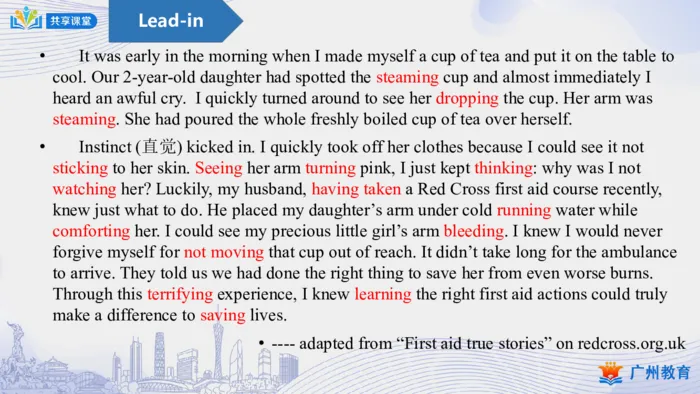
•      It was early in the morning when I made myself a cup of tea and put it on the table to
cool. Our 2-year-old daughter had spotted the steaming cup and almost immediately I
heard an awful cry.  I quickly turned around to see her dropping the cup. Her arm was
steaming. She had poured the whole freshly boiled cup of tea over herself.
•      Instinct (直觉) kicked in. I quickly took off her clothes because I could see it not
sticking to her skin. Seeing her arm turning pink, I just kept thinking: why was I not
watching her? Luckily, my husband, having taken a Red Cross first aid course recently,
knew just what to do. He placed my daughter’s arm under cold running water while
comforting her. I could see my precious little girl’s arm bleeding. I knew I would never
forgive myself for not moving that cup out of reach. It didn’t take long for the ambulance
to arrive. They told us we had done the right thing to save her from even worse burns.
Through this terrifying experience, I knew learning the right first aid actions could truly
make a difference to saving lives.
• ---- adapted from “First aid true stories” on redcross.org.uk
Lead-in
Homework checking--Identifying the function
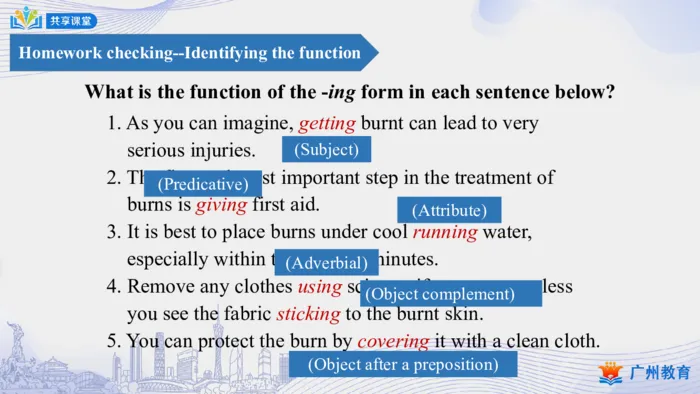
What is the function of the -ing form in each sentence below?
1. As you can imagine, getting burnt can lead to very
    serious injuries.
2. The first and most important step in the treatment of
    burns is giving first aid.
3. It is best to place burns under cool running water,
    especially within the first ten minutes.
4. Remove any clothes using scissors if necessary, unless
    you see the fabric sticking to the burnt skin.
5. You can protect the burn by covering it with a clean cloth.
(Subject)
(Predicative)
(Object after a preposition)
(Attribute)
(Adverbial)
(Object complement)
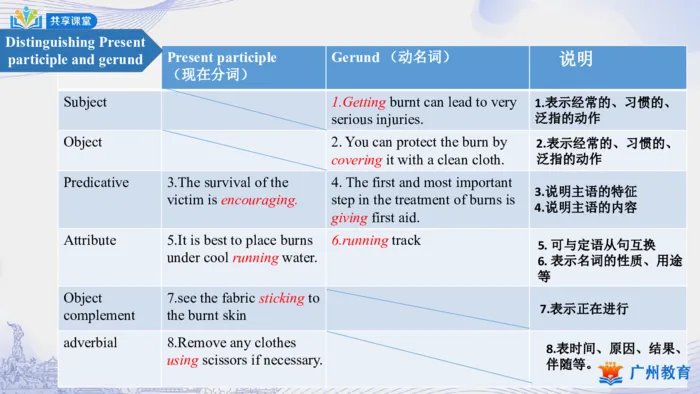
Present participle
(现在分词)
Gerund (动名词)
      说明
Subject
1.Getting burnt can lead to very
serious injuries.
Object
2. You can protect the burn by
covering it with a clean cloth.
Predicative
3.The survival of the
victim is encouraging.
4. The first and most important
step in the treatment of burns is
giving first aid.
Attribute
5.It is best to place burns
under cool running water.
6.running track
Object
complement
7.see the fabric sticking to
the burnt skin
adverbial
8.Remove any clothes
using scissors if necessary.
Distinguishing Present
participle and gerund
1.表示经常的、习惯的、
泛指的动作
2.表示经常的、习惯的、
泛指的动作
3.说明主语的特征
4.说明主语的内容
5. 可与定语从句互换
6. 表示名词的性质、用途
等
7.表示正在进行
8.表时间、原因、结果、
伴随等。
Active voice
Passive voice
Simple
tense
一般式
1. I enjoy talking to people.
2. I enjoy being talked to.
Perfect
tense
完成式
3. He denied having cheated
the poor old man yesterday.
4. The old man denied having been
cheated.
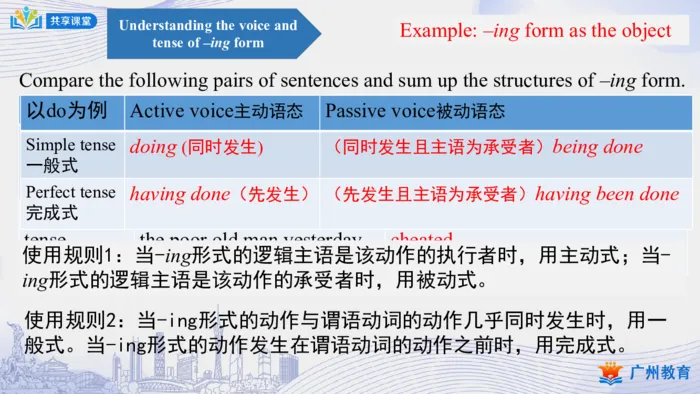
Compare the following pairs of sentences and sum up the structures of –ing form.
Understanding the voice and
tense of –ing form
Example: –ing form as the object
使用规则1:当-ing形式的逻辑主语是该动作的执行者时,用主动式;当-
ing形式的逻辑主语是该动作的承受者时,用被动式。
以do为例
Active voice主动语态
Passive voice被动语态
Simple tense
一般式
doing (同时发生)
(同时发生且主语为承受者)being done
Perfect tense
完成式
having done(先发生)(先发生且主语为承受者)having been done
使用规则2:当-ing形式的动作与谓语动词的动作几乎同时发生时,用一
般式。当-ing形式的动作发生在谓语动词的动作之前时,用完成式。
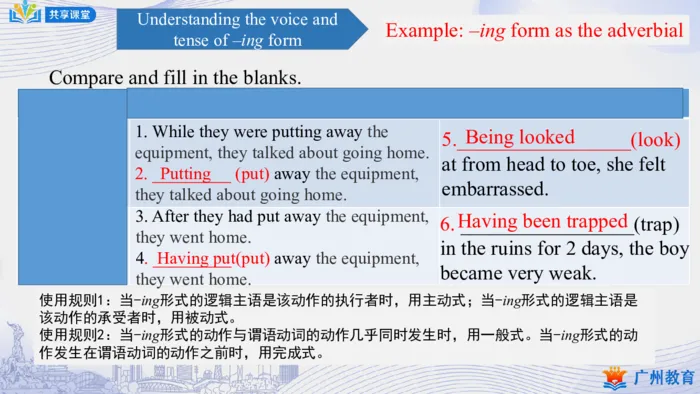
Active voice
Passive voice
Simple tense
一般式
1. While they were putting away the
equipment, they talked about going home.
2. _________ (put) away the equipment,
they talked about going home.
Perfect tense
完成式
Example: –ing form as the adverbial
使用规则1:当-ing形式的逻辑主语是该动作的执行者时,用主动式;当-ing形式的逻辑主语是
该动作的承受者时,用被动式。
使用规则2:当-ing形式的动作与谓语动词的动作几乎同时发生时,用一般式。当-ing形式的动
作发生在谓语动词的动作之前时,用完成式。
Compare and fill in the blanks.
Being looked
Having been trapped
Understanding the voice and
tense of –ing form
5._________________(look)
at from head to toe, she felt
embarrassed.
6. _________________(trap)
in the ruins for 2 days, the boy
became very weak.
Putting
Having put
3. After they had put away the equipment,
they went home.
4. _________ (put) away the equipment,
they went home.
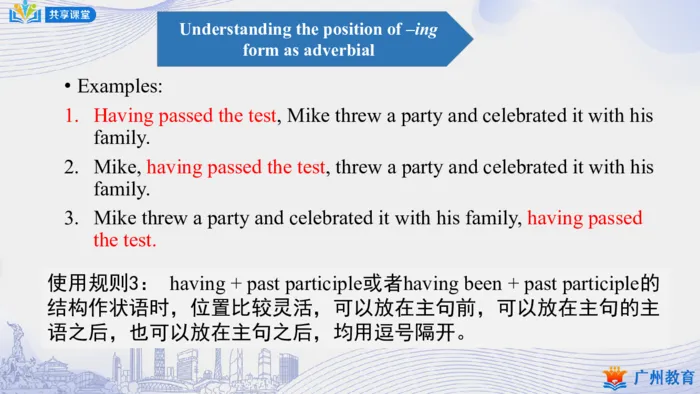
• Examples:
1. Having passed the test, Mike threw a party and celebrated it with his
family.
2. Mike, having passed the test, threw a party and celebrated it with his
family.
3. Mike threw a party and celebrated it with his family, having passed
the test.
Understanding the position of –ing
form as adverbial
使用规则3: having + past participle或者having been + past participle的
结构作状语时,位置比较灵活,可以放在主句前,可以放在主句的主
语之后,也可以放在主句之后,均用逗号隔开。
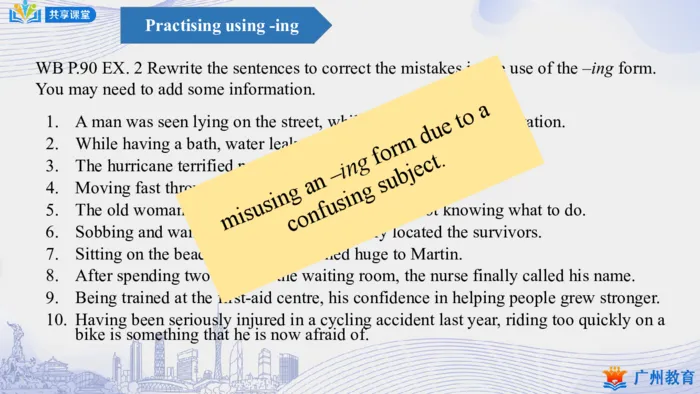
1.
A man was seen lying on the street, while waiting at a subway station.
2.
While having a bath, water leaked over the sides of the tub.
3.
The hurricane terrified people, being driven from their home.
4.
Moving fast through the grass, I saw a snake.
5.
The old woman fell down just in front of Kathy, not knowing what to do.
6.
Sobbing and wailing, the search team finally located the survivors.
7.
Sitting on the beach, the waves seemed huge to Martin.
8.
After spending two hours in the waiting room, the nurse finally called his name.
9.
Being trained at the first-aid centre, his confidence in helping people grew stronger.
10. Having been seriously injured in a cycling accident last year, riding too quickly on a
bike is something that he is now afraid of.
WB P.90 EX. 2 Rewrite the sentences to correct the mistakes in the use of the –ing form.
You may need to add some information.
Practising using -ing
misusing an –ing form due to a
confusing subject.
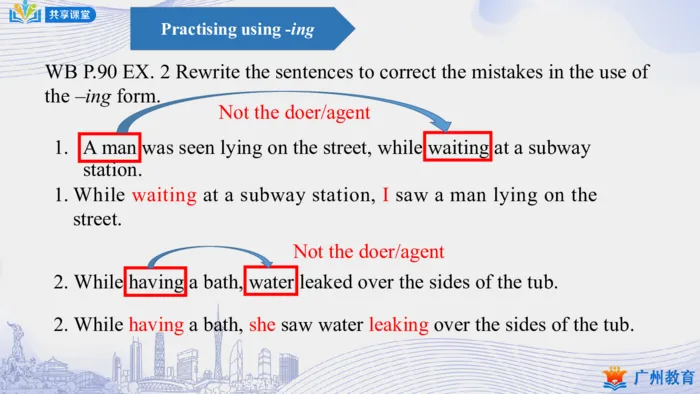
1. A man was seen lying on the street, while waiting at a subway
station.
Not the doer/agent
1. While waiting at a subway station, I saw a man lying on the
street.
WB P.90 EX. 2 Rewrite the sentences to correct the mistakes in the use of
the –ing form.
2. While having a bath, water leaked over the sides of the tub.
Not the doer/agent
2. While having a bath, she saw water leaking over the sides of the tub.
Practising using -ing
3. The hurricane terrified people, being driven from their home.
Not the doer/agent
3. Being driven from their homes, people were terrified by the hurricane.
WB P.90 EX. 2
4. Moving fast through the grass, I saw a snake.
Not the doer/agent
4. I saw a snake moving fast through the grass.
5. The old woman fell down just in front of Kathy, not knowing what to
do.
Not the doer/agent
5. Kathy looked at the old woman who fell down just in front of her, not
knowing what to do.
WB P.90 EX. 2
6. Sobbing and wailing, the search team finally located the survivors.
Not the doer/agent
6. Sobbing and wailing, the survivors were finally located by the search team.
=The survivors were finally located by the search team, sobbing and wailing.
7. Sitting on the beach, the waves seemed huge to Martin.
Not the doer/agent
7. Sitting on the beach, Martin found the waves were huge.

WB P.90 EX. 2
8. After spending two hours in the waiting room, the nurse finally called
his name.
Not the doer/agent
8. After spending two hours in the waiting room, finally he heard his
name being called.
9. Being trained at the first-aid centre, his confidence in helping people
grew stronger.
Not the doer/agent
9. Having been trained at the first-aid center, he became more confident in
helping people.
WB P.90 EX. 2
10. Having been seriously injured in a cycling accident last year, riding
too quickly on a bike is something that he is now afraid of.
Not the doer/agent
10. Having been seriously injured in a cycling accident last year, he is
now afraid of riding too quickly on a bike.
Example: –ing form as the subject
使用规则4:-ing形式作主语时,没有时态的变化,只有语态的变化。
Compare and fill in the blank.
Active voice
Passive voice
1.Inviting the guests is the most
important task in preparing a party.
2. ____________ (invite) to the
party made Mike excited.
Being invited
Understanding the voice and
tense of –ing form
Having been invited
Example: –ing form as
the object complement
使用规则5:-ing形式作宾语补足语时,没有having + past participle或者
having been + past participle的用法。
Compare and tell the differences.
1. I saw him come upstairs.
2. I heard him coming upstairs.
3. I heard my name being called.
4. I heard my name having been called.
Understanding the voice and
tense of –ing form
4.  I heard my name having been called.
Understanding the voice and
tense of –ing form
Example: –ing form
as the attribute
使用规则6:-ing形式作定语时,没有having + past participle或者
having been + past participle的用法。
Compare and tell the differences.
1. The person holding the meeting is our headteacher.
2. The issue being discussed is about the canteen in our school.
3. The issue having been discussed is about the canteen in our
school.
3.  The issue having been discussed is about the canteen in our
school.
使用规则7: 在–ing 形式前面加上not,即构成其否定式。
Understanding the negative
of –ing form
1. Not being invited to the party made her upset.
2. I am sorry for not finishing my assignment on time.
3. Not knowing the risk, I pressed the button.
4. Not having arranged the notes well, she didn’t know where to start.
Observe the following sentences and find out what they have in common.
1. She hates _____________ (tell) others what to do.
2. She hates _____________ (tell) what to do.
3. She is happy about __________________ (choose) Mike for the job.
4. Mike is excited about _________________ (choose) for the job.
5. ________________ (see) the customer choking, the waiter remained calm
and reacted immediately.
6. _________________(see) the movie before, she knew what the professor
was talking about.
7. _________________ (run) a marathon, I can give you some tips.
telling
being told
having chosen
having been chosen
Practising using –ing form
Exercise:
Seeing
Having seen
Having run
使用规则8:根据语境中的显性或者隐性提示判断-ing 的正确形式。
1.It is best to place burns under cool
running water, especially within the
first ten minutes.
2.It is best to run some cool water and
place burns under it, especially within
the first ten minutes.
3.Remove any clothes using scissors
if necessary, unless you see the fabric
sticking to the burnt skin.
4.Use scissors to remove any clothes
if necessary, unless you find that the
fabric is sticking to the burnt skin.
5.You can protect the burn by
covering it with a clean cloth.
6.To protect the burnt area, you can
cover it with a loose clean cloth.
Rewrite the sentences on the left column without using
–ing form, and then compare the differences.
Understanding the
meaning of –ing form
-ing form 常用于书面语中,它使表达简洁达意、逻辑清晰、语言更丰富。
• TB P.53 EX. 2  Replace each underlined part with a  suitable –ing form and
rewrite the sentence as necessary.
1. When he got out of the bathtub, he slipped and fell on the floor.
2. Is there any reason why we are not going to have the first-aid training this week?
3. She had been told about the risk of electric shocks and this made her very
careful while using hairdryers.
4. Because the child was not watched carefully by his parents, he touched a hot
iron and burnt his finger.
5. After she had been bitten by mosquitoes, she applied some medicine to her skin.
Practising using –ing form
• TB P.53 EX. 2
1. When he got out of the bathtub, he slipped and fell on the floor.
• When getting out of the bathtub, he slipped and fell on the floor.
2. Is there any reason why we are not going to have the first-aid training
this week?
• Is there any reason for not having the first-aid training this week?
Practise using –ing form
3. She had been told about the risk of electric shocks and this made her very careful
while using hairdryers.
• Having been told about the risk of electric shocks, she was very careful while using
hairdryers.
4. Because the child was not watched carefully by his parents, he touched a hot iron and
burnt his finger.
• Not being watched carefully by his parents, the child touched a hot iron and burnt his
finger.
5. After she had been bitten by mosquitoes, she applied some medicine to her skin.
• After being/ having been bitten by mosquitoes, she applied some medicine to her skin.
TB P.53 EX. 2
Practise using –ing form
Mrs Taylor was an elderly woman ______ (live) alone. One day, she
was in her living room cleaning the windows, when suddenly she could
no longer feel the right side of her body. _____ (try) to walk to her sofa
to sit down, she fell over onto the carpet. Then she realised that she
could not get up, and that she was having trouble ________ (breathe).
Fortunately, she had her mobile phone with her, and she was able to
reach it with her left hand while  _____ (lie) on the floor. Her mobile
phone _______________ (already, set up) to call an emergency number
at the push of a button, so it was easy to call for help.
living
Trying
breathing
lying
was already set up
TB P.53 EX.3 Complete the passage with the correct forms of the given
words. Identify the function of each –ing form. What happened to Mrs.
Taylor?
Practise using –ing form
in contexts
attribute
adverbial
Object of prep.
adverbial
predicate
While attempting to talk to the operator, Mrs Taylor discovered that
she could not speak. _________ (not, hear) an answer, the operator
knew that Mrs Taylor must be in trouble. Telling Mrs Taylor that
everything would be OK, she immediately sent an ambulance. After
________ (arrive), the ambulance team quickly found Mrs Taylor
and without delay gave her oxygen, put in an IV needle, and checked
her vital signs. ________________ (take) to the hospital and treated
immediately, Mrs Taylor's health was in no great danger, though she
had to stay in the hospital ward. After a week, her __________
(frighten) experience was over, and she was allowed to go home.
Not hearing
arriving
Having been taken
frightening
Practise using –ing form in
contexts
adverbial
Object of prep.
adverbial
attribute
What happened to Mrs. Taylor?
Introduction
Rising action
Falling action
Resolution
Climax
Practise retelling the story
using –ing form
living alone
cleaning, no longer feel
trying, fell
having trouble breathing
reached, lying
attempting, not speak
not hearing, knew
telling, sent
arriving, found
Having been taken and treated
frightening, over
以do为例
Active voice主动语态
Passive voice被动语态
Simple tense一般式
doing
being done
Perfect tense 完成式
having done
having been done
Summary
1.现在分词可作表语、定语、宾补、状语,动名词可作主语、宾语、表语、定语,
两者所表示的意义不同。
2.-ing形式有语态,其逻辑主语如果是该动作的执行者,用主动语态,是承受者,
则用被动语态。
3.-ing形式有时态,如果-ing形式的动作与主句谓语动词的动作同时发生,则用
一般式,如果先于主句谓语发生,则用完成式。在判断时可借助显性的时间标
志,如before, for +一段时间,many times, yesterday等,有时则根据语境意义的
隐性提示。
4.-ing形式在句中充当不同成分时,其用法、时态和语态有所不同。
Homework
1. Review the notes on the form and use of –ing form.
2. Finish WB P. 90 Ex. 3. Then identify the functions of all the
–ing form in the story. Lastly retell the story.
In the next period, you will retell the story to your classmates to
see if you can describe it concisely and logically.
Thank  you!
高二—人教版—英语—选择性必修二第五单元
Unit 5 First Aid
Lesson 3: Discover useful structures
答疑
广东广雅中学 郑舜芝
It is/was no good/use doing…
It is/was worth/worthwhile doing…
It is a waste of time doing…
There is/was no point doing…
2. 只能后接动名词作宾语的动词, 常见的有:
avoid, consider, enjoy, keep, finish, suggest, dislike, delay, escape,
cannot help, imagine, mind, miss, practise, cannot stand等。
1. 常用-ing 形式作主语的句型
3. “-ing 形式” 在少数表示“需要”的动词(want, need,
require, deserve, desire ...) 后表示被动意义。
Notes for the use of –ing form
4. 既可接动名词又可接不定式作宾语的动词
A.接doing 和to do意思基本相同的常见的有:
   like, love, hate, prefer, continue, begin/start
B.接doing 和to do意思不同的常见的有:
   forget, remember, regret, try, mean, go on, cannot help, be used to, stop
5. 能用-ing形式作宾语补足语的几类动词:
A. 表示感觉和心理状态的动词, 常见的有see, hear,
     feel, smell, find, notice, observe, look at, listen to等。
B. 表示指使意义的动词, 常见的有 have, set, keep, get, catch, leave等。
Notes for the use of –ing form
• 作主语:2、13、21、24、44题
• 作定语:9、15、17、19、32、33、34、39、42题
• 作宾语:4、5、6、7、8、10、16、18、28、31、41、47、52、53题
• 作宾补:25、37、43、48、49、51题
• 作状语:1、3、11、12、14、20、22、23、26、27、29、30、35、36、
38、40、45、46、50、54、55、56、57、58、59、60题
-ing形式配套高考练习
8. (2016浙江) I had as much fun sailing the seas as I now do ________ (work)
with students.
9. (2015全国卷Ⅰ)  Abercrombie & Kent,a travel company in Hong Kong,
says it regularly arranges quick getaways here for people ________(live) in
Shanghai and Hong Kong.
11. (2015重庆) Like ancient sailors, birds can find their way_________(use)
the sun and the stars.
16. (2014北京卷) The film star wears sunglasses. Therefore, he can go
shopping without ______________(recognize).
29. (2012福建卷) Pressed from his parents, and ___________(realize) that he
has wasted too much time , the boy is determined to stop playing video games.
-ing形式配套高考练习
working
living
using
being recognized
realizing
Vocabulary Expansion
operator
 a person who connects telephone calls at the telephone exchange or in
a place such as an office or hotel. 电话接线员
e.g. He dialled the operator and put in a call for Rome.
他拨了接线员的号,让他接通一个到罗马的电话。
ambulance
 a vehicle for taking people to and from hospital. 救护车
e.g. An ambulance dashed to the scene of the accident.
救护车风驰电掣赶往事故现场。
delay
 If you delay doing something, you do not do it immediately or at the
planned or expected time, but you leave it until later.  使延期,推迟
e.g. For the unfinished job, I wanted to delay my departure until June.
因为一些没完成的工作,我想把离开的日期延迟至6月。
ward
A room in a hospital which has beds for many people, often people who
need similar treatment. 病房
e.g. A toddler was admitted to the emergency ward with a wound in his
chest.
一个蹒跚学步的小孩因为胸部受伤被送进急救室。
Lines 1-2: Last night there was a
big storm, bringing high winds
and blowing roofs off houses.
Lines 4-5: While going to school,
Peter noticed a young boy lying in
the road …
Lines 6-7: Not moving, the boy
looked dead …
Workbook P90 Ex. 3
Lines 14-15: Going back into the
street, he saw the man using a
long piece of wood …
Lines 16-17: Having been freed
of the power line, the boy was
picked up…
Lines 28-29: Peter felt happy when
he saw the medics lifting the boy,
now talking, into the ambulance.
Workbook P90 Ex. 3