高二—人教版—英语—选择性必修二第五单元
广东广雅中学 姚超楠
UNIT 5  FIRST AID
Lesson 4: Using language--Listening and Speaking
At the end of this lesson, you will be able to:
1. tell the emergency numbers in different countries.
2. identify some common medical emergencies.
3. make an emergency call.
4. give and follow first-aid instructions for rescuing a
drowning victim.
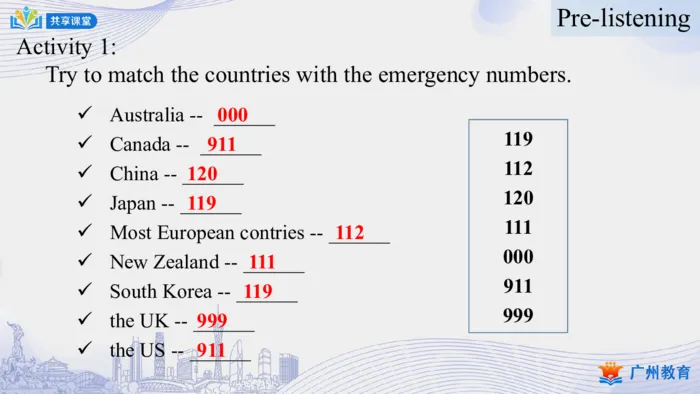
Activity 1:
     Try to match the countries with the emergency numbers.
ü
Australia --  ______
ü
Canada --  ______
ü
China -- ______
ü
Japan -- ______
ü
Most European contries -- ______
ü
New Zealand -- ______
ü
South Korea -- ______
ü
the UK -- ______
ü
the US -- ______
       000
     911
 120
 119
                              112
             111
            119
   999
   911
Pre-listening
119
112
120
111
000
911
999
     Have you ever called 120? If so, what happened?
Pre-listening
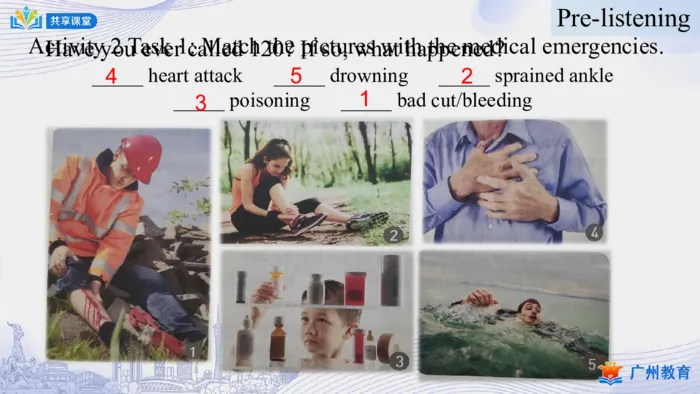
Activity 2 Task 1: Match the pictures with the medical emergencies.
_____ heart attack      _____ drowning      _____ sprained ankle
_____ poisoning      _____ bad cut/bleeding
3
1
2
4
5
Pre-listening
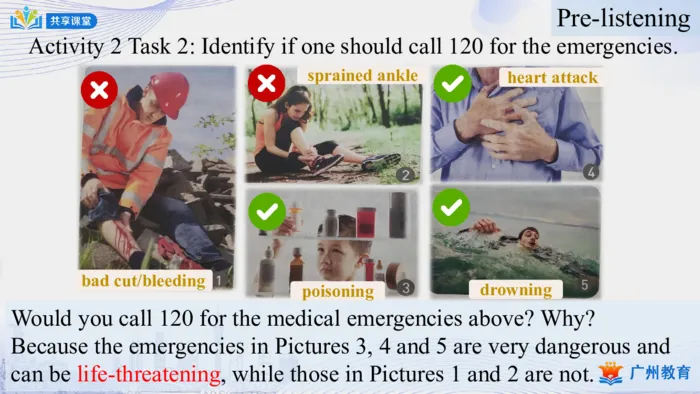
Activity 2 Task 2: Identify if one should call 120 for the emergencies.
Would you call 120 for the medical emergencies above? Why?
Because the emergencies in Pictures 3, 4 and 5 are very dangerous and
can be life-threatening, while those in Pictures 1 and 2 are not.
bad cut/bleeding
sprained ankle
poisoning
heart attack
drowning
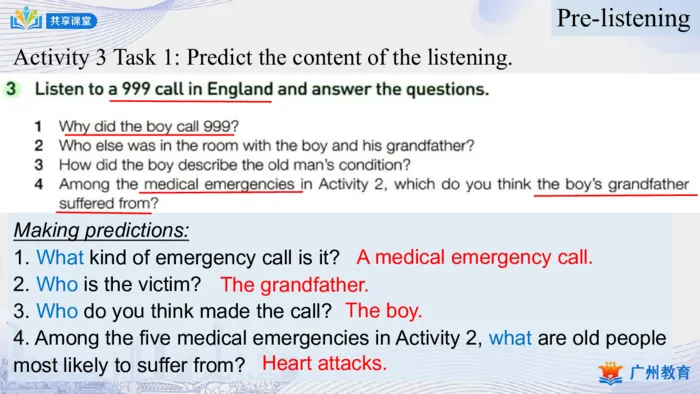
Activity 3 Task 1: Predict the content of the listening.
Making predictions:
1. What kind of emergency call is it?
2. Who is the victim?
3. Who do you think made the call?
4. Among the five medical emergencies in Activity 2, what are old people
most likely to suffer from?
A medical emergency call.
The grandfather.
The boy.
Heart attacks.
Pre-listening
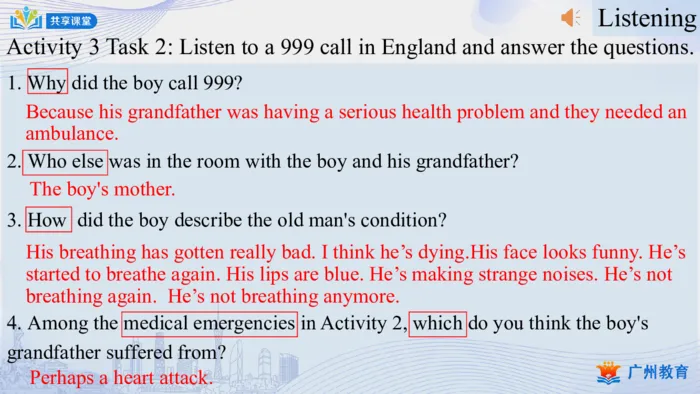
Activity 3 Task 2: Listen to a 999 call in England and answer the questions.
1. Why did the boy call 999?
2. Who else was in the room with the boy and his grandfather?
3. How  did the boy describe the old man's condition?
4. Among the medical emergencies in Activity 2, which do you think the boy's
grandfather suffered from?
The boy's mother.
Because his grandfather was having a serious health problem and they needed an
ambulance.
His breathing has gotten really bad. I think he’s dying.His face looks funny. He’s
started to breathe again. His lips are blue. He’s making strange noises. He’s not
breathing again.  He’s not breathing anymore.
Perhaps a heart attack.
Listening
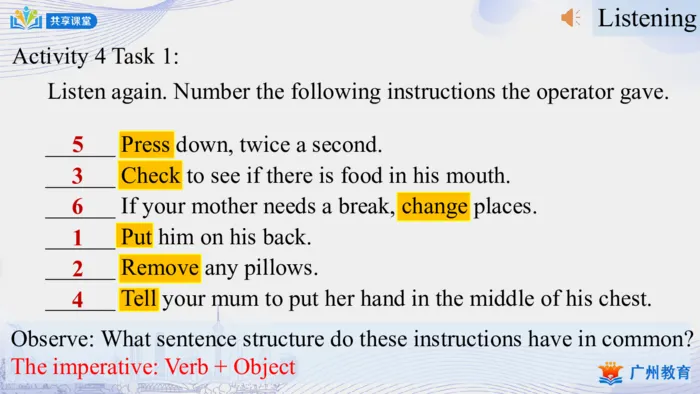
Observe: What sentence structure do these instructions have in common?
The imperative: Verb + Object
Activity 4 Task 1:
      Listen again. Number the following instructions the operator gave.
Listening
______ Press down, twice a second.
______ Check to see if there is food in his mouth.
______ If your mother needs a break, change places.
______ Put him on his back.
______ Remove any pillows.
______ Tell your mum to put her hand in the middle of his chest.
5
3
6
1
2
4
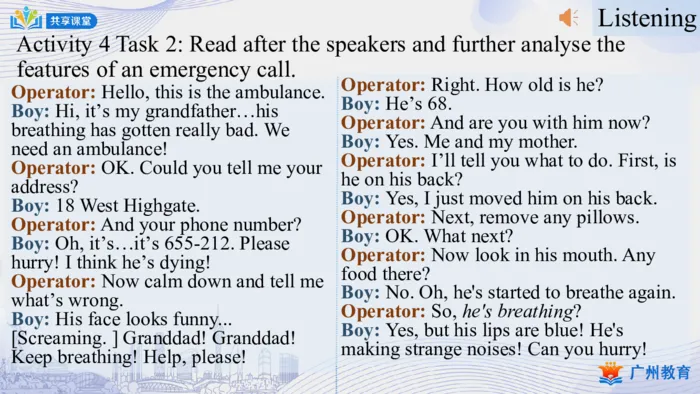
Operator: Hello, this is the ambulance.
Boy: Hi, it’s my grandfather…his
breathing has gotten really bad. We
need an ambulance!
Operator: OK. Could you tell me your
address?
Boy: 18 West Highgate.
Operator: And your phone number?
Boy: Oh, it’s…it’s 655-212. Please
hurry! I think he’s dying!
Operator: Now calm down and tell me
what’s wrong.
Boy: His face looks funny...
[Screaming. ] Granddad! Granddad!
Keep breathing! Help, please!
Operator: Right. How old is he?
Boy: He’s 68.
Operator: And are you with him now?
Boy: Yes. Me and my mother.
Operator: I’ll tell you what to do. First, is
he on his back?
Boy: Yes, I just moved him on his back.
Operator: Next, remove any pillows.
Boy: OK. What next?
Operator: Now look in his mouth. Any
food there?
Boy: No. Oh, he's started to breathe again.
Operator: So, he's breathing?
Boy: Yes, but his lips are blue! He's
making strange noises! Can you hurry!
Activity 4 Task 2: Read after the speakers and further analyse the
features of an emergency call.
Listening
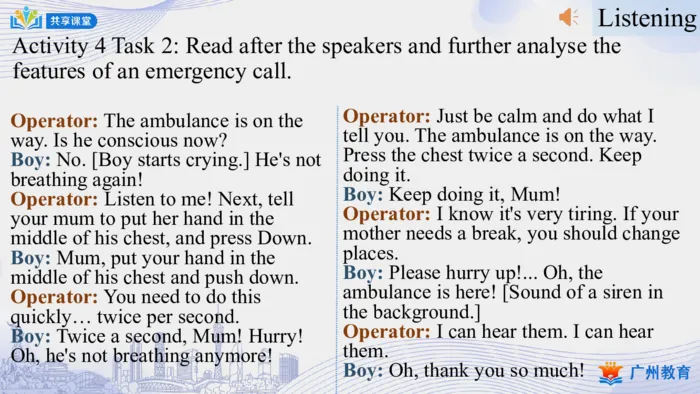
Operator: The ambulance is on the
way. Is he conscious now?
Boy: No. [Boy starts crying.] He's not
breathing again!
Operator: Listen to me! Next, tell
your mum to put her hand in the
middle of his chest, and press Down.
Boy: Mum, put your hand in the
middle of his chest and push down.
Operator: You need to do this
quickly… twice per second.
Boy: Twice a second, Mum! Hurry!
Oh, he's not breathing anymore!
Operator: Just be calm and do what I
tell you. The ambulance is on the way.
Press the chest twice a second. Keep
doing it.
Boy: Keep doing it, Mum!
Operator: I know it's very tiring. If your
mother needs a break, you should change
places.
Boy: Please hurry up!... Oh, the
ambulance is here! [Sound of a siren in
the background.]
Operator: I can hear them. I can hear
them.
Boy: Oh, thank you so much!
Activity 4 Task 2: Read after the speakers and further analyse the
features of an emergency call.
Listening
Operator: Hello, this is the ambulance.
Boy: Hi, it’s my grandfather…his
breathing has gotten really bad. We need
an ambulance!
Operator: OK. Could you tell me your
address?
Boy: 18 West Highgate.
Operator: And your phone number?
Boy: Oh, it’s…it’s 655-212. Please
hurry! I think he’s dying!
Operator: Now calm down and tell me
what’s wrong.
Boy: His face looks funny...
[Screaming. ] Granddad! Granddad!
Keep breathing! Help, please!
Operator: Right. How old is he?
Boy: He’s 68.
Operator: And are you with him now?
Boy: Yes. Me and my mother.
Operator: I’ll tell you what to do. First, is
he on his back?
Boy: Yes, I just moved him on his back.
Operator: Next, remove any pillows.
Boy: OK. What next?
Operator: Now look in his mouth. Any
food there?
Boy: No. Oh, he's started to breathe again.
Operator: So, he's breathing?
Boy: Yes, but his lips are blue! He's
making strange noises! Can you hurry!
location and phone number
descriptions of the symptoms
Activity 4 Task 2: Read after the speakers and further analyse the
features of an emergency call.
Listening
adverbs of sequence
Operator: The ambulance is on the way.
Is he conscious now?
Boy: No. [Boy starts crying.] He's not
breathing again!
Operator: Listen to me! Next, tell your
mum to put her hand in the middle of his
chest, and press Down.
Boy: Mum, put your hand in the middle
of his chest and push down.
Operator: You need to do this
quickly… twice per second.
Boy: Twice a second, Mum! Hurry! Oh,
he's not breathing anymore!
Operator: Just be calm and do what I
tell you. The ambulance is on the way.
Press the chest twice a second. Keep
doing it.
Boy: Keep doing it, Mum!
Operator: I know it's very tiring. If your
mother needs a break, you should change
places.
Boy: Please hurry up!... Oh, the
ambulance is here! [Sound of a siren in
the background.]
Operator: I can hear them. I can hear
them.
Boy: Oh, thank you so much!
Activity 4 Task 2: Read after the speakers and further analyse the
features of an emergency call.
Listening
adverbs of sequence
Activity 4:
Listening
       Follow instructions
When giving commands, people usually use the imperative. It’s
simple and clear. To help the listeners follow what to do next, they
use words such as first, next, then, after that, and finally. When
listening to instructions in English, you should:
• listen carefully and don’t panic.
• follow the order of the instructions given to you.
• answer any questions simply and directly when asked.
v.(使)惊慌;n.惊恐,惊慌
Speaking
Activity 5: Try to answer the following questions.
1. How did the operator keep the boy calm?
By telling him to calm down and calmly asking him questions.
2. What did the operator do to make this call a success?
She asked only the questions necessary to clearly find out the problem, and then
she provided short and clear instructions as to what to do.
3. What do you think happened after the ambulance arrived?
The doctors continued to provide CPR, took some blood pressure tests and
temperature checking, while they transported him to the hospital.
Activity 6: Try to describe what is going on in each picture.
Speaking
Activity 6: Try to describe what is going on in each picture.
Speaking
Picture 1: lay the victim on his back
                pat his shoulders
                check for a response
Picture 2: call for an ambulance
Picture 3: check to see if he is breathing
Activity 6: Try to describe what is going on in each picture.
Speaking
Picture 4: lift up his chin
                remove any grass or sand from his mouth
Picture 5: perform mouth-to-mouth rescue breathing
                cover his mouth
                blow air in
Picture 6: perform CPR
                push down on the centre of his chest
Speaking
Activity 7:
       Make a telephone call to your friend and role-play an emergency
call with him or her. One of you will be the friend of a drowning victim
(Student A), and the other will be a telephone operator (Student B)
giving first-aid instructions. Use the pictures and useful expressions
you have learnt in this lesson to help you.
Key points:
location and telephone number, description of the symptoms, giving
instructions by using the imperative and adverbs for sequence
SAMPLE CONVERSATION
[ Recorded by Jiang Jinxing(江锦星) and Chen Yanming(陈彦鸣) from
Guangdong Guangya High School ]
Speaking
O: Hello, this is emergency.
B: Hi, it's my friend. We are at the swimming pool and I think he's drowning.
     We need an ambulance!
O: OK. Could you tell me your address?
B: We are at the pond in Zhongshan Park.
O: And your phone number?
B: Oh, it's... it's ×××-××××-××××. Please hurry! I think he's dying!
O: And are you with him now?
B: Yes.
O: I'll tell you what to do. First, is he on his back?
B: No, he's on his side.
O: Well, you'll need to roll him over then. Can you do that?
B: OK. What next?
O: Now check for a response. When you call to him, does he answer?
B: No!
O: So, is he breathing?
O = Operator     B=Boy
B: No!
O: Does he have a pulse? Is his heart beating?
B: Let me check ... no!
O: Listen to me! Turn his head to the side, and then put your finger in his mouth to
     make sure that there is nothing in it.
B: OK ... I've done that.
O: Now turn his head back up, and lift his chin back.
B: Yes, OK.
O: Just be calm and do what I tell you next. The ambulance is on the way. Breathe
     into his moth until his chest rises. Do this twice.
B: OK ... now what?
O: Now push down on the middle of his chest really hard and really fast. Every
     thirty pushes, stop and give him two more breaths.
B: That's it?
O: Yes, keep doing this until the ambulance arrives. And don't hang up the phone!
     I'll be right here if you need more help. The ambulance is on its way.
B: OK!
SAMPLE CONVERSATION
[ Recorded by Jiang Jinxing(江锦星) and Chen Yanming(陈彦鸣) from
Guangdong Guangya High School ]
Speaking
O = Operator     B=Boy
What we have learned today
1. The emergency numbers in different countries.
2. The names of some common medical emergencies.
3. How to make an emergency call.
4. How to give and follow first-aid instructions for rescuing a
drowning victim.
Ø Review the medical emergencies we have learnt in class
and the first-aid procedures to save a drowning victim.
Ø Finish Exercise 1 on P89.
Ø Search for more first-aid treatments online.
Homework
高二—人教版—英语—选择性必修二第五单元
UNIT 5  FIRST AID
Lesson 4: Using language--Listening and Speaking
答 疑
广东广雅中学 姚超楠
Vocabulary Expansion
Names of some
medical emergencies
突发事件
Emergency
突发事件
Emergency
心脏病发作
烧伤
溺水
划伤,割伤
扭伤脚踝
哽噎
中毒
毒蛇咬伤
流血
中暑
流鼻血
手臂骨折
heart attack
drowning
sprained ankle
poisoning
bleeding
nosebleed
burn
cut
choking
snake bite
sunstroke
broken arm
Talking about emergencies
Emergency
Cause
Result
Solution
burn
cut
sprained
ankle
acid
blister
special scream
knife
bleeding
bandage
slip over
something          swollen, bruise
ice pack
bike accident
painful
X-ray, plaster
and a sling
broken arm
Complete the table by using the words in the box below it. (Page 89)
knife     swollen     slip over something     bandage     acid
plaster and a sling     bleeding     painful     special cream
blister     broken arm     bruise     ice pack     X-ray
drown

[v.] to die because one has been underwater too long and cannot
breathe; to kill sb in this way(使)淹死,溺死
• The boy fell into the river and drowned.
 这个男孩落水溺亡。
• He tried to drown himself but failed.
 他投水自杀未遂。
drown your fears/loneliness/sorrows
借酒壮胆/ 借酒解寂寞/借酒浇愁
sprain

[v.] to injure a joint in your body, especially your wrist or ankle,
by suddenly twisting it 扭伤(关节)
• He fell and sprained his ankle.
他跌了一跤,扭伤了脚踝。

[n.] the injury caused by spraining a joint 扭伤
•She is suffering a right ankle sprain.
她右脚踝扭伤了。
bleed

[v.] to lose blood; to force sb to pay a lot of money over a period of
time流血;长期榨取(某人的钱)
• His left leg is bleeding.
他的左腿在出血。
• The workers have been bled by their boss in the past decade.
在过去十年里,工人们被老板榨尽了钱财。
bleed to death
失血而亡
panic

[v.] to suddenly feel anxious or afraid, and act quickly and
without thinking carefully (使)惊慌,惊慌失措
panic -- panicked -- panicked
• I panicked when I saw smoke coming out of the engine.
我看见发动机冒烟时,吓得手足无措。
[n.] a very strong feeling of anxiety or fear that makes people act
without thinking carefully 惊慌
• They were in a state of panic.
他们惊恐万状。
Giving first-aid instructions
Useful verbs or verb phrases in giving instructions.
1. 放置 __________________
2. 拍打 __________________
3. 检查 __________________
4. 打电话叫 __________________
5. 抬起 __________________
6. 拿开 __________________
7. 实施(急救) __________________
8. 吹气 __________________
9. 按压 __________________
             lay
             pat
           check
                  call for ...
            lift up
           remove
             perform (first aid)
          blow air
push down/press down