高二—人教版—英语—选择性必修二第五单元
广东广雅中学 周晓盈
Unit 5 FIRST AID
Lesson 5 Reading for Writing
In this lesson, you will be able to:
1. Learn about the procedure of performing Heimlich manoeuvre;
2. Identify the structure and languages of a narrative essay;
3. Write a narrative essay about providing first-aid.

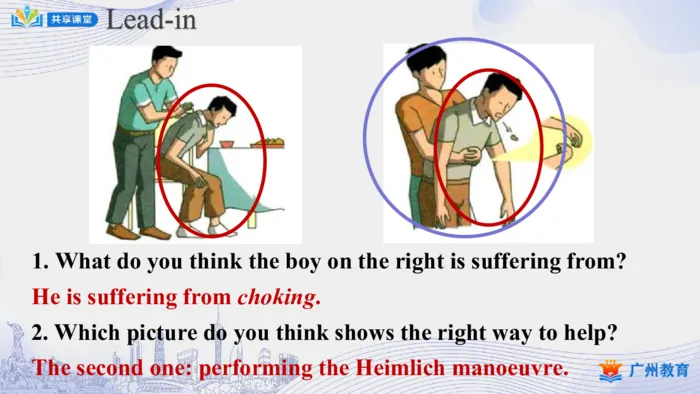
1. What do you think the boy on the right is suffering from?
He is suffering from choking.
2. Which picture do you think shows the right way to help?
The second one: performing the Heimlich manoeuvre.
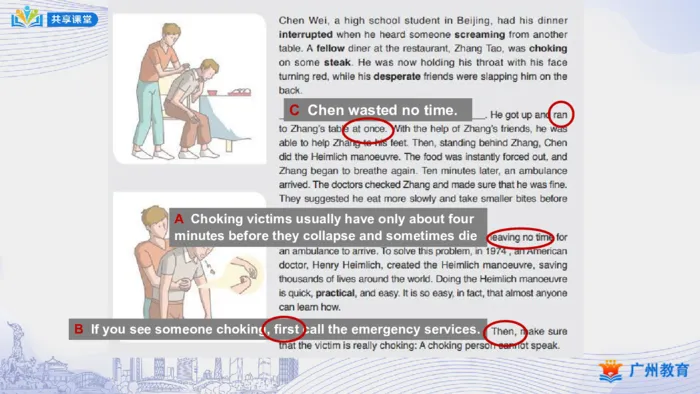
Read the article and put A–E (on Page 57) in the correct
places in the text.
1. Which sentence in each paragraph is missing?
The first sentence.
2. What function does the first sentence usually serve?
It serves to introduce the main idea of a paragraph or link
up ideas between paragraphs.
Please don’t
forget to find out
the evidence for
your choices.
C  Chen wasted no time.
A  Choking victims usually have only about four
minutes before they collapse and sometimes die
B  If you see someone choking, first call the emergency services.
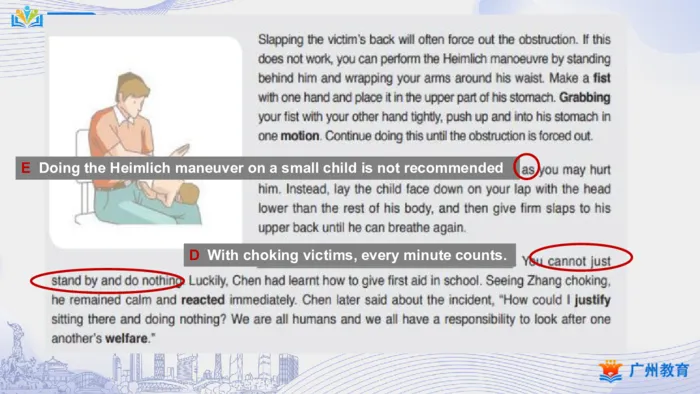
E  Doing the Heimlich maneuver on a small child is not recommended
D  With choking victims, every minute counts.
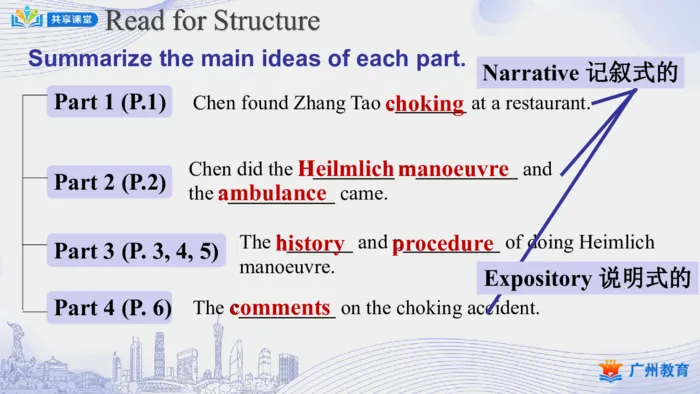
Summarize the main ideas of each part.
Part 1 (P.1)
Part 2 (P.2)
Part 3 (P. 3, 4, 5)
Part 4 (P. 6)
Chen found Zhang Tao c               at a restaurant.
The h              and p                    of doing Heimlich
manoeuvre.
Chen did the H                 m                     and
the a                      came.
The c                    on the choking accident.
choking
Heilmlichmanoeuvre
ambulance
history
procedure
comments
Narrative 记叙式的
Expository 说明式的
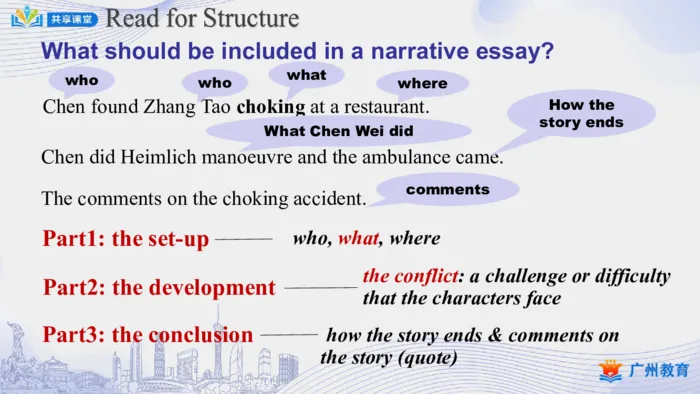
What should be included in a narrative essay?
Chen found Zhang Tao choking at a restaurant.
Chen did Heimlich manoeuvre and the ambulance came.
The comments on the choking accident.
who
who
where
what
How the
story ends
comments
Part1: the set-up
Part2: the development
who, what, where
the conflict: a challenge or difficulty
that the characters face
Part3: the conclusion
 how the story ends & comments on
the story (quote)
What Chen Wei did
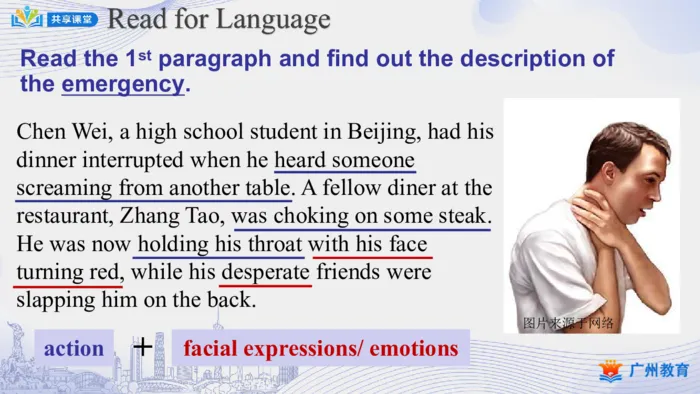
Chen Wei, a high school student in Beijing, had his
dinner interrupted when he heard someone
screaming from another table. A fellow diner at the
restaurant, Zhang Tao, was choking on some steak.
He was now holding his throat with his face
turning red, while his desperate friends were
slapping him on the back.
Read the 1st paragraph and find out the description of
the emergency.
action
+
facial expressions/ emotions
图片来源于网络
Chen wasted no time. He got up and ran to Zhang’s table at
once. With the help of Zhang’s friends, he was able to help
Zhang to his feet. Then, standing behind Zhang, Chen did the
Heimlich manoeuvre.
Read the 2nd paragraph and find out the verbs used to
describe Chen’s reaction.
help sb to his/her feet: help sb stand up
What did the underlined verbs show about Chen’s reaction?
His help was quick, timely (及时的) and professional.
If you see someone choking, first call the emergency services.
Then, make sure that the victim is really choking: A choking
person cannot speak. Slapping the victim’s back will often
force out the obstruction. If this does not work, you can
perform the Heimlich manoeuvre by standing behind him and
wrapping your arms around his waist. Make a fist with one
hand and place it in the upper part of his stomach. Grabbing
your fist with your other hand tightly, push up and into his
stomach in one motion. Continue doing this until the
obstruction is forced out.
Read the 4th and find out the verbs used to describe how to deal
with choking.
Before Heimlich manoeuvre
• Call the emergency
• Make sure that…
• Slap the victim’s back
Performing Heimlich
manoeuvre
• Stand behind him
• Wrap your arms…
• Make a fist and place it…
• Grab your fist
• Push up and into…
Read the 5th paragraph and find out how to perform
Heimlich manoeuvre on a small child.
Doing the Heimlich maneuver on a small child is not recommended,
as you may hurt him. Instead, lay the child face down on your lap
with the head lower than the rest of his body, and then give firm
slaps to his upper back until he can breathe again.
precise (精确的) action +
precise position
Situations
Verbs used
Others
Emergency
Reaction
How to perform
Heimlich manoeuvre
How to perform
Heimlich manoeuvre
on a small child
• Hear sb screaming
• Choke on some steak
• Hold his throat
• His face turning red (facial
expressions)
• Desperate (emotions)
• Got up and ran
• Help Zhang to his feet
• Stand before
•
Stand behind
•
Wrap your arms around his waist
•
Make a fist and grab your fist
•
Push up and into his stomach
•
Continue doing this
Before Heimlich manoeuvre:
•
Call the emergency
•
Make sure that…
•
Slap the victim’s back
•
Lay the child
•
Give firm slaps
Position:
•
Face down on your lap
•
With head lower than…
•
To his upper back
Use precise verbs and add other details
Read the 1st paragraph and find out how the author
linked the sequential (按顺序的) actions or events.
Chen Wei, a high school student in Beijing, had his
dinner interrupted when he heard someone screaming
from another table. A fellow diner at the restaurant,
Zhang Tao, was choking on some steak. He was now
holding his throat with his face turning red, while his
desperate friends were slapping him on the back.
Read the 2nd paragraph and find out how the author linked
the sequential (按顺序的) verbs.
Chen wasted no time. He got up and ran to Zhang’s table at once.
With the help of Zhang’s friends, he was able to help Zhang to his
feet. Then, standing behind Zhang, Chen did the Heimlich
manoeuvre. The food was instantly forced out, and Zhang began to
breathe again. Ten minutes later, an ambulance arrived. The doctors
checked Zhang and made sure that he was fine. They suggested he
eat more slowly and take smaller bites before they left.
Types
Examples from the text
More examples
Adverbial
Adverbial
Clauses
V. ing-form
• Now
• At once
• Then,…
• Instantly
• Again
• Ten minutes later
• Immediately,
• Before/after that
• Soon,…
…
• when + instant action
• while + continuous action
• before + sentence
• after + sentence
• until + sentence
• as soon as + sentence
Use proper ways to link sequential actions
• hear someone screaming
• with his face turning red
• standing behind, … did…
Read the last paragraph and think about the meaning of
the quote.
①How could I justify sitting there and doing nothing?
②We are all humans and we all have a responsibility to look after one
another’s welfare.
It echoes (回应) the previous statement “you cannot just stand by
and do nothing” and shows Chen’s kindness and helpfulness.
the general health, happiness and safety
It serves as a call (呼吁) for learning first-aid as a way to help
others and ourselves as well.
A proper quote can show the character’s moral (品德),
the theme or serves as a strong call for certain action.
The quote in the end depends on your theme.
life-saving
• “First-aid is for everyone everywhere.”
• “Safety brings first-aid to the uninjured.”
– F.S.Huges
• “Accidents do happen; make first-aid
your best mate.”
first-aid
• “You don’t have to be a doctor to save
lives.”
• “Next to creating a life the finest thing a
man can do is to save one.” -- Abraham
Lincoln
• “We all have the power to save a life.”
You can choose either a part of the character’s saying or a great
man’s as long as your quote helps strengthen your theme.
How to choose a good quote?
Use what you have learnt to write a narrative essay that shares a
story about providing first aid.
Write an outline of the three parts in your story. Then think of a
good quote to sum things up.
Parts
Elements
Key words
1 Set-up
Who? Where? What happened?
2 Development Any conflict(s)?
3 Conclusion
How does the story end?
Any comment(s)/ quote(s)?
•
What person/perspective should be used?
•
What verb tense should be used?
The first/third person.
Past tense.
ü Does your work have three parts?
ü Does the first part tell the readers about who, what,
and where?
ü Does the second part show a conflict?
ü Does the third part give the conclusion?
ü Is there a good quote to sum things up?
ü Are the verbs used in your work clear and precise?
ü Are the sequential actions linked in a coherent way?
ü Are the V.ing form used in your work?
Key Competence
We are able to…
Language ability
•
Read a hospital leaflet and a narrative story on first-aid
•
Understand and make an emergency call in English
•
Write a narrative essay on first-aid with topic-related
vocabulary in a logical and coherent way
•
Understand and use the V.ing form in different
situations
Learning ability
•
Identify the text type by style of writing and language
features
•
Pay close attention to the imperative sentences and
adverbials in guiding first-aid
•
Analyze the writing style of narrative essays
Key Competence
We are able to…
Cultural Awareness
•
Learn about the emergency numbers in several
countries
•
Learn about the first-aid treatments and their
procedures at home and abroad
Thinking Ability
•
Think about the importance of first-aid
•
Organize the first-aid information, including first-aid
treatments on common emergencies and usage of first-
aid kit in case they are needed
Write a narrative essay about providing first-aid in an emergency.
It can be your personal experience or the stories you have read or
heard about. Refer to your outline, what we have learnt and the
check-list to help with your writing.

高二—人教版—英语—选择性必修二第五单元
广东广雅中学 周晓盈
Unit 5 FIRST AID
Lesson 5 Reading for Writing
答疑
Vocabulary Explanation
1
interrupt vi.& vt.打断;打扰  vt.使暂停;使中断
interruption n. 中断;打断;障碍物
interrupt sb./sth. (with sth.) (因某事)打断某人/某事
be interrupted by sb/sth. 被某人/某事打断
Practice:
1.请问您可以不要一直用问题打断我们的对话吗?
Would you mind not                        our conversation           questions all
the time?
2. 首相要求不要被打断。
The prime minister asked not to                        .
interrupting
with
be interrupted
2
desperate adj.绝望的;孤注一掷的;非常需要的
desperation n. 绝望 [U]
be desperate about 对……绝望
be desperate for 极想要……
be desperate to do... 渴望做某事
Practice:
1. 在沙漠中迷路几天后,他很想要水。
He was                             water after getting lost for a few days in
the desert.
2. 在尽力尝试之前,不要对生活绝望。
Don’t be                                 life before trying your best.
desperate for
desperate about
3
slap vt. (用手掌)打/拍  slaps-slapping-slapped
        n. (用手掌) 打/拍/拍击声
[Extension]  动词+sb.+介词+the+部位
[Differentiation]
表示“抓住、领住(catch/seize/grasp)”某一部位(如arm, hand),介词用by;
表示“击中、拍打(strike/beat/hit/pat/tap)” 较硬且突出的部位(如back, head)
介词用on;
而相对较软、陷入的部位(如stomach, face)介词用in。
图片来源于网络
Practice:
1. The ball struck me       the eye.
2. The mother kissed the baby        the cheek.
3. The man caught the thief         the arm.
in
on
by
4
justify vt.证明……有道理;为……辩护;是……的正当理由
justify (doing) sth. 证明……正当
justify sth. with sth. 用……来为……辩解
justify sth./oneself (to sb.) 对……做出解释;为……辩解
Practice:
1.他想用站不住脚的借口为自己的缺席辩解。
He tried to                    his absence           lame excuses.
2. 明明是他们的错为什么我要自证清白?
Why should I ________________ when it was their fault?
justify
justify myself
with
Writing Assistance
A narrative essay on providing first–aid
The gist: David发现女儿误吞纽扣,通过急救措施帮助女儿脱险
Parts
Elements
Key words
1 Set-up
Who? Where? What?
2 Development
Any conflict(s)?
3 Conclusion
How does the story end?
Any comment(s)/
quote(s)?
• David & his daughter Jane
• At home
• Jane swallowed a button
• Jane choked on a button
• frightened, struggling, lips blue
• Checked, slapped to her back
• David taught first-aid at college
Importance of first-aid:
“When seconds count, an
ambulance is often minutes away”.
One morning, David was working home while watching his infant
daughter Jane crawling on the floor. Suddenly, he noticed that she had
picked something up and put it in her mouth. Then she began to move
like she was struggling. He quickly jumped from his chair and ran over
and picked her up. She now had a frightened look on her face with her
lips turning blue. However, she was not crying or making a sound.
He carefully opened her mouth to see if there was obstruction. Not
finding anything, he then laid her face down on his lap and gave her a
few firm slaps to her back. It worked! Within seconds a small button
fell from her mouth onto the floor, and she was breathing once again.
Thanks to David’s quick thinking, Jane was saved.
David now teaches life-saving techniques at the local college, and he
uses this story to impress upon students the need for quick action.
“When seconds count,” he said, “an ambulance is often minutes away.”

Part1: the set-up
Part2: the
development
Part3: the
conclusion
(ending + quote)
One morning, David was working home while watching his
infant daughter Jane crawling on the floor. Suddenly, he noticed
that she had picked something up and put it in her mouth. Then
she began to move like she was struggling. He quickly jumped
from his chair and ran over and picked her up. She now had a
frightened look on her face with her lips turning blue. However,
she was not crying or making a sound.
He carefully opened her mouth to see if there was obstruction.
Not finding anything, he then laid her face down on his lap and
gave her a few firm slaps to her back. It worked! Within
seconds a small button fell from her mouth onto the floor, and
she was breathing once again. Thanks to David’s quick thinking,
Jane was saved.

Precise verbs
Detailed
description
(emotion/ facial
expressions/
precise position)
One morning, David was working home while watching
his infant daughter Jane crawling on the floor. Suddenly, he
noticed that she had picked something up and put it in her
mouth. Then she began to move like she was struggling. He
quickly jumped from his chair and ran over and picked her
up. She now had a frightened look on her face with her lips
turning blue. However, she was not crying or making a sound.
He carefully opened her mouth to see if there was
obstruction. Not finding anything, he then laid her face down
on his lap and gave her a few firm slaps to her back. It
worked! Within seconds a small button fell from her mouth
onto the floor, and she was breathing once again. Thanks to
David’s quick thinking, Jane was saved.

adverbial
adverbial clause
(while)
David was working home while watching his infant daughter Jane
crawling on the floor.
She now had a frightened look on her face with her lips turning blue.
However, she was not crying or making a sound.
Not finding anything, he then laid her face down on his lap and gave
her a few firm slaps to her back.
two actions at the same time
two actions at the same time
Ving as the cause
David now teaches life-saving techniques at the local college, and he
uses this story to impress upon students the need for quick action.
“When seconds count,” he said, “an ambulance is often minutes away.”
The end of the story
The theme
The quote echoes and
restates the theme