高二—人教版—英语—选择性必修二第一单元
Unit 1 SCIENCE AND SCIENTISTS
Lesson 3: Discover Useful Structures & Using Structures
广东广雅中学 杨文彬
 Learning Objectives (学习目标)
     By the end of the lesson, you will be able to:
1. understand the basic form of predicative clauses (表语从句).

2. master the usages of different subordinating conjunctions (从属连词) that
    lead predicative clauses.
3. understand the meanings and functions of predicative clauses.
4. use predicative clauses correctly and properly in context (语境中).
Revision
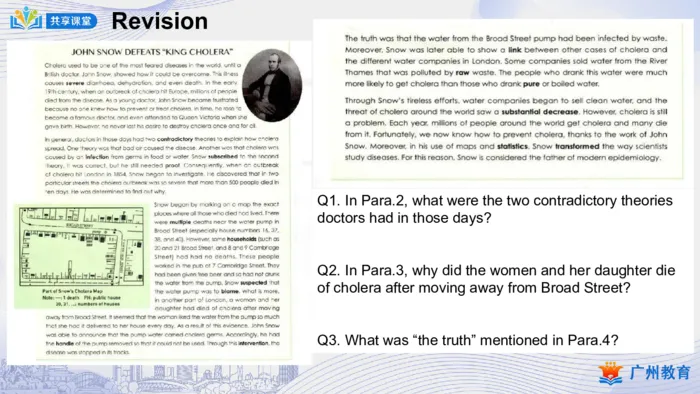
Q1. In Para.2, what were the two contradictory theories
doctors had in those days?
Q2. In Para.3, why did the women and her daughter die
of cholera after moving away from Broad Street?
Q3. What was “the truth” mentioned in Para.4?
Q1. In Para.2, what were the contradictory theories doctors
had in those days?
Q2. In Para.3, why did the women and her daughter die of
cholera after moving away from Broad Street?
Q3.  What was “the truth” mentioned in Para.4?
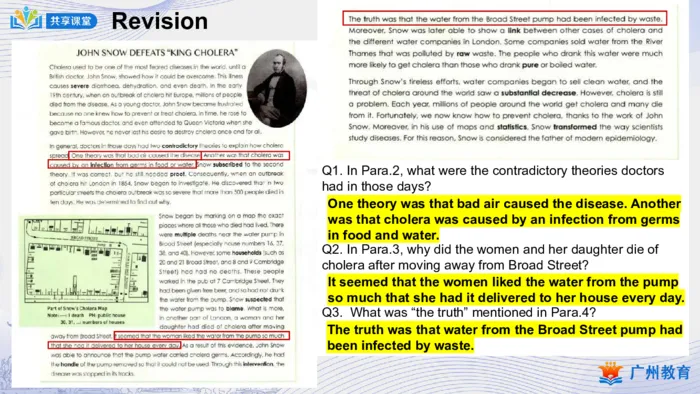
One theory was that bad air caused the disease. Another
was that cholera was caused by an infection from germs
in food and water.
It seemed that the women liked the water from the pump
so much that she had it delivered to her house every day.
The truth was that water from the Broad Street pump had
been infected by waste.
Revision
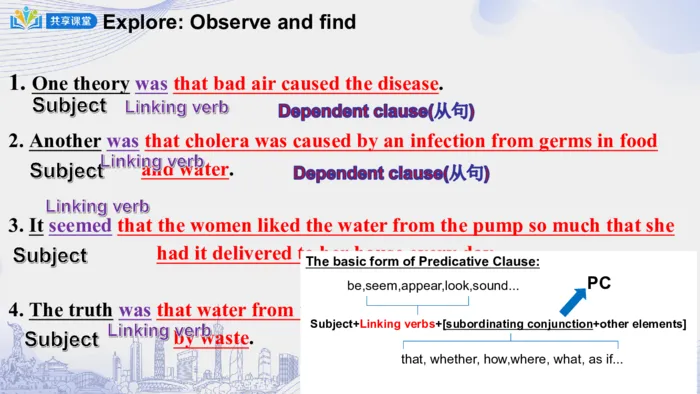
Explore: Observe and find
1. One theory was that bad air caused the disease.
2. Another was that cholera was caused by an infection from germs in food
                          and water.
3. It seemed that the women liked the water from the pump so much that she
                             had it delivered to her house every day.
4. The truth was that water from the Broad Street pump had been infected
by waste.
The basic form of Predicative Clause:
Subject+Linking verbs+[subordinating conjunction+other elements]
PC
that, whether, how,where, what, as if...
be,seem,appear,look,sound...
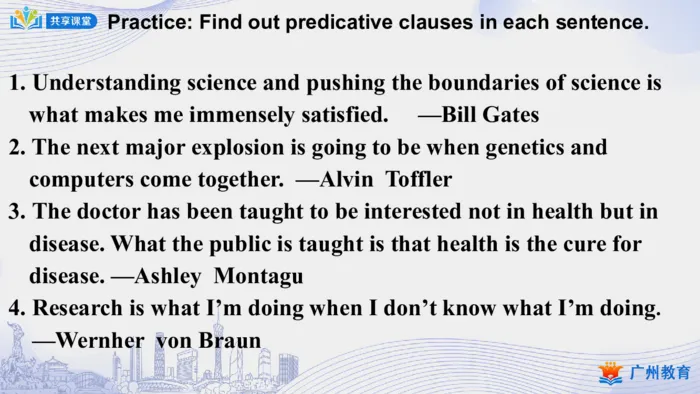
1. Understanding science and pushing the boundaries of science is
what makes me immensely satisfied.     —Bill Gates
2. The next major explosion is going to be when genetics and
computers come together.  —Alvin  Toffler
3. The doctor has been taught to be interested not in health but in
disease. What the public is taught is that health is the cure for
disease. —Ashley  Montagu
4. Research is what I’m doing when I don’t know what I’m doing.
    —Wernher  von Braun
Practice: Find out predicative clauses in each sentence.
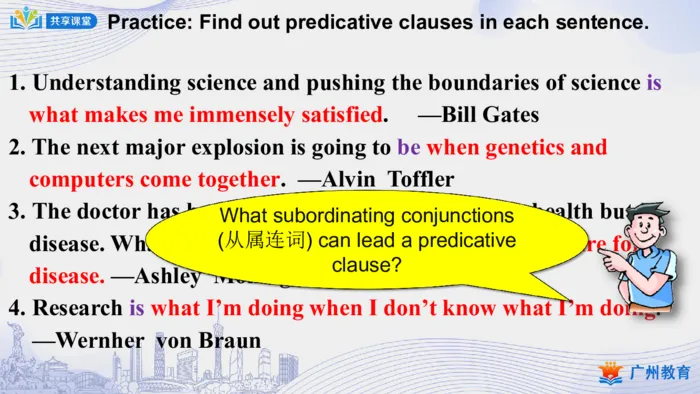
What subordinating conjunctions
(从属连词) can lead a predicative
clause?
1. Understanding science and pushing the boundaries of science is
what makes me immensely satisfied.     —Bill Gates
2. The next major explosion is going to be when genetics and
computers come together.  —Alvin  Toffler
3. The doctor has been taught to be interested not in health but in
disease. What the public is taught is that health is the cure for
disease. —Ashley  Montagu
4. Research is what I’m doing when I don’t know what I’m doing.
    —Wernher  von Braun
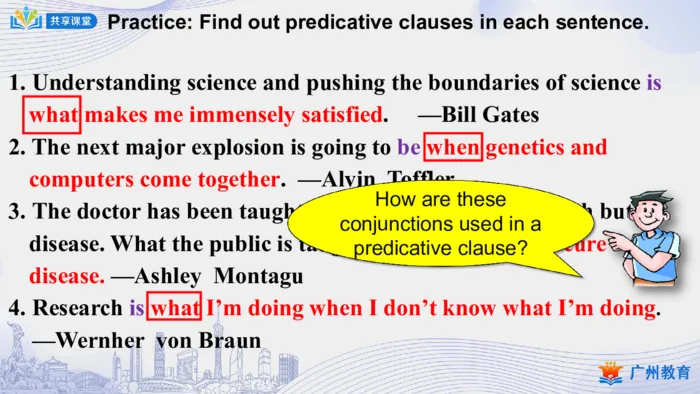
Practice: Find out predicative clauses in each sentence.
How are these
conjunctions used in a
predicative clause?
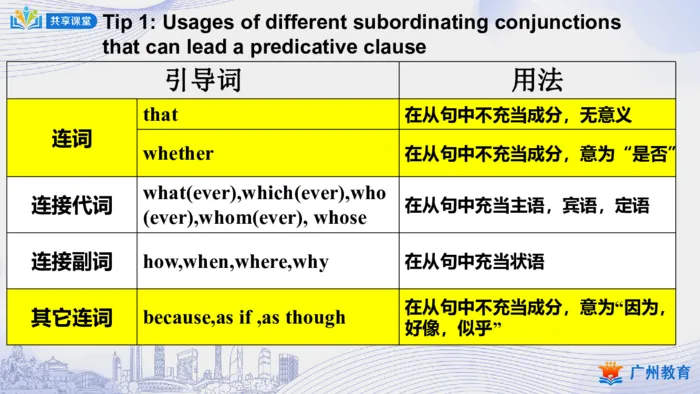
Tip 1: Usages of different subordinating conjunctions
that can lead a predicative clause
引导词
用法
连词
that
在从句中不充当成分,无意义
whether
在从句中不充当成分,意为“是否”
连接代词
what(ever),which(ever),who
(ever),whom(ever), whose
在从句中充当主语,宾语,定语
连接副词
how,when,where,why
在从句中充当状语
其它连词
because,as if ,as though
在从句中不充当成分,意为“因为,
好像,似乎”
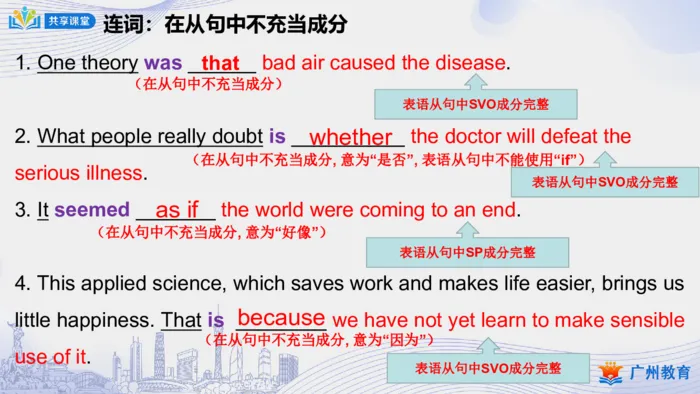
1. One theory was ______ bad air caused the disease.
2. What people really doubt is __________ the doctor will defeat the
serious illness.
3. It seemed _______ the world were coming to an end.
4. This applied science, which saves work and makes life easier, brings us
little happiness. That is  ________ we have not yet learn to make sensible
use of it.
             that
(在从句中不充当成分)
                   whether
(在从句中不充当成分, 意为“是否”, 表语从句中不能使用“if”)

          as if
(在从句中不充当成分, 意为“好像”)
表语从句中SVO成分完整
连词:在从句中不充当成分
表语从句中SVO成分完整
表语从句中SVO成分完整
      because
(在从句中不充当成分, 意为“因为”)
表语从句中SP成分完整
Tip 1: Usages of different subordinating conjunctions
that can lead a predicative clause
引导词
用法
连词
that
在从句中不充当成分,无意义
whether
在从句中不充当成分,意为“是否”
连接代词
what(ever),which(ever),who
(ever),whom(ever), whose
在从句中充当主语,宾语,定语
连接副词
how,when,where,why
在从句中充当状语
其它连词
because,as if,as though
在从句中不充当成分,意为“因为,
好像,似乎”
5. Understanding science and pushing the boundaries of science is ______
makes me immensely satisfied.
6. That is _______ many experts are worrying about.
7. There are dozens of books about Zoology in library. However, what
really makes him confused is _______ is the most suitable one for his
research paper.
                what
(在从句中充当主语,
意为“...的事情”)
          which
(在从句中充当主语, 意为“哪一(本)...”)
连接代词:在从句中充当主语、宾语、定语
表语从句中缺少主语
                what
(在从句中充当宾语,意为“...的事情”)
表语从句中缺少宾语
表语从句中缺少主语
8. The problem is __________ could find out a cure for the disease.
9. What I have not decided is ________ I am going to visit.
10. Both my parents have given me some advice on how to save money.
But the question is ______ advice I should take.
                whose
(在从句中充当定语,意为“谁的...”)
连接代词:在从句中充当成分主语、宾语、定语
表语从句中缺少定语
表语从句中缺少主语
      whom
(在从句中充当宾语, 意为“谁”)
表语从句中缺少宾语
          who
(在从句中充当主语, 意为“谁”)
Tip 1: Usages of different subordinating conjunctions
that can lead a predicative clause
引导词
用法
连词
that
在从句中不充当成分,无意义
whether
在从句中不充当成分,意为“是否”
连接代词
what(ever),which(ever),who
(ever),whom(ever), whose
在从句中充当主语,宾语,定语
连接副词
how,when,where,why
在从句中充当状语
其它连词
because,as if,as though
在从句中不充当成分,意为“因为,
好像,似乎”
11. What John Snow showed to the world was ______ cholera could be
overcome.
12. The exact places Snow marked on the map were _______ all those
who died had lived.
13. What Snow was determined to find out was ________ more than 500
people died in ten days.
14. The next major explosion is going to be ________  genetics and
computers come together.
             how

where

          when
表语从句中SVA成分完整, 缺少
原因状语:“为什么...”
连接副词:在从句中充当方式、地点、原因、时间状语
表语从句中SV成分完整,缺少方
式状语:“如何”
表语从句中SV成分完整, 缺少时
间状语:“...的时候”
       why
表语从句中SV成分完整,缺少
地点状语:“...的地方”
Explore:Observe and think
1. One theory was that bad air caused the disease.
2. Another was that cholera was caused by an infection from
germs in food and water.
3. It seemed that the women liked the water from the pump so
much that she had it delivered to her house every day.
4.  The truth was that water from the Broad Street pump had
been infected by waste.
What meanings and functions
do these predicative clauses
communicate in each sentence?
Explore:Observe and think
1. One theory was that bad air caused the disease.
2. Another was that cholera was caused by an infection from
germs in food and water.
3. It seemed that the women liked the water from the pump so
much that she had it delivered to her house every day.
4.  The truth was that water from the Broad Street pump had
been infected by waste.
Predicative Clauses are often used:
1. to directly explain or emphasize what the Subject is in greater detail.
2. function as a Complement (补语)  to the Subject.
Practice: Complete the following questions by using predicative
clauses and figure out  what meanings and functions they communicate.
EXAMPLE
 What was it that John Snow showed to the world?
 What John Snow showed to the world was how cholera could be overcome.
1. What was Snow’s discovery in two particular streets in London?
    Snow’s discovery in two particular streets in London was that _________________________.
2.What was Snow determined to find out during the 1854 outbreak of cholera in London?
   What Snow was determined to find out was why ______________________________________________.
3.What were the exact places Snow marked on the map?
   The exact places Snow marked on the map were where __________________________.
4.What was the finding that Snow announced?
    Snow’s finding was that __________________________________.
Practice: Complete the following questions by using predicative
clauses and figure out  what meanings and functions they communicate.
the cholera outbreak was so severe that
more than 500 people died in ten days
the cholera outbreak had caused more than 500 people
died in ten days
all those who died had lived
the pump water carried cholera germs
Apply:Use the target structure in context
David is talking to Maria about their scientific research project.
l First, complete David’s lines (A-E), using the words in the box;
A: Absolutely! You may not believe it, but that was ___________happened at the initial (初始
的) stage of our group's research on developing a vaccine for malaria.
B:Yes, it is. And it seemed ___________ all the theories were useful, but the fact was ______
we couldn't persuade one another that one theory was better than another.
C:Exactly. The problem was not about ___________ all our theories were equally good, but in
deciding __________________ theory to depend upon.
D:We realized that what we cared about was not ___________ aspect we needed to develop a
theory in, but rather ________ we can reduce the cost of a vaccine without reducing its effect!
E: You're right. At last, we became focused on the key issue, which was ___________we had
to carry out the research in the first place.
A: Absolutely! You may not believe it, but that was ___________happened at the initial (初始
的) stage of our group's research on developing a vaccine for malaria.
B:Yes, it is. And it seemed ___________ all the theories were useful, but the fact was ______
we couldn't persuade one another that one theory was better than another.
C:Exactly! The problem was not about ___________ all our theories were equally good, but
in deciding __________________ theory to depend upon.
D:We realized that what we cared about was not ___________ aspect we needed to develop a
theory in, but rather ________ we can reduce the cost of a vaccine without reducing its effect!
E: You're right. At last, we became focused on the key issue, which was ___________we had
to carry out the research in the first place.
what
as if
that
whether
which/what
what/which
how
why
l First, complete David’s lines (A-E), using the words in the box;
l Then put David's lines in the correct order.
A: Absolutely! You may not believe it, but that was what
happened at the initial (初始的) stage of our group's research
on developing a vaccine for malaria.
B:Yes, it is. And it seemed as if all the theories were useful,
but the fact was that we couldn't persuade one another that
one theory was better than another.
C:Exactly. The problem was not about whether all our theories
were equally good, but in deciding what/which theory to
depend upon.
D:We realized that what we cared about was not what/which
aspect we needed to develop a theory in, but rather how we
can reduce the cost of a vaccine without reducing its effect!
E: You're right. At last, we became focused on the key issue,
which was why we had to carry out the research in the first
place.
Maria: This mix of theory and data is one of the
key characteristics of what we call science.
David: __________________
Maria: With your theoretical framework?
David: __________________
Maria: Deciding on a theory is definitely of
critical importance.
David:_________________
Maria: This was when you should have calmed
down and got down to doing some solid work.
David:_________________
Maria: So what happened in the end?
David:__________________
l Then put David's lines in the correct order.
A: Absolutely! You may not believe it, but that was what
happened at the initial (初始的) stage of our group's research
on developing a vaccine for malaria.
B:Yes, it is. And it seemed as if all the theories were useful,
but the fact was that we couldn't persuade one another that
one theory was better than another.
C:Exactly! The problem was not about whether all our theories
were equally good, but in deciding what/which theory to
depend upon.
D:We realized that what we cared about was not what/which
aspect we needed to develop a theory in, but rather how we
can reduce the cost of a vaccine without reducing its effect!
E: You're right. At last, we became focused on the key issue,
which was why we had to carry out the research in the first
place.
Maria: This mix of theory and data is one of the
key characteristics of what we call science.
David: __________________
Maria: With your theoretical framework?
David: __________________
Maria: Deciding on a theory is definitely of
critical importance.
David:_________________
Maria: This was when you should have calmed
down and got down to doing some solid work.
David:_________________
Maria: So what happened in the end?
David:__________________
A:“initial stage” (logical connector)
C:“deciding what theory to depend
upon”-“Deciding on a theory”(lexical connectors)
B:“couldn't persuade one another”-
“this”(grammatical connector)
E:“At last”-“in the end”
(logical connectors)
D:a possible answer to the Wh-question(grammatical connector)
l Answer the comprehension questions by using predicative clauses.
Maria: This mix of theory and data is one of the key characteristics of what we
            call science.
David: Absolutely! You may not believe it, but that was what happened at the
            initial stage of our group's research on developing a vaccine for malaria.
Maria: With your theoretical framework?
David: Exactly The problem was not about whether all our theories were equally
            good, but in deciding what/which theory to depend upon.
Maria: Deciding on a theory is definitely of critical importance.
David: Yes, it is. And it seemed as if all the theories were useful, but the fact
             was that we couldn't persuade one another that one theory was better
             than another.
Maria: This was when you should have calmed down and got down to doing
            some solid work.
David: You're right. At last, we became focused on the key issue, which was
             why we had to carry out the research in the first place.
Maria:  So what happened in the end?
David: We realized that what we cared about was not what/which aspect we
            needed to develop a theory in, but rather how we can reduce the cost
            of a vaccine without reducing its effect!
Q1: What was David’s group’s
research?
Q2:What was the problem?
Q3:What was the key issue?
Q4:What did they care about?
A: David’s group’s research was that
they wanted to develop a vaccine for
malaria.
A: The problem was that they had to
decide which/what theory to depend
upon.
A: The key issue was why they had
to carry out the research in the first
place.
A: What they cared about was how
they can reduce the cost of a vaccine
without reducing its effect.
A recap of predicative clauses
l Form:
Subject+Linking verbs+[subordinating conjunction+other elements]
l Functions:
Predicative Clauses are often used to directly explain or emphasize what the Subject is in
greater detail and function as a Complement (补语)  to the Subject.
l Usages:
Complete Exercise 2 in Assessing Your Progress on P10.
Assignment
2. Complete Exercise 2
of Using Structures in
Workbook on P62.
THANK  YOU!
高二—人教版—英语—选择性必修二第一单元
Unit 1 SCIENCE AND SCIENTISTS
Lesson 3: Discover Useful Structures & Using Structures
答疑
广东广雅中学 杨文彬
1. Complete Exercise 2 in Assessing Your Progress on P10.
Assignment
2. Complete Exercise
2 of Using Structures
in Workbook on P62.
1. Complete Exercise 2 in Assessing Your Progress on P10.
Science is simply _________ you can do. And doing science makes you a
scientist! So,what do scientists do? Actually, what matters is not only
_________ they observe in the world around them and what questions they
ask, but also _________ they use evidence or data to answer the questions.
They identify useful data and take new measurements. Some of the key
issues that scientists face are _________ calculations they do and
_________ they analyse their data to draw conclusions about the questions
they ask. The final issue, which many believe to be the most important, is
_________ they need to communicate their results. This is _________ they
want everyone to benefit from their work! It seems _________ science is
all around us. You see, by doing science, scientists get a better
understanding of the world around them and share that understanding with
the whole world .
what
what
how
what
how
that/as if
why
because
1 A: Papermaking, printing, gunpowder, and the compass are the four great
inventions of ancient China. They are significant contributions of the Chinese
nation to the world.
B: Sure, they are. What I want to know though is_______________________
_____________________________________________
2 A: The ancient Chinese were the first to invent paper and printing. Then they
went on to invent books and had opened bookshops in many cities.
B: What I am curious about is __________________________________
__________________________________________
which one is the greatest invention.
2. Complete Exercise 2 of Using Structures in Workbook on P62.
/how these inventions have changed China and the world.
who invented paper/when ink was invented.
/when and how printing spread to the rest of the world.
3 A: The compass is a special invention of ancient China, dating back to as
early as the Warring States Period.
B: Yes, It seems__________________________________________________
_________________________________
4 A: Gunpowder was originally used for making fireworks.
B: But what surprises me is ________________________________________
______________________________
that ancient Chinese had developed a good knowledge of magnetism.
2. Complete Exercise 2 of Using Structures in Workbook on P62.
/that the compass was particularly useful.
that gunpowder was not used initially for firearms.
/how it is so unexpectedly used today.
5 A: After the discovery of medicine, acupuncture was invented in China.
Acupuncture is a treatment which doesn’t involve any drugs. Very thin needles
are put in certain parts of a person’s body.
B: Really? What puzzles me is _______________________
___________________________
6 A: High-speed trains, mobile payments, the bike-sharing system, and online
shopping are considered by some as the new “four inventions” of China.
B: Is that so? I feel/It seems_________________________________________
_____________________________________________________________
/for whom this practice was first done.
2. Complete Exercise 2 of Using Structures in Workbook on P62.
who first started this practice.
that these inventions have really made our lives easier.
/as if I could not live without them, especially when it comes to online shopping.
The  END!