Unit 1 SCIENCE AND SCIENTISTS
Lesson 4: Listening and Speaking
高二—人教版—英语—选择性必修二第一单元
广东广雅中学 张绮晴
Learning objectives
After this lesson,
you will be able to
1
predict by using pictures to focus better
when listening
2
3
listen and understand what people can do
and how they feel in a science museum
talk about a scientific experience or a
scientific phenomenon in daily life
Listening and Speaking
Scientific Experiences
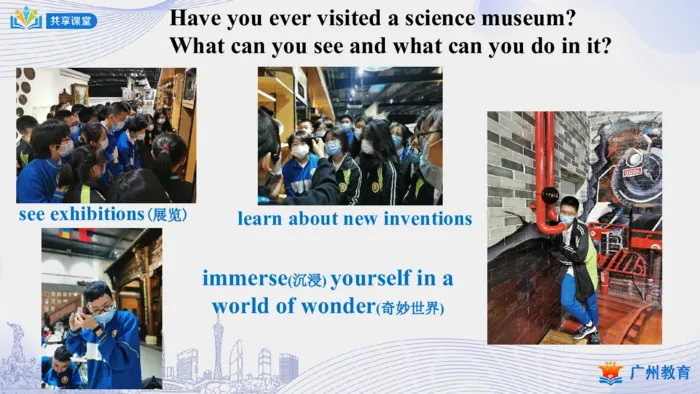
Have you ever visited a science museum?
What can you see and what can you do in it?
see exhibitions(展览)
immerse(沉浸) yourself in a
world of wonder(奇妙世界)
learn about new inventions
                 Pre-listening
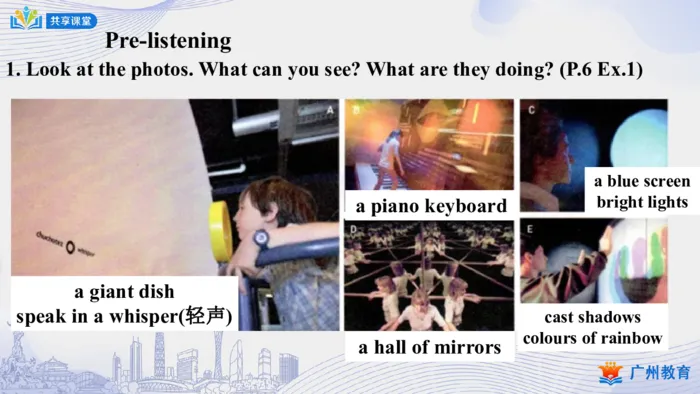
1. Look at the photos. What can you see? What are they doing? (P.6 Ex.1)
a giant dish
speak in a whisper(轻声)
a piano keyboard
a blue screen
bright lights
a hall of mirrors
cast shadows
colours of rainbow
                      Pre-listening
2. Using the photos, try to predict the answers to the following questions.
    (P.6 Ex.2)
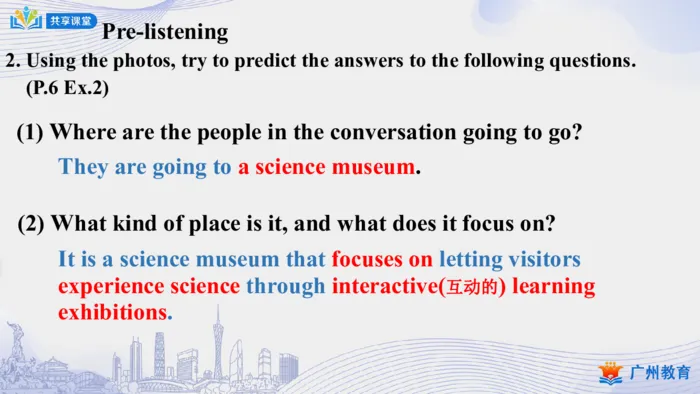
(1) Where are the people in the conversation going to go?
(2) What kind of place is it, and what does it focus on?
They are going to a science museum.
It is a science museum that focuses on letting visitors
experience science through interactive(互动的) learning
exhibitions.
                    Pre-listening
2. Using the photos, try to predict the answers to the following questions.
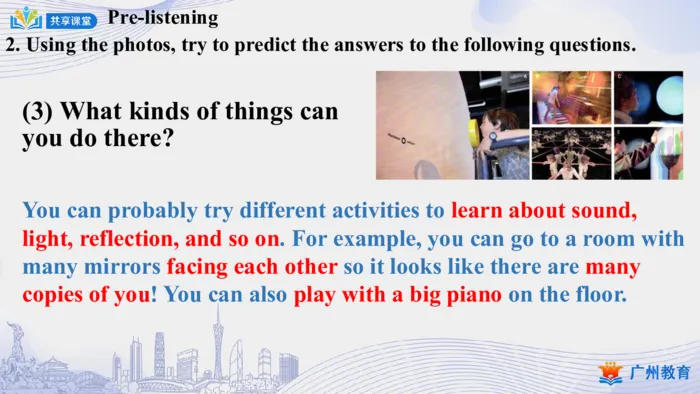
(3) What kinds of things can
you do there?
You can probably try different activities to learn about sound,
light, reflection, and so on. For example, you can go to a room with
many mirrors facing each other so it looks like there are many
copies of you! You can also play with a big piano on the floor.
Predict by using pictures
One way to get more out of your
listening is to predict what you will
hear. Using the pictures provided
and the knowledge you already have,
y o u c a n g u e s s t h e k i n d s o f
information you should listen for. At
times, you may even be able to guess
exactly what will be talked about.
This will help you focus better when
listening, making your listening
more effective.
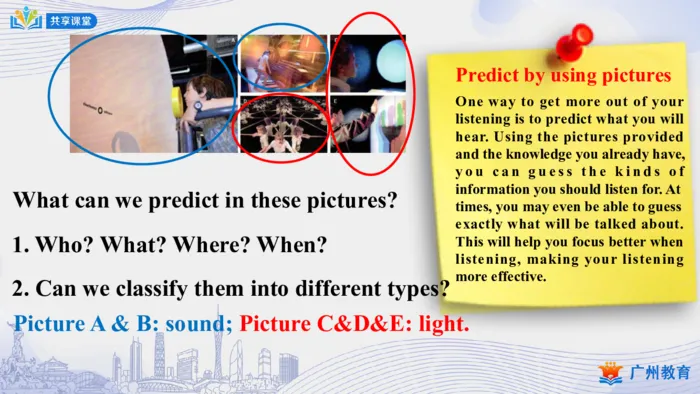
What can we predict in these pictures?
1. Who? What? Where? When?
2. Can we classify them into different types?
Picture A & B: sound; Picture C&D&E: light.
                    While-listening
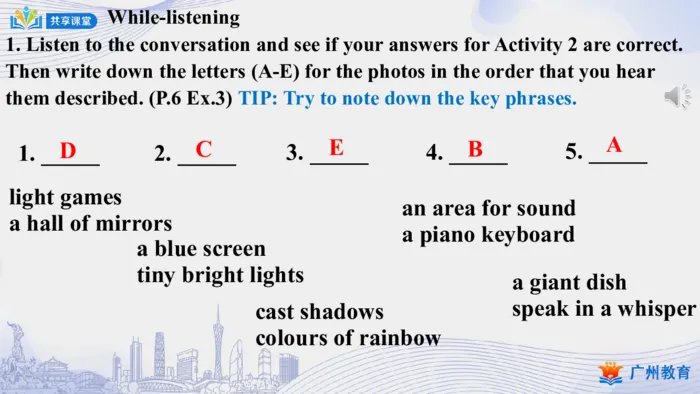
1. Listen to the conversation and see if your answers for Activity 2 are correct.
Then write down the letters (A-E) for the photos in the order that you hear
them described. (P.6 Ex.3) TIP: Try to note down the key phrases.
1. _____
2. _____
3. _____
4. _____
5. _____
light games
a hall of mirrors
a blue screen
tiny bright lights
cast shadows
colours of rainbow
an area for sound
a piano keyboard
a giant dish
speak in a whisper
D
C
E
B
A
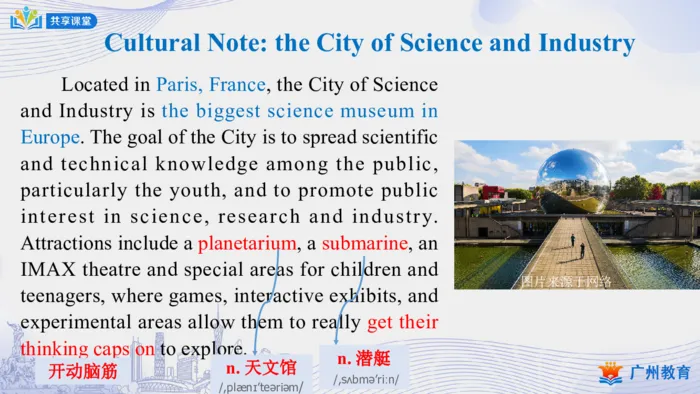
        Located in Paris, France, the City of Science
and Industry is the biggest science museum in
Europe. The goal of the City is to spread scientific
and technical knowledge among the public,
particularly the youth, and to promote public
interest in science, research and industry.
Attractions include a planetarium, a submarine, an
IMAX theatre and special areas for children and
teenagers, where games, interactive exhibits, and
experimental areas allow them to really get their
thinking caps on to explore.
Cultural Note: the City of Science and Industry
n. 天文馆
/,plænɪ’teəriəm/
n. 潜艇
 /,sʌbmə’riːn/
开动脑筋
图片来源于网络
                    While-listening
2. Listen again and complete the descriptions of the photos. (P.6 Ex.4)
Photo A: A giant dish; when you speak into it, it __________ the sound back and
               _______________. You can use it to speak in a _________ to someone 17 meters away.
Photo B: A giant ______________ that you can use your feet to play. Instead of playing the
               sounds of a piano, it plays the voices of________________.
Photo C: You look at a blue screen for a while, and then suddenly you can see
                ________________ moving around on it. These are our_________________.
Photo D: A ________________ where you can see yourself reflected thousands of times.
Photo E: You stand in front of _____________ and it casts different shadows of you,
                in ___________________ the rainbow.
reflects
makes it louder
whisper
piano keyboard
classical singers
tiny bright lights
own blood cells
hall of mirrors
a white light
every colour of
                    Post-listening
1. Answer the following questions about science museums. (P.7 Ex.5)
(1) The conversation is about the City of Science and Industry, a museum
      in Paris. Would you like to go to this museum? Why or why not?
(2) Are there any museums like this in China? What can
      you do in them?
Yes, because the exhibitions seem really interesting. I think I would
learn a lot about science and it can broaden my horizons(开拓视野).
Yes. For example, there is the China Science and
Technology Museum (中国科学技术馆) in Beijing and the
Guangdong Science Center (广东科学中心) in Guangzhou.
We can do many interesting experiments in such museums.
图片来源于网络
图片来源于网络
                    Post-listening
2. Brainstorm and talk about a scientific experiment you are interested in.
    TIP: You can refer to the sentence patterns provided. (P.7 Ex.6)
1.Opening: Today, I want to talk to you about a very strange
phenomenon called a non-Newtonian fluid(非牛顿流体).
2.Materials needed: You can make it easily using equal parts of water
and cornflour(矢车菊), like I have here.
3.Process: A non-Newtonian fluid is strange because you can pour it like
a liquid, but if you put any pressure on it, it suddenly becomes hard as
concrete(混凝土). In fact, it becomes hard enough to stand on. Then, as
soon as you take the pressure off, it becomes a liquid again.
4.Theory: This shows that it is possible that something can exist as a
liquid and a solid at the same time.
Talking about scientific phenomena
Ø .. can/cannot exist in the form of a
solid/gas and a liquid/plasma(血浆).
Ø ... is both a ... and a.. . at the same
time …
Ø how light/sound is reflected …
Ø This occurs when ...
Ø If you ..., it will become ...
Ø That demonstrates(表明) ...
Ø This experiment/research shows ...
Ø Through this, we know that ....
Ø We can prove that ...
Ø This evidence proves …
In addition to the science museums, where else
can people have scientific experiences?
图片来源于网络
图片来源于网络
in space
in a science museum
                    Post-listening
Talk about the “Water Film Experiment” in the Tiangong space station.
Theory: Zero gravity magnifies the surface tension of water.
(零重力放大水的表面张力)
a water film 水膜
a flower bud 花朵
a metal ring 金属圈
fold sth. with paper 折纸
rotate      旋转
blossom  开花
Word Bank
视频来源于网络
Ø That demonstrates zero
gravity magnifies the surface
tension of water in space.
Ø This experiment shows…
Ø Through this, we know that ...
Ø This occurs when things are
in zero gravity.
Wang placed the flower bud folded
with paper on the water film.
Wang created a water film using a
metal ring and a bag filled with water.
The bud rotated magically on the film
and “blossomed”.
Theory
Materials needed
Process
图片来源于网络
图片来源于网络
图片来源于网络
                    Post-listening
Make a presentation about the “Water Film Experiment”.
 1. Opening: Today, I want to talk to you about a very interesting phenomenon and I learnt
about it from the “Water Film Experiment”[Name] in the Tiangong space station.
 2. Experimenter: Wang Yaping, a Chinese female astronaut, did a scientific experiment
with a flower bud which she and her daughter folded with paper before the space journey.
 3. Materials needed: First, she created a water film using a metal ring and a bag filled with
water.
 4. Process: Then, she placed the flower bud on the water film. The amazing thing was
that the bud rotated magically on the film and “blossomed”!
 5. Theory: This occurs when things are in zero gravity. This experiment shows that zero
gravity magnifies the surface tension of water in space.
Review of new words
cast          /kɑːst/             v. 投射;向……投以(视线、笑容等);投掷
reflect      /rɪˈflekt/          v. 反射(声、光、热等);反映(影像)
pour           /pɔː(r)/              v. 倒出,倾泻,斟(饮料)
whisper      /ˈwɪspə(r)/       v./n. 耳语;低语;私语;小声说
exhibition  /ˌeksɪˈbɪʃ(ə)n/  n. 展览,展出
shadow   /ˈʃædəʊ/          n. 阴影,影子,背光处
rainbow   /ˈreɪnbəʊ/        n. 彩虹
concrete   /ˈkɒŋkriːt/       n. 混凝土  adj. 混凝土制的;确实的;具体的
solid         /ˈsɒlɪd/            adj. 可靠的,固体的,坚实的 n. 固体
plasma     /ˈplæzmə/        n. 血浆
In addition to the science museums and space, where else
can people have scientific experiences?
图片来源于网络
图片来源于网络
in space
in a science museum
in daily life
图片来源于网络
                    Homework
Talk about a scientific phenomenon in your daily life.
temperature  /ˈtemprətʃə(r)/  (n.)温度
humidity     /hjuːˈmɪdəti/       (n.)湿度
moisture     /ˈmɔɪstʃə(r)/         (n.)水分
condense    /kənˈdens/        (v.)冷凝
Word Bank
图片来源于网络
Eg. Have you ever seen a foggy window
       of a car? When does it happen? Why?
Homework
1. Talk about a scientific phenomenon in your daily life.
     (Please refer to the example of “Water Film Experiment”.)
2. Think about the function of science and what students can do
     with scientific knowledge.
3. Finish the vocabulary exercises related to scientific experiences.
Unit 1 SCIENCE AND SCIENTISTS
Lesson 4: Listening and Speaking
高二—人教版—英语—选择性必修二第一单元
广东广雅中学 张绮晴
答疑
        Judy had (1)__________ to a science museum with her classmates last week.
First she went to an area for (2)________. In (3) _______________, Judy saw
herself reflected thousands of times. She also experimented with a blue screen
and saw her own (4)__________ moving around like (5)________________.
The thing Judy liked better was that a white light cast different shadows of
Judy in every colour of (6) ____________. Later Judy went to the area for
(7)_______. Judy played a giant (8) ____________________ with her feet, and it
even produced the voices of classical singers. She also found a giant dish, which
(9) __________ the sound back and made it louder so that you could
(10)__________ to someone 17 metres away.
   piano keyboard    a hall of mirrors      whisper           blood cells        sound
   the rainbow          tiny bright lights      reflected         a field trip        light
1. Review: Complete the passage with the given expressions.
a field trip
light
a hall of mirrors
blood cells
tiny bright lights
the rainbow
sound
piano keyboard
reflected
whisper
2. Homework: Talk about a scientific phenomenon in your daily life.
foggy car windows
Opening
Today, I want to talk to you about an interesting
phenomenon in our daily life.
Process
Theory
图片来源于网络
Sometimes, our car windows get foggy. This occurs
when there is a difference in air temperature and
humidity between the inside of the car and the outside.
Phenomenon
① If you get into the car when it is cold outside, your
warm body temperature and the moisture coming
from your breath will increase the humidity in the car.
② When this humid and warm air touches the cold
glass, the water in the air condenses on the glass to
create fog.
Though this, we know that water condenses when
warm air touches the cold glass. This is how fog is
formed on the car windows.
3. Think about the function of science:
    Why do we study science? What can we do with scientific knowledge?
Life
• Bring new
inventions.
• Make people’s
lives easier.
Mind
• Inspire curiosity
and an attitude
of discovery.
• Increase our
understanding of
Society
• Make further
advances in
various fields.
• Shape our
modern world.
4. Vocabulary exercises.
投射
cast
反射
reflect
倒出
pour
低语
whisper
展览
exhibition
阴影,影子    shadow
彩虹
rainbow
混凝土            concrete
固体
solid
血浆
            plasma
科学的            scientific
现象
phenomenon / phenomena (pl.)
放大
magnify
旋转               rotate
see exhibitions
     看展览
learn about new inventions          了解新发明
immerse oneself in …
     某人沉浸在…
a giant dish
                      一个巨大的接收器
speak in a whisper
      轻声说
a hall of mirrors
      镜子大厅
cast shadows
       投射阴影
tiny bright lights                           极微弱的光线
a piano keyboard                          一个钢琴键盘
focus on
      聚焦在
classify … into …                        把…分类为…
get one’s thinking caps on           开动某人的脑筋
broaden one’s horizons
      开拓某人的视野
a water film
                       一个水膜
a foggy window                            一个起雾的窗户