学科网(北京)股份有限公司
试卷类型:A
高二下学期学业质量评价
英语试题
2026.7
注意事项:
1.答题前,考生务必将自己的姓名、考生号等填写在答题卡和试卷指定位置上。
2.回答选择题时,选出每小题答案后,用铅笔把答题卡上对应题目的答案标号涂黑。如需改
动,用橡皮擦干净后,再选涂其他答案标号。回答非选择题时,将答案写在答题卡上,写在
本试卷上无效。
第一部分
听力(共两节,满分30 分)
该部分分为第一、第二两节。注意:回答听力部分时,请先将答案标在试卷上。听力部分结
束前,你将有两分钟的时间将你的答案转涂到答题卡上。
第一节(共5 小题;每小题1.5 分,满分7.5 分)
听下面5 段录音。每段录音后有一个小题,从题中所给的A、B、C 三个选项中选出最佳选项。
听完每段录音后,你都有10 秒钟的时间来回答有关小题和阅读下一小题。每段录音播放两遍。
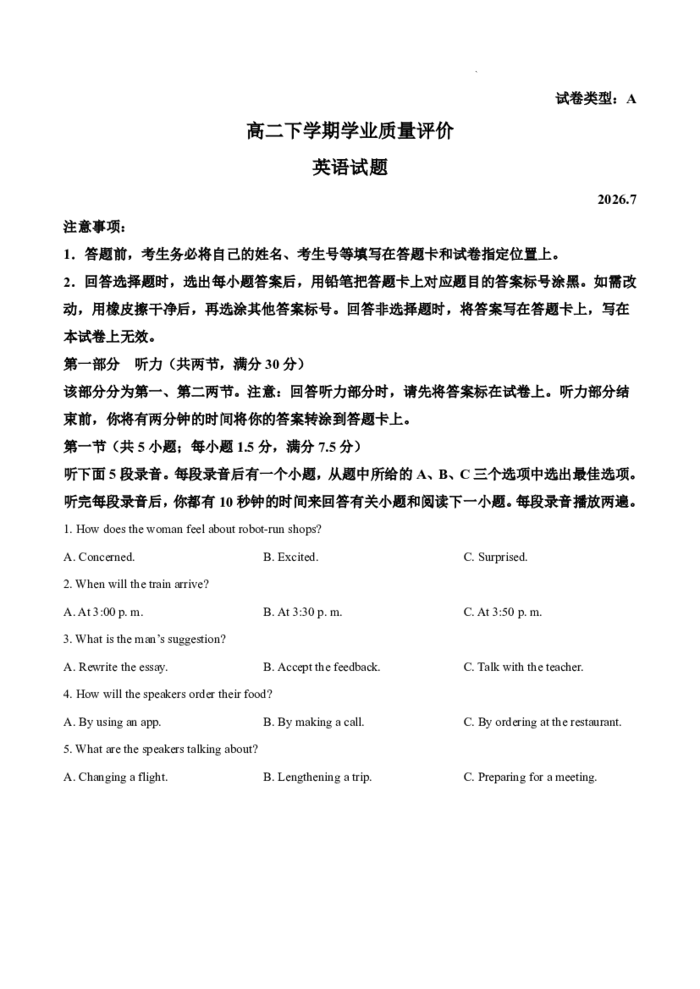
1. How does the woman feel about robot-run shops?
A. Concerned.
B. Excited.
C. Surprised.
2. When will the train arrive?
A. At 3:00 p. m.
B. At 3:30 p. m.
C. At 3:50 p. m.
3. What is the man’s suggestion?
A. Rewrite the essay.
B. Accept the feedback.
C. Talk with the teacher.
4. How will the speakers order their food?
A. By using an app.
B. By making a call.
C. By ordering at the restaurant.
5. What are the speakers talking about?
A. Changing a flight.
B. Lengthening a trip.
C. Preparing for a meeting.
学科网(北京)股份有限公司
第二节(共15 小题;每小题1.5 分,满分22.5 分)
听下面5 段录音。每段录音后有几个小题,从题中所给的A、B、C 三个选项中选出最佳选项。
听每段录音前,你将有时间阅读各个小题,每小题5 秒钟;听完后,每小题都有5 秒钟的作
答时间。每段录音播放两遍。
听第6 段录音,回答第6 和第7 题。
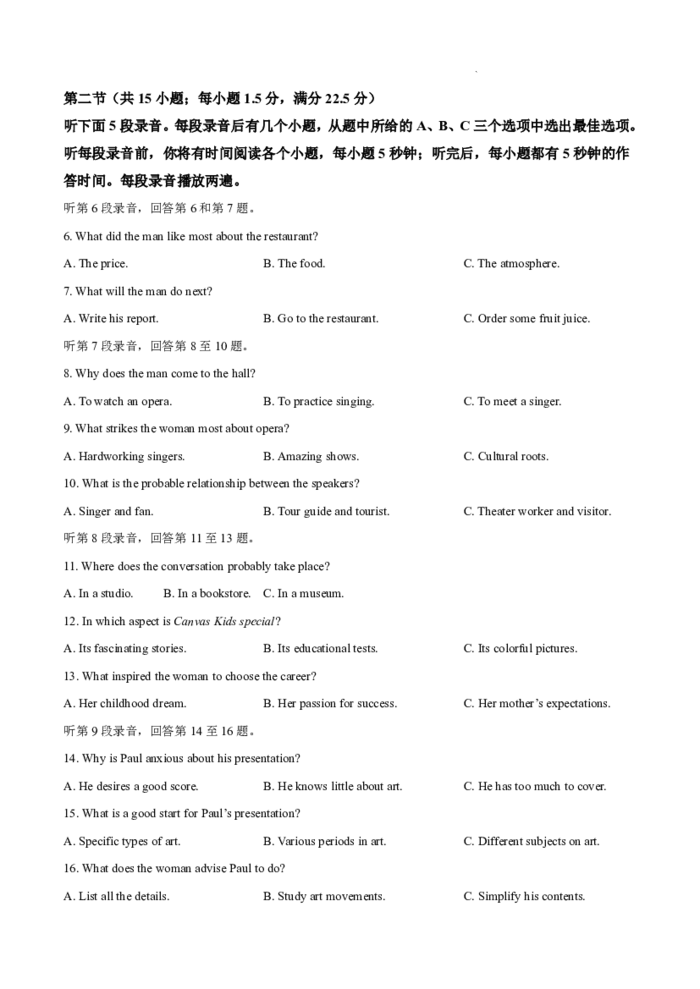
6. What did the man like most about the restaurant?
A. The price.
B. The food.
C. The atmosphere.
7. What will the man do next?
A. Write his report.
B. Go to the restaurant.
C. Order some fruit juice.
听第7 段录音,回答第8 至10 题。
8. Why does the man come to the hall?
A. To watch an opera.
B. To practice singing.
C. To meet a singer.
9. What strikes the woman most about opera?
A. Hardworking singers.
B. Amazing shows.
C. Cultural roots.
10. What is the probable relationship between the speakers?
A. Singer and fan.
B. Tour guide and tourist.
C. Theater worker and visitor.
听第8 段录音,回答第11 至13 题。
11. Where does the conversation probably take place?
A. In a studio.
B. In a bookstore.
C. In a museum.
12. In which aspect is Canvas Kids special?
A. Its fascinating stories.
B. Its educational tests.
C. Its colorful pictures.
13. What inspired the woman to choose the career?
A. Her childhood dream.
B. Her passion for success.
C. Her mother’s expectations.
听第9 段录音,回答第14 至16 题。
14. Why is Paul anxious about his presentation?
A. He desires a good score.
B. He knows little about art.
C. He has too much to cover.
15. What is a good start for Paul’s presentation?
A. Specific types of art.
B. Various periods in art.
C. Different subjects on art.
16. What does the woman advise Paul to do?
A. List all the details.
B. Study art movements.
C. Simplify his contents.
学科网(北京)股份有限公司
听第10 段材料,回答第17 至20 题。
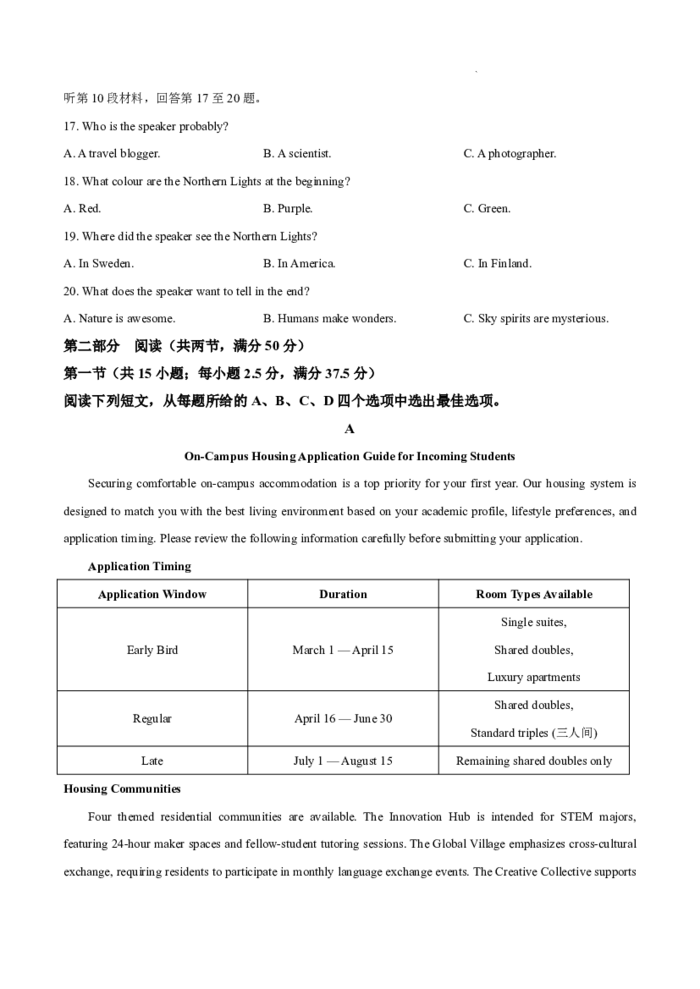
17. Who is the speaker probably?
A. A travel blogger.
B. A scientist.
C. A photographer.
18. What colour are the Northern Lights at the beginning?
A. Red.
B. Purple.
C. Green.
19. Where did the speaker see the Northern Lights?
A. In Sweden.
B. In America.
C. In Finland.
20. What does the speaker want to tell in the end?
A. Nature is awesome.
B. Humans make wonders.
C. Sky spirits are mysterious.
第二部分
阅读(共两节,满分50 分)
第一节(共15 小题;每小题2.5 分,满分37.5 分)
阅读下列短文,从每题所给的A、B、C、D 四个选项中选出最佳选项。
A
On-Campus Housing Application Guide for Incoming Students
Securing comfortable on-campus accommodation is a top priority for your first year. Our housing system is
designed to match you with the best living environment based on your academic profile, lifestyle preferences, and
application timing. Please review the following information carefully before submitting your application.
Application Timing
Application Window
Duration
Room Types Available
Early Bird
March 1 — April 15
Single suites,
Shared doubles,
Luxury apartments
Regular
April 16 — June 30
Shared doubles,
Standard triples (三人间)
Late
July 1 — August 15
Remaining shared doubles only
Housing Communities
Four themed residential communities are available. The Innovation Hub is intended for STEM majors,
featuring 24-hour maker spaces and fellow-student tutoring sessions. The Global Village emphasizes cross-cultural
exchange, requiring residents to participate in monthly language exchange events. The Creative Collective supports
学科网(北京)股份有限公司
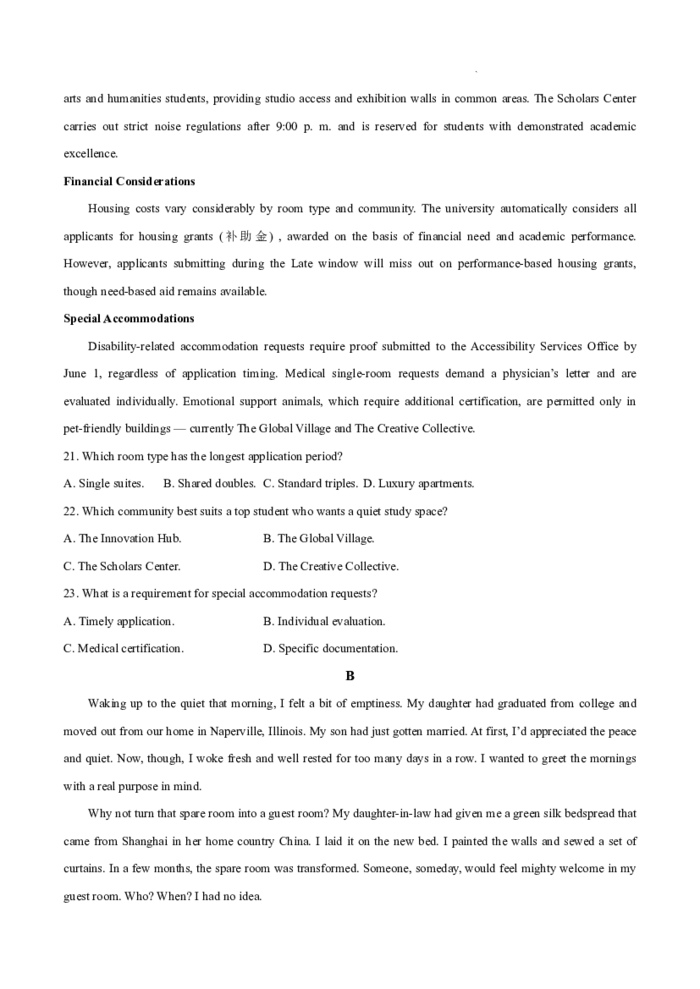
arts and humanities students, providing studio access and exhibition walls in common areas. The Scholars Center
carries out strict noise regulations after 9:00 p. m. and is reserved for students with demonstrated academic
excellence.
Financial Considerations
Housing costs vary considerably by room type and community. The university automatically considers all
applicants for housing grants ( 补助金) , awarded on the basis of financial need and academic performance.
However, applicants submitting during the Late window will miss out on performance-based housing grants,
though need-based aid remains available.
Special Accommodations
Disability-related accommodation requests require proof submitted to the Accessibility Services Office by
June 1, regardless of application timing. Medical single-room requests demand a physician’s letter and are
evaluated individually. Emotional support animals, which require additional certification, are permitted only in
pet-friendly buildings — currently The Global Village and The Creative Collective.
21. Which room type has the longest application period?
A. Single suites.
B. Shared doubles. C. Standard triples. D. Luxury apartments.
22. Which community best suits a top student who wants a quiet study space?
A. The Innovation Hub.
B. The Global Village.
C. The Scholars Center.
D. The Creative Collective.
23. What is a requirement for special accommodation requests?
A. Timely application.
B. Individual evaluation.
C. Medical certification.
D. Specific documentation.
B
Waking up to the quiet that morning, I felt a bit of emptiness. My daughter had graduated from college and
moved out from our home in Naperville, Illinois. My son had just gotten married. At first, I’d appreciated the peace
and quiet. Now, though, I woke fresh and well rested for too many days in a row. I wanted to greet the mornings
with a real purpose in mind.
Why not turn that spare room into a guest room? My daughter-in-law had given me a green silk bedspread that
came from Shanghai in her home country China. I laid it on the new bed. I painted the walls and sewed a set of
curtains. In a few months, the spare room was transformed. Someone, someday, would feel mighty welcome in my
guest room. Who? When? I had no idea.
学科网(北京)股份有限公司
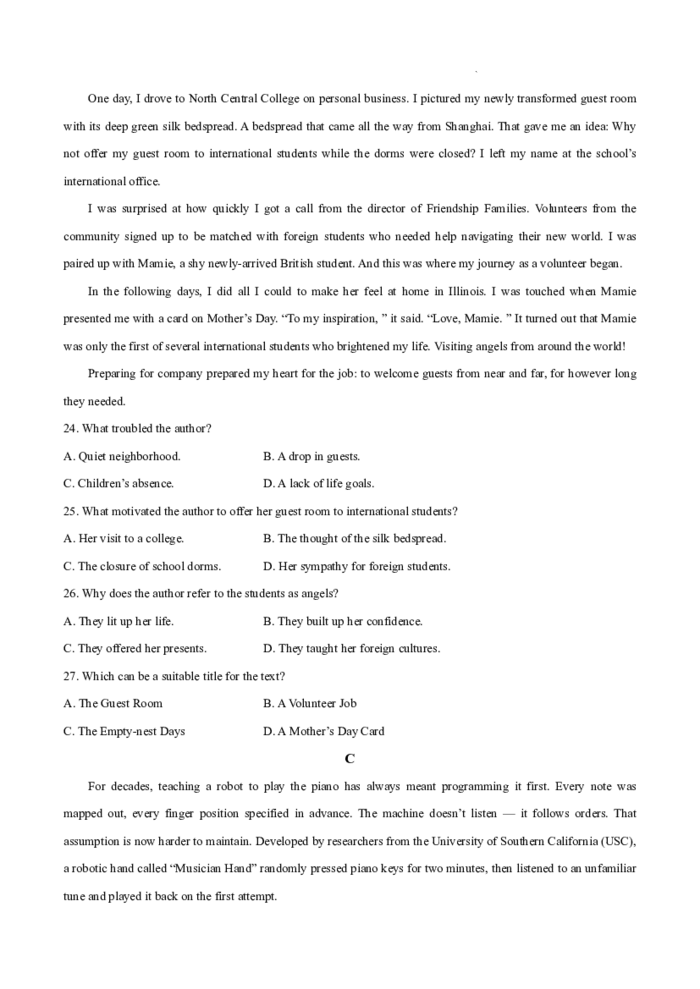
One day, I drove to North Central College on personal business. I pictured my newly transformed guest room
with its deep green silk bedspread. A bedspread that came all the way from Shanghai. That gave me an idea: Why
not offer my guest room to international students while the dorms were closed? I left my name at the school’s
international office.
I was surprised at how quickly I got a call from the director of Friendship Families. Volunteers from the
community signed up to be matched with foreign students who needed help navigating their new world. I was
paired up with Mamie, a shy newly-arrived British student. And this was where my journey as a volunteer began.
In the following days, I did all I could to make her feel at home in Illinois. I was touched when Mamie
presented me with a card on Mother’s Day. “To my inspiration, ” it said. “Love, Mamie. ” It turned out that Mamie
was only the first of several international students who brightened my life. Visiting angels from around the world!
Preparing for company prepared my heart for the job: to welcome guests from near and far, for however long
they needed.
24. What troubled the author?
A. Quiet neighborhood.
B. A drop in guests.
C. Children’s absence.
D. A lack of life goals.
25. What motivated the author to offer her guest room to international students?
A. Her visit to a college.
B. The thought of the silk bedspread.
C. The closure of school dorms.
D. Her sympathy for foreign students.
26. Why does the author refer to the students as angels?
A. They lit up her life.
B. They built up her confidence.
C. They offered her presents.
D. They taught her foreign cultures.
27. Which can be a suitable title for the text?
A. The Guest Room
B. A Volunteer Job
C. The Empty-nest Days
D. A Mother’s Day Card
C
For decades, teaching a robot to play the piano has always meant programming it first. Every note was
mapped out, every finger position specified in advance. The machine doesn’t listen — it follows orders. That
assumption is now harder to maintain. Developed by researchers from the University of Southern California (USC),
a robotic hand called “Musician Hand” randomly pressed piano keys for two minutes, then listened to an unfamiliar
tune and played it back on the first attempt.
学科网(北京)股份有限公司
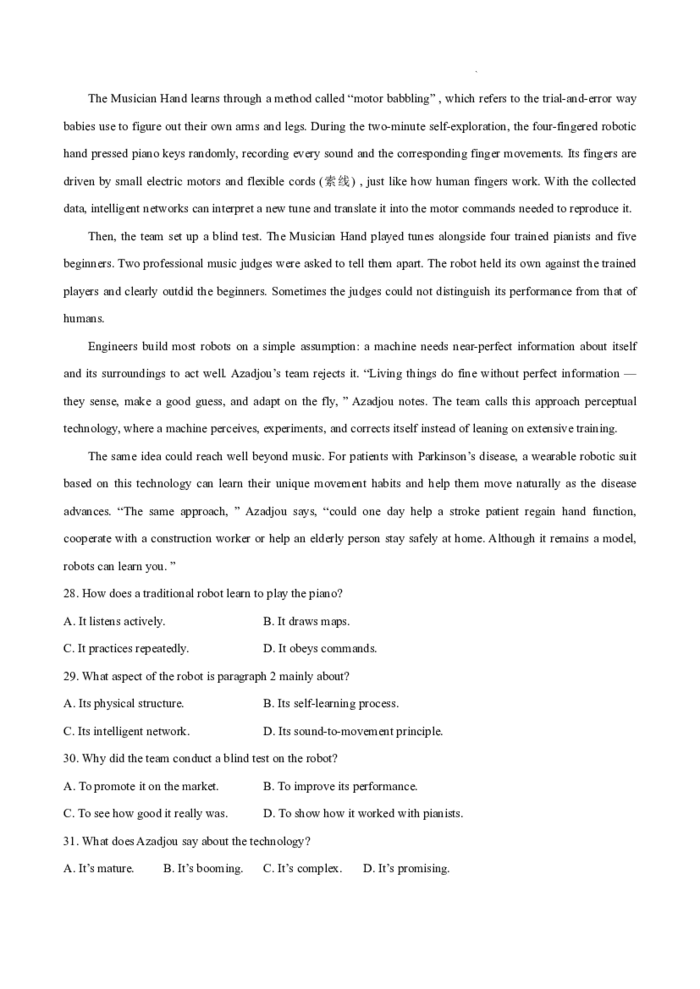
The Musician Hand learns through a method called “motor babbling” , which refers to the trial-and-error way
babies use to figure out their own arms and legs. During the two-minute self-exploration, the four-fingered robotic
hand pressed piano keys randomly, recording every sound and the corresponding finger movements. Its fingers are
driven by small electric motors and flexible cords (索线) , just like how human fingers work. With the collected
data, intelligent networks can interpret a new tune and translate it into the motor commands needed to reproduce it.
Then, the team set up a blind test. The Musician Hand played tunes alongside four trained pianists and five
beginners. Two professional music judges were asked to tell them apart. The robot held its own against the trained
players and clearly outdid the beginners. Sometimes the judges could not distinguish its performance from that of
humans.
Engineers build most robots on a simple assumption: a machine needs near-perfect information about itself
and its surroundings to act well. Azadjou’s team rejects it. “Living things do fine without perfect information —
they sense, make a good guess, and adapt on the fly, ” Azadjou notes. The team calls this approach perceptual
technology, where a machine perceives, experiments, and corrects itself instead of leaning on extensive training.
The same idea could reach well beyond music. For patients with Parkinson’s disease, a wearable robotic suit
based on this technology can learn their unique movement habits and help them move naturally as the disease
advances. “The same approach, ” Azadjou says, “could one day help a stroke patient regain hand function,
cooperate with a construction worker or help an elderly person stay safely at home. Although it remains a model,
robots can learn you. ”
28. How does a traditional robot learn to play the piano?
A. It listens actively.
B. It draws maps.
C. It practices repeatedly.
D. It obeys commands.
29. What aspect of the robot is paragraph 2 mainly about?
A. Its physical structure.
B. Its self-learning process.
C. Its intelligent network.
D. Its sound-to-movement principle.
30. Why did the team conduct a blind test on the robot?
A. To promote it on the market.
B. To improve its performance.
C. To see how good it really was.
D. To show how it worked with pianists.
31. What does Azadjou say about the technology?
A. It’s mature.
B. It’s booming.
C. It’s complex.
D. It’s promising.
学科网(北京)股份有限公司
D
You walk into a clothing store and spot a leather coat marked $1, 800. You immediately label it extremely
pricey and move on. Later that day, you find an identical coat on sale for $650, and you instantly think you have
found an incredible steal. What you may not realize is that your judgment has been misled by the anchoring bias
(锚定偏见) .
The anchoring bias was first identified by psychologists Daniel Kahneman and Amos Tversky in their research
on intuitive (直觉的) reasoning. It describes the human tendency to rely heavily on the first piece of information
we encounter — called an anchor — and evaluate every subsequent detail against that fixed reference point.
Consider bargaining for a second-hand vehicle. If a seller opens with a high asking price, that number
becomes your mental anchor. Even if you negotiate the price far lower, you will still view the final deal as a win
compared to the original figure, ignoring the car’s true market value. The opposite holds true: A surprisingly low
initial offer causes the seller to undervalue their own property. This trap does not only appear in shopping; it
influences salary negotiations, exam score judgments, and even predictions about global statistics.
The bias exists because human brains naturally conserve mental energy. Recalculating value requires heavy
cognitive (认知的) effort, so we automatically lean on the first available reference point rather than conducting
fully independent analysis. When we are setting plans or making estimates about something, we interpret newer
information from the reference point of our anchor instead of seeing it objectively. This can affect our judgment
and prevent us from updating our plans or predictions as much as we should.
Avoiding the anchoring bias entirely isn’t possible, given its widespread impact and how powerful it is. Like
all cognitive biases, the anchoring bias is subconscious, meaning it’s difficult to interrupt. Yet one evidence-based
and straightforward strategy to fight against the anchoring bias is to come up with reasons why that anchor is
inappropriate for the situation. Meanwhile, considering multiple options is always a good idea to aid in
decision-making.
32. What do the underlined words “an incredible steal” in paragraph 1 mean?
A. A real bargain.
B. A free item.
C. An identical product.
D. An unexpected gift.
33. Why is the second-hand vehicle deal mentioned in paragraph 3?
A. To explain a rule.
B. To present a fact.
C. To illustrate a concept.
D. To make a comparison.
34. What is the cause of the anchoring bias?
A. Reference point loss.
B. Independent analysis.
学科网(北京)股份有限公司
C. Brain’s energy-saving nature.
D. Brain’s heavy burden.
35. What is a good way to deal with the anchoring bias?
A. Ignoring its reasons.
B. Weighing various choices.
C. Seeking its impacts.
D. Interrupting subconscious thoughts.
第二节(共5 小题;每小题2.5 分,满分12.5 分)
阅读下面短文,从短文后的选项中选出可以填入空白处的最佳选项,选项中有两项为多余选
项。
Reading comes in two forms. The first skims the surface: You follow the plot and end up knowing roughly
what takes place. The second, however, takes you elsewhere entirely — the page fades away and you emerge from
the book with novel ideas or feelings.
36
It requires bringing your cognitive resources entirely to a text and
involves complex reasoning and emotional response.
However, deep reading is becoming rarer today. A decade of smartphones has reshaped our attention habits,
leaving our “reading muscles” worn out far more readily.
37
Like any other practice, it can be rebuilt
through deliberate steps and the right environment.
To reclaim this ability, the environment matters most.
38
Studies show that the mere presence of a
smartphone reduces cognitive capacity because the brain wastes energy monitoring the possibility of a message.
The ideal reading environment should be quiet and tidy, making the book the most interesting thing available.
You should also choose books that reward deep attention. Books suitable for deep reading have common
features: multi-layered writing, progressive ideas and complex characters that offer new insights on rereading.
39
These “resistant” texts, which force you to re-read sentences, offer the greatest benefits for your attention.
40
It is about preserving and developing a form of attention that enriches every part of life. That
attention is worth protecting, and worth working to recover if it has been lost. The path back is not complicated: By
putting the phone away and sitting with a worthy book, we can regain this vital capacity.
A. It is an active process involving your full mind.
B. You should be comfortable enough to remain focused.
C. The single most effective step is to remove your phone.
D. Deep reading is not primarily about reading more books.
E. Fortunately, this decline in focus is not a permanent state.
F. Literary fiction and philosophy typically show such qualities.
G. Digital reading habits are often in tension with deep reading.
学科网(北京)股份有限公司
第三部分
语言运用(共两节,满分30 分)
第一节(共15 小题;每小题1 分,满分15 分)
阅读下面短文,从每小题所给的A、B、C、D 四个选项中选出可以填入空白处的最佳选项。
As part of my New Year’s resolution, I decided it was time to get my driver’s license. I’ve said I would do it
for five years now, yet I never
41
it. Driving felt like a teenager’s thing, not something you began in your
twenties, and I convinced myself I had somehow
42
my window.
When I finally sat in the driver’s seat last week, my
43
asked if I had ever driven before. I admitted
this was my first time. Saying it out felt
44
, like admitting I couldn’t ride a bike. I imagined people
45
me, wondering why I hadn’t done this sooner.
What started as anxiety about not being able to drive
46
anxiety about everything else, like not having
moved out of my parents’ house yet and not having travelled to countless countries. Suddenly, all my quiet
47
resurfaced.
Of course,
48
reasons delayed my learning. Living in a city with convenient public transport, the cost
of lessons, and the expense of owning a car all
49
careful planning before booking my first lesson.
50
, there was always that annoying voice reminding me that I “should” have already done it.
As I continue learning to drive and improving with each lesson, I realise that driving, like many achievements,
doesn’t come with a rigid
51
. It’s just a milestone reached when it’s most
52
. Feelings of
incompetence arise from
53
between peers when you haven’t done something society considers
54
by a certain point in life. But life is complicated. Learning something new should never be
55
as being too
late.
41. A. believe
B. start
C. stop
D. forget
42. A. seized
B. opened
C. missed
D. found
43. A. instructor
B. boss
C. classmate
D. passenger
44. A. amusing
B. exciting
C. annoying
D. embarrassing
45. A. persuading
B. judging
C. complaining
D. reminding
46. A. took over
B. broke down
C. evolved into
D. differed from
47. A. injustices
B. difficulties
C. mistakes
D. insecurities
48. A. practical
B. strange
C. simple
D. formal
49. A. followed
B. avoided
C. required
D. provided
50. A. Otherwise
B. Still
C. Instead
D. Therefore
学科网(北京)股份有限公司
51. A. timeline
B. approach
C. system
D. structure
52. A. urgent
B. valuable
C. helpless
D. convenient
53. A. impressions B. conflicts
C. comparisons
D. relationships
54. A. typical
B. necessary
C. fashionable
D. positive
55. A. framed
B. accumulated
C. created
D. researched
第二节(共10 小题;每小题1.5 分,满分15 分)
阅读短文内容,在空白处填入1 个适当的单词或括号内单词的正确形式。
Lately, all of us have seen Chinese people on TV in far-off places in the world, helping other countries to
develop. Some people may ask, “Is it
56
(true) worth it? Why help overseas when China has areas still in
need of development? ”
I had the same questions myself. But for me, it was much more personal. My mother, a medical doctor,
57
(assign) to work as a volunteer consultant in Tanzania. Honestly, when she first left, I was upset. We talked together,
we spent our leisure time together,
58
except for school and work, we were never apart. So I was unhappy
about her leaving
59
asking for my input.
But then I began to sing a different tune after learning about her work in Tanzania,
60
country where
people are likely
61
(contract) many diseases, rare in China. One project that my mother worked on was
helping build a cardiac hospital. My mother also does a circuit of the rural villages to provide medical treatment
and offer professional
62
(consult) and training to local doctors.
Today, I want to relay that I am fully
63
(support) of my mother’s work. We, as global citizens
interested in world stability, should commit ourselves to building a community with a
64
(share) future for
mankind. When I think of
65
we as Chinese citizens can be most proud of, helping others comes at the top
of this list.
第四部分
写作(共两节,满分40 分)
第一节(满分15 分)
假定你是李华,你校英文报正在举办主题为“A Reflection on Life’s Path”的征文活动。请你结合所给
图片写一篇短文投稿,内容包括:
学科网(北京)股份有限公司
1.描述图片内容;
2.联系事例谈谈你的感想。
注意:
1.写作词数应为80 左右。
2.请按如下格式在答题卡的相应位置作答。
A Reflection on Life’s Path
第二节(满分25 分)
阅读下面材料,根据其内容和所给段落开头续写两段,使之构成一篇完整的短文。
Colt, a 26-year-old electrician on vacation in central Arizona, set out to hike a remote trail in the Superstition
Mountains by himself. He parked his car by the trailhead near Canyon Lake and started hiking. Accustomed to
hiking the shaded, cooler trails near his home, Colt was undone by the intense heat of Arizona’s exposed sun. After
five hours, he found himself lost and out of water. Lightheaded, he texted his wife, “I need help. ”
But his text didn’t go through; his phone had no service. Colt ate his soft fruit candies bite by bite, fearing they
would be his last meal. He thought of his wife and their daughter, hoping that he would get to see them again.
Desperate, he fired for help from the signal gun he carried to scare off bears — a final call for help.
The sound carried across the rocks to Zeto, a 57-year-old retired firefighter, enjoying his new hobby — hiking
mountain trails in Arizona. He knew target practice was banned there, so he thought the pair of shots might be
someone shooting at an animal. But when he heard another pair about half an hour later, Zeto’s instincts (本能) ,
polished over 30 years responding to calls for help, told him the repeated shots must be a signal for help.
On previous hikes, Zeto had come across other hikers in need. There was a man who fell and bloodied his
head, a woman who broke her leg. As a result, he’d started carrying extra supplies in case others needed help. He
hiked in the direction of the shots, and about 45 minutes later, climbing over a hill, he came across Colt, lying on
学科网(北京)股份有限公司
his side. He could tell that Colt was confused, lost and in rough shape.
注意:
1.续写词数应为150 左右。
2.请按如下格式在答题卡的相应位置作答。
Zeto knew he must take action quickly.
After almost three tiring hours, they finally made it to Colt’s car.