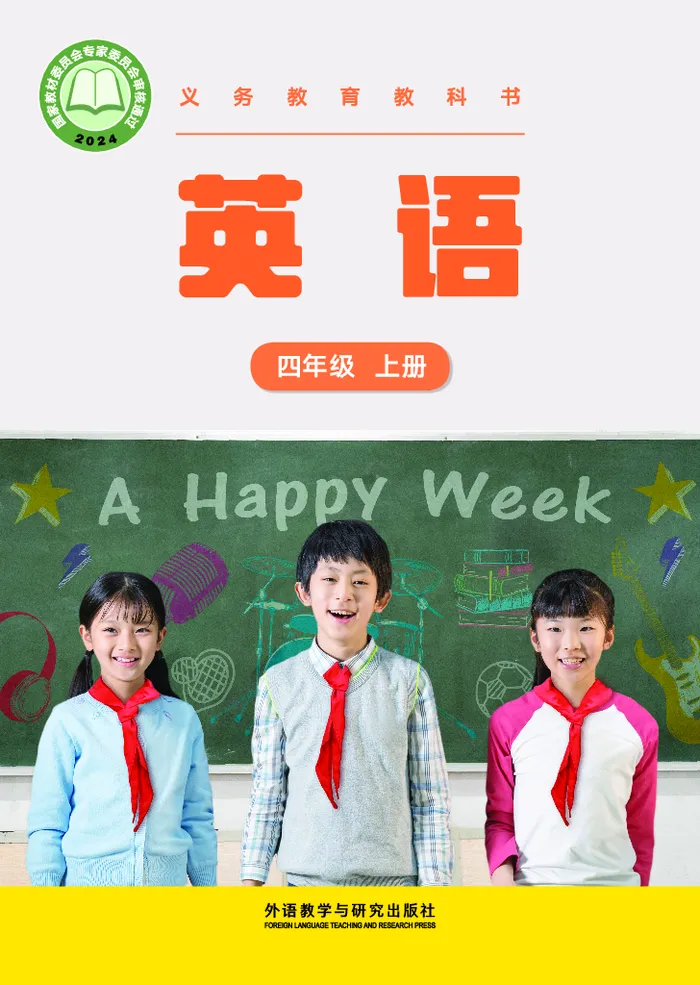
义
务
教
育
教
科
书
四年级 上册
义
务
教
育
教
科
书
四年级 上册
主 编
张祖春
编 者
董海运
(按照姓氏笔画排序)
于艳红 石
芳 白艳艳
刘 珉 吴旻烨 徐 姗
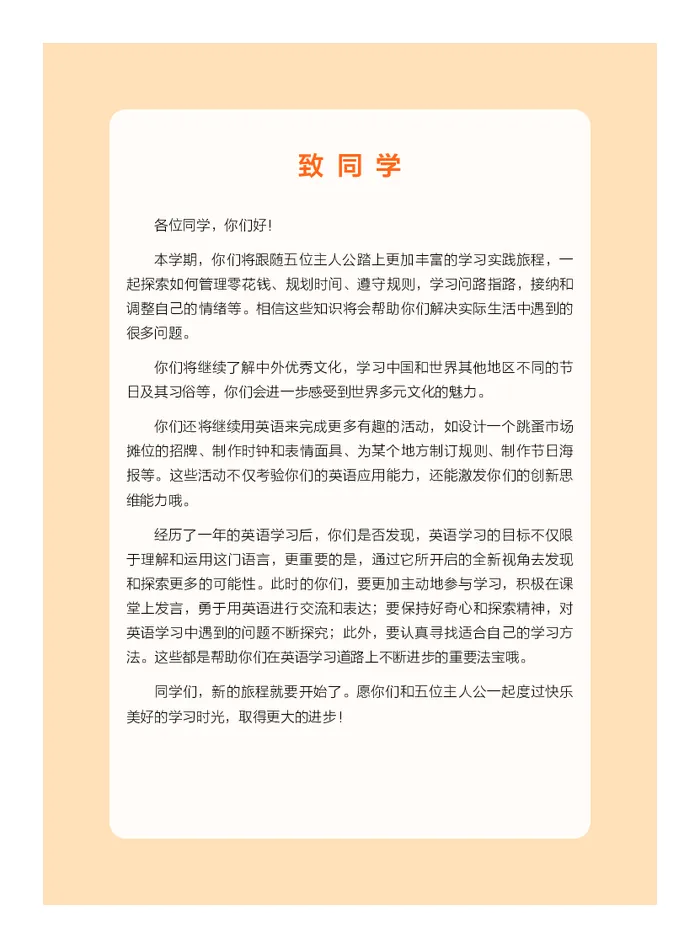
致 同 学
各位同学,你们好!
本学期,你们将跟随五位主人公踏上更加丰富的学习实践旅程,一
起探索如何管理零花钱、规划时间、遵守规则,学习问路指路,接纳和
调整自己的情绪等。相信这些知识将会帮助你们解决实际生活中遇到的
很多问题。
你们将继续了解中外优秀文化,学习中国和世界其他地区不同的节
日及其习俗等,你们会进一步感受到世界多元文化的魅力。
你们还将继续用英语来完成更多有趣的活动,如设计一个跳蚤市场
摊位的招牌、制作时钟和表情面具、为某个地方制订规则、制作节日海
报等。这些活动不仅考验你们的英语应用能力,还能激发你们的创新思
维能力哦。
经历了一年的英语学习后,你们是否发现,英语学习的目标不仅限
于理解和运用这门语言,更重要的是,通过它所开启的全新视角去发现
和探索更多的可能性。此时的你们,要更加主动地参与学习,积极在课
堂上发言,勇于用英语进行交流和表达;要保持好奇心和探索精神,对
英语学习中遇到的问题不断探究;此外,要认真寻找适合自己的学习方
法。这些都是帮助你们在英语学习道路上不断进步的重要法宝哦。
同学们,新的旅程就要开始了。愿你们和五位主人公一起度过快乐
美好的学习时光,取得更大的进步!
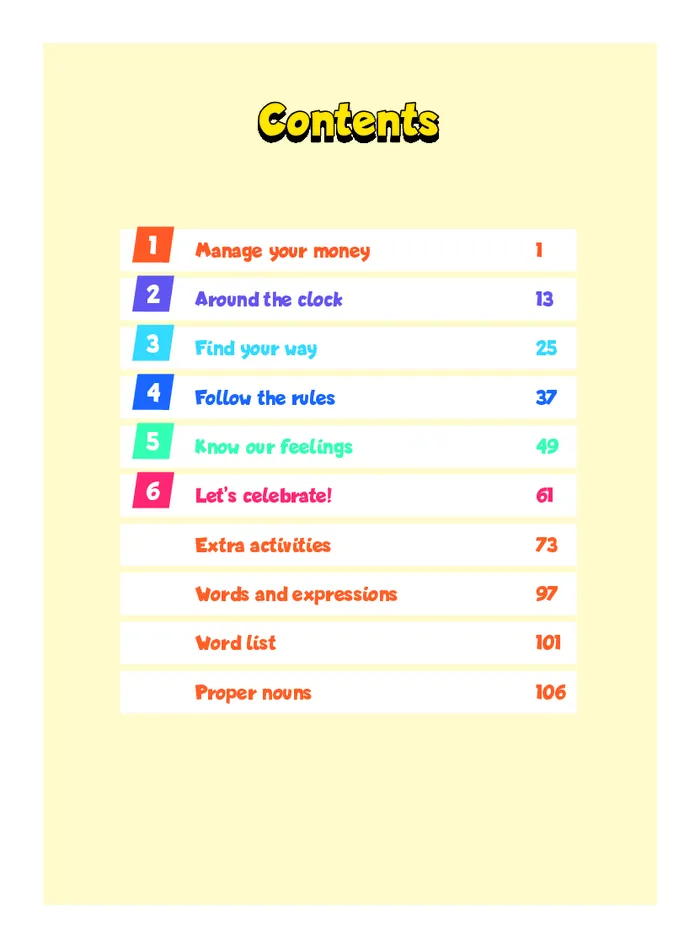
Contents
Contents
1
Manage your money
1
2
Around the clock
13
3
Find your way
25
4
Follow the rules
37
5
Know our feelings
49
6
Let’s celebrate!
61
Extra activities
73
Words and expressions
97
Word list
101
Proper nouns
106
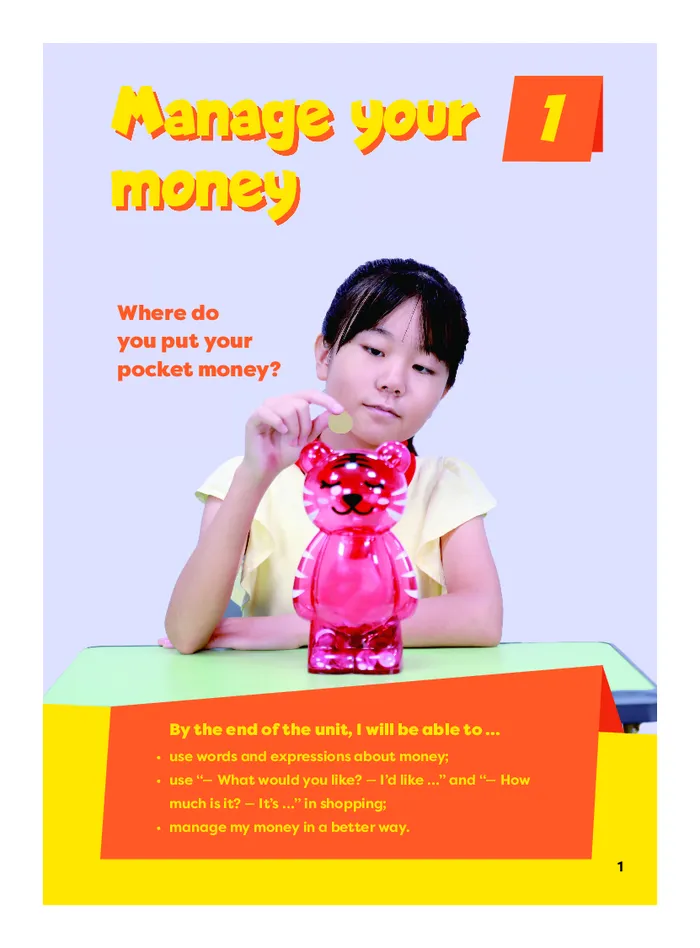
Where do
you put your
pocket money?
Manage your
money
1
Read
Use
Write
In this unit you will
stories about arts and artists
the simple future tense and the simple past tense to
talk about arts and artists
an art exhibition
Read
Use
Write
In this unit you will
• use words and expressions about money;
• use “— What would you like? — I’d like …” and “— How
much is it? — It’s …” in shopping;
• manage my money in a better way.
By the end of the unit, I will be able to ...
1
Listen and read
1 Listen, point and say.
2 Listen and read.
birthday
buy
money
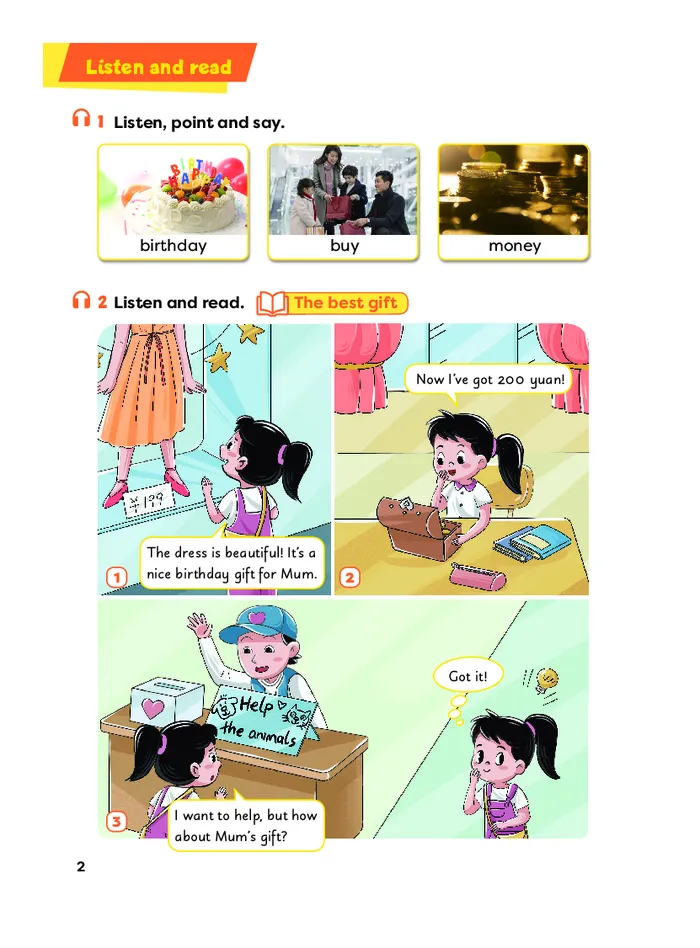
The dress is beautiful! It’s a
nice birthday gift for Mum.
Now I’ve got 200 yuan!
I want to help, but how
about Mum’s gift?
Got it!
1
3
2
The best gift
2
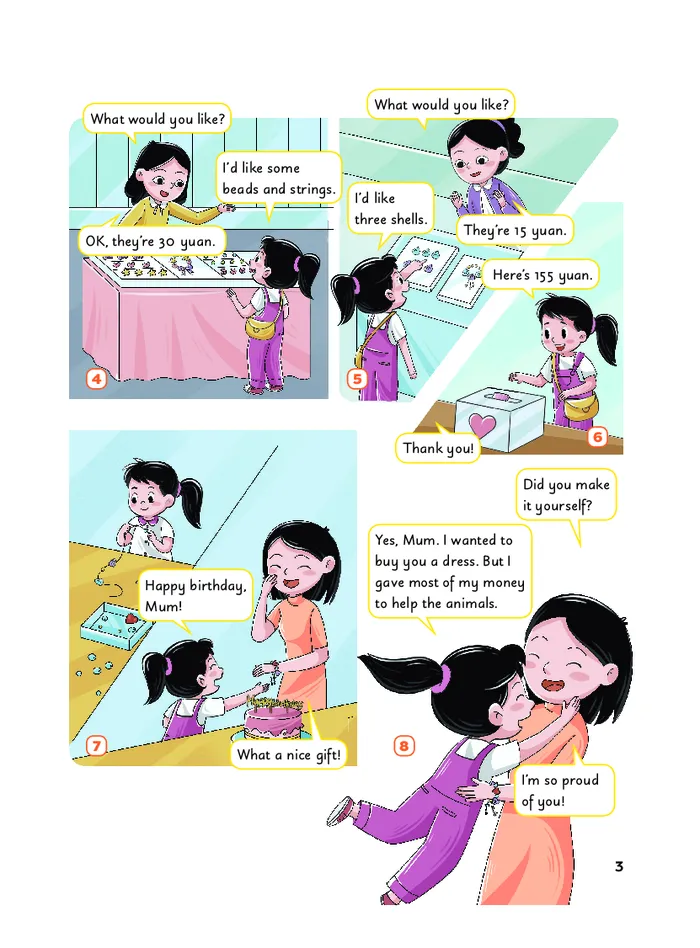
What would you like?
I’d like some
beads and strings.
OK, they’re 30 yuan.
What would you like?
I’d like
three shells.
They’re 15 yuan.
What a nice gift!
Yes, Mum. I wanted to
buy you a dress. But I
gave most of my money
to help the animals.
Did you make
it yourself?
I’m so proud
of you!
Here’s 155 yuan.
5
7
8
Thank you!
4
6
Happy birthday,
Mum!
3
3 Read and choose.
4 Read and choose.
➊Beibei has got
yuan in her money box.
a 100 b 200 c 300
➋She gives 155 yuan to
.
➌Beibei’s mum is
.
a worried b happy c sad
5 Work in groups and discuss.
➊What does Beibei want to buy for her mum’s birthday
at first?
➋What does Beibei give her mum at last?
➊Do you give birthday gifts to your parents?
➋What do you get for them?
➌Do you buy or make the gifts?
a b c d
c
a b c
b
4
6 Look, read and match.
a — What would you like?
— I’d like three shells.
b — What would you like?
— I’d like some beads
and strings.
➊
7 Work in pairs. Look, ask and answer.
➋
What would you like?
I’d like this schoolbag.
In focus
— What would you like?
— I’d like ...
5
At the
flea
mar
ke
t
You’re so honest.
Thank you!
It’s 10 yuan.
Hi! I’d like this book.
How much is it?
For what?
Read to learn
1 Listen, point and say.
2 Listen and read.
How much are the books?
Tiaotiao, would you like to go
to the flea market tomorrow?
Sure!
flea market
sell
pocket money
honest
It’s 25 yuan.
You can have
two for 30.
How much
is that one?
OK, I’ll take them.
Here you are.
Please wait. The two books are
30 yuan. But here’s 40 yuan.
1
3
4
2
5
One, two, three, four?
I want to sell some old
things to buy school things
for the children’s home.
In focus
— How much is it?
— It’s ...
6
OK, I’ll take them. Here you are.
It’s 10 yuan.
It’s 25 yuan. You can have two for 30.
How much is it?
How much is that one?
The books are 30 yuan. But here’s 40 yuan.
3 Read and choose.
4 Read and order.
5 Work in pairs. Look, ask and answer.
Why does Doudou sell his old things?
a buy a gift for Tiaotiao
b get some pocket money
c buy school things for the children’s home
He wants to
.
How much is the shirt?
It’s 30 yuan.
We use all the money to help others.
Big sale - great prices!
7
Can I help you?
Can I help you?
I’d like this cake.
I’d like some milk.
How much are they?
How much are they?
They’re twenty-eight.
They’re twenty-eight.
Learn to use
1 Listen and chant.
Phonics
c m
Total price:
2 Listen and tick (✔). Then complete.
8
The second one is for “spending”.
I use the money to buy things
for my family and friends.
4 Write and talk.
Make notes about your money boxes in one week. Then
talk with your partner.
I have got three money boxes.
The first one is for “saving”.
Mum gives me 200 yuan.
I put 100 yuan in it.
The third one is for “giving”.
I use the money to help
others.
3 Read and think.
Which one of the three money boxes do you like best?
9.10 ¥20 ¥10 ¥5
1
3
4
2
What would you like?
It can get
fat one day!
A toy horse
for my sister.
It’s 60 yuan.
It feels good
to help! I love
this one best!
Thank you!
...
9
Finish
Start
20 yuan
8 yuan
30 yuan
40 yuan
95 yuan
20 yuan
80 yuan
15 yuan
55 yuan
35 yuan
Sel
l a
n
d b
uy
!
Work in pairs. Ask and answer.
Play the game
20 yuan
A: What would
you like?
B: I’d like some cake.
A: How much is
the hat?
B: It’s 20 yuan.
10
Check it
1 Work in groups of four. Write about things to sell at the stand.
Design a lea market stand
2 Design a price list for your stand.
3 Hold a flea market in your class. Ask and answer.
Name
Things to sell
An old book
5 yuan
I’d like …
It’s …
What would you like?
How much is …?
Project
Now I can
use words and expressions about money:
;
use “— What would you like? — I’d like …” and “— How much
is it? — It’s …” in shopping;
manage my money in a better way.
11
1 Listen and read.
Where did the first paper money come from?
See the world
2 Work in pairs. Ask and answer.
People use money every day. It can be notes
(paper money) or coins. The first paper money
came from China over a thousand years ago!
Different countries usually use different
money. People use dollars ($) in the United
States. People in the United Kingdom use
pounds (£). But the euro (€) is the money
of many countries in Europe. That means,
countries like France and Germany use
the same money.
w o
r
l
d
M o n e y
a
r
o
u
n
d
t
h
e
➊ ➋ ➌
Which country is the money from?
It’s from the
United States.
12
Read
Use
Write
In this unit you will
stories about arts and artists
the simple future tense and the simple past tense to
talk about arts and artists
an art exhibition
Read
Use
Write
In this unit you will
What is this?
What does it do?
Around
the clock
2
• use words and expressions about time;
• use “— What time is it? — It’s …” and “— When do
you …? — At …” to talk about time and daily schedules;
• manage my time in a better way.
By the end of the unit, I will be able to ...
13
1 Listen, point and say.
2 Listen and read.
What time is
it, Grandma?
What time is it now?
It's two o'clock.
It’s four o’clock.
It's early.
It's still early.
What time is
it, Grandpa?
It's a quarter
to six. Time
for dinner.
Can you finish your
homework first?
Hooray! I can't wait!
There is a kung fu show at
seven o'clock this evening!
1
3
4
2
evening
time
a quarter to
half past
o’clock
Homework first
t
f
Listen and read
14
OK.
Doudou?
I have to finish my homework first.
Doudou, it's half past six.
It's time for homework.
Doudou, it's five to
seven. Get ready
for the show.
5
7
6
15
3 Look and choose.
4 Look and match.
At seven o’clock, Doudou
.
➊
➋
➌
➍
b
c
b
a
d
a
c
16
6 Work in groups. Ask, answer and show.
5 Look, read and match.
a — What time is it, Grandma?
— It’s four o’clock.
b — What time is it, Grandpa?
— It’s a quarter to six.
➊
➋
➌
c — What time is it now?
— It’s two o’clock.
What time is it?
It's eight o'clock.
In focus
— What time is it?
— It’s …
17
2 Listen and read.
When do the friends plan to meet?
1 Listen, point and say.
in the daytime
late
a quarter past
At eight o'clock.
He is late.
Nice to meet you!
Let's wait for him.
What time is it?
It's nine o'clock.
Sure! When do
you get up?
Would you like to play
with us tomorrow?
Hi! I'm Freddy.
I'm new here.
I'm Billy — and
this is Milly!
It’s a quarter
past nine! When
does he get up?
Hi!
I know! Owls sleep
in the daytime.
Freddy says half
past eight in the
evening!
Let's go to
Freddy's house.
Let's meet at half past
eight in the park.
A new friend
2
1
3
4
5
He's sleeping!
In focus
— When do you …?
— At …
Read to learn
18
4 Read and complete.
➊— When
Billy and Milly get up?
— They get up at
am.
➋— When
Billy and Milly get to the park?
— They get to the park at
am.
➌— When
Billy and Milly get to Freddy’s house?
— They get to Freddy’s house at
am.
➍— When
Freddy sleep?
— He sleeps
.
5 Work in pairs. Ask and answer.
Are you an early bird or a night owl?
3 Look and tick.
Where is Freddy at half past eight in the morning?
A: When do you go to bed?
B: I go to bed at 8:30.
A: When do you get up?
B: I get up at 6:30.
A: You’re an early bird!
19
When do you get up?
At six am, at six am.
That’s very early! That’s very early!
When do you eat lunch?
At twelve noon, at twelve noon.
That’s just right! That’s just right!
When do you go to bed?
At eight pm, at eight pm.
That’s very early! That’s so great!
1 Listen and chant.
2 Listen and complete.
Phonics
t v
Time
Activity
Time
Activity
have breakfast
16:00
go home
8:00
go to school
do exercise
8:30-12:00
have classes
18:00
have dinner
have lunch
do homework
14:00-16:00
have classes
21:00
go to bed
Learn to use
20
Do you feel difficult to get up in the morning? But there
are many early birds around us. Who are they?
•Around four o’clock, cleaners go out. They keep the roads
clean for us.
•Around five o’clock, bus drivers start to work. They send
us to different places.
•Around six o’clock, restaurants open. They make us
yummy breakfast.
•Around seven o’clock, police officers are on the road.
They keep the road safe.
3 Read and order.
4 Work in pairs and talk.
What time do your family members usually do their
daily activities?
es?
When does your dad
go to work every day?
How about your mum?
Wow, she’s so early!
He goes to work
at eight o’clock.
She goes to work
at half past six.
17
21
Work in pairs. Ask and answer.
Play the game
What time is it?
A: When do you
get up?
B: At seven o’clock.
A: What time is it?
B: It’s a quarter
to five.
Finish
Finish
Start
Start
22
Make a clock
1 Follow the steps and make your own clock.
2 Work in pairs and turn the clock hands. Ask and answer.
What time is it?
It’s seven o’clock.
Get the
materials.
➊
Draw a clock face
and the hands.
➋
Cut out your clock
face and the hands.
➌
Pin the hands to
the middle of the
clock face.
Now it’s a clock!
➍
Project
Check it
When does your
mum go to work?
At 8:30.
Now I can
use words and expressions about time:
;
use “— What time is it? — It’s …” and “— When do you …? — At …”
to talk about time and daily schedules;
manage my time in a better way.
23
1 Listen and read.
What does the child in London do at 7:30 pm Beijing time?
2 Work in groups and discuss.
It’s 9 am in Beijing. What time is it in the other cities in
Activity 1? What are the children doing at that time?
Time zones
It’s 7:30 pm in Beijing, China.
It’s nighttime. Tongtong is
reading stories with her mum.
In Los Angeles, the US, it’s
3:30 am! Tim is sleeping at this
time. Have a sweet dream!
In Havana, Cuba, it’s 6:30 am.
Sofia gets up. Then she has
breakfast and goes
to school.
In London, the UK, it’s 11:30 am.
It’s time for lunch. Ken is having
fish and chips. What a nice lunch!
See the world
24
Find your way
How do you find a place in a city?
3
Read
Use
Write
In this unit you will
stories about arts and artists
the simple future tense and the simple past tense to
talk about arts and artists
an art exhibition
Read
Use
Write
In this unit you will
• name different places;
• use words and expressions about giving directions;
• use “How can we get to …?” and “Is there a(an) …?” to
ask for directions;
• help others to find the right way to places.
By the end of the unit, I will be able to ...
25
go across
go along
turn left
Woof!
Look at this.
1 Listen, point and say.
2 Listen and read.
A cute dog! What's
your name?
Could you please tell us
the way to Pink Street?
How can we get
to Peak Street?
Pink Street? I only
know Peak Street.
Thanks!
street
Go across the
park to the library.
Peak Street is on
your right.
Whose dog is it?
Max. No. 29, P … P …
Is this Pink Street?
Let me ask.
1
3
4
2
Where is Max’s home?
Listen and read
26
Here it is!
How can we get
to Park Street?
No. Maybe it's
from Park Street.
Yes! My dear Max!
Thank you so much!
Is this your dog?
Is this your dog?
Go along this street. Then
turn left at the cinema.
You are welcome!
5
6
7
8
27
3 Look and tick (✔).
Where does the dog’s owner live?
4 Read and order.
5 Work in groups and discuss.
➊ How do you ask the way to a place?
➋ How do you help people find their way to places?
The children go to Park Street.
The children meet Max.
The children go to Peak Street.
The children find an information card.
The children find the dog’s owner.
park
library
cinema
28
Taoyuan St
Tiyu St
Zhengyang St
Jiefang St
Changjiang St
Fuxing St
Baiyun St
6 Look, read and match.
7 Work in pairs. Look and find.
Follow your partner’s directions and find the places.
— How can we get to
Park Street?
— Go along this street. Then
turn left at the cinema.
a
— How can we get to
Peak Street?
— Go across the park to
the library.
b
St
St
Start from our school. Go along Changjiang
Street and turn left at the first crossroads.
It’s the fire station!
You're right!
➋
Park Street
In focus
— How can we get to …?
— Go across / along …
Turn left / right ...
➊
Peak Street
29
shop
turn right
1 Listen, point and say.
2 Listen and read.
Where do the children want to go?
ice cream stand
gate
Let's look at the map
Here we are, at
the park shop. We
need to turn right.
There it is! Well
done, Mia.
3
4
5
Oh! Turn left
or right here?
I can’t
remember.
There is a map.
Let’s check.
1
In focus
— Is there a(n) …?
— Yes, there is. / No, there isn’t.
2
Yes. There's one
near the park gate.
Excuse me. Is there
an ice cream stand
around here?
Turn left at the old tree.
Go along. Turn right at the
shop. It’s on your left!
How can we
get there?
Read to learn
30
Turn left at the
. Go along. Turn right at the
.
It’s on your
!
3 Look and choose.
4 Look and fill in the blanks.
5 Work in pairs. Ask and answer.
The children buy ice cream near
.
Help the children
find the ice
cream stand!
Excuse me, is there a hospital around here?
Yes. Go along this road and turn right.
You can see the hospital on your right.
b
a
c
nks
am near
31
In the morning, let’s go to the city zoo.
I like zebras. Where are they?
Turn left and go along.
They’re next to the monkeys.
1 Listen and chant.
2 Listen and draw the road map to the zoo.
Guangming Rd
Xinhua St
Hongxing Rd
cinema
park
school
hospital
zoo
You are here.
post office
In the afternoon, let’s go to the museum.
I like the old chopsticks. Where are they?
Go along and turn right.
They’re next to the old chair.
Chaoyang St
Heping St
Jiefang St
Phonics
z ch
Learn to use
32
3 Look and write T (true) or F (false).
4 Work in pairs. Draw and say.
Draw a map of a community. Then talk about the way
to different places with your partner.
➊There is a fire station between the supermarket
and the police station.
➋There is a post office beside the cinema.
➌The bank is next to the park.
➍There is a school next to the post office.
➎The hospital is near the police station.
bank
cinema
hospital
fire station
park
police station
post office
school
supermarket
p
33
How can we
get to the
bank?
Is there a
shop?
Is there an ice
cream stand?
How can we
get to the
zoo?
Is there a park
around here?
Play the game
Work in pairs. Ask and answer.
Help the monkey find the way home!
How can we
get to the
museum?
How can we
get to the
library?
34
1 Choose your favourite place and make a model of it.
2 Share your model with the class. Ask and answer.
Is there an ice cream stand?
Yes, there is.
Go across the square …
How can we get there from the gate?
➊
➌
➋
➍
museum
school
zoo
park
Project
Check it
What's your favourite place?
It's a park.
Make a model of your avourite place
3 Vote for the best model in your class.
Now I can
name different places:
;
use words and expressions about giving directions:
;
use “How can we get to …?” and “Is there a(an) …?” to ask
for directions;
help others to find the right way to places.
35
2 Work in groups. Think and share.
What other ways do you know to tell the directions?
Use a compass
Turn your body with the compass.
Stop when the red hand points to
N. This is north!
1 Listen and read.
How can you find your way without a map?
Look at trees
In the northern half of
the earth, there are more
leaves on the southern
side of trees.
Look at the sun
In the morning, the sun is in the
east. In the late afternoon, the
sun is in the west.
Look at the stars
Find the Big Dipper. The
two stars on the end of
the Dipper’s “cup” point
the way to the North Star!
Find your way without a map
S
N
S
N
U
T
S
N
E
W
E
W
See the world
36
Follow the
rules
What do you see
in the picture?
Read
Use
Write
In this unit you will
stories about arts and artists
the simple future tense and the simple past tense to
talk about arts and artists
an art exhibition
Read
Use
Write
In this unit you will
• use words and expressions about rules;
• use “must / mustn’t” and “should / shouldn’t” to talk
about rules;
• explain the importance of following rules.
By the end of the unit, I will be able to ...
4
37
1 Listen, point and say.
2 Listen and read.
get up
keep quiet
put away
rules
What? No rules
for a day? Great!
Rules are like those
little men. Mum
has one. Dad has
one. My teacher
also has one. They
are always
around me.
You must put
away your toys!
You mustn’t
take your pet
to school!
You must keep
quiet in the
classroom!
OK. You can have
a day without us.
Why can’t you go away?
1
2
3
Classroom rules
· No eating
· Keep quiet
· No pets
...
No rules for a day
Listen and read
38
Let’s go to
school, Feifei!
Ouch!
What is that?
It’s your car!
Wake up, Doudou!
You must get up now.
Whew! It was a dream.
The rules men didn’t go
away. That’s great.
Feifei, come back!
Oh, this is too bad.
4
5
6
7
39
3 Look and circle T (true) or F (false).
4 Work in groups and discuss.
➊ What does Doudou say to the little men?
➋ What happens on the day without rules?
➌ Do you think it’s good without rules? Why?
You can take your pet
to school!
T / F
You must keep quiet
in class!
T / F
It’s OK to put your toys
all around.
T / F
➊
➌
➋
40
5 Look, read and complete.
6 Work in pairs. Look and say.
➊You
put away your toys!
➋You
take your pet to school!
➋ You
keep quiet in the classroom!
We must keep quiet in
the library or museum.
In focus
You must / mustn’t ...
41
1 Listen, point and say.
2 Listen and read.
What are the rules for Xinxin’s family?
talk nicely
help
each other
shout
share
the work
Our family rules
We should be honest
with each other.
We should help each
other.
We shouldn’t shout.
We should talk nicely.
We should share the
work at home.
My family rules
My family rules
Xinxin
In focus
We should / shouldn’t ...
This is my family rules poster. These rules are not only for kids.
They are for the whole family. Everyone should follow them.
We don’t have many rules. But they are very important. The
rules help make us a good and happy family.
Read to learn
42
➊ Family rules are only for kids.
➋ Xinxin’s family have many family rules.
➌ Family rules are very important.
➍ Family rules give Xinxin a good and happy family.
3 Read and tick (✔).
4 Read and match. Then say the sentences.
5 Make a poster of your family rules. Then share.
shout at each other.
We should
share the work at home.
talk nicely.
We shouldn’t
help each other.
be honest with each other.
43
1 Listen and chant.
2 Listen and match.
Don’t shout. Don’t run.
Speak after raising your hand.
Cars should stop at the red light.
Get on the bus one by one.
Rules for class. Rules for school.
Rules for sport. Rules for road.
Rules for everything. But why?
Rules make the world safe and fair.
.
Conversation 1
Conversation 2
Conversation 3
b
a
c
Phonics
r sh
Learn to use
44
Rules to keep you safe online!
Over 60% of the people in the world use the Internet!
There are many kids among them. It’s important to stay
safe online. These rules can help you:
You mustn’t give out your information or photos.
You mustn’t let others know your passwords.
You mustn’t meet any “friends” online.
You should ask for help if you get an unkind message.
You should be kind and polite in your words online.
3 Read and answer.
What should / mustn’t we do online? Use the expressions under
the pictures to help you.
4 Write more online rules. Then talk with your partner.
Online rules
We mustn’t give out our parents' names.
➋your school name
➌your photos
➍your phone number
➏words online
➊your password
➎friends online
We mustn’t give out
our parents' names.
Yes, it’s not safe!
45
Play the game
Work in pairs. Spin the wheel. Ask and answer, or say.
Play the rules wheel!
Play the rules wheel!
Play the rules wheel!
What signs
of rules can
you often see
around you?
Say three
family rules.
What’s the most
important rule in
your class?
Do you think rules
are important?
Why?
What’s
the most
important rule
to keep us safe
online?
Choose a place,
and say three
rules there.
Tell your class a
special rule you
heard.
Make a new
rule for your
class. Give your
reason.
46
Make rules or a place
1 Work in groups. Choose a place.
3 Share your rules with the class.
2 Think and write.
What rules do you want to have there?
There are rules for … Here, people …
Check it
Project
Now I can
use words and expressions about rules:
;
use “must / mustn’t” and “should / shouldn’t” to talk about rules;
explain the importance of following rules.
47
2 Work in groups. Think and share.
Do you know more rules and laws?
1 Listen, read and write R (rule) or L (law).
Rules and laws
Rules:
Rules are for people in some places,
such as home or school.
It’s not good to break rules.
Laws:
Laws are for everyone.
It’s not good to break laws.
The result is more serious.
See the world
Which is a rule? Which is a law?
➊No running in the library.
➋You can’t vote until the age of 18.
➌You should wear a seat belt in a moving car.
➍Be home before 5 pm.
➎Return the book in a week.
48
5
Read
Use
Write
In this unit you will
stories about arts and artists
the simple future tense and the simple past tense to
talk about arts and artists
an art exhibition
Read
Use
Write
In this unit you will
• name different feelings;
• use “— Are you …? — Yes, I am. / No, I’m not.” and
“— Why? — Because ...” to describe feelings and
give reasons;
• control my feelings in a better way.
By the end of the unit, I will be able to ...
How do they feel?
49
1 Listen, point and say.
2 Listen and read.
Listen and read
sad
worried
happy
excited
Are you worried, Mum?
Yes, I am.
Look at the
clouds there.
I am so excited.
I can’t sleep.
Are you ready?
Let’s go.
Oh, I am worried
too now.
1
3
4
2
A happy picnic
Let’s go for a
picnic tomorrow.
Hooray!
50
Yes, I am. I want
to have a picnic.
Are you sad?
Are you happy now?
Come on. Let’s
have a picnic.
Oh, no.
Let’s wait
for a while.
I have got an idea.
Yes. Why not?
We can't wait for
the rain to stop.
Let’s go back home.
5
7
8
6
9
Here in the
living room?
Yes, I am very
happy, for the
picnic at home!
I'm happy, too.
51
➊Let’s go for a picnic tomorrow.
➋We can’t wait for the rain to
stop. Let’s go back home.
➌Yes, I am very happy,
for the picnic at home!
3 Read and tick (✔).
Where do Doudou’s family have the picnic in the end?
4 Read and match.
5 Look and order. Then retell the story.
➊At the park.
➋At the bus stop.
➌At home.
a
b
c
52
6 Look, read and match.
7 Work in pairs. Act, guess and answer.
— Are you worried, Mum?
— Yes, I am.
— Are you sad?
— Yes, I am. I want to
have a picnic.
a
b — Are you happy now?
— Yes, I am very happy.
c
Yes, I am!
➊
➋
➌
Are you excited?
Are you happy?
In focus
— Are you ...?
— Yes, I am. / No, I’m not.
No, I'm not!
53
1 Listen, point and say.
2 Listen and read.
How does Charlie feel in the end?
Read to learn
listen to
I am out! I don’t want
to discuss it with you!
Charlie, you are
angry. Why?
Because they
don’t listen to
me. I feel bad.
Go back. Say sorry
first. Tell them
about your feelings.
You also need to
listen to them.
OK. Let
me try.
Are you
happy now?
Yes. It’s great to
share feelings.
Sharing feelings is great!
discuss
angry
2
4
5
1
feel bad
3
But what
shall I do?
Why? They
make me angry.
You shouldn’t
shout at them.
Because you are
in a group. Share
your feelings
with others.
In focus
— Why?
— Because ...
54
3 Read and tick (✔).
Who is angry?
4 Read and answer.
5 Look and say.
How do the people feel? Why?
➊ Why is Charlie angry?
➋ What does Charlie’s teacher do?
➌ What does Charlie do at last?
She feels sad
because she can't
find her toy.
55
1 Listen and chant.
2 Listen and match.
How do the children feel?
Binbin
Kate
Ken
Qiqi
Learn to use
Sometimes you are happy.
Sometimes you are sad.
Sometimes you are worried.
Sometimes you are mad.
There are many different feelings.
Show your feelings in the right way.
Don’t think too much.
There’s nothing to hide.
a
b
d
c
➊
➋
➌
➍
Phonics
w th
56
3 Read and complete.
Use the words in the box to help you.
4 Work in pairs. Ask and answer.
sad angry scared happy
My feelings have colours.
Yellow is the colour of the shining sun.
I feel
1
.
I play with my friends.
Grey is the colour of the cloudy sky.
I feel
2
.
I can’t find my dear bear.
Red is the colour of fire.
I feel
3
.
My brother breaks my car.
Black is the colour of night.
I feel
4
.
Don’t tell me the monster story.
of the feelings
4 Work in pa
4
No, I'm sad!
Because my toy is broken.
Are you happy now?
Why?
57
Play the game
Work in pairs. Ask and answer.
Start
Finish
How do you feel?
How do you feel?
A: We are happy.
B: Why?
A: Because we like
playing with
our dog.
A: Are you sad?
B: Yes, I am.
You are the people in the pictures.
58
1 Think and share.
What feeling do you want your mask to show?
2 Follow the steps and make your mask.
Make an emoji mask
4 Vote for the best mask for each feeling in your class.
➊ Draw a circle.
➍ Glue a stick
on the back
of the circle.
➌ Draw eyes and
a mouth.
3 Hold the mask over your face. Ask and answer.
Project
Check it
Are you happy?
Why?
Yes, I am.
Because it's my
birthday today!
➋ Cut it out.
Now I can
name different feelings:
;
use “— Are you …? — Yes, I am. / No, I’m not.” and
“— Why? — Because ...” to describe feelings and give reasons;
control my feelings in a better way.
59
s
1 Listen and read.
How many emojis do people send every day?
2 Work in groups and discuss.
➊ Do you often use emojis? Which ones do you use the most?
➋ What’s your favourite emoji and what’s its meaning?
See the world
s
The first set of emojis appears.
They can help us talk about
our feelings without words.
Emojis become
popular worldwide.
There is the first World
Emoji Day — on 17 July.
There is even
an emoji movie!
We send over 10 billion
emojis every day.
1997
2011
2014
2017
Today
Some of the most
popular emojis:
thumbs up
tears of joy
red heart
for all
60
What do you see in the picture?
How do you feel?
61
Let’s
celebrate!
6
Read
Use
Write
In this unit you will
stories about arts and artists
the simple future tense and the simple past tense to
talk about arts and artists
an art exhibition
Read
Use
Write
In this unit you will
• use words and expressions about festivals;
• use “— How do you celebrate …? — I / We …” and “— What’s
your favourite festival? — My favourite festival is … It’s
in …” to talk about festivals;
• talk about festivals around the world.
By the end of the unit, I will be able to …
61
A Different Spring Festival
Do you want to make
dumplings for animals?
Come and join us!
Time: 2 pm, Saturday
Place: the city zoo
1 Listen, point and say.
2 Listen and read.
the Spring
Festival
1
2
celebrate
dumplings
dish
How do you celebrate the Spring Festival?
We also stay up late.
We eat dumplings and
many yummy dishes.
Hey! Look. We can
have a different Spring
Festival this year.
Great! Let’s go!
A different Spring Festival
Listen and read
62
Let me make meat
dumplings for the tigers.
I can make fruit dumplings
for the elephants.
Let me make bamboo
dumplings for the pandas.
I want to make carrot
dumplings for the monkeys.
Hello! Welcome to
the zoo. Let’s begin.
3
4
Thank you, children!
They have a happy
Spring Festival! And
I wish you a happy
Spring Festival!
5
They all love our dumplings!
63
3 Look and match.
4 Read and circle.
➊ The children go to the zoo on Saturday afternoon /
Sunday morning.
➋ The children make fruit / carrot dumplings for the
monkeys.
➌ The animals love / don’t like the dumplings.
5 Work in groups and discuss.
➊ How do you celebrate the Spring Festival?
➋ What kind of dumplings do you like?
➌ Do you help your parents make dumplings?
➊
➋
➌
➍
b
a
c
d
B
A
C
D
64
6 Look, read and complete.
7 Work in pairs. Look, ask and answer.
—
the Spring Festival?
— We
and many yummy dishes.
— We also
late.
How do you celebrate
National Day?
We go to the Tian'anmen Square.
,
p
In focus
— How do you celebrate ...?
— I / We ...
65
2 Listen and read.
What festivals do the children like?
1 Listen, point and say.
dragon boat
Christmas tree
climb mountains
My favourite festival is the Dragon Boat
Festival. It’s in May or June. We eat zongzi
and watch exciting dragon boat races.
My favourite festival is Christmas. It’s in
December. We have a Christmas tree
at home. We get gifts for each other in
the family.
It’s the Spring Festival, of course! It’s in
January or February. We visit our family
and friends.
I like the Double Ninth Festival best. It’s
usually in October. We climb mountains
with our family.
Lin Ling
Lin Tao
Lizzy
Zhou Wei
gzi
What's your favourite festival?
In focus
— What’s your favourite festival?
— My favourite festival is …
It’s in ...
Read to learn
66
4 Look and complete.
5 Work in pairs. Ask and answer.
3 Read and tick (✔).
Where can you find the text?
➊In a storybook.
➋On the Internet.
➌On a poster.
➍In a travel guide.
Festival
Time
Celebration
the Dragon
Boat Festival
in May
or June
1. eat zongzi
2. watch dragon boat races
What’s your favourite festival?
My favourite festival is the Spring Festival.
Lin Ling
Lin Tao
Lizzy
Zhou Wei
67
A quarter to six,
Time for the Lantern Festival dinner.
Have some sweet rice balls.
You’ll have a sweet year.
Come quickly to see the lanterns.
There are cute rabbits, big tigers,
And a lot of beautiful flowers.
Night lights bring people together.
1 Listen and chant.
Learn to use
2 Listen and complete.
Date: 24
Time:
pm
Ticket price:
What to see: lanterns and
dragon
What to do: solve riddles
Amazing Lantern Show
Amazing Lantern Show
Nig
Li
t
L
t
n er
a
La
La
La
La
g Lantern
g Lantern
g Lantern
Phonics
q y
A quarter to six,
or the Lantern Festival dinner.
Have some sweet rice balls.
You’ll have a sweet
Yo
Y
year.
Come quickly to see the lanterns.
There are cute rabbits, big tigers,
nd a lot of beautiful flowers.
ghts bring people together.
w
h
Sh w
ow
how
how
how
Show
Show
Show
ner.
Phonics
q y
68
4 Think of another festival and draw a mind map.
The Lantern Festival is the end of the Spring Festival. It is
on the 15th day of the first lunar month. It celebrates the
first full moon of the new lunar year. On this day, people
eat sweet rice balls. They also put up colourful lanterns all
over the streets. The lanterns are in many shapes. Some
are in the shapes of animals. Some are in the shapes of
flowers. They look very beautiful at night. Some lanterns
have riddles on them. Can you solve these riddles?
3 Read and solve the riddles. Then answer the questions.
➊When is the Lantern Festival?
➋What does it celebrate?
➌What do people do on that day?
➍What are the shapes of the lanterns?
What table has
no legs?
Which room
has no doors or
windows?
What apple is
not an apple?
activities
time
…
name of
the festival
what to celebrate
country
food
69
Play the game
Work in pairs. Spin the wheel. Ask and answer.
How do you
celebrate this
festival?
What’s your
favourite
festival?
How do you
celebrate the
Double Ninth
Festival?
What’s this
festival?
What’s her
favourite festival?
How do you
celebrate the
Dragon Boat
Festival?
How does he
celebrate the
Dragon Boat
Festival?
What’s your
mum’s favourite
festival?
Play the festival wheel!
70
Check it
1 Work in groups. Ask and answer about some festivals and
take notes.
Make a poster about a estival
3 Show the poster to the
class. Ask and answer.
2 Make a poster about a
festival from Activity 1.
What’s its name?
When is it?
How do people
celebrate it?
My favourite festival is …
Harbin Ice
and Snow Festival
5 January
• ice and snow sculptures
• ice lanterns
• ice and snow sports
Project
What ’s your favourite festival?
4 Vote for the top three
posters in your class.
Now I can
use words and expressions about festivals:
;
use “— How do you celebrate …? — I / We ...” and “— What’s your
favourite festival? — My favourite festival is … It’s in ...” to talk
about festivals;
talk about festivals around the world.
71
1 Listen and read.
Which festival do you like best?
2 Work in groups. Think and share.
What other interesting festivals around the world do
you know?
Festivals around the world
Festivals around the world
In winter, Harbin holds the world’s
biggest ice and snow festival.
There are hundreds of beautiful
snow and ice sculptures. Many of
the ice sculptures have colourful
lights in them. People come and
see them every year.
Harbin Ice and Snow Festival
See the world
The festival is celebrated on a
Friday between 19 June and 25
June each year. There are flowers
all around. People in Sweden dress
up to sing and dance outside.
The Midsummer Festival in Sweden
The carnival is full of colours.
People wear masks and
beautiful clothes. The streets
become a place of show!
The Venice Carnival in Italy
72
73
1 Read and complete.
2 Write the words with the same sound in the boxes.
Extra activities
Manage your money
1
birthday
buy
sell
money
honest
save
spend
give
➊ I
my
in my money box.
➋ I want to
my old books at
the flea market.
➍ I want to
30 yuan on the
hat and
it
to my mum.
➌ It’s Leilei’s
.
I want to
a
gift for him.
➎ Do you know “The
boy who cried
wolf”? The boy
in the story is not
.
cake
milk
swim
home
cat
cow
carrot
money
c
m
cake
milk
74
3 Look, listen and match.
4 Listen and circle.
How much is each toy at the boy’s stand?
Mr Smith
at the boy’s
¥60
¥70
¥30
¥13
¥15
¥50
¥25
¥70
¥20
¥25
¥80
¥40
Ben
Ms Smith
➊
➍
➋
➌
➎
➏
➐
➏
75
5 Read and order.
6 Look and complete.
➊ — What would
?
— I’d like
, please.
— How much
?
— It’s
.
➌—
?
— I’d like
, please.
—
?
—
.
➊
Thanks!
What would you like?
Here you are.
I’d like a piece of cake, please.
➋
And this shirt? Is it 125 yuan, too?
It’s 125 yuan.
Yes, it is.
I like this shirt. How much is it?
➌
The kite, please. How much is it?
Great. Here you are.
What would you like?
It’s 40 yuan.
➋ —
?
— I’d like
, please.
—
?
—
.
➍—
?
— I’d like
, please.
—
?
—
.
25 yuan
80 yuan
62 yuan
8
8 yuan
76
2 Think and write.
List the prices of your food in Activity 1. Then find out the
total price.
1 Choose and draw.
What would you like for …?
breakfast
lunch
dinner
My breakfast / lunch / dinner is
yuan.
Food
How much is it?
an egg
1 yuan
About me
77
1 Look, read and complete.
2 Read and write.
Complete the words with t and v to help
the cat cross the river.
o’clock half past a quarter to
o’clock a quarter past o’clock
I get up at
1 seven.
I go home at
five
4 .
I have breakfast
at
2 seven.
I do my homework
at
5 six.
I meet my friend at the
bus stop at eight
3 .
Then we go to school
together.
I go to sleep at nine
6 .
ery
jus
ge
a
righ
wel e
eigh
Around the clock
2
➋
➌
➍
➎
➏
➊
78
3 Listen and match.
4 Listen and tick (✔).
7:15
7:45
6:45
7:15
3:45
4:45
7:30
8:30
6:15
6:30
9:00
9:30
a
b
c
d
➊
➌
➋
➍
➊
➍
➋
➎
➌
➏
79
➊ �what / time / now / ?
�
➋ �when / your family /
have lunch / ?
�
➌ �when / your brother /
go to work / ?
�
➍ �when / your parents /
go to bed / ?
�
➎ �when / you / get
home from school / ?
�
5 Look and write.
6 Read and write. Then match.
➊ �It’s five o’clock in the
morning.
➍ �
�
➋ �
�
➎ �
�
➌ �
�
➏ �
�
At 12:30 pm.
At ten o’clock in
the evening.
At four o’clock in the
afternoon.
At 6:00 in the
morning — his work
starts early.
It’s 7 am.
What time is it?
a
b
c
d
e
80
1 Read and complete.
When do you do these activities?
2 Write sentences.
Use your timetable in Activity 1.
Time
Activity
get up
have breakfast
go to school
have lunch
go home
do homework
have dinner
read books / enjoy family time / …
go to bed
➊ I get up at six o’clock.�
➋ �
➌ �
➍ �
➎ �
➏ �
➐ �
➑ �
➒ �
About me
1 the Green Street.
2 the park and turn
3 .
4 at the cinema. Then you can see
the gate of the
5 . It’s near the library.
2 Listen and circle.
Which word starts with a different sound?
➊
➌
➋
Find your way
3
SHOP
Green St
Jiajia
1 Look and write.
Find the way to help Jiajia get to the museum.
81
3 Listen and match.
4 Listen and circle.
➊ �Is there a shop in the park?
a Yes.
b No.
➋ �Is there a post office in the park?
a Yes.
b No.
➌ �Is there a shop near the post office?
a Yes.
b No.
➍ �Is there an ice cream stand near the park gate?
a Yes.
b No.
How can we get to …?
➊
➋
➌
➍
a
b
c
d
82
5 Look at the map. Read and complete.
6 Look at the map again and answer.
➊ Is there a shop near the bank?
➋ Is there a cinema near the zoo?
➌ Is there a library next to the hospital?
➍ Is there a playground next to the bank?
➊ — How can we get to the
cinema?
— the street and
the park. It’s on
your .
➋ — How can we get to the
shop?
— the street and . It’s on your .
➌ — How can we get to the hospital?
— Go along the street and . Then go
straight to the end. It’s on your right.
➍ — How can we get to the zoo?
— Go along the street, at the library.
Then and . You can
see the of the zoo.
83
1 Read and tick (✔) or cross (✘). Then add other places.
Is there a … in your community?
2 Draw a map of your community. Then talk about it!
library
bank
market
hospital
playground
zoo
cinema
farm
shop
park
Other places: �
About me
84
85
1 Read and complete.
2 Read and draw lines.
Join the words that begin with r and sh.
Start
Finish
rocket
sleep
run
sad
school
red
hand
shirt
sister
shoes
sit
shop
K q . You are in the library.
Stop at the r l .
Let’s h each other
and sh the work.
In our class, we should raise our
h and then speak. And we
should be p to each other.
Keep s online. Don’t
give out your i .
Don't sh . Talk n ly.
Follow the rules
4
➏
➍
➋
➊
➌
➎
86
3 Listen, read and order.
What should we say to the boy?
4 Listen and tick (✔) or cross (✘).
You shouldn’t shout here.
No, you shouldn’t bring your pet on the bus.
You should raise your hand first.
You shouldn’t say that — be kind.
You should always put away your clothes in the box.
➊ feed the animals
➋ take photos with flash
➌ play music out loud
➍ shout to the animals
➎ eat in special areas
87
5 Read and write.
Use must or mustn’t and the correct verbs.
6 Read and write.
Use should or shouldn’t.
➊ �You park your bike here. The parking place for
bikes is over there.
➋ �You bring your dog to the library. The rule is “No
pets”.
➌ �Stop. It’s the red light. You follow the traffic rules.
➍ �Pick up the bottle, please. You litter.
➎ �You wear a swimming cap in the swimming pool.
➏ �Look at the sign. You eat or drink on the subway.
➌ �You on the right
side of the road in China.
➊ �You in the museum.
➋ �You on the grass.
➍ �You quiet in the
library.
88
1 Read and tick (✔) or cross (✘).
Does your school have the following rules?
2 Write more rules of your school.
Use must / mustn’t or should / shouldn’t.
get to school on time
keep your desk tidy
raise your hand to
speak
be kind and polite
wear school uniforms
on Mondays
run in the hallways
eat in the classrooms
wear hats in class
bring drinks to the
computer room
shout at others
About me
89
1 Look and write the words.
2 Look and colour.
Which words have the same sounds?
roriewd
sda
yhpap
gryna
casrde
no
noth
thing
ing
mo
moth
ther
er
watch
atch
three
three
brother
brother
homework
homework
think
think
walk
walk
there
there
worried
worried
teeth
teeth
Know our feelings
5
xedctie
excited
90
3 Listen and match.
4 Listen, draw and match.
How do the children feel? Why?
➊ Junjun
➋ Xiaoyun
➌
Amy
➍ Haohao
➎
Feifei
Name
Feeling
Reason
a �Because the music from next
door is too loud.
b �Because we’re the winner of
the school basketball match.
c �Because I read a monster story.
d �Because I’m late for school.
e �Because my parents give a
lovely gift to me.
Meimei
Taotao
Chuchu
Leilei
91
5 Look and complete.
6 Look and circle.
➌ — Are you �
?
— Yes, I am.
➍ — Are you �
?
— Yes, we are.
➎ — �
— �
➊ — Are you excited?
— �
➋ — Are you scared?
— �
➊ �We are .
a happy
b angry
Why?
a Because the food is delicious.
b Because we enjoy the party.
➋ �I am .
a sad
b scared
Why?
a Because our group is not the winner.
b Because I am late for the match.
➌ I am .
a excited
b worried
Why?
a Because my mum is ill.
b Because my cat is lost.
92
2 Draw and write about your feelings today.
1 Look and write.
How do these things make you feel?
I’m today because �
.
�
�
�
�
�
About me
93
1 Look and write.
2 Find and circle the words with q or y.
➊ It’s the . We have a family dinner.
We have many .
➋ It’s the . There are a lot of
in the street.
➌ It’s the . We eat zongzi and watch
the together.
➍ It’s the . We climb with my
grandparents.
➎ It’s . Mum and Dad put my gifts
under the .
Q
R
Q
Y
L
V
M
D
Q
Y
Q
U
Y
U
G
B U
G
B
U
E
U
A
O
I
Y
Q
W
E
Z
E
A
I
R
U
C
E
W
F
Q
K
S
R
E
T
C
K
S
A
G G
L
T
A
T
E
L
I
X
V
F
B
C
I
D
H
R
A
L
R
N
P
G
X
O
U
E
G
Y
E
L
L
O
W
Y
N
P
I
Let’s celebrate!
6
94
3 Listen and tick (✔).
How does Weiwei celebrate the Spring Festival?
4 Listen and match.
Lin Fan
Qi Shan
Li Lin
➊
➋
➌
a
b
c
95
5 Read and order.
How do you celebrate it?
Mei
It’s the Kite Festival!
Mei
We fly kites together. What about you?
Mei
How do you celebrate it?
Ben
We dress up and dance together with friends.
Ben
What’s your favourite festival, Mei?
Ben
My favourite festival is the Midsummer
Festival in my home town, Sweden.
Ben
6 Read and complete.
➊ How / celebrate / the Dragon Boat Festival / ?
— How do you ?
— We .
➋What / favourite / festival / ?
— What’s your ?
— My .
➌What / favourite / festival / ?
— What’s Lili’s ?
— Her .
➍What / favourite / festival / ?
— What’s Taotao’s ?
— .
96
Draw and talk.
What’s your favourite festival?
My favourite festival is … It's in … We …
About me
total 总共的
first 第一(位)的
save 储蓄,存(钱)
second 第二(个)的
spend 用钱,花费
third 第三(个)的
feel 感受到,觉得,体会到
date 日期,日子
Unit 2
quarter 一刻钟
a quarter to one / two … 12点45
分/1点45分等
half 一半
past 在……之后
half past one / two … 1点半/
2点半等
kung fu 中国功夫
finish 完成,做完
still 还
early 早的
ready 准备好(做某事)的
late 迟到的
daytime 白天,日间
when 什么时候
park 公园
Unit 1
manage 合理安排
money 钱
pocket 衣袋,口袋
pocket money 零花钱
buy 买,购买
bead 珠子
shell 贝壳
most 大多数,大部分
sad 难过的
parent 父,母
flea 跳蚤
market 市场
flea market 跳蚤市场
sell 卖,出售
honest 诚实的,正直的
tomorrow 明天
wait 等,等候
sale 大减价
price 价格,价钱
other 其他的
twenty-eight 二十八
dish 菜肴,一道菜
side dish (搭配主菜的)小菜,配菜
pizza 比萨饼,意大利薄饼
topping 配料,浇头
注:加粗词汇为义务教育英语课程标准二级词汇
97
Words and expressions
Words and expressions
owl 猫头鹰
am 上午
lunch 午餐
twelve 十二
noon 中午
exercise 运动,锻炼
difficult 困难的
cleaner 清洁工人
out 出来
go out 外出
keep (使)保持
road 路
bus 公共汽车
driver 司机,驾驶员
start 开始
send 将(某人)送往
restaurant 饭店,餐馆
police 警察
officer 警察
police officer 警察
safe 安全的
Unit 3
find 找到
city 城市
street 大街,街道
across 穿过
go across 横穿
along 顺着,沿着
go along 沿着走
turn 转弯
left 向左,朝左
turn left 向左转
whose 谁的
woof 汪汪(形容狗吠声)
No. 第…… 号
ask 问
could 能否
maybe 也许
cinema 电影院
owner 所有人
information 情报;资料;消息
crossroads 十字路口
fire 火
station 站
fire station 消防站
stand 货摊
ice cream stand 冰激凌摊
gate 大门
shop 商店
map 地图
near 离…… 很近(地)
remember 记得
check 核查
hospital 医院
zebra 斑马
chopstick 筷子
chair 椅子
post 邮政
post office 邮政局
98
bank 银行
supermarket 超市
beside 在……旁边 ,在……近旁
Unit 4
follow 遵循
rule 规则
quiet 轻声的;安静的
keep quiet 请安静,别说话
man 人
always 总是,一直,每次都
must 必须
without 没有
car 汽车
wake 醒来
whew 哟
dream 梦
each 每个,各
shout 大声说,喊叫,呼喊
talk 交谈
nicely 友好地
talk nicely 好好谈话
kid 小孩
whole 整个的
should 应当
speak 说话
raise 举起;提起;抬起;使升高
stop (使)停下来
light 交通信号灯
fair 公正的
conversation 谈话,交谈
over 超出
Internet 因特网
among 在……当中
stay 维持
password 密码
if 如果
unkind 不和善的
message 信息
kind 亲切的
polite 有礼貌的
word 某人说的话
phone 电话
number 号码
phone number 电话号码
Unit 5
feeling 感觉,感触
excited 兴奋的
worried 担心的,焦虑的
picnic 野餐
cloud 云
while 一段时间
end 最后部分
discuss 讨论
angry 生气的
shall 该,要
last 最终,终于
mad 生气的
nothing 没有任何东西
99
100
hide 隐藏
scared 害怕的
cloudy 多云的
sky 天空
monster 怪兽
Unit 6
celebrate 庆祝
festival 节日
dumpling 水饺
year 年
Saturday 星期六
begin 开始
meat 肉
tiger 老虎
wish 祝,祝愿
Sunday 星期日,星期天
national 国家的
dragon 龙
dragon boat 龙舟
Christmas tree 圣诞树
exciting 令人兴奋的
race 速度比赛
of course 当然
double 双重的
usually 通常地;惯常地;平常地
text 正文
travel 旅行
guide 旅游指南
celebration 庆祝活动
lantern 灯笼
quickly 快速地
bring 带来
bring sb together 把…… 召集
起来
amazing 惊人的;了不起的
ticket 票,入场券
lunar 月球的
month 月
lunar month 朔望月
full 完全的,完整的
moon 月亮
full moon 满月
colourful 颜色鲜艳的,色彩丰富的
shape 形状
solve 破解
country 国家
100
Word list
Word list
chair 椅子
check 核查
chopstick 筷子
Christmas tree 圣诞树
cinema 电影院
city 城市
cleaner 清洁工人
cloud 云
cloudy 多云的
colourful 颜色鲜艳的,色彩丰富的
conversation 谈话,交谈
could 能否
country 国家
crossroads 十字路口
D
date 日期,日子
daytime 白天,日间
difficult 困难的
discuss 讨论
dish 菜肴,一道菜
double 双重的
dragon 龙
dragon boat 龙舟
dream 梦
driver 司机,驾驶员
dumpling 水饺
A
across 穿过
go across 横穿
along 顺着,沿着
go along 沿着走
always 总是,一直,每次都
am 上午
amazing 惊人的;了不起的
among 在……当中
angry 生气的
ask 问
B
bank 银行
bead 珠子
begin 开始
beside 在…… 旁边 ,在…… 近旁
bring 带来
bring sb together 把…… 召集
起来
bus 公共汽车
buy 买,购买
C
car 汽车
celebrate 庆祝
celebration 庆祝活动
101
E
each 每个,各
early 早的
end 最后部分
excited 兴奋的
exciting 令人兴奋的
exercise 运动,锻炼
F
fair 公正的
feel 感受到,觉得,体会到
feeling 感觉,感触
festival 节日
find 找到
finish 完成,做完
fire 火
first 第一(位)的
flea 跳蚤
follow 遵循
full 完全的,完整的
G
gate 大门
guide 导游
H
half 一半
hide 隐藏
honest 诚实的,正直的
hospital 医院
I
if 如果
information 情报;资料;消息
Internet 因特网
K
keep (使)保持
kid 小孩
kind 亲切的
kung fu 中国功夫
L
lantern 灯笼
last 最终,终于
late 迟到的
left 向左,朝左
light 交通信号灯
lunar 月球的
lunch 午餐
M
mad 生气的
man 人
manage 合理安排
map 地图
market 市场
flea market 跳蚤市场
maybe 也许
meat 肉
message 信息
102
money 钱
monster 怪兽
month 月
lunar month 朔望月
moon 月亮
full moon 满月
most 大多数,大部分
must 必须
N
national 国家的
near 离…… 很近(地)
nicely 友好地
talk nicely 好好谈话
No. 第…… 号
noon 中午
nothing 没有任何东西
number 号码
phone number 电话号码
O
of course 当然
officer 警察
police officer 警察
other 其他的
out 出来
go out 外出
over 超出
owl 猫头鹰
owner 所有人
P
parent 父,母
park 公园
password 密码
past 在……之后
half past one / two … 1点半/
2点半等
phone 电话
picnic 野餐
pizza 比萨饼,意大利薄饼
pocket 衣袋,口袋
pocket money 零花钱
police 警察
polite 有礼貌的
post 邮政
post office 邮政局
price 价格,价钱
Q
quarter 一刻钟
a quarter to one / two …
12点45分/1点45分等
quickly 快速地
quiet 轻声的;安静的
keep quiet 请安静,别说话
R
race 速度比赛
raise 举起;提起;抬起;使升高
ready 准备好(做某事)的
103
remember 记得
restaurant 饭店,餐馆
road 路
rule 规则
S
sad 难过的
safe 安全的
sale 大减价
Saturday 星期六
save 储蓄,存(钱)
scared 害怕的
second 第二(个)的
sell 卖,出售
send 将(某人)送往
shall 该,要
shape 形状
shell 贝壳
shop 商店
should 应当
shout 大声说,喊叫,呼喊
side dish (搭配主菜的)小菜,配菜
sky 天空
solve 破解
speak 说话
spend 用钱,花费
stand 货摊
ice cream stand 冰激凌摊
start 开始
station 站
fire station 消防站
stay 维持
still 还
stop (使)停下来
street 大街,街道
Sunday 星期日,星期天
supermarket 超市
T
talk 交谈
text 正文
third 第三(个)的
ticket 票,入场券
tiger 老虎
tomorrow 明天
topping 配料,浇头
total 总共的
travel 旅行
turn 转弯
turn left 向左转
twelve 十二
twenty-eight 二十八
U
unkind 不和善的
usually 通常地;惯常地;平常地
W
wait 等,等候
wake 醒来
104
when 什么时候
whew 哟
while 一段时间
whole 整个的
whose 谁的
wish 祝,祝愿
without 没有
woof 汪汪(形容狗吠声)
word 某人说的话
worried 担心的,焦虑的
Y
year 年
Z
zebra 斑马
105
Names
Freddy 弗雷迪
Billy 比利
Milly 米利
Max 马克斯
Kate 凯特
Lizzy 莉齐
Others
Spring Festival 春节
Christmas 圣诞节
Dragon Boat Festival 端午节
May 五月
June 六月
zongzi 粽子
January 一月
February 二月
December 十二月
Double Ninth Festival 重阳节
October 十月
Lantern Festival 元宵节
sweet rice ball 汤圆,元宵
106
Proper nouns
Proper nouns
后 记
亲爱的同学们,当你们翻到这一页,就意味着又一个阶段的英语学
习旅程圆满结束了,而新的学习篇章正等待着你们去体验和挑战。感谢
每一位同学在这个学习过程中所表现出的好奇心、热情以及不懈的努力。
我们希望这套教材能够为你们打开一扇通往丰富多彩的英语世界的大门;
希望五位主人公的故事能够温暖你们的学习时光,让英语不再是生硬的
知识点堆砌,而变成了一场场生动的冒险,让你们愿意学习、敢于尝试;
希望你们在未来的探索中,能不断拓宽自己的视野,丰富自己的人生经验。
尊敬的老师们,感谢你们为了教授好这套教材所付出的心力与汗水。
正是你们不懈的努力,确保了教材能够实现既定的育人目标。你们为我
国英语课程改革贡献了重要力量。
教材编写团队、编辑团队和设计团队的每位成员,感谢你们对本套
教材的精心设计、反复打磨,你们的艰辛努力确保了本套教材能够在党
的教育方针指引下,落实立德树人根本任务,实现学生核心素养的发展。
此次编写也得到了众多专家学者、社会各界人士及组织的大力支持。
你们的支持保证了教材的语言真实地道、内容鲜活多样。在此,我们一
并向你们表示诚挚的谢意。
我们热切地期待本套教材能得到业内专家持续指正,在未来的实践
中亦将广泛征求使用者的意见,使之更加完善。
我们的联系方式是:
电 话:400 898 7008
电子邮箱:beed@fltrp.com
外语教学与研究出版社