绝密★启用前
2015年全国硕士研究生招生考试
管理类专业学位联考英语试题
(科目代码:
204)
◎
考生注意事项
◎
1.考生必须严格遵守各项考场规则。
2.答题前,考生应该按准考证上的有关内容填写答题卡上的“考生姓名”“报考
单位”“考生编号”等信息。
3.答案必须按要求填涂或书写在指定的答题纸上。
(1)英语知识运用和阅读理解A 节、B节的答案填涂在答题卡上。填涂部分应
该按照答题卡上的要求用2B铅笔完成。如要改动,必须用橡皮擦干净。
(2)英译汉和写作部分必须用黑色字迹签字笔在答题卡上作答。字迹要清楚。
4.考试结束,将试题、答题卡一并装入试题袋中交回。
(以下信息考生必须认真填写)
考生编号
考生姓名
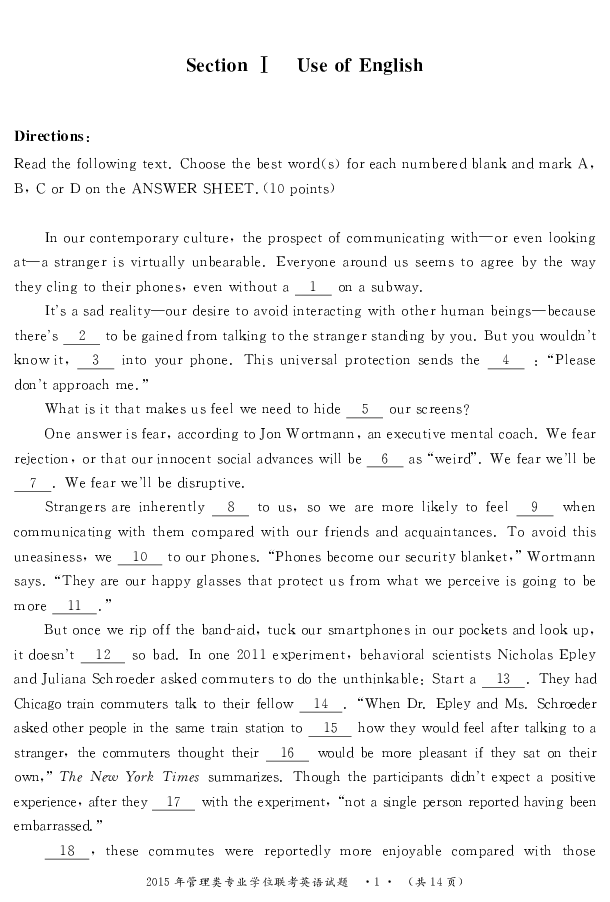
Section
Ⅰ Use
of
English
Directions:
Read
the
following
text.
Choose
the
best
word(s)
for
each
numbered
blank
and
mark
A,
B,
C
or
D
on
the
ANSWER
SHEET.(10
points)
In
our
contemporary
culture,
the
prospect
of
communicating
with—or
even
looking
at—a
stranger
is
virtually
unbearable.
Everyone
around
us
seems
to
agree
by
the
way
they
cling
to
their
phones,
even
without
a
1
on
a
subway.
Its
a
sad
reality—our
desire
to
avoid
interacting
with
other
human
beings—because
theres
2
to
be
gained
from
talking
to
the
stranger
standing
by
you.
But
you
wouldnt
know
it,
3
into
your
phone.
This
universal
protection
sends
the
4
:
“Please
dont
approach
me.”
What
is
it
that
makes
us
feel
we
need
to
hide
5
our
screens?
One
answer
is
fear,
according
to
Jon
Wortmann,
an
executive
mental
coach.
We
fear
rejection,
or
that
our
innocent
social
advances
will
be
6
as
“weird”.
We
fear
well
be
7 .
We
fear
well
be
disruptive.
Strangers
are
inherently
8
to
us,
so
we
are
more
likely
to
feel
9
when
communicating
with
them
compared
with
our
friends
and
acquaintances.
To
avoid
this
uneasiness,
we
10
to
our
phones.
“Phones
become
our
security
blanket,”
Wortmann
says.
“They
are
our
happy
glasses
that
protect
us
from
what
we
perceive
is
going
to
be
more
11 .”
But
once
we
rip
off
the
band-aid,
tuck
our
smartphones
in
our
pockets
and
look
up,
it
doesnt
12
so
bad.
In
one
2011
experiment,
behavioral
scientists
Nicholas
Epley
and
Juliana
Schroeder
asked
commuters
to
do
the
unthinkable:
Start
a
13 .
They
had
Chicago
train
commuters
talk
to
their
fellow
14 .
“When
Dr.
Epley
and
Ms.
Schroeder
asked
other
people
in
the
same
train
station
to
15
how
they
would
feel
after
talking
to
a
stranger,
the
commuters
thought
their
16
would
be
more
pleasant
if
they
sat
on
their
own,”
The
New
York
Times
summarizes.
Though
the
participants
didnt
expect
a
positive
experience,
after
they
17
with
the
experiment,
“not
a
single
person
reported
having
been
embarrassed.”
18 ,
these
commutes
were
reportedly
more
enjoyable
compared
with
those
2015年管理类专业学位联考英语试题 ·1· (共14页)
without
communication,
which
makes
absolute
sense,
19
human
beings
thrive
off
social
connections.
Its
that
20 :
Talking
to
strangers
can
make
you
feel
connected.
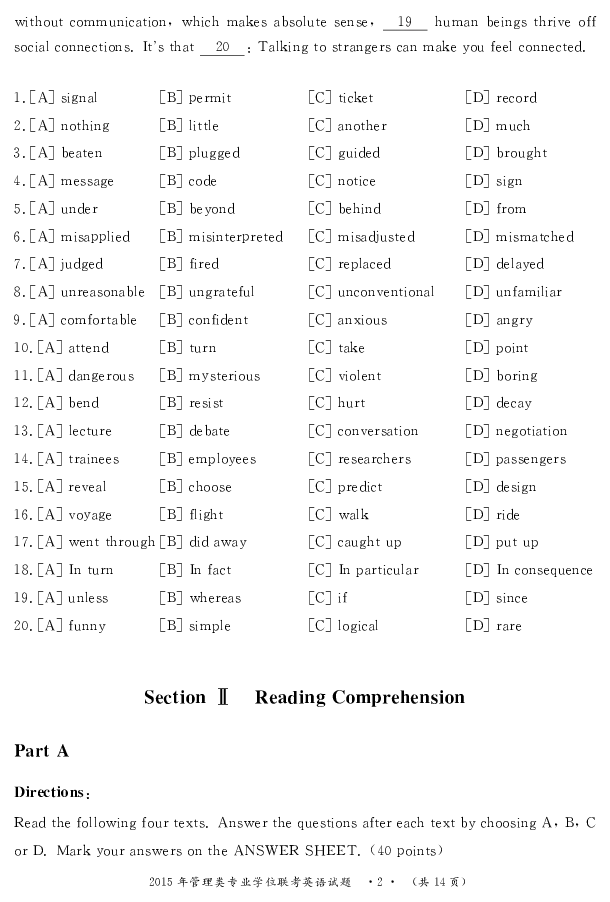
1.[A]
signal [B]
permit [C]
ticket [D]
record
2.[A]
nothing
[B]
little
[C]
another
[D]
much
3.[A]
beaten
[B]
plugged
[C]
guided
[D]
brought
4.[A]
message
[B]
code
[C]
notice
[D]
sign
5.[A]
under
[B]
beyond
[C]
behind
[D]
from
6.[A]
misapplied
[B]
misinterpreted
[C]
misadjusted
[D]
mismatched
7.[A]
judged
[B]
fired
[C]
replaced
[D]
delayed
8.[A]
unreasonable [B]
ungrateful
[C]
unconventional
[D]
unfamiliar
9.[A]
comfortable
[B]
confident
[C]
anxious
[D]
angry
10.[A]
attend
[B]
turn
[C]
take
[D]
point
11.[A]
dangerous
[B]
mysterious
[C]
violent
[D]
boring
12.[A]
bend
[B]
resist
[C]
hurt
[D]
decay
13.[A]
lecture
[B]
debate
[C]
conversation
[D]
negotiation
14.[A]
trainees
[B]
employees
[C]
researchers
[D]
passengers
15.[A]
reveal
[B]
choose
[C]
predict
[D]
design
16.[A]
voyage
[B]
flight
[C]
walk
[D]
ride
17.[A]
went
through[B]
did
away
[C]
caught
up
[D]
put
up
18.[A]
In
turn
[B]
In
fact
[C]
In
particular
[D]
In
consequence
19.[A]
unless
[B]
whereas
[C]
if
[D]
since
20.[A]
funny
[B]
simple
[C]
logical
[D]
rare
Section
Ⅱ Reading
Comprehension
Part
A
Directions:
Read
the
following
four
texts.
Answer
the
questions
after
each
text
by
choosing
A,
B,
C
or
D.
Mark
your
answers
on
the
ANSWER
SHEET.
(40
points)
2015年管理类专业学位联考英语试题 ·2· (共14页)
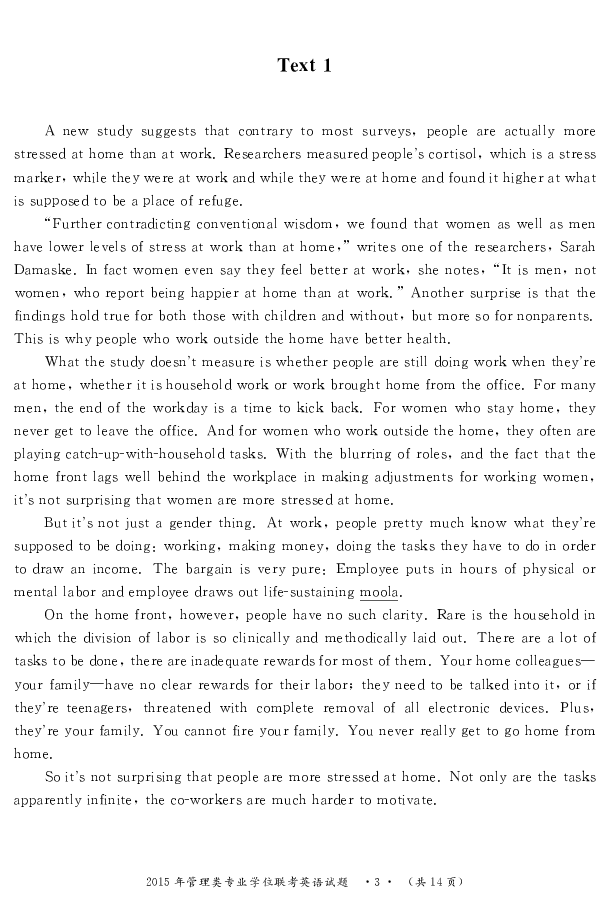
Text
1
A
new
study
suggests
that
contrary
to
most
surveys,
people
are
actually
more
stressed
at
home
than
at
work.
Researchers
measured
peoples
cortisol,
which
is
a
stress
marker,
while
they
were
at
work
and
while
they
were
at
home
and
found
it
higher
at
what
is
supposed
to
be
a
place
of
refuge.
“Further
contradicting
conventional
wisdom,
we
found
that
women
as
well
as
men
have
lower
levels
of
stress
at
work
than
at
home,”
writes
one
of
the
researchers,
Sarah
Damaske.
In
fact
women
even
say
they
feel
better
at
work,
she
notes,
“It
is
men,
not
women,
who
report
being
happier
at
home
than
at
work.”
Another
surprise
is
that
the
findings
hold
true
for
both
those
with
children
and
without,
but
more
so
for
nonparents.
This
is
why
people
who
work
outside
the
home
have
better
health.
What
the
study
doesnt
measure
is
whether
people
are
still
doing
work
when
theyre
at
home,
whether
it
is
household
work
or
work
brought
home
from
the
office.
For
many
men,
the
end
of
the
workday
is
a
time
to
kick
back.
For
women
who
stay
home,
they
never
get
to
leave
the
office.
And
for
women
who
work
outside
the
home,
they
often
are
playing
catch-up-with-household
tasks.
With
the
blurring
of
roles,
and
the
fact
that
the
home
front
lags
well
behind
the
workplace
in
making
adjustments
for
working
women,
its
not
surprising
that
women
are
more
stressed
at
home.
But
its
not
just
a
gender
thing.
At
work,
people
pretty
much
know
what
theyre
supposed
to
be
doing:
working,
making
money,
doing
the
tasks
they
have
to
do
in
order
to
draw
an
income.
The
bargain
is
very
pure:
Employee
puts
in
hours
of
physical
or
mental
labor
and
employee
draws
out
life-sustaining
moola.
On
the
home
front,
however,
people
have
no
such
clarity.
Rare
is
the
household
in
which
the
division
of
labor
is
so
clinically
and
methodically
laid
out.
There
are
a
lot
of
tasks
to
be
done,
there
are
inadequate
rewards
for
most
of
them.
Your
home
colleagues—
your
family—have
no
clear
rewards
for
their
labor;
they
need
to
be
talked
into
it,
or
if
theyre
teenagers,
threatened
with
complete
removal
of
all
electronic
devices.
Plus,
theyre
your
family.
You
cannot
fire
your
family.
You
never
really
get
to
go
home
from
home.
So
its
not
surprising
that
people
are
more
stressed
at
home.
Not
only
are
the
tasks
apparently
infinite,
the
co-workers
are
much
harder
to
motivate.
2015年管理类专业学位联考英语试题 ·3· (共14页)
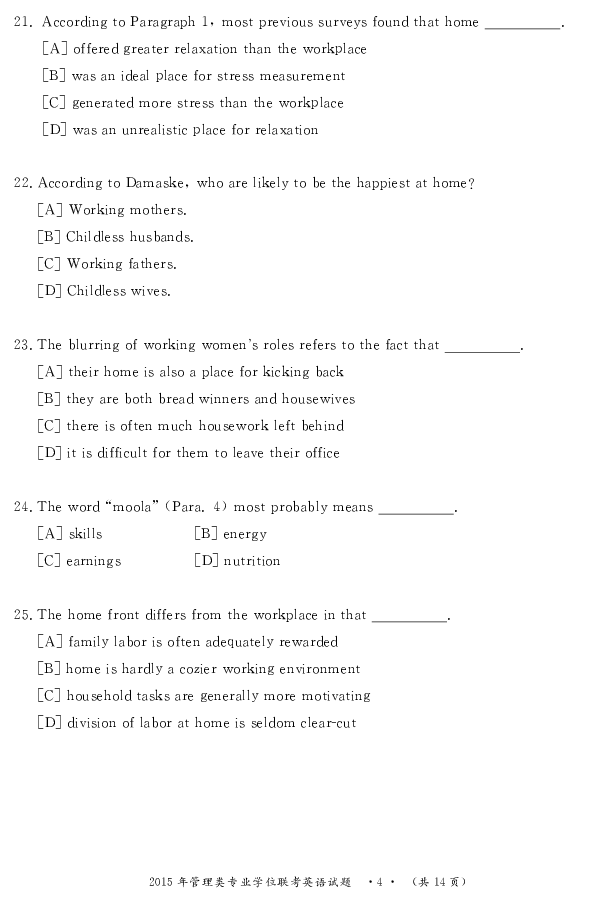
21.
According
to
Paragraph
1,
most
previous
surveys
found
that
home
.
[A]
offered
greater
relaxation
than
the
workplace
[B]
was
an
ideal
place
for
stress
measurement
[C]
generated
more
stress
than
the
workplace
[D]
was
an
unrealistic
place
for
relaxation
22.According
to
Damaske,
who
are
likely
to
be
the
happiest
at
home?
[A]
Working
mothers.
[B]
Childless
husbands.
[C]
Working
fathers.
[D]
Childless
wives.
23.The
blurring
of
working
womens
roles
refers
to
the
fact
that
.
[A]
their
home
is
also
a
place
for
kicking
back
[B]
they
are
both
bread
winners
and
housewives
[C]
there
is
often
much
housework
left
behind
[D]
it
is
difficult
for
them
to
leave
their
office
24.The
word
“moola”
(Para.
4)
most
probably
means
.
[A]
skills [B]
energy
[C]
earnings
[D]
nutrition
25.The
home
front
differs
from
the
workplace
in
that
.
[A]
family
labor
is
often
adequately
rewarded
[B]
home
is
hardly
a
cozier
working
environment
[C]
household
tasks
are
generally
more
motivating
[D]
division
of
labor
at
home
is
seldom
clear-cut
2015年管理类专业学位联考英语试题 ·4· (共14页)
Text
2
For
years,
studies
have
found
that
first-generation
college
students—those
who
do
not
have
a
parent
with
a
college
degree—lag
other
students
on
a
range
of
education
achievement
factors.
Their
grades
are
lower
and
their
dropout
rates
are
higher.
But
since
such
students
are
most
likely
to
advance
economically
if
they
succeed
in
higher
education,
colleges
and
universities
have
pushed
for
decades
to
recruit
more
of
them.
This
has
created
“a
paradox”
in
that
recruiting
first-generation
students,
but
then
watching
many
of
them
fail,
means
that
higher
education
has
“continued
to
reproduce
and
widen,
rather
than
close”
an
achievement
gap
based
on
social
class,
according
to
the
depressing
beginning
of
a
paper
forthcoming
in
the
journal
Psychological
Science.
But
the
article
is
actually
quite
optimistic,as
it
outlines
a
potential
solution
to
this
problem,
suggesting
that
an
approach
(which
involves
a
one-hour,
next-to-no-cost
program)
can
close
63
percent
of
the
achievement
gap
(measured
by
such
factors
as
grades)
between
first-generation
and
other
students.
The
authors
of
the
paper
are
from
different
universities,
and
their
findings
are
based
on
a
study
involving
147
students
(who
completed
the
project)
at
an
unnamed
private
university.
First
generation
was
defined
as
not
having
a
parent
with
a
four-year
college
degree.
Most
of
the
first-generation
students
(59.1
percent)
were
recipients
of
Pell
Grants,
a
federal
grant
for
undergraduates
with
financial
need,
while
this
was
true
only
for
8.6
percent
of
the
students
with
at
least
one
parent
with
a
four-year
degree.
Their
thesis—that
a
relatively
modest
intervention
could
have
a
big
impact—was
based
on
the
view
that
first-generation
students
may
be
most
lacking
not
in
potential
but
in
practical
knowledge
about
how
to
deal
with
the
issues
that
face
most
college
students.
They
cite
past
research
by
several
authors
to
show
that
this
is
the
gap
that
must
be
narrowed
to
close
the
achievement
gap.
Many
first-generation
students
“struggle
to
navigate
the
middle-class
culture
of
higher
education,
learn
the
‘rules
of
the
game’,
and
take
advantage
of
college
resources,”
they
write.
And
this
becomes
more
of
a
problem
when
colleges
dont
talk
about
the
class
advantages
and
disadvantages
of
different
groups
of
students.
“Because
US
colleges
and
universities
seldom
acknowledge
how
social
class
can
affect
students
2015年管理类专业学位联考英语试题 ·5· (共14页)
educational
experiences,
many
first-generation
students
lack
insight
about
why
they
are
struggling
and
do
not
understand
how
students
‘like
them’
can
improve.”
26.
Recruiting
more
first-generation
students
has
.
[A]
reduced
their
dropout
rates
[B]
narrowed
the
achievement
gap
[C]
missed
its
original
purpose
[D]
depressed
college
students
27.The
authors
of
the
research
article
are
optimistic
because
.
[A]
their
findings
appeal
to
students
[B]
the
recruiting
rate
has
increased
[C]
the
problem
is
solvable
[D]
their
approach
is
costless
28.The
study
suggests
that
most
first-generation
students
.
[A]
are
from
single-parent
families
[B]
study
at
private
universities
[C]
are
in
need
of
financial
support
[D]
have
failed
their
college
29.The
authors
of
the
paper
believe
that
first
generation
students
.
[A]
may
lack
opportunities
to
apply
for
research
projects
[B]
are
inexperienced
in
handling
their
issues
at
college
[C]
can
have
a
potential
influence
on
other
students
[D]
are
actually
indifferent
to
the
achievement
gap
30.We
may
infer
from
the
last
paragraph
that
.
[A]
universities
often
reject
the
culture
of
the
middle-class
[B]
students
are
usually
to
blame
for
their
lack
of
resources
[C]
social
class
greatly
helps
enrich
educational
experiences
[D]
colleges
are
partly
responsible
for
the
problem
in
question
2015年管理类专业学位联考英语试题 ·6· (共14页)
Text
3
Even
in
traditional
offices,
“the
lingua
franca
of
corporate
America
has
gotten
much
more
emotional
and
much
more
right-brained
than
it
was
20
years
ago,”
said
Harvard
Business
School
professor
Nancy
Koehn.
She
started
spinning
off
examples.
“If
you
and
I
parachuted
back
to
Fortune
500
companies
in
1990,
we
would
see
much
less
frequent
use
of
terms
like
journey,
mission,
passion.
There
were
goals,
there
were
strategies,
there
were
objectives,
but
we
didnt
talk
about
energy;
we
didnt
talk
about
passion.”
Koehn
pointed
out
that
this
new
era
of
corporate
vocabulary
is
very
“team”
-
oriented—and
not
by
coincidence.
“Lets
not
forget
sports—in
male-dominated
corporate
America,
its
still
a
big
deal.
Its
not
explicitly
conscious;
its
the
idea
that
Im
a
coach,
and
youre
my
team,
and
were
in
this
together.
There
are
lots
and
lots
of
CEOs
in
very
different
companies,
but
most
think
of
themselves
as
coaches
and
this
is
their
team
and
they
want
to
win.”
These
terms
are
also
intended
to
infuse
work
with
meaning—and,
as
Rakesh
Khurana,
another
professor,
points
out,
increase
allegiance
to
the
firm.
“You
have
the
importation
of
terminology
that
historically
used
to
be
associated
with
non-profit
organizations
and
religious
organizations:
terms
like
vision,
values,
passion,
and
purpose,”
said
Khurana.
This
new
focus
on
personal
fulfillment
can
help
keep
employees
motivated
amid
increasingly
loud
debates
over
work-life
balance.
The
“mommy
wars”
of
the
1990s
are
still
going
on
today,
prompting
arguments
about
why
women
still
cant
have
it
all
and
books
like
Sheryl
Sandbergs
Lean
In,
whose
title
has
become
a
buzzword
in
its
own
right.
Terms
like
unplug,
offline,
life-hack,
bandwidth,
and
capacity
are
all
about
setting
boundaries
between
the
office
and
the
home.
But
if
your
work
is
your
“passion”,
youll
be
more
likely
to
devote
yourself
to
it,
even
if
that
means
going
home
for
dinner
and
then
working
long
after
the
kids
are
in
bed.
But
this
seems
to
be
the
irony
of
office
speak:Everyone
makes
fun
of
it,
but
managers
love
it,
companies
depend
on
it,
and
regular
people
willingly
absorb
it.
As
a
linguist
once
said,
“You
can
get
people
to
think
its
nonsense
at
the
same
time
that
you
buy
into
it.”
In
a
workplace
thats
fundamentally
indifferent
to
your
life
and
its
meaning,
2015年管理类专业学位联考英语试题 ·7· (共14页)
office
speak
can
help
you
figure
out
how
you
relate
to
your
work—and
how
your
work
defines
who
you
are.
31.According
to
Nancy
Koehn,
office
language
has
become
.
[A]
less
strategic
[B]
less
energetic
[C]
more
objective
[D]
more
emotional
32.
“Team”
-oriented
corporate
vocabulary
is
closely
related
to
.
[A]
sports
culture
[B]
gender
difference
[C]
historical
incidents
[D]
athletic
executives
33.Khurana
believes
that
the
importation
of
terminology
aims
to
.
[A]
revive
historical
terms
[B]
promote
company
image
[C]
foster
corporate
cooperation
[D]
strengthen
employee
loyalty
34.It
can
be
inferred
that
Lean
In
.
[A]
voices
for
working
women
[B]
appeals
to
passionate
workaholics
[C]
triggers
debates
among
mommies
[D]
praises
motivated
employees
35.Which
of
the
following
statements
is
true
about
office
speak?
[A]
Linguists
believe
it
to
be
nonsense.
[B]
Regular
people
mock
it
but
accept
it.
[C]
Companies
find
it
to
be
fundamental.
[D]
Managers
admire
it
but
avoid
it.
2015年管理类专业学位联考英语试题 ·8· (共14页)
Text
4
Many
people
talked
of
the
288,000
new
jobs
the
Labor
Department
reported
for
June,
along
with
the
drop
in
the
unemployment
rate
to
6.1
percent,
as
good
news.
And
they
were
right.
For
now
it
appears
the
economy
is
creating
jobs
at
a
decent
pace.
We
still
have
a
long
way
to
go
to
get
back
to
full
employment,
but
at
least
we
are
now
finally
moving
forward
at
a
faster
pace.
However,
there
is
another
important
part
of
the
jobs
picture
that
was
largely
overlooked.
There
was
a
big
jump
in
the
number
of
people
who
report
voluntarily
working
part-time.
This
figure
is
now
830,000(4.4
percent)
above
its
year
ago
level.
Before
explaining
the
connection
to
the
Obamacare,
it
is
worth
making
an
important
distinction.
Many
people
who
work
part-time
jobs
actually
want
full-time
jobs.
They
take
part-time
work
because
this
is
all
they
can
get.
An
increase
in
involuntary
part-time
work
is
evidence
of
weakness
in
the
labor
market
and
it
means
that
many
people
will
be
having
a
very
hard
time
making
ends
meet.
There
was
an
increase
in
involuntary
part-time
in
June,
but
the
general
direction
has
been
down.
Involuntary
part-time
employment
is
still
far
higher
than
before
the
recession,
but
it
is
down
by
640,000(7.9
percent)
from
its
year
ago
level.
We
know
the
difference
between
voluntary
and
involuntary
part-time
employment
because
people
tell
us.
The
survey
used
by
the
Labor
Department
asks
people
if
they
worked
less
than
35
hours
in
the
reference
week.
If
the
answer
is
“yes”,
they
are
classified
as
working
part-time.
The
survey
then
asks
whether
they
worked
less
than
35
hours
in
that
week
because
they
wanted
to
work
less
than
full
time
or
because
they
had
no
choice.
They
are
only
classified
as
voluntary
part-time
workers
if
they
tell
the
survey
taker
they
chose
to
work
less
than
35
hours
a
week.
The
issue
of
voluntary
part-time
relates
to
Obamacare
because
one
of
the
main
purposes
was
to
allow
people
to
get
insurance
outside
of
employment.
For
many
people,
especially
those
with
serious
health
conditions
or
family
members
with
serious
health
conditions,
before
Obamacare
the
only
way
to
get
insurance
was
through
a
job
that
provided
health
insurance.
However,
Obamacare
has
allowed
more
than
12
million
people
to
either
get
2015年管理类专业学位联考英语试题 ·9· (共14页)
insurance
through
Medicaid
or
the
exchanges.
These
are
people
who
may
previously
have
felt
the
need
to
get
a
full-time
job
that
provided
insurance
in
order
to
cover
themselves
and
their
families.
With
Obamacare
there
is
no
longer
a
link
between
employment
and
insurance.
36.
Which
part
of
the
jobs
picture
was
neglected?
[A]
The
prospect
of
a
thriving
job
market.
[B]
The
increase
of
voluntary
part-time
jobs.
[C]
The
possibility
of
full
employment.
[D]
The
acceleration
of
job
creation.
37.Many
people
work
part-time
because
they
.
[A]
prefer
part-time
jobs
to
full-time
jobs
[B]
feel
that
is
enough
to
make
ends
meet
[C]
cannot
get
their
hands
on
full-time
jobs
[D]
havent
seen
the
weakness
of
the
market
38.Involuntary
part-time
employment
in
the
US
.
[A]
shows
a
general
tendency
of
decline
[B]
is
harder
to
acquire
than
one
year
ago
[C]
satisfies
the
real
need
of
the
jobless
[D]
is
lower
than
before
the
recession
39.It
can
be
learned
that
with
Obamacare,
.
[A]
it
is
no
longer
easy
for
part-timers
to
get
insurance
[B]
full-time
employment
is
still
essential
for
insurance
[C]
it
is
still
challenging
to
get
insurance
for
family
members
[D]
employment
is
no
longer
a
precondition
to
get
insurance
40.The
text
mainly
discusses
.
[A]
employment
in
the
US
[B]
part-timer
classification
[C]
insurance
through
Medicaid
[D]
Obamacares
trouble
2015年管理类专业学位联考英语试题 ·10· (共14页)
Part
B
Directions:
Read
the
following
text
and
answer
the
questions
by
choosing
the
most
suitable
subheading
from
the
list
A
G
for
each
numbered
paragraph(41 45).
There
are
two
extra
subheadings
which
you
do
not
need
to
use.
Mark
your
answers
on
the
ANSWER
SHEET.(10
points)
[A]
You
are
not
alone
[B]
Experience
helps
you
grow
[C]
Pave
your
own
unique
path
[D]
Most
of
your
fears
are
unreal
[E]
Think
about
the
present
moment
[F]
Dont
fear
responsibility
for
your
life
[G]
There
are
many
things
to
be
grateful
for
Some
Old
Truths
to
Help
You
Overcome
Tough
Times
Unfortunately,
life
is
not
a
bed
of
roses.
We
are
going
through
life
facing
sad
experiences.
Moreover,
we
are
grieving
various
kinds
of
loss:
a
friendship,
a
romantic
relationship
or
a
house.
Hard
times
may
hold
you
down
at
what
usually
seems
like
the
most
inopportune
time,
but
you
should
remember
that
they
wont
last
forever.
When
our
time
of
mourning
is
over,
we
press
forward,
stronger
with
a
greater
understanding
and
respect
for
life.
Furthermore,
these
losses
make
us
mature
and
eventually
move
us
toward
future
opportunities
for
growth
and
happiness.
I
want
to
share
these
old
truths
Ive
learned
along
the
way.
41.
Fear
is
both
useful
and
harmful.
This
normal
human
reaction
is
used
to
protect
us
by
signaling
danger
and
preparing
us
to
deal
with
it.
Unfortunately,
people
create
inner
barriers
with
a
help
of
exaggerating
fears.
My
favorite
actor
Will
Smith
once
said,
“Fear
is
not
real.
It
is
a
product
of
thoughts
you
create.
Do
not
misunderstand
me.
Danger
is
very
real.
But
fear
is
a
choice.”
I
do
completely
agree
that
fears
are
just
the
product
of
our
luxuriant
imagination.
2015年管理类专业学位联考英语试题 ·11· (共14页)
42.
If
you
are
surrounded
by
problems
and
cannot
stop
thinking
about
the
past,
try
to
focus
on
the
present
moment.
Many
of
us
are
weighed
down
by
the
past
or
anxious
about
the
future.
You
may
feel
guilt
over
your
past,
but
you
are
poisoning
the
present
with
the
things
and
circumstances
you
cannot
change.
Value
the
present
moment
and
remember
how
fortunate
you
are
to
be
alive.
Enjoy
the
beauty
of
the
world
around
and
keep
the
eyes
open
to
see
the
possibilities
before
you.
Happiness
is
not
a
point
of
future
and
not
a
moment
from
the
past,
but
a
mindset
that
can
be
designed
into
the
present.
43.
Sometimes
it
is
easy
to
feel
bad
because
you
are
going
through
tough
times.
You
can
be
easily
caught
up
by
life
problems
that
you
forget
to
pause
and
appreciate
the
things
you
have.
Only
strong
people
prefer
to
smile
and
value
their
life
instead
of
crying
and
complaining
about
something.
44.
No
matter
how
isolated
you
might
feel
and
how
serious
the
situation
is,
you
should
always
remember
that
you
are
not
alone.
Try
to
keep
in
mind
that
almost
everyone
respects
and
wants
to
help
you
if
you
are
trying
to
make
a
good
change
in
your
life,
especially
your
dearest
and
nearest
people.
You
may
have
a
circle
of
friends
who
provide
constant
good
humor,
help
and
companionship.
If
you
have
no
friends
or
relatives,
try
to
participate
in
several
online
communities,
full
of
people
who
are
always
willing
to
share
advice
and
encouragement.
45.
Today
many
people
find
it
difficult
to
trust
their
own
opinion
and
seek
balance
by
gaining
objectivity
from
external
sources.
This
way
you
devalue
your
opinion
and
show
that
you
are
incapable
of
managing
your
own
life.
When
you
are
struggling
to
achieve
something
important
you
should
believe
in
yourself
and
be
sure
that
your
decision
is
the
best.
You
live
in
your
skin,
think
your
own
thoughts,
have
your
own
values
and
make
your
own
choices.
2015年管理类专业学位联考英语试题 ·12· (共14页)
Section
Ⅲ Translation
46.Directions:
Translate
the
following
text
into
Chinese.
Write
your
translation
on
the
ANSWER
SHEET.
(15
points)
Think
about
driving
a
route
thats
very
familiar.
It
could
be
your
commute
to
work,
a
trip
into
town
or
the
way
home.
Whichever
it
is,
you
know
every
twist
and
turn
like
the
back
of
your
hand.
On
these
sorts
of
trips
its
easy
to
lose
concentration
on
the
driving
and
pay
little
attention
to
the
passing
scenery.
The
consequence
is
that
you
perceive
that
the
trip
has
taken
less
time
than
it
actually
has.
This
is
the
well-travelled
road
effect:
People
tend
to
underestimate
the
time
it
takes
to
travel
a
familiar
route.
The
effect
is
caused
by
the
way
we
allocate
our
attention.
When
we
travel
down
a
well-known
route,
because
we
dont
have
to
concentrate
much,
time
seems
to
flow
more
quickly.
And
afterwards,
when
we
come
to
think
back
on
it,
we
cant
remember
the
journey
well
because
we
didnt
pay
much
attention
to
it.
So
we
assume
it
was
shorter.
Section
Ⅳ Writing
Part
A
47.Directions:
Suppose
your
university
is
going
to
host
a
summer
camp
for
high
school
students.
Write
a
notice
to
1)
briefly
introduce
the
camp
activities,
and
2)
call
for
volunteers.
You
should
write
about
100
words
on
the
ANSWER
SHEET.
2015年管理类专业学位联考英语试题 ·13· (共14页)
Do
not
use
your
own
name
or
the
name
of
your
university.
Do
not
write
your
address.(10
points)
Part
B
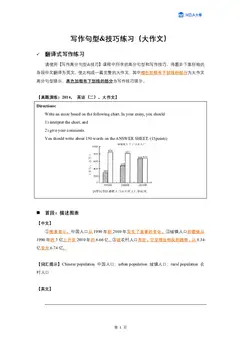
48.Directions:
Write
an
essay
based
on
the
following
chart.
In
your
writing,
you
should
1)
interpret
the
chart,
and
2)
give
your
comments.
You
should
write
about
150
words
on
the
ANSWER
SHEET.
(15
points)
2015年管理类专业学位联考英语试题 ·14· (共14页)
2015年全国硕士研究生招生考试
管理类专业学位联考英语试题参考答案
Section
Ⅰ Use
of
English
1.A
2.D
3.B
4.A
5.C
6.B
7.A
8.D
9.C
10.B
11.A
12.C
13.C
14.D
15.C
16.D
17.A
18.B
19.D
20.B
Section
Ⅱ Reading
Comprehension
Part
A
21.A
22.B
23.B
24.C
25.D
26.C
27.C
28.C
29.B
30.D
31.D
32.A
33.D
34.A
35.B
36.B
37.C
38.A
39.D
40.A
Part
B
41.D
42.E
43.G
44.A
45.C
Section
Ⅲ Translation
略
Section
Ⅳ Writing
Part
A
略
Part
B
略
2015年管理类专业学位联考英语试题参考答案 ·1· (共1页)