 夜雨聆风
夜雨聆风


2026超越代码-AI时代的软件交付加速指南_74页_3mb.pdf

📝 研报客AI助手-AI报告总结
Summary of “Exploring Possible AI Trajectories Through 2030”
Core Content
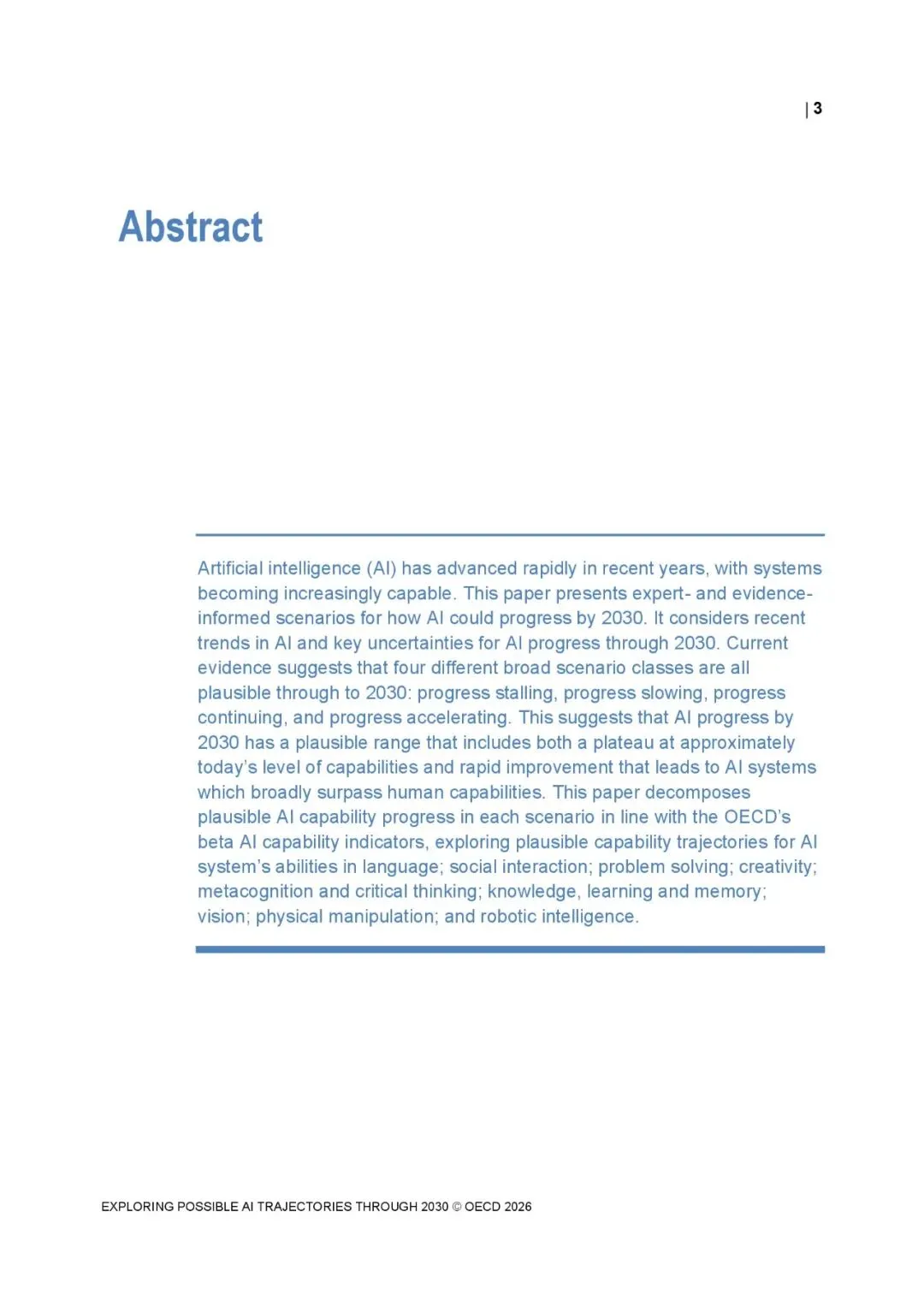
This OECD Working Paper explores plausible future trajectories of Artificial Intelligence (AI) by 2030, based on expert insights and available evidence. It outlines four main scenarios for AI development, each representing a different pace and direction of progress, and examines variations within these scenarios. The analysis is grounded in the OECD’s beta AI Capability Indicators, which assess AI systems across various dimensions such as language, problem solving, creativity, and physical manipulation.
The paper acknowledges the rapid advancement of AI in recent years, with systems now capable of tasks such as writing academic essays and solving coding problems at a level comparable to human experts. However, it also highlights significant limitations in AI, particularly in areas like continual learning, generalization, metacognition, and social interaction. These limitations suggest that while AI may surpass humans in some domains, it is still far from achieving general intelligence or full autonomy in complex environments.
Main Views
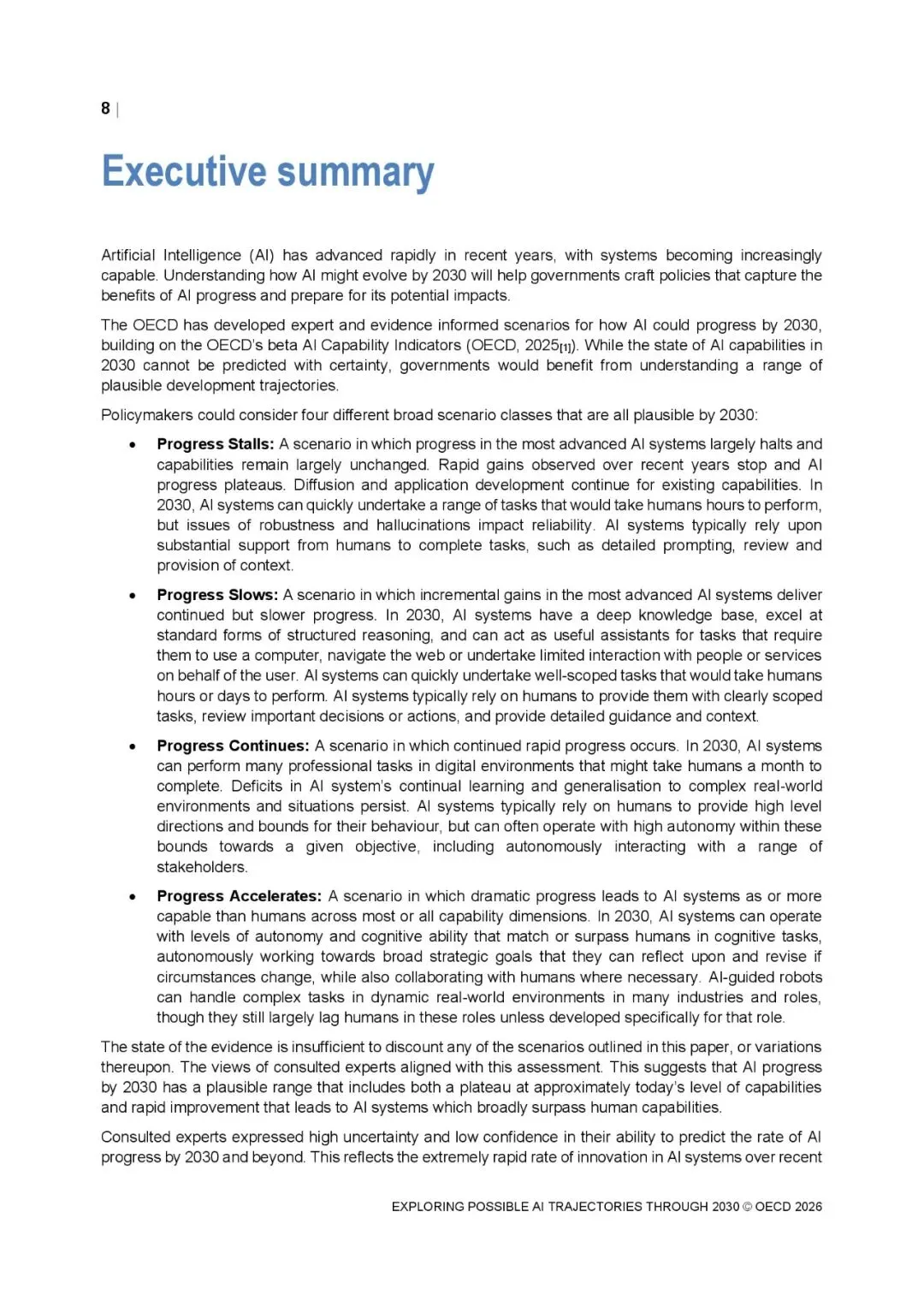
The four core scenarios for AI progress by 2030 are:
- Progress Stalls: AI systems show little to no improvement, remaining at current capability levels. They can still perform tasks quickly, but their reliability is limited by issues like robustness and hallucinations. Human oversight is still critical for most operations.
- Progress Slows: AI systems continue to improve, but at a reduced rate. They excel at structured reasoning and can assist with tasks requiring computer use, web navigation, or limited human interaction. Human input remains essential for task scoping and decision-making.
- Progress Continues: AI systems maintain rapid improvement, performing complex tasks in digital environments that would take humans weeks to complete. While they operate with high autonomy, they still rely on human guidance for broader strategic goals and complex real-world interactions.
- Progress Accelerates: AI systems could surpass human capabilities across most dimensions. They may achieve autonomy in cognitive tasks, reflect on and revise strategic goals, and collaborate effectively with humans. AI-guided robots could perform complex tasks in dynamic environments, though human superiority in certain roles remains.
Key Information
AI Progress Trends
- AI systems have shown rapid improvements on a wide range of benchmarks, including scientific reasoning, mathematics, and programming.
- Performance on tasks like software engineering and video interpretation has increased significantly, with the length of tasks completed with 50% success rate doubling every seven months.
- AI has achieved human-level performance in multilingual translation and some digital tasks, but performance is uneven across languages and domains.
Uncertainties
- Scaling Laws: AI performance improves with more parameters, training data, and compute, but this trend may plateau or slow.
- Reasoning Gains: Reinforcement learning is being used to improve reasoning capabilities, but the generalizability of these gains is uncertain.
- Memory and Learning: Advances in memory and continual learning could enable more robust AI systems, but these are not guaranteed.
- Physical Capabilities: While visual and multimodal perception has improved, translating these into robust physical abilities remains a challenge.
- Creativity and Novel Problem Solving: AI systems are limited in their ability to solve novel problems and demonstrate creativity, though new methods may improve this.
Influential Factors
- Training Data and Compute: The availability and quality of data, along with the amount of compute used for training and inference, are key drivers of AI progress.
- Model Architecture: Innovations in AI architecture support more efficient reasoning and learning.
- Human Oversight: AI systems often require human input for task scoping, decision review, and context provision.
Plausibility of Scenarios
- No scenario can be ruled out as implausible, and the evidence suggests that AI could either plateau or accelerate significantly by 2030.
- Expert opinions align with the paper’s assessment, emphasizing the high uncertainty in predicting AI’s future trajectory.
Conclusion
The paper underscores the need for governments to understand a range of possible AI developments to formulate effective policies. While AI has made impressive strides, its future remains uncertain due to the complex interplay of technological, economic, and social factors. The OECD’s scenarios provide a framework for policy discussions, highlighting the importance of preparedness for both stable and rapidly evolving AI landscapes.
报告正文

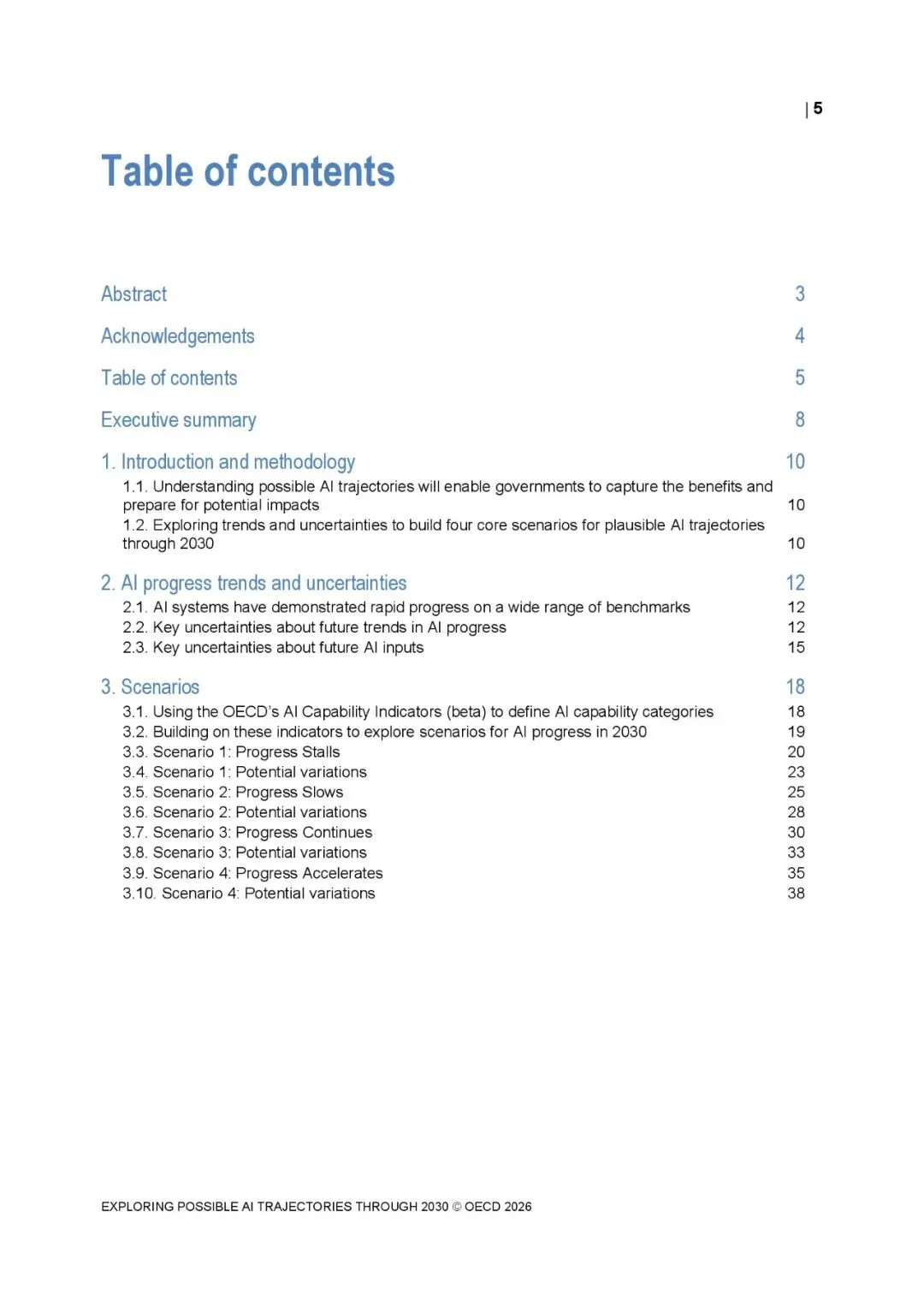
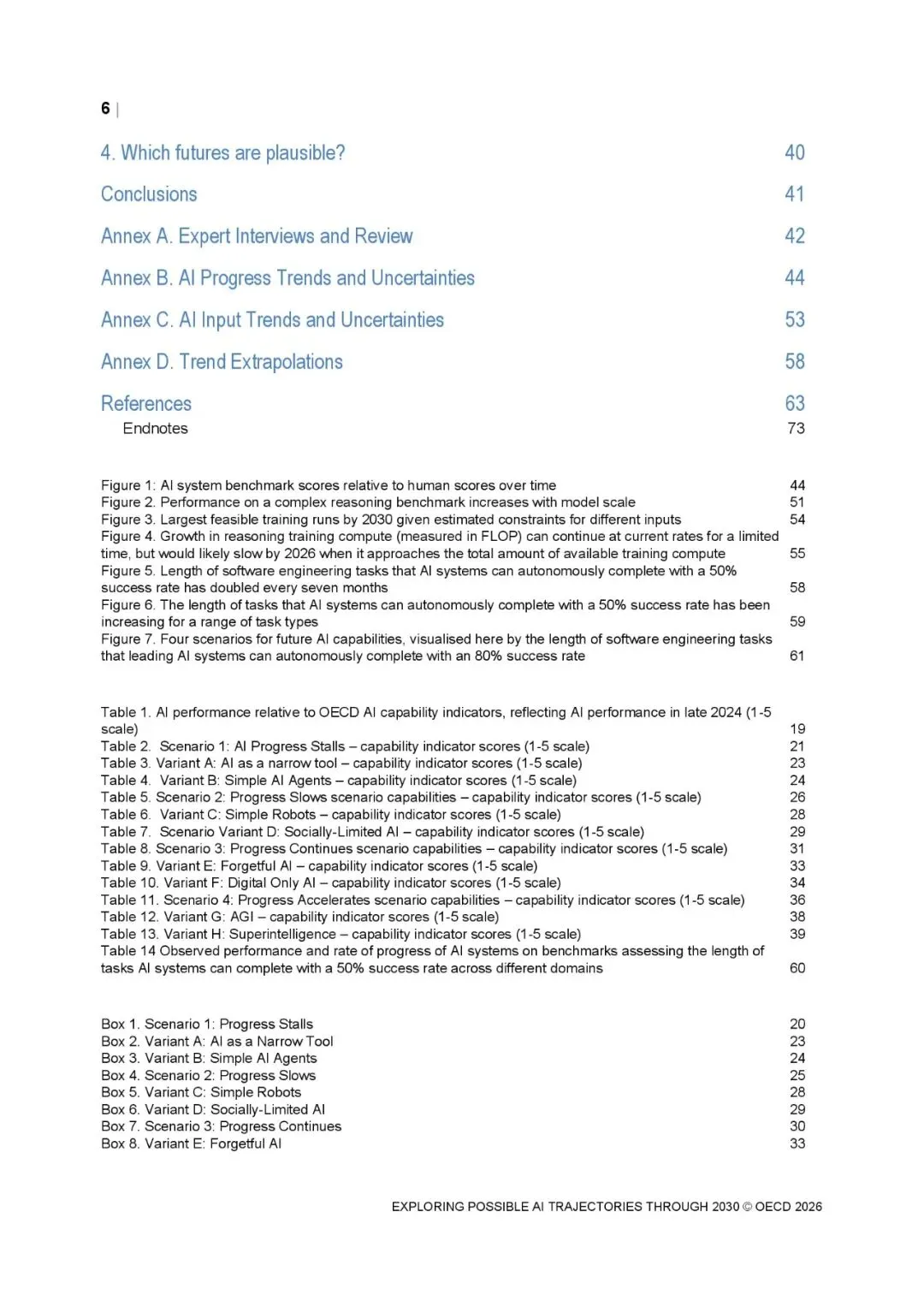


免费获取报告源文件,请点下方图片

研报客 – 全球行业报告 图表数据聚合AI平台
5000多家机构,五百万+报告 覆盖全行业深度研究
一站式行业研究报告平台,汇聚全球百强智库,百万中英文报告
✨ 核心功能
📊 海量报告:覆盖全行业,AI搜索+全文检索
🤖 AI翻译:多语言互译,保留原排版
💬 AI对话:智能研报助手,深度解读文档
🔔 实时推送:订阅关键词,更新主动通知
📱 全平台:网页、APP、小程序数据同步
🤖 AI能力
🔍 智能检索:快速理解问题意图,提供精准信息
🌐 多源整合:综合多个可靠来源,给出全面答案
💡 语境理解:不只是字面翻译,更能理解上下文和文化差异
🎯 专业领域:适应技术、文学、商务等不同领域的翻译需求
🧠 自然交流:理解复杂对话上下文,保持连贯性
📚 研报专家:深度理解文档,进行专业回复
⚡ 实时性:能够获取最新信息,主动推送更新
🎯 适用场景
💼 投资分析:券商研报、市场分析、投资策略
📈 市场调研:行业分析、市场趋势、竞争格局
🏭 行业研究:深度行业报告、产业链分析
🚀 趋势预测:未来趋势、技术发展、政策解读
🌐 访问方式
💻 网页版:pc.yanbaoke.cn
📱 APP下载:各大手机商店搜索「研报客」
🖥️ 软件版:pc.yanbaoke.cn/pc2.html
📲 小程序:微信搜索「研报客」
💡 PDF/DOC/PPT互转 | 文字版一键复制 | 支持下载分享
网页、APP、小程序多端同步,随时随地阅读研报
内容由ai生成,仅供参考