ARTICLE · 1010077
PDF打印版 | 2026注册验船师A级《MARPOL公约》这11道英语简答题,重点背!
临近2026注册验船师考试,方方整理了《MARPOL公约》附则I—附则VI最核心的11组英文简答题,点击文末“阅读原文”可以直接下载PDF版打印学习,希望对您注册验船师学习有所帮助。
1 《MARPOL公约》附则I—附则VI最核心的11组英文简答题梳理
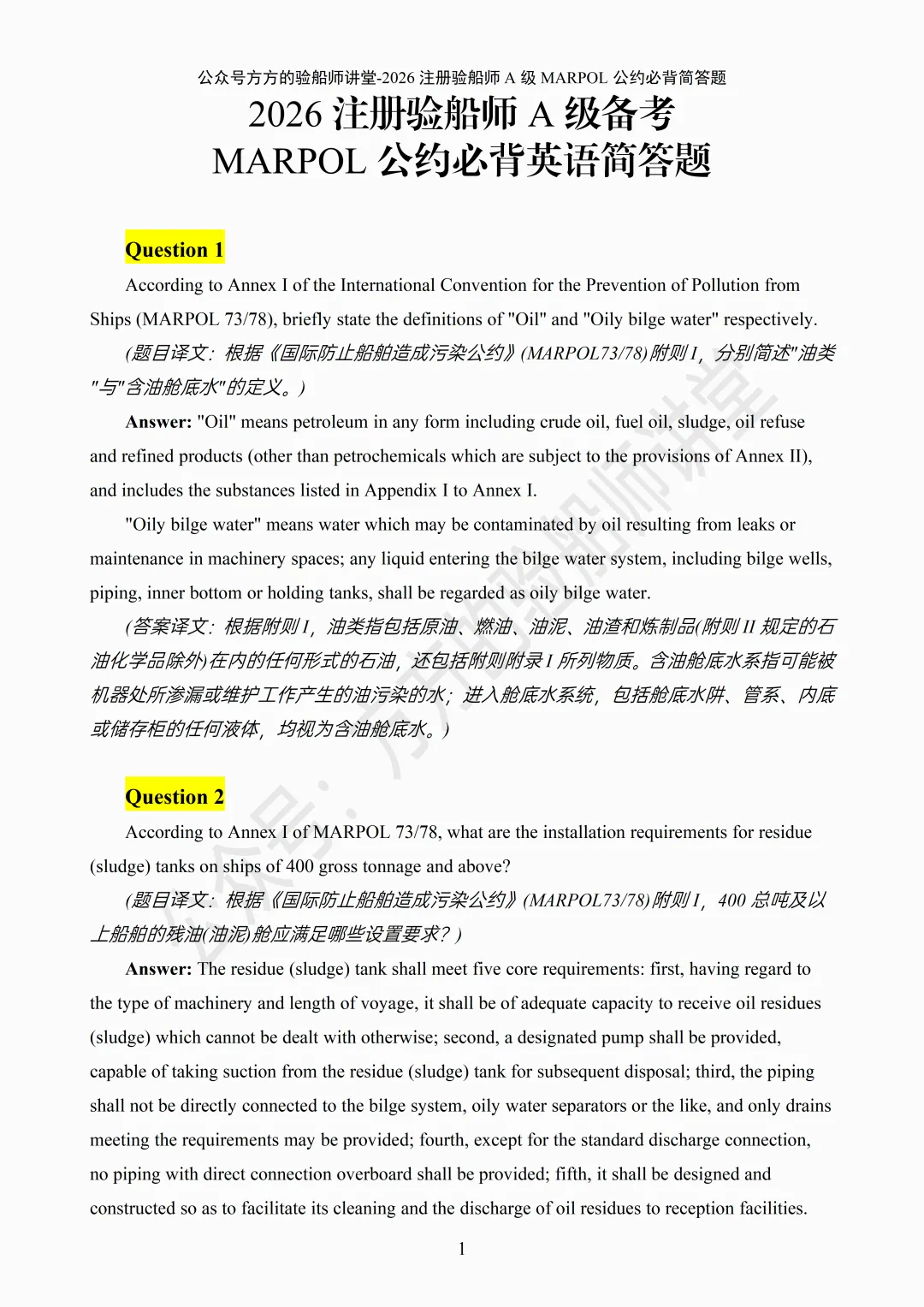
(可在文末点击阅读原文下载全文PDF学习)
Question 1
According to Annex I of the International Convention for the Prevention of Pollution from Ships (MARPOL 73/78), briefly state the definitions of "Oil" and "Oily bilge water" respectively.
(题目译文:根据《国际防止船舶造成污染公约》(MARPOL73/78)附则I,分别简述"油类"与"含油舱底水"的定义。)
Answer: "Oil" means petroleum in any form including crude oil, fuel oil, sludge, oil refuse and refined products (other than petrochemicals which are subject to the provisions of Annex II), and includes the substances listed in Appendix I to Annex I.
"Oily bilge water" means water which may be contaminated by oil resulting from leaks or maintenance in machinery spaces; any liquid entering the bilge water system, including bilge wells, piping, inner bottom or holding tanks, shall be regarded as oily bilge water.
(答案译文:根据附则I,油类指包括原油、燃油、油泥、油渣和炼制品(附则II规定的石油化学品除外)在内的任何形式的石油,还包括附则附录I所列物质。含油舱底水系指可能被机器处所渗漏或维护工作产生的油污染的水;进入舱底水系统,包括舱底水阱、管系、内底或储存柜的任何液体,均视为含油舱底水。)
Question 2
According to Annex I of MARPOL 73/78, what are the installation requirements for residue (sludge) tanks on ships of 400 gross tonnage and above?
(题目译文:根据《国际防止船舶造成污染公约》(MARPOL73/78)附则I,400总吨及以上船舶的残油(油泥)舱应满足哪些设置要求?)
Answer: The residue (sludge) tank shall meet five core requirements: first, having regard to the type of machinery and length of voyage, it shall be of adequate capacity to receive oil residues (sludge) which cannot be dealt with otherwise; second, a designated pump shall be provided, capable of taking suction from the residue (sludge) tank for subsequent disposal; third, the piping shall not be directly connected to the bilge system, oily water separators or the like, and only drains meeting the requirements may be provided; fourth, except for the standard discharge connection, no piping with direct connection overboard shall be provided; fifth, it shall be designed and constructed so as to facilitate its cleaning and the discharge of oil residues to reception facilities.
(答案译文:根据附则I第12条,残油舱应满足五项核心要求:一是参照机型与航程长短,具备足够容量接收无法以其他方式处理的残油;二是设置专用泵,可抽吸残油开展后续处置;三是管路不得直接连通舱底水系统、油水分离器等,仅允许设符合要求的泄水管;四是除标准排放接头外,不得设置直接舷外排放管系;五是设计建造应便于清洗和将残油排入接收设备。)
Question 3
According to Annex I of MARPOL 73/78, what are the requirements for the fitting of oil filtering equipment on ships of different gross tonnage?
(题目译文:根据《国际防止船舶造成污染公约》(MARPOL73/78)附则I,不同总吨船舶的滤油设备配备要求分别是什么?)
Answer: Oil filtering equipment is divided into two tiers by gross tonnage: ships of 400 gross tonnage and above but less than 10,000 gross tonnage shall be fitted with oil filtering equipment approved by the Administration, ensuring that the oil content of the discharge does not exceed 15 ppm; ships of 10,000 gross tonnage and above shall, in addition to meeting the 15 ppm discharge requirement, satisfy two further requirements: first, an alarm arrangement shall be fitted to give an alarm when the effluent cannot be maintained at the 15 ppm standard; second, an automatic stopping device shall be fitted to automatically stop the discharge of oily mixture overboard when the oil content of the effluent exceeds 15 ppm.
(答案译文:根据附则I第14条,滤油设备按总吨分为两级:400总吨及以上、10000总吨以下的船舶,应装设经主管机关批准、排放含油量不超过15ppm的滤油设备;10000总吨及以上的船舶,除满足15ppm排放要求外,还需满足两项要求:一是装设报警装置,当排出物无法保持15ppm标准时发出报警;二是装设自动停排装置,当排出物含油量超过15ppm时,自动停止油性混合物向舷外排放。)
Question 4
According to Annex I of MARPOL 73/78, which operations in machinery spaces must be recorded item by item in Part I of the Oil Record Book?
(题目译文:根据《国际防止船舶造成污染公约》(MARPOL73/78)附则I,机器处所的哪些作业必须逐项记入《油类记录簿》第Ⅰ部分?)
Answer: The operations to be recorded include five categories: ballasting or cleaning of oil fuel tanks; discharge of dirty ballast or cleaning water from oil fuel tanks; collection and disposal of oil residues (sludge); discharge overboard or disposal otherwise of bilge water which has accumulated in machinery spaces; and bunkering of fuel or bulk lubricating oil. In addition, any accidental or other exceptional discharge of oil, and any failure of the oil filtering equipment, shall also be noted in the Oil Record Book with the circumstances and reasons.
(参考译文:根据附则I第17条,应记录的作业包括五类:燃油舱的压载或清洗;燃油舱污压载水或洗舱水的排放;残油的收集和处理;机器处所积存的舱底水向舷外排放或处理;添加燃油或散装润滑油。此外,意外或特殊排油情况、滤油设备故障,也应在记录簿中说明情况与理由。)
Question 5
According to Regulation 21 of Annex I of MARPOL 73/78, what is the definition of heavy grade oil? What specific categories of oil does it include?
(题目译文:根据《国际防止船舶造成污染公约》(MARPOL73/78)附则I第21条,重级别油的定义是什么?具体包含哪几类油品?)
Answer: Heavy grade oil is a specialized definition established for oils with a high pollution risk, and includes three categories: first, crude oil having a density at 15°C higher than 900 kg/m³; second, oil other than crude oil, meeting either of the following conditions: a density at 15°C higher than 900 kg/m³, or a kinematic viscosity at 50°C higher than 180 mm²/s; third, bitumen, tar and their emulsions.
(答案译文:根据附则I第21条,重级别油是针对高污染风险油品设定的专门定义,共包含三类:一是15℃时密度高于900kg/m³的原油;二是原油以外的油类,满足15℃密度高于900kg/m³,或50℃时运动粘度高于180mm²/s任一条件;三是沥青、焦油及其乳化物。)
Question 6
According to Annex I of MARPOL 73/78, the baseline capacity of slop tanks is 3% of the oil-carrying capacity. Describe the three categories of circumstances under which the capacity may be progressively reduced and the corresponding minimum limits.
(题目译文:根据《国际防止船舶造成污染公约》(MARPOL73/78)附则I规定,污油水舱基准舱容为载油容量的3%,说明可逐级下调舱容的三类情形及对应下限。)
Answer: The reduction rules are divided into three tiers: first, where the ship is fitted with a closed cleaning system using recirculated washing water, the capacity may be reduced to 2%; second, where the ship is provided with segregated ballast tanks / dedicated clean ballast tanks or fitted with a crude oil washing system, the baseline may be applied at 2%, and where the closed cleaning condition is also met, it may be further reduced to 1.5%; third, for combination carriers carrying oil cargo only in tanks with smooth walls, the baseline is 1%, and where the closed cleaning condition is met, it may be reduced to 0.8%. All capacity reductions shall be approved by the Administration after verification of the effectiveness of the systems.
(答案译文:根据附则I第29条,下调规则共分三级:一是配备闭式洗舱装置、洗舱水可循环自用的,舱容可降至2%;二是设有专用压载舱/清洁压载舱或原油洗舱系统的,基础可按2%执行,同时满足闭式洗舱条件可进一步降至1.5%;三是仅在平壁舱载货的兼装船,基础为1%,满足闭式洗舱条件可降至0.8%。所有减容均需主管机关核验系统有效性后方可认可。)
Question 7
According to Annex I of MARPOL 73/78, to which ships does Part II of the Oil Record Book apply? Which operations must be recorded item by item?
(参考译文:根据《国际防止船舶造成污染公约》(MARPOL73/78)附则I,《油类记录簿》第II部分适用于哪些船舶?哪些作业必须逐项记录?)
Answer: It applies to all oil tankers of 150 gross tonnage and above, corresponding to cargo oil and ballast operations. The operations that must be recorded include ten categories: loading of oil cargo; internal transfer of oil cargo during voyage; unloading of oil cargo; ballasting of cargo tanks and dedicated clean ballast tanks; cleaning of cargo tanks (including crude oil washing); discharge of ballast from non-segregated ballast tanks; discharge of water from slop tanks; closing of valves after discharge operations; closing of isolation valves; and disposal of residues. Entries shall be made on a tank-to-tank basis.
(答案译文:根据附则I第36条,适用于所有150总吨及以上的油船,对应货油与压载作业。必须记录的作业包括:货油装载、航行中货油过驳、货油卸载、货油舱与清洁压载舱压载、货油舱清洗(含原油洗舱)、非专用压载舱压载水排放、污油水舱排水、排放后阀门关闭、隔离阀门关闭、残油处理共十类作业,且须逐舱填写。)
Question 8
According to the provisions of Annex IV of MARPOL 73/78, briefly state the definition of sewage.
(题目译文:根据《国际防止船舶造成污染公约》(MARPOL73/78)附则Ⅳ的规定,简述生活污水的定义。)
Answer: "Sewage" means: drainage and other wastes from any form of toilets and urinals; drainage from medical premises via wash basins, wash tubs and scuppers located in such premises; drainage from spaces containing living animals; and other waste water mixed with the drainages referred to above.
(答案译文:根据附则IV第1条,生活污水系指:任何型式的厕所和小便池的排出物和其他废弃物;医务室的面盆、洗澡盆和这些处所排水孔的排出物;装有活畜禽货的处所的排出物;混有上述排出物的其他废水。)
Question 9
According to Annex IV of MARPOL 73/78, what types of sewage systems shall applicable ships be fitted with? Briefly state the core requirements of each.
(题目译文:根据《国际防止船舶造成污染公约》(MARPOL73/78)附则Ⅳ,适用船舶应配备哪几类生活污水系统?分别简述其核心要求。)
Answer: Applicable ships shall be fitted with one of the following three systems: first, a sewage treatment plant, which shall be of a type approved by the Administration and comply with the standards and test methods developed by the Organization; second, a sewage comminuting and disinfecting system, approved by the Administration, with adequate temporary storage facilities, for use in scenarios where the distance from the nearest land is less than 3 nautical miles; third, a holding tank, the capacity of which shall be determined having regard to the operation of the ship, the number of persons on board and other factors to meet the full storage requirement, of construction approved by the Administration, and fitted with a visual content level indicator.
(参考译文:根据附则IV第9条,适用船舶应配备以下三类系统之一:一是生活污水处理装置,需经主管机关型式认可,符合本组织制定的标准和试验方法;二是生活污水粉碎和消毒系统,经主管机关认可,配套合格的临时储存设施,用于距最近陆地不足3海里的场景;三是集污舱,容量需结合船舶营运、船上人数等因素满足全量储存需求,构造经主管机关认可,并设有可视化的存量指示装置。)
Question 10
According to Annex IV of MARPOL 73/78, what statutory conditions must be met for the discharge of sewage by ships other than passenger ships in all areas, and by passenger ships outside special areas?
(参考译文:根据《国际防止船舶造成污染公约》(MARPOL73/78)附则Ⅳ,除客船外的船舶在所有区域、客船在特殊区域外排放生活污水,需满足哪些法定条件?)
Answer: Discharge is prohibited except in the circumstances provided for by law, and may be made when either of the following conditions is met: first, at a distance of more than 3 nautical miles from the nearest land, using an approved system to discharge comminuted and disinfected sewage, or at a distance of more than 12 nautical miles from the nearest land, discharging untreated sewage; and the sewage stored in holding tanks or originating from spaces containing living animals shall not be discharged instantaneously, but shall be discharged while the ship is en route at a speed of not less than 4 knots, at a moderate rate approved by the Administration. Second, an approved sewage treatment plant is in normal operation, and the effluent contains no visible floating solids and does not cause discoloration of the surrounding water.
(答案译文:根据附则IV第11条,除法定例外情形外禁止排放,符合以下任一条件方可排放:一是在距最近陆地3海里外,使用经认可系统排放经粉碎消毒的生活污水,或在12海里外排放未经处理的生活污水;且不得顷刻排光集污舱或活体动物处所的生活污水,需在航行中以不小于4节的航速、经主管机关批准的中等速率排放。二是经批准的生活污水处理装置正常运转,排出物无可见漂浮固体、不造成水体变色。)
Question 11
According to Annex VI of MARPOL 73/78, what are the provisions on permitted locations for incineration on board? What categories of substances are prohibited from being incinerated on board?
(题目译文:根据《国际防止船舶造成污染公约》(MARPOL73/78)附则Ⅵ,船上焚烧的许可场所有何规定?禁止在船上焚烧的物质有哪些类别?)
Answer: Except as otherwise provided by law, incineration on board ships shall only be permitted in shipboard incinerators. Substances prohibited from incineration on board include: residues and contaminated packaging materials arising from cargoes covered by Annex I, II or III; polychlorinated biphenyls (PCBs); garbage containing more than traces of heavy metals as defined in Annex V; refined petroleum products containing halogen compounds; sludge oil and oil residue not generated on board; and exhaust gas cleaning system residues.
(答案译文:根据附则VI第16条,除法定例外情形外,船上焚烧应只允许在船上焚烧炉中进行。禁止在船上焚烧的物质包括:附则Ⅰ、Ⅱ或Ⅲ规定的货物残余物或有关的被污染包装材料;多氯联苯(PCB);附则Ⅴ定义的含有超过微量重金属的垃圾;含有卤素化合物的精炼石油产品;不在船上产生的污泥和油渣;废气清洗系统的残余物。)
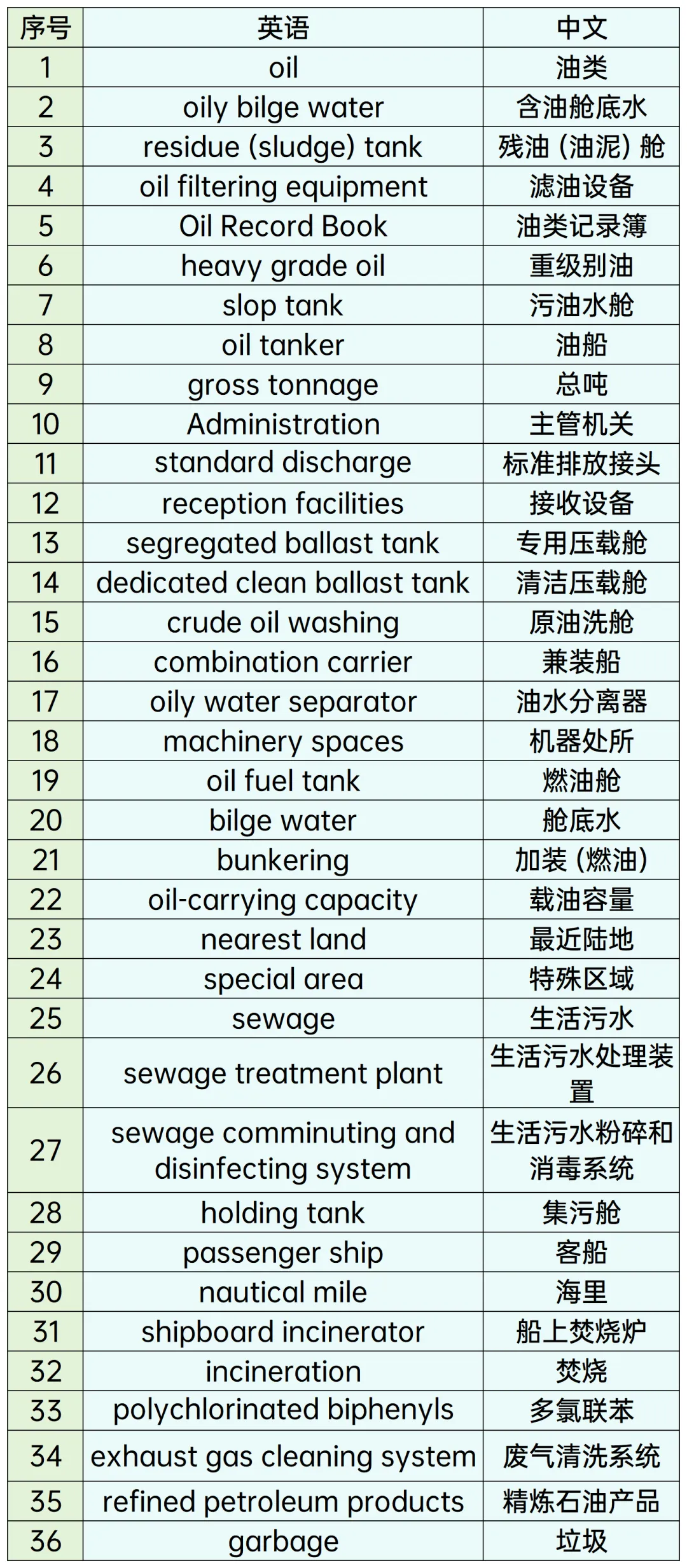
2 《MARPOL公约》重点单词积累
今天的分享到这里就结束了,感谢大家的认真阅读。如果觉得内容对你有帮助,还请多多点赞、关注或转发,你的认可对我非常重要。我会继续以验船师的视角,带你探索验船的世界。我们下期再见!
注册验船师核心知识点梳理+注册验船师必做660题。
客服V:fangfangyanchuan,或扫描下方二维码。