ARTICLE · 1251981
2026年6月英语六级真题(第2套)真题试卷+听力原文+听力音频+参考答案

01
真题试卷
>>>
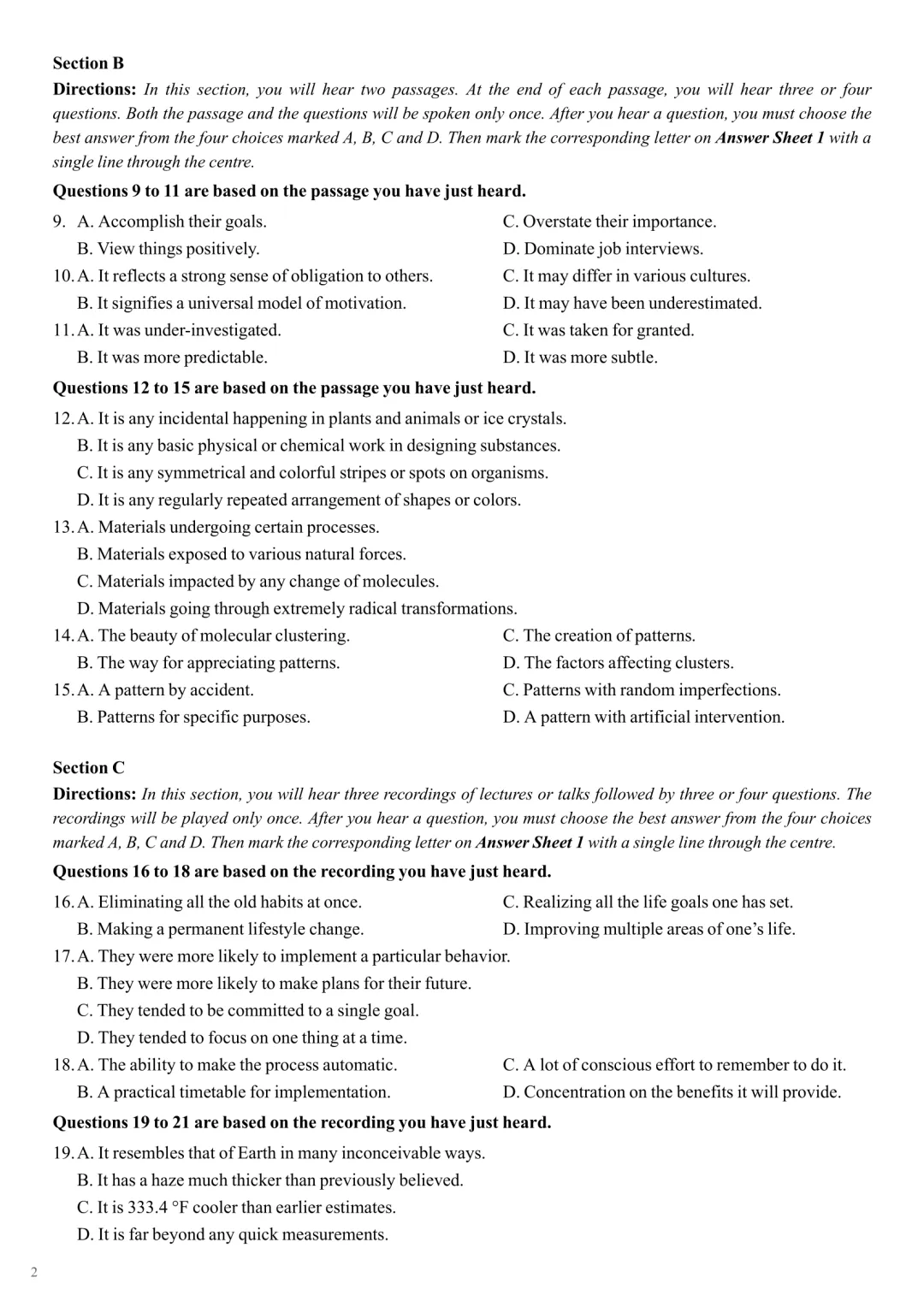
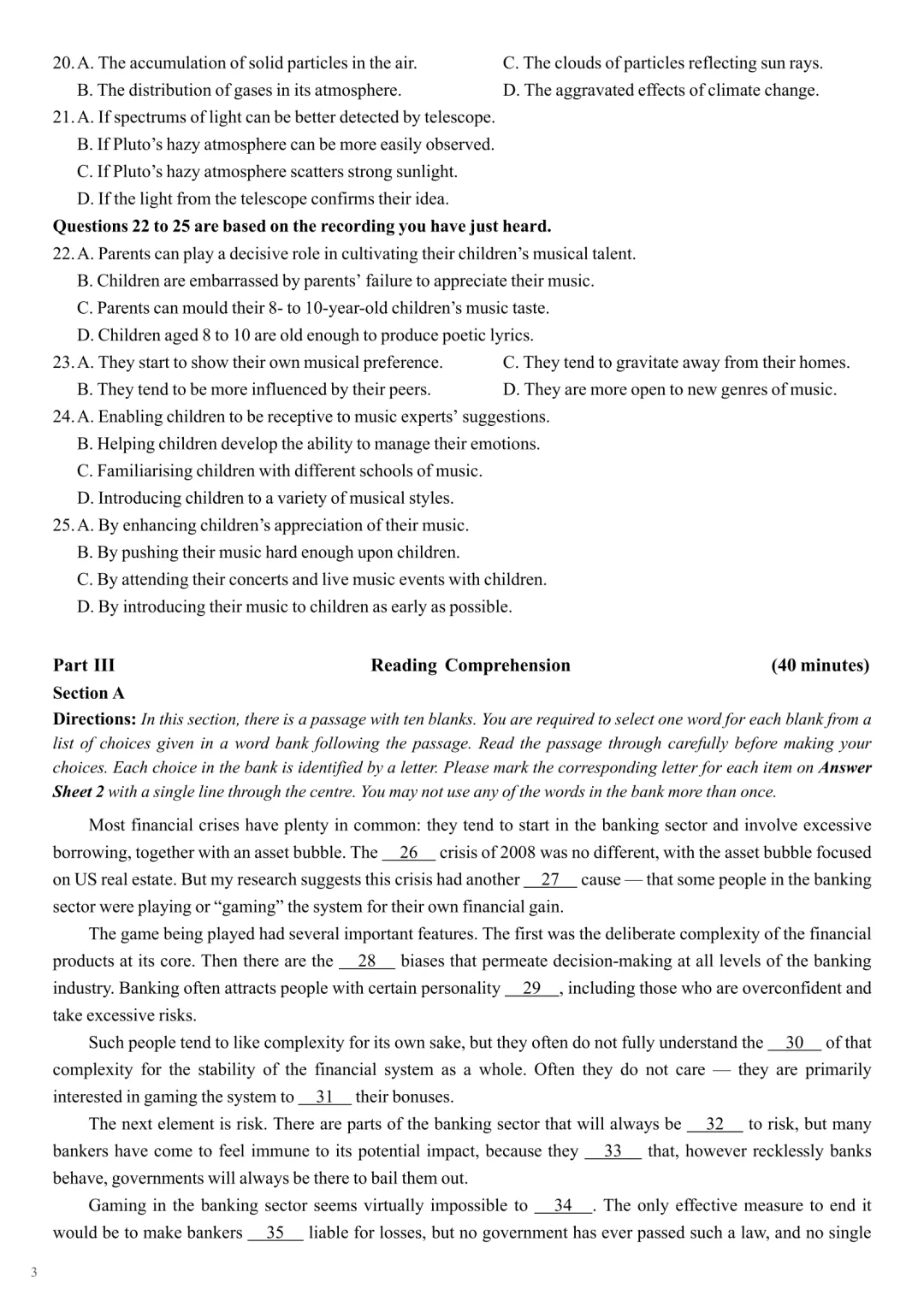
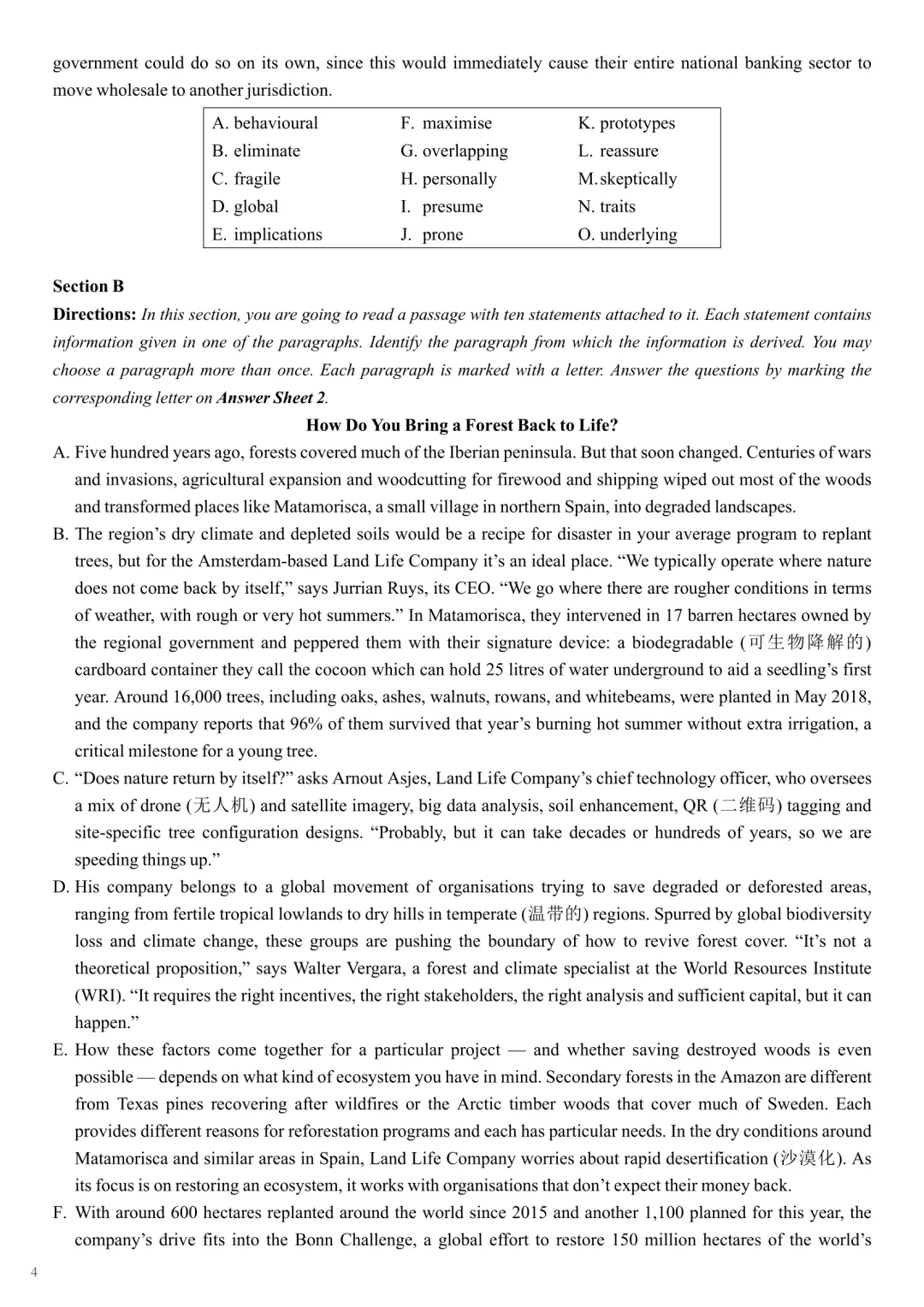
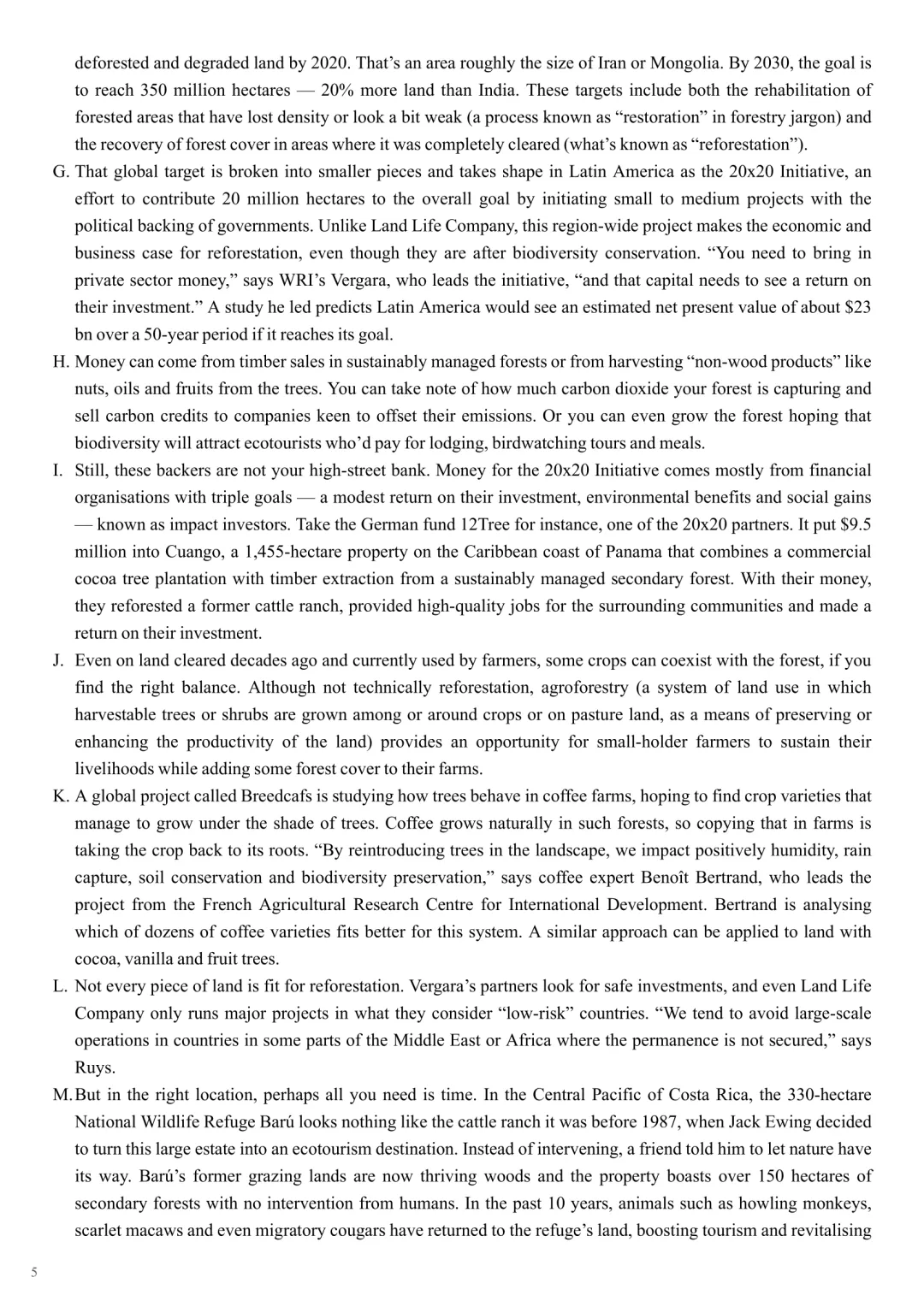
02
听力原文
>>>

03
真题试卷-word版
>>>
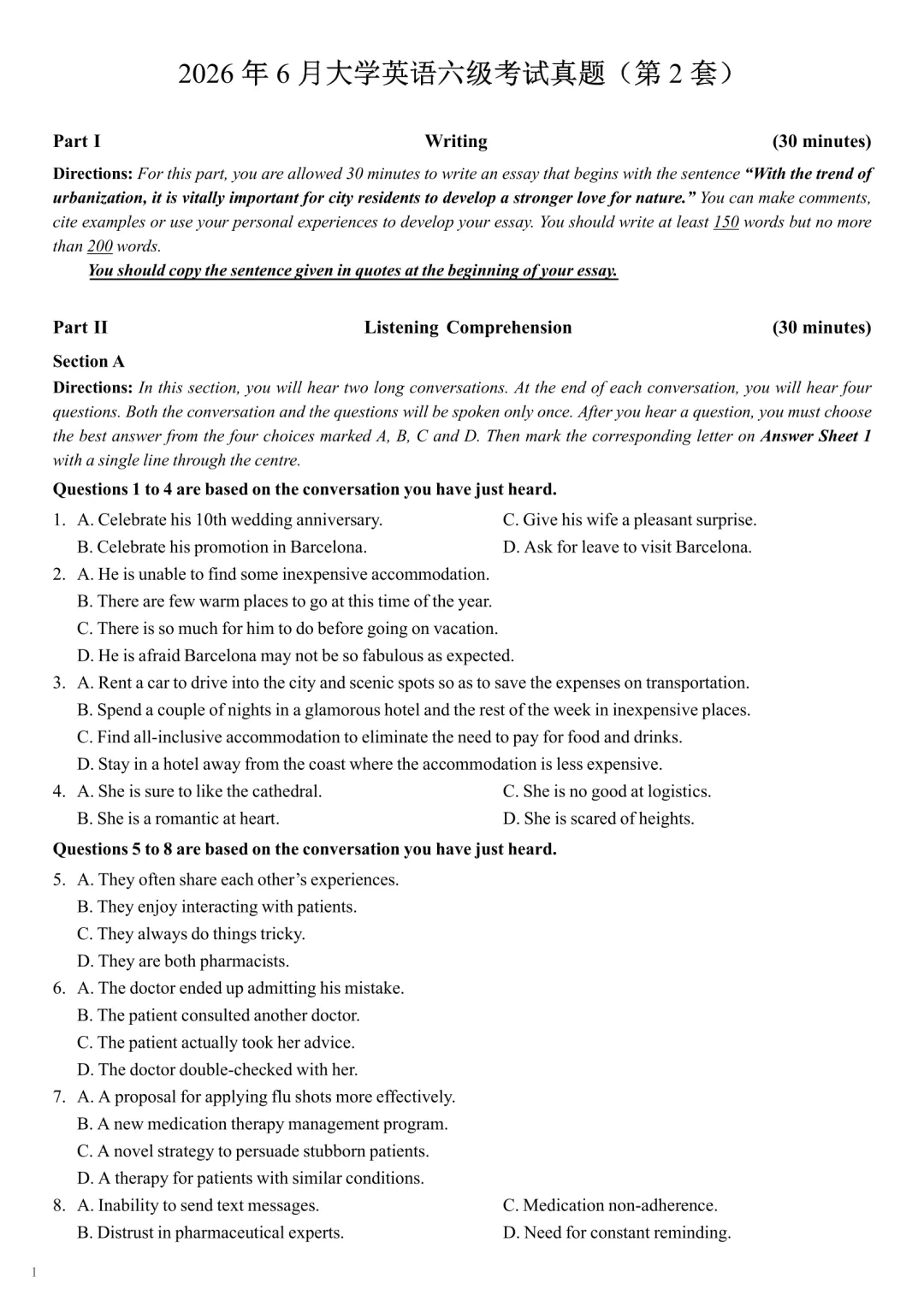
2026年6月大学英语六级考试真题(第2套)
Part I Writing(30 minutes)
Directions: For this part, you are allowed 30 minutes to write an essay that begins with the sentence "With the trend of urbanization, it is vitally important for city residents to develop a stronger love for nature." You can make comments, cite examples or use your personal experiences to develop your essay. You should write at least 150 words but no more than 200 words.
You should copy the sentence given in quotes at the beginning of your essay.
Part II Listening Comprehension(30 minutes)
Section A
Directions: In this section, you will hear two long conversations. At the end of each conversation, you will hear four questions. Both the conversation and the questions will be spoken only once. After you hear a question, you must choose the best answer from the four choices marked A, B, C and D. Then mark the corresponding letter on Answer Sheet 1 with a single line through the centre.
Questions 1 to 4 are based on the conversation you have just heard.
1.A. Celebrate his 10th wedding anniversary.B. Celebrate his promotion in Barcelona.C. Give his wife a pleasant surprise.D. Ask for leave to visit Barcelona.
2.A. He is unable to find some inexpensive accommodation.B. There are few warm places to go at this time of the year.C. There is so much for him to do before going on vacation.D. He is afraid Barcelona may not be so fabulous as expected.
3.A. Rent a car to drive into the city and scenic spots so as to save the expenses on transportation.B. Spend a couple of nights in a glamorous hotel and the rest of the week in inexpensive places.C. Find all-inclusive accommodation to eliminate the need to pay for food and drinks.D. Stay in a hotel away from the coast where the accommodation is less expensive.
4.A. She is sure to like the cathedral.B. She is a romantic at heart.C. She is no good at logistics.D. She is scared of heights.
Questions 5 to 8 are based on the conversation you have just heard.
5.A. They often share each other's experiences.B. They enjoy interacting with patients.C. They always do things tricky.D. They are both pharmacists.
6.A. The doctor ended up admitting his mistake.B. The patient consulted another doctor.C. The patient actually took her advice.D. The doctor double-checked with her.
7.A. A proposal for applying flu shots more effectively.B. A new medication therapy management program.C. A novel strategy to persuade stubborn patients.D. A therapy for patients with similar conditions.
8.A. Inability to send text messages.B. Distrust in pharmaceutical experts.C. Medication non-adherence.D. Need for constant reminding.
Section B
Questions 9 to 11 are based on the passage you have just heard.
9.A. Accomplish their goals.B. View things positively.C. Overstate their importance.D. Dominate job interviews.
10.A. It reflects a strong sense of obligation to others.B. It signifies a universal model of motivation.C. It may differ in various cultures.D. It may have been underestimated.
11.A. It was under-investigated.B. It was more predictable.C. It was taken for granted.D. It was more subtle.
Questions 12 to 15 are based on the passage you have just heard.
12.A. It is any incidental happening in plants and animals or ice crystals.B. It is any basic physical or chemical work in designing substances.C. It is any symmetrical and colorful stripes or spots on organisms.D. It is any regularly repeated arrangement of shapes or colors.
13.A. Materials undergoing certain processes.B. Materials exposed to various natural forces.C. Materials impacted by any change of molecules.D. Materials going through extremely radical transformations.
14.A. The beauty of molecular clustering.B. The way for appreciating patterns.C. The creation of patterns.D. The factors affecting clusters.
15.A. A pattern by accident.B. Patterns for specific purposes.C. Patterns with random imperfections.D. A pattern with artificial intervention.
Section C
Directions: In this section, you will hear three recordings of lectures or talks followed by three or four questions. The recordings will be played only once. After you hear a question, you must choose the best answer from the four choices marked A, B, C and D. Then mark the corresponding letter on Answer Sheet 1 with a single line through the centre.
Questions 16 to 18 are based on the recording you have just heard.
16.A. Eliminating all the old habits at once.B. Making a permanent lifestyle change.C. Realizing all the life goals one has set.D. Improving multiple areas of one's life.
17.A. They were more likely to implement a particular behavior.B. They were more likely to make plans for their future.C. They tended to be committed to a single goal.D. They tended to focus on one thing at a time.
18.A. The ability to make the process automatic.B. A practical timetable for implementation.C. A lot of conscious effort to remember to do it.D. Concentration on the benefits it will provide.
Questions 19 to 21 are based on the recording you have just heard.
19.A. It resembles that of Earth in many inconceivable ways.B. It has a haze much thicker than previously believed.C. It is 333.4°F cooler than earlier estimates.D. It is far beyond any quick measurements.
20.A. The accumulation of solid particles in the air.B. The distribution of gases in its atmosphere.C. The clouds of particles reflecting sun rays.D. The aggravated effects of climate change.
21.A. If spectrums of light can be better detected by telescope.B. If Pluto's hazy atmosphere can be more easily observed.C. If Pluto's hazy atmosphere scatters strong sunlight.D. If the light from the telescope confirms their idea.
Questions 22 to 25 are based on the recording you have just heard.
22.A. Parents can play a decisive role in cultivating their children's musical talent.B. Children are embarrassed by parents' failure to appreciate their music.C. Parents can mould their 8-to 10-year-old children's music taste.D. Children aged 8 to 10 are old enough to produce poetic lyrics.
23.A. They start to show their own musical preference.B. They tend to be more influenced by their peers.C. They tend to gravitate away from their homes.D. They are more open to new genres of music.
24.A. Enabling children to be receptive to music experts' suggestions.B. Helping children develop the ability to manage their emotions.C. Familiarising children with different schools of music.D. Introducing children to a variety of musical styles.
25.A. By enhancing children's appreciation of their music.B. By pushing their music hard enough upon children.C. By attending their concerts and live music events with children.D. By introducing their music to children as early as possible.
Part III Reading Comprehension(40 minutes)
Section A
Directions: In this section, there is a passage with ten blanks. You are required to select one word for each blank from a list of choices given in a word bank following the passage. Read the passage through carefully before making your choices. Each choice in the bank is identified by a letter. Please mark the corresponding letter for each item on Answer Sheet 2 with a single line through the centre. You may not use any of the words in the bank more than once.
Most financial crises have plenty in common: they tend to start in the banking sector and involve excessive borrowing, together with an asset bubble. The 26 crisis of 2008 was no different, with the asset bubble focused on US real estate. But my research suggests this crisis had another 27 cause - that some people in the banking sector were or "gaming" the system for their own financial gain.
The game being played had several important features. The first was the deliberate complexity of the financial products at its core. Then there are the 28 biases that permeate decision-making at all levels of the banking industry. Banking often attracts people with certain personality 29, including those who are overconfident and take excessive risks.
Such people tend to like complexity for its own sake, but they often do not fully understand the 30 of that complexity for the stability of the financial system as a whole. Often they do not care - they are primarily interested in gaming the system to 31 their bonuses.
The next element is risk. There are parts of the banking sector that will always be 32 to risk, but many bankers have come to feel immune to its potential impact, because they 33 that, however recklessly banks behave, governments will always be there to bail them out.
Gaming in the banking sector seems virtually impossible to 34. The only effective measure to end it would be to make bankers 35 liable for losses, but no government has ever passed such a law, and no single government could do so on its own, since this would immediately cause their entire national banking sector to move wholesale to another jurisdiction.
A. behaviouralB. eliminateC. fragileD. globalE. implicationsF. maximiseG. overlappingH. personallyI. pressureJ. proneK. prototypesL. reassureM. skepticallyN. traitsO. underlying
Section B
Directions: In this section, you are going to read a passage with ten statements attached to it. Each statement contains information given in one of the paragraphs. Identify the paragraph from which the information is derived. You may choose a paragraph more than once. Each paragraph is marked with a letter. Answer the questions by marking the corresponding letter on Answer Sheet 2.
How Do You Bring a Forest Back to Life?
A. Five hundred years ago, forests covered much of the Iberian peninsula. But that soon changed. Centuries of wars and invasions, agricultural expansion and woodcutting for firewood and shipping wiped out most of the woods and transformed places like Matamorisca, a small village in northern Spain, into degraded landscapes.
B. The region's dry climate and depleted soils would be a recipe for disaster in your average program to replant trees, but for the Amsterdam-based Land Life Company it's an ideal place. "We typically operate where nature does not come back by itself," says Jurrian Ruys, its CEO. "We go where there are rougher conditions in terms of weather, with rough or very hot summers." In Matamorisca, they intervened in 17 barren hectares owned by the regional government and peppered them with their signature device: a biodegradable (可生物降解的) cardboard container they call the cocoon which can hold 25 litres of water underground to aid a seedling's first year. Around 16,000 trees, including oaks, ashes, walnuts, rowans, and whitebeams, were planted in May 2018, and the company reports that 96% of them survived that year's burning hot summer without extra irrigation, a critical milestone for a young tree.
C. "Does nature return by itself?" asks Arnout Asjes, Land Life Company's chief technology officer, who oversees a mix of drone (无人机) and satellite imagery, big data analysis, soil enhancement, QR (二维码) tagging and site-specific tree configuration designs. "Probably, but it can take decades or hundreds of years, so we are speeding things up."
D. His company belongs to a global movement of organisations trying to save degraded or deforested areas, ranging from fertile tropical lowlands to dry hills in temperate (温带的) regions. Spurred by global biodiversity loss and climate change, these groups are pushing the boundary of how to revive forest cover. "It's not a theoretical proposition," says Walter Vergara, a forest and climate specialist at the World Resources Institute (WRI). "It requires the right incentives, the right stakeholders, the right analysis and sufficient capital, but it can happen."
E. How these factors come together for a particular project - and whether saving destroyed woods is even possible - depends on what kind of ecosystem you have in mind. Secondary forests in the Amazon are different from Texas pines recovering after wildfires or the Arctic timber woods that cover much of Sweden. Each provides different reasons for reforestation programs and each has particular needs. In the dry conditions around Matamorisca and similar areas in Spain, Land Life Company worries about rapid desertification (沙漠化). As its focus is on restoring an ecosystem, it works with organisations that don't expect their money back.
F. With around 600 hectares replanted around the world since 2015 and another 1,100 planned for this year, the company's drive fits into the Bonn Challenge, a global effort to restore 150 million hectares of the world's deforested and degraded land by 2020. That's an area roughly the size of Iran or Mongolia. By 2030, the goal is to reach 350 million hectares - 20% more land than India. These targets include both the rehabilitation of forested areas that have lost density or look a bit weak (a process known as "restoration" in forestry jargon) and the recovery of forest cover in areas where it was completely cleared (what's known as "reforestation").
G. That global target is broken into smaller pieces and takes shape in Latin America as the 20x20 Initiative, an effort to contribute 20 million hectares to the overall goal by initiating small to medium projects with the political backing of governments. Unlike Land Life Company, this region-wide project makes the economic and business case for reforestation, even though they are after biodiversity conservation. "You need to bring in private sector money," says WRI's Vergara, who leads the initiative, "and that capital needs to see a return on their investment." A study he led predicts Latin America would see an estimated net present value of about $23 bn over a 50-year period if it reaches its goal.
H. Money can come from timber sales in sustainably managed forests or from harvesting "non-wood products" like nuts, oils and fruits from the trees. You can take note of how much carbon dioxide your forest is capturing and sell carbon credits to companies keen to offset their emissions. Or you can even grow the forest hoping that biodiversity will attract ecotourists who'd pay for lodging, birdwatching tours and meals.
I. Still, these backers are not your high-street bank. Money for the 20x20 Initiative comes mostly from financial organisations with triple goals - a modest return on their investment, environmental benefits and social gains - known as impact investors. Take the German fund 12Tree for instance, one of the 20x20 partners. It put $9.5 million into Cuango, a 1,455-hectare property on the Caribbean coast of Panama that combines a commercial cocoa tree plantation with timber extraction from a sustainably managed secondary forest. With their money, they reforested a former cattle ranch, provided high-quality jobs for the surrounding communities and made a return on their investment.
J. Even on land cleared decades ago and currently used by farmers, some crops can coexist with the forest, if you find the right balance. Although not technically reforestation, agroforestry (a system of land use in which harvestable trees or shrubs are grown among or around crops or on pasture land, as a means of preserving or enhancing the productivity of the land) provides an opportunity for small-holder farmers to sustain their livelihoods while adding some forest cover to their farms.
K. A global project called Breedcafs is studying how trees behave in coffee farms, hoping to find crop varieties that manage to grow under the shade of trees. Coffee grows naturally in such forests, so copying that in farms is taking the crop back to its roots. "By reintroducing trees in the landscape, we impact positively humidity, rain capture, soil conservation and biodiversity preservation," says coffee expert Benoit Bertrand, who leads the project from the French Agricultural Research Centre for International Development. Bertrand is analysing which of dozens of coffee varieties fits better for this system. A similar approach can be applied to land with cocoa, vanilla and fruit trees.
L. Not every piece of land is fit for reforestation. Vergara's partners look for safe investments, and even Land Life Company only runs major projects in what they consider "low-risk" countries. "We tend to avoid large-scale operations in countries in some parts of the Middle East or Africa where the permanence is not secured," says Ruys.
M. But in the right location, perhaps all you need is time. In the Central Pacific of Costa Rica, the 330-hectare National Wildlife Refuge Barú looks nothing like the cattle ranch it was before 1987, when Jack Ewing decided to turn this large estate into an ecotourism destination. Instead of intervening, a friend told him to let nature have its way. Barú's former grazing lands are now thriving woods and the property boasts over 150 hectares of secondary forests with no intervention from humans. In the past 10 years, animals such as howling monkeys, scarlet macaws and even migratory cougars have returned to the refuge's land, boosting tourism and revitalising...
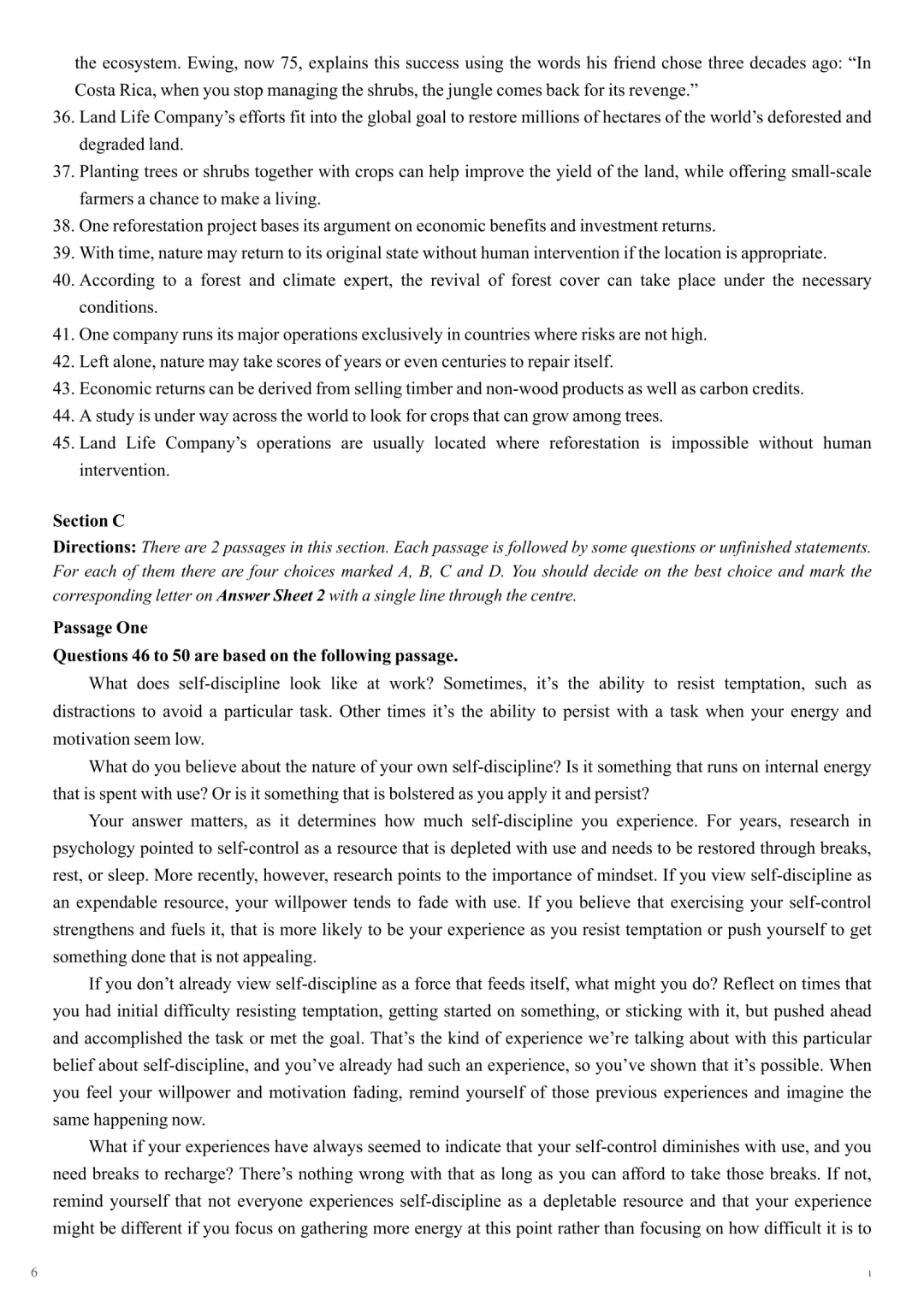
36.Land Life Company's efforts fit into the global goal to restore millions of hectares of the world's deforested and degraded land.
37.Planting trees or shrubs together with crops can help improve the yield of the land, while offering small-scale farmers a chance to make a living.
38.One reforestation project bases its argument on economic benefits and investment returns.
39.With time, nature may return to its original state without human intervention if the location is appropriate.
40.According to a forest and climate expert, the revival of forest cover can take place under the necessary conditions.
41.One company runs its major operations exclusively in countries where risks are not high.
42.Left alone, nature may take scores of years or even centuries to repair itself.
43.Economic returns can be derived from selling timber and non-wood products as well as carbon credits.
44.A study is under way across the world to look for crops that can grow among trees.
45.Land Life Company's operations are usually located where reforestation is impossible without human intervention.
Section C
Directions: There are 2 passages in this section. Each passage is followed by some questions or unfinished statements. For each of them there are four choices marked A, B, C and D. You should decide on the best choice and mark the corresponding letter on Answer Sheet 2 with a single line through the centre.
Passage One
Questions 46 to 50 are based on the following passage.
What does self-discipline look like at work? Sometimes, it's the ability to resist temptation, such as distractions to avoid a particular task. Other times it's the ability to persist with a task when your energy and motivation seem low.
What do you believe about the nature of your own self-discipline? Is it something that runs on internal energy that is spent with use? Or is it something that is bolstered as you apply it and persist?
Your answer matters, as it determines how much self-discipline you experience. For years, research in psychology pointed to self-control as a resource that is depleted with use and needs to be restored through breaks, rest, or sleep. More recently, however, research points to the importance of mindset. If you view self-discipline as an expendable resource, your willpower tends to fade with use. If you believe that exercising your self-control strengthens and fuels it, that is more likely to be your experience as you resist temptation or push yourself to get something done that is not appealing.
If you don't already view self-discipline as a force that feeds itself, what might you do? Reflect on times that you had initial difficulty resisting temptation, getting started on something, or sticking with it, but pushed ahead and accomplished the task or met the goal. That's the kind of experience we're talking about with this particular belief about self-discipline, and you've already had such an experience, so you've shown that it's possible. When you feel your willpower and motivation fading, remind yourself of those previous experiences and imagine the same happening now.
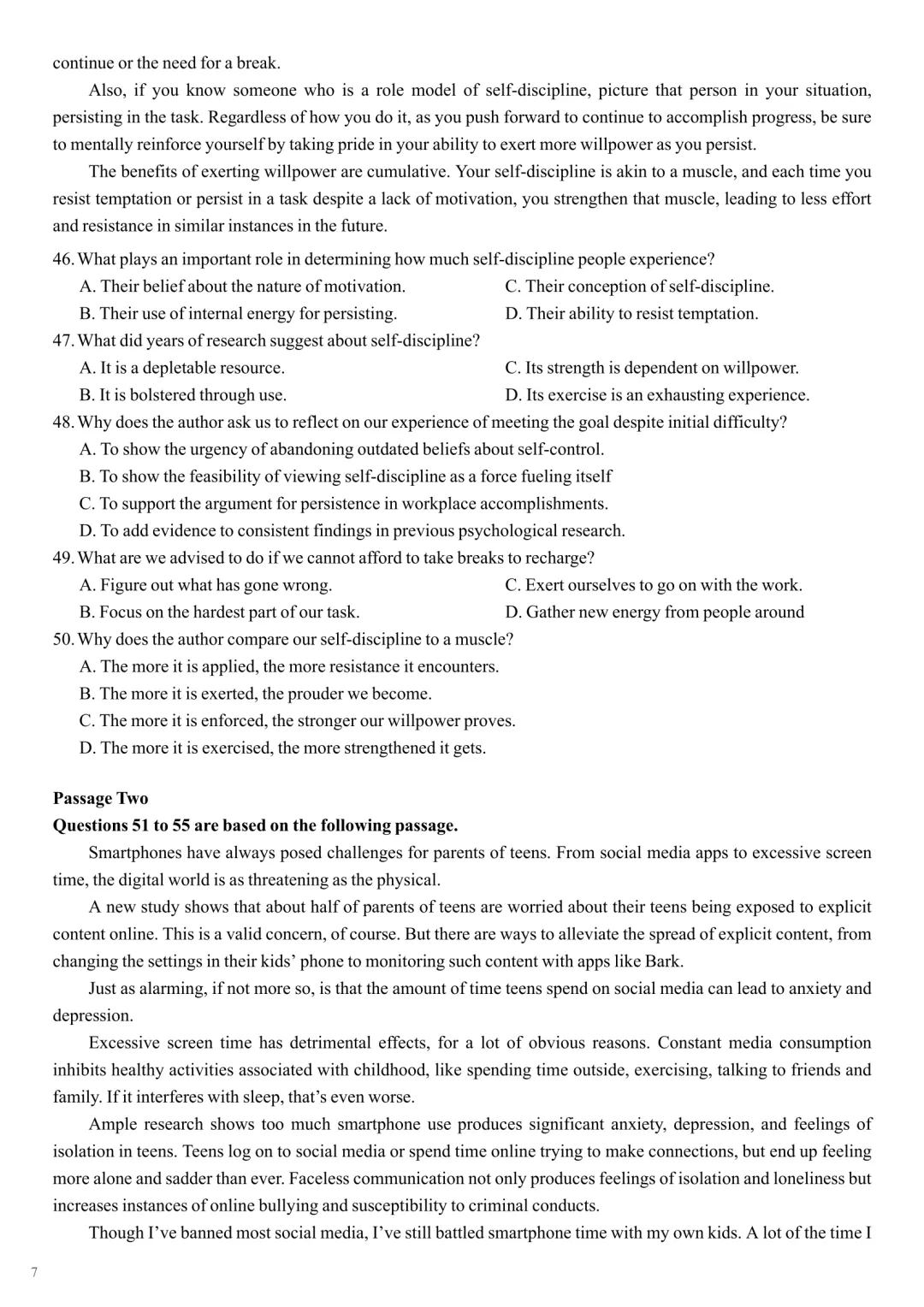
What if your experiences have always seemed to indicate that your self-control diminishes with use, and you need breaks to recharge? There's nothing wrong with that as long as you can afford to take those breaks. If not, remind yourself that not everyone experiences self-discipline as a depletable resource and that your experience might be different if you focus on gathering more energy at this point rather than focusing on how difficult it is to...
Also, if you know someone who is a role model of self-discipline, picture that person in your situation, persisting in the task. Regardless of how you do it, as you push forward to continue to accomplish progress, be sure to mentally reinforce yourself by taking pride in your ability to exert more willpower as you persist.
The benefits of exerting willpower are cumulative. Your self-discipline is akin to a muscle, and each time you resist temptation or persist in a task despite a lack of motivation, you strengthen that muscle, leading to less effort and resistance in similar instances in the future.
46.What plays an important role in determining how much self-discipline people experience?A. Their belief about the nature of motivation.B. Their use of internal energy for persisting.C. Their conception of self-discipline.D. Their ability to resist temptation.
47.What did years of research suggest about self-discipline?A. It is a depletable resource.B. It is bolstered through use.C. Its strength is dependent on willpower.D. Its exercise is an exhausting experience.
48.Why does the author ask us to reflect on our experience of meeting the goal despite initial difficulty?A. To show the urgency of abandoning outdated beliefs about self-control.B. To show the feasibility of viewing self-discipline as a force fueling itself.C. To support the argument for persistence in workplace accomplishments.D. To add evidence to consistent findings in previous psychological research.
49.What are we advised to do if we cannot afford to take breaks to recharge?
A. Figure out what has gone wrong.B. Focus on the hardest part of our task.C. Exert ourselves to go on with the work.D. Gather new energy from people around.
50.Why does the author compare our self-discipline to a muscle?A. The more it is applied, the more resistance it encounters.B. The more it is exerted, the prouder we become.C. The more it is enforced, the stronger our willpower proves.D. The more it is exercised, the more strengthened it gets.
Passage Two
Questions 51 to 55 are based on the following passage.
Smartphones have always posed challenges for parents of teens. From social media apps to excessive screen time, the digital world is as threatening as the physical.
A new study shows that about half of parents of teens are worried about their teens being exposed to explicit content online. This is a valid concern, of course. But there are ways to alleviate the spread of explicit content, from changing the settings in their kids' phone to monitoring such content with apps like Bark.
Just as alarming, if not more so, is that the amount of time teens spend on social media can lead to anxiety and depression.
Excessive screen time has detrimental effects, for a lot of obvious reasons. Constant media consumption inhibits healthy activities associated with childhood, like spending time outside, exercising, talking to friends and family. If it interferes with sleep, that's even worse.
Ample research shows too much smartphone use produces significant anxiety, depression, and feelings of isolation in teens. Teens log on to social media or spend time online trying to make connections, but end up feeling more alone and sadder than ever. Faceless communication not only produces feelings of isolation and loneliness but increases instances of online bullying and susceptibility to criminal conducts.
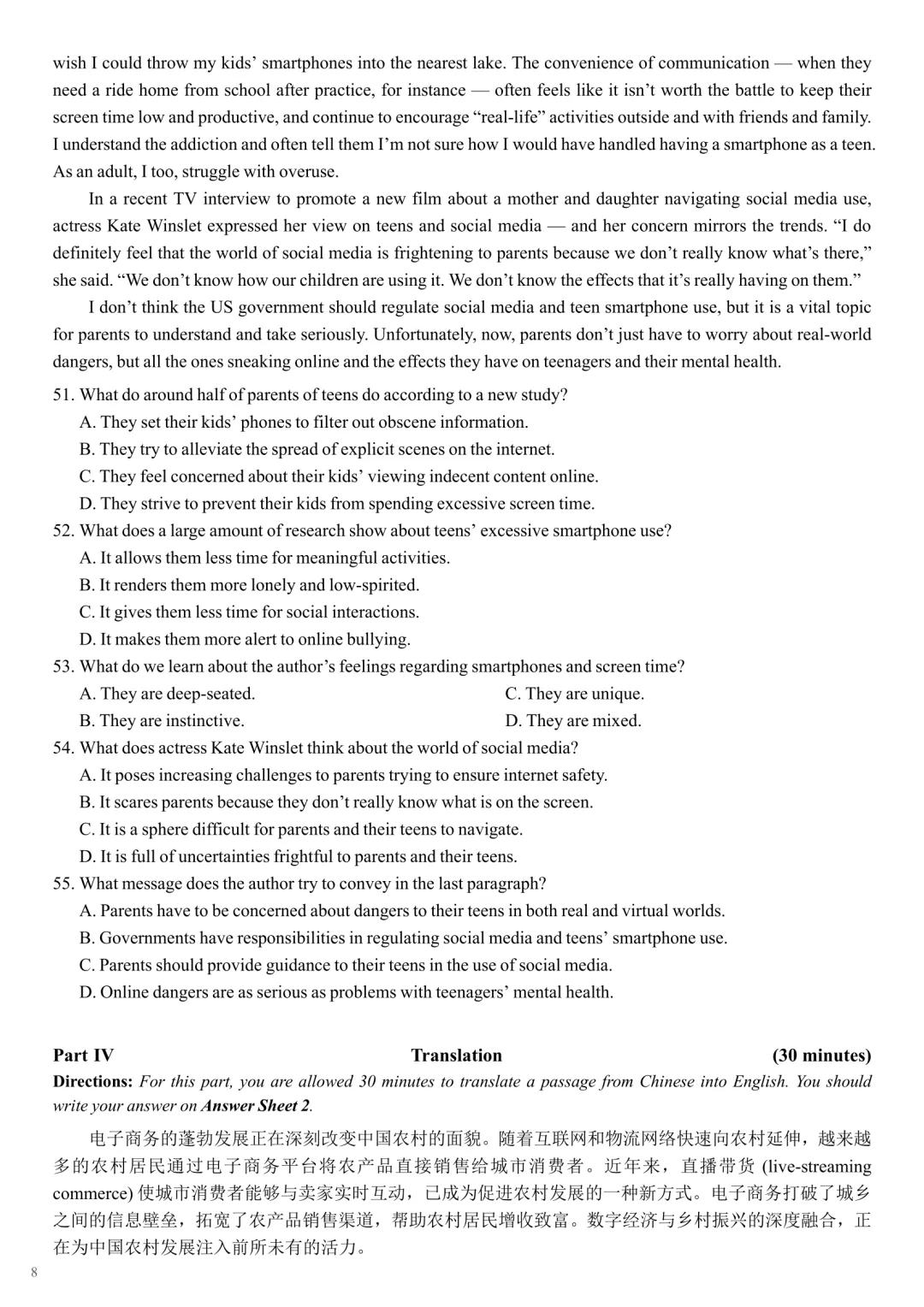
Though I've banned most social media, I've still battled smartphone time with my own kids. A lot of the time I wish I could throw my kids' smartphones into the nearest lake. The convenience of communication — when they need a ride home from school after practice, for instance — often feels like it isn't worth the battle to keep their screen time low and productive, and continue to encourage "real-life" activities outside and with friends and family. I understand the addiction and often tell them I'm not sure how I would have handled having a smartphone as a teen. As an adult, I, too, struggle with overuse.
In a recent TV interview to promote a new film about a mother and daughter navigating social media use, actress Kate Winslet expressed her view on teens and social media - and her concern mirrors the trends. "I do definitely feel that the world of social media is frightening to parents because we don't really know what's there," she said. "We don't know how our children are using it. We don't know the effects that it's really having on them."
I don't think the US government should regulate social media and teen smartphone use, but it is a vital topic for parents to understand and take seriously. Unfortunately, now, parents don't just have to worry about real-world dangers, but all the ones sneaking online and the effects they have on teenagers and their mental health.
51.What do around half of parents of teens do according to a new study?A. They set their kids' phones to filter out obscene information.B. They try to alleviate the spread of explicit scenes on the internet.C. They feel concerned about their kids' viewing indecent content online.D. They strive to prevent their kids from spending excessive screen time.
52.What does a large amount of research show about teens' excessive smartphone use?A. It allows them less time for meaningful activities.B. It renders them more lonely and low-spirited.C. It gives them less time for social interactions.D. It makes them more alert to online bullying.
53.What do we learn about the author's feelings regarding smartphones and screen time?A. They are deep-seated.B. They are instinctive.C. They are unique.D. They are mixed.
54.What does actress Kate Winslet think about the world of social media?A. It poses increasing challenges to parents trying to ensure internet safety.B. It scares parents because they don't really know what is on the screen.C. It is a sphere difficult for parents and their teens to navigate.D. It is full of uncertainties frightful to parents and their teens.
55.What message does the author try to convey in the last paragraph?A. Parents have to be concerned about dangers to their teens in both real and virtual worlds.B. Governments have responsibilities in regulating social media and teens' smartphone use.C. Parents should provide guidance to their teens in the use of social media.D. Online dangers are as serious as problems with teenagers' mental health.
Part IV Translation(30 minutes)
Directions: For this part, you are allowed 30 minutes to translate a passage from Chinese into English. You should write your answer on Answer Sheet 2.
电子商务的蓬勃发展正在深刻改变中国农村的面貌。随着互联网和物流网络快速向农村延伸,越来越多的农村居民通过电子商务平台将农产品直接销售给城市消费者。近年来,直播带货(live-streaming commerce)使城市消费者能够与卖家实时互动,已成为促进农村发展的一种新方式。电子商务打破了城乡之间的信息壁垒,拓宽了农产品销售渠道,帮助农村居民增收致富。数字经济与乡村振兴的深度融合,正在为中国农村发展注入前所未有的活力。
03
参考答案
>>>

翻译参考范文:
The rapid development of e-commerce is profoundly changing the landscape of rural China. As the Internet and logistics networks rapidly extend into rural areas, an increasing number of rural residents are selling agricultural products directly to urban consumers through e-commerce platforms. In recent years, live-streaming commerce, which enables urban consumers to interact with sellers in real time, has become a new way to promote rural development. E-commerce has broken down the information barriers between urban and rural areas, broadened the sales channels for agricultural products, and helped rural residents increase their incomes and achieve prosperity. The deep integration of the digital economy with rural revitalization is injecting unprecedented vitality into China’s rural development.
04
听力原文-word版
>>>
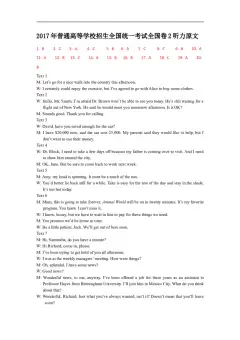
Conversation 1
W: Hi, Frank, are you working through your lunch hour again?
M: No, not at all. It's my 10th wedding anniversary next week, and I promised Jane that I would book a city break for us, as I have annual leave to take. And it would be nice to celebrate somewhere warm, so I'm trying to book something in Barcelona.
W: That sounds so romantic. I adore Barcelona. It's such a fabulous cosmopolitan city. There's so much to do there, excellent food and that cathedral that they are still building after about 150 years. Very cool.
M: I know. But the anniversary is looming and I'm still scrambling to find accommodation. Everything is either wildly expensive or already fully booked. I'm starting to feel a bit frantic.
W: Well, if you are going for a whole week, why don't you do a couple of nights in somewhere really glamorous and then do the rest of the week a bit further up the coast, where the accommodation is cheaper and that will offset the cost of the expensive place?
M: That might be a good plan. It's not too expensive to rent a car, so we could still drive into the city. Yes, there are lots of places outside the city that have pools and are all-inclusive, so we wouldn't even need to pay for food or drinks. I'll send a query now about the dates we're interested in.
W: That sounds perfect! I'm sure that Jane will be absolutely thrilled to bits. I really do recommend visiting that cathedral. You can go all the way up to the top of it, but you need to go up a really steep spiral staircase to get there.
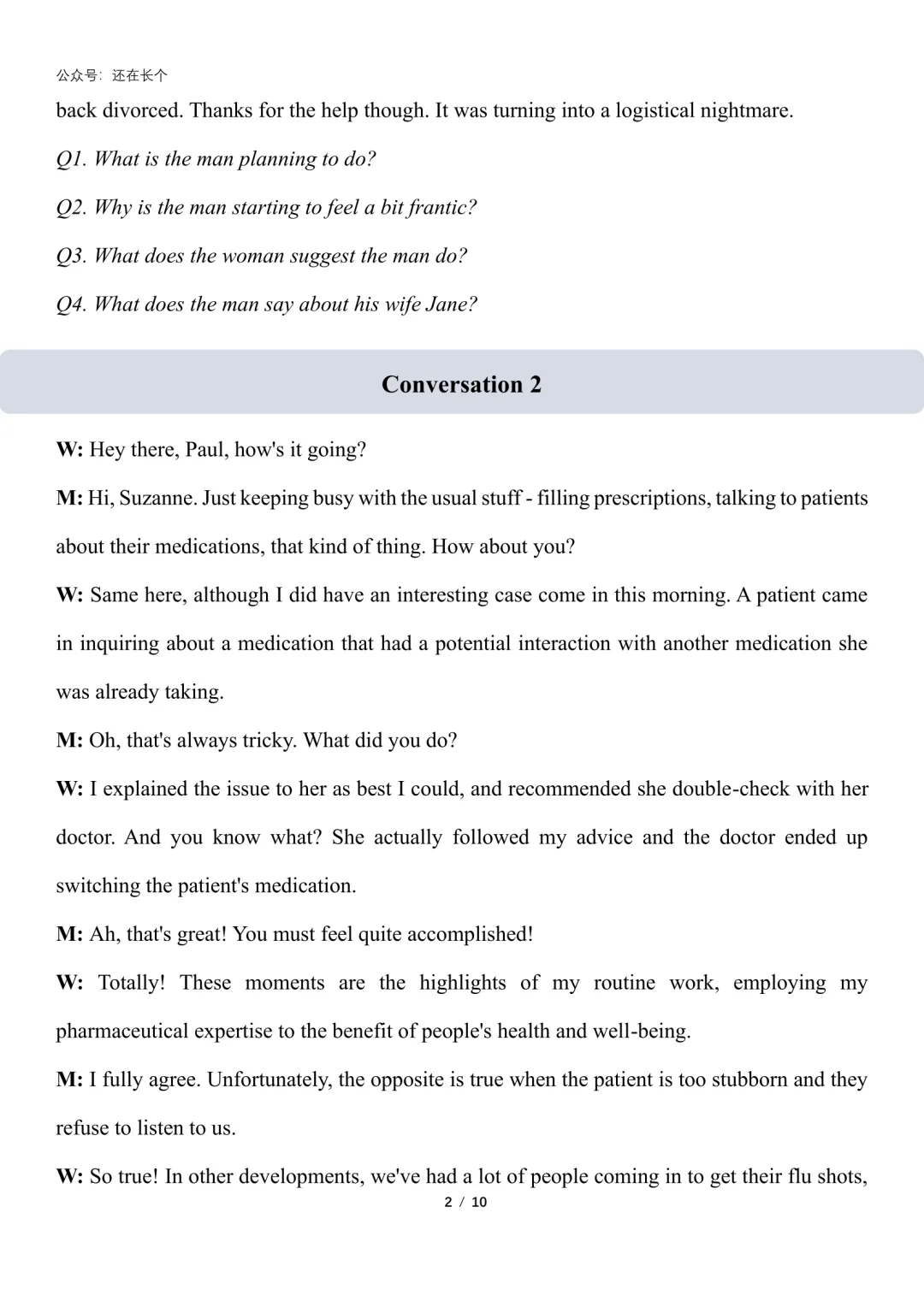
M: Considering Jane is terrified of heights, I think if I tried to make her do that, I would come back divorced. Thanks for the help though. It was turning into a logistical nightmare.
Q1. What is the man planning to do?
Q2. Why is the man starting to feel a bit frantic?
Q3. What does the woman suggest the man do?
Q4. What does the man say about his wife Jane?
Conversation 2
W: Hey there, Paul, how's it going?
M: Hi, Suzanne. Just keeping busy with the usual stuff - filling prescriptions, talking to patients about their medications, that kind of thing. How about you?
W: Same here, although I did have an interesting case come in this morning. A patient came in inquiring about a medication that had a potential interaction with another medication she was already taking.
M: Oh, that's always tricky. What did you do?
W: I explained the issue to her as best I could, and recommended she double-check with her doctor. And you know what? She actually followed my advice and the doctor ended up switching the patient's medication.
M: Ah, that's great! You must feel quite accomplished!
W: Totally! These moments are the highlights of my routine work, employing my pharmaceutical expertise to the benefit of people's health and well-being.
M: I fully agree. Unfortunately, the opposite is true when the patient is too stubborn and they refuse to listen to us.
W: So true! In other developments, we've had a lot of people coming in to get their flu shots, which is always good to see.
M: Good, good. I've been working on a new medication therapy management program for our patients with chronic conditions. It helps patients manage their medications more effectively.
W: That sounds interesting.
M: We review all of their medications and make sure that they're taking them as prescribed. We also look for any potential drug interactions or side effects. Patient response has so far been very positive. Some have reported seeing improvements in their health, which is really rewarding to see.
W: That's great to hear. Do you use text message reminders?
M: Yes, absolutely.
W: It's a great idea. Medication non-adherence is a big problem, especially for older patients.
M: We're still in the early stages of the program, but I'm hopeful that it will make a real difference for our patients.
Q5. What do we learn about the speakers?
Q6. What does the woman say about an interesting case she had?
Q7. What does the man say he has been working on?
Q8. What is a big problem, especially for older patients, according to the woman?
Passage 1
In America, at least, "passion" is a word that often comes up on job descriptions and in interviews. On the whole, passionate people are thought of in a positive light and considered likely to achieve their goals. But when it comes to predicting achievement, has the importance of passion been overstated?
According to a new study from Stanford University, passion may be less important in certain cultures. And the fact that passion is often seen as a key to achievement may reflect a distinctly Western model of motivation. The chief factor explored in the study was how individualistic a society was. In individualistic cultures, the researchers assert, people are more motivated by pursuing paths related to their passions, but those in collectivistic cultures are more likely to see themselves as part of a network. They often place fulfilling obligations to others above focusing on their own interests.
The researchers looked at data from nearly 60 countries. They found that, in science subjects, passion was positively correlated with academic achievements. Higher levels of enjoyment and interest also bolstered test scores. But the strength of this correlation wasn't the same across cultures. Those in individualistic societies such as the US, Australia and the UK showed a stronger link between passion and achievement. The effect of passion on performance was more subtle for those in more collectivistic societies such as Colombia or Thailand. These findings were mirrored in achievement in both mathematics and reading. It's clear from the findings that passion isn't the only thing that motivates people to achieve their goals.
Q9. What are passionate people considered likely to do in America?
Q10. What does a new study from Stanford show about the importance of passion in predicting achievement?
Q11. What did the researchers find about the effect of passion on academic achievement for those in more collectivistic societies?
Passage 2
Why does nature create patterns? The reason patterns often appear in nature is simple - the same basic physical or chemical processes occur in many pattern substances and organisms as they form. Whether in plants and animals or rocks, foams and ice crystals, the intricate patterns that happen in nature come down to what's happening at the level of atoms and molecules.
A pattern in nature is any regularly repeated arrangement of shapes or colors. Some of the most striking examples include the six-sided arrays of rocks at Giant's Causeway in the United Kingdom, and the colorful stripes and spots on tropical fish. Patterns like these begin to form at a small scale when materials undergo processes like drying, freezing, wrinkling, diffusing and reacting. Those changes then give rise to complex patterns at a larger scale that people can see.
Imagine delicate frozen crystals on a window during winter. What creates that pattern? When water freezes, its molecules begin clustering together. Water molecules have a particular bent shape that causes them to stack into clusters as they freeze. As the cluster grows, many outside factors, including humidity and temperature, begin to affect its overall shape. If the water is freezing on a window, for example, random imperfections on the glass surface affect the stacking and create the larger pattern. But scientists do not always know the purpose of a pattern, or even if there is one. The molecular processes involved are simple enough that they might generate a pattern by coincidence.
Q12. What does the passage say is a pattern in nature?
Q13. What gives rise to complex patterns at a larger scale?
Q14. What does the example of frozen crystals on a window show?
Q15. What might molecular processes produce according to the passage?
Recording 1
Many people, myself included, have multiple areas of life they would like to improve. For example, I would like to reach more people with my writing, to lift heavier weights at the gym, and to start practicing mindfulness more consistently. Those are just a few of the goals I find desirable, and you probably have a long list yourself.
The problem is, even if we are committed to working hard on our goals, our natural tendency is to return to our old habits at some point. Making a permanent lifestyle change is really difficult.
Recently, I've come across a few studies that will make these difficult lifestyle changes a bit easier. As you'll see, however, the approach to mastering many areas of life is somewhat counterintuitive.
Research has shown that you are two to three times more likely to stick with your habits if you make a specific plan for when, where and how you will perform the behavior. For example, in one study scientists asked people to fill out a sentence to specify during the next week they would do at least 20 minutes of vigorous exercise on which day, at what time of day, and at or in what place. Researchers found that people who filled out this sentence were two to three times more likely to actually exercise compared to a control group who did not make plans for their future behavior. Psychologists call these specific plans "implementation intentions" because they state when, where, and how you intend to implement a particular behavior.
However, follow-up research has discovered implementation intentions only work when you focus on one thing at a time. In fact, researchers found that people who tried to accomplish multiple goals were less committed and less likely to succeed than those who focused on a single goal.
Another science-based reason to focus on one thing at a time is that when you begin practicing a new habit, it requires a lot of conscious effort to remember to do it. After a while, however, the pattern of behavior becomes easier. Eventually, your new habit becomes a normal routine and the process is more or less mindless and automatic.
The most important thing to note is that there is some "tipping point" at which new habits become more or less automatic. The time it takes to build a habit depends on many factors including how difficult the habit is, your genetics, and more.
Q16. What does the speaker say is really difficult?
Q17. What did researchers find about people with implementation intentions?
Q18. According to the speaker, what is required of you when you begin practicing a new habit?
Recording 2
It was a lazy, crazy day on the dwarf planet Pluto when New Horizons, a spacecraft from Earth, flew by at a speed of 31,000 miles per hour two years ago. The spacecraft took a bunch of photos, made some quick measurements of Pluto's atmosphere, and sent them all back here, giving planetary scientists their first up-close look of the distant dwarf planet.
One of the more bizarre things they found was that the haze in Pluto's atmosphere was much thicker than previously thought. The planet also had an atmosphere much cooler than earlier estimates, topping out at -333.4°F.
Now, a study published in Nature links those two atmospheric observations. A computer model developed by planetary scientist Xi Zhang and colleagues shows the haze of tiny droplets in the upper atmosphere is likely scattering light from the Sun, preventing heat from reaching the planet below.
We see hazy skies on Earth too, from time to time, whenever solid particles get suspended in the air - from water-based fogs, to ash from fires, to the toxic droplets that make up a thick smog. But on Earth, the overall temperature of the planet is dominated by the distribution of gases in our atmosphere. On Pluto, the authors suggest, haze might be more influential. Particles can reflect light from the Sun here on Earth. It happens after volcanoes erupt, emitting clouds of particles that reflect the Sun's rays into the atmosphere. Some people even propose imitating this phenomenon to alleviate the effects of climate change. But our planet isn't dominated by that process, or at least it hasn't been for a few billion years.
If Pluto's atmosphere is very different from ours and from that of other nearby planets, it could help scientists expand their understanding of planetary atmospheres. But right now, this is just a good guess based on data from New Horizons and a sophisticated computer model, not direct observations of the haze's composition. There are other theories floating around to explain Pluto's cool temperatures, including blaming the cold air on gases in the atmosphere.
Luckily, the authors will get a chance to test their notions when the James Webb Space Telescope launches later. That observatory can detect different spectrums of light, which the hazy Plutonian atmosphere would be positively glowing with as it scattered sunlight. The researchers just have to wait and see if the light from the telescope validates their bright idea.
Q19. What was one of the more bizarre findings about Pluto's atmosphere?
Q20. What is said to determine the overall temperature on Earth?
Q21. What does the speaker say the researchers have to wait and see?
Recording 3
Parents have a small window where they can influence their 8- to 10-year-old children's music taste, researchers have concluded. The 24-month time-frame comes at an age when youngsters are old enough to appreciate poetic lyrics and snappy tunes, but have not yet started to be embarrassed by their mother and father's preferences.
Dr. Hauke Egermann, a lecturer in music at the University of York, carried out a literature review into more than a dozen studies looking at parental musical influence. Children have an openness to new music, and this means parents have an important role to play in developing the musical preferences of their kids, he said. However, time is of the essence, as parental influence is most likely to be effective during the critical time period before age 10. During adolescence, children tend to gravitate away from their parents' choices and are more influenced by their peers.
A separate survey of 2,000 British parents by music streaming service Deezer also found that nearly four fifths of parents agreed that their children were far more receptive to their musical suggestions before the age of 10. In contrast, just 10% of parents reported positive reactions from their teenage children when they shared their favourite music.
Some 79% of fathers said they had tried to influence their children's music, but just 69% of mothers. However, mothers were more effective, with 38% reporting that their kids loved the tunes they shared, compared to 30% of dads who in some cases said their children cried or even fell asleep.
Dr. Egermann claims introducing children to a variety of musical styles is the key to fostering good taste in later life. By children a variety of genres before this critical period, research on familiarisation suggests they will enjoy lots of different types of music as adults, he added. The benefits of having a wider taste in music include the ability to manage their emotions more effectively, socialise and bond with others more easily, and to have a better understanding of other cultures as well.
Dr. Egermann advises parents not to push their favourite music too hard on their children, but instead play it as background music while a child is. They can also help create positive memories about artists and bands by going to concerts and live music events together.
Q22. What do we learn from researchers' conclusion at the beginning of the talk?
Q23. What does Dr. Hauke Egermann say about adolescents?
Q24. What is the key to fostering good taste in later life according to Dr. Hauke Egermann?
Q25. How can parents help children create positive memories about artists and bands?
05
免费下载PDF版
>>>