 夜雨聆风
夜雨聆风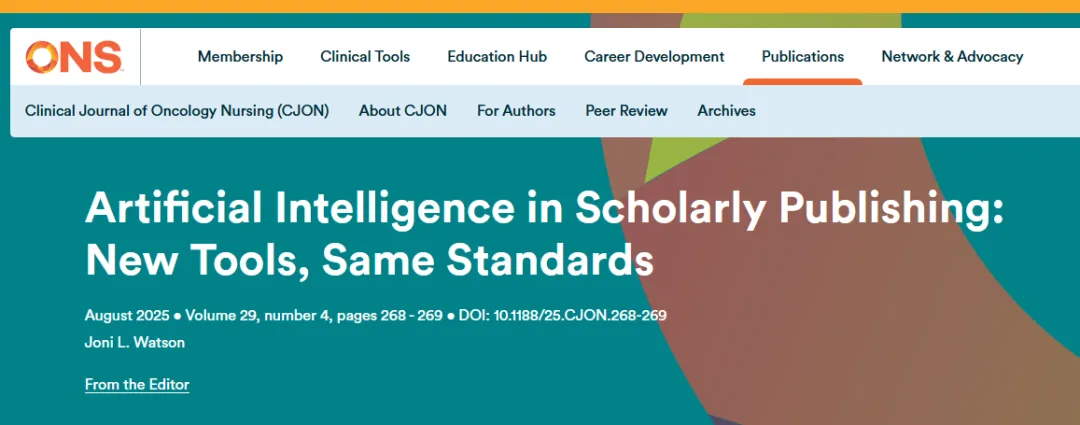
全文
As we continue celebrating 50 years of the Oncology Nursing Society, I have enjoyed reading previous Clinical Journal of Oncology Nursing (CJON) editorials. While you benefit from the six historic editorials printed in CJON this year, I am embracing my love of words and desire for asynchronous editorial mentoring by reading all my predecessors’ work. It has been fun watching the history of a changing oncology nursing practice and publishing landscape within the pages of CJON.
CJON has maintained editorial and scholarly integrity, with a commitment to publication ethics, across three decades. CJON has educated readers about the impact of ghostwritten manuscripts, authorship criteria, and embedded and changing process rigor for structural protection within publishing. CJON’s second editorial (Liebman, 1997), republished in this issue beginning on p. 270, focused on reference style and content errors as nurses struggled with inaccurate or misinterpreted references, which “can lead to questions related to the accuracy and reliability of an article’s content” (p. 27). The editor inquired, “If the author was not 100% correct in checking the accuracy of something as measurable as a reference, how careful was he or she in regard to an article’s content?” (Liebman, 1997, p. 27). Nearly 30 years later, I am grappling with the same question thanks to new artificial intelligence (AI) tools.
Technology changes help us in many ways, even in publishing. Yet our professional standards of oncology nursing integrity remain unchanged (American Nurses Association [ANA], 2025; Lubejko & Wilson, 2019). I am a proponent of advancing technology and AI, having practiced in these spaces and written on these topics throughout my career. AI is growing within publishing to help with brainstorming, writing, coding, summarizing literature, supporting authors writing in non-native languages, and more. I use it to brainstorm titles, create outlines, summarize large amounts of information, and understand complicated concepts (like a tutor), among other things. The number of articles on the topic of AI within CJON, highlighting its benefits and limitations in cancer care and oncology nursing, is increasing.
AI is quite helpful for myriad reasons, yet it has many faults. Students in my graduate- and doctoral-level courses hear and see me repeat, “Trust but verify; trust but verify!” Generative AI creates plausible information, which, on the surface, looks like it may be accurate, but a bit more review quickly reveals deficits. As such, AI is not a decision-maker, so humans must use critical thinking and judgment when using AI. I am increasingly having difficult conversations with nurses of all educational backgrounds and experience levels who do not understand the appropriate use of AI, often resulting in inaccurate information and hallucinated—or fictitious or AI-misinformed—references. This is not unique to CJON. More than 100 peer-reviewed journals, the legal system, and even the White House have retracted articles, sanctioned professionals, and faced national backlash because of inappropriate AI use and inaccurate AI-generated information (Blum & Astor, 2025; Glynn, 2025; Naddaf, 2025).
Even as AI platforms continue to improve, ongoing research reveals that they still exhibit significant content and reference errors, reaching as high as 66%–90% reference inaccuracies, depending on the platform (Aljamaan et al., 2024; Chelli et al., 2024; Hatem et al., 2023; Sun et al., 2024). These inaccuracies are often identified as hallucinations, but Hatem et al. (2023) argued that language is stigmatizing and lacks a universal definition and term agreement. Alternatively, AI inaccuracies are classified as distorted information; the information is inaccurate regardless of the intention. There are two types of distorted information: disinformation, which is deliberate and intentionally false, and misinformation, which lacks intentional falsification (Hatem et al., 2023; Sun et al., 2024). Thanks to rigorous CJON publication processes and a dedicated editorial board and staff, team members have had several AI-distorted information “smart catches” (i.e., near misses) across both domains, protecting the oncology nursing body of evidence. CJON is a learning suborganization, using these moments to have open conversations about accountability and improvement. As such, we have reviewed and revised our processes to prevent the perpetuation of errors and publishing waste. We will continue to do so in pursuit of our oncology nursing commitment to patient care and advancing oncology nursing practice.
CJON adheres to national guidelines on AI use and disclosure, such as those from the International Committee of Medical Journal Editors (2025), the Committee on Publication Ethics Council (2024), and the American Psychological Association (McAdoo, 2024), as well as nursing calls for increased AI due diligence in nursing scholarship (Fontenot, 2025). In 2025, the journal added AI-specific author guidelines (www.ons.org/publications-research/cjon/for-authors) for acceptable and unacceptable uses of AI in CJON publishing. Authors attest to AI use on manuscript submission, and AI platforms cannot be listed as a manuscript author. Authors also need to ensure that anyone they mention in the manuscript acknowledgment section has also appropriately used AI (i.e., using an AI platform alone does not constitute “editing support” meeting International Committee of Medical Journal Editors acknowledgment criteria). In addition, CJON peer reviewers have new instructions and reminders that manuscripts are confidential within the peer review process, so AI use is not an acceptable or professional way to peer review manuscripts. Transparency in AI use is non-negotiable. Nondisclosure can result in manuscript rejection and publication decision rescission, which has occurred, and removal from the CJON peer review board.
AI is a tool; it is amoral—neither good nor bad. I have déjà vu as I have made this statement about social media throughout my career. Tools are tools; they require a person to determine the use. AI use depends on the user’s choices, so choose wisely, following the Code of Ethics for Nurses (ANA, 2025) and Oncology Nursing: Scope and Standards of Practice (Lubejko & Wilson, 2019). AI cannot compare to your expert voice and deep knowledge. As an author or peer reviewer, you need AI literacy; it is just as important as understanding evidence appraisal techniques and American Psychological Association style, and you can upskill in this area to keep your skills on pace with changing technology and standards. As oncology nurses, we have a trusted and ethical responsibility to provide people with quality, safe, and equitable care (ANA, 2025; Lubejko & Wilson, 2019), regardless of the tools we use. Take the time to review your AI knowledge, AI use, and all AI outputs. Ultimately, you are the responsible expert. AI may be a new tool, but the oncology nursing scope and standards of professional practice have not shifted (Lubejko & Wilson, 2019).
THE
END
