夜雨聆风
夜雨聆风
作者:米奇 来源:财经会议圈
Anthropic CEO再次预警AI风险:
已具备发动大规模网络攻击能力,各国立法迟缓,两者速度严重错配!
Dario Amodei 选了一个很妙的开场——《指环王》里行动极度迟缓的树人树胡,对比雷厉风行的霍比特人。这个隐喻不是在调侃,而是在发出一份真正的警报。
树人是各国立法机构。霍比特人是 AI。
问题是,树胡最终还是动了,而且一动就改变了战局。现实的问题是:各国政府,究竟还要等到什么时候?
能力已经在这里,规则还在半路上
这次 Anthropic 随政策文章同步发布的,是它最新的顶级模型 Mythos 5。这不是一次普通的产品更新——Amodei 亲口确认,英国 AI 安全研究所已在实测中证明,该模型"能独立执行复杂网络渗透攻击",威胁级别直指金融体系、关键基础设施和国家安全。
换句话说:
我们现在讨论的,不是"AI 将来可能有危险",而是"AI 已经具备了发动大规模网络攻击的能力"。
这个时间点很关键。就在三四年前,AI 还写不出一行通顺代码;今天,它已经能在网络空间里扮演高级攻击者的角色。这种速度,远超大多数政策制定者的认知刷新周期。
错配,才是最大的系统风险
Amodei 用一个词精准命中了问题核心:时间尺度错配。
国会一部法案动辄数年,AI 的每一个季度都在改写规则。当法律终于通过时,它所规范的,往往已经不再是当下的技术现实。这不是政客懒惰或无能,而是民主立法程序的内在特性——审慎、协商、博弈,天然就慢。
这种错配的代价不只是监管真空,更危险的是:在规则空白期,掌握能力的人可以做任何事,而承担后果的往往是那些对 AI 一无所知的普通公众。
网络攻击风险已经来临,生物武器制造风险正在路上,自主行动的失控 AI 不是科幻想象,是 Amodei 自己说的"近在眼前"。
他的方案,是认真的还是表演的?
值得注意的是,这篇文章不只是警告,它还带着行动清单:强制独立安全审计、类 FAA 监管模式、失业对冲政策框架、联邦芯片管制、民主阵营 AI 全球联盟……Anthropic 同时投入 3.5 亿美元配套落地。
这让这篇文章脱离了"忧虑文学"的范畴,更接近一份政策游说书。
批评者当然会问:Anthropic 自己研发并发布了这个危险模型,又来呼吁监管——这是真正的道德担当,还是通过制造恐慌来构筑监管壁垒、提高竞争对手的入场成本?
这个质疑并非没有道理。但换一个视角看:
如果连做出这个东西的人,都在公开说"它可能会摧毁金融体系",那么无论动机如何,这个警告本身都不应该被忽视。
公众的恐慌,是监督,不是噪音
Amodei 在文末说了一句少见的大实话:
很多 AI 企业把公众对 AI 的担忧当成"公关危机",认为只要优化叙事话术就能平息舆论。他明确否定这种思路——大众的恐慌来自真实的风险,不是信息素养不足。
这句话值得所有人记住。
在过去几年,AI 乐观主义者的标准操作是:把担忧者描述为"不懂技术的守旧者",把风险警告处理为"情绪化反应"。这种叙事既傲慢,也危险。公众对未知技术的警惕,本来就是社会免疫系统的正常反应,应该被转化为有效监管,而不是被"科普"掉。
最后:速度不对称,是这个时代最核心的政治问题
AI 以摩尔定律的速度进化,民主政治以地质年代的速度运转。
这不是 Amodei 制造的问题,也不是任何单一企业能解决的问题。但它是当下最紧迫、最容易被忽视的系统性风险——不是因为 AI 本身是恶的,而是因为在规则真空里,任何强大的工具都可能被滥用,无论使用者是国家、企业,还是个人。
树胡最终动了。问题是,当它动起来时,战场还在吗?
评论作者观点基于 Dario Amodei《Policy on the AI Exponential》全文,发布于北京时间 2026 年 6 月 11 日。
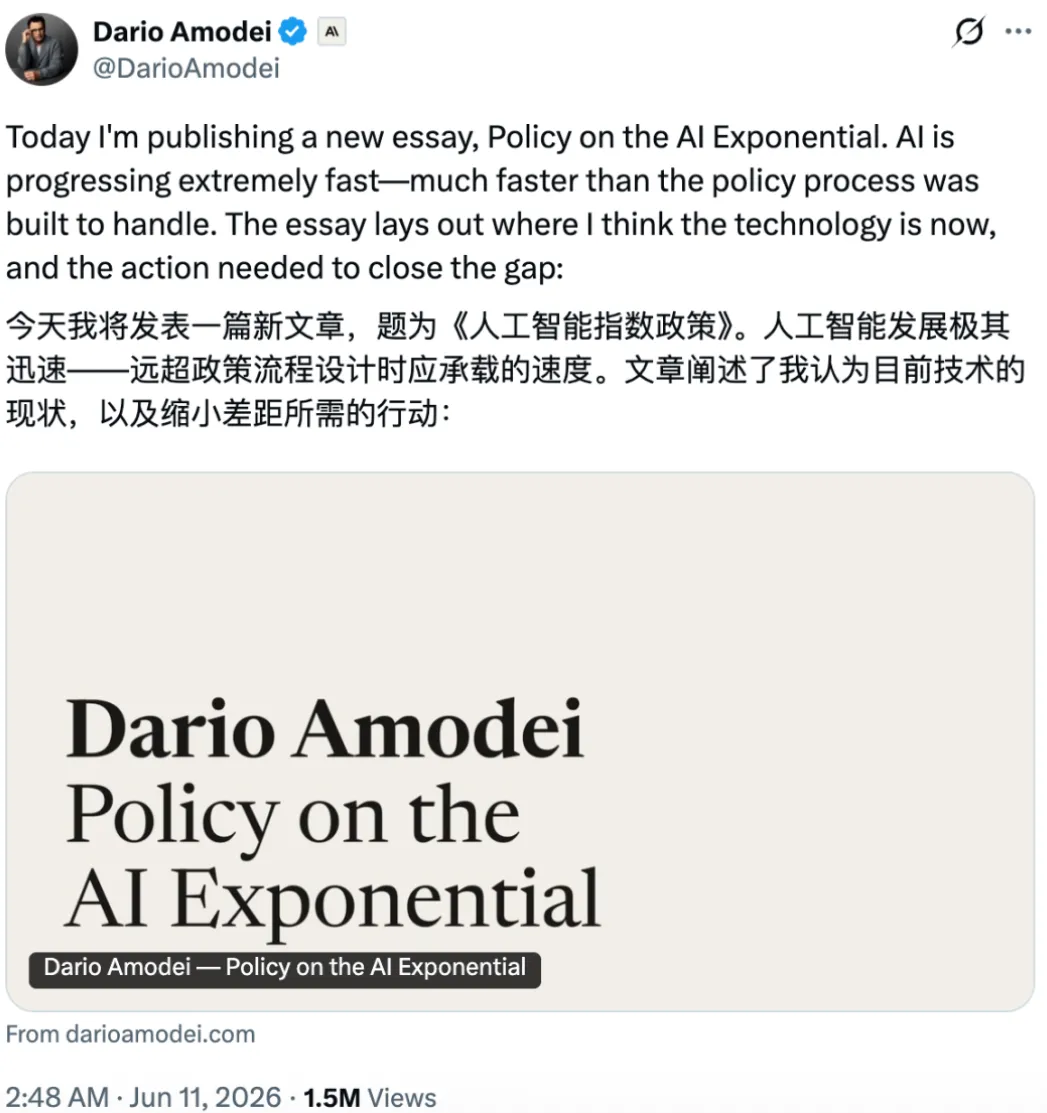
Dario Amodei《Policy on the AI Exponential(人工智能指数时代的政策)》完整译文
发布时间:美国当地6月10日、北京时间6月11日 发布背景:Anthropic同步发布顶级Mythos(神话)系列模型Mythos 5(受限高危版)、公开安全版Claude Fable 5
正文全文
在《指环王》的支线情节里,两名霍比特人试图唤醒树人树胡,让他守护森林免遭军队砍伐。矛盾的核心是两者节奏天差地别:树胡行动极度迟缓,光是和另一棵树打招呼就要耗上一整天,根本没法快速动员族人行动。
当下AI产业与各国政治体制的关系,就像霍比特人与树胡的对照。AI正以闪电速度狂飙:短短四年,AI模型从连一行通顺代码都写不出,进化到能完成头部AI企业绝大多数代码开发;生物学、物理、数学、金融、法律、翻译等所有领域,都复刻了这种跨越式提升。 AI缩放定律早已拥有十余年实证支撑——算力提升会推动通用认知能力指数暴涨。如果这个趋势再延续一两年,我们大概率会迎来我定义的强力AI,等同于数据中心里诞生了一座汇聚无数天才的智慧国度。
反观政策立法,步伐极其缓慢。政府手握巨大公权力,谨慎行事本无可厚非,但这种时间尺度错配的代价极高:国会动辄数年的立法周期里,AI早已从新奇玩具蜕变为足以重塑格局的强力系统。
过去几年,AI走向商业化主流后,安全阵营一直困在两难处境。我们能清晰预判指数增长的终点:不出数年,AI会成为极少数能彻底改写全球政策框架的技术,影响力对标核武器重塑地缘格局、工业革命颠覆所有经济社会议题。 但只看当下AI表现,它看起来和普通消费App、加密货币没有区别,很难说服政客与企业放弃自由放任路线。更何况AI的颠覆性后果形态模糊、尚未完全爆发,即便政策方有心行动,也很难设计精准有效的规则。
受限于现实条件,包括Anthropic在内的安全从业者,此前只能优先推行打底型政策:透明度立法、高端芯片出口管制、统计AI对劳动力冲击数据等。这些手段不足以根治风险,但已是当下能落地的最优选择。
可近几个月,AI恐怖能力与对应风险的实证已经无法忽视。最典型的标志就是本次Claude Mythos预览模型的上线与风险实测:前沿模型具备实打实的网络攻击能力,足以摧毁金融体系、关键基建与国家安全,直接打乱全球网络安全秩序。 更深层的警示是:Mythos级模型证明AI已经上升到全球战略、国家安全级工具。网络风险绝不会是终点,紧随而来的会是生物武器制造风险,具备自主行动能力的失控AI风险也近在眼前。
现在全球必须启动这套迟缓僵化的政策机器,应对即将爆发的风险与机遇。不少政策制定者已经愿意主动行动,同行企业也开始接纳我们多年倡导的安全立场,这值得肯定,但我担忧现行行动至少落后AI发展节奏一整年。 本文旨在抹平这份差距:讲清AI指数增长的真实阶段,给出适配当下的全球集体行动方案。我会围绕五大核心政策领域展开,主体以美国政策为范本,绝大多数建议可全球通用。 随本文同步,Anthropic发布两份配套文件:前沿AI模型强制测试立法草案、AI失业对冲经济政策框架,同时投入3.5亿美元资金落地配套方案,这只是我们表态严肃态度的第一步。
一、监管与公共安全:参照FAA航空体系建立强制约束
任何新技术都存在利弊博弈,监管既能降低伤害、普惠大众,也会压制技术红利、削弱创新动力。同时学界“科林格里奇困境”早已点明:技术危害往往在难以管控之后才完全显现,监管者也很难掌握全盘信息做出完美权衡。 2023-2024年,我们清晰预判极端风险:AI未来有能力批量制造杀伤性生物武器,极端场景下自主恶意AI甚至威胁全人类生存。但当时风险形态模糊、缓解方案不明,仓促立法极易出台无效、冗余的合规条款,抓不住真正致命隐患。 因此我们当年选择透明度先行路线:要求AI厂商公开安全流程、模型测试报告、重大安全事故,让公众与学界实时掌握风险动态,等危害清晰后再用实证支撑精准立法。依托这套思路,我们推动加州SB53、纽约RAISE、伊利诺伊SB315透明度法案落地,同时推动联邦建立统一透明标准。
现在风险已经落地,透明度时代结束,必须落地有强制约束力的硬性监管。现阶段最贴切的对标是飞机、汽车、处方药:它们是社会刚需强技术,设计操作失误就能造成大规模伤亡。 我主张复刻美国联邦航空管理局(FAA)的监管模式:
所有前沿Mythos级AI模型,必须强制通过独立第三方全维度安全审计测试; 安全指标不达标,政府有权直接阻止模型上线、勒令下架召回,优先保障公共安全; 特朗普政府AI行政令已经小幅强化政府介入力度,但我们的方案约束强度更高。
如果未来AI能力再上台阶,系统威胁上升到核武级、直接威胁人类存续,我们还要推出比这套框架更激进的管控手段。 落地层面,强制第三方测试覆盖四大高危维度:网络安全攻防、生物武器合成、AI自我失控、自动化高危科研。本次Mythos 5实测里,英国AI安全研究所已经证实它能独立执行复杂网络渗透攻击,这也是我强硬呼吁监管的直接依据。 配套产品分层策略(Anthropic内部实操范本):
Mythos 5(神话):完整解锁全部模型能力,仅对审核通过的网络安全防御机构、关键基建企业、授权顶尖研究者开放(Project Glasswing计划); Claude Fable 5(寓言):同底层权重,搭载动态安全分类器,面向全行业、普通开发者公开;一旦检测到网络、生化、高危AI研发类提问,自动切换到低风险Opus 4.8模型作答,锁死危险能力。
二、宏观经济与就业政策:对冲强力AI带来的失业震荡
传统经济逻辑默认“增长来之不易”,平衡增收、福利、减不平等必须权衡代价。但强力AI会彻底推翻这个前提:AI能远超人类速度完成绝大多数认知工作,极速拉升全社会生产效率,AI自我迭代优化更会放大增长幅度。 代价是AI对人力的替代力度、变革速度远超蒸汽机、互联网等过往所有技术,极易形成“超速增长、极端贫富差距”的死局,调整空间极小。政策核心不再是刺激增长,而是让全民均分AI红利。
我明确两个核心立场:
持续性大规模失业是恶果,必须全力规避。我警示失业风险,是给企业、政府预留适配缓冲时间,而非唱衰制造恐慌。Anthropic内部始终引导客户用AI扩产能、拓新业务,而非单纯裁员降本;我们也持续探索人机协作新模式,放大人类在AI体系里的核心价值。AI一定会诞生海量新商机,单人团队靠AI打造亿级营收企业已经成为现实,但我们不能否认:即便全力缓冲,大规模持久性失业仍是高概率固有风险。 失业配套政策要兼顾两层需求:基础经济兜底保障、人的精神价值与自我实现。后者优先级更高,关乎社会生存意义、人生价值的底层认知。即便未来AI全方位碾压人类能力,我依然乐观相信人类能创造充满意义、美好的生活。
可落地经济干预方案: 短期(1-5年):推行工资保险、企业留岗税收补贴、全民技能再培训补助; 长期(5年以上):研讨全民基本收入、全民资本分红账户,资金来源为AI增量经济红利专项税。 额外补充:市场对AI数据中心能耗的抵触,本质是全民经济焦虑的情绪宣泄。AI企业理应承担电价上浮成本(Anthropic已公开承诺),但全社会必须直面分配、失业核心矛盾,不能把怨气转嫁到能耗问题上。
三、科学创新监管:适配AI加速后的审批体系
AI会同步加速生物医药、能源、材料等所有科研赛道的迭代速度,这里存在一对反向矛盾:
AI自身风险极强,需要严格前置监管; AI赋能的下游科研,原有慢速审批体系会直接堵塞创新、浪费AI带来的巨大民生利好。
以生物医药为典型案例(AI最大人道主义价值赛道,监管体系最复杂): 当前FDA、EMA新药审批周期普遍7-8年,底层逻辑是默认新药大概率无效、伴随严重副作用,因此多层严苛测试。AI会彻底颠覆这个前提:AI模拟、仿真试验能大幅压缩实体实验成本、提升药物成功率,旧体系会直接瘫痪。 改革方向:
监管机构立刻出台AI模拟实验的官方采信标准,达标仿真数据可直接替代部分实体临床试验,不用漫长过渡期; 开放灵活加速审批通道,针对AI研发的高疗效新药简化审核流程; 同步绑定安全底线:绝不放松假药、临床事故红线,用AI仿真前置筛查风险,而非事后补救。
生物医药改革双向增益:既放大治病救人的AI红利,也同步强化生物防御能力;AI驱动的精神医疗进步,还能稳定整体社会心态。
四、公私权力平衡:制衡AI带来的权力重构
欧美数百年来依靠宪法、修正案、分权法案平衡政府、公民、企业权力,但强力AI会打破这套稳态,权力杠杆被无限放大。
AI沦为专制工具的风险:不受约束的强力AI能绕过民主监督,快速集中权力、监控民众、压制反对声音;现有法律框架不足以完全抵御这种冲击。必须前置加固公民自由、民主制度的法律屏障。 企业权力膨胀风险:历史上垄断企业曾出现“准国家化”、俘获监管体系的先例。未来AI算力、模型能力太强,不能完全交给政府或者企业单一主体,必须双向制衡。
政府端:强制监管、合规审查约束企业; 企业端:主动搭建分权问责架构(比如Anthropic长期利益信托模式),全行业探索深度制衡机制; 终极目标:政府、AI企业互相锁死对方的越界权力。
五、地缘政治:AI是比核武器影响更广的全球博弈核心
互联网、电信时代大家习惯把新技术当成贸易商品,但AI的战略层级完全不同——它会重塑全球所有地缘博弈规则,战略权重甚至高于核武器。 民主阵营必须搭建价值观绑定的AI全球联盟:
联盟内部统一落实本文1-4部分的安全、经济、科研监管标准; 供应链内循环:高端算力芯片、训练基础设施、安全技术仅在联盟内共享,对外形成可控壁垒; 梯度激励机制:加入联盟红利持续放大,游离体系外的成本持续抬升,逐步吸纳全球多数经济体跟进标准。
结尾总结
AI指数增长制造了前所未有的政策紧迫感,当下三重条件叠加催生了行动窗口:清晰可预见的极端风险、AI红利与冲击的现实体验、民众对无监管AI的普遍抵触。 行业很多人把公众担忧当成公关危机,认为只要优化宣传话术就能扭转舆论。我完全否定这个思路:大众恐慌来源于真实可证的AI风险,不是宣传悲观与否。作为AI企业负责人,我的义务是持续透明披露隐患,公众的担忧本身就是民主监督的正常环节。 我们真正要做的,是把社会焦虑转化为落地可行的无党派共识方案。失业对冲、模型前置安全测试、芯片管制、能耗调控等议题,左右政治阵营都有共识基础。只要快速协同推进,我们既能牢牢守住安全底线,也能完整拥抱AI带来的巨大时代红利。
Policy on the AI Exponential
Full Original Essay by Dario Amodei, CEO of Anthropic
Published June 10, 2026 (US Eastern Time)
In a side plot from The Lord of the Rings, two hobbits try to rouse Treebeard the Ent to defend the forest from being felled by armies. The core conflict is a stark mismatch in pace: Treebeard moves with extreme slowness, spending an entire day just greeting another tree, and cannot rally his kin quickly to act.
The dynamic between today’s AI industry and governing political systems mirrors the hobbits and Ents perfectly. AI is surging forward at lightning speed: just four years ago, AI models could barely write a single coherent line of code; now they produce most of the code written at major AI firms. Breakthrough leaps have repeated across biology, physics, mathematics, finance, law, translation, and every other field.
AI’s scaling laws now have more than a decade of empirical proof: boosting computing power delivers exponential jumps in general cognitive ability. If this trend holds for just another year or two, we will likely arrive at what I call Powerful AI—effectively a nation of countless genius-level minds contained within data center infrastructure.
By contrast, policy and legislation move at a glacial crawl. Governments hold immense public authority, and caution is understandable, yet the cost of this misalignment in timescales is severe. While Congress and parliaments spend years drafting new laws, AI evolves from a novel curiosity into transformative systems capable of reshaping global order.
After AI moved fully into mainstream commercial use over the past several years, the AI safety community has been trapped in a persistent dilemma. We can clearly forecast where exponential growth leads: within a handful of years, AI will become one of a tiny set of technologies capable of rewriting global policy frameworks, with geopolitical impact comparable to nuclear weapons’ reordering of world affairs, or the Industrial Revolution’s upending of every economic and social dynamic.
Yet when looking only at AI’s present-day performance, it appears indistinguishable from ordinary consumer apps or cryptocurrency, making it hard to convince politicians and corporations to abandon hands-off laissez-faire approaches. Worse still, AI’s disruptive downstream consequences remain fuzzy and not fully manifested; even well-intentioned policymakers struggle to design precise, effective rules.
Constrained by real-world limits, safety practitioners including Anthropic have prioritized foundational baseline policies up to now: transparency legislation, high-end chip export controls, statistical analysis of AI’s labor market impacts, and similar measures. These tools cannot fully eliminate existential risks, but they were the most actionable steps available at the time.
Over recent months, however, irrefutable evidence of AI’s extreme capabilities and corresponding risks has emerged. The clearest marker is the launch and risk testing of our new preview model, Claude Mythos. Frontier models now possess genuine, functional capacity to execute cyberattacks powerful enough to cripple financial systems, critical infrastructure, and national security—directly destabilizing global cybersecurity norms.
A deeper warning follows: Mythos-class models confirm AI has ascended to the tier of strategic, national security-grade tools. Cyber threats are only the beginning; bioweapon synthesis risks are close behind, as are hazards of out-of-control AI with autonomous agency.
The world must now activate its slow, rigid policy machinery to address incoming risks and opportunities. Many policymakers are already stepping forward with proactive action, and peer companies have begun embracing the safety stances we have advocated for years—this progress deserves recognition. Still, I fear current collective action lags AI’s developmental trajectory by at minimum a full year.
This essay aims to close that gap: laying out the true stage of AI’s exponential growth, and presenting a framework for coordinated global collective action. I structure recommendations across five core policy domains, with US systems as the primary template—nearly all proposals translate globally. Accompanying this essay, Anthropic has published two supplementary documents: draft legislation mandating testing for frontier AI models, and an economic policy framework to mitigate AI-driven job displacement. We are also committing $350 million to implement supporting initiatives, an initial signal of our sincere commitment to this agenda.
1. Regulation & Public Safety: Adopt FAA-Style Mandatory Guardrails for Frontier AI
All transformative new technologies carry tradeoffs between harm reduction, broad public benefit, and suppressed innovation momentum. The Collingridge Dilemma from academic thought underscores a fundamental tension: technological harms often become fully apparent only after the technology is too entrenched to easily regulate, while regulators lack perfect information to weigh tradeoffs flawlessly from the start.
From 2023 through 2024, we clearly outlined catastrophic risk scenarios: AI could eventually enable mass production of lethal bioweapons, and in extreme edge cases, malicious autonomous AI could threaten human survival at large. Back then, risk profiles remained ambiguous, and mitigation playbooks unrefined; hasty legislation risked bloated, redundant compliance rules that would fail to target the truly lethal hazards.
For that reason, we pursued a transparency-first pathway in those years: requiring AI developers to publish safety workflows, model audit reports, and disclosures of major safety incidents, so the public and research community could track risks in real time until clear harms emerged to support targeted, evidence-based lawmaking. This strategy guided our advocacy for California’s SB 53, New York’s RAISE Act, Illinois’ SB 315 transparency bills, and pushes for unified federal transparency standards.
That transparency-first era is over. Now binding, enforceable hard regulation is non-negotiable. Today’s appropriate parallels are aircraft, passenger automobiles, and prescription pharmaceuticals: essential, society-wide technologies where flawed design or operation can trigger mass casualties.
I advocate replicating the regulatory structure of the US Federal Aviation Administration (FAA):
All frontier Mythos-tier AI models must complete full, independent third-party safety audits across all high-risk dimensions. Regulators gain explicit authority to block model launches or order full recalls if safety benchmarks are unmet, prioritizing public safety above commercial rollout timelines. The Trump administration’s AI executive order introduced modest expansions of government oversight power, but our framework imposes far stricter constraints.
If future AI capability leaps elevate systemic threats to nuclear-weapon parity, with direct human extinction risk, we will need even more stringent controls beyond this baseline framework.
For implementation, mandatory third-party testing covers four highest-risk verticals: cybersecurity offensive/defensive operations, bioweapon synthesis, AI loss of control/runaway agency, and automated high-stakes scientific research. UK AI Safety Institute testing of Mythos 5 confirmed it can independently execute complex network penetration attacks—this real-world test data is the direct foundation for my forceful regulatory call.
Internal Anthropic product tiering (our operational blueprint for the industry):
Mythos 5 (Mythos tier): Full, unrestricted model capability set. Access limited exclusively to pre-vetted cybersecurity defense organizations, critical infrastructure operators, and credentialed top-tier academic researchers via our Project Glasswing access program. Claude Fable 5 (Fable tier): Identical base model weights, equipped with dynamic safety classifiers for public enterprise and developer use. Any prompt detected to target cyberattacks, biochemistry weapons research, or unregulated advanced AI development automatically routes queries to the lower-risk Opus 4.8 model, locking down dangerous capability exposure.
2. Macroeconomics & Labor Policy: Buffer Mass Displacement from Powerful AI
Conventional economic frameworks treat sustained GDP growth as hard-won, requiring careful tradeoffs between wage gains, welfare spending, and inequality reduction. Powerful AI upends this foundational premise entirely: AI can complete nearly all cognitive labor far faster than humans, driving extreme, rapid jumps in total societal productivity, with AI self-improvement amplifying growth further.
The steep tradeoff is AI’s unprecedented speed and scale of workforce substitution—far outpacing steam power, electrification, or the internet—creating a high-risk feedback loop of hyper-charged growth paired with extreme wealth disparity. Policy’s core mission shifts from stimulating growth to ensuring equitable distribution of AI’s total economic surplus across all populations.
I hold two definitive core positions:
Persistent mass unemployment is a severe adverse outcome that must be actively mitigated. My warnings about labor displacement exist to give businesses and governments time to adapt and cushion transitions, not to stoke unfounded panic. Internally, Anthropic consistently guides clients to deploy AI to expand production capacity and launch new business lines, rather than solely cutting headcount to reduce costs. We also continuously research new human-AI collaboration paradigms to preserve irreplaceable human value within AI-integrated workflows. AI will undoubtedly spawn massive new commercial opportunities; solo founders building nine-figure revenue businesses with AI assistance are already commonplace. Even with maximum buffer planning, however, large-scale long-term job displacement remains a high-probability inherent risk. Labor transition policy must address two layered priorities: baseline financial security via economic safety nets, and preservation of human psychological purpose, meaning, and self-worth. The latter carries higher long-term priority, tied to fundamental questions of societal identity and individual life meaning. Even in a distant future where AI outperforms humans across nearly every task, I remain optimistic humanity can build fulfilling, meaningful lives.
Actionable economic intervention roadmap:
Short-term (1–5 year horizon): Wage insurance programs, tax incentives for companies retaining staff, subsidized universal workforce reskilling and retraining. Long-term (5+ year horizon): Formal exploration of universal basic income and collective capital dividend accounts, funded via dedicated tax revenue drawn from AI’s incremental economic gains.
Addendum: Public backlash against AI data center energy consumption largely stems from underlying economic anxiety channeled into proxy grievances. AI firms like Anthropic should absorb modest premium power costs voluntarily, but societies must confront labor and distribution as root tensions rather than redirecting frustration to energy use.
3. Scientific Innovation Governance: Overhaul Slow Approval Systems for AI-Accelerated R&D
AI simultaneously speeds iteration across biotech medicine, energy, materials science, and every research vertical—creating a contradictory dual pressure:
AI itself carries extreme inherent risks demanding strict pre-launch oversight; Downstream research empowered by AI will grind to a halt under legacy slow approval systems, wasting massive life-improving AI upside.
Biomedicine offers the clearest test case (AI’s greatest humanitarian value sector, with the most layered existing regulation): Current FDA and EMA new drug approval cycles average 7–8 years, built around a baseline assumption that untested therapeutics carry high failure rates and severe side effect risks, justifying multi-stage rigid vetting. AI flips this premise entirely: AI simulation and in silico trial modeling slash physical experiment costs and drastically boost candidate drug success rates. Legacy slow systems will become functionally obsolete.
Reform priorities:
Regulators must immediately publish official standards for validating AI-simulated trial data; qualified in silico results may substitute portions of physical human clinical trials, with no extended transition window. Create flexible accelerated approval pathways for therapeutics discovered, designed, or optimized via AI, streamlining review workflows. Safety red lines remain uncompromised for counterfeit treatments or clinical adverse events—AI simulation acts as pre-emptive risk screening, not post-hoc damage control.
Biomedical reform delivers dual upside: scaling AI’s life-saving medical benefits while strengthening national biodefense posture; parallel progress in AI-enabled mental health therapeutics will stabilize broad societal sentiment as well.
4. Public-Private Power Balance: Counteract AI-Driven Power Concentration
Western democratic systems have relied for centuries on constitutions, amendments, and separation-of-powers statutes to balance authority between state, citizen, and corporate actors. Powerful AI disrupts this stable equilibrium, multiplying leverage for concentrated power holders.
Risk of AI becoming authoritarian state tools: Unconstrained frontier AI enables mass surveillance, centralized control, and suppression of dissent without robust democratic checks and balances. Existing legal frameworks are insufficient to fully insulate civil liberties and democratic institutions. Pre-emptive legal reinforcement of free speech, assembly, and democratic accountability guardrails is required. Risk of outsized corporate power: Historical precedents exist for monopolistic corporations attaining near state-like influence and capturing regulatory bodies. Future control of AI compute and model capability cannot rest solely with either governments or private firms in isolation—mutual checks are required. State side: Mandatory regulatory oversight and compliance audits constrain corporate overreach. Corporate side: Voluntary internal accountability structures (such as Anthropic’s long-term stewardship trust model) and cross-industry shared balancing mechanisms. Ultimate goal: Reciprocal checks locking both state and private AI developers against overstepping legitimate authority bounds.
5. Geopolitics: AI as a Global Flashpoint Broader in Reach Than Nuclear Weapons
The internet and telecom eras framed new technology primarily as tradable commercial goods. AI operates on an entirely higher strategic tier, set to rewrite every axis of geopolitical competition, with stakes surpassing nuclear arms in cross-border impact scope. Democratic-aligned nations must build a values-bound global AI coalition:
Coalition members fully adopt the unified safety, economic, and research regulatory frameworks laid out in sections one through four of this paper. Supply chain closed circulation: High-end compute chips, training infrastructure, and safety technology are shared exclusively within coalition members, forming controlled barriers for external parties. Gradient incentive mechanisms: Benefits for alliance participants expand continuously, while costs for actors outside the system rise steadily, gradually drawing most global economies to align with unified standards.
Concluding Remarks
AI’s exponential growth has created an unprecedented window for policy action, shaped by three overlapping realities: clearly foreseeable catastrophic risks, tangible real-world benefits and disruptions from AI deployment, and broad public pushback against unregulated advancement.
Many industry figures dismiss public anxiety as a mere communications problem, believing refined marketing messaging can shift public sentiment entirely. I reject this framing outright: widespread unease stems from verifiable, tangible AI hazards, not pessimistic rhetoric. As the leader of an AI developer, my fundamental duty is sustained transparent disclosure of hidden dangers; public concern itself forms a normal, vital part of democratic oversight.
Our actionable path forward lies in translating societal apprehension into bipartisan, workable consensus solutions. Mitigating job displacement, mandatory pre-launch model safety testing, chip export controls, and energy footprint management all enjoy cross-aisle common ground. By acting swiftly in tandem, we can lock in ironclad safety guardrails while fully capturing the transformative upside of the AI era.
Attached Official Supplementary Notes on Mythos 5 Model
Internal Model Tier RankingMythos is Anthropic’s new highest internal security/capability tier, superseding the prior Haiku / Sonnet / Opus hierarchy. Fable 5 uses identical base neural weights but includes active safety filtering for mass public distribution. Performance Benchmark MetricsMythos 5 scores 80.3% on the SWE-Bench Pro code benchmark; it can complete full migration of 50 million lines of enterprise-scale code within a single calendar day, outperforming both GPT-5.5 and Anthropic’s prior flagship Opus 4.8. Capability Isolation DesignWhitelisted Mythos 5 retains unredacted offensive cybersecurity, biochemical formulation, and high-risk autonomous research functionality. Public Fable 5 triggers automatic query rerouting to lower-safety-risk Opus 4.8 whenever dangerous research prompts are detected.
来源:财经会议圈