 夜雨聆风
夜雨聆风
Step into 2026: Key Localization Trends to Watch
迈向 2026:值得关注的本地化趋势
Explore the future of localization with insights from leading experts at Translated, Nimdzi, Motorola Solutions, and Phrase, and discover how AI and LLMs are reshaping the language industry for 2025 and beyond.
聆听来自 Translated、Nimdzi、Motorola Solutions 和 Phrase 等行业领军企业的专家见解,共同探索本地化行业的未来,并了解人工智能和大语言模型如何重塑 2025 年及未来的语言行业。
It’s fair to say that 2025 has seen something of a revolution in localization, with the entire function taking a big step up in the minds of enterprise leadership. Rather than a backstage player, localization is receiving much greater recognition as a strategic powerhouse driving market expansion, cultural connection, and brand identity on an unprecedented scale.
可以说,2025 年本地化领域经历了一场变革,在企业高管心中,这一职能的重要性得到了显著提升。本地化已不再只是幕后推手,而是作为推动市场扩张、文化联结和品牌形象建设的战略引擎,以前所未有的规模获得广泛认可。
Here, we’ve gathered some of the most interesting points and comments from a wide ranging discussion that covered the entire localization ecosystem.
在此,我们整理了整个本地化行业生态中广泛讨论的一些最有趣的观点和评论。

01

Moving beyond traditional constraints
突破传统束缚
From the outset, there was an acknowledgment that localization is more than a mechanical process of cost and turnaround times. “We’ve traditionally looked at localization through the triangle of quality, time, and cost,” Renato noted. “But now we’re moving beyond these constraints into unchartered territories.”
从一开始,人们就认识到,本地化不仅仅是一个涉及成本和回报的机械化过程。“我们历来都是从质量、时间和成本这三个维度来考量本地化工作的,”Renato 指出,“但现在,我们正突破这些限制,迈向未知的领域。”
The panelists urged participants to view localization not merely as a “final polishing” step, but as a strategic function that can accelerate global reach, unlock new markets, and inform a brand’s global voice.
研讨专家敦促与会者不要仅仅将本地化视为“最后润色”环节,而应将其视为一种战略职能:它能够加速全球业务拓展,开拓新市场,还能塑造品牌的全球形象。
While cutting costs and speeding up delivery will always matter, the real opportunity lies in using AI to translate and transform content at a scale and depth previously unimaginable.
虽然降低成本和加快交付一直很重要,但真正的机遇在于利用人工智能以过去难以想象的规模和深度来翻译和转化内容。

02

Automating quality evaluation and moving QA upstream
实现质量评估自动化和前置质量保证工作
A key theme was how AI, particularly large language models (LLMs), can help push quality assurance further “upstream.”
一个关键议题是,人工智能(尤其是大语言模型(LLM))如何有助于将质量保证工作进一步“前置”。
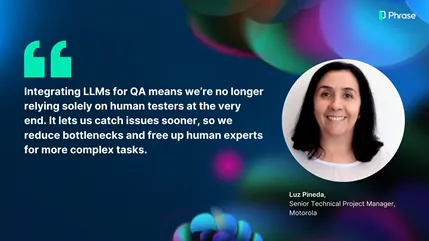
Luz Pineda described Motorola’s current push toward leveraging AI-driven linguistic checks at the very start of the localization lifecycle. Traditionally, organizations waited until late in the process—after multiple handoffs—before running linguistic quality assurance.
Luz Pineda 介绍了 Motorola 目前正致力于在本地化生命周期的最初阶段就运用人工智能驱动的语言检查。传统上,行业通常要等到项目后期——经过多次交接之后——才会进行语言质量保证。
Now, AI can instantly assess translations, flag potential errors, and even ensure they fit tight UI space constraints before a human reviewer lifts a finger.
如今,人工智能能够即时评估翻译内容、标记潜在错误,甚至在人工审核员动手之前,就确保翻译内容符合严格的用户界面空间限制。
(图片来自phrase官网)
This isn’t a trivial point. Luz credited insights from experts like Marina Panchava on prompt engineering, learning that controlling and shaping LLM behavior requires a careful combination of metadata, instructions, and linguistic assets.
这一点绝非小事。Luz 将这一成果归功于 Marina Panchava 等专家在提示工程方面的见解,她从中了解到,要控制和塑造大语言模型的行为,需要对元数据、指令和语言资源进行精心的组合。
You cannot do this in a month. It’s an iterative process that requires careful collaboration, the right tools, and a willingness to learn. From metadata handling to workflow adjustments, every step builds toward a more seamless integration of AI-driven quality assurance.”
——Luz Pineda, Motorol
单单一个月内是做不来的。这是一个对密切协作、适配工具以及学习意愿有要求的迭代过程。从元数据处理到工作流调整,每一步都在推动人工智能驱动的质量保证实现更无缝的整合。
—— Luz Pineda, Motorola

03

The next generation of translation models
下一代翻译模型
Among the most intriguing innovations discussed was LARA, the new architecture introduced by Marco Trombetti and his team at Translated.
讨论中最具吸引力的创新之一是 LARA,这是来自 Translated 的 Marco Trombetti 及其团队推出的全新架构。
LARA represents a fusion of powerful neural machine translation (NMT) systems and large language model capabilities, moving beyond sentence-by-sentence translation to document-level, context-rich processing.
LARA 融合了强大的神经机器翻译(NMT)系统与大语言模型的能力,从逐句翻译转向基于文档和丰富的上下文的处理。
Traditionally, MT systems worked in isolation, churning out segment translations without a sense of broader narrative or brand voice. LARA flips that script.
传统上,机器翻译系统都是孤立运行的,只会机械地生成片段翻译,而缺乏对整体叙事脉络或品牌语调的把握。LARA 彻底颠覆了这一局面。
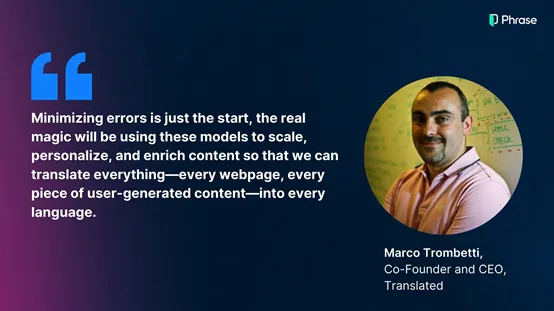
“We’ve combined the fluency and flexibility of language models with the accuracy of specialized translation models,” Marco explained. “Now the model isn’t just translating; it’s taking in full documents, understanding context, and even asking for clarification if needed.”
“我们将语言模型的流畅性和灵活性与专业翻译模型的准确性相结合,”Marco 解释道,“现在,(结合后的)模型不仅能进行翻译,还能处理完整的文档,理解上下文,甚至在必要时主动寻求进一步解释。”
The ultimate goal for these newer models is to reduce errors down to negligible levels and achieve a form of linguistic “singularity”—a point at which machine translations are reliably as good as, if not better than, the average professional translator for certain content types.
这些新模型的最终目标是将错误率降至可以忽略不计的程度,并实现一种语言领域的“奇点”——即在处理特定内容类型时,机器翻译的质量能够稳定地达到与普通专业译员相当,甚至更优的水平。
In one example, Marco noted how LARA has pushed error rates from around 12 errors per 1,000 words in typical MT models to just 2.5, approaching the best human professionals.
在一则案例中,Marco 指出,LARA 已将错误率从传统机器翻译模型中每 1,000 词约 12 个错误,降至仅 2.5 个,接近顶尖专业译者的水平。
It’s important to note this is a stepping stone however, not an endpoint, as Marco explained.
不过,正如 Marco 解释的那样,需要注意这只是一个跳板,而非终点。
(图片来自phrase官网)

04

Beyond cost: What is AI in localization really for?
成本之外:人工智能之于本地化究竟有何作用?
Early AI discussions in localization often centered on cost savings. But the panel was unanimous in seeing beyond mere efficiency.
早期关于人工智能在本地化领域应用的讨论,往往聚焦于节约成本。但专家组一致认为,不能仅着眼于效率。
“It’s not just about saving money; it’s about doing more with the resources we have,” said Marco. AI can help teams handle larger volumes, shorten turnaround times, and localize content that previously would have been out of scope or budget.
“这不仅仅是为了省钱,更是为了充分利用我们现有的资源,”Marco 说道。人工智能能够帮助团队处理更大的项目规模、更短的交付时间,并对此前不在考虑范围或因预算而无法完成的内容实现本地化。
Luz added that Motorola uses AI to scale its localization efforts, allowing the same team to handle more repositories and projects while maintaining—if not improving—quality standards.
Luz 补充道,Motorola 利用人工智能来扩大其本地化工作的规模,使同一支团队能够在保持(甚至提升)质量标准的同时,处理更多的内容和项目。
“By scaling, we create more opportunities, we go from translating a fraction of the world’s content to almost all of it, democratizing access to information across linguistic and cultural borders.”
“通过规模化发展,我们创造了更多机遇,将翻译范围从全球内容的一小部扩展到几乎全部,从而打破语言和文化界限,让信息获取变得更加普及。”

05

AI as Co-Pilot: The human factor
人工智能作为协作助手:人的因素
If machines are getting smarter, faster, and more context-aware, where does that leave human translators, project managers, and linguists?
如果机器正变得越来越智能,速度越来越快,并且对上下文的感知能力越来越强,那么人类译员、项目经理和语言专家又将何去何从?
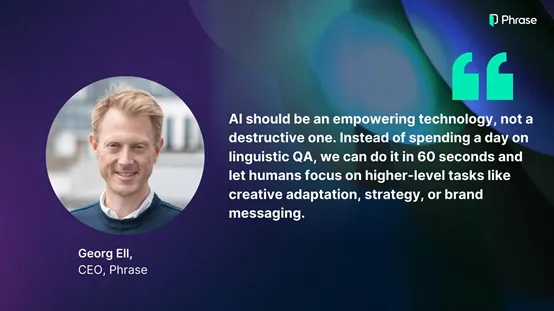
Georg Ell offered a reassuring vision: AI doesn’t eliminate human roles—it reshapes them. The future he imagines is one where AI and humans work in tandem, each complementing the other’s strengths.
Georg Ell 描绘了一幅令人安心的图景:人工智能并非取代人类的角色,而是重塑这些角色。他设想的未来是人工智能与人类协同合作,彼此互补优势。
(图片来自phrase官网)
This co-pilot model aligns with the philosophical shift happening in localization: move humans away from monotonous error-spotting and toward tasks that require empathy, cultural understanding, and editorial judgment—areas where technology, no matter how advanced, struggles to emulate the human touch.
这种“协作助手”模式契合了本地化领域正在发生的理念转变:让人类摆脱单调的错误排查工作,转而从事需要同理心、文化理解和编辑判断力的任务——无论技术多么先进,在这些领域都难以复制人类的独特触感。

06

Leveraging context: UI constraints and cultural nuances
利用上下文:UI 约束与文化细微差别
Taking a deeper look at the granular applications of new technology, Luz described how a single translated string might need to fit into a button on a mobile UI.
在深入探讨新技术的具体应用时,Luz 解释说,一条翻译后的字符串可能需要适配到移动端用户界面的某个按钮上。
The challenge is not only to ensure correctness, but also to adapt that translation so it doesn’t overflow or get truncated. Integrating metadata—like character limits or style guides—into the prompt can guide the LLM to produce translations that respect these constraints right from the start, solving a host of traditional problems by referencing additional data options.
(带来的)挑战不仅在于确保翻译的准确性,还在于对译文进行调整,以避免内容溢出或被截断。将元数据(如字符限制或风格指南)整合到提示词中,可以引导大语言模型从一开始就生成符合这些限制的译文,通过引用额外的数据选项来解决一系列传统问题。
Similarly, Marco spoke about document-level translation and how LLMs can consider brand terminology, tone of voice, and even demographic data to produce content that resonates.
同样,Marco 谈到了文档级翻译,以及大语言模型如何通过考量品牌术语、语气风格,甚至地区人口的统计数据,来生成能引起共鸣的内容。
Georg offered the idea of hyper-personalization: dynamically adjusting a website’s tone and message based on current events, cultural sensitivities, or individual user preferences:
Georg 提出了“超个性化”的概念:根据时事、文化敏感性或个人用户偏好,动态调整网站的语气和信息:
We’re talking about changing the content on-the-fly. If a significant event happens in a particular country, AI could instantly shift the tone of the localized content to be more empathetic, respectful, or informative.
——Georg Ell, CEO, Phrase
我们说的是实时更改内容。如果某个国家发生重大事件,人工智能可以立即调整本地化内容的基调,使其更具同理心、更显尊重或更具信息量。
——Georg Ell, Phrase 首席执行官

07

Language, intelligence, and trust
语言、智慧与信任
The discussion wasn’t just about technology and process. As Marco mentioned, we often assume human intelligence and linguistic ability are fixed benchmarks. But what if they aren’t?
讨论的内容不仅仅涉及技术和流程。正如 Marco 所提到的,我们常常认为人类的智慧和语言能力是固定的。但如果事实并非如此呢?
“Language is the most human thing we have, but there’s no law in physics that says our brains are the pinnacle of intelligence. If we can build machines smarter than us in certain areas, how does that change our understanding of language and communication?”
“语言是我们所拥有的最具有人类特质的事物,但物理学中并没有任何定律表明,我们的大脑是智慧的巅峰。如果我们能在某些领域制造出比我们更聪明的机器,这将如何改变我们对语言和沟通的理解?”
This philosophical thread touches on trust and authenticity: how do we trust AI-driven translations if they become indistinguishable—or even superior—to human work?
这一哲学议题涉及信任与真实性:如果人工智能驱动的翻译变得与人类作品难以区分——甚至更胜一筹——我们该如何信任它们?
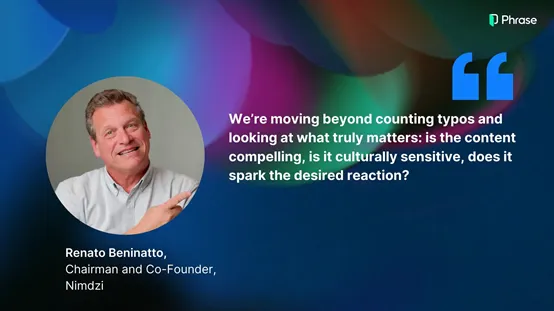
The implication is that just as we continue to evolve the translations themselves, we also need to make sure measures of quality and impact keep up. Instead of fixating on small errors, we should look at engagement, understanding, and the seamlessness of experience.
这意味着,正如我们不断改进翻译本身一样,我们也需要确保质量和影响的评估标准与时俱进。与其纠结于细微的错误,我们更应关注用户参与度、理解程度以及体验的流畅性。
(图片来自phrase官网)

08

The roots of modern AI translation
现代人工智能翻译的起源
The panel also took time to discuss ‘how we got here’, looking at some of the historical and technical underpinnings of modern AI systems.
专家小组还专门讨论了“我们是如何走到今天的”,探讨了现代人工智能系统的一些历史和技术基础。
The transformer architecture—pioneered through research in the language field—has been the backbone of many breakthroughs in machine translation and LLMs.
Transformer 架构源自语言学领域的研究前沿,已成为机器翻译和大语言模型(LLM)诸多突破的基石。
The discussion touched on the irony of localization professionals viewing AI advances as external forces.
讨论中提到了一个颇具讽刺意味的现象:本地化从业者将人工智能的进步视为外部力量。
In reality, research in machine translation and language modeling helped inspire and shape these very transformer-based architectures.
实际上,正是机器翻译和语言模型领域的研究激发并塑造了这些基于 Transformer 的架构。
We invented the transformer in this industry, this technology didn’t drop from the sky. It grew out of attempts to solve our core problems. We should embrace it as an integral part of our toolkit.
——Marco Trombetti, Co-Founder and CEO, Translated
我们发明了 Transformer,这项技术并非凭空而来。它源于我们为解决核心问题所做的努力。我们应该将其视为手头上不可或缺的一个工具。
——Marco Trombetti,Translated 联合创始人兼首席执行官

09

Embracing the future
拥抱未来
There are still hurdles to overcome. Talent shortages in AI-savvy localization roles, infrastructure costs for training and fine-tuning models, and the need for careful prompt engineering are all barriers.
仍有障碍需要克服。人工智能领域专业本地化人才短缺、模型训练与微调的基础设施成本,以及对精细化提示工程的需求,都是亟待克服的障碍。
Despite this, the panel are optimistic: These are challenges to be managed, not showstoppers.
尽管如此,专家组仍持乐观态度:这些是需要应对的挑战,而非无法克服的障碍。
The future of localization lies in symbiosis, humans and AI collaborating to drive unprecedented growth and innovation, delivering experiences that resonate across languages and cultures.
——Georg Ell, CEO, Phrase
本地化的未来在于共生——人类与人工智能通力合作,推动前所未有的增长与创新,打造跨越语言和文化障碍、引起共鸣的体验。
——Georg Ell, Phrase 首席执行官
特别说明:本文内容选自Phrase官网,仅供学习交流使用,如有侵权请后台联系小编删除。



群内会定期推送语言服务行业最新动态、活动预告、竞赛通知📝等内容~
欢迎你的加入🥰!

感谢关注【语言服务前瞻】!我们深耕语言服务、翻译技术及人工智能辅助翻译前沿领域,致力于打造专业的学术与行业资讯平台。
现开放会议、讲座、研修及赛事等信息发布合作。欢迎各高校、学会、企业及机构与我们接洽,借助平台专业资源与广泛影响力,共同推动行业交流与发展。
合作联系:15810719161


负责公众号日常运营
推文排版
新闻稿撰写
营销文案撰写
拥有良好的写作功底、过硬的文字驾驭能力
热爱翻译技术,对翻译或翻译技术有独到的认识
有翻译技术类公众号的内容编辑或运营经验
语言服务及翻译技术大咖的指导
了解行业专家及语言行业概况
免费参加运营平台举办的活动
获得多种翻译兼职或实习机会
获得统一发放的兼职或实习证明

扫描二维码填写报名表
往期回顾
研究动态 | 从大数据到小模型:隐私保护的翻译质量监控新路径 研究动态 | 刘世界、王华树:大语言模型的术语自动抽取性能评估──基于ACTER数据集的实证研究 技术应用 | 腾讯IMA VS NotebookLM,快来pick你的最佳AI翻译助手! 技术应用 |【Zotero 文献引用】解决中英文文献混排烦恼! 技术应用 | 利用Python进行数据分析的初学者应该掌握哪些基本知识?