夜雨聆风
夜雨聆风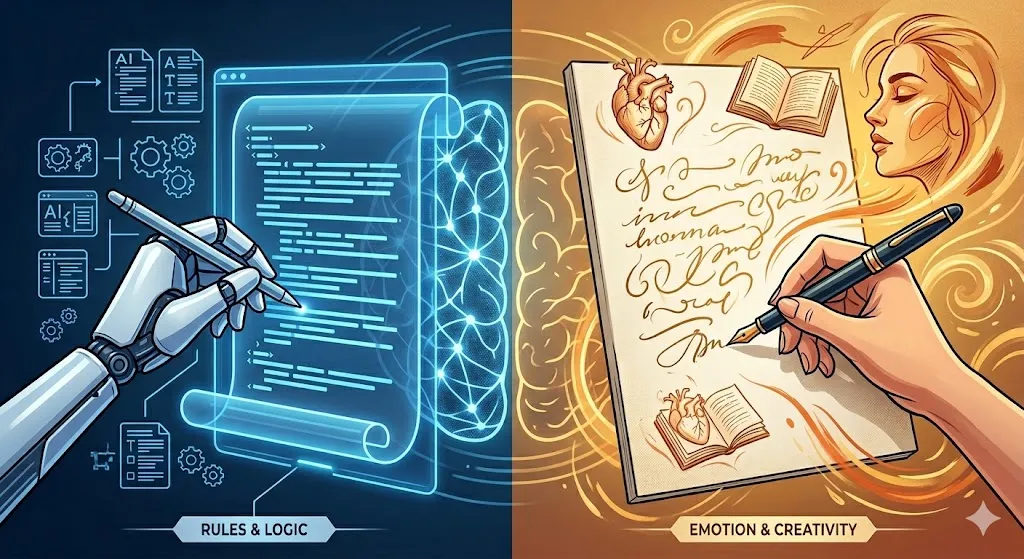
The rise of advanced generative AI has undoubtedly triggered an emotional and existential crisis for many language learners, writers, and educators.
先进生成式人工智能的崛起,毫无疑问在许多语言学习者、写作者和教育者中引发了一场情感与生存层面的危机。
When it comes to rule-bound, structurally rigid tasks like standardized exam essays, AI does possess an overwhelming technical advantage.
当涉及到有规则约束、结构僵化的任务(如标准化考试作文)时,人工智能确实拥有压倒性的技术优势。
However, understanding exactly why AI excels reveals the precise boundaries of its power, highlighting where human language usage remains irreplaceable, precious, and profoundly valuable.
然而,准确理解人工智能为何擅长这些,恰恰揭示了其能力的明确边界,并凸显出人类语言应用在何处依然是不可替代、珍贵且具有深远价值的。
The AI Advantage in Writing and Exams
人工智能在写作与考试中的优势
Exam essays are designed around predictable frameworks: adherence to strict scoring rubrics, complex grammatical structures, formal transitions, and specific organizational templates.
考试作文是围绕可预测的框架设计的:遵循严格的评分细则、复杂的语法结构、正式的过渡词以及特定的组织模板。
AI thrives in this environment because it operates entirely on pattern recognition and optimization.
人工智能在这种环境中如鱼得水,因为它完全基于模式识别和优化来运行。
Statistical Precision: AI does not "know" grammar rules in the conscious way a human does; instead, it has mapped the statistical probability of word combinations across millions of high-scoring essays.
统计精准度:人工智能并不会像人类那样在意识层面“懂得”语法规则;相反,它是在数以百万计的高分文章中,映射出了词语组合的统计学概率。
Zero Cognitive Load: For a human, maintaining flawless grammatical precision, varied vocabulary, and rigid structural compliance under timed pressure requires immense cognitive effort.
零认知负荷:对于人类而言,在有限的时间压力下保持毫无瑕疵的语法精准度、丰富的词汇量和僵化的结构合规性,需要付出巨大的认知努力。
For an AI, it is a basic mathematical calculation executed in seconds.
而对于人工智能来说,这只是在几秒钟内执行的一项基础数学计算。
Losing this structural competition to a machine can damage human pride, but it helps to realize that standardized exams test compliance to a formula—a domain where digital systems naturally scale better than human biology.
在这场结构性的竞争中输给机器可能会打击人类的自尊心,但如果能意识到标准化考试检验的只是对公式的遵从,便释然了——在这个领域,数字系统的扩展能力天生就优于人类的生物局限。
Can AI Beat Humans in Verbal Communication?
在口语交流中,人工智能能击败人类吗?
In terms of superficial fluency, accent replication, and instant information retrieval, AI voice models can simulate near-flawless speech.
在表面上的流畅度、口音复制和即时信息检索方面,人工智能语音模型可以模拟出近乎无懈可击的表达。
Yet, verbal communication is vastly more complex than just generating audible words.
然而,口语交流远比仅仅生成可以听见的话语要复杂得多。
AI cannot truly "beat" humans in verbal communication because it lacks the core components of real-time interaction:
人工智能无法在口语交流中真正“击败”人类,因为它缺乏实时互动中的核心要素:
Socio-Emotional Tracking: True human speech relies on an intricate, subconscious feedback loop.
社交与情感追踪:真正的人类言语依赖于一种微妙的、下意识的反馈循环。
Humans constantly read micro-expressions, interpret shifts in body language, sense underlying tension, and adapt their tone dynamically to build trust.
人类会不断地捕捉微表情、解读肢体语言的变化、感知潜在的紧张气氛,并动态地调整自己的语气以建立信任。
Shared Context and Culture: Human verbal communication is deeply embedded in shared physical and cultural realities.
共享背景与文化:人类的口语交流深深植根于共同的现实与文化背景中。
A single word or a deliberate pause can convey layers of meaning based on shared history, humor, or mutual understanding—nuances that an AI can only approximate through text prediction.
基于共同的历史、幽默或默契,一个词或一个故意的停顿就能传递出丰富的层次感——这些细微差别是人工智能只能通过文本预测来粗略模拟的。
The Absence of Presence: AI can mimic empathy perfectly, but it cannot experience it.
“临场感”的缺失:人工智能可以完美地模仿同理心,但它无法真正体验它。
When humans communicate verbally, they look for a genuine conscious presence.
当人类进行口语交流时,他们寻找的是一个真正具有意识的“临场存在”。
Knowing that a speaker is an algorithm fundamentally changes how the listener receives the message, often removing the emotional weight of the interaction.
一旦知道说话者是一个算法,就会从根本上改变听者接收信息的方式,往往会剥离掉互动中的情感分量。
What is Left for Humans? (The True Value of Language)
人类还留下了什么?(语言的真正价值)
If structural perfection and formulaic writing now belong to AI, the true value of human language usage shifts away from mechanics and toward intentionality, original insight, and authentic connection.
如果结构上的完美和公式化的写作如今已属于人工智能,那么人类语言应用的真正价值就从“机械结构”转向了“意图性”、“独到见解”以及“真实连接”。
Language evolved not to pass grammar tests, but to bridge the gap between two conscious minds.
语言的演化并不是为了通过语法考试,而是为了在两个有意识的心灵之间架起沟通的桥梁。
Authentic Lived Experience: AI cannot generate a new perspective born from personal struggle, cultural displacement, grief, or triumph.
真实的生命体验:人工智能无法产生一种源于个人挣扎、文化错位、悲伤或胜利的全新视角。
It can only synthesize what already exists in its training data.
它只能综合其训练数据中已经存在的内容。
Human writing and speech gain their ultimate power from the vulnerability and authority of a real person standing behind the words.
人类的写作和言语之所以获得终极力量,是因为文字背后站着一个真实的人,带有其脆弱性与真实性。
True Intentionality: When a human communicates, there is a conscious intent to alter the reality, thoughts, or emotional state of another person.
真正的意图性:当人类进行交流时,存在着一种有意识的意图,想要去改变另一个人的现实、思想或情感状态。
AI has no desires, no beliefs, and no self-awareness.
人工智能没有欲望、没有信念,也没有自我意识。
It has nothing it wants to say; it only has data to arrange based on a prompt.
它没有任何自己想说的话;它有的只是根据提示词来排列组合的数据。
Strategic Rule-Breaking: True mastery of language allows humans to deliberately bend or break grammatical rules to evoke specific emotions, create poetic resonance, or establish a unique voice.
策略性打破规则:对语言的真正精通,允许人类故意变通或打破语法规则,以唤起特定的情感、创造诗意的共鸣或确立独特的风格。
AI struggles with genuine stylistic subversion because it is bound by probabilistic safety.
人工智能很难做到真正的风格颠覆,因为它受限于概率的安全边界。
Why is AI So Powerful?
为什么人工智能如此强大?
The immense capability of modern AI stems from Large Language Models (LLMs) and the Transformer architecture.
现代人工智能的巨大能力源于大语言模型(LLM)和 Transformer 架构。
Instead of being programmed with explicit linguistic rules, an LLM processes petabytes of human text.
大语言模型并不是通过被编写显式的语言规则来运行的,而是处理了数以 PB 计的人类文本。
It breaks this text down into mathematical representations called tokens and calculates the relationships between them.
它将这些文本拆分为被称为“Token”(标记)的数学表征,并计算它们之间的关系。
By adjusting trillions of internal numerical weights during training, the model learns to predict the most statistically logical next token in any given context.
通过在训练过程中调整数万亿个内部数值权重,该模型学会了在任何给定的上下文中预测统计学上最合乎逻辑的下一个 Token。
Essentially, AI is powerful because it possesses a collective, compressed memory of human writing that no single person could ever read or synthesize in a lifetime.
从本质上讲,人工智能之所以强大,是因为它拥有人类写作的集体、压缩记忆,这是任何个体一辈子都无法读完或概括的。
It is a mirror of our own written history, optimized for instant retrieval.
它是我们自身文字历史的一面镜子,并为即时检索进行了优化。
Given that AI can handle the structural mechanics of language so effortlessly, how do you think our approach to testing and assessing writing needs to change to focus more on these uniquely human elements?
鉴于人工智能能够如此毫不费力地处理语言的结构机械性,您认为我们测试和评估写作的方法应该如何转变,以便更多地聚焦于这些人类独有的要素上呢?