 夜雨聆风
夜雨聆风有趣灵魂说
年初还在比拼谁用AI最多、冲击“Token最大化”排行榜,如今企业却开始勒紧裤腰带,转向“Token最小化”——只因AI账单实在太过昂贵。从Meta、优步到沃尔玛,纷纷对员工使用AI设限,甚至撤下内部排行榜。当“无脑堆量”遇上高昂成本,企业终于意识到:用好AI的关键不是用得最多,而是用得最巧。这场AI狂热,正迎来一次冷静的算账时刻。
译文为原创,仅供个人学习使用
The New York Times |Business
纽约时报|商业
‘Tokenmaxxing’ Has Given Way To Its Opposite After reckoning
“Token最大化”时代已让位于其反面
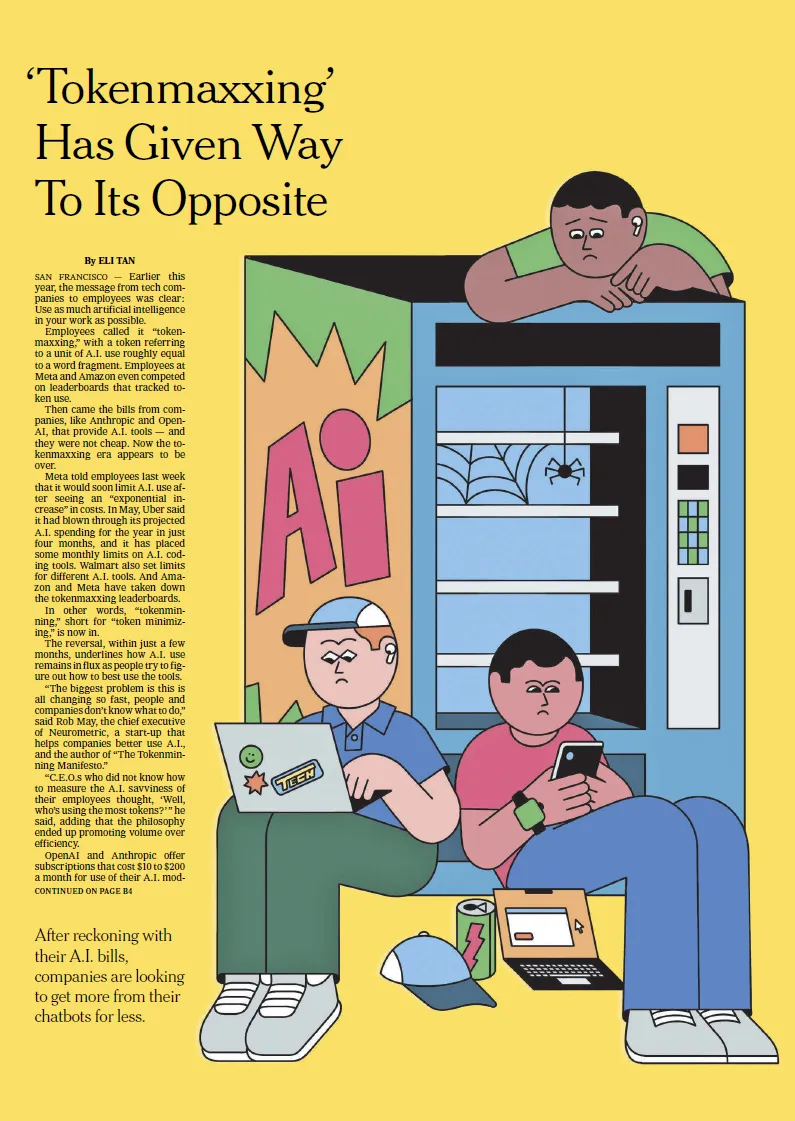
After reckoning with their A.I. bills, companies are looking to get more from their chatbots for less.
在认真审视了人工智能账单之后,企业正寻求以更少的成本从聊天机器人身上获得更多价值。
By ELI TAN
今年早些时候,科技公司向员工传达的信息很明确:在工作中尽可能多地使用人工智能。员工们称之为“tokenmaxxing”(token最大化),其中“token”指代人工智能使用量的一个单位,大致相当于一个词片段。Meta和亚马逊的员工甚至会在追踪token使用量的排行榜上展开竞争。
【注:Token的官方中文名是词元】
然而,来自Anthropic和OpenAI等人工智能工具提供商的账单随后寄到——而且价格不菲。如今,token最大化的时代似乎已经结束。
Meta上周告知员工,在发现成本出现“指数级增长”后,将很快限制人工智能的使用。今年5月,优步表示,仅用四个月就花完了全年预估的人工智能支出,并已对人工智能编码工具设置了一些月度上限。沃尔玛也为不同的人工智能工具设定了限制。亚马逊和Meta则撤下了token最大化的排行榜。换言之,“tokenminning”(token最小化)的时代已经到来。
这一转变仅发生在短短几个月内,凸显出人工智能的使用仍处于变动之中,人们还在摸索如何最好地利用这些工具。“最大的问题是这一切变化太快,个人和企业都不知道该怎么做,”Neurometric公司首席执行官罗布·梅表示。该公司是一家帮助企业更好使用人工智能的初创企业,他也是《token最小化宣言》一书的作者。
“那些不知道如何衡量员工人工智能素养的首席执行官们会想:‘那么,谁用的token最多呢?’”他补充道,这种做法最终助长了重数量而非效率的风气。
OpenAI和Anthropic提供的订阅服务每月费用从10美元到200美元不等,供用户使用其人工智能模型;当订阅者达到使用限额后,服务会被切断。但它们的收入大头来自向Meta、Shopify和亚马逊等企业提供工具——这些企业不仅支付订阅费,还要为其数万名员工使用的token付费。因此,token使用得越多,人工智能的成本就越高。
一个简单的任务,比如让人工智能总结一次公司会议的记录,可能只消耗几百个token。而更复杂的请求,比如编写代码来构建新产品或新功能,则可能消耗数万个token。
随着人工智能模型变得更加强大并消耗更多token,其使用成本也急剧上升。Anthropic最新的人工智能模型Fable,其价格是上一代模型Opus的两倍。梅先生表示,虽然存在更便宜的模型,但许多员工已经养成了凡事都使用最强大模型的习惯。
人们使用人工智能的方式也发生了变化。工程师们不再仅仅与人工智能聊天机器人对话,而是部署人工智能“代理”,这些代理可以连续数小时处理复杂任务。结果,工程师每月可能消耗价值数万美元的token。
许多公司表示,在未能看到明确投资回报后,它们正试图在人工智能支出上更具战略性。“如果你实际上无法直接将支出与你交付的有用功能和特性数量挂钩,那么这笔交易就难以被证明是合理的,”优步首席运营官安德鲁·麦克唐纳在最近的一次播客采访中表示。“目前这种联系还不存在。”
这并不意味着企业会停止在人工智能上大手笔投入。Meta告知员工,公司今年的人工智能使用费用预计将达到数十亿美元,但希望“找到既能花更少的钱,又能获得类似或更好业务成果的地方”。企业软件公司Salesforce的首席执行官马克·贝尼奥夫表示,公司计划今年在人工智能上投入数亿美元,但现在转而追踪“代理工作单元”而非token。这一新指标旨在衡量产出,而不仅仅是使用量。
Meta和沃尔玛对员工人工智能使用设限的消息,此前由The Information和彭博社率先报道。
目前尚不清楚“token最小化”可能对Anthropic和OpenAI的利润产生何种影响。在今年token最大化风潮的高峰期,人工智能公司曾报告称,受编码工具使用推动,收入创下历史新高。上周,Meta指示其工程师尽可能使用其内部编码助手MetaCode,而非第三方工具。
Meta拒绝置评,Anthropic未提供评论,OpenAI也未回应置评请求。(《纽约时报》已对OpenAI和微软提起诉讼,指控其人工智能系统侵犯了新闻内容的版权。这两家公司否认了诉讼中的指控。)
梅先生表示,企业前进的明确路径是:仅在需要复杂任务的场景中使用尖端人工智能,其他情况下则改用更便宜的模型。AT&T的首席人工智能官安迪·马库斯表示,企业通过选择较不先进的人工智能模型可以节省高达90%的成本。他指出,他的工程师在某些任务上使用最强大的模型,而在大多数其他操作中使用较弱的模型。“会有起起伏伏,”他说。“我们发现的是,对于大多数使用场景来说,并不需要最新最强大的前沿模型。”◾
SAN FRANCISCO — Earlier this year, the message from tech companies to employees was clear: Use as much artificial intelligence in your work as possible. Employees called it “tokenmaxxing,” with a token referring to a unit of A.I. use roughly equal to a word fragment. Employees at Meta and Amazon even competed on leaderboards that tracked token use.
Then came the bills from companies, like Anthropic and Open-AI, that provide A.I. tools — and
they were not cheap. Now the tokenmaxxing era appears to be over.
Meta told employees last week that it would soon limit A.I. use after seeing an “exponential increase” in costs. In May, Uber said it had blown through its projected A.I. spending for the year in just four months, and it has placed some monthly limits on A.I. coding tools. Walmart also set limits for different A.I. tools. And Amazon and Meta have taken down the tokenmaxxing leaderboards. In other words, “tokenminning,” short for “token minimizing,” is now in.
The reversal, within just a few months, underlines how A.I. use remains in flux as people try to figure out how to best use the tools. “The biggest problem is this is all changing so fast, people and companies don’t know what to do,” said Rob May, the chief executive of Neurometric, a start-up that helps companies better use A.I., and the author of “The Tokenminning Manifesto.”
“C.E.O.s who did not know how to measure the A.I. savviness of their employees thought, ‘Well, who’s using the most tokens?’” he said, adding that the philosophy ended up promoting volume over efficiency.
OpenAI and Anthropic offer subscriptions that cost $10 to $200 a month for use of their A.I. models; when subscribers hit their usage limit, they are cut off. But the bulk of the revenue comes from offering tools to companies like Meta, Shopify and Amazon, which pay not only subscription fees but also for the tokens used by their tens of thousands of workers. So the more tokens that are used, the more money the A.I. costs.
A simple task, like asking A.I. to summarize the transcript from a company meeting, may use a few hundred tokens. More complex requests, like writing code to build a new product or feature, can use tens of thousands.
The costs of using A.I. models have soared as they have become more powerful and consume more tokens. Anthropic’s newest A.I. model, Fable, is twice as expensive as its previous model, Opus. While there are cheaper models, many employees have fallen into the habit of using the most powerful models for everything, Mr. May said.
The ways that people use A.I. have also changed. Instead of just conversing with A.I. chatbots, engineers deploy A.I. “agents,” which can work on complex tasks for hours at a time. As a result, engineers can use tens of thousands of dollars’ worth of tokens each month.
Many companies said they were trying to be more strategic about A.I. spending after not seeing clear returns on their investment. “If you’re not actually able to draw a direct line to how many useful features and functionality you’re shipping, that trade becomes harder to justify,” Andrew Macdonald, Uber’s chief operating officer, said in a recent podcast interview. “That link is not there yet.”
That’s not to say companies won’t keep spending big on A.I. Meta told employees that it was on track to spend billions on A.I. use this year, but wanted to “find places we can spend less while getting similar or better business results.” Marc Benioff, the chief executive of Salesforce, the enterprise software company, said his company planned to spend hundreds of millions on A.I. this year but now tracked “agentic work units” instead of tokens. The new metric is supposed to measure output, not just use.
Meta’s and Walmart’s limits on employee A.I. use were reported earlier by The Information and Bloomberg.
It’s unclear how “tokenminning” might affect the bottom lines of Anthropic and OpenAI. At the height of the tokenmaxxing era this year, the A.I. companies reported record revenues driven by the use of coding tools. Last week, Meta told its engineers to use its internal coding assistant, MetaCode, instead of third-party tools if possible.
Meta declined to comment, Anthropic did not provide a comment, and OpenAI did not respond to a request for comment. (The New York Times has sued OpenAI and Microsoft, claiming copyright infringement of news content related to A.I. systems. They have denied the suit’s claims.)
The clear path forward for companies, Mr. May said, is to use cutting-edge A.I. only on complex tasks that require it and substitute cheaper models for other instances. Companies can save as much as 90 percent by opting for less advanced A.I. models, said Andy Markus, AT&T’s chief A.I. officer. He said his engineers were using the most powerful A.I. models for some tasks and the less powerful ones for most other actions. “There’s an ebb and flow,” he said. “What we do find is that, for most use cases, the latest greatest frontier model isn’t needed.”