 夜雨聆风
夜雨聆风系列:那些值得深究的源码
难度:⭐⭐⭐⭐(1-5星)
本篇精读:SGLang ·sgl-project/sglang[1] · tagv0.5.9,commitbbe9c7eeb520b0a67e92d133dfc137a3688dc7f2
分析重点:沿着RadixCache -> SchedulePolicy -> Scheduler -> ScheduleBatch这条路径,分析 RadixAttention 怎样把前缀命中变成调度排序、batch 输入裁剪、KV index 生命周期和驱逐边界。
前置知识:能读 Python,了解 Transformer prefill、KV cache、continuous batching 和 serving 调度基础。
1. 术语表(前置阅读)
• SGLang:面向大语言模型和多模态模型的 serving/runtime 框架。官方 README 和文档把 RadixAttention、continuous batching、paged attention、PD disaggregation 等作为主要 runtime 能力,见 sgl-project/sglang[1] 和 SGLang Docs[2]。• RadixAttention:SGLang 论文和官方博客提出的自动 KV cache 复用机制,用 radix tree 组织 token 前缀,让复杂 LLM 程序里的共享 prompt 片段可以被复用;背景可读 LMSYS 官方博客[3] 和论文 SGLang: Efficient Execution of Structured Language Model Programs[4]。 • Radix tree / compressed trie:把连续 key 片段压缩到节点里的前缀树。SGLang 的节点 key 是 token id 序列加可选 extra_key,value 是对应 KV cache index。• prefix cache:跨请求复用相同前缀已经计算出的 KV cache。它不是普通 prompt hash cache,而会参与调度、batch 构造、allocator 和 eviction。 • Req:SGLang scheduler 里的请求对象,保存原始输入、生成输出、 prefix_indices、last_node、host/storage 命中统计等状态。• SchedulePolicy:等待队列排序策略。 lpm、dfs-weight等 cache-aware policy 会先做 prefix match,再按命中信息调整请求顺序。• ScheduleBatch:scheduler 选出一批请求后构造的 batch 对象,负责把请求级 prefix_indices转成 batch 级prefix_lens、input_ids、out_cache_loc等 forward 输入。• lock_ref:RadixCache 节点被运行中请求引用的计数。 lock_ref > 0的节点不能被驱逐。• evictable leaf:没有被 lock 且位于 radix tree 叶子位置的缓存节点。SGLang 从叶子往上驱逐,避免误删共享前缀。 • HiCache:SGLang 的层级 KV cache 能力,涉及 GPU、host、storage 不同层级的命中和预取。这里先看它和基础 prefix cache 接口的交界,背景可读官方 HiCache 文档[5]。
2. 版本、范围和阅读边界
分析版本固定为 SGLang tag v0.5.9,commit bbe9c7eeb520b0a67e92d133dfc137a3688dc7f2。源码许可为 Apache-2.0;后面引用的源码片段均为该版本的短节选和删减。
SGLang 官方把它描述为面向大语言模型和多模态模型的高性能 serving 框架,重点能力包括 RadixAttention、prefix caching、continuous batching、paged attention、PD disaggregation、speculative decoding 等。官方 README[1] 和 SGLang 文档首页[2] 都把 RadixAttention 放在 runtime 能力的核心位置。早期的 LMSYS 官方博客《Fast and Expressive LLM Inference with RadixAttention and SGLang》[3] 解释得更直接:复杂 LLM 程序里经常有 few-shot examples、chat history、tree-of-thought search history 这类共享前缀,如果每次都从头 prefill,就会重复消耗计算和 KV cache 显存。SGLang 论文 SGLang: Efficient Execution of Structured Language Model Programs[4] 也把 RadixAttention 作为 runtime 侧的关键优化之一。
RadixAttention 如果只停在“radix tree 复用前缀”这一层,很容易漏掉它和调度器的互相牵制。沿着 v0.5.9 的真实源码往前走,几个问题会变得具体:前缀命中发生在哪里,命中结果怎么影响 waiting queue 的排序,KV cache 索引怎么从 Req 传到 forward batch,请求结束以后缓存怎么插回 radix tree,显存不够时哪些节点可以被驱逐。
接下来主要沿着这些源码走。
python/sglang/srt/mem_cache/radix_cache.py[6] | |
python/sglang/srt/managers/schedule_policy.py[7] | |
python/sglang/srt/managers/scheduler.py[8] | PrefillAdder,调用 Req.init_next_round_input(),构造 ScheduleBatch |
python/sglang/srt/managers/schedule_batch.py[9] | Req.prefix_indices 转成 batch 级 prefix_lens、input_ids、out_cache_loc 等 forward 输入 |
先看架构图。它把前缀缓存所有权、排队顺序、batch 构造和 forward 输入边界放在同一张图里。
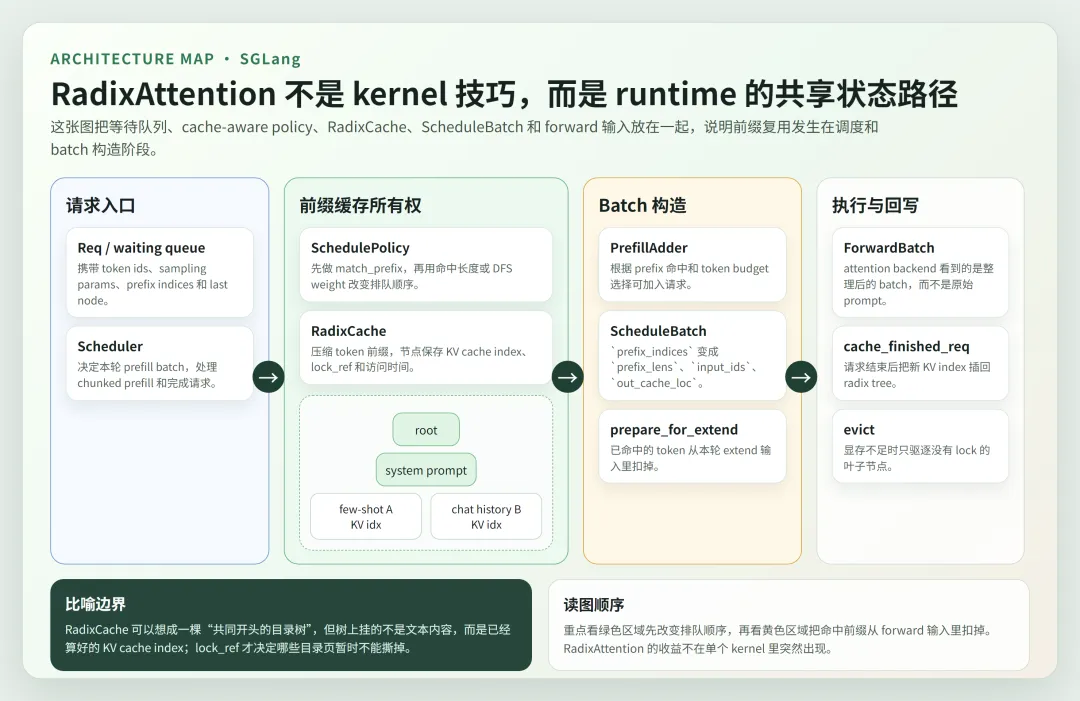
图里的类比只对应源码对象本身:RadixCache 可以想成一棵共同开头的目录树,树上挂的是已经算好的 KV cache index;lock_ref 决定哪些目录页暂时不能被撕掉。源码里可确认的是 Req.prefix_indices、last_node、allocator 和 tree 节点之间的状态传递。
3. 先看运行路径
SGLang 的前缀缓存不是 attention backend 里临时做一次查表。它更像 runtime 的一条共享状态路径:请求进入 scheduler,调度策略先用 radix tree 做 prefix match,然后 scheduler 根据排序结果选出能跑的请求,ScheduleBatch.prepare_for_extend() 再把命中的 prefix 从本轮 prefill 输入里扣掉,只对剩余 token 分配 KV cache 和执行 forward。请求完成或被 chunked prefill 暂停时,再把已经产生的 KV cache 写回 tree。

RadixAttention 的共享发生在 scheduler 和 batch construction 阶段。kernel 最终看到的是已经整理好的 ForwardBatch;哪些 token 可以跳过 prefill,由 scheduler 之前的 cache matching 和 batch construction 决定。
4. RadixCache 的数据结构
RadixCache 继承自 BasePrefixCache。它维护一棵 radix tree,key 是 token id 序列加一个可选的 extra_key,value 是对应 token 的 KV cache index。节点上还维护 lock_ref、last_access_time、hit_count、priority、hash_value、host cache 相关字段等。
第一段代码是 RadixKey 和 TreeNode 的骨架。这里值得注意的是,extra_key 被放进 key 命名空间里,这意味着 LoRA、cache salt 或其他隔离条件可以让相同 token 序列不共享 KV cache。
1 2 3 4 5 6 7 8 9 10 11 12 13 14 15 16 17 18 19 20 21 22 23 24 25
class RadixKey:
def __init__(
self,
token_ids: List[int],
extra_key: Optional[str] = None,
is_bigram: bool = False,
):
self.token_ids = token_ids
self.extra_key = extra_key
self.is_bigram = is_bigram
class TreeNode:
def __init__(self, id: Optional[int] = None, priority: int = 0):
self.children = defaultdict(TreeNode)
self.parent: TreeNode = None
self.key: RadixKey = None
self.value: Optional[torch.Tensor] = None
self.lock_ref = 0
self.last_access_time = time.monotonic()
self.hit_count = 0
self.host_ref_counter = 0
self.host_value: Optional[torch.Tensor] = None
self.hash_value: Optional[List[str]] = None
self.priority = priority
源码位置:radix_cache.py[6]。
它和普通 trie 的粒度不同。普通 trie 的每条边通常对应一个 token,radix tree 会把连续 token 压缩到一个节点的 key 里。这样节点数量更少,但也带来一次关键操作:如果一次 match 停在某个节点 key 的中间,就必须 split node,把公共前缀单独暴露出来。
可以把 radix tree 想成一套共享目录。普通 trie 像每个字都单独建一层文件夹,路径很长;radix tree 会把一段连续路径压成一个文件夹名,比如 system prompt + few-shot。当新请求只共享这个文件夹名的前半段时,SGLang 就把文件夹拆成“公共前半段”和“后续分支”。这个比喻只对应 TreeNode.key 和 _split_node(),不要扩展成文件系统语义;节点上的 value 是 KV cache index。
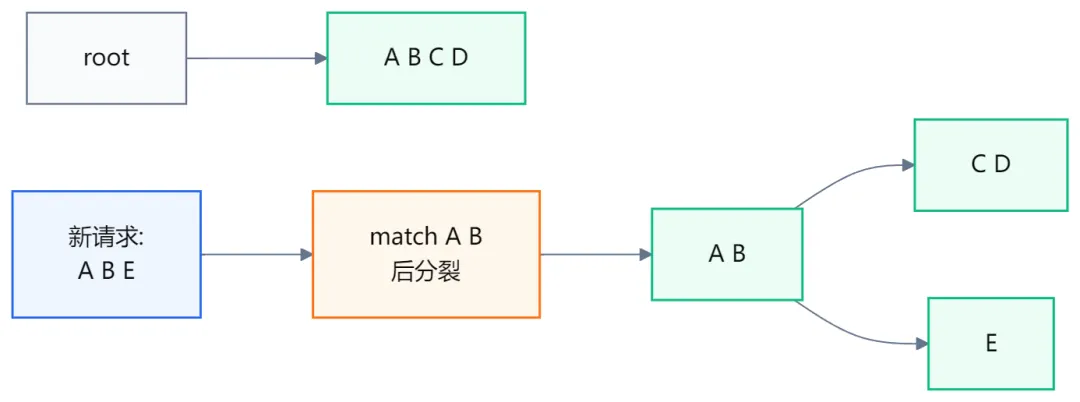
RadixAttention 依赖的正是这种数据结构:缓存条目不再是孤立的 prompt hash,而是一棵可被不断 refine 的前缀树。它能表达聊天历史、few-shot 样例、self-consistency 多分支等模式,也能处理完全相同 prompt 之外的部分共享。
5. match_prefix 返回 KV index 和 last node
match_prefix() 返回 MatchResult。其中 device_indices 是最长命中前缀对应的 KV cache index tensor,last_device_node 是命中路径的最后节点。后续请求会用这个节点做 lock ref,避免正在被请求使用的 KV cache 被驱逐。
1 2 3 4 5 6 7 8 9 10 11 12 13 14 15 16 17 18 19 20 21
def match_prefix(self, params: MatchPrefixParams) -> MatchResult:
key = params.key
key, _ = self.maybe_bigram_convert(key)
def empty_match_result():
return MatchResult(
device_indices=torch.empty((0,), dtype=torch.int64, device=self.device),
last_device_node=self.root_node,
last_host_node=self.root_node,
)
if self.disable or len(key) == 0:
return empty_match_result()
if self.page_size != 1:
page_aligned_len = len(key) // self.page_size * self.page_size
key = key[:page_aligned_len]
value, last_node = self._match_prefix_helper(self.root_node, key)
value = torch.cat(value) if value else torch.empty((0,), dtype=torch.int64, device=self.device)
return MatchResult(device_indices=value, last_device_node=last_node, last_host_node=last_node)
源码位置:RadixCache.match_prefix[10]。
page_size != 1 时,函数会把 key 截到 page 对齐长度。SGLang 的 KV cache 可能是 paged layout,缓存复用不能只看 token 语义上的最长公共前缀,还要看底层 KV 页面是否能完整复用。返回值保留 last_node,因为命中不仅影响这次输入裁剪,还影响后续 lock、evict、unfinished req caching。
match_prefix() 的返回值不能按一个布尔命中来理解。它更像图书管理员递给你两样东西:一摞已经找到的书页编号,也就是 device_indices;还有最后停在哪个书架,也就是 last_node。前者让 batch 构造知道哪些 token 不用重算,后者让 cache 生命周期知道哪些节点正在被请求保护。只返回命中长度,不够后面这些步骤使用。
树遍历落在 _match_prefix_helper()。如果命中停在节点中间,它会调用 _split_node(),让公共前缀变成独立节点。
1 2 3 4 5 6 7 8 9 10 11 12 13 14 15 16 17 18 19 20 21 22
def _match_prefix_helper(self, node: TreeNode, key: RadixKey):
access_time = time.monotonic()
node.last_access_time = access_time
child_key = self.get_child_key_fn(key)
value = []
while len(key) > 0 and child_key in node.children.keys():
child = node.children[child_key]
child.last_access_time = access_time
prefix_len = self.key_match_fn(child.key, key)
if prefix_len < len(child.key):
new_node = self._split_node(child.key, child, prefix_len)
value.append(new_node.value)
node = new_node
break
else:
value.append(child.value)
node = child
key = key[prefix_len:]
if len(key):
child_key = self.get_child_key_fn(key)
return value, node
源码位置:RadixCache._match_prefix_helper[11]。这段实现有一个很好的判断:match 本身允许改变树结构。很多缓存实现会把 lookup 设计成只读操作,但 radix tree 的最优形态依赖访问模式,读的时候顺手 split,可以让后续共享边界更准确。
6. 调度策略:命中长度先改变排队顺序
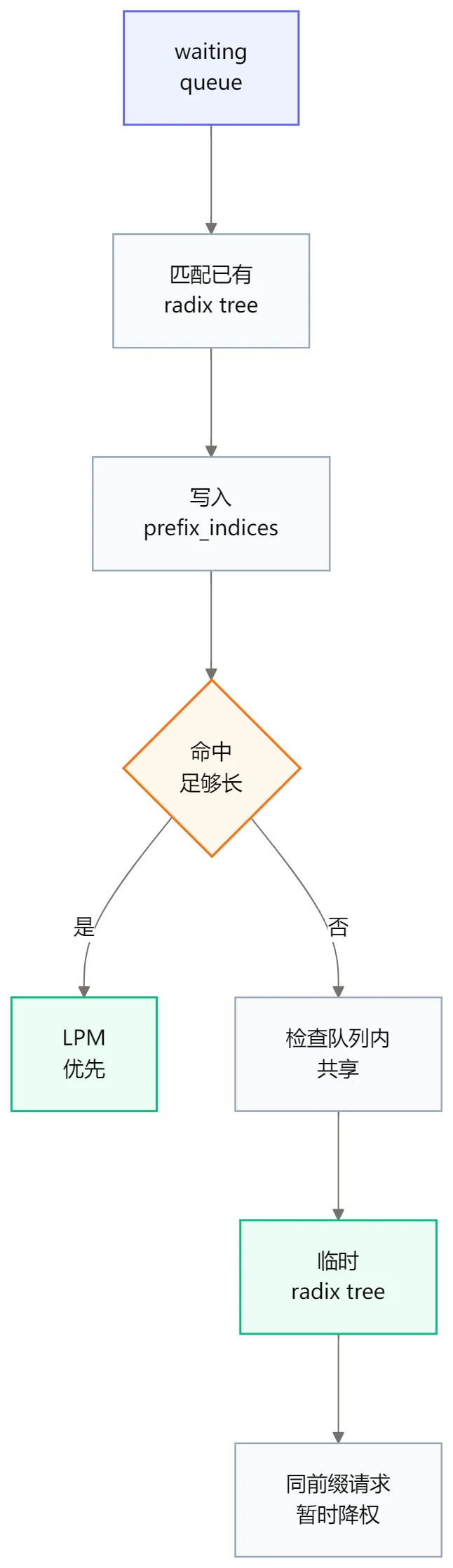
如果只在 forward 前裁掉已经命中的 token,prefix cache 当然能省计算,但还不够。排队顺序也会影响整体命中率。SGLang 的 SchedulePolicy 定义了 cache-aware policy,包括 lpm 和 dfs-weight。lpm 是 longest prefix match,直觉上就是先跑缓存命中多的请求。
关键代码在 _compute_prefix_matches():它遍历 waiting queue,对每个请求调用 tree_cache.match_prefix(),然后把结果写回 Req 对象。
1 2 3 4 5 6 7 8 9 10 11 12 13 14 15 16 17 18 19 20 21 22 23
def _compute_prefix_matches(
self, waiting_queue: List[Req], policy: CacheAwarePolicy
) -> Set[int]:
temporary_deprioritized: Set[int] = set()
self.waiting_queue_radix_tree.reset()
for r in waiting_queue:
prefix_ids = r.origin_input_ids + r.output_ids
extra_key = r.extra_key
match_result = self.tree_cache.match_prefix(
MatchPrefixParams(key=RadixKey(token_ids=prefix_ids, extra_key=extra_key))
)
(
r.prefix_indices,
r.last_node,
r.last_host_node,
r.host_hit_length,
) = (
match_result.device_indices,
match_result.last_device_node,
match_result.last_host_node,
match_result.host_hit_length,
)
源码位置:SchedulePolicy._compute_prefix_matches[12]。
这段代码说明一件事:prefix match 是调度输入,不是 batch 构造之后的附属结果。Req.prefix_indices 之后会一路进入 ScheduleBatch,Req.last_node 则是缓存生命周期管理的句柄。
lpm 的排序很直接:没有被临时降权的请求,按 len(r.prefix_indices) 从大到小排。这里还有一个 in-batch prefix caching 的小机制:如果请求对现有 tree 命中很少,但它们在 waiting queue 内部共享较长前缀,策略会临时降权后面的同前缀请求,倾向先跑一个,等它把 KV cache 插进 tree,后面的请求再利用。
1 2 3 4 5 6 7 8 9 10 11 12 13 14
if len(r.prefix_indices) <= IN_BATCH_PREFIX_CACHING_CHECK_THRESHOLD:
match_result = self.waiting_queue_radix_tree.match_prefix(
MatchPrefixParams(key=RadixKey(token_ids=prefix_ids, extra_key=extra_key))
)
in_batch_matching_prefixes = match_result.device_indices
if len(in_batch_matching_prefixes) >= IN_BATCH_PREFIX_CACHING_DEPRIORITIZE_THRESHOLD:
temporary_deprioritized.add(r.rid)
else:
self.waiting_queue_radix_tree.insert(
InsertParams(
key=RadixKey(token_ids=prefix_ids, extra_key=extra_key),
value=torch.empty(len(prefix_ids), dtype=torch.bool),
)
)
这段逻辑服务于 serving 系统里的一个常见取舍:当前 batch 的最短排队时间,不一定等于后续几个 batch 的最高吞吐。SGLang 在这里用很轻的 simulated radix tree 捕捉 waiting queue 内部的潜在共享,不需要真的分配 KV cache。
可以把这段调度想成拼车排队。FCFS 是谁先到谁先上车;LPM 会优先让路线重合更长的人上车,因为一辆车能顺路带更多人。in-batch prefix caching 则更细一点:如果队伍里有几个人路线很像,但第一位还没把路线变成系统里的可复用缓存,后面几位可以稍微等一等,让第一位先跑完,把公共路线登记进 tree。这个比喻只对应等待队列排序,不表示 SGLang 会牺牲所有公平性;源码里仍保留多种 policy 和降权阈值。
7. Scheduler 把 cache-aware policy 接进 prefill batch
Scheduler._get_new_batch_prefill_raw() 是 prefill batch 的主路径。它先让 policy 计算优先级,然后创建 PrefillAdder。PrefillAdder 拿到 tree_cache、KV allocator、running batch、prefill token budget 等信息,逐个尝试把 waiting queue 里的请求加进本轮 prefill。
1 2 3 4 5 6 7 8 9 10 11 12 13 14 15 16
self.policy.calc_priority(self.waiting_queue, self.running_batch)
adder = PrefillAdder(
self.page_size,
self.tree_cache,
self.token_to_kv_pool_allocator,
self.running_batch,
self.new_token_ratio,
self.max_prefill_tokens,
chunked_prefill_size,
running_bs if self.is_mixed_chunk else 0,
self.priority_scheduling_preemption_threshold,
prefill_max_requests=self.server_args.prefill_max_requests,
prefill_delayer_single_pass=prefill_delayer_single_pass,
dllm_config=self.dllm_config,
)
源码位置:Scheduler._get_new_batch_prefill_raw[13]。之后 scheduler 会对 waiting queue 做主循环,在每个请求进入 adder.add_one_req() 前调用 req.init_next_round_input(self.tree_cache)。
1 2 3 4 5 6 7 8 9 10 11 12 13
for req in self.waiting_queue:
if self.enable_hicache_storage:
prefetch_done = self.tree_cache.check_prefetch_progress(req.rid)
if not prefetch_done:
continue
req.storage_hit_length = self.tree_cache.pop_prefetch_loaded_tokens(req.rid)
req.init_next_round_input(self.tree_cache)
res = adder.add_one_req(
req,
has_chunked_req=(self.chunked_req is not None),
truncation_align_size=self.truncation_align_size,
)
这段代码把普通 GPU resident prefix cache 和 HiCache 这类层级缓存扩展放在同一个调度入口前后。SGLang 把 host/storage 命中的加载进度也纳入 scheduler,复用条件不只限于显存命中。v0.5.9 的基础 RadixCache.match_prefix() 仍然返回 device 命中,但 BasePrefixCache.MatchResult 已经包含 last_host_node、host_hit_length 这类字段,为层级 KV cache 留了统一接口。SGLang 官方文档里的 HiCache 页面[5] 也把这个方向作为高级功能单独展开。
当 can_run_list 非空后,scheduler 创建 ScheduleBatch 并调用 prepare_for_extend()。这一步把命中的 prefix 转成 batch 里的 suffix 输入。
1 2 3 4 5 6 7 8 9 10 11 12
new_batch = ScheduleBatch.init_new(
can_run_list,
self.req_to_token_pool,
self.token_to_kv_pool_allocator,
self.tree_cache,
self.model_config,
self.enable_overlap,
self.spec_algorithm,
chunked_req=self.chunked_req,
)
new_batch.prepare_for_extend()
8. ScheduleBatch 把 prefix_indices 变成 forward 输入
在 prepare_for_extend() 里,SGLang 对每个请求做了一个很关键的切片:
1 2 3 4 5
input_ids = [r.fill_ids[len(r.prefix_indices) :] for r in reqs]
extend_num_tokens = sum(len(ids) for ids in input_ids)
seq_lens = [len(r.fill_ids) for r in reqs]
prefix_lens = [len(r.prefix_indices) for r in reqs]
extend_lens = [r.extend_input_len for r in reqs]
源码位置:ScheduleBatch.prepare_for_extend[14]。这四行是 RadixAttention 在 batch 构造层面的落点。
fill_ids 表示这轮请求需要覆盖的完整 token 序列,prefix_indices 表示已有 KV cache 的 token 索引。于是本轮送进模型的 input_ids 是从 len(prefix_indices) 之后开始的 suffix。与此同时,prefix_lens 会传到后续 model worker batch,让 attention backend 知道每条序列已有多长的 prefix。
这一段可以想成快递分拣:fill_ids 是整张订单,prefix_indices 是仓库里已经打包好的前半箱,input_ids 只剩还没打包的后半箱。prepare_for_extend() 直接把本轮要处理的货量缩小,只把 suffix 交给 extend forward。这个比喻的边界也很清楚:缓存保存的是这些 token 对应的 KV cache 位置,不是 token 文本。
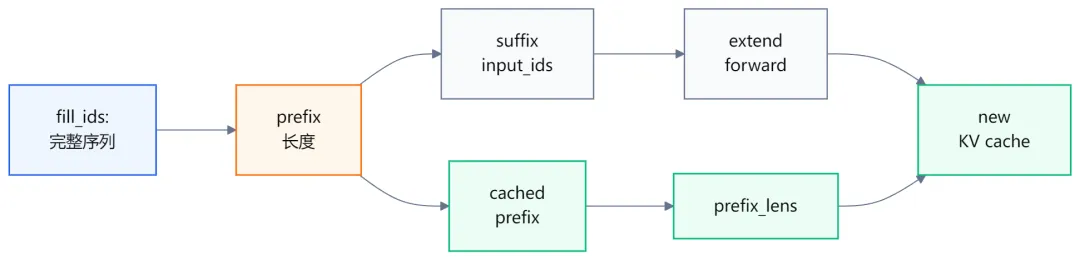
后面 alloc_for_extend(self) 会按 extend_num_tokens 分配本轮新 token 的 KV cache 位置。也就是说,prefix cache 不只是省 attention 计算,它还改变 KV cache allocator 看到的需求规模。
同一个函数还会更新请求级统计字段:
1 2 3 4 5 6 7 8 9 10 11 12 13
new_cached = pre_len - req.already_computed
req.cached_tokens += new_cached
if not req._cache_breakdown_computed:
host_total = req.host_hit_length
storage_portion = min(host_total, req.storage_hit_length)
host_portion = host_total - storage_portion
device_portion = max(0, len(req.prefix_indices) - host_total)
req.cached_tokens_device = device_portion
req.cached_tokens_host = host_portion
req.cached_tokens_storage = storage_portion
req._cache_breakdown_computed = True
这说明 SGLang 不只是做内部优化,还把缓存命中拆成 device、host、storage 三类统计。对生产 serving 来说,这类指标很重要。没有它,大家只能看到吞吐变快或变慢,却不知道是 GPU prefix 命中、host cache 命中、storage prefetch,还是调度排序改变了请求形态。
9. 请求结束后缓存插回树,重复部分释放
请求完成后,cache_finished_req() 会把已提交的 KV cache 插回 radix tree。容易漏掉的内存管理细节在重复前缀上:如果新请求的前缀已经在 tree 里存在,那么插入返回的 prefix_len 表示重复部分长度,SGLang 会释放当前请求中重复那段 KV index,只保留新增的 cache。
1 2 3 4 5 6 7 8 9 10 11 12 13 14 15 16 17 18 19 20 21
def cache_finished_req(self, req: Req, is_insert: bool = True):
kv_committed_len = req.pop_committed_kv_cache()
token_ids = (req.origin_input_ids + req.output_ids)[:kv_committed_len]
kv_indices = self.req_to_token_pool.req_to_token[
req.req_pool_idx, : len(token_ids)
]
keys = convert_to_bigram_key(token_ids) if self.is_eagle else token_ids
keys = self._page_align_keys(keys)
values = kv_indices[: len(keys)].to(dtype=torch.int64, copy=True)
radix_key = RadixKey(keys, req.extra_key, is_bigram=self.is_eagle)
if is_insert:
result = self.insert(InsertParams(key=radix_key, value=values, priority=priority))
new_prefix_len = result.prefix_len
self.token_to_kv_pool_allocator.free(
kv_indices[req.cache_protected_len : new_prefix_len]
)
self.token_to_kv_pool_allocator.free(kv_indices[len(keys) :])
self.dec_lock_ref(req.last_node)
源码位置:RadixCache.cache_finished_req[15]。这段代码把三个动作放在一起:把请求结果变成可复用缓存,释放重复 KV cache,释放请求对旧命中节点的 lock。
insert() 的内部也体现了 radix tree 的压缩特性。它一路比较 key,如果公共前缀停在节点中间就 split,如果剩余 key 非空就新建节点。
1 2 3 4 5 6 7 8 9 10 11 12 13 14 15 16 17 18 19 20 21 22
while len(key) > 0 and child_key in node.children.keys():
node = node.children[child_key]
node.last_access_time = access_time
prefix_len = self.key_match_fn(node.key, key)
total_prefix_length += prefix_len
key = key[prefix_len:]
value = value[prefix_len:]
if prefix_len < len(node.key):
new_node = self._split_node(node.key, node, prefix_len)
new_node.priority = max(new_node.priority, priority)
node = new_node
else:
node.priority = max(node.priority, priority)
if len(key):
new_node = TreeNode(priority=priority)
new_node.parent = node
new_node.key = key
new_node.value = value.clone()
node.children[child_key] = new_node
self.evictable_size_ += len(key)
源码位置:RadixCache._insert_helper[16]。这段实现没有复杂的外部索引,树本身就是 key 到 KV cache index 的索引。它的代价是每次插入和匹配都要维护 node split、访问时间、lock ref、evictable leaf 等状态。SGLang 选择把这些状态集中在 RadixCache 内,避免它们散落在 scheduler、allocator 和 backend 里。
10. 显存不够时只驱逐没有 lock 的叶子
缓存系统如果只会插入,不会驱逐,很快就会变成内存泄漏。SGLang 的 RadixCache 维护 evictable_leaves,并通过 lock_ref 区分正在被请求引用的节点和可以被释放的节点。
1 2 3 4 5 6 7 8 9 10 11 12 13 14 15 16 17 18 19 20 21
def evict(self, params: EvictParams) -> EvictResult:
num_tokens = params.num_tokens
leaves = list(self.evictable_leaves)
eviction_heap = [
(self.eviction_strategy.get_priority(node), node) for node in leaves
]
heapq.heapify(eviction_heap)
num_evicted = 0
while num_evicted < num_tokens and len(eviction_heap):
_priority, x = heapq.heappop(eviction_heap)
self.token_to_kv_pool_allocator.free(x.value)
num_evicted += len(x.value)
self._delete_leaf(x)
if len(x.parent.children) == 0 and x.parent.lock_ref == 0:
new_priority = self.eviction_strategy.get_priority(x.parent)
heapq.heappush(eviction_heap, (new_priority, x.parent))
return EvictResult(num_tokens_evicted=num_evicted)
源码位置:RadixCache.evict[17]。
这里的策略是“从叶子往上删”。如果删掉一个叶子以后,父节点也变成没有子节点且没有 lock,就把父节点重新放回候选堆。这符合 radix tree 的共享语义:中间节点往往代表多个请求共享的公共前缀,不能随便删;叶子更可能是某条分支独有的后缀。
驱逐叶子可以类比成修剪树枝:先剪掉没有人正在使用的末端枝条,不能一上来砍树干。树干往往代表许多请求共享的公共 prompt,一刀砍掉会让多个后续请求都失去复用机会;叶子更像某次对话独有的后缀,收益小、风险低。源码里的 lock_ref 就是“这段枝条上还有人站着”的标记,有人站着就不能剪。
inc_lock_ref() 和 dec_lock_ref() 负责在请求使用某个命中节点时保护沿途节点。一个节点从 lock_ref == 0 变成被引用时,会从 evictable size 转到 protected size;引用释放后再转回可驱逐集合。
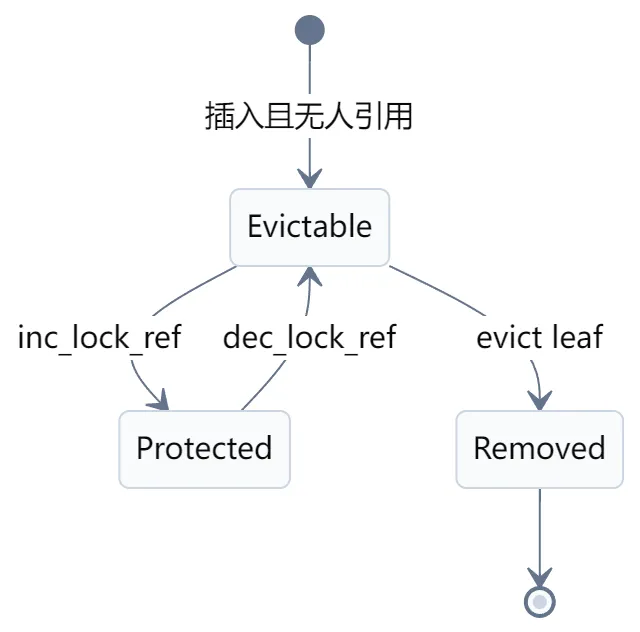
prefix cache 和 serving scheduler 在这里耦合起来。scheduler 决定哪个请求进入 batch,进入 batch 的请求必须保护自己的 prefix 节点;请求完成或被释放时,cache 才能重新参与驱逐。
11. 和 vLLM 的差异:SGLang 多了一层程序前缀视角
SGLang 官方博客明确提到 RadixAttention compatible with continuous batching and paged attention,并把 KV cache tensor 存在 paged layout 里,原文在 Backend: Automatic KV Cache Reuse with RadixAttention 一节[3]。从源码看,SGLang 在分页 KV cache 之上加了一层按 token sequence 组织的 runtime index。
vLLM 的 PagedAttention 更像把显存页变成可调度资源,主要处理 block table、allocation、preemption 和 continuous batching。SGLang 的 RadixAttention 则额外关心“不同请求之间的 token 前缀关系”。这两个问题并不冲突:底层仍要高效管理 KV cache 页,上层还要判断哪些页可以被多个请求共享。
PagedAttention 让 KV cache 不必连续,RadixAttention 让 KV cache 不必只属于单个请求。前者解决物理布局,后者解决跨请求复用。SGLang 的代码把这两个问题接在一起:RadixCache 只保存 KV index,KV tensor 仍在 memory pool 和 allocator 管理之下。
12. 这套设计的代价
RadixAttention 的好处很明显:复杂 LLM 程序里的重复 prompt 片段可以自动复用,用户不需要手动声明哪些 prompt 可以共享。SGLang 官方博客举了 few-shot、self-consistency、multi-turn chat、tree-of-thought 等模式,这些模式也是最适合 prefix cache 的负载[3]。但源码也能看到几个代价。
调度不再只是 FCFS。cache-aware policy 会为了命中率改变 waiting queue 顺序。这通常能提升吞吐,但也会让请求延迟的分布更复杂,所以代码里仍保留 FCFS、LOF、RANDOM、routing-key、priority scheduling 等多种策略。
lookup 可能修改树。match_prefix() 会 split node,这让后续命中更准,但意味着缓存读路径也要维护结构一致性。并发和多 worker 场景下,这类状态必须被严格限定在 scheduler 管理范围内。
缓存命中需要和 page size 对齐。语义上的最长公共 token 前缀不一定等于可复用的 KV page 前缀。源码中 _page_align_keys() 和 page_aligned_len 就是在处理这个边界。
prefix cache 对不同 workload 的收益不均匀。如果请求之间几乎没有共享前缀,RadixCache 仍有 match、排序、维护访问时间的成本。SGLang 官方博客提到其 ablation 显示无 cache hit 时没有明显 overhead,但在真实业务里,cache-aware 调度是否值得打开,仍然要看请求形态和指标。
13. 可迁移判断清单
• 缓存要进入 runtime 状态,不能停在某个函数里的 memoization。SGLang 的 prefix cache 会影响调度、batch 构造、allocator、统计和 eviction。它是一条系统路径,不只是一个 map。 • 缓存命中结果要携带可执行信息。 match_prefix()返回 KV indices 和 last node,单独返回长度数字不够后续构造input_ids、保护节点、释放重复 KV cache。• 读路径可以维护索引形态。radix tree 的 split 发生在 match 和 insert 里,这让数据结构随着真实访问逐渐变得适合 workload。 • 复用必须和隔离一起设计。 extra_key、LoRA、cache salt、host/storage 命中拆分,都说明“能共享”不能只看 token 一样,还要看上下文是否允许共享。• 好的 serving 代码会把优化收益变成指标。 cached_tokens_device、cached_tokens_host、cached_tokens_storage这类字段看起来琐碎,但它们决定了线上问题能不能解释清楚。
14. AI 协作时可以用它否掉哪些代码
让 AI 生成一个 prefix cache for LLM serving,它很容易写成一个 prompt hash 到 KV tensor 的字典:完全相同 prompt 就复用,不同 prompt 就重算,显存不够就随机删一项。这个版本在 demo 里可能看起来能省一次 prefill,但它没有进入 serving runtime 的真实约束。
读完 SGLang 这部分源码,再看到类似实现,可以用几件事校验它:它是否只做完全匹配,还是能表达部分前缀共享;命中结果是否接进 batch 构造和 KV allocator;正在被请求引用的 prefix 节点是否有 lock ref 和 eviction 边界。如果这些问题答不上来,代码看起来再完整,也很可能只是演示缓存,离可服务真实负载的 runtime 组件还差一层。
15. 参考资料与延伸阅读
• SGLang 官方仓库: sgl-project/sglangtagv0.5.9[1]。• SGLang 官方文档:SGLang Documentation[2]。 • LMSYS 官方博客:Fast and Expressive LLM Inference with RadixAttention and SGLang[3]。 • SGLang 论文:SGLang: Efficient Execution of Structured Language Model Programs[4]。 • SGLang 源码: python/sglang/srt/mem_cache/radix_cache.py[6]。• SGLang 源码: python/sglang/srt/managers/schedule_policy.py[7]。• SGLang 源码: python/sglang/srt/managers/scheduler.py[8]。• SGLang 源码: python/sglang/srt/managers/schedule_batch.py[9]。• SGLang 文档:HiCache[5]。
当前文章:第 02 篇《SGLang源码分析:RadixAttention与前缀缓存调度》。
下一篇预告:第 03 篇《llama.cpp源码分析:GGUF、量化与ggml执行图》,继续看本地推理 runtime 如何把模型格式、量化和多后端执行拆开。
更新时间:2026 年 7 月 24 日
引用链接
[1] `sgl-project/sglang`: https://github.com/sgl-project/sglang/tree/v0.5.9[2] SGLang Docs: https://docs.sglang.io/[3] LMSYS 官方博客: https://lmsys.org/blog/2024-01-17-sglang/#backend-automatic-kv-cache-reuse-with-radixattention[4] SGLang: Efficient Execution of Structured Language Model Programs: https://arxiv.org/abs/2312.07104[5] HiCache 文档: https://docs.sglang.io/docs/advanced_features/hicache.md[6] `python/sglang/srt/mem_cache/radix_cache.py`: https://github.com/sgl-project/sglang/blob/v0.5.9/python/sglang/srt/mem_cache/radix_cache.py[7] `python/sglang/srt/managers/schedule_policy.py`: https://github.com/sgl-project/sglang/blob/v0.5.9/python/sglang/srt/managers/schedule_policy.py[8] `python/sglang/srt/managers/scheduler.py`: https://github.com/sgl-project/sglang/blob/v0.5.9/python/sglang/srt/managers/scheduler.py[9] `python/sglang/srt/managers/schedule_batch.py`: https://github.com/sgl-project/sglang/blob/v0.5.9/python/sglang/srt/managers/schedule_batch.py[10] `RadixCache.match_prefix`: https://github.com/sgl-project/sglang/blob/v0.5.9/python/sglang/srt/mem_cache/radix_cache.py#L352[11] `RadixCache._match_prefix_helper`: https://github.com/sgl-project/sglang/blob/v0.5.9/python/sglang/srt/mem_cache/radix_cache.py#L648[12] `SchedulePolicy._compute_prefix_matches`: https://github.com/sgl-project/sglang/blob/v0.5.9/python/sglang/srt/managers/schedule_policy.py#L169[13] `Scheduler._get_new_batch_prefill_raw`: https://github.com/sgl-project/sglang/blob/v0.5.9/python/sglang/srt/managers/scheduler.py#L1977[14] `ScheduleBatch.prepare_for_extend`: https://github.com/sgl-project/sglang/blob/v0.5.9/python/sglang/srt/managers/schedule_batch.py#L1429[15] `RadixCache.cache_finished_req`: https://github.com/sgl-project/sglang/blob/v0.5.9/python/sglang/srt/mem_cache/radix_cache.py#L446[16] `RadixCache._insert_helper`: https://github.com/sgl-project/sglang/blob/v0.5.9/python/sglang/srt/mem_cache/radix_cache.py#L698[17] `RadixCache.evict`: https://github.com/sgl-project/sglang/blob/v0.5.9/python/sglang/srt/mem_cache/radix_cache.py#L565