 夜雨聆风
夜雨聆风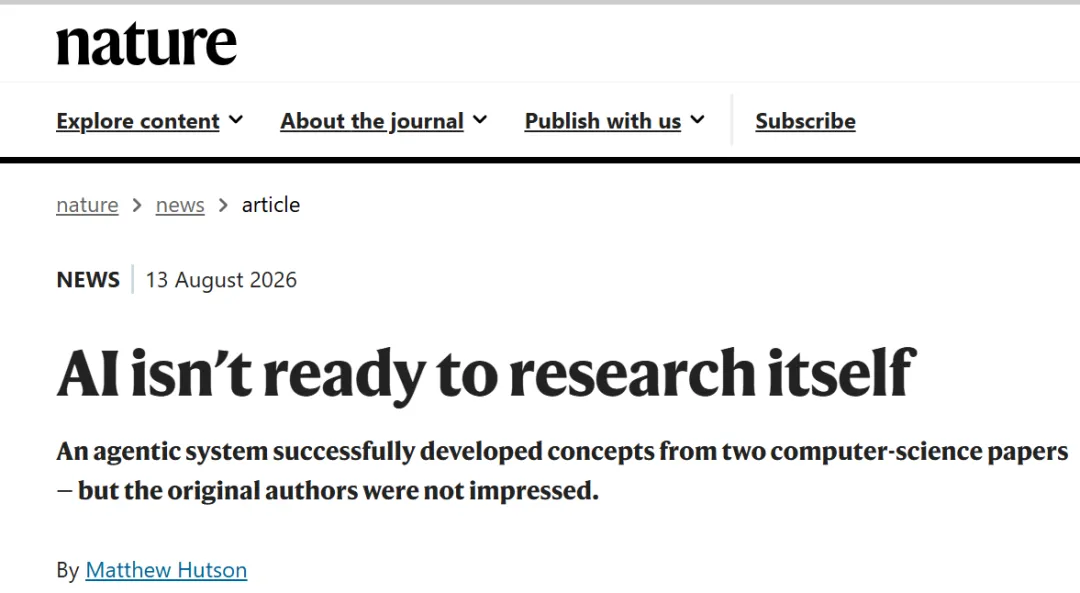
题目:人工智能尚不具备自主开展自身领域研究的能力
----一套自主智能系统依托两篇计算机领域论文,成功推导衍生出相关研究思路,但两篇论文的原作者对这套系统产出的成果并不认可。
人工智能在自主研究人工智能领域已经取得跨越式发展,它既能优化现有算法、提升算法性能,也能独立编写全新算法。但7月末发布在预印本平台arXiv上的一项研究表明,计算机目前还无法取代创造它们的人类科研人员。
新泽西州普林斯顿大学计算机科学家、该预印本论文合著者萨亚什·卡普尔表示:“我认为,开放式探索型科研的全流程自动化在短期内根本无法实现。”
一支核心成员来自东京Sakana AI公司的团队率先开展科学研究全流程自动化探索,整套流程覆盖从研究思路生成,到论文撰写、论文自我评估的全部环节。该团队于2024年推出名为“AI科学家”的系统,并在次年3月于《自然》期刊发表该系统优化迭代版本的实验成果。
“AI科学家”系统的研究方向是挖掘机器学习领域存在的各类缺陷问题。该系统独立撰写三篇论文并投递至学术会议专题研讨会参与同行评审,其中一篇论文评分达到录用标准。但卡普尔指出,同行评审并非评判论文质量的可靠方式,在人工智能研究领域这一短板尤为突出。
放眼整个行业,不少科研人员都提出质疑:即便实现从课题构思到论文投稿的全流程自动化,当下的人工智能也很难产出真正具备突破性的科研成果;他们认为AI更擅长对现有技术做优化改良。
为了采用比同行评审更严苛的标准检验人工智能的科研能力,卡普尔与同事设计了一套全新评测方案,命名为“影子评估”。首先,研究团队选取两篇投递至本年度神经信息处理系统大会(NeurIPS)的投稿论文;随后让一款AI工具分别围绕两篇论文的核心研究问题独立完成整套研究并撰写论文,再交由两篇原文的作者仔细审核AI生成的全部内容。这套评测设计的核心逻辑是:相较于日常事务繁杂、评审时间有限的普通审稿人,论文原作者拥有更深厚的专业积累,也会投入更多精力细致核验AI产出内容。
研究团队搭建这套实验AI系统的方式为:基于自主智能代理框架OpenClaw的改良版本,接入大语言模型Claude Opus 4.8作为核心底座;再为其搭建一层完整外层调度框架,框架内置通用科研指令与进度自检机制。这套核心调度程序为大模型开放全套科研工具权限,包括创建次级智能代理、联网检索资料、调用各类程序库、调取算力运行实验,以及模拟同行评审的自检程序。针对两篇不同研究课题,团队为AI统一分配资源:6天研究时长、价值3000美元的算力额度。针对第一篇论文的研究大方向,卡普尔团队要求AI设计一套可精准调控对话机器人人设风格的算法方案;对标第二篇论文的研究目标,AI需要设计一款适配特定神经网络的故障检测工具。
两篇原文的作者都十分意外:这套AI系统在研究的工程实操环节表现十分出色。它能够连续数日自动完成上百组对照实验,不会陷入无法解决报错的无限循环;完成的文献综述完整扎实,同时产出了少量微小的新发现。AI还能自主识别自身生成的虚假结论(业内称为模型幻觉);即便研究人员事前预判它会投机取巧,它也没有为了达标刻意简化流程、钻指标空子(即奖励投机行为)。
得分惨淡
但这套AI系统在两项指定研究任务上基本全部失败,两篇课题分别只拿到原作者给出的2分/6分、1分/6分。它最典型的失败模式为:仅挑选少量假设开展验证,却过早锁定单一研究路径;当这套研究思路实验效果不佳时,无法充分回溯复盘、推翻原有方案。后续AI开展的自我评审自我批评力度严重不足,因此系统会固执坚持最初选定的方案,只能不断弱化、缩减自身研究论断,最终整篇论文几乎不存在任何有价值的创新观点。
AI得分惨淡的另一项原因是:该系统无法完整遵循实验指令、无法充分理解研究背景,且成果呈现效果极差。大量分配的研究时长与算力资源被闲置,产出的论文行文粗糙、格式混乱。卡普尔表示,整体来看这套系统缺乏科研层面的创新能力;不过他也提到,部分合著者不认同这一判断,他们对该技术的发展潜力更为乐观。
现任职于旧金山初创公司递归超级智能、曾在伦敦从事机器学习研究,同时也是“AI科学家”系统联合研发者的陆聪表示:“这项研究十分有参考价值。”但他认为本次实验给AI系统设置的约束机制不足。这套系统暴露出的部分问题,“只要搭配一套限制更完善的调度程序就能轻松解决”,“AI科学家”系统的调度框架就是很好的参照。他说道:“这份研究提供了一组极具意义、且和我们实验结论差异较大的数据,但如果由我来设计实验,我会采用完全不同的方案。”
卡普尔是2024年出版的《AI虚假宣传》一书的合著者,他坦言自己对人工智能的科研能力持怀疑态度,但他表示团队已经给予这套AI系统公平的实验条件,甚至额外延长了研究截止期限。目前研究团队正在测试性能更优的大模型、优化外层调度框架,同时收集更多论文用于后续影子评估测试。
卡普尔补充道:尽管人工智能在单一窄域任务上可以完成性能优化,但现阶段还无法产出原创性科研洞见;更不用说本次实验未纳入评测的核心能力——科研判断力,也就是从源头判断哪些研究课题具备探索价值。
https://doi.org/10.1038/d41586-026-02494-5
AI isn’t ready to research itself
An agentic system successfully developed concepts from two computer-science papers— but the original authors were not impressed.
By Matthew Hutson
Artificial intelligence has made leaps in AI research itself, finding ways to make existing algorithms smarter — or writing new ones. But computers are not yet ready to replace their makers, according to a study posted on the preprint server arXiv1 in late July.
“I don’t think full automation of open-ended research is on the horizon right now,” says Sayash Kapoor, a computer scientist at Princeton University in New Jersey and a co-author of the preprint.
The effort to fully automate the scientific process, from idea generation to the writing and self-evaluation of a paper, was pioneered by a team mostly from the firm Sakana AI in Tokyo. The team unveiled their system, called The AI Scientist, in 2024, and later published results from an improved version in March in Nature2.
The AI Scientist was tasked with studying pitfalls in machine learning. Three of the papers it produced were submitted for peer review at a conference workshop, and one achieved a score high enough for acceptance. But, according to Kapoor, peer review is an unreliable way of assessing the quality of a paper, especially in AI research.
More generally, some researchers have questioned whether automating AI research from idea creation to publication can produce true breakthroughs yet, suggesting it is better at optimizing existing techniques.
To hold AI to a higher standard than peer review, Kapoor and his colleagues created a new challenge, called shadow evaluation. First, they picked two papers that had been submitted to this year’s Neural Information Processing Systems conference. Then they asked an AI tool to do research and write papers based on a research question from each paper, and asked the original authors to scrutinize its output. The idea was that these authors would have more of the expertise and dedication to dig into the output than a harried peer reviewer would.
The team built its AI system by ‘harnessing’ the large language model Claude Opus 4.8 in a modified version of the agentic system OpenClaw, and then wrapped that in a broader ‘scaffold’ that contained general instructions and ways to check progress. The harness gave the model an array of tools, including the ability to create sub-agents and to access the Internet, software libraries, computer processors for running experiments and software that simulates peer review. For each paper, the AI system had six days and US$3,000 in computing credits. Following the general research direction of the first paper, Kapoor’s team asked the system to design a method for the precise control of chatbot personality. Mirroring the second paper, it had to design a failure detector for a certain kind of neural network.
The authors were surprised by the system’s success at the engineering work of its research. It could run hundreds of experiments over several days, without getting stuck in a loop of unresolvable errors. And it performed solid literature reviews and made some minor findings. It also caught its own false claims (sometimes called hallucinations) and did not try to cut corners (or ‘reward hack’), despite the authors’ predictions.
Poor marks
But the AI system mostly failed at its two assigned tasks, earning overall scores of 2/6 and 1/6 from the original papers’ authors. A typical way in which it would fail was to select a few hypotheses to explore, but settle too early on one and not backtrack sufficiently when its approach wasn’t working. Subsequent self-review wasn’t sufficiently negative, so the system persisted on its initial choices, whittling down its claims until it said little of interest.
Another reason for its poor marks was that the system didn’t fully follow instructions or appreciate context, and failed to present its work well: it left a lot of time and compute unused, and it produced poorly written and poorly formatted papers. Overall, according to Kapoor, it lacked research creativity, although he says that some of his co-authors disagreed on this interpretation and were more optimistic about the technique’s potential.
“It’s very fun work,” says Cong Lu, a London-based machine-learning researcher who co-created The AI Scientist and is now at Recursive Superintelligence, a start-up company in San Francisco. But he thinks that the authors gave their system insufficient guardrails. Some of its problems “would have been trivially fixable with a more constrained harness”, perhaps one resembling that of The AI Scientist. “It’s an interesting and great data point that is quite different from ours, but I would have done things differently,” he says.
Kapoor, who is also a co-author of the book AI Snake Oil (2024) admits his AI scepticism, but says that his team tried to give their system a fair shot, even adding a deadline extension. The researchers are also now testing better models, working to improve the scaffolds and collecting further papers for shadow evaluation.
Kapoor adds that although AI has managed improvements on narrow tasks, it’s not yet ready to produce original insights, let alone the one thing that the authors did not try to evaluate: research taste — that is, what topics to pursue in the first place.
doi: https://doi.org/10.1038/d41586-026-02494-5
Ref:
1.Kirgis, P. et al. Preprint at arXiv https://doi.org/10.48550/arXiv.2607.27191 (2026).
2.Lu, C. et al. Nature 651, 914–919 (2026).