ARTICLE · 948466
周三|电脑能写诗吗?
Dear CCNUers,
你有没有想过,
一首诗到底怎样才能证明是“人”写的?
如果有一天,
一首电脑生成的诗已经足够逼真,
甚至让你无法判断它的作者是人类还是机器,
你还会相信:
“写诗,是只有人类才能做到的事情吗?”
Oscar Schwartz 在 TED 演讲
《Can a Computer Write Poetry?》 中
没有直接回答这个问题。
相反,他先邀请观众玩了一个游戏。
而这个游戏也将我们一步步带进了一个
比“AI能不能写诗”更加深的问题。
I have a question. Can a computer write poetry? This is a provocative question. You think about it for a minute, and you suddenly have a bunch of other questions like: What is a computer? What is poetry? What is creativity? But these are questions that people spend their entire lifetime trying to answer, not in a single TED Talk. So we're going to have to try a different approach.
"电脑能写诗吗?"
Oscar Schwartz 从这个简单的问题开始,却很快发现,这个问题背后其实还藏着更多问题:什么是电脑?什么是诗歌?什么又是创造力?这些问题看起来简单,真正回答起来却并不容易。Oscar Schwartz没有直接告诉我们答案,而是先让我们自己来判断。
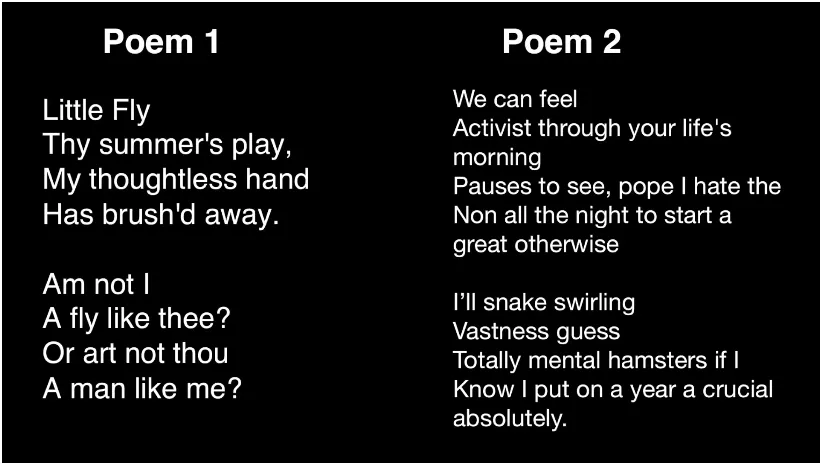
So up here, we have two poems. One of them is written by a human, and the other one's written by a computer. I'm going to ask you to tell me which one's which. Have a go:
(图源:TED官网)
请暂停阅读,做出你的选择:
(答案:A)
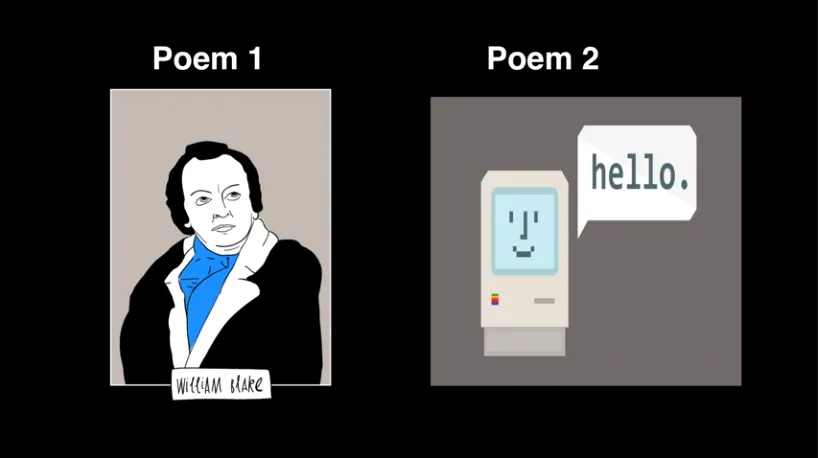
OK, time's up. Hands up if you think Poem 1 was written by a human. OK, most of you. Hands up if you think Poem 2 was written by a human. Very brave of you, because the first one was written by the human poet William Blake. The second one was written by an algorithm that took all the language from my Facebook feed on one day and then regenerated it algorithmically, according to methods that I'll describe a little bit later on.
相信你应该和大多数人一样,认为第一首诗来自人类。
而答案也确实如此——第一首诗是英国诗人 William Blake 的作品。第二首诗来自一个算法。有意思的是,这个算法甚至只是把 Oscar 某一天 Facebook 动态中的语言收集起来,再重新组合生成诗歌。也就是说,我们刚刚凭借自己的判断,成功分辨出了人类诗人和电脑。至少第一次,我们似乎觉得自己还是很有把握的。
(图源:TED官网)
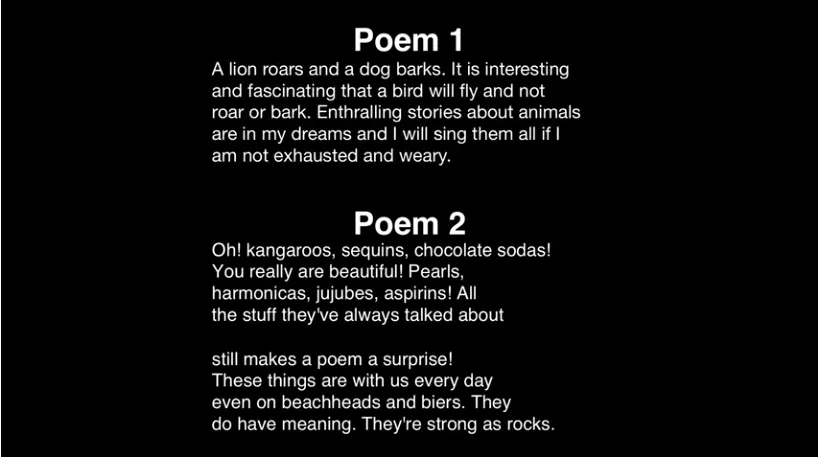
So let's try another test. Again, you haven't got ages to read this, so just trust your gut.
(图源:TED官网)
接着,Oscar又让我做了第二次测试。还是先自己判断一下吧。
(答案:B)
Alright, time's up. So if you think the first poem was written by a human, put your hand up. OK. And if you think the second poem was written by a human, put your hand up. We have, more or less, a 50/50 split here. It was much harder.
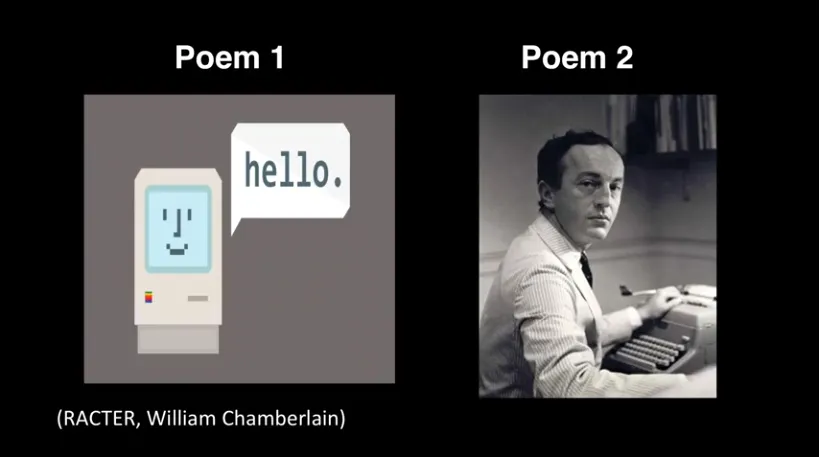
The answer is, the first poem was generated by an algorithm called Racter, that was created back in the 1970s, and the second poem was written by a guy called Frank O'Hara, who happens to be one of my favorite human poets.
相信你也能感受出来这一次,情况明显不同。当时现场观众的选择几乎五五开。刚才还很容易做出的判断,现在突然变得困难起来。而答案也更加出人意料:第一首诗其实是 20 世纪 70 年代的算法 Racter 生成的,第二首才是人类诗人 Frank O'Hara 的作品。原来,电脑写出来的诗真的可能和人写的诗如此相似。
(图源:TED官网)
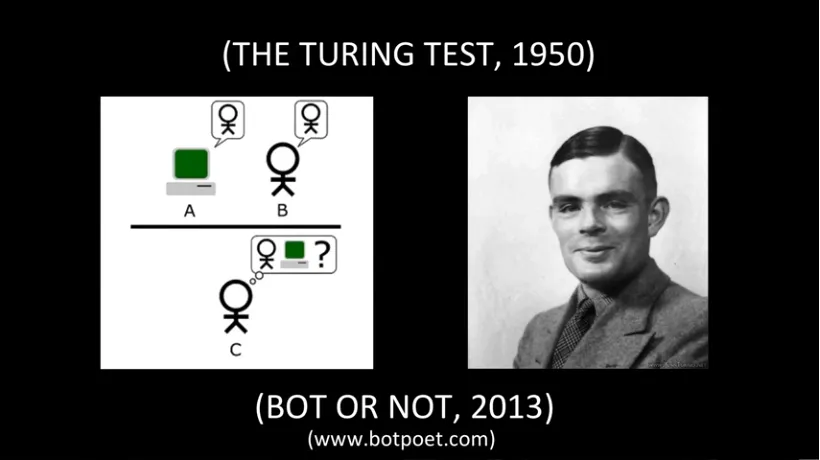
So what we've just done now is a Turing test for poetry. The Turing test was first proposed by this guy, Alan Turing, in 1950, in order to answer the question, can computers think? Alan Turing believed that if a computer was able to have a text-based conversation with a human, with such proficiency such that the human couldn't tell whether they are talking to a computer or a human, then the computer can be said to have intelligence.
So in 2013, my friend Benjamin Laird and I, we created a Turing test for poetry online. It's called bot or not, and you can go and play it for yourselves. But basically, it's the game we just played. You're presented with a poem, you don't know whether it was written by a human or a computer and you have to guess. So thousands and thousands of people have taken this test online, so we have results.
Oscar刚才进行的,其实是一场诗歌版的图灵测试。1950 年,Alan Turing 曾经提出一个问题:“计算机能思考么?”如果一台电脑能够和人类进行交流,让人无法判断自己面对的究竟是人还是机器,那么我们是否可以认为它拥有智能?而现在,Oscar 把这个问题带到了诗歌中:如果电脑写出的诗,也能够让人无法分辨,那么我们是不是也可以说电脑会写诗?
(图源:TED官网)
And what are the results? Well, Turing said that if a computer could fool a human 30 percent of the time that it was a human, then it passes the Turing test for intelligence. We have poems on the bot or not database that have fooled 65 percent of human readers into thinking it was written by a human. So, I think we have an answer to our question. According to the logic of the Turing test, can a computer write poetry? Well, yes, absolutely it can. But if you're feeling a little bit uncomfortable with this answer, that's OK. If you're having a bunch of gut reactions to it, that's also OK because this isn't the end of the story.
按照图灵测试的标准,如果一台电脑能够在一定程度上让人类误以为它是人类,那么它就可以通过测试。而在 Oscar Schwartz 和朋友创建的“是或否” 测试中,有些电脑生成的诗甚至成功让 65% 的人类读者认为它们来自人类。
那么,最开始的问题——“计算机能写诗么”是不是已经有答案了?
Oscar 的回答非常直接——可以,电脑当然能够写诗。但如果你看到这里,觉得这个答案有些不舒服,Oscar说没关系,因为这个故事还远远没有结束。
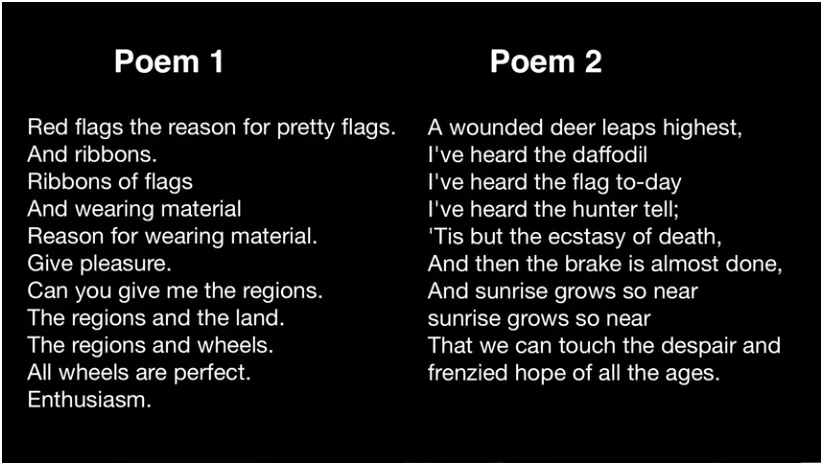
Let's play our third and final test. Again, you're going to have to read and tell me which you think is human.
(图源:TED官网)
现在跟随Oscar的脚步我们来进行第三次,也是最后一次测试。
(答案:A)
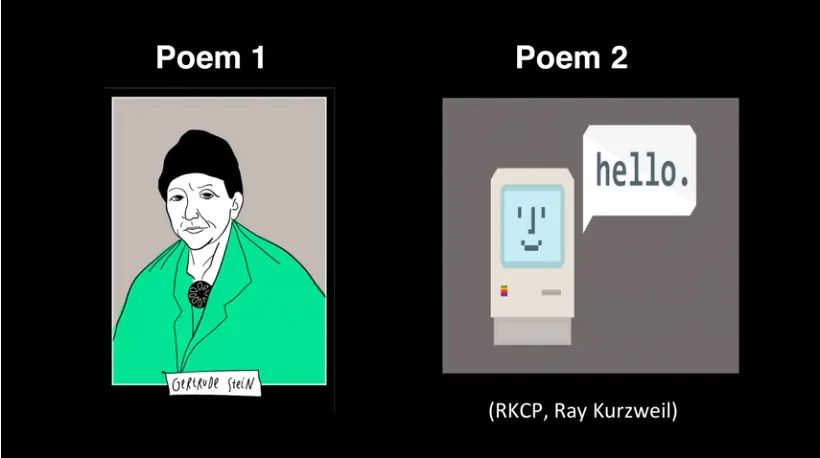
OK, time is up. So hands up if you think Poem 1 was written by a human. Hands up if you think Poem 2 was written by a human. Whoa, that's a lot more people. So you'd be surprised to find that Poem 1 was written by the very human poet Gertrude Stein. And Poem 2 was generated by an algorithm called RKCP.
这一次,更多的人选择了第二首。可是答案揭晓后,情况完全反过来了。第一首是诗人 Gertrude Stein 写的;第二首,却是算法 RKCP 生成的。我们以为"像机器"的诗,其实是人写的;我们以为"像人"的诗,反而来自电脑。
到了这里,原本清楚的界限开始变得模糊:人可以写得像机器,机器也可以写得像人。
(图源:TED官网)
Now before we go on, let me describe very quickly and simply, how RKCP works. So RKCP is an algorithm designed by Ray Kurzweil, who's a director of engineering at Google and a firm believer in artificial intelligence. So, you give RKCP a source text, it analyzes the source text in order to find out how it uses language, and then it regenerates language that emulates that first text.
Oscar 接下来解释了 RKCP 是如何工作的。它会先读取一段文本,分析这段文本是如何使用语言的,然后根据这种语言模式重新生成新的文本。
So in the poem we just saw before, Poem 2, the one that you all thought was human, it was fed a bunch of poems by a poet called Emily Dickinson it looked at the way she used language, learned the model, and then it regenerated a model according to that same structure. But the important thing to know about RKCP is that it doesn't know the meaning of the words it's using. The language is just raw material, it could be Chinese, it could be in Swedish, it could be the collected language from your Facebook feed for one day. It's just raw material. And nevertheless, it's able to create a poem that seems more human than Gertrude Stein's poem, and Gertrude Stein is a human.
这一次,它学习的是 Emily Dickinson 的诗歌。RKCP 学习 Emily Dickinson 使用语言的方式,再按照相似的结构重新生成诗歌。但这里有一个很重要的问题:它并不知道自己写出的这些词是什么意思。对于电脑来说,语言只是原材料。它可以是英语,也可以是中文、瑞典语。它不需要真正理解这些语言,却仍然可以根据语言本身的规律,生成一首看起来非常像诗的作品。
So what we've done here is, more or less, a reverse Turing test. So Gertrude Stein, who's a human, is able to write a poem that fools a majority of human judges into thinking that it was written by a computer. Therefore, according to the logic of the reverse Turing test, Gertrude Stein is a computer.
到了这里,Oscar 又提出了一个新的概念——反向图灵测试。刚才我们看到的是:电脑写得像人。现在却出现了另一种情况:人写得像电脑。Gertrude Stein 明明是一位人类诗人,却写出了一首让很多人认为来自电脑的诗。所以,如果按照刚才的逻辑,我们甚至可以荒谬地说:“Gertrude Stein是个电脑”。当然,这显然不是真的。
Feeling confused? I think that's fair enough.
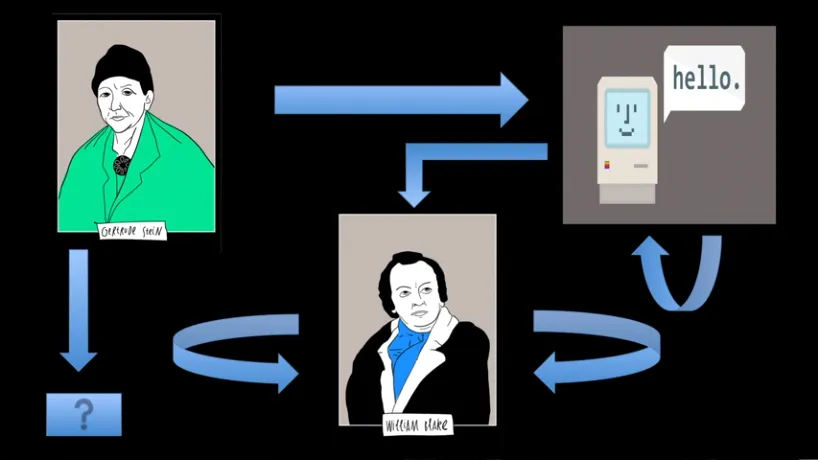
So far we've had humans that write like humans, we have computers that write like computers, we have computers that write like humans, but we also have, perhaps most confusingly, humans that write like computers.
相信你也感到困惑。Oscar解释说很正常。因为走到这里,我们已经很难简单地把"人"和"电脑"分开了。
(图源:TED官网)
So what do we take from all of this? Do we take that William Blake is somehow more of a human than Gertrude Stein? Or that Gertrude Stein is more of a computer than William Blake?
These are questions I've been asking myself for around two years now, and I don't have any answers. But what I do have are a bunch of insights about our relationship with technology.
到目前为止,我们见过像人一样写作的人,像电脑一样写作的电脑,像人一样写作的电脑,以及最令人困惑的——像电脑一样写作的人。于是,Oscar 开始重新思考:我们到底凭什么判断一首诗是"人写的"?也许,问题已经不再只是电脑能不能写诗。这些测试真正让 Oscar 开始思考的,是我们自己对于"人"的理解。
So my first insight is that, for some reason, we associate poetry with being human. So that when we ask, "Can a computer write poetry?" we're also asking, "What does it mean to be human and how do we put boundaries around this category? How do we say who or what can be part of this category?" This is an essentially philosophical question, I believe, and it can't be answered with a yes or no test, like the Turing test. I also believe that Alan Turing understood this, and that when he devised his test back in 1950, he was doing it as a philosophical provocation.
Oscar 发现,我们似乎天然会把诗歌和"人"联系在一起。所以,当我们问:"电脑能写诗吗?"其实也在问:"什么才意味着成为一个人?"如果诗歌属于人类,那么创造力是不是也属于人类?如果机器可以模仿诗歌,那么我们又应该如何定义真正的创造?这些问题,已经不再只是关于电脑的问题。
So my second insight is that, when we take the Turing test for poetry, we're not really testing the capacity of the computers because poetry-generating algorithms, they're pretty simple and have existed, more or less, since the 1950s. What we are doing with the Turing test for poetry, rather, is collecting opinions about what constitutes humanness. So, what I've figured out, we've seen this when earlier today, we say that William Blake is more of a human than Gertrude Stein. Of course, this doesn't mean that William Blake was actually more human or that Gertrude Stein was more of a computer. It simply means that the category of the human is unstable. This has led me to understand that the human is not a cold, hard fact. Rather, it is something that's constructed with our opinions and something that change over time.
在 Oscar 看来,"人"并不是一个永远固定、清晰明确的事实。我们对于"什么是人"的理解,本身就在随着我们的观点和时代不断变化。所以,当我们觉得 William Blake 比 Gertrude Stein 更"像人"时,并不代表 William Blake 真的更像人。它只是说明:我们心中的"人"本身就是一个不断变化的概念。
So my final insight is that the computer, more or less, works like a mirror that reflects any idea of a human that we show it. We show it Emily Dickinson, it gives Emily Dickinson back to us. We show it William Blake, that's what it reflects back to us. We show it Gertrude Stein, what we get back is Gertrude Stein. More than any other bit of technology, the computer is a mirror that reflects any idea of the human we teach it.
到了最后,Oscar 给出了一个很有意思的比喻:电脑就像一面镜子。我们把 Emily Dickinson 给它,它就把 Emily Dickinson 还给我们。我们把 William Blake 给它,它就把 William Blake 还给我们。我们教给它什么样的"人",它最终映照出来的,也就是我们对于"人"的理解。
So I'm sure a lot of you have been hearing a lot about artificial intelligence recently. And much of the conversation is, can we build it? Can we build an intelligent computer? Can we build a creative computer? What we seem to be asking over and over is can we build a human-like computer?
所以,当我们不断讨论人工智能时,我们总是在问:我们能不能创造一个更聪明的电脑?能不能创造一个更有创造力的电脑?能不能创造一个越来越像人的电脑?
But what we've seen just now is that the human is not a scientific fact, that it's an ever-shifting, concatenating idea and one that changes over time. So that when we begin to grapple with the ideas of artificial intelligence in the future, we shouldn't only be asking ourselves, "Can we build it?" But we should also be asking ourselves, "What idea of the human do we want to have reflected back to us?" This is an essentially philosophical idea, and it's one that can't be answered with software alone, but I think requires a moment of species-wide, existential reflection.
Thank you.
但 Oscar 希望我们进一步思考:我们希望未来的AI映照出一个怎样的人类?也许,这才是这个演讲真正想留给我们的思考。我们原本只是想知道:电脑能写诗吗?走到最后,问题却变成了:我们究竟如何理解"人"?而当我们试图教会机器什么是"人"的时候,也许我们其实正在重新认识自己。
电脑是一面镜子。而我们在镜子里看到的,最终还是我们自己。

END
文案:毛茹静
审校:于欣玉 韩玉乾
排版:董奕萱
播音:于欣玉
点击阅读原文 观看演讲视频
#