2 0 2 3 下 粉 笔 教 资
全 真 模 拟 初 中 1
▹
讲师:原 原
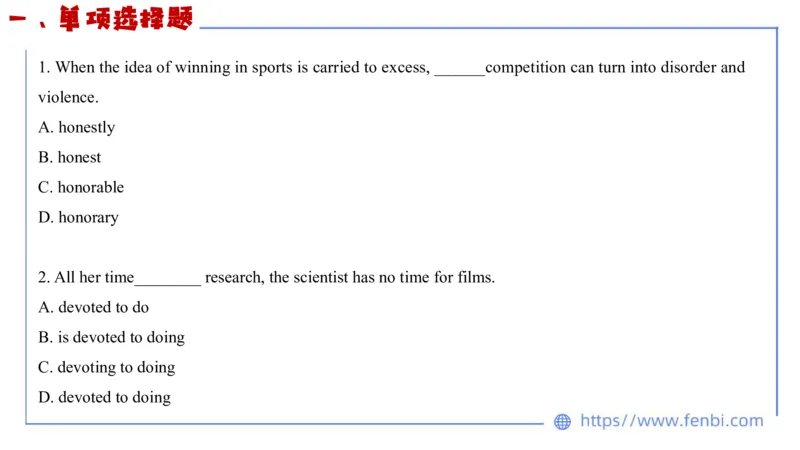
更多干货关注 粉笔教师教育 粉笔教师一 、单 项 选 择 题
1. When the idea of winning in sports is carried to excess, ______competition can turn into disorder and
violence.
A. honestly
B. honest
C. honorable
D. honorary
2. All her time________ research, the scientist has no time for films.
A. devoted to do
B. is devoted to doing
C. devoting to doing
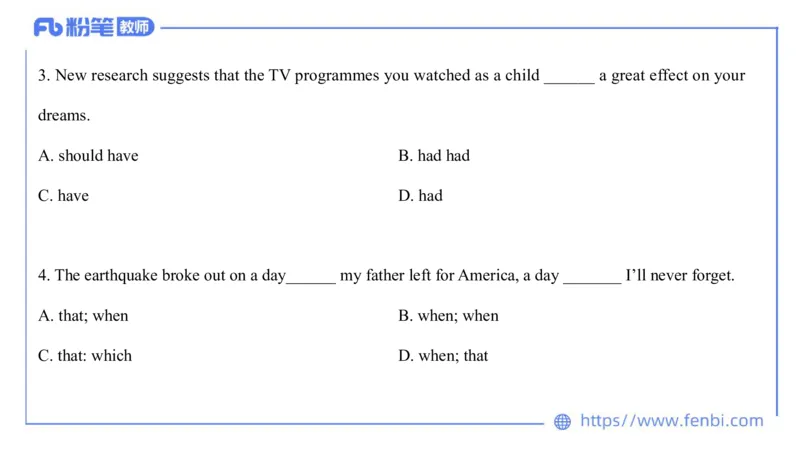
D. devoted to doing3. New research suggests that the TV programmes you watched as a child ______ a great effect on your
dreams.
A. should have B. had had
C. have D. had
4. The earthquake broke out on a day______ my father left for America, a day _______ I’ll never forget.
A. that; when B. when; when
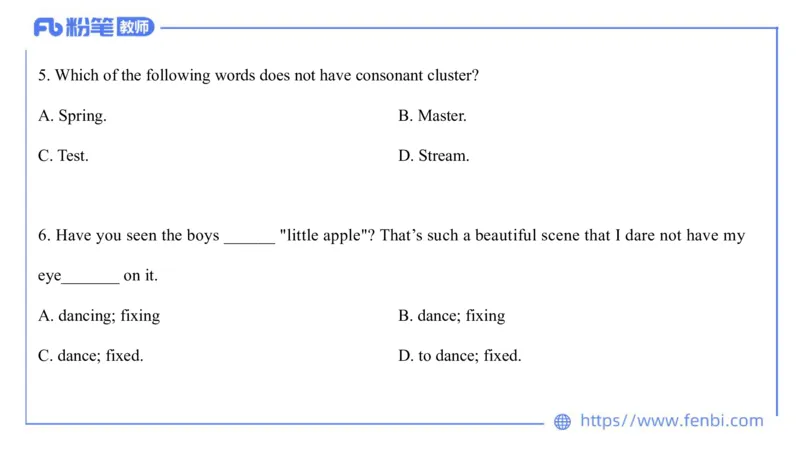
C. that: which D. when; that5. Which of the following words does not have consonant cluster?
A. Spring. B. Master.
C. Test. D. Stream.
6. Have you seen the boys ______ "little apple"? That’s such a beautiful scene that I dare not have my
eye_______ on it.
A. dancing; fixing B. dance; fixing
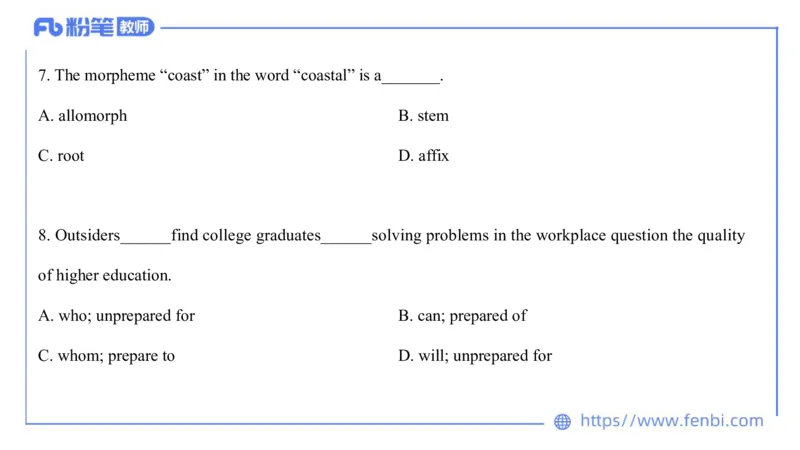
C. dance; fixed. D. to dance; fixed.7. The morpheme “coast” in the word “coastal” is a_______.
A. allomorph B. stem
C. root D. affix
8. Outsiders______find college graduates______solving problems in the workplace question the quality
of higher education.
A. who; unprepared for B. can; prepared of
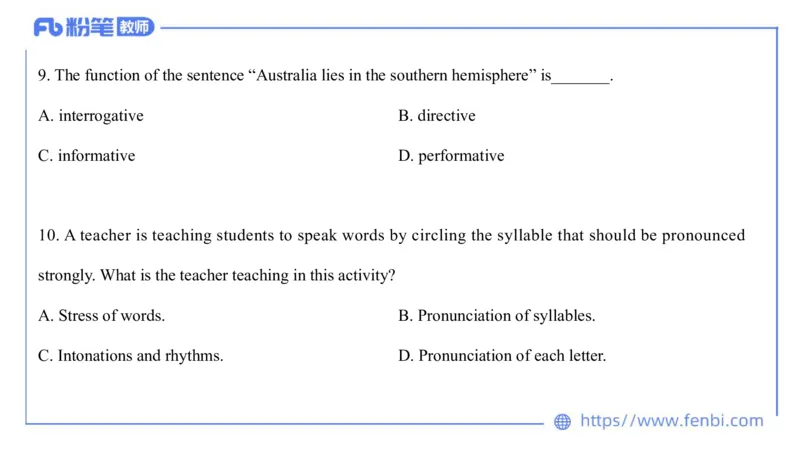
C. whom; prepare to D. will; unprepared for9. The function of the sentence “Australia lies in the southern hemisphere” is_______.
A. interrogative B. directive
C. informative D. performative
10. A teacher is teaching students to speak words by circling the syllable that should be pronounced
strongly. What is the teacher teaching in this activity?
A. Stress of words. B. Pronunciation of syllables.
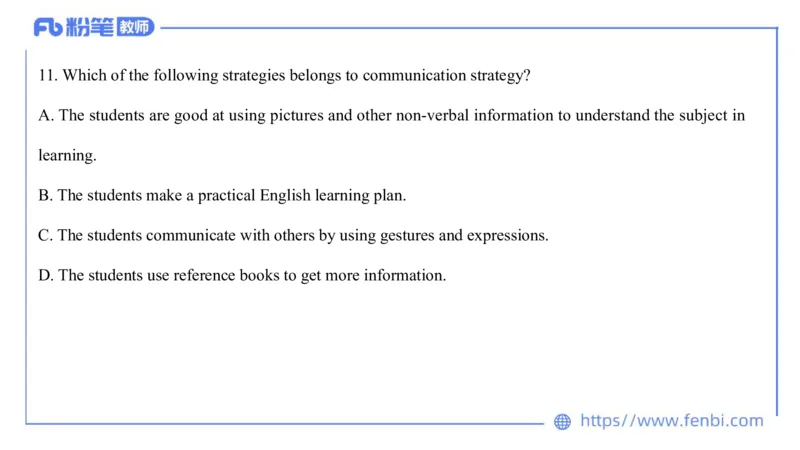
C. Intonations and rhythms. D. Pronunciation of each letter.11. Which of the following strategies belongs to communication strategy?
A. The students are good at using pictures and other non-verbal information to understand the subject in
learning.
B. The students make a practical English learning plan.
C. The students communicate with others by using gestures and expressions.
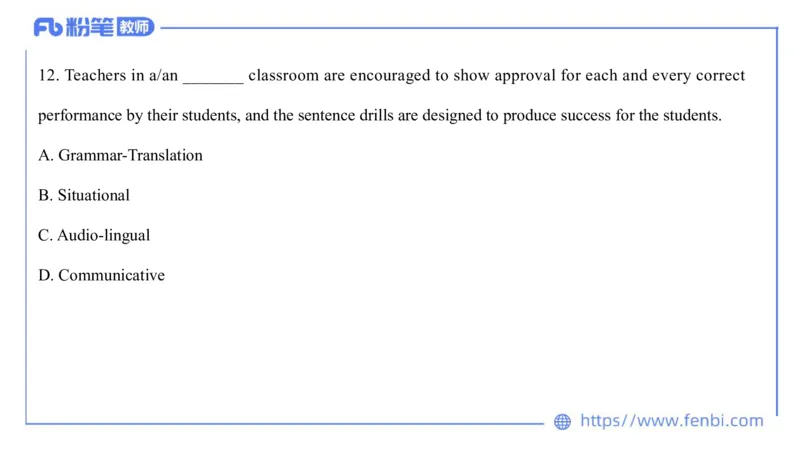
D. The students use reference books to get more information.12. Teachers in a/an _______ classroom are encouraged to show approval for each and every correct
performance by their students, and the sentence drills are designed to produce success for the students.
A. Grammar-Translation
B. Situational
C. Audio-lingual
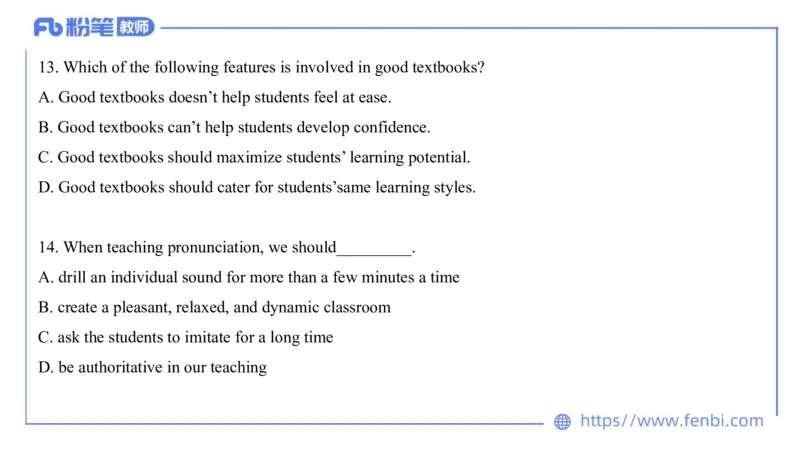
D. Communicative13. Which of the following features is involved in good textbooks?
A. Good textbooks doesn’t help students feel at ease.
B. Good textbooks can’t help students develop confidence.
C. Good textbooks should maximize students’ learning potential.
D. Good textbooks should cater for students’same learning styles.
14. When teaching pronunciation, we should_________.
A. drill an individual sound for more than a few minutes a time
B. create a pleasant, relaxed, and dynamic classroom
C. ask the students to imitate for a long time
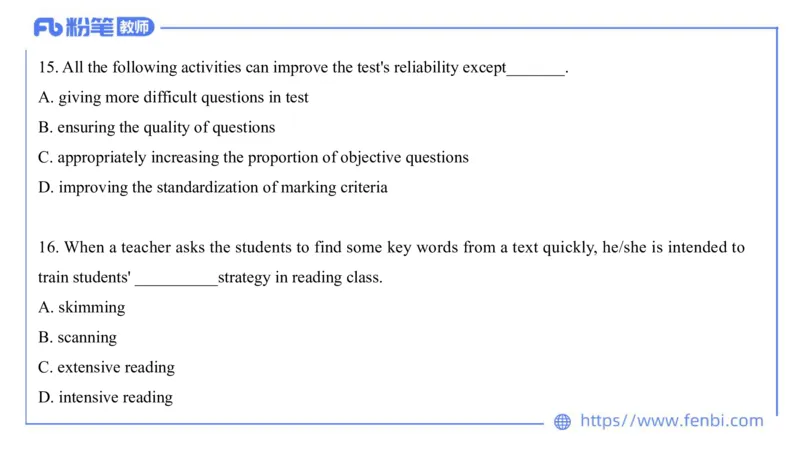
D. be authoritative in our teaching15. All the following activities can improve the test's reliability except_______.
A. giving more difficult questions in test
B. ensuring the quality of questions
C. appropriately increasing the proportion of objective questions
D. improving the standardization of marking criteria
16. When a teacher asks the students to find some key words from a text quickly, he/she is intended to
train students' __________strategy in reading class.
A. skimming
B. scanning
C. extensive reading
D. intensive reading17. __________is a type of activity in which the teacher reads out a passage in normal speed for two or
three times and students note down the words they could catch as they listen as much as possible.
A. Answering questions B. Gap-filling
C. Dictogloss D. Sequencing
18. __________stage for teaching writing includes discussion or debate on relevant topic, picture telling,
free talk, reading short passages, and audio-visual activities.
A. Pre-writing B. While-writing
C. Post-writing D. Intensive writing19. How should the teacher deal with students′writing errors?
A. Teachers should limit students to taking risks to use new vocabulary and structures.
B. Teachers should often show negative attitude towards students' writing errors.
C. Teachers should make corrections of all the writing errors for students.
D. Teachers should underline the errors and leave them for students to correct themselves.
20. According to the PPP model, which activity in the following would most probably appear at the
presentation stage of the oral teaching?
A. Drills. B .Prompted dialogue.
C. Role play. D. Discussion.Passage 1
21. What does the author imply social media may do to our life?
A. It may facilitate our interpersonal relationships.
B. It may filter our negative impressions of others.
C. It may make us feel isolated and incompetent.
D. It may render us vulnerable and inauthentic.
【第一段】Why does social media trigger feelings of loneliness and inadequacy? Because instead of
being real life, it is, for the most part, impression management, a way of marketing yourself, carefully
choosing and filtering the pictures and words to put your best face forward.
【第四段】...Also, we tend to idealize others’ lives and compare our downfalls to their greatest
accomplishments, ending in feelings of loneliness and inadequacy.22. Why do people post comments selectively on social media?
A. They do not find all their online friends trustworthy.
B. They want to avoid offending any of their audience.
C. They do not want to lose their followers.
D. They are eager to boost their popularity.
【第二段】Generally speaking, there are no unfiltered comments or casually taken photos on our social
media pages. And, rightfully so, because it wouldn’t feel safe to be completely authentic and vulnerable
with some of our “friends” whom we don’t actually know or with whom trust has yet to be built.23. What are humans inclined to do according to the passage?
A. Exaggerate their life’s accomplishments.
B. Strive for perfection regardless of the cost.
C. Paint a rosy picture of other people’s lives.
D. Learn lessons from other people’s downfalls.
【第四段】As humans, we yearn for social connection. Scrolling through pages of pictures and
comments, however, does not provide the same degree of fulfillment as face-to-face inter- actions do.
Also, we tend to idealize others’ lives and compare our downfalls to their greatest accomplishments,
ending in feelings of loneliness and inadequacy.24. What is the author’s view of pictures and posts on social media?
A. They should record the memorable moments in people’s lives.
B. They should be carefully edited so as to present the best image.
C. They should be shown in a way that meets one’s security needs.
D. They should keep people from the unhealthy quest for perfection.
【第五段】Social media can lead people on the unhealthy quest for perfection. Some people begin to
attend certain events or travel to different places so that they can snap that “perfect” photo. They begin
to seek validation through the number of people who “like” their posts. ...... Pictures and posts should
be byproducts of life’s treasured moments and fun times, not the planned and calculated image that one is
putting out into cyberspace in an attempt to fill insecurities or unmet needs.25. What does the author advise people to do when they find their online experience unconstructive?
A. Use social media to increase their ability to connect with various types of people.
B. Stay connected to those whom they may not otherwise get to know and befriend.
C. Try to prevent negative thoughts and feelings from getting into the online pages.
D. Strengthen ties with real-life friends instead of caring about their online image.
【最后一段】Ultimately, social media has increased our ability to connect with various types of people
all over the globe . It has opened doors for businesses and allowed us to stay connected to people whom
we may not otherwise get to follow. However, social media should feel like a fun experience not one that
contributes to negative thoughts and feelings. If the latter is the case, increasing face-to-face time with
trusted friends, and minimizing time scrolling online, will prove to be a reminder that your social network
is much more rewarding than any “like,” “follow” or “share” can be.Passage 2
26. What does the author say we humans have been doing to chimps?
A. Ruining their culture.
B. Accelerating their extinction.
C. Treating them as alien species.
D. Homogenizing their living habits.
【第一段】Imagine that an alien species landed on Earth and, through their mere presence, those aliens
caused our art to vanish, our music to homogenize, and our technological know-how to disappear. That is
effectively what humans have been doing to our closest relatives—chimps.27. What is the finding of Andrew Whiten’s team?
A. Chimps demonstrate highly developed skills of communication.
B. Chimps rely heavily upon their body language to communicate.
C. Chimps behave in ways quite similar to those of human beings.
D. Different chimp groups differ in their way of communication.
【第二段】Back in 1999, a team of scientists led by Andrew Whiten showed that chimps from
different parts of Africa behave very differently from one another. Some groups would get each
other’s attention by rapping branches with their knuckles, while others did it by loudly ripping leaves
with their teeth.28. What did Ammie Kalan and her colleagues find through their intensive fieldwork?
A. Whiten’s classic study has little impact on the diversity of chimp behavior.
B. Chimp behavior becomes less varied with the increase of human activity.
C. Chimps alter their culture to quickly adapt to the changed environment.
D. It might already be too late to prevent animal cultures from extinction.
【第四段】Ammie Kalan and her colleagues have shown, through years of intensive fieldwork, that the
very presence of humans has eroded the diversity of chimp behavior. Where we flourish, their cultures
wither.29. What does Cat Hobaiter think we should do for chimp conservation?
A. Try to understand our sister species’ behavior in the wild.
B. Make efforts to preserve each individual chimp community.
C. Study the unique characteristics of each generation of chimps.
D. Endeavor to restore chimp habitats to expand its total population.
【第六段】“Sometimes in the rush to conserve the species. I think we forget about the individuals,”
says Cat Hobaiter, a professor at the University of St. Andrews. “Each population, each community,
even each generation of chimps is unique.30. What does the author suggest conservationists do?
A. Focus entirely on culturally-based entities rather than genetically-based ones.
B. Place more stress on animal traditions than on their physical conservation.
C. Conserve animal species in a novel and all-round way.
D. Explore the cultures of species before they vanish.
【最后一段】Obviously conservationists need to think about saving species in a completely new way—
by preserving animal traditions as well as bodies and genes. “Instead of focusing only on the
conservation of genetically-based entities like species, we now need to also consider culturally- based
entities,” says Andrew Whiten.二 、简 答 题
简述教师在组织小组活动时的两个注意事项(8分)。列举教师在开展小组活动时的两个主要角
色(8分),并概括有效开展小组活动时教师应具备的两种主要能力(4分)。【参考答案】
(1)教师在组织小组活动时的两个注意事项:
①精心选择话题,明确活动目的。
教师在小组活动中要结合教学内容,选择恰当的话题,以引起学生的学习兴趣,激起学生主动参
与语言活动的欲望。同时,要在活动开始之前,使学生明白小组活动的任务,从而使学生按照教
师的布置认真完成小组活动并有实质性收获。
②合理组建小组,明确职责分工。
教师要从学生的实际情况出发,注意学生之间的差异性,进行合理分组。可以根据性别、性格特
点、学习成绩、遵守纪律情况等方面的差异建立相对稳定的学习小组,以保证组内各成员的差异
性和互补性;可以根据小组水平基本一致来分组,以保证小组之间竞争的公平性。在分组后,要
根据每个人的实际情况,明确分工,确保每个组员都有属于自己的任务,使每个人都能有效地发
挥作用。二 、简 答 题
简述教师在组织小组活动时的两个注意事项(8分)。列举教师在开展小组活动时的两个主要角
色(8分),并概括有效开展小组活动时教师应具备的两种主要能力(4分)。(2)教师在开展小组活动时的两个主要角色:
①组织者。教师宣布采取小组活动的形式,明确活动任务,组织分组,确定每组组长并使小组长
明确自己的职责,然后说明活动如何开展;在活动进行过程中,教师要确保学生正确地执行任务,
并给予指导或督促这都体现了教师的组织者的角色。
②参与者。新课程强调教学是教与学的交往、互动,是师生双方相互交流、相互沟通、相互补充
的过程。在小组活动中,教师应把自己当成学生中的一员,参与到活动中,这既可以活跃课堂气
氛,增进师生感情、又可以帮助学生解决难题,协助学生顺利完成任务。
(另外,教师在小组活动中的主要角色还有控制者、评价者等,列举出两种并简要说明即可)二 、简 答 题
简述教师在组织小组活动时的两个注意事项(8分)。列举教师在开展小组活动时的两个主要角
色(8分),并概括有效开展小组活动时教师应具备的两种主要能力(4分)。(3)教师应具备的两种主要能力是组织能力和观察能力。在小组活动的过程中、教师需要发挥
良好的组织协调能力。同时在整个活动的过程中,教师也需要发挥观察能力。如发现学生在活动
中遇到困难,要主动帮助学生排忧解难,使活动能够顺利进行。三 、教学 情 境分 析题
根据题目要求完成下列任务,用中文作答。
教学材料:
Hi, this is Liu Yun. I’m going to have a busy weekend! On Saturday, I’m going to the bookstore by
subway. I’m going to buy a new CD and some storybooks. Then, I’m going to go home and read the new
books. On Sunday, I’m going to the supermarket with my mother. We are going after lunch. Then, in the
evening, I’m going to visit my aunt. We are going to watch TV together. That will be fun! What about
you? What are you going to do on the weekend?教学片段:
Pre-reading
Activity 1:
Students have a free talk, using “I’m going to...”
Activity 2:
Students carry on the following dialogue with Mr. Time on the screen:
Student A: Hello. Mr. Time.
Mr. Time: Hello. Where are you going?
Student A: I’m going to...
Mr. Time: What are you going to do?
Student A: I’m going to...以上是初一的英语教学材料及其教学设计片段,请从以下三个方面进行评析。
1. 读前两个活动的设计意图。(6分)【参考答案】
1.读前活动的设计意图:
(1)案例中教师在读前用一般将来时来进行自由练习和师生对话,在帮助学生复习知识点的同
时,为下一步进行文章的阅读奠定了语言基础,使得各环节活动由易到难,循序渐进。
(2)课前活动设计贴近学生生活,符合学生的认知水平和生活经验,读前对话内容关于自己将
来的计划安排,易激发学生英语学习的兴趣和课堂参与的积极性。While-reading
Activity 1
Students read the text quickly and silently to find the answer to the question: What is the text about?
Activity 2
Students underline Liu Yun’s weekend plan and answer the questions.
What is Liu Yun going to do on Saturday/Sunday afternoon/Sunday evening?
What does Liu Yun think of her weekend?2. 读中两个活动运用的阅读策略及其意图。(12分)2.读中活动阅读策略和意图:
(1)读中活动1训练学生通过快速阅读得到关键信息来概括文章大意,为进一步理解文章内容打
好基础,有利于培养学生快速阅读的阅读技巧以及总结文章大意的能力。
(2)读中活动2通过对于细节理解的阅读策略引导学生边读边画出刘云的周末计划并且回答四个
细节问题,让学生对文章细节内容有了进一步全面的了解,有利于培养学生根据关键词查询和获
取细节信息的能力。Post-reading
Activity 1
Students retell Liu Yun’s weekend plan according to the timeline on the blackboard.
Activity 2
Students talk about another two weekend plans in groups, choose the better one and give the reasons.
Activity 3
Students write down their own weekend plans, report them in class and evaluate them.3. 读后三个活动的设计意图。(12分)3.读后活动设计意图
(1)读后活动1教师让学生根据时间线复述文章内容,有助于学生加深对文章框架的理解,既培
养了学生复述的能力,又复习和巩固了本节课的重难点。而且在此过程中,用到了一般现在时的
表达,能够提高学生口语表达能力。
(2)读后活动2教师让学生分组讨论其他的周末计划,然后选出最好的一个并给出原因,有助于
培养学生自主学习能力,在合作的实践活动中提高学生语言运用和思维能力,学生还能在展示活
动中获得成就感。
(3)读后活动3教师让学生写出自己的周末计划并且在全班分享、评价,有利于培养学生在真实
语境中运用语言的能力,提高其综合语言运用能力。活动设计贴近学生、贴近生活,学生是整个
活动的主体,有利于激发学生语言学习兴趣。四 、教学 设 计 题
根据提供的信息和语言素材设计教学方案,用英文作答。
设计任务:请阅读下面的学生信息和语言素材,设计一份时长 分钟的阅读教学方案。
20
教案没有固定格式,但须包含下列要点:
①
Teaching objectives
②
Teaching contents
③
Key and difficult points
④
Major steps and time allocation
⑤
Activities and justifications
教学时间: 分钟
20
学生概况:某城镇普通中学八年级(初中二年级)学生,班级人数 人,多数学生已经达到
40
《义务教育英语课程标准( 年版)》三级水平。学生课堂参与积极性一般。
2022语言素材:
Secret codes keep messages private. Banks, companies, and government agencies use secret codes in doing
business, especially when information is sent by computer.
People have used secret codes for thousands of years. As long as there have been codes, people have tried to break
them. Code breaking never lags far behind code making. The science of creating and reading coded messages is called
cryptography.
There are three main types of cryptography. You can hide a message by having the first letters of each word spell it
out. For example, the first letters of “My elephant eats too many eels” spell out the hidden message “Meet me.”
Another way to hide a message is to use symbols to stand for specific letters of the elephant. You might represent
each letter with a number, for example Let’s number the letters of the alphabet, in order, from 1 to 26. If we substitute
a number for each letter, the message “Meet me” would read “13 5 5 20 13 5.”语言素材:
A code uses symbols to replace words, phrases, or sentences. To read the message of a real code, you must have a
code book. With a code book, you might write down words that would stand for other words. For example, “bridge”
might stand for “meat” and “out” might stand for “me.” The message “Bridge out” would actually mean “Meet me” It
is very hard to break a code without the code book. However, it is also hard to keep a code book secret for long.
So codes must be changed frequently.Reading—PWP
Pre- While-
Post-reading
reading reading
Preparation General idea
Group activities
Details【参考设计】
1. Teaching contents
This is a reading lesson. It mainly introduces the importance and necessity of setting codes, the history of codes, the
way of hiding information and the importance of a code book.2. Teaching objectives
Language competence
Students can grasp the new words, such as cryptography, substitute, symbol and so on.
Through reading, students will understand the main idea of the passage and be able to use the target language to talk
about codes.
Cultural awareness
Students can be interested in intercultural communication and get along well with others.
Thinking quality
Students can sort out and summarize the information in the passage.
Learning ability
Students will be willing to take part in the class activities and cooperate with other group members.3. Teaching key and difficult points
Key points
The teacher will help students to know the meaning and usage of the new words.
The teacher will help students to understand the content of this lesson through reading.
Difficult points
The teacher will help students to talk about the new topic correctly and fluently.
The teacher will help students to improve their confidence in speaking English.4. Teaching procedures
Step 1 Pre-reading (6 mins)
(1) New knowledge teaching
With the help of pictures and videos, the teacher will guide students to understand the meaning and usage of the new
words including cryptography, substitute, symbol and so on.
(2) Prediction
Before reading, the teacher will organize students to make a prediction. Some hints will be provided to help them.
Hint 1: Words just referred to.
Hint 2: A video in which students can see some people are communicating with each other by Morse code.
【Justification】The above activities can help students recognize the new words, remove the barriers, and lay the
foundation for the next step of “reading”.Step 2 While-reading (10 mins)
(1) Extensive reading
①Skimming: Students will read the passage for the first time to check their predictions and conclude the main idea of
the passage.
②Scanning: Ask students to locate certain information by reading the text quickly and answer the following questions.
How long have people used secret codes?
What are three main types of cryptography?(2) Intensive reading
Students should read the passage for the second time and do the following task:
True or False:
As long as there have been codes, people have tried to break them.(T/F)
A code uses symbols to replace words, phrases, or sentences.(T/F)
(3) Reading and repeating
Students will listen to the passage and read after it. They should pay attention to the pronunciation and intonation.
【Justification】In the process of completing the reading tasks at different levels, students can not only understand
the content and certain details of the passage, but also improve their reading skills.Step 3 Post-reading (4 mins)
Group discussion
Students will work in groups to discuss some questions: Have you ever used codes? How? They need to discuss the
topic by using the key words and sentences. Several minutes will be given. When time’s up, several students will be
invited to share their ideas. Then the teacher will comment on students’ performance.
【Justification】Group activities will provide students with the opportunity to apply what they have learned to the
situation, improve their comprehensive language skills, and boost their confidence in learning English and strengthen
their sense of teamwork.