义
务
教
育
教
义务教育教科书
科
书
English
英语
英
语
( 衔接三年级起点 )
(
衔
接
三
年
级
起
八年级上册
点
)
八
年
级
上
册
n!
u
It’s
f
asy!
It’s
e
绿绿色色印印刷刷产产品品
定价:9.35元
全国价格举报电话:12315义务教育教科书
English
英语
( 衔接三年级起点 )
八年级上册
[中 国] 河 北 教 育 出 版 社
合作编写
[加拿大] DC加拿大国际交流中心致 同 学
亲爱的同学们,新的学年开始了,欢迎大家继续使用这套《英语》教材!
本册《英语》教材供八年级上学期使用。
上个学期我们同詹妮、李明和丹尼一起沿古丝绸之路探寻了中国的古代文明;了
解了中、加两国不同的校内外学习生活;探讨了关于季节和体育运动等内容。
翻开本册教材,我们会发现,教材引入了更为丰富、有趣的话题,例如:新的学
期生活、学校课程、家庭及节日聚会、生活中的社区环境、交通工具的发展变化、个
人兴趣爱好和自我认识等。通过学习这些内容,我们共同思索人生,一起成长。我是
谁?我有哪些特点?我擅长做什么?将来的我可能从事什么职业?对这些问题,书中
的主人公有时会和我们一样迷茫,也需要寻求他人的帮助。从他们的故事中,也许我
们能看到自己的影子,并且会心一笑,学有所获。
随着我们语言知识的积累和技能的不断提高,教材的内容更加丰富,各种活动也
更加多样化。从八年级开始,教材还提供了不同形式的单元项目(Project)。这些课
题式的探究性活动,让英语学习变得更有意义并富有创造性,连同Let’s Do It, Dig In,
Learning Tip, Culture Tip等板块一起,为同学们提供了更多选择与知识链接。愿同学
们在新学期中,积极参与各项活动,学习语言、感悟人生,并不断总结学习方法,形
成良好的学习策略,保持英语学习的兴趣,不断提高自己的语言应用能力。
We learn to do by doing! 让我们一起在语言探索之旅中继续努力。Contents
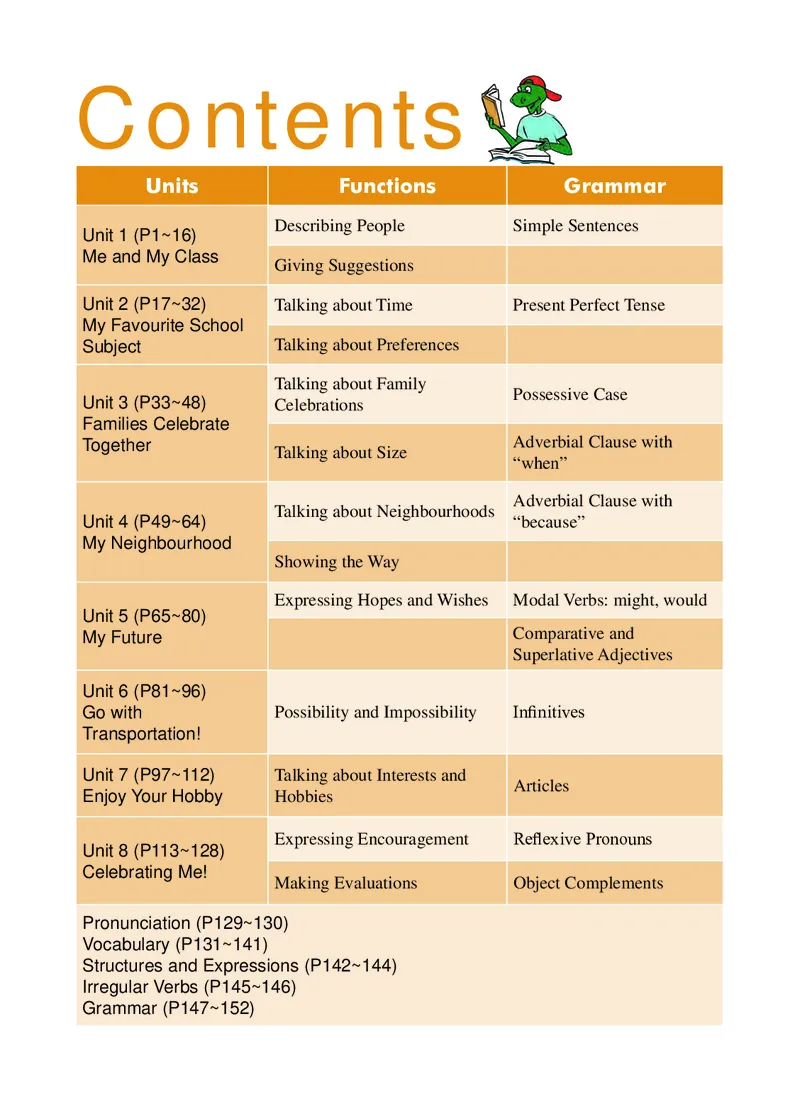
Units Functions Grammar
Describing People Simple Sentences
Unit 1 (P1~16)
Me and My Class
Giving Suggestions
Unit 2 (P17~32) Talking about Time Present Perfect Tense
My Favourite School
Subject Talking about Preferences
Talking about Family
Possessive Case
Unit 3 (P33~48) Celebrations
Families Celebrate
Together Adverbial Clause with
Talking about Size
“when”
Adverbial Clause with
Talking about Neighbourhoods
Unit 4 (P49~64) “because”
My Neighbourhood
Showing the Way
Expressing Hopes and Wishes Modal Verbs: might, would
Unit 5 (P65~80)
My Future Comparative and
Superlative Adjectives
Unit 6 (P81~96)
Go with Possibility and Impossibility Infinitives
Transportation!
Unit 7 (P97~112) Talking about Interests and
Articles
Enjoy Your Hobby Hobbies
Expressing Encouragement Reflexive Pronouns
Unit 8 (P113~128)
Celebrating Me!
Making Evaluations Object Complements
Pronunciation (P129~130)
Vocabulary (P131~141)
Structures and Expressions (P142~144)
Irregular Verbs (P145~146)
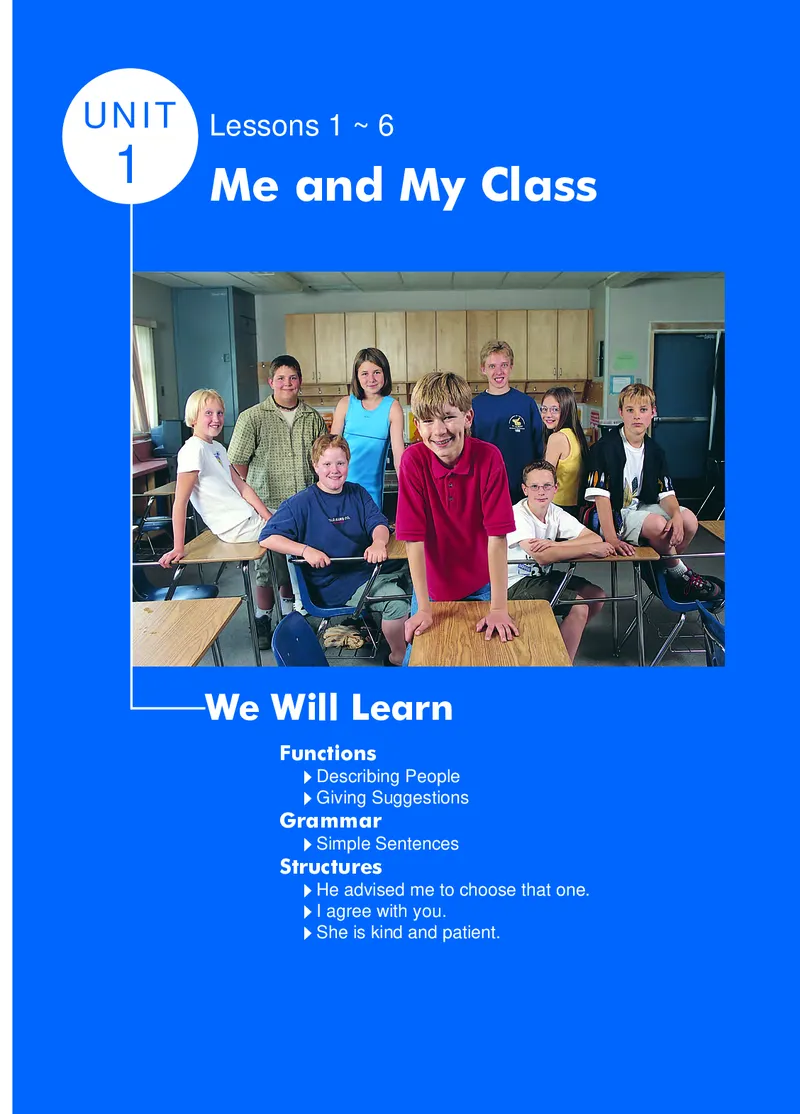
Grammar (P147~152)UNIT
Lessons 1 ~ 6
1
Me and My Class
We Will Learn
Functions
Describing People
Giving Suggestions
Grammar
Simple Sentences
Structures
He advised me to choose that one.
I agree with you.
She is kind and patient.
1Lesson 1: Back to School
N K ABO U
T
HI T
IT
• How do you like the first day of a new term/school year?
• Do you have any new subjects? Do you think you will like them?
Yay! I am in Grade 8!
Li Ming: Hi Danny! How are you? How was your first day of
Grade 8?
Danny: Great! I was happy to see my classmates after such a long
holiday. I have two new classmates this term. One is Sandra and
the other is Mary. We also have a new English teacher. Her name
is Ms. Cox.
Li Ming: That’s exciting! You always like to make new friends.
Where are Sandra and Mary from?
Danny: I don’t know. I wanted to talk to Sandra, but I didn’t know
how to begin.
Li Ming: Well, you can introduce yourself to her. You can also ask
her questions.
Danny: Good idea, Li Ming! Thank you. What about you? How is
Grade 8 for you?
Li Ming: Good. It’s almost the same as Grade 7. We have a new
subject this term — physics. It looks interesting. Tomorrow
we will make a class picture, but I don’t have any good recent
pictures of myself.
Danny: You have a lot of good pictures, Li Ming. We took many on
the Silk Road. I like the one of you on the camel.
Li Ming: Yes. I like those pictures, too. I will look for one. See you
later!
Danny: See you! Good luck!
2Let’s Do It!
1 Read the lesson and answer the questions.
1. How many new classmates does Danny have? What are their names?
2. What advice does Li Ming give Danny on how to start a conversation
with Sandra?
3. Li Ming has a new subject this year. What is it?
4. What will Li Ming do to prepare for his class tomorrow? Why?
2 Listen to the passage and tick the correct pictures.
3 Fill in the blanks with the words or phrase in the box.
ask give look for borrow
When you have trouble finding answers to questions on your own, there are
a few things you can do. You can ________ your teacher or your classmates
for help. You can also ________ books from the library. If you can’t find the
answers in a book, you can ________ the answers on the Internet. These days
you can search the web for almost everything. You are sure to find a website
that can ________ you the answers you need.
4 Work in pairs. Discuss the following questions: How do you like
Grade 8? What is new this term? Are there any new students in
your class? Do you have any new subjects?
Example:
I like Grade 8 very much. There are eight new
students in my class! I have a new subject this
year…
3Lesson 2: Many Faces, One Picture
N K ABO U
T
HI T
IT
• Do you have a favourite photo? Why is it your favourite? Explain.
• What is a class picture?
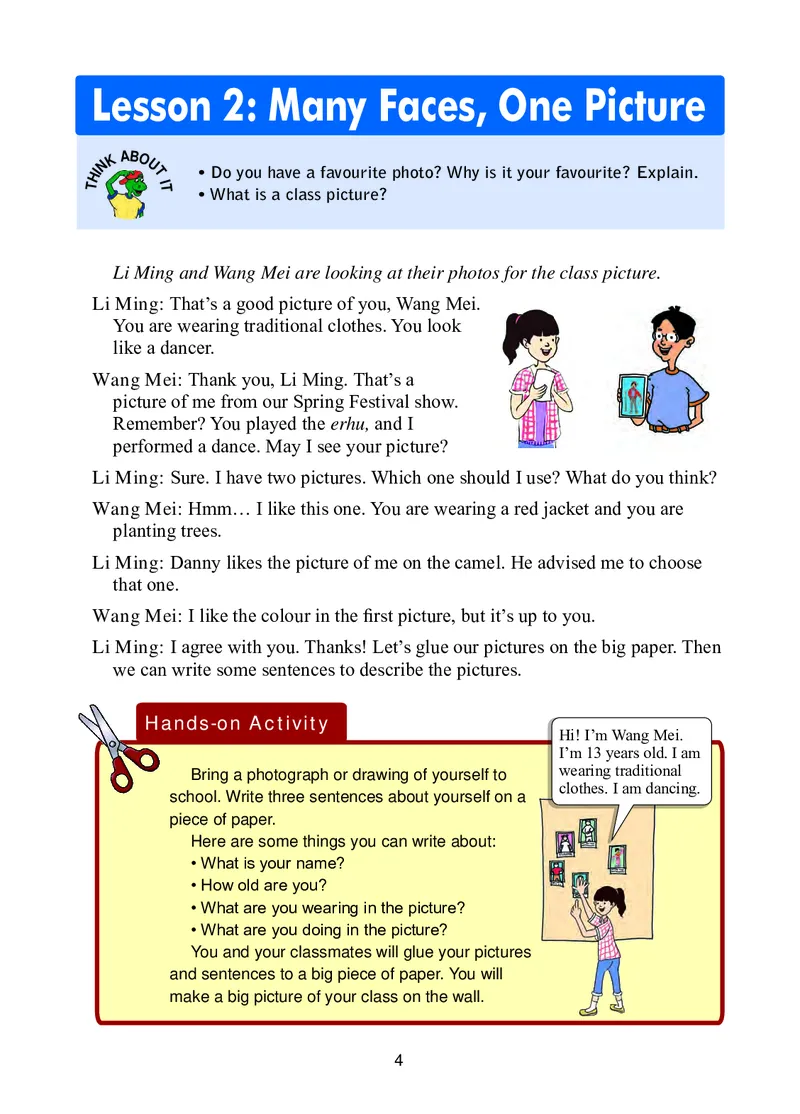
Li Ming and Wang Mei are looking at their photos for the class picture.
Li Ming: That’s a good picture of you, Wang Mei.
You are wearing traditional clothes. You look
like a dancer.
Wang Mei: Thank you, Li Ming. That’s a
picture of me from our Spring Festival show.
Remember? You played the erhu, and I
performed a dance. May I see your picture?
Li Ming: Sure. I have two pictures. Which one should I use? What do you think?
Wang Mei: Hmm… I like this one. You are wearing a red jacket and you are
planting trees.
Li Ming: Danny likes the picture of me on the camel. He advised me to choose
that one.
Wang Mei: I like the colour in the first picture, but it’s up to you.
Li Ming: I agree with you. Thanks! Let’s glue our pictures on the big paper. Then
we can write some sentences to describe the pictures.
Hands-on Activity
Hi! I’m Wang Mei.
I’m 13 years old. I am
Bring a photograph or drawing of yourself to wearing traditional
clothes. I am dancing.
school. Write three sentences about yourself on a
piece of paper.
Here are some things you can write about:
• What is your name?
• How old are you?
• What are you wearing in the picture?
• What are you doing in the picture?
You and your classmates will glue your pictures
and sentences to a big piece of paper. You will
make a big picture of your class on the wall.
4Let’s Do It!
1 Listen and circle the correct answers.
1. Wang Mei was wearing (traditional/sports) clothes in her picture.
2. Wang Mei was (singing/dancing) in the picture.
3. Li Ming prepared (two/three) pictures for the class picture.
4. Li Ming chose a picture. In that picture, he was (planting a tree/riding a
camel).
2 Complete the dialogue with the correct forms of the words or phrase
in the box.
advise agree up to beside
Danny: Let’s put your picture on the top right corner, Linda.
Linda: I want to put my picture ________ Jenny’s.
Danny: OK. I will put my picture a little bit lower then.
Linda: Well, it’s ________ you.
Danny: Linda, can you lend me your marker? Ms. Cox ________ us to write
something under the picture.
Linda: Sure. Here you are. I really like our class picture. It looks so nice.
Danny: Yes, I ________.
Linda: Let’s put it up on the wall.
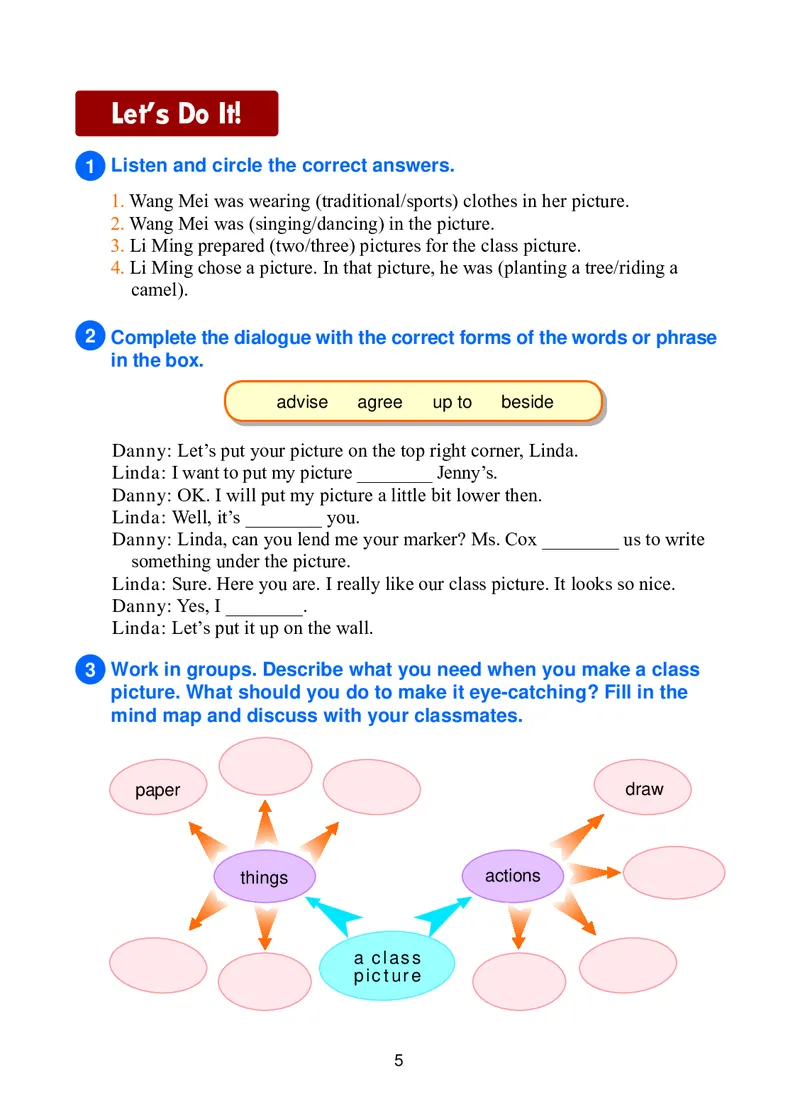
3 Work in groups. Describe what you need when you make a class
picture. What should you do to make it eye-catching? Fill in the
mind map and discuss with your classmates.
paper draw
things actions
a class
picture
5Lesson 3: Getting to Know You!
T
HI N K ABO U T
IT
•
• W
Is
h
it
a t
e a
in
s
t
y
e
t
r
o
e s
m
ts
a
d
k
o
e
e
n
s
e
y
w
o u
f
r
r i
n
e
e
n
w
ds ?
fr
W
ien
h
d
y
h
o
a
r
v
w
e?
hy not?
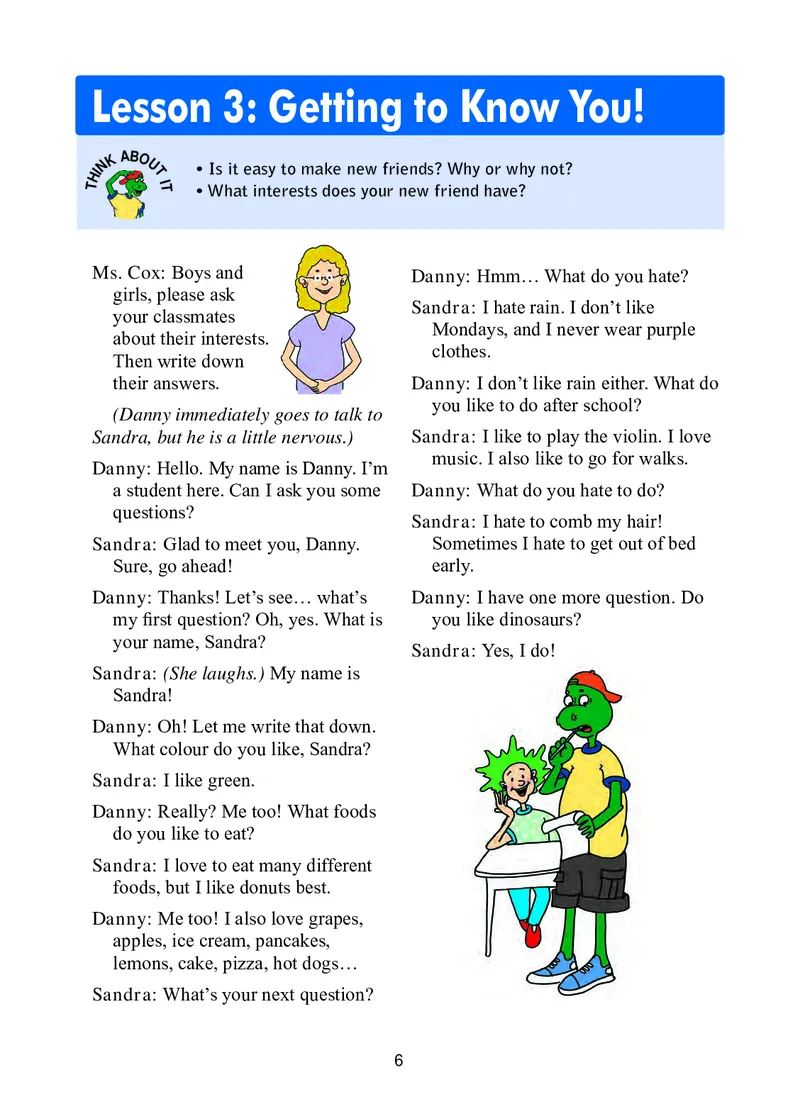
Ms. Cox: Boys and Danny: Hmm… What do you hate?
girls, please ask
Sandra: I hate rain. I don’t like
your classmates
Mondays, and I never wear purple
about their interests.
clothes.
Then write down
their answers. Danny: I don’t like rain either. What do
you like to do after school?
(Danny immediately goes to talk to
Sandra, but he is a little nervous.) Sandra: I like to play the violin. I love
music. I also like to go for walks.
Danny: Hello. My name is Danny. I’m
a student here. Can I ask you some Danny: What do you hate to do?
questions?
Sandra: I hate to comb my hair!
Sandra: Glad to meet you, Danny. Sometimes I hate to get out of bed
Sure, go ahead! early.
Danny: Thanks! Let’s see… what’s Danny: I have one more question. Do
my first question? Oh, yes. What is you like dinosaurs?
your name, Sandra?
Sandra: Yes, I do!
Sandra: (She laughs.) My name is
Sandra!
Danny: Oh! Let me write that down.
What colour do you like, Sandra?
Sandra: I like green.
Danny: Really? Me too! What foods
do you like to eat?
Sandra: I love to eat many different
foods, but I like donuts best.
Danny: Me too! I also love grapes,
apples, ice cream, pancakes,
lemons, cake, pizza, hot dogs…
Sandra: What’s your next question?
6Let’s Do It!
1 Listen to Danny’s report and circle the words in the chart.
All about Sandra
She likes… She doesn’t like… She likes to… She hates to…
• green • rain • play the piano • set the table
• red • snow • play the violin • comb her hair
• foods • Mondays • ride a bike • get up early
• fruit • pink clothes • go for walks
• dinosaurs • purple clothes
2 Read the lesson and answer the questions.
1. What task did Ms. Cox give to the class?
2. How did Danny feel about the interview?
3. What questions did Danny ask Sandra?
3 Fill in the blanks with the words or phrase in the box.
hate glad go ahead either
1. A: Do you mind if I open the window?
B: No, ________.
2. I ________ going to the movie theatre alone.
3. A: I can’t swim.
B: I can’t swim ________.
4. After travelling all summer, I was ________ to come home.
PROJECT
LET’S MAKE A CHART!
Learn something new about your
classmates. Talk to them! Here are
some questions you can ask:
• What things do you like/hate?
• What do you like/hate to do?
Talk to three or four of your
classmates. Write down their
answers in a chart.
7Lesson 4: Best Friends
N K ABO U
T
HI T
IT
• Who is your best friend? What do you like about him/her?
• Did you ever argue with your best friend? Why?
Patrick and Grant are best friends. They are like “two
peas in a pod”. One day, the two best friends stopped
talking to each other. Why? Grant wanted to copy
Patrick’s homework. That way, he could spend more
time playing basketball. But to his surprise, Patrick
didn’t agree.
“No way! I can’t help you like that,” said Patrick.
“What a friend!” Grant said angrily.
Patrick felt awful. He said, “I won’t lend you my homework. Friends don’t help
each other like that. That’s cheating!”
That afternoon, they parted and went their own ways. In the following days,
they both felt bad.
A few days later, there was a school basketball game. Patrick went to the gym
to watch it. Grant was there, too. At the end of the game, the two friends looked at
each other.
Grant immediately came over and held out his hand. He wanted to say
something, but he felt embarrassed. Patrick smiled and
said, “Good friends don’t have to say sorry. They just
know it. I want to be your friend, not your enemy.”
That day the two boys made a deal. They would do
their own homework first and play basketball later.
Learning Tip
A simple sentence contains only one independent clause. Look at these:
Patrick didn’t agree. (Subject + Intransitive Verb)
The two boys made a deal. (Subject + Transitive Verb + Object)
Patrick felt awful. (Subject + Link Verb + Predicative)
I won’t lend you my homework. (Subject + Verb + Indirect Object + Direct Object)
8Let’s Do It!
1 Listen and number the sentences in the correct order.
1. They parted and went their own ways.
2. They stopped talking to each other.
3. The two boys saw each other at the school gym.
4. Patrick and Grant are best friends. They are like “two peas in a pod”.
5. They made a deal. They would do their homework first and play basketball
later.
The correct order is: ______________________________
2 Read the lesson and answer the questions.
1. What did Grant like to play after class?
2. Why did the two boys stop talking to each other?
3. What made the two boys become friends again?
4. What agreement did the two boys make?
3 Complete the clues and do the crossword.
1
ACROSS
h
4 2. We ________ at the airport
7 2 p with good wishes for each
3 l d other.
3. My bike is broken. Can you
5 e
________ me yours?
5. A joke never gains an
6 gg
________, but loses a friend.
6. Hi Danny! ________ to
meet you!
DOWN
1. I ________ rainy days!
4. I find my new ________ class very difficult!
7. The NBA players refused to play. They were hoping for a better ________.
4 In your opinion, what makes a best friend? Collect some sayings
about friendship and share them with your partners.
Example:
Only your real friends will tell you when your face is dirty.
9Lesson 5: Meet Ms. Liu
N K ABO U
T
HI T
IT
• What is your teacher’s name? What do you know about him/her?
• How do you feel when you talk in front of your class?
It’s English class. Li Ming is standing at the front. He is ready to give his
report to the class.
I talked to someone very special — our English
teacher, Ms. Liu.
I feel lucky to have her as my English teacher.
She learned English at a university in London,
England. She started teaching seven years ago.
She is knowledgeable, and her lessons are
interesting. She encourages us to ask questions
and discuss the answers with each other. She
is kind and patient. After class, she is our good
friend.
Ms. Liu has many interests. She likes to swim
for exercise. She plays the piano, and she is a
very good singer, too. What does Ms. Liu hate?
Walking to school in January! It’s cold in January.
That’s Ms. Liu. Thank you!
Learning Tip
My name is Yang Hui. I’m married. My husband is “Mr.” Liu. You
can call me “Ms.” Yang or “Mrs.” Liu. My daughter is single, so you
can call her “Miss” or “Ms.” Liu.
10Let’s Do It!
1 Listen and write true (T) or false (F).
1. Ms. Liu is a kind English teacher. ( )
2. Three years ago, Ms. Liu began teaching. ( )
3. Ms. Liu learned English in England. ( )
4. The students are Ms. Liu’s friends. ( )
5. Ms. Liu is good at singing. ( )
2 Read the lesson and fill in the chart.
Name Job Personality Interests
Liu Mei
3 Complete the passage with the correct forms of the given words.
piano enjoy discuss encourage patient knowledgeable
Ms. Liu is my favourite teacher. She is a beautiful lady, and there is always
a smile on her face. She doesn’t just give us the answers. She is ________
with us and gives us enough time to think in class. She ________ us to find the
answers by ourselves. We often ________ things in groups and then give our
report to the class. She is very ________ about English. Sometimes she plays
nice music on the ________. The students all ________ her class.
4 Interview one of your teachers and tell a group of classmates about
him or her. Then write a short passage.
Task tips:
You may use these expressions:
My favourite teacher is…
He/She likes… and hates…
His/Her favourite… is…
11Lesson 6: Jenny’s Week
N K ABO U
T
HI T
IT
• What do you like to do after school or on weekends/holidays?
• Do you like to watch movies? What is your favourite movie?
Date: September 10
Weather: No rain today, but cloudy, windy and cool.
Dear Diary,
Today Danny introduced us to his new friend, Sandra. We
played football together after school. Steven and I were on
one team, and Sandra and Danny were on the other. It was a
fair competition. The score was four to three. We lost. I hate
to lose. I like winning!
Last Saturday, my mother bought a pair of jeans for me.
She and I love to shop for clothes! She also bought me a
purple blouse. I wore my new clothes to school on Monday.
Everyone liked them.
In English class this morning, we talked to our classmates.
I had the pleasure of talking to Mary — a girl from Hong
Kong. Her English is very good. She invited me to go to the
movies with her next Sunday. Mary’s parents work in a local
restaurant. After the movie, we will have supper there.
On Wednesday, my cousin Brian is arriving
from the U.K. He will stay with my family
for the next two years.
Time for bed!
12Let’s Do It!
1 Listen and tick the correct answers.
1. Jenny’s team ________ the football game.
won lost
2. Last Saturday, Jenny’s mother bought her ________.
a pair of pants and a blue dress a pair of jeans and a purple blouse
3. In English class, Jenny talked to a girl from ________.
Hong Kong the U.K.
4. Jenny will go to ________ with Mary next Sunday.
buy some new clothes watch a movie
5. Jenny’s cousin Brian will stay in Canada for ________.
one year two years
2 Read the lesson and answer the questions.
1. What did Jenny do after school today?
2. Who was on the same team as Danny?
3. Which team won the game? What was the score?
4. What will Jenny do next Sunday?
5. Who will come from the U.K. to stay with Jenny’s family?
3 Read the passage and fill in the blanks with the words in the box.
sports local pleasure restaurant
Hello everyone. My name is Mary. It’s my ________ to talk to you. I moved
here from Hong Kong with my parents. My parents and I like reading the
________ newspaper. My parents got jobs in a ________ by reading an ad in
the paper. I often read the ________ news. Football is my favourite sport.
4 Write a letter to a friend. Tell him or her
something about your first two weeks
of school.
Task tips: You can talk about your
subjects, teachers, classmates or
classrooms. Maybe you can tell a funny
story!
13Unit Review
Building Your Vocabulary
I. Match each definition with the correct word from this unit.
deal at once
pleasure talk about something with somebody
glue joy, happiness
immediately something we can use to join things together
discuss agreement
II. Complete the sentences with the correct forms of the words above.
1. Put the poster on the wall. Be careful. Don’t get the ________ everywhere.
2. A: Would you like to come and have lunch on Sunday?
B: With ________. I’d love to come.
3. My school is planning a trip to the U.S. I ________ the trip with my parents
last night.
4. I heard the question, but I couldn’t give the answer ________.
5. Let’s make a ________ to send a letter to each other in English every week.
Grammar in Use
Make sentences using the information given.
like our English teacher We We like our English teacher.
are singing and dancing The students
a new book bought me My father
to her friend Peggy the ball passed
You so young and cute look
Listening and Speaking
I. Listen to the passage and answer the questions.
1. What kind of person is Da Zhi?
142. What did they play in P.E. class?
3. What happened in P.E. class?
II. Listen and repeat.
1. She is kind and patient.
2. They are like “two peas in a pod”.
3. I was happy to see my classmates after such a long holiday.
III. Talk to your partner about your likes and dislikes. Complete the chart.
Topic I like…/I like to… I hate…/I hate to…
clothes
songs
sports
seasons
…
Putting It All Together
I. Read the passage and write true (T) or false (F).
We Love Our Class
I have some pictures of our class. Look at this
one! Sandra, Jenny and the others are wearing nice
clothes. Look at Danny. He is wearing a yellow
cotton shirt. He looks very happy. Danny and
Sandra are good friends now. Danny isn’t scared to
talk to her anymore.
Our class enjoys playing badminton and basketball together. We don’t
always have the same classes at the same time. Each of us is different.
We have different likes and dislikes.
We really like our teacher, Ms. Cox. She teaches us English. She
dresses very nicely and treats each student fairly. We all love her! Our
class is like a big family.
151. This is a picture of Jenny’s family. ( )
2. Danny is wearing a yellow coat in the picture. ( )
3. Sandra is scared to talk to Danny. ( )
4. Danny, Sandra and Jenny have the same likes and dislikes. ( )
5. Ms. Liu is not in the picture. ( )
II. Write a short passage about your favourite picture of your class.
Self-Evaluation
Find more examples from this unit. Then mark your stars.
I. Describing People III. Simple Sentences
She is kind and patient. We lost.
Her English is very good.
She also bought me a purple blouse.
I can describe people in English.
I know simple sentences in English.
II. Giving Suggestions
I have two pictures. Which one should
I use?
I like this one. You are wearing a red
jacket and you are planting trees.
I know how to give suggestions to others.
Friendship Is Like the Breeze
Friendship is like the breeze, It may come and then go,
You can’t smell it, taste it, In your heart you will know,
Or know when it’s coming. It will always come back.
But you’ll always feel it,
And you’ll always know it’s there.
16UNIT
Lessons 7 ~ 12
2
My Favourite School
Sub ect
j
We Will Learn
Functions
Talking about Time
Talking about Preferences
Grammar
Present Perfect Tense
Structures
Art is fun for everyone.
What time is it?
Class will start in two minutes!
It’s a quarter after three.
17Lesson 7: Don’t Be Late for Class!
N K ABO U
T
HI T
IT
• How many subjects do you study? What are they?
• What subjects are you good at?
Brian: Hi Jenny! What class did you just have?
Jenny: I had geography. What class do you have next?
Brian: I have art. It’s my favourite. I have painted six
pictures this week!
Jenny: I hope to see them sometime. I have seen some
of your paintings. They’re beautiful! I like art too,
but I’m not very good at it. I’m not going to be a
painter in the future!
Brian: I’ve told you many times, Jenny. Art is fun for
everyone. You don’t need to be good at it.
Jenny: (She laughs.) You’re right, Brian. Art is fun, and I like our art teacher. She
has taught us a lot. I am much better at art this year.
Brian: When do you have art, Jenny?
Jenny: (She looks at her timetable.) I have art on Tuesdays.
Brian: What class do you have now?
Jenny: I have music class. It’s one of my favourites! I love to sing. What time is
it, please?
Brian: (He looks at his watch.) Oh no! It’s 2:13! Class will start in two minutes!
Jenny: Hurry, Brian! We don’t want to be late for class!
Brian: OK! See you after school!
Jenny: See you later, Brian!
Learning Tip
What time does this clock say?
2:13 — two thirteen/thirteen after two/thirteen past two
3:15 — a quarter after three/a quarter past three/three fifteen
3:30 — half past three/three thirty
3:45 — a quarter to four/three forty-five
18Let’s Do It!
1 Read the lesson and answer the questions.
1. What is Brian’s favourite subject?
2. How many pictures has Brian painted this week?
3. What does Jenny think of Brian’s paintings?
4. How is Jenny at art this year?
2 Fill in the blanks with the correct forms of the given words.
1. Nobody wants ________ (be) late for school.
2. One of my favourite ________ (subject) is physics.
3. I ________ (see) this movie three times this month.
3 Listen to the dialogue and match the people with their favourite
subjects.
Jack Kathy Nick Tom
Maths Music Art Geography
4 Work in groups. Fill in your class timetable and discuss it with
each other. Then present it to the whole class.
Task tips: How many classes are there? What classes do you like and what
classes don’t you like? Why or why not? What’s your favourite class?
Day
Monday Tuesday Wednesday Thursday Friday
Time
19Lesson 8: E-mail Helps!
N K ABO U
T
HI T
IT
• Do you like to write e-mails or letters in English?
• Do your classmates help each other in class? How?
From: danny@compmail.ca To: liming@net.cn
Subject: P.E. Date: 15/09 6:59 p.m.
Hi Li Ming,
I have a lot of homework this year! All of our teachers make us
study very, very hard. I am very tired.
Some of my classes are a lot of fun. My favourite class is physical
education (P.E.). Yesterday in P.E. class, I put Brian’s shorts on my
head and his runners on my hands. Everyone laughed except the
teacher. “That’s not funny, Danny,” he said. But I saw him smile.
Time for supper! Write to me soon!
Danny
From: liming@net.cn To: danny@compmail.ca
Subject: English and Maths Date: 16/09 6:15 p.m.
Dear Danny,
I have written three e-mails in English today. Our English teacher told us to use
English every day. It is the best way to learn the language. You have helped me a
lot.
Ms. Liu gives us lots of interesting projects in English class. This week, we are
talking about our favourite subjects in school. I like English best. I also like
maths. My friend Wang Mei is very good at maths. She has helped me with my
maths homework a lot. We will have a maths exam this Friday. We are going to
study together tonight.
Your friend,
Li Ming
20Let’s Do It!
1 Read the lesson and write true (T) or false (F).
1. Danny’s favourite subject is P.E. ( )
2. The teacher was very angry with Danny. ( )
3. Li Ming’s favourite subject is English. ( )
4. Li Ming hates maths. ( )
5. Wang Mei has helped Li Ming with his maths a lot. ( )
2 Listen to the passage and fill in the blanks.
Zhao Fei is in Grade ________ this year. Her favourite subject is ________.
She ________ it a lot every day. The teacher says it’s the ________ way to
learn a language well. She has a pen pal in ________ named Lucy. They have
________ each other many e-mails. Zhao Fei helps Lucy with her ________.
They write to each other in both languages.
3 Write the past participles of the verbs below. Then group them.
study tell help write see know say smile put laugh
play teach close talk listen walk run make
regular verbs irregular verbs
study - studied tell - told
4 Work in groups and discuss what good methods you use to study
your subjects. Then present your ideas to the class.
Example:
English: I like English best. I write e-mails in English every week.
Maths:
Chinese:
21Lesson 9: I Don’t Want to Miss Geography!
N K ABO U
T
HI T
IT
• What’s your favourite subject? Why?
• What’s the most interesting thing about your favourite subject?
Wang Mei: I haven’t seen you since Tuesday,
Li Lin. What’s the matter?
Li Lin: I have been sick for two days. I had to
miss school.
Wang Mei: Oh, poor Li Lin. How are you
today? Are you OK?
Li Lin: Yes. I’m fine today, but I still have a
cough. The doctor asked me to rest at home
this week. I came to school because I didn’t
want to miss my favourite class.
Wang Mei: What is your favourite class?
Li Lin: Geography. We learn about famous mountains and rivers in geography. I’d
love to visit them in the future. I like physics, too. I have geography today and
physics tomorrow.
Wang Mei: Good for you. I also like
geography, but physics is a headache for
me. I don’t understand it at all.
Li Lin: It seems hard, but don’t worry. I
can help you. We can do our homework
together.
Wang Mei: That’s very kind of you, Li Lin.
What time is convenient for you?
Li Lin: How about every Thursday after
school from 7:00 to 8:30?
Wang Mei: OK. It’s a date.
22Let’s Do It!
1 What are Wang Mei and Li Lin talking about? Listen and tick the
correct answers.
They are talking about Li Lin’s health.
They are talking about Li Lin’s favourite subject.
They are talking about helping each other in their studies.
They are talking about some school activities.
2 Read the lesson and fill in the blanks.
1. Wang Mei hasn’t seen Li Lin since ________.
2. Li Lin has been ill for ________ days. She had to ________ school.
3. The doctor asked Li Lin to ________ at home this week.
4. Li Lin’s favourite subject is ________.
5. Li Lin can help Wang Mei with her ________.
3 Read the lesson again and answer the questions.
1. How is Li Lin today?
2. What does Wang Mei think of physics?
3. What advice does Li Lin give to Wang Mei about physics?
4. When will Li Lin and Wang Mei do their homework together?
4 Liu Yi is a busy teacher. Look at her schedule and write about her
day. Then present it to the class.
6:00 get up 6:40 have breakfast
7:10 go to work 12:00 have lunch
13:00 begin work 16:15 mark students’ homework
18:30 end work 19:00 have supper
19:30 watch TV 21:45 go to sleep
Example:
It’s 6 o’clock. It’s time for Liu Yi to get up.
23Lesson 10: Looking for Lisa
N K ABO U
T
HI T
IT
• Is there a library in your school? What can you do there?
• Is it important to be on time? Why?
Jenny and Bill meet at 3 o’clock to work on their project. They are in the
library. Jenny is on the computer.
Jenny: Look, Bill. I have downloaded
some more pictures of Beijing.
Bill: Good work, Jenny! We have lots of
photos for our talk now. Have you found
any Chinese music?
Jenny: Yes, I have. The librarian helped me
find some.
Bill: That’s great!
(Suddenly the door opens. Danny rushes
People read or borrow books in a library.
into the library with a basketball in his
hand. He is wearing shorts and a T-shirt.)
Danny: (He shouts loudly.) Is Lisa here? Lisa! Lisa! Are you here?
Jenny: Danny, be quiet! Lisa is not here.
Librarian: No noise, please!
Danny: (He whispers.) Oops! Sorry. Lisa and I are going to work on our
basketball project together. I told her to meet me at a quarter to three. What’s
the time, Jenny?
Jenny: (She looks at her watch.) It’s a quarter after three.
Danny: She’s half an hour late! I have looked for her
everywhere — in the classroom, in the office, and now
in the library. Where is she?
Bill: Relax, Danny! Have you looked in the gym?
Danny: No, I haven’t. Maybe she’s there!
Bill and Jenny: (They laugh.) Yes. Maybe she is. See you
tomorrow, Danny.
24Let’s Do It!
2221 Read the lesson and answer the questions.
1. What time did Jenny and Bill meet to work on their project?
2. What did the librarian help Jenny find?
3. What time did Danny tell Lisa to meet him?
4. Where has Danny looked for Lisa?
2222 Write out the time using words.
12:00 12:05 12:15 12:30 12:45
2223 Complete the dialogue.
Li Ming is in the library. He is borrowing a book.
Librarian: _______________
Li Ming: Yes, please. I want to borrow Harry
Potter. A. Can I help you?
Librarian: Let me see. Here you are. B. Then you must come
Li Ming: _______________ back and renew it.
Librarian: For two weeks. C. How long can I keep it?
Li Ming: But I can’t finish it in two weeks. D. Can I write on the book?
Librarian: _______________
Li Ming: Thanks. I will try to finish it on time.
_______________
Librarian: No, you can’t. You must keep it clean.
Li Ming: All right. I understand. Thank you.
2224 Work in pairs. Make an appointment with your
partner. Make up a dialogue and act it out.
Example:
A: Would you like to go to the library with me?
B: Sure. When will we meet?
A: How about 3:40?
B: OK. Let’s meet at the front door.
25Lesson 11: Lily Learns about China!
N K ABO U • Have you learned about other countries in school? Which one is the
T
HI T
IT
most interesting?
• What foreign holidays do you know about?
I’m Lily. My family has lived in Canada
for six years. I am a good student in
school. I’m good at maths and science, but
my favourite subject is social studies. It’s
so interesting! We learn about different
countries of the world.
Recently, my class has learned about
China. Our teacher once worked in
southern China. He showed us some
pictures of different places in China.
They are so beautiful. I also learned
about Chinese culture and festivals. I like
I like learning about China. Children’s Day best. We have Mother’s
Day and Father’s Day here but no
Children’s Day. Do we need one? I think so. Now I want to travel to China. I love
being a tourist and seeing new things!
A few days ago, our teacher took us to a Chinese grocery store and a Chinese
restaurant. The grocery store had many traditional foods, but I didn’t know any
of them. The Chinese restaurant was great! I love Chinese food. There are many
Chinese restaurants in our city. The name of my favourite restaurant is Beijing
Beijing Peking House. That’s a funny name!
I would like to learn more about China in the future.
Culture Tip
In North America, Mother’s Day is the second Sunday of May. Father’s
Day is the third Sunday of June. On Mother’s Day and Father’s Day, children
say thank you to their parents.
26Let’s Do It!
1 Read the lesson and fill in the blanks.
Lily’s favourite subject is ________. She likes it because she learns a lot
about ________ countries of the world. Her class has learned about Chinese
________ and ________. Now she wants to ________ to China. She loves
being a ________ and seeing ________.
2 Listen to the passage and write true (T) or false (F).
1. Monkey Hill is the name of a restaurant. ( )
2. Kelly’s favourite restaurant has delicious monkey food. ( )
3. Kelly likes to order chicken at her favourite restaurant. ( )
4. Kelly’s parents cook the best beef in the world. ( )
5. Kelly wants to have her own restaurant in the future. ( )
3 Fill in the blanks with the correct forms of the words in the box.
fun child south tour
1. Every year, large numbers of ________ visit Hainan.
2. Tom is a ________ boy. He often makes us laugh.
3. Mr. and Mrs. Green have three ________: one daughter and two sons.
4. Guangzhou is in the ________ part of China. It’s very hot there in summer.
PROJECT
SHOW US YOUR FAVOURITE SUBJECT
Find some classmates who like the same subject as you.
Together show the class why it’s your favourite subject.
Here are some things you can do:
• Do you like maths? Talk about jobs that use
maths.
• Do you like English? Read a story or a poem.
• Do you like P.E.? Show how to play your favourite
sport.
• Do you like art? Present some of the things you
have made in your art class. Talk about your artwork.
27Lesson 12: Karen’s Hair Stood Up!
N K ABO U
T
HI T
IT
• Have you done anything interesting this week?
• What have you done in your favourite class?
Dear Diary,
I have been in Canada for two weeks. I miss everyone at home! But
I am also happy to be here. I am living at my aunt’s house. I have
made many new friends.
My cousin Jenny and I are in the same class. Today at school, we
talked to the class about our favourite subjects.
My group talked about art. We each brought a painting to class. Mine
was a picture of the ocean. It had birds, clouds, a boat and the sun
on it. Last summer, my family took a trip to the beach. The picture
always reminds me of that holiday.
Jenny and Bill were next. Their favourite subject was social studies.
Bill showed us many photos of Beijing. Jenny played some Chinese
music. She also read some letters and e-mails from her friends in
China.
Karen and Jack showed us some physics. Jack put very small tea
leaves on the desk. Then Karen combed her hair ten times very
quickly. She has long hair! She put the comb beside the tea leaves.
The leaves jumped to the comb! She also made her hair stand up
with the comb. Everyone was very surprised.
Finally, Danny and Lisa presented their
favourite subject — P.E. We went to the gym.
Danny played basketball, and Lisa showed
us some exercises. We had a good discussion
about how to stay healthy.
Time for bed!
28Let’s Do It!
1 Read Brian’s diary and fill in the chart.
Name Favourite subject What did they present?
Brian’s group
Jenny and Bill
Karen and Jack
Danny and Lisa
2 Listen to the statements and match the names with the pictures.
Andy William Zhang Qiang Zhao Hui
3 Fill in the blanks with the words in the box.
discussion surprised finally mine
1. Your schoolbag is new, but ________ is old.
2. All of the students are interested in the ________. They are talking to each
other.
3. Tom got up late this morning. He had breakfast quickly and hurried to
school. ________ he got to school on time.
4. Everyone was ________ when Jim worked out the difficult maths problem.
4 Work in groups. Discuss
My Favourite Subject
your favourite subject.
Then present it to the class.
What is it?
WWhahta td doo y yoouu ddoo in
WWhhyy d doo yyoouu lliikkee iitt??
i nth tehe c clalassss??
29Unit Review
Building Your Vocabulary
I. Fill in the blanks with the correct words. The first letter is given.
1. Thanksgiving is a t________ holiday in the U.S. and Canada.
2. They had a good d________ about yesterday’s basketball game.
3. Jim is a friend of m________. We often help each other.
4. The baby is sleeping. Please don’t make so much n________.
II. Complete the passage with the correct words or phrases.
Mr. Lee works hard. He never gets up late in the morning. He is never
________ ________ work. He leaves home at 8:50 every day ________
on weekends. He usually gets to his office at 9:15. When he was young, he
________ hard at school, and his favourite ________ was computer science.
Now he does very well in his field. He ________ to be the CEO of a big
computer company someday.
Grammar in Use
I. Write the past tense and past participle of the following verbs.
help ________ ________ paint ________ ________
use ________ ________ give ________ ________
carry ________ ________ put ________ ________
make ________ ________ find ________ ________
read ________ ________ buy ________ ________
II. Fill in the blanks with the given verbs in their correct tenses.
1. They ________ (study) at this school for two years.
2. My mother ________ (tell) me the story before.
3. I ________ (not see) my English-speaking friends for a long time.
I miss them.
4. Ms. Wang ________ (teach) us English for two years.
5. Jim ________ (not write) a letter to his friend because he has been
busy lately.
6. Steven ________ (be) sick since last Sunday. He needs to see the
doctor.
30Listening and Speaking
I. Listen to the dialogues and tick the correct answers.
1. Seven. Nine. Ten.
2. In the lab. In the library. In the classroom.
3. Twice. Three times. Every day.
II. Listen and repeat.
1. A: What time is it, please? B: Oh no! It’s 2:13!
2. I’m good at maths and science, but my favourite subject is social studies.
3. There are many Chinese restaurants in our city.
III. Complete the following dialogue. Then act it out.
Li Ming: May I go to the movies, Mum?
Mrs. Li: Movies again?! ______________
Li Ming: Yes. I have finished all my homework.
Mrs. Li: What’s the name of the movie?
Li Ming: Kung Fu Panda.
Mrs. Li: Oh, Li Ming. Haven’t you seen it already?
Li Ming: ______________. Actually I have seen it twice. It’s my favourite cartoon!
Mrs. Li: OK. You may go, then.
Li Ming: Great, Mum! Thanks.
Putting It All Together
I. Read the passage and answer the questions.
My Favourite Subjects
Hello! My name is Li Ping. I live in Qingdao, a city in northern China.
I think it’s a beautiful city, and I love it a lot. I hope that you will visit it
sometime in the future.
I’m in Grade 8 this year. I have a lot of subjects at school, such as Chinese,
maths, English, music, P.E. and art. Of all the subjects, I like English best
because it’s so useful and interesting. It’s very important for us. I like reading
books, too. I often borrow books from the school library. The librarians are
very kind. They are always smiling.
I have a few Canadian friends. We often talk and write e-mails in English.
Oh! I forgot to tell you about physics, a new subject. I think it’s very
interesting. All my friends like it, except Wang Lei. She is not good at it, but
maybe I can help her. What are your favourite school subjects? Can you tell
me something about them?
311. Where does Li Ping live?
2. What subject does Li Ping like best?
3. What subject is Wang Lei not good at?
II. Write a short passage about your favourite subject and present it to
the class.
Self-Evaluation
Find more examples from this unit. Then mark your stars.
I. Talking about Time III. Present Perfect Tense
What’s the time, Jenny? I have painted six pictures this week!
It’s a quarter after three.
I can use and communicate with the
I can talk about time in English. present perfect tense properly.
II. Talking about Preferences
I have art. It’s my favourite.
I know how to talk about my
preferences.
Tick-tock
(clap clap) (snap snap)
Oh? Then when? TICK-TOCK!
Half an hour. TICK-TOCK!
(clap clap) (snap snap)
See the time? TICK-TOCK!
What time will that be? TICK-TOCK!
Quarter to three. TICK-TOCK!
On the clock. TICK-TOCK!
Time for lunch? TICK-TOCK!
No, not yet! TICK-TOCK!
32UNIT
Lessons 13 ~ 18
3
Families Celebrate Together
We Will Learn
Functions
Talking about Family Celebrations
Talking about Size
Grammar
Possessive Case
Adverbial Clause with “when”
Structures
We will eat moon cakes and fruit during the festival.
What size does your friend wear?
I think he’s the same size as Brian.
33Lesson 13: I Love Autumn
N K ABO U
T
HI T
IT
• What Chinese festivals are in autumn?
• Do you know of any autumn festivals in other countries?
Hello Jenny,
I love fall! We will celebrate Mid-Autumn Festival this week. In the lunar calendar,
it’s on August 15. The moon is round and bright. We will watch the moon that night
and look for Chang’e. When I was a little boy, my grandma told me the story of
Chang’e. In the story, a beautiful lady named Chang’e lives on the moon. We will
eat moon cakes and fruit during the festival. They’re delicious!
National Day is also in autumn. It’s on October 1. We will have a seven-day
holiday! We will do many things together. I like going to the National Day
celebration.
The best thing about autumn, however, is my birthday. I will be thirteen years old
this year!
How about you, Jenny? Do you celebrate any festivals in autumn?
Goodbye for now!
Li Ming
What would
Dear Li Ming, Li Ming
like for his
Thank you for the e-mail! I love autumn, too. In Canada, we
birthday? I
also have a holiday in autumn — Thanksgiving. Families
wonder…
always celebrate Thanksgiving together. I will go to my
grandparents’ home. All of my uncles, aunts and cousins will
be there, too. We will have a big dinner!
The Canadian Thanksgiving is on the second Monday of
October. In the U.S. they celebrate Thanksgiving on the fourth
Thursday of November.
Have fun on your birthday, Li Ming!
Your friend,
Jenny
34Let’s Do It!
1 Read the lesson and answer the questions.
1. What will Li Ming’s family do on the night of the Mid-Autumn Festival?
2. Where will Jenny go on Thanksgiving Day?
3. When is Canadian Thanksgiving?
4. Why do Li Ming and Jenny like autumn?
2 Listen to the dialogues and tick the correct answers or pictures.
1. When did the girl visit her grandparents?
On National Day. On Mid-Autumn Day.
On Thanksgiving Day.
2. What do people usually eat on that day?
3. What do people usually do that evening?
PROJECT
CHART OF FAMILY CELEBRATIONS IN CHINA AND CANADA
How do families celebrate in Canada? How do we celebrate in China?
Make a chart with two big circles. In one circle, write the things that
families do in Canada. In the other circle, write the things that families do
in China. In the middle, write the things that families do in both countries.
You can compare the dates, the foods and the activities.
Write the things Write the things that are Write the things
that are different the same about China and that are different
about China here. Canada in the middle. about Canada here.
35Lesson 14: Happy Memories
N K ABO U
T
HI T
IT
• What was your last family gathering?
• Do you still remember that gathering well? Why or why not?
Family celebrations, such as holidays and birthday parties, are always a lot of
fun. When family members get together, they talk and laugh. They often talk about
today, the past or the future.
Here are some ideas to help you save your memories:
It’s never too late to start an album of family
photos. You can ask family members to choose
some photos from their collections. When you all
get together, you can make a slide show. People
always enjoy looking at old pictures.
Cameras are useful for recording videos of
the family. Everyone can make a video from
their own point of view. Videos are lively. They
help you remember happy times.
It’s fun to make a family tree. Write the names,
birth dates and hobbies of different family members.
You can use photos, too. You can also write their
interesting stories on the family tree.
When there is a new family member — for
example, a new baby — don’t forget to add him or
her to the family tree.
If you can’t attend a family celebration, don’t worry about it. You can write
everyone a letter or an e-mail, or you can call them. You can even talk to your
family members face to face over the Internet. Never forget to stay in touch with
your family.
36Let’s Do It!
1 Listen to the statements and number the pictures.
( ) ( ) ( )
2 Read the lesson and match the people with their main ideas.
record a video of the family
make a family tree
collect family photos
3 Complete the dialogue with the correct forms of the words in the
box. Then make your own dialogue with these words.
attend collection hobby lively record
A: Did you bring your photo album?
B: Sorry, I didn’t. But I brought some photos from my ________.
A: OK. Let me look at them. This one is ________. Were you at a sports meet?
B: Yes. My father took the picture for me. His ________ is taking photos. He
always ________ my school events and volunteers to take photos.
A: That’s great! Taking photos is a good way to ________ good times.
4 Work in pairs. Suppose you are going to attend an important
event. What would you do to keep the memory? Discuss it with
your partner and write a short passage.
_______________________________________________________________
_______________________________________________________________
37Lesson 15: A Present for Li Ming
N K ABO U
T
HI T
IT
• Have you ever bought a present for a friend?
• What do you consider when you shop for clothing?
Jenny wants to buy a present for Li Ming’s birthday. She and Brian go into a
clothing store.
Clerk: What can I do for you?
Jenny: I’m looking for a birthday present for my friend, Li Ming. He lives in
China.
Clerk: Would he like a new jacket for his birthday? What size does your friend
wear?
Jenny: I think he’s the same size as Brian.
Clerk: (He gives Brian a yellow jacket.) Try on this jacket, please. Does it fit?
Brian: (He tries on the jacket.) No, this jacket is too small. Do you have any other
sizes?
Jenny: I don’t think Li Ming would like that jacket anyway. Do you have any
other styles?
Clerk: (He gets another jacket.) Yes, we do.
Brian: (He tries on the bright green jacket.)
Would Li Ming like this one, Jenny?
Jenny: No! Li Ming hates bright green. I don’t
like the colour, but I like the style.
Clerk: We have other colours. We have purple,
red and blue. What colour do you want?
Jenny: Red is Li Ming’s favourite colour. We’ll
buy a red one.
Learning Tip
The clerk can greet people like this:
What can I do for you?
May/Can I help you?
Is there anything I can do for you?
38Let’s Do It!
1 Read the lesson and write true (T) or false (F).
1. Jenny is looking for a birthday present for Li Ming. ( )
2. Jenny thinks about the size, colour and style when she buys
the present. ( )
3. Brian is the same size as Li Ming. ( )
4. Li Ming’s favourite colour is bright green. ( )
5. Jenny doesn’t find a present for Li Ming in the end. ( )
2 Listen to the dialogues and tick the correct answers.
1. ________ birthday is on Sunday.
The girl’s mum’s The girl’s friend’s The girl’s cousin’s
2. The jacket is ________.
just right too small too big
3. The girl will buy a ________ skirt.
red green purple
3 Match the words with the correct meanings.
present an exact measurement
clothing the shape or kind of something
size be the right size and shape for somebody or something
fit something you give to or get from somebody
style things you wear
4 Work in pairs. Pretend you want to
buy something for your mother’s
or your father’s birthday. You are
in a shop talking to a clerk about
what to buy. What will you buy?
Why? Make up a dialogue with
your partner. Then act it out.
39Lesson 16: Happy Thanksgiving!
N K ABO U
T
HI T
IT
• Do you always celebrate holidays with your whole family?
• Why do families like to celebrate holidays together?
On Thanksgiving Day, Jenny went to her
grandparents’ house with her mother, father,
sister, brother and Brian. When they arrived, her
grandfather opened the door.
“Hello everyone,” he said. “Happy
Thanksgiving! Let me give you a big hug. It’s
good to see you!”
Jenny and Brian went into the kitchen. Their
grandmother was cooking the turkey for the
Thanksgiving dinner.
“Hi Grandma,” said Brian. He hugged her.
“Are my cousins coming tonight?”
“No, not tonight,” said Grandma. “They’re
here now!”
Brian went to say hi to his cousins. “Hi! Nice to finally meet you!”
At dinner, everyone gave thanks.
“I’d like to give thanks to Grandma and Grandpa for this
lovely meal. Thanks to Jenny for all of her help, and thanks
to all of you for welcoming me. When I first came here,
everything was different. I felt nervous. But with all your
help I feel at home now,” said Brian.
As usual, the family gathering was exciting. It was a
fun and lively evening with a big meal, delicious desserts,
lots of games and good conversation. Then everyone stood
together for a family photo.
Everyone enjoyed this special holiday.
40Let’s Do It!
1 Read the lesson and fill in the blanks. The first letter is given.
Jenny’s family gathers at Grandma and Grandpa’s house on Thanksgiving
Day. Brian is with the family, too. He felt n________ when he first came here,
but Jenny’s family helped him a lot. Now he feels at home. He thanks Grandma
and Grandpa for the l________ meal. He thanks Jenny for all of her help. He
also thanks everyone for w________ him.
The family gathering is e________. It is a fun and lively evening with a big
meal, d________ desserts, lots of games and good c________. At the end, they
take a family photo.
2 Listen to the song and fill in the blanks.
Celebrate!
Celebrate! Celebrate! Celebrate! Celebrate!
Let’s all get together! Let’s all get together!
Celebrate your ________ Celebrate ________
Tonight, tonight, tonight! Tonight, tonight, tonight!
________ and candles, Feast of ________,
________ and friends, With ________ and friends,
Celebrate tonight! Celebrate tonight!
3 Thanksgiving Day is a time for people to express their gratitude for
their friends and family. Read the following messages.
On this Thanksgiving
Thanks so much for
You are the most
Day, I wish to say
always being there
special person in my
thank you for loving
and supporting me.
life. Thank you for
me and caring for me.
being my friend, guide
and much more.
You are the best
parents. Thanks for
listening to me and
Suppose you are celebrating Thanksgiving.
trying to understand
What would you say to your parents or friends?
me.
41Lesson 17: Presents from Canada!
N K ABO U
T
HI T
IT
• Have you ever sent a birthday card?
• What do people usually write in birthday cards?
Jenny and Danny are making birthday
cards for Li Ming. They are going to send the
cards and presents to China. Brian is helping
them.
“May I see your card, Jenny?” asks Brian.
Jenny passes him her card. Brian reads,
“Happy Birthday, Li Ming! From your
friend, Jenny.”
“What did you write in yours, Danny?”
asks Jenny. “Happy Birthday to my best
Chinese friend, Li Ming. Best wishes to you
on your thirteenth birthday. Remember me
when you wear my gift! Your friend, Danny.”
Danny and Jenny put the presents and cards into a box. Brian closes the box
with tape. “There!” he says. “Now we can post it!”
“Not yet!” says Danny. He writes Li Ming’s address on the top of the box.
“There! All ready!”
“Wait! We need stamps!” says Jenny. She goes to look for stamps, but she has
no luck. “Come on. Let’s go to the post office. We can get some stamps there, and
then mail Li Ming’s present.”
Oh, no! It’s one of those
words again! Jenny mails
They mean the same
things, but you post them,
thing. Come on, let’s go
Brian!
to the post office.
42Let’s Do It!
1 Listen and tick the sentences that DO NOT belong.
Brian makes a birthday cake for Li Ming.
They send Li Ming their birthday presents and cards.
They put the presents and the cards in a box.
They write Li Ming’s address on the box and close it with tape.
Jenny finds some stamps and glues them on the box.
2 Read the lesson and answer the questions.
1. What does Jenny write in Li Ming’s card?
2. How old is Li Ming?
3. What does the sentence “but she has no luck” mean?
4. Where do they go to get some stamps?
3 Match the words with the correct meanings.
wish the place where somebody lives or works
tape a long, thin and sticky piece of material or paper
address things that happen to you, but that you can’t control
stamp something you want
luck a small piece of paper that you put on a letter
4 Make a birthday card for one of your classmates. Tell him or her why
he or she is a special person. Don’t forget to make the card beautiful.
43Lesson 18: Li Ming’s Birthday
N K ABO U
T
HI T
IT
• Have you ever received an interesting gift?
• How do you usually celebrate your birthday?
October 12
Dear Jenny and Danny,
Many thanks for the presents! The postman brought them to me yesterday.
I love the jacket, Jenny. The style is in fashion here in China, and red is my
favourite colour! You remembered! The jacket fits me very well. How did
you know my size?
Danny, I also love the cap. I laughed and laughed when I saw it. It looks like
your cap! I will think of you when I wear it.
My mother and father held a party for my birthday! They invited my friends,
cousins, grandparents, uncles and aunts. We ate noodles.
My mother bought some balloons. She also bought a delicious birthday cake.
When it was time for dessert, she turned off the lights, and my father carried
the cake into the room. There were thirteen candles on it. I made a wish. Then
I took a deep breath and blew out the candles immediately.
I was so happy!
They fit! Do I
Your friend,
look good?
Li Ming
Culture Tip
In China, eating long noodles means you will live a long life. Chinese
people usually eat noodles on their birthdays.
44Lesson 18: Li Ming’s Birthday
Let’s Do It!
1 Read the lesson and write true (T) or false (F).
1. Li Ming’s mother picked up the presents from the post office. ( )
2. The jacket fits Li Ming very well. ( )
3. Danny gave his own cap to Li Ming. ( )
4. When it was time for dessert, Li Ming’s father turned off the lights, and
his mother carried the cake into the room. ( )
2 Listen to the dialogue and fill in the blanks.
Sara: Hi Wang Lei. I couldn’t wait to call you. Tell me about your birthday.
Wang Lei: It was a lot of fun. Thank you for the lovely ________.
Sara: Does the shirt ________ you?
Wang Lei: Yes. It’s just my ________.
Sara: How about the ________?
Wang Lei: It’s my favourite. You remembered!
Sara: And the ________?
Wang Lei: It is in fashion here.
Sara: I’m glad you like it. How about the cap?
Wang Lei: I like it, too. I will think of you ________ I wear it.
Sara: Did you have a birthday party?
Wang Lei: Yes. My mum and dad held a party for me. We ate ________.
Noodles are a ________ birthday food in China. Eating long noodles means
you will have a long ________.
3 Game: Word Relay
Students sit in rows. The first student in each row whispers the words
breath, fashion, balloon, deep and candle to the next student. That student then
whispers the words to the next student, and so on. The last student in each row
comes to the front of the class and writes the words on the board. The row
that has the most correct words wins. The rows that do not win have to make
sentences using at least three words.
4 Interview your family members or classmates about their birthdays
and fill in the table. Then choose one story and write a report about it.
Member Birthday Gift Activity Other
grandparents
parents
cousins
45Unit Review
Building Your Vocabulary
I. Fill in the blanks with the correct forms of the words or phrases in the box.
wonder fit be away from try on blow out
1. These shoes _________ me well. I’ll take them.
2. I _________ the coat, but it was too small.
3. I _________ who he was. Nobody knew him.
4. Yesterday was my birthday. I _________ the candles on my birthday cake.
5. He feels lonely because he _________ his family.
II. Complete the passage with the words you learned. The first letter is given.
The Mid-Autumn Festival is a traditional f_________ in China. It is
celebrated on August 15 in the lunar calendar. For most people, it is a time to
return h_________. In the evening, g_________, parents, aunts, uncles and
cousins get together. They c_________ their happy lives with good food, drinks
and moon cakes! After d_________, families usually stay outside to enjoy the
bright m_________ light.
Grammar in Use
Fill in the blanks with the correct forms of the given words.
1. That is _________ (Alice and Debbie) aunt. They love her very much.
2. The post office isn’t far from here. It’s about a five-_________ (minute) walk
from here.
3. On _________ (teacher) Day, all teachers are very happy.
4. This style was in fashion when my mother _________ (is) young.
5. We were playing football when it _________ (begin) to rain.
6. When it _________ (is) time to say goodbye, they didn’t want to leave.
Listening and Speaking
I. Listen to the passage and tick the correct answers.
1. When was Amy’s birthday? September 5. September 25.
2. Who bought the birthday cake? Her parents. Her friends.
463. How old was Amy? Thirteen. Fourteen.
4. What did Sandra buy for Amy? A sweater. A T-shirt.
II. Listen and repeat. Pay attention to the letter “l”.
lively lend celebrate balloon meal
blow glad glue pleasure candle
III. Complete the following dialogue. Then make up a dialogue with a partner
about shopping.
A: Good morning, Miss. ___________________________
B: I’d like to buy a yellow dress. Do you have any yellow dresses?
A: Yes. ___________________________
B: I would like a size small.
A: Here you are.
B: ___________________________
A: Sure. Is it all right?
B: Yes. It fits well. I like it very much. ___________________________
A: 280 yuan.
B: That’s a little expensive. Do you have any others?
A: What about this one? It’s only 120 yuan.
B: OK. ___________________________ Here’s the money.
Putting It All Together
I. Read the passage and write true (T) or false (F).
On Birthdays
All young people love birthday parties. Some people have parties at home.
Others like to take their friends to the park. Sometimes teenagers go to a
movie theatre for their birthday celebration. Others like to watch movies at
home.
At birthday parties, everyone eats birthday cake. The cake is decorated
with icing and has candles on top. We usually put one candle for each year of
our age. But for older people, there isn’t enough room on the cake for all the
candles! When the candles are lit, everyone sings “Happy Birthday”. Then
the birthday boy or girl makes a wish and blows out the candles.
People also receive presents for their birthdays. Young children get toys.
Teenagers get clothes, CDs, books or other gifts.
Many people like to send birthday cards to their friends. What do birthday
cards say? They usually say things like “Happy Birthday” or “Best Wishes”.
Some cards have funny messages or jokes for the birthday boy or girl.
471. Sometimes people go to a movie theatre for their birthdays. ( )
2. Teenagers usually get toys for their birthdays. ( )
3. All birthday cards have funny messages or jokes. ( )
II. Write an e-mail to describe a Chinese festival. When is it? How is it
celebrated? How does it begin? How does it end?
Self-Evaluation
Find more examples from this unit. Then mark your stars.
I. Talking about Family Celebrations
III. Possessive Case
Families always celebrate
Red is Li Ming’s favourite colour.
Thanksgiving together.
I can use the possessive case properly.
I can talk about family celebrations in
English.
IV. Adverbial Clause with “when”
When I was a little boy, my grandma
II. Talking about Size
told me the story of Chang’e.
What size does your friend wear?
I can use adverbial clauses with “when”
I can talk about size in English.
properly.
Going to Grandpa’s
On Thanksgiving Day, on this festival day, On Christmas Day, on this festival day,
To Grandfather’s house we go. To Grandfather’s house we go.
Over the river, through the land, Over the river, through the land,
Can you hear the birds all singing? The winter wind is blowing.
We are laughing all the way, We are laughing all the way,
Through the countryside. Through the snow-white day.
We are laughing all the way, We are laughing all the way,
Through the countryside. Through the snow-white day.
48UNIT
Lessons 19 ~ 24
4
My Neighbourhood
We Will Learn
Functions
Talking about Neighbourhoods
Showing the Way
Grammar
Adverbial Clause with “because”
Structures
Can you tell me the way to…?
Turn right at the second crossing.
It’s… blocks from…
There’s a bakery near our house.
49Lesson 19: The Best Neighbourhood
N K ABO U
T
HI T
IT
• What’s in your neighbourhood?
• Do you like your neighbourhood? Why or why not?
Both Li Ming and Wang Mei are drawing a map of a perfect neighbourhood.
Wang Mei: What are you drawing on your map, Li Ming?
Li Ming: A park. I need a big park so I can play basketball! And here’s a corner
store. I can buy drinks when I am thirsty! What’s in your neighbourhood,
Wang Mei?
Wang Mei: I drew three bookstores.
Li Ming: Why so many bookstores?
Wang Mei: Because I buy lots of books.
And over there is a market. My mum can
buy vegetables and fruits there. She won’t
have to go far. I also added a Canadian
restaurant to complete my map. I can take
Jenny there when she comes for a visit!
Li Ming’s map:
50Let’s Do It!
1111 Listen and write down what’s in each person’s neighbourhood.
Wang Mei Li Ming
1112 Read the lesson and answer the questions.
1. What are Li Ming and Wang Mei doing?
2. Who drew three bookstores?
3. Did Li Ming draw a corner store?
4. Who needs a big park?
5. What can Wang Mei’s mum buy at the market?
1113 Fill in the blanks with the words in the box.
because complete thirsty perfect
1. Mum, I’m ________. Can you give me a glass of water, please?
2. Let’s ________ the work quickly. It’s time to go for lunch.
3. She felt cold ________ it was snowing heavily.
4. He spoke ________ English in his speech.
PROJECT
MAKE YOUR OWN NEIGHBOURHOOD!
Where would you like to live? Would you like to live in a neighbourhood
with a lot of parks or stores? Draw a map of your perfect neighbourhood!
What would you put in this neighbourhood?
• Grocery stores? You can buy food in a grocery store.
• Schools? You know what schools are!
• Theatres? You can go to a concert or see a movie.
• Banks? You can keep your money there.
Label everything on your map in English. Show the map
to your friends. Talk about it. Would your friends like to live
in your neighbourhood?
51Lesson 20: No Stopping!
N K ABO U • What places do you pass on your way to school?
T
HI T
IT • Look at the pictures. What places do Jenny and Brian pass
on their way to school?
Jenny and Brian are on their way to school. They are walking because it’s
sunny.
“This is fun,” says Brian. “Usually we take the school bus.”
“I want to show you the neighbourhood this morning,” says Jenny. “The bus
goes too fast. When you walk, you can see things better.”
(They come to a corner.)
“Do we go this way now?” asks Brian. He is
pointing to the right.
“No. Turn left,” says Jenny. “Then cross the street.”
(They look left, then right. They cross the street.)
“I like going this way,” says Jenny. “We will go
past some of my favourite shops.”
Soon they walk past a big store window. Brian
stops. He sees bread, cakes and donuts. “It’s a bakery!”
he says. “Mmm... tea biscuits, yummy! I’m hungry.
Let’s go in and buy something!”
“We can’t stop now, Brian. Come on! We don’t want
to be late for school,” says Jenny. “We’ll come here this
afternoon.”
Soon they pass a bookstore. This time, Jenny stops.
“This is my favourite store. It has so many good things
to read.” Jenny stands and looks at all of the books in
the window.
“Remember, Jenny. We can’t stop. Let’s go to
school!” says Brian.
52Let’s Do It!
1 Read the lesson and write true (T) or false (F).
1. Jenny and Brian are on their way to school. ( )
2. They usually ride bicycles to school. ( )
3. Brian wants to go into a bakery and buy something. ( )
4. Jenny’s favourite store is the bookstore. ( )
5. They can stop to buy something or read books. ( )
2 Fill in the blanks with the correct forms of the words in the box.
point cross neighbourhood past
1. I want to show you the ________ this morning.
2. “Do we go this way now?” asks Brian. He is ________ to the right.
3. They look left, then right. They ________ the street.
4. We will go ________ some of my favourite shops.
3 Match the statements on the left with the reasons on the right.
We didn’t have fun because I like reading.
The teacher is angry because you’re not old enough.
I often go to the library because Peter is late for school.
He is tired because the weather was bad.
You can’t go by yourself because he went mountain climbing.
4 Work in pairs. Talk about what you do on your way to school. Then
make up a dialogue with your partner.
You can ask the following questions:
• How do you usually get to school?
• What places do you pass on your way to school?
• What are your favourite places?
• Do you stop anywhere? Why or why not?
53Lesson 21: Eat a Donut and Turn Right
N K ABO U
T
HI T
IT
• Have you ever lost your way?
• What do you do if someone asks you for directions?
Brian is on his way to meet Danny. grocery store and finds a park. There are
They are going to see a movie lots of trees in the park.
downtown. Danny wrote out the “This must be it,” Brian says to
directions for Brian on a piece of paper himself. But it’s the wrong park. It
because Brian doesn’t know the way doesn’t have a cherry tree.
to the movie theatre. “Let’s see,” Brian “Oh no! This is not funny, Danny! I’m
says as he reads the paper. lost!”
Then Brian sees a lady. She is
walking down the street. “Excuse me,”
First, walk down the street and eat
he says. “Can you tell me the way to the
a donut at the coffee shop. Have you
eaten the donut? OK! movie theatre?”
Now, cross the street. Turn right. Stop
“Yes,” says the lady. “Go down this
at the grocery store and buy some
street. Turn right at the second crossing.
milk. Did you drink the milk? Good.
Now, turn left. Walk through the From there, you can see the movie
park. You will see many trees. Turn theatre.”
left after the cherry tree. The movie
“Thank you very much,” says Brian.
theatre will be straight ahead.
P.S. Always walk on the sidewalk. It is “You’re welcome!”
safe there. Five minutes later Brian arrives at the
entrance of the theatre.
Here you are! I knew
you wouldn’t get lost!
“Oh no! How will I find the movie
theatre?” says Brian.
Brian starts walking. He stops at the
coffee shop and gets a donut. Then he
crosses the street. He walks past the
54Let’s Do It!
1 Listen to the instructions and put the pictures in the correct places
on the map.
A B C D
Brian●
2 Read the lesson and write true (T) or false (F).
1. Danny and Brian are going to see a movie downtown. ( )
2. Brian doesn’t know the way to the movie theatre. ( )
3. Danny wrote out the directions for Brian in an e-mail. ( )
4. Brian asks a lady the way, but she doesn’t tell him. ( )
3 Fill in the blanks with the words in the box.
coffee himself through downtown entrance
1. I prefer to live in the countryside rather than ________.
2. Sandra was smiling when she walked ________ the door.
3. Do you like your ________ with or without milk?
4. Let’s meet at the ________ of the movie theatre.
5. Jack won the competition. He felt proud of ________.
4 Work in pairs. One of you asks the way, the other shows the way.
Make up a dialogue.
When you ask, you can say: When you answer, you can say:
Excuse me… Go straight down this road/street.
How can I get to…? Turn left/right at the… crossing/
Do you know the way to…? traffic lights.
Can you tell me the way to…? You can see… on your left/right.
55Lesson 22: I Like My Neighbourhood
N K ABO U
T
HI T
IT
• What do you like to do after school? Where do you like to go?
• Do you do any housework? What do you do?
My name is Michael, and I live in Canada.
There is a pond near my house. During the
winter it freezes, and I can play hockey on it
with my friends. In Canada, many people like
hockey.
There’s also a new shopping centre in my
neighbourhood. It’s only three blocks from
my house. It has a coffee shop, a grocery
store, a bank and a movie theatre. My mum
and dad shop at the grocery store. Sometimes
I go with them.
I really like the coffee shop. I like to go
Hockey is the best!
there on weekends, but I have to do some
housework first. Then I walk or ride my bike to the coffee shop. It’s quiet there,
and the chairs are very comfortable. Sometimes I sit for the whole afternoon and
do my homework. Other times I just chat with my friends. The coffee shop has
lots of different drinks. I usually have hot chocolate, but it’s a little expensive.
It costs $3.50!
Culture Tip
What is hockey? It’s a very popular sport in Canada.
You skate on ice and try to put a hard rubber puck in
the opponent’s net.
hockey player
56Lesson 22: I Like My Neighbourhood
Let’s Do It!
1 Read the lesson and write true (T) or false (F).
1. Hockey is a sport. Many people in Canada like it. ( )
2. There is a pond far from Michael’s house. ( )
3. On weekends, Michael likes to go to the park with his friends. ( )
4. Michael usually has coffee in the coffee shop. ( )
5. Michael sometimes goes to the grocery store with his parents. ( )
2 Listen and fill in the mind map.
Michael’s house
near three blocks away
3 Match the pictures with the sentences. Then fill in the blanks with
the words from the lesson.
A B C D E
( ) 1. Michael likes to play ________ in winter.
( ) 2. Many people put money in the ________.
( ) 3. He often watches a movie in the ________ on weekends.
( ) 4. I usually help my mother do some ________.
( ) 5. When I read a book, I like to have a cup of hot ________.
4 Write a short passage about your neighbourhood.
Task tips:
• What is your neighbourhood like?
• What do you like most about it?
• Is there a bank, a supermarket or a hospital nearby?
57Lesson 23: People in My Neighbourhood
N K ABO U
T
HI T
IT
• What do you know about the people in your neighbourhood?
• How many different jobs can you name?
I like living in Canada, but sometimes I miss my neighbourhood in London.
I did a fun project in my neighborhood last year. Our teacher asked us to interview
people about their jobs. After a little planning, I went for a walk down the main
shopping street in my neighbourhood.
First I came to Mr. Green’s tailor shop. He was busy fixing a pair of pants,
but he still answered my questions. Mr. Green
likes being a tailor. He meets new people and
sees many old friends every day. It sounded
like an enjoyable job.
My second stop was Ms. King’s bakery.
It was warm inside and full of yummy treats.
Ms. King gets up every day at 5:30 a.m. to
make bread. It is ready by 7:00 a.m. There
were many delicious smells in the bakery,
but my favourite was the smell of fresh bread.
After the bakery, I visited a grocery store, a flower shop, a bookstore and a
clothing shop. I learned a lot about the
people in my neighbourhood. All of
them were friendly and the interviews
were enjoyable.
I love my
neighbourhood!
58Lesson 23: People in My Neighbourhood
Let’s Do It!
1 Read the passage and fill in the blanks. The first letter is given.
One day, Brian interviewed some people in his neighbourhood. Mr. Green is
a t________. He was fixing a pair of pants. He meets many friends every day.
It s________ like an enjoyable job. Brian’s second stop was Ms. King’s bakery.
There were many yummy t________. After the bakery, Brian visited a grocery
store, a f________ shop, a bookstore and a clothing shop. All the people were
f________. Brian loves his neighbourhood!
2 What places did Brian visit? Read the lesson and complete the
mind map.
a tailor’s
shop
the places
I visited
3 Fill in the blanks with the correct forms of the given words.
1. I often ________ (go) for a walk in my neighbourhood after supper.
2. Mr. White ________ (be) a teacher for many years.
3. One day, I ________ (interview) many people with different jobs.
4. She loves to travel. She ________ (visit) many places.
5. He ________ (fix) the broken chair when I came in.
4 Talk about someone in your neighbourhood.
Task tips:
• What does he/she look like?
• What does he/she do?
• Is he/she young or old?
• Is he/she your friend?
59Lesson 24: I Need a Map!
N K ABO U
T
HI T
IT
•• Is it easy to live in a new place?
•• What do you do if you get lost?
Dear Mum and Dad,
How are you? I’m doing well. I have to tell you that I had the flu. But
don’t worry, I’m better now.
This week, I got to know my neighbourhood. Jenny and I walked to
school on Monday. The school is about one mile from Uncle David’s
home. Jenny showed me her favourite places. There’s a bakery near
our house. When we walk to school, we go by the bakery. Sometimes
we buy bread there. Jenny likes to buy books at the bookstore. It’s on
our way to school, too. Across from the bookstore, there’s a beautiful
park. We love to play there.
Life in a new neighbourhood is not very easy. Yesterday I got lost. I
was going to meet Danny at the movie theatre. Luckily, a lady showed
me the way. Tomorrow I’m going to buy a map of the city because I
don’t want to get lost again.
Thanksgiving was a lot of fun. I met all of my
Canadian cousins. We have a big family!
I miss you very much. I’m happy here in
Canada. I will be glad when you come to see
me. I will write again soon.
Love,
Brian
60Let’s Do It!
1 Listen and answer the questions.
1. What did Jenny and Brian do on Monday?
2. How far is the school from Uncle David’s home?
3. What happened to Brian yesterday?
4. What will Brian do tomorrow? Why?
5. What did Brian do on Thanksgiving Day?
2 Fill in the blanks with the phrases in the box.
go by across from on our way get lost
1. We go to the bakery. It is __________ to school.
2. You will __________ a grocery store when you come to my home.
3. The movie theatre is __________ the museum.
4. I need a map of the city because I don’t want to __________ again.
3 Choose the correct answers.
1. We’re going to have ________.
lot of fun a lot of fun
2. A: What is the way ________ the factory?
B: Turn left ________ the second turning.
to; at of; to
3. Go down this street until you ________ the end of the street.
reach arrive
4. Twenty minutes ________, the old woman finally found her grandson.
in later
5. It was very dark last night. Jimmy ________.
got lost lost
4 One of your friends is coming to see
you. Write an e-mail to him or her
and give directions to your house.
You can begin like this:
I’m glad you are coming to my house...
61Unit Review
Building Your Vocabulary
I. Fill in the blanks with the correct forms of the words or phrases in the box.
interview perfect past across from on one’s way to
1. ________ school, I go by a park.
2. Danny is going to school. He sees a bakery, but he doesn’t stop. He goes
________ the bakery.
3. My room is ________ my brother’s room.
4. The dress looks good on you. It’s ________.
5. He is a journalist. He ________ many famous people.
II. Complete the passage with the words you learned. The first letter is given.
I live in a small but nice village. I love it b________ it’s quiet, and there
are a lot of trees. My friends and I often play f________ on the field near
my house. H________, after it rains, the field is too wet to play on. We
like to walk a________ the river. We can smell the flowers and listen to the
birds. It is very enjoyable. My village is a c________ place to live in.
Grammar in Use
Tick the correct answers.
1. It took him an hour to get to the station ________ he got lost.
when because
2. I really like this movie because it’s very ________.
awful interesting
3. The little boy took off his coat because it was very ________.
hot cold
4. Mary was late this morning because her ________ didn’t work.
clock computer
5. You can’t go to school because you are not ________ enough.
old heavy
62Listening and Speaking
I. Listen to the passage and fill in the blanks.
I live in downtown Shanghai. It is a very big and busy city. ________ I first
moved here, I often got lost on my way to school. ________, I don’t get lost
anymore. My mum showed me the big ________ near my school. She told me
if I go ________ it, then I am going the right way. On weekends, I like to walk
________ Nanjing Street. There are many ________ there, and they are always
filled with customers. This is a ________ city. When my friends come to visit, I
always have so much to show them.
II. Complete the following dialogue with your partner.
A: I’ve got two tickets for tomorrow’s football match. _____________________
B: Yes, I’d love to. When and where shall we meet?
A: How about 9 o’clock tomorrow morning at the gate of the Yuhua Gym?
B: All right. But how can I get there?
A: _____________________
B: Is it far from here?
A: _____________________
B: OK. See you tomorrow.
Putting It All Together
I. Read the passage and write true (T) or false (F).
Neighbourhood Dogs
Buddy and Teak were two dogs. They lived in the same neighbourhood.
They loved each other and played together every day.
One evening, Buddy didn’t come home. David and his family went out to
look for him, but they had no luck finding him. To their surprise, Teak came
to their house alone and started barking. David’s family didn’t know why.
Teak didn’t stop barking. He barked at anyone he could see. One morning,
Teak followed David around, barking loudly and running towards the woods
as if to say, “Follow me!”
The little dog led David towards the woods. There, the boy found Buddy
stuck in a hole with a hurt leg. Around him was some dog food. David knew
it was Teak’s food from home. David suddenly realized that Teak had brought
this food to his friend!
David helped to free Buddy and get his leg treated. For many years, the
two families watched their dogs play happily together.
631. Buddy and Teak were good friends. ( )
2. Buddy did a lot for Teak when he was stuck in the woods. ( )
3. Buddy’s family found him with the help of Teak. ( )
4. Buddy and Teak lived together in the same family. ( )
II. Make a poster!
You want to help your city by convincing more tourists to come to visit.
Make a poster to advertise your city. Describe your city and write why it is an
interesting place to visit. You can draw pictures or get them from magazines.
Make your poster beautiful!
Self-Evaluation
Find more examples from this unit. Then mark your stars.
I. Talking about Neighbourhoods III. Adverbial Clause with “because”
There is a pond near my house. I’m going to buy a map of the city
because I don’t want to get lost
again.
I can talk about my neighbourhood in
English.
I can use adverbial clauses with
“because” properly.
II. Showing the Way
Go down this street. Turn right at the
second crossing.
I know how to give directions and show
the way in English.
Turn Right, Turn Left
Excuse me. Can you tell me the way to the grocery store/the movie theatre?
(Sure!)
Look right, look left. Turn right, turn left.
Before you cross the street. But stay on the sidewalk.
64UNIT
Lessons 25 ~ 30
5
My Future
We Will Learn
Functions
Expressing Hopes and Wishes
Grammar
Modal Verbs: might, would
Comparative and Superlative Adjectives
Structures
You might be a scientist when you grow up.
I would see the world and experience many
interesting things.
I hope to be a farmer when I grow up.
All the best.
65Lesson 25: I Want to Be a Teacher!
N K ABO U
T
HI T
IT
• What are you good at?
• What would you like to be in the future?
Li Ming: It’s hard sometimes to talk about the future. What will I be? Where will
I live? I have no idea.
Wang Mei: You work very hard, Li Ming. You are also a nice boy. You will have
a very good future.
Li Ming: Thank you.
Wang Mei: You are good at talking to people. You
gave a good talk to the students yesterday. Maybe
you’ll be a teacher.
Li Ming: I hope to be a teacher. I would be nice
to my students. I wouldn’t give them too much
homework on weekends!
Wang Mei: What will I be in the future? Do you
have any suggestions?
Li Ming: You study very hard. You might be a
scientist when you grow up.
Wang Mei: It’s not easy to become a scientist.
I’m not sure I can be a scientist.
Li Ming: What about a doctor or an
engineer?
Wang Mei: I hope to be a doctor like my
mother. I would help sick children.
Li Ming: Oh, I have a headache, Dr. Wang!
Can you help me?
Wang Mei: Sure. You should have a good
rest and take some medicine.
66Let’s Do It!
1 Listen and answer the questions.
1. What are Li Ming and Wang Mei talking about?
2. What is Li Ming good at?
3. What does Li Ming hope to do? Why?
4. What does Wang Mei hope to be in the future? Why?
2 Read the lesson and fill in the blanks.
Li Ming and Wang Mei are talking about the future. Li Ming doesn’t have
any ________ about his future. He is good at talking to people so Wang Mei
says he might be a ________. Li Ming hopes so. He would be ________ to
his students. He wouldn’t give his students too much ________ on weekends.
What might Wang Mei be when she ________ up? Li Ming gives her some
suggestions — a ________, a ________ or an ________. She hopes to be a
________. Each of them will have a good future.
3 Complete the dialogue with the sentences in the box.
A. You are so kind.
B. Thank you very much.
C. What about you?
D. What are you going to be in the future?
A: ________
B: I’m going to be an English teacher.
A: Why?
B: Because I’m good at English, and I like children very much. ________
A: I want to be a children’s doctor.
B: Why do you want to do that?
A: Because I want to help sick children. They look very sad when they are sick.
B: ________ You’re going to be a very good children’s doctor, I think.
A: ________ I’m sure you’re going to be a good teacher.
4 Work in pairs. Let your partner guess what your future job will be.
Does this job match what you want to be?
67Lesson 26: What Will I Be?
N K ABO U
T
HI T
IT
• Would you like to be a pilot? Why or why not?
• Do you have a fear of heights? What will you do to overcome it?
Hello! My name
is Tiantian. Here’s
my page for the What will I be when I grow
yearbook! up? That’s a big question.
People have asked me this
question
many times, but I
don’t really know the
answer yet.
m f t p w o r e a a r o o v n f M u p e y u l l l d n a e i t n . y o b t t I b r e e s a e w r e v a e I e o e s ’ c u t l l t o i l h l a n d o b e l g l l i e s r j a t e a o h f r e n a b o i n m t u a h b g n i i e e s r l d . c p i w e a l t s a h u o , n e s r f e e l o w d p I r o a i w w l r n o l d o o d t u . r . e k T l P x d o h e p h o r a e e t p r j i u l l e p e s n t ce
f p h e i e a l i o r T g . t h . h t I e s r c , e a b n i u s t t o a t n h k l a e y t s w o m n o a e n l l p ’ t s r t o s e t b o p l p s e m t m o . e o I v f h r e a o r v m c e o m b a e e f i e n m a g r y a o f
p w b p l u l a o a i n u O l n d e l e d r . s a m . f n e I a e e l y l w i k b s e e a ty f b I e p ’ u r l e l i a l o b d n f e i d n p a g m l n a m o n e r e n o e g d s c o i e o n l m m e p e e l f r d a o a n a r y n t e a . s d b . P b l I e e u o m i i p n l i d l g e m h t y
Culture Tip
In many countries, students like to make yearbooks. A yearbook is a book
that has pictures of all of the kids and teachers in your school.
68Let’s Do It!
1 Read the lesson and answer the questions.
1. Is Tiantian sure about her future?
2. What would be a cool job in Tiantian’s opinion? Why does she think so?
3. What is Tiantian afraid of?
4. Do you like Tiantian’s idea for a new plane? Why?
2 Listen to the passage and write true (T) or false (F).
1. Zhao Lei is talking about his school. ( )
2. Zhao Lei’s parents ask him nothing about his future. ( )
3. Zhao Lei is sure about his future. ( )
4. Zhao Lei hopes to get some good suggestions from others. ( )
3 Complete the dialogues with the words in the box.
height page pilot model
1. A: Look! That bird is flying very high!
B: Yes. That kind of bird can fly at a ________ of 800 metres.
2. A: Hi Liu Mei! Your cat looks lovely.
B: Thanks. But it’s not a real one. It’s a ________ cat.
3. A: What are you going to be when you grow up?
B: I hope to be a ________. I hope to travel around the world someday.
4. A: Hello Mr. Zhang! We are ready for English class.
B: OK, everyone! Please turn to ________ 72. Let’s read Lesson 28.
PROJECT
MAKE A YEARBOOK! IMAGINE YOUR FUTURE!
Create a yearbook page. Imagine your future and write about it.
Think about the following questions:
• Where do you live now? Where will you live in the future?
• What do you do now? What will you do in the future?
• How will your life be different than it is today?
Include a photo or drawing of yourself. Then put all of the yearbook pages
together and make a big class yearbook.
69Lesson 27: What’s Your Advice?
N K ABO U
T
HI T
IT
• What games do you like to play?
• What advice have you given to your friends?
Danny and Jenny have made advice (Danny counts as he opens and closes
diamonds. the diamond. When Danny gets to fifty-
one, he stops counting.)
Danny: Let’s play with my advice
diamond, Jenny. Choose a colour. Jenny: (She reads.) Fast is the opposite
of slow. That’s not advice, Danny.
Jenny: How can I choose? All of your
That’s a fact.
diamonds are green! Let’s see...
I choose green. Danny: Well, let’s do it again.
Danny: OK! (He starts spelling.) (They play again. Jenny chooses
G-R-E-N. green and a new number. Danny spells
and counts.)
Jenny: Danny! You forgot an E!
Jenny: (She reads.) Wish you a
Danny: Oh, sorry! Now, choose a
wonderful future. Danny! That’s a
number.
wish, not advice!
(Jenny looks inside the advice
Danny: OK, let’s try again.
diamond.)
(Jenny picks another number and
Jenny: Fifty-one.
Danny counts.)
Danny: (He counts.)
Jenny: (She reads.) Always be nice to
One, two…
your dinosaur friends. (She laughs.)
seventeen, eighteen…
That’s very good advice, Danny!
forty-five, forty-six…
Jenny: This is making
me tired!
Hands-on Activity
Give your friends good advice for the future! Get a piece of paper. Your
teacher will show you how to make an advice diamond. After you fold and
colour your advice diamond, write some advice.
70Let’s Do It!
1 Read the lesson and answer the questions.
1. How do Danny and Jenny use the advice diamonds?
2. What colours does Danny’s advice diamond have?
3. What number does Jenny choose first?
4. How many times does Jenny choose? What does the advice diamond say
each time?
2 Fill in the blanks with the words in this lesson. The first letter is given.
1. A: I w________ you good luck. B: Thanks! The same to you.
2. My phone n________ is 605-979-5532. You can call me if you need help.
3. My teacher has given me some a________ about my future.
4. Tomorrow is my father’s birthday. I have c________ a nice present for him.
3 Complete the dialogue with the sentences in the box.
A: Hello Lily. ________
B: Advice diamond? What’s that?
A: It’s a game. I’ll show you how to make one. ________
B: Oh. It really looks like a diamond.
A: ________
B: Can we play with it now?
A: Sure! Choose a colour first. Then choose a number. I will open and close it
each time.
A. What’s the advice?
B: I would like to choose yellow and
B. First, take out a piece of paper
the number ten.
and fold it into an advice diamond.
A: OK. I’ve got it.
C. Would you like to play with my
B: ________
advice diamond?
A: Always work hard in school.
D. Then write some advice on it.
B: Good advice!
4 Work in groups. Brainstorm some ideas for your advice diamond.
Write as much advice as you can. Here are some examples:
• Always do your homework carefully.
• Go to bed and get up early.
• Be nice to your classmates and teachers.
• Help your parents with the housework.
71Lesson 28: Rich or Poor? It Doesn’t Matter!
N K ABO U
T
HI T
IT
• Do you want to be a farmer when you grow up? Why or why not?
• What is your biggest goal? What will you do to make it come true?
My name is Lucas. I hope to be a farmer
when I grow up. Is my father a farmer? No.
What about my mother? No again. So why
do I want to be a farmer? Because it is really
an important job. Everyone needs food, and I
want to grow the best crops.
Or maybe I will be a manager. I would run
a business and lead a team. I would work hard
and make the company bigger and stronger.
I might even be a teacher. It would be fun.
I would be nice to all of my students. I would
encourage them to be creative.
What makes you happy? Alan is my best friend. We are in the same
class. His dream is to be a doctor. His sister is
going to be a doctor, too. They want to help sick people.
But our biggest goal is to be happy. Rich or poor? It doesn’t matter. So what
would make us happy? A job we
like, a nice family and good friends
would make us very happy.
Farmers
work hard in their fields.
Dig In
Here are some jobs you may choose when you grow up: teacher,
engineer, doctor, tailor, manager… Can you think of more jobs?
72Let’s Do It!
1 Read the lesson and write true (T) or false (F).
1. Lucas’ parents are farmers. ( )
2. Lucas is sure to become a teacher. ( )
3. Alan and Lucas are in the same school but in different classes. ( )
4. Alan and his sister are going to be doctors. ( )
2 Listen to the passage and fill in the blanks. Then match the
sentences with the pictures.
Jack wants to be a ________.
Jack’s brother wants to be a ________.
Mike wants to be a ________.
Mike’s brother wants to be a ________.
3 Fill in the blanks with the correct forms of the words in the box.
matter grow hope manager
Bob will be a waiter when he ________ up. He thinks it would be fun to be
a waiter. His sister is going to be a ________. She wants to run a big company.
His cousin, Mike, wants to be a scientist. They all ________ to be happy. It
would be wonderful to have a happy family. Rich or poor? It doesn’t ________.
4 Work in groups. Are Lucas’ goals the same as yours? Compare
your classmates’ goals with Lucas’. Talk about things that are the
same and things that are different.
73Lesson 29: Our Ambitions and Dreams
N K ABO U • What does it mean to know yourself? How well do you know
T
HI T
IT yourself?
• Is it important to choose the right path for your dreams? Why?
From: liming@net.cn
To: danny@compmail.ca
Subject: The Future
Date: 08/11 7:09 p.m.
Hello Danny,
In school, we are talking about our ambitions and dreams. Some of us have
no idea, but others have very clear goals. Some students want to be fishermen,
some want to be policemen or policewomen, and some want to be artists.
There are so many good choices. It’s hard to choose just one. The main thing
is to know yourself and to choose the right path for you.
What will I be when I grow up? I hope to be a good teacher like Ms. Liu. She
is strict but nice. She encourages us to work hard, but she never punishes us.
Her classes are fun!
What are you going to be when you’re
older, Danny? You are good at playing
basketball. You would be a good
basketball player, I think. Are you taller
this year?
Talk to you soon!
Li Ming
74Let’s Do It!
1 Read the lesson and answer the questions.
1. What is the e-mail about?
2. What’s the main thing to think about when you choose a job?
3. Why does Li Ming hope to be a teacher like Ms. Liu?
4. How many kinds of jobs can we find in the e-mail?
2 Listen to the dialogues and put the pictures in the correct order.
Then write the job words under the pictures.
artist
3 Complete the dialogue with the correct forms of the words in the box.
punish ambition nice choice encourage maybe
A: Hi Liu Dong! What’s your ________?
B: My dream is to be an engineer. How about you, Yang Yang?
A: I’m not sure. My parents gave me some suggestions — a doctor, a teacher, a
scientist, an artist, a basketball player, a policewoman and so on. It’s hard to
choose just one from all these ________. Can you help me?
B: The main thing is to know yourself and choose the right path.
A: You’re right. I like drawing, and I’m good at it. ________ I’ll be an artist
someday.
B: Well, you need a good teacher.
A: Yes. Miss Zhang teaches me how to draw. She’s very ________ to me. She
never ________ me. She always ________ me. I like her very much.
B: That’s wonderful.
4 What are you going to be when you grow up? Make a to-do list for
your dream. Then write a report about it.
75Lesson 30: A Famous Friend?
N K ABO U • Who do you like to ask for advice when you need help?
T
HI T
IT
• Will you keep your friendships with your classmates when you are
older? How?
From: danny@compmail.ca
To: liming@net.cn
Subject: Re: The Future
Date: 09/11 6:59 a.m.
Hi Li Ming!
You are right. I love playing basketball, and I’m much taller this year.
However, I’m not going to be a basketball player when I grow up.
I wrote an e-mail to Helen about my future this week. She is a wise woman.
She works for the newspaper and gives advice to people. I asked her many
questions.
She gave me some advice. She said I might be a good actor. I would like to
be a famous movie star someday. Or maybe I will be an actor on TV.
It would be great to be rich and famous when I’m older. But no matter
what, I will always be your friend!
All the best,
Danny
76Let’s Do It!
1 Listen and write true (T) or false (F).
1. Danny is going to be a basketball player when he grows up. ( )
2. Helen gives advice to people on the phone. ( )
3. Danny would like to be a famous movie star someday. ( )
2 Read the lesson and answer the questions.
1. What questions did Danny ask Helen?
2. What’s Helen’s advice for Danny?
3. Will Danny and Li Ming be friends when they become rich?
3 Fill in the blanks with the correct forms of the words in the box.
wise old advice famous forget actor
Danny is much taller this year. He loves playing
basketball, but he wouldn’t like to be a basketball player
when he is ________. He wrote an e-mail to a ________
woman, Helen. She gave him some good ________ about
his future. She said that Danny might be a ________ movie
star or a good ________ on TV someday. Danny hopes so.
But no matter what he becomes, he will never ________
Li Ming. They will always be good friends.
4 What are they going to be in the future? Complete the table below.
Then interview your group members.
Danny Li Ming Wang Mei Tiantian Lucas Alan
77Unit Review
Building Your Vocabulary
I. Fill in the blanks with the correct forms of the words or phrases in the box.
encourage build punish be nice to grow up take steps
1. Our homeroom teacher is very kind. He ____________ us.
2. Our library is too old. We ____________ a new one next year.
3. My English is poor. I have to ____________ to improve it.
4. My brother is very naughty, but my parents never ____________ him.
5. Jenny’s Chinese teacher often gives her advice about studying Chinese and
____________ her to work hard.
6. When my sister ____________, she wants to be an artist.
II. Complete the passage with the correct words.
He Min, Zhao Hong and Tao Lili are talking about the future. He Min’s
________ is to be an engineer. She wants to make new things for people to
use. Zhao Hong ________ to be a traffic policewoman. Tao Lili would like
to be a pilot. She is taking ________ to make her dream come true. They all
hope for a good ________.
Grammar in Use
I. Fill in the blanks with “will, would, may” or “might”.
1. It ________ be a sunny day tomorrow. We are going to the park.
2. A: ________ you like some tea? B: Yes, please.
3. A: Who is at the door? B: It ________ be my mum.
4. A: When ________ your father come back? B: Next week.
5. A: ________ I come to see you this Friday? B: Yes, please.
6. A: What ________ you be in the future? B: I ________ be a scientist. I
________ invent a new type of train. It ________ run very fast.
II. Fill in the blanks with the comparative or superlative of the given adjectives.
1. Li Yu is growing fast this year. He is much ________ (tall).
2. It’s the _______ (big) supermarket in this city.
3. It was very cold yesterday. But it’s much _________(warm) today.
4. He was ill last week. He feels ________ (good) this week.
5. The black dog is lovely, but the white dog is even ________ (lovely).
78Listening and Speaking
I. Listen to the passage and tick the correct answers.
1. What did James like to do in winter?
To fly kites. To skate. To ski.
2. What did James find interesting and beautiful?
Clouds. Birds. Kites.
3. How did James overcome his fear of heights?
He practiced climbing every day.
He flew a kite every day.
He watched a bird flying every day.
II. Listen and underline the stressed words.
1. What are you going to be when you’re older?
2. I hope to be a farmer when I grow up.
3. I would see the world and experience many interesting things.
4. I will always be your friend!
5. A job we like, a nice family and good friends would make us very happy.
III. Work in pairs. Make up a dialogue about the future.
Example:
A: What do you want to be in the future? Do you have any ambitions?
B: Yes. My dream is to be an actor. I would like to be a famous movie star.
…
Putting It All Together
I. Read the passage and answer the questions.
Our Future
Everybody is sitting in the classroom. Ms. Liu asks the students to think
about the future. “What will you be in the future? What are your plans or your
ambitions?” she asks.
“Your future will be good if you work hard. Your parents will be happy
if you study hard in school. They will be even happier if you succeed in the
future,” Ms. Liu says.
The class thinks about the future for a long time. Some students might be
workers. Some want to be farmers. Some would like to be doctors, and others
hope to be engineers. Rose would like to be a policewoman, and Jack’s goal
is to be a scientist.
“Everyone has dreams. But you’d better think about what you should do to
make your dreams come true,” Ms. Liu says.
791. Where are Ms. Liu and her students?
2. What are they doing?
3. What should the students do if they want to have a good future?
4. What does Jack want to be?
II. Think about your future. Write a short passage about it.
Task tips: Where would you like to live? What will your job be? Will you have a
happy family? How will you feel?
Self-Evaluation
Find more examples from this unit. Then mark your stars.
I. Expressing Hopes and Wishes III. Comparative and Superlative
I hope to be a teacher. Adjectives
All the best. People would feel safer and more
comfortable in my plane.
My biggest goal is to be happy.
I can express hopes and wishes in
English.
I know about comparative and
superlative adjectives.
II. Modal Verbs: might, would
You might be a scientist when you
grow up.
I would be nice to my students.
I can use “might” and “would”
properly.
No Matter What
In ten more years, my friend, No matter what I become, I know for sure:
Where will I be? You’ll be my friend,
Rich, poor, or somewhere in between? If I’m rich or I’m poor.
80UNIT
Lessons 31 ~ 36
6
Go with Transportation!
We Will Learn
Functions
Possibility and Impossibility
Grammar
Infinitives
Structures
You could take a ship to your hometown!
But with a transporter, it would take just
a few seconds.
In the future, cars will probably use water
or sun energy to power them.
81Lesson 31: How Do You Travel?
N K ABO U
T
HI T
IT
• How do you travel in your city, town or village?
• What’s your favourite type of transportation?
Jenny: How do you like to travel, Danny?
Danny: I like to walk. I can go almost
anywhere on foot. I can walk to school. I
can walk to the park. I can walk to your
house.
Brian: You can walk to the bakery to buy
donuts. What about going to other cities?
Could you go to another city on foot?
Danny: Of course not. That would be too far!
Jenny: I like to take a train to other cities. I love riding the train. It’s my favourite
type of transportation. What about you, Brian?
Brian: The train is good, but I couldn’t take a train to London to visit my parents.
London is across the ocean.
Danny: You could take a ship to your hometown!
Brian: Of course, but it would take
a long time to go from Canada to
Britain. I seldom travel by ship. I like
travelling by plane. It is faster.
Danny: I like rapid transportation, too.
Could I take a plane to the bakery?
Let’s go!
Jenny and Brian: Danny!
82Let’s Do It!
1 Read the lesson and write true (T) or false (F).
1. Danny likes to travel on foot. ( )
2. Brian would like to take a train to London. ( )
3. Jenny likes to travel by plane. ( )
4. It would take Brian a long time to take a ship to his hometown. ( )
2 Listen to the passage and match the people with their favourite
types of transportation.
David Roy Jack Tom
3 Fill in the blanks with the words from this lesson. The first letter is given.
1. The boy is strong enough to swim a________ the small river.
2. A________ every kid can send messages on his or her mobile phone now.
3. Mary’s father is very busy. He s________ gets home for dinner.
4. A: The buses are really slow in our city.
B: Yes, they are. We need more r________ transportation.
5. A: How often do you go to your h________ to visit your grandparents?
B: Twice a year.
4 Work in groups. Survey your group members about their favourite
types of transportation. Then make up a dialogue.
Example:
A: What is your favourite type of transportation?
B: …
Name Transportation
83Lesson 32: Trains Go Faster!
N K ABO U
T
HI T
IT
• How do you usually travel to other cities?
• Talk about your first time taking a train.
In the 1700s, many scientists worked on steam engines. In the 1760s, a scientist
in England found a way to put steam engines and wheels together. Soon people
had a new type of transportation: the steam train.
In 1804, the first train engine was born in England. It travelled only about
fifteen kilometres in two hours. In 1825, the first passenger railway opened. The
Rocket was the most famous early engine.
During the 1830s, countries all over the world started to build railways. Fifty
years later many countries had railways. People built many train stations to help
passengers get on and off the trains easily.
Early trains were slow by today’s standards. The Rocket had a top speed of
only 45 kilometres per hour. Today’s high-speed trains can travel at about 300
kilometres per hour. The fastest
trains can go about 500 kilometres
an hour.
Maybe trains will have no wheels
in the future. Maybe they will ride
on air. That would be amazing!
High-speed trains are fast!
84Let’s Do It!
1 Read the lesson and answer the questions.
1. Where was the first train engine built?
2. When did the first passenger railway open?
3. How fast do today’s trains go?
4. What might future trains be like?
2 Listen to the dialogues and tick the correct information.
1. in 1804 in 1825 in 1830
2. 30 kilometres an hour 45 kilometres an hour
54 kilometres an hour
3. seven seventeen seventy
4. 50 kilometres an hour 500 metres an hour
500 kilometres an hour
3 Complete the dialogue with the correct forms of the words in the box.
railway station speed passenger
Tom: Hello John. How are you doing?
John: Hi Tom. I’m doing well. Have you been to our new ________ ________?
Tom: Not yet. How about you?
John: I went there last month. It’s bright and beautiful. It’s easy for ________
to get on and off the train. It was exciting. The train went really fast. It can
reach a top ________ of 500 kilometres an hour.
Tom: That’s really fast! I hope to ride it soon.
4 Read the passage and answer the questions.
Over two thousand years ago, Chinese people invented kites. Kites can fly
like birds, but they can’t take people up into the sky. Hundreds of years later, the
Wright brothers made the first successful experiment. A machine carrying a man
rose into the sky using its own energy. It was the first plane. Inventors went on to
improve planes. Two engineers, Frank Whittle of the U.K. and Hans Von Ohain
of Germany, developed the jet plane during the late 1930s.
1. Who invented kites?
2. Can kites take people up into the sky?
3. Where was Frank Whittle from?
85Lesson 33: Life on Wheels
N K ABO U
T
HI T
IT
• How many ways can you think of to use wheels?
• How can you get to the moon?
Hello, I’m Jeremy. I’m from the U.S. This
is my report on transportation.
This world is always moving. Everything
seems to have wheels, engines or wings.
Everything seems to be getting faster, too.
Long ago, horses pulled carts, but now we
have engines on everything, even on bicycles
and skateboards!
Where did it begin?
What’s your favourite type of Well, in the 1700s people invented the
transportation?
steam engine. That was the beginning of
trains. Then steam was able to power boats and cars. Boats have been around
for thousands of years. Now with engines, they can go very fast. The first car
appeared about two hundred years ago, and now the roads are full of cars. All of
these cars make the U.S. a nation on wheels.
Transportation is not just on the ground or water. Over 100 years ago, people
began to make flying machines. Today we travel a lot by airplane.
Now people can even travel to
space in spaceships. Can you imagine
future transportation?
My favourite type of transportation
is the bicycle. I like to go everywhere
by bike in my city. It’s good for my
health and for the environment.
It’s fun to ride a bike.
86Let’s Do It!
1 Listen to the passage and choose the correct words.
How do we use (wheels/transportation)? Many years ago, people
(invented/made) many helpful vehicles such as trains and cars. This was
the (beginning/starting) of modern transportation. It’s much easier for
people to (go/travel) now. But to keep (healthy/fine), we should walk or
ride bicycles.
2 Read the lesson and fill in the blanks. The first letter is given.
1. This is Jeremy’s report on t________.
2. Cars make the U.S. a nation on w________.
3. Now people can even travel to space in s________.
4. Riding a bike is good for our health and the e________.
3 Read the passage and label the bicycle.
Bicycle means “two wheels”. The first bicycle was probably created in
Germany in 1816. It was heavy and had wooden wheels. At first, the bicycle
had two wheels but no pedals. People pushed it along with their feet. In 1838,
a man in the U.K. invented pedals. The modern bicycle was invented in 1876
in England. By 1900, bicycles had tyres filled with air. Air-filled tyres made
bicycles more comfortable to ride. Today’s bicycles look the same as bicycles
from the 1900s, but they are lighter. This is because they all have hollow frames.
seat
chain
4 Work in pairs. Imagine the transportation of the future. Then make
up a dialogue.
Example:
A: What does it look like?
B: It looks like a bird. It has wings.
A: How will it help people?
B: …
87Lesson 34: Flying Donuts
N K ABO U
T
HI T
IT
• What kinds of transportation can you name?
• Imagine a new type of transportation. Describe it!
Danny has thought of a new kind of transportation. He wants to give a
presentation on it to the class.
Last night, Danny stayed up late to make his invention. He took an old
backpack. Then he made two cardboard rockets. He painted them red and glued
them onto the backpack. In the morning, on his way to school, he bought ten
donuts.
Now Danny is standing at the front of the classroom.
Danny: I would like to present my invention. I call it “Flying Donuts”. With my
invention, you don’t need an airplane to fly. First, you put the Flying Donuts
bag on your back. Then you turn it on and jump into the air!
Teacher: OK, Danny. But why do you call it Flying Donuts?
Danny: Look inside! See? I put ten donuts there.
Jenny: What do the donuts do, Danny?
Danny: The donuts are the fuel. I don’t need oil or coal. One donut will carry you
one kilometre. To go ten kilometres, you need ten donuts.
Teacher: Do other types of food make the
rockets go?
Danny: Yes, but donuts are the best.
Do you like
Teacher: Why is that? my invention?
Danny: You can eat them when you get
hungry!
Will Danny’s invention really work?
Probably not, but he had fun, and he used
his imagination! You can do it, too!
88Let’s Do It!
1 Read the lesson and answer the questions.
1. What does Danny call his invention?
2. How does Danny’s invention work?
3. Why are donuts the best food to make the rockets go?
4. How far will you go if you have five donuts?
2 Fill in the blanks with the correct forms of the given words.
1. To be a writer, you need a good ________ (imagine).
2. It’s too dark now. ________ (see) clearly, you need ________ (turn) on the
light.
3. It is one of the most important ________ (invent) in the history of the world.
4. We would like ________ (present) our project to the class.
3 Fill in the blanks with the correct forms of the phrases in the box.
stay up late think of on one’s way turn it on put on
On Wednesday morning, Tom got up and _____________ his clothes. After
a quick breakfast, he was _____________ to school. It was going to be an
important day for him.
Last night, Tom _____________ doing his project. He _____________ a
new kind of transportation. He felt really excited about it. He was ready to
show his invention to his class.
At the front of the class, Tom took out his new transporter. It looked like a
banana, and it had wings. Tom _____________, but the banana didn’t move.
Tom was very sad. He said he would make a new one.
PROJECT
TRANSPORTATION FROM THE FUTURE
In the 1900s, few people had cars. Nobody knew about airplanes
or rockets. What would they think about the types of transportation
we have today? Would they be surprised? Now think about future
transportation. What types of transportation will be there 100 years from
now? Describe one type of transportation from the future. Don’t forget to
think and be creative! Use your imagination and have fun!
89Lesson 35: Future Transportation
N K ABO U
T
HI T
IT
• Have you ever used a skateboard?
• What type of transportation do you think is amazing?
Hello everyone! My name is Sam.
What type of transportation would I
like to see in the future? I would like to
see hoverboards. A hoverboard would
be like a skateboard, but it wouldn’t
have any wheels. It would go really
fast, and the ride would be very smooth.
How would a hoverboard float? I have
no idea. But it would be great! I hope
What type of transportation would you like to someone will invent one in the future.
see in the future?
Maybe someone will invent a
transporter, too. A transporter would send you from one place to another very,
very quickly. Today, it takes eleven hours to fly from Canada to China. But with
a transporter, it would take just a few
seconds. A transporter would allow you to
travel at the speed of light.
I like to watch TV shows about space
and spaceships. The shows are about the
future, not about today! In these shows,
people use new forms of transportation all
the time.
Hands-on Activity
Use your imagination to create a new kind of transportation. You may
build a model or draw a poster.
90Lesson 35: Future Transportation
Let’s Do It!
1 Match the words with the correct descriptions.
wheel It would send you from one place to another very quickly.
space It is how fast or slow something moves.
transporter It has no air to breathe.
speed It is the part of a car that allows it to move smoothly.
2 Read the lesson and write true (T) or false (F).
1. A hoverboard would be like a skateboard with wheels. ( )
2. A hoverboard would float in the air. ( )
3. Riding the train from Canada to China takes eleven hours. ( )
4. TV shows about space and spaceships are about the future. ( )
3 Complete the dialogue with the correct forms of the words in the box.
smooth form float send
Paul: Hi Jack! My Canadian pen pal, Frank, wrote me an e-mail about a new
________ of transportation.
Jack: Oh, really! What’s it like?
Paul: It’s a bit like a ship.
Jack: Can it ________ on the sea?
Paul: Of course. It gets energy from water. It ________ people to different
places very fast.
Jack: Sounds cool! Does it move ________?
Paul: I have no idea. I’ll ask Frank more about it.
4 Work in groups. Talk about some inventions you know. Then fill in
the table.
Invention Who invented it? When was it invented? How does it work?
91Lesson 36: Clean Cars?
N K ABO U
T
HI T
IT
• What’s the transportation like in your city?
• What different kinds of fuel may be used in the future?
Dear Li Ming,
This week in school, we discussed transportation. We learned about trains,
planes, bicycles, cars and rockets.
The teacher asked us to think about the future of transportation. What types of
transportation will people use a hundred years from now on? We had to think of
an invention and present it to the class.
Today Danny gave his presentation. He put on an old
backpack. He called it “Flying Donuts”. He got on a chair
and jumped down. Then he said, “Did you see me? I flew!”
We all laughed.
I would like to invent a clean car, but I don’t know how.
Do you have any ideas?
Jenny
Dear Jenny,
That sounds like a fun project!
You’re right about cars. They are very bad for our environment. People should
walk or ride bicycles more often. That way, our air would be a lot cleaner. You
can go far on a bike. Today I rode across the city. I pedalled for more than an
hour!
Oops! I haven’t answered your question yet. You can’t pedal a
car! Have you thought of a new fuel for cars?
In the future, cars will probably use water or sun energy to
power them.
I hope your presentation goes well.
Li Ming
92Let’s Do It!
1 Listen and tick the correct answers.
1. Jenny and Li Ming talked about different types of transportation over the next
________ years.
one hundred one thousand one million
2. Jenny would like to invent a ________.
hoverboard clean car backpack
3. Li Ming travelled across the city by ________.
bus bike train
2 Read the lesson and fill in the blanks.
This week, Jenny’s class discussed ________. They ________ about trains,
planes, rockets and more. The teacher asked them to think about the future of
transportation. They had to think of an invention and ________ it to the class.
Danny gave a very interesting presentation. He ________ on an old backpack.
He ________ on a chair and ________ down. He wanted to fly.
3 Fill in the blanks with the correct forms of the words or phrases in
the box.
present sound clean go well think of be bad for
1. The air in the mountains is much _____________ than it is in the cities.
2. He _____________ a good idea to solve the problem.
3. Everything _____________ last week. The newcomer got on well with the
others.
4. Danny stood in front of the class and gave his _____________ on his new
form of transportation.
5. Eating too much junk food _____________ our health.
6. Your idea _____________ fun.
4 What are the advantages and disadvantages of different types of
transportation? Talk with your partner and fill in the table.
Transportation car/bus bicycle plane train ship
Advantages
Disadvantages
93Unit Review
Building Your Vocabulary
I. Complete the clues and do the crossword.
5 ACROSS
1
1. Yang Liwei was the first Chinese
person to travel into ________.
2 o 2. Put some ________ in the car.
3. Your ________ is the place where you
were born or lived as a child.
6
3 h m 4. The kilogram is the international
________ of weight.
7 8 DOWN
4 a r 5. The water was as ________ as glass.
6. ________ of us took part in the sports
meeting.
7. The river is so wide that we can’t
swim ________.
8. Trains run on ________.
II. Fill in the blanks with the correct forms of the words in the box.
sound present wing rapid seldom passenger
wheel environment probably everywhere
1. As you ________ know, I’m going to change my job soon.
2. She phoned me just now, but her voice ________ strange on the phone.
3. He dislikes trains because he likes more ________ types of transportation.
4. Everyone has to think of an invention and ________ it to the class.
5. Human beings don’t have ________, but we invented planes to fly.
6. I have looked for my book ________, but I can’t find it.
7. We should work together to make our ________ clean.
8. Cars can’t move without ________.
9. They ________ watch TV these days because they are very busy.
10. How many ________ does that high-speed train carry?
94Grammar in Use
Fill in the blanks with the correct forms of the given verbs.
1. What transportation would you like ________ (take)?
2. He ________ (tell) me ________ (meet) him at the park yesterday.
3. I have no time ________ (travel).
4. ________ (learn) a language well, we should ________ (use) it every day.
5. Ms. Liu always ________ (encourage) us ________ (read) more books.
Listening and Speaking
I. Listen to the dialogue and fill in the blanks.
A: National Day is coming. What are you going to do?
B: My father is going to take me to my ________. We’re going to visit some
________ places there.
A: Oh, that ________ good.
B: Yes. What about you?
A: ________ my parents will take me to Xi’an.
B: That will be ________. How will you go there?
A: Maybe by ________. I’m not sure.
B: Well, I’m sure you’ll have a good time.
A: I ________ so.
II. Listen and repeat.
1. In the 1700s, / many scientists worked on / steam engines.
2. The Rocket, / had a top speed of / only 45 kilometres per hour.
3. With a transporter, / it would take / just a few seconds.
4. In the future, / cars will probably use / water or sun energy / to power them.
III. Work in groups. Talk about your family’s favourite type of transportation.
Putting It All Together
I. Read the passage and answer the questions.
Driving Cars
The first cars were made in the early 1800s. What were the first cars like?
They did not look or sound anything like they do today. They made a lot
of noise as they travelled down the street. They had wooden wheels like
wagons. They had steam engines like trains. Then during the 1880s, a German
engineer invented engines that used gas, not steam.
95At that time, people thought cars were dangerous. In England, between
1865 and 1878, cars could travel only 6.5 kilometres per hour. Many people
were afraid of cars and preferred to use horses for travel.
At first, only rich people could buy cars. Then Henry Ford opened a car
factory in 1908 and began building small cars in large numbers. After that,
most families in North America could buy a car. Henry Ford called his car the
Model T Ford. Today people all over the world can buy cars.
1. When did the first cars appear?
2. What were the first cars like?
3. Who began building small cars in large numbers?
II. What type of transportation interests you? Find facts about this type of
transportation. Then write some sentences to describe it.
Task tips: How did it begin? Write down important dates about your type of
transportation. What happened on these dates?
Self-Evaluation
Find more examples from this unit. Then mark your stars.
I. Possibility and Impossibility II. Infinitives
In the future, cars will probably use You can walk to the bakery to buy
water or sun energy to power them. donuts.
______________________________ ______________________________
______________________________ ______________________________
I can express possibility and impossibility I can use infinitives properly.
in English.
Let’s Take a Drive
This afternoon, Park by the sea,
Let’s take a drive, Get out of the car,
Through village streets, Sit on the beach,
To the countryside, Watch the ships from afar,
On highways so straight — At night we’ll drive home —
Get in, let’s take a ride. We like a drive in the car.
96UNIT
Lessons 37 ~ 42
7
Enjoy Your Hobby
We Will Learn
Functions
Talking about Interests and Hobbies
Grammar
Articles
Structures
What’s your hobby?
I like to exercise in my free time.
I enjoy playing ping-pong.
My hobby is studying stars.
I’m interested in collecting all kinds of concert tickets.
97Lesson 37: What‘s Your Hobby?
N K ABO U
T
HI T
IT
• What do you like to do in your spare time?
• What hobbies do you know?
Ms. Liu: Hi Class! We know everyone likes to have spare time. How do you
spend your free time? Do you have any hobbies?
Wang Mei: I like to exercise in my free time. I often go swimming in summer. In
winter, I like to go skating.
Li Ming: Exercising is fun, and it also helps to keep us healthy. I enjoy playing
ping-pong.
Yang Hao: My hobby is studying stars. I find it very interesting. Did you know
the sun is a star? It’s the closest star to Earth.
Li Lin: I collect stones. When I travel, I always look for stones. If I find an
interesting one, I take it home and add it to my collection.
Yi Han: Really? I like collecting, too. I’m interested in collecting all kinds of
concert tickets. My family often helps me. I also trade my tickets with other
people.
Wang Mei: That’s an interesting hobby. My aunt in Shanghai loves going to
concerts. I will ask her to keep her tickets for you.
Ms. Liu: That would be great! How
about you, Tao Xiaolin? What do you
like to do in your spare time?
Tao Xiaolin: Well, I have many
interests. I like reading books. I also
like gardening, watching movies and
surfing the Internet.
Learning Tip
When we want to express our interests or hobbies, we can use the
following structures:
I like/enjoy…
I’m interested in…
My hobby is…
98Let’s Do It!
1 Read the lesson and write each student’s hobby under the pictures.
Li Lin likes collecting
stones.
2 Fill in the blanks with the correct forms of the given verbs.
1. Some people like ________ (exercise) in the gym, and some enjoy ________
(run) outside.
2. She likes sports very much. She often goes ________ (skate) in winter.
3. You’ve read many stories. I’m sure you would be interested in ________ (write).
4. My hobby is ________ (collect) all kinds of tickets.
PROJECT
WHAT'S YOUR HOBBY?
A hobby is something you enjoy doing. A hobby is not a job or a
school subject. It’s not something you need to do. It’s just something
you like to do.
• Do you have a hobby?
• Would you like to have a hobby?
• Do you like to build model cars?
• Do you collect things?
If you already have a hobby, talk about it! Bring your hobby to
school and show it to your classmates. Talk about why you enjoy it.
If you don’t have a hobby, what hobby would you like to have?
99Lesson 38: Hobbies Are Fun!
N K ABO U
g41-88 12/18/07 9:31 AM Page 58 T
HI T
IT
• What types of hobbies can you think of?
• What new hobby do you like? Why?
“A happy child has a hobby.” That’s an old
saying, and it’s true. A hobby is not only fun but also
Lesson 46: Do Youuse fuLl. Ai hokbbye can heClp burilda youfr ctonsfide?nce and
make your life more colourful. It can help you make
more friends and teach you to work well with others.
There are many different types of hobbies. Some
people like to collect things such as stamps, toy cars
The Craft Corner
and postcards. Other hobbies are outdoor activities.
A lot of people enjoy gardening, travelling, skiing
Outdoor
activities
are fun!
and other such activities. Games are also popular.
Do you like crafts? If you like to sew or knit, Some people like to play card
our shop has everything you need. games or chess. Others are
interested in the arts. They like
SEWING SUPPLIES
drawing, dancing, acting and
We have:
singing.
• More than three
hundred types of People usually take up their
fabric. first hobby when they are kids,
needle
• Excellent needles
fabric but hobbies are fun for all
for sewing by hand.
ages. It’s never too late to learn
• Twenty colours of
cotton thread. Some people like to sew. They can make beautiful something new.
If you learn to sew, you can make beautiful things
• Two hundred kinds of things like this!
like this! These are quilts.You make quilts out of
buttons. thread button many little pieces of fabric.
• Patterns for blouses,
Dig In
dresses, shirts and much, much more.
Knitting I
There are many sayings about hobbies:
KNITTING SUPPLIES We will show you how to knit an easy scarf.
All work and no play makes Jack a dull boy.
When: Mondays, 7:00 PM to 8:00 PM,
Choose from:
Happy is the man who is living by his hobby.
October 5 to November 18
• Fifty different kinds
Cost: $30.0If0 you have time after work for your hobby, you are lucky. But if work itself
of wool, organized
is a hobby for you, you are luckiest.
by colour.
ADVANCEDDo yCoLu AknSoSwE aSny similar sayings in Chinese?
• Fifteen sizes of
wool
knitting needles. Sewing II
• Easy instructions for more knitting Learn how to make a coat.You can ch 1o0os0e a
than two hundred projects. needles
man’s coat or a lady’s coat.
When: Wednesdays, 7:00 PM to 9:00 PM,
WE HAVE CLASSES,TOO!
October 7 to November 18
Don’t know how to sew or knit? Don’t worry! Cost: $110.00
Join one of our craft classes.Then you can
Knitting II
take part in these very enjoyable hobbies!
This class is just in time for Christmas.Knit a
sweater for someone in your family!
EASY CLASSES FOR BEGINNERS
When: Saturdays, 7:00 PM to 9:00 PM,
Sewing I
November 7 to December 19
Learn to make a skirt.It’s easy and fun! Cost: $110.00
When: Saturdays, 10:00 AM to 11:30 AM,
C
O
o
ct
s
o
t
b
:
e
$
r
3
3
0
t
.
o
0 0
Octob
V
e
i
r
s
2
i
4
t
our
store
today!
You’ll
be
gladyou
did!
58Let’s Do It!
1 Read the lesson and follow the instructions.
1. Underline and copy the old saying mentioned in the lesson.
____________________________________________________________
2. Underline and copy the key sentences in the second paragraph.
____________________________________________________________
3. Circle the hobby that is NOT mentioned in the lesson.
card games acting cooking
gardening collecting painted eggs
2 A reporter interviewed people about their hobbies. Listen to the
statements and match the names with the hobbies.
Jim I like playing chess in my spare time.
Wang Lin I enjoy collecting sports cards.
Jack I’m interested in learning about my family history.
Kate I really love singing. Singing is a big part of my life.
Sun Yang When I have free time, I read story books.
3 Work in pairs. Read the lesson again and organize the hobbies into
the following groups.
Hobbies
Collections Outdoor Activities Games & Arts Others
stamp collection
101Lesson 39: Danny’s Hobby
N K ABO U • How many people are there in your family? What hobbies do
T
HI T
IT
they have?
• Do you know any interesting facts about your family history?
Dear Grandma,
Thank you very much for your letter about Great Great Grandpa Rex.
I like collecting facts about our family history. It’s a great hobby! It’s
fun, and it makes me feel proud.
I like your name for Great Great Grandpa Rex: Grandpa Giant! He was
very tall and very strong! When he visited you, did you have a huge
chair for him?
You told me many interesting facts about him. He came from Africa
and learned English in Canada. He built his own African-style house.
He got his eggs from his own hens and milk from his own cows. That
is very interesting. Most people don’t have cows or chickens anymore.
They buy their milk and eggs at the store.
Can you help me some more? I am doing a report for one of my classes.
I need to show and talk about my hobby, so I would like a photo of
Great Great Grandpa Rex. Do you have one?
I have an idea! Let’s trade photos! Here’s a photo of me from school.
You keep this photo and send me a photo of Great Great Grandpa Rex.
Would that be OK?
I’ll write again soon.
Love,
Danny
102Let’s Do It!
1 Read the lesson and write true (T) or false (F).
1. Danny likes collecting facts about his family. ( )
2. Grandpa Giant is another name for Danny’s great great grandpa. ( )
3. Rex came from Africa, and he learned English in the U.S. ( )
4. Rex always goes to the store to buy milk and eggs. ( )
5. Danny wants to trade photos with his grandma. ( )
2 Danny’s grandma is telling him more facts about Grandpa Giant.
Listen to the dialogue and circle for correct and for false.
• He enjoyed playing basketball.
• He didn’t like gardening.
• He enjoyed eating donuts.
• He liked collecting stamps.
• He was not interested in painting.
3 Complete the passage with the phrases in the box.
Shirley is a journalist. She travels around the world and interviews many
people. Her job requires her to ask people questions and ________ about them.
Right now she is ________ about Africa. She is there to write about the lives of
the poor. She likes to take photos with them
and they like to ________ with one another.
Shirley never forgets to stay in touch with
her family. She ________ to them once a
week and always includes a photo. Shirley’s
family and friends ________ of her.
sends a letter doing a report feel proud collect facts trade photos
103Lesson 40: What’s Paul’s Hobby?
g41
N
-
K
8 8
A B O
1
U
2/18/07
9:31 AM Page 57
T
HI T
IT
• Have you ever built a model? What was it?
• Have you ever joined a club?
My n T am in e y is P T a r u a l. i W n h s a , t’s B m ig y h o D bb re y? a ms
I b w t u ’ o s i o l m t d o o a n d n e e d l o c r f a o t r c h d k e b e m a I o nt r s e a m N ! r l o d oI y t r . s ht s h I o e a fl g Av fc l me .l u u I et e tb r e ’ d i s n s c ! a i mT r t a o h t n a c o e d d k g U e E e e . u K t t o s h r . f . o e h p I r a e , s , s a o m m e o d p e e l o -r p a l i e l w e a n y jo c y lu b b u a il l d m in o g st m a o h d u e n l d ra re il d w y a e y a s r . s T o h l e d r . e S E L
and then I painted it. What do I do with
S
my rockets? I launch them! I began to
O
l c o m m c r g a o i o f i u t o e v c m y t L I a n e k s e r h w . i o n A t t l a c p e n r e s I a p h o d a s h e o t e t a r T u y m r t s i t m m T v y t f r h l h i h . n “ r i i w y z s d e s h e v t o st I a e e T c ? i e h e m o r a t a e D s c m o l h r y t s h t a y r e i F o k A r ’ n k o s a r s e s — a b n m o f m , e , m e n s b r i o g r a e f m n o t . h I o o o t A s r o r ’ r e t s f a o E i s e r h s u j s s n g m n t r t o c t t e t v h h b t m w s m h r d t h a o i u o h u ob e o e e f n m r u e s y o r n n i u o . r m e e f t r e s e l b y o g r o s d s r r S r t ! y d m o s y e e u e ’ t e s t o e s o y e r n M h a ! a o s n n a h y l o a l a g m l t i m t v u l a m e n - r a a c r . r h e r v n b e k n i s o eg k o “ s o o l n e e i y g u d t a B e c a n a b s c e m i a e i m u t k , m d d b g r l u k r l l l s o i ne t v s s b e y w u t o o e e k e o . i c t r e m l d ” . s o t ! n l e s i m t o s h l m r c e f n e s , a o s c e l m e l s . s s g m a w d I . u k d s r e . W e l i t e a S e b l e n o v e s W t. w l ’ i , t , d o h s l e e S i s w h h b l e m n e e n . a o a o l u a i a k s a r m v l e t y t , e e o ” l s e s s y S o m w l I m i e “ n a m g a t x I I o o l h T t p l o k s d u h g t A l h l e u . e e n e a a i n n T r s t s i t W l h m d v n a t i o h r a g e i i s n o f e s n l i r n o l o n g c , t J s ” a e r s r k e s . r o g d h t , s e n t h D l n e o a h t b k i d e , g y p t e u i r i , s e ’ s n i s s c s p d T b a t s a k J a a r g c u b . h e b s e r r h e i i n P e t e oe l g s s s k t a t u l w , T g o s i a i p i t t . n r a e p t n i t e o a m s s l e a d r l e n t . i n a n n t e t m k . h o d r h T e e o T n m e o r p e u n i a d a e t s a n s h n e c t i p y e c r e n d l k e u o t h p h e b t e a v t a e a r a l d t e u s o h v s l r F l e e p i i . a t l t a m l I , l h l ” e a l a a e l g k l I s e e s o . . s ue 4 N 5
l t o en st t o im ne e s o . f T m he y n r o I c l k o e se ts o t r w b o r e w a e k e t k h s e a m g . o I . It w tr e a n i A n t h r a t r m o o v o e s ll t s r a h o p i 1n g a .g8 s h t -t : , mu o 4 re n n 9 t rs 9 i e t o - s m tn a w l e hl a t ri y r o s e c e t s k o n . e g t t I h ! i n e la e s . u t T ant h cio e hne.d
it in a field, but it landed in some trees. My dad and I looked for it for three days.
I hate to lose a rocket! I keep my
broken rockets. I have a collection
of them in my bedroom.
I like my hobby because it’s
exciting and challenging. It is a lot
of fun to build and launch rockets.
Model railways
are fun to build and play with!
“ e i l I s l n W o r i b g e k o o A u i a e h n k n “ i l r e l s l , e I a y m ” d n s a t t t s s r t y p i w l t h y a n i r o u v y e e o y l t u e s n l n o e , p t g l s A n y i m b i e g t e h r t e e c i a l m c a c n e e k e o s a e n s e t n u s t t f r o r i , i e a s m f m v o i e c e o n n t a y e h t f g r e t h c e s r m . n m a e e a g “ w r s o y s t n T i r d o n l d o a o h m e r e i n n l a l t s n d o r g t . r l s a ’ . d i . a E s c t A e m i T t k a l t l l w h e n h c s s o , h e e d v a t m i r e y f e t i a y u . t s n ” l c s o n g l e k o o i ! l n s f o k . . e k s 1 c H t 0 e M r o n a 4 w a t i i n m n w s y e i d t a p r e e r e e s a o r w f p e u i l d t n e h e e t l . i o k t r e b a c u t k o il s d ? b u a E i n a ld d c h m p t l r o a a d y c e k w l i s s it . h o M n !l o y d 2 e .5 l
57Let’s Do It!
1 Read the lesson and write true (T) or false (F).
1. Paul’s hobby is model rockets. ( )
2. Paul built a rocket by himself. It’s made of wood and paper. ( )
3. Paul likes his hobby because it’s exciting, and model rockets are
easy to make. ( )
4. The members of the rocket club meet every week. ( )
5. Paul launches his rockets several times, and then he collects the
broken ones in his bedroom. ( )
2 Fill in the blanks with the correct forms of the words in the box.
begin launch break make collection land
1. Susan loves her red skirt because it was a gift from her grandma, and it is
________ of silk.
2. When Mr. Black came into the classroom, the students gathered around him
and ________ to ask him questions.
3. “That’s one small step for man, one giant leap for mankind,” Neil Armstrong
said. In July 1969, he ________ on the moon and became the first person to
walk on the moon.
4. When China successfully ________ its Shenzhou IX at 6:37 p.m. on June 16,
2012, everyone was excited.
5. I hate to be late, but my bike was ________.
6. Everyone in our club has busy lives. But we still try to get together on
weekends and share our ________.
3 Write a short passage about your hobby or your future hobby.
Task tips: How do you like it? When did/will you start it? Do you know any
friends that have the same hobby as you? Are there any stories about your
hobby?
105Lesson 41: Show and Tell!
N K ABO U
T
HI T
IT
• Do you know a lot about your family history?
• What would you present at a hobby show?
Today the students are telling their classmates about their hobbies.
Brian brings his stamp collection. He has four books full of stamps! Some of
them are very old. Steven shows the class his yo-yo. He spins it up and down. It’s
a good performance. The class claps for him. There are many other hobbies —
from riddles, chess and reading, to model trains and even model rockets.
Finally, it’s Danny’s turn.
“My hobby is in a big box in the parking lot,” says Danny. “Would someone
help me bring it in?”
The teacher and three students go to help Danny,
but the box is too tall! It won’t fit through the door.
One student says, “Let’s put the box on its side,
Danny. Then it will go through the door.”
“We can’t,” says Danny. “It’s not a common box.
See the sign on the box?”
“OK,” says the teacher. “Let’s ask the class to come to the parking lot. Take
your hobby out of the box and get it ready, Danny.”
When the teacher comes back with the class, Danny is ready.
“It’s my family tree! I know about everyone
in my family.”
Danny tells some facts and stories about his
family. Everyone is very interested.
“Good for you, Danny! Many people enjoy
learning about their family history, but most
people draw their family trees. They don’t plant
them!” says the teacher.
“I have two hobbies,” says Danny. “I like to
learn about my family, and I like gardening!”
106Let’s Do It!
1 Read the lesson and tick the correct answers.
1. What are the students doing today?
They are playing in the parking lot.
They are showing their hobbies to their classmates.
2. What is Steven’s hobby?
He likes collecting stamps. He likes playing with his yo-yo.
3. Where is Danny’s hobby?
In a tall box. In a tree.
4. What does the teacher ask the students to do?
To come to the parking lot. To stay in the classroom.
2 Complete the passage with “a”, “an” or “the”.
Today Danny’s class had ________ hobby show. Brian brought his stamp
collection. He had four books full of stamps! Steven showed ________ class his
yo-yo. He is ________ good performer.
Danny’s hobby was in ________ big box in the parking lot. But ________
box was too tall! So the teacher asked ________ class to come to the parking
lot. Danny took his hobby out of ________ box. It was his family tree!
It’s ________ interesting hobby. Most people draw their family trees. They
don’t plant them!
Sometimes, we use articles like “a/an” or “the” before a noun.
And other times we don’t use any articles. Look for more examples
in the lesson about when to use articles and when not to. Can you
find any rules?
3 Work in groups. Interview some of your classmates or family
members about their collections.
Task tips:
• Do you know any collectors? (Many people
like to collect stamps, postcards, sports cards,
etc. Those people are called collectors. )
• What do they collect?
• When did they begin their collections?
• What do they love most about collecting?
This is a sports card.
107Lesson 42: The New Club
N K ABO U
T
HI T
IT
• Why is it important to have hobbies?
• Do good friends always have the same hobbies? Why or why not?
November 30
Dear Grandpa,
Did you see the stamp on this letter? Please send it back to me for my
collection.
This morning, everyone in my class brought his or her favourite hobby to
school. I showed my stamp collection to the class.
Danny showed us his family tree. It was a real tree, and it was huge.
I really enjoyed Jenny’s hobby. Her hobby is gardening. Last summer,
she grew lots of wonderful fresh vegetables. She brought some of them to
school.
Our teacher says that gardening is enjoyable and easy to learn. Everyone
can take part in gardening.
Then Jenny had a very good idea. She said that we should organize a
gardening club! Many classmates supported the idea. We will all study
gardening this winter. Then next year we can have a school garden. We
can work in it daily and take good care of it.
Jenny and I joined the club. So did most of our classmates!
Please write back to me soon. I miss you!
There are lots of
beautiful stamps. Do
you collect stamps?
Love,
Brian
108Let’s Do It!
1 Read the lesson and answer the questions.
1. What is Jenny’s hobby?
2. What does Brian’s teacher say about gardening?
3. What is Jenny’s good idea?
4. Who joined the gardening club?
2 Listen to the dialogue and fill in the blanks.
Yang Hao: Hi Xiaolin! Your flowers are ________!
You’re good at gardening. Would it be easy for me to
learn?
Tao Xiaolin: Yes! Anyone can learn.
Yang Hao: Great! I want to ________ my own flowers!
Then I could ________ my own flowers to school, too.
Tao Xiaolin: Sure! Why not ________ our club? We can
study ________ together, and we can have a school
garden next year. We can ________ it every day and
________ it.
Yang Hao: That’s a great idea!
3 Fill in the blanks with the correct forms of the given words.
1. I enjoy ________ stamps. Last week I added a new one to my stamp
________. (collect)
2. He can cook ________ Chinese food, and it tastes ________ good. (real)
3. My grandpa sometimes reads the China ________ when he is free, and he
works in his small garden ________. (day)
4. Most of our classmates ________ playing ping-pong. It’s ________. (enjoy)
4 Work in groups. Talk about gardening. Then write a short passage
about gardening and present it to your classmates.
Task tips: Do you like gardening? Do you
think it is easy or hard? Do you have any
gardening knowledge? Would you like to
join a gardening club? What would you like
to plant — trees, flowers or vegetables?
109Unit Review
Building Your Vocabulary
I. Complete the clues and do the crossword.
ACROSS
6
g 1. Wang Qing loves to collect postcards.
It’s her ______.
2
3. I enjoy playing hockey. It is ______.
c
5. I love painting. I have been a ______
1 h
of the art club for two years.
5 m DOWN
4 2. John likes to ______ stamps. He has
3 e c three books full of old stamps.
4. James joined the swimming ______
last year.
6. You have a lot of fun working in your
garden. ______ is a nice hobby.
II. Complete the passage with the words you learned. The first letter is given.
People with hobbies have more colourful lives. There are many different
kinds of hobbies. Some people e__________ collecting coins or stamps;
others choose to s__________ their time playing sports or music. I have
many hobbies: r__________ bicycles, painting and gardening. Gardening
is my f__________ hobby. It is very enjoyable. I like to p__________
vegetables, fruit and flowers in my g__________.
Grammar in Use
Fill in the blanks with “a” , “an” or “the”.
Last year, I learned about a strange hobby. I was on
a train and saw ________ man reading a book about
gardening. I said to ________ man, “That seems like
________ interesting book.” He said, “Yes, it is a good
book. But I am reading it for ________ very special
110reason — it has ________ green cover. My hobby is collecting books with green
covers.” What ________ strange hobby! It is very hard to find books with green
covers. He spends a lot of time in bookstores. When he sees ________ good book
with a green cover, he adds ________ book to his collection. His dream is to
cover ________ wall in his bedroom with just green books. Strange, you might
say, but that’s his hobby!
Listening and Speaking
I. Listen and repeat. Pay attention to the letter “r”.
real railway rapid environment
break probably across celebrate
II. Complete the following dialogue.
A: Hi! What are you doing?
B: I’m looking at my new stamps.
A: How beautiful these stamps are! ___________________
B: Yes, I like collecting stamps.
A: ___________________
B: For three years. What’s your hobby?
A: ___________________
B: Really? My brother enjoys collecting postcards, too.
A: Great! Maybe we can trade them some day.
Putting It All Together
I. Read the story and write true (T) or false (F).
Let’s Go Fishing!
Jamie was ten years old, but he did not have a hobby. He used to say that
he was too busy or too young to have a hobby. He did not take part in any
games with his friends. Instead, he watched a lot of television and played too
many computer games. He didn’t want to do anything else.
One day, his grandfather paid him a visit. His grandfather saw that Jamie
had no hobby. He knew this was not a good way for a young boy to grow up.
“Wouldn’t you like to have a hobby?” asked Jamie’s grandfather.
Jamie thought about it for a while. “Grandpa,” he said, “I would love to
learn how to fish. There is a river near here, and I see many people fishing
there on my way to school. Will you teach me how to fish? I would love to
have a hobby like that.”
111His grandfather was happy. He smiled at his grandson and said, “Of
course! I would love to teach you how to fish. When I get home, I will send
you a fishing rod and some hooks. When I come for my next visit, you and I
will go fishing. Imagine the huge fish we will catch. Imagine the fun we will
have!”
1. Jamie is a boy with many hobbies. ( )
2. Jamie does not like watching television. ( )
3. Jamie’s grandfather does not have time to teach Jamie how to fish. ( )
II. In this unit, you have learned about different hobbies. Write an e-mail to
a friend in Canada. Tell him or her something about your hobbies. Why do
you have them? What are some common hobbies in China?
Self-Evaluation
Find more examples from this unit. Then mark your stars.
I. Talking about Interests and Hobbies II. Articles
My hobby is studying stars. A happy child has a hobby.
I can talk about hobbies in English. I can use “a”, “an” and “the” properly.
A Moment Just for Me
Sometimes I’m glad to be alone —
A moment just for me.
I use this special time,
For my favourite activity.
I like to colour, paint and draw.
I could collect more hockey cards,
I like my model train.
Or play my favourite CD again.
Sometimes I’m glad to be alone —
A moment just for me.
I use this special time,
For my favourite activity.
112UNIT
Lessons 43 ~ 48
8
Celebrating Me!
We Will Learn
Functions
Expressing Encouragement
Making Evaluations
Grammar
Reflexive Pronouns
Object Complements
Structures
What do you like about yourself?
What makes you unique?
We felt proud of ourselves.
Believe in yourself.
113Lesson 43: What Makes You Unique?
N K ABO U
T
HI T
IT
• Are you proud of yourself?
• What are you good at?
Li Ming and Jenny are chatting online.
Li Ming: Hi Jenny! Are you there?
Jenny: Yes, Li Ming. What’s up?
Li Ming: SOS! I need your help with my English project this week.
Jenny: No problem! Tell me more about it.
Li Ming: We are supposed to describe ourselves in a report. What
should I write about myself? I find it a little hard.
Jenny: I can’t help you write the report, but I can help you think
about it.
Li Ming: Yes, please. That would be great!
Jenny: First, think about yourself. What do you like about yourself?
Li Ming: Hmm... Let me think. I’m a good student, and I think I’m a
good person. I also have many friends.
Jenny: That’s right! You can also write about your special talents and
personal strengths. What makes you unique?
Li Ming: That seems hard!
Jenny: Not really. Suppose you are talking to a friend. Tell them
about yourself: What are you good at? What are you proud of?
Li Ming: Yes, that makes sense. Thank you so much for your help.
Jenny: It’s my pleasure.
Culture Tip
SOS is a code that was used in an
old form of communication called Morse
Code. It is a call or signal for help.
114Let’s Do It!
1 Read the lesson and write true (T) or false (F).
1. Jenny and Li Ming are talking on the phone. ( )
2. Jenny can write the report for Li Ming. ( )
3. Li Ming doesn’t know how to describe himself in the report at first. ( )
4. Li Ming is a good student and has many friends. ( )
2 Listen to the dialogue and fill in the blanks.
Mike: Hi Helen! Are you there?
Helen: Yes, Mike. What’s up?
Mike: Could you help me with my ________ this week?
Helen: Sure. Tell me more about it.
Mike: We are ________ to write about Dr. Hawking. I know he is a famous
________. But what should I write about him? I’m not sure.
Helen: He wrote some interesting books. Maybe you can talk about one of his books.
Mike: That’s a great idea. Thank you for your help.
Helen: It’s my ________.
3 Make sentences using the given information.
Example: We are supposed to describe ourselves in a report.
1. Danny / meet Steven at 8 a.m. in the library (be supposed to)
Danny is supposed to meet Steven at 8 a.m. in the library.
2. I / do my homework tomorrow evening (be supposed to)
_________________________________________________________
3. Celina / perform on Christmas Day next week (be supposed to)
_________________________________________________________
PROJECT
ALL ABOUT ME
Everyone is special. What makes you special? Describe yourself and
explain why you are unique. Write a report about yourself and include
some drawings or photographs.
Here are some ideas of things to write about:
• What are your personal strengths?
• Do you have any talents?
• What makes you happy?
• What are you proud of?
115Lesson 44: Georgia Plays Basketball
N K ABO U
T
HI T
IT
• Do you have basketball teams in your school?
• What makes you unique in your class?
Hello everyone! My name is Georgia.
I am in Grade 8.
What makes me unique? Let’s see.
My family comes from Greece. I was
born there. Nobody else in my school
comes from Greece! That makes me
unique.
I’ve been in Canada for seven and
a half years. My grandparents, aunts,
uncles and cousins still live in Greece.
Want to play?
My sister is a basketball player in
Canada. But she sometimes returns to Greece to play for the Greek National
Basketball Team.
Playing basketball is my main talent, too. When I was in Grade 6, I played for
the junior high basketball team. I was the youngest player. We did very well last
year. We lost only two games.
Once, we played against a team from
another city. The game was almost over, and
the score was fifty-one to fifty-one.
A player on my team passed me the ball. I
was too far from the basket. Could I put the
ball into the basket? I tried, and the ball went
in! The final score was fifty-four to fifty-one.
We won! We felt proud of ourselves.
My dream is to play basketball in the Olympics. I’d like to go to university,
too. My parents want me to study medicine, but I want to continue taking P.E.
What sport would I study? Basketball, of course!
116Let’s Do It!
1 Listen to the passage and tick the correct answers.
Where’s he/ What’s his/her What’s his/her What’s his/her
Name
she from? father’s job? mother’s job? dream job?
The U.S. A teacher. A teacher. A teacher.
Tom
Canada. A doctor. A doctor. A doctor.
Russia. A businessman. A writer. A writer.
Natalie
India. A police officer. A shop assistant. A doctor.
A basketball
Hong China. A tailor. A bank clerk.
player.
Lei Singapore. A bank clerk. A writer.
A teacher.
2 Read the lesson and complete the passage. The first letter is given.
Georgia is a student in Grade 8. She is unique in her school because she was
b_______ in Greece. N_______ else in her class is from Greece. Georgia has
a big family. Her grandparents, aunts, uncles and cousins are living in Greece.
Her sister is a basketball player in Canada. But she sometimes r_______ to
Greece to play for the Greek National Basketball Team. Georgia is good at
basketball, too. Her parents want her to study m_______, but she wants to
c_______ taking P.E. Her dream is to be a basketball player.
3 Fill in the blanks with the correct forms of the given words.
1. Last year he ________ (return) to China to play for the Chinese team.
2. Once, she ________ (win) a game for her city. She was very proud of herself.
3. Her dream is ________ (play) ping-pong in the Olympics.
4. Jack wants to ________ (continue) studying Chinese when he returns to
Canada.
4 Work in groups. What makes you unique? Think
about the other members and share your ideas.
Example:
I think Da Zhi is special. He can play the guitar very well.
Lin Tao always helps others. She is really kind. She is unique.
117Lesson 45: Be Yourself!
T
HI N K ABO U T
IT
•
•
W
Di
h
d
a
y
t
o
a
u
r e
e v
y
e
o
r
u
w
r
r
s
i
t
t
r
e
o n
to
g
a
p o
d
i
o
n
c
ts
t o
a
r
n
o
d
r
w
a
e
n
a
o
k
th
p
e
o
r
i n
p
t
e
s
r
?
son for help?
Dear Sue,
I’m a middle school student. I look very common. I get
average grades in all of my subjects except English,
but sometimes I make stupid mistakes. My friend Lisa,
however, is pretty and smart. She is good at everything. I
want to be like her, but I know that’s impossible. I feel bad
about myself.
What can I do?
A Sad Girl from Washington
Dear Sad Girl,
Nobody is perfect in this world. Even your
friend isn’t perfect. We all have our strong
points and weak points.
Think about your strong points. For example,
you are good at English, and I’m sure you are
a good friend. What do you like about yourself?
Make a list and read it every morning.
Don’t be too hard on yourself for making mistakes. We all make mistakes.
The important thing is to learn from your mistakes.
Look in the mirror and smile at yourself every day. Be your own best friend,
and be yourself. You are a special person and unique in your own way!
Sue
118Let’s Do It!
1 Read the lesson and tick the things that are mentioned in the lesson.
1. What are the girl’s problems?
She thinks she looks very common. She doesn’t do well in English.
Sometimes she makes stupid mistakes. She doesn’t have any friends.
2. What are Sue’s suggestions?
Talk to your parents or teacher. Smile at yourself every day.
Make plans for your dreams. Go to a doctor.
Make a list of your strong points and read it every morning.
2 Listen to some pieces of advice and number them in the correct order.
Think about your Join a club
The important interests and find and make
thing is to learn a new hobby. more friends.
from your
List your Look in the mirror
mistakes.
dreams and and smile at
make a plan. yourself every day.
3 Now read this letter to Sue and Sue’s response to it. Fill in the blanks
with proper pronouns.
Dear Sue,
Dear Lonely Boy,
I’m a high school boy. I’m good at all my
Teenage years are wonderful
subjects, but I don’t like ________. I don’t
but also difficult. It’s common
have any friends. The boys in my class enjoy
that many middle school
________ after class. They talk and laugh,
students don’t like ________.
but no one speaks to me. I don’t know how
Be proud of ________. You
to speak to ________. I feel very lonely.
are doing so well in school.
Lonely Boy from Ottawa After school you can read the
news and share interesting
stories with ________ classmates.
Think about your interests and find a new hobby.
Maybe you can join a club and make more friends.
Soon you will begin to enjoy ________!
Sue
119Lesson 46: My Dream
N K ABO U
T
HI T
IT
• Do you have any dreams or interests? What are they?
• What would you like to do but feel afraid to try?
My name is Cathy. I love singing opera.
Even when I was a little girl, I dreamed of
being an opera singer. I often sang with my
hair brush as my microphone. My family is
poor, and I never had any singing lessons.
But I taught myself by listening to the radio
and watching TV programs.
One year, our school organized a talent
show. Some students wanted to tell jokes,
and others wanted to dance. I wanted to
sing, but I wasn’t confident. “Maybe I’m
not good enough to be a singer,” I said to
myself.
My teacher encouraged me to take part
in the show. “Your voice sounds beautiful.
Cathy enjoys herself so much when she
Believe in yourself.” I chose my favourite
is singing.
opera song and practiced every day.
The day of the talent show came. I waited and waited. Some students were
really good. Their performances were excellent. “Would I sound good?” I felt a
little nervous.
Finally, it was my turn. I stood on the big stage. The lights were so bright, and
there were so many people in front of me. I felt my heart beating so fast! Then I
saw my teacher smiling and my friends waving at me. They were there with me!
Slowly I began to relax. The music started and I began to sing.
When my song was over, all of the students clapped loudly. They all loved it!
After the show, my friends came to see me. “Well done, Cathy! You will be a
real opera singer someday.”
120Let’s Do It!
1 Read the lesson and number the sentences in the correct order.
Then retell Cathy’s story.
She stood on the stage and began to sing.
She dreamed of being an opera singer when she was a little girl.
She wanted to take part in the show but wasn’t confident.
One year, her school had a talent show.
The students loved Cathy’s song.
Her teacher encouraged her to take part in the talent show.
2 Listen to the passage and tick the correct answers.
1. Li Yun liked to play ________ when she was young.
on the beach in the hills
2. Li Yun liked to ________ the birds.
sing along with listen to
3. Li Yun’s dream is to ________.
be a singer become a teacher
3 Make sentences using the given information.
Example A: My teacher encouraged me to take part in the show.
1. Dr. Lin / Xiao Feng / join a club and make new friends (advise… to)
_________________________________________________________
2. Georgia’s parents / her / study medicine in the future (want… to)
_________________________________________________________
Example B: I felt my heart beating so fast.
1. Cathy / her friends / wave at her (see)
_________________________________________________________
2. Jenny / Li Ming / call his parents (hear)
_________________________________________________________
Look at these sentences: I find it a little hard. I can’t help you
write the report. That makes me unique. I felt my heart beating
so fast. They all have object complements. Object complements
(words in blue) give more information about objects (words in
red). Circle the object complements in the activity above. Can you
figure out the rule?
121Lesson 47: I Made It!
N K ABO U • Are you good at spelling? What words do you think are hard to
T
HI T
IT spell?
• What English skills would you like to improve?
Peter left Miss Martin’s classroom feeling
like a loser. His teacher wrote a big “F” for
“fail” on his English exam paper.
Krista, his friend, noticed him looking
sad. “What’s wrong, Peter?” asked Krista.
“I just failed my English exam,” replied
Peter. “I made too many spelling mistakes.”
“If I can spell, you can spell, too,” said
Krista.
Peter didn’t agree. He came from Mexico.
English was not his first language.
But Krista was not going to let Peter give
up. The next day, she gave Peter a book —
The Top 500 Most Often Misspelled Words.
“There are 125 days left before the end of the school year,” said Krista. “Each
day, you will learn how to spell four of these words. I am here to help you. OK?
Soon, you will master them all.”
Peter accepted the challenge. He worked very hard, both by himself and with
Krista.
On the last day of school, Miss Martin stood in front of the class. She presented
many awards that day, but she was most excited to present one very special award:
the Most-Improved Student Award. She gave it to Peter and said, “Your spelling
was perfect in your last paper. I’m very proud of you.”
Peter felt so happy. After school, he told Krista the good news. “I made it!” he
said. “It’s all because of your help! Thank you so much!”
“Good for you, Peter! I am proud of you.”
122Let’s Do It!
1 Listen to the dialogues and tick the correct answers.
1. How does the boy feel?
He feels excited. He feels nervous.
2. Who are the two speakers?
A student and a teacher. A girl and her aunt.
3. How did Cindy do on her homework?
She didn’t do well. She did an excellent job.
4. How many days are there before the end of the term?
Seven days. Seven weeks.
2 Read the lesson and complete the passage with the correct forms
of the words in the box.
agree present notice fail accept
Peter came from Mexico. He ________ his English exam because he spelled
too many words wrong. His friend Krista ________ that. “If I can spell, you
can spell, too,” said Krista. Peter didn’t ________ because English wasn’t his
first language.
Krista helped Peter make a study plan. Peter ________ the challenge, and he
worked very hard.
On the last day of school, Miss Martin ________ the Most-Improved Student
Award to Peter. His spelling was perfect in the last exam. Peter felt so happy.
He thanked Krista. Practice makes perfect! It always works.
3 Complete the dialogues with the correct forms of the words above.
1. A: Did you ______ that? Jim does not seem happy today.
B: Yes. But maybe he is just tired. He played soccer this morning.
2. A: I think we should visit our grandpa next weekend.
B: I ______. We haven’t visited him for a whole month.
3. A: I know you really want this job. But if you _______, what will you do?
B: I will feel sad, but I will not give up. I’ll continue working toward my
dream.
4 Work in groups of three. Rewrite the lesson as a dialogue and act it
out.
123Lesson 48: Li Ming’s Report
N K ABO U
T
HI T
IT
• Do you like to talk about yourself to others? Why or why not?
• What do you do when you feel nervous?
It is time for Li Ming to present his report. He stands in front of the class. Here
is his report to the class.
My friends are very important to me. With friends, we make ourselves
strong! Before class, I was nervous about this report. My friend Jenny
gave me some good advice, and you all encouraged me. Now I feel more
confident. You are all my friends. We work together. We help each other.
I work hard in school and I hope to go to college someday. I’d like to
be an English teacher when I grow up.
I am very good at English. I write letters and talk to my English
friends. This gives me some confidence to speak English. I often make
mistakes when I speak English, but I believe that practice makes perfect.
I practice English a lot in class and after school.
I love to sing. I also like to play ping-pong.
Sometimes I lose, but usually I win. I am one
of the best players in the school.
Sometimes I am not well organized. I will
try to improve. I believe I can do better.
Thank you!
124Let’s Do It!
1 Read the lesson and number the following key sentences in the
correct order.
My friends are important to me.
I am not well organized.
I work hard at school.
I am good at English.
I have many interests.
2 Lucy, Nick and Bob are talking about themselves. Listen to the
passages and match the people with the statements.
Nick
I am very active at my school, so I make a lot of friends.
We always study and play together.
Bob Sometimes I feel shy speaking in front of the class. I don’t
have much confidence in myself. But I enjoy playing with
my friends. My favourite sport is football.
Lucy
I like listening to music because it helps me calm down
and feel good.
3 Read Mike’s report and complete the passage with the words in the
box.
college singer excellent introduce ourselves
Hello everyone! Let me ________ myself. I am Mike — a good
person, an ________ student and a hard worker. I have many friends.
We work together and help each other. We make ________ strong! My
dream is to go to ________ someday, and I want to be a ________ in
the future. I love to sing and play hockey. I like myself. Thank you!
125Unit Review
Building Your Vocabulary
I. Fill in the blanks with the words in the box.
common return weak perfect impossible
1. His father plans to ________ from Canada next month.
2. Anne was ill last week, and she is still very ________.
3. Collecting sports cards is a very ________ hobby among students.
4. He loves reading books. A trip without a book is ________ for him.
5. No one is ________. Everyone makes mistakes.
II. Complete the passage with the words from this unit. The first letter is given.
My dream is to be a writer. Some of my friends think writing
is not my p_________ strength, but I know I can improve. My
mum encourages me and makes me feel more c_________. I will
c_________ reading and writing every day. My favourite writer is
J.K. Rowling. I think her writing is unique. In the future, I hope to
write children’s stories, too.
Grammar in Use
Complete the chart and then fill in the blanks with the correct pronouns.
1. Mike told his mother to relax. He said
I my me mine myself
he could take care of _________.
you your you yours 2. Steven is very confident. _________
he his him his thinks of himself as a good person.
3. Help _________ to some fish, please!
she her her hers
4. We enjoyed _________ on the
it its it its itself playground.
we our us ours 5. The mother encouraged the little girl
to clean her room by _________.
you your you yours
6. Don’t worry about _________. We
they their them theirs can look after ourselves.
126Listening and Speaking
I. Listen to the following sentences and underline the stressed words.
1. My parents want me to study medicine.
2. I saw my teacher smiling and my friends waving at me.
3. I taught myself by listening to the radio and watching TV programs.
4. Krista noticed Peter looking sad.
5. Your voice sounds beautiful.
II. Suppose your friend is having trouble at school. Complete the conversation
to encourage him or her.
You: How are you doing these days?
Friend: Not very well! My English grade is very low, and my Chinese is even worse!
You: ___________________ If you work harder, things will get better.
Friend: I’m not so sure. I failed my English and Chinese exams.
You: Don’t give up. I had the same problem, but I am doing well now!
Friend: Really? I’m still not sure. What should I do?
You: ___________________
Friend: Thanks! You’re a good friend!
You: ___________________
Putting It All Together
I. Read the article and fill in the missing sentences.
How to Be Yourself
Everyone is born to be unique. It’s important to know yourself, to like
yourself, and to always be yourself. However, it’s not always easy to be
yourself. Here are some tips.
● _______________ You can’t be yourself if you don’t know, understand or
believe in yourself first.
● _______________ “Do you think I’m funny? Does he like me? Does she
think I’m silly?” It’s impossible to be yourself if you are always worrying
about these things. To be yourself, you have to let go of these worries and
have confidence in yourself.
● _______________ Stop thinking about the worst that could happen. If
something embarrassing happens to you, learn to laugh at yourself and turn
it into a funny story that you can share with others. It lets them know that
you are not perfect and makes you feel more relaxed, too.
● _______________ If your favourite way of doing something is different
from others, do it and don’t give up. You should learn to be proud of what
makes you unique.
127A. Stop caring about what others think of you.
B. Relax.
C. Find yourself.
D. Develop and express yourself.
II. Play a writing game.
Task tips: Do you have any questions for the doctor? Write a letter to Sue.
Shuffle your letters and trade them with other groups. Everyone gets a letter. Now
suppose you are Sue and write a letter back.
Self-Evaluation
Find more examples from this unit. Then mark your stars.
I. Expressing Encouragement III. Reflexive Pronouns
I am proud of you. We are supposed to describe ourselves
in a report.
I know what to say when my friends
are not confident and need help. I can use reflexive pronouns properly.
II. Making Evaluations IV. Object Complements
I’m a good student, and I think I’m a My parents want me to study
good person. medicine.
I can describe myself in a confident way. I can use object complements properly.
You Are You
Be confident in yourself, Be yourself and celebrate,
Be proud of who you are, How no one is quite like you!
Strive to be the best you can be! Be yourself and celebrate —
We’re unique — You are special through and through!
You are you and I am me!
128Pronunciation
liason 连读
句子根据要表达的意思和内在的结构关系分为若干部分,每一部分称为一个意群。意群可
以是一个词、一个词组或短语,甚至是一个句子。例如:
I / was happy / to see my classmates / after such a long holiday.
Lisa and I / are going to work on / our basketball project together.
We / learn about / famous mountains and rivers / in geography.
My mum / shops at / the grocery store / in the shopping centre.
在连贯地说话或朗读时,同一个意群中有些相邻的两个词可以连起来读,即前者词尾和后
者词首可以连读。例如:
What are you good at?
What are your interests?
连读一般分为以下三种情况。
1. 辅音结尾的单词与元音开头的单词相连,这两个词可以连读。例如:
Look at this plant.
Wang Mei is very good at math.
a good job and a nice family
an old lady
an interesting one
a lot of homework
She told us to use English.
注意:
单词“以辅音结尾”指的是单词中最后一个发音是辅音,而不是指单词结尾的字母
是辅音。如:star就不是以辅音结尾的单词。
2. 以r或re结尾的单词和元音开头的单词相连,可以连读,r或re读作/r/。例如:
a pair of pants
After you master it, it will become easier.
Mine was a picture of the ocean.
There are many Chinese restaurants in our city.
1 122993. 以元音结尾的单词和以元音开头的单词相连,可以连读。例如:
They are like “two peas in a pod”.
He is ready to give his report to the class.
That is very interesting.
Some of them are very old.
Stress 句子重音
在英语口语中,除了单词中有重音外,英语的句子中也存在重音。句子中重音的功能一般
有两种:第一种是为了强调说话人意在强调的内容,突出所要表达的重点。第二种是为句子的
节奏感和韵律感服务。句子重音一般遵循实词重读、虚词弱读的原则。实词包括名词、动词、
形容词、副词、指示代词、感叹词、疑问词、数词和多音节介词和连词等。虚词包括人称代
词、系动词、助动词、情态动词、单音节的介词和连词、冠词等。例如:
I 'wanted to 'talk to 'Sandra.
It’s 'almost the 'same as 'Grade 7.
'What do you 'like to 'do after 'school?
'Class 'starts in 'two 'minutes!
Rhythm 节奏
英语是一种节奏感较强的语言,其节奏是由重音与轻音的组合与重复来体现的。英语的节
奏就是句子的重音在句子中有规律地出现。一个重音与其他轻音构成一个节奏群,每个节奏群
需用大致相同的时间来朗读。所以为了真正取得节奏效果,碰到轻音较少的节奏时,就可以读
慢些,非重读音较多的节奏群则必须念快一些。例如:以下句子都包含三个重音,所以它们读
出来所需要的时间应该大致相等。
'Horses 'eat 'grass.
The 'horses 'eat 'grass.
The 'horses will 'eat the 'grass.
The 'horses will be 'eating the 'grass.
朗读诗歌等时也要注意突出节奏感。例如:
Twinkle / twinkle / little / star,
How I / wonder / what you / are.
Up / above / the sky / so high,
Like a / diamond / in the / sky.
130
130Vocabulary ( I )
Vocabulary
牗Ⅰ牘
【注】 本词汇表中的黑体词为要求掌握的词汇; 其余单词为接触 愤怒地;生气地 ( )
词汇。 angrily /rlI( / adv. )借给(某人钱 4
lend /lend/ v. lent/lent
Unit 1 或东西);借出 ( )
Unit 1
桑德拉(人名) ( )
4
作弊;欺骗 ( )
Sandra /sndr/ 1
考克斯(姓氏) ( )
cheat /ti∶t / v.& n. 4
接下来的;
Cox /k?ks/ 1
物理学 ( )
follow
接
in
着
g
的
/f?lI/ adj.
( )
physics /fIzIks/ n.
最近的;近代的 (
1
)
4
体育馆;健身房 ( )
recent /ri∶snt/ adj. 1
表演,演出 ( )
gym /dm / n. 4
尴尬的;窘迫的
perform /pf∶m/ v. 2
劝告;忠告;建议 ( ) embarrassed /Imbrst/ adj.
( )
advise /dvaIz/ v.
同意 (
2
) 4
敌人;仇人 ( )
agree /ri∶/ v. 2
用胶水将物体粘合 enemy /enmI/
交
n
易
. 4
glue /lu∶/ v.
胶水 ( ) deal /di∶l/ n.
( )处理;应付 ( )
n. 2
立即地, v. dealt/dealt 4
某人;有人 ( )
immediately /Imi∶dItlI/ adv.
马上地 ( ) someone /smwn/ pron. 5
英格兰(地名) ( )
3
高兴的;乐意的 ( ) England /Inlnd/
有丰富
5
glad /ld / adj. 3
在前面;向前 ( ) know
知
led
识
ge
的
ab
;
le
博学
/n
的
?lIdbl/ adj.
( )
ahead /hed/ adv. 3
薄饼 ( ) 5
鼓励;支持 ( )
pancake /pnkeIk/
柠
n.
檬 (
3
) encourage /InkrId/
讨
v
论
.
;谈论 (
5
)
lemon /lemn/ n. 3
比萨饼 ( ) discuss /dIsks/ v.
有耐心的;能忍耐的
5
pizza /pi∶ts/ n.
憎 恨;讨厌 (
3
) patient /peInt/ adj. 病人 ( )
hate /heIt/ v ; . 也(用在否定 3 n. 钢琴 ( 5 )
either
句中
/a
)
I i∶/ adv.
( )
piano /pIn/ n.
牛仔裤 (
5
)
用梳子梳头
3 jeans /di∶nz/ n.
愉快,快乐;满足 (
6
)
comb /km/ v. 梳子 ( ) pleasure /ple/ n. 本地的,当地的 6
n.
帕特里克(人名) (
3
)
local /lkl/ adj.
当地人 ( )
Patrick /ptrIk/
格兰特(人名) (
4
)
n. 6
Grant /r∶nt/ 4 UUnniitt 22
豌豆 ( ) 地理(学) ( )
pea /pi∶/ n.
豆荚 (
4
)
geography /dI?rfI/ n.
在某时 (
7
)
pod /p?d/ n.
抄写;复制
4 sometime /smtaIm/ a
画
dv
家
.
(
7
)
copy /k?pI/ v
复制品 ( )
painter /peInt/ n.
课程表;时间表(
7
)
n
意想不到的事
4 timetable /taImteIbl/ n
身
.
体的;肉体的 (
7
)
surprise /spraIz/ n.
使惊奇 ( )
physical /fIzIkl/ adj.
跑 鞋 (
8
)
v. 4 runner /rn / n. 8
131
1 31
书书书除了……之外 ( ) 月球的;农历的,阴历的
except /Iksept/ prep.
今晚 (
8
)
lunar /lu∶n/ adj.
( )
tonight /tnaIt/ ad
自
v.
…
&
…
n
以
.
后;从……以来
8
圆的
13
since /sIns/ prep.
因为;由于;既然 ( )
round /rand/ adj.
周而复始地 ( )
conj. 可怜的;贫穷的 ( 9 ) adv. 庆祝;庆贺 ( 13 )
poor /p/ adj. 咳嗽 ( 9 ) celebration /selIbreIn/ n. 然 而;不过 ( 13 )
cough /k?f/ n.& v. 因为 ( 9 ) however /haev/ adv. 感恩节 ( 13 )
because /bIk?z/ 好 con 像 j. ; 似乎 ( 9 ) thanksgiving /ksIvI/ n. 13
好奇;想知道 ( )
seem /si∶m/ v.
方便的;
9
wonder /wnd/ v. 回忆;记忆;记忆力 13
conve
便
nie
捷
nt
的
/knvi∶nInt/ adj.
( )
memory /memrI/ n.
( )
9 14
丽莎(人名) ( ) 过去;昔日;过去的事情
Lisa /li∶z/
比 尔(人名) (
10
)
past /p∶st/ n.
晚于;在……之后 ( )
Bill /bIl/
下载 (
10
) prep. 14
(收藏照片、邮票等)
download /danld/ v. 10
图书管理员 ( ) album /lbm/ n.
簿,册;唱片集;专辑 ( )
librarian /laIbrerIn/ n.
突然地 (
10
) 14
( )选择 ( )
suddenly /sdnl 冲I ; / 奔 adv. ( 10 ) choose /tu∶z/ v. chose/chosen 14
收藏品 ( )
rush /r/ v. 10
进入;到……里 ( ) collection /klekn/ n. 14
幻灯片
into /Int/ prep.
喊 (
10
) slide /slaId/ n.
(使)滑行;滑动 ( )
shout /at/ v. 10
( ) 低语,小声说话 v. 14
录像;录音;记录
whisper / h wIsp/ v.
低语,小声说的话 record /rIk∶d/ v.
记录;记载 ( )
n.
( )
/rek∶d/ n. 14
10 观点,想法 ( )
刻;四分之一 ( )
view /vju∶/ n. 14
quarter /kw∶t/ n. 10 生动有趣的;充满活力的
最近;不久前;
recently /ri∶sntlI/ adv.
lively /laIvlI/ adj.
( )
近来 ( )
14
11 出生;生育 ( )
南部的;来自
birth /b∶/ n. 14
southern /sn/ adj. 参加;出席 ( )
南方的 ( )
游客,游人,观光者 ( 11 )
attend /tend/ v.
接 触;联系
14
tourist /trIst/ n. 我的 ( 11 ) touch /tt/ n 触摸;接触 ( )
mine /man/ pron. 海洋 ( 12 ) v 尺寸;大小 ( 14 )
ocean /n/ n.
使想起;提醒 (
12
)
size /saIz/ n
(
.
或 )合适;合身
15
remind /rmand / v.
最后;终于 (
12
)
fit /fIt/ v. fitted/fitted fit/fit
( )
finally /faInlI/ adv.
讨论,谈论 (
12
) 无论如何 (
15
)
discussion /dIskn/ n. 12 anyway /enIweI/
款
ad
式
v.
(
15
)
UUnniitt3 3 style /staIl/ n. 15
庆祝 ( ) 拥抱 ( )
celebrate /selIbreI居 t/
中
v.
; 在中间 (
13
)
hug /h/ n & v.
火鸡 (
16
)
mid /mId/ prefix 13 turkey /tз∶kI/ n. 16
11 3322(一)餐;(一顿)饭食 ( ) 人行道 ( )
meal /mi∶l/ n. 16 sidewalk /saIdw∶k/ n. 21
聚会;集会 ( ) 他自己 ( )
gathering /rI/
甜
n.
点 (
16
)
himself /hImself/ pron.
进 入;入口 (
21
)
dessert /dIzз∶t/ n.
交谈;对话
16 entrance /entrns/ n.
迈克尔(人名) (
21
)
conversation /k?nvseIn/ n. ( ) Michael /maIkl/ 池 塘 ( 22 )
16 pond /p?nd / n. ( )冻死; 22
thirteenth /∶ti∶n/ num.& adj.& adv.
freeze
冻僵
/fr
;
i∶
结
z/
冰
v. froze/frozen
( )
第十三(的) ( )
22
17 冰球;曲棍球 ( )
胶带 ( )
tape /teIp/ n. 17
hockey /h?kI/ n.
街道;栋,幢 (
22
)
邮寄 ( )
block /bl?k/ n. 22
post /pst/ v. 17 银行 ( )
还;仍旧(用于否定句中) ( )
bank /bk/ n. 22
yet /jet/ adv. 17 整个的;完全的 ( )
地址 ( )
whole /hl/ adj. 22
address /dres/ n. 17 闲聊;闲谈;聊天 ( )
顶部;(物的)上面 ( )
chat /tt/ v. 22
top /t?p/ n. 17 ( )花费 ( )
邮票 ( )
cost /k?st/ v. cost/cost 22
stamp /stmp/ n. 17 面试;采访;
邮递员;邮差 ( )
interview /Intvju∶/ v & n.
postman /pstmn/ n. 18 访谈 ( )
流行的式样;时尚 ( )
23
fashion /fn/ n. 18 裁缝 ( )
气球 ( )
balloon /blu∶n/ n. 18
tailor /teIl/ n
修
.
理;维修 (
23
)
蜡烛 ( )
candle /kndl/ n. 18
fix /fIks/ v.
听起来
23
深的 ( )
sound /sand/ v.
deep /di∶p / adj. 18 声音 ( )
(呼吸的)空气;吸气 ( )
n. 23
令人愉快的 ( )
breath /bre / n. 18
( )吹 ( )
enjoyable /IndI美 b
食
l/
;
a
款
dj.
待 (
23
)
blow /bl/ v. blew/blown 18
treat /tri∶t/ n. 23
UUnniitt4 4 流行性感冒 ( )
街区;城区; flu /flu∶/ n. 24
英里 ( )
neighbourhood /neIbhd/ n.
(统称)某街区(或城区)的居民 ( )
mile /maIl/ n.
横过……;从……
24
19
美好的;完美的; across /kr?s/ prep.
一边到另一边 ( )
perfect /p∶fIkt/ adj.
理想的 ( ) 24
19
渴的 ( ) UUnniitt5 5
可能,也许 ( )
thirsty /∶stI/ adj. 19
完成;结束 ( ) might /mat / v.aux. 25
科学家 ( )
complete /kmpli∶t/ v. 19
面包店 ( ) scientist /saIntIst
(
/ n.
)生长;
25
bakery /beIkrI/ n.
饼干 (
20
) grow /r / v. grew/grown
增加 ( )
biscuit /bIskIt/ n.
(在 向)
20
工程师;技师 ( 25 )
down 城 tow 市 n 商 / 业 da 中 n 心 ta 或 n 市 / 中 ad 心 v. / ( ) engineer /endInI 页 / n. ( 25 )
咖啡 ( 21 ) page /peId/ n. 年刊;年报 ( 26 )
coffee /k?fI/ n.
穿过 (
21
)
yearbook /jIbk/ n.
飞机 (
26
)
through /ru∶/ prep.
樱 桃 (
21
)
airplane /epleIn /
飞
n.
行 员 (
26
)
cherry /ter / n. 21 pilot /paIlt/ n. 26
11 3333害怕;惧怕;担忧 ( ) 交通 ( )
fear /fI/ n.& v.
高度;身高 (
26
) 故乡;家乡 (
31
)
height /haIt/ n.
克服;解决 (
26
)
hometown /hmta
英
n/
国
n.
( 地名) (
31
)
overcome /vkm/
模
v
型
.
(
26
)
Britain /brItn/
不常;罕见;难得 (
31
)
model /m?dl/ n. 26 seldom /seldm/ adv. 31
建议;劝告 ( ) 快速的 ( )
advice /dvaIs/ n.
钻石 (
27
)
rapid /rpId/ adj.
蒸 汽 (
31
)
diamond /daIm
(
nd/ n.
或
27
)
steam /sti∶m/ n. 32
发动机;引擎 ( )
spell /spel/ v. spelled/spelled spelt/spelt
拼写;拼出;拼成 ( ) engine /endIn/ n. 32
车轮;轮子 ( )
27
数字;号码 ( ) wheel /wi∶l/ n. 32
出生;诞生;产生
number /nmb/ n. 27
十七 ( ) born /b∶n/ v.
(仅用于被动语态) ( )
seventeen /sevnti∶n/ num. 27
十八 ( ) 32
乘客 ( )
eighteen /eIti∶n/ num. 27
相反(的); passenger /psInd/ n. 32
铁路 ( )
oppo
相
sit
对
e
的
/?pzIt/ n.& adj.
( ) railway /relwe/ n. 32
( 或 的最高级)
27
卢卡斯(人名) ( ) most /mst/ adj. many much
大多数的;最多的
Lucas /lks/ 28
庄稼;作物 ( )
( 的最高级)最
crop /kr?p/ n. 28
经理;管理人 ( ) adv. much
最大量;最多数 ( )
manager /mnId/ n.
买 卖;生意 (
28
) n. 32
站;所;车站 ( )
business /bIzns/ n.
公司 (
28
) station /sten/ n. 32
容易地 ( )
company /kmpnI/ n.
创造性的 (
28
)
easily /i∶zIlI/ adv. 32
标准;规格 ( )
creative /krIeItIv/
艾
ad
伦
j.
( 人名) (
28
)
standard /stndd/ n. 32
Alan /ln/ 28 速度 ( )
目标 ( )
speed /spi∶d/ n. 32
goal /l/ n. 28 每,每一 ( )
抱负;雄心 ( )
per /p∶/ prep. 32
ambition /mbIn/ n.
渔夫,渔民 (
29
)
杰里米(人名) ( )
fisherman /fImn/ n.
女警察 (
29
)
Jeremy /dermI
翅
/
膀 (
33
)
policewoman /pli∶swmn/ n. 29
wing /wI/ n.
拉;拖 (
33
)
艺术家;(尤指)画家 ( )
pull /pl/ v. 33
artist /∶tIst/ n. 29 手推车 ( )
选择 ( )
cart /k∶t / n. 33
choice /tIs/ n. 途径;小路 ( 29 ) 滑板 ( )
path /p∶/ n. 29 skateboard /skeItb∶d/ n. 33
严厉的;严格的 ( ) 能,能够(用作情态动词)
strict /strIkt/ adj.
处罚;惩罚 (
29
)
able /eIbl/ adj.
( )
punish /pnI/ v.
海伦(人名) (
29
) 驱动;推动
33
Helen /heln/ 30 power /pa/ v
聪明的;智慧的;明智的 能量;力量 ( )
wise /waIz/ adj.
( )
n
出现;呈现;来到 (
33
)
30 appear /pI/ v. 33
(男)演员 ( ) 机器;机械 ( )
actor /kt/ n. 30 machine /mi∶n/ n. 33
太空;空间;距离 ( )
UUnniitt 66
运输;
space /speIs/ n.
宇宙飞船 (
33
)
transportation /trnsp∶teIn/ n. spaceship /speIsIp/ n. 33
1 34
134想像;想到 ( ) 交易 ( )
imagine /ImdIn/ v. 33 37
环境 ( ) 从事园艺;种植
environment /InvaIrnmnt/ n. 33 garden /∶dn/ v.
介绍;陈述 ( ) 花园;果园 ( )
presentation /preznteIn/ n. 34 n. 37
发明;创造 ( ) 自信 ( )
invention /Invenn/ n.
背包 (
34
)
confidence /k?nfIdns/ n.
明信片 (
38
)
backpack /bkpk/ n.
硬纸板 (
34
)
postcard /pstk∶d/ n
户
.
外的;露天的 (
38
)
cardboard /k∶db∶d/ n. 34 outdoor /atd∶/ adj. 38
燃料 ( ) 雷克斯(人名) ( )
fuel /fju∶l/ n. 34 Rex /reks/ 39
油;石油 ( ) 巨人;伟人
oil /Il/ n.
大概;很可能;
34 giant /daInt/ n.
巨大的 ( )
probably /pr?bblI/ adv. adj. 39
也许 ( ) 极大的;巨大的 ( )
34 huge /hju∶d/ adj. 39
想像; 非洲(人)的 ( )
imagi
想
na
像
tio
力
n /ImdIneIn/ n.
( )
African /frIk
母
n/
鸡
adj.
(
39
)
34 hen /hen/ n. 39
萨姆(人名) ( ) 再也(不);不(再)
Sam /sm/
飞翔器 (
35
)
anymore /enIm∶/ adv.
( )
hoverboard /h?vb∶d/ n. 35 39
平稳的;平坦的;光滑的 发射;使……运动;送
smooth /smu∶/ adj. launch /l∶nt/ v.
( ) 上轨道 ( )
35 40
漂浮 ( ) 成年人 ( )
float /flt/ v. 35 adult /dlt/ n. 40
运输车;输送器 ( )弄坏;损坏
transporter /trnsp∶t/ n.
( )
break /breIk/ v.
间
br
歇
ok
;
e
休
/b
息
rok
;
e
间
n
断 ( )
35 n. 40
允许 ( ) 登陆;降落
allow /la/ v. 35 land /lnd/ v.
形式;形状 ( ) 陆地;土地 ( )
form /f∶m/ n. 35 n. 40
踏……的踏板;骑自行车 挑战性的;
pedal /pedl/ v.
踏板 ( )
challe
考
ng
验
in
能
g
力
/t
的
lIndI/ adj.
( )
, n. 比 ( 36 ) (使)快速旋转 ( 40 )
than /n n / prep
能
.&
量
conj.
(
36
)
spin /spIn/ v.
表演;演出 (
41
)
energy /endI/ n. 36 performance /pf∶mns/ n
普
.
通的;一般的 (
41
)
UUnniitt 77 common /k?mn/ adj. 41
爱好 ( ) 真正的;确实的 ( )
hobby /h?bI/ n. 空闲的 ( 37 ) real /rIl/ adj. 支持;拥护;鼓励 42
spare /spe/ adj.
地 球;大地 (
37
)
support /sp∶t/ v.& n.
( )
earth /∶/ n. 37
每日;每天
42
收集;集合 ( )
collect /klekt/ v. 37
daily /deIlI/ adv.
每日的;日常的 ( )
石头;石块 ( )
adj. 42
stone /stn/ n. 37
音乐会 ( )
concert /k?nst/ n. 37
UUnniitt 88
票;券 ( ) 独特的 ( )
ticket /tIkIt/ n. 37 unique /ju∶ni∶k/ adj. 43
用……进行交换; 假定;认为 ( )
trade /treId/ v.& n. suppose /spz/ v. 43
11 3355我们自己 ( ) 话筒 ( )
ourselves /aselvz/ pron. 43 46
人 ( ) 节目;程序;方案;
person /p∶sn / n. 43 program /prrm/ n.
才智;天赋 ( ) 计划 ( )
talent /tlnt/ n. 43 46
个人的 ( ) 自信的 ( )
personal /pз∶snl/ ad
长
j.
处;力量 (
43
)
confident /k?nfId
嗓
nt
音
/ adj.
(
46
)
strength /stre/ n 意 . 义;感觉 ( 43 ) voice /vIs/ n. 优秀的;杰出的; 46
sense /sens/ n. 乔治亚(人名) ( 43 ) excell 好 en 极 t 了 / ; e 棒 ks 极 l 了 nt/ adj. ( )
Georgia /d∶dj/ 44 舞台 ( 46 )
希腊(地名) ( )
Greece /ri∶s/ 44
stage /steId/ n.
心;心脏 (
46
)
没有人 ( )
heart /h∶t/ n. 46
nobody /nbdI/ pron.
返回;回应 (
44
)
( )跳动;
return /rIt∶n/ v. & n. 44
beat
敲
/
打
bi∶
(
t
声
/ v
)
& n. beat/beaten
( )
希腊(人)的
46
Greek /ri∶k/ adj. 慢慢地 ( )
希腊人 ( )
slowly /sll/ adv. 46
n. 44 她自己 ( )
初级(的);
herself /h∶self/ pron. 46
junior /du∶nI/ adj. & n. 彼得(人名) ( )
儿童(的) ( )
Peter /pi∶t/ 47
44 输者,败者 ( )
继续;延续 ( )
continue /kntInju∶/ v. 44
loser /lu∶z/ n.
不及格;失败 (
47
)
苏(人名) ( )
Sue /sju∶/ 45
fail /feIl/ n.& v.
克里斯塔(人名) (
47
)
一般的;平均的
average /vrId/ adj.
平均;一般水平 ( )
Krista /krIst/
墨西哥(地名) (
47
)
n. 45
Mexico /meksIk/
拼错的
47
愚蠢的;傻的 ( )
stupid /stju∶pId/ adj. 45
misspell
(
ed /mIs
的
sp
过
el
去
d/
分 词) ( )
聪敏的 ( )
misspell 47
smart /sm∶t/ adj. 45 接受;承认 ( )
不可能的 ( )
accept /ksept/ v. 47
impossible /Imp?s
弱
bl
的
/ a
;
d
无
j.
气 力的 (
45
)
奖状;奖品 ( )
award /w∶d/ n. 47
weak /wi∶k/ adj. 45 学院;大学 ( )
镜子 ( )
college /k?lId/ n. 48
mirror /mIr/ n.
麦克风;
45
microphone /maIkrfn/ n.
11 3366Vocabulary
( II )
Vocabulary
牗Ⅱ牘
【注】 本词汇表中的黑体词为要求掌握的词汇; 其余单词为接触 因为 ( )
词汇。 because /bIk?z比/ 尔co(nj人. 名) ( 9 )
Bill /bIl/ 出生;生育 (10)
能,
AA
能够(用作情态动词) birth /b∶/ n. 饼干 (14)
able /eIbl/ adj. ( ) biscuit /bIskIt/ n.街 道;栋,幢 (20)
接受;承认 (33) block /bl?k/ n. ( )吹 (22)
accept /ksept/ v. 横过……; 47 blow /bl/ v. 出bl生ew;/诞bl生ow;n产生 18
acros从s …/…k一r?s边/ 到pre另p.一 边 ( ) born(仅/b用∶于n/被v.动 语态) ( )
(男)演员 (24) ( )弄坏;损坏32
actor /kt/ n. 地址 (30) break /breIk/ v. 间br歇ok;e休/b息rok;e间n断 ( )
address /dres/ n. 成年人 (17) n. (呼吸的)空气;吸气 (40)
adult /dlt/ n. 建议;劝告 (40) breath /bre / n. 英国(地名) (18)
advice /dvaIs/ n. 劝告;忠告;建议 (27) Britain /brItn/ 买卖;生意 (31)
advise /dvaIz/ v. 非洲(人)的 ( 2 ) business /bIzns/ n. 28
African /frIkn/ 同ad意j. (39)
CC
agree /ri∶/ v. 在前面;向前 ( 2 ) 蜡烛 ( )
ahead /hed/ adv. 飞机 ( 3 ) candle /kndl/ n. 硬纸板 (18)
airplane /epleIn /艾n伦. (人名) (26) cardboard /k∶db手∶d推/ 车n. (34)
Alan /ln/ (收藏照片、邮票等) 28 cart /k∶t / n. 庆祝 (33)
album簿,/册;lb唱m片/集n;.专 辑 ( ) celebrate /selIbreIt/ v. 庆祝;庆贺 (13)
允许 (14) celebration /selIbreIn/ n. 挑战性的; 13
allow /la/ v. 抱负;雄心 (35) challe考ng验in能g 力/t的lIndI/ adj. ( )
ambition /mbIn/ n. 愤怒地;生气地 (29) 闲聊;闲谈;聊天 (40)
angrily /rlI/ adv. 再也(不);不(再)4 chat /tt/ v. 作弊;欺骗 (22)
anymore /enIm∶/ adv. ( ) cheat /ti∶t / v.& n.樱 桃 ( 4 )
无论如何 (39) cherry /ter / n. 选择 (21)
anyway /enIweI/ ad出v. 现;呈现;来到 (15) choice /tIs/ n. ( )选择 (29)
appear /pI/ v. 艺术家;(尤指)画家 (33) choose /tu∶z/ v. 咖ch啡ose/chosen (14)
artist /∶tIst/ n. 参加;出席 (29) coffee /k?fI/ n. 收集;集合 (21)
attend /tend/ v. 一般的;平均的 14 collect /klekt/ v. 收藏品 (37)
average /vrId/ adj. 平均;一般水平 ( ) collection /klekn/ n.学 院;大学 (14)
n.奖 状;奖品 (45) college /k?lId/ n用. 梳子梳头 48
award /w∶d/ n. 47 comb /km/ v. 梳子 ( )
n. 普通的;一般的 ( 3 )
BB
背包 ( ) common /k?mn/ adj. 公司 (41)
backpack /bkpk/ n.面 包店 (34) company /kmpnI/ n. 完成;结束 (28)
bakery /beIkrI/ n. 气球 (20) complete /kmpli∶t/ v.音 乐会 (19)
balloon /blu∶n/ n银. 行 (18) concert /k?nst/ n. 自信 (37)
bank /bk/ n. ( )跳动; 22 confidence /k?nfIdns/ n. 自信的 (38)
beat敲/打bi∶(t声/ v) & n. beat/beaten ( ) confident /k?nfIdnt/ adj. 继续;延续 (46)
46 continue /kntInju∶/ v. 44
11 3377方便的;便捷的 优秀的;杰出的;
convenient /knvi∶nInt/ adj. ( ) excell好en极t 了/;e棒ks极l了nt/ adj. ( )
交谈;对话9 除了……之外 (46)
conversation /k?nvseIn/ n. ( ) except /Iksept/ prep. 8
抄写;复制 16 FF
copy /k?pI/ v 复制品 ( ) 不及格;失败 ( )
n( )花费 ( 4 ) fail /feIl/ n.& v. 流行的式样;时尚 (47)
cost /k?st/ v. cost/咳co嗽st (22) fashion /fn/ n. 害怕;惧怕;担忧 (18)
cough /k?f/ n.&考v.克 斯(姓氏) ( 9 ) fear /fI/ n.& v. 最后;终于 (26)
Cox /k?ks/ 创造性的 ( 1 ) finally /faInlI/ adv. 渔夫,渔民 (12)
creative /krIeItIv/庄a稼dj;.作 物 (28) fisherman /(fImn/ n.或 )合适;合身29
crop /kr?p/ n. 28 fit /fIt/ v. fitted/fitted fit/fit ( )
修理;维修 (15)
DD
每日;每天 fix /fIks/ v. 漂浮 (23)
daily /deIlI/ adv. 每日的;日常的 ( ) float /flt/ v. 流行性感冒 (35)
a交dj.易 42 flu /flu∶/ n. 接下来的; 24
deal /di∶l/ n. ( )处理;应付 ( ) follow接in着g 的/f?lI/ adj. ( )
v. dealt深/d的ealt ( 4 ) 形式;形状 ( 4 )
deep /di∶p / adj. 甜点 (18) form /f∶m/ n. ( )冻死;冻僵;35
dessert /dIzз∶t/ n. 钻石 (16) freeze结冰/fri∶z/ v. froze/frozen ( )
燃料 (22)
diamond /daImnd/ 讨n.论 ;谈论 (27)
fuel /fju∶l/ n. 34
discuss /dIsks/ v. 讨论,谈论 ( 5 )
discussion /dIskn/ n. 下载 (12) GG
download /danld/ v. (在 向)城市 10 从事园艺;种植
down商tow业n中/心da或n市ta中n心/ adv. / ( ) garden /∶dn/ v. 花园;果园 ( )
21 n. 聚会;集会 (37)
gathering /rI/ n. 地理(学) (16)
EE
地球;大地 ( )
geography /dI?rfI/ n乔. 治亚(人名) (7 )
earth /∶/ n. 容易地 (37) Georgia /d∶dj/ 巨 人;伟人 44
easily /i∶zIlI/ adv. 十八 (32) giant /daInt/ n. 巨大的 ( )
adj.高 兴的;乐意的 (39)
eighteen /eI;ti∶n/ num. 也(用在否定句中27)
glad /ld / adj用. 胶水将物体粘合 3
either /aI i∶/ adv. ( )
glue /lu∶/ v. 胶水 ( )
尴尬的;窘迫的3
n. 目标 ( 2 )
embarrassed /Imbrst/ adj. ( )
goal /l/ n. 格 兰特(人名) (28)
鼓励;支持 ( 4 )
Grant /r∶nt/ 希腊(地名) ( 4 )
encourage /InkrId/敌v人. ;仇人 ( 5 )
Greece /ri∶s/ 希腊(人)的 44
enemy /enmI/ n. 能量 ( 4 )
energy /endI/ n. 发动机;引擎 (36) Greek /ri∶k/ adj. 希腊人 ( )
n. ( )生长;增加44
engine /endIn/ n. 工程师;技师 (32)
grow /r / v. grew/grown ( )
engineer /endInI/ n. 英格兰(地名) (25)
体育馆;健身房 (25)
England /Inlnd/ 令人愉快的 ( 5 )
gym /dm / n. 4
enjoyable /IndIbl/ a进dj.入 ;入口 (23)
HH
entrance /entrns/ n. 环境 (21) 憎恨;讨厌 ( )
environment /InvaIrnmnt/ n. 33 hate /heIt/ v. 3
1 38
138心;心脏 ( ) 图书管理员 ( )
heart /h∶t/ n. 高度;身高 (46) librarian /laIbrerI丽n莎/ n(.人 名) (10)
height /haIt/ n. 海伦(人名) (26) Lisa /li∶z/ 生动有趣的;充满活力1的0
Helen /heln/ 母 鸡 (30) lively /laIvlI/ adj. ( )
hen /hen/ n. 她自己 (39) 本地的,当地的 14
herself /h∶self/ pron. 他自己 (46) local /lkl/ adj. 当地人 ( )
himself /hImself/ pr爱on好. (21) n. 输者,败者 ( 6 )
hobby /h?bI/ n. 冰球;曲棍球 (37) loser /lu∶z/ n. 卢卡斯(人名) (47)
hockey /h?kI/ n. 故乡;家乡 (22) Lucas /lks/ 月球的;农历的,阴历的28
hometown /hmtan/ n. 飞翔器 (31) lunar /lu∶n/ adj. ( )
hoverboard /h?vb∶d/ n. 然而;不过 (35) 13
however /haev/ a拥dv抱. (13) MM
机器;机械 ( )
hug /h/ n & v. 极大的;巨大的 (16)
machine /mi∶n/ n. 经理;管理人 (33)
huge /hju∶d/ adj. 39
manager /mnId(一/ )n餐. ;(一顿)饭食 (28)
II
想像;想像力 meal /mi∶l/ n. 回忆;记忆;记忆力 16
imagination /ImdIneIn/ n. ( ) memory /memrI/ n. ( )
想像;想到 (34) 墨西哥(地名) (14)
imagine /ImdIn/ v. 立即地, 33 Mexico /meksIk/ 迈克尔(人名) (47)
imme马di上ate地ly /Imi∶dItlI/ adv. ( ) Michael /maIkl/ 麦克风;话筒22
不可能的 ( 3 ) microphone /maIkrfn/ n. ( )
impossible /Imp?sbl/ adj. 面试;采访; 45 居中;在中间 (46)
interv访ie谈w /Intvju∶/ v & n. ( ) mid /mId/ prefix 可能,也许 (13)
进入;到……里 (23) might /mat / v.a英ux里. (25)
into /Int/ prep. 发明;创造 (10) mile /maIl/ n. 我的 (24)
invention /Invenn/ n. 34 mine /man/ pron. 镜子 (12)
JJ mirror /mIr/ n. 拼错的 45
牛仔裤 ( )
missp(elled /m的Is过sp去el分d/词 ) ( )
jeans /di∶nz/ n. 杰里米(人名) ( 6 )
misspell 模型 (47)
Jeremy /dermI/ 初级(的); 33
model /m?dl/ n. ( 或 的最高级26)
junior儿童/d(的u∶)nI/ adj. & n. ( )
most大/多m数的st/;最ad多j. 的 many much
44
( 的最高级)最
KK adv. 最大m量uc;h最多数 ( )
有丰富知识
n. 32
know的led;g博ea学ble的/n?lIdbl/ adj. ( )
N
克里斯塔(人名) ( 5 ) N
街区;城区;
Krista /krIst/ 47
neigh(b统our称ho)o某d 街/区ne(Ib或h城d区/ )n的. 居民 ( )
登陆;LL
降落 没有人 (19)
land /lnd/ v. 陆地;土地 ( ) nobody /nbdI/ pron数. 字;号码 (44)
n. 发射;使……运动; 40 number /nmb/ n. 27
launc送h 上/l轨∶道nt/ v. ( )
OO
柠檬 (40) 海洋 ( )
lemon /lemn/ (n. ) 借给 3 ocean /n/油n;.石 油 (12)
lend(某/le人nd钱/ 或v.东西len)t;/借len出t ( ) oil /Il/ n. 相反(的); 34
4 opposite /?pzIt/ n.& adj.
11 3399相对的 ( ) 大概;很可能;
我们自己 (27) prob也ab许ly /pr?bblI/ adv. ( )
ourselves /aselvz/ pro户n.外 的;露天的 (43) 节目;程序;方案3;4
outdoor /atd∶/ adj. 克服;解决 (38) progr计am划 /prrm/ n. ( )
overcome /vkm/ v. 26 拉;拖 (46)
pull /pl/ v. 处罚;惩罚 (33)
PP
页 ( ) punish /pnI/ v. 29
page /peId/ n. 画家 (26)
QQ
painter /peInt/ n. 薄饼 ( 7 ) 刻;四分之一 ( )
pancake /pnkeIk/ n. 乘客 ( 3 ) quarter /kw∶t/ n. 10
passenger /psInd过去/ ;n昔. 日;过去的事情 32
RR
past /p∶st/ n. 晚于;在……之后 ( ) 铁路 ( )
prep.途 径;小路 (14) railway /relwe/ n.快 速的 (32)
path /p∶/ n. 有耐心的;能忍耐的29 rapid /rpId/ adj真. 正的;确实的 (31)
patient /peInt/ adj. 病人 ( ) real /rIl/ adj. 最近的;近代的 (42)
n. 帕特里克(人名) ( 5 ) recent /ri∶snt/ adj. 最近;不久前;近来1
Patrick /ptrIk豌/ 豆 ( 4 ) recently /ri∶sntlI/ adv. ( )
pea /pi∶/ n. 踏……的踏板;骑自行车 4 录像;录音;记录 11
pedal /pedl/ v. 踏板 ( ) record /rIk∶d/ v. 记录;记载 ( )
n. 每,每一 (36) /rek∶d/ n. 使想起;提醒 (14)
per /p∶/ prep. 美好的;完美的; 32 remind /rmand / v. 返回;回应 (12)
perfe理ct想/的p∶fIkt/ adj. ( ) return /rIt∶n/ v雷.&克n斯. (人名) (44)
表演,演出 (19) Rex /reks/ 圆的 39
perform /pf∶m/ v. 表演;演出 ( 2 ) round /rand/ adj. 周而复始地 ( )
performance /pf∶mn人s/ n. (41) adv. 跑鞋 (13)
person /p∶sn / n. 个人的 (43) runner /rn / n冲. ;奔 ( 8 )
personal /pз∶snl/彼ad得j.( 人名) (43) rush /r/ v. 10
Peter /pi∶t/ 身体的;肉体的 (47) SS
physical /fIzIkl/ adj. 物理学 ( 8 ) 萨姆(人名) ( )
physics /fIzIks/ n. 钢琴 ( 1 ) Sam /sm/ 桑德拉(人名) (35)
piano /pIn/ n. 飞行员 ( 5 ) Sandra /sndr/ 科学家 ( 1 )
pilot /paIlt/ n. 比萨饼 (26) scientist /saIntI好st/像n;.似 乎 (25)
pizza /pi∶ts/ n. 愉快,快乐;满足 ( 3 ) seem /si∶m/ v. 不常;罕见;难得 ( 9 )
pleasure /ple豆/ n荚. ( 6 ) seldom /seldm/ a意dv义. ;感觉 (31)
pod /p?d/ n. 女警察 ( 4 ) sense /sens/ n. 十七 (43)
policewoman /pli池∶sw塘mn/ n. (29) seventeen /sevnti喊∶n/ num. (27)
pond /p?nd / n. 可怜的;贫穷的 (22) shout /at/ v. 人行道 (10)
poor /p/ adj. 邮寄 ( 9 ) sidewalk /saIdw∶k自/ …n.… 以后;从……以来 21
post /pst/ v. 明信片 (17) since /sIns/ prep. 因为;由于;既然 ( )
postcard /pstk∶d/ n. 邮递员;邮差 (38) conj.尺 寸;大小 (9 )
postman /pstmn驱/ 动n.; 推动 18 size /saIz/ n. 滑板 (15)
power /pa/ v 能量;力量 ( ) skateboard /skeItb幻∶d灯/ 片n. 33
n 介绍;陈述 (33) slide /slaId/ n. (使)滑行;滑动 ( )
presentation /preznteIn/ n. 34 v. 14
1 40
140慢慢地 ( )
slowly /sll/ adv.聪 敏的 (46) thirte第ent十h三/(的∶)ti∶n/ num.& adj.& adv. ( )
smart /sm∶t/ adj. 平稳的;平坦的;光滑4的5 穿过 (17)
smooth /smu∶/ adj. ( ) through /ru∶/ prep票. ;券 (21)
某人;有人 (35) ticket /tIkIt/ n. 课程表;时间表(37)
someone /smwn/ pron. 在某时 ( 5 ) timetable /taImteIbl/ n. 今晚 ( 7 )
sometime /smtaIm/听ad起v.来 7 tonight /tnaIt顶/ a部dv;.(&物n的. )上面 ( 8 )
sound /sand/ v. 声音 ( ) top /t?p/ n. 接触;联系 17
n. 南部的;来自南方的23 touch /tt/ n. 触摸;接触 ( )
southern /sn/ adj. ( ) v. 游客,游人,观光者 (14)
太空;空间;距离 (11) tourist /trIst/ n. 用……进行交换;交易11
space /speIs/ n. 宇宙飞船 (33) trade /treId/ v.& n. ( )
spaceship /speIsIp/空n闲. 的 (33) 运输;交通37
spare /spe/ adj. 速度 (37) transportation /trnsp∶teIn/ n. ( )
speed /spi∶d/ n.( 或 3)2 运输车;输送器31
spell拼/写sp;el拼/ 出v.;拼sp成elled/spelled spelt/spe(lt ) transporter /trnsp∶t/ n. ( )
(使)快速旋转 (27) 美食;款待 (35)
spin /spIn/ v. 舞台 (41) treat /tri∶t/ n. 火鸡 (23)
stage /steId/ n. 邮票 (46) turkey /tз∶kI/ n. 16
stamp /stmp/ n. 标准;规格 (17)
UU
standard /stndd/ n站. ;所;车站 (32)
独特的 ( )
station /sten/ n蒸. 汽 (32) unique /ju∶ni∶k/ adj. 43
steam /sti∶m/ n. 石头;石块 (32)
VV
stone /stn/ n. 长处;力量 (37)
观点,想法 ( )
strength /stre/ n. 严厉的;严格的 (43) view /vju∶/ n. 嗓音 (14)
strict /strIkt/ adj. 愚蠢的;傻的 (29)
voice /vIs/ n. 46
stupid /stju∶pId/款a式dj. (45)
WW
style /staIl/ n. 突然地 (15)
弱的;无气力的 ( )
suddenly /sdn苏lI(/人a名dv.) (10)
weak /wi∶k/ adj. 车轮;轮子 (45)
Sue /sju∶/ 支持;拥护;鼓励45
wheel /wi∶(l/ )n. 低语,小声说话 32
support /sp∶t/ v.& n. ( ) whisper / h wIsp/ v. 低语,小声说的话
假定;认为 (42) n. ( )
suppose /spz/ v. 意想不到的事 43 整个的;完全的 (10)
surprise /spraIz/ n. 使惊奇 ( ) whole /hl/ ad翅j. 膀 (22)
v. 4
wing /wI/ n. 聪明的;智慧的;明智的 33
TT wise /waIz/ adj. ( )
裁缝 ( ) 好奇;想知道 (30)
tailor /teIl/ n. 才智;天赋 (23) wonder /wnd/ v. 13
talent /tlnt/ n.胶 带 (43)
YY
tape /teIp/,n. 比 (17)
年刊;年报 ( )
than /n n / prep.& conj. 感恩节 (36) yearbook /jIb还k/;仍n.旧 (用于否定句中) (26)
thanksgiving /ksI渴vI的/ n. (13)
yet /jet/ adv. 17
thirsty /∶stI/ adj. 19
11 4411StrSutrcutcutureress aanndd EExxpprersessiosniosns
UUnniitt 11
一个……,另一个…… ( )
One爥 and the other爥 给……介绍…… ( 1 )
introduce爥 to爥 建议……做某事 ( 1 )
advise爥 to do爥 由……定 ( 2 )
be up to爥 同意…… ( 2 )
agree with爥 (口语)请吧,说吧 ( 2 )
go ahead 拉小提琴 ( 3 )
play the violin 一个豆荚里的两粒豆子(比喻两个人形影不离或一模一样) ( 3 )
two peas(in)a pod 花费(时间)干…… ( 4 )
spend爥 in doing爥 让……感到惊奇的是 ( 4 )
to ones surprise 达成协议 ( 4 )
make a deal 做……感到很幸运 ( 4 )
feel lucky to do爥 鼓励……做…… ( 5 )
encourage爥 to do爥 弹钢琴 ( 5 )
play the piano 很高兴做…… ( 5 )
have the pleasure of doing爥 6
UUnniitt 22
迟到 ( )
be late for 两分钟之后 ( 7 )
in two minutes ( ) 体育 ( 7 )
physical education P E 误课 耽误上学 ( 8 )
miss class/school 咳嗽/ ( 9 )
have a cough 一点儿也不 ( 9 )
not爥 at all 对……方便 便利 ( 9 )
be conve,nient for!爥 请保持安静!/ (9 )
No noise please 一刻钟 (10)
a quarter 母亲节 (10)
Mothers Day 父亲节 (11)
Fathers Day 使……想起;令……想到…… (11)
remind爥 of爥 12
UUnniitt 33
中秋节 ( )
MidAutumn Festival 例如 (13)
such as 太……(以至于)不能…… (14)
too爥 to爥 把……加入…… (14)
add爥 to爥 面对面地 (14)
face to face 14
1 42
142与……保持联系 ( )
stay in touch with爥 和……是一样的号码;和……一样大小 (14)
the same size as爥 试穿 (15)
try on 给……一个热情的拥抱 (15)
give爥 a big hug 给……最美好的祝福 (16)
best wishes to爥 在……顶上 (17)
on the top!of 一切都准备好了! (17)
All ready 未能如愿;不走运 (17)
have no luck 时尚;流行 (17)
in fashion 关掉 (18)
turn off 许愿 (18)
make a wish 吹熄;吹灭 (18)
blow out 18
Unit 4
Unit 4
走过 路过…… ( )
go past/by爥 茶点/ (20)
tea biscuit 迷路;走失 (20)
be/get lost ? 你能告诉我去……的路吗? (21)
Can you tell me the way to爥 在第……个路口向右 左拐。 (21)
Turn right/lef(t at th)e爥 crossing. 距……有……个街区。/ (21)
Its爥 blocks away from爥 忙于做…… (22)
be busy doing爥 听起来像 (23)
sound like 我很好。 (23)
Im doing well. 感冒 (24)
have the flu 在对面;在对过 (24)
across from 24
UUnniitt 55
做讲演 报告 ( )
give a talk 对……好/ (25)
be nice to爥 长大;成长 (25)
grow up 恐高 (25)
a fear (of heig)hts 阻止……;防止…… (26)
stop爥 from doing爥 采取措施做…… (26)
take steps to爥 宝石建议(一种游戏的名称) (26)
advice diamond 经营生意 (27)
run a business 无论…… (28)
no matter what爥 30
UUnniitt 66
步行;徒步 ( )
on foot 蒸汽机 (31)
steam engine 出生;产生;形成 (32)
be born 32
1 43
143上 下(车、船等) ( )
get on/off 能;/能够 (32)
be able to 熬夜 (33)
stay up late 打开(电脑、收音机、电视等) (34)
turn on 以光速行驶 (34)
travel at the speed of light 一直;向来 (35)
all the time 从现在开始 (35)
from now on 想出;想起; 记起 (36)
think of 跳下 (36)
jump down 超过;多于 (36)
more than 36
UUnniitt 77
在某人的空闲时间 ( )
in ones free/spare time 乐于(做)……;感兴趣(做)…… (37)
be interested in doing爥 各种各样的 (37)
all kinds of 不但……而且…… (37)
not only爥 but also爥 开始从事 (38)
take up 曾曾祖父 (即祖父母之祖父) (38)
Great Great Grandpa 感到骄傲 (39)
feel proud 不再…… (39)
not爥 anymore 由……做成 (39)
be made of爥 最佳制作火箭 (40)
the bestbuilt rocket 上上下下;来回;往复;起伏 (40)
up and down 停车场 (41)
parking lot 将……沿侧面放 (41)
put爥 on its side 穿过 (41)
go through 41
UUnniitt 88
? (口语)怎么了? 有什么事吗? 近来怎么样? ( )
Whats up 紧急求救(国际救难信号,一般作为海难求救信号 ) (43)
SOS 应该;被期望 (43)
be supposed to 有道理;有意义 (43)
make sense 乐意效劳。 (对别人表示感谢时的一种答语) (43)
Its my pleasure. 继续做…… (43)
continue doing/to do爥 优 缺点; 强 弱项 (44)
strong/weak points 梦想/ 成为……/ (45)
dream of being爥 相信自己 (46)
believe in oneself 单独;独自 (46)
by oneself 进步最快学生奖 (47)
MostImproved Student Award 因为 (47)
because of 熟能生巧。 (47)
Practice makes perfect. 48
1 44
144Irregular Verbs
be was/were been go went gone
babysit babysat babysat grow grew grown
beat beat beaten hang hung/hanged hung/hanged
become became become have had had
begin began begun hear heard heard
blow blew blown hide hid hidden
break broke broken hit hit hit
bring brought brought hold held held
build built built hurt hurt hurt
burn burned/burnt burned/burnt keep kept kept
buy bought bought know knew known
catch caught caught lay laid laid
choose chose chosen lead led led
come came come leave left left
cost cost cost lend lent lent
cut cut cut let let let
deal dealt dealt lie lay lain
dig dug dug light lighted/lit lighted/lit
do did done lose lost lost
draw drew drawn make made made
dream dreamed/dreamt dreamed/dreamt mean meant meant
drink drank drunk meet met met
drive drove driven mistake mistook mistaken
eat ate eaten pay paid paid
fall fell fallen put put put
feed fed fed read read read
feel felt felt ride rode ridden
fight fought fought ring rang rung
find found found rise rose risen
fit fitted/fit fitted/fit run ran run
fly flew flown say said said
forget forgot forgotten see saw seen
freeze froze frozen sell sold sold
get got got/gotten send sent sent
give gave given set set set
145shake shook shaken stick stuck stuck
shine shone shone strive strove striven
show showed shown swim swam swum
shut shut shut swing swung swung
sing sang sung take took taken
sink sank sunk teach taught taught
sit sat sat tear tore torn
sleep slept slept tell told told
smell smelled/smelt smelled/smelt think thought thought
speak spoke spoken throw threw thrown
spell spelled/spelt spelled/spelt understand understood understood
spend spent spent wake woke woken
spread spread spread wear wore worn
stand stood stood win won won
steal stole stolen write wrote written
146Grammar
Grammar
简单句 ( )
简单句(SSiimmpplele SSeenntetnecnecse)s
简单句是只包含一个主语 (或并列主语) 和一个谓语 (或并列谓语) 的句子。 简单句分为五
种基本句型。
主语 谓语
1. +
They laughed.
T主h语e stude谓nts语are si宾ng语ing.
2. + +
I like English.
J主en语ny is r谓ea语ding a间bo接ok宾. 语 直接宾语
3. + + +
Lily gave Davy a yoyo ball. = Lily gave a yoyo ball to Davy.
注意M:y mother bought me a pair of jeans. = My mother bought a pair of jeans for me.
双宾语一个指人 (即间接宾语), 另一个指物 (即直接宾语)。 一般间接宾语位于直接宾语的
前面, 有时它们也可交换位置, 这时需要在间接宾语的前面加上介词 或 。 常见的跟双宾语结
构的动词有: , , , , , , , , , to等。for
主语 giv系e 动sh词ow b表rin语g pass lend send make buy get sing
4. + +
Ms Liu is kind and patient.
Jenny looks very happy.
注意Th:e days get longer in spring.
系动词 (也称连系动词) 本身有词义, 但不能单独作谓语, 后边必须跟表语, 构成系表结构说
明主语的状况、 性质、 特征等。 ( , , , , ) 是最常用的系动词。 有些动词也可作
为系动词。 如: , , b,e am, is a,re w,as we,re , 等。
主语 谓get语beco宾me语turn补g语row look feel smell taste sound
5英.语中的+宾语补足+语通常紧+跟宾语之后, 对宾语进行补充说明。 充当宾语补足语的可以是名
词、 形容词、 副词、 分词、 不定式和介词短语等。 例如:
We call her Beibei.
I found the boy very clever.
I will not let you in.
He saw a little girl dancing under a tree.
We saw the road covered with snow.
Jenny saw Danny buy many donuts.
She wanted me to give her some money.
The girl always keeps现ev在ery完thin成g in时go态od o(rder. )
现在完成时态(Present Perfect Tense)
Present Perfect Tense
现在完成时的意义和用法
1). 表示过去发生或已完成的某个动作对现在产生的影响或结果, 常与 , , 等状语
连用1。 例如: already just yet
I)ha表ve示al开rea始dy于re过ad去th,e持bo续ok到. 现在的动作或状态, 常与表示包括现在在内的时间状语连用, 如:
2, , , , , , , 等; 也与 “ 时间
today now this week this morning these days this afternoon recently so far for+
1 1 4477段” 或 “ 时间点” 的状语连用。 例如:
since+
I have painted six new pictures this week.
Li Ming has written three emails today.
She has helped me a lot since last year.
She现ha在s完tau成gh时t i的n t结he构school for ten years.
2. (助动词) (动词的过去分词)。 例如:
have / has + done
I ha现ve在ju完st成tu时rne的d句off型th变e 化light.
3肯.定句:
否定句: I have already read the book.
一般疑问句I h及av其en回t r答ea:d the book yet.
?
Hav,e you read(t或he者book , )
Yes, I have. (或者Yes,already. , )
No I havent. N?o I have not. /No not yet.
Has,Tom read the,book (或者 , )
Y特e殊s 疑he问h句as:/No he hasnt. No he has not.
?
What have you done this week?
注Wh意at:has Tom done this week
“ ( ) ” 与 “ ( ) ” 的区别: ( ) 的意思是 “曾到过
某地,h现ave在不ha在s 那b儿een”;to ( hav)e has g的on意e t思o 是 “去某处h了ave, 现ha在s不b在ee这n t儿o ”。 例如:
have h他as们到gon过e兰to州。 (现在已不在兰州)
They have been to Lanzhou. 他们到兰州去了。 (现在不在这里)
They have gone to Lanzhou.
名词所有格 ( )
名词所有格(Possessive Case)
Possessive Case
在英语中, 有些名词在词尾加 表示所有关系, 这种形式称为该名词的所有格。 例如:
, 。 s my
father名s词ca所r 有tod格ay的s构ne成ws:paper
单数名词在词尾加 。 例如: , ,
复数名词词尾是 或s , 只加Da。nn例ys如tu:rn the daughters sh,irt my aunts house
复数名词词尾不是s 或es , 仍要 加 。 例th如e s:tudents books ,the boxes tops
名词词组的所有格,s在最es后一个词的s词尾加 m。e例ns如c:lothes childrens toys ,
s an hour and a halfs walk Jenny and
Marys b在ed清ro辅om音后读 , 在浊辅音和元音后读 。 在 后读 , 在 后读 。
名s 词所有格的另一/s/种形式是在介词 后加/名z/词, 这/t种/ 形式/多ts/用于表/d示/ 没有/生dz命/ 的东西的名词。
例如: , of ,
the name of the book the root of the tree the legs of the desk
和 引导的状语从句
( wwhheenn 或 bbeeccaauussee “引导的”状语从“句 ”)
(Adverbial Clause with“when”or“because”)
Adverbial Clause with when or because
用来修饰主句或主句中的动词、 副词、 形容词的从句叫状语从句。 状语从句可分为时间状语从
句 、 原因状语从句、 地点状语从句等。 学习状语从句时要注意连词的正确使用, 主句与从句的时态
呼应等。 本册书仅学习 引导的时间状语从句和 引导的原因状语从句。
引导的时间w状he语n 从句 because
1). w表he示n “当……的时候” 。 此时, 从句用来说明主句动词动作发生
1 = at the time that爥 when
1 48
148的背景。 例如:
I couldnt help laughing,when I saw it.
W)he表n示I w“as无a论lit什tle么b时oy候m…y…gr”a,ndm与a told me th的e意sto思ry差of不C多ha,ng但e.语气较轻。 例如:
2 whenever
R注e意me:mber me when you wear the cap.
在 引导的时间状语从句中, 常使用一般现在时态表示将来。 例如:
when
I will think of you when I wear it.
Ill go on with the work when I come back tomorrow.
Please tell h引im导a的bou原t 因it w状h语en从yo句u see him back.
2. becau引se导的原因状语从句一般置于主句之后, 表示直接的原因, 语气最强。 例如:
because
I feel comfortable here because it is safe.
He was fixing a pair of pants for an old lady because they were too long.
I注li意ke:winter because I like to ski and skate.
) 习惯上不与 连用。 在汉语中我们习惯说 “因为……所以……”, 但在英语中却不
能将1 b与ecause 连用。 例s如o:
因so为下b雨ec,aus所e以我们待在家里。
正: ,
Because it wa,s raining we stayed at home.
误: It was raining so we s,tayed at home.
) Because从it句w与as raining so短we语s的tay转ed换at home.
2 becau引se导的原因b状ec语au从se句of有时可与 短语转换。 例如:
because because of
He cant come because he is il情l /态He动can词t co(me because of his ill)ness.
情态动词(MMooddaall VVeerrbbs)s
情态动词表示说话人的观点和态度, 如需要、 猜测、 意愿或怀疑等。 常见的情态动词有: ,
, , , , , , , , 等。 can
could情m态a动y 词m的igh语t 法m特us征t :need shall should will would
有实意, 但在句中不能单独充当谓语。
1 后跟动词原形。 表示否定时, 在其后面加 ; 表示疑问时, 将它提到句首。
2 无人称和数的变化。 not
3
和
may might
( ) 主要表示说话人许可、 请求对方许可, 或表示可能性。 否定式为 。
m是ay mig的ht过去式, 主要有下列用法: may/might not
might 表m示ay语气更加委婉、 客气。 例如:
1 ?
Might I have your email address
He表sa示id一he种m更igh加t 微com弱e的ba可ck能in性tw,o或we比ek较s.没有把握的推测。 例如:
2 (可能性较小) 试比较: (可能性较大)
He might be at home. (表示H一e种ma比y较be没at有ho把m握e.的推测)
You might be a doctor when you are older.
和
will would
和 用于第二人称疑问句, 表示请求和建议, 比 委婉、 客气。
1固 定wi句ll型:would ? 请你……好吗? would will
Will/Would you please爥 ?
Would you please pass this book to the student in the last row
1 49
149Certainly /Sure /All r,ight.
Im sorr和y. I cant可 /N表o示I愿w望on、t.决心或意愿, 用于所有人称的陈述句。
2.) w表ill愿望would
1
I will do anything for you.
T)hat表w决ou心ld be a cool job because I would help people move all around the world.
2
I)wil表l n意ev愿er tell you the secret.
3
They would not let him in.
I would build the best airplanes someday.
I would like to be a teacher.
形容词的比较级和最高级 ( )
形容词的比较级和最高级(CCoommppaarraattivivee aannd dSuSpueprleartilvaet ivAedjAecdtjiveecst)ives
英语中的形容词有原级、 比较级和最高级三种形式。 表示 “比……更……一些” 的概念时, 用
比较级; 表示 “最……” 的概念时, 用最高级。 例如:
Danny is much taller this year.
I形w容an词t t比o g较ro级w 和the最b高est级cr的op构s.成:
构成方法 原级 比较级 最高级
单音节词一般在词尾加 ,
er est fast faster fastest
以 结尾的单音节词, 以
和e 结尾的双音节词, 只b加le large larger largest
,ple able abler ablest
r st simple simpler simplest
以一个辅音字母结尾的重读闭音节
词, 双写该字母后加 , big bigger biggest
er est wet wetter wettest
以 “辅音字母 ” 结尾的词,
变 为 后, 加+y , lazy lazier laziest
y i er est lucky luckier luckiest
以 或 结尾的少数双音节
词,er加 o,w clever cleverer cleverest
er est narrow narrower narrowest
其他双音节词或多音节词, 在
词前加 , useful more useful most useful
more most important more important most important
注意下列形容词的比较级和最高级的特殊变化:
— — , — — , — — , — — ,
goo—d bette(r bes)t—bad wo(rse w)o,rst little( less)—least —far farther farthest
o形ld容词old比er较级el和der最高o级ld用est法示eld例es:t many much more most
,
In winter it is colder in Beijing than in Shanghai.
This question is more difficult than that one.
He is the strongest student in his class.
People would feel safer and more comfortable in my plane.
This story is even more interesting不tha定n th式at on(e. )
不定式(Infinitives)
Infinitives
不定式是一种动词的非谓语形式, 没有人称和数的变化, 不能单独作谓语, 其构成形式为:
to+
1 50
150动词原形, 为不定式的符号, 本身无实义。
动词不t定o 式的语法特征:
具有动词的特点, 因此, 后面可以跟表语、 宾语或状语, 构成动词不定式短语。
1 具有名词、 形容词和副词的特点, 可以在句子中作主语、 宾语、 宾语补足语、 状语、 定语等
(初中2阶段只要求掌握作宾语、 宾语补足语和目的状语)。 例如:
(作主语)
To see is to believe. (作宾语)
I would love t,o speak English with my friends. (作宾语)
In this email I am trying to use some new words. (作宾语补足语)
She asked every student to choose a pen pal(f作rom状t语he)se names.
They mostly use English to write programs. (作状语)
You can walk to the bakery to buy donu?ts(.作定语)
Do you get many opportunities to speak (作定语)
That should make English an easy lan冠gua词ge to(learn. )
冠词(Articles)
Articles
冠词通常放在名词之前, 说明名词所表示的含义, 不能离开名词而单独存在。 在英语中, 冠词
有: ( ) 和 。 ( ) 为不定冠词, 一般用于泛指; 为定冠词, 一般用于特指。
a 不an定冠词the a an the
1不 定冠词 ( ) 用于泛指首次提到的、 不限定的人或事物。 用于辅音音素前, 用于元音
音素前, 与可数a 名a词n单数连用, 表示某类人或物的一个。 例如: a an
?
Are you a student
Im making a report for my classmates.
A plane flies faster than a train.
He built a house near !the river.
Shes half an hour late ,
You can,write everyone a letter or an email or you can call them.
One day our teacher gave us an exciting project.
Maybe Ill be an airplane pilot.
W注e意h:ad to think of an invention and present it to the class.
有些情况下, 名词前不用不定冠词。
) 可数名词的复数形式前不用不定冠词。 例如:
1 ,
I)wo不uld可l数ike名fi词ve前bo不xe能s 用pl不ea定se.冠词。 例如:
2
I)wa抽nt象to名bu词y前mi不lk.用不定冠词。 例如:
3 !
How定t冠im词e flies
2定 冠词 用于特指。 指上文已提到的人或事物, 或是指被限制性修饰语加以限定的人或事
物, 也可以是the指说话双方都知道的人或事物, 还可以用于世界上独一无二的事物或乐器名称前。
例如:
(上文已提到的事物)
I have a book. The book is very in?ter(e被sti限ng.制性修饰语加以限定的人)
Do you know the ,girl in blue(双sho方es心中所默认的特定的事物)
Give me the book please(.世界上独一无二的事物)
the sun/moon/earth/sky (乐器名称)
I love to play the violin.
151
1 51反身代词 ( )
反身代词(RReefflleexxiivvee PPrroonnoouunsn)
反身代词是一种表示反射或强调的代词, 意为 “自己; 本身; 亲自”。 反身代词与它所指代的
名词或代词形成互指关系, 在人称、 性质、 数上应保持一致。
反身代词的单复数形式
1.
数
单数 复数
人 称
第一人称
myself ourselves
第二人称
yourself yourselves
第三人称
herself himself itself themselves
反身代词的用法
2.) 作宾语, 表示主语和宾语是同一 (或一些) 人或事物。
1
Je)nn作y b同ou位gh语t h,er常se用lf a来n加ice强d语res气s。as a birthday gift.
2
I)can含d反o身it 代my词sel的f.常用词组:
3 自学
teach oneself 自学
learn by onese玩lf得高兴, 过得愉快
enjoy oneself 随便吃 用……
help onesel独f t自o /
b注y意on:eself
) 反身代词不能单独作主语, 但可以作主语的同位语。
1误:
正: Ourselves can make dinner for our parents.
) 反W身e代our词se表lve示s ca“n某m人ak自e 己din”n,er而fo不r o表ur示par“en某ts人. 的……”; 表示 “某人自己的……” 时, 应用
2 。 例如:
ones own
I drove my own car to a movie theatre.
1 52
152