高三年级 10 月份阶段性检测英语
本试卷分为第Ⅰ卷(选择题)和第Ⅱ卷(非选择题)两部分,共150分,考试用时120分钟。
注意事项:
1.答卷前,考生务必将自己的姓名、准考证号填写在答题卡上。
2.回答选择题时,选出每小题答案后,用2B铅笔把答题卡上对应题目的答案标号涂黑。如需
改动,用橡皮擦干净后,再选涂其它答案标号。回答非选择题时,将答案写在答题卡上。写
在本试卷上无效。
3.考试结束后,将本试卷和答题卡一并交回。
第Ⅰ卷
第一部分 听力(共两节,满分30分)
做题时,先将答案标在试卷上。录音内容结束后,你将有两分钟的时间将试卷上的答案转涂
到答题卡上。
第一节(共5小题;每小题1.5分,满分7.5分)
听下面5段对话。每段对话后有一个小题,从题中所给的A、B、C三个选项中选出最佳选项。
听完每段对话后,你都有10秒钟的时间来回答有关小题和阅读下一小题。每段对话仅读一遍。
1. What does the woman suggest doing at the moment?
A. Taking a taxi. B. Calling the mechanic. C. Driving to the cinema.
2. What will the speakers do tomorrow?
A. Go to the beach. B. Stay at home. C. Do some shopping.
3. Who will Sarah stay with tomorrow?
A. The man. B. Christina. C. Her grandparents.
4. How does the man find Jack?
A. He lacks related experience.
B. He isn’t a good team player.
C. He doesn’t have technical skills.
5. When does the yoga class begin?
A At 2:40. B. At 3:00. C. At 3:20.
二节(共15小题;每小题1.5分,满分22.5分)
听下面5段对话或独白。每段对话或独白后有几个小题,从题中所给的A、B、C三个选项中
选出最佳选项。听每段对话或独白前,你将有时间阅读各个小题,每小题5秒钟;听完后,各小题将给出5秒钟的作答时间。每段对话或独白读两遍。
听一段材料,回答以下小题。
6. Why does the man talk to the woman?
A. To make a suggestion.
B. To remind her of a deadline.
C. To check on an arrangement.
7. What will the woman probably do next?
A. Call a client. B. Send an email. C. Rearrange the schedule.
听一段材料,回答以下小题。
8. Why did the woman visit Sarah?
A. To discuss a project.
B. To put forward a proposal.
C. To show concern for her health.
9. What is the man going to do tomorrow?
A. Chair a meeting. B. Send Sarah flowers. C. Take over Sarah’s duty.
10. What is the relationship between the speakers?
A. Neighbors. B. Classmates. C. Workmates.
听一段材料,回答以下小题。
11. What did the woman say about playing the guitar?
A. It helped her make friends.
B. It inspired her to learn music.
C. It made her feel more relaxed.
12. Why did the man decide to learn the violin?
A. To follow his classmates.
B. To please his grandfather.
C. To pursue his interest in it.
13. What do we know about the woman?
A. She takes music as a career.
B. She prefers rock music now.
C. She regrets choosing the violin.
听一段材料,回答以下小题。
14. What is the woman doing?A. Evaluating an artist. B. Interviewing an artist.
C. Learning from an artist.
15. What inspired the man’s latest artwork collection?
A. His travel experiences. B. The appeal of city life.
C. His childhood memories.
16. Which two techniques did the man combine in his collection?
A. Oil painting and sketching.
B. Watercolor and oil painting.
C. Watercolor and digital editing.
17. Why is the man planning to teach workshops?
A. To promote his projects.
B. To repay the community.
C. To improve his techniques.
一段独白,回答以下小题。
18. What has Grace been doing for the past ten years?
A. Promoting fishing.
B. Creating international programs.
C. Engaging in ecological conservation.
19. What does Grace think is most essential in her work?
A. Good partnership. B. Scientific research. C. Advanced technology.
20. What will Grace do after her presentation?
A. Display her program.
B. Answer some questions.
C. Introduce new techniques.
二部分 阅读(共两节,满分50分)
第一节(共15小题;每小题2.5分,满分37.5分)
阅读下列短文,从每题所给的A、B、C、D四个选项中选出最佳选项。
A
Producing and consuming clothing is a major source of global CO emissions (排放). From growing cotton to
2
dyeing (染色) fabrics, every step in the clothing supply chain leaves a carbon footprint. Much of the impact comes
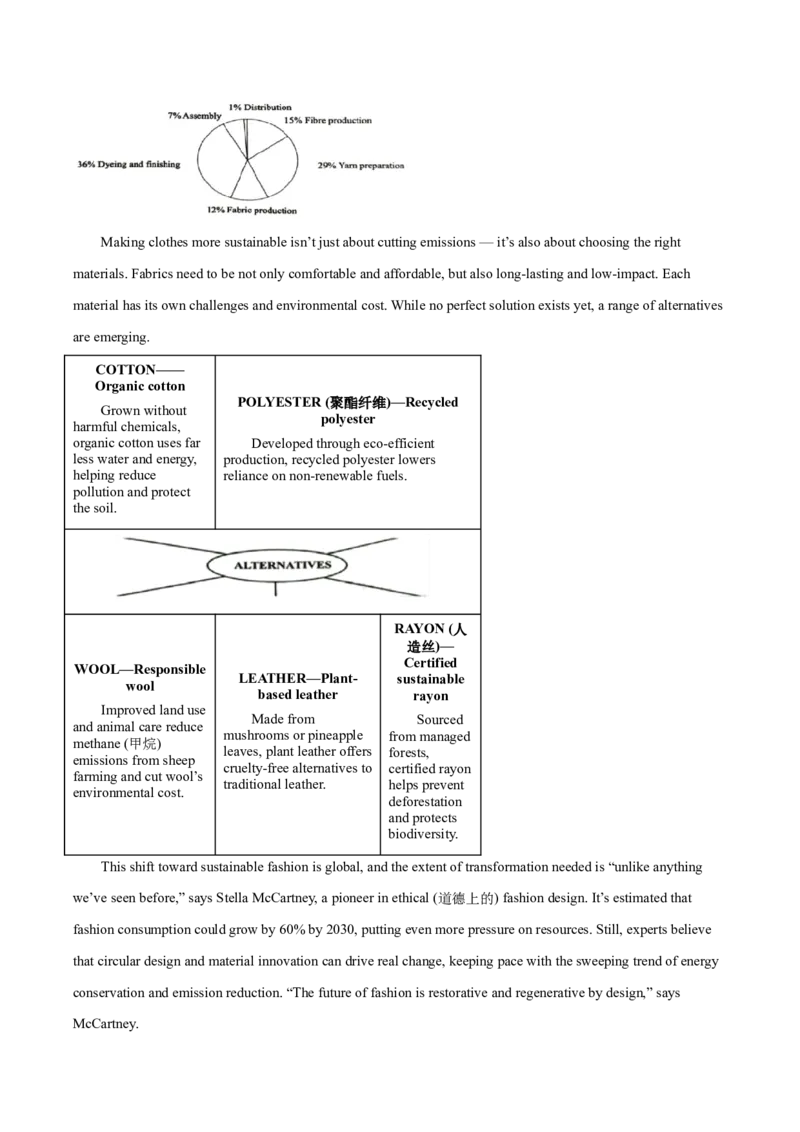
from energy-intensive industrial processes. Here’s a breakdown of the emissions in 2020 across different stages of
clothing production.Making clothes more sustainable isn’t just about cutting emissions — it’s also about choosing the right
materials. Fabrics need to be not only comfortable and affordable, but also long-lasting and low-impact. Each
material has its own challenges and environmental cost. While no perfect solution exists yet, a range of alternatives
are emerging.
COTTON——
Organic cotton
POLYESTER (聚酯纤维)—Recycled
Grown without
polyester
harmful chemicals,
organic cotton uses far Developed through eco-efficient
less water and energy, production, recycled polyester lowers
helping reduce reliance on non-renewable fuels.
pollution and protect
the soil.
RAYON (人
造丝)—
Certified
WOOL—Responsible
LEATHER—Plant- sustainable
wool
based leather rayon
Improved land use
Made from Sourced
and animal care reduce
mushrooms or pineapple from managed
methane (甲烷)
leaves, plant leather offers forests,
emissions from sheep
cruelty-free alternatives to certified rayon
farming and cut wool’s
traditional leather. helps prevent
environmental cost.
deforestation
and protects
biodiversity.
This shift toward sustainable fashion is global, and the extent of transformation needed is “unlike anything
we’ve seen before,” says Stella McCartney, a pioneer in ethical (道德上的) fashion design. It’s estimated that
fashion consumption could grow by 60% by 2030, putting even more pressure on resources. Still, experts believe
that circular design and material innovation can drive real change, keeping pace with the sweeping trend of energy
conservation and emission reduction. “The future of fashion is restorative and regenerative by design,” says
McCartney.21. Which stage released the least amount of greenhouse gases in 2020?
A. Fibre production. B. Yarn preparation. C. Fabric production. D. Distribution.
22. What do these alternatives have in common?
A. They help protect biodiversity.
B. They aim to lessen environmental impact.
C. They require less energy during production.
D. They could reduce the emission of harmful gases.
23. What does McCartney stress regarding the future of fashion?
A. It is to last and adapt.
B. It is to reduce resource usage.
C. It is to meet various needs.
D. It is to encourage consumption.
B
This spring break, my 12-year-old disabled son rode his first roller coaster. He had so much fun!
The roller coaster was the Slinky Dog Dash at Disney’s Hollywood Studios in Orlando, Florida. Disney World
is one of the only mainstream amusement parks that will let my son go on rides. He has cerebral palsy (脑瘫) and is
unable to sit independently. Because of his disabilities, most parks won’t let him go on their roller coasters.
The experience at Disney was special for my son, but also special for the rest of my family of five. Splitting up
(分开) is something we encounter daily. My son goes to a special school in a town 20 minutes from our home.
There are almost no activities he can enjoy at our local parks and recreation program, and he spends a few
afternoons a week in physical treatment.
We also divide and conquer when we are out in public. Many buildings have an accessible entrance that is
further away, so we split up to avoid dragging everyone around the back. The same goes for hunting for a vacant
elevator in a big building or a busy mall.
Accessible seating in theaters often only has room for one companion, so we sit in separate rows or further
apart from one another. On occasion, an entire building or part of a building is just completely inaccessible, so we
split up or pass on an activity we planned to enjoy because we literally can’t get everyone in the door.
Many people assume that tending to my son’s day-to-day needs is the hardest part of being his caregiver. But
finding resources and places that will include him is the real challenge. Disney World is one of the few, if not the
only place, where everyone in my family feels equally important. Now that my son has successfully ridden his first
roller coaster, I would love for him to go on the same types of rides at an amusement park in the local community,but I know it’s not an option. For now, anyway, I’m holding our recent experience close to my heart.
24. Why was the experience at Disney special for the author’s son?
A He was permitted to ride a roller coaster.
B. It was his first trip to an amusement park.
C. He was allowed to go on rides independently.
D. It was his first vacation with his entire family.
25. Which of the following best describes Disney World?
A. Romantic. B. Popular. C. Inclusive. D. Secure.
26. Why does the author mention theaters in the fifth paragraph?
A. To criticize the limited space of theaters.
B. To stress the importance of theaters to the disabled.
C. To complain about the lack of accessible seating in public.
D. To illustrate accessibility barriers in public that separate her family.
27. What does the author find most difficult when caring for her son?
A. Managing her son’s daily needs.
B. Balancing her son and the rest of her family.
C. Finding disability-friendly places and activities.
D. Persuading his son to fit into the local community.
C
Beneath California lie complex faults (断层)—places where large chunks of rock slide past, over, under, or
into one another. They move at the rate a fingernail grows until, eventually the ground shakes. Inevitably,
destructive earthquakes will rock the state. Nothing can be done to prevent them from striking, but understanding
where they are likely to happen means we can prepare.
In other words, the best way to mitigate these future disasters is to draw maps of the underworld, charting
every fault and monitoring its behavior. To create those maps, researchers employ seismometers (地震仪) on the
surface that sense earthquakes. Seismic waves are a bit like music. Identify their notes and rhythm changes, and
scientists can work out what underground instruments create them, where they lie, and how they behave upon
shakes.
When Ross, an assistant geophysics professor, started in the field in the early 2010s, he sought a new way
forward. He and his colleagues took seismic wave forms that human scientists had identified as genuine quakes.
Then he made templates (模板) of them. Finally, he set an algorithm (算法) upon the seismic record, one searchingfor tiny quakes that matched those templates. The algorithm quickly identified nearly two million previously
hidden tiny quakes in a duration of nearly 10 years.
However, this program could only find earthquakes in the seismic record that it was taught to recognize. Novel
seismic events went unnoticed. So Ross turned to more advanced tools: self-learning programs. Very quickly, these
programs found all sorts of unfamiliar-sounding quakes. AI multiplies and accelerates the capabilities of a single
scientist. It can process many seismic records at the same time, with great precision and in three dimensions faster
than any human could in the same amount of time. But for all their promise, AI programs won’t replace human
scientists. “They’re just tools,” Ross says— ones that in time will become as ordinary as seismometers
themselves.
28. What does the underlined word “mitigate” mean in paragraph 2?
A. Relieve. B. Prevent. C. Find. D. Sense.
29. What information can researchers obtain by analyzing seismic waves?
A. The distribution of underground rocks. B. The exact position of an earthquake.
C. The amount of underground water. D. The structure of some instruments.
30. What is paragraph 3 mainly about?
A. The new findings of quakes. B. The breakthrough of history.
C. The hidden way of measuring. D. The process of the research.
31. What might the author agree with about AI?
A. Multiple seismic records can be safely stored with AI.
B. AI is helpful in improving the efficiency of scientists.
C. Scientists can rely on AI to do independent research.
D. AI-related programs are free of human monitoring.
D
Do you ever find yourself randomly thinking back to the times we wandered, collecting wildflowers and
smiling beneath the sky? That feeling is often referred to as nostalgia (怀旧).
Psychologists have defined nostalgia as a self-conscious, social emotion, bittersweet but dominantly positive.
It comes from our happy memories and our desire to go back to the past and reconnect with the people we cared
about. Often, nostalgia involves sensory stimuli. On some occasions, the smell of autumn leaves might generate a
fierce longing for your childhood home. Almost everyone can experience nostalgia, although its object tends to
vary throughout life. One survey conducted by the psychologist Krystine Irene Batcho found that younger people
felt more nostalgia for pets, toys, and holidays than did older people, who felt it more strongly for music.In contrast to its links to negative emotions, nostalgia doesn’t make us sadder. Rather, nostalgia is a defensive
response to unhappiness, one that brings relief from a negative mood. Research from 2006 shows that nostalgia can
actually strengthen social ties, improve self-esteem, and uplift our mood. Other studies suggest that it can also
enhance our view of life’s meaning, reduce fear of death, boost spirituality, and increase optimism.
Scholars remain uncertain about the precise mechanism behind the effectiveness of nostalgia; however, some
suggest that reflecting on joyful memories strengthens our sense of self-worth and belonging, particularly during
times of loneliness or self-doubt. Its power lets the happiness of the past overcome the current unpleasantness,
offering a bit of escape from tough times. To form stronger connections, we can establish traditions around shared
past experiences in families, friend groups, and workplaces. Observing special occasions like childhood sports or
post-college meetups can give us something to look forward to.
Perhaps because it is so powerful and complex, nostalgia has received magical treatment from poets and
writers. “The past is hidden somewhere outside the realm (领域), beyond the reach of intellect,” Marcel Proust
wrote.
32. Why does the author mention “autumn leaves” in the second paragraph?
A. To illustrate the complexity of nostalgia.
B. To emphasize the joyful nature of nostalgia.
C. To clarify nostalgia’s connection to our senses.
D. To stress individual variety of experiencing nostalgia.
33. What is paragraph 3 mainly about?
A. The mismatch between two findings.
B. The potential benefits of nostalgia.
C. The impact of nostalgia on personal mood.
D. The mechanisms behind nostalgia’s effects.
34. What does the author suggest us do in paragraph 4?
A. Create shared traditions for bonding and joy. B. Record the social gatherings regularly.
C. Recognize the unnecessary social gatherings. D. Say no to the concept of escapism.
35. Which of the following is the best title for the text?
A. Nostalgia: Why We Should Avoid Reflecting on the Past
B. Nostalgia: A Shelter Against the Unhappiness of Our Life
C. A Nostalgia Warning: Our Mental Health Being Attacked
D. Power of Nostalgia: Struggling for an Irreplaceable Present第二部分 阅读(共两节,满分50分)
第一节(共15小题;每小题2.5分,满分37.5分)
阅读下列短文,从每题所给的A、B、C、D四个选项中选出最佳选项。
I am a child of traditional book reading. I used to go through one book continuously from beginning to end,
taking notes or highlighting lines before going on to the next book. It was a slow but deeper way to absorb a book.
___36___ My struggle with Dostoevsky’ s The Brothers Karamazov early on is a good example.
After college, my job involved reading a lot of background materials for projects. Many nights I stayed awake
till past midnight leafing through pages. ___37___ It helped me breeze through my reading requirements.
However, for books I was genuinely passionate about, I switched to a slower pace, and still read one book at a time.
___38___ I no longer stick to one book, but jump between them, spending about half an hour on each.
Currently, I’m reading six books in various stages, with more lined up to start soon. My speed reading skills help
me scan quickly without losing comprehension. I can easily switch to slow reading mode whenever needed.
Recently, I learnt from a journal that my previous reading method is known as “Blocked Practice”, which
involves studying one topic thoroughly before moving on to another. ___39___ However, it tends to restrict how
you apply knowledge in new and varied situations.
On the other hand, the “mixing it up” approach, also referred to as “Interleaved Practice”, could produce
dramatic, long-lasting learning benefits. By switching between topics, readers can make connections between ideas
and skills. ___40___ Over time, readers could be more capable of solving problems critically. If this is true, then
my evolution as a reader of books has been in the right direction all along.
A. It helps widen perspectives.
B. This method has its limitations.
C. That was when I took up speed reading.
D. I’m not great at trying out different reading styles.
E. That’s why it took me months to finish heavy books.
F. Nowadays I’ ve acquired the habit of multiple book reading.
G. This approach can be effective for mastering individual concepts.
第三部分 语言运用(共两节,满分30分)
第一节(共15小题;每小题1分,满分15分)
阅读下面短文,从每题所给的A、B、C、D四个选项中选出可以填入空白处的最佳选项。
A few years ago, I stood underneath a red overhanging cliff near my hometown, Carbondale, Colo. I was tied
in, ready to ____41____. I was attempting to do a route first try. It would have been a tough struggle for me tomanage hard climbs. What you need was ____42____. No interference.
____43____ I was about to climb, nerves in my body, which I hadn’t felt yet, said hello. That’s not good for
any athlete. ____44____, I painted a coat of confidence on my inner walls of doubt. I visualized myself at the top,
celebrating. “You can do this,” I ____45____ told myself. “If you believe, success is certain.”
It didn’t work. I fell near the top. Defeated, I laid myself ____46____ on the ground and realized with the
calmness I was seeking minutes earlier that the desire to climb the route had ____47____ me doing it.
At that moment, my self-worth was associated ____48____ my success or failure, and that ____49____ a
chain reaction: unnatural desire, pressure, performance anxiety, anticipation, a mind keen on the top but a body
____50____ below, bad decision-making, irregular movement, distraction, frustration. All in that order, too.
On a whim(灵机一动), I told myself that on my next attempt, success or failure was ____51____. “Make one
move at a time. That’s all.” It worked. I floated to the top with calmness and amazement.
That moment ____52____ me thinking. At some point, I explained this experience for myself in terms of
simple arithmetic(算术): When I added“determination, perseverance, ____53____, desire”, I failed. When I
____54____the desire for success, my body moved more smoothly and naturally. I improved. I enjoyed it more as
well, which, as a(n) ____55____ of 30 years, I didn’t think was possible. I discovered the power of subtraction(减
法).
41. A. dive B. jump C. climb D. slip
42. A. independence B. calmness C. courage D. praise
43. A. When B. Though C. While D. So
44. A. Anxious B. Desperate C. Dedicated D. Annoyed
45. A. silently B. secretly C. devotedly D. determinedly
46. A. flat B. deep C. plain D. straight
47. A. kept B. insisted C. prevented D. suggested
48. A. to B. on C. up D. with
49. A. give off B. give out C. set off D. set out
50. A. circling B. collapsing C. struggling D. shouting
51. A. irrelevant B. irregular C. unnatural D. unusual
52. A. had B. set C. made D. forced
53. A. self-respect B. self-control C. self-defense D. self-confidence
54. A. put away B. took away C. took off D. put off
55. A. athlete B. advisor C. climber D. writer第Ⅱ卷
第二节(共10小题;每小题1.5分,满分15分)
阅读下面短文,在空白处填入1个适当的单词或括号内单词的正确形式。
As the oldest umbrella in China, the oiled paper umbrella has been in use for over a thousand years and
____56____(perceive) as the living fossil of Chinese umbrella art nowadays. ____57____ (compose) of a bamboo
frame and a delicately painted paper surface, the oiled paper umbrella is a vivid symbol of China’s tradition of
____58____ (culture) craftsmanship and poetic beauty.
According to the legend, the umbrella was first invented by Yun, the wife of Lu Ban. Back in the late Spring
and Autumn period, Lu Ban, ____59____ famous carpenter in ancient China, used to work in the field so Yun
wanted to make something to keep out the rain. It was not until the Tang and Song dynasties ____60____ oiled
paper umbrellas became widely used. After the ____61____ (appear) of modern mechanical umbrellas, traditional
oil-paper umbrellas suffered from declining sales.
As China’s intangible cultural heritage, the oil paper umbrella has a rich cultural significance in its own right,
in addition to serving ____62____ a shelter from the wind and rain. The process of making oil paper umbrellas is
particularly complex, ____63____ is said to be twenty-seven and a half steps. The employment of tung oil (桐油)
is ____64____ (keep) away evil spirits. Its elegant and heavenly beauty speaks volumes about the gentleness and
charm of classical Chinese beauty to the ____65____ (full).
第四部分 写作(满分40分)
第一节(满分15分)
66. 假定你是校学生会主席李华,你打算邀请外教Jenny做一次讲座,帮同学们解决英语写作方面的困难。
请给Jenny写一封邮件,内容包括:
1.讲座的具体内容;
2.其他相关事项。
注意:
1.写作词数应为80个左右;
2.请按如下格式在答题卡的相应位置作答。
Dear Jenny,
____________________________________________________________________________________________
____________________________________________________________________________________________
________________________________________________________________________________________________________________________________________________________________________________________
____________________________________________________________________________________________
____________________________________________________________________________________________
Yours,
Li Hua
第二节(满分25分)
67. 阅读下面材料,根据其内容和所给段落开头语续写两段,使之构成一篇完整的短文。
The school year was coming to a close, and the air was filled with anticipation for the upcoming annual school
fair. Our class had eagerly decided to host a bake sale, with each student ready to contribute their favorite recipes.
Spirits were high. Every spare moment was devoted to perfecting the art of baking, from experimenting with
different flavors to mastering the art of cake decorations. Our classroom became a hub of activity, filled with the
sweet scent of freshly baked goods and the sound of laughter and chatter.
The day of the fair finally arrived, and our table was beautifully decorated with a mouthwatering baked goods.
There were freshly baked chocolate chip cookies, warm and crispy, alongside homemade fruit pies. The attractive
scent was irresistible, and it wasn't long before a long line of students and parents formed, their eyes gleaming with
satisfaction.
However, as the morning wore on, we couldn't help but notice that the neighboring class’s booth (摊位) was
appealing to a significantly larger crowd. There was a buzz of excitement surrounding their table, and it was clear
that they were onto something special.
Among our class, a sense of healthy competition began to emerge. Sarah, our natural leader, suggested we step
up our game. “We need to find out what they're doing differently and improve our booth,” she said with
determination. Out of curiosity, we sent our most inquisitive member, Mark, to investigate.
Soon, Mark returned with good news. “They've got a ‘Taste of the World’ theme going on over there,” Mark
reported. “They’re serving up a variety of international desserts, and it’s quite the hit!”
We were intrigued by the idea and asked Mark for more details. He went on to explain that the students had
gone the extra mile by dressing up in traditional costumes from the countries they were representing. “It's like a
cultural feast for the senses,” he added with enthusiasm.
注意:
1. 续写词数应为 150 左右;
2. 请按如下格式在答题卡的相应位置作答。
Inspired by their creativity, we began to brainstorm ways to enhance our own booth.____________________________________________________________________________________________
____________________________________________________________________________________________
____________________________________________________________________________________________
____________________________________________________________________________________________
_______________________________________________________________________________________
As the day drew to a close, it was clear that our efforts had finally paid off.
____________________________________________________________________________________________
____________________________________________________________________________________________
____________________________________________________________________________________________
____________________________________________________________________________________________
_______________________________________________________________________________________答案版
高三年级 10 月份阶段性检测英语
本试卷分为第Ⅰ卷(选择题)和第Ⅱ卷(非选择题)两部分,共150分,考试用时120分钟。
注意事项:
1.答卷前,考生务必将自己的姓名、准考证号填写在答题卡上。
2.回答选择题时,选出每小题答案后,用2B铅笔把答题卡上对应题目的答案标号涂黑。如需
改动,用橡皮擦干净后,再选涂其它答案标号。回答非选择题时,将答案写在答题卡上。写
在本试卷上无效。
3.考试结束后,将本试卷和答题卡一并交回。
第Ⅰ卷
第一部分 听力(共两节,满分30分)
做题时,先将答案标在试卷上。录音内容结束后,你将有两分钟的时间将试卷上的答案转涂
到答题卡上。
第一节(共5小题;每小题1.5分,满分7.5分)
听下面5段对话。每段对话后有一个小题,从题中所给的A、B、C三个选项中选出最佳选项。
听完每段对话后,你都有10秒钟的时间来回答有关小题和阅读下一小题。每段对话仅读一遍。
1. What does the woman suggest doing at the moment?
A. Taking a taxi. B. Calling the mechanic. C. Driving to the cinema.
【答案】A
【原文】A: Oh, no. The car won’t start again. This is the third time this week. I think the engine needs serious
attention.
B: You should get it checked by a mechanic tomorrow. Let’s not waste time. How about taking a taxi to the
cinema?
A: That sounds like a good idea.2. What will the speakers do tomorrow?
A. Go to the beach. B. Stay at home. C. Do some shopping.
【答案】A
【原文】A: The weather forecast says it will be sunny tomorrow. Shall we go to the beach? We haven’t been there
for a long time.
B: Sure. Let’s prepare some food at home tonight, so we can leave early in the morning.
A: What about ordering some food online? I’m too tired to make food today.
3. Who will Sarah stay with tomorrow?
A. The man. B. Christina. C. Her grandparents.
【答案】C
【原文】A: Sarah, are you going to see Christina with us tomorrow?
B: I’d love to, but I promised my grandparents I’d visit them this weekend.
A: Oh that’s sweet of you. Maybe next time.
4. How does the man find Jack?
A. He lacks related experience.
B. He isn’t a good team player.
C. He doesn’t have technical skills.
【答案】A
【原文】A: So what do you think about Jack for the team leader position?
B: Well he’s very skilled technically and gets along well with others. But I’m not sure if he has enough experience.
A: Hmm I see your point.
B: Maybe we should assign him a smaller project first to see how he performs.
A: That’s probably a good idea.
5. When does the yoga class begin?
A At 2:40. B. At 3:00. C. At 3:20.
【答案】B
【原文】A: Hi is this where the Yoga class takes place.?
B: Yes you’re in the right spot. But it starts in about twenty minutes. You’re a bit early.
A: Oh, yes. It’s only twenty to three now.
B: I’ll just go grab a drink and come back.
A: Good idea.
第二节(共15小题;每小题1.5分,满分22.5分)听下面5段对话或独白。每段对话或独白后有几个小题,从题中所给的A、B、C三个选项中
选出最佳选项。听每段对话或独白前,你将有时间阅读各个小题,每小题5秒钟;听完后,各
小题将给出5秒钟的作答时间。每段对话或独白读两遍。
听一段材料,回答以下小题。
6. Why does the man talk to the woman?
A. To make a suggestion.
B. To remind her of a deadline.
C. To check on an arrangement.
7. What will the woman probably do next?
A. Call a client. B. Send an email. C. Rearrange the schedule.
【答案】6. C 7. B
【原文】A: Susan, we have the final presentation with the client on Friday afternoon. Have you received the
updated schedule?
B: Yes, David. We’re meeting them at three pm, right?
A: Correct. But it’s no longer in Conference Room A. Now it’s in Room C.
B: Got it. I’ll make sure our team knows. Anything else?
A: Could you please send them a quick email now? Just to double check if the time still works for them.
B: Sure. I’ll handle that right away.
听一段材料,回答以下小题。
8. Why did the woman visit Sarah?
A. To discuss a project.
B. To put forward a proposal.
C. To show concern for her health.
9. What is the man going to do tomorrow?
A. Chair a meeting. B. Send Sarah flowers. C. Take over Sarah’s duty.
10. What is the relationship between the speakers?
A. Neighbors. B. Classmates. C. Workmates.
【答案】8. C 9. B 10. C
【原文】A: Hi, John. Sorry, I’m late. I just came back from Sarah’s.
B: Oh, how is she doing? I heard she hasn’t been feeling well lately.
A: That’s why I went to see her. She’s recovering, but she’s still feeling a bit weak.
B: Well. I’m glad she’s getting better. Did you stay for long?A: No, I didn’t. I just dropped off some soup and had a quick chat. I have to prepare for the important meeting with
the client tomorrow morning.
B: The one about our new marketing proposal?
A: Yes. I need to finalize the presentation tonight. I think Sarah would have led the discussion if she were here. But
I’LL have to take over for her.
B: That makes sense by the way I am going to see Sarah tomorrow. Do you think sending her some flowers would
be a good idea?
A: That’s nice. You’re so thoughtful.
听一段材料,回答以下小题。
11. What did the woman say about playing the guitar?
A. It helped her make friends.
B. It inspired her to learn music.
C. It made her feel more relaxed.
12. Why did the man decide to learn the violin?
A. To follow his classmates.
B. To please his grandfather.
C. To pursue his interest in it.
13. What do we know about the woman?
A. She takes music as a career.
B. She prefers rock music now.
C. She regrets choosing the violin.
【答案】11. A 12. C 13. A
【原文】A: Lisa, did you grow up learning to play any instruments?
B: Yes. I started learning the guitar when I was eleven. I just moved to a new school and didn’t know anyone.
Joining the school band seemed like a nice way to make friends and they happened to need someone to play the
guitar. What about you?
A: I’ve been learning the violin since I was six. My grandfather used to take me to classical music concerts and I
was so inspired that I begged my parents to let me start lessons.
B: That’s great. Do you still play now?
A: I do. But I wish I’d practiced more back then. Instead I spent a lot of time hanging out at the park with my
friends.B: I can understand that for me playing the guitar is more about teaching now.
A: I see. For me I don’t regret choosing the violin, especially since most kids I knew at the time were more into
rock music.
听一段材料,回答以下小题。
14. What is the woman doing?
A. Evaluating an artist. B. Interviewing an artist.
C. Learning from an artist.
15. What inspired the man’s latest artwork collection?
A. His travel experiences. B. The appeal of city life.
C. His childhood memories.
16. Which two techniques did the man combine in his collection?
A. Oil painting and sketching.
B. Watercolor and oil painting.
C. Watercolor and digital editing.
17. Why is the man planning to teach workshops?
A. To promote his projects.
B. To repay the community.
C. To improve his techniques.
【答案】14. B 15. A 16. C 17. B
【原文】A: Daniel, congratulations on your recent exhibition. It must have been exciting to exhibit your artwork
in a public gallery in New York.
B: Thanks, Emma. It was indeed a wonderful experience. It’s always amazing to see how people interpret my art.
A: Could you tell us audience what inspired your latest collection?
B: Sure. Most of the pieces were inspired by my travels to small coastal towns. I wanted to express the simplicity
and appeal of life there. However, I also added some abstract elements to make it more interesting.
A: I noticed that you experimented with new techniques in this collection. Why was that?
B: I’ve always been interested in pushing boundaries. This time I combined watercolor and digital editing to create
a layered effect. It was tough but worth it.
A: What’s next for you? Another exhibition perhaps?
B: Not immediately. I want to take some time to teach a few workshops and share what I’ve learned over the years.
It’s a way of giving back to the community.
听一段独白,回答以下小题。18. What has Grace been doing for the past ten years?
A. Promoting fishing.
B. Creating international programs.
C. Engaging in ecological conservation.
19. What does Grace think is most essential in her work?
A. Good partnership. B. Scientific research. C. Advanced technology.
20. What will Grace do after her presentation?
A. Display her program.
B. Answer some questions.
C. Introduce new techniques.
【答案】18. C 19. A 20. B
【原文】Good evening, everyone. My name is Grace Collins and I’m excited to share my experiences with you
tonight. For the past ten years, I’ve worked to protect and restore natural ecosystems particularly in a small island
nation in the Pacific. One of my proudest projects was creating a community program where local fishermen could
work together to monitor and protect the environment. These partnerships have shown me that successful
conservation isn’t just about using the latest tools or technologies. It’s about building trust, respecting local
traditions and finding ways to solve problems together. I’ve learned so much from the people. I’ve worked with and
their knowledge has been key to bringing real change. Later in my talk, I’ll introduce some new techniques. We’ve
recently developed to help speed up restoration efforts but first I’d like to tell you more about the work we did and
what we learned along the way. After my presentation, I’d be happy to take any questions.
第二部分 阅读(共两节,满分50分)
第一节(共15小题;每小题2.5分,满分37.5分)
阅读下列短文,从每题所给的A、B、C、D四个选项中选出最佳选项。
A
Producing and consuming clothing is a major source of global CO emissions (排放). From growing cotton to
2
dyeing (染色) fabrics, every step in the clothing supply chain leaves a carbon footprint. Much of the impact comes
from energy-intensive industrial processes. Here’s a breakdown of the emissions in 2020 across different stages of
clothing production.Making clothes more sustainable isn’t just about cutting emissions — it’s also about choosing the right
materials. Fabrics need to be not only comfortable and affordable, but also long-lasting and low-impact. Each
material has its own challenges and environmental cost. While no perfect solution exists yet, a range of alternatives
are emerging.
COTTON——
Organic cotton
POLYESTER (聚酯纤维)—Recycled
Grown without
polyester
harmful chemicals,
organic cotton uses far Developed through eco-efficient
less water and energy, production, recycled polyester lowers
helping reduce reliance on non-renewable fuels.
pollution and protect
the soil.
RAYON (人
造丝)—
Certified
WOOL—Responsible
LEATHER—Plant- sustainable
wool
based leather rayon
Improved land use
Made from Sourced
and animal care reduce
mushrooms or pineapple from managed
methane (甲烷)
leaves, plant leather offers forests,
emissions from sheep
cruelty-free alternatives to certified rayon
farming and cut wool’s
traditional leather. helps prevent
environmental cost.
deforestation
and protects
biodiversity.
This shift toward sustainable fashion is global, and the extent of transformation needed is “unlike anything
we’ve seen before,” says Stella McCartney, a pioneer in ethical (道德上的) fashion design. It’s estimated that
fashion consumption could grow by 60% by 2030, putting even more pressure on resources. Still, experts believe
that circular design and material innovation can drive real change, keeping pace with the sweeping trend of energy
conservation and emission reduction. “The future of fashion is restorative and regenerative by design,” says
McCartney.21. Which stage released the least amount of greenhouse gases in 2020?
A. Fibre production. B. Yarn preparation. C. Fabric production. D. Distribution.
22. What do these alternatives have in common?
A. They help protect biodiversity.
B. They aim to lessen environmental impact.
C. They require less energy during production.
D. They could reduce the emission of harmful gases.
23. What does McCartney stress regarding the future of fashion?
A. It is to last and adapt.
B. It is to reduce resource usage.
C. It is to meet various needs.
D. It is to encourage consumption.
【答案】21. D 22. B 23. A
B
This spring break, my 12-year-old disabled son rode his first roller coaster. He had so much fun!
The roller coaster was the Slinky Dog Dash at Disney’s Hollywood Studios in Orlando, Florida. Disney World
is one of the only mainstream amusement parks that will let my son go on rides. He has cerebral palsy (脑瘫) and is
unable to sit independently. Because of his disabilities, most parks won’t let him go on their roller coasters.
The experience at Disney was special for my son, but also special for the rest of my family of five. Splitting up
(分开) is something we encounter daily. My son goes to a special school in a town 20 minutes from our home.
There are almost no activities he can enjoy at our local parks and recreation program, and he spends a few
afternoons a week in physical treatment.
We also divide and conquer when we are out in public. Many buildings have an accessible entrance that is
further away, so we split up to avoid dragging everyone around the back. The same goes for hunting for a vacant
elevator in a big building or a busy mall.
Accessible seating in theaters often only has room for one companion, so we sit in separate rows or further
apart from one another. On occasion, an entire building or part of a building is just completely inaccessible, so we
split up or pass on an activity we planned to enjoy because we literally can’t get everyone in the door.
Many people assume that tending to my son’s day-to-day needs is the hardest part of being his caregiver. But
finding resources and places that will include him is the real challenge. Disney World is one of the few, if not the
only place, where everyone in my family feels equally important. Now that my son has successfully ridden his firstroller coaster, I would love for him to go on the same types of rides at an amusement park in the local community,
but I know it’s not an option. For now, anyway, I’m holding our recent experience close to my heart.
24. Why was the experience at Disney special for the author’s son?
A He was permitted to ride a roller coaster.
B. It was his first trip to an amusement park.
C. He was allowed to go on rides independently.
D. It was his first vacation with his entire family.
25. Which of the following best describes Disney World?
A. Romantic. B. Popular. C. Inclusive. D. Secure.
26. Why does the author mention theaters in the fifth paragraph?
A. To criticize the limited space of theaters.
B. To stress the importance of theaters to the disabled.
C. To complain about the lack of accessible seating in public.
D. To illustrate accessibility barriers in public that separate her family.
27. What does the author find most difficult when caring for her son?
A. Managing her son’s daily needs.
B. Balancing her son and the rest of her family.
C. Finding disability-friendly places and activities.
D. Persuading his son to fit into the local community.
【答案】24. A 25. C 26. D 27. C
C
Beneath California lie complex faults (断层)—places where large chunks of rock slide past, over, under, or
into one another. They move at the rate a fingernail grows until, eventually the ground shakes. Inevitably,
destructive earthquakes will rock the state. Nothing can be done to prevent them from striking, but understanding
where they are likely to happen means we can prepare.
In other words, the best way to mitigate these future disasters is to draw maps of the underworld, charting
every fault and monitoring its behavior. To create those maps, researchers employ seismometers (地震仪) on the
surface that sense earthquakes. Seismic waves are a bit like music. Identify their notes and rhythm changes, and
scientists can work out what underground instruments create them, where they lie, and how they behave upon
shakes.
When Ross, an assistant geophysics professor, started in the field in the early 2010s, he sought a new wayforward. He and his colleagues took seismic wave forms that human scientists had identified as genuine quakes.
Then he made templates (模板) of them. Finally, he set an algorithm (算法) upon the seismic record, one searching
for tiny quakes that matched those templates. The algorithm quickly identified nearly two million previously
hidden tiny quakes in a duration of nearly 10 years.
However, this program could only find earthquakes in the seismic record that it was taught to recognize. Novel
seismic events went unnoticed. So Ross turned to more advanced tools: self-learning programs. Very quickly, these
programs found all sorts of unfamiliar-sounding quakes. AI multiplies and accelerates the capabilities of a single
scientist. It can process many seismic records at the same time, with great precision and in three dimensions faster
than any human could in the same amount of time. But for all their promise, AI programs won’t replace human
scientists. “They’re just tools,” Ross says— ones that in time will become as ordinary as seismometers
themselves.
28. What does the underlined word “mitigate” mean in paragraph 2?
A. Relieve. B. Prevent. C. Find. D. Sense.
29. What information can researchers obtain by analyzing seismic waves?
A. The distribution of underground rocks. B. The exact position of an earthquake.
C. The amount of underground water. D. The structure of some instruments.
30. What is paragraph 3 mainly about?
A. The new findings of quakes. B. The breakthrough of history.
C. The hidden way of measuring. D. The process of the research.
31. What might the author agree with about AI?
A. Multiple seismic records can be safely stored with AI.
B. AI is helpful in improving the efficiency of scientists.
C. Scientists can rely on AI to do independent research.
D. AI-related programs are free of human monitoring.
【答案】28. A 29. A 30. D 31. B
D
Do you ever find yourself randomly thinking back to the times we wandered, collecting wildflowers and
smiling beneath the sky? That feeling is often referred to as nostalgia (怀旧).
Psychologists have defined nostalgia as a self-conscious, social emotion, bittersweet but dominantly positive.
It comes from our happy memories and our desire to go back to the past and reconnect with the people we cared
about. Often, nostalgia involves sensory stimuli. On some occasions, the smell of autumn leaves might generate afierce longing for your childhood home. Almost everyone can experience nostalgia, although its object tends to
vary throughout life. One survey conducted by the psychologist Krystine Irene Batcho found that younger people
felt more nostalgia for pets, toys, and holidays than did older people, who felt it more strongly for music.
In contrast to its links to negative emotions, nostalgia doesn’t make us sadder. Rather, nostalgia is a defensive
response to unhappiness, one that brings relief from a negative mood. Research from 2006 shows that nostalgia can
actually strengthen social ties, improve self-esteem, and uplift our mood. Other studies suggest that it can also
enhance our view of life’s meaning, reduce fear of death, boost spirituality, and increase optimism.
Scholars remain uncertain about the precise mechanism behind the effectiveness of nostalgia; however, some
suggest that reflecting on joyful memories strengthens our sense of self-worth and belonging, particularly during
times of loneliness or self-doubt. Its power lets the happiness of the past overcome the current unpleasantness,
offering a bit of escape from tough times. To form stronger connections, we can establish traditions around shared
past experiences in families, friend groups, and workplaces. Observing special occasions like childhood sports or
post-college meetups can give us something to look forward to.
Perhaps because it is so powerful and complex, nostalgia has received magical treatment from poets and
writers. “The past is hidden somewhere outside the realm (领域), beyond the reach of intellect,” Marcel Proust
wrote.
32. Why does the author mention “autumn leaves” in the second paragraph?
A. To illustrate the complexity of nostalgia.
B. To emphasize the joyful nature of nostalgia.
C. To clarify nostalgia’s connection to our senses.
D. To stress individual variety of experiencing nostalgia.
33. What is paragraph 3 mainly about?
A. The mismatch between two findings.
B. The potential benefits of nostalgia.
C. The impact of nostalgia on personal mood.
D. The mechanisms behind nostalgia’s effects.
34. What does the author suggest us do in paragraph 4?
A. Create shared traditions for bonding and joy. B. Record the social gatherings regularly.
C. Recognize the unnecessary social gatherings. D. Say no to the concept of escapism.
35. Which of the following is the best title for the text?
A. Nostalgia: Why We Should Avoid Reflecting on the PastB. Nostalgia: A Shelter Against the Unhappiness of Our Life
C. A Nostalgia Warning: Our Mental Health Being Attacked
D. Power of Nostalgia: Struggling for an Irreplaceable Present
【答案】32. C 33. B 34. A 35. B
第二部分 阅读(共两节,满分50分)
第一节(共15小题;每小题2.5分,满分37.5分)
阅读下列短文,从每题所给的A、B、C、D四个选项中选出最佳选项。
I am a child of traditional book reading. I used to go through one book continuously from beginning to end,
taking notes or highlighting lines before going on to the next book. It was a slow but deeper way to absorb a book.
___36___ My struggle with Dostoevsky’ s The Brothers Karamazov early on is a good example.
After college, my job involved reading a lot of background materials for projects. Many nights I stayed awake
till past midnight leafing through pages. ___37___ It helped me breeze through my reading requirements.
However, for books I was genuinely passionate about, I switched to a slower pace, and still read one book at a time.
___38___ I no longer stick to one book, but jump between them, spending about half an hour on each.
Currently, I’m reading six books in various stages, with more lined up to start soon. My speed reading skills help
me scan quickly without losing comprehension. I can easily switch to slow reading mode whenever needed.
Recently, I learnt from a journal that my previous reading method is known as “Blocked Practice”, which
involves studying one topic thoroughly before moving on to another. ___39___ However, it tends to restrict how
you apply knowledge in new and varied situations.
On the other hand, the “mixing it up” approach, also referred to as “Interleaved Practice”, could produce
dramatic, long-lasting learning benefits. By switching between topics, readers can make connections between ideas
and skills. ___40___ Over time, readers could be more capable of solving problems critically. If this is true, then
my evolution as a reader of books has been in the right direction all along.
A. It helps widen perspectives.
B. This method has its limitations.
C. That was when I took up speed reading.
D. I’m not great at trying out different reading styles.
E. That’s why it took me months to finish heavy books.
F. Nowadays I’ ve acquired the habit of multiple book reading.
G. This approach can be effective for mastering individual concepts.
【答案】36. E 37. C 38. F 39. G 40. A第三部分 语言运用(共两节,满分30分)
第一节(共15小题;每小题1分,满分15分)
阅读下面短文,从每题所给的A、B、C、D四个选项中选出可以填入空白处的最佳选项。
A few years ago, I stood underneath a red overhanging cliff near my hometown, Carbondale, Colo. I was tied
in, ready to ____41____. I was attempting to do a route first try. It would have been a tough struggle for me to
manage hard climbs. What you need was ____42____. No interference.
____43____ I was about to climb, nerves in my body, which I hadn’t felt yet, said hello. That’s not good for
any athlete. ____44____, I painted a coat of confidence on my inner walls of doubt. I visualized myself at the top,
celebrating. “You can do this,” I ____45____ told myself. “If you believe, success is certain.”
It didn’t work. I fell near the top. Defeated, I laid myself ____46____ on the ground and realized with the
calmness I was seeking minutes earlier that the desire to climb the route had ____47____ me doing it.
At that moment, my self-worth was associated ____48____ my success or failure, and that ____49____ a
chain reaction: unnatural desire, pressure, performance anxiety, anticipation, a mind keen on the top but a body
____50____ below, bad decision-making, irregular movement, distraction, frustration. All in that order, too.
On a whim(灵机一动), I told myself that on my next attempt, success or failure was ____51____. “Make one
move at a time. That’s all.” It worked. I floated to the top with calmness and amazement.
That moment ____52____ me thinking. At some point, I explained this experience for myself in terms of
simple arithmetic(算术): When I added“determination, perseverance, ____53____, desire”, I failed. When I
____54____the desire for success, my body moved more smoothly and naturally. I improved. I enjoyed it more as
well, which, as a(n) ____55____ of 30 years, I didn’t think was possible. I discovered the power of subtraction(减
法).
41. A. dive B. jump C. climb D. slip
42. A. independence B. calmness C. courage D. praise
43. A. When B. Though C. While D. So
44. A. Anxious B. Desperate C. Dedicated D. Annoyed
45. A. silently B. secretly C. devotedly D. determinedly
46. A. flat B. deep C. plain D. straight
47. A. kept B. insisted C. prevented D. suggested
48. A. to B. on C. up D. with
49. A. give off B. give out C. set off D. set out
50. A. circling B. collapsing C. struggling D. shouting51. A. irrelevant B. irregular C. unnatural D. unusual
52. A. had B. set C. made D. forced
53. A. self-respect B. self-control C. self-defense D. self-confidence
54. A. put away B. took away C. took off D. put off
55. A. athlete B. advisor C. climber D. writer
【答案】41. C 42. B 43. A 44. B 45. D 46. A 47. C 48. D 49. C 50. C 51. A 52. B 53. D
54. B 55. A
第Ⅱ卷
第二节(共10小题;每小题1.5分,满分15分)
阅读下面短文,在空白处填入1个适当的单词或括号内单词的正确形式。
As the oldest umbrella in China, the oiled paper umbrella has been in use for over a thousand years and
____56____(perceive) as the living fossil of Chinese umbrella art nowadays. ____57____ (compose) of a bamboo
frame and a delicately painted paper surface, the oiled paper umbrella is a vivid symbol of China’s tradition of
____58____ (culture) craftsmanship and poetic beauty.
According to the legend, the umbrella was first invented by Yun, the wife of Lu Ban. Back in the late Spring
and Autumn period, Lu Ban, ____59____ famous carpenter in ancient China, used to work in the field so Yun
wanted to make something to keep out the rain. It was not until the Tang and Song dynasties ____60____ oiled
paper umbrellas became widely used. After the ____61____ (appear) of modern mechanical umbrellas, traditional
oil-paper umbrellas suffered from declining sales.
As China’s intangible cultural heritage, the oil paper umbrella has a rich cultural significance in its own right,
in addition to serving ____62____ a shelter from the wind and rain. The process of making oil paper umbrellas is
particularly complex, ____63____ is said to be twenty-seven and a half steps. The employment of tung oil (桐油)
is ____64____ (keep) away evil spirits. Its elegant and heavenly beauty speaks volumes about the gentleness and
charm of classical Chinese beauty to the ____65____ (full).
【答案】56. is perceived
57. Composed
58. cultural
59. a 60. that
61. appearance
62. as 63. which
64. to keep65. fullest
第四部分 写作(满分40分)
第一节(满分15分)
66. 假定你是校学生会主席李华,你打算邀请外教Jenny做一次讲座,帮同学们解决英语写作方面的困难。
请给Jenny写一封邮件,内容包括:
1.讲座的具体内容;
2.其他相关事项。
注意:
1.写作词数应为80个左右;
2.请按如下格式在答题卡的相应位置作答。
Dear Jenny,
____________________________________________________________________________________________
____________________________________________________________________________________________
____________________________________________________________________________________________
____________________________________________________________________________________________
____________________________________________________________________________________________
____________________________________________________________________________________________
Yours,
Li Hua
【答案】例文
Dear Jenny,
I’m writing to extend my heartfelt invitation to you to deliver a lecture on English writing next week
Many students are struggling with their English writing, so they are eager to receive expert guidance from you.
The most difficult part for them is how to organize sentences in a correct and advanced way. Would you please give
us some suggestions on how to connect sentences logically? We’d also like to know the common mistakes Chinese
students often make in their writing so that we can avoid using them in the future.
The lecture is scheduled to take place next Wednesday from 6 p.m. to 8 p.m. in the school hall. I would be
grateful if you could accept my invitation.
Yours,
Li Hua
第二节(满分25分)67. 阅读下面材料,根据其内容和所给段落开头语续写两段,使之构成一篇完整的短文。
The school year was coming to a close, and the air was filled with anticipation for the upcoming annual school
fair. Our class had eagerly decided to host a bake sale, with each student ready to contribute their favorite recipes.
Spirits were high. Every spare moment was devoted to perfecting the art of baking, from experimenting with
different flavors to mastering the art of cake decorations. Our classroom became a hub of activity, filled with the
sweet scent of freshly baked goods and the sound of laughter and chatter.
The day of the fair finally arrived, and our table was beautifully decorated with a mouthwatering baked goods.
There were freshly baked chocolate chip cookies, warm and crispy, alongside homemade fruit pies. The attractive
scent was irresistible, and it wasn't long before a long line of students and parents formed, their eyes gleaming with
satisfaction.
However, as the morning wore on, we couldn't help but notice that the neighboring class’s booth (摊位) was
appealing to a significantly larger crowd. There was a buzz of excitement surrounding their table, and it was clear
that they were onto something special.
Among our class, a sense of healthy competition began to emerge. Sarah, our natural leader, suggested we step
up our game. “We need to find out what they're doing differently and improve our booth,” she said with
determination. Out of curiosity, we sent our most inquisitive member, Mark, to investigate.
Soon, Mark returned with good news. “They've got a ‘Taste of the World’ theme going on over there,” Mark
reported. “They’re serving up a variety of international desserts, and it’s quite the hit!”
We were intrigued by the idea and asked Mark for more details. He went on to explain that the students had
gone the extra mile by dressing up in traditional costumes from the countries they were representing. “It's like a
cultural feast for the senses,” he added with enthusiasm.
注意:
1. 续写词数应为 150 左右;
2. 请按如下格式在答题卡的相应位置作答。
Inspired by their creativity, we began to brainstorm ways to enhance our own booth.
____________________________________________________________________________________________
____________________________________________________________________________________________
____________________________________________________________________________________________
____________________________________________________________________________________________
_______________________________________________________________________________________
As the day drew to a close, it was clear that our efforts had finally paid off.____________________________________________________________________________________________
____________________________________________________________________________________________
____________________________________________________________________________________________
____________________________________________________________________________________________
_______________________________________________________________________________________
【答案】Inspired by their creativity, we began to brainstorm ways to enhance our own booth. After a heated
discussion, we decided to adopt a similar theme, but with a unique twist. Our booth would become a 'Tour of
Sweets: A Journey Through Time'. Each member would present a historical sweet from a different era, ranging
from ancient civilizations to modern innovations. We worked tirelessly to prepare for the transformation. Our booth
was adorned with ancient Egyptian decorations for the earliest known desserts, and Renaissance-style tablecloths
for the sweets of that period. We even set up a small 'time machine' prop to add to the immersive experience. As the
visitors approached, they were not just purchasing desserts, but taking a trip through the history of sweetness.
As the day drew to a close, it was clear that our efforts had paid off. The crowd at our booth was just as large
as the neighboring one, with people lining up to experience our unique take on the 'Taste of the World' theme. We
received countless compliments on our creativity and the effort we put into making our booth a memorable
experience. The fair concluded with a sense of pride and accomplishment. Not only had we matched our
competitors in popularity, but we had also learned the power of innovation and teamwork. The bake sale was a
sweet success that we would remember for years to come.