2025~2026学年12月七校联合学情调研
高三英语
第一部分 听力 (共两节,满分30分)
第一节(共5小题;每小题1.5分,满分7.5分)
请听下面5段对话。每段对话后有一个小题, 从题中所给的A、B、C三个选项中选出最佳选项。听完
每段对话后, 你都有10秒钟的时间来回答有关小题和阅读下一小题。每段对话仅读一遍。
1. What has the woman finished doing?
A. Choosing her major.
B. Working on the computer.
C. Sending her application form.
2. What will the man buy?
A. A bag. B. A laptop. C. A suitcase.
3. When will the man check out?
A. On the 16th. B. On the 17th. C. On the 18th.
4. What are the speakers mainly talking about?
A. Going on vacation. B. Dealing with sensitivities. C. Looking after the pet.
5. What will the man probably do for the woman?
A. Clean the table. B. Help with her report. C. Carry the shopping.
第二节(共15小题;每小题1.5分,满分22.5分)
听下面5段对话或独白。每段对话或独白后有几个小题,从题中所给的A、B、C三个选项中选出最佳
选项。听每段对话或独白前,你将有时间阅读各个小题,每小题 5秒钟;听完后,各小题将给出5秒钟的
作答时间。每段对话或独白读两遍。
听第6段材料,回答第6、7题。
6. What did Barbara begin to do two months ago?
A. Do the gardening.
B. Tidy the bedrooms.
C. Decorate the living room.
7. Who might Brian be?
A. Barbara’s neighbor. B. Barbara’s husband. C. Barbara’s gardener.
听第 7 段材料,回答第 8 至 10 题。
8. When does the conversation take place?
A. Before ordering. B. During a meal. C. After a meal.
9. What do we know about the restaurant?
A. It has a new location.
B. It has a nice environment.
C. It is short-staffed today.
10. What do the speakers decide to do?
A. Report service issues.
B. Complain about the manager.
C. Team up with other diners.听第 8 段材料,回答第 11 至 13 题。
11. What is the woman curious about?
A. What life coaches do.
B. Why Mel does the qualification.
C. How permanent changes are made.
12. What does the woman hate doing?
A. Talking about her family situation.
B. Analyzing personal problems.
C. Completing the housework.
13. How can the woman solve her problem according to the man?
A. By seeking cooperation.
B. By changing her attitude.
C. By starting a new routine.
听第 9 段材料,回答第 14 至 17 题。
14. What inspired Trent to start climbing?
A. A picture of mountains.
B. A television documentary.
C. A biography of a climber.
15. How did Trent feel during his first big climbing?
A. Nervous. B. Confident. C. Confused.
16. Why did Trent decide to climb the seven peaks?
A. To gain climbing experience.
B. To realize his long-held dream.
C. To raise money for his grandpa.
17. What made Trent special among the climbers to the seven peaks?
A. He was accompanied by his grandpa.
B. He climbed snow-covered mountains.
C. He was younger than any other climber.
听第 10 段材料,回答第 18 至 20 题。
18. What did Bohlin do in his first job?
A. He taught at a college. B. He designed aircraft. C. He produced cars.
19. When did the first modern car seat belt appear?
A. In 1942. B. In 1958. C. In 1959.
20. Which country was the first to introduce car seat belt laws?
A. Japan. B. Australia. C. France.
第二部分 阅读(共两节,满分50分)
第一节(共15小题;每小题2.5分,满分37.5分)
阅读下列短文,从每题所给的A、B、C、D四个选项中选出最佳选项。
A
A recent survey conducted by an online magazine sought to measure public perception on the potential impact
of artificial intelligence on the job market. The questionnaire gathered insights from diverse groups, including high
school students, office professionals, assembly line workers, educators, etc.
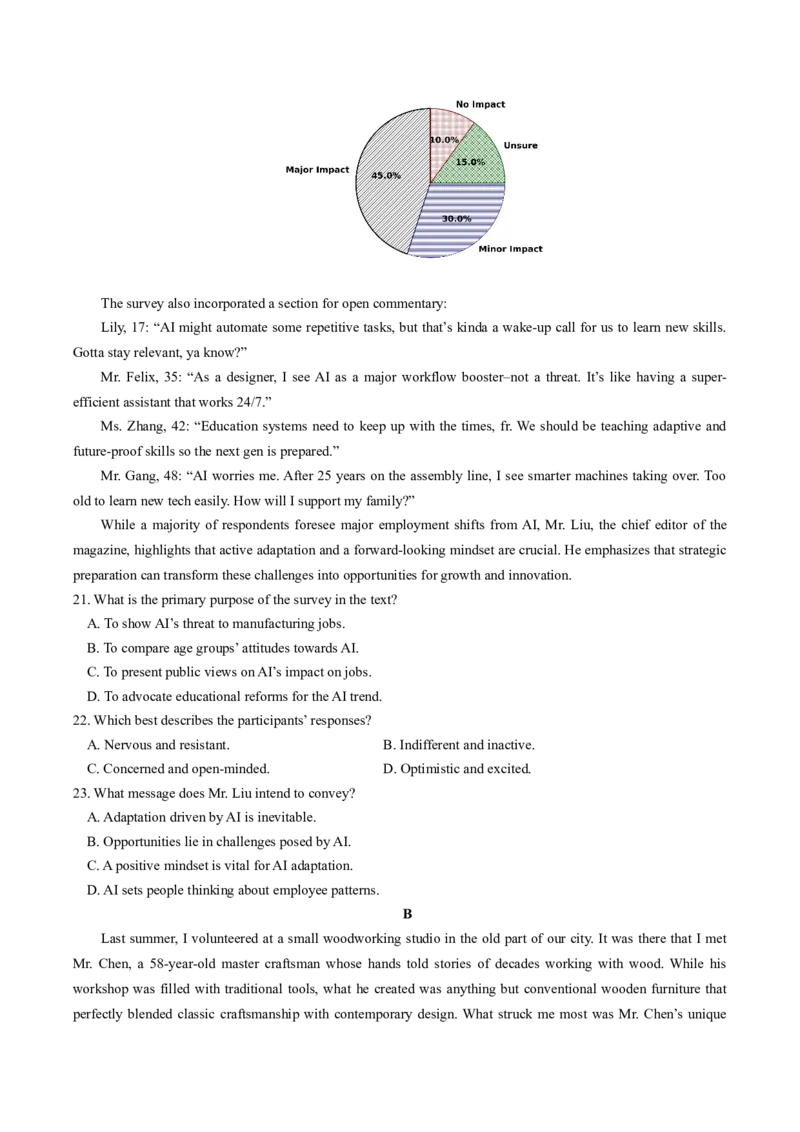
A total of 500 people participated in the study. The findings are illustrated in the accompanying pie chart:The survey also incorporated a section for open commentary:
Lily, 17: “AI might automate some repetitive tasks, but that’s kinda a wake-up call for us to learn new skills.
Gotta stay relevant, ya know?”
Mr. Felix, 35: “As a designer, I see AI as a major workflow booster–not a threat. It’s like having a super-
efficient assistant that works 24/7.”
Ms. Zhang, 42: “Education systems need to keep up with the times, fr. We should be teaching adaptive and
future-proof skills so the next gen is prepared.”
Mr. Gang, 48: “AI worries me. After 25 years on the assembly line, I see smarter machines taking over. Too
old to learn new tech easily. How will I support my family?”
While a majority of respondents foresee major employment shifts from AI, Mr. Liu, the chief editor of the
magazine, highlights that active adaptation and a forward-looking mindset are crucial. He emphasizes that strategic
preparation can transform these challenges into opportunities for growth and innovation.
21. What is the primary purpose of the survey in the text?
A. To show AI’s threat to manufacturing jobs.
B. To compare age groups’ attitudes towards AI.
C. To present public views on AI’s impact on jobs.
D. To advocate educational reforms for the AI trend.
22. Which best describes the participants’ responses?
A. Nervous and resistant. B. Indifferent and inactive.
C. Concerned and open-minded. D. Optimistic and excited.
23. What message does Mr. Liu intend to convey?
A. Adaptation driven by AI is inevitable.
B. Opportunities lie in challenges posed by AI.
C. A positive mindset is vital for AI adaptation.
D. AI sets people thinking about employee patterns.
B
Last summer, I volunteered at a small woodworking studio in the old part of our city. It was there that I met
Mr. Chen, a 58-year-old master craftsman whose hands told stories of decades working with wood. While his
workshop was filled with traditional tools, what he created was anything but conventional wooden furniture that
perfectly blended classic craftsmanship with contemporary design. What struck me most was Mr. Chen’s uniqueperspective on what he called “new-era craftsmanship.” Though he learned woodworking from his father as a
teenager, he never confined himself to old methods. Recognizing the changing preferences of younger customers,
he spent evenings teaching himself 3D modeling software and weekends researching sustainable materials like
bamboo composites and water-based finishes.
I witnessed his innovative approach firsthand when a young couple asked for a custom bookshelf for their
small apartment. They needed something space-efficient, eco-friendly, and easy to tear apart for potential moves.
Mr. Chen embraced the challenge enthusiastically.
Over the next week, he created multiple digital prototypes, experimented with three different types of wood,
and reinvented traditional techniques to create interlocking joints that required no metal fasteners. I often found him
working late, his experienced hands carefully testing each component. When I asked why he invested such
extraordinary effort into what seemed like a simple project, he paused from his work and smiled. “True
craftsmanship isn’t about blindly repeating what our ancestors did,” he explained. “It’s about understanding the
essence of tradition while having the courage to adapt it for today’s world.” To illustrate his point, he showed me
two bookshelves—one he made twenty years ago, beautiful in its solid construction, and the new prototype, which
used thirty percent less material while being equally steady and more functional for modern living.
Through Mr. Chen’s example, I came to understand that new-era craftsmanship represents the perfect marriage
of dedication and innovation. It honors the past while embracing the future, proving that excellence comes not from
doing one thing forever, but from doing it well with an ever-evolving spirit.
24. Traditional tools are mentioned in Paragraph1 to _______.
A. stress Mr. Chen’s source of inspiration
B. highlight the wisdom of past generations
C. promote the spirit of traditional craftsmanship
D. contrast with Mr.Chen’s modern and creative ideas
25. Why does the author list specific requests from the young couple?
A. To display the shift of traditional craftsmanship.
B. To reveal the challenges facing today’s craftsmen.
C. To imply the need for craftsmen to go with the times.
D. To distinguish modern approaches from traditional ones.
26. What does “true craftsmanship” mean in Mr. Chen’s viewpoint?
A. Creating resource-efficient products.
B. Persisting through testing and effort.
C. Adapting tradition wisdom for modern use.
D. Combining digital and traditional techniques.
27. What does Mr. Chen’s story show?
A. The best of both worlds. B. Two sides of a coin.
C. If it isn’t broken, don’t fix it. D. What is new is not always better.
C
In 2022, President Biden’s Inflation Reduction Act (IRA) was designed to speed up the adoption of electricvehicles (EVs). It offered 7,500 dollars in tax breaks for new EVs and 4,000 dollars for used ones, and also
invested money in charging facilities. “This is about creating a clean energy future and showing American
leadership,” Biden said. However, by July 2025, President Trump changed direction. He canceled those terms
regarding incentives (奖励性优惠) for consumers and punishments for car companies that didn’t meet emission
standards. “We canceled the ridiculous EV requirements that were limiting American choices,” Trump said, putting
consumer freedom ahead of government rules.
This sudden policy change caused chaos in the industry. Sales of pure EVs stopped growing, with Tesla seeing
a 10% decline in the first half of 2025. On the other hand, hybrid (混合的) electric vehicles (HEVs) saw a 40%
jump compared to the previous year in May 2025, led by Toyota’s practical, non-plug-in models. “Our plan meets
customers’ needs right now without sacrificing convenience,” explained Jack Hollis, the head of Toyota North
America. At the same time, the US lost its edge in global competition as Chinese NEV exports increased, taking
advantage of the weaknesses in American infrastructure and policy stability.
For consumers, the policy rollback made things more expensive and increased their worries. EVs became
more costly without tax breaks, and there were still few charging stations outside cities. “Why waste hours looking
for a charger when I can fill up my hybrid in five minutes?” a resident from the Midwest asked, pointing out the
ongoing problem of “range anxiety”. Trust also decreased as policies kept changing, making buyers reluctant to buy
EVs.
The future is still unclear. While some states continue to offer support, the federal government’s withdrawal
undermines (削弱) the ability to build a competitive clean transportation industry and the progress in reducing
carbon emissions could be cut in half.
28. Which is true about Biden’s Inflation Reduction Act (IRA) in 2022?
A. It was intended to create a new kind of clean energy.
B. It offered tax breaks to new EVs instead of used ones.
C. It ignored the construction of more charging facilities.
D. It punished car companies not meeting emission standards.
29. What is Trump’s attitude towards Biden’s IRA?
A. Dismissive. B. Objective. C. Favorable. D. Reserved.
30. What can be inferred from paragraphs 2 and 3?
A. Toyota benefited most from the new policy.
B. Range anxiety had no effect on buyers’ desire.
C. The policy change weakened the global EV market.
D. Policy instability harmed US’s edge in EV industry.
31. What is the passage mainly about?
A. A global competition in the EV industry.
B. The impact of American EV policy shift.
C. The obstacles of clean energy transition.
D. Buyers’ response to the US new EV policy.
DCatherine Raven, a former biology professor with a profound love for nature, has gifted readers a touching
memoir titled Fox and I: An Uncommon Friendship. Drawing on her academic background and personal
experiences, Raven crafts a narrative that blends scientific insight with heartfelt emotion, making the book a
standout in nature writing.
The story unfolds in a remote corner of Montana, where Raven lives alone in a small cabin she built herself.
Her solitary life takes an unexpected turn when a wild fox begins visiting her every day at 4:15 p.m. What starts as
a cautious encounter evolves into a deep bond—Raven even reads The Little Prince to the fox, creating a unique
connection that transcends different species. Through this friendship, she reflects on themes of loneliness,
companionship, and the inevitable losses that come with loving the natural world.
Critics have praised the book warmly. The New York Times calls it “a tender and insightful exploration of our
relationship with nature,” highlighting Raven’s ability to blend observation with reflection. The Washington Post
recommends it as a “must-read for summer,” noting its ability to remind readers of the beauty in quiet connections.
A bestseller and winner of the PEN/E.O. Wilson Literary Science Writing Award, Fox and I is more than a memoir
—it’s a celebration of the magic that happens when we open our hearts to the world around us.
Animal encounter books are common, and the good ones act like peaceful countryside escapes. Fox and I
shares core similarities with Chloe Dalton’s Raising Hare and Helen Macdonald’s H Is for Hawk: all three
explore profound, transformative bonds between humans and wild animals, using these relationships to delve into
universal themes of grief, healing, and our place in the natural world. However, Fox and I stands apart in its quiet
closeness with the fox and focus on “everyday magic”—unlike the intense, sometimes chaotic, violent journey in
H Is for Hawk or the hands-on nurturing in Raising Hare, Raven’s story centers on a gentle, routine-driven
connection that unfolds through small, consistent moments, offering a unique reflection on companionship without
possession.
32. Why is Raven’s book Fox and I outstanding in nature writing?
A. It is written by a biology professor.
B. It combines science with emotion.
C. It is set in a remote corner of Montana.
D. It tells a story between human and nature.
33. What does the underlined word “transcend” in paragraph 2 mean?
A. Deal with. B. Apply to. C. Go beyond. D. Arise from.
34. According to paragraph 3, what can readers learn from the book Fox and I?
A. The book is well received by both critics and readers.
B. A bestseller should reveal the beauty in quiet connections.
C. Blending observation and reflection is vital for a biologist.
D. An open heart to the surroundings invites unexpected wonder.
35. Which of the following is an example of “everyday magic” in paragraph 4?
A. Amy feeds a homeless cat daily and makes friends with it.
B. Tom saved a badly-hurt bird in a forest and took it to the zoo.
C. Mary trains her dog every day and now it can do many tricks.D. David captured a wild animal and successfully made it his pet.
第二节 (共5小题; 每小题2.5分,满分12.5分)
阅读下面短文,从短文后的选项中选出可以填入空白处的最佳选项。选项中有两项为多余选项。
How to Avoid Over-consumption: Expert Tips to Beat Shopping Traps
Black Friday and holiday sales, now a global phenomenon, are designed to trigger impulsive (冲动的)
overspending by taking advantage of human psychology. Consumer experts warn that these events use methods like
urgency and pleasure-driven brain responses to cloud judgment—but simple strategies can help shoppers stay in
control.
Make a needs-based list and stick to it.
36 Start by drafting a strict list of necessary items, not wants. Note their pre-sale prices: many
“discounts” raise costs first, so comparing historical prices reveals true bargains. Even small, unplanned buys can
add up to significant costs over time. This list acts as a guide, reducing the urge to spend too much on unplanned
purchases.
37
When attracted by a non-list item, stop for a second. Step away from the screen or take a 10-minute walk in-
store, have a coffee, and let the initial excitement driven by excitement hormones (荷尔蒙) fade. 38 Research
shows urgency-fueled desires weaken quickly once tension eases.
Avoid high-pressure sale environments.
It’s easy to get trapped in the excitement of limited-time offers. Sale settings crowded stores, flash-sale pop-
ups increase fear of missing out and social pressure. If you struggle with overspending, skip these environments
entirely. Shopping outside peak sale times removes the hype (炒作) that ruins sensible choices. 39
Check for regret before making a purchase.
Remember: impulsive purchases often lead to regret. Studies show sale buyers feel more regret than regular
shoppers, and repeated overspending can harm long-term financial well-being. 40 If the answer is “no”, walk
away.
By combining planning, patience, and self-awareness, shoppers can navigate sales season wisely—prioritizing
needs over impulses while protecting their wallets.
A. Relax and ignore appealing offers.
B. Pause and let yourself calm down.
C. Avoiding sale pages online also works.
D. Do you often feel regret after overspending?
E. Will I still value this item a few months from now?
F. This cooling-off period often holds back the impulse to buy.
G. This simple step helps separate genuine needs from temporary wants.
第三部分 语言运用(共两节,满分30分)
第一节 完形填空 (共15小题;每小题1分,满分15分)
阅读下面短文,从每题所给的A、B、C、D四个选项中,选出可以填入空白处的最佳选项。
Budhia Singh, a 4-year-old from India, is no ordinary child—he is a record-breaking long-distance 41 .He has inspired many people to follow his footstep, but his story has also caused many disagreements.
After becoming an orphan at two years old, he was 42 to living on the streets. Luckily, he was rescued by
a judo (柔道) coach Biranchi Das, who took him in, fed him, and taught him judo. One day, when Biranchi heard
Budhia using bad language and punished Budhia by making him 43 . He was shocked to find the boy still
running hours later: Budhia had a rare 44 for endurance.
Biranchi began training Budhia with great 45 , forcing him to run for hours daily without water mid-run.
When Budhia was entered into a Delhi half-marathon, officials 46 the 4-year-old from competing, but let him
run a shorter race, where he finished 47 energy. Yet experts warned: children under 15 aren’t 48 ready
for such strain; Budhia’s bones couldn’t 49 the pressure.
With unshaken resolve, Biranchi pushed Budhia to run a 70-kilometer race. In very hot weather, Budhia ran
for 7 hours but 50 5 kilometers from the finish, his small body exhausted. Though he set a world record as the
youngest endurance runner, the 51 was high: doctors found he had high blood pressure, nutrient deficiencies,
and bone damage 52 his growth.
Three days later, police arrested Biranchi for 53 Budhia. The child welfare minister banned Budhia from
long races. The government officials put 54 on children running long races. Budhia’s story reminds people to
find a 55 between working children too hard and encouraging them.
41. A. athlete B. runner C. hiker D. coach
42. A. used B. equal C. reduced D. opposed
43. A. stand B. run C. walk D. jump
44. A. passion B. hobby C. dream D. talent
45. A. care B. suspicion C. curiosity D. intensity
46. A. barred B. excused C. protected D. distracted
47. A. eager for B. free from C. full of D. lacking in
48. A. mentally B. socially C. emotionally D. physically
49. A. relieve B. handle C. resolve D. process
50. A. escaped B. hesitated C. collapsed D. paused
51. A. cost B. demand C. probability D. expectation
52. A. speeding B. improving C. preventing D. protecting
53. A. punishing B. hurting C. ignoring D. training
54. A. limits B. emphasis C. pressure D. blame
55. A. difference B. similarity C. connection D. balance
第二节 (共10小题;每小题1.5分,满分15分)
阅读下面材料,在空白处填入1个适当的单词或括号内单词的正确形式。
Canadians Steve and Ivana enthusiastically told their vlog viewers that walking down a Chinese city street is
“so 56 (impress) and different that it’s hard to know where to start”. The sharp increase in tourist numbers
is largely because China 57 (loosen) its entry requirements recently. Now, citizens of 47 countries can enter
China visa-free for 30 days, while others from 55 countries can apply for a 10-day transit visa on arrival.According to official data, international tourist arrivals into Shanghai were up nearly 40 percent in the first
half of 2025, with the largest numbers of travelers 58 (come) from South Korea, Thailand and Japan. “They
feel that coming to China is similar to 59 Chinese people used to view traveling to Europe and the US,”
said Liu Xiangyan, 60 analyst at the China Tourism Academy.
China has been trying to become culturally and technologically attractive for years. The appeal to tourists has
come as Chinese brands such as Labubu, a designer plush toy 61 (make) by Pop Mart, and electric-car
maker BYD are gaining international recognition. Chen Ming, 62 left his job as an app designer to start a
tour agency in his hometown, Chongqing, believes the city is made for the TikTok age.
When Darren Watkins Jr., an American YouTuber, went to Chongqing in May, his live stream from the city
got 9.4 million views. 63 (expose) of this kind is helping bring a new view of China to younger audiences
abroad, Chen said. “Many of these people are still young, but as they grow older, 64 their twenties and
thirties, their impression of China will 65 (definite) be different from before,” Chen said.
第四部分 写作(共两节,满分40分)
第一节(满分15分)
目前,多地试点推行春秋假 (spring and autumn holidays)。假定你是李华,你校学生会就是否跟进该做
法征求意见,请你发表自己的见解,内容包括:
(1)你的观点;
(2)你的理由。
注意:
(1)写作词数应为80个左右;
(2)请按如下格式在答题卡的相应位置作答。
Dear Students’ Union,
Yours,
Lihua
第二节 (满分25分)
阅读下面材料,根据其内容和所给段落开头语续写两段,使之构成一篇完整的短文。
The midterm group project was supposed to bring our four-person team closer, but it ended up tearing me and
Lily apart. We’d been good friends since freshman year, sharing snacks in class and studying together late at night.
When our professor assigned the history research project, we volunteered to lead the data collection and analysis—
tasks we’d split equally before.
Everything started smoothly until the third week. Lily missed two group meetings in a row, and the work she
promised to finish remained untouched. I grew frustrated, assuming she was slacking off (懈怠). During our next
meeting, I shouted at her in front of the other two teammates. “Can’t you take this seriously? We’re all working
hard except you!” Lily’s eyes filled with tears, but she didn’t defend herself—she just ran out of the classroom.The following days were awkward. We avoided each other in hallways, and our group project didn’t make
any progress without our coordination. My other teammates tried to mediate, but I was too stubborn to listen,
convinced Lily was in the wrong. One evening, as I sorted through research materials alone in the library, our class
monitor Sarah sat beside me. “You know Lily’s mom has been in the hospital, right? She’s been taking care of her
after school and hasn’t slept well for weeks,” Sarah said gently. “She didn’t want to burden anyone, so she kept it
to herself.” She then added, “I wonder whether your team members can share the burden of looking after her
mother.”
Shock washed over me. I thought back to how tired Lily had looked lately, with dark circles under her eyes
and her usual bright smile gone. I’d been so focused on the project deadline and my own annoyance that I failed to
notice her struggle. Guilt weighed heavily on my chest—I’d judged her without asking for the truth, and hurt a
friend who was already going through a tough time. Eventually, I decided to make things right.
注意:
(1) 续写词数应为150个左右;
(2) 请按如下格式在答题卡的相应位置作答。
Inspired by Sarah’s words, I went to the other teammates.
The next day, I found Lily sitting alone at the dining hall, looking worried.2025~2026学年12月七校联合学情调研
高三英语 参考答案
一、听力
1-5. A ACCB 6-10. ABBCA 11-15. ACBAB 16-20. CCBCB
二、阅读
三、21-23 CCB 24-27 DCCA 28-31 DADB 32-35 BCDA
四、七选五 36-40 GBFCE
五|、完形填空:
41-45 BCBDD 46-50 ACDBC 51-55 ACBAD
六、语篇填空
56. impressive 57. has loosened 58. coming 59. how 60. an
61. made 62. who 63. Exposure 64. in 65. definitely
应用文
Possible version one
Dear Students’ Union,
As a student, I firmly support the adoption of spring and autumn holidays in primary and secondary schools.
These holidays, which offer a break from tight study schedules, allow us to recharge our batteries and explore
the world outside classrooms. Instead of being buried in textbooks, we can engage in outdoor activities, visit
cultural relics, or spend quality time with families—all of which broaden our horizons and foster practical skills.
Moreover, it is these short vacations that help reduce academic pressure, making learning more efficient and
enjoyable.
Let us embrace the holidays and grow through diverse experiences!
Yours,
Lihua
Possible version two
Dear Students’ Union,
From my perspective, I oppose the full implementation of spring and autumn holidays in primary and
secondary schools.
These extra vacations, which split the academic semester into smaller parts, may disrupt learning continuity.Students might struggle to stay focused after breaks, wasting time readjusting to study rhythms. What’s more, with
limited holiday duration, many families can only choose hasty trips or spend lazy days at home, neither of which
brings real benefits. Worse still, it is the shortened class time that may force teachers to speed up teaching, leaving
students with incomplete understanding of key knowledge.
For steady academic progress, we should stick to the existing vacation system.
Yours,
Lihua
读后续写
Inspired by Sarah’s words, I went to the other teammates. I told them the truth about Lily’s mother being in
the hospital and how she’d been struggling to balance caregiving and the project alone. To my relief, they all
responded with immediate empathy and offered to help. “A trouble shared is a trouble halved. We can share the
burden with her,” one teammate suggested. Everyone else echoed. We soon worked out a schedule—I assisted
with the data sorting and analysis, and we all took turns to look after Lily’s mom after school.
The next day, I found Lily sitting alone at the dining hall, looking worried. With guilt, I walked over and sat
quietly opposite her. I said sincerely, “Lily, I shouldn’t have shouted at you without knowing the truth. We all know
about your mom now, and we want to help.” I continued to tell her our plan. Tears welled up in Lily’s eyes. “Thank
you,” she whispered. We hugged tightly, and the awkwardness between us melted away. We finally completed the
project with cooperation, and more importantly, our friendship grew stronger through mutual understanding and
support.
录音原文:
(Text 1)
M: What are you up to?
W: Checking my college application form. I’ve finally come to a decision about what to study in college.
M: Is engineering still your top choice?
W: Yeah. I was thinking of studying computer science, but I decided against it in the end.
(Text 2)
W: May I help you, sir?
M: Yes, I’m looking to replace my old laptop bag. I go on a lot of business trips, so I’m looking for something with
wheels.
(Text 3)
W: When will you be arriving, Mr. Baranski?
M: Let me see. It’s Monday today, so on Thursday, the 16th of May.
W: And how long will you be staying?
M: Two nights, leaving on Saturday.
(Text 4)
M: I’m leaving next week for the trip and I still don’t know what to do with my Cooper.W: Well, you know I am sensitive to animals so I can’t help. Hey! I just remembered I have a friend that has a pet
hotel.
M: I guess I can do that.
(Text 5)
M: You look stressed. Is there something wrong?
W: I’ve been trying to delete a table from my report but every time I do, it ruins the file format.
M: I’ll fix it for you, if you agree to help me with the shopping later.
(Text 6)
M: Hi Barbara, how’s the new house?
W: We still have to decorate the living room and the bedrooms, but that’s because I spent the last two months
working outside, planting flowers and trees trying to make it look beautiful. You know me, I’ll never be inside if
I can be out in the fresh air.
M: I bet you miss all the conveniences of the city, don’t you?
W: Not really. I like living in a village.
M: I hope Brian shares your views and isn’t missing city life too much.
(Text 7)
W: Mike, did you notice the slow service tonight? It’s unusually crowded.
M: Yeah. Our orders took forever to arrive, and they got mine wrong.
W: Same here. And the waitstaff seem busy and understaffed. I saw a few tables complaining about their orders
too. I think we should talk to the manager before leaving.
M: Definitely. This level of service isn’t acceptable for such a reputable restaurant.
W: Let’s do that. Maybe they can improve service for future diners. And it could help them understand what went
wrong tonight.
M: Good idea. I’ll ask for the manager once we finish our meal.
W: It’s important to address these issues constructively rather than just leaving without saying anything.
M: Absolutely, Amanda.
(Text 8)
W: I’ve just seen Mel. She was telling me about that qualification she’s doing. It’s something about life coaching,
isn’t it?
M: That’s right. She’ll be great at it. You know how many times she has helped us with our problems?
W: Is that all life coaching means?
M: Well, life coaches show their clients how to adopt new approaches or new routines, and this enables them to
make permanent changes. It’s about much more than analyzing a specific problem and fixing it.
W: You sound like Mel! I’m still lost, though.
M: Look, take something you’re always complaining about. Like, having to do chores around the house. A life
coach would help you address this by helping you change your attitude to doing the chores in the first place. By
working on your mindset, that will help you go forward.
W: Oh, that makes sense. Mel would be brilliant at that.
(Text 9)
W: Trent, how did you get into mountain climbing?
M: Many people start climbing because they’ve watched a television documentary about climbing a mountain and a
good friend enjoyed reading the biography of a famous climber. My experience was more unusual, though.
When I was nine, I started at a new school where there was an amazing artwork on the wall. It showed some
snow-covered mountains and I thought, I want to climb those!
W: You climbed your first big mountain when you were ten. How did you feel beforehand?
M: I was convinced I’d be really nervous before we set off, but the opposite was actually true, which I couldn’t
quite believe. I went with very experienced climbers whom I trusted.
W: You decided to climb the highest peak on each of the seven continents. Why was that?M: My grandfather became ill and there wasn’t much financial support for scientists trying to find a cure, so I asked
people to sponsor me to climb the seven peaks. I became the youngest person ever to climb them, though that
wasn’t my reason for doing it.
(Text 10)
M: Hi, my talk today’s about an invention, the modern car seat belt.
The inventor of the modern car seat belt was a Swedish man called Nils Bohlin. Bohlin had trained as a
mechanical engineer at college before gaining his first employment as an aircraft designer. He did well, so was
invited to join a car manufacturing company as a safety engineer.
Bohlin had often worked on improving seats and seat belts for planes since starting his working life in 1942.
After joining the car manufacturer in 1958, he spent the following 12 months developing his ideas for cars, and
then a car featuring Bohlin’s creation on both front seats was introduced, making it the earliest example of a
vehicle with modern seat belts.
However, it took many years for them to become widely accepted. Japan made it a rule that everyone must wear
seat belts in their cars across the whole country in 1971. A year earlier, two of the six states in Australia had
introduced similar rules. France was the first European nation to create seat belt laws several years later. It’s
incredible to think that some investment in research and development in the manufacturing industry has had such
a huge global impact.