2 0 2 5 年 全 国 教 师 资 格
理 论 精 讲 - 语 言 学 3
讲师:安书缘
更多干货关注 粉笔教师教育 粉笔教师笔记帮帮忙
课上听讲
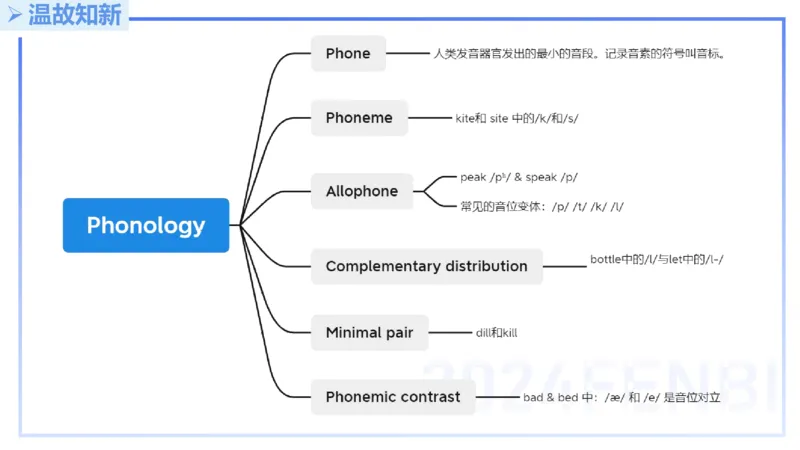
课后复习Ø 温故知新
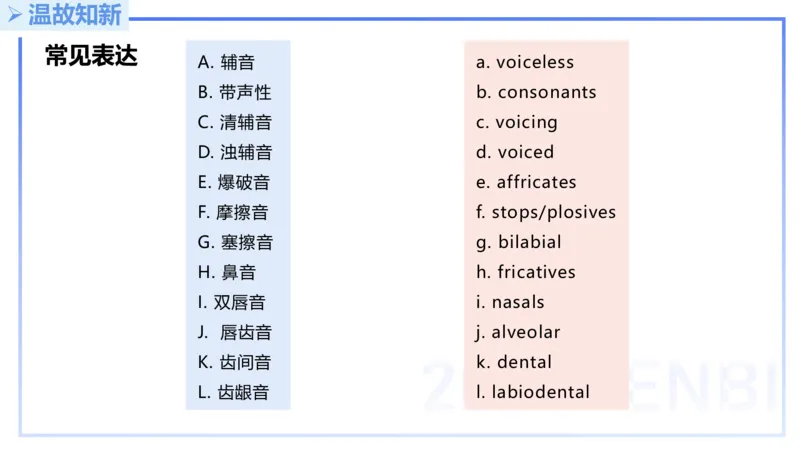
常见表达
A. 辅音 a. voiceless
B. 带声性 b. consonants
C. 清辅音 c. voicing
D. 浊辅音 d. voiced
E. 爆破音 e. affricates
F. 摩擦音 f. stops/plosives
G. 塞擦音 g. bilabial
H. 鼻音 h. fricatives
I. 双唇音 i. nasals
J. 唇齿音 j. alveolar
K. 齿间音 k. dental
L. 齿龈音 l. labiodentalØ 温故知新P97
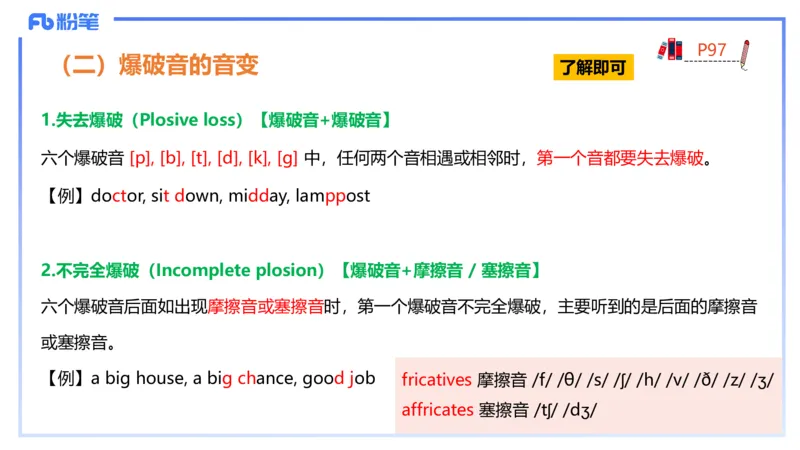
(二)爆破音的音变
了解即可
1.失去爆破(Plosive loss)【爆破音+爆破音】
六个爆破音 [p], [b], [t], [d], [k], [g] 中,任何两个音相遇或相邻时,第一个音都要失去爆破。
【例】doctor, sit down, midday, lamppost
2.不完全爆破(Incomplete plosion)【爆破音+摩擦音 / 塞擦音】
六个爆破音后面如出现摩擦音或塞擦音时,第一个爆破音不完全爆破,主要听到的是后面的摩擦音
或塞擦音。
【例】a big house, a big chance, good job fricatives 摩擦音 /f/ /θ/ /s/ /ʃ/ /h/ /v/ /ð/ /z/ /ʒ/
affricates 塞擦音 /tʃ/ /dʒ/(二)爆破音的音变 P97
了解即可
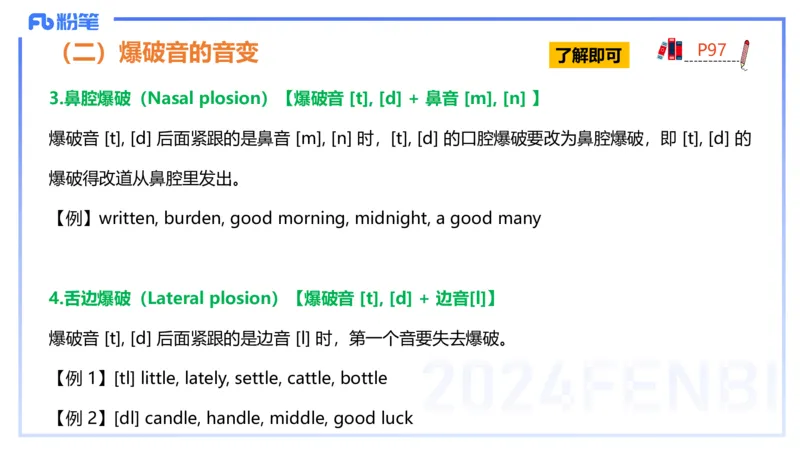
3.鼻腔爆破(Nasal plosion)【爆破音 [t], [d] + 鼻音 [m], [n] 】
爆破音 [t], [d] 后面紧跟的是鼻音 [m], [n] 时,[t], [d] 的口腔爆破要改为鼻腔爆破,即 [t], [d] 的
爆破得改道从鼻腔里发出。
【例】written, burden, good morning, midnight, a good many
4.舌边爆破(Lateral plosion)【爆破音 [t], [d] + 边音[l]】
爆破音 [t], [d] 后面紧跟的是边音 [l] 时,第一个音要失去爆破。
【例 1】[tl] little, lately, settle, cattle, bottle
【例 2】[dl] candle, handle, middle, good luck小试牛刀
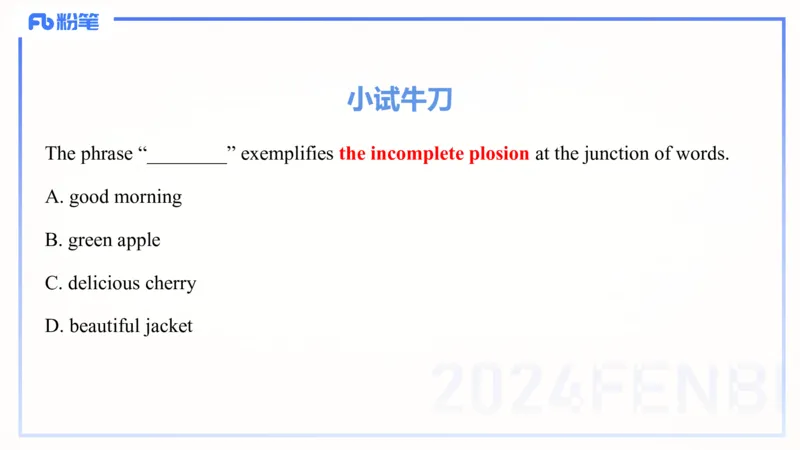
The phrase “________” exemplifies the incomplete plosion at the junction of words.
A. good morning
B. green apple
C. delicious cherry
D. beautiful jacketP97
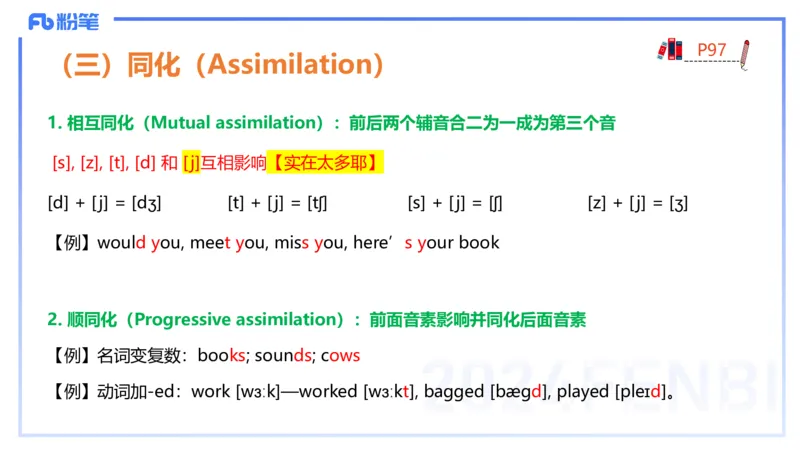
(三)同化(Assimilation)
1. 相互同化(Mutual assimilation):前后两个辅音合二为一成为第三个音
[s], [z], [t], [d] 和 [j]互相影响【实在太多耶】
[d] + [j] = [dʒ] [t] + [j] = [tʃ] [s] + [j] = [ʃ] [z] + [j] = [ʒ]
【例】would you, meet you, miss you, here’s your book
2. 顺同化(Progressive assimilation):前面音素影响并同化后面音素
【例】名词变复数:books; sounds; cows
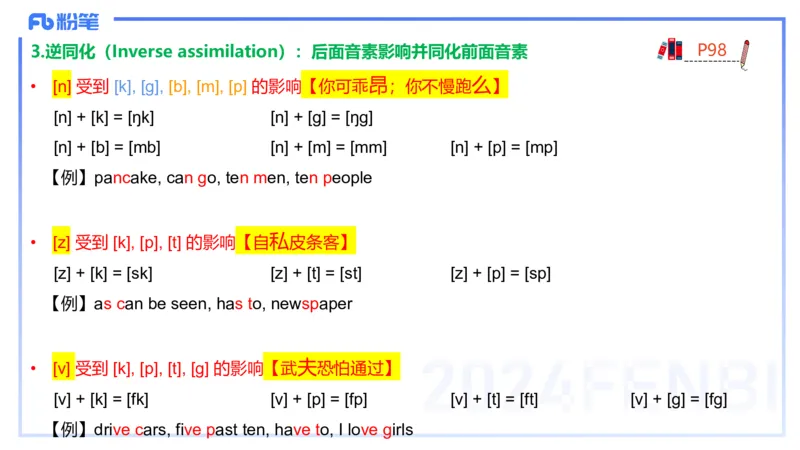
【例】动词加-ed:work [wɜːk]—worked [wɜːkt], bagged [bæɡd], played [pleɪd]。3.逆同化(Inverse assimilation):后面音素影响并同化前面音素 P98
• [n] 受到 [k], [g], [b], [m], [p] 的影响【你可乖昂;你不慢跑么】
[n] + [k] = [ŋk] [n] + [g] = [ŋg]
[n] + [b] = [mb] [n] + [m] = [mm] [n] + [p] = [mp]
【例】pancake, can go, ten men, ten people
• [z] 受到 [k], [p], [t] 的影响【自私皮条客】
[z] + [k] = [sk] [z] + [t] = [st] [z] + [p] = [sp]
【例】as can be seen, has to, newspaper
• [v] 受到 [k], [p], [t], [g] 的影响【武夫恐怕通过】
[v] + [k] = [fk] [v] + [p] = [fp] [v] + [t] = [ft] [v] + [g] = [fg]
【例】drive cars, five past ten, have to, I love girls小试牛刀
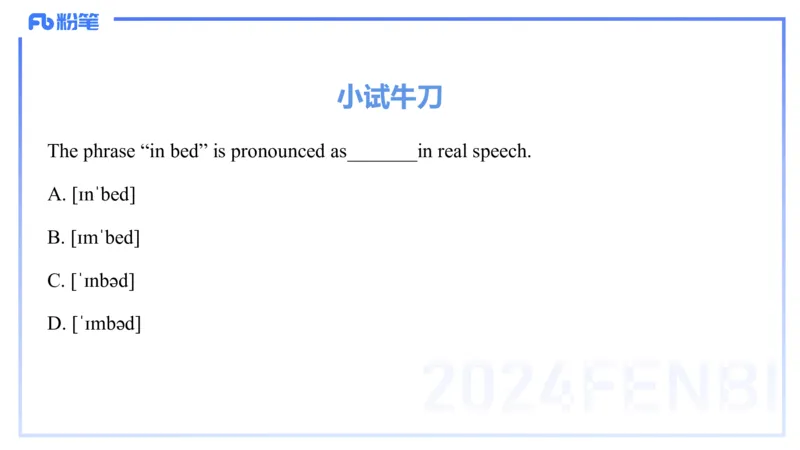
The phrase “in bed” is pronounced as_______in real speech.
A. [ɪnˈbed]
B. [ɪmˈbed]
C. [ˈɪnbəd]
D. [ˈɪmbəd]语音变化(Vocal variety)
省力!!!
worry about
连读(Liaison)
not at all
爆破音的音变 this year
good night
同化(Assimilation)
in case八、超音段(Suprasegmentals)
(一)音节(Syllable)
(二)语音变化(Vocal variety)
(三)重音(Stress)
(四)语调(Intonation)三、重音(Stress)
P99
1. 单词重音(Word Stress)
(1)单音节词单独出现时一律重读,不必标出重音符号,如 go [ɡəʊ], book [bʊk], sit [sɪt]
(2)双音节名词重音一般在第一个音节上;双音节动词重音一般在第二个音节上。 名1动2
【例】bro-ther [ˈbrʌðə], ap-ple [ˈæpl], let-ter ['letə], ad-vise [əd'vaɪz]
(3)三音节、多音节词重音在倒数第三个音节上
【例】de-mo-cra-cy [dɪ'mɒkrəsi] an-ni-ver-sa-ry [ˌænɪ'vɜːsəri]
(4)多音节词除了有主要重音外,还有一个次要重音。次要重音一般都在主要重音向前倒数
第二个音节上
【例】im-pos-si-bi-li-ty [ɪmˌpɒsə'bɪlətɪ]补充
l 派生词的重音和词根重音一致。 (act, active, actively)
l 重音通常在第一个音节上:带有下列后缀的词:-ary, -ery, -ory, -ism, -ist等。(customary,
scientist, slavery, factory)
l 重音通常在第二个音节上:带下列前缀的词:a-, ab-, ac-, ad-, al-, be-, con-, de-, dis-, em-,
en-, in-, mis-, re-, tans-, un-。(about, admire, belong, consult, dislike) 带下列后缀的词:-
aim, -ain, -cur, -eem, -duce, -ere, -firm, -gn, -oin, -oke, -ose, -pt, -rce, -self, -ume。
(contain, occur, sincere, design, confirm)
l 重音通常在最后一个音节:带下列后缀的词:-ade, -ee, -eer, -esque, -ette, -ique, -ine, -oon。
这些词一般都是从法语中借来的词。(employee, volunteer)
l 重音通常在倒数第二个音节上:带下列后缀的词:-eous, -ial, -ian, -ic, -ics, -ient, -ion, -
ious, -ish, -it, -liar, -sive, -tal, -uous。(relation, deposit, musician)小试牛刀
1. What is the right pronunciation of the word “permit” when it is used as a
noun?
A. /'pəmɪt/ B. /pə'mɪt/ C. /pɜː'mɪt/ D. /'pɜːmɪt/
2. Which of the following words has a different stress pattern?
A. Facility. B. Caterpillar. C. Community. D. Accompany.P99
三、重音( )
Stress
2. 句子重读(Sentence Stress)
重读:英语中实词(名词、实义动词、形容词、副词、一部分代词、数词、
感叹词等)
弱读:虚词(冠词、介词、连词、大多数代词和非实义动词)
【例】I am so glad to see you again.小试牛刀
Which of the following underlined words will be stressed when Julia responds
to the person who has mistaken her for Julian?
A. My name is Julia, not Julian.
B. My name is Julia, not Julian.
C. My name is Julia, not Julian.
D. My name is Julia, not Julian.八、超音段(Suprasegmentals)
(一)音节(Syllable)
(二)语音变化(Vocal variety)
(三)重音(Stress)
(四)语调(Intonation)P99
四、语调(Intonation)
1. 升调(Rising tone)
升调常用来表示不肯定,语意未完,或表示礼貌,常有含蓄、委婉、安慰、虚心征求意见等
意味。
一般疑问句通常用升调。
【例 1】Is he making a ↗ kite?
【例 2】Can I help ↗ you?
【例 3】Could you please turn down the ↗ radio?P99
四、语调(Intonation)
2. 降调(Falling tone)
在英语句子中,降调的使用比升调更为广泛,它表示肯定、决断、坚决或终结,但有时含有
生硬、不容置疑的意味。降调的用法可归纳为以下六种:
(1)陈述句用降调。 【例】I like ↘ swimming.
(2)特殊疑问句用降调。 【例】What happened to her ↘ car?
(3)表示命令的祈使句常用降调。 【例】David, open the ↘ door.
(4)问候用语常用降调,以示真诚。 【例】Good ↘ morning.
(5)感谢语常用降调,以表示诚挚的谢意。 【例】↘ Thank you.
(6)感叹句用降调。 【例】 How ↘ beautiful the flowers are!P100
四、语调(Intonation)
简单句
3. 有升有降
(1)数数、列举事物或列举一连串的动作时,除最后那个并列成分用降调外, 前面所有的并列成分
都要用升调。“前升后降”
【例 1】Let's count our new ↘ books. ↗ One, ↗ two, ↗ three, ↗ four, ↘ five. Oh, we have
↘
five new books.
【例 2】 We'd like a bottle of ↗ coke, two bottles of apple ↗ juice, a ↗ hamburger and two ↘
cakes.
【例 3】John likes ↗ running, ↗ swimming and ↘ skating, but he doesn’t like playing
↗ ↗ ↘
football, basketball or volleyball.P100
四、语调(Intonation)
3. 有升有降
(2)选择疑问句的语调分为两个部分, or 前的部分用升调, or后的部分用降调。“前升后降”
【例】Would you like a cup of ↗ tea or a glass of ↘ milk?
(3)反义疑问句的语调分两种情况:若说话者对所陈述的内容没有把握,想询问对方这一理
解是否正确,则陈述句部分用降调,简略问句用升调;若说话者对所陈述的内容已经很有把
握,只是想要对方同意自己的观点,或是想从对方那里得到证实,则前后两部分都用降调。
【例 1】——Your uncle is ↘ tall, ↗ isn't he? ——No, he's very ↘ short.
【例 2】——It's a ↘ fine day, ↘ isn't it? ——Yes, it ↘ is.P101
四、语调(Intonation)
复合句
3. 有升有降
(4)若主句在前,从句在后,主句结束时意思已比较完整,则主句通常用降调,整个句子
读完时也应该用降调;(“降降”)但是,若从句在前,主句在后,则常常是“前升后降”。
【例 1】I was drawing a ↘ picture when my mother came ↘ back.
【例 2】When she got to the ↗ station, the train had already ↘ left.P101
四、语调(Intonation)
并列句
3. 有升有降
(5)在并列句中,通常有连接词连接前后两个对等的部分,如果前后两个句子成分同等重
要,或两个句子成分联系不紧密,则两个并列的成分都用降调。
【例1】We come to school by ↘ bus and he comes by ↘ bike.
【例2】 She likes ↘ English, but she needs ↘ help.
如果并列句前后两个部分的关系非常紧密,有逻辑上的顺承关系,则一般前一个分句用升调,
后一个分句用降调。
【例1】He opened the ↗ door and the officer ↘ walked in.
【例2】It was so cold ↗ yesterday, and I’ve caught a ↘ cold.小试牛刀
1. Which of the following indicates a correct intonation pattern?
A. Did you have a ↑ fever or a ↓ headache?
B. Did you have a ↑ fever or a ↑ headache?
C. Did you have a ↓ fever or a ↓ headache?
D. Did you have a ↓ fever or a ↑ headache?
2. Which of the following shows the general intonation pattern in a complex sentence?
↗ ↗
A. When I started my career there was no unemployment.
↗ ↘
B. When I started my career there was no unemployment.
↘ ↗
C. When I started my career there was no unemployment.
↘ ↘
D. When I started my career there was no unemployment.P101
巩固提升
1. Which of the following terms best describes the pair of words “kill” and “drill”?
A. Minimal pair. B. Phonemic contrast.
C. Complementary distribution. D. Allophone.
2. The word “uncomfortable” consists of ________ syllables and the stress falls on the
________ syllable of the word.
A. four; third B. five; second C. five; third D. four; second第四节
形态学
MorphologyP102
形态学的定义
01 02 词素的定义
• 研究词的内部
结构和构词规则
03 词素的种类 04 构词法二、词素的定义(Morpheme)
词素被定义为含有语义的最小的语言单位,并且不能再被继续拆分。例如:boy 这个单词不
能再进一步分成更小的语义单位了。因此这个单词只有一个词素。【boyfriend? boys?】
desk ——————
boyish ——————
desirable ——————
unacceptable ——————
gentlemanliness ——————答案页:小试牛刀
1. How many morphemes are there in the word “impassable”?【2018下高中】
A. Two B. Three
C. Four D. Five
2. The word “gunfighters” contains morphemes.
A. two B. three
C. four D. fiveP103
三、词素的种类(Types of morphemes)
(一) 自由词素【Free morpheme】和黏着词素【Bound morpheme】
能否单独出现 例子
能 dog, man, baby...
不能 un-, dis-, -ed, -tionP103
(二)词根【Root】、词缀【Affix】和词干【Stem】
词根,把一个词
词缀,本质上是黏 词干,由词-屈折词缀构成。
的所有词缀去掉之
着词素。 (词干 = 词根 /
后剩下的部分。
词缀通常分为两类: 词干 = 词根 + 派生词缀)
词根可能是自由词
前缀(Prefix)、 e.g. friends & friendships
素,也可能是黏着
后缀(Suffix)。
词素。
e.g. unhappy 思考:这两个词的词根是什
e.g. childish
happiness 么?
respectP103
( 三 ) 屈 折 词 缀 【 I n f l e c t i o n a l A f f i x 】 和 派 生 词 缀 【 D e r i va t i o n a l A f f i x 】
1.屈折词缀的特点为:
2.派生词缀的特点为:
①为词干添加一个语法意义(-’s,-s, ①能产性;
-ing,-ed,-en, -er, -est) ②可以改变词汇意义和词性(small-smallness;
②不改变原词的词性(flower &flowers) like-dislike)
③可以是前缀,也可以是后缀。
③只有后缀。
agree→ agrees
write → writer
black → blacken小试牛刀
1. Which of the following words is formed through derivation? 【2018年下初中】
A. students B. shorter C. bought D. insanity
2. Which of the following words contains an inflectional morpheme? 【2018年下初中】
A. Disappear. B. Blacken. C. Oxen. D. Anti-pollution.
3.The morpheme “-ceive” in the word “conceive” is a(n) _______.【2017上高中】
A. stem B. root C. allomorph D. suffix