文档文本内容
2 0 2 5 年 全 国 教 师 资 格
理 论 精 讲 - 语 言 学 5
讲师:安书缘
更多干货关注 粉笔教师教育 粉笔教师笔记帮帮忙
课上听讲
课后复习Ø 温故知新Ø 温故知新二、涵义关系 P110
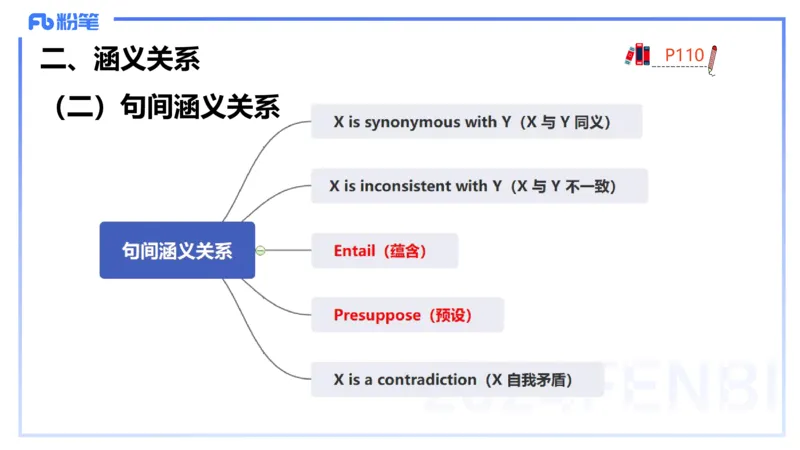
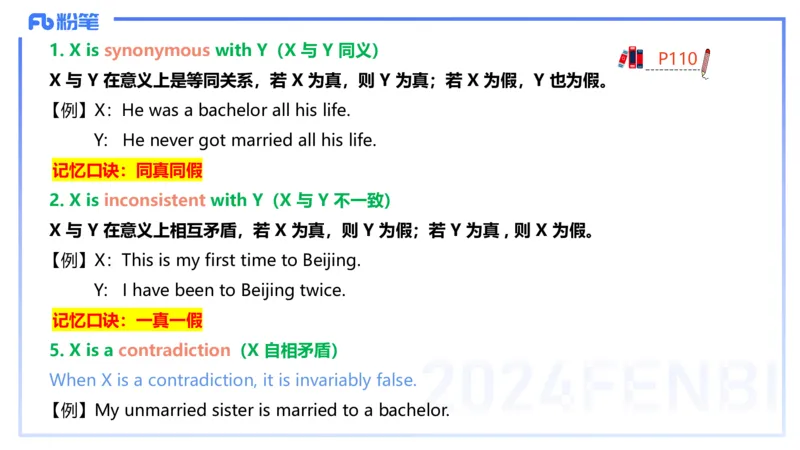
(二)句间涵义关系1. X is synonymous with Y(X 与 Y 同义)
P110
X 与 Y 在意义上是等同关系,若 X 为真,则 Y 为真;若 X 为假,Y 也为假。
【例】X:He was a bachelor all his life.
Y: He never got married all his life.
记忆口诀:同真同假
2. X is inconsistent with Y(X 与 Y 不一致)
X 与 Y 在意义上相互矛盾,若 X 为真,则 Y 为假;若 Y 为真 , 则 X 为假。
【例】X:This is my first time to Beijing.
Y: I have been to Beijing twice.
记忆口诀:一真一假
5. X is a contradiction(X 自相矛盾)
When X is a contradiction, it is invariably false.
【例】My unmarried sister is married to a bachelor.P110
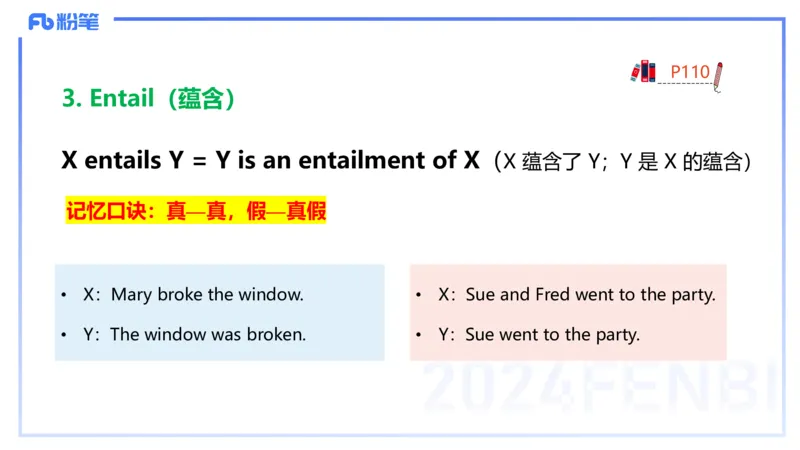
3. Entail(蕴含)
X entails Y = Y is an entailment of X(X 蕴含了 Y;Y 是 X 的蕴含)
记忆口诀:真—真,假—真假
• X:Mary broke the window. • X:Sue and Fred went to the party.
• Y:The window was broken. • Y:Sue went to the party.P111
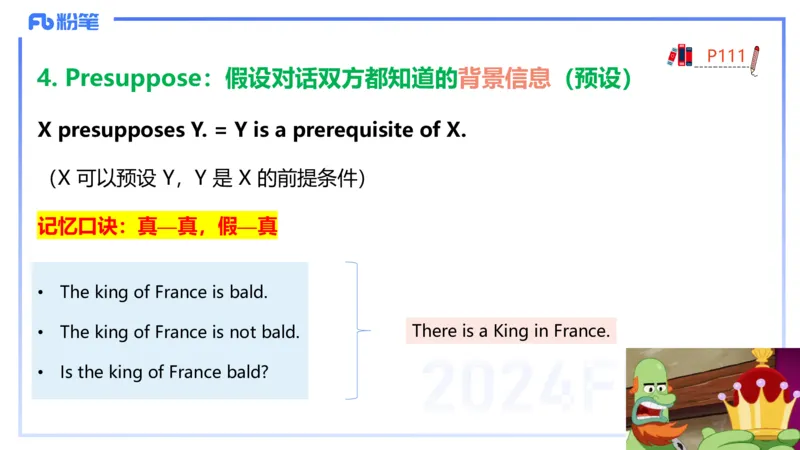
4. Presuppose:假设对话双方都知道的背景信息(预设)
X presupposes Y. = Y is a prerequisite of X.
(X 可以预设 Y,Y 是 X 的前提条件)
记忆口诀:真—真,假—真
• The king of France is bald.
• The king of France is not bald. There is a King in France.
• Is the king of France bald?小试牛刀
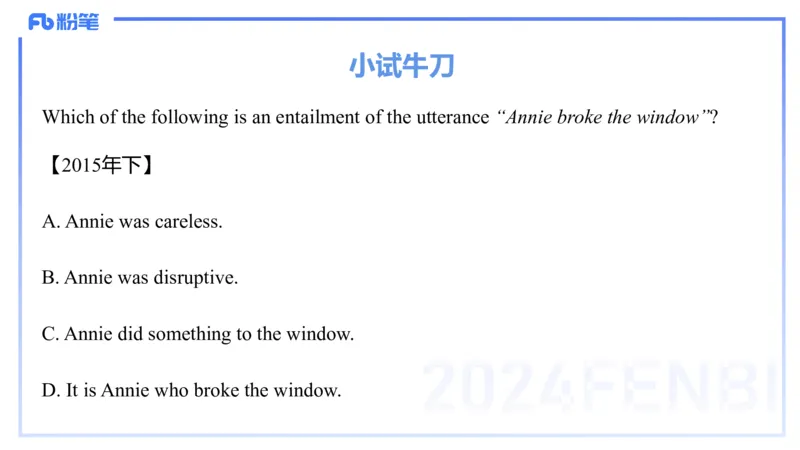
Which of the following is an entailment of the utterance “Annie broke the window”?
【2015年下】
A. Annie was careless.
B. Annie was disruptive.
C. Annie did something to the window.
D. It is Annie who broke the window.P111
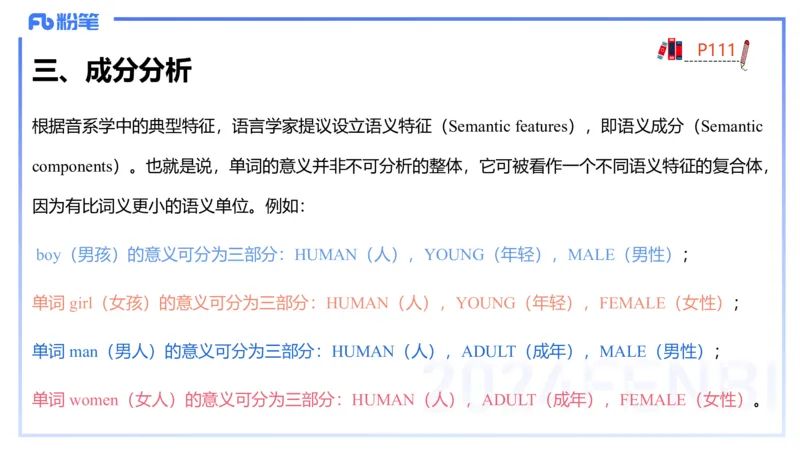
三、成分分析
根据音系学中的典型特征,语言学家提议设立语义特征(Semantic features),即语义成分(Semantic
components)。也就是说,单词的意义并非不可分析的整体,它可被看作一个不同语义特征的复合体,
因为有比词义更小的语义单位。例如:
boy(男孩)的意义可分为三部分:HUMAN(人),YOUNG(年轻),MALE(男性);
单词 girl(女孩)的意义可分为三部分:HUMAN(人),YOUNG(年轻),FEMALE(女性);
单词 man(男人)的意义可分为三部分:HUMAN(人),ADULT(成年),MALE(男性);
单词 women(女人)的意义可分为三部分:HUMAN(人),ADULT(成年),FEMALE(女性)。为了简洁,可以用加减符号(+/–)来表示一个词中是否存在某一语义特征。
例如:
Boy: +HUMAN, –ADULT, +MALE
Girl: +HUMAN, –ADULT, –MALE
Man: +HUMAN, +ADULT, +MALE
Woman: +HUMAN, +ADULT, –MALE小试牛刀
Which of the following correctly describes the semantic features of the word “girl”?
【2023上初中】
A. [-Human-Male-Adult]
B. [+Human+Male-Adult]
C. [+Human-Male+Adult]
D. [+Human-Male-Adult]巩固提升 P112
1. The sense relationship between “male” and “female” is ________.
A. complementarity B. gradability
C. relational opposites D. hyponymy
2. Which of the following pairs of words belongs to the gradable antonyms?
A. male vs female B. parent vs child
C. hot vs cold D. employer vs employeeP110
巩固提升
3. “I bought some roses” ________ “I bought some flowers.”
A. entails B. presupposes
C. is inconsistent with D. is synonymous with
4. What is the relationship between “furniture” and “table”?
A. Antonymy. B. Hyponymy. C. Polysemy. D. Synonymy.第六节
语用学
PragmaticsP112
语用学定义
言语行为
合作原则与会话含义P113
一、语用学的定义【 】
Pragmatics 了解即可
• 语用学是 20 世纪 60、70 年代兴起的语言学的一个新的分支,它所研究的是语言
同其使用者之间的关系,即在一定的交际环境中如何使用语言。
• 语用学研究范围包括言语行为、语境、会话含义等方面。P113
二、言语行为【 】
Speech acts
言内行为 言外行为 言 后 行 为
【Illocutionary Act】
【Perlocutionary Act】
【Locutionary Act】
涉及说话者的意图,是指在特
指说话行为或施事行为在
指说出合乎语言习惯
定的语境中赋予有意义的话语
听者身上所产生的某种效
的、有意义的话语
一种“言语行为力量
果
(Illocutionary Force)”,
即语力,比如通过说话来做出
声明或是承诺、要求等,或使
用句子起到命令、请求等作用(二)直接言语行为和间接言语行为 P113
1. 直接言语行为(Direct Speech Act) 2. 间接言语行为(Indirect Speech Act)
所执行的言语功能与其言语结构之间没有直
所执行的言语功能与其话语结构之间有直
接的关系,如:
接的关系,比如:
疑问句 提出请求
陈述句 陈述客观事实
Can you open the door?
疑问句 提出问题
陈述句 提出请求
祈使句 提出命令、要求
e.g. I am hungry, mom.
e.g. Fasten your seat belt.小试牛刀
On hearing the utterance “It’s hot here”, the listener opened the door. It is a(n) ________.
【2017上初中】
A. locutionary act
B. illocutionary act
C. direct speech act
D. perlocutionary act三、合作原则【 】
Cooperative Principle
P114
1. 数量准则(Quantity Maxim):所提供的信息的量
(1)说话者所说的话包含交谈所需要的信息。
(2)说话者所说的话不应超出所需要信息的范围。
2. 质量准则(Quality Maxim):所说的话力求真实
(1)说话者要说真话,不要说假话。
(2)说话者不要说缺乏证据的话。
3. 关系准则(Relation Maxim):说话要有关联、切题
4. 方式准则(Manner Maxim):说话要明白、清楚、有条理小试牛刀
1. The utterance “Now, correct me if I’m wrong…” suggests that people are likely to
observe the ______ Maxim in daily conversations. 【2018下初中】
A. Quantity B. Quality C. Relevance D. Manner
2. The expression “As far as I know” suggests that people usually observe the maxim of
______ in their daily conversations. 【2017上高中】
A. quantity B. quality C. relevance D. mannerP115
会话含义【Con ver s a t i on a l i m p l i c a t u re】
了解即可
在具体的言语交际中,说话者会根据具体情况、谈话的内容、听话者的身份、说话的场合,
着重遵守某一准则或违反某一准则,听话者从中推导出“会话含义”,即根据语境研究话
语的真正含义,解释话语的言下之意、弦外之音,而不是从语言系统内部(语音、语法、
语义等)去研究语言本身表达的意义。
【例】A: How do you like my painting? 你喜欢我的画吗?
B: I don’t have an eye for beauty, I’m afraid. 我不会鉴赏美。
B 的回答违反了关系准则,即回答的内容和问题没有关联,通过违反这一准则来暗示“我
一点儿也不喜欢”。会话含义的特征: P115
了解即可
(1)可推导性(Calculability)
可推导性是指会话含义可以根据已知信息推导出来。
(2)可取消性(Cancellability)
可取消性也叫可废除性(Defeasibility)。会话含义的存在依赖于这些因素:所用词的
规约意义、合作原则、语言和情景语境等。一旦其中一个因素发生改变,原来的会话含义也
会发生相应的改变。
(3)不可分离性(Non-detachability)
不可分离性是指会话含义依附于话语的语义内容,而不是语言形式。
(4)非规约性(Non-conventionality)
非规约性是指会话含义与词语的常规意义显然不同。巩固提升 P116
1. When saying “It’s noisy outside” to get someone to close the window, the speaker
intends to perform a(n) ________.
A. direct speech act B. locutionary act
C. indirect speech act D. perlocutionary act
2. What maxim is violated in the sentence “Every nice girl loves a sailor”?
A. The maxim of quantity. B. The maxim of quality.
C. The maxim of relation. D. The maxim of manner.P116
巩固提升
3. Y’s utterance in the following conversation violates the maxim of ________.
X: Who was that you were with last night?
Y: Did you know that you were wearing odd socks?
A. quality B. quantity C. relation D. manner第七节
修辞学
RhetoricP116
A B
语音修辞 词义修辞 句法修辞
A B C一、语音修辞【Phon etic r hetor ic 】
P117
1. 头韵(Alliteration):两个或两个以上的词词首发音相同
【例】She sells seashells by the seashore. /sel/-/ˈsiːʃel/-/ˈsiːʃɔː(r)/
2. 尾韵(End rhyme)指指词尾音素的重复,通常出现于故事,诗歌,歌曲中
Sunset and evening star, /tɑːr/
And one clear call for me!/miː/
And may there be no moaning of the bar,/bɑːr/
When I put out to sea.../siː/
3. 反韵(Reverse rhyme)指单词的最后一个音(节)不同
【例】night, nine, knife /naɪt/-/naɪn/-/naɪf/4. 准押韵 / 类韵(Assonance) 指元音相似或相同,但是前后辅音不同【cVc】
P117
【例 1】gate /ɡeɪt/—make/meɪk/
【例 2】Peppa loves/lʌvz/ to jump/dʒʌmp/ in the muddy/ˈmʌdi/ puddle/ˈpʌd(ə)l/.
5. 拟声(Onomatopoeia)指模仿人或事物的声响
【例 1】Jingle bells.
【例 2】The rain pattered against the window.
斯普纳现象【Spoonerism】
首音误置现象由英语中单词的辅音交错互换而成。这种原本是口误的现象,后来逐渐演变成一种文字
游戏。例如:A pack of lies(一大堆谎言)—— A lack of pies(缺少馅饼)。小试牛刀
________ is the main rhyming pattern in “Mrs. White had a fright in the
middle of the night”.【2018下高中】
A. Assonance
B. End rhyme
C. Alliteration
D. Reverse rhyme二、词义修辞【 】
Semantic rhetoric
P117
(1)明喻【Simile】常用 as 或 like 等词;表达方法:A 像 B
【例】My heart is like a singing bird.
(2)暗喻 【Metaphor】表达方法:A 是 B
【例】All the world is a stage.
(3)转喻 / 借代【Metonymy】指一个词或词组被另一个与之有紧密联系的词或词组替换
【例】The White House considers a new policy.
(4)提喻 【Synecdoche】以部分代指整体,以整体代指部分
【例 1】Two heads are better than one.
【例 2】It was reported that China beat Korea in a soccer game yesterday.P119
(5)隐喻 / 典故【Allusion】是通过援引典故、谚语、成语、格言和俗语作为喻体
【例】Grammar may be his heel of Achilles.
(6)拟人【Personification】使无生命的事物具有生命,或者赋予动物以人性
【例】The flowers danced in the gentle breeze.
(7)夸张【Hyperbole】夸大事实,故意言过其实,达到强调或突出的目的
【例】I’ll keep it a secret till the end of the world.P119
(8)矛盾【Oxymoron】把相互关联的、属于反义的词放在一起
【例】painful pleasure 悲喜交加;wise fool 大智若愚的人
(9)委婉语【Euphemism】用比较文雅、悦耳或温婉的说法
【例】Her mama had gone up to heaven when she was five.
(10)反语【Irony】说反话,常用于讽刺
【例】He is a man who is most dependable when you are not in need.P120
(11)双关【Pun】利用语言中的多义或者同音的词
【例 1】If we don’t hang together, we will hang separately.
【例 2】On Sunday they pray for you and on Monday they prey on you.
(12)移就【Transferred epithet】本用来修饰一类名词的修饰语用来修饰另一类名词
【例 1】He lay all night on a sleepless pillow.【移人于物】
【例 2】Peaceful people are not violent.【移物于人】
【例 3】His story achieve nothing but cheap laughs.【移物于物】小试牛刀
1. What rhetoric device is used in the sentence “This is a successful failure”?【2017上高中】
A. Simile. B. Metonymy. C. Metaphor. D. Oxymoron.
2. What rhetoric device is used in the sentence “many hands made light work”?
【2017上初中】
A. Synecdoche. B. Simile C. Metaphor. D. Oxymoron.