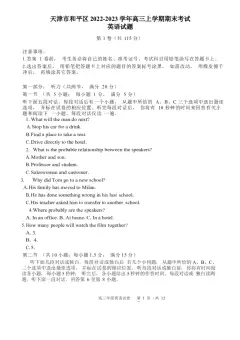
天津市和平区 2023-2024 学年度第一学期高三年级期末质量调查
英语试卷
卷I(共115分)
注意事项:
1. 答第I卷前, 考生务必将自己的姓名、准考证号、考试科目用铅笔涂写在答题卡上。
2. 选出答案后, 用铅笔把答题卡上对应的题目的答案标号涂黑, 如需改动, 用橡皮擦干
净后, 再填涂其它答案。
第一部分:听力(共两节, 满分20分)
第一节(共5小题;每小题1分, 满分5分)
听下面五段对话。每段对话后有一个小题, 从题中所给的A、B、C三个选项中选出最佳
选项, 并标在试卷的相应位置。听完每段对话后, 你将有10秒钟的时间来回答有关小题和阅
读下一小题。每段对话仅读一遍。
1. Where is the woman working now?
A. In a company. B. In a bank. C. In a law firm.
2. What is the probable relationship between the two speakers?
A. Husband and wife. B. Boss and secretary. C. Seller and customer.
3. What does the woman think of Christie's?
A. It's too expensive. B. It's too far away. C. It's too crowded.
4. What will the man do for the woman?
A. Renew two books. B. Return two books. C. Borrow two books.
5. Why is the man upset?
A. He missed his plane. B. He had a traffic accident. C. He failed to find a
place to park.
第二节(共10小题;每小题1. 5分, 满分15分)
听下面几段对话或独白。每段对话或独白后有几个小题, 从题中所给的A、B、C、三个
选项中选出最佳选项, 并标在试卷的相应位置, 听每段对话或独白前, 你将有时间阅读各小
题, 每小题5秒钟;听完后, 各小题给出5秒钟的作答时间。每段对话或独白读两遍。听下面一段对话, 回答第6至第8小题。
6. Why was the girl unwilling to answer her dad's question?
A. She was anxious to leave.
B. She didn't get the report card.
C. She didn't do well in some classes.
7. For which class did the girl NOT hand in her homework?
A. French. B. English. C. Math.
8. Who is Mr. Jones?
A. An English teacher. B. A history teacher. C. A math teacher.
听下面一段对话, 回答第9至第11小题。
9. How long did the woman think John would stay in Italy?
A. Two weeks. B. Two months. C. Two years.
10. Why was Marco eager to learn English?
A. He planned a trip to England.
B. He had business with Americans.
C. He was interested in American culture.
11. Where does this conversation most probably take place?
A. In America. B. In England. C. In Italy.
听下面一段独白, 回答第12至第15小题。
12. Who is Jim Brown?
A. The organizer of the program.
B. A participant of the course.
C. An experienced climber.
13. Why are the students encouraged to join the program?
A. To have a wonderful adventure.
B. To better their climbing skills.
C. To try some new equipment.
14. How many people can be admitted into the program?
A. 20. B. 25. C. 30.
15. How can the students register for the program?
A. Tell the course instructor after class.B. Call the State Park Climbing Center.
C. Return the application form to the speaker.
第二部分:英语知识运用(共两节, 满分45分)
第一节:单项填空(共15小题, 每小题1分, 满分15分)
从A、B、C、D四个选项中, 选出可以填入空白处的最佳选项。
16. ---Math is really killing me! I'm thinking of giving it up.
--- ______. You'll never get your dream job as a market analyst if you don't stick to it.
A. No pains, no gains. B. Better late than never.
C. All's well that ends well. D. Two heads are better than one.
17. Assuming an earthquake ______what will we do?
A. to happen B. happens C. happening D. will happen
18. We can ______the options and try to come to a decision.
A. make up B. set up C. weigh up D. cut up
19. I will be sorry ______this company, but I was offered an opportunity ______in a
field which I really enjoy.
A. for leaving: to have worked B. to leave: to work
C. for having left; about working D. to have left; for working
20. I expect you ______bored with working at the Post Office by this time next year
and for a more interesting job.
A. have become; will have looked B. found; will have panned
C. will have become; will be looking D. had found; had been panning
21. ---How come Tom picked a quarrel with his wife?
--- ______? We also have the occasional argument.
A. What's on B. Guess what C. For what D. Who doesn't
22. ______the classic Shi Ji, the only great historical works I had been exposed to
were Homer's epic poems.
A. Superior to B. Prior to C. Due to D. Similar to
23. The train doesn't stop at ______station along the way, but it stops at ______of the
main ones.
A. all; either B. every: most C. few; all D. each; none24. It is widely believed ______much television isn't healthy for children.
A. that B. how C. whether D. so
25. Most of the characters in Aesop's stories are animals, the qualities ______Aesop
used to reflect human traits and wisdom.
A. of which B. with which C. from whom D. of whom
26. Sharing is a reaction to our increasing need for goods and services ______lower
prices but still of good quality.
A. for B. at C. by D. through
27. ______the council has provided places for us to take our empty bottles for recy-
cling, many of us still throw glass bottles into the ordinary dustbins.
A. However B. Even though C. On account of D. Despite
28. She advised young people should be realistic and seek guidance from expert con-
sultants before ______.
A. rushing into things B. bursting out laughing
C. falling into ruins D. striking a chord
29. The dry-cleaner's couldn't get the dirt out completely, but you can ______see it
now.
A. approximately B. virtually C. barely D. practically
30. They ______finished the project; it was due on last Friday.
A. must have B. ought to have C. would have D. might have
第二节:完形填空(共20小题, 每小题1. 5分, 满分30分)
阅读下面短文, 掌握其大意, 然后从31-50题所给的A、B、C、D四个选项中, 选出最佳
选项。
The mission of Faces of Santa Ana is to lovingly engage the homeless through art. In
July 2015, Brian Peterson and his wife had just moved to Santa Ana, California with a
burning desire in their hearts to love their neighbors. Outside the couple's fourth-floor apart-
ment, a(n)31 man was often yelling on the street corner, sometimes keeping them 32 at
night. Peterson, 28, would pass the guy on his way to work as a car designer, but they never
33.One day, Peterson was relaxing in his living room, reading the book Love Does, about
the power of love in action, when his 34 disturbed by the homeless man. 35 by the book's
compassionate (有同情心的) message, Peterson made a(n)36 decision: He was going
outside to introduce himself.
In that first 37, Peterson learned that the man's name was Matt Faris. He'd moved to
Southern California to pursue a career 38, but he soon fell on hard times and 39 living on
the street for more than a decade.
"It was a strange thing to me, " Peterson recalled later. "I saw 40 on the face of a
man who hadn't shaved in probably a year. And the 41 inside of him inspired me. "42 Pe-
terson, a graduate of the Cleveland Institute of Art, hadn't picked up a paintbrush in about
eight years, he found himself asking if he could 43 Faris's portrait. And Faris said yes.
Peterson's 44 with Faris led him to form Faces of Santa Ana, a nonprofit organization
focused on 45 and painting portraits of members of the community who are unhoused. Peter-
son sells the 30-by-40-inch canvas(画布)-signed by both subject and artist-for a few
thousand dollars, and put half into what he calls a "love account"for his. 46.
Many of Peterson's new friends use the donations to secure immediate 47-medical care,
hotel rooms, food. Faris used the funds from his portrait to record an album, realizing his
48 dreams.
Peterson has painted 41 of these portraits himself. He's discovered that the buyers tend
to connect to the story of the person in the painting, finding 49 and often friendship with
someone they might have otherwise overlooked. "People often tell me, 'I was the one that
would cross the street. But I see homeless people 50 now, " Peterson says. "I didn't know
that would happen. "
31. A. talented B. strange C. homeless D. old
32. A. awake B. anxious C. awkward D. amazed
33. A. approached B. encountered C. quarreled D. spoke
34. A. hobby B. space C. quiet D. work
35. A. Inspired B. Enforced C. Informed D. Reminded
36. A. indifferent B. independent C. unexpected D. unwise
37. A. conversation B. compassion C. presentation D. realization38. A. in painting B. in health C. in music D. in sales
39. A. settled down B. ended up C. come up D. arise from
40. A. beauty B. friendliness C. determination D. thirst
41. A. honesty B. calm C. life D. bravery
42. A. Even though B. Now that C. Since D. When
43. A. sell B. collect C. evaluate D. paint
44. A. competition B. concentration C. connection D. cooperation
45. A. preparing B. befriending C. promoting D. bargaining
46. A. customers B. artists C. models D. volunteers
47. A. changes B. contributions C. necessities D. salaries
48. A. childhood B. forgotten C. impossible D. musical
49. A. support B. comfort C. similarities D. recognition
50. A. differently B. closely C. safely D. diversely
第三部分:阅读理解(共20小题;每小题2. 5分, 满分50分)
阅读下列短文, 从每题所给的A、B、C、D四个选项中, 选出最佳选项。
A
You're looking for a holiday with a difference? It's on offer right here! Come with us
on a very special tour of the great southern continent Antarctica. It's the only untouched
wilderness left on our planet. For 10 months of the year, the continent is inaccessible by
ships. Consequently, our tours are conducted in the brief period in late spring when the ice
has melted and we can reach Antarctica.
So why should I go there?
Antarctica may lack man-made attractions, but its natural beauty is breathtaking. You'll
want to tell your grandchildren about this trip in years to come. Ninety-eight percent of
this continent is covered with ice, which contains 70 per cent of the world's fresh water,
although it receives very little rainfall.
What kind of things could I see and do there?
Our tours are conducted in summer, but you have to remember that summer is six
months later in the Southern Hemisphere. Apart from the Arctic region, Antarctica is oneof the two areas on earth where you can enjoy 24 hours of sunlight. To get there, we
have our own ship, which is equipped with a helicopter and a landing pad. Once there
you'll be able to observe penguins and birds, and even watch whales and seals in the
ocean.
Do your tours damage the environment?
No, not at all. We don't disturb the wildlife, and we remove all the rubbish that we
produce. We strictly follow the guidelines contained in the 1991 Antarctica Agreement,
which bans oil exploration and protects wildlife.
How long does a tour last?
That depends on which tour package you choose. You can visit the Antarctic region
for as long as a month or, if you depart from Australia, you can see the Antarctic conti-
nent from the air in just one day. We will fly you over the continent so you can see it from
the comfort of your seat on one of our aircraft. The exact route depends on the weather on
the day of the . tour, but normally the flights pass over the Antarctic coastline and then head
inland over vast landscapes formed by ice and dramatic mountain ranges.
That sounds really interesting. How do I make a booking?
South Pole Tours are based in Christchurch, New Zealand. Call us on 25674874 today!
51. According to Paragraph 1, what can we learn about Antarctica?
A. Antarctica is a crowded tourist destination.
B. Spring is the best time to visit Antarctica.
C. The tour to Antarctica is quite expensive.
D. Antarctica is accessible by helicopters at any. time.
52. Tourists paying a visit to Antarctica can ____.
A. find many man-made attractions
B. share the experiences with each other
C. reach Antarctica by taking a helicopter
D. have chances to view some sea animals
53. According to the guidelines, which action is proper to address environmental con-
cerns?
A. Visitors must take fresh water with them while visiting the continent.B. The continent must be closed to visitors in late spring every year.
C. Polar tour must be conducted without disturbing its wildlife.
D. Oil exploration is allowed only when all the rubbish is removed.
54. The length of the tour will be determined by _____.
A. the weather on the day of the tour
B. the route visitors take to the region
C. the tour package you decided on
D. the amount of money tourists paid
55. What is the author's purpose in writing the passage?
A. To introduce some information of Antarctica to readers.
B. To attract potential tourists to go on a visit to Antarctica.
C. To highlight some rules for visitors staying on Antarctica.
D. To promote new businesses on the continent of Antarctica.
B
Camping is a rite of passage(成人礼) if you grow up in Canada. It's a child's first
taste of what living in the wild really means. But growing up as an immigrant(移民)
from India, I thought it was strange. I simply didn't understand why so many people loved
nature when the comfort of your home still existed.
Then I turned 20 and started trying new things. I had been experiencing mental health
issues for quite some time and I discovered being out in nature helped me calm down. So,
I decided to try camping.
The night before the trip I was quite excited. Then I overheard a conversation between
my father and mother. "Why does she have to do this? Doesn't she know she can just stay
at home?" my father asked. "This is what Canadian kids do, it's okay, she'll be fine!" my
mom explained. My parents had no faith in me surviving one night in the wild.
My friends and I set up our campsite in the woods. As the day went on, we ate,
played by the water and met our camping neighbors. Time felt like it slowed down; life
felt gentler and easier. Suddenly, I realized: I was doing it! I was camping! As the day
turned into night, the stars came out and I was amazed by all the twinkling lights above
me. I won't lie. I had the worst sleep of my life. Morning came and I was up and readyto make breakfast, coffee and tea. I didn't even realize I was sad to leave until we started
packing everything up.
I wasn't just leaving, having accomplished something I never thought I would do. I
was leaving with a real sense of community, a real sense of appreciation for what the
great outdoors had to offer, and a completely different outlook on an activity that I had
thought strange for so many years. It made me realize the beauty of Canada wasn't in the
things we did, but in the community we built.
56. What was the author's attitude toward camping as a child?
A. She was passionate.
B. She was frightened.
C. She felt it unnecessary.
D. She considered it beneficial.
57. What pushed the author to try camping?
A. Her friends' invitation.
B. Her curiosity about the wild.
C. Her desire to restore her mental health.
D. Her parents' doubts about her survival skills.
58. What can be used to best describe the writer's feeling during the camp?
A. Eager and proud.
B. Relaxed and fulfilled.
C. Challenging but satisfied.
D. Confident but regretful.
59. What did the author think of the camping trip?
A. It deepened her love of camping.
B. It helped her find a sense of belonging.
C. It was peaceful sleeping outdoors.
D. It gave her the courage to overcome challenges.
60. What is the proper title of the passage?
A. A new life in Canada.
B. Go back to nature.C. Guidance to camping for a beginner.
D. A meaningful camping experience.
C
The high-tech revolution has inspired a pleasure endless stream of new and exciting
electronic products that we just can't live without. In fact, the speed of technological inno-
vation can make last year's must-have this year's junk. And that's the problem.
The average life span of a personal computer has been shortened to around 18
months- and this has nothing to do with worn-mice or damaged disk drives. Simply put,
electronic products can become out of date before you've even figured out how they work.
So what happens to all those old keyboards, monitors, organizers and CPUs? Most are
stored away in a warehouse (仓库), taking up valuable space. But many end up in land-
fills, and that is where the trouble really begins. Computer monitors can contain up to 3. 5
kg of dangerous waste once they are no longer in use.
Unfortunately, this problem is not going to disappear anytime soon--in fact, it is grow-
ing by the minute. In Japan alone, people throw away some 20 million TVs, washing ma-
chines, refrigerators and air conditioners each year. What is to be done with all this techno-
trash?
One way to reduce waste is to avoid throwing away in the first place. Many compa-
nies reuse parts from old products in new models. This is not cheating-it makes both envi-
ronmental and economic sense. Cannon, for example, has adopted a philosophy known as
"kyosei", meaning "living and working together for the common good?"-a goal of achieving
balance between the environment and the corporate (公司的) activities. The company has
even gone so far as to say that environmental assurance should come before all business
activities, and that companies unable to achieve such assurance do not deserve to remain in
business.
As part of that effort, the company has started a global recycling program with a goal
to reduce, reuse and recycle more than 90% of its used products. In 1999, for example,
Cannon collected 128, 000 copying machines and 12, 175 tons of toner cartridges (色粉
盒) in Japan, Europe and the United States.Some argue that electronic garbage can also be controlled during the design phase.
This concept, called "design for the environment". Not only does this make environmental
sense, but it saves the customer money. IBM, meanwhile, recently planned programs in
Canada and the US that, for a small fee, will take back not just an IBM but also any
manufacturer's computer. Depending on the age and condition, the equipment will then be
either donated to charity, or broken down for reusable parts and recyclable materials.
61. With the rapid development of science and technology high-tech products can ____.
A. last for many years
B. become worn out soon
C. become old and useless soon
D. be used forever
62. What is not the problem caused by the out-of-date high-tech products?
A. Too much room is needed for their probable storage.
B. People do not know how to deal with them at all.
C. The amount of this techno-trash is increasing everyday without stop.
D. Harmful substances contained within may pollute the environment.
63. What idea can be learned through the example of Canon?
A. Business must be achieved at the cost of environment.
B. Environment holds great importance than business.
C. Business and environment has little impact on each other.
D. Recycling makes only environment sense instead of economic benefits.
64. When the author says, "electronic garbage can be controlled during the design
phase", he means ___.
A. while designing products, we must make something to contain garbage
B. while designing products, don't throw away garbage away
C. while designing, we must work out how much garbage the new product will bring
about
D. while designing, we must take environment into consideration.
65. What can be inferred from reading the passage?
A. The problem caused by high-tech products can't be solved in short timeB. The techno-trash problem can easily be solved in big countries
C. The problem can be solved to some degree if enough attention is paid
D. It is still hard to say whether this problem can be solved or not
D
Everyone knows that the choices we make affect our future. Suppose I am an intelli-
gent student with good marks. However, being lazy, I do badly in my examinations. I am
refused entry to university and cannot find a good job. The golden future I had imagined will
never be. All these are all from a bad choice!
However, your choices affect your future in a way that is a lot more complicated.
This is because nearly all the choices you make affect your character. Your character is
displayed through your choices, but it is also formed by them. Whenever you make a
choice, your character changes or grows, or diminishes (降低, 减弱) depending on
whether the decision you made is wise or foolish. Your character is being made by you,
bit by bit, choice by choice. And so, you become the sort of person who will maké a cer-
tain kind of choice in a certain situation.
Some will argue this is not true. After all, the field of human choice is a narrow one.
Most of the things that form us in our lives are not subject to choice . We cannot choose
when and where to be born, whether our families will be rich or poor, kind or cruel. We
cannot even entirely control who we will meet in our lives. With so much that we cannot
choose, how can we be said to be responsible for anything?
There is some truth in this. We are thrown into life without any say over the matter,
and have little control over most of it. However, we do have some power of choice, and
we do control the most important thing of all: how we respond to circumstances. We can
choose to keep struggling in hard times, or to give up.
This ability to choose how we behave and respond is a great gift. It is our key to
having confidence in the future. It is human nature to fear the future, as the future is un-
known. You cannot entirely control what will happen to you tomorrow. But if you have
confidence in your character, formed by years of making good choices, then you do know
one thing for certain about the future: no matter what happens, you will make a choice
that you will be proud of.At every moment, then, practise forming your character when you make your choices,
no matter how small they are. Remember: your choices form your character. And your
character determines your future.
66. With the example in paragraph1, the author intends to show that ___.
A. a good choice of job is a guarantee of one's bright future
B. intelligent people always tend to be somewhat lazy
C. a bad choice of being lazy may affect one's life bit by bit
D. a golden future will never be if one is refused by university
67. Your choices may affect your future in a complicated way because ___.
A. your future is solely determined by a certain choice
B. your choices and character shape each other, finally influencing the future
C. your future can only be formed if the choices are right
D. your character is always changing and so is your future
68. What does the underlined part mean in paragraph. 3?
A. not chosen as a subject to learn
B. not based on your choices
C. not depended on your future
D. not affected by your pleasure
69. According to the passage, why is the ability to choose how we behave considered
a great gift?
A. It guarantees you to have confidence in the future.
B. It ensures complete control over one's future life.
C. It eliminates your fear of the unknown future.
D. It provides you a favorable future as expected.
70. What do the "choice" mentioned in the passage refer to?
A. Choose to be a brave man with nothing to fear of.
B. Choose to be a hardworking man to get a bright future.
C. Choose to have a positive response to the unknown future.
D. Choose to have a determined mind to keep struggling.
卷Ⅱ主观题(共35分)第一节:阅读表达(共5小题;每小题2分, 满分10分)
阅读短文, 按照题目要求用英语回答问题。
I remember the day I sat down and considered my future quite clearly. I had been
widowed recently, and I had an elderly mother to support but no income of my own. I no
longer had the luxury of a husband supporting me, so it was time to get a job. With my
background and qualifications, the easiest way for me to earn money was to become a
teacher.
A friend told me his school was looking for an English teacher, so I arranged an in-
terview with the principal. Fifteen minutes after stepping into her office, I was given the
job and asked ifI was able to begin teaching that same day. The current English teacher
appeared very keen to leave!
I wondered why she had made such an abrupt decision, but I was secretly pleased that
her loss had become my gain. I walked towards the classroom on that first day, wondering
about the wisdom of my decision to accept the principal's offer. The thought of standing in
front of a group of teenagers made me scared and I started to panic.
The classroom was empty when I entered it. Slowly, the teenagers I was expecting
arrived in groups of four and five. Finally every seat was taken and I stared out at the
blank faces in front of me. They had been shown little respect and so they had given up
on education and on themselves. No one was listening or seemed to care what I was do-
ing. I knew I wasn't a gifted teacher and it was only my first day, but nothing I did moti-
vated these students. They were bored and restless.
I knew why their previous teacher had left. That night I sat at home. The same ques-
tion kept repeating itself in my head, even when I tried to distract myself by watching late-
night movies: "How could I make a huge difference to their lives?". I decided I would take
up the challenge. It was a slow process, but it was also the most rewarding experience of my
life. It took time, but my patience was rewarded. They had discovered the joy of learning
and I had discovered what it really means to be a teacher.
71. What made the writer have to get-a job herself? (no more than 15 words)
72. Why was the writer able to begin teaching that same day? (no more than 10
words)73. How does the writer feel on that first day? And why? (no more than 20
words)
74. What does the writer intend to tell us in paragraph 4? (no more than 15
words)
75. How do you understand "rewarding" according to the story? (no more than 20
words)
第二节:书面表达(满分25分)
假设你是在海外做交换生的中国学生李津。看到校文化社
征集活动的告示, 请你根据告示的内容, 以及以下要点, 写
一封邮件:
(1)简单描述所推荐的文化活动的内容;
(2)阐述推荐的理由;
(3)实施该活动的注意事项。
注意:
(1)词数不少于100;
(2)可适当加入细节, 使行文连贯。
(3)文章的开头结尾已给出。
Dear Campus Cultural Society,
Yours,