(cid:31)(cid:30)(cid:31)(cid:31)(cid:30)(cid:29)(cid:28)(cid:29)
(cid:28)(cid:27)(cid:26)(cid:31) (cid:25)(cid:24)(cid:23)(cid:30)(cid:28)(cid:27)(cid:26)(cid:31)(cid:22)(cid:21)(cid:20)(cid:29)(cid:19)(cid:27)(cid:27)(cid:25)(cid:26)(cid:26) (cid:18)(cid:17)(cid:16)(cid:15)(cid:31)(cid:31)(cid:30)(cid:29)(cid:28)(cid:27)G&’H’("332?IJK3’,$%L?K2?GMN-&L?O(’P%&,’#2?Q&%,,?R!$’("S)T’5’#%L)
!)GMN-&L)O(’P%&,’#2)Q&%,,)977.
U$’,)%L’#’-()!)V&’#’(H?W&-JI?-N?!"#$%&’>?GMN-&L?O(’P%&,’#2?Q&%,,?R!$’("S?T’5’#%L?"(L?X’3’(?Q&%,,?97.=
"GMN-&L# ’,?"?&%H’,#%&%L?#&"L%5"&Y?-N?GMN-&L?O(’P%&,’#2?Q&%,,
*+,-./0$12&3456¤/
!?GMN-&L?O(’P%&,’#2?Q&%,,?977.
(cid:154)/! '%7“ ):«‹ *+,-./0$12&3456›hi./097.=
GMN-&L?fi*+,-./0fl(cid:176)–†¢‡
/·(cid:181)3¶ •‚/·(cid:181)3„⁄”»…‰ (cid:190)¿(cid:192)\Aw`´\Aˆ˜‹ \A(cid:142)¯‹ \Ao˘
˙(cid:136)‹ ¨(cid:201)˚¸(cid:204)(cid:154)⁄fl˝˛‹ o˘˚mˇ¶
!"#$%&’()
! " # !"#$%&’(%)*"+,-($) %&
%’() *+,-./0$12&3456%789):;<=
1’() >?@ A B
C ( ) D E FGH
) : IJK L M NOP Q R STU V W X Y Z2U
[\)] IJK ^_‘ abJ
cdef *+,-./0$12&3456 efg
hi./0 j k
l m nop qrs j k tuv
. / hi./0
w x yz{|y}.~/(cid:127)
(cid:128) (cid:129) 0’"-1"’!2’3’(41-5
(cid:130)(cid:131)(cid:132)(cid:133) 677(cid:134)89:(cid:134)87;8
89(cid:132)(cid:133) 79<(cid:134):=;<:=68>?:=;@9::8
(cid:135) (cid:136) (cid:137)(cid:138)(cid:139)(cid:140)./(cid:141)(cid:142)(cid:143)(cid:144)3456
(cid:145) (cid:146) (cid:137)(cid:138)(cid:139)(cid:140)./(cid:141)(cid:142)(cid:143)(cid:144)3456
(cid:136) (cid:147) (cid:137)(cid:138)(cid:139)(cid:140)(cid:148)(cid:149)(cid:136)(cid:150)(cid:151)(cid:152)3456
(cid:153) (cid:154) @:@(cid:155)(cid:156)!.789(cid:155)(cid:156) .A.;
(cid:136) N 8B<
/ (cid:157) 97.=(cid:158) ..(cid:159)(cid:160) 9/
(cid:136) (cid:157) 979.(cid:158) ..¡(cid:160)8(cid:157)(cid:136)(cid:147)
¢£⁄~ CDEF?8@:(cid:134)@(cid:134)<66@(cid:134)6<68(cid:134)8
¥ ƒ 8B69§
!"#$!%"&’
()*+, -./012 3456789:; <=> 677?:9:@..=9Eddie Hobo
Comic
strip
Welcome to the unit
Reading
Grammar
Integrated skills
Study skills
Task
Self-assessment
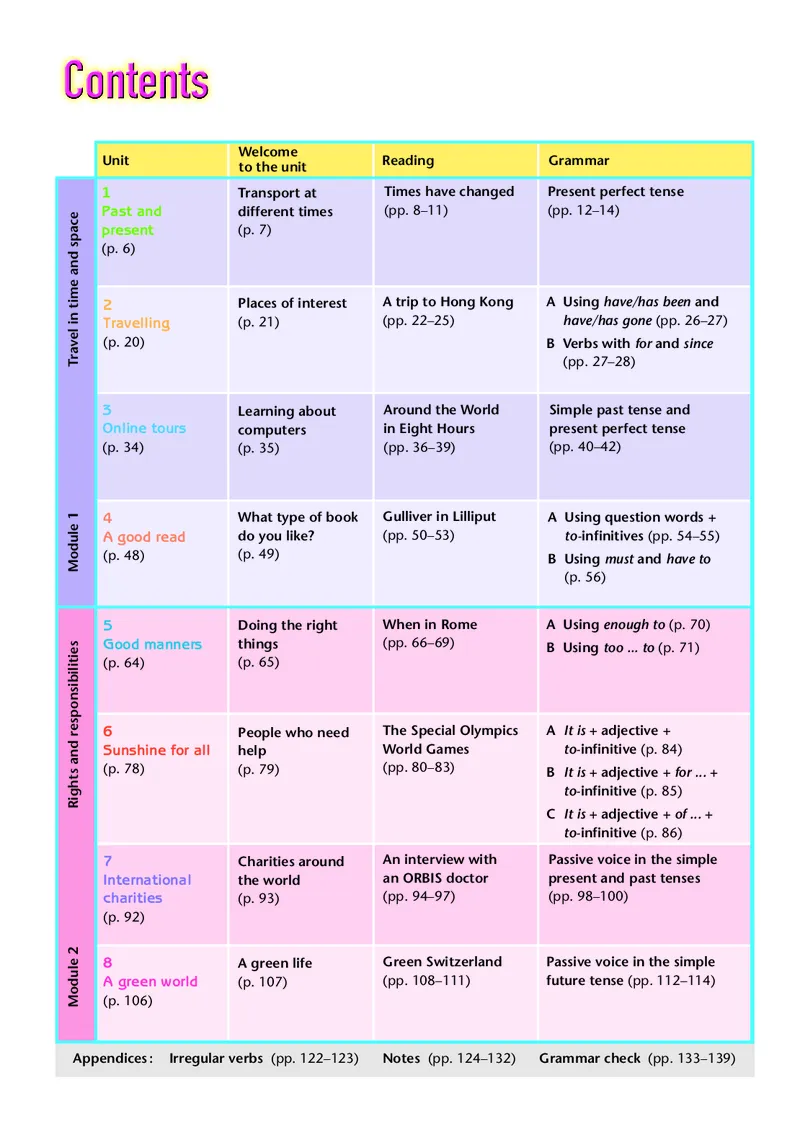
ProjectUnit Reading Grammar
Appendices: Irregular verbs (pp. 122–123) Notes (pp. 124–132) Grammar check (pp. 133—139)
ecaps
dna
emit
ni
levarT
1
eludoM
seitilibisnopser
dna
sthgiR
2
eludoM
Welcome
to the unit
1 Transport at Times have changed Present perfect tense
Past and different times (pp. 8—11) (pp. 12—14)
present (p. 7)
(p. 6)
2 Places of interest A trip to Hong Kong A Using have/has beenand
Travelling (p. 21) (pp. 22—25) have/has gone(pp. 26–27)
(p. 20) B Verbs with forand since
(pp. 27–28)
3 Learning about Around the World Simple past tense and
Online tours computers in Eight Hours present perfect tense
(p. 34) (p. 35) (pp. 36—39) (pp. 40–42)
4 What type of book Gulliver in Lilliput A Using question words+
A good read do you like? (pp. 50—53) to-infinitives (pp. 54–55)
(p. 48) (p. 49) B Using mustand have to
(p. 56)
5 Doing the right When in Rome A Using enough to(p. 70)
Good manners things (pp. 66—69) B Using too ... to(p. 71)
(p. 64) (p. 65)
6 People who need The Special Olympics A It is + adjective+
Sunshine for all help World Games to-infinitive (p. 84)
(p. 78) (p. 79) (pp. 80—83) B It is + adjective+ for ... +
to-infinitive (p. 85)
C It is + adjective+ of ... +
to-infinitive (p. 86)
7 Charities around An interview with Passive voice in the simple
International the world an ORBIS doctor present and past tenses
charities (p. 93) (pp. 94—97) (pp. 98—100)
(p. 92)
8 A green life Green Switzerland Passive voice in the simple
A green world (p. 107) (pp. 108—111) future tense (pp. 112–114)
(p. 106))121—021
.pp(ytirahc
no
troper
A
2
tcejorP
Integrated skills Study skills Task Self-assessment
A Changes in Starlight Town
(pp. 15–16)
B Speak up: We haven’t seen each
other since then. (p. 16)
A Travelling in China (pp. 29–30)
B Speak up: I’m going to visit
Chengdu. (p. 30)
A Travelling at home (pp. 43–44)
B Speak up: My pleasure. (p. 44)
A Recommending a book (pp. 57–58)
B Speak up: I want some history
books. (p. 58)
Wordlists (pp. 140—150) Proper nouns (pp. 151—152)
tcejorP
)36—26
.pp(
redlof
noitamrofni
nA
1
tcejorP
Facts and opinions Changes in my (p. 19)
(p. 17) hometown
(pp. 18—19)
Main points and My best holiday (p. 33)
details (pp. 32—33)
(p. 31)
Making charts Introducing a (p. 47)
(p. 45) country
(pp. 46—47)
Transitions between A survey on reading (p. 61)
ideas habits
(p. 59) (pp. 60—61)
A Public signs (pp. 72–73) Using English Table manners (p. 77)
B Speak up: Please don’t take sayings (pp. 76—77)
photos. (p. 73) (pp. 74–75)
A Working in a mountain area Organizing your Giving a helping (p. 91)
(pp. 87–88) ideas hand
B Speak up: How can we help (p. 89) (pp. 90—91)
people in our daily lives?(p. 88)
A The work of UNICEF Using punctuation Charity work (p. 105)
(pp. 101–102) marks (pp. 104–105)
B Speak up: I’ve got toothache. (p. 103)
(p. 102)
A How green are you? Checking your work Going green (p. 119)
(pp. 115–116) (p. 117) (pp. 118—119)
B Speak up: We can plant more
trees. (p. 116)Unit 1
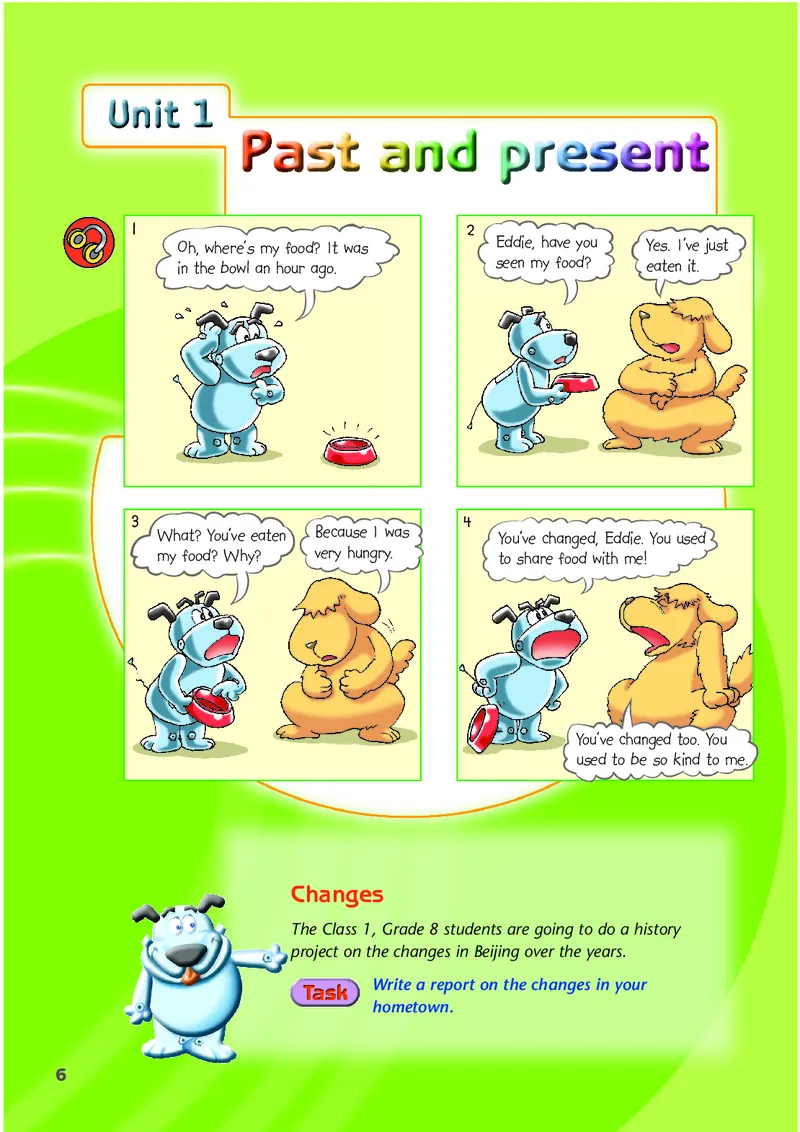
1 2
Oh, where’s my food? It was Eddie, have you Yes. I’ve just
in the bowl an hour ago. seen my food? eaten it.
3 4
What? You’ve eaten Because I was You’ve changed, Eddie. You used
my food? Why? very hungry. to share food with me!
You’ve changed too. You
used to be so kind to me.
Changes
The Class 1, Grade 8 students are going to do a history
project on the changes in Beijing over the years.
Write a report on the changes in your
hometown.
6Unit 1
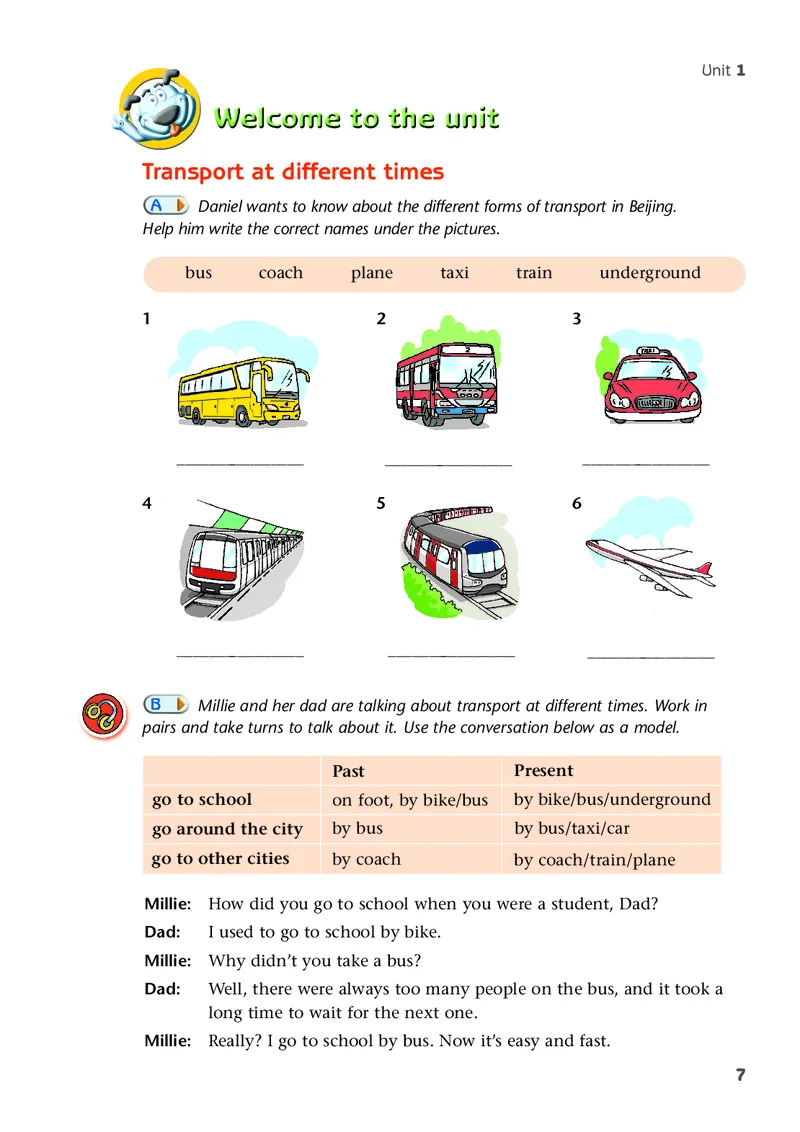
Transport at different times
Daniel wants to know about the different forms of transport in Beijing.
Help him write the correct names under the pictures.
bus coach plane taxi train underground
1 2 3
________________ ________________ ________________
4 5 6
________________ ________________ ________________
Millie and her dad are talking about transport at different times. Work in
pairs and take turns to talk about it. Use the conversation below as a model.
Past Present
go to school on foot, by bike/bus by bike/bus/underground
go around the city by bus by bus/taxi/car
go to other cities by coach by coach/train/plane
Millie: How did you go to school when you were a student, Dad?
Dad: I used to go to school by bike.
Millie: Why didn’t you take a bus?
Dad: Well, there were always too many people on the bus, and it took a
long time to wait for the next one.
Millie: Really? I go to school by bus. Now it’s easy and fast.
7Unit 1
A Times have changed
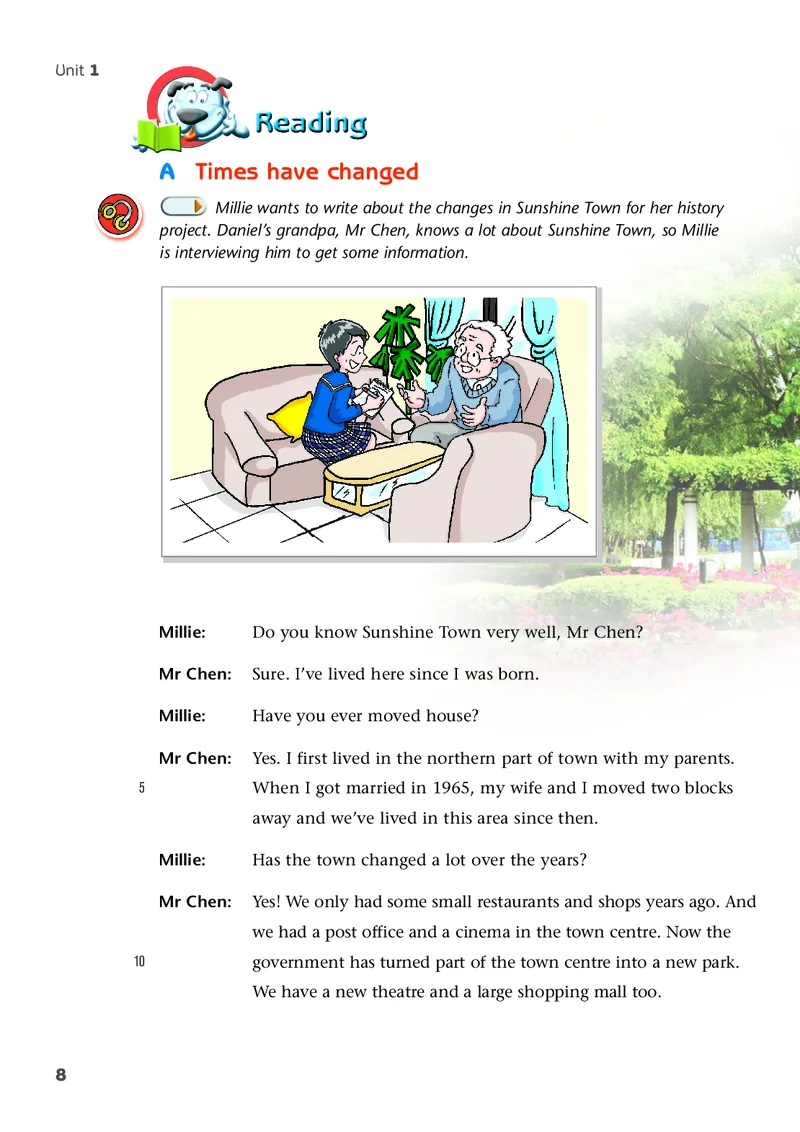
Millie wants to write about the changes in Sunshine Town for her history
project. Daniel’s grandpa, Mr Chen, knows a lot about Sunshine Town, so Millie
is interviewing him to get some information.
Millie: Do you know Sunshine Town very well, Mr Chen?
Mr Chen: Sure. I’ve lived here since I was born.
Millie: Have you ever moved house?
Mr Chen: Yes. I first lived in the northern part of town with my parents.
5 When I got married in 1965, my wife and I moved two blocks
away and we’ve lived in this area since then.
Millie: Has the town changed a lot over the years?
Mr Chen: Yes! We only had some small restaurants and shops years ago. And
we had a post office and a cinema in the town centre. Now the
10 government has turned part of the town centre into a new park.
We have a new theatre and a large shopping mall too.
8Unit 1
Millie: Was pollution a problem then?
Mr Chen: Yes, it was. There was once a steel factory near the Sunshine River.
They often put the waste into the river. Later the government
15 realized the problem and took action to improve the situation.
Now the river is much cleaner.
Millie: Do you think life is better now?
Mr Chen: Well, in some ways it is. It’s really nice to have a beautiful modern
town. However, most of my old friends have moved away. It has
20 become impossible for us to see each other as often as before. We
used to play cards and Chinese chess together. Now I feel a bit
lonely from time to time. Anyway, it’s good to see the amazing
changes in the town.
9Unit 1
B Changes in Sunshine Town
Millie is telling Sandy about her interview with Mr Chen. Sandy does not
know the meanings of some words. Help her match the words on the left with the
meanings on the right. Write the correct letters in the blanks.
1 married (line 5) _________ a sometimes
2 block (line 5) _________ b know or understand something
that you did not know before
3 factory (line 13) _________ c make something better
4 realize (line 15) _________ d a place where things are made
by machines
5 improve (line 15) _________ e not happy because of being alone
6 lonely (line 22) _________ f having a husband or wife
7 from time to time _________ g a group of buildings with
(line 22) streets on all sides
Millie is telling Sandy more about her interview with Mr Chen. Help Sandy
check if she has got the information right. Write a T if a sentence is true or an F if
it is false.
1 Mr Chen knows little about Sunshine Town. _________
2 Mr Chen moved away from his parents when he
got married. _________
3 There is a large shopping mall in Sunshine Town now. _________
4 The steel factory once put its waste into the Sunshine River. _________
5 It is easy for Mr Chen to see his old friends now. _________
6 Amazing changes have taken place in Sunshine Town. _________
10Unit 1
Sandy wants to learn more about the history of Sunshine Town. She is
asking Millie some questions. Work in pairs. Complete their conversation.
Sandy: Tell me more about your interview with Mr Chen, Millie. Has he
lived in Sunshine Town all his life?
Millie: Yes. He first lived with his parents in the (1) ________________ part of
town, and then moved to another flat two (2) ________________ away.
Sandy: What was the town like in the past?
Millie: There were some small (3) ________________ and shops.
Sandy: What did Mr Chen say about the town centre?
Millie: Years ago, there was a (4) ________________ and a (5) ________________.
Now there’s a new park, a new (6) ________________ and a large
(7) ________________.
Sandy: Were there any factories in Sunshine Town?
Millie: Yes. There was once a (8) ________________ near the Sunshine River.
Millie is going to write about the changes in Sunshine Town for her history
project. She has made some notes. Help her complete the sentences with the
information on pages 8 and 9.
• Sunshine Town (1)________________________ over the years.
• People now have a (2) ________________________ town.
• The (3) ________________ from the steel factory was once a problem.
Luckily, the government took action to improve the (4) ________________
later.
• Old people used to (5) ________________________ together.
• Old people sometimes (6) ________________________ because they
cannot (7) ________________________ as often as before.
• People think it is good to see (8) ________________________.
11Unit 1
Present perfect tense
We can use We use the present perfect tense to talk about an action that started in the
these time
past and continues to the present.
expressions
with the present I have lived here since I was born.
perfect tense.
already yet We use the present perfect tense to talk about an action that happened in the
ever never
past and has a connection with the present.
just recently
since for
Eddie has just eaten Hobo’s food.
(Eddie ate the food, and now Hobo has nothing to eat.)
We also use the present perfect tense to talk about how many times an
action has happened till now.
I have already read this book many times.
We make positive statements in the present perfect tense like this:
I/You/We/They have
arrived.
He/She/It has
12
PIT
We make negative statements in the present perfect tense like this:
I/You/We/They have
have not = haven’t
not arrived.
has not = hasn’t
He/She/It has
We ask and answer questions using the present perfect tense like this:
Have I/you/we/they
arrived?
Has he/she/it
I/you/we/they have.
Yes,
he/she/it has.
I/you/we/they haven’t.
No,
he/she/it hasn’t.
PITUnit 1
We form the past participles of regular verbs by adding -ed, just as what we
do to form the simple past tense of these verbs.
Most verbs + ed finish ➜ finished
Verbs ending in -e + d change ➜ changed
Verbs ending in a consonant + y - y + ied carry ➜ carried
Short verbs ending in a vowel + double the stop ➜ stopped
a consonant consonant + ed
Turn to pages
122 and 123
for more
changes of
irregular verbs.
The table below shows more examples of the past participles of verbs.
Regular verbs Irregular verbs
Base form Past participle Base form Past participle
visit visited hit hit
repair repaired put put
live lived meet met
move moved make made
try tried sell sold
study studied give given
fit fitted write written
plan planned think thought
13
PIT
We form the past participles of irregular verbs differently. Here are some
examples.
No change come ➜ come hurt ➜ hurt
Change the vowel hold ➜ held win ➜ won
Change the consonant lend ➜ lent build ➜ built
Change the vowel(s) and the catch ➜ caught keep ➜ kept
the consonant(s) forget ➜ forgotten tell ➜ told
be ➜ been have ➜ had
Others fall ➜ fallen fly ➜ flown
draw ➜ drawn see ➜ seenUnit 1
A short test
Mr Wu wants the students to practise using the present perfect tense. Help
them write the past participles of the verbs below.
1 borrow________ 5 plan ________ 9 say ________
2 hope ________ 6 cry ________ 10 grow ________
3 make ________ 7 send ________ 11 hit ________
4 get ________ 8 watch ________ 12 enjoy ________
Mr Wu asks the students to complete the sentences below using the present
perfect tense. Help them complete the sentences.
1 They ________________ (finish) their homework already.
2 John __________ never __________ (visit) China.
3 Mr Li ________________ (repair) over ten bicycles since Monday.
4 We ____________________ (not see) each other for years.
5 My parents ____________________ (not come) back yet.
6 Our teacher ________________ (teach) us a lot about the history of China.
Chat time
Millie and Sandy are talking about a film about the history of Beijing.
Complete their conversation with the correct forms of the verbs in brackets.
Millie: (1) ___________ you ___________ (see) any films recently, Sandy?
Sandy: No, I haven’t. What about you?
Millie: I (2) _____________________ (see) one last Saturday.
Sandy: What’s it about?
Millie: It’s about the changes in Beijing over the past century.
From this film, I (3) _____________________ (learn)
more about Beijing’s past and present.
Sandy: Oh, I think I (4) _____________________ (hear) about
the film. Do you plan to see it again?
Millie: Yes, I’d like to.
14Unit 1
A Changes in Starlight Town
Daniel and Kitty are doing their history project. Listen to their conversation.
Complete the information below about Starlight Town in the past.
Past
Environment: green (1) ___________, clean
and fresh (2) ___________, wild
(3) ___________ near the lake
Transport: bus and (4) ___________
Living conditions: old (5) ___________
Listen to the rest of their conversation and complete the information about
today’s Starlight Town.e
Present
Environment: smaller (1) ___________, new
(2) ___________ station, tall (3) ___________
and new roads
Transport: bus, taxi and (4) ___________
Living conditions: new (5) ___________
Kitty is writing about Starlight Town in her diary. Complete her diary entry
on the next page with the words in the box.e
air bicycle birds buildings flats
hills houses modern railway taxi
15Unit 1
13 February
Dear Diary,
Today I borrowed a book about Starlight Town’s past and present.
Starlight Town was very beautiful years ago. There were green
(1) ______________ and wild (2) ______________ near the lake. The
(3) ______________ was clean and fresh then.
Now it has become a (4) ______________ town. There is a new
(5) ______________ station. There are some new roads too. People can
now travel to and from the town by bus, (6) ______________ or train, but
in the past, people could only travel by bus or (7) ______________.
Another big change is the many tall (8) ______________ in the town.
Local people used to live in old (9) ______________, but now, most of
them have moved into new (10) ______________.
Starlight Town has changed a lot over the years. I hope I can visit it
again.
B Speak up: We haven’t seen each other since then.
Millie is telling Sandy about an old friend. Work in pairs and tell your
partner about the changes in your life. Use the conversation below as a model.
Millie: I met my old friend Becky last week. She’s just returned from
the USA.
Sandy: Really? When did you last see each other?
Millie: About five years ago. She went abroad with her parents. We
haven’t seen each other since then.
Sandy: Oh, you were still at primary school
then. So how do you keep in touch
with each other?
Millie: We mainly communicate by email.
The Internet makes communication
much easier.
Sandy: Exactly.
16Unit 1
Facts and opinions
We often use facts and opinions when we write. Facts are true statements.
They include names, dates, events and numbers. Opinions tell what we
Sentences that believe, feel or think. They may not be true.
show opinions
Beijing is the capital of China. (Fact)
often use verbs
like feel, Beijing is the best city in the world. (Opinion)
believeand
thinkor have Many changes have taken place in my hometown. (Fact)
adjectives like
The new shopping mall is a good place to have fun. (Opinion)
good, badand
terrible.
When we write, we can use facts to support our opinions. We can also give
facts first, and then state our opinions.
My hometown is beautiful. There are green hills all around. A river runs through
the centre of town.
I have moved to a new school this term. I do not know the school very well and
I have no friends here. I feel unhappy these days.
17
PIT
Read the sentences below. Write an F for a fact or an O for an opinion.
1 There were only small shops and restaurants in the town. ________
2 Old people used to play cards and Chinese chess together. ________
3 The new park in the town centre looks beautiful. ________
4 There was once a steel factory near the Sunshine River. ________
5 Life is getting better in some ways. ________
6 Many of Mr Chen’s friends have moved away. ________
Millie is writing about the changes in her life. Help her decide which are
opinions and which are facts. Reorganize them into a short passage.
1 We have more subjects to learn.
2 It is not easy to get used to the changes of life quickly.
3 When I was at primary school, I walked to school with my mum.
4 Now I go to school by bus on my own.
5 I have to spend more time on my homework than before.
6 Some subjects are difficult.Unit 1
Changes in my hometown
Amy plans to write about the changes in Moonlight Town for her history
project. She has an old picture and a recent picture of the town.
Amy organized her ideas by using a fact file. Read her fact file.
Topic Many changes have taken place in Moonlight Town over the years.
Past Present
narrow and dirty roads; wide and clean streets;
Environment rubbish everywhere; green trees on both sides;
large open spaces shops and tall buildings
Facts
small old houses; new flats;
Life listen to the radio or computers and the Internet;
watch TV mobile phones
Transport on foot or by bicycle by bus or taxi; have own cars
Opinion Now people are enjoying a comfortable life.
... has changed a lot over the years.
Many changes have taken place in ....
People are enjoying a ... life.
There were only ... in the past, but now ....
People used to ....
The government has built ....
Many families have their own ....
18Unit 1
Amy is writing her report on the changes in Moonlight Town. Help her
complete her report using the fact file in Part B.
Many changes have taken place in Moonlight Town over the years.
In the past, there were only (1) ______________ roads in the small town.
There was (2) ______________ everywhere. But now the streets are
(3) ______________, with many (4) ______________ on both sides. The
government has also built (5) ______________ in some large open spaces.
Years ago, people lived in (6) ______________. Now most of them have moved
into (7) ______________. They used to (8) ______________ or watch TV in their
free time, but now most families have computers and the (9) ______________.
Moreover, (10) ______________ make communication easier now.
In the past, people travelled around the town (11) ______________, but now
they can go around (12) ______________. Many families even have their own
cars.
Now people are enjoying a comfortable life.
You are writing a report on the changes in your hometown. Find an old photo
and a recent photo of your hometown. Use Amy’s fact file and her article as a model.
I have learnt Details Result
1 about the changes in Sunshine Town.
2 to use the new words to talk
about my hometown.
3 to use the present perfect tense.
4 how to use facts to support my
opinions.
Result: Excellent! Good! Not bad!
I need to spend more time on ___________________________________.
191 2 Really? I’ve been there before.
Hey, Eddie. Where Can I join you?
are you going?
I’m going to South Hill for my holiday. OK. Get ready!
3 4
What are you doing, Hobo?
I don’t think it’ll be
a holiday for us.
Don’t worry. I’ll
I’m getting all the things.
help you. Let’s go.
I’m so excited!
Where have you been on holiday?
The Class 1, Grade 8 students want to find out more
about different places. They are writing about their
holidays.
Prepare a fact file and write about one
of your holidays.
20Unit 2
Places of interest
Daniel and Millie are looking at some pictures of places of interest from
around the world. Help them write the correct names under the pictures.
the Great Wall the Leaning Tower of Pisa the Little Mermaid
the Statue of Liberty the Sydney Opera House Tower Bridge
1 2 3
_____________________ _____________________ _____________________
4 5 6
_____________________ _____________________ _____________________
Daniel and Millie are talking about the places in Part A. Work in pairs and
talk to your partner about different places. Use the conversation below as a model.
What’s this, Millie? It’s the Little Mermaid.
Where is it?
It’s in Copenhagen, the capital of Denmark.
What’s special about it?
It comes from the story by Hans Christian Andersen.
Have you ever been there?
No, I haven’t.
21Unit 2
A A trip to Hong Kong
Kitty is visiting Hong Kong during the winter holiday. She has written a
letter to Millie about Hong Kong Disneyland. Here is the letter.
Hi Millie,
How are you? We haven’t seen each other since last week. I miss
you so much! My parents and I have been in Hong Kong for two
days. We’re having a fantastic time here. Today we spent the whole
5 day at Disneyland.
We got to the park by underground. First, we had fun on Space
Mountain—an indoor roller coaster in the dark. It moved at high
speed and was really exciting! We were screaming and laughing
through the ride.
10 Next, we hurried to a restaurant to have a quick meal. On the way,
we met some Disney cartoon characters, such as Snow White and
Mickey Mouse. They were so cute.
Everybody got excited when a parade of Disney characters began
later in the afternoon. It was the best part of the day. I ran after
15 them and couldn’t stop taking photos. After the parade, we
22Unit 2
watched a 4-D film. It was like magic. We could even smell the
apple pie and feel the wind.
Then we did some shopping. I bought a couple of key rings for
classmates. I’m sure you’ll love them.
20 At the end of the day, we watched the fireworks in front of
Sleeping Beauty Castle. The castle looked bright and beautiful
under the fireworks.
I know you’ve gone to Hainan. Hope you’ve enjoyed yourself there!
See you soon.
25 Yours,
Kitty
23Unit 2
B About Hong Kong Disneyland
Kitty is back in Sunshine Town. Amy is asking Kitty about her trip. Help Kitty
answer Amy’s questions.
Amy: Who did you go to Hong Kong with?
Kitty: I went there with (1) __________________________.
Amy: Where did you go during your stay there?
Kitty: We went to (2) __________________________.
Amy: How did you get there?
Kitty: We got there (3) __________________________.
Amy: How long did you stay in the park?
Kitty: We stayed there for (4) __________________________.
Amy: Did you enjoy yourselves there?
Kitty: Sure. We had (5) __________________________.
After talking with Kitty, Amy is making notes of how Kitty spent her day at
Disneyland. Help Amy complete the notes below.
Had fun on (1) _______________
Hurried to have a (2) _______________ and met
Disney (3) _______________ on the way
A day at
Watched a (4) _______________ of Disney characters
Disneyland
Watched a (5) _______________
Did some (6) _______________
Watched (7) _______________ in front of the castle
24Unit 2
Kitty is showing Amy her photos the other day. Complete their conversation
with the words in Kitty’s letter on pages 22 and 23.
Kitty: I took lots of photos at Hong Kong Disneyland, Amy.
Amy: Oh, let me have a look. Is that Mickey Mouse?
Kitty: Yes. He looked so (1) ________________.
Amy: What’s in this photo?
Kitty: It’s Space Mountain, an (2) ________________ roller coaster. It moved at
high (3) ________________ and we were (4) ________________ and
laughing through the (5) ________________.
Amy: What do you think was the best part of the day?
Kitty: I think the parade of Disney (6) ________________ was really
wonderful.
Amy: Was the film in the park interesting?
Kitty: Yes. The 4-D film was like (7) ________________. We could even smell
the apple (8) ________________.
Amy: Did you go shopping there?
Kitty: Yes. I bought (9) ________________
key rings. Here’s one for you.
Amy: It’s nice. Thank you.
Kitty had a good time at Hong Kong Disneyland. Find the sentences in her
letter that show her happiness.
25Unit 2
A Using have/has been and have/has gone
We use have/has been to express the idea that someone went to a place and
has already come back. It refers to an experience.
Millie and Amy have been to South Hill. They want to go there again.
Sandy has never been to South Hill. She wants to go with them.
We use have/has gone to express the idea that someone went to a place but
has not yet returned.
Kitty and her family have gone to Hong Kong. They will come back next week.
Suzy is not at home at the moment. She has gone to the bookshop.
About travels
The Class 1, Grade 8 students are talking about their classmates and families.
Help them complete the sentences with have/has been or have/has gone.
1
Millie isn’t here. She ________________ to the
library.
2
Peter and Simon ________________ just
________________ to the library. They borrowed
some interesting books.
3
My cousin ________________ to Xi’an twice.
4
My parents ________________ to Xi’an and
they’ll stay there for a week.
5
Daniel won’t be with us at the party. He
________________ to Shanghai.
26Unit 2
Daniel and Millie are chatting at a weekend. Complete their conversation
with the correct forms of the verbs in brackets.
Daniel: I haven’t seen Mr Wu for days. Where (1) ________ he ________ (go)?
Millie: He (2) ________________ (go) to Tianjin to attend a meeting.
Daniel: (3) ________ you ___________ (be) anywhere recently?
Millie: Yes, I (4) ________________ (be) to Hainan with my parents.
Daniel: Oh, that’s great! (5) ________ you ___________ (be) to Sanya?
Millie: Sure, we (6) ________________ (be) to the beach there. Look at these
photos.
Daniel: The beach is beautiful. I see Andy playing on the sand too.
Millie: Yes. We went there with his family.
Daniel: I see. By the way, shall we invite Andy
to go for a picnic tomorrow?
Millie: Andy isn’t here this weekend. He
and his parents (7) ________________
(go) to the countryside. They’ll be
back tomorrow afternoon.
B Verbs with for and since
We use for when we talk about a period of time, and we use since when we
talk about a time point in the past.
Mr Dong has lived here for many years.
Mr Dong has lived here since he was born.
Some verbs, such as come, go, buy and leave, can be used in the present
perfect tense, but they cannot be used with for or since in positive
statements.
✗
He has left Beijing for a week.
✓
He has not left Beijing yet.
✓
He has been away from Beijing for a week.
✗
He has bought a car since 2007.
✓
He has not bought any new car since 2007.
✓
He has had a car since 2007.
27Unit 2
If we want to express a continuous state, we can use another way like this:
Verb Used for a Example
continuous state
begin/start have/has been on The film has been on for 20 minutes.
finish/stop have/has been over The parade has been over for hours.
come/go/arrive have/has been in/at Kitty has been in Hong Kong for two
days.
leave have/has been away She has been away from home since
last Tuesday.
borrow have/has kept She has kept this book since last week.
join have/has been in Simon has been a member of the
have/has been a Football Club since last year.
member of
marry have/has been They have been married for 15 years.
married
die have/has been dead The fish have been dead for some
time.
More about Kitty’s trip
Kitty is telling Millie about her holiday in Hong Kong on the phone. Complete
what she says with the correct forms of the verbs in brackets.
My parents and I (1) _______________ (arrive) in
Hong Kong on the first day of the winter holiday. We
(2) _______________ (be) here for three days.
I (3) _______________ (borrow) a book about Hong Kong
a week ago. It’s very useful. I (4) _______________ (keep)
it with me for a few days. It helps me learn more about
Hong Kong.
Now it’s noon and we’re in Ocean Park. The first dolphin
show (5) _______________ (begin) at 11:30 a.m. It
(6) _______________ (be) on for about half an hour.
The show is really exciting.
28Unit 2
A Travelling in China
The Class 1, Grade 8 students are talking about the kinds of places they like
best. Listen to their conversation and match the students with the places. Write the
correct letter in each box.
Places for travelling
a Chinese gardens 1 Kitty
b Museums 2 Simon
c Places of natural beauty 3 Sandy
d Seaside cities 4 Daniel
e Theme parks 5 Millie
The students are listening to a radio programme about the best time to
visit some places in China. Put a tick (✓) in the correct boxes.
Places to go Spring Summer Autumn Winter
Chinese Suzhou,
gardens Yangzhou
Beijing,
Museums
Xi’an
Places of
Mount Huang,
natural
Jiuzhaigou
beauty
Dalian,
Seaside cities
Qingdao
Shenzhen,
Theme parks
Hong Kong
29Unit 2
Amy wants to give her classmates some advice on travelling in China.
Help her complete her notes. Use the information in Parts A1 and A2 to help you.
Places to go in China
Kitty likes (1) ______________, such as the Window of the World in Shenzhen or
(2) ______________ Disneyland. She can go there all year round.
Simon loves water sports, such as sailing. He thinks it is great fun. He can visit
a seaside city like (3) ______________ or Qingdao this (4) ______________.
Sandy likes places of (5) ______________, like Mount Huang or Jiuzhaigou. She
can go there in any season except (6) ______________. The views there in winter
may be wonderful, but it is dangerous to climb the mountains or hills on cold and
snowy days.
Daniel likes (7) ______________. He can visit Suzhou or Yangzhou. The best time
to go there is in spring or (8) ______________. There may be some rain, but the
weather is usually nice at that time of year.
Millie likes (9) ______________. She can go to Beijing or Xi’an. She can visit
museums in any season.
B Speak up: I’m going to visit Chengdu.
Simon and Amy are talking about their holiday plans. Work in pairs and take
turns to ask about a holiday plan. Use the conversation below as a model.
Simon: Do you have any plans for the May Day holiday, Amy?
Amy: Yes. I’m going to visit Chengdu with my mum.
Simon: That’s great. My dad has been to Chengdu on business twice. How
will you get there?
Amy: We’re going to take a direct flight to Chengdu.
Simon: How long are you staying there?
Amy: About three days. By the way, how long
does it take to fly to Chengdu?
Simon: About three hours, I think. I can check it
for you with my dad.
Amy: Thanks very much.
30Unit 2
Main points and details
When we write about an experience or event, we can organize our ideas
using the following five main points:
WWhheenn did it happen?
WWhheerree did it happen?
WWhhoo was there?
WWhhaatt happened?
HHooww did you feel?
Then we should give details to support the main points. Take Kitty’s day at
Hong Kong Disneyland as an example:
⎧ When: during the winter holiday
⎪ Where: Hong Kong
⎪ Who: Kitty and her parents
⎪ What: visited Hong Kong Disneyland
⎨ ⎧enjoyed the Space Mountain ride
Main
⎪
points⎪ ⎪watched a parade
⎪
⎪ Details ⎨saw a 4-D film
⎪
⎪ ⎪did some shopping
⎪
⎩watched the fireworks
⎩
How: had a fantastic time
Mr Wu is asking the Class 1, Grade 8 students to organize the following
information into main points and details. First, help them write the correct letters in
the blanks. Then work in pairs and talk about their trip.
a Class 1, Grade 8 students
When: _________
b Enjoyed the natural beauty
Where: _________
c Everybody felt excited
d Flew kites Who: _________ _________
⎧
e Went fishing by the lake ⎪
What: _________ ⎪ _________
⎨
f 5 March ⎪
⎪
How: _________ ⎩ _________
g South Hill
h A visit to South Hill
31Unit 2
My best holiday
Kitty plans to write about her trip to Hong Kong. She organized her ideas
by using a fact file. First, she wrote down the main points. Then she wrote down
the details. Read her fact file.
Main points Details
When The winter holiday
Where Hong Kong
Who My parents and I
Disneyland parade of Disney characters
Visiting places of
exciting Space Mountain ride
interest
Ocean Park dolphin show and bird show
What
Visited museums
Other activities
Went shopping
Eating Delicious seafood
Interesting, exciting, fun, nice
How Enjoyed the trip
Want to visit it again
It took us ... to fly to ....
The next day, we went to ....
I loved watching the interesting ....
... was exciting/beautiful/fantastic.
On the third day, we visited ....
We went to ... on the fifth day.
... was the best part of the day.
We enjoyed this trip very much.
32Unit 2
Kitty is writing about her trip to Hong Kong. Help her complete her article.
The day finally arrived. My parents and I left for the airport in the early
morning. It took us about three and a half hours to fly to Hong Kong.
The next day, we went to the most famous theme park— (1) __________________.
I loved watching the interesting (2) __________________ of Disney characters,
and the Space Mountain ride was very (3) __________________.
On the third day, we visited another famous theme park in Hong Kong—
(4) __________________. We watched the (5) __________________ and the bird
show there. They were great fun.
On the fourth day, we visited some museums, and then we went
(6) __________________. My mother enjoyed that day most. She bought a lot
of presents for our relatives and her friends.
We went to a seafood restaurant on the fifth day and had a
(7) __________________ meal. The food in Hong Kong was really nice.
We enjoyed this trip very much, and I hope I can visit it again some day.
You are going to write an article about one of your holidays. Write down
some main points and details, and organize your ideas before you write.
I have learnt Details Result
1 about Kitty’s trip to Hong Kong.
2 to use the new words to talk
about a holiday.
3 to use hhaavvee/hhaass bbeeeenn and
hhaavvee/hhaass ggoonnee.
to use verbs with ffoorr and ssiinnccee.
4 to state main points first and
then give details.
Result: Excellent! Good! Not bad!
I need to spend more time on ___________________________________.
331 2
Have you used this
before, Eddie?
It looks like a TV.
No, never!
I agree.
3 4
Look, this programme began
Ah, here it is. Let’s change
an hour ago. It’s boring.
the channel.
Right. Where’s the
remote control?
The world in computers
Daniel found a good website for learning about places
of interest around the world.
Write an introduction to a country with
the help of the Internet or libraries.
34Unit 3
Learning about computers
Annie, Simon’s cousin, wants to learn about the different parts of a computer.
Look at the picture below and help her write the correct answers in the boxes.
keyboard main unit mouse screen
1
2
3
4
Simon and Daniel are talking about the different uses of computers. Work in
pairs and ask each other what you use a computer for. The ideas in the box may
help you. Use the conversation below as a model.
chat with friends do word processing
play games search for information
send and receive emails watch videos
Daniel: What do you usually use your computer for?
Simon: I usually use it to search for information.
Daniel: Why?
Simon: Because it’s fast and easy.
Daniel: How often do you use your computer
for this?
Simon: Almost every day.
35Unit 3
A Around the World in Eight Hours
Daniel is looking at a website called “Around the World in Eight Hours”.
Here is what the website’s guide says.
Welcome to “Around the World in Eight Hours”. I’m your tour
guide, Robin. Have you noticed the “Tour” icon at the top of the
page? Just click on it, and you can visit Asia, Africa, Europe,
America and more in only eight hours!
36Unit 3
5 Here we are in “the Big Apple”—New
York, the biggest city in the USA.
Wall Street, the world-famous trade
centre, is here at the southern end of
Manhattan Island. There are many big
10 companies and international banks here.
Further on is Times Square. Every year, thousands of people gather
here on New Year’s Eve. It’s exciting to see the huge glass ball falling
through the darkness!
In the centre of the island is Central Park. With several lakes, hills and
15 a large green lawn, it’s a good place to relax after a hard day’s work.
When you visit New York, don’t miss
Broadway. It has been famous for its
theatres since the early twentieth
century. Have you ever heard of the
20 song “Memory”? It comes from the
famous Broadway musical Cats.
OK, so much for New York. There’s a
“Back” icon at the bottom of the page.
Click on it, pick another city and then
25 start your new tour!
37Unit 3
B A fun way to travel
Daniel does not know the meanings of some words on the web page.
Help him match the words on the left with the meanings on the right. Write the
correct letters in the blanks.
1 trade (line 7) ________ a a play filled with many songs
2 international (line 10) ________ b rest after work
3 gather (line 11) ________ c come together
4 huge (line 12) ________ d a period of 100 years
5 several (line 14) ________ e more than two
6 relax (line 15) ________ f the activity of buying and selling
7 century (line 19) ________ g two or more countries taking part
8 musical (line 21) ________ h very large
Daniel is introducing the website to Millie. Millie is trying to find out what
people can see in New York. Help her fill in the blanks below.
New York
Wall Street (1) ___________ (2) ___________ Broadway
lakes, hills and
a world-famous people gather there famous for its
a large green
(3) ___________ on (4) ___________ (6) ___________
(5) ___________
38Unit 3
Amy is also interested in travelling around the world. She is telling her mum
about the website. Check whether what she says is correct or not. Write a T if a
sentence is true or an F if it is false.
1 The website helps people buy tickets to different places. _________
2 There is a “Tour” icon at the bottom of the page. _________
3 New York is also called “the Big Apple”. _________
4 Wall Street is at the northern end of Manhattan Island. _________
5 A big apple falls from the sky on New Year’s Eve at
Times Square. _________
6 There are no hills or lakes in Central Park. _________
7 The song “Memory” comes from the musical Cats. _________
8 Click on the “Back” icon and you can start a new online tour. _________
Kitty also wants to know about the website. She is asking Daniel about it.
Complete their conversation below.
Kitty: Daniel, what’s the website called?
Daniel: It’s called “(1) ______________________________________________”.
Kitty: It gives people (2) _____________ tours, right?
Daniel: Yes. It can show you cities in (3) _____________, Africa,
(4) _____________, America and other places.
Kitty: Can we find more information about a city?
Daniel: Of course. Look, here’s New York, and here’s Wall Street.
Kitty: I see. Wall Street is on Manhattan Island. There are many big
(5) ________________ and (6) ________________________________ there.
Daniel: Yes, and Times Square is another great place to visit. Every year,
many people gather there to welcome the (7) _____________.
Kitty: That sounds great. Look! That’s Central Park. People like to
(8) _____________ there after work.
Daniel: Yes, and don’t miss Broadway. It has been famous for its theatres
since the early (9) __________________________.
39Unit 3
Simple past tense and present perfect tense
There are some differences between the simple past tense and the present
perfect tense.
• We use the simple past tense to tell what happened in the past.
We often use
these time
expressions
with the
simple past
tense.
yesterday We use the present perfect tense to talk about an action that started in
the other day
the past and continues to the present.
last ...
... ago
• We use the simple past tense to tell what happened in the past.
We use the present perfect tense to talk about the result of an action.
When the action happened is not very important. It may have just
happened or happened some time ago.
• We use the simple past tense to tell what happened in the past.
We use the present perfect tense to tell how many times an action has
happened till now.
40
PIT
We often use
these time
expressions
with the
present perfect
tense.
already
ever
just
recently
(not) yet
so far
up to now
until/till now
PIT
Daniel went to Beijing two years ago.
past ⎪ ⎪ present
Daniel has lived in Beijing for two years.
past ⎪ ⎪ present
Daniel bought a new computer last month.
past ⎪ ⎪ present
Daniel has bought a new computer.
(Daniel has a new computer now.)
past ⎪ ⎪ present
Mr Wu visited Canada in 2010 and 2011.
past ⎪ ⎪ present
Mr Wu has been to Canada twice.
past ⎪ ⎪ presentUnit 3
Differences between the two
Simon is showing Millie some pictures. Complete his sentences with the correct
forms of the words in brackets.
1 2
I _____________ (visit) the Palace Museum I _____________ (climb) Mount
with my grandparents the other day. Huang last summer.
3 4
________ you ever ________ (try) I am happy that I ___________
the famous Tianjin Baozi? (learn) to swim.
Mr Wu is asking the students to make sentences with the correct tenses. Help
them complete the sentences with the correct forms of the words in brackets.
1
I _____________ (finish/just) my homework.
Millie _____________ (finish) her homework 20 minutes ago.
2
I _____________ (write) an email to my friend yesterday.
Daniel _____________ (write/already) two emails.
3
I _____________ (be) in Hainan last month.
Some of our classmates _____________ (not be) to Hainan yet.
4
I _____________ (live) in Sunshine Town since I was born.
Daniel _____________ (live) in Nanjing in 2007.
41Unit 3
Millie has never been to Nanjing. She is asking Simon about the city.
Complete their conversation with the correct forms of the words in brackets.
Millie: (1) __________________ (you/be/ever) to Nanjing?
Simon: Yes. I (2) _____________ (be) there three times.
Millie: When (3) __________________ (you/go) there last?
Simon: Last summer. I (4) _____________ (spend) a week there.
Millie: (5) __________________ (you/like) it?
Simon: Oh yes. I (6) _____________ (have) a great time there.
I (7) _____________ (visit) many places of interest and
(8) _____________ (eat) lots of local food.
Millie: Lucky you! I (9) __________________ (be/never) there.
Millie is writing about the USA in her diary. Complete her diary entry with the
correct forms of the verbs in the box.
be buy read return see show
Saturday, 15 March
Have you ever dreamt of travelling around the world without a passport?
Yes, you can realize your dream by taking an online tour. Yesterday Daniel
(1) _____________ me an online tour of the USA. I (2) _____________ never
_____________ so many wonderful pictures before.
Last week, I (3) _____________ a book about the places of interest in the
USA. I (4) _____________ 20 pages already. It’s really interesting. My dad
(5) _____________ just ____________ from the USA, but I (6) _____________
never ____________ there. I hope I can visit the USA some day.
42UUnniitt 33
A Travelling at home
Daniel and Peter are planning an online tour of Sydney, Australia. Listen to
their conversation and help Peter complete his notes.
How to use the website
The website takes you to different places around the world. To learn
about a city, just find it in the menu (1) _______________ of the page
and click on it. If you click on the “
(2)
_______________” icon, you will
see some (3) _______________ of the city first. Further down at the
(4) _______________ of the page, you can also find other information
about the city.
Peter took some notes of Sydney. Listen to Daniel and Peter’s second
conversation. Write a T if a sentence is true or an F if it is false.
1 Sydney is on the north-east coast of Australia.
2 Sydney is the largest city in Australia.
3 Sydney is near a lake.
4 The Sydney Opera House looks like a ship with many sails.
5 It takes about 30 minutes to climb the Harbour Bridge.
6 In April, it is spring in Australia.
4433Unit 3
Peter is writing about the online tour. Listen to their second conversation
again and help him complete his article.
Today Daniel and I took an online tour on the website “Around the World
in Eight Hours”.
Sydney is on the (1) ______________ coast of Australia. It is the
(2) ______________ city in Australia.
On the website, we saw lots of pictures of Sydney. Sydney is near the
(3) ______________. There are many beautiful (4) ______________ there.
We also saw a wonderful building called the
(5)
______________. It is a
(6) ______________ and looks like a (7) ______________ with many sails.
Near the Sydney Opera House is the famous
(8)
______________. People
can climb it. It takes about
(9)
______________. It is really cool!
Australian seasons are the opposite of ours. For example, in April, it is
(10) ______________ in Australia!
B Speak up: My pleasure.
Sandy is asking for Millie’s help with the online tour. Talk to your partner
about the problems you may have. Use the conversation below as a model.
Sandy: Would you mind showing me how to start this online tour?
Millie: Of course not. Just click on the “Tour” icon and it’ll start.
Sandy: Oh, good! It’s starting. I want to look at some pictures first.
Millie: That’s easy. If you click on the “Camera” icon, you can see many
pictures of the city.
Sandy: Great! These pictures are so clear.
Millie: Yes. Click on the “Print” icon
when you want to print.
Sandy: Thanks for your help, Millie.
Millie: My pleasure.
44Unit 3
Making charts
We can use charts to organize our ideas when we write. This helps us see and
understand the ideas better. We can also use charts to make notes of a piece
of writing.
We can use the following chart to show people what the website “Around
the World in Eight Hours” is about.
When we
Around the World in Eight Hours
make charts,
we do not
need to use
takes you on an online tour to
complete a website
sentences. places all over the world
Asia Africa Europe America Others
New York, USA
Wall Street Times Square Central Park Broadway
Millie is making a chart to introduce an online course to her classmates.
Help her use the chart to organize her ideas. Write the letters in the boxes.
a an online course
b asking the way
c booking tickets and hotels
d Daily English
e ordering meals
f seeing a doctor
g shopping
h using English in daily communication
45
PITUnit 3
Introducing a country
Amy wants to introduce the UK to her friends. She collected some
information on the Internet and made a chart.
An island country England, Wales ...
About the country London, the capital Big and modern
Kings and queens
Long history
were once its rulers
Palaces and castles Buckingham Palace
Places to visit Museums the British Museum
Places of natural
the Lake District
beauty
Best time to visit May to September
Others Weather Changes often
Money Pounds
46
KU
ehT
It is a/an ... country.
..., the capital city, is big and modern/beautiful.
There are/is ... on/in ....
It has always been famous for ....
The best time to visit ... is ....
The weather often/seldom changes ....Unit 3
Amy has written an introduction to the UK. Read her article.
The United Kingdom of Great Britain and Northern Ireland, also called
the UK, is an island country. It is made up of England, Scotland, Wales
and Northern Ireland. London, the capital city, is big and modern. Like
China, the UK has a long history. Kings and queens were once its rulers.
There are many palaces and castles in this old European country.
Buckingham Palace is the most famous one. It has been the home of
kings and queens for a long time. The UK has always been famous for its
museums. Among them is the British Museum. You can learn a lot about
the world’s culture there. The UK also has many places of natural beauty,
such as the Lake District. You can see swans and other wild birds on the
lakes there.
The best time to visit the UK is from May to September because its
winter is wet and cold. The weather changes often there. It is sunny one
minute, but rainy the next, so prepare for it before you go there.
Moreover, remember that people use pounds there, not RMB or dollars!
You can search
for information
Pick a country that interests you and make a chart to organize your ideas.
on the Internet
or in the library. Then write an introduction. You can add some pictures to make it more interesting.
I have learnt Details Result
1 about an introduction to New York.
2 to use the new words to talk about
a place.
3 the differences between the simple
past tense and the present perfect
tense.
4 to use a chart to organize ideas.
Result: Excellent! Good! Not bad!
I need to spend more time on ___________________________________.
47
PIT1 2
Have you decided what to do
with these books, Hobo?
Give them to me then.
Not yet.
3 4 Oh yes. I have to use them to
reach the box on the fridge.
OK. I didn’t know you liked books!
We love reading!
The Class 1, Grade 8 students are enjoying their Reading
Week. They are talking about their favourite books.
Complete a survey on reading habits and
write a report on it.
48Unit 4
What type of book do you like?
Mr Wu is showing the Class 1, Grade 8 students some books. Write the
type of book under each picture. Then put a tick (✓) in the box if you have read
this type of book before.
cooking culture health novel science travel
1 2 3
_____________ _____________ _____________
4 5 6
_____________ _____________ _____________
Sandy and Daniel are talking about what they like to read. Work in pairs and
talk about the type of book you like. Use the conversation below as a model.
Sandy: What are you reading, Daniel?
Daniel: I’m reading a book about Germany in World War II. I’m interested
in history books. They improve my knowledge of the past.
Sandy: But I think they’re boring.
Daniel: What do you like to read in your spare time?
Sandy: I like reading novels and plays. The Hunchback of Notre Dame by the
French writer Victor Hugo is great.
Daniel: I’ve read that book. The story of the ugly man Quasimodo really
touched me.
Sandy: Me too.
49Unit 4
A Gulliver in Lilliput
Sandy loves reading novels. She is reading a book called Gulliver’s Travels,
by Jonathan Swift (1667–1745). Here is an extract from the book.
After our ship crashed against the rocks, I swam as far as I could.
By the time I finally felt the land under my feet, I was tired out.
I fell down on the beach and went to sleep.
I woke up as the sun was rising, but I found I could not move.
5 My arms, legs and hair were tied to the ground!
Then I felt something on my leg. It moved up over my stomach
and neck until it was standing near my face. I looked down and
saw a very small man. He was the same size as my little finger!
Where was I? Who was this tiny person?
10 Soon more small men started climbing all over me. There were
50Unit 4
around 40 of them. I shouted at them—the loud noise made
them all fall over. However, they soon got up again and
continued moving across my body.
One of these small men began talking to me, but I could not
15 understand him. I did not know what to say either. I tried to pull
one hand free and finally managed to break the ropes. When I
lifted my left hand into the air, the small men began to shout.
I looked down and saw a huge army of tiny people. They were
coming straight towards me. “I must run away from them,”
20 I thought, but I did not know how to get away.
51Unit 4
B A strange world
Sandy is not sure about the meanings of some words in the story. Help her
match the words on the left with the meanings on the right. Write the correct letters
in the blanks.
1 against (line 1) _________ a keep doing something
2 tired out (line 2) _________ b very small
3 tie (line 5) _________ c finish what you have tried to do
4 tiny (line 9) _________ d very tired
5 continue (line 13) _________ e hitting something
6 manage (line 16) _________ f hold things together with ropes
Sandy wants to explain what happened to Gulliver. She wrote down some
notes on a piece of paper, but her mother tore it up by mistake. Help her match
the events with their causes.
1 Gulliver fell down on the beach and went to sleep. _________
2 Gulliver found himself unable to move. _________
3 The tiny men all fell over. _________
4 Gulliver got one hand free. _________
5 Gulliver wanted to run away. _________
a He managed to break the ropes.
b His arms, legs and hair were tied to the ground.
c He was tired out after swimming for a long time.
d He saw a huge army of tiny people coming towards him.
e Gulliver shouted at them.
52Unit 4
Sandy made some notes of Gulliver’s story. Help her check for mistakes.
Write a T if a sentence is true or an F if it is false.
1 Gulliver’s ship crashed against the rocks. _________
2 When Gulliver woke up, it was almost evening. _________
3 A tiny man climbed onto Gulliver’s body and
stood on his shoulder. _________
4 Gulliver shouted at the tiny men, but they did
not care. _________
5 Gulliver talked with those small men. _________
6 Gulliver finally pulled his right hand free. _________
Kitty is also interested in the story. She is asking Sandy about it. Help Sandy
answer her questions.
1 Kitty: What did Gulliver do after their ship crashed against the rocks?
Sandy: _____________________________________________________________
2 Kitty: What did Gulliver find after he woke up?
Sandy: _____________________________________________________________
3 Kitty: How big was the small man?
Sandy: _____________________________________________________________
4 Kitty: Could Gulliver communicate with the small men?
Sandy: _____________________________________________________________
Gulliver came to a strange land after their ship crashed against the rocks.
Tell your partner how strange it was in your own words.
53Unit 4
A Using question words +to-infinitives
We can use a question word with a to-infinitive after a verb.
Millie has decided what to read.
Daniel did not say who to talk to about this book.
Simon forgot when to meet his friends.
Kitty cannot decide which to choose first.
Sandy is wondering where to ask for help.
Amy does not know how to write the report.
All question words can be used in this way, except why.
✗
Suzy will explain why to recommend this book.
✓
Suzy will explain why she recommends this book.
We can use a verb and an object before a question word with a to-infinitive.
advise ask decide discuss find out
forget know learn remember say
show teach think understand wonder
Mr Wu advised us which to choose as after-school activities.
The students asked their teacher when to hand in their work.
Millie showed us what to do next.
Daniel taught himself how to use a computer to draw.
Don’t forget to tell your mum where to meet you.
We can use a noun after what, which, whose, how many and how much.
They are discussing which colour to paint the walls.
You can ask your parents how much money to take with you.
We can also use an adjective like sure or clear before a question word.
Suzy was not sure who to ask for help.
Are you clear when to meet at the gate tomorrow?
54Unit 4
About Reading Week
Amy and Daniel are talking about their Reading Week. Complete their
conversation. Use the correct question words and to-infinitives.
how what when ask for find hand in
where which who read travel write about
Amy: Mr Wu has recommended so many interesting books. Have you
decided (1) __________________ first, Daniel?
Daniel: Yes. I want to read Black Beauty first. But I don’t know
(2) __________________ the book.
Amy: You can try our school library or Sunshine Library. Oh, did you
know Peter is reading Around the World in Eighty Days? He wants to
find out (3) __________________ around the world in such a short
time.
Daniel: Wow, that’s amazing! By the way, can you tell me
(4) __________________ our book report?
Amy: Before next Friday. I’m still not sure (5) _________________ in the report.
Daniel: You can write anything about your book—what the book is about,
what you think of it and so on. You should read some reviews about
the book before writing.
Amy: Thank you. Anyway, I know (6) __________________ help with writing.
Mr Wu is always there to help us.
55Unit 4
B Using must and have to
We use must and have to to say that it is necessary to do something.
Have tohas We use must when the speaker feels that something is necessary.
different forms.
“I must run away from them,” Gulliver thought.
has to
had to
We use have to when the situation makes something necessary.
will have to
have/has got to I have to use them to reach the box on the fridge.
She has to take her daughter from school in the afternoon.
We use must not to say that something is not allowed.
You must not smoke in the library.
We use do not have to to say that it is not necessary to do something.
We do not have to go to school at weekends.
Library rules
Amy is telling her cousin Shirley some library rules. Complete what she
says with must, must not, have to or do not have to.
56
PIT
must not
= mustn’t
do not have to
= don’t have to
PIT
You (1) ________________ keep quiet in the library.
You (2) ________________ keep the books clean and tidy.
You (3) ________________ draw or write in the books.
You (4) ________________ eat or drink in the library.
You (5) ________________ return the books on time. If you want
to keep them longer, you (6) ________________ renew them.
You (7) ________________ bring your student card every time
you go to the library, but remember to bring your library card.Unit 4
A Recommending a book
The Class 1, Grade 8 students are talking about what they have read
recently. Listen to them and match each student with the type and name of the
book they have read.
Student Type of book Name of the book
Kitty novel Three Men in a Boat
Millie history Notes from a Small Island
Daniel science Moment in Peking
Simon travel Flags of Our Fathers
Sandy A Brief History of Time
Suzy plans to read the Harry Potter series. She is telling her classmates
about the books. Listen to what she says and complete her notes.
J. K. Rowling
A British writer
Date of birth (1) ________________
As a child often wrote (2) ___________ and read them to her sister
In 1990 got the idea for the first Harry Potter story on a
(3) ___________ trip to London
In (4) ___________ finished the first Harry Potter book
In 2007 finished the (5) ___________ book of the series
Harry Potter series
At first all the British publishing houses refused to publish it
A year later a small publishing house in (6) ___________ accepted it
So far a great success
has been translated into about (7) ___________ languages
Sales over (8) ___________ million copies in over (9) ___________
countries and areas
57Unit 4
Millie made some notes of the Harry Potter series. However, she has made
some mistakes. Listen to Suzy again. Help Millie underline the mistake in each
sentence and write the correct words in the blanks.
1 J. K. Rowling is a Canadian writer. ______________
2 Rowling’s birthday is on 30 July. ______________
3 When she was a child, Rowling often shared
toys with her sister. ______________
4 The eighth Harry Potter book is the last one
of the series. ______________
5 The first Harry Potter book was a great success
in the very beginning. ______________
6 The Harry Potter series is popular only in Britain. ______________
B Speak up: I want some history books.
Daniel is talking to Mrs Li, the school librarian. Work in pairs and take turns
to borrow books from a library. Use the conversation below as a model.
Daniel: Excuse me, I want some history books, but I don’t know where to
find them.
Mrs Li: Don’t worry. You can search for information on the computer here.
Daniel: Thank you. How many books can I borrow at a time?
Mrs Li: You can borrow one Chinese book and one English book.
Daniel: I see. How long can I keep the books?
Mrs Li: For two weeks. You must return them on time.
Daniel: Could you tell me how to renew them?
Mrs Li: You don’t have to come to our desk every time. Just renew them
online. It’s easy.
Daniel: OK. Thanks for your help.
Mrs Li: You’re welcome.
58Unit 4
Transitions between ideas
When we write an article, we have different ways to connect the ideas in it.
Here are some common transitions.
Usage Transitional words Example
and phrases
To show time before, after, while, at first, After our ship crashed against the rocks,
soon, later, when, ... I swam as far as I could.
To show first, second, next, then, First, we had fun on Space Mountain.
sequence finally, ... Next, we hurried to a restaurant.
To add more and, also, too, again, and I could not understand him. I did not
information then, either, moreover, ... know what to say either.
To give an for example, ... They are now in danger. For example,
example it is difficult for pandas to have babies.
To show cause because, since, as, so, as a I can tell her anything because she can
and effect result, ... keep a secret.
To emphasize never, in fact, ... He says he knows everything about DIY.
In fact, I know much more than he does.
To compare or but, however, on the one Many birds live in Zhalong all year
contrast hand ... on the other round, while some go there only for a
(hand), while, otherwise, ... short stay.
I like novels
Sandy is writing about her love for novels. Read her article and underline the
transitional words and phrases.
I like novels. I enjoy reading the books of Robert Louis Stevenson
because I find them really exciting. For example, Treasure Island tells the
story of a young boy who sailed the sea to look for hidden treasure. Jim,
the main character in the book, is very brave. His story gave me a lot of
confidence. After reading the book, I am not as shy as I used to be and I
am willing to try new things. I also want to travel and have exciting
experiences in the future. Moreover, I have decided to write my own
stories. Maybe I can become a writer when I am older!
59Unit 4
A survey on reading habits
Mr Wu wants to find out about his students’ reading habits. He drafted the
following questions for the survey. Complete it with your own information.
1 How much time do you spend reading each week?
a Less than 1 hour. b 1–2 hours.
c 3–4 hours. d More than 4 hours.
2 When do you usually read books?
a Any time I can. b Every night.
c At weekends. d During holidays.
3 What is your favourite type of book?
a Novel. b Science. c History. d Travel.
Other: ________________
4 How do you get most of your books?
a Borrow from libraries. b Buy at bookshops.
c Borrow from friends. d Receive as gifts.
5 Why do you usually read?
a To relax.
b To improve my knowledge.
c To collect information for a report.
d Because someone has recommended a book.
6 Who do you usually ask for advice on books?
a Teachers. b Parents. c Friends. d Librarians.
I spend ... hours a week reading.
On weekdays, I usually ....
I ... at the weekend.
I am interested in ... books. My favourite book is ....
I get most of my books from ....
My friend(s)/teacher(s) often ....
I love reading because ....
60Unit 4
Millie is writing about her reading habits. Here is her report.
MMyy rreeaaddiinngg hhaabbiittss
I love reading. I spend over seven hours a week reading different types of
books. On weekdays, I usually read for about half an hour before going to
bed. I read a lot at the weekend. I am interested in history books, but I like
novels best. The four great classical Chinese novels are my favourite.
I get most of my books from Sunshine Library—it is just opposite my home.
My friends give me lots of advice on books. We often
meet together and discuss what to read.
Reading is always a wonderful time. Good books are
good friends. They help me relax after a busy day.
They also open up a whole new world to me.
Write a report on your own reading habits. You can make some notes to
organize your ideas first. Use Millie’s report in Part B as a model.
I have learnt Details Result
1 about part of the bookGulliver’s
Travels.
2 to use the new words to retell
Gulliver’s story.
3 to use question words + ttoo-infinitives.
to use mmuusstt and hhaavvee ttoo.
4 how to make transitions between
ideas when writing an article.
Result: Excellent! Good! Not bad!
I need to spend more time on ___________________________________.
61Unit 4
An information folder
The Class 1, Grade 8 students wish to visit other countries. They have
decided to make an information folder about different countries around the
world. Your class wants to do the same thing. You need to choose a country
and find out more information about it. Then you can make the folder.
A Planning and preparing
1 Think of a country that you find interesting and wish to visit. Talk about
it and its places of interest with a partner.
2 Work alone. Think of a set of questions about the country you have
chosen. If you need help, you can use the questions below to give
yourself some ideas.
You may
3 When you have the questions ready, look for the information you need.
also collect
You may use the library and the Internet.
information
from travel 4 Design an information folder about the country of your choice. Collect
agencies.
some pictures, postcards, posters and leaflets about that country and put
them in the folder.
5 Write about some special places of interest in that country.
The country of my choice
What is the name of the country?
How big is it?
What is its capital?
How many people live there?
Does it have any famous mountains or rivers?
Is it near the sea?
What are the most famous places there?
What language do most people speak?
What is the weather like?
When is spring/summer/autumn/winter?
What is the time difference between China and that country?
What special foods do people eat there?
What special festivals do people celebrate there? When are they?
62
PITUnit 4
B Tips for preparing your information folder
Writing
• Group your ideas into different sections.
• Each paragraph should have one main point.
• Use facts to support each point.
• Keep each paragraph short and interesting.
Using pictures
• You may want to design an attractive cover for your information folder.
• Collect as many interesting pictures, maps, drawings, postcards, photos
and posters as possible. You can use them to explain some of the points
more clearly.
Drafting and checking
• Write your first draft.
• Check for spelling and grammatical mistakes.
• Ask your partner to check your work.
Presenting
• Put your writing and pictures in the folder. You may use the computer to
help you arrange the text and pictures nicely.
• Put the name of the country you have chosen on the cover of the folder.
• If you like, stick a picture of the country on the cover.
• Show your folder to your partner and talk about the country.
631 You’re old enough to learn 2
First, always share your
about manners now, Hobo.
things with others.
Eh? What do you
mean?
3 4
Second, ...
You should learn about manners
Hey! That’s my cake!
too. You’re never too old to learn.
Second, don’t cut in on
others. Always wait politely.
Learning about manners
The Class 1, Grade 8 students are learning about
manners. They are making a web page about a talk
on good table manners.
Make your web page about a talk on
good manners.
64Unit 5
Doing the right things
The Class 1, Grade 8 students are discussing the right and wrong things to
do in public places. Look at the pictures below and match them with the phrases.
Write the correct letters in the boxes.
a drop litter everywhere b leave the tap running
c keep quiet in the library d pick flowers in the park
e obey traffic rules f queue for your turn
1 2
3 4
5 6
Amy and her cousin Shirley are discussing what they should and should not
do in the library. Work in pairs and discuss what we should and should not do in a
public place. Use the conversation below as a model.
Shirley: Can we chat in the library?
Amy: I’m afraid not. We should keep quiet.
Shirley: Anything else?
Amy: Don’t drop litter everywhere. Always keep the library clean.
Shirley: I see. Can we eat in the library?
Amy: No, we can’t eat there.
Shirley: Can we write in the books?
Amy: No, we shouldn’t write in the books, and we should put them back
after reading.
65Unit 5
A When in Rome
Daniel is hosting the school radio show this week. He is interviewing Jenny,
a Grade 9 student, who has recently visited the UK.
Daniel: Hi, everyone. Today we’ve invited Jenny to talk about manners in
the UK. What’s the proper way to greet people there, Jenny?
Jenny: Well, British people say “hello” or “nice to meet you” and shake
your hand when they meet you for the first time.
5 Daniel: Do they greet people with a kiss?
Jenny: No. British people only greet relatives or close friends with a kiss.
Daniel: How do people start a conversation?
Jenny: They talk about the weather, holidays, music, books or something
else. But please avoid subjects like age, weight or money.
10 Daniel: Do people there behave politely in public?
Jenny: Yes, they do. They always queue. They think it’s rude to push in
66Unit 5
before others. Also, if they bump into someone in the street,
they’ll say “sorry”.
Daniel: Anything else?
15 Jenny: If you’re in their way, they won’t touch you or push past you.
They’ll say “excuse me” and be polite enough to wait till you
move.
Daniel: British people are very polite at home as well, aren’t they?
Jenny: Yes. They say “please” and “thank you” all the time!
20 Daniel: Any other tips for us if we’re going to the UK?
Jenny: Let me see. Oh, keep your voice down in public. British people
don’t like to shout or laugh loudly.
Daniel: OK. Thanks, Jenny. Now we’ve learnt more about manners in the
UK. I’m sure they’re helpful to us.
25 Jenny: I hope so. Just as the saying goes, “When in Rome, do as the
Romans do.”
67Unit 5
B Good manners in the UK
Simon does not know some of the words in the interview. Help him match
the words on the left with the meanings on the right. Write the correct letters in
the blanks.
1 proper (line 2) _________ a a small talk
2 greet (line 2) _________ b try not to do something
3 conversation (line 7) _________ c go in front of other people
who are waiting
4 avoid (line 9) _________ d hit someone or something
by accident
5 push in (line 11) _________ e right or correct
6 bump (line 12) _________ f say hello to someone or
welcome them
Simon is trying to make sure that he remembers what Jenny talked about
on the radio. Help him tick for what British people do and for what they
do not do.
Greeting: say “hello” or “nice to meet you”
shake hands
usually greet people with a kiss
talk about the weather, holidays, music or books
talk about age, weight or money
In public: queue for something
push in before others
say “sorry” if they bump into others
push past people
shout or laugh loudly
At home: say “please” and “thank you” all the time
68Unit 5
Jenny is writing an article about good manners in the UK for the school
newsletter. Help her complete her article with the correct words.
Good manners in the UK
British people usually say “hello” or “nice to meet you” and
(1) __________________ when they meet you for the first time. They only
greet (2) __________________ or close friends with a kiss. They like to
start a (3) __________________ with subjects like the weather, holidays,
music or books. They (4) __________________ talking about age, weight
or money.
British people think it is rude to (5) __________________ before others.
They always (6) __________________. They say “sorry” if they
(7) __________________ you in the street. When they want you to
(8) __________________, they say “excuse me”. They do not like to shout
or laugh loudly (9) __________________. British people are
(10) __________________ at home too. They say “please” or “thank you”
(11) __________________.
“When in Rome, do as (12) __________________ do.” When we are in a
strange place, we should do as the local people do.
C Talking about manners in China
Daniel is thinking about the differences in manners between the UK and
China. Work in pairs and discuss his questions below with your partner.
11 How do we greet each other?
22 How do we usually start a conversation?
33 Do we always queue?
44 What do we do if someone is in our way?
55 Do we shout or laugh loudly in public?
66 Do we say “please” and “thank you” at home?
77 Do we need to improve our manners?
69Unit 5
A Using enough to
We can use “to be + adjective + enough + to-infinitive” to describe a
person’s personality and abilities.
You are old enough to learn about manners.
If you are in their way, British people will be polite enough to wait till you move.
Suzy’s friends
Suzy wants to tell her parents what she thinks about her friends. Help her
make sentences using “to be + adjective + enough + to-infinitive”.
1
his friends/kind/any time/help
Daniel is kind enough to help his friends any time.
_______________________________________________________
Daniel
2 listen/patient/when others speak/carefully
_______________________________________________________
Millie
3
around her/careful/small changes/notice
_______________________________________________________
Sandy
4
generous/with others/her things/share
_______________________________________________________
Kitty
5
queue/polite/in public
_______________________________________________________
Simon
6
make everyone laugh/funny/after class
_______________________________________________________
Amy
70Unit 5
B Using too ... to
We can use “to be + too + adjective + to-infinitive” to express a negative result.
British people are very polite. They do not shout loudly in public.
➜
British people are too polite to shout loudly in public.
British people are very polite. They will not push past you.
➜
British people are too polite to push past you.
Sometimes we need to add for someone before the to-infinitive.
The UK is very far away. Jenny cannot go there on her own.
➜
The UK is too far away for Jenny to go to on her own.
After the radio show
The radio show is over. Millie wants to write about that day in her diary. Help her
rewrite the sentences with “to be + too + adjective + to-infinitive”.
1 Suzy was very shy. She did not join the discussion.
2 Simon was very excited. He did not express himself clearly.
3 Peter was slow. He could not write down all the main points.
4 Amy was careless. She did not take her hat with her when she left.
5 Kitty was very busy with her dancing lessons. She did not listen to the radio.
We often use “to be + too +____________ (adjective, adverb) + to-infinitive”
to express a negative result.
71Unit 5
A Public signs
Amy is talking with her cousin Shirley about signs used in public places.
Listen to the first part of their conversation and help Shirley complete her notes.
Public signs
• Are used in public places
• Often (1) ____________________ in colours
• Often have (2) ____________________ on them
• Help explain things and give us useful information
P Help us find our (3) ____________________
P Tell us about the (4) ____________________ around us
P Keep us (5) ____________________ from danger
P Warn us (6) ____________________ something
Listen to the second part of the conversation. Help Shirley write the missing
information in the table below.
Sign Meaning Usually seen
No smoking in (1) __________________
No photos in (2) __________________
No parking in (3) __________________
No littering in (4) __________________
72Unit 5
Shirley is writing a report on public signs. Help her complete her report. Fill in
the blanks with the information in Parts A1 and A2.
Public signs
We can see different public signs in places like (1) __________________,
(2) __________________, streets and (3) __________________. They are
often bright in colours and have (4) __________________ on them.
Public signs help (5) __________________ things. Most of them give us
(6) __________________ information. They help us (7) __________________,
tell us about the (8) __________________, keep us (9) __________________
and warn us (10) __________________.
Here are some examples:
(11) _________________ (12) _________________
(13) _________________ (14) _________________
B Speak up: Please don’t take photos.
Mr Zhao, Amy’s father, is visiting an art museum with Amy and Shirley. They
are talking softly in the museum. Work in groups and warn your group members not
to do something. Use the conversation below as a model.
Mr Zhao: Look at this famous painting by Picasso.
Amy: Wow! It’s excellent! Let me take a photo of it.
Mr Zhao: Please don’t take photos, Amy.
Amy: Why not?
Mr Zhao: Look at the sign. It says “No photos”. We shouldn’t take photos
here.
Amy: Sorry, I didn’t notice that sign just now.
Shirley: Come and see, Amy! I’ve seen this painting before.
Amy: OK. I’m coming, but we shouldn’t shout in the museum, Shirley.
73Unit 5
Using English sayings
A saying is a short wise statement that usually gives advice or expresses
some truth about life.
When in Rome, do as the Romans do.
(When you are in a foreign country or a situation you are not familiar with, you
should behave in the way that the people around you behave.)
Many traditional sayings are still in general use today. Sometimes they are
a great help if you need some wise words to express your ideas. They make
what you say or write simple and vivid.
Sandy collected some sayings. Help her match the sayings with their meanings.
Write the correct letters in the boxes.
a everybody will be lucky or successful sometime in their life
b when one bad thing happens to you, other bad things happen
soon after
c you have to do something before others in order to be successful
d if lots of people share the work, it will make a job easier to
complete
e what other people have always seems better than your own
f risk losing everything all at one time
1 2
the early bird catches the worm it never rains but it pours
74Unit 5
3 4
many hands make light work every dog has its day
5 6
put all your eggs in one basket the grass is always greener
on the other side
Mr Wu has prepared some sayings for the students. Help the students
complete the sentences with the correct sayings.
• actions speak louder than words
• no pain, no gain
• a friend in need is a friend indeed
• practice makes perfect
• burn the candle at both ends
1 Just as the saying goes, “_______________________________.” My cousin
has made his dream come true after years of hard work.
2 _______________________________. If you keep practising speaking English
every day, you will be better at it.
3 Do not try to do many things at one time. Otherwise, you will become
tired out. Remember, you cannot _______________________________.
4 He always gives his friends help when they need it because he knows that
_______________________________.
5 Dad never says that he is good at cooking, but in fact he is. He always
cooks delicious meals for us, that is, _______________________________.
75Unit 5
Table manners
The Class 1, Grade 8 students are going to give a talk on good table manners.
They are making a plan for the talk. Read their plan below.
Name of the talk Good table manners
Purpose of the talk Teach students rules for eating
Time 10 a.m., 12 May
Place The school hall
Content Do not start eating until everyone is ready.
Do not make too much noise while eating or drinking.
Do not eat with your mouth open.
Do not talk with food in your mouth.
Do not reach over someone’s plate for something.
Wait for everyone to finish before you leave the table.
We should know these rules to make sure that both
Conclusion
guests and hosts are comfortable at the table.
... is/are going to hold a talk on ....
The purpose of the talk is to teach ... about ....
It will take place at/in ... at ... on ....
When you ..., you should ....
You should not ....
It is impolite to ....
Always remember to ....
76Unit 5
Amy and Daniel are making a web page about their talk on the school
website. Read their plan on page 76 again. Then help them complete the page.
Name
Good table manners
We are going to hold a talk on good table manners. The purpose of the
Purpose
talk is to teach students (1)____________________.
Time and
It will take place at (2)_________________ on (3)_________________
place
at the school hall.
There will be a lot of rules on table manners. We hope you will find them
Content
useful. Above all, when you are sitting at the table, you should not
start eating until (4)____________________, and it is impolite to
(5)____________________ while eating or drinking. You should not eat
with (6)____________________ or talk with (7)___________________.
Also, do not reach over (8)____________________ for something.
Before you leave, wait for (9)____________________.
These rules are important because we should make sure that both
Conclusion
guests and hosts are comfortable at the table.
Your class is planning a talk about other aspects of good manners. Work
in pairs. Make a plan and create your own web page.
I have learnt Details Result
1 about good manners in the UK.
2 to use the new words to talk
about manners.
3 to use eennoouugghh ttoo.
to use ttoooo ...... ttoo.
4 to use English sayings.
Result: Excellent! Good! Not bad!
I need to spend more time on ___________________________________.
771 2
Hobo, what are you doing?
Will you support
me, Eddie?
I’m training to be a volunteer Sure. It’s meaningful to do
for the Olympic Games. something for the Olympics.
3 4
Here you are.
How can I help then?
I need some more
No, I don’t need money.
food to eat at work.
I want you to help me.
Trying our best to help
The Class 1, Grade 8 students are talking about people
who need help. They are discussing what they can do
for people in need.
Write a letter asking people to help those
in need.
78Unit 6
People who need help
The Class 1, Grade 8 students have found some pictures of people who need
help. Write the correct words under them. Then put a tick (✓) in the boxes if you
have ever helped these people.
blind deaf disabled elderly homeless poor
1 2
a __________________ person a __________________ person
3 4
a __________________ person an __________________ person
5 6
a __________________ person __________________ people
Amy and Daniel are talking about people who need help. Work in pairs and
discuss the people in Part A. Use the conversation below as a model.
Amy: What are homeless people, Daniel?
Daniel: Homeless people don’t have their own places to live.
Amy: How can we help homeless people?
Daniel: We can give them food and clothes.
Amy: Are there any other ways to help them?
Daniel: Yes. We can write to the local government. They can provide special
places for homeless people to stay.
79Unit 6
A The Special Olympics World Games
The 12th Special Olympics World Games were successfully held in Shanghai in
2007. Simon is reading a report on the experience of a volunteer. Here is the report.
Volunteering for the
Special Olympics World Games
Liu Ming did not know what to expect when he
volunteered for the Special Olympics World Summer
Games in Shanghai, back in October 2007. Now he thinks
it was the most amazing experience of his life. “It’s
5 fantastic to work as a volunteer!” he says.
The Special Olympics World Games give children and
adults with intellectual disabilities a chance to show their
skills to the world. They include many events similar to
those in the Olympics, such as basketball, football and
10 swimming.
Over 40,000 people gave up their spare time for the 2007
Special Olympics World Games. It was necessary for these
volunteers to receive training before doing the tasks. Then
80Unit 6
they provided support for the athletes and helped make
15 the event a great success.
“I was the swimming coach for a young boy from North
China called Li Hai,” says Liu Ming. “He was born with
intellectual disabilities. It was very brave of him to join
the competition. To Li Hai, the most important thing is
20 not to win a gold or a silver, but to take part. Li Hai tried
his best and finished fourth. He feels more confident now
because of the Special Olympics World Games.”
The Special Olympics World Games also bring people
together. Athletes and volunteers from different
25 backgrounds feel like part of one big family. “It’s great for
us to work closely with these special athletes. You get to
help them achieve their dreams,” says Liu Ming.
81Unit 6
B Special Olympics World Games volunteers
Simon is reading about the Special Olympics World Games. Here are the main
points of the paragraphs in the report. Where can he find the information? Help him fill
in the blanks with the correct numbers of the paragraphs.
Main points Paragraphs
1 An introduction to the Special Olympics World Games ____________
2 Liu Ming’s experience ____________
3 Liu Ming’s feelings about the event ____________
4 What volunteers do for the event ____________
Simon is chatting online with his cousin Annie about volunteering for the Special
Olympics World Games. Replace each of the underlined parts with a word or phrase from
the report.
Annie, Simon
Simon: Have you heard of the international sports 1
festival for people with intellectual disabilities?
Annie: Yes, and I know some people offer to help 2
without getting paid for the event. How do
they help?
Simon: They give up their time when they’re not 3
working or busy to provide help and support.
I read about one volunteer. He was the
person who provided swimming lessons for 4
a boy called Li Hai.
Annie: Did Li Hai win first prize? 5
Simon: No. He finished fourth, but he feels more
sure he can do better now. 6
Annie: It’s great to help those special athletes make 7
their dreams come true.
Simon: Yes. Maybe that’s why this event is so
different from other usual games! 8
82Unit 6
Annie learnt about the Special Olympics World Games from Simon and made
some notes. Write a T if a sentence is true or an F if it is false.
1 Liu Ming was a volunteer for the 2007 Special
Olympics World Games. ____________
2 Liu Ming knew what to expect before he became
a volunteer. ____________
3 There were only a few events in the 2007 Special
Olympics World Games. ____________
4 There were over 40,000 volunteers for the 2007
Special Olympics World Games. ____________
5 Li Hai was born with intellectual disabilities. ____________
6 Li Hai was sure to win the swimming competition. ____________
Amy is asking Simon some questions about the Special Olympics World
Games. Help Simon answer her questions with the words in the report.
Amy: What are the Special Olympics World Games for?
Simon: They give (1) ________________ and (2) ________________ with
intellectual disabilities a (3) ________________ to show their skills to
the world.
Amy: Where were the 2007 Special Olympics World Summer Games held?
Simon: They were held in (4) ________________.
Amy: What events are included in the Special Olympics World Games?
Simon: They include many events (5) ________________ those in the Olympic
Games, such as basketball, football and swimming.
Amy: Are there any volunteers for the Special
Olympics World Games?
Simon: Yes. They get to help those special
(6) ________________ realize their dreams.
Amy: Is it interesting to become a volunteer?
Simon: Yes, of course. Being a volunteer for such
an (7) ________________ is often an amazing
(8) ________________.
83Unit 6
A It is + adjective + to-infinitive
We use “It is + adjective + to-infinitive” to express what we think about
something.
It is adjective to-infinitive
fantastic to work as a volunteer.
It is
important to support the Special Olympics World Games.
Ways to help
Amy is thinking about what she can do to help society. Help her use the
words in brackets and those in the box to make sentences.
donate give help keep plant take care of
1 2
________________________________ ________________________________
(right/seats/the elderly/to) (good/blind people/cross the road)
3 4
________________________________ ________________________________
(helpful/money/to charities) (proper/a lost pet)
5 6
________________________________ ________________________________
(important/more trees) (necessary/parks/clean)
84Unit 6
We can use
a noun, a
proper noun
or a pronoun
after for.
for
We can use ______________________ (subject pronouns, object pronouns)
after for.
85
PIT
B It is + adjective + for ... + to-infinitive
We can use “It is + adjective + for ... + to-infinitive” to specify who we are
talking about.
It is adjective for someone to-infinitive
important people to learn good manners.
It is difficult Li Hai to win the competition.
possible her to work for the charity on Saturday.
Asking about the voluntary work
Simon is a volunteer now. He works for people with intellectual disabilities. Amy
is asking him about his work. Complete their conversation with the phrases in the box.
easy for people fantastic for me
important for us impossible for them
necessary for volunteers wonderful for you
Amy: Why do you want to be a volunteer?
Simon: Because any help would mean a lot. Many organizations provide
help for people with intellectual disabilities, but it’s
(1) _____________________ to do their work one-to-one without the
help of volunteers.
Amy: It’s (2) _____________________ to be a volunteer. Do you need
experience?
Simon: No. It’s not (3) _____________________ to have any experience, but it’s
very (4) _____________________ to be kind and friendly.
Amy: What are your tasks?
Simon: I’m in the sports group. I chat with them, help them practise and
make sure they’re safe. I think it’s (5) _____________________ to work
with these special people.
Amy: Do you have any trouble talking to people with intellectual
disabilities?
Simon: Yes, a little. We need to be more patient. However, it’s very
(6) _____________________ to make friends with them.Unit 6
We often use
these adjectives
in this structure.
brave careless
clever good
helpful kind
nice polite
86
PIT
C It is + adjective + of ... + to-infinitive
We can use “It is + adjective + of ... + to-infinitive” to express what we think
of someone’s actions.
It is adjective of someone to-infinitive
kind these volunteers to work in their spare time.
of
It is
brave him to take part in the competition.
Good or bad?
Mr Wu wants to know what the Class 1, Grade 8 students think about the
actions below. Help them organize their thoughts by rearranging the words below
to form sentences.
1 careless/the tap/the boy/to/it is/running/leave/of
_____________________________________________________________________
2 the girl/it is/bad/of/pick flowers/in the park/to
_____________________________________________________________________
3 wrong/it is/of/drop litter/to/the people/everywhere
_____________________________________________________________________
4 of/kind/it is/to/donate blood/the young man/to people in need
_____________________________________________________________________
5 smoke/to/not right/it is/the man/of/in public places
_____________________________________________________________________Unit 6
A Working in a mountain area
Peter’s cousin Judy is telling him about a volunteer project. Listen carefully.
Help Peter answer the following questions by choosing the correct answers.
1 What is Judy?
a A college student. b A primary school teacher.
2 Where is she going?
a South-west China. b North-west China.
3 Why is she going there?
a For a volunteer project. b For a training plan.
4 What will she do there?
a Teach in a primary school. b Work in the fields.
5 How long will she stay there?
a For one year. b For three months.
6 How can Peter and Judy keep in touch?
a By writing emails. b By talking on the phone.
Judy is talking to Peter on the phone about her experience. Listen to their
conversation and help Peter complete his notes.
School: a very
(1)
_______________school in a
(2)
_______________area
only
(3)
_______________classrooms
Students: live in villages (4) _______________
walk for more than
(5)
_______________to get to school
Judy’s life: teaches them Chinese,
(6)
_______________and Maths
teaches them
(7)
_______________after class
gives them a lot of (8) _______________
What she thinks: meaningful to learn more about (9) _______________ of China
helpful to
(10)
_______________the children there
87Unit 6
Peter is writing about Judy and the village school in his diary. Help him
complete his diary entry with the information in Parts A1 and A2.
My cousin Judy has taken part in a (1)_____________ in her college. She
works as a primary school (2)_____________ in North-west China for
(3)_____________.
The school is very (4)_____________. There are only (5)_____________
in the school. Most of the students live (6)_____________ and they have to
walk for more than (7)_____________ to get to school.
Judy works hard there. She teaches them Chinese, (8)_____________ and
Maths. After class, she sometimes teaches them (9)_____________. She
also gives them (10)_____________ to read.
Judy thinks it is meaningful for college students to learn more about
(11)_____________ of China. It is also helpful of them to
(12)_____________ the children there. In this way, they can help the local
people improve their lives.
B Speak up: How can we help people in our daily lives?
The Class 1, Grade 8 students are discussing how they can help people in
their daily lives. Work in groups and talk about this topic. Use the conversation below
as a model.
Daniel: How can we help people in our daily lives?
Peter: We can save our pocket money and donate it to those in need.
Millie: I agree. And it’s meaningful to work as volunteers at community
centres or in libraries at the weekend.
Simon: We can also give food to homeless people.
Sandy: Yes. And it’s good to give our seats on the bus to the elderly.
88Unit 6
Organizing your ideas
An article is often made up of three parts: introduction, main body and
conclusion. However, we can organize our ideas in different ways according
to the type of writing.
W A e T u im se e t h o i r s d m er ethod when we B W de e S s c p u r a s i e b c e e t h a o i r s p d l m a e c r e e t h o o r d a n w h ob en je c w t. e
e
w
v
r
e
i
n
te
t .
a bout an experience or an
Topic: My
bedroom
The door ....
F T i o rs p t, i c . : . . A . trip to Nanjing M Th y e b c e o d m .. p .. uter on my desk ....
Next, ....
The
window ....
Then ....
Finally, ....
D Specific to general
We use this method when we
C General to specific want to use some specific
When we use this method, we examples to lead to our main
give a general statement first, and ideas.
then use specific information to
Topic: Environment
support the main idea.
The sky is not as blue as before.
Topic: Travelling The water is not clean any more.
Travelling is fun. The weather changes often.
We see different people and sights. We have more bad weather.
We learn about different cultures. Our environment is getting worse.
Travelling helps our mind relax. We need to take action to protect it.
Travelling helps us keep fit.
Mr Wu gives the students some topics and asks them to choose a suitable way
to organize their ideas. Help them choose the best way for each topic. Write A, B, C or
D in the box.
1 A day at Hong Kong Disneyland 4 My dream home
2 Good reading habits are important 5 Changes in my hometown
3 Teenagers’ after-school activities 6 It is fantastic to be a
volunteer
89Unit 6
Giving a helping hand
Peter has read an article about a middle school student in the newspaper.
He wants to write a letter to ask for help. He is organizing his ideas first.
Introduction Who needs help?
Information about the person or group in need
Main body What kind of help do they need?
How can we help?
Conclusion Thanks for help
Peter wrote a letter asking for people’s help. Read his letter below.
Dear all,
A Grade 9 student at No. 2 Middle School needs our help!
The student’s name is Xiao Wei. He has been ill in hospital since last
month. The doctor says that he has a serious blood disease. An
operation may save him, but it will cost over 300,000 yuan.
Xiao Wei’s parents are both farmers. They do not have enough money
for such an operation. However, it is important for Xiao Wei to have
the operation as soon as possible. Otherwise, he may lose his life.
I am writing to ask for your help. Please donate money. Many hands
make light work. If all of us can give a helping hand, he may get well
again soon.
Thanks a lot for your help!
Peter
You also want to help people in need. Discuss in pairs who you want to
help and what you can do. Use the ideas on the next page to help you.
90Unit 6
• Someone with a serious disease
• People in poor areas
• Blind and deaf people
• The elderly
• Children without parents
• Earthquake survivors
... need our help.
We must do something to help.
It will cost ... to ....
... do/does not have enough money for ....
It is important/dangerous/... for ... to ....
If all of us can give a helping hand, ... may ....
Thank you for your help/support.
Write a letter to ask for help. Use Peter’s letter in Part B as a model.
I have learnt Details Result
1 about volunteering for the Special
Olympics World Games.
2 to use the new words to talk
about voluntary work.
3 to use “IItt iiss ++ adjective ((++ ffoorr ......
//ooff ......)) ++ ttoo-infinitive”.
4 to organize ideas according to
the type of writing.
Result: Excellent! Good! Not bad!
I need to spend more time on ___________________________________.
911 E d d i e , m o r e m o n e y i s n e e d e d f o r 2
charity. You have some pocket
Now? It’s time for lunch.
money left. Let’s go and donate it.
Hobo, let me have lunch first. I’m
3 4
Don’t worry. We can have too weak to walk any further.
a big lunch after that.
Come on, Eddie. We only
have five kilometres left.
How charities help people
The Class 1, Grade 8 students want to learn about
international charities. They want to find out how
these charities help people around the world.
Write a report on the work of an
international charity.
92Unit 7
Charities around the world
Amy has collected some information about international charities. Help
her match the logos with the charities. Write the correct names in the blanks.
ORBIS Oxfam UNICEF WWF
1 2
_____________________ _____________________
3 4
_____________________ _____________________
Mr Wu is asking the students about international charities. Work in groups
and say what you know about charities. Use the conversation below as a model.
Mr Wu: Do you know about any international charities, class?
Daniel: Yes. I know about a charity called UNICEF.
Mr Wu: How does UNICEF help people?
Daniel: It helps build a better world for everyone, especially children all
over the world.
Millie: It provides basic education for children in poor areas.
Sandy: It works for the equal rights of girls and women too.
Simon: It also works to prevent the spread of some serious diseases, like
AIDS, among young people.
Mr Wu: Perfect! You’ve done a good job.
93Unit 7
A An interview with an ORBIS doctor
Amy is interested in the work that ORBIS doctors and nurses do. She found
an interview with an ORBIS doctor. Here is the interview.
Interviewer: Dr Ma, please tell us something about blindness.
Dr Ma: About 285 million people around the world are
blind or have other eye problems, mostly in poor
areas, and about 80 per cent of these cases can
5 be prevented or cured. However, many people
don’t have money for medical treatment.
Interviewer: How does ORBIS help?
Dr Ma: ORBIS uses its Flying Eye Hospital to visit poor areas. On the
plane, volunteer doctors do operations. The plane is also used
10 as a training centre.
Interviewer: Why don’t you work in a hospital?
Dr Ma: Many of our patients can’t afford to go to hospital, so we
have to go to them. Also, local doctors and nurses are invited
on board to learn about eye operations. We can teach them
15 new skills. By training them, we hope to help more people.
94Unit 7
Interviewer: How many operations do you do during a visit?
Dr Ma: During my last visit, 150 patients were operated on.
Interviewer: You’re doing a really important job.
Dr Ma: Thank you. I’m proud to help people see again and improve
20 their lives.
Interviewer: Is there anything else you’d like to say to our readers?
Dr Ma: Yes. Modern medicine is developing quickly and now most
eye problems and diseases can be treated and cured. But more
money is needed to carry on with our work. We hope more
25 people will support us.
Interviewer: Thank you very much for your time, Dr Ma.
95Unit 7
B What does ORBIS do?
Amy wants to tell Daniel about Dr Ma and what he does, but she does not
know the meanings of some words in the interview. Help her match the words on the
left with the meanings on the right. Write the correct letters in the blanks.
1 blindness (line 1) _______ a cut a person’s body open to take out
or repair a part
2 cure (line 5) _______ b in or on a plane, ship, train, etc.
3 patient (line 12) _______ c make an illness go away
4 afford (line 12) _______ d have enough money to pay for
something
5 on board (line 14) _______ e a person who is ill, especially in
hospital
6 operate (line 17) _______ f the condition of being unable to see
Amy wants to show how ORBIS helps people. She is making a chart. Help her
fill in the blanks with the words in the box.
doctors and nurses eye operations eye problems
Flying Eye Hospital new skills see again
ORBIS, a charity
uses its (1) ________________ to visit poor areas
treats people with (2) ________________
does (3) ________________ invites local (4) ________________
on the plane on board
helps people (5) ________________ teaches them (6) ________________
96Unit 7
Amy made some more notes of the interview. Help her put the sentences
together. Write the correct letters in the blanks.
1 Many more people in poor ______ a were operated on during
areas Dr Ma’s last visit.
2 Dr Ma thinks that most eye ______ b a hospital and a training
problems and diseases centre.
3 Many blind people do not ______ c because they have no
get any treatment money to go to hospital.
4 The ORBIS plane is used as ______ d to carry on with the work.
5 One hundred and fifty patients ______ e have eye problems.
6 More money is needed ______ f can be prevented or cured.
Amy is writing an article about ORBIS for the school newsletter. Help her
complete it with the correct forms of the words in the box.
afford board cure medicine patient proud support train
The ORBIS plane travels all around the world and helps people with
eye problems in poor areas. Most of the people there cannot
(1) ________________ to go to hospital, so ORBIS doctors go to them.
Operations are done to help people with eye problems see again. The
(2) ________________ do not have to pay because ORBIS is a charity.
Local doctors and nurses are also invited on (3) ________________ to
learn new skills. By (4) ________________ them, ORBIS doctors hope to
help more people.
Dr Ma is a doctor on the ORBIS plane. He feels (5) ________________ to
help people see again. Dr Ma thinks that modern (6) ________________ is
developing quickly and now most eye problems
can be treated and (7) ________________, but
more money is needed to (8) ________________
their work.
97Unit 7
Passive voice in the simple present and past tenses
We use the active voice when it is important to know who performs
the action.
Volunteer doctors do operations on the plane.
We use the passive voice when
• it is obvious who performs the action.
The plane is used as a training centre.
• we do not know or do not need to know who performs the action.
His eye problem was cured two months ago.
• the action is more important than the person who performs the action.
The lives of the patients with eye problems are improved.
We form the passive voice in the simple present tense like this:
Subject be Past participle
I am
You/We/They are supported.
He/She/It is
Subject be not Past participle
I am not
You/We/They are not supported.
He/She/It is not
We form the passive voice in the simple past tense like this:
Subject be Past participle
I was
You/We/They were supported.
He/She/It was
98Unit 7
Subject be not Past participle
I was not
You/We/They were not supported.
He/She/It was not
We can also introduce who or what performs an action in the passive voice
using by. We put by and the performer after the verb.
On the plane, volunteer doctors do operations.
➜
On the plane, operations are done by volunteer doctors.
ORBIS doctors helped many blind people.
➜
Many blind people were helped by ORBIS doctors.
Helping others
The Class 1, Grade 8 students are talking about the different things people
can do for the poor. Look at the pictures and help them complete their notes using
the words in brackets and the passive voice. Add the word by when necessary.
What they do every year
1
Charity activities _____________________________
(plan/to help the poor).
2
Leaflets _____________________________ (hand
out/to people in the street/volunteers).
3
Toys and CDs _____________________________
(sell/to raise money).
99Unit 7
What they did last week
4
New books _____________________________
(send/to children in poor areas/the Class 1,
Grade 8 students).
5
Warm clothes _____________________________
(collect/for poor people).
6
A charity show _____________________________
(hold/the Students’ Union).
Amy and Daniel are talking about charities. Complete their conversation with
the words in brackets using the passive voice.
Amy: I’m reading a book about Oxfam.
Daniel: Really? Please tell me about it.
Amy: OK. Oxfam (1) ________________ (set up) in the UK in 1942, and the
first Oxfam shop (2) ________________ (open) in 1948. Now it has
about 15,000 shops all over the world. A lot of things
(3) ________________ (sell) in Oxfam shops, including books. The
money (4) ________________ (use) by Oxfam to help poor people.
Daniel: That’s good. There are also some charity projects in China. One of
them (5) ________________ (call) Project Hope. It (6) ________________
(start) in 1989. With its help, millions of poor children all over the
country (7) ________________ (give) basic education.
Amy: Yes. Many schools (8) ________________ (build) in poor areas each year.
100Unit 7
A The work of UNICEF
Daniel has found some information about UNICEF. Read it with him.
UNICEF is part of the United Nations. It was set up in
Europe in 1946, after World War II. At that time, many
children’s lives were changed because of the war, and
UNICEF wanted to help them.
Now UNICEF works in over 190 countries and areas.
It helps governments, communities and families make
the world a better place for children.
Daniel is listening to a radio programme about UNICEF. Help him put
the sentences in the correct order. Write the numbers 1–5 in the boxes.
UNICEF provides basic education for poor children in many countries.
It helps them go to school.
UNICEF provides clean water and food. It wants all children to be
healthy.
You can help by donating money or working as a volunteer.
UNICEF raises money by selling Christmas cards and organizing other
activities.
UNICEF works all over the world.
Mr Wu asked the students to write a report on UNICEF. First, he gave them
some questions to help them organize their ideas. Help Daniel answer the questions
with the information in Parts A1 and A2.
1 When was UNICEF set up? _____________________________________
2 Why was UNICEF set up? _____________________________________
3 Where does UNICEF work? _____________________________________
4 What does UNICEF do to help? _____________________________________
5 How does UNICEF raise money? _____________________________________
101Unit 7
Daniel is writing the report on UNICEF. Complete his report with the
information on page 101. Then listen to Daniel and check your answers.
UNICEF is part of (1) ______________. It was set up in Europe in
(2) _________, after (3) ______________. At that time, many
(4) ______________ were changed because of the war, and UNICEF
wanted to help them.
Now UNICEF works in over (5) ______________. It helps governments,
(6) _________ and families make the world (7) ______________
for children.
UNICEF wants all children to be (8) _________,
so it provides them with (9) ______________
and food, and tries to prevent them from getting
illnesses. UNICEF also believes that it is important
for children to receive (10) ______________, so it helps them go to school.
UNICEF raises money by (11) ______________ and organizing other
activities. People can support it by donating money or working as volunteers.
B Speak up: I’ve got toothache.
A boy goes to a health centre of UNICEF. He is talking to the doctor. Work
in pairs and ask your partner about his or her problem. Use the conversation below
as a model.
Doctor: You look pale. What’s the matter?
Boy: I don’t feel well. I’ve got toothache. It hurts.
Doctor: How long have you felt like this?
Boy: For about two days.
Doctor: OK. Open your mouth and let me have a check. ... Well, it’s
nothing serious. Take this medicine after meals three times a day.
You’ll be all right in a few days.
Boy: OK. Thanks.
102Unit 7
Using punctuation marks
Here are some common punctuation marks we use to divide a piece of
writing into sentences, phrases, etc.
Punctuation Usage Example
Comma (,) to separate words in a list You can visit Asia, Africa, Europe,
America and more in only eight hours.
to separate phrases and You can use a computer for sending and
clauses receiving emails, searching for information,
drawing or playing games.
If you want someone to move, say
“excuse me”.
Full stop (.) at the end of a sentence The 12th Special Olympics World Games
that is not a question or were held in Shanghai in 2007.
an exclamation
Question at the end of a direct How does UNICEF help?
mark (?) question
Exclamation to express surprise, joy, He was the same size as my little finger!
mark (!) anger, shock or other
strong feelings
Quotation to enclose words and “I’m proud to help people see again,”
marks (“ ”) punctuation marks in says Dr Ma.
direct speech
A charity show
Millie has written about her experience as a host of a charity show. Help her
add the correct punctuation marks.
The big day came very quickly and suddenly it was the night before
the charity show I could not sleep at all that night because I was so
excited Will it be a success I kept asking myself
Twenty minutes before the big event the doors opened and many
people came into the theatre No time to be nervous any more
This is it I told myself A lot of people came to watch the show
They were making a lot of noise so I had to speak loudly
103Unit 7
Charity work
Amy wants to write about the work of an ORBIS nurse called Diana for
her class presentation. She found these pictures of Diana.
1 2 3
Diana was a secretary She was afraid of She learnt about
of a company. flying. ORBIS.
4 5 6
She trained as a She works for She enjoys her
nurse. ORBIS. work.
Amy wrote a report on Diana and her charity work. Read Amy’s report below.
Diana was once a secretary of a big company. She lived in a comfortable
flat and drove to work. She travelled to many places, but she seldom
took the plane. She was afraid of flying.
One day, Diana saw a TV programme about ORBIS. She learnt about
the Flying Eye Hospital. She wanted to help poor people with eye
problems see again, so she made up her mind to train as a nurse and
attended courses after work.
Diana is working for ORBIS now. She has to travel over 300 days a year.
She is getting used to travelling by plane.
Diana enjoys her work. She is glad to be able to help people see again.
She does not have as much money as before, but she thinks her life is
more meaningful.
104Unit 7
You want to write a report on the work of UNICEF. Search for information on
the Internet. You can also use the information below. Use Amy’s report as a model.
1
Name: Mandeep
Country: India
Family: many children, poor
2 In the past: used to work on the farm all day,
could not read or write
One day: a UNICEF officer came and
learnt about the conditions
of the local people
3 Now: entered a school, can read
and write
Future: hopes to become a teacher
I have learnt Details Result
1 about ORBIS.
2 to use the new words to talk
about charity work.
3 the passive voice in the simple
present and past tenses.
4 to use the correct punctuation
marks.
Result: Excellent! Good! Not bad!
I need to spend more time on ___________________________________.
1051 2 Will more trees be
What are you going
planted this year?
to do, Hobo?
Plant trees. Yes. Trees are good for us.
3 4
OK. I’ll go with you. I like
digging in the garden.
Are you serious?
Sure. I’ll plant breadfruit
trees. Breadfruit ... Yummy!
Caring about the Earth
World Environment Day is coming. The Class 1, Grade 8
students are busy discussing the Earth’s problems and
preparing a presentation.
Give a presentation on how to go green.
106Unit 8
A green life
The Class 1, Grade 8 students are talking about ways to live a green life.
Look at the pictures below and match them with the correct sentences.
1 2
a We can reduce air
pollution by riding
bicycles.
b We can save water
by taking shorter
showers.
3 4
c We can save energy by
turning off the lights
when we leave a room.
d We can protect the
environment by recycling
waste.
Mr Wu is asking the students how to live a green life. Work in groups
and discuss what you can do. Use the conversation below as a model.
Mr Wu: What should we do to live a green life, class?
Kitty: My dad used to drive me to school, but now we take the
underground. More and more families own cars and this
causes serious air pollution.
Millie: I agree. It’s wise for people to choose public transport or ride
bicycles.
Daniel: I think we can take shorter showers to save water.
Sandy: Yes. And we should remember to turn off the lights when we
leave a room.
107Unit 8
A Green Switzerland
Kitty’s online friend Martina is a middle school student in Switzerland. She
is writing in her blog on 5 June, World Environment Day. Here is her article.
I love Switzerland. It is a country with high mountains and
clean blue lakes. It is beautiful, and we should try to keep it
that way.
In Switzerland, things like glass, plastic and paper are
5 separated into different groups and then recycled. Even old
clothes and shoes can be recycled. I learnt about an
organization for recycling clothes. It collects old clothes from
all over the country. Some of the clothes are sold in charity
shops, some are given to the poor, and others are sent to
10 factories for recycling. My family and I often send our old jeans
and T-shirts to this organization.
Our government has many laws to protect the environment. For
example, we are not allowed to cut down trees. Otherwise, we
108Unit 8
will be punished. If we drop litter in a public place, we will be
15 fined by the police. There are also laws to limit air and water
pollution.
Nature is our greatest treasure. We depend on its rich resources
to live, so it is important for us to protect it wisely. Luckily, we
are starting to use energy from the sun, wind and water. These
20 new types of energy cost very little and will never run out.
Moreover, they produce little pollution.
Today is 5 June, World Environment Day. What have you
done for the environment? Remember that everyone can do
something to make a difference!
109Unit 8
B What do people in Switzerland do?
Kitty is not sure about the meanings of some words in Martina’s article.
Help her match the words on the left with the meanings on the right. Write the
correct letters in the blanks.
1 separate (line 5) ________ a cause a result
2 recycle (line 6) ________ b make someone pay money because
he/she has done something wrong
3 allow (line 13) ________ c be used up
4 fine (line 15) ________ d put things into different groups
5 run out (line 20) ________ e let someone do something
6 produce (line 21) ________ f treat something used so that it can
be used again
Kitty made some notes of Martina’s blog on a piece of paper, but her mother
tore it up by mistake. Help her match the two halves of the sentences. Write the
correct letters in the blanks.
1 Switzerland is a beautiful country __________
2 In Switzerland, glass, plastic and paper __________
3 An organization was set up __________
4 The government has laws __________
5 We should protect nature __________
6 People are starting to use __________
a are separated into different groups and recycled.
b energy from the sun, wind and water.
c to protect the environment.
d with high mountains and clean blue lakes.
e because we depend on its rich resources to live.
f to collect old clothes from around the country.
110Unit 8
After reading Martina’s article, Kitty has written down the main points of the
paragraphs. Write the correct numbers of the paragraphs in the boxes.
a Martina asks everyone to do something for the environment.
b People are starting to use new energy.
c People in Switzerland recycle many things to reduce pollution.
d The government has laws to protect the environment.
e Switzerland is a beautiful country.
Kitty is telling Sandy about Martina’s article. Complete their conversation.
Kitty: My online friend Martina wrote last week about how they protect
the (1) ________________ in Switzerland.
Sandy: Really? What do they do to keep their country clean?
Kitty: In Switzerland, glass, plastic and paper are (2) ________________ into
different groups and then (3) ________________.
Sandy: Do they recycle anything else? What do they do with old clothes?
Kitty: An organization (4) ________________ old clothes from around the
country. Then some are sold in (5) ________________, some are given
to (6) ________________, and others are sent to (7) ________________
for recycling.
Sandy: That sounds like a good idea.
Kitty: They have many (8) ________________ to protect the environment
too. For example, people will be (9) ________________ if they cut
down trees because it’s not (10) ________________.
Sandy: That’s great!
Kitty: Yes. And they don’t drop (11) ________________ in a public place.
Otherwise, they’ll be (12) ________________ by the police.
111Unit 8
Passive voice in the simple future tense
We use the passive voice in the simple future tense when the action has not
taken place yet.
You will be punished if you cut down a tree.
These bottles will be recycled to make new things.
We form the passive voice in the simple future tense like this:
SSuubbjjeecctt wil‘lw bilel/ bbee’ going to be PaPsta psta rptiacriptilceiple
II will wbiell/ baem going to be
YYoouu//WWee//TThheeyy will wbiell/ baere going to be invsiutepdp toor ttehde. party.
HHee//SShhee//IItt will wbiell/ bise going to be
Environment Week
The students are talking about Environment Week. Help them make
sentences using the passive voice.
1 activities/in Environment Week/a lot of/organize/
are going to
__________________________________________
2
design/posters/will/by Sandy
__________________________________________
3
to all the people/send/leaflets/in the town/will
__________________________________________
4 are going to/hold/some of the activities/
in the town square
__________________________________________
112Unit 8
Environment Week
Lisa is telling her cousin Harry about a show that will be held in this Environment
Week on the phone. Help Lisa answer Harry’s questions using the passive voice.
Lisa: Hi, Harry. There’s going to be an environment show here.
Harry: Really? When is the show going to be held?
Lisa: (1) _____________________________________________________________
(this Friday evening)
Harry: Will the show be held at your school?
Lisa: No. (2) _________________________________________________________
(at the town hall)
Harry: Who will be invited to the show?
Lisa: (3) _____________________________________________________________
(some famous people in our town)
Harry: What will be displayed at the show?
Lisa: (4) _____________________________________________________________
_______________________________________________________________
(videos about the past and present of Sunshine Town)
Harry: What will be discussed at the show?
Lisa: (5) _____________________________________________________________
_______________________________________________________________
(ways about how to protect the environment)
We use “will be or ______________ + past participle” to form the passive
voice in the simple future tense.
113Unit 8
Kitty is writing an article about pollution. Help her complete the article using
the passive voice.
Pollution
Pollution is one of the biggest problems in the world today. In many places,
rubbish (1) _____________________ (throw) into lakes and rivers, so many of
them (2) _____________________ (pollute).
In some cities, the air (3) _____________________ (fill) with pollution. This
makes people ill, and more people (4) _____________________ (hurt) in the
future if it is not cleaned up.
As well as people, animals (5) _____________________ (harm) by pollution.
Land and water pollution kills many animals every year. If we do not act to
improve the environment, more living things (6) _____________________ (kill)
by pollution.
However, there is some good news. A show (7) _____________________ (hold)
at the town hall this Friday evening. All of us will have a chance to think
about the world around us. On that day, we (8) _____________________
(show) how to protect the environment.
If we work together, we can make the world a better place.
114Unit 8
A How green are you?
The Class 1, Grade 8 students want to do a survey to get some ideas
for their presentation on how to go green. Listen to the conversation between
Daniel and Sandy and write the correct information in the table below.
A survey on students’ daily habits
Time: Survey: (1) ________________
Daniel and Sandy meet: (2) ________________
Place: (3) ______________
Number of students: (4) ______________
Boys: (5) ______________
Girls: (6) ______________
Number of questions: (7) ______________
Daniel and Sandy are talking about the results of the survey. Listen carefully
and then complete the table below.
Daily habits Number of students
Turn off the tap when brushing teeth
Take showers for less than 10 minutes
Use both sides of the paper
Recycle empty bottles
Turn off the lights when they leave a room
Take their own bags to the supermarket
115UUnniitt 88
Sandy is writing a note to Mr Wu about the survey she and Daniel have
done. Help her complete the note. Use Parts A1 and A2 to help you.
Dear Mr Wu,
Daniel and I did a survey this (1) __________________. Students were asked
about their (2) __________________.
Here are the results of the survey. Only (3) __________________ students usually
take showers for less than 10 minutes, but (4) __________________ students
turn off the tap when brushing their teeth. Only 15 students recycle
(5) __________________, but (6) __________________ students use both sides of
the paper. It is great that most students remember to (7) __________________
the lights when they leave a room, but few students take their own
(8) __________________ to the supermarket.
The survey shows that students are doing a lot to help protect the environment,
but there are still many more things they can do.
Sandy
B Speak up: We can plant more trees.
Sandy and Kitty are talking about how to protect the environment. Work
in pairs and talk about actions you can take. Use the conversation below as a
model.
Sandy: Pollution has become a serious problem all around the world.
Kitty: Yes, I agree. We should try our best to protect the environment.
Sandy: What can we do?
Kitty: We can plant more trees. I think our town
will look nicer with more trees around.
Sandy: Good idea. Trees reduce dust and
help keep the air clean. Air pollution is
harmful to our health.
Kitty: Right. Trees also help keep soil in place
during storms.
Sandy: Yes. They provide home for animals too.
111166Unit 8
Checking your work
You can correct a lot of your own mistakes by checking your work. After you
have finished a piece of writing, always spend some time reading it through.
Millie has written an article. Help her check her work. Underline the mistakes,
make the corrections and decide the types of mistakes she has made. Use the
information in the box to help you. There are ten mistakes. One has been corrected.
W = word usage mistake P = punctuation mistake
S= spelling mistake M = missing word
G = grammatical mistake
Let’s protect our environment!
on (M)
People depend natural resources to live.Water and soil help provide us
with necessary food and drinks. Coal,oil and natural gas is not only
useful for families,but have a wider use for factorys.
Some natural resources are around us,such as water and air. Others
like coal,oil and natural gas are dug up from the ground.They will
form over thousands or even millions of years.As a result,it is very
important for us to use them wise. If they are used and thrown away
carelessly. finally some of them will run out.
It is time for us to take proper actions to protect our enviromnent.We
should try produce less waste,reuse or recycle things if possible?
117Unit 8
Going green
The Class 1, Grade 8 students are going to give a presentation on how to go
green. Here are Millie’s ideas. Read her notes below.
Our environment is changing for the worse, so it is time for us to go
green! Here are some simple steps to take.
To save water:
• Take shorter showers.
• Turn off the tap when you brush your teeth.
• Reuse water if possible.
To save power:
• Turn off the lights when you leave a room.
• Turn off the power when your TV or computer is not in use.
To reduce pollution:
• Do not use plastic bags. Take your own bags when shopping.
• Separate waste into different groups.
More tips for a green lifestyle:
• Do more exercise and watch less TV.
• Plant some flowers at home.
Follow these small steps, and you can make a big difference to the Earth!
It is time for us to ....
We can save water by ....
We should use/take ....
... is a good way to ....
It is important for us to ....
It is good to ....
Moreover, ....
118Unit 8
Millie is writing the script for the presentation. Help her complete her script.
Use the information on page 118to help you.
Our environment is changing for the worse, so it is time for us to
(1) ______________. Here are some simple steps to take.
We can save water by taking (2) ______________ and turning off (3) ______________
when we brush our teeth. We should also (4) ______________ if possible. In order
to save power, we should (5) ______________ when we leave a room. We should
also turn off the power when our TV or computer is (6) ______________.
Some other good habits can help reduce pollution too. We should not use
(7) ______________. Instead, we should take (8) ______________ when shopping.
Recycling is also a good way to help reduce pollution. We should separate
(9) ______________ into different groups so that it can be recycled.
Moreover, it is important for us to develop a green lifestyle. We should
(10) ______________ and watch less TV and it is good to (11) ______________ at home.
Follow these small steps, and you can make a big difference to the Earth!
You are also going to give a presentation on how to go green. Write your
script. Use Millie’s notes and script as a model.
I have learnt Details Result
1 about green Switzerland.
2 to use the new words to
talk about protecting the
environment.
3 the passive voice in the
simple future tense.
4 to check my work after
finishing writing.
Result: Excellent! Good! Not bad!
I need to spend more time on ___________________________________.
119Unit 8
A report on charity
Supporting charities is a good way to help other people. Your class is doing
a report on the ways to help different charity projects.
A Planning and preparing
1 Work in groups of four. Look for information about different charity
projects in China. You can find information in leaflets or newspapers,
in the library or on the Internet.
Some charity projects in China
• Project Hope
• Project Green Hope
• Spring Bud Project
• Save China’s Tigers
• Happiness Project
Here are some details about Project Hope.
What is its name? Project Hope
When was it set up? In 1989
Why was it set up? To help children in poor areas
Sponsor children to go to school, build
What kind of work does it do?
schools, libraries and playgrounds, etc.
How many children has it helped? About 4.5 million children (by 2012)
2 Choose a charity project. Collect leaflets, advertisements and articles
about it. Then try to prepare a list of questions. Use the questions above
as a model.
3 Find out what people do to help this charity project. If you need help
with ideas, you may use the questions on the next page.
120Unit 8
a Have you heard about Project Hope in China?
b Do you know what it does?
c Do you know how it raises money?
d Are you willing to help poor children?
e How can you help them?
f Do you know of other ways to help this project?
If yes, what are they?
4 Once you have prepared your list of questions, make 12 copies of it.
Each member of your group should ask three classmates the questions.
5 When you have collected all the information, discuss with your group
members how you will present it. You may use charts, graphs, pictures
or other ways to help you. Make a list of all the suggestions.
6 Draw pictures and use photos to make your report attractive.
B Describing how you can help the charity
Look at the ideas below. They are suggestions about what people can do
for charity. You may include them in your report.
How people can help
• work as volunteers
• donate money or things
• organize an activity to raise money
121122
sbrev
ralugerrI
Irregular verbs
Base form Simple past Past participle Base form Simple past Past participle
be was/were been feel felt felt
bear bore born fight fought fought
beat beat beaten find found found
become became become fly flew flown
begin began begun forget forgot forgotten
blow blew blown get got got
break broke broken give gave given
bring brought brought go went gone
build built built grow grew grown
burn burnt burnt hang hung hung
burned burned have had had
buy bought bought hear heard heard
catch caught caught hide hid hidden
choose chose chosen hit hit hit
come came come hold held held
cost cost cost hurt hurt hurt
cut cut cut keep kept kept
deal dealt dealt know knew known
dig dug dug lay laid laid
do did done lead led led
draw drew drawn learn learnt learnt
dream dreamt dreamt learned learned
dreamed dreamed leave left left
drink drank drunk lend lent lent
drive drove driven let let let
eat ate eaten lie lay lain
fall fell fallen light lit lit
feed fed fed lighted lighted123
Irregular
verbs
Base form Simple past Past participle Base form Simple past Past participle
lose lost lost sleep slept slept
make made made smell smelt smelt
mean meant meant smelled smelled
meet met met speak spoke spoken
mistake mistook mistaken speed speeded speeded
pay paid paid sped sped
put put put spell spelt spelt
read /ri(cid:2)d/ read /red/ read /red/ spelled spelled
ride rode ridden spend spent spent
ring rang rung spread spread spread
rise rose risen stand stood stood
run ran run steal stole stolen
say said said stick stuck stuck
see saw seen swim swam swum
sell sold sold take took taken
send sent sent teach taught taught
set set set tell told told
shake shook shaken think thought thought
shine shone shone throw threw thrown
show showed shown understand understood understood
showed showed wake woke woken
shut shut shut wear wore worn
sing sang sung win won won
sit sat sat write wrote writtensetoN
Notes
Unit 1
1 You’ve changed too. You used to be so kind to me. (page 6, Picture 4)
used to
We used to play cards and Chinese chess together.
2 When I got married in 1965, my wife and I moved two blocks away and we’ve lived in
this area since then. (page 8, lines 5–6)
1965
get married be married
How long have you been married?
3 Well, in some ways it is. (page 9, line 18)
in some ways
In some ways I agree with you.
4 Now I feel a bit lonely from time to time. (page 9, lines 21–22)
from time to time
We have not seen each other for a long time, but we send emails from time to time.
5 Anyway, it’s good to see the amazing changes in the town. (page 9, lines 22–23)
it is + adjective + to-infinitive it
It is nice to have a beautiful modern town.
6 She’s just returned from the USA. (page 16, Part B)
she’s she has return
return home (adv.) return to school (n.)
7 When did you last see each other? (page 16, Part B)
last
I last saw him in Shanghai two years ago.
= I saw him last in Shanghai two years ago.
8 So how do you keep in touch with each other? (page 16, Part B)
keep in touch stay in touch
124Notes
Please stay in touch with me while you are in Beijing.
Unit 2
1 I don’t think it’ll be a holiday for us. (page 20, Picture 4)
I think
I believe
I don’t think he will come here today.
2 It’s the Little Mermaid. (page 21, Part B)
3 I ran after them and couldn’t stop taking photos. (page 22, lines 14–15)
run after
Look, the dog is running after the rabbit.
cannot stop doing something
We could not stop laughing when we watched Tom and Jerry.
4 I bought a couple of key rings for classmates. I’m sure you’ll love them.
(page 23, lines 18–19)
a couple of
a couple of minutes
a couple of
I saw a couple of men get out.
5 Hope you’ve enjoyed yourself there! (page 23, line 23)
I
I hope (that) you’ve enjoyed yourself there!
Hope to hear from you.
6 My dad has been to Chengdu on business twice. (page 30, Part B)
on business business
business is business to run a business
none of your business
125setoN
7 We’re going to take a direct flight to Chengdu. (page 30, Part B)
direct
There is a direct high-speed train to Hangzhou.
8 My parents and I left for the airport in the early morning. (page 33, Part B)
leave for ...
The plane leaves for Hong Kong at 10:30. 10:30
9 It took us about three and a half hours to fly to Hong Kong. (page 33, Part B)
three hours and a half
one and a half hours one hour and a half
Unit 3
1 Here we are in “the Big Apple”—New York, the biggest city in the USA.
(page 37, lines 5–6)
20
the Big Apple
2 Wall Street, the world-famous trade centre, is here at the southern end of Manhattan
Island. (page 37, lines 7–9)
3 Further on is Times Square. Every year, thousands of people gather here on New Year’s
Eve. It’s exciting to see the huge glass ball falling through the darkness!
(page 37, lines 11–13)
4 In the centre of the island is Central Park. With several lakes, hills and a large green
lawn, it’s a good place to relax after a hard day’s work. (page 37, lines 14–15)
1858 1873
with several lakes, hills and a large green lawn with
With a smile on his face, he came into the classroom.
126Notes
5 When you visit New York, don’t miss Broadway. It has been famous for its theatres since
the early twentieth century. (page 37, lines 16–19)
20
the early twentieth century 20 20 the
late twentieth century
6 Would you mind showing me how to start this online tour? (page 44, Part B)
Would you mind doing ...?
Would you mind explaining the sentence again?
7 My pleasure. (page 44, Part B)
You’re welcome
8 It is made up of England, Scotland, Wales and Northern Ireland. (page 47, Part B)
be made up of
Our class is made up of 32 boys and 23 girls. 32 23
Unit 4
1 Have you decided what to do with these books, Hobo? (page 48, Picture 1)
what + when how
which
I did not know how to get away.
2 I like reading novels and plays. The Hunchback of Notre Dame by the French writer Victor
Hugo is great. (page 49, Part B)
1802–1885
Quasimodo
Esmeralda
3 After our ship crashed against the rocks, I swam as far as I could. (page 50, line 1)
as far as I could as ... as ... far
It is not as difficult as I thought.
4 My arms, legs and hair were tied to the ground! (page 50, line 5)
were tied to ...
127setoN
5 He was the same size as my little finger! (page 50, line 8)
the same ... as ...
My coat is the same colour as hers, but it is a different size.
6 However, they soon got up again and continued moving across my body.
(page 51, lines 12–13)
continue doing something continue to do something
The rain continued falling/to fall all afternoon.
7 I tried to pull one hand free and finally managed to break the ropes.
(page 51, lines 15–16)
manage
How did you manage to get there?
8 I looked down and saw a huge army of tiny people. (page 51, line 18)
an army of ...
an army of ants
army
Her husband is in the army.
9 You don’t have to come to our desk every time. Just renew them online.
(page 58, Part B)
online
online travel
Unit 5
1 You should learn about manners too. You’re never too old to learn. (page 64, Picture 4)
2 Do they greet people with a kiss? (page 66, line 5)
greet somebody with ...
She greeted us with a smile.
3 British people only greet relatives or close friends with a kiss. (page 66, line 6)
128Notes
4 They talk about the weather, holidays, music, books or something else.
(page 66, lines 8–9)
5 They always queue. They think it’s rude to push in before others.
(pages 66–67, lines 11–12)
push in cut in
6 When in Rome, do as the Romans do. (page 67, lines 25–26)
when in Rome
7 Using English sayings (pages 74–75, Study skills)
• the early bird catches the worm
• it never rains but it pours
• many hands make light work
• every dog has its day
• put all your eggs in one basket
• the grass is always greener on the other side
• actions speak louder than words
• no pain, no gain
• a friend in need is a friend indeed
• practice makes perfect
• burn the candle at both ends
Unit 6
1 Liu Ming did not know what to expect when he volunteered for the Special Olympics
World Summer Games in Shanghai, back in October 2007. (page 80, lines 1–3)
2007 10
1968
2007 12 10 11
2 The Special Olympics World Games give children and adults with intellectual
disabilities a chance to show their skills to the world. (page 80, lines 6–8)
with intellectual disabilities children and adults
The key to my bicycle is missing.
129setoN
to show their skills to the world
Please give me a chance to explain.
3 They include many events similar to those in the Olympics, such as basketball, football
and swimming. (page 80, lines 8–10)
similar to those in the Olympics events similar
His teaching style is similar to that of most teachers.
4 Then they provided support for the athletes and helped make the event a great success.
(pages 80–81, lines 13–15)
support support
Thank you for your support.
Thank you for supporting me.
help to
They helped stop the fire.
5 He was born with intellectual disabilities. (page 81, lines 17–18)
be born with
He was born with a weak heart.
6 Li Hai tried his best and finished fourth. (page 81, lines 20–21)
Who won (the) first prize?
7 “It’s great for us to work closely with these special athletes. You get to help them
achieve their dreams,” says Liu Ming. (page 81, lines 25–27)
get to
He got to try out all the new software.
achieve
He finally achieved success.
Unit 7
1 I’m too weak to walk any further. (page 92, Picture 4
further far
Can you stand a bit further away?
2 It provides basic education for children in poor areas. (page 93, Part B
130Notes
provide something for somebody provide
somebody with something
I am happy that you have provided so many interesting books for us.
= I am happy that you have provided us with so many interesting books.
3 Many of our patients can’t afford to go to hospital, so we have to go to them.
(page 94, lines 12–13)
afford can could be able to
Can we afford a new car?
We cannot afford a new house.
4 By training them, we hope to help more people. (page 94, line 15)
by -ing
You can learn more about the news by reading today’s newspaper.
5 But more money is needed to carry on with our work. (page 95, lines 23–24)
carry on with something
Please carry on with the work while I am away.
6 She wanted to help poor people with eye problems see again, so she made up her mind
to train as a nurse and attended courses after work. (page 104, Part B)
make up one’s mind
I hope you can make up your mind quickly.
7 She is getting used to travelling by plane. (page 104, Part B)
be/get used to something/doing something
I found the job tiring at first, but now I am used to it.
Unit 8
1 Sure. I’ll plant breadfruit trees. Breadfruit ... Yummy! (page 106, Picture 4)
breadfruit
Eddie
2 It is beautiful, and we should try to keep it that way. (page 108, lines 2–3)
131132
setoN
way this that
Why does he act this way?
3 Some of the clothes are sold in charity shops, some are given to the poor, and others
are sent to factories for recycling. (page 108, lines 8–10)
Some ..., some ..., and others ....
Some students are reading quietly, some are taking notes, and others are searching for
information on the Internet.
4 Nature is our greatest treasure. We depend on its rich resources to live, so it is
important for us to protect it wisely. (page 109, lines 17–18)
depend on
I do not want to depend too much on my parents.
5 These new types of energy cost very little and will never run out.
(page 109, lines 19–20)
run out
Our food soon ran out.
6 Remember that everyone can do something to make a difference!
(page 109, lines 23–24)
make a/no/some/much difference / / /
The rain did not make much difference to the game.
7 I think our town will look nicer with more trees around. (page 116, Part B)
with more trees around around
I could hear laughter all around.
8 Our environment is changing for the worse, so it is time for us to go green!
(page 118, Part A)
green go green protect the
environment133
Grammar
check
Grammar check
Unit 1
(I)
•
He has lived here since he came to Nanjing.
I have lost my mobile phone.
• already ever just never recently yet since for
He has already taken first prize twice.
He has not returned the book to me yet.
He has never visited the Great Wall.
already yet
• have/has +
•
hit—hit—hit hurt—hurt—hurt
t d learn—learnt—learnt hear—heard—heard
get—got—got sit—sat—sat
make—made—made spill—spilt—spilt
feel—felt—felt smell—smelt—smelt
come—came—come run—ran—run
ring—rang—rung sing—sang—sung
en eat—ate—eaten fall—fell—fallen
n see—saw—seen give—gave—given
n steal—stole—stolen break—broke—broken
do—did—done go—went—gone
122–123134
kcehc
rammarG
Unit 2
(II)
have/has been have/has gone
• have/has been
He has been to the Great Wall twice.
We have never been to South Hill.
• have/has gone
He has gone to London. He will be back in two weeks.
—Is Tom at home?
—No, he isn’t. He has gone to the cinema.
for since
• for since
He has been away from China for two years.
He has lived in Nanjing since 2010. 2010
catch a cold have a cold have had a cold
buy have have had
open be open have been open
close be closed have been closed
fall ill be ill have been ill
fall asleep be asleep have been asleep
Unit 3
(III)
•
I went to Beijing last month.
Tom was in China in 2008. 2008
•135
Grammar
check
I have bought a new mobile phone.
I have been to London many times.
yesterday last week two years ago
just now in 2008
many times never
these days this week since ... for ...
Unit 4
+
• + what
which who how when where +
know learn see hear ask tell advise decide explain
find out forget remember think understand wonder
I do not know what to say next.
I cannot decide which to take.
• advise ask show teach tell
Please tell me how to get there.
Sandy showed Millie how to start the online tour.
• what which whose how many how much
She wondered how many subjects to choose.
• + sure clear
I am not sure which way to take.
• +
How to deal with the problem is most important to us.
The problem is when to leave the place.
• +
I do not know what to do.
= I do not know what I should do.
why
must/have to
• must
You must finish your homework today.
• must must not
You must not smoke here.
• have to have to
It is getting dark. He has to go home now.
Mum is out, so I have to look after the shop.
• have to do not have to
They do not have to buy a computer at the moment.
He does not have to go.136
kcehc
rammarG
must
You must be hungry after all that walking.
Unit 5
enough to
• to be + adjective + enough + to do
He is tall enough to reach the basket.
The girl is not brave enough to go near the dog.
• enough
The house is not big enough for us.
Have you got enough money?
Six bottles should be enough.
too ... to
• to be + too + adjective + to do
He is too tired to go on working.
British people are too polite to laugh loudly in public.
• for
The box is very heavy. The little boy cannot carry it.
= The box is too heavy for the little boy to carry.
The apple is very high. The child cannot reach it.
= The apple is too high for the child to reach.
• too ... to
He is too tired to go any further.
go
She is too poor to buy such an expensive blouse.
buy such an expensive blouse
too ... to never
One is never too old to learn.
• to be + too + adjective + to do to be + not + adjective + enough + to
do
The little girl is too young to go to school.
= The little girl is not old enough to go to school.137
Grammar
check
Unit 6
“It is + adjective (+ for .../of ...) + to-infinitive”
It is + adjective It is interesting to go
+ to do fishing.
something cheap convenient
dangerous difficult easy
exciting expensive
important interesting
necessary normal
possible useful
wonderful
It is + adjective It is necessary for me It is + adjective +
+ for somebody to help him. to do something
+ to do for
something
It is + adjective It is clever of him to
+ of somebody / solve the problem.
+ to do brave careless clever
something foolish generous good
helpful honest kind
nice polite silly stupid
wrong
It is + adjective + of somebody + to do something of
of
It is foolish of them to do so.
= They are foolish to do so.
Unit 7
(I)
•
We clean the classroom every day.
The classroom is cleaned (by us) every day.138
kcehc
rammarG
•
be
I am
You/We/They are supported.
He/She/It is
I was
You/We/They were supported.
He/She/It was
•
1.
None of the books was taken away.
2.
The toy is designed for children.
3.
My bike was repaired.
4.
This problem was talked about just now.
5. by
Mr Wu is liked by all of his students.
He was born in Nanjing.
This mobile phone was made in China.
•
She hurt me.
I was hurt by her.
+ +
He passed me a book.
A book was passed to me by him.
I was passed a book by him.139
Grammar
check
1. smell taste sound feel
The dish smells good.
The music sounds nice.
well easily
read write draw sell wash cook clean
The books sell well.
The pen writes smoothly.
2. to
to
to
The teacher made him retell the story.
to
He was made to retell the by the teacher.
story
Unit 8
(II)
•
He will be/is going to be taken to hospital in a few minutes.
The food will be/is going to be eaten by the dog soon.
•
will be/be going to be
I will be/am going to be
You/We/They will be/are going to be supported.
He/She/It will be/is going to be
shall be +140
tsildroW
Wordlist (by unit)
(Project)
Oxford
Advanced Learner’s Dictionary (7th Edition) /I/ /W/ /IR/ /WR/ /i/
/u/ /iR/ /uR/
Unit 1
return/rI3tF(cid:2)n/ vi. (16)
past/pA(cid:2)st/ n. (6) last/lA(cid:2)st/ adv. (16)
abroad/R3brO(cid:2)d/ adv. (16)
present/3preznt/n. (6)
primary/3praImRri/ adj. (16)
just/JVst/adv. (6)
keep in touch (16)
used to (6)
communicate/kR3mju(cid:2)nIkeIt/ vi. & vt.
since/sIns/ conj. (8)
(16)
ever/3evR(r)/ adv. (8)
northern/3nO(cid:2)QRn/ adj. (8) communication/kR4mju(cid:2)nI3keISn/ n.
(16)
married/3mCrid/ adj. (8)
exactly/IG3zCktli/ adv. (16)
wife/waIf/ n. pl.wives (8)
be/get used to (17)
block/blBk/ n. (8)
narrow/3nCrRW/ adj. (18)
since/sIns/ prep. (8)
open spacen. (18)
over/3RWvR(r)/ prep. (8)
turn ... into ... (8)
Unit 2
pollution/pR3lu(cid:2)Sn/ n. (9)
factory/3fCktri; 3fCktRri/ n. (9) travelling/3trCvRlIN/ n.< > (20)
waste/weIst/ n. (9) = < >traveling
realize/3ri(cid:2)RlaIz; 3rIRlaIz/ =realise vt.& vi. hey/heI/ excl. (20)
(9) miss/mIs/ vt. (22)
improve/Im3pru(cid:2)v/ vt. & vi. (9) fantastic/fCn3tCstIk/ adj. (22)
situation/4sITu3eISn/ n. (9) indoor/3IndO(cid:2)(r)/ adj. (22)
in some ways (9) roller coaster/3rRWlR kRWstR(r)/ n.
impossible/Im3pBsRbl/ adj. (9) (22)
before/bI3fO(cid:2)(r)/ adv. (9) speed/spi(cid:2)d/ n. (22)
lonely/3lRWnli/ adj. (9) ride/raId/ n. (22)
from time to time (9) cartoon/kA(cid:2)3tu(cid:2)n/ n. (22)
anyway/3eniweI/ adv. (9) character/3kCrRktR(r)/ n. (22)
husband/3hVzbRnd/ n. (10) such/sVT/ det. & pron. (22)
interview/3IntRvju(cid:2)/ n. (11) such as (22)
all one’s life (11) parade/pR3reId/ n. (22)
yet/jet/ adv. (14) magic/3mCJIk/ n. (23)
recently/3ri(cid:2)sntli/ adv. (14) pie/paI/ n. (23)
past/pA(cid:2)st/ adj. (14) feel/fi(cid:2)l/ vt. (23)
environment/In3vaIrRnmRnt/ n. (15) couple/3kVpl/ n.
transport/3trCnspO(cid:2)t/ n. (15) (23)
condition/kRn3dISn/n. (15) a couple of (23)141
Wordlist
at the end of (23) Asia/3eIZR; 3eISR/ n. (36)
castle/3kA(cid:2)sl/ n. (23) Africa/3CfrIkR/n. (36)
sand /sCnd/n. (27) Europe/3jWRrRp/ n. (36)
over/3RWvR(r)/ adv. (28) America /R3merIkR/n. (36)
marry /3mCri/vi. & vt. (28) world-famous adj. (37)
dead/ded/ adj. (28) trade/treId/ n. (37)
beauty/3bju(cid:2)ti/ n. (29) southern /3sVQRn/adj. (37)
seaside/3si(cid:2)saId/ adj. (29) international/4IntR3nCSnRl/ adj. (37)
theme /Pi(cid:2)m/ park n. (29) gather/3GCQR(r)/ vi. & vt. (37)
sailing/3seIlIN/ n. (30) huge/hju(cid:2)J/ adj. (37)
except/Ik3sept/prep. (30) darkness/3dA(cid:2)knRs/ n. (37)
view/vju(cid:2)/ n. (30) island /3aIlRnd/n. (37)
mountain/3maWntRn/ n. (30) several /3sevrRl/ det. & pron. (37)
business/3bIznRs/ n. (30) lawn/lO(cid:2)n/ n. (37)
on business (30) relax/rI3lCks/ vi. (37)
direct/dR3rekt; dI3rekt; daI3rekt/ adj. hard/hA(cid:2)d/ adj. (37)
(30) musical/3mju(cid:2)zIkl/ n. (37)
flight/flaIt/ n. (30) so much for sth
point/pOInt/ n. (31) (37)
detail/3di(cid:2)teIl/ n. (31) bottom/3bBtRm/ n. (37)
delicious/dI3lISRs/ adj. (32) pick/pIk/ vt. (37)
seafood/3si(cid:2)fu(cid:2)d/ n. (32) play/pleI/ n. (38)
airport/3eRpO(cid:2)t/ n. (33) website/3websaIt/ n. (39)
relative/3relRtIv/ n. (33) dream/dri(cid:2)m/ vi. & vt. (42)
dream of/about (42)
Unit 3 passport/3pA(cid:2)spO(cid:2)t/ n. (42)
online/4Bn3laIn/ adj. (34) coast/kRWst/ n. (43)
programme/3prRWGrCm/ n.< > sail/seIl/ n. (43)
(34) Australian/B3streIliRn; O(cid:2)3streIliRn/ adj.
= < > program (44)
remote control /rI4mRWt kRn3trRWl/ n. (34) opposite /3BpRzIt; 3BpRsIt/n. (44)
ah/A(cid:2)/ excl. (34) mind /maInd/vt. & vi. (44)
channel/3TCnl/ n. (34) print /prInt/vi. & vt. (44)
keyboard/3ki(cid:2)bO(cid:2)d/ n. (35) pleasure/3pleZR(r)/ n. (44)
unit/3ju(cid:2)nIt/ n. (35) my pleasure (44)
main unitn. (35) book/bWk/ vt. & vi. (45)
mouse/maWs/ n. pl.mice mouses (35) England/3INGlRnd/n. (46)
screen/skri(cid:2)n/ n. (35) queen/kwi(cid:2)n/n. (46)
word processing /3prRWsesIN/ n. (35) ruler/3ru(cid:2)lR(r)/n. (46)
receive/rI3si(cid:2)v/vt. (35) pound/paWnd/ n. (46)
guide/GaId/ n. (36) be made up of (47)
icon/3aIkBn/ n. (36) European/4jWRrR3pi(cid:2)Rn/ adj. (47)
click/klIk/ vi. &vt. (36) dollar/3dBlR(r)/ n. (47)142
tsildroW
Unit 4 Canadian/kR3neIdiRn/ adj. (58)
at a time (58)
read/ri(cid:2)d/ n. (48)
online/4Bn3laIn/ adv. (58)
cooking/3kWkIN/ n. (49)
sail/seIl/ vt.& vi. (59)
novel/3nBvl/ n. (49)
hidden/3hIdn/ adj. (59)
Germany/3JF(cid:2)mRni/ n. (49)
confidence/3kBnfIdRns/ n. (59)
knowledge/3nBlIJ/ n. (49)
experience/Ik3spIRriRns/ n. (59)
spare/speR(r)/ adj. (49)
advice/Rd3vaIs/ n. (60)
French/frenT/ adj. (49)
librarian/laI3breRriRn/ n. (60)
writer/3raItR(r)/ n. (49)
habit /3hCbIt/ n. (61)
ugly/3VGli/adj. (49)
classical/3klCsIkl/ adj. (61)
touch/tVT/ vt. (49)
opposite /3BpRzIt; 3BpRsIt/prep.
against/R3Genst; R3GeInst/ prep. (50)
(61)
be tired out (50)
open up (61)
tie/taI/vt. (50)
over /3RWvR(r)/prep. (50) Unit 5
stomach/3stVmRk/n. (50)
manners/3mCnRz/ n. (64)
until/Rn3tIl/conj. (50)
eh/eI/ excl. (64)
finger/3fINGR(r)/ n. (50)
cut in (on sb/sth) (64)
tiny/3taIni/ adj. (50)
politely/pR3laItli/ adv. (64)
fall over (51)
litter/3lItR(r)/ n. (65)
continue/kRn3tInju(cid:2)/vt. & vi. (51)
tap/tCp/ n. (65)
either/3aIQR(r); 3i(cid:2)QR(r)/ adv. (51)
run/rVn/ vi. (65)
manage /3mCnIJ/ vt. & vi. (51)
pick/pIk/ vt. (65)
lift/lIft/vt. (51)
obey/R3beI/ vt. & vi. (65)
army/3A(cid:2)mi/ n. (51)
queue/kju(cid:2)/ vi. (65)
must/mRst; mVst/ modalv. (51)
turn/tF(cid:2)n/ n. (65)
unable/Vn3eIbl/ adj. (52)
proper/3prBpR(r)/ adj. (66)
shoulder/3SRWldR(r)/ n. (53)
greet /Gri(cid:2)t/ vt. (66)
hand /hCnd/ vi. (55)
shake sb’s hand (66)
hand in (55)
kiss/kIs/ n. (66)
and so on (55)
close/klRWs/ adj. (66)
review/rI3vju(cid:2)/ n. (55)
conversation/4kBnvR3seISn/ n.
return/rI3tF(cid:2)n/ vt. (56)
(66)
on time (56)
avoid/R3vOId/ vt. (66)
renew/rI3nju(cid:2)/ vt. (56)
subject/3sVbJIkt; 3sVbJekt/ n. (66)
series/3sIRri(cid:2)z/ n. (57)
behave/bI3heIv/ vi. & vt. (66)
publishing /3pVblISIN/housen. (57)
public/3pVblIk/ n. (66)
refuse /rI3fju(cid:2)z/ vt.& vi. (57)
in public (66)
publish/3pVblIS/ vt. (57)
push/pWS/ vi. & vt. (66)
so far (57)
push in < > (66)
success/sRk3ses/ n. (57)
= < > cut in
translate/trCns3leIt/ vt.& vi. (57)
bump/bVmp/ vi. &vt. (67)
sales/seIlz/ n. (57)
in one’s way (67)
copy/3kBpi/ n. (57)
touch/tVT/ vt. (67)143
Wordlist
excuse/Ik3skju(cid:2)z/ vt. (67) elderly/3eldRli/ adj. (79)
excuse me (67) homeless /3hRWmlRs/ adj. (79)
till/tIl/ conj. (67) volunteer/4vBlRn3tIR(r)/ vi. & vt.
as well (as) (67) (80)
loudly/3laWdli/ adv. (67) expect/Ik3spekt/ vt.& vi. (80)
as/Rz; Cz/ conj. (67) adult/3CdVlt; R3dVlt/ n. (80)
saying/3seIIN/ n. (67) intellectual/4IntR3lekTuRl/ adj. (80)
Roman/3rRWmRn/ n. (67) disability/4dIsR3bIlRti/ n. (80)
by accident (68) chance/TA(cid:2)ns/ n. (80)
discussion/dI3skVSn/ n. (71) event/I3vent/ n. (80)
express/Ik3spres/vt. (71) similar/3sImRlR(r)/ adj. (80)
public/3pVblIk/ adj. (72) give up (80)
explain/Ik3spleIn/ vt.& vi. (72) necessary/3nesRsRri/ adj. (80)
keep sb from sth (72) training/3treInIN/ n. (80)
warn/wO(cid:2)n/ vt.& vi. (72) task/tA(cid:2)sk/ n. (80)
parking/3pA(cid:2)kIN/ n. (72) athlete/3CPli(cid:2)t/ n. (81)
litter/3lItR(r)/ vi. &vt. (72) coach/kRWT/ n. (81)
successful/sRk3sesfl/ adj. (74) gold/GRWld/ n. (81)
sometime/3sVmtaIm/ adv. = some time (74) silver/3sIlvR(r)/ n. (81)
soon after (74) confident/3kBnfIdRnt/ adj. (81)
risk/rIsk/ vt. (74) background/3bCkGraWnd/ n. (81)
worm/wF(cid:2)m/ n. (74) closely/3klRWsli/ adv. (81)
pain/peIn/ n. (75) achieve/R3Ti(cid:2)v/ vt. (81)
gain/GeIn/ n. (75) prize/praIz/ n. (82)
indeed/In3di(cid:2)d/ adv. (75) donate/dRW3neIt/ vt. (84)
practice/3prCktIs/n. (75) charity/3TCrRti/ n. (84)
candle/3kCndl/n. (75) organization/4O(cid:2)GRnaI3zeISn/ =organisation
purpose /3pF(cid:2)pRs/ n. (76) n. (85)
content/3kBntent/ n. (76) one-to-oneadv. (85)
conclusion/kRn3klu(cid:2)Zn/ n. (76) = < > one-on-one
guest/Gest/n. (76) blood/blVd/ n. (86)
host/hRWst/ n. (76) south-westn., adj. & adv. (87)
above all (77) north-westn., adj. & adv. (87)
impolite /4ImpR3laIt/ adj. (77) project/3prBJekt/ n. (87)
introduction/4IntrR3dVkSn/ n. (90)
Unit 6 disease/dI3zi(cid:2)z/ n. (90)
train /treIn/vi.& vt. (78) operation/4BpR3reISn/ n. (90)
the Olympic/R3lImpIk/ Games =the Olympics give a helping hand (90)
n. (78) survivor/sR3vaIvR(r)/ n. (91)
support/sR3pO(cid:2)t/ vt. (78)
meaningful/3mi(cid:2)nINfl/ adj. (78) Unit 7
blind/blaInd/ adj. (79) especially/I3speSRli/ adv. (93)
deaf/def/ adj. (79) basic/3beIsIk/ adj. (93)
disabled/dIs3eIbld/ adj. (79) education/4eJu3keISn/ n. (93)equal/3i(cid:2)kwRl/ adj. (93) reduce/rI3dju(cid:2)s/ vt.& vi. (107)
right/raIt/ n. (93) turn off (107)
spread/spred/ n. (93) recycle/4ri(cid:2)3saIkl/ vt. (107)
interviewer/3IntRvju(cid:2)R(r)/ n. (94) wise/waIz/ adj. (107)
blindness/3blaIndnRs/ n. (94) plastic/3plCstIk/ n. (108)
mostly/3mRWstli/ adv. (94) separate/3sepRreIt/ vt.& vi. (108)
case/keIs/ n. (94) recycling/4ri(cid:2)3saIklIN/ n. (108)
cure/kjWR(r)/ vt. (94) allow/R3laW/ vt. (108)
medical/3medIkl/ adj. (94) cut down (108)
treatment/3tri(cid:2)tmRnt/ n. (94) punish/3pVnIS/ vt. (109)
patient/3peISnt/ n. (94) fine/faIn/ vt. (109)
afford/R3fO(cid:2)d/ vt. (94) limit/3lImIt/ vt. (109)
go to hospital (94) depend/dI3pend/vi. (109)
on board (94) depend on/upon (109)
operate/3BpRreIt/ vi. (95) rich/rIT/ adj. (109)
proud/praWd/ adj. (95) resource /rI3sO(cid:2)s; rI3zO(cid:2)s/ n. (109)
reader/3ri(cid:2)dR(r)/ n. (95) wisely /3waIzli/ adv. (109)
medicine/3medsn; 3medIsn/n. (95) run out (109)
develop/dI3velRp/ vi. &vt. (95) produce /prR3dju(cid:2)s/ vt. (109)
treat/tri(cid:2)t/ vt. (95) difference/3dIfrRns/ n. (109)
carry on (95) make a difference (to sb/sth)
leaflet/3li(cid:2)flRt/ n. (99) (109)
hand out (99) poster/3pRWstR(r)/ n. (112)
hold/hRWld/ vt. (100) display/dI3spleI/ vt. & vi. (113)
set/set/ vt.& vi. (100) pollute /pR3lu(cid:2)t/vt. (114)
set up (100) harm/hA(cid:2)m/ vt. (114)
including/In3klu(cid:2)dIN/ prep. (100) living /3lIvIN/adj. (114)
war/wO(cid:2)(r)/ n. (101) survey /3sF(cid:2)veI/n. (115)
organize/3O(cid:2)GRnaIz/ =organise empty /3empti/adj. (115)
vt. (101) dust/dVst/ n. (116)
pale /peIl/adj. (102) harmful/3hA(cid:2)mfl/ adj. (116)
matter /3mCtR(r)/n. (102) soil /sOIl/ n. (116)
check/Tek/ n. (102) in place (116)
secretary/3sekrRtri/ n. (104) coal/kRWl/n. (117)
make up one’s mind (104) oil/OIl/n. (117)
India/3IndiR/ n. (105) gas /GCs/ n. (117)
officer/3BfIsR(r)/n. (105) form/fO(cid:2)m/vt. & vi. (117)
carelessly /3keRlRsli/adv. (117)
reuse /4ri(cid:2)3ju(cid:2)z/ vt. (117)
Unit 8
simple/3sImpl/ adj. (118)
dig/dIG/ vi. & vt. (106) step/step/ n. (118)
serious/3sIRriRs/ adj. (106) power /3paWR(r)/ n. (118)
breadfruit/3bredfru(cid:2)t/ n. (106)
144
tsildroW145
Wordlist
Wordlist (in alphabetical order)
(Project)
Oxford
Advanced Learner’s Dictionary (7th Edition) /I/ /W/ /IR/ /WR/ /i/
/u/ /iR/ /uR/
A blind/blaInd/ adj. (79)
blindness/3blaIndnRs/ n. (94)
above all (77)
block/blBk/ n. (8)
abroad/R3brO(cid:2)d/ adv. (16)
blood/blVd/ n. (86)
achieve/R3Ti(cid:2)v/ vt. (81)
book/bWk/ vt. & vi. (45)
adult/3CdVlt; R3dVlt/ n. (80)
bottom/3bBtRm/ n. (37)
advice/Rd3vaIs/ n. (60)
breadfruit/3bredfru(cid:2)t/ n. (106)
afford/R3fO(cid:2)d/ vt. (94)
bump/bVmp/ vi. &vt. (67)
Africa/3CfrIkR/n. (36)
business/3bIznRs/ n. (30)
against/R3Genst; R3GeInst/ prep. (50)
on business (30)
ah/A(cid:2)/ excl. (34)
by accident (68)
airport/3eRpO(cid:2)t/ n. (33)
all one’s life (11) C
allow/R3laW/ vt. (108)
Canadian/kR3neIdiRn/ adj. (58)
America /R3merIkR/n. (36)
candle/3kCndl/n. (75)
and so on (55)
carelessly /3keRlRsli/adv. (117)
anyway/3eniweI/ adv. (9)
army/3A(cid:2)mi/ n. (51) carry on (95)
cartoon/kA(cid:2)3tu(cid:2)n/ n. (22)
as/Rz; Cz/ conj. (67)
case/keIs/ n. (94)
as well (as) (67)
castle/3kA(cid:2)sl/ n. (23)
Asia/3eIZR; 3eISR/ n. (36)
chance/TA(cid:2)ns/ n. (80)
at a time (58)
channel/3TCnl/ n. (34)
at the end of (23)
athlete/3CPli(cid:2)t/ n. (81) character/3kCrRktR(r)/ n. (22)
Australian/B3streIliRn; O(cid:2)3streIliRn/ adj. charity/3TCrRti/ n. (84)
check/Tek/ n. (102)
(44)
classical/3klCsIkl/ adj. (61)
avoid/R3vOId/ vt. (66)
click/klIk/ vi. &vt. (36)
B close/klRWs/ adj. (66)
closely/3klRWsli/ adv. (81)
background/3bCkGraWnd/ n. (81)
coach/kRWT/ n. (81)
basic/3beIsIk/ adj. (93)
coal/kRWl/n. (117)
be made up of (47)
coast/kRWst/ n. (43)
be tired out (50)
communicate/kR3mju(cid:2)nIkeIt/ vi. & vt.
be/get used to (17)
(16)
beauty/3bju(cid:2)ti/ n. (29)
communication/kR4mju(cid:2)nI3keISn/ n.
before/bI3fO(cid:2)(r)/ adv. (9)
(16)
behave/bI3heIv/ vi. & vt. (66)146
tsildroW
conclusion/kRn3klu(cid:2)Zn/ n. (76) E
condition/kRn3dISn/n. (15)
education/4eJu3keISn/ n. (93)
confidence/3kBnfIdRns/ n. (59)
eh/eI/ excl. (64)
confident/3kBnfIdRnt/ adj. (81)
either/3aIQR(r); 3i(cid:2)QR(r)/ adv. (51)
content/3kBntent/ n. (76)
elderly/3eldRli/ adj. (79)
continue/kRn3tInju(cid:2)/vt. & vi. (51)
empty /3empti/adj. (115)
conversation/4kBnvR3seISn/ n.
England/3INGlRnd/n. (46)
(66)
environment/In3vaIrRnmRnt/ n. (15)
cooking/3kWkIN/ n. (49)
equal/3i(cid:2)kwRl/ adj. (93)
copy/3kBpi/ n. (57)
especially/I3speSRli/ adv. (93)
couple/3kVpl/ n.
Europe/3jWRrRp/ n. (36)
(23)
European/4jWRrR3pi(cid:2)Rn/ adj. (47)
a couple of (23)
event/I3vent/ n. (80)
cure/kjWR(r)/ vt. (94)
ever/3evR(r)/ adv. (8)
cut down (108)
exactly/IG3zCktli/ adv. (16)
cut in (on sb/sth) (64)
except/Ik3sept/prep. (30)
excuse/Ik3skju(cid:2)z/ vt. (67)
D
excuse me (67)
darkness/3dA(cid:2)knRs/ n. (37) expect/Ik3spekt/ vt.& vi. (80)
dead/ded/ adj. (28) experience/Ik3spIRriRns/ n. (59)
deaf/def/ adj. (79) explain/Ik3spleIn/ vt.& vi. (72)
delicious/dI3lISRs/ adj. (32) express/Ik3spres/vt. (71)
depend/dI3pend/vi. (109)
F
depend on/upon (109)
detail/3di(cid:2)teIl/ n. (31)
factory/3fCktri; 3fCktRri/ n. (9)
develop/dI3velRp/ vi. &vt. (95)
fall over (51)
difference/3dIfrRns/ n. (109)
fantastic/fCn3tCstIk/ adj. (22)
make a difference (to sb/sth)
feel/fi(cid:2)l/ vt. (23)
(109)
fine/faIn/ vt. (109)
dig/dIG/ vi. & vt. (106)
finger/3fINGR(r)/ n. (50)
direct/dR3rekt; dI3rekt; daI3rekt/ adj.
flight/flaIt/ n. (30)
(30)
form/fO(cid:2)m/vt. & vi. (117)
disability/4dIsR3bIlRti/ n. (80)
French/frenT/ adj. (49)
disabled/dIs3eIbld/ adj. (79)
from time to time (9)
discussion/dI3skVSn/ n. (71)
disease/dI3zi(cid:2)z/ n. (90)
display/dI3spleI/ vt. & vi. (113) G
dollar/3dBlR(r)/ n. (47)
donate/dRW3neIt/ vt. (84) gain/GeIn/ n. (75)
dream/dri(cid:2)m/ vi. & vt. (42) gas /GCs/ n. (117)
dream of/about (42) gather/3GCQR(r)/ vi. & vt. (37)
dust/dVst/ n. (116) Germany/3JF(cid:2)mRni/ n. (49)147
Wordlist
give a helping hand (90) J
give up (80)
just/JVst/adv. (6)
go to hospital (94)
gold/GRWld/ n. (81)
K
greet /Gri(cid:2)t/ vt. (66)
guest/Gest/n. (76) keep in touch (16)
guide/GaId/ n. (36) keep sb from sth (72)
keyboard/3ki(cid:2)bO(cid:2)d/ n. (35)
H
kiss/kIs/ n. (66)
knowledge/3nBlIJ/ n. (49)
habit /3hCbIt/ n. (61)
hand /hCnd/ vi. (55)
L
hand in (55)
hand out (99) last/lA(cid:2)st/ adv. (16)
hard/hA(cid:2)d/ adj. (37) lawn/lO(cid:2)n/ n. (37)
harm/hA(cid:2)m/ vt. (114) leaflet/3li(cid:2)flRt/ n. (99)
harmful/3hA(cid:2)mfl/ adj. (116) librarian/laI3breRriRn/ n. (60)
hey/heI/ excl. (20) lift/lIft/vt. (51)
hidden/3hIdn/ adj. (59) limit/3lImIt/ vt. (109)
hold/hRWld/ vt. (100) litter/3lItR(r)/ n. (65)
homeless /3hRWmlRs/ adj. (79) vi. &vt. (72)
host/hRWst/ n. (76) living /3lIvIN/adj. (114)
huge/hju(cid:2)J/ adj. (37) lonely/3lRWnli/ adj. (9)
husband/3hVzbRnd/ n. (10) loudly/3laWdli/ adv. (67)
I M
icon/3aIkBn/ n. (36) magic/3mCJIk/ n. (23)
impolite /4ImpR3laIt/ adj. (77) make up one’s mind (104)
impossible/Im3pBsRbl/ adj. (9) manage /3mCnIJ/ vt. & vi. (51)
improve/Im3pru(cid:2)v/ vt. & vi. (9) manners/3mCnRz/ n. (64)
in one’s way (67) married/3mCrid/ adj. (8)
in place (116) marry /3mCri/vi. & vt. (28)
in some ways (9) matter /3mCtR(r)/n. (102)
including/In3klu(cid:2)dIN/ prep. (100) meaningful/3mi(cid:2)nINfl/ adj. (78)
indeed/In3di(cid:2)d/ adv. (75) medical/3medIkl/ adj. (94)
India/3IndiR/ n. (105) medicine/3medsn; 3medIsn/n. (95)
indoor/3IndO(cid:2)(r)/ adj. (22) mind /maInd/vt. & vi. (44)
intellectual/4IntR3lekTuRl/ adj. (80) miss/mIs/ vt. (22)
international/4IntR3nCSnRl/ adj. (37) mostly/3mRWstli/ adv. (94)
interview/3IntRvju(cid:2)/ n. (11) mountain/3maWntRn/ n. (30)
interviewer/3IntRvju(cid:2)R(r)/ n. (94) mouse/maWs/ n. pl.mice mouses (35)
introduction/4IntrR3dVkSn/ n. (90) musical/3mju(cid:2)zIkl/ n. (37)
island /3aIlRnd/n. (37) must/mRst; mVst/ modalv. (51)148
tsildroW
N pie/paI/ n. (23)
plastic/3plCstIk/ n. (108)
narrow/3nCrRW/ adj. (18)
play/pleI/ n. (38)
necessary/3nesRsRri/ adj. (80)
pleasure/3pleZR(r)/ n. (44)
northern/3nO(cid:2)QRn/ adj. (8)
my pleasure (44)
north-westn., adj. & adv. (87)
point/pOInt/ n. (31)
novel/3nBvl/ n. (49)
politely/pR3laItli/ adv. (64)
pollute /pR3lu(cid:2)t/vt. (114)
O
pollution/pR3lu(cid:2)Sn/ n. (9)
obey/R3beI/ vt. & vi. (65) poster/3pRWstR(r)/ n. (112)
officer/3BfIsR(r)/n. (105) pound/paWnd/ n. (46)
oil/OIl/n. (117) power /3paWR(r)/ n. (118)
on board (94) practice/3prCktIs/n. (75)
on time (56) present/3preznt/n. (6)
one-to-oneadv. (85) primary/3praImRri/ adj. (16)
= < > one-on-one print /prInt/vi. & vt. (44)
online/4Bn3laIn/ adj. (34) prize/praIz/ n. (82)
adv. (58) produce /prR3dju(cid:2)s/ vt. (109)
open spacen. (18) programme/3prRWGrCm/ n.< >
open up (61) (34)
operate/3BpRreIt/ vi. (95) = < > program
operation/4BpR3reISn/ n. (90) project/3prBJekt/ n. (87)
opposite /3BpRzIt; 3BpRsIt/n. (44) proper/3prBpR(r)/ adj. (66)
prep. (61) proud/praWd/ adj. (95)
organization/4O(cid:2)GRnaI3zeISn/ =organisation public/3pVblIk/ n. (66)
n. (85) in public (66)
organize/3O(cid:2)GRnaIz/ =organise adj. (72)
vt. (101) publish/3pVblIS/ vt. (57)
over/3RWvR(r)/ prep. (8) publishing/3pVblISIN/ house n. (57)
adv. (28) punish/3pVnIS/ vt. (109)
prep. (50) purpose /3pF(cid:2)pRs/ n. (76)
push/pWS/ vi. & vt. (66)
P push in < > (66)
= < > cut in
pain/peIn/ n. (75)
pale /peIl/adj. (102)
Q
parade/pR3reId/ n. (22)
parking/3pA(cid:2)kIN/ n. (72) queen/kwi(cid:2)n/n. (46)
passport/3pA(cid:2)spO(cid:2)t/ n. (42) queue/kju(cid:2)/ vi. (65)
past/pA(cid:2)st/ n. (6)
R
adj. (14)
patient/3peISnt/ n. (94)
read/ri(cid:2)d/ n. (48)
pick/pIk/vt. (37)
reader/3ri(cid:2)dR(r)/ n. (95)
vt. (65)149
Wordlist
realize/3ri(cid:2)RlaIz; 3rIRlaIz/ =realise vt.& vi. several /3sevrRl/ det. & pron. (37)
(9) shake sb’s hand (66)
receive/rI3si(cid:2)v/vt. (35) shoulder/3SRWldR(r)/ n. (53)
recently/3ri(cid:2)sntli/ adv. (14) silver/3sIlvR(r)/ n. (81)
recycle/4ri(cid:2)3saIkl/ vt. (107) similar/3sImRlR(r)/ adj. (80)
recycling/4ri(cid:2)3saIklIN/ n. (108) simple/3sImpl/ adj. (118)
reduce/rI3dju(cid:2)s/ vt.& vi. (107) since/sIns/ conj. (8)
refuse /rI3fju(cid:2)z/ vt.& vi. (57) prep. (8)
relative/3relRtIv/ n. (33) situation/4sITu3eISn/ n. (9)
relax/rI3lCks/ vi. (37) so far (57)
remote control/rI4mRWt kRn3trRWl/ n. (34) soil /sOIl/ n. (116)
renew/rI3nju(cid:2)/ vt. (56) so much for sth
resource /rI3sO(cid:2)s; rI3zO(cid:2)s/ n. (109) (37)
return/rI3tF(cid:2)n/ vi. (16) sometime/3sVmtaIm/ adv. = some time (74)
vt. (56) soon after (74)
reuse /4ri(cid:2)3ju(cid:2)z/ vt. (117) southern /3sVQRn/adj. (37)
review/rI3vju(cid:2)/ n. (55) south-westn., adj. & adv. (87)
rich/rIT/ adj. (109) spare/speR(r)/ adj. (49)
ride/raId/ n. (22) speed/spi(cid:2)d/ n. (22)
right/raIt/ n. (93) spread/spred/ n. (93)
risk/rIsk/ vt. (74) step/step/ n. (118)
roller coaster/3rRWlR kRWstR(r)/ n. stomach/3stVmRk/n. (50)
(22) subject/3sVbJIkt; 3sVbJekt/ n. (66)
Roman/3rRWmRn/ n. (67) success/sRk3ses/ n. (57)
ruler/3ru(cid:2)lR(r)/n. (46) successful/sRk3sesfl/ adj. (74)
run/rVn/ vi. (65) such/sVT/ det. & pron. (22)
run out (109) such as (22)
support/sR3pO(cid:2)t/ vt. (78)
S survey /3sF(cid:2)veI/n. (115)
survivor/sR3vaIvR(r)/ n. (91)
sail/seIl/ n. (43)
vt.& vi. (59)
T
sailing/3seIlIN/ n. (30)
sales/seIlz/ n. (57) tap/tCp/ n. (65)
sand /sCnd/n. (27) task/tA(cid:2)sk/ n. (80)
saying/3seIIN/ n. (67) the Olympic/R3lImpIk/ Games =the Olympics
screen/skri(cid:2)n/ n. (35) n. (78)
seafood/3si(cid:2)fu(cid:2)d/ n. (32) theme /Pi(cid:2)m/park n. (29)
seaside/3si(cid:2)saId/ adj. (29) tie/taI/vt. (50)
secretary/3sekrRtri/ n. (104) till/tIl/ conj. (67)
separate/3sepRreIt/ vt.& vi. (108) tiny/3taIni/ adj. (50)
series/3sIRri(cid:2)z/ n. (57) touch/tVT/ vt. (49)
serious/3sIRriRs/ adj. (106) vt. (67)
set/set/ vt.& vi. (100) trade/treId/ n. (37)
set up (100)150
tsildroW
train /treIn/vi.& vt. (78) W
training/3treInIN/ n. (80)
war/wO(cid:2)(r)/ n. (101)
translate/trCns3leIt/ vt.& vi. (57)
transport/3trCnspO(cid:2)t/ n. (15)
warn/wO(cid:2)n/ vt.& vi. (72)
waste/weIst/ n. (9)
travelling/3trCvRlIN/ n.< > (20)
website/3websaIt/ n. (39)
= < >traveling
treat/tri(cid:2)t/ vt. (95)
wife/waIf/ n. pl.wives (8)
treatment/3tri(cid:2)tmRnt/ n. (94)
wise/waIz/ adj. (107)
wisely /3waIzli/ adv. (109)
turn ... into ... (8)
turn/tF(cid:2)n/ n. (65)
word processing/3prRWsesIN/ n. (35)
world-famous adj. (37)
turn off (107)
worm/wF(cid:2)m/ n. (74)
U writer/3raItR(r)/ n. (49)
ugly/3VGli/adj. (49) Y
unable/Vn3eIbl/ adj. (52)
unit/3ju(cid:2)nIt/ n. (35)
yet/jet/ adv. (14)
main unit n. (35)
until/Rn3tIl/conj. (50)
used to (6)
V
view/vju(cid:2)/ n. (30)
volunteer/4vBlRn3tIR(r)/ vi. & vt.
(80)Proper nouns
Becky /3beki/ (16)
Hans Christian Andersen /hCns 4krIsTRn 3CndRsRn/ (21)
Snow White (22)
Mickey /3mIki/ Mouse (22)
Robin /3rBbIn/ (36)
Victor Hugo /4vIktR(r) 3hju(cid:2)GRW/ (49)
Quasimodo /4kwA(cid:2)zi((cid:2))3mRWdRW/ (49)
Gulliver /3GVlIvR(r)/ (50)
JonathanSwift /4JBnRPRn 3swIft/ (50)
J. K. Rowling /3rRWlIN/ J. K. (57)
Robert Louis Stevenson /4rBbRt 4lu(cid:2)Is 3sti(cid:2)vnsRn/ (59)
Jim /JIm/ (59)
Jenny /3Jeni/ (66)
Picasso /pI3kA(cid:2)sRW/ (73)
Judy /3Ju(cid:2)di/ (87)
Diana /daI3CnR/ (104)
Mandeep /3mCndi(cid:2)p/ (105)
Martina /mA(cid:2)3ti(cid:2)nR/ (108)
Lisa /3li:zR; 3li:sR/ (113)
Harry /3hCri/ (113)
the Leaning /3li(cid:2)nIN/ Tower/3taWR(r)/ of Pisa /3pi(cid:2)zR/ (21)
the Little Mermaid /3mF(cid:2)meId/ (21)
the Statue /3stCTu(cid:2)/ of Liberty /3lIbRti/ (21)
Tower Bridge (21)
Copenhagen /4kRWpRn3heIGRn/ (21)
Denmark /3denmA(cid:2)k/ (21)
Hong Kong /4hBN 3kBN/ (22)
Disneyland /3dIznilCnd/ (22)
SpaceMountain/3maWntRn/ (22)
Sleeping Beauty/3bju(cid:2)ti/Castle/3kA(cid:2)sl/ (23)
Ocean/3RWSn/ Park (28)
Mount Huang (29)
the Window of the World (30)
the May Day holiday (30)
Wall Street (37)
Manhattan /mCn3hCtn/Island /3aIlRnd/ (37)
Times Square (37)
New Year’s Eve (37)
Central/3sentrRl/Park (37)
151
Proper
nouns152
snuon
reporP
Broadway /3brO(cid:2)dweI/ (37)
Cats (37)
England /3INGlRnd/ (46)
Wales/weIlz/ (46)
Buckingham Palace /4bVkINRm 3pClRs/ (46)
the British Museum (46)
the Lake District/3dIstrIkt/ (46)
the United Kingdom/ju4naItId 3kINdRm/ of Great
Britain /3brItn/ and Northern Ireland /3aIRlRnd/ (47)
Scotland /3skBtlRnd/ (47)
Northern Ireland (47)
Germany /3JF(cid:2)mRni/ (49)
World War /wO(cid:2)(r)/II (49)
The Hunchback/3hVnTbCk/of
Notre Dame /4nRWtrR 3deIm/ (49)
Lilliput/3lIlIput/ (50)
Gulliver’s Travels (50)
Black Beauty (55)
Around the World in Eighty Days (55)
Three Men in a Boat (57)
Notes from a Small Island (57)
Moment in Peking (57)
Flags of Our Fathers
(57)
A Brief History of Time (57)
HarryPotter /4hCri 3pBtR(r)/series J. K. (57)
Treasure Island (59)
Rome /rRWm/ (67)
the Olympic Games = the Olympics (78)
the Special Olympics World Games (80)
ORBIS /3O(cid:2)bIs/ (93)
Oxfam/3BksfCm/ (93)
UNICEF /3ju(cid:2)nIsef/
= the United Nations Children’s Fund (93)
WWF
= World Wide Fund for Nature (93)
AIDS /eIdz/ (93)
the Flying Eye Hospital (94)
the Students’ Union /3ju(cid:2)niRn/ (100)
the United Nations /3neISnz/ (101)
India /3IndiR/ (105)
Switzerland /3swItsRlRnd/ (108)
World Environment Day (108)(cid:31)(cid:30)(cid:31)(cid:31)(cid:30)(cid:29)(cid:28)(cid:29)
(cid:28)(cid:27)(cid:26)(cid:31) (cid:25)(cid:24)(cid:23)(cid:30)(cid:28)(cid:27)(cid:26)(cid:31)(cid:22)(cid:21)(cid:20)(cid:29)(cid:19)(cid:27)(cid:27)(cid:25)(cid:26)(cid:26) (cid:18)(cid:17)(cid:16)(cid:15)(cid:31)(cid:31)(cid:30)(cid:29)(cid:28)(cid:27)