2021年下·高中英语试题(精选)解析
讲师:原原
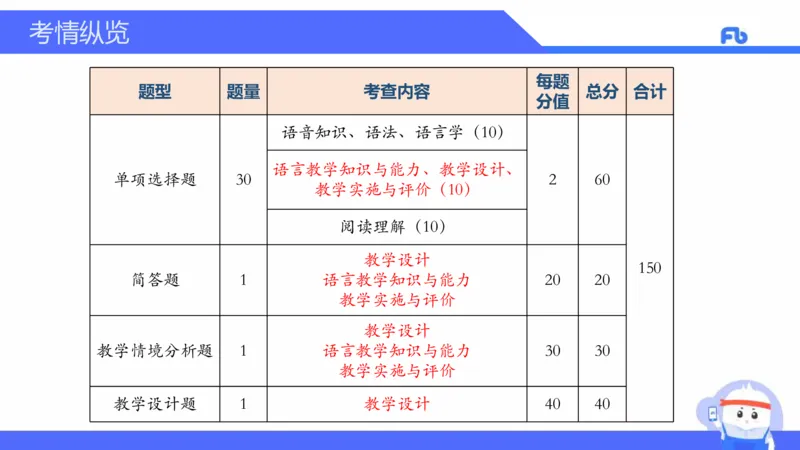
粉笔教师教育 粉笔教师考情纵览
每题
题型 题量 考查内容 总分 合计
分值
语音知识、语法、语言学(10)
语言教学知识与能力、教学设计、
单项选择题 30 2 60
教学实施与评价(10)
阅读理解(10)
教学设计
150
简答题 1 语言教学知识与能力 20 20
教学实施与评价
教学设计
教学情境分析题 1 语言教学知识与能力 30 30
教学实施与评价
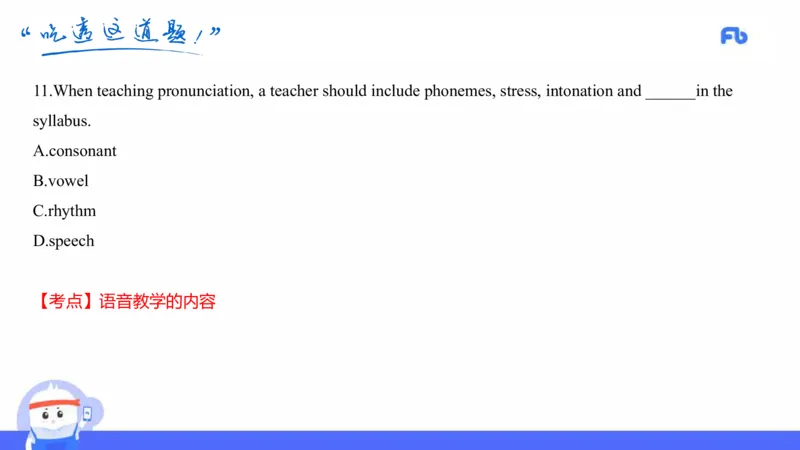
教学设计题 1 教学设计 40 40一、单项选择题11.When teaching pronunciation, a teacher should include phonemes, stress, intonation and ______in the
syllabus.
A.consonant
B.vowel
C.rhythm
D.speech
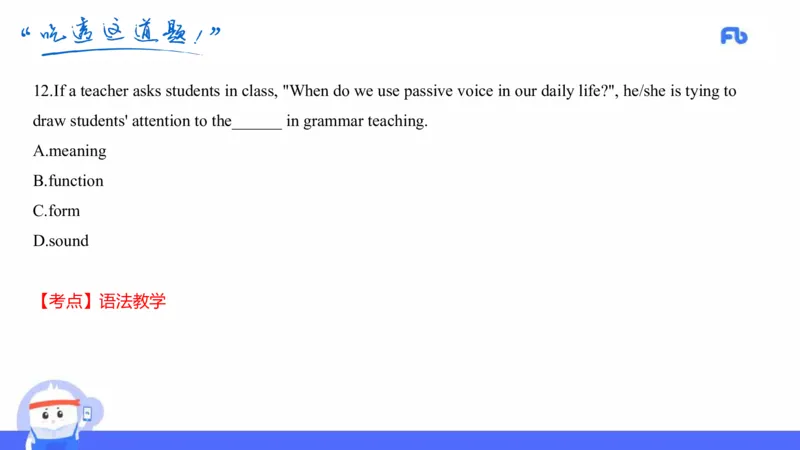
【考点】语音教学的内容12.If a teacher asks students in class, "When do we use passive voice in our daily life?", he/she is tying to
draw students' attention to the______ in grammar teaching.
A.meaning
B.function
C.form
D.sound
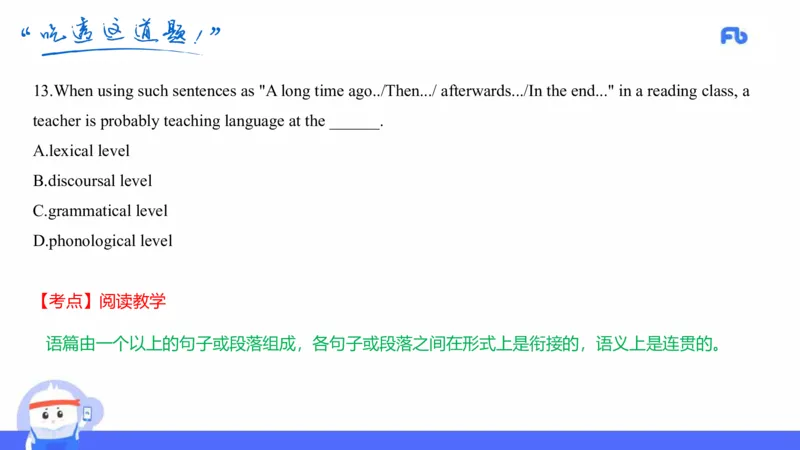
【考点】语法教学13.When using such sentences as "A long time ago../Then.../ afterwards.../In the end..." in a reading class, a
teacher is probably teaching language at the ______.
A.lexical level
B.discoursal level
C.grammatical level
D.phonological level
【考点】阅读教学
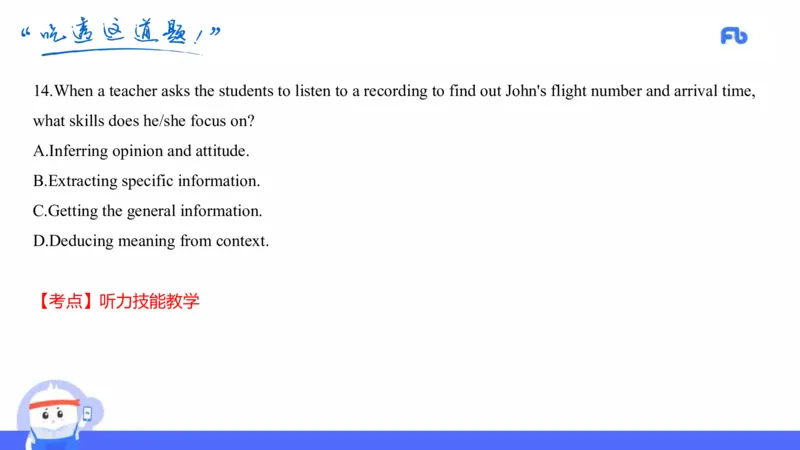
语篇由一个以上的句子或段落组成,各句子或段落之间在形式上是衔接的,语义上是连贯的。14.When a teacher asks the students to listen to a recording to find out John's flight number and arrival time,
what skills does he/she focus on?
A.Inferring opinion and attitude.
B.Extracting specific information.
C.Getting the general information.
D.Deducing meaning from context.
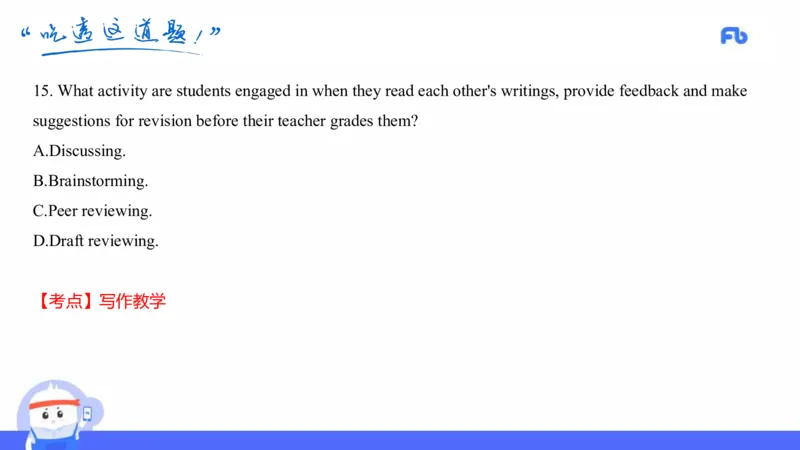
【考点】听力技能教学15. What activity are students engaged in when they read each other's writings, provide feedback and make
suggestions for revision before their teacher grades them?
A.Discussing.
B.Brainstorming.
C.Peer reviewing.
D.Draft reviewing.
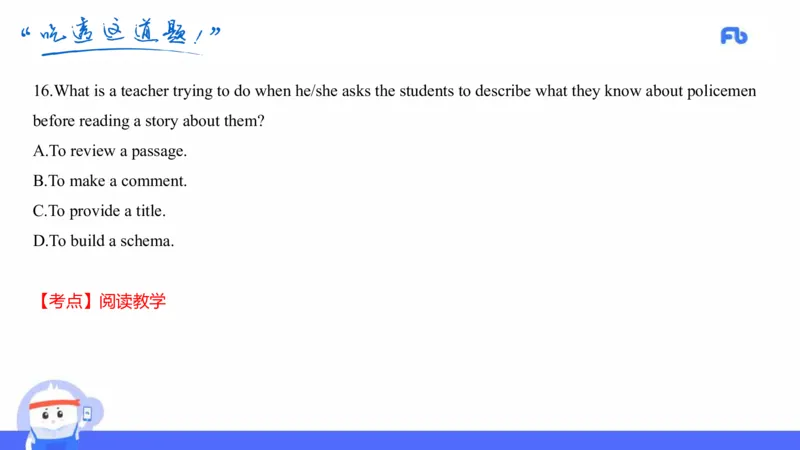
【考点】写作教学16.What is a teacher trying to do when he/she asks the students to describe what they know about policemen
before reading a story about them?
A.To review a passage.
B.To make a comment.
C.To provide a title.
D.To build a schema.
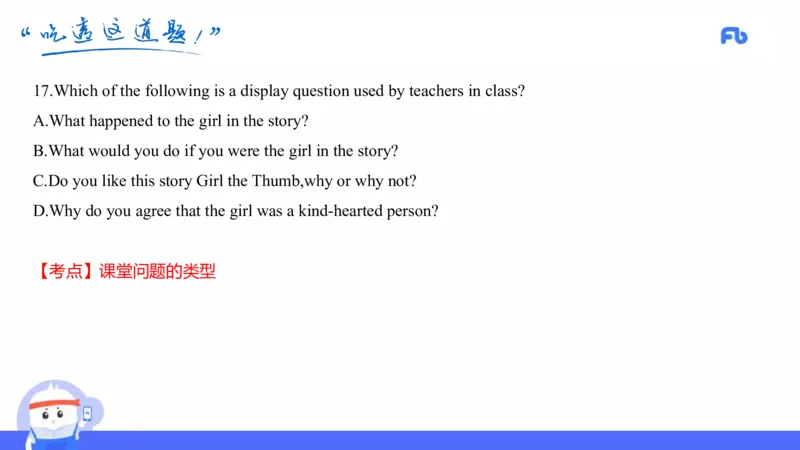
【考点】阅读教学17.Which of the following is a display question used by teachers in class?
A.What happened to the girl in the story?
B.What would you do if you were the girl in the story?
C.Do you like this story Girl the Thumb,why or why not?
D.Why do you agree that the girl was a kind-hearted person?
【考点】课堂问题的类型18.What does a teacher want the students to do when he/she asks them to find a word of similar meaning to
“germinate” in a paragraph?
A.To deduce meaning from the context.
B.To analyze word meaning by using syntax.
C.To identify new words by using synonyms.
D.To apply grammatical rules to guess meaning.
【考点】阅读教学19.At what stage of a lesson is a teacher likely to conduct a brainstorming activity about a topic?
A.Producing.
B.Checking.
C.Leading-in.
D.Practicing.
【考点】课堂活动20.Which of the following activities best promotes the development of students' communicative skills?
A.Doing multiple-choice questions.
B.Sharing information with partners.
C.Completing a summary of the text.
D.Copying sentences from the dictionary
【考点】课堂活动客观题考点归纳
模块 题号 知识点
语音、词汇、语法、语
1-10
言学
11;12;13;14; 语音教学的内容;语法教学的内容;阅
语言教学知识与能力
15;16;18 读教学;听力技能;写作教学过程;
教学实施与评价 17;19;20 课堂问题的类型;教学活动及教学环节Passage 1
【文章大意】
文章共 7 段,杜威是经验教育的哲学之父,他提出,教育的设计应建立在经验理论的基础上。我们必
须了解学生如何经历的本质,才能设计出有效的教育。在这方面,杜威的经验理论基于两个核心原
则——连续性和相互作用。21. What was Dewey’s criticism about progressive education?
A. Complete freedom that teachers grant to students.
B. 略
C. A broad social purpose that education has.
D. Unique differences among students.
【第一段】John Dewey was the philosophical father of experiential education, or as it was then referred to,
progressive education.But he was also critical of completely “free, studentdriven” education because students
often don’t know how to structure their own learning experiences for maximum benefit.22. How should teaching and curriculum be designed according to Dewey?
A. In manners that allow for individual differences.
B. In ways that foster free and student-driven education.
C. In ways that encourage a one-way delivery style of teaching.
D. In manners that rely heavily on established pedagogical methods.
【第二段】Dewey said that an educator must take into account the unique differences between each student. Each
person is different. Even when a standard curriculum is presented, each student will have a different quality of experience.
Thus, teaching and curriculum must be designed in ways that allow for such individual differences.23. Which of the following is closest in meaning to the underlined word “tenets” in Paragraph 5?
略
A.
B. Principles.
C. Regulations.
D. Guidelines.
【第五段】Dewey proposed that education be designed on the basis of a theory of experience. We must
understand the nature of how students have the experiences, in order to design effective education. In this
****, Dewey’s theory of experience rested on two central tenets—continuity and interaction.24. What does continuity refer to according to Dewey?
A. We never learn anything from our negative experiences.
B. Animals and beings can learn from past experiences.
C. Only positive experiences affect the nature of one’s experiences.
D. Experience gained from the past influences one’s future experiences.
【第六段】Dewey argued that we learn something from every experience, whether positive or negative, and
one’s accumulated learned experience influences the nature of one’s future experiences.25. What does the maxim “one man’s meat is another man’s poison” suggest?
A. Teachers should teach all their students the same materials.
B. Quality education that focuses on past experience should be offered.
C. Teachers should teach all their students what they believe is important.
D. Quality education that values individual development should be provided.
【第七段】Dewey’s hypothesis is that your present experiences can be understood as a function of your past
(stored) experience which interacts with the present situation to create an individual’s experience. This explains
the “one man’s meat is another man’s poison” maxim.Passage 2
【文章大意】
文章共 9 段,主要通过一些科学家的实验及研究,表明我们并不像自己认为的那样理性,越聪明的人
越容易掉进认知陷阱。26 . What can be inferred from the result of “the bat-and-ball” question?
A. Philosophers, economists and social scientists tend to make a fuss over a trivial issue.
B. Human beings are not as rational as they think they are when facing an uncertain situation.
C. Human beings think quickly and confidently when responding to a simple arithmetic question.
D. Daniel Kahneman has attained great success as a Nobel laureate and professor of psychology.
【第二段】The vast majority of people respond quickly and confidently, insisting the ball costs ten cents.
This answer is both obvious and wrong. (The correct answer is five cents for the ball and a dollar and five
cents for the bat.)27. What does the underlined phrase “a subtle curse” in Paragraph 5 suggest?
A. 略
B. Intelligence helps reduce committing thinking errors.
C. Thinking errors are a spell cast upon human beings.
D. Smarter people are prone to some thinking errors.
【第五段】A new study in the Journal of Personality and Social Psychology led by Richard West at James
Madison University and Keith Stanovich at the University of Toronto suggests that, in many instances,
smarter people are more vulnerable to these thinking errors. Although we assume that intelligence is a buffer
against bias—that’s why those with higher S.A.T. scores think they are less prone to these universal thinking
mistakes—it can actually be a subtle curse.28. What are people prone to do when facing an uncertain situation according to the passage?
A. To skip less important information.
B. To rely on a list of mental shortcuts.
C. To examine the relevant statistical data.
D. To seek an answer requiring the least mental effort.
【第四段前两句】When people face an uncertain situation, they don’t carefully evaluate the information or
look up relevant statistics. Instead, their decisions depend on a long list of mental shortcuts, which often lead
them to make foolish decisions.29. What does the study made by West and his colleagues demonstrate?
A. Self-awareness of one's own biases does not help an individual to control them.
B. The intelligent people are, the less vulnerable they are to reasoning biases.
C. People will improve their thinking capacity when they are aware of their thinking errors.
D. People may avoid committing thinking errors when realizing the mistakes they have made.
【第八段前两句】But West and colleagues weren't simply interested in reconfirming the known biases of the
human mind. Rather, they wanted to understand how these biases correlated with human intelligence.
【第九段前两句】The results were quite disturbing. For one thing, self-awareness was not particularly useful:
as the scientists note, “people who were aware of their own biases were not better able to overcome them.”30. What may be discussed by the author in subsequent paragraphs?
A. The impact of biases on human intelligence.
B. The reasons why intelligence improves thinking.
C. The relationship between intelligence and thinking errors.
D. The correlation between intuitive thinking and mental performance.
【最后一段最后两句】This finding wouldn’t surprise Kahneman, who admits in “Thinking, Fast and Slow” that
his decades of groundbreaking research have failed to significantly improve his own mental performance. “My
intuitive thinking is just as prone to overconfidence, extreme predictions, and the planning fallacy”—a tendency to
underestimate how long it will take to complete a task— “as it was before I made a study of these issues,” he writes.二、简答题31. 学习策略主要指学生为促进语言学习和语言运用而采取的各种行动和步骤。简述note-taking所
属的学习策略范畴(5分)及其三个作用。(15分)
《义务教育英语课程标准》
《普通高中英语课程标准(2017年版)》31. 学习策略主要指学生为促进语言学习和语言运用而采取的各种行动和步骤。简述note-taking所
属的学习策略范畴(5分)及其三个作用。(15分)【参考答案】
(1)note-taking(记笔记)属于认知策略。学生在学习和运用英语的过程中常用的策略包括:调控
策略、认知策略、交际策略和资源策略等。其中,认知策略指学生为了完成具体语言学习活动而采取
的步骤和方法,如利用笔记、图表、思维导图等收集、整理信息;根据篇章标题、图片和关键词等信
息预测和理解篇章等均属于认知策略的范畴。31. 学习策略主要指学生为促进语言学习和语言运用而采取的各种行动和步骤。简述note-taking所
属的学习策略范畴(5分)及其三个作用。(15分)
《义务教育英语课程标准》
《普通高中英语课程标准(2017年版)》【参考答案】
(2)记笔记的三个作用:
①有利于强化记忆,拓展新知,把握要点。学生在课堂上及时记录重难点和困惑的地方,才能把做
笔记的效率提到更高的同时让记忆更加深刻。
②有利于锻炼学生的思维敏捷性,提高其分析和理解能力。记笔记的过程也是一个积极思考的过程,
可调动眼、耳、脑、手一齐活动,促进了对讲授内容的理解。同时也有效摒弃了注意力不集中、打
盹犯困、做小动作、浮想联翩等一系列坏毛病。
③有利于学生养成良好的学习习惯,激发学生的学习兴趣。记笔记是一个积极主动学习的过程,养
成记笔记的学习习惯可以帮助学生提高学习兴趣及学习效率。三、教学情境分析题32. 下面是师生课堂对话的两个片段。
(1)Teacher: Let's review “be + verbing”. For example, we’re having a test today.
Student: I'm having a painting.
...
(2)Teacher: Let’s practise the present perfect tense. For example, I have been to Beijing. Have you been to
Beijing?
Student: Yes, I've been to Beijing last week.
...
根据所给材料,从下列三个方面作答:
(1)分析每组对话存在的一个语言错误。(10分)【参考答案】
(1)第一组对话中存在的错误:时态使用错误,have a painting意为“有一幅画”,不能用于进行
时。
第二组对话中存在的错误:时间状语使用错误,last week通常用于一般过去时,现在完成时通常不
与明确的时间状语连用。32. 下面是师生课堂对话的两个片段。
(1)Teacher: Let's review “be + verbing”. For example, we’re having a test today.
Student: I'm having a painting.
...
(2)Teacher: Let’s practise the present perfect tense.For example, I have been to Beijing. Have you been to
Beijing?
Student: Yes, I've been to Beijing last week.
...
根据所给材料,从下列三个方面作答:
(2)指出该教师设计上述活动所体现的学习观和语言观。(8分)把语言看作是结构上相互联系并表达一定意义的系统。认
为语言学习的目标是掌握语言系统中的各种成分,如语音
单位、语法单位和词项等。
把语言看作是表达功能和意义的载体。语言学习者需要知
道如何使用语法规则和词汇来表达概念并执行功能。
把语言看作是实现人际关系和进行人与人之间的社会交往
的工具。学习者不仅需要了解语法、词汇内容,还要知道
他们在交际语境中的使用规则。
认为学习的过程是“刺激—反应—强化”,强调模仿、强
化和重复。
认为学习者通过对外界情况进行知觉、记忆、思维等一
系列认知活动来学习,强调以语言规则和语言知识为重
点进行教学。
学习者在一定的情境下,通过人与人的协作活动而实
现意义建构的过程。32. 下面是师生课堂对话的两个片段。
(1)Teacher: Let's review “be + verbing”. For example, we’re having a test today.
Student: I'm having a painting.
...
(2)Teacher: Lets practise the present perfect tense.For example, I have been to Beijing. Have you been to
Beijing?
Student: Yes, I've been to Beijing last week.
...
根据所给材料,从下列三个方面作答:
(2)指出该教师设计上述活动所体现的学习观和语言观。(8分)【参考答案】
(2)从学习观的角度来看,该教师设计的活动体现了行为主义学习理论。行为主义学习理论认为学
习的过程是刺激—反应—强化的过程,所以强调语言学习过程中的模仿、强化和重复。教学中的机
械练习就是基于行为主义学习理论进行的。材料中,该教师举出例句并要求学生模仿、重复,属于机
械练习,体现了行为主义学习理论。
从语言观的角度来看,该教师设计的活动体现了结构主义语言观。结构主义语言观认为语言学习的目
标是掌握语言系统中的各种成分,如语音单位(音位)、语法单位(词组、句子)、词项(功能词和
结构词)等。材料中,该教师重点要求学生掌握“be doing”和“现在完成时”这两个语法项目,
体现了结构主义语言观。32. 下面是师生课堂对话的两个片段。
(1)Teacher: Let's review “be + verbing”. For example, we’re having a test today.
Student: I'm having a painting.
...
(2)Teacher: Let’s practise the present perfect tense. For example, I have been to Beijing. Have you been to
Beijing?
Student: Yes, I've been to Beijing last week.
...
根据所给材料,从下列三个方面作答:
(3)从三个角度分析评价该教师的语言教学观。(12分)认为教学的目的是让学生掌握语言系统中语音、
词汇、语法各个成分的内容。在课堂教学中采用
“刺激—反应—强化”的机械操练方式训练学生的语
言能力。
认为教师的角色在于创设学习情境,学生是积极的信息
加工者,他们从已知的知识出发,通过规则的分析和学
习,对语言知识及语言规则进行有意识的认知。
认为外语教学的目的是让学生学会使用语言实现社会交际。
主张把语言放在实际的交际情境中学习。32. 下面是师生课堂对话的两个片段。
(1)Teacher: Let's review “be + verbing”. For example, we’re having a test today.
Student: I'm having a painting.
...
(2)Teacher: Let’s practise the present perfect tense. For example, I have been to Beijing. Have you been to
Beijing?
Student: Yes, I've been to Beijing last week.
...
根据所给材料,从下列三个方面作答:
(3)从三个角度分析评价该教师的语言教学观。(12分)【参考答案】
(3)①教师作用观指教师对自己课堂教学角色的认识与运用。新课标倡导改变课堂教学以教师为中
心、单纯传授书本知识的教学方式;积极帮助学生发展探究知识的能力、获取信息的能力和自主学习
的能力;帮助学生建构意义,组织内容,获取知识和寻求帮助的策略。在材料的两个片段中,老师在
引导课堂教学活动的进行,属于对课堂的学习步骤、时间进行有效的管理和控制,体现了控制者的角
色;同时教师在课堂上教授新知识,体现了知识传授的角色。【参考答案】
②教学方法观指教师完成教学任务,实现教学目标的手段。新课标倡导优化教育教学方式;提倡任务
型语言教学;创造性地设计各种语言实践活动;促进学生用英语交流;在“用”中学习语言,发挥学
生的创造力和想象力,发展学生的批判性思维能力和创新精神。在材料中,片段1通过复习的方式,让
学生根据老师的举例来造句;片段2通过练习的方式来学会语言。两个片段进行的都是机械性的活动。
③教学教材观指教师对教材的认识与运用。教材是相对静止和稳定的,任何一套教材都不可能十全十
美,需要根据不同的学生和不同的环境对教材进行取舍、调整和补充。在两个片段中,老师都跳脱教
材本身让学生根据教学重点来造句,做到了在实际教学中不能拘泥于教材,根据学生的学情对教材进
行了调整。四、教学设计题根据提供的信息和语言素材设计教学方案,用英文作答。
33.设计任务:阅读下面的学生信息和语言素材,设计15分钟的英语口语教学方案。教案没有固定格
式,但须包含下列要点:
• teaching objectives
• teaching contents
• key and difficult points
• major steps and time allocation
• activities and justifications
教学时间:15分钟
学生概况:某城镇普通中学高中二年级学生,班级人数40人。多数学生已经达到《普通高中英语课
程标准(2017年版2020年修订)》学业质量水平一,学生课堂参与积极性一般。语言素材:
We've been told since we were toddlers that “It's good to share”. Parents and teachers keep reminding us
to share toys, snacks, books, happy memories, and sometime seven sorrows with others. When we grow up,
we share photos, life stories and opinions with people around us and with those we don't know via social
media. Taking it as an object of study, psychologists have published various papers stating that the behaviour
of sharing is beneficial to setting up positive emotional bonding.
Today, the action of sharing takes on extra meaning. It's not just about sharing sweets or frustration; it
has expanded to almost every aspect of our lives-the whole world seems to be into sharing. We are using
technology to reduce the money that we spend on goods and services, or to make money out of those that we
don't use ourselves all of the time. These vary from car shares to home shares, and even to pet shares. The
sharing economy is taking off in all sorts of areas. It is creating new ways of thinking and is providing
services to people when and where they want them.【参考设计】
(1) Teaching objectives
① Knowledge objectives
Students can master the new words/ phrases/ sentence structures correctly, including ___________.
Students can grasp the general idea of the passage and learn more about ___________.
② Ability objective
Students can express their opinions/talk about______ by using the target language correctly and fluently.
③ Emotional Objectives
Students can________________________________________.
Students can cooperate with other group members actively and complete the tasks together.【参考设计】
(1) Teaching objectives
① Knowledge objectives
Students can master the new phrases correctly, including social media, is beneficial to, sharing economy.
Students can grasp the general idea of the passage and learn more about sharing.
② Ability objective
Students can express their opinions/talk about the development of sharing by using the target language
correctly and fluently.
③ Emotional Objectives
Students can be more willing to share their feeling with their parents or friends.
Students can cooperate with other group members actively and complete the tasks together.(2) Teaching content
This is a speaking lesson. It mainly talks about ________________________.
(3) Key and difficult points
① Key point
How to talk about the new topic correctly and fluently.
② Difficult points
To improve the confidence of speaking English.(2) Teaching content
This is a speaking lesson. It mainly talks about the good quality about sharing. And with the developing of
technology, the “sharing” has extra meaning, for example, sharing car shares, home shares and pet shares and
so on, thus resulting in a sharing economy.
(3) Key and difficult points
① Key point
How to talk about the new topic correctly and fluently.
② Difficult points
To improve the confidence of speaking English.(4) Major steps and time allocation
Step1 Pre-speaking (7 mins)
(1) Read the passage
Students will read the passage to get the main idea, and then answer some questions/ fill in the chart.
(2) Learning expressions
The teacher will explain the meaning and usage of the new words and sentences about the situation, including
_________and invite students to do some exercises about the new knowledge.
(Justification: With those activities, students will be familiar with the situation, and accumulate many
expressions which can be used in this situation, making good preparations for the speaking activities.)(4) Major steps and time allocation
Step1 Pre-speaking (7 mins)
(1) Read the passage
Students will read the passage to get the main idea, and then fill in the chart.
Traditional sharing New sharing economy
Items for sharing
Benefits of it
(2) Learning expressions
The teacher will explain the meaning and usage of the new phrases about the situation, including social media,
is beneficial to, sharing economy and invite students to do some exercises about the new knowledge.
(Justification: With those activities, students will be familiar with the situation, and accumulate many
expressions which can be used in this situation, making good preparations for the speaking activities.)Step 2 While-speaking (5 mins)
(1) Reading after the tape
The teacher will play the tape and lead students to read after it. Students should pay attention to the
pronunciation and intonation.
(2) Group discussion/ make a conversation/ Do a survey
Ask students to work in groups of four and have a discussion/make a conversation/ do a survey
about_____________. They should try to use the words and sentence structures they have learned today.
(Justification: Students will have a deeper understanding of the topic and usage of the new knowledge, and
they can also have more opportunities to express themselves.)Step 2 While-speaking (5 mins)
(1) Reading after the tape
The teacher will play the tape and lead students to read after it. Students should pay attention to the
pronunciation and intonation.
(2) Group discussion
Ask students to work in groups of four and have a discussion about the questions: “What do you think of the
new sharing economy? Does it have some advantages and disadvantages?” They should try to use the words
and sentence structures they have learned today.
(Justification: Students will have a deeper understanding of the topic and usage of the new knowledge, and
they can also have more opportunities to express themselves.)Step 3 Post-speaking (3 mins)
Sharing and evaluating
The teacher will invite some students to share their results with the whole class and guide other students to
evaluate the performance, and then the teacher will make a conclusion.
(Justification: Through these activities, students will regulate their language and work out better ideas or
expressions, and they will improve their speaking skills. Besides, they will be more willing to share their
ideas in public and learn from each other.)主观题考点归纳:
题型 题号 考查模块 知识点
简答题 31 课程标准 学习策略
教学情境分析题 32 语言教学知识与能力 语言观、语言学习观、语言教学观
题型 题号 考查课型
教学设计题 33 口语课