攀枝花市 2025 届高三第三次统一考试
英 语
试卷共10页。满分150分。考试时间120分钟。
注意事项:
1.答卷前,考生务必将自己的姓名、准考证号填写在答题卡上。
2.回答选择题时,选出每小题答案后,用铅笔将答题卡上对应题目的答案标号涂黑。如需改动,
用橡皮擦干净后,再选涂其它答案标号。回答非选择题时,将答案写在答题卡上。写在本试卷上无效。
3. 考试结束后,将本试卷和答题卡一并交回。
第一部分 听力(共两节,满分30分)
做题时,先将答案标在试卷上。录音内容结束后,你将有两分钟的时间将试卷上的答案转涂到答题
卡上。
第一节(共5小题;每小题1.5分,满分7.5分)
听下面5段对话。每段对话后有一个小题,从试题所给的A、B、C三个选项中选出最佳选项,并标
在试卷的相应位置。听完每段对话后,你都有10秒钟的时间来回答有关小题和阅读下一小题。每段对话
仅读一遍。
例:How much is the shirt?
A. £19.15. B. £9.18. C. £9.15.
答案是C。
1. Where does the conversation probably take place?
A. In a classroom. B. In a bookstore. C. In a hospital.
2. What will the speakers do next?
A. Have a cup of coffee. B. Wait for somebody else. C. Move on to the next item.
3. How does the woman probably feel now?
A. Regretful. B. Confused. C. Worried.
4. At what time will the woman have the special meeting?
A. 11:30. B. 11:45. C. 12:00.
5. What are the speakers talking about?
A. A neighbor. B. A classmate. C. A workmate.
第二节 (共15小题;每小题1.5分,满分22.5分)
听下面5段对话或独白。每段对话或独白后有几个小题,从题中所给的 A、B、C三个选项中选出最
佳选项,并标在试卷的相应位置。听每段对话或独白前,你将有时间阅读各个小题,每小题 5秒钟;听
完后,各小题将给出5秒钟的作答时间。每段对话或独白读两遍。听第6段材料,回答第6、7题。
6. Where does the conversation probably take place?
A. In a cleaner’s. B. In a coffee shop. C. In a clothes store.
7. What will the man do next?
A. Attend a party. B. Meet some friends. C. Buy a birthday gift.
听第7段材料,回答第8至10题。
8. Where was Annie probably born?
A. In Italy. B. In France. C. In Portugal.
9. What is difficult for Annie to learn about Spanish?
A. Its writing. B. Its grammar. C. Its pronunciation.
10. What is Mr. Johnson’s opinion of Annie?
A. She is falling behind. B. She is performing average. C. She is doing well.
听第8段材料,回答第11至13题。
11. Why did the man travel to England?
A. For further education. B. For an exchange project. C. For a sports competition.
12. What sport is the man taking Josh to see in China?
A. Football. B. Basketball. C. Table tennis.
13. How does the man mainly feel during his trip?
A. Excited. B. Lonely. C. Tired.
听第9段材料,回答第14至16题。
14. What are the speakers doing?
A. Finishing office work. B. Borrowing a book. C. Enjoying a vacation.
15. What is the book mainly about?
A. Career improvement. B. College education. C. Financial planning.
16. Why does the man want to read the book?
A. To master study skills.
B. To improve his life quality.
C. To get along well with his co-workers.
听第10段材料,回答第17至20题。
17. What kind of system will the governments bring in?
A. A vehicle trading system.
B. A car campaigning system.
C. A petrol car purchase system.
18. When will the plastic bottles be forbidden?
A. By 2025. B. By 2030. C. By 2040.
19. What does the speaker suggest as an alternative to current plastic bottles?A. Metal cans. B. Glass bottles. C. Paper cups.
20. What is the main idea of the talk?
A. Dangers of global warming.
B. New rules about electric cars.
C. Urgent actions against pollution.
第二部分 阅读(共两节,满分50分)
第一节(共15小题:每小题2. 5分,满分37. 5分)
阅读下列短文,从每题所给的A、B、C、D四个选项中选出最佳选项。
A
Digital Discovery Workshops
PacSci’s Digital Discovery Workshops bring unique science experiences to you on your own schedule.
PacSci educators join you live from our Digital Learning Studio to engage learners in STEM concepts through
real-time demonstrations, sample close-ups, and interactive software and videos.
Who Are these for?
Digital Discovery Workshops are designed for Pre K-12 graders joining from classrooms, after-school
settings, library programs, or other community groups.
Costs & Booking
● 1-99 participants: $250
● 100-199 participants: $350
● 200-299 participants: $450
● 300+ participants: $550
Qualified low-income schools may receive up to 100% off Digital Discovery Workshops rates. Programs
should be booked at least 2 weeks in advance. We book on a rolling calendar year so we can schedule as far in
advance as you like!
How They Work
● PacSci educators send you a private Zoom link, or join a virtual platform of your choice.
● PacSci educators guide participants through demonstrations and activities as they facilitate active student
participation.
● Each program includes an optional follow-along worksheet, as well as connected extension activities,
reading lists, and videos to use before and after the program.
What You Will Need
● One shared device with a large screen and speakers or individual devices
● Internet connection
● Access to your selected virtual platform, such as Zoom
● A webcam and microphone on participant device(s)● An adult must be present to provide aid for the participant
21. How much should a group of 310 participants pay for a Digital Discovery Workshop?
A. $250. B. $350. C. $450. D. $550.
22. How do participants learn in the Digital Discovery Workshops?
A. Through watching mailed videos. B. Through live educator guidance.
C. By reading scientific books. D. By participating in community activities.
23. Who is required to accompany and help the participants besides the PacSci educators?
A. A pre K-12 grader. B. A low-income student.
C. An adult. D. An active junior student.
B
Growing up, I disliked writing. It was the last thing I wanted to do and it’s one reason why I pursued science
in the first place. In high school, I hated writing essays. For hours, I stared at blank pages, trying to turn my
disordered thoughts into fluent sentences and I often received papers marked with lots of corrections. I began to
wonder if I was simply not cut out for writing. And that was OK. I didn’t have to be good at everything.
I focused instead on my love for math and science. I took comfort there, knowing objective truth could be
found if I searched methodically. In college, I studied engineering and joined a research lab to gain hands-on
experience. My first project was to improve the efficiency of a magnetic component. Despite initial disappointing
results, I continued through many designs. Eventually, we developed a design that halved energy losses. I was
delighted — until my professor told me to write that research paper.
I knew that if I wanted to become a researcher, I would need to spend time penning papers. But I was scared
of failing. In a panic, I asked a graduate student in my lab for help. We set a goal for the paper, and I carefully
wrote an outline. But when I asked him for feedback (反馈), I soon found the paper covered in red marks. He
explained that red didn’t mean I was a bad writer. Writing isn’t a one-and-done thing. It requires revising your
work, often several times. Suddenly it occurred to me, “Hadn’t I done the same thing when I was searching for an
efficient design?”
I polished my paper’s outline into sentences and paragraphs, guided by feedback. Though my first draft
wasn’t perfect, with help, I enjoyed the process of improving it. Writing has since become one of my favorite parts
of research, helping me organize my thoughts. I’ve even started writing popular science articles, which I never
could have imagined during my early struggles with essays.
24. Which of the following best describes the author’s initial attitude toward writing?
A. A walk in the park. B. A storm in a teacup.
C. A nut hard to break. D. A feather in one’s cap.
25. Which is closest in meaning to the underlined word “penning” in paragraph 3?
A. Collecting. B. Reviewing. C. Composing. D. Polishing.
26. What did the author learn from his writing and research?A. Both require trial and error. B. Both need inspiration and teamwork.
C. Both are about following fixed rules. D. Both are stressful and time-consuming.
27. What is the author’s attitude toward writing now?
A. Bored. B. Uncaring. C. Ambiguous. D. Enthusiastic.
C
In the Monarch Butterfly Biosphere Reserve, millions of monarch butterflies find shelter in the oyamel fir
forests after a difficult migration from Canada and the United States down to Mexico for the winter. Now, as
rising temperatures, droughts, and disease threaten the forests of the monarch reserve, scientists are hoping to help
these trees migrate.
“We’re doing something different,” says Sáenz-Romero, a researcher of the reserve. “If we don’t do this, the
trees in the monarch reserve are going to die.” By 2090, the reserve’s forest habitats are expected to deteriorate,
as temperatures warm. Using a technique called assisted migration, researchers might be able to move these trees
to the nearby volcano.
Forests move naturally; they move in many directions and altitudes as climate changes. Assisted migration
helps the forest move more quickly than it would do so naturally. You collect seeds from a place with a specific
climate, like the monarch reserve, and move them to an area that will have a similar climate in the future, explains
Sáenz-Romero.
The experiment began in 2017, when Sáenz-Romero and his team gathered seeds from oyamel fir trees in the
Monarch Butterfly Biosphere Reserve at various altitudes. For two years, the plants grew in a shade house and
then for another year in a nursery at around 9,800 feet to help them adapt to the altitude. Then, in 2021, they
planted the young trees under “nurse plants”, which protected them from difficult conditions. In 2023, six years
after planting the seeds, they found that at two of those heights, 11,800 and 12,400 feet, nearly 70 percent of the
young trees had survived even at the higher altitude.
“These types of experiments are tremendously important,” said Sally Aitken, who wasn’t involved in the
study. “However, assisted migration outside of a tree’s normal range comes with concerns. Oyamel firs don’t
normally grow at this height on Nevado de Toluca’s slopes. Moving a species could have unintended ecological
consequences for other species present in that ecosystem.” Aitken added.
For now, in Mexico, Sáenz-Romero hopes this new study convinces conservationists and government
officials that assisted migration can establish new potential wintering sites for the monarch butterflies.
28. What does the underlined word “deteriorate” in paragraph 2 mean?
A. Get worse. B. Grow larger. C. Maintain. D. Improve.
29. Which of the following best describes the experiment?
A. Costly. B. Successful. C. Controversial. D. Risky.
30. What did Aitken think of assisted migration?
A. It could benefit all species. B. It could change the local weather.C. It could have ecological risks. D. It could definitely save Monarch Butterflies.
31. What is the text mainly about?
A. The migration of the oyamel fir forests.
B. A way to save monarch butterflies’ habitats.
C. The threats Monarch butterflies’ survival is facing.
D. The importance of the Monarch Butterfly Biosphere Reserve.
D
A new study from Nottingham Trent University (NTU) indicates that people who are more facially
expressive are generally more likable and socially successful. The research, which analyzed over 1,500 natural
conversations, suggests that complex facial muscle movements can strengthen social bonds and improve social
interactions.
In the initial phase, researchers engaged with 52 participants in video calls designed to get a range of
everyday situations, such as humor, embarrassment and conflict. The participants were further challenged to
maintain a still face while their partners attempted to stimulate movement, testing their ability to control facial
expressions.
Following these interactions, the participants recorded short videos, where they aimed to achieve specific
social goals, like disagreeing with someone but without being disliked. These clips of videos were then rated
by over 170 independent observers, assessing the readability of the emotions and expressions displayed.
The researchers applied the Facial Action Coding System (FACS), a method for measuring facial muscle
activity, to evaluate each participant’s expressivity (表现能力). Afterwards, the study extended to analyze an
existing database of natural video conversations between 1,456 strangers, where the participants rated their
conversational partners’ likability. The study revealed that individuals who were more expressive were more
likable by both independent observers and their conversation partners. Additionally, these expressive individuals
were easier to read and more skillful at using facial behaviors to achieve their social goals.
“This is a study to examine facial expression in real-world interactions,” said the study’s lead author,
Eithne Kavanagh. “Our evidence shows that facial expressivity is related to positive social outcomes. It suggests
that more expressive people are more successful at attracting social partners and building relationships. It also
could be important in conflict resolution.” The research highlights the significant role which facial expressions
play in successful social interactions.
32. How did the researchers examine the participants’ ability to control facial expressions?
A. By asking them to make complex facial muscle movements.
B. By asking them to watch humorous videos and keep a still face.
C. By having them use facial behaviors to achieve their social goals.
D. By having their partners try to make them produce facial movements.
33. What were the participants asked to do after the first stage?A. Rate the videos of other participants.
B. Engage in further social interactions.
C. Assess the readability of their own emotions.
D. Record short videos under specific conditions.
34. What can we learn about the FACS?
A. It is a tool to assess facial muscle activity.
B. It decides the social success of individuals.
C. It improves the likability of facial expressions.
D. It is a method for promoting participants’ likability.
35. What can be the best title for the text?
A. FACS: A New Method for Social Science
B. Facial Expressions: Important for Social Success
C. The Development of Facial Muscle Movements
D. The Way to Be Likable and Socially Successful
第二节(共5小题;每小题2.5分, 满分12.5分)
阅读下面短文,从短文后的选项中选出可以填入空白处的最佳选项。选项中有两项为多余选项。
Wisdom is not just a good quality. 36 . When things get really wild out there, you can always rely on
your wisdom to make the best choices. Here are some strategies that you can use to get wiser.
◇ Try experiencing new opportunities.
Experiencing new opportunities is how you gain wisdom. 37 , which is why you need to get out of it.
You can try learning new skills that you never thought of learning or going to places that were on your bucket list
(遗愿清单). Change your routine and see where life takes you, then take control!
◇ Learn and grow from your mistakes.
All of us make mistakes in life, but it is the acknowledgment of mistakes that makes us grow and do better
next time. Whenever we make a mistake, we should learn from it. 38 . Stop blaming other people for your
mistakes and admit where you went wrong.
◇ Never back away from learning.
You must be the kind of person who learns something new every day, and you must develop a thirst for
knowledge. Take classes, read books, listen to educational podcasts, and the list goes on and on. 39 . In the
end, you will be able to tackle a problem easily from different perspectives (视角).
◇ ___40___.
You obviously want to grow and do better in life, right? The best way to do that is to have wise people as
your coaches. They can be teachers, family members, colleagues, and even special friends. Find out what makes
them wiser than you, then engage in useful dialogue with them. The more time you spend with them, the more
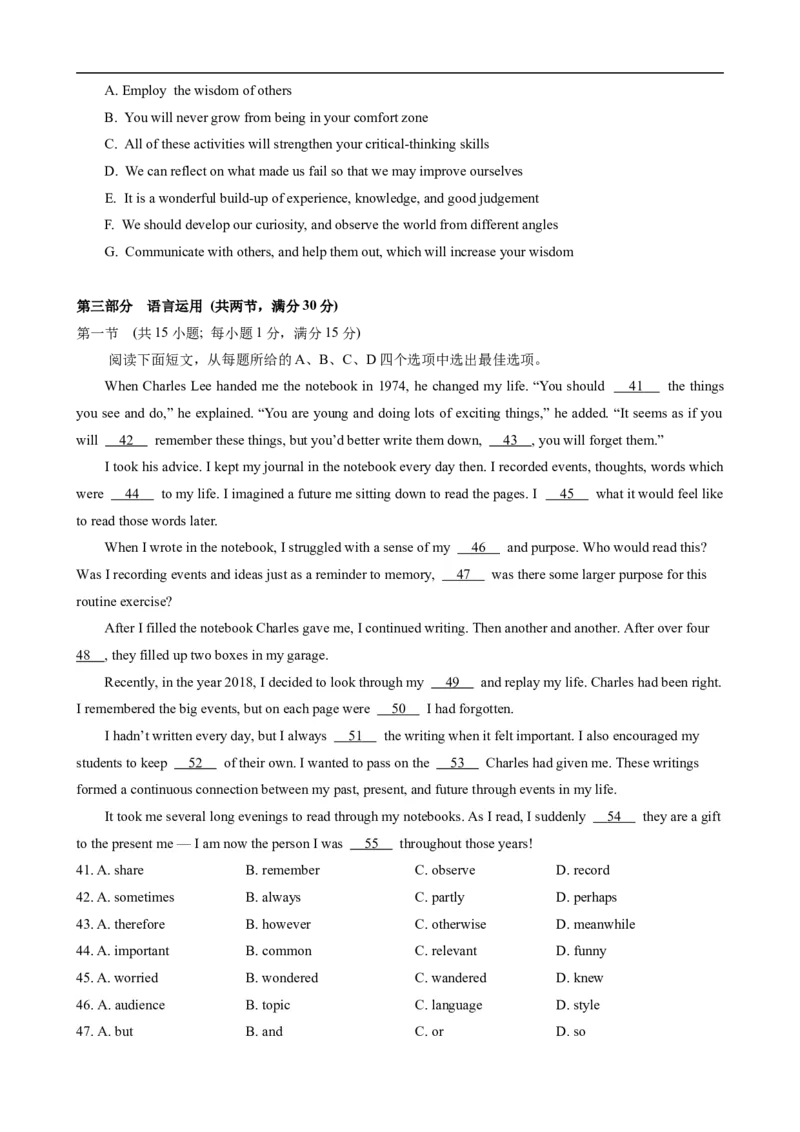
transfer of knowledge there will be.A. Employ the wisdom of others
B. You will never grow from being in your comfort zone
C. All of these activities will strengthen your critical-thinking skills
D. We can reflect on what made us fail so that we may improve ourselves
E. It is a wonderful build-up of experience, knowledge, and good judgement
F. We should develop our curiosity, and observe the world from different angles
G. Communicate with others, and help them out, which will increase your wisdom
第三部分 语言运用 (共两节,满分30分)
第一节 (共15小题; 每小题1分,满分15分)
阅读下面短文,从每题所给的A、B、C、D四个选项中选出最佳选项。
When Charles Lee handed me the notebook in 1974, he changed my life. “You should 41 the things
you see and do,” he explained. “You are young and doing lots of exciting things,” he added. “It seems as if you
will 4 2 remember these things, but you’d better write them down, 4 3 , you will forget them.”
I took his advice. I kept my journal in the notebook every day then. I recorded events, thoughts, words which
were 4 4 to my life. I imagined a future me sitting down to read the pages. I 4 5 what it would feel like
to read those words later.
When I wrote in the notebook, I struggled with a sense of my 4 6 and purpose. Who would read this?
Was I recording events and ideas just as a reminder to memory, 4 7 was there some larger purpose for this
routine exercise?
After I filled the notebook Charles gave me, I continued writing. Then another and another. After over four
48 , they filled up two boxes in my garage.
Recently, in the year 2018, I decided to look through my 4 9 and replay my life. Charles had been right.
I remembered the big events, but on each page were 5 0 I had forgotten.
I hadn’t written every day, but I always 5 1 the writing when it felt important. I also encouraged my
students to keep 5 2 of their own. I wanted to pass on the 5 3 Charles had given me. These writings
formed a continuous connection between my past, present, and future through events in my life.
It took me several long evenings to read through my notebooks. As I read, I suddenly 5 4 they are a gift
to the present me — I am now the person I was 5 5 throughout those years!
41. A. share B. remember C. observe D. record
42. A. sometimes B. always C. partly D. perhaps
43. A. therefore B. however C. otherwise D. meanwhile
44. A. important B. common C. relevant D. funny
45. A. worried B. wondered C. wandered D. knew
46. A. audience B. topic C. language D. style
47. A. but B. and C. or D. so48. A. years B. seasons C. terms D. decades
49. A. letters B. notebooks C. documents D. garage
50. A. details B. birthdays C. names D. phone numbers
51. A. gave up B. put off C. picked up D. referred to
52. A. journals B. letters C. essays D. reports
53. A. habit B. gift C. advice D. memory
54. A. recognized B. realized C. remembered D. hoped
55. A. waiting for B. thinking of C. talking with D. writing to
第二节 (共10小题; 每小题1.5分,满分15分)
阅读下面短文,在空白处填入1个适当的单词或括号内单词的正确形式。
More and more highly 56 (ambition) parents in the world are signing their children up for Chinese
classes. Keen for their sons and daughters to be successful in life, they see being fluent in a foreign language as an
advantage. With learning Chinese gaining 57 (popular), up to now, more than 75 countries 58
(include) the Chinese language in their education systems. Over 4000 overseas universities offer Chinese language
courses and about 25 million people are learning Chinese outside China.
It’s easy to understand 59 Chinese is becoming so popular. Learning Chinese may help people get more
job 60 (opportunity). China is already a global economic power, and it has a 61 (grow) influence on
the whole world. For example, there is China’s Belt and Road Initiative, which motivates many countries along
the Silk Road 62 (cooperate) more closely. It has created thousands of local jobs, many of which need people
with 63 knowledge of Chinese. Another reason is that studying Chinese 64 (provide) access to
wonderful Chinese history and culture. Adam Turner, a school head teacher in the UK, cites this as one of the
most appealing aspects of the recently added Chinese course. “Students love the mystery of China,” he explains.
“Learning Chinese helps them see life from a new way of thinking 65 broaden their minds to the outside
world.”
第四部分 写作(共两节,满分40分)
第一节(满分15分)
66. 假定你是李华。目前,中国中学生每天校内体育活动时间不少于 2个小时。你的英国笔友John
对于央视英语频道的这条新闻很感兴趣。请你给他回封邮件,内容如下:
(1)你们学校的体育活动开展情况;
(2)你的感受。
注意:
(1)写作词数应为80左右;
(2)请按如下格式在答题卡的相应位置作答。
Dear John,
Glad to know you’re interested in the news about Chinese students’ sports activities.Yours
Li Hua
第二节(满分25分)
67. 阅读下面材料, 根据其内容和所给段落开头语续写两段, 使之构成一篇完整的短文。
Emma, a fifteen-year-old girl, lived with her grandma on the farm. Every day she would spend some time in
the woods nearby. Some birds even came close to her, pecking at bread pieces from her hands and singing away.
One evening, a young man carrying a gun approached their farm house. Putting down the gun, he said, “I’ve
lost my way. Could I have a night’s lodging here?” Emma’s warm-hearted grandma agreed.
Then, the man introduced himself as an ornithologist, who collected and studied birds. “Do you put them in a
cage?” Emma asked. “No,” he shook his head, “I shoot them and get them preserved. I have over one hundred
kinds of bird specimens (标本) in my studio.” Emma felt her heart trembling as she imagined so many birds
being shot.
“Emma loves climbing trees, just like a naughty monkey! And she knows a lot about birds, too,” her
grandmother said proudly. The man became excited. “I have followed a rare white heron in this direction for two
days. Have you seen it, too?” he asked Emma. “The heron has soft white feathers and long slender legs. It
probably has its nest at a tree-top,” he added. Emma’s heart gave a wild beat. She had frequently seen the strange
bird flying back to its nest on the top of a tall tree near the other side of the woods! The young man then stared at
Emma with the hope of the heron being one of Emma’s acquaintances. “I would give one hundred dollars to
whoever shows me where the white heron is!” But Emma somehow shook her head. He then sighed, “They have
never been seen here. Perhaps it was only migrating, or had been driven out of its own region by some fierce
predator.”
That night, long after the moon came out and the young man had fallen asleep, Emma was broad awake. Her
mind was alternately visited by the bird specimens and her long-awaited smart phone one hundred dollars could
buy.
注意:
(1)续写词数应为150个左右;
(2)请按如下格式在答题卡的相应位置作答。
Finally, Emma made up her mind.
Before dawn, Emma returned to the farm house quietly, holding the cage covered with her jacket.攀枝花市 2025 届高三第三次统考
英语参考答案
第一部分 听力(共20小题;每小题1.5分,满分30分。)
1-5BACBC 6-10ABBAC 11-15BCACA 16-20CABBC
第二部分 阅读理解(共2节,满分50分。)
第一节(共15小题;每小题2.5分,满分37.5分。)
21-23DBC 24-27CCAD 28-31ABCB 32-35DDAB
第二节(共5小题;每小题2.5分,满分12.5分。)
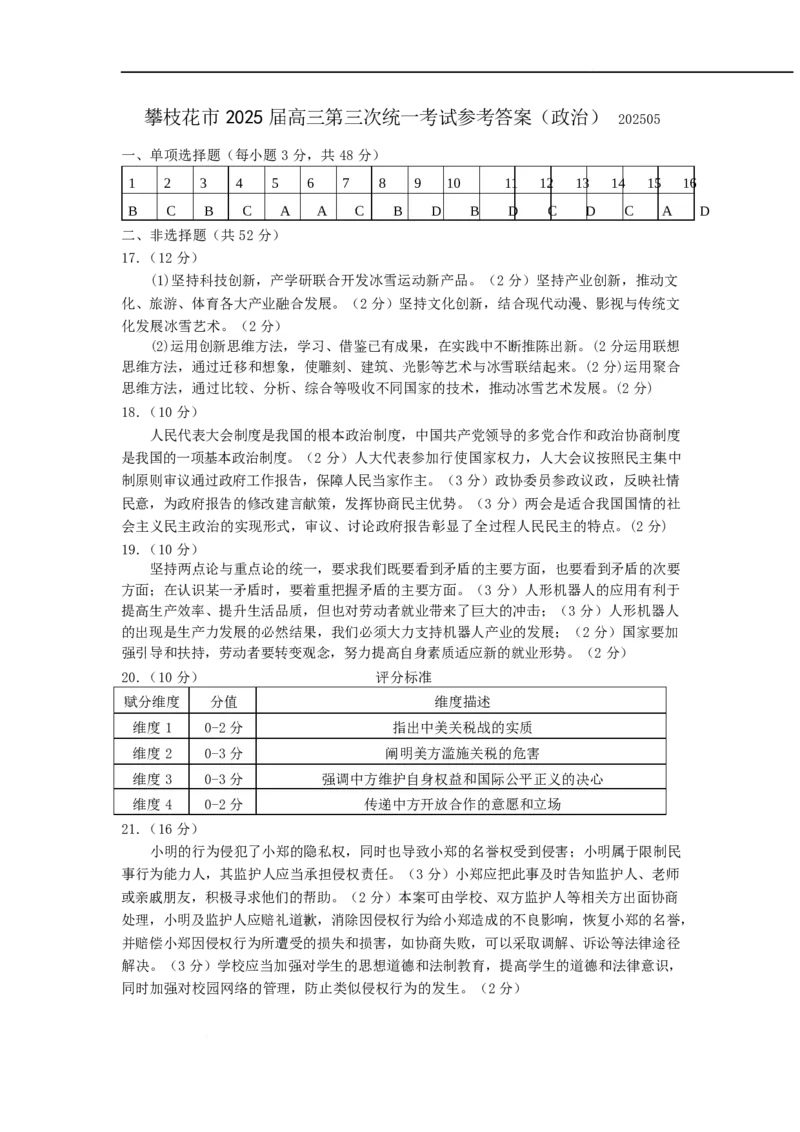
36. E 37. B 38. D 39. C 40. A
第三部分 英语知识运用(共2节,满分45分。)
第一节 完形填空(共20小题;每小题1分,满分15分。)
41-45DBCAB 46-50ACDBA 51-55CACBD
第二节 语法填空(共10小题;每小题1.5分,满分15分。)
56. ambitious 57. popularity 58. have included 59. why 60. opportunities
61. growing 62. to cooperate 63. a 64. provides 65. and
第四部分 写作(共两节,满分40分。)
第一节(满分15分)
One possible version
Dear John,
I'm glad to know you’re interested in the news about Chinese students’ sports activities. Now I’d like to
introduce something about it.
At our school, we have one P.E. class every day, which lasts for 45 minutes. Besides, there is a 30-minute
long break for sports in the morning. During these times, we do various sports like running, playing basketball and
so on. I really enjoy these activities. They not only make me physically stronger but also relieve my study
pressure. I feel energetic and focused after exercising.
How about sports in your school? Looking forward to your reply!
Yours,
Li Hua
第二节(满分25分)
One possible version
Finally, Emma made up her mind. She tiptoed out of the house, her heart pounding. The moonlit woods
seemed mysterious, but she knew the path well. She hurried toward the tall tree where the white heron nested, her
mind clear with purpose. When she reached the tree, she climbed carefully, her hands gripping the rough bark. At
the top, the heron slept peacefully, its white feathers glowing in the moonlight. Instead of shocking it, Emmawhispered softly, “You’re safe with me.” She gently carried it down, and placed it in a small cage she had
prepared earlier.
Before dawn, Emma returned to the farm house quietly, holding the cage covered with her jacket. She hid the
bird in the barn, making sure it had food and water. After the man left for several days, Emma released the heron
deep in the woods, watching as it soared into the sky. Though she could have used the money, her heart felt lighter
knowing the bird was free. Her grandma, learning what had happened, hugged her tightly and said, “Some things
are more precious than money.”
第三节 听力录音原文
Text 1
W: I like this textbook, but the cover is damaged. Do you have any other copies?
M: If that is the only copy on the shelf, I’ll give you a discount.
Text 2
W: I think we’ve covered everything. How about a cup of coffee before we move on to the next item.
M: Good idea. I really can’t wait another minute.
Text 3
W: Jim, have you seen Bob?
M: Not since he left my office an hour ago. Why?
W: He’s supposed to be at the airport now to pick up Mr. Anderson, but he’s nowhere to be found.
Text 4
M: Lora, the boss wants to see you in Room 11 fifteen minutes later, for a special meeting.
W: Fifteen minutes later? But it’s 11:30 now. And I plan to meet Carlo for lunch at twelve.
M: Well, you better cancel the date.
Text 5
W: Chris, did you know about Ge-ma Hard-son? Have you heard that she’s leaving?
M: Really? How did you know that?
W: She told me. She’s leaving next month.
M: Actually I’m not surprised. I didn’t think she was very happy working here.
TEXT 6
W: Excuse me, I accidentally dropped some coffee on my dress. Do you think you can manage it?
M: Let me see... Yes, it’s not a big problem.
W: You’re a great help, I must say! It’s a gift from my mother and I’m going to a huge birthday party wearing it
the day after tomorrow. When can I collect it?
M: Well, today is too late, and I intend to head out for dinner with my friends in a few minutes. So could you
come back tomorrow to pick it up?
W: Sure. Thanks a lot.
Text 7W: Mr. Johnson, can I speak to you for a minute?
M: Sure, Annie. What’s on your mind?
W: I’m just wondering how I’m doing in the class.
M: Is there something you find difficult about Spanish?
W: Well, I’m a native French speaker, so I understand most of its grammar.
M: That makes sense. The two languages are very similar. In fact, Spanish is similar to Italian and Portuguese,
too. That’s why you have such good pronunciation as well.
W: Then why can’t I express myself on paper?
M: Don’t be hard on yourself, Annie. Right now the important thing is that you can have simple conversations by
using the vocabulary we learn in the books.
W: So you are saying I’m not falling behind?
M: Of course not. In fact, you are doing better than most of your classmates. Remember, this is a beginners’ class.
If this were an advanced class, I would be concerned.
W: OK, thanks, Mr. Johnson. That makes me feel better.
Text 8
M: I traveled to England over the summer and had a great time. I picked up so much of the language.
W: I bet it was exhausting. Was it scary staying with someone you didn’t know?
M: Not at all! It was Josh and his family. I was paired with Josh on the student exchange project. He is such a
great guy. His likes and interests are similar to mine, so we hit it off straight away.
W: What sorts of interests?
M: We’re both into sports, particularly football and basketball, and we just didn’t stop talking about them. Plus,
his dad took us to a Premier League match in London, which was incredible. It was Arsenal against
Manchester United, and it was shown live all over the world! It ended 3-1 to Arsenal, so Josh was really
happy as that’s his team.
W: Oh, wow!
M: He said if I come again, we’ll watch a Liverpool game as they’re my team. But he’s coming to China first!
We’re planning to watch a Table Tennis Club Super League match together!
W: Sounds like you’ve made a friend for life!
Text 9
M: I haven’t seen you reading much lately. Where did you get this book?
W: I borrowed it from the library. I know it’s challenging to read regularly, but I wanted a good book to read on
this beach vacation.
M: Well, lying here by the ocean looks like the perfect spot to get lost in a book. Which one is this, anyway?
W: It’s The Seven Habits of Highly Effective People. I love reading books about finance or educational
growth. This one, in particular, is about improving your career and work quality.
M: That sounds very interesting.
W: Yes. The writer discusses taking responsibility by focusing on what we can change rather than things out ofour control.
M: Correct!
W: He also talks about communication skills such as understanding others’ opinions. The book can help us have
better relationships with co-workers.
M: Cool. I get along so well with my family and friends. But I find myself often debating or arguing with people
at my office.
W: Then the book could help! I’ve been using the techniques over the last week and have seen progress within a
few days. Furthermore, I only started reading the book two weeks ago, but it’s already changed my life!
Text 10
We stand at a great moment in our history. We have for a long time known of the dangers of global warming,
but sadly little action has been taken to respond to it. However, we have listened to our children campaigning all
across the world, and we have chosen to listen to them, and make hard choices. We have set a date of 2025 for
petrol-based cars to stop production. In addition, our governments will bring in a vehicle exchange system. It will
allow drivers to trade in their car for an electric model at no additional cost. We see this as an urgent action that
needs to be taken. We cannot put profits ahead of the health of our planet. For too long, the industries that pollute
the most have dragged their heels. Well no more! In addition, we will also be banning all plastic bottles by
2030. Unless producers can find a way to make plastic break down, we would suggest a return to glass bottles.
They can easily be reused and recycled with no harm to the environment. Plastic has invaded our food supply, and
we need to remove it urgently before it destroys our planet’s ecosystem.