2025-2026 学年高二英语上学期第一次月考卷 01(人教版 2019)
(考试时间:120分钟 试卷满分:150分)
考生注意:
1.答题前,请务必将自己的姓名、准考证号用黑色字迹的签字笔或钢笔分别填写在试题卷和答题纸
规定的位置上。
2. 答题时,请按照答题纸上"注意事项"的要求,在答题纸相应的位置上规范作答,在本试题卷上的作
答一律无效。
3.难度系数:0.55。
4.考试结束后,将本试卷和答题卡一并交回。
第一部分 听力(共两节,满分30分)
注意,听力部分答题时请先将答案标在试卷上,听力部分结束前你将有两分钟的时间将答案转涂到答
题卡上。
第一节(共5小题;每小题1.5分,满分7.5分)
听下面5段对话。每段对话后有一个小题,从题中所给的A、B、C三个选项中选出最佳选项,并标在
试卷的相应位置。听完每段对话后,你都有10秒钟的时间来回答有关小题和阅读下一小题。每段对话仅读
一遍。
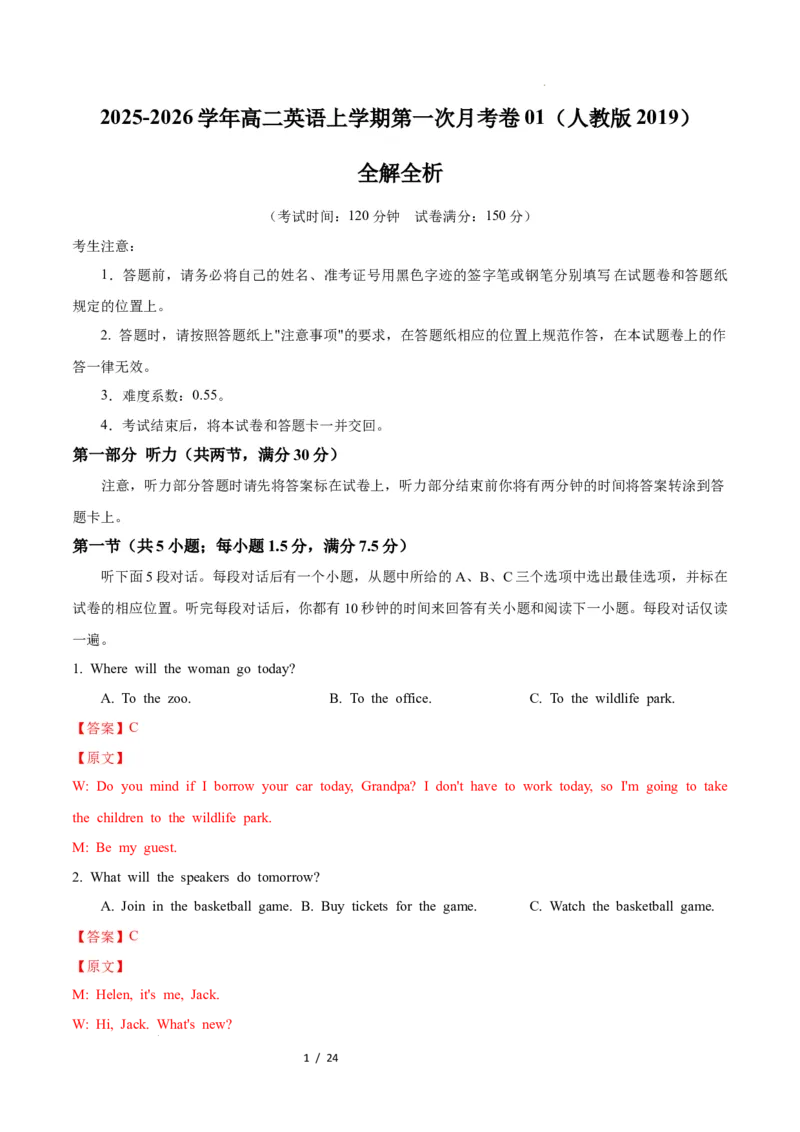
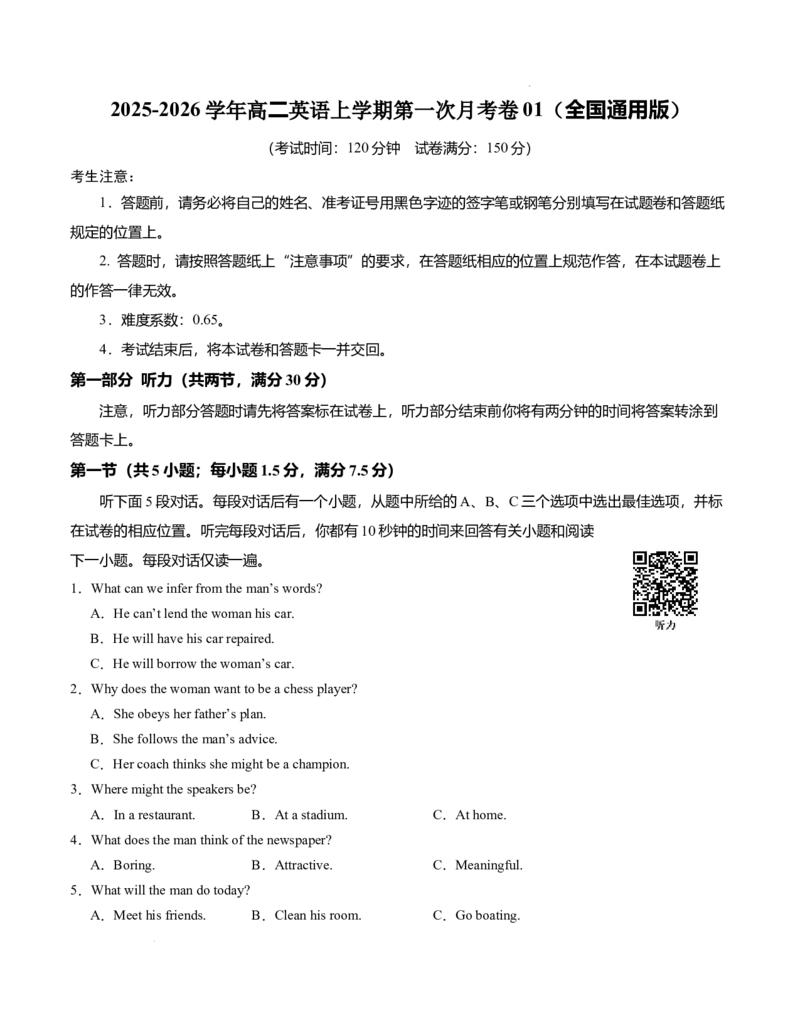
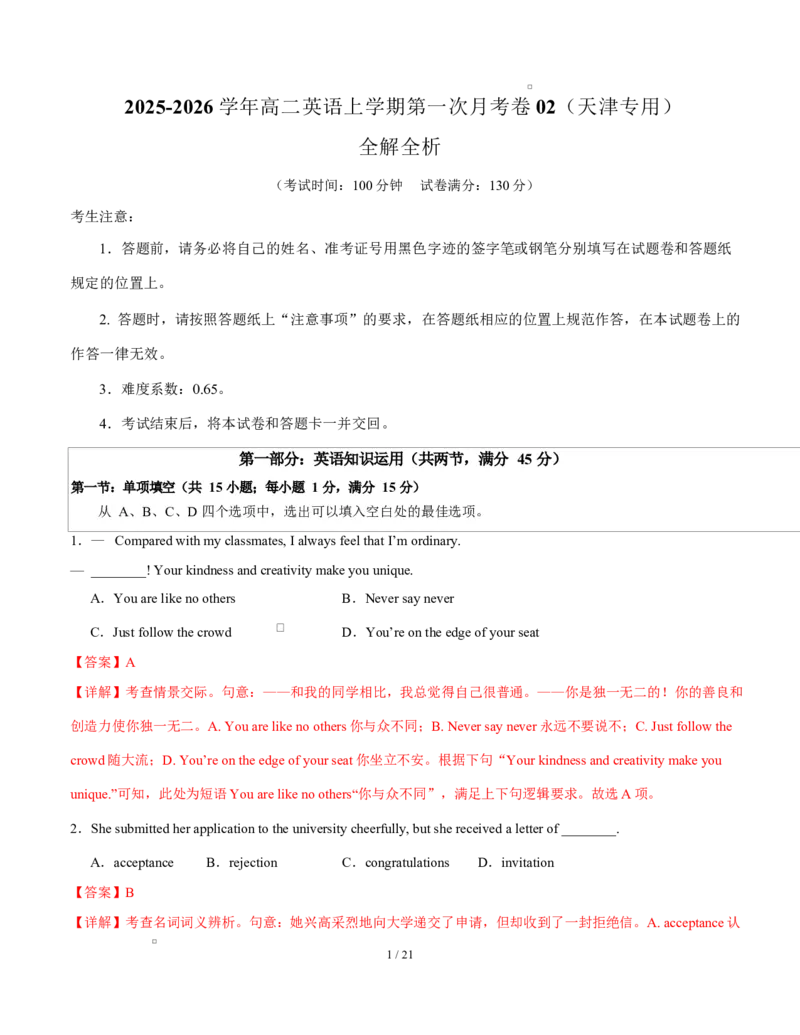
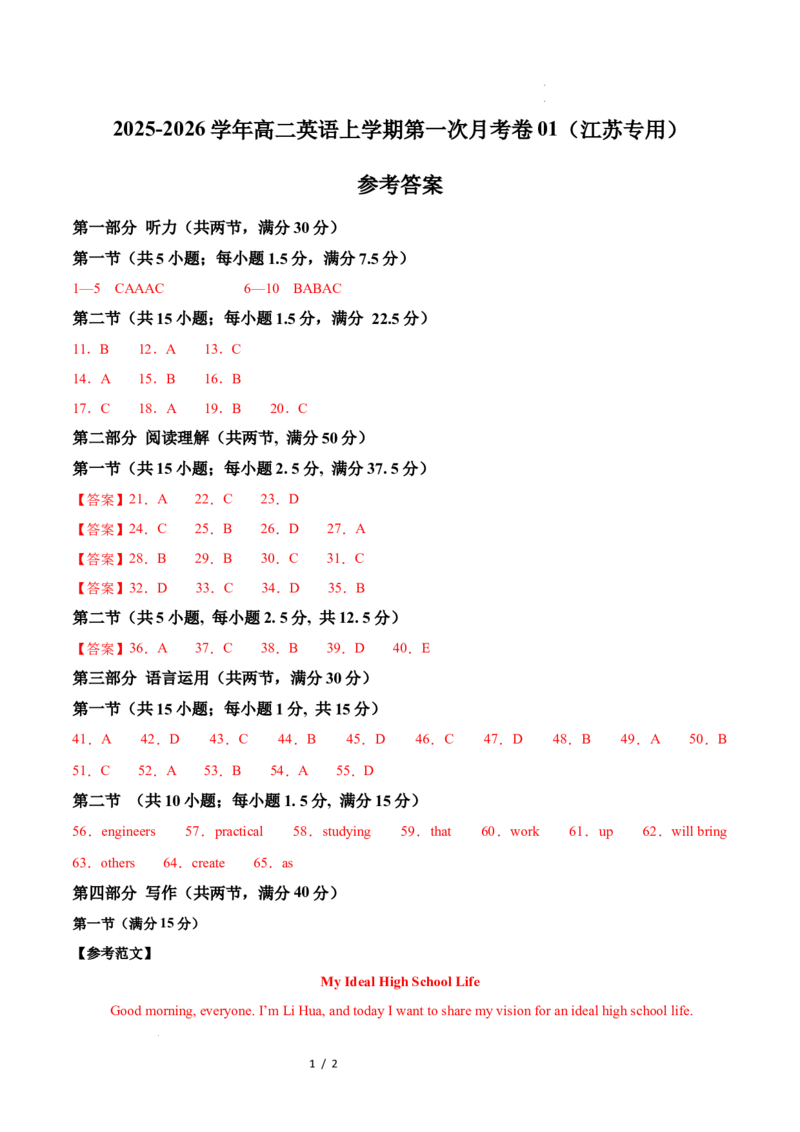
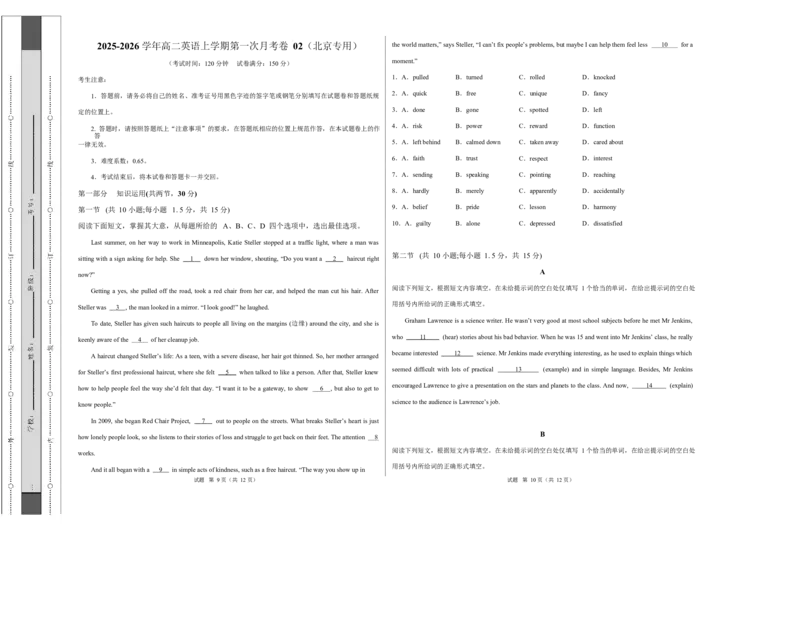
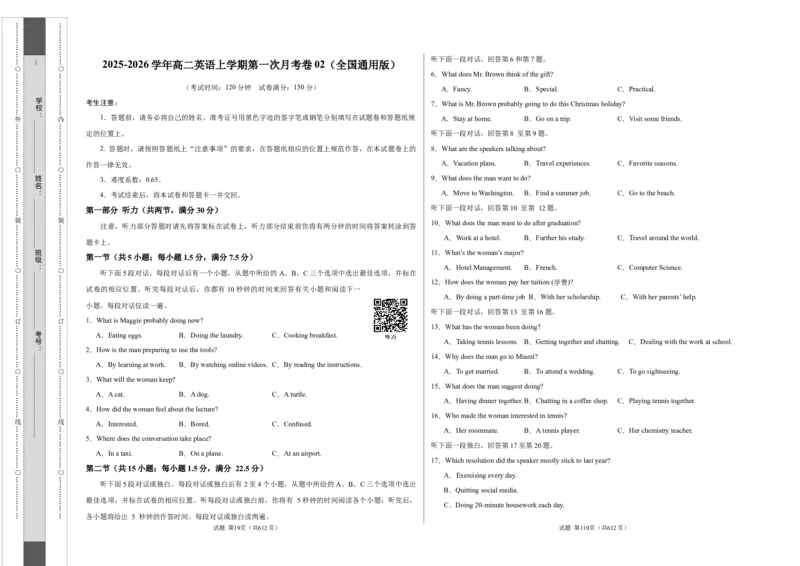
1. Where will the woman go today?
A. To the zoo. B. To the office. C. To the wildlife park.
2. What will the speakers do tomorrow?
A. Join in the basketball game. B. Buy tickets for the game. C. Watch the basketball game.
3. How does the woman feel about English writing?
A. It's uninteresting. B. It's useful. C. It's difficult.
4. Why does the man want the apartment outside the city?
A. It's cheaper. B. It's larger. C. It's more convenient.
5. What are the speakers mainly talking about?
A. A health club. B. A fitness instructor. C. A running machine.
第二节(共15小题;每小题1.5分,满分22.5分)
听下面5段对话或独白。每段对话或独白后有几个小题,从题中所给的A、B、C三个选项中选出最佳
选项,并标在试卷的相应位置。听每段对话或独白前,你将有 5秒钟的时间阅读各个小题;听完后,各小
题将给出5秒钟的作答时间。每段对话或独白读两遍。
1/12
学科网(北京)股份有限公司听下面一段对话,回答第6和第7题。
6.What is the man's job?
A. A fireman. B. A businessman. C. A policeman.
7. What does the girl like best?
A. Sweets. B. Biscuits. C. Dresses.
听下面一段对话,回答第8至第9题。
8. Who will the woman bring to the party?
A. Jane. B. Edward. C. Ted.
9. Why will the woman arrive early?
A. To play games. B. To offer help. C. To make dessert.
听下面一段对话,回答第10至第12题。
10. What is the relationship between the speakers?
A. Sister and brother. B. Teacher and student. C. Employer and employee.
11. When did the woman see Bobby's parents?
A. Yesterday. B. Last Monday. C. Last Friday.
12. What is the woman planning to do?
A. Punish Bobby. B. Praise Bobby. C. Talk with Bobby.
听下面一段对话,回答第13至第16题。
13. What did Carol's mother study at college?
A. Finance. B. History. C. Literature.
14. Who will pay for Carol's mother's education in Stanford University?
A. Carol's father. B. The university. C. Carol.
15. What does Carol suggest the man do?
A. Work hard. B. Find a part-time job. C. Help with the housework.
16. What does Carol ask the man to do?
A. Return a book. B. Clean her bedroom. C. Borrow a book.
听下面一段独白,回答第17至第20题。
17. When did the speaker set up the organisation?
A. In 2011. B. In 2013. C. In 2015.
18. What led the speaker to set up the organisation?
A. Money. B. Confidence. C. Interest.
19. Where did the speaker get the $100?
2/12
学科网(北京)股份有限公司A. From a contest. B. From the government. C. From a friend.
20. What will the speaker plan to do next?
A. Create a food bank. B. Collect more letters. C. Enter a contest.
第二部分 阅读理解(共两节,满分50分)
第一节(共15小题;每小题2.5分,满分37.5分)
阅读下列短文,从每题所给的A、B、C、D四个选项中选出最佳选项,并在答题卡上将该选项涂黑。
A
For years, experts have pointed out that Carbon capture and storage (CCS) has been primarily used to pump
more oil out of the earth, using a process known as enhanced oil recovery (EOR). Burning that oil emits far more
carbon dioxide (CO₂) than what is captured, and therefore CCS doesn't represent a viable (可实施的) solution to
tackle climate change, critics argue.
Below is a review of the climate impact of 4 large-scale CCS projects around the world.
1. Terrell Natural Gas Processing Plant ("Val Verde")
Storage method: Enhanced oil recovery in the Permian Basin.
What they said would happen: More crude oil would be extracted using injected CO₂.
What actually happened: It worked. Val Verde's success served as a replicable model enabling the oil industry
to pump more oil while claiming to be helping the climate.
2. Sleipner and Snøhvit Projects
Storage methods: Geologic storage in the North Sea.
What they said would happen: Often cited as evidence that the oil industry has already perfected carbon
capture and storage techniques.
What actually happened: Studies suggest the projects' CO₂ storage modeling is faulty, stressing concerns that
CO₂ behavior remains highly unpredictable.
3. Gorgon Project
Storage methods: Geologic storage in Barro Island, Western Australia, Australia.
What they said would happen: A flagship plant to store CO₂ produced by drilling for offshore gas.
What actually happened: Project started years after drilling began; plagued (困扰) by technical problems that
meant it captured less than a quarter of what was promised.
4. Boundary Dam
Storage method: Enhanced oil recovery in the Weyburn oil field (90 percent), geologic storage (10 percent).
What they said would happen: A world-leading "clean coal" facility.
3/12
学科网(北京)股份有限公司What actually happened: Consistent failure to hit capture targets; captured CO₂ used to pump more oil.
21.What major concern arose about Sleipner and Snøhvit Projects?
A.Proven perfected CCS techniques.
B.Unreliable CO₂ storage modeling.
C.Primarily used CO₂ for oil extraction.
D.Faced unexpected shutdowns.
22.Why did Gorgon fail expectations?
A.It started late and had technical problems.
B.It was never properly constructed.
C.It stored excessive CO₂ emissions.
D.It focused only on coal sources.
23.What is common problem for most projects?
A.Effectively reduced carbon emissions.
B.Suffered from high operational costs.
C.Operated only for a limited time.
D.Boosted fossil fuels causing more pollution.
B
Let's take a look at this year's Ig Nobel Prize
The Ig Nobel Prize, made to "honor achievements that first make people laugh, and then make them think", is
a humorous version of the Nobel Prize. This year, 10 new winners stood head and shoulders above thousands of
other nominees (候选人). Let's take a look at their bizarre (奇异的) scientific achievements.
Zombie spiders
Spiders move their legs through a hydraulic (液压的) system in their bodies. The brain controls the blood to
flow into the legs so that the legs can reach out and contract (收缩). That's why you see a spider curl up (蜷缩) its
legs after dying. Based on this, Te Faye Yap and her team from Rice University in the US turned a dead spider into
a robot. By controlling air pressure inside the body, the zombie spider can grasp and move things on a small scale.
This zombie (僵尸) spider robot won the mechanical engineering prize at the Ig Nobel.
The Stanford smart toilet
Seung-min Park from Stanford University received the public health prize for developing a smart toilet. It
recognizes users by reading their anal print (肛纹). It checks the color of users' urine (尿液) and records the urine's
release speed and volume. It also checks poo through a model using deep learning. The winner said the smart toilet
4/12
学科网(北京)股份有限公司might contribute to disease screening, diagnosis (诊断) and monitoring.
Jamais vu
The literature prize goes to Chris Moulin and his team for studying how people feel when they repeat a word
many times. If you repeat a simple word like "the" tens of times, you might find the word becomes unfamiliar and
strange. This phenomenon is called jamais vu, a fleeting (短暂的) feeling of unfamiliarity with things we have seen
before. Moulin's team conducted an experiment with students from the University of Leeds, UK. They required the
students to repeat a word many times. Some participants felt that the word lost its meaning. Some said they
suddenly felt unfamiliar with the word. Two-thirds of participants reported this phenomenon after repeating it 30
times.
24.What do we know about the zombie spider robot?
A.It moves when a person touches it.
B.It is made from a real spider body.
C.Its movements are controlled by blood pressure.
D.A hydraulic system was put in its body.
25.What might be one of the functions of the smart toilet?
A.Measuring body temperature.
B.Identifying users by their toilet use.
C.Detecting potential diseases.
D.Improving users' bathroom habits.
26.What is the main focus of Moulin and his team's research?
A.The impact of word repetition on memory.
B.The effects of memory loss on word recognition.
C.College students' strategies for word memorization.
D.Emotional responses to unfamiliar words.
27.Which of the following best describes the phenomenon called "jamais vu"?
A.A sudden loss of memory.
B.A sense of familiarity with new experiences.
C.Memory improvement due to repetition.
D.A brief feeling of unfamiliarity with familiar things.
C
The idea that too much screen time and digital dependence might harm our cognitive abilities — often called
5/12
学科网(北京)股份有限公司"digital dementia (痴呆)" — has been debated since psychiatrist Manfred Spitzer coined the term in 2012. Critics
argue that outsourcing memory (like relying on smartphones for contact details) and passive media consumption,
such as endless scrolling, could weaken mental sharpness. But is this really true, especially for older adults who
have witnessed the digital revolution firsthand?
A major 2024 study published in Nature Human Behaviour analyzed data from over 411,000 adults aged 50
and above. Surprisingly, it found that regular use of computers, smartphones, and the Internet was associated with a
58% lower risk of cognitive decline — a stronger protective effect than even physical exercise or maintaining
healthy blood pressure.
This doesn't mean technology directly prevents dementia, but it suggests that staying digitally engaged may
help keep the brain active. Learning new apps, resolving tech issues, and even online socializing could function like
mental workouts, strengthening cognitive resilience (恢复力). In fact, technology aids instead of harming because
it offers mental stimulation, enhances social connection, and boosts independence via problem-solving.'
While this study is a relief, not all tech use is equal in its effects. Passive activities, like binge watching TV,
may not offer the same benefits as interactive tasks, such as video calls or online learning. Additionally, too much
screen time in younger people has been linked to attention problems and poor sleep — which could have long-term
effects.
As AI and brain-computer interfaces advance, older adults may gain even more tools to support cognition,
from memory aids to virtual social companions. However, balance remains key. The best approach? Use technology
actively — learn, connect, and problem-solve — rather than just consume.
For now, older adults shouldn't fear "digital dementia." Instead, thoughtful tech use might be one of the best
ways to keep their minds sharp in the digital age.
28.What does the 2024 study reveal about "digital dementia" compared with the popular idea?
A.It draws a contrary conclusion.
B.It agrees with Manfred Spitzer' theory.
C.It only occurs in older adults.
D.It equals the effect of physical workouts.
29.Why can active digital use reduce the risk of cognitive decline?
A.It can prolong our life.
B.It can activate our brain.
C.It can solve tricky issues.
D.It can enhance our ability.
6/12
学科网(北京)股份有限公司30.What does paragraph 4 mainly talk about?
A.Reliability of the new study.
B.Negative effects on the young.
C.Downsides of passive tech use.
D.Contrast between two tech uses.
31.What does the author suggest the elderly do in the last two paragraphs?
A.Relieve their fear quickly.
B.Get more tools to sharpen cognition.
C.Consume technology simply.
D.Make considered use of modern tech.
D
The Internet has changed the way we communicate. In the past, people used to send letters or make phone
calls to stay in touch with others. Now, with social media platforms like Facebook, Twitter, and Instagram, people
can connect with friends and family from all over the world instantly.
Social media allows people to share photos, videos, and updates about their lives. It's a great way to stay
informed about what's happening with the people we care about. "I can see what my cousin is doing in Australia
even though we haven't seen each other in years," said Maria Garcia, a regular social media user.
However, social media also has its drawbacks. Some people spend too much time on social media and neglect
their real-life relationships. They may also compare themselves to others and feel insecure. "I sometimes feel bad
when I see my friends posting about their perfect lives," said John Smith.
It's important to use social media in moderation. We should remember that what people post on social media is
often a highlight reel of their lives, not the full picture. "Social media can be a great tool, but it's not a replacement
for face-to-face communication," said Dr. James Wilson, a psychologist.
32.How has the Internet changed the way we communicate?
A.It has made communication slower.
B.It has made it harder to connect with people.
C.It has allowed instant communication with people worldwide.
D.It has replaced all other forms of communication.
33.What can people do on social media?
A.Only send letters.
7/12
学科网(北京)股份有限公司B.Share photos, videos, and updates.
C.Make phone calls.
D.Meet people in person.
34.What is a drawback of social media?
A.It allows people to stay in touch with friends.
B.It can make people spend too much time online.
C.It helps people feel more secure.
D.It provides a full picture of people's lives.
35.What does Dr. James Wilson suggest?
A.Using social media as much as possible.
B.Avoiding social media completely.
C.Using social media in moderation.
D.Replacing face-to-face communication with social media.
第二节(共5小题,每小题2.5分,共12.5分)
阅读下面短文, 从短文后的选项中选出可以填入空白处的最佳选项。选项中有两项为多余选项。
Taking care of pet fish is a big responsibility, so you have to learn all about it before bringing them home!
36 Freshwater fish are the best fish to start with. But some species of fish don't get along with
others, so you'll need to do some research before you make decisions about what to buy and how many to buy.
Next, you need to make sure you have the necessary supplies that your fish will need. Get a fish tank big
enough for the fish you plan to keep. You can put the tank on a dresser. 37 Fish tanks need a light to help
fish distinguish between day and night, an air pump and filter (过滤器) to keep the water clean, as well as a heater
and thermometer to maintain a comfortable water temperature. Many people also like to get decorations for their
tanks!
Now that you have your supplies, you'll need to set up your aquarium. Put the tank on the stand, close enough
to an outlet (电源插座). Wash any decorations you plan to put in the tank. 38 Then, heat up the water to
the temperature your fish will need. Follow the instructions on the filter and air pump to get them in your tank.
Make sure your light is ready to go, too! 39
You're ready to bring your fish home! Once fish are in the tank, you have to watch them closely to make sure
they don't get sick. Feed them in small amounts a few times a day. 40 Remember to change the water
weekly, and more frequently in the first few weeks.
8/12
学科网(北京)股份有限公司A.Save up your money if you'd like decorations.
B.Alternatively, you might need to get a fish tank stand.
C.You'll be able to take care of a more complicated pet later on.
D.Too much extra food will worsen water quality and harm your fish.
E.First, decide the species of fish and the number of the fish you want to get.
F.Fill the bottom of the tank with the clean decorations, then fill the tank with water.
G.Some people use a timer for their lights to avoid turning them on and off each day.
第三部分 语言运用(共两节,满分30分)
第一节(共15小题;每小题1分,共15分)
阅读下面短文,从每题所给的A、B、C、D四个选项中选出可以填入空白处的最佳选项。
I've always had a passion for animals but my parents worked long hours, so I was just 41 a parrot at
home. He was kept in a cage and couldn't fly 42 , and often fell behind the oven when we let him out.
I think I've been destined to 43 the strays (流浪宠物). I went with a friend to a farm to buy her dog
and there was a tiny poor sheepdog. I bought her on the 44 .
I got my first kitten from a charity, to offer the dog 45 while I was working. They loved each other.
My dog was 16 when she died, and she ended up being a security 46 to eight skinny adopted cats through
the years.
One day in 2023, my son rang to tell me there was a white rabbit on the road. We 47 it with the aid
of sweeping brushes and buckets. I advertised him, but no one 48 him. Alan, another adopted dog, liked
our rescue Siamese cat Po, and they were 49 . Not long after, my friend Jane sent me a(n) 50 to
rehome an ancient Siamese cat who hadn't much sight. "You know what you want," she said. We couldn't 51
a huge and fluffy one. He got around clicking like sonar (声呐) and always 52 his way to our laps.
We said it would be enough to keep these animals. Then a friend asked me to 53 details of a chow
mutt found wandering as a stray. We went to see her — just to look. My heart was 54 . But I couldn't stop
thinking about her. Someone was lined up to see her and I rang the shelter in 55 . Yes, she's now part of
the family.
41.A.boasted B.arranged C.allowed D.shown
42.A.silently B.properly C.directly D.deliberately
43.A.take in B.take on C.quest for D.adapt to
44.A.horizon B.whole C.spot D.way
45.A.company B.safety C.compassion D.freedom
9/12
学科网(北京)股份有限公司46.A.vest B.blanket C.helmet D.towel
47.A.played B.cleaned C.kidnapped D.caught
48.A.defended B.purchased C.hired D.claimed
49.A.uneasy. B.intolerable C.inseparable D.unaware
50.A.warning B.protest C.enquiry D.appeal
51.A.bury B.resist C.liberate D.control
52.A.felt B.made C.inched D.squeezed
53.A.spread B.shorten C.polish D.explain
54.A.worn-out B.wide-open C.highly-sensitive D.sealed-off
55.A.innocence B.surprise C.panic D.doubt
第二节 (共10小题;每小题1.5分,满分15分)
阅读下面短文, 在空白处填入1个适当的单词或括号内单词的正确形式。
Yuan Longping, known as the "father of hybrid rice", devoted his life to 56 (work) the land. He
57 (convince) that hybrid rice could solve the food shortage problem. Through intense effort, he 58
(develop) hybrid rice, which enabled farmers 59 (boost) yields greatly.
Organic farming, which avoids 60 (use) chemicals, is another important approach. Farmers use
natural waste 61 fertiliser and change crops every year to keep the soil 62 (rich). However, it
is challenging for organic farming 63 (meet) the high demand for food. 64 (find) a balance
between chemical and organic farming is crucial for 65 (sustain) agriculture.
第四部分 写作(共两节,满分40分)
第一节(满分15分)
很多同学认为现在已经是信息时代,没有必要浪费时间背诵古汉语诗词。请以"Reasons for Learning
Chinese Classical Poetry"为题写一篇短文向学校英语报投稿。要点包括:
1.为什么要学习古诗词;2.说明学习古诗词的意义和好处。
注意:
1.词数为80左右;2.可适当增加细节,以使行文连贯。
Reasons for Learning Chinese Classical Poetry
____________________________________________________________________________________________
____________________________________________________________________________________________
____________________________________________________________________________________________
____________________________________________________________________________________________
10/12
学科网(北京)股份有限公司____________________________________________________________________________________________
____________________________________________________________________________________________
第二节(满分25分)
阅读下面材料,根据其内容和所给段落开头语续写两段,使之构成一篇完整的短文。
Every child hopes for gifts for Christmas. But it seemed that my family didn't have enough money to buy me
the bike that I'd wanted for Christmas. After supper was over on Christmas eve, I sat at the table, feeling sorry for
myself.
It was cold outside. Soon Dad came back. "Come on, Eric," he said. "Put on warm clothes. It's cold out
tonight." I was really upset then. Not only was I not getting the bike for Christmas, but now Dad was dragging me
out in the cold. But anyway, I got up and followed him.
Outside, in front of the house, our old truck was ready. The cold was already biting at me. Dad went into the
woodshed (柴房) and came out with an armload of wood. "Dad," I asked, "what are you doing?" He said, "I
passed by Ms. Black's house today. She is a single mother of three kids. Her eldest son, 8-year-old Robert, was out
digging around in the woodpile trying to find a few chips. He was just wearing an old thin shirt, trembling with
cold. They're out of wood, Eric." That was all he said and then he turned and went back into the room for a big
ham. He handed them to me and told me to put them in the truck and wait. When he returned, he was carrying a bag
of something in his hand. "What's in the bag?" I asked. "Coats. They're out of warm clothes. I got the children a
little candy too. It just wouldn't be Christmas without a little candy."
We drove two miles to Ms. Black's house. We stopped at the gate and unloaded the wood, then we took the
other things to the door. Ms. Black opened the door and let us in. The room felt cold. Such a small fire could hardly
give off any heat at all. So Dad asked me to add more wood to the fire.
注意:
1.续写词数应为150左右;
2.请按如下格式在答题卡的相应位置作答。
I soon made the fire burn brighter and everyone's spirits rose high._________________________________
____________________________________________________________________________________________
____________________________________________________________________________________________
____________________________________________________________________________________________
____________________________________________________________________________________________
____________________________________________________________________________________________
On the way back home, Dad turned to me and began to explain about the bike I had longed
11/12
学科网(北京)股份有限公司for._________________________________________________________________________________________
____________________________________________________________________________________________
____________________________________________________________________________________________
____________________________________________________________________________________________
____________________________________________________________________________________________
____________________________________________________________________________________________
12/12
学科网(北京)股份有限公司