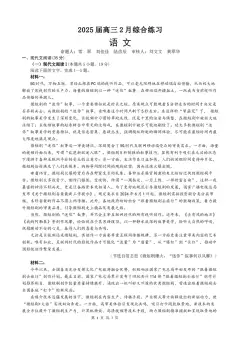
2025届高三2月综合练习 2025.02
第一部分 听力
第一节
听下面5段对话。 每段对话仅读一遍。
1. What happened to Molly?
A. She fell ill. B. She had to work. C. She was sent home.
2. What does the woman mean about the beach?
A. She will walk there. B. It’s close to the hotel. C. It covers one square mile.
3. What was wrong with the car?
A. It had a flat tire. B. It wasn’t cleanly washed. C. It was parked wrongly.
4. What are the two speakers doing?
A. Choosing candies. B. Reserving hotel rooms. C. Talking about a film.
5. Where are the speakers now?
A. At home. B. At a restaurant. C. In a cinema.
第二节
听下面5段对话或独白。 每段对话或独白读两遍。
听第6段材料,回答第6、7题。
6. What’s the probable relationship between Elliot and the woman?
A. Teacher and student. B. Mother and son. C. Boss and employee.
7. What will the man do?
A. Explain his work. B. Talk with Elliot. C. Ask parents for help.
听第7段材料,回答第8-10题。
8. What problem does Thomas have?
A. A headache. B. A toothache. C. A stomachache.
9. What does the woman mean about Thomas?
A. He is homesick. B. He eats the wrong food. C. He should take medicine.
10. What will Thomas do next?
A. Visit his parents. B. Go home directly. C. Stay in the camp.
听第8段材料,回答第11-13题。
11. What is Tahiti famous for?
A. Its surfing. B. Its location. C. Its language.
12. When will the competition probably begin?
A. In 5 minutes. B. In 55 minutes. C. In over an hour.
13. Who will be probably introduced first?
A. The competitors. B. The advertiser. C. The judges.
听第9段材料,回答第14-17题。
14. Why does the man dislike take-offs?
A. It is dangerous. B. It makes him sick. C. It takes a long time.
15. Where are the speakers going?
A. Spain. B. America. C. Greece.
16. What attracts the man most?
A. The villages. B. The museums. C. The beaches.
17. How does the man feel in the end?
A. Nervous. B. Relieved. C. Impatient.
1
学科网(北京)股份有限公司听第10段材料,回答第18-20题。
18. How did Florence Nightingale get her name?
A. It was given by a nurse. B. It originated from a book’s title.
C. It was from her place of birth.
19. Why was Florence Nightingale awarded the Royal Red Cross medal?
A. For the hospitals she built. B. For the cures she developed.
C. For the contributions she made.
20. What is the purpose of the speech?
A. To entertain the audience with a story.
B. To introduce a famous historical figure.
C. To show the great changes in Florence.
第二部分 阅读理解
第一节
阅读下列短文,从每题所给的A、B、C、D四个选项中,选出最佳选项。
A
Disinformation, which is false information spread on purpose, has become a cause of concern
recently. In response to this rising global threat, the United Nations Information Centre (UNIC )
Canberra and its partners will be organizing a two-day conference, DISINFO PACIFIC, on November
11 and 12, 2024.
The conference will focus on strategies for preventing and reducing disinformation, as well as
applying best practices to address this global challenge. It aims to provide a forum (论坛) for
journalists, social media experts, educators, researchers, policy-makers and communications
professionals, from within and outside the UN.
Currently, we are in search of social media volunteers to provide online assistance for this
conference.
Requirements:
·Outstanding oral and written communication skills
·Professional graphic (绘图的) design experience
·Prior involvement in designing document layouts
·In-depth familiarity with graphic design apps
·Working knowledge of the English language
Note: A degree in graphic design or a related field is considered a plus.
Responsibilities:
·Developing a comprehensive social media release plan
·Assisting in choosing the right types of media and updating conference information on a daily
basis
·Working together with our communications team to create social media activities according
to agreed requirements
·Developing a series of social media resources once the final concept is agreed upon, with a
particular focus on a youth (university level) student audience
Join us now as a social media volunteer and help build a future with less disinformation. You
will also have the opportunity to build connections with the UNIC Canberra and its partners and
learn about the ways in which social media communication can support the promotion of a conference
centering on disinformation.
2
学科网(北京)股份有限公司Find out more at https: // app. unv. org / opportunities
21. According to the passage, volunteers should .
A. hold a degree in graphic design B. be able to develop graphic design apps
C. have a great communicative competence D. be as fluent in English as native speakers
22. If selected, volunteers will .
A. release a UNIC work plan B. help design social media activities
C. evaluate the final concept D. provide weekly media updates
23. What is the main purpose of the passage?
A. To promote a conference. B. To seek online volunteers.
C. To highlight a global threat. D. To introduce an organization.
B
I’m walking around the house with a severe limp (跛行) and actively second-guessing every
decision I’ve ever made. That can only mean one thing: I just ran my one race for the year.
The 7-mile race is in my hometown in Illinois, and I’ve been doing it almost every year since
I was a 12-year-old boy. I reached my peak about 15 years ago and have been performing poorly
ever since.
Why do I keep going if I no longer enjoy it and am getting worse every year? Tradition, mostly.
Besides, I don’t dislike the whole race, just the running part. I like seeing all the running club
members I’ve known since childhood, and I love the free beer afterward. Running is just a minor
block on the way to the good stuff.
That day, I was accompanied to the race by a group of three extremely in-shape people. We all
live in the same Indianapolis suburb. These guys bike and run countless miles, often in the same
day. One has done dozens of Spartan Races, which require the player to crawl through mud, flip
tires and throw spears. Another is training for a triathlon (三项全能运动). In addition to being faster
than me on foot, in the water and on wheels, he can also outlift me.
I didn’t hold much hope for the race—no one puts less pressure on me than me. Between
miles 4 and 5, I felt so good that I wondered why I only do this once a year. Then I hit mile 6, and
my body warned me. I pushed myself until I had a mile left, at which point my legs decided they
were done. Determination and a can-do attitude are no match for gravity and distance. Exhausted, I
slowly made my way to the finishing line.
Still, I can honestly say I gave everything I had. My slow, plodding (步履艰难的) finish was
actually a victory that proves I gave it my all. I don’t need a huge cup to honor my heroic performance.
My aching knee is enough of a souvenir.
A day later, even as my entire body tells me I’m an idiot, I can’t help but feel that the race was a
success. I’ve decided to keep doing this race as long as my legs can support me.
24. The author ran the race because .
A. he wanted to keep the old custom B. he wanted to compete with friends
C. he intended to build up his body D. he enjoyed long-distance running
25. Why did the author mention the in-shape people?
A. To give his reason for low self-expectation.
B. To show his envy of their athletic abilities.
C. To emphasize his strong will to win the race.
D. To express his confidence in finishing the race.
3
学科网(北京)股份有限公司26. What do we know about the author during the race?
A. He struggled from beginning to end. B. He broke his leg at the finishing line.
C. He experienced pressure from himself. D. He pushed himself to the limits to make it.
27. How did the author feel after the race?
A. Surprised. B. Satisfied. C. Regretful. D. Grateful.
C
About 150 years after his death, questions appeared about the authorship of William
Shakespeare’s plays. Scholars and literary critics began to float names like Christopher Marlowe,
Edward de Vere and Francis Bacon-men of more known backgrounds, literary recognition, or
inspiration - as the true authors of the plays. Much of this came from the incomplete record of
Shakespeare’s life and the lack of eye-witness sources. Official files from the Holy Trinity Church
and the Stratford government record the existence of a William Shakespeare, but none bears the
statements like him being an actor or playwright (剧作家).
Skeptics (怀疑者) also questioned how anyone of such humble education could write with the
intellectual perceptiveness and poetic power that are displayed in Shakespeare’s works.
One specific cry came from Henry Chettle and Robert Greene, who, many thought were both
jealous of Shakespeare’s fame. The problem these two authors had with Shakespeare had something
to do with the fact that he was a new comer from the back of beyond. The two questioned
Shakespeare’s unclear whereabouts after he moved to London.
However, the vast majority of Shakespearean scholars argue that William Shakespeare wrote
all his own plays. They point out that other playwrights of the time also had unclear histories and
came from low backgrounds. They believe that Stratford’s New Grammar School course of Latin
and the classics could have provided a good foundation for literary writers. Supporters of
Shakespeare’s authorship argue that the lack of evidence about Shakespeare’s life doesn’t mean his
life didn’t exist. They point to evidence that displays his name on the title pages of published poems
and plays. Examples exist of authors and critics of the time acknowledging William Shakespeare as
author of plays.
According to many, Shakespeare’s footprints in London are also well documented. He was
believed to partly own the Globe Theatre where his plays were produced. The theatre was also
involved in some high profile events: it was moved across the Thames in 1598 and burned down on
the 29th of June 1613. The events both pointed to Shakespeare’s whereabouts.
Today, his plays are highly popular and reinterpreted in performances with diverse cultural
backgrounds. The appeal of Shakespeare’s characters and plots is that they present real human beings
in a wide range of emotions and conflicts that go beyond their origins in Elizabethan England.
28. Which of the reasons is NOT mentioned to support skepticism about Shakespeare’s
authorship?
A. Official records didn’t mention Shakespeare’s identity as a playwright.
B. Shakespeare’s education background couldn’t support his literary achievements.
C. Shakespeare’s plays were inspired by big-name literary giants.
D. There was a lack of specific details of Shakespeare’s life.
29. Which of the following facts disproves Henry Chettle and Robert Greene’s skepticism?
A. Shakespeare’s literary power was recognized at his time.
B. His activities in London could be proved by happenings of his theatre.
C. Shakespeare’s childhood education experience helped him gain literary ability.
4
学科网(北京)股份有限公司D. The title papers of government documents bore his name.
30. The charm of Shakespeare’s plays today lies in that ________.
A. his plots are full of conflicts
B. his plays are translated into many languages
C. he succeeded from a modest background
D. he pictures people of real feelings which can exist today
31. The passage is mainly about ________.
A. ways to determine the real author of classic literary works
B. the fights between Shakespeare’s supporters and his opponents
C. doubts and proofs about the authorship of Shakespeare’s plays
D. the criticism on Shakespeare’s plays and their values
D
I read “Middlemarch” in college. None in my class got it. Why would Dorothea make
such a decision on her marriage? “Trust me, you’ll read this book again when you’re forty, and
①
you’ll say, ‘Oh, I see!’” our professor said.
Yet there’s a theory behind the assignment of “Middlemarch”: knowledge acquired too
early gets stored away. Patterns of thinking established now will be retraced later; ideas
②
encountered first in art will prepare us for the rest of life. This sounds unclear, until you reflect on
the fact that you take a class in law school today only to argue a complicated case years later.
Knowledge must often molder in our mental warehouses for decades until we figure out what to
do with it.
Leslie Valiant, a distinguished computer scientist, calls our ability to learn over the long
term “educability”. In his new book, “The Importance of Being Educable,” he argues that it’s key
③
to our success. When we think about what makes our minds special, we tend to focus on
intelligence. But if we want to grasp reality in all its complexity, Valiant writes, then “cleverness is
not enough.” We need to build comprehensive and flexible theories about the world — theories
that will serve us in new, unanticipated, and strange circumstances — and we do that by gathering
diverse kinds of knowledge, often in a slow, additive, accidental way, and knitting them together.
Through this process, we acquire systems of beliefs that are broader and richer than the ones we
can create through direct personal experience.
An educable mind, he writes, can learn from books, lectures, conversations, experiences,
— from anything, really — and notice when relevant aspects of almost forgotten knowledge
④
reveal themselves. We admire aspects of someone’s educability when we say that they are a quick
study, but what really makes them educable is that they apply insights “for purposes not foreseen
at the time of the study”. When people strike us as particularly well-educated, this might mean that
they have had lots of school, but it could also mean that they’re exceptionally educable, with the
ability to take good advantage of whatever educational opportunities arise, whether formal or
informal.
Valiant thinks it might be useful to promote educability as an ideal. We could try to figure
out how to measure and teach it in schools, or to encourage it in adults; at a time when rapid
⑤
technological change means there’s always more to learn, we might seek to create a more educable
society in general.
5
学科网(北京)股份有限公司32. The underlined word “molder” (paragraph 2) is closest in meaning to “______”.
A. become out-of-date B. keep practical C. remain inactive D. stay
safe
33. Which of the following mind map correctly illustrate the relationship among knowledge,
theory and beliefs?
A. B.
C. D.
34. What can be inferred from paragraph 4?
A. True educability lies in presenting insights for unforeseen purposes.
B. A quick learner overestimates the value of learning from all sources.
C. Schooling ensures that an educable mind can seize all learning opportunities.
D. An educable mind pursues learning even without an immediate goal in mind.
35. The passage is intended to ______.
A. introduce a book on educability
B. maximize the benefits of educability
C. inspire people to create an educable society
D. recommend a distinguished computer scientist
第二节
Imagine you’ve been working for hours before a deadline, but you feel like you’re getting
nowhere. You’re starting to feel really anxious. At this point, you might start to blame yourself for
having this emotion. Now you have two emotions: feeling anxious about getting work done and
feeling frustrated that you are anxious. When the second emotion gets layered on top of the first
emotion, you often feel worse and are even less likely to reach your goals. You may now be
wondering if it is possible to make the second emotion less likely. 3 6 .
Many people have heard of “mindfulness”. It is often associated with doing a meditation (冥
想 ) practice, but its essence is to be more aware and accepting of your present-moment
experience. 3 7 Acceptance can limit judgmental thoughts and unhelpful secondary
emotions.
Let me explain. Picture yourself in a challenging situation like the scenario described above
and you feel anxiety arising. Instead of getting upset at yourself for having this emotion, you bring
your awareness to the experience of the emotion and accept it. You might feel that this anxiety is
not fun to experience. ____38____ With this attitude of acceptance, and stepping away from the
tendency to fight against the emotion, you are less likely to get stuck in a loop of judgmental thoughts
that might trigger more unwanted emotions.
3 9 But evidence suggests that it works. That is probably because accepting yourselves,
6
学科网(北京)股份有限公司including your emotions, relieves pressure. You stop adding fuel to the emotional fire when you
release judgmental thoughts about your emotions. 40 For instance, you could turn down the
volume on the initial emotion, perhaps by seeing the situation from a new perspective or asking
someone for support.
A. Thankfully, research suggests that the answer is yes.
B. You can’t be productive even when you have more inner space.
C. Then you may question if you are feeling anxious about getting work done.
D. Yet you know you can breathe it through and that it is just a passing emotion.
E. Sometimes the experience includes an unpleasant emotion you don’t want to feel.
F. It might sound unreasonable that embracing an unpleasant emotion can be a good thing.
G. You also create more inner space to determine whether you can do something that helps.
第三部分 语言运用
第一节
阅读下面短文,从每题所给的A、B、C、D 四个选项中选出可以填入空白处的最佳选项。
Our drive to seek out happiness is a muscle that we can exercise and develop. Almost anyone
can learn to develop their reward sensitivity by ____41____ themselves to notice and experience
their positive emotions.
To raise your reward sensitivity, begin by planning one activity per day that will make you
happy or give you a sense of ____42____. It can be as small as treating yourself to a favorite
snack or reading a few pages of a novel. This will make you less likely to ____43____ positive
experiences. After you’ve enjoyed that ____44____ moment, close your eyes and recount out
loud where and when you experienced the greatest joy. The idea isn’t just to remember how you
felt, but to enhance and re-experience it, thus ____45____ your memory of them, and increasing
your motivation to seek them out going forward.
Here are some other adjustments you can make to develop a positive mind-set.
Expand your joy ____46____: Research suggests that finding more words to describe
positive emotions can prove and increase them. When reflecting on how something made you feel,
try to be ____47____, using words like calm, overjoyed, delighted, inspired beyond fine, good or
great.
Share your highlight reel (高光时刻): ____48____ what made you happiest can make you
feel better. Spread that happiness to another person — and also strengthen a bond.
Find bright sides: With practice, it’s possible to ____49____ the positives hidden in things
that we might first see as negative. For example, if you invited co-workers to get together and only
one person showed up, you could easily view that as a (n) _____50_____. But the bright side
would be that you got to know that one person better.
Forecast future wins: If you’re tight scheduled, pick an event that’s approaching and think of
the best possible _____51_____. If you’re tired, _____52_____ smiling at your friend across the
room, feeling proud. Using imagery can encourage motivation and get you ready for more
_____53_____ experiences.
Keep in mind, too, that it’s normal to feel _____54_____ with pleasurable feelings
sometimes, particularly if you experience depression and anxiety. Worrying can make you feel like
you’re ready to respond to threats — but by constantly _____55_____ disaster, we miss the
happiness in front of us right now. Sometimes we need to behave like happy people if we actually
7
学科网(北京)股份有限公司want to be happy.
41. A. attracting B. demonstrating C. entertaining D. training
42. A. accomplishment B. belonging C. identity D. responsibility
43. A. broaden B. postpone C. provide D. share
44. A. critical B. daily C. rare D. spare
45. A. recalling B. recovering C. searching D. strengthening
46. A. reflection B. selection C. trial D. vocabulary
47.. A. brief B. creative C. precise D. secure
48 A. Broadcasting B. Choosing C. Defining D. Wondering
49. A. cover B. divide C. teach D. notice
50. A. failure B. opportunity C. reward D. surprise
51. A. initiative B. outcome C. prize D. solution
52. A. avoid B. imagine C. practice D. try
53. A. direct B. inspiring C. sensory D. shared
54. A. content B. distracted C. easy D. uncomfortable
55. A. ending in B. guarding against C. heading for D. preparing for
第二节
阅读下面短文,在空白处填入1个适当的单词或括号内单词的正确形式。
Essential oils are extremely concentrated versions of oily substance that plants produce
____56____ (attract) pollinators (传粉昆虫). They may be natural, but that doesn’t mean they’re
always healthy or good for everyone.
____57____ the essential oil is so popular on the cosmetics(化妆品) market is not known.
Some people credit its appeal ____58____ its pleasant smell. But one thing is for sure. Essential
oils don’t cure cancer and there’s no solid evidence that they do much of anything else for health.
But people who love essential oils often say that there’s an oil for everything. They claim
these oils can be useful in a variety of ways. Since long ago, Atlanta Institute for Aromatherapy
____59____ (collect) examples of people harmed by essential oils, in an effort to convince oil
fans that these things are not always ___60___ (harm) and should be treated seriously.
In their injury report, people said they got skin burns ____61____ they used the oils in
proper ways. One woman got blisters (泡) on her back after putting a few drops of sweet orange
oil in her bath water. Another applied an oil mixture behind the ears, ____62____ seemed to
cause burning.
Some oils, especially ____63____ from citrus (柑橘属的) plants, can cause burns and
blisters by sensitizing skin to the sun. Others hurt skin directly. And ____64____ (mix) oils with
water, which is suggested by many, seldom helps to reduce the harm. Saddest of all are the stories
of people who adopted oils as a treatment for skin problems, only to find the condition worsened.
Therefore, some oils may be safe for skin, when appropriately ____65____ (apply). To
protect you from any unexpected harm, a tryout is always recommended.
第四部分 写作
第一节
假定你是李华,你校图书馆新设了小组学习室,请你给留学生 Michael写邮件,邀请他同
去体验,内容包括:
1. 学习室的位置和开放时间;
8
学科网(北京)股份有限公司2.室内设施及其功能。
注意:
1.词数80左右;2.可适当增加细节,以使行文连贯。
2025届高三2月综合练习 答卷纸
Dear Michael ,
__________________________________________________________________________________________________
__________________________________________________________________________________________________
__________________________________________________________________________________________________
__________________________________________________________________________________________________
__________________________________________________________________________________________________
__________________________________________________________________________________________________
__________________________________________________________________________________________________
__________________________________________________________________________________________________
__________________________________________________________________________________________________
__________________________________________________________________________________________________
__________________________________________________________________________________________________
__________________________________________________________________________________________________
__________________________________________________________________________________________________
__________________________________________________________________________________________________
Yours,
Li Hua
9
学科网(北京)股份有限公司答案:
听力
1--5 ABACB 6—10ABCAC 11--15 ACBBC 16--20 ABCCB
阅读理解
21—23 CBB 24—27 AADB 28-31.C BDC 32-35 CADA
36—40 AEDFG .
完形填空 41-55 DABBD DCAD A BBBDD
语法填空
1. to attract 2. Why 3. to 4. has been collecting/has collected 5. harmless
6. although 7. which 8. those##ones 9. mixing 10. applied
Dear Michael,
I’m Li Hua. How is everything going? I’m writing to invite you to experience studying together
in Group Study Room newly opened up in school library. Here are some details. (邀请的缘
由)
It lies in the south of library, open at 9:00 am, lasting for seven hours, except weekends.
(小组学习室开放时间、所在地点)Additionally, it has plenty of desks and chairs, bright and
spacious space which provide us with a brilliant atmosphere to study. What’s more, the desks are
equipped with modern computers, enabling students to gain useful information from Internet. Last
but not least, Group Study Room has a reading corner, where bookshelves provide relevant books
for us. I’m fully convinced that the Room not only offers us a deep insight into literature study but
presents a valuable feast, where we promote our permanent friendship.(内部设施,功能).
Do you have a great passion for it? I’m looking forward to your reply at your earliest
convenience.(再次发出邀请)
Yours
Li
Hua
听力原文
Text 1
W: A teacher at the school called. Molly’s ill and they want to send her home. My husband can’t
get there. Will it be OK if I go early?
M: Yes, of course. Give your work to Lucy. I hope Molly doesn’t have anything serious.
Text 2
M: How far is the hotel from the beach? I don’t want to go if it’s too far.
W: No, it’s just one mile away. Go straight for 500 meters. Turn right and walk another kilometer.
Text 3
10
学科网(北京)股份有限公司W: I hope I haven’t damaged the car. I drove to the shops, and then took it to the car wash. I
parked it outside the house just now and I noticed one of the tires is completely flat.
M: Didn’t it feel different?
Text 4
W: Oh no, I hate this part, which is really scary. It’s the part when the killer comes out of the hotel
room and…
M: Don’t tell me! You’ll ruin the film for me. Here, have another candy and don’t say another
word until the end.
Text 5
W: I didn’t expect to see you here, Gary. Do you come to this restaurant every Saturday night?
M: No, but I wanted a change from watching TV, so it is either this or the cinema.
W: Well, I think you’ll enjoy the food here.
Text 6
W: I’m worried about Elliot. He’s been late for school several times recently, and he didn’t turn
up at all for Sports Day. Also, the homework he hands in to me is getting worse and worse. His
marks keep going down.
M: Yes, I know. I think he’s having some family issues, and I’m afraid they’re affecting his
schoolwork.
W: You need to have a serious talk with him. I can understand if there are family problems, but
we don’t want them harming his future.
M: I know. I’ll talk with him tomorrow. I’ll ask if we can help with any of his problems and
explain that his work needs to improve.
Text 7
M: Mrs. Day, I don’t feel so good.
W: What’s bothering you, Thomas? Is it the same problem from this morning? I can’t give you
any more medicine for that until tomorrow.
M: No. It’s not my head. Now my stomach hurts.
W: I don’t have any other patients right now, so why don’t we sit and talk? Do you realize that
you’ve come to visit me here at the health office every day since camp began?
M: Yes, but I’m not pretending to be sick. I really feel bad and want to go home.
W: Well, I don’t think it’s the food. None of the other children have this problem. I think you’re
just missing your home and parents. There is nothing wrong with that.
M: Then can I go home now?
W: No. Your parents are coming in three days. So relax until then.
Text 8
W: Welcome to the International Surf Invitational. We’re here in the Pacific island nation of
Tahiti, also known as the home to surfing.
M: As a native Hawaiian, I’d say otherwise. But I’m grateful to be here with Sara today, and I
respect the rich tradition of surfing throughout the Pacific islands.
W: Similarly, Tom! It’s with great honor that we introduce you to our home in Tahiti. But I’m
sorry for forgetting the words in Hawaiian that you taught me before.
M: The pleasure is mine! What a joy to watch the best surfers in the world compete. I always
forget that Tahitians’ first language is French — I’m afraid I can’t help you with that.
11
学科网(北京)股份有限公司W: No worries. For the convenience of the viewers here at Bora Bora beach or online, English
will be fine.
M: Deal. Over one hour later, we’ll introduce this year’s competitors and judges while they get
ready to start. Before this, there will be a five-minute section with the Tahiti tourism board — our
chief advertiser for this event.
Text 9
M: I’m not looking forward to this.
W: Why not? This is the holiday you’ve been waiting the whole year for!
M: It’s not the holiday. It’s traveling on the plane that I’m worried about. I hate take-offs.
W: But you’ve done this many times before. You never said anything when we went to Spain.
M: It started on that flight to America nine years ago. When we rise very quickly, it really makes
my stomach turn. When the plane races down the track, the engines scream loudly.
W: OK, well, we’re finally about to take off. You just need to calm down. Here, take my hand…
What are you looking forward to the most about visiting Greece? The beaches? The museums? Or
maybe it’s the late evenings relaxing by the bar with a drink?
M: I…oh dear, here we go… Well, I’d love to go visit local villages…You know…see how real
Greeks live…have a walk…have a drink and a bite to eat in the local restaurants…and…and…oh
dear…
W: There we are. We’re up in the air. M: Phew! Thank goodness I’m alive. I feel great! W: Good,
because in five hours we will land in Greece.
Text 10
Florence Nightingale was born into a wealthy British family on May 12, 1820. She was named
Florence after the place of her birth, Florence in Italy. Working as a nurse, she saved the lives of
many soldiers during the Crimean War. She was devoted to her profession and worked hard day and
night. Florence Nightingale changed the way that hospitals cared for their patients. Before, hospitals
were overcrowded and dirty places. This meant that diseases were easily spread. There weren’t
enough doctors or beds to go around, so people often didn’t get the care they needed. Florence
Nightingale changed all of this by making hospitals cleaner places. She also trained more nurses to
help care for patients. She made sure patients were well looked after and had good food to eat, which
saved many lives. Florence met Queen Victoria, who awarded her the Royal Red Cross medal. Every
year on May 12, her birthday, nurses celebrate International Nurses Day. Florence opened a school
of nursing and wrote a book called Notes on Nursing. King Edward VII gave Florence a special
award called the Order of Merit in 1907. She was the first woman to receive this award and she
changed the way that women were seen in the workplace. She died in 1910.
12
学科网(北京)股份有限公司