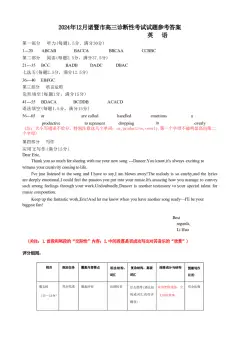
2025 年 5 月诸暨市高三适应性考试试题参考答案
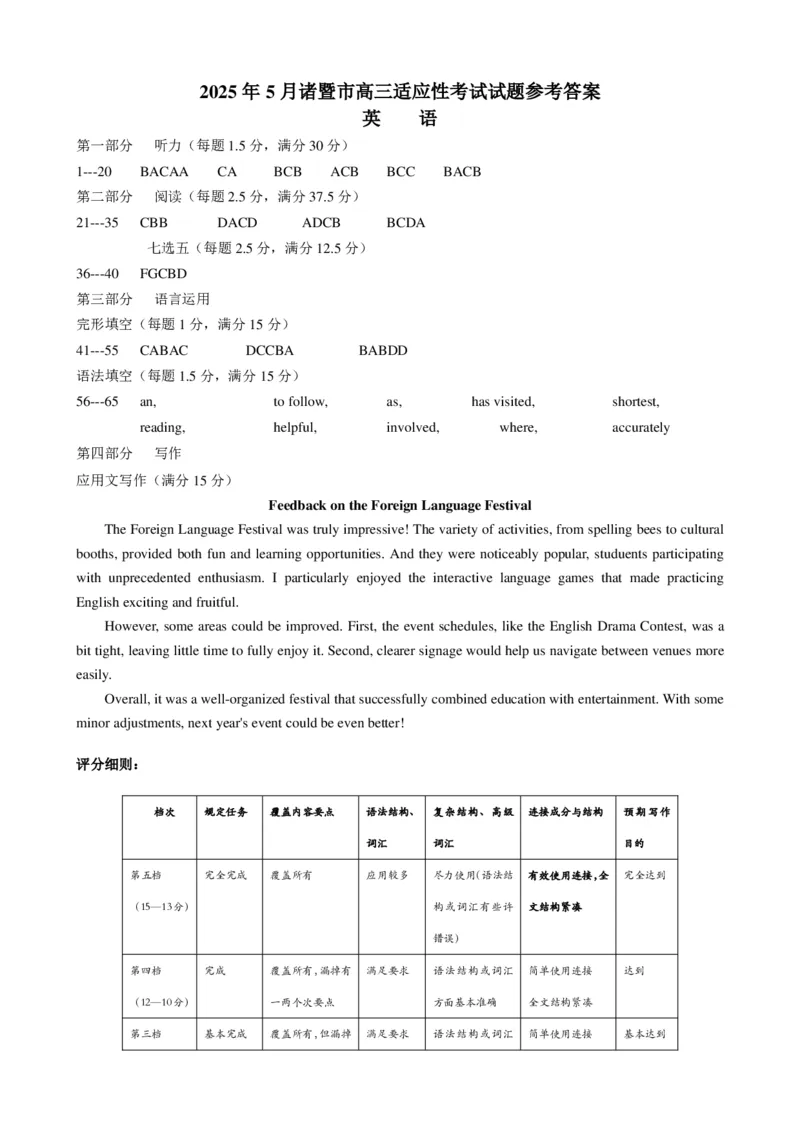
英 语
第一部分 听力(每题1.5分,满分30分)
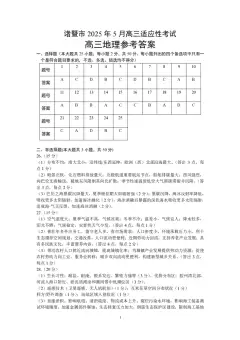
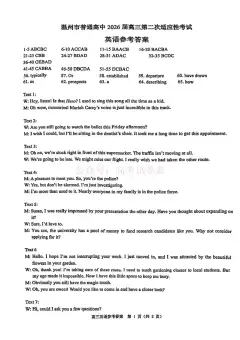
1---20 BACAA CA BCB ACB BCC BACB
第二部分 阅读(每题2.5分,满分37.5分)
21---35 CBB DACD ADCB BCDA
七选五(每题2.5分,满分12.5分)
36---40 FGCBD
第三部分 语言运用
完形填空(每题1分,满分15分)
41---55 CABAC DCCBA BABDD
语法填空(每题1.5分,满分15分)
56---65 an, to follow, as, has visited, shortest,
reading, helpful, involved, where, accurately
第四部分 写作
应用文写作(满分15分)
Feedback on the Foreign Language Festival
The Foreign Language Festival was truly impressive! The variety of activities, from spelling bees to cultural
booths, provided both fun and learning opportunities. And they were noticeably popular, studuents participating
with unprecedented enthusiasm. I particularly enjoyed the interactive language games that made practicing
English exciting and fruitful.
However, some areas could be improved. First, the event schedules, like the English Drama Contest, was a
bit tight, leaving little time to fully enjoy it. Second, clearer signage would help us navigate between venues more
easily.
Overall, it was a well-organized festival that successfully combined education with entertainment. With some
minor adjustments, next year's event could be even better!
评分细则:
档次 规定任务 覆盖内容要点 语法结构、 复杂结构、高级 连接成分与结构 预期写作
词汇 词汇 目的
第五档 完全完成 覆盖所有 应用较多 尽力使用(语法结 有效使用连接,全 完全达到
(15—13分) 构或词汇有些许 文结构紧凑
错误)
第四档 完成 覆盖所有,漏掉有 满足要求 语法结构或词汇 简单使用连接 达到
(12—10分) 一两个次要点 方面基本准确 全文结构紧凑
第三档 基本完成 覆盖所有,但漏掉 满足要求 语法结构或词汇 简单使用连接 基本达到
学科网(北京)股份有限公司(9—7分) 一些内容 方面的错误有一 全文内容连贯
些,但不影响理解
第二档 未恰当完 漏掉一些主要内 语法单调, 语法结构或词汇 较少使用连接成 信息未能
(6—4分) 成 容,写了无关内容 词汇有限 方面的错误有一 分,内容缺少连贯 清楚地传
些,影响对写作内 达给读者
容的理解
第一档 未完成 明显遗漏主要内 语法单调, 语法结构或词汇 缺乏连接成分,内 信息未能
(1—3分) 容,写了一些无关 词汇有限 方面的错误较多, 容不连贯 传达给读
内容 影响对写作内容 者
的理解
第零档 未完成 与要点内容无关 内容太少 无 无 未能传达
任何信息
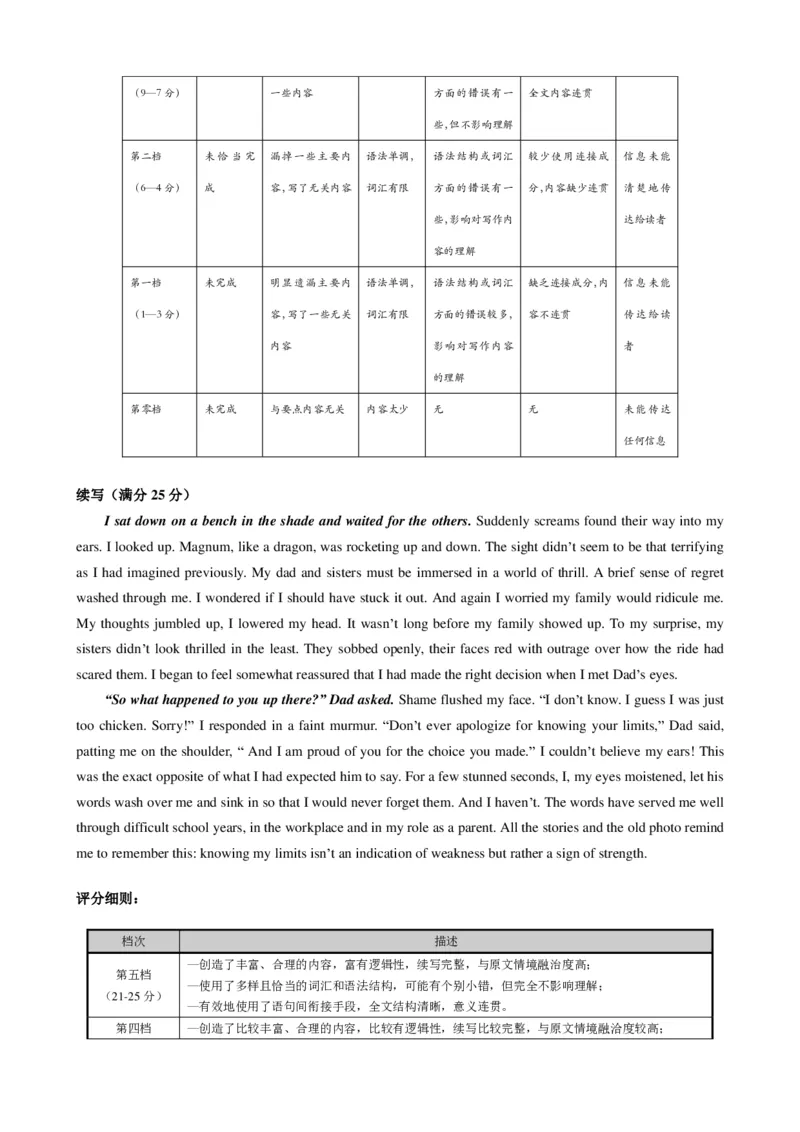
续写(满分25分)
I sat down on a bench in the shade and waited for the others. Suddenly screams found their way into my
ears. I looked up. Magnum, like a dragon, was rocketing up and down. The sight didn’t seem to be that terrifying
as I had imagined previously. My dad and sisters must be immersed in a world of thrill. A brief sense of regret
washed through me. I wondered if I should have stuck it out. And again I worried my family would ridicule me.
My thoughts jumbled up, I lowered my head. It wasn’t long before my family showed up. To my surprise, my
sisters didn’t look thrilled in the least. They sobbed openly, their faces red with outrage over how the ride had
scared them. I began to feel somewhat reassured that I had made the right decision when I met Dad’s eyes.
“So what happened to you up there?” Dad asked. Shame flushed my face. “I don’t know. I guess I was just
too chicken. Sorry!” I responded in a faint murmur. “Don’t ever apologize for knowing your limits,” Dad said,
patting me on the shoulder, “ And I am proud of you for the choice you made.” I couldn’t believe my ears! This
was the exact opposite of what I had expected him to say. For a few stunned seconds, I, my eyes moistened, let his
words wash over me and sink in so that I would never forget them. And I haven’t. The words have served me well
through difficult school years, in the workplace and in my role as a parent. All the stories and the old photo remind
me to remember this: knowing my limits isn’t an indication of weakness but rather a sign of strength.
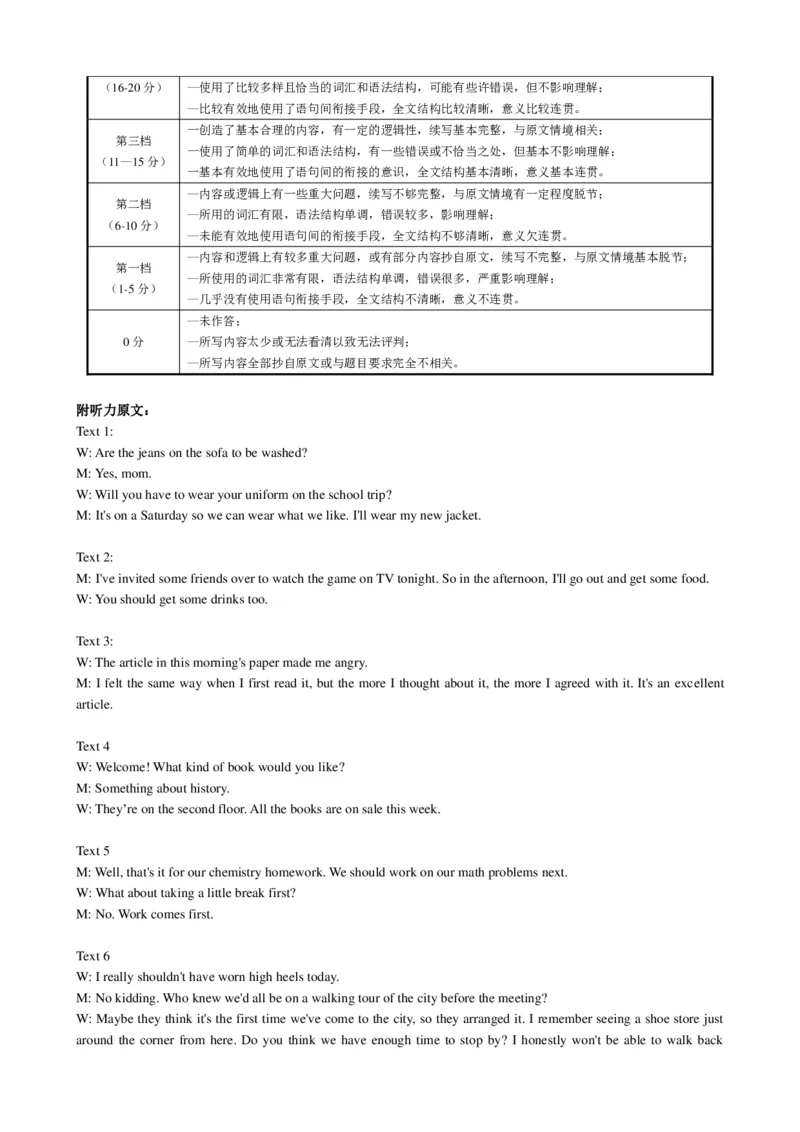
评分细则:
档次 描述
—创造了丰富、合理的内容,富有逻辑性,续写完整,与原文情境融治度高;
第五档
—使用了多样且恰当的词汇和语法结构,可能有个别小错,但完全不影响理解;
(21-25分)
—有效地使用了语句间衔接手段,全文结构清晰,意义连贯。
第四档 —创造了比较丰富、合理的内容,比较有逻辑性,续写比较完整,与原文情境融洽度较高;
学科网(北京)股份有限公司(16-20分) —使用了比较多样且恰当的词汇和语法结构,可能有些许错误,但不影响理解;
—比较有效地使用了语句间衔接手段,全文结构比较清晰,意义比较连贯。
一创造了基本合理的内容,有一定的逻辑性,续写基本完整,与原文情境相关;
第三档
一使用了简单的词汇和语法结构,有一些错误或不恰当之处,但基本不影响理解;
(11—15分)
一基本有效地使用了语句间的衔接的意识,全文结构基本清晰,意义基本连贯。
—内容或逻辑上有一些重大问题,续写不够完整,与原文情境有一定程度脱节;
第二档
—所用的词汇有限,语法结构单调,错误较多,影响理解;
(6-10分)
—未能有效地使用语句间的衔接手段,全文结构不够清晰,意义欠连贯。
—内容和逻辑上有较多重大问题,或有部分内容抄自原文,续写不完整,与原文情境基本脱节;
第一档
—所使用的词汇非常有限,语法结构单调,错误很多,严重影响理解;
(1-5分)
—几乎没有使用语句衔接手段,全文结构不清晰,意义不连贯。
—未作答;
0分 —所写内容太少或无法看清以致无法评判;
—所写内容全部抄自原文或与题目要求完全不相关。
附听力原文:
Text 1:
W: Are the jeans on the sofa to be washed?
M: Yes, mom.
W: Will you have to wear your uniform on the school trip?
M: It's on a Saturday so we can wear what we like. I'll wear my new jacket.
Text 2:
M: I've invited some friends over to watch the game on TV tonight. So in the afternoon, I'll go out and get some food.
W: You should get some drinks too.
Text 3:
W: The article in this morning's paper made me angry.
M: I felt the same way when I first read it, but the more I thought about it, the more I agreed with it. It's an excellent
article.
Text 4
W: Welcome! What kind of book would you like?
M: Something about history.
W: They’re on the second floor. All the books are on sale this week.
Text 5
M: Well, that's it for our chemistry homework. We should work on our math problems next.
W: What about taking a little break first?
M: No. Work comes first.
Text 6
W: I really shouldn't have worn high heels today.
M: No kidding. Who knew we'd all be on a walking tour of the city before the meeting?
W: Maybe they think it's the first time we've come to the city, so they arranged it. I remember seeing a shoe store just
around the corner from here. Do you think we have enough time to stop by? I honestly won't be able to walk back
学科网(北京)股份有限公司unless I get some relief for my feet.
M: It should be fine. We can get you some shoes and then eat a quick lunch at the fast food restaurant. We are almost
back at the meeting center anyway.
W: Okay.
Text 7
W: Doctor's office. May I help you?
M: Yes, my name is John Carver. I'd like to make an appointment to see Dr. Carter.
W: What seems to be the problem?
M: I guess I have a bad cold.
W: Do you feel light-headed or have a fever?
M: No, I neither feel light-headed nor have a fever, but my nose is often running, and I don't feel like eating anything.
W: Well, let me check the schedule. Doctor Carter has an opening at three o'clock this afternoon. Can you come in then?
M: At three o'clock? No, I'm sorry. I can't. I have an important lecture to attend. Then how about tomorrow afternoon?
W: Let's see. Tomorrow afternoon at two o'clock?
M: Yes, that would be fine.
W: All right. See you then.
Text 8:
M: Why are you so dressed up?
W: I am on my way out to the celebration party of my company, and I have to meet some important customers there.
How do I look? Is my makeup okay?
M: You look great. Your makeup is also perfect.
W: Do you think I should wear a different dress?
M: No, the one you have on looks great, especially with your purple shoes and your hair like that.
W: Thanks for saying so. Do you have any ideas which necklace I should wear?
M: With that dress, I'd say your white diamond necklace would look perfect.
W: Thanks for helping out. Now that I'm ready, what are you doing tonight?
M: Don't you remember? I have a get-together party with my college friends.
W: Oh yes, but who is going to pick up our daughter at school?
M: Don't worry, I'll pick her up and then send her to my parents before I go.
Text 9:
M: Guess what? I joined the cave exploring society last month.
W: Seriously? Aren’t cave-explorers who go down into caves? I thought you were only interested in mounting climbing.
M: I do like to climb, but you know, the two sports have a lot in common. I'll give you an example. The same technique
for climbing down steep rocks is used in both sports. Of course, climbers use this technique to come down hills, while
cave explorers use it to go down holes.
W: What else does your society do?
M: For one thing, we help preserve caves. Believe it or not, some people are so careless that they just leave their litter in
caves, and some people even write on cave walls. So we pick up litter and clean away the drawings on the wall.
W: I don't think I'd like cave exploring very much. Caves are wet and cold and dark, aren't they?
M: I suppose they are, but they can also be beautiful. Tell you what, why don't you come along with me to the meeting
tonight? They'll be showing pictures that we took in a cave last weekend. We will see some unbelievable rocks. It might
change the way you think about cakes.
学科网(北京)股份有限公司Text 10
Today I am going to talk a little about Noah Webster and the influence he had on American English. Webster was
born in Connecticut in 1758 and graduated from Yale university in 1778. This was during the time of the American
revolution, and Webster joined George Washington's army to fight against the British. The end of the war brought
independence, but political independence didn't satisfy Webster. He wanted independence in language from Britain as
well. In 1783, Webster published a spelling book. It later became known to generations of schoolchildren as the
blue-backed book because of its blue cover. A couple of years later, he published his dictionary. It is for his dictionary
that Webster is chiefly remembered today. In his dictionary, Webster made many changes in the way English was used
in the United States. He suggested new ways of pronouncing words and added new words to the language. Most of the
changes, though, involved spelling. Today, most people in the United States spell words differently from people in
Britain because of Webster's dictionary. Let me just give you a couple of examples. In Britain, words like “centre” end
in RE. In the United States, these words end in ER. He also took the letter U from words like “color”. In the British
spelling, that word ends with the letters OUR. But in the American spelling, it ends with OR. Still in making changes to
spelling, Webster did not go as far as his friend Benjamin Franklin wanted him to. Franklin wanted to drop all silent
letters from words. The word “wrong” would have been spelled RONG. And the word “love” would have been spelled
LOV.
学科网(北京)股份有限公司