
















文档内容
滨城高中联盟 2025-2026 学年度上学期高三期中Ⅰ考试
英语试卷
第一部分:听力(共两节,满分30分)
第一节(共5小题;每小题1.5分,满分7.5分)
听下面5段对话。每段对话后有一个小题,从题中所给的A、B、C三个选项中选出最佳选项。
听完每段对话后,你都有10秒钟的时间来回答有关小题和阅读下一小题。每段对话仅读一遍。
例:How much is the shirt?
A. £19.15. B. £9.18. C. £9.15.
答案是C。
1. Why does the man want to leave?
A. The service is too slow. B. The food is bad. C. The music is too loud
2. What does the woman do?
A. A teacher. B. A nurse. C. A shop assistant.
3. What has the man decided to do?
A. Continue his talk with Mr. Black.
B. Go to see an engineer.
C. Check the schedule.
4. Where does the conversation most probably take place?
A. On a bus. B. In a library. C. In a shop.
5. How did the man feel about his jump in the end?
A. Terrified. B. Disappointed. C. Excited.
第二节(共15小题;每小题1.5分,满分22.5分)
听下面5段对话或独白。每段对话或独白后有几个小题,从题中所给的 A、B、C三个选项中
选出最佳选项。听每段对话或独白前,你将有时间阅读各个小题,每小题 5秒钟;听完后,
各小题将给出5秒钟的作答时间。每段对话或独白读两遍。
听第6段材料,回答第6、7题。
6. What are the speakers talking about?
A. A restaurant. B. An accident. C. A magazine.
7. Why is The Sunflower closed now?
A. It will move to another town.B. The workers are on holiday.
.
C It is under repair.
听第7段材料,回答第8、9题。
8. What do we know about Mr. Bannister?
A. He lacks experience.
B. He worked on a trade deal last year.
C. He is a new member of the company.
9. Who do the speakers think is suitable for the position in the end?
A. Amelia. B. Mr. Duncan. C. Mrs. Templeton.
听第8段材料,回答第10至12题。
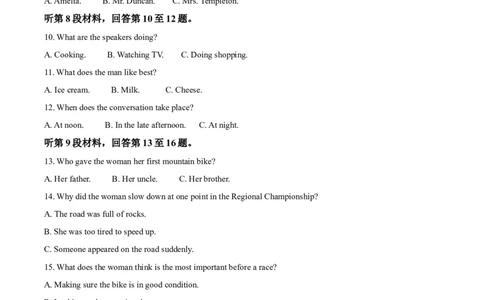
10. What are the speakers doing?
A. Cooking. B. Watching TV. C. Doing shopping.
11. What does the man like best?
A. Ice cream. B. Milk. C. Cheese.
12. When does the conversation take place?
A. At noon. B. In the late afternoon. C. At night.
听第9段材料,回答第13至16题。
13. Who gave the woman her first mountain bike?
A. Her father. B. Her uncle. C. Her brother.
14. Why did the woman slow down at one point in the Regional Championship?
A. The road was full of rocks.
B. She was too tired to speed up.
C. Someone appeared on the road suddenly.
15. What does the woman think is the most important before a race?
A. Making sure the bike is in good condition.
B. Looking at the route in advance.
C. Doing sports to keep fit.
.
16 What does the woman say about the clothes for a race?
A. They’re comfortable. B. They’re pretty. C. They’re tight.
听第10段材料,回答第17至20题。
17. When does the Business Studies course start?
A. On June 5th. B. On June 12th. C. On July 11th.
18. What can the students bring with them during the course?A. Business videos. B. Notebook computers. C. Mobile phones.
19. Where is the Business Studies Department?
A. Next to the staff car park.
B. On the left side of the science center.
C. Beside the main entrance of the college.
20. What language classes are provided this summer?
A. Japanese and German. B. French and Chinese. C. Italian and Spanish.
第二部分:阅读(共两节,满分50分)
第一节(共15小题;每小题2.5分,满分37.5分)
阅读下列短文,从每题所给的A、B、C、D四个选项中选出最佳选项。
A
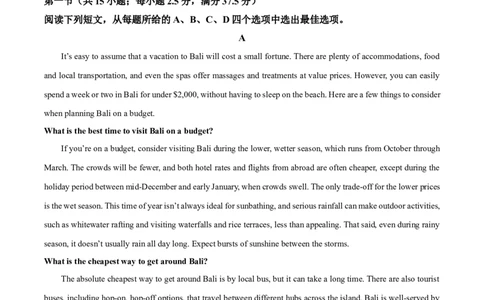
It’s easy to assume that a vacation to Bali will cost a small fortune. There are plenty of accommodations, food
and local transportation, and even the spas offer massages and treatments at value prices. However, you can easily
spend a week or two in Bali for under $2,000, without having to sleep on the beach. Here are a few things to consider
when planning Bali on a budget.
What is the best time to visit Bali on a budget?
If you’re on a budget, consider visiting Bali during the lower, wetter season, which runs from October through
March. The crowds will be fewer, and both hotel rates and flights from abroad are often cheaper, except during the
holiday period between mid-December and early January, when crowds swell. The only trade-off for the lower prices
is the wet season. This time of year isn’t always ideal for sunbathing, and serious rainfall can make outdoor activities,
such as whitewater rafting and visiting waterfalls and rice terraces, less than appealing. That said, even during rainy
season, it doesn’t usually rain all day long. Expect bursts of sunshine between the storms.
What is the cheapest way to get around Bali?
The absolute cheapest way to get around Bali is by local bus, but it can take a long time. There are also tourist
buses, including hop-on, hop-off options, that travel between different hubs across the island. Bali is well-served by
taxis, both of the car and motorbike variety, and the prices tend to be affordable by international standards. Most
drivers will offer you a fixed rate for full-day hires or to get from point A to point B, rather than using a meter.
Remember to bargain: doing so is particularly easy when a driver is on his own rather than at a taxi stand.
How much does food cost in Bali?
If you’re into fine dining, you can end up spending a large chunk of your budget on food. Eating at the average
tourist-customized restaurant is the best way to have a meal in Bali on a budget. A good meal should cost you around100,000 rupiah (around $7), but if you’re willing to subsist mostly off of local specialties such as nasi goreng (fried
rice) and eat at local restaurants, you can expect to pay around 30,000 rupiah ($2) to get fed. Best of all, most hotels
and guesthouses in Bali come with free breakfast, and many offer heavier options of noodles and meat that may keep
you full until lunch.
1. What can we infer about the weather in Bali during its wet season?
A. It rains continuously from morning till night every day.
B. There are still periods of sunshine between rainstorms.
C. Outdoor activities like whitewater rafting are completely impossible.
D. The rainfall makes it unsuitable for any form of travel.
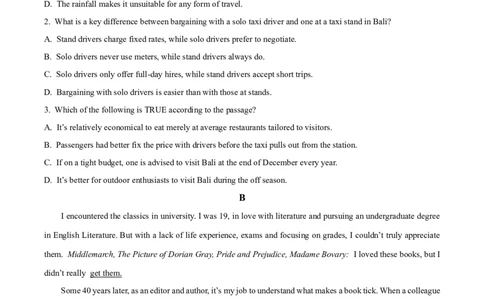
2. What is a key difference between bargaining with a solo taxi driver and one at a taxi stand in Bali?
A. Stand drivers charge fixed rates, while solo drivers prefer to negotiate.
B. Solo drivers never use meters, while stand drivers always do.
C. Solo drivers only offer full-day hires, while stand drivers accept short trips.
D. Bargaining with solo drivers is easier than with those at stands.
3. Which of the following is TRUE according to the passage?
A. It’s relatively economical to eat merely at average restaurants tailored to visitors.
B. Passengers had better fix the price with drivers before the taxi pulls out from the station.
C. If on a tight budget, one is advised to visit Bali at the end of December every year.
D. It’s better for outdoor enthusiasts to visit Bali during the off season.
B
I encountered the classics in university. I was 19, in love with literature and pursuing an undergraduate degree
in English Literature. But with a lack of life experience, exams and focusing on grades, I couldn’t truly appreciate
them. Middlemarch, The Picture of Dorian Gray, Pride and Prejudice, Madame Bovary: I loved these books, but I
didn’t really get them.
Some 40 years later, as an editor and author, it’s my job to understand what makes a book tick. When a colleague
suggested we deconstruct (解构) classics, I was excited. I had no idea what I was in for. Many were rereads of novels I
loved. I wondered if they would still resonate (引起共鸣) and if my technology-damaged attention span could handle
them.
Reading Middlemarch when you’re 19 is very different from when you’re 60 and have been through, well, life.
Much of what Eliot was doing with marriage, relationships and expectations went over my young head. The characters
and dialogue are masterful.
However, rereading Middlemarch was a scary idea. It’s a brick of a book with tiny print. So I tried the audiobookinstead. I was swept away: I didn’t want to do anything except listen. I told a friend to read it again, amazed by how
good, how relevant it is, even though it was published in 1871.
Maybe life hasn’t changed as much as we think. Madame Bovary gives big social media vibes. Everyone else is
having a better time than Bovary. Everyone’s grass is greener. Nothing lives up to her expectations. The Picture of
Dorian Gray shows that our obsessions (痴迷) with youth and beauty are nothing new. Oscar Wilde would have a
lot to say about today’s selfies and social media personas (表面形象), which can be far from the truth.
We gave these books the attention they deserved-attention I couldn’t give at age 19. That’s why I recommend
rereading. These authors understood something about humanity that still resonates, still makes us question our life
choices.
Reading the classics is a way to reclaim (重拾) something in danger of being lost: the enjoyment of mastery in
language, of characters so alive they could walk into our living room. Good fiction teaches something that we will
always need: the ability to stand in another’s shoes and feel what they feel, and maybe come away with a new
understanding.
4. What does the phrase “get them” in Paragraph 1 most probably mean?
A. Memorize the plots. B. Appreciate the value deeply.
C. Finish reading quickly. D. Understand the authors’ background.
5. Why did the author try the audiobook when rereading Middlemarch?
A. To make the reading easier as the book is very thick with small print.
B. To follow the latest trend of reading audiobooks.
C. To share the reading experience with friends conveniently.
D. To improve her listening skills.
6. Which of the following statements can be inferred from the passage?
A. The author thinks classic books should only be read by adults.
B. Madame Bovary’s themes are unrelated to modern social media phenomena.
C. Rereading classics in different life stages can bring new insights.
D. Oscar Wilde’s works are outdated and not worth reading now.
7. What is the author’s main purpose in writing this passage?
A. To criticize people’s lack of attention to classics.
B. To explain why she disliked classics in her youth.
C. To advocate for rereading classics and exploring their timeless value.
D. To compare the reading habits of teenagers and adults.
CIt’s not uncommon for patients to hide their true emotions from their caregivers—or even from their own
conscious selves. An experimental new facial “sticker” could help by detecting and sharing information on its
wearer’s present state of mind.
Currently being developed by Prof. Huanyu “Larry” Cheng and his colleagues at Penn State University, the
flexible, stretchable device incorporates sensors that measure biaxial mechanical strain (双轴机械应变), body
temperature, sweat-caused humidity, and blood oxygen levels. These sensors are piled like pancakes, separated by
thin sheets of different materials that keep their signals and measurement methods from meddling with one
another. Other components include a printed circuit board, wireless charging coil (线圈), 5-volt battery and
Bluetooth chip. All of these pieces are enclosed within a waterproof covering, with the whole device measuring
about 6 cm in length.
When the sticker is temporarily attached to a patient’s face, its strain sensor monitors their skin movements
along two axes, wirelessly relaying the data to an app on a cloud-connected smartphone or tablet. AI-based
algorithms (算法) in the software are in turn able to deduce(推断) the person’s current facial expression, which is
certainly linked to their mood. In lab tests, the technology has proven to be over 96% accurate at identifying six
common facial expressions: happiness, surprise, fear, sadness, anger and disgust.
That said, expressions can be faked, often even subconsciously (潜意识地). For that reason, the app also uses
real-time readings from the temperature, humidity and blood oxygen sensors. Using this combination of data, the
system is so far almost 89% accurate at identifying true emotions triggered by the viewing of various video clips.
That figure should improve as the technology is developed further. And importantly, the data are processed in the
cloud.
“This is a new and improved way to understand our emotions by looking at multiple body signals at once,”
says Cheng. “People often don’t visibly show how they truly feel, so that’s why we’re combining facial expression
analysis with other important physiological signals, which will ultimately lead to better mental health monitoring
and support.”
8. What is the function of the facial “sticker” mentioned in the passage?
A. To decorate patients’ faces.
B. To cure mental health problems.
C. To detect and share information about the wearer’s mental state.
D. To take the place of caregivers in monitoring patients.
9. The underlined phrase “meddling with” in Paragraph 2 is closest in meaning to .
A. interfering with B. connecting with C. dealing with D. agreeing with10. What words can properly describe the facial “sticker” technology?
A. High-precision but improvable B. Mature but inaccurate
C. Cost-effective and portable D. Inefficient and unaffordable
11. Which statement best explains the necessity of the new method?
A. Facial expressions always match true emotions.
B. A single body signal can fully reveal emotions.
C. Physiological signals are irrelevant to emotions.
D. People’s outward displays often don’t reflect inner feelings.
D
Have you ever found yourself having intrusive (侵扰的) thoughts about something you haven’t finished? Maybe
a half-done work project is keeping you up at night or the suspenseful plot of a novel you’re reading keeps circling
your thoughts. There is a reason why it’s so hard to stop thinking about uncompleted and interrupted tasks, and
psychologists called it the Zeigarnik effect (Z-effect).
The Zeigarnik effect was first observed by a Russian psychologist named Bluma Zeigarnik. While sitting in a
busy restaurant in Vienna, Zeigarnik noted that the waiters had better memories of unpaid orders. Once the bill was
paid, however, the waiters had trouble remembering the exact details of the orders.
Zeigarnik did a series of experiments, in which participants were asked to complete simple tasks such as putting
together puzzles, or solving math problems. Half of the participants were interrupted partway through doing these
tasks. After an hour-long wait, Zeigarnik asked the participants to describe what they had been working on. She
discovered that the people who had been interrupted in their work were twice as likely to remember what they had
been doing as the people who had been able to complete the tasks.
We are living in an information explosion era, and we need mental tricks to help us remember a great deal of
information. The Zeigarnik effect serves as a prime example. We hold on to information in the short term by constantly
pulling it back into our awareness. By thinking of uncompleted tasks often, we’re more likely to keep remembering
them until they get done.
The Zeigarnik effect tells us a lot about how memory works and you can use the Zeigarnik effect to your
advantage. If you are struggling to memorize something important, momentary interruptions might work to your
advantage. Rather than simply repeating the information, review it a few times, and then take a break. Nevertheless,
leaving too many tasks unfinished can lead to feelings of overwhelm and anxiety. Therefore, it’s crucial to use this
effect wisely in practical applications.
12. What does the Zeigarnik effect mainly refer to according to the passage?A. People tend to forget completed tasks immediately after finishing them.
.
B Uncompleted or interrupted tasks are more likely to stay in people’s memory.
C. Waiters have better memories than ordinary people when it comes to orders.
D. Simple tasks are easier to remember than complex ones for most people.
13. What is the purpose of paragraph 3?
A. To clarify a concept. B. To test an assumption.
C. To analyze the causes. D. To give background information.
14. Which of the following cases best reflects the potential disadvantage of the Zeigarnik effect?
A. Airing ads during the suspenseful moments in a TV series.
B. Stopping writing at the thrilling plot of a story.
C. Having many uncompleted tasks listed on the desktop.
D. Interrupting students halfway through solving a math problem.
15. What can be a suitable title for the text?
A. The Tricks of Developing Long-term Memory.
B. The Z-Effect: How to Boost Recall of Finished Tasks.
C. The Power of Completing Tasks Ahead of Schedule.
D. The Z-Effect: How Interruptions Enhance Memory.
第二节(共5小题;每小题2.5分,满分12.5分)
阅读下面短文,从短文后的选项中选出可以填入空白处的最佳选项。选项中有两项为多余选
项。
Across Asia, millions of people recently gathered to witness the breathtaking natural wonder of a total solar
eclipse.____16____. At this time, the Moon covers the Sun entirely, turning day dark for a short while.
This eclipse first appeared in eastern India, then slowly moved across Burma, Bangladesh, Bhutan, eastern
China, Japan, and finally into the Pacific Ocean. When it reached cities in eastern China yesterday, crowds poured
into streets, parks and rooftops — some even arrived hours early to secure good viewing spots.____17____. The
scene was breathtaking. In Shanghai, many held up cameras and small telescopes, cheering loudly as the sky gradually
dimmed, while a few families laid out picnic blankets to enjoy the moment comfortably.
As daylight faded rapidly, the sky turned dark in just minutes.____18____. Shanghai was plunged into sudden
darkness during what’s believed to be the longest total solar eclipse of the 21st century. It lasted 6 minutes and 39
seconds — far longer than the average 2 to 3 minutes of most total solar eclipses.
Total solar eclipses of such an extended duration are extremely rare.____19____. Shao Zhenyi, an astronomer
at the Shanghai Astronomical Observatory, explained: “We’ll have to wait several hundred years for another chanceto see a solar eclipse this long, so this really is a once-in-a-lifetime opportunity.”
But while people now celebrate this phenomenon, total eclipses weren’t always seen as treasures. In many
traditional cultures, they were regarded as bad omens or supernatural events.____20____. Others believed the eclipse
signaled upcoming disasters like floods or droughts. Today, these old fears and superstitions have faded-when daylight
returned to Shanghai and other Asian cities, loud cheers and applause filled the air.
Reflecting on the experience, one Shanghai resident said it felt “horrible”, while another laughed and added,
“It’s like magic — day turns to night so fast. I felt a bit disoriented.”
A. It feels like a different world.
B. They are a once-in-a-lifetime experience for most people.
C. Those who came to watch were far from disappointed.
D. Some believed evil gods were swallowing the Sun.
E. People were more scared than excited by the unusual sight.
F. A total solar eclipse forms when the Sun, Moon and Earth line up perfectly.
G. The sudden darkness even triggered streetlights to turn on automatically.
第三部分:语言运用(共两节,满分30分)
第一节(共15小题;每小题1分,满分15分)
阅读下面短文,从每题所给的A、B、C、D四个选项中选出可以填入空白处的最佳选项。
One day, I rushed through a busy street, tired and stressed. The city’s noise and crowds were ____21____.
With a long to-do list, I felt constantly short of time.
Waiting at a crosswalk, I noticed an old man beside me. His coat was worn, but his face ____22____ with a
bright smile that lit up the street. I couldn’t help staring.
When the light changed, we crossed together. He turned and said, “Beautiful day, isn’t it?” His voice was gentle
and ____23____ of warmth. Surprised, I forced a smile: “Yes, it is.” He chatted on, talking of loving life’s little
things — the sunlight ____24____ on leaves, morning birdsong. His simple words made me pause. I realized I’d
been so ____25____ up in worries that I’d forgotten to notice beauty.
He’d lived here 40 years. “Every season has charm,” he said, pointing to a maple. “Autumn leaves turn red like
fire—you ____26____ miss it if rushing.” I nodded, realizing I’d passed it hundreds of times but never ____27____ its
color changes.
Parting, he smiled: “A smile changes a day. Share it, and it might ____28____ the world too.” He left me deep
in thought.
That encounter ____29____ me profoundly. It showed the power of a smile. In fast-paced lives, we forget
kindness to strangers, focused on goals and ____30____ chances to brighten others’ days.So from that day on, I made a/an ____31____ decision to smile more often. A smile is communication —
breaking barriers, easing tension, ____32____ happiness. It lifted others — and me, ____33____ a more positive
life.
Now I walk without rushing, noticing sunlight and children’s laughter. Life’s beauty lies ____34____ small,
ordinary moments — ones we ____35____ when too busy chasing the next thing.
21. A. unpredictable B. unbearable C. unnoticeable D. unfavorable
22. A. shone B. froze C. relaxed D. trembled
23. A. afraid B. full C. proud D. short
24. A. standing B. burning C. dancing D. shaking
25. A. involved B. tied C. wrapped D. locked
26. A. must B. need C. should D. might
27. A. admired B. ignored C. doubted D. forgot
28. A. enter B. ruin C. change D. leave
29. A. affected B. confused C. amused D. annoyed
30. A. seize B. miss C. create D. take
31. A. random B. detailed C. aimless D. intentional
32. A. controlling B. hiding C. reducing D. spreading
33. A. unlocking B. untying C. understanding D. uncovering
34. A. at B. during C. in D. from
35. A. treasure B. ignore C. celebrate D. create
第二节(共10小题:每小题1.5分,满分15分)
阅读下面短文,在空白处填入1个适当的单词或括号内单词的正确形式。
Nobody (《浪浪山小妖怪》) , an animated film mixing laughs and heartfelt moments, follows four little
monsters from the bottom of the monster world. At first, they only want to pretend to be Monk Tang Sanzang and
his disciples (徒弟) on ____36____ pilgrimage (朝圣之旅). But as they fight monsters and save lives, they start to
find out who they really are. They even give up their powers to take on a strong enemy. ____37____ (lose)
everything, and going back to their old selves, they choose to save children’s lives. This choice makes the saying
“be the self you like” come alive.
In the film, the four monsters show kindness when a child is taken. They share food with family and those in
need ____38____ (show) respect. They tell right ____39____ wrong when they save the children instead of
eating Tang Sanzang.
It is these admirable traits (特征) ____40____ let them show true humanity. The monsters are not perfect. Yetbecause these traits come from within, they rise above ____41____ (they) in crisis. They show us that a
“pilgrimage” is not about becoming the Buddha or living forever, but about kindness and responsibility.
In every viewer ____42____ (live) such a “little monster”— not perfect, but ____43____ (will) to act with
courage. Its success lies in how it connects with people’s inner goodness, making us think about what it means to
be truly “nobody” but true to oneself. The film ____44____ (gentle) reminds us that even the smallest beings can
shine when they follow their _____45_____ (moral).
第四部分:写作(共两节,满分40分)
第一节(满分15分)
46. 随着经济的发展,越来越多的文化遗产(cultural relics)遭到破坏。假设你是红星中学高中生李华,请
给当地报社写一封信,就以下两个方面谈谈你的看法,内容包括:
1.文化遗迹的重要性;
2.呼吁人们保护文化遗产。
注意:1.要涵盖所给要点,词数80左右;
2.可以适当增加细节,以使行文连贯;
3.开头和结尾已为你写好,不计入总词数。
Dear Editor,
I am Li Hua, a senior student from Hong Xing High School.
____________________________________________________________________________________________
____________________________________________________________________________________________
____________________________________________________________________________________________
____________________________________________________________________________________________
_____________________________________________________________________________________
Yours,
Li Hua
第二节(满分25分)
47. 阅读下面材料,根据其内容和所给段落开头语续写两段,使之构成一篇完整的短文.
On a steamy morning in July, Clay and Acaimie Chastain arrived at the base of Mount Liamuiga on the
Caribbean island of St.Kitts, ready to spend a day of their honeymoon climbing Mount Liamuiga.The highest
point on St.Kitts, Liamuiga is also a dormant(休眠的)volcano that starts in the clouds and plunges down to
meet the sea.
They couldn't find a visitor centre or hire a guide, so they set off on their own.They reached the peak aroundnoon and ate their sandwiches looking out over the ocean and surrounding islands.
That's when Clay saw it: a small trail that led into the volcano's crater(坑), a bowl of green with cloud
forest giving way to green grass.A series of screw eyes(螺钉孔)had been drilled into the rocks, with ropes that
led down.Clay wanted to go down and take some pictures.Acaimie followed him a little way, but she was very
cautious and quite scared of heights;so Clay went on alone.
A few minutes later, she heard a crash——a noise that sounded like a large branch snapping, followed by the
sound of something big rolling downhill."Clay?" she called.Silence.
Uneasy, she waited a minute and shouted again——still nothing.And then, from somewhere much further
down, she heard a weak cry for help.This time she was certain: It was Clay calling for help from deep within the
crater.
As she looked over the lip of the volcano, she tried to stop some of her worst worries.Her phone wasn't
getting a signal, and her cries for help were met with only silence."Clay!" she shouted as loud as she
could."Clay, are you OK?"
Acaimie grasped the rope and began climbing down the trail.When the path became too steep, she slid on
her butt, her legs and arms getting bruised and scraped in the process.Then, just off the trail, she saw a flash of
red.It was Clay's scarf.And next to it was his cell phone.
She grabbed both and continued down, screaming for Clay all the way.
"Help," he said in that strange voice.
"I'm coming! Stay where you are," she said.
注意:
1.续写词数应为150左右;
2.请按如下格式在答题卡的相应位置作答.
Finally, she spotted Clay.
____________________________________________________________________________________________
____________________________________________________________________________________________
Acaimie had to push those thoughts away and focus on what she could do.
____________________________________________________________________________________________
____________________________________________________________________________________________滨城高中联盟 2025-2026 学年度上学期高三期中Ⅰ考试
英语试卷
第一部分:听力(共两节,满分30分)
第一节(共5小题;每小题1.5分,满分7.5分)
听下面5段对话。每段对话后有一个小题,从题中所给的A、B、C三个选项中选出最佳选项。
听完每段对话后,你都有10秒钟的时间来回答有关小题和阅读下一小题。每段对话仅读一遍。
例:How much is the shirt?
A. £19.15. B. £9.18. C. £9.15.
答案是C。
1. Why does the man want to leave?
A. The service is too slow. B. The food is bad. C. The music is too loud
2. What does the woman do?
A. A teacher. B. A nurse. C. A shop assistant.
3. What has the man decided to do?
A. Continue his talk with Mr. Black.
B. Go to see an engineer.
C. Check the schedule.
4. Where does the conversation most probably take place?
A. On a bus. B. In a library. C. In a shop.
5. How did the man feel about his jump in the end?
A. Terrified. B. Disappointed. C. Excited.
第二节(共15小题;每小题1.5分,满分22.5分)
听下面5段对话或独白。每段对话或独白后有几个小题,从题中所给的 A、B、C三个选项中
选出最佳选项。听每段对话或独白前,你将有时间阅读各个小题,每小题 5秒钟;听完后,
各小题将给出5秒钟的作答时间。每段对话或独白读两遍。
听第6段材料,回答第6、7题。
6. What are the speakers talking about?
A. A restaurant. B. An accident. C. A magazine.
7. Why is The Sunflower closed now?
A. It will move to another town.B. The workers are on holiday.
C. It is under repair.
听第7段材料,回答第8、9题。
8. What do we know about Mr. Bannister?
A. He lacks experience.
B. He worked on a trade deal last year.
C. He is a new member of the company.
9. Who do the speakers think is suitable for the position in the end?
A. Amelia. B. Mr. Duncan. C. Mrs. Templeton.
听第8段材料,回答第10至12题。
10. What are the speakers doing?
A. Cooking. B. Watching TV. C. Doing shopping.
11. What does the man like best?
.
A Ice cream. B. Milk. C. Cheese.
12. When does the conversation take place?
A. At noon. B. In the late afternoon. C. At night.
听第9段材料,回答第13至16题。
13. Who gave the woman her first mountain bike?
.
A Her father. B. Her uncle. C. Her brother.
14. Why did the woman slow down at one point in the Regional Championship?
A. The road was full of rocks.
B. She was too tired to speed up.
C. Someone appeared on the road suddenly.
15. What does the woman think is the most important before a race?
A. Making sure the bike is in good condition.
B. Looking at the route in advance.
C. Doing sports to keep fit.
16. What does the woman say about the clothes for a race?
A. They’re comfortable. B. They’re pretty. C. They’re tight.
听第10段材料,回答第17至20题。
17. When does the Business Studies course start?
A. On June 5th. B. On June 12th. C. On July 11th.
18. What can the students bring with them during the course?A. Business videos. B. Notebook computers. C. Mobile phones.
19. Where is the Business Studies Department?
A. Next to the staff car park.
B. On the left side of the science center.
C. Beside the main entrance of the college.
20. What language classes are provided this summer?
A. Japanese and German. B. French and Chinese. C. Italian and Spanish.
第二部分:阅读(共两节,满分50分)
第一节(共15小题;每小题2.5分,满分37.5分)
阅读下列短文,从每题所给的A、B、C、D四个选项中选出最佳选项。
A
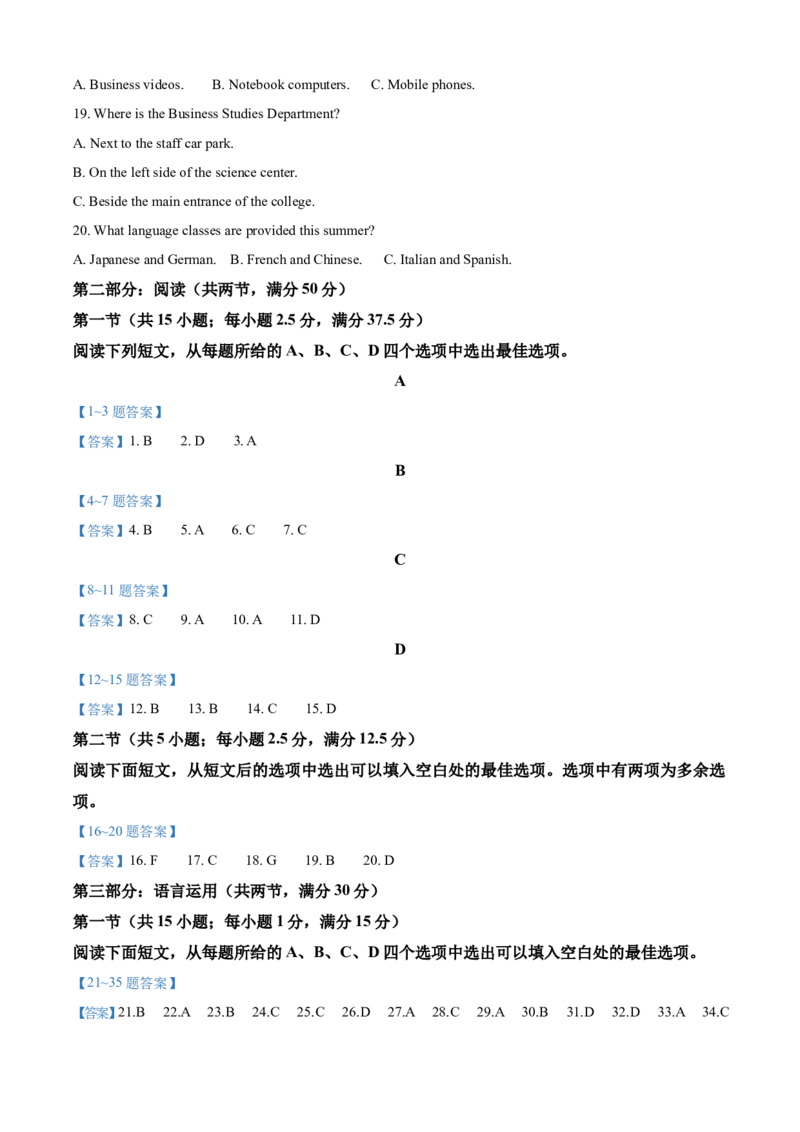
【1~3题答案】
【答案】1. B 2. D 3. A
B
【4~7题答案】
【答案】4. B 5. A 6. C 7. C
C
【8~11题答案】
【答案】8. C 9. A 10. A 11. D
D
【12~15题答案】
【答案】12. B 13. B 14. C 15. D
第二节(共5小题;每小题2.5分,满分12.5分)
阅读下面短文,从短文后的选项中选出可以填入空白处的最佳选项。选项中有两项为多余选
项。
【16~20题答案】
【答案】16. F 17. C 18. G 19. B 20. D
第三部分:语言运用(共两节,满分30分)
第一节(共15小题;每小题1分,满分15分)
阅读下面短文,从每题所给的A、B、C、D四个选项中选出可以填入空白处的最佳选项。
【21~35题答案】
【答案】21. B 22. A 23. B 24. C 25. C 26. D 27. A 28. C 29. A 30. B 31. D 32. D 33. A 34. C35. B
第二节(共10小题:每小题1.5分,满分15分)
【36~45题答案】
【答案】36. a 37. Losing
38. to show
39. from 40. that
41. themselves
42. lives 43. willing
44. gently 45. morals
第四部分:写作(共两节,满分40分)
第一节(满分15分)
【46题答案】
【答案】Dear Editor,
I am Li Hua, a senior student from Hong Xing High School. I am writing to express my concern about the
increasing damage to culture relics due to economic development.
Cultural relics are invaluable treasures that connect us to our history and traditions. They reflect the wisdom
of our ancestors and help us understand our cultural identity. Without them, we would lose a vital part of our
heritage.
Therefore, I urge everyone to take action to protect these relics. We should raise public awareness, support
preservation efforts, and avoid destructive behaviors. Only in this way can we safeguard our cultural for future
generations.
Yours,
Li Hua
第二节(满分25分)
【47题答案】
【答案】Finally, she spotted Clay. He was sitting on the ground, blood running down his face. “Clay,” she called in
an anxious voice. “What’s wrong? Have you broken anything?” With a confused look on his face, Clay just stared at
her and couldn’t remember anything that had happened. Perhaps the rope he’d been holding had snapped, or maybe
he’d just missed a step, but it was clear he’d fallen a long way. Acaimie had to stay calm for Clay, but inside she was
in great panic, worried that he had internal injuries that could kill him.
Acaimie had to push those thoughts away and focus on what she could do. She helped him up, had him hold
the rope tight and pushed him from behind. Inch by inch, they climbed. After what felt like forever, they reachedthe top. As they made their way down the trail, Clay’s breathing became more laboured. Acaimie kept shouting
for help, but they didn’t see anyone. Thankfully, about halfway down she managed to get a signal and call an
ambulance. To their relief, by the time they reached the bottom, the ambulance was waiting for them.