年 月英语四级考试真题
2011 12
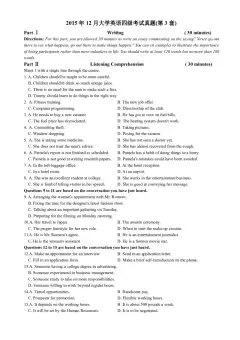
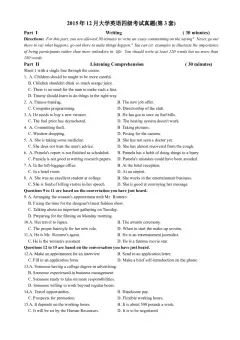
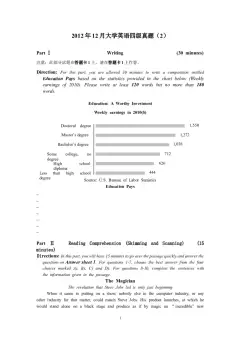
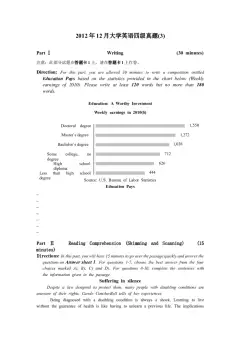
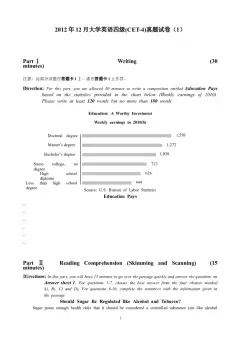
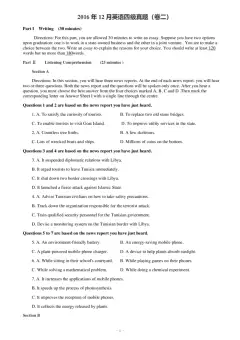
Part I Writing (30 minutes)
Directions: Forthispart,youareallowed30minutestowriteashortessayentitledNothing
SucceedsWithoutaStrongWillbycommentingonthehumoroussaying,"Quitting
smokingistheeasiestthingintheworld.I'vedoneithundredsoftimes."Youshould
writeatleast120wordsbutnomorethan180words.
NothingSucceedsWithoutaStrongWill
Part II Reading Comprehension (Skimming and Scanning)
(15 minutes)
Directions: In this part,you willhave 15minutes togoover thepassagequickly
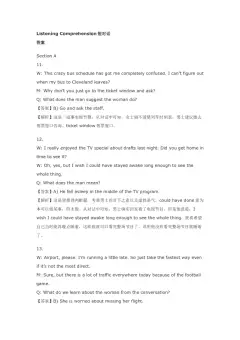
andanswer thequestions onAnswer Sheet1.For questions 1-7 choosethe
best answer fromthefourchoices marked A), B), C)andD). For questions
8-10, complete thesentence withthe informationgiven in thepassage.
Why Integrity Matters
WhatIs Integrity?
Thekey to integrity is consistency- notonly setting high personal standards for
oneself (honesty, responsibility, respect for others, fairness) but also living upto those
standards each and every day. Onewho has integrityis boundbyandfollows moral
and ethical (道德上的)standards even when making life's hard choices, choices
which may be clouded bystress, pressureto succeed, ortemptation.
Whathappens ifwelie, cheat, steal, or violateotherethical standards? Wefeel
disappointed in ourselves and ashamed. But a lapse(缺失) ofintegrity also affects our
relationships with others. Trust is essential inany important relationship, whether
personal orprofessional. Whocan trust someonewho is dishonest orunfair? Thus
integrity mustbeone ofourmost important goals.
RiskyBusinessWeare each responsible forour owndecisions, even ifthedecision, making
process has been undermined bystress orpeer pressure. The real test ofcharacter is
whether wecan learn from ourmistake, byunderstanding why weacted as we did and
then exploringways toavoid similarproblems inthefuture.
Makingethical decisions is acritical part of avoiding futureproblems. Wemust
learn torecognizerisks, becauseifwe can't seetherisks we're taking, wecan't make
responsiblechoices. To identify risks, we need toknow therules and be aware of the
facts. Forexample, onewho doesn't knowtherules aabout plagiarism (剽窃) may
accidentally usewords or ideas without giving proper credit orone who fails to keep
careful research notes may unintentionallyfail to quoteand citesources as required.
But thefact that such aviolation is"unintentional" does not excusethemisconduct,
Ignorance isnot adefense.
"ButEverybodyDoes It"
Mostpeople who get in troubledoknowtherules and facts but manage tofool
themselves about therisks they're taking byusing excuses: "Everyone elsedoes it."
"I'm nothurting anyone", or"I really need thisgrade." Excuses can get veryelaborate:
"I knowI'm lookat another's exam,even though I'm supposedto keep my eyes onmy
own paper, but that's not cheating because I’m justchecking myanswers, not
copying." Wemustbehonest about ouractions and avoid excuses, ifwefool
ourselves into believing we're not doinganything wrong, we can't seethe real choice
we're making -and that leads tobad decisions.
Toavoid fooling yourself, watch out for excuses and try thistest: Askhowyou
would feel ifyour actions were publicand anyone could bewatching overyour
shoulder. If you'd rather hideyour actions, that's an indication that you're taking a risk
and rationalizing ittoyourself.
Evaluating Risks
Todecide whether a risk is worth taking, you mustexaminetheconsequences, in
thefuture as well as right now, negative as well as positive, and to others as well as to
yourself. Those who take risks they laterregret usually focus onimmolatebenefits
and simplyhaven't considered what might go wrong. The consequences of getting
caught are serious and mayincludea "O" onatest orassignment, an "F" in theclass,
suspension (暂令停学)or dismissal from school and aruined reputation. In fact,
when you breaka roleor law, you losecontrol over your life and give others the
power toimposepunishment that you have nocontrol over. This is an extremely
vulnerable (脆弱的)position. There may besome matters oflifeand death or highest
principle, which might justifysuch arisk, but there aren't many things that fall inthis
category.
Getting Awaywith it- OrNot
Thosewhodon't get caught pay an even higherprice. Acheater doesn't learn
from thetest, which deprives (剥夺)himher of an education. Cheating undermines
confidenceand independence: thecheater is afraud, and knows that withoutdishonesty, he/she would have failed. Cheatingdestroys self-respect and integrity,
leaving thecheater ashamed, guilty and afraid ofgetting caught.
Worstofall, acheater who doesn't get caught thefirst timeusually cheats again,
notonly because he/sheis fartherbehind, but also because itseems "easier." This
slippery slopeoferoding ethics and bigger risks leads only to disaster. Eventually, the
cheatergets caught, and thelater he/she gets caught, theworse the consequences.
Cheating Hurts Other, Too
Cheaters often feel invisible, as iftheir actions "don't count" and don't really hurt
anyone. But individual choices have an intensecumulative(累积的) effect. Cheating
can spread likeadisease. Recent statistics suggest 30%ormoreof collegestudents
cheat. If a class is graded onacurve, cheating hurts others' grades. Even ifthere is no
curve, cheating "poisons" theclassroom, and others may feel pressured tojoin in.("If
Idon't cheat Ican't compete with thosewho do") Cheatingalso has adestructive
impact onteachers. Thereal reward of goof teaching is seeing studentslearn. But a
cheatersays. "I'm not interested in what you're trying to teach, all I care about is
stealing agrade, regardless of theeffect onothers." Theend result is adestructive
attack onthe qualityof your education. Finally, cheating can hurt thereputation of the
university and harm thosewhoworked hard for theirdegree.
WhyIntegrity Marten
If cheating becomes thenorm, then we are inbig trouble. Wemust rely onthe
honesty and good faith of others, ifnot, we couldn't putmoney inthe bank, buyfood,
clothing, or medicinefrom others, drive across abridge, get ona plane, go tothe
dentist--thelistis endless. There are many examples ofthevast harm that is caused
when individuals forget orignoretheeffect theirdishonesty can have. Thesavings
and loan scandal, thestock market and junkbondswindles, and, ofcourse, Watergate,
have undermined thefaith ofmany Americans intheintegrity ofpolitical and
economicleaders and society as a whole. Such incidents take atremendous tollonour
nation's economy and our individualwell-being. For example, but forthesavings and
loan debacle, there might be funds available to reduce the national debt andpay for
education.
In sum, weall have acommon stake inourschool, ourcommunity, and our
society. Our actions domatter. It is essential that we act with integrity in order to
buildthekind of world in which we want tolive.
注意:此部分试题请在答题卡1上作答。
1.Aperson ofintegrity notonly sets high moral and ethical standards but also
_______.
A)sticks to them intheirdaily life B) makes them knownto others
C)understands their truevalues D) sees that others also follow
them
2.Whatrole does integrity play in personal and professional relationships?A)It helps to createteam spirit B) It facilitates communication
C)It isthebasis of mutual trust D) It inspires mutual respect
3.why must welearn to identify therisks we are going to take?
A. To ensure we makeresponsiblechoices. B. To avoidbeing
overwhelmed bystress.
C.Sothat wedon’tbreak any rules. D. Sothat we don’t
run intotrouble.
4.Violationof arule ismisconduct even if_______?
A. ithas caused noharm. B. it isclaimed to be
unintentional.
C.it has gone unnoticed. D. itis committed with
good intentions.
5.Whatshouldonedoifhe doesn’twish to fool himself?
A. Avoid making excuses. B.Listen to other people’s
advice.
C.Make his intensionspublic. D. Have others watch over
hisshoulder.
6.Thosewho take risks they regret later on_______.
A. willoften become morecautious B. are usually very
aggressive
C.value immediatebenefits most. D. may loseeverything in
theend
7.According to theauthor, a cheater who doesn’t get caught right away will _______.
A)paymore dearly B) become moreconfident
C)bewidely admired D)feel somewhat lucky
8.Cheaters at examdon’t care about theireducation, all they care about ishow to
__________.
9.Integrity matters in that all social activitiesrely on___________.
10.ManyAmericans lost faith in theintegrity oftheirpolitical leaders as a result of
__________.
Part III ListeningComprehension (35
minutes)
Section A
Directions: In this section, you willhear 8shortconversations and2long
conversations.At theend ofeach conversation, oneor morequestions will
beasked aboutwhat wassaid. Both theconversation andthequestions will
bespoken onlyonce. After each questionthere willbeapause. Duringthe
pause, you must read the four choices marked A), B), C)andD), anddecidewhich isthebest answer.Then mark thecorresponding letter onAnswer
Sheet2with asinglelinethroughthecentre.
注意:此部分试题请在答题卡 2上作答。
11.A)Read thenoticeonthe window.
B) Go and ask thestaff.
C)Get a newbus schedule.
D)Board thebus to Cleveland.
12.A)He was looking forward toseeing thegiraffes.
B) Heenjoyed watching theanimal performance.
C)Hegot hometoo lateto see theTV special.
D)He fell asleep inthemiddleof theTV program.
13.A)Shewants totake themost direct way.
B) Shemay belate forthe footballgame.
C)Sheis worried about missing herflight.
D)Sheis currently caught ina traffic jam.
14.A)At a restaurant. B) In a fish shop. C)At a clinic. D)On a
fishingboat.
15.A)He is anexperienced sales manager.
B) Heis being interviewed for ajob.
C)Heis aclose friend ofthewoman.
D)He is good at answering tricky questions.
16.A)The manshould considerhis privacy first.
B) Theman will choose alow-rent apartment.
C)Theman is not certain ifhe canfind a quieterplace.
D)The manis unlikelyto moveout ofthedormitory.
17.A)The woman is going tomake her topicmorefocused.
B) Theman and thewoman are working onajoint project.
C)Oneshouldchoose abroad topicfor aresearch paper.
D)It took a lotoftimetoget theman ontheright track.
18.A)They went camping thistimelastyear.
B) They didn’t quiteenjoy their lastpicnic.
C)They learned tocooperate under harsh conditions.
D)They weren’t experienced in organizing picnics.
Questions19to 22are based ontheconversation youhavejust heard.
19.A)He likes Sweden better than England.B) Heprefers hot weather to coldweather.
C)Heis an Englishman living inSweden.
D) HevisitsLondon nearly every winter.
20.A)The bad weather. B) Thegloomy winter. C)The coldhouses. D)The
longnight.
21.A)Delightful. B) Painful. C)Depressing. D)
Refreshing.
22.A)They often stay uplate reading.
B) They work hardand play hard.
C)They liketogo camping in summer.
D) They try to earn moreand spend more.
Questions23to 25are based ontheconversation youhavejust heard.
23.A)English Literature. B) Management. C)French. D)Public
Administration.
24.A)English teaching. B) Staff training.
C)Careers guidance. D) Psychological counseling.
25.A)Its generous scholarship. B) Its worldwide fame.
C)Its well-designed courses. D)Its pleasant environment.
Section B
Directions: In this section, you willhear 3shortpassages. At theend ofeach
passage, you willhear some questions. Both thepassageandthequestions
willbespoken onlyonce. After you hear aquestion, you mustchoose the
best answer fromthefourchoices marked A), B), C)andD). Then markthe
corresponding letter onAnswer Sheet 2withasinglelinethrough the
centre.
注意:此部分试题请在答题卡 2上作答。
PassageOne
Questions26to 28are based onthepassageyou havejustheard.
26.A)Characteristics ofJapanese artists.
B) Somefeatures ofJapaneseculture.
C)Theart ofJapanese brush painting.
D)The uniqueness ofJapanese art.
27.A)To calm themselves down.
B) To enhance concentration.
C)To showtheirimpatience.D)To signal lack ofinterest.
28.A)How listeners in different cultures showrespect.
B) Howspeakers can win approval from theaudience.
C)Howspeakers can misunderstand theaudience.
D)How different Western and Eastern art forms are.
PassageTwo
Questions29to 32are based onthepassageyou havejustheard.
29.A)Directing personnel evaluation.
B) Buying and maintainingequipment.
C)Drawing upplans forin-service training.
D)Interviewing and recruitingemployees.
30.A)Someofhis equipment was damaged in afire.
B) Thetraining program he ran was a failure.
C)Twoofhis workers were injured at work.
D)Two ofhis employees committed theft.
31.A)Abetter relationship with his boss.
B) Advancement toahigher position.
C)Abetter-paying jobin anothercompany.
D)Improvement in thecompany’s management.
32.A)Shehas moreself-confidence than Chris.
B) Sheworks with Chris in thesamedivision.
C)Shehas more management experiencethan Chris.
D)Sheis competing with Chris forthenew job.
PassageThree
Questions33to 35are based onthepassageyou havejustheard.
33.A)They helpus see theimportantvalues ofculture.
B) They guide us in handling human relationship.
C)They help us express ourselves more effectively.
D)They are an infinitesource ofhuman knowledge.
34.A)Their wording may become different.
B) Thevalues theyreflect may change.
C)Theirorigins can nolongerbe traced.
D)They may bemisinterpreted occasionally.
35.A)Certain values are shared by alarge number ofcultures.B) Someproverbs are assumingmore and moreimportance.
C)Old proverbs are constantly replaced bynew ones.
D)Certain values have always been central to a culture.
Section C
Directions: In this section, you willhear apassagethreetimes. When thepassage
is readfor thefirsttime, you should listencarefully for itsgeneral idea.
When thepassage is read for thesecond time, you arerequired tofill inthe
blanks numbered from36to 43withthe exact wordsyou havejust heard.
For blanks numbered from44to 46you arerequired to fillin themissing
information.For theseblanks, you can either usetheexact words you have
justheard or writedown themain pointsin your ownwords.Finally, when
thepassageis read for thethirdtime, you should check what you have
written.
注意:此部分试题请在答题卡 2上作答。
Ourlives are woven together. As much as Ienjoy my own (36) _c____,Ino
longerimagine I can get through a (37) ___s__day much less all my life, (38) __c___
onmyown. Even ifI am on(39)___v__in themountains, Iam eating foodsomeone
elsehas grown, livingin a housesomeoneelse has built,wearing clothes someone
elsehas (40)_s____from cloth woven byothers, using(41)__e___someoneelse is
distributingto my house. (42)__e___ofinterdependence is everywhere; we are on
this(43) _j____together.
AsI was growing up,(44)
_irbcttininterwe__________________________________________________. “Make
your own way”,” Standonyour own two feet”or mymother’s favorite remark when I
was face-to-face with consequences ofsome action: Nowthat you’ve madeyour bed,
lieonit.Total independence is adominant thinginour culture. Iimagine that (45)
__wm pwt tt mew tot r fmy aandm
c__________________________________________.But theteaching was shaped by
ourcultural imagines. And instead, Igrew upbelieving that I was supposed to be
totallyindependent andconsequently becamevery reluctant to ask for help.
(46)___
________________________________________________________________.
Part Ⅳ Reading Comprehension(Reading in Depth) (25
minutes)
Section A
Directions: In this section, thereis apassagewith ten blanks. Youare required to
select one wordfor each blankfromalistof choices given in aword bankfollowingthe passage. Read thepassage through carefullybeforemaking
your choices. Each choice in thebank isidentified byletter. Please mark
thecorresponding letter for each itemonAnswer Sheet 2withasingleline
through thecentre. You may notuse anyof thewords inthe bankmorethan
once.
Questions47to 56are based onthefollowing passage.
Withthe world's population estimated togrow from six to ninebillionby2050,
researchers. businesses and governments are already dealing with theimpact this
increasewill have oneverything from food and water to infrastructure (基础设施)
and jobs. Underling all this 47willbe thedemand forenergy, which is expected to
doubleover thenext40years.
Findingthe resources to meet thisdemand ina __48__sustainableway isthe
cornerstone(基石)ofour nation's energysecurity, and will beone ofthemajor
__49__ofthe21st century. Alternative forms ofenergy- bio-fuels, wind andsolar, to
namea few are__50__being funded and developed, and will play a growing__51__
inthe world's energy supply. But experts say that even when __52__,alternative
energy sources willlikely meet onlyabout 30%of theworld's energy needs by2050.
Forexample, even with __53__investments,such as the$93million forwind
energy development __54__in theAmerican Recovery and Reinvestment Act,
important alternativeenergy sources such as wind and bio-fuels __55__only about
1%ofthe market today.
Energy and sustainability experts say theanswer toourfuture energy needs will
likelycome from a lotof __56__both traditionaland alternative.
注意:此部分试题请在答题卡 2上作答。
A)stable I)exactly
B)solutions J)consist
C)significant K)comprise
D)role L)competitions
E)progress M)combined
F)marvelous N)challenges
G)included O)certainly
H)growth
Section B
Directions: Thereare2passages inthis section. Each passage is followed bysome
questionsor unfinished statements. For each of themthere arefour chokes
marked A), B), C)andD). Youshould decide onthebest choice andmark
thecorresponding letter onAnswer Sheet 2withasinglelinethrough the
centre.PassageOne
Questions57to 61are based onthefollowing passage.
Boys' schools are theperfect place toteach young men to expresstheir emotions
and involvethem in activities such as art, dance and music.
Far from thetraditional image ofaculture ofaggressivemasculinity (阳刚), the
absenceof girls gives boys the chance to develop without pressure toconform to a
stereotype. aUS study says.
Boys at single-sex schools were said tobemore likelytoget involved incultural
and artisticactivities that helped develop their emotionalexpressiveness, rather than
feelingthey had to conform tothe"boy code" ofhiding theiremotions tobe a"real
man".
Thefindings ofthestudy so against received wisdom that boys dobetter when
taught alongside girls.
TonyLittle, headmaster ofEton, warned that boys were being fadedbythe
British education system because ithad become too focused ongirls. He criticized
teachers for failing torecognizethat boys are actually moreemotional than girls.
Theresearch argued that boys often perform badly inmixed schools because they
become discouraged when their female peers dobetter earlier inspeaking and reading
skills.
But in single-sex schools teachers can tailor lessonstoboys' learning style, letting
them movearound theclassroom and gettingthem to compete in teams to prevent
boredom, wrote thestudy's author, Abigail James, oftheUniversity of Virginia.
Teachers could encourageboys to enjoy reading andwriting with "boy-focused"
approaches suchas themes and characters that appeal tothem. Because boys generally
have moreacute vision learn best through touch, andare physically more active, they
need tobe given"hands-on" lessons where they are allowed towalk around. "Boys in
mixed schools viewclassical musicas feminine(女性的)and prefer themodem genre
(类型)in which violenceand sexism are majorthemes, "James wrote.
Single-sex education also made itless likely that boys would feel they had to
conform toa stereotype that men shouldbe "masterful and incharge" inrelationships.
"In mixed schools boys feel compelled to act likemen before theyunderstand
themselves well enough toknow what that means, " thestudy reported.
注意:此部分试题请在答题卡 2上作答。
57.Theauthor believes that asingle-sex school would __________.
A)force boys to hidetheiremotions tobe "real men"
B) help to cultivatemasculine aggressiveness in boys
C)encourage boys to express theiremotions more freely
D)naturally reinforce inboys thetraditional image ofaman
58.It iscommonly believed that in amixed school boys __________.
A)Perform relatively better C)behave more responsiblyB) growupmore healthily D)receive abetter education
59.Whatdoes Tony Littlesay about theBritish education system?
A)It fails moreboys thangirls academically.
B) It focuses moreonmixed school education.
C)It fails to give boys theattention they need.
D)It places more pressure onboys than ongirls.
60.According to Abigail James, oneof theadvantages ofsingle-sex schools is
__________.
A)teaching can betailored tosuit thecharacteristics ofboys
B) boys can focus ontheirlessons without being distracted
C)boys can choose to learn whatever they are interested in
D)teaching can bedesigned topromote boys'team spirit
61.Whichof thefollowing ischaracteristicof boys according to Abigail James'
report?
A)They enjoy beingin charge. C)They have sharper vision.
B) They conform to stereotypes. D)They are violent and sexist.
PassageTwo
Questions62to 66are based onthefollowing passage.
It's an annual argument. Do we ordowe not go onholiday? Mypartner says no
becausetheboiler could go, ortheroof fall off and we havenosavings tosave us. I
sayyou only liveonce and wework hard andwhat's thepointifyou can't go on
holiday. Thejoyofa recession means noargument nextyear -we just won't go.
Sincemoney isknown tobe oneof thethings most likelyto bring a relationship
toits knees, weshouldbegrateful. For many families therecession means more than
notbooking a holiday AYouGov poll of2,000people found 22%said they were
arguing more withtheir partners because of concerns about money. What's less clear
is whether divorceand separation rates rise in arecession –financial pressures mean
couples argue more butmake splitting upless affordable. Arecent research shows
arguments about money were especially damaging to couples. Disputes were
characterizedbyintense verbal (言语上的)aggression, tended to berepeated and not
resolved andmade men, morethan women, extremely angry.
KimStephenson, an occupational psychologist, believes money issuch abigdeal
becauseof what it symbolizes, which may bedifferent things to men andwomen.
"People can say thesamethings about money but have different ideas of what it's
for." he explains. "They'll sayit's tosave to spend, for security, for freedom, toshow
someoneyou lovethem." He says men are more likely tosee money as a way of
buying status and ofshowing theirparents that they've achieved something."The biggest problem is that couples assumeeach otherknowwhat's going on
withtheir finances, but they don't. There seems to be moreofataboo (禁忌)about
talkingabout money than about death. But you both need to knowwhat you're doing,
who's paying what into thejoint account and howmuch you keep separately. In a
healthy relationship, you don't have to agree about money, butyou have to talk about
it."
注意:此部分试题请在答题卡 2上作答:
62.Whatdoes theauthorsay about vacationing?
A)Peopleenjoy it all themore during arecession.
B) Few people can afford itwithout working hard.
C)It makes all thehard work worthwhile.
D)It is thechief cause offamily disputes.
63.Whatdoes theauthormean bysaying "money is known ...to bring arelationship
toits knees"(Line 1,Para. 2)?
A)Money isconsidered to be theroot ofall evils.
B) Somepeople sacrifice theirdignity for money.
C)Few people can resist thetemptation of money.
D)Disputes over moneymay rain arelationship.
64.TheYouGov pollof 2,000peopleindicates that inarecession __________.
A)conflicts between couples tendto rise
B) itis moreexpensivefor couples to splitup
C)couples showmore concern for each other
D)divorce and separation rates increase
65.Whatdoes KimStephenson believe?
A)Money isoften asymbol of aperson's status.
B) Money means agreat deal to bothand women.
C)Men and women spendmoney ondifferent things.
D)Men and women view money in different ways.
66.Theauthor suggests at theendof thepassage that couples should __________.
A)put theirmoney together instead ofkeeping it separately
B) makeefforts toreach agreement ontheirfamily budgets
C)discuss money matters to maintain ahealthy relationship
D)avoid arguing about money matters toremain romantic
Part Ⅴ Cloze (15
minutes)Directions: Thereare20blanks inthe followingpassage. For eachbland there are
four choices marked A), B), C)andD)ontheright sideof thepaper You
should choosetheONE that best fitsinto thepassage.Then mark the
corresponding letter onAnswer Sheet 2withasinglelinethrough the
centre.
注意:此部分试题请在答题卡 2上作答。
Employers fear they will beunable to recruitstudents with theskillsthey need as
theeconomic recovery kicks in,a newsurvey __67__.
Nearly half ofthe organizationstold researchers they were already struggling to
find __68__with skillsinscience, technology, engineering and maths (STEM).
__69__even morecompanies expectto experience __70__of employees with STEM
skillsin thenextthree years.
TheConfederation ofBritish Industry __71__businesses and organizations
across thepublicand __72__sectors, which together employ 2.4million people.
Halfare __73__theywill not beableto fill graduateposts in thecoming years,
whileathird said theywould not be ableto __74__enough employees with theright
A-level skills.
"__75__we movefurther role recovery and businesses plan __76__growth, the
demand for people withhigh-quality skillsand qualifications will __77__,"said
Richard Lambert, DirectorGeneral, CBI. "Firms say it isalready hard to find people
withthe right __78__orengineering skills. Thenew government mustmake ita top
__79__toencourage more young peopletostudy science-related __80__."
Thesurvey found that young peoplewould improve theirjobprospects __81__
they studied business, maths, English and physics orchemistry at A-level. The
A-levels thatemployers __82__least are psychology andsociology. And whilemany
employers don't insistona __83__degree subject. A thirdprefer to hirethose witha
STEM-related subject.
Theresearch __84__worries about thelack ofprogress in improvingbasic skills
inthe UK__85__.Half oftheemployer expressed worries about employees' basic
literacy and numeracy(计算) skills,while thebiggest problem is with IT
skills,86two-thirds reported concerns.
67.A)submits B) reveals C)launches D)generates
68.A)audience B) officials C)partners D) staff
69.A)while B) because C)for D) although
70.A)exits B) shortages C)absences D) departures
71.A)surveyed B) searched C)exposed D)exploited
72.A)collective B) private C)personal D) civil
73.A)confronted B) conformed C)concerned D) confused
74.A)bind B) attain C)transfer D) recruit
75.A)Lest B) Unless C)Before D)As76.A)with B) for C)on D)by
77.A)dominate B) stretch C)enforce D)intensify
78.A)creative B) technical C)narrative D)physical
79.A)priority B) option C)challenge D) judgment
80.A)procedures B) academics C)thoughts D)subjects
81.A)until B) since C)whereas D)if
82.A)rate B) discuss C)order D)observe
83.A)typical B particular C)positive D) general
84.A)highlighted B) prescribed C)focused D) touched
85.A)masses B) workforce C)faculty D)communities
86.A)what B) whom C)where D) why
Part Ⅳ Translation (5 minutes)
Directions: Completethesentences by translating intoEnglish theChinesegiven in
brackets Pleasewriteyour translation onAnswer Sheer 2.
注意:此部分试题请在答题卡 2上作答,只需写出译文部分。
87.Charity groups organized various activities to_____________
___(为地震幸存者筹款)。
88.Linda ___________ _(不可能收到我的电子
邮件):otherwise, shewould have replied.
89.It's mymother ___________ _____ (一直在鼓励我不要灰
心)when I have difficulties in mystudies.
90.Thepublishinghouse has to ______________
(考虑这部小说的受欢迎程度)。
91.It isabsolutely wrong to _________
______(仅仅以金钱来定义幸福)。