


















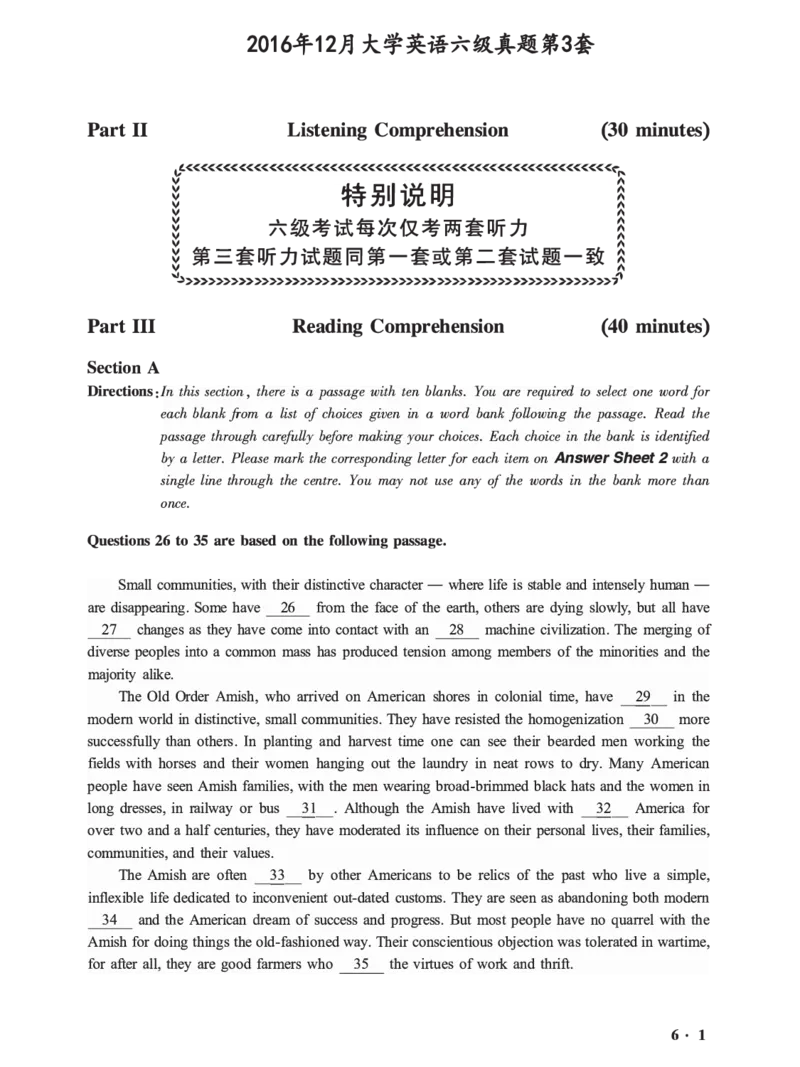
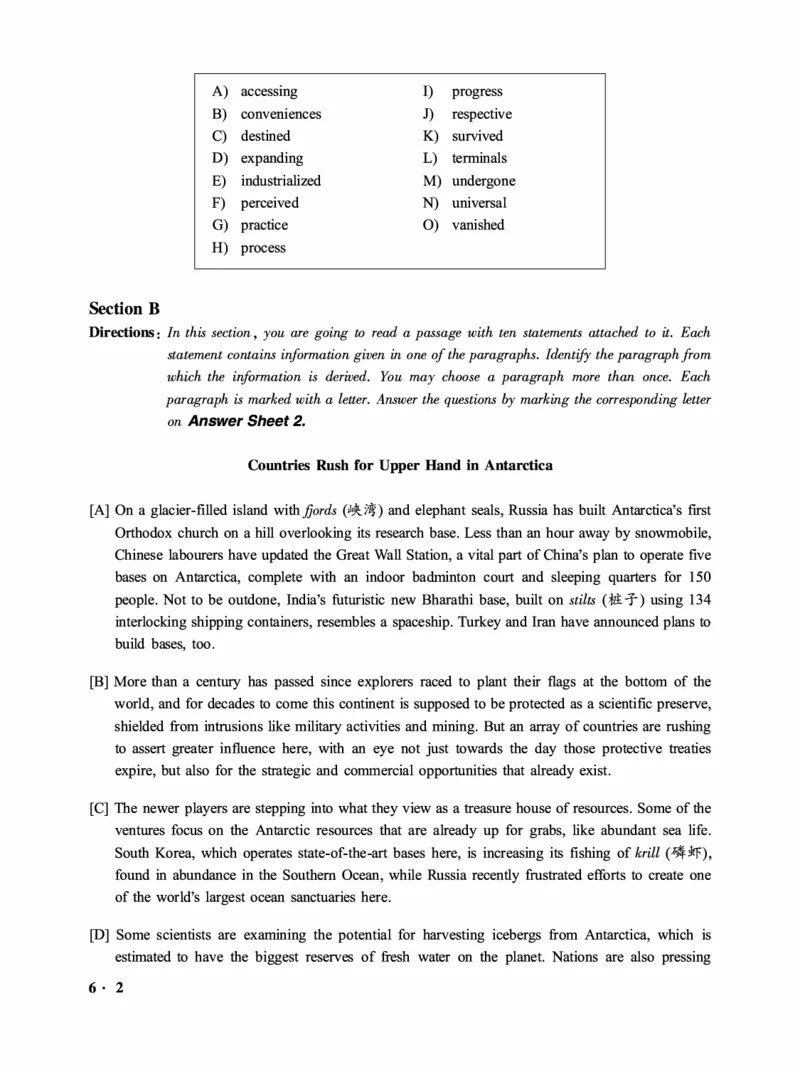
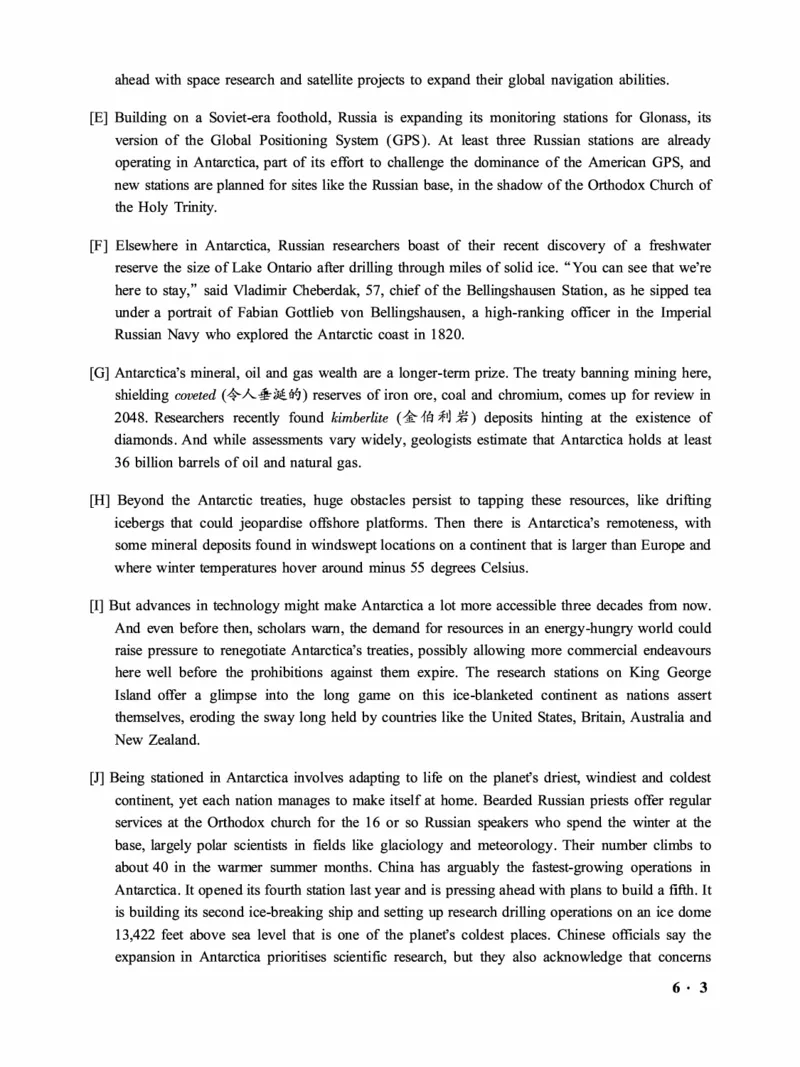
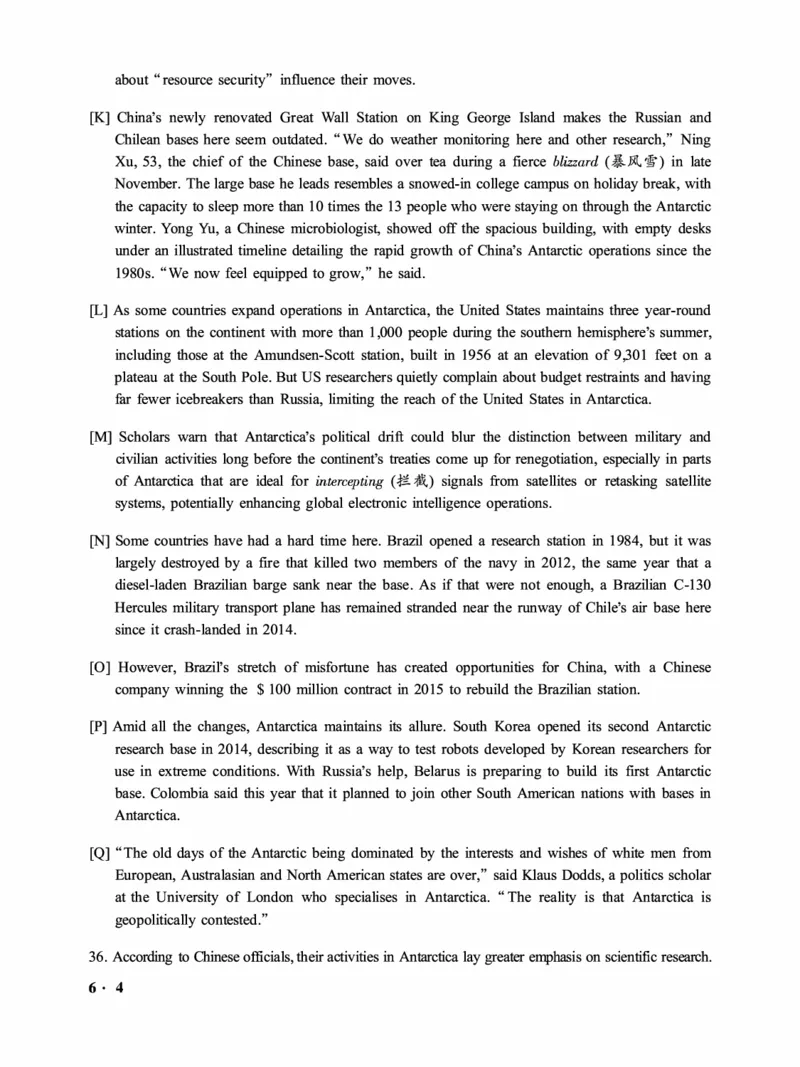














































































































































































































































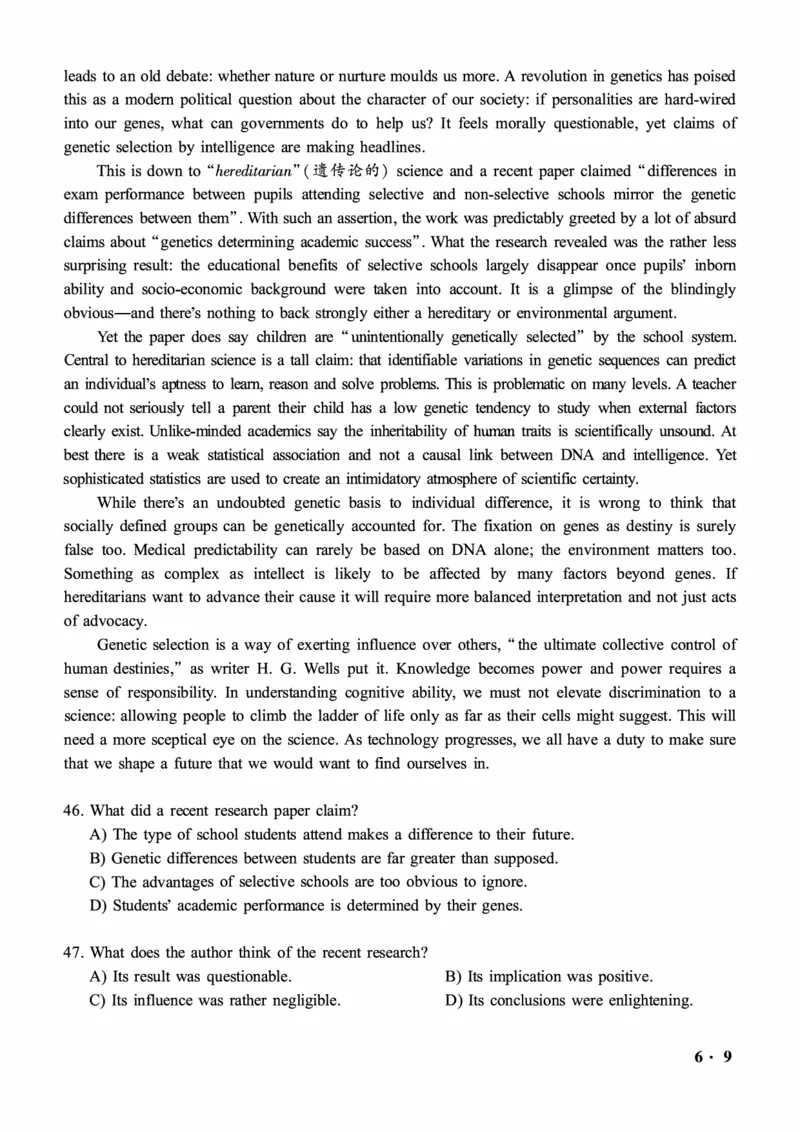
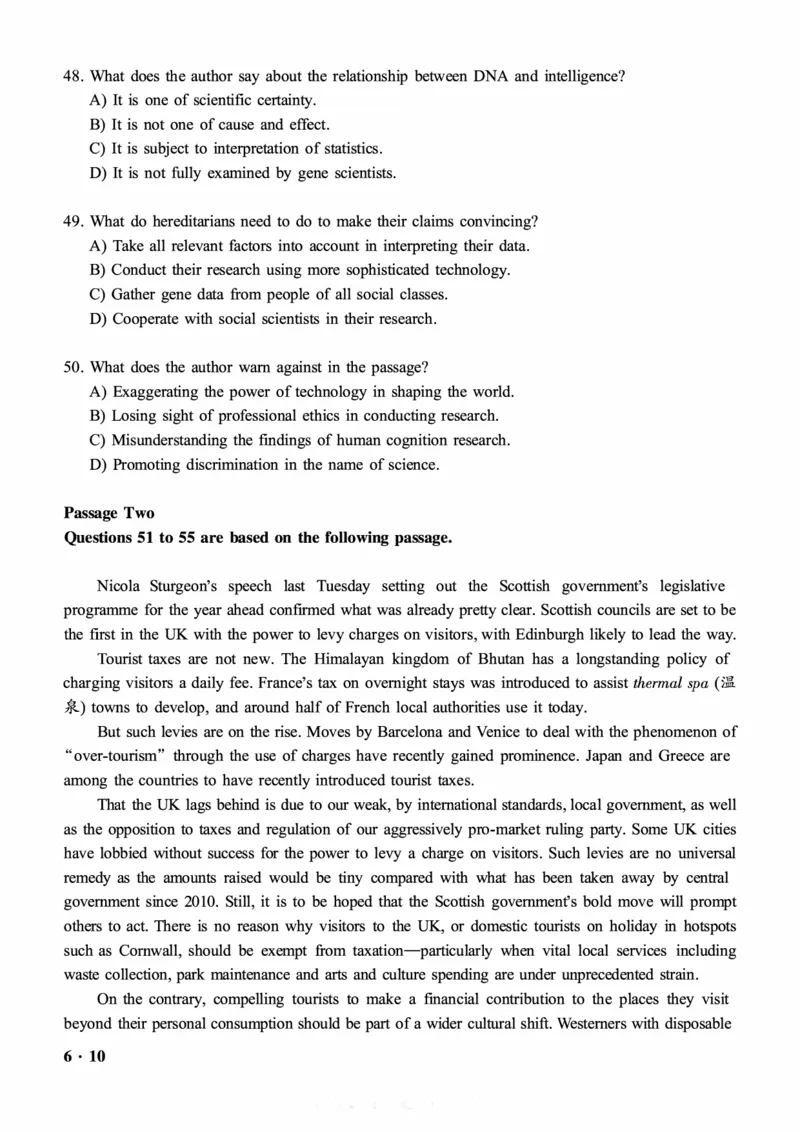
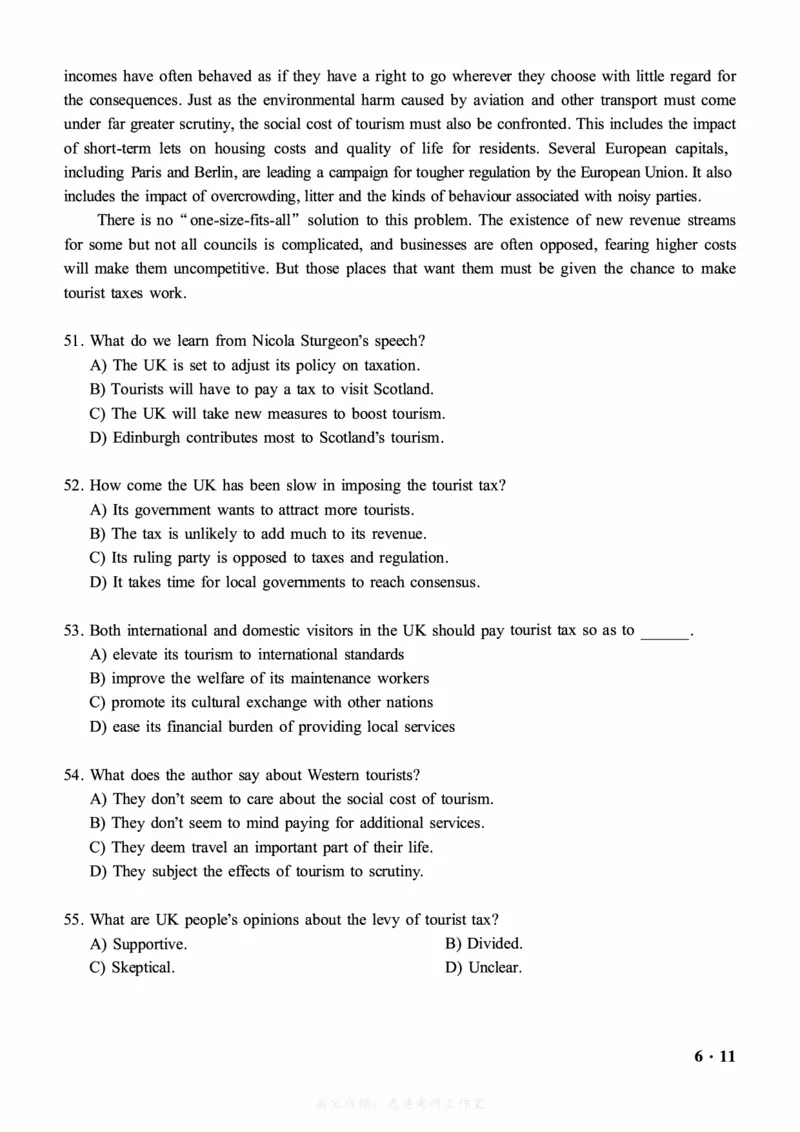


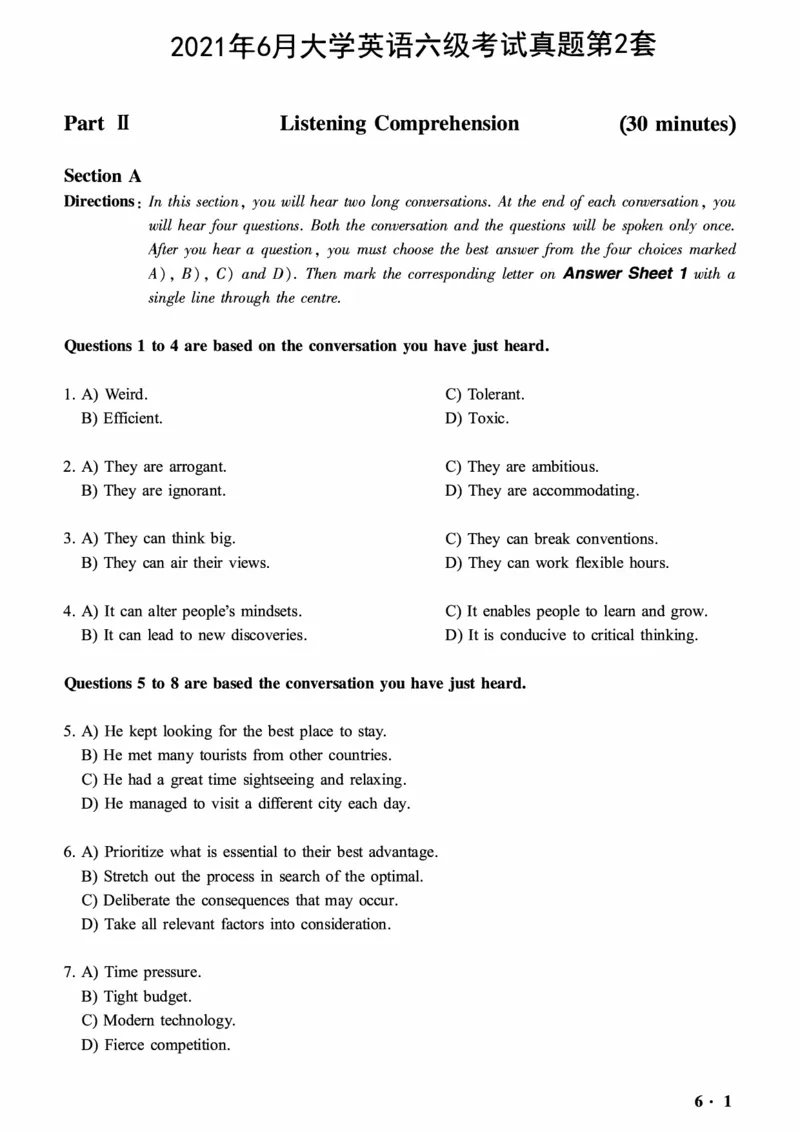




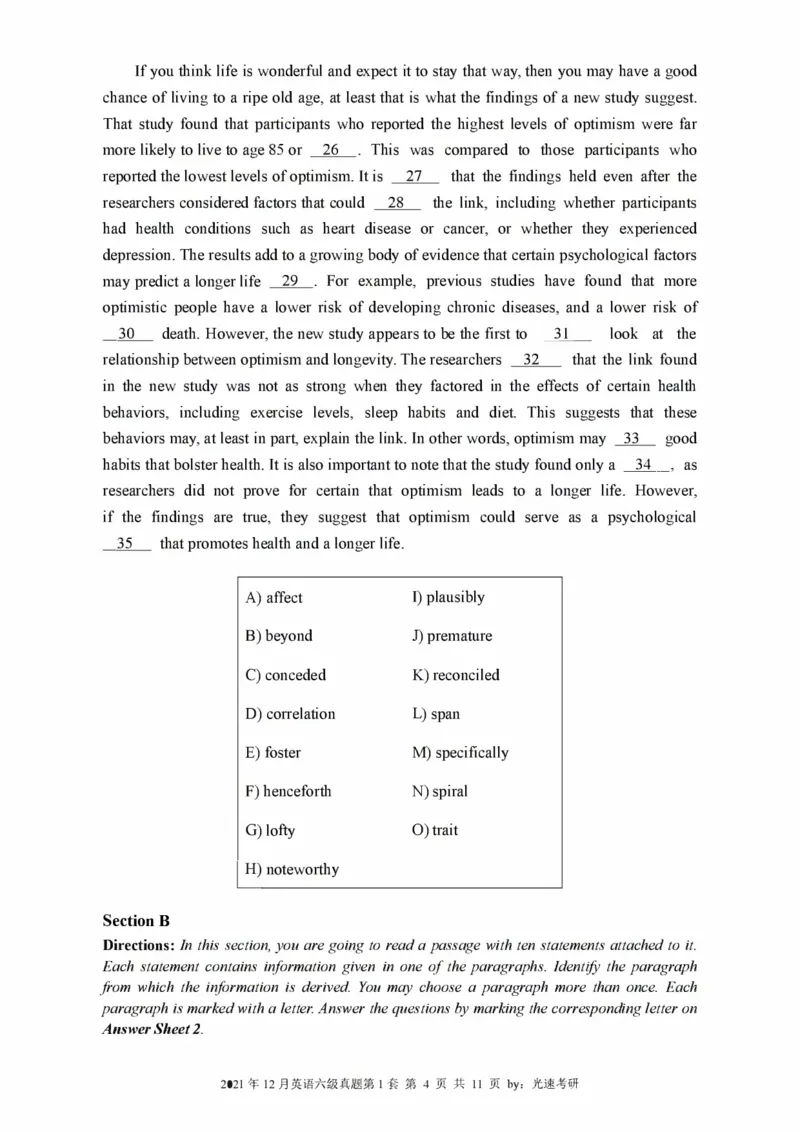
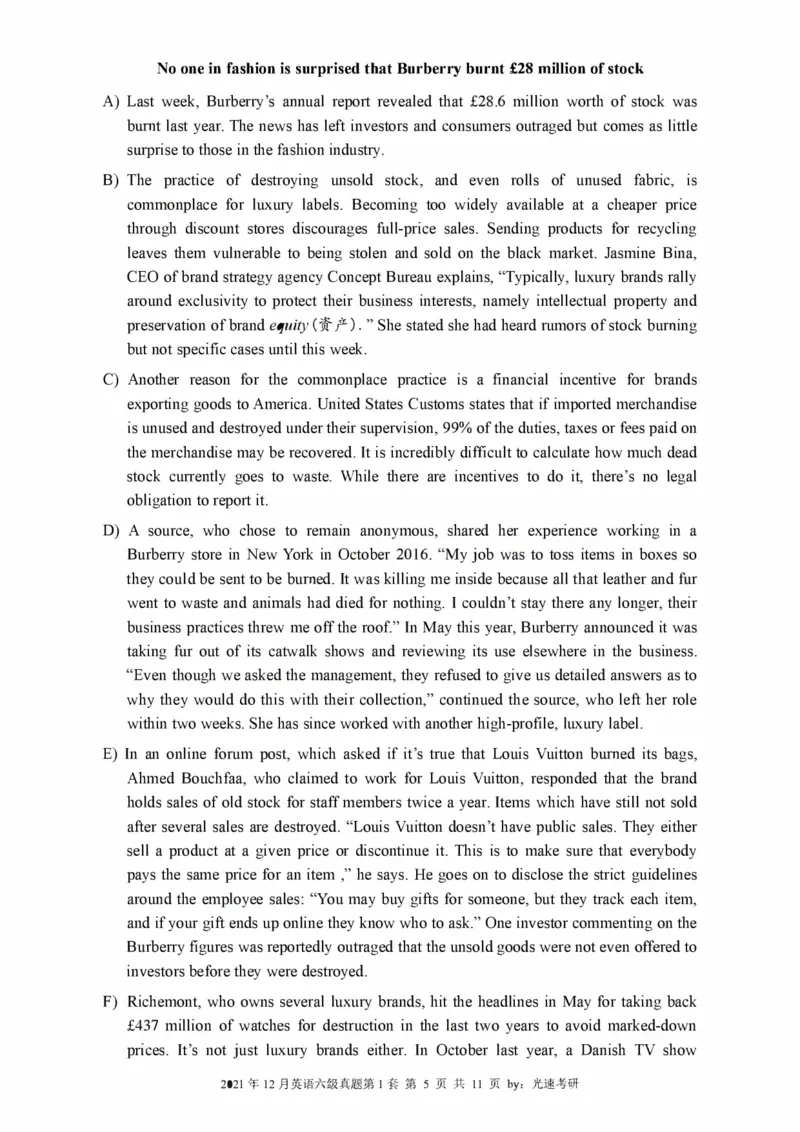
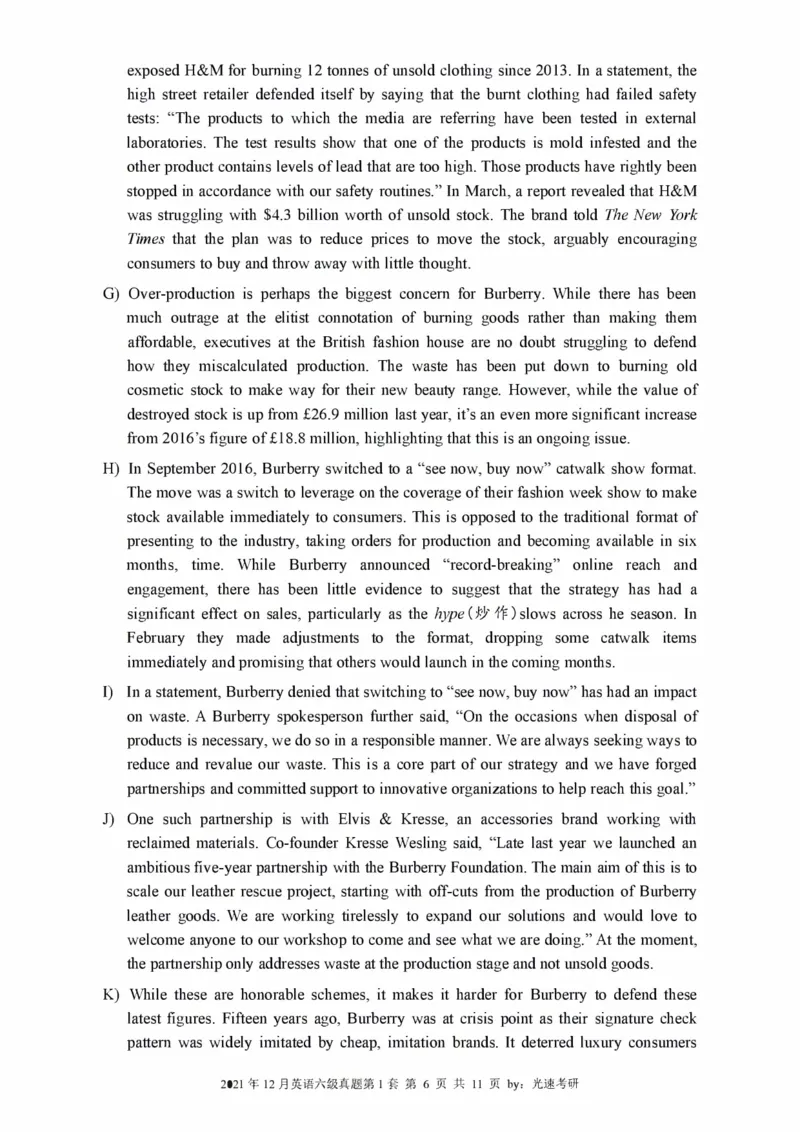
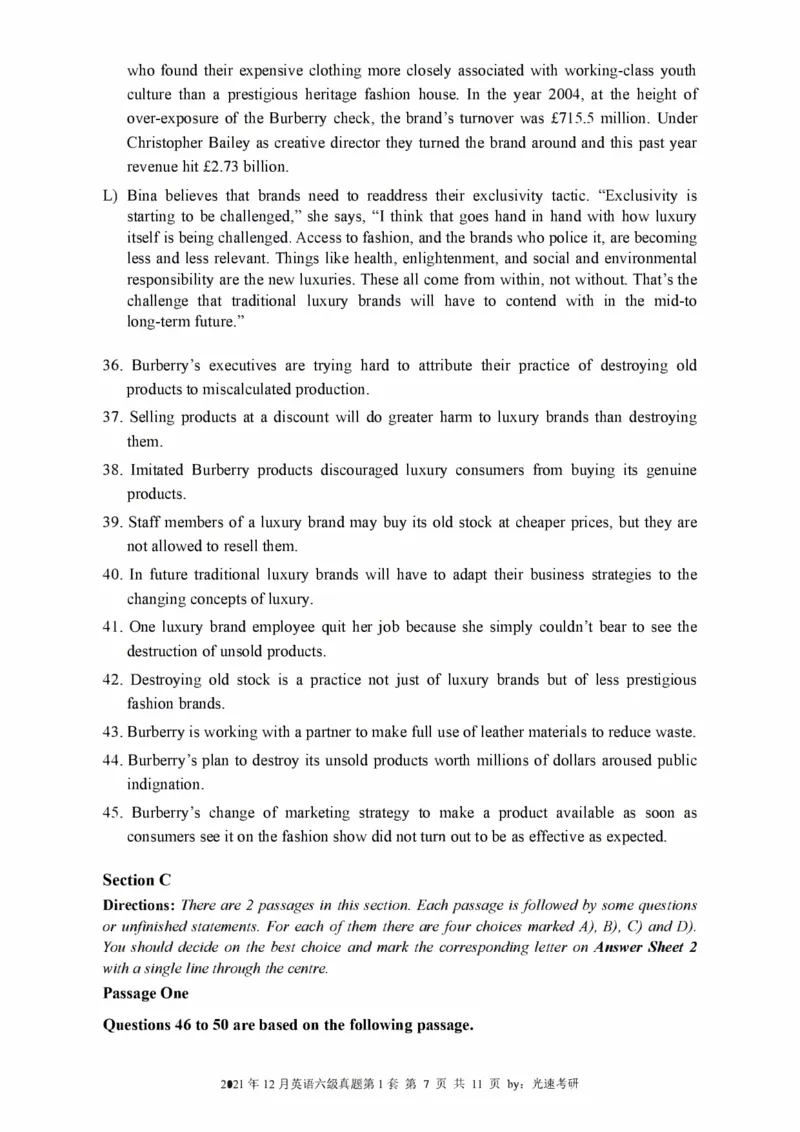

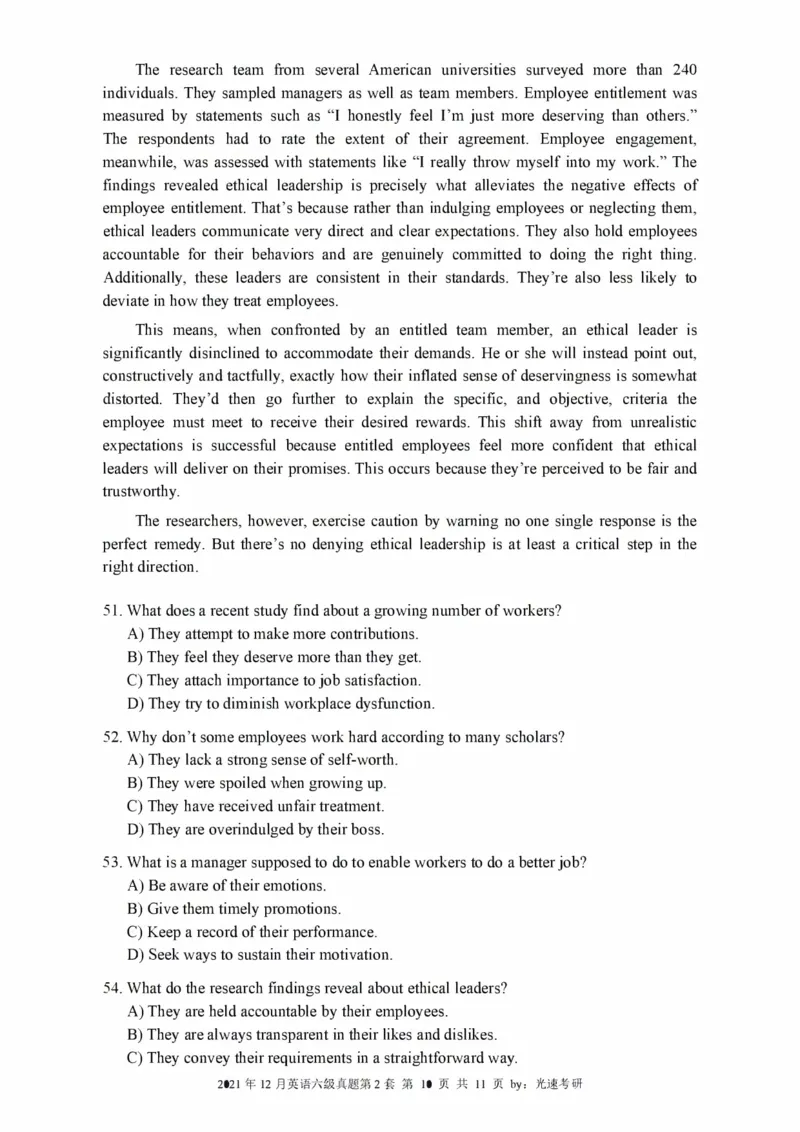

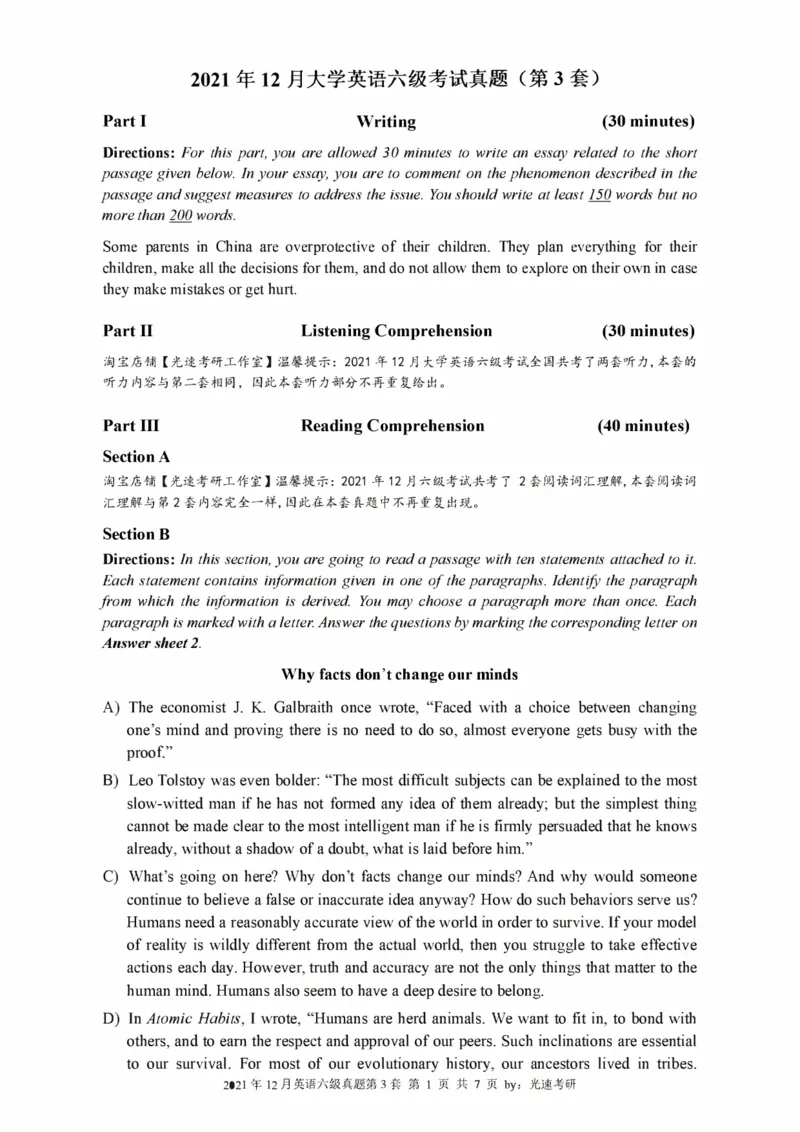
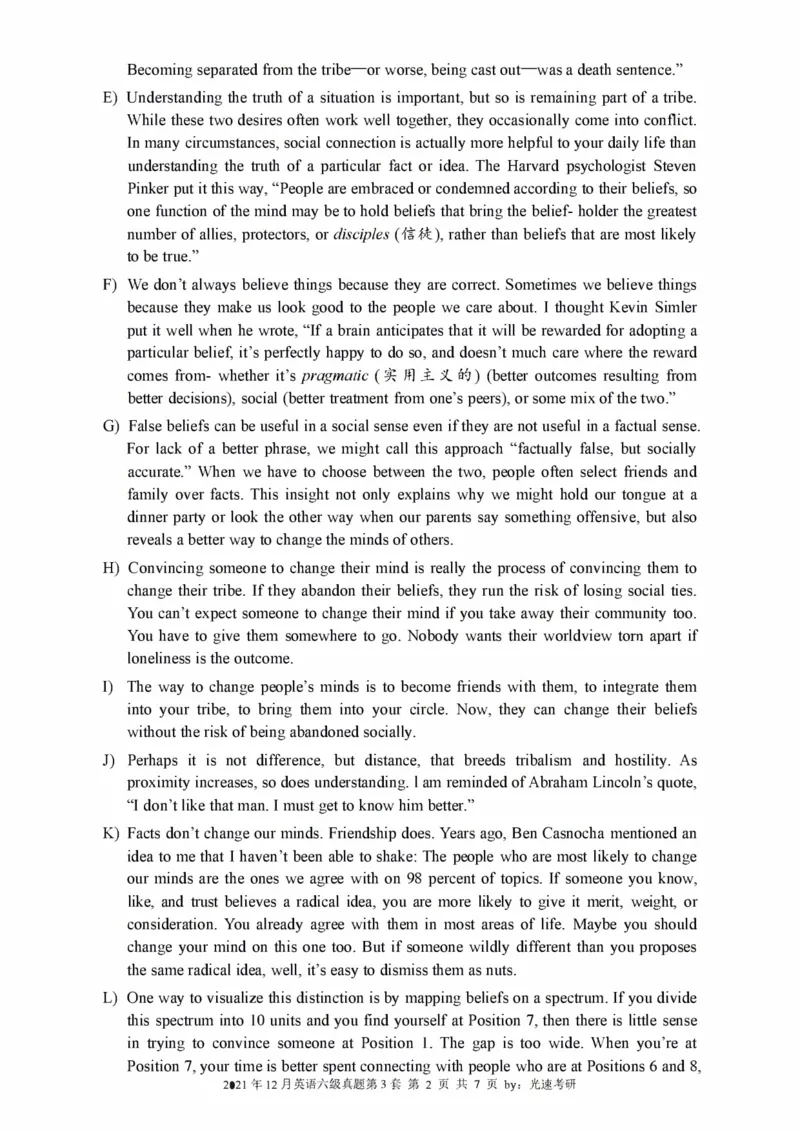
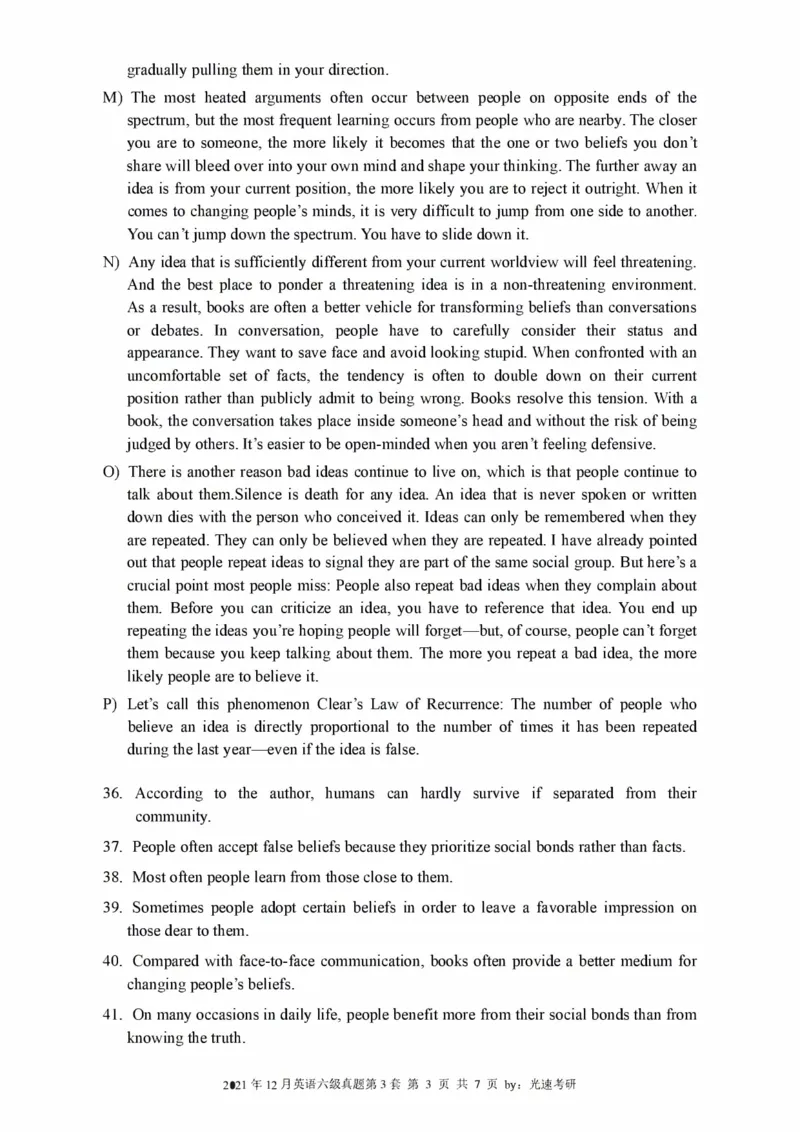



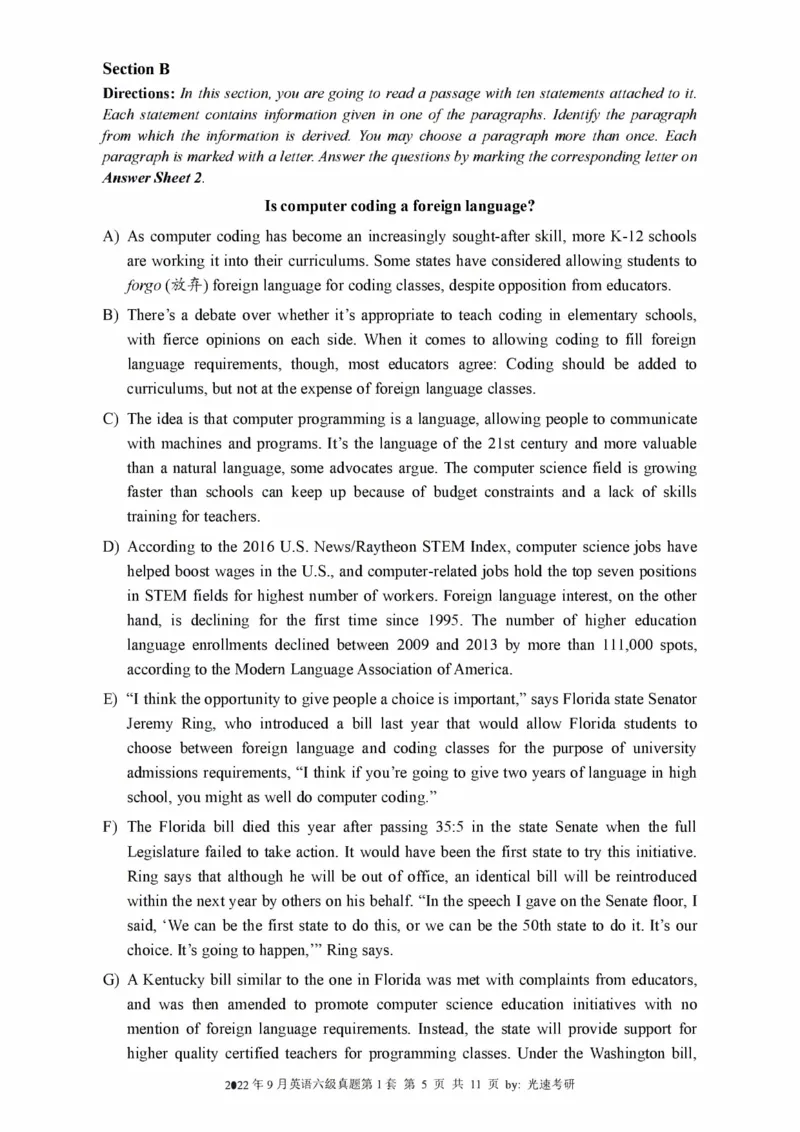
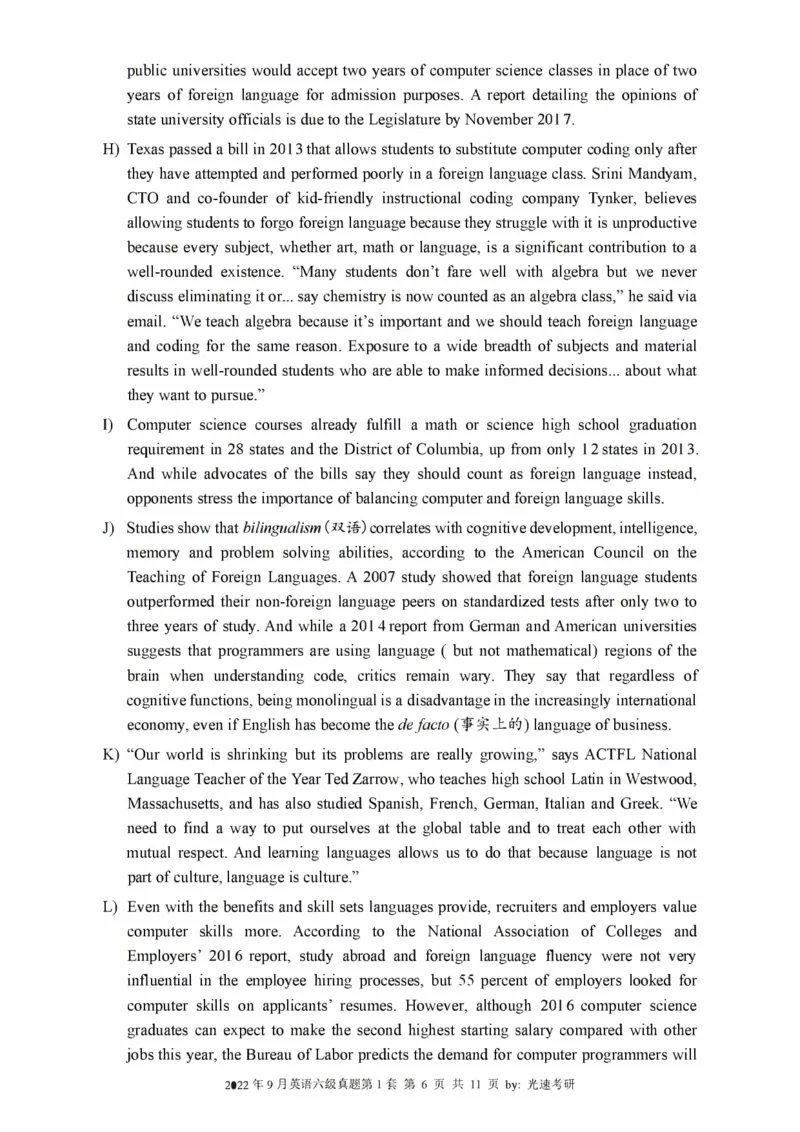
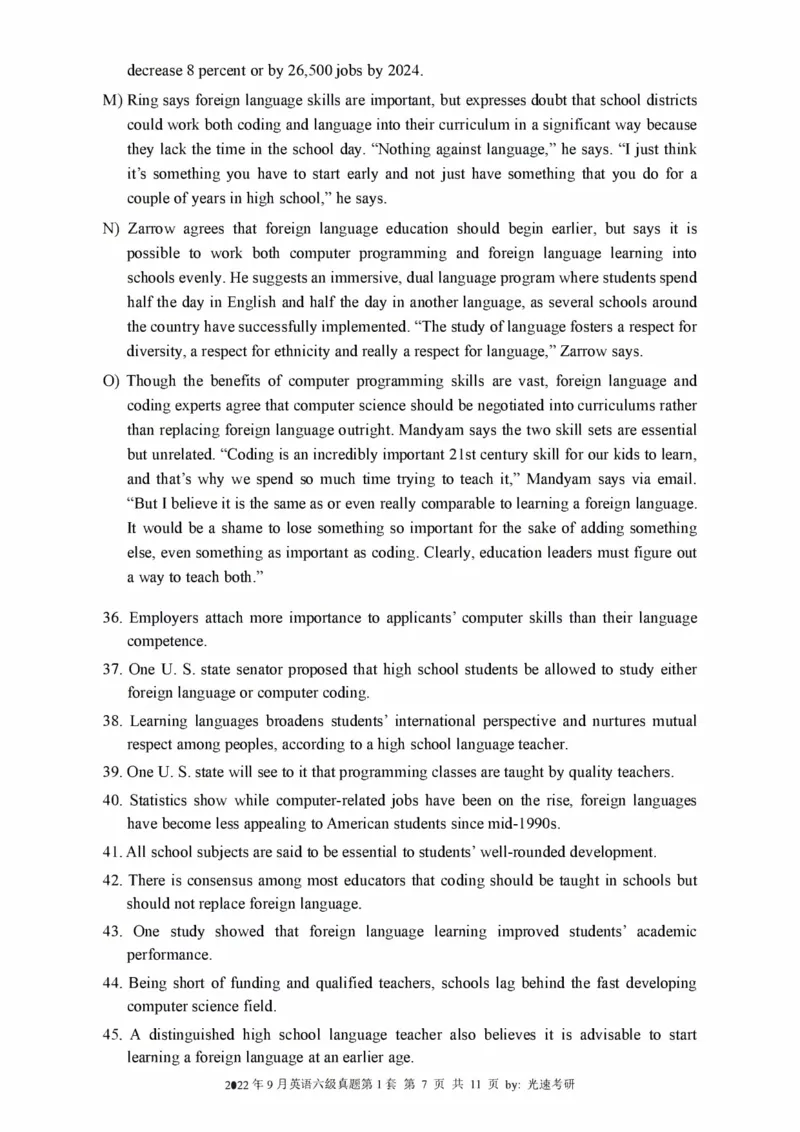
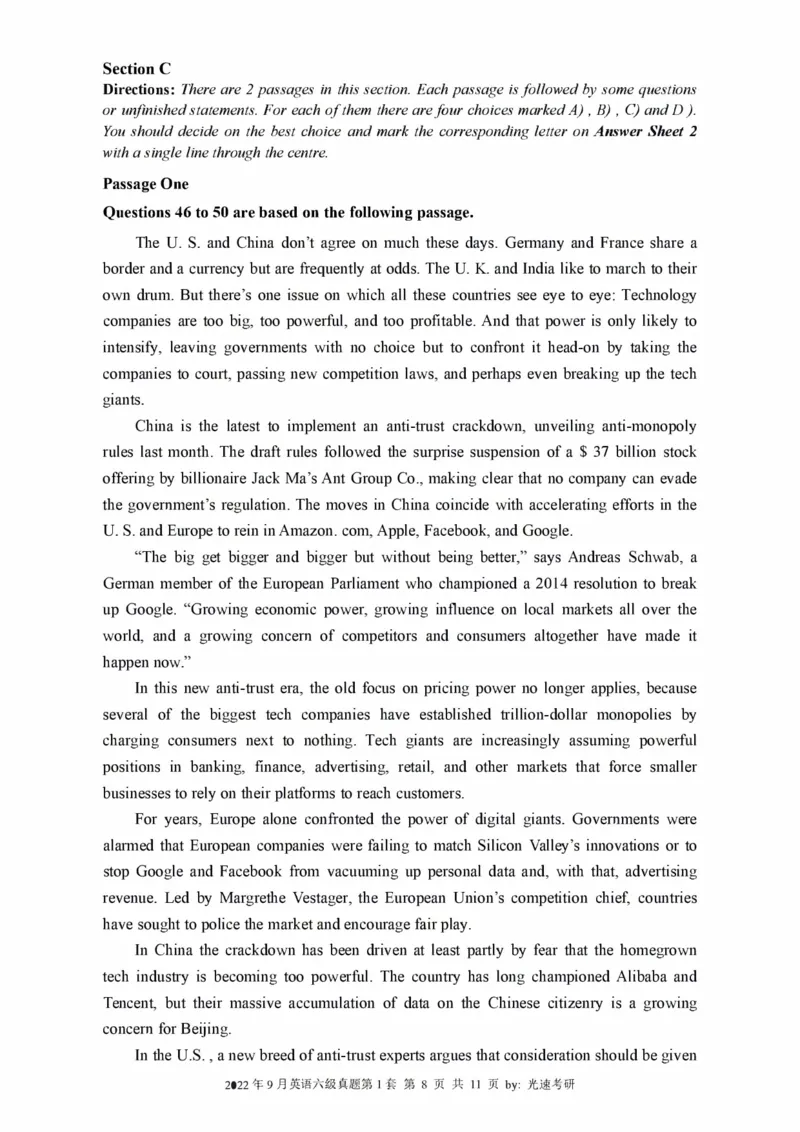
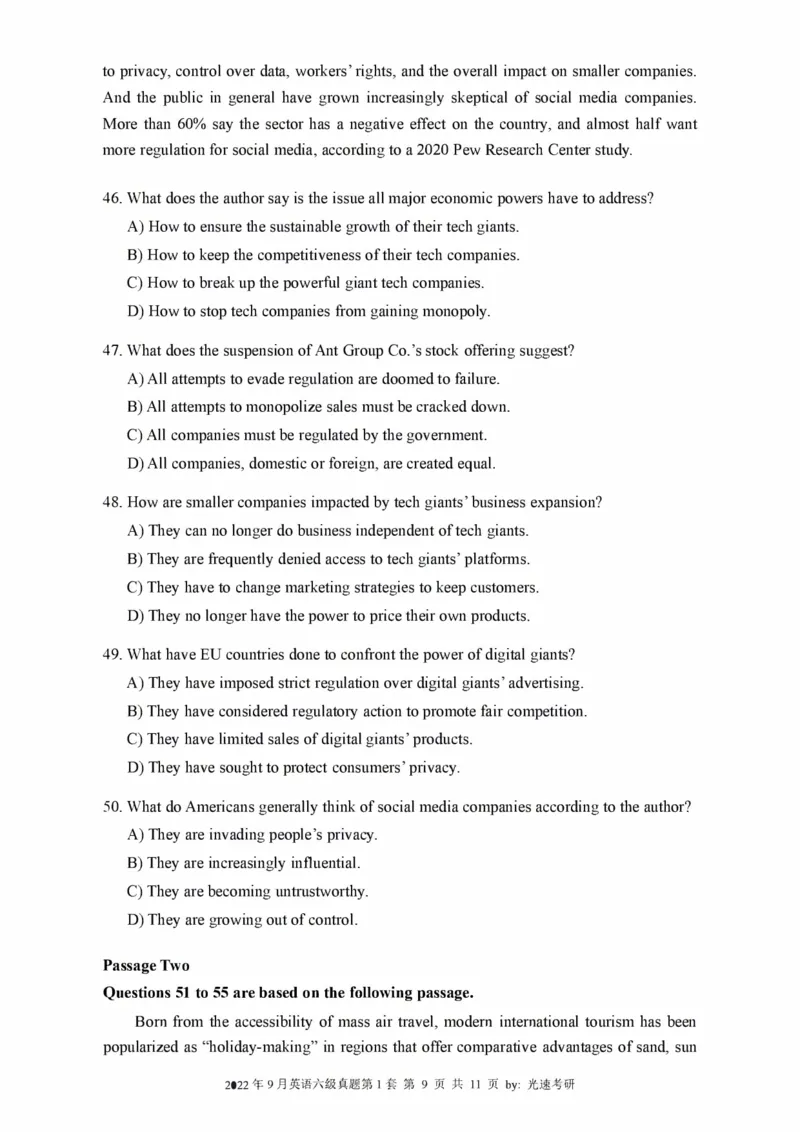
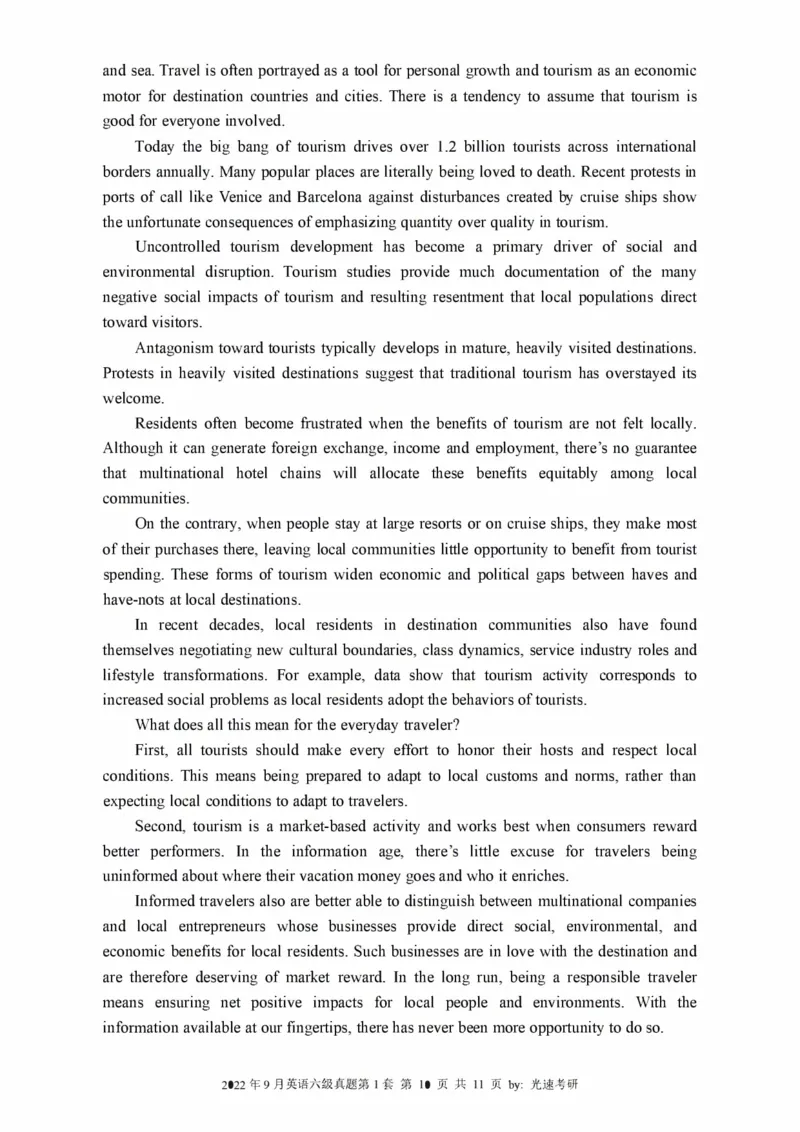
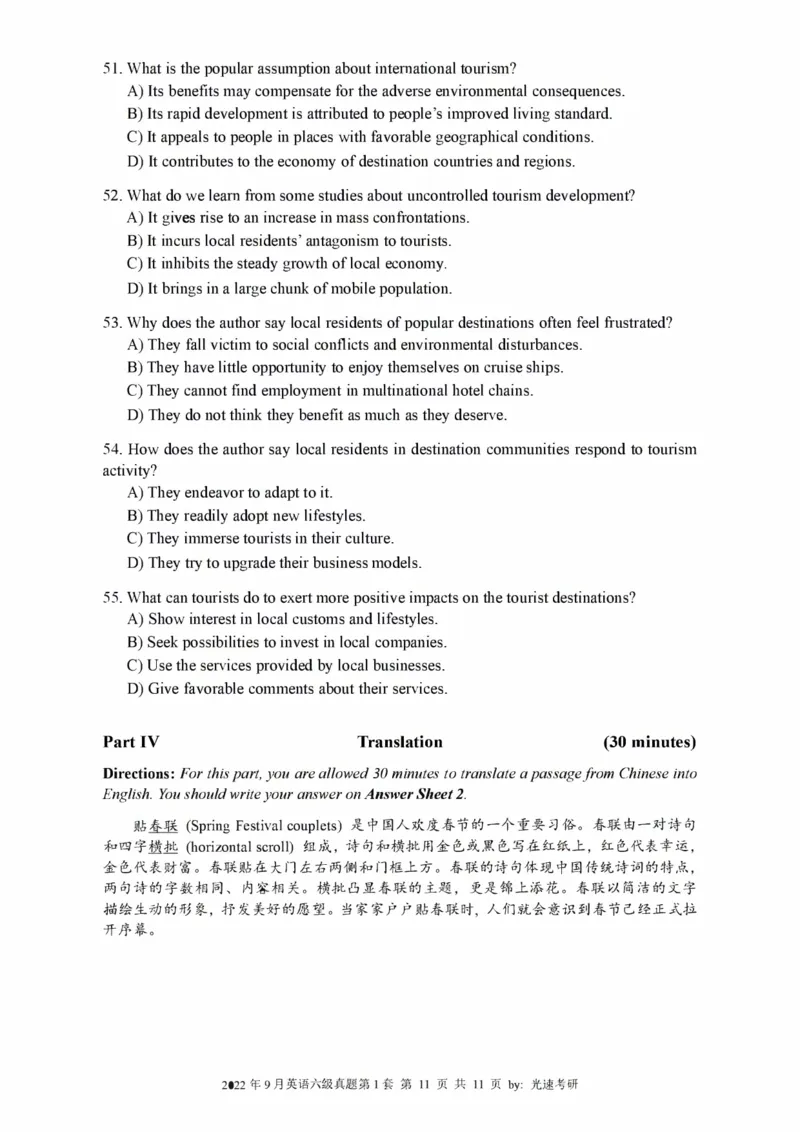


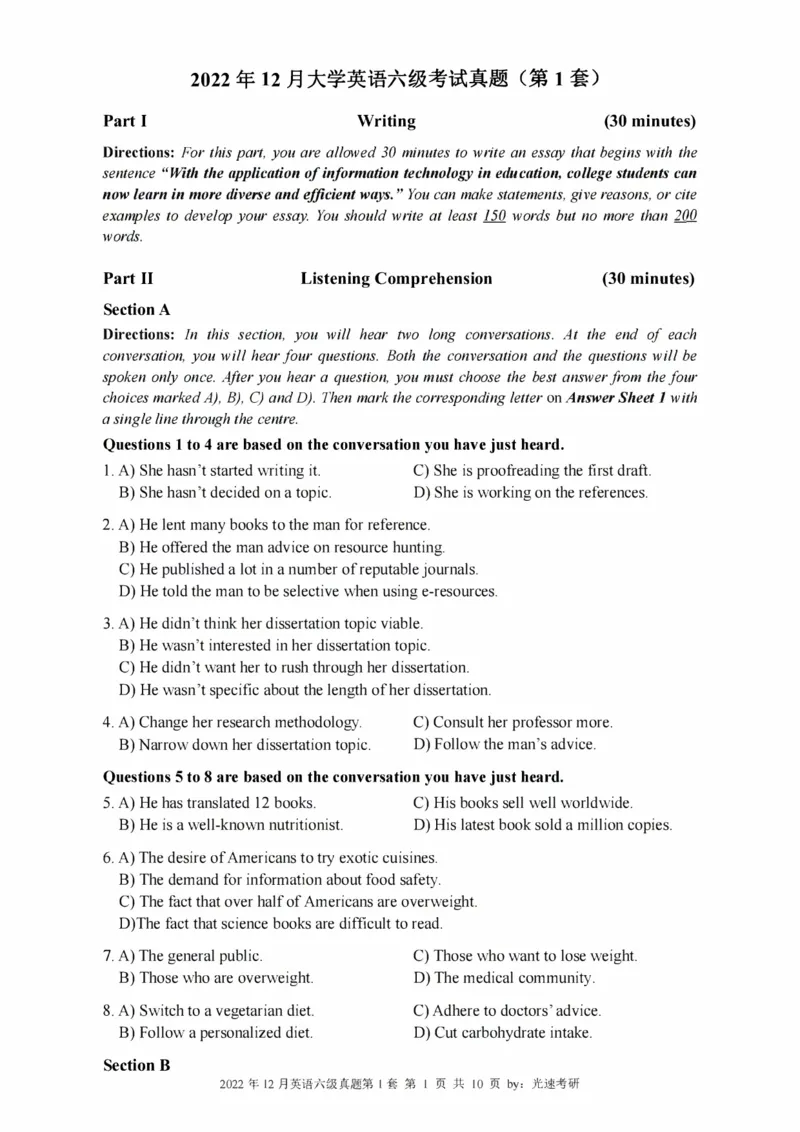


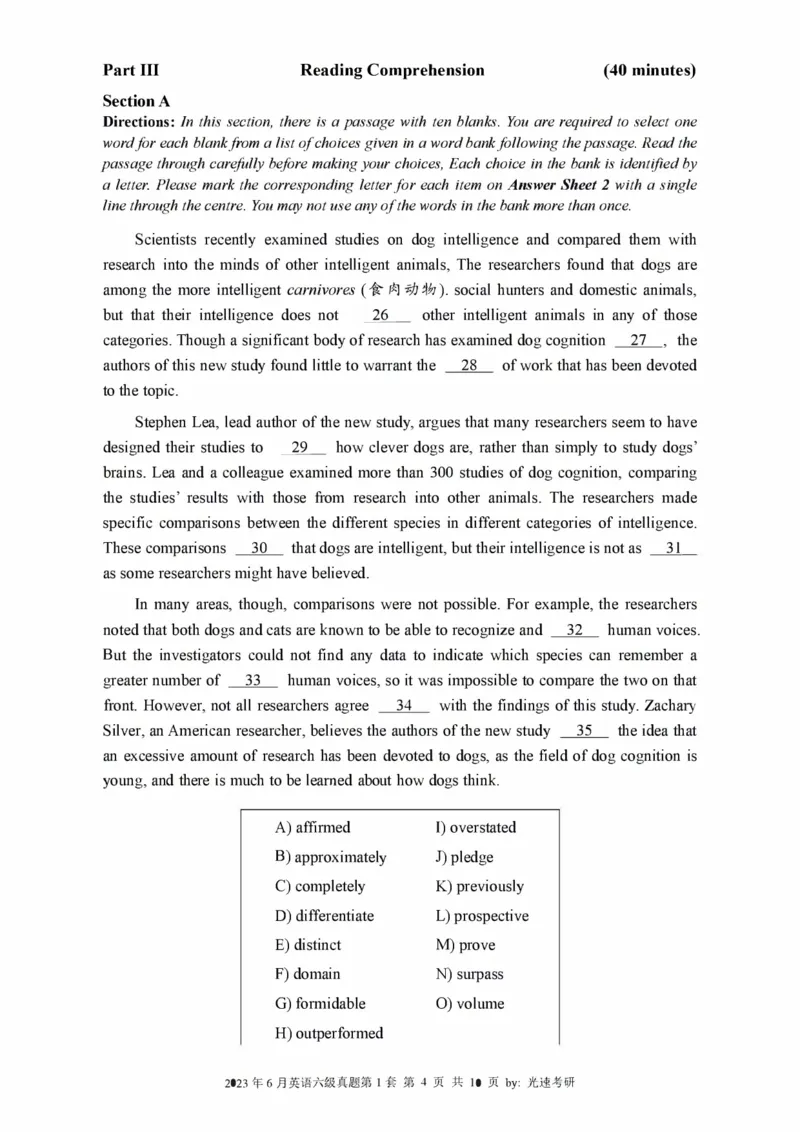
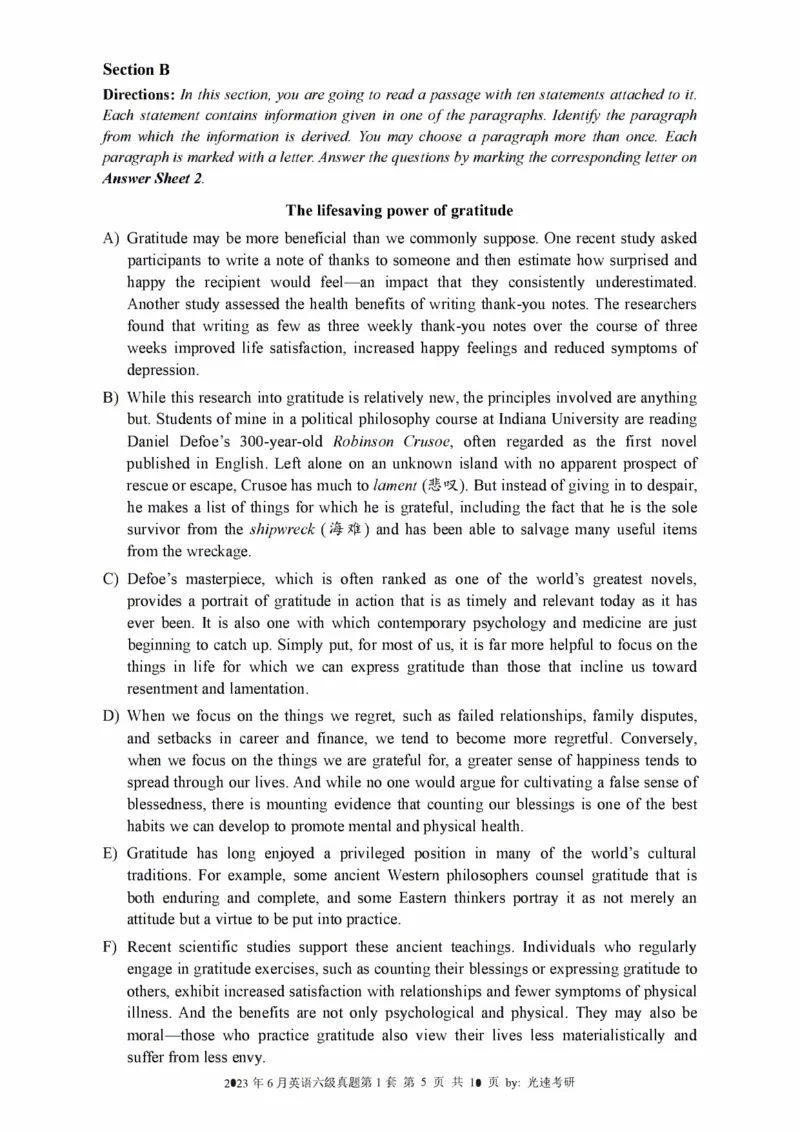
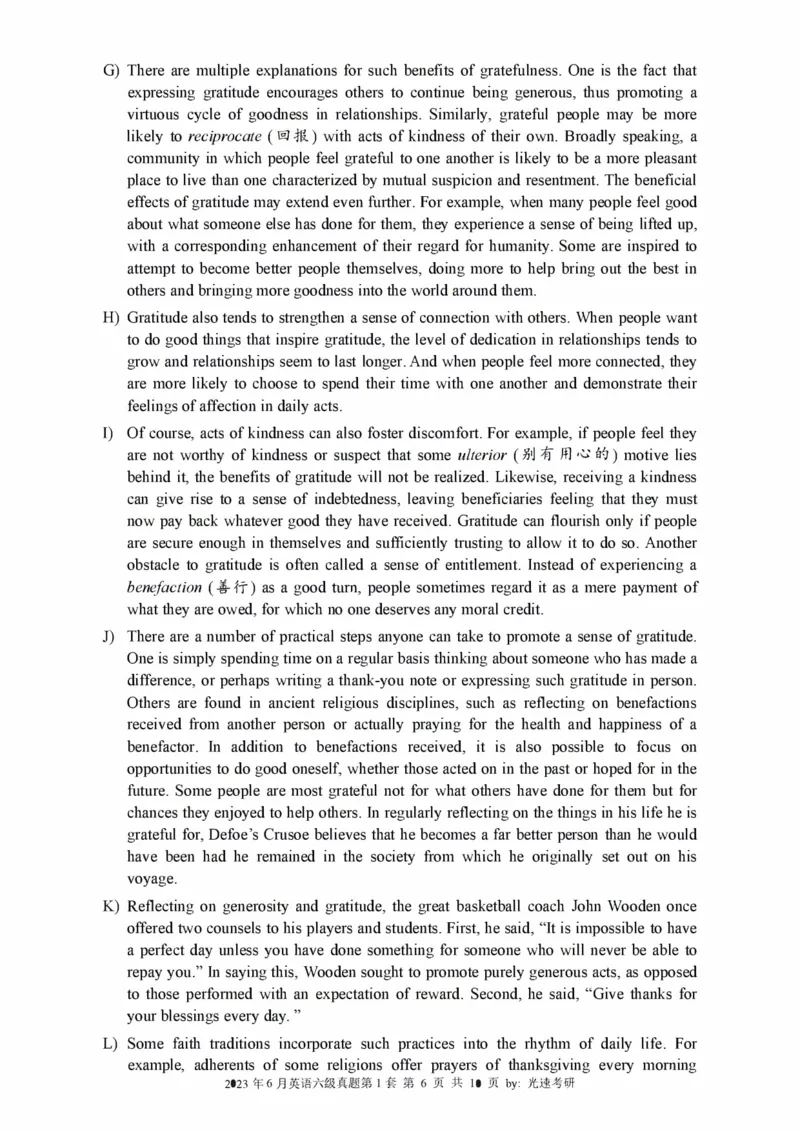
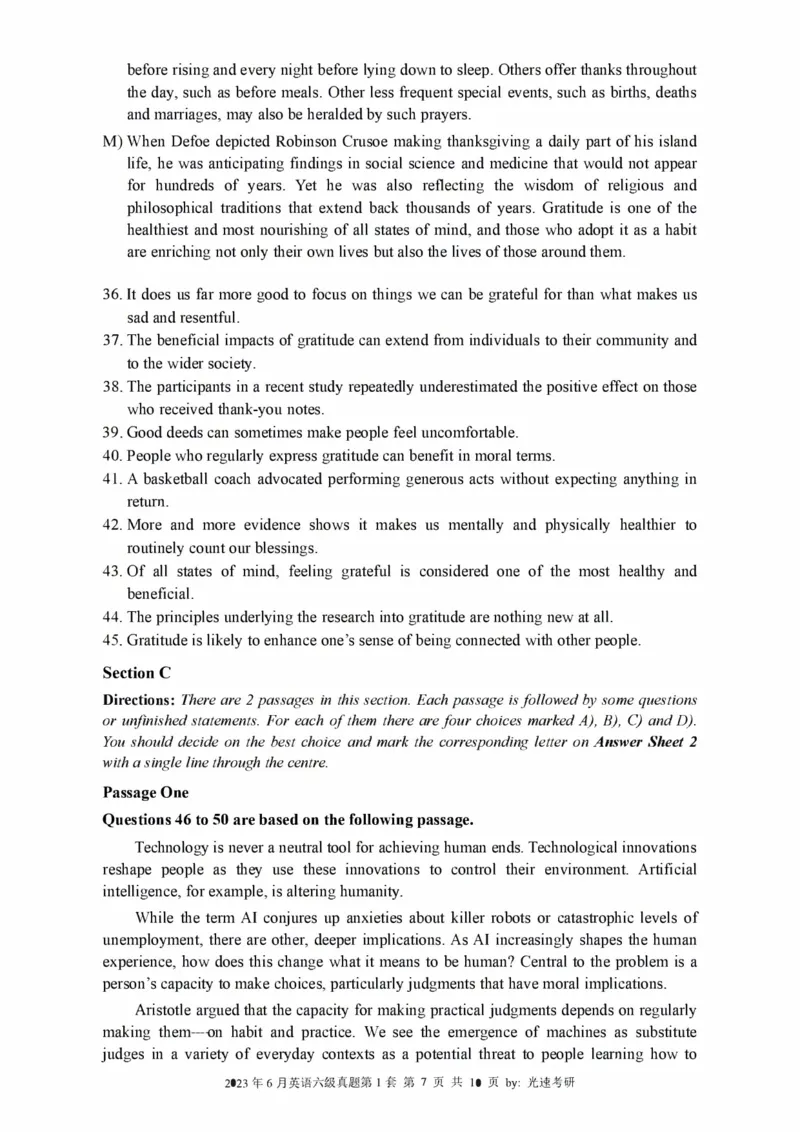
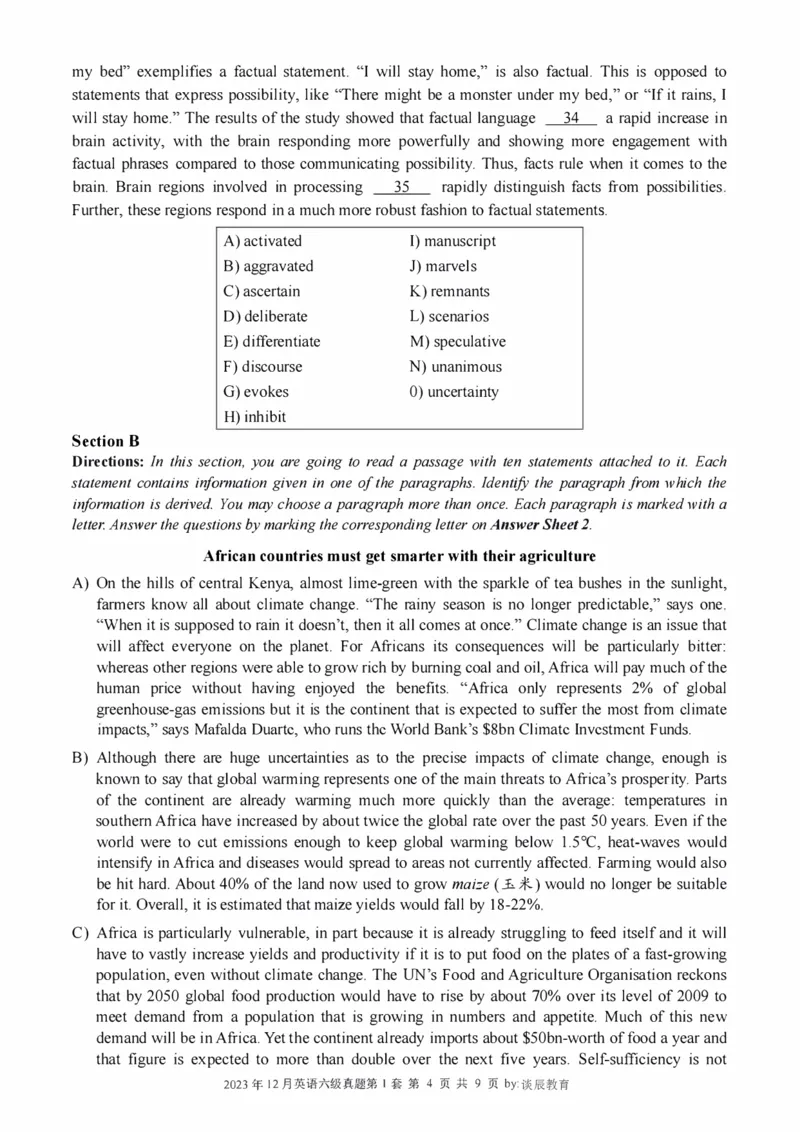
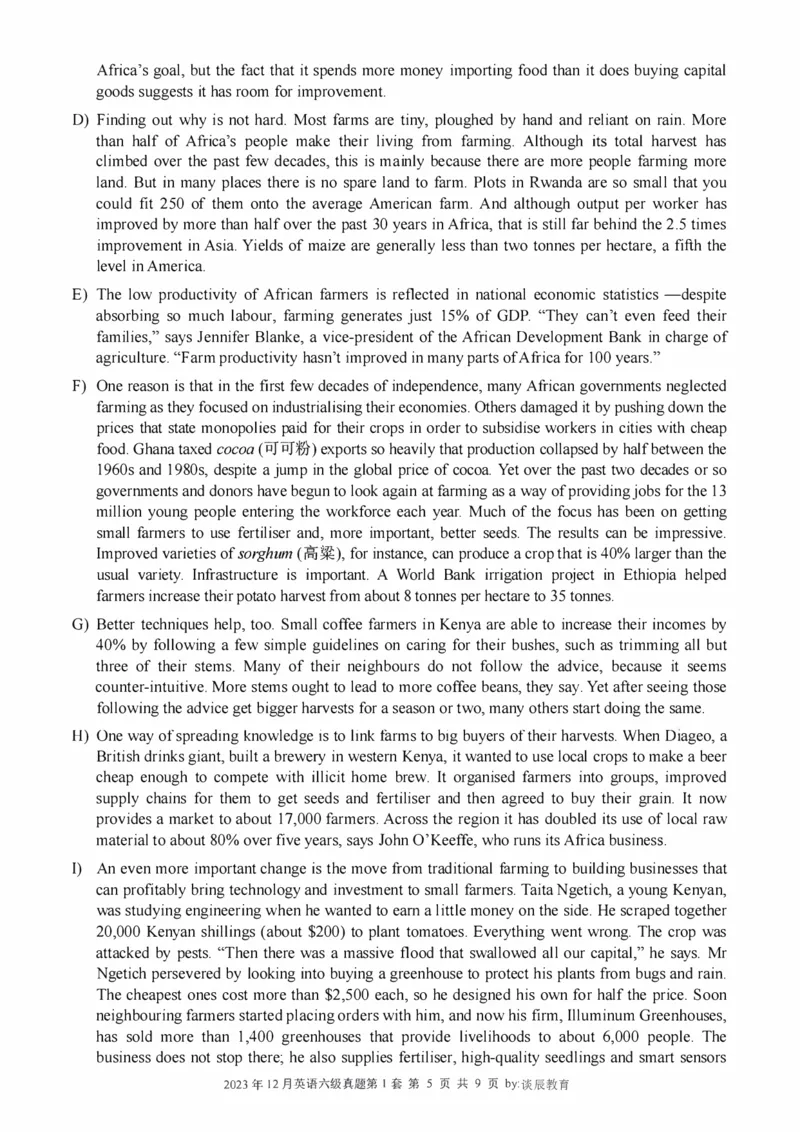
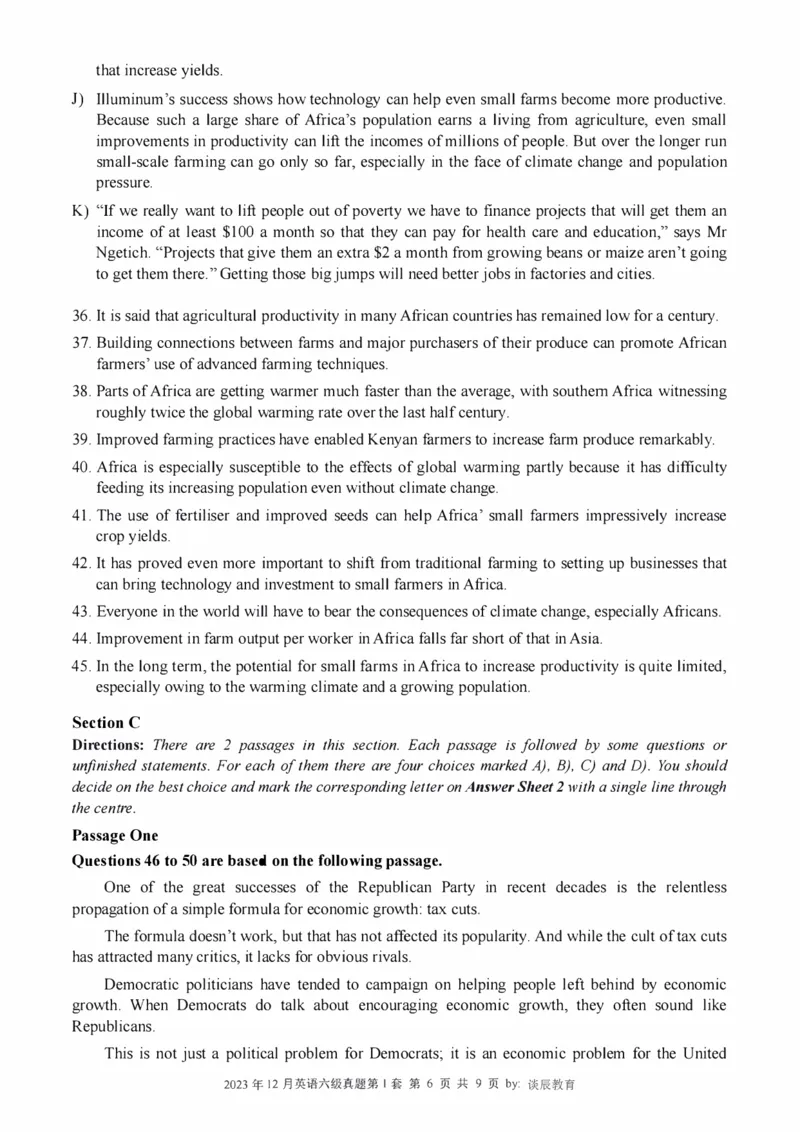
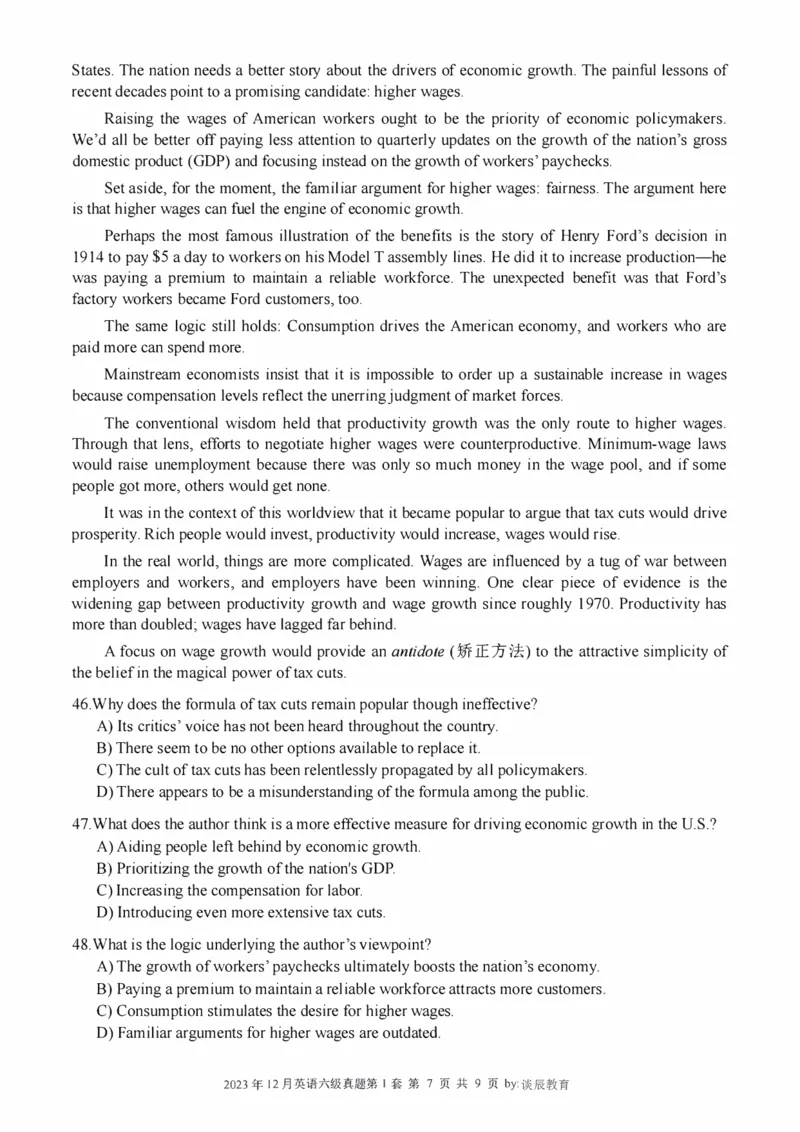
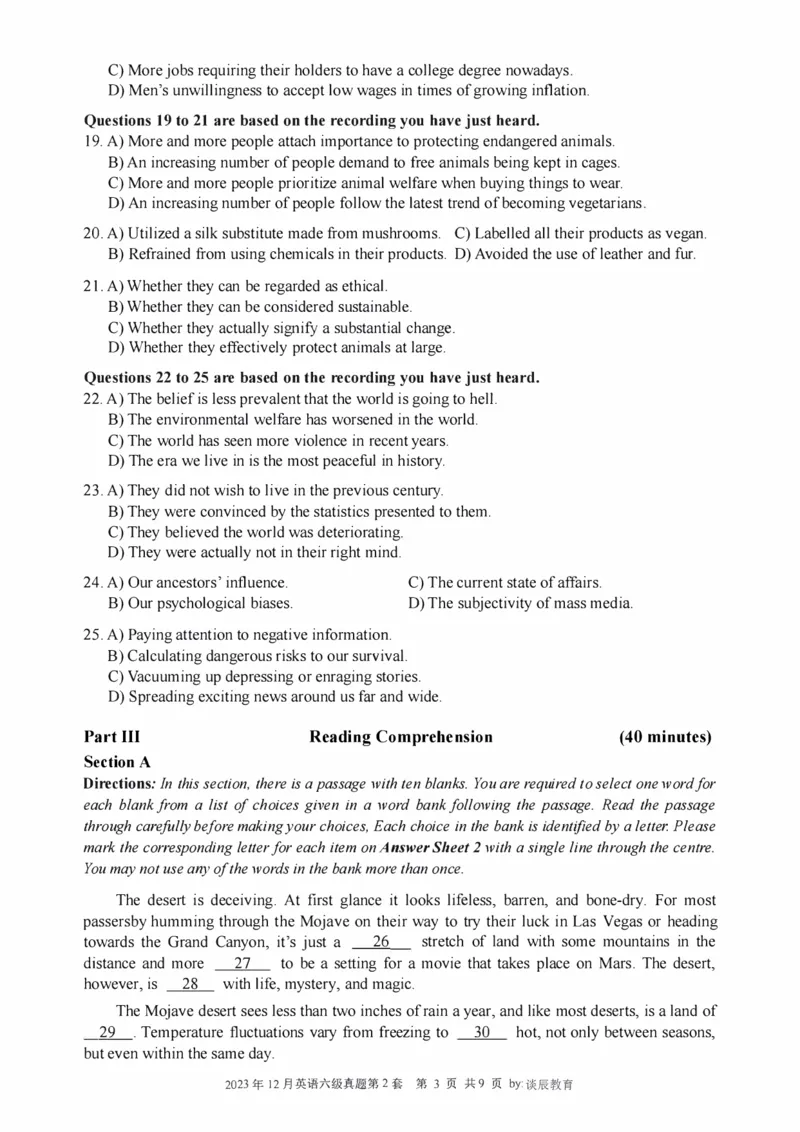
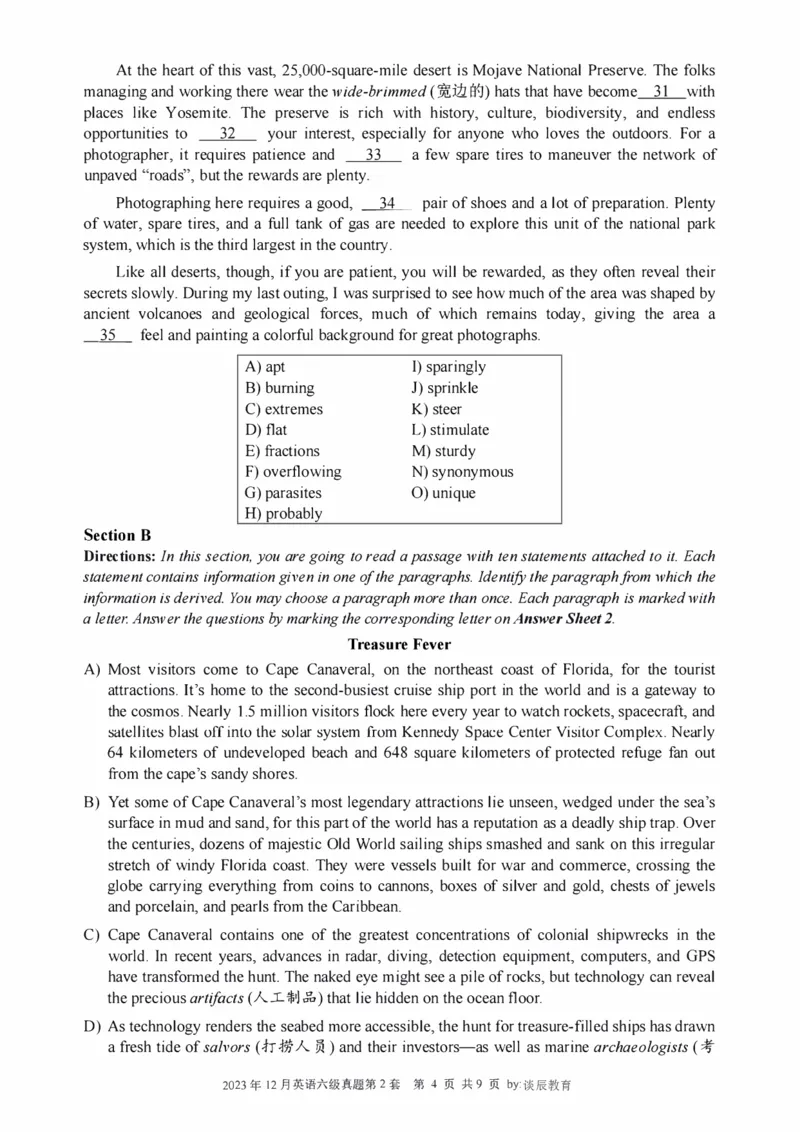
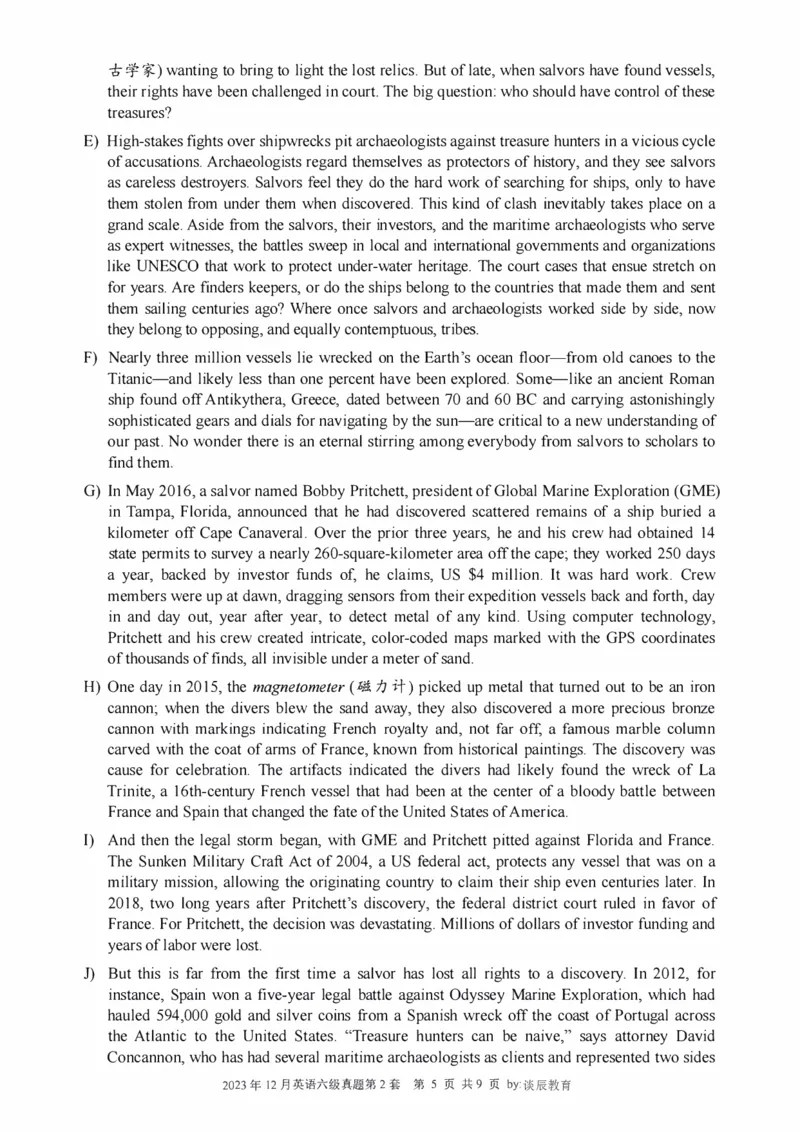
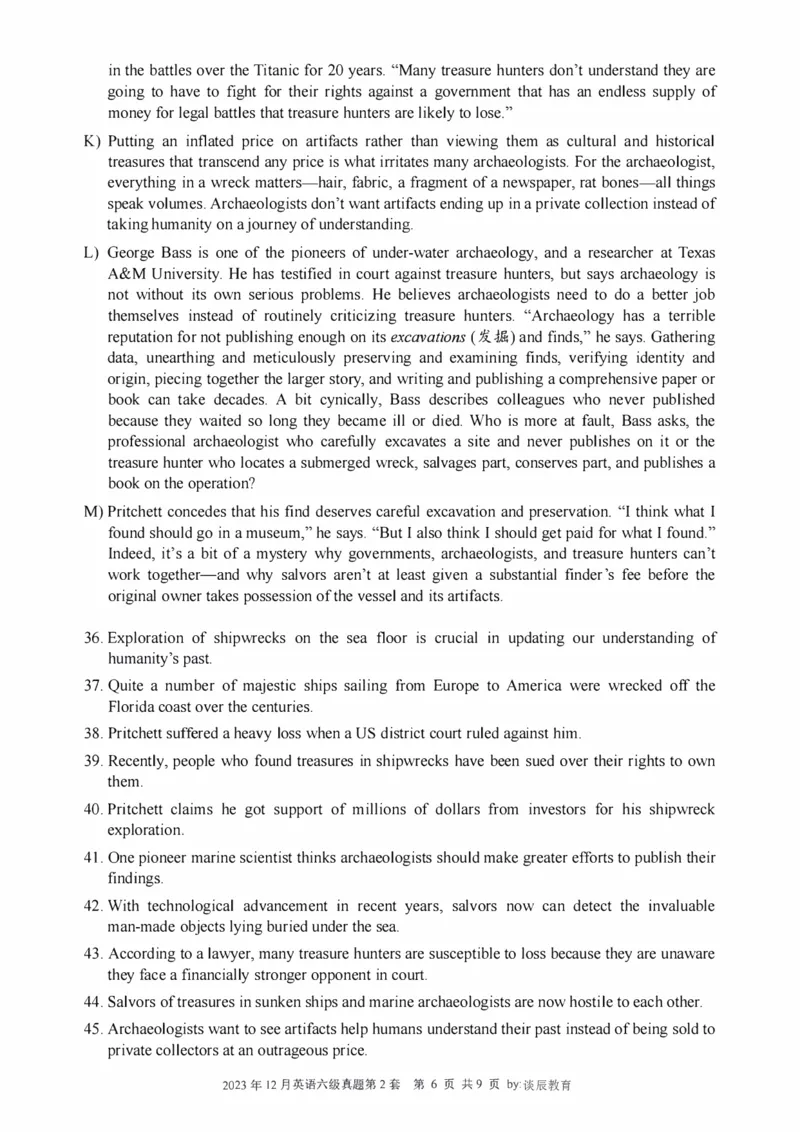
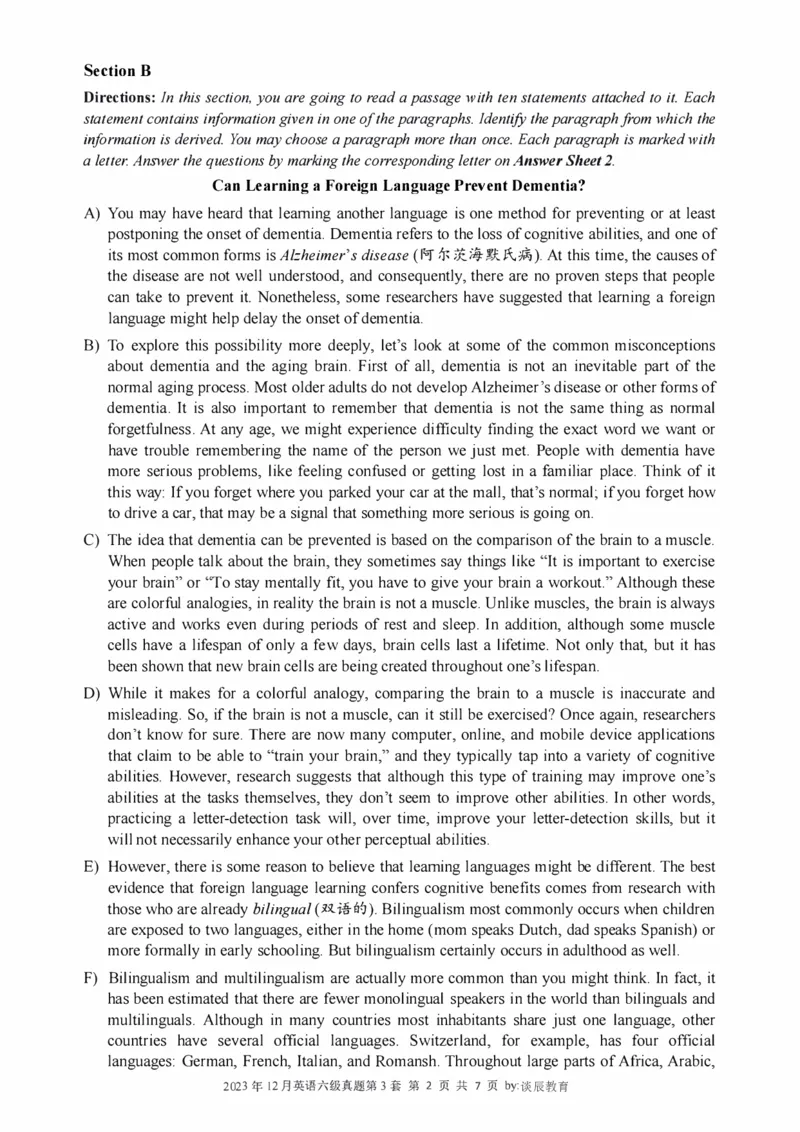
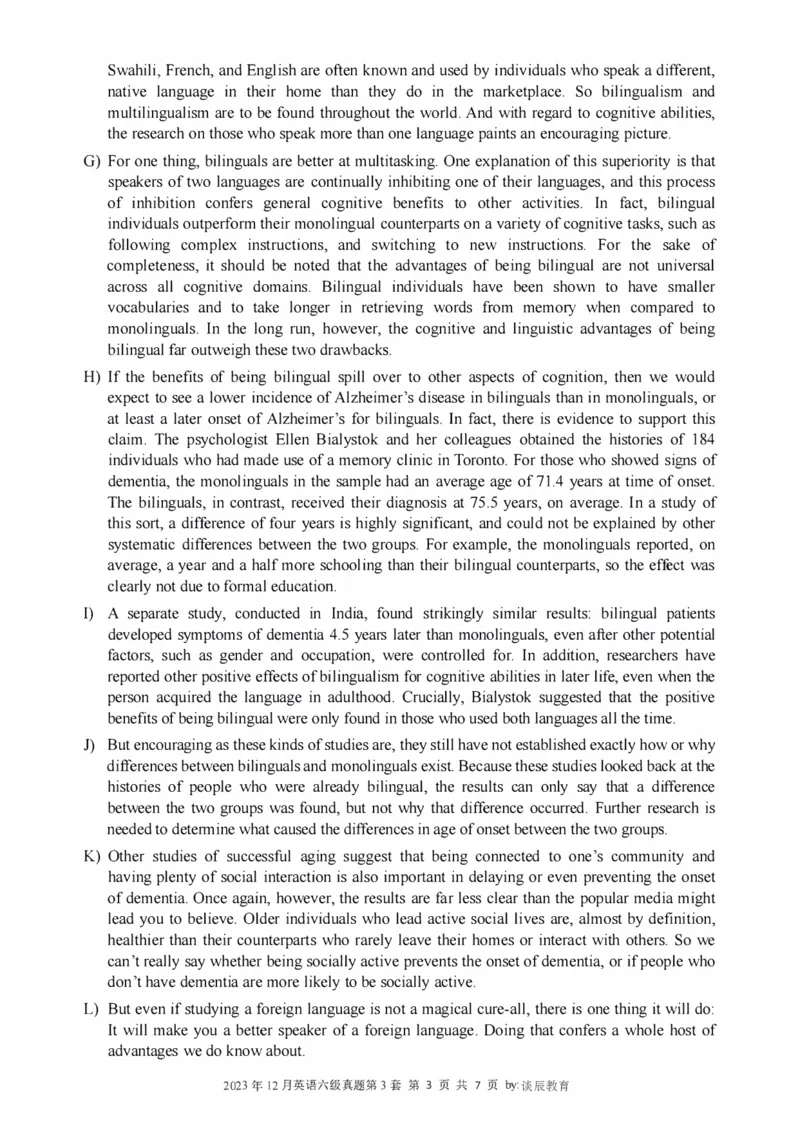
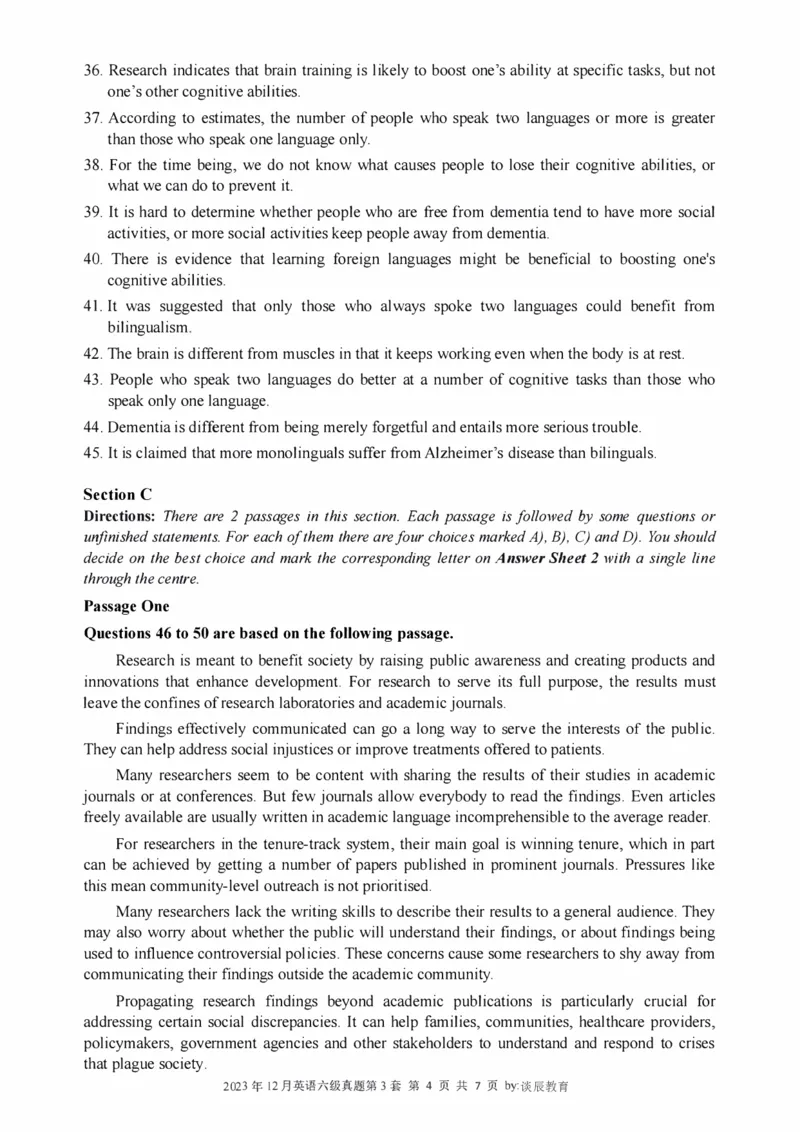
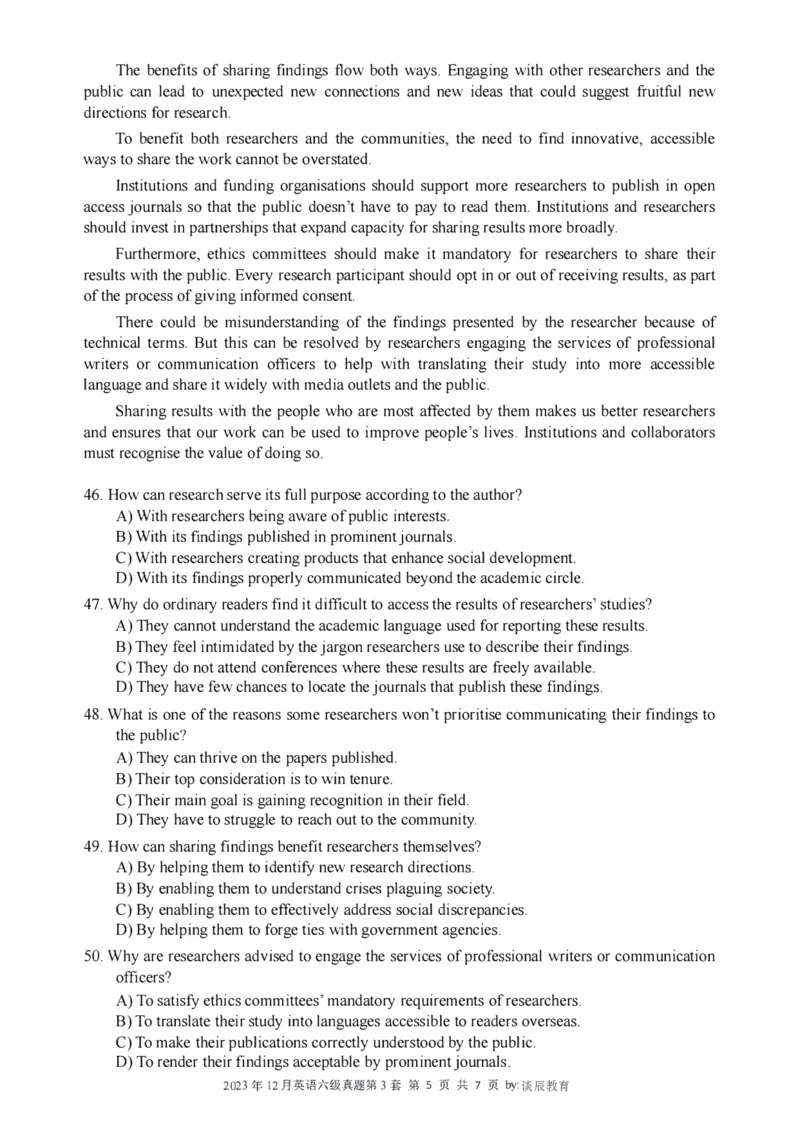









文档内容
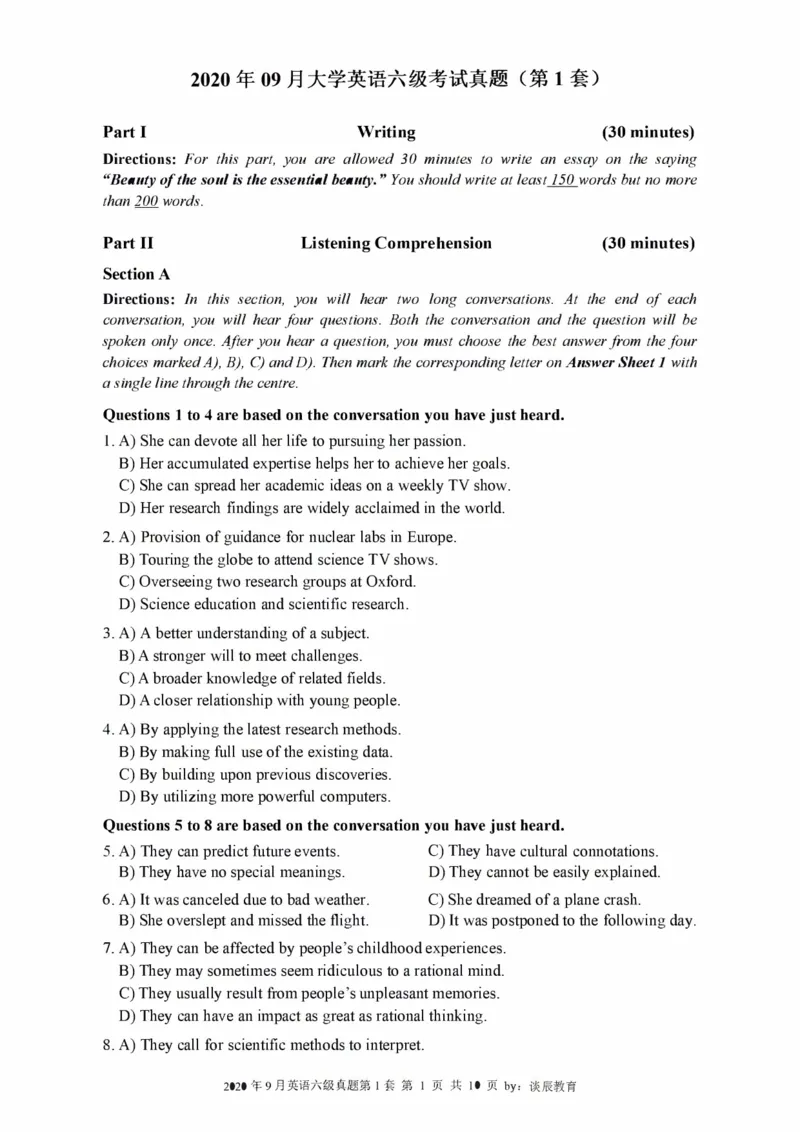
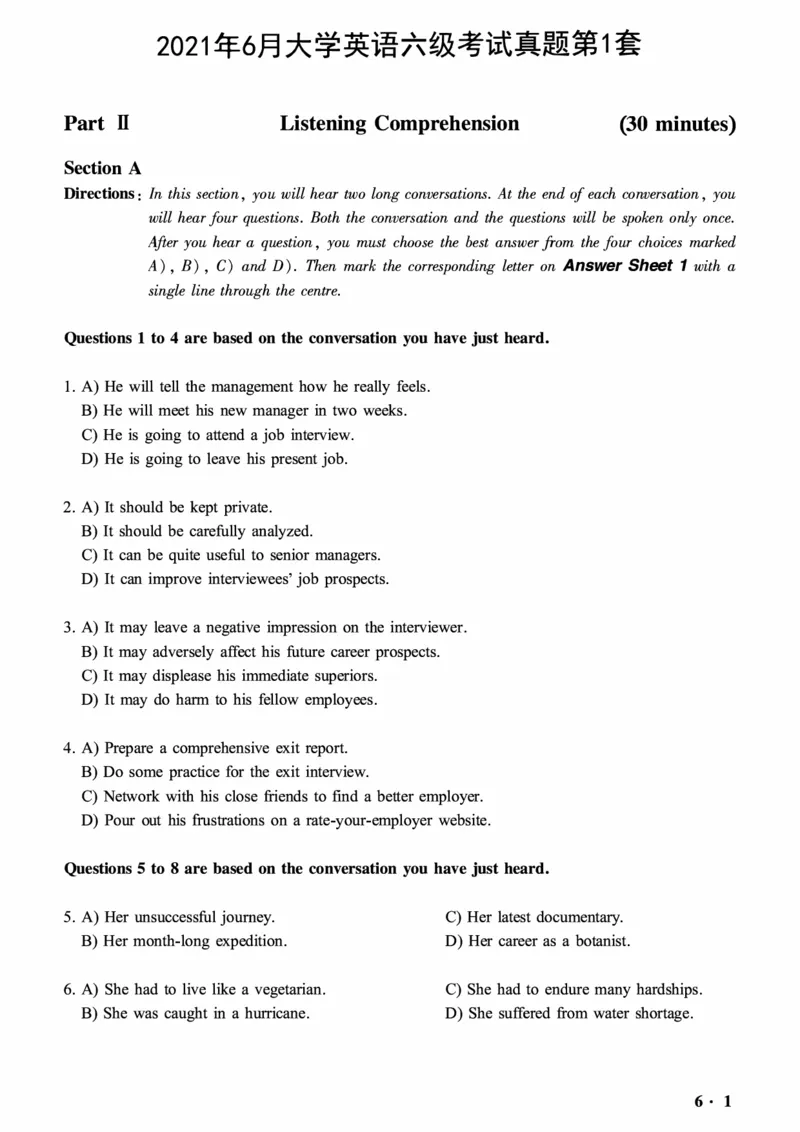
2(cid:21)(cid:21)0(cid:19)1(cid:20)6(cid:25)年(cid:5290)66月(cid:7486)大(cid:3933)学(cid:4508)英(cid:14631)语(cid:16931)六(cid:1955)级(cid:13533)真(cid:11605)题(cid:20174)第(cid:12642)1(cid:20)(cid:3981)套
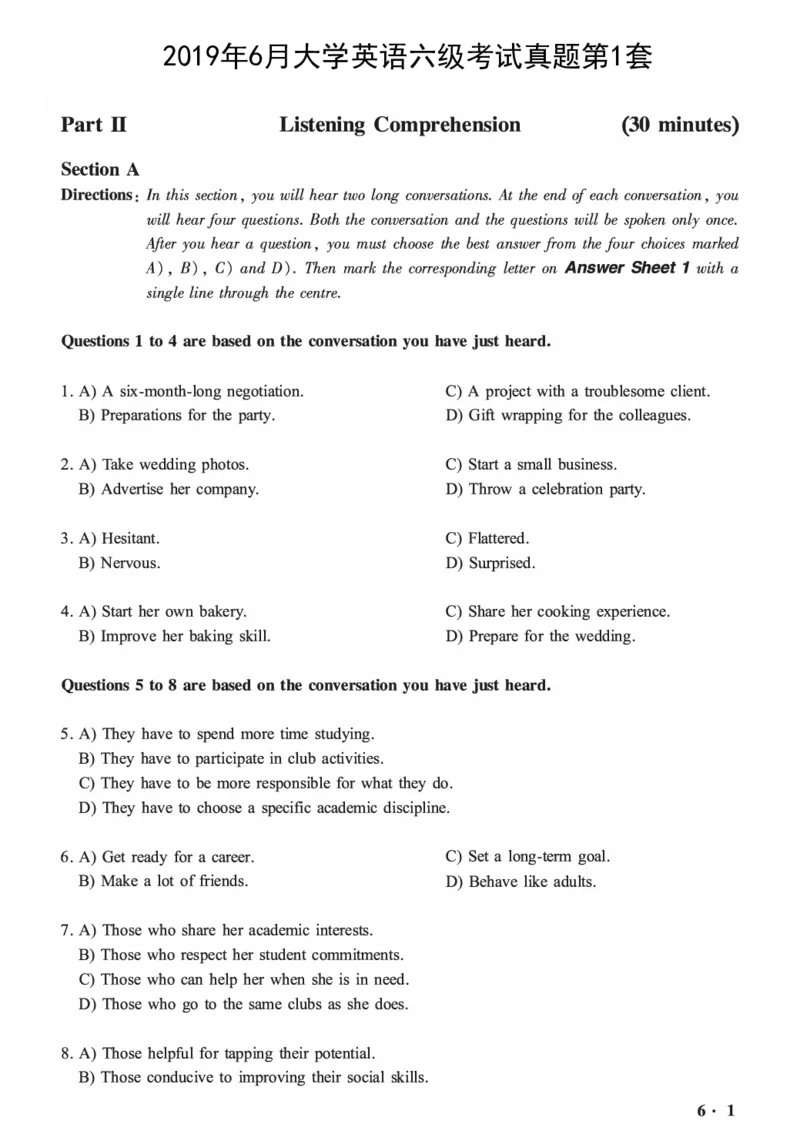
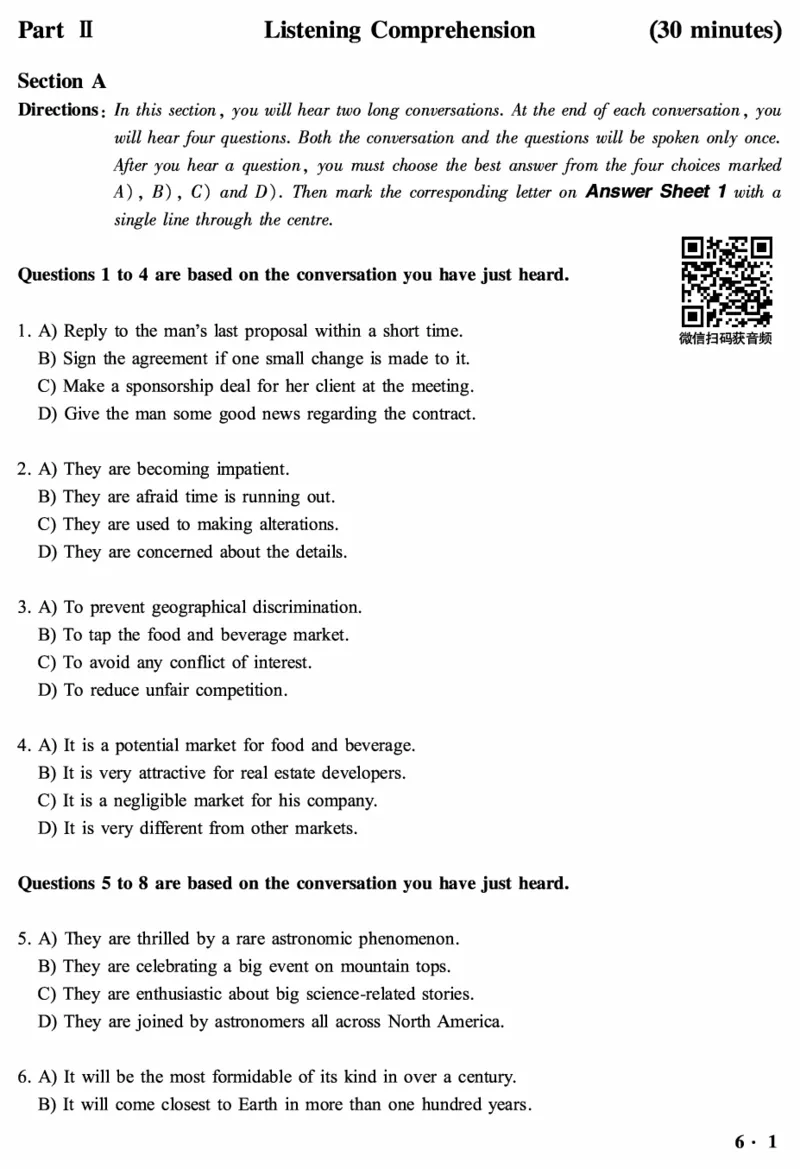
Part II Listening Comprehension (30 minutes)
Part II Listening Comprehension (30 minutes)
Section A
Section A
Directions:In this section,you will hear two long convesations.At the end of each conversation,you
Directions : In this section , you will hear two long conversations. At the end of each conversation, you
will hear four questions.Both the conversation and the questions will be spoken only once.
will hear four questions. Both the conversation and the questions will be spoken only once.
After you heara question,you must choose the best answer from the four choices marked
After you hear a question , you must choose the best answer from the four choices marked
A) B),C)and D).Then marh the corresponding letter on Answer Sheet 1witha
A) B) , C) and D) . Then mark the corresponding letter on Answer Sheet 1 with a
single line through the centre.
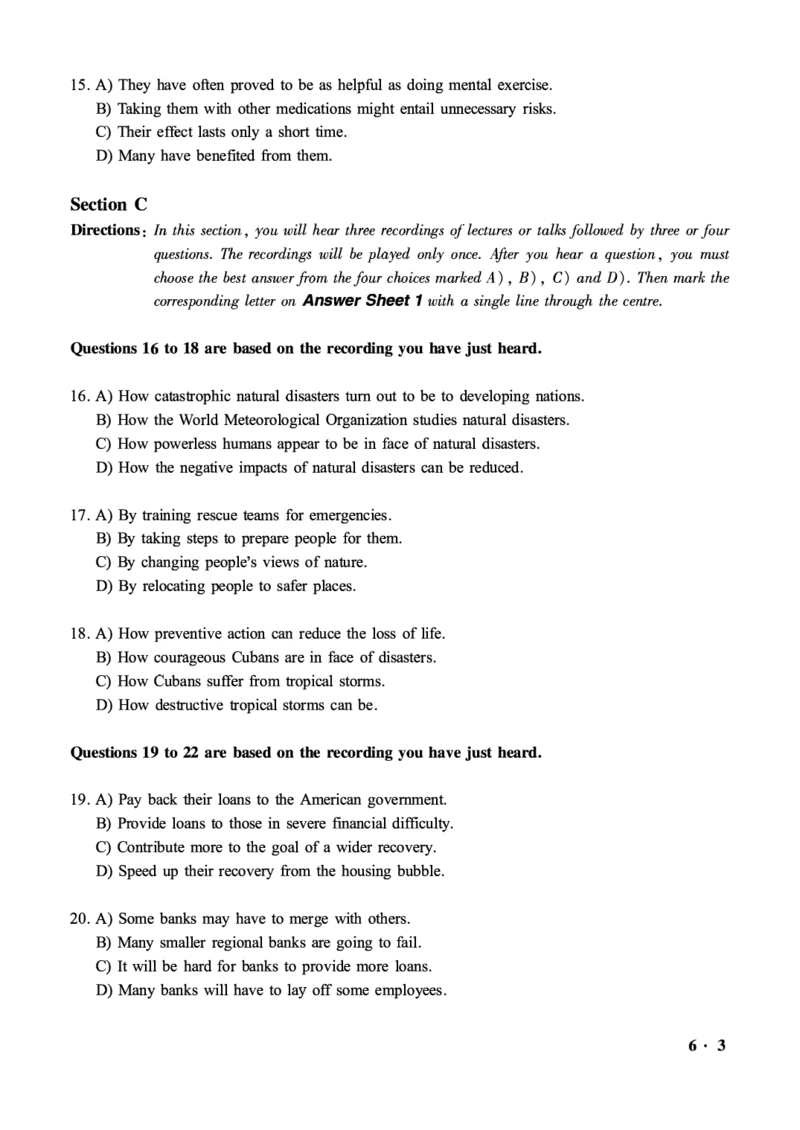
single line through the centre.
Questions 1 to 4 are based on the conversation you have just heard.
Questions 1 to 4 are based on the conversation you have just heard.
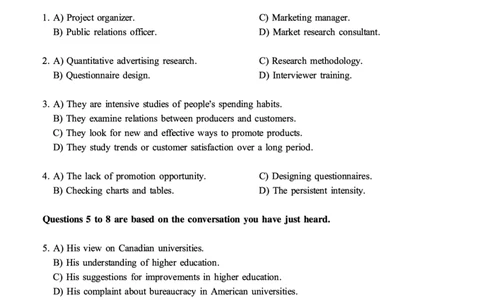
1. A) Project organizer. C) Marketing manager.
1. A) Project organizer. C) Marketing manager.
B) Public eltionsoffier. D) Market research consultant.
B) Public relations officer. D) Market research consultant.
2. A) Quantitative advertising research. C) Research methodology.
2. A) Quantitative advertising research. C) Research methodology.
B) Questionnaire design. D) Interviewer training.
B) Questionnaire design. D) Interviewer training.
3.3 .AA) )T hTehye ya rare ei nitnetnesnisvive es tsutuddieiess ooff ppeeoopplele''ss ssppeennddiinngg hhaabbititss..
BB) )ThTehye ye xeaxmaminein er erlealtatiioonnss bbeettwweeeenn pprroodduucceerrss aanndd ccuussttoommeerrss..
C) They look for new and effective ways to promote products.
C) They look for new and effective ways to promote products.
D)They study trends or customer satisfaction over a long period.
D) They study trends or customer satisfaction over a long period.
4.A)The lack of promotion opportunity. C) Designing questionnaires.
4. A) The lack of promotion opportunity. C) Designing questionnaires.
B)B )ChCehcekciknign gc hcahratrst s aanndd ttaabblleess.. D)D T)hTe hpee rpseirsstiestnetn ti nintetennssiittyy..
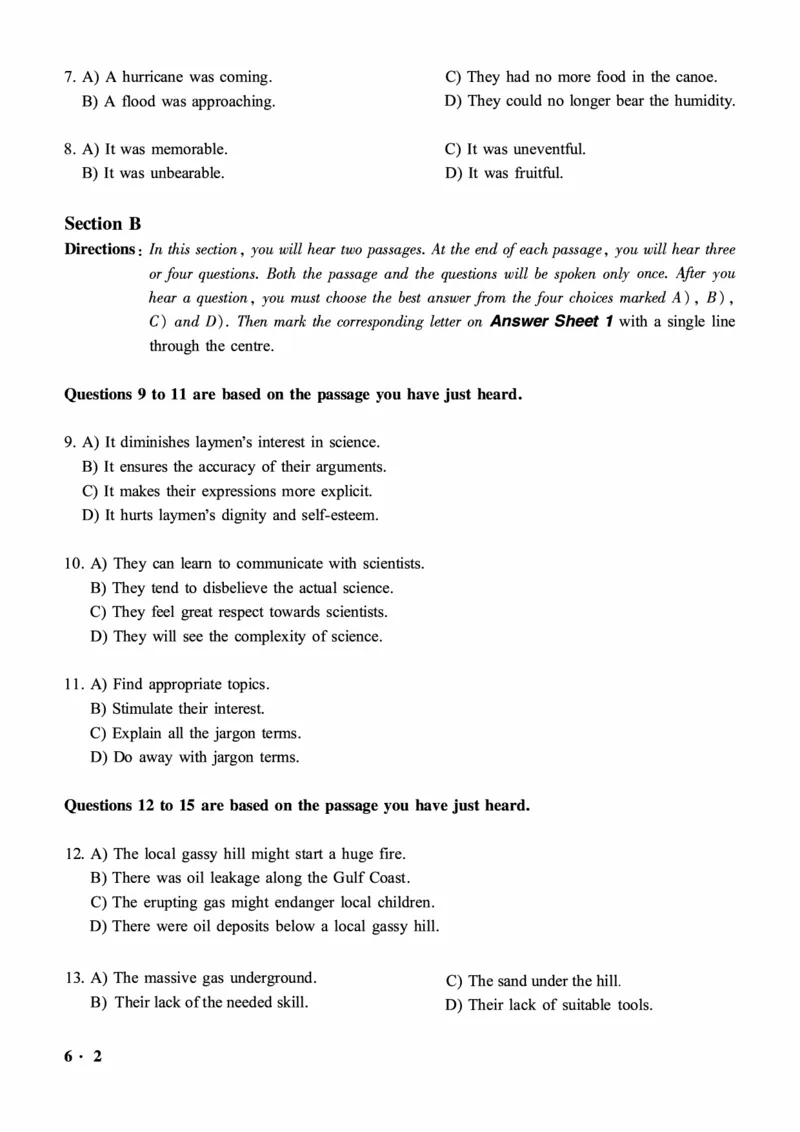
Questions 5 to 8 are based on the conversation you have just heard.
Questions 5 to 8 are based on the conversation you have just heard.
5. A) His view on Canadian universities.
5. A) His view on Canadian universities.
B) His understanding of higher education.
B) His understanding of higher education.
C)C )HiHs iss usguggegsetsitoionns sf foorr iimmpprroovvemeemnetnst si nin h higighheerr eedduuccaattiioonn..
D)DH)isH icso mcpolmpainlati natb aobuto ubt ubrueareuacurcarcayc yi ni nA mAemriecraicnan u nuinveivresristiitieess..
6. A) It is well designed. C) It varies among universities.
6. A) It is well designed. C) It varies among universities.
B) It i rather inflexible. D) It has undergone great changes.
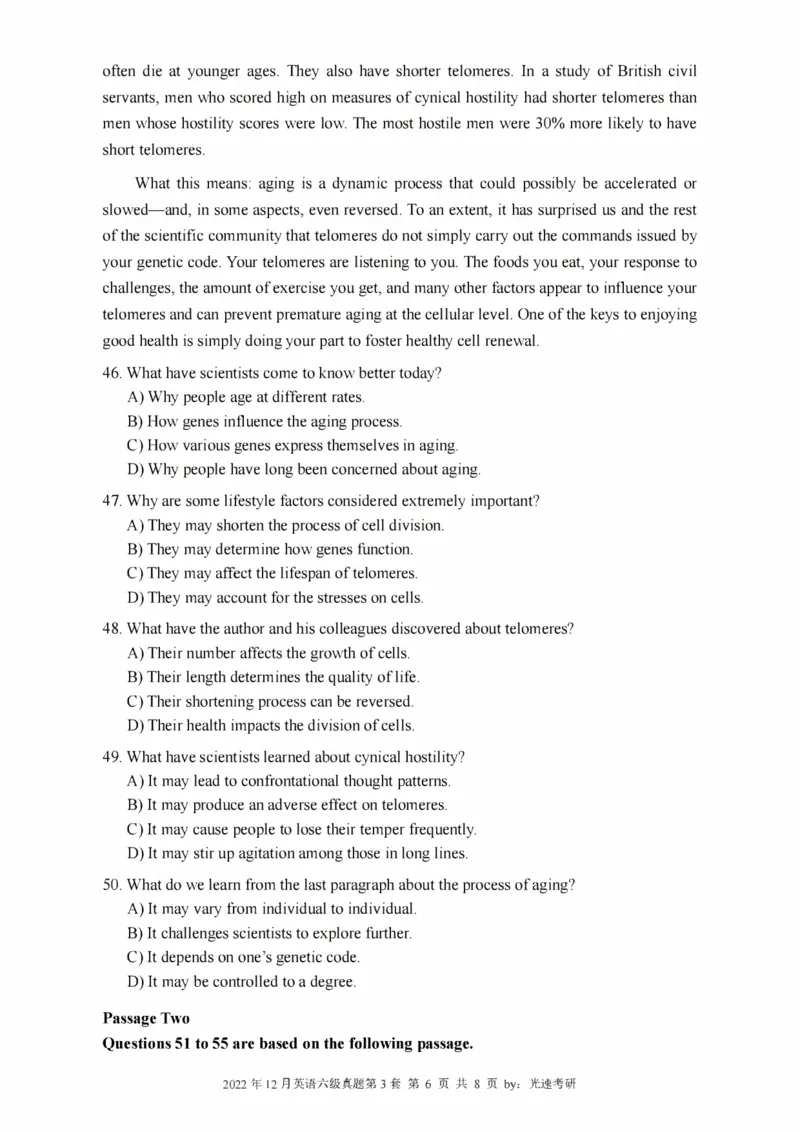
B) It is rather inflexible. D) It has undergone great changes.
7.A)The United States and Canada can learn from each other.
7. A) The United States and Canada can learn from each other.
B)BP)ubPluicb liucn iuvnerivsietrsiietsie sa rare eo fotftene ns uspueprieoriro rt ot op rpirviavtaete u nuinvievresristitiieess..
C)C )EvEevreyroynoen es hsohuolud ldb eb eg igvievne ne qeuqaula la caccecsess st oto hhiigghheerr eedduuccaattiioonn..
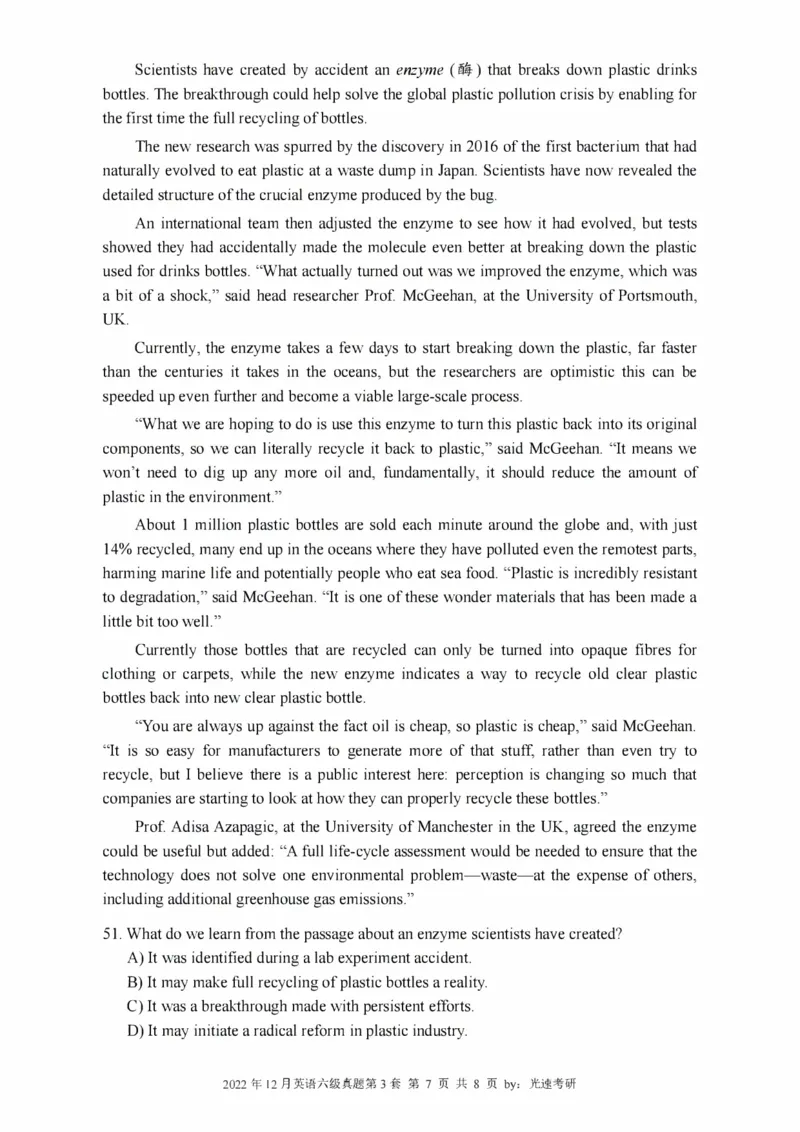
D)DP)riPvraitvea tsec hscoholoso lwso wrko rmko rme oerfef iecffiiecnitelnyt lyt htahna npu pbluibcl ici nisntsittituuttiioonnss..
6·1
6· 18. A) University systems vary from country to country.
B) Efficiency is essential to university management.
C) It is hard to say which is better, a public university or a private one.
D) Many private universities in the US are actually large bureaucracies.
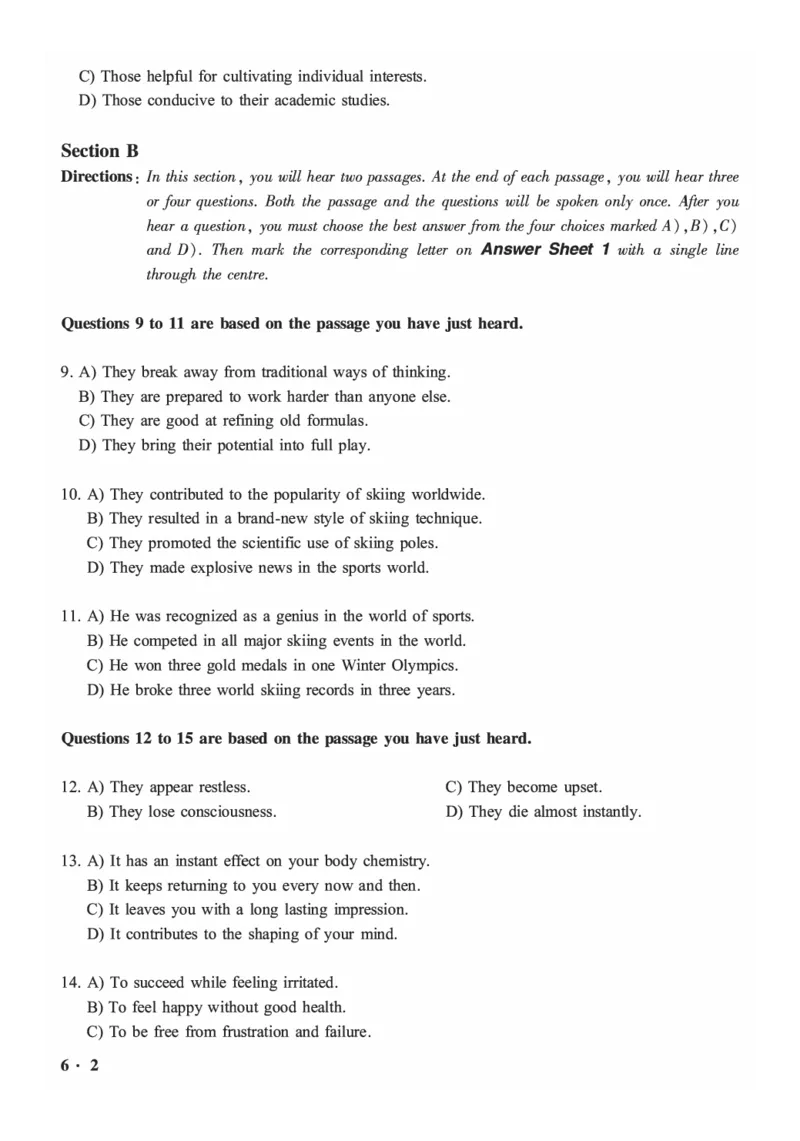
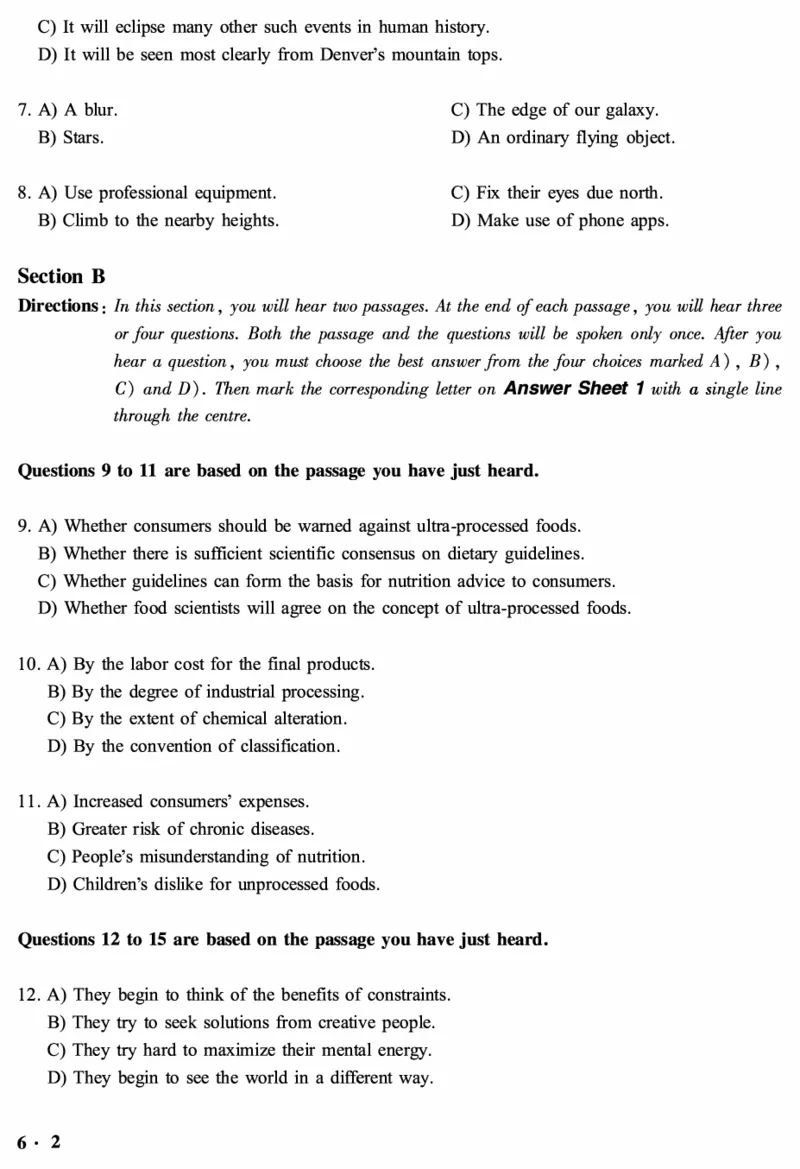
Section B
Directions: In this section, you will hear two passages. At the end of each passage, you will hear three
or four questions. Both the passage and the questions will be spoken only once. After you
hear a question, you must choose the best answer from the four choices marked A), B),
C) and D). Then mark the corresponding letter on Answer Sheet 1 with a single line
through the centre.
Questions 9 to 11 are based on the passage you have just heard.
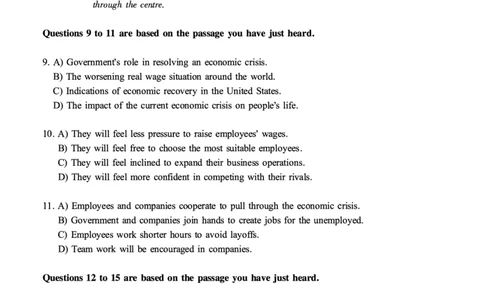
9. A) Government's role in resolving an economic crisis.
B) The worsening real wage situation around the world.
C) Indications of economic recovery in the United States.
D) The impact of the current economic crisis on people's life.
10. A) They will feel less pressure to raise employees' wages.
B) They will feel free to choose the most suitable employees.
C) They will feel inclined to expand their business operations.
D) They will feel more confident in competing with their rivals.
11. A) Employees and companies cooperate to pull through the economic crisis.
B) Government and companies join hands to create jobs for the unemployed.
C) Employees work shorter hours to avoid layoffs.
D) Team work will be encouraged in companies.
Questions 12 to 15 are based on the passage you have just heard.
12. A) Whether memory supplements work. C) Whether exercise enhances one's rnerno双
B)Whether herbal medicine works wonders. D) Whether a magic rnernoiy promises success.
13. A) They help the elderly more than the young. C) They generally do not have side effects.
B) They are beneficial in one way or another. D) They are not based on real science.
14. A) They are available at most country fairs. C) They are collected or grown by farmers.
B) They are taken in relatively high dosage. D) They are prescribed by trained practitioners.
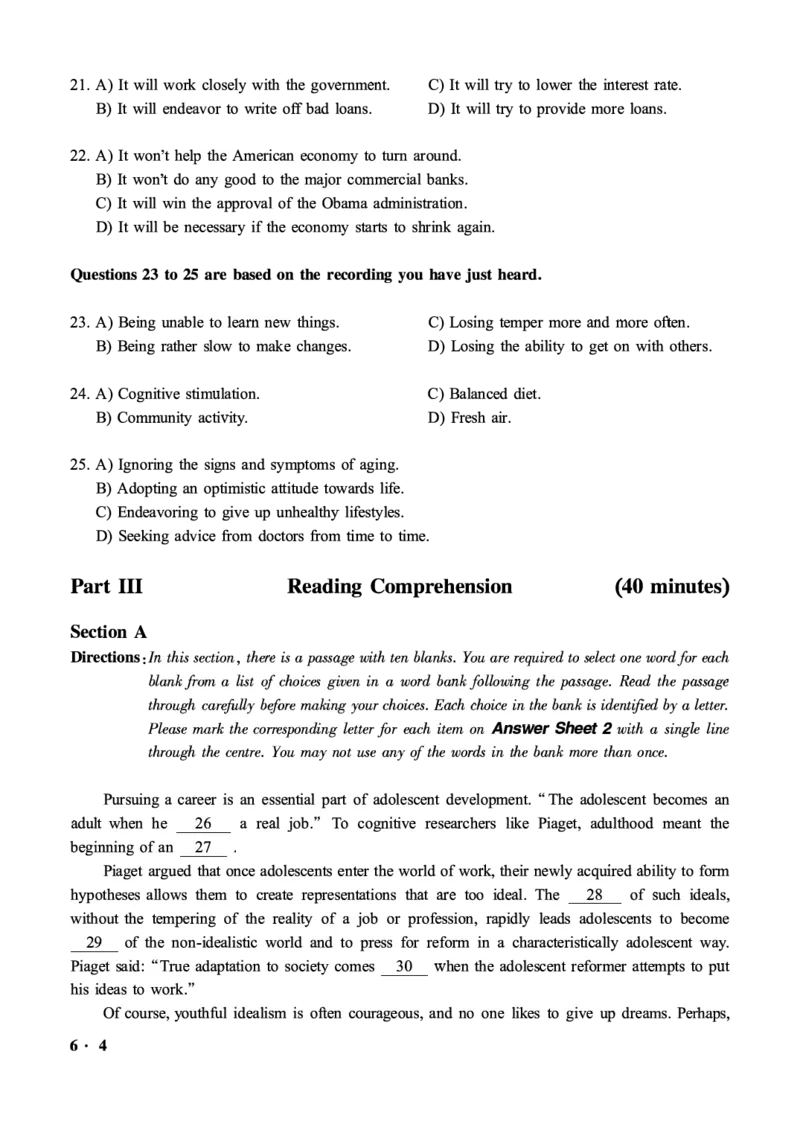
6 · 215. A) They have often proved to be as helpful as doing mental exercise.
B) Taking them with other medications might entail unnecessary risks.
C) Their effect lasts only a short time.
D) Many have benefited from them.
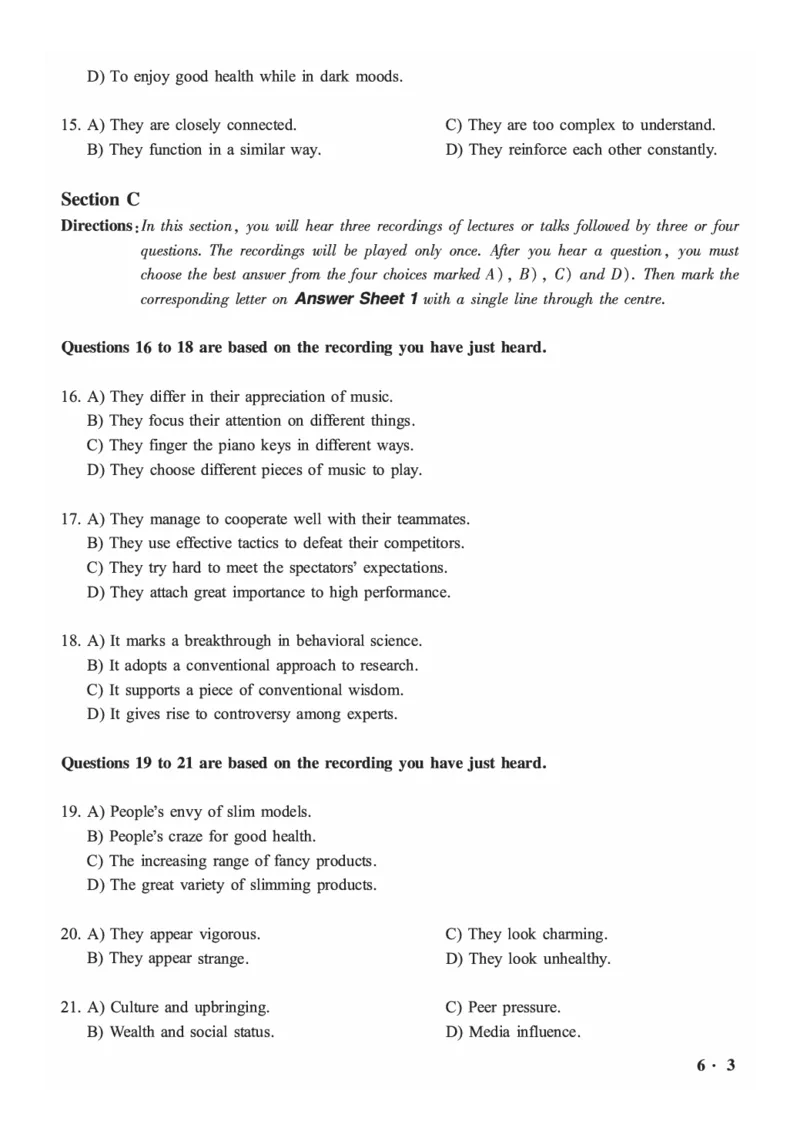
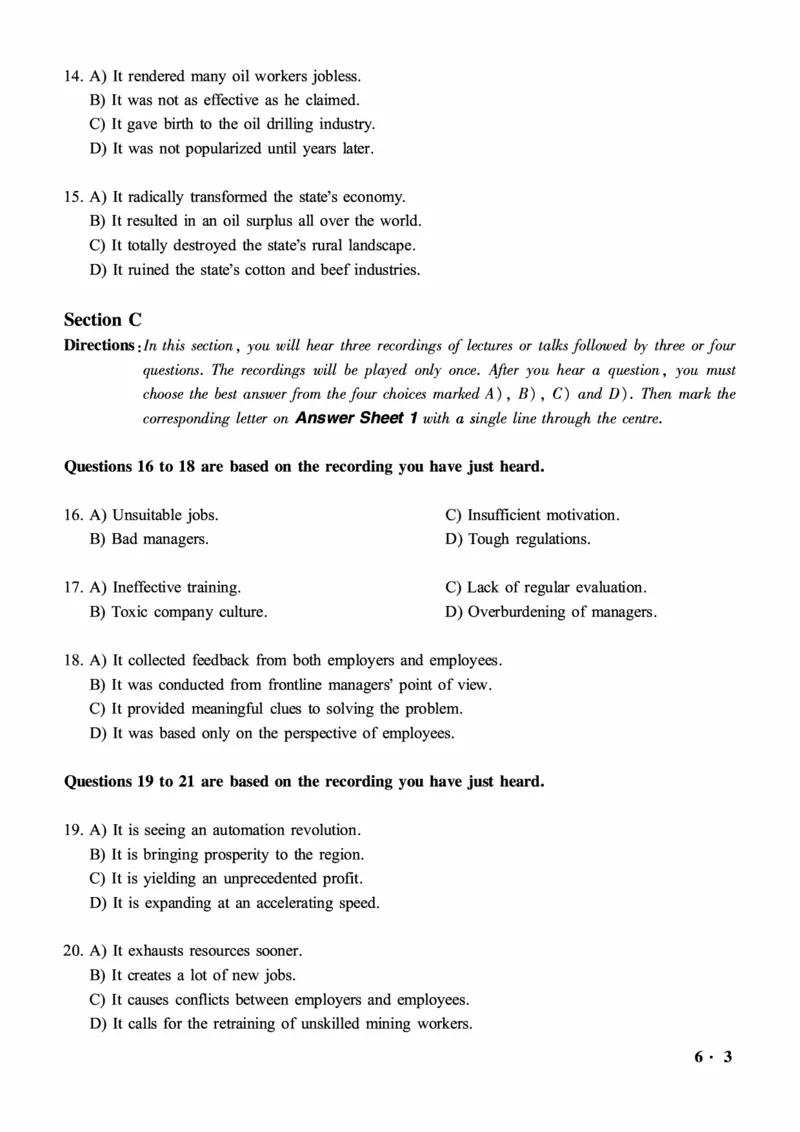
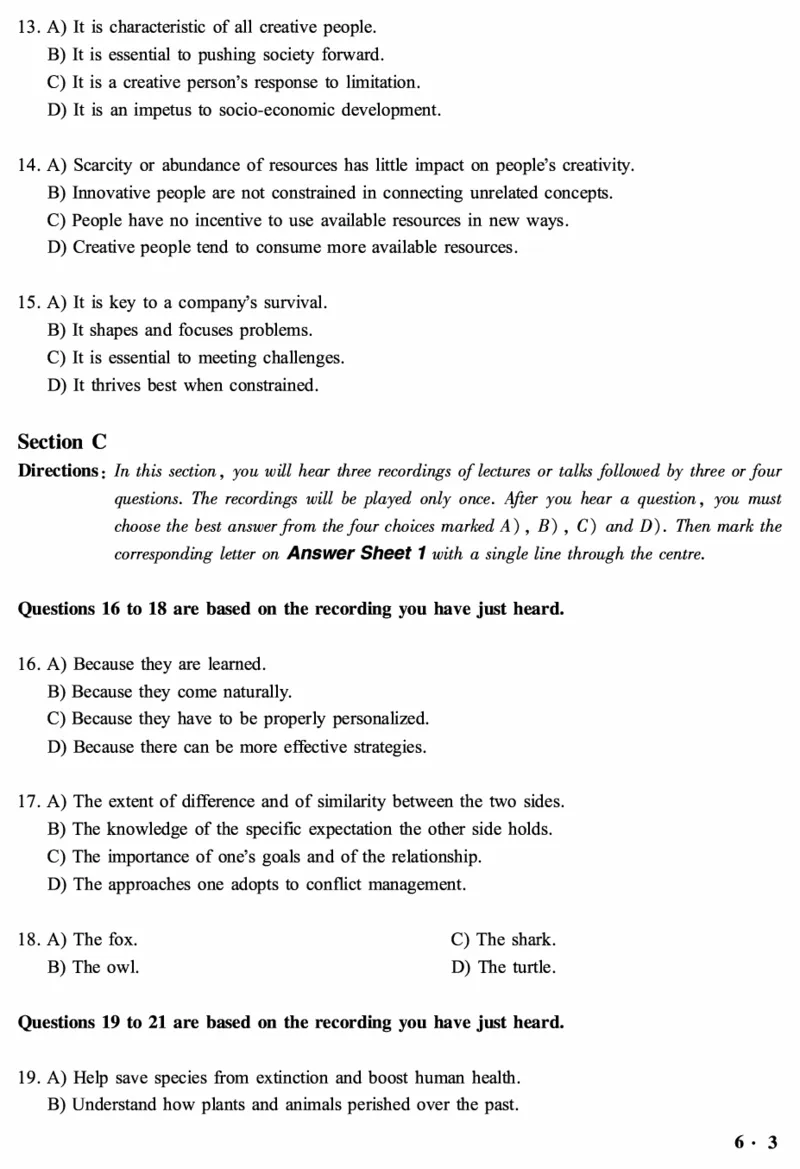
Section C
Directions : In this section, you will hear three recordings of lectures or talks followed by three or four
questions. The recordings will be played only once. After you hear a question, you must
choose the best answer from the four choices marked A), B), C) and D). Then mark the
corresponding letter on Answer Sheet 1 with a single line through the centre.
Questions 16 to 18 are based on the recording you have just heard.
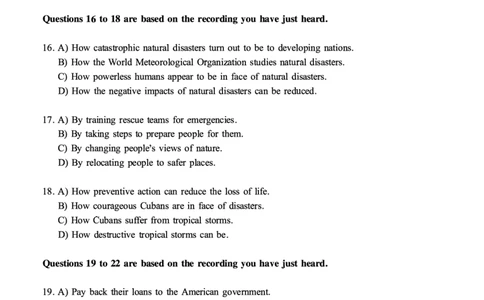
16. A) How catastrophic natural disasters turn out to be to developing nations.
B) How the World Meteorological Organization studies natural disasters.
C) How powerless humans appear to be in face of natural disasters.
D) How the negative impacts of natural disasters can be reduced.
17. A) By training rescue teams for emergencies.
B) By taking steps to prepare people for them.
C) By changing people's views of nature.
D) By relocating people to safer places.
18. A) How preventive action can reduce the loss of life.
B) How courageous Cubans are in face of disasters.
C) How Cubans suffer from tropical storms.
D) How destructive tropical storms can be.
Questions 19 to 22 are based on the recording you have just heard.
19. A) Pay back their loans to the American government.
B) Provide loans to those in severe fmancial difficulty.
C) Contribute more to the goal of a wider recovery.
D) Speed up their recovery from the housing bubble.
20. A) Some banks may have to merge with others.
B) Many smaller regional banks are going to fail.
C) It will be hard for banks to provide more loans.
D) Many banks will have to lay off some employees.
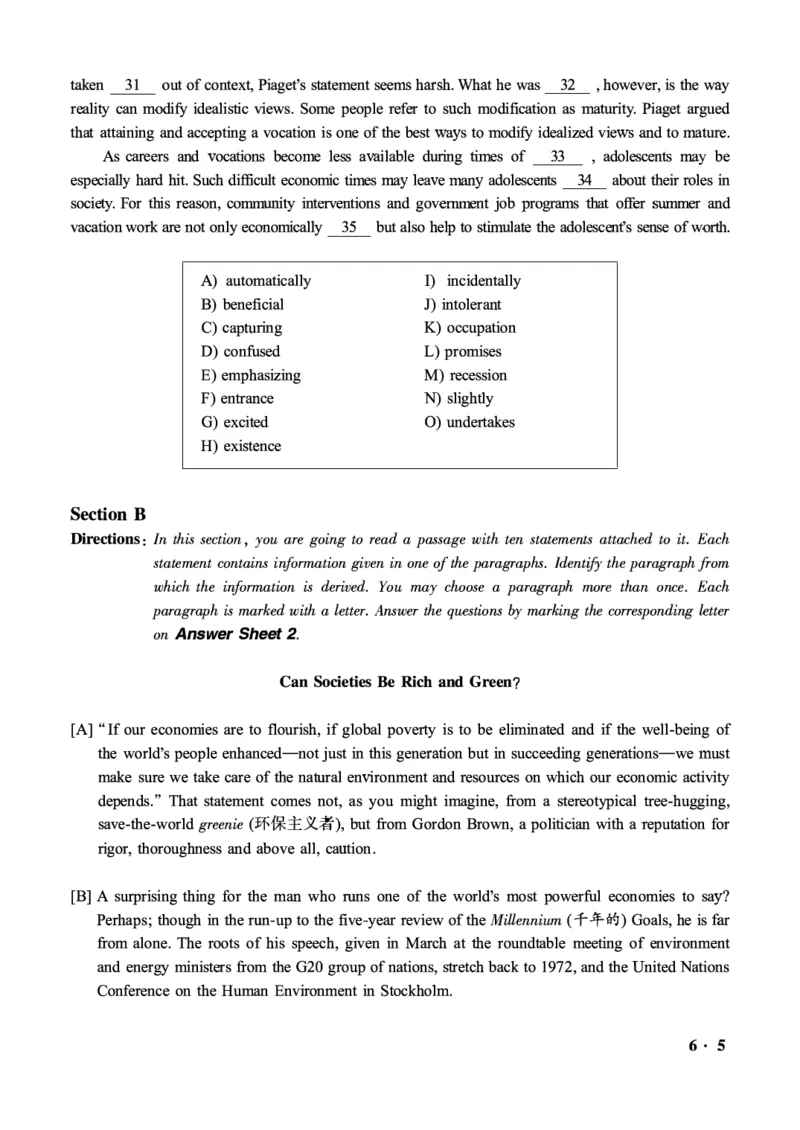
6 · 321. A) It will work closely with the government. C) It will try to lower the interest rate.
B) It will endeavor to write off bad loans. D) It will try to provide more loans.
22. A) It won't help the American economy to tum around.
B) It won't do any good to the major commercial banks.
C) It will win the approval of the Obama administration.
D) It will be necessary if the economy starts to shrink again.
Questions 23 to 25 are based on the recording you have just heard.
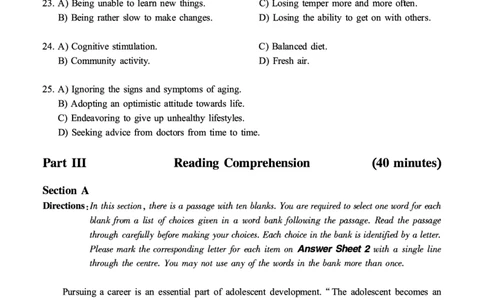
23. A) Being unable to learn new things. C) Losing temper more and more often.
B) Being rather slow to make changes. D) Losing the ability to get on with others.
24. A) Cognitive stimulation. C) Balanced diet.
B) Community activity. D) Fresh air.
25. A) Ignoring the signs and symptoms of aging.
B) Adopting an optimistic attitude towards life.
C) Endeavoring to give up unhealthy lifestyles.
D) Seeking advice from doctors from time to time.
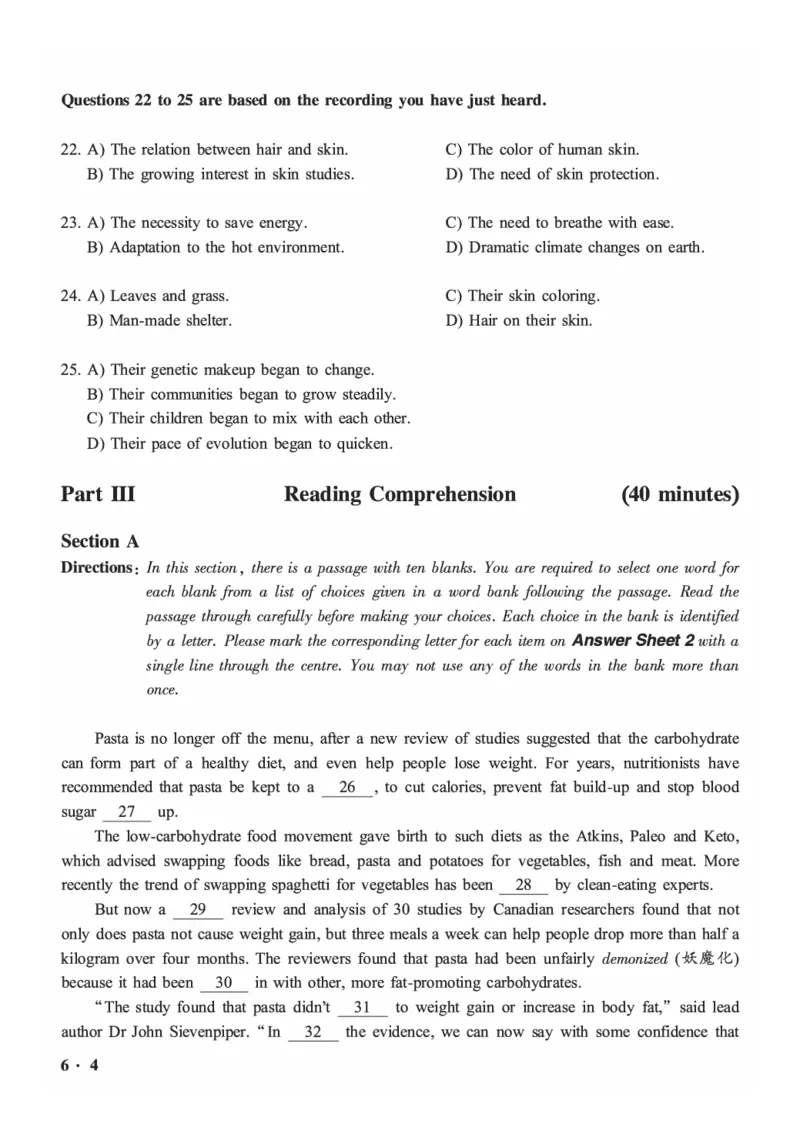
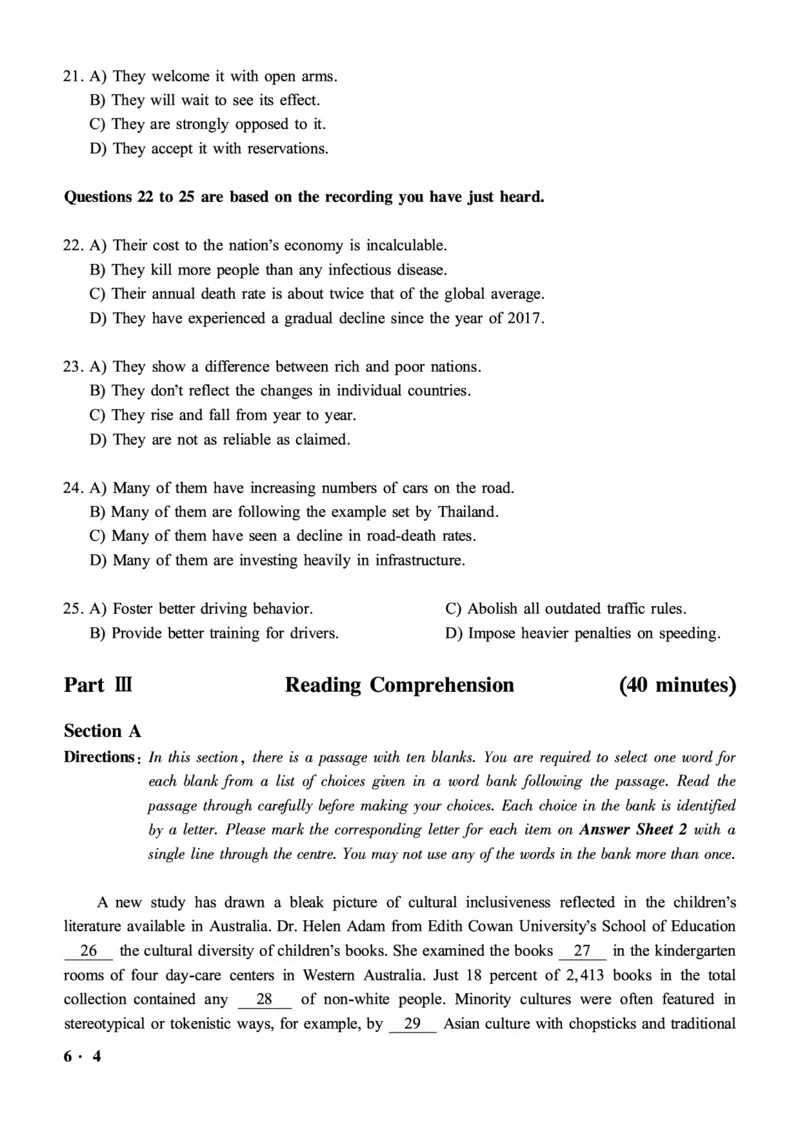
Part III Reading Comprehension (40 minutes)
Section A
Directions : In this section, there is a passage with ten blanks. You are required to select one wordfo r each
blank from a list of choices given in a word bank following the passage. Read the passage
through carefully before making your choices. Each choice in the bank is identified by a letter.
Please mark the corresponding letter for each item on Answer Sheet 2 with a single line
through the centre. You may not use any of the words in the bank re than once.
砌
Pursuing a career is an essential part of adolescent development. " The adolescent becomes an
adult when he 26 a real job." To cognitive researchers like Piaget, adulthood meant the
beg皿ing of an 27
Piaget argued that once adolescents enter the world of work, their newly acquired ability to form
hypotheses allows them to create representations that are too ideal. The 28 of such ideals,
without the tempering of the reality of a job or profession, rapidly leads adolescents to become
29 of the non-idealistic world and to press for reform in a characteristically adolescent way.
Piaget said: "True adaptation to society comes 30 when the adolescent reformer attempts to put
his ideas to work."
Of course, youthful idealism is often courageous, and no one likes to give up dreams. Perhaps,
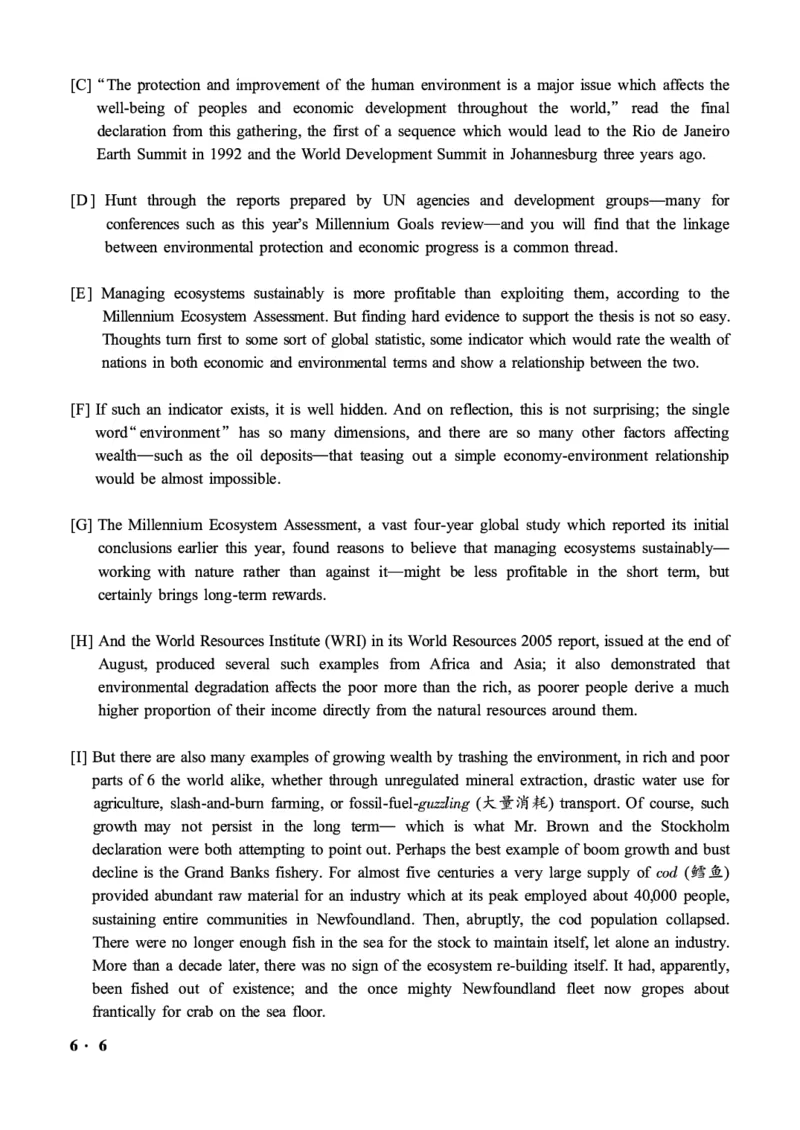
6 · 4taken 31 out of context, Piaget's statement seems harsh. What he was 32 , however, is the way
reality can modify idealistic views. Some people refer to such modification as maturity. Piaget argued
that attaining and accepting a vocation is one of the best ways to modify idealized views and to mature.
As careers and vocations become less available during times of 33 , adolescents may be
especially hard hit. Such difficult economic times may leave many adolescents 34 about their roles in
society. For this reason, community interventions and government job programs that offer summer and
vacation work are not only economically 35 but also help to stimulate the adolescent's sense of worth.
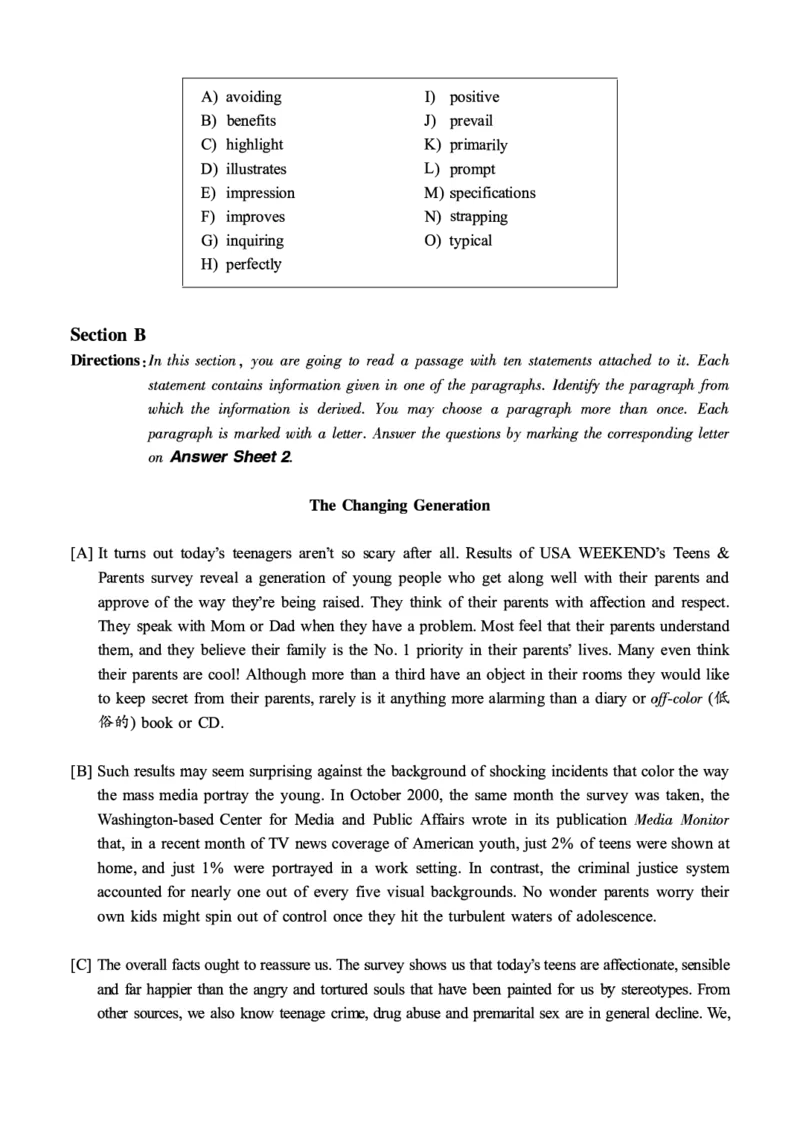
A) automatically I) incidentally
B) beneficial J) intolerant
C) capturing K) occupation
D) confused L) promises
E) emphasizing M) recession
F) entrance N) slightly
G) excited 0) undertakes
H) existence
Section B
Directions : In this section, you are going to read a passage with ten statements attached to it. Each
statement contains information given in one of the paragraphs. Identify the paragraph from
which the information is derived. You may choose a paragraph more than once. Each
paragraph is marked with a letter. Answer the questions by marking the corresponding letter
on Answer Sheet 2.
Can Societies Be Rich and Green?
[A] "If our economies are to flourish, if global poverty is to be eliminated and if the well-being of
the world's people enhanced—not just in this generation but in succeeding generations—we must
make sure we take care of the natural environment and resources on which our economic activity
depends." That statement comes not, as you might imagine, from a stereotypical tree-hugging,
save-the-world greenie (环保主义者), but from Gordon Brown, a politician with a reputation for
rigor, thoroughness and above all, caution.
[B] A surprising thing for the man who runs one of the world's most powerful economies to say?
Perhaps; though in the run-up to the five-year review of the Millennium (千年的) Goals, he is far
from alone. The roots of his speech, given in March at the roundtable meeting of environment
and energy ministers from the G20 group of nations, stretch back to 1972, and the United Nations
Conference on the Human Environment in Stockholm.
6 · 5[C] "The protection and improvement of the human environment is a major issue which affects the
well-being of peoples and economic development throughout the world," read the fmal
declaration from this gathering, the first of a sequence which would lead to the Rio de Janeiro
Earth Summit in 1992 and the World Development Summit in Johannesburg three years ago.
[D] Hunt through the reports prepared by UN agencies and development groups—many for
conferences such as this year's Millennium Goals review—and you will find that the linkage
between environmental protection and economic progress is a common thread.
[E] Managing ecosystems sustainably is more profitable than exploiting them, according to the
Millennium Ecosystem Assessment. But finding hard evidence to support the thesis is not so easy.
Thoughts tum first to some sort of global statistic, some indicator which would rate the wealth of
nations in both economic and environmental terms and show a relationship between the two.
[F] If such an indicator exists, it is well hidden. And on reflection, this is not surprising; the single
word" environment" has so many dimensions, and there are so many other factors affecting
wealth—such as the oil deposits—that teasing out a simple economy-environment relationship
would be ahnost impossible.
[G] The Millennium Ecosystem Assessment, a vast four-year global study which reported its initial
conclusions earlier this year, found reasons to believe that managing ecosystems sustainably—
working with nature rather than against it—might be less profitable in the short term, but
certainly brings long-term rewards.
[H] And the World Resources Institute (WRI) in its World Resources 2005 report, issued at the end of
August, produced several such examples from Africa and Asia; it also demonstrated that
environmental degradation affects the poor more than the rich, as poorer people derive a much
higher proportion of their income directly from the natural resources around them.
[I] But there are also many examples of growing wealth by trashing the environment, in rich and poor
parts of 6 the world alike, whether through unregulated mineral extraction, drastic water use for
agriculture, slash-and-bum farming, or fossil-fuel-guzzling(大量消耗)transport. Of course, such
grow小may not persist in the long tern which is what Mr. Brown and the Stockholm
尸
declaration were both attempting to point out. Perhaps the best example of boom growth and bust
decline is the Grand Banks fishery. For almost five centuries a very large supply of cod(鳍鱼)
provided abundant raw material for an industry which at its peak employed about 40,000 people,
sustaining entire communities in Newfoundland. Then, abruptly, the cod population collapsed.
There were no longer enough fish in the sea for the stock to maintain itself, let alone an industry.
More than a decade later, there was no sign of the ecosystem re-building itself. It had, apparently,
been fished out of existence; and the once mighty Newfoundland fleet now gropes about
frantically for crab on the sea floor.
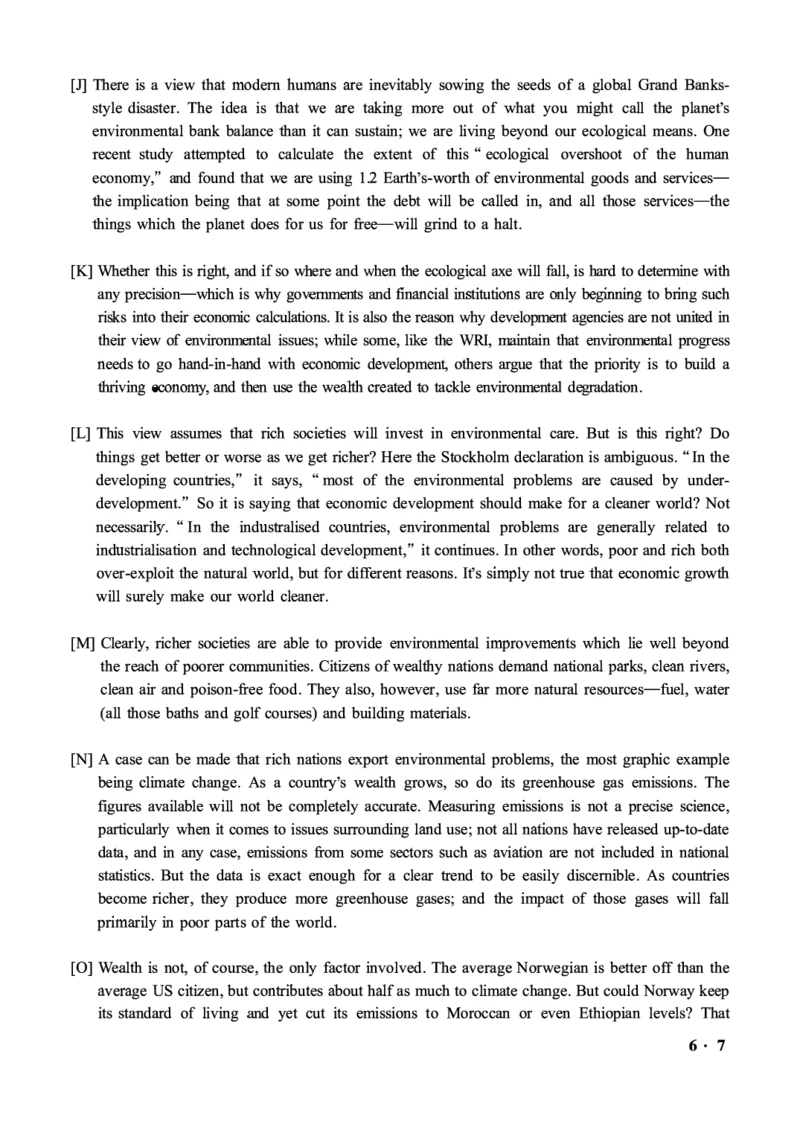
6 · 6[J]There is a view that modem humans are inevitably sowing the seeds of a global Grand Banks
style disaster. The idea is that we are taking more out of what you might call the planet's
environmental bank balance than it can sustain; we are living beyond our ecological means. One
recent study attempted to calculate the extent of this " ecological overshoot of the human
economy," and found that we are using 1.2 Earth's-worth of environmental goods and services—
the implication being that at some point the debt will be called in, and all those services—the
things which the planet does for us for free—will grind to a halt.
[K] Whether this is right, and if so where and when the ecological axe will fall, is hard to determine with
any precision—which is why governments and :financial institutions are only beginning to bring such
risks into their economic calculations. It is also the reason why development agencies are not united in
their view of enviromnental issues; while some, like the W团,maintain that enviromnental progress
needs to go hand-in-hand with economic development, others argue that the priority is to build a
thriving economy, and then use the wealth created to tackle enviromnental degradation.
[L]This view assumes that rich societies will invest in envirorunental care. But is this right? Do
things get better or worse as we get richer? Here the Stockholm declaration is ambiguous. "In the
developing countries," it says, "most of the envirorunental problems are caused by under
development." So it is saying that economic development should make for a cleaner world? Not
necessarily. " In the industralised countries, environmental problems are generally related to
industrialisation and technological development," it continues. In other words, poor and rich both
over-exploit the natural world, but for different reasons. It's simply not true that economic growth
will surely make our world cleaner.
[M]Clearly, richer societies are able to provide environmental improvements which lie well beyond
the reach of poorer communities. Citizens of wealthy nations demand national parks, clean rivers,
clean air and poison-free food. They also, however, use far more natural resources—fuel, water
(all those baths and golf courses) and building materials.
[N]A case can be made that rich nations export environmental problems, the most graphic example
being climate change. As a country's wealth grows, so do its greenhouse gas emissions. The
figures available will not be completely accurate. Measuring emissions is not a precise science,
particularly when it comes to issues surrounding land use; not all nations have released up-to-date
data, and in any case, emissions from some sectors such as aviation are not included in national
statistics. But the data is exact enough for a clear trend to be easily discernible. As countries
become richer, they produce more greenhouse gases; and the impact of those gases will fall
primarily in poor parts of the world.
[O] Wealth is not, of course, the only factor involved. The average Norwegian is better off than the
average US citizen, but contributes about half as much to climate change. But could Norway keep
its standard of living and yet cut its emissions to Moroccan or even Ethiopian levels? That
6 · 7question, repeated across a dozen environmental issues and across our diverse planet, is what will
ultimately determine whether the human race is living beyond its ecological means as it pursues
economic revival.
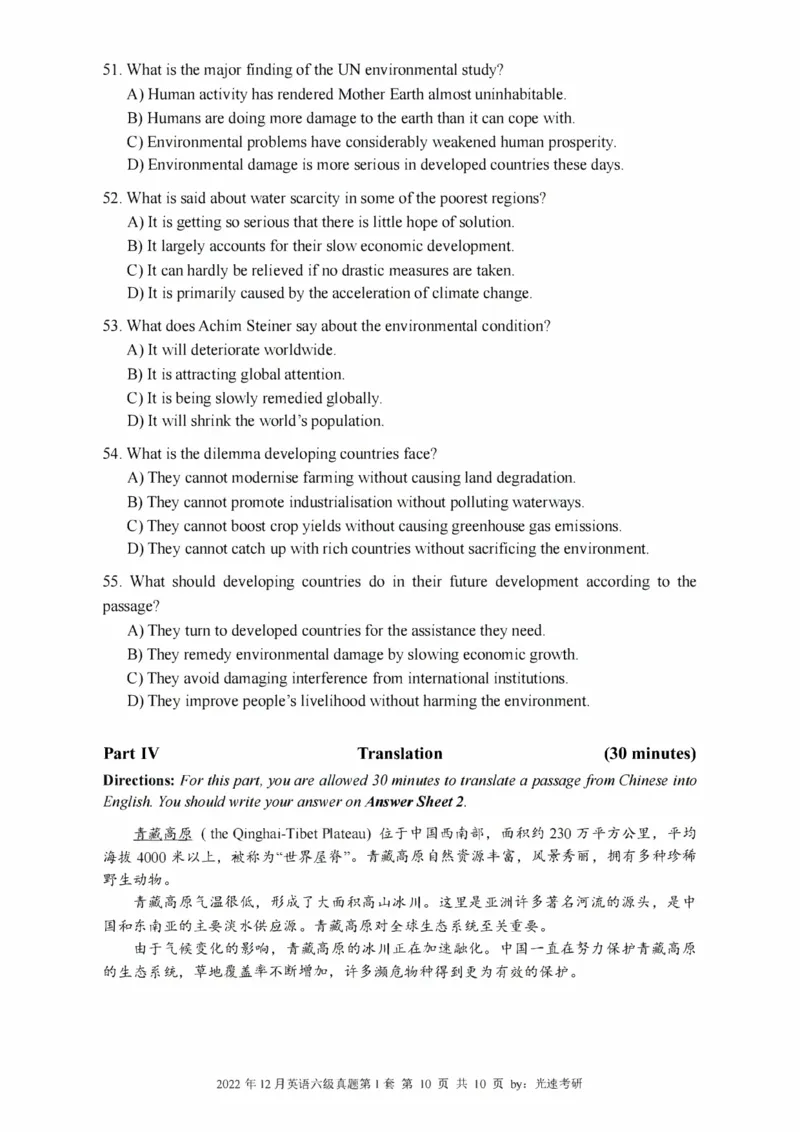
36. Examples show that both rich and poor countries exploited the environment for economic progress.
37 . Environmental protection and improvement benefit people all over the world.
38. It is not necessarily true that economic growth will make our world cleaner.
39. The common theme of the UN reports is the relation between environmental protection and
economic growth.
40. Development agencies disagree regarding how to tackle environment issues while ensuring
economic progress.
41. It is difficult to find solid evidence to prove environmental friendliness generates more profits than
exploiting the natural environment.
42. Sustainable management of ecosystems will prove rewarding in the long run.
43. A politician noted for being cautious asserts that sustainable human development depends on the
natural environment.
44. Poor countries will have to bear the cost for rich nations' economic development.
45. One recent study warns us of the danger of the exhaustion of natural resources on Earth.
Section C
Directions : There are two passages in this section. Each p assage is followed by some questions or
unfinished statements. For each of them there are four choices marked A), B), C) and
D). You should decide on the best choice and mark the corresponding letter on Answer
Sheet 2 with a single line through the centre.
Passage One
Questions 46 to 50 are based on the following passage.
Interactive television advertising, which allows viewers to use their remote controls to click on
advertisements, has been pushed for years. Nearly a decade ago it was predicted that viewers of
"Friends," a popular situation comedy, would soon be able to purchase a sweater like Jennifer
Aniston's with a few taps on their remote control. " It's been the year of interactive television
advertising for the last ten or twelve years," says Colin Dixon of a digital-media consultancy.
6 · 8So the news that Cablevision, an American cable company, was rolling out interactive
advertisements to all its customers on October 6th was greeted with some skepticism. During
commercials, an overlay will appear at the bottom of the screen, prompting viewers to press a button
to request a free sample or order a catalogue. Cablevision 8 hopes to allow customers to buy things
with their remote controls early next year.
Television advertising could do with a boost. Spending fell by 10% in the first half of the year.
The popularization of digital video recorders has caused advertisers to worry that their commercials
will be skipped. Some are turning to the Internet, which is cheaper and offers concrete measurements
like click-through rates—especially important at a time when marketing budgets are tight. With the
launch of interactive advertising, "many of the dollars that went to the Internet will come back to the
TV," says David Kline of Cablevision. Or so the industry hopes.
In theory, interactive advertising can engage viewers in a way that 30-second spots do not.
Unilever recently ran an interactive campaign for its Axe deodorant (除臭剂), which kept viewers
engaged for more than three minutes on average.
The amount spent on interactive advertising on television is still small. Magna, an advertising
agency, reckons it will be worth about $ 138 million this year. That falls far short of the billions of
dollars people once expected it to generate. But DirecTV, Comcast and Time Warner Cable have all
invested in it. A new effort led by Canoe Ventures, a coalition of leading cable providers, aims to make
interactive advertising available across America later this year. BrightLine iTV, which designs and sells
interactive ads, says interest has surged: it expects its revenues almost to triple this year. BSkyB,
Britain's biggest satellite-television service, already provides 9 million customers with interactive ads.
Yet there are doubts whether people watching television, a "lean back" medium, crave interaction.
Click-through rates have been high so far (around 3 - 4%, compared with less than 0.3% online), but
that may be a result of the novelty. Interactive ads and viewers might not go well together.
46. What does Colin Dixon mean by saying "It's been the year of interactive television advertising
for the last ten or twelve years" (Lines 4 - 5, Para.I)?
A) Interactive television advertising will become popular in 10- 12 years.
B) Interactive television advertising has been under debate for the last decade or so.
C) Interactive television advertising is successful when incorporated into situation comedies.
D) Interactive television advertising has not achieved the anticipated results.
47. What is the public's response to Cablevision's planned interactive TV advertising program?
A) Pretty positive. C) Somewhat doubtful.
B) Totally indifferent. D) Rather critical.
48. What is the impact of the wide use of digital video recorders on TV advertising?
A) It has made TV advertising easily accessible to viewers.
B) It helps advertisers to measure the click-through rates.
C) It has placed TV advertising at a great disadvantage.
D) It enables viewers to check the sales items with ease.
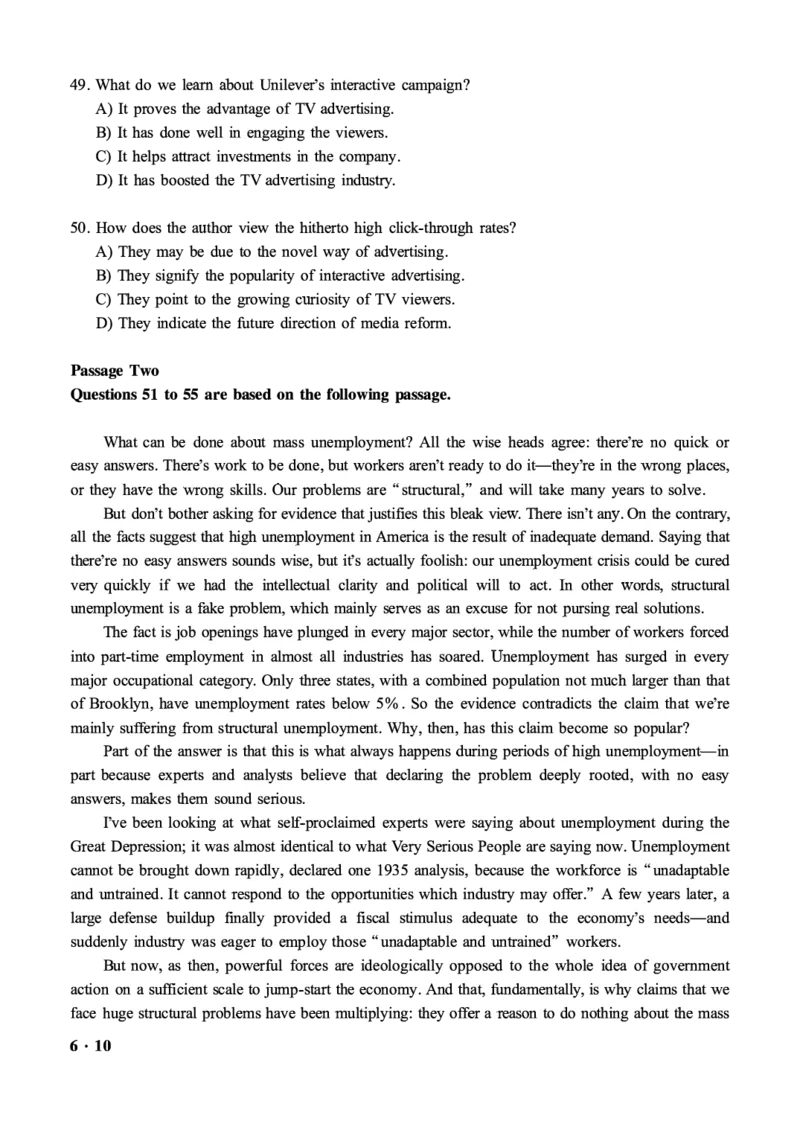
6 · 949. What do we learn about Unilever's interactive campaign?
A) It proves the advantage of TV advertising.
B) It has done well in engaging the viewers.
C) It helps attract investments in the company.
D) It has boosted the TV advertising industry.
50. How does the author view the hitherto high click-through rates?
A) They rnay be due to the novel way of advertising.
B) They signify the popularity of interactive advertising.
C) They point to the growing curiosity of TV viewers.
D) They indicate the future direction of media reform.
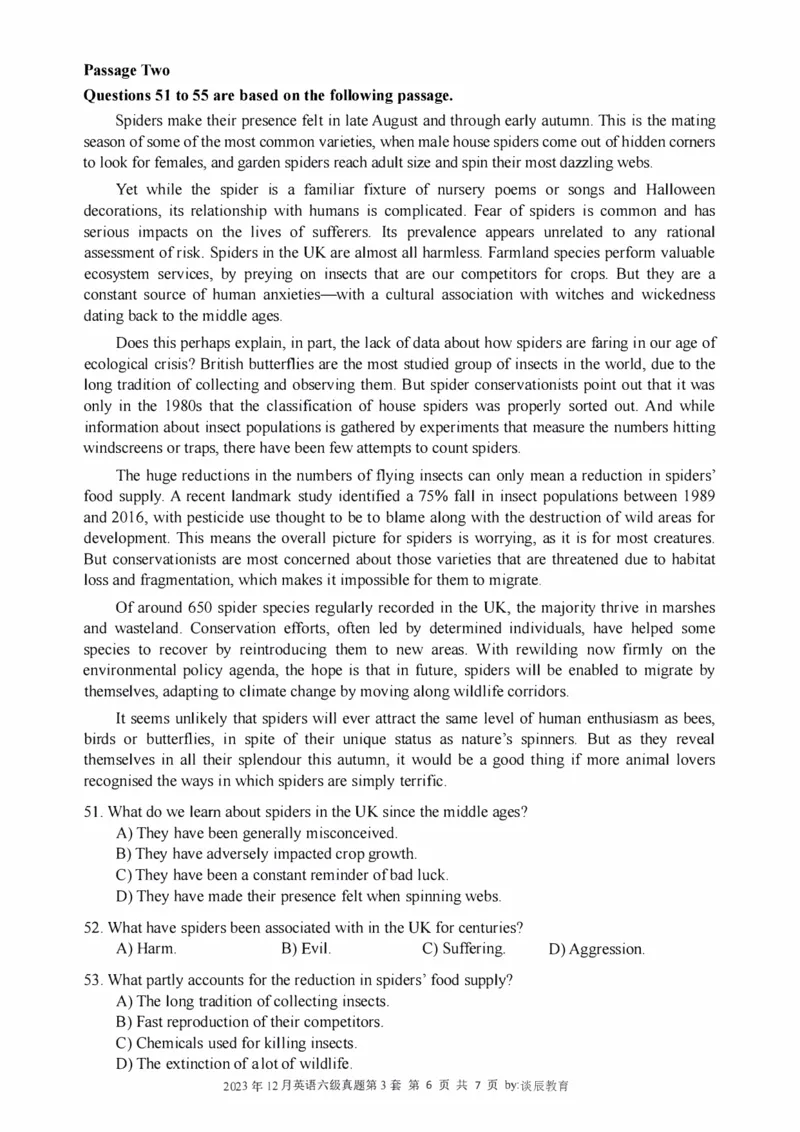
Passage Two
Questions 51 to 55 are based on the following passage.
What can be done about mass unemployment? All the wise heads agree: there're no quick or
easy answers. There's work to be done, but workers aren't ready to do it—they're in the wrong places,
or they have the wrong skills. Our problems are "structural," and will take many years to solve.
But don't bother asking for evidence that justifies this bleak view. There isn't any. On the contrary,
all the facts suggest that high unemployment in America is the result of inadequate demand. Saying that
there're no easy answers sounds wise, but it's actually foolish: our unemployment crisis could be cured
very quickly if we had the intellectual clarity and political will to act. In other words, structural
unemployment is a fake problem, which mainly serves as an excuse for not pursing real solutions.
The fact is job openings have plunged in every major sector, while the number of workers forced
into part-time employment in almost all industries has soared. Unemployment has surged in every
major occupational category. Only three states, with a combined population not much larger than that
of Brooklyn, have unemployment rates below 5%. So the evidence contradicts the claim that we're
mainly suffering from structural unemployment. Why, then, has this claim become so popular?
Part of the answer is that this is what always happens during periods of high unemployment—in
part because experts and analysts believe that declaring the problem deeply rooted, with no easy
answers, makes them sound serious.
I've been looking at what self-proclaimed experts were saying about unemployment during the
Great Depression; it was almost identical to what Very Serious People are saying now. Unemployment
cannot be brought down rapidly, declared one 193 5 analysis, because the workforce is "unadaptable
and untrained. It cannot respond to the opportunities which industry may offer." A few years later, a
large defense buildup finally provided a fiscal stimulus adequate to the economy's needs—and
suddenly industry was eager to employ those "unadaptable and untrained" workers.
But now, as then, powerful forces are ideologically opposed to the whole idea of government
action on a sufficient scale to jump-start the economy. And that, fundamentally, is why claims that we
face huge structural problems have been multiplying: they offer a reason to do nothing about the mass
6 · 10unemployment that is crippling our economy and our society.
So what you need to know is that there's no evidence whatsoever to back these claims. We aren't
suffering from a shortage of needed skills; we're suffering from a lack of policy resolve. As I said,
structural unemployment isn't a real problem, it's an excuse—a reason not to act on America's
problems at a time when action is desperately needed.
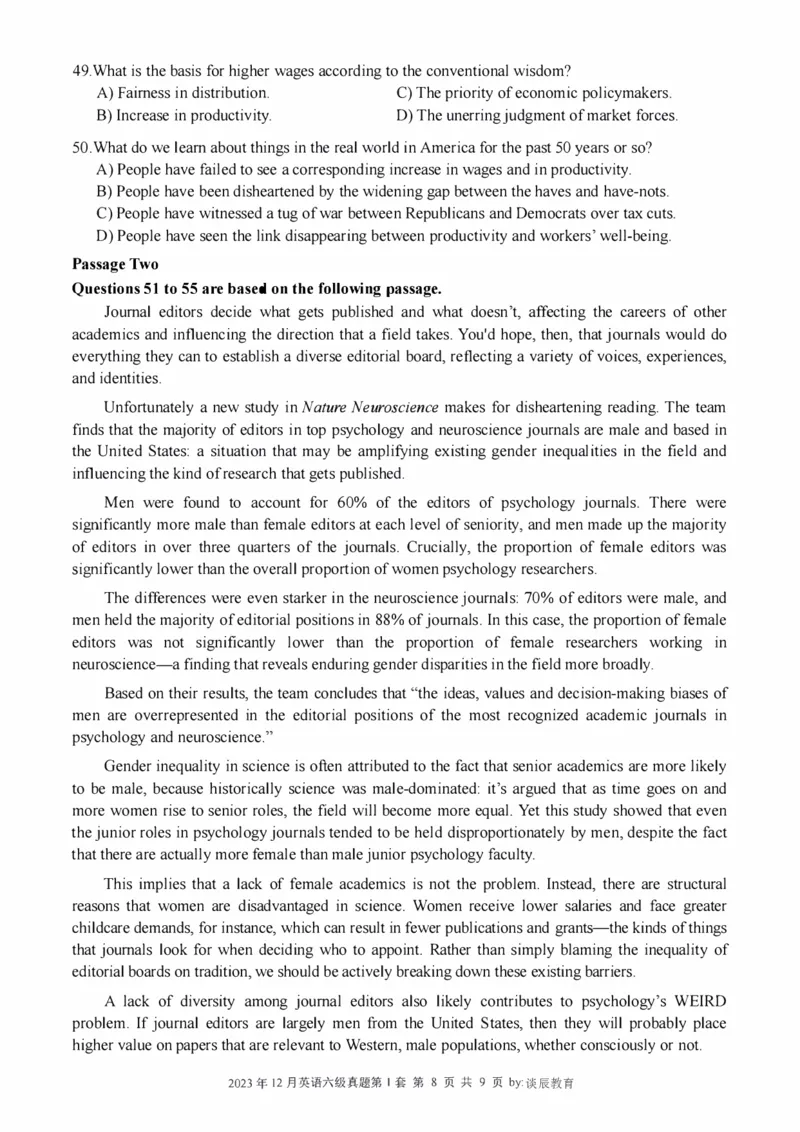
51. What does the author think is the root cause of mass unemployment in America?
A) Corporate mismanagement. C) Technological advances.
B) Insufficient demand. D) Workers' slow adaptation.
52. What does the author think of the experts' claim concerning unemployment?
A) Self-evident. C) Irrational.
B) Thought-provoking. D) Groundless.
53. What does the author say helped bring down unemployment during the Great Depression?
A) The booming defense industry. C) Nationwide training of workers.
B) The wise heads' benefit package. D) Thorough restructuring of industries.
54. What has caused claims of huge structural problems to multiply?
A) Powerful opposition to government's stimulus efforts.
B) Very Serious People's attempt to cripple the economy.
C) Evidence gathered from many sectors of the industries.
D) Economists'failure to detect the problems in time.
55. What is the author's purpose in w百ting the passage?
A) To testify to the experts' analysis of America's problems.
B) To offer a feasible solution to the structural unemployment.
C) To show the urgent need for the government to take action.
D) To alert American workers to the urgency for adaptation.
Part IV Translation (30 minutes)
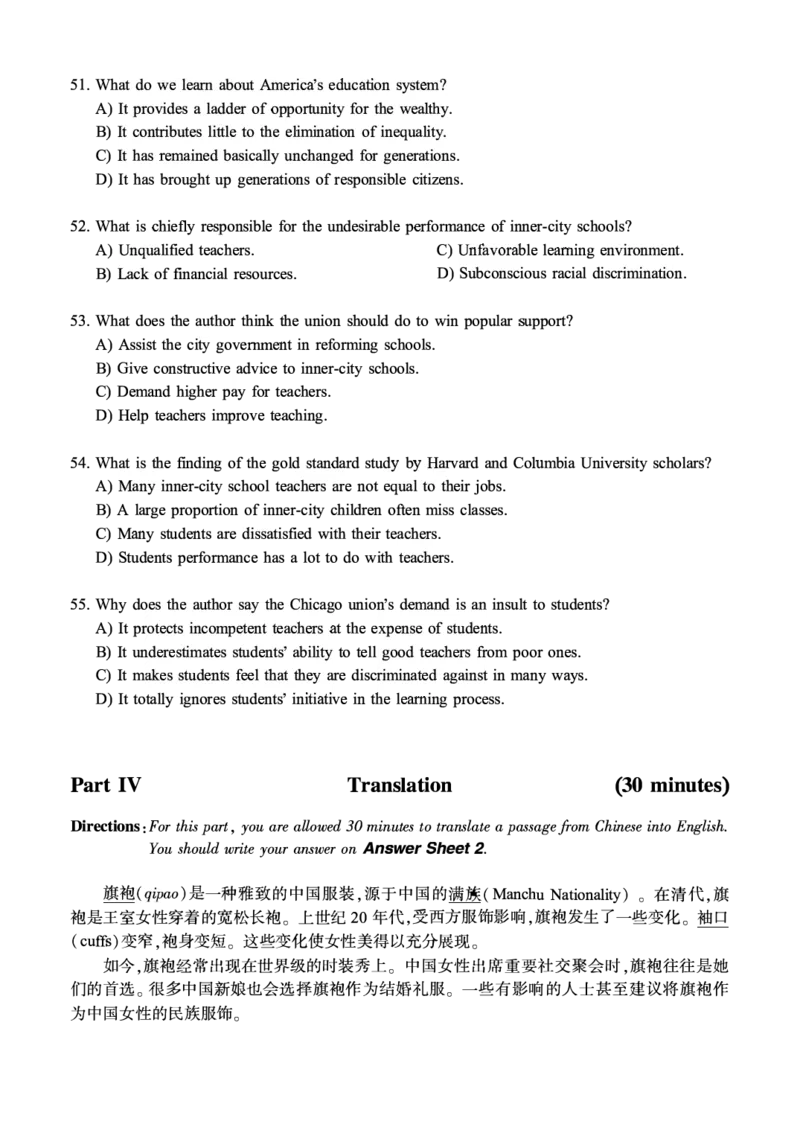
Directions: For this part, you are allowed 30 minutes to translate a passage from Chinese into English.
You should write your answer on Answer Sheet 2.
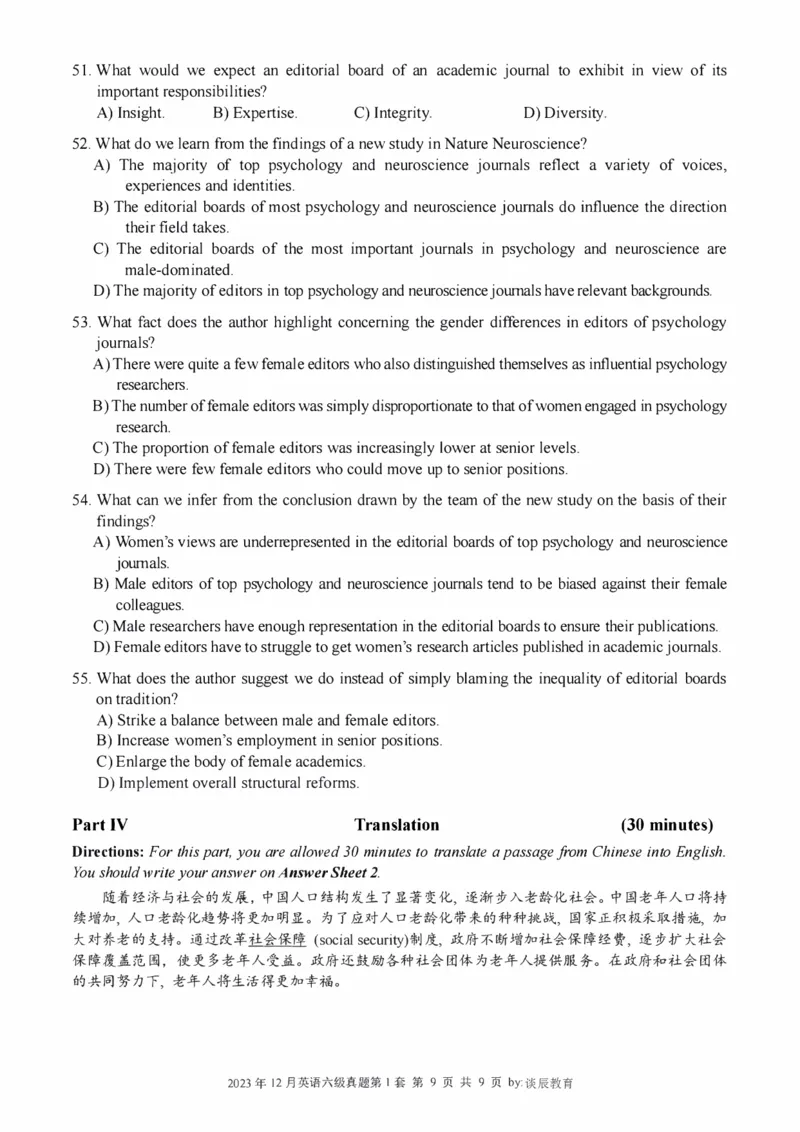
中国的创新正以前所未有的速度蓬勃发展。 为了在科学技术上尽快赶超世界发达国家,中
国近年来大幅度增加了研究开发资金。 中国的大学和研究所正在积极开展创新研究,这些研究
覆盖了从大数据到生物化学、从新能源到机器人等各类高科技领域。 它们还与各地的科技园合
作,使创新成果商业化。 与此同时,无论在产品还是商业模式上,中国企业家也在努力争做创新
的先锋,以适应国内外消费市场不断变化和增长的需求。
6 · 11未得到监考教师指令前,不得翻阅该试题册!
Part I Writing (30 minutes)
(请千正式开考后半小时内完成该部分,之后将进行听力考试)
. . . . .
Directions: For thiiss ppaarrtt,, yyoouu aarree aalllloowweedd 3300 mminutes to write a short essay on living in the virtual
i
world. Try to imagine what will h en when people spend more and more time in the
app
饥rtual world instead of interacting in the real world. You are required to write at least
150 words but no more than 200 words.
请用黑色签字笔在答题卡l指定区域内作答作文题,在试题册上的作答无效!
请认真填写以下信息
I
准考证号
姓 名:
错填、未填以上信息,按违规处理!2(cid:21)(cid:21) 0(cid:19)(cid:20)1(cid:25)6(cid:5290)年
6
1(cid:7486)2月(cid:3933)大(cid:4508)学(cid:14631)英(cid:16931)语(cid:1955)六(cid:13533)级(cid:11605)真(cid:20174)题(cid:12642)第
2套
2套
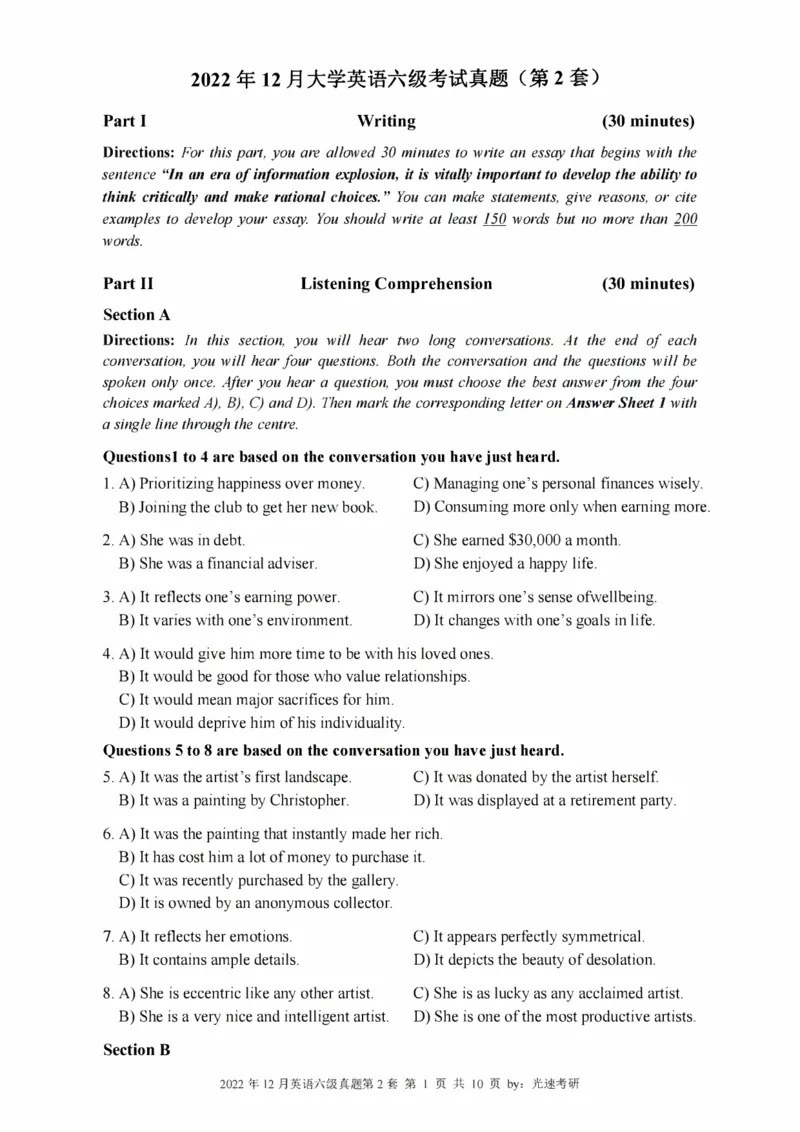
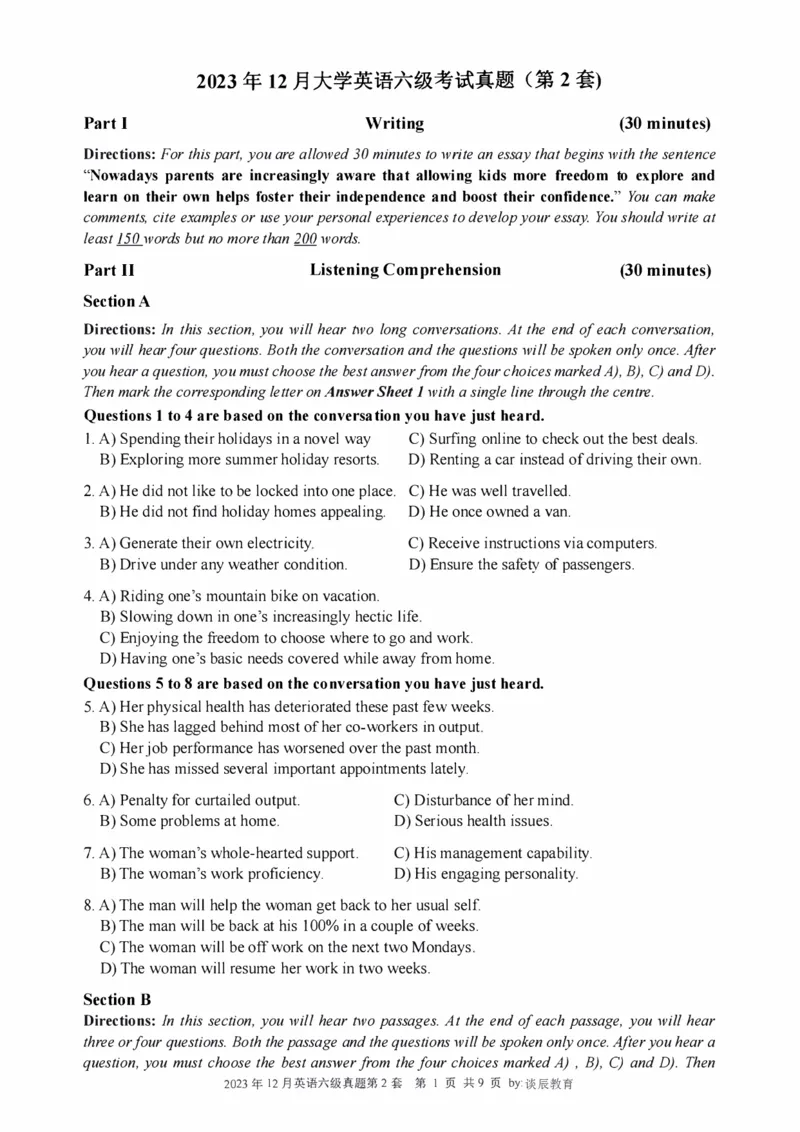
Part I
Listening Comprehension (30 minutes)
Part II Listening Comprehension (30 minutes)
Section A
Section A
Directions:In this section,you will hear two long conersations.At the end of each conersation,you
Directions : In this section , you will hear two long conversations. At the end of each conversation, you
will hear four questions.Both the conversation and the questions will be spoken only once.
will hear four questions. Both the conversation and the questions will be spoken only once.
After you hear a question,you must choose the best answer from the four choices marked
After you hear a question , you must choose the best answer from the four choices marked
A),B),C)and D).Then man the corresponding leer on Answer Sheet 1with a
A) , B) , C) and D) . Then mark the corresponding letter on Answer Sheet 1 with a
single line through the centre.
single line through the centre.
Questions 1 to 4 are based on the conversation you have just heard.
Questions 1 to 4 are based on the conversation you have just heard.
1.1A.)A )T hTeh ep rporjoejcetct tthhee mmaann mmaannaaggeedd aatt CCuucciinn TTeecchh..
BB) )ThTeh eu pudpadtaitning go of ft teecchhnnoollooggyy aatt CCuucciinn TTeecchh..
C)C )ThTeh em amn'ans 'ss wsiwtictchh t oto aa nneeww c caarreeeerr..
D) The restructuring of her company.
D) The restructuring of her company.
2. 2 . A A ) ) T T al a e le n n t t e e d d p p e e r r s s o o n n n n e e l l. . C)C )CoCmopmetpiettiitvivee pprroodduuccttss..
B)B )StSrtratateeggiicc iinnnnoovvaattiioonn.. D)D )EfEfffecetcitivvee pprroommoottiioonn..
3. A) Expand the market.
3. A) Expand the market. C)C )InInnonvoavtaet ec oconsntsatannttllyy..
B)B )ReRcercuriuti t mmoroer et atalleennttss.. D)D )WaWtcahtc hou ot uft ofor rh ihsis ccoommpepteittitoorrss..
4. A) Possible bankruptcy. C) Conflicts within the company.
4. A) Possible bankruptcy. C) Conflicts within the company.
B) B ) Un U fo n r fo es r e e e se n e d n i f d f iffi ic c u u lt lt i i e e s s. . D)D I)mIimtaittaitoionn bbyy oonen'es's ccoommpepteittitoorrss..
Questions 5 to 8 are based on the conversation you have just heard.
Questions 5 to 8 are based on the conversation you have just heard.
5.5A.)A T) hTe hjeo jbo bof oafn an i nitnetreprprreetteerr.. C)C )ThTeh ei mipmorptoarntancec eo fo fl alanngguaugaeg ep rporfoificciieennccyy..
B)B )ThTe hset rsetrsess sf efeltlt bbyy pprrooffeessssiioonnaallss.. D)D )ThTeh eb ebsets tw waya yt ot oe effffeeccttiivvee ccoommmmuunnicicaattiioonn..
6. A) Promising. C) Rewarding.
6. A) Promising. C) Rewarding.
B)B )AAdmdimriarabbllee.. D) D ) M M ea e n an in in g g f fu ul l. .
7.7A.)ATh) eTy haelyl ahlla vhea vae sat rsotrnogn gin tinetreersets t iinn llanangguuaaggee..
B)B )ThTehy eayl la llh ahvaev ep rporfoefesssisoinoanla lq uqaulailfifiiccaattiioonnss..
C)C )ThTehye yh ahvea vael la llp apsassesde dl alnangugaugaeg ep rporfoificiceienncyc yt etessttss..
D)DT)heTyh heayv eh aavlel asltl usdtiueddi ecdr ocsrso-scsu-lctuultrurala ld idfifffeerreenncceess..
8.8A.A)I)t I tr ereqquiurireess aa mmuuchc hl alarrggeerr vvooccaabbuullaarryy..
B)B )ItI t aattttaacchheess mmoorree iimmppoortrtaannccee ttoo aaccccuurraaccyy..
C)C )ItI ti iss mmoroer es tsrtreessssffuull tthhaann ssiimmuullttaanneeoouus si inntteerrpprreettiinngg..
D)DI)t Ipt uptust so noen'es's lloonngg--tteermrm mmeemmoroyr yu nudnedre rm omroer es tsrtreessss..Section B
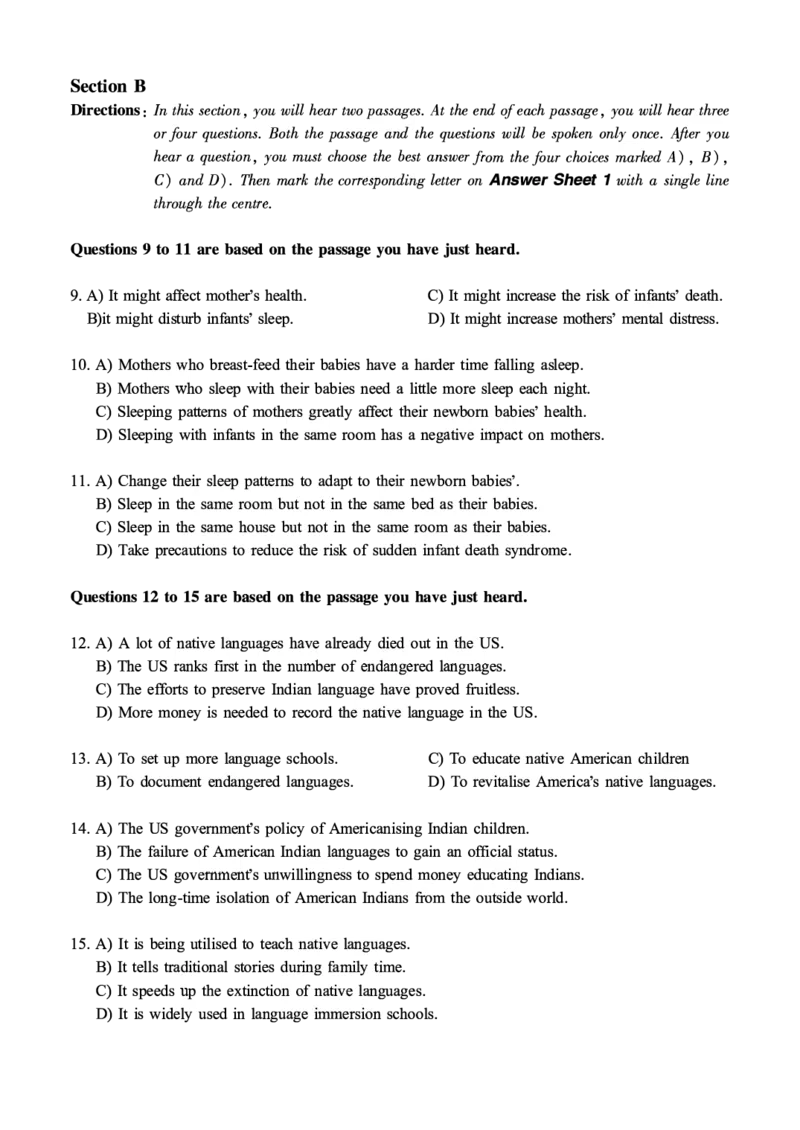
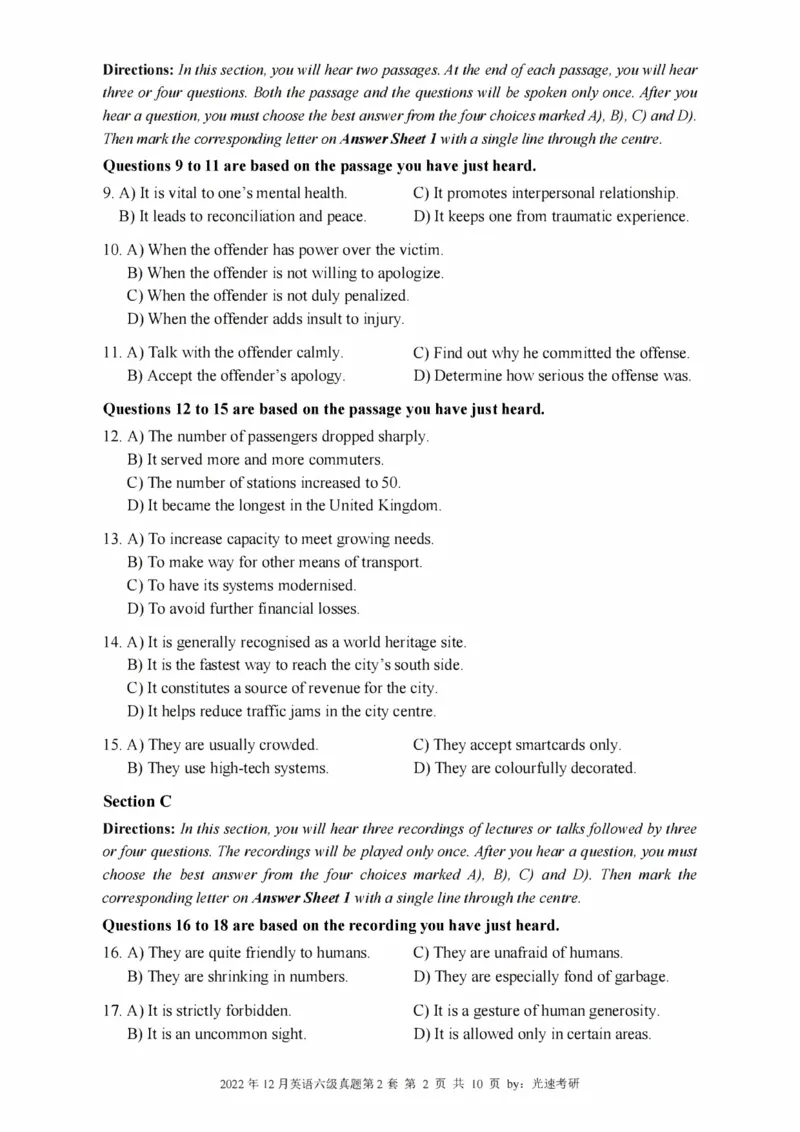
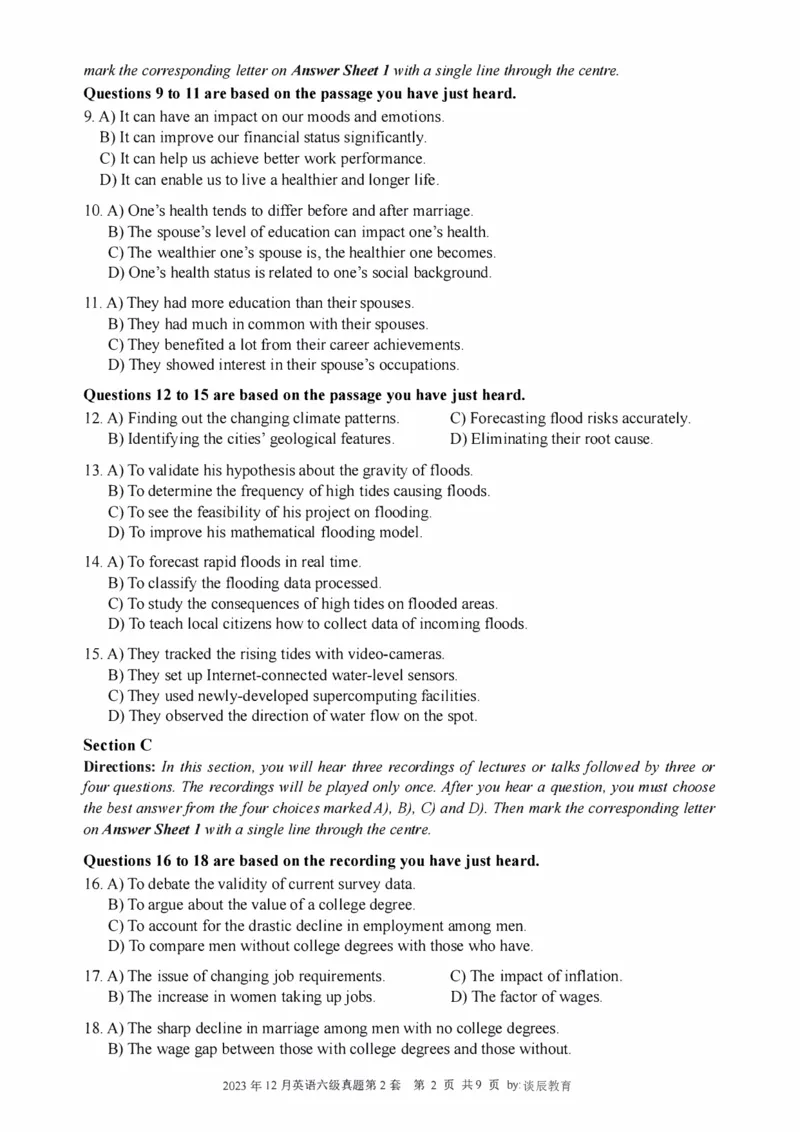
Directions: In this section, you will hear two passages. At the end of each passage, you will hear three
or four questions. Both the passage and the questions will be spoken only once. After you
、
hear a question, you must choose the best answer jom the four choices marked A), B),
C) and D). Then mark the corresponding letter on Answer Sheet 1 with a single line
through the centre.
Questions 9 to 11 are based on the passage you have just heard.
9. A) It might affect mother's health. C) It might increase the risk of infants' death.
B)it might disturb infants' sleep. D) It might increase mothers' mental distress.
10. A) Mothers who breast-feed their babies have a harder time falling asleep.
B) Mothers who sleep with their babies need a little more sleep each night.
C) Sleeping patterns of mothers greatly affect their newborn babies' health.
D) Sleeping with infants in the same room has a negative impact on mothers.
11. A) Change their sleep patterns to adapt to their newborn babies'.
B) Sleep in the same room but not in the same bed as their babies.
C) Sleep in the same house but not in the same room as their babies.
D) Take precautions to reduce the risk of sudden infant death syndrome.
Questions 12 to 15 are based on the passage you have just heard.
12. A) A lot of native languages have already died out in the US.
B) The US ranks frrst in the number of endangered languages.
C) The efforts to preserve Indian language have proved fruitless.
D) More money is needed to record the native language in the US.
13. A) To set up more language schools. C) To educate native American children
B) To document endangered languages. D) To revitalise America's native languages.
14. A) The US government's policy of Americanising Indian children.
B) The failure of American Indian languages to gain an official status.
C) The US government's unwillingness to spend money educating Indians.
D) The long-time isolation of American Indians from the outside world.
15. A) It is being utilised to teach native languages.
B) It tells traditional stories during family time.
C) It speeds up the extinction of native languages.
D) It is widely used in language immersion schools.Section C
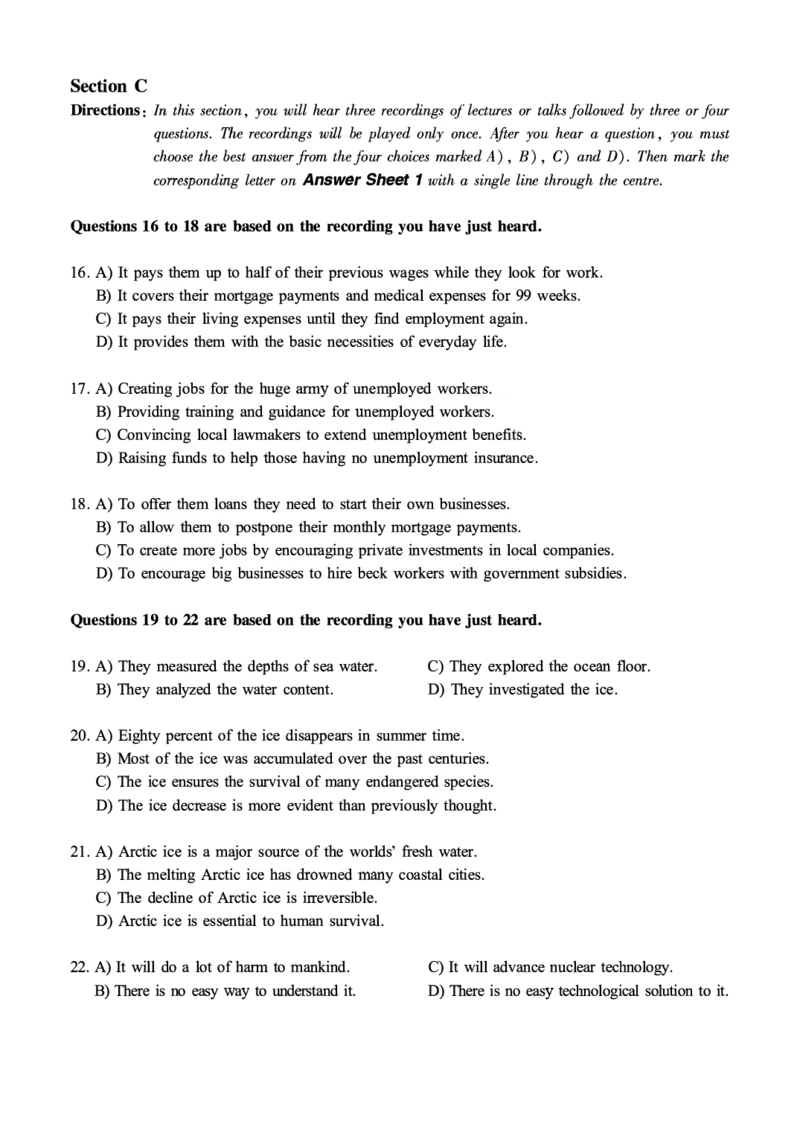
Directions : In this section, you will hear three recordings of lectures or talks followed by three or four
questions. The recordings will be played only once. After you hear a question, you must
choose the best answer from the four choices marked A), B), C) and D). Then mark the
corresponding letter on Answer Sheet 1 with a single line through the centre.
Questions 16 to 18 are based on the recording you have just heard.
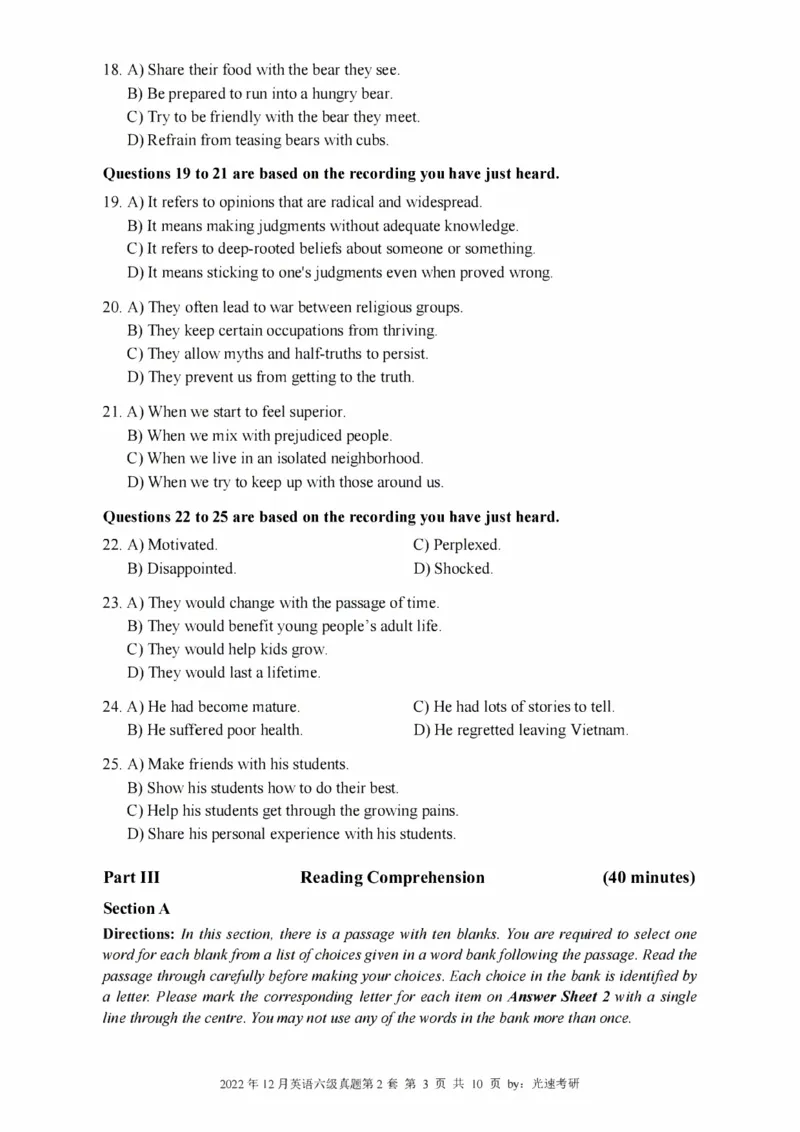
16. A) It pays them up to half of their previous wages while they look for work.
B) It covers their mortgage payments and medical expenses for 99 weeks.
C) It pays their living expenses until they fmd employment again.
D) It provides them with the basic necessities of everyday life.
17. A) Creating jobs for the huge army of unemployed workers.
B) Providing training and guidance for unemployed workers.
C) Convincing local lawmakers to extend unemployment benefits.
D) Raising funds to help those having no unemployment insurance.
18. A) To offer them loans they need to start their own businesses.
B) To allow them to postpone their monthly mortgage payments.
C) To create more jobs by encouraging private investments in local companies.
D) To encourage big businesses to hire beck workers with government subsidies.
Questions 19 to 22 are based on the recording you have just heard.
19. A) They measured the depths of sea water. C) They explored the ocean floor.
B) They analyzed the water content. D) They investigated the ice.
20. A) Eighty percent of the ice disappears in summer time.
B) Most of the ice was accumulated over the past centuries.
C) The ice ensures the survival of many endangered species.
D) The ice decrease is more evident than previously thought.
21. A) Arctic ice is a major source of the worlds'fresh water.
B) The melting Arctic ice has drowned many coastal cities.
C) The decline of Arctic ice is irreversible.
D) Arctic ice is essential to human survival.
22. A) It will do a lot of harm to mankind. C) It will advance nuclear technology.
B) There is no easy way to understand it. D) There is no easy technological solution to it.Questions 23 to 25 are based on the recording you havejust heard.
Questions 23 to 25 are based on the recording you have just heard.
223.3A.)ATh) eT rheea sreoans ownh yw Nheyw NZeewal aZneda lcanhidl dcrheilnd rseene ms eteom htaov eh abveet tbeertt esre slefl-fc-coontnrtrooll..
B)The relation between children's self-control and their future success.
B) The relation between children's self-control and their future success.
C)C )ThTeh eh ehaletahlt hp rporbolbelmesm osf ocfh cihldilrderne nr ariasiseedd bbyy a as siinnggllee ppaarreenntt..
D)D )ThTeh ed edceicdiidnign gf afactcotor r iinn cchhiillddrreenn''ss aaccaaddeemmiicc ppeerrffoorrmmaannccee..
24.A) Children raised by single parents will have a hard time in their thirties.
24. A) Children raised by single parents will have a hard time in their thirties.
B)BT)hoTsheo swei twh itah car icmriimnailn arl erceocrodr dm omstolsytl yc ocmoem fer ofrmo msi nsginlge lep aprarenetn tf afammiliilieess..
C)C )PaPraernetns tsm umstu slte aleran rnto toex eexrceirsceis es eslefl-fc-ocnotnrtrolo li nin ffrroonntt ooff tthheeiirr cchhiillddrreenn..
D)Lack of self-control in parents is a disadvantage for their children.
D) Lack of self-control in parents is a disadvantage for their children.
25. A) Self-control can be improved through education.
25. A) Self-control can be improved through education.
B)B )SeSlefl-fc-ocnotnrtrolo l ccaann i mimprporvoev oen oe'nse 'sf ifmnanancicaila ls isittuuaattiioonn..
C)C )SeSlefl-fc-coontnrtrooll pprroobblleemms sm maya yb eb de edteectetcetde de aeralryl yi nin cchhiillddrreenn..
D)D )SeSlefl-f-ccoonntrtrooll pprroobblleemmss wwililll ddiimmiinniisshh aass oonnee ggrroowwss uupp..
PartIII
Reading Comprehension (40 minutes)
Part III Reading Comprehension (40 minutes)
Section A
Section A
Directions:In thissection,there isapassage with ten blank.Youare required to select onewordfor each
Directions :In this section, there is a passage with ten blanks. You are required to select one word for each
bank from alist of choices gien in aword bank follwing the passageRead the passage
blank from a list of choices given in a word bank following the passage. Read the passage
through carefully before making your choices.Each choice in the bankisidentijfied bya letter.
through carefully before making your choices. Each choice in the bank is identified by a letter.
Please marh the corsponding letter for each item on Answer Sheet 2 with a single line
Please mark the corresponding letter for each item on Answer Sheet 2 with a single line
through the center. You may not use any of the words in the bank more than once.
through the center. You may not use any of the words in the bank re than once.
叩
LeLte'ts's ssaayy yyoouu lloovvee rroolllleerr--sskkaatitnign.g .JuJusst tt hteh teh otuhoguhgth ot fo f 2266 on oyno uyro urro lrloelrle-rs-ksaktaetess bbrriinnggss aa ssmmiillee
to your face. You also know that roller-skating is excellent exercise. You have a 27 attitude
to your face. You also know that roller-skating is excellent exercise. You have a 27 attitude
toward it.
toward it.
This description of roller-skating _28_ the three components of an attitude: affect, cognition,
This description of roller-skating 28 the three components of an attitude: affect, cognition,
and behavior.You love the activity; its great fun.These feelings 29 the affective or emotional
and behavior. You love the activity; it's great fun. These feelings 29 the affective or emotional
component; they are an important ingredient in attitudes. The knowledge we have about the object
component; they are an important ingredient in attitudes. The knowledge we have about the object
constitutes the cognitive component of an attitude. You understand the health 30 that the activity
constitutes the cognitive component of an attitude. You understand the health 30 that the activity
can bring.Finally, atitudes have a behavioral component. Our attiudes 31 us to go outside to
can bring. Finally, attitudes have a behavioral component. Our attitudes 31 us to go outside to
enjoy roller-skating.
enjoy roller-skating.
Now, we dont want to leave you with the 32 that these three components always work
Now, we don't want to leave you with the 32 that these three components always work
totoggetethheerr 33 3.3 The.y Tdhoeny' td;o ns'ot;m estoimmeesti mtehse yth celya schla.s hF.o rF oerx aemxpalmep,l el, elte't'ss ssaayy yyoouu lloovvee ppiizzzaa( a(fafffeeccttiivvee
cocmopmopneonnte)n;t );h ohwoewveevr,eyr,o uy ohua vhea vhei ghhi gchh oclheosletsetreorlo l aanndd uunndderesrsttaanndd ((kknnoowwleleddggee ccoommpopnoennetn) t)t hthatat eeaattiinngg
pizza may be bad for your health. Which behavior will your attitude result in, eating pizza or 34
pizza may be bad for your health. Which behavior will your attitude result in, eating pi互a or 34
it? The answer depends on which component happens to be stronger. If you are walking past a pizza
it? The answer depends on which component happens to be stronger. If you are walking past a pizza
restaurant at lunchtime, your emotions and feelings probably will be stronger than your knowledge
restaurant at lunchtime, your emotions and feelings probably will be stronger than your knowledge
that pizza may not be the best food for your health.In that instance,you have pizza for lunch. If you
that pizza may not be the best food for your health. In that instance, you have pizza for lunch. If you
are at home trying to decide where to go for dinner, however, the knowledge component may
are at home trying to decide where to go for dinner, however, the knowledge component may
35 , and you decide to go where you can eat a healthier meal.
3 5 , and you decide to go where you can eat a healthier meal.A)avoiding I) positiv
A) avoiding I) positive
B) enefits ) prevail
B) benefits J) prevail
C) highigt K) primarily
C) highlight K) primarily
D)ilustrates L)prompt
D) illustrates L) prompt
E) impesion M) specifcations
E) impression M) specifications
)improve N) straping
F) improves N) strapping
G inquiring
O) tpieal
G) inquiring 0) typical
H) prfecly
H) perfectly
Section B
Section B
Directions:In this section,you are going to read a passage with ten statements attached to it. Each
Direct10ns : In th·is section, you are going to read a passage with ten statements attached to it. Each
statement contains information gien in one of the paragraphs. Identify the paragraph from
statement contains information given in one of the paragraphs. Identify the paragraph from
which the information is derived. You may choose a paragraph more than once. Each
wh呻the information is derived. You may choose a paragraph more than once. Each
paragraphis marked with a letter.Answer the questions by marking the corresponding letter
paragraph is marked with a letter. Answer the questions by marking the corresponding letter
on Answer Sheet 2
on Answer Sheet 2.
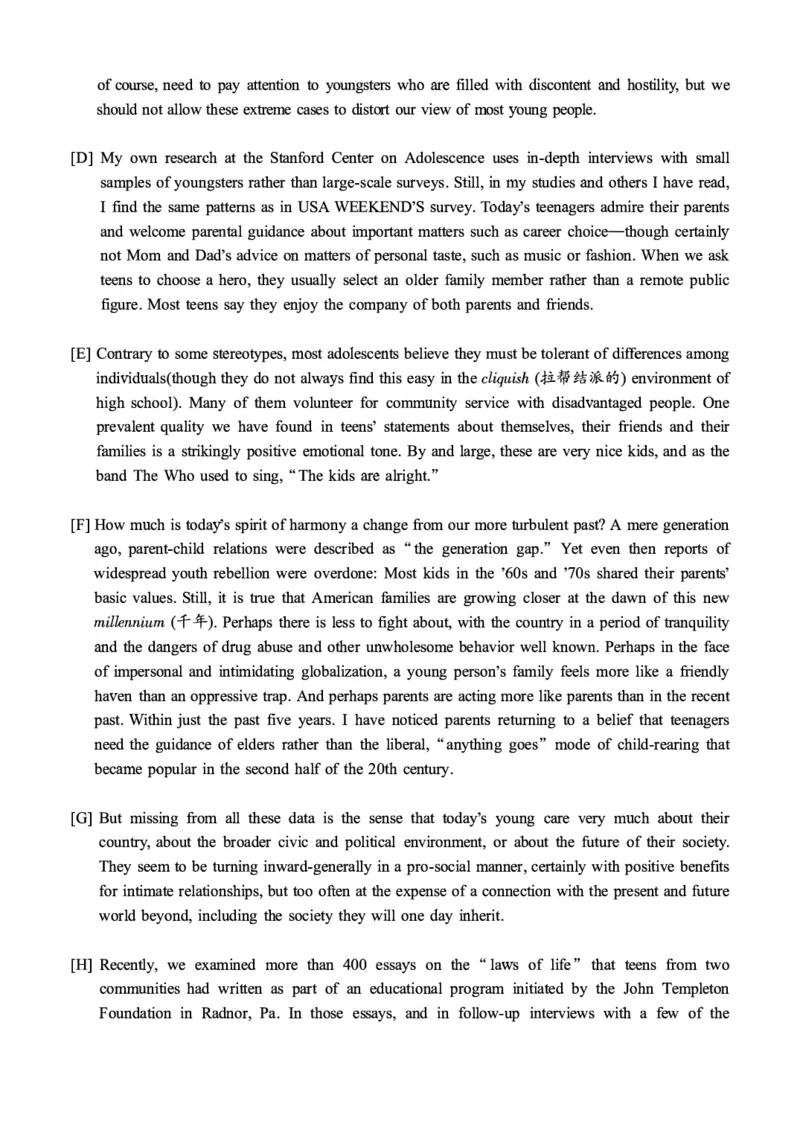
The Changing Generation
The Changing Generation
[A] It turs out today's teenagers aren't so scary after all.Results of USA WEEKEND's Teens &
[A] It turns out today's teenagers aren't so scary after all. Results of USA WEEKEND's Teens &
Parents survey reveal a generation of young people who get along well with their parents and
Parents survey reveal a generation of young people who get along well with their parents and
approve of the way they're being raised. They think of their parents with affection and respect.
approve of the way they're being raised. They think of their parents with affection and respect.
They speak with Mom or Dad when they have a problem. Most feel that their parents understand
They speak with Morn or Dad when they have a problem. Most feel that their parents understand
them, and they believe their family is the No.1 priority in their parents'lives. Many even think
them, and they believe their family is the No. 1 priority in their parents' lives. Many even think
their parents are cool! Although more than a third have an object in their rooms they would like
their parents are cool! Although more than a third have an object in their rooms they would like
to keep secret from their parents, rarely is it anything more alarming than a diary or off-color (低
to keep secret from their parents, rarely is it anything more alam血g than a diary or off-color (低
俗的)book or CD.
俗的) book or CD.
[B] Such results may seem surprising against the background of shocking incidents that color the way
[B] Such results may seem surprising against the background of shocking incidents that color the way
the mass media portray the young.In October 2000, the same month the survey was taken, the
the mass media portray the young. In October 2000, the same month the survey was taken, the
Washington-based Center for Media and Public Affairs wrote in its publication Media Monitor
Washington-based Center for Media and Public Affairs wrote in its publication Media Monitor
ththaatt,, iinn aa r erceecnetn mt omnotnht ho fo Tf VT Vnneewwss ccoovveerraaggee ooff A Ammeerriiccanan yyoouutthh, ,jujusts t2 %2o fo ft teeeennss wweerree sshhoowwnn aatt
home,and just 1were portrayed in a work setting. In contrast, the criminal justice system
home, and just 1 % were portrayed in a work setting. In contrast, the criminal justice system
accounted for nearly one out of every five visual backgrounds. No wonder parents worry their
accounted for nearly one out of every five visual backgrounds. No wonder parents worry their
own kids might spin out of control once they hit the turbulent waters of adolescence.
own kids might spin out of control once they hit the turbulent waters of adolescence.
[C] The overall facts ought to reassure us. The survey shows us that today's teens are affectionate,sensible
[C] The overall facts ought to reassure us. The survey shows us that today's teens are affectionate, sensible
and far happier than the angry and tortured souls that have been painted for us by stereotypes. From
and far happier than the angry and tortured souls that have been painted for us by stereotypes. From
other sources, we also know teenage crime, drug abuse and premarital sex are in general decline. We,
other sources, we also know teenage crime, drug abuse and premarital sex are in general decline. We,of course, need to pay attention to youngsters who are filled with discontent and hostility, but we
of course, need to pay attention to youngsters who are filled with discontent and hostility, but we
should not allow these extreme cases to distort our view of most young people.
should not allow these extreme cases to distort our view of most young people.
[D] My own research at the Stanford Center on Adolescence uses in-depth interviews with small
[D] My own research at the Stanford Center on Adolescence uses in-depth interviews with small
samples of youngsters rather than large-scale surveys. Still, in my studies and others I have read,
samples of youngsters rather than large-scale surveys. Still, in my studies and others I have read,
I find the same patterns as in USA WEEKEND'S survey.Today's teenagers admire their parents
I find the same patterns as in USA WEEKEND'S survey. Today's teenagers admire their parents
and welcome parental guidance about important matters such as career choice—though certainly
and welcome parental guidance about important matters such as career choice—though certainly
not Mom and Dad's advice on matters of personal taste, such as music or fashion. When we ask
not Mom and Dad's advice on matters of personal taste, such as music or fashion. When we ask
teens to choose a hero, they usually select an older family member rather than a remote public
teens to choose a hero, they usually select an older family member rather than a remote public
figure.Most teens say they enjoy the company of both parents and friends.
figure. Most teens say they enjoy the company of both parents and friends.
[E] Contrary to some stereotypes, most adolescents believe they must be tolerant of differences among
[E] Contrary to some stereotypes, most adolescents believe they must be tolerant of differences among
inindidvivididuualasls((tthhoouugghh tthheeyy ddoo nnoott aallwwaayyss ffiinndd ththiiss eeaassyy ini nth teh ec licqluiigsuhi s(h拉(帮拉结帮结派派的的))enenvviriornonmmeenntt ooff
hihgigh hs scchhooool)l).. MMaannyy o fo ft thheemm v ovloulunenetere rf ofor r ccoommmumniutnyit ys esrevrivcicee wwitithh ddiissaaddvvaannttaaggeedd ppeeooppllee. . OOnnee
prevalent quality we have found in teens'statements about themselves, their friends and their
prevalent quality we have found in teens' statements about themselves, their friends and their
families is a strikingly positive emotional tone.By and large,these are very nice kids,and as the
families is a strikingly positive emotional tone. By and large, these are very nice kids, and as the
band The Who used to sing,"The kids are alright."
band The Who used to sing, "The kids are alright."
[F]How much is today's spirit of harmony a change from our more turbulent past? A mere generation
[F] How much is today's spirit of harmony a change from our more turbulent past? A mere generation
ago, parent-child relations were described as"the generation gap."Yet even then reports of
ago, parent-child relations were described as "the generation gap." Yet even then reports of
widespread youth rebellion were overdone: Most kids in the '60s and '70s shared their parents'
widespread youth rebellion were overdone: Most kids in the '60s and '70s shared their parents'
basic values. Still, it is true that American families are growing closer at the dawn of this new
basic values. Still, it is true that American families are growing closer at the dawn of this new
millennium(千年).Perhaps there is less to fight about, with the country in a period of tranqulity
millennium (于年). Perhaps there is less to fight about, with the country in a period of tranquility
and the dangers of drug abuse and other unwholesome behavior well known. Perhaps in the face
and the dangers of drug abuse and other unwholesome behavior well known. Perhaps in the face
of impersonal and intimidating globalization, a young person's family feels more like a friendly
of impersonal and intimidating globalization, a young person's family feels more like a friendly
haven than an oppressive trap.And perhaps parents are acting more like parents than in the recent
haven than an oppressive trap. And perhaps parents are acting more like parents than in the recent
past. Within just the past five years.I have noticed parents returning to a belief that teenagers
past. Within just the past five years. I have noticed parents returning to a belief that teenagers
need the guidance of elders rather than the liberal,"anything goes"mode of child-rearing that
need the guidance of elders rather than the liberal, "anything goes" mode of child-rearing that
became popular in the second half of the 20th century.
became popular in the second half of the 20th century.
[G] But missing from all these data is the sense that today's young care very much about their
[G] But missing from all these data is the sense that today's young care very much about their
country, about the broader civic and political environment,or about the future of their society.
country, about the broader civic and political environment, or about the future of their society.
They seem to be turning inward-generally in a pro-social manner, certainly with positive benefits
They seem to be turning inward-generally in a pro-social manner, certainly with positive benefits
for intimate relationships, but too often at the expense of a connection with the present and future
for intimate relationships, but too often at the expense of a connection with the present and future
world beyond, including the society they will one day inherit.
world beyond, including the society they will one day inherit.
[H] Recently, we examined more than 400 essays on the"laws of life" that teens from two
[H] Recently, we examined more than 400 essays on the " laws of life " that teens from two
ccoommmmuniutniietise sh ahda dw rwitrittetenn aass ppaarrtt ooff aann eedduuccaattiioonnaall pprrooggrraamm iinniittiiaatetde db yby thteh e JoJohhnn TTeempmplleettoonn
Foundation in Radnor, Pa.In those essays, and in follow-up interviews with a few of the
Foundation in Radnor, Pa. In those essays, and in follow-up interviews with a few of theteenagers, we found lots of insight, positive feeling and inspirational thinking. But we also found
teenagers, we found lots of insight, positive feeling and inspirational thinking. But we also found
little interest in civic life beyond the tight circles of their family and immediate friends.
little interest in civic life beyond the tight circles of their family and immediate friends.
[I] For example, only one boy said he would like to be president when he grows up. When I was in
[I] For example, only one boy said he would like to be president when he grows up. When I was in
high school, dozens in my class alone would have answered differently. In fact, other recent
high school, dozens in my class alone would have answered differently. In fact, other recent
studies have found there has never been a time in American history when so small a proportion of
studies have found there has never been a time in American history when so small a proportion of
young people have sought or accepted leadership roles in local civic organizations. It is also
young people have sought or accepted leadership roles in local civic organizations. It is also
troubling that voting rates among our youngest eligible voters—18-to 24-year-olds—are way
troubling that voting rates among our youngest eligible voters—18-to 24-year-olds—are way
down: Little more than one in four now go to the polls, even in national elections, compared with
down: Little more than one in four now go to the polls, even in national elections, compared with
almost twice that many when 18-year-olds were first given the vote.
almost twice that many when 18-year-olds were first given the vote.
[J[J]]InI no uorur i nitneterrvviieewws,s , mmanany ys tsutudednetnst sv iveiweewde dpo pliotliitcicss wwitihth ssuussppiicciioonn aanndd d disisttaassttee.. ""MMosots tp oploiltitiicciiananss araree kkiinndd
ofo fc rcorookoeked d( (不不诚诚实实的)的,),""onoen set usdtuednte ndte cdleacrleadr.e dA.n Aotnheort,her d, idsicsucsussisnign gn antaitoinoanla pl oploitliitcicss,, ssaaiidd,, ""II ffeeeell lliikkee
one person can't do that much, and I get the impression most people don't think a group of people can
one person can't do that much, and I get the impression most people don't think a group of people can
do that much." Asked what they would like to change in the world, the students mentioned only
do that皿ch." Asked what they would like to change in the world, the students mentioned only
personal concerns such as slowing down the pace of life, gaining good friends, becoming more
personal concerns such as slowing down the pace of life, gaining good friends, becoming more
spsipririittualual, , bbeeccoommiinngg eeiiththeerr momorree mmaateteririaallllyy ssuucccceessssfulfu l oorr lleesss s mamatteerriailalyll yo roierntieendt ed(d(depepeennddiningg oonn tthhee
stsutuddenetnt's's vvaalluueess)),, anandd bbeeiinngg momorree rreessppeeccttffuull ooff ththee压 Ea血rt,h,animanimaallss anandd ooththeerr ppeeooppllee. .On Onee bbooyy ssaaiidd,, ""TI''dd
rather be concentrating on artistic efforts than saving the world or something."
rather be concentrating on artistic efforts than saving the world or something."
[K[K] ]ItI t iiss ffminee aanndd hheeaalltthhyy ffoorr tteeeennss ttoo ccuullttiivvaattee ththeeiri rp peersrosnonaal l initnetreersetss,t san, da nidt iist giso ogdo onde nwesw sw whheenn
young people enjoy harmonious relations with their family and friends.But there is also a place
young people enjoy hannonious relations with their family and friends. But there is also a place
in a young life for noble purposes that include a dedication to the broader society, a love of
in a young life for noble purposes that include a dedication to the broader society, a love of
country and an aspiration to make their own leadership contributions.
country and an aspiration to make their own leadership contributions.
[L[L] ]IInn t thhee ppasats,t, tthhee yyoouunng gh ahvaev ee aegeargleyr lypa rptairctiicpiaptaetde di ni nn antaitoionanla l seservrviiccee aannd dc icviivcic afafffaaiirrss,, ooftfteenn wwiitthh
lots of energy and idealism.If this is not happening today, we should ask why.Our society needs
lots of energy and idealism. If this is not happening today, we should ask why. Our society needs
the full participation of its younger citizens if it is to continue to thrive. We know the promise is
the full participation of its younger citizens if it is to continue to thrive. We know the promise is
there—this is a well-grounded, talented, warm-hearted group of youngsters. We have everything
there—this is a well-grounded, talented, warm-hearted group of youngsters. We have everything
to gain by encouraging them to explore the world beyond their immediate experience and to
to gain by encouraging them to explore the world beyond their immediate experience and to
prepare themselves for their turn at shaping that world.
prepare themselves for their tum at shaping that world.
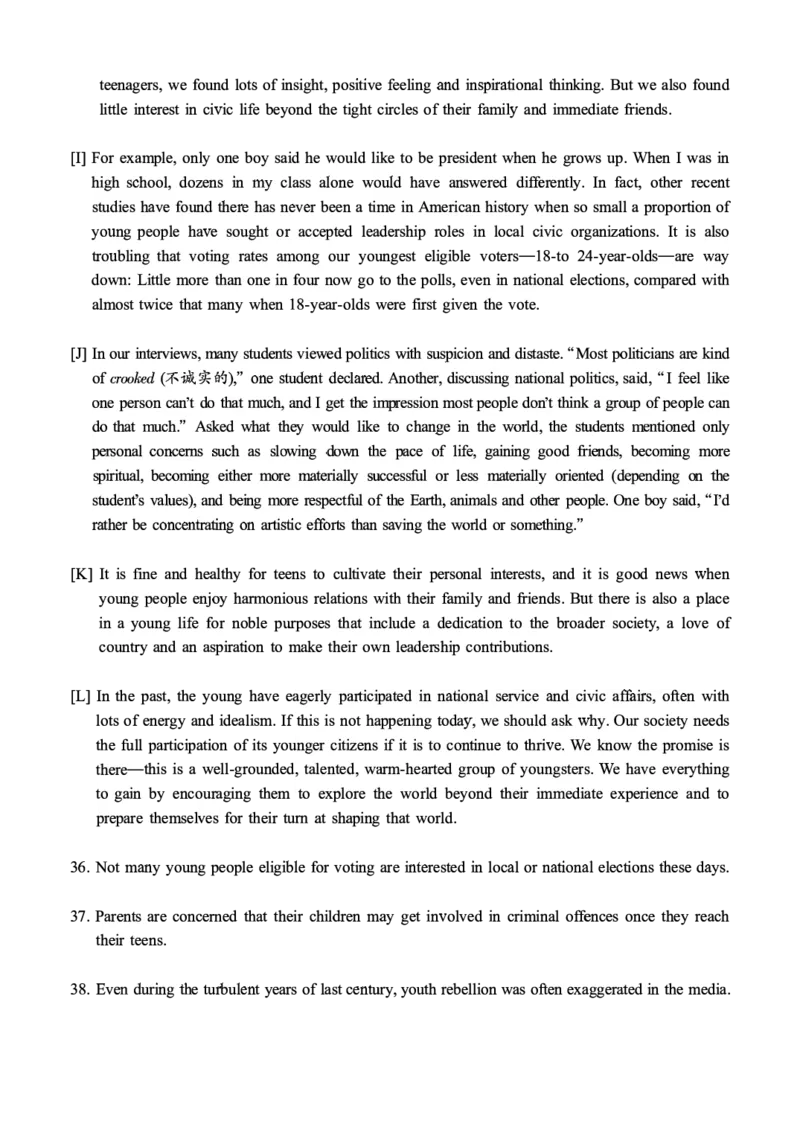
36.Not many young people eligible for voting are interested in local or national elections these days.
36. Not many young people eligible for voting are interested in local or national elections these days.
37.Parents are concerned that their children may get involved in criminal offences once they reach
37. Parents are concerned that their children may get involved in criminal offences once they reach
their tens.
their teens.
38. Even during the turbulent years of last century,youth rebellion was often exaggerated in the media.
38. Even during the turbulent years of last century, youth rebellion was often exaggerated in the media.39. Teenagers of today often turn to their parents for advice on such important matters as career choice.
39. Teenagers of today often turn to their parents for advice on such important matters as career choice.
40.The incidence of teenage crime and misbehavior is decreasing nowadays.
40. The incidence of teenage crime and misbehavior is decreasing nowadays.
41.Young people should have lofty ideals in life and strive to be leaders.
41. Young people should have lofty ideals in life and strive to be leaders.
42.Some young people like to keep something to themselves and don't want their parents to know
42. Some young people like to keep something to themselves and don't want their parents to know
about it.
about it.
43.It is beneficial to encourage young people to explore the broader world and get ready to make it a
43. It is beneficial to encourage young people to explore the broader world and get ready to make it a
better place.
better place.
44. Many teenagers now offer to render service to the needy.
44. Many teenagers now offer to render service to the needy.
45.Interviews with students find many of them are only concerned about personal matters.
45. Interviews with students find many of them are only concerned about personal matters.
Section C
Section C
Directions:There are 2 passages in this section.Each passage is followed by some questions or
D"1 rections : There are 2 passages in this section. Each passage is followed by some questions or
uunfnifinniisshheedd ssttaattememeenntts.s .FoForr eaeachch of o fth etmhe tmh etrhee arere faoruefr ocuhro iccehso imcaesrk emda rAk)e d, BA)), B, )C,C) )aanndd DD)) ..
You should decide on the best choice and mark the corresponding letter on Answer Sheet
You should decide on the best choice and mark the corresponding letter on Answer Sheet
2 with a single line through the center.
2 with a single line through the center.
Passage One
Passage One
Questions 46 to 50 are based on the following passage.
Questions 46 to 50 are based on the following passage.
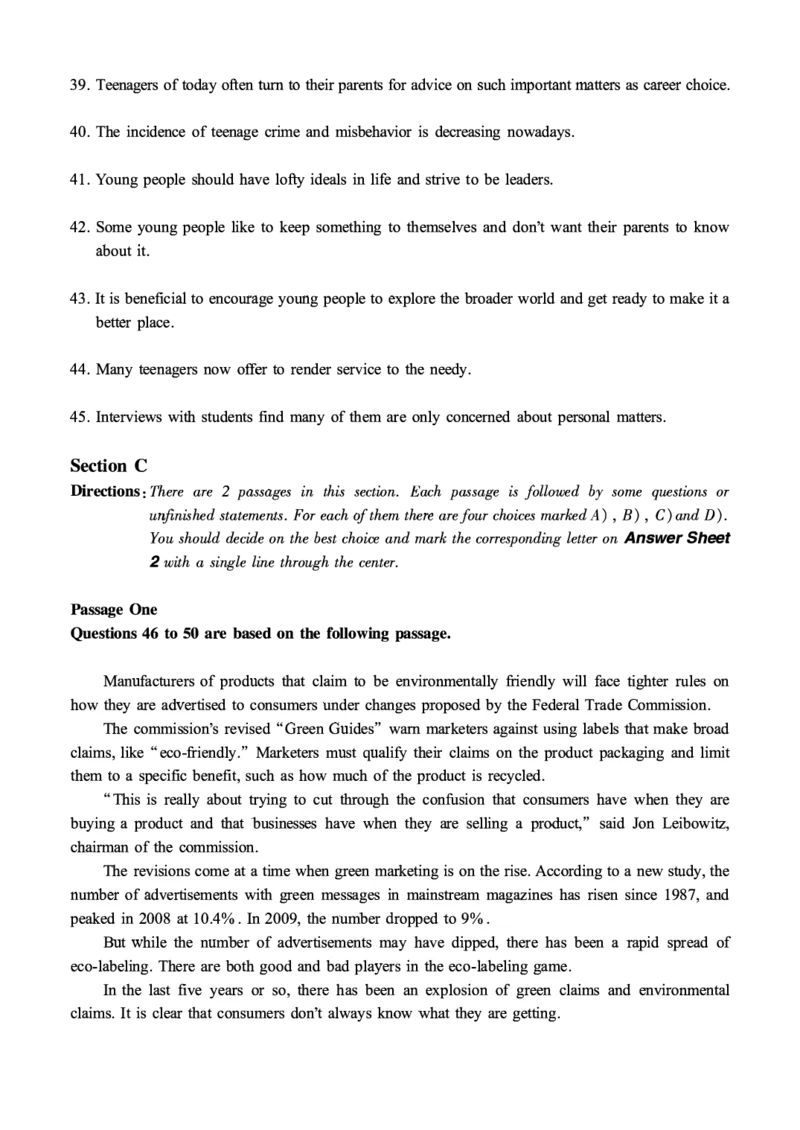
Manufacturers of products that claim to be environmentally friendly will face tighter rules on
Manufacturers of products that claim to be enviromnentally friendly will face tighter rules on
how they are advertised to consumers under changes proposed by the Federal Trade Commission.
how they are advertised to consumers under changes proposed by the Federal Trade Commission.
The commission's revised"Green Guides"warn marketers against using labels that make broad
The commission's revised "Green Guides" warn marketers against using labels that make broad
claims, like"eco-friendly."Marketers must qualify their claims on the product packaging and limit
claims, like "eco-friendly." Marketers must qualify their claims on the product packaging and limit
them to a specific benefit, such as how much of the product is recycled.
them to a specific benefit, such as how much of the product is recycled.
"This is really about trying to cut through the confusion that consumers have when they are
"T his is really about trying to cut through the confusion that consumers have when they are
buying a product and that businesses have when they are selling a product," said Jon Leibowitz,
buying a product and that businesses have when they are selling a product," said Jon Leibowitz,
chairman of the commission.
chairman of the commission.
The revisions come at a time when green marketing is on the rise.According to a new study,the
The revisions come at a time when green marketing is on the rise. According to a new study, the
number of advertisements with green messages in mainstream magazines has risen since 1987, and
number of advertisements with green messages in mainstream magazines has risen since 1987, and
peaked in 2008 at 10.4?n 2009, the number dropped to 9%.
peaked in 2008 at 10.4%. In 2009, the number dropped to 9%.
But while the number of advertisements may have dipped, there has been a rapid spread of
But while the number of advertisements may have dipped, there has been a rapid spread of
eco-labeling. There are both good and bad players in the eco-labeling game.
eco-labeling. There are both good and bad players in the eco-labeling game.
In the last five years or so, there has been an explosion of green claims and environmental
In the last five years or so, there has been an explosion of green claims and enviromnental
claims. It is clear that consumers don't always know what they are getting.
claims. It is clear that consumers don't always know what they are getting.A handful of lawsuits have been filed in recent years against companies accused of using
A handful of lawsuits have been filed in recent years against companies accused of using
mmisilseleaaddiinngg eennvviriroonmnmenetnatla l llaabbeellss.. IInn 22000088 a nadn d2 020090,9 , ccllaassss--aaccttioinon lalwawssuuitist s((集集体体 诉 诉 讼 讼) ) wweerree ffiilleedd
agaagianinstst SSCC J oJohnhsnosno nf ofor ru suisningg"G r"eGenreleinstli"slt"a belalbs eolsn oint si tcs lcelaenainnign gp rpordoudcutsc.ts .T hTeh el alwaswusiutist ss asaiidd tthhaatt tthhee
label was misleading because it gave the impression that the products had been certified by a third
label was misleading because it gave the impression that the products had been certified by a third
party when the certification was the company's own.
party when the certification was the company's own.
"We are very proud of our accomplishments under the Greenlist system and we believe that we
"We are very proud of our accomplishments under the Greenlist system and we believe that we
will prevail in these cases,"Christopher Beard, director of public affairs for SC Johnson, said, while
will prevail in these cases," Christopher Beard, director of public affairs for SC Johnson, said, while
acknowledging that" this has been an area that is difficult to navigate."
acknowledging that "this has been an area that is difficult to navigate."
Companies have also taken it upon themselves to contest each other's green claims.
Companies have also taken it upon themselves to contest each other's green claims.
David Mallen, associate director of the Council of Better Business Bureau, said in the last two
David Mallen, associate director of the Council of Better Business Bureau, said in the last two
years the organization had seen an increase in the number of claims companies were bringing against
years the organization had seen an increase in the number of claims companies were bringing against
each other for false or misleading environmental product claims.
each other for false or misleading environmental product claims.
"About once a week, I have a client that will bring up a new certification I've never even heard of
"About once a week, I have a client that will bring up a new certification I've never even heard of
and I'm in this industry,"said Kevin Wihelm, chief executive officer of Sustainable Business Consulting.
and I'm in this industry," said Kevin Wilhelm, chief executive officer of Sustainable Business Consulting.
"Its kind of a Wild West, anybody can claim themselves to be green."Mr. Wihelm said the excess of
"It's kind of a Wild West, anybody can claim themselves to be green." Mr. Wilhelm said the excess of
labels made it difficult for businesses and consumers to know which labels they should pay attention to.
labels made it difficult for businesses and consumers to know which labels they should pay attention to.
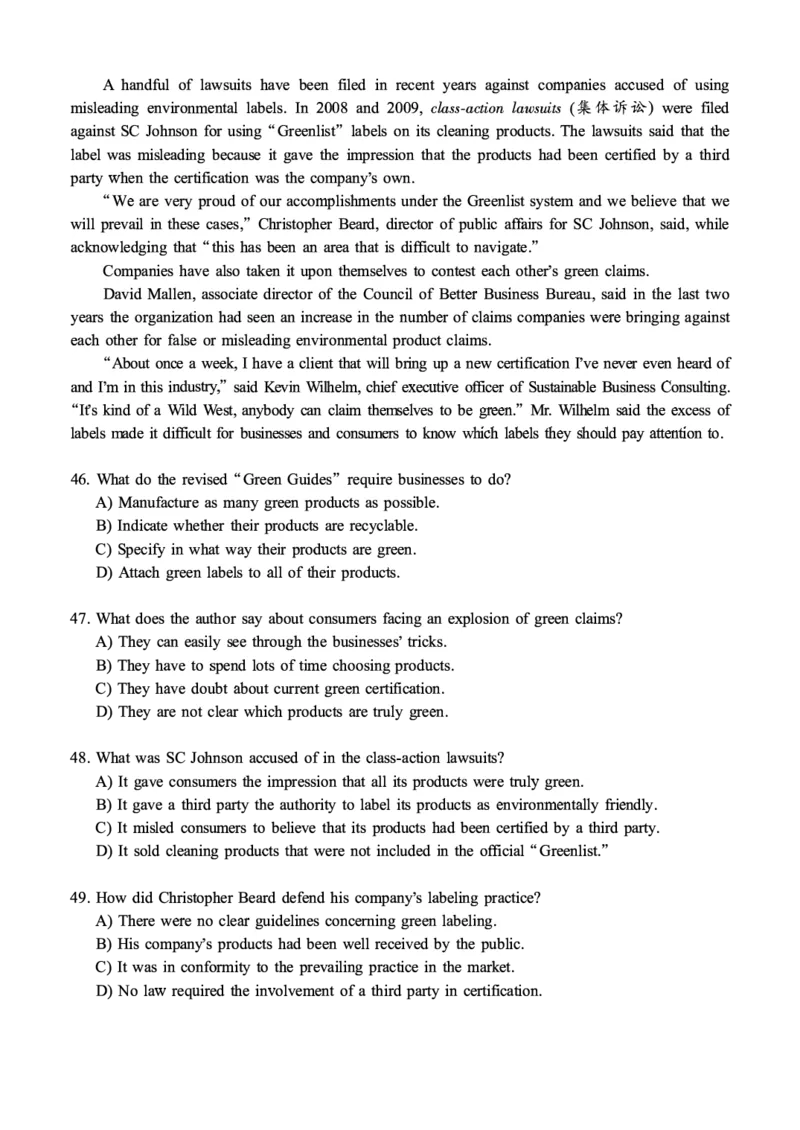
46. What do the revised "Green Guides"require businesses to do?
46. What do the revised "Green Guides" require businesses to do?
AA) )MaMnuanufacfatucrtuer ea sa sm amnayn ygr geerene np rpordoudcutsct sa sa sp posossisibbllee..
B)B )InIdnidciactatee wwhehtehtehre rt htehierir pprroodduuctcsts aarree rreeccyyccllaabbllee..
C)C )SpSepceicfiyfy i nin wwhahta tw waya yt htheierir pprroodduuctcsts aarree ggrreeeenn..
D)D )AtAtattcahc hg rgeerene nla blaebles lst ot oa lalll ooff tthheeiirr pprroodduuccttss..
47.What does the author say about consumers facing an explosion of green claims?
47. What does the author say about consumers facing an explosion of green claims?
AA) )ThTehye yc acnan ea esaisliyl ys esee et thhrroouuggh ht hthee bbuusisinneesssseess''trtriicckkss..
B)B )ThTehye yh ahvaev teo t os psepnedn dl oltosts ooff ttiimmee cchhoooossiinngg pprroodduuccttss..
C)C )ThTehy ehya vhea vdeo udbotu babt oaubto ucut rcruernrte ngtr egerne ecne rcteirtfiificcaattiioonn..
D)D )ThTehye yar ea ren onto ct lcelaera r wwhihcihc hp rpordoudcutcst sa raree ttrurullyy ggrreeeenn..
48.What was SC Johnson accused of in the class-action lawsuits?
48. What was SC Johnson accused of in the class-action lawsuits?
AA)I)t Igt agvaev ec ocnosunmseurms etrhs et hiem pirmepssreisosni otnh atht aatl al lli titss pprroodduuccttss wweerree trtruullyy ggrreeeenn..
B)BI)t Igt agvea vae tah ithrdir dp apratyrt yt hthe ea uatuhtohroirtiyt yt oto l laabbeell iittss pprroodduuccttss aass eennvviirroonnmmenetnatlalllyy ffrriieennddllyy..
C) It misled consumers to believe that its products had been certified by a third party.
C) It misled consumers to believe that its products had been certified by a third party.
D) It sold cleaning products that were not included in the official"Greenlist."
D) It sold cleaning products that were not included in the official "Greenlist."
49.How did Christopher Beard defend his company's labeling practice?
49. How did Christopher Beard defend his company's labeling practice?
AA) )ThTehreer ew ewree ren on ocl ecalera rg ugiudiedleilnineess ccoonncecrenrniinngg ggrereeenn l laabbeelliinngg..
B)B )HiHsi sc ocmopmanpyan'sy 'sp rpordoudcutsc tsh ahda db ebeene nw ewlle llr erceecieviveedd b byy t thhee ppuubblilicc..
C)C )ItI tw wasa si ni nc ocnofnoformrimtyit yt ot ot hteh ep rperveavialiilinngg pprraaccttiiccee iinn ththee mmaarrkkeett..
D)D )NoN loa wl arwe qrueiqrueidr etdh et hien vinolvvoelmveenmt eonft ao ft ah ithrdi rpda rptayrt yin inc ecretritfifiiccaattiioonn..50.What does Kevin Wilhelm imply by saying"It's kind of a Wild West"(Line 3, Para.11)?
50. What does Kevin Wilhelm imply by saying "It's kind of a Wild West" (Line 3, Para. 11)?
.AA)) BBuussiinneesssseess ccoommppeettee ttoo pprroodduuccee ggrreeeenn pprroodduuccttss..
B)B )EaEcahc hb ubsuisniensess sa catcsts iittss oowwnn wwaya yi nin ggrreeeenn llaabbeelliinngg..
C)C )CoCnosnusmuemrse rgsr gorwo wwi lwdi lwdi wthi thp rpordoudcutcst sl alabbeelleedd ggrreeeenn..
DD) )AnAyntyhthinign gp rpordoudcuecde di ni nt hthee WWesets tc caann b be e llaabbeelleedd ggrreeeenn..
Passage Two
Passage Two
Questions 51 to 55 are based on the following passage.
Questions 51 to 55 are based on the following passage.
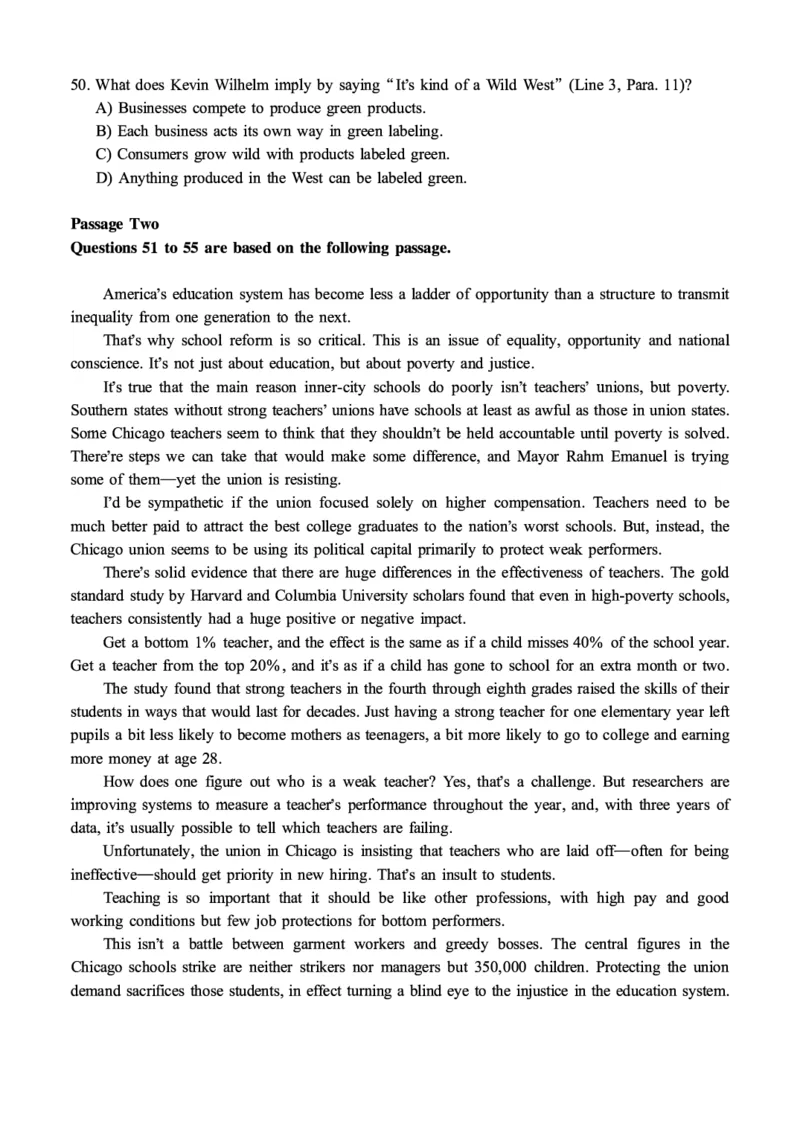
America's education system has become less a ladder of opportunity than a structure to transmit
America's education system has become less a ladder of opportunity than a structure to transmit
inequality from one generation to the next.
inequality from one generation to the next.
That's why school reform is so critical. This is an issue of equality, opportunity and national
That's why school reform is so critical. This is an issue of equality, opportunity and national
conscience. It's not just about education, but about poverty and justice.
conscience. It's not just about education, but about poverty and justice.
It's true that the main reason inner-city schools do poorly isn't teachers' unions, but poverty.
It's true that the main reason inner-city schools do poorly isn't teachers' unions, but poverty.
Southern states without strong teachers' unions have schools at least as awful as those in union states.
Southern states without strong teachers'unions have schools at least as awful as those in union states.
Some Chicago teachers seem to think that they shouldn't be held accountable until poverty is solved.
Some Chicago teachers seem to think that they shouldn't be held accountable until poverty is solved.
There're steps we can take that would make some difference, and Mayor Rahm Emanuel is trying
There're steps we can take that would make some difference, and Mayor Rahm Emanuel is trying
some of them-—yet the union is resisting.
some of them—yet the union is resisting.
I'd be sympathetic if the union focused solely on higher compensation. Teachers need to be
I'd be sympathetic if the union focused solely on higher compensation. Teachers need to be
much better paid to attract the best college graduates to the nation's worst schools. But. instead,the
much better paid to attract the best college graduates to the nation's worst schools. But, instead, the
ChCihciacgaog oun uionnio sne esmese mtos tboe bues iungsi nigts i tpso pliotliitcicaal l ccaappiittaall pprriimmaarriillyy ttoo pprrootteecct tw weeaakk ppeerrfoforrmmeerrss..
There's solid evidence that there are huge differences in the effectiveness of teachers. The gold
There's solid evidence that there are huge differences in the effectiveness of teachers. The gold
standard study by Harvard and Columbia University scholars found that even in high-poverty schools,
standard study by Harvard and Columbia University scholars found that even in high-poverty schools,
teachers consistently had a huge positive or negative impact.
teachers consistently had a huge positive or negative impact.
Get a bottom 1teacher,and the effect is the same as if a child misses 40? the school year.
Get a bottom 1% teacher, and the effect is the same as if a child misses 40% of the school year.
Get a teacher from the top 20?nd it's as if a child has gone to school for an extra month or two.
Get a teacher from the top 20%, and it's as if a child has gone to school for an extra month or two.
The study found that strong teachers in the fourth through eighth grades raised the skills of their
The study found that strong teachers in the fourth through eighth grades raised the skills of their
students in ways that would last for decades.Just having a strong teacher for one elementary year left
students in ways that would last for decades. Just having a strong teacher for one elementary year left
pupils a bit less likely to become mothers as teenagers,a bit more likely to go to college and earning
pupils a bit less likely to become mothers as teenagers, a bit more likely to go to college and earning
more money at age 28.
more money at age 28.
How does one figure out who is a weak teacher? Yes, that's a challenge. But researchers are
How does one figure out who is a weak teacher? Yes, that's a challenge. But researchers are
improving systems to measure a teacher's performance throughout the year, and, with three years of
improving systems to measure a teacher's performance throughout the year, and, with three years of
data, it's usually possible to tell which teachers are failing.
data, it's usually possible to tell which teachers are failing.
Unfortunately, the union in Chicago is insisting that teachers who are laid off—often for being
Unfortunately, the union in Chicago is insisting that teachers who are laid off—often for being
ineffective—should get priority in new hiring. That's an insult to students.
ineffective—should get priority in new hiring. That's an insult to students.
Teaching is so important that it should be like other professions, with high pay and good
Teaching is so important that it should be like other professions, with high pay and good
working conditions but few job protections for bottom performers.
working conditions but few job protections for bottom performers.
This isnt a battle between garment workers and greedy bosses. The central figures in the
This isn't a battle between garment workers and greedy bosses. The central figures in the
Chicago schools strike are neither strikers nor managers but 350,000 children. Protecting the union
Chicago schools strike are neither strikers nor managers but 350,000 children. Protecting the union
dedmeamnda nsdac sraicfiricfiecs etsh tohsoe sset ustduedntesn,t si, ni ne fefffeecct t tturnurniinngg aa bblliinndd eeyyee ttoo tthhee iinnjjuussttiiccee iinn ththee e edduuccaatitioonn ssyysstteemm..51. What do we learn about America's education system?
51. What do we learn about America's education system?
AA) )ItI t pprroovvidideess aa llaaddddeerr ooff oopppporotrutunnitityy ffoorr tthhee wweeaalltthhyy..
B)B )ItI tc ocnotnrtirbiubtuetse sl iltitttllee ttoo ththee eelliimmiinnaattiioonn ooff iinneeqquuaalilittyy..
C)C )ItI t hhaass rreemmaianinede db absaiscicaallllyy uunncchhaannggede df ofor r ggeennerearattiioonnss..
D)D )ItI t hhasa s bbrorouguhgth tu pu pg egneenreatraitoinosn so fo fr ersepsponosnisbilbele c ciittiizzeennss..
52.What is chiefly responsible for the undesirable performance of inner-city schools?
52. What is chiefly responsible for the undesirable perfom沮nee of inner-city schools?
A)
A )
Un
U
q
n
u
q
al
u
i
a
f
li
i
fi
e
e
d
d
t
t
e
e
a
a
c
c
h
h
e
e
r
r
s
s.
. C)C )Un
U
f
n
a
fa
vo
v
r
o
a
r
b
a
l
b
e
le
l
l
e
e
a
am
mi
m
ng
g
e
e
n
n
v
v
i
i
r
ro
o
n
n
m
me
e
n
n
t
t
.
.
B) Lack of financial resources. D) Subconscious racial discrimination.
B) Lack of fmancial resources. D) Subconscious racial discrimination.
53.What does the author think the union should do to win popular support?
53. What does the author think the union should do to win popular support?
AA) )AsAssissits t tthhee cciityty ggoovveerrnmnmeennt t iinn rreeffoorrmmiinngg sscchhoooollss..
B)B )GiGveiv ec ocnostnrsutrcutcitviev ea davdivciec et oto i ninnnere-r-cciittyy sscchhoooollss..
C)C )DDemeamndan hdi ghhigerh epr apya yf ofor rt teeaacchheerrss..
DD) )HeHlepl pt eteaacchheresrs iimmpprroovvee tteeaacchhiinngg..
54. What is the finding of the gold standard study by Harvard and Columbia University scholars?
54. What is the fmding of the gold standard study by Harvard and Columbia University scholars?
AA) )MaMnya niyn nienrn-ecri-tcyi tys cshcohool otl etaecahcehresr sa rare en onto te qeuqaula lt oto t thheeiirr jjoobbss..
B) A large proportion of inner-city children often miss classes.
B) A large proportion of inner-city children often miss classes.
C)C )MaMnya nsytu dsteundtes natsr ea rdei sdsiastsiastifsifieedd w witihth t htheeiirr tteeaacchheerrss..
D) Students performance has a lot to do with teachers.
D) Students performance has a lot to do with teachers.
55. Why does the author say the Chicago union's demand is an insult to students?
55. Why does the author say the Chicago union's demand is an insult to students?
AA) )ItI t pprrootteeccttss iinnccoommppeteetennt t tteeaacchheerrss aatt tthhee eexxppeennssee ooff ssttuuddeennttss..
B)B )ItI t uunndedreersetsitimmataetess ssttuuddeenntsts''aabibliliittyy ttoo tteelll lg ogooodd tetaecachheerrs sfr formom ppoooorr oonneess..
C)C )ItI t mmakakese ss tsutduednetnst sf efeeel l tthhaatt tthheeyy aarree ddiissccrrimimiinnaatetedd aaggaaiinnsst ti ni nm maannyy wwaayyss..
D) It totally ignores students'' initiative in the learning process.
D) It totally ignores students' initiative in the learning process.
Part IV
Translation (30 minutes)
Part IV Translation (30 minutes)
Directions:For his part,you are alowed 30 minutes to translate a passage from Chinese into English.
Directions: For this part, you are allowed 30 minutes to translate a passage from Chinese into English.
You should write your answer on AnsWer Sheet 2.
You should write your answer on Answer Sheet 2.
旗旗袍袍((gqiippaaoo))是是一一
种
种
雅
雅
致
致
的
的
中
中国
国
服
服
装
装
,
,源
源
于
于中
中
国
国
的
的
满
满
族
族
(
(
MMananchcuh uNaNtaitoionnalaliittyy
)
)
。
。在
在
清
清
代
代
,
,旗
旗
袍
袍
是
是
王
主
室
室
女
女
性
性
穿
穿
着
着
的
的
宽
宽
松
松
长
长
袍
袍
。
。
上
上
世
世
纪
纪
202 0年
年
代
代
,
,受
受
西
西
方
方
服
服饰
饰
影
影
响
响
,
,旗
旗
袍
袍
发
发
生
生
了
了一一
些
些
变
变
化
化
。
。
袖
袖
口
口
((ccuuffffs)s)变变窄窄,袍,身袍身变变短短。。这这些些变变化化使使女女性性美美得得以以充充分分展展现现。。
如今,旗袍经常出现在世界级的时装秀上。中国女性出席重要社交聚会时,旗袍往往是她
如今,旗袍经常出现在世界级的时装秀上。 中国女性出席重要社交聚会时,旗袍往往是她
们
们
的
的
首
首
选
选
。
。很
很多
多
中
中
国
国
新
新娘
娘
也
也
会
会
选
选
择
择
旗
旗
袍
袍
作
作
为
为
结
结
婚
婚
礼
礼
服
服
。
。一一
些
些
有
有
影
影
响
响
的
的
人
人
士
士
甚
甚
至
至
硅
建
议
议
将
将
旗
旗
袍
袍
作
作
为中国女性的民族服饰。
为中国女性的民族服饰。未得到监考教师指令前,不得翻阅该试题册!
Part I Writing (30 minutes)
(请千正式开考后半小时内完成该部分,之后将进行听力考试)
Di.recti.ons : Foorr tthhii s part, you are allowed 30 minutes to write a short essay on the use of robots.
Try to imagine what will h en when more and more robots take the place of human
app
beings in industry as well as people's daily lives. You are required to write at least 150
words but no more than 200 words.
请用黑色签字笔在答题卡l指定区域内作答作文题,在试题册上的作答无效!
请认真填写以下信息
I
准考证号
姓 名:
错填、未填以上信息,按违规处理!22001166年年66月月英英语语六六级级考考试试试试题题第第33套套
PartII Listening Comprehension
(30 minutes)
Part II Listening Comprehension (30 minutes)
<<<<<<>>>>>>>>>>>>>>>>>>>>>>>>>>>>>>>>>>>>>>>>>>>>>>>>>>>)
".)>>>>>>>>>>>>>>>>>>>>>>>>>>>>>>>>>>>>>>>>>>>>>>>>>>>>>>>>7�
Part III
Reading Comprehension (40 minutes)
Part III Reading Comprehension (40 minutes)
Section A
Section A
Directions: In this section,there is a passage with ten blanks.You are required to select one word for
Directions: In this section, there is a passage with ten blanks. You are required to select one word for
each blank from a list of choices gien in a word bank following the passage Read the
each blank from a list of choices given in a word bank following the passage. Read the
passage through carefully before making your choices. Each choice in the bank is identified
passage through carefully before making your choices. Each choice in the bank is identified
by a letter. Please mark the corresponding letter for each item on Answer Sheet 2 with a
by a letter. Please mark the corresponding letter for each item on Answer Sheet 2 with a
single line through the centre. You may not use any of thewords in the bank more than once.
single line through the centre. You may not use any of the words in the bank re than once.
砌
The robotics revolution is set to bring humans face to face with an old fear—man-made
The robotics revolution is set to bring humans face to face with an old fear—man-made
creations as smart and capable as we are but without a moral compass.As robots take on ever more
creations as smart and capable as we are but without a moral compass. As robots take on ever more
complex roles, the question naturally 26: Who will be responsible when they do something
complex roles, the question naturally 26 : Who will be responsible when they do something
wrong? Manufacturers? Users? Software writers? The answer depends on the robot.
wrong? Manufacturers? Users? Software writers? The answer depends on the robot.
Robots already save us time, money and energy. In the future, they will improve our health care,
Robots already save us time, money and energy. In the future, they will improve our health care,
social welfare and standard of living. The 27 of computational power and engineering advances
social welfare and standard of living. The 27 of computational power and engineering advances
will 28 enable lower-cost in-home care for the disabled, 29 use of driverless cars that may
will 28 enable lower-cost in-home care for the disabled, 29 use of driverless cars that may
reduce drunk-and distracted-driving accidents and countless home and service-industry uses for
reduce drunk- and distracted-driving accidents and countless home and service-industry uses for
robots, from street cleaning to food preparation.
robots, from street cleaning to food preparation.
BuBtu tt htheerree aarree 303_0t o bteo pbreo pblroebmlse.mRosb. oRto bcoatr sc awrsi lwli lrl acsrha.shA . dAr odnreo n(e (遥遥控控飞飞行行器器))opoepreartaotorr wwiillll
31 someone's privacy. A robotic lawn mower will run over a neighbor's cat. Juries sympathetic
31 someone's privacy. A robotic lawn mower will run over a neighbor's cat. Juries sympathetic
to the 32 of machines will punish entrepreneurs with company-crushing 33 and damages.
to the 32 of machines will punish entrepreneurs with company-crushing 33 and damages.
What should governments do to protect people while 34 space for innovation?
What should governments do to protect people while 34 space for innovation?
Big, complicated systems on which much public safety depends, like driverless cars, should be
Big, complicated systems on which much public safety depends, like driverless cars, should be
built, 35 and sold by manufacturers who take responsibility for ensuring safety and are liable for
built, 35 and sold by manufacturers who take responsibility for ensuring safety and are liable for
accidents. Governments should set safety requirements and then let insurers price the risk of the
accidents. Governments should set safety requirements and then let insurers price the risk of the
robots based on the manufacturer's driving record, not the passenger's.
robots based on the manufacturer's driving record, not the passenger's.A)arises I) manifesting
A) arises I) manifesting
B) asecends J) pnalties
B) ascends J) penalties
C) bound K) preseving
C) bound K) preserving
D) combination L) programmed
D) combination L) programmed
E) defite M) proximately
E) definite M) proximately
F) eventually N)vctims
F) eventually N) victims
G)interfere O) widepread
G) interfere 0) widespread
H) invad
H) invade
Section B
Section B
Directions: In this section,you are going to read a passage with ten statements attached to it. Each
Directions : In this section , you are going to read a passage with ten statements attached to it. Each
statement contains information given in one of the paragraphs.Identify the paragraph.from
statement contains information given in one of the paragraphs. Identify the paragraph from
which the information is derived. You may choose a paragraph more than once.Each
which the information is derived. You may choose a paragraph more than once. Each
paragraph is marked with aletter.Answer the questions by marking the corresponding letter
paragraph is marked with a letter. Answer the questions by marking the corresponding letter
on, Answer Sheet 2.
on Answer Sheet 2.
Reform and Medical Costs
Reform and Medical Costs
[A] Americans are deeply concerned about the relentless rise in health care costs and health insurance
[A] Americans are deeply concerned about the relentless rise in health care costs and health insurance
premiums. They need to know if reform will help solve the problem. The answer is that no one
premiums. They need to know if reform will help solve the problem. The answer is that no one
has an easy fix for rising medical costs. The fundamental fix—reshaping how care is delivered
has an easy fix for rising medical costs. The fundamental fix—reshaping how care is delivered
and how doctors are paid in a wasteful,abnormal system—is likely to be achieved only through
and how doctors are paid in a wasteful, abnormal system—is likely to be achieved only through
trtriiaall anandd eerrrroorr aanndd iinnccrreemmmeennttaall ((渐渐进进的的)) ggaaiinnss..
[B] The good news is that a bill just approved by the House and a bill approved by the Senate
[B] The good news is that a bill just approved by the House and a bill approved by the Senate
Finance Committee would implement or test many reforms that should help slow the rise in
Finance Committee would implement or test many reforms that should help slow the rise in
medical costs over the long term. As a report in The New England Journal of Medicine concluded,
medical costs over the long term. As a report in The New England Journal of Medicine concluded,
"Pretty much every proposed innovation found in the health policy literature these days is
" Pretty much every proposed innovation found in the health policy literature these days is
contained in these measures.""
contained in these measures."
[C] Medical spending,which typically rises faster than wages and the overall economy, is propelled
[C] Medical spending, which typically rises faster than wages and the overall economy, is propelled
by two things: the high prices charged for medical services in this country and the volume of
by two things: the high prices charged for medical services in this country and the volume of
unnecessary care delivered by doctors and hospitals, which often perfom a lot more tests and
unnecessary care delivered by doctors and hospitals, which often perform a lot more tests and
treatments than a patient really needs.
treatments than a patient really needs.
[D[D] ]HeHreer ea rare es osomem eo fo tfh the ei mipmoprtoarntant tp rporpoopsoaslasl si nin t hthee HHouosues ea nand dSe nSaetnea tbei lblilsl st oto ttrryy ttoo aaddddrreessss tthhoossee
problems, and why it is hard to know how well they will work.
problems, and why it is hard to know how well they will work.[E] Both bills would reduce the rate of growth in annual Medicare payments to hospitals, nursing
[E] Both bills would reduce the rate of growth in annual Medicare payments to hospitals, nursing
homes and other providers by amounts comparable to the productivity savings routinely made in
homes and other providers by amounts comparable to the productivity savings routinely made in
other industries with the help of new technologies and new ways to organize work. This proposal
other industries with the help of new technologies and new ways to organize work. This proposal
could save Medicare more than $ 100 billion over the next decade.If private plans demanded
could save Medicare more than $ 100 billion over the next decade. If private plans demanded
similar productivity savings from providers, and refused to let providers shift additional costs to
similar productivity savings from providers, and refused to let providers shift additional costs to
them, the savings could be much larger. Critics say Congress will give in to lobbyists and let
them, the savings could be much larger. Critics say Congress will give in to lobbyists and let
inienfefffiicciieenntt pprroovviiddeerrss oofff/ thhee hhoooohk ((放放过过)).. TThhaatt iiss ffaarr lleesss s lilkiekleyl yt ot oh ahpappepenn ifi fC Coonnggrreessss aallssoo aaddooppttss
strong"pay-go"rules requiring that any increase in payments to providers be offset by new taxes
strong "pay-go" rules requiring that any increase in payments to providers be offset by new taxes
or budget cuts.
or budget cuts.
【[FF】] T Thhee SSeennaattee FFiinnananccee bbiillll w woouulldd iimmppoossee aann eexxcciissee ttaaxx ((消消费费税税))oonn hheealatlthh iinnssuurraannccee ppllaannss tthhaatt ccoosstt
more than $ 8,000 for an individual or $21,000 for a family. It would most likely cause insurers
more than $ 8,000 for an individual or $21,000 for a family. It would most likely cause insurers
to redesign plans to fall beneath the threshold. Enrolles would have to pay more money for many
to redesign plans to fall beneath the threshold. Enrollees would have to pay more money for many
seserrvviicceess oouutt ooff tthheeiirr o owwnn ppoocckkeettss,, anandd ththaat tw woouulldd eennccoouurraaggee ththeemm ttoo tthhiinnkk ttwwiiccee aabboouutt wwhheetthheerr aann
exepxepnesnisviev eo ro r reredduundnadnatn t tetesstt wwaass wworotrhth i tit.. EEccoonnoommisitstss pprroojjeecctt tthhaatt mmoosstt eemmppllooyyeerrss wwoouuldld sshhiifftt
money from expensive health benefits into wages, The House bill has no similar tax. The final
money from expensive health benefits into wages, The House bill has no si血lar tax. The final
legislation should.
legislation should.
[G[G] ]AAnyn yd odctoocrto rw hwo hhoa sh awsr ewstrelsetdle dwi wthi thmu mltuilptlipel ef oformrsm sf rfromo mdi fdfieffreernetn ti innssuurreerrss,, oorr ppaattieienntst sw whhoo hhaavvee
tried to understand their own parade of statements, know that simplification ought to save money.
tried to understand their own parade of statements, know that simplification ought to save money.
When the health insurance industry was still cooperating in reform efforts, its trade group offered
When the health insurance industry was still cooperating in reform efforts, its trade group offered
to provide standardized forms for automated processing. It estimated that step would save
to provide standardized forms for automated processing. It estimated that step would save
hundreds of billions of dollars over the next decade.The bills would lock that pledge into law.
hundreds of billions of dollars over the next decade. The bills would lock that pledge into law.
[H[H] ]ThTeh es tsitmimuluulsu sp apcakcakgaeg ep rporvoivdiedde dm omneoyn etyo tcoo ncvoenrvt etrth eth ien ienfeffificciieenntt,, ppaappeerr--ddrriivveenn mmeeddiiccaall ssyysstteemm ttoo
electronic records that can be easily viewed and transmitted. This requires open investments to
electronic records that can be easily viewed and transmitted. This requires open investments to
hheleplp ddocotcotorrss ccoonvnevretr.t. IInn titimmee itit shshoouludld hehlepl pr ersetsrtraaiinn ccoossttss bbyy eleilmimininataitinngg reredduunndadnant t tetsetstss,,
preventing drug interactions, and helping doctors find the best treatments.
preventing drug interactions, and helping doctors find the best treatments.
[I] Virtually all experts agree that the fee-for-service system—doctors are rewarded for the quantity of
[I] Virtually all experts agree that the fee-for-service system—doctors are rewarded for the quantity of
care rather than its quality or effectiveness—is a primary reason that the cost of care is so high.
care rather than its quality or effectiveness—is a primary reason that the cost of care is so high.
Most agree that the solution is to push doctors to accept fixed payments to care for a particular
Most agree that the solution is to push doctors to accept fixed payments to care for a particular
illness or for a patient's needs over a year. No one knows how to make that happen quickly.The
illness or for a patient's needs over a year. No one knows how to make that happen quickly. The
bills in both houses would start pilot projects within Medicare. They include such measures as
bills in both houses would start pilot projects within Medicare. They include such measures as
accountable care organizations to take charge of a patient's needs with an eye on both cost and
accountable care organizations to take charge of a patient's needs with an eye on both cost and
quality, and chronic disease management to make sure the seriously ill, who are responsible for the
quality, and chronic disease management to make sure the seriously ill, who are responsible for the
bulk of all health care costs, are treated properly. For the most part, these experiments rely on
bulk of all health care costs, are treated properly. For the most part, these experiments rely on
incentive payments to get doctors to try them.
incentive payments to get doctors to try them.
[[JJ]] TTeessttiinngg iinnnnoovvaattiioonnss ddoo nnoo ggoooodd uunnlleessss tthhee ggoooodd eexxppeerriimmeenntsts aarree iiddeennttiififeide dan adnd e exxppaannddeedd aanndd tthhee
bad ones are dropped. The Senate bill would create an independent commission to monitor the
bad ones are dropped. The Senate bill would create an independent commission to monitor the
pilot programs and recommend changes in Medicare's payment policies to urge providers to adopt
pilot programs and recommend changes in Medicare's payment policies to urge providers to adoptreforms that work. The changes would have to be approved or rejected as a whole by Congress,
making it hard for narrow-interest lobbies to bend lawmakers to their will.
[K]The bills in both chambers would create health insurance exchanges on which small businesses
and individuals could choose from an array of private plans and possibly a public option. All the
plans would have to provide standard benefit packages that would be easy to compare. To get
access to millions of new customers, insurers would have a strong incentive to lower their prices,
perhaps by accepting slimmer profit margins or demanding better deals from providers.
[L]The final legislation might throw a public plan into the competition, but thanks to the fierce
opposition of the insurance industry and Republican critics, it might not save much money. The
one in the House bill would have to negotiate rates with providers, rather than using Medicare
rates, as many reformers wanted.
[M]The president's stimulus package is pumping money into research to compare how well various
treatments work. Is surgery, radiation or careful monitoring best for prostate(前列腺)cancer? Is
the latest and most expensive cholesterol-lowering drug any better than its common competitors?
The pending bills would spend additional money to accelerate this effort.
[N]Critics have charged that this sensible idea would lead to rationing of care. (That would be true
only if you believed that patients should have an unrestrained right to treatments proven to be
inferior.) As a result, the bills do not require, as they should, that the results of these studies be
used to set payment rates in Medicare.
[O]C ongress needs to find the courage to allow Medicare to pay preferentially for treatments proven
to be superior. Sometimes the best treatment might be the most expensive. But overall, we suspect
that spending would come down through elimination of a lot of unnecessary or even dangerous
tests and treatments.
[P] The House bill would authorize the secretary of health and human services to negotiate drug
prices in Medicare and Medicaid. Some authoritative analysts doubt that the secretary would get
better deals than private insurers already get. We believe negotiation could work. It does in other
countries.
[Q] Missing from these bills is any serious attempt to rein in malpractice costs. Malpractice awards do
drive up insurance premiums for doctors in high-risk specialties, and there is some evidence that
doctors engage in " defensive medicine" by performing tests and treatments primarily to prove
they are not negligent should they get sued.
36. With a tax imposed on expensive health insurance plans, most employers will likely transfer
money from health expenses into wages.37. Changes in policy would be approved or rejected as a whole so that lobbyists would find it hard
37. Changes in policy would be approved or rejected as a whole so that lobbyists would find it hard
to influence lawmakers.
to influence lawmakers.
38. It is not easy to curb the rising medical costs in America.
38. It is not easy to curb the rising medical costs in America.
39.Standardization of forms for automatic processing will save a lot of medical expenses.
39. Standardization of forms for automatic processing will save a lot of medical expenses.
40.Republicans and the insurance industry are strongly opposed to the creation of a public insurance plan.
40. Republicans and the insurance industry are strongly opposed to the creation of a public insurance plan.
41. Conversion of paper to electronic medical records will help eliminate redundant tests and prevent
41. Conversion of paper to electronic medical records will help eliminate redundant tests and prevent
drug interactions.
drug.m teracbons.
42.The high cost of medical services and unnecessary tests and treatments have driven up medical
42. The high cost of medical services and unnecessary tests and treatments have driven up medical
expenses
expenses.
43. One main factor that has driven up medical expenses is that doctors are compensated for the
43. One main factor that has driven up medical expenses is that doctors are compensated for the
amount of care rather than its effect.
amount of care rather than its effect.
44. Contrary to analysts'doubts, the author believes drug prices may be lowered through negotiation.
44. Contrary to analysts'doubts, the author believes drug prices may be lowered through negotiation.
45.Fair competition might create a strong incentive for insurers to charge less.
45. Fair competition might create a strong incentive for insurers to charge less.
Section C
Section C
Dir.ectio.ns: There are 2 passages in this section. Each passage is followed by some questions or
D1rect10ns : The re are 2 passages in this section. Each passage is followed by some questions or
uunfnfiinniisshheedd ssttaatetmemenentst. s.Fo Fro era ceha cohf othfe mth ethme rteh earree foaruer fcohuoric ecsh omiacrekse dm aArk) e,d BA)) ,,B )C,)C )aanndd
DD).)Y .o You us hsohuoludl dd edceicdide e oonn t hthee bbeesstt cchhooiiccee aanndd mmaarrkk tthhee ccoorrrresepsopnodnidnign gl eltteetrt eorn oAnn Asnweswerr
Sheet 2 with a single line through the center.
Sheet 2 with a single line through the center.
Passage One
Passage One
Questions 46 to 50 are based on the following passage.
Questions 46 to 50 are based on the following passage.
Facing water shortages and escalating fertilizer costs, farmers in developing countries are using
Facing water shortages and escalating fertilizer costs, fanners in developing countries are using
raw sewage (下水道污水) to irigate and fertilize nearly 49 million acres of cropland, according to a
raw sewage (下水道污水) to irrigate and fertilize nearly 49 million acres of cropland, according to a
new report—and it may not be a bad thing.
new report—and it may not be a bad thing.
While the practice carries serious health risks for many, those dangers are outweighed by the
While the practice carries serious health risks for many, those dangers are outweighed by the
social and economic gains for poor urban farmers and consumers who need affordable food
social and economic gains for poor urban farmers and consumers who need affordable food.
"There is a large potential for wastewater agriculture to both help and hurt great numbers of
"There is a large potential for wastewater agriculture to both help and hurt great numbers of
urban consumers,"said Liga Raschid-Sally, who led the study.
urban consumers," said Liqa Raschid-Sally, who led the study.
The report focused on poor urban areas, where farms in or near cities supply relatively
The report focused on poor urban areas, where farms in or near cities supply relatively
inexpensive food. Most of these operations draw irrigation water from local rivers or lakes. Unlike
inexpensive food. Most of these operations draw irrigation water from local rivers or lakes. Unlike
developed cities, however, these areas lack advanced water-treatment facilities, and rivers effectively
developed cities, however, these areas lack advanced water-treatment facilities, and rivers effectively
become sewers (下水道).
become sewers (下水道).When this water is used for agricultural irrigation, farmers risk absorbing disease-causing
When this water is used for agricultural irrigation, farmers risk absorbing disease-causing
bacteria, as do consumers who eat the produce raw and unwashed.Nearly 2.2 million people die each
bacteria, as do consumers who eat the produce raw and unwashed. Nearly 2.2 million people die each
yeyaerar b ebceacuasues eo fo fd diaiarrrrhheeaa--rreellaatteedd ((与与腹腹泻泻相相关关的的))ddiisseeaasseess,, aaccccoorrddiinngg ttoo WWHHO Os tsattaitissttiiccss.. M Moorree tthhanan
80of those cases can be attributed to contact with contaminated water and a lack of proper
80% of those cases can be attributed to contact with contaminated water and a lack of proper
sanitation. But Pay Drechsel,an environmental scientist, argues that the social and economic benefits
sanitation. But Pay Drechsel, an environmental scientist, argues that the social and economic benefits
of using untreated human waste to grow food outweigh the health risks.
of using untreated human waste to grow food outweigh the health risks.
Those dangers can be addressed with farmer and consumer education,he said, while the fee water
Those dangers can be addressed with fanner and consumer education, he s扭d, while the free water
and nutrients from human waste can help urban famers in developing countries to escape poverty.
and nutrients from human waste can help urban fanners in developing countries to escape poverty.
Agriculture is a water-intensive business, accounting for nearly 70of global fresh water
Agriculture is a water-intensive business, accounting for nearly 70% of global fresh water
consumption.
consumption.
In poor, dry regions, untreated wastewater is the only viable irigation source to keep farmers in
In poor, dry regions, untreated wastewater is the only viable irrigation source to keep fanners in
business. In some cases, water is so scarce that famers break open sewage pipes transporting waste to
business. In some cases, water is so scarce that fanners break open sewage pipes transporting waste to
local rivers.
local rivers.
Irrigation is the primary agricultural use of human waste in the developing world. But frequently
际gation is the primary agricultural use of human waste in the developing world. But frequently
untreated human waste harvested from lavatories is delivered to farms and spread as fertilizer,
untreated human waste harvested from lavatories is delivered to fanns and spread as fertilizer.
In most cases, the human waste is used on grain crops, which are eventually cooked, minimizing
In most cases, the human waste is used on grain crops, which are eventually cooked, minimizing
ththee rriisskk ooff ttrraannssmmiittttiinngg wwaatteerr--bboornrnee ddiisseeaasseess.. W Wiitthh fefretirtliizleirz perr icpersi cjeusm jpuinmpgi nnge arnelyar 5ly0 %50 ppeerr mmetertriicc ttoonn
over the last year in some places, human waste is an attractive, and often necessary, alternative.
over the last year in some places, human waste is an attractive, and often necessary, alternative.
In cases where sewage mud is used, expensive chemical fertilizer use can be avoided. The mud
In cases where sewage mud is used, expensive chemical fertilizer use can be avoided. The mud
contains the same critical nutrients.
contains the same critical nutrients.
"Overly strict standards often fail,"James Bartram,a WHO water-health expert, said."We need
"Overly strict standards often fail," James Bartram, a WHO water-health expert, said. "We need
to accept that fact across much of the planet, so waste with litle or no treatment will be used in
to accept that fact across much of the planet, so waste with little or no treatment will be used in
agriculture for good reason."
agriculture for good reason."
46. What does the author say about the use of raw sewage for farming?
46. What does the author say about the use of raw sewage for fanning?
AA) )ItItss rriisskkss cc
叩
annnoott bbee oovveerreessttiimamatteedd.. C)C )ItIsts bbeenneefifittss oouuttwweeiigghh tthhee hhaazzaarrddss iinnvvoollvveedd..
B) It should be forbidden altogether. D) It is polluting millions of acres of cropland.
B) It should be forbidden altogether. D) It is polluting millions of acres of cropland.
47. What is the main problem caused by the use of wastewater for irigation?
47. What is the main problem caused by the use of wastewater for irrigation?
A) Rivers and lakes nearby will gradually become contaminated.
A) Rivers and lakes nearby will gradually become contaminated.
BB)I)t Iwt iwllil ld rdirvive ep rpordoudcuecresr so fo fc hcehmeimcailc afle rfetirtliilizzeerrss oouutt ooff bbuussiinneessss..
C)CF)arFmaermrse rasn da ncdo ncsounmseurms emrsa ym baey bafef aeffcteecdte db yb yh ahramrfmulfu lb abcatcetreriiaa..
DD) )ItIt wwililll mmaakkee tthhee ffaarrmm pprroodduucec el elessss ccoommpepteittitiivvee oonn tthhee mmaarrkkeett..
48. What is environmental scientist Pay Drechsel's attitude towards the use of untreated human waste
48. What is envirorunental scientist Pay Drechsel's attitude towards the use of untreated human waste
in agriculture?
in agriculture?
A) Favorable. C) Indifferent.
A) Favorable. C) Indifferent.
B) Skeptical. D) Responsible
B) Skeptical. D) Responsible.
49. What does Pay Dreschsel think of the risks involved in using untreated human waste for farming?
49. What does Pay Dreschsel think of the risks involved in using untreated human waste for farming?
AA)T)hTeyh ehya hvaev eb ebeene ns osomemwehwath ate xeaxgaggegrearatteedd..
B)BT)heTyh ecya nc anbe bdee adleta ltw iwtihth t thhrroouugghh eedduuccaattiioonn..C) They will be minimized with new technology.
D) They can be addressed by improved sanitation.
50. What do we learn about James Bartram's position on the use of human waste for farming?
A) He echoes Pay Drechsel's opinion on the issue.
B) He challenges Liqa Raschid-Sally's conclusion
C) He thinks it the only way out of the current food crisis.
D) He deems it indispensable for combating global poverty.
Passage Two
Questions 51 to 55 are based on the following passage.
These days, nobody needs to cook. Families graze on high-cholesterol take-aways and
microwaved ready-meals. Cooking is an occasional hobby and a vehicle for celebrity chefs. Which
makes it odd that the kitchen has become the heart of the modern house: what the great hall was to
the medieval castle, the kitchen is to the 21st-century home.
The money spent on kitchens has risen with their status. In America the kitchen market is now
worth $ 170 billion, five times the country's film industry. In the year to August 2007, IKEA, a
Swedish furniture chain, sold over one million kitchens worldwide. The average budget for a "major"
kitchen overhaul in 2006, calculates Remodeling magazine, was a staggering $ 54, 000; even a
"minor" improvement cost on average $18,000.
Exclusivity, more familiar in the world of high fashion, has reached the kitchen: Robinson &
Cornish, a British manufacturer of custom-made kitchens, offers a Georgian-style one which would
cost£ 145,000-155,000—excluding building, plumbing and electrical work. Its big selling point is that
nobody else will have it: "You won't see this kitchen anywhere else in the world."
The elevation of the room that once belonged only to the servants to that of design showcase for
the modern family tells the story of a century of social change. Right into the early 20th century,
kitchens were smoky, noisy places, generally located underground, or to the back of the house, and as
far from living space as possible. That was as it should be: kitchens were for servants, and the
aspiring middle classes wanted nothing to do with them.
But as the working classes prospered and the servant shortage set in, housekeeping became a
matter of interest to the educated classes. One of the pioneers of a radical new way of thinking about
the kitchen was Catharine Esther Beecher, sister of Harriet Beecher Stowe. In American Woman's
Home, published in 1869, the Beecher sisters recommended a scientific approach to household
management, designed to enhance the efficiency of a woman's work and promote order.
Many contemporary ideas about kitchen design can be traced back to another American,
Clrristine Frederick, who set about enhancing the efficiency of the housewife. Her 1919 work,
Household E ineering: Scientific Management in the Home, was based on detailed observation of a
ng
housewife's daily routine. She borrowed the principle of efficiency on the factory floor and applied it
to domestic tasks on the kitchen floor.
Frederick's central idea, that "stove, sink and kitchen table must be placed in such a relation that
useless steps are avoided entirely," inspired the frrst fully fitted kitchen, designed in the 1920s byMargarete Schütter-Lihotsky. It was a modernist triumph, and many elements remain central features
Margarete Schutter-Lihotsky. It was a modernist triumph, and many elements remain central features
of today's kitchen.
of today's kitchen.
51. What does the author say about the kitchen of today?
51. What does the author say about the kitchen of today?
AA) )ItI t iiss wwhheerere hhoousuesweiwveivse sd idsipslpalya yt htheierir ccooookikning gs ksiklilllss..
B)B )ItI t iiss wwhhereer et thhee ffaammiliyly eennteterrttaaiinnss imimppoorrttaanntt gguueessttss..
C)C )ItIt hhaass bbeeccoommee ssoommetehthiinngg oodddd iinn aa mmooddeerrnn hhoouussee..
D)D )ItI t iiss rreeggaarrddeedd aass ththee cceenntteer ro fo fa am mooddeernrn hhoommee..
52. Why does the Georgian-style kitchen sell at a very high price?
52. Why does the Georgian-style kitchen sell at a very high price?
AA) )ItI t iiss bbeelliieevveedd ttoo hhaavvee ttrreemmeenndoduosu sa ratritsisttiicc vvaalluuee..
B)B )NoN odu pdlupiclaictaet ei sis ttoo bbee ffoouunndd iinn aannyy ootthheerr ppllaaccee..
C)C )ItI t iiss mmaannuuffaaccttuurreedd bbyy aa ffamamoouuss BBrriittiisshh ccoommppaannyy..
D)D )NoN oot hoethre rm amnuanfaucfatucrteurre rc acna np rpordoudcuec ea nanythyithnign gl ilkike ei itt..
53. What does the change in the status of the kitchen reflect?
53. What does the change in the status of the kitchen reflect?
AA) )ImImprporvoevde dl ilviviningg ccoonndidtitiioonnss.. C) C ) Te T c e h c n h o n l o o l g o i g c i a c l a l p p r r o o g g r r e e s s s s . .
D) Socalchange.
B)BW)omWoen'mse ne'ls eevlaetveadte ds tsatattuuss.. D) Social change.
54. What was the Beecher sisters'idea of a kitchen?
54. What was the Beecher sisters' idea of a kitchen?
AA) )AA p lpalcaece wwhehreer ew womoemn ecno uclodu lwdo rwko rmko rme oeref feifficiceinetnltlyy..
B)B )A Ap lpalcaec ew hwehreer eh ihgihg ht etecchhnnoolologgyy ccoouludld bbee aapppplliieedd..
C)C )A Apl apclae coef o ifn itnetreersetst ttoo tthhee eedduuccaatteedd ppeeooppllee..
D)D )A Ap lpalcaec et oto eexxppeerriimmeennt t wwitithh nneeww iiddeeaass..
55. What do we learn about today's kitchen?
55. What do we learn about today's kitchen?
AA) )ItI t rreepprreesseenntsts tthhee rraappiidd tteecchhnnoollooggicicaall aaddvvaancnec ei nin p epoepolpel'es' sd adialiyly lliiffee..
B)B )MaMnya noyf oitfs i tcs ecnetnratrla lf efeaatuturreess aarree nnoo ddiiffffeerreentnt frfroomm tthhoossee ooff ththee 1199220 0 ss..
C)C )ItI t hhaass bbeeeenn ttrraannssfoforrmmeedd bbeeyyoonndd rreeccooggnniittiioonn..
D)D )MaMnya noyf oift sit sf ufunnctcitioonnss hhaavvee cchhaannggeedd g grereaattllyy..
Part IV Translation
(30 minutes)
Part IV Translation (30 minutes)
Directions:For this par,you are allowed 30 minutes to translate a passagefrom Chinese into English.
Directions: For this part, you are allowed 30 minutes to translate a passage from Chinese into English.
You should write your answer on Answer Sheet 2
You should write your answer on Answer Sheet 2.
深圳是中国广东省一座新开发的城市。在改革开放之前,深圳不过是一个渔村,仅有三万
深圳是中国广东省一座新开发的城市。 在改革开放之前,深圳不过是一个渔村,仅有三万
多
多
人人。
。
2200 世世纪纪 8800
年
年代
代
,
,中
中
国
国政
政府
府创
创建
建
了
了深
深圳
圳经
经济
济特
特
区
区
,
,
作
作为
为实
实施
施
社
社
会
会
主
主义
义
市
市
场
场
经
经济
济的
的
试
试
验
验
田
川
。
。
如今,深圳的人口已超过 1000 万,整个城市发生了巨大的变化。
如今,深圳的人口已超过1000万,整个城市发生了巨大的变化。
到 2014 年,深圳的人均(per-capita)GDP 已达 25000 美元,相当于世界上一些发达国家的
到2014年,深圳的人均(per-capita)GDP巳达25000美元,相当千世界上一些发达国家的
水平。就综合经济实力而言,深圳居于中国顶尖城市之列。由于其独特的地位,深圳也是国内
水平。 就综合经济实力而言,深圳居于中国顶尖城市之列。 由于其独特的地位,深圳也是国内
外企业家创业的理想之地。
外企业家创业的理想之地。未得到监考教师指令前,不得翻阅该试题册!
Part I Writing (30 minutes)
(请千正式开考后半小时内完成该部分,之后将进行听力考试)
Di.recti.ons : Foorr tthhii s part, you are allowed 30 minutes to write a short essay on e-learni . n g. Try to
imagine what will h en when rrwre and more people study online instead of attending
app
school. You are required to write at least 150 words but no rru e than 200 words.
汀
请用黑色签字笔在答题卡l指定区域内作答作文题,在试题册上的作答无效!
请认真填写以下信息
I
准考证号
姓 名:
错填、未填以上信息,按违规处理!22(cid:21)(cid:21)00(cid:19)11(cid:20)66(cid:25)年年(cid:5290)11(cid:20)22(cid:21)月月(cid:7486)大大(cid:3933)学学(cid:4508)英英(cid:14631)语语(cid:16931)六六(cid:1955)级级(cid:13533)真真(cid:11605)题题(cid:20174)第第(cid:12642)11(cid:20)(cid:3981)套套
PPaarrtt IIII LLiisstteenniinngg CCoommpprreehheennssiioonn ((3300 mmiinnuutteess))
(cid:7)(cid:8)(cid:17)(cid:19)(cid:21)(cid:5)(cid:5)(cid:21) (cid:6)(cid:12)(cid:18)(cid:19)(cid:9)(cid:14)(cid:12)(cid:14)(cid:10)(cid:21)(cid:4)(cid:15)(cid:13)(cid:16)(cid:17)(cid:9)(cid:11)(cid:9)(cid:14)(cid:18)(cid:12)(cid:15)(cid:14)(cid:21) (cid:1)(cid:3)(cid:21)(cid:13)(cid:12)(cid:14)(cid:20)(cid:19)(cid:9)(cid:18)(cid:2)(cid:21)
SSeeccttiioonn AA
(cid:2)(cid:4)(cid:3)(cid:8)(cid:5)(cid:7)(cid:6)(cid:9)(cid:1)(cid:9)
DDiirreeccttiioonnss::IInn tthhiiss sseecctiioonn,,yyoouu wwiillll hheeaarr ttoo lloonngg ccoonnveerrssaattiioonnss..AAtt tthhee eenndd ooff eeaacchh ccoonnvveerrssaattiioonn,,yyoouu
(cid:7)(cid:15)(cid:19)(cid:13)(cid:11)(cid:21)(cid:15)(cid:18)(cid:17)(cid:20)(cid:26)(cid:7)(cid:12)(cid:34)(cid:51)(cid:44)(cid:26)(cid:28)(cid:42)(cid:51)(cid:42)(cid:19)(cid:17)(cid:44)(cid:28)(cid:35)(cid:32)(cid:3)(cid:51)(cid:50)(cid:35)(cid:46)(cid:51)(cid:48)(cid:28)(cid:30)(cid:30)(cid:51)(cid:26)(cid:19)(cid:15)(cid:39)(cid:51)(cid:44)(cid:48)(cid:35)(cid:51)(cid:30)(cid:35)(cid:32)(cid:25)(cid:51)(cid:17)(cid:35)(cid:32)(cid:47)(cid:19)(cid:41)(cid:15)(cid:44)(cid:28)(cid:35)(cid:32)(cid:42)(cid:4)(cid:51)(cid:8)(cid:44)(cid:51)(cid:44)(cid:26)(cid:19)(cid:51)(cid:19)(cid:32)(cid:18)(cid:51)(cid:36)(cid:51)(cid:19)(cid:15)(cid:17)(cid:26)(cid:51)(cid:17)(cid:35)(cid:32)(cid:47)(cid:19)(cid:39)(cid:42)(cid:15)(cid:44)(cid:28)(cid:35)(cid:32)(cid:3)(cid:51)(cid:50)(cid:35)(cid:46)(cid:51)
wwiillll hheeaarr ffoouurr qquueessttiioonnss..B oBtoht ht hteh ec ocnovnevresrastaitoino na nadn dt hteh eq uqeusetsitoinosn sw iwlill lb eb es psophokkeenn oonnllyy oonnccee..
(cid:48)(cid:28)(cid:30)(cid:30)(cid:51)(cid:26)(cid:19)(cid:15)(cid:39)(cid:51)(cid:21)(cid:35)(cid:46)(cid:39)(cid:51)(cid:38)(cid:46)(cid:19)(cid:42)(cid:44)(cid:28)(cid:35)(cid:32)(cid:42)(cid:5)(cid:51)(cid:10)(cid:35)(cid:44)(cid:26)(cid:51)(cid:44)(cid:26)(cid:19)(cid:51)(cid:17)(cid:35)(cid:32)(cid:47)(cid:19)(cid:39)(cid:42)(cid:15)(cid:44)(cid:28)(cid:35)(cid:32)(cid:51)(cid:15)(cid:32)(cid:18)(cid:51)(cid:44)(cid:26)(cid:19)(cid:51)(cid:38)(cid:46)(cid:19)(cid:42)(cid:44)(cid:28)(cid:35)(cid:32)(cid:42)(cid:51)(cid:48)(cid:28)(cid:30)(cid:30)(cid:51)(cid:16)(cid:19)(cid:51)(cid:42)(cid:37)(cid:35)(cid:29)(cid:19)(cid:32)(cid:51)(cid:35)(cid:32)(cid:30)(cid:50)(cid:51)(cid:35)(cid:32)(cid:17)(cid:19)(cid:5)(cid:51)
AAfftteerr yyoouu hheeaarr aa qquueessttiioonn,,,yyoouu mmuusstt cchhoooossee tthhee bbeesstt aannsswweerr ffrroomm tthhee ffoouurr cchhooiicceess mmaarrkkeedd
(cid:8)(cid:24)(cid:19)(cid:39)(cid:51)(cid:50)(cid:35)(cid:46)(cid:51)(cid:26)(cid:19)(cid:15)(cid:39)(cid:51)(cid:15)(cid:51)(cid:38)(cid:46)(cid:19)(cid:42)(cid:44)(cid:28)(cid:35)(cid:32)(cid:51)(cid:1)(cid:3) (cid:50)(cid:35)(cid:46)(cid:51)(cid:31)(cid:46)(cid:42)(cid:44)(cid:51)(cid:17)(cid:26)(cid:35)(cid:35)(cid:42)(cid:19)(cid:51)(cid:44)(cid:26)(cid:19)(cid:51)(cid:16)(cid:19)(cid:42)(cid:44)(cid:51)(cid:15)(cid:32)(cid:42)(cid:48)(cid:19)(cid:39)(cid:51)(cid:23)(cid:35)(cid:31)(cid:51)(cid:44)(cid:26)(cid:19)(cid:51)(cid:22)(cid:46)(cid:39)(cid:51)(cid:17)(cid:26)(cid:35)(cid:28)(cid:17)(cid:19)(cid:42)(cid:51)(cid:31)(cid:15)(cid:39)(cid:29)(cid:19)(cid:18)(cid:51)
AA (cid:8) ))(cid:1) ,,(cid:51) BB(cid:1)(cid:3) ))(cid:10) ,,C (cid:1)C(cid:51) ))(cid:1) a (cid:3)an(cid:16)ndd(cid:2) (cid:85) D (cid:15)D) (cid:32)). (cid:18).(cid:51)TT (cid:11)hhe(cid:2) e (cid:51)n(cid:2) n (cid:3) (cid:14)mmaa (cid:19)r(cid:32) rk(cid:51) k (cid:31) tt (cid:15)hh (cid:39)e(cid:29) e (cid:51) (cid:44)cc (cid:26)oo (cid:19)r(cid:51) r (cid:17)rr (cid:35)ee (cid:39)ss (cid:39)(cid:19)pp (cid:42) oo(cid:37) n (cid:35)n(cid:32) dd(cid:18) ii(cid:28) nn(cid:32) gg(cid:25) (cid:51) ll(cid:30)(cid:19) ee(cid:44) t (cid:44)t(cid:19) tt(cid:39)(cid:51) ee(cid:35) rr(cid:32) (cid:51) oo(cid:9) nn (cid:33) A (cid:43)An (cid:49)nsswwe (cid:40)e(cid:51) rr(cid:13) (cid:27) SSh (cid:20)he (cid:20)ee (cid:45)et (cid:51)t (cid:6)(cid:51) 1 (cid:48)1w (cid:28)wi (cid:44)i(cid:26) t (cid:51)hh (cid:15)aa (cid:51)
ssiinnggllee lliinnee tthhrroouugghh tthhee cceennttrree..
(cid:42)(cid:28)(cid:32)(cid:25)(cid:30)(cid:19)(cid:51)(cid:30)(cid:28)(cid:32)(cid:19)(cid:51)(cid:44)(cid:26)(cid:39)(cid:35)(cid:46)(cid:25)(cid:26)(cid:51)(cid:44)(cid:26)(cid:19)(cid:51)(cid:17)(cid:19)(cid:32)(cid:44)(cid:39)(cid:19)(cid:5)(cid:51)
QQuu(cid:8)ee(cid:22)sstt(cid:13)ii(cid:20)(cid:21)oo(cid:15)nn(cid:18)ss(cid:17) (cid:20)11(cid:26) (cid:2)tt(cid:26)oo(cid:21)(cid:18) (cid:26)44(cid:3) (cid:26)aa(cid:9)rr(cid:19)ee(cid:13) (cid:26)bb(cid:10)aa(cid:9)ss(cid:20)ee(cid:13)dd(cid:12) (cid:26)oo(cid:18)nn(cid:17) (cid:26)tt(cid:21)hh(cid:14)ee(cid:13) (cid:26)cc(cid:11)oo(cid:18)nn(cid:17)vv(cid:23)ee(cid:13)rr(cid:19)ss(cid:20)aa(cid:9)tt(cid:21)ii(cid:15)(cid:18)oonn(cid:17) (cid:26)yy(cid:24)oo(cid:18)uu(cid:22) (cid:26)hh(cid:14)aa(cid:9)vv(cid:23)ee(cid:13) (cid:26)jj(cid:16)uu(cid:22)ss(cid:20)tt(cid:21)(cid:26) (cid:14)hh(cid:13)ee(cid:9)aarr(cid:19)dd(cid:12)..(cid:1)(cid:26)
11..AA))IItt ttrriieess ttoo pprreeddiicctt tthhee ppoossssiibbllee ttrreennddss ooff gglloobbaall cclliimmaattee cchhaannggee..
(cid:7)(cid:6) (cid:14)(cid:3)(cid:85)(cid:20)(cid:69)(cid:85)(cid:74)(cid:50)(cid:38)(cid:68)(cid:85)(cid:69)(cid:62)(cid:85)(cid:63)(cid:65)(cid:38)(cid:37)(cid:50)(cid:36)(cid:69)(cid:85)(cid:72)(cid:38)(cid:85)(cid:63)(cid:62)(cid:68)(cid:68)(cid:50)(cid:34)(cid:56)(cid:38)(cid:85)(cid:74)(cid:38)(cid:59)(cid:37)(cid:68)(cid:85)(cid:62)(cid:39)(cid:85)(cid:47)(cid:56)(cid:62)(cid:34)(cid:26)(cid:56)(cid:85)(cid:36)(cid:56)(cid:50)(cid:58)(cid:31)(cid:38)(cid:85)(cid:36)(cid:48)(cid:29)(cid:47)(cid:38)(cid:6)
BB))(cid:15) II(cid:3)tt(cid:20) (cid:69)ss(cid:85)tt(cid:68)(cid:69)uu(cid:77)dd(cid:37)ii(cid:50)ee(cid:38)ss(cid:68) (cid:85)tt(cid:69)hh(cid:48)ee(cid:38) (cid:85)ii(cid:50)(cid:58)mmpp(cid:63)aa(cid:26)cctt(cid:36)ss(cid:69)(cid:68) (cid:85)oo(cid:62)ff(cid:39) (cid:85)gg(cid:47)ll(cid:56)oo(cid:62)bb(cid:34)aa(cid:26)ll(cid:56) (cid:85)cc(cid:36)ll(cid:56)(cid:50)ii(cid:58)mmaa(cid:26)tt(cid:69)ee(cid:38) (cid:85)cc(cid:36)hh(cid:48)aa(cid:29)nngg(cid:47)ee(cid:38) (cid:85)oo(cid:62)nn(cid:59) pp(cid:85)ee(cid:63)oo(cid:38)pp(cid:62)ll(cid:63)ee(cid:56)''(cid:38)ss(cid:1)(cid:68) (cid:85)ll(cid:56)ii(cid:50)(cid:80)vvee(cid:38)ss(cid:68)..(cid:6)
CC))(cid:17) (cid:3)IItt(cid:20) (cid:69)(cid:85)ll(cid:56)ii(cid:50)(cid:61)nnkk(cid:53)ss(cid:68) (cid:85)tt(cid:71)(cid:48)hh(cid:38)ee (cid:85)(cid:68)ss(cid:36)cc(cid:50)ii(cid:38)ee(cid:59)nn(cid:36)cc(cid:38)ee(cid:85) (cid:62)oo(cid:39)ff(cid:85) (cid:36)cc(cid:56)ll(cid:50)(cid:58)iimm(cid:26)aa(cid:70)tt(cid:38)ee(cid:85) (cid:36)cc(cid:48)hh(cid:29)aann(cid:47)gg(cid:38)ee(cid:85) (cid:69)tt(cid:62)oo(cid:85) (cid:38)ee(cid:36)cc(cid:62)oo(cid:59)nnoo(cid:62)mm(cid:58)iicc(cid:50)(cid:36) (cid:85)aa(cid:27)nn(cid:59)dd(cid:37) pp(cid:85)(cid:63)ooll(cid:62)ii(cid:56)(cid:50)cc(cid:36)yy(cid:82) (cid:85)ii(cid:50)ss(cid:68)ss(cid:68)uu(cid:76)ee(cid:38)ss(cid:68)..(cid:6)
DD))(cid:18)IItt(cid:3) (cid:20)ff(cid:69)oo(cid:85)(cid:44)ccuu(cid:36)ss(cid:76)ee(cid:68)ss(cid:38) (cid:68)oo(cid:85)nn(cid:62) (cid:59)tt(cid:85)hh(cid:69)ee(cid:48) (cid:38)ee(cid:85)ff(cid:38)ff(cid:42)oo(cid:62)rrtt(cid:65)(cid:70)ss(cid:68) (cid:85)cc(cid:36)oo(cid:62)uu(cid:76)nn(cid:59)tt(cid:74)rr(cid:50)ii(cid:38)ee(cid:68)ss(cid:85) (cid:36)cc(cid:26)aa(cid:59)nn(cid:85) (cid:58)mmaa(cid:26)kk(cid:53)ee(cid:38) (cid:85)tt(cid:69)(cid:62)oo(cid:85) (cid:37)dd(cid:38)ee(cid:26)aa(cid:56)ll(cid:85) (cid:81)wwii(cid:50)(cid:72)tthh(cid:85) (cid:47)gg(cid:56)ll(cid:62)oo(cid:34)bb(cid:26)aa(cid:56)(cid:85)ll(cid:81) ww(cid:27)aa(cid:65)rr(cid:58)mmii(cid:50)(cid:59)nn(cid:47)gg(cid:6)..
22..(cid:8)AA(cid:6)))(cid:14) IIt(cid:3)t (cid:85) w(cid:20)(cid:69)wi(cid:85)il(cid:81)lll(cid:50) (cid:56) t(cid:56)t(cid:85)a(cid:69)ak(cid:26)ke(cid:54)e (cid:38) a(cid:85)a (cid:26) l(cid:85)lo(cid:56)o(cid:62)nng(cid:59)g (cid:47) t(cid:85)ti(cid:73)im(cid:58)mee (cid:38) b(cid:85)be(cid:34)ef(cid:38)fo(cid:44)orre(cid:65)e (cid:38) a(cid:85)a(cid:26) c(cid:85)c(cid:36)oo(cid:62)nns(cid:59)se(cid:68)en(cid:38)ns(cid:59)su(cid:68)us(cid:76)s (cid:68)i(cid:85)is(cid:50)s(cid:68) (cid:85)rr(cid:65)e(cid:38)ea(cid:26)acc(cid:36)hh(cid:48)ee(cid:38)dd(cid:37) (cid:85)oo(cid:62)nn(cid:59) (cid:85)ii(cid:50)tt(cid:69)s(cid:68)s(cid:85) (cid:50)ii(cid:58)mmpp(cid:63)aa(cid:26)cc(cid:36)tt(cid:69)..(cid:6)
BB))(cid:15)II(cid:3)tt (cid:20)ww(cid:69)(cid:85)oo(cid:81)uull(cid:62)dd(cid:76) (cid:56)bb(cid:37)ee(cid:85) (cid:34)mm(cid:38)oo(cid:85)rr(cid:58)ee (cid:62)cc(cid:65)oo(cid:38)ss(cid:85)tt(cid:36)ll(cid:62)yy(cid:68) (cid:69)(cid:57)tt(cid:82)oo(cid:85) (cid:69)dd(cid:62)ee(cid:85)aa(cid:37)ll(cid:38) (cid:26)ww(cid:56)(cid:85)ii(cid:81)tthh(cid:50) (cid:69)(cid:48)ii(cid:85)tt(cid:50)ss(cid:69) (cid:68)(cid:85)cc(cid:36)oo(cid:62)nnss(cid:59)ee(cid:68)qq(cid:38)uu(cid:64)ee(cid:76)nn(cid:38)cc(cid:59)ee(cid:36)ss(cid:38) (cid:68)tt(cid:85)hh(cid:69)aa(cid:48)nn(cid:26) (cid:59)tt(cid:85)oo(cid:69)(cid:62) aa(cid:85)(cid:26)vv(cid:80)ooii(cid:62)dd(cid:50) (cid:37)ii(cid:85)tt(cid:50)(cid:69)..(cid:6)
CC))(cid:17) II(cid:3)tt(cid:20) (cid:69)ii(cid:85)ss(cid:50)(cid:68) (cid:85)tt(cid:72)hhee(cid:38) (cid:85)mm(cid:58)ooss(cid:62)tt(cid:68) (cid:69)pp(cid:85)rr(cid:63)ee(cid:65)ss(cid:38)ss(cid:68)ii(cid:68)nn(cid:50)(cid:59)gg(cid:47) ii(cid:85)ss(cid:50)(cid:68)ss(cid:68)uu(cid:76)ee(cid:38) (cid:85)cc(cid:36)oo(cid:62)nnff(cid:59)rr(cid:45)oo(cid:62)nntt(cid:59)ii(cid:69)(cid:51)nngg(cid:47) aa(cid:85)ll(cid:26)ll(cid:56)(cid:56) (cid:85)cc(cid:36)oo(cid:62)uu(cid:76)nn(cid:59)ttrr(cid:74)ii(cid:50)ee(cid:38)ss(cid:68)..(cid:6)
DD)) IItt iiss bboouunndd ttoo ccaauussee eennddlleessss ddiissppuutteess aammoonngg nnaattiioonnss..
(cid:18)(cid:3) (cid:20)(cid:69)(cid:85)(cid:50)(cid:68)(cid:85)(cid:34)(cid:62)(cid:76)(cid:59)(cid:37)(cid:85)(cid:69)(cid:62)(cid:85)(cid:36)(cid:32)(cid:68)(cid:38)(cid:85)(cid:38)(cid:59)(cid:37)(cid:56)(cid:38)(cid:68)(cid:68)(cid:85)(cid:37)(cid:50)(cid:68)(cid:63)(cid:76)(cid:69)(cid:38)(cid:68)(cid:85)(cid:26)(cid:58)(cid:62)(cid:59)(cid:47)(cid:85)(cid:59)(cid:27)(cid:69)(cid:50)(cid:62)(cid:59)(cid:68)(cid:6)
33(cid:9)..(cid:6)AA))(cid:14)TT(cid:3)hh(cid:85)ee(cid:24) (cid:48)tt(cid:38)rr(cid:85)aa(cid:74)nnss(cid:26)ii(cid:59)tt(cid:68)(cid:50)ii(cid:69)oo(cid:50)(cid:62)nn(cid:59) (cid:85)tt(cid:69)oo(cid:62) (cid:85)ll(cid:56)(cid:62)oo(cid:81)ww--(cid:4)cc(cid:36)aa(cid:30)rrbb(cid:35)oo(cid:62)nn(cid:59) (cid:85)ee(cid:38)nn(cid:59)ee(cid:38)rr(cid:65)gg(cid:47)yy(cid:82) (cid:85)ss(cid:68)(cid:82)yy(cid:68)ss(cid:69)tt(cid:38)ee(cid:58)mmss(cid:68)(cid:6).. CC))(cid:17) TT(cid:3)hh(cid:24)ee(cid:48) ss(cid:38)ii(cid:85)(cid:68)gg(cid:50)nn(cid:47)ii(cid:59)nn(cid:50)gg(cid:59) (cid:47)oo(cid:85)ff(cid:62) (cid:39)aa(cid:85)(cid:26) (cid:85)gg(cid:47)ll(cid:56)oo(cid:62)bb(cid:34)aa(cid:26)ll(cid:56) (cid:85)a(cid:26)ag(cid:47)grr(cid:65)(cid:38)ee(cid:38)ee(cid:58)mmee(cid:38)nn(cid:59)tt(cid:69)..(cid:6)
BB))(cid:15)TT(cid:3)hhee(cid:24) (cid:48)cc(cid:38)oo(cid:85)oo(cid:36)(cid:62)ppee(cid:62)rr(cid:63)aa(cid:38)tt(cid:65)(cid:26)ii(cid:73)oo(cid:62)nn(cid:59) (cid:85)aa(cid:26)mm(cid:58)oonn(cid:62)gg(cid:59) (cid:47)ww(cid:85)oo(cid:81)rr(cid:62)ll(cid:65)dd(cid:56)(cid:37) (cid:85)mm(cid:58)aajj(cid:26)oo(cid:52)(cid:62)rr(cid:65) (cid:85)pp(cid:63)oo(cid:62)ww(cid:81)ee(cid:38)rr(cid:65)ss(cid:68)..(cid:6) DD))(cid:18) TT(cid:3)hh(cid:24)ee (cid:48)rr(cid:38)aa(cid:85)ii(cid:65)(cid:26)ss(cid:50)ii(cid:68)nn(cid:50)(cid:59)gg (cid:47)oo(cid:85)ff(cid:62) (cid:39)pp(cid:85)(cid:63)ee(cid:38)oo(cid:62)pp(cid:63)llee(cid:56)(cid:38)''(cid:1)ss(cid:68) (cid:85)(cid:26)aa(cid:81)wwaa(cid:30)rree(cid:38)nn(cid:59)ee(cid:38)ss(cid:68)ss(cid:68)(cid:6)..
44..(cid:10)AA(cid:6)))(cid:14) CC(cid:3)(cid:85)aa(cid:17)rrrr(cid:26)yy(cid:67) oo(cid:85)uu(cid:62)tt(cid:76) (cid:69)mm(cid:85)oo(cid:58)rree(cid:62) (cid:65)(cid:38)rr(cid:85)ee(cid:65)ss(cid:38)ee(cid:68)aa(cid:38)rr(cid:26)cc(cid:65)(cid:36)hh(cid:48) oo(cid:85)(cid:62)nn (cid:59)ii(cid:85)tt(cid:50)(cid:69)..(cid:6) CC)) (cid:17) (cid:3) PPll (cid:23) aa (cid:56) nn (cid:26) (cid:59) ww (cid:85)(cid:81) eell (cid:38) ll (cid:56) (cid:56)(cid:85) ii (cid:50)(cid:59) nn (cid:85)(cid:26) aa (cid:37) dd (cid:80) vv (cid:26) aa (cid:59) nn (cid:36) cc (cid:38) ee (cid:6) ..
BB))(cid:15) (cid:3)CCuu(cid:17)tt(cid:76) (cid:69)(cid:85)dd(cid:37)oo(cid:62)ww(cid:81)nn (cid:59)ee(cid:85)nn(cid:38)ee(cid:59)rr(cid:38)gg(cid:65)(cid:47)yy(cid:82) (cid:85)cc(cid:36)oo(cid:62)nn(cid:59)ss(cid:68)uu(cid:76)mm(cid:58)pp(cid:63)ttii(cid:69)(cid:50)oo(cid:62)nn(cid:59)..(cid:6) DD)) (cid:18) (cid:3) AAdd (cid:14) oo (cid:37) pp (cid:62) tt (cid:63) (cid:69) nn (cid:85) ee (cid:59) ww (cid:38) (cid:81) tt (cid:85) ee (cid:69)(cid:38) cc (cid:36) hh (cid:49) nnoo (cid:62) ll (cid:56) oo (cid:62) gg (cid:47) yy (cid:82) .. (cid:6)
QQuueessttiioonnss 55 ttoo 88aarree bbaasseedd oonn tthhee ccoonnvveerrssaattiioonn yyoouu hhaavvee jjuusstt hheeaarrdd..
(cid:8)(cid:22)(cid:13)(cid:20)(cid:21)(cid:15)(cid:18)(cid:17)(cid:20)(cid:26)(cid:4)(cid:26)(cid:21)(cid:18)(cid:26)(cid:6)(cid:26)(cid:9)(cid:19)(cid:13)(cid:26)(cid:10)(cid:9)(cid:20)(cid:13)(cid:12)(cid:26)(cid:18)(cid:17)(cid:26)(cid:21)(cid:14)(cid:13)(cid:26)(cid:11)(cid:18)(cid:17)(cid:23)(cid:13)(cid:19)(cid:20)(cid:9)(cid:21)(cid:15)(cid:18)(cid:17)(cid:26)(cid:24)(cid:18)(cid:22)(cid:26)(cid:14)(cid:9)(cid:23)(cid:13)(cid:26)(cid:16)(cid:22)(cid:20)(cid:21)(cid:26)(cid:14)(cid:13)(cid:9)(cid:19)(cid:12)(cid:1)(cid:26)
55..
(cid:11)
(cid:6)AA (cid:14))) (cid:3)(cid:85)WW (cid:25)hhee (cid:48)nn
(cid:38)
(cid:59)ll (cid:85)uu (cid:56)cc (cid:76)kk
(cid:36)
(cid:53)pp (cid:85)ll (cid:63)aa (cid:56)yy (cid:33)ss (cid:68)aa
(cid:85)(cid:26)
(cid:85)rr (cid:65)oo (cid:62)ll (cid:56)ee (cid:38)..
(cid:6)
CC))(cid:17)
(cid:3)
WW(cid:25) hheett(cid:48) hh(cid:38) ee(cid:69)(cid:48) rr(cid:38)
(cid:65)
pp(cid:85) rr(cid:63) aa(cid:65) cc(cid:26) tt(cid:36) ii(cid:69) cc(cid:50)(cid:36) ee(cid:38)
(cid:85)
mm(cid:58) aakk(cid:26) ee(cid:54) ss(cid:38)
(cid:68)
pp(cid:85) ee(cid:63) rr(cid:38) ff(cid:65)(cid:41) eecc(cid:36) tt(cid:69) ..(cid:6)
BB))(cid:15) (cid:3)WWhh(cid:25)aatt(cid:48) (cid:26)dd(cid:69)(cid:85)ee(cid:37)tt(cid:38)ee(cid:69)rr(cid:38)mm(cid:66)iinn(cid:50)ee(cid:59)ss(cid:38) (cid:68)(cid:85)ss(cid:68)uu(cid:76)cc(cid:36)cc(cid:36)ee(cid:38)ss(cid:68)ss(cid:68)(cid:6).. DD)) (cid:18) HH (cid:3) oo (cid:19) ww (cid:62) ii (cid:81) mmpp (cid:85) o (cid:50) o (cid:58) rrtt (cid:63) aa (cid:62) nn (cid:65) tt (cid:70) (cid:26) n (cid:59) naa (cid:69)(cid:85) tt (cid:59) uu (cid:28) rr (cid:69) aa (cid:79) ll (cid:26) tt (cid:56) a (cid:85) a (cid:69) ll (cid:26) ee (cid:56) n (cid:38) nt (cid:59) t (cid:69)(cid:85) ii (cid:50) ss (cid:68) . (cid:6) .
66..(cid:12)AA(cid:6)))(cid:14) IIt(cid:3)t (cid:85) (cid:20)k(cid:69)kn(cid:85)no(cid:55)oc(cid:59)ck(cid:62)ks(cid:36)s (cid:53) a(cid:68)at(cid:85)t (cid:26) y(cid:69)y(cid:85)o(cid:82)ouu(cid:62)rr(cid:78) dd(cid:85)o(cid:37)ooo(cid:62)rr(cid:62) (cid:65)oo(cid:85)nn(cid:62)ll(cid:59)yy(cid:56) (cid:82) oo(cid:85)n(cid:62)ncc(cid:59)ee(cid:36) (cid:38)ii(cid:85)nn(cid:50)(cid:59) (cid:85)aa(cid:26) (cid:85)ww(cid:81)hhii(cid:48)ll(cid:50)(cid:56)ee(cid:38)..(cid:6)
BB))(cid:15) (cid:3)IItt(cid:20) (cid:69)ii(cid:85)(cid:50)ss(cid:68) (cid:85)ss(cid:68)oo(cid:62)mm(cid:58)eett(cid:38)hh(cid:69)(cid:48)iinn(cid:50)(cid:59)gg(cid:47) tt(cid:85)(cid:69)hh(cid:48)aa(cid:26)tt(cid:69) (cid:85)nn(cid:59)oo(cid:62) (cid:85)oo(cid:62)nn(cid:59)ee (cid:38)cc(cid:85)(cid:36)aa(cid:26)nn(cid:59) pp(cid:85)oo(cid:63)ss(cid:62)ss(cid:68)ii(cid:68)bb(cid:50)(cid:34)llyy(cid:56)(cid:82) (cid:85)cc(cid:36)rr(cid:65)ee(cid:38)aa(cid:26)tt(cid:69)ee(cid:38)..(cid:6)
CC))(cid:17) (cid:3)IItt(cid:20) (cid:69)(cid:85)cc(cid:36)oo(cid:62)mmee(cid:58)ss(cid:38) (cid:68)nn(cid:85)aa(cid:59)tt(cid:26)uu(cid:69)rr(cid:79)aall(cid:26)ll(cid:56)yy(cid:57)(cid:82) oo(cid:85)uu(cid:62)tt(cid:76) (cid:69)oo(cid:85)(cid:62)ff (cid:39)oo(cid:85)(cid:62)nnee(cid:59)''(cid:38)ss(cid:1)(cid:68) (cid:85)ss(cid:68)ee(cid:38)ll(cid:56)ff(cid:40)--(cid:5)(cid:36)cc(cid:62)oonn(cid:59)ff(cid:43)ii(cid:37)dd(cid:38)ee(cid:59)nncc(cid:36)ee(cid:38)..(cid:6)
DD))(cid:18) II(cid:3)tt(cid:20) (cid:69)mm(cid:85)(cid:58)eeaa(cid:38)nn(cid:29)ss (cid:68)bb(cid:85)ee(cid:34)ii(cid:38)nn(cid:50)gg(cid:60) (cid:47)gg(cid:85)oo(cid:47)oo(cid:62)dd (cid:62)aa(cid:37)tt(cid:85) (cid:26)ss(cid:69)(cid:85)ee(cid:68)ii(cid:38)zz(cid:50)ii(cid:84)nn(cid:50)(cid:59)gg (cid:47)oo(cid:85)(cid:62)pppp(cid:63)oo(cid:63)rr(cid:62)tt(cid:65)uu(cid:75)nniitt(cid:50)ii(cid:69)(cid:50)ee(cid:38)ss(cid:68)..(cid:6)
77(cid:13)..AA(cid:6)))(cid:14)LLuu(cid:3)(cid:85)cc(cid:21)kk (cid:76)rr(cid:36)aa(cid:53)rr(cid:85)ee(cid:65)ll(cid:27)yy(cid:65)(cid:38) (cid:57)cc(cid:83)oo(cid:85)nn(cid:36)tt(cid:62)rr(cid:59)ii(cid:74)bbuu(cid:50)(cid:34)ttee(cid:76)ss(cid:69)(cid:38) (cid:68)tt(cid:85)oo(cid:69) (cid:62)aa(cid:85) (cid:26)pp(cid:85)(cid:63)eerr(cid:38)ss(cid:65)(cid:68)oo(cid:62)nn(cid:59)''ss(cid:1)(cid:68) (cid:85)ss(cid:68)uu(cid:76)cc(cid:36)cc(cid:36)ee(cid:38)ss(cid:68)ss(cid:68)..(cid:6)
BB))(cid:15) (cid:3)OOnn(cid:22)ee (cid:59)mm(cid:38)uu(cid:85)ss(cid:58)tt (cid:76)hh(cid:68)aa(cid:69)(cid:85)vv(cid:48)ee(cid:26) (cid:80)nn(cid:38)aatt(cid:85)(cid:59)uurr(cid:27)aa(cid:69)(cid:76)ll(cid:65) (cid:26)tt(cid:56)aa(cid:85)ll(cid:69)(cid:26)ee(cid:56)nn(cid:38)tt(cid:59) (cid:69)tt(cid:85)oo(cid:69)(cid:62) (cid:85)bb(cid:34)ee(cid:38) (cid:85)ss(cid:68)uu(cid:76)cc(cid:36)cc(cid:36)ee(cid:38)ss(cid:68)ss(cid:68)ff(cid:46)uull(cid:56)..(cid:6)
CC))(cid:17)
(cid:3)
OOnn(cid:22) ee(cid:59) ss(cid:38) hh(cid:85)(cid:68) oo(cid:48) uu(cid:62) lldd(cid:76)
(cid:56)(cid:37)
aall(cid:85)(cid:26) ww(cid:56) aa(cid:81) yyss(cid:26)
(cid:82)
bb(cid:68) ee(cid:85)
(cid:34)
rr(cid:38) ee(cid:85) aa(cid:65)(cid:38) dd(cid:26) yy(cid:37)
(cid:82)
ttoo(cid:85)
(cid:69)(cid:62)
ss(cid:85) ee(cid:68) ii(cid:38) zz(cid:50) ee(cid:84)
(cid:38)
oo(cid:85)(cid:62) pppp(cid:63) oo(cid:63) rr(cid:62) tt(cid:65) uu(cid:69)(cid:77) nnii(cid:59) tt(cid:50)(cid:69) ii(cid:50) ee(cid:38) ss(cid:68)(cid:6) ..
66··11
(cid:5)(cid:26)(cid:25)(cid:26) (cid:2)(cid:26)D) Practice is essential to becoming good at something.
8. A) Putting time and effort into fun things is profitable.
B) People who love what they do care little about money.
C) Being passionate about work can make one wealthy.
D) People in need of money work hard automatically.
Section B
Directions: In this section, you will hear two passages. At the end of each passage, you will hear three
or four questions. Both the passage and the questions will be spoken only once. After you
hear a question, you must choose the best answer from the four choices marked A), B), C)
and D). Then mark the corresponding letter on Answer Sheet 1 with a single line
through the centre.
Questions 9 to 12 are based on the passage you have just heard.
9. A) The stump of a giant tree. C) The peak of a mountain.
B) A huge piece of rock. D) A tall chimney.
10. A) Human activity. C) Chemical processes.
B) Wind and water. D) Fire and fury.
11. A) It is a historical monument. C) It is Indians'sacred place for worship.
B) It was built in ancient times. D) It was created by supernatural powers.
12. A) By sheltering them in a cave. C) By lifting them well above the ground.
B) By killing the attacking bears. D) By taking them to the top of a mountain.
Questions 13 to 15 are based on the passage you have just heard.
13. A) They will buy something from the convenience stores.
B) They will take advantage of the time to rest a while.
C) They will have their vehicles washed or serviced.
D) They will pick up some souvenirs or gift items.
14. A) They can bring only temporary pleasures.
B) They are meant for the extremely wealthy.
C) They should be done away with altogether.
D) They may eventually drive one to bankruptcy.
6 • 215. A) A good way to socialize is to have daily lunch with one's colleagues.
B) Retirement savings should come frrst in one's family budgeting.
C) A vacation will be affordable if one saves 20 dollars a week.
D) Small daily savings can make a big difference in one's life.
Section C
Directions: In this section, you will hear three recordi of lectures or talks followed by three or four
ngs
questions. The recordings will be played only once. After you hear a question, you must
choose the best answer from the four choices marked A), B), C) and D). Then mark the
corresponding letter on Answer Sheet 1 with a single line through the centre.
Questions 16 to 18 are based on the recording you have just heard.
16. A) They should be done away with. C) They enrich our experience.
B) They are necessary in our lives. D) They are harmful to health.
17. A) They feel stressed out even without any challenges in life.
B) They feel too overwhehned to deal with life's problems.
C) They are anxious to free themselves from life's troubles.
D) They are exhausted even without doing any heavy work.
18. A) They expand our mind. C) They narrow our focus.
B) They prolong our lives. D) They lessen our burdens.
Questions 19 to 22 are based on the recording you have just heard.
19. A) It is not easily breakable. C) It represents the latest style.
B) It came from a 3D printer. D) It was made by a fashion designer.
20. A) When she had just graduated from her college.
B) When she attended a conference in New York.
C) When she was studying at a fashion design school.
D) When she attended a fashion show nine months ago.
21. A) It was difficult to print. C) It was hard and breakable.
B) It was hard to come by. D) It was extremely expensive.
22. A) It is the latest model of a 3D printer.
B) It is a plastic widely used in 3D printing.
C) It gives fashion designers room for imagination.
6 • 3D) It marks a breakthrough in printing material.
Questions 23 to 25 are based on the recording you have just heard.
23. A) They arise from the advances in technology.
B) They have not been examined in detail so far.
C) They are easy to solve with modem technology.
D) They can't be solved without government support.
24. A) It is attractive to entrepreneurs. C) It focuses on new products.
B) It demands huge investment. D) It is intensely competitive.
25. A) Cooperation with big companies. C) In-service training of IT personnel.
B) Recruiting more qualified staff. D) Sharing of costs with each other.
Part III Reading Comprehension (40 minutes)
Section A
Directions: In this section, there is a passage with ten blanks. You are required to select one word for
each blank from a list of choices驴ven in a word bank following the passage. Read the
passage through carefully before 皿king your choices. Each choice in the bank is ident,fied
by a letter. Please rk the corresponding letter for each item on Answer Sheet 2 with a
叩
single line through the centre. You y not use any of the words in the bank nwre than once.
血
It is important that scientists be seen as normal people asking and answering important questions.
Good, sound science depends on 26 , experiments and reasoned methodologies. It requires a
willingness to ask new questions and try new approaches. It requires one to take risks and experience
failures. But good science also requires 27 understanding, clear explanation and concise
presentation.
Our country needs more scientists who are willing to step out in the public 28 and offer
their opinions on important matters. We need more scientists who can explain what they are doing in
language that is 29 and understandable to the public. Those of us who are not scientists should
also be prepared to support public engagement by scientists, and to 30 scientific knowledge into
our public communications.
Too many people in this country, including some among our elected leadership, still do not
understand how science works or why robust, long-range investments in research vitally matter. In the
1960s, the United States 31 nearly 17% of discretionary(可酌情支配的)spending to research
and development, 32 decades of economic growth. By 2008, the figure had fallen into the single
33 . This occurs at a time when other nations have made significant gains in their own research
capabilities.
6 · 4At the University of California (UC), we 34 ourselves not only on the quality of our
research, but also on its contribution to improving our world. To 35 the development of science
from the lab bench to the market place, UC is investing our own money in our own good ideas.
A) arena I) incorporate
B) contextual indefmite
J)
C) convmcmg K) indulge
D) devoted L) inertia
E) digits M) pride
F) hasten N) reaping
G) hypotheses 0) warrant
H) impairing
Section B
Directions: In this section, you are going to read a passage with ten statements attached to it. Each
statement contains information given in one of the paragraphs. Identify the paragraph from
wh呻the information is derived. You may choose a paragraph more than once. Each
paragraph is marked with a letter. Answer the questions by marking the corresponding letter
on Answer Sheet 2.
Are We in an Innovation Lull?
[A] Scan the highlights of this year's Consumer Electronics Show (CES), and you may get a slight
feeling of having seen them before. Many of the coolest gadgets this year are the same as the
coolest gadgets last year—or the year before, even. The booths are still exciting, and the demos
are still just as crazy. It is still easy to be dazzled by the display of drones(无人机)3, D printers,
virtual reality goggles(眼镜)and more "smart" devices than you could ever hope to catalog.
Upon reflection, however, it is equally easy to feel like you have seen it all before. And it is hard
not to think: Are we in an innovation lull(间歇期)?
[B] In some ways, the answer is yes. For years, smartphones, televisions, tablets, laptops and desktops
have made up a huge part of the market and driven innovation. But now these segments are
looking at slower growth curves —or shrinking markets in some cases— as consumers are not as
eager to spend money on new gadgets. Meanwhile, emerging technologies — the drones, 3D
printers and smart-home devices of the world — now seem a bit too old to be called "the next big
thing."
[C] Basically the tech industry seems to be in an awkward period now. "There is not any one-hit
wonder, and there will not be one for years to come," said Gary Shapiro, president and chief
6 · 5executive of the Consumer Technology Association (CTA). In his eyes, however, that doesn't
necessarily mean that innovation has stopped. It has just grown up a little. "Many industries are
going out of infancy and becoming adolescents," Shapiro said.
[D] For instance, new technologies that are building upon existing technology have not found their
footing well enough to appeal to a mass audience, because, in many cases, they need to work
effectively with other devices to realize their full appeal. Take the evolution of the smart home,
for example. Companies are pushing it hard but make it almost oveiwhelming even to dip a toe
in the water for the average consumer, because there are so many compatibility issues to think
about. No average person wants to figure out whether their favorite calendar software works with
their fridge or whether their washing machine and tablet get along. Having to install a different
app for each smart appliance in your home is annoying; it would be nicer if you could manage
everything together. And while you may forgive your smartphone an occasional fault, you
probably have less patience for error messages from your door lock.
[E] Companies are promoting their own standards, and the market has not had time to choose a
w血er yet as this is still very new. Companies that have long focused on hardware now have to
think of ecosystems instead to give consumers practical solutions to their everyday problems.
"The dialogue is changing from what is technologically possible to what is technologically
—
meaningful," said economist Shawn DuBravac. DuBravac works for CTA which puts on the
—
show each year and said that this shift to a search for solutions has been noticeable as he
researched his predictions for 2016.
[F] "So much of what CES has been about is the cool. It is about the flashiness and the gadgets,"
said John Curran, managing director of research at Accenture. "But over the last couple of years,
and in this one in particular, we are starting to see companies shift from what is the largest screen
size, the smallest form factor or the shiniest object and more into what all of these devices do that
is practical in a consumer's life." Even the technology press conferences, which have been high
profile in the past and reached a level of drama and theatrics fitting for a Las Vegas stage, have a
different bent to them. Rather than just dazzling with a high cool factor, there is a focus on the
—
practical. Fitbit, for example, released its first smartwatch Monday, selling with a clear purpose
—
to improve your fitness and promoting it as a "tool, not a toy." Not only that, it supports a
number of platfo皿s: Apple's iOS, Google's Android and Microsoft's Windows phone.
[G] That seems to be what consumers are demanding, after all. Consumers are becoming increasingly
bored with what companies have to offer: A survey of 28,000 consumers in 28 countries released
by Accenture found consumers are not as excited about technology as they once were. For
example, when asked whether they would buy a new smartphone this year, only 48 percent said
—
yes a six-point drop from 2015.
6 · 6[H] And when it comes to the hyper-connected super-smart world that technology firms are painting
for us, it seems that consumers are growing more uneasy about handing over the massive
amounts of consumer data needed to provide the personalized, customized solutions that
companies need to improve their services. That could be another explanation for why companies
seem to be strengthening their talk of the practicality of their devices.
[I] Companies have already won part of the battle, having driven tech into every part of our lives,
tracking our steps and our very heartbeats. Yet the persistent question of "Why do I need that?”—
or, perhaps more tellingly, " Why do you need to know that?”—dogs the steps of many new
ventures. Only 13 percent ofrespondents said that they were interested in buying a smartwatch in
2016, for example—an increase ofj ust one percent from the previous year despite a year ofh igh
profile launches. That is bad news for any frrm that may hope that smartwatches can make up
ground for maturing smartphone and tablet markets. And the survey found flat demand for fitness
monitors, smart thermostats (恒温器) and connected home cameras, as well.
[J] According to the survey, that lack of enthusiasm could stem from concerns about privacy and
security. Even among people who have bought connected devices of some kind, 37 percent said
that they are going to be more cautious about using these devices and services in the future. A full
18 percent have even returned devices until they feel they can get safer guarantees against having
their sensitive information hacked.
[K]That, too, explains the heavy Washington presence at this year's show, as these new technologies
intrude upon heavily regulated areas. In addition to many senior officials from the Federal Trade
and Federal Communications commissions, this year's list of policy makers also includes
appearances from Transportation Secretary Anthony Foxx, to talk about smart cities, and Federal
Aviation Administration Administrator Michael Huerta, to talk about drones.
[L] Curran, the Accenture analyst, said that increased government interest in the show makes sense as
technology becomes a larger part of our lives. "There is an incompatibility in the rate at which
these are advancing relative to the way we're digesting it," he said. "Technology is becoming
bigger and more aspirational, and penetrating almost every aspect of our lives. We have to
understand and think about the implications, and balance these great innovations with the potential
downsides they naturally carry with them."
36. Consumers are often hesitant to try smart-home devices because they are worried about
compatibility problems.
37. This year's electronics show featured the presence ofm any officials from the federal government.
38. The market demand for electronic devices is now either declining or not growing as fast as before.
6 • 739. One analyst suggests it is necessary to accept both the positive and negative aspects of innovative
products.
40. The Consumer Electronics Show in recent years has begun to focus more on the practical value
than the showiness of electronic devices.
41. Fewer innovative products were found at this year's electronic products show.
42. Consumers are becoming more worried about giving personal information to tech companies to
get custom忆ed products and services.
43. The Consumer Technology Association is the sponsor of the annual Consumer Electronics Show.
44. Many consumers wonder about the necessity of having their fitness monitored.
45. The electronic industry is maturing even though no wonder products hit the market.
Section C
Di.recti.ons : Ther e are 2 passages in this section. Each passage is followed by some questions or
unfinished statements. For each of them there are four choices marked A), B), C) and
D). You should decide on the best choice and mark the corresponding letter on Answer
Sheet 2 with a si le line through the centre.
ng
Passage One
Questions 46 to 50 are based on the following passage.
The Paris climate agreement fmalised in December last year heralded a new era for climate
action. For the first time, the world's nations agreed to keep global warming well below 2'C.
This is vital for climate-vulnerable nations. Fewer than 4% of countries are responsible for more
than half of the world's greenhouse gas emissions. In a study published in Nature Sc比ntifi,c Reports,
we reveal just how deep this injustice runs.
Developed nations such as Australia, the United States, Canada, and European countries are
essentially climate "free-riders" : causing the majority of the problems through high greenhouse gas
emissions, while incurring few of the costs such as climate change's impact on food and water. In
other words, a few countries are benefiting enormously from the consumption of fossil fuels, while at
the same time contributing disproportionately to the global burden of climate change.
On the flip side, there are many " forced riders", who are suffering from the climate change
impacts despite having scarcely contributed to the problem. Many of the world's most climate
vulnerable countries, the majority of which are African or small island states, produce a very small
quantity of emissions. This is much like a non-smoker getting cancer from second-hand smoke, while
6 • 8the heavy smoker is fortunate enough to smoke in good health.
The Paris agreement has been widely hailed as a positive step forward in addressing climate
change for all, although the details on addressing "climate justice" can be best described as sketchy.
The goal of keeping global temperature rise "well below" 2'C is commendable but the
emissions-reduction pledges submitted by countries leading up to the P扛is talks are very unlikely to
deliver on this.
More than $ 100 billion in funding has been put on the table for supporting developing nations
to reduce emissions. However, the agreement specifies that there is no formal distinction between
developed and developing nations in their responsibility to cut emissions, effectively ignoring
historical emissions. There is also very little detail on who will provide the funds or, importantly, who
is responsible for their provision. Securing these funds, and establishing who is responsible for raising
them will also be vital for the future of climate-vulnerable countries.
The most climate-vulnerable countries in the world have contributed very little to creating the
global disease from which they now suffer the most. There must urgently be a meaningful
mobilisation of the policies outlined in the agreement if we are to achieve national emissions
reductions while helping the most vulnerable countries adapt to climate change.
And it is clearly up to the current generation of leaders from high-emitting nations to decide
whether they want to be remembered as climate change tyrants or pioneers.
46. The author is critical of the Paris climate agreement because_.
A) itt is unfair to those climate-vulnerable nations
i i
B) it aims to keep temperature rise below 2°C only
C) it is beneficial to only fewer than 4 % of countries
D) it burdens developed countries with the sole responsibility
47. Why does the author call some developed countries climate "free-riders"?
A) They needn't worry about the food and water they consume.
B) They are better able to cope with the global climate change.
C) They hardly pay anything for the problems they have caused.
D) They are free from the greenhouse effects affecting "forced riders".
48. Why does the author compare the "forced riders" to second-hand smokers?
A) They have little responsibility for public health problems.
B) They are vulnerable to unhealthy enviromnental conditions.
C) They have to bear consequences they are not responsible for.
D) They are unaware of the potential risks they are confronting.
49. What does the author say about the $ 100 billion funding?
A) It will motivate all nations to reduce carbon emissions.
B) There is no fmal agreement on where it will come from.
6 · 9C) There is no clarification of how the money will be spent.
D) It will effectively reduce greenhouse emissions worldwide.
50. What urgent action must be taken to realise the Paris climate agreement?
A) Encouraging high-emitting nations to take the initiative.
B) Calling on all the nations concerned to make joint efforts.
C) Pushing the current world leaders to come to a consensus.
D) Putting in effect the policies in the agreement at once.
Passage Two
Questions 51 to 55 are based on the following passage.
Teenagers at risk of depression, anxiety and suicide often wear their troubles like a neon(霓虹
灯)sign. Their risky behaviors—drinking too much alcohol, using illegal drugs, smoking cigarettes
and skipping school—can alert parents and teachers that serious problems are brewing.
But a new study finds that there's another group of adolescents who are in nearly as much
danger of experiencing the same psychiatric symptoms: teens who use tons of media, don't get
enough sleep and have a sedentary(不爱活动的)lifestyle.
Of course, that may sound like a description of every teenager on the planet. But the study warns
that it is teenagers who engage in all three of these practices in the extreme who are truly in jeopardy.
Because their behaviors are not usually seen as a red flag, these young people have been dubbed the
"invisible risk" group by the study's authors.
"In some ways they're at greater risk of falling through the cracks," says researcher Vladimir
Carli. "While most parents, teachers and clinicians would react to an adolescent using drugs or
getting drunk, they may easily overlook teenagers who are engaging in inconspicuous behaviors."
The study's authors surveyed 12,395 students and analyzed nine risk behaviors, including
excessive alcohol use, illegal drug use, heavy smoking, high media use and truancy(逃学).Their aim
was to determine the relationship between these risk behaviors and mental health issues in teenagers.
About 58% of the students demonstrated none or few of the risk behaviors. Some 13% scored
high on all nine of the risk behaviors. And 29%, the "invisible risk" group, scored high on three in
particular: They spent five hours a day or more on electronic devices. They slept six hours a night or
less. And they neglected "other healthy activities."
The group that scored high on all nine of the risk behaviors was most likely to show symptoms
of depression; in all, nearly 15% of this group reported being depressed, compared with just 4% of
the low-risk group. But the invisible group wasn't far behind the high-risk set, with more than 13%
of them exhibiting depression.
The fmdings caught Carli off guard. "We were very surprised," he says. "The high-risk group
and low-risk group are obvious. But this third group was not only unexpected, it was so distinct and
so large — nearly one third of our sample — that it became a key finding of the study."
Carli says that one of the most significant things about his study is that it provides new
6 · 10early-warning signs for parents, teachers and mental health-care providers. And early identification,
support and treatment for mental health issues, he says, are the best ways to keep them from turning
into full-blown disorders.
51. What does the author mean by saying "Teenagers at risk of depression, anxiety and suicide often
wear their troubles like a neon sign" (Lines 1-2, Para. 1)?
A) Mental problems can now be found in large numbers of teenagers.
B) Teenagers'mental problems are getting more and more attention.
C) Teenagers'mental problems are often too conspicuous not to be observed.
D) Depression and anxiety are the most common symptoms of mental problems.
52. What is the fmding of the new study?
A) Teenagers'lifestyles have changed greatly in recent years.
B) Many teenagers resort to drugs or alcohol for mental relief.
C) Teenagers experiencing psychological problems tend to use a lot of media.
D) Many hitherto unobserved youngsters may have psychological problems.
53. Why do the researchers refer to teens who use tons of media, don't get enough sleep and have a
sedentary lifestyle as the "invisible risk" group?
A) Their behaviors can be an invisible threat to society.
B) Their behaviors do not constitute a warning signal.
C) Their behaviors do not tend towards mental problems.
D) Their behaviors can be found in almost all teenagers on earth.
54. What does the new study find about the invisible group?
A) They are almost as liable to depression as the high-risk group.
B) They suffer from depression without showing any symptoms.
C) They do not often demonstrate risky behaviors as their peers.
D) They do not attract the media attention the high-risk group does.
55. What is the significance of Vladimir Carli's study?
A) It offers a new treatment for psychological problems among teenagers.
B) It provides new early-warning signals for identifying teens in trouble.
C) It may have found an ideal way to handle teenagers with behavioral problems.
D) It sheds new light on how unhealthy behaviors trigger mental health problems.
6 · 11Part IV Translation (30 minutes)
Directions :几r this part, you are allowed 30 minutes to translate a passage from Chinese into English.
You should write your answer on Answer Sheet 2.
随着生活水平的提高,度假在中国人生活中的作用越来越重要。 过去,中国人的时间主要
花在谋生上,很少有机会外出旅行。 然而,近年来中国旅游业发展迅速。 经济的繁荣和富裕中
产阶级的出现,引发了一个前所未有的旅游热潮。 中国人不仅在国内旅游,出国旅游也越来越
普遍。 2016年国庆节假日期间,旅游消费总计超过4000 亿元。 据世界贸易组织估计,2020年
中国将成为世界上最大的旅游国,在未来几年里将成为出境旅游支出增长最快的国家。
6 · 12未得到监考教师指令前,不得翻阅该试题册!
Part I Writing (30 minutes)
(请于正式开考后半小时内完成该部分,之后将进行听力考试)
Directions: For this part, yoouu aarree aalllloowweedd 3300 mminutes to write a short essay on inven勋n. Your
i
essay should include the i ortance of invention and measures to be taken to encourage
mp
invention. You are required to write at least 150 words but no more than 200 words.
请用黑色签字笔在答题卡l指定区域内作答作文题,在试题册上的作答无效!
请认真填写以下信息
I
准考证号
姓 名:
错填、未填以上信息,按违规处理!22(cid:21)(cid:21)00(cid:19)11(cid:20)66(cid:25)年年(cid:5290)11(cid:20)22(cid:21)月月(cid:7486)大大(cid:3933)学学(cid:4508)英英(cid:14631)语语(cid:16931)六六(cid:1955)级级(cid:13533)真真(cid:11605)题题(cid:20174)(cid:12642)第第(cid:21)22(cid:3981)套套
PPaarrtt IIII LLiisstteenniinngg CCoommpprreehheennssiioonn 3(300 mmiinnuutteess))
(cid:7)(cid:8)(cid:17)(cid:19)(cid:21)(cid:5)(cid:5)(cid:21) (cid:6)(cid:12)(cid:18)(cid:19)(cid:9)(cid:14)(cid:12)(cid:14)(cid:10)(cid:21)(cid:4)(cid:15)(cid:13)(cid:16)(cid:17)(cid:9)(cid:11)(cid:9)(cid:14)(cid:18)(cid:12)(cid:15)(cid:14)(cid:21) (cid:1)(cid:3)(cid:21)(cid:13)(cid:12)(cid:14)(cid:20)(cid:19)(cid:9)(cid:18)(cid:2)(cid:21)
SSeeccttiioonn AA
(cid:2)(cid:4)(cid:3)(cid:8)(cid:5)(cid:7)(cid:6)(cid:9)(cid:1)(cid:9)
DDiirreeccttiioonnss::Inn tthhsi ss escetcitoino,ny,oyuo uw iwlill lh ehaera rt wtow ol olnogn gc coonnvveerrssaattiioonnss..AAtt tthhee eenndd ooff eeaacchh ccoonnvveerrssaattiioonn,,yyoouu
(cid:6)(cid:14)(cid:18)(cid:12)(cid:10)(cid:20)(cid:14)(cid:17)(cid:16)(cid:19)(cid:24)(cid:7)(cid:12)(cid:34)(cid:51)(cid:44)(cid:26)(cid:28)(cid:42)(cid:51)(cid:42)(cid:19)(cid:17)(cid:44)(cid:28)(cid:35)(cid:32)(cid:3)(cid:51)(cid:50)(cid:35)(cid:46)(cid:51)(cid:48)(cid:28)(cid:30)(cid:30)(cid:51)(cid:26)(cid:19)(cid:15)(cid:39)(cid:51)(cid:44)(cid:48)(cid:35)(cid:51)(cid:30)(cid:35)(cid:32)(cid:25)(cid:51)(cid:17)(cid:35)(cid:32)(cid:47)(cid:19)(cid:41)(cid:15)(cid:44)(cid:28)(cid:35)(cid:32)(cid:42)(cid:4)(cid:51)(cid:8)(cid:44)(cid:51)(cid:44)(cid:26)(cid:19)(cid:51)(cid:19)(cid:32)(cid:18)(cid:51)(cid:36)(cid:51)(cid:19)(cid:15)(cid:17)(cid:26)(cid:51)(cid:17)(cid:35)(cid:32)(cid:47)(cid:19)(cid:39)(cid:42)(cid:15)(cid:44)(cid:28)(cid:35)(cid:32)(cid:3)(cid:51)(cid:50)(cid:35)(cid:46)(cid:51)
will hearfour questions. Both the conversation and the questions will be spoken only once.
will hear four questions.Both the conversation and the questions will be spoken only once.
(cid:48)(cid:28)(cid:30)(cid:30)(cid:51)(cid:26)(cid:19)(cid:15)(cid:39)(cid:51)(cid:21)(cid:35)(cid:46)(cid:39)(cid:51)(cid:38)(cid:46)(cid:19)(cid:42)(cid:44)(cid:28)(cid:35)(cid:32)(cid:42)(cid:5)(cid:51)(cid:10)(cid:35)(cid:44)(cid:26)(cid:51)(cid:44)(cid:26)(cid:19)(cid:51)(cid:17)(cid:35)(cid:32)(cid:47)(cid:19)(cid:39)(cid:42)(cid:15)(cid:44)(cid:28)(cid:35)(cid:32)(cid:51)(cid:15)(cid:32)(cid:18)(cid:51)(cid:44)(cid:26)(cid:19)(cid:51)(cid:38)(cid:46)(cid:19)(cid:42)(cid:44)(cid:28)(cid:35)(cid:32)(cid:42)(cid:51)(cid:48)(cid:28)(cid:30)(cid:30)(cid:51)(cid:16)(cid:19)(cid:51)(cid:42)(cid:37)(cid:35)(cid:29)(cid:19)(cid:32)(cid:51)(cid:35)(cid:32)(cid:30)(cid:50)(cid:51)(cid:35)(cid:32)(cid:17)(cid:19)(cid:5)(cid:51)
AAfftteerr yyoouu hheeaarraa qquueessttiioonn,,yyoouu mmuusstt cchhoooossee tthhee bbeesstt aannsswweerr ffrroomm tthhee ffoouurr cchhooiicceess mmaarrkkeedd
(cid:8)(cid:24)(cid:19)(cid:39)(cid:51)(cid:50)(cid:35)(cid:46)(cid:51)(cid:26)(cid:19)(cid:15)(cid:39)(cid:51)(cid:15)(cid:51)(cid:38)(cid:46)(cid:19)(cid:42)(cid:44)(cid:28)(cid:35)(cid:32)(cid:51)(cid:1)(cid:3) (cid:50)(cid:35)(cid:46)(cid:51)(cid:31)(cid:46)(cid:42)(cid:44)(cid:51)(cid:17)(cid:26)(cid:35)(cid:35)(cid:42)(cid:19)(cid:51)(cid:44)(cid:26)(cid:19)(cid:51)(cid:16)(cid:19)(cid:42)(cid:44)(cid:51)(cid:15)(cid:32)(cid:42)(cid:48)(cid:19)(cid:39)(cid:51)(cid:23)(cid:35)(cid:31)(cid:51)(cid:44)(cid:26)(cid:19)(cid:51)(cid:22)(cid:46)(cid:39)(cid:51)(cid:17)(cid:26)(cid:35)(cid:28)(cid:17)(cid:19)(cid:42)(cid:51)(cid:31)(cid:15)(cid:39)(cid:29)(cid:19)(cid:18)(cid:51)
AA)),,BB)),,CC))aanndd DD))..TThheenn mmaarrkk tthhee ccoorrrreessppoonnddiinngg lleettteerr oonn AAnnsswweerr SShheeeett 11wwiitthh aa
(cid:8)(cid:1)(cid:51)(cid:1)(cid:3)(cid:10)(cid:1)(cid:51)(cid:1)(cid:3) (cid:15)(cid:2)(cid:70) (cid:15)(cid:32)(cid:18)(cid:51)(cid:11)(cid:2)(cid:51)(cid:2)(cid:3) (cid:14)(cid:19)(cid:32)(cid:51)(cid:31)(cid:15)(cid:39)(cid:29)(cid:51)(cid:44)(cid:26)(cid:19)(cid:51)(cid:17)(cid:35)(cid:39)(cid:39)(cid:19)(cid:42)(cid:37)(cid:35)(cid:32)(cid:18)(cid:28)(cid:32)(cid:25)(cid:51)(cid:30)(cid:19)(cid:44)(cid:44)(cid:19)(cid:39)(cid:51)(cid:35)(cid:32)(cid:51)(cid:9)(cid:33)(cid:43)(cid:49)(cid:40)(cid:51)(cid:13)(cid:27)(cid:20)(cid:20)(cid:45)(cid:51)(cid:6)(cid:51)(cid:48)(cid:28)(cid:44)(cid:26)(cid:51)(cid:15)(cid:51)
single line through the centre.
single line through the centre.
(cid:42)(cid:28)(cid:32)(cid:25)(cid:30)(cid:19)(cid:51)(cid:30)(cid:28)(cid:32)(cid:19)(cid:51)(cid:44)(cid:26)(cid:39)(cid:35)(cid:46)(cid:25)(cid:26)(cid:51)(cid:44)(cid:26)(cid:19)(cid:51)(cid:17)(cid:19)(cid:32)(cid:44)(cid:39)(cid:19)(cid:5)(cid:51)
QQuu(cid:7) ee(cid:21) sstt(cid:12) ii(cid:19)(cid:20) oo(cid:14) nn(cid:17) ss(cid:16)
(cid:19)
11(cid:24)
(cid:2)
tt(cid:24) oo(cid:20)(cid:17)
(cid:24)
44(cid:3)
(cid:24)
aa(cid:8) rr(cid:18) ee(cid:12)
(cid:24)
bb(cid:9) aa(cid:8) ss(cid:19) ee(cid:12) dd(cid:11)
(cid:24)
oo(cid:17) nn(cid:16)
(cid:24)
tt(cid:20) hh(cid:13) ee(cid:12)
(cid:24)
cc(cid:10) oo(cid:17) nn(cid:16) vv(cid:22) ee(cid:12) rr(cid:18) ss(cid:19) aa(cid:8) tt(cid:20) ii(cid:14)(cid:17) oo(cid:16) nn
(cid:24)(cid:23)
yyoo(cid:17) uu(cid:21)
(cid:24)
hh(cid:13) aa(cid:8) vv(cid:22) ee(cid:12)
(cid:24)
jj(cid:15)(cid:21) uuss(cid:19)(cid:20) tt(cid:24)
(cid:13)
hh(cid:12) ee(cid:8) aa(cid:18) rr(cid:11) dd..(cid:1)(cid:24)
11..(cid:5)(cid:4) AA(cid:13)))(cid:3) (cid:70)TT(cid:23)hh(cid:44)eeyy(cid:36) (cid:69)ww(cid:70)ee(cid:67)rr(cid:36)ee(cid:56) (cid:36)aa(cid:70)ll(cid:26)ll(cid:50)(cid:50) (cid:70)gg(cid:43)oo(cid:54)oo(cid:54)dd(cid:35) (cid:70)aa(cid:26)tt(cid:59) (cid:70)cc(cid:34)oo(cid:54)oo(cid:54)kk(cid:49)ii(cid:47)nn(cid:53)gg(cid:43)..(cid:4) CC)) (cid:16) (cid:3)TThh (cid:23)ee (cid:44)yy (cid:36) (cid:69)wwee (cid:70)(cid:67)rree (cid:36) (cid:56)pp (cid:36)rr (cid:70)oo (cid:55)uu (cid:56)dd (cid:54) (cid:64)oo (cid:35)ff (cid:70) (cid:54)tt (cid:37)hh (cid:70)ee (cid:61)ii (cid:36)rr (cid:47) (cid:56)cc (cid:70)uu (cid:34)ii (cid:64)ss (cid:47)(cid:58)ii (cid:47)nn (cid:53)ee (cid:36).. (cid:4)
BB)) (cid:14) (cid:3) TThh (cid:23) ee (cid:44) yy (cid:36) (cid:69) wwee (cid:70)(cid:67) rree (cid:36) (cid:56) pp (cid:36) aa (cid:70)(cid:55) rrtt (cid:26) ii (cid:56)(cid:59) cc (cid:47) uu (cid:34)(cid:64) llaa (cid:50)(cid:26) rr (cid:56) (cid:70) aa (cid:26) bb (cid:33) oo (cid:54) uu (cid:64) tt (cid:59) (cid:70) ff (cid:40) oo (cid:54) oodd (cid:35) .. (cid:4) DD))(cid:17) (cid:3)TThh(cid:23)ee(cid:44)yy(cid:36) (cid:69)ww(cid:70)ee(cid:67)rr(cid:36)ee(cid:56) (cid:36)ff(cid:70)oo(cid:40)nndd(cid:53) (cid:35)oo(cid:70)(cid:54)ff (cid:37)(cid:70)bb(cid:33)aa(cid:26)cc(cid:34)oo(cid:54)nn(cid:53) (cid:70)aa(cid:26)nn(cid:53)dd(cid:35) (cid:70)ee(cid:36)gg(cid:43)gg(cid:43)ss(cid:58)..(cid:4)
22.. AA)) HHiiss ppaarreennttss.. CC)) HHiiss sscchhoooollmmaatteess..
(cid:6)(cid:4) (cid:13)(cid:3)(cid:70)(cid:19)(cid:47)(cid:58)(cid:70)(cid:55)(cid:26)(cid:56)(cid:36)(cid:53)(cid:59)(cid:58)(cid:4) (cid:16)(cid:3) (cid:19)(cid:47)(cid:58)(cid:70)(cid:58)(cid:34)(cid:44)(cid:54)(cid:54)(cid:50)(cid:51)(cid:26)(cid:59)(cid:36)(cid:58)(cid:4)
BB)) HHiiss ffrriiennddss.. DD)) HHiiss ppaarreennttss'' ffrriieennddss..
(cid:14)(cid:3) (cid:19)(cid:47)(cid:58)(cid:70)(cid:41)(cid:47)(cid:36)(cid:53)(cid:35)(cid:58)(cid:4) (cid:17)(cid:3) (cid:19)(cid:47)(cid:58)(cid:70)(cid:55)(cid:26)(cid:56)(cid:36)(cid:53)(cid:59)(cid:58)(cid:1)(cid:70)(cid:38)(cid:57)(cid:47)(cid:36)(cid:53)(cid:35)(cid:58)(cid:4)
33..(cid:7) AA(cid:4) ))(cid:13) NN(cid:3)(cid:70) oo(cid:22) tt(cid:54) ee(cid:70) aa(cid:59)(cid:36)
(cid:26)
ww(cid:70) aa(cid:67) ss(cid:26)
(cid:58)
ss(cid:70) ee(cid:58) rr(cid:36) vv(cid:56) ee(cid:66) dd(cid:36)
(cid:35)
ww(cid:70) ii(cid:67) tt(cid:47) hh(cid:60)
(cid:70)
tt(cid:59) hh(cid:44) ee(cid:36)
(cid:70)
mm(cid:51) ee(cid:36) aa(cid:26) ll(cid:50) ..(cid:4) CC))
(cid:16) (cid:3)
NNoo
(cid:22) (cid:54)
oon
(cid:70)
n
(cid:54)
ee
(cid:53)
o
(cid:36)
of
(cid:70)
f
(cid:54)
t
(cid:37)
th
(cid:70)
h
(cid:59)
e
(cid:44)
e
(cid:36)
g
(cid:70)
gr
(cid:43)
ro
(cid:56)
ou
(cid:54)
up
(cid:64)
p
(cid:55)
a
(cid:70)
at
(cid:26)
ee
(cid:59) (cid:36)
i
(cid:70)
i
(cid:48)
tt
(cid:59)
..
(cid:4)
BB))(cid:14) (cid:3)IItt(cid:20) (cid:59)ww(cid:70)(cid:67)aass(cid:26) (cid:58)tt(cid:70)hh(cid:60)ee (cid:36)rr(cid:70)ee(cid:56)(cid:36)aa(cid:26)ll(cid:50) (cid:70)EE(cid:18)nn(cid:53)ggll(cid:43)ii(cid:50)(cid:47)ss(cid:58)hh(cid:44) (cid:70)bb(cid:33)rr(cid:56)ee(cid:36)aa(cid:26)kk(cid:49)ff(cid:39)aass(cid:58)tt(cid:59)..(cid:4) DD)) (cid:17) (cid:3) IItt (cid:20)(cid:59) (cid:70) ww (cid:67) aa (cid:26) ss (cid:58) (cid:70) aa (cid:26) (cid:70) ii (cid:50)(cid:47) tt (cid:59) tt (cid:59)(cid:50) ll (cid:36) (cid:70)(cid:54) oovv (cid:66) ee (cid:36) rr (cid:56)(cid:34) cc (cid:54) oo (cid:54) oo (cid:49) kkee (cid:36)(cid:35) dd.. (cid:4)
44..(cid:8) (cid:4)AA(cid:13))) (cid:3)II(cid:70)tt(cid:20) (cid:59)(cid:70)ww(cid:67)aass(cid:26) (cid:58)ff(cid:70)uu(cid:42)ll(cid:50)ll(cid:50) (cid:70)oo(cid:54)ff(cid:37) (cid:70)(cid:36)ee(cid:68)xxcc(cid:34)ii(cid:47)(cid:59)tt(cid:36)ee(cid:51)mmee(cid:36)nn(cid:53)tt(cid:59)..(cid:4) CC))(cid:16) (cid:3)IItt(cid:20) (cid:59)(cid:70)ww(cid:67)aass(cid:26) (cid:58)aa(cid:70)(cid:26) (cid:70)rr(cid:56)ii(cid:47)ss(cid:58)(cid:49)kkyy(cid:69) (cid:70)ee(cid:36)xx(cid:68)pp(cid:55)ee(cid:36)rr(cid:56)ii(cid:47)(cid:36)ee(cid:53)nn(cid:34)cc(cid:36)ee(cid:4)..
BB))(cid:14) (cid:3)IItt(cid:20) (cid:59)ww(cid:70)(cid:67)aass(cid:26) (cid:58)rr(cid:70)ee(cid:56)aa(cid:36)ll(cid:26)ll(cid:50)(cid:50)yy(cid:69) (cid:70)ee(cid:36)xx(cid:68)tt(cid:63)rraa(cid:26)oo(cid:54)rr(cid:56)dd(cid:35)ii(cid:47)nn(cid:53)aa(cid:30)rryy..(cid:4) DD))(cid:17) II(cid:3)tt(cid:20) (cid:59)ww(cid:70)aa(cid:67)ss(cid:26) (cid:58)rr(cid:70)aa(cid:56)tt(cid:26)hh(cid:59)(cid:44)eerr(cid:36) (cid:56)(cid:70)dd(cid:35)ii(cid:47)ss(cid:58)aa(cid:26)pp(cid:55)pp(cid:55)oo(cid:54)ii(cid:47)nn(cid:53)tt(cid:59)ii(cid:47)(cid:53)nngg(cid:43)..(cid:4)
QQuueessttiioonnss 55 ttoo 88 aarree bbaasseedd oonn tthhee ccoonnvveerrssaattiioonn yyoouu hhaavvee jjuusstt hheeaarrdd..
(cid:7)(cid:21)(cid:12)(cid:19)(cid:20)(cid:14)(cid:17)(cid:16)(cid:19)(cid:24)(cid:4)(cid:24)(cid:20)(cid:17)(cid:24)(cid:5)(cid:24)(cid:8)(cid:18)(cid:12)(cid:24)(cid:9)(cid:8)(cid:19)(cid:12)(cid:11)(cid:24)(cid:17)(cid:16)(cid:24)(cid:20)(cid:13)(cid:12)(cid:24)(cid:10)(cid:17)(cid:16)(cid:22)(cid:12)(cid:18)(cid:19)(cid:8)(cid:20)(cid:14)(cid:17)(cid:16)(cid:24)(cid:23)(cid:17)(cid:21)(cid:24)(cid:13)(cid:8)(cid:22)(cid:12)(cid:24)(cid:15)(cid:21)(cid:19)(cid:20)(cid:24)(cid:13)(cid:12)(cid:8)(cid:18)(cid:11)(cid:1)(cid:24)
55(cid:9)..(cid:4) AA(cid:13)))TT(cid:3)(cid:70)hh(cid:23)ee(cid:44) ww(cid:36)oo(cid:70)(cid:67)mmaa(cid:54)nn(cid:51)''ss(cid:26) (cid:53)rr(cid:1)ee(cid:58)(cid:70)ll(cid:56)aa(cid:36)tt(cid:50)ii(cid:26)oo(cid:59)(cid:47)nn(cid:54)ss(cid:53)hh(cid:58)ii(cid:44)pp(cid:47) (cid:55)ww(cid:70)ii(cid:67)tt(cid:47)hh(cid:59)(cid:44) oo(cid:70)(cid:54)tt(cid:60)hhee(cid:36)rr(cid:56) (cid:70)ss(cid:58)hh(cid:44)oo(cid:54)pp(cid:55)ss(cid:58)..(cid:4) CC))(cid:16) (cid:3)TThh(cid:23)ee(cid:44) kk(cid:36)(cid:70)ee(cid:49)yy(cid:36) (cid:69)ttoo(cid:70)(cid:59) (cid:54)rr(cid:70)uu(cid:56)nn(cid:65)nn(cid:53)ii(cid:53)nn(cid:47)gg(cid:53) (cid:43)aa(cid:70) (cid:26)ss(cid:70)hh(cid:58)(cid:44)oopp(cid:54) (cid:55)aa(cid:70)tt(cid:26) (cid:59)(cid:70)aa(cid:26) (cid:70)ll(cid:50)(cid:54)oo(cid:67)ww (cid:70)cc(cid:34)oo(cid:54)ss(cid:58)tt(cid:59)..(cid:4)
BB))(cid:14) (cid:3)TThh(cid:23)ee(cid:44) (cid:36)bb(cid:70)uu(cid:33)ss(cid:64)ii(cid:58)nn(cid:47)ee(cid:53)ss(cid:36)ss(cid:58) (cid:58)ss(cid:70)(cid:58)uu(cid:64)cc(cid:34)cc(cid:34)ee(cid:36)ss(cid:58)ss(cid:58) (cid:70)oo(cid:54)ff(cid:37) (cid:70)(cid:59)tt(cid:44)hh(cid:36)ee(cid:70) (cid:67)wwoo(cid:54)mm(cid:51)aa(cid:26)nn(cid:53)''(cid:1)ss(cid:58) (cid:70)ss(cid:58)(cid:44)hhoo(cid:54)pp(cid:55)..(cid:4) DD))(cid:17) T(cid:3)Thhe(cid:23)e (cid:44) w(cid:36)wo(cid:70)om(cid:67)maan(cid:54)n'(cid:51)'ss(cid:27) ee(cid:1)a(cid:58)ar(cid:70)r(cid:36)nn(cid:29)iinngg(cid:47)s(cid:53)s (cid:43) o(cid:58)ov(cid:70)v(cid:54)ee(cid:66)rr (cid:36) (cid:56)tt(cid:70)hh(cid:60)ee (cid:36) y(cid:70)y(cid:69)ee(cid:36)aa(cid:26)rr(cid:56)ss(cid:58)..(cid:4)
66..(cid:10) A(cid:4)A)(cid:13)) I(cid:3)Im(cid:70)m(cid:20)p(cid:52)prroov(cid:56)ve(cid:54)e (cid:66) i(cid:36)it(cid:70)ts(cid:47)s(cid:59) (cid:58) c(cid:70)cu(cid:34)us(cid:64)st(cid:58)to(cid:59)o(cid:54)mm(cid:51)eerr(cid:36) (cid:56)ss(cid:70)e(cid:58)e(cid:36)rr(cid:56)vv(cid:66)ii(cid:47)cc(cid:34)ee(cid:36)..(cid:4) CC))(cid:16) (cid:3)KK(cid:21)eeee(cid:36)pp(cid:36) (cid:55)dd(cid:70)oo(cid:35)ww(cid:54)nn(cid:67) (cid:53)ii(cid:70)tt(cid:47)ss(cid:59)(cid:58) (cid:70)ee(cid:36)xx(cid:68)pp(cid:55)ee(cid:36)nn(cid:53)ss(cid:58)ee(cid:36)ss(cid:58)..(cid:4)
BB))(cid:14) (cid:3)EExx(cid:18)pp(cid:68)aann(cid:55)dd(cid:27) ii(cid:35)tt(cid:70)ss(cid:47)(cid:59) (cid:58)bb(cid:70)uu(cid:33)ss(cid:64)ii(cid:58)nn(cid:47)ee(cid:53)ss(cid:36)ss(cid:58) (cid:58)(cid:70)ss(cid:58)cc(cid:34)aa(cid:26)ll(cid:50)ee(cid:36)..(cid:4) DD)) (cid:17) (cid:3)UUpp (cid:25)gg (cid:55)rr (cid:43)aa (cid:56)dd (cid:26)ee (cid:35) (cid:36)tt (cid:70)hh (cid:59)(cid:46)ee (cid:36)(cid:70)gg (cid:43)oo (cid:54)oo (cid:54)dd (cid:35)ss (cid:58)(cid:70)ii (cid:47)tt (cid:59)(cid:70) (cid:58)ee (cid:36)ll (cid:50)(cid:50)ss (cid:58).. (cid:4)
77(cid:11).. A(cid:4)A)(cid:13))T h(cid:3)T(cid:70)e(cid:23)hye (cid:44)ya(cid:36) r(cid:69)ae(cid:70)r (cid:28)es o(cid:36)s(cid:70)lo(cid:58)dl(cid:54) d(cid:50)a (cid:35)ta(cid:70) t(cid:26)l (cid:59)o(cid:70)l(cid:50)wo(cid:54)ew(cid:67)re r(cid:36)p (cid:56)pr(cid:70)r(cid:55)iic(cid:56)c(cid:47)e(cid:34)es(cid:36)s (cid:58) t(cid:70)th(cid:60)haan(cid:26)n (cid:53) i(cid:70)i(cid:47)nn(cid:53) (cid:70)oo(cid:54)tt(cid:59)hh(cid:44)ee(cid:36)rr(cid:56) (cid:70)s(cid:58)s(cid:44)hhoo(cid:54)pp(cid:55)ss(cid:58)..(cid:4)
BB)) TThheeyy aarree vveerryy ppooppuullaarr wwiitthh tthhee llooccaall rreessiiddeennttss..
(cid:14)(cid:3) (cid:23)(cid:44)(cid:36)(cid:69)(cid:70)(cid:28)(cid:36)(cid:70)(cid:66)(cid:36)(cid:56)(cid:69)(cid:70)(cid:55)(cid:54)(cid:55)(cid:64)(cid:50)(cid:28)(cid:70)(cid:67)(cid:47)(cid:60)(cid:70)(cid:60)(cid:36)(cid:70)(cid:50)(cid:54)(cid:34)(cid:26)(cid:50)(cid:70)(cid:56)(cid:36)(cid:58)(cid:47)(cid:35)(cid:36)(cid:53)(cid:59)(cid:58)(cid:4)
CC)) TThheeyy aarree ddeelliivveerreedd ffrreeee ooff cchhaarrggee..
(cid:16)(cid:3) (cid:23)(cid:44)(cid:36)(cid:69)(cid:70)(cid:26)(cid:56)(cid:36)(cid:70)(cid:35)(cid:36)(cid:50)(cid:47)(cid:66)(cid:36)(cid:56)(cid:36)(cid:35)(cid:70)(cid:41)(cid:36)(cid:36)(cid:70)(cid:54)(cid:37)(cid:70)(cid:34)(cid:44)(cid:26)(cid:56)(cid:43)(cid:36)(cid:4)
DD)) TThheeyy aarree iinn ggrreeaatt ddeemmaanndd..
(cid:17)(cid:3) (cid:23)(cid:44)(cid:36)(cid:69)(cid:70)(cid:28)(cid:36)(cid:70)(cid:47)(cid:53)(cid:70)(cid:43)(cid:56)(cid:36)(cid:26)(cid:59)(cid:70)(cid:35)(cid:36)(cid:51)(cid:26)(cid:53)(cid:35)(cid:4)
88..AA))TToo ffoollllooww tthhee ccuussttoomm ooff tthhee llooccaall sshhooppkkeeeeppeerrss..
(cid:12)(cid:4) (cid:13)(cid:3)(cid:70)(cid:23)(cid:54)(cid:70)(cid:40)(cid:50)(cid:50)(cid:54)(cid:67)(cid:70)(cid:59)(cid:44)(cid:36)(cid:70)(cid:34)(cid:64)(cid:58)(cid:59)(cid:54)(cid:51)(cid:70)(cid:54)(cid:37)(cid:70)(cid:60)(cid:36)(cid:70)(cid:50)(cid:54)(cid:34)(cid:26)(cid:50)(cid:70)(cid:58)(cid:44)(cid:54)(cid:55)(cid:49)(cid:36)(cid:36)(cid:55)(cid:36)(cid:56)(cid:58)(cid:4)
BB))(cid:14)TT(cid:3)oo (cid:23)aa(cid:54)tt(cid:70)tt(cid:31)rraa(cid:63)cc(cid:26)tt(cid:34) (cid:59)(cid:70)mm(cid:51)oorr(cid:54)ee(cid:56) (cid:36)cc(cid:70)uu(cid:34)ss(cid:64)tt(cid:58)oo(cid:59)(cid:54)mm(cid:51)eerr(cid:36)ss(cid:56) (cid:58)ii(cid:70)(cid:47)nn(cid:53) (cid:70)tt(cid:60)hhee(cid:36) (cid:70)(cid:53)nnee(cid:36)ii(cid:47)(cid:43)gg(cid:45)hh(cid:33)bb(cid:54)oorr(cid:56)(cid:44)hh(cid:54)oooo(cid:54)dd(cid:35)..(cid:4)
CC))(cid:16) (cid:3)TToo(cid:23) (cid:54)aavv(cid:70)(cid:32)ooiidd(cid:54) (cid:47)(cid:35)bb(cid:70)ee(cid:33)ii(cid:36)nn(cid:47)gg(cid:53) (cid:43)pp(cid:70)uu(cid:55)tt(cid:64) oo(cid:59)(cid:70)uu(cid:54)tt(cid:64) (cid:59)oo(cid:70)ff(cid:54) (cid:37)bb(cid:70)uu(cid:33)ss(cid:64)ii(cid:58)nn(cid:47)(cid:53)eess(cid:36)ss(cid:58)(cid:58) (cid:70)ii(cid:47)nn(cid:53) (cid:70)cc(cid:34)oo(cid:54)mm(cid:51)ppee(cid:55)tt(cid:36)ii(cid:59)(cid:47)tt(cid:59)ii(cid:47)(cid:54)oo(cid:53)nn..(cid:4)
DD))(cid:17)TToo(cid:3) (cid:24)mmaaii(cid:70)nn(cid:51)tt(cid:26)aa(cid:47)ii(cid:53)nn(cid:59) (cid:26)ff(cid:47)(cid:53)rrii(cid:70)(cid:41)eenn(cid:47)dd(cid:36)ll(cid:53)yy(cid:35) (cid:50)(cid:69)rree(cid:70)(cid:56)ll(cid:36)aa(cid:50)tt(cid:26)ii(cid:62)oo(cid:54)nn(cid:53)ss(cid:58)hh(cid:44)iipp(cid:47)(cid:55)ss(cid:58) (cid:70)ww(cid:67)iitt(cid:47)(cid:60)hh (cid:70)oo(cid:54)tt(cid:59)hh(cid:44)ee(cid:36)rr(cid:56) (cid:70)ss(cid:58)(cid:44)hhoo(cid:54)pp(cid:55)ss(cid:58)..(cid:4)
66··11
(cid:2)(cid:4)(cid:3) (cid:1)(cid:4)Section B
Directions : In this section, you will hear two passages. At the end of each passage, you will hear three
or four questions. Both the passage and the questions will be spoken only once. After you
hear a question, you must choose the best answer from the four choices marked A), B),
C) and D). Then mark the corresponding letter on Answer Sheet 1 with aa ssingle line
i
through the centre.
Questions 9 to 12 are based on the passage you have just heard.
9. A) They can be used to deliver messages in times of emergency.
B) They deliver pollutants from the ocean to their nesting sites.
C) They carry plant seeds and spread them to faraway places.
D) They are on the verge of extinction because of pollution.
10. A) They migrate to the Arctic Circle during the summer.
B) They originate from Devon Island in the Arctic area.
C) They travel as far as 400 kilometers in search of food.
D) They have the ability to survive in extreme weathers.
11. A) They were carried by the wind. C) They were less than on the continent.
B) They had become more poisonous. D) They poisoned some of the fulmars.
12. A) The threats humans pose to Arctic seabirds.
B) The diminishing colonies for Arctic seabirds.
C) The hann Arctic seabirds may cause to humans.
D) The effects of the changing climate on Arctic seabirds.
Questions 13 to 15 are based on the passage you have just heard.
13. A) It has decreased. C) It has become better understood.
B) It has been exaggerated. D) It has remained basically the same.
14. A) It develops more easily in centenarians not actively engaged.
B) It is now the second leading cause of death for centenarians.
C) It has had no effective cure so far.
D) It calls for more intensive research.
15. A) They care more about their physical health. C) Their minds fail before their bodies do.
B) Their quality of life deteriorates rapidly. D) They cherish their life more than ever.
6 • 2Section C
Directions: In th岱section, you will hear three recordi of lectures or talks followed by three or four
ngs
questions. The recordings will be played only once. After you hear a question, you must
choose the best answer from the four choices marked A), B), C) and D). Then mark the
corresponding letter on Answer Sheet 1 with a single line through the centre.
Questions 16 to 18 are based on the recording you have just heard.
16. A) They are focused more on attraction than love.
B) They were done by his former colleague at Yale.
C) They were carried out over a period of some thirty years.
D) They form the basis on which he builds his theory of love.
17. A) The relationship cannot last long if no passion is involved.
B) Intimacy is essential but not absolutely indispensable to love.
C) It is not love if you don't wish to maintain the relationship.
D) Romance is just impossible without mutual understanding.
18. A) W伍ch of them is considered most important.
B) Whether it is true love without commitment.
C) When the absence of any one doesn't affect the relationship.
D) How the relationship is to be defined if any one is missing.
Questions 19 to 22 are based on the recording you have just heard.
19. A) Social work as a profession.
B) The history of social work.
C) Academic degrees required of social work applicants.
D) The aim of the Naitonal Association of Social Workers.
20. A) They try to change people's social behavior.
B) They help enhance the well-being of the underprivileged.
C) They raise people's awareness of the environment.
D) They create a lot of opportunities for the unemployed.
21. A) They have all received strict clinical training.
B) They all have an academic degree in social work.
C) They are all members of the National Association.
D) They have all made a difference through their work.
6 • 322. A) The promotion of social workers' social status.
B) The importance of training for social workers.
C) Ways for social workers to meet people's needs.
D) Social workers'job options and responsibilities.
Questions 23 to 25 are based on the recording you have just heard.
23. A) To fight childhood obesity. C) To encourage kids to play more sports.
B) To help disadvantaged kids. D) To urge kids to follow their role models.
24. A) They best boost product sales when put online.
B) They are most effective when appearing on TV.
C) They are becoming more and more prevalent.
D) They impress kids more than they do adults.
25. A) Always place kids' interest fi订st.
B) Do what they advocate in public.
C) Message positive behaviors at all times.
D) Pay attention to their image before children.
(40
Part III Reading Comprehension minutes)
Section A
Directions: In this section, there is a passage with ten blanks. You are required to select one word for
each blank from a list of choices given in a word bank following the passage. Read the
passage through carefully before making your cho兀es. Each choice in the bank is ident如d
by a letter. Please mark the corresponding letter for each item on Answer Sheet 2 with a
si le line through the centre. You may not use any of the words in the bank more than
ng
once.
Questions 26 to 35 are based on the following passage.
— —
The tree people in the Lord of the Rings the Ents can get around by walking. But for real trees,
it's harder to uproot. Because they're literally rooted into the ground, they are unable to leave and
go 26 .
—
When a tree first starts growing in a certain area, it's likely that the 27 envelope the
—
temperature, humidity, rainfall patterns and so on suits it. Otherwise, it would be unable to grow
from a seedling. But as it 28 , these conditions may change and the area around it may no longer
be suitable for its 29 .
When that happens, many trees like walnuts, oaks and pines, rely 30 on so-called "scatter-
6 · 4hoarders," such as birds, to move their seeds to new localities. Many birds like to store food for the
winter, which they 31 retrieve.
— —
When the birds forget to retrieve their food and they do sometimes a seedling has a chance
to grow. The bird Clark's nutcracker, for example, hides up to 100,000 seeds per year, up to 30
加(共生的)
kilometers away from the seed source, and has a very close symbio relationship with
several pine species, most 32 the whitebark pine.
As trees outgrow their ideal 33 in the face of climate change, these flying ecosystem
—
engineers could be a big help in 34 trees. It's a solution for us getting birds to do the work is
—
cheap and effective and it could give 35 oaks and pines the option to truly "make like a tree
and leave."
A) ages I) legacy
B) breathing J) notably
C) climatic K) offspring
D) elsewhere L) replanting
E) exclusively M)subsequently
F) forever N) vulnerable
G):fruitful 0) withdraws
H) habitats
Section B
Directions: In this section, you are going to read a passage with ten statements attached to it. Each
statement contains information given in one of the paragraphs. Identify the paragraph from
咖ch the infonnation is derived. You may choose a paragraph more than once. Each
paragraph is marked with a letter. Answer the questions by marking the corresponding letter
on Answer Sheet 2.
The American Workplace Is Broken. Here's How We Can Start Fixing It.
[A] Americans are working longer and harder hours than ever before. 83% of workers say they're
stressed about their jobs, nearly 50% say work-related stress is interfering with their sleep, and
60% use their smartphones to check in with work outside of normal working hours. No wonder
only 13% of employees worldwide feel engaged in their occupation.
(少许)
[B] Glimmers of hope, however, are beginning to emerge in this bruising environment:
Americans are becoming aware of the toll their jobs take on them, and employers are exploring
ways to alleviate the harmful e:ffects of stress and overwork. Yet much more work remains to be
done. To call stress an epidemic isn't exaggeration. The 83% of American employees who are
6 · 5stressed about their jobs—up from 73% just a year before—say that poor compensation and an
unreasonable workload are their number-one sources of stress. And if you suspected that the
workplace had gotten more stressful than it was just a few decades ago, you're right. Stress levels
increased 18% for women and 24% for men from 1983 to 2009. Stress is also starting earlier in
life, with some data suggesting that today's teens are even more stressed than adults.
[CJ Stress is taking a significant toll on our health, and the collective public health cost may be
enormous. Occupational stress increases the risk of heart attack and diabetes, accelerates the aging
process, decreases longevity, and contributes to depression and anxiety, among numerous other
negative health outcomes. Overall, stress-related health problems account for up to 90% of
hospital visits, many of them preventable. Your job is "literally killing you," as The Washington
Post put it. It's also hurting our relationships. Working parents say they feel stressed, tired, rushed
and short on quality time with their children, friends and partners.
[D] Seven in 10 workers say they struggle to maintain work-life balance. As technology (and with it,
work emails) seeps(渗入)into every aspect of our lives, work-life balance has become an almost
meaningless term. Add a rapidly changing economy and an uncertain future to this 24/7
connectivity, and you've got a recipe for overwork, according to Phyllis Moen." There's rising
work demand coupled with the insecurity of mergers, takeovers, downsizing and other factors,"
Moen said. "Part of the work-life issue has to talk about uncertainty about the future."
[E] These factors have converged to create an increasingly impossible situation with many employees
overworking to the point of burnout. It's not only unsustainable for workers, but also for the
companies that employ them. Science has shown a clear correlation between high stress levels in
workers and absenteeism (旷工), reduced productivity, disengagement and high turnover. Too
many workplace policies effectively prohibit employees from developing a healthy work-life
balance by barring them from taking time off, even when they need it most.
[F] The U. S. trails far behind every wealthy nation and many developing ones that have family
friendly work policies including paid parental leave, paid sick days and breast-feeding support,
according to a 2007 study. The U. S. is also the only advanced economy that does not guarantee
workers paid vacation time, and it's one of only two countries in the world that does not offer
guaranteed paid maternity leave. But even when employees are given paid titne off, workplace
norms and expectations that pressure them to overwork often prevent them from taking it.
Fulltime employees who do have paid vacation days only use half of them on average.
[G] Our modem workplaces also operate based on outdated time constraints. The practice of clocking
in for an eight-hour workday is a leftover from the days of the Industrial Revolution, as reflected
in the then-popular saying, "Eight hours labor, eight hours recreation, eight hours rest."
6 · 6—
[H] We've held on to this workday structure but thanks to our digital devices, many employees
never really clock out. Today, the average American spends 8. 8 hours at work daily, and the
majority of working professionals spend additional hours checking in with work during evenings,
weekends and even vacations. The problem isn't the technology itself, but that the technology is
being used to create more flexibility for the employer rather than the employee. In a competitive
work environment, employers are able to use technology to demand more from their employees
rather than motivating workers with flexibility that benefits them.
[I] In a study published last year, psychologists coined the term "workplace telepressure" to describe
an employee's urge to immediately respond to emails and engage in obsessive thoughts about
returning an email to one's boss, colleagues or clients. The researchers found that telepressure is a
major cause of stress at work, which over time contributes to physical and mental burnout. Of the
300 employees participating in the study, those who experienced high levels of telepressure were
more likely to agree with statements assessing burnout, like "I've no energy for going to work in
the morning," and to report feeling fatigued and unfocused. Telepressure was also correlated with
sleeping poorly and missing work.
[J] Harvard Business School professor Leslie Perlow explains that when people feel the pressure to be
always " on," they find ways to accommodate that pressure, including altering their schedules,
work habits and interactions with family and friends. Perlow calls this vicious cycle the "cycle of
responsiveness": Once bosses and colleagues experience an employee's increased responsiveness,
they increase their demands on the employee's time. And because a failure to accept these
increased demands indicates a lack of commitment to one's work, the employee complies.
[K] To address skyrocketing employee stress levels, many companies have implemented workplace
wellness programs, partnering面th health care providers that have created programs to promote
employee health and well-being. Some research does suggest that these programs hold promise. A
study of employees at health insurance provider Aetna revealed that roughly one quarter of those
taking in-office yoga and mindfulness classes reported a 28% reduction in their stress levels and a
20% improvement in sleep quality. These less-stressed workers gained an average of 62 minutes
per week of productivity. While yoga and meditation(静思)are scientifically proven to reduce
stress levels, these programs do little to target the root causes of burnout and disengagement. The
conditions creating the stress are long hours, 血realistic demands and deadlines, and work-life
conflict.
[L] Moen and her colleagues may have found the solution. In a 2011 study, she investigated the
effects of implementing a Results Only Work Environment (ROWE) on the productivity and well
being of employees at Best Buy's corporate headquarters.
[M] For the study, 325 employees spent six months taking part in ROWE, while a control group of
6 • 7334 employees continued with their normal workflow. The ROWE participants were allowed to
—
freely determine when, where and how they worked the only thing that mattered was that they
got the job done. The results were striking. After six months, the employees who participated in
ROWE reported reduced work-family conflict and a better sense of control of their time, and they
were getting a full hour of extra sleep each night. The employees were less likely to leave their
jobs, resulting in reduced turnover. It's important to note that the increased flexibility didn't
—
encourage them to work around the clock. "They didn't work anywhere and all the time they
were better able to manage their work," Moen said. "Flexibility and control is key," she
continued.
36. Workplace norms pressure employees to overwork, deterring them from taking paid time off.
37. The overwhehning majority of employees attribute their stress mainly to low pay and an excessive
workload.
38. According to Moen, flexibility gives employees better control over their work and time.
39.Flexibility resulting from the use of digital devices benefits employers instead of employees.
40. Research finds that if employees suffer from high stress, they will be less motivated, less
productive and more likely to quit.
41. In-office wellness programs may help reduce stress levels, but they are hardly an ultimate solution
to the problem.
42. Health problems caused by stress in the workplace result in huge public health expenses.
43. If employees respond quickly to their job assignments, the employer is likely to demand more from
them令
44. With technology everywhere in our life, it has become virtually impossible for most workers to
keep a balance between work and life.
45. In America today, even teenagers suffer from stress, and their problem is even more serious than
grown-ups'.
Section C
Directions : There are 2 passages in this section. Each passage is followed by some questions or
unfinished statements. For each of them there are four choices marked A), B), C) and
D). You should decide on the best choice and mark the corresponding letter on Answer
6 • 8Sheet 2 with a single line through the centre.
Passage One
Questions 46 to 50 are based on the following passage.
Dr. Donald Sadoway at MIT started his own battery company with the hope of changing the
world's energy future. It's a dramatic endorsement for a technology most people think about only
when their smartphone goes dark. But Sadoway isn't alone in trumpeting energy storage as a missing
link to a cleaner, more efficient, and more equitable energy future.
Scientists and engineers have long believed in the promise of batteries to change the world.
Advanced batteries are moving out of specialized markets and creeping into the mainstream, signaling
a tipping point for forward-looking technologies such as electric cars and rooftop solar panels.
The ubiquitous (无所不在的)battery has already come a long way, of course. For better or
worse, batteries make possible our mobile-frrst lifestyles, our screen culture, our increasingly
globalized world. Still, as impressive as all this is, it may be trivial compared with what comes next.
Having already enabled a communications revolution, the battery is now poised to transform just
about everything else.
The wireless age is expanding to include not just our phones, tablets, and laptops, but also our
cars, homes, and even whole communities. In emerging economies, rural communities are bypassing
the wires and wooden poles that spread power. Instead, some in Africa and Asia are seeing their first
lightbulbs illuminated by the power of sunlight stored in batteries.
Today, energy storage is a $ 33 billion global industry that generates nearly 100 gigawatt-hours
of electricity per year. By the end of the decade, it's expected to be worth over $ 50 billion and
generate 160 gigawatt-hours, enough to attract the attention of major companies that might not
otherwise be interested in a decidedly pedestrian technology. Even utility companies, which have long
viewed batteries and alternative forms of energy as a threat, are learning to embrace the technologies
as enabling rather than disrupting.
Today's battery breakthroughs come as the world looks to expand modern energy access to the
billion or so people without it, while also cutting back on fuels that warm the planet. Those
simultaneous challenges appear less overwhelming with increasingly better answers to a centuries-old
question: how to make power portable.
To be sure, the battery still has a long way to go before the nightly recharge completely replaces
the weekly trip to the gas station. A battery-powered world comes with its own risks, too. What
happens to the centralized electric grid, which took decades and billions of dollars to build, as more
and more people become "prosumers," who produce and consume their own energy onsite?
— —
No one knows which if any battery technology will ultimately dominate, but one thing
remains clear: The future of energy is in how we store it.
46. What does Dr. Sadoway think of energy storage?
A) It involves the application of sophisticated technology.
6 · 9B) It is the direction energy development should follow.
C) It will prove to be a profitable business.
D) It is a technology benefiting everyone.
47. What is most likely to happen when advanced batteries become widely used?
A) Mobile-frrst lifestyles will become popular.
B) The globalization process will be accelerated.
C) Communications will take more diverse forms.
D) The world will undergo revolutionary changes.
48. I n some rural communities of emerging economies, people have begun to_.
A) fmd digital devices simply indispensable
B) communicate primarily by mobile phone
C) light their homes with stored solar energy
D) distribute power with wires and wooden poles
49. Utility companies have begun to realize that battery technologies_.
A) benefit their business C) promote mnovatton
B) transmit power faster D) encourage competition
50. What does the author imply about the centralized electric grid?
A) It might become a thing of the past. C) It will be easier to operate and maintain.
B) It might turn out to be a "prosumer". D) It will have to be completely transformed.
Passage Two
Questions 51 to 55 are based on the following passage.
More than 100 years ago, American sociologist W. E. B. Du Bois was concerned that race was
being used as a biological explanation for what he understood to be social and cultural differences
between different populations of people. He spoke out against the idea of "white" and "black" as
distinct groups, claiming that these distinctions ignored the scope of human diversity.
Science would favor Du Bois. Today, the mainstream belief among scientists is that race is a
social construct without biological meaning. In an article published in the journal Science, four
scholars say racial categories need to be phased out.
"Essentially, I could not agree more with the authors," said Svante Paabo, a biologist and
director of the Max Planck Institute for Evolutionary Anthropology in Germany. In one example that
demonstrated genetic differences were not fixed along racial lines, the full genomes (基因组)of
James Watson and Craig Venter, two famous American scientists of European ancestry, were
compared to that of a Korean scientist, Seong-Jin Kim. It turned out that Watson and Venter shared
fewer variations in their genetic sequences than they each shared with Kim.
6 · 10Michael Yudell, a professor of public health at Drexel University in Philadelphia, said that
modem genetics research is operating in a paradox: on the one hand, race is understood to be a useful
tool to illuminate human genetic diversity, but on the other hand, race is also understood to be a
poorly defined marker of that diversity.
Assumptions about genetic differences between people of different races could be particularly
dangerous in a medical setting. "If you make clinical predictions based on somebody's race, you're
going to be wrong a good chunk of the time," Yudell told Live Science. In the paper, he and his
colleagues used the example of cystic fibrosis, which is underdiagnosed in people of African ancestry
because it is thought of as a "white" disease.
So what other variables could be used if the racial concept is thrown out? Yudell said scientists
need to get more specific with their language, perhaps using terms like " ancestry" or "population"
that might more precisely reflect the relationship between humans and their genes, on both the
individual and population level. The researchers also acknowledged that there are a few areas where
race as a construct might still be useful in scientific research: as a political and social, but not
biological, variable.
"While we argue phasing out racial terminology (术语)in the biological sciences, we also
acknowledge that using race as a political or social category to study racism, although filled with lots
of challenges, remains necessary given our need to understand how structural inequities and
discrimination produce health disparities(差异)between groups," Yudell said.
51. Du Bois was opposed to the use of race as _.
A) a basis for explaining human genetic diversity
B) an aid to understanding different populations
C) an explanation for social and cultural differences
D) a term to describe individual human characteristics
52. The study by Svante Paabo served as an example to show _.
A) modem genetics research is likely to fuel racial conflicts
B) race is a poorly defmed marker of human genetic diversity
C) race as a biological term can explain human genetic diversity
D) genetics research should consider social and cultural variables
53. The example of the disease cystic fibrosis underdiagnosed in people of A出can ancestry
demonstrates that
A) it is absolutely necessary to put race aside in making diagnosis
B) it is important to include social variables in genetics research
C) racial categories for genetic diversity could lead to wrong clinical predictions
D) discrimination against black people may cause negligence in clinical treatment
54. What is Yudell's suggestion to scientists?
6 · 11A) They be more precise with the language they use.
B) They refrain from using politically sensitive terms.
C) They throw out irrelevant concepts in their research.
D) They examine all possible variables in their research.
55. What can be inferred from Yudell's remark in the last paragraph?
A) Clinging to racism prolongs inequity and discrimination.
B) Physiological disparities are quite striking among races.
C) Doing away with racial discrimination is challenging.
D) Racial terms are still useful in certain fields of study.
Part IV Translation (30 minutes)
Directions: For this part, you are allowed 30 minutes to translate a passage from Chinese into Engl呻
You should write your answer on Answer Sheet 2.
随着中国经济的蓬勃发展,学汉语的人数迅速增加,使汉语成了世界上人们最爱学的语言
之一。 近年来,中国大学在国际上的排名也有了明显的提高。 由于中国教育的巨大进步,中国
成为最受海外学生欢迎的留学目的地之一就不足为奇了。 2015年,近四十万国际学生蜂拥来
到中国学习。 他们学习的科目已不再限于中国语言和文化,而包括科学与工程。 在全球教育市
场上,美国和英国仍占主导地位,但中国正在迅速赶上。
6 · 12未得到监考教师指令前,不得翻阅该试题册!
Part I Writing (30 minutes)
(请于正式开考后半小时内完成该部分,之后将进行听力考试)
. .
Directions : Foorr tthhii s part, you are allowed 30 minutes to write a short essay on innovation. Your
essay should i lude the i orta e of innovation and measures to be taken to
邓 mp 邓
e ourage innovation. You are required to write at least型words but no rrwre than
邓
200 words.
请用黑色签字笔在答题卡l指定区域内作答作文题,在试题册上的作答无效!
请认真填写以下信息
I
准考证号
姓 名:
错填、未填以上信息,按违规处理!22(cid:21)00(cid:19)11(cid:20)66(cid:25)年年(cid:5290)11(cid:20)22(cid:21)月月(cid:7486)大大(cid:3933)学学(cid:4508)英英(cid:14631)语语(cid:16931)六六(cid:1955)级级(cid:13533)真真(cid:11605)题题(cid:20174)第第(cid:12642)333套套套
Part II
Part I[ LLiisstteenniinngg CCoommpprreehheennssiioonn ((3300 mmiinnuutteess))
(cid:9)(cid:11)(cid:21)(cid:23)(cid:25)(cid:7)(cid:7)(cid:25) (cid:8)(cid:16)(cid:22)(cid:23)(cid:13)(cid:18)(cid:16)(cid:18)(cid:14)(cid:25)(cid:6)(cid:19)(cid:17)(cid:20)(cid:21)(cid:13)(cid:15)(cid:13)(cid:18)(cid:22)(cid:16)(cid:19)(cid:18)(cid:25) (cid:2)(cid:4)(cid:25)(cid:17)(cid:16)(cid:18)(cid:24)(cid:23)(cid:13)(cid:22)(cid:3)(cid:25)
>>>>.>?>>>>>>.>9>>>>>.>>?>>>>>9>>?>>>>>.>>>>>>>>9>?>>>>》>>.9
(cid:1)(cid:3)(cid:4)(cid:3)(cid:3)(cid:3)(cid:3)(cid:4)(cid:3)(cid:3)(cid:3)(cid:3)(cid:4)(cid:3)(cid:3)(cid:3)(cid:3)(cid:4)(cid:3)(cid:3)(cid:3)(cid:3)(cid:4)(cid:3)(cid:3)(cid:3)(cid:3)(cid:4)(cid:3)(cid:3)(cid:3)(cid:3)(cid:4)(cid:3)(cid:3)(cid:3)(cid:3)(cid:4)(cid:3)(cid:3)(cid:3)(cid:3)(cid:4)(cid:3)(cid:3)(cid:3)(cid:3)(cid:3)(cid:2)(cid:5)(cid:6)
PartIII Reading Comprehension
Part II[ Reading Comprehension ((4400 mmiinnuutteess))
(cid:9)(cid:11)(cid:21)(cid:23)(cid:25)(cid:7)(cid:7)(cid:7)(cid:25) (cid:10)(cid:13)(cid:11)(cid:12)(cid:16)(cid:18)(cid:14)(cid:25)(cid:6)(cid:19)(cid:17)(cid:20)(cid:21)(cid:13)(cid:15)(cid:13)(cid:18)(cid:22)(cid:16)(cid:19)(cid:18)(cid:25) (cid:1)(cid:5)(cid:25)(cid:4)(cid:25)(cid:17)(cid:16)(cid:18)(cid:24)(cid:23)(cid:13)(cid:22)(cid:3)(cid:25)
Section A
Section A
(cid:2)(cid:4)(cid:3)(cid:8)(cid:5)(cid:7)(cid:6)(cid:9)(cid:1)(cid:9)
DDiirreeccttiioonnss::Ihn tthhsi ss escetcitoino,nt,htehreer ei sisa ap apsassasgaeg ewwiitthh tteenn bbllaannkkss.. YYoouu aarree rreeqquuiirreedd ttoo sseelleecctt oonnee wwoorrdd ffoorr
(cid:7)(cid:17)(cid:22)(cid:13)(cid:11)(cid:24)(cid:17)(cid:20)(cid:19)(cid:23)(cid:28)(cid:4)(cid:6)(cid:28)(cid:41)(cid:36)(cid:21)(cid:22)(cid:35)(cid:41)(cid:35)(cid:14)(cid:12)(cid:36)(cid:22)(cid:29)(cid:27)(cid:1)(cid:41)(cid:36)(cid:21)(cid:14)(cid:33)(cid:14)(cid:41)(cid:22)(cid:35)(cid:41)(cid:10)(cid:41)(cid:31)(cid:10)(cid:35)(cid:35)(cid:10)(cid:20)(cid:14)(cid:41)(cid:39)(cid:22)(cid:36)(cid:21)(cid:41)(cid:36)(cid:14)(cid:27)(cid:41)(cid:11)(cid:25)(cid:10)(cid:27)(cid:24)(cid:35)(cid:2)(cid:41) (cid:9)(cid:37)(cid:41)(cid:10)(cid:33)(cid:14)(cid:41)(cid:33)(cid:14)(cid:32)(cid:37)(cid:22)(cid:33)(cid:14)(cid:13)(cid:41)(cid:36)(cid:29)(cid:41)(cid:35)(cid:14)(cid:25)(cid:14)(cid:12)(cid:36)(cid:41)(cid:29)(cid:27)(cid:14)(cid:41)(cid:39)(cid:29)(cid:33)(cid:13)(cid:41)(cid:19)(cid:33)(cid:41)
eeaacchh bbllaannkk ffrroomm aa lliisstt ooff cchhooiicceess ggiiveenn iinn aa wwoorrdd bbaannkh foollolwoiwnign gt hhee ppaassssaaggee..RReeaadd tthhee
(cid:14)(cid:10)(cid:12)(cid:21)(cid:41)(cid:11)(cid:25)(cid:10)(cid:27)(cid:24)(cid:41)(cid:17)(cid:34)(cid:29)(cid:26)(cid:41)(cid:10)(cid:41)(cid:25)(cid:22)(cid:35)(cid:36)(cid:41)(cid:29)(cid:18)(cid:41)(cid:12)(cid:21)(cid:29)(cid:22)(cid:12)(cid:14)(cid:35)(cid:41)(cid:20)(cid:22)(cid:38)(cid:14)(cid:27)(cid:41)(cid:22)(cid:27)(cid:41)(cid:10)(cid:41)(cid:39)(cid:29)(cid:33)(cid:13)(cid:41)(cid:11)(cid:10)(cid:27)(cid:24)(cid:41)(cid:18)(cid:29)(cid:25)(cid:25)(cid:29)(cid:39)(cid:22)(cid:27)(cid:20)(cid:41)(cid:36)(cid:21)(cid:14)(cid:41)(cid:31)(cid:10)(cid:35)(cid:35)(cid:10)(cid:20)(cid:14)(cid:3)(cid:41) (cid:8)(cid:14)(cid:10)(cid:13)(cid:41)(cid:36)(cid:21)(cid:14)(cid:41)
ppaassssaaggee tthhrroouugghh ccaarreefjuullllyy bbeeffoorree mmaakkiinngg yyoouurr cchhooiiccese.s .EEaacchh cchhooiiccee iinn tthhee bbaannkh iiss iiddeennttiiffieedd
(cid:31)(cid:10)(cid:35)(cid:35)(cid:10)(cid:20)(cid:14)(cid:41)(cid:36)(cid:21)(cid:33)(cid:29)(cid:37)(cid:20)(cid:21)(cid:41)(cid:12)(cid:10)(cid:33)(cid:15)(cid:37)(cid:25)(cid:25)(cid:40)(cid:41)(cid:11)(cid:16)(cid:33)(cid:14)(cid:41)(cid:26)(cid:10)(cid:24)(cid:22)(cid:27)(cid:20)(cid:41)(cid:40)(cid:29)(cid:37)(cid:33)(cid:41)(cid:12)(cid:21)(cid:29)(cid:22)(cid:12)(cid:14)(cid:35)(cid:3)(cid:41)(cid:5)(cid:10)(cid:12)(cid:21)(cid:41)(cid:12)(cid:21)(cid:29)(cid:22)(cid:12)(cid:14)(cid:41)(cid:22)(cid:27)(cid:41)(cid:36)(cid:21)(cid:14)(cid:41)(cid:11)(cid:10)(cid:27)(cid:24)(cid:41)(cid:22)(cid:35)(cid:41)(cid:22)(cid:13)(cid:14)(cid:27)(cid:36)(cid:23)(cid:14)(cid:13)(cid:41)
bbyy aa lleettetre.r .PPlleeaassee mmaarrkk tthhee ccoorrrreessppoonnddiinngg lletettetre rf ofro re aecahc hi tietme mo no nA nAsnwsewre rS hSeheete t2 2wwiitthh aa
(cid:11)(cid:40)(cid:41)(cid:10)(cid:41)(cid:25)(cid:14)(cid:36)(cid:36)(cid:14)(cid:33)(cid:2)(cid:41)(cid:7)(cid:25)(cid:14)(cid:10)(cid:35)(cid:14)(cid:41)(cid:26)(cid:10)(cid:33)(cid:24)(cid:41)(cid:36)(cid:21)(cid:14)(cid:41)(cid:12)(cid:29)(cid:33)(cid:33)(cid:14)(cid:35)(cid:31)(cid:29)(cid:27)(cid:13)(cid:22)(cid:27)(cid:20)(cid:41)(cid:25)(cid:14)(cid:36)(cid:36)(cid:14)(cid:33)(cid:41)(cid:18)(cid:29)(cid:33)(cid:41)(cid:14)(cid:10)(cid:12)(cid:21)(cid:41)(cid:22)(cid:36)(cid:14)(cid:26)(cid:41)(cid:29)(cid:27)(cid:41)(cid:2)(cid:6)(cid:8)(cid:10)(cid:7)(cid:11)(cid:3)(cid:5)(cid:4)(cid:4)(cid:9)(cid:11)(cid:1)(cid:11)(cid:39)(cid:22)(cid:36)(cid:21)(cid:41)(cid:10)(cid:41)
ssiinnggllee lliinnee tthhrroouugghh tthhee cceennttrree.. YYoouu mmaayy nnoott uussee aannyy ooff tthhee wwoorrddss iinn tthhee bbaannkk mmoorree tthhaann
on(cid:35)(cid:22)c(cid:27)e(cid:20)(cid:25).(cid:14)(cid:41)(cid:25)(cid:22)(cid:27)(cid:14)(cid:41)(cid:36)(cid:21)(cid:33)(cid:29)(cid:37)(cid:20)(cid:21)(cid:41)(cid:36)(cid:21)(cid:14)(cid:41)(cid:12)(cid:14)(cid:27)(cid:36)(cid:33)(cid:14)(cid:2)(cid:41) (cid:9)(cid:37)(cid:41)(cid:26)(cid:10)(cid:40)(cid:41)(cid:27)(cid:29)(cid:36)(cid:41)(cid:37)(cid:35)(cid:14)(cid:41)(cid:10)(cid:27)(cid:40)(cid:41)(cid:30)(cid:41)(cid:36)(cid:21)(cid:14)(cid:41)(cid:39)(cid:29)(cid:33)(cid:13)(cid:35)(cid:41)(cid:22)(cid:27)(cid:41)(cid:36)(cid:21)(cid:14)(cid:41)(cid:11)(cid:10)(cid:27)(cid:24)(cid:41)(cid:26)(cid:29)(cid:33)(cid:14)(cid:41)(cid:36)(cid:21)(cid:10)(cid:27)(cid:41)
Once.
(cid:29)(cid:27)(cid:12)(cid:14)(cid:2)(cid:41)
QQuueessttiioonnss 2266 ttoo 3355 aarree bbaasseedd oonn tthhee ffoolllloowwiinngg ppaassssaaggee..
(cid:8)(cid:25)(cid:13)(cid:23)(cid:24)(cid:17)(cid:20)(cid:19)(cid:23)(cid:28)(cid:3)(cid:6)(cid:28)(cid:24)(cid:20)(cid:28)(cid:4)(cid:5)(cid:28)(cid:9)(cid:22)(cid:13)(cid:28)(cid:10)(cid:9)(cid:23)(cid:13)(cid:12)(cid:28)(cid:20)(cid:19)(cid:28)(cid:24)(cid:16)(cid:13)(cid:28)(cid:14)(cid:18)(cid:18)(cid:20)(cid:26)(cid:17)(cid:19)(cid:15)(cid:28)(cid:21)(cid:9)(cid:23)(cid:23)(cid:9)(cid:15)(cid:13)(cid:1)(cid:28)
SSmmaallll ccoommmmuunniittiieess,, wwiitthh tthheeiirr ddiissttiinnccttiivvee cchhaarraacctteerr —— wwhheerree lliiffee iiss ssttaabbllee aanndd iinntteennsseellyy hhuummaann ——
(cid:22)(cid:58)(cid:24)(cid:57)(cid:57)(cid:95)(cid:35)(cid:69)(cid:61)(cid:88)(cid:54)(cid:78)(cid:54)(cid:39)(cid:77)(cid:1)(cid:95)(cid:91)(cid:54)(cid:81)(cid:95)(cid:78)(cid:52)(cid:39)(cid:54)(cid:72)(cid:95)(cid:36)(cid:54)(cid:77)(cid:78)(cid:54)(cid:64)(cid:35)(cid:78)(cid:54)(cid:89)(cid:39)(cid:95)(cid:35)(cid:52)(cid:30)(cid:24)(cid:35)(cid:78)(cid:39)(cid:72)(cid:95)(cid:2) (cid:91)(cid:52)(cid:39)(cid:72)(cid:39)(cid:95)(cid:57)(cid:54)(cid:44)(cid:95)(cid:54)(cid:77)(cid:95)(cid:77)(cid:78)(cid:24)(cid:34)(cid:57)(cid:39)(cid:95)(cid:28)(cid:36)(cid:95)(cid:54)(cid:67)(cid:78)(cid:39)(cid:64)(cid:77)(cid:39)(cid:57)(cid:93)(cid:95)(cid:52)(cid:84)(cid:58)(cid:28)(cid:95)(cid:2)
aarree ddiissaappppeeaarriinngg.. SSoommee hhaavvee 2266 ffrroomm tthhee ffaaccee ooff tthhee eeaarrtthh,, ootthheerrss aarree ddyyiinngg sslloowwllyy,, bbuutt aallll hhaavvee
(cid:29)(cid:39)(cid:95)(cid:36)(cid:54)(cid:77)(cid:24)(cid:70)(cid:70)(cid:39)(cid:29)(cid:54)(cid:64)(cid:51)(cid:5)(cid:95)(cid:22)(cid:69)(cid:58)(cid:39)(cid:95)(cid:52)(cid:26)(cid:90)(cid:39)(cid:95) (cid:8)(cid:12)(cid:95) (cid:48)(cid:69)(cid:58)(cid:95)(cid:81)(cid:39)(cid:95)(cid:42)(cid:35)(cid:39)(cid:95)(cid:69)(cid:40)(cid:95)(cid:81)(cid:39)(cid:95)(cid:39)(cid:31)(cid:1)(cid:95)(cid:69)(cid:81)(cid:39)(cid:72)(cid:77)(cid:95)(cid:29)(cid:39)(cid:95)(cid:37)(cid:93)(cid:54)(cid:64)(cid:51)(cid:95)(cid:77)(cid:57)(cid:69)(cid:91)(cid:57)(cid:93)(cid:1)(cid:95)(cid:34)(cid:84)(cid:78)(cid:95)(cid:24)(cid:57)(cid:57)(cid:95)(cid:52)(cid:24)(cid:89)(cid:39)(cid:95)
2277 _cchhaannggeess aass tthheeyy hhaavvee ccoommee iinnttoo ccoonnttaacctt wwiitthh aann 2288 mmaacchhiinnee cciivviilliizzaattiioonn..TThhee mmeerrggiinngg ooff
(cid:8)(cid:13)(cid:95) (cid:35)(cid:52)(cid:24)(cid:64)(cid:51)(cid:39)(cid:77)(cid:95)(cid:24)(cid:77)(cid:95)(cid:81)(cid:39)(cid:93)(cid:95)(cid:52)(cid:24)(cid:89)(cid:39)(cid:95)(cid:35)(cid:69)(cid:58)(cid:39)(cid:95)(cid:54)(cid:64)(cid:78)(cid:69)(cid:95)(cid:35)(cid:69)(cid:64)(cid:78)(cid:24)(cid:35)(cid:78)(cid:95)(cid:91)(cid:54)(cid:81)(cid:95)(cid:24)(cid:64)(cid:95) (cid:8)(cid:14)(cid:95) (cid:60)(cid:24)(cid:35)(cid:52)(cid:54)(cid:64)(cid:39)(cid:95)(cid:35)(cid:54)(cid:89)(cid:54)(cid:57)(cid:54)(cid:94)(cid:32)(cid:54)(cid:69)(cid:64)(cid:5)(cid:95)(cid:23)(cid:52)(cid:39)(cid:95)(cid:58)(cid:39)(cid:72)(cid:51)(cid:54)(cid:64)(cid:51)(cid:95)(cid:69)(cid:40)(cid:95)
ddiivveerrssee ppeeoopplleess iinnttoo aa ccoommmmoonn mmaassss hhaass pprroodduucceedd tteennssiioonn aammoonngg mmeemmbbeerrss ooff tthhee mmiinnoorriittiieess aanndd tthhee
(cid:36)(cid:54)(cid:89)(cid:39)(cid:72)(cid:77)(cid:39)(cid:95)(cid:70)(cid:39)(cid:69)(cid:70)(cid:57)(cid:39)(cid:77)(cid:95)(cid:54)(cid:65)(cid:78)(cid:69)(cid:95)(cid:24)(cid:95)(cid:35)(cid:69)(cid:62)(cid:69)(cid:64)(cid:95)(cid:58)(cid:24)(cid:77)(cid:77)(cid:95)(cid:52)(cid:24)(cid:77)(cid:95)(cid:70)(cid:72)(cid:69)(cid:37)(cid:86)(cid:35)(cid:39)(cid:36)(cid:95)(cid:78)(cid:39)(cid:64)(cid:77)(cid:54)(cid:69)(cid:64)(cid:95)(cid:25)(cid:58)(cid:69)(cid:64)(cid:51)(cid:95)(cid:58)(cid:39)(cid:58)(cid:34)(cid:39)(cid:72)(cid:77)(cid:95)(cid:69)(cid:40)(cid:95)(cid:81)(cid:39)(cid:95)(cid:58)(cid:54)(cid:64)(cid:69)(cid:72)(cid:54)(cid:78)(cid:54)(cid:39)(cid:77)(cid:95)(cid:28)(cid:36)(cid:95)(cid:81)(cid:39)(cid:95)
mmaajjoorriittyy aalliikkee..
(cid:58)(cid:24)(cid:55)(cid:69)(cid:72)(cid:54)(cid:78)(cid:93)(cid:95)(cid:24)(cid:57)(cid:54)(cid:56)(cid:39)(cid:5)(cid:95)
The Old Order Amish, who arrived on American shores in colonial time, have 29 in the
The Old Order Amish, who arrived on American shores in colonial time, have 29 in the
(cid:23)(cid:52)(cid:39)(cid:95)(cid:21)(cid:57)(cid:36)(cid:95)(cid:21)(cid:72)(cid:36)(cid:39)(cid:72)(cid:95)(cid:17)(cid:58)(cid:54)(cid:77)(cid:52)(cid:1)(cid:95)(cid:91)(cid:52)(cid:69)(cid:95)(cid:29)(cid:72)(cid:54)(cid:89)(cid:39)(cid:36)(cid:95)(cid:69)(cid:64)(cid:95)(cid:16)(cid:58)(cid:39)(cid:72)(cid:54)(cid:35)(cid:28)(cid:95)(cid:77)(cid:52)(cid:69)(cid:72)(cid:39)(cid:77)(cid:95)(cid:54)(cid:64)(cid:95)(cid:35)(cid:69)(cid:57)(cid:69)(cid:64)(cid:54)(cid:24)(cid:57)(cid:95)(cid:82)(cid:58)(cid:39)(cid:1)(cid:95)(cid:52)(cid:26)(cid:90)(cid:39)(cid:95) (cid:8)(cid:15)(cid:95) (cid:54)(cid:64)(cid:95)(cid:81)(cid:39)(cid:95)
mmooddeerrnn wwoorrlldd iinn ddiissttiinnccttiivvee,, ssmmaallll ccoommmmuunniittiieess.. TThheeyy hhaavvee rreessiisstteedd tthhee hhoommooggeenniizzaattiioonn 3300 mmoorree
(cid:58)(cid:69)(cid:36)(cid:39)(cid:59)(cid:95)(cid:91)(cid:69)(cid:72)(cid:57)(cid:36)(cid:95)(cid:54)(cid:64)(cid:95)(cid:36)(cid:54)(cid:77)(cid:78)(cid:54)(cid:64)(cid:35)(cid:78)(cid:54)(cid:89)(cid:39)(cid:1)(cid:95)(cid:77)(cid:58)(cid:24)(cid:57)(cid:57)(cid:95)(cid:35)(cid:69)(cid:61)(cid:84)(cid:64)(cid:54)(cid:78)(cid:54)(cid:39)(cid:77)(cid:5)(cid:95)(cid:23)(cid:52)(cid:39)(cid:93)(cid:95)(cid:52)(cid:24)(cid:89)(cid:39)(cid:95)(cid:72)(cid:39)(cid:77)(cid:54)(cid:77)(cid:78)(cid:39)(cid:36)(cid:95)(cid:81)(cid:39)(cid:95)(cid:52)(cid:69)(cid:58)(cid:69)(cid:51)(cid:39)(cid:64)(cid:54)(cid:94)(cid:24)(cid:83)(cid:69)(cid:64)(cid:95) (cid:9)(cid:6)(cid:95) (cid:58)(cid:69)(cid:72)(cid:39)(cid:95)
ssuucccceessssffuullllyy tthhaann ootthheerrss.. IInn ppllaannttiinngg aanndd hhaarrvveesstt ttiimmee oonnee ccaann sseeee tthheeiirr bbeeaarrddeedd mmeenn wwoorrkkiinngg tthhee
(cid:77)(cid:84)(cid:35)(cid:35)(cid:39)(cid:77)(cid:77)(cid:50)(cid:57)(cid:57)(cid:93)(cid:95)(cid:81)(cid:28)(cid:95)(cid:69)(cid:78)(cid:52)(cid:39)(cid:72)(cid:77)(cid:5)(cid:95)(cid:19)(cid:64)(cid:95)(cid:70)(cid:57)(cid:24)(cid:64)(cid:78)(cid:54)(cid:64)(cid:51)(cid:95)(cid:24)(cid:64)(cid:36)(cid:95)(cid:52)(cid:25)(cid:76)(cid:39)(cid:77)(cid:78)(cid:95)(cid:78)(cid:54)(cid:58)(cid:39)(cid:95)(cid:69)(cid:64)(cid:39)(cid:95)(cid:35)(cid:28)(cid:95)(cid:77)(cid:39)(cid:39)(cid:95)(cid:81)(cid:39)(cid:54)(cid:72)(cid:95)(cid:34)(cid:39)(cid:25)(cid:72)(cid:36)(cid:39)(cid:36)(cid:95)(cid:58)(cid:39)(cid:64)(cid:95)(cid:91)(cid:69)(cid:72)(cid:56)(cid:54)(cid:64)(cid:51)(cid:95)(cid:81)(cid:39)(cid:95)
ffiieellddss wwiitthh hhoorrsseess aanndd tthheeiirr wwoommeenn hhaannggiinngg oouutt tthhee llaauunnddrryy iinn nneeaatt rroowwss ttoo ddryr.y .MMaannyy AAmmeerriiccaann
(cid:45)(cid:39)(cid:57)(cid:36)(cid:77)(cid:95)(cid:91)(cid:54)(cid:81)(cid:95)(cid:52)(cid:69)(cid:72)(cid:77)(cid:39)(cid:77)(cid:95)(cid:24)(cid:64)(cid:36)(cid:95)(cid:78)(cid:52)(cid:39)(cid:54)(cid:72)(cid:95)(cid:91)(cid:69)(cid:58)(cid:39)(cid:64)(cid:95)(cid:52)(cid:24)(cid:64)(cid:51)(cid:54)(cid:64)(cid:51)(cid:95)(cid:69)(cid:84)(cid:78)(cid:95)(cid:81)(cid:39)(cid:95)(cid:57)(cid:26)(cid:87)(cid:64)(cid:36)(cid:72)(cid:93)(cid:95)(cid:54)(cid:64)(cid:95)(cid:64)(cid:39)(cid:24)(cid:78)(cid:95)(cid:72)(cid:69)(cid:91)(cid:77)(cid:95)(cid:78)(cid:69)(cid:95)(cid:36)(cid:72)(cid:93)(cid:5)(cid:95)(cid:20)(cid:24)(cid:64)(cid:93)(cid:95)(cid:16)(cid:58)(cid:39)(cid:72)(cid:54)(cid:35)(cid:28)(cid:95)
ppeeooppllee hhaavvee sseeeenn AAmmiisshh ffaammiilliieess,, wwiitthh tthhee mmeenn wweeaarriinngg bbrrooaadd--bbrriimmmmeedd bbllaacckk hhaattss aanndd tthhee wwoommeenn iinn
(cid:70)(cid:39)(cid:69)(cid:70)(cid:57)(cid:39)(cid:95)(cid:52)(cid:26)(cid:90)(cid:39)(cid:95)(cid:77)(cid:39)(cid:39)(cid:64)(cid:95)(cid:16)(cid:58)(cid:54)(cid:77)(cid:52)(cid:95)(cid:41)(cid:27)(cid:54)(cid:57)(cid:54)(cid:39)(cid:77)(cid:1)(cid:95)(cid:91)(cid:54)(cid:81)(cid:95)(cid:78)(cid:52)(cid:39)(cid:95)(cid:58)(cid:39)(cid:64)(cid:95)(cid:91)(cid:39)(cid:29)(cid:54)(cid:64)(cid:51)(cid:95)(cid:34)(cid:72)(cid:69)(cid:24)(cid:36)(cid:3)(cid:34)(cid:72)(cid:54)(cid:58)(cid:58)(cid:39)(cid:36)(cid:95)(cid:34)(cid:57)(cid:24)(cid:35)(cid:56)(cid:95)(cid:52)(cid:24)(cid:78)(cid:77)(cid:95)(cid:28)(cid:36)(cid:95)(cid:81)(cid:39)(cid:95)(cid:91)(cid:69)(cid:58)(cid:39)(cid:64)(cid:95)(cid:54)(cid:64)(cid:95)
lloonngg ddrreesssseess,,iinn rraaiillwwaayy oorr bbuuss 3311 .. AAlltthhoouugghh tthhee AAmmiisshh hhaavvee lliivveedd wwiitthh 3322 AAmmeerriiccaa ffoorr
(cid:57)(cid:69)(cid:64)(cid:51)(cid:95)(cid:36)(cid:72)(cid:39)(cid:77)(cid:77)(cid:39)(cid:77)(cid:1)(cid:95)(cid:54)(cid:64)(cid:95)(cid:72)(cid:24)(cid:54)(cid:57)(cid:91)(cid:24)(cid:93)(cid:95)(cid:69)(cid:72)(cid:95)(cid:34)(cid:84)(cid:77)(cid:95) (cid:9)(cid:7)(cid:95) (cid:5)(cid:95)(cid:16)(cid:57)(cid:81)(cid:69)(cid:84)(cid:51)(cid:52)(cid:95)(cid:81)(cid:39)(cid:95)(cid:16)(cid:58)(cid:54)(cid:77)(cid:52)(cid:95)(cid:52)(cid:33)(cid:39)(cid:95)(cid:57)(cid:54)(cid:89)(cid:39)(cid:36)(cid:95)(cid:91)(cid:54)(cid:78)(cid:52)(cid:95) (cid:9)(cid:8)(cid:95) (cid:16)(cid:58)(cid:39)(cid:72)(cid:54)(cid:35)(cid:24)(cid:95)(cid:47)(cid:72)(cid:95)
oovveerr ttwwoo aanndd aa hhaallff cceennttuurriieess,, tthheeyy hhaavvee mmooddeerraatteedd iittss iinnfflluueennccee oonn tthheeiirr ppeerrssoonnaall lliivveess,, tthheeiirr ffaammiilliieess,,
(cid:69)(cid:89)(cid:39)(cid:72)(cid:95)(cid:78)(cid:91)(cid:69)(cid:95)(cid:24)(cid:64)(cid:36)(cid:95)(cid:24)(cid:95)(cid:52)(cid:24)(cid:57)(cid:40)(cid:95)(cid:35)(cid:39)(cid:64)(cid:78)(cid:86)(cid:72)(cid:54)(cid:39)(cid:77)(cid:1)(cid:95)(cid:78)(cid:52)(cid:39)(cid:93)(cid:95)(cid:52)(cid:25)(cid:90)(cid:39)(cid:95)(cid:58)(cid:69)(cid:36)(cid:39)(cid:72)(cid:25)(cid:78)(cid:39)(cid:36)(cid:95)(cid:54)(cid:78)(cid:77)(cid:95)(cid:54)(cid:64)(cid:46)(cid:84)(cid:39)(cid:64)(cid:35)(cid:39)(cid:95)(cid:69)(cid:64)(cid:95)(cid:81)(cid:39)(cid:54)(cid:72)(cid:95)(cid:70)(cid:39)(cid:72)(cid:77)(cid:69)(cid:64)(cid:24)(cid:57)(cid:95)(cid:57)(cid:54)(cid:89)(cid:39)(cid:77)(cid:1)(cid:95)(cid:78)(cid:52)(cid:39)(cid:54)(cid:72)(cid:95)(cid:43)(cid:58)(cid:54)(cid:57)(cid:54)(cid:39)(cid:77)(cid:1)(cid:95)
ccoommmmuunniittiieess,, aanndd tthheeiirr vvaalluueess..
(cid:35)(cid:69)(cid:61)(cid:85)(cid:64)(cid:54)(cid:78)(cid:54)(cid:39)(cid:77)(cid:1)(cid:95)(cid:28)(cid:36)(cid:95)(cid:78)(cid:52)(cid:39)(cid:54)(cid:72)(cid:95)(cid:89)(cid:24)(cid:57)(cid:84)(cid:39)(cid:77)(cid:5)(cid:95)
TThhee AAmmiisshh aarree oofftteenn 3333 bbyy ootthheerr AAmmeerriiccaannss ttoo bbee rreelliiccss ooff tthhee ppaasstt wwhhoo lliivvee aa ssiimmppllee,,
(cid:23)(cid:52)(cid:39)(cid:95)(cid:16)(cid:58)(cid:54)(cid:77)(cid:52)(cid:95)(cid:24)(cid:72)(cid:39)(cid:95)(cid:69)(cid:49)(cid:39)(cid:64)(cid:95) (cid:9)(cid:9)(cid:95) (cid:34)(cid:93)(cid:95)(cid:69)(cid:81)(cid:39)(cid:72)(cid:95)(cid:16)(cid:58)(cid:39)(cid:72)(cid:54)(cid:35)(cid:24)(cid:64)(cid:77)(cid:95)(cid:78)(cid:69)(cid:95)(cid:34)(cid:39)(cid:95)(cid:72)(cid:39)(cid:57)(cid:54)(cid:35)(cid:77)(cid:95)(cid:69)(cid:40)(cid:95)(cid:78)(cid:52)(cid:39)(cid:95)(cid:70)(cid:24)(cid:77)(cid:78)(cid:95)(cid:91)(cid:52)(cid:69)(cid:95)(cid:57)(cid:54)(cid:89)(cid:39)(cid:95)(cid:24)(cid:95)(cid:77)(cid:54)(cid:63)(cid:57)(cid:39)(cid:1)(cid:95)
iinnfflleexxiibbllee lliiffee ddeeddiiccaatteedd ttoo iinnccoonnvveenniieenntt oouutt--ddaatteedd ccuussttoommss.. TThheeyy aarree sseeeenn aass aabbaannddoonniinngg bbootthh mmooddeerrnn
(cid:54)(cid:64)(cid:46)(cid:39)(cid:92)(cid:54)(cid:34)(cid:57)(cid:39)(cid:95)(cid:57)(cid:54)(cid:44)(cid:95)(cid:36)(cid:39)(cid:36)(cid:54)(cid:35)(cid:24)(cid:78)(cid:39)(cid:36)(cid:95)(cid:78)(cid:69)(cid:95)(cid:54)(cid:64)(cid:35)(cid:69)(cid:64)(cid:89)(cid:39)(cid:68)(cid:39)(cid:64)(cid:78)(cid:95)(cid:69)(cid:84)(cid:78)(cid:4)(cid:36)(cid:24)(cid:78)(cid:39)(cid:36)(cid:95)(cid:35)(cid:84)(cid:77)(cid:78)(cid:69)(cid:58)(cid:77)(cid:5)(cid:95)(cid:23)(cid:52)(cid:39)(cid:93)(cid:95)(cid:29)(cid:39)(cid:95)(cid:77)(cid:39)(cid:39)(cid:64)(cid:95)(cid:24)(cid:77)(cid:95)(cid:24)(cid:34)(cid:24)(cid:64)(cid:36)(cid:69)(cid:64)(cid:54)(cid:64)(cid:51)(cid:95)(cid:34)(cid:69)(cid:81)(cid:95)(cid:58)(cid:69)(cid:36)(cid:39)(cid:59)(cid:95)
3344 aanndd tthhee AAmmeerriiccaann ddrreeaamm ooff ssuucccceessss aanndd pprrooggrreessss.. BBuutt mmoosstt ppeeooppllee hhaavvee nnoo qquuaarrrreell wwiitthh tthhee
(cid:9)(cid:10)(cid:95) (cid:28)(cid:36)(cid:95)(cid:81)(cid:39)(cid:95)(cid:16)(cid:58)(cid:39)(cid:72)(cid:54)(cid:35)(cid:28)(cid:95)(cid:38)(cid:39)(cid:24)(cid:58)(cid:95)(cid:69)(cid:40)(cid:95)(cid:77)(cid:84)(cid:35)(cid:35)(cid:39)(cid:77)(cid:77)(cid:95)(cid:28)(cid:36)(cid:95)(cid:70)(cid:72)(cid:69)(cid:51)(cid:72)(cid:39)(cid:77)(cid:77)(cid:5)(cid:95)(cid:18)(cid:84)(cid:78)(cid:95)(cid:58)(cid:69)(cid:77)(cid:78)(cid:95)(cid:70)(cid:39)(cid:69)(cid:70)(cid:57)(cid:39)(cid:95)(cid:52)(cid:24)(cid:89)(cid:39)(cid:95)(cid:64)(cid:69)(cid:95)(cid:71)(cid:84)(cid:25)(cid:74)(cid:39)(cid:57)(cid:95)(cid:91)(cid:54)(cid:81)(cid:95)(cid:81)(cid:39)(cid:95)
AAmmiisshh ffoorr ddooiinngg tthhiinnggss tthhee oolldd--ffaasshhiioonneedd wwaayy.. TThheeiirr ccoonnsscciieennttiioouuss oobbjjeeccttiioonn wwaass ttoolleerraatteedd iinn wwaarrttiimmee,,
(cid:16)(cid:58)(cid:54)(cid:77)(cid:52)(cid:95)(cid:47)(cid:72)(cid:95)(cid:36)(cid:69)(cid:54)(cid:64)(cid:51)(cid:95)(cid:78)(cid:52)(cid:54)(cid:64)(cid:51)(cid:77)(cid:95)(cid:78)(cid:52)(cid:39)(cid:95)(cid:69)(cid:57)(cid:36)(cid:4)(cid:42)(cid:77)(cid:52)(cid:54)(cid:69)(cid:64)(cid:39)(cid:36)(cid:95)(cid:91)(cid:24)(cid:93)(cid:5)(cid:95)(cid:23)(cid:52)(cid:39)(cid:54)(cid:72)(cid:95)(cid:35)(cid:69)(cid:64)(cid:77)(cid:35)(cid:54)(cid:39)(cid:64)(cid:78)(cid:54)(cid:69)(cid:84)(cid:77)(cid:95)(cid:69)(cid:34)(cid:55)(cid:39)(cid:35)(cid:78)(cid:54)(cid:69)(cid:64)(cid:95)(cid:91)(cid:24)(cid:77)(cid:95)(cid:78)(cid:69)(cid:57)(cid:39)(cid:72)(cid:25)(cid:79)(cid:39)(cid:36)(cid:95)(cid:54)(cid:64)(cid:95)(cid:91)(cid:24)(cid:75)(cid:54)(cid:58)(cid:39)(cid:1)(cid:95)
ffoorr aafftteerr aallll,, tthheeyy aarree ggoooodd ffaarrmmeerrss wwhhoo 3355 tthhee vviirrttuueess ooff wwoorrkk aanndd tthhrriifftt..
(cid:47)(cid:72)(cid:95)(cid:24)(cid:49)(cid:39)(cid:72)(cid:95)(cid:24)(cid:57)(cid:57)(cid:1)(cid:95)(cid:81)(cid:39)(cid:93)(cid:95)(cid:24)(cid:72)(cid:39)(cid:95)(cid:51)(cid:69)(cid:69)(cid:36)(cid:95)(cid:42)(cid:72)(cid:58)(cid:39)(cid:72)(cid:77)(cid:95)(cid:91)(cid:52)(cid:69)(cid:95) (cid:9)(cid:11)(cid:95) (cid:78)(cid:52)(cid:39)(cid:95)(cid:89)(cid:54)(cid:72)(cid:78)(cid:84)(cid:39)(cid:77)(cid:95)(cid:69)(cid:40)(cid:95)(cid:91)(cid:69)(cid:73)(cid:56)(cid:95)(cid:24)(cid:66)(cid:36)(cid:95)(cid:80)(cid:53)(cid:72)(cid:54)(cid:49)(cid:5)(cid:95)
66··11
(cid:6)(cid:28)(cid:27)(cid:28) (cid:2)(cid:28)A) accessing I) progress
B) convemences J) respective
C) destined K) survived
D) expanding L) terminals
E) industrialized M) undergone
F) perceived N) universal
G) practice 0) vanished
H) process
Section B
Directions: In this section, you are going to read a passage with ten statements attached to it. Each
statement contains information given in one of the paragraphs. Identify the paragraph from
咖ch the information is心rived. You may choose a paragraph more than once. Each
paragraph is marked with a letter. Answer the questions by marking the corresponding letter
on Answer Sheet 2.
Countries Rush for Upper Hand in Antarctica
[A] On a glacier-filled island with.fjords(峡湾)and elephant seals, Russia has built Antarctica's first
Orthodox church on a hill overlooking its research base. Less than an hour away by snowmobile,
Chinese labourers have updated the Great Wall Station, a vital part of China's plan to operate five
bases on Antarctica, complete with an indoor badminton court and sleeping quarters for 150
people. Not to be outdone, India's futuristic new Bharathi base, built on stilts(桩子)using 134
interlocking shipping containers, resembles a spaceship. Turkey and Iran have announced plans to
build bases, too.
[B] More than a century has passed since explorers raced to plant their flags at the bottom of the
world, and for decades to come this continent is supposed to be protected as a scientific preserve,
shielded from intrusions like military activities and mining. But an array of countries are rushing
to assert greater influence here, with an eye not just towards the day those protective treaties
expire, but also for the strategic and commercial opportunities that already exist.
[C] The newer players are stepping into what they view as a treasure house of resources. Some of the
ventures focus on the Antarctic resources that are already up for grabs, like abundant sea life.
South Korea, which operates state-of-the-art bases here, is increasing its fishing of k亢ll(磷虾),
found in abundance in the Southern Ocean, while Russia recently frustrated efforts to create one
of the world's largest ocean sanctuaries here.
[D] Some scientists are examining the potential for harvesting icebergs from Antarctica, which is
estimated to have the biggest reserves of fresh water on the planet. Nations are also pressing
6 • 2ahead with space research and satellite projects to expand their global navigation abilities.
[E] Building on a Soviet-era foothold, Russia is expanding its monitoring stations for Glonass, its
version of the Global Positioning System (GPS). At least three Russian stations are already
operating in Antarctica, part of its effort to challenge the dominance of the American GPS, and
new stations are planned for sites like the Russian base, in the shadow of the Orthodox Church of
the Holy Trinity.
[F] Elsewhere in Antarctica, Russian researchers boast of their recent discovery of a freshwater
reserve the size of Lake Ontario after drilling through miles of solid ice. "You can see that we're
here to stay," said Vladimir Cheberdak, 57, chief of the Bellingshausen Station, as he sipped tea
under a portrait of Fabian Gottlieb von Bellingshausen, a high-ranking o:fficer in the Imperial
Russian Navy who explored the Antarctic coast in 1820.
[G] Antarctica's mineral, oil and gas wealth are a longer-term prize. The treaty banning mining here,
shielding coveted(令人垂涎的)reserves of iron ore, coal and chromium, comes up for review in
2048. Researchers recently found kimberlite(全伯利岩)deposits hinting at the existence of
diamonds. And while assessments vary widely, geologists estimate that Antarctica holds at least
36 billion barrels of oil and natural gas.
[H] Beyond the Antarctic treaties, huge obstacles persist to tapping these resources, like drifting
icebergs that could jeopardise offshore platforms. Then there is Antarctica's remoteness, with
some mineral deposits found in windswept locations on a continent that is larger than Europe and
where winter temperatures hover around minus 55 degrees Celsius.
[I] But advances in technology might make Antarctica a lot more accessible three decades from now.
And even before then, scholars warn, the demand for resources in an energy-hungry world could
raise pressure to renegotiate Antarctica's treaties, possibly allowing more commercial endeavours
here well before the prohibitions against them expire. The research stations on King George
Island offer a glimpse into the long game on this ice-blanketed continent as nations assert
themselves, eroding the sway long held by countries like the United States, Britain, Australia and
New Zealand.
[J] Being stationed in Antarctica involves adapting to life on the planet's driest, windiest and coldest
continent, yet each nation manages to make itself at home. Bearded Russian priests offer regular
services at the Orthodox church for the 16 or so Russian speakers who spend the winter at the
base, largely polar scientists in fields like glaciology and meteorology. Their number cfunbs to
about 40 in the warmer summer months. China has arguably the fastest-growing operations in
Antarctica. It opened its fourth station last year and is pressing ahead with plans to build a ftfth. It
is building its second ice-breaking ship and setting up research drilling operations on an ice dome
13,422 feet above sea level that is one of the planet's coldest places. Chinese o:fficials say the
expansion in Antarctica prioritises scientific research, but they also acknowledge that concerns
6 • 3about "resource security" influence their moves.
[K] China's newly renovated Great Wall Station on King George Island makes the Russian and
Chilean bases here seem outdated. "We do weather monitoring here and other research," Ning
Xu, 53, the chief of the Chinese base, said over tea during a fierce blizzard(暴凤雪)in late
November. The large base he leads resembles a snowed-in college campus on holiday break, with
the capacity to sleep more than 10 times the 13 people who were staying on through the Antarctic
winter. Yong Yu, a Chinese microbiologist, showed off the spacious building, with empty desks
under an illustrated timeline detailing the rapid grow由ofChina's Antarctic operations since the
1980s. "We now feel equipped to grow," he said.
[L]A s some countries expand operations in Antarctica, the United States maintains three year-round
stations on the continent with more than 1,000 people during the southern hemisphere's summer,
including those at the Amundsen-Scott station, built in 1956 at an elevation of 9,301 feet on a
plateau at the South Pole. But US researchers quietly complain about budget restraints and having
far fewer icebreakers than Russia, limiting the reach of the United States in Antarctica.
[M] Scholars warn that Antarctica's political drift could blur the distinction between military and
civilian activities long before the con血ent's treaties come up for renegotiation, especially in parts
of Antarctica that are ideal for intercepting(拦截)signals from satellites or retasking satellite
systems, potentially enhancing global electronic intelligence operations.
[N]Some countries have had a hard time here. Brazil opened a research station in 1984, but it was
largely destroyed by a fire that killed two members of the navy in 2012, the same year that a
diesel-laden Brazilian barge sank near the base. As if that were not enough, a Brazilian C-130
Hercules military transport plane has remained stranded near the runway of Chile's air base here
since it crash-landed in 2014.
[OJ However, Brazil's stretch of misfortune has created opportunities for China, with a Chinese
company winning the $ 100 million contract in 2015 to rebuild the Brazilian station.
[P]A mid all the changes, Antarctica maintains its allure. South Korea opened its second Antarctic
research base in 2014, describing it as a way to test robots developed by Korean researchers for
use in extreme conditions. With Russia's help, Belarus is preparing to build its first Antarctic
base. Colombia said this year that it planned to join other South American nations with bases in
Antarctica.
[Q] "The old days of the Antarctic being dominated by the interests and wishes of white men from
European, Australasian and North American states are over," said Klaus Dodds, a politics scholar
at the University of London who specialises in Antarctica. " The reality is that Antarctica is
geopolitically contested."
36. According to Chinese officials, their activities in Antarctica lay greater emphasis on scientific research.
6 · 437 . Efforts to create one of the world's largest ocean sanctuaries failed because of Russia's obstruction.
38. With several monitoring stations operating in Antarctica, Russia is trying hard to counter
America's dominance in the field of worldwide navigational facilities.
39. According to geologists' estimates, Antarctica has enormous reserves of oil and natural gas.
40. It is estimated that Antarctica boasts of the richest reserves of fresh water on earth.
41. The demand for energy resources may compel renegotiation of Antarctica's treaties before their
expiration.
42. Many countries are racing against each other to increase their business and strategic influence on
Antarctica.
43. Antarctica's harsh natural conditions constitute huge obstacles to the exploitation of its resources.
44. With competition from many countries, Antarctica is no longer dominated by the traditional white
nations.
45. American scientists complain about lack of sufficient money and equipment for their expansion in
Antarctica.
Section C
Directions : There are 2 passages in this section. Each passage is followed by some questions or
unfinished statements. For each of them there are four choices marked A), B), C) and
D). You should decide on the best choice and mark the corresponding letter on Answer
Sheet 2 with a single line through the centre.
Passage one
Questions 46 to 50 are based on the following passage.
Any veteran nicotine addict will testify that fancy packaging plays no role in the decision to keep
smoking. So, it is argued, stripping cartons of their branding will trigger no m郘s movement to quit.
—
But that isn't why the government under pressure from cancer charities, health workers and the
—
Labour party has agreed to legislate for standardised packaging. The theory is that smoking should
be stripped of any appeal to discourage new generations from starting in the first place. Plain packaging
would be another step in the reclassification of cigarettes from inviting consumer products to narcotics
(麻醉剂).
Naturally, the tobacco industry is violently opposed. No business likes to admit that it sells
addictive poison as a lifestyle choice. That is why government has historically intervened, b叩ning
advertising, imposing health warnings and punitive (惩罚性的)duties. This approach has led over
time to a fall in smoking with numbers having roughly halved since the 1970s. Evidence from
6 · 5Australia suggests plain packaging pushes society further along that road. Since tobacco is one of the
biggest causes of premature death in the UK, a measure that tames the habit even by a fraction is
worth trying.
So why has it taken so long? The Department of Health declared its intention to consider the
move in November 2010 and consulted through 2012. But the plan was suspended in July 2013. It
did not escape notice that a lobbying f1rm set up by Lynton Crosby, David Cameron's election
campaign director, had previously acted for Philip Morris International. (The prime minister denied
there was a connection between his new adviser's outside interests and the change in legislative
programme.) In November 2013, after an unnecessary round of additional consultation, health
minister Jane Ellison said the government was minded to proceed after all. Now we are told Members
of Parliament (MPs) will have a free vote before parliament is dissolved in March.
Parliament has in fact already authorised the government to tame the tobacco trade. MPs voted
overwhelmingly in favour of Labour amendments to the children and families bill last February that
included the power to regulate for plain packaging. With sufficient will in Downing Street this would
have been done already. But strength of will is the missing ingredient where Mr. Cameron and public
health are concerned. His attitude to state intervention has looked confused ever since his bizarre 2006
lament(叹惜)that chocolate oranges placed seductively at supermarket checkouts fueled obesity.
The government has moved reluctantly into a sensible public health policy, but with such
obvious over-cautiousness that any political credit due belongs to the opposition. Without sustained
external pressure it seems certain Mr. Cameron would still be hooked on the interests of big tobacco
companies.
46. What do chain smokers think of cigarette packaging?
A) Fancy packaging can help to engage new smokers.
B) It has little to do with the quality or taste of cigarettes.
C) Plain packaging discourages non-smokers from taking up smoking.
D) It has little impact on their decision whether or not to quit smoking.
47. What has the UK government agreed to do concerning tobacco packaging?
A) Pass a law to standardise cigarette packaging.
B) Rid cigarette cartons of all advertisements.
C) Subsidise companies to adopt plain packaging.
D) Reclassify cigarettes according to packaging.
48. What has happened in Australia where plain packaging is implemented?
A) Premature death rates resulting from smoking have declined.
B) The number of smokers has dropped more sharply than in the UK.
C) The sales of tobacco substitutes have increased considerably.
D) Cigarette sales have been falling far more quickly than in the UK.
49. Why has it taken so long for the UK government to consider plain packaging?
6 · 6A) Prime Minister Cameron has been reluctant to take action.
B) There is strong opposition from veteran nicotine addicts.
C) Many Members of Parliament are addicted to smoking.
D) Pressure from tobacco manufacturers remains strong.
50. What did Cameron say about chocolate oranges at supe皿arket checkouts?
A) They fueled a lot of controversy. C) They made more British people obese.
B) They attracted a lot of smokers. D) Theyy hhaadd certain ingredients missing.
Passage Two
Questions 51 to 55 are based on the following passage.
What a waste of money! In return for an average of£ 44,000 of debt, students get an average of
only 14 hours of lecture and tutorial time a week in Britain. Annual fees have risen from £ 1,000 to
£ 9,000 in the last decade, but contact time at university has barely risen at all. And graduating doesn't
even provide any guarantee of a decent job: six in ten graduates today are in non-graduate jobs.
No wonder it has become fashionable to denounce many universities as little more than elaborate
(骗术).
con-tricks There's a lot for students to complain about: the repayment threshold for paying
back loans will be frozen for five years, meaning that lower-paid graduates have to start repaying
their loans; and maintenance grants have been replaced by loans, meaning that students from poorer
backgrounds face higher debt than those with wealthier parents.
Yet it still pays to go to university. If going to university doesn't work out, students pay very
— —
little if any of their tuition fees back: you only start repaying when you are earning £ 21,000 a
— —
year. Almost half of graduates those who go on to earn less will have a portion of their debt
written off. It's not just the lectures and tutorials that are important. Education is the sum of what
students teach each other in between lectures and seminars. Students do not merely benefit while at
university; studies show they go on to be healthier and happier than non-graduates, and also far more
likely to vote.
Whatever your talents, it is extraordinarily difficult to get a leading job in most fields without
(兀鹰).
having been to university. Recruiters circle elite universities like vultures Many top firms will
not even look at applications from those who lack a 2.1, i.e., an upper-second class degree, from an
elite university. Students at university also meet those likely to be in leading jobs in the future,
forming contacts for life. This might not be right, but school-leavers who fail to acknowledge as
much risk making the wrong decision about going to university.
Perhaps the reason why so many universities offer their students so little is they know studying
at a top university remains a brilliant investment even if you don't learn anythi . Studying at
ng
university will only become less attractive if employers shift their focus away from where someone
—
went to university and there is no sign of that happening anytime soon. School-leavers may moan,
but they have little choice but to embrace university and the student debt that comes with it.
51. What is the author's opinion of going to university?
6 • 7A) It is worthwhile after all. C) It is hard to say whether it is good or bad.
B) It is simply a waste of time. D) It is too expensive for most young people.
52. What does the author say about the employment situation of British university graduates?
A) Few of them are satisfied with the jobs they are offered.
B) It usually takes a long time for them to find a decent job.
C) Graduates from elite universities usually can get decent jobs.
D) Most of them take jobs which don't require a college degree.
53. What does the author say is important for university students besides classroom instruction?
A) Making sure to obtain an upper-second class degree.
B) Practical skills they will need in their future careers.
C) Interactions among themselves outside the classroom.
D) Devloping independent and creative thinking abilities.
54. What is said to be an advantage of going to university?
A) Learning how to take risks in an ever-changing world.
B) Meeting people who will be helpful to you in the future.
C) Having opportunities of playing a leading role in society.
D) Gaining up-to-date knowledge in science and technology.
55. What can we infer from the last paragraph?
A) It is natural for students to make complaints about university education.
B) Few students are willing to bear the burden of debt incurred at university.
C) University education is becoming attractive to students who can afford it.
D) The prestige of the university influences employers' recruitment decisions.
Part IV Translation (30 minutes)
Directions :几r this part, you are allowed 30 minutes to translate a passage from Chinese into English.
You should write your answer on Answer Sheet 2.
农业是中国的一个重要产业,从业者超过 亿。 中国农业产量全球第一,主要生产水稻、小
3
麦和豆类。 虽然中国的农业用地仅占世界的百分之十,但为世界百分之二十的人口提供了粮
食。 中国 年前开始种植水稻。 早在使用机械和化肥之前,勤劳和富有创造性的中国农民
7700
就已经采用各种各样的方法来增加农作物产最。 中国农业最新的发展是推进有机农业。 有机
农业可以同时服务千多种目的,包括食品安全、大众健康和可持续发展。
6 • 8未得到监考教师指令前,不得翻阅该试题册!
Part I Writing (30 minutes)
(请于正式开考后半小时内完成该部分,之后将进行听力考试)
. .
Directions: For this part,yoouu aarree aalllloowweedd 3300 mminnuutteess ttoo wwrrittee aa sshhoorrtt eessssaayy oonn ccrreeaatitio n. Your essay
i i
should include the importance of creation and measures to be taken to encourage
creation. You are required to write at least !.J.Q words but no more than堕Q words.
请用黑色签字笔在答题卡l指定区域内作答作文题,在试题册上的作答无效!
请认真填写以下信息
I
准考证号
姓 名:
错填、未填以上信息,按违规处理!2017年6月大学英语六级考试真题第1套
Part II Listening Comprehension (30 minutes)
Section A
Directions In this section you will hear two long conversations. At the end of each conversation you
: , ,
will hear four questions. Both the conversation and the questions will be spoken only once.
After you hear a question you must choose the best answer from the four choices marked
,
A B C and D . Then mark the corresponding letter on Answer Sheet 1 with a
), ), ) )
single line through the centre.
Questions 1 to 4 are based on the conversation you have just heard.
1. A) Doing enjoyable work. C) Earning a competitive salary.
B) Having friendly colleagues. D) Working for supportive bosses.
2. A) 31%. C) 25%.
B) 20%. D) 73%.
3. A) Those of a small size. C) Those that are well managed.
B) Those run by women. D) Those full of skilled workers.
4. A) They can hop from job to job easily. C) They can better balance work and life.
B) They can win recognition of their work. D) They can take on more than one job.
Questions 5 to 8 are based on the conversation you have just heard.
5. A) It is a book of European history. C) It is about the city of Bruges.
B) It is an introduction to music. D) It is a collection of photos.
6. A) When painting the concert hall of Bruges.
B) When vacationing in an Italian coastal city.
C) When taking pictures for a concert catalogue.
D) When writing about Belgiums coastal regions.
7. A) The entire European coastline will be submerged.
B) The rich heritage of Europe will be lost completely.
C) The seawater of Europe will be seriously polluted.
D) The major European scenic spots will disappear.
8. A) Its waterways are being increasingly polluted.
B) People cannot get around without using boats.
C) It attracts large numbers of tourists from home and abroad.
D) Tourists use wooden paths to reach their hotels in the morning.
6 1
·Section B
Directions In this section you will hear two passages. At the end of each passage you will hear three
: , ,
or four questions. Both the passage and the questions will be spoken only once. After you
hear a question you must choose the best answer from the four choices marked A B
, ), ),
C and D . Then mark the corresponding letter on Answer Sheet 1 with a single line
) )
through the centre.
Questions 9 to 12 are based on the passage you have just heard.
9. A) They make careful preparations beforehand.
B) They take too many irrelevant factors into account.
C) They spend too much time anticipating their defeat.
D) They try hard to avoid getting off on the wrong foot.
10. A) A persons nervous system is more complicated than imagined.
B) Golfers usually have positive mental images of themselves.
C) Mental images often interfere with athletes performance.
D) Thinking has the same effect on the nervous system as doing.
11. A) Anticipate possible problems. C) Picture themselves succeeding.
B) Make a list of dos and donts. D) Try to appear more professional.
12. A) She wore a designer dress. C) She did not speak loud enough.
B) She won her first jury trial. D) She presented moving pictures.
Questions 13 to 15 are based on the passage you have just heard.
13. A) Its long term effects are yet to be proved.
⁃
B) Its health benefits have been overestimated.
C) It helps people to avoid developing breast cancer.
D) It enables patients with diabetes to recover sooner.
14. A) It focused on their ways of life during young adulthood.
B) It tracked their change in food preferences for 20 years.
C) It focused on their difference from men in fiber intake.
D) It tracked their eating habits since their adolescence.
15. A) Fiber may help to reduce hormones in the body.
B) Fiber may bring more benefits to women than men.
C) Fiber may improve the function of heart muscles.
6 2
·D) Fiber may make blood circulation more smooth.
Section C
Directions In this section you will hear three recordings of lectures or talks followed by three or four
: ,
questions. The recordings will be played only once. After you hear a question you must
,
choose the best answer from the four choices marked A B C and D . Then mark the
), ), ) )
corresponding letter on Answer Sheet 1 with a single line through the centre.
Questions 16 to 18 are based on the recording you have just heard.
16. A) Observing the changes in marketing.
B) Conducting research on consumer behavior.
C) Studying the hazards of young people drinking.
D) Investigating the impact of media on government.
17. A) It is the cause of many street riots. C) It is getting worse year by year.
B) It is a chief concern of parents. D) It is an act of socialising.
18. A) They spent a week studying their own purchasing behavior.
B) They researched the impact of mobile phones on young people.
C) They analysed their family budgets over the years.
D) They conducted a thorough research on advertising.
Questions 19 to 22 are based on the recording you have just heard.
19. A) It is helping its banks to improve efficiency.
B) It is trying hard to do away with dirty money.
C) It is the first country to use credit cards in the world.
D) It is likely to give up paper money in the near future.
20. A) Whether it is possible to travel without carrying any physical currency.
B) Whether it is possible to predict how much money one is going to spend.
C) Whether the absence of physical currency causes a person to spend more.
D) Whether the absence of physical currency is going to affect everyday life.
21. A) There was no food service on the train. C) The restaurant car accepted cash only.
B) The service on the train was not good. D) The cash in her handbag was missing.
22. A) By putting money into envelopes. C) By limiting their day to day spending.
⁃ ⁃
B) By drawing money week by week. D) By refusing to buy anything on credit.
6 3
·Questions 23 to 25 are based on the recording you have just heard.
23. A) Population explosion. C) Extinction of rare species.
B) Chronic hunger. D) Environmental deterioration.
24. A) They contribute to overpopulation. C) They have been brought under control.
B)About half of them are unintended. D)The majority of them tend to end halfway.
25. A) It is essential to the wellbeing of all species on earth.
B) It is becoming a subject of interdisciplinary research.
C) It is neglected in many of the developing countries.
D) It is beginning to attract postgraduates attention.
Part III Reading Comprehension (40 minutes)
Section A
Directions In this section there is a passage with ten blanks. You are required to select one word for
: ,
each blank from a list of choices given in a word bank following the passage. Read the
passage through carefully before making your choices. Each choice in the bank is identified
by a letter. Please mark the corresponding letter for each item on Answer Sheet 2 with a
single line through thecentre. You may not useany of thewords in thebank morethan once.
After becoming president of Purdue University in2013,Mitch Daniels asked the faculty to prove
that their students have actually achieved one of higher educations most important goals: critical
thinking skills. Two years before,a nationwide study of college graduates had shown that more than a
third had made no 26 gains in such mental abilities during their school years.Mr.Daniels needed
to 27 the high cost of attending Purdue to its students and their families.After all,the percentage
of Americans who say a college degree is very important has fallen 28 in the last5 6 years.
“ ” —
Purdue now has a pilot test to assess students critical thinking skills. Yet like many college
teachers around the U.S., the faculty remain 29 that their work as educators can be measured by
a learning 30 such as a graduates ability to investigate and reason. However, the professors
“ ”
need not worry so much. The results of a recent experiment showed that professors can use 31
metrics to measure how well students do in three key areas: critical thinking, written communication,
and quantitative literacy.
Despite the success of the experiment, the actual results are worrisome, and mostly 32
earlier studies. The organizers of the experiment concluded that far fewer students were achieving at
high levels on critical thinking than they were doing for written communication or quantitative
literacy. And that conclusion is based only on students nearing graduation.
American universities,despite their global 33 for excellence in teaching,have only begun to
demonstrate what they can produce in real world learning. Knowledge based degrees are still
⁃ ⁃
6 4
·important, but employers are 34 advanced thinking skills from college graduates. If the
intellectual worth of a college degree can be 35 measured, more people will seek higher
education―and come out better thinkers.
A) accurately I) predominance
B) confirm J) presuming
C) demanding K) reputation
D) doubtful L) significant
E) drastically M) signify
F) justify N) simultaneously
G) monopolized O) standardized
H) outcome
Section B
Directions In this section you are going to read a passage with ten statements attached to it. Each
: ,
statement contains information given in one of the paragraphs. Identify the paragraph from
which the information is derived. You may choose a paragraph more than once. Each
paragraph is marked with a letter. Answer the questions by marking the corresponding letter
on Answer Sheet 2.
The Price of Oil and the Price of Carbon
[A] Fossil fuel prices are likely to stay low for long. Notwithstanding important recent progress in
“ ”
developing renewable fuel sources, low fossil fuel prices could discourage further innovation in,
and adoption of, cleaner energy technologies. The result would be higher emissions of carbon
dioxide and other greenhouse gases.
[B] Policymakers should not allow low energy prices to derail the clean energy transition. Action to
restore appropriate price incentives, notably through corrective carbon pricing, is urgently needed
to lower the risk of irreversible and potentially devastating effects of climate change. That
approach also offers fiscal benefits.
[C] Oil prices have dropped by over 60% since June 2014.A commonly held view in the oil industry
is that the best cure for low oil prices is low oil prices. The reasoning behind this saying is that
“ ”
low oil prices discourage investment in new production capacity, eventually shifting the oil supply
curve backward and bringing prices back up as existing oil fields which can be tapped at
—
relatively low marginal cost are depleted.In fact,in line with past experience,capital expenditure
—
in the oil sector has dropped sharply in many producing countries,including the United States.The
dynamic adjustment to low oil prices may, however, be different this time around.
6 5
·[D] Oil prices are expected to remain lower for longer. The advent of new technologies has added
about 4.2 million barrels per day to the crude oil market, contributing to a global over supply. In
⁃
addition, other factors are putting downward pressure on oil prices: change in the strategic
behavior of the Organization of Petroleum Exporting Countries, the projected increase in Iranian
exports, the scaling down of global demand (especially from emerging markets), the long term
⁃ ⁃
drop in petroleum consumption in the United States, and some displacement of oil by substitutes.
These likely persistent forces, like the growth of shale(页岩) oil, point to a low for long
“ ”
scenario. Futures markets, which show only a modest recovery of prices to around $60 a barrel
by 2019, support this view.
[E] Natural gas and coal also fossil fuels have similarly seen price declines that look to be long
— — ⁃
lived. Coal and natural gas are mainly used for electricity generation, whereas oil is used mostly
to power transportation, yet the prices of all these energy sources are linked.The North American
shale gas boom has resulted in record low prices there.The recent discovery of the giant Zohr gas
field off the Egyptian coast will eventually have impact on pricing in the Mediterranean region
and Europe, and there is significant development potential in many other places, notably
Argentina. Coal prices also are low, owing to over supply and the scaling down of demand,
⁃ ⁃
especially from China, which burns half of the worlds coal.
[F] Technological innovations have unleashed the power of renewables such as wind, hydro, solar,
and geothermal(地热). Even Africa and the Middle East, home to economies that are heavily
dependent on fossil fuel exports, have enormous potential to develop renewables. For example,
the United Arab Emirates has endorsed an ambitious target to draw 24% of its primary energy
consumption from renewable sources by 2021.
[G] Progress in the development of renewables could be fragile, however, if fossil fuel prices remain
low for long. Renewables account for only a small share of global primary energy consumption,
which is still dominated by fossil fuels 30% each for coal and oil, 25% for natural gas. But
—
renewable energy will have to displace fossil fuels to a much greater extent in the future to avoid
unacceptable climate risks.
[H] Unfortunately, the current low prices for oil, gas, and coal may provide little incentive for
research to find even cheaper substitutes for those fuels. There is strong evidence that both
innovation and adoption of cleaner technology are strongly encouraged by higher fossil fuel
prices. The same is true for new technologies for alleviating fossil fuel emissions.
[I] The current low fossil fuel price environment will thus certainly delay the energy transition from
fossil fuel to clean energy sources. Unless renewables become cheap enough that substantial
carbon deposits are left underground for a very long time, if not forever, the planet will likely be
exposed to potentially catastrophic climate risks.
[J] Some climate impacts may already be discernible. For example, the United Nations Childrens
6 6
·Fund estimates that some 11 million children in Africa face hunger, disease, and water shortages
as a result of the strongest El Niño(厄尔尼诺) weather phenomenon in decades. Many scientists
believe that El Ni o events, caused by warming in the Pacific, are becoming more intense as a
ñ
result of climate change.
[K] Nations from around the world have gathered in Paris for the United Nations Climate Change
Conference, COP 21, with the goal of a universal and potentially legally binding agreement on
⁃
reducing greenhouse gas emissions. We need very broad participation to fully address the global
tragedy that results when countries fail to take into account the negative impact of their carbon
emissions on the rest of the world. Moreover, non participation by nations, if sufficiently
⁃
widespread, can undermine the political will of participating countries to act.
[L] The nations participating at COP 21 are focusing on quantitative emissions reduction
⁃
commitments. Economic reasoning shows that the least expensive way for each country is to put
a price on carbon emissions.The reason is that when carbon is priced,those emissions reductions
that are least costly to implement will happen first. The International Monetary Fund calculates
that countries can generate substantial fiscal revenues by eliminating fossil fuel subsidies and
levying carbon charges that capture the domestic damage caused by emissions. A tax on
upstream carbon sources is one easy way to put a price on carbon emissions, although some
countries may wish to use other methods, such as emissions trading schemes. In order to
maximize global welfare, every countrys carbon pricing should reflect not only the purely
domestic damage from emissions, but also the damage to foreign countries.
[M] Setting the right carbon price will therefore efficiently align the costs paid by carbon users with
the true social opportunity cost of using carbon. By raising relative demand for clean energy
sources, a carbon price would also help align the market return to clean energy innovation with
⁃
its social return, spurring the refinement of existing technologies and the development of new
ones. And it would raise the demand for technologies such as carbon capture and storage,
spurring their further development. If not corrected by the appropriate carbon price, low fossil
fuel prices are not accurately signaling to markets the true social profitability of clean energy.
While alternative estimates of the damage from carbon emissions differ,and its especially hard to
reckon the likely costs of possible catastrophic climate events, most estimates suggest substantial
negative effects.
[N] Direct subsidies to research and development have been adopted by some governments but are a
poor substitute for a carbon price:they do only part of the job,leaving in place market incentives
to over use fossil fuels and thereby add to the stock of atmospheric greenhouse gases without
⁃
regard to the collateral(附带的) costs.
[O] The hope is that the success of COP 21 opens the door to future international agreement on
carbon prices.Agreement on an international carbon price floor would be a good starting point in
⁃
that process. Failure to address comprehensively the problem of greenhouse gas emissions,
6 7
·however, exposes all generations, present and future, to incalculable risks.
36.A number offactors aredriving down theglobal oil prices not just for nowbut in theforeseeablefuture.
37. Pricing carbon proves the most economical way to reduce greenhouse gas emissions.
38. It is estimated that extreme weather conditions have endangered the lives of millions of African
children.
39. The prices of coal are low as a result of over supply and decreasing demand.
⁃
40. Higher fossil fuel prices prove to be conducive to innovation and application of cleaner
technology.
41. If fossil fuel prices remain low for a long time,it may lead to higher emissions of greenhouse gases.
42. Fossil fuels remain the major source of primary energy consumption in todays world.
43. Even major fossil fuel exporting countries have great potential to develop renewable energies.
44. Greenhouse gas emissions, if not properly dealt with, will pose endless risks for mankind.
45. It is urgent for governments to increase the cost of using fossil fuels to an appropriate level to
lessen the catastrophic effects of climate change.
Section C
Directions There are passages in this section. Each passage is followed by some questions or
: 2
unfinished statements. For each of them there are four choices marked A B C and
), ), )
D . You should decide on the best choice and mark the corresponding letter on Answer
)
Sheet 2 with a single line through the centre.
Passage One
Questions 46 to 50 are based on the following passage.
Open data sharers are still in the minority in many fields. Although many researchers broadly
agree that public access to raw data would accelerate science, most are reluctant to post the results of
their own labours online.
Some communities have agreed to share online geneticists, for example, post DNA sequences
—
at the GenBank repository(库), and astronomers are accustomed to accessing images of galaxies and
stars from, say,theSloan Digital Sky Survey,atelescopethat hasobserved some500million objects
—
but these remain the exception, not the rule. Historically, scientists have objected to sharing for many
reasons: it is a lot of work;until recently,good databases did not exist;grant funders were not pushing
for sharing;it hasbeen difficult to agreeon standardsfor formatting data;and thereisno agreed way to
assign credit for data.
6 8
·But the barriers are disappearing, in part because journals and funding agencies worldwide are
encouraging scientists to make their data public. Last year, the Royal Society in London said in its
report that scientists need to shift away from a research culture where data is viewed as a private
“
preserve . Funding agencies note that data paid for with public money should be public information,
”
and the scientific community is recognizing that data can now be shared digitally in ways that were
not possible before. To match the growing demand, services are springing up to make it easier to
publish research products online and enable other researchers to discover and cite them.
Although calls to share data often concentrate on the moral advantages of sharing, the practice is
not purely altruistic(利他的). Researchers who share get plenty of personal benefits, including more
connections with colleagues, improved visibility and increased citations. The most successful sharers
those whose data are downloaded and cited the most often get noticed, and their work gets
— —
used. For example, one of the most popular data sets on multidisciplinary repository Dryad is about
wood density around the world; it has been downloaded 5,700 times. Co author Amy Zanne thinks
⁃
that users probably range from climate change researchers wanting to estimate how much carbon is
⁃
stored in biomass, to foresters looking for information on different grades of timber. Id much prefer
“
to have my data used by the maximum number of people to ask their own questions, she says. Its
” “
important to allow readers and reviewers to see exactly how you arrive at your results. Publishing
data and code allows your science to be reproducible.
”
Even people whose data are less popular can benefit. By making the effort to organize and label
files so that others can understand them, scientists become more organized and better disciplined
themselves, thus avoiding confusion later on.
46. What do many researchers generally accept?
A) It is imperative to protect scientists patents.
B) Repositories are essential to scientific research.
C) Open data sharing is most important to medical science.
D) Open data sharing is conducive to scientific advancement.
47. What is the attitude of most researchers towards making their own data public?
A) Opposed. B) Ambiguous. C) Liberal. D) Neutral.
48. According to the passage, what might hinder open data sharing?
A) The fear of massive copying.
B) The lack of a research culture.
C) The belief that research data is private intellectual property.
D) The concern that certain agencies may make a profit out of it.
49. What helps lift some of the barriers to open data sharing?
A) The ever growing demand for big data.
⁃
B) The advancement of digital technology.
C) The changing attitude of journals and funders.
6 9
·D) The trend of social and economic development.
50. Dryad serves as an example to show how open data sharing .
A) is becoming increasingly popular C) makes researchers successful
B) benefits sharers and users alike D) saves both money and labor
Passage Two
Questions 51 to 55 are based on the following passage.
Macys reported its sales plunged 5.2% in November and December at stores open more than a
year, a disappointing holiday season performance that capped a difficult year for a department store
chain facing wide ranging challenges. Its flagship stores in major U.S. cities depend heavily on
⁃
international tourist spending,which shrank at many retailers due to a strong dollar.Meanwhile,Macys
has simply struggled to lure consumers who are more interested in spending on travel or dining out
than on new clothes or accessories.
The company blamed much of the poor performance in November and December on
unseasonably warm weather. About 80% of our companys year over year declines in comparable
“ ⁃ ⁃
sales can be attributed to shortfalls(短缺) in cold weather goods, said chief executive Terry
⁃ ”
Lundgren in a press release.This prompted the company to cut its forecasts for the full fourth quarter.
However, its clear that Macys believes its troubles run deeper than a temporary aberration(偏
离)off the thermometer.The retail giant said the poor financial performance this year has pushed it to
begin implementing $400 million in cost cutting measures. The company pledged to cut 600 back
⁃ ⁃
office positions, though some 150 workers in those roles would be reassigned to other jobs. It also
plans to offer voluntary separation packages to 165 senior executives. It will slash staffing at its
“ ”
fleet of 770 stores, a move affecting some 3,000 employees.
The retailer also announced the locations of 36 stores it will close in early 2016. The company
had previously announced the planned closures, but had not said which locations would be affected.
None of the chains stores in the Washington metropolitan area are to be closed.
Macys has been moving aggressively to try to remake itself for a new era of shopping. It has
plans to open more locations of Macys Backstage, a newly developed off price concept which might
⁃ ⁃
help it better compete with ambitious T.J.Maxx.Its also pushing ahead in2016 with an expansion of
Bluemercury, the beauty chain it bought last year. At a time when young beauty shoppers are often
turning to Sephora or Ulta instead of department store beauty counters, Macys hopes Bluemercury
will help strengthen its position in the category.
One relative bright spot for Macys during the holiday season was the online channel, where it
rang up double digit increases in sales and a 25% increase in the number of orders it filled. That
“ ⁃ ”
relative strength would be consistent with what was seen in the wider retail industry during the early
part of the holiday season.While Thanksgiving, Black Friday and Cyber Monday all saw record
spending online, in store sales plunged over the holiday weekend.
⁃
6 10
·51. What does the author say about the shrinking spending of international tourists in the U.S.?
A) It is attributable to the rising value of the U.S. dollar.
B) It is a direct result of the global economic recession.
C) It reflects a shift of their interest in consumer goods.
D) It poses a potential threat to the retail business in the U.S.
52. What does Macys believe about its problems?
A) They can be solved with better management.
B) They cannot be attributed to weather only.
C) They are not as serious in its online stores.
D) They call for increased investments.
53. In order to cut costs, Macys decided to .
A) cut the salary of senior executives C) adjust its promotion strategies
B) relocate some of its chain stores D) reduce the size of its staff
54. Why does Macys plan to expand Bluemercury in 2016?
A) To experiment on its new business concept.
B) To focus more on beauty products than clothing.
C) To promote sales of its products by lowering prices.
D) To be more competitive in sales of beauty products.
55. What can we learn about Macys during the holiday season?
A) Sales dropped sharply in its physical stores.
B) Its retail sales exceeded those of T. J. Maxx.
C) It helped Bluemercury establish its position worldwide.
D) It filled its stores with abundant supply of merchandise.
Part IV Translation (30 minutes)
Directions For this part you are allowed30 minutes to translate a passage from Chinese into English.
: ,
You should write your answer on Answer Sheet 2.
明朝统治中国276年 被人们描绘成人类历史上治理有序 社会稳定的最伟大的时代之一
, 、 。
这一时期 手工业的发展促进了市场经济和城市化 大量商品 包括酒和丝绸 都在市场销售
, 。 , , 。
同时 还进口许多外国商品 如时钟和烟草 北京 南京 扬州 苏州这样的大商业中心相继形
, , 。 、 、 、
成 也是在明代 由郑和率领的船队曾到印度洋进行了七次大规模探险航行 还值得一提的
。 , 。
是 中国文学的四大经典名著中有三部写于明代
, 。
6 11
·未得到监考教师指令前,不得翻阅该试题册!
Part I Writing (30 minutes)
(请于正式开考后半小时内完成该部分,之后将进行听力考试)
Directions Suppose you are asked to give advice on whether to major in science or humanities at
:
college write an essay to state your opinion. You are required to write at least 150
,
words but no more than 200 words.
请用黑色签字笔在答题卡1 指定区域内作答作文题,在试题册上的作答无效!
请认真填写以下信息:
准考证号
:
姓 名
:
错填、未填以上信息,按违规处理!机密 启用前
★
大 学 英 语 六 级 考 试
COLLEGE ENGLISH TEST
—Band Six—
(2017 年6 月第2 套)
试 题 册
☆☆☆☆☆☆☆☆☆☆☆☆☆☆☆☆☆☆☆☆☆☆☆☆☆☆☆☆☆☆☆☆☆☆☆☆☆☆☆☆
敬 告 考 生
一、 在答题前, 请认真完成以下内容:
1. 请检查试题册背面条形码粘贴条 答题卡的印刷质量 如有问题及时向监考员反映
、 , ,
确认无误后完成以下两点要求
。
2. 请将试题册背面条形码粘贴条揭下后粘贴在答题卡1 的条形码粘贴框内 并将姓名和
,
准考证号填写在试题册背面相应位置
。
3. 请在答题卡1和答题卡2 指定位置用黑色签字笔填写准考证号 姓名和学校名称 并
、 ,
用HB 2B铅笔将对应准考证号的信息点涂黑
⁃ 。
二、 在考试过程中, 请注意以下内容:
1. 所有题目必须在答题卡上规定位置作答 在试题册上或答题卡上非规定位置的作答一
,
律无效
。
2. 请在规定时间内在答题卡指定位置依次完成作文 听力 阅读 翻译各部分考试 作
、 、 、 ,
答作文期间不得翻阅该试题册 听力录音播放完毕后 请立即停止作答 监考员将立
。 , ,
即收回答题卡1 得到监考员指令后方可继续作答
, 。
3. 作文题内容印在试题册背面 作文题及其他主观题必须用黑色签字笔在答题卡指定区
,
域内作答
。
4. 选择题均为单选题 错选 不选或多选将不得分 作答时必须使用 HB 2B 铅笔在答题
, 、 , ⁃
卡上相应位置填涂 修改时须用橡皮擦净
, 。
三、 以下情况按违规处理:
1. 未正确填写 涂 个人信息 错贴 不贴 毁损条形码粘贴条
( ) , 、 、 。
2. 未按规定翻阅试题册 提前阅读试题 提前或在收答题卡期间作答
、 、 。
3. 未用所规定的笔作答 折叠或毁损答题卡导致无法评卷
、 。
4. 考试期间在非听力考试时间佩戴耳机
。
全国大学英语四、 六级考试委员会2017年6月大学英语六级考试真题第2套
Part II Listening Comprehension (30 minutes)
Section A
Directions In this section you will hear two long conversations. At the end of each conversation you
: , ,
will hear four questions. Both the conversation and the questions will be spoken only once.
After you hear a question you must choose the best answer from the four choices marked
,
A B C and D . Then mark the corresponding letter on Answer Sheet 1 with a
), ), ) )
single line through the centre.
Questions 1 to 4 are based on the conversation you have just heard.
1. A) He would feel insulted. C) He would be embarrassed.
B) He would feel very sad. D) He would be disappointed.
2. A) They are worthy of a prize. C) They make good reading.
B) They are of little value. D) They need improvement.
3. A) He seldom writes a book straight through. C) He draws on his real life experiences.
⁃
B) He writes several books simultaneously. D) He often turns to his wife for help.
4. A) Writing a book is just like watching a football match.
B) Writers actually work every bit as hard as footballers.
C) He likes watching a football match after finishing a book.
D) Unlike a football match, there is no end to writing a book.
Questions 5 to 8 are based on the conversation you have just heard.
5. A) Achievements of black male athletes in college.
B) Financial assistance to black athletes in college.
C) High college dropout rates among black athletes.
D) Undergraduate enrollments of black athletes.
6. A) They display great talent in every kind of game.
B) They are better at sports than at academic work.
C) They have difficulty finding money to complete their studies.
D) They make money for the college but often fail to earn a degree.
7. A) About 15%. C) Slightly over 50%.
B) Around 40%. D) Approximately 70%.
6 1
·8. A)Coaches lack the incentive to graduate them. C)They have little interest in academic work.
B)College degrees do not count much to them. D)Schools do not deem it a serious problem.
Section B
Directions In this section you will hear two passages. At the end of each passage you will hear three
: , ,
or four questions.Both the passage and the questions will be spoken only once. After you
hear a question you must choose the best answer from the four choices marked A B
, ), ),
C and D . Then mark the corresponding letter on Answer Sheet 1 with a single line
) )
through the centre.
Questions 9 to 12 are based on the passage you have just heard.
9. A) Marketing strategies. C) Shopping malls.
B) Holiday shopping. D) Online stores.
10. A) About 50% of holiday shoppers. C) About 136 million.
B) About 20-30% of holiday shoppers. D) About 183.8 million.
11. A) They have fewer customers. C) They are thriving once more.
B) They find it hard to survive. D) They appeal to elderly customers.
12. A) Better quality of consumer goods. C) Greater varieties of commodities.
B) Higher employment and wages. D) People having more leisure time.
Questions 13 to 15 are based on the passage you have just heard.
13. A) They are new species of big insects. C) They are life threatening diseases.
⁃
B) They are overprescribed antibiotics. D) They are antibiotic resistant bacteria.
⁃
14. A) Antibiotics are now in short supply. C) Large amounts of tax money are wasted.
B) Many infections are no longer curable. D)Routine operations have become complex.
15. A) Facilities. C) Money.
B) Expertise. D) Publicity.
Section C
Directions In this section you will hear three recordings of lectures or talks followed by three or four
: ,
questions. The recordings will be played only once. After you hear a question you must
,
choose the best answer from the four choices marked A B C and D . Then mark the
), ), ) )
corresponding letter on Answer Sheet 1 with a single line through the centre.
6 2
·Questions 16 to 18 are based on the recording you have just heard.
16.A) It is accessible only to the talented. C) It starts a lifelong learning process.
B) It improves students ability to think. D) It gives birth to many eminent scholars.
17.A) They encourage academic democracy. C) They uphold the presidents authority.
B) They promote globalization. D) They protect students rights.
18.A) His thirst for knowledge. C) His contempt for authority.
B) His eagerness to find a job. D) His potential for leadership.
Questions 19 to 22 are based on the recording you have just heard.
19.A) Few people know how to retrieve information properly.
B) People can enhance their memory with a few tricks.
C) Most people have a rather poor long term memory.
⁃
D) People tend to underestimate their mental powers.
20.A) They present the states in a surprisingly different order.
B) They include more or less the same number of states.
C) They are exactly the same as is shown in the atlas.
D) They contain names of the most familiar states.
21.A) Focusing on what is likely to be tested.
B) Having a good sleep the night before.
C) Reviewing your lessons where the exam is to take place.
D) Making sensible decisions while choosing your answers.
22.A) Discover when you can learn best. C) Give yourself a double bonus afterwards.
B)Change your time of study daily. D)Follow the example of a marathon runner.
Questions 23 to 25 are based on the recording you have just heard.
23.A) He is a politician. C) He is a sociologist.
B) He is a businessman. D) He is an economist.
24.A) In slums. C) In pre industrial societies.
⁃
B) In Africa. D) In developing countries.
25.A) They have no access to health care, let alone entertainment or recreation.
B) Their income is less than 50% of the national average family income.
C) They work extra hours to have their basic needs met.
D) Their children cannot afford to go to private schools.
6 3
·Part III Reading Comprehension (40 minutes)
Section A
Directions In this section there is a passage with ten blanks. You are required to select one word for
: ,
each blank from a list of choices given in a word bank following the passage. Read the
passage through carefully before making your choices. Each choice in the bank is identified
by a letter. Please mark the corresponding letter for each item on Answer Sheet 2 with a
single line through thecentre. You may not useany of thewords in thebank morethan once.
Half of your brain stays alert and prepared for danger when you sleep in a new place, a study
has revealed. This phenomenon is often 26 to as the first night effect . Researchers from
“ ⁃ ⁃ ”
Brown University found that a network in the left hemisphere of the brain remained more active
“ ”
than the network in the right side of the brain. Playing sounds into the right ears (stimulating the left
hemisphere)of 27 was more likely to wake them up than if the noises were played into their
left ears.
It was 28 observed that the left side of the brain was more active during deep sleep. When
the researchers repeated the laboratory experiment on the second and third nights they found the left
hemisphere could not be stimulated in the same way during deep sleep.The researchers explained that
the study demonstrated when we are in a 29 environment the brain partly remains alert so that
humans can defend themselves against any 30 danger.
The researchers believe this is the first time that the first night effect of different brain states
“ ⁃ ⁃ ”
has been 31 in humans. It isnt, however, the first time it has ever been seen. Some animal 32
also display this phenomenon.For example, dolphins, as well as other 33 animals, shut down
one hemisphere of the brain when they go to sleep.A previous study noted that dolphins always 34
control their breathing. Without keeping the brain active while sleeping, they would probably
drown. But, as the human study suggests, another reason for dolphins keeping their eyes open during
sleep is that they can look out for 35 while asleep. It also keeps their physiological processes
working.
A) classified I) potential
B) consciously J) predators
C) dramatically K) referred
D) exotic L) species
E) identified M) specifically
F) inherent N) varieties
G) marine O) volunteers
H) novel
6 4
·Section B
Directions In this section you are going to read a passage with ten statements attached to it. Each
: ,
statement contains information given in one of the paragraphs. Identify the paragraph from
which the information is derived. You may choose a paragraph more than once. Each
paragraph is marked with a letter. Answer the questions by marking the corresponding letter
on Answer Sheet 2.
Elite Math Competitions Struggle to Diversify Their Talent Pool
[A] Interest in elite high school math competitions has grown in recent years, and in light of last
summers U.S.win at the International Math Olympiad (IMO) the first for an American team in
—
more than two decades the trend is likely to continue.
—
[B] But will such contests, which are overwhelmingly dominated by Asian and white students from
middle class and affluent families, become any more diverse? Many social and cultural factors
⁃
play roles in determining which promising students get on the path toward international math
recognition. But efforts are in place to expose more black, Hispanic, and low income students to
⁃
advanced math, in the hope that the demographic pool of high level contenders will eventually
⁃
begin to shift and become less exclusive.
[C] The challenge is if certain types of people are doing something, its difficult for other people to
“
break into it, said Po Shen Loh, the head coach of last years winning U.S. Math Olympiad
” ⁃
team.Participation grows through friends and networks and if you realize thats how theyre
“
growing, you can start to take action and bring in other students, he said.
”
[D] Most of the training for advanced math competitions happens outside the confines of the normal
⁃
school day. Students attend after school clubs, summer camps, online forums and classes, and
⁃
university based math circles, to prepare for the competitions.
⁃ “ ”
[E] One of the largest feeders for high school math competitions including those that eventually lead
—
to the IMO is a middle school program called MathCounts. About 100,000 students around the
—
country participate in the programs competition series, which culminates in a national game
⁃
show style contest held each May.The most recent one took place last week in Washington, D.C.
⁃
Students join a team through their schools, which provide a volunteer coach and pay a nominal
fee to send students to regional and state competitions. The 224 students who make it to the
national competition get an all expenses paid trip.
⁃ ⁃
[F] Nearly all members of last years winning U.S. IMO team took part in MathCounts as middle
school students, as did Loh, the coach. Middle school is an important age because students have
“
6 5
·enough math capability to solve advanced problems, but they havent really decided what they
want to do with their lives, said Loh. They often get hooked then.
” “ ”
[G] Another influential feeder for advanced math students is an online school called Art of Problem
⁃
Solving, which began about 13 years ago and now has 15,000 users. Students use forums to chat,
play games, and solve problems together at no cost,or they can pay a few hundred dollars to take
courses with trained teachers. According to Richard Rusczyk, the company founder, the six U.S.
team members who competed at the IMO last year collectively took more than 40 courses on the
site. Parents of advanced math students and MathCounts coaches say the children are on the
⁃
website constantly.
[H]There are also dozens of summer camps many attached to universities that aim to prepare elite
— —
math students. Some are pricey a three week intensive program can cost $4,500 or more but
— ⁃ —
most offer scholarships. The Math Olympiad Summer Training Program is a three week math
⁃
camp held by the Mathematical Association of America that leads straight to the international
championship and is free for those who make it.Only about50 students are invited based on their
performance on written tests and at the USA Math Olympiad.
[I] Students in university towns may also have access to another lever for involvement in accelerated
math: math circles. In these groups, which came out of an Eastern European tradition of
developing young talent, professors teach promising K 12 students advanced mathematics for
⁃
several hours after school or on weekends.The Los Angeles Math Circle,held at the University of
California, Los Angeles, began in 2007 with 20 students and now has more than 250. These
“
math circles cost nothing, or theyre very cheap for students to get involved in, but you have to
know about them, said Rusczyk. Most people would love to get students from more
” “
underserved populations, but they just cant get them in the door. Part of it is communication; part
of it is transportation.
”
[J] Its no secret in the advanced math community that diversity is a problem.According to Mark Saul,
⁃
the director of competitions for the Mathematical Association of America, not a single African
⁃
American or Hispanic student and only a handful of girls has ever made it to the Math
— —
Olympiad team in its 50 years of existence. Many schools simply dont prioritize academic
competitions. Do you know who we have to beat? asked Saul. The football team,the basketball
“ ” “
team thats our competition for resources, student time, attention, school dollars, parent efforts,
—
school enthusiasm.
”
[K] Teachers in low income urban and rural areas with no history of participating in math
⁃
competitions may not know about advanced math opportunities like MathCounts and those
⁃ —
who do may not have support or feel trained to lead them.
6 6
·[L] But there are initiatives in place to try to get more underrepresented students involved in
accelerated math. A New York City based nonprofit called Bridge to Enter Mathematics runs a
⁃
residential summer program aimed at getting underserved students, mostly black and Hispanic,
working toward math and science careers. The summer after 7th grade, students spend three
weeks on a college campus studying advanced math for seven hours a day. Over the next five
years, the group helps the students get into other elite summer math programs, high performing
⁃
high schools, and eventually college. About 250 students so far have gone through the program,
which receives funding from the Jack Kent Cooke Foundation.
[M] If you look at a lot of low income communities in the United States,there are programs that are
“ ⁃
serving them, but they re primarily centered around Lets get these kids grades up, and not
‘ ’
around Lets get these kids access to the same kinds of opportunities as more affluent kids,
‘ ⁃ ’”
said Daniel Zaharopol,the founder and executive director of the program. Were trying to create
“
that pathway. Students apply to the program directly through their schools. We want to reach
” “
parents who are not plugged into the system, said Zaharopol.
”
[N] In the past few years, MathCounts added two new middle school programs to try to diversify its
participant pool the National Math Club and the Math Video Challenge. Schools or teachers
—
who sign up for the National Math Club receive a kit full of activities and resources, but theres
no special teacher training and no competition attached.
[O]The Math Video Challenge is a competition,but a collaborative one.Teams of four students make
a video illustrating a math problem and its real world application. After the high pressure
⁃ ⁃
Countdown round at this years national MathCounts competition, in which the top 12 students
went head to head solving complex problems in rapid fire, the finalists for the Math Video
Challenge took the stage to show their videos. The demographics of that group looked quite
different from those in the competition round of the 16 video finalists, 13 were girls and eight
—
were African American students. The video challenge does not put individual students on the hot
⁃
seat so its less intimidating by design. It also adds the element of artistic creativity to attract a
—
new pool of students who may not see themselves as math people.
“ ”
36. Middle school is a crucial period when students may become keenly interested in advanced
mathematics.
37. Elite high school math competitions are attracting more interest throughout the United States.
38. Math circles provide students with access to advanced math training by university professors.
⁃
39. Students may take advantage of online resources to learn to solve math problems.
40. The summer program run by a nonprofit organization has helped many underserved students learn
6 7
·advanced math.
41. Winners of local contests will participate in the national math competition for free.
42. Many schools dont place academic competitions at the top of their priority list.
43. Contestants of elite high school math competitions are mostly Asian and white students from well
⁃
off families.
44. Some math training programs primarily focus on raising students math scores.
45. Some intensive summer programs are very expensive but most of them provide scholarships.
Section C
Directions There are 2 passages in this section. Each passage is followed by some questions or
:
unfinished statements.For each of them there are four choices marked A B C and
), ), )
D . You should decide on the best choice and mark the corresponding letter on Answer
)
Sheet 2 with a single line through the centre.
Passage One
Questions 46 to 50 are based on the following passage.
We live today indebted to McCardell, Cashin, Hawes, Wilkins, and Maxwell, and other women
who liberated American fashion from the confines of Parisian design. Independence came in tying,
wrapping, storing, harmonizing, and rationalizing that wardrobe. These designers established the
modern dress code, letting playsuits and other activewear outfits suffice for casual clothing, allowing
pants to enter the wardrobe, and prizing rationalism and versatility in dress, in contradiction to
dressing for an occasion or allotment of the day. Fashion in America was logical and answerable to
the will of the women who wore it.Implicitly or explicitly, American fashion addressed a democracy,
whereas traditional Paris based fashion was prescriptive and imposed on women, willing or not.
⁃
In an earlier time, American fashion had also followed the dictates of Paris, or even copied and
pirated specific French designs. Designer sportswear was not modeled on that of Europe, as modern
“
art would later be;it was genuinely invented and developed in America.Its designers were not high
” ⁃
end with supplementary lines. The design objective and the business commitment were to sportswear,
and the distinctive traits were problem solving ingenuity and realistic lifestyle applications. Ease of
⁃
care was most important: summer dresses and outfits, in particular, were chiefly cotton, readily
capable of being washed and pressed at home. Closings were simple, practical, and accessible, as
the modern woman depended on no personal maid to dress her. American designers prized
resourcefulness and the freedom of the women who wore the clothing.
Many have argued that the women designers of this time were able to project their own clothing
values into a new style. Of course, much of this argument in the 1930s 40s was advanced because
⁃
there was little or no experience in justifying apparel (服装)on the basis of utility. If Paris was cast
6 8
·aside, the tradition of beauty was also to some degree slighted.Designer sportswear would have to be
verified by a standard other than that of pure beauty; the emulation of a designers life in designer
sportswear was a crude version of this relationship. The consumer was ultimately to be mentioned
as well, especially by the likes of Dorothy Shaver, who could point to the sales figures at Lord &
Taylor.
Could utility alone justify the new ideas of the American designers?Fashion is often regarded as
a pursuit of beauty, and some cherished fashions trivial relationship to the fine arts. What the
designers of American sportswear proved was that fashion is a genuine design art, answering to the
demanding needs of service.Of course these practical,insightful designers have determined the course
of late twentieth century fashion. They were the pioneers of gender equity, in their useful, adaptable
⁃
clothing, which was both made for the masses and capable of self expression.
⁃
46. What contribution did the women designers make to American fashion?
A) They made some improvements on the traditional Parisian design.
B) They formulated a dress code with distinctive American features.
C) They came up with a brand new set of design procedures.
D) They made originality a top priority in their fashion design.
47. What do we learn about American designer sportswear?
A) It imitated the European model. C) It represented genuine American art.
B) It laid emphasis on womens beauty. D) It was a completely new invention.
48. What characterized American designer sportswear?
A) Pursuit of beauty. C) Ease of care.
B) Decorative closings. D) Fabric quality.
49. What occurred in the design of womens apparel in America during the 1930s-40s?
A) A shift of emphasis from beauty to utility.
B) The emulation of traditional Parisian design.
C) A search for balance between tradition and novelty.
D) The involvement of more women in fashion design.
50. What do we learn about designers of American sportswear?
A) They catered to the taste of the younger generation.
B) They radically changed peoples concept of beauty.
C) They advocated equity between men and women.
D) They became rivals of their Parisian counterparts.
6 9
·Passage Two
Questions 51 to 55 are based on the following passage.
Massive rubbish dumps and sprawling landfills constitute one of the more uncomfortable impacts
that humans have on wildlife. They have led some birds to give up on migration. Instead of flying
thousands of miles in search of food, they make the waste sites their winter feeding grounds.
Researchers in Germany used miniature GPS tags to track the migrations of 70 white storks (鹳)
from different sites across Europe and Asia during the first five months of their lives. While many
birds travelled along well known routes to warmer climates, others stopped short and spent the winter
⁃
on landfills, feeding on food waste, and the multitudes of insects that thrive on the dumps.
In the short term, the birds seem to benefit from overwintering(过冬)on rubbish dumps. Andrea
⁃
Flack of the Max Planck Institute found that birds following traditional migration routes were more
likely to die than German storks that flew only as far as northern Morocco,and spent the winter there
on rubbish dumps. For the birds its a very convenient way to get food. There are huge clusters of
“
organic waste they can feed on, said Flack. The meals are not particularly appetising, or even safe.
”
Much of the waste is discarded rotten meat, mixed in with other human debris such as plastic bags
and old toys.
Its very risky.The birds can easily eat pieces of plastic or rubber bands and they can die, said
“ ”
Flack. And we dont know about the long term consequences. They might eat something toxic and
“ ⁃
damage their health. We cannot estimate that yet.
”
The scientists tracked white storks from different colonies in Europe and Africa. The Russian,
Greek and Polish storks flew as far as South Africa, while those from Spain, Tunisia and Germany
flew only as far as the Sahel.
Landfill sites on the Iberian peninsula have long attracted local white storks,but all of the
Spanish birds tagged in the study flew across the Sahara desert to the western Sahel. Writing in the
journal, the scientists describe how the storks from Germany were clearly affected by the presence of
waste sites, with four out of six birds that survived for at least five months overwintering on rubbish
dumps in northern Morocco, instead of migrating to the Sahel.
Flack said it was too early to know whether the benefits of plentiful food outweighed the risks of
feeding on landfills. But thats not the only uncertainty. Migrating birds affect ecosystems both at
home and at their winter destinations,and disrupting the traditional routes could have unexpected side
effects. White storks feed on locusts (蝗虫)and other insects that can become pests if their numbers
get out of hand. They provide a useful service, said Flack.
“ ”
51. What is the impact of rubbish dumps on wildlife?
A) They have forced white storks to search for safer winter shelters.
B) They have seriously polluted the places where birds spend winter.
C) They have accelerated the reproduction of some harmful insects.
D) They have changed the previous migration habits of certain birds.
6 10
·52. What do we learn about birds following the traditional migration routes?
A) They can multiply at an accelerating rate. C) They help humans kill harmful insects.
B) They can better pull through the winter. D) They are more likely to be at risk of dying.
53. What does Andrea Flack say about the birds overwintering on rubbish dumps?
A) They may end up staying there permanently.
B) They may eat something harmful.
C) They may evolve new feeding habits.
D) They may have trouble getting adequate food.
54. What can be inferred about the Spanish birds tagged in the study?
A) They gradually lose the habit of migrating in winter.
B) They prefer rubbish dumps far away to those at home.
C) They are not attracted to the rubbish dumps on their migration routes.
D) They join the storks from Germany on rubbish dumps in Morocco.
55. What is scientists other concern about white storks feeding on landfills?
A) The potential harm to the ecosystem. C) The spread of epidemics to their homeland.
B) The genetic change in the stork species. D) The damaging effect on bio diversity.
⁃
Part IV Translation (30 minutes)
Directions For this part you are allowed30 minutes to translate a passage from Chinese into English.
: ,
You should write your answer on Answer Sheet 2.
宋朝始于960年 一直延续到1279 年 这一时期 中国经济大幅增长 成为世界上最先进
, 。 , ,
的经济体 科学 技术 哲学和数学蓬勃发展 宋代中国是世界历史上首先发行纸币的国家 宋
, 、 、 。 。
朝还最早使用火药并发明了活字(movable type)印刷 人口增长迅速 越来越多的人住进城市
⁃ 。 , ,
那里有热闹的娱乐场所 社会生活多种多样 人们聚集在一起观看和交易珍贵艺术品 宋朝
。 。 。
的政府体制在当时也是先进的 政府官员均通过竞争性考试选拔任用
。 。
6 11
·未得到监考教师指令前,不得翻阅该试题册!
Part I Writing (30 minutes)
(请于正式开考后半小时内完成该部分,之后将进行听力考试)
Directions Suppose you are asked to give advice on whether to attend a vocational college or a
:
university write an essay to state your opinion. You are required to write at least 150
,
words but no more than 200 words.
请用黑色签字笔在答题卡1 指定区域内作答作文题,在试题册上的作答无效!
请认真填写以下信息:
准考证号
:
姓 名
:
错填、未填以上信息,按违规处理!Part II Listening Comprehension (30 minutes)
6 1
·
2017年6月大学英语六级考试真题第3套
特别说明
六级考试每次仅考两套听力
第三套听力试题同第一套或第二套试题一致
Part III Reading Comprehension (40 minutes)
Section A
Directions In this section there is a passage with ten blanks. You are required to select one word for
: ,
each blank from a list of choices given in a word bank following the passage. Read the
passage through carefully before making your choices. Each choice in the bank is identified
by a letter. Please mark the corresponding letter for each item on Answer Sheet 2 with a
single line through thecentre. You may not useany of thewords in thebank morethan once.
Lets all stop judging people who talk to themselves. New research says that those who cant
seem to keep their inner monologues (独白)in are actually more likely to stay on task,remain 26
better and show improved perception capabilities. Not bad, really, for some extra muttering.
According to a series of experiments published in the Quarterly Journal of Experimental
Psychology by professors Gary Lupyan and Daniel Swignley, the act of using verbal clues to 27
mental pictures helps people function quicker.
In one experiment, they showed pictures of various objects to twenty 28 and asked them to
find just one of those, a banana.Half were 29 to repeat out loud what they were looking for and
the other half kept their lips 30 .Those who talked to themselves found the banana slightly faster
than those who didnt, the researchers say. In other experiments, Lupyan and Swignley found that
31 the name of a common product when on the hunt for it helped quicken someones pace, but
talking about uncommon items showed no advantage and slowed you down.
Common research has long held that talking themselves through a task helps children learn,
although doing so when youve 32 matured is not a great sign of 33 . The two professors
hope to refute that idea, 34 that just as when kids walk themselves through a process, adults can
benefit from using language not just to communicate, but also to help augment thinking .
“ ”
Of course, you are still encouraged to keep the talking at library tones and, whatever you do,
keep the information you share simple, like a grocery list. At any 35 , theres still such a thing as
too much information.A) apparently I) obscurely
B) arrogance J) sealed
C) brilliance K) spectators
D) claiming L) trigger
E) dedicated M) uttering
F) focused N) volume
G) incur O) volunteers
H) instructed
Section B
Directions In this section you are going to read a passage with ten statements attached to it. Each
: ,
statement contains information given in one of the paragraphs. Identify the paragraph from
which the information is derived. You may choose a paragraph more than once. Each
paragraph is marked with a letter. Answer the questions by marking the corresponding letter
on Answer Sheet 2.
Rich Children and Poor Ones Are Raised Very Differently
[A] The lives of children from rich and poor American families look more different than ever before.
[B] Well off families are ruled by calendars, with children enrolled in ballet, soccer and after school
⁃ ⁃
programs,according to a new Pew Research Center survey.There are usually two parents,who spend
a lot of time reading to children and worrying about their anxiety levels and hectic schedules.
[C] In poor families, meanwhile, children tend to spend their time at home or with extended family.
They are more likely to grow up in neighborhoods that their parents say arent great for raising
children, and their parents worry about them getting shot, beaten up or in trouble with the law.
[D] The class differences in child rearing are growing a symptom of widening inequality with far
— ⁃
reaching consequences. Different upbringings set children on different paths and can deepen
socioeconomic divisions,especially because education is strongly linked to earnings.Children grow
up learning the skills to succeed in their socioeconomic stratum (阶层), but not necessarily others.
[E] Early childhood experiences can be very consequential for childrens long term social,emotional
“ ⁃
and cognitive development, said Sean Reardon, professor of poverty and inequality in education
”
at Stanford University. And because those influence educational success and later earnings,early
“
childhood experiences cast a lifelong shadow. The cycle continues:Poorer parents have less time
”
and fewer resources to invest in their children, which can leave children less prepared for school
and work, which leads to lower earnings.
[F] American parents want similar things for their children,the Pew report and past research have found:
6 2
·for them to be healthy and happy, honest and ethical, caring and compassionate. There is no best
parenting style or philosophy,researchers say,and across income groups,92% of parents say they are
doing a good job at raising their children. Yet they are doing it quite differently. Middle class and
⁃
higher incomeparentsseetheir childrenasprojectsinneedofcareful cultivation,saysAnnetteLareau,
⁃
whose groundbreaking research on the topic was published in her book Unequal Childhoods Class
: ,
Race and Family Life. They try to develop their skills through close supervision and organized
activities,and teach children to question authority figures and navigate elite institutions.
[G] Working class parents, meanwhile, believe their children will naturally thrive, and give them far
⁃
greater independence and time for free play. They are taught to be compliant and respectful to
adults. There are benefits to both approaches. Working class children are happier, more
⁃
independent, complain less and are closer to family members, Ms. Lareau found. Higher income
⁃
children are more likely to declare boredom and expect their parents to solve their problems. Yet
later on, the more affluent children end up in college and on the way to the middle class, while
working classchildren tend to struggle.Children fromhigher incomefamiliesarelikely to havethe
⁃ ⁃
skills to navigate bureaucracies and succeed in schools and workplaces, Ms. Lareau said.
[H] Do all parents want the most success for their children? Absolutely, she said. Do some
“ ” “
strategies give children more advantages than others in institutions? Probably they do. Will
parents be damaging children if they have one fewer organized activity? No, I really doubt it.
”
[I] Social scientists say the differences arise in part because low income parents have less money to
⁃
spend on music class or preschool, and less flexible schedules to take children to museums or
attend school events. Extracurricular activities reflect the differences in child rearing in the Pew
survey, which was of a nationally representative sample of1,807 parents.Of families earning more
than $75,000 a year, 84% say their children have participated in organized sports over the past
year,64% have done volunteer work and 62% have taken lessons in music, dance or art. Of
families earning less than $30,000,59% of children have done sports, 37% have volunteered and
41% have taken arts classes.
[J] Especially in affluent families, children start young. Nearly half of high earning, college graduate
⁃ ⁃
parents enrolled their children in arts classes before they were 5, compared with one fifth of low
⁃ ⁃
income, less educated parents. Nonetheless,20% of well off parents say their childrens schedules
⁃ ⁃
are too hectic, compared with 8% of poorer parents.
[K] Another example is reading aloud, which studies have shown gives children bigger vocabularies
and better reading comprehension in school.71% of parents with a college degree say they do it
every day, compared with 33% of those with a high school diploma or less. White parents are
more likely than others to read to their children daily, as are married parents. Most affluent
parents enroll their children in preschool or day care,while low income parents are more likely to
⁃
depend on family members. Discipline techniques vary by education level: 8% of those with a
6 3
·postgraduate degree say they often beat their children, compared with 22% of those with a high
school degree or less.
[L] The survey also probed attitudes and anxieties.Interestingly, parents attitudes toward education do
not seem to reflect their own educational background as much as a belief in the importance of
education for upward mobility. Most American parents say they are not concerned about their
childrens grades as long as they work hard.But 50% of poor parents say it is extremely important
to them that their children earn a college degree, compared with 39% of wealthier parents.
[M] Less educated parents, and poorer and black and Latino parents are more likely to believe that
⁃
there is no such thing as too much involvement in a childs education. Parents who are white,
wealthy or college educated say too much involvement can be bad.Parental anxieties reflect their
⁃
circumstances. High earning parents are much more likely to say they live in a good
⁃
neighborhood for raising children.While bullying is parents greatest concern over all,nearly half
of low income parents worry their child will get shot, compared with one fifth of high income
⁃ ⁃ ⁃
parents. They are more worried about their children being depressed or anxious.
[N] In the Pew survey,middle class families earning between $30,000 and $75,000 a year fell right
⁃
between working class and high earning parents on issues like the quality of their neighborhood
⁃ ⁃
for raising children, participation in extracurricular activities and involvement in their children s
education.
[O]Children were not always raised so differently.The achievement gap between children from high
⁃
and low income families is30 40% larger among children born in2001 than those born25 years
⁃ ⁃
earlier, according to Mr. Reardon s research. People used to live near people of different income
levels; neighborhoods are now more segregated by income. More than a quarter of children live
in single parent households a historic high, according to Pew and these children are three
⁃ — —
times as likely to live in poverty as those who live with married parents. Meanwhile, growing
income inequality has coincided with the increasing importance of a college degree for earning a
middle class wage.
⁃
[P] Yet there are recent signs that the gap could be starting to shrink. In the past decade, even as
income inequality has grown, some of the socioeconomic differences in parenting, like reading to
children and going to libraries, have narrowed.
[Q] Public policies aimed at young children have helped, including public preschool programs and
reading initiatives. Addressing differences in the earliest years, it seems, could reduce inequality
in the next generation.
36. Working class parents teach their children to be obedient and show respect to adults.
⁃
37. American parents, whether rich or poor, have similar expectations of their children despite
different ways of parenting.
6 4
·38.While rich parents are more concerned with their childrens psychological well being,poor parents
⁃
are more worried about their childrens safety.
39. The increasing differences in child rearing between rich and poor families reflect growing social
inequality.
40. Parenting approaches of working class and affluent families both have advantages.
⁃
41. Higher income families and working class families now tend to live in different neighborhoods.
⁃ ⁃
42. Physical punishment is used much less by well educated parents.
⁃
43. Ms. Lareau doesnt believe participating in fewer after class activities will negatively affect
⁃
childrens development.
44. Wealthy parents are concerned about their childrens mental health and busy schedules.
45. Some socioeconomic differences in child rearing have shrunk in the past ten years.
Section C
Directions There are 2 passages in this section. Each passage is followed by some questions or
:
unfinished statements. For each of them there are four choices marked A B C and
), ), )
D . You should decide on the best choice and mark the corresponding letter on Answer
)
Sheet 2 with a single line through the centre.
Passage One
Questions 46 to 50 are based on the following passage.
Tennessees technical andcommunitycollegeswill not outsource(外包)management oftheir facilities
to a private company,a decision one leader said was bolstered by an analysis of spending at each campus.
In an email sent Monday to college presidents in the Tennessee Board of Regents system,
outgoing Chancellor John Morgan said an internal analysis showed that each campus spending on
facilities management fell well below the industry standards identified by the state.Morgan said those
findings which included data from the systems 13 community colleges, 27 technical colleges and
—
six universities were part of the decision not to move forward with Governor Bill Haslams proposal
—
to privatize management of state buildings in an effort to save money.
While these numbers are still being validated by the state, we feel any adjustments they might
“
suggest will be immaterial, Morgan wrote to the presidents. System institutions are operating very
” “
efficiently based on this analysis, raising the question of the value of pursuing a broad scale
outsourcing initiative.
”
Workers advocates have criticized Haslams plan, saying it would mean some campus workers
would lose their jobs or benefits. Haslam has said colleges would be free to opt in or out of the
outsourcing plan, which has not been finalized.
6 5
·Morgan notified the Haslam administration of his decision to opt out in a letter sent last week.
That letter,which includes several concerns Morgan has with the plan,was originally obtained by The
Commercial Appeal in Memphis.
In an email statement from the states Office of Customer Focused Government, which is
examining the possibility of outsourcing, spokeswoman Michelle R. Martin said officials were still
working to analyze the data from the Board of Regents. Data on management expenses at the college
system and in other state departments will be part of a business justification the state will use as
“ ”
officials deliberate the specifics of an outsourcing plan.
The states facilities management project team is still in the process of developing its business
“
justificationandexpectstohavethat completedandavailabletothepublicat theendofFebruary, Martin
”
said. At this time there is nothing to take action on since the analysis has yet to be completed.
“ ”
Morgans comments on outsourcing mark the second time this month that he has come out
against one of Haslams plans for higher education in Tennessee.Morgan said last week that he would
retire at the end of January because of the governors proposal to split off six universities of the Board
of Regents system and create separate governing boards for each of them. In his resignation letter,
Morgan called the reorganization unworkable.
“ ”
46. What do we learn about the decision of technical and community colleges in Tennessee?
A) It is backed by a campus spending analysis. C) It has neglected their facultys demands.
B) It has been flatly rejected by the governor. D) It will improve their financial situation.
47. What does the campus spending analysis reveal?
A) Private companies play a big role in campus management.
B) Facilities management by colleges is more cost effective.
⁃
C) Facilities management has greatly improved in recent years.
D) Colleges exercise full control over their own financial affairs.
48. Workers supporters argue that Bill Haslams proposal would .
A) deprive colleges of the right to manage their facilities
B) make workers less motivated in performing duties
C) render a number of campus workers jobless
D) lead to the privatization of campus facilities
49. What do we learn from the state spokeswomans response to John Morgans decision?
A) The outsourcing plan is not yet finalized.
B) The outsourcing plan will be implemented.
C) The state officials are confident about the outsourcing plan.
D) The college spending analysis justifies the outsourcing plan.
50. Why did John Morgan decide to resign?
A) He had lost confidence in the Tennessee state government.
B) He disagreed with the governor on higher education policies.
6 6
·C) He thought the states outsourcing proposal was simply unworkable.
D) He opposed the governors plan to reconstruct the college board system.
Passage Two
Questions 51 to 55 are based on the following passage.
Beginning in the late sixteenth century, it became fashionable for young aristocrats to visit Paris,
Venice, Florence, and above all, Rome, as the culmination (终极) of their classical education. Thus
was born the idea of the Grand Tour, a practice which introduced Englishmen, Germans,
Scandinavians, and also Americans to the art and culture of France and Italy for the next 300 years.
Travel was arduous and costly throughout the period, possible only for a privileged class the same
—
that produced gentlemen scientists, authors, antique experts, and patrons of the arts.
The Grand Tourist was typically a young man with a thorough grounding in Greek and Latin
literature as well as some leisure time, some means, and some interest in art. The German traveler
Johann Winckelmann pioneered the field of art history with his comprehensive study of Greek and
Roman sculpture; he was portrayed by his friend Anton Raphael Mengs at the beginning of his long
residence in Rome. Most Grand Tourists, however, stayed for briefer periods and set out with less
scholarly intentions,accompanied by a teacher or guardian,and expected to return home with souvenirs of
their travels as well as an understanding of art and architecture formed by exposure to great masterpieces.
London was a frequent starting point for Grand Tourists, and Paris a compulsory destination;
many traveled to the Netherlands, some to Switzerland and Germany, and a very few adventurers to
Spain, Greece, or Turkey.The essential place to visit, however, was Italy.The British traveler Charles
Thompson spoke for many Grand Tourists when in 1744 he described himself as being impatiently
“
desirous of viewing a country so famous in history,a country which once gave laws to the world,and
which is at present the greatest school of music and painting, contains the noblest productions of
sculpture and architecture, and is filled with cabinets of rarities, and collections of all kinds of
historical relics. Within Italy, the great focus was Rome, whose ancient ruins and more recent
”
achievements were shown to every Grand Tourist. Paninis Ancient Rome and Modern Rome
represent the sights most prized, including celebrated Greco Roman statues and views of famous
⁃
ruins, fountains,and churches.Since there were few museums anywhere in Europe before the close of
the eighteenth century, Grand Tourists often saw paintings and sculptures by gaining admission to
private collections,and many were eager to acquire examples of Greco Roman and Italian art for their
⁃
own collections. In England, where architecture was increasingly seen as an aristocratic pursuit,
noblemen often applied what they learned from the villas of Palladio in the Veneto and the evocative
(唤起回忆的) ruins of Rome to their own country houses and gardens.
51. What is said about the Grand Tour?
A) It was fashionable among young people of the time.
B) It was unaffordable for ordinary people.
C) It produced some famous European artists.
D) It made a compulsory part of college education.
6 7
·52. What did Grand Tourists have in common?
A) They had much geographic knowledge.
B) They were courageous and venturesome.
C) They were versed in literature and interested in art.
D) They had enough travel and outdoor life experience.
⁃
53. How did Grand Tourists benefit from their travel?
A) They found inspiration in the worlds greatest masterpieces.
B) They got a better understanding of early human civilization.
C) They developed an interest in the origin of modern art forms.
D) They gained some knowledge of classical art and architecture.
54. Why did many Grand Tourists visit the private collections?
A) They could buy unique souvenirs there to take back home.
B) Europe hardly had any museums before the 19th century.
C) They found the antiques there more valuable.
D) Private collections were of greater variety.
55. How did the Grand Tour influence the architecture in England?
A) There appeared more and more Roman style buildings.
⁃
B) Many aristocrats began to move into Roman style villas.
⁃
C) Aristocrats country houses all had Roman style gardens.
⁃
D) Italian architects were hired to design houses and gardens.
Part IV Translation (30 minutes)
Directions For this part you are allowed30 minutes to translate a passage from Chinese into English.
: ,
You should write your answer on Answer Sheet 2.
唐朝始于618年 终于907年 是中国历史上最灿烂的时期 经过近三百年的发展 唐代中
, , 。 ,
国成为世界上最繁荣的强国 其首都长安是世界上最大的都市 这一时期 经济发达 商业繁
, 。 , 、
荣 社会秩序稳定 甚至边境也对外开放 随着城市化和财富的增加 艺术和文学也繁荣起来
、 , 。 , 。
李白和杜甫是以作品简洁自然而著称的诗人 他们的诗歌打动了学者和普通人的心 即使在
。 。
今天 他们的许多诗歌仍广为儿童及成人阅读背诵
, 。
6 8
·未得到监考教师指令前,不得翻阅该试题册!
Part I Writing (30 minutes)
(请于正式开考后半小时内完成该部分,之后将进行听力考试)
Directions Suppose you are asked to give advice on whether to attend college at home or
:
abroad write an essay to state your opinion. You are required to write at least 150
,
words but no more than 200 words.
请用黑色签字笔在答题卡1 指定区域内作答作文题,在试题册上的作答无效!
请认真填写以下信息:
准考证号
:
姓 名
:
错填、未填以上信息,按违规处理!2017年12月大学英语六级考试真题第1套
Part II Listening Comprehension (30 minutes)
Section A
Directions In this section you will hear two long conversations. At the end of each conversation you
: , ,
will hear four questions. Both the conversation and the questions will be spoken only once.
After you hear a question you must choose the best answer from the four choices marked A
, ),
B C and D . Then mark the corresponding letter on Answer Sheet1 with a single line
), ) )
through the centre.
Questions 1 to 4 are based on the conversation you have just heard.
1. A) They reward businesses that eliminate food waste.
B) They prohibit the sale of foods that have gone stale.
C) They facilitate the donation of unsold foods to the needy.
D) They forbid businesses to produce more foods than needed.
2. A) It imposed penalties on businesses that waste food.
B) It passed a law aiming to stop overproduction.
C) It voted against food import from outside Europe.
D) It prohibited the promotion of bulk food sales.
3. A) It has warned its people against possible food shortages.
B) It has penalized businesses that keep overproducing foods.
C) It has started a nationwide campaign against food waste.
D) It has banned supermarkets from dumping edible foods.
4. A) The confusion over food expiration labels. C) Americans habit of buying food in bulk.
B)The surplus resulting from overproduction. D)A lack of regulation on food consumption.
Questions 5 to 8 are based on the conversation you have just heard.
5. A) It has started a week long promotion campaign.
⁃
B) It has just launched its annual anniversary sales.
C) It offers regular weekend sales all the year round.
D) It specializes in the sale of ladies designer dresses.
6. A) Price reductions for its frequent customers.
B) Coupons for customers with bulk purchases.
C) Free delivery of purchases for senior customers.
D) Price adjustments within seven days of purchase.
6 1
·7. A) Mail a gift card to her. C) Credit it to her account.
B) Allow her to buy on credit. D) Give her some coupons.
8. A) Refunding for goods returned. C) Prolonged goods warranty.
B) Free installing of appliances. D) Complimentary tailoring.
Section B
Directions In this section you will hear two passages. At the end of each passage you will hear three
: , ,
or four questions. Both the passage and the questions will be spoken only once. After you
hear a question you must choose the best answer from the four choices marked A B
, ), ),
C and D . Then mark the corresponding letter on Answer Sheet 1 with a single line
) )
through the centre.
Questions 9 to 11 are based on the passage you have just heard.
9. A) They are thin, tall, and unlike real human beings.
B) They have more than twenty different hair textures.
C) They have twenty four different body shapes in total.
⁃
D) They represent people from virtually all walks of life.
10. A)They do not reflect young girls aspirations. C)Their flat feet do not appeal to adolescents.
B)They are not sold together with the original. D)Their body shapes have not changed much.
11. A) In toy stores. C) On the Internet.
B) In shopping malls. D) At Barbie shops.
Questions 12 to 15 are based on the passage you have just heard.
12. A) Moveable metal type began to be used in printing.
B) Chinese printing technology was first introduced.
C) The earliest known book was published.
D) Metal type was imported from Korea.
13. A) It had more than a hundred printing presses.
B) It was the biggest printer in the 16th century.
C) It helped the German people become literate.
D) It produced some 20 million volumes in total.
14. A) It pushed handwritten books out of circulation. C) It made writing a very profitable career.
B) It boosted the circulation of popular works. D) It provided readers with more choices.
6 2
·15. A) It accelerated the extinction of the Latin language.
B) It standardized the publication of grammar books.
C) It turned translation into a welcome profession.
D) It promoted the growth of national languages.
Section C
Directions In this section you will hear three recordings of lectures or talks followed by three or four
: ,
questions. The recordings will be played only once. After you hear a question you must
,
choose the best answer from the four choices marked A B C and D . Then mark the
), ), ) )
corresponding letter on Answer Sheet 1 with a single line through the centre.
Questions 16 to 18 are based on the recording you have just heard.
16. A) They get bored after working for a period of time.
B) They spend an average of one year finding a job.
C) They become stuck in the same job for decades.
D) They choose a job without thinking it through.
17. A) See if there will be chances for promotion. C) Watch a film about ways of job hunting.
B) Find out what job choices are available. D) Decide which job is most attractive to you.
18. A) The qualifications you have. C) The culture of your target company.
B) The pay you are going to get. D) The work environment you will be in.
Questions 19 to 22 are based on the recording you have just heard.
19. A) It is as important as Christmas for African Americans.
⁃
B) It is a cultural festival founded for African Americans.
⁃
C) It is an ancient festival celebrated by African Americans.
⁃
D) It is a religious festival celebrated by African Americans.
⁃
20. A) To urge African Americans to do more for society.
⁃
B) To call on African Americans to worship their gods.
⁃
C) To help African Americans to realize their goals.
⁃
D) To remind African Americans of their sufferings.
⁃
21. A) Faith in self determination. C) Unity and cooperative economics.
⁃
B) The first fruits of the harvest. D) Creative work and achievement.
22. A) They recite a principle. C) They drink wine from the unity cup.
6 3
·B) They take a solemn oath. D) They call out their ancestors names.
Questions 23 to 25 are based on the recording you have just heard.
23. A) It is one of the worlds most healthy diets.
B) It contains large amounts of dairy products.
C) It began to impact the world in recent years.
D) It consists mainly of various kinds of seafood.
24. A) It involved 13, 000 researchers from Asia, Europe and America.
B) It was conducted in seven Mid Eastern countries in the 1950s.
⁃
C) It is regarded as one of the greatest researches of its kind.
D) It has drawn the attention of medical doctors the world over.
25. A) They care much about their health. C) They use little oil in cooking.
B) They eat foods with little fat. D) They have lower mortality rates.
Part III Reading Comprehension (40 minutes)
Section A
Directions In this section there is a passage with ten blanks. You are required to select one word for
: ,
each blank from a list of choices given in a word bank following the passage. Read the
passage through carefully before making your choices. Each choice in the bank is identified
by a letter. Please mark the corresponding letter for each item on Answer Sheet 2 with a
single line through thecentre. You may not useany of thewords in thebank morethan once.
In the past 12 months, Nigeria has suffered from a shrinking economy, a sliding currency, and a
prolonged fuel shortage. Now, Africas largest economy is facing a food crisis as major tomato fields
have been destroyed by an insect, leading to a nationwide shortage and escalating prices.
The insect, Tutaabsoluta, has destroyed 80% of farms in Kaduna, Nigerias largest tomato
⁃
producing state, leading the government there to declare a state of 26 . The insect, also known as
thetomato leafminer,devastatescropsby 27 on fruitsand digging into and moving through stalks.
It 28 incredibly quickly, breeding up to 12 generations per year if conditions are favorable. It is
believed to have 29 in South America in the early 1900s, and later spread to Europe before
crossing over to sub Saharan Africa.
⁃
In Nigeria,wheretomatoesareastapleoflocal diets,theinsectseffectsaredevastating.Retail prices
for a 30 of tomatoes at local markets have risen from $0 50 to $2 50.Farmers are reporting steep
losses and a new $20 million tomato paste factory has 31 production due to the shortages.
⁃
Given the moths ability also to attack crops like pepper and potatoes, Audu Ogbeh, Nigerias
minister of agriculture, has warned that the pest may create serious problems for food 32 in
“ ”
6 4
·the country. Ogbeh says experts are investigating how to control the pests damage and prevent its
spread, which has gone largely 33 until now.
Despite being the continents second largest producer of tomatoes, Nigeria is 34 on $1
⁃
billion worth of tomato paste imports every year, as around 75% of the local harvest goes to waste
⁃
thanks to a lack of proper storage facilities. A further 35 in local supplies is yet another
unwelcome setback to the industry.
A) dependent I) originated
B) embarking J) reduction
C) emergency K) reproduces
D) feeding L) security
E) grazes M) terror
F) halted N) unchecked
G) handful O) untouched
H) multitude
Section B
Directions In this section you are going to read a passage with ten statements attached to it. Each
: ,
statement contains information given in one of the paragraphs. Identify the paragraph from
which the information is derived. You may choose a paragraph more than once. Each
paragraph is marked with a letter. Answer the questions by marking the corresponding letter
on Answer Sheet 2.
Whos Really Addicting You to Technology
?
[A] Nearly everyone I know is addicted in some measure to the Internet, wrote Tony Schwartz in The
“ ”
New York Times.Its a common complaint these days.Asteady streamof similar headlines accuse the
Net and its offspring apps,social media sites and online games of addicting us to distraction.
[B] Theres little doubt that nearly everyone who comes in contact with the Net has difficulty
disconnecting. Many of us, like Schwartz, struggle to stay focused on tasks that require more
concentration than it takes to post a status update.As one person ironically put it in the comments
section of Schwartzs online article, As I was reading this very excellent article, I stopped at
“
least half a dozen times to check my email.
”
[C] Theres something different about this technology: it is both invasive and persuasive. But whos at
fault for its overuse? To find solutions,its important to understand what were dealing with.There
are four parties conspiring to keep you connected: the tech, your boss, your friends and you.
6 5
·[D] The technologies themselves, and their makers, are the easiest suspects to blame for our
diminishing attention spans. Nicholas Carr, author of The Shallows: What the Internet Is Doing to
Our Brains, wrote, The net is designed to be an interruption system, a machine geared to
“
dividing attention.
”
[E] Online services like Facebook, Twitter and the like, are called out as masters of manipulation
—
making products so good that people cant stop using them. After studying these products for
several years, I wrote a book about how they do it. I learned it all starts with the business model.
Since these services rely on advertising revenue, the more frequently you use them, the more
money they make. Its no wonder these companies employ teams of people focused on engineering
their services to be as engaging as possible. These products arent habit forming by chance; its by
⁃
design. They have an incentive to keep us hooked.
[F] However, as good as these services are,there are simple steps we can take to keep them at bay.For
example, we can change how often we receive the distracting notifications that trigger our urge to
check. According to Adam Marchick, CEO of mobile marketing company Kahuna, less than 15
percent ofsmartphoneusersever bother to adjust their notification settings meaning theremaining
—
85 percent of us default to the app makers every preset trigger.Google and Apple have made it far
too difficult to adjust these settings so its up to us to take steps to ensure we set these triggers to
suit our own needs, not the needs of the app makers.
[G] While companies like Facebook harvest attention to generate revenue from advertisers, other
technologies have no such agenda. Take email, for example. This system couldnt care less how
often you use it. Yet to many, email is the most habit forming medium of all. We check email at
⁃
all hours of the day were obsessed. But why? Because thats what the boss wants. For almost
—
all white collar jobs, email is the primary tool of corporate communication. A slow response to a
⁃
message could hurt not only your reputation but also your livelihood.
[H] Your friends are also responsible for the addiction. Think about this familiar scene. People
gathered around a table, enjoying food and each others company. Theres laughter and a bit of
kidding. Then, during an interval in the conversation, someone takes out their phone to check
who knows what. Barely anyone notices and no one says a thing.
[I] Now, imagine the same dinner, but instead of checking their phone, the person belches (打嗝)
—
loudly. Everyone notices. Unless the meal takes place in a beer house, this is considered bad
manners. The impolite act violates the basic rules of etiquette. One has to wonder: why dont we
apply the same social norms to checking phones during meals, meetings and conversations as we
do to other antisocial behaviors? Somehow, we accept it and say nothing when someone offends.
[J] The reality is, taking ones phone out at the wrong time is worse than belching because, unlike
6 6
·other minor offense, checking tech is contagious. Once one person looks at their phone, other
people feel compelled to do the same, starting a chain reaction. The more people are on their
phones, the fewer people are talking until finally youre the only one left not reading email or
checking Twitter. From a societal perspective, phone checking is less like belching in public and
more like another bad habit.Our phones are like cigarettes something to do when were anxious,
—
bored or when our fingers need something to toy with. Seeing others enjoy a smoke, or sneak a
quick glance, is too tempting to resist and soon everyone is doing it.
[K] The technology, your boss, and your friends, all influence how often you find yourself using (or
overusing) these gadgets.But theres still someone who deserves scrutiny the person holding the
—
phone.
[L] I have a confession. Even though I study habit forming technology for a living, disconnecting is
⁃
not easy for me.Im online far more than Id like.Like Schwartz and so many others,I often find
myself distracted and off task. I wanted to know why so I began self monitoring to try to
⁃
understand my behavior. Thats when I discovered an uncomfortable truth.I use technology as an
escape. When Im doing something Id rather not do, or when Im someplace Id rather not be, I
use my phone to port myself elsewhere.I found that this ability to instantly shift my attention was
often a good thing, like when passing time on public transportation. But frequently my tech use
was not so benign. When I faced difficult work, like thinking through an article idea or editing
the same draft for the hundredth time, for example, a more sinister screen would draw me in. I
could easily escape discomfort, temporarily, by answering emails or browsing the web under the
pretense of so called research. Though I desperately wanted to lay blameelsewhere,I finally had
⁃ “ ”
to admit that my bad habits had less to do with new age technology and more to do with old
⁃ ⁃
fashioned procrastination (拖延).
[M] Its easy to blame technology for being so distracting, but distraction is nothing new. Aristotle
and Socrates debated the nature of akrasia our tendency to do things against our interests. If
“ ”—
were honest with ourselves, tech is just another way to occupy our time and minds. If we
werent on our devices, wed likely do something similarly unproductive.
[N] Personal technology is indeed more engaging than ever, and theres no doubt companies are
engineering their products and services to be more compelling and attractive.But would we want
it any other way? The intended result of making something better is that people use it more.
Thats not necessarily a problem, thats progress.
[O] These improvements dont mean we shouldnt attempt to control our use of technology. In order
to make sure it doesnt control us, we should come to terms with the fact that its more than the
technology itself thats responsible for our habits. Our workplace culture, social norms and
individual behaviors all play a part.To put technology in its place,we must be conscious not only
of how technology is changing, but also of how it is changing us.
6 7
·36. Online services are so designed that the more they are used, the more profit they generate.
37. The author admits using technology as an escape from the task at hand.
38. Checking phones at dinners is now accepted as normal but not belching.
39. To make proper use of technology, we should not only increase our awareness of how it is
changing but also how it is impacting us.
40. Most of us find it hard to focus on our immediate tasks because of Internet distractions.
41. When one person starts checking their phone, the others will follow suit.
42.The great majority of smartphone users dont take the trouble to adjust their settings to suit their own
purposes.
43. The Internet is regarded by some as designed to distract our attention.
44. The author attributes his tech addiction chiefly to his habit of putting off doing what he should do
right away.
45. White collar workers check email round the clock because it is required by their employers.
⁃
Section C
Directions There are passages in this section. Each passage is followed by some questions or
: 2
unfinished statements. For each of them there are four choices marked A B C and
), ), )
D . You should decide on the best choice and mark the corresponding letter on Answer
)
Sheet 2 with a single line through the centre.
Passage One
Questions 46 to 50 are based on the following passage.
You may have heard that Coca Cola once contained an ingredient capable of sparking particular
⁃
devotion in consumers: cocaine. The coca in the name referred to the extracts of coca leaf that the
“ ”
drinks originator,chemist John Pemberton,mixed with his sugary syrup (浆汁).At the time,coca leaf
extract mixed with wine was a common tonic (滋补品), and Pembertons sweet brew was a way to
get around local laws prohibiting the sale of alcohol.But the other half of the name represents another
ingredient, less infamous (名声不好的), perhaps, but also strangely potent: the kola nut.
In West Africa, people have long chewed kola nuts as stimulants, because they contain caffeine
that also occurs naturally in tea, coffee, and chocolate. They also have heart stimulants.
Historian Paul Lovejoy relates that the cultivation of kola nuts in West Africa is hundreds of
years old. The leafy, spreading trees were planted on graves and as part of traditional rituals. Even
though the nuts,which need to stay moist,can be somewhat delicate to transport,traders carried them
6 8
·hundreds of miles throughout the forests and grasslands.
Europeans did not know of them until the 1500s, when Portuguese ships arrived on the coast of
what is now Sierra Leone. And while the Portuguese took part in the trade, ferrying nuts down the
coast along with other goods, by 1620, when English explorer Richard Jobson made his way up the
Gambia, the nuts were still peculiar to his eyes.
By the late19th century,kola nuts were being shipped by the tonne to Europe and the US.Many
made their way into medicines,intended as a kind of energy boost.One such popular medicinal drink
was Vin Mariani, a French product consisting of coca extract mixed with red wine. It was created by
a French chemist, Angelo Mariani, in 1863. So when Pemberton created his drink, it represented an
ongoing trend. When cocaine eventually fell from grace as a beverage ingredient, kola extract colas
⁃
became popular.
The first year it was available,Coca Cola averaged nine servings a day across all the Atlanta soda
⁃
fountains where it was sold. As it grew more popular,the company sold rights to bottle the soda,so it
could travel easily. Today about 1.9 billion Cokes are purchased daily. Its become so iconic that
attempts to change its taste in 1985 sweetening it in a move projected to boost sales proved
— —
disastrous, with widespread anger from consumers. Coca Cola Classic returned to store shelves just
“ ⁃ ”
three months after the New Coke was released.
“ ”
These days, the Coca Cola recipe is a closely guarded secret. But its said to no longer contain
⁃
kola nut extract, relying instead on artificial imitations to achieve the flavour.
46. What do we learn about chemist John Pemberton?
A) He used a strangely potent ingredient in a food supplement.
B) He created a drink containing alcohol without breaking law.
C) He became notorious because of the coca drink he developed.
D) He risked breaking local law to make a drink with coca leaves.
47. What does the passage say about kola nuts?
A) Their commercial value was first discovered by Portuguese settlers.
B) They contain some kind of energy boost not found in any other food.
C) Many were shipped to Europe in the late 19th century for medicinal use.
D) They were strange to the Europeans when first imported from West Africa.
48. How come kola extract colas became popular?
⁃
A) Cocaine had become notorious. C) Fountains were set up to sell them.
B) Alcoholic drinks were prohibited. D) Rights were sold to bottle the soda.
49. What is known about the taste of Coca Cola?
⁃
A) It was so designed as to create addiction in consumers.
B) It still relies on traditional kola nut extract.
C) It has become more popular among the old.
6 9
·D) It has remained virtually unchanged since its creation.
50. What is the passage mainly about?
A) The evolution of Coca Cola. C) The medicinal value of Coca Cola.
⁃ ⁃
B) The success story of Coca Cola. D) The business strategy of Coca Cola.
⁃ ⁃
Passage Two
Questions 51 to 55 are based on the following passage.
Twenty years ago,the Urban Land Institute defined the two types of cities that dominated the US
landscape: smaller cities that operated around standard 9 5 business hours and large metropolitan
⁃
areas that ran all 24 hours of the day. Analyzing and comparing cities using the lens of this basic
divide gives interesting context to how investment capital flows and housing prices have shifted.
In recent years, many mid sized cities have begun to adopt a middle of the road approach
⁃ ⁃ ⁃ ⁃
incorporating the excitement and opportunity of large cities with small cities quiet after midnight. These
18 hour cities are beginning to make waves in real estate rankings and attract more real estate investment.
⁃
What is underlying this new movement in real estate,and why do these cities have so much appeal?
18 hour cities combine the best of 24 hour and 9 5 cities, which contributes to downtown
⁃ ⁃ ⁃
revitalization.For decades,many downtown cores in small to mid sized cities were abandoned after work
⁃
hours by workers who lived in the suburbs.Movement out of city centers was widespread,and downtown
tenants were predominantly made up of the working poor. This generated little commerce for downtown
businesses intheevenings,whichmadebusinessandgeneratingtaxrevenueformunicipalupkeepdifficult.
With the rise of a new concept in urban planning that aims to make life easier and more convenient,
however,increasing popularity for urban areas that caused the real estate pushes, in major cities like San
Francisco or New York,has inspired a type of forward thinking urbanity and policy in smaller cities.
Transforming downtown areas so that they incorporate modern housing and improved
walkability to local restaurants, retail, and entertainment especially when combined with improved
—
infrastructure for cyclists and public transit makes them appeal to a more affluent demographic.
—
These adjustments encourage employers in the knowledge and talent industries to keep their offices
downtown. Access to foot traffic and proximity to transit allow the type of entertainment oriented
⁃
businesses such as bars and restaurants to stay open later, which attracts both younger, creative
workers and baby boomers nearing retirement alike. Because of their smaller size, most keep hours
that allow people to enjoy themselves,then have some quiet after midnight,as opposed to large major
cities like New York, where the buzz of activity is ongoing.
These 18 hour cities are rapidly on the rise and offer great opportunities for homeowner
⁃
investment. In many of these cities such as Denver, a diverse and vigorous economy attracted to the
urban core has offered stable employment for residents. The right urban mix has propped up home
occupancy, increased property values, and attracted significant investment capital.
6 10
·51. What do we learn about American cities twenty years ago?
A) They were divided into residential and business areas.
B) Their housing prices were linked with their prosperity.
C) There was a clear divide between large and small cities.
D) They were places where large investment capital flowed.
52. What can be inferred from the passage about 18 hour cities?
⁃
A) They especially appeal to small businesses. C) They have replaced quiet with excitement.
B) They have seen a rise in property prices. D) They have changed Americas landscape.
53. Years ago, many downtown cores in small to mid sized cities .
⁃
A) had hardly any business activity C) exhibited no signs of prosperity
B) were crowded in business hours D) looked deserted in the evenings
54. What characterizes the new downtown areas in 18 hour cities?
⁃
A) A sudden emergence of the knowledge industry.
B) Flooding in of large crowds of migrant workers.
C) Modernized housing and improved infrastructure.
D) More comfortable life and greater upward mobility.
55. What have 18 hour cities brought to the local residents?
⁃
A) More chances for promotion. C) Greater cultural diversity.
B) Healthier living environment. D) Better job opportunities.
Part IV Translation (30 minutes)
Directions For this part you are allowed 30 minutes to translate a passage from Chinese into English.
: ,
You should write your answer on Answer Sheet 2.
太湖是中国东部的一个淡水湖 占地面积2250 平方公里 是中国第三大淡水湖 仅次于鄱
, , ,
阳和洞庭 太湖约有90个岛屿 大小从几平方米到几平方公里不等 太湖以其独特的 太湖
。 , 。 “
石 而闻名 太湖石常用于装饰中国传统园林 太湖也以高产的捕鱼业闻名 自上世纪70年代
” , 。 。
后期以来 捕捞鱼蟹对沿湖的居民来说极为重要 并对周边地区的经济作出了重大贡献 太湖
, , 。
地区是中国陶瓷(ceramics)业基地之一 其中宜兴的陶瓷厂家生产举世闻名的宜兴紫砂壶
,
(clay teapot)
。
6 11
·未得到监考教师指令前,不得翻阅该试题册!
Part I Writing (30 minutes)
(请于正式开考后半小时内完成该部分,之后将进行听力考试)
Directions For this part you are allowed 30 minutes to write an essay commenting on the saying
: ,
Respect others and you will be respected. You can cite examples to illustrate
“ , ”
your views. You should write at least 150 words but no more than 200 words.
请用黑色签字笔在答题卡1 指定区域内作答作文题,在试题册上的作答无效!
请认真填写以下信息:
准考证号
:
姓 名
:
错填、未填以上信息,按违规处理!2017年12月大学英语六级考试真题第2套
Part II Listening Comprehension (30 minutes)
Section A
Directions In this section you will hear two long conversations. At the end of each conversation you
: , ,
will hear four questions. Both the conversation and the questions will be spoken only once.
After you hear a question you must choose the best answer from the four choices marked A
, ),
B C and D . Then mark thecorresponding letter on AnswerSheet1with a singleline
), ) )
through the centre.
Questions 1 to 4 are based on the conversation you have just heard.
1. A) Say a few words to thank the speaker. C) Give a lecture on the history of the town.
B)Introduce the speaker to the audience. D)Host a talk on how to give a good speech.
2. A) He was the founder of the local history society.
B) He has worked with Miss Bligh for 20 years.
C) He has published a book on public speaking.
D) He joined the local history society when young.
3. A) She was obviously better at talking than writing.
B) She had a good knowledge of the towns history.
C) Her speech was so funny as to amuse the audience.
D) Her ancestors came to the town in the 18th century.
4. A) He read exactly what was written in his notes. C) He made an embarrassing remark.
B) He kept forgetting what he was going to say. D) He was too nervous to speak up.
Questions 5 to 8 are based on the conversation you have just heard.
5. A) What their retailers demand. C) How they are going to beat their rivals.
B) What their rivals are doing. D)How dramatically the market is changing.
6. A) They should be taken seriously. C) Their business strategy is quite effective.
B) They are rapidly catching up. D) Their potential has been underestimated.
7. A) She had given it to Tom. C) She had not seen it yet.
B) It simply made her go frantic. D) It was not much of a big concern.
8. A)Restructuring the whole company. C)Promoting cooperation with Jayal Motors.
B) Employing more forwarding agents. D) Exporting their motorbikes to Indonesia.
6 1
·Section B
Directions In this section you will hear two passages. At the end of each passage you will hear three or
: , ,
four questions. Both the passage and the questions will be spoken only once. After you hear a
question you must choose the best answer from the four choices marked A B C and D .
, ), ), ) )
Then mark the corresponding letter on Answer Sheet 1with a single line through the centre.
Questions 9 to 11 are based on the passage you have just heard.
9. A) It makes claims in conflict with the existing research.
B) It focuses on the link between bedtime and nutrition.
C) It cautions against the overuse of coffee and alcohol.
D) It shows that night owls work much less efficiently.
“ ”
10. A) They pay greater attention to food choice. C) They run a higher risk of gaining weight.
B) They tend to achieve less than their peers. D) They stand a greater chance to fall sick.
11. A) Get up late. C) Exercise more.
B) Sleep 8 hours a day. D) Go to bed earlier.
Questions 12 to 15 are based on the passage you have just heard.
12. A) All of the acting nominees are white. C) It is prejudiced against foreign films.
B) It has got too much publicity on TV. D) Only 7% of the nominees are female.
13. A) 22 percent of movie directors were people of color.
B) Half of the TV programs were ethnically balanced.
C) Only one fifth of TV shows had black characters.
⁃
D) Only 3.4 percent of film directors were women.
14. A) Non white males. C) Females of color over 40.
⁃
B) Program creators. D) Asian speaking characters.
15. A) They constitute 17% of Hollywood movie characters.
B) They are most underrepresented across TVand film.
C) They contribute little to the U.S. film industry.
D) They account for 8.5% of the U.S. population.
Section C
Directions In this section you will hear three recordings of lectures or talks followed by three or four
: ,
questions. The recordings will be played only once. After you hear a question you must
,
6 2
·choose the best answer from the four choices marked A B C and D . Then mark the
), ), ) )
corresponding letter on Answer Sheet 1 with a single line through the centre.
Questions 16 to 18 are based on the recording you have just heard.
16. A) One that can provide for emergency needs.
B) One that can pay for their medical expenses.
C) One that covers their debts and burial expenses.
D) One that ensures a healthy life for their later years.
17. A) Purchase insurance for their children. C) Buy a home with a small down payment.
B) Save sufficient money for a rainy day. D) Add more insurance on the breadwinner.
18. A) When their children grow up and leave home.
B) When they have saved enough for retirement.
C) When their family move to a different place.
D) When they have found better paying jobs.
⁃
Questions 19 to 22 are based on the recording you have just heard.
19. A) They do more harm than good. C) They do not help build friendship.
B) They have often been ignored. D) They may not always be negative.
20. A) Biased sources of information. C) Misinterpretation of Shakespeare.
B) Ignorance of cultural differences. D) Tendency to jump to conclusions.
21. A) They are hard to dismiss once attached to a certain group.
B) They may have a negative impact on people they apply to.
C) They persist even when circumstances have changed.
D) They are often applied to minorities and ethnic people.
22. A) They impact people more or less in the same way.
B) Some people are more sensitive to them than others.
C) A positive stereotype may help one achieve better results.
D) A negative stereotype sticks while a positive one does not.
Questions 23 to 25 are based on the recording you have just heard.
23. A) Use some over the counter medicine instead.
⁃ ⁃
B) Quit taking the medicine immediately.
6 3
·C) Take some drug to relieve the side effect.
D) Ask your pharmacist to explain why it occurs.
24. A) It may help patients fall asleep. C) It may cause serious harm to ones liver.
B)It may lead to mental problems. D)It may increase the effect of certain drugs.
25. A) Tell their children to treat medicines with respect.
B) Keep medicines out of the reach of their children.
C) Make sure their children use quality medicines.
D) Ask their children to use legitimate medicines.
Part III Reading Comprehension (40 minutes)
Section A
Directions In this section there is a passage with ten blanks. You are required to select one word for
: ,
each blank from a list of choices given in a word bank following the passage. Read the
passage through carefully before making your choices. Each choice in the bank is identified
by a letter. Please mark the corresponding letter for each item on Answer Sheet 2 with a
single line through thecentre. You may not useany of thewords in thebank morethan once.
The Pacific island nation of Palau has become home to the sixth largest marine sanctuary in the
world. The new marine reserve,now the largest in the Pacific,will 26 no fishing or mining.Palau
also established the worlds first shark sanctuary in 2009.
The tiny island nation has set aside 500,000 square kilometres ―80 percent ― of its maritime
27 , for full protection. Thats the highest percentage of an 28 economic zone devoted to
marine conservation by any country in the world. The remaining 20 percent of the Palau seas will be
reserved for local fishing by individuals and small scale 29 fishing businesses with limited
⁃
exports.
Island 30 have been among the hardest hit by the threats facing the ocean, said President
“ ”
Tommy Remengesau Jr.in astatement. Creating thissanctuary isabold movethat thepeopleofPalau
“
recognise as 31 to our survival. We want to lead the way in restoring the health of the ocean for
future generations.
”
Palau has only been an 32 nation for twenty years and has a strong history of environmental
protection.It is home to one of the worlds finest marine ecosystems, with more than 1,300 species of
fish and 700 species of coral.
Senator Hokkons Baules,lead 33 of the Palau National Marine Sanctuary Act, said the
sanctuary will help build a 34 future for the Palauan people by honoring the conservation
“
traditions of our past . These include the centuries old custom of bul , where leaders would call a
” ⁃ “ ”
temporary stop to fishing for key speciesin order to givefish 35 an opportunity to replenish(补充).
6 4
·A) allocate I) permit
B) celebrities J) secure
C) commercial K) solitary
D) communities L) spectacle
E) essential M) sponsor
F) exclusive N) stocks
G) independent O) territory
H) indulge
Section B
Directions In this section you are going to read a passage with ten statements attached to it. Each
: ,
statement contains information given in one of the paragraphs. Identify the paragraph from
which the information is derived. You may choose a paragraph more than once. Each
paragraph is marked with a letter. Answer the questions by marking the corresponding letter
on Answer Sheet 2.
Data sharing An open mind on open data
:
[A] It is a movement building steady momentum: a call to make research data, software code and
experimental methods publicly available and transparent. A spirit of openness is gaining
acceptance in the science community, and is the only way, say advocates, to address a crisis in
‘ ’
science whereby too few findings are successfully reproduced. Furthermore, they say, it is the
best way for researchers to gather the range of observations that are necessary to speed up
discoveries or to identify large scale trends.
⁃
[B] The open data shift poses a confusing problem for junior researchers. On the one hand, the drive
⁃
to share is gathering official steam. Since 2013, global scientific bodies have begun to back
policies that support increased public access to research. On the other hand, scientists disagree
about how much and when they should share data, and they debate whether sharing it is more
likely to accelerate science and make it more robust, or to introduce vulnerabilities and problems.
As more journals and funders adopt data sharing requirements, and as a growing number of
⁃
enthusiasts call for more openness, junior researchers must find their place between adopters and
those who continue to hold out, even as they strive to launch their own careers.
[C] One key challenge facing young scientists is how to be open without becoming scientifically
vulnerable. They must determine the risk of jeopardizing a job offer or a collaboration proposal
from those who are wary of or unfamiliar with open science. And they must learn how to
— —
capitalize on the movements benefits,such as opportunities for more citations and a way to build a
reputation without the need for conventional metrics, such as publication in high impact journals.
⁃
6 5
·[D] Some fields have embraced open data more than others.Researchers in psychology,a field rocked
by findings of irreproducibility in the past few years,have been especially vocal supporters of the
drive for more open science. A few psychology journals have created incentives to increase
⁃
interest in reproducible science for example, by affixing an open data badge to articles that
— ‘ ⁃ ’
clearly state where data are available. According to social psychologist Brian Nosek, executive
director of the Center for Open Science, the average data sharing rate for the journal
⁃
Psychological Science, which uses the badges, increased tenfold to 38% from 2013 to 2015.
[E] Funders, too,are increasingly adopting an open data policy.Several strongly encourage,and some
⁃
require, a data management plan that makes data available. The US National Science Foundation
⁃
is among these. Some philanthropic (慈善的) funders, including the Bill & Melinda Gates
Foundation in Seattle, Washington, and the Wellcome Trust in London, also mandate open data
from their grant recipients.
[F] But many young researchers, especially those who have not been mentored in open science, are
uncertain about whether to share or to stay private.Graduate students and postdocs,who often are
working on their lab heads grant, may have no choice if their supervisor or another senior
colleague opposes sharing.
[G] Some fear that the potential impact of sharing is too high, especially at the early stages of a
career. Everybody has a scary story about someone getting scooped (被抢先), says New York
“ ”
University astronomer David Hogg.Those fears may be a factor in a lingering hesitation to share
data even when publishing in journals that mandate it.
[H] Researchers at small labs or at insitutions focused on teaching arguably have the most to lose
when sharing hard won data. With my institution and teaching load, I dont have postdocs and
⁃ “
grad students, says Terry McGlynn, a tropical biologist at California State University,
”
Dominguez Hills. The stakes are higher for me to share data because its a bigger fraction of
“
whats happening in my lab.
”
[I] Researchers also point to the time sink that is involved in preparing data for others to view. Once
the data and associated materials appear in a repository (存储库), answering questions and
handling complaints can take many hours.
[J] The time investment can present other problems.In some cases,says data scientist Karthik Ram,it
may be difficult for junior researchers to embrace openness when senior colleagues many of
—
whom head selection and promotion committees might ridicule what they may view as
—
misplaced energies. Ive heard this recently that embracing the idea of open data and code
“ —
makes traditional academics uncomfortable, says Ram. The concern seems to be that open
” “
advocates dont spend their time being as productive as possible.
”
6 6
·[K] An open science stance can also add complexity to a collaboration. Kate Ratliff, who studies
⁃
social attitudes at the University of Florida, Gainesville, says that it can seem as if there are two
camps in a field those who care about open science and those who dont. Theres a new area
— “
to navigate Are you cool with the fact that Ill want to make the data open? when
— ‘ ’ —
talking with somebody about an interesting research idea, she says.
”
[L] Despite complications and concerns, the upsides of sharing can be significant.For example, when
information is uploaded to a repository, a digital object identifier (DOI) is assigned.Scientists can
use a DOI to publish each step of the research life cycle,not just the final paper.In so doing,they
can potentially get three citations one each for the data and software, in addition to the paper
—
itself. And although some say that citations for software or data have little currency in academia,
they can have other benefits.
[M] Many advocates think that transparent data procedures with a date and time stamp will protect
scientists from being scooped. This is the sweet spot between sharing and getting credit for it,
“
while discouraging plagiarism (剽窃), says Ivo Grigorov, a project coordinator at the National
”
Institute of Aquatic Resources Research Secretariat in Charlottenlund, Denmark. Hogg says that
scooping is less of a problem than many think. The two cases Im familiar with didnt involve
“
open data or code, he says.
”
[N] Open science also offers junior researchers the chance to level the playing field by gaining better
access to crucial data.Ross Mounce,a postdoc studying evolutionary biology at the University of
Cambridge, UK, is a vocal champion of open science, partly because his fossil based research
⁃
depends on access to others data.He says that more openness in science could help to discourage
what some perceive as a common practice of shutting out early career scientists requests for data.
⁃
[O] Communication also helps for those who worry about jeopardizing a collaboration, he says.
Concerns about open science should be discussed at the outset of a study. Whenever you start a
“
project with someone, you have to establish a clear understanding of expectations for who owns
the data, at what point they go public and who can do what with them, he says.
”
[P] In the end, sharing data, software and materials with colleagues can help an early career
⁃
researcher to gain recognition a crucial component of success. The thing you are searching
— “
for is reputation, says Titus Brown, a genomics (基因组学) researcher at the University of
”
California, Davis. To get grants and jobs, you have to be relevant and achieve some level of
“
public recognition. Anything you do that advances your presence especially in a larger sphere,
—
outside the communities you know is a net win.
— ”
36. Astronomer David Hogg doesnt think scooping is as serious a problem as generally thought.
6 7
·37. Some researchers are hesitant to make their data public for fear that others might publish
something similar before them.
38. Some psychology journals have offered incentives to encourage authors to share their data.
39. There is a growing demand in the science community that research data be open to the public.
40. Sharing data offers early career researchers the chance to build a certain level of reputation.
⁃
41. Data sharing enables scientists to publish each step of their research work, thus leading to more
citations.
42. Scientists hold different opinions about the extent and timing of data sharing.
43. Potential problems related to data sharing should be made known to and discussed by all
participants at the beginning of a joint research project.
44. Sharing data and handling data related issues can be time consuming.
⁃ ⁃
45. Junior researchers may have no say when it comes to sharing data.
Section C
Directions There are 2 passages in this section. Each passage is followed by some questions or
:
unfinished statements. For each of them there are four choices marked A B C and
), ), )
D . You should decide on the best choice and mark the corresponding letter on Answer
)
Sheet 2 with a single line through the centre.
Passage One
Questions 46 to 50 are based on the following passage.
In the beginning of the movie I Robot a robot has to decide whomto save after two cars plunge
, ,
into the water Del Spooner or a child.Even though Spooner screams Save her!Save her! the robot
— “ ”
rescues him because it calculates that he has a 45 percent chance of survival compared to Sarahs 11
percent. The robots decision and its calculated approach raise an important question: would humans
make the same choice? And which choice would we want our robotic counterparts to make?
Isaac Asimov evaded the whole notion of morality in devising his three laws of robotics, which
hold that 1. Robots cannot harm humans or allow humans to come to harm; 2. Robots must obey
humans, except where the order would conflict with law 1; and 3. Robots must act in self
⁃
preservation, unless doing so conflicts with laws 1 or 2. These laws are programmed into Asimovs
robots they dont have to think, judge, or value. They dont have to like humans or believe that
—
6 8
·hurting them is wrong or bad. They simply dont do it.
The robot who rescues Spooners life in I Robot follows Asimovs zeroth law:robots cannot harm
,
humanity (as opposed to individual humans) or allow humanity to come to harm an expansion of the
—
first law that allows robots to determine whats in the greater good. Under the first law, a robot could
not harm a dangerous gunman, but under the zeroth law, a robot could kill the gunman to save others.
Whether its possible to program a robot with safeguards such as Asimovs laws is debatable. A
word such as harm is vague (what about emotional harm? Is replacing a human employee harm?),
“ ”
and abstract concepts present coding problems. The robots in Asimovs fiction expose complications
and loopholes in the three laws, and even when the laws work, robots still have to assess situations.
Assessing situations can be complicated. A robot has to identify the players, conditions, and
possible outcomes for various scenarios. Its doubtful that a computer program can do that at least,
—
not without some undesirable results. A roboticist at the Bristol Robotics Laboratory programmed a
robot to save human proxies (替身) called H bots from danger. When one H bot headed for
“ ⁃ ” ⁃
danger, the robot successfully pushed it out of the way. But when two H bots became imperiled, the
⁃
robot choked42 percent of the time,unable to decide which to save and letting them both die. The
“ ”
experiment highlights the importance of morality:without it,how can a robot decide whom to save or
whats best for humanity, especially if it cant calculate survival odds?
46. What question does the example in the movie raise?
A) Whether robots can reach better decisions. C) How robots may make bad judgments.
B) Whether robots follow Asimovs zeroth law. D) How robots should be programmed.
47. What does the author think of Asimovs three laws of robotics?
A) They are apparently divorced from reality.
B) They did not follow the coding system of robotics.
C) They laid a solid foundation for robotics.
D) They did not take moral issues into consideration.
48. What does the author say about Asimovs robots?
A) They know what is good or bad for human beings.
B) They are programmed not to hurt human beings.
C) They perform duties in their owners best interest.
D) They stop working when a moral issue is involved.
49. What does the author want to say by mentioning the word harm in Asimovs laws?
“ ”
A) Abstract concepts are hard to program.
B) It is hard for robots to make decisions.
C) Robots may do harm in certain situations.
D) Asimovs laws use too many vague terms.
6 9
·50. What has the roboticist at the Bristol Robotics Laboratory found in his experiment?
A) Robots can be made as intelligent as human beings some day.
B) Robots can have moral issues encoded into their programs.
C) Robots can have trouble making decisions in complex scenarios.
D) Robots can be programmed to perceive potential perils.
Passage Two
Questions 51 to 55 are based on the following passage.
Our world now moves so fast that we seldom stop to see just how far we have come in just a
few years. The latest iPhone 6s, for example, has a dual core processor and fits nicely into your
⁃
pocket. By comparison, you would expect to find a technological specification like this on your
standard laptop in an office anywhere in the world.
Its no wonder that new applications for the Internet of Things are moving ahead fast when
almost every new device we buy has a plug on the end of it or a wireless connection to the internet.
Soon, our current smartphone lifestyle will expand to create our own smart home lifestyle too.
All researches agree that close to 25 billion devices,things and sensors will be connected by 2020
which incidentally is also the moment that Millennials (千禧一代) are expected to make up 75 percent
of our overall workforce, and the fully connected home will become a reality for large numbers of
people worldwide.
However, this is just the tip of the proverbial iceberg as smart buildings and even cities
increasingly become the norm as leaders and business owners begin to wake up to the massive
savings that technology can deliver through connected sensors and new forms of automation coupled
with intelligent energy and facilities management.
Online security cameras,intelligent lighting and a wealth of sensors that control both temperature
and air quality are offering an unprecedented level of control, efficiency, and improvements to what
were once classed necessary costs when running a business or managing a large building.
We can expect that the ever growing list of devices, systems and environments remain
⁃
connected, always online and talking to each other.The big benefit will not only be in the housing of
this enormous and rapidly growing amount of data,but will also be in the ability to run real time data
analytics to extract actionable and ongoing knowledge.
The biggest and most exciting challenge of this technology is how to creatively leverage this
ever growing amount of data to deliver cost savings, improvements and tangible benefits to both
⁃
businesses and citizens of these smart cities.
The good news is that most of this technology is already invented. Lets face it, it wasnt too
long ago that the idea of working from anywhere and at anytime was some form of a distant utopian
(乌托邦式的) dream, and yet now we can perform almost any office based task from any location in
⁃
the world as long as we have access to the internet.
Its time to wake up to the fact that making smart buildings, cities and homes will dramatically
improve our quality of life in the years ahead.
6 10
·51. What does the example of iPhone 6s serve to show?
A) The huge capacity of the smartphones people now use.
B) The widespread use of smartphones all over the world.
C) The huge impact of new technology on peoples everyday life.
D) The rapid technological progress in a very short period of time.
52. What can we expect to see by the year 2020?
A) Apps for the Internet of Things. C) The emergence of Millennials.
B) The popularization of smart homes. D) Total globalization of the world.
53. What will business owners do when they become aware of the benefits of the Internet of Things?
A) Employ fewer workers in their operations.
B) Gain automatic control of their businesses.
C) Invest in more smart buildings and cities.
D) Embrace whatever new technology there is.
54. What is the most exciting challenge when we possess more and more data?
A) How to turn it to profitable use. C) How to link the actionable systems.
B) How to do real time data analysis. D) How to devise new ways to store it.
55. What does the author think about working from anywhere and at anytime?
A) It is feasible with a connection to the internet.
B) It will thrive in smart buildings, cities and homes.
C) It is still a distant utopian dream for ordinary workers.
D) It will deliver tangible benefits to both boss and worker.
Part IV Translation (30 minutes)
Directions For this part you are allowed30 minutes to translate a passage from Chinese into English.
: ,
You should write your answer on Answer Sheet 2.
青海湖位于海拔3,205米 青海省省会西宁以西约100 公里处 是中国最大的咸水湖 面积
、 , ,
4 317平方公里 最深处25.5米 有23条河注入湖中 其中大部分是季节性的 百分之八十的
, , 。 , 。
湖水源于五条主要河流 青海湖位于跨越亚洲的几条候鸟迁徙路线的交叉处 许多鸟类把青
。 。
海湖作为迁徙过程中的暂息地 湖的西侧是著名的 鸟岛 吸引着来自全世界各地的观鸟者
。 “ ”, 。
每年夏天 游客们也来这里观看国际自行车比赛
, 。
6 11
·未得到监考教师指令前,不得翻阅该试题册!
Part I Writing (30 minutes)
(请于正式开考后半小时内完成该部分,之后将进行听力考试)
Directions For this part you are allowed 30 minutes to write an essay commenting on the saying
: ,
Seek to understand others and you will be understood. You can cite examples to
“ , ”
illustrate your views. You should write at least 150 words but no more than 200 words.
请用黑色签字笔在答题卡1 指定区域内作答作文题,在试题册上的作答无效!
请认真填写以下信息:
准考证号
:
姓 名
:
错填、未填以上信息,按违规处理!Part II Listening Comprehension (30 minutes)
6 1
·
2017年12月大学英语六级考试真题第3套
特别说明
六级考试每次仅考两套听力
第三套听力试题同第一套或第二套试题一致
Part III Reading Comprehension (40 minutes)
Section A
Directions In this section there is a passage with ten blanks. You are required to select one word for
: ,
each blank from a list of choices given in a word bank following the passage. Read the
passage through carefully before making your choices. Each choice in the bank is identified
by a letter. Please mark the corresponding letter for each item on Answer Sheet2 with a
single line through the centre. You may not use any of the words in the bank more than
once.
Many European countries have been making the shift to electric vehicles and Germany has just
stated that they plan to ban the sale of vehicles using gasoline and diesel as fuel by2030.The country
is also planning to reduce its carbon footprint by 80 95% by 2050, 26 a shift to green energy in
⁃
the country. Effectively, the ban will include the registration of new cars in the country as they will
not allow any gasoline 27 vehicle to be registered after 2030.
Part of the reason this ban is being discussed and 28 is because energy officials see that
they will not reach their emissions goals by 2050 if they do not 29 a large portion of vehicle
emissions.The country is still 30 that it will meet its emissions goals, like reducing emissions by
40% by 2020, but the 31 of electric cars in the country has not occurred as fast as expected.
Other efforts to increase the use of electric vehicles include plans to build over 1 million hybrid
and electric car battery charging stations across the country. By 2030, Germany plans on having over
6 million charging stations 32 . According to the International Business Times, electric car sales
are expected to increase as Volkswagen is still recovering from its emissions scandal.
There are 33 around 155,000 registered hybrid and electric vehicles on German roads,
dwarfed by the 45 million gasoline and diesel cars driving there now. As countries continue setting
goals of reducing emissions, greater steps need to be taken to have a 34 effect on the
surrounding environment. While the efforts are certainly not 35 , the results of such bans will
likely only start to be seen by generations down the line, bettering the world for the future.A) acceptance I) incidentally
B) currently J) installed
C) disrupting K) noticeable
D) eliminate L) powered
E) exhaust M) restoration
F) futile N) skeptical
G) hopeful O) sparking
H) implemented
Section B
Directions In this section you are going to read a passage with ten statements attached to it. Each
: ,
statement contains information given in one of the paragraphs. Identify the paragraph from
which the information is derived. You may choose a paragraph more than once. Each
paragraph is marked with a letter. Answer the questions by marking the corresponding letter
on Answer Sheet 2.
Apples Stance Highlights a More Confrontational Tech Industry
[A]The battle between Apple and law enforcement officials over unlocking a terrorists smartphone is
the culmination of a slow turning of the tables between the technology industry and the United
States government.
[B] After revelations by the former National Security Agency contractor Edward J. Snowden in 2013
that the government both cozied up to (讨好) certain tech companies and hacked into others to
gain access to private data on an enormous scale,tech giants began to recognize the United States
government as a hostile actor. But if the confrontation has crystallized in this latest battle, it may
already be heading toward a predictable conclusion: In the long run, the tech companies are
destined to emerge victorious.
[C] It may not seem that way at the moment. On the one side, you have the United States
governments mighty legal and security apparatus fighting for data of the most sympathetic sort:
the secrets buried in a dead mass murderers phone. The action stems from a federal court order
issued on Tuesday requiring Apple to help the Federal Bureau of Investigation (FBI)to unlock an
iPhone used by one of the two attackers who killed 14 people in San Bernardino, California, in
December.
[D] In the other corner is the worlds most valuable company, whose chief executive, Timothy Cook,
has said he will appeal the courts order. Apple argues that it is fighting to preserve a principle
that most of us who are addicted to our smartphones can defend: Weaken a single iPhone so that
6 2
·its contents can be viewed by the American government and you risk weakening all iPhones for
any government intruder, anywhere.
[E] There will probably be months of legal confrontation, and it is not at all clear which side will
prevail in court,nor in the battle for public opinion and legislative favor.Yet underlying all of this
is a simple dynamic:Apple,Google,Facebook and other companies hold most of the cards in this
confrontation. They have our data, and their businesses depend on the global publics collective
belief that they will do everything they can to protect that data.
[F] Any crack in that front could be fatal for tech companies that must operate worldwide.If Apple is
forced to open up an iPhone for an American law enforcement investigation, what is to prevent it
from doing so for a request from the Russians or the Iranians? If Apple is forced to write code
that lets the FBI get into the iPhone5c used by Syed Rizwan Farook,the male attacker in the San
Bernardino attack, who would be responsible if some hacker got hold of that code and broke into
its other devices?
[G]Apples stance on these issues emerged post Snowden, when the company started putting in place
⁃
a series of technologies that, by default, make use of encryption (加密) to limit access to peoples
data. More than that, Apple and, in different ways, other tech companies, including Google,
—
Facebook, Twitter and Microsoft have made their opposition to the governments claims a
—
point of corporate pride.
[H] Apples emerging global brand is privacy;it has staked its corporate reputation,not to mention the
investment of considerable technical and financial resources, on limiting the sort of mass
surveillance that was uncovered by Mr.Snowden.So now,for many cases involving governmental
intrusions into data, once lonely privacy advocates find themselves fighting alongside the most
⁃
powerful company in the world.
[I] A comparison point is in the 1990s battles over encryption, said Kurt Opsahl, general counsel
“ ”
of the Electronic Frontier Foundation,a privacy watchdog group. Then you had a few companies
“
involved, but not one of the largest companies in the world coming out with a lengthy
and impassioned post, like we saw yesterday from Timothy Cook. Its profile has really
been raised.
”
[J] Apple and other tech companies hold another ace: the technical means to keep making their
devices more and more inaccessible. Note that Apples public opposition to the governments
request is itself a hindrance to mass government intrusion. And to get at the contents of a single
iPhone, the government says it needs a court order and Apples help to write new code; in earlier
versions of the iPhone, ones that were created before Apple found religion on (热衷于) privacy,
the FBI might have been able to break into the device by itself.
6 3
·[K] You can expect that noose (束缚) to continue to tighten. Experts said that whether or not Apple
loses this specific case, measures that it could put into place in the future will almost certainly be
able to further limit the governments reach.
[L] That is not to say that the outcome of the San Bernardino case is insignificant. As Apple and
several security experts have argued, an order compelling Apple to write software that gives the
FBI access to the iPhone in question would establish an unsettling precedent.The order essentially
asks Apple to hack its own devices, and once it is in place, the precedent could be used to justify
law enforcement efforts to get around encryption technologies in other investigations far removed
from national security threats.
[M] Once armed with a method for gaining access to iPhones, the government could ask to use it
proactively (先发制人地), before a suspected terrorist attack leaving Apple in a bind as to
—
whether to comply or risk an attack and suffer a public relations nightmare. This is a brand
⁃ “ ⁃
new move in the war against encryption, Mr. Opsahl said. We have had plenty of debates in
” “
Congress and the media over whether the government should have a backdoor,and this is an end
run (迂回战术) around that here they come with an order to create that backdoor.
— ”
[N] Yet it is worth noting that even if Apple ultimately loses this case, it has plenty of technical
means to close a backdoor over time. If they are anywhere near worth their salt as engineers, I
“
bet they are rethinking their threat model as we speak, said Jonathan Zdziarski, a digital expert
”
who studies the iPhone and its vulnerabilities.
[O] One relatively simple fix,Mr.Zdziarski said,would be for Apple to modify future versions of the
iPhone to require a user to enter a passcode before the phone will accept the sort of modified
operating system that the FBI wants Apple to create. That way, Apple could not unilaterally
introduce a code that weakens the iPhone a user would have to consent to it.
—
[P] Nothing is 100 percent hacker proof, Mr. Zdziarski said, but he pointed out that the judges
“ ⁃ ”
order in this case required Apple to provide reasonable security assistance to unlock Mr.
“ ”
Farooks phone. If Apple alters the security model of future iPhones so that even its own
engineers reasonable assistance will not be able to crack a given device when compelled by
“ ”
the government,a precedent set in this case might lose its lasting force.In other words,even if the
FBI wins this case, in the long run, it loses.
36. It is a popular belief that tech companies are committed to protecting their customers private data.
37. The US government believes that its access to peoples iPhones could be used to prevent terrorist
attacks.
6 4
·38. A federal court asked Apple to help the FBI access data in a terrorists iPhone.
39. Privacy advocates now have Apple fighting alongside them against government access to personal
data.
40. Snowden revealed that the American government had tried hard to access private data on a
massive scale.
41. The FBI might have been able to access private data in earlier iPhones without Apples help.
42. After the Snowden incident, Apple made clear its position to counter government intrusion into
personal data by means of encryption.
43. According to one digital expert, no iPhone can be entirely free from hacking.
44. Timothy Cooks long web post has helped enhance Apples image.
45. Apples CEO has decided to appeal the federal courts order to unlock a users iPhone.
Section C
Directions There are passages in this section. Each passage is followed by some questions or
: 2
unfinished statements. For each of them there are four choices marked A B C and
), ), )
D . You should decide on the best choice and mark the corresponding letter on Answer
)
Sheet 2 with a single line through the centre.
Passage One
Questions 46 to 50 are based on the following passage.
At the base of a mountain in Tanzanias Gregory Rift, Lake Natron burns bright red, surrounded
by the remains of animals that were unfortunate enough to fall into the salty water. Bats, swallows
and more are chemically preserved in the pose in which they perished, sealed in the deposits of
sodium carbonate in the water. The lakes landscape is bizarre and deadly and made even more so
—
by the fact that its the place where nearly 75 percent of the worlds flamingos (火烈鸟) are born.
The water is so corrosive that it can burn the skin and eyes of unadapted animals. Flamingos,
however, are the only species that actually makes life in the midst of all that death. Once every three
or four years, when conditions are right, the lake is covered with the pink birds as they stop flight to
breed. Three quarters of the worlds flamingos fly over from other salt lakes in the Rift Valley and
⁃
nest on salt crystal islands that appear when the water is at a specific level too high and the birds
⁃ —
cant build their nests, too low and predators can move briskly across the lake bed and attack. When
the water hits the right level, the baby birds are kept safe from predators by a corrosive ditch.
6 5
·Flamingos have evolved very leathery skin on their legs so they can tolerate the salt water, says
“ ”
David Harper, a professor at the University of Leicester. Humans cannot, and would die if their legs
“
were exposed for any length of time. So far this year, water levels have been too high for the
”
flamingos to nest.
Some fish,too,have had limited success vacationing at the lake as less salty lagoons (泻湖)form
on the outer edges from hot springs flowing into Lake Natron. Three species of tilapia (罗非鱼)
thrive there part time. Fish have a refuge in the streams and can expand into the lagoons when the
⁃ “
lake is low and the lagoons are separate, Harper said. All the lagoons join when the lake is high
” “
and fish must retreat to their stream refuges or die. Otherwise, no fish are able to survive in the
”
naturally toxic lake.
This unique ecosystem may soon be under pressure. The Tanzanian government has once again
started mining the lake for soda ash, used for making chemicals, glass and detergents. Although the
planned operation will be located more than 40 miles away, drawing the soda ash in through
pipelines, conservationists worry it could still upset the natural water cycle and breeding grounds.For
now, though, life prevails even in a lake that kills almost everything it touches.
—
46. What can we learn about Lake Natron?
A) It is simply uninhabitable for most animals.
B) It remains little known to the outside world.
C) It is a breeding ground for a variety of birds.
D) It makes an ideal habitat for lots of predators.
47. Flamingos nest only when the lake water is at a specific level so that their babies can .
A) find safe shelter more easily C) stay away from predators
B) grow thick feathers on their feet D) get accustomed to the salty water
48. Flamingos in the Rift Valley are unique in that .
A) they can move swiftly across lagoons C) they breed naturally in corrosive ditches
B) they can survive well in salty water D) they know where and when to nest
49. Why can certain species of tilapia sometimes survive around Lake Natron?
A) They can take refuge in the less salty waters.
B) They can flee quick enough from predators.
C) They can move freely from lagoon to lagoon.
D) They can stand the heat of the spring water.
50. What may be the consequence of Tanzanian governments planned operation?
A) The accelerated extinction of flamingos.
B) The change of flamingos migration route.
C) The overmining of Lake Natrons soda ash.
6 6
·D) The disruption of Lake Natrons ecosystem.
Passage Two
Questions 51 to 55 are based on the following passage.
It is the season for some frantic last minute math across the country, employees of all stripes
⁃ —
are counting backward in an attempt to figure out just how much paid time off they have left in their
⁃
reserves. More of them, though, will skip those calculations altogether and just power through the
holidays into 2017:More than half of American workers dont use up all of their allotted vacation days
each year.
Not so long ago, people would have turned up their noses at that kind of dedication to the job.
As marketing professors Silvia Bellezza, Neeru Paharia, and Anat Keinan recently explained in
Harvard Business Review HBR , leisure time was once seen as an indicator of high social status,
( )
something attainable only for those at the top. Since the middle of the 20th century, though, things
have turned the opposite way these days, punishing hours at your desk, rather than days off, are
—
seen as the mark of someone important.
In a series of several experiments, the researchers illustrated just how much weve come to
admire busyness, or at least the appearance of it.Volunteers read two passages, one about a man who
led a life of leisure and another about a man who was over worked and over scheduled; when asked
⁃ ⁃
to determine which of the two had a higher social status, the majority of the participants said the
latter. The same held true for people who used products that implied they were short on time: In one
experiment, for example, customers of the grocery delivery service Peapod were seen as of higher
⁃
status than people who shopped at grocery stores that were equally expensive; in another, people
wearing wireless headphones were considered further up on the social ladder than those wearing
regular headphones, even when both were just used to listen to music.
In part, the authors wrote in HBR, this pattern may have to do with the way work itself has
changed over the past several decades.
We think that the shift from leisure as status to busyness as status may be linked to the
⁃ ⁃ ⁃ ⁃
development of knowledge intensive economies. In such economies, individuals who possess the
⁃
human capital characteristics that employers or clients value (e.g. , competence and ambition) are
expected to be in high demand and short supply on the job market.Thus,by telling others that we are
busy and working all the time, we are implicitly suggesting that we are sought after, which enhances
our perceived status.
Even if you feel tempted to sacrifice your own vacation days for fake busyness, though, at least
consider leaving your weekends unscheduled. Its for your own good.
51. What do most employees plan to do towards the end of the year?
A) Go for a vacation. C) Set an objective for next year.
B) Keep on working. D) Review the years achievements.
6 7
·52. How would people view dedication to work in the past?
A) They would regard it as a matter of course.
B) They would consider it a must for success.
C) They would look upon it with contempt.
D) They would deem it a trick of businessmen.
53. What did the researchers find through a series of experiments?
A) The busier one appears, the more respect one earns.
B) The more one works, the more one feels exploited.
C) The more knowledge one has, the more competent one will be.
D) The higher ones status, the more vacation time one will enjoy.
54. What may account for the change of peoples attitude towards being busy?
A) The fast pace of life in modern society.
B) The fierce competition in the job market.
C) The widespread use of computer technology.
D) The role of knowledge in modern economy.
55. What does the author advise us to do at the end of the passage?
A) Schedule our time properly for efficiency.
B) Plan our weekends in a meaningful way.
C) Find time to relax however busy we are.
D) Avoid appearing busy when we are not.
Part IV Translation (30 minutes)
Directions For this part you are allowed30 minutes to translate a passage from Chinese into English.
: ,
You should write your answer on Answer Sheet 2.
洞庭湖位于湖南省东北部 面积很大 但湖水很浅 洞庭湖是长江的蓄洪池 湖的大小很大
, , 。 ,
程度上取决于季节变化 湖北和湖南两省因其与湖的相对位置而得名 湖北意为 湖的北边
。 : “ ”,
而湖南则为 湖的南边 洞庭湖作为龙舟赛的发源地 在中国文化中享有盛名 据说龙舟赛
“ ”。 , 。
始于洞庭湖东岸 为的是搜寻楚国爱国诗人屈原的遗体 龙舟赛与洞庭湖及周边的美景 每年
, 。 ,
都吸引着成千上万来自全国和世界各地的游客
。
6 8
·未得到监考教师指令前,不得翻阅该试题册!
Part I Writing (30 minutes)
(请于正式开考后半小时内完成该部分,之后将进行听力考试)
Directions For this part you are allowed 30 minutes to write an essay commenting on the saying
: ,
Help others and you will be helped when you are in need. You can cite
“ , ”
examples to illustrate your views. You should write at least 150 words but no more than
200 words.
请用黑色签字笔在答题卡1 指定区域内作答作文题,在试题册上的作答无效!
请认真填写以下信息:
准考证号
:
姓 名
:
错填、未填以上信息,按违规处理!2018年6月大学英语六级考试真题第1套
Part II Listening Comprehension (30 minutes)
Section A
Directions In this section you will hear two long conversations. At the end of each conversation
: , ,
you will hear four questions. Both the conversation and the questions will be spoken
only once. After you hear a question you must choose the best answer from the four
,
choices marked A B C and D . Then mark the corresponding letter on Answer
), ), ) )
Sheet 1 with a single line through the centre.
Questions 1 to 4 are based on the conversation you have just heard.
1. A) It is a typical salad. C) It is a weird vegetable.
B) It is a Spanish soup. D) It is a kind of spicy food.
2. A) To make it thicker. C) To add to its appeal.
B) To make it more nutritious. D) To replace an ingredient.
3. A) It contains very little fat. C) It uses no artificial additives.
B) It uses olive oil in cooking. D) It is mainly made of vegetables.
4. A) It does not go stale for two years. C) It comes from a special kind of pig.
B) It takes no special skill to prepare. D) It is a delicacy blended with bread.
Questions 5 to 8 are based on the conversation you have just heard.
5. A) They come in a great variety. C) They do not vary much in price.
B) They do not make decent gifts. D) They go well with Italian food.
6. A) $30 $40. B) $40 $50. C) $50 $60. D) Around $150.
⁃ ⁃ ⁃
7. A) They are a healthy choice for elderly people.
B) They are especially popular among Italians.
C) They symbolize good health and longevity.
D) They go well with different kinds of food.
8. A) It is a wine imported from California.
B) It is less spicy than all other red wines.
C) It is far more expensive than he expected.
D) It is Italys most famous type of red wine.
6 1
·Section B
Directions In this section you will hear two passages. At the end of each passage you will hear
: , ,
three or four questions. Both the passage and the questions will be spoken only once.
After you hear a question you must choose the best answer from the four choices
,
marked A B C and D . Then mark the corresponding letter on Answer Sheet
), ), ) )
1 with a single line through the centre.
Questions 9 to 11 are based on the passage you have just heard.
9. A) Learning others secrets. C) Decoding secret messages.
B) Searching for information. D) Spreading sensational news.
10. A) They helped the U.S. army in World War II.
B) They could write down spoken codes promptly.
C) They were assigned to decode enemy messages.
D) They were good at breaking enemy secret codes.
11. A) Important battles fought in the Pacific War.
B) Decoding of secret messages in war times.
C) A military code that was never broken.
D) Navajo Indians contribution to code breaking.
Questions 12 to 15 are based on the passage you have just heard.
12. A) All services will be personalized.
B) A lot of knowledge intensive jobs will be replaced.
⁃
C) Technology will revolutionize all sectors of industry.
D) More information will be available.
13. A) In the robotics industry. C) In the personal care sector.
B) In the information service. D) In high end manufacturing.
⁃
14. A) They charge high prices. C) They cater to the needs of young people.
B) They need lots of training. D) They focus on customers specific needs.
15. A) The rising demand in education and healthcare in the next 20 years.
B) The disruption caused by technology in traditionally well paid jobs.
⁃
C) The tremendous changes new technology will bring to peoples lives.
D) The amazing amount of personal attention people would like to have.
6 2
·Section C
Directions In this section you will hear three recordings of lectures or talks followed by three or four
: ,
questions. The recordings will be played only once. After you hear a question you must
,
choose the best answer from the four choices marked A B C and D . Then mark the
), ), ) )
corresponding letter on Answer Sheet 1 with a single line through the centre.
Questions 16 to 18 are based on the recording you have just heard.
16. A) It was the longest road in ancient Egypt. C) It lay 8 miles from the monument sites.
B) It was constructed some 500 years ago. D) It linked a stone pit to some waterways.
17. A) Saws used for cutting stone. C) An ancient geographical map.
B) Traces left by early explorers. D) Some stone tool segments.
18. A) To transport stones to block floods. C) To link the various monument sites.
B) To provide services for the stone pit. D) To connect the villages along the Nile.
Questions 19 to 21 are based on the recording you have just heard.
19. A) Dr. Gong didnt give him any conventional tests.
B) Dr. Gong marked his office with a hand painted sign.
⁃
C) Dr. Gong didnt ask him any questions about his pain.
D) Dr. Gong slipped in needles where he felt no pain.
20. A) He had heard of the wonders acupuncture could work.
B) Dr. Gong was very famous in New Yorks Chinatown.
C) Previous medical treatments failed to relieve his pain.
D) He found the expensive medical tests unaffordable.
21. A) More and more patients ask for the treatment.
B) Acupuncture techniques have been perfected.
C) It doesnt need the conventional medical tests.
D) It does not have any negative side effects.
Questions 22 to 25 are based on the recording you have just heard.
22. A) They were on the verge of breaking up.
B) They were compatible despite differences.
C) They quarreled a lot and never resolved their arguments.
D) They argued persistently about whether to have children.
6 3
·23. A) Neither of them has any brothers or sisters.
B) Neither of them won their parents favor.
C) They werent spoiled in their childhood.
D) They didnt like to be the apple of their parents eyes.
24. A) They are usually good at making friends.
B) They tend to be adventurous and creative.
C) They are often content with what they have.
D) They tend to be self assured and responsible.
⁃
25. A) They enjoy making friends. C) They are least likely to take initiative.
B) They tend to be well adjusted. D) They usually have successful marriages.
Part III Reading Comprehension (40 minutes)
Section A
Directions In this section there is a passage with ten blanks. You are required to select one word
: ,
for each blank from a list of choices given in a word bank following the passage. Read
the passage through carefully before making your choices. Each choice in the bank is
identified by a letter. Please mark the corresponding letter for each item on Answer
Sheet 2 with a single line through the centre. You may not use any of the words in the
bank more than once.
Scientists scanning and mapping the Giza pyramids say theyve discovered that the Great
Pyramid of Giza is not exactly even.But really not by much.This pyramid is the oldest of the worlds
Seven Wonders. The pyramids exact size has 26 experts for centuries, as the more than 21
“
acres of hard, white casing stones that originally covered it were 27 long ago. Reporting in the
”
most recent issue of the newsletter AERAGRAM, which 28 the work of the Ancient Egypt
“ ”
Research Associates, engineer Glen Dash says his team used a new measuring approach that involved
finding any surviving 29 of the casing in order to determine where the original edge was. They
found the east side of the pyramid to be a 30 of 5.5 inches shorter than the west side.
The question that most 31 him,however,isnt how the Egyptians who designed and built the
pyramid got it wrong4,500years ago,but how they got it so close to 32 . We can only speculate
“
as to how the Egyptians could have laid out these lines with such 33 using only the tools they
had, Dash writes. He says his 34 is that the Egyptians laid out their design on a grid,noting that
”
the great pyramid is oriented only 35 away fromthe cardinal directions(its north south axis runs3
⁃
minutes 54 seconds west of due north, while its east west axis runs 3 minutes 51 seconds north of due
⁃
east) an amount thats tiny, but similar, archeologist Atlas Obscura points out.
— “ ”
6 4
·A) chronicles I) perfect
B) complete J) precision
C) established K) puzzled
D) fascinates L) remnants
E) hypothesis M) removed
F) maximum N) revelations
G) momentum O) slightly
H) mysteriously
Section B
Directions In this section you are going to read a passage with ten statements attached to it.
: ,
Each statement contains information given in one of the paragraphs. Identify the
paragraph from which the information is derived. You may choose a paragraph more
than once. Each paragraph is marked with a letter. Answer the questions by marking
the corresponding letter on Answer Sheet 2.
Peer Pressure Has a Positive Side
[A] Parents of teenagers often view their childrens friends with something like suspicion.They worry
that the adolescent peer group has the power to push its members into behavior that is foolish and
even dangerous. Such wariness is well founded:statistics show,for example,that a teenage driver
with a same age passenger in the car is at higher risk of a fatal crash than an adolescent driving
⁃
alone or with an adult.
[B] In a 2005 study, psychologist Laurence Steinberg of Temple University and his co author,
⁃
psychologist Margo Gardner, then at Temple, divided 306 people into three age groups: young
adolescents, with a mean age of14;older adolescents,with a mean age of19;and adults,aged24
and older. Subjects played a computerized driving game in which the player must avoid crashing
into a wall that materializes, without warning, on the roadway. Steinberg and Gardner randomly
assigned some participants to play alone or with two same age peers looking on.
⁃
[C] Older adolescents scored about 50 percent higher on an index of risky driving when their peers
were in the room and the driving of early adolescents was fully twice as reckless when other
—
young teens were around. In contrast, adults behaved in similar ways regardless of whether they
were on their own or observed by others. The presence of peers makes adolescents and youth,
“
but not adults, more likely to take risks, Steinberg and Gardner concluded.
”
[D] Yet in the years following the publication of this study, Steinberg began to believe that this
interpretation did not capture the whole picture. As he and other researchers examined the
6 5
·question of why teens were more apt to take risks in the company of other teenagers, they came
to suspect that a crowds influence need not always be negative.Now some experts are proposing
that we should take advantage of the teen brains keen sensitivity to the presence of friends and
leverage it to improve education.
[E] In a 2011 study, Steinberg and his colleagues turned to functional MRI (磁共振) to investigate
how the presence of peers affects the activity in the adolescent brain. They scanned the brains of
40 teens and adults who were playing a virtual driving game designed to test whether players
would brake at a yellow light or speed on through the crossroad.
[F] The brains of teenagers, but not adults, showed greater activity in two regions associated with
rewards when they were being observed by same age peers than when alone. In other words,
⁃
rewards are more intense for teens when they are with peers, which motivates them to pursue
higher risk experiences that might bring a big payoff (such as the thrill of just making the light
⁃
before it turns red). But Steinberg suspected this tendency could also have its advantages. In his
latest experiment, published online in August, Steinberg and his colleagues used a computerized
version of a card game called the Iowa Gambling Task to investigate how the presence of peers
affects the way young people gather and apply information.
[G] The results: Teens who played the Iowa Gambling Task under the eyes of fellow adolescents
engaged in more exploratory behavior, learned faster from both positive and negative outcomes,
and achieved better performance on the task than those who played in solitude. What our study
“
suggests is that teenagers learn more quickly and more effectively when their peers are present
than when theyre on their own, Steinberg says. And this finding could have important
”
implications for how we think about educating adolescents.
[H] Matthew D. Lieberman, a social cognitive neuroscientist at the University of California, Los
Angeles, and author of the2013 book Social Why Our Brains Are Wired to Connect,suspects that
:
the human brain is especially skillful at learning socially significant information. He points to a
classic 2004 study in which psychologists at Dartmouth College and Harvard University used
functional MRI to track brain activity in 17 young men as they listened to descriptions of people
while concentrating on either socially relevant cues (for example, trying to form an impression of
a person based on the description) or more socially neutral information (such as noting the order
of details in the description). The descriptions were the same in each condition, but people could
better remember these statements when given a social motivation.
[I] The study also found that when subjects thought about and later recalled descriptions in terms of
their informational content, regions associated with factual memory, such as the medial temporal
lobe, became active. But thinking about or remembering descriptions in terms of their social
meaning activated the dorsomedial prefrontal cortex part of the brains social network even as
— —
6 6
·traditional memory regions registered low levels of activity. More recently, as he reported in a
2012 review, Lieberman has discovered that this region may be part of a distinct network
involved in socially motivated learning and memory. Such findings, he says, suggest that this
“
network can be called on to process and store the kind of information taught in school
—
potentially giving students access to a range of untapped mental powers.
”
[J] If humans are generally geared to recall details about one another, this pattern is probably even
more powerful among teenagers who are very attentive to social details: who is in, who is out,
who likes whom,who is mad at whom.Their desire for social drama is not or not only a way
— —
of distracting themselves from their schoolwork or of driving adults crazy. It is actually a
neurological (神经的) sensitivity, initiated by hormonal changes. Evolutionarily speaking, people
in this age group are at a stage in which they can prepare to find a mate and start their own
family while separating from parents and striking out on their own. To do this successfully, their
brain prompts them to think and even obsess about others.
[K] Yet our schools focus primarily on students as individual entities. What would happen if
educators instead took advantage of the fact that teens are powerfully compelled to think in social
terms? In Social, Lieberman lays out a number of ways to do so. History and English could be
presented through the lens of the psychological drives of the people involved. One could
therefore present Napoleon in terms of his desire to impress or Churchill in terms of his lonely
gloom. Less inherently interpersonal subjects, such as math, could acquire a social aspect through
team problem solving and peer tutoring. Research shows that when we absorb information in
order to teach it to someone else, we learn it more accurately and deeply, perhaps in part because
we are engaging our social cognition.
[L] And although anxious parents may not welcome the notion, educators could turn adolescent
recklessness to academic ends. Risk taking in an educational context is a vital skill that enables
“
progress and creativity, wrote Sarah Jayne Blakemore, a cognitive neuroscientist at University
” ⁃
College London, in a review published last year. Yet, she noted, many young people are
especially unwilling to take risks at school afraid that one low test score or poor grade could
—
cost them a spot at a selective university.We should assure such students that risk, and even peer
pressure, can be a good thing as long as it happens in the classroom and not in the car.
—
36. It is thought probable that the human brain is particularly good at picking up socially important
information.
37. It can be concluded from experiments that the presence of peers increases risk taking by
⁃
adolescents and youth.
38. Students should be told that risk taking in the classroom can be something positive.
⁃
6 7
·39. The urge offinding a mate and getting married accounts for adolescents greater attention to social
interactions.
40. According to Steinberg, the presence of peers increases the speed and effectiveness of teenagers
learning.
41. Teenagers parents are often concerned about negative peer influence.
42. Activating the brains social network involved in socially motivated learning and memory may
allow students to tap unused mental powers.
43. The presence of peers intensifies the feeling of rewards in teens brains.
44. When we absorb information for the purpose of imparting it to others, we do so with greater
accuracy and depth.
45. Some experts are suggesting that we turn peer influence to good use in education.
Section C
Directions There are passages in this section. Each passage is followed by some questions or
: 2
unfinished statements. For each of them there are four choices marked A B C
), ), )
and D . You should decide on the best choice and mark the corresponding letter on
)
Answer Sheet 2 with a single line through the centre.
Passage One
Questions 46 to 50 are based on the following passage.
The Ebro Delta, in Spain, famous as a battleground during the Spanish Civil War, is now the
setting for a different contest,one that is pitting rice farmers against two enemies:the rice eating giant
⁃
apple snail, and rising sea levels. What happens here will have a bearing on the future of European
rice production and the overall health of southern European wetlands.
Located ontheMediterraneanjusttwohourssouthofBarcelona,theEbroDeltaproduces120million
kilograms of rice a year, making it one of the continents most important rice growing areas. As the sea
⁃
creeps into these fresh water marshes,however,rising salinity (盐分)is hampering rice production.At the
⁃
same time,thissea water alsokillsoffthegreedygiant applesnail,anintroducedpest that feedsonyoung
⁃
rice plants.The most promising strategy has become to harness one foe against the other.
The battle is currently being waged on land, in greenhouses at the University of Barcelona.
Scientists working under the banner Project Neurice are seeking varieties of rice that can withstand
“ ”
the increasing salinity without losing the absorbency that makes European rice ideal for traditional
Spanish and Italian dishes.
6 8
·The project has two sides, says Xavier Serrat, Neurice project manager and researcher at the
“ ”
University of Barcelona the short term fight against the snail, and a mid to long term fight against
, “ ⁃ ⁃ ⁃
climate change. But the snail has given the project greater urgency.
”
Originally from South America, the snails were accidentally introduced into the Ebro Delta by
Global Aquatic Technologies, a company that raised the snails for fresh water aquariums (水族馆),
⁃
but failed to prevent their escape.For now, the giant apple snails presence in Europe is limited to the
Ebro Delta. But the snail continues its march to new territory, says Serrat. The question is not
“
whether it will reach other rice growing areas of Europe, but when.
⁃ ”
Over the next year and a half investigators will test the various strains of salt tolerant rice
⁃
theyve bred. In 2018, farmers will plant the varieties with the most promise in the Ebro Delta and
Europes other two main rice growing regions along the Po in Italy, and Frances Rh ne. A season
⁃ — ô
in the field will help determine which, if any, of the varieties are ready for commercialization.
As an EU funded effort, the search for salt tolerant varieties of rice is taking place in all three
⁃ ⁃
countries.Each team is crossbreeding a local European short grain rice with a long grain Asian variety
⁃ ⁃
that carries the salt resistant gene.The scientists are breeding successive generations to arrive at varieties
⁃
that incorporate salt tolerance but retain about 97 percent of the European rice genome (基因组).
46. Why does the author mention the Spanish Civil War at the beginning of the passage
?
A) It had great impact on the life of Spanish rice farmers.
B) It is of great significance in the records of Spanish history.
C) Rice farmers in the Ebro Delta are waging a battle of similar importance.
D) Rice farmers in the Ebro Delta are experiencing as hard a time as in the war.
47. What may be the most effective strategy for rice farmers to employ in fighting their enemies
?
A) Striking the weaker enemy first. C) Eliminating the enemy one by one.
B) Killing two birds with one stone. D) Using one evil to combat the other.
48. What do we learn about Project Neurice
“ ”?
A) Its goals will have to be realized at a cost.
B) It aims to increase the yield of Spanish rice.
C) Its immediate priority is to bring the pest under control.
D) It tries to kill the snails with the help of climate change.
49. What does Neurice project manager say about the giant apple snail
?
A) It can survive only on southern European wetlands.
B) It will invade other rice growing regions of Europe.
⁃
C) It multiplies at a speed beyond human imagination.
D) It was introduced into the rice fields on purpose.
6 9
·50. What is the ultimate goal of the EU funded program
⁃ ?
A) Cultivating ideal salt resistant rice varieties.
⁃
B) Increasing the absorbency of the Spanish rice.
C) Introducing Spanish rice to the rest of Europe.
D) Popularizing the rice crossbreeding technology.
Passage Two
Questions 51 to 55 are based on the following passage.
Photography was once an expensive, laborious ordeal reserved for lifes greatest milestones.
Now, the only apparent cost to taking infinite photos of something as common as a meal is the space
on your hard drive and your dining companions patience.
But is there another cost, a deeper cost, to documenting a life experience instead of simply
enjoying it? You hear that you shouldnt take all these photos and interrupt the experience, and its
“
bad for you, and were not living in the present moment, says Kristin Diehl, associate professor of
”
marketing at the University of Southern California Marshall School of Business.
Diehl and her fellow researchers wanted to find out if that was true, so they embarked on a
series of nine experiments in the lab and in the field testing peoples enjoyment in the presence or
absence of a camera. The results, published in the Journal of Personality and Social Psychology,
surprised them. Taking photos actually makes people enjoy what theyre doing more, not less.
What we find is you actually look at the world slightly differently, because youre looking for
“
things you want to capture,that you may want to hang onto, Diehl explains. That gets people more
” “
engaged in the experience, and they tend to enjoy it more.
”
Take sightseeing. In one experiment, nearly 200 participants boarded a double decker bus for a
⁃
tour of Philadelphia. Both bus tours forbade the use of cell phones but one tour provided digital
cameras and encouraged people to take photos. The people who took photos enjoyed the experience
significantly more, and said they were more engaged, than those who didnt.
Snapping a photo directs attention, which heightens the pleasure you get from whatever youre
looking at, Diehl says. It works for things as boring as archaeological (考古的) museums, where
people were given eye tracking glasses and instructed either to take photos or not. People look
⁃ “
longer at things they want to photograph, Diehl says. They report liking the exhibits more, too.
”
To the relief of Instagrammers (Instagram 用户) everywhere, it can even make meals more
enjoyable. When people were encouraged to take at least three photos while they ate lunch,they were
more immersed in their meals than those who werent told to take photos.
Was it the satisfying click of the camera? The physical act of the snap? No, they found; just the
act of planning to take a photo and not actually taking it had the same joy boosting effect. If you
— — ⁃ “
want to take mental photos, that works the same way, Diehl says. Thinking about what you would
” “
want to photograph also gets you more engaged.
”
6 10
·51. What does the author say about photo taking in the past?
⁃
A) It was a painstaking effort for recording lifes major events.
B) It was a luxury that only a few wealthy people could enjoy.
C) It was a good way to preserve ones precious images.
D) It was a skill that required lots of practice to master.
52. Kristin Diehl conducted a series of experiments on photo taking to find out .
⁃
A) what kind of pleasure it would actually bring to photo takers
⁃
B) whether people enjoyed it when they did sightseeing
C) how it could help to enrich peoples life experiences
D) whether it prevented people enjoying what they were doing
53. What do the results of Diehls experiments show about people taking pictures
?
A) They are distracted from what they are doing.
B) They can better remember what they see or do.
C) They are more absorbed in what catches their eye.
D) They can have a better understanding of the world.
54. What is found about museum visitors with the aid of eye tracking glasses
⁃ ?
A) They come out with better photographs of the exhibits.
B) They focus more on the exhibits when taking pictures.
C) They have a better view of what are on display.
D) They follow the historical events more easily.
55. What do we learn from the last paragraph
?
A) It is better to make plans before taking photos.
B) Mental photos can be as beautiful as snapshots.
C) Photographers can derive great joy from the click of the camera.
D) Even the very thought of taking a photo can have a positive effect.
Part IV Translation (30 minutes)
Directions For this part you are allowed 30 minutes to translate a passage from Chinese into
: ,
English. You should write your answer on Answer Sheet 2.
过去 拥有一辆私家车对大部分中国人而言是件奢侈的事 如今 私家车在中国随处可见
, 。 , 。
汽车成了人们生活中不可或缺的一部分 他们不仅开车上下班 还经常驾车出游 有些城市的
, , 。
汽车增长速度过快 以至于交通拥堵和停车位不足的问题日益严峻 这些城市的市政府不得不
, ,
出台新规 限制上路汽车的数量 由于空气污染日益严重 现在越来越多的人选择购买新能源
, 。 ,
汽车 中国政府也采取了一些措施 支持新能源汽车的发展
, , 。
6 11
·未得到监考教师指令前,不得翻阅该试题册!
Part I Writing (30 minutes)
(请于正式开考后半小时内完成该部分,之后将进行听力考试)
Directions For this part you are allowed 30 minutes to write an essay on the importance of
: ,
building trust between employers and employees. You can cite examples to illustrate
your views. You should write at least 150 words but no more than 200 words.
请用黑色签字笔在答题卡1 指定区域内作答作文题,在试题册上的作答无效!
请认真填写以下信息:
准考证号
:
姓 名
:
错填、未填以上信息,按违规处理!2018年6月大学英语六级考试真题第2套
Part II Listening Comprehension (30 minutes)
Section A
Directions In this section you will hear two long conversations. At the end of each conversation
: , ,
you will hear four questions. Both the conversation and the questions will be spoken
only once. After you hear a question you must choose the best answer from the four
,
choices marked A B C and D . Then mark the corresponding letter on Answer
), ), ) )
Sheet 1 with a single line through the centre.
Questions 1 to 4 are based on the conversation you have just heard.
1. A) She advocates animal protection. C) She is going to start a caf chain.
é
B) She sells a special kind of coffee. D) She is the owner of a special caf .
é
2. A) They bear a lot of similarities. C) They cater to different customers.
B) They are a profitable business sector. D) They help take care of customers pets.
3. A) By giving them regular cleaning and injections.
B) By selecting breeds that are tame and peaceful.
C) By placing them at a safe distance from customers.
D) By briefing customers on how to get along with them.
4. A) They want to learn about rabbits. C) They love the animals in her caf .
é
B) They like to bring in their children. D) They give her caf favorite reviews.
é
Questions 5 to 8 are based on the conversation you have just heard.
5. A) It contains too many additives. C) It can cause obesity.
B) It lacks the essential vitamins. D) It is mostly garbage.
6. A) Its fancy design. C) Its taste and texture.
B) TV commercials. D) Peer influence.
7. A) Investing heavily in the production of sweet foods.
B) Marketing their products with ordinary ingredients.
C) Trying to trick children into buying their products.
D) Offering children more varieties to choose from.
6 1
·8. A) They hardly ate vegetables. C) They favored chocolate coated sweets.
⁃
B) They seldom had junk food. D) They liked the food advertised on TV.
Section B
Directions In this section you will hear two passages. At the end of each passage you will hear
: , ,
three or four questions. Both thepassageand thequestions will bespoken only once. After
you hear a question you must choose the best answer from the four choices marked A
, ),
B C and D . Then mark the corresponding letter on Answer Sheet1with a single
), ) )
line through the centre.
Questions 9 to 11 are based on the passage you have just heard.
9. A) Stretches of farmland. C) Tombs of ancient rulers.
B) Typical Egyptian animal farms. D) Ruins left by devastating floods.
10. A) It provides habitats for more primitive tribes.
B) It is hardly associated with great civilizations.
C) It has not yet been fully explored and exploited.
D) It gathers water from many tropical rain forests.
11. A) It carries about one fifth of the worlds fresh water.
B) It has numerous human settlements along its banks.
C) It is second only to the Mississippi River in width.
D) It is as long as the Nile and the Yangtze combined.
Questions 12 to 15 are based on the passage you have just heard.
12. A) Living a life in the fast lane leads to success.
B) We are always in a rush to do various things.
C) The search for tranquility has become a trend.
D) All of us actually yearn for a slow and calm life.
13. A) She had trouble balancing family and work.
B) She enjoyed the various social events.
C) She was accustomed to tight schedules.
D) She spent all her leisure time writing books.
14. A) The possibility of ruining her family. C) The fatigue from living a fast paced life.
⁃
B) Becoming aware of her declining health. D) Reading a book about slowing down.
6 2
·15. A) She started to follow the cultural norms.
B) She came to enjoy doing everyday tasks.
C) She learned to use more polite expressions.
D) She stopped using to do lists and calendars.
⁃
Section C
Directions In this section you will hear three recordings of lectures or talks followed by three or
: ,
four questions. The recordings will be played only once. After you hear a question you
,
must choose the best answer from the four choices marked A B C and D . Then
), ), ) )
mark the corresponding letter on Answer Sheet 1 with a single line through the
centre.
Questions 16 to 18 are based on the recording you have just heard.
16. A) They will root out native species altogether. C) They pose a threat to the local ecosystem.
B) They contribute to a regions biodiversity. D) They will crossbreed with native species.
17. A) Their classifications are meaningful. C) Their definitions are changeable.
B) Their interactions are hard to define. D) Their distinctions are artificial.
18. A) Only a few of them cause problems to native species.
B) They may turn out to benefit the local environment.
C) Few of them can survive in their new habitats.
D) Only 10 percent of them can be naturalized.
Questions 19 to 21 are based on the recording you have just heard.
19. A) Respect their traditional culture. C) Research their specific demands.
B) Attend their business seminars. D) Adopt the right business strategies.
20. A) Showing them your palm.
B) Giving them gifts of great value.
C) Drinking alcohol on certain days of a month.
D) Clicking your fingers loudly in their presence.
21. A) They are very easy to satisfy. C) They tend to be friendly and enthusiastic.
B) They have a strong sense of worth. D) They have a break from 2:00 to 5:30 p.m.
6 3
·Questions 22 to 25 are based on the recording you have just heard.
22. A) He completely changed the companys culture.
B) He collected paintings by world famous artists.
⁃
C) He took over the sales department of Readers Digest.
D) He had the companys boardroom extensively renovated.
23. A) It should be sold at a reasonable price.
B) Its articles should be short and inspiring.
C) It should be published in the worlds leading languages.
D) Its articles should entertain blue and pink collar workers.
⁃ ⁃
24. A) He knew how to make the magazine profitable.
B) He served as a church minister for many years.
C) He suffered many setbacks and misfortunes in his life.
D) He treated the employees like members of his family.
25. A) It carried many more advertisements. C) Several hundred of its employees got fired.
B) George Grune joined it as an ad salesman. D) Its subscriptions increased considerably.
Part III Reading Comprehension (40 minutes)
Section A
Directions In this section there is a passage with ten blanks. You are required to select one word
: ,
for each blank from a list of choices given in a word bank following the passage. Read
the passage through carefully before making your choices. Each choice in the bank is
identified by a letter. Please mark the corresponding letter for each item on Answer
Sheet 2 with a single line through the centre. You may not use any of the words in the
bank more than once.
Did Sarah Josepha Hale write Marys Little Lamb, the eternal nursery rhyme (儿歌) about a
“ ”
girl named Mary with a stubborn lamb?This is still disputed,but its clear that the woman 26 for
writing it was one of Americas most fascinating 27 . In honor of the poems publication on May
24, 1830, heres more about the 28 authors life.
Hale wasnt just a writer, she was also a 29 social advocate, and she was particularly
30 with an ideal New England, which she associated with abundant Thanksgiving meals that she
claimed had a deep moral influence. She began a nationwide 31 to have a national holiday
“ ”
declared that would bring families together while celebrating the 32 festivals. In 1863, after 17
years of advocacy including letters to five presidents, Hale got it. President Abraham Lincoln, during
the Civil War, issued a 33 setting aside the last Thursday in November for the holiday.
6 4
·The true authorship of Marys Little Lamb is disputed. According to the New England
“ ”
Historical Society,Hale wrote only part of the poem,but claimed authorship.Regardless of the author,
it seems that the poem was 34 by a real event. When young Mary Sawyer was followed to
school by a lamb in 1816, it caused some problems. A bystander named John Roulstone wrote a
poem about the event. Then, at some point, Hale herself seems to have helped write it. However, if a
1916 piece by her great niece is to be trusted, Hale claimed for the 35 of her life that some
⁃ “
other people pretended that someone else wrote the poem .
”
A) campaign I) proclamation
B) career J) rectified
C) characters K) reputed
D) features L) rest
E) fierce M) supposed
F) inspired N) traditional
G) latter O) versatile
H) obsessed
Section B
Directions In this section you are going to read a passage with ten statements attached to it.
: ,
Each statement contains information given in one of the paragraphs. Identify the
paragraph from which the information is derived. You may choose a paragraph more
than once. Each paragraph is marked with a letter. Answer the questions by marking
the corresponding letter on Answer Sheet 2.
Grow Plants Without Water
[A] Ever since humanity began to farm our own food, weve faced the unpredictable rain that is both
friend and enemy. It comes and goes without much warning, and a field of lush (茂盛的) leafy
greens one year can dry up and blow away the next. Food security and fortunes depend on
sufficient rain,and nowhere more so than in Africa,where 96% of farmland depends on rain instead
of the irrigation common in more developed places. It has consequences: South Africas ongoing
⁃
drought the worst in three decades will cost it at least a quarter of its corn crop this year.
— —
[B] Biologist Jill Farrant of the University of Cape Town in South Africa says that nature has plenty
of answers for people who want to grow crops in places with unpredictable rainfall. She is hard
at work finding a way to take traits from rare wild plants that adapt to extreme dry weather and
use them in food crops. As the earths climate changes and rainfall becomes even less predictable
in some places, those answers will grow even more valuable. The type of farming Im aiming
“
6 5
·for is literally so that people can survive as its going to get more and more dry, Farrant says.
”
[C] Extreme conditions produce extremely tough plants. In the rusty red deserts of South Africa,
steep sided rocky hills called inselbergs rear up from the plains like the bones of the earth. The
⁃
hills are remnants of an earlier geological era, scraped bare of most soil and exposed to the
elements. Yet on these and similar formations in deserts around the world, a few fierce plants
have adapted to endure under ever changing conditions.
⁃
[D] Farrant calls them resurrection plants (复苏植物). During months without water under a harsh
sun, they wither, shrink and contract until they look like a pile of dead gray leaves. But rainfall
can revive them in a matter of hours.Her time⁃lapse (间歇性拍摄的) videos of the revivals look
like someone playing a tape of the plants death in reverse.
[E] The big difference between drought tolerant plants and these tough plants: metabolism. Many
“ ⁃ ”
different kinds of plants have developed tactics to weather dry spells. Some plants store reserves
of water to see them through a drought; others send roots deep down to subsurface water
supplies. But once these plants use up their stored reserve or tap out the underground supply,they
cease growing and start to die. They may be able to handle a drought of some length, and many
people use the term drought tolerant to describe such plants, but they never actually stop
“ ”
needing to consume water, so Farrant prefers to call them drought resistant.
[F] Resurrection plants, defined as those capable of recovering from holding less than 0.1 grams of
water per gram of dry mass, are different. They lack water storing structures, and their existence
⁃
on rock faces prevents them from tapping groundwater,so they have instead developed the ability
to change their metabolism. When they detect an extended dry period, they divert their
metabolisms, producing sugars and certain stress associated proteins and other materials in their
⁃
tissues. As the plant dries, these resources take on first the properties of honey, then rubber, and
finally enter a glass like state that is the most stable state that the plant can maintain, Farrant
⁃ “ ”
says. That slows the plants metabolism and protects its dried out tissues. The plants also change
⁃
shape, shrinking to minimize the surface area through which their remaining water might
evaporate. They can recover from months and years without water, depending on the species.
[G] What else can do this dry out and revive trick? Seeds almost all of them. At the start of her
⁃ ⁃ ⁃ —
career, Farrant studied recalcitrant seeds (顽拗性种子), such as avocados, coffee and lychee.
“ ”
While tasty,such seeds are delicate they cannot bud and grow if they dry out (as you may know if
—
youve ever tried to grow a tree from an avocado pit). In the seed world, that makes them rare,
because most seeds from flowering plants are quite robust. Most seeds can wait out the dry,
unwelcoming seasons until conditions are right and they sprout (发芽). Yet once they start growing,
such plants seemnot to retain the ability to hit the pause button on metabolismin their stems or leaves.
6 6
·[H] After completing her Ph.D. on seeds, Farrant began investigating whether it might be possible to
isolate the properties that make most seeds so resilient (迅速恢复活力的) and transfer them to
other plant tissues. What Farrant and others have found over the past two decades is that there are
many genes involved in resurrection plants response to dryness. Many of them are the same that
regulate how seeds become dryness tolerant while still attached to their parent plants.Now they are
⁃
trying to figure out what molecular signaling processes activate those seed building genes in
⁃
resurrection plants and how to reproduce them in crops. Most genes are regulated by a master set
— “
of genes, Farrant says. Were looking at gene promoters and what would be their master switch.
” “ ”
[I] Once Farrant and her colleagues feel they have a better sense of which switches to throw,they will
have to find the best way to do so in useful crops. Im trying three methods of breeding,
“ ”
Farrant says: conventional, genetic modification and gene editing. She says she is aware that
plenty of people do not want to eat genetically modified crops, but she is pushing ahead with
every available tool until one works. Farmers and consumers alike can choose whether or not to
use whichever version prevails: Im giving people an option.
“ ”
[J] Farrant and others in the resurrection business got together last year to discuss the best species of
resurrection plant to use as a lab model. Just like medical researchers use rats to test ideas for
human medical treatments, botanists use plants that are relatively easy to grow in a lab or
greenhouse setting to test their ideas for related species.The Queensland rock violet is one of the
best studied resurrection plants so far, with a draft genome (基因图谱) published last year by a
Chinese team. Also last year, Farrant and colleagues published a detailed molecular study of
another candidate, Xerophyta viscosa, a tough as nail South African plant with lily like flowers,
⁃ ⁃ ⁃
and she says that a genome is on the way. One or both of these models will help researchers test
their ideas so far mostly done in the lab on test plots.
— —
[K] Understanding the basic science first is key. There are good reasons why crop plants do not use
dryness defenses already. For instance, theres a high energy cost in switching from a regular
metabolism to an almost no water metabolism. It will also be necessary to understand what sort
⁃ ⁃
of yield farmers might expect and to establish the plants safety. The yield is never going to be
“
high, Farrant says, so these plants will be targeted not at Iowa farmers trying to squeeze more
”
cash out of high yield fields, but subsistence farmers who need help to survive a drought like the
⁃
present one in South Africa. My vision is for the subsistence farmer, Farrant says. Im
“ ” “
targeting crops that are of African value.
”
36. There are a couple of plants tough and adaptable enough to survive on bare rocky hills and in
deserts.
37. Farrant is trying to isolate genes in resurrection plants and reproduce them in crops.
6 7
·38. Farmers in South Africa are more at the mercy of nature, especially inconsistent rainfall.
39. Resurrection crops are most likely to be the choice of subsistence farmers.
40. Even though many plants have developed various tactics to cope with dry weather, they cannot
survive a prolonged drought.
41. Despite consumer resistance, researchers are pushing ahead with genetic modification of crops.
42. Most seeds can pull through dry spells and begin growing when conditions are ripe, but once this
process starts, it cannot be held back.
43. Farrant is working hard to cultivate food crops that can survive extreme dryness by studying the
traits of rare wild plants.
44. By adjusting their metabolism, resurrection plants can recover from an extended period of
drought.
45. Resurrection plants can come back to life in a short time after a rainfall.
Section C
Directions There are passages in this section. Each passage is followed by some questions or
: 2
unfinished statements. For each of them there are four choices marked A B C
), ), )
and D . You should decide on the best choice and mark the corresponding letter on
)
Answer Sheet 2 with a single line through the centre.
Passage One
Questions 46 to 50 are based on the following passage.
Human memory is notoriously unreliable. Even people with the sharpest facial recognition skills
⁃
can only remember so much.
Its tough to quantify how good a person is at remembering. No one really knows how many
different faces someone can recall, for example, but various estimates tend to hover in the
thousands based on the number of acquaintances a person might have.
—
Machines arent limited this way.Give the right computer a massive database of faces,and it can
process what it sees then recognize a face its told to find with remarkable speed and precision.
— —
This skill is what supports the enormous promise of facial recognition software in the 21st century.
⁃
Its also what makes contemporary surveillance systems so scary.
The thing is, machines still have limitations when it comes to facial recognition. And scientists
are only just beginning to understand what those constraints are. To begin to figure out how
6 8
·computers are struggling, researchers at the University of Washington created a massive database of
faces they call it MegaFace and tested a variety of facial recognition algorithms (算法) as they
— — ⁃
scaled up in complexity.The idea was to test the machines on a database that included up to1 million
different images of nearly 700,000 different people and not just a large database featuring a
—
relatively small number of different faces, more consistent with whats been used in other research.
As the databases grew, machine accuracy dipped across the board. Algorithms that were right
95% of the time when they were dealing with a 13,000 image database, for example, were accurate
⁃
about 70% of the time when confronted with 1 million images. Thats still pretty good, says one of
the researchers, Ira Kemelmacher Shlizerman. Much better than we expected, she said.
⁃ “ ”
Machines also had difficulty adjusting for people who look a lot alike either doppelgangers (长
—
相极相似的人), whom the machine would have trouble identifying as two separate people, or the
same person who appeared in different photos at different ages or in different lighting, whom the
machine would incorrectly view as separate people.
Once we scale up, algorithms must be sensitive to tiny changes in identities and at the same
“
time invariant to lighting, pose, age, Kemelmacher Shlizerman said.
” ⁃
The trouble is, for many of the researchers whod like to design systems to address these
challenges, massive datasets for experimentation just dont exist at least, not in formats that are
—
accessible to academic researchers.Training sets like the ones Google and Facebook have are private.
There are no public databases that contain millions of faces. MegaFaces creators say its the largest
publicly available facial recognition dataset out there.
⁃
An ultimate face recognition algorithm should perform with billions of people in a dataset, the
“ ”
researchers wrote.
46. Compared with human memory, machines can .
A) identify human faces more efficiently C) store an unlimited number of human faces
B) tell a friend from a mere acquaintance D) perceive images invisible to the human eye
47. Why did researchers create MegaFace?
A) To enlarge the volume of the facial recognition database.
⁃
B) To increase the variety of facial recognition software.
⁃
C) To understand computers problems with facial recognition.
D) To reduce the complexity of facial recognition algorithms.
⁃
48. What does the passage say about machine accuracy?
A) It falls short of researchers expectations. C) It varies greatly with different algorithms.
B) It improves with added computing power. D) It decreases as the database size increases.
49. What is said to be a shortcoming of facial recognition machines?
⁃
A) They cannot easily tell apart people with near identical appearances.
⁃
B) They have difficulty identifying changes in facial expressions.
6 9
·C) They are not sensitive to minute changes in peoples mood.
D) They have problems distinguishing people of the same age.
50. What is the difficulty confronting researchers of facial recognition machines?
⁃
A) No computer is yet able to handle huge datasets of human faces.
B) There do not exist public databases with sufficient face samples.
C) There are no appropriate algorithms to process the face samples.
D) They have trouble converting face datasets into the right format.
Passage Two
Questions 51 to 55 are based on the following passage.
There are currently 21.5 million students in America, and many will be funding their college on
borrowed money. Given that theres now over $1.3 trillion in student loans on the books, its pretty
clear that many students are far from sensible. The average students debt upon graduation now
approaches $40,000, and as college becomes ever more expensive, calls to make it free are
“ ”
multiplying. Even Hillary Clinton says that when it comes to college, Costs wont be a barrier.
“ ”
But the only way college could be free is if the faculty and staff donated their time,the buildings
required no maintenance,and the campuses required no utilities.As long as its impossible to produce
something from nothing, costs are absolutely a barrier.
The actual question we debate is who should pay for people to go to college. If taxpayers are to
bear the cost of forgiving student loans, shouldnt they have a say in how their money is used?
At least taxpayers should be able to decide what students will study on the public dime. If we
are going to force taxpayers to foot the bill for college degrees, students should only study those
subjects that are of greatest benefit to taxpayers. After all, students making their own choices in this
respect is what caused the problem in the first place. We simply dont need more poetry, gender
studies, or sociology majors. How do we know which subjects benefit society? Easy.
Average starting salaries give a clear indication of what type of training society needs its new
workers to have.Certainly,there are benefits to a college major beyond the job a student can perform.
But if were talking about the benefits to society,the only thing that matters is what the major enables
the student to produce for society. And the value of what the student can produce is reflected in the
wage employers are willing to pay the student to produce it.
A low wage for elementary school teachers, however, doesnt mean elementary education isnt
important. It simply means there are too many elementary school teachers already.
Meanwhile, there are few who are willing and able to perform jobs requiring a petroleum
engineering major, so the value of one more of those people is very high.
So we can have taxpayers pick up students tuition in exchange for dictating what those students
will study. Or we can allow students both to choose their majors and pay for their education
themselves. But in the end, one of two things is true:
6 10
·Either a college major is worth its cost or it isnt. If yes, taxpayer financing isnt needed. If not,
taxpayer financing isnt desirable. Either way, taxpayers have no business paying for students college
education.
51. What does the author think of college students funding their education through loans?
A) They only expect to get huge returns. C) They benefit at taxpayers expense.
B) They are acting in an irrational way. D) They will regret doing so someday.
52. In the authors opinion, free college education is .
A) impractical C) a goal to strive for
B) unsustainable D) a way to social equality
53. What should students do if taxpayers are to bear their college costs?
A) Work even harder to repay society.
B) Choose their subjects more carefully.
C) Choose majors that will serve societys practical needs.
D) Allow taxpayers to participate in college administration.
54. What does the author say about the value of a students college education?
A) It is underestimated by profit seeking employers.
⁃
B) It is to be proved by what they can do on the job.
C) It is well reflected in their average starting salary.
D) It is embodied in how they remove social barriers.
55. What message does the author want to convey in the passage?
A) Students should think carefully whether to go to college.
B) Taxpayers should only finance the most gifted students.
C) The worth of a college education is open to debate.
D) College students should fund their own education.
Part IV Translation (30 minutes)
Directions For this part you are allowed 30 minutes to translate a passage from Chinese into
: ,
English. You should write your answer on Answer Sheet 2.
中国目前拥有世界上最大最快的高速铁路网 高铁列车的运行速度还将继续提升 更多的
。 ,
城市将修建高铁站 高铁大大缩短了人们出行的时间 相对飞机而言 高铁列车的突出优势在
。 。 ,
于准时 因为基本不受天气或交通管制的影响 高铁极大地改变了中国人的生活方式 如今
, 。 。 ,
它已经成了很多人商务旅行的首选交通工具 越来越多的人也在假日乘高铁外出旅游 还有
。 。
不少年轻人选择在一个城市工作而在邻近城市居住 每天乘高铁上下班
, 。
6 11
·未得到监考教师指令前,不得翻阅该试题册!
Part I Writing (30 minutes)
(请于正式开考后半小时内完成该部分,之后将进行听力考试)
Directions For this part you are allowed 30 minutes to write an essay on the importance of
: ,
building trust between teachers and students. You can cite examples to illustrate your
views. You should write at least 150 words but no more than 200 words.
请用黑色签字笔在答题卡1 指定区域内作答作文题,在试题册上的作答无效!
请认真填写以下信息:
准考证号
:
姓 名
:
错填、未填以上信息,按违规处理!Part II Listening Comprehension (30 minutes)
6 1
·
2018年6月大学英语六级考试真题第3套
特别说明
六级考试每次仅考两套听力
第三套听力试题同第一套或第二套试题一致
Part III Reading Comprehension (40 minutes)
Section A
Directions In this section there is a passage with ten blanks. You are required to select one word
: ,
for each blank from a list of choices given in a word bank following the passage. Read
the passage through carefully before making your choices. Each choice in the bank is
identified by a letter. Please mark the corresponding letter for each item on Answer
Sheet 2 with a single line through the centre. You may not use any of the words in the
bank more than once.
When Elon Musk says that his new priority is using artificial intelligence to build domestic
robots, we should look forward to the day in admiration.
Mr. Musk is a guy who gets things done. The founder of two tech companies, Tesla Motors and
SpaceX, is bringing electric vehicles to mass market and 26 humans to live on other planets.
This sounds like so much hot air, but the near $13 billion fortune this entrepreneur has 27
comes from practical achievements rather than hypothetical ones.
A lot of clever people are 28 about artificial intelligence, fearing that robots will one day
become so 29 that theyll murder all of us. These fears are mostly 30 : as with hysteria
about genetic modification, we humans are generally wise enough to manage these problems with
speed and care.
And just think of how wonderful it would be if you had a live in robot.It could, 31 ,be like
⁃
having a babysitter and a nurse rolled into one or, if that required 32 intelligence beyond the
—
power of Mr. Musks imagined machine, at least someone to chop the carrots, wash the car and mow
the lawn. Once purchased and trained, this would allow the 33 user to save money and time,
freeing up 34 space in our busy lives to read a good book.
That is why we welcome Mr.Musks latest 35 ,and wish him well.As long as robots add to
the sum of human happiness, reduce suffering, and create time to read world class journalism, we
⁃
should be their fans, especially since journalism is one job robots will never do.A) amassed I) misleading
B) casual J) precious
C) emotional K) reward
D) enabling L) smart
E) eventually M) sphere
F) exaggerated N) terrified
G) extravagant O) venture
H) generously
Section B
Directions In this section you are going to read a passage with ten statements attached to it.
: ,
Each statement contains information given in one of the paragraphs. Identify the
paragraph from which the information is derived. You may choose a paragraph more
than once. Each paragraph is marked with a letter. Answer the questions by marking
the corresponding letter on Answer Sheet 2.
In the real world nobody cares that you went to an Ivy League school
,
[A] As a high school junior, everything in my life revolved around getting into the right college. I
diligently attended my SAT, ACT, and Advanced Placement test preparation courses. I juggled
(尽力应付) cross country and track schedules, newspaper staff, and my churchs youth group
⁃
and drama team. I didnt drink, party, or even do much dating. The right college, I thought, was
one with prestige, one with a name. It didnt have to be the Ivy League, but it needed to be a
top school.
“ ”
[B] Looking back now, nine years later, I cant remember exactly what it was about these universities
that made themseemso much better.Was it a curriculumthat appeared more rigorous,perhaps?Or
an alumni network that I hoped would open doors down the line? Maybe. I do think there are
“
advantages to schools with more recognition, notes Marybeth Gasman, a professor of higher
”
education at the University of Pennsylvania. I dont necessarily think thats a reason to go to one.
“ ”
[C]In reflection, my firm belief in the power of the brand was naive, not to mention a bit snobby. I
quickly passed over state schools and southern schools, believing their curriculums to be
automatically inferior to northeastern or western counterparts. Instead, I dreamed of living in
New York City and my parents obliged me with a visit to New York Universitys (NYU)
campus. During the tour, tuition fees were discussed. (NYU is consistently ranked one of the
countrys most expensive schools, with room and board costs totaling upwards of $64,000 a
year.) Up until then, I hadnt truly realized just how expensive an education can be. Over the
next few months, I realized not only could I not afford my dream school, I couldnt even afford
6 2
·the ones where Id been accepted. City University of New York (CUNY), Rutgers University,
and Indiana University were out of reach as were Mississippi State and the University of
Alabama, where I would have to pay out of state fees. Further complicating my college search
⁃ ⁃
was a flourishing track career I wanted to keep running but my times werent quite fast
—
enough to secure a scholarship.
[D] And so, at 11pm on the night of Georgia State Universitys (GSU) midnight deadline, I applied
online. Rated No. 466 overall on Forbes Lists Top Colleges, No. 183 in Research Universities,
and No.108 in the South,I cant say it was my top choice.Still,the track coach had offered me a
walk on spot,and I actually found the urban Atlanta campus a decent consolation prize after New
⁃
York City.
[E] While it may have been practical, it wasnt prestigious. But heres the thing: I loved my lower⁃
“
tier (低层次的) university. (I use the term low tier cautiously, because GSU is a well
” “ ⁃ ” ⁃
regarded research institution that attracts high quality professors and faculty from all over the
country.) We are taught to believe that only by going to the best schools and getting the best
grades can we escape the rat race and build a better future. But what if lower tier colleges and
⁃
universities were the ticket to escaping the rat race? After all, where else can you leave school
with a decent degree but without a lifetime of debt?
—
[F] My school didnt come pre packaged like the more popular options, so we were left to take care
⁃
of ourselves, figuring out city life and trying to complete degree programs that no one was
championing for us to succeed in. What Im saying is, I loved my university because it taught us
all to be resourceful and we could make what we wanted out of it.
[G] I was lucky enough to have my tuition covered by a lottery funded scholarship called HOPE
⁃
(Helping Outstanding Pupils Educationally). When I started college, the HOPE scholarship was
funded by the state of Georgia and offered to graduating high school seniors with a GPA of 3.0
or higher.Living costs and books I paid for with money earned during high school,supplemented
by a small college fund my deceased grandfather left for me and a modest savings account my
parents created when I was born.
[H] So what about all that name recognition? Sure, many of my colleagues and competitors have
more glamorous alma maters(母校)than I do. As a journalist, I have competed against NYU,
Columbia, and Northeastern graduates for jobs. And yet, not a single interviewer has ever asked
me about my educational background. In fact, almost every interview Ive ever had was due to a
connection one that Ive gained through pure determination, not a school brand.
—
[I] According to The Boston Globe, students who earned their bachelors in 2012 have an average
monthly loan payment of $312, which is one third more than those who graduated in 2004.
⁃
Ultimately, thats the thing universities dont want to admit.Private universities are money making
⁃
6 3
·institutions. If you can afford to buy prestige, thats your choice. For the rest of us, however, our
hearty lower tiered universities are just fine, thank you.
⁃
[J] Wealthy universities talk up the benefits their name will give graduates: namely, strong alumni
networks, star faculty, and a r sum boost. But you neednt attend an Ivy League school to reap
é é
those rewards. Ludacris and the former CEO of Bank of America Ken Lewis are alumni of my
college, as well as VICEs first female editor in chief, Ellis Jones. Successful people tend to be
⁃ ⁃
successful no matter where they go to school, and lower tier schools can have alumni networks
⁃
just as strong as their big name counterparts. In fact, lower tier school alumni networks are
⁃
arguably stronger, because fellow alumni recognize that you didnt necessarily have an easy path
to follow. They might be more willing to offer career help, because your less famous school
denotes that, like them, you are also full of energy and perseverance.
[K] The Washington Post reported on a recent study by Princeton economists, in which college
graduates who applied to the most selective schools in the 12th grade were compared to those
who applied to slightly less selective schools.They found that students with more potential earned
more as adults, and the reverse held true as well, no matter where they went to school.
[L] Likewise, star faculty are not always found where youd expect. Big name schools are not
necessarily the best places for professors; plus, many professors split teaching time between
multiple colleges and/or universities. This means, for instance, a CUNY student could reasonably
expect to receive the same quality of instruction from a prestigious professor as they would if
they were enrolled in the same class at NYU.
[M] Its possible that some hiring managers may be drawn to candidates with a particular educational
r sum , but its no guarantee. According to a 2012 survey described in The Atlantic, college
é é
reputation ranked lowest in relative importance of attributes in evaluating graduates for hire,
beaten out by top factors like internships, employment during college, college major, volunteer
experience, and extracurriculars.
[N] Maybe students who choose less prestigious universities are bound to succeed because they are
determined to. I tend to think so. In any case, if I could do it again, Id still make the same
choice. Today Im debt free, resourceful and I understand that even the shiniest packaging cant
⁃ —
predict what youll find on the inside.
36. Modest institutions can also have successful graduates and strong alumni networks.
37. The money the author made in high school helped pay for her living expenses and books at college.
38. The author came to see how costly college education could be when she was trying to choose a
university to attend.
6 4
·39. A recent study found that a graduates salary is determined by their potential, not the university
they attended.
40. The author cannot recall for sure what made certain top universities appear a lot better.
41. None of the authors job interviewers cared which college she went to.
42. The author thinks she did the right thing in choosing a less prestigious university.
43. In order to be admitted to a prestigious university, the author took part in various extracurricular
activities and attended test preparation courses.
44. The author liked her university which was not prestigious but less expensive.
45. Colleges are reluctant to admit that graduates today are in heavier debt.
Section C
Directions There are 2 passages in this section. Each passage is followed by some questions or
:
unfinished statements. For each of them there are four choices marked A B C
), ), )
and D . You should decide on the best choice and mark the corresponding letter on
)
Answer Sheet 2 with a single line through the centre.
Passage One
Questions 46 to 50 are based on the following passage.
Economically speaking, are we better off than we were ten years ago? Twenty years ago?
In their thirst for evidence on this issue, commentators seized on the recent report by the Census
Bureau, which found that average household income rose by 5.2% in 2015. Unfortunately, that
conclusion puts too much weight on a useful, but flawed and incomplete, statistic. Among the more
significant problems with the Censuss measure are that: 1) it excludes taxes, transfers, and
compensation like employer provided health insurance; and 2) it is based on surveys rather than data.
⁃
Even if precisely measured, income data exclude important determinants of economic well being,
⁃
such as the hours of work needed to earn that income.
While thinking about the question, we came across a recently published article by Charles Jones
and Peter Klenow,which proposesan interesting newmeasureofeconomicwelfare.Whileby no means
perfect, it is considerably more comprehensive than average income, taking into account not only
growth in consumption per person but also changes in working time, life expectancy, and inequality.
Moreover, it can be used to assess economic performance both across countries and over time.
The Jones Klenow method can be illustrated by a cross country example. Suppose we want to
⁃ ⁃
compare the economic welfare of citizens of the U.S. and France in 2005.
In 2005, as the authors observe,real consumption per person in France was only60% as high as
6 5
·the U.S., making it appear that Americans were economically much better off than the French on
average. However, that comparison omits other relevant factors: leisure time, life expectancy, and
economic inequality. The French take longer vacations and retire earlier, so typically work fewer
hours; they enjoy a higher life expectancy, presumably reflecting advantages with respect to health
care, diet, lifestyle, and the like; and income and consumption are somewhat more equally distributed
there than in the U.S. Because of these differences, comparing Frances consumption with the U.S.s
overstates the gap in economic welfare.
Similar calculations can be used to compare the U.S. and other countries. For example, this
calculation puts economic welfare in the United Kingdom at 97% of U.S. levels, but estimates
Mexican well being at 22%.
⁃
The Jones Klenow measure can also assess an economys performance over time. According to
⁃
this measure, as of the early to mid 2000s, the U.S. had the highest economic welfare of any large
⁃ ⁃ ⁃
country. Since 2007, economic welfare in the U.S. has continued to improve. However, the pace of
improvement has slowed markedly.
Methodologically, the lesson from the Jones Klenow research is that economic welfare is multi
⁃ ⁃
dimensional.Their approach is flexible enough that in principle other important quality of life changes
⁃ ⁃
could be incorporated for example,decreases in total emissions of pollutants and declines in crime rates.
—
46. What does the author think of the 2015 report by the Census Bureau?
A) It is based on questionable statistics.
B) It reflects the economic changes.
C) It evidences the improved welfare.
D) It provides much food for thought.
47. What does the author say about the Jones Klenow method?
⁃
A) It is widely used to compare the economic growth across countries.
B) It revolutionizes the way of measuring ordinary peoples livelihood.
C) It focuses on peoples consumption rather than their average income.
D) It is a more comprehensive measure of peoples economic well being.
⁃
48. What do Jones and Klenow think of the comparison between France and the U.S.in terms of real
consumption per person?
A) It reflected the existing big gap between the two economies.
B) It neglected many important indicators of peoples welfare.
C) It covered up the differences between individual citizens.
D) It failed to count in their difference in natural resources.
49. What is an advantage of the Jones Klenow method?
⁃
A) It can accurately pinpoint a countrys current economic problems.
B) It can help to raise peoples awareness of their economic well being.
⁃
C) It can diagnose the causes of a countrys slowing pace of economic improvement.
D) It can compare a countrys economic conditions between different periods of time.
6 6
·50. What can we infer from the passage about American peoples economic well being?
⁃
A) It is much better than that of their European counterparts.
B) It has been on the decline ever since the turn of the century.
C) It has not improved as much as reported by the Census Bureau.
D) It has not been accurately assessed and reported since mid 2000s.
⁃
Passage Two
Questions 51 to 55 are based on the following passage.
If youve ever started a sentence with, If I were you... or found yourself scratching your head
“ ”
at a colleagues agony over a decision when the answer is crystal clear, theres a scientific reason
⁃
behind it. Our own decision making abilities can become depleted over the course of the day causing
⁃
indecision or poor choices, but choosing on behalf of someone else is an enjoyable task that doesnt
suffer the same pitfalls.
The problem is decision fatigue, a psychological phenomenon that takes a toll on the quality
“ ”
of your choices after a long day of decision making, says Evan Polman, a leading psychologist.
Physicians who have been on the job for several hours,for example,are more likely to prescribe
antibiotics to patients when its unwise to do so. Presumably its because its simple and easy to write
“
a prescription and consider a patient case closed rather than investigate further, Polman says.
”
But decision fatigue goes away when you are making the decision for someone else. When
people imagine themselves as advisers and imagine their own choices as belonging to someone else,
they feel less tired and rely less on decision shortcuts to make those choices. By taking upon the
“
role of adviser rather than decision maker, one does not suffer the consequences of decision fatigue,
”
he says. Its as if theres something fun and liberating about making someone elses choice.
“ ”
Getting input from others not only offers a fresh perspective and thought process, it often also
includes riskier choices. While this sounds undesirable, it can be quite good, says Polman. When
“
people experience decision fatigue when they are tired of making choices they have a tendency to
— —
choose to go with the status quo (现状), he says. But the status quo can be problematic, since a
” “
change in the course of action can sometimes be important and lead to a positive outcome.
”
In order to achieve a successful outcome or reward,some level of risk is almost always essential.
People who are susceptible to decision fatigue will likely choose to do nothing over something, he
“ ”
says. Thats not to say that risk is always good, but it is related to taking action, whereas decision
“
fatigue assuredly leads to inaction and the possible chagrin (懊恼) of a decision maker who might
otherwise prefer a new course but is unfortunately hindered.
”
Just because you can make good choices for others doesnt mean youll do the same for yourself,
Polman cautions. Research has found that women negotiate higher salaries for others than they do
“
for themselves, he says, adding that people slip in and out of decision roles.
”
6 7
·51. What does the author say about people making decisions?
A) They may become exhausted by making too many decisions for themselves.
B) They are more cautious in making decisions for others than for themselves.
C) They tend to make decisions the way they think advantageous to them.
D) They show considerable differences in their decision making abilities.
⁃
52. What does the example about the physicians illustrate?
A) Patients seldom receive due care towards the end of the day.
B) Prescription of antibiotics can be harmful to patients health.
C) Decision fatigue may prevent people making wise decisions.
D) Medical doctors are especially susceptible to decision fatigue.
53. When do people feel less decision fatigue?
A) When they take decision shortcuts.
B) When they help others to make decisions.
C) When they have major decisions to make.
D) When they have advisers to turn to.
54. What are people likely to do when decision fatigue sets in?
A) They turn to physicians for advice.
B) They tend to make risky decisions.
C) They adopt a totally new perspective.
D) They refrain from trying anything new.
55. What does the passage say about taking some risk in decision making?
A) It is vital for one to reach the goal desired.
B) It is likely to entail serious consequences.
C) It will enable people to be more creative.
D) It will more often than not end in regret.
Part IV Translation (30 minutes)
Directions For this part you are allowed 30 minutes to translate a passage from Chinese into
: ,
English. You should write your answer on Answer Sheet 2.
自行车曾经是中国城乡最主要的交通工具 中国一度被称为 自行车王国 如今 随着城
, “ ”。 ,
市交通拥堵和空气污染日益严重 骑自行车又开始流行起来 近来 中国企业家将移动互联网
, 。 ,
技术与传统自行车结合在一起 发明了一种称为共享单车 shared bikes 的商业模式 共享单
, ( ) 。
车的出现使骑车出行更加方便 人们仅需一部手机就可以随时使用共享单车 为了鼓励人们骑
, 。
车出行 很多城市修建了自行车道 现在 越来越多的中国人也喜欢通过骑车健身
, 。 , 。
6 8
·未得到监考教师指令前,不得翻阅该试题册!
Part I Writing (30 minutes)
(请于正式开考后半小时内完成该部分,之后将进行听力考试)
Directions For this part you are allowed 30 minutes to write an essay on the importance of
: ,
building trust between businesses and consumers. You can cite examples to illustrate
your views. You should write at least 150 words but no more than 200 words.
请用黑色签字笔在答题卡 指定区域内作答作文题,在试题册上的作答无效!
1
请认真填写以下信息:
准考证号
:
姓 名
:
错填、未填以上信息,按违规处理!2018年12月大学英语六级考试真题第1套
Part II Listening Comprehension (30 minutes)
Section A
Directions In this section you will hear two long conversations. At the end of each conversation you
: , ,
will hear four questions. Both the conversation and the questions will be spoken only once.
After you hear a question you must choose the best answer from the four choices marked
,
A B C and D . Then mark the corresponding letter on Answer Sheet 1 with a
), ), ) )
single line through the centre.
Questions 1 to 4 are based on the conversation you have just heard.
1. A) It can benefit professionals and non professionals alike.
⁃
B) It lists the various challenges physicists are confronting.
C) It describes how some mysteries of physics were solved
D) It is one of the most fascinating physics books ever written.
2. A) Physicists contribution to humanity. C) Historical evolution of modern physics.
B) Stories about some female physicists. D) Womens changing attitudes to physics.
3. A) By exposing a lot of myths in physics. C) By including lots of fascinating knowledge.
B) By describing her own life experiences. D)By telling anecdotes about famous professors.
4. A) It avoids detailing abstract concepts of physics.
B) It contains a lot of thought provoking questions.
⁃
C) It demonstrates how they can become physicists.
D) It provides experiments they can do themselves.
Questions 5 to 8 are based on the conversation you have just heard.
5. A) He is too busy to finish his assignment in time.
B) He does not know what kind of topic to write on.
C) He does not understand the professors instructions.
D) He has no idea how to proceed with his dissertation.
6. A) It is too broad. C) It is challenging.
B) It is a bit outdated. D) It is interesting.
7. A) Biography. C) Philosophy.
B) Nature. D) Beauty.
6 1
·8. A) Improve his cumulative grade. C) Stick to the topic assigned.
B) Develop his reading ability. D) List the parameters first.
Section B
Directions In this section you will hear two passages. At the end of each passage you will hear three
: , ,
or four questions. Both the passage and the questions will be spoken only once. After you
hear a question you must choose the best answer from the four choices marked A B
, ), ),
C and D . Then mark the corresponding letter on Answer Sheet 1 with a single line
) )
through the centre.
Questions 9 to 11 are based on the passage you have just heard.
9. A) The unprecedented high temperature in Greenland.
B) The collapse of ice on the northern tip of Greenland.
C) The unusual cold spell in the Arctic area in October.
D) The rapid change of Arctic temperature within a day.
10. A) It has created a totally new climate pattern.
B) It will pose a serious threat to many species.
C) It typically appears about once every ten years.
D) It has puzzled the climate scientists for decades.
11. A) Extinction of Arctic wildlife. C) Emigration of indigenous people.
B) Iceless summers in the Arctic. D) Better understanding of ecosystems.
Questions 12 to 15 are based on the passage you have just heard.
12. A) A good start. C) A strong determination.
B) A detailed plan. D) A scientific approach.
13. A) Most people get energized after a sufficient rest.
B) Most people tend to have a finite source of energy.
C) It is vital to take breaks between demanding mental tasks.
D) It is most important to have confidence in ones willpower.
14. A) They could keep on working longer.
B) They could do more challenging tasks.
C) They found it easier to focus on work at hand.
D) They held more positive attitudes toward life.
6 2
·15. A) They are part of their nature. C) They are related to culture.
B) They are subject to change. D) They are beyond control.
Section C
Directions In this section you will hear three recordings of lectures or talks followed by three or four
: ,
questions. The recordings will be played only once. After you hear a question you must
,
choose the best answer from the four choices marked A B C and D . Then mark the
), ), ) )
corresponding letter on Answer Sheet 1 with a single line through the centre.
Questions 16 to 18 are based on the recording you have just heard.
16. A) About half of current jobs might be automated.
B) The jobs of doctors and lawyers would be threatened.
C) The job market is becoming somewhat unpredictable.
D) Machine learning would prove disruptive by 2013.
17. A) They are widely applicable for massive open online courses.
B) They are now being used by numerous high school teachers.
C) They could read as many as 10,000 essays in a single minute.
D) They could grade high school essays just like human teachers.
⁃
18. A) It needs instructions throughout the process.
B) It does poorly on frequent, high volume tasks.
⁃
C) It has to rely on huge amounts of previous data.
D) It is slow when it comes to tracking novel things.
Questions 19 to 21 are based on the recording you have just heard.
19. A) The engineering problems with solar power.
B) The generation of steam with the latest technology.
C) The importance of exploring new energy sources.
D) The theoretical aspects of sustainable energy.
20. A) Drive trains with solar energy. C) Build a new ten kilometre railway line.
⁃
B) Upgrade the citys train facilities. D) Cut down the citys energy consumption.
21. A) Build a tank for keeping calcium oxide. C) Recover super heated steam.
⁃
B) Find a new material for storing energy. D) Collect carbon dioxide gas.
6 3
·Questions 22 to 25 are based on the recording you have just heard.
22. A) The lack of supervision by both the national and local governments.
B) The impact of the current economic crisis at home and abroad.
C) The poor management of day centres and home help services.
D) The poor relation between national health and social care services.
23. A) It was mainly provided by voluntary services.
B) It mainly caters to the need of privileged.
C) It called for a sufficient number of volunteers.
D) It has deteriorated over the past sixty years.
24. A) Their longer lifespans. C) Their preference for private services.
B) Fewer home helpers available. D) More of them suffering serious illnesses.
25. A) They are unable to pay for health services. C) They are vulnerable to illness and diseases.
B)They have long been discriminated against. D)They have contributed a great deal to society.
Part III Reading Comprehension (40 minutes)
Section A
Directions In this section there is a passage with ten blanks. You are required to select one word for
: ,
each blank from a list of choices given in a word bank following the passage. Read the
passage through carefully before making your choices. Each choice in the bank is identified
by a letter. Please mark the corresponding letter for each item on Answer Sheet 2 with a
single line through thecentre. You may not useany of thewords in thebank morethan once.
Just off the coast of Southern California sits Santa Cruz Island, where a magical creature called
the island fox 26 . A decade ago, this islands ecosystem was in 27 . Wild pigs attracted
golden eagles from the mainland, and those flying 28 crashed the fox population. So the Nature
Conservancy launched a 29 war against the pigs, complete with helicopters and sharp shooters.
And it worked. Today, federal agencies are pulling the island fox from the Endangered Species
List. Its the fastest ever recovery of a mammal, joining peers like the Louisiana black bear as
⁃
glowing successes in the history of the Endangered Species Act.
But the recovery of Santa Cruz Island isnt just about the fox. The Nature Conservancy has
30 war on a multitude of invasive species here, from sheep to plants to the 31 Argentine
ant. Our philosophy with the island has always been, OK, 32 the threats and let the island go
“ ‘
back to what it was, says ecologist Christina Boser.And it appears to be working.Native plants are
’”
coming back, and the fox once again bounds about carefree.
But keeping those foxes from harm will occupy Boser and her colleagues for years to come.You
6 4
·see, humans are still allowed on Santa Cruz Island, and they bring dogs. So Boser has to vaccinate
her foxes against various diseases. Were obligated to keep a pulse on the population for at least five
“
years after the foxes are delisted, says Boser. That includes tagging the foxes and 33 their
”
numbers to ensure nothing goes wrong.
This is the story of the little fox that has come back,and the people who have 34 their lives
to protecting it. This is the story of wildlife conservation in the age of mass 35 .
A) aggressive I) hinders
B) chaos J) mammal
C) configuration K) monitoring
D) declared L) predators
E) dedicated M) remove
F) dwells N) tempt
G) extinction O) underlying
H) fierce
Section B
Directions In this section you are going to read a passage with ten statements attached to it. Each
: ,
statement contains information given in one of the paragraphs. Identify the paragraph from
which the information is derived. You may choose a paragraph more than once. Each
paragraph is marked with a letter. Answer the questions by marking the corresponding letter
on Answer Sheet 2.
Do Parents Invade Childrens Privacy When They Post Photos Online?
A When Katlyn Burbidges son was 6 years old, he was performing some ridiculous song and
[ ]
dance typical of a first grader. But after she snapped a photo and started using her phone, he
⁃
asked her a serious question: Are you going to post that online? She laughed and answered,
“ ”
Yes, I think I will. What he said next stopped her. Can you not?
“ ” “ ”
B Thats when it dawned on her: She had been posting photos of him online without asking his
[ ]
permission. Were big advocates of bodily autonomy and not forcing him to hug or kiss people
“
unless he wants to,but it never occurred to me that I should ask his permission to post photos of
him online, says Burbidge, a mom of two in Wakefield, Massachusetts. Now when I post a
” “
photo of him online, I show him the photo and get his okay.
”
C When her 8 month old is 3 or 4 years old, she plans to start asking him in an age appropriate
[ ] ⁃ ⁃ ⁃
way, Do you want other people to see this? Thats precisely the approach that two researchers
“ ”
advocated before a room of pediatricians (儿科医生) last week at the American Academy of
6 5
·Pediatrics meeting,when they discussed the 21st century challenge of sharenting, a new term for
“ ”
parents online sharing about their children. As advocates of childrens rights, we believe that
“
children should have a voice about what information is shared about them if possible, says Stacey
”
Steinberg,a legal skills professor at the University of Florida Levin College of Law in Gainesville.
D Whether its ensuring that your child isnt bullied over something you post, that their identity
[ ]
isnt digitally kidnapped , or that their photos dont end up on a half dozen child pornography
“ ”
(色情) sites, as one Australian mom discovered, parents and pediatricians are increasingly
aware of the importance of protecting childrens digital presence. Steinberg and Bahareh Keith,
an assistant professor of pediatrics at the University of Florida College of Medicine, say most
children will likely never experience problems related to what their parents share, but a tension
still exists between parents rights to share their experiences and their childrens rights to privacy.
E Were in no way trying to silence parents voices, Steinberg says. At the same time, we
[ ] “ ” “
recognize that children might have an interest in entering adulthood free to create their own
digital footprint. They cited a study presented earlier this year of249 pairs of parents and their
”
children in which twice as many children as parents wanted rules on what parents could share.
The parents said, We dont need rules were fine, and the children said, Our parents
“ ‘ — ’ ‘
need rules, Keith says. The children wanted autonomy about this issue and were worried
’ ” “
about their parents sharing information about them.
”
F Although the American Academy of Pediatrics offers guidelines recommending that parents
[ ]
model appropriate social media use for their children, it does not explicitly discuss oversharing
by parents. I think this is a very legitimate concern, and I appreciate their drawing our
“
attention to it, David Hill, a father of five, says. He sees a role for pediatricians to talk with
”
parents about this, but believes the messaging must extend far beyond pediatricians offices. I
“
look forward to seeing researchers expand our understanding of the issue so we can translate it
into effective education and policy, he says.
”
G Theres been little research on the topic, Steinberg wrote in a law article about this issue. While
[ ]
states could pass laws related to sharing information about children online, Steinberg feels
parents themselves are generally best suited to make these decisions for their families. While
“
we didnt want to create any unnecessary panic, we did find some concerns that were
troublesome, and we thought that parents or at least physicians should be aware of those
potential risks, Steinberg says. They include photos repurposed for inappropriate or illegal
”
means, identity theft, embarrassment, bullying by peers or digital kidnapping.
H But thats the negative side, with risks that must be balanced against the benefits of sharing.
[ ]
Steinberg pointed out that parental sharing on social media helps build communities, connect
spread out families, provide support and raise awareness around important social issues for
⁃
which parents might be their childs only voice.
6 6
·I A C.S. Mott survey found among the 56 percent of mothers and 34 percent of fathers who
[ ]
discussed parenting on social media, 72 percent of them said sharing made them feel less alone,
and nearly as many said sharing helped them worry less and gave them advice from other
parents. The most common topics they discussed included kids sleep, nutrition, discipline,
behavior problems and day care and preschool.
J Theres this peer to peer nature of health care these days with a profound opportunity for
[ ] “ ⁃ ⁃
parents to learn helpful tips, safety and prevention efforts, pro vaccine messages and all kinds of
⁃
other messages from other parents in their social communities, says Wendy Sue Swanson, a
”
pediatrician and executive director of digital health at Seattle Childrens Hospital, where she
blogs about her own parenting journey to help other parents. Theyre getting nurtured by
“
people theyve already selected that they trust, she says.
”
K How do we weigh the risks, how do we think about the benefits, and how do we alleviate the
[ ] “
risks? she says. Those are the questions we need to ask ourselves, and everyone can have a
” “
different answer.
”
L Some parents find the best route for them is not to share at all. Bridget OHanlon and her
[ ]
husband,who live in Cleveland,decided before their daughter was born that they would not post
her photos online. When a few family members did post pictures, OHanlon and her husband
made their wishes clear. Its been hard not to share pictures of her because people always want
“
to know how babies and toddlers (学走路的孩子) are doing and to see pictures, but we made
the decision to have social media while she did not, OHanlon said. Similarly, Alison Jamison
”
of New York decided with her husband that their child had a right to their own online identity.
They did use an invitation only photo sharing platform so that friends and family, including
⁃
those far away, could see the photos, but they stood firm, simply refusing to put their childs
photos on other social media platforms.
M For most families, its a journey. Sometimes it goes wrong, but most of the time it doesnt,
[ ] “ ”
says Swanson, who recommends starting to ask children permission to post narratives or photos
around ages 6 to 8. Well learn more and more what our tolerance is. We can ask our kids to
“
help us learn as a society whats okay and whats not.
”
N Indeed, that learning process goes both ways. Bria Dunham, a mother in Somerville,
[ ]
Massachusetts, was so excited to watch a moment of brotherly bonding while her first grader
⁃
and baby took a bath together that she snapped a few photos.But when she considered posting
them online, she took the perspective of her son: How would he feel if his classmates parents
saw photos of him chest up in the bathtub? It made me think about how I am teaching him to
⁃ “
have ownership of his own body and how what is shared today endures into the future,
”
Dunham says. So I kept the pictures to myself and accepted this as one more step in
“
supporting his increasing autonomy.
”
6 7
·36. Steinberg argued parental sharing online can be beneficial.
37. According to an expert, when children reach school age, they can help their parents learn what
can and cannot be done.
38. One mother refrained from posting her sons photos online when she considered the matter from
her sons perspective.
39. According to a study, more children than parents think there should be rules on parents sharing.
40. Katlyn Burbidge had never realized she had to ask her sons approval to put his photos online.
41. A mother decided not to post her sons photo online when he asked her not to.
42. Awoman pediatrician tries to help other parents by sharing her own parenting experience.
43. There are people who decide simply not to share their childrens photos online.
44. Parents and physicians should realize sharing information online about children may involve risks.
45. Parents who share their parenting experiences may find themselves intruding into their childrens
privacy.
Section C
Directions There are 2 passages in this section. Each passage is followed by some questions or
:
unfinished statements. For each of them there are four choices marked A B C and
), ), )
D . You should decide on the best choice and mark the corresponding letter on Answer
)
Sheet 2 with a single line through the centre.
Passage One
Questions 46 to 50 are based on the following passage.
Perhaps it is time for farmers to put their feet up now that robots are used to inspect crops, dig
up weeds, and now have become shepherds, too. Commercial growing fields are astronomically huge
and take thousands of man hours to operate. One prime example is one of Australias most isolated
⁃
cattle stations, Suplejack Downs in the Northern Territory, extending across 4,000 square kilometers,
taking over 13 hours to reach by car from the nearest major town Alice Springs.
—
The extreme isolation of these massive farms leaves them often unattended, and monitored only
once or twice a year,which means if the livestock falls ill or requires assistance,it can be a long time
for farmers to discover.
However, robots are coming to the rescue.
6 8
·Robots are currently under a two year trial in Wales which will train farmbots to herd,
⁃ ‘ ’
monitor the health of livestock, and make sure there is enough pasture for them to graze on. The
robots are equipped with many sensors to identify conditions of the environment, cattle, and food,
using thermal and vision sensors that detect changes in body temperature.
Youve also got color, texture and shape sensors looking down at the ground to check pasture
“
quality, says Salah Sukkarieh of the University of Sydney, who will carry out trials on several farms
”
in central New South Wales.
During the trials, the robots algorithms (算法) and mechanics will be fine tuned to make it
⁃
better suited to ailing livestock and ensure it safely navigates around potential hazards including trees,
mud, swamps, and hills.
We want to improve the quality of animal health and make it easier for farmers to maintain
“
large landscapes where animals roam free, says Sukkarieh.
”
The robots are not limited to herding and monitoring livestock.They have been created to count
individual fruit, inspect crops, and even pull weeds.
Many robots are equipped with high tech sensors and complex learning algorithms to avoid
⁃
injuring humans as they work side by side.The robots also learn the most efficient and safest passages,
and allow engineers and farmers to analyze and better optimize the attributes and tasks of the robot,as
well as provide a live stream giving real time feedback on exactly what is happening on the farms.
⁃
Of course, some worry lies in replacing agricultural workers. However, it is farmers that are
pushing for the advancements due to ever increasing labor vacancies, making it difficult to maintain
⁃
large scale operations.
⁃
The robots have provided major benefits to farmers in various ways, from hunting and pulling
weeds to monitoring the condition of every single fruit. Future farms will likely experience a greater
deal of autonomy as robots take up more and more farm work efficiently.
46. What may farmers be able to do with robots appearing on the farming scene?
A) Upgrade farm produce. C) Modify the genes of crops.
B) Enjoy more leisure hours. D) Cut down farming costs.
47. What will farmbots be expected to do?
‘ ’
A) Take up many of the farmers routines.
B) Provide medical treatments for livestock.
C) Lead the trend in farming the world over.
D) Improve the quality of pastures for grazing.
48. What can robots do when equipped with high tech sensors and complex learning algorithms?
⁃
A) Help farmers choose the most efficient and safest passages.
B) Help farmers simplify their farming tasks and management.
C) Allow farmers to learn instantly what is occurring on the farm.
D) Allow farmers to give them real time instructions on what to do.
⁃
6 9
·49. Why are farmers pressing for robotic farming?
A) Farming costs are fast increasing. C) Robotic farming is the trend.
B) Robotics technology is maturing. D) Labor shortage is worsening.
50. What does the author think future farms will be like?
A) More and more automated. C) Larger and larger in scale.
B) More and more productive. D) Better and better in condition.
Passage Two
Questions 51 to 55 are based on the following passage.
The public must be able to understand the basics of science to make informed decisions.Perhaps
the most dramatic example of the negative consequences of poor communication between scientists
and the public is the issue of climate change, where a variety of factors, not the least of which is a
breakdown in the transmission of fundamental climate data to the general public, has contributed to
widespread mistrust and misunderstanding of scientists and their research.
The issue of climate change also illustrates how the public acceptance and understanding of
science or the lack of it can influence governmental decision making with regard to regulation,
( ) ⁃
science policy and research funding.
However, the importance of effective communication with a general audience is not limited to
hot issues like climate change. It is also critical for socially charged neuroscience issues such as the
genetic basis for a particular behavior, the therapeutic potential of stem cell therapy for
neurodegenerative diseases, or the use of animal models, areas where the public understanding of
science can also influence policy and funding decisions. Furthermore, with continuing advances in
individual genome (基因组) sequencing and the advent of personalized medicine, more non
⁃
scientists will need to be comfortable analyzing complex scientific information to make decisions that
directly affect their quality of life.
Science journalism is the main channel for the popularization of scientific information among the
public. Much has been written about how the relationship between scientists and the media can shape
the efficient transmission of scientific advances to the public. Good science journalists are specialists
in making complex topics accessible to a general audience, while adhering to scientific accuracy.
Unfortunately, pieces of science journalism can also oversimplify and generalize their subject
material to the point that the basic information conveyed is obscured or at worst,obviously wrong.The
impact of a basic discovery on human health can be exaggerated so that the public thinks a miraculous
cure is a few months to years away when in reality the significance of the study is far more limited.
Even though scientists play a part in transmitting information to journalists and ultimately the
public, too often the blame for ineffective communication is placed on the side of the journalists. We
believe that at least part of the problem lies in places other than the interaction between scientists and
members of the media, and exists because for one thing we underestimate how difficult it is for
scientists to communicate effectively with a diversity of audiences, and for another most scientists do
not receive formal training in science communication.
6 10
·51. What does the example of climate change serve to show?
A) The importance of climate data is increasingly recognized.
B) Adequate government funding is vital to scientific research.
C) Government regulation helps the public understand science.
D) Common folks scientific knowledge can sway policy making.
52. What should non scientists do to ensure their quality of life?
⁃
A) Seek personalized medical assistance from doctors.
B) Acquire a basic understanding of medical science.
C) Have their individual genome sequenced.
D) Make informed use of animal models.
53. Why is it important for scientists to build a good relationship with the media?
A) It helps them to effectively popularize new scientific information.
B) It enables the public to develop a positive attitude toward science.
C) It helps them to establish a more positive public image.
D) It enables them to apply their findings to public health.
54. What does the author say is the problem with science journalism?
A) It is keen on transmitting sensational information.
B) It tends to oversimplify peoples health problems.
C) It may give inaccurate or distorted information to the public.
D) It may provide information open to different interpretations.
55. What should scientists do to impart their latest findings to the public more effectively?
A) Give training to science journalists. C) Seek timely assistance from the media.
B) Stimulate public interest in science. D) Improve their communication skills.
Part IV Translation (30 minutes)
Directions For this part you are allowed30 minutes to translate a passage from Chinese into English.
: ,
You should write your answer on Answer Sheet 2.
近年来 中国越来越多的博物馆免费向公众开放 博物馆展览次数和参观人数都明显增
, 。
长 在一些广受欢迎的博物馆门前 排长队已很常见 这些博物馆必须采取措施限制参观人
。 , 。
数 如今 展览形式越来越多样 一些大型博物馆利用多媒体和虚拟现实等先进技术 使展览
。 , 。 ,
更具吸引力 不少博物馆还举办在线展览 人们可在网上观赏珍稀展品 然而 现场观看展品
。 , 。 ,
的体验对大多数参观者还是更具吸引力
。
6 11
·未得到监考教师指令前,不得翻阅该试题册!
Part I Writing (30 minutes)
(请于正式开考后半小时内完成该部分,之后将进行听力考试)
Directions For this part you are allowed 30 minutes to write an essay on how to balance work
: ,
and leisure. You should write at least 150 words but no more than 200 words.
请用黑色签字笔在答题卡1 指定区域内作答作文题,在试题册上的作答无效!
请认真填写以下信息:
准考证号
:
姓 名
:
错填、未填以上信息,按违规处理!2018年12月大学英语六级考试真题第2套
Part II Listening Comprehension (30 minutes)
Section A
Directions In this section you will hear two long conversations. At the end of each conversation you
: , ,
will hear four questions. Both the conversation and the questions will be spoken only once.
After you hear a question you must choose the best answer from the four choices marked
,
A B C and D . Then mark the corresponding letter on Answer Sheet 1 with a
), ), ) )
single line through the centre.
Questions 1 to 4 are based on the conversation you have just heard.
1. A) Stop worrying about him. C) Take a picture of him.
B) Keep away from the statue. D) Put on a smile for the photo.
2. A) Gaining great fame on the Internet. C) Collecting the best photos in the world.
B) Publishing a collection of his photos. D) Becoming a professional photographer.
3. A) Surfing various websites and collecting photos.
B) Editing his pictures and posting them online.
C) Following similar accounts to compare notes.
D) Studying the pictures in popular social media.
4. A) They are far from satisfactory. C) They make an impressive album.
B) They are mostly taken by her mom. D) They record her fond memories.
Questions 5 to 8 are based on the conversation you have just heard.
5. A) A journal reporting the latest progress in physics.
B) An introductory course of modern physics.
C) An occasion for physicists to exchange ideas.
D) A series of interviews with outstanding physicists.
6. A) The future of the physical world. C) Sources of radiation.
B) The origin of the universe. D) Particle theory.
7. A) How matter collides with anti matter. C) Why there exists anti matter.
⁃ ⁃
B) Whether the universe will turn barren. D) Why there is a universe at all.
8. A) Matter and anti matter are opposites of each other.
⁃
B) Anti matter allowed humans to come into existence.
⁃
6 1
·C) The universe formed due to a sufficient amount of matter.
D) Anti matter exists in very high temperature environments.
⁃ ⁃
Section B
Directions In this section you will hear two passages. At the end of each passage you will hear three
: , ,
or four questions. Both the passage and the questions will be spoken only once. After you
hear a question you must choose the best answer from the four choices marked A B
, ), ),
C and D . Then mark the corresponding letter on Answer Sheet 1 with a single line
) )
through the centre.
Questions 9 to 11 are based on thepassage you have just heard.
9. A She found herself speaking a foreign language.
)
B She woke up speaking with a different accent.
)
C She found some symptoms of her illness gone.
)
D She woke up finding herself in another country.
)
10. A It is usually caused by a stroke or brain injury.
)
B It has not yet found any effective treatment.
)
C It leaves the patient with a distorted memory.
)
D It often happens to people with speech defects.
)
11. A British. B Irish. C Russian. D Australian.
) ) ) )
Questions 12 to 15 are based on the passage you have just heard.
12. A) Water sports. C) Stories about women swimmers.
B) Racing in rivers. D) Books about swimming.
13. A) She succeeded in swimming across the English Channel.
B) She published a guide to Londons best swimming spots.
C) She told her story of adventures to some young swimmers.
D) She wrote a book about the history of swimwear in the UK.
14. A) They loved vacationing on the seashore.
B) They had a unique notion of modesty.
C) They were prohibited from swimming.
D) They were fully dressed when swimming.
15. A) She designed lots of appropriate swimwear for women.
6 2
·B) She once successfully competed against men in swimming.
C) She was the first woman to swim across the English Channel.
D) She was an advocate of womens right to swim in public pools.
Section C
Directions In this section you will hear three recordings of lectures or talks followed by three or four
: ,
questions. The recordings will be played only once. After you hear a question you must
,
choose the best answer from the four choices marked A B C and D . Then mark the
), ), ) )
corresponding letter on Answer Sheet 1 with a single line through the centre.
Questions 16 to 18 are based on the recording you have just heard.
16. A) Build a machine that can detect lies.
B) Develop a magnetic brain scanner.
C) Test the credibility of court evidence.
D) Win peoples complete trust in them.
17. A) They are optimistic about its potential. C) They think it is but business promotion.
B) They are sceptical of its reliability. D) They celebrate it with great enthusiasm.
18. A)It is not to be trusted at all. C) It may intrude into peoples privacy.
B) It does not sound economical. D) It may lead to overuse in court trials.
Questions 19 to 21 are based on the recording you have just heard.
19. A) Most of its residents speak several languages.
B) Some of its indigenous languages are dying out.
C) Each village there speaks a totally different language.
D) Its languages have interested researchers the world over.
20. A) They are spread randomly across the world.
B) Some are more difficult to learn than others.
C) More are found in tropical regions than in the mild zones.
D) They enrich and impact each other in more ways than one.
21. A) They used different methods to collect and analyze data.
B) They identified distinct patterns of language distribution.
C) Their conclusions do not correspond to their original hypotheses.
D) There is no conclusive account for the cause of language diversity.
6 3
·Questions 22 to 25 are based on the recording you have just heard.
22. A) Its middle class is disappearing. C) Its population is rapidly growing.
⁃
B) Its wealth is rationally distributed. D) Its cherished dream is coming true.
23. A) Success was but a dream without conscientious effort.
B) They could realize their dreams through hard work.
C) A few dollars could go a long way.
D) Wealth was shared by all citizens.
24. A) Better working conditions. C) High social status.
B) Better paying jobs. D) Full employment.
⁃
25. A) Reduce the administrative costs. C) Hire part time employees only.
⁃
B) Adopt effective business models. D) Make use of the latest technology.
Part III Reading Comprehension (40 minutes)
Section A
Directions In this section there is a passage with ten blanks. You are required to select one word for
: ,
each blank from a list of choices given in a word bank following the passage. Read the
passage through carefully before making your choices. Each choice in the bank is identified
by a letter. Please mark the corresponding letter for each item on Answer Sheet2 with a
single line through the centre. You may not use any of the words in the bank more than
once.
Surfing the Internet during class doesnt just steal focus from the educator; it also hurts students
whore already struggling to 26 the material. A new study from Michigan State University,
though, argues that all students including high achievers see a decline in performance when they
— —
browse the Internet during class for non academic purposes.
⁃
To measure the effects of Internet based distractions during class, researchers 27 500
⁃
students taking an introductory psychology class at Michigan State University. Researchers used ACT
scores as a measure of intellectual 28 . Because previous research has shown that people with
high intellectual abilities are better at 29 out distractions, researchers believed students with high
ACTscores would not show a 30 decrease in performance due to their use of digital devices.But
students who surfed the web during class did worse on their exams regardless of their ACT scores,
suggesting that even the academically smartest students are harmed when theyre distracted in class.
College professors are increasingly 31 alarm bells about the effects smartphones, laptops,
and tablets have on academic performance. One 2013 study of college students found that 80% of
students use their phones or laptops during class, with the average student checking their digital
6 4
·device 11 times in a 32 class.A quarter of students report that their use of digital devices during
class causes their grades to 33 .
Professors sometimes implement policies designed to 34 students use of digital devices, and
some instructors even confiscate 没收 tablets and phones. In a world where people are increasingly
( )
dependent on their phones, though, such strategies often fail. One international study found that 84%
of people say they couldnt go a day without their smartphones.Until students are able to 35 the
pull of social networking, texting, and endlessly surfing the web, they may continue to struggle in
their classes.
A) aptitude I) obscure
B) eradication J) obsess
C) evaluated K) raising
D) evaporated L) resist
E) filtering M) significant
F) grasp N) suffer
G) legacy O) typical
H) minimize
Section B
Directions In this section you are going to read a passage with ten statements attached to it. Each
: ,
statement contains information given in one of the paragraphs. Identify the paragraph from
which the information is derived. You may choose a paragraph more than once. Each
paragraph is marked with a letter. Answer the questions by marking the corresponding letter
on Answer Sheet 2.
A Pioneering Woman of Science Re⁃emerges after 300 Years
[A] Maria Sibylla Merian, like many European women of the 17th century, stayed busy managing a
household and rearing children. But on top of that, Merian, a German born woman who lived in
⁃
the Netherlands,also managed a successful career as an artist,botanist,naturalist and entomologist
(昆虫学家).
[B] She was a scientist on the level with a lot of people we spend a lot of time talking about, said
“ ”
Kay Etheridge, a biologist at Gettysburg College in Pennsylvania who has been studying the
scientific history of Merians work. She didnt do as much to change biology as Charles Darwin,
“
but she was significant.
”
[C] At a time when natural history was a valuable tool for discovery, Merian discovered facts about
plants and insects that were not previously known. Her observations helped dismiss the popular
6 5
·belief that insects spontaneously emerged from mud. The knowledge she collected over decades
didnt just satisfy those curious about nature, but also provided valuable insights into medicine
and science. She was the first to bring together insects and their habitats, including food they ate,
into a single ecological composition.
[D] After years of pleasing a fascinated audience across Europe with books of detailed descriptions
and life size paintings of familiar insects, in 1699 she sailed with her daughter nearly 5,000 miles
⁃
from the Netherlands to South America to study insects in the jungles of what is now known as
Suriname. She was 52 years old. The result was her masterpiece, Metamorphosis Insectorum
Surinamensium.
[E] In her work, she revealed a side of nature so exotic, dramatic and valuable to Europeans of the
time that she received much acclaim. But a century later, her findings came under scientific
criticism. Shoddy(粗糙的) reproductions of her work along with setbacks to womens roles in
18th and 19th century Europe resulted in her efforts being largely forgotten. It was kind of
⁃ ⁃ “
stunning when she sort of dropped off into oblivion(遗忘), said Dr. Etheridge. Victorians
” “
started putting women in a box, and theyre still trying to crawl out of it.
”
[F]Today, the pioneering woman of the sciences has re emerged.In recent years, feminists, historians
⁃
and artists have all praised Merians tenacity(坚韧), talent and inspirational artistic compositions.
And now biologists like Dr. Etheridge are digging into the scientific texts that accompanied her
art. Three hundred years after her death, Merian will be celebrated at an international symposium
in Amsterdam this June.
[G] And last month, Metamorphosis Insectorum Surinamensium was republished. It contains 60 plates
(插图) and original descriptions, along with stories about Merians life and updated scientific
descriptions. Before writing Metamorphosis, Merian spent decades documenting European plants
and insects that she published in a series of books. She began in her 20s, making textless,
decorative paintings of flowers with insects. Then she got really serious, Dr. Etheridge said.
“ ”
Merian started raising insects at home, mostly butterflies and caterpillars. She would sit up all
“
night until they came out of the pupa (蛹) so she could draw them, she said.
”
[H] The results of her decades worth of careful observations were detailed paintings and descriptions
of European insects,followed by unconventional visuals and stories of insects and animals from a
land that most at the time could only imagine. Its possible Merian used a magnifying glass to
capture the detail of the split tongues of sphinx moths (斯芬克斯飞蛾) depicted in the painting.
She wrote that the two tongues combine to form one tube for drinking nectar (花蜜). Some
criticized this detail later, saying there was just one tongue, but Merian wasnt wrong. She may
have observed the adult moth just as it emerged from its pupa. For a brief moment during that
stage of its life cycle, the tongue consists of two tiny half tubes before merging into one.
⁃
6 6
·[I] It may not have been ladylike to depict a giant spider devouring a hummingbird,but when Merian
did it at the turn of the 18th century, surprisingly, nobody objected. Dr. Etheridge called it
revolutionary. The image, which also contained novel descriptions of ants, fascinated a European
audience that was more concerned with the exotic story unfolding before them than the gender of
the person who painted it.
[J] All of these things shook up their nice, neat little view, Dr. Etheridge said. But later, people of
“ ”
the Victorian era thought differently. Her work had been reproduced, sometimes incorrectly. A
few observations were deemed impossible. Shed been called a silly woman for saying that a
“
spider could eat a bird, Dr.Etheridge said.But Henry Walter Bates, a friend of Charles Darwin,
”
observed it and put it in book in 1863, proving Merian was correct.
[K] In the same plate, Merian depicted and described leaf cutter ants for the first time. In America
⁃ “
there are large ants which can eat whole trees bare as a broom handle in a single night, she
”
wrote in the description.Merian noted how the ants took the leaves below ground to their young.
And she wouldnt have known this at the time, but the ants use the leaves to farm fungi (菌类)
underground to feed their developing babies.
[L] Merian was correct about the giant bird eating spiders,ants building bridges with their bodies and
⁃
other details. But in the same drawing, she incorrectly lumped together army and leaf cutter ants.
⁃
And instead of showing just the typical pair of eggs in a hummingbird nest,she painted four.She
made other mistakes in Metamorphosis Insectorum Surinamensium as well: not every caterpillar
and butterfly matched.
[M] Perhaps one explanation for her mistakes is that she cut short her Suriname trip after getting sick,
and completed the book at home in Amsterdam.And errors are common among some of historys
most celebrated scientific minds, too. These errors no more invalidate Ms. Merians work than
⁃ “
do well known misconceptions published by Charles Darwin or Isaac Newton, Dr. Etheridge
⁃ ”
wrote in a paper that argued that too many have wrongly focused on the mistakes of her work.
[N] Merians paintings inspired artists and ecologists. In an 1801 drawing from his book, General
Zoology Amphibia, George Shaw, an English botanist and zoologist, credited Merian for
describing a frog in the account of her South American expedition, and named the young tree
frog after her in his portrayal of it. It wouldnt be fair to give Merian all the credit. She received
assistance naming plants, making sketches and referencing the work of others. Her daughters
helped her color her drawings.
[O]Merian also made note of the help she received from the natives of Suriname,as well as slaves or
servants that assisted her. In some instances she wrote moving passages that included her helpers
in descriptions.As she wrote in her description of the peacock flower, The Indians, who are not
“
6 7
·treated well by their Dutch masters, use the seeds to abort their children, so that they will not
become slaves like themselves. The black slaves from Guinea and Angola have demanded to be
well treated, threatening to refuse to have children. In fact, they sometimes take their own lives
because they are treated so badly, and because they believe they will be born again, free and
living in their own land. They told me this themselves.
”
[P] Londa Schiebinger,a professor of the history of science at Stanford University,called this passage
rather astonishing. Its particularly striking centuries later when these issues are still prominent in
public discussions about social justice and womens rights. She was ahead of her time, Dr.
“ ”
Etheridge said.
36. Merian was the first scientist to study a type of American ant.
37. The European audience was more interested in Merians drawings than her gender.
38. Merians masterpiece came under attack a century after its publication.
39. Merians mistakes in her drawings may be attributed to her shortened stay in South America.
40. Merian often sat up the whole night through to observe and draw insects.
41. Merian acknowledged the help she got from natives of South America.
42. Merian contributed greatly to peoples better understanding of medicine and science.
43. Merian occasionally made mistakes in her drawings of insects and birds.
44. Now, Marians role as a female forerunner in sciences has been re established.
⁃
45. Merian made a long voyage to South America to study jungle insects over three centuries ago.
Section C
Directions There are passages in this section. Each passage is followed by some questions or
: 2
unfinished statements. For each of them there are four choices marked A B C and
), ), )
D . You should decide on the best choice and mark the corresponding letter on Answer
)
Sheet 2 with a single line through the centre.
Passage One
Questions 46 to 50 are based on the following passage.
While human achievements in mathematics continue to reach new levels of complexity, many of
6 8
·us who arent mathematicians at heart (or engineers by trade) may struggle to remember the last time
we used calculus(微积分).
Its a fact not lost on American educators, who amid rising math failure rates are debating how
math can better meet the real life needs of students. Should we change the way math is taught in
⁃
schools, or eliminate some courses entirely?
Andrew Hacker, Queens College political science professor, thinks that advanced algebra and
other higher level math should be cut from curricula in favor of courses with more routine usefulness,
⁃
like statistics.
We hear on all sides that were not teaching enough mathematics, and the Chinese are running
“
rings around us, Hacker says. Im suggesting were teaching too much mathematics to too many
” “
people... not everybody has to know calculus. If youre going to become an aeronautical(航空的)
engineer, fine. But most of us arent.
”
Instead, Hacker is pushing for more courses like the one he teaches at Queens College:
Numeracy 101. There, his students of citizen statistics learn to analyze public information like the
“ ”
federal budget and corporate reports. Such courses, Hacker argues, are a remedy for the numerical
illiteracy of adults who have completed high level math like algebra but are unable to calculate the
⁃
price of, say, a carpet by area.
Hackers argument has met with opposition from other math educators who say whats needed is
to help students develop a better relationship with math earlier, rather than teaching them less math
altogether.
Maria Droujkova is a founder of Natural Math,and has taught basic calculus concepts to5 year
⁃ ⁃
olds. For Droujkova, high level math is important, and what it could use in American classrooms is
⁃
an injection of childlike wonder.
Make mathematics more available, Droujkova says. Redesign it so its more accessible to
“ ” “
more kinds of people: young children, adults who worry about it, adults who may have had bad
experiences.
”
Pamela Harris, a lecturer at the University of Texas at Austin , has a similar perspective. Harris
says that American education is suffering from an epidemic of fake math an emphasis on the rote
“ ”—
memorization(死记硬背)of formulas and steps, rather than an understanding of how math can
influence the ways we see the world.
Andrew Hacker, for the record, remains skeptical.
Im going to leave it to those who are in mathematics to work out the ways to make their
“
subject interesting and exciting so students want to take it, Hacker says. All that I ask is that
” “
alternatives be offered instead of putting all of us on the road to calculus.
”
46. What does the author say about ordinary Americans
?
A) They struggle to solve math problems.
B) They think math is a complex subject.
C) They find high level math of little use.
⁃
D) They work hard to learn high level math.
⁃
6 9
·47. What is the general complaint about Americas math education according to Hacker
?
A) America is not doing as well as China.
B) Math professors are not doing a good job.
C) It doesnt help students develop their literacy.
D) There has hardly been any innovation for years.
48. What does Andrew Hackers Numeracy 101 aim to do
?
A) Allow students to learn high level math step by step.
⁃
B) Enable students to make practical use of basic math.
C) Lay a solid foundation for advanced math studies.
D) Help students to develop their analytical abilities.
49. What does Maria Droujkova suggest math teachers do in class
?
A) Make complex concepts easy to understand.
B) Start teaching children math at an early age.
C) Help children work wonders with calculus.
D) Try to arouse students curiosity in math.
50. What does Pamela Harris think should be the goal of math education
?
A) To enable learners to understand the world better.
B) To help learners to tell fake math from real math.
C) To broaden Americans perspectives on math.
D) To exert influence on world development.
Passage Two
Questions 51 to 55 are based on the following passage.
For years, the U.S. has experienced a shortage of registered nurses. The Bureau of Labor
Statistics projects that while the number of nurses will increase by 19 percent by 2022, demand will
grow faster than supply, and that there will be over one million unfilled nursing jobs by then.
So whats the solution? Robots.
Japan is ahead of the curve when it comes to this trend.Toyohashi University of Technology has
developed Terapio, a robotic medical cart that can make hospital rounds, deliver medications and
other items, and retrieve records. It follows a specific individual, such as a doctor or nurse, who can
use it to record and access patient data. This type of robot will likely be one of the first to be
implemented in hospitals because it has fairly minimal patient contact.
Robots capable of social engagement help with loneliness as well as cognitive functioning, but
the robot itself doesnt have to engage directly it can serve as an intermediary for human
—
communication. Telepresence robots such as MantaroBot,Vgo,and Giraff can be controlled through a
computer, smartphone, or tablet, allowing family members or doctors to remotely monitor patients or
6 10
·Skype them, often via a screen where the robots face would be. If you cant get to the nursing
‘
home to visit grandma, you can use a telepresence robot to hang out with her. A 2016 study found
that users had a consistently positive attitude about the Giraff robots ability to enhance
“ ”
communication and decrease feelings of loneliness.
A robots appearance affects its ability to successfully interact with humans, which is why the
RIKEN TRI Collaboration Center for Human Interactive Robot Research decided to develop a robotic
⁃ ⁃
nurse that looks like a huge teddy bear.RIBA (Robot for Interactive Body Assistance),also known as
Robear, can help patients into and out of wheelchairs and beds with its strong arms.
“ ”
On the less cute and more scary side there is Actroid F, which is so human like that some
⁃
patients may not know the difference. This conversational robot companion has cameras in its eyes,
which allow it to track patients and use appropriate facial expressions and body language in its
interactions. During a month long hospital trial, researchers asked 70 patients how they felt being
⁃
around the robot and only three or four said they didnt like having it around.
“ ”
Its important to note that robotic nurses dont decide courses of treatment or make diagnoses
(though robot doctors and surgeons may not be far off). Instead, they perform routine and laborious
tasks, freeing nurses up to attend to patients with immediate needs. This is one industry where it
seems the integration of robots will lead to collaboration, not replacement.
51. What does the author say about Japan?
A) It delivers the best medications for the elderly.
B) It takes the lead in providing robotic care.
C) It provides retraining for registered nurses.
D) It sets the trend in future robotics technology.
52. What do we learn about the robot Terapio?
A) It has been put to use in many Japanese hospitals.
B) It provides specific individualized care to patients.
C) It does not have much direct contact with patients.
D) It has not revolutionized medical service in Japan.
53. What are telepresence robots designed to do?
A) Directly interact with patients to prevent them from feeling lonely.
B) Cater to the needs of patients for recovering their cognitive capacity.
C) Closely monitor the patients movements and conditions around the clock.
D) Facilitate communication between patients and doctors or family members.
54. What is one special feature of the robot Actroid F?
A) It interacts with patients just like a human companion.
B) It operates quietly without patients realizing its presence.
C) It likes to engage in everyday conversations with patients.
6 11
·D) It uses body language even more effectively than words.
55. What can we infer from the last paragraph?
A) Doctors and surgeons will soon be laid off.
B) The robotics industry will soon take off.
C) Robots will not make nurses redundant.
D) Collaboration will not replace competition.
Part IV Translation (30 minutes)
Directions For this part you are allowed 30 minutes to translate a passage from Chinese into English.
: ,
You should write your answer on Answer Sheet 2.
中国越来越重视公共图书馆 并鼓励人们充分加以利用 新近公布的统计数字表明 中国
, 。 ,
的公共图书馆数量在逐年增长 许多图书馆通过翻新和扩建 为读者创造了更为安静 舒适的
。 , 、
环境 大型公共图书馆不仅提供种类繁多的参考资料 而且定期举办讲座 展览等活动 近年
。 , 、 。
来 也出现了许多数字图书馆 从而节省了存放图书所需的空间 一些图书馆还推出了自助服
, , 。
务系统 使读者借书还书更加方便 进一步满足了读者的需求
, , 。
6 12
·Part II Listening Comprehension (30 minutes)
6 1
·
2018年12月大学英语六级考试真题第3套
特别说明
六级考试每次仅考两套听力
第三套听力试题同第一套或第二套试题一致
Part III Reading Comprehension (40 minutes)
Section A
Directions In this section there is a passage with ten blanks. You are required to select one word for
: ,
each blank from a list of choices given in a word bank following the passage. Read the
passage through carefully before making your choices. Each choice in the bank is identified
by a letter. Please mark the corresponding letter for each item on Answer Sheet 2 with a
single line through thecentre. You may not useany of thewords in thebank morethan once.
In whats probably the craziest headline Ive ever written, Ive reported that 26 in livestock
protection are happening with scientists painting eyes on the butts of cows. The experiment is based
upon the idea that farmers whore protecting their herd from lions would shoot and kill lions in an
effort to protect their livestock. While this makes a lot of sense, it results in many lion deaths that
27 would have been unnecessary.Researchers in Australia have been 28 and testing a method
of trickery to make lions think they are being watched by the painted eyes on cow butts.
This idea is based on the principle that lions and other 29 are far less likely to attack when they
feel they are being watched. As conservation areas become smaller, lions are increasingly coming into
contact with human populations,which are expanding to the 30 of these protected areas.
Efforts like painting eyes on cow butts may seem crazy at first, but they could make actual
headway in the fight for conservation. If the method works,it could provide farmers in Botswana
“ —
and 31 with a low cost, sustainable tool to protect their livestock, and a way to keep lions
— ⁃
safe from being killed.
”
Lions are 32 ambush (埋伏) hunters, so when they feel their prey has 33 them, they
usually give up on the hunt.Researchers are 34 testing their idea on a select herd of cattle.They
have painted half of the cows with eyes and left the other half as normal.Through satellite tracking of
both the herd and the lions in the area,they will be able to 35 if their psychological trickery will
work to help keep farmers from shooting lions.A) advances I) otherwise
B) boundaries J) predators
C) challenging K) primarily
D) currently L) retorted
E) determine M) spotted
F) devising N) testimonies
G) elsewhere O) wrestle
H) nevertheless
Section B
Directions In this section you are going to read a passage with ten statements attached to it. Each
: ,
statement contains information given in one of the paragraphs. Identify the paragraph from
which the information is derived. You may choose a paragraph more than once. Each
paragraph is marked with a letter. Answer the questions by marking the corresponding letter
on Answer Sheet 2.
Resilience Is About How You Recharge, Not How You Endure
A As constant travelers and parents of a2 year old,we sometimes fantasize about how much work
[ ] ⁃ ⁃
we can do when one of us gets on a plane, undistracted by phones, friends, or movies. We race
to get all our ground work done:packing,going through security,doing a last minute work call,
⁃
calling each other, then boarding the plane. Then, when we try to have that amazing work
session in flight, we get nothing done. Even worse, after refreshing our email or reading the
same studies over and over, we are too exhausted when we land to soldier on with (继续处理)
the emails that have inevitably still piled up.
B Why should flying deplete us? Were just sitting there doing nothing. Why cant we be tougher
[ ]
more resilient (有复原力的) and determined in our work so we can accomplish all of the
—
goals we set for ourselves? Based on our current research, we have come to realize that the
problem is not our hectic schedule or the plane travel itself; the problem comes from a
misconception of what it means to be resilient, and the resulting impact of overworking.
C We often take a militaristic, tough approach to resilience and determination like a Marine
[ ] “ ”
pulling himself through the mud, a boxer going one more round, or a football player picking
himself up off the ground for one more play. We believe that the longer we tough it out, the
tougher we are, and therefore the more successful we will be.However, this entire conception is
scientifically inaccurate.
D The very lack of a recovery period is dramatically holding back our collective ability to be
[ ]
6 2
·resilient and successful. Research has found that there is a direct correlation between lack of
recovery and increased incidence of health and safety problems. And lack of recovery
—
whether by disrupting sleep with thoughts of work or having continuous cognitive arousal by
watching our phones is costing our companies $62 billion a year in lost productivity.
—
E And just because work stops, it doesnt mean we are recovering. We stop work sometimes at
[ ] “ ”
5pm, but then we spend the night wrestling with solutions to work problems, talking about our
work over dinner, and falling asleep thinking about how much work well do tomorrow. In a
study just released, researchers from Norway found that 7.8% of Norwegians have become
workaholics (工作狂). The scientists cite a definition of workaholism as being overly
“ ” “
concerned about work, driven by an uncontrollable work motivation, and investing so much
time and effort in work that it impairs other important life areas.
”
F We believe that the number of people who fit that definition includes the majority of American
[ ]
workers, which prompted us to begin a study of workaholism in the U.S. Our study will use a
large corporate dataset from a major medical company to examine how technology extends our
working hours and thus interferes with necessary cognitive recovery, resulting in huge health
care costs and turnover costs for employers.
G Themisconceptionofresilienceisoftenbredfromanearlyage.Parentstryingtoteachtheir children
[ ]
resilience might celebrate a high school student staying up until 3am to finish a science fair project.
What a distortion of resilience! A resilient child is a well rested one. When an exhausted student
⁃
goes to school,he risks hurting everyone on the road with his impaired driving;he doesnt have the
cognitive resources to do well on his English test;he has lower self control with his friends;and at
⁃
home, he is moody with his parents. Overwork and exhaustion are the opposite of resilience and
the bad habits we acquire when were young only magnify when we hit the workforce.
H As Jim Loehr and Tony Schwartz have written, if you have too much time in the performance
[ ]
zone, you need more time in the recovery zone, otherwise you risk burnout. Gathering your
resources to try hard requires burning energy in order to overcome your currently low
“ ”
arousal level. It also worsens exhaustion. Thus the more imbalanced we become due to
overworking, the more value there is in activities that allow us to return to a state of balance.
The value of a recovery period rises in proportion to the amount of work required of us.
I So how do we recover and build resilience? Most people assume that if you stop doing a task
[ ]
like answering emails or writing a paper,your brain will naturally recover,so that when you start
again later in the day or the next morning, youll have your energy back. But surely everyone
reading this has had times when you lie in bed for hours,unable to fall asleep because your brain
is thinking about work. If you lie in bed for eight hours, you may have rested, but you can still
feel exhausted the next day. Thats because rest and recovery are not the same thing.
6 3
·J If youre trying to build resilience at work, you need adequate internal and external recovery
[ ]
periods. As researchers Zijlstra,Cropley and Rydstedt write in their2014paper: Internal recovery
“
refers to the shorter periods of relaxation that take place within the frames of the work day or the
work setting in the form of short scheduled or unscheduled breaks, by shifting attention or
changing to other work taskswhen themental or physical resourcesrequired for theinitial task are
temporarily depleted or exhausted. External recovery refers to actions that take place outside of
work e.g.in the free time between the work days,and during weekends,holidays or vacations.
— ”
If after work you lie around on your bed and get irritated by political commentary on your phone
or get stressed thinking about decisions about how to renovate your home, your brain has not
received a break fromhigh mental arousal states.Our brains need a rest as much as our bodies do.
K If you really want to build resilience, you can start by strategically stopping. Give yourself the
[ ]
resources to be tough by creating internal and external recovery periods.Amy Blankson describes
how to strategically stop during the day by using technology to control overworking. She
suggests downloading the Instant or Moment apps to see how many times you turn on your phone
each day.You can also use apps like Offtime or Unplugged to create tech free zones by strategically
scheduling automatic airplane modes.The average person turns on their phone 150 times every day.
If every distraction took only 1 minute,that would account for 2.5 hours a day.
L In addition, you can take a cognitive break every 90 minutes to charge your batteries.Try to not
[ ]
have lunch at your desk,but instead spend time outside or with your friends not talking about
—
work.Take all of your paid time off, which not only gives you recovery periods, but raises your
productivity and likelihood of promotion.
M As for us, weve started using our plane time as a work free zone, and thus time to dip into the
[ ] ⁃
recovery phase. The results have been fantastic.We are usually tired already by the time we get
on a plane, and the crowded space and unstable internet connection make work more
challenging. Now, instead of swimming upstream, we relax, sleep, watch movies, or listen to
music. And when we get off the plane, instead of being depleted, we feel recovered and ready
to return to the performance zone.
36. It has been found that inadequate recovery often leads to poor health and accidents.
37. Mental relaxation is much needed, just as physical relaxation is.
38. Adequate rest not only helps one recover, but also increases ones work efficiency.
39. The author always has a hectic time before taking a flight.
40. Recovery may not take place even if one seems to have stopped working.
6 4
·41. It is advised that technology be used to prevent people from overworking.
42. Contrary to popular belief, rest does not equal recovery.
43. The author has come to see that this problem results from a misunderstanding of the meaning of
resilience.
44. Peoples distorted view about resilience may have developed from their upbringing.
45. People tend to think the more determined they are, the greater their success will be.
Section C
Directions There are 2 passages in this section. Each passage is followed by some questions or
:
unfinished statements. For each of them there are four choices marked A B C and
), ), )
D . You should decide on the best choice and mark the corresponding letter on Answer
)
Sheet 2 with a single line through the centre.
Passage One
Questions 46 to 50 are based on the following passage.
Children with attention problems in early childhood were 40% less likely to graduate from high
school, says a new study from Duke University.
The study included 386 kindergarteners from schools in the Fast Track Project, a multi site
⁃
clinical trial in the U.S. that in 1991 began tracking how children developed across their lives.
With this study, researchers examined early academic attention and socio emotional skills and
⁃
how each contributed to academic success into young adulthood.
They found that early attention skills were the most consistent predictor of academic success,and
that likability by peers also had a modest effect on academic performance.
By fifth grade, children with early attention difficulties had lower grades and reading achievement
scores than their peers.Asfifth graders,children with early attention problemsobtained averagereading
⁃
scores at least 3% lower than their contemporaries and grades at least 8% lower than those of their
peers. This was after controlling for IQ, socio economic status and academic skills at school entry.
⁃
Although these may not seem like large effects, the impact of early attention problems continued
throughout the childrens academic careers. Lower reading achievement scores and grades in fifth
grade contributed to reduced grades in middle school and thereby contributed to a 40% lower high
school graduation rate.
The children we identified as having attention difficulties were not diagnosed with attention
“
deficit hyperactivity disorder (注意力缺乏多动症) ADHD , although some may have had the
( )
disorder. Our findings suggest that even more modest attention difficulties can increase the risk of
negative academic outcomes, said David Rabiner, an associate dean of Dukes Trinity College of
”
6 5
·Arts & Sciences, whose research has focused on ADHD and interventions to improve academic
performance in children with attention difficulties.
Social acceptance by peers in early childhood also predicted grades in fifth grade, Children not
as liked by their first grade peers had slightly lower grades in fifth grade, while those with higher
⁃
social acceptance had higher grades.
This study shows the importance of so called non cognitive or soft skills in contributing to
“ ⁃ ‘ ⁃ ’
childrens positive peer relationships, which, in turn, contribute to their academic success, said
”
Kenneth Dodge, director of the Duke Center for Child and Family Policy.
The results highlight the need to develop effective early interventions to help those with attention
problems stay on track academically and for educators to encourage positive peer relationships, the
researchers said.
Were learning that student success requires a more comprehensive approach, one that
“
incorporates not only academic skills but also social,self regulatory and attention skills, Dodge said.
⁃ ”
If we neglect any of these areas, the childs development lags. If we attend to these areas, a childs
“
success may reinforce itself with positive feedback loops.
”
46. What is the focus of the new study from Duke University?
A) The contributors to childrens early attention.
B) The predictors of childrens academic success.
C) The factors that affect childrens emotional well being.
⁃
D) The determinants of childrens development of social skills.
47. How did the researchers ensure that their findings are valid?
A) By attaching equal importance to all possible variables examined.
B) By collecting as many typical samples as were necessary.
C) By preventing them from being affected by factors not under study.
D) By focusing on the family background of the children being studied.
48. What do we learn from the findings of the Duke study?
A) Modest students are generally more attentive than their contemporaries.
B) There are more children with attention difficulties than previously thought.
C) Attention deficit hyperactivity disorder accounts for most academic failures.
D) Childrens academic performance may suffer from even slight inattention.
49. What does the Duke study find about children better accepted by peers?
A) They do better academically. C) They are teachers favorites.
B) They are easy to get on with. D) They care less about grades.
50. What can we conclude from the Duke study?
A) Childrens success is related to their learning environment.
6 6
·B) School curriculum should cover a greater variety of subjects.
C) Social skills are playing a key role in childrens development.
D) An all round approach should be adopted in school education.
⁃
Passage Two
Questions 51 to 55 are based on the following passage.
On Jan. 9,2007, Steve Jobs formally announced Apples revolutionary mobile phone a
“ ”—
device that combined the functionality of an iPod, phone and Internet communication into a single
unit, navigated by touch.
It was a huge milestone in the development of smartphones,which are now owned by a majority
of American adults and are increasingly common across the globe.
As smartphones have multiplied, so have questions about their impact on how we live and how
we work. Often the advantages of convenient, mobile technology are both obvious and taken for
granted, leaving more subtle topics for concerned discussion: Are smartphones disturbing childrens
sleep? Is an inability to get away from work having a negative impact on health? And what are the
implications for privacy?
But today, on the 10th anniversary of the iPhone, lets take a moment to consider a less obvious
advantage: the potential for smartphone technology to revolutionize behavioral science. Thats
because, for the first time in human history, a large proportion of the species is in continuous contact
with technology that can record key features of an individuals behavior and environment.
Researchers have already begun to use smartphones in social scientific research, either to query
people regularly as they engage in their normal lives or to record activity using the devices built in
⁃
sensors. These studies are confirming, challenging and extending whats been found using more
traditional approaches, in which people report how they behaved in real life or participate in relatively
short and artificial laboratory based tasks.
⁃
Such studies are just first steps. As more data are collected and methods for analysis improve,
researchers will be in a better position to identify how different experiences, behaviors and
environments relate to each other and evolve over time, with the potential to improve peoples
productivity and wellbeing in a variety of domains. Beyond revealing population wide patterns, the
⁃
right combination of data and analysis can also help individuals identify unique characteristics of their
own behavior, including conditions that could indicate the need for some form of intervention such
—
as an unusual increase in behaviors that signal a period of depression.
Smartphone based data collection comes at an appropriate time in the evolution of psychological
⁃
science. Today, the field is in transition, moving away from a focus on laboratory studies with
undergraduate participants towards more complex, real world situations studied with more diverse
⁃
groups of people. Smartphones offer new tools for achieving these ambitions, providing rich data
about everyday behaviors in a variety of contexts.
So heres another way in which smartphones might transform the way we live and work: by
offering insights into human psychology and behavior and, thus, supporting smarter social science.
6 7
·51. What does the author say about the negative impact of smartphones?
A) It has been overshadowed by the positive impact.
B) It has more often than not been taken for granted.
C) It is not so obvious but has caused some concern.
D) It is subtle but should by no means be overstated.
52. What is considered a less obvious advantage of smartphone technology?
A) It systematically records real human interactions.
B) It helps people benefit from technological advances.
C) It brings people into closer contact with each other.
D) It greatly improves research on human behavior.
53. What characterizes traditional psychological research?
A) It is based on huge amounts of carefully collected data.
B) It relies on lab observations and participants reports.
C) It makes use of the questionnaire method.
D) It is often expensive and time consuming.
⁃
54. How will future psychological studies benefit individuals?
A) By helping them pin down their unusual behaviors.
B) By helping them maintain a positive state of mind.
C) By helping them live their lives in a unique way.
D) By helping them cope with abnormal situations.
55. What do we learn about current psychological studies?
A) They are going through a period of painful transition.
B) They are increasingly focused on real life situations.
⁃
C) They are conducted in a more rigorous manner.
D) They are mainly targeted towards undergraduates.
Part IV Translation (30 minutes)
Directions For this part you are allowed30 minutes to translate a passage from Chinese into English.
: ,
You should write your answer on Answer Sheet 2.
近年来 中国政府进一步加大体育馆建设投资 以更好地满足人们快速增长的健身需求
, , 。
除了新建体育馆外 许多城市还采取了改造旧工厂和商业建筑等措施 来增加当地体育馆的数
, ,
量 在政府资金的支持下 越来越多的体育馆向公众免费开放 或者只收取少量费用 许多体
。 , , 。
育馆通过应用现代信息技术大大提高了服务质量 人们可以方便地在线预订场地和付费 可
。 。
以预见 随着运动设施的不断完善 愈来愈多的人将会去体育馆健身
, , 。
6 8
·未得到监考教师指令前,不得翻阅该试题册!
Part I Writing (30 minutes)
(请于正式开考后半小时内完成该部分,之后将进行听力考试)
Directions For this part you are allowed 30 minutes to write an essay on how to balance
: ,
academic study and extracurricular activities. You should write at least 150 words
but no more than 200 words.
请用黑色签字笔在答题卡1 指定区域内作答作文题,在试题册上的作答无效!
请认真填写以下信息:
准考证号
:
姓 名
:
错填、未填以上信息,按违规处理!2019年6月大学英语六级考试真题第1套
Part II Listening Comprehension (30 minutes)
Section A
Directions: In this section, you will hear two long conversations. At the end of each conversation, you
will hear four questions. Both the conversation and the questions will be spoken only once.
After you hear a question, you must choose the best answer from the four choices marked
A), B), C) and D). Then mark the corresponding letter on Answer Sheet 1 with a
single line through the centre.
Questions 1 to 4 are based on the conversation you have just heard.
1. A) A six-month-long negotiation. C) A project with a troublesome client.
B) Preparations for the party. D) Gift wrapping for the colleagues.
2. A) Take wedding photos. C) Start a small business.
B) Advertise her company. D) Throw a celebration party.
3. A) Hesitant. C) Flattered.
B) Nervous. D) Surprised.
4. A) Start her own bakery. C) Share her cooking experience.
B) Improve her baking skill. D) Prepare for the wedding.
Questions 5 to 8 are based on the conversation you have just heard.
5. A) They have to spend more time studying.
B) They have to participate in club activities.
C) They have to be more responsible for what they do.
D) They have to choose a specific academic discipline.
6. A) Get ready for a career. C) Set a long-term goal.
B) Make a lot of friends. D) Behave like adults.
7. A) Those who share her academic interests.
B) Those who respect her student commitments.
C) Those who can help her when she is in need.
D) Those who go to the same clubs as she does.
8. A) Those helpful for tapping their potential.
B) Those conducive to improving their social skills.
6 · 1C) Those helpful for cultivating individual interests.
D) Those conducive to their academic studies.
Section B
Directions: In this section, you will hear two passages. At the end of each passage, you will hear three
or four questions. Both the passage and the questions will be spoken only once. After you
hear a question, you must choose the best answer from the four choices marked A), B), C)
and D). Then mark the corresponding letter on Answer Sheet 1 with a single line
through the centre.
Questions 9 to 11 are based on the passage you have just heard.
9. A) They break away from traditional ways of thinking.
B) They are prepared to work harder than anyone else.
C) They are good at refming old formulas.
D) They bring their potential into full play.
10. A) They contributed to the popularity of skiing worldwide.
B) They resulted in a brand-new style of skiing technique.
C) They promoted the scientific use of skiing poles.
D) They made explosive news in the sports world.
11. A) He was recognized as a genius in the world of sports.
B) He competed in all major skiing events in the world.
C) He won three gold medals in one Winter Olympics.
D) He broke three world skiing records in three years.
Questions 12 to 15 are based on the passage you have just heard.
12. A) They appear restless. C) They become upset.
B) They lose consciousness. D) They die ahnost instantly.
13. A) It has an instant effect on your body chemistry.
B) It keeps returning to you every now and then.
C) It leaves you with a long lasting impression.
D) It contributes to the shaping of your mind.
14. A) To succeed while feeling irritated.
B) To feel happy without good health.
C) To be free from frustration and failure.
6 · 2D) To enjoy good health while in dark moods.
15. A) They are closely connected. C) They are too complex to understand.
B) They function in a similar way. D) They reinforce each other constantly.
Section C
Directions: In this section, you will hear three recordings of lectures or talks followed by three or four
questions. The recordings will be played only once. After you hear a question, you must
choose the best answer from the four choices marked A), B), C) and D). Then mark the
corresponding letter on Answer Sheet 1 with a single line through the centre.
Questions 16 to 18 are based on the recording you have just heard.
16. A) They differ in their appreciation of music.
B) They focus their attention on different things.
C) They finger the piano keys in different ways.
D) They choose different pieces of music to play.
17. A) They manage to cooperate well with their teammates.
B) They use effective tactics to defeat their competitors.
C) They try hard to meet the spectators' expectations.
D) They attach great importance to high performance.
18. A) It marks a breakthrough in behavioral science.
B) It adopts a conventional approach to research.
C) It supports a piece of conventional wisdom.
D) It gives rise to controversy among experts.
Questions 19 to 21 are based on the recording you have just heard.
19. A) People's envy of slim models.
B) People's craze for good health.
C) The increasing range of fancy products.
D) The great variety of slimming products.
20. A) They appear vigorous. C) They look charming.
B) They appear strange. D) They look unhealthy.
21. A) Culture and upbringing. C) Peer pressure.
B) Wealth and social status. D) Media influence.
6 · 3Questions 22 to 25 are based on the recording you have just heard.
22. A) The relation between hair and skin. C)The color of human skin.
B) The growing interest in skin studies. D) The need of skin protection.
23. A) The necessity to save energy. C)The need to breathe with ease.
B) Adaptation to the hot environment. D) Dramatic climate changes on earth.
24. A) Leaves and grass. C)Their skin coloring.
B) Man-made shelter. D) Hair on their skin.
25. A) Their genetic makeup began to change.
B) Their communities began to grow steadily.
C) Their children began to mix with each other.
D)Their pace of evolution began to quicken.
Part III Reading Comprehension (40 minutes)
Section A
Directions: In this section, there is a passage with ten blanks. You are required to select one word for
each blank from a list of choices given in a word bank following the passage. Read the
passage through carefully before making your choices. Each choice in the bank is identified
by a letter. Please mark the corresponding letter for each item on Answer Sheet 2 with a
single line through the centre. You may not use any of the words in the bank more than
once.
Pasta is no longer off the menu, after a new review of studies suggested that the carbohydrate
can form part of a healthy diet, and even help people lose weight. For years, nutritionists have
recommended that pasta be kept to a 26 , to cut calories, prevent fat build-up and stop blood
sugar 27 up.
The low-carbohydrate food movement gave birth to such diets as the Atkins, Paleo and Keto,
which advised swapping foods like bread, pasta and potatoes for vegetables, fish and meat. More
recently the trend of swapping spaghetti for vegetables has been 28 by clean-eating experts.
But now a 29 review and analysis of 30 studies by Canadian researchers found that not
only does pasta not cause weight gain, but three meals a week can help people drop more than half a
kilogram over four months. The reviewers found that pasta had been unfairly demonized(妖魔化)
because it had been 30 in with other, more fat-promoting carbohydrates.
"The study found that pasta didn't 31 to weight gain or increase in body fat," said lead
author Dr John Sievenpiper. "In 32 the evidence, we can now say with some confidence that
6 · 4pasta does not have an 33 effect on body weight outcomes when it is consumed as part of a
healthy dietary pattern." In fact, analysis actually showed a small weight loss 34 to concerns.
Perhaps pasta can be part of a healthy diet.
Those involved in the 35 trials on average ate 3.3 servings of pasta a week instead of other
carbohydrates, one serving equaling around half a cup. They lost around half a kilogram over an
average follow-up of 12 weeks.
A) adverse I) minimum
B) championed J) radiating
C) clinical K) ration
D) contrary L) shooting
E) contribute M) subscribe
F) intimate N) systematic
G) lumped 0) weighing
H) magnified
Section B
Directions: In this section, you are going to read a passage with ten statements attached to it. Each
statement contains information given in one of the paragraphs. Identify the paragraph from
which the information is derived. You may choose a paragraph more than once. Each
paragraph is marked with a letter. Answer the questions by marking the corresponding letter
on Answer Sheet 2.
The Best Retailers Combine Bricks and Clicks
[A] Retail profits are falling sharply. Stores are closing. Malls are emptying. The depressing stories
just keep coming. Reading the earnings announcements of large retail stores like Macy's,
Nordstrom, and Target is about as uplifting as a tour of an intensive care unit. The Internet is
apparently taking down yet another industry. Brick and mortar stores(实体店)seem to be going
the way of the yellow pages. Sure enough, the Census Bureau just released data showing that
online retail sales surged 15.2 percent between the first quarter of 2015 and the frrst quarter
of 2016.
[B] But before you dump all of your retail stocks, there are more facts you should consider. Looking
only at that 15.2 percent "surge" would be misleading. It was an increase that was on a small
base of 6.9 percent. Even when a tiny number grows by a large percentage terms, it is often still
tiny.
6 · 5[C] More than 20 years after the Internet was opened to commerce, the Census Bureau tells us that
brick and mortar sales accounted for 92.3 percent ofretail sales in the first quarter of2 016. Their
data show that only 0.8 percent ofretail sales shifted from ofiline to online between the beginning
of2 015 and 2016.
[D] So, despite all the talk about drone(无人机)deliveries to your doorstep, all the retail executives
expressing anxiety over consumers going online, and even a Presidential candidate exclaiming
that Amazon has a "huge antitrust problem," the Census data suggest that physical retail is
thriving. Ofc ourse, the closed stores, depressed executives, and sinking stocks suggest otherwise.
What's the real story?
[E] Many fmns operating brick and mortar stores are in trouble. The retail industry is getting
reinvented, as we describe in our new book Matchmakers. It's standing in the path of what
Schumpeter called a gale(大风)ofcreative destruction. That storm has been brewing for some
time, and as it has reached gale force, most large retailers are searching for a response. As the
CFO of Macy's put it recently, "We're frankly scratching our heads."
[F] But it's not happening as experts predicted. In the peak of the dot.com bubble, brick-and-mortar
retail was one of those industries the Internet was going to kill—and quickly. The dot.com bust
discredited most predictions of that sort. And in the years that followed, conventional retailers'
confidence in the future increased as Census continued to report weak online sales. And then the
gale hit.
[G] It is becoming increasingly clear that retail reinvention isn't a simple battle to the death between
bricks and clicks. It is about devising retail models that work for people who are making
increasing use of a growing array of Internet-connected tools to change how they search, shop,
and buy. Creative retailers are using the new technologies to innovate just about everything stores
do from managing inventory, to marketing, to getting paid.
[H] More than drones dropping a new supply of underwear on your doorstep, Apple's massively
successful brick-and-mortar-and-glass retail stores and Amazon's small steps in the same direction
are what should keep old-fashioned retailers awake at night. Not to mention the large number of
creative new retailers, like Bonobos, that are blending online and oftline experiences in creative
ways.
[I] Retail reinvention is not a simple process, and it's also not happening on what used to be called
"Internet Time." Some Internet-driven changes have happened quickly, of course. Craigslist
quickly overtook newspaper classified ads and turned newspaper economics upside down. But
many widely anticipated changes weren't quick, and some haven't really started. With the benefit
of hindsight(后见之明),it looks like the Internet will transform the economy at something like
6 · 6the pace of other great inventions like electricity. B2B commerce, for example, didn't move
mainly online by 2005 as many had predicted in 2000, nor even by 2016, but that doesn't mean it
won't do so over the next few decades.
[J] But the gale is still blowing. The sudden decline in foot traffic in recent years, even though it
hasn't been accompanied by a massive decline in physical sales, is a critical warning. People can
shop more efficiently online and therefore don't need to go to as many stores to find what they
want. There's a surplus of physical shopping space for the crowds, which is one reason why
stores are downsizing and closing.
[K] The rise of the mobile phone has recently added a new level of complexity to the process of retail
reinvention. Even five years ago most people faced a choice. Sit at your computer, probably at
home or at the office, search and browse, and buy. Or head out to the mall, or Main Street, look
and shop, and buy. Now, just about everyone has a smartphone, connected to the Internet almost
everywhere almost all the time. Even when a retailer gets a customer to walk in the store, she can
easily see if there's a better deal online or at another store nearby.
[L]So far, the main thing many large retailers have done in response to all this is to open online
stores, so people will come to them directly rather than to Amazon and its smaller online rivals.
Many are having the same problem that newspapers have had. Even if they get online traffic, they
struggle to make enough money online to compensate for what they are losing offiine.
[M] A few seem to be making this work. Among large traditional retailers,Walmart recently reported
the best results, leading its stock price to surge, while Macy's, Target, and Nordstrom's dropped.
Yet Walmart's year-over-year online sales only grew 7 percent, leading its CEO to lament (哀叹),
"Growth here is too slow." Part of the problem is that almost two decades after Amazon filed the
one-click patent, the online retail shopping and buying experience is filled with frictions. A recent
study graded more than 600 Internet retailers on how easy it was for consumers to shop, buy, and
pay. Almost half of the sites didn't get a passing grade and only 18 percent got an A or B.
[N]The turmoil on the ground in physical retail is hard to square with the Census data. Unfortunately,
part of the explanation is that the Census retail data are unreliable. Our deep look into those data
and their preparation revealed serious problems. It seems likely that Census simply rnisclassifies a
large chunk of online sales. It is certain that the Census procedures, which lump the online sales
of major traditional retailers like Walmart in with "non-store retailers" like food trucks, can mask
major changes in individual retail categories. The bureau could easily present their data in more
useful ways, but they have chosen not to.
[O]Despite the turmoil, brick and mortar won't disappear any time soon. The big questions are
which, if any, of the large traditional retailers will still be on the scene in a decade or two because
6 • 7they have successfully reinvented themselves, which new players will operate busy stores on
Main Streets and maybe even in shopping malls, and how the shopping and buying experience
will have changed in each retail category. Investors shouldn't write off brick and mortar. Whether
they should bet on the traditional players who run those stores now is another matter.
36. Although online retailing has existed for some twenty years, nearly half of the Internet retailers
still fail to receive satisfactory feedback from consumers, according to a recent survey.
37. Innovative retailers integrate Internet technologies with conventional retailing to create new retail
models.
38. Despite what the Census data suggest, the value of physical retail's stocks has been dropping.
39. Internet-driven changes in the retail industry didn't take place as quickly as widely anticipated.
40. Statistics indicate that brick and mortar sales still made up the lion's share of the retail business.
41. Companies that successfully combine online and offline business models may prove to be a big
concern for traditional retailers.
42. Brick and mortar retailers' faith in their business was strengthened when the dot.com bubble burst.
43. Despite the tremendous challenges from online retailing, traditional retailing will be here to stay
for quite some time.
44. With the rise of online commerce, physical retail stores are likely to suffer the same fate as the
yellow pages.
45. The wide use of smartphones has made it more complex for traditional retailers to reinvent their
business.
Section C
. .
Directions : Theerree aarree 22 ppaassssaa{{geess inn tthhis section. Each passage is followed by some questions or
i i
unfinished statements. For each of them there are four choices marked A), B), C) and
D). you should decide on the best choice and mark the corresponding letter on Answer
Sheet 2 with a single line through the centre.
6 · 8Passage One
Questions 46 to 50 are based on the following passage.
Professor Stephen Hawking has warned that the creation of powerful artificial intelligence (AI)
will be "either the best, or the worst thing, ever to happen to humanity", and praised the creation of
an academic institute dedicated to researching the future of intelligence as "crucial to the future of our
civilisation and our species".
Hawking was speaking at the opening of the Leverhulme Centre for the Future of Intelligence
(LCFI) at Cambridge University, a multi-disciplinary institute that will attempt to tackle some of the
open -ended questions raised by the rapid pace of development in AI research. "We spend a great deal
of time studying history," Hawking said, "which, let's face it, is mostly the history of stupidity. So it's
a welcome change that people are studying instead the future of intelligence."
While the world-renowned physicist has often been cautious about AI, raising concerns that
humanity could be the architect of its own destruction if it creates a super-intelligence with a will of
its own, he was also quick to highlight the positives that AI research can bring. " The potential
benefits of creating intelligence are huge," he said. "We cannot predict what we might achieve when
our own minds are amplified by Al. Perhaps with the tools of this new technological revolution, we
will be able to undo some of the damage done to the natural world by the last one—industrialisation.
And surely we will aim to finally eradicate disease and poverty. And every aspect of our lives will be
transformed. In short, success in creating AI could be the biggest event in the history of our
civilisation."
Huw Price, the centre's academic director and the Bertrand Russell professor of philosophy at
Cambridge University, where Hawking is also an academic, said that the centre came about partially
as a result of the university's Centre for Existential Risk. That institute examined a wider range of
potential problems for humanity, while the LCFI has a narrow focus.
AI pioneer Margaret Boden, professor of cognitive science at the University of Sussex, praised
the progress of such discussions. As recently as 2009, she said, the topic wasn't taken seriously, even
among AI researchers. "AI is hugely exciting," she said,"but it has limitations, which present grave
dangers given uncritical use."
The academic community is not alone in warning about the potential dangers of AI as well as
the potential benefits. A number of pioneers from the technology industry, most famously the
entrepreneur Elon Musk, have also expressed their concerns about the damage that a super- intelligent
AI could do to humanity.
46. What did Stephen Hawking think of artificial intelligence?
A) It would be vital to the progress of human civilisation.
B) It might be a blessing or a disaster in the making.
C) It might present challenges as well as opportunities.
D) It would be a significant expansion of human intelligence.
6 · 947. What did Hawking say about the creation of the LCFI?
A) It would accelerate the progress of AI research.
B) It would mark a step forward in the AI industry.
C) It was extremely important to the destiny of humankind.
D) It was an achievement of multi-disciplinary collaboration.
48. What did Hawking say was a welcome change in AI research?
A) The shift of research focus from the past to the future.
B) The shift of research from theory to implementation.
C) The greater emphasis on the negative impact of AL
D) The increasing awareness of mankind's past stupidity.
49. What concerns did Hawking raise about AI?
A) It may exceed human intelligence sooner or later.
B) It may ultimately over-amplify the human mind.
C) Super-intelligence may cause its own destruction.
D) Super-intelligence may eventually ruin mankind.
50. What do we learn about some entrepreneurs from the technology industry?
A) They are much influenced by the academic community.
B) They are most likely to benefit from AI development.
C) They share the same concerns about AI as academics.
D) They believe they can keep AI under human control.
Passage Two
Questions 51 to 55 are based on the following passage.
The market for products designed specifically for older adults could reach $ 30 billion by next
year, and startups (初创公司) want in on the action. What they sometimes lack is feedback from the
people who they hope will use their products. So Brookdale, the country's largest owner of retirement
communities, has been inviting a few select entrepreneurs just to move in for a few days, show off
their products and hear what the residents have to say.
That's what brought Dayle Rodriguez, 28, all the way from England to the dining room of
Brookdale South Bay in Torrance, California. Rodriguez is the community and marketing manager for
a company called Sentab. The startup's product, SentabTV, enables older adults who may not be
comfortable with computers to access email, video chat and social media using just their televisions
and a remote control.
"It's nothing new, it's nothing too complicated and it's natural because lots of people have TV
remotes," says Rodriguez.
But none of that is the topic of conversation in the Brookdale dining room. Instead, Rodriguez
6 · 10solicits residents' advice on what he should get on his cheeseburger and how he should spend the
afternoon. Playing cards was on the agenda, as well as learning to play mahjong(麻将).
Rodriguez says it's important that residents here don'tfe el like he's selling them something. "I've
had more feedback in a passive approach," he says. "Playing pool, playing cards, having dinner,
having lunch," all work better "than going through a survey of questions. When they get to know me
and to trust me, knowing for sure I'm not selling them something—there'll be more honest feedback
from them."
Rodriguez is just the seventh entrepreneur to move into one of Brookdale's 1,100 senior living
communities. Other new products in the program have included a kind of full-body blow dryer and
specially designed clothing that allows people with disabilities to dress and undress themselves.
Mary Lou Busch, 93, agreed to try the Sentab system. She tells Rodriguez that it might be good
for someone, but not for her.
"I have the computer and FaceTime, which I talk with my family on," she explains. She also
has an iPad and a smartphone. "So I do pretty much everything I need to do."
To be fair, if Rodriguez had wanted feedback from some more technophobic(害怕技术的)
seniors, he might have ended up in the wrong Brookdale community. This one is located in the heart
of Southern California's aerospace corridor. Many residents have backgrounds in engineering,
business and academic circles.
But Rodriguez says he's still learning something important by moving into this Brookdale
community: "People are more tech-proficient than we thought."
And besides, where else would he learn to play mahjong?
51. What does the passage say about the startups?
A) They never lose time in upgrading products for seniors.
B) They want to have a share of the seniors' goods market.
C) They invite seniors to their companies to try their products.
D) They try to profit from promoting digital products to seniors.
52. Some entrepreneurs have been invited to Brookdale to _.
A) have an interview with potential customers
B) conduct a survey of retirement communities
C) collect residents'feedback on their products
D) show senior residents how to use IT products
53. What do we know about SentabTV?
A) It is a TV program catering to the interest of the elderly.
B) It is a digital TV which enjoys popularity among seniors.
C) It is a TV specially designed for seniors to view programs.
D) It is a communication system via TV instead of a computer.
6 · 1154. What does Rodriguez say is important in promoting products?
A) Winning trust from prospective customers.
B) Knowing the likes and dislikes of customers.
C) Demonstrating their superiority on the spot.
D) Responding promptly to customer feedback.
55. What do we learn about the seniors in the Brookdale community?
A) Most of them are interested in using the Sentab.
B) They are quite at ease with high-tech products.
C) They have much in common with seniors elsewhere.
D) Most of them enjoy a longer life than average people.
Part IV Translation (30 minutes)
Directions: For this part, you are allowed 30 minutes to translate a passage from Chinese into English.
You should write your answer on Answer Sheet 2.
成语 是汉语中的一种独特的表达方式,大多由四个汉字组成。 它们高度
(Chinese idioms)
简练且形式固定,但通常能形象地表达深刻的含义。 成语大多数来源于中国古代的文学作品,
通常与某些神话、传说或者历史事件有关。 如果不知道某个成语的出处,就很难理解其确切含
义。 因此,学习成语有助于人们更好地理解中国传统文化。 成语在日常会话和文学创作中广泛
使用。恰当使用成语可以使一个人的语言更具表现力,交流更有效。
6 · 12未得到监考教师指令前,不得翻阅该试题册!
Part I Writing (30 minutes)
(请于正式开考后半小时内完成该部分,之后将进行听力考试)
Directions: For this part, you are allowed 30 minutes to write an essay on the importance of team
spirit and communication in the workplace. You can cite examples to illustrate your
views. You should write at least 150 words but no more than 200 words.
请用黑色签字笔在答题卡1指定区域内作答作文题,在试题册上的作答无效!
请认真填写以下信息:
考证号:
I I I I I I I I I I I I I I I I
1佳
姓 名:
错填、未填以上信息,按违规处理!2019年6月大学英语六级考试真题第2套
Part II Listening Comprehension (30 minutes)
Section A
Directions In this section you will hear two long conversations. At the end of each conversation you
: , ,
will hear four questions. Both the conversation and the questions will be spoken only once.
After you hear a question you must choose the best answer from the four choices marked
,
A B C and D . Then mark the corresponding letter on Answer Sheet 1 with a
), ), ) )
single line through the centre.
Questions 1 to 4 are based on the conversation you have just heard.
1. A) Why Roman Holiday was more famous than Breakfast at Tiffanys.
B) Why Audrey Hepburn had more female fans than male ones.
C) Why the woman wanted to be like Audrey Hepburn.
D) Why so many girls adored Audrey Hepburn.
2. A) Her unique personality. C) Her shift of interest to performing arts.
B) Her physical condition. D) Her familys suspension of financial aid.
3. A) She was not an outgoing person. C) She was easy going on the whole.
⁃
B) She was modest and hardworking. D) She was usually not very optimistic.
4. A) She was influenced by the roles she played in the films.
B) Her parents taught her to sympathize with the needy.
C) She learned to volunteer when she was a child.
D) Her family benefited from other peoples help.
Questions 5 to 8 are based on the conversation you have just heard.
5. A) Give a presentation. C) Start a new company.
B) Raise some questions. D) Attend a board meeting.
6. A) It will cut production costs. C) No staff will be dismissed.
B) It will raise productivity. D) No new staff will be hired.
7. A) The timeline of restructuring. C) The communication channels.
B) The reasons for restructuring. D) The companys new missions.
6 1
·8. A) By consulting their own department managers.
B) By emailing questions to the man or the woman.
C) By exploring various channels of communication.
D) By visiting the companys own computer network.
Section B
Directions In this section you will hear two passages. At the end of each passage you will hear three
: , ,
or four questions. Both the passage and the questions will be spoken only once. After you
hear a question you must choose the best answer from the four choices marked A B C
, ), ), )
and D . Then mark the corresponding letter on Answer Sheet 1 with a single line
)
through the centre.
Questions 9 to 11 are based on the passage you have just heard.
9. A) It helps passengers to take care of their pet animals.
B) It has animals to help passengers carry their luggage.
C) It uses therapy animals to soothe nervous passengers.
D) It allows passengers to have animals travel with them.
10. A) Avoiding possible dangers. C) Identifying drug smugglers.
B) Finding their way around. D) Looking after sick passengers.
11. A) Schedule their flights around the animal visits.
B) Photograph the therapy animals at the airport.
C) Keep some animals for therapeutic purposes.
D) Bring their pet animals on board their plane.
Questions 12 to 15 are based on the passage you have just heard.
12. A) Beside a beautifully painted wall in Arles.
B) Beside the gate of an ancient Roman city.
C) At the site of an ancient Roman mansion.
D) At the entrance to a reception hall in Rome.
13. A) A number of different images. C) Various musical instruments.
B) A number of mythological heroes. D) Paintings by famous French artists.
14. A) The originality and expertise shown. C) The stunning images vividly depicted.
B) The worldly sophistication displayed. D) The impressive skills and costly dyes.
6 2
·15. A) His artistic taste is superb. C) He was a collector of antiques.
B) His identity remains unclear. D) He was a rich Italian merchant.
Section C
Directions In this section you will hear three recordings of lectures or talks followed by three or four
: ,
questions. The recordings will be played only once. After you hear a question you must
,
choose the best answer from the four choices marked A B C and D . Then mark the
), ), ) )
corresponding letter on Answer Sheet 1 with a single line through centre.
Questions 16 to 18 are based on the recording you have just heard.
16. A) They encourage international cooperation.
B) They lay stress on basic scientific research.
C) They place great emphasis on empirical studies.
D) They favour scientists from its member countries.
17. A) Many of them wish to win international recognition.
B) They believe that more hands will make light work.
C) They want to follow closely the international trend.
D) Many of their projects have become complicated.
18. A) It requires mathematicians to work independently.
B) It is faced with many unprecedented challenges.
C) It lags behind other disciplines in collaboration.
D) It calls for more research funding to catch up.
Questions 19 to 21 are based on the recording you have just heard.
19. A) Scientists tried to send a balloon to Venus.
B) Scientists discovered water on Venus.
C) Scientists found Venus had atmosphere.
D) Scientists observed Venus from a space vehicle.
20. A) It resembles Earth in many aspects.
B) It is the same as fiction has portrayed.
C) It is a paradise of romance for alien life.
D) It undergoes geological changes like Earth.
6 3
·21. A) It might have been hotter than it is today.
B) It might have been a cozy habitat for life.
C) It used to have more water than Earth.
D) It used to be covered with rainforests.
Questions 22 to 25 are based on the recording you have just heard.
22. A) Causes of sleeplessness. C) Cultural psychology.
B) Cross cultural communication. D) Motivation and positive feelings.
⁃
23. A) They attach great importance to sleep.
B) They often have trouble falling asleep.
C) They pay more attention to sleep efficiency.
D) They generally sleep longer than East Asians.
24. A) By asking people to report their sleep habits.
B) By observing peoples sleep patterns in labs.
C) By having people wear motion detecting watches.
⁃
D) By videotaping peoples daily sleeping processes.
25. A) It has made remarkable progress in the past few decades.
B) It has not yet explored the cross cultural aspect of sleep.
⁃
C) It has not yet produced anything conclusive.
D) It has attracted attention all over the world.
Part III Reading Comprehension (40 minutes)
Section A
Directions In this section there is a passage with ten blanks. You are required to select one word for
: ,
each blank from a list of choices given in a word bank following the passage. Read the
passage through carefully before making your choices. Each choice in the bank is identified
by a letter. Please mark the corresponding letter for each item on Answer Sheet 2 with a
single line through thecentre. You may not useany of thewords in thebank morethan once.
The dream of personalised flight is still vivid in the minds of many inventors, some developing
cycle powered craft, others 26 money into jetpacks (喷气飞行背包).However,the flying car has
⁃
always remained the 27 symbol of personal transport freedom.
Several companies around the world have produced 28 that can drive on roads and fly.
Airbus has a futuristic modular (组件式的)concept involving a passenger capsule that can be 29
6 4
·from the road going chassis (底盘) and picked up by a helicopter type machine.
⁃ ⁃
But all these concepts are massively expensive,require safety certification standards for road and
air, need 30 controls, involve complex folding wings and propellers, and have to be flown from
air strips.So they are likely to remain rich peoples playthings rather than practical transport solutions
⁃
for the masses.
A car that takes off from some London street and lands in another 31 street is unlikely to
“
happen, says Prof.Gray,a leading aeronautical engineer. Sky taxis are much more likely. But that
” “ ”
wont stop inventors from dreaming up new ways to fly and trying to persuade investors to back their
sometimes 32 schemes.
Civilian aviation is being disrupted, not by the age old desires for speed, romanticism and
⁃
33 , but by the pressing need to respond to a changing climate.New electric engines coupled with
artificial intelligence and 34 systems will contribute to a more efficient, integrated transport
system that is less polluting and less noisy. That may sound simple, but as Prof. Gray says, When I
“
travel somewhere I like this notion that when I finish my journey I feel better than when I started it.
Thats completely at 35 with how I feel today. Now that would be progress.
”
A) autonomous I) pouring
B) detached J) prototypes
C) dual K) random
D) glamour L) repressing
E) imminent M) segmented
F) odds N) spectrum
G) opposites O) ultimate
H) outrageous
Section B
Directions In this section you are going to read a passage with ten statements attached to it. Each
: ,
statement contains information given in one of the paragraphs. Identify the paragraph from
which the information is derived. You may choose a paragraph more than once. Each
paragraph is marked with a letter. Answer the questions by marking the corresponding letter
on Answer Sheet 2.
Companies Are Working with Consumers to Reduce Waste
A As consumers, we are very wasteful. Annually, the world generates 1.3 billion tons of solid
[ ]
waste. This is expected to go up to2.2 billion by2025.The developed countries are responsible
for 44% of waste, and in the U.S. alone, the average person throws away their body weight in
rubbish every month.
6 5
·B Conventional wisdom would seem to suggest that companies have no incentive to lengthen the
[ ]
life cycle of their products and reduce the revenue they would get from selling new goods. Yet,
more and more businesses are thinking about how to reduce consumer waste. This is partly
driven by the rising price of raw materials and metals. It is also partly due to both consumers
and companies becoming more aware of the need to protect our environment.
C When choosing what products to buy and which brands to buy from, more and more consumers
[ ]
are looking into sustainability. This is opposed to just price and performance they were
concerned about in the past. In a survey of 54 of the worlds leading brands, almost all of them
reported that consumers are showing increasing care about sustainable lifestyles. At the same
time, surveys on consumers in the U.S.and the U.K.show that they also care about minimizing
energy use and reducing waste.
D For the most part, consumers control what happens to a product. But some companies are
[ ]
realizing that placing the burden of recycling entirely on the consumer is not an effective strategy,
especially when tossing something away seems like the easiest and most convenient option.
E Some retailers and manufacturers in the clothing, footwear, and electronics industries have
[ ]
launched environmental programs. They want to make their customers interested in preserving
their products and preventing things that still have value from going to the garbage dump. By
offering services to help expand the longevity of their products, theyre promising quality and
durability to consumers, and receiving the reputational gains for being environmentally friendly.
F For example, the Swedish jeans company Nudie Jeans offers free repair at twenty of their shops.
[ ]
Instead of discarding their old worn out jeans, customers bring them in to be renewed. The
⁃
company even provides mail order repair kits and online videos, so that customers can learn
⁃
how to fix a pair of jeans at home. Their philosophy is that extending the life of a pair of jeans
is not only great for the environment, but allows the consumer to get more value out of their
product. When customers do want to toss their pair,they can give them back to the store,which
will repurpose and resell them. Another clothing company, Patagonia, a high end outdoor
⁃
clothing store, follows the same principle. It has partnered with DIY website iFixit to teach
consumers how to repair their clothing, such as waterproof outerwear, at home. The company
also offers a repair program for their customers for a modest fee. Currently, Patagonia repairs
about 40,000 garments a year in their Reno,Nevada,service center.According to the companys
CEO, Rose Marcario, this is about building a company that cares about the environment. At the
same time, offering repair supports the perceived quality of its products.
G In Brazil, the multinational corporation Adidas has been running a shoe recycling program
[ ] ⁃
called Sustainable Footprint since 2012. Customers can bring shoes of any brand into an
“ ”
6 6
·Adidas store to be shredded and turned into alternative fuels for energy creation instead of being
burned as trash. They are used to fuel cement ovens. To motivate visitors to bring in more old
shoes, Adidas Brazil promotes the program in stores by showing videos to educate customers,
and it even offers a discount each time a customer brings in an old pair of shoes. This boosts
the reputation and image of Adidas by making people more aware of the companys values.
H Enormous opportunities also lie with e waste. It is estimated that in 2014 the world produced
[ ] ⁃
some 42 million metric tons of e waste (discarded electrical and electronic equipment and its
⁃
parts) with North America and Europe accounting for 8 and 12 million metric tons respectively.
The materials from e waste include iron, copper, gold, silver, and aluminum materials that
⁃ —
could be reused,resold,salvaged,or recycled.Together,the value of these metals is estimated to
be about $52 billion. Electronics giants like Best Buy and Samsung have provided e waste
⁃
take back programs over the past few years, which aim to refurbish (翻新) old electronic
⁃
components and parts into new products.
I For other companies interested in reducing waste, helping the environment, and providing the
[ ]
sustainable lifestyles that consumers seek, here are some first steps for building a relationship
with customers that focuses on recycling and restoring value to products:
J Find partners. If you are a manufacturer who relies on outside distributors, then retailers are the
[ ]
ideal partner for collecting old products. Power tool maker DeWalt partners with companies,
such as Lowes and Napa Auto Parts, to collect old tools at their stores for recycling. The
partnership benefits both sides by allowing unconventional partners (for example, two
companies from two different industries) to work together on a specific aspect of the value
chain, like, in this example, an engine firm with an accessory one.
K Create incentives. Environmental conscientiousness isnt always enough to make customers
[ ]
recycle old goods. For instance, DeWalt discovered that many contractors were holding on to
their old tools, even if they no longer worked, because they were expensive purchases and it
was hard to justify bringing them in to recycle. By offering instant discounts worth as much as
$100, DeWalt launched a trade in program to encourage people to bring back tools. As a
⁃
result, DeWalt now reuses those materials to create new products.
L Start with a trial program, and expect to change the details as you go. Any take back program
[ ] ⁃
will likely change over time, depending on what works for your customers and company goals.
Maybe you see low customer participation at first, or conversely, so much success that the cost
of recycling becomes too high. Best Buy, for instance, has been bearing the lions share of e
⁃
waste volume since two of its largest competitors,Amazon and Wal mart,do not have their own
⁃
6 7
·recycling programs. Since the launch of its program, Best Buy changed its policy to add a $25
fee for recycling old televisions in order to keep the program going.
M Build a culture of collective values with customers.A stronger relationship between the retailer/
[ ]
producer and the consumer isnt just about financial incentives. By creating more awareness
around your efforts to reduce waste, and by developing a culture of responsibility, repair, and
reuse, you can build customer loyalty based on shared values and responsibilities.
N These examples are just the tip of the iceberg, but they demonstrate how helping customers get
[ ]
more use of their materials can transform value chains and operations. Reducing waste by
incorporating used materials into production can cut costs and decrease the price of procurement
(采购): less to be procured from the outside and more to be re utilized from the inside.
⁃
O Companies play a big role in creating a circular economy,in which value is generating less from
[ ]
extracting new resources and more from getting better use out of the resources we already
have but they must also get customers engaged in the process.
—
36. Some companies believe that products prolonged lifespan benefits both the environment and
customers.
37. A survey shows shoppers today are getting more concerned about energy conservation and
environmental protection when deciding what to buy.
38. Companies can build customer loyalty by creating a positive culture of environmental awareness.
39. When companies launch environmental programs, they will have their brand reputation enhanced.
40. Onemultinationalcompanyoffersdiscountstocustomerswhobringinoldfootweartobeusedasfuel.
41. Recycling used products can help manufacturers reduce production costs.
42. Electronic products contain valuable metals that could be recovered.
43. It seems commonly believed that companies are not motivated to prolong their products lifespan.
44. It is advisable for companies to partner with each other in product recycling.
45. Some businesses have begun to realize it may not be effective to let consumers take full
responsibility for recycling.
6 8
·Section C
Directions There are 2 passages in this section. Each passage is followed by some questions or
:
unfinished statements. For each of them there are four choices marked A B C and
), ), )
D . You should decide on the best choice and mark the corresponding letter on Answer
)
Sheet 2 with a single line through the centre.
Passage One
Questions 46 to 50 are based on the following passage.
Effective Friday, Screen Actors Guild American Federation of Television and Radio Artists
⁃
(SAG AFTRA) has declared a strike against 11 video game publishers over games that went into
⁃
production after Feb.17,2015.The companies include some of the heavyweights of the industry, like
Electronic Arts Productions, Insomniac Games, Activision and Disney.
The strike comes in light of an unsuccessful 19 months of negotiations after the existing labor
contract known as the Interactive Media Agreement expired in late 2014. Overall, the strike is an
effort to provide more secondary compensation along with other concerns, such as transparency upon
hiring talent and on⁃set (制作中) safety precautions.
The video gaming industry has ballooned in recent years. The Los Angeles Times reports that the
industry is in the midst of an intense increase in cash flow. In 2015, gaming produced $23.5 billion
in domestic revenue.
But SAG AFTRA says voice actors dont receive residuals (追加酬金) for their gaming work.
⁃
Instead,theyreceiveafixedrate,whichistypicallyabout $825for astandardfour hour vocal session.So
⁃
the voice actors are pushing for the idea of secondary compensation a performance bonus every time a
—
game sells 2 million copies or downloads, or reaches 2 million subscribers, with a cap at 8 million.
Its a very small number of games that would trigger this secondary compensation issue, said
“ ”
voice actor Crispin Freeman, whos a member of the unions negotiating committee. This is an
“
important aspect of what it means to be a freelance (从事自由职业的) performer, who isnt regularly
employed every single day working on projects.
”
Another major complaint from the actors is the secrecy of the industry. I cant imagine if theres
“
any other acting job in the world where you dont know what show youre in, when youre hired,
”
says voice actor Keythe Farley, who chairs the SAG AFTRA negotiating committee.
⁃
And yet that happens every day in the video game world, Farley told reporters during a press
“ ”
conference Friday. I was a main character in Fallout 4, a character by the name of Kellogg, and I
“
never knew that I was doing vocal recording for that game throughout the year and a half.
”
Scott Witlin, the lawyer representing the video game companies, says voice actors represent
“
less than one tenth of 1 percent of the work that goes into making a video game. So even though
” “
theyre the top craftsmen in their field, Witlin says, if we pay them under a vastly different system
” “
than the people who do the99.9 percent of the work, thats going to create far more problems for the
video game companies.
”
6 9
·46. Why did SAG AFTRA declare a strike against some video game publishers?
⁃
A) The labor contract between them had been violated.
B) Its appeal to renegotiate the contract had been rejected.
C) It had been cheated repeatedly in the 19 months of talks.
D) The negotiations between them had broken down.
47. What do we learn from the passage about the video gaming industry?
A) It has reaped huge profits in recent years.
B) It has become more open and transparent.
C) It has attracted many famous voice actors.
D) It has invested a lot in its domestic market.
48. What are the voice actors demanding?
A) More regular employment.
B) A non discriminatory contract.
⁃
C) Extra pay based on sales revenues.
D) A limit on the maximum work hours.
49. What does Keythe Farley say about voice actors?
A) They are kept in the dark about many details of their job.
B) They are discriminated against in the gaming industry.
C) They are not paid on a regular basis.
D) They are not employed full time.
⁃
50. What is the argument of lawyer Scott Witlin?
A) Voice actors should have a pay raise if they prove to be top craftsmen.
B) Changing the pay system would cause the industry more problems.
C) Voice actors are mere craftsmen, not professional performers.
D) Paying voice actors on an hourly basis is in line with the law.
Passage Two
Questions 51 to 55 are based on the following passage.
Officials at the White House announced a new space policy focused on managing the increasing
number of satellites that companies and governments are launching into space. Space Policy
Directive 3 lays out general guidelines for the United States to mitigate (缓解) the effects of space
⁃
debris and track and manage traffic in space.
This policy sets the stage for the Department of Commerce to take over the management of
6 10
·traffic in space. The department will make sure that newly launched satellites dont use radio
frequencies that would interfere with existing satellites, and schedule when such new satellites can be
launched. This only applies to American space activities,but the hope is that it will help standardize a
set of norms in the dawning commercial spaceflight industry throughout the world.
Space, especially the space directly around our planet, is getting more crowded as more
governments and companies launch satellites. One impetus for the policy is that companies are
already starting to build massive constellations (星座), comprising hundreds or thousands of satellites
with many moving parts among them. With so much stuff in space, and a limited area around our
planet, the government wants to reduce the chances of a collision. Two or more satellites slamming
into each other could create many more out of control bits that would pose even more hazards to the
⁃ ⁃
growing collection of satellites in space.
And its not like this hasnt happened before. In 2009 an old Russian craft slammed into a
communications satellite, creating a cloud of hundreds of pieces of debris and putting other hardware
at risk. Journalist Sarah Scoles reports that NASA currently tracks about 24,000 objects in space, and
in 2016 the Air Force had to issue 3,995,874 warnings to satellite owners alerting them to a potential
nearby threat from another satellite or bit of debris.
Thats why this new policy also includes directions to update the current U.S. Government
Orbital Debris Mitigation Standard Practices, which already require any entity that launches a satellite
or spacecraft to vigorously analyze the likelihood that any of their actions,from an unexpected failure
or normal operations, will create more space debris. It includes accounting for any piece of debris
they plan to release over 5mm that might stay in orbit for 25 years or more. It might seem surprising
to think about an item staying in space for that long, but the oldest satellite still in orbit Vanguard
—
1 turned 60 in 2018.
—
Agencies and companies throughout the world are working on developing technology that would
dispose of or capture space debris before it causes serious damage.But for now, the U.S.government
is more focused on preventing new debris from forming than taking the trash out of orbit.
51. What is the purpose of the new U.S. space policy?
A) To lay out general guidelines for space exploration.
B) To encourage companies to join in space programs.
C) To make the best use of satellites in space.
D) To improve traffic conditions in space.
52. What is the Department of Commerce expected to do under the new policy?
A) Reduce debris in space.
B) Monitor satellite operations.
C) Regulate the launching of new satellites.
D) Update satellite communications technology.
6 11
·53. What does the U.S. government hope to do with the new space policy?
A) Set international standards for the space flight industry.
B) Monopolize space industry by developing a set of norms.
C) Facilitate commercial space flights throughout the world.
D) Promote international collaboration in space exploration.
54. What is a space vehicle launching entity required to do according to the current U.S.Government
Orbital Debris Mitigation Standard Practices?
A) Give an estimate of how long its debris will stay in space.
B) Account for the debris it has released into space at any time.
C) Provide a detailed plan for managing the space debris it creates.
D) Make a thorough analysis of any possible addition to space debris.
55. What are space agencies and companies aiming to do at present?
A) Recycle used space vehicles before they turn into debris.
B) Develop technology to address the space debris problem.
C) Limit the amount of debris entering space.
D) Cooperate closely to retrieve space debris.
Part IV Translation (30 minutes)
Directions For this part you are allowed30 minutes to translate a passage from Chinese into English.
: ,
You should write your answer on Answer Sheet 2.
中国幅员辽阔 人口众多 很多地方人们都说自己的方言 方言在发音上差别最大 词汇和
, , 。 ,
语法差别较小 有些方言 特别是北方和南方的方言 差异很大 以至于说不同方言的人常常很
。 , , ,
难听懂彼此的讲话 方言被认为是当地文化的一个组成部分 但近年来能说方言的人数不断减
。 ,
少 为了鼓励人们更多说本地方言 一些地方政府已经采取措施 如在学校开设方言课 在广播
。 , , ,
和电视上播放方言节目 以期保存本地的文化遗产
, 。
6 12
·未得到监考教师指令前,不得翻阅该试题册!
Part I Writing (30 minutes)
(请于正式开考后半小时内完成该部分,之后将进行听力考试)
Directions For this part you are allowed 30 minutes to write an essay on the importance of
: ,
mutual understanding and respect in interpersonal relationships. You can cite
examples to illustrate your views. You should write at least 150 words but no more than
200 words.
请用黑色签字笔在答题卡1 指定区域内作答作文题,在试题册上的作答无效!
请认真填写以下信息:
准考证号
:
姓 名
:
错填、未填以上信息,按违规处理!Part II Listening Comprehension (30 minutes)
6 1
·
2019年6月大学英语六级考试真题第3套
特别说明
六级考试每次仅考两套听力
第三套听力试题同第一套或第二套试题一致
Part III Reading Comprehension (40 minutes)
Section A
Directions In this section there is a passage with ten blanks. You are required to select one word for
: ,
each blank from a list of choices given in a word bank following the passage. Read the
passage through carefully before making your choices. Each choice in the bank is identified
by a letter. Please mark the corresponding letter for each item on Answer Sheet2 with a
single line through the centre. You may not use any of the words in the bank more than
once.
Steel is valued for its reliability, but not when it gets cold. Most forms of steel 26 become
brittle (脆的) at temperatures below about - 25 unless they are mixed with other metals. Now,
℃
though, a novel type of steel has been developed that resists 27 at much lower temperatures,
while remaining its strength and toughness without the need for expensive 28 .
—
Steels fragility at low temperatures first became a major concern during the Second World War.
After German U boats torpedoed (用鱼雷攻击) numerous British ships, a 2700 strong fleet of cheap
⁃ ⁃ ⁃
and cheerful Liberty ships was introduced to replace the lost vessels, providing a lifeline for the
⁃ “ ”
29 British. But the steel shells of hundreds of the ships 30 in the icy north Atlantic, and 12
broke in half and sank.
Brittleness remains a problem when building steel structures in cold conditions, such as oil rigs
in the Arctic. So scientists have 31 to find a solution by mixing it with expensive metals such as
nickel.
Yuuji Kimura and colleagues in Japan tried a more physical 32 . Rather than adding other
metals, they developed a complex mechanical process involving repeated heating and very severe
mechanical deformation, known as tempforming.
The resulting steel appears to achieve a combination of strength and toughness that is 33 to
that of modern steels that are very rich in alloy content and, therefore, very expensive.
Kimuras team intends to use its tempformed steel to make ultra high strength parts, such as
⁃
bolts. They hope to reduce both the number of 34 needed in a construction job and their
weight by replacing solid supports with 35 tubes, for example. This could reduce the amount
—
of steel needed to make everything from automobiles to buildings and bridges.A) abruptly I) cracked
B) additives J) fractures
C) approach K) hollow
D) ardently L) relevant
E) besieged M) reshuffled
F) channel N) strived
G) comparable O) violent
H) components
Section B
Directions In this section you are going to read a passage with ten statements attached to it. Each
: ,
statement contains information given in one of the paragraphs. Identify the paragraph from
which the information is derived. You may choose a paragraph more than once. Each
paragraph is marked with a letter. Answer the questions by marking the corresponding letter
on Answer Sheet 2.
The future of personal satellite technology is here are we ready for it
— ?
[A] Satellites used to be the exclusive playthings of rich governments and wealthy corporations. But
increasingly, as space becomes more democratized,they are coming within reach of ordinary
people.Just like drones(无人机) before them,miniature satellites are beginning to fundamentally
transform our conceptions of who gets to do what up above our heads.
[B] As a recent report from the National Academy of Sciences highlights, these satellites hold
tremendous potential for making satellite based science more accessible than ever before.However,
⁃
as the cost of getting your own satellite in orbit drops sharply,the risks of irresponsible use grow.
The question here is no longer Can we? but Should we? What are the potential downsides
“ ” “ ”
of having a slice of space densely populated by equipment built by people not traditionally
labeled as professionals ? And what would the responsible and beneficial development and use
“ ”
of this technology actually look like? Some of the answers may come from a nonprofit
organization that has been building and launching amateur satellites for nearly 50 years.
[C] Having your personal satellite launched into orbit might sound like an idea straight out of science
fiction. But over the past few decades a unique class of satellites has been created that fits the bill:
CubeSats. The Cube here simply refers to the satellites shape. The most common CubeSat is a
“ ”
10 cm cube, so small that a single CubeSat could easily be mistaken for a paperweight on your
desk. These mini satellites can fit in a launch vehicles formerly wasted space. Multiples can be
⁃ “ ”
deployed in combination for more complex missions than could be achieved by one CubeSat alone.
6 2
·[D] Within their compact bodies these minute satellites are able to house sensors and communications
receivers/transmitters that enable operators to study Earth from space, as well as space around
Earth. Theyre primarily designed for Low Earth Orbit (LEO) an easily accessible region of
—
space from around 200 to 800 miles above Earth, where human tended missions like the Hubble
⁃
Space Telescope and the International Space Station (ISS) hang out. But they can attain more
distant orbits; NASA plans for most of its future Earth escaping payloads (to the moon and Mars
⁃
especially) to carry CubeSats.
[E] Because theyre so small and light, it costs much less to get a CubeSat into Earths orbit than a
traditional communications or GPS satellite. For instance, a research group here at Arizona State
University recently claimed their developmental small CubeSats could cost as little as $3,000 to
put in orbit. This decrease in cost allows researchers, hobbyists and even elementary school
groups to put simple instruments into LEO or even having them deployed from the ISS.
[F] The first CubeSat was created in the early 2000s, as a way of enabling Stanford graduate students
to design,build,test and operate a spacecraft with similar capabilities to the USSRs Sputnik(前苏
联的人造卫星). Since then, NASA, the National Reconnaissance Office and even Boeing have
all launched and operated CubeSats. There are more than 130 currently in operation. The NASA
Educational Launch of Nano Satellite program, which offers free launches for educational groups
and science missions, is now open to U.S. nonprofit corporations as well. Clearly, satellites are
not just for rocket scientists anymore.
[G] The National Academy of Sciences report emphasizes CubeSats importance in scientific
discovery and the training of future space scientists and engineers. Yet it also acknowledges that
widespread deployment of LEO CubeSats isnt risk free. The greatest concern the authors raise is
⁃
space debris pieces of junk that orbit the earth, with the potential to cause serious damage if
— “ ”
they collide with operational units, including the ISS.
[H] Currently, there arent many CubeSats and theyre tracked closely. Yet as LEO opens up to more
amateur satellites, they may pose an increasing threat. As the report authors point out, even near
⁃
misses might lead to the creation of a burdensome regulatory framework and affect the future
“
disposition of science CubeSats.
”
[I] CubeSat researchers suggest that nows the time to ponder unexpected and unintended possible
consequences of more people than ever having access to their own small slice of space. In an era
when you can simply buy a CubeSat kit off the shelf, how can we trust the satellites over our
heads were developed with good intentions by people who knew what they were doing? Some
expert amateurs in the satellite game could provide some inspiration for how to proceed
“ ”
responsibly.
6 3
·[J] In 1969, the Radio Amateur Satellite Corporation (AMSAT) was created in order to foster ham
radio enthusiasts(业余无线电爱好者)participation in space research and communication. It
continued the efforts, begun in 1961, by Project OSCAR a U.S. based group that built and
— ⁃
launched the very first nongovernmental satellite just four years after Sputnik. As an organization
of volunteers, AMSAT was putting amateur satellites in orbit decades before the current
“ ”
CubeSat craze. And over time,its members have learned a thing or two about responsibility.Here,
open source development has been a central principle. Within the organization, AMSAT has a
⁃
philosophy of open sourcing everything making technical data on all aspects of their satellites
—
fully available to everyone in the organization, and when possible, the public. According to a
member of the team responsible for FOX 1 A, AMSATs first CubeSat, this means that theres no
⁃
way to sneak something like explosives or an energy emitter into an amateur satellite when
everyone has access to the designs and implementation.
[K] However, theyre more cautious about sharing information with nonmembers, as the organization
guards against others developing the ability to hijack and take control of their satellites.This form
of self governance is possible within long standing amateur organizations that, over time, are
“ ⁃ ” ⁃
able to build a sense of responsibility to community members, as well as society in general. But
what happens when new players emerge, who dont have deep roots within the existing culture?
[L] Hobbyists and students are gaining access to technologies without being part of a long standing
⁃
amateur establishment. Theyre still constrained by funders, launch providers and a series of
regulations all of which rein in what CubeSat developers can and cannot do. But theres a
—
danger theyre ill equipped to think through potential unintended consequences. What these
⁃
unintended consequences might be is admittedly far from clear. Yet we know innovators can be
remarkably creative with taking technologies in unexpected directions. Think of something as
seemingly benign as the cellphone we have microfinance and text based social networking at
— ⁃
one end of the spectrum, and improvised(临时制作的) explosive devices at the other.
[M] This is where a culture of social responsibility around CubeSats becomes important not simply
—
to ensure that physical risks are minimized, but to engage with a much larger community in
anticipating and managing less obvious consequences of the technology. This is not an easy task.
Yet the evidence from AMSAT and other areas of technology development suggests that
responsible amateur communities can and do emerge around novel technologies. The challenge
here, of course, is ensuring that what an amateur community considers to be responsible, actually
is. Heres where there needs to be a much wider public conversation that extends beyond
government agencies and scientific communities to include students, hobbyists, and anyone who
may potentially stand to be affected by the use of CubeSat technology.
36. Given the easier accessibility to space,it is time to think about how to prevent misuse of satellites.
6 4
·37. A group of mini satellites can work together to accomplish more complex tasks.
⁃
38. The greater accessibility of mini satellites increases the risks of their irresponsible use.
⁃
39. Even school pupils can have their CubeSats put in orbit owing to the lowered launching cost.
40. AMSAT is careful about sharing information with outsiders to prevent hijacking of their satellites.
41. NASA offers to launch CubeSats free of charge for educational and research purposes.
42. Even with constraints, it is possible for some creative developers to take the CubeSat technology
in directions that result in harmful outcomes.
43. While making significant contributions to space science, CubeSats may pose hazards to other
space vehicles.
44. Mini satellites enable operators to study Earth from LEO and space around it.
⁃
45. AMSAT operates on the principle of having all its technical data accessible to its members,
preventing the abuse of amateur satellites.
Section C
Directions There are 2 passages in this section. Each passage is followed by some questions or
:
unfinished statements. For each of them there are four choices marked A B C and
), ), )
D . You should decide on the best choice and mark the corresponding letter on Answer
)
Sheet 2 with a single line through the centre.
Passage One
Questions 46 to 50 are based on the following passage.
When I re entered the full time workforce a few years ago after a decade of solitary self
⁃ ⁃ ⁃
employment, there was one thing I was looking forward to the most: the opportunity to have work
friends once again. It wasnt until I entered the corporate world that I realized, for me at least, being
friends with colleagues didnt emerge as a priority at all. This is surprising when you consider the
prevailing emphasis by scholars and trainers and managers on the importance of cultivating close
interpersonal relationships at work. So much research has explored the way in which collegial (同事
的) ties can help overcome a range of workplace issues affecting productivity and the quality of work
output such as team based conflict, jealousy, undermining, anger, and more.
⁃
Perhaps my expectations of lunches, water cooler gossip and caring, deep and meaningful
⁃ ⁃ ⁃
6 5
·conversations were a legacy of the last time I was in that kind of office environment. Whereas now,
as I near the end of my fourth decade, I realize work can be fully functional and entirely fulfilling
without needing to be best mates with the people sitting next to you.
In an academic analysis just published in the profoundly respected Journal of Management,
⁃
researchers have looked at the concept of indifferent relationships . Its a simple term that
“ ”
encapsulates (概括) the fact that relationships at work can reasonably be non intimate, inconsequential,
⁃
unimportant and even, dare I say it, disposable or substitutable.
Indifferent relationships are neither positive nor negative.The limited research conducted thus far
indicates theyre especially dominant among those who value independence over cooperation, and
harmony over confrontation. Indifference is also the preferred option among those who are socially
lazy. Maintaining relationships over the long term takes effort. For some of us, too much effort.
As noted above, indifferent relationships may not always be the most helpful approach in
resolving some of the issues that pop up at work.But there are nonetheless several empirically proven
benefits. One of those is efficiency. Less time chatting and socializing means more time working and
churning (产出).
The other is self esteem. As human beings, were primed to compare ourselves to each other in
⁃
what is an anxiety inducing phenomenon. Apparently, we look down on acquaintances more so than
⁃
friends.Since the former is most common among those inclined towards indifferent relationships,their
predominance can bolster individuals sense of self worth.
⁃
Ego aside, a third advantage is that the emotional neutrality of indifferent relationships has been
found to enhance critical evaluation, to strengthen ones focus on task resolution, and to gain greater
access to valuable information. None of that might be as fun as after work socializing but, hey, Ill
⁃
take it anyway.
46. What did the author realize when he re entered the corporate world?
⁃
A) Making new friends with his workmates was not as easy as he had anticipated.
B) Cultivating positive interpersonal relationships helped him expel solitary feelings.
C) Working in the corporate world requires more interpersonal skills than self employment.
⁃
D) Building close relationships with his colleagues was not as important as he had expected.
47. What do we learn from many studies about collegial relationships?
A) Inharmonious relationships have an adverse effect on productivity.
B) Harmonious relationships are what many companies aim to cultivate.
C) Close collegial relationships contribute very little to product quality.
D) Conflicting relationships in the workplace exist almost everywhere.
48. What can be inferred about relationships at work from an academic analysis?
A) They should be cultivated. C) They are vital to corporate culture.
B) They are virtually irrelevant. D) They should be reasonably intimate.
6 6
·49. What does the author say about people who are socially lazy?
A) They feel uncomfortable when engaging in social interactions.
B) They often find themselves in confrontation with their colleagues.
C) They are unwilling to make efforts to maintain workplace relationships.
D) They lack basic communication skills in dealing with interpersonal issues.
50. What is one of the benefits of indifferent relationships?
A) They provide fun at work. C) They help resolve differences.
B) They help control emotions. D) They improve work efficiency.
Passage Two
Questions 51 to 55 are based on the following passage.
In a few decades, artificial intelligence (AI) will surpass many of the abilities that we believe
make us special. This is a grand challenge for our age and it may require an irrational response.
“ ”
One of the most significant pieces of news from the US in early 2017 was the efforts of Google
to make autonomous driving a reality.According to a report,Googles self driving cars clocked1,023,
⁃
330 km,and required human intervention124 times.That is one intervention about every8,047 km of
autonomous driving. But even more impressive is the progress in just a single year: human
interventions fell from0.8 times per thousand miles to0.2,a400% improvement.With such progress,
Googles cars will easily surpass my own driving ability later this year.
Driving once seemed to be a very human skill. But we said that about chess, too. Then a
computer beat the human world champion, repeatedly. The board game Go (围棋) took over from
chess as a new test for human thinking in 2016, when a computer beat one of the worlds leading
professional Go players.With computers conquering what used to be deeply human tasks,what will it
mean in the future to be human? I worry about my six year old son. What will his place be in a
⁃ ⁃
world where machines beat us in one area after another? Hell never calculate faster, never drive
better, or even fly more safely. Actually, it all comes down to a fairly simple question: Whats so
special about us? It cant be skills like arithmetic, which machines already excel in. So far, machines
have a pretty hard time emulating creativity, arbitrary enough not to be predicted by a computer, and
yet more than simple randomness.
Perhaps, if we continue to improve information processing machines, well soon have helpful
⁃
rational assistants.So wemust aimto complement therationality ofthemachine,rather than to compete
with it. If Im right, we should foster a creative spirit because a dose of illogical creativity will
complement the rationality of the machine. Unfortunately, however, our education system has not
caught up to the approaching reality.Indeed,our schools and universities are structured to mould pupils
to be mostly obedient servants of rationality,and to develop outdated skills in interacting with outdated
machines. We need to help our children learn how to best work with smart computers to improve
human decision making.But most of all we need to keep the long term perspective in mind: that even if
⁃ ⁃
6 7
·computers will outsmart us,we can still be the most creative.Because if we arent,we wont be providing
much value in future ecosystems,and that may put in question the foundation for our existence.
51. What is the authors greatest concern about the use of AI?
A) Computers are performing lots of creative tasks.
B) Many abilities will cease to be unique to human beings.
C) Computers may become more rational than humans.
D) Many human skills are fast becoming outdated.
52. What impresses the author most in the field of AI?
A) Googles experimental driverless cars require little human intervention.
B) Googles cars have surpassed his driving ability in just a single year.
C) Google has made huge progress in autonomous driving in a short time.
D) Google has become a world leader in the field of autonomous driving.
53. What do we learn from the passage about creativity?
A) It is rational. C) It is human specific.
B) It is predictable. D) It is yet to be emulated by AI.
54. What should schools help children do in the era of AI?
A) Cultivate original thinking. C) Compete with smart machines.
B) Learn to work independently. D) Understand how AI works.
55. How can we humans justify our future existence?
A) By constantly outsmarting computers. C) By rationally compromising with AI.
B) By adopting a long term perspective. D) By providing value with our creativity.
⁃
Part IV Translation (30 minutes)
Directions For this part you are allowed30 minutes to translate a passage from Chinese into English.
: ,
You should write your answer on Answer Sheet 2.
汉语现在是世界上用作本族语人数最多的语言 汉语与西方语言的一个重要区别在于它
。
是以方块字 character 而不是以字母构成的 目前仍在使用的书写系统中 汉语是最古老的
( ) 。 , 。
在中国 来自不同地区的人可能听不懂对方的方言 但由于汉字有统一的书写形式 他们交流起
, , ,
来几乎没有任何困难 汉语历史上对团结中华民族发挥了重要作用 今天 随着中国经济的快
。 。 ,
速增长和全球影响力的增强 越来越多其他国家的人也开始学习汉语
, 。
6 8
·未得到监考教师指令前,不得翻阅该试题册!
Part I Writing (30 minutes)
(请于正式开考后半小时内完成该部分,之后将进行听力考试)
Directions For this part you are allowed 30 minutes to write an essay on the importance of
: ,
motivation and methods in learning. You can cite examples to illustrate your views.
You should write at least 150 words but no more than 200 words.
请用黑色签字笔在答题卡1 指定区域内作答作文题,在试题册上的作答无效!
请认真填写以下信息:
准考证号
:
姓 名
:
错填、未填以上信息,按违规处理!2019年12月大学英语六级考试真题第1套
Part II Listening Comprehension (30 minutes)
Section A
Directions In this section you will hear two long conversations. At the end of each conversation you
: , ,
will hear four questions.Both the conversation and the question will be spoken only once.
After you hear a question you must choose the best answer from the four choices marked
,
A B C and D . Then mark the corresponding letter on Answer Sheet 1 with a
), ), ) )
single line through the centre.
Questions 1 to 4 are based on the conversation you have just heard.
1. A) Magazine reporter. C) Website designer.
B) Fashion designer. D) Features editor.
2. A) Designing sports clothing. C) Answering daily emails.
B) Consulting fashion experts. D) Interviewing job seekers.
⁃
3. A) It is challenging. C) It is tiresome.
B) It is fascinating. D) It is fashionable.
4. A) Her persistence. C) Her competence.
B) Her experience. D) Her confidence.
Questions 5 to 8 are based on the conversation you have just heard.
5. A) It is enjoyable.
B) It is educational.
C) It is divorced from real life.
D) It is adapted from a drama.
6. A) All the roles are played by famous actors and actresses.
B) It is based on the real life experiences of some celebrities.
⁃
C) Its plots and events reveal a lot about Frankies actual life.
D) It is written, directed, edited and produced by Frankie himself.
7. A) Go to the theater and enjoy it.
B) Recommend it to her friends.
C) Watch it with the man.
D) Download and watch it.
6 1
·8. A) It has drawn criticisms from scientists.
B) It has been showing for over a decade.
C) It is a ridiculous piece of satire.
D) It is against common sense.
Section B
Directions In this section you will hear two passages. At the end of each passage you will hear three
: , ,
or four questions. Both the passage and the questions will be spoken only once. After you
hear a question you must choose the best answer from the four choices marked A B
, ), ),
C and D . Then mark the corresponding letter on Answer Sheet 1 with a single line
) )
through the centre.
Questions 9 to 11 are based on the passage you have just heard.
9. A) They are likely to get injured when moving too fast.
B) They believe in team spirit for good performance.
C) They need to keep moving to avoid getting hurt.
D) They have to learn how to avoid body contact.
10. A) They do not have many years to live after retirement.
B) They tend to live a longer life with early retirement.
C) They do not start enjoying life until full retirement.
D) They keep themselves busy even after retirement.
11. A) It prevents us from worrying.
B) It slows down our aging process.
C) It enables us to accomplish more in life.
D) It provides us with more chances to learn.
Questions 12 to 15 are based on the passage you have just heard.
12. A) It tends to dwell upon their joyous experiences.
B) It wanders for almost half of their waking time.
C) It has trouble concentrating after a brain injury.
D) It tends to be affected by their negative feelings.
13. A) To find how happiness relates to daydreaming.
B) To observe how ones mind affects ones behavior.
C) To see why daydreaming impacts what one is doing.
D) To study the relation between health and daydreaming.
6 2
·14. A) It helps them make good decisions.
B) It helps them tap their potentials.
C) It contributes to their creativity.
D) It contributes to clear thinking.
15. A) Subjects with clear goals in mind outperformed those without clear goals.
B) The difference in performance between the two groups was insignificant.
C) Non daydreamers were more focused on their tasks than daydreamers.
⁃
D) Daydreamers did better than non daydreamers in task performance.
⁃
Section C
Directions In this section you will hear three recordings of lectures or talks followed by three or four
: ,
questions. The recordings will be played only once. After you hear a question you must
,
choose the best answer from the four choices marked A B C and D . Then mark the
), ), ) )
corresponding letter on Answer Sheet 1 with a single line through the centre.
Questions 16 to 18 are based on the recording you have just heard.
16. A) They are the oldest buildings in Europe.
B) They are part of the Christian tradition.
C) They are renovated to attract tourists.
D) They are in worsening condition.
17. A) They have a history of 14 centuries.
B) They are 40 metres tall on average.
C) They are without foundations.
D) They consist of several storeys.
18. A) Wood was harmonious with nature.
B) Wooden buildings kept the cold out.
C) Timber was abundant in Scandinavia.
D) The Vikings liked wooden structures.
Questions 19 to 21 are based on the recording you have just heard.
19. A) Similarities between human babies and baby animals.
B) Cognitive features of different newly born mammals.
C) Adults influence on children.
D) Abilities of human babies.
6 3
·20. A) They can distinguish a happy tune from a sad one.
B) They love happy melodies more than sad ones.
C) They fall asleep easily while listening to music.
D) They are already sensitive to beats and rhythms.
21. A) Infants facial expressions.
B) Babies emotions.
C) Babies interaction with adults.
D) Infants behaviors.
Questions 22 to 25 are based on the recording you have just heard.
22. A) It may harm the culture of todays workplace.
B) It may hinder individual career advancement.
C) It may result in unwillingness to take risks.
D) It may put too much pressure on team members.
23. A) They can hardly give expression to their original views.
B) They can become less motivated to do projects of their own.
C) They may find it hard to get their contributions recognized.
D) They may eventually lose their confidence and creativity.
24. A) They can enlarge their professional circle.
B) They can get chances to engage in research.
C) They can make the best use of their expertise.
D) They can complete the project more easily.
25. A) It may cause lots of arguments in a team.
B) It may prevent making a timely decision.
C) It may give rise to a lot of unnecessary expenses.
D) It may deprive a team of business opportunities.
Part III Reading Comprehension (40 minutes)
Section A
Directions In this section there is a passage with ten blanks. You are required to select one word for
: ,
each blank from a list of choices given in a word bank following the passage. Read the
passage through carefully before making your choices. Each choice in the bank is identified
by a letter. Please mark the corresponding letter for each item on Answer Sheet2 with a
single line through thecentre. You may not useany of thewords in thebank morethan once.
6 4
·When considering risk factors associated with serious chronic diseases, we often think about
health indicators such as cholesterol, blood pressure, and body weight. But poor diet and physical
inactivity also each increase the risk of heart disease and have a role to play in the development of
some cancers.Perhaps worse,the 26 effects of an unhealthy diet and insufficient exercise are not
limited to your body. Recent research has also shown that 27 in a high fat and high sugar diet
⁃ ⁃
may have negative effects on your brain, causing learning and memory 28 .
Studies have found obesity is associated with impairments in cognitive functioning, as 29
by a range of learning and memory tests, such as the ability to remember a list of words presented
some minutes or hours earlier. There is also a growing body of evidence that diet induced cognitive
⁃
impairments can emerge 30 within weeks or even days.For example, one study found healthy
—
adults 31 to a high fat diet for five days showed impaired attention, memory, and mood
⁃
compared with a low fat diet control group. Another study also found eating a high fat and high
⁃ ⁃ ⁃
sugar breakfast each day for as little as four days resulted in problems with learning and memory
32 to those observed in overweight and obese individuals.
Body weight was not hugely different between the groups eating a healthy diet and those on
high fat and sugar diets. So this shows negative 33 of poor dietary intake can occur even when
body weight has not changed 34 . Thus, body weight is not always the best indicator of health
and a thin person still needs to eat well and exercise 35 .
A) assessed I) excelling
B) assigned J) indulging
C) consequences K) loopholes
D) conspicuously L) rapidly
E) deficits M) redundant
F) designated N) regularly
G) detrimental O) similar
H) digestion
Section B
Directions In this section you are going to read a passage with ten statements attached to it. Each
: ,
statement contains information given in one of the paragraphs. Identify the paragraph from
which the information is derived. You may choose a paragraph more than once. Each
paragraph is marked with a letter. Answer the questions by marking the corresponding letter
on Answer Sheet 2.
Increased Screen Time and Wellbeing Decline in Youth
A Have young people never had it so good? Or do they face more challenges than any previous
[ ]
generation? Our current era in the West is one of high wealth.This means minors enjoy material
6 5
·benefits and legal protections that would have been the envy of those living in the past. But
there is an increasing suspicion that all is not well for our youth. And one of the most popular
explanations, among some experts and the popular media, is that excessive screen time is to
“ ”
blame.(This refers to all the attention young people devote to their phones, tablets and laptops.)
However, this is a contentious theory and such claims have been treated skeptically by some
scholars based on their reading of the relevant data.
B Now a new study has provided another contribution to the debate, uncovering strong evidence
[ ]
that adolescent wellbeing in the United States really is experiencing a decline and arguing that
the most likely cause is the electronic riches we have given them.The background to this is that
from the 1960s into the early 2000s, measures of average wellbeing went up in the US. This
was especially true for younger people. It reflected the fact that these decades saw a climb in
general standards of living and avoidance of mass societal traumas like full scale war or
⁃
economic deprivation. However, the screen time hypothesis, advanced by researchers such as
“ ”
Jean Twenge, is that electronic devices and excessive time spent online may have reversed these
trends in recent years, causing problems for young peoples psychological health.
C To investigate,Twenge and her colleagues dived into the Monitoring the Future dataset based
[ ] “ ”
on annual surveys of American school students from grades 8, 10, and 12 that started in 1991.
In total, 1.1 million young people answered various questions related to their wellbeing.
Twenges teams analysis of the answers confirmed the earlier, well established wellbeing climb,
⁃
with scores rising across the 1990s, and into the later 2000s. This was found across measures
like self esteem, life satisfaction, happiness and satisfaction with individual domains like job,
⁃
neighborhood, or friends. But around 2012 these measures started to decline. This continued
through 2016, the most recent year for which data is available.
D Twenge and her colleagues wanted to understand why this change in average wellbeing
[ ]
occurred. However, it is very hard to demonstrate causes using non experimental data such as
⁃
this. In fact, when Twenge previously used this data to suggest a screen time effect, some
commentators were quick to raise this problem. They argued that her causal sounding claims
⁃
rested on correlational data, and that she had not adequately accounted for other potential causal
factors. This time around, Twenge and her team make a point of saying that they are not trying
to establish causes as such, but that they are assessing the plausibility of potential causes.
E First,they explain that if a given variable is playing a role in affecting wellbeing,then we should
[ ]
expect any change in that variable to correlate with the observed changes in wellbeing.If not, it
is not plausible that the variable is a causal factor. So the researchers looked at time spent in a
number of activities that could plausibly be driving the wellbeing decline. Less sport, and fewer
6 6
·meetings with peers correlated with lower wellbeing, as did less time reading print media
(newspapers) and, surprisingly, less time doing homework. (This last finding would appear to
contradict another popular hypothesis that it is our burdening of students with assignments that
is causing all the problems.) In addition,more TV watching and more electronic communication
both correlated with lower wellbeing. All these effects held true for measures of happiness, life
satisfaction and self esteem, with the effects stronger in the 8th and 10th graders.
⁃ ⁃
F Next, Twenges team dug a little deeper into the data on screen time. They found that
[ ]
adolescents who spent a very small amount of time on digital devices a couple of hours a
—
week had the highest wellbeing. Their wellbeing was even higher than those who never used
—
such devices. However, higher doses of screen time were clearly associated with lower
happiness. Those spending 10 19 hours per week on their devices were 41 percent more likely
⁃
to be unhappy than lower frequency users. Those who used such devices 40 hours a week or
⁃
more (one in ten teenagers) were twice as likely to be unhappy. The data was slightly
complicated by the fact that there was a tendency for kids who were social in the real world to
also use more online communication, but by bracketing out different cases it became clear that
the real world sociality component correlated with greater wellbeing, whereas greater time on
⁃
screens or online only correlated with poorer wellbeing.
G So far, so plausible. But the next question is, are the drops in average wellbeing happening at
[ ]
the same time as trends toward increased electronic device usage? It looks like it after all,
—
2012 was the tipping point when more than half of Americans began owning smartphones.
Twenge and her colleagues also found that across the key years of 2013 16, wellbeing was
⁃
indeed lowest in years where adolescents spent more time online, on social media, and reading
news online, and when more youth in the United States had smartphones. And in a second
analysis, they found that where technology went,dips in wellbeing followed.For instance,years
with a larger increase in online usage were followed by years with lower wellbeing, rather than
the other way around. This does not prove causality, but is consistent with it. Meanwhile, TV
use did not show this tracking.TV might make you less happy, but this is not what seems to be
driving the recent declines in young peoples average happiness.
H A similar but reversed pattern was found for the activities associated with greater wellbeing.For
[ ]
example, years when people spent more time with friends were better years for wellbeing (and
followed by better years).Sadly,the data also showed face to face socializing and sports activity
⁃ ⁃
had declined over the period covered by the survey.
I There is another explanation that Twenge and her colleagues wanted to address:the impact of the
[ ]
great recession of 2007 2009, which hit a great number of American families and might be
⁃
6 7
·affecting adolescents. The dataset they used did not include economic data, so instead the
researchers looked at whether the 2013 16 wellbeing decline was tracking economic indicators.
⁃
They found some evidence that some crude measures, like income inequality, correlated with
changes in wellbeing,but economic measures with a more direct impact,like family income and
unemployment rates (which put families into difficulties), had no relationship with wellbeing.
The researchers also note that the recession hit some years before we see the beginning of the
wellbeing drop, and before the steepest wellbeing decline, which occurred in 2013.
J The researchers conclude that electronic communication was the only adolescent activity that
[ ]
increased at the same time psychological wellbeing declined. I suspect that some experts in the
field will be keen to address alternative explanations,such as unassessed variables playing a role
in the wellbeing decline. But the new work does go further than previous research and suggests
that screen time should still be considered a potential barrier to young peoples flourishing.
36. The year when most Americans began using smartphones was identified as a turning point in
young Americans level of happiness.
37. Scores in various wellbeing measures began to go downward among young Americans in recent
years.
38. Unfortunately, activities involving direct contact with people, which contributed to better
wellbeing, were found to be on the decline.
39. In response to past critics, Twenge and her co researchers stress they are not trying to prove that
⁃
the use of digital devices reduces young peoples wellbeing.
40. In the last few decades of the 20th century, living standards went up and economic depressions
were largely averted in the US.
41. Contrary to popular belief, doing homework might add to students wellbeing.
42. The author believes the researchers new study has gone a step further regarding the impact of
screen time on wellbeing.
43. The researchers found that extended screen time makes young people less happy.
44. Data reveals that economic inequality rather than family income might affect peoples wellbeing.
45. Too much screen time is widely believed to be the cause of unhappiness among todays young
people.
6 8
·Section C
Directions There are 2 passages in this section. Each passage is followed by some questions or
:
unfinished statements. For each of them there are four choices marked A B C and
), ), )
D . You should decide on the best choice and mark the corresponding letter on Answer
)
Sheet 2 with a single line through the centre.
Passage One
Questions 46 to 50 are based on the following passage.
The dangerous thing about lying is people dont understand how the act changes us, says Dan
“ ”
Ariely, behavioural psychologist at Duke University.Psychologists have documented children lying as
early as the age of two. Some experts even consider lying a developmental milestone, like crawling
and walking, because it requires sophisticated planning, attention and the ability to see a situation
from someone elses perspective to manipulate them. But, for most people, lying gets limited as we
develop a sense of morality and the ability to self regulate.
⁃
Harvard cognitive neuroscientist Joshua Greene says,for most of us,lying takes work.In studies,
he gave study subjects a chance to deceive for monetary gain while examining their brains in a
functional MRI machine, which maps blood flow to active parts of the brain. Some people told the
truth instantly and instinctively. But others opted to lie, and they showed increased activity in their
frontal parietal (颅腔壁的) control network, which is involved in difficult or complex thinking. This
suggests that they were deciding between truth and dishonesty and ultimately opting for the latter.
—
For a follow up analysis, he found that people whose neural (神经的) reward centres were more
⁃
active when they won money were also more likely to be among the group of liars suggesting that
—
lying may have to do with the inability to resist temptation.
External conditions also matter in terms of when and how often we lie.We are more likely to lie,
research shows, when we are able to rationalise it, when we are stressed and fatigued or see others
being dishonest. And we are less likely to lie when we have moral reminders or when we think others
are watching. We as a society need to understand that, when we dont punish lying, we increase the
“
probability it will happen again, Ariely says.
”
In a2016 study published in the journal Nature Neuroscience, Ariely and colleagues showed how
dishonesty alters peoples brains, making it easier to tell lies in the future. When people uttered a
falsehood, the scientists noticed a burst of activity in their amygdala.The amygdala is a crucial part of
the brain that produces fear,anxiety and emotional responses including that sinking,guilty feeling you
get when you lie. But when scientists had their subjects play a game in which they won money by
—
deceiving their partner, they noticed the negative signals from the amygdala began to decrease. Not
only that, but when people faced no consequences for dishonesty, their falsehoods tended to get even
more sensational. This means that if you give people multiple opportunities to lie for their own
benefit, they start with little lies which get bigger over time.
6 9
·46. Why do some experts consider lying a milestone in a childs development?
A) It shows they have the ability to view complex situations from different angles.
B) It indicates they have an ability more remarkable than crawling and walking.
C) It represents their ability to actively interact with people around them.
D) It involves the coordination of both their mental and physical abilities.
47. Why does the Harvard neuroscientist say that lying takes work?
A) It is hard to choose from several options.
B) It is difficult to sound natural or plausible.
C) It requires speedy blood flow into ones brain.
D) It involves lots of sophisticated mental activity.
48. Under what circumstances do people tend to lie?
A) When they become too emotional.
B) When they face too much peer pressure.
C) When the temptation is too strong.
D) When the consequences are not imminent.
49. When are people less likely to lie?
A) When they are worn out and stressed.
B) When they are under watchful eyes.
C) When they think in a rational way.
D) When they have a clear conscience.
50. What does the author say will happen when a liar does not get punished?
A) They may feel justified.
B) They will tell bigger lies.
C) They will become complacent.
D) They may mix lies and truths.
Passage Two
Questions 51 to 55 are based on the following passage.
Heres how the Pacific Northwest is preparing for The Big One . Its the mother of all disaster
“ ”
drills for what could be the worst disaster in American history. California has spent years preparing
for The Big One the inevitable earthquake that will undoubtedly unleash all kinds of havoc along
“ ”—
the famous San Andreas fault (断层). But what if the fault that runs along the Pacific Northwest
delivers a gigantic earthquake of its own? If the people of the Cascadia region have anything to do
with it, they wont be caught unawares.
6 10
·The region is engaged in a multi day earthquake and tsunami (海啸) drill involving around
⁃ ⁃ ⁃
20,000 people. The Cascadia Rising drill gives area residents and emergency responders a chance to
practice what to do in case of a 9.0 magnitude earthquake and tsunami along one of the nations
⁃
dangerous and underestimated faults.
— —
The Cascadia Earthquake Zone is big enough to compete with San Andreas (its been called the
most dangerous fault in America), but its much lesser known than its California cousin. Nearly 700
miles long,the earthquake zone is located by the North American Plate off the coast of Pacific British
Columbia, Washington, Oregon and Northern California.
Cascadia is whats known as a megathrust fault. Megathrusts are created in earthquake
“ ”
zones land plate boundaries where two plates converge. In the areas where one plate is beneath
—
another, stress builds up over time. During a megathrust event, all of that stress releases and some of
the worlds most powerful earthquakes occur.Remember the9.1 earthquake and tsunami in the Indian
Ocean off Sumatra in 2004? It was caused by a megathrust event as the India plate moved beneath
the Burma micro plate.
⁃
The last time a major earthquake occurred along the Cascadia fault was in 1700, so officials
worry that another event could occur any time. To prevent that event from becoming a catastrophe,
first responders will join members of the public in rehearsals that involve communication, evacuation,
search and rescue, and other scenarios.
Thousands of casualties are expected if a 9.0 earthquake were to occur. First, the earthquake
would shake metropolitan areas including Seattle and Portland. This could trigger a tsunami that
would create havoc along the coast. Not all casualties can necessarily be prevented but by
—
coordinating across local, state, and even national borders, officials hope that the worst case scenario
⁃
can be averted. On the exercises website, officials explain that the report they prepare during this
rehearsal will inform disaster management for years to come.
For hundreds of thousands of Cascadia residents, The Big One isnt a question of if, only
“ ”
when. And its never too early to get ready for the inevitable.
51. What does The Big One refer to?
“ ”
A) A gigantic geological fault.
B) A large scale exercise to prepare for disasters.
⁃
C) A massive natural catastrophe.
D) A huge tsunami on the California coast.
52. What is the purpose of the Cascadia Rising drill?
A) To prepare people for a major earthquake and tsunami.
B) To increase residents awareness of imminent disasters.
C) To teach people how to adapt to post disaster life.
⁃
D) To cope with the aftermath of a possible earthquake.
6 11
·53. What happens in case of a megathrust earthquake according to the passage?
A) Two plates merge into one.
B) A variety of forces converge.
C) Boundaries blur between plates.
D) Enormous stress is released.
54. What do the officials hope to achieve through the drills?
A) Coordinating various disaster relief efforts.
⁃
B) Reducing casualties in the event of a disaster.
C) Minimizing property loss caused by disasters.
D) Establishing disaster and emergency management.
55. What does the author say about The Big One ?
“ ”
A) Whether it will occur remains to be seen.
B) How it will arrive is too early to predict.
C) Its occurrence is just a matter of time.
D) It keeps haunting Cascadia residents.
Part IV Translation (30 minutes)
Directions For this part you are allowed minutes to translate a passage from Chinese into English.
: , 30
You should write your answer on Answer Sheet 2.
牡丹 peony 花色艳丽 形象高雅 象征着和平与繁荣 因而在中国被称为 花中之王 中
( ) , , , “ ”。
国许多地方都培育和种植牡丹 千百年来 创作了许多诗歌和绘画赞美牡丹 唐代时期 牡丹
。 , 。 ,
在皇家园林普遍种植并被誉为国花 因而特别风行 十世纪时 洛阳古城成为牡丹栽培中心 而
, 。 , ,
且这一地位一直保持到今天 现在 成千上万的国内外游客蜂拥到洛阳参加一年一度的牡丹
。 ,
节 欣赏洛阳牡丹的独特之美 同时探索九朝古都的历史
, , 。
6 12
·未得到监考教师指令前,不得翻阅该试题册!
Part I Writing (30 minutes)
(请于正式开考后半小时内完成该部分,之后将进行听力考试)
Directions For this part you are allowed 30 minutes to write an essay on the importance of
: ,
having a sense of social responsibility. You should write at least 150 words but no
more than 200 words.
请用黑色签字笔在答题卡1 指定区域内作答作文题,在试题册上的作答无效!
请认真填写以下信息:
准考证号
:
姓 名
:
错填、未填以上信息,按违规处理!2019年12月大学英语六级考试真题第2套
Part II Listening Comprehension (30 minutes)
Section A
Directions In this section you will hear two long conversations. At the end of each conversation you
: , ,
will hear four questions. Both the conversation and the questions will be spoken only once.
After you hear a question you must choose the best answer from the four choices marked
,
A B C and D . Then mark the corresponding letter on Answer Sheet 1 with a
), ), ) )
single line through the centre.
Questions 1 to 4 are based on the conversation you have just heard.
1. A) It focuses exclusively on jazz. C) It has several branches in London.
B) It sponsors major jazz concerts. D) It displays albums by new music talents.
2. A) It originated with cowboys.
B) Its market has now shrunk.
C) Its listeners are mostly young people.
D) It remains as widespread as hip hop music.
3. A) Its definition is varied and complicated.
B) It is still going through experimentation.
C) It is frequently accompanied by singing.
D) Its style has remained largely unchanged.
4. A) Learn to play them. C) Listen to them yourself.
B) Take music lessons. D) Consult jazz musicians.
Questions 5 to 8 are based on the conversation you have just heard.
5. A) She paid her mortgage. C) She made a business plan.
B) She called on the man. D) She went to the bank.
6. A) Her previous debt hadnt been cleared yet. C) She had apparently asked for too much.
B) Her credit history was considered poor. D) She didnt pay her mortgage in time.
7. A) Pay a debt long overdue. C) Start her own business.
B) Buy a piece of property. D) Check her credit history.
6 1
·8. A) Seek advice from an expert about fundraising.
B) Ask for smaller loans from different lenders.
C) Build up her own finances step by step.
D) Revise her business proposal carefully.
Section B
Directions In this section you will hear two passages. At the end of each passage you will hear three
: , ,
or four questions. Both the passage and the questions will be spoken only once. After you
hear a question you must choose the best answer from the four choices marked A B C
, ), ), )
and D . Then mark the corresponding letter on Answer Sheet 1 with a single line
)
through the centre.
Questions 9 to 11 are based on the passage you have just heard.
9. A) It is profitable and environmentally friendly.
B) It is well located and completely automated.
C) It is small and unconventional.
D) It is fertile and productive.
10. A) Their urge to make farming more enjoyable.
B) Their desire to improve farming equipment.
C) Their hope to revitalize traditional farming.
D) Their wish to set a new farming standard
11. A) It saves a lot of electricity. C) It causes hardly any pollution.
B) It needs little maintenance. D) It loosens soil while weeding.
Questions 12 to 15 are based on the passage you have just heard.
12. A) It has turned certain insects into a new food source.
B) It has started to expand business outside the UK.
C) It has imported some exotic foods from overseas.
D) It has joined hands with Sainsburys to sell pet insects.
13. A) It was really unforgettable. C) It hurt his throat slightly.
B) It was a pleasant surprise. D) It made him feel strange.
6 2
·14. A) They are more tasty than beef, chicken or pork.
B) They are more nutritious than soups and salads.
C) They contain more protein than conventional meats.
D) They will soon gain popularity throughout the world.
15. A) It is environmentally friendly. C) It requires new technology.
B) It is a promising industry. D) It saves huge amounts of labour.
Section C
Directions In this section you will hear three recordings of lectures or talks followed by three or four
: ,
questions. The recordings will be played only once. After you hear a question you must
,
choose the best answer from the four choices marked A B C and D . Then mark the
), ), ) )
corresponding letter on Answer Sheet 1 with a single line through the centre.
Questions 16 to 18 are based on the recording you have just heard.
16. A) To categorize different types of learners.
B) To find out what students prefer to learn.
C) To understand the mechanism of the human brain.
D) To see if they are inherent traits affecting learning.
17. A) It was defective. C) It was original in design.
B) It was misguided. D) It was thought provoking.
⁃
18. A) Auditory aids are as important as visual aids.
B) Visual aids are helpful to all types of learners.
C) Reading plain texts is more effective than viewing pictures.
D) Scientific concepts are hard to understand without visual aids.
Questions 19 to 22 are based on the recording you have just heard.
19. A) Not playing a role in a workplace revolution.
B) Not benefiting from free market capitalism.
⁃
C) Not earning enough money to provide for the family.
D) Not spending enough time on family life and leisure.
6 3
·20. A) People would be working only fifteen hours a week now.
B) The balance of power in the workplace would change.
C) Technological advances would create many new jobs.
D) Most workers could afford to have house of their own.
21. A) Loss of workers personal dignity.
B) Deprivation of workers creativity.
C) Deterioration of workers mental health.
D) Unequal distribution of working hours.
Questions 22 to 25 are based on the passage you have just heard.
22. A) It is the worst managed airport in German history.
B) It is now the biggest and busiest airport in Europe.
C) It has become something of a joke among Germans.
D) It has become a typical symbol of German efficiency.
23. A) The citys airports are outdated. C) The city wanted to boost its economy.
B) The city had just been reunified. D) The city wanted to attract more tourists.
24. A) The municipal government kept changing hands.
B) The construction firm breached the contract.
C) Shortage of funding delayed its construction.
D) Problems of different kinds kept popping up.
25. A) Tourism industry in Berlin suffers. C) Huge maintenance costs accumulate.
B) All kinds of equipment gets rusted. D) Complaints by local residents increase.
Part III Reading Comprehension (40 minutes)
Section A
Directions In this section there is a passage with ten blanks. You are required to select one word for
: ,
each blank from a list of choices given in a word bank following the passage. Read the
passage through carefully before making your choices. Each choice in the bank is identified
by a letter. Please mark the corresponding letter for each item on Answer Sheet 2 with a
single line through thecentre. You may not useany of thewords in thebank morethan once.
6 4
·The persistent haze over many of our cities is a reminder of the polluted air that we breathe.
Over 80% of the worlds urban population is breathing air that fails to meet World Health
Organisation guidelines, and an estimated 4.5 million people died 26 from outdoor air pollution
in 2015.
Globally, urban populations are expected to double in the next 40 years, and an extra 2 billion
people will need new places to live,as well as services and ways to move around their cities.What is
more important, the decisions that we make now about the design of our cities will 27 the
everyday lives and health of the coming generations. So what would a smog free, or at least low
⁃ ⁃
pollution, city be like?
Traffic has become 28 with air pollution, and many countries intend to ban the sale of new
petrol and diesel cars in the next two decades. But simply 29 to electric cars will not mean
pollution free cities. The level of emissions they cause will depend on how the electricity to run them
⁃
is 30 , while brakes, tyres and roads all create tiny airborne 31 as they wear out.
Across the developed world, car use is in decline as more people move to city centers, while
young people especially are 32 for other means of travel.Researchers are already asking if motor
vehicle use has reached its 33 and will decline, but transport planners have yet to catch up with
this 34 , instead of laying new roads to tackle traffic jams. As users of Londons orbital M25
motorway will know, new roads rapidly fill with more traffic. In the US, studies have shown that
doubling the size of a road can 35 double the traffic, taking us back to the starting point.
A) alternate I) particles
B) crown J) peak
C) determine K) prematurely
D) generated L) simply
E) locating M) switching
F) merged N) synonymous
G) miniatures O) trend
H) opting
Section B
Directions In this section you are going to read a passage with ten statements attached to it. Each
: ,
statement contains information given in one of the paragraphs. Identify the paragraph from
which the information is derived. You may choose a paragraph more than once. Each
paragraph is marked with a letter. Answer the questions by marking the corresponding letter
on Answer Sheet 2.
6 5
·How Much Protein Do You Really Need?
[A] The marketing is tempting: Get stronger muscles and healthier bodies with minimal effort by
adding protein powder to your morning shake or juice drink.Or grab a protein bar at lunch or for
a quick snack.Today,you can find protein supplements everywhere online or at the pharmacy,
—
grocery store or health food store. They come in powders, pills and bars. With more than $12
billion in sales this year, the industry is booming and, according to the market research company,
Grand View Research, is on track to sell billions more by 2025. But do we really need all this
supplemental protein? It depends. There are pros, cons and some other things to consider.
[B] For starters, protein is critical for every cell in our body. It helps build nails, hair, bones and
muscles. It can also help you feel fuller longer than eating foods without protein. And, unlike
nutrients that are found only in a few foods, protein is present in all foods. The typical
“
American diet is a lot higher in protein than a lot of us think, says registered dietitian Angela
”
Pipitone. Its in foods many of us expect, such as beef, chicken and other types of meat and
“
dairy. But its also in foods that may not come immediately to mind like vegetables, fruit, beans
and grains.
”
[C] The U.S. governments recommended daily allowance (RDA) for the average adult is 50 to 60
grams of protein a day.This may sound like a lot,but Pipitone says: We get bits of protein here
“
and there and that really adds up throughout the day. Take, for example, breakfast. If you eat
”
two eggs topped with a little bit of cheese and an orange on the side, you already have 22 grams
of protein. Each egg gives you 7 grams, the cheese gives you about 6 grams and the orange
—
about 2 grams.Add a lunch of chicken,rice and broccoli (西兰花),and you are already over the
recommended 50 grams. You can get enough protein and meet the RDA before you even get to
“
dinner, says Pipitone.
”
[D] So if its so easy to get your protein in food,why add more in the form of powders,snack bars or
a boost at your local juice bar?No need to,says Pipitone,because,in fact,most of us already get
enough protein in our diet. Whole foods are always the best option rather than adding
“
supplements, she says, noting the FDA does not regulate supplements as rigorously as foods or
”
drugs. So there could be less protein, more sugar and some additives you wouldnt expect, such
as caffeine (咖啡因).
[E] If you are considering a supplement, read the list of ingredients, she says, although this is not
always reliable. Ive seen very expensive protein supplements that claim to be high quality but
“
6 6
·they might not really be beneficial for the average healthy adult, she says. It could just be a
” “
waste of money.
”
[F] But there are certain situations that do warrant extra protein. Anytime youre repairing or
“
building muscle, Pipitone says, such as if youre an extreme endurance athlete, training for a
”
marathon, or youre a body builder. If youre moderately exercising for 150 minutes a week, as
the Centers for Disease Control and Prevention recommends, or less than that, youre probably
not an extreme athlete. Extreme athletes expend lots of energy breaking down and repairing and
building muscles. Protein can give them the edge they need to speed that process.
[G] Vegans can benefit from protein supplements since they do not eat animal based protein sources
⁃
like meat, dairy or eggs. And, for someone always on the go who may not have time for a meal,
⁃ ⁃
a protein snack bar can be a good option for occasional meal replacement. Also, individuals
recovering from surgery or an injury can also benefit from extra protein. So, too, can older
people. At around age 60, muscles really start to break down, says Kathryn Starr, an aging
“ ”
researcher, and because of that, the protein needs of an older adult actually increase.
“ ”
[H] In fact, along with her colleague Connie Bales, Starr recently conducted a small study that found
that adding extra protein foods to the diet of obese older individuals who were trying to lose
weight strengthened their muscles. Participants in the study were separated into two groups
—
one group was asked to eat30 grams of protein per meal in the form of whole foods.That meant
they were eating 90 grams of protein a day. The other group the control group was put on
— —
a typical low calorie diet with about 50 to 60 grams of protein a day. After six months,
⁃
researchers found the high protein group had significantly improved their muscle function
—
almost twice as much as the control group. They were able to walk faster, had improved
“
balance, and were also able to get up out of a chair faster than the control group, Starr says.All
”
67 participants were over60 years of age,and both groups lost about the same amount of weight.
[I] Starr is now looking into whether high protein diets also improve the quality of the muscle itself in
⁃
seniors. Shes using CT scans to measure muscle size and fat, and comparing seniors on a high
⁃
protein diet to those on regular diets.She says her findings should be available in a couple of months.
6 7
·[J] In the meantime, 70 year old Corliss Keith, who was in the high protein group in Starrs latest
⁃ ⁃
study, says she feels a big difference. I feel excellent, she says. I feel like I have a different
“ ” “
body,I have more energy,Im stronger. She says she is able to take Zumba exercise classes three
”
times a week,work out on the treadmill (跑步机),and take long,brisk walks.Keith also lost more
than 15 pounds. Im a fashionable person, so now Im back in my 3 inch heels, she says.
“ ⁃ ”
[K] As people age, Starr says muscle strength is key to helping them stay strong and continue living
on their own in their own home. I feel very much alive now, says Keith. I feel like I could
“ ” “
stay by myself until Im 100.
”
[L] But can people overdo protein? Pipitone says you do have to be careful. Other researchers say
too much protein can cause cramps (痉挛), headaches, and fatigue. Dehydration(脱水) is also a
risk when you eat too much protein. Pipitone says if you increase protein, you also have to
increase your fluid intake. I always tell people to make sure theyre drinking enough fluids,
“ ”
which for the average person is60 to 70 ounces a day, which translates into eight8 ounce glasses
⁃
of water or liquid per day.
[M]There have been some indications that extra protein makes the kidneys work harder, which could
be problematic for individuals with a history of kidney disease and for them,the supplements may
increase the risk of kidney stones, she says.
[N] Bottom line, if you think you need more protein in your diet, consider these questions: Are you
an extreme athlete; are you recovering from injury or surgery; or are you 60 years or older? If so,
adding high protein foods like eggs and meat products to your diet can be beneficial. And, if
youre not sure, it is always a good idea to check with your primary care provider.
36. It is quite easy for one to take in the recommended amount of protein.
37. Pipitone claims that healthy adults need not spend money on protein supplements.
38. The protein supplement business is found to be thriving.
39. Protein can speed the repairing of damaged muscles.
40. Protein supplements may overburden some internal organ, thus leading to its malfunctioning.
41. Older adults need to take in more protein to keep their muscles strong.
6 8
·42. Protein is found in more foods than people might realize.
43. Additionalproteinwasfoundtohelpstrengthenthemusclesofoverweightseniorsseekingweightloss.
44. Pipitone believes that whole foods provide the best source of protein.
45. People are advised to drink more liquid when they take in more protein.
Section C
Directions There are 2 passages in this section. Each passage is followed by some questions or
:
unfinished statements. For each of them there are four choices marked A B C and
), ), )
D . You should decide on the best choice and mark the corresponding letter on Answer
)
Sheet 2 with a single line through the centre.
Passage One
Questions 46 to 50 are based on the following passage.
Last year, a child was born at a hospital in the UK with her heart outside her body. Few babies
survive this rare condition,and those who do must endure numerous operations and are likely to have
complex needs. When her mother was interviewed, three weeks after her daughters birth, she was
asked if she was prepared for what might be a daunting (令人生畏的) task caring for her. She
answered without hesitation that, as far as she was concerned, this would be a privilege .
“ ”
Rarely has there been a better example of the power of attitude, one of our most powerful
psychological tools. Our attitudes allow us to turn mistakes into opportunities, and loss into the
chance for new beginnings. An attitude is a settled way of thinking, feeling and/or behaving towards
particular objects, people, events or ideologies.We use our attitudes to filter, interpret and react to the
world around us. You werent born with attitudes; rather they are all learned, and this happens in a
number of ways.
The most powerful influences occur during early childhood and include both what happened to
you directly, and what those around you did and said in your presence. As you acquire a distinctive
identity, your attitudes are further refined by the behavior of those with whom you identify your
—
family, those of your gender and culture, and the people you admire, even though you may not know
them personally. Friendships and other important relationships become increasingly important,
particularly during adolescence. About that same time and throughout adulthood, the information you
receive, especially when ideas are repeated in association with goals and achievements you find
attractive, also refines your attitudes.
Many people assume that our attitudes are internally consistent, that is, the way you think and
6 9
·feel about someone or something predicts your behavior towards them. However, many studies have
found that feelings and thoughts dont necessarily predict behavior. In general, your attitudes will be
internally consistent only when the behavior is easy, and when those around you hold similar beliefs.
Thats why, for example, many say they believe in the benefits of recycling or exercise, but dont
behave in line with their views, because it takes awareness, effort and courage to go beyond merely
stating that you believe something is a good idea.
One of the most effective ways to change an attitude is to start behaving as if you already feel
and think the way youd prefer to. Take some time to reflect on your attitudes, to think about what
you believe and why. Is there anything you consider a burden rather than a privilege? If so, start
behaving right now as if the latter is the case.
— —
46. What do we learn from the passage about attitude?
A) It shapes our beliefs and ideologies.
B) It improves our psychological wellbeing.
C) It determines how we respond to our immediate environment.
D) It changes the way we think, feel and interact with one another.
47. What can contribute to the refinement of ones attitude, according to the passage?
A) Their idols behaviors. C) Their contact with the opposite gender.
B) Their educational level. D) Their interaction with different cultures.
48. What do many studies find about peoples feelings and thoughts?
A) They may not suggest how a person is going to behave.
B) They are in a way consistent with a persons mentality.
C) They may not find expression in interpersonal relations.
D) They are in line with a persons behavior no matter what.
49. How come many people dont do what they believe is good?
A) They cant afford the time. C) They are hypocritical.
B) They have no idea how to. D) They lack willpower.
50. What is proposed as a strategy to change attitude?
A) Changing things that require ones immediate attention.
B) Starting to act in a way that embodies ones aspirations.
C) Adjusting ones behavior gradually over a period of time.
D) Considering ways of reducing ones psychological burdens.
6 10
·Passage Two
Questions 51 to 55 are based on the following passage.
Industrial fishing for krill (鳞虾) in the unspoilt waters around Antarctica is threatening the
future of one of the worlds last great wildernesses, according to a new report.
The study by Greenpeace analysed the movements of krill fishing vessels in the region and
found they were increasingly operating in the immediate vicinity of penguin colonies and whale
“
feeding grounds . It also highlights incidents of fishing boats being involved in groundings, oil spills
”
and accidents, which posed a serious threat to the Antarctic ecosystem.
The report, published on Tuesday, comes amid growing concern about the impact of fishing and
climate change on the Antarctic. A global campaign has been launched to create a network of ocean
sanctuaries to protect the seas in the region and Greenpeace is calling for an immediate halt to fishing
in areas being considered for sanctuary status.
Frida Bengtsson from Greenpeaces Protect the Antarctic campaign said: If the krill industry
“
wants to show its a responsible player, then it should be voluntarily getting out of any area which is
being proposed as an ocean sanctuary, and should instead be backing the protection of these huge
tracts of the Antarctic.
”
A global campaign has been launched to turn a huge tract of Antarctic seas into ocean
sanctuaries, protecting wildlife and banning not just krill fishing, but all fishing. One was created in
the Ross Sea in2016,another reserve is being proposed in a vast area of the Weddell Sea,and a third
sanctuary is under consideration in the area west of the Antarctic Peninsula a key krill fishing area.
—
The Commission for the Conservation of Antarctic Marine Living Resources (CCAMLR)
manages the seas around Antarctica. It will decide on the Weddell Sea sanctuary proposal at a
conference in Australia in October, although a decision on the peninsula sanctuary is not expected
until later.
Keith Reid, a science manager at CCAMLR, said that the organisation sought a balance
“
between protection, conservation and sustainable fishing in the Southern Ocean. He said although
”
more fishing was taking place nearer penguin colonies it was often happening later in the season
when these colonies were empty.
The creation of a system of marine protected areas is a key part of ongoing scientific and
“
policy discussions in CCAMLR, he added. Our long term operation in the region depends on a
” “ ⁃
healthy and thriving Antarctic marine ecosystem,which is why we have always had an open dialogue
with the environmental non governmental organisations.We strongly intend to continue this dialogue,
⁃
including talks with Greenpeace, to discuss improvements based on the latest scientific data. We are
not the ones to decide on the establishment of marine protected areas, but we hope to contribute
positively with our knowledge and experience.
”
6 11
·51. What does Greenpeaces study find about krill fishing?
A) It caused a great many penguins and whales to migrate.
B) It was depriving penguins and whales of their habitats.
C) It was carried out too close to the habitats of penguins and whales.
D) It posed an unprecedented threat to the wildlife around Antarctica.
52. For what purpose has a global campaign been launched?
A) To reduce the impact of climate change on Antarctica.
B) To establish conservation areas in the Antarctic region.
C) To regulate krill fishing operations in the Antarctic seas.
D) To publicise the concern about the impact of krill fishing.
53. What is Greenpeaces recommendation to the krill industry?
A) Opting to operate away from the suggested conservation areas.
B) Volunteering to protect the endangered species in the Antarctic.
C) Refraining from krill fishing throughout the breeding season.
D) Showing its sense of responsibility by leading the global campaign.
54. What did CCAMLR aim to do according to its science manager?
A) Raise public awareness of the vulnerability of Antarctic species.
B) Ban all commercial fishing operations in the Southern Ocean.
C) Keep the penguin colonies from all fishing interference.
D) Sustain fishing without damaging the Antarctic ecosystem.
55. How does CCAMLR define its role in the conservation of the Antarctic environment?
A) A coordinator in policy discussions. C) A provider of the needed expertise.
B) An authority on big data analysis. D) An initiator of marine sanctuaries.
Part IV Translation (30 minutes)
Directions For this part you are allowed30 minutes to translate a passage from Chinese into English.
: ,
You should write your answer on Answer Sheet 2.
梅花 plum blossom 位居中国十大名花之首 源于中国南方 已有三千多年的栽培和种植
( ) , ,
历史 隆冬时节 五颜六色的梅花不畏严寒 迎着风雪傲然绽放 在中国传统文化中 梅花象征
。 , , 。 ,
着坚强 纯洁 高雅 激励人们不畏艰难 砥砺前行 自古以来 许多诗人和画家从梅花中获取灵
、 、 , 、 。 ,
感 创作了无数不朽的作品 普通大众也都喜爱梅花 春节期间常用于家庭装饰 南京市已将
, 。 , 。
梅花定为市花 每年举办梅花节 成千上万的人冒着严寒到梅花山踏雪赏梅
, , 。
6 12
·未得到监考教师指令前,不得翻阅该试题册!
Part I Writing (30 minutes)
(请于正式开考后半小时内完成该部分,之后将进行听力考试)
Directions For this part you are allowed 30 minutes to write an essay on the importance of
: ,
having a sense of family responsibility. You should write at least 150 words but no
more than 200 words.
请用黑色签字笔在答题卡1 指定区域内作答作文题,在试题册上的作答无效!
请认真填写以下信息:
准考证号
:
姓 名
:
错填、未填以上信息,按违规处理!Part II Listening Comprehension (30 minutes)
6 1
·
2019年12月大学英语六级考试真题第3套
特别说明
六级考试每次仅考两套听力
第三套听力试题同第一套或第二套试题一致
Part III Reading Comprehension (40 minutes)
Section A
Directions In this section there is a passage with ten blanks. You are required to select one word for
: ,
each blank from a list of choices given in a word bank following the passage. Read the
passage through carefully before making your choices. Each choice in the bank is identified
by a letter. Please mark the corresponding letter for each item on Answer Sheet2 with a
single line through the centre. You may not use any of the words in the bank more than
once.
The number of devices you can talk to is multiplying first it was your phone, then your car,
—
and now you can tell your kitchen appliances what to do. But even without gadgets that understand
our spoken commands, research suggests that, as bizarre as it sounds, under certain 26 , people
regularly ascribe human traits to everyday objects.
Sometimes we see things as human because we are 27 . In one experiment, people who
reported feeling isolated were more likely than others to attribute 28 to various gadgets. In turn,
feeling close to objects can 29 loneliness. When college students were reminded of a time they
had been 30 in a social setting,they compensated by exaggerating their number of friends unless
—
they were first given tasks that caused them to interact with their phone as if it had human qualities.
According to the researchers, the participants phones 31 substituted for real friends.
At other times, we personify products in an effort to understand them. One study found that
three in four respondents yelled at their computer. Further, the more their computer gave them
problems, the more likely the respondents were to report that it had its own beliefs and 32 .
“ ”
So how do people assign traits to an object? In part, we rely on looks. On humans, wide faces
are 33 with dominance.Similarly,people rated cars,clocks,and watches with wide faces as more
dominant looking than narrow faced ones, and preferred them especially in 34 situations. An
⁃ ⁃ —
analysis of car sales in Germany found that cars with grilles (护栅) that were upturned like smiles
sold best. The purchasers saw this 35 as increasing a cars friendliness.
A) alleviate I) desires
B) apparently J) excluded
C) arrogant K) feature
D) associated L) lonely
E) circumstances M) separate
F) competitive N) spectacularly
G) conceded O) warrant
H) consciousness
Section B
Directions In this section you are going to read a passage with ten statements attached to it. Each
: ,
statement contains information given in one of the paragraphs. Identify the paragraph from
which the information is derived. You may choose a paragraph more than once. Each
paragraph is marked with a letter. Answer the questions by marking the corresponding letter
on Answer Sheet 2.
Why More Farmers Are Making The Switch to Grass⁃Fed Meat and Dairy
A Though he didnt come from a farming family, from a young age Tim Joseph was fascinated by
[ ]
the idea of living off the land.Reading magazines like The Stockman Grass Farmer and Graze,he
got hooked on the idea of grass fed agriculture.The idea that all energy and wealth comes from
⁃
the sun really intrigued him. He thought the shorter the distance between the sun and the end
product, the higher the profit to the farmer.
B Joseph wanted to put this theory to the test.In2009,he and his wife Laura launched Maple Hill
[ ]
Creamery, an organic, all grass fed yogurt company in northern New York. He quickly learned
⁃
what the market has demonstrated: Demand for grass fed products currently exceeds supply.
⁃
Grass fed beef is enjoying a25 30% annual growth rate.Sales of grass fed yogurt and kefir (发
⁃ ⁃ ⁃
酵乳饮品), on the other hand, have in the last year increased by over 38%. This is in
comparison with a drop of just under 1% in the total yogurt and kefir market, according to
natural and organic market research company SPINS. Josephs top priority became getting his
hands on enough grass fed milk to keep customers satisfied, since his own 64 cow herd wasnt
⁃ ⁃
going to suffice.
C His first partnership was with Paul and Phyllis Amburgh, owners of the Dharma Lea farm in
[ ]
New York. The Amburghs, too, were true believers in grass fed. In addition to supplying milk
⁃
from their own 85 head herd, they began to help other farmers in the area convert from
⁃
conventional to certified organic and grass fed in order to enter the Maple Hill supply chain.
⁃
6 2
·Since 2010, the couple has helped 125 small dairy farms convert to grass fed, with more than
⁃
80% of those farms coming on board during the last two years.
D All this conversion has helped Maple Hill grow 40 50% every year since it began, with no end
[ ] ⁃
in sight. Joseph has learned that a farmer has to have a certain mindset to successfully convert.
But convincing open minded dairy people is actually not that hard, when you look at the
⁃
economics.Grass fed milk can fetch up 2.5 times the price of conventional milk.Another factor
⁃
is the squeeze that conventional dairy farmers have felt as the price of grain they feed their cows
has gone up,tightening their profit margins.By replacing expensive grain feed with regenerative
management practices, grass fed farmers are insulated from jumps in the price of feed. These
⁃
practices include grazing animals on grasses grown from the pasturelands natural seed bank,
and fertilized by the cows own fertilizer.
E Champions of this type of regenerative grazing also point to its animal welfare, climate and
[ ]
health benefits: Grass fed animals live longer out of confinement. Grazing herds stimulate
⁃
microbial (微生物的) activity in the soil, helping to capture water and separate carbon. And
grass fed dairy and meat have been shown to be higher in certain nutrients and healthy fats.
⁃
F In the grass fed system, farmers are also not subject to the wildly fluctuating milk prices of the
[ ]
international commodity market. The unpredictability of global demand and the lag time it takes
⁃
to add more cows to a herd to meet demand can result in events like the recent cheese surplus.
Going grass fed is a safe refuge, a way for family scale farms to stay viable. Usually a farmer
⁃ ⁃
will get to the point where financially, what theyre doing is not working. Thats when they call
Maple Hill. If the farm is well managed and has enough land, and the desire to convert is
sincere, a relationship can begin. Through regular regional educational meetings, a large annual
meeting, individual farm visits and thousands of phone calls, the Amburghs pass on the
principles of pasture management. Maple Hill signs a contract pledging to buy the farmers milk
at a guaranteed base price, plus quality premiums and incentives for higher protein, butter fat
⁃
and other solids.
G While Maple Hills conversion program is unusually hands on and comprehensive, its just one
[ ] ⁃
of a growing number of businesses committed to slowly changing the way America farms.
Joseph calls sharing his knowledge network through peer to peer learning a core piece of the
⁃ ⁃
companys culture. Last summer, Massachusetts grass fed beef advocate John Smith launched
⁃
Big Picture Beef,a network of small grass fed beeffarms in New England and New York that is
⁃
projected to bring to market2,500 head of cattle from125 producers this year.Early indications
are that Smith will have no shortage of farm members. Since he began to informally announce
the network at farming conferences and on social media, hes received a steady stream of
inquiries from interested farmers.
6 3
·H Smith says hell provide services ranging from formal seminars to on farm workshops on holistic
[ ] ⁃
(整体的) management, to one on one hand holding and an almost 24/7 phone hotline for
⁃ ⁃ ⁃
farmers who are converting. In exchange, he guarantees an above market price for each animal
⁃
and a calf to customer electronic ear tag ID system like that used in the European Union.
⁃ ⁃
I Though advocates portray grass fed products as a win win situation for all, they do have
[ ] ⁃
downsides.Price,for one,is an issue.Joseph says his products are priced10 20% above organic
⁃
versions, but depending on the product chosen, compared to non organic conventional yogurt,
⁃
consumers could pay a premium of 30 50% or more for grass fed. As for the meat, Smith says
⁃ ⁃
his grass fed hamburger will be priced 20 25% over the conventional alternative. But a look at
⁃ ⁃
the prices on online grocer Fresh Direct suggests a grass fed premium of anywhere from
⁃
35 60%.
⁃
J And not every farmer has the option of going grass fed. For both beef and dairy production it
[ ] ⁃
requires, at least in the beginning, more pastureland. Grass fed beef production tends to be more
⁃
labor intensive as well. But Smith counters that if you factor in the hidden cost of government
⁃
corn subsidies, environment degradation, and decreased human heath and animal welfare, grass
⁃
fed is the more cost effective model. The sun provides the lowest cost of production and the
⁃ “
cheapest meat, he says.
”
K Another grass fed booster spurring farmers to convert is EPIC, which makes meat based protein
[ ] ⁃ ⁃
bars. Founders Taylor Collins and his wife, Katie Forrest, used to be endurance athletes; now
theyre advocates of grass fed meat. Soon after launching EPICs most successful product the
⁃ —
Bison Bacon Cranberry Bar Collins and Forrest found theyd exhausted their sources for bison
—
(北美野牛) raised exclusively on pasture. When they started researching the supply chain, they
learned that only 2 3% of all bison is actually grass fed. The rest is feed lot confined and fed
⁃ ⁃ ⁃
grain and corn.
L But after General Mills bought EPIC in 2016, Collins and Forrest suddenly had the resources
[ ]
they needed to expand their supply chain. So the company teamed up with Wisconsin based
⁃
rancher Northstar Bison. EPIC fronted the money for the purchase of $2.5 million worth of
young bison that will be raised according to its grass fed protocols, with a guaranteed purchase
⁃
price. The message to young people who might not otherwise be able to afford to break into the
business is, You can purchase this $3 million piece of land here, because Im guaranteeing
“‘
you today youll have 1,000 bison on it. Were bringing new blood into the old, conventional
farming ecosystem, which is really cool to see, Collins explains.
”
36. Farmers going grass fed are not affected by the ever changing milk prices of the global market.
⁃ ⁃
37. Over the years, Tim Josephs partners have helped many dairy farmers to switch to grass fed.
⁃
6 4
·38. One advocate believes that many other benefits should be taken into consideration when we assess
the cost effectiveness of grass fed farming.
⁃ ⁃
39. Many dairy farmers were persuaded to switch to grass fed when they saw its advantage in terms
⁃
of profits.
40. Tim Josephs grass fed program is only one example of how American farming practice is
⁃
changing.
41. Tim Joseph was fascinated by the notion that sunlight brings energy and wealth to mankind.
42. One problem with grass fed products is that they are usually more expensive than conventional
⁃
ones.
43. Grass fed products have proved to be healthier and more nutritious.
44. When Tim Joseph started his business, he found grass fed products fell short of demand.
⁃
45. A snack bar producer discovered that the supply of purely grass fed bison meat was scarce.
⁃
Section C
Directions There are 2 passages in this section. Each passage is followed by some questions or
:
unfinished statements. For each of them there are four choices marked A B C and
), ), )
D . You should decide on the best choice and mark the corresponding letter on Answer
)
Sheet 2 with a single line through the centre.
Passage One
Questions 46 to 50 are based on the following passage.
Schools are not just a microcosm (缩影) of society; they mediate it too. The best seek to
alleviate the external pressures on their pupils while equipping them better to understand and handle
the world outside at once sheltering them and broadening their horizons. This is ambitious in any
—
circumstances, and in a divided and unequal society the two ideals can clash outright (直接地).
Trips that many adults would consider the adventure of a lifetime treks in Borneo,a sports tour
—
to Barbados appear to have become almost routine at some state schools. Parents are being asked
—
for thousands of pounds. Though schools cannot profit from these trips, the companies that arrange
them do. Meanwhile, pupils arrive at school hungry because their families cant afford breakfast. The
Child Poverty Action Group says nine out of 30 in every classroom fall below the poverty line. The
discrepancy is startlingly apparent. Introducing a fundraising requirement for students does not help,
as better off children can tap up richer aunts and neighbours.
⁃
Probing the rock pools of a local beach or practising French on a language exchange can fire
6 5
·childrens passions, boost their skills and open their eyes to lifes possibilities. Educational outings
help bright but disadvantaged students to get better scores in A level tests. In this globalised age,
⁃
there is a good case for international travel, and some parents say they can manage the cost of a
school trip abroad more easily than a family holiday. Even in the face of immense and mounting
financial pressures,some schools have shown remarkable determination and ingenuity in ensuring that
all their pupils are able to take up opportunities that may be truly life changing. They should be
⁃
applauded. Methods such as whole school fundraising, with the proceeds (收益) pooled, can help to
⁃
extend opportunities and fuel community spirit.
But 3,000 trips cannot be justified when the average income for families with children is just
£
over 30,000. Such initiatives close doors for many pupils. Some parents pull their children out of
£
school because of expensive field trips.Even parents who can see that a trip is little more than a party
or celebration may well feel guilt that their child is left behind.
The Department for Educations guidance says schools can charge only for board and lodging if
the trip is part of the syllabus, and that students receiving government aid are exempt from these
costs. However,many schools seem to ignore the advice;and it does not cover the kind of glamorous,
exotic trips, which are becoming increasingly common. Schools cannot be expected to bring together
communities single handed. But the least we should expect is that they do not foster divisions and
⁃
exclude those who are already disadvantaged.
46. What does the author say best schools should do?
A) Prepare students to both challenge and change the divided unequal society.
B) Protect students from social pressures and enable them to face the world.
C) Motivate students to develop their physical as well as intellectual abilities.
D) Encourage students to be ambitious and help them to achieve their goals.
47. What does the author think about school field trips?
A) They enable students from different backgrounds to mix with each other.
B) They widen the gap between privileged and disadvantaged students.
C) They give the disadvantaged students a chance to see the world.
D) They only benefit students with rich relatives and neighbours.
48. What does the author suggest can help build community spirit?
A) Events aiming to improve community services.
B) Activities that help to fuel students ingenuity.
C) Events that require mutual understanding.
D) Activities involving all students on campus.
49. What do we learn about low income parents regarding school field trips?
⁃
A) They want their children to participate even though they dont see much benefit.
B) They dont want their kids to participate but find it hard to keep them from going.
C) They dont want their kids to miss any chance to broaden their horizons despite the cost.
6 6
·D) They want their children to experience adventures but they dont want them to run risks.
50. What is the authors expectation of schools?
A) Bringing a community together with ingenuity.
B) Resolving the existing discrepancies in society.
C) Avoiding creating new gaps among students.
D) Giving poor students preferential treatment.
Passage Two
Questions 51 to 55 are based on the following passage.
Rising temperatures and overfishing in the pristine (未受污染的) waters around the Antarctic
could see king penguin populations pushed to the brink of extinction by the end of the century,
according to a new study.The studys report states that as global warming transforms the environment
in the worlds last great wilderness,70 percent of king penguins could either disappear or be forced to
find new breeding grounds.
Co author C line Le Bohec,from the University of Strasbourg in France,warned: If therere no
⁃ é “
actions aimed at halting or controlling global warming, and the pace of the current human induced
⁃
changes such as climate change and overfishing stays the same,the species may soon disappear. The
”
findings come amid growing concern over the future of the Antarctic. Earlier this month a separate
study found that a combination of climate change and industrial fishing is threatening the krill (磷虾)
population in Antarctic waters,with a potentially disastrous impact on whales,seals and penguins.But
todays report is the starkest warning yet of the potentially devastating impact of climate change and
human exploitation on the Antarctics delicate ecosystems.
Le Bohec said: Unless current greenhouse gas emissions drop,70 percent of king penguins 1.1
“ —
million breeding pairs will be forced to relocate their breeding grounds,or face extinction by2100.
— ”
King penguins are the second largest type of penguin and only breed on specific isolated islands in
⁃
the Southern Ocean where there is no ice cover and easy access to the sea. As the ocean warms, a
body of water called the Antarctic Polar Front an upward movement of nutrient rich sea that
— ⁃
supports a huge abundance of marine life is being pushed further south. This means that king
—
penguins, which feed on fish and krill in this body of water, have to travel further to their feeding
grounds, leaving their hungry chicks for longer. And as the distance between their breeding grounds
and their food grows, entire colonies could be wiped out.
Le Bohec said: The plight of the king penguin should serve as a warning about the future of
“
the entire marine environment in the Antarctic. Penguins, like other seabirds and marine mammals,
occupy higher levels in the food chain and they are what we call bio indicators of their ecosystems.
⁃ ”
Penguins are sensitive indicators of changes in marine ecosystems. As such, they are key species for
understanding and predicting impacts of global change on Antarctic and sub Antarctic marine
⁃
ecosystems. The report found that although some king penguins may be able to relocate to new
breeding grounds closer to their retreating food source, suitable new habitats would be scarce. Only a
handful of islands in the Southern Ocean are suitable for sustaining large breeding colonies.
6 7
·51. What will happen by 2100, according to a new study?
A) King penguins in the Antarctic will be on the verge of dying out.
B) Sea water will rise to a much higher level around the Antarctic.
C) The melting ice cover will destroy the great Antarctic wilderness.
D) The pristine waters around the Antarctic will disappear forever.
52. What do we learn from the findings of a separate study?
A) Shrinking krill population and rising temperatures could force Antarctic whales to migrate.
B) Human activities have accelerated climate change in the Antarctic region in recent years.
C) Industrial fishing and climate change could be fatal to certain Antarctic species.
D) Krill fishing in the Antarctic has worsened the pollution of the pristine waters.
53. What does the passage say about king penguins?
A) They will turn out to be the second largest species of birds to become extinct.
⁃
B) Many of them will have to migrate to isolated islands in the Southern Ocean.
C) They feed primarily on only a few kinds of krill in the Antarctic Polar Front.
D) The majority of them may have to find new breeding grounds in the future.
54. What happens when sea levels rise in the Antarctic?
A) Many baby king penguins cant have food in time.
B) Many king penguins could no longer live on krill.
C) Whales will invade king penguins breeding grounds.
D) Whales will have to travel long distances to find food.
55. What do we learn about the Southern Ocean?
A) The king penguins there are reluctant to leave for new breeding grounds.
B) Its conservation is key to the sustainable propagation of Antarctic species.
C) It is most likely to become the ultimate retreat for species like the king penguin.
D) Only a few of its islands can serve as huge breeding grounds for king penguins.
Part IV Translation (30 minutes)
Directions For this part you are allowed 30 minutes to translate a passage from Chinese into
: ,
English. You should write your answer on Answer Sheet 2.
荷花 lotus flower 是中国的名花之一 深受人们喜爱 中国许多地方的湖泊和池塘都适宜
( ) , 。
荷花生长 荷花色彩鲜艳 夏日清晨绽放 夜晚闭合 花期长达两三个月 吸引来自各地的游客
。 , , , ,
前往观赏 荷花具有多种功能 既能绿化水面 又能美化庭园 还可净化水质 减少污染 改善环
。 , , , 、 、
境 荷花迎骄阳而不惧 出污泥而不染 象征纯洁 高雅 常常用来比喻人的高尚品德 历来是诗
。 , , 、 , ,
人画家创作的重要题材 荷花盛开的地方也是许多摄影爱好者经常光顾之地
。 。
6 8
·未得到监考教师指令前,不得翻阅该试题册!
Part I Writing (30 minutes)
(请于正式开考后半小时内完成该部分,之后将进行听力考试)
Directions For this part you are allowed 30 minutes to write an essay on the importance of
: ,
having a sense of community responsibility. You should write at least 150 words but
no more than 200 words.
请用黑色签字笔在答题卡1 指定区域内作答作文题,在试题册上的作答无效!
请认真填写以下信息:
准考证号
:
姓 名
:
错填、未填以上信息,按违规处理!2020年7月大学英语六级考试真题全1套
Part II Listening Comprehension (30 minutes)
Section A
Directions In this section you will hear two long conversations. At the end of each conversation you
: , ,
will hear four questions. Both the conversation and the questions will be spoken only once.
After you hear a question you must choose the best answer from the four choices marked
,
A B C and D . Then mark the corresponding letter on Answer Sheet 1 with a
), ), ) )
single line through the centre.
Questions 1 to 4 are based on the conversation you have just heard.
1. A) She is a great athlete. C) She is a famous scientist.
B) She is a famed speaker. D) She is a noted inventor.
2. A) How knowledge of human biochemistry has been evolving.
B) How nutrition helps athletes performance in competitions.
C) How scientific training enables athletes to set new records.
D) How technology has helped athletes to scale new heights.
3. A) Our physical structures. C) Our biochemical process.
B) Our scientific knowledge. D) Our concept of nutrition.
4. A) It may increase the expenses of sports competitions.
B) It may lead to athletes over reliance on equipment.
C) It may give an unfair advantage to some athletes.
D) It may change the nature of sports competitions.
Questions 5 to 8 are based on the conversation you have just heard.
5. A) Experience. C) Family background.
B) Flexibility. D) Business connections.
6. A) Buying directly from factories.
B) Shipping goods in bulk by sea.
C) Having partners in many parts of the world.
D) Using the same container back and forth.
7. A) Warehouses. C) Investors.
B) Factories. D) Retailers.
6 1
·8. A) Trendy style. C) Lower import duties.
B) Unique design. D) Lower shipping costs.
Section B
Directions In this section you will hear two passages. At the end of each passage you will hear three
: , ,
or four questions. Both the passage and the questions will be spoken only once. After you
hear a question you must choose the best answer from the four choices marked A B
, ), ),
C and D . Then mark the corresponding letter on Answer Sheet 1 with a single line
) )
through the centre.
Questions 9 to 11 are based on the passage you have just heard.
9. A) It helps employees to reduce their stress.
B) It prevents employees from feeling bored.
C) It strengthens harmony among employees.
D) It helps employees to view things positively.
10. A) Weekends are conducive to reducing stress.
B) Humor is vital to interpersonal relationships.
C) All workers experience some emotional stress.
D) Humor can help workers excel at routine tasks.
11. A) Smash the toys to release their bottled up resentments.
-
B) Take the boss doll apart as long as they reassemble it.
C) Design and install stress reducing gadgets.
-
D) Strike at the boss doll as hard as they like.
Questions 12 to 15 are based on the passage you have just heard.
12. A) The recent finding of a changed gene in obese mice.
B) A breakthrough in understanding gene modification.
C) A newly discovered way for people to lose weight.
D) The self repairing ability of a gene in obese mice.
-
13. A) It renders an organism unable to fight diseases.
B) It prevents the mices fatty tissues from growing.
C) It helps organisms adapt to environmental changes.
D) It renders mice unable to sense when to stop eating.
6 2
·14. A) Human beings have more obesity genes than most mice do.
B) Half of a persons total weight variation can be controlled.
C) People are born with a tendency to have a certain weight.
D) The function of the obesity genes is yet to be explored.
15. A) The worsening of natural environment.
B) The abundant provision of rich foods.
C) The accelerated pace of present day life.
-
D) The adverse impact of the food industry.
Section C
Directions In this section you will hear three recordings of lectures or talks followed by three or four
: ,
questions. The recordings will be played only once. After you hear a question you must
,
choose the best answer from the four choices marked A B C and D . Then mark the
), ), ) )
corresponding letter on Answer Sheet 1 with a single line through the centre.
Questions 16 to 18 are based on the recording you have just heard.
16. A) Similarity in interests. C) Openness.
B) Mental stimulation. D) Compassion.
17. A) The willingness to offer timely help. C) Personal bonds.
B) The joy found in each others company. D) Emotional factors.
18. A) Failure to keep a promise. C) Feelings of betrayal.
B) Lack of frankness. D) Loss of contact.
Questions 19 to 21 are based on the recording you have just heard.
19. A) Along the low lying Colorado River.
-
B) At the Dinosaur National Monument.
C) Along the border of the U.S. and Canada.
D) At museums of natural history in large cities.
20. A) Volcanic explosions could bring whole animal species to extinction.
B) Some natural disaster killed a whole herd of dinosaurs in the area.
C) The pit should be carefully preserved for the study of dinosaurs.
D) The whole region must have been struck by a devastating flood.
6 3
·21. A) They floated down an eastward flowing river.
B) They lay buried deep in the sand for millions of years.
C) They were skeletons of dinosaurs inhabiting the locality.
D) They were remains of dinosaurs killed in a volcanic explosion.
Questions 22 to 25 are based on the recording you have just heard.
22. A) Indulging in seeking leisure and material comfort.
B) Attaching too much importance to independence.
C) Failing to care for parents in the traditional way.
D) Leaving their parents on the verge of starvation.
23. A) They have great difficulty living by themselves.
B) They have little hope of getting any family care.
C) They have fond memories of their good old days.
D) They have a sense of independence and autonomy.
24. A) People in many parts of the world preferred small sized families.
-
B) There have been extended families in most parts of the world.
C) Many elderly people were unwilling to take care of their grandchildren.
D) So many young Americans refused to live together with their parents.
25. A) Leave their younger generations alone.
B) Avoid being a burden to their children.
C) Stay healthy by engaging in joyful activities.
D) View things from their children s perspective.
’
Part III Reading Comprehension (40 minutes)
Section A
Directions In this section there is a passage with ten blanks. You are required to select one word for
: ,
each blank from a list of choices given in a word bank following the passage. Read the
passage through carefully before making your choices. Each choice in the bank is identified
by a letter. Please mark the corresponding letter for each item on Answer Sheet 2 with a
single line through the centre. You may not use any of the words in the bank more than
once.
The United Nations issued a report last week warning that humans are destroying nature at such
a rate that life on Earth is at risk. When the report came out, it naturally 26 headlines. But
obviously it didnt hijack the news agenda in the manner of a major terrorist attack or 27 of war.
6 4
·The report from the Intergovernmental Science Policy Platform on Biodiversity and Ecosystem
-
Services (IPBES) is clear on whats at 28 and what needs to change. IPBES chair Robert Watson
says the 29 evidence presents an ominous (凶兆的) picture . The health of ecosystems on
“ ” “ ” “
which we and all other species depend is 30 more rapidly than ever, Robert Watson said. We
” “
are 31 the very foundations of our economies, livelihoods, food security, health and quality of
life worldwide. The report says its not too late if we make transformative change fundamental,
” “ ”—
system wide reorganization at every level from local to global and we need to focus on how to
- — ,
make that happen.
First, dont indulge in despair, because despair leads to inertia and doing nothing means certain
32 . Every action to save nature will improve our collective and personal futures and the only
way to respond to a threat of this scale is with 33 action rooted in headstrong optimism. Second,
we need relentless focus, just like when paramedics (救护人员) arrive on a scene and use the concept
of triage (伤员鉴别分类) to ensure the most 34 cases get treated first. Saving the natural
“ ”
world needs that kind of thinking. We dont have the 35 to do everything at once. We need to
make hard choices.
A) capacity I) junction
B) declaration J) monotonous
C) deteriorating K) overwhelming
D) determined L) stagnation
E) disaster M) stake
F) eroding N) stifled
G) grabbed O) urgent
H) inventory
Section B
Directions In this section you are going to read a passage with ten statements attached to it. Each
: ,
statement contains information given in one of the paragraphs. Identify the paragraph from
which the information is derived. You may choose a paragraph more than once. Each
paragraph is marked with a letter. Answer the questions by marking the corresponding letter
on Answer Sheet 2.
Children Understand Far More About Other Minds Than Long Believed
A) Until a few decades ago, scholars believed that young children know very little, if anything, about
what others are thinking. Swiss psychologist Jean Piaget, who is credited with founding the
scientific study of childrens thinking, was convinced that preschool children cannot consider what
goes on in the minds of others. The interviews and experiments he conducted with kids in the
middle of the 20th century suggested that they were trapped in their subjective viewpoints,
6 5
·incapable of imagining what others think, feel or believe.
B) Much of the subsequent research on early childhood thinking was highly influenced by Piagets
ideas. Scholars sought to refine his theory and empirically confirm his views. But it became
increasingly clear that Piaget seemed to have gravely underestimated the intellectual powers of
very young kids before they can make themselves understood by speech. Researchers began to
devise ever more ingenious ways of figuring out what goes on in the minds of babies, and the
resulting picture of their abilities shows subtle variations. Consequently, the old view of childrens
egocentric (自我中心的) nature and intellectual weaknesses has increasingly fallen out of favor
and become replaced by a more generous position that sees a budding sense not only of the
physical world but also of other minds, even in the youngest young.
“ ”
C) Historically, children didnt receive much respect for their mental powers. Piaget not only believed
that children were egocentric in the sense that they were unable to differentiate between their
“ ”
own viewpoint and that of others; he was also convinced that their thinking was characterized by
systematic errors and confusions. When playing with others, they dont cooperate because they do
not realize there are different roles and perspectives. He was convinced that children literally
cannot get their act together : instead of playing cooperatively and truly together, they play side
“ ”
by side, with little regard for others. And when speaking with others, a young child supposedly
cannot consider the listeners viewpoint but talks to himself without listening to others.
“ ”
D) Piaget and his followers maintained that children go through something like a dark age of
intellectual development before slowly and gradually becoming enlightened by reason and
rationality as they reach school age. Alongside this enlightenment develops an ever growing
understanding of other persons, including their attitudes and views of the world.
E) Today, a very different picture of childrens mental development emerges. Psychologists
continually reveal new insights into the depth of young childrens knowledge of the world,
including their understanding of other minds. Recent studies suggest that even infants are
sensitive to others perspectives and beliefs.
F) Part of the motivation to revise some of Piagets conclusions stemmed from an ideological shift
about the origin of human knowledge that occurred in the second half of the 20th century. It
became increasingly unpopular to assume that a basic understanding of the world can be built
entirely from experience. This was in part prompted by theorist Noam Chomsky, who argued that
something as complex as the rules of grammar cannot be picked up from exposure to speech, but
is supplied by an inborn language faculty. Others followed suit and defined further core areas
“ ” “ ”
in which knowledge allegedly cannot be pieced together from experience but must be possessed at
birth. One such area is our knowledge of others minds. Some even argue that a basic knowledge
of others minds is not only possessed by human infants, but must be evolutionarily old and hence
6 6
·shared by our nearest living relatives, the great apes.
G) To prove that infants know more in this realm than had been acknowledged, researchers needed to
come up with innovative ways of showing it. A big part of why we now recognize so much more
of kids intellectual capacities is the development of much more sensitive research tools than
Piaget had at his disposal.
H) Instead of engaging babies in dialog or having them execute complex motor tasks, the newer
methods capitalize on behaviors that have a firm place in infants natural behavior repertoire:
looking, listening, sucking, making facial expressions, gestures and simple manual actions. The
idea of focusing on these small behaviors is that they give kids the chance to demonstrate their
“ ”
knowledge implicitly and spontaneously without having to respond to questions or instructions.
For example, children might look longer at an event that they did not expect to happen, or they
might show facial expressions indicating that they have sympathetic concern for others. When
researchers measure these less demanding, and often involuntary, behaviors, they can detect a
sensitivity to others mental states at a much younger age than with the more taxing methods that
Piaget and his followers deployed.
I) In the 1980s, these kinds of implicit measures became customary in developmental psychology. But
it took a while longer before these tools were employed to measure childrens grasp of the mental
lives of others.
J) In a set of experiments, my colleagues at the University of Southern California and I found
evidence that babies can even anticipate how others will feel when their expectations are
disappointed. We acted out several puppet (木偶) shows in front of two year old children. In these
- -
puppet shows, a protagonist (Cookie Monster) left his precious belongings (cookies) on stage and
later returned to fetch them. What the protagonist did not know was that an antagonist had come
and messed with his possessions. The children had witnessed these acts and attentively watched the
protagonist return. We recorded childrens facial and bodily expressions. Children bit their lips,
wrinkled their nose or wiggled (扭动) in their chair when the protagonist came back, as if they
anticipated the bewilderment and disappointment he was about to experience. Importantly, children
showed no such reactions and remained calm when the protagonist had seen the events himself and
thus knew what to expect. Our study reveals that by the tender age of two, kids not only track
what others believe or expect; they can even foresee how others will feel when they discover
reality.
K) Studies like this reveal that there is much more going on in small kids and even infants minds
than was previously believed. With the explicit measures used by Piaget and successors, these
deeper layers of kids understanding cannot be accessed. The new investigative tools demonstrate
that kids know more than they can say: when we scratch beneath the surface, we find an emerging
6 7
·understanding of relations and perspectives that Piaget probably did not dream of.
L) Despite these obvious advances in the study of young childrens thinking, it would be a grave
mistake to dismiss the careful and systematic analyses compiled by Piaget and others before the
new tests dominated the scene because the original methods revealed essential facts about how
children think that the new methods cannot uncover.
M) Theres no consensus in todays science community about how much we can infer from a look, a
facial expression or a hand gesture. These behaviors clearly indicate a curiosity about what goes
on in the mind of others, and probably a set of early intuitions coupled with a willingness to learn
more. They pave the way to richer and more explicit forms of understanding of the minds of
others. But they can in no way replace the childs growing ability to articulate and refine her
understanding of how people behave and why.
36. Piaget believed that small children could not collaborate with others while playing.
37. The author and his colleagues study shows two year olds may be able to predict other peoples
- -
feelings.
38. In the latter half of the last century, fewer and fewer people believed the basis for our
understanding of the world is wholly empirical.
39. Research conducted by Jean Piaget in the last century suggested babies were insensitive to others
thinking.
40. Our improved understanding of babies intellectual power is attributable to better research tools.
41. It has been found in recent research that even small babies are sensitive to other peoples points of view.
42. Scientists are still debating what inference can be drawn from certain physical expressions of a
child.
43. The newer research methods focus on infants simple behaviors instead of requiring them to
answer questions.
44. With the progress in psychology, the traditional view of childrens self centered nature and limited
-
thinking abilities has become less and less influential.
45. Even though marked advances have been made, it is wrong to dismiss Piagets fundamental
contributions to the study of kids cognitive abilities.
6 8
·Section C
Directions There are 2 passages in this section. Each passage is followed by some questions or
:
unfinished statements. For each of them there are four choices marked A B C and
), ), )
D . You should decide on the best choice and mark the corresponding letter on Answer
)
Sheet 2 with a single line through the centre.
Passage One
Questions 46 to 50 are based on the following passage.
People often discuss the dangers of too much stress, but lately a very different view of stress is
gaining popularity: this view of stress, held by members of the positive stress movement, argues that
stress might actually be beneficial. The positive stress movement is made up of people such as
Zachary Rapp who are looking for an edge in a competitive world, and Rapps routine is a good
example of followers of the movement. He wakes up most mornings at dawn, goes for a run, sips
black coffee while ripping through emails, and then steps into a freezing cold shower. This is a
routine designed to reduce the stress of running simultaneously three different health and
biotechnology companies for 18 hours a day.
Although Rapps practices may sound extreme, he is part of a growing movement, consisting
largely of tech industry workers who claim that such radical tactics will help them live better and
longer. Inspired by influential figures in different fields, including entertainers, athletes, entrepreneurs
and scientists, positive stress practitioners seek out some combination of extreme temperatures,
restrictive diets, punishing exercise routines and general discomfort.
Rapp argues that positive stress keeps him balanced. In addition to running and freezing
showers, Rapp uses ice baths, hot yoga, and unconventional eating practices such as eliminating dairy,
sugar, alcohol and various other foods high in carbohydrates. He believes that these practices, which
put stress on his body, actually make him feel less stress from work. However, Rapp does not credit
anyone in particular for his choices: he said he started using these methods in college, where he got
into the habit of taking ice baths to recover from sports. He got back into it while trying to get his
three companies off the ground.
Rapp works long hours and sleeps only five to seven hours a night but he said he only gets sick
once a year. For him, the difference between day to day stress, like the kind we feel when moving
- -
apartments, and positive stress is that the latter involves pushing the body to extremes and forcing it
to build up a tolerance.
One thought leader in the positive stress world is Dutch extreme athlete Wim Hof, who earned
the name ice man for his ability to withstand severe cold using deep breathing exercises. Hofs
“ ”
ideas have become popular among tech industry elites and, thanks to Hof, cold showers are now a
trend; indeed, some even call it a form of therapy.
But it is important to note that not everyone agrees with these practitioners; indeed, some
6 9
·medical professionals argue that positive stress is not for everyone, and that it might even be
dangerous for people who are unhealthy or older.
46. What do we learn about followers of the positive stress movement?
A) They are usually quite sensitive to different types of stress.
B) They hold a different view on stress from the popular one.
C) They derive much pleasure from living a very hectic life.
D) They gain a competitive edge by enjoying good health.
47. What do followers of the positive stress movement usually do to put their ideas into practice?
A) They keep changing their living habits.
B) They network with influential figures.
C) They seek jobs in tech industries.
D) They apply extreme tactics.
48. What does Zachary Rapp say about his unconventional practices?
A) They help him combat stress from work.
B) They enable him to cut down living expenses.
C) They enable him to recover from injuries and illnesses.
D) They help him get three companies enlisted all at once.
49. What can be inferred from the passage about day to day stress?
- -
A) It is harmful to ones physical and mental health.
B) It does not differ in essence from positive stress.
C) It is something everybody has to live with.
D) It does not help build up ones tolerance.
50. What do some medical professionals think of positive stress?
A) Its true effect remains to be verified.
B) Its side effect should not be ignored.
C) Its effect varies considerably from person to person.
D) Its practitioners should not take it as a form of therapy.
Passage Two
Questions 51 to 55 are based on the following passage.
Is hunting good or bad for the environment? Like so many hot button issues, the answer to this
question depends upon who you ask. On the one hand, some say, nothing could be more natural than
6 10
·hunting, and indeed just about every animal species including humans has been either predator or
— —
prey at some point in its evolution. And, ironic as it sounds, since humans have wiped out many
animal predators, some see hunting as a natural way to reduce the herds of prey animals that now
reproduce beyond the environments carrying capacity.
On the other hand, many environmental and animal advocates see hunting as savage, arguing
that it is morally wrong to kill animals, regardless of practical considerations. According to Glenn
Kirk of the California based The Animals Voice, hunting causes immense suffering to individual wild
- “
animals... and is irrationally cruel because unlike natural predation (捕食) hunters kill for
” “ ,
pleasure... He adds that, despite hunters claims that hunting keeps wildlife populations in balance,
”
hunters license fees are used to manipulate a few game species into overpopulation at the expense
“
of a much larger number of non game species, resulting in the loss of biological diversity, genetic
-
integrity and ecological balance.
”
Beyond moral issues, others contend that hunting is not practical. According to the Humane
Society of the United States, the vast majority of hunted species such as waterfowl, rabbits, upland
—
birds and mourning doves provide minimal nutrition and do not require population control.
—“ ”
Author Gary E. Varner suggests in his book, In Natures Interests, that some types of hunting may
be morally justifiable while others may not be. Hunting designed to secure the aggregate welfare of
“
the target species, the integrity of its ecosystem, or both what Varner terms therapeutic
”— “
hunting is defensible, while subsistence and sport hunting both of which only benefit human
”— —
beings is not.
—
Regardless of ones individual stance, fewer Americans hunt today than in recent history. Data
gathered by the U.S. Fish & Wildlife Service in 2006 show that only five percent of Americans
—
some 12.5 million individuals consider themselves hunters today, down from nine percent in 2001
—
and 15 percent in 1996.
Public support for hunting, however, is on the rise. A 2007 survey by Responsive Management
Inc. found that eighty percent of respondents agreed that hunting has a legitimate place in modern
“
society, and the percentage of Americans indicating disapproval of hunting declined from 22 percent
”
in 1995 to 16 percent in 2007.
Perhaps matching the trend among the public, green leaders are increasingly advocating
cooperation between hunters and environmental groups: After all, both deplore urban sprawl and
habitat destruction.
51. What does the author say sounds ironic?
A) Some predators may often turn out to be prey of other predators.
B) Hunting may also be a solution to the problem caused by hunting.
C) The species of prey animals continue to vary despite humans hunting.
D) The number of prey animals keeps rising despite environmental change.
6 11
·52. What does Glenn Kirk think of charging hunters license fees?
A) It keeps game population under control.
B) It turns hunting into a sport of the rich.
C) It leads to ecological imbalance.
D) It helps stop killing for pleasure.
53. What is the argument of the Humane Society of the United States against hunting?
A) Overpopulation is not an issue for most hunted animals.
B) Hunting deprives animal populations of their food sources.
C) Many birds and small animals are being irrationally killed.
D) Hunting is universally acknowledged as a savage behavior.
54. When is hunting morally justifiable according to Gary E. Varner?
A) When it benefits animals and their ecosystem.
B) When it serves both human and animal interests.
C) When it is indispensable to humans subsistence.
D) When it stabilizes the population of animal species.
55. What concept are green leaders trying to promote?
A) Effective protection of animal habitats.
B) Strict control over urban development.
C) Coordinated efforts of hunters and environmentalists.
D) A compromise between development and animal protection.
Part IV Translation (30 minutes)
Directions For this part you are allowed minutes to translate a passage from Chinese into
: , 30
English. You should write your answer on Answer Sheet 2.
三国演义 The Romance of the Three Kingdoms 是中国一部著名的历史小说 写于十四
《 》( ) ,
世纪 这部文学作品以三国时期的历史为背景 描写了从公元二世纪下半叶到公元三世纪下半
。 ,
叶的魏 蜀 吴三国之间的战争 小说中刻画了近千个人物和无数的历史事件 这些人物和事
、 、 。 。
件虽然大都基于真实的历史 但都不同程度地被浪漫化和戏剧化了 三国演义 是一部公认
, 。 《 》
的文学杰作 自面世以来 这部小说不断吸引着一代又一代的读者 并且对中国文化产生了广
。 , ,
泛而持久的影响
。
6 12
·未得到监考教师指令前,不得翻阅该试题册!
Part I Writing (30 minutes)
(请于正式开考后半小时内完成该部分,之后将进行听力考试)
Directions For this part you are allowed 30 minutes to write an essay on the saying The best
: , “
preparation for tomorrow is doing your best today. You should write at least 150 words
”
but no more than 200 words.
请用黑色签字笔在答题卡1 指定区域内作答作文题,在试题册上的作答无效!
请认真填写以下信息:
准考证号
I I I I I I I I I I I I I I I I
:
姓 名
:
错填、未填以上信息,按违规处理!2020年09月大学英语六级考试真题(第1套)
Part I Writing (30 minutes)
Directions: For this part, you are allowed 30 minutes to write an essay on the saying
"Beauty of the soul is the essential beauty." You should write at least_l.JQ_words but no more
than 200 words.
Part II Listening Comprehension (30 minutes)
Section A
Directions: In this section, you will hear two long conversations. At the end of each
conversation, you will hear four questions. Both the conversation and the question will be
spoken only once. After you hear a question, you must choose the best answer from the four
choices marked AJ, BJ, CJ and DJ. Then mark the corresponding letter on Answer Sheet 1 with
a single line through the centre.
Questions 1 to 4 are based on the conversation you have just heard.
1. A) She can devote all her life to pursuing her passion
B) Her accumulated expertise helps her to achieve her goals
C) She can spread her academic ideas on a weekly TV show.
D) Her research findings are widely acclaimed in the world.
2. A) Provision of guidance for nuclear labs in Europe
B) Touring the globe to attend science TV shows.
C) Overseeing two research groups at Oxford
D) Science education and scientific research.
3. A) A better understanding of a subject.
B)A stronger will to meet challenges.
C)A broader knowledge of related fields.
D)A closer relationship with young people
4. A) By applying the latest research methods.
B) By making full use of the existing data.
C) By building upon previous discoveries.
D) By utilizing more powerful computers.
Questions 5 to 8 are based on the conversation you have just heard.
5. A) They can predict future events. C) They ha ve cultural connotations.
B) Theyy hha ve no special meanings. D) They cannot be easily explained.
6. A) It was canceled due to bad weather. C) She dreamed of a plane crash
B) She overslept and missed the flight. D) It was postponed to the following day
7. A) They can be affected by people's childhood experiences
B) They may sometimes seem ridiculous to a rational mind.
C) They usually result from people's unpleasant memories
D) They can have an impact as great as rational thinking.
8. A) They call for scientific methods to interpret.
2020年9月英语六级真题第1套第 1页共10页by: 谈辰教育B) They mirror their long-cherished wishes.
C) They reflect their complicated emotions.
D) They are often related to盯ational feelings.
Section B
Directions: In this section, you will hear two passages. At the end of each passage, you will
hear three or four questions. Both the passage and the questions will be spoken only once
After you hear a question, you must choose the best answer from the four choices marked A),
B), C) and DJ. Then mark the corresponding letter on Answer Sheet 1 with a single line
through the centre.
Questions 9 to 11 are based on the passage you have just heard.
9. A) Radio waves. B) Sound waves. C) Robots D) Satellites.
10.
A) It may be freezing fast beneath the glacier
B) It may have micro-organisms living in it
C) It may have certain rare minerals in it.
D) It may be as deep as four kilometers.
11.
A) Help understand life in freezing conditions.
B) Help find new sources of fresh water.
C) Provide infom诅tion about other planets.
D) Shed light on possible life in outer space
Questions 12 to 15 are based on the passage you have just heard.
12.
A) He found there had been little research on their language.
B) He was trying to preserve the languages of the Indian tribes.
C) His contact with a social worker had greatly aroused his interest in the tribe.
D) His meeting with Gonzalez had made him eager to learn more about the tribe.
13. A) He taught Copeland to speak the Tarahumaras language
B) He persuaded the Tarahumaras to accept Copeland's gifts.
C) He recommended one of his best friends as an interpreter.
D) He acted as an intern记小ary between Copeland and the villagers
14. A) Unpredictable. B) Unjustifiable. C) Laborious. D) Tedious.
15. A) Their appreciation of help from the outsiders.
B) Their sense of sharing and caring
C) Their readiness to adapt to technology
D) Their belief in creating wealth for themselves.
Section C
Directions: In this section, you will hear three recordings of lectures or talks followed by three
or four questions. The recordings will be pl ed only once. After you hear a question, you must
ay
choose the best answer from the four choices marked A), BJ, CJ and DJ. Then mark the
corresponding letter on Answer Sheet 1 with a single line through the centre.
Questions 16 to 18 are based on the recording you have just heard.
16. A) They tend to be silenced into submission.
B) They find it hard to defend themselves
2020年9月英语六级真题第1套第2页共10页by: 光速考研C) They will feel proud of being pioneers.
D) They will feel somewhat encouraged.
17. A) One who advocates violence in effecting change.
B) One who craves for relentless transformations,
C) One who acts in the interests of the oppressed.
D) One who rebels against the existing social order
18. A) They tried to effect social change by force.
B) They disrupted the nation's social stability.
C) They served as a driving force for progress
D) They did more harm than good to humanity
Questions 19 to 21 are based on the recording you have just heard.
19.A) Few of us can ignore changes in our immediate environment.
B) It is impossible for us to be immune from outside influence.
C) Few of us can remain unaware of what happens around us.
D) It is important for us to keep in touch with our own world.
20. A) Make up his mind to start all over again.
B) Stop making unfair judgements of others.
C) Try to find a more exciting job somewhere else.
D) Recognise the negative impact of his coworkers.
21. A) They are quite susceptible to suicide.
B) They improve people's quality of life
C) They suffer a great deal from ill health.
D) They help people solve mental problems
Questions 22 to 25 are based on the recording you have just heard.
22. A) Few people can identify its texture. C) Its real value is open to interpretation
B) Few people can describe it precisely. D) Its importance is often over-estimated.
23. A) It has never seen any change. C) It is a well-protected government secret.
B) It has much to do with color. D) It is a subject of study by many forgers
24. A) People had little faith in paper money. C) It predicted their value would increase.
B) They could last longer in circulation. D) They were more difficult to counterfeit.
25. A) The stabilization of the dollar value. C) A gold standard for American currency.
B) The issuing of government securities. D) A steady appreciation of the U.S. dollar.
Part III Reading Comprehension (40 minutes)
Section A
Directions: In this section, there is a passage with ten blanks. You are required to select one
word for each blank from a list of choices given in a word bank following the passage. Read the
passage through carefully before making your choices. Each choice in the bank is identified by
a letter. Please mark the corresponding letter for each item on Answer Sheet 2 with a single
line through the centre. You may not use any of the words in the bank more than once
2020年9月英语六级真题第1套第3页共10页by: 光速考研Overall, men are more likely than women to make excuses. Several studies suggest
that men feel the need to appear competent in all ---1.L, while women worry only about
the skills in which they've invested _J:J__. Ask a man and a woman to go diving for the
first time, and the woman is likely to jump in, while the man is likely to say he's not feeling
too well.
Ironically, it is often success that leads people to flirt with failure. Praise won for
28 a sk仆l suddenly puts one in the position of having everything to lose. Rather than
putting their reputation on the line again, many successful people develop a handicap
— —
drinking, -12..____, depression that allows them to keep their status no matter what the
future brings. An adve巾sing executive _J__Q__ for depression shortly after winning an
award put it this way: "Without my depression, I'd be a failure now; with it, I'm a success
'on hold.'"
In fact, the people most likely to become chronic excuse makers are those _1L_ with
success. Such people are so afraid of being ____]1___ a failure at anything that they
constantly develop one handicap or another in order to explain away failure
Though self-handicapping can be an effective way of coping with performance anxiety
now and then, in the end, researchers say, it will lead to ___J_l__. In the long run, excuse
makers fail to live up to their true ___J__£__ and lose the status they care so much about.
And despite their protests to the ____lL, they have only themselves to blame.
A) contrary I) momentum
B) fatigue J) obsessed
C) heavily K) potential
D) heaving L) realms
E) hospitalized M) reciprocal
F) labeled N) ruin
G) legacies 0) viciously
凹
mastering
Section B
Directions: In this section, you are going to read a passage with ten statements attached to it.
Each statement contains information given in one of the paragraphs. Identify the paragraph
from which the information is derived. You may choose a paragraph more than once. Each
paragraph is marked with a letter. Answer the questions by marking the corresponding letter on
Answer Sheet 2.
Six Potential Brain Benefits of Bilingual Education
A) Brains, brains, brains. People are fascinated by brain research. And yet it can be hard to
point to places where our education system is really making use of the latest
(神经科学)
neuroscience findings. But there is one happy link where research is meeting
(双语的)
practice: bilingual education. "In the last 20 years or so, there's been a virtual
2020年9月英语六级真题第1套第4页共10页by: 光速考研explosion of research on bilingualism," says Judith Kroll, a professor at the University
of California, Riverside.
B) Again and again, researchers have found, "bilingualism is an experience that shapes our
brain for life," in the words of Gigi Luk, an associate professor at Harvard's Graduate
School of Education. At the same time, one of the hottest trends in public schooling is
what's often called dual-language or two-way immersion programs.
C) Traditional programs for English-language learners, or ELLs, focus on assimilating
students into English as quickly as possible. Dual-language classrooms, by contrast,
provide instruction across subjects to both English natives and English learners, in both
English and a target language. The goal is functional bilingualism and biliteracy for all
students by middle school. New York City, North Carolina, Delaware, Utah, Oregon
and Washington state are among the places expanding dual-language classrooms
D) The trend flies in the face of some of the culture wars of two decades ago, when
advocates insisted on "English first" education. Most famously, California passed
Proposition 227 in 1998. It was intended to sharply reduce the amount of time that
English-language learners spent in bilingual settings. Proposition 58, passed by
California voters on November 8, largely reversed that decision, paving the way for a
huge expansion of bilingual education in the state that has the largest population of
English-language learners.
E) Some of the insistence on English-first was founded on research produced decades ago,
(单语的)
in which bilingual students underperformed monolingual English speakers and
had lower IQ scores. Today's scholars, like Ellen Bialystok at York University in
Toronto, say that research was "deeply flawed." "Earlier research looked at socially
disadvantaged groups," agrees Antonella Sorace at the University of Edinburgh in
Scotland. "This has been completely contradicted by recent research" that compares
groups more similar to each other.
F) So what does recent research say about the potential benefits of bilingual education? It
turns out that, in many ways, the real trick to speaking two languages consists in
managing not to speak one of those languages at a given moment—which is
fundamentally a feat of paying attention. Saying "Goodbye" to mom and then "Guten
tag" to your teacher, or managing to ask for a crayola roja instead of a red crayon(蜡
笔),requires sk仆ls called "inhibition" and "task switching." These skills are subsets of
an ability called executive function.
G) People who speak two languages often outperform monolinguals on general measures
of executive function. "Bilinguals can pay focused attention without being distracted
and also improve in the ab山ty to switch from one task to another," says Sorace.
H) Do these same advantages benefit a child who begins learning a second language in
kindergarten instead of as a baby? We don't yet know. Patterns of language learning
and language use are complex. But G i Luk at Harvard cites at least one brain-imaging
屯
study on adolescents that shows similar changes in brain structure when compared with
those who are bilingual from birth, even when they didn't begin practicing a second
language in earnest before late childhood.
I) Young children being raised bilingual have to follow social cues to figure out which
language to use with which person and in what setting. As a result, says Sorace,
bilingual children as young as age 3 have demonstrated a head start on tests of
perspective-taking and theory of mind—both of which are fundamental social and
2020年9月英语六级真题第1套第5页共10页by: 光速考研emotional skills.
J) About 10 percent of students in the Portland, Oregon public schools are assigned by
lottery to dual-language classrooms that offer instruction in Spanish, Japanese or
Mandarin, alongside English. Jennifer Steele at American University conducted a
four-year, randomized trial and found that these dual-language students outperformed
their peers in English-reading sk仆ls by a full school-year's worth of learning by the end
of middle school. Because the effects are found in reading, not in math or science where
there were few differences, Steele suggests that learning two languages makes students
more aware of how language works in general.
K) The research of Gigi Luk at Harvard offers a slightly different explanation. She has
recently done a small study looking at a group of 100 fourth-graders in Massachusetts
who had similar reading scores on a standard test, but very different language
experiences. Some were foreign-language dominant and others were English natives
Here's what's interesting. The students who were dominant in a foreign language
weren't yet comfortably bilingual; they were just starting to learn English. Therefore,
by definition, they had a much weaker English vocabulary than the native speakers. Yet
they were just as good at interpreting a text. "This is very surprising," Luk says. "You
would expect the reading comprehension performance to mirror the vocabulary—it's a
cornerstone of comprehension."
L) How did the foreign-language dominant speakers manage this feat? Well, Luk found,
they also scored higher on tests of executive functioning. So, even though they didn't
have huge mental dictionaries to draw on, they may have been great puzzle-solvers,
taking into account higher-level concepts such as whether a single sentence made sense
within an overall storyline. They got to the same results as the monolinguals, by a
different path.
M) American public school classrooms as a whole are becoming more segregated by race
and class. Dual-language programs can be an exception. Because they are composed of
native English speakers deliberately placed together with recent immigrants, they tend
to be more ethnically and economically balanced. And there is some evidence that this
helps kids of all backgrounds gain comfort with diversity and different cultures
N) Several of the researchers also pointed out that, in b山ngual education, non-English
-dominant students and their families tend to feel that their home language is heard and
valued, compared with a classroom where the home language is left at the door in favor
of English. This can improve students' sense of belonging and increase parents'
involvement in their children's education, including behaviors like reading to children.
"Many parents fear their language is an obstacle, a problem, and if they abandon it the订
啪ld will integrate better," says Antonella Sorace of the University of Edinburgh. "We
tell them they're not doing their child a favor by giving up their language."
0) One theme that was striking in speaking to all these researchers was just how strongly
they advocated for dual-language classrooms. Thomas and Collier have advised many
school systems on how to expand their dual-language programs, and Sorace runs
"Bilingualism Matters," an international network of researchers who promote bilingual
education projects. This type of advocacy among scientists is unusual; even more so
because the "bilingual advantage hypothesis" is being challenged once again
P) A review of studies published last year found that cognitive advantages failed to appear
in 83 percent of published studies, though in a separate analysis, the sum of effects was
2020年9月英语六级真题第1套第6页共10页by: 光速考研still significantly positive. One potential explanation offered by the researchers is that
advantages that are measurable in the very young and very old tend to fade when testing
young adults at the peak of their cognitive powers. And, they countered that no negative
effects of bilingual education have been found. So, even if the advantages are small,
they are still worth it. Not to mention one obvious, outstanding fact: "Bilingual children
can speak two languages!"
36. A study found that there are similar changes in brain structure between those who are
b山ngual from birth and those who start learning a second language later
37. Unlike traditional monolingual programs, bilingual classrooms aim at developing
students' ab山ty to use two languages by middle school.
38. A study showed that dual-language students did significantly better than their peers in
reading English texts.
39. About twenty years ago, bilingual practice was strongly discouraged, especially in
California.
40. Ethnically and economically balanced bilingual classrooms are found to be helpful for
kids to get used to social and cultural diversity.
41. Researchers now claim that earlier research on bilingual education was seriously
flawed.
42. According to a researcher, dual-language experiences exert a lifelong influence on
one's brain.
43. Advocates of bilingual education argued that it produces positive effects though they
may be limited.
44.B山ngual speakers often do better than monolinguals in completing certain tasks
because they can concentrate better on what they are doing.
45. When their native language is used, parents can become more involved in their
children's education.
Section C
Directions: There are 2 passages in this section. Each passage is followed by some questions
or unfinished statements. For each of them there are four choices marked A), BJ, C) and D)
You should decide on the best choice and mark the corresponding letter on Answer Sheet 2
with a single line through the centre.
Passage One
Questions 46 to 50 are based on the following passage.
It is not controversial to say that an unhealthy diet causes bad health. Nor are the basic
elements of healthy eating disputed. Obesity raises susceptib山ty to cancer, and Britain is
the sixth most obese country on Earth. That is a public health emergency. But naming the
problem is the easy part. No one disputes the costs in quality of life and depleted health
budgets of an obese population, but the quest for solutions gets diverted by ideological
arguments around respons伽lity and choice. And the water is muddied by lobbying from
the industries that profit from consumption of obesity-inducing products
Historical precedent suggests that science and politics can overcome resistance from
businesses that pollute and poison but it takes time, and success often starts small. So it is
2020年9月英语六级真题第1套第7页共10页by: 光速考研heartening to note that a programme in Leeds has achieved a reduction in childhood obesity,
becoming the first UK city to reverse a fattening trend. The best results were among
younger children and in more deprived areas. When 28% of English children aged two to
15 are obese, a national shift on the scale achieved by Leeds would lengthen hundreds of
thousands of lives. A significant factor in the Leeds experience appears to be a scheme
called HENRY, which helps parents reward behaviours that prevent obesity in children
Many members of parliament are uncomfortable even with their own government's
anti-obesity strategy, since it involves a "sugar tax" and a ban on the sale of energy drinks
to under-16s. Bans and taxes can be blunt instruments, but their harshest critics can rarely
suggest better methods. These critics just oppose regulation itself.
The relationship between poor health and inequality is too pronounced for
governments to be passive about large-scale intervention. People living in the most
deprived areas are four times more prone to die from avoidable causes than counterparts in
more affluent places. As the structural nature of public health problems becomes harder to
ignore, the complaint about over protective government loses potency
In fact, the polarised debate over public health interventions should have been
abandoned long ago. Government action works when individuals are motivated to respond.
Individuals need governments that expand access to good choices. The HENRY
programme was delivered in part through children's centres. Closing such centres and
cutting council budgets doesn't magically increase reserves of individual self-reliance. The
function of a well-designed state intervention is not to deprive people of liberty but to build
social capacity and infrastructure that helps people take respons伽lity for their wellbeing
The obesity crisis will not have a solution devised by left or right ideology—but experience
indicates that the private sector needs the incentive of regulation before it starts taking
public health emergencies seriously
46. Why is the obesity problem in Britain so difficult to solve?
A) Government health budgets are depleted
B) People disagree as to who should do what.
C) Individuals are not ready to take their respons伽lities
D) Industry lobbying makes it hard to get healthy foods
4 7. What can we learn from the past experience in tackling public health emergencies?
A) Governments have a role to play
B) Public health is a scientific issue.
C) Priority should be given to deprived regions
D) Businesses'responsibility should be stressed.
48. What does the author imply about some critics of bans and taxes concerning unhealthy
drinks?
A) They are not aware of the consequences of obesity
B) They have not come up with anything more constructive
C) They are uncomfortable with parliament'anti-obesity debate
D) They have their own motives in opposing government regulation.
2020年9月英语六级真题第1套第8页共10页by: 光速考研49. Why does the author stress the relationship between poor health and inequality?
A) To demonstrate the dilemma of people living in deprived areas
B) To bring to light the root cause of widespread obesity in Britain
C) To highlight the area deserving the most attention from the public
D) To justify government intervention in solving the obesity problem.
50. When will government action be effective?
A) When the polarised debate is abandoned.
B) When ideological differences are resolved.
C) When individuals have the incentive to act accordingly.
D) When the private sector realises the severity of the crisis.
Passage Two
Questions 51 to 55 are based on the following passage.
Home to virgin reefs, rare sharks and vast numbers of exotic fish, the Coral Sea is a
unique haven of biodiversity off the northeastern coast of Australia. If a proposal by the
Australian government goes ahead, the region will also become the world's largest marine
protected area, with restrictions or bans on fishing, mining and marine farming
The Coral Sea reserve would cover almost 990,000 square kilometres and stretch as
far as 1,100 kilometres from the coast. Unveiled recently by environment minister Tony
Burke, the proposal would be the last in a series of proposed marine reserves around
Australia's coast.
But the scheme is attracting criticism from scientists and conservation groups, who
argue that the government hasn't gone far enough in protecting the Coral Sea, or in other
marine reserves in the coastal network.
Hugh Possingham,如ector of the Centre of Excellence for Environmental Decisions
at the University of Queensland, points out that little more than half of the Coral Sea
reserve is proposed as'no take' area, in which all fishing would be banned. The world's
largest existing marine reserve, established last year by the British government in the Indian
Ocean, spans 554,000 km2 and is a no-take zone throughout. An alliance of campaigning
conservation groups argues that more of the Coral Sea should receive this level of
protection.
"I would like to have seen more protection for coral reefs," says Terry Hughes,
director of the Centre of Excellence for Coral Reef Studies at James Cook University in
Queensland. "More than 20 of them would be outside the no-take area and vulnerable to
catch-and-release fishing".
As Nature went to press, the Australian government had not responded to specific
criticisms of the plan. But Robin Beaman, a marine geologist at James Cook University,
says that the reserve does "broadly protect the range of habitats" in the sea. "I can testify to
the huge effort that government agencies and other organisations have put into trying to
understand the ecological values of this vast area," he says.
Reserves proposed earlier this year for Australia's southwestern and northwestern
coastal regions have also been criticised for failing to give habitats adequate protection. In
August, 173 marine scientists signed an open letter to the government saying they were
2020年9月英语六级真题第1套第9页共10页by: 光速考研"greatly concerned" that the proposals for the southwestern region had not been based on
the "core science principles" of reserves—the protected regions were not, for instance,
representative of all the habitats in the region, they said.
Critics say that the southwestern reserve offers the greatest protection to the offshore
areas where commercial oppor血ities are fewest and where there is little threat to the
environment, a contention also levelled at the Coral Sea plan.
51. What do we learn from the passage about the Coral Sea?
A) It is exceptionally rich in marine life.
B) It is the biggest marine protected area.
C) It remains largely undisturbed by humans
D) It is a unique haven of endangered species.
52. What does the Australian government plan to do according to Tony Burke?
A) Make a new proposal to protect the Coral Sea.
B) Revise its conservation plan owing to criticisms
C) Upgrade the established reserves to protect marine life.
D) Complete the series of marine reserves around its coast.
53. What is scientists' argument about the Coral Sea proposal?
A) The government has not done enough for marine protection.
B) It will not improve the marine reserves along Australia's coast.
C) The government has not consulted them in drawing up the proposal.
D) It is not based on sufficient investigations into the ecological system
54. What does marine geologist Robin Beaman say about the Coral Sea plan?
A) It can compare with the British government's effort in the Indian Ocean.
B) It will result in the establishment of the world's largest marine reserve.
C) It will ensure the sustainab血y of the fishing industry around the coast
D) It is a tremendous joint effort to protect the range of marine habitats
55. What do critics think of the Coral Sea plan?
A) It will do more harm than good to the environment.
B) It will adversely affect Australia's fishing industry
C) It will protect regions that actually require little protection
D) It will win little support from environmental organisations
Part IV Translation (30 minutes)
Directions: For this part, you are allowed 30 minutes to translate a passage from Chinese into
English. You should write your answer on Answer Sheet 2.
也许是中国文学四大经典小说中最具影响力的一部, 当
《吵i» (Journey to the West)
然也是在国外最广为人知的一部小说。这部小说描绘了著名僧侣玄奖在三个随从的陪同下穿
越中国西部地区前往印度取经 的艰难历程。 虽然故事的主题基于佛教,
(Buddhist scripture)
但这部小说采用了大量中国民间故事和神话的素材, 创造了各种栩栩如生的人物和动物形
象。 其中最著名的是孙悟空, 他与各种各样妖魔作斗争的故事几乎为每个中国孩子所熟知。
2020年9月英语六级真题第1套第10页共10页by: 光速考研2020年09月大学英语六级考试真题(第2套)
Part I Writing (30 minutes)
Directions: For this part, you are allowed 30 minutes to write an essay on the saying
"What is worth doing is worth doing well." You should write at least 1lQ_ words but no
more than红世words.
Part II Listening Comprehension (30 minutes)
淘宝店铺【光速考研工作室】温馨提示:2020年9月六级考试仅考了1套听力, 第2、 3套听力与第1
套完全相同, 只是选项顺序不同, 故而未重复给出。
Part III Reading Comprehension (40 minutes)
Section A
Directions: In this section, there is a passage with ten blanks. You are required to select
one word for each blank from a list of choices given in a word bank following the passage
Read the passage through carefully before making your choices. Each choice in the bank is
identified by a letter. Please mark the corresponding letter for each item on Answer Sheet 2
with a single line through the centre. You may not use any of the words in the bank more
than once.
— —
It was perhaps when my parents who also happen to be my housemates left to
go travelling for a couple of months recently that it ____2__Q__ on me why I had not yet left
the family home.
It wasn't that I relied on them for _JJ__ reasons, or to keep my life in order, or to
ease the chaos of the home. These days, I rely on them for their company.
I missed coming home and talking about my day at work, and I missed being able
to read their faces and sense how their day was. I missed having unique ----2.L_ into tiny
details that make a life.
While the conversation about young adults staying longer at home is ___12__ by talk
of laziness, of dependence, of an inability for young people to pull themselves together,
� do we talk of the way, in my case at least, my relationship with my parents has
;1L_ strengthened the longer we have lived together
Over the years the power dynamic has changed and is no longer defined by one being
the giver and another, the taker. So, what does this say for our relationships within the
family home?
According to psychologist Sabina Read, there are "some very positive possible ___12
when adult children share the family home", noting the "parent-child relationship may
indeed strengthen and mature" in the process.
But, she notes, a strong ____TI__ doesn't simply come with time. "The many changing
factors of the relationship need to be acknowledged, rather than hoping that the mere
passage of time will __H_ connect parents to their adult children. It's important to
acknowledge that the relationship parameters have changed to avoid falling back into
J2.__ from the teen years."
2020年9月英语六级真题第2套第1页共8页 by: 光速考研A) bond I) magically
B) contemplated J) outcomes
C) dawned K) patterns
D) hierarchy L) rarely
E) insight M) saturated
F) legislative N) stereotypes
G)leverage 0) undoubtedly
主
logistical
Section B
Directions: In this section, you are going to read a passage with ten statements attached to it.
Each statement contains information given in one of the paragraphs. !dent仿the paragraph
from which the information is derived. You may choose a paragraph more than once. Each
paragraph is marked with a letter. Answer the questions by marking the corresponding letter on
Answer Sheet 2.
How Telemedicine Is Transforming Healthcare
A) After years of big promises, telemedicine is finally living up to its potential. Driven by
(无处不在的)
faster internet connections, ubiquitous smartphones and changing
insurance standards, more health providers are turning to electronic communications to
do their jobs—and it's dramatically changing the delivery of healthcare.
(网络摄像头)
B) Doctors are linking up with patients by phone, email and webcam
They're also consulting with each other electronically—sometimes to make split-second
decisions on heart attacks and strokes. Patients, meanwhile, are using new devices to
relay their blood pressure, heart rate and other vital signs to their doctors so they can
manage chronic conditions at home. Telemedicine also allows for better care in places
where medical expertise is hard to come by. Five to 10 times a day, Doctors Without
Borders relays questions about tough cases from its physicians in Niger, South Sudan
and elsewhere to its network of 280 experts around the world, and back again via
internet.
C) As a measure of how rapidly telemedicine is spreading, consider: More than 15 million
Americans received some kind of medical care remotely last year, according to the
American Telemedicine Association, a trade group, which expects those numbers to
grow by 30% this year.
D) None of this is to say that telemedicine has found its way into all comers of medicine. A
(精通技木的)
recent survey of 500 tech-savvy consumers found that 39% hadn't heard
of telemedicine, and of those who haven't used it, 42% said they preferred in-person
doctor visits. In a poll of 1,500 family physicians, only 15% had used it in the订
(补偿)
practices—but 90% said they would i们t were appropriately reimbursed
E) What's more, for all the rapid growth, significant questions and challenges remain.
Rules defining and regulating telemedicine differ widely from state to state. Physicians
2020年9月英语六级真题第2套第2页共8页 by: 光速考研groups are issuing different guidelines about what care they consider appropriate to
deliver and in what form.
F) Some critics also question whether the quality of care is keeping up with the rapid
expansion of telemedicine. And there's the question of what services physicians should
be paid for: Insurance coverage varies from health plan to health plan, and a big federal
plan covers only a narrow range of services. Telemedicine's future will depend on
how—and whether—regulators, providers, payers and patients can address these
challenges. Here's a closer look at some of these issues:
G) Do patients trade quality for convenience? The fastest-growing services in telemedicine
connect consumers with clinicians they've never met for a phone, video or email
visit--on-demand, 24/7. Typically, these are for nonemergency issues such as colds, flu,
ear-aches and skin rashes, and they cost around $45, compared with approximately
$100 at a doctor's office, $160 at an urgent-care clinic or $750 and up at an emergency
room.
H) Many health plans and employers have rushed to offer the services and promote them
as a convenient way for plan members to get medical care without leaving home or
work. Nearly three-quarters of large employers will offer virtual doctor visits as a
benefit to employees this year, up from 48% last year. Web companies such as Tel a doc
and American Well are expected to host some 1.2 million such virtual doctor visits this
year, up 20% from last year, according to the American Telemedicine Association.
I) But critics worry that such services maybe sacrificing quality for convenience.
Consulting a random doctor patients will never meet, they say, further fragments the
叮(上呼吸道的)
health-care system, and even minor issues such as upper respirato
infections can't be thoroughly evaluated by a doctor who can't listen to your heart or
feel your swollen glands. In a recent study, researchers posing as patients with skin
problems sought help from 16 telemedicine sites—with unsettling results. In 62
encounters, fewer than one-third disclosed clinicians' credential or let patients choose;
only 32% discussed potential side effects of prescribed medications. Several sites
mis小agnosed serious conditions, largely because they failed to ask basic follow-up
questions, the researchers said. "Telemedicine holds enormous promise, but these sites
are just not ready for prime time," says Jack Res neck, the study's lead author
J) The American Telemedicine Association and other organizations have started
(鉴定)
accreditation programs to identify top-quality telemedicine sites. The American
Medical Association this month approved new ethical guidelines for telemedicine,
calling for participating doctors to recognize the limitations of such services and ensure
that they have sufficient information to make clinical recommendations.
K) Who pays for the services? While employers and health plans have been eager to cover
virtual urgent-care visits, insurers have been far less willing to pay for telemedicine
when doctors use phone, email or video to consult with existing patients about
continuing issues. "It's very hard to get paid unless you physically see the patient," says
Peter Rasmussen, medical director of distance health at the Cleveland Clinic. Some 32
(等同的)
states have passed "parity" laws requiring private insurers to reimburse doctors
for services delivered remotely if the same service would be covered in person, though
not necessarily at the same rate or frequency. Medicare lags further behind. The federal
2020年9月英语六级真题第2套第3页共8页 by: 光速考研health plan for the elderly covers a small number of telemedicine services-only for
beneficiaries in rural areas and only when the services are received in a hospital,
doctor's office or clinic.
L) B仆ls to expand Medicare coverage of telemedicine have bipartisan (两党的) support in
Congress. Opponents worry that such expansion would be costly for taxpayers, but
advocates say it would save money in the long run.
M) Experts say more hospitals are likely to invest in telemedicine systems as they move
away from fee-for-service payments and into managed-care-type contracts that give
them a set fee to provide care for patients and allow them to keep any savings they
achieve.
N) Is the state-by-state regulatory system outdated? Historically, regulation of medicine
has been left to individual states. But some industry members contend that having 50
different sets of rules, licensing fees and even definitions of "medical practice" makes
less sense in the era of telemedicine and is hampering its growth. Currently, doctors
must have a valid license in the state where the patient is located to provide medical
care, which means virtual-visit companies can match users only with locally licensed
(麻烦)
clinicians. It also causes administrative hassles for world-class medical centers
that attract patients from across the country. At the Mayo Clinic, doctors who treat
out-of-state patients can follow up with them via phone, email or web chats when they
return home, but they can only discuss the conditions they treated in person. "If the
patient wants to talk about a new problem, the doctor has to be licensed in that state to
discuss it. If not, the patient should talk to his primary-care physician about it," says
Steve Ommen, who runs Mayo's Connected Care program
0) To date, 17 states have joined a compact that will allow a doctor licensed in one
member state to quickly obtain a license in another. While welcoming the move, some
telemedicine advocates would prefer states to automatically honor one another's
licenses, as they do with drivers' licenses. But states aren't likely to surrender control of
medical practice, and most are considering new regulations. This year, more than 200
telemedicine-related bills have been introduced in 42 states, many regarding what
services Medicaid will cover and whether payers should reimburse for remote patient
monitoring. "A lot of states are still trying to define telemedicine," says Lisa Robbin,
chief advocacy officer for the Federation of State Medical Boards.
36. An overwhelming majority of family physicians are willing to use telemedicine if they
are duly paid.
37. Many employers are eager to provide telemedicine service as a benefit to their
employees because of its convenience.
38. Different states have markedly different regulations for telemedicine.
39. With telemedicine, patients in regions short of professional medical service are able to
receive better medical care.
40. Unlike employers and health plans, insurers have been rather reluctant to pay for some
telemedicine services.
41. Some supporters of telemedicine hope states will accept each other's medical practice
licenses as valid.
2020年9月英语六级真题第2套第4页共8页 by: 光速考研42. The fastest growing area for telemedicine services is for lesser health problems.
43.As telemedicine spreads quickly, some of its opponents doubt whether its service
quality can be guaranteed.
44.The results obtained by researchers who pretended to be patients seeking help from
telemedicine providers are disturbing.
45. Some people argue that the fact that different states have different regulations
concerning medical services hinders the development of telemedicine.
Section C
Directions: There are 2 passages in this section. Each passage is followed by some
questions or unfinished statements. For each of them there are four choices marked A), B),
C) and D). You should decide on the best choice and mark the corresponding letter on
Answer Sheet 2 with a single line through the centre.
Passage One
Questions 46 to 50 are based on the following passage.
Danielle Steel, the 71-year-old romance novelist is notoriously productive, having
published 179 books at a rate of up to seven a year. But a passing reference in a recent
profile by Glamour magazine to her 20-hour workdays prompted an outpouring of
admiration.
Steel has given that 20-hour figure when describing her "exhausting" process in the
past: "I start the book and don't leave my desk until the first draft is finished." She goes
from bed, to desk, to bath, to bed, avoiding all contact aside from phone calls with her nine
children. "I don't comb my hair for weeks," she says. Meals are brought to her desk, where
she types until her fingers swell and her nails bleed.
The business news website Quartz held Steel up as an inspiration, writing that if only
we all followed her "actually extremely liberating" example of industrious sleeplessness,
we would be quick to see results.
Well, indeed. With research results showing the cumulative effects of sleep loss and its
impact on productivity, doubt has been voiced about the accuracy of Steel's self-assessment.
Her output maybe undeniable, but sceptics have suggested that she is guilty of erasing the
(代笔人)
role of ghostwriters at worst, gross exaggeration at best
Steel says working 20 hours a day is "pretty brutal physically." But is it even possible?
"No," says Maryanne Taylor of the Sleep Works. While you could work that long, the
impact on productivity would make it hardly worthwhile. If Steel was routinely sleeping for
four hours a night, she would be drastically underestimating the negative impact, says
Alison Gardiner, founder of the sleep improvement programme Sleep station. "It's akin to
being drunk."
It's possible that Steel is exaggerating the demands of her schedule. Self-imposed
sleeplessness has "become a bit of a status symbol", says Taylor, a misguided measure to
prove how powerful and productive you are. Margaret Thatcher was also said to get by on
four hours a night, while the 130-hour workweeks endured by tech heads has been held up
2020年9月英语六级真题第2套第5页共8页 by: 光速考研as key to their success.
That is starting to change with increased awareness of the importance of sleep for
mental health. "People are starting to realise that sleep should not be something that you fit
in between everything else," says Taylor.
—t
—
But it is possible if statistically extremely unlikely hat Steel could be born a "short
sleeper" with an unusual body clock, says sleep expert Dr. Sophie Bostock. "It's probably
present in fewer than 1 % of the population."
Even if Steel does happen to be among that tiny minority, says Bostock, it's "pretty
irresponsible" to suggest that 20-hour days are simply a question of discipline for the rest of
us.
46.What do we learn from the passage about Glamour magazine readers?
A) They are intrigued by the exotic romance in Danielle Steel's novels.
B) They are amazed by the number of books written by Danielle Steel.
C) They are deeply impressed by Danielle Steel's daily work schedule
D) They are highly motivated by Danielle Steel's unusual productivity
47.What did the business news website Quartz say about Danielle Steel?
A) She could serve as an example of industriousness.
B) She proved we could liberate ourselves from sleep.
C) She could be an inspiration to novelists all over the world.
D) She showed we could get all our work done without sleep
48.What do sceptics think of Danielle Steel's work schedule claims?
A) They are questionable.
B) They are alterable.
C) They are irresistible.
D) They are verifiable.
49.What does Maryanne Taylor think of self-imposed sleeplessness?
A) It may tum out to be key to a successful career.
B) It may be practiced only by certain tech heads.
C) It may symbolise one's importance and success.
D) It may well serve as a measure of self-discipline.
50.How does Dr. Sophie Bostock look at the 20-hour daily work schedule?
A) One should not adopt it without consulting a sleep expert
B) The general public should not be encouraged to follow it.
C) One must be duly self-disciplined to adhere to it.
D) The majority must adjust their body clock for it.
Passage Two
Questions 51 to 55 are based on the following passage.
2020年9月英语六级真题第2套第6页共8页 by: 光速考研Organic agriculture is a relatively untapped resource for feeding the Earth's population,
especially in the face of climate change and other global challenges. That's the conclusion I
reached in reviewing 40 years of science comparing the long-term prospects of organic and
conventional farming.
The review study, "Organic Agriculture in the 21st Century," is featured as the cover
story for the February issue of the journal Nature Plants. It is the first to compare organic
and conventional agriculture across the main goals of sustainab山ty identified by the
National Academy of Sciences: productivity, economics and environment.
Critics have long argued that organic agriculture is inefficient, requiring more land to
yield the same amount of food. It's true that organic farming produces lower yields,
averaging 10 to 20 percent less than conventional. Advocates contend that the
environmental advantages of organic agriculture far outweigh the lower yields, and that
increasing research and breeding resources for organic systems would reduce the yield gap
Sometimes excluded from these arguments is the fact that we already produce enough food
to more than feed the world's 7.4 billion people but do not provide adequate access to all
individuals.
In some cases, organic yields can be higher than conventional. For example, in severe
drought cond山ons, which are expected to increase with climate change in many areas,
organic farms can produce as good, if not better, yields because of the higher water-holding
capacity of organically fa皿ed soils.
What science does tell us is that mainstream conventional farming systems have
provided growing supplies of food and other products but often at the expense of other
sustainability goals.
Conventional agriculture may produce more food, but it often comes at a cost to the
environment. Biodiversity loss, environmental degradation, and severe impacts on
ecosystem services have not only accompanied conventional farming systems but have
often extended well beyond their field boundaries. With organic agriculture, environmental
costs tend to be lower and the benefits greater.
Overall, organic farms tend to store more soil carbon, have better soil quality and
reduce soil erosion compared to their conventional counterparts. Organic agriculture also
creates less soil and water pollution and lower greenhouse gas emissions. And it's more
energy-efficient because it doesn't rely on synthetic fertilizers or pesticides
Organic agriculture is also associated with greater biodiversity of plants, animals,
insects and microorganisms as well as genetic diversity. Biodiversity increases the services
that nature provides and improves the ab山ty of farming systems to adapt to changing
conditions.
Despite lower yields, organic agriculture is more profitable for farmers because
consumers are willing to pay more. Higher prices, called price premiums, can be justified as
a way to compensate farmers for providing ecosystem services and avoiding environmental
damage or external costs.
2020年9月英语六级真题第2套第7页共8页 by: 光速考研51. What do we learn from the conclusion of the author's review study?
A) More resources should be tapped for feeding the world's population.
B) Organic farming may be exploited to solve the global food problem
C) The long-term prospects of organic farming are yet to be explored
D) Organic farming is at least as promising as conventional farming.
52. What is the critics' argument against organic farming?
A) It cannot meet the need for food.
B) It cannot increase farm yields.
C) It is not really practical
D) It is not that productive.
53. What does the author think should be taken into account in arguing about organic
farming?
A) Growth in world population
B) Deterioration in soil fertility.
C) Inequality in food distribution
D)Advance in farming technology
54. What does science tell us about conventional farming?
A) It will not be able to meet global food demand.
B) It is not conducive to sustainable development.
C) It will eventually give way to organic farming.
D) It is going mainstream throughout the world.
55. Why does the author think higher prices of organic farm produce are justifiable?
A) They give farmers going organic a big competitive edge
B) They motivate farmers to upgrade farming technology.
C) Organic farming costs more than conventional farming.
D) Organic farming does long-term good to the ecosystem
Part IV Translation (30 minutes)
Directions: For this part, you are allowed 30 minutes to translate a passage from Chinese into
English. You should write your answer on Answer Sheet 2.
《红埜艾》 (Dream of the Red Chamber)是 18 世纪曹雪芹创作的一部小说。 曹雪芹基于
自己痛苦的个人经历, 讲述了贾宝玉和林黛玉之间的悲剧性爱情故事。 书中有大约 30个主
要人物和400 多个次要人物,每个人物都刻画得栩栩如生, 具有鲜明的个性。 小说详尽地描
述了四个贵族世家兴衰的历程,反映了封建社会隐藏的种种危机和错综复杂的社会冲突。
《红楼梦》融合了现实主义和浪漫主义,具有很强的艺木感染力。 它被普遍认为是中国
最伟大的小说,也是世界上最伟大的文学创作之一。
2020年9月英语六级真题第2套第8页共8页 by: 光速考研2020年09月大学英语六级考试真题(第3套)
匋宝店铺【光速考研工作室】温馨提示:2020年9月第3套试题除翻译和写作外, 其余题目与第2套
完全一致, 故而未重复给出。
Part I Writing (30 minutes)
Directions: For this part, you are allowed 30 minutes to write an essay on the saying
"Wealth of the mind is the only true wealth." You should write at least--15..Q words but no
more than 200 words.
Part IV Translation (30 minutes)
Directions: For this part, you are allowed 30 minutes to translate a passage from Chinese into
English. You should write your answer on Answer Sheet 2
《坴庄伎》 (Water Margin) 是中国文学四大经典小说之一。 这部小说基于历史人物宋
江及其伙伴反抗封建帝王的故事, 数百年来一直深受中国读者的喜爱。 毫不夸张地说, 几
乎每个中国人都熟悉小说中的一些主要人物。 这部小说中的精彩故事在茶馆、 戏剧舞台、
广播电视、 电影屏幕和无数家庭中反复讲述。 事实上, 这部小说的影响已经远远超出了国
界。 越来越多的外国读者也感到这部小说里的故事生动感人、 趣味盎然。
2020年9月英语六级真题第 3 套第1页共1页 by: 光速考研淘宝店铺【光速考研工作室】温馨提示:本页为插入页, 方便大家装订~22002200年年1122月月大大学学英英语语六六级级试试题题第第11套套
Part II
Listening Comprehension (30 minutes)
Part II Listening Comprehension (30 minutes)
Section A
Section A
Directions:In this section,you will hear two long conversations.At the end of each conversation,you
Directions : In thi-s section , you will hear two long conversations. At the end of each conversation, you
will hearfour questions.Both the conversation and the questions will be spoken only once.
will hear four questions. Both the conversation and the questions will be spoken only once.
After you hear a question,you must choose the best answer from the four choices marked
After you hear a question, you must choose the best answer from the four choices marked
A),B),C)and D).Then mark the corresponding letter on Answer Sheet 1with a
A) , B) , C) and D) . Then mark the corresponding letter on Answer Sheet 1 with a
single line through the centre.
single line through the centre.
Questions 1 to 4 are based on the conversation you have just heard.
Questions 1 to 4 are based on the conversation you have just heard.
11.. AA)) HHere rh houosues eh ahsa sn onto tb ebeene nr erpeapiarireedd iinn ttiimmee..
BB) )ShSeh eh ahsa sf afailileedd ttoo rreeaacchh tthhee mmaannaaggeerr aaggaaiinn..
CC) )HHere rc lcalaiimm h ahsa s bbeeene nc coompmlpetleetleyly ddiissrreeggaarrddeedd..
DD) )ShSeh eh ahsa sn onto tr erecceeiivveedd aannyy lleetttteerr frforomm tthhee mmaann..
22..A)A )T hTeh ger ogurondu nfdl ofloor oor fo fth theierir ccoottttaaggee wwaass ffllooooddeedd..
BB) )TThehierir ccaarraavvaann wwaass wwaasshheedd aawwaya yb yb yt hthee fflloooodd..
CC) )TThehieri re enntitirree hhoouussee wwaass ddeessttrrooyyeedd bbyy tthhee fflloooodd..
DD) )ThTeh er oroofo off o tfh tehieri rc cototttaaggee ccoollllaappsseedd iinn tthhee fflloooodd..
33.. AA)) TTheh ew owmoamn'asn 'msi smriesardeiandgin ogf otfh teh ei nisnusruarnacnec ec ocmopmanpya'nsy 'lse ltetteterr..
BB) )TTheh ew owmoanm'ans 'isg nigonraonracnec eo fo tfh teh ei ninssuurraannccee ccoommpapnayn'ys' sp poloiliccyy..
CC) )TTheh ew owmaonm'sa ni'sn aicncaucrcautrea ted edscerscirpitpitoionn o of ft thhee wwhohloel ei inncciiddeenntt..
DD)T)hTe hweo mwaon'msa nf'asi lfauirleu ret ot op apya yh ehre rh ohuosues ei ninsusurarannccee iinn ttiimmee..
4. A) File a lawsuit against the insurance company.
4. A) File a lawsuit against the insurance company.
BB) )TTalaklk ttoo tthhee mmaannaaggeerr ooff SSaaffee HHoouussee IInnssuurraannccee..
CC) )CConosnuslut lth ehre rl laawwyeyre ra baobuotu tt hthe ei innssuurraannccee ppooliliccyy..
DD) )ReRveivsies et hteh et eterrmms sa nadn dc ocnodnidtiitoinosn so fo ft thhee ccoonntrtraacctt..
Questions 5 to8are based on the conversation you have just heard.
Questions 5 to 8 are based on the conversation you have just heard.
5.
5
A
.
)ATh) eTy hweoyr kw oirnk diinf fdeiffreenrte nft ifieledldss ooff AAII tteecchhnnoollooggyy..
BB)T)hTeyh edyi sdaigsraegere ea baobuot utt hthe ef ufututurree ooff AAII tteecchhnnoollooggyy..
C C )T ) hTeyh edyi fdfieffre rg rgereaattllyy iinn tthheeiri rk nkonwowlleeddggee ooff m mooddeemm tteecchhnnoollooggyy..
DD) )ThTehye ya raer eb obtohth w owrorirreide da baobuotu tt hthe en negeagtaitivvee iimmppacatc t ooff tteecchhnnoollooggyy..
6.1
6 · 16. A) Simply writing AI software.
B) Stimulating and motivating.
C) Less time-consuming and focusing on creation.
D) More demanding and requiring special training.
7. A) There could be jobs nobody wants to do.
B) Digital life could replace human civilization.
C) Humans would be tired of communicating with one another.
D) Old people would be taken care of solely by unfeeling robots.
8. A) Life will become like a science fiction film.
B) It will take away humans'jobs altogether.
C) Chips will be inserted in human brains.
D) It will be smarter than human beings.
Section B
Directions : In this section, you will hear two passages. At the end of each passage, you will hear three
or four questions. Both the passage and the questions will be spoken only once. After you
hear a question, you must choose the best answer from the four choices marked A), B),
C) and D). Then mark the corresponding letter on Answer Sheet 1 with a single line
through the centre.
Questions 9 to 11 are based on the passage you have just heard.
9. A) Restrain themselves from high-risk investments.
B) Save one-fifth of their net monthly income.
C) Invest shrewdly in lucrative businesses.
D) Try to earn as much money as possible.
10. A) Start by doing something small. C) Try to stick to their initial plan.
B) Ask a close friend for advice. D) Cut 20% of their daily spending.
11. A) An optitnistic attitude. C) A proper mindset.
B) An ambitious plan. D) A keen interest.
Questions 12 to 15 are based on the passage you have just heard.
12. A) She was uninterested in advertising. C) She was unhappy with fashion trends.
B) She found her outfit inappropriate. D) She often checked herself in a mirror.
6 · 213. A) To save the trouble of choosing a unique outfit every day.
B) To meet the expectations of fashion-conscious clients.
C) To keep up with the current trends.
D) To save the expenses on clothing.
14. A) It enhances people's ability to work independently.
B) It helps people succeed in whatever they are doing.
C) It matters a lot in jobs involving interaction with others.
D) It boosts one's confidence when looking for employment.
15. A} Design their own uniform to appear unique.
B) Wear classic pieces to impress their clients.
C) Fight the ever-changing trends in fashion.
D) Do whatever is possible to look smart.
Section C
Directions:[几 this section, you will hear three recordings of lectures or talks followed by three or four
questions. The recordings will be played only once. After you hear a question, you must
choose the best answer from the four choices marked A), B), C) and D). Then mark the
corresponding letter on Answer Sheet 1 with a single line through the centre.
Questions 16 to 18 are based on the recording you have just heard.
16. A) Their obsession with consumption. C) The ever-increasing costs of housing.
B) Their failure to accumulate wealth. D) The deterioration of the envirorunent.
17. A) Things that are rare to find. C) Things that boost efficiency.
B) Things that cost less money. D) Things that we cherish most.
18. A) They serve multiple purposes. C) They are mostly durable.
B) They benefit the environment. D) They are easily disposable.
Questions 19 to 21 are based on the recording you have just heard.
19. A) All respondents were afraid of making a high expense claim.
B) A number of respondents gave an average answer of 400 miles.
C) Over 10% of the respondents lied about the distance they drove.
D) Most of the respondents got compensated for driving 384 miles.
6 • 320. A) They responded to colleagues' suspicion. C) They wanted to protect their reputation.
B) They cared about other people's claims. D) They endeavored to actually be honest.
21. A) They seem positive. C) They are illustrative.
B) They seem intuitive. D) They are conclusive.
Questions 22 to 25 are based on the recording you have just heard.
22. A) Deterioration in the quality of new music. C) Older people's changing musical tastes.
B) Insights into the features of good music. D) Older people's aversion to new music.
23. A) They no longer listen to new music.
B) They find all music sounds the same.
C) They can make subtle distinctions about music.
D) They seldom listen to songs released in their teens.
24. A) The more you are exposed to something, the more familiar it'll be to you.
B) The more you are exposed to something, the deeper you'll understand it.
C) The more you experience something, the longer you'll remember it.
D) The more you experience something, the better you'll appreciate it.
25. A) Teenagers' memories are more lasting. C) Teenagers are much more sensitive.
B) Teenagers' emotions are more intense. D) Teenagers are much more sentimental.
Part III Reading Comprehension (40 minutes)
Section A
Directions: In this section, there is a passage with ten blanks. You are required to select one word for
each blank from a list of choices given in a word bank following the passage. Read the
passage through carefully before maki your choices. Each choice in the bank is identified
ng
by a letter. Please mark the co esponding letter for each item on Answer Sheet 2 with a
汀
single line through the centre. You may not use any of the words in the bank more than once.
The idea of taxing things that are bad for society has a powerful allure. It offers the possibility of
a double benefit— 26 harmful activities, while also providing the government with revenue.
Take sin taxes. Taxes on alcohol make it more expensive to get drunk, which reduces excessive
drinking and _JJ__ driving. At the same time, they provide state and local governments with
billions of dollars of revenue. Tobacco taxes, which generate more than twice as much, have proven
28 in the decline of smoking, which has saved millions of lives.
6 • 4Truces can also be an important tool for environmental protection, and many economists say
taxing carbon would be the best way to reduce greenhouse gas emissions. Economic theory says that
unlike income or sales taxes, carbon taxes can actually increase economic efficiency; because
companies that ___1L carbon dioxide into the sky don't pay the costs of the climate change they
cause, carbon taxes would restore the proper _lQ___ to the market.
In reality, carbon taxes alone won't be enough to halt global warming, but they would be a
useful part of any climate plan. What's more, the revenue from this tax, which would 31 be
hundreds of billions of dollars per year, could be handed out to citizens as a ___1L or used to fund
green infrastructure projects.
S血larly, a wealth tax has been put forward as a way to reduce inequality while raising revenue.
The revenue from this tax, which some experts _1L will be over $4 trillion per decade, would be
designated for housing, child care, health care and other government benefits. If you believe, as many
do, that wealth inequality is ___l!_ bad, then these taxes improve society while also �
government coffers(金库).
A) discouraging I) initially
B) dividend J) instrumental
C) emotional K) merging
D) fragments L) predict
E) impaired M) probably
F) imprisoned N) pump
G) mcent1ves 0) swelling
H) inherently
Section B
Directions: In this section you are going to read a passage with ten statements attached to it. Each
t
statement contains information given in one of the paragraphs. Identify the paragraph from
which the information is derived. You may choose a paragraph m than once. Each
釭e
paragraph is marked with a letter. Answer the questions by marking the corresponding letter
on Answer Sheet 2.
The Challenges for Artificial Intelligence in Agriculture
A) A group of com fanners stands huddled around an agronomist(农学家)and his computer on the
side of an irrigation machine in central South Africa. The agronomist has just flown over the field
with a hybrid umnanned aerial vehicle (UAV) that takes off and lands using propellers yet
maintains distance and speed for scanning vast hectares of land through the use of its fixed wings.
6 · 5B) The UAV is fitted with a four spectral band precision sensor that conducts onboard processing
immediately after the flight, allowing farmers and field staff to address, almost immediately, any
crop abnormalities that the sensor may have recorded, making the data collection truly real-time.
C) In this instance, the farmers and agronomist are looking to specialized software to give them an
accurate plant p � pulation count. It's been 10 days since the corn emerged and the farmer wants to
determine if there are any parts of the field that require replanting due to a lack of emergence or
wind damage, which can be severe in the early stages of the summer rainy season.
D) At this growth stage of the plant's development, the fam r has another 10 days to conduct any
记
replanting before the majority of his fertilizer and chemical applications need to occur. Once these
have been applied, it becomes economically unviable to take corrective action, making any further
collected data historical and useful only to inform future practices for the season to come.
E) The software completes its processing in under 15 minutes producing a plant population count
map. It's difficult to grasp just how impressive this is, without understanding that just over a year
ago it would have taken three to five days to process the exact same data set, illustrating the
advancements that have been achieved in precision agriculture and remote sensing in recent years.
With the software having been developed in the United States on the same variety of crops in
seemingly similar conditions, the agronomist feels confident that the software will produce a near
accurate result.
F) As the map appears on the screen, the agronomist's face begins to drop. Having walked through
the planted rows before the flight to gain a physical understanding of the situation on the ground,
he knows the instant he sees the data on his screen that the plant count is not correct, and so do
the farmers, even with their limited understanding of how to read remote sensing maps.
G) Hypothetically, it is possible for machines to learn to solve any problem on earth relating to the
physical interaction of all things within a defined or contained environment by using artificial
intelligence and machine learning.
H) Remote sensors enable algorith s(算法)to interpret a field's enviromnent as statistical data that
矶
can be understood and useful to farmers for decision-making. Algorithms process the data,
adapting and learning based on the data received. The more inputs and statistical information
collected, the better the algorithm will be at predicting a range of outcomes. And the aim is that
farmers can use this artificial intelligence to achieve their goal of a better harvest through making
better decisions in the field.
I) In 2011,田M, through its R&D Headquarters in Haifa, Israel, launched an agricultural cloud
computing project. The project, in collaboration with a number of specialized IT and agricultural
6 · 6partners, had one goal in mind—to take a variety of academic and physical data sources from an
agricultural environment and turn these into automatic predictive solutions for farmers that would
assist them in making real-time decisions in the field.
J) InteIViews with some of the IBM project team members at the time revealed that the team believed it
was entirely possible to "algorithm" agriculture, meaning that algorithms could solve any problem in
the world. Earlier that year, IBM's cognitive learning system, Watson, competed in the game
Jeopardy against former winners Brad Rutter and Ken Jennings with astonishing results. Several
ye s later, Watson went on to produce ground-breaking achievements in the field of medicine.
缸
K) So why did the project have such success in medicine but not agriculture? Because it is one of the
most difficult fields to contain for the purpose of statistical quantification. Even within a single
field, conditions are always changing from one section to the next. There's unpredictable weather,
changes in soil quality, and the ever-present possibility that pests and diseases may pay a visit.
Growers may feel their prospects are good for an upcoming harvest, but until that day arrives, the
outcome will always be uncertain.
L) By comparison, our bodies are a contained enviromnent. Agriculture takes place in nature, among
ecosystems of interacting organisms and activity, and crop production takes place within that
ecosystem enviromnent. But these ecosystems are not contained. They are subject to climatic
occurrences such as weather systems, which impact upon hemispheres as a whole, and from
continent to continent. Therefore, understanding how to manage an agricultural enviromnent means
taking literally many hundreds if not thousands of factors into account.
M) What may occur with the same seed and fertilizer program in the United States'Midwest region is
almost certainly unrelated to what may occur with the same seed and fertilizer program in
Australia or South Africa. A few factors that could impact on variation would typically include
the measurement of rain per unit of a crop planted, soil type, patterns of soil degradation, daylight
hours, temperature and so forth.
N) So the problem with deploying machine learning and artificial intelligence in agriculture is not that
scientists lack the capacity to develop programs and protocols to begin to address the biggest of
growers' concerns; the problem is that in most cases, no two envirorunents will be exactly alike,
which makes the testing, validation and successful rollout of such technologies much more
laborious than in most other industries.
0) Practically, to say that AI and Machine Leaming can be developed to solve all problems related to
our physical environment is to basically say that we have a complete understanding of all aspects
of the interaction of physical or material activity on the planet. After all, it is only through our
understanding of'the nature of things'that protocols and processes are designed for the rational
6 • 7capabilities of cognitive systems to take place. And, although AI and Machine Leaming are teaching
us many things about how to understand our environment, we are still far from being able to predict
critical outcomes in fields like agriculture purely through the cognitive ability of machines.
P) Backed by the venture capital community, which is now investing billions of dollars in the sector,
most agricultural technology startups today are pushed to complete development as quickly as
possible and then encouraged to flood the market as quickly as possible with their products.
Q) This usually results in a failure of a product, which leads to skepticism from the market and
delivers a blow to the integrity of Machine Learning technology. In most cases, the problem is not
that the technology does not work, the problem is that industry has not taken the time to respect
that agriculture is one of the most uncontained environments to manage. For technology to truly
make an impact on agriculture, more effort, skills, and funding is needed to test these technologies
in fanners'五elds.
R) There is huge potential for artificial intelligence and machine learning to revolutionize agriculture
by integrating these technologies into critical markets on a global scale. Only then can it make a
difference to the grower, where it really counts.
36. Farmers will not profit from replanting once they have applied most of the fertilizer and other
chemicals to their fields.
37. Agriculture differs from the medical science of the human body in that its environment is not a
contained one.
38. The agronomist is sure that he will obtain a near accurate count of plant population with his
software.
39. The application of artificial intelligence to agriculture is much more challenging than to most other
industries.
40. Even the farmers know the data provided by the UAV is not correct.
41. The pressure for quick results leads to product failure, which, in tum, arouses doubts about the
applicability of AI technology to agriculture.
42. Remote sensors are aimed to help farmers improve decision-making to increase yields.
43. The farmer expects the software to tell him whether he will have to replant any parts of his farm
fields.
6• 844. Agriculture proves very difficult to quantify because of the constantly changing conditions involved.
45. The same seed and fertilizer program may yield completely different outcomes in different places.
Section C
Directions: There are 2 passages in this section. Each passage is followed by some questions or
unfinished statements. For each of them there are four choices marked A), B), C) and
D). You should decide on the best choice and mark the co esponding letter on Answer
汀
Sheet 2 with a single line through the centre.
Passage One
Questions 46 to 50 are based on the following passage.
What is the place of art in a culture of inattention? Recent visitors to the Louvre report that
tourists can now spend only a minute in front of the Mona Lisa before being asked to move on. Much
of that time, for some of them, is spent taking photographs not even of the painting but of themselves
with the painting in the background.
One view is that we have democratised tourism and gallery-going so much that we have made it
effectively impossible to appreciate what we've travelled to see. In this oversubscribed society,
experience becomes a commodity like any other. There are queues to climb Mt. Jolmo Lungma as
well as to see famous paintings. Leisure, thus conceived, is hard labour, and returning to work
becomes a well-earned break from the ordeal.
What gets lost in this industrialised haste is the quality of looking. Consider an extreme example,
the late philosopher Richard Wollheim. When he visited the Louvre he could spent as much as four
hours sitting before a painting. The first hour, he claimed, was necessary for misperceptions to be
eliminated. It was only then that the picture would begin to disclose itself. This seems unthinkable
today, but it is still possible to organise. Even in the busiest museums there are many rooms and many
pictures worth hours of contemplation which the crowds largely ignore. Sometimes the largest crowds
are partly the products of bad management; the Mona Lisa is such a hurried experience today partly
because the museum is being reorganised. The Uffizi in Florence, another site of cultural pilgrimage,
has cut its entry queues down to seven minutes by clever management. And there are some forms of
art, those designed to be spectacles as well as objects of contemplation, which can work perfectly well
in the face of huge crowds.
Olafur Eliasson's current Tate Modern show, for instance, might seem nothing more than an
entertainment, overrun as it is with kids romping (喧闹地玩耍) in fog rooms and spray mist
installations. But it's more than that: where Eliasson is at his most entertaining, he is at his most serious
too, and his disorienting installations bring home the reality of the destructive effects we are having
on the planet—not least what we are doing to the glaciers of Eliasson's beloved Iceland.
6 • 9Marcel Proust, another lover of the Louvre, wrote: " It is only through art that we can escape
from ourselves and know how another person sees the universe, whose landscapes would otherwise
have remained as unknown as any on the moon." If any art remains-worth seeing, it must lead us to
such escapes. But a minute in front of a painting in a hurried crowd won't do that.
46. What does the scene at the Louvre demonstrate according to the author?
A) The enormous appeal of a great piece of artistic work to tourists.
B) The near impossibility of appreciating art in an age of mass tourism.
C) The ever-growing commercial value of long-cherished artistic works.
D) The real difficulty in getting a glimpse at a masterpiece amid a crowd.
4 7. Why did the late philosopher Richard Wollheim spend four hours before a picture?
A) It takes time to appreciate a piece of art fully.
B) It is quite common to misinterpret artistic works.
C) The longer people contemplate a picture, the more likely they will enjoy it.
D) The more time one spends before a painting, the more valuable one finds it.
48. What does the case of the Uffizi in Florence show?
A) Art works in museums should be better taken care of.
B) Sites of cultural pilgrimage are always flooded with visitors.
C) Good management is key to handling large crowds of visitors.
D) Large crowds of visitors cause management problems for museums.
49. What do we learn from Olafur Eliasson's current Tate Modern show?
A) Children learn to appreciate art works most effectively while they are playing.
B) It is possible to combine entertainment with appreciation of serious art.
C) Art works about the envirorunent appeal most to young children.
D) Some forms of art can accommodate huge crowds of visitors.
50. What can art do according to Marcel Proust?
A) Enable us to live a much fuller life.
B) Allow us to escape the harsh reality.
C) Help us to see the world from a different perspective.
D) Urge us to explore the unknown domain of the universe.
Passage Two
Questions 51 to 55 are based on the following passage.
Every five years, the government tries to tell Americans what to put in their bellies. Eat more
vegetables. Dial back the fats. It's all based on the best available science for leading a healthy life. But
6 · 10the best available science also has a lot to say about what those food choices do to the environment,
the best available science also has a lot to say about what those food choices do to the environment,
aanndd ssoomme er eresseeaarrcchheerrss aarree anannnooyyeedd tthhaatt nneeww ddiieettaarryy rerceocmommmeennddaattiioonnss ooff tthhee UUSSDDAA ( U(Unintietedd SStatatteess
DDepeaprartmtmente notf oAfg Arigcruilctuulrtue)r er) erleelaesaesde dy eysetsetredradya ys eseeme mto tuot tuetrtelryl yi gignonroer et htahta tf faacctt..
Broadly, the 2016-2020 dietary recommendations aim for balance: More vegetables, leaner
Broadly, the 2016 -2020 dietary recommendations aim for balance: More vegetables, leaner
meats and far less sugar.
meats and far less sugar.
But Americans consume more calories per capita than almost any other country in the world. So
But Americans consume more calories per capita than almost any other country in the world. So
the things Americans eat have a huge impact on climate change. Soil tilling releases carbon dioxide,
the things Americans eat have a huge impact on climate change. Soil tilling releases carbon dioxide,
and delivery vehicles emit exhaust. The govemment's dietary guidelines could have done a lot to
and delivery vehicles emit exhaust. The government's dietary guidelines could have done a lot to
lloowwere rt htahta tc clliimmataete c coosts.t.N Notojut sjtu sbte bcaeucsaeu soef otfh ethire irp opsoistiitoion no fo fa uatuhtohroirtityy:: TThhe eg guiudiedleilninees sd drriivvee b biilllliioonnss ooff
dollars of food production through federal programs like school lunches and nutrition assistance for
dollars of food production through federal programs like school lunches and nutrition assistance for
the needy.
the needy.
On its own, plant and animal agriculture contributes 9 percent of all the country's greenhouse gas
On its own, plant and animal agriculture contributes 9 percent of all the country's greenhouse gas
emissions. That's not counting the fuel burned in transportation, processing, refrigeration, and other
emissions. That's not counting the fuel burned in transportation, processing, refrigeration, and other
waypoints between farm and belly. Red meats are among the biggest and most notorious emitters, but
waypoints between farm and belly. Red meats are among the biggest and most notorious emitters, but
trucking a salad from Califoria to Minnesota in January also carries a significant burden. And
trucking a salad from California to Minnesota in January also carries a significant burden. And
greenhouse gas emissions aren't the whole story. Food production is the largest user of fresh water,
greenhouse gas emissions aren't the whole story. Food production is the largest user of fresh water,
largest contributor to the loss of biodiversity,and a major contributor to using up natural resources.
largest contributor to the loss of biodiversity, and a major contributor to using up natural resources.
All of these points and more showed up in the Dietary Guidelines Advisory Committee's
All of these points and more showed up in the Dietary Guidelines Advisory Committee's
scientific report, released last February. Miriam Nelson chaired the subcommittee in charge of
scientific report, released last February. Miriam Nelson chaired the subcommittee in charge of
sustainability for the report, and is disappointed that eating less meat and buying local food aren't in
sustainability for the report, and is disappointed that eating less meat and buying local food aren't in
the final product."Especially if you consider that eating less meat, especially red and processed, has
the final product. "Especially if you consider that eating less meat, especially red and processed, has
health benefits," she says.
health benefits," she says.
So what happened? The official response is that sustainability falls too far outside the guidelines'
So what happened? The official response is that sustainability falls too far outside the guidelines'
official scope, which is to provide"nutritional and dietary information."
official scope, which is to provide "nutritional and dietary information."
Possbly the agencies in charge of drafting the decisions are too close to the industries they are
Possibly the agencies in charge of drafting the decisions are too close to the industries they are
supposed to regulate. On one hand, the USDA is compiling dietary advice.On the other, their clients
supposed to regulate. On one hand, the USDA is compiling dietary advice. On the other, their clients
are US agriculture companies.
are US agriculture companies.
The line about keeping the guidelines'scope to nutrition and diet doesn't ring quite right with
The line about keeping the guidelines' scope to nutrition and diet doesn't ring quite right with
researchers. David Wallinga, for example,says,"In previous guidelines, they've always been
researchers. David Wallinga, for example, says, " In previous guidelines, they've always been
concerned with things like fod security—which is presumably the mission of the USDA.You
concerned with things like food security-which is presumably the mission of the USDA. You
absolutely need to be worried about climate impacts and future sustainability if you want secure food
absolutely need to be worried about climate impacts and future sustainability if you want secure food
in the future."
in the future."
51. Why are some researchers iritated at the USDA's 2016-2020 Dietary Guidelines?
51. Why are some researchers irritated at the USDA's 2016-2020 Dietary Guidelines?
AA) )ItI t iiggnnoorreess tthhee hhaarmrmffuull eeffffeecctt ooff rreedd mmeeaatt anandd pprroocceesssseedd ffoooodd oonn hheeaaltlthh..
BB) )ToToo om umchu cehm pehmaspihsa siiss igsi vgeivn etno toe aetaitning gl elessss mmeaeta t aanndd bbuuyiyning gl oloccaall ffoooodd..
CC) )TTheh ed ideiteatarryy rreeccoommmemnednatdiaotinosn sa rare en noto t bbaasseedd oonn m medeidciacla l sscciieennccee..
DD) )ItI t ttaakkeess nnoo nnootiticcee ooff tthhee ppootteennttiiaall imimppaacctt oonn ththee eennvviirroonnmmeenntt..
6.11
6 • 1152.Why does the author say the USDA could have contributed a lot to lowering the climate cost
52. Why does the author say the USDA could have contributed a lot to lowering the climate cost
through its dietary guidelines?
through its dietary guidelines?
AA)I)tI th ahsa st hthe ec acpaapcaictiyty aannd dt hthe ef ifinnaanncciiaall rreessoouurrcceess ttoo ddoo ssoo..
BB) )ItItss rreesseeaarrcchheerrss hhaavvee aallrreeaaddyy ssuubbmmitittteedd rreelleevvaanntt pprrooppoossaallss..
CC) )ItIsts aaggeennciceiess iinn cchhaarrggee o of f ddrarafftitinngg tthhee gguuiiddeelliinneess hhaavvee tthhee eexxpperetrtiissee..
DD) )ItI t ccaann rraaiissee sstutuddeennttss'' eennvviirroonnmmeenntatall aawwaarreenneessss tthhrroouugghh iittss pprrooggrraammss..
53. What do we learn from the Dietary Guidelines Advisory Committe's scientific report?
53. What do we learn from the Dietary Guidelines Advisory Committee's scientific report?
AA) )FFooodo di si se aesaisillyy ccoonnttaammininaatteedd ffrroomm f faarrmm t oto bbeellllyy..
BB) )GrGeerenehnouhsoeu seef feeffcte cits i sa nan i sissuseu es tsitillll ununddeerr ddeebbaattee..
CC) )MoMdeordne mag raigcruilctuulrtuer eh ahsa si nicnrceraesaesde df ofoodo dd idvievresristityy..
DD) )FFaramrmiingn gc ocnosnusmuems emso smto sotf oofu or unra ntauturarla lr reessoouurrcceess..
54. What may account for the neglect of sustainability in the USDA's Dietary Guidelines according to
54. What may account for the neglect of sustainability in the USDA's Dietary Guidelines according to
the author?
the author?
AA) )ItItss eexxcclluussiivvee ccoonncceerrnn wwitithh AAmemreirciacnans's'' ffoooodd s asaffeettyy..
BB) )ItIsts ssoollee rreessppoonnsisbibiilliityty foforr pprroovviiddiinngg ddiieettararyy aaddvviiccee..
CC) )ItIsts cclloossee ttiieess wwiithth ththee aagrgriiccuulltuturere c ocommppaanniieess..
DD) )ItIsts aalllleeggeedd f afaiilluurree ttoo rreegguullaattee tthhee iinndduuststrriieess..
55. What should the USDA do to achieve food security according to David Wallinga?
55. What should the USDA do to achieve food security according to David Wallinga?
AA) )GiGveiv teo tpo ppr iporrioitriyt yt oto t hthininggs sl ilikkee nnuuttrriittiioonn aanndd ffoooodd sseeccuuririttyy..
BB) )EnEdnedaevaovr otro t oe nesnusruer et hthe es ussutsatianinaabblele ddeevveeloloppmemnetn ot fo fa gargirciuclutltuurree..
CC) )FuFluillfill li ittss mmiissssiioonn bbyy cclloosseellyy ccoooopepreartaitinngg w witihth t hthe ei innddusutsrtriieess..
DD) )StSutudyd yt hthee l loonngg--tteerrmm iimmpapcatc t ooff cclliimmaattee cchhaannggee oonn ffoooodd pprroodduuccttiioonn..
Part IV
Translation (30 minutes)
Part IV Translation (30 minutes)
Diretions:For this part,you are allowed 30 minutes to translatea passage from Chinese into English.
Directions: For thi,s part, you are allowed 30 minutes to translate a passage from Chinese into Engli.sh.
You should write your answer on Answer Sheet 2.
You should write your answer on Answer Sheet 2.
青藏铁路是世界上最高最长的高原铁路,全长19
1
5 6
9
5公6 里,其中有 96
9
0
6 0
公 里在海拔 4
4
0o0o0o 多
$
WiH!kBU�tttW..t!l�it*B9�}JJ{-Jffl-, �* 0!!! ,Jt9=1� 0!1!;(£rfi1!
米之上,是连接西藏和中国其他地区的第一条铁路。由于铁路穿越世界上最脆弱的生态系统,
*Z..t,��MDMffl9=1�Jt�•�09ffi-�--o ��-•��tttW..tAAWB9��--,
在建设期间和建成后都采取了生态保护措施,以确保其成为一条"绿色铁路"。青藏铁路大大
;(£-�M�ffl-�Eff**T��R�ffl•,�-R���-�"8@.lffl-"a WM••**
缩短了中国内地与西藏之间的旅行时间。更重要的是,它极大地促进了西藏的经济发展,改善
nmT9=1��-�DMZ�B9•fi��o�-�89�,�•*•��TD*B9�m�M,�•
了当地居民的生活。铁路开通后,愈来愈多的人选择乘火车前往西藏,这样还有机会欣赏沿线
T�•m�89�fflo••*�E,�*�$89A��***oottWM,����m���fil�
的美景。
89�:iJ:o
Writing
Part I
(30 minutes)
Part I Writing (30 minutes)
* � *
( c -iw请 ,=-于正式开考E后 半¥小,J \时Jt-t内 完3t成 �该 部$分 ,之z 后,rg将 �4进 itt行 fr听 n1r力 :n考 �试m))
IE j\ r,1g :$t ,
Directions: For this part,you are allowed 30 minutes to write an essay on why students should be
Directions: For th�s part, you are allowed 30 minutes to write an essay on why students should be
encouraged to develop creativity.You shoull write at least 150 words but no more
encouraged to develop creativity. You should write al least 150 words but no more
than. 200 words.
than 200 words.
6·12
6 • 1222002200年年1122月月大大学学英英语语六六级级试试题题第第22套套
Part I Listening Comprehension (30 minutes)
Part II Listening Comprehension (30 minutes)
Section A
Section A
Directions: In this section,you will hear two long conversations.At the end of each conversation,you
Directions : In thi,s section, you will hear two long conversations. At the end of each conversation, you
will hear four questions. Both the conversation and the questions will be spoken only once.
will hear four questions. Both the conversation and the questions will be spoken only once.
After you hear a question,you must choose the best answer from the four choices marked
After you hear a question, you must choose the best answer from the four choices marked
A A ) ) ,B, )B,C) ),a nCd) D a ) n . d T D he ) n . T m h a e r n k m t a h r e k c th o e r r co e r s r p es o p n o d n i d n in g g l l e et t te t r e r on oAn nAsnwsweerr S Shheeeett 1 1 w i w th i h a a
single line through the centre.
single line through the centre.
Questions 1 to 4 are based on the conversation you have just heard.
Questions 1 to 4 are based on the conversation you have just heard.
1.1A.)A A) Adr idvriivnign gt etesstt.. C)C )TrTarfafffiicc rroouutteess..
B)B )AA v viiddeeoo ggaammee.. D) D C ) a C r a g r o g o l o l g o i g s i t st i i c c s s. .
2.2 .AA) )H eH feo ufondu nidt iitn isntsrtrucutcitvive ea andn dr eraelailissttiicc..
BB) )HHe eb obuoguhgth ti tit wwhhene nt toouurriinngg EEuurrooppee..
C)C )HeH wea sw arse arlelayll yd rdarwanw tno toit ist so oththeerr vveerrssiioonnss..
D)D H)eH ien tirnotrdoucdeudc eidt itto t oh ihsi sb rbortohtehre rl alasstt yyeeaarr..
3. A) Traveling all over the country.
3. A) Traveling all over the country.
BB) )DrDirviivning gf rfroomm o noen ec ictiyty ttoo aannootthheerr..
C)C )ThTeh dee tdaeitalisl si nin tthhee ddrriivviinngg ssiimmuulalattoorr..
DD)T)heT hkeey k reoyl ero olef otfh eth leo gloigstisiticcss iinndduussttryry..
4.4 .AA) )C lCelaerareerr rrooaadd ssiiggnnss..
BB) )MoMreo rpee poepolep led rdirviivning gs saaffeellyy..
CC) )StSrtriicctteerr trtaafffific rruulleess..
D) More self-driving trucks on the road.
D) More self-driving trucks on the road.
Questions 5 to 8 are based on the conversation you have just heard.
Questions 5 to 8 are based on the conversation you have just heard.
5.5A.)A I)t Iti sisnn't't ssoo eennjjooyyaabbllee aass hhee eexxppeecctteedd..
B)B )ItI t iissnn''tt ssoo mmoottiivvaattiinngg aass hhee bbeelliieevveedd..
CC)I)tI td odeosens'nt't eennaabbllee hhiimm ttoo eearnam aass mmuucchh mmoonenye ya sa s hhee uusseedd ttoo..
DD)I)t Idt odeosens'nt' ts seeeemm t ot oo fofffeerr aass mmuucch hf frreeeeddoomm a sa sh eh ea natniticciippaatteedd..
6.6A.)ANo) tN aoltl a lolf o tfh tehme mca craer ea baobuotu tt htheeiirr eemmppllooyyeeeess'' bbeehhaavviioorrss..
BB) )FeFwe wo fo ft htehme mar aer ea waawraer eo fo ft htheierir eemmpploloyyeeeess''f efeeelliinnggss..
CC) )FeFwe wo fo ft htehme mo fofffere rp prraaiissee aanndd rreewwaarrdd ttoo tthheeiir reemmppllooyyeeeess..
DD)N)oNt oatl la llo fo ft thheemm l knnowo wh ohwo wto tomo mtiovtaivtaet et htheeiirr eemmppllooyyeeeess..
6·1
6 · 17. A) Job satisfaction. C) Autonomy.
B)Self�awareness. D) Money.
8. A) The importance of cultivating close relationships with clients.
B). The need for getting recommendations from their managers.
C)The advantages of pennanent full-time employment.
D) The way to explore employees'interests and talents.
Sectjon B
Dir�ctions : In this section, you will hear two passages. At the end of each passage, you will hear three
or four questions. Both the passage and the questions will be spoken only once. After you
hear a question, you must choose the best answer from the four choices marked A), B), C)
and D). Then mark the corresponding letter on Answer Sheet 1 with a single line
through the centre.
Questions 9 to 11 are based on the passage you have just heard.
9. A) Consumers visualize their activities in different weather.
B) Good weather triggers consumers'desire to go shopping.
C) Weather conditions influence consumers'buying behavior.
D)Consumers'mental states change with the prices of goods.
10. A) Active consumption. C)Individual association.
B)Direct correlation. D)Mental visualization.
11. A) Enabling them to simplify their mathematical formulas.
B) Helping them determine what to sell and at what price.
C)Enabling them to sell their products at a higher price.
D)Helping them advertise a greater variety of products.
Questions 12 to 15 are based on the passage you have just heard.
12. A) A naturally ventilated office is more comfortable.
B) A cool office will boost employees'productivity.
C)Office air-conditioning should follow guidebooks.
D)Air-conditioning improves ventilation in the office.
13. A) People in their comfort zone of temperature are more satisfied with their productivity.
B) People in different countries vary in their tolerance to uncomfortable temperatures.
C) Twenty-two degrees is the optimal temperature for office workers.
D)There is a range of temperatures for people to feel comfortable.
6, 214. A) It will have no negative impact on work.
B) It will be immediately noticeable.
C) It will sharply decrease work efficiency.
D) It will cause a lot of discomfort.
15. A) They tend to favor lower temperatures.
B) They suffer from rapid temperature changes.
C) They are not bothered by temperature extremes.
D) They become less sensitive to high temperatures.
Section C
Directions: In this section, you will hear three recordings of lectures or talks followed by three or four
questions. The recordings will be played only once. After you hear a question, you must
choose the best answer from the four choices marked A), B), C) and D). Then mark the
corresponding letter on Answer Sheet 1 with a single line through the centre.
Questions 16 to 18 are based on the recording you have just heard.
16. A) It overlooked the possibility that emotions may be controlled.
B) It ignored the fact that emotions are personal and subjective.
C) It classified emotions simply as either positive or negative.
D) It measured positive and negative emotions independently.
17. A) Sitting alone without doing anything seemed really distressing.
B) Solitude adversely affected the participants' mental well-being.
C) Sitting alone for 15 minutes made the participants restless.
D) Solitude had a reductive effect on high-arousal emotions.
18. A) It proved hard to depict objectively.
B) It went hand in hand with sadness.
C) It helped increase low-arousal emotions.
D) It tended to intensify negative emotions.
Questions 19 to 21 are based on the recording you have just heard.
19. A) It uses up much less energy than it does in deep thinking.
B) It remains inactive without burning calories noticeably.
C) It continues to bum up calories to help us stay in shape.
D) It consumes :almost a quarter of the body's total energy.
6. 320. A) Much of the consumption has nothing to do with conscious activities.
B) It has something to do with the difficulty of the activities in question.
C) Energy usage devoted to active learning accounts for a big part of it.
D) A significant amount of it is for performing difficult cognitive tasks.
21. A) It is believed to remain basically constant.
B) It is a prerequisite for any mental activity.
C) It is conducive to relieving mental exhaustion.
D) It is thought to be related to food consumption.
Questions 22 to 25 are based on the recording you have just heard.
22. A) Job candidates rarely take it seriously.
B) Job seekers tend to have a ready answer.
C) Job seekers often feel at a loss where to start in answering it.
D) Job candidates can respond freely due to its open-ended nature.
23. A) Follow their career coaches'guidelines.
B) Strive to take control of their narrative.
C) Do their best to impress the interviewer.
D) Repeat the information on their resume.
24. A} To reflect on their past achievements as well as failures.
B) To produce examples for different interview questions.
C) To discuss important details they are going to present.
D) To identify a broad general strength to elaborate on.
25. A) Getting acquainted with the human resources personnel.
B) Finding out why the company provides the job opening.
C) Figuring out what benefits the company is able to offer them.
D) Tailoring their expectations to the company's long-term goal.
Part III Reading Comprehension (40 minutes)
Section A
Directions: In this section, there is a passage with ten blanks. You are required to select one word for
each blank from a list of choices given in a word bank following the passage. Read the
passage through carefully before making your choices. Each choice in the bank is identified
by a letter. Please mark the corresponding letter for each item on Answer Sheet 2 with a
single line through the centre. You may not use any of the words in the bank re than once.
砌
6 • 4Virtually every activity that entails or facilitates in-person human interaction seems to be in the
血dst of a total meltdown as the co rus(冠状病毒)outbreak erases Americans'desire to travel.
沺-
Amtrak says bookings are down 50 percent and cancelations are up 300 percent. Hotels in San
Francisco are experiencing ___1L rates between 70 and 80 percent. Broadway goes dark on
Thursday night. Universities, now emptying their campuses, have never tried online learning on this
'2.1__. White-collar companies like Amazon, Apple, and the New York Times are asking employees
to work from home for the 28 future.
But what happens after the coronavirus?
In some ways, the answer is: All the old normal stuff. The pande呻(大流行病)will take lives,
� economies and destroy routines, but it will pass. Americans will never stop going to
basketball games. They won't stop going on vacation. They'll meet to do business. No decentralizing
technology so far—not telephones, not television, and not the internet一has dented that human desire
to shake hands, despite technologists'_19_ to the contrary.
Yet there are real reasons to think that things will not return to the way they were last week.
Small _1L_ create small societal shifts; big ones change things for good. The New York transit
strike of 1980 is. 32 with prompting several long-term changes in the city, including bus and bike
lanes, and women wearing sports shoes to work. The Spanish flu pandemic of 1918 prompted the
development of national health care in Europe.
Here and now, this might not even be a question of ___lL. It's not clear that the cruise industry
_竺_
will ___l!_. Or that public transit won't go broke without assistance. The infrastructure might
not even be in place to do what we were doing in 2019.
A) credentials I) scale
B) credited J) strangle
C) cumulative K) subtle
D) disruptions L) summoned
E) federal M) survive
F) foreseeable N) vacancy
G) predictions 0) wedge
H) preference
Section B
Directions :/九this section, you are going to read a passage with ten state皿过s attached to it. Each
state皿mt contains information胪此n in one of the paragraphs. Identify the paragraph from
which the information is deri d. You may choose a paragraph more than once. Each
促
paragraph is marked with a letter. A er the questions by marking the correspandi leuer
心切 叱
on Answer Sheet 2.
6 • SSlow Hope
A) Our world is full of—mostly untold—stories of slow hope, driven by the idea that change is
possible. They are'slow'in their unfolding, and they are slow because they come with setbacks.
B) At the beginning of time一so goes the myth一humans suffered, shivering in the cold and dark
until the titan (巨人) Prometheus stole fire from the gods. Just as in the myth, technology—first
fire and stone tools, and later farming, the steam engine and industry, fossil fuels, chemicals and
nuclear power—has allowed us to alter and control the natural world. The myth also reminds us
that these advances have come at a price: as a punishment for Prometheus'crime, the gods created
Pandora, and they gave her a box filled with evils and curses. When Pandora's box was opened, it
unleashed swarms of diseases and disasters upon humankind.
C) Today we can no longer ignore the ecological curses that we have released in our search for
warmth and comfort. In engineering and exploiting and transforming our habitat, we have opened
tens of thousands of Pandora's boxes. In recent decades, environmental threats have expanded
beyond regional boundaries to have global reach and, most hauntingly, are multiplying at a
diz勾ing rate. On a regular basis, we are reminded that we are running out of time. Year after year,
faster and faster, consumption outpaces the biological capacity of our planet. Stories of accelerated
catastrophe multiply. We fear the breakdown of the electric grid, the end of non-renewable
resources, the expansion of deserts, the loss of islands, and the pollution of our air and water.
D) Acceleration is the signature of our time. Populations and economic activity grew slowly for much
of human history. For thousands of years and well into early modem times, world economies saw
no growth at all, but from around the mid-19th century and again, in particular, since the mid-
20th, the real GDP has increased at an enormous speed, and so has human consumption. In the
Middle Ages, households in Central Europe might have owned fewer than 30 objects on average;
in 1900, this number had increased to 400, and in 2020 to 15,000. The acceleration of human
production, consumption and travel has changed the animate and inanimate spheres. It has echoed
through natural processes on which humans depend. Species extinction, deforestation, damming of
rivers, occurrence of floods, the depletion of ozone, the degradation of ocean systems and many
other areas are all experiencing acceleration. If represented graphically, the curve for all these
changes looks rather like that well-known hockey stick: with little change over millennia (数于年)
and a dramatic upswing over the past decades.
E) Some of today's narratives about the future seem to suggest that we too, like Prometheus, will be
saved by a new Hercules, a divine engineer, someone who will mastermind, manoeuvre and
manipulate our planet. They suggest that geoengineering, cold fusion or faster-than-light
spaceships might transcend once and for all the terrestrial constraints of rising temperatures, lack
of energy, scarcity of food, lack of space, mountains of waste, polluted water—you name it.
6 • 6F) Yet, if we envisage our salvation to come from a de ex machina (解围之神), from a divine
因
engineer or a tech solutionist who will miraculously conjure up a new source of energy or another
cure-all with revolutionary potency, we might be looking in the wrong place. The fact that we
now imagine our planet as a whole does not mean that the'rescue' of our planet will come with
one big global stroke of genius and technology. It will more likely come by many small acts.
Global heating and enviromnental degradation are not technological problems. They are highly
political issues that are informed by powerful interests. Moreover, if history is a guide, then we
can assume that any major transformations will once again be followed by a huge set of
unintended consequences. So what do we do?
G) This much is clear: we need to find ways that help us flatten the hockey-stick curves that reflect
our ever-faster pace of ecological destruction and social acceleration. If we acknowledge that
human manipulation of the Earth has been a destructive force, we can also imagine that human
endeavours can help us build a less destructive world in the centuries to come. We might keep
making mistakes. But we will also keep learning from our mistakes.
H) To counter the fears of disaster, we need to identify stories, visions and actions that work quietly
towards a more hopeful future. Instead of one big narrative, a story of unexpected rescue by a
larger-than-life hero, we need multiple stories: we need stories, not only of what Rob Nixon of
Princeton University has called the'slow violence' of enviromnental degradation (that is, the
damage that is often invisible at first and develops slowly and gradually), but also stories of what I
call'slow hope'.
I) We need an acknowledgement of our present ecological plight but also a language of positive
change, visions of a better future. In The Principle of Hope (1954-1959), Ernst Bloch, one of the
leading philosophers of the future, wrote that'the most tragic form of loss…is the loss of the
capacity to imagine that things could be different'. We need to identify visions and paths that will
help us imagine a different, more just and more ecological world. Hope, for Bloch, has its starting
point in fear, in uncertainty, and in crisis: it is a creative force that goes hand in hand with utopian
(乌托邦的) 'wishful images'. It can be found in cultural products of the past—in fairy tales, in
fiction, in architecture, in music, in the movies-in products of the human mind that contain'the
outlines of a better world'. What makes us'authentic' as humans are visions of our'potential'.
In other words: living in hope makes us human.
J) The power of small, grassroots movements to make changes that spread beyond their place of
origin can be seen with the Slow Food movement, which began in Italy in the 1980s. The rise of
fast-food restaurants after the Second World War produced a society full of cheap, industrially
made foodstuffs. Under the leadership of Carlo Petrini, the Slow Food movement began in
Piedmont, a region of Italy with a long history of poverty, violence and resistance to oppression.
The movement transformed it into a region hospitable to traditional food cultures—based on
6 · 7native plants and breeds of animals. Today, Slow Food operates in more than 160 countries, poor
and rich. It has given rise to thousands of projects around the globe, representing democratic
politics, food sovereignty, biodiversity and sustainable agriculture.
K) The unscrupulous(无所顾忌的)commodification of food and the destruction of foodstuffs will
continue to devastate soils, livelihoods and ecologies. Slow Food cannot undo the irresistible
developments of the global food economy, but it can upset its theorists, it can'speak differently',
and it can allow people and their local food traditions and environments to flourish. Even in the
United States—the fast-food nation—small farms and urban gardens are on the rise. The US
Department of Agriculture provides an Urban Agriculture Toolkit and, according to a recent
report, American millennials(千禧一代)are changing their diets. In 2017, 6 per cent of US
consumers claimed to be strictly vegetarian, up from 1 per cent in 2014. As more people realise
that'eating is an agricultural act', as the US poet and environmental activist Wendell Berry put it
in 1989, slow hope advances.
36. It seems some people today dream that a cutting-edge new technology might save them from the
present ecological disaster.
3 7. According to one great thinker, it is most unfortunate if we lose the ability to think differently.
38. Urgent attention should be paid to the ecological problems we have created in our pursuit of a
comfortable life.
39. Even in the fast-food nation America, the number of vegetarians is on the rise.
40. The deterioration of the ecological system is accelerating because of the dramatic increase of
human production and consumption.
41. It is obvious that solutions must be found to curb the fast worsening environment and social
acceleration.
42. Many people believe changing the �orld is possible, though it may take time and involve
setbacks.
43. It might be wrong to expect that our world would be saved at one stroke with some miraculous
technology.
44. It is human nature to cherish hopes for a better world.
45. Technology has given us humans the power to change the natural world, but we have paid a price
for the change.
6 • 8Section C
Directions: There are 2 passages in this section. Each passage is followed by some questions or
unfinished statements. For each of them there are four choices marked A), B), C) and
D). You should decide on the best choice and mark the corresponding letter on Answer
Sheet 2 with a single line through the centre.
Passage One
Questions 46 to 50 are based on the following passage.
Vegetarians would prefer not to be compelled to eat meat. Yet the reverse compulsion (强迫)is
hidden in the proposals for a new plant-based "planetary diet." Nowhere is this more visible than in
India.
Earlier this year, the EAT-Lancet Commission released its global report on nutrition and called
for a global shift to a more plant-based diet and for " substantially reducing consumption of animal
source foods." In countries like India, that call could become a tool to aggravate an already tense
political situation and stress already undernourished populations.
The EAT report presumes that "traditional diets" in countries like India include little red meat,
which might be consumed only on special occasions or as minor ingredients in mixed dishes.
In India, however, there is a vast difference between what people would wish to consume and
what they have to consume because of innumerable barriers around class, religion, culture, cost,
geography, etc. Policymakers in India have traditionally pushed for a cereal-heavy "vegetarian diet"
on a meat-eating population as a way of providing the cheapest sources of food.
Currently, under an aggressive Hindu nationalist government, Muslims, Christians, disadvantaged
classes and indigenous communities are being compelled to give up their traditional foods.
None of these concerns seem to have been appreciated by the EAT-Lancet Commission's
representative, Brent Loken, who said "I ndia has got such a great example" in sourcing protein from
plants.
But how much of a model for the world is India's vegetarianism? In the Global Hunger Index
2019, the country ranks 102nd out of 117. Data from the National Family Health Survey indicate that
only 10 percent of infants of 6 to 23 months are adequately fed.
Which is why calls for a plant-based diet modeled on India risk offering another whip with
which to beat already vulnerable communities in developing countries.
A diet directed at the affluent West fails to recognize that in low-income countries
undernourished children are known to benefit from the consumption of milk and other animal source
foods, improving cognitive functions, while reducing the prevalence of nutritional deficiencies as well
as mortality.
EAT-Lancet claimed its intention was to "spark conversations" among all Indian stakeholders.
Yet vocal critics of the food processing industry and food fortification strategies have been left out of
the debate. But the most conspicuous omission may well be the absence of India's farmers.
The government, however, seems to have given the report a thumps-up. Rather than addressing
6 • 9chronic hunger and malnutrition through an improved access to wholesome and nutrient-dense foods,
the government is opening the door for company-dependent solutions, ignoring the environmental and
economic cost, which will destroy local food systems. It's a model full of danger for future
generations.
46. What is more visible in India than anywhere else according to the passage?
A) People's positive views on the proposals for a "planetary·diet."
B) People's reluctance to be compelled to eat plant-based food.
C) People's preferences for the kind of food they consume.
D) People's unwillingness to give up their eating habits.
47. What would the EAT-Lancet Commission's report do to many people in countries like India?
A) Radically change their dietary habits.
B) Keep them further away from politics.
C) Make them even more undernourished.
D) Substantially reduce their food choices.
48. What do we learn from the passage about food consumption in India?
A) People's diet will not change due to the EAT-Lancet report.
B) Many people simply do not have access to foods they prefer.
C) There is a growing popularity of a cereal-heavy vegetarian diet.
D) Policymakers help remove the barriers to people's choice of food.
49. What does the passage say about a plant-based diet modeled on India?
A) It may benefit populations whose traditional diet is meat-based.
B) It may be another blow to the economy in developing countries.
C) It may help narrow the gap between the rich and poor countries.
D) It may worsen the nourishment problem in low-income countries.
50. How does the Indian government respond to the EAT-Lancet Commission's proposals?
A) It accepts them at the expense of the long-term interests of its people.
B) It intends them to spark conversations among all Indian stakeholders.
C) It gives them approval regardless of opposition from nutrition experts.
D) It welcomes them as a tool to address chronic hunger and malnutrition.
Passage Two
Questions 51 to 55 are based on the following passage.
Back in 1964, in his book Games People Play, psychiatrist Eric Berne described a pattern of
conversation he called "Why Don't You—Yes But", which remains one of the most irritating aspects
6 · 10of everyday social life. The person adopting the strategy is usually a chronic complainer. Something is
terrible about their relationship, job, or other situation, and they moan about it ceaselessly, but fmd
some excuse to dismiss any solution that's proposed. The reason, of course, is that on some level they
don't want a solution; they want to be validated in their position that the world is out to get them. If
they can "win" the game—dismissing every suggestion until their interlocutor(对话者) gives up in
annoyance-they get to feel pleasurably righteous (正当的) in their resentments and excused from
any obligation to change.
Part of the trouble here is the so-called responsibility/fault fallacy(谬误). When you're feeling
hard done by-taken for granted by your partner, say, or obliged to work for a half-witted boss—it's
easy to become attached to the position that it's not your job to address the matter, and that doing so
would be an admission of fault. But there's a confusion here. For example, if I were to discover a
newborn at my front door, it wouldn't be my fault, but it most certainly would be my responsibility.
There would be choices to make, and no possibility of avoiding them, since trying to ignore the
matter would be a choice. The point is that what goes for the baby on the doorstep is true in all cases:
even if the other person is 100% in the wrong, there's nothing to be gained, long-term, from using
this as a justification to evade responsibility.
Should you fmd yourself on the receiving end of this kind of complaining, there's an ingenious
way to shut it down—which is to agree with it, ardently. Psychotherapist Lori Gottlieb describes this
as "over-validation". For one thing, you'll be spared further moaning, since the other person's
motivation was to confirm her beliefs, and now you're confirming them. But for another, as Gottlieb
notes, people confronted with over-validation often hear their complaints afresh and start arguing
back. The notion that they're utterly powerless suddenly seems unrealistic—not to mention rather
annoying—so they're prompted instead to generate ideas about how they might change things.
"And then, sometimes, something magical might happen," Gottlieb writes. The other person
"might realise she's not as trapped as you are saying she is, or as she feels." Which illustrates the
irony of the responsibility/fault fallacy: evading responsibility feels comfortable, but turns out to be a
prison; whereas assuming responsibility feels unpleasant, but ends up being freeing.
51. What is characteristic of a chronic complainer, according to psychiatrist Eric Berne?
A) They only feel angry about their ill treatment and resent whoever tries to help.
B) They are chronically unhappy and ceaselessly find fault with people around them.
C) They constantly dismiss others' proposals while taking no responsibility for tackling the problem.
D) They lack the knowledge and basic skills required for successful conversations with their
interlocutors.
52. What does the author try to illustrate with the example of the newborn on one's doorstep?
A) Peopl� tend to think that one should not be held responsible for others' mistakes.
B) It is easy to become attached to the position of overlooking one's own fault.
C) People are often at a loss when confronted with a number of choices.
D) A distinction should be drawn between responsibility and fault.
6 · 11553. 3 .WWhhat adt odeose st hteh ea uatuhthoro r aaddvvisisee ppeeooppllee ttoo ddoo ttoo cchhrroonniicc ccoommppllaaiinneerrss??
AA) )StSotop pt thheemm f rfroomm g ogionign gf ufurtrthheerr bbyy aaggrreeeeiinngg wwiitthh tthheemm..
B)B )LiLsitsetne nt oto t thheeiirr ccoommplpalianinttss aarrddeennttllyy aanndd ssyymmpaptahtehteiticcaallllyy..
C)C )AsAk stkh ethme tmo tvoa lviadlaitdea tet htehieri rb ebleilieeffss wwiitthh ffuurrtthheerr eevviiddeennccee..
D)D )PePresrusaudaed et htehme mto t oc lcalrairfifyy tthhee ccoonnffuussiioonn ththeeyy hhaavvee ccaauusseedd..
54. What happens when chronic complainers receive over-validation?
54. What happens when chronic complainers receive over-validation?
AA)T)heTyh eayre a rmeo tmivoattiveda tetdo tfoi nfidn din ginegnieonuios uwsa ywsa ytso tpoe rpseursaduea dteh ethire iri nitneterrllooccuuttoorr..
B)BT)heTyh eayr ea rper pomropmtepdt etdo toc ocmoem uep uwpi twhi tihd eidaesa sf ofor rm makaiknign gp opsossisbibllee cchhaannggeess..
C)C )ThTehye ya raer es sttiimmuullaatteedd ttoo mmaakkee mmoorree ccoommplpalaiinnttss..
D)D )ThTehye ya raer ee necnocuoruargaegde dt ot os tsatarrtt aarrgguuiinngg bbaacckk..
55.How can one stop being a chronic complainer according to the author?
55. How can one stop being a chronic complainer according to the author?
AA) )AnAalnyasliynsgi ntgh et hseo -scoa-lclaeldl erde srpeosnpsoinbsiilbiitlyit/yf/afaulutl t ffaallllaaccyy..
BB) )AvAoviodiidnign gh ahzaazradorduso utsr atrpasp si ni ne veevreyrydadya ys oscoicaila ll iliffee..
CC) )AsAssusmuimngi nrge srpeosnpsoinbsiilbiitliyty t oto f rfreeee oonneesesellff..
DD) )AAwawiatiitningg ssoommetehthiningg mmagaigcicaall ttoo hhaappppeenn..
Part IV
Translation (30 minutes)
Part IV Translation (30 minutes)
Directions: For this part,you are allowed 30 minutes to translateapassage from Chinese ino Englis.
Directions: For this part, you are allowed 30 minutes to translate a passage from Chinese into English.
You should write your answer on Answer Sheet 2.
You should write your answer on Answer Sheet 2.
港 m 珠 � 澳 tl 大 ::Jc 桥 m ( (H Hoonngg KKoonngg--ZZhhuuhhaaii--MMaaccaauu BBrriiddggee))�全*长 5 55 05 公1E里, ,;liH是1G我�国-一J:Di项�不!AJ同�寻'iit常1¥J的I工�程
壮举。大桥将三个城市连接起来,是世界上最长的跨海桥梁和隧道系统。大桥将三个城市之间
tt*o ::kffi���-m�•®*,.�WL•*l¥JM•m•ffl��--o::km���M$Z�
��fi�n•
的a1nit旅行fi时at间raJ从JA 33 ,小J\B时tmi缩ffi短i到U 3300 分钟。这座跨度巨大的钢筋混凝土大桥充分证明ir中 国有能力建
%1t41 o J!JMMJ.te::k1¥Jffl1Inti�±:ictff1t:%iiEl!ij
造创纪录的巨型建筑。它将助推区域一体化,促进经济增长。大桥是中国发展自己的大湾区总
-�e�1¥J§ffl•mo ��mmg--��'�*��m*o :ictff����-�Bl¥J:ic��A
体�规i�划ttl的B�关Jc键if。 中国希望将大湾区建成在技术创新和经济繁荣上能与旧IB金�山LlJ、 .}纽11.f约��和*东Ji(京 1¥J的fPJ湾
o � OO�m�::ktl gmJJlf:Ett7ic�tlflr�����Ln��
区相媲美的地区。
g fflMI!� l¥J !ii! g
0
Writing
Part I
(30 minutes)
Part I Writing (30 minutes)
Directions: For this part,youare allowed 30 mintes to write an essay on why students should be
Directions: For this part, you are allowed 30 minutes to write an essaJ on why students should be
encouraged to develop effective communication skills.Yon shouldl urie al lerast 150
encouraged to develop effective communication skills. You should write at. least. 150
cordls but no more than 200 weords.
words but no more than 200 words.
6·12
6 · 122020年12月大学英语六级试题第3套
Part II Listening Comprehension (30 minutes)
�L<<<<<<<<<<<<<<<<<<<<<<<<<<<<<<<<<<<<<<<<<<<<<<<<<<<<<<<<�
� ffi: §JIJ i� n� � �
V I\
�
� A��m-������n
�
v �
vv �=��nm���-���=�m�-�
A
��>>>>>>>>>>>>>>>>>>>>>>>>>>>>>>>>>>>>>>>>>>>>>>>>>>>>>>>>,�
Part III Reading Comprehension (40 minutes)
Section A
Directions: In this section, there is a passage with ten blanks. You are required to select one word for
each blank from a list of choices given in a word bank following the passage. Read the
passage through carefully before making your choices. Each choice in the bank is
identified by a letter. Please mark the co"esponding letter for each item on Answer
Sheet 2 with a single line through the centre. You may not use any of the words in the
bank more than once.
Social distancing is putting people out of work, canceling school and tanking the stock market. It
has been � by fear, and it is creating even more fear as money problems and uncertainty grow.
However, at its core is love, and a sacrifice to protect those most _J:J__ to the coronavirus ( iii;f}{�
¾) effects-the elderly, people with compromised immune systems, and those whose life-saving
resources would be used up by a 28 epidemic.
Americans make life-saving decisions every day as a matter of course. We cut food into bite
sized pieces, we wear seatbelts, and we take care not to exceed the speed limit. But social distancing
is � in that it is completely self-sacrificing. Those who will benefit may be the elderly relatives
of the __1Q__ person we didn't pass in Starbucks, on the subway, or in the elevator.
Social distancing is millions of people making hundreds of sacrifices to keep the elderly alive. It
doesn't include the _3_1_ to run from society or make an excuse to avoid one's obligations-such as
life-saving medical work or the parental obligation to buy groceries. What it does include is applying
love through caution. And in doing so, it offers an ___l1_ opportunity for those who care about the
elderly to find new ways to love them.
If we're not ___1L as much in our normal work or school, we have extra time to call parents
and grandparents. We can also ask elderly relatives how to best support them 34 and use our
sacrifices as an opportunity to bring us, our community and the world ___1L.
6 · 1A) amazing I) sentimentally
B) closer J) spiritually
C) driven K) temp组tions
D) engaged L) thriftier
E) malignant M) tickled
F) oppressing N) unique
G) prem访es 0) vulnerable
H) random
Section B
Directions : In this section, you are going to read a passage with ten statements attached to it. Each
statement contains informati.on护印屯one of the paragraphs. Identify the paragraph from
which the informati.on is deri d. You may choose a paragraph more than once. Each
妇
paragraph is mar,知d with a letter. Answer the questi.ons by mar伍 the co espondingletter
ng 汀
on Answer Sheet 2.
Why Lifelong Learning Is the International Passport to Success
A) Picture yourself at a college graduation day, with a fresh cohort(一群)of students about to set sail
for new horizons. What are they thinking while they throw their caps in the air? What is it with
this thin sheet of paper that makes it so precious? It's not only the proof of acquired knowledge
but plays into the reputation game of where you were trained. Being a graduate from Harvard Law
School carries that extra glamour, doesn't it? Yet talce a closer look, and the diploma is the perfect
ending to the modem tragedy of education.
B) Why? Because universities and curricula are designed along the three unities of French classical
tragedy: time, actio�, and place. Students meet at the university campus (unity of place) for classes
(unity of action) during their 20s (unity of time). This classical model has traditio—nally produced
prestigious universities, but it is now challenged by the digitalisation of society which allows
everybody who is connected to the internet to access learning—and by the need to acquire skills
in step with a · fast-changing world. Universities must realise that learning in your 20s won't be
enough. If technological diffusion and implementation develop faster, workers will have to
constantly refresh their skills.
C) The university model needs to evolve. It must equip students with the right skills and knowledge
to compete in a world'where value will be derived largely from human interaction and the ability
to invent and interpret things that machines cannot', as the English futurist Richard Watson puts
it. By teaching foundational knowledge and up-to-date skills, universities will provide students
with the future-proof skills of lifelong learning, not just get them'job-ready'.
6 • 2D) Some universities already play a critical role in lifelong learning as they want to keep the value of
their diplomas. This new role comes with a huge set of challenges, and needs largely to be
invented. One way to start this transformation process could be to go beyond the'five-year
diploma model'to adapt curricula to lifelong learning. We call this model the lifelong passport.
E) The Bachelor's degree could be your passport to lifelong learning. For the first few years, students
would'learn to learn'and get endowed with reasoning skills that remain with them for the rest of
their lives. For instance, physics allows you to observe and rationalise the world, but also to
integrate observations into models and, sometimes, models into theories or laws that can be used to
make predictions. Mathematics is the language used to formulate the laws of physics or economy,
and to make rigorous computations that tum into predictions. These two disciplines naturally form
the foundational pillars of education in technical universities.
F) Recent advances in computational methods and data science push us into rethinking science and
engineering. Computers increasingly become principal actors in leveraging data to formulate
questions, which requires radically new ways of reasoning. Therefore, a new discipline blending
computer science, programming, statistics and machine learning should be added to the traditional
foundational topics of mathematics and physics. These three pillars would allow you to keep
learning complex technical subjects all your life because numeracy (计算) is the foundation upon
which everything else is eventually built.
G) According to this new model, the Master of Science (MSc) would become the first stamp in the
lifelong learning journey. The MSc curriculum should prepare students for their professional
career by allowing them to focus on acquiring practical skills through projects.
H) Those projects are then interwoven with fast-paced technical modules (模块) learned'on-the-fly'
and'at will'depending on the nature of the project. If, for instance, your project is developing
an integrated circuit, you will have to take a module on advanced concepts in· microelectronics.
The most critical skills will be developed before the project even starts, in the form of boot camps
(短期强化训练), while the rest can be fostered along with the project, putting them to immediate
use and thus providing a rich learning context.
I) In addition to technical capabilities, the very nature of projects develops social and entrepreneurial
skills, such as design thinking, initiative taking, team leading, activity reporting or resource
planning. Not only will those skills be actually integrated into the curriculum but they will be very
important to have in the future because they are difficult to automate.
J) After the MSc diploma is earned, there would be many more stamps of lifelong learning over the
years. If universities decide to engage in this learning model, they will have to cope with many
organisational challenges that might shake their unity of place and action. First, the number of
students would be unpredictable. If all of a university's alumni (往届毕业生) were to become
6 • 3students again, the student body would be much bigger than it is now, and it could become
unsustainable for the campus in terms of both size and resources. Second, freshly graduated
students would mix with professionally experienced ones. This would change the classroom
dynamics, perhaps for the best. Project-based learning with a mixed team reflects the reality of the
professional world and could therefore be a better preparation for it.
K) Sound like science fiction? In many countries, part-time studying is not exceptional: on average
across OECD countries, part-time students in 2016 represented 20 per cent of enrolment in tertiary
education. In many countries, this share is higher and can exceed 40 per cent in Australia, New
Zealand and Sweden.
L) If lifelong learning were to become a priority and the new norm, diplomas, just like passports,
could be revalidated periodically. A time-determined revalidation wou�d ease administration for
everybody. Universities as well as employers and employees would know when they have to
retrain. For instance, graduates from the year 2000 would have to come back in 2005.
M) This could fix the main organisational challenges for the university, but not for the learners, due
to lack of time, family obligations or funds. Here, online learning might be an option because it
allows you to save your'travel time', but it has its limits. So far, none of the major employers
associated with online learning platforms such as Coursera and Udacity has committed to hire or
even interview graduates of their new online programmes.
N) Even if time were not an issue, who will pay for lifelong learning? That's the eternal debate:
should it be the learner's responsibility, that of his employer, or of the state? For example, in
Massachusetts, the healthcare professions require continuing education credits, which are carefully
evidenced and documented. Yet the same state's lawyers don't require continuing legal education,
although most lawyers do participate in it informally. One explanation is that technology is less of
a factor in law than it is in healthcare.
0) Europe has many scenarios, but the French and Swiss ones are interesting to compare. In France,
every individual has a right to lifelong learning organised via a personal learning account that is
credited as you work. In Switzerland, lifelong learning is a personal responsibility and not a
government one. However, employers and the state encourage continuing education either by
funding parts of it or by allowing employees to attend it.
P) Universities have a fundamental role to play in this journey, and higher education is in for a
change. Just like classical theatre, the old university model produced talent and value for society.
We are not advocating its abolition but rather calling for the adaptation of its characteristics to
meet the needs of today.
36. Students should develop the key skills before they start a project.
6· 437. By acquiring reasoning skills in the frrst few years of college, students can lay a foundation for
lifelong learning.
38. The easy access to learning and rapid technological changes have brought the traditional model of
education under challenge.
39. Unbelievable as it may seem, part-time students constitute a considerable portion of the student
body in many universities across the world.
40. Some social and managerial skills, which are not easily automated, will be of great importance to
students'future careers.
41. A new model of college education should provide students with the knowledge and skills that will
make them more inventive and capable of lifelong learning.
42. A mixed student body may change the classroom dynamics and benefit learning.
43. The question of who will bear the cost of lifelong learning is a topic of constant debate.
44. To the traditional subjects of math and physics should be added a new discipline which combines
computer science with statistics and other components.
45. Students who are burdened with family duties might choose to take online courses.
Section C
Directions: There are 2 passages in this section. Each passage is followed by some questions or
unfinished statements. For each of them there are four choices marked A), B), C)a nd
D). You should decide on the best choice and mark the corresponding letter on Answer
Sheet 2 with a single line through the centre.
Passage One
Questions 46 to SO are based on the following passage.
Why does social media trigger feelings of loneliness and •inadequacy? Because instead of being
real life, it is, for the most part, impression management, a way of marketing yourself, carefully
choosing and filtering the pictures and words to put your best face forward.
Online "friends" made through social media do not follow the normal psychological progression
of an interpersonal relationship. You share neither physical time nor emotional conversations over the
Internet. You simply communicate photographs and catchy posts to a diverse group of people whom
you have "friended" or "followed" based on an accidental interaction. This is not to say that your
social media friends can't be real friends. They absolutely can, but the two are not synonymous.
6 · 5Generally speaking, there are no unfiltered comments or casually taken photos on our social media
pages. And, rightfully so, because it wouldn't feel safe to be completely authentic and vulnerable with
some of our "friends" whom we don't actually know or with whom trust has yet to be built.
Social media can certainly be an escape from the daily grind, but we must be cautioned against
the negative effects, such as addiction, on a person's overall psychological well-being.
As humans, we yearn for social connection. Scrolling(滚动)through pages of pictures and
comments, however, does not provide the same degree of fulfillment as face-to-face interactions do.
Also, we tend to idealize others' lives and compare our downfalls to their greatest accomplishments,
ending in feelings of loneliness and inadequacy.
Social media can lead people on the unhealthy quest for perfection. Some people begin to attend
certain events or travel to different places so that they can snap that "perfect" photo. They begin to
seek validation through the number of people who " like" their posts. In order for it to play a
psychologically healthy role in your social life, social media should supplement an already healthy
social network. Pictures and posts should be byproducts of life's treasured moments and fun times, not
the planned and calculated image that one is putting out into cyberspace in an attempt to fill
insecurities or unmet needs.
Ultimately, social media has increased our ability to connect with various types of people all over
the globe. It has opened doors for businesses and allowed us to stay connected to people whom we
may not otherwise get to follow. However, social media should feel like a fun experience, not one that
contributes to negative thoughts and feelings. If the latter is the case, increasing face-to-face time with
trusted friends, and minimizing time scrolling online, will prove to be a reminder that your social
network is much more rewarding than any "like," "follow" or "share" can be.
46. What does the author imply social media may do to our life?
A) It may facilitate our interpersonal relationships.
B) It may filter our negative impressions of others.
C) It may make us feel isolated and incompetent.
D) It may render us vulnerable and inauthentic.
47. Why do people post comments selectiv�ly on social media?
A) They do not find all their online friends trustworthy.
B) They want to avoid offending any of their audience.
C) They do not want to lose their followers.
D) They are eager to boost their popularity.
48. What are humans inclined to do according to the passage?
A) Exaggerate their life's accomplishments. • C) Paint a rosy picture of other people's lives.
B) Strive for perfection regardless of the cost. D) Learn lessons from other people's downfalls.
49. What is the author's view of pictures and posts on social media?
A) They should record the memorable moments in people's lives.
6 • 6B) They should be carefully edited so as to present the best image.
C) They should be shown in a way that meets one's security needs.
D) They should keep people from the unhealthy quest for perfection.
50. What does the author advise people to do when they find their online experience unconstructive?
A) Use social media to increase their ability to connect with various types of people.
B) Stay connected to those whom they may not otherwise get to know and befriend.
C) Try to prevent negative thoughts and feelings from getting into the online pages.
D) Strengthen ties with real-life friends instead of caring about their online image.
Passage Two
Questions 51 to 55 are based on the following passage.
Imagine that an alien species landed on Earth and, through their mere presence, those aliens
caused our art to vanish, our music to homogenize, and our technological know-how to disappear.
That is effectively what humans have been doing to our closest relatives—chimps(大猩猩).
Back in 1999, a team of scientists led by Andrew Whiten showed that chimps from different
parts of Africa behave very differently from one another. Some groups would get each other's
attention by rapping branches with their knuckles while others did it by loudly ripping
(指关节),
leaves with their teeth. The team identified 39 of these traditions that are practiced by some
communities but not others—a pattern that, at the time, hadn't been seen in any animal except
humans. It was evidence, the team said, that chimps have their own cultures.
It took a long time to convince skeptics that such cultures exist, but now we have plenty of
examples of animals learning local traditions from one another.
But just when many scientists have come to accept the existence of animal cultures, many of
those cultures might vanish. Ammie Kalan and her colleagues have shown, through years of intensive
fieldwork, that the very presence of humans has eroded the diversity of chimp behavior. Where we
flourish, their cultures wither. It is a bitterly ironic thing to learn on the 20th anniversary of Whiten's
classic study.
"It's amazing to think that just 60 years ago, we knew next to nothing of the behavior of our
sister species in the wild," Whiten says. "But now, just as we are truly getting to know our primate(灵
长类)cousins, the actions of humans are closing the window on all we have discovered."
" Sometimes in the rush to conserve the species, I think we forget about the individuals," says
Cat Hobaiter, a professor at the University of St. Andrews. "Each population, each community, even
each generation of chimps is unique. An event might only have a small impact on the total population
of chimps, but it may wipe out an entire community—an entire culture. No matter what we do to
restore habitat or support population growth, we may never be able to restore that culture."
No one knows whether the destruction of chimp culture is getting worse. Few places have
tracked chimp behavior over long periods, and those that have are also more likely to have pro,ected
their animals from human influence.
Obviously, conservationists need to think about saving species in a completely new way—by
preserving animal traditions as well as bodies and genes. " Instead of focusing only on the
6 • 7conservation of genetically based entities like species, we now need to also consider culturally based
entities," says Andrew Whiten.
51. What does the author say we humans have been doing to chimps?
A) Ruining their culture. C) Treating them as alien species.
B) Accelerating their extinction. D) Homogenizing their living habits.
52. What is the finding of Andrew Whiten's team?
A) Chimps demonstrate highly developed skills of communication.
B) Chimps rely heavily upon their body language to communicate.
C) Chimps behave in ways quite similar to those of human beings.
D) Different chimp groups differ in their way of communication.
53. What did Ammie Kalan and her colleagues find through their intensive fieldwork?
A) Whiten's classic study has little impact on the diversity of chimp behavior.
B) Chimp behavior becomes less varied with the increase of human activity.
C) Chimps alter their culture to quickly adap� to the changed environment.
D) It might already be too late to prevent animal cultures from extinction.
54. What does Cat Hobaiter think we should do for chimp conservation? .
A) Try to understand our sister species'behavior in the wild.
B) Make efforts to preserve each individual chimp community.
C) Study the unique characteristics of each generation of chimps.
D) Endeavor to restore chimp habitats to expand its total population.
55. What does the author suggest conservationists do?
A) Focus entirely on culturally-based entities rather than genetically-based ones.
B) Place more stress on animal traditions than on their physical conservation.
C) Conserve animal species in a novel and all-round way.
D) Explore the cultures of species before they vanish.
Part IV Translation (30 minutes)
Directions :凡r this part, you are allowed 30 minutes to translate a passage from Chinese into English.
You should write your answer on Answer Sheet 2.
北京大兴国际机场位于天安门广场以南46公里处,于2019年9月30日投人使用。该巨
型工程于2014年开工建设,高峰时工地上有4万多工人。航站楼设计紧凑,可以允许最大数掀
的飞机直接停靠在最靠近航站楼中心的位置,这给乘客提供了极大的方便。航站楼共有82个
登机口,但乘客通过安检后,只需不到8分钟就能抵达任何一个登机口。机场的设计可确保每
小时300架次起降。机场年客运量2040年将达到1亿人次,有望成为世界上最繁忙的机场。
6 • 8Part I Writing (30 minutes)
( il i=-.iE j\ 3f � J§ $1 J , 1M" pg �.Ex:* �B � , :z 1§ �4 i11: fr PJr n �ii.t)
Directions: For this part, you are allowed 30 minutes to write an essay on why students should be
encouraged to develop the ability to meet challenges. You should write at least 150
words but no more than 200 words.2021年6月大学英语六级考试真题第1套
Part II Listening Comprehension (30 minutes)
Section A
Directions: In this section, ou will hear two long conversations. At the end of each conversation, ou
y y
will hear four questions. Both the conversation and the questions will be spoken onl once.
y
After ou hear a question, ou must choose the best answer from the four choices marked
y y
A), B), C) and D). Then mark the corresponding letter on Answer Sheet 1 with a
single line through the centre.
Questions 1 to 4 are based on the conversation you have just heard.
1. A) He will tell the management how he reall feels.
y
B) He will meet his new manager in two weeks.
C) He is going to attend a job interview.
D) He is going to leave his present job.
2. A) It should be kept private.
B) It should be carefull analyzed.
y
C) It can be quite useful to senior managers.
D) It can improve interviewees'job prospects.
3. A) It ma leave a negative impression on the interviewer.
y
B) It ma adversel affect his future career prospects.
y y
C) It ma displease his immediate superiors.
y
D) It may do harm to his fellow emplo ees.
y
4. A) Prepare a comprehensive exit report.
B) Do some practice for the exit interview.
C) Network with his close friends to fmd a better emplo er.
y
D) Pour out his frustrations on a rate- our-emplo er website.
y y
Questions 5 to 8 are based on the conversation you have just heard.
5. A) Her unsuccessful journe . C) Her latest documentary.
y
B) Her month-long expedition. D) Her career as a botanist.
6. A) She had to live like a vegetarian. C) She had to endure man hardships.
y
B) She was caught in a hurricane. D) She suffered from water shortage.
6 · 17. A) A hurricane was coming. C) They had no more food in the canoe.
B) A flood was approaching. D) They could no longer bear the humidity.
8. A) It was memorable. C) It was uneventful.
B) It was unbearable. D) It was fruitful.
Section B
Directions : In this section, ou will hear two passages. At the end of each passage, you will hear three
y
or four questions. Both the passage and the questions will be spoken onl once. After ou
y y
hear a question, ou must choose the best answer from the four choices marked A), B),
y
C) and D). Then mark the corresponding letter on Answer Sheet 1 with a single line
through the centre.
Questions 9 to 11 are based on the passage you have just heard.
9. A) It diminishes laymen's interest in science.
B) It ensures the accuracy of their arguments.
C) It makes their expressions more explicit.
D) It hurts laymen's dignity and self-esteem.
10. A) They can learn to communicate with scientists.
B) They tend to disbelieve the actual science.
C) They feel great respect towards scientists.
D) They will see the complexity of science.
11. A) Find appropriate topics.
B) Stimulate their interest.
C) Explain all the jargon terms.
D) Do away with jargon terms.
Questions 12 to 15 are based on the passage you have just heard.
12. A) The local gassy hill might start a huge fire.
B) There was oil leakage along the Gulf Coast.
C) The erupting gas might endanger local children.
D) There were oil deposits below a local gassy hill.
13. A) The massive gas underground. C) The sand under the hill.
B) Their lack of the needed skill. D) Their lack of suitable tools.
6 • 214. A) It rendered man oil workers jobless.
y
B) It was not as effective as he claimed.
C) It gave birth to the oil drilling industry.
D) It was not popularized until ears later.
y
15. A) It radicall transfom记d the state's econom .
y y
B) It resulted in an oil surplus all over the world.
C) It totall destro ed the state's rural landscape.
y y
D) It ruined the state's cotton and beef industries.
Section C
Directions : In this section, ou will hear three recordings of lectures or talks followed b three or four
y y
questions. The recordings will be pla ed onl once. After ou hear a question, ou must
y y y y
choose the best answer from the four choices marked A), B), C) and D). Then mark the
corresponding letter on Answer Sheet 1 with aa ssingle line through the centre.
i
Questions 16 to 18 are based on the recording you have just heard.
16. A) Unsuitable jobs. C) Insufficient motivation.
B) Bad managers. D) Tough regulations.
17. A) Ineffective training. C) Lack of regular evaluation.
B) Toxic compan culture. D) Overburdening of managers.
y
18. A) It collected feedback from both emplo ers and emplo ees.
y y
B) It was conducted from frontline managers' point of view.
C) It provided meaningful clues to solving the problem.
D) It was based onl on the perspective of emplo ees.
y y
Questions 19 to 21 are based on the recording you have just heard.
19. A) It is seeing an automation revolution.
B) It is bringing prosperity to the region.
C) It is ielding an unprecedented profit.
y
D) It is expanding at an accelerating speed.
20. A) It exhausts resources sooner.
B) It creates a lot of new jobs.
C) It causes conflicts between emplo ers and emplo ees.
y y
D) It calls for the retraining of unskilled mining workers.
6 · 321. A) The welcome it with open arms.
y
B) The will wait to see its effect.
y
C) The are strongl opposed to it.
y y
D) The accept it with reservations.
y
Questions 22 to 25 are based on the recording you have just heard.
22. A) Their cost to the nation's economy is incalculable.
B) The kill more people than an infectious disease.
y y
C) Their annual death rate is about twice that of the global average.
D) The have experienced a gradual decline since the ear of 2017.
y y
23. A) The show a difference between rich and poor nations.
y
B) The don't reflect the changes in individual countries.
y
C) The rise and fall from ear to ear.
y y y
D) The are not as reliable as claimed.
y
24. A) Man of them have increasing numbers of cars on the road.
y
B) Many of them are following the example set b Thailand.
y
C) Many of them have seen a decline in road-death rates.
D) Man of them are investing heavil in infrastructure.
y y
25. A) Foster better driving behavior. C) Abolish all outdated traffic rules.
B) Provide better training for drivers. D) Impose heavier penalties on speeding.
Part ID Reading Comprehension (40 minutes)
Section A
Directions: In this section, there is a passage with ten blanks. You are required to select one word for
each blank from a list of choices given in a word bank following the passage. Read the
passage through carefull before making your choices. Each choice in the bank is identified
y
b a letter. Please mark the corresponding letter for each item on Answer Sheet 2 with a
y
single line through the centre. You ma not use an of the words in the bank rrwre than once.
y y
A new stud has drawn a bleak picture of cultural inclusiveness reflected in the children's
y
literature available in Australia. Dr. Helen Adam from Edith Cowan University's School of Education
26 the cultural diversity of children's books. She examined the books 27 in the kindergarten
rooms of four day-care centers in Western Australia. Just 18 percent of 2,413 books in the total
collection contained an 28 of non-white people. Minority cultures were often featured in
y
stereotypical or tokenistic ways, for example, b 29 Asian culture with chopsticks and traditional
y
6 · 4dress. Characters that did represent a minority culture usuall had 30 roles in the books. The
y
main characters were mostl Caucasian. This causes concern as it can lead to an impression that
y
whiteness is of greater value.
Dr. Adam said children formed impressions about "difference" and identity from a very oung
y
age. Evidence has shown the develop own-race 31 from as oung as three months of age. The
y y
books we share with oung children can be a valuable opportunity to develop children's
y
understanding of themselves and others. Books can also allow children to see diversity. The discover
y
both similarities and differences between themselves and others. This can help develop understanding,
acceptance and 32 of diversity.
Census data has shown Australians come from more than 200 countries. The speak over 300
y
languages at home. Additionall , Australians belong to more than 100 different religious groups. The
y y
also work in more than 1, 000 different occupations. "Australia is a multicultural society. The current
33 promotion of white middle-class ideas and lifestyles risks 34 children from minority
groups. This can give white middle-class children a sense of 35 or privilege," Dr. Adam said.
A) alienating I) representat10n
B) appreciation J) safeguarded
C) bias K) secondary
D) fraud L) supenonty
E) housed M) temperament
F) investigated N) tentative
G) overwhelming 0) threshold
H) portra
y
ing
Section B
Directions: In this section, ou are going to read a passage with ten statements attached to it. Each
y
statement contains information given in one of the paragraphs. Identify the paragraph from
which the information is derived. You ma choose a paragraph more than once. Each
y
paragraph is marked with a letter. Answer the questions b marking the corresponding letter
y
Answer Sheet 2.
on
How Marconi Gave Us the Wireless World
A) A hundred ears before iconic figures like Bill Gates and Steve Jobs permeated our lives, an Irish
y
Italian inventor laid the foundation of the communication explosion of the 21st century. Guglielmo
Marconi was arguabl the first trul global figure in modern communication. Not onl was he the
y y y
frrst to communicate globall , he was the first to think globall about communication. Marconi
y y
ma not have been the greatest inventor of his time, but more than an one else, he brought about
y y
a fundamental shift in the way we communicate.
6 • 5B) Today's globall networked media and communication s stem has its origins in the 19th century,
y y
when, for the first time, messages were sent electronicall across great distances. The telegraph,
y
the telephone, and radio were the obvious predecessors of the Internet, iPods, and mobile phones.
What made the link from then to now was the development of wireless communication. Marconi
was the first to develop and perfect this s stem, using the recentl -discovered "air waves" that
y y
make up the electromagnetic spectrum.
C) Between 1896, when he applied for his frrst patent in England at the age of 22, and his death in
Ital in 1937, Marconi was at the center of every major innovation in electronic communication.
y
He was also a skilled and sophisticated organizer, an entrepreneurial innovator, who mastered the
use of corporate strateg , media relations, government lobb ing, international diplomac , patents,
y y y
and prosecution. Marconi was reall interested in onl one thing: the extension of mobile,
y y
personal, long-distance communication to the ends of the earth (and be ond, if we can believe
y
some reports). Some like to refer to him as a genius, but if there was an genius to Marconi it was
y
this vision.
D) In 1901 he succeeded in signaling across the Atlantic, from the west coast of England to
Newfoundland in the USA, despite the claims of science that it could not be done. In 1924 he
convinced the British government to encircle the world with a chain of wireless stations using the
latest technolog that he had devised, shortwave radio. There are some who sa Marconi lost his
y y
edge when commercial broadcasting came along; he didn't see that radio could or should be used
to frivolous(无聊的)ends. In one of his last public speeches, a radio broadcast to the United
States in March 193 7, he deplored that broadcasting had become a one-wa means of
y
communication and foresaw it moving in another direction, toward communication as a means of
exchange. That was visionary genius.
E) M杠coni's career was devoted to making wireless communication happen cheaply, efficiently, smoothly,
—
and with an elegance that would appear to be intuitive and uncomplicated to the user user-friendly, if
ou will. There is a direct connection from M虹coni to toda 's social media, search engines, and
y y
program streaming that can best be summed up b an admittedl provocative exclamation: the 20th
y y
century did not exist. In a sense, Marconi's vision jumped from his time to our own.
—
F) Marconi invented the idea of global communication or, more straightforwardl , globall networked,
y y
mobile, wireless communication. Initiall , this was wireless Morse code telegraph (电报通讯), the
y y
principal communication technolog of his da . Marconi was the first to develop a practical method
y y
for wireless telegraph using radio waves. He borrowed technical details from many sources, but
y
what set him apart was a self-confident vision of the power of communication technolog on the
y
one hand, and, on the other, of the steps that needed to be taken to consolidate his own position as a
pla er in that field. Tracing Marconi's lifeline leads us into the story of modem communication
y
itself. There were other important figures, but Marconi towered over them all in reach, power, and
6 · 6influence, as well as in the grip he had on the popular imagination of his time. Marconi was quite
simpl the central figure in the emergence of a modem understanding of communication.
y
G) In his lifetime, Marconi foresaw the development of television and the fax machine, GPS, radar,
and the portable hand-held telephone. Two months before he died, newspapers were reporting that
he was working on a "death ra ," and that he had "killed a rat with an intricate device at a
y
distance of three feet." B then, an thing Marconi said or did was newsworth . Stock prices rose
y y y
or sank according to his pronouncements. If Marconi said he thought it might rain, there was
likel to be a run on umbrellas.
y
H) Marconi's biograph is also a story about choices and the motivations behind them. At one level,
y
Marconi could be fiercel autonomous and independent of the constraints of his own social class.
y
On another scale, he was a perpetual outsider. Wherever he went, he was never "of" the group;
he was always the "other," considered foreign in Britain, British in Ital , and "not American" in
y
the United States. At the same time, he also suffered tremendousl from a need for acceptance that
y
drove, and sometimes stained, every one of his relationships.
I) Marconi placed a permanent stamp on the way we live. He was the frrst person to imagine a
practical application for the wireless spectrum, and to develop it successfull into a global
y
—
communication s stem in both terms of the word; that is, worldwide and all-inclusive. He was
y
— —
able to do this because of a combination of factors most important, timing and opportunity but
the single-mindedness and determination with which he carried out his self-imposed mission was
fundamentall character-based; millions of Marconi's contemporaries had the same class, gender,
y
race, and colonial privilege as he, but onl a handful did anything with it. Marconi needed to
y
achieve the goal that was set in his mind as an adolescent; b the time he reached adulthood, he
y
understood, intuitivel , that in order to have an impact he had to both develop an independent
y
economic base and align himself with political power. Disciplined, uncritical lo alty to political
y
power became his compass for the choices he had to make.
J) At the same time, Marconi was uncompromisingl independent intellectuall . Shortl after
y y y
—
Marconi's death, the nuclear physicist Enrico Fermi soon to be the developer of the Manhattan
—
Project wrote that Marconi proved that theory and experimentation were complementary features
of progress. "Experience can rarel , unless guided b a theoretical concept, arrive at results of any
y y
great significance…on the other hand, an excessive trust in theoretical conviction would have
prevented Marconi from persisting in experiments which were destined to bring about a revolution
in the technique of radio-communications." In other words, Marconi had the advantage of not
being burdened b preconceived assumptions.
y
—
K) The most controversial aspect of Marconi's life and the reason wh there has been no satisfying
y
—
biograph of Marconi until now was his uncritical embrace of Benito Mussolini. At first this was
y
6 · 7not problematic for him. But as the regressive(倒退的)nature of Mussolini's regime became clear,
he began to suffer a crisis of conscience. However, after a lifetime of moving within the circles of
power, he was unable to break with authority, and served Mussolini faithfull (as president of
y
Italy's national research council and ro al academy, as well as a member of the Fascist Grand
y
— —
Council) until the day he died convenientl in 1937, shortl before he would have had to take
y y
a stand in the conflict that consumed a world that he had, in part, created.
36. Marconi was central to our present-da understanding of communication.
y
37. As an adult, M扛coni had an intuition that he had to be lo al to politicians in order to be influential.
y
38. Marconi disapproved of the use of wireless communication for commercial broadcasting.
39. Marconi's example demonstrates that theoretical concepts and experiments complement each other
in making progress in science and technolog .
y
40. Marconi's real interest la in the development of worldwide wireless communication.
y
41. Marconi spent his whole life making wireless co皿nunication simple to use.
42. Because of his long-time connection with people in power, Marconi was unable to cut himself off
from the fascist regime in Ital .
y
43. In his later ears, Marconi exerted a tremendous influence on all aspects of people's life.
y
44. What connected the 19th century and our present time was the development of wireless
communication.
45. Despite his autonomy, Marconi felt alienated and suffered from a lack of acceptance.
Section C
. .
Directions : Th ere are 2 passages in this section. Each passage is followed b some questions or
y
unfinished statements. For each of them there are four choices marked A), B), C) and
D). You should decide on the best choice and mark the corresponding letter on Answer
Sheet 2 with a single line through the centre.
Passage One
Questions 46 to 50 are based on the foil owing passage.
Humans are fascinated b the source of their failings and virtues. This preoccupation inevitabl
y y
6 • 8leads to an old debate: whether nature or nurture moulds us more. A revolution in enetics has poised
g
this as a modem political question about the character of our society: if personalities are hard-wired
into our enes, what can overnments do to help us? It feels morall questionable, et claims of
g g y y
enetic selection b intelli ence are makin headlines.
g y g g
This is down to "hereditarian"(遗传论的)science and a recent paper claimed "d ifferences in
exam performance between pupils attendin selective and non-selective schools mirror the enetic
g g
differences between them". With such an assertion, the work was predictabl reeted b a lot of absurd
y g y
claims about " enetics detem血in academic success". What the research revealed was the rather less
g g
surprisin result: the educational benefits of selective schools lar el disappear once pupils' inborn
g g y
ability and socio-economic background were taken into account. It is a limpse of the blindin l
g g y
obvious—and there's nothin to back stron l either a hereditary or enviromnental ar ument.
g g y g
Yet the paper does say children are "unintentionall eneticall selected" b the school s stem.
y g y y y
Central to hereditarian science is a tall claim: that identifiable variations in enetic sequences can predict
g
an individual's aptness to learn, reason and solve problems. This is problematic on man levels. A teacher
y
could not seriousl tell a parent their child has a low enetic tendenc to stud when external factors
y g y y
clearl exist. Unlike-minded academics say the inheritability of human traits is scientificall unsound. At
y y
best there is a weak statistical association and not a causal link between DNA and intelli ence. Yet
g
sophisticated statistics are used to create an intimidatory atmosphere of scientific certainty.
While there's an undoubted enetic basis to individual difference, it is wron to think that
g g
sociall defined roups can be eneticall accounted for. The fixation on enes as destin is surel
y g g y g y y
false too. Medical predictability can rarely be based on DNA alone; the environment matters too.
Somethin as complex as intellect is likel to be affected b man factors be ond enes. If
g y y y y g
hereditarians want to advance their cause it will require more balanced interpretation and not just acts
of advocac .
y
Genetic selection is a wa of exertin influence over others, "the ultimate collective control of
y g
human destinies," as writer H. G. Wells put it. Knowled e becomes power and power requires a
g
sense of responsibility. In understandin cognitive ability, we must not elevate discrimination to a
g
science: allowin people to climb the ladder of life onl as far as their cells mi ht su est. This will
g y g gg
need a more sceptical e e on the science. As technology pro resses, we all have a duty to make sure
y g
that we shape a future that we would want to find ourselves in.
46. What did a recent research paper claim?
A) The type of school students attend makes a difference to their future.
B) Genetic differences between students are far reater than supposed.
g
C) The advanta es of selective schools are too obvious to i nore.
g g
D) Students' academic perfo血ance is determined b their enes.
y g
47. What does the author think of the recent research?
A) Its result was questionable. B) Its implication was positive.
C) Its influence was rather ne li ible. D) Its conclusions were enli htenin .
g g g g
6 · 948. What does the author say about the relationship between DNA and intelligence?
A) It is one of scientific certainty.
B) It is not one of cause and effect.
C) It is subject to interpretation of statistics.
D) It is not full examined b gene scientists.
y y
49. What do hereditarians need to do to make their claims convincing?
A) Take all relevant factors into account in interpreting their data.
B) Conduct their research using more sophisticated technolog .
y
C) Gather gene data from people of all social classes.
D) Cooperate with social scientists in their research.
50. What does the author warn against in the passage?
A) Exaggerating the power of technolog in shaping the world.
y
B) Losing sight of professional ethics in conducting research.
C) Misunderstanding the findings of human cognition research.
D) Promoting discrimination in the name of science.
Passage Two
Questions 51 to 55 are based on the foil owing passage.
Nicola Sturgeon's speech last Tuesda setting out the Scottish government's legislative
y
programme for the ear ahead confi而ed what was alread pretty clear. Scottish councils are set to be
y y
the frrst in the UK with the power to levy charges on visitors, with Edinburgh likel to lead the way.
y
Tourist taxes are not new. The Himalayan kingdom of Bhutan has a longstanding polic of
y
charging visitors a dail fee. France's tax on overnight sta s was introduced to assist thermal spa(温
y y
泉)towns to develop, and around half of French local authorities use it today.
But such levies are on the rise. Moves b Barcelona and Venice to deal with the phenomenon of
y
"over-tourism" through the use of charges have recentl gained prominence. Japan and Greece are
y
among the countries to have recentl introduced tourist taxes.
y
That the UK lags behind is due to our weak, b international standards, local government, as well
y
as the opposition to taxes and regulation of our aggressivel pro-market ruling party. Some UK cities
y
have lobbied without success for the power to levy a charge on visitors. Such levies are no universal
remed as the amounts raised would be tiny compared with what has been taken awa b central
y y y
government since 2010. Still, it is to be hoped that the Scottish government's bold move will prompt
others to act. There is no reason wh visitors to the UK, or domestic tourists on holida in hotspots
y y
—
such as Cornwall, should be exempt from taxation particularly when vital local services including
waste collection, park maintenance and arts and culture spending are under unprecedented strain.
On the contrary, compelling tourists to make a financial contribution to the places the visit
y
be ond their personal consumption should be part of a wider cultural shift. Westerners with disposable
y
6 · 10incomes have often behaved as if the have a right to go wherever the choose with little regard for
y y
the consequences. Just as the environmental harm caused b aviation and other transport must come
y
under far greater scrutin , the social cost of tourism must also be confronted. This includes the impact
y
of short-term lets on housing costs and quality of life for residents. Several European capitals,
including Paris and Berlin, are leading a campaign for tougher regulation b the European Union. It also
y
includes the impact of overcrowding, litter and the kinds of behaviour associated with nois parties.
y
There is no "one-size-fits-all" solution to this problem. The existence of new revenue streams
for some but not all councils is complicated, and businesses are often opposed, fearing higher costs
will make them uncompetitive. But those places that want them must be given the chance to make
tourist taxes work.
51. What do we learn from Nicola Sturgeon's speech?
A) The UK is set to adjust its polic on taxation.
y
B) Tourists will have to pa a tax to visit Scotland.
y
C) The UK will take new measures to boost tourism.
D) Edinburgh contributes most to Scotland's tourism.
52. How come the UK has been slow in imposing the tourist tax?
A) Its government wants to attract more tourists.
B) The tax is unlikel to add much to its revenue.
y
C) Its ruling party is opposed to taxes and regulation.
D) It takes time for local governments to reach consensus.
53. Both international and domestic visitors in the UK should pa tourist tax so as to
y
A) elevate its tourism to international standards
B) improve the welfare of its maintenance workers
C) promote its cultural exchange with other nations
D) ease its fmancial burden of providing local services
54. What does the author say about Western tourists?
A) The don't seem to care about the social cost of tourism.
y
B) The don't seem to mind pa ing for additional services.
y y
C) The deem travel an important part of their life.
y
D) The subject the effects of tourism to scrutin .
y y
55. What are UK people's opinions about the lev of tourist tax?
y
A) Supportive. B) Divided.
C) Skeptical. D) Unclear.
6 · 11Part IV Translation (30 minutes)
Directions: For this part, you are allowed 30 minutes to translate a passage from Chinese into English.
You should write your answer on Answer Sheet 2.
海南是仅次于台湾的中国第二大岛,是位千中国最南端的省份。 海南岛风景秀丽,气候宜
人,阳光充足,生物多样,温泉密布,海水清澈,大部分海滩几乎全年都是游泳和日光浴的理想场
所,因而被誉为中国的四季花园和度假胜地,每年都吸引了大批中外游客。
一
海南1988年建省以来,旅游业、服务业、高新技术产业飞速发展,是中国唯 的省级经济特
区。 在中央政府和全国人民的大力支持下,海南将建成中国最大的自由贸易试验区。
6 · 12未得到监考教师指令前,不得翻阅该试题册!
Part I Writing (30 minutes)
(请千正式开考后半小时内完成该部分,之后将进行听力考试)
Directions : For this part, you are allowed 30 minutes to write an essay based on the graph below.
i
You should start your essay with a brief description of the graph and comment on
China's achievements in urbanization. You should write at least 150 words but no
more than堕words.
Degree of urbanization in China from 1980 to 2019
70% I I I I I
I
59 58%|竺l
I I I I I I 七 匕--|
一 一.一
产
57 35%
5 i171Q | |
42 9 Y
u
I I I I I I
u
o '11>+
nOdu 29i04| /i |
gn d m 硐昭泗
Jq
q 1o 2 lP7./1'il\ 歹
u 9 39'/ly
邓
.. | | | | | | | |
rn 10 亟 % || | | | |
s 1980 1985 1990 1995 2000 2005 2010 2011 2012 2013 2014 2015 2016 2017 2018 2019
| |
请用黑色签字笔在答题卡l指定区域内作答作文题,在试题册上的作答无效!
请认真填写以下信息:
准考证号: I
姓 名:
错填、未填以上信息,按违规处理!2021年6月大学英语六级考试真题第2套
Part II Listening Comprehension (30 minutes)
Section A
Directions: In this section, ou will hear two long conversations. At the end of each conversation, ou
y y
will hear four questions. Both the conversation and the questions will be spoken onl once.
y
After ou hear a question, ou must choose the best answer from the four choices marked
y y
A), B), C) and D). Then mark the corresponding letter on Answer Sheet 1 with a
single line through the centre.
Questions 1 to 4 are based on the conversation you have just heard.
1. A) Weird. C) Tolerant.
B) Efficient. D) Toxic.
2. A) They are arrogant. C) They are ambitious.
B) They are ignorant. D) They are accommodating.
3. A) They can think big. C) They can break conventions.
B) They can air their views. D) They can work flexible hours.
4. A) It can alter people's mindsets. C) It enables people to learn and grow.
B) It can lead to new discoveries. D) It is conducive to critical thinking.
Questions 5 to 8 are based the conversation you have just heard.
5. A) He kept looking for the best place to stay.
B) He met many tourists from other countries.
C) He had a great time sightseeing and relaxing.
D) He managed to visit a different city each day.
6. A) Prioritize what is essential to their best advantage.
B) Stretch out the process in search of the optimal.
C) Deliberate the consequences that may occur.
D) Take all relevant factors into consideration.
7. A) Time pressure.
B) Tight budget.
C) Modem technology.
D) Fierce competition.
6 · 18. A) Research as many different options as possible.
B) Avoid going over the same options repeatedly.
C) Focus on what is practical.
D) Trust their gut instinct.
Section B
Directions: In this section, you will hear two passages. At the end of each passage, you will hear three
or four questions. Both the passage and the questions will be spoken only once. After you
hear a question, you must choose the best answer from the four choices marked A), B),
C) and D). Then mark the corresponding letter on Answer Sheet 1 with a single line
through the centre.
Questions 9 to 11 are based on the passage you have just heard.
9. A) It is beneficial to poor as well as rich communities.
B) It is conducive to children's future development.
C) It is welcome to parents but not to children.
D) It is not of much help to younger children.
10. A) It may put some students in remote areas at a disadvantage.
B) It gives the majority of students ready access to their teachers.
C) It effectively improves the learning quality of students in rural areas.
D) It can bridge the learning gap between kids of different backgrounds.
11. A) Diligent students tend to do their homework independently.
B) The focus of homework should always be on school subjects.
C) Doing homework exerts a positive effect on kids' personality development.
D) The benefits of doing homework vary widely from individual to individual.
Questions 12 to 15 are based on the passage you have just heard.
12. A) It was something he apologized for later.
B) It was ridiculed by The New York Times.
C) It was a forty-nine-year plan.
D) It was considered visionary.
13. A) It was of great significance to rocket science.
B) It was completed in the state of New Mexico.
C) It was somehow delayed about 12 minutes.
D) It failed due to a sudden change of weather.
6 · 214. A) A laboratory and test range was already set up there.
B) Its climate was ideal for ear-round rocket launching.
y
C) A weather expert invited him to go there for his mission.
D) Its remote valle s were appealing to him and his famil .
y y
15. A) He won an award from the US government for his work.
B) He gained recognition from rocket scientists worldwide.
C) He was granted over 200 patents in rocket technolog .
y
D) He boosted the military strength of the United States.
Section C
Directions : In this section, ou will hear three recordings of lectures or talks followed b three or four
y y
questions. The recordings will be pla ed onl once. After ou hear a question, ou must
y y y y
choose the best answer from the four choices marked A), B), C) and D). Then mark the
corresponding letter on Answer Sheet 1 with a single line through the centre.
Questions 16 to 18 are based on the recording you have just heard.
16. A) It requires entrepreneurial experience.
B) It is usuall financiall rewarding.
y y
C) It can be quite frustrating.
D) It can be rather risky.
17. A) It contributes to rapid business expansion.
B) It inspires willingness to make sacrifices.
C) It reduces conflict among team members.
D) It encourages creation and innovation.
18. A) The have unrealistic expectations.
y
B) The often work without an pa .
y y y
C) Few can fmd willing investors.
D) Man are idealistic dreamers.
y
Questions 19 and 21 are based on the recording you have just heard.
19. A) The have better dietary habits.
y
B) The bear fewer social responsibilities.
y
C) The are born with a stronger ability to socialize.
y
D) The are better able to survive or handle disease.
y
6 · 320. A) The have a limited reproductive ability.
y
B) The depend on adequate sleep to thrive.
y
C) The keep dividing throughout one's life.
y
D) The strengthen with regular exercise.
y
21. A) The process of ageing can ultimatel be brought under control.
y
B) Improved health care for the elderl will contribute to longevity.
y
C) Prevention of heart disease and stroke will increase life expectanc .
y
D) The resolution of age-related diseases will solve the mystery of ageing.
Questions 22 to 25 are based on the recording you have just heard.
22. A) The are reluctant to follow instructions.
y
B) The fail to answer emails promptl .
y y
C) The cannot understand directives.
y
D) The do not show due respect.
y
23. A) The have not been trained to follow the rules.
y
B) The are not satisfied with the management.
y
C) The want to avoid unnecessary losses.
y
D) The fmd their voice go unheeded.
y
24. A) When the are on good terms with their managers.
y
B) When the find their job goals easil attainable.
y y
C) When the find their supervisors helpful.
y
D) When the are fmanciall motivated.
y y
25. A) The are a useless tool for managers to change emplo ee behavior.
y y
B) The prove to be a good means for managers to give instructions.
y
C) The should be reserved for urgent communication.
y
D) The are seldom used for sharing confidential data.
y
Part ID Reading Comprehension (40 minutes)
Section A
Directions: In this section, there is a passage with ten blanks. You are required to select one word for
each blank from a list of choices given in a word bank following the passage. Read the
passage through carefull before making our choices. Each choice in the bank is identified
y y
b a letter. Please mark the corresponding letter for each item on Answer Sheet 2 with a
y
single line through the centre. You ma not use an of the words in the bank more than once.
y y
6 · 4I'm always baflled when I walk into a pharmac and see shelves bursting with various vitamins,
y
extracts and other supplements, all promising to accelerate or promote weight loss. Aisles of marketing
genius belie(掩饰)the fact that, 26 , weight loss is dictated b the laws of arithmetic. Economist
y
Jessica Irvine wrote a book about how she used math to help her lose more than 18 kilograms. If
calories taken in are less than calories 27 , weight shall be lost, and so it is with mone .
y
Despite the 28 of financial products, services and solutions geared towards accumulating
wealth, it all begins with the same 29 : getting ahead fmanciall requires a reduction of spending,
y
so that income is greater than expenses. I was reminded of this again recentl listening to an interview
y
with Nicole Haddow, the author of Smashed Avocado, explaining how she cracked the property market
at 31. It was quite a 30 , given where she had been two ears earlier.
y
Nicole didn't celebrate her 30th birthday as she had 31 . She was sobbing at the dinner table
with her parents, with whom she had just moved back in. She had no stable income, $12,000 in
credit-card debt and no plan, but to her 32 , her father, an accountant, told her that her financial
33 wasn't as bad as she thought. He said, on her income, with some changes, she would be able
to bu an investment unit within two ears, which she did.
y y
Nicole admitted she was fortunate, as she was able to live with her parents and 34 her
— —
spending and life to get herself on track financiall . Creating a gap between her income and
y
spending required a paradigm shift and 35 sacrifice and commitment, but b going into financial
y
lockdown, Nicole gained financial independence.
A) abundance I) impetus
B) astonishment J) overhaul
C) entailed K) permanentl
y
D) envisaged L) plight
E) equation M) prosper
F) expended N) shatter
G) feat 0) ultimatel
y
H) fiscall
y
Section B
Directions: In this section, ou are going to read a passage with ten statements attached to it. Each
y
statement contains information given in one of the paragraphs. Identify the paragraph from
which the information is derived. You ma choose a paragraph more than once. Each
y
paragraph is marked with a letter. Answer the questions b marking the corresponding letter
y
on Answer Sheet 2.
France's Beloved Cathedral Only Minutes Away from Complete Destruction
A) Notre Dame Cathedral in the heart of Paris was within" 15 to 30 minutes" of complete destruction
as firefighters battled to stop flames reaching its bell towers on Monday evening, French
6 • 5authorities have revealed. A greater disaster was averted b members of the Paris fire brigade, who
y
risked their lives to remain inside the burning monument to create a wall of water between the
raging fire and the two towers on the west of the building.
B) The revelation of how close France came to losing its most famous cathedral emerged as police
investigators questioned workers involved in the restoration of the monument to try to establish the
cause of the devastating blaze. Paris prosecutor Rem Heitz said that an initial frre alert was
y
sounded at 6 :20 pm on Monday evening but no frre was found. The second alert was sounded at
6:43 pm, and the blaze was discovered on the roof.
C) More than € 650 million was raised in a few hours on Tuesday as French business leaders and
global corporations announced the would donate to a restoration campaign launched b the
y y
president, Emmanuel Macron. But as the emergenc services picked through the burnt debris, a
y
row was resurfacing over accusations that the beloved cathedral, immortalised in Victor Hugo's
novel, was alread crumbling before the fire.
y
D) The cathedral is owned b the French state and has been at the centre of a ears-long dispute over
y y
who should fmance restoration work of the collapsing staircases, crumbling statues and cracked
walls. Jean-Michel Leniaud, the president of the scientific council at the National Heritage
Institute, said: " What happened was bound to happen. The lack of adequate maintenance and
dail attention to such a majestic building is the cause of this catastrophe." After the blaze was
y
declared completel extinguished, 15 hours after it started, the junior interior minister, Laurent
y
Nunez, said the structure had been saved but remained vulnerable. He praised the actions of the
frrefighters but admitted the fate of the cathedral had been uncertain. " The saved the main
y
structure, but it all came down to 15—30 minutes," Nunez said.
E) In a surprise televised address on Tuesday evening, Macron said he wanted to see the cathedral
rebuilt within five ears. "The frre at Notre Dame reminds us that we will alwa s have challenges
y y
to overcome," Macron said, "Notre Dame is our history, our literature, the centre of our life. It is
the standard b which we measure our distances. It's so man books, so man paintings. It's the
y y y
cathedral of every French person, even those who have never visited it. This history is ours and so
we will rebuild Notre Dame. It is what the French people expect; it is what our history deserves. It
is our deep destin . We will rebuild Notre Dame so it is even more beautiful than before. I want it
y
done in the next five ears. We can do it. After the time of testing comes a time of reflection and
y
then of action."
F) The fi订e, which had started at the base of the 93-metre spire (尖塔)at about 6:40 pm on Monday,
spread through the cathedral's roof, made up of hundreds of oak beams, some dating back to the
13th century. These beams, known as la foret (the forest) because of their density, formed the
cross-shaped roof that ran the length of the central part of the cathedral. As hundreds of tourists
and Parisians stood and watched the flames leaping from the roof, there was shock and tears as the
cathedral spire caught fire, burned and then collapsed into itself.
6 · 6G) A collection of dramatic videos and photos quickl spread across social media, showing the
y
horrifying destruction, and attracting emotional responses from people all over the world. Indeed,
within minutes the fire occupied headlines of every major global newspaper and television
network. This is not surprising given Notre Dame Cathedral, meaning "Our Lad ", is one of the
y
most recognised s mbols of the city of Paris attracting millions of tourists every ear.
y y
H) While the world looked on, the 500 frrefighters at the scene then battled to prevent the flames
from reaching the two main towers, where the cathedral bells hang. If the wooden frame of the
—
towers had caught fire, it could have sent the bells the largest of which, the Emmanuel Bell,
—
weighs 13 tons crashing down, potentiall causing the collapse of both towers. Police and fire
y
services will spend the next 48 hours assessing the " security and safety" of the 850- ear-old
y
structure. Nunez said: " We have identified vulnerabilities throughout the structure, all of which
still need securing." As a result, residents of five buildings around the northern side of the
cathedral were being temporaril evacuated, he added. Architects have identified three main holes
y
in the structure, in the locations of the spire, the main hall and the upper rooms to the north of the
central aisle. Most of the wooden roof beams have been burned, and parts of the concrete holding
up the roof have collapsed.
I) The interior minister, Christophe Castaner, visited the cathedral on Tuesda afternoon to see the
y
extent of the devastation. Ash covered the marble diamond-patterned floor and floated in large
pools of gre water from the fire hoses. Behind a heap of blackened oak beams that la piled up
y y
where the had fallen, daylight from vast holes in the cathedral roof lit a golden cross over a statue
y
b Nicolas Coustou, which appeared to have escaped damage. Preliminary inspections also
y
(装饰华丽的)
suggested the three ornate stained glass "rose" windows appeared to have survived
the frre, officials said. However, frre officers have said a complete inventory of the damage will not
be possible until the cathedral structure has been deemed safe.
J) The culture minister, Franck Riester, said religious relics saved from the cathedral were being
securel held at the Hotel de Ville, and works of art that sustained smoke damage were being taken
y
to the Louvre, the world's largest art museum, where the would be dried out, repaired and stored.
y
Sixteen copper statues that decorated the spire had been removed for restoration onl a few days
y
before the fire. Relics at the top of the spire are believed lost as the spire was destro ed. As well as
y
damage from the heat, which frrefighters said reached more than 800 °C, experts also need to
assess damage from the vast quantities of water frrefighters poured into the cathedral. One casualty
of this was The Great Organ constructed in the 1730s, which was said to have escaped the flames
but been significantl damaged b water.
y y
K) French political commentators noted the devastating fire had succeeded where Macron had failed
in uniting the country. But criticism over the original state of the building is likel to intensify
y
over coming days. Leniaud told La Croix newspaper: "This is not about looking for people to
blame. The responsibility is collective because this is the most loved monument in the country."
6 · 7Alexandre Gad , an art historian, agreed. " We've been sa ing for ears that the budget for
y y y
maintaining historic monuments is too low," Gad said. The Paris prosecutor's office has opened
y
an inquiry into " involuntary destruction b fi订e", indicating the believe the cause of the blaze
y y
was accidental rather than criminal.
36. The total amount of damage to Notre Dame Cathedral can be assessed onl when its structure is
y
considered safe.
37. Once again people began to argue whether Notre Dame Cathedral was going to collapse even
without the fi订e.
38. The Notre Dame Cathedral catastrophe was said to have helped unite the French nation.
39. The roof of Notre Dame Cathedral was built with large numbers of densel laid-out wood beams.
y
40. Renovation workers of Notre Dame Cathedral were questioned to find out the cause of the
accident.
41. Had the bell towers' wooden frames burned down, the heav bells would have crashed down.
y
42. The timely action of the firefighters prevented the fire from reaching the Cathedral's bell towers.
43. Apart from the frre, the water used to extinguish it also caused a lot of damage to Notre Dame
Cathedral.
44. There has been argument over the ears as to who should pa for the restoration of Notre Dame
y y
Cathedral.
45. News of the Notre Dame Cathedral catastrophe instantl caught media attention throughout the
y
world.
Section C
.
Directions : The re are 2 passages in this section. Each passage is followed b some questions or
y
unfinished statements. For each of them there are four choices marked A), B), C) and
D). You should decide on the best choice and mark the corresponding letter on Answer
Sheet 2 with a single line through the centre.
Passage One
Questions 46 to 50 are based on the foil owing passage.
We often think of drawing as something that takes inborn talent, but this kind of thinking stems
from our misclassification of drawing as, primaril , an art form rather than a tool for learning.
y
Researchers, teachers, and artists are starting to see how drawing can positivel impact a wide
y
6 • 8variety of skills and disciplines.
Most of us have spent some time drawing before, but at some point, most of us stop drawing.
There are people who don't, obviousl , and thank god for that: a world without designers and artists
y
would be a very shabb one indeed.
y
Some argue that so man adults have abandoned drawing because we've miscategorized it and
y
given it a very narrow defmition. In his book, Stick Fi ures : Drawin as a Human Practice, Professor
g g
D. B. Dowd argues that we have misfiled the significance of drawing because we see it as a
professional skill instead of a personal capacity. We mistakenl think of " good" drawings as those
y
which work as recreations of the real world, as realistic illusions. Rather, drawing should be
recategorized as a s mbolic tool.
y
Human beings have been drawing for 73,000 ears. It's part of what it means to be human. We
y
don't have the strength of chimpanzees(大猩猩)because we've given up animal strength to
— —
manipulate subtle instruments, like hammers, spears, and later pens and pencils. The human hand
is an extremel dense network of nerve endings. In man wa s, human beings are built to draw.
y y y
—
Some researchers argue that doodlin (涂画)activates the brain's so-called default circuit
g
essentiall , the areas of the brain responsible for maintaining a baseline level of activity in the absence
y
of other stimuli. Because of this, some believe that doodling during a boring lecture can help students
pay attention. In one study, participants were asked to listen to a list of names while either doodling or
sitting still. Those who doodled remembered 29 percent more of the names than those who did not.
There's also evidence that drawing talent is based on how accurately someone perceives the
world. The human visual s stem tends to misjudge size, shape, color, and angles but artists perceive
y
these qualities more accuratel than non-artists. Cultivating drawing talent can become an essential
y
tool to improve people's observational skills in fields where the visual is important.
Rather than think of drawing as a talent that some creative people are gifted in, we should
—
consider it as a tool for seeing and understanding the world better one that just so happens to double
as an art form. Both absent-minded doodling and cop ing from life have been shown to positivel
y y
affect our memory and visual perception, so complain loudl the next time our school board slashes
y y y
the art department's budget.
46. What do people generall think about drawing?
y
A) It is a gift creative people are endowed with.
B) It is a skill that is acquired with practice.
C) It is an art form that is appreciated b all.
y
D) It is an ability everyone should cultivate.
47. What do we learn about designers and artists?
A) The are declining graduall in number.
y y
B) The are keen on changing shabb surroundings.
y y
C) The add beauty and charm to the world.
y
D) The spend most of their lives drawing.
y
6 · 948. What does Professor D. B. Dowd argue in his book?
A) Everybody is born with the capacity to draw.
B) Drawing is a skill that requires special training.
C) The value of drawing tends to be overestimated.
D) Drawing should be redefmed as a realistic illusion.
49. What have some researchers found from one study about doodling?
A) It is a must for maintaining a base level of brain activit .
y
B) It can tum something boring into something interesting.
C) It is the most reliable stimulant to activate the brain.
D) It helps improve concentration and memory.
50. What is characteristic of people with drawing talent?
A) Sensitivity to cognitive stimulation.
B) Subtlety of representation.
C) Accurac in categorization.
y
D) Precision in visual perception.
Passage Two
Questions 51 to 55 are based on the foil owing passage.
The car has reshaped our cities. It seems to offer autonom for everyone. There is something
y
almost delightful in the detachment from reality of advertisements showing mass-produced cars
marketed as s mbols of individuality and of freedom when most of their lives will be spent making
y
short journe s on choked roads.
y
For all the fuss made about top speeds, cornering ability and acceleration, the most useful
gadgets on a modem car are those which work when ou're going very slowl : parking sensors,
y y
sound s stems, and navigation apps which will show a wa around upcoming traffic jams. This seems
y y
to be one of the few areas where the benefit of sharing personal information comes straight back to
the sharer: because these apps know where almost all the users are, and how fast the are moving
y
almost all the time, the can spot traffic congestion(堵塞)very quickl and suggest wa s round it.
y y y
The problem comes when everyone is using a navigation app which tells them to avoid everyone
else using the same gadget. Traffic jams often appear where no one has enough information to avoid
them. When a luck few have access to the knowledge, the will benefit greatl . But when everyone
y y y
has perfect infom诅tion, traffic jams simpl spread onto the side roads that seem to offer a wa round
y y
them.
This new congestion teaches us two things. The fi订st is that the promises of technology will
never be realised as full as we hope; the will be limited b their unforeseen and unintended
y y y
consequences. Siting in a more comfortable car in a different traffic jam is pleasant but hardl the
y
liberation that once seemed to be promised. The second is that self-organisation will not get us where
6 · 10we want to go. The efforts of millions of drivers to get ahead do not miraculousl produce a situation
y
in which everyone does better than before, but one in which almost everyone does rather worse.
Central control and collective organisation can produce smoother and fairer outcomes, though even
that much is never guaranteed.
Similar limits can be foreseen for the much greater advances promised b self-driving cars. Last
y
week, one operated b the taxi company Uber struck and killed a woman pushing her bic cle across a
y y
wide road in Arizona. This was the first recorded death involving a car which was supposed to be
full autonomous. Experts have said that it suggests a "catastrophic failure" of technolog .
y y
Increasingl , even Silicon Valle has to acknowledge the costs of the intoxicating(令人陶醉的)
y y
hurry that characterises its culture. What traffic teaches us is that reckless and uncontrolled change is
as likel to harm us as it is to benefit us, and that thoughtful regulation is necessary for a better
y
future.
51. What does the author say about car advertisements?
A) The portra drivers who enjo speed on the road.
y y y
B) The present a false picture of the autonomy cars provide.
y
C) The pursue individuality and originality in design concept.
y
D) The overestimate the potential market of autonomous cars.
y
52. What does the author impl about the various gadgets on cars?
y
A) The can help to alleviate traffic jams.
y
B) Most of them are as effective as advertised.
C) Onl some can be put to use under current traffic conditions.
y
D) The are constantl upgraded to make driving easier and safer.
y y
53. What does the author say about the use of navigation apps?
A) It is likel to create traffic jams in other places.
y
B) It helps a great deal in easing traffic congestion.
C) It sharpl reduces the incidence of traffic accidents.
y
D) It benefits those who are learning to drive.
54. What does the author say about technology?
A) Its consequences are usuall difficult to assess.
y
B) It seldom delivers all the benefits as promised.
C) It depends on the required knowledge for application.
D) Its benefits are guaranteed b collective wisdom.
y
55. What ke message does the author try to convey in the passage?
y
A) The consequences of technological innovation need not be exaggerated.
B) There is always a price to pay to develop technolog for a better world.
y
6 · 11C) Technological innovation should be properly regulated.
D) The culture of Silicon Valley ought not to be emulated.
Part IV Translation (30 minutes)
Directions: For this part, you are allowed 30 minutes to translate a passage from Chinese into English.
You should write your answer on Answer Sheet 2.
一
青海是中国西北部的 个省份,平均海拔3 000米以上,大部分地区为高山和高原。 青海
“ "
省得名千全国最大的咸水湖青海湖。 青海湖被誉为 中国最美的湖泊 ,是最受欢迎的旅游景
一
点之 ,也是摄影师和艺术家的天堂。
青海山川壮丽,地大物博,石油和天然气储量丰富,省内许多城市的经济在石油和天然气工
业带动下得到了长足发展。 青海尤以水资源丰富而闻名,是中国三大河流长江、黄河和澜沧江
的发源地,在中国的水生态中发挥着重要作用。
6 · 12未得到监考教师指令前,不得翻阅该试题册!
Part I Writing (30 minutes)
(请千正式开考后半小时内完成该部分,之后将进行听力考试)
Directions : For this part, yoouu aarree aalllloowweedd 3300 mm
i
i nutes to write an essay based on the chart below.
You should start your essay with a brief description of the chart and comment on
Chin a's achievements in higher education. You should write at least 150 words but
i
no more than迎words.
Gross enrolment ratio in higher education in China (1990-2019)
-------------------------------------------------------------------------------------------------------
60. 0%
45.7½
45. 0%. ---------------------------------------------------------------------------------� � -4:2.=/%
40% �
37.5%
· ---------------------------------------------------------
30.0%
15.0% · ------------------
0.0%
1990 1995 2000 2001 2002 2003 2004 2005 2006 2007 2008 2009 2010 2011 2012 2013 2014 2015 2016 2017 2018 2019
Source: Ministry of Education
CGTN
请用黑色签字笔在答题卡1指定区域内作答作文题,在试题册上的作答无效!
请认真填写以下信息:
I佳考证号:
I I I I I I I I I I I I I I I I
姓 名:
错填、未填以上信息,按违规处理!2021年6月大学英语六级考试真题第3套
Part II Listening Comprehension (30 minutes)
m
Part Reading Comprehension (40 minutes)
Section A
Directions : In this section, there is a passage with ten blanks. You are required to select one word for
each blank from a list of choices given in a word bank following the passage. Read the
passage through carefull before making your choices. Each choice in the bank is identified
y
b a letter. Please mark the corresponding letter for each item on Answer Sheet 2 with a
y
si le line through the centre. You may not use an of the words in the bank rrwre than once.
ng y
At 43, I've reached the stage where women are warn.ed to watch out for the creeping sadness of
middle age. We're served up an endless stream of advice on "how to survive our 40s", as if we're in
y
the endurance stage of a slow limp toward �. This is the age women start to become
" invisible
”—our
value, attractiveness and power supposedl 27 b the vanishing of outh. But I
y y y
don't feel like I'm fading into ---1!_. I feel more seen than I ever have, and for the first time in my
life, I have a clear-eyed view of m self that is 29 , compassionate and accepting.
y
When I look in the mirror, I'm proud of who I am—even those "broken" parts that for so long
seemed impossible to love. So when advertisers try to sell me wa s to "turn back the clock", I have
y
to 30 a laugh. I wouldn't go back to the crippling self-consciousness of my outh if ou paid
y y
me. This hard-won sense of self-acceptance is one of the jo s of being an older woman. But it's a
y
narrative often 31 out b the shame that marketers rel on to peddle us their diet pills, miracle
y y
face creams and breathable oga pants—as if self-love is a 32 commodity.
y
For some women I know, this sense of trust and self-belief later in life gave them the courage to
leave d sfunctional relationships or 卫— on new career paths. Others talked about enjo ing their
y y
,
own compan , of growth through一一望_ deepening bonds of friendships, the ability to be more
y
compassionate, less judgmental and to listen more and appreciate the small pleasures. Life past 40 is
far from smooth sailing, but it's so much more than the reductive 35 we see in women's
magazines and on the Hollywood big screen.
6 • 1A) adversity I) neglected
B) authentic J) obscurity
C) convey K) outlines
D) depictions L) prevalent
E) diminished M) purchasable
F) drowned N) submit
G) embark 0) suppress
H) fragility
Section B
Directions : In this section, you are going to read a passage with ten statements attached to it. Each
statement contains information given in one of the paragraphs. Identify the paragraph from
which the information is derived. You may choose a paragraph more than once. Each
paragraph is marked with a letter. Answer the questions by marking the corresponding letter
on Answer Sheet 2.
What Are the Ethics of CGI Actors—And Will They Replace Real Ones?
A) Digital humans are coming to a screen near you. As computer-generated imagery (CGI) has
become cheaper and more sophisticated, the film industry can now convincingly recreate people
on screen—even actors who have been dead for decades. The technology's ability to effectively
keep celebrities alive beyond the grave is raising questions about public legacies and image rights.
B) Late in 2019, it was announced that US actor James Dean, who died in 1955, will star in a
Vietnam War film scheduled for release later this year. In the film, which will be called Finding
Jack, Dean will be recreated on screen with CGI based on old footage (影片镜头)and
photographs, with another actor voicing him. The news was met with excitement by those keen to
see Dean digitally brought back to life for only his fourth film, but it also drew sharp criticism.
"This is puppeteering the dead for their fame alone," actress Zelda Williams wrote on Twitter. "It
sets such an awful precedent for the future of performance." Her father, Robin Williams, who died
in 2014, was keen to avoid the same fate. Before his death, he filed a deed protecting the use of
his image until 2039, preventing others from recreating him using CGI to appear in a film, TV
show or as a hologram(全息影像).
C) The James Dean film is a way to keep the actor's image relevant for younger generations, says
Mark Roesler of CMG Worldwide, the firm that represents Dean's estate. "I think this is the
beginning of an entire wave," says Travis Cloyd, CEO of Worldwide XR, one of the companies
behind the digital recreation of Dean. "Moving into the future, we want James Dean to be brought
into different gaming environments, or different virtual reality environments, or augmented reality
environments," he says.
6 · 2D) Other actors have been revived, with the permission of their estates, for advertising purposes: for
example, a 2011 advertisement for Dior featured contemporary actress Charlize Theron alongside
iconic 20th-century stars M面lyn Monroe, Grace Kelly and Marlene Dietrich. Later, Audrey
Hepburn was digitally recreated for a chocolate commercial in 2013. In the same year, a CGI Bruce
Lee appeared in a Chinese-language ad for a whisky brand, which offended many fans because Lee
was widely known not to drink alcohol at all. "In the last five years, it's become more affordable
and more achievable in a whole movie," says Tim Webber at UK visual effects firm Framestore, the
company behind the Hepburn chocolate ad. Framestore used body doubles with resemblance to
Hepburn's facial structure and body shape as a framework for manual animation. The process was
extremely difficult and expensive, says Webber, but the technology has moved on.
E) Now, a person can be animated from scratch. "If they're alive today, you can put them in scanning
rigs, you can get every detail of their body analysed very carefully and that makes it much easier,
whereas working from available photographs is tricky," says Webber, who won an Academy
Award for his visual effects work on the 2013 film Gravity. "I also see a lot of actors today who
will have the desire to take advantage of this technology: to have their likeness captured and stored
for future content," says Cloyd. " They foresee this being something that could give their estates
and give their families the ability to make money from their likeness when they're gone."
F) A hidden hazard of digitally recreating a deceased(已故的)celebrity is the risk of damaging their
legacy. "We have to respect the security and the integrity of rights holders," says John Canning at
Digital Domain, a US fmn that created a hologram of rapper(说唱艺人)Tupac Shakur, which
appeared at the Coachella music festival in 2012, 15 years after his death.
G) Legally, a person's rights to control the commercial use of their name and image beyond their
death differ between and even within countries. In certain US states, for example, these rights are
treated similarly to property rights, and are transferable to a person's heirs. In California, under the
Celebrities Rights Act, the personality rights for a celebrity last for 70 years after their death.
"We've got a societal debate going on about access to our public commons, as it were, about
famous faces," says Lilian Edwards at Newcastle University, UK. Should the public be allowed to
use or reproduce images of famous people, given how iconic they are? And what is in the best
interest of a deceased person's legacy may conflict with the desires of their family or the public,
says Edwards.
H) A recreation, however lifelike, will never be indistinguishable from a real actor, says Webber.
" When we are bringing someone back, representing someone who is no longer alive on the
screen, what we are doing is extremely sophisticated digital make-up," he says. "A performance
is a lot more than a physical resemblance."
I) As it becomes easier to digitally recreate celebrities and to entirely manufacture on-screen identities,
could this kind of technology put actors out of jobs? "I think actors are worried about this," says
6 • 3Edwards. "But I think it will take a very long time." This is partly because of the risk that viewers
find virtual humans scary. Edwards cites widespread backlash to the digital recreation of Carrie
Fisher as a young Princess Leia in Rogue One, a trick later repeated in the recent Star Wars: The
Rise of Sk alker, which was filmed after Fisher's death in 2016. "People didn't like it," she says.
yw
" They discovered the uncanny vall (诡异谷)."
ey
J) This refers to the idea that when objects trying to resemble humans aren't quite perfect, they can
make viewers feel uneasy because they fall somewhere between obviously non-human and fully
human. "That's always a danger when you're doing anything human or human-like," says Webber.
"There are a thousand things that could go wrong with a computer-generated facial performance,
and any one of those could make it fall into the uncanny valley," he says. "Your brain just knows
there's something wrong." The problem often arises around the eyes or mouth, says Webber.
"They're the areas that you look at when you're talking to someone."
K) An unfamiliar digital human that has been created through CGI will also face the same challenge
as an unknown actor: they don't have the appeal of an established name. "You have to spend
substantial capital in creating awareness around their likeness and making sure people are familiar
with who they are," says Cloyd. This is now starting to happen. " The way you pre-sell a movie
in a foreign market is based on relevant talent," he says. "I think we're a long way away from
having virtual beings that have the ability to pre-sell content."
L) Webber expects that we will see more digital humans on screen. "It's happening because it can
happen," he says. Referring to a line from Jurassic Park (1:朱罗纪公园),he adds: "People are too
busy thinking about what they can do to think about whether they should do it."
36. There is an ongoing debate among the public as to whether the images of deceased celebrities
should be recreated.
37. The CGI technology allows the image of the deceased James Dean to be presented to young
people in new settings.
38. It is very likely that the CGI-recreated image of a deceased celebrity will fail to match the real
actor especially in facial expressions.
39. The use of digital technology can bring images of deceased celebrities back to the screen.
40. Recreating a deceased famous actor or actress may violate their legitimate rights.
41. More CGI-recreated images of deceased celebrities are expected to appear on screen.
42. The image of James Dean will be recreated on screen with his voice dubbed by someone else.
43. However advanced the CGI technology is, the recreated image will differ in a way from the real actor.
6· 444. A lot of actors toda are likel to make use of the CGI technolog to have their images stored for
y y y
the benefit of their families.
45. Some actors are concerned that the may lose jobs because of the CGI technology.
y
Section C
Directions : Th ere are 2 passages in this section. Each passage is followed b some questions or
y
unfinished statements. For each of them there are four choices marked A), B), C) and
D). You should decide on the best choice and mark the corresponding letter on Answer
Sheet 2 with a single line through the centre.
Passage One
Questions 46 to 50 are based on the following passage.
You can't see it, smell it, or hear it, and people disagree on how precisel to define it, or where
y
exactl it comes from. It isn't a school subject or an academic discipline, but it can be learned. It is a
y
qualit that is required of artists, but it is also present in the lives of scientists and entrepreneurs. All
y
of us benefit from it and we thrive mentall and spirituall when we are able to wield it. It is a
y y
delicate thing, easil stamped out; in fact, it flourishes most full when people are pl ful and
y y ay
childlike. Meanwhile, it works best in conjunction with deep knowledge and expertise.
— —
This mysterious but teachable quality is creativit , the subject of a recently-published report
y
b D虹ham Commission on Creativit and Education. The report concludes that creativit should not
y y y
inhabit the school curriculum onl as it relates to drama, music, art and other obviousl creative
y y
(充满)
subjects, but that creative thinking ought to run through all of school life, infusing the wa
y
humanities and natural sciences are learned.
The authors, who focus on education in England, offer a number of sensible recommendations,
some of which are an attempt to alleviate the uninspiring and fact-based approach to education that
has crept into polic in recent years. When children are regarded as vessels to be filled with facts,
y
creativity does not prosper; nor does it when teachers' sole objective is coaching children towards
exams. One suggestion from the commission is a network of teacher-led "creativity collaboratives",
(中心),
along the lines of existing maths hubs with the aim of supporting teaching for creativity
through the school curriculum.
Nevertheless, it is arts subjects through which creativity can most obviously be fostered. The
value placed on them b the independent education sector is clear. One onl has to look at the
y y
remarkable arts facilities at Britain's top private schools to comprehend this. But in the state sector the
excessive focus on English, maths and science threatens to crush arts subjects; meanwhile, reduced
school budgets mean dim血shing extracurricular activities. There has been a 28. 1 % decline in
students taking creative subjects at high schools since 2014, though happil , art and design have seen
y
a recent increase.
This discrepanc between state and private education is a matter of social justice. It is simpl
y y
wrong and unfair that most children have a fraction of the access to choirs, orchestras, art studios and
6 · 5drama that their more privileged peers enjoy. As lives are affected by any number of looming
challenges—climate crisis, automation in the workplace—humans are going to need creative thinking
more than ever. For all of our sakes, creativity in education, and for all, must become a priority.
46. What do we learn from the passage about creativity?
A) It develops best when people are spiritually prepared.
B) It is most often wielded by scientists and entrepreneurs.
C) It is founded on scientific knowledge and analytical skills.
D) It contributes to intellectual grow由but can easily be killed.
47. What is the conclusion of a recently-published report?
A) Natural sciences should be learned the way humanities courses are.
B) Cultivation of creativity should permeate the entire school curriculum.
C) Art courses should be made compulsory for all students.
D) Students should learn more obviously creative subjects.
48. What does the report say is detrimental to the fostering of creativity?
A) Alleviation of pressure.
B) Teacher-led school activities.
C) Test-oriented teaching.
D) Independent learning.
49. What do we learn about the private schools in the UK?
A) They encourage extracurricular activities.
B) They attach great importance to arts education.
C) They prioritize arts subjects over maths and sciences.
D) They cater to students from different family backgrounds.
50. What should be done to meet the future challenges?
A) Increasing government investment in school education.
B) Narrowing the existing gap between the rich and the poor.
C) Providing all children with equal access to arts education.
D) Focusing on meeting the needs of under-privileged students.
Passage Two
Questions 51 to 55 are based on the following passage.
Emulating your conversation partner' s actions is a common human behavior classified as
" mirroring " and has been known and studied by psychologists for years. We all tend to
subconsciously copy gestures of people we like. But why do we act like this?
As a rule, mirroring means that conversationalists enjoy their communication and that there's a
6 • 6certain level of agreement between them. The topic of discussion is equally interesting for both and
they know their interests meet.
Repeating someone's behavior is typical of talented communicators, not always because the
person is sympathetic, but because there is a goal to be achieved. This way new idols have been
brought to the stage: politicians, celebrities, and other big names. Popular culture makes people want
to look popular, and act and speak like popular people.
Nowadays celebrities steal lyrics from each other and struggle with copyright violation
accusations or straightforwardly claim themselves to be the authors, even though all the work was
done by other people.
Among celebrities, it's trendy nowadays to use their own speech writers as politicians do. The
so-called "ghostwriting" can take various forms: books, articles, autobiographies, and even social
media posts.
Who is a true copycat(抄袭者)and who gets copycatted? Sometimes, it is a hard nut to crack
without an expert's help. But new authorship defending methods based on identifying individual
writing patterns are already here. Their aim is to protect intellectual property. Using scientific
methods, some of them can defme authorship with 85% accuracy.
Writing is not an easy craft to master. If you want to write like a professional without plagiarism
(抄袭),there are a few lessons to learn and the first one is: "Copy from one, it's plagiarism; copy
from two, it's research." The correct interpretation of this statement is not about copying, but rather
about creating your own style. When you study an author's writing style, don't stop on a single one,
but explore numerous styles instead. Examine types of sentences they use, pay attention to their
metaphors, and focus on stories you feel you could write a pretty cool sequel(续篇)to.
Imitation is rather paradoxical. As an integral part of learning, it brings about positive changes,
making people develop and grow. However, it may do a lot of harm. Copying someone's thoughts,
ideas or inventions is completely unacceptable. It infringes on intellectual property rights of others.
Still, many things we do are about copying others one way or another. So if you want to
compliment someone on the work they have done and imitate it, just make sure you do it the right
way to avoid committing plagiarism.
51. What do people tend to do while engaging in a conversation?
A) Repeat what their partners say one way or another.
B) Focus as much as possible on topics of mutual interest.
C) Imitate their partners' gestures without their knowing it.
D) Observe carefully how their partners make use of gestures.
52. When does mirroring usually take place in a conversation?
A) When both sides are sympathetic with each other.
B) When both sides have a lot of things in common.
C) When both sides make interesting contributions.
D) When both sides try to seek common ground.
6 · 753. What do we learn about popular culture?
A) It encourages people to imitate.
B) It appeals mostly to big names.
C) It acquaints young people with their idols.
D) It can change people's mode of cognition.
54. Why is the saying "copy from two, it's research" a lesson to learn?
A) It facilitates the creation of one's own writing style.
B) It helps to protect one's intellectual property rights.
C) It fosters correct interpretation of professional writing.
D) It enables one to write intriguing sequels to famous stories.
55. Why does the author say血tation is rather paradoxical?
A) It is liable to different interpretations.
B) It is by and large a necessary evil.
C) It can give rise to endless disputes.
D) It may do harm as well as good.
Part IV Translation (30 minutes)
Directions :几r this part, you are allowed 30 minutes to translate a passage from Chinese into English.
You should write your answer on Answer Sheet 2.
云南是位于中国西南的一个省份,平均海拔1 500米。 云南历史悠久,风景秀丽,气候宜
人。 云南生态环境优越,生物多种多样,被誉为野生动植物的天堂。 云南还有多种矿藏和充足
的水资源,为全省经济的可持续发展提供了有利条件。
云南居住着25个少数民族,他们大多有自己的语言、习俗和宗教。 云南独特的自然景色和
丰富的民族文化使其成为中国最受欢迎的旅游目的地之一,每年都吸引着大批国内外游客前往
观光旅游。
6 • 8未得到监考教师指令前,不得翻阅该试题册!
Part I Writing (30 minutes)
(请千正式开考后半小时内完成该部分,之后将进行听力考试)
Directions :几r this part, you are allowed 30 minutes to write an essay based on the chart below.
You should start your essay with a brief description of the chart and comment on
China's achievements in poverty alleviation. You should write at least 竺Q words but
no more than 200 words.
Rural population in poverty
poverty headcount ratio
(Million people) (% of rural population)
100 12
75 9
50 6
25 3
。
2012 2013 2014 2015 2016 2017 2018 2019 2020
Sources: China's National Bureau of Statistics, China's State Council Leading Group Office of Poverty Alleviation and Development
请用黑色签字笔在答题卡l指定区域内作答作文题,在试题册上的作答无效!
请认真填写以下信息:
—,— , —
I— ,_1
准考证号:
姓 名:_
错填、未填以上信息,按违规处理!2021年12月大学英语六级考试真题(第1套)
Part I Writing (30 minutes)
Directions: For this part, you are allowed 30 minutes to write an essay related to the short
passage given below. In your essay, you are to comment on the phenomenon described in the
passage and suggest measures to address the issue. You should write at least ill words but no
more than泣Qwords
Young people spend a lot of time on the Internet. However, they are sometimes unable to
recognize false information on the Internet, judge the reliab山ty of online information sources,
or tell real news stories from fake ones.
Part II Listening Comprehension (30 minutes)
Section A
Directions: In this section, you will hear two long conversations. At the end of each
conversation, you will hear four questions. Both the conversation and the questions will be
spoken only once. After you hear a question, you must choose the best answer from the four
choices marked A), B), C) and D). Then mark the corresponding letter on Answer Sheet 1 with
a single line through the centre.
Questionsl to 4 are based on the conversation you have just heard.
1. A) He was enjoying his holiday C) He was busy writing his essays.
B) He was recovering in hospital D) He was fighting a throat infection.
2. A) He broke his wrist. C) He slipped on ice and fell.
B) He lost his antibiotics. D) He was laughed at by some girls.
3. A) Tum to her father for help. C) Ask the manufacturer for repairs.
B) Call the repair shop to fix it D) Replace it with a brand-new one.
4. A) Help David retrieve his essays. C) Offer David some refreshments.
B) Introduce David to her parents. D)Accompany David to his home.
Questions 5 to 8 are based on the conversation you have just heard.
5. A) She is a critic of works on military affairs.
B) She is an acclaimed hostess of Book Talk.
C) She is a researcher of literary genres.
D) She is a historian of military history.
6. A) It is about the m山tary history of Europe
B) It is set in the 18th and 19th centuries.
C) It is her fifth book of military history.
D) It is a war novel set in the future.
7. A) She visited soldiers'wives and mothers.
B) She conducted surveys of many soldiers
C) She met a large number of soldiers in person
D) She looked into the personal lives of soldiers.
2021年12月英语六级真题第1套第1页共11页by: 光速考研8. A) She doesn't have much freedom for imagination.
B) It is not easy to make her readers believe in her.
C) It is小fficult to attract young readers
D) She has to combine fact with fiction.
Section B
Directions: In this section, you will hear two passages. At the end of each passage, you will hear
three or four questions. Both the passage and the questions will be spoken only once. After you
hear a question, you must choose the best answer from the four choices marked AJ, BJ, CJ and DJ
Then mark the corresponding letter on Answer Sheet 1 with a single line through the centre.
Questions 9 to 11 are based on the passage you have just heard.
9. A) Santa Claus. C) Cocoa seeds.
B)A polar bear. D)A glass bottle.
10. A) To attract customer attention. C)To combat counterfeits.
B) To keep up with the times. D) To promote its sales.
11. A) It resembles a picture in the encyclopedia
B) It appears in the shape of a cocoa seed.
C) It has the drink's logo in the middle.
D) It displays the image of Santa Claus.
Questions 12 to 15 are based on the passage you have just heard.
12. A) It often occurs among commuters. C) It improves their mood considerably
B) It promotes mutual understanding. D) It takes a great deal of effort to sustain
13. A) Social anxiety. C) Lack of social skills.
B)E
xcess1ve caut10n. D) Preference for solitude.
14. A) People usually regard it as an unforgettable lesson
B) Human brains tend to dwell on negative events.
C)Negative events often hurt people deeply.
D) People generally resent being rejected
15. A) Co ntag10us. B)Temporary. C) Unpredictable. D) Measurable.
Section C
Directions: In this section, you will hear three recordings of lectures or talks followed by three
or four questions. The recordings will be pl ed only once. After you hear a question, you must
ay
choose the best answer from the four choices marked AJ, BJ, CJ and DJ. Then mark the
corresponding letter on Answer Sheet 1 with a single line through the centre
Questions 16 to 18 are based on the recording you have just heard.
16. A) It depends heavily on tourism. C) It is mainly based on agriculture
B) It is flourishing in foreign trade D) It relies chiefly on mineral export
17. A)Tobacco. B) Bananas. C) Coffee. D) Sugar.
18. A) They toil on farms. C) They live in Spanish-style houses
2021年12月英语六级真题第1套第2页共11页by: 光速考研B) They live a poor life D) They hire people to do housework.
Questions 19 to 21 are based on the recording you have just heard.
19. A) They will be more demanding of their next generation
B) They will end up lonely, dependent and dissatisfied.
C) They will experience more setbacks than successes.
D) They will find it difficult to get along with others
20. A) Failure to pay due attention to their behavior.
B) Unwillingness to allow them to play with toys.
C) Unwillingness to satisfy their wishes immediately
D) Failure to spend sufficient quality time with them
21. A) It will enable them to learn from mistakes.
B) It will help them to handle disappointment.
C) It will do much good to their mental health.
D) It will build their ab山ty to endure hardships
Questions 22 to 25 are based on the recording you have just heard.
22. A) Failing to make sufficient preparations.
B) Looking away from the hiring manager
C) Saying the wrong thing at the wrong time
D) Making a wrong judgment of the interview.
23. A) Complaining about their previous job.
B) Inquiring about their salary to be paid.
C) Exaggerating their academic background
D) Understating their previous achievements.
24. A)Those who have both skill and experience.
B) Those who get along well with colleagues
C) Those who take initiative in their work.
D) Those who are loyal to their managers
25. A) Ability to shoulder new responsibil山es.
B) Experience of performing multiple roles
C) Readiness to work to flexible schedules.
D) Skills to communicate with colleagues.
Part III Reading Comprehension (40 minutes)
Section A
Directions: In this section, there is a passage with ten blanks. You are required to select one
word for each blank from a list of choices given in a word bank following the passage. Read the
passage through carefully before making your choices. Each choice in the bank is ident访ed by
a letter. Please mark the corresponding letter for each item on Answer Sheet 2 with a single
line through the centre. You may not use any of the words in the bank more than once.
2021年12月英语六级真题第1套第3页共11页by: 光速考研If you think life is wonderful and expect it to stay that way, then you may have a good
chance of living to a ripe old age, at least that is what the findings of a new study suggest
That study found that participants who reported the highest levels of optimism were far
more likely to live to age 85 or ___l_L. This was compared to those participants who
reported the lowest levels of optimism. It is ___]]__ that the findings held even after the
researchers considered factors that could ----2.L the link, including whether participants
had health conditions such as heart disease or cancer, or whether they experienced
depression. The results add to a growing body of evidence that certain psychological factors
may predict a longer life ---1.2._. For example, previous studies have found that more
optimistic people have a lower risk of developing chronic diseases, and a lower risk of
;1Q__ death. However, the new study appears to be the first to ____lL_ look at the
relationship between optimism and longevity. The researchers ____lL_ that the link found
in the new study was not as strong when they factored in the effects of certain health
behaviors, including exercise levels, sleep habits and diet. This suggests that these
behaviors may, at least in part, explain the link. In other words, optimism may ___TI___ good
habits that bolster health. It is also important to note that the study found only a ___lL, as
researchers did not prove for certain that optimism leads to a longer life. However,
if the findings are true, they suggest that optimism could serve as a psychological
12__ that promotes health and a longer life.
A) affect I) plausibly
B)b eyond J) premature
C) conceded K)r econciled
D)c orrelation L)span
E)fo ster M) specifically
F)h enceforth N)s piral
G)l ofty 0)t rait
内
noteworthy
Section B
Directions: In this section, you are going to read a passage with ten statements attached to it.
Each statement contains information given in one of the paragraphs. Identify the paragraph
from which the information is derived. You may choose a paragraph more than once. Each
paragraph is marked with a letter. Answer the questions by marking the corresponding letter on
Answer Sheet 2.
2021年12月英语六级真题第1套第4页共11页by: 光速考研No one in fashion is surprised that Burberry burnt £28 million of stock
A) Last week, Burberry's annual report revealed that 位8.6 million worth of stock was
burnt last year. The news has left investors and consumers outraged but comes as little
S叩rise to those in the fashion industry.
B) The practice of destroying unsold stock, and even rolls of unused fabric, is
commonplace for luxury labels. Becoming too widely available at a cheaper price
through discount stores discourages full-price sales. Sending products for recycling
leaves them vulnerable to being stolen and sold on the black market. Jasmine Bina,
CEO of brand strategy agency Concept Bureau explains, "Typically, luxury brands rally
around exclusivity to protect their business interests, namely intellectual property and
preservation of brand equity(资产).“She stated she had heard rumors of stock burning
but not specific cases until this week.
C) Another reason for the commonplace practice is a financial incentive for brands
exporting goods to America. United States Customs states that if imported merchandise
is unused and destroyed under their supervision, 99% of the duties, taxes or fees paid on
the merchandise may be recovered. It is incredibly difficult to calculate how much dead
stock currently goes to waste. While there are incentives to do it, there's no legal
obligation to report it.
D) A source, who chose to remain anonymous, shared her experience working in a
Burberry store in New York in October 2016. "My job was to toss items in boxes so
they could be sent to be burned. It was killing me inside because all that leather and fur
went to waste and animals had died for nothing. I couldn't stay there any longer, their
business practices threw me off the roof." In May this year, Burberry announced it was
taking fur out of its catwalk shows and reviewing its use elsewhere in the business.
"Even though we asked the management, they refused to give us detailed answers as to
why they would do this with their collection," continued the source, who left her role
within two weeks. She has since worked with another high-profile, luxury label.
E) In an online forum post, which asked if it's true that Louis Vuitton burned its bags,
Ahmed Bouchfaa, who claimed to work for Louis Vuitton, responded that the brand
holds sales of old stock for staff members twice a year. Items which have still not sold
after several sales are destroyed. "Louis Vuitton doesn't have public sales. They either
sell a product at a given price or discontinue it. This is to make sure that everybody
pays the same price for an item ," he says. He goes on to disclose the strict guidelines
around the employee sales: "You may buy gifts for someone, but they track each item,
and if your gift ends up online they know who to ask." One investor commenting on the
Burberry figures was reportedly outraged that the unsold goods were not even offered to
investors before they were destroyed.
F) Richemont, who owns several luxury brands, hit the headlines in May for taking back
£437 million of watches for destruction in the last two years to avoid marked-down
pnces. It's not just luxury brands either. In October last year, a Danish TV show
2021年12月英语六级真题第1套第5页共11页by: 光速考研exposed H&M for burning 12 tonnes of unsold clothing since 2013. In a statement, the
high street retailer defended itself by saying that the burnt clothing had failed safety
tests: "The products to which the media are referring have been tested in external
laboratories. The test results show that one of the products is mold infested and the
other product contains levels of lead that are too high. Those products have rightly been
stopped in accordance with our safety routines." In March, a report revealed that H&M
was struggling with $4.3 billion worth of unsold stock. The brand told The New York
Times that the plan was to reduce prices to move the stock, arguably encouraging
consumers to buy and throw away with little thought
G) Over-production is perhaps the biggest concern for Burberry. While there has been
much outrage at the elitist connotation of burning goods rather than making them
affordable, executives at the British fashion house are no doubt struggling to defend
how they miscalculated production. The waste has been put down to burning old
cosmetic stock to make way for their new beauty range. However, while the value of
destroyed stock is up from £26.9 million last year, it's an even more significant increase
from 2016's figure of 归8.8 million, highlighting that this is an ongoing issue
H) In September 2016, Burberry switched to a "see now, buy now" catwalk show format
The move was a switch to leverage on the coverage of their fashion week show to make
stock available immediately to consumers. This is opposed to the traditional format of
presenting to the industry, taking orders for production and becoming available in six
months, time. While Burberry announced "record-breaking" online reach and
engagement, there has been little evidence to suggest that the strategy has had a
、
significant effect on sales, particularly as the hype(炒 作)slows across he season. In
February they made adjustments to the fom叫, dropping some catwalk items
immediately and promising that others would launch in the coming months
I) In a statement, Burberry denied that switching to "see now, buy now" has had an impact
on waste. A Burberry spokesperson further said, "On the occasions when disposal of
products is necessary, we do so in a responsible manner. We are always seeking ways to
reduce and revalue our waste. This is a core part of our strategy and we have forged
partnerships and committed support to innovative organizations to help reach this goal."
J) One such partnership is with Elvis & Kresse, an accessories brand working with
reclaimed materials. Co-founder Kresse Wesling said, "Late last year we launched an
ambitious five-year partnership with the Burberry Foundation. The main aim of this is to
scale our leather rescue project, starting with off-cuts from the production of Burberry
leather goods. We are working tirelessly to expand our solutions and would love to
welcome anyone to our workshop to come and see what we are doing." At the moment,
the partnership only addresses waste at the production stage and not unsold goods
K) While these are honorable schemes, it makes it harder for Burberry to defend these
latest figures. Fifteen years ago, Burberry was at crisis point as the订signature check
pattern was widely imitated by cheap, i皿tation brands. It deterred luxury consumers
2021年12月英语六级真题第1套第6页共11页by: 光速考研who found their expensive clothing more closely associated with working-class youth
culture than a prestigious heritage fashion house. In the year 2004, at the height of
over-exposure of the Burberry check, the brand's turnover was盯15.5 million. Under
Christopher Bailey as creative director they turned the brand around and this past year
revenue hit位.73 billion.
L) Bina believes that brands need to readdress their exclusivity tactic. "Exclusivity is
starting to be challenged," she says, "I think that goes hand in hand with how luxury
itself is being challenged. Access to fashion, and the brands who police it, are becoming
less and less relevant. Things like health, enlightenment, and social and environmental
responsibility are the new luxuries. These all come from within, not without. That's the
challenge that traditional luxury brands will have to contend with in the mid-to
long-term future."
36. Burberry's executives are trying hard to attribute their practice of destroying old
products to miscalculated production.
37. Selling products at a discount will do greater harm to luxury brands than destroying
them.
38. Imitated Burberry products discouraged luxury consumers from buying its genuine
products.
39. Staff members of a luxury brand may buy its old stock at cheaper prices, but they are
not allowed to resell them.
40. In future traditional luxury brands will have to adapt their business strategies to the
changing concepts of luxury.
41. One luxury brand employee quit her job because she simply couldn't bear to see the
destruction of unsold products.
42. Destroying old stock is a practice not just of luxury brands but of less prestigious
fashion brands.
43. Burberry is working with a partner to make full use of leather materials to reduce waste.
44. Burberry's plan to destroy its unsold products worth millions of dollars aroused public
indignation.
45. Burberry's change of marketing strategy to make a product available as soon as
consumers see it on the fashion show did not turn out to be as effective as expected.
Section C
Directions: There are 2 passages in this section. Each passage is followed by some questions
or unfinished statements. For each of them there are four choices marked A), BJ, C) and D)
You should decide on the best choice and mark the corresponding letter on Answer Sheet 2
with a single line through the centre.
Passage One
Questions 46 to 50 are based on the following passage.
2021年12月英语六级真题第1套第7页共11页by: 光速考研Social media is absolutely everywhere. Billions of people use social media on a daily
basis to create, share, and exchange ideas, messages, and information. Both individuals and
businesses post regularly to engage and interact with people from around the world. It is a
powerful communication medium that simultaneously provides immediate, frequent,
pem皿ent, and wide-reaching information across the globe
People post their lives on social media for the world to see. Facebook, Twitter,
Linkedln, and countless other social channels provide a quick and simple way to glimpse
—
into a job candidate's personal life both the positive and negative sides of it. Social media
screening is tempting to use as part of the hiring process, but should employers make use of
it when researching a potential candidate's background?
Incorporating the use of social media to screen job candidates is not an uncommon
practice. A 2018 survey found that almost 70% of employers use social media to screen
candidates before hiring them. But there are consequences and potential legal risks involved
too. When done inappropriately, social media screening can be considered Unethical or
even illegal.
Social media screening is essentially scrutinising a job candidate's private life. It can
reveal information about protected characteristics like age, race, nationality, disab山ty,
gender, religion, etc., and that could bias a hiring decision. Pictures or con皿ents on a
private page that are taken out of context could ruin a perfectly good candidate's chances of
getting hired. This process could potentially give an unfair advantage to one candidate over
another. It creates an unequal playing field and potentially provides hiring managers with
information that can impact their hiring decision in a negative way.
It's hard to ignore social media as a screening tool. While there are things that you
—
shouldn't see, there are some things that can be lawfully considered making it a valuable
source of relevant info而ation too. Using social media screening appropriately can help
ensure that you don't hire a toxic employee who will cost you money or stain your
company's reputation. Consider the lawful side of this process and you may be able to hire
the best employee ever. There is a delicate balance.
Screening job candidates on social media must be done professionally and responsibly
Companies should stipulate that they will never ask for passwords, be consistent, document
decisions, consider the source used and be aware that other laws may apply. In light of this
it is probably best to look later in the process and ask human resources for help in
navigating it. Social media is here to stay. But before using social media to screen job
candidates, consulting with management and legal teams beforehand is essential in order to
comply with all laws.
2021年12月英语六级真题第1套第8页共11页by: 光速考研46. What does the author mainly discuss in the passage?
A) The advantage of using social media in screening job candidates
B) The potentially invasive nature of social media in everyday life.
C) Whether the benefits of social media outweigh the drawbacks.
D) Whether social media should be used to screen job candidates.
47.
What might happen when social media is used to screen job candidates?
A) Moral or legal issues might arise
B) Company reputation might suffer
C) Sensational information might surface.
D) Hiring decisions might be complicated
48.
Whe n could online personal information be detrimental to candidates?
A) When it is separated from context.
B) When it is scrutinised by an employer
C) When it is magnified to a ruinous degree
D) When it is revealed to the human resources.
49. How can employers use social media information to their advantage while avoiding
unnecessary risks?
A) By tipping the delicate balance.
B) By using it in a legitimate way
C) By keeping personal information on record.
D) By separating relevant from irrelevant data.
50. What does the author suggest doing before screening job candidates on social media?
A) Hiring professionals to navigate the whole process
B)Anticipating potential risks involved in the process.
C) Seeking advice from management and legal experts
D) Stipulating a set of rules for asking specific questions
Passage Two
Questions 51 to 55 are based on the following passage.
In recent years, the food industry has increased its use of labels. Whether the labels say
(非转基因的) '
'non-GMO or'no sugar,' or'zero carbohydrates', consumers are
increasingly demanding more information about what's in their food. One report found that
39 percent of consumers would switch from the brands they currently buy to others that
provide clearer, more accurate product information. Food manufacturers are responding to
the report with new labels to meet that demand, and they're doing so with an eye towards
giving their products an advantage over the competition, and bolstering profits
This strategy makes intuitive sense. If consumers say they want transparency, tell them
exactly what is in your product. That is simply supplying a certain demand. But the
marketing strategy in response to this consumer demand has gone beyond articulating what
is in a product, to labeling what is NOT in the food. These labels are known as "absence
2021年12月英语六级真题第1套第9页共11页by: 光速考研claims" labels, and they represent an emerging labeling trend that is detrimental both to the
consumers who purchase the products and the industry that supplies them
For example, Hunt's put a "non-GMO" label on its canned crushed tomatoes a few
years ago—despite the fact that at the time there was no such thing as a GMO tomato on
the market. Some dai y companies are using the "non-GMO" label on their milk, despite
r
the fact that all milk is naturally GMO-free, another label that creates unnecessa y fear
r
around food.
While creating labels that play on consumer fears and misconceptions about their food
may give a company a tempora y marketing advantage over competing products on the
r
groce y aisle, in the long term this strategy will have just the opposite effect: by injecting
r
fear into the discourse about our food, we run the risk of eroding consumer trust in not just
a single product, but the entire food business.
Eventually, it becomes a question in consumers, minds: Were these foods ever safe?
By purchasing and consuming these types of products, have I already done some kind of
harm to my family or the planet?
For food manufacturers, it will mean damaged consumer trust and lower sales for
eve yone. And this isn't just supposition. A recent study found that absence claims labels
r
can create a stigma around foods even when there is no scientific evidence that they cause
harm.
It's clear that food manufacturers must tread carefully when it comes to using absence
claims. In addition to the likely negative long-term impact on sales, this verbal trick sends a
message that innovations in farming and food processing are unwelcome, eventually
leading to less efficiency, fewer choices for consumers, and ultimately, more costly food
products. If we allow this kind of labeling to continue, we will all lose.
51. What trend has been observed in a report?
A) Food manufacturers, rising awareness of product safet
y
B) Food manufacturers, changing strategies to bolster profits
C) Consumers, growing demand for eye-catching food labels
D) Consumers, increasing desire for clear product inforn汕on
52. What does the author say is manufacturers new marketing strategy?
A) Stressing the absence of certain elements in their products.
B)Articulating the unique nutritional value of their products
C) Supplying detailed information of their products.
D) Designing transparent labels for their products
53. What point does the author make about non-GMO labels?
A) They are increasingly attracting customers'attention.
B) They create lots of trouble for GMO food producers.
2021年12月英语六级真题第1套第10页共11页by: 光速考研C) They should be used more for vegetables and milk.
D) They cause anxiety about food among consumers.
54. What does the author say absence claims labels will do to food manufacturers?
A) Cause changes in their marketing strategies.
B) Help remove stigma around their products
C) Erode consumer trust and reduce sales.
D) Decrease support from food scientists.
55. What does the author suggest food manufacturers do?
A)Take measures to lower the cost of food products.
B) Exercise caution about the use of absence claims.
C) Welcome new innovations in food processing.
D) Promote efficiency and increase food variety
Part IV Translation (30 minutes)
Directions: For this part, you are allowed 30 minutes to translate a passage from Chinese into
English. You should write your answer on Answer Sheet 2.
中国共产党第一次全国代表大会会址位于上每兴业路76号,是一栋典型的上海式住宅,
建于1920年秋。1921年7月23日, 中国共产党第一次全国代表大会在此召开, 大会通过了
中国共产党的第一个纲领和第一个决议, 选举产生了中央领导机构, 宣告了中国共产党的
诞生。 1952年9月,中共一大会址修复, 建立纪念馆并对外开放。 纪念馆除了介绍参加一大
的代表之外, 还介绍党的历史发展进程, 现已成为了解党史,缅怀革命先烈的爱国主义教育
基地。
2021年12月英语六级真题第1套第11页共11页by: 光速考研2021年12月大学英语六级考试真题(第2套)
Part I Writing (30 minutes)
Directions: For this part, you are allowed 30 minutes to write an essay related to the short
passage given below. In your essay, you are to comment on the phenomenon described in the
passage and suggest measures to address the issue. You should write at least ill words but no
more than虚words
Nowadays star chasing is prevalent among many teenagers. They take pop stars as their idols,
血itating their way of talking, following their style of dressing9 and seeking every chance to
meet them in person at great expenses.
Part II Listening Comprehension (30 minutes)
Section A
Directions: In this section, you will hear two long conversations. At the end of each
conversation, you will hear four questions. Both the conversation and the questions will be
spoken only once. After you hear a question, you must choose the best answer from the four
choices marked AJ, BJ, CJ and DJ. Then mark the corresponding letter on Answer Sheet 1 with
a single line through the centre.
Questions 1 to 4 are based on the conversation you have just heard.
1.A) It has given rise to much controversy. C) It was primarily written for vegetarians
B) It has been very favorably received D) It offends many environmentalists.
2.A) She neglects people's efforts in animal protection
B) She tries to force people to accept her radical ideas.
C) She ignores the various benefits of public transport.
D) She insists vegetarians are ham血g the environment.
3.A) They are significant C) They are rational.
B) They are revolutionary. D) They are modest.
4.A) It would help to protect the environment.
B) It would generate money for public health
C) It would need support from the general public
D) It would force poor people to change their diet
Questions 5 to 8 are based on the conversation you have just heard.
5.A) Where successful people's strengths come from
B) Why many people fight so hard for success.
C) How she achieved her life's goal.
D) What makes people successful.
6.A) Having someone who has confidence in them.
B) Having someone who is ready to help them.
C) Having a firm belief in their own ability
D) Having a realistic attitude towards life.
7.A) They adjust their goals accordingly C) They stay positive.
2021年12月英语六级真题第2套第1页共11页by: 光速考研try
B)They hard to appear optimistic D)They remain calm.
8. A)A n understanding leadersh甲 C)Mutual respect among colleagues.
B)A nurturmg envITonment. D)Highly cooperative teammates.
Section B
Directions: In this section, you will hear two passages. At the end of each passage, you will hear
three or four questions. Both the passage and the questions will be spoken only once. After you
hear a question, you must choose the best answer from the four choices marked AJ, BJ, CJ and DJ
Then mark the corresponding letter on Answer Sheet 1 with a single line through the centre
Questions 9 to 11 are based on the passage you have just heard.
9. A) They use their sense of hearing to capture their prey
B)Their food mainly consists of small animals and fish.
C)They have big eyes and distinctive visual centers.
D)Their ancestor is different from that of micro bats.
10.
A) With the help of moonlight C)With the aid of daylight vision
B)By means of echolocation. D)By means of vision and smell.
11.
A) To make up for their natural absence of vision.
B)To adapt themselves to a particular lifestyle
C)To facilitate their travel over long distances.
D)To survive in the ever-changing weather.
Questions 12 to 15 are based on the passage you have just heard.
12.
A) They acquire knowledge not found in books.
B)They learn how to interact with their peers.
C)They become more emotionally aggressive.
D)They get much better prepared for school.
13. A) They are far from emotionally prepared.
B)They tend to be more attracted by images.
C)They can't follow the conflicts in the show.
D)They lack the cognitive and memory skills
14.
A) Choose appropriate programs for their children.
B)Help their children understand the program's plot.
C)Outline the program's plot for their children first.
D)Monitor their children's watching of TV programs
15.
A) Explain its message to their children.
B)Check if their children have enjoyed it.
C)Encourage their children to retell the story.
D) Ask their children to describe its characters.
Section C
Directions: In this section, you will hear three recordings of lectures or talks followed by three
or four questions. The recordings will be played only once. After you hear a question, you must
choose the best answer from the four choices marked AJ, BJ, CJ and DJ. Then mark the
corresponding letter on Answer Sheet 1 with a single line through the centre
2021年12月英语六级真题第2套第2页共11页by: 光速考研Questions 16 to 18 are based on the recording you have just heard.
16. A) They are afraid of injuring their feet. C) They believe a little dirt harms no one.
B) They have never developed the habit. D) They find it rather troublesome to do so.
17. A) Different types of bacteria existed on public-toilet floors.
B) There were more bacteria on sidewalks than in the home.
C) Office carpets collected more bacteria than elsewhere.
D) A large number of bacteria collected on a single shoe.
18. A) The chemicals on shoes can deteriorate air quality.
B) Shoes can upset family members with their noise.
C) The marks left by shoes are hard to erase.
D) Shoes can leave scratches on the floor.
Questions 19 to 21 are based on the recording you have just heard.
19. A) It is sinful and immoral. C) It is an uncontrollable behavior.
B) It is deemed uncivilized. D) It is a violation of faith and trust.
20. A) Assess their consequences. C) Accept them as normal.
B) Guard against their harm. D) Find out their causes.
21. A) Try to understand what messages they convey.
B) Pay attention to their possible consequences.
C) Consider them from different perspectives.
D) Make sure they are brought under control.
Questions 22 to 25 are based on the recording you have just heard.
22. A) Cultivation of new varieties of crops.
B) Measures to cope with climate change.
C) Development of more effective pesticides.
D) Application of more nitrogen-rich fertilizers.
23. A) The expansion of fam仆and in developing countries.
B) The research on crop rotation in developing countries
C) The cooperation of the world's agricultural scientists.
D) The improvement of agricultural infrastructure.
24. A) For encouraging fam记rs to embrace new farming techniques
B) For aligning their research with advances in farming technology.
C) For turning their focus to the needs of farmers in poorer countries.
D) For cooperating closely with policymakers in developing countries
25. A) Rapid transition to become a food exporter.
B) Substantial funding in agricultural research.
C) Quick rise to become a leading grain producer
D) Assumption of humanitarian responsibilities.
2021年12月英语六级真题第2套第3页共11页by: 光速考研Part III Reading Comprehension (40 minutes)
Section A
Directions: In this section, there is a passage with ten blanks. You are required to select one
word for each blank from a list of choices given in a word bank following the passage. Read the
passage through carefully before making your choices. Each choice in the bank is identified by
a letter. Please mark the corresponding letter for each item on Answer Sheet 2 with a single
line through the centre. You may not use any of the words in the bank more than once.
According to psychologist Sharon Draper, our clothing choices can absolutely affect
our well-being. When we wear ill-fitting clothes, or feel over-or under-dressed for an event,
it's natural to feel self-conscious or even stressed. Conversely, she says, opting for clothes
that fit well and ___l§__ with your sense of style can improve your confidence.
But can you improve your health through your ___]]__ clothing, without having to
dash out and buy a whole new ____lL_? "Absolutely," says Draper. If your goal is to
improve your thinking, she recommends picking clothes that fit well and are unlikely to
encourage restlessness, so, avoid bows, ties and unnecessary _____l2__. It also helps to opt
for clothes you ____JQ___ as tying in with your goals, so, if you want to perform better at
work, select pieces you view as professional. Draper says this fits in with the concept of
behavioral activation, whereby ___J_L_ in a behavior (in this case, selecting clothes) can
set you on the path to then achieving your goals (working harder)
Another way to improve your ____lL_ of mind is to mix things up. Draper says we
(常规) —
often feel stuck in a rut if we wear the same clothes even if they're our
favorites—thus opting for an item you don't wear often, or adding something different to an
outfit, such as a hat, can __]]__ shift your mood. On days when you're really ____li__ to
brave the world, Draper suggests selecting sentimental items of clothing, such as ones you
wore on a special day, or given to you by a loved one, as clothes with ----12__ associations
can help you tap into constructive emotions.
A) accessones I) perceive
B) align J) positively
C) concurrently K)profile
D)current L) prospenng
E) engagmg M)reluctant
F)fond N)showcase
G) frame 0)wardrobe
H)locations
2021年12月英语六级真题第2套第4页共11页by: 光速考研Section B
Directions: In this section, you are going to read a passage with ten statements attached to it.
Each statement contains information given in one of the paragraphs. Identify the paragraph
from which the information is derived. You may choose a paragraph more than once. Each
paragraph is marked with a letter. Answer the questions by marking the corresponding letter
on Answer Sheet 2
Do music lessons really make children smarter?
A) A recent analysis found that most research mischaracterizes the relationship between
music and skills enhancement.
B) In 2004, a paper appeared in the journal Psychological Science, titled "Music Lessons
Enhance IQ." The author, composer and psychologist Glenn Schellenberg had
conducted an experiment with 144 children randomly assigned to four groups: one
learned the keyboard for a year, one took singing lessons, one joined an acting class,
and a control group had no extracurricular training. The IQ of the children in the two
musical groups rose by an average of seven points in the course of a year; those in the
other two groups gained an average of 4.3 points
C) Schellenberg had long been skeptical of the science supporting claims that music
education enhances children's abstract reasoning, math, or language skills. If children
who play the piano are smarter, he says, it doesn't necessarily mean they are smarter
because they play the piano. It could be that the youngsters who play the piano also
happen to be more ambitious or better at focusing on a task. Correlation, after all, does
not prove causation.
D) The 2004 paper was specifically designed to address those concerns. And as a
passionate musician, Schellenberg was delighted when he turned up credible evidence
that music has transfer effects on general intelligence. But nearly a decade later, in 2013,
the Education Endowment Foundation funded a bigger study with more than 900
students. That study failed to confirm Schellenberg's findings, producing no evidence
that music lessons improved math and literacy skills.
E) Schellenberg took that news in stride while continuing to cast a skeptical eye on the
research in his field. Recently, he decided to formally investigate just how often his
fellow researchers in psychology and neuroscience make what he believes are erroneous
— —
or at least premature causal connections between music and intelligence. His results,
published in May, suggest that many of his peers do just that
F) For his recent study, Schellenberg asked two research assistants to look for co订elational
studies on the effects of music education. They found a total of 114 papers published
since 2000. To assess whether the authors claimed any causation, researchers then
looked for telltale verbs in each paper's title and abstract, verbs like "enhance,"
"promote," "facilitate," and "strengthen." The papers were categorized as neuroscience
if the study employed a brain imaging method like magnetic resonance, or if the study
appeared in a journal that had "brain," "neuroscience," or a related term in its title.
Otherwise the papers were categorized as psychology. Schellenberg didn't tell his
assistants what exactly he was trying to prove.
2021年12月英语六级真题第2套第5页共11页by: 光速考研G) After computing their assessments, Schellenberg concluded that the majority of the
articles erroneously claimed that music training had a causal effect. The overselling, he
also found, was more prevalent among neuroscience stud s, three quarters of which
比
mischaracterized a mere association between music training and skills enhancement
as a cause-and-effect relationship. This may come as a s叨)rise to some. Psychologists
have been battling charges that they don't do "real" science for some time—in large
part because many findings from classic experiments have proved unreproducible
Neuroscientists, on the other hand, a d with brain scans and EEGs (脑电图), have
m记
not been subject to the same degree of critique.
H) To argue for a cause-and-effect relationship, scientists must attempt to explain why and
how a connection could occur. When it comes to transfer effects of music, scientists
frequently point to brain plasticity—the fact that the brain changes according to how we
use it. When a child learns to play the violin, for example, several studies have shown
that the brain region responsible for the fine motor sk仆ls of the left hand's fingers is
likely to grow. And many experiments have shown that musical training improves
certain hearing capabilities, like filtering voices from background noise or distinguishing
the difference between the consonants (辅音) ' b'and'g'.
I) But Schellenberg remains highly critical of how the concept of plasticity has been
applied in his field. "Plasticity has become an industry of its own," he wrote in his May
paper. Practice does change the brain, he allows, but what is questionable is the
assertion that these changes affect other brain regions, such as those responsible for
spatial reasoning or math problems
J) Neuropsychologist Lutz Jancke agrees. "Most of these studies don't allow for causal
inferences," he said. For over two decades, Jancke has researched the effects of music
lessons, and like Schellenberg, he believes that the only way to truly understand the订
effects is to run longitudinal stud s. In such stud s, researchers would need to follow
比 比
groups of children with and without music lessons over a long period of time—even if
the assignments are not completely random. Then they could compare outcomes for
each group.
K) Some researchers are starting to do just that. The neuroscientist Peter Schneider from
Heidelberg University in Germany, for example, has been following a group of children
for ten years now. Some of them were handed musical instruments and given lessons
through a school-based program in the Ruhr region of Germany called Jedem Kind ein
Instrument, or "an instrument for every child," which was carried out with government
funding. Among these children, Schneider has found that those who were enthusiastic
about music and who practiced voluntarily showed improvements in hearing ab山ty, as
well as in more general competencies, such as the ability to concentrate
L) To establish whether effects such as improved concentration are caused by music
participation itself, and not by investing time in an extracurricular activity of any kind,
Assal Hab伽,a psychology professor at the University of Southern California, is
conducting a five-year longitudinal study with children from low-income communities
in Los Angeles. The youngsters fall into three groups: those who take after-school
music, those who do after-school sports, and those with no structured after-school
2021年12月英语六级真题第2套第6页共11页by: 光速考研program at all. After two years, Hab伽and her colleagues reported seeing structural
changes in the brains of the musically trained children, both locally and in the pathways
connecting different parts of the brain.
M) That may seem compelling, but Hab佃s children were not selected randomly. Did the
children who were drawn to music perhaps have something in them from the start that
made them different but eluded the brain scanners? "As somebody who started taking
piano lessons at the age of five and got up every morning at seven to practice, that
experience changed me and made me part of who I am today," Schellenberg said. "The
question is whether those kinds of experiences do so systematically across individuals
and create exactly the same changes. And I think that is that huge leap of faith."
N) Did he have a hidden talent that others didn't have? Or more endurance than his peers?
Music researchers tend, like Schellenberg, to be musicians themselves, and as he noted
in his recent paper, "the idea of positive cognitive and neural side effects from music
training (and other pleasurable activities) is inherently appealing." He also admits that if
he had children of his own, he would encourage them to take music lessons and go to
university. "I would think that it makes them better people, more critical, just wiser in
general," he said.
0) But those convictions should be checked at the entrance to the lab, he added. Otherwise,
the work becomes religion or faith. "You have to let go of your faith if you want to be a
sc1ent1st.
36. Glenn Schellenberg's latest research suggests many psychologists and neuroscientists
wrongly believe in the causal relationship between music and IQ
3 7. The belief in the positive effects of music training appeals to many researchers who are
musicians themselves.
38. Glenn Schellenberg was doubtful about the claim that music education helps enhance
children's intelligence.
39. Glenn Schellenberg came to the conclusion that most of the papers assessed made the
wrong claim regarding music's effect on intelligence
40. You must abandon your unverified beliefs before you become a scientist.
41. Lots of experiments have demonstrated that people with music training can better
differentiate certain sounds.
42. Glenn Schellenberg's findings at the beginning of this century were not supported by a
larger study carried out some ten years later.
43. One researcher shares Glenn Schellenberg' view that it is necessary to conduct
long-term developmental studies to understand the effects of music training.
44. Glenn Schellenberg's research assistants had no idea what he was trying to prove in his
new study.
45. Glenn Schellenberg admits that practice can change certain areas of the brain but doubts
that the change can affect other areas.
2021年12月英语六级真题第2套第7页共11页by: 光速考研Section C
Directions: There are 2 passages in this section. Each passage is followed by some questions
or unfinished statements. For each of them there are four choices marked A), BJ, C) and D)
You should decide on the best choice and mark the corresponding letter on Answer Sheet 2
with a single line through the centre.
Passage One
Questions 46 to 50 are based on the following passage.
The trend toward rationality and enlightenment was endangered long before the advent
of the World Wide Web. As Neil Postman noted in his 1985 book Amusing Ourselves to
Death, the rise of television introduced not just a new medium but a new discourse: a
gradual shift from a typograp加(印刷的)culture to a photographic one, which in turn
meant a shift from rationality to emotions, exposition to entertainment. In an image-centered
and pleasure-driven world, Postman noted, there is no place for rational thinking, because
you simply cannot think with images. It is text that enables us to "uncover lies, confusions
and overgeneralizations, and to detect abuses of logic and common sense. It also means to
weigh ideas, to compare and contrast assertions, to connect one generalization to another."
The dominance of television was not confined to our living rooms. It overturned all of
those habits of mind, fundamentally changing our experience of the world, affecting the
conduct of politics, religion, business, and culture. It reduced many aspects of modern life
to entertainment, sensationalism, and commerce. "Americans don't talk to each other, we
entertain each other," Postman wrote. "They don't exchange ideas, they exchange images
They do not argue with propositions, they argue with good looks, celebrities and
commercials."
At first, the web seemed to push against this trend. When it emerged towards the end
of the 1980s as a purely text-based medium, it was seen as a tool to pursue knowledge, not
pleasure. Reason and thought were most valued in this garden—all derived from the project
of the Enlightenment. Universities around the world were among the first to connect to this
new medium, which hosted discussion groups, informative personal or group blogs,
electronic magazines, and academic mailing lists and forums. It was an intellectual project,
not about commerce or control, created in a scientific research center in Switzerland. And
for more than a decade, the web created an alternative space that threatened television's
grip on society.
Social networks, though, have since colonized the web for television's values. From
Facebook to Instagram, the medium refocuses our attention on videos and images,
— —
rewarding emotional appeals 'like' buttons over rational ones. Instead of a quest for
knowledge, it engages us in an endless zest(热情)for instant approval from an audience,
for which we are constantly but unconsciously performing. (It's telling that, while Google
began life as a PhD thesis, Facebook started as a tool to judge classmates, appearances.) It
reduces our curiosity by showing us exactly what we already want and think, based on our
(座右铭)
profiles and preferences. The Enlightenment's motto of'Dare to know' has
become'Dare not to care to know.'
2021年12月英语六级真题第2套第8页共11页by: 光速考研46. What did Neil Postman say about the rise of television?
A) It initiated a change from dominance of reason to supremacy of pleasure.
B) It brought about a gradual shift from cinema going to home entertainment
C) It started a revolution in photographic technology
D) It marked a new age in the entertainment industry
4 7. According to the passage, what is the advantage of text reading?
A) It gives one access to huge amounts of infom画on.
B) It allows more information to be processed quickly
C) It is capable of enriching one's life.
D) It is conducive to critical thinking.
48. How has television impacted Americans?
A) It has given them a lot more to argue about.
B) It has brought celebrities closer to their lives.
C) It has made them care more about what they say.
D) It has rendered their interactions more superficial.
49. What does the passage say about the World Wide Web?
A) It was developed primarily for universities worldwide.
B) It was created to connect people in different countries.
C) It was viewed as a means to quest for knowledge.
D) It was designed as a discussion forum for university students.
50. What do we learn about users of social media?
A) They are bent on looking for an alternative space for escape
B) They are constantly seeking approval from their audience.
C) They are forever engaged in hunting for new information
D) They are unable to focus their attention on tasks for long.
Passage Two
Questions 51 to 55 are based on the following passage.
According to a recent study, a small but growing proportion of the workforce is
affected to some degree by a sense of entitlement. Work is less about what they can
contribute but more about what they can take. It can lead to workplace dysfunction and
diminish their own job satisfaction. Fm not referring to employees who are leg山mately
小ssatisfied with their employment conditions due to, say, being denied fair pay or flexible
work practices. I'm talking about those who consistently believe they deserve special
treatment and generous rewards. It's an expectation that exists irrespective of their abilities
or levels of performance.
As a result of that discrepancy between the privileges they feel they're owed and the订
inflated sense of self-worth, they don't work as hard for their employer. They prefer instead
to slack off. It's a tendency which many scholars believe begins in childhood due to parents
who overindulge their kids. This thereby leads them to expect the same kind of spoilt
treatment throughout their adult lives. And yet despite how these employees feel, it's
obviously important for their manager to nonetheless find out how to keep them motivated
And, by virtue of that heightened motivation, to perform well
2021年12月英语六级真题第2套第9页共11页by: 光速考研The research team from several American universities surveyed more than 240
individuals. They sampled managers as well as team members. Employee entitlement was
measured by statements such as "I honestly feel I'm just more deserving than others."
The respondents had to rate the extent of their agreement. Employee engagement,
meanwhile, was assessed with statements like "I really throw myself into my work." The
findings revealed ethical leadership is precisely what alleviates the negative effects of
employee entitlement. That's because rather than indulging employees or neglecting them,
ethical leaders communicate very direct and clear expectations. They also hold employees
accountable for their behaviors and are genuinely committed to doing the right thing.
Additionally, these leaders are consistent in their standards. They're also less likely to
deviate in how they treat employees.
This means, when confronted by an entitled team member, an ethical leader is
significantly disinclined to accommodate their demands. He or she will instead point out,
constructively and tactfully, exactly how their inflated sense of deservingness is somewhat
邮torted. They'd then go further to explain the specific, and objective, criteria the
employee must meet to receive their desired rewards. This shift away from unrealistic
expectations is successful because entitled employees feel more confident that ethical
leaders will deliver on their promises. This occurs because they're perceived to be fair and
trustworthy.
The researchers, however, exercise caution by warning no one single response is the
perfect remedy. But there's no denying ethical leadership is at least a critical step in the
right direction.
51.What does a recent study find about a growing number of workers?
A) They attempt to make more contributions.
B) They feel they deserve more than they get
C) They attach importance to job satisfaction.
D) They try to d皿inish workplace dysfunction
52.Why don't some employees work hard according to many scholars?
A) They lack a strong sense of self-worth.
B) They were spoiled when growing up
C) They have received unfair treatment.
D) They are overindulged by their boss
53.What is a manager supposed to do to enable workers to do a better job?
A) Be aware of their emotions.
B) Give them timely promotions.
C) Keep a record of their performance
D) Seek ways to sustain their motivation.
54.What do the research findings reveal about ethical leaders?
A) They are held accountable by their employees
B) They are always transparent in their likes and dislikes.
C) They convey their requirements in a straightforward way
2021年12月英语六级真题第2套第10页共11页by: 光速考研D) They make it a point to be on good terms with their employees
55. What kind of leaders are viewed as ethical by entitled employees?
A) Those who can be counted on to fulfill commitments.
B) Those who can do things beyond normal expectations
C) Those who exercise caution in making major decisions.
D) Those who know how to satisfy their employees, needs
Part IV Translation (30 minutes)
Directions: For this part, you are allowed 30 minutes to translate a passage from Chinese into
English. You should write your answer on Answer Sheet 2.
延安位于陕西省北部,地处黄河中并,是中国革命的圣地。毛泽东等老一辈革命家曾在这
里生,舌战斗了十三个春秋,领导了抗日战争和解放战争,培育了延安精神,为中国革命做出
了巨大贡献。 延安的革命旧址全国数量最大、 分布最厂,级别最高。 延安是全国爱国主义、
革命传统和延安精神教育基地。 延安有9个革命纪念馆,珍藏看中共中央和老一辈革命家在
延安时期留存下来的大量重要物品,因此享有 “中国革命博物馆城” 的美誉。
2021年12月英语六级真题第2套第 11页共11页by: 光速考研2021年12月大学英语六级考试真题(第3套)
Part I Writing (30 minutes)
Directions: For this part, you are allowed 30 minutes to write an essay related to the short
passage given below. In your essay, you are to comment on the phenomenon described in the
passage and suggest measures to address the issue. You should write at least ill words but no
more than虚words
Some parents in China are overprotective of their children. They plan everything for their
children, make all the decisions for them, and do not allow them to explore on their own in case
they make mistakes or get hurt.
Part II Listening Comprehension (30 minutes)
淘宝店铺【光速考研工作室】温馨提示:2021年12月大学英语六级考试全国共考了两套听力,本套的
听力内容与第二套相同, 因此本套听力部分不再重复给出。
Part III Reading Comprehension (40 minutes)
Section A
淘宝店铺【光速考研工作室】温馨提示:2021年12月六级考试共考了2套阅读词工理解,本套阅读词
汇理解与第2套内容完全一样,因此在本套真题中不再重复出现。
Section B
Directions: In this section, you are going to read a passage with ten statements attached to it.
Each statement contains information given in one of the paragraphs. Identify the paragraph
from which the information is derived. You may choose a paragraph more than once. Each
paragraph is marked with a letter. Answer the questions by marking the corresponding letter on
Answer sheet 2.
Why facts don't change our minds
A) The economist J. K. Galbraith once wrote, "Faced with a choice between changing
one's mind and proving there is no need to do so, almost everyone gets busy with the
proof."
B) Leo Tolstoy was even bolder: "The most difficult subjects can be explained to the most
slow-witted man if he has not formed any idea of them already; but the simplest thing
cannot be made clear to the most intelligent man if he is firmly persuaded that he knows
already, without a shadow of a doubt, what is laid before him."
C) What's going on here? Why don't facts change our minds? And why would someone
continue to believe a false or inaccurate idea anyway? How do such behaviors serve us?
Humans need a reasonably accurate view of the world in order to survive. If your model
of reality is wildly different from the actual world, then you struggle to take effective
actions each day. However, truth and accuracy are not the only things that matter to the
human mind. Humans also seem to have a deep desire to belong.
D) In Atomic Habits, I wrote, "Humans are herd animals. We want to fit in, to bond with
others, and to earn the respect and approval of our peers. Such inclinations are essential
to our survival. For most of our evolutionary history, our ancestors lived in tribes.
2021年12月英语六级真题第3套第1页共7页by: 光速考研Becoming separated from the tribe 一 or worse, being cast out—was a death sentence."
E) Understanding the truth of a situation is important, but so is remaining part of a tribe.
While these two desires often work well together, they occasionally come into conflict.
In many circumstances, social connection is actually more helpful to your daily life than
understanding the truth of a particular fact or idea. The Harvard psychologist Steven
Pinker put it this way, "People are embraced or condemned according to their beliefs, so
one function of the mind may be to hold beliefs that bring the belief- holder the greatest
(信徒),
number of allies, protectors, or disciples rather than beliefs that are most likely
to be true."
F) We don't always believe things because they are correct. Sometimes we believe things
because they make us look good to the people we care about. I thought Kevin Simler
put it well when he wrote, "If a brain anticipates that it will be rewarded for adopting a
particular belief, it's perfectly happy to do so, and doesn't much care where the reward
(实用主义的) (
comes from- whether it's pragmatic better outcomes resulting from
better decisions), social (better treatment from one's peers), or some mix of the two."
G) False beliefs can be useful in a social sense even if they are not useful in a factual sense.
For lack of a better phrase, we might call this approach "factually false, but socially
accurate." When we have to choose between the two, people often select friends and
family over facts. This insight not only explains why we might hold our tongue at a
dinner party or look the other way when our parents say something offensive, but also
reveals a better way to change the minds of others.
H) Convincing someone to change their mind is really the process of convincing them to
change their tribe. If they abandon their beliefs, they run the risk of losing social ties
You can't expect someone to change their mind if you take away their community too
You have to give them somewhere to go. Nobody wants their worldview tom apart if
loneliness is the outcome.
I) The way to change people's minds is to become friends with them, to integrate them
into your tribe, to bring them into your circle. Now, they can change their beliefs
without the risk of being abandoned socially.
J) Perhaps it is not difference, but distance, that breeds tribalism and host山ty. As
proximity increases, so does understanding. l am reminded of Abraham Lincoln's quote,
"I don't like that man. I must get to know him better."
K) Facts don't change our minds. Friendship does. Years ago, Ben Casnocha mentioned an
idea to me that I haven't been able to shake: The people who are most likely to change
our minds are the ones we agree with on 98 percent of topics. If someone you know,
like, and trust believes a radical idea, you are more likely to give it merit, weight, or
consideration. You already agree with them in most areas of life. Maybe you should
change your mind on this one too. But if someone wildly different than you proposes
the same radical idea, well, it's easy to dismiss them as nuts.
L) One way to visualize this小stinction is by mapping beliefs on a spectrum. If you divide
this spectrum into 10 units and you find yourself at Pos山on 7, then there is little sense
in trying to convince someone at Position 1. The gap is too wide. When you're at
Position 7, your time is better spent connecting with people who are at Positions 6 and 8,
2021年12月英语六级真题第3套第2页共7页by: 光速考研gradually pulling them in your direction.
M) The most heated arguments often occur between people on opposite ends of the
spectrum, but the most frequent learning occurs from people who are nearby. The closer
you are to someone, the more likely it becomes that the one or two beliefs you don't
share will bleed over into your own mind and shape your thinking. The further away an
idea is from your current position, the more likely you are to reject it outright. When it
comes to changing people's minds, it is very difficult to jump from one side to another
You can't jump down the spectrum. You have to slide down it.
N) Any idea that is sufficiently different from your current worldview will feel threatening
And the best place to ponder a threatening idea is in a non-threatening environment
As a result, books are often a better vehicle for transforming beliefs than conversations
or debates. In conversation, people have to carefully consider their status and
appearance. They want to save face and avoid looking stupid. When confronted with an
uncomfortable set of facts, the tendency is often to double down on their cu订ent
position rather than publicly admit to being wrong. Books resolve this tension. With a
book, the conversation takes place inside someone's head and without the risk of being
judged by others. It's easier to be open-minded when you aren't feeling defensive.
0) There is another reason bad ideas continue to live on, which is that people continue to
talk about them.Silence is death for any idea. An idea that is never spoken or written
down dies with the person who conceived it. Ideas can only be remembered when they
are repeated. They can only be believed when they are repeated. I have already pointed
out that people repeat ideas to signal they are part of the same social group. But here's a
crucial point most people miss: People also repeat bad ideas when they complain about
them. Before you can criticize an idea, you have to reference that idea. You end up
repeating the ideas you're hoping people will forget—but, of course, people can't forget
them because you keep talking about them. The more you repeat a bad idea, the more
likely people are to believe it.
P) Let's call this phenomenon Clear's Law of Recu盯ence: The number of people who
believe an idea is directly proportional to the number of times it has been repeated
during the last year—even if the idea is false.
36. According to the author, humans can hardly survive if separated from the订
community.
37. People often accept false beliefs because they prioritize social bonds rather than facts.
38. Most often people learn from those close to them.
39. Sometimes people adopt certain beliefs in order to leave a favorable impression on
those dear to them.
40. Compared with face-to-face communication, books often provide a better medium for
changing people's beliefs.
41. On many occasions in daily life, people benefit more from the订social bonds than from
knowing the truth.
2021年12月英语六级真题第3套第3页共7页by: 光速考研42. If you want to change somebody's beliefs, you should first establish social connection
with them.
43. Humans cannot survive without a fair knowledge of the actual world.
44. Repetition of bad ideas increases their chances of being accepted.
45. Nobody is willing to give up their beliefs at the risk of getting isolated.
Section C
Directions: There are 2 passages in this section. Each passage is followed by some questions
or unfinished statements. For each of them there are four choices marked AJ, BJ, CJ and DJ
You should decide on the best choice and mark the corresponding letter on Answer Sheet 2
with a single line through the centre.
Passage One
Questions 46 to 50 are based on the following passage.
The subject of automation and its role in our economy has taken hold in American
public discourse. Technology broadly and automation specifically are dramatically
reshaping the way we work. And we need to have a plan for what's still to come.
We don't have to look further than our own communities to see the devastating impact
of automation. From automated warehouses to cashierless grocery stores to neighborhood
libraries that offer self-checkout lanes instead of employing real people—automation is
increasingly replacing jobs and leaving too few good new jobs behind
The statistics in manufacturing are staggering. Despite the widespread fears about
trade, a recent report showed that just 13 percent of jobs lost in manufacturing are due to
一
trade the rest of the losses have been due to advances in technology.
That is why more people are criticizing the ever-increasing role of technology in our
economy. Our country is manufacturing more than ever before, but we are doing it with
fewer workers. However, it's not just factories that are seeing losses—software and
m汕
info on technology are also having a dramatic impact on jobs most people think are
secure from the forces of a rapidly-changing economy. Something transformative is
happening in America that is having an adverse effect on American families. Whether
policymakers and politicians admit it or not, workers have made clear their feelings about
their economic insecurity and desire to keep good jobs in America.
So why are people so insistent on ignoring the perils of automation? They are failing
to look ahead at a time when planning for the future is more important than ever. Resisting
automation is futile: it is as inevitable as industrialization was before it.I sincerely hope that
those who assert that automation will make us more effective and pave the way for new
occupations are right, but the reality of automation's detrimental effects on workers makes
me skeptical. No one can currently say where the new jobs are coming from or when, and
any sensible company or country should prepare for all alternatives.
I'm not overstating the danger: look at what's happened to the labor force. According
to economic research, one in six working-age men, 25—54, doesn't have a job. Fifty years
ago, nearly 100 percent of men that age were working. Women's labor force participation,
2021年12月英语六级真题第3套第4页共7页by: 光速考研meanwhile, has slipped back to the level it was at in the late 1980s.
American families and prominent business leaders are aware that there's a big problem
with automation. The value of a college degree is diminishing, and our upward mobility is
declining. If we want an economy that allows everyone to be economically secure, we need
to start thinking about how we can rightfully address automation
46. What can we observe from the author's description of our communities?
A) The growing passion for automation.
B) The shift from manual jobs to IT ones.
C) Their changing views on employment.
D) Their fading employment opportun巾es
4 7. What do we learn from a recent report?
A) The manufacturing sector is declining at a fast rate.
B) The concerns about the effect of trade are exaggerated.
C) The fears about trade have been spreading far and wide.
D) The impact of trade on employment has been staggering.
48. What does the passage tell us about American workers in an era of transformation?
A) They feel ignored by politicians.
B) They feel increasingly vulnerable
C) They keep adapting to the changes
D) They keep complaining but to no avail.
49. What does the author think of automation?
A) It will have the same impact as industrialization.
B) It provides sensible companies with alternatives.
C) Its alleged positive effects are doubtful.
D) Its detrimental effects are unavoidable.
50. What should we attach importance to when dealing with automation?
A) College graduates'job prospects. C) Peoplee''s economic security.
B) Women's access to employment. D)People's social mob山ty
Passage Two
Questions 51 to 55 are based on the following passage.
Look at the people around you. Some are passive, others more aggressive. Some work
best alone, others crave companionship. We easily recognize that there is great variation
among the individuals who live near us. Yet, when we speak of people from elsewhere, we
seem to inevitably characterize them based on their country of origin.
Statistics specialists, when they speak of national averages, often make the same
mistake.
Newly published research shows how erroneous such overviews are. Three researchers
2021年12月英语六级真题第3套第5页共7页by: 光速考研analyzed decades of values-based surveys and found that only between 16% and 21 % of the
variation in cultural values could be explained by differences between countries. In other
words, the vast majority of what makes us culturally distinct from one another has nothing
to do with our homeland.
To determine what factors really are associated with culture, the authors combined
data from 558 prior surveys that each measured one or more of Hofstede's cultural
dimensions. These are traits, such as individualism and masculinity, that describe
work-related cultural values. (They are not a measure of visible cultural traits, such as food
or dress.) Though the validity of Hofstede's dimensions has been questioned, they have the
singular benefit of having been in use for decades, which allows for historical and
international comparisons.
The researchers found that both demographic factors, such as age, and environmental
factors, such as long-term unemployment rates, were more correlated with cultural values
than nationality. Occupation and social economic status were the most strongly correlated,
suggesting that our values are more economically driven than we usually give them credit
for.
The evidence implies that people with similar jobs and incomes are more culturally
alike, regardless of where they live. Vas Taras, the lead author of the study, puts it this way:
"Tell me how much you make and I will make a pretty accurate prediction about your
cultural values. Tell me what your nationality is and I probably will make a wrong
prediction."
Taras says our erroneous belief that countries are cultures has caused businesses to
teach their employees useless or even harmful ways of interacting with their international
peers. Chinese and American lawyers might be trained to interact based on the assumption
that the Chinese person is less individualistic, even though their similar social economic
situations make it probable they are actually quite alike in that regard
The country, as the unit of authority, is often a convenient way of generalizing about a
population.
However, our focus on countries can mask broad variations within them. In the
majority of cases we would be better off identifying people by the factors that constrain
their lives, like income, rather than by the lines surrounding them on a map
51.What error do experts often make when describing people from other places?
A) They tend to overly rely on nationality
B) They often exaggerate their differences.
C) They often misunderstand their cultures.
D) They tend to dwell on national averages.
52.What do we learn about Hofstede's cultural dimensions?
A) They are useful in comparing cultural values across time and space.
B) They have brought unusual benefits to people of different cultures.
2021年12月英语六级真题第3套第6页共7页by: 光速考研C) They are widely used to identify people's individual traits.
D) They provide valuable questions for researchers to study
53.What did researchers find about previous studies on factors determining people's values?
A) Environmental factors were prioritized over other factors.
B)An individual's financial status was often underestimated.
C) Too much emphasis had been placed on one's occupation
D) The impact of social progress on one's values was ignored
54. What is the impact on employees when cultures are identified with countries?
A) They may fail to see the cultural biases of their business pa血ers.
B) They may fail to attach sufficient importance to cultural diversity
C) They may not be taught how to properly interact with overseas partners.
D) They may not be able to learn the legal procedures for business transactions.
55. What does the author suggest at the end of the passage?
A) There is sufficient reason to generalize about a country's population
B) The majority of people are still constrained by their national identity.
C) It is arguable that the country should be regarded as the unit of authority
D) Nationality is less useful than socio-economic status as an indicator of one's values.
Part IV Translation (30 minutes)
Directions: For this part, you are allowed 30 minutes to translate a passage from Chinese into
English. You should write your answer on Answer Sheet 2.
井冈山地处湖南、江西两省交界处, 因其辉煌的革命历史被誉为 “中国革命红色摇篮”。
1927 年 10 月, 毛泽东、 朱德等老一辈革命家率领中国工农红军来到这里, 开展了艰苦卓绝
的斗争,创建了第 一个农村革命根据地, 点燃了中国革命的星星之火, 开辟了“农村旦旦L
城市, 武装夺取政权” 这一具有中国特色的革命道路,中国革命从这里迈向胜利。
(besiege)
井冈山现有 100 多处革命旧址,成为一个“没有围墙的革命历史博物馆”, 是爱国主义和革命
传统教育的重要基地。
2021年12月英语六级真题第3套第7页共7页by: 光速考研2022年06月大学英语六级考试真题(第1套)
Part I Writing (30minutes)
Directions: For this part, you are allowed 30 minutes to write an essay that begins with the
sentence "Nowadays more and more people choose to live an environmentally friendly
“
lifes”比 You can make comments, cite examples, or use your personal experiences to develop
your essay. You should write at least垃Qwords but no more than红世words
Part II Listening Comprehension (30 minutes)
Section A
Directions: In this section, you will hear two long conversations. At the end of each
conversation, you will hear four questions. Both the conversation and the questions will be
spoken only once. After you hear a question, you must choose the best answer from the four
choices marked A), BJ, C) and D). Then mark the corresponding letter on Answer Sheet 1 with
a single line through the centre.
Questions 1 to 4 are based on the conversation you have just heard.
1.A) He is a staff writer. C) He is an author of fiction.
B) He is an adventurer. D) He is a father of four kids.
2. A) They are interested in fai tales. C) They are a headache to their parents
ry
B) They are curious and autonomous. D) They are ignorant of politics.
3. A) He offers them ample editorial guidance. C) He gives them encouragement
B) He recommends model essays to them. D) He teaches them proofreading
4. A) Her tastes in books changed.
B) She realized the power of reading
C) Her reading opened her eyes to the world.
D) She began to perceive the world differently
Questions 5 to 8 are based on the conversation you have just heard.
5. A) She is a website designer. C) Shee 1i s a mam street store owner.
B) She is a university graduate. D) She is a successful entrepreneur.
6. A) They were repeatedly rejected by shops C) They showed her natural talent.
B) They were popular with her classmates. D) They were mostly failures.
7. A) She had a strong interest in doing it.
B) She did not like ready-made clothes.
C) She could not find clothes of her size.
D) She found clothes in shops unaffordable.
8. A) Study fashion design at college C)Add designs for women.
B) Improve her marketing strategy. D) Expand her business.
2022年6月英语六级真题第1套第1页共10页by光速考研Section B
Directions: In this section, you will hear two passages. At the end of each passage, you will
hear three or four questions. Both the passage and the questions will be spoken only once. After
you hear a question, you must choose the best answer from the four choices marked A) , B), C)
and D). Then mark the corresponding letter on Answer Sheet 1 with a single line through the
centre.
Questions 9 to 11 are based on the passage you have just heard.
9. A) Utilizing artificial intelligence to find a powerful new antibiotic.
B)Discovering bacteria which are resistant to all known antibiotics.
C)Identifying bacterial strains that are most harmful to human health.
D)Removing a deadly strain of bacteria in humans with a new antibiotic.
10.
A) Ever-increasing strains of bacteria.
B) Bacteria's resistance to antibiotics.
C)The similarity between known drugs.
D)The growing threat of bacteria to health.
11.
A) Dispense with experimental testing
B)Predict whether compounds are toxic.
C)Foresee human reaction to antibiotics.
D)Combat bacteria's resistance to antibiotics.
Questions 12 to 15 are based on the passage you have just heard.
12.
A) By theorization. C) By observation.
B) By generalization. D)B y conversat10n.
13.A) They are easy to detect. C)They are groundless.
B)They are well intended. D)They are ham让ess.
14.A) Mostly by chance. C)Subject to their mental alertness.
B) Basically objective D) Dependent on their analyticalability.
15.A) Looking the speaker in the eye
B)Listening carefully to the speaker
C)Measuring the speaker's breathing rate.
D)Focusing on the speaker's facial expressions
Section C
Directions: In this section, you will hear three recordings of lectures or talks followed by three
or four questions. The recordings will be played only once. After you hear a question, you must
choose the best answer from the four choices marked AJ, BJ, CJ and DJ. Then mark the
corresponding letter on Answer Sheet 1 with a single line through the centre.
Questions 16 to 18 are based on the recording you have just heard.
16.A) They don't treat patients with due respect
B)They witness a lot of doctor-patient conflicts
2022年6月英语六级真题第1套第2页共10页by光速考研C) They have to deal with social workers' strikes.
D) They don't care how much patients have to pay
17.A) Appear submissive and grateful to doctors and nurses.
B) Express a strong desire to be consulted or info画ed.
C) Refrain from saying anything that sounds negative.
D) Note down the names of all the doctors and nurses.
18.A) Cooperative. C) Passive.
B)Appreciative. D) Responsive.
Questions 19 to 21 are based on the recording you have just heard.
19.A) Its members work together despite risks of failure
B) It prioritizes recruiting young energetic members
C) Its members stay in touch even after it breaks up
D) It grows more and more mature professionally.
20.A) Their differences are likely to impact productivity.
B) Their similarity is conducive to future collaboration.
C) Their connections strengthen with the passage of time
D) Their mutual understanding stems from a common goal.
21.A) It is characterized by diversity.
B) Its goals are quite inconsistent.
C) Its members have similar backgrounds.
D) It is connected by a unique mechanism.
Questions 22 to 25 are based on the recording you have just heard.
22.A) Putting aside twenty percent of one's earnings
B) Spending in anticipation of becoming wealthy
C) Living off a small proportion of one's income.
D) Saving as much as one can possibly manage.
23.A) It empowers them to cope with irrational emotions.
B) It will guarantee the profits from their investments.
C) It will turn them into successful financial planners.
D) It enables them to focus on long-term investments.
24.A) They count on others to take the responsibility.
B) They change their investment strategy in time.
C) They think they themselves are to blame.
D) They persist rather than get discouraged.
25.A) They do not resist novel lifestyles.
B) They do not try to keep up with others
C) They do not care what they have acquired.
D) They do not pressure themselves to get rich
2022年6月英语六级真题第1套第3页共10页by光速考研Part III Reading Comprehension (40 minutes)
Section A
Directions: In this section, there is a passage with ten blanks. You are required to select one
word for each blank from a list of choices given in a word bank following the passage. Read the
passage through carefully before making your choices, Each choice in the bank is identified by
a letter. Please mark the corresponding letter for each item on Answer Sheet 2 with a single
line through the centre. You may not use any of the words in the bank more than once.
The city of Bath was founded by the Romans almost two thousand years ago. It has
been famous for its ___]_§__ pleasing architecture and healing thermal springs ever since
There are three hot springs in Bath; one is the King's Spring, upon which the Roman
Baths and a temple were ___J;J__. The other two are the Cross Spring and the Hetling
Spring, close to each other in Hot Bath Street. Although Bath is � known as a
Roman and Georgian city, many people came in the intervening centuries to make use of
the 29 waters.
While the Georgians made'taking the waters'or bathing particularly fashionable, it
was ____lQ__ generations who paved the way, creating greater interest in Bath and its
springs. Charles II , desperate for an heir and unable to produce a ___ll__ son, came to
Bath to take the waters in the hope that their magical powers would do something to ___J1
the situation. Craving for a male heir, James and Mary both came to Bath and soon after
produced a son, which bred many conspiracy theories about who was the real father of the订
;u__. Regardless, the'miracle'created something of a boom in tourism for Bath and
once Queen Anne had paid a visit in 1702, sealing it as the place to be, the whole
nation ___J_L to the city.
(矿泉疗养浴场)
Afterwards, the spas in Bath continued to go in and out of fashion for
more than 150 years until they closed completely. The new Bath Spa, which opened in 2006,
1i__ modem architecture with the ancient spring, now the New Royal Bath.
A) aesthetically I) offspring
B) constructed J) previous
C) designates K) principally
D) extract L) remedy
E) flocked M) rhetorically
F) incorporates N) sneaked
G) legitimate 0) versatile
H) natural
Section B
Directions: In this section, you are going to read a passage with ten statements attached to it.
Each statement contains information given in one of the paragraphs. Identify the paragraph
from which the information is derived. You may choose a paragraph more than once. Each
paragraph is marked with a letter. Answer the questions by marking the corresponding letter on
Answer Sheet 2.
2022年6月英语六级真题第1套第4页共10页by光速考研The Doctor Will Skype You Now
A) Fazila is a young woman that has been dealing with eczema(湿疹), a common skin
condition, for the past five years, but never got it treated. The nearest hospital is an hour
away, by boat and bus, and her skin condition didn't seem serious enough to make the
—
trek, so she ignored it until a new technology brought the doctor to her. Fazila lives on
one of the remote river islands in northern Bangladesh. These islands are low-lying,
temporary sand islands that are continuously formed and destroyed through sand
buildup and erosion. They are home to over six million people, who face repeated
小splacement from flooding and erosion—which may be getting worse because of
climate change-and a range of health risks, including poor nutrition, malaria(症疾)and
other water-borne diseases.
B) The most dangerous thing for these remote island dwellers is land erosion. The second
is lack of access to medical supplies and doctors. There are no doctors within miles, and
咖le child mortality and maternal death have gone down in the rest of the country, this
is not the case for the islands. The medical situation is so bad that it really takes away
—
from the quality of their life. Yet for many island inhabitants some of Bangladesh's
poorest—paying for health care is a costly ordeal. Victims of erosion lose their houses,
agricultural land and jobs as farmers, fishermen and day laborers. Though government
hospitals are free, many people hesitate to go, citing long commutes, endless lines and
questionable diagnoses. For convenience's sake, one-third of rural households visit
unqualified village doctors, who rely on unscientific methods of treatment, according to
a 2016 study in the peer-reviewed journal Global Health Action.
(口头的)
C) On the islands, there's even a colloquial expression for the idea of making
medical care your lowest priority: It's known as "rog pushai rakha" in Bengali, which
”—
roughly translates to "stockpiling their diseases waiting to seek medical attention
until a condition becomes extremely serious. Now, a new virtual medical service called
Teledaktar (TD) is trying to make health care more easily accessible. Every week, TD's
medical operators travel to the islands by boat, carrying a laptop, a portable printer for
prescriptions and tools to run basic medical screenings such as blood pressure, blood
sugar, body temperature and weight. They choose an area of the island with the best
巾(临时凑合的)
Internet reception and set up a makesh medical center which consists
of plastic stools and small tables borrowed from the locals' homes, a tent in case of rain
and a sheet that is strung up to give the patients privacy during their session.
D) Launched in October 2018, TD has eight centers in towns and villages across rural
Bangladesh and on three islands. It is funded by a nonprofit organization founded by
Bangladeshi entrepreneurs, finance and technology professionals. Inside the center, the
laptop screen lights up to reveal Dr. Tina Mustahid, TD's head physician, live-streamed
(网络直播)from the capital city of Dhaka for free remote medical consultations.
Affectionately called Doctor Apa— “older sister" in Bengali—by her patients, she is
one of three volunteer doctors at TD.
E) "I diagnose them through conversation," says Dr. Mustahid. "Sometimes it's really
obvious things that local doctors don't have the patience to talk through with the订
patients. For example, a common complaint mothers come in with is that their children
refuse to eat their meals. The mothers are concerned they are dealing with indigestion,
2022年6月英语六级真题第1套第5页共10页by光速考研but it's because they are feeding the children packaged chips which are cheap and
convenient. I tell them it is ruining their appetite and ask them to cut back on unhealthy
snacks." Dr. Mustahid says building awareness about health and nutrition is important
for island patients who are cut off from mainland resources.
F) Even off the islands, Bangladesh faces a critical deficit of health services. The country
has half the doctors-per-person ratio recommended by the World Health Organization:
roughly one doctor per 2,000 people, instead of one doctor per 1,000 people. And of
those physicians, many are concentrated in cities: 70% of the country's population live
in rural areas, yet less than 20% of health workers practice there. Over 70% of TD's
3,000 patients are female, in part because many are not comfortable speaking with local
doctors who tend to be male. The rural women are mostly not literate or confident
enough to travel on their own to the nearest town to visit medical facilities. Many have
spent their entire lives rebuilding their homes when the islands flood. Early marriage
and young motherhood, which are prevalent in these parts of Bangladesh, also
contribute to the early onset of health problems.
G) For most TD patients on the islands, Dr. Mustahid is the first big-city doctor that
they've ever consulted. TD doctors are not meant to treat serious illnesses or conditions
that require a doctor to be physically present, such as pregnancy. But they can write
prescriptions, diagnose common ailments—including digestive issues, joint pain, skin
diseases, fever and the common cold—and refer patients to doctors at local hospitals
The visit is also an opportunity for the patients, especially women, to a订their concerns
about aging, motherhood and reproductive health according to Dr. Mustahid. The
doctors also offer health,如tary and lifestyle advice where necessary, including insight
(产后的)
on everything from recognizing postnatal depression to daily exercise. Dr.
Mustahid regularly recommends her patients to take a daily thirty-minute morning walk
before the sun gets too intense.
H) After a few sessions about general health issues Fazila finally opened up about
something else that was bothering her: her persistent skin condition. It can get
expensive to travel to the doctor, so usually the women living on the islands describe
their illness to their husbands. The husbands then go to the pharmacy, try to describe the
issue and return home with some random medicines. Nothing worked for Fazila until
she started seeing Dr. Apa.
I) Other nonprofits are also starting to provide health services on the islands. A local
non-governmental organization called Friendship operates floating boat hospitals that
provide health services to islands all over Bangladesh, docking at each for two months
at a time. Friendship also runs satellite clinics in which one doctor and one clinic aide
who are residents of the community disperse health and hygiene information.
J) TD still has a few major challenges. Many residents complain the medicines they are
prescribed are sometimes unaffordable, but the government isn't doing enough for them
Patients often ask why the medicine isn't free along with the consultation from the
doctors. The organizations are linked to local pharmacies and offer discounts to the
patients and make sure to prescribe the most cost-effective brands, but still many
residents can't afford even that.
K) Nevertheless, TD's remote consultations seem to be popular: Of 3,000 patients, at least
2022年6月英语六级真题第1套第6页共10页by光速考研200 have returned for follow-ups, according to TD. The reason, explains one resident,
might be the simple gesture of treating the island inhabitants with respect. "Dr. Apa is
patient," he says, "At government hospitals, the doctors treat us very badly, but here
they listen to us, I can repeat myself many times and no one gets annoyed."
36. Some children on the remote islands won't eat their meals because they are fed cheap
junk food.
37.Unlike other parts of Bangladesh, the number of women who die from giving birth
remains high on the river islands.
38. One big problem many islanders have is that they can't afford the prescribed medicines,
even with discounts offered.
39.TD is a virtual medical service financially supported by one of the nation's nonprofit
organizations.
40. TD doctors are welcome to the islanders because they treat the sick with respect and
patience.
41.Women islanders tend to have health problems early partly because they get married
and give birth early.
42.TD doctors make weekly visits to the remote islands to provide services at a temporary
medical center.
43. TD doctors provide the islanders with online diagnoses and treatments for common
diseases.
44. The residents of the river islands have to keep moving their homes because of floods
and land erosions.
45. Women islanders usually rely on their husbands to get some medicines for them without
diagnoses and prescriptions.
Section C
Directions: There are 2 passages in this section. Each passage is followed by some questions
or unfinished statements. For each of them there are four choices marked A), BJ, C) and D)
You should decide on the best choice and mark the corresponding letter on Answer Sheet 2
with a single line through the centre
Passage One
Questions 46 to 50 are based on the following passage.
Selective colleges and universities in the U.S. are under fire for being too elite and too
expensive, and for not training graduates for the world of work. Such charges ignore the
fact that these institutions continue to prepare students for success in their work, for
thoughtful engagement in civic life, for lifelong learning, and for understanding the world
and those with whom they live.
These colleges and universities must be doing something right. Applications are at
record highs, and their financial aid programs make them more accessible than ever. This
model of education has long played a central role in creating opportunity,如ving economic
2022年6月英语六级真题第1套第7页共10页by光速考研growth, and spurring innovation.
Yet, there is growing skepticism about the value of this model. The recent tax reform
b仆I is a wake-up call that our strongest colleges and universities are under assault by some
in government. The initial proposals would have made education unaffordable for many by
taxing tuition waivers for graduate students and ending deductions for student loan interest.
Thankfully, these provisions were ultimately stripped from the bill, but lawmakers let stand
a new tax on the investment income of some colleges and universities.
While these attacks are motivated by misguided ideas, we need to do a better job of
explaining why these claims are false and why what we do is valuable. We cannot take for
granted that any of this is obvious.
It is often said that elite colleges and universities do not train students, particularly
those who study the liberal arts, for the workforce. But this can be refuted by scholarly
research. The data are clear: a liberal arts education is great career preparation, both for
excellent lifetime earnings and for satisfaction with the work. This education develops the
skills of critical thinking, rigorous analysis of data and facts, communication with the
written and spoken word, understanding of cultural differences and issues, and the ab山ty to
keep learning. In fact, liberal arts graduates do extremely well in every imaginable field
Access to an education at selective colleges and universities is now more available
than ever to low-and middle-income families. We have built endowments from donations
by alumni(校友)and parents who understand and appreciate our mission to provide access
and opportunity, and a significant portion of the returns from these endowments is used to
fund financial aid.
Ironically, the new tax on endowments drains financial aid funds from the very schools
most able to offer opportunity to those who have earned a spot but cannot otherwise afford
this education. Beyond the virtue of access to those who have earned a place at these
schools, the diversity of economic backgrounds enhances the education and experience of
all of our students.
46.What fact does the author emphasize concerning selective colleges and universities?
A) They have been ignoring the training of graduates for the world of work.
B) They have been doing well in ensuring the订studentsa successful future.
C) They have been constantly attacked for being too elite and too expensive
D) They have been actively engaged in civic life beyond the school campus
47.What does the author say in arguing for the model of education in the U.S.?
A) It has contributed substantially to the nation's overall development.
B) It has succeeded in maintaining sustainable financial aid programs
C) It has given priority to innovative programs for graduate studies
D) It has played a central role in attracting international applicants.
48.What do we learn about the initial proposals concerning the recent tax reform bill?
A) They would have stripped many students of life's chances.
B) They would have deducted graduate student loan interest
C) They would have added to many students'financial burden.
D) They would have increased the number of tuition waivers.
2022年6月英语六级真题第1套第8页共10页by光速考研49. What do the data show about elite colleges and universities?
A) Their graduates lack the rigor required for doing statistical analysis
B) Their students prove to be inadequately prepared for their future careers.
C) Their focus on research is conducive to developing students'critical thinking
D) Their liberal arts education enables graduates to excel in whatever field they are in
50. What is an advantage of providing financial aid for students?
A) Eve student can choose the institution they wish to attend.
ry
B)All students can benefit from a diversified student population.
C)All students will be able to earn a place on university campus
D) Less privileged students will be more competitive at elite schools
Passage Two
Questions 51 to 55 are based on the following passage.
When a group of Australians was asked why they believed climate change was not
happening, about 36% said it was "common sense", according to a report published last
year by the Commonwealth Scientific and Industrial Research Organization. This was the
most popular reason for their opinion, with only 11 % saying their belief that climate change
was not happening was based on scientific research.
But what do we mean by an appeal to common sense? Presumably it's an appeal to
rationality of some sort that forms the basis of more complex reasoning. The appeal to
common sense, however, is usually nothing more than an appeal to thinking that just feels
right, but what feels right to one person may not feel right to another. Whether it feels right
is usually a reflection of the world view and ideologies we have internalised, and that
frames how we interact with new ideas. When new ideas are in accord with what we
already believe, they are more readily accepted. When they are not, they, and the arguments
that lead to them, are more readily rejected.
We often mistake this automatic compatibility testing of new ideas with existing beliefs
as an application of common sense, but, in reality, it is more about judging than thinking.
As Nobelist Daniel Kahneman notes in Thinking, Fast and Slow, when we arrive at
conclusions in this way, the outcomes also feel true, regardless of whether they are. We are
not psychologically well equipped to judge our own thinking
We are also highly susceptible to a range of cognitive biases such as giving preference
to the first things that come to mind when making decisions or giving weight to evidence.
One way we can check our internal biases and inconsistencies is through the social
verification of knowledge, in which we test our ideas in a rigorous and systematic way to
see if they make sense not just to us, but to other people. The outstanding example of this
socially shared cognition is science.
That does not mean that individuals are not capable of excellent thinking, nor does it
mean no individual is rational. But the extent to which individuals can do this on their own
is a function of how well integrated they are with communities of systematic inqui in the
ry
first place. You can't learn to think well by yourself.
In matters of science at least, those who value their common sense over methodological,
collaborative investigation imagine themselves to be more free in their thinking, unbound
年 月英语六级真题第 套第 页共 页 光速考研
2022 6 1 9 10 byby involvement with the group, but in reality they are tightly bound by their capabilities and
perspectives. We are smarter together than we are individually, and perhaps that's just
common sense.
51. What does the author intend to show by citing the findings from the report published
last year?
A)People seldom appeal to rationality in their thinking.
B) It is often the case that truth lies in the hands of a few.
C) Common sense and science are the two sides of a coin.
D) Few people know if climate change is really happening
52. What is the appeal to common sense according to the author?
A) It is the basis for the internalisation of individuals' ideologies.
B) It is a series of conceptions formulated from complex reasoning
C) It is collective wisdom that helps people interact with new ideas.
D) It is something subjective based on what one perceives to be right.
53. What does Daniel Kahneman think is the problem of testing new ideas with existing beliefs?
A) It may lead to incorrect judgment.
B) It makes no use of common sense.
C) It fails to correct mistakes through serious reasoning
D) It can produce psychologically unacceptable outcomes
54. What can we do to be less susceptible to cognitive biases?
A) Give equal weight to evidence of both sides in a conflict.
B) Provide convincing examples in developing an argument
C) Establish socially shared cognition via scientific methods.
D)Avoid inconsistencies when addressing controversial issues
55 . What message does the author try to convey at the end of the passage?
A) Multiple perspectives stimulate people's interest in exploring the unknown
B) Individuals can enhance their overall capabilities by interacting with others
C) Individuals should think freely to break from the restrictions of common sense.
D) Collaborative efforts can overcome individuals limitations in scientific inqui .
ry
Part IV Translation (30 minutes)
Directions: For this part, you are allowed 30 minutes to translate a passage from Chinese into
English. You should write your answer on Answer Sheet 2
卢沟桥位于天安门广场西南 公里处, 横跨永定河, 是北京现存最古老的多拱石桥。
15
卢沟桥最初建成于1192年, 1698年重建, 由281根柱子支撑。 每根柱子上都有一头石狮。
这些石狮的头、 背、 腹部或爪子上都藏着更多的狮子。 这些石狮生动逼真、 千姿百态, 是
卢沟桥石刻艺木的精品。桥上的石狮不计其数,因而北京地区流传着“卢沟桥上的石狮子
数不清"的说法。
卢沟桥不仅以其美学特征闻名于世, 还被公认为石桥建筑史上的一座丰碑。
2022年6月英语六级真题第1套第10页共10页by光速考研2022年06月大学英语六级考试真题(第2套)
Part I Writing (30minutes)
Directions: For this part, you are allowed 30 minutes to write an essay that begins with the
sentence "Nowadays more and more people keep learning new skills to adapt to a
fast-changing world." You can make comments, cite examples, or use your personal experiences
to develop your essay. You should write at least 15.!}_words but no more than凶Qwords
.
Part II Listening C omprehension (30 minutes)
淘宝店铺:【光速考研工作室】温馨提示:2022年6月英语六级考试实考1套听力,本套听力内容与
第1套完全一致,只是选项顺序不同, 故而未重复给出。
Part III Reading Comprehension (40 minutes)
Section A
Directions: In this section, there is a passage with ten blanks. You are required to select one
word for each blank from a list of choices given in a word bank following the passage. Read the
passage through carefully before making your choices, Each choice in the bank is identified
by a letter. Please mark the corresponding letter for each item on Answer Sheet 2 with a single
line through the centre. You may not use any of the words in the bank more than once.
Thinking kind thoughts about yourself and your loved ones can prove beneficial for
your overall wellbeing, empirical evidence has shown. Researchers carried out an
investigation to explore the ---2.L between having kind thoughts and a person's
psychological state.
For the study, five groups of participants were presented with a different set of audio
instructions, some of which encouraged the participants to think ___]]__ about themselves
and others which persuaded them to think in a self-critical manner. After listening to the
audio instructions, the participants were asked to answer a series of questions. These
included whether they felt agitated, how likely they were to show kindness to themselves
and how ___1L they feellt to other individuals.
The participants who were instructed to think kindly about themselves were more
订
likely to exhibit a bodily response associated with being relaxed and feeling safe. The
heart rates also dropped, which is a healthy sign of a heart that can respond flexibly to
situations. Yet, ____l2__, those who listened to the critical audio clips were noted as having
a higher heart rate and sweat response afterwards, both of which __JQ__ feelings of threat
and distress.
Having the ability to switch off the body's natural threat response can _1l_ a person's
immune system. This, in turn, gives them a greater likelihood of recovering quickly from
illness. These findings help us to further understand some of our clinical trials research
findings, where we show that individuals with ___lL depression benefit particularly from
self-awareness-based ____TI__ therapy. They essentially learn to become more sympathetic
to themselves.
2022年6月英语六级真题第2套 第1页共8页by光速考研The sense is that for people ____lL to depression, meeting their negative thoughts
and feelings with ___J_L is a radically different way; that these thoughts are not facts. It
introduces a different way of being and knowing that is quite transformative for many
people.
A) adversely I) indignantly
B) amiably J) insulation
C) boost K)lavish
D)cognitive L)prone
E)compassion M) recurrent
F)connected N)signify
G) correlation 0) surpass
H) fascinated
Section B
Directions: In this section, you are going to read a passage with ten statements attached to it.
Each statement contains information given in one of the paragraphs. Identify the paragraph
from which the information is derived. You may choose a paragraph more than once. Each
paragraph is marked with a letter. Answer the questions by marking the corresponding letter on
Answer Sheet 2.
Saving Our Planet
A) In the long view, the human relationship with forests has been one of brutal destruction,
but even it carries elements of slow hope. In the Middle Ages, there was no shortage of
timber in most parts of the world, and few saw cutting down forests as a problem. Yet in
1548 the people of Venice estimated that an important timber supply would last only 30
years at their current rate of usage—but different forest management would make it
possible to meet the demand for many centuries to come. The idea of preserving
resources came out of a concern for the future: a fear of using up resources faster than
they could be replenished(补充)
B) Economic interests were at the core of this understanding of trees and forests. It would
take more than three centuries before scientists began to understand that timber
production is not the only, and possibly not the most important, function of forests. The
late 19th and early 20th century saw an increasing recogn巾on that forests serve as
habitats for countless animal and plant species that all rely on each other. They take
over protective functions against soil erosion and landslides (塌方);they make a
significant contribution to the water balance as they prevent surface runoff; they filter
dirt particles, greenhouse gases and radioactive substances from the air; they produce
oxygen; they provide spaces for recreation and they preserve historic and prehistoric
remains. As a result, forests around the world have been set aside as parks or wilderness
areas.
C) Recent years have seen a big change in our view of forests. Peter Wohlleben's book The
Hidden Life of Trees (2015), an international bestseller, suggests that trees can warn
each other of danger through a "wood wide web" of roots and fungi(真菌). They
2022年6月英语六级真题第2套 第2页共8页by光速考研support each other through sharing of nutrients and information, and they even keep
ancient stumps alive by feeding them solutions of sugars. Such insights have made us
aware of deep ecological relationships between humans and the more-than-human
world.
D) Awareness of ecologies is a recent phenomenon. It was not until the 1940s that the
concept of the "environment" embracing all living and nonliving things developed. In
the 1970s, the term "environment" gained currency, becoming widely adopted in the
English and Romance languages, and as "Umwelt" ("surrounding world") in German
The emergence of the idea led to the rise of environmental agencies, regulations and
environmental studies, and to environmental science as new, integrated academic
disciplines. It was in 1956 that the very first bachelor of science in environmental
studies was awarded, at the State University of New York College of Forestry at
— ”—
Syracuse. Since the 1970s with the rise of "environmentalism environmental
studies programmes have sprung up at hundreds of universities. There is (slow) hope in
the fact that scholars from many different disciplines have adopted the term
"environment" over the past decades. They are exploring intricate connections within
and between complex ecolog比s, as well as the impact that human environment-making
(through techno-industrial, economic and other manipulative developments) has had on
the biosphere.
E) The rise of the idea of the environment and a scholarly understanding of ecological
processes has influenced new technologies and also politics. We have come to ask
questions about vulnerab山ty and risk, world ecolog比s, and the relationship between
nature and power. The search for an adequate response to climate change occup比S
centre stage in international diplomacy.
F) Social and environmental activists, scientists and indigenous groups have called the
Paris Agreement of the United Nations Climate Change Conference in December 2015
insufficient, weak, or compromised. To some extent, they are right: climate change has
already destroyed tens of thousands of livelihoods, and the situation will worsen in the
near future for millions of mostly poorer people, who will join the ranks of those who
have already been displaced by climate change and extreme weather events. But the
Paris Conference nevertheless marked a historic step toward the recognition of the need
for action on climate change, the cutting of carbon emissions, and world cooperation
There were 195 nations that came to the table in Paris and agreed to limits on emissions.
压storically, nothing comparable had happened prior to this. Before the 20th century, a
handful of scientists had been interested in the theoretical relationship between
greenhouse gases and climate change, but only the empirical evidence accumulated
since the late 20th century established a clear connection between the burning of fossil
fuels and a vastly accelerated rise in global temperatures
G) The current crisis is not the first that humans have encountered, and a look at the
struggles with pollution in recent history reveals transformations that once seemed
unimaginable. The "London fog" that came to define the capital through British novels
and thrillers is in reality smog or smoke, a legacy of industrialisation. After a century of
ignorance, London was hit by the Great Smog of December 1952—the worst
air-pollution event in the history of the United Kingdom which caused the deaths of
approximately 12,000 people. Shortly thereafter, public initiatives and political
campaigns led to strict regulations and new laws, including the Clean Air Act (1956).
Today, London has effectively reduced traffic emissions through the introduction of a
2022年6月英语六级真题第2套 第3页共8页by光速考研Congestion Charge Zone in 2003, and an Ultra Low Emission Zone in 2019.
H) Scientific evidence that we are living in an era of climate change, resource exhaustion
and potential ecological disaster is overwhelming. How do we motivate a public
exhausted by never-ending scenarios of doom and disaster, when the challenges seem so
huge and so impossible to solve? Statistics about extinction and the gloom of decline
will not in themselves get us out of our often self-created ecological traps: instead, they
are more likely to result in paralysis and inaction.
I) We need stories and histories of change and transformation: ecological stories that make
us confront the fact that human power is potentially destructive, and that the survival of
our species on this planet depends on the preservation of soil and water, and the habitats
and ecological systems.
J) It is time that we showed successes and accelerations in ecological awareness, action
and restoration: stories that include past successes and future visions about the rise of
urban gardening and of renaturalised riverscapes, of successful protests against polluted
air and water, of the rise of regional markets and slow food, and the planting of trees
around the globe, of initiatives and enterprises that work towards ecological restoration
The reality of ecological curses seems far greater than the power of the hopes left at the
bottom of Pandora's box. But if we believe that nothing can be changed, then we are
giving up our opportunity to act
K) Today's saving powers will not come from a deus ex machina(解围之神). In an
ever-more complex and synthetic world, our saving powers won't come from a single
source, and certainly not from a too-big-to-fail approach or from those who have been
drawn into the whirlpool of our age of speed. Hope can work as a wakeup call. It
acknowledges setbacks. The concept of slow hope suggests that we can't expect things
to change overnight. If the ever-faster exhaustion of natural resources (in ecological
terms) and the "shrinking of the present" (in social terms) are urgent problems of
humans, then cutting down on exhaustive practices and working towards a "stretching
of the present" will be ways to move forward.
36. Climate change has wrought havoc on the lives of tens of thousands of people
37. It took scientists a long time to realise that the function of forests goes far beyond
providing humans with timber.
38. There is abundant evidence that we are now facing a possible ecological disaster.
39. Environmental science became academic disciplines only some sixty years ago.
40. Things cannot change overnight, but reducing the consumption of natural resources will
help solve the ecological crisis
41. Human perception of forests has undergone a tremendous change in the past years
42. Recent history shows reduction of pollution, once seemingly impossible, can actually
be accomplished.
43. People began to consider preserving natural resources when they feared they would
have nothing to use in the future.
44. If we doubt our ab山ty to reverse ecological deterioration, we are throwing away the
chance to take action.
45. How to respond effectively to climate change has become the focus of international
diplomacy.
2022年6月英语六级真题第2套 第4页共8页by光速考研Section C
Directions: There are 2 passages in this section. Each passage is followed by some questions
or unfinished statements. For each of them there are four choices marked A), BJ, C) and D)
You should decide on the best choice and mark the corresponding letter on Answer Sheet 2
with a single line through the centre.
Passage One
Questions 46 to 50 are based on the following passage.
Since American idol star Taryn Southern started composing music with AI in 2017,
musicians all over the world have begun wondering about the implications of AI and
modem technology where music production is concerned. Using AI in the creation of music
is perceived by some as a helpful tool and by others as almost "the beginning of the end"
In Taryn's case, AI software enabled her to communicate melodies and chords that she
didn't know how to put together herself. The end product was therefore a collaborative
effort, rather than a piece entirely produced by technology. Taryn's story has a distinctly
positive feel that highlights the advantages of using AI in music production. It can serve as
a source of inspiration, and as an ideal jumping-off point should a musician be hit with
writer's block(文思枯竭).
Contrary to seeing AI as a tool, some musicians consider it to be hugely detrimental to
the music scene. At the moment, because such technology is still so young, the music it's
producing is not necessarily what we want to hear. In short, it's not of great quality. Those
who have produced their own music, or even fans of authentic, artistic music, will also
argue that a computer could never emulate the work (and human touch) of a true musician
Music has been an integral part of the story of humans for ages; in fact, the first known
piece of music is believed to be around 3,400 years old. Songs have long been used as a
means of communicating messages and folk stories, covering everything from societal
ethics to world history. Since many people see music as such an inherently human
expression, it is often considered as too precious to impart to technology. The thought of a
computer generating a "random" piece of music that hasn't been painstakingly created by
an artist is almost seen as sacrilegious(亵渎神圣的).
Regardless of which side of the argument you fall on, it seems likely that the use of AI
in music production will only become more frequent. Our modem world is preoccupied
with technological advancements. Instead of shying away from the idea of this bleak future,
the best approach to take is one of optimism and curiosity. While there are always bound to
be stubborn old-school musicians who refuse to use tech, music producers should consider
AI as something to be embraced. AI music software is still very much in its infancy, but
with more investors interested in the development and outcomes of such technology, and
considering the rapid growth rate of other tech advances in recent years, it's only a matter
of time before AI-produced music is seen as the new norm.
2022年6月英语六级真题第2套 第5页共8页by光速考研46.How do some musicians perceive using AI in creating music?
A) It would help to produce more music idols.
B) It would be detrimental to music production.
C) It would hinder the understanding of authentic music.
D) It would be the beginning of a new era in music creation.
47.W hat does Taryn Southem's story illustrate?
A)AI technology is conducive to music composition.
B) Musicians will be unable to create music without high tech.
C) Musicians are often at their wits, end in their creative effort.
D)AI technology is indispensable to creating melodies and chords
48.W hy are some musicians opposed to the use of AI in creating music?
A) Music produced with AI technology lacks humanness
B) Music created with AI technology is easily emulated
C) It will depreciate humans'role in music composition.
D) It will deplete young musicians, creative inspiration.
49.W hy do many people think music is too precious to impart to AI technology?
A) It cannot be created without pains.
B) It cannot be produced at random.
C) It is part of human life.
D) It is human specific.
SO.What does the author think of the future of AI music?
A) It will continue to arouse the interest of music investors.
B) It has the prospect of becoming the norm in the future.
C) It will be gradually accepted by old-school musicians.
D) It may eventually lose its freshness and appeal
Passage Two
Questions 51 to 55 are based on the following passage.
A few weeks ago, a well-meaning professor tried to explain the physiological process
behind viruses and the human body in a tweet and was immediately criticized for a mistake
in his information. He then issued an apology and deleted his erroneous tweet.
Communicating science beyond the academic bubble is necessary to augmenting
public understanding of health and environmental issues and helping individuals make
well-informed personal decisions.
However, scientists who engage in science communication must acknowledge that
even in their area, their expertise is deep but narrow. They need to recognize the constraints
in their own knowledge. That is not to suggest that they only write or present on their own
research, but rather, that they consult with an expert if the topic is outside of their discipline
Fact-checking with a scientist who works in the specialty will prevent the unintentional
2022年6月英语六级真题第2套 第6页共8页by光速考研spread of misinformation, and the process of doing so may yield tiny pieces of interesting
new information that can be incorporated.
Some have argued that the public is not educated enough to understand scientific
information, especially for any complex phenomena, but this is absurd. Science instruction
can be found at all levels of public education with most secondary schools offering classes
on biology, physics, and chemistry. If anything, social media has shown that the public
craves knowledge based on a solid scientific foundation. Even the public discourse that
follows most scientific articles shows that online readers can understand even the most
baffling of scientific principles.
It is equally imperative to emphasize that being an expert on a topic does not
automatically make a scholar qualified to communicate it to a nonscientific audience. A
number of scientists recently have been offering public-aimed explanations of scientific
phenomena. Even though they have appropriate credentials, they often do very little in the
way of explaining. One biologist shared an intricate analogy involving a library, books,
paper, a recipe, ingredients, and a cake to explain the process behind vaccines. Any
explanation that requires a written key to keep track of what each item represents is not a
clear example for public consumption
Science communication is a science in and of itself. It requires rigorous training and
instruction. A scientist should take communication courses that can teach a person how to
identify and eliminate jargon and how to develop effective analogies to explain complex
concepts. One cannot assume communication expertise-imagine if someone just decided
that they were a physicist and started trying to contribute to the field without the necessary
background. Doing a poor job communicating science to the public will only create
confusion and widen the gap between science and society, a gap that scientists are trying to
close.
51. What does the author say about communicating science to the general public?
A) It will help them to keep abreast of the latest scientific developments
B) It is a necessary means to improve their understanding of scientific issues
C) It will get them more involved in academic debates on environmental problems.
D) It is an effective way to augment scientists'influence beyond the academic circle
52. What does the author advise scientists do to deal with topics outside of their specialty?
A) Write or present on them from new angles.
B) Utilize information from diverse sources.
C) Tum to a specialist for professional help
D) Fact-check with colleagues in their field.
53. What does the author say we can learn from social media?
A)A solid academic foundation is essential to understanding baffling scientific principles
B) Modem technology has facilitated communication between scientists and the public.
2022年6月英语六级真题第2套 第7页共8页by光速考研C) Scientific articles have gained increasing popularity among the general public
D) The public's understanding of science is much better than some have claimed.
54. What does the example of the biologist who shared an intricate analogy show?
A) It is helpful to use illustrations in explaining scientific phenomena
B) It is imperative to have appropriate titles to explain scientific issues.
C)A learned scholar is not necessarily a qualified science communicator.
D)A nonscientific audience cannot duly understand principles of science
55. What does the author suggest scientists do to close the gap between science and society?
A) Explain complex concepts scientifically
B) Make appropriate use of scientific terms.
C) Take courses in public speaking
D) Develop communication skills.
Part IV Translation (30 minutes)
Directions: For this part, you are allowed 30 minutes to translate a passage from Chinese into
English. You should write your answer on Answer Sheet 2.
南京长江大桥是长江上首座由中国设计、 采用国产材料建造的铁路、 公路两用桥, 上层
的 车道公路桥长 术, 下层的双轨道铁路桥长 术。 铁路桥连接原来的天津一浦口
4 4589 6772
和上海一南京两条铁路线, 使火车过江从过去一个半小时缩短为现在的 分钟。 大桥是南北
2
交通的重要枢纽, 也是南京的著名景点之一。
南京长江大桥的建成标志着中国桥梁建设的一个飞跃, 大大方便了长江两岸的物资交流
和人员来往, 对促进经济发展和改善人民生活起到了巨大作用。
2022年6月英语六级真题第2套 第8页共8页by光速考研2022年06月大学英语六级考试真题(第3套)
淘宝店铺:【光速考研工作室】温馨提示:2022年英语六级考试第3套试题, 除翻译写作外, 其余题
目与第2套完全一致, 故而未重复给出。
Part I Writing (30 minutes)
Directions: For this part, yoouu aarree aalllloowweedd 3300 minutes to write an essay that begins with the
sentence "Nowadays more and more people take delight in offeri help to the needy." You
ng
can make comments, cite examples, or use your personal experiences to develop your essay
You should write at least垃Qwords but no more than红世words.
Part IV Translation (30 minutes)
Directions: For this part, you are allowed 30 minutes to translate a passage from Chinese into
English. You should write your answer on Answer Sheet 2.
赵州桥建于隋朝, 公元605年左右, 长50.82术, 宽96. 术, 跨度37.37术。 天才建筑
师李春设计并监督了桥的建设。 赵州桥结构新颖、 造型优美。 桥有一个大拱, 在大拱的两
瑞有两个小拱, 帮助排泄,共水、 减轻桥梁重量并节省石材。 建成以来, 该桥经受了多次,共
水和地震,但其主体结构仍然完好无损, 至今仍在使用。
赵州桥是世界桥梁建筑史上的一次创举, 是中国古代文明史上的一项杰出成就。 类似
设计的桥梁直到14世纪才在欧洲出现, 比赵州桥晚了700多年。
2022年6月英语六级真题第 3 套 第 1 页共 1 页by 光速考研2022年09月大学英语六级考试真题(第1套)
淘宝店铺: 【光速考研工作室】温馨提示:2022年9月英语六级考试实考1套听力, 1套阅读理解,
3套写作与翻译。
Part I Writing (30minutes)
Directions: For this part, you are allowed 30 minutes to write an essay that begins with the
sentence "Nowadays more and more students are becoming increasingly aware of the
importance of developing digital skills." You can make comments, cite examples or use your
personal experiences to develop your essay. You should write at least且Q words but no more
than 200 words.
Part II Listening Comprehension (30 minutes)
Section A
Directions: In this section, you will hear two long conversations. At the end of each
conversation, you will hear four questions. Both the conversation and the questions will be
spoken only once. After you hear a question, you must choose the best answer from the four
choices marked AJ, BJ, CJ and DJ. Then mark the corresponding letter on Answer Sheet 1 with
a single line through the centre.
Questions 1 to 4 are based on the conversation you have just heard.
1.A) It enables people to earn more money. C) It helps people with budgeting.
B) It teaches the importance of financing D) It introduces a novel way to invest.
2.A) Many Americans are not satisfied with their income.
B) Many Americans have no idea about how to invest.
C) Most Americans do not know how to save money.
D) Most Americans do not stick to a budget.
3.A) Keep track of his money. C) Find more sources of income.
B) Live within his means. D) Refrain from buying luxuries.
4.A) It offers a greater variety of items. C) It changes one's way of living.
B) It helps avoid unnecessary spending. D) It saves one's time for shopping.
Questions 5 to 8 are based on the conversation you have just heard.
5.A) It is brand-new. C) It belongs to her mother.
B) It has plenty of rooms. D) It has been vacant for months.
6.A) Space. C)Appliances.
B) Tranquillity. D) Location.
7.A) Talk to his wife about the contract terms.
B) Pay the first month's rent and a deposit.
C) Check the references of the flat owner.
D) Consult his solicitor one more time.
2022年9月英语六级真题第1套第1页共11页by光速考研8.A) She can have a wonderful view of the pond.
B) She will be much closer to her work place.
C) She can make friends with new neighbours.
D) She will have plenty of space for her shoes.
Section B
Directions: In this section, you will hear two passages. At the end of each passage, you will
hear three or four questions. Both the passage and the questions will be spoken only once
After you hear a question, you must choose the best answer from the four choices marked A), BJ,
C) and DJ. Then mark the corresponding letter on Answer Sheet 1 with a single line through
the centre.
Questions 9 to 11 are based on the passage you have just heard.
9.A) The more commercials they see, the more brands they get to know
B) The more commercials they see, the more they adore celebrities
C) The more television they watch, the fewer conflicts in the family
D) The more television they watch, the greater their parents' stress
I 0. A) Inform children of the family's financial situation.
B) Shift children's attention to interesting activities.
C) Involve children in making purchasing decisions
D) Help children understand advertising's intent.
I 1. A) Their limited cognitive ability C) Their admiration for celebrities.
B) Their strong natural curiosity. D) Their lack of social experience.
Questions 12 to 15 are based on the passage you have just heard.
12.
A) Bad guys may do good deeds C) Good guys may not always cooperate.
B) Bad guys may go unpunished. D) Good guys may get unfair treatment.
13.A) By what we do. C) In comparison with others.
B) By fair evaluation. D) In accordance with set standards.
14.
A) Learn from them earnestly. C) Leave them alone temporarily.
B) Compete with them actively. D) Cooperate with them sincerely.
15.A) Being dismissed as hypocritical. C) Having to make too many sacrifices.
B)Not getting the reward they deserve D) Being misunderstood by people around
Section C
Directions: In this section, you will hear three recordings of lectures or talks followed by three
or four questions. The recordings will be played only once. After you hear a question, you must
choose the best answer from the four choices marked A), BJ, C) and D). Then mark the
corresponding letter on Answer Sheet 1 with a single line through the centre
Questions 16 to 18 are based on the recording you have just heard.
16.
A) They are increasingly aware of gender differences
B) They engage themselves in positive recollection.
C) They begin to see the importance of friendship
2022年9月英语六级真题第1套第2页共11页by光速考研D) They make friends with peers of the same sex.
17.A) Competing for position C) Pursuing fashion.
B) Forging close ties with如ends. D) Fulfilling family obligations
18.A) They prioritize romance over friendship.
B) They try to strengthen same-sex friendships
C) They begin to take friendship more seriously
D) They compete intensely for romantic partners
Questions 19 to 21 are based on the recording you have just heard.
19.A) They regard it as a matter of sheer privacy.
B) They are worried about being turned down.
C) They fear that their condition will be made widely known.
D) They are afraid to be discriminated against once rec皿ted
20.A) After receiving a job offer
B) During a job interview.
C) When con伍ming an interview.
D) Upon completing a cover letter.
21.A) Describe the true state of their health.
B) Provide all the information required.
C) Stress the irrelevance of their disability to the job.
D)Av oid mentioning the name of their disab山ty
Questions 22 to 25 are based on the recording you have just heard.
22.A) Their scores were least affected by music with speech
B) It was the poorest when there was background speech.
C) Their scores were most depressed with instrumental music.
D) It was disrupted by the sound of an air conditioner or fan.
23.A) It has to do with the type and volume of the background noise.
B) It has to do with short-term memory for listening comprehension.
C) It depends on the overlap in processing different kinds of information.
D) It depends on the participants'ab山ty to concentrate on the task at hand.
24.A) Keep everything as quiet as possible
B) Play nothing but instrumental music.
C) Use vocal material as little as possible.
D) Wear a pair of earphones or headphones
25.A) Sociable people were immune to all distractions.
B) Shy quiet people were most adversely impacted.
C) Less outgoing people were more affected by silence
D) Confident people were unaffected by high-arousal music
2022年9月英语六级真题第1套第3页共11页by光速考研Part III Reading Comprehension (40 minutes)
Section A
Directions: In this section, there is a passage with ten blanks. You are required to select one
word for each blank from a list of choices given in a word bank following the passage. Read the
passage through carefully before making your choices, Each choice in the bank is identified by
a letter. Please mark the corresponding letter for each item on Answer Sheet 2 with a single
line through the centre. You may not use any of the words in the bank more than once.
The now extinct passenger pigeon has the dubious honor of being the last species
anyone ever expected to disappear. At one point, there were more passenger pigeons than
any other species of bird. Rough ____1L of their population went as high as five billion
and they accounted for around 40 percent of the total indigenous bird population of North
America in the early 19th century.
Despite their huge population, passenger pigeons were ___J:J__ to human intrusion
into their nesting territory. Their nests were shabby things and two weeks after the eggs
�'the parent pigeons would abandon their offspring, leaving them to take care of
themselves. People discovered that these baby pigeons were really tasty, and the adult birds
were also quite ___12__. First the Native Americans and then the transplanted Europeans
came to consider the birds a great ___J_Q__.
By the 1850s, commercial trapping of passenger pigeons was proceeding at an _l1
pace. Hundreds of thousands of the birds were being harvested every day to be made into
popular pigeon pies. In addition, large _____lL of the pigeons'nesting territory were being
cleared away for planting crops and creating pasture land. As numerous as the passenger
pigeons were, they were not an ____TI__ resource. By the 1880s, it was noticed that the bird
population had become seriously _____11__. The last passenger pigeons killed in the wild
were shot in 1899.
Eventually those billions and billions of birds shrank to a single remaining ____lL, a
passenger pigeon named Martha, who died on September 1,1914, in captivity at the
Cincinnati Zoo. In addition to being the end of an era, it was also the first time humans
were able to exactly time the extinction of a species.
A) vulnerable I) hatched
B) unprecedented J) expired
C) tracts K) excerpts
D) specimen L) estimates
E) robust M) edible
F) refuge N) depleted
G) plazas 0) delicacy
H) infinite
2022年9月英语六级真题第1套第4页共11页by光速考研Section B
Directions: In this section, you are going to read a passage with ten statements attached to it.
Each statement contains information given in one of the paragraphs. Identify the paragraph
from which the information is derived. You may choose a paragraph more than once. Each
paragraph is marked with a letter. Answer the questions by marking the corresponding letter on
Answer Sheet 2.
Is computer coding a foreign language?
A) As computer coding has become an increasingly sought-after skill, more K-12 schools
are working it into their curriculums. Some states have considered allowing students to
forgo(放弃)foreign language for coding classes, despite opposition from educators
B) There's a debate over whether it's appropriate to teach coding in elementary schools,
with fierce opinions on each side. When it comes to allowing coding to fill foreign
language requirements, though, most educators agree: Coding should be added to
CU订iculums, but not at the expense of foreign language classes.
C) The idea is that computer programming is a language, allowing people to communicate
with machines and programs. It's the language of the 21st century and more valuable
than a natural language, some advocates argue. The computer science field is growing
faster than schools can keep up because of budget constraints and a lack of sk仆ls
training for teachers.
D) According to the 2016 U.S. News/Raytheon STEM Index, computer science jobs have
helped boost wages in the U.S., and computer-related jobs hold the top seven positions
in STEM fields for highest number of workers. Foreign language interest, on the other
hand, is declining for the first time since 1995. The number of higher education
language enrollments declined between 2009 and 2013 by more than 111,000 spots,
according to the Modern Language Association of America.
E) "I think the opportunity to give people a choice is important," says Florida state Senator
Jeremy Ring, who introduced a bill last year that would allow Florida students to
choose between foreign language and coding classes for the purpose of university
admissions requirements, "I think if you're going to give two years of language in high
school, you might as well do computer coding."
F) The Florida bill died this year after passing 35:5 in the state Senate when the full
Legislature failed to take action. It would have been the first state to try this initiative.
Ring says that although he will be out of office, an identical bill will be reintroduced
within the next year by others on his behalf. "In the speech I gave on the Senate floor, I
said,'We can be the first state to do this, or we can be the 50th state to do it. It's our
choice. It's going to happen,"'Ring says
G) A Kentucky b仆1 similar to the one in Florida was met with complaints from educators,
and was then amended to promote computer science education initiatives with no
mention of foreign language requirements. Instead, the state will provide support for
higher quality certified teachers for programming classes. Under the Washington bill,
2022年9月英语六级真题第1套第5页共11页by光速考研public universities would accept two years of computer science classes in place of two
years of foreign language for admission purposes. A report detailing the opinions of
state university officials is due to the Legislature by November2 017
H) Texas passed a bill in2 031 that allows students to substitute computer coding only after
they have attempted and perfom记d poorly in a foreign language class. Srini Mandyam,
CTO and co-founder of kid-friendly instructional coding company Tynker, believes
allowing students to forgo foreign language because they struggle with it is unproductive
because every subject, whether art, math or language, is a significant contribution to a
well-rounded existence. "Many students don't fare well with algebra but we never
discuss eliminating it or... say chemistry is now counted as an algebra class," he said via
email. "We teach algebra because it's important and we should teach foreign language
and coding for the same reason. Exposure to a wide breadth of subjects and material
results in well-rounded students who are able to make informed decisions… about what
they want to pursue."
I) Computer science courses already fulfill a math or science high school graduation
requirement in2 8 states and the District of Columbia, up from only 21 states in2 013
And while advocates of the bills say they should count as foreign language instead,
opponents stress the importance of balancing computer and foreign language skills
(双语)
J) Studies show that bilingualism correlateswith cognitive development, intelligence,
memory and problem solving abilities, according to the American Council on the
Teaching of Foreign Languages. A2 007 study showed that foreign language students
outperfom记d their non-foreign language peers on standardized tests after only two to
three years of study. And while a2 014 report from German and American universities
suggests that programmers are using language (but not mathematical) regions of the
brain when understanding code, critics remain wary. They say that regardless of
cognitive functions, being monolingual is a disadvantage in the increasingly international
(事实上的)
economy, even if English has become the de facto language of business
K) "Our world is shrinking but its problems are really growing," says ACTFL National
Language Teacher of the Year Ted Zarrow, who teaches high school Latin in Westwood,
Massachusetts, and has also studied Spanish, French, German, Italian and Greek. "We
need to find a way to put ourselves at the global table and to treat each other with
mutual respect. And learning languages allows us to do that because language is not
part of culture, language is culture."
L) Even with the benefits and skill sets languages provide, recruiters and employers value
computer skills more. According to the National Association of Colleges and
Employers'2061 report, study abroad and foreign language fluency were not very
influential in the employee hiring processes, but 55 percent of employers looked for
computer skills on applicants' resumes. However, although 2061 computer science
graduates can expect to make the second highest starting salary compared with other
jobs this year, the Bureau of Labor predicts the demand for computer programmers will
2022年9月英语六级真题第1套第6页共11页by光速考研decrease 8 percent or by 26,500 jobs by 2024
M) Ring says foreign language sk仆ls are important, but expresses doubt that school districts
could work both coding and language into their curriculum in a significant way because
they lack the time in the school day. "Nothing against language," he says. "I just think
it's something you have to start early and not just have something that you do for a
couple of years in high school," he says
N) Zarrow agrees that foreign language education should begin earlier, but says it is
possible to work both computer programming and foreign language learning into
schools evenly. He suggests an immersive, dual language program where students spend
half the day in English and half the day in another language, as several schools around
the country have successfully implemented. "The study of language fosters a respect for
diversity, a respect for ethnicity and really a respect for language," Zarrow says
0) Though the benefits of computer programming skills are vast, foreign language and
coding experts agree that computer science should be negotiated into cu订iculumsrather
than replacing foreign language outright. Mandyam says the two skill sets are essential
but unrelated. "Coding is an incredibly important 21st century skill for our kids to learn,
and that's why we spend so much time trying to teach it," Mandyam says via email
"But I believe it is the same as or even really comparable to learning a foreign language.
It would be a shame to lose something so important for the sake of adding something
else, even something as important as coding. Clearly, education leaders must figure out
a way to teach both."
36. Employers attach more importance to applicants'computer skills than their language
competence.
37. One U. S. state senator proposed that high school students be allowed to study either
foreign language or computer coding.
38. Leaming languages broadens students'international perspective and nurtures mutual
respect among peoples, according to a high school language teacher
39. One U. S. state will see to it that programming classes are taught by quality teachers.
40. Statistics show while computer-related jobs have been on the rise, foreign languages
have become less appealing to American students since mid-1990s.
41.All school subjects are said to be essential to students'well-rounded development.
42. There is consensus among most educators that coding should be taught in schools but
should not replace foreign language.
43. One study showed that foreign language learning improved students' academic
performance.
44. Being short of funding and qualified teachers, schools lag behind the fast developing
computer science field.
45. A distinguished high school language teacher also believes it is advisable to start
learning a foreign language at an earlier age
2022年9月英语六级真题第1套第7页共11页by光速考研Section C
Directions: There are 2 passages in this section. Each passage is followed by some questions
or unfinished statements. For each of them there are/our choices marked A), B), C) and D)
You should decide on the best choice and mark the corresponding letter on Answer Sheet 2
with a single line through the centre.
Passage One
Questions 46 to 50 are based on the following passage.
The U. S. and China don't agree on much these days. Germany and France share a
border and a currency but are frequently at odds. The U. K. and India like to march to their
own drum. But there's one issue on which all these countries see eye to eye: Technology
companies are too big, too powerful, and too profitable. And that power is only likely to
intensify, leaving governments with no choice but to confront it head-on by taking the
companies to court, passing new competition laws, and perhaps even breaking up the tech
giants.
China is the latest to implement an anti-trust crackdown, unveiling anti-monopoly
rules last month. The draft rules followed the s咡)rise suspension of a $ 37 b仆lion stock
offering by billionaire Jack Ma's Ant Group Co., making clear that no company can evade
the government's regulation. The moves in China coincide with accelerating efforts in the
U. S. and Europe to rein in Amazon. com, Apple, Facebook, and Google
"The big get bigger and bigger but without being better," says Andreas Schwab, a
German member of the European Parliament who championed a 2014 resolution to break
up Google. "Growing economic power, growing influence on local markets all over the
world, and a growing concern of competitors and consumers altogether have made it
happen now."
In this new anti-trust era, the old focus on pricing power no longer applies, because
several of the biggest tech companies have established trillion-dollar monopolies by
charging consumers next to nothing. Tech giants are increasingly assuming powerful
positions in banking, finance, advertising, retail, and other markets that force smaller
businesses to rely on their platforms to reach customers.
For years, Europe alone confronted the power of d ital giants. Governments were
屯
alarmed that European companies were failing to match Silicon Valley's innovations or to
stop Google and Facebook from vacuuming up personal data and, with that, advertising
revenue. Led by Margrethe Vestager, the European Union's competition chief, countries
have sought to police the market and encourage fair play.
In China the crackdown has been driven at least partly by fear that the homegrown
tech industry is becoming too powerful. The country has long championed Alibaba and
Tencent, but their massive accumulation of data on the Chinese citizenry is a growing
concern for Beijing.
In the U.S., a new breed of anti-trust experts argues that consideration should be given
2022年9月英语六级真题第1套第8页共11页by光速考研to privacy, control over data, workers'rights, and the overall impact on smaller companies
And the public in general have grown increasingly skeptical of social media companies
More than 60% say the sector has a negative effect on the country, and almost half want
more regulation for social med团, according to a 2020 Pew Research Center study
46.What does the author say is the issue all major economic powers have to address?
A) How to ensure the sustainable growth of their tech giants
B) How to keep the competitiveness of their tech companies
C) How to break up the powerful giant tech companies
D) How to stop tech companies from gaining monopoly
47.What does the suspension of Ant Group Co.'s stock offering suggest?
A)All attempts to evade regulation are doomed to failure.
B)All attempts to monopolize sales must be cracked down.
C)All companies must be regulated by the government
D)All companies, domestic or foreign, are created equal
48. How are smaller companies impacted by tech giants'business expansion?
A) They can no longer do business independent of tech giants
B) They are frequently denied access to tech giants'platforms
C) They have to change marketing strateg比s to keep customers
D) They no longer have the power to price their own products
49.What have EU countries done to confront the power of digital giants?
A) They have imposed strict regulation over d屯ital giants'advertising
B) They have considered regulatory action to promote fair competition
C) They have limited sales of d屯italgiants'products
D) They have sought to protect consumers'privacy
50.What do Americans generally think of social media companies according to the author?
A) They are invading people's privacy
B) They are increasingly influential.
C) They are becoming untrustworthy
D) They are growing out of control.
Passage Two
Questions 51 to 55 are based on the following passage.
Born from the accessibility of mass air travel, modem international tourism has been
popularized as "holiday-making" in regions that offer comparative advantages of sand, sun
2022年9月英语六级真题第1套第9页共11页by光速考研and sea. Travel is often portrayed as a tool for personal growth and tourism as an economic
motor for destination countries and cities. There is a tendency to assume that tourism is
good for everyone involved.
Today the big bang of tourism drives over 1.2 billion tourists across international
borders annually. Many popular places are literally being loved to death. Recent protests in
ports of call like Venice and Barcelona against disturbances created by cruise ships show
the unfortunate consequences of emphasizing quantity over quality in tourism
Uncontrolled tourism development has become a primary driver of social and
environmental disruption. Tourism studies provide much documentation of the many
negative social impacts of tourism and resulting resentment that local populations direct
toward visitors.
Antagonism toward tourists typically develops in mature, heavily visited destinations
Protests in heavily visited destinations suggest that traditional tourism has overstayed its
welcome.
Residents often become如strated when the benefits of tourism are not felt locally.
Although it can generate foreign exchange, income and employment, there's no guarantee
that multinational hotel chains will allocate these benefits equitably among local
communities.
On the contrary, when people stay at large resorts or on cruise ships, they make most
of their purchases there, leaving local commun山es little opportunity to benefit from tourist
spending. These forms of tourism widen economic and political gaps between haves and
have-nots at local destinations.
In recent decades, local residents in destination communities also have found
themselves negotiating new cultural boundaries, class dynamics, service industry roles and
lifestyle transformations. For example, data show that tourism activity corresponds to
increased social problems as local residents adopt the behaviors of tourists.
What does all this mean for the everyday traveler?
F订st, all tourists should make every effort to honor their hosts and respect local
conditions. This means being prepared to adapt to local customs and norms, rather than
expecting local conditions to adapt to travelers.
Second, tourism is a market-based activity and works best when consumers reward
better performers. In the information age, there's little excuse for travelers being
uninformed about where their vacation money goes and who it enriches.
Informed travelers also are better able to distinguish between multinational companies
and local entrepreneurs whose businesses provide direct social, environmental, and
economic benefits for local residents. Such businesses are in love with the destination and
are therefore deserving of market reward. In the long run, being a responsible traveler
means ensuring net positive impacts for local people and environments. With the
info皿ation available at our fingertips, there has never been more opportunity to do so.
2022年9月英语六级真题第1套第10页共11页by光速考研51. What is the popular assumption about international tourism?
A) Its benefits may compensate for the adverse environmental consequences.
B) Its rapid development is attributed to people's improved living standard
C) It appeals to people in places with favorable geographical conditions
D) It contributes to the economy of destination countries and regions
52. What do we learn from some studies about uncontrolled tourism development?
A) It givveess rrise to an increase in mass confrontations.
i i
B) It incurs local residents'antagonism to tourists.
C) It inhibits the steady growth of local economy
D) It brings in a large chunk of mobile population.
53. Why does the author say local residents of popular destinations often feel frustrated?
A) They fall victim to social conflicts and environmental disturbances.
B) They have little opportunity to enjoy themselves on cruise ships
C) They cannot find employment in multinational hotel chains.
D) They do not think they benefit as much as they deserve
54. How does the author say local residents in destination communities respond to tourism
activity?
A) They endeavor to adapt to it.
B) They readily adopt new lifestyles
C) They immerse tourists in their culture.
D) They try to upgrade their business models.
55. Wha t can tourists do to exert more positive impacts on the tourist destinations?
A) Show interest in local customs and lifestyles.
B) Seek possibilities to invest in local companies.
C)Use the services provided by local businesses.
D) Give favorable comments about their services.
Part IV Translation (30 minutes)
Directions: For this part, you are allowed 30 minutes to translate a passage from Chinese into
English. You should write your answer on Answer Sheet 2.
贴叠坚 是中国人欢度春节的一个重要习俗。 春联由一对诗句
(Spring Festival couplets)
和四字横把 组成, 诗句和横批用金色或黑色写在红纸上, 红色代表幸运,
(horizontalscroll)
全色代表财富。 春联贴在大门左右两侧和门框上方。 春联的诗句体现中国传统诗词的特点,
两句诗的字数相同、 内容相关。 横批凸显春联的主题, 更是锦上添花。 春联以简洁的文字
描绘生动的形象, 抒发美好的愿望。 当家家户户贴春联时, 人们就会意识到春节已经正式拉
开序幕。
2022年9月英语六级真题第1套第11页共11页by光速考研2022年09月大学英语六级考试真题(第2套)
Part I Writing (30 minutes)
Directions: For this part, you are allowed 30 minutes to write an essay that begins with the
sentence "Today more and more people begin to realize the pleasures and joys of real-world
social interaction." You can make comments, cite examples or use your personal experiences to
develop your essay. You should write at leastJJ.Q_words but no more than 2.QQ_words.
Part IV Translation (30 minutes)
Directions: For this part, you are allowed 30 minutes to translate a passage from Chinese into
English. You should write your answer on Answer Sheet 2.
自古以来, 印章在中国就是身份的凭证和权力的象征。 印章不仅具有实用性, 而且也
是一种艺木形式, 是一l1集书法与雕刻于一体的古老艺木, 经常被看作与书画并列的独立
艺木品。 印章从材料的选择、 制作的工艺到字体的设计, 都具有极其丰富的美学表现。 其
他国家的艺术家通常在其绘画作品上签名, 而中国艺木家则往往在其书画作品上盖上印章
代替签名。 这样, 印章也就成为作品的组成部分, 是体现作品独特性的一种方式。
2022年9月英语六级真题第2套第1页共1页by光速考研2022年09月大学英语六级考试真题(第3套)
Part I Writing (30 minutes)
Directions: For this part, you are allowed 30 minutes to write an essay that begins with the
sentence "It is now widely accepted that mutual trust and openness is the key to promoting
cooperation." You can make comments,cite examples, or use your personal experiences to
develop your essay. You should write at least垃Qwords but no more than 2J.世words
Part IV Translation (30 minutes)
Directions: For this part, you are allowed 30 minutes to translate a passage from Chinese into
English. You should write your answer on Answer Sheet 2.
中央电视台总部大楼位于北京市朝阳区, 总建筑面积约55万平方术。 主楼由两座塔楼
组成, 因其独特的造型, 成为这座城市的一个热门景点, 每天都吸引众多特客前来参观。
大楼的创新结构是中外建筑师长期合作的成果, 不仅体现了环保意识, 而且大大节约了建
筑材料。 中央电视台总部设有一条穿过大楼的专用通道, 向公众展示各个工作室以及中央
电视台的历史。 在那里, 参观者还可以看到故宫和北京其他地方的壮观景色。
2022年9月英语六级真题第3套第1页共1页by光速考研2022年12月大学英语六级考试真题(第1套)
Part I Writing (30 minutes)
Directions: For this part, you are allowed 30 minutes to write an essay that begins with the
sentence "With the application of information technology in education, college students can
now learn in more diverse and efficient ways." You can make statements, give reasons, or cite
examples to develop your essay. You should write at least垃Q words but no more than且世
words.
Part II Listening Comprehension (30 minutes)
Section A
Directions: In this section, you will hear two long conversations. At the end of each
conversation, you will hear four questions. Both the conversation and the questions will be
spoken only once. After you hear a question, you must choose the best answer from the four
choices marked AJ, BJ, CJ and DJ. Then mark the corresponding letter on Answer Sheet 1 with
a single line through the centre.
Questions 1 to 4 are based on the conversation you have just heard.
1. A) She hasn't started writing it. C) She is proofreading the first draft
B) She hasn't decided on a topic D) She is working on the references
2. A) He lent many books to the man for reference
B)He offered the man advice on resource hunting
C)He published a lot in a number of reputable」ournals
D)He told the man to be selective when using e-resources
3. A) He didn't think her dissertation topic viable
B)He wasn't interested in her dissertation topic
C)He didn't want her to rush through her dissertation
D)He wasn't specific about the length of her dissertation
4. A) Change her research methodology C)Consult her professor more.
B)Narrow down her dissertation topic D)Follow the man's advice
Questions 5 to 8 are based on the conversation you have just heard.
5. A) He has translated 12 books. C)His books sell well worldwide
B)He is a well-known nutritionist D)His latest book sold a million cop比S
6. A) The desire of Americans to try exotic cuisines
B) The demand for infom汕on about food safety
C)The fact that over half of Americans are overweight
D)The fact that science books are difficult to read
7. A) The general public C)Those who want to lose weight
B) Those who are overweight D)The medical community
8. A) Switch to a vegetarian diet C) Adhere to doctors'advice
B)Follow a personalized diet D)Cut carbohydrate intake
Section B
2022年12月英语六级真题第1套第1页共10页by: 光速考研Directions: In this section, you will hear two passages. At the end of each passage, you will hear
three or four questions. Both the passage and the questions will be spoken only once. After you
hear a question, you must choose the best answer from the four choices marked AJ, BJ, CJ and DJ
Then mark the corresponding letter on Answer Sheet 1 with a single line through the centre.
Questions 9 to 11 are based on the passage you have just heard.
9. A) The rate of their growth increased dramatically
B) The growth of their new brain cells doubled
C) They began to show signs of depression
D) They began to get irritated and restless
10.A) To avoid them in the future C)To make good sense of them
B) To warn others against them D)To reflect on their causes
11.A) Produce a surprising healing effect
B) Weaken one's immunity in the long run
C) Make people more susceptible to illness
D) Provide protection against mental illnesses
Questions 12 to 15 are based on the passage you have just heard.
12.A) Placing their own interests over their staff's
B) Being overwhelmed by their daily routines
C) Lacking the ability to relate to their staff
D) Spending too much time handling ema仆
13.A) Their leadership may be challenged C) Unexpected events may occur
B) Their companies may go bankrupt D) Major problems may result
14. A) Keep an eye on their employees
B) Motivate and inspire their team
C) Sacrifice some of the immediate goals
D) Have greater amb山onin overall planning
15.A) Cultivate self-control C) Respond only after work
B) Filter their email boxes D) Check only when necessary
Section C
Directions: In this section, you will hear three recordings of lectures or talks followed by three
or four questions. The recordings will be played only once. After you hear a question, you must
choose the best answer from the four choices marked A), B), C) and D). Then mark the
corresponding letter on Answer Sheet 1 with a single line through the centre
Questions 16 to 18 are based on the recording you have just heard.
16. A) The key to increasing healthy food supply
B) The best way to improve marketing research
C) The impact of advertisements on consumption
D) The importance of the appearance of food
17. A) By focusing on the nutrients in different foods
B) By emphasizing the diversity of food
C) By stressing pleasing aesthetics of food
D) By winning the support of marketing professors
2022年12月英语六级真题第1套第2页共10页by: 光速考研18.A) They can attract customers with the healthy qualities of their products
B) They can boost sales of healthy foods by making them visually appealing
C) They can tum to marketing professors for advice
D) They can rely on advertising for sales promotion
Questions 19 to 21 are based on the recording you have just heard.
19.A) It has witnessed a spectacular surge in demand
B) It has met much criticism from environmentalists
C) It has seen more small businesses offering environment-和endly products
D) It has experienced increasingly fierce competition among global companies
20. A) Consumers now know much more about technology
B) Their mass production has sharply reduced the price
C) Consumers tend to favor all that is novel
D) Their quality has been greatly improved
21. A) Purchasing only this kind of products for home cleaning
B) Writing pos山ve comments about them on social med
团
C) Demonstrating on TV how effective these products are
D) Telling one another about their incomparable virtues
Questions 22 to 25 are based on the recording you have just heard.
22. A) Increasing cleaners'workload C) Breaking a time-honored ritual
B) Blocking the fountains'works D) Polluting the fountains'water
23. A) They are occasionally retrieved by curious tourists
B) They are regularly donated to charity organizations
C) They are mostly used for the fountains'maintenance
D) They are usually used as wages for fountain cleaners
24. A) It is invested in a series of businesses
B) It is used exclusively for its maintenance
C) It is used to run a supermarket for the needy
D) It is estimated to be about $40,000 a month
25. A) He was arrested for stealing money from four fountain cleaners
B) He was sentenced to 34 years'imprisonment
C) He collected rare coins from around the world
D) He stole a lot of money from a fountain with a magnetic stick
Part III Reading Comprehension (40 minutes)
Section A
Directions: In this section, there is a passage with ten blanks. You are required to select one
word for each blank from a list of choices given in a word bank following the passage. Read the
passage through carefully before making your choices. Each choice in the bank is identified by
a letter. Please mark the corresponding letter for each item on Answer Sheet 2 with a single
line through the centre. You may not use any of the words in the bank more than once.
2022年12月英语六级真题第1套第3页共10页by: 光速考研During the summer, when I was a visiting poet at a residency out of state, an angry,
confused woman wandered into my class and said: "I have three guns and I want to use
them." We all ------2.L. It wasn't clear if she had the guns, but we each know that, when we
teach in America, we are already in danger
I was dizzy with fear. The woman, who later turned out to be a schizophrenic(精神分
裂症患者)without ___J:J__ to her medications, was, by some force, wrestled out
and -----2.L away, then put in a hospital for observation, in a step that was actually safer
for everyone than any one of us pressing charges. My class went on; we talked about poems
But despite the fact that the rest of our days on campus passed ___l2__, I was rattled. I
couldn't shake the sense that in this country we always live at ____JQ_ risk
A few months later, crisis ___J_l_ again. While my husband was locking his bike to
drop off our 3-year-old daughter for her preschool-aged day camp, a different woman
approached. Swiftly and for no ____J_L reason, she bent down, picked up our daughter,
and began to carry her down the street. It was so fast and confusing that my
daughter ___J]__ cried. My husband, in a burst of speed, chased the woman and reclaimed
our daughter. The woman, clearly confused, retreated into the public library. A ____J_L of
homeless people who generally know the other homeless in the area said they did not
recognize the woman. The woman was so clearly unwell that when she was taken into
custody she was incoherent. Heartbreakingly, she called our daughter by the name of
someone else's child. Each part of the episode was as haunting as it was ------3l
A) access I) network
B) apparent J) overriding
C) barely K) peacefully
D) dedication L) presumably
E) escorted M) stifled
F) froze N) struck
G) incredible 0) terrifying
H) indignant
Section B
Directions: In this section, you are going to read a passage with ten statements attached to 几
Each statement contains information given in one of the paragraphs. Identify the paragraph
from which the information is derived. You may choose a paragraph more than once. Each
paragraph is marked with a letter. Answer the questions by mar幻ng the corresponding letter on
Answer Sheet 2.
This man is running 7 marathons on 7 continents in 7 days
A) Michael Wardian pushed forward into the penetrating arctic(北极的) wind, fighting the
urge to speed up. Too much effort and he'd begin to sweat, which, he was told, would
only increase the risk of hypothermia (体温过低)
B) At the 2014 North Pole Marathon, the temperature dipped to minus-22 degrees F, with a
wind ch仆1 that made it feel even colder. Along the route, armed guards wandered the
2022年 12月英语六级真题第 1套第 4 页共 10 页by: 光速考研large sheets of floating ice to minimize the risk of polar bear attacks
C) "I like to do stuff that scares me," Wardian said. With ice frozen to his beard, Wardian
crossed the finish line that April afternoon in a winning time of 4 hours 7 minutes and
40 seconds, almost two hours slower than his personal best over 26.2 miles. The race
for Wardian, however, was less about the result than overcoming his aversion to the
cold.
D) In a few days, Wardian will once again compete in an unfam山ar territory and
below-freezing temperatures. He will line up Monday in Antarctica(南极)for the first
leg of the World Marathon Challenge— joining 32 other adventure seekers on an
unusual journey where participants travel through different time zones and climates to
run seven marathons on seven continents in seven days
E) An elite ultra-runner, Wardian has his sights on breaking the event's record average
marathon time of 3: 32: 25 set last January by U.S. Marine Corps captain Daniel Cartica
Wardian, a 42-year-old Arlington resident, is a record-breaking racer, known in the
ultra-running community for seeking tough courses and setting world records. Last year,
he ran 1,254.65 miles in 47 races. The World Marathon Challenge, like most of
Wardian's running goals, will be about pushing his limits. "I love diverse and unique
challenges," he said.'Tm definitely interested in seeing what I can handle and what my
body can accept. That drives me."
F) Something about the way Richard Donovan carried himself appealed to Wardian
Perhaps it was the sense of adventure Donovan displayed when they first met at the
2010 SOK Championships in Galway, Ireland, where Donovan was the race director
The two hit it off, and soon Wardian was participating in Donovan's events. It was at
the North Pole Marathon, a race that Donovan organizes, that Wardian first heard about
the Irishman's plan for the World Marathon Challenge-a challenge that Donovan
himself completed in 2009 and 2012. "I knew that many people had a goal of running
seven marathons on seven continents during any time period," Donovan, 50, said. "I felt
the natural extension to this idea would be to try to achieve it within a seven-day
period."
G) Wardian started saving for the trip in 2014, connecting with sponsors and getting
approval from his wife, Jennifer, before committing. Registration for the event costs
36,000 euros, which covers international charter flights to each of the seven marathon
locations: Union Glacier (Antarctica), Punta Arenas, Chile (South America), Miami
(North America), Madrid (Europe), Marrakesh, Morocco (Africa), Dubai (Asia) and
Sydney (Australia). The challenge is a test of both physical strength and mental fitness
Sleeping on a crammed plane, adjusting to different time zones and finding food to eat
(Wardian is a vegetarian) would make it an exhausting trip over a month, let alone a
week. "The key to a race like this is getting comfortable being uncomfortable," said
Becca Pizzi, last year's women's champion. "The highs of the race are incredibly high,
and the lows incredibly low."
H) Since turning it into an organized event in 2015, Donovan has attracted a variety of
2022年 12月英语六级真题第 1套第 5 页共 10 页by: 光速考研runners. This year's challenge will feature a far more elite field, which includes Ryan
Hall, America's fastest marathon runner. Despite his proven track record, Hall said he
has no time goals and that he still suffers from the same fatigue issues that forced him to
leave the professional ranks in 2015. Hall plans to run with his和end, Pastor Matthew
Barnett of The Dream Center in Los Angeles—one of the six American men who will
be competing. "I don't expect to run a step with Mike, but I will be excited to see how
he does," said the 34-year-old Hall, who began weight-lifting after retiring. "If I finish
within an hour of him in each marathon, I'd be surprised."
I) Instead, 43-year-old Petr Vabrousek, an elite Czech Ironman champion, is expected to
be Wardian's closest challenger. To others on the trip, simply finishing will be its own
reward. Sinead Kane of Ireland is aiming to become the first blind person to complete
the challenge. And Beth Ann Telford, a 47-year-old federal government worker from
Fairfax and the only American female in this year's mix, is using the event as a platform
to raise money for cancer research. It's a cause with a personal connection to Telford,
who was diagnosed with brain cancer in 2004. "Doing something like this is definitely
the hardest challenge that I've ever done except for the chemotherapy and brain
surgery," she said. "It's going to raise awareness ... I just wanted to do something that is
epic and this certainly is right up there." Wardian, too, hopes his involvement will give
him a platform to promote a cause. He recently became an ambassador for the United
Nations Women's HeForShe initiative to fight inequalities faced by women and girls
worldwide.
J) On a ch仆ly December afternoon, Wardian wove through Washington's crowded
sidewalks on the way home from his full-time job as an international ship broker. His
elastic, 6-foot frame bounced gently and efficiently off the ground with each step of the
hilly six-mile trip back to Arlington. This is a daily routine during the week for Wardian,
who started racing professionally in 2003 and runs seven days a week, often multiple
times a day. When he travels, he prefers to explore new places on his feet
K) But in some ways, Wardian still has trouble thinking of himself as a runner. For the
majority of his childhood, Wardian devoted his energy to becoming a Division I
lacrosse (长曲棍球)player-a dream he realized when he was recruited to play at
M咖gan State University. "Once he decides to do something, he just works at it until
he does it," Michael's younger sister, Mariele, said. "Once he decides to do it, it's
usually something that's going to happen. He's always been like that. He's a very
motivated individual."
L) It was only a year or so ago that Wardian realized that he had been a runner longer than
a lacrosse player. It was not until he ran in the 2004 U.S. Olympic Marathon Trials-the
first of three for Wardian-that he felt that he was a leg山mate runner. Now more than 10
years and numerous ultra-marathon national titles and world records later, he embraces
that identity. Wardian wants to see how far his legs can take him, one epic challenge at a
time. "I want to always keep doing things that are exciting, adventurous, different and
most importantly, probably things I'm not the best at," Wardian said, "because if you're
2022年12月英语六级真题第1套第6页共10页by: 光速考研not seeking things out that are challenging and difficult for you, then you're not
growing... So I hope maybe people see what I do, and say,'Okay, I want to do
something different or try something new... I'm going to do something that scares me.'
That's what I'm hoping people will take from it."
36. Wardian regards the various extraordinary challenges as a test of his physical
endurance.
37. Wardian hopes his participation in the seven-day marathon series will contribute to a
worthy cause.
38. Wardian is going to」oin over thirty other runners in a week-long marathon series
39. Over-exertion in extreme cold can lower one's body temperature to a dangerous point
40. Wardian was very much impressed by a race director's sense of adventure
41. Once Wardian sets his mind on something, he is determined to make it happen
42. One top American marathoner quit his running career because of his physical cond山on
43. To many of the week-long marathon participants, completing the race will be a success
in itself
44. For Wardian, the marathon in the Arctic was more about how to triumph over the
extreme cold.
45.To participate in the seven-day marathon series, Wardian had to raise a lot of money and
have his wife's suppor
t
Section C
Directions: There are 2 passages in this section. Each passage is followed by some questions
or unfinished statements. For each of them there are four choices marked AJ, BJ, CJ and DJ
You should decide on the best choice and mark the corresponding letter on Answer Sheet 2
with a single line through the centre.
Passage One
Questions 46 to 50 are based on the following passage.
Many people associate their self-worth with their work. The more successful their
career, the better they feel about themselves. Work-related self-esteem is therefore a worthy
ideal to pursue with vigor, right? Well, not always. According to recent research, in which
psychologists interviewed 370 full-time workers over a period of three weeks, the reality is
a little more complicated. And it involves negative as well as pos山veconsequences
It's natural to be drawn towards pleasure and to step away from pain. In the workplace,
if that pleasure comes from a triumph which swells our self-respect, people will try to
repeat the accomplishment. But repeating that accomplishment is often not realistic, which
can lead to severe negative emotional consequences when it doesn't reoccur. This form of
motivation is widely regarded as a negative type of motivation. It can hinder other more
pos山ve motivation types, such as completing a task purely because it's fulfilling or
enjoyable
What consumes the employee instead is a pressing need to feel mighty and sure of
themselves. They then take on only tasks and objectives which serve that ego-driven need
As a result, to avoid feelings of shame and worthlessness associated with failure, they
extend themselves to such a degree that there's a subsequent adverse effect on their
2022年12月英语六级真题第1套第7页共10页by: 光速考研well-being. This internal pressure to succeed at all costs demands a lot of effort. It depletes
their energy, culminating in disproportionate levels of damaging sentiment
Those negative emotions mount into heightened anxiety, impacting their ability to
make the most of their personal life. Their desire to avoid feeling inferior ends up making
them feel inferior when it comes to their d皿inished capacity for和endship and leisure
They end up dissatisfied both at work and outside of几
But thankfully, for those people compelled almost entirely by this specific form of
motivation, the news isn't all bad, or bad at all. The study also discovered several pos山ve
outcomes that can actually outweigh the harmful ones. Though these types of employees
are motivated by the desire to avoid negative consequences, they are also motivated by the
excitement of pursuing emotional rewards. This excitement makes pursuing goals enjoyable
and stimulates pleasure and pride that would result from success. An effect of the pos山ve
motivation is that it neutralizes the existence of negative motivation
Sure, it affects people's personal lives to what could be deemed an unhealthy extent,
because leisure activities are often seen as a part of life that must be sacrificed to manage
work and family demands. However, the way people feel about their work has less to do
with whether they're motivated by the preservation of self-esteem but more with the fact
that they're simply motivated
46. What does the author say about the pursuit of work-related self-esteem?
A) It may result in negative motivation
B) It contributes to one's accomplishments
C) It can increase one's vigor as one keeps trying
D) It costs too much emotionally and psychologically
47. What do employees tend to do in pursuing work-related self-esteem?
A) Take on tasks well beyond their actual capab山ties
B) Strive to succeed at the expense of their well-being
C) Resort to all means regardless of the consequences
D) Exaggerate their sense of shame and worthlessness
48. What do we learn about people over-concerned with work-related self-esteem?
A) They may often feel inferior to their colleagues
B) They cannot enjoy their personal life to the full
C) They are never satisfied with their achievements
D) They have their own view of friendship and leisure
49. What is the good news we learn from the recent research?
A) The pursuit of goals may turn out to be enjoyable and pleasant
B) The emotional rewards from goal pursuit are worth the pains taken
C) The negative consequences of goal pursuit can mostly be avoided
D) The goal of swelling self-esteem can be achieved if one keeps trying
50. What can we infer from the last paragraph?
A)Workers have to make sacrifices to preserve self-esteem
B) Self-esteem swells when workers are strongly motivated
C) Pursuit of goals affects people's personal lives to an unhealthy extent
D) People feel pos山veabout their work as long as they are motivated
2022年12月英语六级真题第1套第8页共10页by: 光速考研Passage Two
Questions 51 to 55 are based on the following passage.
Degradation of the world's natural resources by humans is rapidly outpacing the
planet's ab山ty to absorb the damage, a recent UN environmental study has found. The
study concludes that without radical action the level of prosperity that millions of people in
the developed world count on will be impossible to maintain or extend to poorer countries
Water scarcity is the curse of some of the poorest regions on Earth, leaving developing
countries increasingly unable to feed themselves, and causing hardship for millions of
people. There appears little prospect of this desperate situation being remedied without
radical action being taken. Water resources are under increasing threat from population
growth, climate change, rapid urbanization, rising levels of consumption, and the
degradation of lands that previously provided a natural replenishment (补充)of water
resources.
The rate of damage to the natural environment was found to increase globally, despite
concerted efforts to persuade government to take measures to improve the cond山on ”If
current trends continue, and the world fails to improve patterns of production and
consumption, then the state of the world's environment will continue to decline," warned
UN executive director Achim Steiner
He said the tools for improving the environment for millions of people existed in
developed countries, but were in danger of not being used
The study found that basic measures to tackle some of the key causes of environmental
damage were still not being taken. These included measures to reduce air pollution; to
control the damage to marine eco-systems, which can have a huge effect on fish stocks on
which hundreds of millions of people depend; and to curb the degradation of land where
modem agricultural methods were pursued without regard to the longer-term consequences
Despite the recent global agreement on cutting greenhouse gas emissions, global
carbon output continues to rise. This will put a long-term strain on the ab山ty of developing
economies to feed their own people. Climate change is aggravated by the emissions of
greenhouse gases from chemical and natural fertilisers used in agriculture which increased
by more than a quarter between 2000 and 2010. Other problem areas identified in the report
included glaciers, which provide vital water resources for millions of people, but which are
shrinking as the climate warms.
In rich countries, these problems have built up over decades and centuries while
economic growth was pursued at the expense of the environment. Subsequent efforts to
remedy the environment have met with partial success. But in developing countries, the
path of future development has more potential to change, which has encouraged
international institutions to devise more sustainable growth pathways that are supposed
both to alleviate poverty and preserve the environment
2022年12月英语六级真题第1套第9页共10页by: 光速考研51. What is the major finding of the UN environmental study?
A) Human activity has rendered Mother Earth almost uninhabitable
B) Humans are doing more damage to the earth than it can cope with
C) Environmental problems have considerably weakened human prosperit
y
D) Environmental damage is more serious in developed countries these days
52. What is said about water scarcity in some of the poorest regions?
A) It is getting so serious that there is little hope of solution
B) It largely accounts for their slow economic development
C) It can hardly be relieved if no drastic measures are taken
D) It is primarily caused by the acceleration of climate change
53. What does Achim Steiner say about the environmental cond山on?
A) It will deteriorate worldwide
B) It is attracting global attention
C) It is being slowly remedied globally
D) It will shrink the world's population
54. What is the dilemma developing countries face?
A) They cannot modernise farming without causing land degradation
B) They cannot promote industrialisation without polluting waterways
C) They cannot boost crop yields without causing greenhouse gas emissions
D) They cannot catch up with rich countries without sacrificing the environment
55. What should developing countries do in their future development according to the
passage?
A) They turn to developed countries for the assistance they need
B) They remedy environmental damage by slowing economic growth
C) They avoid damaging interference from international institutions
D) They improve people's livelihood without harming the environment
Part IV Translation minutes)
(30
Directions: For this part, you are allowed minutes to translate a passage from Chinese into
30
English. You should write your answer on Answer Sheet 2.
青藏高原 (the Qinghai-Tibet Plateau) 位于中国西南部, 面积约 万平方公里, 平均
230
海拔 术以上, 被称为“世界屋脊"。 青藏高原自然资源丰富, 风景秀丽, 拥有多种珍稀
4000
野生动物。
青藏高原气温很低, 形成了大面积高山冰川。 这里是亚洲许多著名河流的源头, 是中
国和东南亚的主要淡水供应源。 青藏高原对全球生态系统至关重要。
由于气候变化的影响, 青藏高原的冰川正在加速融化。 中国一直在努力保护青藏高原
的生态系统, 草地覆盖率不断增加, 许多濒危物种得到更为有效的保护。
2022年12月英语六级真题第1套第10页共10页by: 光速考研2022年12月大学英语六级考试真题(第2套)
Part I Writing (30 minutes)
Directions: For this part, you are allowed 30 minutes to write an essay that begins with the
sentence "In an era of information explosion, it is vitally important to develop the ability to
think critically and make rational choices." You can make statements, give reasons, or cite
examples to develop your essay. You should write at least 15..Q words but no more than 2.QQ
words.
Part II Listening Comprehension (30 minutes)
Section A
Directions: In this section, you will hear two long conversations. At the end of each
conversation, you will hear four questions. Both the conversation and the questions will be
spoken only once. After you hear a question, you must choose the best answer from the four
choices marked AJ, BJ, CJ and DJ. Then mark the corresponding letter on Answer Sheet 1 with
a single line through the centre.
Questions! to 4 are based on the conversation you have just heard.
1. A) Prioritizing happiness over money C) Managing one's personal finances wisely
B) Joining the club to get her new book D) Consuming more only when earning more
2. A) She was in debt C) She earned $30,000 a month
B) She was a financial adviser D) She enjoyed a happy life
3. A) It reflects one's earning power C) It mirrors one's sense ofwellbeing
B) It varies with one's environment D) It changes with one's goals in life
4. A) It would give him more time to be with his loved ones
B) It would be good for those who value relationships
C) It would mean major sacrifices for him
D) It would deprive him of his individuality
Questions 5 to 8 are based on the conversation you have just heard.
5. A) It was the artist's first landscape C) It was donated by the artist herself
B) It was a painting by Christopher D) It was displayed at a retirement party
6. A) It was the painting that instantly made her rich
B) It has cost him a lot of money to purchase几
C) It was recently purchased by the gallery
D) It is owned by an anonymous collector
7. A) It reflects her emotions C) It appears perfectly symmetrical
B) It contains ample details D) It depicts the beauty of desolation
8. A) She is eccentric like any other artist C) She is as lucky as any acclaimed artist
B) She is a very nice and intelligent artist D) She is one of the most productive artists
Section B
2022年12月英语六级真题第2套第1页共10页by: 光速考研Directions: In this section, you will hear two passages. At the end of each passage, you will hear
three or four questions. Both the passage and the questions will be spoken only once. After you
hear a question, you must choose the best answer from the four choices marked AJ, BJ, CJ and DJ
Then mark the corresponding letter on Answer Sheet 1 with a single line through the centre.
Questions 9 to 11 are based on the passage you have just heard.
9. A) It is vital to one's mental health. C) It promotes interpersonal relationship
B) It leads to reconciliation and peace D) It keeps one from traumatic experience
10. A) When the offender has power over the victim
B) When the offender is not willing to apologize
C) When the offender is not duly penalized
D) When the offender adds insult to injury
11. A) Talk with the offender calmly C) Find out why he committed the offense
B) Accept the offender's apology D) Determine how serious the offense was
Questions 12 to 15 are based on the passage you have just heard.
12. A) The number of passengers dropped sharply
B) It served more and more commuters.
C) The number of stations increased to 50
D) It became the longest in the United Kingdom
13. A) To increase capacity to meet growing needs
B) To make way for other means of transport
C) To have its systems modernised
D) To avoid further financial losses
14. A) It is generally recognised as a world heritage site
B) It is the fastest way to reach the city's south side
C) It constitutes a source of revenue for the city
D) It helps reduce traffic jams in the city centre
15. A) They are usually crowded C) They accept smartcards only
B) They use high-tech systems D) They are colourfully decorated
Section C
Directions: In this section, you will hear three recordings of lectures or talks伈/lowed by three
or four questions. The recordings will be played only once. After you hear a question, you must
choose the best answer from the four choices marked AJ, BJ, CJ and DJ. Then mark the
corresponding letter on Answer Sheet 1 with a single line through the centre
Questions 16 to 18 are based on the recording you have just heard.
16. A) They are quite和endly to humans C) They are unafraid of humans
B) They are shrinking in numbers D) They are especially fond of garbage
17. A) It is strictly forbidden C) It is a gesture of human generosity
B) It is an uncommon sight. D) It is allowed only in certain areas
2022年12月英语六级真题第2套第2页共10页by: 光速考研18. A) Share their food with the bear they see
B) Be prepared to run into a hungry bear
C) Try to be friendly with the bear they meet
D)Refrain from teasing bears with cubs
Questions 19 to 21 are based on the recording you have just heard.
19. A) It refers to opinions that are radical and widespread
B) It means making judgments without adequate knowledge
C) It refers to deep-rooted beliefs about someone or something
D) It means sticking to one's judgments even when proved wrong
20. A) They often lead to war between religious groups
B) They keep certain occupations from thriving
C) They allow myths and half-truths to persist
D) They prevent us from getting to the truth
21. A) When we start to feel superior.
B) When we mix with prejudiced people
C) When we live in an isolated neighborhood
D) When we try to keep up with those around us
Questions 22 to 25 are based on the recording you have just heard.
22. A) Motivated C) Perplexed
B) Disappointed D) Shocked
23. A) They would change with the passage of time
B) They would benefit young people's adult lif
e
C) They would help kids grow
D) They would last a lifetime
24. A) He had become mature. C) He had lots of stories to tell
B) He suffered poor health D) He regretted leaving Vietnam
25. A) Make和ends with his students
B) Show his students how to do their best
C) Help his students get through the growing pains
D) Share his personal experience with his students
Part III Reading Comprehension (40 minutes)
Section A
Directions: In this section, there is a passage with ten blanks. You are required to select one
word for each blank from a list of choices given in a word bank following the passage. Read the
passage through carefully before making your choices. Each choice in the bank is identified by
a letter. Please mark the corresponding letter for each item on Answer Sheet 2 with a single
line through the centre. You may not use any of the words in the bank more than once.
2022年12月英语六级真题第2套第3页共10页by: 光速考研The task of the global strategist of a business is to build a platform of capab山ties
derived from the resources, experiences and innovations of units operating in multiple
locations, to transplant those capab山ties wherever _____1_6__, and then to systematically
upgrade and renew them—ahead of the competition
Apple is an outstanding case of a company whose unique capab山ties give it a
worldwide ___J:J.__ advantage, particularly with respect to its ability to build platforms
----2.L
from a product base that integrates functional and design. Apple has been able to
leverage and explo几几s California-based design and marketing advantages successfully
throughout the world. IKEA is another such case. The do-it-yourself furniture and
houseware company first developed a compelling set of capab山ties to design, manufacture
and ______2__2__ furniture at low cost and sell it in a novel way in Sweden. Later, IKEA
successfully _J_Q__ this formula in many other countries
By contrast, Telefonica, a Spanish telecommunications company that is now the
world's fifth largest telecom by ____lL_, first developed几s special advantage abroad. In
1989 and 1990, Telefonica had the opportunity to enter Chile and Argentina, countries that
shared many institutional and cultural characteristics with几s home country but that
were ____lL more rapid market reform. Throughout the 1990s, Telefonica took what it
learned in Chile and Argentina about reconstructing former state-owned telecoms to other
Latin American countries that were privatizing their state telecoms and deregulating their
telecom markets.
These examples might lead the reader to believe that creating a global advantage is an
easy task. But many other ____l1_ of expensive failed experiments suggest that creating a
lasting global advantage actually requires a great deal of ___1±__ and operational finesse
(技巧)Our research suggests that global winners typically create and sustain their
international presence through a systematic process of _____lL, renewing and enhancing
their core capab山ties
A) aesthetic I) reproduced
B) appropriate J) revenues
C) clusters K) safeguarding
D) compet山ve L) ship
E) explo山ng M) strategic
F) fiscal N) transcend
G) instances 0) undergoing
H) rehab山tated
Section B
Directions: In this section, you are going to read a passage with ten statements attached to 几
Each statement contains information given in one of the paragraphs. Identify the paragraph
from which the information is derived. You may choose a paragraph more than once. Each
paragraph is marked with a letter. Answer the questions by marking the corresponding letter
on Answer Sheet 2.
2022年12月英语六级真题第2套第4页共10页by: 光速考研Fear of Nature: An Emerging Threat to Conservation
A) What do we lose when natural spaces and species disappear? Increasingly, research has
shown that as species and ecosystems vanish, it also chips away at our ab血y to
preserve what remains—because we no longer understand what we're losing
B) You probably see it all the time. The neighbor who puts pesticides on his lawn rather
than deal with annoying bees. The politician who votes against wildlife protection
because she's never seen a wolf in the wild. The corporation that wants to bulldoze(用
推土机推平)the habitat of a rare frog
C) At best this can be termed "the extinction of experience," where our cultural and natural
histories fade from our memories and therefore our reality. At its worst it becomes
something even more concerning: "biophobia," the fear of living things and a complete
aversion to nature.
D) This isn't the fiction of living in a cold, empty dystopia (绝望的世界)Sadly, it's
becoming a way of life for too many people—especially children. A recent study in
Japan paints a striking portrait of this problem. A survey of more than 5,300 school
children in the Tochigi Prefecture examined their perception of 14 local insect species
and one spider. The results? A collective "ew!" Most of the students saw the species as
things to dislike or fear, or even as sources of danger. The less experience the students
had with nature, the more negative their feelings
E) The results were published earlier this year in the journal Biological Conservation
Lead researcher Masashi Soga with the University of Tokyo says the study stemmed
from observations about today's nature-deficient children. "Humans inherently avoid
dangerous organisms such as bees, but children these days avoid even harmless insects
such as butterflies and dragonflies(靖蜓),“he says. "I have long wondered why so
many of today's children react like this."
F) Although the children's reactions were somewhat expected, the new study did contain
an unexpected finding: Many of the surveyed children revealed that their parents also
expressed fear or disgust of the same animals. In fact these parental emotions were
strong enough to overwhelm any pos山ve experiences the children might have gained
from direct experiences in nature. As Soga and his coauthors wrote in their paper, "Our
results suggest that there is likely a feedback loop in which an increase in people who
have negative attitudes towards nature in one generation will lead to a further increase
in people with similar attitudes in the next generation."
G) And that's possibly the greater threat posed by extinction of experience. Soga suggests
the generational loss—a cond山on previously dubbed environmental generational
amnesia(遗忘)—couldchip away at our societal ability to preserve what we're losing
"I believe that increased biophob团 is a major, but invisible, threat to global
biodiversity," Soga says. "As the number of children who have biophobia increases,
public interest and support for biodiversity conservation will gradually decline
Although many conservation biologists still consider that preventing the loss of wildlife
habitat is the most important way to conserve biodiversity, I think preventing increased
biophob团is also important for conservation."
H) What's to be done about this? The paper makes several recommendations, the most
obvious of which is that children should experience nature more often. The authors also
suggest establishing policies to guide these natural experiences and increasing
educational programs about the natural world
2022年12月英语六级真题第2套第5页共10页by: 光速考研I) Helping parents to see species around them in a new light would make a difference, too
And, of course, maintaining support for preserving the wild spaces where these "scary"
creatures live is the most important thing of all. That's a point reinforced by another
recent study, which found that wild spaces located within urban areas—and the plants
and animals that thrive in them-are particularly important for human health and
well-being
J) Published in the journal Frontiers in Sustainable Cities, the study examined attitudes
toward Discovery Park, the heavily forested 534-acre public park in Seattle,
Washington. It found that the public had the most appreciation for— and gained the
most value from—the wildest parts of the park. "I have seen whales, seals, fish, eagles,
shorebirds and many other sea creatures in their natural habitat," one survey participant
wrote. "Coming here with people has allowed me to connect and talk with them about
conversation that simply does not happen in everyday life," wrote another
K) The participants reported that their most valuable experiences in the park included
encountering wildlife, walking through open spaces, exploring the beach and finding
beautiful views. "We saw that a large majority of participants' interactions, especially
their most meaningful interactions, depended on Discovery Park's relative wildness,"
says lead author Elizabeth Lev, a master's student in the University of Washington's
Human Interaction with Nature Lab. This is only possible because the park is relatively
wild. After all, you can't enjoy watching birds ifthere are no birds to follow; gaze at the
sunset if it's obscured by skyscrapers; or stop and smell the flowers if they don't have
room to grow.
L) And yet even this long-protected space could someday become less hospitable to nature
Over the past few years a lot of people and organizations have suggested developing
parts of Discovery Park or the neighboring area. Most recently a plan proposed building
34 acres of much-needed affordable housing and parking spaces adjacent to the park,
bringing with them noise, traffic and pollution
M) If anything like that happened, both the park and the people of Seattle could lose
something vital. And that would continue the trend of chipping away at Seattle's— and
the world's— natural spaces, leaving just tiny pocket parks and green-but-empty spaces
that offer little real value to wildlife, plants or people
N) "It is true that any interaction with nature is better than none, but I don't want people to
be satisfied with any small bit of grass and trees," Lev says. "We have been in this cycle
of environmental generational amnesia for a long time, where the baseline keeps
shifting and we don't even realize what we're losing until it's gone. If we can get people
to understand how much meaning and value can come from having more experiences
with more wild forms of nature, then maybe we can stop this cycle and move toward
conserving and restoring what we have left."
0) Building this understanding in an ever-more fearful and disconnected world may be the
biggest challenge. Peter Kahn, the senior author of Lev's paper and the director of the
Human Interaction with Nature lab, made several suggestions for bridging this gap in
伽s 2011 book, Technological Nature. They echo the recommendation about getting
children into nature, but also include telling stories of how things used to be, imagining
what things might be like in the future, and developing a common language about
nature, "a way of speaking about wild and domestic interaction patterns, and the
meaningful, deep and often」oyfulfeelings that they generate."
P) No matter what techniques we use, this growing field of research 仆lustrates that saving
2022年 12月英语六级真题第2套第 6 页共 10 页by: 光速考研nature requires encouraging people to experience it more often and more deeply. That
calls for add山onal research—Lev and her coauthors have published a toolk几that other
municipalities can follow to study the value of their own wild spaces— and clear
communication of the results. "If we can continue to show people the benefits of these
wild spaces,"L ev says, "maybe people will begin to see more value in keeping these
areas undeveloped—for the sake of our mutual benefit."
36. A new study found parents' aversion to certain animals would pass on to their children
37. The disappearance of species and ecological systems erodes our ability to keep what is
left
38. A study showed that the wildest areas of Discovery Park appealed most to the public
39. The fear of living organisms is becoming more worrisome
40. Preventing the increase in children's fear of living creatures is also important for
conserving biodiversity.
41. Research shows that more and deeper experience people have with nature will help save
it
42. Though humans naturally tend to avoid dangerous animals, today's children try to stay
away from even harmless ones
43. Development in and around Discovery Park could cause heavy losses to the park and
the local residents
44. A large survey of school children found that their negative feelings grew as their
experience with nature d皿inished
45. ElizabethL ev believes increased contact with more wildlife helps conserve biodiversit
y
Section C
Directions: There are 2 passages in this section. Each passage is followed by some questions
or unfinished statements. For each of them there are four choices marked AJ, BJ, CJ and DJ
You should decide on the best choice and mark the corresponding letter on Answer Sheet 2
with a single line through the centre.
Passage One
Questions 46 to 50 are based on the following passage.
Some people in the US have asserted that forgiving student loan debt is one way to
stimulate the economy and give assistance to those in need. One government proposition is
to eliminate $10,000 of debt for'economically distressed' students. Some in US Congress
have gone so far as to suggest forgiving up to $50,000 in debt per student bo ower, but
订
does forgiving student debt necessarily correlate to helping the economically disadvantaged?
The answer is no. This policy is just giving money away to univers山es and the most
affluent students in attendance. Federal Reserve data reveals that the highest-income 40
percent of households owe approximately 60 percent of outstanding student debt, while the
lowest 40 percent owe just under 20 percent. This could be due to a combination of factors
students from high-income households are more likely to go to expensive colleges, less
likely to receive financial aid, and more likely to have high incomes post-graduation. Plus,
the majority of student debt is held by graduate degree earners, who earn approximately 25
2022年12月英语六级真题第2套第7页共10页by: 光速考研percent more than their undergraduate counterparts. Clearly, giving free reign to banks to
forgive student debt is a step in the wrong direction
Other proposals for broader, long-term student loan plans have some fundamental
problems. One idea is to cancel student debt only for undergraduate degrees and for
students making less than $125,000
This attempts to address the fact that Congress' previously mentioned student loan
forgiveness plan largely helps out the wealthy, but is an adverse incentive for univers山es to
keep raising tuition and for students to choose to major in low-earning degree programs
Colleges have no reason to make their programs more affordable if they believe students
will just take out more debt. And, students will feel more comfortable making the
irresponsible decision to go tens of thousands of dollars in debt to major in impractical or
idealistic subjects if they know their loans will be forgiven
This is especially concerning given the pandemic (大流行病) has rendered a college
education practically worthless. Students are paying tens of thousands of dollars per year to
live at home and be lectured on the Internet. Do we really want to tell colleges that they can
get away with providing below-average service for an outrageous cost?
In the case of any of these student debt plans, working-class Americans who chose not
to or could not afford to go to college will be subs心zing the education of the professional
class. Plumbers and retail workers will be paying for the degrees of doctors and lawyers
The US government's effort to help those in debt is commendable but is this really the
solution that will help the poor financially recover?
46. Why do some people advocate forgiving student loan debt?
A) They assert it will narrow the gap between the wealthy and the poor
B) They believe it will benefit both the economy and the underprivileged
C) They claim it will eliminate economic小stressamong college students
D) They think the cost of education is the respons伽lity of the government
47. What do we learn from the Federal Reserve data?
A)Approximately 60% of student debt remains unpaid
B) Cancelling student debt benefits wealthy families most
C) Forgiving student debt provides little benefit to univers山es
D) Low-income fam山esowe the biggest amount of student debt
48. What does the author say students are likely to do if they know they needn't repay their
loans?
A) They will choose to study subjects without considering their」ob prospects
B) They will be free to pursue their goals without being burdened financially
C) They will over-borrow and live beyond their means
D) They will be able to enroll in expensive univers山es
49. What does the author imply about colleges offering online education?
A) They cannot get away with the serious consequences
B) They have suffered greatly from the current pandemic
2022年12月英语六级真题第2套第8页共10页by: 光速考研C) The tu山onthey charge is not justified by the quality of their service
D) The tu山onthey charge has surged outrageously during the pandemic
50.What will happen if any of the proposed student debt plans is implemented?
A)Plumbers and retail workers will have a chance of becoming professionals
B) Working-class students will have increasing access to subs心zed education
C)Blue-collar workers will have to bear the cost of educating would-be high-earners
D)A growing number of students will be able to earn degrees in medicine and law
Passage Two
Questions 51 to 55 are based on the following passage.
If there's one rule that most parents cling to in the confusing, fast-changing world of
伈ds and media, it's "No screens before age 2."
As of today, that rule has been thrown out the window
The American Academy of Pediatrics (AAP), which first issued that recommendation
back in 1999, has extensively updated and revised its guidelines for children and
adolescents to reflect new research and new hab八s
The new guidelines, especially for very young children, shift the focus from WHAT is
on the screen to WHO else is in the room. And in doing so, they raise some intriguing
points about the future of learning from media.
For babies younger than 18 months, AAP still says no screens at all are the best
idea— with one notable exception: Live video chat. Surveys indicate that fam山es already
popularly believe that "Face time doesn't count", or at least that the benefit of virtual visits
with grandparents or other relatives outweighs the potential cost of exposing babies to the
laptop or smartphone.
The AAP doesn't cite pos山ve evidence that infants actually get something out of this
kind of "conversation", the way that they clearly do from live social interaction. But there's
some observational research that infants as young as six months old are emotionally
engaged by playing live peekaboo (躲猫猫)with Grandma online
For infants and toddlers (学步儿童), ages 15 months to 2 years old, there's limited
evidence from a couple of very small stud比s that they can learn new words from
educational med ifand only if parents are watching alongside them, repeating what the
团,
video says and/or drawing attention to what is on the screen. In other words, treating a
video or an app like a picture book is the best bet
The flip side of this is that many studies have actually shown poorer language skills
correlated with earlier solo viewing of "educational" videos. There's also research that
shows language delays in children who watch more TV and start watching earlier. In both
cases, the problem seems to be media replacing interaction with people. For this reason, the
new AAP guideline has changed from "avoid all screens under age 2" to "avoid solo media
use in this age group."
For preschoolers ages 2 to 5, there's more evidence that they have the ability to
transfer knowledge from screens to the real world, including early literacy and math. For
2022年12月英语六级真题第2套第9页共10页by: 光速考研伽s age group, AAP recommends no more than an hour a day of screen use. And, just as
with younger children, they want care-givers to take part in screen time: "Co-view with
your children, help children understand what they are seeing, and help them apply what
they learn to the world around them."
51.What do we learn about the "No screens under 2" rule?
A) It has met more and more resistance from parents
B) It has proved helpful to children's healthy growth
C) It confuses parents with regard to kids'education
D) It has been discarded in line with recent research
52.What do the new AAP guidelines advocate?
A)Young children should be accompanied by parents during screen time
B) Parents should be emotionally involved in their children's upbringing
C)Young children should watch videos carefully selected by parents
D) Parents should protect their children from too much media exposure
53.What do fam山esthink of live video chat according to surveys?
A) It should not be regarded as screen time
B) It helps babies to develop their verbal skills
C) It is not as harmful as playing games on laptops
D) It is a good substitute for video viewing
54.What do researches find about kids solo viewing educational videos?
A) It arouses their interest in language learning
B) It works no better than reading p兀turebooks
C) It hampers their development of language skills
D) It helps them acquire independent learning skills
55.What does the author say about preschoolers ages 2 to 5?
A) They can understand pretty well what they see on the screen
B) They can learn on their own without much parental guidance
C) They can make use of educational videos to develop digital literacy
D) They can relate what they learn on the screen to real life situations
Part IV Translation (30 minutes)
Directions: For this part, you are allowed 30 minutes to translate a passage from Chinese into
English. You should write your answer on Answer Sheet 2.
黄土高原(the Loess Plateau)是中国第三大高原, 面积约 60 万平方公里, 平均海拔
1000-2000 术, 绝大部分覆盖着 50-80 术厚的黄土, 是世界上黄土分布最集中、 覆盖厚度最
大的区域。 这是大自然创造的一个奇迹, 在世界上也是绝无仅有的。
黄土高原是中华民族的发祥地之一。 早在5500 年前, 人们就已经在黄土高原上开始农
耕。 随着农耕业的持续发展, 黄土高原人口不断增加, 在秦汉时期就成为中国的政治和经
乔中心。 如今, 随着西部大开发战略的实施, 黄土高原地区的经乔得到了迅速发展。
2022年12月英语六级真题第2套第10页共10页by: 光速考研2022年12月大学英语六级考试真题(第3套)
Part I Writing (30 minutes)
Directions: For this part, you are allowed 30 minutes to write an essay that begins with the
sentence "Today increasing importance is being attached to cultivating college students'team
spirit." You can make statements, give reasons, or cite examples to develop your essay. You
should write at least垃Qwords but no more than 2.1世words.
Part II Listening Comprehension (30 minutes)
淘宝店铺【光速考研工作室】温馨提示:2022年12月大学英语六级考试全国共考了两套听力,
本套的听力内容与第二套相同, 因此本套听力部分不再重复给出。
Part III Reading Comprehension (40 minutes)
Section A
Directions: In this section, there is a passage with ten blanks. You are required to select one
word for each blank from a list of choices given in a word bank following the passage. Read the
passage through carefully before making your choices. Each choice in the bank is identified by
a letter. Please mark the corresponding letter for each item on Answer Sheet 2 with a single
line through the centre. You may not use any of the words in the bank more than once.
American colleges and univers山es are using 64 percent less coal than they did a
decade ago, burning 700,000 tons last year, down from 2 million tons in 2008, the US
Energy Information Administration (EIA) said in a report ----2.L yesterday
All 57 schools that were burning coal in 2008 are using less now, and 20 have ____n__
coal completely, EIA found
Most univers山es have turned to natural gas as a ____lL, with state funding backing
the fuel switch
While academic institutions use less than 0.1 percent of U.S. coal burned for power,
campus coal use has a history dating back to the 1800s when ___12__ to power was scarce
Many univers山es still operate their own power plants. The Public Utility Regulatory
Policies Act of 1978 encouraged more electricity generation by allowing institutions to
sell ___JQ_ power to utilities
But EIA noted many coal-fired univers山es have signed onto the American College
and University Presidents Climate Commitment, which was launched in 2007
About 665 schools are part of the program, which aims to ___J_L_ greenhouse gas
emissions. Thirty percent of the participants have pledged to be carbon ____lL within 20
years.
The Sierra Club's Beyond Coal campaign, which also leads campaigns for univers山es
to withdraw their ____l1__ in coal and other fossil fuels, lists 22 schools that have pledged
to move "beyond coal," including Clemson University, Indiana University, Ohio University,
Penn State University, the University of Louisville and the University of Tennessee,
Knoxville.
2022年12月英语六级真题第3套第1页共8页by: 光速考研The largest coal use ____1±__ at colleges were in M咖gan, Missouri, Tennessee and
Indiana. Indiana's univers山es alone cut coal ____Jl__ by 81 percent between 2008 and
2015
During the same period, M咖gan made an 80 percent cut and Tennessee cut back by
94 p ercent at state mst1tut10ns.
A) abandoned I)neutral
B) access J)reductions
C)consumption K) released
D) contrive L)replacement
E)duplications M) slash
F)investments N)surplus
G) mob山zed 0)void
H) negligent
Section B
Directions: In this section, you are going to read a passage with ten statements attached to 几
Each statement contains information given in one of the paragraphs. Identify the paragraph
from which the information is derived. You may choose a paragraph more than once. Each
paragraph is marked with a letter. Answer the questions by marking the corresponding letter on
Answer sheet 2.
Classical music aims to evolve, build audiences without alienating old guard
A) In 1913, classical music sparked a riot in Paris. Igor Stravinsky was introducing his
revolutionary "R几e of Spring" ballet to the world, with八s discordant melodies and
unorthodox choreography (编舞), and the purists in the crowd expressed their
邮approvalloud and clear. It might have been classical music's version of the time Bob
Dylan went electric at the Newport Folk Festival. "The noise, fighting, and shouting in
the audience got so loud," NPR's music reporter Miles Hoffman said of the Stravinsky
debut, "that the choreographer had to shout out the numbers to the dancers so that they
knew what they were supposed to do."
B) It's difficult to imagine a similar disturbance occurring today within America's sacred
symphony halls. In fact, it's hard to picture any kind of disruptive activity at all (unless
someone's cell phone happens to go off, and then you'd better watch your back). A
mannerly aura (氛围) hangs over most classical proceedings, and many of the genre's
biggest supporters would have it no other way
C) Today, Western audiences for classical music and opera and ballet are almost always
well dressed, older, respectful, achingly silent and often very wealthy (one has to be
able to afford most tickets). But as many of America's most storied "highbrow" (高雅的)
institutions struggle financially—the Philadelphia Orchestra's much-publicized rebound
from bankruptcy is just one recent example—classical music fans and theorists are
wondering how the medium can weave itself into the 21st century's cultural fabric
without sacrificing its integrit
y
D) For example, should we feel OK "clapping" during classical music events, even if
2022年 12月英语六级真题第3 套第 2 页共 8 页by: 光速考研nobody else is? Why shouldn't we cheer for something great, like we do at a rock
concert? The Buffington Post recently ran a Great Debate on this issue and many
commenters came out on the side of silence. "There is no more rewarding experience in
life than being part of an audience where everybody is leaning forward in silence,
thoroughly carried away by a great performance of a masterpiece," one commenter
wrote. "Why is it so difficult for folks to develop an appreciation and understanding for
the mannerisms and trad山onsof classical music?" asked another
E) The truth is that classical music audiences weren't always so polite. Robert Greenberg,
an award-winning composer, said that when Beethoven first performed his 7th
Symphony, audiences forced the orchestra to perform encores (重演)of certain
movements immediately, applauding wildly. And in the last few decades, he said, many
audiences at opera performances have abandoned pretenses, yelling "Bravo" when they
feel like几
F) "I don't think there's anything wrong with an audience showing their enthusiasm for a
proper moment by applauding, showing their joy," Greenberg said, noting that the
stuffiness in concert halls is "one aspect of contemporary concert etiquette" he doesn't
understand. "Instead of wa山ng half an hour to show enthusiasm, why not show it every
eight or nine minutes?"
G) Until the rules about behavior and clothing change, it's hard to imagine multitudes of
young people filling concert halls on their own accord. They're probably more likely to
head to Central Park to watch a free performance with a bottle of wine and their friends
"I think anyone should be able to come into a performance dressed any way they like,
and be comfortable any way they like, sitting in that seat ready to enjoy themselves,"
Greenberg said. "Because it's enjoyable."
H) Greenberg stressed that he doesn't want people to start respecting the music less, and
he's not suggesting that we "dumb down" the experience. Rather, it's about opening up
"access." When operas first instituted subtitles (字幕)during shows, he said, many
purists didn't like the idea, believing that the audience should instead study the works
before attending. But now it's commonplace to find titles on the seatback in front of
you—choose a language, sit back, and understand what's going on
I) Allison Vulgamore, president of the Philadelphia Orchestra, is certainly looking to the
future. She says certain "classics concerts" dedicated to the old masters will always
exist, but not every program has to feature Beethoven and Brahms—or even a stage and
seats. "We're trying to introduce different kinds of concerts in different ways," she said
"We are an interactive society now, where people like to learn."
J) As the Philadelphia Orchestra rebounds from its financial stra几s, it is also aiming to
experiment, without alienating the loyalists. Vulgamore pointed to Cirque de la
Symphonie, a recent offering in whichjugglers(玩杂耍的人)and acrobats(杂技演员)
interacted with musicians. An upcoming collaboration with New York City's Ridge
Theatre, meanwhile, will feature a "suspended dance installation" and other theatrical
elements occurring in conjunction with an orchestral piece
K) The orchestra also continues to offer $25 annual memberships to Philadelphia students,
who can buy rush tickets to every concert on the schedule. "Students line up for the
2022年 12月英语六级真题第3 套第 3 页共 8 页by: 光速考研concerts they want, and we get roughly 300 or 350 kids a night coming to these. They
take any of the open seats available, 5 minutes before the concert starts," Vulgamore
said. "It's like the running of the bulls, that energy when the doors open."
L) Greenberg thinks that youthful energy needs to be harvested. Conductors don't have to
be arrogant and untouchable— they can be accessible. Perhaps there could even be a
"bit of humor" about them, he suggested, and an abandoning of pretension within the
high-art institutions themselves. "On one hand, these organizations are all saying the
same thing: we want more general audiences, to break down cultural barriers," he said
"But then they come up with some very snooty (目中无人的)thing that makes you
crazy."
M) John Terauds, a critic who has covered Toronto's classical music scene extensively, also
wants to do away with the stuffiness. He suggested that the warmer an audience is, the
better the musicians themselves will respond. "But the producer or organizer has to let
everyone know it's OK," he said. "It's OK to enjoy yourself." At the Toronto Symphony
Orchestra, for example, conductor Peter Oundjian often stops between pieces, taking a
moment to talk about the composer or the music in a very amiable way. And some
nights, Terauds said, "at least a third" of the audience consists of students who have
purchased cheaper tickets. On these nights, the energy of the room drastically shifts. It
becomes a less inti dating place
皿
N) Back in February, Terauds wrote on his blog about how going to classical performances
can be intimidating. Certain people "think they have to dress up," he wrote. "They think
they have to know something about the music before they go. And, I'm sure, sitting in a
seat, trembling in fear that this might be the wrong time to applaud, is also one of the
factors."
0) Everyone in the classical world agrees on the need for increased "access伽lity," but
achieving it is often easier said than done. Nowadays, there are unknown, unorthodox
opera singers wowing(博得 的喝彩)viewers on TV programs like "America's Got
Talent" and "The Voice". What can higher institutions do with any of that? And if they
appeal to these outlets, do they risk compromising the integrity or the intelligence of the
music?
P) Vulgamore seems to understand this. She thinks an organization can have it both ways,
claiming the new while keeping the old. And as she reorganizes the Philadelphia
Orchestra, she will attempt to do just that. "The world's most respected musicians
brought together as an orchestra will always exist," she said. "But it's essential that we
be willing to experiment and fail."
36. It was not a rare occurrence that audiences behaved wildly while listening to classical
music.
37. Some high-art institutions don't actually mean it when they say they want more general
audiences.
38. The theatre was in chaos when an unconventional ballet was first put on stage in the
capital of France.
39.According to one critic, the audience's warm response would encourage the musicians
2022年 12月英语六级真题第3 套第 4 页共 8 页by: 光速考研to do a better job
40. Many commenters argued for the audience enjoying classical music quietly
41. What appears on the seatback screen makes it unnecessary for the audience to study the
works beforehand
42. It is generally accepted that there should be no disturbance from the audience during
classical music performance
43. Higher institutions will be concerned about compromising the integrity of classical
music if they have to resort to the television medium
44. Heavily discounted rush tickets help attract many young students to attend classical
concerts.
45.The formalities of high-art theatres can intimidate some people attending a performance
Section C
Directions: There are 2 passages in this section. Each passage is followed by some questions
or unfinished statements. For each of them there are four choices marked AJ, BJ, CJ and DJ
You should decide on the best choice and mark the corresponding letter on Answer Sheet 2
with a single line through the centre.
Passage One
Questions 46 to 50 are based on the following passage.
How can one person enjoy good health, while another person looks old before her time?
Humans have been asking this question for thousands of years, and recently, it's becoming
clearer and clearer to scientists that the differences between people's rates of aging lie in the
complex interactions among genes, social relationships, environments and lifestyles. Even
though you were born with a particular set of genes, the way you live can influence how
they express themselves. Some lifestyle factors may even turn genes on or shut them off
Deep within the genetic heart of all our cells are telomeres, or repeating segments of
noncoding DNA that live at the ends of the chromosomes(朵色体)They form caps at the
ends of the chromosomes and keep the genetic material together. Shortening with each cell
division, they help determine how fast a cell ages. When they become too short, the cell
stops dividing altogether. This isn't the only reason a cell can age— there are other stresses
on cells we don't yet understand very well—but short telomeres are one of the major
reasons human cells grow old. We've devoted most of our careers to studying telomeres,
and one extraordinary discovery from our labs is that telomeres can actually lengthen
Scientists have learned that several thought patterns appear to be unhealthy for
telomeres, and one of them is cynical hostility. Cynical hostility is defined by high anger
and frequent thoughts that other people cannot be trusted. Someone with hostility doesn't
just think, "I hate to stand in long lines"; they think, "Others deliberately sped up and beat
me to my rightful position in the line|”—and then get violently agitated. People who score
high on measures of cynical hostility tend to get more heart disease, metabolic disease and
2022年12月英语六级真题第3套第5页共8页by: 光速考研often die at younger ages. They also have shorter telomeres. In a study of British civil
servants, men who scored high on measures of cynical hostility had shorter telomeres than
men whose hostility scores were low. The most hostile men were 30% more likely to have
short telomeres.
What this means: aging is a dynamic process that could possibly be accelerated or
slowed—and, in some aspects, even reversed. To an extent, it has surprised us and the rest
of the scientific community that telomeres do not simply carry out the commands issued by
your genetic code. Your telomeres are listening to you. The foods you eat, your response to
challenges, the amount of exercise you get, and many other factors appear to influence your
telomeres and can prevent premature aging at the cellular level. One of the keys to enjoying
good health is simply doing your part to foster healthy cell renewal
46. What have scientists come to know better today?
A)Why people age at different rates
B) How genes influence the aging process
C) How various genes express themselves in aging
D)Why people have long been concerned about aging
47. Why are some lifestyle factors considered extremely important?
A) They may shorten the process of cell division
B) They may determine how genes function
C) They may affect the lifespan of telomeres
D) They may account for the stresses on cells
48. What have the author and his colleagues discovered about telomeres?
A) Their number affects the growth of cells
B) Their length determines the quality of lif
e
C) Their shortening process can be reversed
D) Their health impacts the division of cells
49. What have scientists learned about cynical hostility?
A) It may lead to confrontational thought patterns
B) It may produce an adverse effect on telomeres
C) It may cause people to lose their temper frequently
D) It may stir up agitation among those in long lines
50. What do we learn from the last paragraph about the process of aging?
A) It may vary from individual to individual
B) It challenges scientists to explore further
C) It depends on one's genetic code
D) It may be controlled to a degree
Passage Two
Questions 51 to 55 are based on the following passage.
2022年12月英语六级真题第3套第6页共8页by: 光速考研Scientists have created by accident an enzyme(酶)that breaks down plastic drinks
bottles. The breakthrough could help solve the global plastic pollution crisis by enabling for
the first time the full recycling of bottles
The new research was spurred by the discovery in 2016 of the first bacterium that had
naturally evolved to eat plastic at a waste dump in Japan. Scientists have now revealed the
detailed structure of the crucial enzyme produced by the bug
An international team then adjusted the enzyme to see how it had evolved, but tests
showed they had accidentally made the molecule even better at breaking down the plastic
used for drinks bottles. "What actually turned out was we improved the enzyme, which was
a bit of a shock," said head researcher Prof McGeehan, at the University of Portsmouth,
UK
Currently, the enzyme takes a few days to start breaking down the plastic, far faster
than the centuries it takes in the oceans, but the researchers are optimistic this can be
speeded up even further and become a viable large-scale process
"What we are hoping to do is use this enzyme to turn this plastic back into its original
components, so we can literally recycle it back to plastic," said McGeehan. "It means we
won't need to dig up any more oil and, fundamentally, it should reduce the amount of
plastic in the environment."
About 1 million plastic bottles are sold each minute around the globe and, with just
14% recycled, many end up in the oceans where they have polluted even the remotest parts,
harming marine life and potentially people who eat sea food. "Plastic is incredibly resistant
to degradation," said McGeehan. "It is one of these wonder materials that has been made a
little b几too well."
Currently those bottles that are recycled can only be turned into opaque fibres for
clothing or carpets, while the new enzyme indicates a way to recycle old clear plastic
bottles back into new clear plastic bottle
"You are always up against the fact oil is cheap, so plastic is cheap," said McGeehan
"It is so easy for manufacturers to generate more of that stuff, rather than even try to
recycle, but I believe there is a public interest here: perception is changing so much that
companies are starting to look at how they can properly recycle these bottles."
Prof Adisa Azapagic, at the University of Manchester in the UK, agreed the enzyme
could be useful but added: "A full life-cycle assessment would be needed to ensure that the
technology does not solve one environmental problem—waste—at the expense of others,
including add山onal greenhouse gas emissions."
51. What do we learn from the passage about an enzyme scientists have created?
A) It was identified during a lab experiment accident
B) It may make full recycling of plastic bottles a realit
y
C) It was a breakthrough made with persistent efforts
D) It may in山atea radical reform in plastic industr
y
2022年12月英语六级真题第3套第7页共8页by: 光速考研52. What does the passage say about the bug that produces the important enzyme?
A) It has a natural ability to consume plastics
B) It is a bacterium that reproduces at a high rate
C) It is essential to the recycling of plastic bottles
D) It ha s a chemical structure unknown to scientists.
53. By adjusting the enzyme produced by the bug, the scientists
A) made it more effective by chance
B) discovered an extraordinary chemical
C) altered几sbasic molecular composition
D) found几sevolutionary process sped up
54. What does Prof McGeehan say about the recycling of plastic bottles?
A) Manufacturers are implementing it on an increasingly larger scale
B) It generates huge business opportunities for plastic manufacturers
C) It has aroused persistent interest among the general public
D) Manufacturers are beginning to explore ways of doing it
55. What is Prof AdisaAzapag沁sadvice concerning the application of the enzyme?
A) Developing technologies to address greenhouse gas emissions
B) Considering the extra cost involved in producing the enzyme
C) Assessing its possible negative impact on the environment
D) Studying the full life cycle of the enzyme as the first step
Part IV Translation (30 minutes)
Directions: For this part, you are allowed 30 minutes to translate a passage from Chinese into
English. You should write your answer on Answer Sheet 2.
云贵高原 大部分位于云南、 贵州省境内, 总面积约
(theYunnan-Guizhou Plateau) 50万
平方公里, 平均海拔 术, 是中国第四大高原。云贵高原西高东低, 河流众多, 形
2000-4000
成了许多又屎又陡的峡谷 。峡谷中许多地方土壤肥沃,非常有利于多种农作物生长。
(canyon)
云贵高原独特的自然环境造就了生物和文化的多样性。 它是中国森林和矿产资源类型十
分丰富的地区, 也是古人类起源的重要地区。云贵高原是中国少数民族数量最多的地区, 各
民族都保留了自己丰富多彩的文化传统。
2022年12月英语六级真题第3套第8页共8页by: 光速考研2023年03月大学英语六级考试真题(第1套)
淘宝店铺【光速考研工作室】温馨提示: 月英语六级考试实考 套听力, 套阅读理解,
2023年3 l l 3
套写作与翻译。
Part I Writing (30minutes)
Directions: For this part, you are allowed 30 minutes to write an essay that begins with the
sentence "People are now increasingly aware oft he danger of'appearance anxiety' or being
obsessed with one's looks." You can make comments, cite examples or use your personal
experiences to develop your essay. You should write at least且Q words but no more than红世
words.
Part I Listening Comprehension (30minutes)
Section A
Directions: In this section, you will hear two long conversations. At the end of each conversation,
you will hear four questions. Both the conversation and the questions will be spoken only once. After
you hear a question, you must choose the best answer from the four choices marked A), BJ, C) and
DJ. Then mark the corresponding letter on Answer Sheet 1 with a single line through the centre.
Questions 1 to 4 are based on the conversation you have just heard.
1.A) In a restaurant. C) In a food store.
B) In a kitchen. D) In a supermarket.
2.A) She eats meat occasionally. C) She is allergic to seafood.
B) She enjoys cheeseburgers D) She is a partial vegetarian
3.A) Dealing with ones colleagues C) Following the same diet for years
B) Changing ones eating habit. D) Keeping awake at morning meetings.
4.A) They enjoy perfect health. C) They only eat organic food
B) They are both animal lovers. D)They are cutting back on coffee.
Questions 5 to 8 are based on the conversation you have just heard.
5.A) The man got a poor evaluation from his colleagues.
B) The man made little contribution to the company.
C) The man paid attention to trivial things.
D) The man had an attitude problem.
6.A) They make unhelpful decisions for solving problems
B) They favor some employees'suggestions over others'.
C) They use manipulative language to mask their irrational choices.
D) They reject employees'reasonable arguments for work efficiency
7.A) It is a must for rational judgment. C) It is a good quality in the workplace
B) It is more of a sin than a virtue. D) It is more important now than ever.
8.A) Smoothing relationships in the workplace
B) Making rational and productive decisions.
C) Focusing on employees career growth
2023年3月英语六级真题第1套第1页共10页by: 光速考研D) Preserving their power and prestige
Section B
Directions: In this section, you will hear two passages. At the end of each passage, you will hear
three or four questions. Both the passage and the questions will be spoken only once. After you hear
a question, you must choose the best answer from the four choices marked A), B), C) and D). Then
mark the corresponding letter on Answer Sheet 1 with a single line through the centre.
Questions 9 to 11 are based on the passage you have just heard.
9.A) They show genius which defies description.
B) They accomplish feats many of us cannot
C) They create very high commercial value.
D) They bring great honor to their country
10.A) They take part in kids' extra-curricular activities.
B) They work in spare time to teach children sports
C) They try to be positive role models to children.
D) They serve as spokespersons for luxury goods.
11.A) Separating an athlete's professional life from their personal life
B) Preventing certain athletes from getting in trouble with the law.
C) Keeping athletes away from drug or alcohol problems
D) Being super sports stars without appearing arrogant.
Questions 12 to 15 are based on the passage you have just heard.
12.A) They always cost more than expected.
B) They are joyous and exciting occasions
C) They should be paid up by the attendees.
D) They are dreams coming true to the brides.
13.A) It cost$ 60,000. C) It had eight guests only
B) It was cancelled. D) It was held in Las Vegas.
14.A) Postpone her wedding C) Keep to her budget
B)Ask her friends for help. D) Invite more guests.
15.A) She called it romantic. C) She said she would think about it.
B) She welcomed it with open arms. D) She rejected it flatly
Section C
Directions: In this section, you will hear three recordings of lectures or talks followed by three or
four questions. The recordings will be played only once. After you hear a question, you must
choose the best answer from the four choices marked AJ, BJ, CJ and DJ. Then mark the
corresponding letter on Answer Sheet 1 with a single line through the centre
Questions 16 to 18 are based on the recording you have just heard.
16.A) It determines people's moods C) It is closely related to people's emotions
B) It can impact people's wellbeing. D) It can influence people's personalities
2023年3月英语六级真题第1套第2页共10页by: 光速考研17.A) They make people more reproductive
B) They increase people's life expectancy
C) They tend to produce pos山ve feelings
D) They may alter people's genes gradually
18.A) The link between temperature and personality is fairly weak
B) People share many personality traits despite their nationalities
C) People in the same geographical area may differ in personality
D) The Americans are apparently more outgoing than the Chinese.
Questions 19 to 21 are based on the recording you have just heard.
19.A) The number of older Americans living alone is on the rise.
B) Chronic loneliness does harm to senior citizens in particular.
C) Correlations have been found between loneliness and ill health.
D)A growing number of US seniors face the risk of early mortality.
20.A) Medication is available for treating loneliness.
B) Loneliness rarely results from living alone.
C) Being busy helps fight loneliness.
D) Loneliness is probably reversible
21.A) Living with one's children. C) Meaningful social contact.
B) Meeting social expectations D)Timely medical intervention.
Questions 22 to 25 are based on the recording you have just heard.
22.A) She had a successful career in finance.
B) She wrote stories about women travelers.
C) She made regular trips to Asian countries.
D) She invested in several private companies
23.A) Buy a ranch. C) Travel round the world.
B) Start a blog. D) Set up a travel agency
24.A) Work hard to attract attention from publishers.
B) Gain support from travel advertising companies.
C) Try to find a full-time job in the travel business.
D) Create something unique to enter the industry
25.A) Attracting sufficient investment.
B) Creating an exotic corporate culture.
C)Av oiding too much advertising early on.
D) Refraining from promoting similar products
2023年3月英语六级真题第1套第3页共10页by: 光速考研Part III Reading Comprehension (40 minutes)
Section A
Directions: In this section, there is a passage with ten blanks. You are required to select one word
for each blank from a list of choices given in a word bank following the passage. Read the passage
through carefully before making your choices, Each choice in the bank is identified by a letter.
Please mark the corresponding letter for each item on Answer Sheet 2 with a single line through the
centre. You may not use any of the words in the bank more than once.
Unthinkable as it may be, humanity, every last person, could someday be wiped from the
face of the Earth. We have learned to worry about asteroids(小行星)and super volcanoes, but
the more likely ____1L, according to Nick Bostrom, a professor of philosophy at Oxford, is that
we humans will destroy ourselves.
Professor Bostrom, who directs Oxford's Future of Humanity Institute, has argued over
the course of several papers that human ____]]__ risks are poorly understood and, worse still,
2.li___ underestimated by society. Some of these existential risks are fairly well known,
especially the natural ones. But others are ----2.2..__ or even exotic. Most worrying to Bostrom is
the subset of existential risks that ___J_Q__ from human technology, a subset that he expects to
grow in number and potency over the next century
Despite his concerns about the risks _ll_ to humans by technological progress, Bostrom
-----1.2
is no luddite(科技进步反对者)In fact, he is a longtime of trans-humanism—the
effort to improve the human condition, and even human nature itself,through technological
means. In the long run he sees technology as a bridge, a bridge we humans must cross with great
care, in order to reach new and better modes of being. In his work, Bostrom uses the tools of
philosophy and mathematics, in ____lL, probability theory, to try and determine how we as a
M.__ might achieve this safe passage. What follows is my conversation with Bostrom about
some of the most interesting and worrying existential risks that humanity might ____lL in the
decades and centuries to come, and about what we can do to make sure we outlast them.
A) advocate I) particular
B) arise J) posed
C) emphasized K) scenano
D)encounter L) severely
E) essential M)shrewdly
F) evaporation N) species
G) eexxttim ct1on 0) variety
丿
obscure
Section B
Directions: In this section, you are going to read a passage with ten statements attached to it. Each
statement contains information given in one of the paragraphs. Identify the paragraph from which
the information is derived. You may choose a paragraph more than once. Each paragraph is marked
with a letter. Answer the questions by marking the corresponding letter on Answer Sheet 2
2023年3月英语六级真题第1套第4页共10页by: 光速考研San Francisco Has Become One Huge Metaphor for Economic Inequality in America
A) The fog still chills the morning air and the cable cars still climb halfway to the stars. Yet on
the ground, the Bay area has changed greatly since singer Tony Bennett left his heart here
S山con Valley and the tech industry have led the region into a period of unprecedented
wealth and innovation.But existing political and land limits have caused an alarming
housing crisis and astronomical rise in social and economic小fference.
B) While the residents of most cities display pride and support for their home industries, drastic
market distortions in the San Francisco Bay Area have created boiling resentment in the
region towards the tech industry. A vocal minority is even calling on officials to punish
those who are benefitting from the economic and housing boom. If this boom and its
consequences are not resolved, a drastic increase in social and economic difference may
have a profound impact on the region for generations. A history and analysis of this
transformation may hold invaluable insights about the opportunities. Perils of tech cities are
currently being cultivated across the US, and indeed around the world.
C) According to a recent study, San Francisco ranks first in California for economic
difference. The average income of the top 1% of households in the city averages $3.6
million. This is 44 times the average income of those at the bottom, which stands at
$81,094. The top 1 % of the San Francisco peninsula's share of total income now extends to
30.8% of the region's income. This was a dramatic jump from 1989, where it stood at 15.8%
D) The region's economy has been fundamentally transfom记d by the technology industry
springing from Silicon Valley. Policies pushed by Mayor Ed Lee provided tax breaks for
tech companies to set up shop along the city's long-neglected M吐Market area. The city is
now home to Twitter, Uber, Airbnb, Pinterest, Dropbox and others. In short, the Bay Area
has become a global magnet for those with specialized skills, which has in turn helped fuel
economic enthusiasm, and this economic growth has reduced unemployment to 3.4%, an
admirable feat.
E) In spite of all that, the strength of the recent job growth, combined with policies that have
traditionally limited housing development in the city and throughout the peninsula, did not
help ease the affordab巾ty crisis. In 2015 alone, the Bay Area added 64,000 in jobs. In the
same year, only 5,000 new homes were built.
F) With the average house in the city costing over $1.25 million and average flat prices over
$1.11 million, the minimum qualifying income to purchase a house has increased to
$254,000.Considering that the average household income in the city currently stands at
around $80,000, it is not an exaggeration to say that the dream of home ownership is now
beyond the grasp of the vast majority of today's people who rent
G) For generations, the stability and prosperity of the American middle class has been anchored
by home ownership. Studies have consistently shown that the value of land has overtaken
overall income growth, thus providing a huge advantage to property owners as a vehicle of
wealth building. When home prices soar above the reach of most households, the gap
between the rich and the poor dramatically increases.
H) If contributing factors leading to housing becoming less than affordable are not resolved
over multiple generations, a small elite will control a vast share of the country's total
wealth. The result? A society where the threat of class warfare would loom large. A
society's level of happiness is tied less to measures of quantitative wealth and more to
measures of qualitative wealth. This means that how a person judges their security in
comparison to their neighbors' has more of an impact on their happiness than their objective
standard of living. At the same time, when a system no longer provides opportunities for the
2023年3月英语六级真题第1套第5页共10页by: 光速考研majority to participate in wealth building, it not only robs those who are excluded from
opportunities, but also deprives them of their dignity
I) San Francisco and the Bay Area have long been committed to values which embrace
inclusion and rejection of mainstream culture.To see these values coming apart so publicly
adds insult to injury for a region once defined by its progressive social fabric. In the face of
resentment, it is human to want revenge.But deteriorating policies such as heavily taxing
technology companies or real estate developers are not likely to shift the balance
J) The housing crisis is caused by two primary factors: the growing desirab山ty of the Bay Area
as a place to live due to its excellent economy, and our limited housing stock. Although the
city is experiencing an unprecedented boom in new housing, more units are sorely
needed.Protection policies were originally designed to suppress bad development and boost
historic preservation in our urban areas. Now, too many developers are experiencing
excessive delays.Meanwhile, there are the land limitations of the Bay Area to consider. The
region is su订ounded by water and mountains. Local governments need to aid development
as well. This means increasing housing density throughout the region and building upwards
咖le streamlining the approval process.
K) Real estate alone will not solve the problem, of course. Transportation, too, needs to be
updated and infrastructure extended to link distant regions to S山con Valley and the city. We
need to build an effective high-speed commuting system linking the high-priced and
crowded Bay Area with the low-priced and low-density Central Valley. This would
dramatically reduce travel times. And based on the operating speeds of hovering trains used
in countries such as Japan or Spain, high-speed rail could shorten the time to travel between
San Francisco and California's capital, Sacramento, or from Stockton to San Jose, to under
30 minutes. This system would bring once distant regions within reasonable commute to
heavy job centers. The city also needs to update existing transportation routes combined
with smart home-building policies that dramatically increase housing density in areas
surrounding high-speed rail stations. By doing so, we will be able to build affordable
housing within acceptable commuting distances for a significant bulk of the workforce.
L) Our threatening housing crisis forces the difficult question of what type of society we
would like to be. Will it be one where the elite command the vast bulk of wealth and
regional culture is defined by an aggressive business world? We were recently treated to a
taste of the latter, when local tech employee Justin Keller wrote an open letter to the city
complaining about having to see homeless people on his way to work
M) It doesn't have to be this way. But solutions need to be implemented now, before angry
crowds grow from a nuisance to serious concern. It may take less than you might think. And
in fact, the solutions to our housing crisis are already fairly clear. We need to increase the
density of housing units. We need to use existing technology to shorten travel times and
break the land limits. There is a way to solve complex social and economic problems
without abandoning social respons伽lity. This is the Bay Area's opportunity to prove that it
can innovate more than just technology.
36. The higher rate of employment, combined with limited housing supply, did not make it any
easier to buy a house.
3 7. One way to deal with the housing crisis is for the government to simplify approval
procedures for housing projects.
38. Residents of the San Francisco Bay Area strongly resent the tech industry because of the
economic inequality it has contributed to.
2023年3月英语六级真题第1套第6页共10页by: 光速考研39. The fast rise in the prices of land and houses increases the economic inequality among people.
40. San Francisco city government offered tax benefits to attract tech companies to establish
operations in a less developed area.
41. Innovative solutions to social and economic problems should be introduced before it is too
late.
42. When people compare their own living standard with others', it has a greater impact on their
sense of contentment.
43. San Francisco has been found to have the biggest income gap in California between the rich
and the poor.
44. Improved transport networks connecting the city to distant outlying areas will also help
solve the housing crisis.
45.Average incomes in the Bay Area make it virtually impossible for most tenant families to
buy a home.
Section C
Directions: There are 2 passages in this section. Each passage is followed by some questions or
unfinished statements. For each of them there are four choices marked A), B), C) and D). You
should decide on the best choice and mark the corresponding letter on Answer Sheet 2 with a single
line through the centre.
Questions 46 to 50 are based on the following passage.
Passage One
The ab山ty to make inferences from same and different, once thought to be unique to
humans, is viewed as a cornerstone of abstract intelligent thought. A new study, however, has
shown that what psychologists call same-different discrimination is present in creatures
generally seen as unintelligent: newborn ducklings(小鸭)
The study, published Thursday in Science, challenges our idea of what it means to have a
birdbrain, said Edward Wasserman, an experimental psychologist at the University of Iowa who
wrote an independent review of the study
"In fact, birds are extremely intelligent and our problem pretty much lies in figuring out
how to get them to'talk'to us, or tell us how smart they really are," he said
Antone Martinho and Alex Kacelnik, co-authors of the new paper, devised a clever
experiment to better test bird intelligence.
First, they took 1-day-old ducklings and exposed them to a pair of moving objects. The two
objects were either the same or different in shape or color. Then they exposed each duckling to
two entirely new pairs of moving objects
The researchers found that about 70% of the ducklings preferred to move toward the pair of
objects that had the same shape or color relationship as the first objects they saw. A duckling
that was first shown two green spheres, in other words, was more likely to move toward a pair
of blue spheres than a mismatched pair of orange and purple spheres
Ducklings go through a rapid learning process called imprinting shortly after birt—h it's
what allows them to identify and follow their mothers.
These findings suggest that ducklings use abstract relationships between sensory inputs like
2023年3月英语六级真题第1套第7页共10页by: 光速考研color, shape, sounds and odor to recognize their mothers, said Dr. Kacelnik.
By studying imprinting, the authors of this study have shown for the first time that an
animal can learn relationships between concepts without training, said Jeffrey Katz, an
experimental psychologist at Auburn University who was not involved in the study
Previous studies have suggested that other animals, including pigeons, dolphins, honeybees
(灵长类动物),
and some primates can discern same from different, but only after extensive
training.
Adding ducklings to the list—particularly untrained newborn ducklings—suggests that the
”
ab山ty to compare abstract concepts ls far more necessary to a wlder vanety of ammals'
survival than we previously thought," Dr. Martinho said.He believes the ab山ty is so crucial
because it helps animals consider context when identifying objects in their environment.
It's clear from this study and others like it that "animals process and appreciate far more of
the intricacies in their world than we've ever understood," Dr. Wasserman said. "We are in a
revolutionary phase in terms of our ability to understand the minds of other animals."
46. In what way were humans thought to be unique?
A) Being a major source of animal intelligence.
B) Being the cornerstone of the creative world.
C) Being capable of same-different discrimination.
D) Being able to distinguish abstract from concrete.
4 7. What do we learn from the study published in Science?
A) Our understanding of the bird world was biased.
B) Our conception of birds'intelligence was wrong.
C) Our communication with birds was far from adequate.
D) Our knowledge about bird psychology needs updating
48.What did the researchers discover about most ducklings from their experiment?
A) They could associate shape with color.
B) They reacted quickly to moving objects
C) They preferred colored objects to colorless ones.
D) They could tell whether the objects were the same.
49.What was novel about the experiment in the study reported in Science?
A) The animals used received no training.
B) It used a number of colors and shapes.
C) It was conducted by experimental psychologists
D) The ducklings were compared with other animals.
50. What do we learn from Dr. Wasserman's comment on the study of animal minds at the end
of the passage?
A) It is getting more and more intricate.
B) Research methods are being updated.
C) It is attracting more public attention.
D) Remarkable progress is being made
2023年3月英语六级真题第1套第8页共10页by: 光速考研Passage Two
Questions 51 to 55 are based on the following passage.
The suggestion that people should aim for dietary diversity by trying to eat a variety of
foods has been a basic public health recommendation for decades in the United States and
elsewhere. Now, however, experts are warning that aiming for a diverse diet may actually lead
to just eating more calories, and, thus, to obesity. One issue is that people may not interpret
"variety" the way nutritionists intend. This problem is highlighted by new research conducted
by the American Heart Association. Researchers reviewed all the evidence published related to
如tary diversity and saw a correlation between dietary diversity and a greater intake of both
healthy and unhealthy foods. This had implications for obesity, as researchers found a greater
prevalence of obesity amongst people with a greater dietary diversity.
One author of the new study explained that their findings contradict standard dietary advice,
as most dietary guidelines around the world include a statement of eating a variety of foods. But
this advice does not seem to be supported by science, possibly because there is little agreement
“
about the meaning of 如tary diversity," which is not clearly and consistently defined. Some
experts measure dietary diversity by counting the number of food groups eaten, while others
look at the distribution of calories across individual foods, and still others measure how different
the foods eaten are from each other.
Although the findings of this new study contradict standard dietary advice, they do not
come as a surprise to all of the researchers involved. Dr. Rao, one of the study authors, noted
that, after 20 years of experience in the field of obesity, he has observed that people who have a
regimented lifestyle and diet tend to be thinner and healthier than people with a wide variety of
consumption. This anecdotal evidence matches the conclusions of the study, which found no
evidence that dietary diversity promotes healthy body weight or optimal eating patterns, and
limited evidence that eating a variety of foods is actually associated with consuming more
calories, poor eating patterns and weight gain. Further, there is some evidence that a greater
variety of food options in a single meal may delay people's feeling of fullness and actually
increase how much they eat.
Based on their findings, the researchers endorse a diet consisting of a limited number of
healthy foods such as vegetables, fruits, grains, and poultry. They also recommend that people
simultaneously endeavor to restrict consumption of sweets, sugar and red meat. The researchers
stress, however, that their dietary recommendations do not imply dietary diversity is never
positive, and that, in the past, diversity in diets of whole, unprocessed food may have actually
been very beneficial.
51. What has been a standard piece of dietary advice for decades?
A) People should cultivate a healthy eating hab几
B) People should have a well-balanced diet.
C) People should diversify what they eat
D) People should limit calorie intake to avoid obesity.
52. What did the new research by the American Heart Association find?
A) People seeking dietary diversity tend to eat more.
B) Big eaters are more likely to become overweight.
2023年3月英语六级真题第1套第9页共10页by: 光速考研C)D记tary diversity is pos山vely related to good health
D) Unhealthy food makes people gain weight more easily
53. What could help to explain the contradiction between the new findings and the common
public health recommendation?
A) Most dietary guidelines around the world contradict one another.
B)Conventional wisdom about diet is seldom supported by science.
C)The methods researchers use to measure nutrition vary greatly.
D) There is little consensus on the definition of dietary diversity.
54. What did Dr. Rao find after 20 years ofresearch on obesity?
A)D记tary diversity promotes healthy body weight
B)Eating patterns and weight gain go hand in hand
C) Diversified food intake may not contribute to health.
D) There is no clear definition of optimal eating patterns
5 5. What does the passage say about people who eat a great variety of food?
A) They tend to consume more sweets, sugar and red meat.
B)They don't feel they have had enough until they overeat
C)They don't have any problems getting sufficient nutrition
D) They are more likely to eat foods beneficial to their health.
Part IV Translation (30 minutes)
Directions: For this part, you are allowed 30 minutes to translate a passage from Chinese into
English. You should write your answer on Answer Sheet 2.
是中国第一个伟大的探险家。 他不畏艰险,克服重重困难,两次出
亘(Zhang Qian)
使西域,开通了中国同西亚和欧洲的通商关系,将中国的丝和丝织品运往西亚和欧洲,
开拓了历史上著名的“丝绸之路”。 同时,他又将西域的风土人情、 地理文化以及特有
物种等介绍到中原,极大地开阔了人们的视野。
正如历史学家所指出的那样,如果没有张赛出使西域,就不可能有丝绸之路的开辟,
也就不会有汉朝同西域或欧洲的文化交流。
2023年3月英语六级真题第1套第10页共10页by: 光速考研2023年03月大学英语六级考试真题(第2套)
淘宝店铺【光速考研工作室】温馨提示: 年 月英语六级考试特殊, 本套试题中听力与阅读题
2023 3
与第 套完全一致, 未重复整理, 请知悉。
1
Part I Writing (30minutes)
Directions: For this part, you are allowed 30 minutes to write an essay that begins with the
sentence "People are now increasingly aware of the challenges in making a decision when
faced with too many choices." You can make comments, cite examples or use your personal
experiences to develop your essay. You should write at leastlJ.Q_words but no more than 2..QQ_words
Part IV Translation (30 minutes)
Directions: For this part, you are allowed 30 minutes to translate a passage from Chinese into
English. You should write your answer on Answer Sheet 2.
郑和是中国历史上最杰出的航海家,在航海、 外交、 军事等诸多领域都表现出非凡
的智慧和卓越的才能。 他首七次率领庞大的船队远航,访问了西太平洋和印度洋的许
多国家和地区,加深了中国同东南亚、 东非的相互了解。
郑和下西洋对中外的经济和文化交流起到了十分积极的推进作用,也为维护区域
和平做出了巨大贡献。 为了永远铭记郑和及其丰功伟绩,7月11日,即郑和首次率船队
远航启程的日子,被定为中国的航海节。
2023年3月英语六级真题第2套第1页共1页by光速考研2023年03月大学英语六级考试真题(第3套)
淘宝店铺【光速考研工作室】温馨提示: 年 月英语六级考试特殊, 本套试题中听力与阅读题
2023 3
与第 套完全一致, 未重复整理, 请知悉。
1
Part I Writing (30minutes)
Directions: For this part, you are allowed 30 minutes to write an essay that begins with the
sentence "People are now increasingly aware of the'digital gap'or challenges the elderly face
in a digital world." You can make comments, give explanations, or cite examples to develop
your essay. You should write at least垃Qwords but no more than以世words
Part IV Translation (30 minutes)
Directions: For this part, you are allowed 30 minutes to translate a passage from Chinese into
English. You should write your answer on Answer Sheet 2.
徐霞客是中国明代的著名地理学家。 他花费了三十多年的时间旃遍了大半个中国。 他主要
靠徒步跋涉, 寻访了许多荒远偏僻的地区。他把自己的见闻和考察结果详细记录下来, 为后人留
下了珍贵的考察资料。 他通过对许多河流的实地调查,纠正了文献中关于水源的错误。 他还详细
地描述了地形、 气候等因素对植物的影响, 生动地描绘了各地的名胜古迹和风土人情。 他的考
察记录由后人整理成了《徐霞客并记》, 在国内外产生了广泛的影响。
2023年3月英语六级真题第3套第1页共1页by: 光速考研2023年06月大学英语六级考试真题(第1套)
Part I Writing (30 minutes)
Directions: For this part, you are allowed 30 minutes to write an essay that begins with the
sentence "Today there is a growing awareness that mental well-being needs to be given as
much attention as physical health." You can make comments, cite examples or use your
personal experiences to develop your essay. You should write at least垃Q words but no more
than 200 words.
Part II Listening Comprehension (30 minutes)
Section A
Directions: In this section, you will hear two long conversations. At the end of each
conversation, you will hear four questions. Both the conversation and the questions will be
spoken only once. After you hear a question, you must choose the best answer from the four
choices marked AJ, BJ, CJ and DJ. Then mark the corresponding letter on Answer Sheet 1 with
a single line through the centre.
Questions 1 to 4 are based on the conversation you have just heard.
1.A) It was spacious and tranquil C) It was shabby and solitary
B) It was warm and comfortable. D) It was tiny and noisy
2.A) She no longer hates people talking loudly in the dorm
B) She misses her roommates she used to complain about.
C) She begins to enjoy the movies she once found irritating.
D) She finds the crowded dorm as cozy as her new apartment
3.A) He found the apartment perfectly furnished
B) He had a feeling of despair and frustration.
C) He had a similar feeling to the woman's.
D) He felt the new place was like paradise
4.A) Go to see the woman's apartment. C) Buy some furniture for the woman.
B) Make a phone call to his parents. D) Decorate the woman's apartment.
Questions 5 to 8 are based on the conversation you have just heard.
5.A) He works as a literary critic. C) He has initiated a university reform.
B) He hosts an educational program. D) He has published a book recently.
6.A) It fails to keep up with the radical changes of society
B) It fails to ensure universities get sufficient resources.
C) It has not prepared young people for the job market
D) It has not fostered the growth of the arts disciplines
7.A) More of the budget should go to science and technology.
B) The underfunded music discipline should be prioritized
C) Subdisciplines like sculpture should get more funding
D) Literature should get as much funding as engineering
2023年6月英语六级真题第1套第1页共10页by光速考研8.A) Build a prosperous nation. C) Create ingenious artists.
B) Make skilled professionals. D) Cultivate better citizens.
Section B
Directions: In this section, you will hear two passages. At the end of each passage, you will
hear three or four questions. Both the passage and the questions will be spoken only once. After
you hear a question, you must choose the best answer from the four choices marked A), BJ, C)
and DJ. Then mark the corresponding letter on Answer Sheet 1 with a single line through the
centre.
Questions 9 to 11 are based on the passage you have just heard.
9.A) It is quite common. C) It seldom annoys people.
B) It is rarely noticed. D) It occurs when one is alone.
10.
A) Seeing things in black and white.
B) Engaging in regular contemplation
C) Having a special understanding of creativity.
D) Knowing how to make their mental batteries work.
11.
A) Engaging in intense activity C) Working on a particular project.
B) Fantasizing in one's down time. D) Reflecting during one's relaxation.
Questions 12 to 15 are based on the passage you have just heard.
12.
A) Farmers helped Native Americans grow crops
B) There were expansive university campuses
C) There existed post offices.
D) Migrants found gold there
13.A) It helped to boost the economy in the American West.
B) It provided job opportunities for many gold seekers
C) It extended the influence of the federal government.
D) It kept people in the deserts and plains connected.
14.
A) It employed Native Americans to work as postmen.
B) It commissioned private wagons to carry the mail
C) It subsidized the locals who acted as postmasters.
D) It centralized postal services in its remote areas.
15.A) He analyzed interactive maps of mail routes
B) He read a large collection of books on the topic
C) He examined its historical trends with data science.
D) He collected data about its impact on local business.
Section C
Directions: In this section, you will hear three recordings of lectures or talks followed by three
or four questions. The recordings will be played only once. After you hear a question, you must
choose the best answer from the four choices marked A), B), C) and D). Then mark the
corresponding letter on Answer Sheet 1 with a single line through the centre.
Questions 16 to 18 are based on the recording you have just heard.
2023年6月英语六级真题第1套第2页共10页by光速考研16.A) Higher levels of anxiety may improve people's memory
B) Some experiences are easier to remember than others.
C) Most people tend to remember things selectively.
D) Simple things may leave a deep impression on one's memory
17.A) They classified the participants' mindset
B) They showed some photos to the participants
C) They measured the participants' anxiety levels
D) They tested the size of the participants' vocabulary
18.A) Anxiety has become a serious problem for an increasing number of people
B) Extreme levels of anxiety can adversely affect cogn巾ve performance
C) People diagnosed with anxiety disorder may forget things selectively
D) There is no direct correlation between memory and levels of anxiety.
Questions 19 to 21 are based on the recording you have just heard.
19.A) They compare products from different companies before making a choice
B) They get information from other consumers' postings and comments.
C) They lose patience when their phone call is not promptly answered
D) They expect to get instantaneous responses to their inquiry
20.A) Giving them rewards on the spot. C) Speaking directly to their emotions.
B) Broadening their scope of interest. D) Focusing on the details of the product.
21.A) Change the rules of the game in the market every year
B) Keep up with the latest technological developments
C) Learn from technological innovators to do business.
D) Make greater efforts to build up consumers'confidence.
Questions 22 to 25 are based on the recording you have just heard.
22.A) People have only one social engagement per week
B) Working together enhances friend ship
C) Few people have devoted friends.
D) Friendships benefit work.
23.A) The impact of friends on people's self-esteem
B) How supportive friends can be in the workplace.
C) How to boost one's sense of value and worthiness.
D) The role of family ties in people's mental well-being
24.A) They show little interest in their friends'work.
B) They tend to be much more difficult to make.
C) They are more trustworthy and reliable.
D) They increase people's job satisfaction.
25.A) Allow employees to have a flexible work schedule.
B) Encourage employees to be friends with colleagues
C) Help employees balance work and family responsibilities.
D) Organize activities to nourish friendships outside of work.
2023年6月英语六级真题第1套第3页共10页by光速考研Part III Reading Comprehension (40 minutes)
Section A
Directions: In this section, there is a passage with ten blanks. You are required to select one
word for each blank from a list of choices given in a word bank following the passage. Read the
passage through carefully before making your choices, Each choice in the bank is identified by
a letter. Please mark the corresponding letter for each item on Answer Sheet 2 with a single
line through the centre. You may not use any of the words in the bank more than once.
Scientists recently examined studies on dog intelligence and compared them with
research into the minds of other intelligent animals, The researchers found that dogs are
among the more intelligent carnivores (食肉动物) . social hunters and domestic animals,
but that their intelligence does not -----1.§__ other intelligent animals in any of those
categories. Though a significant body of research has examined dog cogn山on ____1]__, the
authors of this new study found little to wa ant the ----2.L of work that has been devoted
订
to the topic.
Stephen Lea, lead author of the new study, argues that many researchers seem to have
designed the订studies to ____12__ how clever dogs are, rather than simply to study dogs'
brains. Lea and a colleague examined more than 300 studies of dog cognition, comparing
the studies'results with those from research into other animals. The researchers made
specific comparisons between the different species in different categories of intelligence
These comparisons ____J_Q_ that dogs are intelligent, but their intelligence is not as ____11
as some researchers might have believed.
In many areas, though, comparisons were not possible. For example, the researchers
noted that both dogs and cats are known to be able to recognize and _____lL human voices.
But the investigators could not find any data to indicate which species can remember a
greater number of ______TI__ human voices, so it was impossible to compare the two on that
front. However, not all researchers agree ___J_.±__ with the findings of this study. Zach
ary
Silver, an American researcher, believes the authors of the new study _____lL the idea that
an excessive amount of research has been devoted to dogs, as the field of dog cognition is
young, and there is much to be learned about how dogs think.
A)affirmed I)overstated
B) approximately J)pledge
C) completely K)previously
D)小fferentiate L)prospective
E) distinct M)prove
F)domain N)surpass
G) formidable 0)volume
H) outperformed
2023年6月英语六级真题第1套第4页共10页by光速考研Section B
Directions: In this section, you are going to read a passage with ten statements attached to it.
Each statement contains information given in one of the paragraphs. Identify the paragraph
from which the information is derived. You may choose a paragraph more than once. Each
paragraph is marked with a letter. Answer the questions by marking the corresponding letter on
Answer Sheet 2.
The lifesaving power of gratitude
A) Gratitude may be more beneficial than we commonly suppose. One recent study asked
participants to write a note of thanks to someone and then estimate how surprised and
happy the recipient would feel—an impact that they consistently underestimated.
Another study assessed the health benefits of writing thank-you notes. The researchers
found that writing as few as three weekly thank-you notes over the course of three
weeks improved life satisfaction, increased happy feelings and reduced symptoms of
depression.
B) While this research into gratitude is relatively new, the principles involved are anything
but. Students of mine in a political philosophy course at Indiana University are reading
Daniel Defoe's 300-year-old Robinson Crusoe, often regarded as the first novel
published in English. Left alone on an unknown island with no apparent prospect of
rescue or escape, Crusoe has much to lament(悲叹)But instead of giving in to despair,
he makes a list of things for which he is grateful, including the fact that he is the sole
survivor from the shipwreck(海难)and has been able to salvage many useful items
from the wreckage.
C) Defoe's masterpiece, which is often ranked as one of the world's greatest novels,
provides a por订ait of gratitude in action that is as timely and relevant today as it has
ever been. It is also one with which contemporary psychology and medicine are just
beginning to catch up. Simply put, for most of us, it is far more helpful to focus on the
things in life for which we can express gratitude than those that incline us toward
resentment and lamentation.
D) When we focus on the things we regret, such as failed relationships, family disputes,
and setbacks in career and finance, we tend to become more regretful. Conversely,
when we focus on the things we are grateful for, a greater sense of happiness tends to
spread through our lives. And while no one would argue for cultivating a false sense of
blessedness, there is mounting evidence that counting our blessings is one of the best
habits we can develop to promote mental and physical health.
E) Gratitude has long enjoyed a privileged position in many of the world's cultural
traditions. For example, some ancient Western philosophers counsel gratitude that is
both enduring and complete, and some Eastern thinkers portray it as not merely an
attitude but a virtue to be put into practice.
F) Recent scientific studies support these ancient teachings. Individuals who regularly
engage in gratitude exercises, such as counting their blessings or expressing gratitude to
others, exhibit increased satisfaction with relationships and fewer symptoms of physical
illness. And the benefits are not only psychological and physical. They may also be
moral—those who practice gratitude also view their lives less materialistically and
suffer from less envy.
2023年6月英语六级真题第1套第5页共10页by光速考研G) There are multiple explanations for such benefits of gratefulness. One is the fact that
expressing gratitude encourages others to continue being generous, thus promoting a
virtuous cycle of goodness in relationships. S皿ilarly, grateful people may be more
likely to reciprocate(回报)with acts of kindness of their own. Broadly speaking, a
community in which people feel grateful to one another is likely to be a more pleasant
place to live than one characterized by mutual suspicion and resentment. The beneficial
effects of gratitude may extend even further. For example, when many people feel good
about what someone else has done for them, they experience a sense of being lifted up,
with a corresponding enhancement of their regard for humanity. Some are inspired to
attempt to become better people themselves, doing more to help bring out the best in
others and bringing more goodness into the world around them.
H) Gratitude also tends to strengthen a sense of connection with others. When people want
to do good things that inspire gratitude, the level of dedication in relationships tends to
grow and relationships seem to last longer. And when people feel more connected, they
are more likely to choose to spend their time with one another and demonstrate their
feelings of affection in daily acts.
I) Of course, acts of kindness can also foster discomfort. For example, if people feel they
are not worthy of kindness or suspect that some ulterior(别有用心的)motive lies
behind it, the benefits of gratitude will not be realized. Likewise, receiving a kindness
can give rise to a sense of indebtedness, leaving beneficiaries feeling that they must
now pay back whatever good they have received. Gratitude can flourish only if people
are secure enough in themselves and sufficiently trusting to allow it to do so. Another
obstacle to gratitude is often called a sense of entitlement. Instead of experiencing a
benefaction(善行)as a good turn, people sometimes regard it as a mere payment of
what they are owed, for which no one deserves any moral credit.
J) There are a number of practical steps anyone can take to promote a sense of gratitude.
One is simply spending time on a regular basis thinking about someone who has made a
difference, or perhaps writing a thank-you note or expressing such gratitude in person.
Others are found in ancient religious disciplines, such as reflecting on benefactions
received from another person or actually praying for the health and happiness of a
benefactor. In addition to benefactions received, it is also possible to focus on
opportunities to do good oneself, whether those acted on in the past or hoped for in the
future. Some people are most grateful not for what others have done for them but for
chances they enjoyed to help others. In regularly reflecting on the things in his life he is
grateful for, Defoe's Crusoe believes that he becomes a far better person than he would
have been had he remained in the society from which he originally set out on his
voyage.
K) Reflecting on generosity and gratitude, the great basketball coach John Wooden once
offered two counsels to his players and students. First, he said, "It is impossible to have
a perfect day unless you have done something for someone who will never be able to
repay you." In saying this, Wooden sought to promote purely generous acts, as opposed
to those performed with an expectation of reward. Second, he said, "Give thanks for
your blessings every day. "
L) Some faith traditions incorporate such practices into the rhythm of daily life. For
example, adherents of some religions offer prayers of thanksgiving every morning
2023年6月英语六级真题第1套第6页共10页by光速考研before rising and every night before lying down to sleep. Others offer thanks throughout
the day, such as before meals. Other less frequent special events, such as births, deaths
and marriages, may also be heralded by such prayers
M) When Defoe depicted Robinson Crusoe making thanksgiving a daily part of his island
life, he was anticipating findings in social science and medicine that would not appear
for hundreds of years. Yet he was also reflecting the wisdom of religious and
philosophical traditions that extend back thousands of years. Gratitude is one of the
healthiest and most nourishing of all states of mind, and those who adopt it as a habit
are enriching not only their own lives but also the lives of those around them.
36. It does us far more good to focus on things we can be grateful for than what makes us
sad and resentful.
37. The beneficial impacts of gratitude can extend from individuals to their community and
to the wider society.
38. The participants in a recent study repeatedly underestimated the positive effect on those
who received thank-you notes.
39. Good deeds can sometimes make people feel uncomfortable.
40. People who regularly express gratitude can benefit in moral terms.
41. A basketball coach advocated perfom血g generous acts without expecting anything in
return.
42. More and more evidence shows it makes us mentally and physically healthier to
routinely count our blessings.
43. Of all states of mind, feeling grateful is considered one of the most healthy and
beneficial.
44. The principles underlying the research into gratitude are nothing new at all
45. Gratitude is likely to enhance one's sense of being connected with other people.
Section C
Directions: There are 2 passages in this section. Each passage is followed by some questions
or unfinished statements. For each of them there are four choices marked A), B), C) and D)
You should decide on the best choice and mark the corresponding letter on Answer Sheet 2
with a single line through the centre
Passage One
Questions 46 to 50 are based on the following passage.
Technology is never a neutral tool for achieving human ends. Technological innovations
reshape people as they use these innovations to control their environment. Artificial
intelligence, for example, is altering humanity
While the term AI conjures up anxieties about killer robots or catastrophic levels of
unemployment, there are other, deeper implications. As AI increasingly shapes the human
experience, how does this change what it means to be human? Central to the problem is a
person's capacity to make choices, particularly judgments that have moral implications
知stotle argued that the capacity for making practical judgments depends on regularly
making them----0n habit and practice. We see the emergence of machines as substitute
judges in a variety of everyday contexts as a potential threat to people learning how to
2023年6月英语六级真题第1套第7页共10页by光速考研effectively exercise judgment themselves.
In the workplace, managers routinely make decisions about whom to hire or fire and
which loan to approve, to name a few. These are areas where algorithmic (算法的)
prescription is replacing human judgment, and so people who might have had the chance to
develop practical judgment in these areas no longer will
Recommendation engines, which are increasingly prevalent intermediaries in people's
consumption of culture, may serve to constrain choice and minimize luck. By presenting
consumers with algorithmically selected choices of what to watch, read, stream and visit
next, companies are replacing human taste with machine taste. In one sense, this is helpful.
After all, machines can survey a wider range of choices than any individual is likely to have
the time or energy to do on their own.
At the same time, though, this selection is optimizing for what people are likely to
prefer based on what they've preferred in the past. We think there is some risk that people's
options will be constrained by their past in a new and unanticipated way.
As machine learning algorithms improve and as they train on more extensive data sets,
larger parts of everyday life are likely to become utterly predictable. The predictions are
going to get better and better, and they will ultimately make common experiences more
efficient and pleasant.
Algorithms could soon—if they don't already—have a better idea about which show
you'd like to watch next and which job candidate you should hire than you do. One day,
humans may even find a way for machines to make these decisions without some of the
biases that humans typically display.
But to the extent that unpredictability is part of how people understand themselves and
part of what people like about themselves, humanity is in the process of losing something
significant. As they become more and more predictable, the creatures inhabiting the
increasingly AI-mediated world will become less and less like us.
46. What do we learn about the deeper implications of AI?
A) It is causing catastrophic levels of unemployment
B) It is doing physical harm to human operators.
C) It is altering moral judgments
D) It is reshaping humanity
4 7. What is the consequence of algorithmic prescription replacing human judgment?
A) People lose the chance to cultivate the ability to make practical judgments
B) People are prevented from participating in making major decisions in the workplace
C) Managers no longer have the chance to decide which loan to approve.
D) Managers do not need to take the trouble to determine who to hire or fire.
48. What may result from increasing application of recommendation engines m our
consumption of culture?
A) Consumers will have much limited choice.
B) Consumers will actually enjoy better luck
C) It will be easier to decide on what to enjoy.
D) Humans will develop tastes similar to machines'.
2023年6月英语六级真题第1套第8页共10页by光速考研49. What is likely to happen to larger parts of our daily life as machine learning algorithms
improve?
A) They will turn out to be more pleasant.
B) They will repeat our past experience.
C) They can be completely anticipated
D)They may become better and better.
50. Why does the author say the creatures living in the more and more AI-mediated world
will become increasingly unlike us?
A)They will have lost the most significant human element of being intelligent
B)They will no longer possess the human characteristic of being unpredictable.
C)They will not be able to understand themselves as we can do today.
D) They will be deprived of what their predecessors were proud of about themselves
Passage Two
Questions 51 to 55 are based on the following passage.
Phonics, which involves sounding out words syllable(音节)by syllable, is the best
way to teach children to read. But in many classrooms, this can be a dirty word. So much so
that some teachers have had to sneak phonics teaching materials into the classroom. Most
American children are taught to read in a way that study after study has found to be wrong.
The consequences of this are striking. Less than half of all American adults were
proficient readers in 2017. American fourth graders rank 15th on the Progress in
International Literacy Study, an international exam.
America is stuck in a debate about teaching children to read that has been going on for
decades. Some advocate teaching symbol-sound relationships (the sound k can be spelled as
c, k, ck, or ch ), known as phonics. Others support an immersive approach (using pictures
of a cat to learn the word cat), known as "whole language". Most teachers today, almost
three out of four according to a survey by the EdWeek Research Centre in 2019, use a mix
called "balanced literacy". This combination of methods is ineffective. "You can't sprinkle
in a little phonics," says Tenette Smith, executive director of elementary education and
reading at Mississippi's education department. "It has to be systematic and explicitly
taught."
Mississippi, often behind in social policy, has set an example here. In a state once
notorious for its low reading scores, the Mississippi state legislature passed new literacy
standards in 2013. Since then Mississippi has seen remarkable gains. Its fourth graders have
moved from 49th (out of 50 states) to 29th on the National Assessment of Educational
Progress, a nationwide exam. In 2019 it was the only state to improve its scores. For the
first time since measurement began, Mississippi's pupils are now average readers, a
remarkable achievement in such a poor state.
Mississippi's success is attributed to implementing reading methods supported by a
body of research known as the science of reading. In 1997 Congress requested the National
Institute of Child Health and Human Development and the Department of Education to
convene a National Reading Panel to end the "reading wars" and synthesize the evidence
The panel found that phonics, along with explicit instruction in phonemic (音位的)
2023年6月英语六级真题第1套第9页共10页by光速考研awareness, fluency and comprehension, worked best.
Yet over two decades on, "balanced literacy" is still being taught in classrooms. But
advances in statistics and brain imaging have disproved the whole-language method. To the
teacher who is a proficient reader, literacy seems like a natural process that requires
educated guessing, rather than the deliberate process emphasized by phonics. Teachers can
imagine that they learned to read through osmosis(潜移默化)when they were children
Without proper training, they bring this to classrooms.
51. What do we learn about phonics in many American classrooms?
A) It is ill reputed. C) Itt is arbitrarily excluded.
i
B) It is mostly misapplied D) It is misrepresented.
52. What has America been witnessing for decades?
A)An obsession with innovating teaching methodologies of reading
B)An enduring debate over the approach to teaching children to read
C)An increasing concern with many children's inadequacy in literacy
D)An ever-forceful advocacy of a combined method for teaching reading
53. Why does Tenette Smith think a combination of teaching methods is ineffective?
A) Elementary school children will be frustrated when taught with several methods combined.
B) Phonics has to be systematically applied and clearly taught to achieve the desired effect.
C) Sprinkling in a little phonics deters the progress of even adequately motivated children
D)Balanced literacy fails to sustain children's interest in developing a good reading habit.
54. What does the author say Mississippi's success is attributed to?
A) Convening a National Reading Panel to synthesize research evidence.
B) Placing sufficient emphasis upon both fluency and comprehension
C)Adopting scientifically grounded approaches to teaching reading
D) Obtaining support from Congress to upgrade teaching methods
55. What have advances in statistics and brain imaging proved ineffective?
A) The teaching of symbol-sound relationships
B) Explicit instruction in phonemic awareness.
C) Efforts to end the reading wars.
D) The immersive approach.
Part IV Translation (30 minutes)
Directions: For this part, you are allowed 30 minutes to translate a passage from Chinese into
English. You should write your answer on Answer Sheet 2.
近年来, 越来越多的中国文化产品走向全球市场, 日益受到海外消费者的青眯。 随着中
国对外文化贸易的快速发展, 中国文化产品出口额已持续多年位居世界前列, 形成了一批具
有国际影响力的文化企业、 产品和品牌。 数据显示, 中国的出版物、 影视作品、 网络文学与
动漫作品等在每外的销售量连年攀升。 中国政府出台了一系列政策鼓励和支持更多具有中国
元素的优秀文化产品走出国门, 扩大,每外市场份额, 进一步提升中国文化的世界影响力。
2023年6月英语六级真题第1套第10页共10页by光速考研2023年06月大学英语六级考试真题(第2套)
Part I Writing (30minutes)
Directions: For this part, you are allowed 30 minutes to write an essay that begins with the
sentence "When faced with differing opinions, we should try to reach agreement through
friendly discussion and reasonable argument. " You can make comments, cite examples or use
your personal experiences to develop your essay. You should write at least且匹ordsbut no more
than 200 words.
Part II Listening Comprehension (30 minutes)
Section A
Directions: In this section, you will hear two long conversations. At the end of each
conversation, you will hear four questions. Both the conversation and the questions will be
spoken only once. After you hear a question, you must choose the best answer from the four
choices marked AJ, BJ, CJ and DJ. Then mark the corresponding letter on Answer Sheet 1 with
a single line through the centre.
Questions 1 to 4 are based on the conversation you have just heard.
1.A) She is attracted to the beauty of modem buildings
B) She is preoccupied with her dream to be an architect.
C) She is influenced by her father who teaches architecture.
D) She is drawn to its integration of design and engineering.
2.A) Through hard work. C)By studying the subject online
B) With the professor's help D)By taking prerequisite courses.
3.A) It is groundbreaking C)It is immaterial.
B)It is long-lasting D)It is immortal.
4.A) Economics. C)Computer science.
B)Philosophy. D)Westem art.
Questions 5 to 8 are based on the conversation you have just heard.
5.A) He has occasionally been harassed by his fans
B) He has been guarded by a discreet assistant.
C) He is well known to the public.
D) He is a famous football coach.
6.A) Serve as a personal assistant. C) Run common daily chores for the woman.
B)Play a key role in Real Madrid. D) Help promote Mr. Sanchez's public profile.
7.A) He is honest and always tells the truth.
B) He once worked part-time in university
C) He cares little about his working hours.
D) He has little previous work experience
8.A) He has a strong ab山ty to connect with people
B) He has a high proficiency in several languages
C)He has a sound knowledge of sports consultancy
2023年6月英语六级真题第2套 第1页共10页by光速考研D) He has a natural capacity to cooperate with others.
Section B
Directions: In this section, you will hear two passages. At the end of each passage, you will
hear three or four questions. Both the passage and the questions will be spoken only once. After
you hear a question, you must choose the best answer from the four choices marked A), BJ, C)
and D). Then mark the corresponding letter on Answer Sheet 1 with a single line through the
centre.
Questions 9 to 11 are based on the passage you have just heard.
9.A) They bring more benefits to young people
B) They require less supervision and training
C) They are more suitable to young people.
D) They have fewer rules and pressures.
10.
A) They prevent kids from enjoying adventure sports
B) They help kids guard against any possible injur比S
C) They rob kids of the chance to cultivate their courage.
D) They deprive kids of the opportunity to develop team spirit
11.
A) Help them take up these sports when they are more mature.
B) Let them participate in some less risky outdoor activities.
C)Ask them to try some forms of indoor sports
D) Introduce them to these sports step by step.
Questions 12 to 15 are based on the passage you have just heard.
12.
A) Consumers often have a craving for the latest model.
B) Such products tend to comprise parts that are irreplaceable
C) Tech firms intentionally design products to have short lifespans
D) Manufacturers use effective strategies to promote fancier products
13.A) Indicate the competitiveness of their products
B) List a repairab山ty score of their products
C) Specify the major parts of their products.
D) Detail the life cycle of their products
14.
A) Take the initiative to reduce electronic waste.
B) Take due caution in upgrading their products
C) Invest in constructing more recycling facilities
D) Substitute all toxic substances with non-toxic ones.
15.A) It can be solved. C) It will be fixed by tech companies
B) Itt 1i s certam to worsen. D) It is unavoidable in the long run.
Section C
Directions: In this section, you will hear three recordings of lectures or talks followed by three
or four questions. The recordings will be pl ed only once. After you hear a question, you must
ay
choose the best answer from the four choices marked AJ, BJ, CJ and DJ. Then mark the
corresponding letter on Answer Sheet 1 with a single line through the centre
Questions 16 to 18 are based on the recording you have just heard.
2023年6月英语六级真题第2套 第2页共10页by光速考研16.A) How internet monitoring can be implemented
B) How to encourage productive internet surfing.
C) How cyberloafing affects overall productivity
D) How to prevent employees from cyberloafing
17.A) Cyberloafing is a sign of workers'laziness.
B) Cyberloafing may relieve employees of stress
C) Employee engagement is closely related to job satisfaction
D) Overuse of social media may lead to decline in productivity
18.A) Taking mini-breaks means better job performance.
B) Cyberloafing generally does more harm than good
C)Worker turnover is linked to the time allowed for cyberloafing.
D) Employees who indulge in internet surfing are most likely to qu几
Questions 19 to 21 are based on the recording you have just heard.
19.A) There were no wooden buildings. C) There were no trees
B) There were environmental problems. D) There were few settlers.
20.A) He served as chairman of the Nebraska State Board of Agriculture.
B) He urged the state to start the Nebraska State Gardening Society.
C) He engaged himself in a large number of aesthetic projects
D) He founded a newspaper and used it to promote his ideas
21.A) A special prize was awarded to Julius Morton.
B) One million trees were planted throughout Nebraska
C) The state government declared it the official Arbor Day.
D) Nebraska earned the nickname "the Tree Planters State".
Questions 22 to 25 are based on the recording you have just heard.
22.A) They spread across Europe and Asia in a few decades.
B) They lived mostly in Africa for about 200,000 years.
C) They preferred to live in Europe rather than in Asia.
D) They moved out of Africa about 60,000 years ago.
23.A) The discovery of two modern human teeth in China.
B) The traces of human migration out of Africa to Asia.
C) The human fossils discovered most recently in Africa.
D) The Luna cave in Guangxi Zhuang Autonomous Region
24.A) There must have been some reason for human migration.
B) There have been changes in animals'living cond山ons
C) Humans adapted themselves to the environment there.
D) Humans had access to abundant food sources there.
25.A) How humans settled down on the Arabian Peninsula.
B) When modern humans started to disperse out of Africa.
C) What path modern humans took to migrate out of Africa.
D) Why fresh water is so important for human survival.
2023年6月英语六级真题第2套 第3页共10页by光速考研Part III Reading Comprehension (40 minutes)
Section A
Directions: In this section, there is a passage with ten blanks. You are required to select one
word for each blank from a list of choices given in a word bank following the passage. Read the
passage through carefully before making your choices, Each choice in the bank is identified by
a letter. Please mark the corresponding letter for each item on Answer Sheet 2 with a single
line through the centre. You may not use any of the words in the bank more than once.
Imagine sitting down to a big dinner: a massive steak, a large portion of fried potatoes,
and cake for dessert. After eating so much, you should be too full to eat another bite. But
some people experience a powerful urge to keep eating, even after�in a huge meal, a
behavior that makes little sense, as most adults are well-versed in the dangers of obesity,
which researchers have shown correlates with 27 health issues and is even linked to
increased ___1L risk. But some people still keep eating long after they should stop, a
(永不满足的 )
phenomenon Dr. Susan Thompson calls "insatiable hunger." It is
characterized by two main _____12__: not being satisfied by eating, and having a desire to
叮(久坐不动的).
stay sedenta
This is at _J_Q_ with how humans are biologically programmed. When there was a
great deal of food available, ancient people would gorge on calories; this massive calorie
intake was accompanied by an urge to get active. Humans were also programmed for
something called "compensation," which is the brain's___ll_ mechanism for preventing
the accumulation of excess weight. With compensation, if you eat one large meal in the
morning, you are naturally ____J_Lto eat less for the rest of the day
But recent studies show that 70% of American adults have lost the ability to naturally
compensate for the calories they consume; worse____ll__, a significant number of them
report _____lL hunger halfway through an eating session, but by the end of the meal, they
feel the same or higher levels of hunger than when they sat down. Dr. Thompson argues
that the main cause of this phenomenon is the modem diet, which is _____lL of food high
in sugar, carbohydrates and calories.
A) attributes I) innumerable
B) comprised J)mortality
C) conceded K) odds
D) conservation L) plights
E) diminishing M)regulatory
F) far N) still
G) inclined 0) unmatchable
H) indulging
2023年6月英语六级真题第2套 第4页共10页by光速考研Section B
Directions: In this section, you are going to read a passage with ten statements attached to it.
Each statement contains information given in one of the paragraphs. Identify the paragraph
from which the information is derived. You may choose a paragraph more than once. Each
paragraph is marked with a letter. Answer the questions by marking the corresponding letter on
Answer Sheet 2.
The problem with being perfect
A) When psychologist Jessica Pryor lived near an internationally renowned university, she
once saw a student walking into a library holding a sleeping bag and a coffee maker
She has heard of graduate students spending 12 to 18 hours at a time in the lab. The订
schedules are meant to be literally punishing: If they are scientists-in-training, they
won't allow themselves to watch Netflix until their experiments start generating results.
(疏远的)—
"Relationships become estranged people stop inviting them to social
gatherings or dinner parties, which leads them to spend even more time in the lab,"
Pryor told me.
B) Along with other therapists, Pryor, who is now with the Family Institute at
Northwestern University, is trying to sound the alarm about a tendency among young
adults and college students to strive for perfection in their work—sometimes at any cost
Though it is often portrayed as a positive trait, Pryor and others say extreme
perfectionism can lead to depression, anxiety, and even suicide
C) What's more, perfectionism seems to be on the rise. In a study of thousands of
American, Canadian, and British college students published earlier this year, Thomas
Curran of the University of Bath and Andrew Hill of York St. John University found
that today's college students report higher levels of perfectionism than college students
did during the 1990s or early 2000s. They measured three types of perfectionism:
self-oriented, or a desire to be perfect; socially prescribed, or a desire to live up to
others'expectations; and other-oriented, or holding others to unrealistic standards. From
1989 to 2016, they found, self-oriented perfectionism scores increased by 10 percent,
socially prescribed scores rose by 33 percent, and other-oriented perfectionism
increased by 16 percent.
D) A person living with an other-oriented perfectionist might feel criticized by the
perfectionist spouse for not doing household chores exactly the "right" way. "One of the
most common things couples argue about is the proper way of loading the dishwasher,"
says Amy Bach, a psychologist in Providence, Rhode Island.
E) Curran describes socially prescribed perfectionism as "My self-esteem is contingent on
what other people think." His study didn't examine the causal reasons for its rise, but he
assumes that the rise of both standardized testing and social media might play a role.
These days, Linkedln alerts us when our rival gets a new job, and Instagram can let us
know how well "liked" our lives are compared with a friend's. In an opinion piece
earlier this year, Curran and Hill argue that society has also become more dog-eat-dog
"Over the last 50 years, public interest and civic respons伽lity have been progressively
eroded," they write, "replaced by a focus on self-interest and competition in a
supposedly free and open marketplace." We strive for perfection, it seems, because we
feel we must in order to get ahead. Michael Brustein, a clinical psychologist in
Manhattan, says when he first began practicing in 2007, he was s叨)rised by how
prevalent perfectionism was among his clients, despite how little his graduate training
2023年6月英语六级真题第2套 第5页共10页by光速考研had focused on the phenomenon. He sees perfectionism in, among others, clients who
are entrepreneurs, artists, and tech employees. "You're in New York because you're
ambitious, you have this need to strive," he says. "But then your whole identity gets
wrapped into a goal."
F) Perfectionism can, of course, be a positive force. Think of professional athletes, who
train aggressively for ever-higher levels of competition. In well-adjusted perfectionism,
someone who doesn't get the gold is able to forget the setback and move on. In
(不当的)
maladaptive perfectionism, meanwhile, people make an archive of all their
甸ures. They revisit these archives constantly, thinking, as Pryor puts it, "I need to
make myself feel terrible so I don't do this again." Then they double down, "raising the
expectation bar even higher, which increases the likelihood of defeat, which makes you
self-critical, so you raise the bar higher, work even harder," she says. Next comes
伽lure, shame, and pushing yourself even harder toward even higher and more
impossible goals. Meeting them becomes an "all or nothing" premise. Pryor offered this
example: "Even if I'm an incredible attorney, ifl don't make partner in the same pacing
as one of my colleagues, clearly that means I'm a failure."
G) Brustein says his perfectionist clients tend to devalue their accomplishments, so that
every time a goal is achieved, the high lasts only a short time, like "a gas tank with a
hole in it." If the boss says you did a great job, it's because he doesn't know anything. If
the audience likes your work, that's because it's too stupid to know what good art
actually is. But, therapists say, there are also different ways perfectionism manifests
Some perfectionists are always pushing themselves forward. But others actually fall
behind on work, unable to complete assignments unless they are, well, perfect. Or they
might handicap their performance ahead of time. They're the ones partying until 2 a. m
the night before the final, so that when the grade C rolls in, there's a ready excuse.
H) While educators and parents have successfully convinced students of the need to be
high performing and diligent, the experts told me, they haven't adequately prepared
them for the inevitability of failure. Instead of praises like "You're so smart," parents
and educators should say things like "You really stuck with it," Pryor says, to
emphasize the value of perseverance over intrinsic talent. Pryor notes that many of her
clients are wary she'll "turn them into some degenerate couch potato and teach them to
be okay with it." Instead, she tries to help them think through the parts of the订
perfectionism they'd like to keep, and to lose the parts that are ruining their lives
I) Bach, who sees many students from Brown University, says some of them don't even
go out on weekends, let alone weekdays. She tells them, "Aim high, but get comfortable
with good enough." When they don't get some award, she encourages them to
remember that "one outcome is not a basis for a broad conclusion about the person's
intelligence, qualifications, or potential for the future."
J) The treatment for perfectionism might be as simple as having patients keep logs of
things they can be proud of, or having them behave imperfectly in small ways, just to
(不正的)
see how it feels. "We might have them hang the towels crooked or wear some
clothing inside out," says Martin Antony, a professor in the department of psychology at
Ryerson University in Toronto.
K) Brustein likes to get his perfectionist clients to create values that are important to them,
then try to shift their focus to living according to those values rather than achieving
specific goals. It's a play on the "You really stuck with it" message for kids. In other
2023年6月英语六级真题第2套 第6页共10页by光速考研words, it isn't about doing a headstand in yoga class; it's about going to yoga class in
the first place, because you like to be the kind of person who takes care of herself. But
he warns that some people go into therapy expecting too much—an instant
(病态的)
transfom灿on of themselves from a pathological perfectionist to a (still
high-achieving) non-perfectionist. They try to be perfect, in other words, at no longer
being perfect.
36. Socially prescribed perfectionism is described as one's self-esteem depending on other
people's opinion.
37. Jessica Pryor has learned that some graduate students work such long hours in the lab
that they have little time for entertainment or socializing.
38. The author believes perfectionism may sometimes be constructive.
39. It is found that perfectionism is getting more and more prevalent among college
students.
40. Some experts suggest parents and educators should prepare students for failures
41. Some therapists warn that young adults tend to pursue perfection in their work
42. Psychologist Amy Bach encourages her students to aim high but be content with
something less than perfect.
43.A clinical psychologist finds perfectionism is widespread among his clients
44. In trying to overcome perfectionism, some people are still pursuing perfection
45. In pursuing perfection, some perfectionists fail to complete their tasks on time
Section C
Directions: There are 2 passages in this section. Each passage is followed by some questions
or unfinished statements. For each of them there are four choices marked AJ, BJ, CJ and DJ
You should decide on the best choice and mark the corresponding letter on Answer Sheet 2
with a single line through the centre.
Passage One
Questions 46 to 50 are based on the following passage.
How on earth did we come to this? We protect our children obsessively from every
ham工we scrutinize every carer, teacher or doctor with whom they come into contact. Yet
despite all this, one group, which in no way has their best interests at heart, has almost
unconstrained access.
We seem to take it for granted that advertisers and marketers are allowed to condition
even the youngest children. Before children have even developed a proper sense of their
own identity, or learned to handle money, they're encouraged to associate status and
self-worth with stuff, and to look to external things such as fame and wealth for validation.
We're turning out little consumers rather than young citizens who will value themselves for
what they contribute to the society in which they live
We've reached this point so gradually that many of us have never questioned it. It's
crept up on us in the 60 years since advertisers started to target the young and found that
they could recruit them to a commercial assault on their parents. We've come to know it as
"pester power" or the ab山ty of children to pressure parents to make certain purchases
Many psychologists, child development experts and educators point to research
2023年6月英语六级真题第2套 第7页共10页by光速考研suggesting that this emerging cradle-to-grave consumerism is contributing to growing rates
of low self-esteem, depression and other forms of mental illness.
Not all psychologists agree. There're plenty working hand in glove with a
£12bn-a-year industry that has turned the manipulation of adult emotions and desires into an
art form-often literally. It's also one that's forever developing new ways to persuade our
啦ldren to desire material possessions, and because of advertisements' viral effect they
only need to infect a few to reach the many. Advertising and marketing can serve a useful
purpose for children. Marketing may help socialize children as consumers, inform them
about products, and help them carve out unique ident山esas they reach adulthood
Then, should we ban all advertising aimed at young children? I say yes
Of course there'll be plenty of objections to an outright ban on advertising to the
under-lls. There'll be those who argue that would be a breach of freedom of speech and
infringe the rights of corporations to brainwash little children into demanding their products.
Most parents hate what advertising does to their children, but we do have the power to
end it and let our children grow up free from many of the pressures of consumerism until
they're old enough to make their own decisions. And though advertising is only part of an
(无处不在的)
all-pervasive marketing culture we need to make a start somewhere. Let's
ban all advertising targeting children of primary school age and younger now
46.Which group of people does the author say has almost unrestricted access to children?
A)Advertisers. B) Carers. C) Teachers. D) Doctors
4 7.W hat kind of people should we enable children to become according to the author?
A) Those who look to fame and wealth for external and ultimate validation.
B) Those who value themselves because of their contribution to society.
C) Those who associate self-worth with the ability to handle money.
D) Those who have developed a proper sense of their own identity
48.Many child development experts and educators call attention to research that suggests?
A) life-long consumerism is causing more and more cases of psychological problems
B) increasing commercialization of education is eroding many children's self-esteem
C) the growing desire for wealth is contributing to a rising rate of depression
D) the craving for purchasing material things is nurtured throughout one's life.
49.What does the author imply about the impact of advertising?
A) It is actually infectious to many rather than a few.
B) It is rooted in our desire for material possessions.
C) It is comparable to that of virus.
D) It is literally limited to children.
SO.What is the opponents'argument against a complete ban on advertising to young children?
A) It would deprive them of the chance to learn about products.
B) It would render them unable to carve out unique identities.
C) It would breach their freedom as would-be consumers.
D) It would violate the rights endowed upon adve巾sers
2023年6月英语六级真题第2套 第8页共10页by光速考研Passage Two
Questions 51 to 55 are based on the following passage.
Many oppose workplace surveillance, because of the inherent dehumanizing effect it
has and the relentless pressure it brings. But it's on the rise around the world as firms look
to become more efficient by squeezing more productivity from their workers. More than
half of companies with over $750m in annual revenue used "non-traditional" monitoring
techniques on staff last year.
Monitoring employee performance gives firms the ability to assess how their staff are
performing and interacting, which can be good for both the firm and employees themselves
A growing number of analytics companies offer this service. They gather "data exhaust"
left by employees' email and instant messaging apps, and use name badges equipped with
radio-frequency identification devices and microphones. These can check how much time
you spend talking, your volume and tone of voice, even if you do not dominate
conversations. While this may sound intrusive, exponents argue that it can also protect
employees against bullying and sexual harassment.
Some of this data analysis can produce unexpected results. For example, it was found
that people who sat at 12-person lunch tables tended to interact, share ideas more and
outperform those who regularly sat at four-person tables, a fact that would probably have
gone undetected without such data analysis.
Over the last few years a Stockholm co-working space called Epicenter has gone much
further and holds popular "chipping parties", where people can have microchips implanted
in their hands. They can use the implants to access electronically-controlled doors, or
monitor how typing speed correlates with heart rate. Implanted chips may seem extreme,
but it is a relatively small step from ID cards and biometrics to such devices.
As long as such schemes are voluntary, there will probably be a growing number of
convenience-oriented uses so that a substantial number of workers would opt to have a ch
甲
inserted. But if implanted chips are used to reduce slack time or rest breaks, that could
prove to be detrimental. And if surveillance tools take away autonomy, that's when they
prove most unpopular. A lot depends on how such monitoring initiatives are communicated
and this could prevent possible revolts being staged.
If bosses don't communicate effectively, employees assume the worst. But if they're
open about the information they're collecting and what they're doing with it, research
suggests 46% of employees are generally okay with it. Although many such monitoring
schemes use anonymized data and participation is voluntary, many staffers remain skeptical
and fear an erosion of their civil liberties.
So workplace surveillance could be empowering for staff and useful for companies
looking to become more efficient and profitable. But implemented in the wrong way, it
could also become an unpopular tool of oppression that proves counterproductive.
2023年6月英语六级真题第2套第9页共10 页by谈辰教育51.Why are many people opposed to monitoring employee performance?
A) It puts workers under constant pressure.
B) It is universally deemed anti-human by nature
C) It does both mental and physical harm to employees monitored.
D) It enables firms to squeeze maximal productivity from employees.
52.What is the supporters'argument for workplace surveillance?
A) It enables employees to refrain from dominating conversations.
B) It enhances employees'identification with firms they work in
C) It can alert employees to intrusion into their privacy
D) It can protect employees against aggressive behavior
53.What does the author want to show by the example of different numbers of people
interacting at lunch tables?
A) Data analysis is key to the successful implementation of workplace surveillance
B)Analyzing data gathered from workers can yield something unexpected.
C)More workmates sitting at a lunch table tend to facilitate interaction and idea sharing.
D) It is hard to decide on how many people to sit at a lunch table without data analysis
54.What does much of the positive effect of monitoring initiatives depend on?
A) How frequently employees are to be monitored.
B) What specific personal information is being excluded.
C) What steps are taken to minimize their detrimental impact.
D) How well bosses make known their p叩ose of monitoring
55.What concern do monitoring initiatives cause among many staffers?
A) They may empower employers excessively
B) They may erode the workplace environment.
C) They may infringe upon staffers'entitled freedom.
D) They may become counterproductive in the long run.
Part IV Translation (30 minutes)
Directions: For this part, you are allowed 30 minutes to translate a passage from Chinese into
English. You should write your answer on Answer Sheet 2.
随着中国经济的快速发展和人们生活水平的稳步提高, 城市居民对环境和生活品质的要求越
来越高。 中国地方政府更加注重公共设施的建设和改进, 以更好地满足人们的需求。 通过兴建新
的广场、 公园和公共绿地或对原有公共场地重新加以规划改造, 许多城市为市民提供了更多休闲
和社交的场所。 如今, 政府出资购置的健身器械和铺设的健身步道在不少城市随处可见, 既明显
改善了市民户外活动的条件, 又使城市更加美丽。
2023年6月英语六级真题第2套第10页共10页by谈辰 教育2023年06月大学英语六级考试真题(第3套)
Part I Writing (30 minutes)
Directions: For this part, you are allowed 30 minutes to write an essay that begins with the
sentence "It is widely accepted that an important goal of education is to help students learn
how to learn. " You can make comments, cite examples or use your personal experiences to
develop your essay. You should write at least 15.Q_words but no more than斗世words
Part II Listening Comprehension (30 minutes)
淘宝店铺【谈辰教育工作室】温馨提示:由于2023年6月六级考试全国共考了两套听力, 本套
真题听力与前两套内容相同, 只是选项顺序不同, 因此在本套真题中不再重复出现。
Part III Reading Comprehension (40 minutes)
Section A
Directions: In this section, there is a passage with ten blanks. You are required to select one
word for each blank from a list of choices given in a word bank following the passage. Read the
passage through carefully before making your choices, Each choice in the bank is identified by
2
a letter. Please mark the corresponding letter for each item on Answer Sheet with a single
line through the centre. You may not use any of the words in the bank more than once.
You might not know yourself as well as you think. According to a new study, people
are _lL accurate judges of only some of their behaviors. While most previous studies
on how well people know themselves have been done on long-term personality traits, this
new study __J;J__ how well people understand how they are acting from one moment to
the next. Researchers asked participants to wear audio recorders that automatically �
every 9.5 minutes between 7 a.m. and 2 a.m. to record 30 seconds of audio. These
participants were then emailed surveys four times a day asking them to ____12__ how
outgoing, agreeable, or conscientious they were during a particular hour of the day. The
study used data from 248 participants, all of whom answered questions about their behavior
for two 30 weeks and wore the audio device for one of those weeks.
Six laboratory assistants rated each participant's audio clips to see how the订
observations compared with people's ____lL__ of themselves. The six assistants were
generally in agreement with one another about how the people they were observing acted
Further, participants' ratings of their own behaviors agreed with observers' for how
outgoing and how conscientious they were being. But the agreement between participants
and outside observers was much smaller for agreeableness. Some of this ___lL could be
because the observers used only audio clips, and thus could not read _____TI__ like body
language, but there are ___lL other explanations, as people should be able to hear when a
participant is being kind versus being rude. The weak agreement between how participants
thought they were acting and what observers heard could be because people would rather
35 rude behavior.
2023年6月英语六级真题第3套第1页共8页by谈辰教育A)a ctivated I)p robes
B) articulates J)r andom
C)a ssessment K) recall
D)c onsecutive L) relatively
E) cues M) saturated
F) deny N) symptoms
G) discrepancy O)tem血ate
[臼
probably
Section B
Directions: In this section, you are going to read a passage with ten statements attached to it.
Each statement contains information given in one of the paragraphs. Identify the paragraph
from which the information is derived. You may choose a paragraph more than once. Each
paragraph is marked with a letter. Answer the questions by marking the corresponding letter on
Answer Sheet 2.
Why we need tiny colleges
A) We're experiencing the rebirth of smallness. Farmers markets, tiny homes, and brew
pubs all exemplify our love of smallness. So do charter schools, coffee shops, and local
bookstores. Small is often (but not always) more affordable, healthier, and sustainable,
but its finest characteristic, the one that turns charm into love, is that going small allows
us to be more fully who we are.
B) In higher education the trend is mostly in the opposite direction: Universities with
20,000 or 30,000 students are considered "mid-sized". The nation's largest university,
Arizona State University, has 80,000 students on campus and aims to enroll another
100,000 students online. At the other end of the spectrum is a handful of colleges that
have fewer than a hundred students on campus and no online courses: colleges such as
Sterling College, Thomas More College of Liberal Arts, and Deep Springs College
These colleges are so small that they can only be called "tiny."
C) Tiny colleges focus not just on a young person's intellect, but on the young person as a
whole. Equally important, tiny colleges ask, "How can education contribute to human
flourishing and the well-being of the world?" And they shape a college experience to
address that question. They replace concerns about institutional growth with attention to
the growth of students as fully developed participants in their communities.
D) I've had the privilege of teaching at three different institutions of higher learning during
—
my career a small liberal arts college and two mid-sized public un、iversities. I've also
been profoundly disappointed in each of these institutions, and in many of my
colleagues, especially when it comes to helping students and preparing them for the
many responsibilities of adulthood. Administrators focus on the business of running a
university, and most faculty focus on their scholarship and teaching their discipline
2023年6月英语六级真题第3套第2页共8页by谈辰教育Little deliberate attention is given to how students mature as individuals and social
beings.
E) Having just retired from teaching at a public university, I'm now returning to my
hometown of Flagstaff, Arizona, to establish a tiny college—Flagstaff College. I'm
convinced that there's a need for another type of education, one devoted to helping
students come into their own and into this beautiful and troubled world. Young people
need an education that will provide them with meaning, hope, courage, and passion, as
well as information and skills. Large institutions, I believe, are particularly ill-suited to
this type of education.
F) There's no "best of' list when it comes to tiny colleges, at least not yet. But around the
country people are creating new colleges that provide an alternative to small liberal arts
colleges, large public universities, and online education.
G) With only 26 students, Deep Springs is the smallest college in the country and, quite
likely, the most atypical(非典型的).Located on a working cattle ranch on the
California-Nevada border, Deep Springs is a private, residential, two-year college for
men, committed to educating students for "a life of service to humanity." Founded by
the electricity tycoon(大亨)L. L. Nunn in 1917, Deep Springs'"curriculum" revolves
around academics, labor, and self-governance. In addition to their courses, students are
charged with running the 15 5-acre ranch and overseeing the functioning of the college
Students chair both the admissions and the curriculum committees.
H) "Living in close community with one's teachers and fellow students, and being forced
to take on adult respons伽lities, makes for one's growth as a person," says William
Hunt, who graduated last year. "To exist for very long in a community like that, you
have to get over the question of whether you're sufficiently talented or principled and
get started worrying about how you can stretch yourself and your peers, how much you
can manage to learn with them."
I) Sterling College, in Craftsbury Common, Ve皿ont, is also very small—fewer than 100
students. Unlike Deep Springs, Sterling focuses its curriculum on environmental and
social justice issues, but like Deep Springs it places a high value on personal
respons伽lity and manual labor. According to its catalog, a college education at Sterling
combines "rigorous academics, roll-up-your-sleeves challenges, and good old hard
work."
J) The average tuition at a small liberal-arts college is $30,000 to $40,000 a year, not
including the cost of living on campus, as compared to $8,000 to $10,000 a year for
tuition alone at a public university. Of the tiny colleges, only Deep Springs doesn't
charge tuition or room and board; students pay only for books and the cost of traveling
to and from college. If tiny schools are to become a player on the higher education
scene, they will need to find a way to be truly affordable
K) Doing so may not be that difficult so long as they do not pattern themselves too closely
on existing norms. We've come to believe that a good college should have many
2023年6月英语六级真题第3套第3页共8页by谈辰教育(豪华的)
academic programs and excellent facilities, posh dorms, an array of athletic
programs, and a world-class student activity center. Imagine a good college without a
climbing wall! We also have accepted the idea that college presidents, and their many
vice-presidents, should be paid like their counterparts in the business world and that
higher education requires an elaborate, up-to-date technology infrastructure. All of this
drives up the cost of education.
L) The "trick" to making tiny colleges affordable, if that's the right word, is simplicity. At
its core, education is a human-to-human interaction. Reflecting on his own college
education, President Garfield once commented that an ideal college would consist of
nothing more than the legendary teacher Mark Hopkins on one end of a log and a
student on the other. The economics of a tiny college, in other words, might be similar
to that of a tiny house. Because it is small, a tiny house costs less to build and less to
furnish, insure, and maintain. But the economic benefits of a small house don't end
there. Tiny homes discourage homeowners from buying stuff that they really don't need,
because there's no place to put it.
M) I'm a late convert to the idea of tiny colleges, and I fully understand the need for many
diverse types of educational institutions. Academic research and job training are
important, but tiny colleges aren't suited for either. The educational needs of a complex
society are themselves complex, and no single model can meet all of these needs. But
I'm now convinced there's an educational need that's now going almost completely
unmet: namely, the need to help young people transition into adulthood. Tiny colleges
can do this better than any other type of educational institution.
N) The ultimate justification for a tiny college is the conviction that each of us comes into
our full humanity by close interaction with those who know and care for us, and that
one of the basic purposes of higher education is social. Although we give lip service to
the idea that a college education will make us better people, when all's said and done,
we think of higher education primarily in economic terms. We've come to think of
higher education as a means to make a living rather than make a life. We've also come
to see higher education as a private good rather than a public one. Tiny colleges are not
the answer to all of our educational requirements, but they're an answer to one of our
most basic educational necessities; the need to produce thoughtful, engaged, and
compassionate human beings.
36. One tiny American college situated on a cattle farm is devoted to educating students to
serve mankind throughout their lives.
37. Much to the author's disappointment, the three institutions of higher learning where she
taught largely ignore students'growth as social beings
38. Tiny colleges must be made affordable in order to play a role in higher education
39. According to a recent graduate from a tiny college, living together with faculty and
fellow students is conducive to a student's growth as a person.
40. Rather than going small, most American universities are trying to gob电
2023年6月英语六级真题第3套第4页共8页by谈辰教育41. In a certain tiny college, rigorous academic work and traditional manual labor are
integrated.
42. Tiny colleges focus on educating students to become well-rounded citizens instead of
seeking their own expansion.
43. The essence of education lies in the interaction between people.
44. After her retirement, the author has decided to set up a tiny college in her hometown
45. Tiny colleges are justified as it is believed that our growth into full humanity comes
through interaction with people near and dear to us.
Section C
Directions: There are 2 passages in this section. Each passage is followed by some questions
or unfinished statements. For each of them there are four choices marked AJ, BJ, CJ and DJ
You should decide on the best choice and mark the corresponding letter on Answer Sheet 2
with a single line through the centre.
Passage One
Questions 46 to 50 are based on the following passage.
(大
If you're someone who has turned to snacking on junk food more in the pandemic
流行病),you're not alone. Investigative reporter Michael Moss says processed food is
engineered to hook you, not unlike alcohol, cigarettes, or other harmful substances. His
2013 book, Salt Sugar Fat, explored food companies' aggressive marketing of those
products and their impact on our health. In his new book, Hooked, Moss updates the food
giants' efforts to keep us eating what they serve, and how they're responding to complaints
from consumers and health advocates.
Processed food is inexpensive, it's legal, and it's everywhere. Companies' advertising
is cueing us to remember those products and we want those products constantly. So the
food environment is one of those key things that makes food even more problematic for so
(怀
many people. Memory, nostalgia l日)in particular, plays a big role in the foods we crave
Soda companies discovered that if they put a soda in the hands of a child when they're at a
ball game with their parents, that soda will forever be associated with that joyous moment.
Later in life, when that child wants to experience a joyous moment, they're going to think
of soda. Many people seek comfort in the snacks they remember from childhood.
Moss examines the way companies capitalize on our memories, cravings and brain
chemistry to keep us snacking
One of the reasons I came to think that some of these food products are even more
powerful, more trouble some than drugs can be is memory. What we eat is all about
memory. And we begin forming memories for food at a really early age. And we keep those
memories for a lifetime. Knowing this, the food industry spends lots of time trying to shape
the memories that we have for their products. One of the features of addiction that scientists
2023年6月英语六级真题第3套第5页共8页by谈辰教育studying drug addiction discovered back in the 1990s was that the faster a substance hits
the brain, the more apt we are as a result to act impulsively. There's nothing faster than food
in its ability to hit the brain. For Moss, this puts the notion of "fast food" in an entirely new
light as this isn't limited to fast food chains—almost 90% of food products in grocery stores
are processed foods. Everything in the industry is about speed, from the manufacturing to
the packaging.
Overall, Moss outlines the industry's dependence on making their products inexpensive,
super delicious, and incredibly convenient for consumers. Now that more and more people
care about what they put in their bodies and are wanting to eat healthier, these companies are
finding it really difficult to meet that new demand because of their own addiction to making
these convenience foods.
46.In what way does Michael Moss think processed food is comparable to alcohol and cigarettes?
A) They are all addictive.
B) They are all necessary evils.
C) They are all engineered to be enjoyed
D) They are all in increasingly great demand
4 7.W hat does the author say plays a key role in the foods we crave?
A) The food environment. C)Convenience.
B) Aggressive marketing. D)Memory.
48.What do food companies do to capitalize on consumers'association with their food products?
A) They strive to influence how consumers remember their products.
B) They attempt to use consumers'long-term memories to promote addiction
C) They try to exploit consumers'memories for their products as early as possible
D) They endeavor to find what consumers remember about their products.
49.How does the food industry operate from manufacturing to packaging, according to Moss?
A) Placing the idea of fast food in an entirely new light.
B)Setting no limit to the number of fast food chains.
C) Focusing on how quickly the work is done.
D) Prioritizing the quality of their products
SO.Why are companies finding it difficult to satisfy consumers'demand for healthier food
products?
A) They think speed of production outweighs consumers'health.
B) They believe their industry would perish without fast foods.
C) They have to strike a balance between taste and nutrition.
D) They are hooked on manufacturing convenience foods.
Passage Two
Questions 51 to 55 are based on the following passage.
2023年6月英语六级真题第3套第6页共8页by谈辰教育(黑猩猩),
Chimpanzees human beings'closest animal relatives, share up to 98% of our
genes. Yet humans and chimpanzees lead very different lives. Fewer than 300,000 wild
chimpanzees live in a few forested comers of Africa today, while humans have colonized
every comer of the globe. At more than 7 billion, human population dwarfs that of nearly
all other mammals—despite our physical weaknesses.
What could account for our species'incredible evolutionary successes?
One obvious answer is our big brains. It could be that our raw intelligence gave us an
unprecedented ability to think outside the box, innovating solutions to thorny problems as
people migrated across the globe.
(人类学家)
But a growing number of cognitive scientists and anthropologists are
rejecting that explanation. They think that, rather than making our living as innovators, we
survive and thrive precisely because we don't think for ourselves. Instead, people cope with
challenging climates and ecological contexts by carefully copying others
In a famous study, psychologists Victoria Homer and Andrew Whiten showed two
groups of test subjects—children and chimpanzees—a mechanical box with a treat inside.
In one condition, the box was opaque, while in the other it was transparent. The
experimenters demonstrated how to open the box to retrieve the treat, but they also included
the irrelevant step of tapping on the box with a stick.
Oddly, the children carefully copied all the steps to open the box, even when they
could see that the stick had no practical effect. That is, they copied irrationally: Instead of
doing only what was necessary to get their reward, children slavishly imitated every action
they'd witnessed.
Of course, that study only included three- and four-year-olds. But additional research
has shown that older children and adults are even more likely to mindlessly copy others'
actions, and infants are less likely to over-imitate—that is, to precisely copy even
impractical actions.
By contrast, chimpanzees in the study only over-imitated in the opaque condition. In
the transparent condition—where they saw that the stick was mechanically useless-they
ignored that step entirely. Other research has since supported these findings.
When it comes to copying, chimpanzees are more rational than human children or
adults.
Where does the seemingly irrational human preference for over-imitation come from?
Anthropologist Joseph Henrich points out that people around the world rely on technologies
that are often so complex that no one can learn them rationally. Instead, people must learn
them step by step, trusting in the wisdom of more experienced elders and peers
So the next time you hear someone arguing passionately that everyone should embrace
nonconformity and avoid imitating others, you might laugh a little bit. We're not
chimpanzees, after all.
2023年6月英语六级真题第3套第7页共8页by谈辰教育51.W hat might explain humans'having the largest population of almost all mammals?
A)They are equipped with raw strength for solving the most challenging problems
B)They cope with the outside world more effectively than their animal relatives.
C)They possess the most outstanding ability to think.
D)They know how to survive everywhere on earth.
52.What accounts for humans' evolutionary successes according to a growing number of
cognitive scientists and anthropologists?
A) They are better at innovating solutions.
B) They thrive through creative strateg比S
C) They are naturally adaptive to ecological contexts
D)They meet challenges by imitating others carefully
53.What does the author think is odd about the findings of the study by Victoria Homer and
Andrew Whiten?
A) Children irrationally i皿tatedevery action of the experimenters
B)Chimpanzees could tell the transparent box from the opaque one
C) Chimpanzees could retrieve the treat more quickly than children did
D) Children omitted the step of tapping on the box with a stick to open it
54.What is anthropologist Joseph Henrich's explanation for the human preference for copying?
A)It originates in the rationality of people around the world.
B)It stems from the way people learn complex technolog比S
C) It results from people distrusting their own wisdom.
D)It derives from the desire to acquire knowledge step by step
55.What point does the author want to emphasize when he says "We're not chimpanzees"?
A)It is arguable whether everyone should avoid imitation.
B)It is characteristic of human beings to copy others.
C) It is desirable to trust in more knowledgeable peers.
D) It is naive to laugh at someone embracing nonconformity.
Part IV Translation (30 minutes)
Directions: For this part, you are allowed 30 minutes to translate a passage from Chinese into
English. You should write your answer on Answer Sheet 2.
近年来,中国城市加快发展,城市人居环境得到显著改善。 许多城市努力探索中国特色
的城市高质量发展之路,城市功能不断完善, 台理水平明显提高。 中国持续开展城市生态修
复和功能修补, 全面实施城镇老旧小区改造,大力推进城市园林绿化, 消除污朵;同时大力
推进城市基础设施体系化建设,开展房屋建筑和市政设施普查以及安全隐患排查整冶,努
力为市民创造高品质的生活环境,让城市更美丽、 更安全、 更宜居。
2023年6月英语六级真题第3套第8页共8页by谈辰教育2023年06月大学英语六级考试真题(第3套)
Part I Writing (30 minutes)
30
Directions: For this part, you are allowed minutes to write an essay that begins with the
sentence "It is widely accepted that an important goal of education is to help students learn
how to learn. " You can make comments, cite examples or use your personal experiences to
develop your essay. You should write at least 15.Q_words but no more than斗世words
Part II Listening Comprehension (30 minutes)
淘宝店铺【谈辰教育工作室】温馨提示:由于2023年6月六级考试全国共考了两套听力, 本套
真题听力与前两套内容相同, 只是选项顺序不同, 因此在本套真题中不再重复出现。
Part III Reading Comprehension (40 minutes)
Section A
Directions: In this section, there is a passage with ten blanks. You are required to select one
word for each blank from a list of choices given in a word bank following the passage. Read the
passage through carefully before making your choices, Each choice in the bank is ident访ed by
a letter. Please mark the corresponding letter for each item on Answer Sheet 2 with a single
line through the centre. You may not use any of the words in the bank more than once.
You might not know yourself as well as you think. According to a new study, people
are __2L accurate judges of only some of their behaviors. While most previous stud比S
on how well people know themselves have been done on long-term personality traits, this
new study _1]__ how well people understand how they are acting from one moment to
the next. Researchers asked participants to wear audio recorders that automatically �
30
every 9.5 minutes between 7 a.m. and 2 a.m. to record seconds of audio. These
participants were then emailed surveys four times a day asking them to _____12__ how
outgoing, agreeable, or conscientious they were during a particular hour of the day. The
study used data from 248 participants, all of whom answered questions about their behavior
30
for two weeks and wore the audio device for one of those weeks.
Six laboratory assistants rated each participant's audio clips to see how the订
observations compared with people's ____lL__ of themselves. The six assistants were
generally in agreement with one another about how the people they were observing acted
Further, participants' ratings of their own behaviors agreed with observers' for how
outgoing and how conscientious they were being. But the agreement between participants
and outside observers was much smaller for agreeableness. Some of this ___lL could be
because the observers used only audio clips, and thus could not read _____TI__ like body
language, but there are ___lL other explanations, as people should be able to hear when a
participant is being kind versus being rude. The weak agreement between how participants
thought they were acting and what observers heard could be because people would rather
35
rude behavior.
2023年6月英语六级真题第3套第1页共8页by谈辰教育A) activated I)p robes
B) articulates J)r andom
C)a ssessment K) recall
D) consecutive L) relatively
E) cues M)s aturated
F) deny N) symptoms
G) discrepancy O)tem血ate
�probably
Section B
Directions: In this section, you are going to read a passage with ten statements attached to it.
Each statement contains information given in one of the paragraphs. Identify the paragraph
from which the information is derived. You may choose a paragraph more than once. Each
paragraph is marked with a letter. Answer the questions by marking the corresponding letter on
Answer Sheet 2.
Why we need tiny colleges
A) We're experiencing the rebirth of smallness. Farmers markets, tiny homes, and brew
pubs all exemplify our love of smallness. So do charter schools, coffee shops, and local
bookstores. Small is often (but not always) more affordable, healthier, and sustainable,
but its finest characteristic, the one that turns charm into love, is that going small allows
us to be more fully who we are.
B) In higher education the trend is mostly in the opposite direction: Universities with
20,000 or 30,000 students are considered "mid-sized". The nation's largest university,
Arizona State University, has 80,000 students on campus and aims to enroll another
100,000 students online. At the other end of the spectrum is a handful of colleges that
have fewer than a hundred students on campus and no online courses: colleges such as
Sterling College, Thomas More College of Liberal Arts, and Deep Springs College
These colleges are so small that they can only be called "tiny."
C) Tiny colleges focus not just on a young person's intellect, but on the young person as a
whole. Equally important, tiny colleges ask, "How can education contribute to human
flourishing and the well-being of the world?" And they shape a college experience to
address that question. They replace concerns about institutional growth with attention to
the growth of students as fully developed participants in their communities.
D) I've had the privilege of teaching at three different institutions of higher learning during
my career—a small liberal arts college and two mid-sized public universities. I've also
been profoundly disappointed in each of these institutions, and in many of my
colleagues, especially when it comes to helping students and preparing them for the
many responsibilities of adulthood. Administrators focus on the business of running a
university, and most faculty focus on their scholarship and teaching their discipline
2023年6月英语六级真题第3套第2页共8页by谈辰教育Little deliberate attention is given to how students mature as individuals and social
beings.
E) Having just retired from teaching at a public university, I'm now returning to my
hometown of Flagstaff, Arizona, to establish a tiny college—Flagstaff College. I'm
convinced that there's a need for another type of education, one devoted to helping
students come into their own and into this beautiful and troubled world. Young people
need an education that will provide them with meaning, hope, courage, and passion, as
well as information and skills. Large institutions, I believe, are particularly ill-suited to
this type of education.
F) There's no "best of' list when it comes to tiny colleges, at least not yet. But around the
country people are creating new colleges that provide an alternative to small liberal arts
colleges, large public universities, and online education.
G) With only 26 students, Deep Springs is the smallest college in the country and, quite
likely, the most atypical(非典型的).Located on a working cattle ranch on the
California-Nevada border, Deep Springs is a private, residential, two-year college for
men, committed to educating students for "a life of service to humanity." Founded by
the electricity tycoon(大亨)L. L. Nunn in 1917, Deep Springs'"curriculum" revolves
around academics, labor, and self-governance. In addition to their courses, students are
charged with running the 155-acre ranch and overseeing the functioning of the college
Students chair both the admissions and the curriculum committees.
H) "Living in close community with one's teachers and fellow students, and being forced
to take on adult respons伽lities, makes for one's growth as a person," says William
Hunt, who graduated last year. "To exist for very long in a community like that, you
have to get over the question of whether you're sufficiently talented or principled and
get started worrying about how you can stretch yourself and your peers, how much you
can manage to learn with them."
I) Sterling College, in Craftsbury Common, Vern皿t, is also very small—fewer than 100
students. Unlike Deep Springs, Sterling focuses its curriculum on environmental and
social justice issues, but like Deep Springs it places a high value on personal
respons伽lity and manual labor. According to its catalog, a college education at Sterling
combines "rigorous academics, roll-up-your-sleeves challenges, and good old hard
work."
J) The average tuition at a small liberal-arts college is $30,000 to $40,000 a year, not
including the cost of living on campus, as compared to $8,000 to $10,000 a year for
tuition alone at a public university. Of the tiny colleges, only Deep Springs doesn't
charge tuition or room and board; students pay only for books and the cost of traveling
to and from college. If tiny schools are to become a player on the higher education
scene, they will need to find a way to be truly affordable
K) Doing so may not be that difficult so long as they do not pattern themselves too closely
on existing norms. We've come to believe that a good college should have many
2023年6月英语六级真题第3套第3页共8页by谈辰教育(豪华的)
academic programs and excellent facilities, posh dorms, an array of athletic
programs, and a world-class student activity center. Imagine a good college without a
climbing wall! We also have accepted the idea that college presidents, and their many
vice-presidents, should be paid like their counterparts in the business world and that
higher education requires an elaborate, up-to-date technology infrastructure. All of this
如ves up the cost of education.
L) The "trick" to making tiny colleges affordable, if that's the right word, is simplicity. At
its core, education is a human-to-human interaction. Reflecting on his own college
education, President Garfield once commented that an ideal college would consist of
nothing more than the legendary teacher Mark Hopkins on one end of a log and a
student on the other. The economics of a tiny college, in other words, might be similar
to that of a tiny house. Because it is small, a tiny house costs less to build and less to
furnish, insure, and maintain. But the economic benefits of a small house don't end
there. Tiny homes discourage homeowners from buying stuff that they really don't need,
because there's no place to put it.
M) I'm a late convert to the idea of tiny colleges, and I fully understand the need for many
diverse types of educational institutions. Academic research and job training are
important, but tiny colleges aren't suited for either. The educational needs of a complex
society are themselves complex, and no single model can meet all of these needs. But
I'm now convinced there's an educational need that's now going almost completely
unmet: namely, the need to help young people transition into adulthood. Tiny colleges
can do this better than any other type of educational institution.
N) The ultimate justification for a tiny college is the conviction that each of us comes into
our full humanity by close interaction with those who know and care for us, and that
one of the basic purposes of higher education is social. Although we give lip service to
the idea that a college education will make us better people, when all's said and done,
we think of higher education primarily in economic terms. We've come to think of
higher education as a means to make a living rather than make a life. We've also come
to see higher education as a private good rather than a public one. Tiny colleges are not
the answer to all of our educational requirements, but they're an answer to one of our
most basic educational necessities; the need to produce thoughtful, engaged, and
compassionate human beings.
36. One tiny American college situated on a cattle farm is devoted to educating students to
serve mankind throughout their lives.
37. Much to the author's disappointment, the three institutions of higher learning where she
taught largely ignore students'growth as social beings
38. Tiny colleges must be made affordable in order to play a role in higher education
39. According to a recent graduate from a tiny college, living together with faculty and
fellow students is conducive to a student's growth as a person.
40. Rather than going small, most American universities are trying to go big
2023年6月英语六级真题第3套第4页共8页by谈辰教育41. In a certain tiny college, rigorous academic work and traditional manual labor are
integrated.
42. Tiny colleges focus on educating students to become well-rounded citizens instead of
seeking their own expansion.
43. The essence of education lies in the interaction between people.
44. After her retirement, the author has decided to set up a tiny college in her hometown
45. Tiny colleges are justified as it is believed that our growth into full humanity comes
through interaction with people near and dear to us.
Section C
Directions: There are 2 passages in this section. Each passage is followed by some questions
or unfinished statements. For each of them there are four choices marked AJ, BJ, CJ and DJ
You should decide on the best choice and mark the corresponding letter on Answer Sheet 2
with a single line through the centre.
Passage One
Questions 46 to 50 are based on the following passage.
If you're someone who has turned to snacking on junk food more in the pandemic(大
流行病),you're not alone. Investigative reporter Michael Moss says processed food is
engineered to hook you, not unlike alcohol, cigarettes, or other ham血l substances. His
2013 book, Salt Sugar Fat, explored food companies' aggressive marketing of those
products and their impact on our health. In his new book, Hooked, Moss updates the food
giants' efforts to keep us eating what they serve, and how they're responding to complaints
from consumers and health advocates.
Processed food is inexpensive, it's legal, and it's everywhere. Companies' advertising
is cueing us to remember those products and we want those products constantly. So the
food environment is one of those key things that makes food even more problematic for so
many people. Memory, nostalgia(怀旧)in particular, plays a big role in the foods we crave
Soda companies discovered that if they put a soda in the hands of a child when they're at a
ball game with their parents, that soda will forever be associated with that joyous moment.
Later in life, when that child wants to experience a joyous moment, they're going to think
of soda. Many people seek comfort in the snacks they remember from childhood.
Moss examines the way companies capitalize on our memories, cravings and brain
chemistry to keep us snacking
One of the reasons I came to think that some of these food products are even more
powerful, more trouble some than drugs can be is memory. What we eat is all about
memory. And we begin forming memories for food at a really early age. And we keep those
memories for a lifetime. Knowing this, the food industry spends lots of time trying to shape
the memories that we have for their products. One of the features of addiction that scientists
2023年6月英语六级真题第3套第5页共8页by谈辰教育studying drug addiction discovered back in the 1990s was that the faster a substance hits
the brain, the more apt we are as a result to act impulsively. There's nothing faster than food
in its ability to hit the brain. For Moss, this puts the notion of "fast food" in an entirely new
light as this isn't limited to fast food chains—almost 90% of food products in grocery stores
are processed foods. Everything in the industry is about speed, from the manufacturing to
the packaging.
Overall, Moss outlines the industry's dependence on making their products inexpensive,
super delicious, and incredibly convenient for consumers. Now that more and more people
care about what they put in their bodies and are wanting to eat healthier, these companies are
finding it really difficult to meet that new demand because of their own addiction to making
these convenience foods.
46.In what way does Michael Moss think processed food is comparable to alcohol and cigarettes?
A) They are all addictive.
B) They are all necessary evils.
C) They are all engineered to be enjoyed
D) They are all in increasingly great demand
47.What does the author say plays a key role in the foods we crave?
A) The food environment. C) Convenience.
B) Aggressive marketing. D)Memory.
48.What do food companies do to capitalize on consumers'association with their food products?
A) They strive to influence how consumers remember their products.
B) They attempt to use consumers'long-term memories to promote addiction
C) They try to exploit consumers'memories for their products as early as possible
D) They endeavor to find what consumers remember about their products
49.How does the food industry operate from manufacturing to packaging, according to Moss?
A) Placing the idea of fast food in an entirely new light.
B) Setting no limit to the number of fast food chains.
C) Focusing on how quickly the work is done.
D) Prioritizing the quality of their products
SO.Why are companies finding it difficult to satisfy consumers'demand for healthier food
products?
A) They think speed of production outweighs consumers'health
B) They believe their industry would perish without fast foods.
C) They have to strike a balance between taste and nutrition.
D) They are hooked on manufacturing convenience foods.
Passage Two
Questions 51 to 55 are based on the following passage.
2023年6月英语六级真题第3套第6页共8页by谈辰教育(黑猩猩),
Chimpanzees human beings'closest animal relatives, share up to 98% of our
genes. Yet humans and chimpanzees lead very different lives. Fewer than 300,000 wild
chimpanzees live in a few forested corners of Africa today, while humans have colonized
every corner of the globe. At more than 7 billion, human population dwarfs that of nearly
all other mammals—despite our physical weaknesses.
What could account for our species'incredible evolutionary successes?
One obvious answer is our big brains. It could be that our raw intelligence gave us an
unprecedented ability to think outside the box, innovating solutions to thorny problems as
people migrated across the globe.
(人类学家)
But a growing number of cognitive scientists and anthropologists are
rejecting that explanation. They think that, rather than making our living as innovators, we
survive and thrive precisely because we don't think for ourselves. Instead, people cope with
challenging climates and ecological contexts by carefully copying others
In a famous study, psychologists Victoria Horner and Andrew Whiten showed two
groups of test subjects—children and chimpanzees—a mechanical box with a treat inside
In one condition, the box was opaque, while in the other it was transparent. The
experimenters demonstrated how to open the box to retrieve the treat, but they also included
the irrelevant step of tapping on the box with a stick.
Oddly, the children carefully copied all the steps to open the box, even when they
could see that the stick had no practical effect. That is, they copied irrationally: Instead of
doing only what was necessary to get their reward, children slavishly imitated every action
they'd witnessed.
Of course, that study only included three- and four-year-olds. But additional research
has shown that older children and adults are even more likely to mindlessly copy others'
actions, and infants are less likely to over-imitate—that is, to precisely copy even
impractical actions.
By contrast, chimpanzees in the study only over-imitated in the opaque cond山on. In
the transparent cond山on—where they saw that the stick was mechanically useless-they
ignored that step entirely. Other research has since supported these findings.
When it comes to copying, chimpanzees are more rational than human children or
adults.
Where does the seemingly irrational human preference for over-imitation come from?
比
Anthropologist Joseph Henrich points out that people around the world rely on technolog S
that are often so complex that no one can learn them rationally. Instead, people must learn
them step by step, trusting in the wisdom of more experienced elders and peers
So the next time you hear someone arguing passionately that everyone should embrace
nonconformity and avoid imitating others, you might laugh a little bit. We're not
chimpanzees, after all.
2023年6月英语六级真题第3套第7页共8页by谈辰教育51.W hat might explain humans'having the largest population of almost all mammals?
A)They are equipped with raw strength for solving the most challenging problems
B)They cope with the outside world more effectively than their animal relatives.
C) They possess the most outstanding ability to think.
D)They know how to survive everywhere on earth
52.What accounts for humans' evolutionary successes according to a growing number of
cognitive scientists and anthropologists?
A) They are better at innovating solutions.
B) They thrive through creative strateg比S
C) They are naturally adaptive to ecological contexts
D)They meet challenges by imitating others carefully
53.What does the author think is odd about the findings of the study by Victoria Homer and
Andrew Whiten?
A) Children irrationally i皿tated every action of the experimenters
B) Chimpanzees could tell the transparent box from the opaque one
C) Chimpanzees could retrieve the treat more quickly than children did
D) Children omitted the step of tapping on the box with a stick to open it
54.What is anthropologist Joseph Henrich's explanation for the human preference for copying?
A)It originates in the rationality of people around the world.
B)It stems from the way people learn complex technolog比S
C) It results from people distrusting their own wisdom.
D)It derives from the desire to acquire knowledge step by step
55.What point does the author want to emphasize when he says "We're not chimpanzees"?
A)It is arguable whether everyone should avoid imitation.
B)It is characteristic of human beings to copy others.
C) It is desirable to trust in more knowledgeable peers.
D)It is naive to laugh at someone embracing nonconformity
Part IV Translation (30 minutes)
Directions: For this part, you are allowed 30 minutes to translate a passage from Chinese into
English. You should write your answer on Answer Sheet 2
近年来,中国城市加快发展,城市人居环境得到显著改善。 许多城市努力探索中国特色
的城市高质量发展之路,城市功能不断完善, 台理水平明显提高。 中国持续开展城市生态修
复和功能修补, 全面实施城镇老旧小区改造,大力推进城市园林绿化, 消除污朵;同时大力
推进城市基础设施体系化建设,开展房屋建筑和市政设施普查以及安全隐患排查整冶,努
力为市民创造高品质的生活环境,让城市更美丽、 更安全、 更宜居。
2023年6月英语六级真题第3套第8页共8页by谈辰教育2023年12月大学英语六级考试真题(第1套)
Part I Writing (30 minutes)
Directions: For this part, you are allowed 30 minutes to write an essay that begins with the sentence "As
is known to all, gaining a sound knowledge of the basics is of vital importance for students to
master an academic subject." Yo'ouu ccaann mmaakke comments, cite examples or use your personal experiences
to develop your essay. You should write at least且Qwords but no more than垃Qwords
Part II Listening Comprehension (30 minutes)
Section A
Directions: In this section, you will hear two long conversations. At the end of each conversation, you
will hear four questions. Both the conversation and the questions will be spoken only once. After you hear
a question, you must choose the best answer from the four choices marked A), B), C) and D). Then mark
the corresponding letter on Answer Sheet 1 with a single line through the centre.
Questions 1 to 4 are based on the conversation you have just heard.
1. A) It is clear that he is expected to enjoy a healthy life
B) There is nothing wrong with his digestive system
C)There is some indication of an issue with his blood circulation
D) He doesn't know he has long been suffering from poor health
2. A) Mistaking symptoms of illness for stress
B) Complaining they are being overworked
C) Being unaware of the stress they are under
D) Suffering from illness without recognising it
3. A) Prescribe some medication for him
B) Give him another physical check-up
C) Explain to him the common consequence of stress
D) Buy some sleeping pills for him from the drugstore
4. A) It calls for responsible management C) It is remarkably promising
B) lt proves to be quite profitable D) It is full of competition
Questions 5 to 8 are based on the conversation you have just heard.
5. A) To avoid being in the limelight. C) To pursue a less competitive career
B)To seek medical help for his injury. D)To stay away from his hostile teammates
6. A) It has ups and downs C) It does not last long
B) It proves rewarding. D) It is not so profitable
7. A) He was a financial advisor C) He became a basketball coach
B) He suffered from poor health D) He was back in the news
8. A) Study issues of public health C) Raise sufficient public funding
B)Alleviate the obesity problem D)Train young basketball players
Section B
Directions: In this section, you will hear two passages. At the end of each passage, you will hear three or
four questions. Both the passage and the questions will be spoken only once. After you hear a question,
you must choose the best answer from the four choices marked A) , B), C) and D). Then mark the
2023年12月英语六级真题第1套第 1页共9页by谈辰教育corresponding letter on Answer Sheet 1 with a single line through the centre
Questions 9 to 11 are based on the passage you have just heard.
9. A) When she started teaching at Edinburgh University in Scotland
B)While she was doing her doctoral studies on American Literature
C)After publishing her first novel Behind the Scenes at the Museum
D)After winning the 1986 Woman's Own Short Story Competition
10. A) The themes oflove and loss C) The sins and flaws of eccentrics
B) The code of human behaviour D) The manners of fashionable circles
11. A) They are usually ignorant of complex human relations
B) They successfully i皿tate the manners of celebrities
C)They often get rewarded instead of being punished
D) They are generally looked down upon in society
Questions 12 to 15 are based on the passage you have just heard.
12. A) It is what members use to alleviate tension in a team
B) It is what employers are increasingly seeking after
C) It is conducive to getting over a recession
D) It is necessary for learning a new task
13. A) Make better choices C)Achieve recognition duly
B) Follow innovative ideas D)Accumulate work experience
14. A) Workers show more emotional intelligence C) People usually work flexible hours
B) Workers use brains more than muscles D) People often work in teams
15. A) Leave the group as soon as possible C) Decide on new priorities speedily
B)Anticipate setbacks well in advance D) Stick to original goals confidently
Section C
Directions: In this section, you will hear three recordings of lectures or talks followed by three or four
questions. The recordings will be played only once. After you hear a question, you must choose the best
answer from the four choices marked A), B), C) and D). Then mark the corresponding letter on Answer
Sheet 1 with a single line through the centre.
Questions 16 to 18 are based on the recording you have just heard.
16. A) What differentiates people from animals
B) Why philosophers disagree with scientists
C)Where humans'great cognitive capacity originates
D) When being creative becomes a biological mandate
17. A) It is what tells apart two ad」acent generations
B) It is what sharpens our appetite for novelty
C) It is something only geniuses can achieve
D) It is something every human being can do
18. A) It seeks inspiration for novel inventions C) It uses existing ideas to create new ones
B) It constantly absorbs new information D) It repeats precedent on a regular basis
Questions 19 to 21 are based on the recording you have just heard.
19. A) Dogs know when their owners are not feeling well
B) Dogs have the cognition for telling right from wrong
C) Dogs have an aptitude for developing sk仆Isto interact with humans
2023年12月英语六级真题第1套第2页共9页by谈辰教育D) Dogs know when their human companions can no longer stand them
20. A) They can readily detect different ill smells of viruses
B) They can easily tell what bacteria cause odor change
C)They are particularly sensitive to strange smells
D)They have an extremely powerful sense of smell
21. A) It can ensure owners suffer fewer chronic diseases
B) It can benefit owners both physically and mentally
C) It can reduce owners'risk of getting cancer or diabetes
D) It can alert owners to the seriousness of their cond山ons
Questions 22 to 25 are based on the recording you have just heard.
22. A) Crack down on courses like science, technology, engineering and math
B) Restrict the ability of creative arts courses to recruit new students
C) Look at how to reform technical and vocational education
D) Ensure creative arts students get better value for money
23. A) Seemingly reasonable C) Extremely irrational
B) Clearly well-grounded D)Apparently simplistic
24. A) A high propo巾on of them haven't tried to save money
B)Most of them never hope to buy a house or to retire.
C) Forty percent of them earn less thari位5,000 a year
D)The majority of them have fairly well-paying jobs
25. A) The context of a bank balance C)The specific degree a student earns
B) Britain's economy as a whole D) Britain's defective educational system
Part III Reading Comprehension (40 minutes)
Section A
Directions: In this section, there is a passage with ten blanks. You are required to select one word for
each blank}、om a list of choices given in a word bank following the passage. Read the passage through
carefully before making your choices, Each choice in the bank is identified by a letter. Please mark the
corresponding letter for each item on Answer Sheet 2 with a single line through the centre. You may not
use any of the words in the bank more than once.
Our brains respond to language expressing facts differently than they do to words conveying
poss伽Jity, scientists at New York University have recently found. Their work offers new insights
----1.L
into the impact word choice has on how we between statements expressing what is real
versus what is merely possible. The researchers assert their findings are important because we are
presented with false information aJI the time. Some of this is ___J;J__, as is the case with deceptive
advertisements, but the problem is __1L by individuals who believe they are sharing correct
information. Thus, it is more important than ever to separate the factual from the possible or merely
� in how we communicate. This is especiaJly true as the study makes clear that information
presented as fact ___JQ__ special responses in our brains, which are distinct from when we process
the same content with clear indicators of 31
In their new study, the scientists intended to ___lL how the brain computes possib山ties as
expressed by words such as "may," "might," and "if" The researchers compared brain responses to
statements expressing factual ___Jl__ and those expressing poss伽lity. "There is a monster under
2023年12月英语六级真题第1套第3页共9页by谈辰教育my bed" exemplifies a factual statement. "I will stay home," is also factual. This is opposed to
statements that express poss伽lity, like "There might be a monster under my bed," or "If it rains, I
will stay home." The results of the study showed that factual language ___lL a rapid increase in
brain activity, with the brain responding more powerfully and showing more engagement with
factual phrases compared to those communicating poss伽lity. Thus, facts rule when it comes to the
brain. Brain regions involved in processing ___li__ rapidly distinguish facts from poss伽Iities
Further, these regions respond in a much more robust fashion to factual statements
A)a ctivated I)m anuscript
B) aggravated J) marvels
C) ascertain K) remnants
D)d eliberate L) scenanos
E) differentiate M) speculative
F) discourse N) unanimous
G)e vokes 0) uncertamty
H)inh伽t
Section B
Directions: In this section, you are going to read a passage with ten statements attached to it. Each
statement contains information given in one of the paragraphs. Identify the paragraph介om which the
information is derived. You may choose a paragraph more than once. Each paragraph is marked with a
letter. Ans,ver the questions by marking the corresponding letter on Answer Sheet 2
African countries must get smarter with their agriculture
A)On the h仆ls of central Kenya, almost lime-green with the sparkle of tea bushes in the sunlight,
farmers know all about climate change. "The rainy season is no longer predictable," says one
"When it is supposed to rain it doesn't, then it all comes at once." Climate change is an issue that
will affect everyone on the planet. For A和cans its consequences will be particularly bitter
whereas other regions were able to grow rich by burning coal and oil, A和ca will pay much of the
human price without having enjoyed the benefits. "Africa only represents 2% of global
gree咄ouse-gas emissions but it is the continent that is expected to suffer the most from climate
impacts," says Mafalda Duarte, who runs the World Bank's $8bn Climate Investment Funds
B)Although there are huge uncertainties as to the precise impacts of climate change, enough is
known to say that global warming represents one of the main threats to A和ca's prosperity. Parts
of the continent are already warming much more quickly than the average: temperatures in
southern Africa have increased by about twice the global rate over the past 50 years. Even if the
world were to cut emissions enough to keep global warming below 1.5°C, heat-waves would
intensify in A和ca and diseases would spread to areas not currently affected. Farming would also
be hit hard. About 40% of the land now used to grow maize(玉米)would no longer be suitable
for it. Overall, it is estimated that maize yields would fall by 18-22%
C)A和ca is particularly vulnerable, in part because it is already struggling to feed itself and it will
have to vastly increase yields and productivity i们t is to put food on the plates of a fast-growing
population, even without climate change. The UN's Food and Agriculture Organisation reckons
that by 2050 global food production would have to rise by about 70% over its level of 2009 to
meet demand from a population that is growing in numbers and appetite. Much of this new
demand will be in A和ca.Yet the continent already imports about $50bn-worth of food a year and
that figure is expected to more than double over the next five years. Self-sufficiency is not
2023年12月英语六级真题第1套第4页共9页by谈辰教育Africa's goal, but the fact that it spends more money importing food than it does buying capital
goods suggests it has room for improvement
D) Finding out why is not hard. Most farms are tiny, ploughed by hand and reliant on rain. More
than half of A和ca's people make their living from farming. Although邸total harvest has
climbed over the past few decades, this is mainly because there are more people farming more
land. But in many places there is no spare land to farm. Plots in Rwanda are so small that you
could fit 250 of them onto the average American farm. And although output per worker has
improved by more than half over the past 30 years in Africa, that is still far behind the 2.5 times
improvement in Asia. Yields of maize are generally less than two tonnes per hectare, a fifth the
level in America
E) The low productivity of African farmers is reflected in national economic statistics —despite
absorbing so much labour, farming generates」ust 15% of GDP. "They can't even feed their
families," says Jennifer Blanke, a vice-president of the African Development Bank in charge of
agriculture. "Farm productivity hasn't improved in many parts of Africa for 100 years."
F) One reason is that in the first few decades of independence, many African governments neglected
farming as they focused on industrialising their economies. Others damaged it by pushing down the
prices that state monopolies paid for their crops in order to subsi小se workers in cities with cheap
food. Ghana taxed cocoa(可可粉)exports so heavily that production collapsed by half between the
1960s and 1980s, despite a jump in the global price of cocoa. Yet over the past two decades or so
goverrunents and donors have begun to look again at farming as a way of providing」obs for the 13
million young people entering the workforce each year. Much of the focus has been on getting
small farmers to use fertiliser and, more important, better seeds. The results can be impressive
Improved varieties of sorghum(高粱),forinstance, can produce a crop that is 40% larger than the
usual variety. Infrastructure is important. A World Bank irrigation project in Ethiopia helped
farmers increase their potato harvest from about 8 tonnes per hectare to 35 tonnes
G) Better techniques help, too. Small coffee farmers in Kenya are able to increase their incomes by
40% by following a few simple guidelines on caring for their bushes, such as trimming all but
three of their stems. Many of their neighbours do not follow the advice, because it seems
counter-intuitive. More stems ought to lead to more coffee beans, they say. Yet after seeing those
following the advice get bigger harvests for a season or two, many others start doing the same
H) One way of spreading knowledge is to link farms to big buyers of their harvests. When Diageo, a
British drinks giant, built a brewery in western Kenya, it wanted to use local crops to make a beer
cheap enough to compete with illicit home brew. It organised farmers into groups, improved
supply chains for them to get seeds and fertiliser and then agreed to buy their grain. It now
provides a market to about 17,000 farmers. Across the region it has doubled its use of local raw
material to about 80% over five years, says John O'Keeffe, who runs its Africa business
I) An even more important change is the move from traditional farming to building businesses that
can profitably bring technology and investment to small farmers. Taita Ngetich, a young Kenyan,
was studying engineering when he wanted to earn a little money on the side. He scraped together
20,000 Kenyan shillings (about $200) to plant tomatoes. Everything went wrong. The crop was
attacked by pests. "Then there was a massive flood that swallowed all our capital," he says. Mr
Ngetich persevered by looking into buying a greenhouse to protect his plants from bugs and rain
The cheapest ones cost more than $2,500 each, so he designed his own for half the price. Soon
neighbouring fam记rsstarted placing orders with him, and now his firm, Illuminum Gree汕ouses,
has sold more than 1,400 greenhouses that provide livelihoods to about 6,000 people. The
business does not stop there; he also supplies fe巾liser, high-quality seedlings and smart sensors
2023年12月英语六级真题第1套第5页共9页by谈辰教育that increase yields.
J) Illuminum's success shows how technology can help even small farms become more productive
Because such a large share of Africa's population earns a living from agriculture, even small
improvements in productivity can lift the incomes of millions of people. But over the longer run
small-scale farming can go only so far, especially in the face of climate change and population
pressure.
K) "If we really want to lift people out of poverty we have to finance projects that will get them an
income of at least $100 a month so that they can pay for health care and education," says Mr
Ngetich. "Projects that give them an extra $2 a month from growing beans or maize aren't going
to get them there." Getting those b屯jumps will need better」obsin factories and cities
36. It is said that agricultural productivity in many African countries has remained low for a centur
y
37. Building connections between farms and major purchasers of their produce can promote African
farmers'use of advanced farming techniques
38. Parts of Africa are getting warmer much faster than the average, with southern Africa witnessing
roughly twice the global warming rate over the last half centur
y
39. Improved farming practices have enabled Kenyan farmers to increase farm produce remarkably
40. A和ca is especially susceptible to the effects of global warming partly because it has difficulty
feeding its increasing population even without climate change
41. The use of fertiliser and improved seeds can help Africa' small farmers impressively increase
crop yields
42. It has proved even more important to shift from trad山onaJ farming to setting up businesses that
can bring technology and investment to small farmers in Africa
43. Everyone in the world will have to bear the consequences of climate change, especially Africans
44. Improvement in farm output per worker in Africa falls far short of that in Asia
45. In the long term, the potential for small farms in Africa to increase productivity is quite limited,
especially owing to the warming climate and a growing population
Section C
Directions: There are 2 passages in this section. Each passage is followed by some questions or
unfinished statements. For each of them there are four choices marked A), B), C) and D). You should
decide on the best choice and mark the corresponding letter on Answer Sheet 2 with a single line through
the centre.
Passage One
Questions 46 to 50 are based on the following passage.
One of the great successes of the Republican Party in recent decades is the relentless
propagation of a simple formula for economic growth: tax cuts
The formula doesn't work, but that has not affected its popularity. And while the cult of tax cuts
has attracted many critics, it lacks for obvious rivals
Democratic politicians have tended to campaign on helping people left behind by economic
growth. When Democrats do talk about encouraging economic growth, they often sound like
Republicans.
This is not」ust a political problem for Democrats; it is an economic problem for the United
2023 年 12 月英语六级真题第 1 套第 6 页共 9 页 by 谈辰教育States. The nation needs a better story about the drivers of economic growth. The painful lessons of
recent decades point to a promising candidate: higher wages
Raising the wages of American workers ought to be the priority of economic policymakers
We'd all be better off paying less attention to quarterly updates on the growth of the nation's gross
domestic product (GDP) and focusing instead on the growth of workers'paychecks
Set aside, for the moment, the familiar argument for higher wages: fairness. The argument here
is that higher wages can fuel the engine of economic growth
Perhaps the most famous illustration of the benefits is the story of Henry Ford's decision in
1914 to pay $5 a day to workers on his Model T assembly lines. He did it to increase production—he
was paying a premium to maintain a reliable workforce. The unexpected benefit was that Ford's
factory workers became Ford customers, too
The same logic still holds: Consumption drives the American economy, and workers who are
paid more can spend more
Mainstream economists insist that it is impossible to order up a sustainable increase in wages
because compensation levels reflect the unerring judgment of market forces
The conventional wisdom held that productivity growth was the only route to higher wages
Through that lens, efforts to negotiate higher wages were counterproductive. Minimum-wage laws
would raise unemployment because there was only so much money in the wage pool, and if some
people got more, others would get none
It was in the context of this worldview that it became popular to argue that tax cuts would drive
prosperity. Rich people would invest, productivity would increase, wages would rise
In the real world, things are more complicated. Wages are influenced by a tug of war between
employers and workers, and employers have been winning. One clear piece of evidence is the
widening gap between productivity growth and wage growth since roughly 1970. Productivity has
more than doubled; wages have lagged far behind
A focus on wage growth would provide an antidote(矫正方法)to the attractive simplicity of
the belief in the magical power of tax cuts
46.Why does the formula of tax cuts remain popular though ineffective?
A) Its critics'voice has not been heard throughout the countr
y
B) There seem to be no other options available to replace it
C)The cult of tax cuts has been relentlessly propagated by all policymakers
D)There appears to be a misunderstanding of the formula among the public
47.What does the author think is a more effective measure for driving economic growth in the U.S.?
A)Aiding people left behind by economic growth
B) Prioritizing the growth of the nation's GDP
C) Increasing the compensation for labor
D) Introducing even more extensive tax cuts
48.What is the logic underlying the author's viewpoint?
A)The growth of workers'paychecks ultimately boosts the nation's economy
B) Paying a premium to maintain a reliable workforce attracts more customers
C) Consumption stimulates the desire for higher wages
D) Familiar arguments for higher wages are outdated
2023年12月英语六级真题第1套第7页共9页by谈辰教育49.What is the basis for higher wages according to the conventional wisdom?
A) Fairness in distribution C) The priority of economic policymakers
B) Increase in productivit D) The unerring judgment of market forces
y
SO.What do we learn about things in the real world in America for the past 50 years or so?
A) People have failed to see a corresponding increase in wages and in productivit
y
B) People have been disheartened by the widening gap between the haves and have-nots
C) People have witnessed a tug of war between Republicans and Democrats over tax cuts
D) People have seen the link disappearing between productivity and workers'well-being
Passage Two
Questions 51 to 55 are based on the following passage.
Journal editors decide what gets published and what doesn't, affecting the careers of other
academics and influencing the direction that a field takes. You'd hope, then, that journals would do
everything they can to establish a diverse editorial board, reflecting a variety of voices, experiences,
and identities
Unfortunately a new study in Nature Neuroscience makes for disheartening reading. The team
finds that the majority of editors in top psychology and neuroscience journals are male and based in
the United States: a situation that may be amplifying existing gender inequalities in the field and
influencing the kind ofresearch that gets published
Men were found to account for 60% of the editors of psychology journals. There were
si驴ificantly more male than female editors at each level of seniority, and men made up the majority
of editors in over three quarters of the journals. Crucially, the proportion of female editors was
SI驴ificantly lower than the overall proportion of women psychology researchers
The differences were even starker in the neuroscience」ournals: 70% of editors were male, and
men held the majority of editorial positions in 88% of journals. In this case, the proportion of female
editors was not significantly lower than the proportion of female researchers working in
neuroscience—a finding that reveals enduring gender disparities in the field more broadly
Based on their results, the team concludes that "the ideas, values and decision-making biases of
men are overrepresented in the editorial positions of the most recognized academic journals in
psychology and neuroscience."
Gender inequality in science is often attributed to the fact that senior academics are more likely
to be male, because historically science was male-dominated: it's argued that as time goes on and
more women rise to senior roles, the field will become more equal. Yet this study showed that even
the junior roles in psychology journals tended to be held disproportionately by men, despite the fact
that there are actually more female than male」uniorpsychology facult
y
This implies that a lack of female academics is not the problem. Instead, there are structural
reasons that women are disadvantaged in science. Women receive lower salar比s and face greater
如ldcare demands, for instance, which can result in fewer publications and grants—the kinds of things
that journals look for when deciding who to appoint. Rather than simply blaming the inequality of
奾torial boards on trad山on, we should be actively breaking down these existing barriers
A lack of diversity among journal editors also likely contributes to psychology's WEIRD
problem. If」ournal editors are largely men from the United States, then they will probably place
higher value on papers that are relevant to Western, male populations, whether consciously or not
2023年12月英语六级真题第1套第8页共9页by谈辰教育51. What would we expect an editorial board of an academic journal to exh如t in view of its
important respons伽Iities?
A) Insight. B) Expertise. C) Integrity D) Diversity
52. What do we learn from the findings of a new study in Nature Neuroscience?
A) The majority of top psychology and neuroscience journals reflect a variety of voices,
experiences and identities
B) The editorial boards of most psychology and neuroscience jounals do influence the direction
r
their field takes
C) The editorial boards of the most important journals in psychology and neuroscience are
male-dominated
D)The majority of editors in top psychology and neuroscience journals have relevant backgrounds
53. What fact does the author highlight concerning the gender differences in editors of psychology
journals?
A)There were quite a few female editors who also dis ting画hedthemselves as influential psychology
researchers.
B)The number offemale editors was simply disproportionate to that of women engaged in psychology
research.
C) The propo巾on of female editors was increasingly lower at senior levels
D) There were few female editors who could move up to senior positions
54. What can we infer from the conclusion drawn by the team of the new study on the basis of their
findings?
A) Women's views are underrepresented in the editorial boards of top psychology and neuroscience
journals.
B) Male editors of top psychology and neuroscience」oumals tend to be biased aga呜the订female
colleagues.
C) Male researchers have enough representation in the editorial boards to ensure their publications
D) Female editors have to struggle to get women's research a巾cles published in academic journals
55. What does the author suggest we do instead of simply blaming the inequality of editorial boards
on tradition?
A) Strike a balance between male and female editors
B) Increase women's employment in senior pos山ons
C)Enlarge the body of female academics
D) Implement overall structural reforms
Part IV Translation (30 minutes)
Directions: For this part, you are allowed 30 minutes to translate a passage from Chinese into English.
You should write your answer on Answer Sheet 2.
随着经济与社会的发展,中国人口结构发生了显著变化,逐渐步入老龄化社会。中国老年人口将持
续增加, 人口老龄化趋势将更加明显。 为了应对人口老龄化带来的种种挑战, 国家正积极采取措施,加
大对养老的支持。 通过改革社会保障 (social security)制度,政府不断增加社会保障经费, 逐步扩大社会
保障覆盖范围, 使更多老年人受益。 政府还鼓励各种社会团体为老年人提供服务。 在政府和社会团体
的共同努力下,老年人将生活得更加幸福。
2023年12月英语六级真题第1套第9页共9页by谈辰教育2023年12月大学英语六级考试真题(第2套)
Part I Writing minutes)
(30
Directions: For this part, you are allowed 30 minutes to write an essay that begins with the sentence
"Nowadays parents are increasingly aware that allowing kids more freedom to explore and
learn on their own helps foster their independence and boost their confidence." You can make
comments, cite examples or use your personal experiences to develop your essay. You should write at
least虚words but no more than 2.1世words.
Part II Listening Comprehension minutes)
(30
Section A
Directions: In this section, you will hear two long conversations. At the end of each conversation,
you will hear four questions. Both the conversation and the questions will be spoken only once. After
you hear a question, you must choose the best answer from the four choices marked A), B), C) and D)
Then mark the corresponding letter on Answer Sheet 1 with a single line through the centre.
Questions 1 to 4 are based on the conversation you have just heard.
1. A) Spending their holidays in a novel way C)Surfing online to check out the best deals
B)E xploring more summer holiday resorts. D) Renting a car instead of driving their own
2. A) He did not like to be locked into one place. C) He was well travelled
B) He did not find holiday homes appealing. D) He once owned a van
3. A) Generate their own electricity C) Receive instructions via computers
B) Drive under any weather condition D)E nsure the safety of passengers
4. A)伈ding one's mountain bike on vacation
B)Slowing down in one's increasingly hectic life
C)En」oying the freedom to choose where to go and work
D) Having one's basic needs covered while away from home
Questions 5 to 8 are based on the conversation you have just heard.
5. A) Her physical health has deteriorated these past few weeks
B) She has lagged behind most of her co-workers in output
C) Her job performance has worsened over the past month
D) She has missed several important appointments lately
6. A) Penalty for curtailed output C) Disturbance of her mind
B) Some problems at home D) Serious health issues
7. A) The woman's whole-hearted support C) His management capability
B) The woman's work proficiency D) His engaging personality
8. A) The man will help the woman get back to her usual self
B) The man will be back at his in a couple of weeks
100%
C) The woman will be off work on the next two Mondays
D) The woman will resume her work in two weeks
Section B
Directions: In this section, you will hear two passages. At the end of each passage, you will hear
three or four questions. Both the passage and the questions will be spoken only once. After you hear a
question, you must choose the best ans,ver from the four choices marked A) , B), C) and D). Then
2023年12月英语六级真题第2套 第1页共9页by谈辰教育mark the corresponding letter on Answer Sheet 1 with a single line through the centre.
Questions 9 to 11 are based on the passage you have just heard.
9. A) It can have an impact on our moods and emotions
B) It can improve our financial status significantly
C) It can help us achieve better work performance
D) It can enable us to live a healthier and longer lif
e
10. A) One's health tends to differ before and after marriage
B)The spouse's level of education can impact one's health
C)The wealthier one's spouse is, the healthier one becomes
D) One's health status is related to one's social background
11. A) They had more education than their spouses
B)They had much in common with their spouses
C)They benefited a lot from their career achievements
D) They showed interest in their spouse's occupations
Questions 12 to 15 are based on the passage you have just heard.
12. A) Finding out the changing climate patterns. C) Forecasting flood risks accurately
B) Identifying the cities' geological features. D)Eliminating their root cause
13. A) To validate his hypothesis about the gravity of floods
B)To determine the frequency of high tides causing floods
C) To see the feas如lity of his project on flooding
D) To improve his mathematical flooding model
14. A) To forecast rapid floods in real time
B)To classify the flooding data processed
C) To study the consequences of high tides on flooded areas
D) To teach local citizens how to collect data of incoming floods
15. A) They tracked the rising tides with video-cameras
B)They set up Internet-connected water-level sensors
C)They used newly-developed supercomputing fac山ties
D) They observed the direction of water flow on the spot.
Section C
Directions: In this section, you will hear three recordings of lectures or talks followed by three or
four questions. The recordings will be played only once. After you hear a question, you must choose
the best answer from the four choices marked A), B), C) and D). Then mark the corresponding letter
on Answer Sheet 1 with a single line through the centre.
Questions 16 to 18 are based on the recording you have just heard.
16. A) To debate the validity of current survey data
B)To argue about the value of a college degree
C) To account for the drastic decline in employment among men
D) To compare men without college degrees with those who have
17. A) The issue of changing job requirements C) The impact of inflation
B)The increase in women taking up jobs D) The factor of wages
18. A) The sharp decline in marriage among men with no college degrees
B) The wage gap between those with college degrees and those without
2023年12月英语六级真题第2套 第2页共9页by谈辰教育C) More jobs requiring their holders to have a college degree nowadays
D) Men's unwillingness to accept low wages in times of growing inflation
Questions 19 to 21 are based on the recording you have just heard.
19. A) More dmore people attach importance to protecting endarigered animals
叩
B)An increasing number of people demand to free animals being kept in cages
C) More and more people prioritize animal welfare when buying things to wear
D)An increasing number of people follow the latest trend of becoming vegetarians
20. A) Utilized a silk substitute made from mushrooms. C) Labelled all their products as vegan
B) Refrained from using chemicals in their products. D) Avoided the use of leather d fur
叩
21. A) Whether they can be regarded as ethical
B)Whether they can be considered sustainable
C)Whether they actually signify a substantial charige
D) Whether they effectively protect animals at large
Questions 22 to 25 are based on the recording you have just heard.
22. A) The belief is less prevalent that the world is going to hell
B) The environmental welfare has worsened in the world
C)The world has seen more violence in recent years
D) The era we live in is the most peaceful in history
23. A) They did not wish to live in the previous centur
y
B)They were convinced by the statistics presented to them
C)They believed the world was deteriorating
D) They were actually not in their right mind
24. A) Our ancestors'influence C) The current state of affairs.
B) Our psychological biases D)The subjectivity of mass media
25. A) Paying attention to negative information
B) Calculating dangerous risks to our survival
C)Vacuuming up depressing or enraging stories
D) Spreading exciting news around us far and wide
Part III Reading Comprehension (40 minutes)
Section A
Directions: In this section, there is a passage with ten blanks. You are required to select one word for
each blank from a list of choices given in a word bank following the passage. Read the passage
through carefully before making your choices, Each choice in the bank is identified by a letter. Please
mark the corresponding letter for each item on Answer Sheet 2 with a single line through the centre.
You may not use any of the words in the bank more than once.
The desert is deceiving. At first glance it looks lifeless, barren, and bone-dry. For most
passersby humming through the Mojave on their way to try their luck in Las Vegas or heading
towards the Grand C yon, it's just a -----2.Q stretch of I d with some mountains in the
叨 叩
邮tance and more ____I]___ to be a setting for a movie that takes place on Mars. The desert,
however, is ---18__ with life, mystery, d magic
叩
The Mojave desert sees less than two inches of rain a year, and like most deserts, is a land of
f:2.__. Temperature fluctuations vary from freezing to ___JQ__ hot, not only between seasons,
but even within the same day
2023年12月英语六级真题第2套 第3页共9页by谈辰教育At the heart of this vast, 25,000-square-mile desert is Mojave National Preserve. The folks
managing and working there wear the wide-brimmed (宽边的) hats that have become___ll_with
places like Yosemite. The preserve is rich with history, culture, biodiversity, and endless
opportunities to _____lL_ your interest, especially for anyone who loves the outdoors. For a
photographer, it requires patience and _____l1__ a few spare tires to maneuver the network of
unpaved "roads", but the rewards are plenty
Photographing here requires a good, -----3.L pair of shoes and a lot of preparation. Plenty
of water, spare tires, and a full tank of gas are needed to explore this unit of the national park
system, which is the third largest in the country
Like all deserts, though, if you are patient, you will be rewarded, as they often reveal their
secrets slowly. During my last outing, I was surprised to see how much of the area was shaped by
ancient volcanoes and geological forces, much of which remains today, giving the area a
&_ feel and painting a colorful background for great photographs
A) apt I) sparingly
B) burning J) sprinkle
C) extremes K) steer
D) flat L) stimulate
E) fractions M) sturdy
F) overflowing N) synonymous
G) parasites 0) unique
H) probably
Section B
Directions: In this section, you are going to read a passage with ten statements attached to it. Each
statement contains information given in one of the paragraphs. Identify the paragraph from which the
呻rmationis derived. You may choose a paragraph more than once. Each paragraph is marked with
a letter. Answer the questions by marking the corresponding letter on Answer Sheet 2
Treasure Fever
A) Most visitors come to Cape Canaveral, on the northeast coast of Florida, for the tourist
attractions. It's home to the second-busiest cruise ship port in the world and is a gateway to
the cosmos. Nearly 1.5 million visitors flock here every year to watch rockets, spacecraft, and
satellites blast off into the solar system from Kennedy Space Center Visitor Complex. Nearly
64 kilometers of undeveloped beach and 648 square kilometers of protected refuge fan out
from the cape's sandy shores
B) Yet some of Cape Canaveral's most legendary attractions lie unseen, wedged under the sea's
surface in mud and sand, for this part of the world has a reputation as a deadly ship trap. Over
the centuries, dozens of majestic Old World sailing ships smashed and sank on this irregular
stretch of windy Florida coast. They were vessels built for war and commerce, crossing the
globe carrying everything from coins to cannons, boxes of silver and gold, chests of jewels
and porcelain, and pearls from the Car巾bean
C) Cape Canaveral contains one of the greatest concentrations of colonial shipwrecks in the
world. In recent years, advances in radar, diving, detection equipment, computers, and GPS
have transfom记d the hunt. The naked eye might see a pile of rocks, but technology can reveal
the precious artifacts (人工制品) that lie hidden on the ocean floor
D) As technology renders the seabed more accessible, the hunt for treasure-f仆ledships has drawn
a fresh tide of salvors (打捞人员) and their investors—as well as marine archaeologists (考
2023年12月英语六级真题第2套 第4页共9页by谈辰教育古学家)wanting to bring to light the lost relics. But of late, when salvors have found vessels,
their rights have been challenged in court. The big question: who should have control of these
treasures?
E) High-stakes fights over shipwrecks pit archaeologists against treasure hunters in a vicious cycle
of accusations. Archaeologists regard themselves as protectors of history, and they see salvors
as careless destroyers. Salvors feel they do the hard work of searching for ships, only to have
them stolen from under them when discovered. This kind of clash inevitably takes place on a
grand scale. Aside from the salvors, their investors, and the maritime archaeologists who serve
as expert witnesses, the battles sweep in local and international governments and organizations
like UNESCO that work to protect under-water heritage. The court cases that ensue stretch on
for years. Are finders keepers, or do the ships belong to the countries that made them and sent
them sailing centuries ago? Where once salvors and archaeologists worked side by side, now
they belong to opposing, and equally contemptuous, tribes
F) Nearly three million vessels lie wrecked on the Earth's ocean floor—from old canoes to the
Titanic—and likely less than one percent have been explored. Some—like an ancient Roman
ship found off Antikythera, Greece, dated between 70 and 60 BC and carrying astonishingly
sophisticated gears and dials for navigating by the sun—are critical to a new understanding of
our past. No wonder there is an eternal stirring among everybody from salvors to scholars to
find them
G) In May 2016, a salvor named Bobby Pritchett, president of Global Marine Exploration (GME)
in Tampa, Florida, armounced that he had discovered scattered remains of a ship buried a
kilometer off Cape Canaveral. Over the prior three years, he and his crew had obtained 14
state permits to survey a nearly 260-square-kilometer area off the cape; they worked 250 days
a year, backed by investor funds of, he claims, US $4 million. It was hard work. Crew
members were up at dawn, dragging sensors from their exped山on vessels back and forth, day
in and day out, year after year, to detect metal of any kind. Using computer technology,
Pritchett and his crew created intricate, color-coded maps marked with the GPS coordinates
of thousands of finds, all invisible under a meter of sand
H) One day in 2015, the magnetometer(磁力计)picked up metal that tuned out to be an iron
r
cannon; when the divers blew the sand away, they also discovered a more precious bronze
cannon with markings indicating French royalty and, not far off, a famous marble column
carved with the coat of arms of France, known from historical paintings. The discovery was
cause for celebration. The artifacts indicated the divers had likely found the wreck of La
Trinite, a 16th-century French vessel that had been at the center of a bloody battle between
France and Spain that changed the fate of the United States of America
I) And then the legal storm began, with GME and Pritchett pitted against Florida and France
The Sunken M山tary Craft Act of 2004, a US federal act, protects any vessel that was on a
m小tary mission, allowing the originating country to claim their ship even centuries later. In
2018, two long years after Pritchett's discovery, the federal district court ruled in favor of
France. For Pritchett, the decision was devastating. Millions of dollars of investor funding and
years of labor were lost
J) But this is far from the first time a salvor has lost all rights to a discovery. In 2012, for
instance, Spain won a five-year legal battle against Odyssey Marine Exploration, which had
hauled 594,000 gold and silver coins from a Spanish wreck off the coast of Portugal across
the Atlantic to the United States. "Treasure hunters can be naive," says attorney David
Concannon, who has had several maritime archaeologists as clients and represented two sides
2023年12月英语六级真题第2套 第5页共9页by谈辰教育in the battles over the Titanic for 20 years. "Many treasure hunters don't understand they are
going to have to fight for their rights against a goven皿ent that has an endless supply of
money for legal battles that treasure hunters are likely to lose."
K) Putting an inflated price on artifacts rather than viewing them as cultural and historical
treasures that transcend any price is what i itates many archaeologists. For the archaeologist,
订
everything in a wreck matters—hair, fabric, a fragment of a newspaper, rat bones—all things
speak volumes. Archaeologists don't want artifacts ending up in a private collection instead of
taking humanity on a journey of understanding
L) George Bass is one of the pioneers of under-water archaeology, and a researcher at Texas
A&M University. He has testified in court against treasure hunters, but says archaeology is
not without its own serious problems. He believes archaeologists need to do a better」ob
themselves instead of routinely criticizing treasure hunters. "Archaeology has a terrible
reputation for not publishing enough on its excavations(发掘)and finds," he says. Gathering
data, unearthing and meticulously preserving and examining finds, verifying identity and
origin, piecing together the larger story, and writing and publishing a comprehensive paper or
book can take decades. A bit cynically, Bass describes colleagues who never published
because they waited so long they became ill or died. Who is more at fault, Bass asks, the
professional archaeologist who carefully excavates a site and never publishes on it or the
treasure hunter who locates a submerged wreck, salvages part, conserves part, and publishes a
book on the operation?
M) Pritchett concedes that his find deserves careful excavation and preservation. "I think what I
found should go in a museum," he says. "But I also think I should get paid for what I found."
Indeed, it's a bit of a mystery why governments, archaeologists, and treasure hunters can't
work together—and why salvors aren't at least given a substantial finder's fee before the
original owner takes possession of the vessel and its artifacts
36. Exploration of shipwrecks on the sea floor is crucial in updating our understanding of
humanity's past.
37. Quite a number of majestic ships sailing from Europe to America were wrecked off the
Florida coast over the centuries
38. Pritchett suffered a heavy loss when a US district court ruled against him
39. Recently, people who found treasures in shipwrecks have been sued over their rights to own
them.
40. Pritchett claims he got support of millions of dollars from investors for his shipwreck
exploration
41. One pioneer marine scientist thinks archaeologists should make greater efforts to publish their
findings
42. With technological advancement in recent years, salvors now can detect the invaluable
man-made objects lying buried under the sea
43. According to a lawyer, many treasure hunters are susceptible to loss because they are unaware
they face a financially stronger opponent in cour
t
44. Salvors of treasures in sunken ships and marine archaeologists are now hostile to each other
45. Archaeologists want to see artifacts help humans understand their past instead of being sold to
private collectors at an outrageous price.
2023年12月英语六级真题第2套 第6页共9页by谈辰教育Section C
Directions: There are 2 passages in this section. Each passage is followed by some questions or
unfinished statements. For each of them there are four choices marked A), B), C) and D). You should
decide on the best choice and mark the corresponding letter on Answer Sheet 2 with a single line
through the centre.
Passage One
Questions 46 to 50 are based on the following passage.
Could you get by without using the internet for four and a half years? That's exactly what
singer and actress Selena Gomez has done in a bid to improve her mental health
She has spoken extensively about the relationship between her social media usage and her
mental wellbeing, recalling feeling like "an addict" when she became lnstagram's most followed
user in 2016. "Taking a break from social media was the best decision that I've ever made for my
mental health", says she. "The unnecessary hate and comparisons went away once I put my
phone down "
Ditching the web at large, however, is a far more subtle and complicated prospect. The
increasing dig山sation of our society means that everything from paying a gas bill to plotting a
route to a和end's house and even making a phone call is at the mercy of your internet connection
Actively opting out of using the internet becomes a matter of privilege
Ms Gomez's multi-millionaire status has allowed her to take the "social" out of social med团,
so she can continue to leverage her enormous fame while keeping the trolls(恶意挑衅的帖子)at
bay. The fact that she's still the second most-followed woman on Instagram suggests it's entirely
possible to maintain a significant web profile to promote various projects—by way of a dedicated
team—without being exposed to the cruel comments, hate mail and rape or death threats
It goes without saying that this is fundamentally different from how the rest of us without
beauty deals and films to publicise use the likes of Instagram, TikTok and Twitter, but even the
concept of a digital detox (戒瘾)requires having a device and connectivity to choose to
disconnect from
The UK's digital divide has worsened over the past two years, leaving poorer families
without broadband connections in their homes. D屯ital exclusion is a major threat to wider
societal equality in the UK, so witnessing companies like Facebook championing the metaverse
(元宇宙)as the next great frontier when school children are struggling to complete their
homework feels pa巾cularlyirritating
Consequently, it's worth bearing in mind that while deleting all social media accounts will
undoubtedly make some feel infinitely better, many other people benefit from the strong sense of
community that sharing platforms can breed
Internet access will continue to grow in importance as we edge further towards web 3.0, and
greater resources and in山atives are needed to provide the underprivileged with the connectivity
they desperately need to learn, work and live. It's crucial that people who feel that social med团is
having a detrimental effect on their mental health are allowed to switch off and for those living in
屿tal exclusion to be able to switch on in the first place
46. What do we learn about singer and actress Selena Gomez in the past four and a half years?
A) She has had worsening mental problems. C) She has refrained from using social med旧
B) She has won Instagram's most followers. D) She has succeeded in a bid on the internet
2023年12月英语六级真题第2套 第7页共9页by谈辰教育47.Why does actively opting out of using the internet become a matter of privilege?
A) Most people find it subtle and complicated to give up using the internet
B) Most people can hardly ditch the web while avoiding hate and comparisons
C) Most people can hardly get by without the internet due to growing dig山sation
D) Most people have been seriously addicted to the web without being aware of仆
48.Why does the author say "witnessing companies... feels particularly irritating" (Para. 6)?
A)The UK digital divide would futher worsen due to the metaverse
r
B)The concept of the metaverse is believed to be still quite illusor
y
C) School children would be drawn farther away from the real world
D) Most families in the UK do not have stable broadband connections
49.What is worth bearing in mind concerning social media platforms?
A)They are conducive to promoting societal equalit
y
B) They help many people feel connected with others
C)They provide a necessary device for a digital detox
D) They create a virtual community on the internet
50. What does the author think is really important for those living in digital exclusion?
A) Having access to the internet C) Getting more educational resources
B) Edging further towards web 3.0 D)Opening more social media accounts
Passage Two
Questions 51 to 55 are based on the following passage.
Psychologists have long been in disagreement as to whether competition is a learned or a
genetic component of human behavior. Whatever it is, you cannot but recognize the effect
competition is exerting in academics and many other areas of contemporary life
Psychologically speaking, competition has been seen as an inevitable consequence of human
drives. According to Sigmund Freud, humans are born screaming for attention and full of organic
drives for fulfillment in various areas. In山ally, we compete for the attention of our parents
Thereafter, we are at the mercy of a battle between our base impulses for self-fulfillment and
social and cultural norms which prohibit pure indulgence
Current work in anthropology(人类学) has suggested, however, that this view of the role of
competition in human behavior may be incorrect. Thomas Hobbes, one of the great philosophers of
the seventeenth century, is perhaps best remembered for his characterization of the "natural world",
that is, the world before the imposition of the will of humanity, as being "nasty, brutish, and short "
This皿age of the pre-rational world is still widely held, reinforced by Charles Darwin's highly
influential work, The Ori伊n of Species, which established the doctrine of natural selection. This
doctrine, which takes for granted that those species best able to adapt to and master the natural
environment in which they live will survive, has suggested that the struggle for survival is an
inherent human trait which determines a person's success. Darwin's theory has even been
summarized as "survival of the fittest” —a phrase Darwin himself never used—further highlighting
competition' role in success. As it has often been pointed out, however, there is nothing in the
concept of natural selection that suggests that competition is the most successful strategy for
"survival of the fittest." Darwin asserted in The Origin of Species that the struggles he was
describing should be viewed as metaphors and could easily include dependence and cooperation
Many studies have been conducted to test the importance placed on competition as opposed
to other values, such as cooperation—by various cultures, and generally conclude that Americans
uniquely praise competition as natural, inevitable, and desirable. In 1937, the world-renowned
2023年12月英语六级真题第2套 第8页共9页by谈辰教育anthropologist Margaret Mead published Cooperation and Compel山on among Prim山vePeoples,
based on her studies of several societies that did not prize competition, and, in fact, seemed at
times to place a negative value on it. One such society was the Zuni Indians of Arizona, and they,
Mead found, valued cooperation far more than competition. After studying dozens of such
cultures, Mead's final conclusion was that competitiveness is a culturally created aspect of human
behavior, and that its prevalence in a particular society is relative to how that society values it
51. What does the author think is easy to see in many areas of contemporary life?
A) The disagreement on the inevitability of competition
B) The consequence of psychological investigation
C) The effect of human drives
D) The impact of competition
52. According to psychology, what do people strive to do following the in巾aJ stage of their life?
A)Fulf仆1 individual needs without incurring adverse effects of human drives
B) Indulge in cultural pursu八s while keeping their base impulses at bay
C) Gain extensive recogn山onwithout exposing pure indulgence
D)Satisfy their own desires while observing social conventions
53. What do we learn about the "natural world" characterized by Thomas Hobbes?
A) It gets misrepresented by philosophers and anthropologists
B) It gets distorted in Darwin's The Origin of Species
C) It is free from the rational intervention of humans
D) It is the pre-rational world rarely appreciated nowadays
54. What can we conclude from Darwin's assertion in The Origin of Species?
A) All spec比s inherently depend on others for survival
B) Struggles for survival do not exclude mutual support
C) Competition weighs as much as cooperation as a survival strategy
D) The strongest species proves to be the fittest in natural selection
55. What conclusion did Margaret Mead reach after studying dozens of different cultures?
A) It is characteristic of humans to be competitive
B) Americans are uniquely opposed to cooperation
C) Competition is relatively more prevalent in Western societies
D) People's attitude towards competition is actually culture-bound
Part IV Translation (30 minutes)
Directions: For this part, you are allowed 30 minutes to translate a passage from Chinese into
English. You should write your answer on Answer Sheet 2.
在中国,随着老龄化社会的到来,养老受到普遍关,主。 人们谈论最多的是应当采取什么样的养
老模式。 多数人认为,养老模式需要多元化。 可以通过政府引导和社会参与,建立更多更好的养老
服务机构,改进社区服务中心,鼓励居家自助养老,还可以推行家庭养老与社会养老相结合的模式。
随看政府和社会对养老服务事业投入的持续增加,养老设施将不断升级,服务质量逐步改进,老年
人的生活将会更加方便舒适、 健康快乐。
2023年12月英语六级真题第2套 第9页共9页by谈辰教育2023年12月大学英语六级考试真题(第3套)
Part I Writing (30 minutes)
Directions: For this part, you are allowed 30 minutes to write an essay that be伊nswith the sentence
"With their valuable skills and experience, elderly people can continue to make significant
contributions to society." Yoouu ccaann mmaakk e comments, cite examples or use your personal observations
to develop your essay. You should write at least臣心1,1ordsbut no more than 2..QQ words (not includirig
the sentence炉ven).
Part II Listening Comprehension (30 minutes)
淘宝店铺【谈辰教育工作室】温馨提示: 由于 2023 年 12 月六级考试全国共考了两套听力, 本套真题听
力与前两套内容相同, 只是选项顺序不同, 因此在本套真题中不再重复出现。
Part III Reading Comprehension (40 minutes)
Section A
Modern U.S. c山es were designed to make exercise unnecessary. Cars and elevators once
symbolized urban areas as machines for more efficient living. Now it is clear that these
improvements provide great benefits but also ----2.L health costs. Recent studies show that urban
27 encourages more driving and is associated with heavier weight. This ____lL suggests
that the l out and design of cities can hinder or promote healthier lifestyle choices and it is
ay
22..__ that urban planners bear this in mind
Unfortunately, urban planning still centers in large part on solving the problems of the past
Of course cities still need to __J_Q__ standard public health practices, such as separating toxic
fac邮es from homes and restricting heavy truck traffic through _J_l__ residential areas. But
it's also important to create healthier cities—and the discussion is already underway. More and
more city planners are paying increasing attention to encouraging physical activity by making it
easier and safer for people to recreate, walk, bike and take public transportation. Many studies of
R___ show that people live the longest in enviromnents where physical activity is part of
everyday lif
e
Providing more walkable spaces, better protected bike lanes and more __J}__ spaces are
important steps. But even smaller changes can be effective
C山escan close off streets on weekends to encourage communities to get out and walk. They
also can provide more seating in public places, so that less-fit residents can rest during their
journeys. Using public spaces in cities as places where people can exercise promotes �
rather than allowing physical activity to become restricted to private gyms with often-expensive
monthly fees that ____lL less wealthy people from joining
A)correlation I) longevity
B) dense J) navigate
C) deter K) recreational
D)equity L) rotten
E) foster M) sprawl
F) imperative N)vibrate
G)impose 0) vicinity
H) irrespective
2023年12月英语六级真题第3套第1页共7页by谈辰教育Section B
Directions: In this section, you are going to read a passage with ten statements attached to it. Each
statement contains information given in one of the paragraphs. Identify the paragraph from which the
叫ormation is derived. You may choose a paragraph more than once. Each paragraph is marked with
a letter. Answer the questions by marking the corresponding letter on Answer Sheet 2
Can Learning a Foreign Language Prevent Dementia?
A) You may have heard that learning another language is one method for preventing or at least
postponing the onset of dementia. Dementia refers to the loss of cognitive ab山ties, and one of
its most common forms is Alzheimer's disease (阿尔茨海默氏病) At this time, the causes of
the disease are not well understood, and consequently, there are no proven steps that people
can take to prevent it. Nonetheless, some researchers have suggested that learning a foreign
language might help delay the onset of dementia
B) To explore this poss伽lity more deeply, let's look at some of the common misconceptions
about dementia and the aging brain. First of all, dement团is not an inevitable part of the
normal aging process. Most older adults do not develop Alzheimer's disease or other forms of
dementia. It is also important to remember that dementia is not the same thing as normal
forgetfulness. At any age, we might experience difficulty finding the exact word we want or
have trouble remembering the name of the person we just met. People with dementia have
more serious problems, like feeling confused or getting lost in a familiar place. Think of it
this way: If you forget where you parked your car at the mall, that's normal; if you forget how
to drive a car, that may be a signal that something more serious is going on
C) The idea that dementia can be prevented is based on the comparison of the brain to a muscle
When people talk about the brain, they sometimes say things like "It is important to exercise
your brain" or "To stay mentally fit, you have to give your brain a workout." Although these
are colorful analog比s, in reality the brain is not a muscle. Unlike muscles, the brain is always
active and works even during periods of rest and sleep. In add山on, although some muscle
cells have a lifespan of only a few days, brain cells last a lifetime. Not only that, but it has
been shown that new brain cells are being created throughout one's lifespan
D) While it makes for a colorful analogy, comparing the brain to a muscle is inaccurate and
misleading. So, if the brain is not a muscle, can it still be exercised? Once again, researchers
don't know for sure. There are now many computer, online, and mobile device applications
that claim to be able to "train your brain," and they typically tap into a variety of cognitive
ab山ties. However, research suggests that although this type of training may improve one's
ab山ties at the tasks themselves, they don't seem to improve other ab山ties. In other words,
practicing a letter-detection task will, over time, improve your letter-detection sk仆Is, but it
will not necessarily enhance your other perceptual ab巾ties
E) However, there is some reason to believe that learning languages might be different. The best
evidence that foreign language learning confers cogn山ve benefits comes from research with
those who are already bilingual(双语的) B山ngualismmost commonly occurs when children
are exposed to two languages, either in the home (mom speaks Dutch, dad speaks Spanish) or
more formally in early schooling. But b山ngualism certainly occurs in adulthood as well
F) B山ngualism and multilingualism are actually more common than you might think. In fact, it
has been estimated that there are fewer monolingual speakers in the world than b山nguals and
multilinguals. Although in many countries most昢abitants share just one language, other
countries have several official languages. Switzerland, for example, has four official
languages: German, French, Italian, and Romansh. Throughout large parts of Africa, Arabic,
2023年12月英语六级真题第3套第2页共7页by谈辰教育Swah山,French, and English are often known and used by individuals who speak a different,
native language in their home than they do in the marketplace. So bilingualism and
multilingualism are to be found throughout the world. And with regard to cognitive ab山ties,
the research on those who speak more than one language paints an encouraging picture
G) For one thing, bilinguals are better at multitasking. One explanation of this superiority is that
speakers of two languages are continually inh伽ting one of their languages, and this process
of inh伽tion confers general cognitive benefits to other activities. In fact, b山ngual
individuals outperform their monolingual counterparts on a variety of cognitive tasks, such as
following complex instructions, and switching to new instructions. For the sake of
completeness, it should be noted that the advantages of being b山ngual are not universal
across all cognitive domains. B山ngual individuals have been shown to have smaller
vocabularies and to take longer in retrieving words from memory when compared to
monolinguals. In the long run, however, the cognitive and linguistic advantages of being
bilingual far outweigh these two drawbacks
H) If the benefits of being b山ngual sp仆1 over to other aspects of cognition, then we would
expect to see a lower incidence of Alzheimer's disease in b山nguals than in monolinguals, or
at least a later onset of Alzheimer's for bilinguals. In fact, there is evidence to support this
claim. The psychologist Ellen Bialystok and her colleagues obtained the histories of 184
individuals who had made use of a memory clinic in Toronto. For those who showed signs of
dementia, the monolinguals in the sample had an average age of 71.4 years at time of onset
The b山nguals, in contrast, received their diagnosis at 75.5 years, on average. In a study of
this sort, a difference of four years is highly significant, and could not be explained by other
systematic differences between the two groups. For example, the monolinguals reported, on
average, a year and a half more schooling than their b山ngual counterparts, so the effect was
clearly not due to formal education
I) A separate study, conducted in Ind团, found str如ngly similar results: b山ngual patients
developed symptoms of dementia 4.5 years later than monolinguals, even after other potential
factors, such as gender and occupation, were controlled for. In add山on, researchers have
reported other positive effects of bilingualism for cognitive abilities in later life, even when the
person acquired the language in adulthood. Crucially, Bialystok suggested that the positive
benefits of being b山ngualwere only found in those who used both languages all the time
J) But encouraging as these kinds of studies are, they still have not established exactly how or why
differences between bilinguals and monolinguals exist. Because these studies looked back at the
histories of people who were already b巾ngual, the results can only say that a difference
between the two groups was found, but not why that difference occurred. Further research is
needed to determine what caused the differences in age of onset between the two groups
K) Other studies of successful aging suggest that being connected to one's community and
having plenty of social interaction is also important in delaying or even preventing the onset
of dementia. Once again, however, the results are far less clear than the popular media might
lead you to believe. Older individuals who lead active social lives are, almost by definition,
healthier than their counterparts who rarely leave their homes or interact with others. So we
can't really say whether being socially active prevents the onset of dementia, or if people who
don't have dementia are more likely to be socially active
L) But even if studying a foreign language is not a magical cure-all, there is one thing it will do
It will make you a better speaker of a foreign language. Doing that confers a whole host of
advantages we do know about
2023年12月英语六级真题第3套第3页共7页by谈辰教育36. Research indicates that brain training is likely to boost one's ability at specific tasks, but not
one's other cognitive ab山ties
37. According to estimates, the number of people who speak two languages or more is greater
than those who speak one language only
38. For the time being, we do not know what causes people to lose their cognitive ab山ties, or
what we can do to prevent it
39. It is hard to determine whether people who are free from dementia tend to have more social
activities, or more social activities keep people away from dementia
40. There is evidence that learning foreign languages might be beneficial to boosting one's
cognitive ab山ties
41. It was suggested that only those who always spoke two languages could benefit from
bilingualism
42. The brain is different from muscles in that it keeps working even when the body is at rest
43. People who speak two languages do better at a number of cognitive tasks than those who
speak only one language
44. Dementia is different from being merely forgetful and entails more serious trouble
45. It is claimed that more monolinguals suffer from Alzheimer's disease than bilinguals
Section C
Directions: There are 2 passages in this section. Each passage is followed by some questions or
unfinished statements. For each of them there are four choices marked A), B), C) and D). You should
decide on the best choice and mark the corresponding letter on Answer Sheet 2 with a single line
through the centre.
Passage One
Questions 46 to 50 are based on the following passage.
Research is meant to benefit society by raising public awareness and creating products and
innovations that enhance development. For research to serve its full purpose, the results must
leave the confines of research laboratories and academic journals
Findings effectively communicated can go a long way to serve the interests of the public
They can help address social injustices or improve treatments offered to patients
Many researchers seem to be content with sharing the results of their studies in academic
journals or at conferences. But few journals allow everybody to read the findings. Even articles
freely available are usually written in academic language incomprehensible to the average reader
For researchers in the tenure-track system, their main goal is winning tenure, which in part
can be achieved by getting a number of papers published in prominent journals. Pressures like
this mean community-level outreach is not prioritised
Many researchers lack the wr山ng sk仆ls to describe their results to a general audience. They
may also worry about whether the public will understand their findings, or about findings being
used to influence controversial policies. These concerns cause some researchers to shy away from
communicating their findings outside the academic communit
y
Propagating research findings beyond academic publications is particularly crucial for
addressing certain social discrepancies. It can help families, communities, healthcare providers,
policymakers, government agencies and other stakeholders to understand and respond to crises
that plague societ
y
2023年12月英语六级真题第3套第4页共7页by谈辰教育The benefits of sharing findings flow both ways. Engaging with other researchers and the
public can lead to unexpected new connections and new ideas that could suggest fruitful new
directions for research
To benefit both researchers and the communities, the need to find innovative, accessible
ways to share the work cannot be overstated
Institutions and funding organisations should support more researchers to publish in open
access journals so that the public doesn't have to pay to read them. Institutions and researchers
should invest in p狙nerships that expand capacity for sharing results more broadly
Furthermore, ethics committees should make it mandatory for researchers to share their
results with the public. Every research participant should opt in or out of receiving results, as part
of the process ofg iving informed consent
There could be misunderstanding of the findings presented by the researcher because of
technical terms. But this can be resolved by researchers engaging the services of professional
writers or communication officers to help with translating their study into more accessible
language and share it widely with media outlets and the public
Sharing results with the people who are most affected by them makes us better researchers
and ensures that our work can be used to improve people's lives. Institutions and collaborators
must recognise the value ofd oing so
46. How can research serve its full purpose according to the author?
A)W ith researchers being aware ofp ublic interests
B)W ith its伽dings published in prominent journals
C)W ith researchers creating products that enhance social development
D)With 仆s findings properly communicated beyond the academic circle
47.Why do ordinary readers find it difficult to access the results ofresearchers'studies?
A) They cannot understand the academic language used for reporting these results
B) They feel intimidated by the jargon researchers use to describe their findings
C) They do not attend conferences where these results are freely available
D) They have few chances to locate the journals that publish these findings
48.What is one of the reasons some researchers won't prioritise communicating their findings to
the public?
A) They can thrive on the papers published
B) Their top consideration is to win tenure
C) Their main goal is gaining recognition in their field
D) They have to struggle to reach out to the communit
y
49. How can sharing findings benefit researchers themselves?
A) By helping them to identify new research directions
B) By enabling them to understand crises plaguing societ
y
C) By enabling them to effectively address social discrepancies
D) By helping them to forge ties with government agencies
50.Why are researchers advised to engage the services of professional writers or communication
officers?
A) To satisfy ethics committees'mandatory requirements ofresearchers
B) To translate their study into languages accessible to readers overseas
C) To make their publications correctly understood by the public
D) To render their findings acceptable by prominent」ournals
2023年12月英语六级真题第3套第5页共7页by谈辰教育Passage Two
Questions 51 to 55 are based on the following passage.
Spiders make their presence felt in late August and through early autumn. This is the mating
season of some of the most common varieties, when male house spiders come out of hidden comers
to look for females, and garden spiders reach adult size and spin their most dazzling webs
Yet while the spider is a familiar fixture of nursery poems or songs and Halloween
decorations, its relationship with humans is complicated. Fear of spiders is common and has
serious impacts on the lives of sufferers. Its prevalence appears unrelated to any rational
assessment of risk. Spiders in the UK are almost all harmless. Farmland species perform valuable
ecosystem services, by preying on insects that are our competitors for crops. But they are a
constant source of human anxieties—with a cultural association with witches and wickedness
dating back to the middle ages
Does this perhaps explain, in part, the lack of data about how spiders are faring in our age of
ecological crisis? British butterfl s are the most studied group of insects in the world, due to the
比
long tradition of collecting and observing them. But spider conservationists point out that it was
only in the 1980s that the classification of house spiders was properly sorted out. And while
information about insect populations is gathered by experiments that measure the numbers hitting
windscreens or traps, there have been few attempts to count spiders
The huge reductions in the numbers of flying insects can only mean a reduction in spiders'
food supply. A recent landmark study identified a 75% fall in insect populations between 1989
and 2016, with pesticide use thought to be to blame along with the destruction of wild areas for
development. This means the overall picture for spiders is worrying, as it is for most creatures
But conservationists are most concerned about those varieties that are threatened due to habitat
loss and fragmentation, which makes it impossible for them to migrate
Of around 650 spider species regularly recorded in the UK, the majority thrive in marshes
and wasteland. Conservation efforts, often led by determined individuals, have helped some
species to recover by reintroducing them to new areas. With rewilding now firmly on the
environmental policy agenda, the hope is that in future, spiders will be enabled to migrate by
themselves, adapting to climate change by moving along wildlife corridors
It seems unlikely that spiders will ever attract the same level of human enthusiasm as bees,
阮ds or butterflies, in spite of their unique status as nature's spinners. But as they reveal
themselves in all their splendour this autumn, it would be a good thing if more animal lovers
recognised the ways in which spiders are simply terrific
51. What do we learn about spiders in the UK since the middle ages?
A) They have been generally misconceived
B) They have adversely impacted crop growth
C)They have been a constant reminder of bad luck
D)They have made their presence felt when spinning webs
52. What have spiders been associated with in the UK for centuries?
A) Harm. B) Evil. C) Suffering. D)Aggression
53. What partly accounts for the reduction in spiders'food supply?
A)The long tradition of collecting insects
B) Fast reproduction of their competitors
C) Chemicals used for killing insects
D)The extinction of a lot of wildlife
2023年12月英语六级真题第3套第6页共7页by谈辰教育54. What does the passage say is conservationists'biggest worry?
A)A variety of spiders are threatened due to pollution of marshes and wasteland
B) Certain species of spiders are endangered due to loss of their natural homes
C)An increasing number of spiders are being k仆led by deadly pesticides
D)More and more spider species are found losing their ability to migrate
55. What wish does the author express close to the end of the passage?
A)More people would recognise spiders'unique status in the ecosystem
B)People would show greater enthusiasm for spiders than for butterfl比S
C)There would be sufficient corridors for spiders to move along
D)There would be more people appreciating spiders'splendour
Part IV Translation (30 minutes)
Directions: For this part, you are allowed 30 minutes to translate a passage from Chinese into
English. You should write your answer on Answer Sheet 2.
近年来,中国老龄人口持续增长。 中国政府正采取各种措施, 推进养老服务体系建设,使老年人
晚年生活健康幸福。 全国兴建了各类养老服务机构。 为了提升养老机构的服务质量,政府颁布了一
系列标准,加强对养老机构的监管。 许多城市为方便老年人用餐,开设了社区食堂,为他们提供价格
实惠的饭菜。 行动不便的老年人还能享受上门送餐服务。 同时,中国还在积极探索居家和社区养老
等其他养老模式,以确保所有老年人老有所养。
2023年12月英语六级真题第3套第7页共7页by谈辰教育机密*启用前
大学英语六级考试
COLLEGE ENGLISH TEST
—Band Six—
(2024年6月第1套)
试题册
****************************************
敬告考生
一、在答题前, 请认真完成以下内容:
1.请检查试题册背面条形码粘贴条、答题卡的印刷质量,如有问题及时向监考员反映,
确认无误后完成以下两点要求。
2.请将试题册背面条形码粘贴条揭下后粘贴在答题卡l的条形码粘贴框内,并将姓名和
准考证号填写在试题册背面相应位置。
3.请在答题卡l和答题卡2指定位置用黑色签字笔填写准考证号、姓名和学校名称,并
用HB-2B铅笔将对应准考证号的信息点涂黑。
二、在考试过程中, 请注意以下内容:
1.所有题目必须在答题卡上规定位置作答,在试题册上或答题卡上非规定位置的作答一
律尤效。
2.请在规定时间内在答题卡指定位置依次完成作文、听力、阅读、翻译各部分考试,作
答作文期间不得翻阅该试题册。 听力录音播放完毕后,请立即停止作答,监考员将立
即收回答题卡1' 得到监考员指令后方可继续作答。
3.作文题内容印在试题册背面,作文题及其他主观题必须用黑色签字笔在答题卡指定区
域内作答。
4.选择题均为单选题,错选、不选或多选将不得分,作答时必须使用HB-2B铅笔在答题
卡上相应位置填涂,修改时须用橡皮擦净。
三、 以下情况按违规处理:
1.未正确填写(涂)个人信息,错贴、不贴、毁损条形码粘贴条。
2.未按规定翻阅试题册、提前阅读试题、提前或在收答题卡期间作答。
3.未用所规定的笔作答、折柱或毁损答题卡导致尤法评卷。
4.考试期间在非听力考试时间佩戴耳机。
全国大学英语四、六级考试委员会Part II Listening Comprehension (30 minutes)
Section A
Directions: In this section, you will hear two long conversations. At the end of each conversation, you
will hear four questions. Both the conversation and the questions will be spoken only once.
After you hear a question, you must choose the best answer from the four choices marked
A), B), C) and D). Then mark the corresponding letter on Answer Sheet 1 with a
single line through the centre.
Questions 1 to 4 are based on the conversation you have just heard.
1. A) Reply to the man's last proposal within a short time.
微信扫码获音频
B) Sign the agreement if one small change is made to it.
C) Make a sponsorship deal for her client at the meeting.
D) Give the man some good news regarding the contract.
2. A) They are becoming impatient.
B) They are afraid time is running out.
C) They are used to making alterations.
D) They are concerned about the details.
3. A) To prevent geographical discrimination.
B) To tap the food and beverage market.
C) To avoid any conflict of interest.
D) To reduce unfair competition.
4. A) It is a potential market for food and beverage.
B) It is very attractive for real estate developers.
C) It is a negligible market for his company.
D) It is very different from other markets.
Questions 5 to 8 are based on the conversation you have just heard.
5. A) They are thrilled by a rare astronomic phenomenon.
B) They are celebrating a big event on mountain tops.
C) They are enthusiastic about big science-related stories.
D) They are joined by astronomers all across North America.
6. A) It will be the most formidable of its kind in over a century.
B) It will come closest to Earth in more than one hundred years.
6 · 1C) It will eclipse many other such events in human history.
D) It will be seen most clearly from Denver's mountain tops.
7. A) A blur. C) The edge of our galaxy.
B) Stars. D) An ordinary flying object.
8. A) Use professional equipment. C) Fix their eyes due north.
B) Climb to the nearby heights. D) Make use of phone apps.
Section B
Directions: In this section, you will hear two passages. At the end of each passage, you will hear three
or four questions. Both the passage and the questions will be spoken only once. After you
hear a question, you must choose the best answer from the four choices marked A), B),
C) and D). Then mark the corresponding letter on Answer Sheet 1 with aa ssingle line
i
through the centre.
Questions 9 to 11 are based on the passage you have just heard.
9. A) Whether consumers should be warned against ultra-processed foods.
B) Whether there is sufficient scientific consensus on dietary guidelines.
C) Whether guidelines can form the basis for nutrition advice to consumers.
D) Whether food scientists will agree on the concept of ultra-processed foods.
10. A) By the labor cost for the final products.
B) By the degree of industrial processing.
C) By the extent of chemical alteration.
D) By the convention of classification.
11. A) Increased consumers' expenses.
B) Greater risk of chronic diseases.
C) People's misunderstanding of nutrition.
D) Children's dislike for unprocessed foods.
Questions 12 to 15 are based on the passage you have just heard.
12. A) They begin to think of the benefits of constraints.
B) They try to seek solutions from creative people.
C) They try hard to maximize their mental energy.
D) They begin to see the world in a different way.
6 · 213. A) It is characteristic of all creative people.
B) It is essential to pushing society forward.
C) It is a creative person's response to limitation.
D) It is an impetus to socio-economic development.
14. A) Scarcity or abundance of resources has little impact on people's creativity.
B) Innovative people are not constrained in connecting unrelated concepts.
C) People have no incentive to use available resources in new ways.
D) Creative people tend to consume more available resources.
15. A) It is key to a company's survival.
B) It shapes and focuses problems.
C) It is essential to meeting challenges.
D) It thrives best when constrained.
Section C
Directions: In this section, you will hear three recordings of lectures or talks followed by three or four
questions. The recordings will be played only once. After you hear a question, you must
choose the best answer from the four choices marked A), B), C) and D). Then mark the
corresponding letter on Answer Sheet 1 with a single line through the centre.
Questions 16 to 18 are based on the recording you have just heard.
16. A) Because they are learned.
B) Because they come naturally.
C) Because they have to be properly personalized.
D) Because there can be more effective strategies.
17. A) The extent of difference and of similarity between the two sides.
B) The knowledge of the specific expectation the other side holds.
C) The importance of one's goals and of the relationship.
D) The approaches one adopts to conflict management.
18. A) The fox. C) The shark.
B) The owl. D) The turtle.
Questions 19 to 21 are based on the recording you have just heard.
19. A) Help save species from extinction and boost human health.
B) Understand how plants and animals perished over the past.
6 · 3C) Help gather information publicly available to researchers.
D) Find out the cause of extinction of Britain's 66,000 species.
20. A) It was once dominated by dinosaurs.
B) It has entered the sixth mass extinction.
C) Its prospects depend on future human behaviour.
D) Its climate change is aggravated by humans.
21. A) It dwarfs all other efforts to conserve, protect and restore biodiversity on earth.
B) It is costly to get started and requires the joint efforts of thousands of scientists.
C) It can help to bring back the large numbers of plants and animals that have gone extinct.
D) It is the most exciting, most relevant, most timely and most internationally inspirational.
Questions 22 to 25 are based on the recording you have just heard.
22. A) Cultural identity. C) The Copernican revolution.
B) Social evolution. D) Human individuality.
23. A) It is a delusion to be disposed of.
B) It is prevalent even among academics.
C) It is a myth spread by John Donne's poem.
D) It is rooted in the mindset of the 17th century.
24. A) He believes in Copernican philosophical doctrines about the universe.
B) He has gained ample scientific evidence at the University of Reading.
C) He has found that our inner self and material self are interconnected.
D) He contends most of our body cells can only live a few days or weeks.
25. A) By coming to see how disruptive such problems have got to be.
B) By realising that we all can do our own bit in such endeavours.
C) By becoming aware that we are part of a bigger world.
D) By making joint efforts resolutely and persistently.
Part ID Reading Comprehension (40 minutes)
Section A
Directions: In this section, there is a passage with ten blanks. You are required to select one word for
each blank from a list of choices given in a word bank following the passage. Read the
passage through carefully before making your choices. Each choice in the bank is identified
by a letter. Please mark the corresponding letter for each item on Answer Sheet 2 with a
single line through the centre. You may not use any of the words in the bank re than once.
叩
6 · 4It's quite remarkable how different genres of music can spark unique feelings, emotions, and
memories. Studies have shown that music can reduce stress and anxiety before surgeries and we are
all attracted toward our own unique life soundtrack.
If you're looking to 26 stress, you might want to give classical music a try.
The sounds of classical music produce a calming effect letting 27 pleasure-inducing
dopamine (多巴胺) in the brain that helps control attention, learning and emotional responses. It can
also tum down the body's stress response, resulting in an overall happier mood. It turns out a pleasant
mood can lead to 28 in a person's thinking.
Although there are many great 29 of classical music like Bach, Beethoven and Handel, none
of these artists' music seems to have the same health effects as Mozart's does. According to
researchers, listening to Mozart can increase brain wave activity and improve 30 function.
Another study found that the distinctive features of Mozart's music trigger parts of the brain that are
responsible for high-level mental functions. Even maternity 31 use Mozart to help newborn
babies adapt to life outside of the mother's belly.
It has been found that listening to classical music 32 reduces a person's blood pressure.
Researchers believe that the calming sounds of classical music may help your heart 33 from
stress. Classical music can also be a great tool to help people who have trouble sleeping. One study
found that students who had trouble sleeping slept better while they were listening to classical music.
Whether classical music is something that you listen to on a regular basis or not, it wouldn't
34 to take time out of your day to listen to music that you find 35 . You will be surprised at
how good it makes you feel and the potentially positive change in your health.
A) alleviate I) loose
B) clarity J) majestic
C) cognitive K) mandatory
D) composers L) recover
E) hurt M) significantly
F) inhibiting N) soothing
G) im terrogat1on 0) wards
H) intrinsically
Section B
Directions: In this section, you are going to read a passage with ten statements attached to it. Each
statement contains information given in one of the paragraphs. Identify the paragraph from
which the information is derived. You may choose a paragraph more than once. Each
paragraph is marked with a letter. Answer the questions by marking the corresponding letter
on Answer Sheet 2.
6 · 5The Curious Case of the Tree That Owns Itself
—
A) In the city of Athens, Georgia, there exists a rather curious local landmark a large white oak that
is almost universally stated to own itself. Because of this, it is considered one of the most famous
trees in the world. So how did this tree come to own itself and the land around it?
B) Sometime in the 19th century a Georgian called Colonel William Jackson reportedly took a liking
to the said tree and endeavored to protect it from any danger. As to why he loved it so, the earliest
documented account of this story is an anonymously written front page article in the Athens Weekly
Banner published on August 12, 1890. It states, "Col. Jackson had watched the tree grow from his
childhood, and grew to love it almost as he would a human. Its luxuriant leaves and sturdy limbs
had often protected him from the heavy rains, and out of its highest branches he had many a time
gotten the eggs of the feathered singers. He watched its growth, and when reaching a ripe old age
he saw the tree standing in its magnificent proportions, he was pained to think that after his death
it would fall into the hands of those who might destroy it."
C) Towards this end, Jackson transferred by means of a deed ownership of the tree and a little land
around it to the tree itself. The deed read, "W. H. Jackson for and in consideration of the great
affection which he bears the said tree, and his great desire to see it protected has conveyed unto
the said oak tree entire possession of itself and of all land within eight feet of it on all sides."
D) In time, the tree came to be something of a tourist attraction, known as The Tree That Owns Itself.
However, in the early 20th century, the tree started showing signs of its slow death, with little that
could be done about it. Father time comes for us all eventually, even our often long lived, tall and
leafy fellow custodians(看管者)ofEarth. Finally, on October 9, 1942, the over 30 meter tall and
200-400 year old tree fell, rumor has it, as a result of a severe windstorm and/or via having
previously died and its roots rotted.
E) About four years later, members of the Junior Ladies Garden Club (who'd tended to the tree before
its unfortunate death) tracked down a small tree grown from a nut taken from the original tree.
And so it was that on October 9, 1946, under the direction of Professor Roy Bowden of the
College of Agriculture at the University of Georgia, this little tree was transplanted to the location
of its ancestor. A couple months later, an official ceremony was held featuring none other than the
Mayor of Athens, Robert L McWhorter, to commemorate the occasion.
F) This new tree became known as The Son of the Tree That Owns Itself and it was assumed that, as
the original tree's heir, it naturally inherited the land it stood on. Of course, there are many dozens
of other trees known to exist descending from the original, as people taking a nut from it to grow
elsewhere was a certainty. That said, to date, none of the original tree's other children have
6 · 6petitioned the courts for their share of the land, so it seems all good. In any event, The Son of the
Tree That Owns Itself still stands today, though often referred to simply as The Tree That Owns
Itself.
G) This all brings us around to whether Jackson ever actually gave legal ownership of the tree to
itself in the first place and whether such a deed is legally binding.
H) Well, to begin with, it turns out Jackson only spent about three years of his life in Athens, starting
at the age of 43 from 1829 to 1832, sort of dismissing the idea that he loved the tree from
spending time under it as a child and watching it grow, and then worrying about what would
happen to it after he died. Further, an extensive search of land ownership records in Athens does
not seem to indicate Jackson ever owned the land the tree sits on.
I) He did live on a lot of land directly next to it for those three years, but whether he owned that land
or not isn't clear. Whatever the case, in 1832 a four acre parcel, which included the land the tree
was on and the neighboring land Jackson lived on, among others, was sold to University professor
Malthus A Ward. In the transaction, Ward was required to pay Jackson a sum of $1,200 (about
$3 1,000 today), either for the property itself or simply in compensation for improvements
Jackson had made on the lot. In the end, whether he ever owned the neighboring lot or was
simply allowed to use it while he allegedly worked at the University, he definitely never owned
the lot the tree grew on, which is the most important bit for the topic at hand.
J) After Professor Ward purchased the land, Jackson and his family purchased a 655 acre parcel a few
miles away and moved there. Ten years later, in 1844, Jackson seemed to have come into financial
difficulties and had his little plantation seized by the Clarke County Sheriffs office and auctioned
off to settle the mortgage. Thus, had he owned some land in Athens itself, including the land the
tree sat on, presumably he would have sold it to raise funds or otherwise had it taken as well.
K) And whatever the case there, Jackson would have known property taxes needed to be paid on the
deeded land for the tree to be truly secure in its future. Yet no account or record indicates any
trust or the like was set up to facilitate this.
L) On top of all this, there is no hard evidence such a deed ever existed, despite the fact that deed
records in Athens go back many decades before Jackson's death in 1876 and that it was supposed
to have existed in 1890 in the archives according to the original anonymous news reporter who
claims to have seen it.
M) As you might imagine from all of this, few give credit to this side of the story. So how did all of
this come about then?
6 • 7N) It is speculated to have been invented by the imagination of the said anonymous author at the
Athens Weekly Banner in the aforementioned 1890 front page article titled " Deeded to Itself",
which by the way contained several elements that are much more easily proved to be false. As to
why the author would do this, it's speculated perhaps it was a 19th century version of a click-bait
thought exercise on whether it would be legal for someone to deed such a non-conscious living
thing to itself or not.
0) Whatever the case, the next known instance of the Tree That Owns Itself being mentioned wasn't
until 1901 in the Centennial Edition of that same paper, the Athens Weekly Banner. This featured
another account very clearly just copying the original article published about a decade before, only
slightly reworded. The next account was in 1906, again in the Athens Weekly Banner, again very
clearly copying the original account, only slightly reworded, the 19th century equivalent of
re-posts when the audience has forgotten about the original.
36. Jackson was said to have transferred his ownership of the oak tree to itself in order to protect it
from being destroyed.
37. No proof has been found from an extensive search that Jackson had ever owned the land where
the oak tree grew.
38. When it was raining heavily, Jackson often took shelter under a big tree that is said to own itself.
39. There is no evidence that Jackson had made arrangements to pay property taxes for the land on
which the oak tree sat.
40. Professor Ward paid Jackson over one thousand dollars when purchasing a piece of land
from him.
41. It is said the tree that owned itself fell in a heavy windstorm.
42. The story of the oak tree is suspected to have been invented as a thought exercise.
43. Jackson's little plantation was auctioned off to settle his debt in the mid-19th century.
44. An official ceremony was held to celebrate the transplanting of a small tree to where its ancestor
had stood.
45. The story of the Tree That Owns Itself appeared in the local paper several times, with slight
alterations in wording.
6 · 8Section C
i
Diirreeccttions : There are 2 passages in this section. Each passage is followed by some questions or
unfinished statements. For each of them there are four choices marked A), B), C) and
D). You should decide on the best choice and mark the corresponding letter on Answer
Sheet 2 with a single line through the centre.
Passage One
Questions 46 to 50 are based on the following passage.
It is irrefutable that employees know the difference between right and wrong. So why don't more
employees intervene when they see someone exhibiting at-risk behavior in the workplace?
There are a number of factors that influence whether people intervene. First, they need to be able
to see a risky situation beginning to unfold. Second, the company's culture needs to make them feel
safe to speak up. And third, they need to have the communication skills to say something effectively.
This is not strictly a workplace problem; it's a growing problem off the job too. Every d
ay
people witness things on the street and choose to stand idly by. This is known as the bystander
effect—the more people who witness an event, the less likely anyone in that group is to help the
victim. The psychology behind this is called diffusion of responsibility. Basically, the larger the
crowd, the more people assume that someone else will take care of it—meaning no one effectively
intervenes or acts in a moment of need.
This crowd mentality is strong enough for people to evade their known responsibilities. But it's
not only frontline workers who don't make safety interventions in the workplace. There are also
instances where supervisors do not intervene either.
When a group of employees sees unsafe behavior not being addressed at a leadership level it
creates the precedent that this is how these situations should be addressed, thus defining the safety
culture for everyone.
Despite the fact that workers are encouraged to intervene when they observe unsafe operations,
this happens less than half of the time. Fear is the ultimate factor in not intervening. There is a fear of
penalty, a fear that they'll have to do more work if they intervene. Unsuccessful attempts in the past
are another strong contributing factor to why people don't intervene—they tend to prefer to defer that
action to someone else for all future situations.
On many worksites, competent workers must be appointed. Part of their job is to intervene when
workers perform a task without the proper equipment or if the conditions are unsafe. Competent
workers are also required to stop work from continuing when there's a danger.
Supervisors also pl a critical role. Even if a competent person isn't required, supervisors need a
ay
broad set of skills to not only identify and alleviate workplace hazards but also build a safety climate
within their team that supports intervening and open communication among them.
Beyond competent workers and supervisors, it's important to educate everyone within the
organization that they are obliged to intervene if they witness a possible unsafe act, whether you're a
designated competent person, a supervisor or a frontline worker.
6 · 946. What is one of the factors contributing to failure of intervention in face of risky behavior in the
workplace?
A) Slack supervision style.
B) Unfavorable workplace culture.
C) Unforeseeable risk.
D) Blocked communication.
47. What does the author mean by "diffusion of responsibility" (Line 4, Para. 3)?
A) The more people are around, the more they need to worry about their personal safety.
B) The more people who witness an event, the less likely anyone will venture to participate.
C) The more people idling around on the street, the more likely they need taking care of.
D) The more people are around, the less chance someone will step forward to intervene.
48. What happens when unsafe behavior at the workplace is not addressed by the leaders?
A) No one will intervene when they see similar behaviors.
B) Everyone will see it as the easiest way to deal with crisis.
C) Workers have to take extra caution executing their duties.
D) Workers are left to take care of the emergency themselves.
49. What is the ultimate reason workers won't act when they see unsafe operations?
A) Preference of deferring the action to others.
B) Anticipation of leadership intervention.
C) Fear of being isolated by coworkers.
D) Fear of having to do more work.
50. What is critical to ensuring workplace safety?
A) Workers be trained to operate their equipment properly.
B) Workers exhibiting at-risk behavior be strictly disciplined.
C) Supervisors create a safety environment for timely intervention.
D) Supervisors conduct effective communication with frontline workers.
Passage Two
Questions 51 to 55 are based on the following passage.
The term "environmentalist" can mean different things. It used to refer to people trying to
protect wildlife and natural ecosystems. In the 21st century, the term has evolved to capture the need
to combat human-made climate change.
The distinction between these two strands of environmentalism is the cause of a split within the
scientific community about nuclear energy.
On one side are purists who believe nuclear power isn't worth the risk and the exclusive solution
6 · 10to the climate crisis is renewable energy. The opposing side agrees that renewables are crucial, but
says society needs an amount of power available to meet consumers' basic demands when the sun
isn't shining and the wind isn't blowing. Nuclear energy, being far cleaner than oil, gas and coal, is a
natural option, especially where hydroelectric capacity is limited.
Leon Clarke, who helped author reports for the UN's Intergovernmental Panel on Climate
Change, isn't an uncritical supporter of nuclear energy, but says it's a valuable option to have if we're
serious about reaching carbon neutrality.
"Core to all of this is the degree to which you think we can actually meet climate goals with
100% renewables," he said. "If you don't believe we can do it, and you care about the climate, you
are forced to think about something like nuclear."
The achievability of universal 100% renewability is similarly contentious. Cities such as
Burlington, Vermont, have been " 100% renewable" for years. But these cities often have small
populations, occasionally still rely on fossil fuel energy and have significant renewable resources at
their immediate disposal. Meanwhile, countries that manage to run off renewables typically do so
thanks to extraordinary hydroelectric capabilities.
Germany stands as the best case study for a large, industrialized country pushing into green
energy. Chancellor Angela Merkel in 2011 announced Energiewende, an energy transition that would
phase out nuclear and coal while phasing in renewables. Wind and solar power generation has
increased over 400% since 2010, and renewables provided 46% of the country's electricity in 2019.
But progress has halted in recent years. The instability of renewables doesn't just mean energy is
often not produced at night, but also that solar and wind can overwhelm the grid during the day,
forcing utilities to pay customers to use their electricity. Lagging grid infrastructure struggles to
transport this overabundance of green energy from Germany's north to its industrial south, meaning
many factories still run on coal and gas. The political limit has also been reached in some places, with
citizens meeting the construction of new wind turbines with loud protests.
The result is that Germany's greenhouse gas emissions have fallen by around 11. 5% since
2010—slower than the EU average of 13.5%.
51. What accounts for the divide within the scientific community about nuclear energy?
A) Attention to combating human-made climate change.
B) Emphasis on protecting wildlife and natural ecosystems.
C) Evolution of the term "green energy" over the last century.
D) Adherence to different interpretations of environmentalism.
52. What is the solution to energy shortage proposed by purists' opponents?
A) Relying on renewables frrmly and exclusively.
B) Using fossil fuel and green energy alternately.
C) Opting for nuclear energy when necessary.
D) Limiting people's non-basic consumption.
6 · 1153. What point does the author want to make with cities like Burlington as an example?
A) It is controversial whether the goal of the whole world's exclusive dependence on renewables
is attainable.
B) It is contentious whether cities with large populations have renewable resources at their
immediate disposal.
C) It is arguable whether cities that manage to run off renewables have sustainable hydroelectric
capabilities.
D) It is debatable whether traditional fossil fuel energy can be done away with entirely throughout
the world.
54. What do we learn about Germany regarding renewable energy?
A) It has increased its wind and solar power generation four times over the last two decades.
B) It represents a good example of a major industrialized country promoting green energy.
C) It relies on renewable energy to generate more than half of its electricity.
D) It has succeeded in reaching the goal of energy transition set by Merkel.
55. What may be one of the reasons for Germany's progress having halted in recent years?
A) Its grid infrastructure's capacity has fallen behind its development of green energy.
B) Its overabundance of green energy has forced power plants to suspend operation during
daytime.
C) Its industrial south is used to running factories on conventional energy supplies.
D) Its renewable energy supplies are unstable both at night and during the day.
Part IV Translation (30 minutes)
Directions: For this part, you are allowed 30 minutes to translate a passage from Chinese into English.
You should write your answer on Answer Sheet 2.
中国的传统婚礼习俗历史悠久,从周朝开始就逐渐形成了一套完整的婚礼仪式,有些一直
沿用至今。 如今的中式婚礼习俗巳有很大变化,但婚礼庆典仍然十分隆重。 婚礼场地经过精心
装饰,以象征喜庆(jubilance)的红色为主色调,摆放着许多祝愿新人幸福的物件。 在婚礼上,新
人要拜天地(bow to Heaven and Earth)、拜父母和相互对拜,然后设宴招待宾客,并向宾客敬酒致
谢。 今天,许多年轻人依然钟情于传统的中式婚礼,体验独特而美好的中国式浪漫。
6 · 12未得到监考教师指令前,不得翻阅该试题册!
Part I Writing (30 minutes)
(请于正式开考后半小时内完成该部分,之后将进行听力考试)
Directions : F,o r this part, you are allowed 30 minutes to write an essay that begins with the
sentence "Nowadays, cultivating independent learning ability is becoming
increasingly crucial for personal development." You can make comments, cite
examples or use your personal experiences to develop your essay. You should write at
least型words but no more than ?.QQ words.
You should copy the sentence given in quotes at the beginning of your essay.
请用黑色签字笔在答题卡1指定区域内作答作文题,在试题册上的作答无效!
请认真填写以下信息:
考证号:
I I I I I I I I I I I I I I I I
1佳
姓 名:
错填、未填以上信息,按违规处理!机密*启用前
大学英语六级考试
COLLEGE ENGLISH TEST
—Band Six—
(2024年6月第2套)
试题册
****************************************
敬告考生
一、在答题前, 请认真完成以下内容:
1.请检查试题册背面条形码粘贴条、答题卡的印刷质量,如有问题及时向监考员反映,
确认无误后完成以下两点要求。
2.请将试题册背面条形码粘贴条揭下后粘贴在答题卡l的条形码粘贴框内,并将姓名和
准考证号填写在试题册背面相应位置。
3.请在答题卡l和答题卡2指定位置用黑色签字笔填写准考证号、姓名和学校名称,并
用HB-2B铅笔将对应准考证号的信息点涂黑。
二、在考试过程中, 请注意以下内容:
1.所有题目必须在答题卡上规定位置作答,在试题册上或答题卡上非规定位置的作答一
律尤效。
2.请在规定时间内在答题卡指定位置依次完成作文、听力、阅读、翻译各部分考试,作
答作文期间不得翻阅该试题册。 听力录音播放完毕后,请立即停止作答,监考员将立
即收回答题卡1' 得到监考员指令后方可继续作答。
3.作文题内容印在试题册背面,作文题及其他主观题必须用黑色签字笔在答题卡指定区
域内作答。
4.选择题均为单选题,错选、不选或多选将不得分,作答时必须使用HB-2B铅笔在答题
卡上相应位置填涂,修改时须用橡皮擦净。
三、 以下情况按违规处理:
1.未正确填写(涂)个人信息,错贴、不贴、毁损条形码粘贴条。
2.未按规定翻阅试题册、提前阅读试题、提前或在收答题卡期间作答。
3.未用所规定的笔作答、折柱或毁损答题卡导致尤法评卷。
4.考试期间在非听力考试时间佩戴耳机。
全国大学英语四、六级考试委员会Part II Listening Comprehension (30 minutes)
Section A
Directions: In this section, you will hear two long conversations. At the end of each conversation, you
will hear four questions. Both the conversation and the questions will be spoken only once.
After you hear a question, you must choose the best answer from the four choices marked
A), B), C) and D). Then mark the corresponding letter on Answer Sheet 1 with a
single line through the centre.
Questions 1 to 4 are based on the conversation you have just heard.
1. A) Read numerous comments users put online.
微信扫码获音频
B) Blended all his food without using a machine.
C)Searched for the state-of-the-art models of blenders.
D) Did thorough research on the price of kitchen appliances.
2. A) Eating any blended food. C) Using machines to do her cooking.
B) Buying a blender herself. D) Making soups and juices for herself.
3. A) Cooking every meal creatively in the kitchen.
B) Paying due attention to his personal hygiene.
C) Eating breakfast punctually every morning.
D) Making his own fresh fruit juice regularly.
4. A) One-tenth of it is sugar.
B)I t looks healthy and attractive.
C)One's fancy may be tickled by it.
D)I t contains an assortment of nutrients.
Questions 5 to 8 are based on the conversation you have just heard.
5. A) How he has made himself popular as the mayor of Berkton.
B) How the residents will turn Berkton into a tourist attraction.
C) How charming he himself considers the village of Berkton to be.
D) How he has led people of Berkton to change the village radically.
6. A)I t was developed only to a limited extent.
B)I t was totally isolated as a sleepy village.
C) It was relatively unknown to the outside.
D)I t was endowed with rare natural resources.
6 · 17. A) All the properties in Berkton were designed by the same architect.
B) The majority of residents lived in harmony with their neighbors.
C) The majority of residents enjoyed cosy housing conditions.
D) All the houses in Berkton looked aesthetically similar.
8. A) They have helped boost the local economy.
B) They have made the residents unusually proud.
C) They have contributed considerably to its popularity.
D) They have brought happiness to everyone in the village.
Section B
Directions: In this section, yow will hear two passages. At the end of each passage, you will hear three
or four questions. Both the passage and the questions will be spoken only once. After you
hear a question, you must choose the best answer from the four choices marked A), B),
C) and D). Then mark the corresponding letter on Answer Sheer 1 with a single line
through the centre.
Questions 9 to 11 are based on the passage you have just heard.
9. A) They have created the smallest remote-controlled walking robot in the world.
B) They are going to publish their research findings in the journal Science Robotics.
C) They are the fi st to build a robot that can bend, crawl, walk, tum and even jump.
订
D) They are engaged in research on a remote-controlled robot which uses special power.
10. A) It changes its shape by complex hardware.
B) It is operated by a special type of tiny motor.
C) It moves from one place to another by memory.
D) It is powered by the elastic property of its body.
11. A) Replace humans in exploratory tasks.
B) Perform tasks in tightly confined spaces.
C) Explore the structure of clogged arteries.
D) Assist surgeons in highly complex surgery.
Questions 12 to 15 are based on the passage you have just heard.
12. A) She threw up in the bathroom.
B) She slept during the entire ride.
C) She dozed off for a few minutes.
D) She boasted of her marathon race.
6 · 213. A) They are mostly immune to cognitive impairment.
B) They can sleep soundly during a rough ride at sea.
C) They are genetically determined to need less sleep.
D) They constitute about 13 percent of the population.
14. A) Whether there is a way to reach elite status.
B) Whether it is possible to modify one's genes.
C) Whether having a baby impacts one's passion.
D) Whether one can train themselves to sleep less.
15. A) It is in fact quite possible to nurture a passion for sleep.
B) Babies can severely disrupt their parents' sleep patterns.
C) Being forced to rise early differs from being an early bird.
D) New parents are forced to jump out of bed at the crack of dawn.
Section C
Directions: In this section, you will hear three recordings of lectures or talks followed by three or four
questions. The recordings will be played only once. After you hear a question, you must
choose the best answer from the four choices marked A), B), C) and D). Then mark the
corresponding letter on Answer Sheet 1 with a single line through the centre.
Questions 16 to 18 are based on the recording you have just heard.
16. A) We have poor awareness of how many controversial issues are being debated.
B) No one knows better than yourself what you are thinking about at the moment.
C) No one can change your opinions more than those who speak in a convincing tone.
D) We are likely to underestimate how much we can be swayed by a convincing article.
17. A) Their belief about physical punishment changed.
B) Their memory pushed them toward a current belief.
C) The memory of their initial belief came back to them.
D) Their experiences of physical punishment haunted them.
18. A) They apparently have little to do with moderate beliefs.
B) They don't reflect the change of view on physical punishment.
C) They may not apply to changes to extreme or deeply held beliefs.
D) They are unlikely to alter people's position without more evidence.
6 · 3Questions 19 to 21 are based on the recording you have just heard.
19. A) American moms have been increasingly inclined to live alone.
B) The American population has been on the rise in the past 25 years.
C) American motherhood has actually been on the decline.
D) The fertility rates in America have in fact been falling sharply.
20. A) More new mothers tend to take greater care of their children.
B) More new mothers are economically able to raise children.
C) A larger proportion of women take pride in their children.
D) A larger proportion of women really enjoy motherhood.
21. A) The meaning of motherhood has changed considerably.
B) More and more mothers go shopping to treat themselves.
C) More mothers have adult children celebrating the holiday.
D) The number of American mothers has been growing steadily.
Questions 22 to 25 are based on the recording you have just heard.
22. A) Add to indoor toxic pollutants.
B) Absorb poisonous chemicals.
C) Beautify the home environment.
D) Soak up surrounding moisture.
23. A) NASA did experiments in sealed containers resembling the super insulated offices of 1970s.
B) It was based on experiments under conditions unlike those in most homes or offices.
C) NASA conducted tests in outer space whose environment is different from ours.
D) It drew its conclusion without any contrastive data from other experiments.
24. A) Natural ventilation proves much more efficient for cleaning the air than houseplants.
B) Houseplants disperse chemical compounds more quickly with people moving around.
C) Natural ventilation turns out to be most effective with doors and windows wide open.
D) Houseplants in a normal environment rarely have any adverse impact on the air.
25. A) The root cause for misinterpretations of scientific fmdings.
B) The difficulty in understanding what's actually happening.
C) The steps to be taken in arriving at any conclusion with certainty.
D) The necessity of continually reexamining and challenging fmdings.
6 · 4Part ID Reading Comprehension (40 minutes)
Section A
Directions: In this section, there is a passage with ten blanks. You are required to select one word for
each blank from a list of choices given in a word bank following the passage. Read the
passage through carefully before making your choices. Each choice in the bank is identified
by a letter. Please mark the corresponding letter for each item on Answer Sheet 2 with a
single line through the centre. You may not use any of the words in the bank nwre than once.
The Sun Is Also a Star is a truly lovely story of love, romance, fate, and destiny.
Natasha is a Jamaican-born immigrant living 26 in America, not by choice exactly. Her
parents brought her over and created the situation she 27 to be out of.
Daniel is an American born of Korean immigrants. He believes in true love, fate, and all that
other nonsense that Natasha 28 through scientific reasoning.
Daniel and Natasha meet by 29 on the streets of New York on the day that she is to be
30 . She doesn't tell him that but does allow him to keep her company while he tries to get her to
fall in love with him over the course of the day.
Natasha is me. I found her so similar to myself. She's scientifically-minded, practical, somewhat
cynical, and always 31 . Her obsession with the universe through a scientific lens is infectious
and I 32 Daniel seeing that too.
Daniel is charming and passionate and has a way with words that even 33 Natasha's tough
outer shell. By the end of the book I fell in love with both of them.
I used to fmd romance stories to always be cheap or laughable. I think now I can see the value
in escaping into a story of pure optimism. I got 34 in The Sun Is Also a Star and fmished it cover
to cover in a weekend. I couldn't wait to get to what I hoped would be a happy ending.
It's nice every once in a while to give in to magic. It doesn't have to be a hard fantasy novel
with actual spells, it can be the magic found between two people who just have that special
something. That 35 that causes them to react and spark when they're near each other.
A) adore I) illegally
B) appraise J) lost
C) assaults K) perpetually
D) chemistry L) prescribed
E) coincidence M) shrewd
F) cracks N) skeptical
G) deported 0) strives
H) dismisses
6 · 5Section B
Directions: In this section, you are going to read a passage with ten statements attached to it. Each
statement contains information given in one of the paragraphs. Identify the paragraph from
which the information is derived. You may choose a paragraph more than once. Each
paragraph is marked with a letter. Answer the questions by marking the corresponding letter
on Answer Sheet 2.
These are the habits to avoid if you want to make a behavior change
A) According to recent research, behavioral change involves physical changes in the brain. In the past
decade, researchers have shown that when it comes to the duration of making a new behavior a
deep-rooted habit there is not a simple answer. Even for the most productive and disciplined
among us, undoing something that has become an automatic part of who we are takes more than
an overnight effort. Once we've successfully made that change, we then have to make other
adjustments to our lives to ensure that we continue to maintain it, which is often a whole other
challenge in itself.
B) At its core, success in changing and maintaining a behavior rarely occurs without the introduction
of some sort of system. When there isn't the right framework in place, we face a greater likelihood
of derailing our hard-earned progress. To ensure success in changing and maintaining a behavior,
we should stay away from some detrimental habits.
C) The first one to avoid is relying on willpower. Think about the last time you vowed to resist a
temptation. Perhaps you didn't want to check your phone every 15 minutes, or you were
determined not to reach for a chocolate bar at 3 p.m. Think about how difficult it must have been
not to glance at your phone when it was within reach, or not to walk to the vending machine
when your afternoon slump hit.
D) The research on whether we have finite or infinite willpower is inconclusive, but experts do
generally agree that you can't change and sustain a habit if you rely on your willpower alone. The
old military saying "You never rise to the occasion, you only sink to the level of training" also
applies to behavior change. The idea is simple—you repeat something so many times that it
becomes automatic.
E) Think about what else you can change about your surrounding that makes it easier for you to
perform this change on a daily basis. This is called your "cue." Basically, it's a trigger to perform
that particular habit. If you don't want to reach for a sugary treat at 3 p.m., have a box of herbal
tea ready at your desk. When 3 p.m. comes around, that's your cue to pour yourself a cup of hot
water and drink that tea, instead of walking to the vending machine.
6 · 6F) The second one to avoid is focusing on negative goals. Sometimes, it's not your process that lets
you down, but the habit that you want to change in the first place. For starters, not eating
chocolate to beat your afternoon slump is a harder goal than swapping chocolate for herbal tea
when you reach the designated time. Your brain wants to find routines that have succeeded in the
past and allow you to repeat those actions again in the future without having to think about them
explicitly. However, this habit-learning system isn't so effective when it comes to learning not to
do something. That's why rather than giving up something, think about introducing something in
its place. Focus on actions you are going to take that will ultimately conflict with the behaviors
you want to stop. When your attention is on doing something new, you give your habit system a
chance to operate.
G) The third one to avoid is using the same strategies in different circumstances. Because we are
creatures of habit, it's natural to assume that when we do manage to adopt and sustain a desirable
behavior, that same strategy will work when we want to make another behavior change. But that's
not always the case. Sometimes, the system that got you to change one behavior might not work
for another.
H) Sometimes we become accustomed to relying on our guts when it comes to decision-making. This
serves us well in certain situations, but can hinder us in others especially when we need to
consider metrics and data, rather than letting our instinct override everything. For example, if you
want to stop checking your email first thing in the morning, you might decide to substitute another
activity in its place. But if you want to stop indulging in video games, simply deciding you will
go for a run might not be as effective. You might need to introduce another reinforcement, such as
meeting a friend and booking an exercise class together.
I) The fourth one to avoid is not forgiving ourselves for slipping up. Of course, even the best-laid
plans fail sometimes. You might have stuck to your screen-free nighttime routine for five days, and
then a big project landed on your desk and you found yourself in bed with your laptop before you
went to sleep. Or you prepared meals on Sunday and stuck to eating healthy dinners at home, but
by Friday you found yourself so exhausted and opted to order greasy takeout. Life happens and
even if your behavior change is small, every single day can prove pretty inflexible, and at some
point your luck may run out, even if just for a day. The perfectionist in you might be screaming to
abandon your goals altogether, but try to see it in the bigger picture. Just because you might have
temporarily strayed off course doesn't mean you can't start afresh the next day.
J) The fmal one to avoid is discounting small progress. There's a habit that many perfectionists tend
to fall into when they try to establish a behavior change. They focus too much on the big goal and
don't take the time to celebrate the small progress they make in the process. Your brain responds to
rewards. The basal ganglia, the brain region linked to our performance of habits, is most active at
the beginning of a behavior, when the habit is cued, and at the end, when it's rewarded. Say your
6 • 7goal is to run five miles three times a week, and this week you ran one mile on Monday,
Wednesday, and Friday. Rather than focusing on how far you've gone toward your goal, think
about how you can reward yourself for the progress you've made. It doesn't have to be big or
expensive; it can be something as simple as making your favorite fruit juice after your run.
Whatever your reward, it has to be more than just the activity itself to get you going.
K) Initiating a new behavior usually seems like the hardest part of the process of change. However,
people often fail to adequately prepare for maintaining it. One of the reasons for this is because
we mistakenly believe the strategies we used to initiate the change will be equally effective in
helping us continue the change. But they won't. Where changing a strongly deep-rooted habit
requires changing our belief about that habit that penetrates deeply into our lives, continually
manifesting that wisdom requires that we maintain a positive outlook. If our mood is low, the
wisdom to behave differently seems to disappear and we go back to eating more and exercising
less. The key, then, to maintaining new behaviors is to be happy! Which is why it's so hard to
maintain new behaviors.
L) Remember, overcoming the behavioral inertia that prevents us from implementing new changes,
like eating a healthy diet or exercising, can benefit us in the long run and can improve our
physical and mental health. No one was born with habits. They were all learned, and can all,
therefore, be unlearned. The question is: how badly do you really want to change?
36. There is general consensus among experts that willpower alone cannot guarantee one's success in
changing and maintaining a habit.
37. One need not abandon their goals completely just because they missed their target temporarily;
they can start anew.
38. Research shows it is quite another challenge to maintain a behavioral change after you have
initiated it.
39. It is wrong to assume the strategies we use to start a change of behavior will work equally well in
helping maintain it.
40. Sometimes, it may not be successful to simply substitute one activity with another to effect a
change of habit; you may need extra reinforcement.
41. One should introduce something new to replace an old habit instead of simply kicking it.
42. Perfectionists focus too much on their big target and neglect celebrating the small gains they make
in the process.
6 · 843. It is of great benefit to us in the long term to conquer the inertia that stops us from making
behavioral changes.
44. The strategy that successfully changed one of your behaviors may not work for some other
behavior of yours.
45. Without a happy mood, it seems that our wisdom to adopt a different behavior vanishes.
Section C
. .
Directions: The re are 2 passages in this section. Each passage is followed by some questions or
unfinished statements. For each of them there are four choices marked A), B), C) and
D). You should decide on the best choice and mark the corresponding letter on Answer
Sheet 2 with a single line through the centre.
Passage One
Questions 46 to 50 are based on the following passage.
The "American Dream" promises that in the Land of Opportunity, any individual can climb the
economic ladder and prosper through hard work and ambition alone. And yet, young Americans
today are struggling to earn more than their parents did at the same age, and upward mobility in the
US actually compares unfavourably to that of other industrialised nations.
So why does the idea of the American Dream persist? A new study in the American Journal of
Political Science identifies one factor that has been overlooked: the influence of reality TV.
Reality shows have come to dominate US television over the past 20 years, notes Eunji Kim
from Vanderbilt University. And the overwhelming majority of these have a " rags-to-riches"
storyline: they feature ordinary Americans who work hard to achieve great economic success. And
while these programmes are regularly among the most-watched shows, news broadcasts—which paint
a more realistic view of the economic hardship faced by millions of Americans—get a much smaller
proportion of the viewership.
Rags-to-riches stories are ubiquitous(无处不在的)on TV—but does watching these programmes
actually convince people that economic mobility is easily attainable? To find out, Kim's team had
participants watch a 5-minute clip from a reality show with a rags-to-riches storyline. Control participants
watched a clip from a reality show that didn't have a rags-to-riches story. After watching the shows,
participants rated how much they agreed with four statements relating to the American Dream.
The results showed that those who'd watched a rags-to-riches clip did indeed have a significantly
greater belief in the American Dream. Interestingly, when participants were separated by party
affiliation, this effect was significant among Republicans but not Democrats, suggesting that the kind
of messages implicit in these TV shows may play into people's existing socioeconomic beliefs.
K血also conducted a survey of 3,000 US residents. They also rated the extent to which they
believed success in life is related to various internal factors (such as ambition) and external factors
6 · 9(such as family wealth). Finally, they read a list of TV programmes and indicated which they
regularly watched.
Participants who were heavy viewers of rags-to-riches programmes or frequent viewers had a
stronger belief in the American Dream than those who never watched such shows.
Kim concludes that "rags-to-riches entertainment media are an important cultural force that
promotes and perpetuates beliefs in upward mobility". And here's the problem: if people mistakenly
believe that hard work is all that is needed for individuals to make a better life for themselves, they
may be less supportive of policies that could actually combat inequality.
"In this era of choice, entertainment media is what captures hearts and minds," Kim writes. "Its
political consequences are anything but trivial".
46. What do we learn from the passage about young Americans of today?
A) They have greater ambitions than their parents.
B) They find it difficult to achieve upward mobility.
C) They have overtaken their parents in terms of earnings.
D) They envy the opportunities in other industrialised nations.
47. What does Kim's team find about reality TV shows in America?
A) They reinterpret the essence of the popular rags-to-riches culture.
B) They urge people to achieve economic success through hard work.
C) They help strengthen people's conviction in the American Dream.
D) They feature ordinary Americans striving for social recognition.
48. What does the author say about news broadcasts in America?
A) They attract far fewer viewers than reality TV.
B) They are bent on reporting the dark side of life.
C) They stand in striking contrast with reality TV.
D) They focus on Americans' economic hardships.
49. What can we infer from the passage about Republicans in general?
A) They believe strongly in the American Dream.
B) They strive to climb the socio-economic ladder.
C) They have a very strong affiliation with their party.
D) They tend to watch more rags-to-riches TV shows.
50. What is stated about people who believe in upward mobility?
A) They are likely to blame the government for their plight.
B) They regard political consequences as anything but trivial.
C) They respect individuals striving to climb the social ladder.
D) They are less likely to approve of policies to fight inequality.
6 · 10Passage Two
Questions 51 to 55 are based on the following passage.
When someone asks us'what do you do?' we nearly always reply with our occupation. Work,
for many of us, is much more than a job. It is the defming aspect of our identity. For many of us it is
through our job that we can defme ourselves.
"Without my job I don't know who I am," is a sentence that has been uttered on more than a
handful of occasions from my office chair. Indeed, it can be one of the most challenging aspects I
work on with clients who have lost or been forced into changing their jobs. This loss provokes an
identity crisis much greater than the loss of the job itself.
One of the things I have come to understand, however, is that our identity is much more
complex than we recognise at first glance. If we take the time to reflect we might recognise that as
well as our work we can also identify as a friend, a spouse, a son or daughter, a parent, a member of
a sports team or religious community. We may recognise that we feel and act differently in these roles
and relationships than we do at work. The passive daughter becomes an assertive leader at work.
Furthermore, our identities at work are not static. They change over time. I myself have been a shop
assistant, a waitress, a student, a graduate, and a clinical psychologist. At each stage my ability to
adapt to and develop my career identity has been crucial to my wellbeing. Whilst we like to eliminate
uncertainty in our lives at some level we have to manage uncertainty, especially in today's volatile and
ever-shifting job market.
How we see ourselves is central to the issue of our identity. When we tell ourselves "I'm good at
starting projects but not so great at seeing them through" it can become part of our belief system. But
if you have the unfortunate experience of an enforced job change you will need to examine those
beliefs to see how grounded in reality they are. You will be required to ask yourself how helpful these
beliefs are and consider personal change. We can change our beliefs, behaviours and emotional
experience at any time through experimentation, practice and conscious self-discipline. In an age
where career progression may lead us into new sectors it is ever more important to challenge our
sense of self and explore whether you can create a new experience of your identity by changing the
beliefs you hold about yourself in order to expand your career options. Ultimately it is you who
defme who you are. You are only your job if you let it be so.
51. What do we learn from the passage about one's loss of a job?
A)It compels them to visit a clinical psychologist.
B)It offers them a chance to play different roles.
C)It renders them puzzled about who they are.
D)It forces them to redefme their life's goals.
52. What has the author come to understand about our identity?
A)It is crucial to our emotional wellbeing.
B)It plays a big role in many facets of life.
6 · 11C) It reflects our changing status in society.
D) It is more complicated than it appears.
53. What does the passage say about our identities at work?
A) They are essential to our self-esteem.
B) They evolve with the passage of time.
C) They overrule all other self-perceptions.
D) They are key to understanding ourselves.
54. What do we have to do in today's ever-changing job market?
A) Strive to develop our social identity.
B) Prepare for different career paths.
C) Try to be assertive at all times.
D) Learn to manage uncertainty.
55. What should we do to expand our career options?
A) Alter our perceptions of ourselves.
B) Compare various job opportunities.
C) Look into newly emerging sectors.
D) Exercise self-discipline consciously.
Part IV Translation (30 minutes)
Directions: For this part, you are allowed 30 minutes to translate a passage from Chinese into English.
You should write your answer on Answer Sheet 2.
中国盛产竹子,是最早开发利用竹资源的国家。 竹子在中国分布广泛,品种丰富。 竹子实
用性强,用千生产和生活的许多方面,如筷子、桌椅的制作和桥梁、房屋的建造。 中国人爱竹,自
古以来就有无数文人以竹为主题,创作了绚丽多彩的文学和绘画作品。 竹子主干 笔直,象
(stem)
征正直的品格。 竹子具有强大的生命力和适应能力,无论环境多么恶劣,都能够顽强生存,因而
寓意坚韧不拔的精神。 几千年来,竹子一直被视为中华民族品格的象征。
6 · 12未得到监考教师指令前,不得翻阅该试题册!
Part I Writing (30 minutes)
(请于正式开考后半小时内完成该部分,之后将进行听力考试)
Directions : F,o r this part, you are allowed 30 minutes to write an essay that begins with the
sentence "Nowadays more and more college students have come to realize social
practice and academic learning are equally important." You can make comments,
cite examples or use your personal experiences to develop your essay. You should write at
least型words but no more than ?.QQ words.
You should copy the sentence given in quotes at the beginning of your essay.
请用黑色签字笔在答题卡1指定区域内作答作文题,在试题册上的作答无效!
请认真填写以下信息:
考证号:
I I I I I I I I I I I I I I I I
1佳
姓 名:
错填、未填以上信息,按违规处理!机密*启用前
大学英语六级考试
COLLEGE ENGLISH TEST
—Band Six—
(2024年6月第3套)
试题册
****************************************
敬告考生
一、在答题前, 请认真完成以下内容:
1.请检查试题册背面条形码粘贴条、答题卡的印刷质量,如有问题及时向监考员反映,
确认无误后完成以下两点要求。
2.请将试题册背面条形码粘贴条揭下后粘贴在答题卡l的条形码粘贴框内,并将姓名和
准考证号填写在试题册背面相应位置。
3.请在答题卡l和答题卡2指定位置用黑色签字笔填写准考证号、姓名和学校名称,并
用HB-2B铅笔将对应准考证号的信息点涂黑。
二、在考试过程中, 请注意以下内容:
1.所有题目必须在答题卡上规定位置作答,在试题册上或答题卡上非规定位置的作答一
律尤效。
2.请在规定时间内在答题卡指定位置依次完成作文、听力、阅读、翻译各部分考试,作
答作文期间不得翻阅该试题册。 听力录音播放完毕后,请立即停止作答,监考员将立
即收回答题卡1' 得到监考员指令后方可继续作答。
3.作文题内容印在试题册背面,作文题及其他主观题必须用黑色签字笔在答题卡指定区
域内作答。
4.选择题均为单选题,错选、不选或多选将不得分,作答时必须使用HB-2B铅笔在答题
卡上相应位置填涂,修改时须用橡皮擦净。
三、 以下情况按违规处理:
1.未正确填写(涂)个人信息,错贴、不贴、毁损条形码粘贴条。
2.未按规定翻阅试题册、提前阅读试题、提前或在收答题卡期间作答。
3.未用所规定的笔作答、折柱或毁损答题卡导致尤法评卷。
4.考试期间在非听力考试时间佩戴耳机。
全国大学英语四、六级考试委员会Part II Listening Comprehension (30 minutes)
g七� <<<<<<<<<<<<<<<<<<<<<<<<<<<<<<<<<<<<<<<<<<<<<<<<<<<<<<<<<<<<<<�
,..
§^
特别说明
^^
Vv ^
^
; 六级考试每次仅考两套听力
V ^
y 第三套听力试题同第一套或第二套试题一致 入
、
V
介
:.l>>>>>>>>>>>>>>>>>>>>>>>>>>>>>>>>>>>>>>>>>>>>>>>>>>>>>>>>>>>>>>7
Part ID Reading Comprehension (40 minutes)
Section A
Directions: In this section, there is a passage with ten blanks. You are required to select one word for
each blank from a list of choices given in a word bank following the passage. Read the
passage through carefully before making your choices. Each choice in the bank is identified
by a letter. Please mark the corresponding letter for each item on Answer Sheet 2 with a
single line through the centre. You may not use any of the words in the bank nwre than once.
A rainbow is a multi-colored, arc-shaped phenomenon that can appear in the sky. The colors ofa
rainbow are produced by the reflection and 26 ofl ight through water droplets (小滴)present in
the atmosphere. An observer may 27 a rainbow to be located either near or far away, but this
phenomenon is not actually located at any specific spot. Instead, the appearance ofa rainbow depends
entirely upon the position of the observer in 28 to the direction ofl ight. In essence, a rainbow is
an 29 illusion.
Rainbows present a 30 made up of seven colors in a specific order. In fact, school children
in many English-speaking countries are taught to remember the name "Roy G. Biv" as an aid for
remembering the colors ofa rainbow and their order. "Roy G. Biv" 31 for: red, orange, yellow,
green, blue, indigo, and violet. The outer edge of the rainbow arc is red, while the inner edge is
violet.
A rainbow is formed when light (generally sunlight) passes through water droplets 32 in the
atmosphere. The light waves change direction as they pass through the water droplets, resulting in two
processes: reflection and refraction (折射). When light reflects off a water droplet, it simply 33
back in the opposite direction from where it 34 . When light refracts, it takes a different direction.
Some individuals refer to refracted light as "bent light waves." A rainbow is formed because white
light enters the water droplet, where it bends in several different directions. When these bent light
waves reach the other side of the water droplet, they reflect back out oft he droplet instead of 35
passing through the water. Since the white light is separated inside of the water, the refracted light
appears as separate colors to the human eye.
6 · 1A) bounces I) permeates
B) completely J) ponder
C) dispersion K) preceding
D) eccentric L) recklessly
E) hanging M) relation
F) optical N) spectnun
G) originates 0) stands
H) perceive
Section B
Directions: In this section, you are going to read a passage with ten statements attached to it. Each
statement contains information given in one of the paragraphs. Identify the paragraph from
which the information is derived. You may choose a paragraph more than once. Each
paragraph is marked with a letter. Answer the questions by marking the corresponding letter
on Answer Sheet 2.
Blame your worthless workdays on meeting recovery syndrome
A) Phyllis Hartman knows what it's like to make one's way through the depths of office meeting hell.
Managers at one of her former human resources jobs arranged so many meetings that attendees
would fall asleep at the table or intentionally arrive late. With hours of her day blocked up with
unnecessary meetings, she was often forced to make up her work during overtime. "I was actually
working more hours than I probably would have needed to get the work done," says Hartman,
who is founder and president of PGHR Consulting in Pittsburgh, Pennsylvania.
B) She isn't alone in her frustration. Between 11 million and 55 million meetings are held each day in
the United States, costing most organisations between 7% and 15% of their personnel budgets.
Every week, employees spend about six hours in meetings, while the average manager meets for a
staggering 23 hours.
C) And though experts agree that traditional meetings are essential for making certain decisions and
developing strategy, some employees view them as one of the most unnecessary parts of the
workday. The result is not only hundreds of billions of wasted dollars, but an annoyance of what
organisational psychologists call "meeting recovery syndrome (MRS)": time spent cooling off and
regaining focus after a useless meeting. If you run to the office kitchen to get some relief with
colleagues after a frustrating meeting, you're likely experiencing meeting recovery syndrome.
D) Meeting recovery syndrome is a concept that should be familiar to almost anyone who has held a
fom叫job. It isn't ground-breaking to say workers feel fatigued after a meeting, but only in recent
decades have scientists deemed the condition worthy of further investigation. With its links to
6 · 2organisational efficiency and employee wellbeing, MRS has attracted the attention of psychologists
aware of the need to understand its precise causes and cures.
E)Today, in so far as researchers can hypothesise, MRS is most easily understood as a slow renewal
of finite mental and physical resources. When an employee sits through an ineffective meeting
their brain power is essentially being drained away. Meetings drain vitality if they last too long,
fail to engage employees or turn into one-sided lectures. The conservation of resources theory,
originally proposed in 1989 by Dr Stevan Hobfoll, states that psychological stress occurs when a
person's resources are threatened or lost. When resources are low, a person will shift into defence
to conserve their remaining supply. In the case of office meetings, where some of employees' most
valuable resources are their focus, alertness and motivation, this can mean an abrupt halt in
productivity as they take time to recover.
F) As humans, when we transition from one task to another on the job—say from sitting in a meeting
to doing normal work—it takes an effortful cognitive switch. We must detach ourselves from the
previous task and expend significant mental energy to move on. If we are already drained to
dangerous levels, then making the mental switch to the next thing is extra tough. It's common to
see people cyber-loafmg after a frustrating meeting, going and getting coffee, interrupting a
colleague and telling them about the meeting, and so on.
G) Each person's ability to recover from horrible meetings is different. Some can bounce back
quickly, while others carry their fatigue until the end of the workday. Yet while no formal MRS
studies are cu ently underway, one can loosely speculate on the length of an average employee's
盯
lag time. Switching tasks in a non-MRS condition takes about 10 to 15 minutes. With MRS, it
may take as long as 45 minutes on average. It's even worse when a worker has several meetings
that are separated by 30 minutes. "Not enough time to transition in a non-MRS situation to get
anything done, and in an MRS situation, not quite enough time to recover for the next meeting,"
says researcher Joseph Allen. "Then, add the compounding of back-to-back bad meetings and we
may have an epidemic on our hands."
H)In an effort to combat the side effects of MRS, Allen, along with researcher Joseph Mroz and
colleagues at the University of Nebraska-Omaha, published a study detailing the best ways to
avoid common traps, including a concise checklist of do's and don'ts applicable to any workplace.
Drawing from around 200 papers to compile their comprehensive list, Mroz and his team may
now hold a remedy to the largely undefined problem of MRS.
I) Mroz says a good place to start is asking ourselves if our meetings are even necessary in the fi st
江
place. If all that's on the agenda is a quick catch-up, or some non-urgent information sharing, it
may better suit the group to send around an email instead. " The second thing I would always
recommend is keep the meeting as small as possible," says Mroz. "If they don't actually have
6 · 3some kind of immediate input, then they can follow up later. They don't need to be sitting in this
hour-long meeting." Less time in meetings would ultimately lead to more employee engagement
in the meetings they do attend, which experts agree is a proven remedy for MRS.
J) Employees also feel taxed when they are invited together to meetings that don't inspire
participation, says Cliff Scott, professor of organisational science. It takes precious time for them
to vent their emotions, complain and try to regain focus after a pointless meeting—one of the
main traps of MRS. Over time as employees find themselves tied up in more and more
unnecessary meetings—and thus dealing with increasing lag times from MRS—the waste of
workday hours can feel insulting.
K) Despite the relative scarcity of research behind the subject, Hartman has taught herself many of the
same tricks suggested in Mroz's study, and has come a long way since her days of being stuck
with unnecessary meetings. The people she invites to meetings today include not just the essential
employees, but also representatives from every department that might have a stake in the issue at
hand. Managers like her, who seek input even from non-experts to sh e their decisions, can find
ap
greater support and cooperation from their workforce, she says.
L) If an organisation were to ply all 22 suggestions from Mroz and Allen's findings, the most
ap
noticeable difference would be a stark decrease in the total number of meetings on the schedule,
Mroz says. Less time in meetings would ultimately lead to increased productivity, which is the
ultimate objective of convening a meeting. While none of the counter-MRS ideas have been tested
empirically yet, Allen says one trick with promise is for employees to identify things that quickly
change their mood from negative to positive. As simple as it sounds, finding a personal happy
place, going there and then coming straight back to work might be key to facilitating recovery.
M) Leaders should see also themselves as "stewards of everyone else's valuable time", adds Steven
Rogelberg, author of The Surprising Science of Meetings. Having the skills to foresee potential traps
and treat employees' endurance with care allows leaders to provide effective short-term deterrents
to MRS.
N) Most important, however, is for organisations to awaken to the concept of meetings being flexible,
says Allen. By resh ing the way they prioritise employees' time, companies can eliminate the
ap
very sources of MRS in their tracks.
36. Although employees are said to be fatigued by meetings, the condition has not been considered
worthy of further research until recently.
37. Mroz and his team compiled a list of what to do and what not to do to remedy the problem
of MRS.
38. Companies can get rid of the root cause of MRS if they give priority to workers' time.
6 · 439. If workers are exhausted to a dangerous degree, it is extremely hard for them to transition to the
next task.
40. Employees in America spend a lot of time attending meetings while the number of hours
managers meet is several times more.
41. Phyllis Hartman has learned by herself many of the ways Mroz suggested in his study and made
remarkable success in freeing herself from unnecessary meetings.
42. When meetings continue too long or don't engage employees, they deplete vitality.
43. When the time of meetings is reduced, employees will be more engaged in the meetings they do
participate in.
44. Some employees consider meetings one of the most dispensable parts of the workday.
45. According to Mroz, if all his suggestions were applied, a very obvious change would be a steep
decrease in the number of meetings scheduled.
Section C
. .
Directions : Theerree aarree 22 ppaassssaa�geess inn tthhis section. Each passage is followed by some questions or
i i
unfinished statements. For each of them there are four choices marked A), B), C) and
D). You should decide on the best choice and mark the corresponding letter on Answer
Sheet 2 with a single line through the centre.
Passage One
Questions 46 to 50 are based on the following passage.
Sarcasm and jazz have something surprisingly in common: You know them when you hear them.
Sarcasm is mostly understood through tone of voice, which is used to portray the opposite of the
literal words. For example, when someone says, "Well, that's exactly what I need right now," their
tone can tell you it's not what they need at all.
Most frequently, sarcasm highlights an irritation or is, quite simply, mean.
If you want to be happier and improve your relationships, cut out sarcasm. Why? Because
sarcasm is actually hostility disguised as humor.
Despite smiling outwardly, many people who receive sarcastic comments feel put down and
often think the sarcastic person is rude, or contemptible. Indeed, it's not surprising that the origin of
the word sarcasm derives from the Greek word "s arkazein" which literally means "t o tear or strip the
flesh off." Hence, it's no wonder that sarcasm is often preceded by the word "cutting" and that it
hurts.
What's more, since actions strongly determine thoughts and feelings, when a person consistently
acts sarcastically it may only serve to heighten their underlying hostility and insecurity. After all,
6 · 5when you come right down to it, sarcasm can be used as a subtle form of bullying—and most bullies
are angry, insecure, or cowardly.
Alternatively, when a person stops voicing negative comments, especially sarcastic ones, they
may soon start to feel happier and more self-confident. Also, other people in their life benefit even
more because they no longer have to hear the emotionally hurtful language of sarcasm.
Now, I'm not saying all sarcasm is bad. It may just be better used sparingly—like a potent spice
in cooking. Too much of the spice, and the dish will be overwhelmed by it. Similarly, an occasional
dash of sarcastic wit can spice up a chat and add an element of humor to it. But a big or steady
serving of sarcasm will overwhelm the emotional flavor of any conversation and can taste very bitter
to its recipient.
So, tone down the sarcasm and work on clever wit instead, which is usually without any hostility
and thus more appreciated by those you're communicating with. In essence, sarcasm is easy while
true, harmless wit takes talent.
Thus, the main difference between wit and sarcasm is that, as already stated, sarcasm is often
hostility disguised as humor. It can be intended to hurt and is often bitter and biting. Witty statements
are usually in response to someone's unhelpful remarks or behaviors, and the intent is to untangle and
clarify the issue by emphasizing its absurdities. Sarcastic statements are expressed in a cutting manner;
witty remarks are delivered with undisguised and harmless humor.
46. Why does the author say sarcasm and jazz have something surprisingly in common?
A) Both are recognized when heard.
B) Both have exactly the same tone.
C) Both mean the opposite of what they appear to.
D) Both have hidden in them an evident irritation.
47. How do many people feel when they hear sarcastic comments?
A) They feel hostile towards the sarcastic person.
B) They feel belittled and disrespected.
C) They feel a strong urge to retaliate.
D) They feel incapable of disguising their irritation.
48. What happens when a person consistently acts sarcastically?
A) They feel their dignity greatly heightened.
B) They feel increasingly insecure and hostile.
C) They endure hostility under the disguise of humor.
D) They taste bitterness even in pleasant interactions.
49. What does the author say about people quitting sarcastic comments?
A) It makes others happier and more self-confident.
B) It restrains them from being irritating and bullying.
C) It benefits not only themselves but also those around them.
D) It shields them from negative comments and outright hostility.
6 · 650. What is the chief difference between a speaker's wit and sarcasm?
A)Their clarity. C)Their emphasis.
B)Their appreciation. D)Their intention.
Passage Two
Question 51 to 55 are based on the following passage.
Variability is crucially important for learning new skills. Consider learning how to serve in
tennis. Should you always practise serving from the exactly same location on the court, aiming at the
same spot? Although practising in more variable conditions will be slower at first, it will likely make
you a better tennis player in the end. This is because variability leads to better generalisation of what
is learned.
This principle is found in many domains, including speech perception and learning categories.
For instance, infants will struggle to learn the category " dog" if they are only exposed to
Chihuahuas, instead of many different kinds of dogs.
"There are over ten different names for this basic principle," says Limor Raviv, the senior
investigator of a recent study. " Learning from less variable input is often fast, but may fail to
generalise to new stimuli."
To identify key patterns and understand the underlying principles of variability effects, Raviv and
her colleagues reviewed over 150 studies on variability and generalisation across fields, including
computer science, linguistics, categorisation, visual perception and formal education.
The researchers discovered that, across studies, the term variability can refer to at least four
different kinds of variability, such as set size and scheduling. "These four kinds of variability have
never been directly compared—which means that we currently don't know which is most effective for
learning," says Raviv.
The impact of variability depends on whether it is relevant to the task or not. But according to
the'Mr. Miyagi principle', practising seemingly unrelated skills may actually benefit learning of
other skills.
But why does variability impact learning and generalisation? One theory is that more variable
input can highlight which aspects of a task are relevant and which are not.
Another theory is that greater variability leads to broader generalisations. This is because
variability will represent the real world better, including atypical(非典型的)examples.
A third reason has to do with the way memory works: when training is variable, learners are
forced to actively reconstruct their memories.
"Understanding the impact of variability is important for literally every aspect of our daily life.
Beyond affecting the way we learn language, motor skills, and categories, it even has an impact on
our social lives," explains Raviv. "For example, face recognition is affected by whether people grew
up in a small community or in a larger community. Exposure to fewer faces during childhood is
associated with diminished face memory."
"We hope this work will spark people's curiosity and generate more work on the topic,"
concludes Raviv. "Our paper raises a lot of open questions. Can we fmd similar effects of variability
beyond the brain, for instance, in the immune system?"
6 • 751. What does the passage say about infants learning the category " dog" if they are exposed to
Chihuahuas only?
A) They will encounter some degree of difficulty.
B) They will try to categorise other objects frrst.
C) They will prefer Chihuahuas to other dog species.
D) They will imagine Chihuahuas in various conditions.
52. What does Raviv say about the four different kinds of variability?
A) Which of them is most relevant to the task at hand is to be confi ed.
而
B) Why they have an impact on learning is far from being understood.
C) Why they have never been directly compared remains a mystery.
D) Which of them is most conducive to learning is yet to be identified.
53. How does one of the theories explain the importance of variability for learning new skills?
A) Learners regard variable training as typical of what happens in the real world.
B) Learners receiving variable training are compelled to reorganise their memories.
C) Learners pay attention to the relevant aspects of a task and ignore those irrelevant.
D) Learners focus on related skills instead of wasting time and effort on unrelated ones.
54. What does the passage say about face recognition?
A) People growing up in a small community may find it easy to remember familiar faces.
B) Face recognition has a significant impact on literally every aspect of our social lives.
C) People growing up in a large community can readily recognise any individual faces.
D) The size of the community people grow up in impacts their face recognition ability.
55. What does Raviv hope to do with their research work?
A) Highlight which aspects of a task are relevant and which are not to learning a skill.
B) Use the principle of variability in teaching seemingly unrelated skills in education.
C) Arouse people's interest in variability and stimulate more research on the topic.
D) Apply the principle of variability to such fields of study as the immune system.
Part IV Translation (30 minutes)
Directions: For this part, you are allowed 30 minutes to translate a passage from Chinese into English.
You should write your answer on Answer Sheet 2.
扇子自古以来就深受中国人喜爱,但现在已不只是消暑纳凉的工具,而更多地作为艺术品
供人欣赏。许多扇子造型优美、做工精良,并绘有山水、花鸟、人物等精美图案,具有很高的艺术
价值。中国许多著名画家和书法家喜欢在扇子上作诗绘画,展示其艺术品味。扇子常作为礼物
赠予他人,表达美好的祝福和真挚的情感。如今,扇子的实用功能已大为减弱,但作为一种文化
符号和艺术形式,扇子仍然在中国传统文化中扮演着重要角色。
6 · 8未得到监考教师指令前,不得翻阅该试题册!
Part I Writing (30 minutes)
(请于正式开考后半小时内完成该部分,之后将进行听力考试)
Directions : F,o r this part, you are allowed 30 minutes to write an essay that begins with the
sentence "There is a growing awareness of the importance of digital literacy and
skills in today's world." You can make comments, cite examples or use your personal
experiences to develop your essay. You should write at least臣Q words but no more than
吵words.
You should copy the sentence given in quotes at the beginning of your essay.
请用黑色签字笔在答题卡1指定区域内作答作文题,在试题册上的作答无效!
请认真填写以下信息:
考证号:
I I I I I I I I I I I I I I I I
1佳
姓 名:
错填、未填以上信息,按违规处理!2024年 12月大学英语六级考试真题(一)
Part I Writing (30 minutes)
Directions: For this part, you are allowed 30 minutes to write an essay that begins with the sentence "To
increase the likelihood of success, one should set realistic goals and work persistently towards them. " You can
make comments, cite examples or use your personal experiences to develop your essay. You should write at
least 150 words but no more than 200 words.
You should copy the sentence given in quotes at the beginning of your essay.
Listening Comprehension (30 minutes)
Section A
扫码获音频
Directions : In this section, you will hear two long conversations. At the end of each conversation, you will
hear four questions. Both the conversation and the questions will be spoken only once. After you hear a
question, you must choose the best answer from the four choices marked A ), B), C) and Q). Then mark
the corresponding letter on Answer Sheet 1 with a single line through the centre.
Questions 1 to 4 are based on the conversation you have just heard.
1. A) Preparing for a job interview.
B) Writing a work report together.
C) Going through a couple of issues the company faces.
D) Discussing the woman's annual performance review.
2. A) The overall culture of the company. C) The honesty of the manager.
B) The instruction from her supervisor. D) The recognition of her merits.
3. A) Her inadequate language proficiency.
B) Her inability to interact with colleagues properly.
C) Her inappropriate behavior at company meetings.
D) Her simplistic approach to dealing with others.
4. A) To avoid offending the recipients. C) To save time.
B) To show her unique writing style. D) To be frank.
Questions 5 to 8 are based on the conversation you have just heard.
5. A) Provide medical service to the community. C) Obtain a doctoral degree in internal medicine.
B) Make healthcare in her hometown the best. D) Have a profound impact on people around her.
6. A) They have constantly urged her to study hard.
B) They have worked hard to finance her education.
C) They have tried to create a positive learning environment.
D) They have pursued the family's dreams together with her.
7. A) It is a key medical branch conducive to realizing her dreams.
B) It connects many other specialties with its broad coverage.
C) It has a long history in the man's prestigious institution.
D) It is a medical branch both of her parents specialize in.
8. A) Problematic. C) Inconsistent.
B) Competitive. D) Trustworthy.
试题册-2024年12月六级真题(一)1Section B
Directions : In this section, you will hear two passages. At the end of each passage, you will hear three or
four questions. Both the passage and the questions will be spoken only once. After you hear a question,you
must choose the best answer from the four choices marked A ), B), C) and D). Then mark the
corresponding letter on Answer Sheet 1 with a single line through the centre.
Questions 9 to 11 are based on the passage you have just heard.
9. A) To prevent hackers from cracking our secret codes.
B) To show that all the guidelines are being followed.
C) To provide evidence that passwords are forgotten.
D) To convince our computer that we are human.
10. A) Put an end to the hacking phenomenon. C) Reduce the intricacy of the password itself.
B) Help people remember their passwords. D) Explain the need for different email accounts.
11. A) Innovate technologies to ensure the safety of users5 accounts.
B) Provide incentives for the application of creative passwords.
C) Explore the possibility of using simpler secret codes.
D) Take steps to encourage users to log in more often.
Questions 12 to 15 are based on the passage you have just heard.
12. A) Her work no longer interested her. C) Her fitness fell into a slump.
B) Her training app did not fit her. D) Her business deteriorated.
13. A) Help users keep track of their fitness levels. C) Strengthen ties among users worldwide.
B) Design personalised training programmes. D) Select well-qualified human coaches.
14. A) They are never repeated. C) They are of no extreme intensity.
B) They help enrich her life. D) They keep her focused on her goal.
15. A) They will not be able to take the place of human personal trainers.
B) They will not be able to comprehend some of the profiles users put in.
C) They cannot lead to optimal results with their mathematical approach.
D) They cannot match humans in arranging meticulous workout schedules.
Section C
Directions: In this section, you will hear three recordings of lectures or talks followed by three or four
questions. The recordings will be played only once. After you hear a question, you must choose the best
answer from the four choices marked A ), B), C) and D). Then mark the corresponding letter on Answer
Sheet 1 with a single line through the centre.
Questions 16 to 18 are based on the recording you have just heard.
16. A) All societies are built upon the cornerstones of basic values.
B) Everyone everywhere demonstrates seven character traits.
C) All societies are kept together by seven basic moral rules.
D) Everyone everywhere shares a universal moral standard.
17. A) Ascertain whether deferring to authority was confined to right-wing people.
B) Find out whether different societies had different versions of morality.
C) Make clear whether all societies faced the same moral issues.
D) Find out whether left-wing people still had a group loyalty.
18. A) Make independent descriptions of cultures around the world.
B) Strive to understand the basic differences between peoples.
C) Appreciate the foundational value of the existing data.
D) Carry out systematic field studies to gather new data.
试题册・2024年12月六级真题(一)2Questions 19 to 21 are based on the recording you have just heard.
19. A) They might be the most important part of our eating experience.
B) They can activate our brain functions in a most direct fashion.
C) They can be viewed as the windows to our soul.
D) They could mislead us in more ways than one.
20. A) It attracts food companies5 growing attention. C) It invariably determines how food sells.
B) It adversely impacts one's eating experience. D) It changes the way people taste food.
21. A) Enhance the taste. C) Identify distinct flavors.
B) Make predictions. D) Enrich the eating experience.
Questions 22 to 25 are based on the recording you have just heard.
22. A) Social status. C) Meaning.
B) Financial resources. D) Happiness.
23. A) Their effect on people's happiness has long been overstated.
B) Their influence on people's life varies with social contexts.
C) They can affect people's experience of meaning.
D) They can ensure people's overall well-being.
24. A) It used questions totally different from those in their first study.
B) It focused on the sense of meaning of French participants.
C) It analysed cases from a daily poll of US residents.
D) It examined data collected from multiple countries.
25. A) They might have more access to external sources of happiness.
B) They might focus on an individual sense of satisfaction or meaning.
C) They might be less easily affected by a community's overall feeling.
D) They might be less adversely impacted by failure to achieve a purpose.
Part M Reading Comprehension (40 minutes)
Section A
Directions: In this section, there is a passage with ten blanks. You are required to select one word for each
blank from a list of choices given in a word bank following the passage. Read the passage through carefully
before making your choices. Each choice in the bank is identified by a letter. Please mark the corresponding
letter for each item on Answer Sheet 2 with a single line through the centre. You may not use any of the
words in the bank more than once.
With the rapid progress in the economy, it is natural that people's ideology is bound for change. Being
26 is no longer a virtue to some people, and they are not alone in holding this view. Each might have
different viewpoints on how to lead one's lifestyle: some prefer simplicity, some love luxuries, some spend
27 , some accumulate as much as they can like a country mouse. As I was born poor and in the
countryside, the simple rural life seldom loses its 28 to me, but as my station changes, I have an
opportunity to 29 with the newly rich, an experience which has revolutionized my view of lifestyle.
It is evil or sinful to spend little and to save much, an idea only recently being revealed to me.
Actually the whole world is in a 30 to borrow and to spend, with the USA leading the trend. The USA
is still the richest and most powerful country in the world, but the 31 is that they borrow money from
us. Though a 32 of economics, at least I know that investing with borrowed money will turn the
borrower into the 33 rather than the decent and kind lender. An apparent case is real estate. Those
who are 34 and have got loans from the bank become relatively rich by selling their purchased home at
a price several folds higher. Even education is not immune from this theory. Many of those poor parents
who have the vision to send their children to college have benefited from this investment, even though
试题册-2024年12月六级真题(一)3they have to 35 a living. It is reasonable to conclude that spending is praiseworthy, supposing it is not
beyond your means.
A) appeal I) meadow
B) extravagantly J) mingle
C) intrinsically K) predator
D) irony L) rage
E) layman M) scrape
F) literally N) shrewd
G) majestic O) thrifty
H) malicious
Section B
Directions: In this section, you are going to read a passage with ten statements attached to it. Each
statement contains information given in one of the paragraphs. Identify the paragraph from which the
information is derived. You may choose a paragraph more than once. Each paragraph is marked with a
letter. Answer the questions by marking the corresponding letter on Answer Sheet 2.
Are Forgotten Crops the Future of Food?
A) On a small fruit farm near the Straits of Malacca, Lim Kok Ann is down to just one tree growing
kedondong, a crunchy, sour berry that Malaysians mostly use in pickles (腌菜)and salads. "It's not
very well-known,“ says the 45-year-old, who is instead focusing on longan (龙眼)berries and
pineapples, which have bigger markets. "We have to grow what is profitable,“ he says.
B) But less than an hour away in the Malaysian countryside, inside three giant, silver domes, scientists are
trying to change the future of food. They're pushing the boundaries of what humans eat by growing
and processing so-called u alternativew crops一such as kedondong. At the headquarters of global
research centre Crops For the Future (CFF) this particular under-used fruit has been turned into a
sugar-free juice, high in vitamin C and getting top marks in sensory evaluations. uAnything you see
here is a forgotten crop,“ says Sayed Azam-Ali of the abundant plants weaving through the gardens of
CFF outside Malaysia's capital Kuala Lumpur.
C) Prof Azam-Ali explains that just four crops一wheat, maize, rice and soybean一provide two-thirds of
the world's food supply. "We're dependent on these four,“ he says. "But actually thereie 7,000 crops
we've been farming for thousands of years. We ignore all of those. M Researchers are trying to unlock
the potential of these ignored crops一plants they describe as forgotten, under-used or “alternative” as
they are displaced by increasingly uniform diets fuelled by processed ingredients from the major crops.
D) It's a timely quest. The food sector is already responsible for nearly a third of global greenhouse gas
emissions. By 2050 it estimates the world must produce 50% more food to feed the projected global
population of 10 billion. Meeting this demand without contributing to climate change calls for urgent
solutions.
E) Forgotten crops hold key answers. By investing in neglected local plants, countries can reduce their
reliance on imported crops and their carbon-heavy supply chains. Bringing back the variety of crops
humans once ate also boosts food security at a time warming climates threaten existing crops. On top of
that forgotten crops are among the most climate-resilient (具有气候韧'性 的)and nutritious, argues
Azam-Ali. His summary is plain: 44Dietary diversification is critical to the future of humanity. n
F) Food security experts agree. "There is no food insecurity in the world, there is food ignorance,“ says
Cecilia Tortajada, a senior research fellow at the Institute of Water Policy at the National University
of Singapore. 44Whenever we have native crops we tend to disregard them as if they were not valuable
but they are,“ she adds.
试题册-2024年12月六级真题(一) 4G) Azam-Ali knows that scepticism firsthand. He came across alternative crops in the 1980s through the
work of women farmers he met in Niger. The then-PhD student remembers marvelling at the crops
they grew in their backyards, without the benefits of technology, to feed their families when the big
crops failed. He saw a tremendous opportunity to build alternative food systems. But “the resistance
was enormous,“ he recalls.
H) Undeterred, he ploughed on. Project after project helped prove these crops were viable in different
environments as alternatives to the staple ones. But the question of whether these crops would be
marketable remained. "That's the critical thing,“ he says. In one of the centre's domes, food
technologist Tan Xinlin uses powdered moringa (辣木)leaves in place of some wheat flour to bake a
cake lower in gluten (谷胶)and higher in nutrients. Tan's job is to create recipes with these still-
unfamiliar ingredients that will appeal to both local and international tastes. In recent years she has
used some of the forgotten crops grown at CFF, such as moringa and bambara groundnut, to make
everything from instant soup to Indian snacks. "I try to modernise forgotten crops instead of using old
recipes.says Tan, who is also a trained chef. It's a strategy to appeal to the world's growing middle
classes who are increasingly turning to the fast and processed food industries. It's also a way to help
counter perceptions of local crops as “old or poor people's food” or as inferior “women's crops",adds
Tan.
I) The roots of these connotations about local foods can run deep. The bambara groundnut, a protein-rich
native crop of sub-Saharan Africa that is also grown in parts of southeast Asia, can trace its
marginalisation to colonial rule. "African women who grew bambara groundnut were actually punished
for growing it,“ says Azam-Ali. uColonial powers said you can't grow that because there's no oil. We
can't get a market for it. " But today the bambara murukku is one of CFF's best reviewed foods and
they are aiming to get it into grocery stores pointing to the success of crops like quinoa to potential
?
investors. Some 30 years ago, quinoa was virtually unheard of outside its native mountains in Bolivia
and Peru. Today the nutritious grain is found on the menus of lavish restaurants across the world.
J) Measuring crops by nutrition instead of yield is at the heart of the forgotten foods enterprise. Ever
since the “green revolution,, of the 1960s, high-yielding crops have dominated modern agriculture.
That was in part a crucial response to devastating famines at a time when the world needed to increase
its food supply. Today unutrition is becoming a time bomb",says Azam-Ali, as growing carbon dioxide
levels strip crops of their minerals. Instead of bio-fortifying major crops we should be investing in
those forgotten crops that are already more nutritious, he asserts.
K) In the bowels of CFF's third dome, lab manager Gomathy Sethuraman opens a window into the
centre's ucrown jewels",revealing vines of winged beans growing under a bright yellow light. It's one
of multiple chambers where scientists are studying the impact of higher temperatures and carbon
dioxide levels on the nutritional make-up of alternative crops. This research is uthe game changer”,
says Azam-Ali, ensuring that future crops“ are also the healthiest ones in warmer climates.
L) There is a growing global momentum around forgotten foods, says Danielle Nierenberg, president of
Food Tank, a US-based think tank. Other than CFF, which bills itself as the world's first research
centre dedicated solely to under-utilised crops, there are other key groups championing agricultural
diversity including Crop Trust, Slow Food, Icrisat and Bioversity International. Add to that more
middle-income consumers searching for nutritious foods and others eager to try the unprocessed foods
their grandparents once ate, she says.
M) But the rising interest in forgotten foods in some quarters is overtaken by the global spread of Western
style diets heavy in sugar, fat and processed foods in others.
N) A key obstacle to promoting fading local crops in Malaysia, for example, is “the obsession with
imported products",says Jenifer Kuah, co-founder of a restaurant that champions locally-sourced food
in an affluent suburb of Kuala Lumpur. Customers at Sitka, regarded as a pioneer in the country's
试题册-2024年12月六级真题(一)5small farm-to-table dining scene, still seek foreign ingredients as a ustatus symbol",she says.
O) The argument for forgotten foods feels intuitive. Some analysts say it is in fact inevitable. “Climate
change is going to mean almost certainly tastes are going to be forced to change,“ says Tim Lang,
professor of food policy at City, University of London. We “have to get used to eating other crops” as
yields of staple crops fall, he says.
36. According to a senior researcher, we will have secure food supply if we rid ourselves of ignorance
about native crops.
37. Most of the world's food supply comes from a tiny number out of thousands of crops that have been
grown for centuries.
38. To provide their family with food when the staple crops failed, some African women farmers grew
local crops in their backyards.
39. High-yielding crops have occupied a dominant position in modern agriculture since the green
revolution in the last century.
40. Growing alternative crops proved feasible in a variety of environments, but the critical question was
whether they would be marketable.
41. According to a professor, when the yields of staple crops fall, we will have to adapt to eating foods
from alternative crops.
42. Urgent measures have to be taken to provide food for the projected world population without
aggravating the climate.
43. Colonial rule marginalised local crops by punishing Africans who grew them.
44. As existing crops are endangered by global warming, we can increase food security by bringing back
the many forgotten food crops.
45. Researchers are trying to find out how higher temperatures and CO levels affect the nutritional
2
composition of alternative crops.
Section C
Directions : There are 2 passages in this section. Each passage is followed by some questions or unfinished
statements. For each of them there are four choices marked A), B), C) and D). You should decide on the
best choice and mark the corresponding letter on Answer Sheet 2 with a single line through the centre.
Passage One
Questions 46 to 50 are based on the following passage.
Imagine you're an alien sent to Earth to document the behaviour of the mammals inhabiting the planet.
You stumble into a movie theatre that's showing the latest Hollywood horror film.
Several dozen humans are gathered together in a dark, undecorated room. They're all staring at a
rectangular area on which patterns of light change rapidly.
They are clearly in a state of high arousal. Their heart rate is elevated, they occasionally glance around
nervously, and they sometimes jump collectively in their seats, and emit high-pitched warning calls.
Eventually, the lights come up and the rectangular screen goes black. The humans stand up and leave the
room, chatting and laughing, and showing signs of pleasure.
Why do these humans voluntarily expose themselves to what appears to be a deeply unpleasant experience?
And why do they react so strongly to those patterns of light on a screen?
I am fascinated with the paradox of horror一the strange fact that many people seek out scary
entertainment.
I think the answer to the puzzle lies in human nature.
My research suggests that we humans evolved to find pleasure in situations that allow us to experience
negative emotions in a safe context. You can see these elements of horror in children's games. Take hide-and-
seek for example, which is a simulation of a predator-prey interaction. The kid hides and the adult pretends to
be a predator, searching for the child while howling like a dangerous beast.
试题册-2024年12月六级真题(一)6This simulation gives the child crucial information about how to avoid becoming prey, and children tend to
find that kind of activity deeply satisfying, presumably because it gives them a safe experience of a potentially
catastrophic scenario.
They find it pleasurable, and pleasure is evolution's way of motivating us toward adaptive behaviour.
Horror is pleasurable to many people because it lets us play with negative emotions and develop coping
strategies. We learn what it feels like to be truly afraid, and we learn how to handle negative emotion.
How, then, does horror work? My research suggests that horror works by exploiting an ancient set of
biological defence mechanisms—an evolved fear system, which we share with other animals. But humans are
uniquely imaginative, and we use our evolved imagination to travel into virtual worlds that are full of danger.
There are good reasons for watching a horror film, even if you're not a loyal horror fan. If you make it
through the film in one piece, you511 probably experience a strong sense of mastery, a sense that you were able
to make it through an appalling experience. Anyway, watching a horror film makes you better at handling your
own fear, and who knows when that will become critically relevant?
46. The alien finds the audience in the movie theatre clearly in a state o f .
A) total mindfulness C) spiritual elevation
B) extreme excitement D) intense curiosity
47. Why do many people seek out scary entertainment, according to the author's research?
A) They gain experience in overcoming horror in real life.
B) They find joy in going through simulated horrible experiences.
C) They have learned from hide-and-seek as kids the thrill involved.
D) They have evolved to gain pleasure in escaping life-threatening situations.
48. What do children learn from hide-and-seek?
A) How to avoid falling prey to an attacker.
B) How to simulate a predator-prey interaction.
C) How to keep themselves from catastrophic errors.
D) How to turn a dangerous scenario into a safe one.
49. Why is horror gratifying to many people?
A) It reminds them of an ancient set of biological defence mechanisms.
B) It triggers their imagination to travel into dangerous virtual worlds.
C) It allows them to learn what fear feels like and how to tackle it.
D) It activates their evolved fear system and their unique fantasy.
50. What will one experience if they watch a horror film through without being hurt?
A) A strong sense of clear relevance. C) A profound sense of intense relief.
B) A profound sense of good fortune. D) A strong sense of being in control.
Passage Two
Questions 51 to 55 are based on the following passage.
An awakening has been taking place in the physical world against the beauty model that has been dictated
to us for years. But in the digital arena, social media determines what is considered beautiful.
The two opposing struggles are taking place in parallel. In the physical world, the struggle goes against the
underlying pressure exerted on women to conform to an unrealistic beauty ideal. As part of the struggle, various
media outlets have presented women whose bodies don't correspond to the so-called ideal. All those women who
had previously been excluded from the covers of magazines, television series and the public agenda, have
become “legitimate”. At the same time, a group of influencers have begun to upload to social media photos of
themselves without makeup, and even photos in which they highlight supposed flaws.
Technology has reshaped our beauty ideal and is doing a great job communicating that message to the
masses. One of the bizarre legacies of the past decade is the popularity of the “cyborg look",which illustrates
what Americans will look like in 2050.
The cyborg look spread rapidly. Today, however, the Instagram face has become the new beauty ideal.
The internalization of accepted beauty norms is much more effective when there is active involvement in
试题册-2024年12月六级真题(一)7the learning process. The active involvement of users is reflected in the gamified (游戏化的)interaction
offered by the social media platforms——the ability to like, write a comment, compare, share.
Once the desired beauty ideal has been internalized, users are given tools or features to change their
appearance to suit the accepted beauty ideal such as editing the image, choosing the ideal filter, the right
background.
A survey conducted in the United States revealed that more than 50% filter the images before posting
them. And you will not be surprised to hear that the majority of them are women. One of the significant
consequences of obsessive filtering is the emerging tendency to treat oneself as an object to be observed and
valued, in the same way another person observes and judges from the side.
The effect of the filters is already far beyond amiable amusement. The filters and the entire game played
on the networks affect the mental health of the users. According to a study, apps like Instagram, Snapchat and
FaceTune allow users to achieve a level of perfection that was previously only observed in beauty magazines.
Even though humanity has always cherished beauty, in the last decade our obsession with looks has reached
an unprecedented peak. The time spent on social media creates an urge to achieve an impossible beauty ideal so
powerful that the only thing that can fix it is not cosmetic intervention, but mental health care.
51. What do we learn about beauty in the digital arena?
A) It dictates the taste of digital media. C) It has ushered in a new awakening.
B) It has been in the making for years. D) It is defined by social media.
52. What does the passage say about beauty in the physical world?
A) Women are under constant pressure to keep up with beauty models.
B) Women are encouraged to pursue a beauty ideal that has never existed.
C) A fight is going on to remove pressure on women to conform to an absurd beauty ideal.
D) Media outlets have begun to present as beauty models trendy women without any makeup.
53. What do we learn from the passage about the Instagram face?
A) It is now regarded as the new beauty ideal.
B) It is what most women will go after in 2050.
C) It is being much talked about on social media.
D) It is a perfect illustration of the ultimate beauty.
54. What has obsessive filtering resulted in?
A) A good many women striving to reach an impossible level of perfection.
B) An urge to turn the entire game played on the network to one's advantage.
C) A tendency to regard one's body as an object of observation and judgment.
D) An increasing number of women filtering their images before uploading them.
55. What does the author want to emphasize at the end of the passage regarding Americans, obsession with
looks?
A) Cosmetic surgery should be made more accessible to the masses.
B) Psychological intervention should be introduced to alleviate it.
C) Their time spent on social media should be strictly controlled.
D) Its root cause should be meticulously examined and analyzed.
Part N Translation (30 minutes)
Directions: For this part, you are allowed 30 minutes to translate a passage from Chinese into English. You
should write your answer on Answer Sheet 2.
色d :(Beidou)卫星导航系统的成功研制是中国自改革开放以来取得的一项重大科技成就。研发人员
经过不懈努力,攻克了一系列技术难题,北斗系统最终实现了全球覆盖和高精度定位,使中国成为世界上
少数几个独立拥有全球卫星导航系统的国家之一。北斗系统已广泛应用于交通运输、灾害救援、天气预
报、公共安全等诸多领域。北斗系统现在已经在国际上得到广泛认可,开始为越来越多的国家和地区提供
优质服务。
试题册・2024年12月六级真题(一) 82024年 12月大学英语六级考试真题(二)
Part I Writing (30 minutes)
Directions: For this part, you are allowed 30 minutes to write an essay that begins with the sentence
MNowadays, more and more students have realized the importance of self-discipline in their personal growth. ”
You can make comments, cite examples or use your personal experiences to develop your essay. You should
write at least 150 words but no more than 200 words.
You should copy the sentence given in quotes at the beginning of yoor essay.
Listening Comprehension (30 minutes)
Section A 扫码获音频
Directions : In this section, you will hear two long conversations. At the end of each conversation, you will
hear four questions. Both the conversation and the questions will be spoken only once. After you hear a
question, you must choose the best answer from the four choices marked A), B), C) and D). Then mark
the corresponding letter on Answer Sheet 1 with a single line through the centre.
Questions 1 to 4 are based on the conversation you have just heard.
1. A) Changing his major. C) Revising his graduation thesis.
B) His family situation. D) His passion for Art History.
2. A) He doesn't think it legitimate to depend on his father.
B) He thinks his financial situation has now changed.
C) He doesn't think it will provide him with a living.
D) He thinks it nourishes the financially secure only.
3. A) Try his best to socialize and build a network in the art industry.
B) Seek financially viable employment opportunities after graduation.
C) Investigate all possible ways to become a celebrity in the art world.
D) Strike a balance between intellectual pursuits and financial security.
4. A) Money. B) Time. C) Determination. D) Optimism.
Questions 5 to 8 are based on the conversation you have just heard.
5. A) Their decision on investigating beef consumption.
B) Their original ideas about the domestic market.
C) Their different approaches to a case study.
D) Their end-of-semester business projects.
6. A) Expanding farmland out west. C) Raising cattle domestically.
B) Importing most of the beef. D) Continuing to boost economic growth.
7. A) Technical equipment. C) Beef.
B) Business consultancy. D) Car washing.
8. A) Car owners of all walks of life.
B) High-end customers in big cities.
C) Consumers craving for professional service.
D) Well-off dealers seeking a profitable markup.
试题册-2024年12月六级真题(二) 9Section B
Directions : In this section, you will hear two passages. At the end of each passage, you will hear three or
four questions. Both the passage and the questions will be spoken only once. After you hear a question, you
must choose the best answer from the four choices marked A ), B), C) and D). Then mark the
corresponding letter on Answer Sheet 1 with a single line through the centre.
Questions 9 to 11 are based on the passage you have just heard.
9. A) Parents' talking with them during TV time raises their curiosity levels.
B) Their daily television exposure cuts parent-child conversation time.
C) The more TV they watch the poorer their progress in development.
D) Their socioeconomic levels impact their academic achievement.
10. A) Kids, enhanced learning. C) Kids' reading and math.
B) Kids' curiosity levels. D) Kids' behavioral development.
11. A) It can hinder kids from getting on with their peers.
B) It can cut into kids' time on exploratory activities.
C) It can arouse kidsJ interest in how people interact in real life.
D) It can widen the gap between kids from different economic statuses.
Questions 12 to 15 are based on the passage you have just heard.
12. A) Exerting ourselves too hard in order to attain our life's goals.
B) Being possessed with a single thought of professional success.
C) Trying every means to beat others in terms of personal aspirations.
D) Being mindlessly driven to possess more and more material things.
13. A) We might isolate ourselves from our fellow beings.
B) We might acquire an incorrect sense of well-being.
C) We might end up pursuing all the wrong things.
D) We might make a mess of our personal lives.
14. A) They should be based on solid theoretical concepts.
B) They should take personal interests into account.
C) They should include goals to help other people.
D) They should increase our sense of worthiness.
15. A) Drifting through life aimlessly. C) Abandoning all that life has to offer.
B) Giving up the chance to fulfill yourself. D) Spoiling your character and integrity.
Section C
Directions: In this section, you will hear three recordings of lectures or talks followed by three or four
questions. The recordings will be played only once. After you hear a question, you must choose the best
answer from the four choices marked A ), 3), C) and £>). Then mark the corresponding letter on Answer
Sheet 1 with a single line through the centre.
Questions 16 to 18 are based on the recording you have just heard.
16. A) Grade-raising ways and means. C) Revision-conducting approaches.
B) Pressure-alleviating exercise. D) Brain-boosting food and drink.
17. A) Buying it from coffee shops. C) Drinking it after 2 pm.
B) Building up a tolerance of it. D) Consuming it with sugar.
18. A) By taking varied vitamin supplements. C) By eating both oranges and frozen berries.
B) By consuming a rich variety of foods. D) By getting components packaged in tablets
Questions 19 to 21 are based on the recording you have just heard.
19. A) Many people across advanced economies think the world is going from bad to worse.
B) The news focuses on reporting catastrophes that occur across the world.
试题册・2024年12月六级真题(二) 10C) A significant part of the world is experiencing another great recession.
D) Many people have no idea of those living under miserable conditions.
20. A) It has experienced ups and downs like any other historical trend.
B) It is hailed as a miracle by both economists and ordinary people.
C) It is the only way for all countries to share economic prosperity.
D) It has given more and more countries a rare chance to thrive.
21. A) Their fortunes may take a downturn.
B) They can be classified as middle class.
C) Their living standards have been deteriorating.
D) They are experiencing a radical transformation.
Questions 22 to 25 are based on the recording you have just heard.
22. A) Why smells can activate emotional memories.
B) How powerful the sense of smell can become.
C) How scent particles revive memories forgotten.
D) Why the scent of bread has a strong mental impact.
23. A) The brain cells, processing of memories experienced as strongly emotional.
B) The activation of the brain's emotion processing area by chemical particles.
C) The interaction between chemical particles and the brain cells responsible for smell.
D) The sensations of scents going directly to the brain's emotional and memory centers.
24. A) Imagination. B) Association. C) Experience. D) Context.
25. A) Inaccuracy and alterability. C) Being personal and individualistic.
B) Susceptibility to polar interpretations. D) Being dependent on relevant scenarios.
Part H Reading Comprehension (40 minutes)
Section A
Directions: In this section , there is a passage with ten blanks. You are required to select one word for each
blank from a list of choices given in a word bank following the passage. Read the passage through carefully
before making your choices. Each choice in the bank is identified by a letter. Please mark the corresponding
letter for each item on Answer Sheet 2 with a single line through the centre. You may not use any of the
words in the bank more than once.
Ever been talking about something important with someone you care about and found the discussion
frustrating instead of fruitful? Negative energy can then cast a 26 over your efforts to build a shared
understanding.
In fact collaborative problem-solving conversations require skills. Strong listening skills are essential.
Sprinkling in positivity via appreciation, 27 smiles, and warm comments helps. So does the essential
ability to keep your emotional tone in the calm zone. If the tone of a dialogue heats up and anger erupts,
the dialogue 28 from collaborative to adversarial, and progress is Hkely to come to an immediate
29 .
In addition, effective dialogue generally has another important characteristic: symmetry.
Symmetry in dialogue refers to the balance of how much each partner talks. Are you each getting
equal airtime? When one participant does most of the talking, this asymmetry or lack of balance tends to
become annoying to one or both of you. The silent partner 30 tires of only listening, while the talker
can feel 31 . Usually, both would prefer more equal give and take.
Different rates of speech and levels of voice volume can 32 symmetry as well. The faster or
louder partner can easily begin taking up more airtime. The slower-talking or softer-voiced one can have
trouble getting the floor.
试题册・2024年12月六级真题(二)11 1Conversations also lose balance when one partner's opinions count more than the other's. One
person ,s input may carry more sway because their style of expression is more 33 . One viewpoint may
tend to get lost because it is expressed more 34 .
If either partner fairly consistently 35 or evaporates, modifying the pattern will be helpful. The
dialogue will feel more productive, and at the same time, the relationship overall is likely to feel more
positive.
A) affectionate I) predominates
B) approximately J) propagate
C) elapses K) scenario
D) erode L) shadow
E) flattered M) tentatively
F) flips N) typically
G) halt O) vigorous
H) overburdened
Section B
Directions: In this section, you are going to read a passage with ten statements attached to it. Each
statement contains information given in one of the paragraphs. Identify the paragraph from which the
information is derived. You may choose a paragraph more than once. Each paragraph is marked with a
letter. Answer the questions by marking the corresponding letter on Answer Sheet 2.
What Is a Super Blood Wolf Moon?
A) Blue moons, rose moons, supermoons. For some reason all the websites seem to think you really want
to know all about these moons. "Catch This Weekend's AMAZING SUPERMOON," one headline will
announce. "The Supermoon Isn't Actually A Big Deal And You're All Ruining Astronomy,“ another
will complain.
B) The latest example is the super blood wolf moon eclipse which sounds like the name of an emotional
song I would have performed a modern dance routine to in 9th grade, but is, in fact, an astronomical
event set to occur on January 20. As we'll explain below, there is nothing truly mysterious or otherwise
special about this moon, and it will not look like a bloody wolf head in the sky or anything wild like
that. We get these super lunar events by smashing together all the qualifiers we've historically used to
keep track of full moons throughout the year, and in the age of the internet we can get a little too
enthusiastic.
C) Consider this your go-to resource for all moon-gazing news. Here's what you need to know about the
latest lunar event.
D) Look, it's okay if you don't know. There are probably loads of folks who walk around pretending they
totally know why that thing in the sky seems to get bigger and smaller at regular intervals but who
totally do not.
E) The moon orbits Earth, and it's tidally locked—that means it always shows us the same face, instead of
spinning around like our planet does. That's why you can always see the man on the moon (or the
moon rabbit, depending on your cultural preferences) even as it spins around us. But while the moon is
big and bright in the sky when it's full, that's only because it's reflecting light from the sun. But the
moon is always moving, so it's getting hit with sunlight at different angles. It's invisible to us during
the new moon, because our satellite is parked right between us and the sun; the so-called dark side of
the moon is lit up like Las Vegas, but the side we can see is in shadow. A full moon happens when the
earth is right between the sun and the moon, so sunlight hits the part we can see. And all the other
试题册・2024年12月六级真题(二)12phases are just the transition from one of those extremes to the other.
F) The moon isn't always exactly the same distance from Earth, because its orbit isn't perfectly circular.
We call the closest point perigee (近地点),and the most distant point is apogee (远地点).2018's
closest perigee and most distant apogee both happened in January, and the difference was about 30,000
miles.
G) The reason you care about this ordinary change in distance is that it turns a moon super. When a full
moon happens close to perigee, it's going to look a bit bigger. Honestly, the difference is not that
profound, but if you're in a position to photograph the supermoon next to something that shows the
slight increase in scale, it can look pretty cool. January's super blood wolf moon eclipse is super
because the date lines up with the closest the moon will get to us during January, but the moon won't
actually be at its closest for the year until February's supermoon, which you can expect plenty of undue
excitement over.
H) Blood moons only occur during total lunar eclipses (which can happen a few times a year in any given
location). When the moon slips through our shadow, we give it a reddish coloring. The moon can also
look orange whenever it's rising or setting, or if it hangs low in the horizon all night—the light
bouncing off of it has to travel through a thicker atmosphere there, which scatters more blue light
away. But you'll probably only see that deep, sinister red during an eclipse.
I) A lot of headlines about moons are just ridiculous (you do not need to be particularly excited about a
blue moon, it just looks like a regular full moon), but you should definitely roll out of bed to look at a
blood moon if one is going to be visible in your region, even though they're just lunar eclipses and not
evidence of bloody battles between the sky gods.
J) In March of 2018, we had our second “blue moon,, of the year, to much acclaim. And while that's not
necessarily special in an oh-gosh-get-out-and-look-at-it way, it's certainly special: a blue moon is a
nickname for when two full moons fall in the same calendar month, and we hadn't previously had two
in one year since 1999. We won't have it happen again until 2037. Astronomer David Chapman
explained that this is merely a peculiarity of our calendar; once we stopped doing things based on the
moon and started trying to follow the sun and the seasons, we stopped having one reliable full moon
per month. The moon cycle is 29. 53 days long on average, so in most months we still end up with a
single new moon and a single full one. But every once in a while, one month steals a full moon from
another. In 2018 (and in 1999, and again in 2037) both January and March stacked full moons on the
first and last nights of the month, leaving February in the dark.
K) Getting two blue moons a year is rare, but we have individual blue moons every few years. Also, fun
fact: not actually blue. A moon can indeed take on a moody blue color, but this only happens when
particles of just the right size disperse through the sky- and it has nothing to do with the moon's status
as “blue”. Big clouds of ash from volcanic eruptions or fires can do the trick, but it doesn't happen
often, and the stars would certainly have to align for two such rare instances to occur at once.
L) You may have heard that the super special second blue moon of 2018 was also a Paschal moon. This is
true! That just means it was the first full moon of spring, which is often used to determine the date of
Easter Sunday. All of this is just calendar nonsense and we refuse to go into it further.
M) Sometimes you'll see a headline that promises a moon with so many qualifiers it makes your head spin.
A super blue blood worm moon, perhaps? Or a super blood wolf moon? Lots of websites will tell you
that 4