荆州市2026 届高三元月质量检测英语试卷答案
第一部分听力
1-20
ACCAA
BCBAB
ACABB
CBCBA
第二部分阅读理解
21-40
ADCBC
BACCB
DABAD
FCDBG
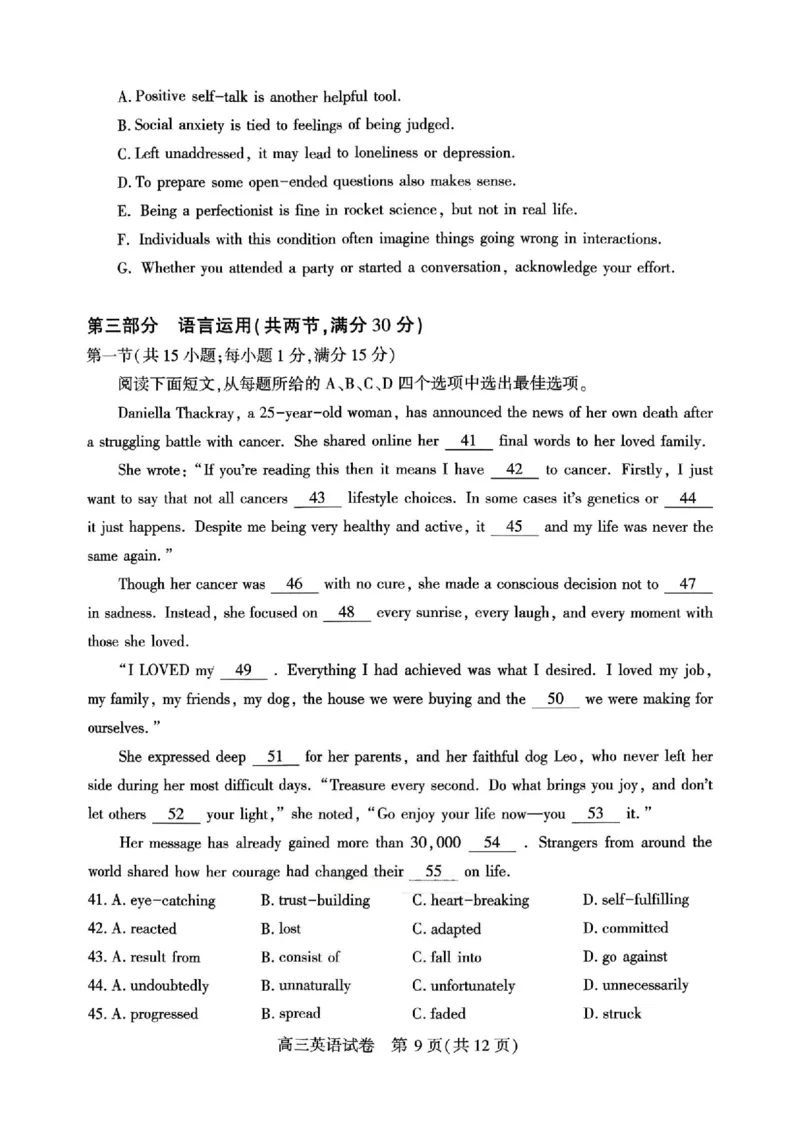
第一节完形填空(每小题1 分,满分15 分)
41-55
CBACD
BBADC
DCADB
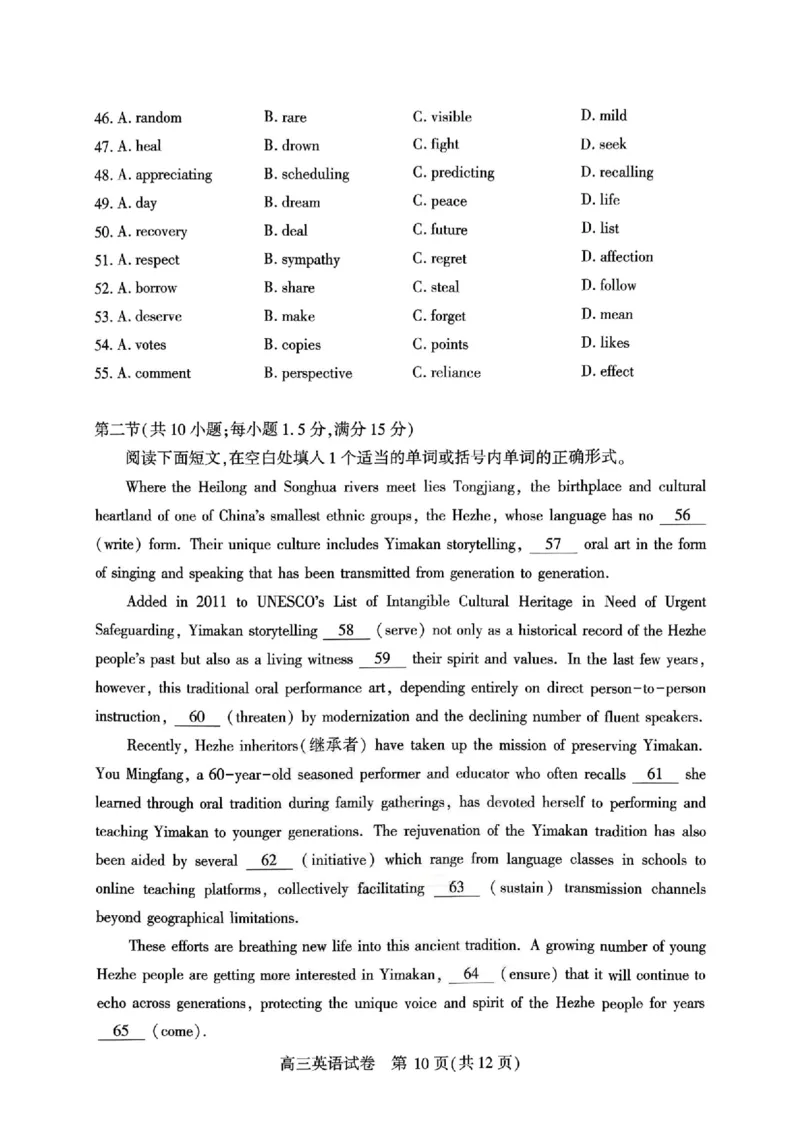
第二节语法填空56. written
57. an
58. serves
59. to
60. has been threatened
61. what
62. initiatives
63. sustainable
64. ensuring
65. to come
第一节应用文写作(满分15 分)
Possible Version 1
Dear Brian,
I’m writing to share the survey results of
students ’ preferred oral activities. 85% of those
surveyed prefer movie dubbing while 81% choose
role playing. Those interested in debates or
speeches account for 46% and 37% respectively.
The results indicate a clear preference for
interactive and enjoyable activities. Such tasks
combine entertainment and learning and tend to
cause less anxiety than debates or speeches.
Moreover, they involve multiple roles, allowing
more students to participate.
Since movie-dubbing and role-playing are
popular, alternating them every few weeks could
keep the club dynamic and engaging. Whichever
you choose, we are eager to take part. Looking
forward to receiving your reply. (94 词)
Yours,
Li Hua
我写这封信是为了分享学生偏爱的口语活
动的调查结果。85%的受访学生喜欢电影配音
,而81%的学生选择角色扮演。对辩论和演讲
感兴趣的学生占比分别为46%和37%。
调查结果表明,学生明显偏好兼具互动性
和趣味性的活动。这类活动兼具娱乐性与知识
性,相比辩论或演讲,更不容易让学生产生焦
虑感。此外,这类活动包含多种角色,能让更
多学生参与其中。
鉴于电影配音和角色扮演深受欢迎,每隔
几周交替开展这两项活动,能让社团保持活力
与吸引力。无论你选择哪种活动,我们都热切
期待参与。期待你的回复。
Possible Version 2
Dear Brian,
I’m writing to share the survey results of
students ’ preferred oral activities. As is shown in
the chart, movie dubbing is the most popular (85%),
followed closely by role playing (81%). Debates
and speeches are favored by 46% and 37% of those
surveyed respectively.
The strong interest in movie dubbing and role
playing suggests that students enjoy fun, creative
ways to practice English. Both activities can
encourage interaction and confidence, which can
boost participation.
I strongly recommend movie dubbing. Not
only is it effective for improving our
pronunciation but it also makes learning more
enjoyable. I would appreciate it if you consider my
suggestion. Looking forward to hearing from you.
(98 词)
Yours,
Li Hua
我写这封信是为了分享学生偏爱的口语活
动的调查结果。如图表所示,电影配音是最受
欢迎的活动,占比85%,紧随其后的是角色扮
演,占比81%。46%的受访者喜欢辩论,37%
的受访者青睐演讲。
学生对电影配音和角色扮演的浓厚兴趣表
明,他们乐于通过有趣且富有创意的方式练习
英语。这两项活动都能促进互动、增强自信,
进而提高参与度。
我强烈推荐开展电影配音活动。它不仅能
有效帮助我们提升发音水平,还能让学习过程
变得更加有趣。若你能考虑我的建议,我将不
胜感激。期待你的回复。
【应用文评分细则】
1. 本题总分为15 分,按5 个档次给分。
2. 评分时,先根据文章的内容和语言初步确定
其所属档次是否合格(9 分) ,然后以该档次的要
求来衡量、确定或调整档次,最后给分。
3. 词数少于60 酌情减分。
4. 评分时应注意:内容要点、应用词汇和语法
结构的丰富性和准确性及上下文的连贯性。
5. 拼写与标点符号是语言准确性的一个方面。
评分时应视其对交际的影响程度予以考虑。英
、美拼写及词汇用法均可接受。
6. 书写较差以至于影响交际,酌情减分。
第二节读后续写(满分25 分)
Some parents tried to calm the kids down but
failed. It was when frustration reached its peak that
Amy’s cheerful voice rose above the chaos. “Can
we play a song-guessing game?” she asked gently.
To the adults ’ surprise, Amy’s idea was greeted
with a chorus of agreement. As Amy sang familiar
tunes, the kids eagerly shouted out their guesses,
some even singing along. Laughter and applause
filled the bus, easing the restlessness caused by the
traffic jam. Seeing the situation settled, the adults
exchanged relieved, admiring glances, amazed at
how effortlessly Amy had transformed the mood.
(86 词)
Eva was proud to see Amy turn chaos into joy.
In that moment, she finally realized that success
wasn’t measured only by rankings or medals, but
by kindness, empathy, and the quiet power to warm
others. Amy might always be “Number 23” on the
class list, but when it comes to gentle strength, she
would always rank first. Eva’s long-held anxiety
over rankings began to fade. From then on,
whenever conversations at events turned to
children’s achievements, Eva would smile and
proudly share stories of Amy’s kindness and the joy
she brought to everyone around her. (86 词)
一些家长试图让孩子们安静下来,却没能
成功。就在大家的烦躁情绪达到顶点时,埃米
欢快的声音穿透了混乱。“我们来玩猜歌名游
戏好吗?”她轻声问道。让大人们感到惊讶的
是,埃米的提议得到了众人异口同声的赞同。
埃米唱起熟悉的曲调,孩子们争先恐后地喊出
答案,有的甚至跟着哼唱起来。整辆巴士里回
荡着笑声与掌声,缓解了因交通堵塞而产生的
焦躁不安。看到局面平复下来,大人们交换了
一个如释重负又满是赞许的眼神,惊叹于埃米
竟能如此轻松地扭转了气氛。
伊娃看到埃米将混乱化为欢乐,心中满
是自豪。在那一刻,她终于意识到,成功并非
只以名次或奖牌来衡量,更在于善良、共情之
心,以及那份温暖他人的无声力量。埃米或许
在班级名次表上永远只是“第23名”,但论及
这份温柔的力量,她永远是第一名。伊娃长久
以来对名次的焦虑,也开始渐渐消散。从那以
后,每当在各种场合的谈话提及孩子的成就时,
伊娃都会微笑着,骄傲地分享埃米的善良事迹,
以及她为身边每一个人带来的欢乐。
一、故事大意
母亲伊娃一度因女儿艾米学业成绩平平而深感
焦虑,但在目睹她两次以高情商化解冲突和混
乱后,终于领悟到:善良与共情力,远比考试
排名更能体现一个人的真正价值。
二、前文伏笔
①Eva would just sit there quietly——伊娃在别人
谈论各家优秀孩子时,经常保持沉默。续写最
后可通过描写伊娃主动晒娃来体现其心态的转
变。
②“Number 23’nickname——“Number 23”这一外
号贯穿全文,构成“ 唯分数论”与“多元成长观”
的核心冲突,预示母亲认知转变的必然性。
③Amy happily helping out while others shared
ambitious dreams——艾米在他人高谈梦想时默
默服务(端饮料、分饼干),通过行动而非言
语展现其体贴与奉献精神。
④“The room fell silent” after Amy shared her
kindergarten teacher dream——艾米说出她平凡
的梦想后全场沉默,加剧伊娃内心的不安。
⑤Amy loves dancing, singing, and playing with
them——艾米喜欢跳舞、唱歌、玩游戏,暗示
后续故事会以唱歌、做游戏等方式来化解堵车
给孩子们带来的烦躁。
⑥“Let’s flip a coin” solution——艾米用“抛硬币
”这一简单公平的方式化解争端,
体现其实践智慧与对心理学的天然理解。
⑦“Everyone stood in stunned silence” ——众人
震惊的反应,既是对艾米能力的意外认可,也
为伊娃后续的价值观重构埋下情感伏笔。
三、续写思路
第一段承接大人安抚孩子们失败,先描述车内
烦躁氛围。再描写艾米主动组织互动游戏(如
猜谜、唱歌),孩子们从焦躁哭闹转为积极参
与,车厢氛围由紧张转为欢乐,大人们钦佩艾
米的温柔与创意。
第二段承接伊娃目睹女儿化解困境给人们带来
快乐,内心感到骄傲,描写伊娃内心世界的转
变。她认识到艾米虽成绩平平,但一直温柔待
人,有化解冲突与矛盾的能力,能得到他人的
认可。她对女儿成绩的焦虑慢慢淡去,并其别
样的出色而开心。
四、可参考的升华句
①Seeing Amy’s bright and confident smile, Eva
realized the world needed kind and warm
kindergarten teachers as well outstanding talents.
看到艾米那明亮而自信的笑容,伊娃意识到,
这个世界不仅需要杰出的人才,也需要善良温
暖的幼儿园老师。
此版本着眼于未来,赋予艾米的梦想——当名
幼儿园老师—以崇高意义,慰藉母亲的焦虑。
②Her heart swelling with pride, Eva realized that
Amy was not meant to be the shiniest star in the sky,
but the warmest sunshine that nurtures life. 随着伊
娃焦虑渐渐消散,她意识到艾米或许并非夜空
中最耀眼的那颗星,却是那缕最温暖、滋养生
命的阳光。
此版本运用“星星”与“ 阳光” 的比喻,富有诗意
地肯定了艾米身上暖人的品质。
【读后续写评分细则】
本题总分为25 分,按五个档次进行评分。
评分时,主要从续写情节内容、语言表达和过
渡衔接三个方面考虑,具体为:
1. 续写的完整性以及与原文情境的融洽度。
2. 使用词汇、句型和语法结构的准确性、恰当
性和多样性。
3. 上下文的衔接和全文的连贯性。
4. 单词拼写和标点符号评分时也要予以考虑。
书写较差,酌情扣分。【各档次的给分范围和
要求】
第五档:(20-25 分)
(1 )创造了丰富、合理的内容,富有逻辑性
,续写完整,与原文情境融洽度高。
(2)使用了恰当且多样的词汇和语法结构,可
能有个别小错,但完全不影响理解。
(3)有效地使用了语句间衔接手段,全文结构
清晰,意义连贯。
第四档:(16-20 分)
(1 )创造了比较丰富、合理的内容,比较有
逻辑性,续写比较完整,与原文情境融合度较
高。
(2)使用了比较恰当、多样的词汇和语法结构
,可能有些许错误,但不影响理解。
(3)比较有效地使用了语句间衔接手段,全文
结构比较清晰,意义比较连贯。
第三档:(11-15 分)
(1 )创造了基本合理的内容,有一定的逻辑
性,续写基本完整,与原文情境相关。
(2)使用了简单的词汇和语法结构,有一定错
误或不恰当之处,但基本不影响理解
(3)基本有效地使用了语句间衔接手段,全文
结构基本清晰,意义基本连贯。
第二档:(6-10 分)
(1 )内容或逻辑上有一些重大问题,续写不
够完整,与原文情境有一定程度脱节。
(2)所使用的词汇有限,语法结构单调,错误
较多,影响理解。
(3)未能有效地使用语句间衔接手段,全文结
构不够清晰,意义不够连贯。
第一档:(1-5 分)
(1 )内容或逻辑上有较多重大问题,或有部
分内容抄自原文,续写不完整,与原文情境基
本脱节。
(2)所使用的词汇有限,语法结构单调,错误
很多,严重影响理解。
(3)几乎没有使用语句间衔接手段,全文结构
不清晰,意义不连续。
不得分:(0 分)
未作答:所写内容太少或无法看清以致无法判
断;所写内容全部抄自原文或与题目要求完全
不相关
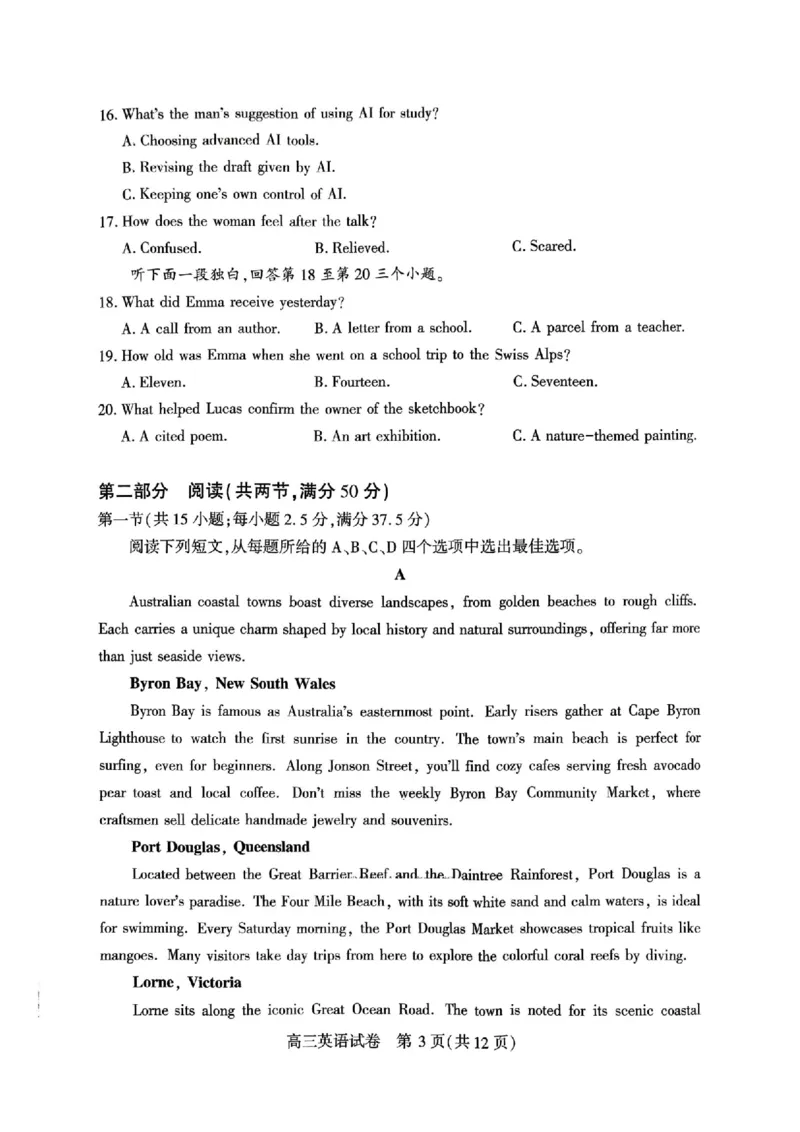
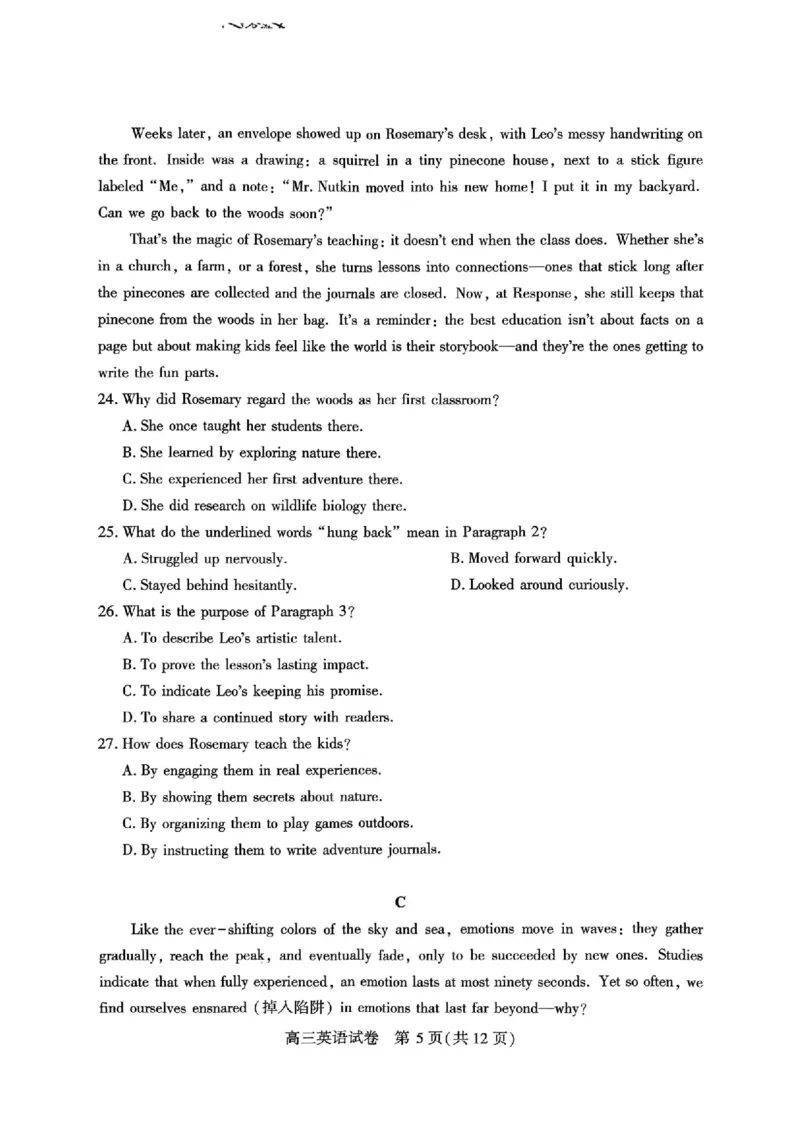
21 题答案A。Byron Bay 段落明确提到“the
weekly Byron Bay Community Market, where
craftsmen sell delicate handmade jewelry and
souvenirs”,这表明该地有手工艺品市场,适合
手工艺爱好者。B 项Port Douglas 提到市场售卖
热带水果,C 项Lorne 未提及手工艺品,D 项
Busselton 的特色是码头和水下观测站。
22 题答案D 。Lorne 段落指出“the annual Lorne
Pier to Pub swim—Australia’s largest open-water
swimming event” ,即其以年度大型公开水域游
泳比赛闻名。A 项海鲜、B 项海岸风光、C 项瀑
布虽在文中被提及,但并非该镇被特别强调的
知名之处。
23 题答案C 。Port Douglas 段落提到“explore
the colorful coral reefs by diving”(通过潜水探索
珊瑚礁),Busselton 段落提到“an underwater
observatory lets you see colorful fish and coral
reefs”(水下观测站可观看珊瑚礁)。两者都提
供了观察珊瑚礁的机会。A 项热带水果仅为Port
Douglas 的特色;B 项适合家庭主要是Busselton
的特点;D 项适合游泳在两地都有提及,但“观
察珊瑚礁”是其更独特且明确的共同点。
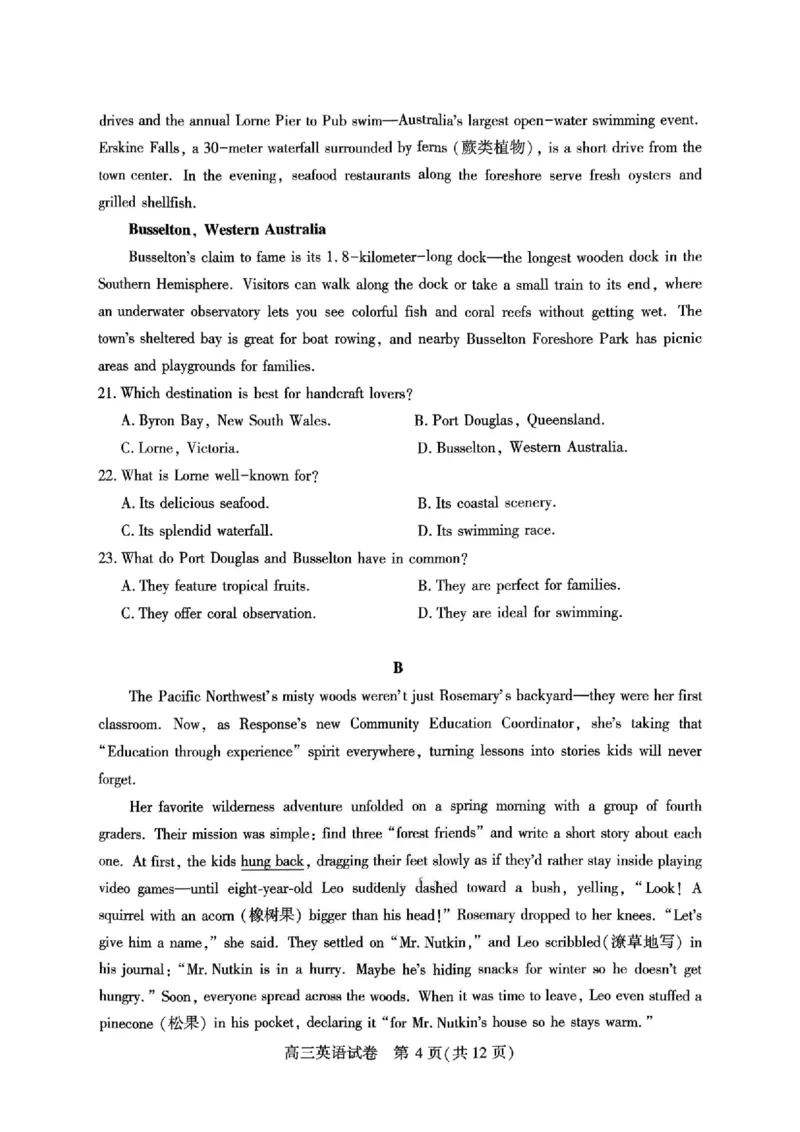
24 题答案B。文章首句指出“The Pacific
Northwest’s misty woods weren’t just Rosemary’s
backyard—they were her first classroom.” ,结合
下文她所秉持的“Education through
experience”精神以及她在森林中带领孩子学习的
事例,可以推断她最初是在自然探索中学习的
25 题答案C。根据划线词后的描述“dragging
their feet slowly as if they’d rather stay inside
playing video games”(拖着脚慢慢走,好像宁愿
待在屋里打游戏),可知孩子们起初是不情愿
、犹豫不前的。A 项(紧张地挣扎向上)、B 项
(快速向前)、D 项(好奇地环顾)均不符合
语境。
26 题答案B 。第三段描述了课程结束后Leo 给
Rosemary 寄来信件和画作,表达了对森林经历
的回味与期待。这直接证明了Rosemary 的教学
课程产生了持久的影响,与第四段首句“That’s
the magic of Rosemary’s teaching: it doesn’t end
when the class does.”相呼应。A 项(描述艺术天
赋)、C 项(表明信守承诺)、D 项(分享后续
故事)均非该段核心目的。
27 题答案A。全文核心是Rosemary“Education
through experience”的理念。第二段详细描述了
她带领孩子们在森林中亲自观察、命名松鼠、
写故事的真实体验。B 项(展示自然秘密)、C
项(组织户外游戏)、D 项(指导写日志)都
只是她教学方法的部分体现或具体行为,而非
其根本方法。
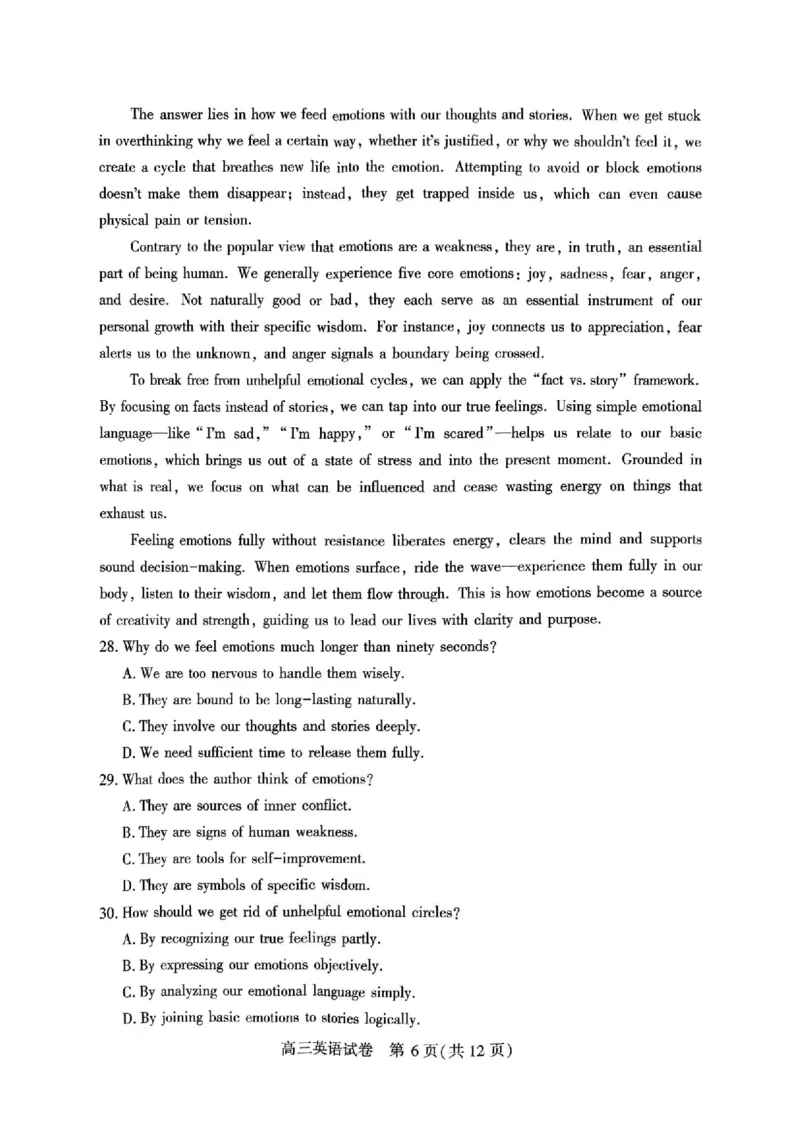
28 题答案C 。第二段首句明确指出“The
answer lies in how we feed emotions with our
thoughts and stories.”,即我们通过思想和故事为
情绪注入新生命,导致其延长。A 项(太紧张
)、B 项(自然长久)、D 项(需要足够时间
释放)均非文章给出的原因。
29 题答案C。第三段提到“they each serve as an
essential instrument of our personal growth with
their specific wisdom”,即情绪是个人成长的重
要工具。A 项(内心冲突的根源)是错误应对
情绪可能带来的结果;B 项(人类弱点的标志
)是流行观点,作者予以否定;
D 项(特定智慧的象征)表述不准确,情绪本
身承载着特定智慧,而非其象征。
30 题答案B 。第四段提出应用“fact vs. story”
框架,并指出“Using simple emotional language...
helps us relate to our basic emotions, which brings
us out of a state of stress and into the present
moment.” ,即用简单客观的语言表达情绪,关
注事实。A 项(部分意识到真实感受)未提及
;C 项(简单分析情绪语言)和D 项(将基本
情绪与故事逻辑连接)均与文意不符。
31 题答案D 。最后一段总结道“Feeling
emotions fully without resistance... guiding us to
lead our lives with clarity and purpose.”,即全然
接纳情绪能带来清晰和目标。A 项:过度思考
让我们陷入情绪而非真实感受;B 项:负面循
环源于我们对情绪的处理方式,而非感受情绪
本身;C 项:深度分析并非作者提倡的控制情
绪的方法。
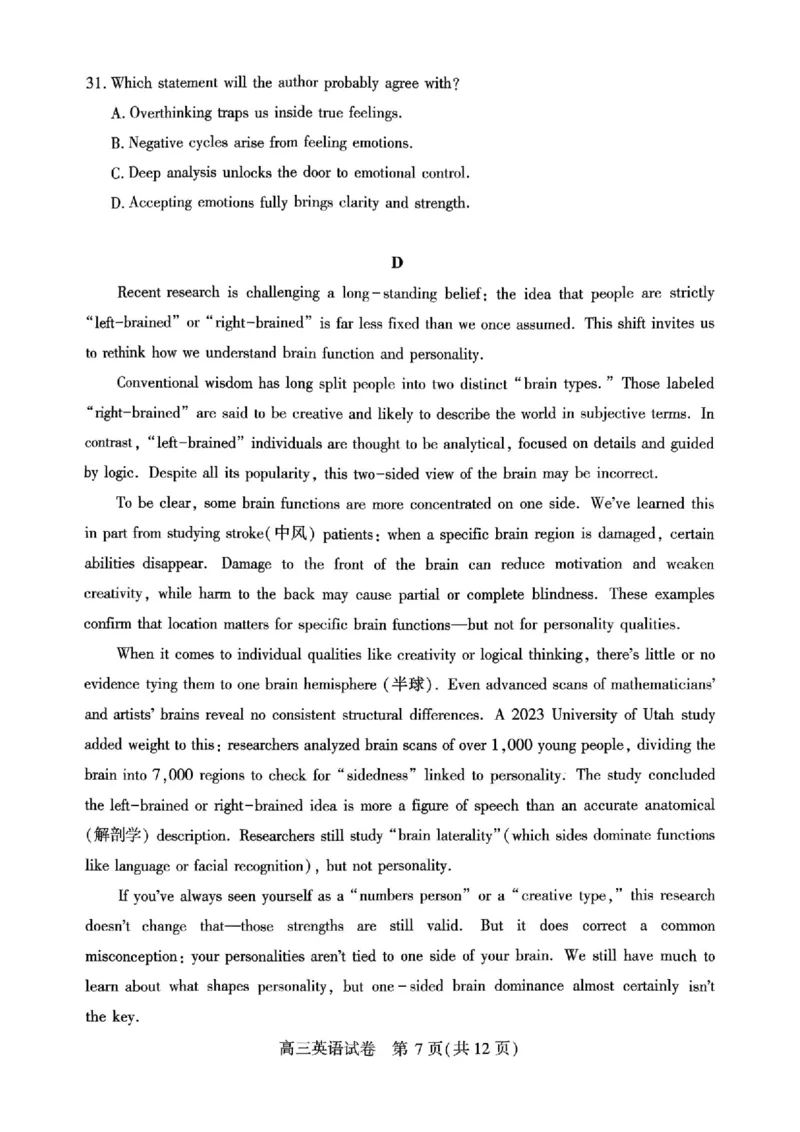
32 题答案A。根据第二段传统观点,“right-
brained”被描述为“creative”和“subjective”(有创
造力的、主观的)。在选项中,Hairdresser(美
发师)更需要创造性和主观审美,符合这一描
述。B 项图书管理员、C 项数学家、D 项打字员
通常被认为更需要条理、逻辑和细节,更接近
传统“左脑型”描述。
33题答案B 。作者在第三段提到中风患者的目
的是为了具体说明大脑不同区域负责不同功能
这一事实。原文通过举例(前脑损伤削弱创造
力,后脑损伤可能导致失明)来证实“location
matters for specific brain functions”(位置对特定
大脑功能至关重要),这直接展示了不同脑区
功能各异。A 项“证明大脑一侧专门运作”过于片
面;C 项“证明脑损伤改变人格”与文意相反;D
项“论证双脑观点错误”是整个段落的最终论证目
的,但提及中风患者这个例子的直接目的,是
为说明“功能分区”这个前提事实。
34 题答案A 。作者在第四段详细介绍了2023
年犹他大学的研究及其结论(“The study
concluded the left-brained or right-brained idea is
more a figure of speech than an accurate anatomical
description.”),并称其“added weight to this”(
为此增添了分量),可见作者是支持(Favorab
le)该研究结论的,并用它来支撑自己批驳传统
观念的观点。
35 题答案D。文章开篇即指出研究正在挑战(
“challenging”)一个长期信念(long-standing
belief),并在全文通过分析研究证据,旨在纠
正(correct )关于“左脑型/右脑型”人格的普遍
误解(common misconception)。A 项(阐明
普遍信仰)、C 项(确认长期假设)与文意相
反;B 项(介绍突破性研究)是手段而非根本
目的。
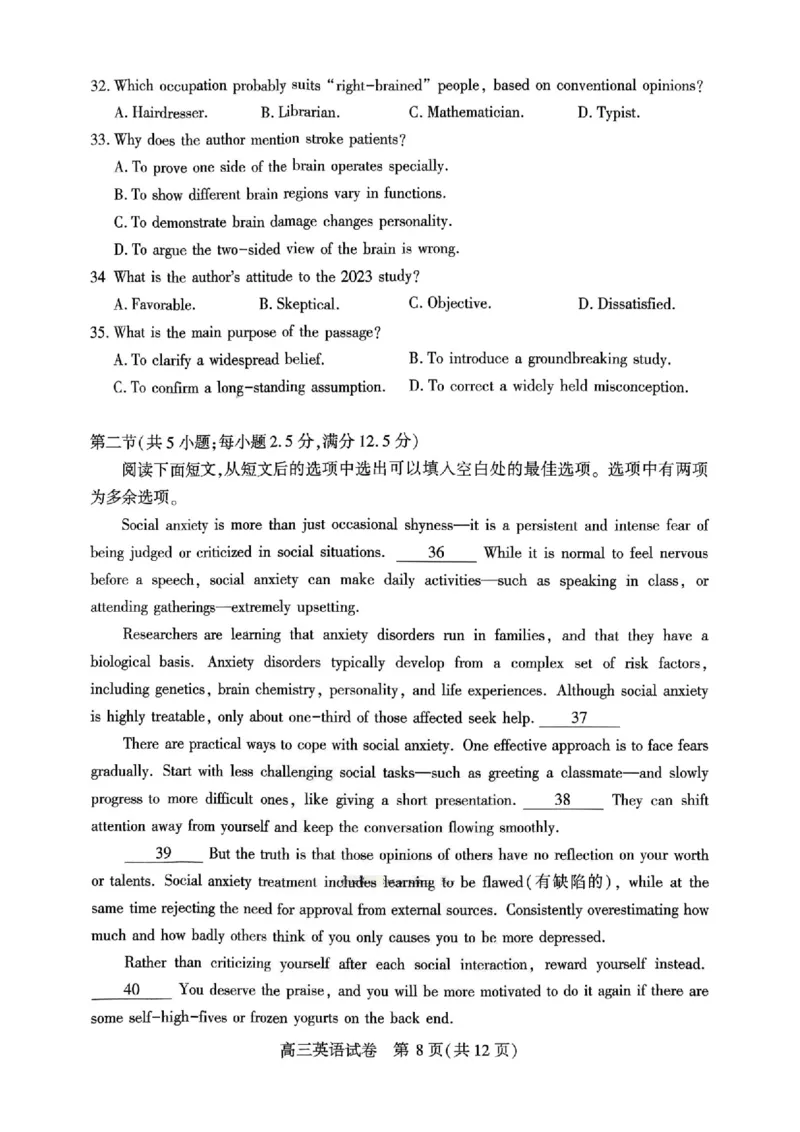
【七选五】
36. 答案F。段中句考查。空格前句定义了社交
焦虑的核心是“对被评判或批评的持久且强烈的
恐惧”。选项F(患有此症的人常想象互动中出
错)正是这种“恐惧”在思维层面的具体表现——
通过负面想象来预演可能被评判的场景。它完
美地承接了上文的抽象定义,并为下文的举例
(如演讲、上课等日常活动变得极度痛苦)提
供了心理活动层面的解释,使论述层次更为丰
富。其他选项(A、D、E 、G)为具体建议,
B 项是重复定义,C 项讲后果,均不符合此处
需要“展开阐释恐惧表现”的上下文逻辑。
37. 答案C。考查段尾句。第二段主要阐述社交
焦虑的生物学成因和“可治疗但治疗率低”的现状
。空格前句是关键数据:“仅约三分之一患者寻
求帮助” 。选项C(若不加处理,可能导致孤独
或抑郁)直接指出了“不寻求帮助”(即“left
unaddressed”)可能引发的严重后果,与前句构
成“问题—后果”的因果链条,增强了论述的紧迫
性。A 项(积极自我对话)是后文的解决方案
,B 项是重复首段内容,D、E、G 项均未涉及“
不治疗”的后果,无法在此处形成有效衔接。
38. 答案D。考查段中句。本段主旨是提供应对
社交焦虑的“实用方法”。空格前介绍“逐步面对
恐惧”的方法,空格后句以“They”开头,说明空
格处需提出一个能被“They”指代的、具体的复
数名词或方法。选项D(准备一些开放式问题
也很有意义)中的“open-ended questions”(开放
式问题)是复数名词,正好可被后句的“They”
指代。同时,“准备问题”本身就是一个具体、可
操作的社交技巧,与段落的“实用方法”主题高度
契合,后句则是对这一技巧作用的解释(转移
注意力、让对话流畅)。A 项虽是方法但无法
被“They”指代,B 、C 、E 、G 项均与“具体技
巧”及“They”的指代要求不符。
39. 答案B 。考查段首句。空格后文的核心论
点是“他人的看法并不能定义你的价值”,并进一
步提出治疗包括“接受不完美”和“拒绝寻求外部
认可” 。选项B(社交焦虑与被评判感有关)直
击核心,点明本段将要展开论述的关键——即
如何处理这种“被评判感”。它作为主题句,成功
引出了后文对于“他人看法”的辨析和应对策略。
A 、D 、E 、G 项均为具体建议或评论,不适合
作为引出本段核心讨论的起始句;C 项是后果
,与后文内容脱节。
40. 答案G 。考查段中句。本段主旨是“ 奖励
自己” 。空格前句是总述“Rather than criticizing...
reward yourself...” ,空格后则具体描述奖励的价
值和激励作用。选项G(无论参加了聚会还是
开启了谈话,都要认可你的努力)完美地充当
了“论点”与“论据”之间的桥梁:它具体阐释了
在哪些“社交互动”(social interaction)后应该进
行“奖励”(即“acknowledge your effort”),与
段首的“reward yourself”形成直接呼应,并为后
文的“你值得表扬”提供了具体情境,使段落逻辑
“总-分-总”结构完整。A 、B 、C 、D 、E 项均
未涉及“奖励”或“认可努力”这一核心,无法在此
处建立连贯语义。
【完形填空】
41. 答案C 。考查形容词。根据语境,一位年
轻女性宣布自己因癌症去世的消息,她留给家
人的“最终遗言”最准确的情感色彩是“令人心碎
的”。A“引人注目的”过于中性,B“建立信任的”
与语境无关,D“自我实现的”通常修饰预言,用
于此处不当。
42. 答案B。考查动词搭配。“lose to + 疾病/对
手”是表示“输给… ,因…去世/失败”的固定且
地道的搭配。A“reacted to”(对…反应),
C“adapted to”(适应),D“committed to” (致力
于)均不符合“去世”的语义。
43. 答案A。考查动词短语。句意为“并非所有
癌症都由生活方式选择引起”。“result from”意为
“由…引起”,准确地表达了因果关系。
B“consist of”(由…组成),C“fall into”(落入
…类别),D“go against”(违背)均不符合语义
44. 答案C 。考查副词。此处表达对于癌症有
时无缘无故发生这一事实的遗憾和不幸。
A“unquestionably”(毫无疑问地)表示确定,
B“unnaturally”(不自然地),D“unnecessarily”
(不必要地)均不能传达“不幸的是”这层遗憾的
语气。
45. 答案D 。考查动词。“strike”常用于描述疾
病“突然侵袭” ,生动形象。A“progressed” (进
展)和B“spread”(扩散)描述疾病的发展阶段
,C“faded”(消退)语义相反。
46. 答案B 。考查形容词。与后文“with no
cure”(无药可医)构成合理的逻辑关系:因为“
罕见”,所以可能缺乏有效的疗法。A“random”
(随机的),C“visible”(可见的),D“mild”
(轻微的)均不能很好地解释“无药可医”。
47. 答案B 。考查动词。“drown in sadness”是
绝佳的比喻,意为“沉溺于悲伤之中” ,形象地
表达了被负面情绪淹没的状态。A“heal”(治愈
)与“in sadness”搭配不合逻辑,C“fight” (斗争
)和D“seek”(寻求)虽然语法通顺,但不如
“drown”生动且符合“决定不沉溺”的语境。
48. 答案A 。考查动词。“appreciating”意为“欣
赏、感激” ,表达了珍惜生活中每一个美好瞬间
的积极人生态度。B“scheduling”(安排日程),
C“predicting”(预测),D“recalling” (回忆)
均不符合“专注于当下美好”的语境。
49. 答案D 。考查名词。作为总起句,概括了
她所热爱的一切,后文是具体的列举(工作、
家庭、朋友等)。A“day”(日子),B“dream”
(梦想),C“peace”(和平)范围都太窄,无
法涵盖后文所有内容。
50. 答案C 。考查名词。与“正在买的房子”并
列,都是“为我们自己创造”的长期、积极的事物
。A“recovery”(康复)是过程而非创造物,
B“deal”(交易)语义不符,D“list” (清单)过
于琐碎。
51. 答案D。考查名词。“affection”意为“深情、
慈爱”,能同时完美地适用于对父母和对宠物的
温暖感情。A“respect”(尊敬)用于宠物不自然
,B“sympathy”(同情)通常指向处于不幸中的
人,C“regret”(遗憾)情感色彩错误。
52. 答案C。考查动词。“steal your light”是地道
的英语比喻,意为“偷走你的光芒/光彩”,即不
要让别人夺走你的积极性、独特性或快乐。
A“borrow”(借用),B“share”(分享),
D“follow”(跟随)均无法表达这种被“夺走”的
意味。
53. 答案A 。考查动词辨析题。表达了“你值得
拥有幸福生活”的强烈肯定和鼓励,是强有力的
结尾。B“make”(制造),C“forget”(忘记)
,D“mean”(意味着)均不符合鼓励他人享受生
活的语境。
54. 答案D。考查名词。完全符合在社交媒体上
发布消息并获得“点赞”的语境。A“votes” (投票
),B“copies”(副本),C“points”(积分)都
不如“likes”在社交媒体语境中常见和直接。
55. 答案B 。考查名词固定搭配题。“change
one’s perspective on life”是意为“改变某人的人生
观/看待生活的视角”的完美表达。A“comment”
(评论),C“reliance”(依赖),D“effect” (影
响,通常搭配是have an effect on)均不如
“perspective”准确地道。
【语法填空】
56. written 考查过去分词作定语。written 修饰
form,意为“书面的形式”。句意:黑龙江与松花
江交汇之处坐落着同江市,这里是中国人口最
少的民族之一赫哲族的发源地和文化中心,而
赫哲族的语言没有书面形式。
57. an 考查不定冠词。“oral art ” 是可数名词单
数(一种口头艺术),首次提及,需用不定冠
词。句意:他们的独特文化包括伊玛堪说唱,
一种说唱形式世代相传的口头艺术。
58. serves 考查谓语动词一般现在时。主语:
Yimakan storytelling 是单数,句子描述的是文化
遗产现在的功能,因此用一般现在时。句意:
伊玛堪说唱于2011年被列入联合国教科文组织
《急需保护的非物质文化遗产名录》,它不仅
充当赫哲族过往历史的记录,也是其精神与价
值观的活态见证。
59. to 考查介词搭配。a witness to something
……的见证者/见证。句意同上题。
60. has been threatened 考查谓语动词现在完成时
被动语态。“In the last few years”典型的现在完
成时标志,且主语this traditional oral
performance art 与threaten 之间是被动关系。现
在完成常见标志:in recent years, over the past
decade, since 2020 等。句意:然而,在近几年
中,这种完全依赖面对面口传的传统文化表演
艺术已经受到现代化进程和流利使用者数量减
少的威胁。
61. what 考查名词性从句中的宾语从句。定语
从句谓语动词recalls 后接宾语从句,引导词
what表示“. … .. 的东西” 。句意:尤明芳是一位
60 岁的资深表演者和教育者,她常常回忆起自
己在家庭聚会中通过口传方式所学到的东西,
并已全身心投入到向年轻一代表演和传授伊玛
堪的工作中。
62. initiatives 考查名词复数。“initiative” 是可数
名词,意为“倡议;新方案”,前面有修饰语
several,后应接可数名词复数。句意:伊玛堪传
统的复兴也得益于从学校开设的语言课程到在
线教学平台等多项新方案,它们共同促进了超
越地理限制的可持续传承渠道。
63. sustainable 考查词性变化。transmission
channels(传承渠道)是名词短语,需填一个形
容词来修饰“channels” 。句意同上题。
64. ensuring 考查动词ing 作结果状语。ensuring
动词ing,说明主句动作带来的结果。句意:越
来越多的赫哲族年轻人对伊玛堪产生了更浓厚
的兴趣,从而确保它将继续代代传唱,在未来
的岁月里守护赫哲族独特的声音与精神。
65. to come 考查动词不定式作后置定语。“to
come”作后置定语,修饰“years”,意为“未来的
年月”。句意同上题。
【听力原文】
Text 1
W: Skies Airlines. How can I help you?
M: I’d like to buy a ticket from London to Paris on
the morning of January 23rd. W: ①Would you like
to book a return flight as well?
M: No, thank you. The weather forecast doesn’t
recommend flying.①I’m taking the railway back.
Text 2
W: ②How I wish there were a parking lot in our
neighourhood! How can we get one?
M: I think we should hold a meeting to discuss it.
Text 3
W: ③Hi, Jack, I saw your name on the
conference schedule — you’re heading to Berlin
next Friday, right?
M: Yes, Linda. ③I’ll be there for three days. Then
I’m off to Munich — I’ve always wanted to visit
those old castles there.
W: Oh, really? That sounds lovely. And when do
you come back to London?
M: I’ll spend two full days in Munich before
coming home.
Text 4
M: Hi, Emma. I remember the band practice is on
October 14th, but you said it ’s on October 16th.
Are you sure?
W: Oh, sorry. ④It was a slip of the tongue. I meant
October 12th for sure.
Text 5
W: Hi, Jason! Which volunteer activity are you
joining this weekend — the beach cleanup on
Saturday or the animal shelter on Sunday?
M: ⑤Actually, neither. I’m visiting the nursing
home on Sunday instead. We’ll help clean up the
common areas and chat or play games with the
residents.
W: I wish I could join that activity. But I’ve signed
up to help at the animal shelter. Text 6
W: Hi, I’m Charlotte from New Zealand. I’m
studying biology here on exchange.
M: Hi, I’m Li Wei. Nice to meet you!
W: ⑥Would you mind if I ask about getting around
the city? I’m still figuring things out.
M: Not at all. Most students take the green bus—it
runs every 15 minutes and only costs ¥2. W:
⑥What about those blue bikes with digital locks?
M: Those are the CityCycle bikes. You can unlock
them using an app. ⑦The first 30 minutes cost ¥ 1.
5, and after that, it’s ¥ 1 for every additional 30
minutes. They are available all over the city and are
perfect for short trips.
W: Thanks! ⑥The light rail looks fast, but does it
go near campus?
M: It does, but only every 30 minutes. It’s probably
not the best choice if you’re in a hurry. Text 7
W: Hi, Peter. I’m sorry to hear you’re leaving today.
So what did you make of Suzhou gardens?
M: Well, to be honest, when I first arrived, I was a
little disappointed. I’d expected something more
modern. ⑧But when I walked into the Humble
Administrator’s Garden, I was so amazed! It was
like stepping into a painting.
W: Where else did you go?
M: I visited the Lingering Garden too. I
learned a lot about traditional Chinese garden
architecture.
W: Oh, well, what about the Tiger Hill—that’s
pretty high. Some of the views from there are
breathtaking!
M: Oh, that place, yes. But I had no idea there
would be so many tourists! So I decided to go to the
Hanshan Temple instead. That place was really
quiet.
W: Yes, it is. ⑨So today you walked along the
Grand Canal, right?
M: ⑨Unfortunately, no. I just didn’t have the time.
W: Wow, I can’t believe you didn’t see the canal!
You have to stay longer, Peter. There’s so much
more of Suzhou to see.
M: Oh, don’t worry. I’ll be back in the Jiangnan
region one day. ⑩I just can’t get enough of those
rice cakes!
Text 8
M: Hi, Diana, ⑪I would like to talk to you before I
respond to the job offer I’ve received from Global
Travel. They’ve offered me the position of
marketing director.
W: I’m sorry to hear that, David. Thank you
for letting me know before making your final
decision.
M: I genuinely value my experience here. Having
worked in the department for four years, I have
gained significant professional growth.
⑫However, there’s been no indication of
career advancement.
W: You’ve been a great team member here. What
would make you consider staying? M: ⑫I don’t
need a big salary increase, but I’d like to take on
more challenges.
W: When do they need your response?
M: By next Thursday.
W: Let me consult with the management team. I’ll
get back to you by next Wednesday. Would that
work?
M: ⑬It would be better if I could have the result by
next Tuesday. I’d prefer to make a decision earlier.
W: ⑬Of course. I’ll make sure you hear from me
by then. We truly regret losing someone with
your skills and dedication.
M: I really appreciate your support.
Text 9
W: Mark, you look focused. Still working on your
history paper?
M: Hi, Lisa. Actually, I just finished the first draft.
⑩Now I’m using an AI writing assistant to
improve the language and check my arguments.
W: ⑩An AI assistant? Isn’t that like cheating?
I’ve avoided using AI for my assignments,
worrying teachers might disapprove.
M: Not if you use it right. As a really smart study
partner, AI doesn’t do the work for me. For
example, it might say,“This part needs better
support,” but then I will go find the support myself.
W: Hmm, that does sound helpful. I went the other
way last semester with a math app. I got into the
habit of just taking pictures of problems and
copying the solutions. It really didn’t help me when
exam time came, only to make things worse.
M:I see.That’s exactly the risk. ⑩The key is to
stay actively involved. My rule is:draft
independently, use AI for feedback, then revise the
draft critically. It has boosted my efficiency without
holding me back.
W: I like that idea. Maybe I should give it another
try, but set clear rules. Like using it only to explain
concepts I find difficult, not to do the work for me.
M: That’s a smart plan. Used wisely, AI can free up
our time for deeper thinking and creativity, rather
than just getting stuck on every little detail.
W: True. Thanks, Mark! ⑦You’ve turned my fear
into a strategy.
Text 10
W: Welcome back, everyone. This is Global Wave
Radio. Here’s something interesting.
⑩Yesterday, a teenage girl named Emma Reed
from Vancouver, Canada, received a package from
Switzerland. ⑩Inside was her sketchbook, lost
three years ago during a school trip to the Swiss
Alps. ⑩It was found by Lucas Weber, a high
school art teacher, near a hiking trail in
Interlaken in 2022. ⑩There was no name or
address, but it contained beautiful drawings of
mountains and forests, with a short poem on the
cover. Impressed by the artwork and poem, Lucas
kept the sketchbook and began searching online for
its owner. Last month, he came
across a news article about a Vancouver student
organizing an environmental art exhibition
using nature-themed paintings. ⑩The article quoted
her poem — the very one on the cover of the
sketchbook. Lucas contacted the author of the
article, who helped him reach ⑩Emma, now
17. Soon, the sketchbook was returned. Emma was
shocked and deeply moved. “I thought it was gone
forever,” she said. The sketchbook’s journey home
reminds us that small acts of kindness can bridge
distances and bring joy across time and borders.