专题 21 完形填空说明文、议论文
2022年完形填空说明文、议论文
Close 1
【2022年全国乙卷】Young children across the globe enjoy playing games of hide and seek. For them,
there’s something highly exciting about ___21___ someone else’s glance and making oneself unable to be seen.
However, we all witness that preschool children are remarkably ___22___ at hiding. They often cover only
their eyes with their hands, leaving the rest of their bodies ___23___ .
For a long time, this ineffective hiding method was ___24___ as evidence that children are hopelessly
“egocentric” (自我中心的) creatures. But our ___25___ research results in child developmental psychology
___26___ that idea.
We brought young children aged 2-4 into our Minds in Development Lab at USC. Each ___27___ sat down
with an adult who covered her own eyes or ___28___ . We then asked the child if she could ___29___ or hear the
adult. Surprisingly, children replied that they couldn’t. The same ___30___ happened when the adult covered her
own mouth: ___31___ children said that they couldn’t ___32___ to her.
A number of ___33___ ruled out that the children misunderstood what they were being asked. The results
were clear: Our young subjects ___34___ the questions and knew ___35___ what was asked of them. Their
___36___ to the questions reflected their true ___37___ that “I can see you only if you can see me, too.” They
simply ___38___ mutual (相互的) recognition and regard. Our ___39___ suggest when a child “hides” by
putting a blanket over her head, it is not a result of egocentrism. In fact, children consider this method ___40___
when others use it.
21. A. following B. taking C. escaping D. directing
22. A. clever B. bad C. scared D. quick
23. A. exposed B. examined C. untouched D. imbalanced
24. A. supported B. guaranteed C. imagined D. interpreted
25. A. disappointing B. mixed C. surprising D. desired
26. A. explained B. confirmed C. contradicted D. tested
27. A. parent B. child C. researcher D. doctor
28. A. feet B. nose C. hands D. ears
29. A. see B. help C. reach D. fool
30. A. event B. thing C. action D. accident31. A. Yet B. Now C. Soon D. Once
32. A. speak B. listen C. turn D. wave
33. A. instructions B. descriptions C. experiments D. assumptions
34. A. comprehended B. predicted C. explored D. ignored
35. A. partly B. honestly C. vaguely D. exactly
36. A. responses B. approaches C. contribution D. sensitivity
37. A. ability B. belief C. identity D. purpose
38. A. hold back B. relate to C. insist on D. make up
39. A. limitations B. requirements C. theories D. findings
40. A. tentative B. impressive C. creative D. effective
Close 2
【2022 年浙江卷 6 月】Small children are easy to throw up in the air and catch-and they ___16___ it.
“Again, Daddy, again!” Jacky shouts as I throw him skywards and catch him on the way back down again. He
throws his arms and legs out ___17___ he were flying, his eyes wide with ___18___. His trust in me is ___19___
which is quite a nice feeling, but at the same time gives me a huge sense of ___20___ .
I hope Jacky will always trust me fully, but I know that, as he gets ___21___ , it will need more effort and
sound judgment____22____ . Trust is such an important part of a ___23___ relationship that it’s something that
can’t ___24___ to lose. Every time I ___25___ Jacky to something new, he’ll do it only because he trusts me and
feels ___26___ in the knowledge that he won’t get hurt .___27___ , teaching Jacky to swim means he has to
___28___ that, when he’s swimming in the big pool, I’ll come to his rescue if his doggy paddle lets him down.
___29___ in the workplace, trust is important for strong ___30___ . It is something that every manager
should work hard to ___31___ among their team. If people don’t trust you, they’re unlikely to ___32___ your
directions and willingly become a loyal (忠诚) team member. A ___33___ of trust can make people work against
you rather than for you. At the very least, it means that people are not going to be ___34___ you their best. Good
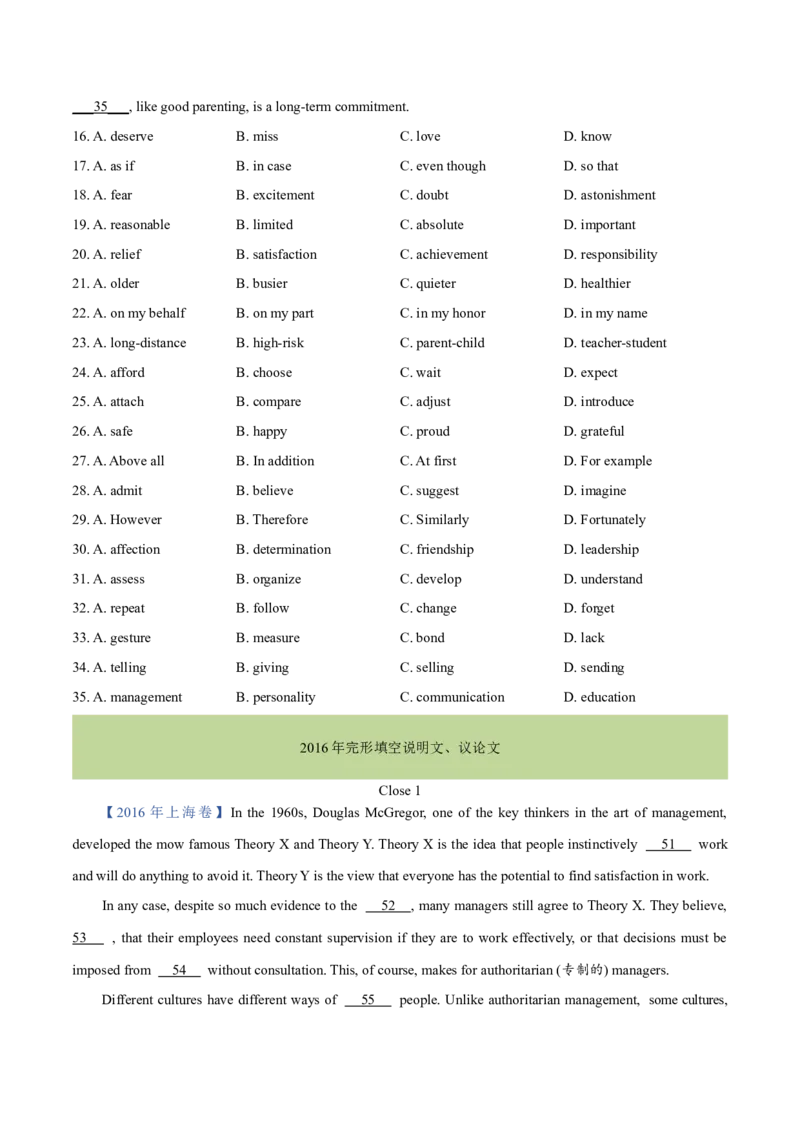
___35___, like good parenting, is a long-term commitment.
16. A. deserve B. miss C. love D. know
17. A. as if B. in case C. even though D. so that
18. A. fear B. excitement C. doubt D. astonishment
19. A. reasonable B. limited C. absolute D. important20. A. relief B. satisfaction C. achievement D. responsibility
21. A. older B. busier C. quieter D. healthier
22. A. on my behalf B. on my part C. in my honor D. in my name
23. A. long-distance B. high-risk C. parent-child D. teacher-student
24. A. afford B. choose C. wait D. expect
25. A. attach B. compare C. adjust D. introduce
26. A. safe B. happy C. proud D. grateful
27. A. Above all B. In addition C. At first D. For example
28. A. admit B. believe C. suggest D. imagine
29. A. However B. Therefore C. Similarly D. Fortunately
30. A. affection B. determination C. friendship D. leadership
31. A. assess B. organize C. develop D. understand
32. A. repeat B. follow C. change D. forget
33. A. gesture B. measure C. bond D. lack
34. A. telling B. giving C. selling D. sending
35. A. management B. personality C. communication D. education
Close 3
【2022 年浙江卷 6 月】Small children are easy to throw up in the air and catch-and they ___16___ it.
“Again, Daddy, again!” Jacky shouts as I throw him skywards and catch him on the way back down again. He
throws his arms and legs out ___17___ he were flying, his eyes wide with ___18___. His trust in me is ___19___
which is quite a nice feeling, but at the same time gives me a huge sense of ___20___ .
I hope Jacky will always trust me fully, but I know that, as he gets ___21___ , it will need more effort and
sound judgment____22____ . Trust is such an important part of a ___23___ relationship that it’s something that
can’t ___24___ to lose. Every time I ___25___ Jacky to something new, he’ll do it only because he trusts me and
feels ___26___ in the knowledge that he won’t get hurt .___27___ , teaching Jacky to swim means he has to
___28___ that, when he’s swimming in the big pool, I’ll come to his rescue if his doggy paddle lets him down.
___29___ in the workplace, trust is important for strong ___30___ . It is something that every manager
should work hard to ___31___ among their team. If people don’t trust you, they’re unlikely to ___32___ your
directions and willingly become a loyal (忠诚) team member. A ___33___ of trust can make people work against
you rather than for you. At the very least, it means that people are not going to be ___34___ you their best. Good___35___, like good parenting, is a long-term commitment.
16. A. deserve B. miss C. love D. know
17. A. as if B. in case C. even though D. so that
18. A. fear B. excitement C. doubt D. astonishment
19. A. reasonable B. limited C. absolute D. important
20. A. relief B. satisfaction C. achievement D. responsibility
21. A. older B. busier C. quieter D. healthier
22. A. on my behalf B. on my part C. in my honor D. in my name
23. A. long-distance B. high-risk C. parent-child D. teacher-student
24. A. afford B. choose C. wait D. expect
25. A. attach B. compare C. adjust D. introduce
26. A. safe B. happy C. proud D. grateful
27. A. Above all B. In addition C. At first D. For example
28. A. admit B. believe C. suggest D. imagine
29. A. However B. Therefore C. Similarly D. Fortunately
30. A. affection B. determination C. friendship D. leadership
31. A. assess B. organize C. develop D. understand
32. A. repeat B. follow C. change D. forget
33. A. gesture B. measure C. bond D. lack
34. A. telling B. giving C. selling D. sending
35. A. management B. personality C. communication D. education
2016年完形填空说明文、议论文
Close 1
【2016 年上海卷】In the 1960s, Douglas McGregor, one of the key thinkers in the art of management,
developed the mow famous Theory X and Theory Y. Theory X is the idea that people instinctively 51 work
and will do anything to avoid it. Theory Y is the view that everyone has the potential to find satisfaction in work.
In any case, despite so much evidence to the 52 , many managers still agree to Theory X. They believe,
53 , that their employees need constant supervision if they are to work effectively, or that decisions must be
imposed from 54 without consultation. This, of course, makes for authoritarian (专制的) managers.
Different cultures have different ways of 55 people. Unlike authoritarian management, some cultures,particularly in Asia, are well known for the consultative nature of decision-making—all members of the department or
work group are asked to 56 to this process. This is management by the collective opinion. Many western
companies have tried to imitate such Asian ways of doing things, which are based on general 57 . Some
experts say that women will become more effective managers than men because they have the power to reach
common goals in a way that traditional 58 managers cannot.
A recent trend has been to encourage employees to use their own initiative, to make decisions on their own
without 59 managers first. This empowerment (授权) has been part of the trend towards downsizing: 60
the number of management layers in companies. After de-layering in this way, a company may be 61 with just
a top level of senior managers, front-line managers and employees with direct contact with the public.
Empowerment takes the idea of delegation (委托) much further than has 62 been the case. Empowerment and
delegation mean new forms of management control to 63 that the overall business plan is being followed, and
that operations become more profitable under the new organization, rather than less.
Another trend is off-site or 64 management, where teams of people linked by e-mail and the Internet
work on projects from their own houses. Project managers evaluate the 65 of the team members in terms of
what they produce for projects, rather than the amount of time they spend on them.
51. A. desire B. seek C. lose D. dislike
52. A. contrary B. expectation C. degree D. extreme
53. A. vice versa B. for example C. however D. otherwise
54. A. outside B. inside C. below D. above
55. A. replacing B. assessing C. managing D. encouraging
56. A. refer B. contribute C. object D. apply
57. A. agreement B. practice C. election D. impression
58. A. bossy B. experienced C. western D. male
59. A. asking B. training C. warning D. firing
60. A. doubling B. maintaining C. reducing D. estimating
61. A. honored B. left C. crowded D. compared
62. A. economically B. traditionally C. inadequately D. occasionally
63. A. deny B. admit C. assume D. ensure
64. A. virtual B. ineffective C. day-to-day D. on-the-scene
65. A. opinion B. risk C. performance D. attractiveness2015年完形填空说明文、议论文
Close 1
【2015年重庆卷】Imagine the first days in a new time zone. Slow to respond to the 28 , your body clock
is confused. You’re sleepy all day, but when it’s time for bed, you can hardly fall asleep. Obviously you’re 29
jet lag(时差反应).
Travelers have traditionally fought this 30 with sleeping pills or alcohol. There are actually healthier
ways that can work just as 31.
For example, the moment you get on the airplane, start 32 your biological clock to the destination’s time.
If it’s daytime in your destination, try to stay 33 . Walking around the cabin(客舱) can be of help. When
it’s nighttime, try to sleep. In that case, eat before the flight, 34 an empty stomach will prevent you from sleeping.
These tips will help you start a new 35of sleep and wakefulness.
28. A.flight B.change C.demand D.climate
29. A.suffering from B.working on C.looking into D.leading to
30. A.danger B.problem C.waste D.fear
31. A.briefly B.slowly C.suddenly D.effectively
32. A.checking B.sending C.adjusting D.stopping
33. A.awake B.alone C.hungry D.calm
34. A.though B.so C.while D.or
35. A.understanding B.cycle C.research D.trend
Close 2
【2015年安徽卷】 In our modern world, when something wears out, we throw it away and buy a new one.
The 36 is that countries around the world have growing mountains of 37 because people are throwing
out more rubbish than ever before.
How did we 38 a throwaway society? First of all, it is now easier to 39 an object than to spend
time and money to repair it. 40 modern manufacturing (制造业) and technology, companies are able to
produce products quickly and inexpensively. Products are plentiful and 4 1 .
[来源:学科网]
Another cause is our 42 of disposable (一次性的) products. As 43 people, we are always
looking for 44 to save time and make our lives easier. Companies 45 thousands of different kinds of
disposable products: paper plates, plastic cups, and cameras, to name a few.
Our appetite for new products also 46 to the problem. We are 47 buying new things.Advertisements persuade us that 4 8 is better and that we will be happier with the latest products. The result is
that we 4 9 useful possessions to make room for new ones.
All around the world, we can see the 50 of this throwaway lifestyle. Mountains of rubbish just keep
getting bigger. To 51 the amount of rubbish and to protect the 52 , more governments are requiring
people to recycle materials. 53 , this is not enough to solve (解决) our problem.
Maybe there is another way out. We need to repair our possessions 54 throwing them away. We also
need to rethink our attitudes about 55 . Repairing our possessions and changing our spending habits may be
the best way to reduce the amount of rubbish and take care of our environment.
36. A. key B. reason C. project D. problem
37. A. gifts B. rubbish C. debt D. products
38. A. face B. become C. observe D. change
39. A. hide B. control C. replace D. withdraw
40. A. Thanks to B. As to C. Except for D. Regardless of
41. A. safe B. funny C. cheap D. powerful
42. A. love B. lack C. prevention D. division
43. A. sensitive B. kind C. brave D. busy
44. A. ways B. places C. jobs D. friends
45. A. donate B. receive C. produce D. preserve
46. A. adapts B. returns C. responds D. contributes
47. A. tired of B. addicted to C. worried about D. ashamed for
48. A. newer B. stronger C. higher D. larger
49. A. pick up B. pay for C. hold onto D. throw away
50. A. advantages B. purposes C. functions D. consequences
51. A. show B. record C. decrease D. measure
52. A. technology B. environment C. consumers D. brands
53. A. However B. Otherwise C. Therefore D. Meanwhile
54. A. by B. in favour of C. after D. instead of
55. A. spending B. collecting C. repairing D. advertising
Close 3
【2015年广东卷】How long can human beings live? Most scientists who study old age think that the humanbody is 1 to live no longer than 120 years. However, 110 years is probably the longest that anyone could
hope to live — if he or she is 2 healthy and lucky. Some scientists even say we can live as long as 130
years! Yet, our cells simply cannot continue to reproduce 3 . They wear out, and as a result, we get old and
4 die.
Even though we can’t live forever, we are living a 5 life than ever before. In 1900, the average
American life span(寿命)was only 47 years, but today it is 75 years!
When does old age begin then? Sixty-five may be out-of-date as the 6 line between middle age and old
age. After all, many older people don’t begin to experience physical and mental 7 until after age 75.
People are living longer because more people 8 childhood. Before modern medicine changed the laws
of nature, many children died of common childhood 9 . Now that the chances of dying 10 are much
lower, the chances of living long are much higher due to better diets and health care.
On the whole, our population is getting older. The 1 1 in our population will have lasting effects on our
social development and our way of life. Some people fear such changes will be for the worse, while some see
12 , not disaster. Today, many men and women in their "golden years" are healthy, still active, and young in
13 if not in age.
As our society grows old, we need the 14 of our older citizens. With long lives ahead of them, they
need to 1 5 active and be devoted.
1.A. designed B. selected C. improved D. discovered
2.A. completely B. generally C. apparently D. extremely
3.A. rapidly B. harmlessly C. endlessly D. separately
4.A. eventually B. hopelessly C. automatically D. desperately
5.A. busier B. longer C. richer D. happier
6.A. finishing B. guiding C. waiting D. dividing
7.A. stress B. damage C. decline D. failure
8.A. survive B. enjoy C. remember D. value
9.A. problems B. fears C. worries D. diseases
10.A. poor B. young C. sick D. quiet
11.A. changes B. recovery C. safety D. increases
12.A. dreams B. chances C. strengths D. choices
13.A. mind B. appearance C. voice D. movement14.A. protection B. suggestions C. contributions D. permission
15.A. sound B. appear C. turn D. stay