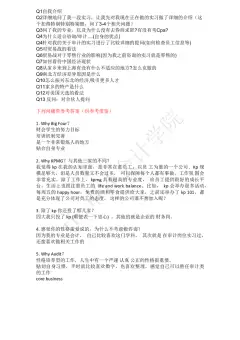
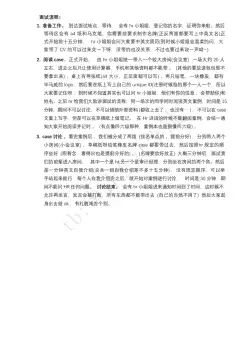
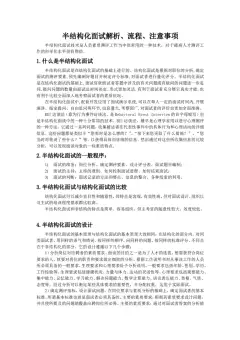
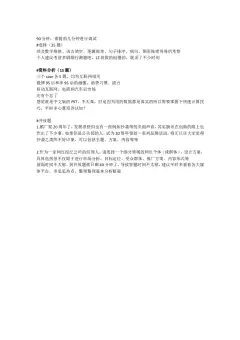
最近在准备 CASE INTERVIEW,刚接触这个,对里面涉及到的 FRAMEWORK和
STRATEGY 非常不熟悉,偶获珍宝,与诸君共享。顺便攒 RP!!
案例面试分析工具/框架
一.Business Strategy
1. 市场进入类
行业分析(波特5力,市场趋势,市场规模,市场份额,市
场壁垒等)
公司宏观环境(人口,经济,自然,技术,政治),公司微
观环境(公司,供应商,市场中介,顾客,竞争对手,大
众) 院
3C(Competitor, Consumer, Company/Capabilities)
Cost-revenue
固定成本,可变成本 学
收入怎么计算?时间序列估计,可比公司估计
市场细分很重要,niche market
计
A. 地理细分
B. 人口细分(年龄及生命周期阶段细分,性别细分,收
入
会
细分)
C. 心理细分(社会阶层,生活方式,个性特征)
D. 行为细分(购买时机-柯达,利益细分-牙膏,用户状
计况,使用率,忠诚度)
2. 行业分析类
审
市场(市场规模,市场细分,产品需求/趋势分析,客户需
求)
竞争(竞争对手的经济情况,产品差异化,市场整合度,产
:
业集中度)
顾客/供应商关系(谈判能力,替代者,评估垂直整合)
B 进入/离开的障碍(评估公司进入/离开。对新加入者的反应,
经济规模,预测学习曲线,研究政府调控)
T
资金金融(主要金融资金来源,产业风险因素,可变成本/
固定成本)
风险预测与防范
3. 新产品引入类
营销调研
产品?价格?即4P
4C (Customer, Competition, Cost, Capabilities)
市场促销,分校渠道(渠道选择,库存,运输,仓储)
STP和4P(Product, Price, Place, Promotion)
产品生命周期二.Business Operation
1.市场容量扩张(竞争对手,消费者,自己实力)
2.利润改善型
Revenue, Cost分析,到底是销售额下降造成,还是成本
上升造成
如果销售额下降,看4P了(是价格过高?产品质量问题?
分校渠道问题?还是promotion的efficacy有问题?)
如果成本上升,看固定成本or可变成本是否有问题?(固
定成本过高,设备是否老化,需要关闭生产线、厂房,降
低管理者工资等,可变成本过高,看原材料价格是否上升,
有没有降低的可能,switch supplier院s? 还是人员工资过高,
需要裁员等)
成本结构是否合理,产能利用率如何(闲置率)
学
3. 推销任何一种产品/服务
4P,3c
4. 定价
计
以成本为基础的定价
成本加成定价,以目标利润(盈亏平衡定价)
以
会
价值为基础定价
以竞争为基础定价
三.Market Sizing/Estimation 计
市场趋势,市场规模,市场份额,市场壁垒等
市场集中度
审
市场驱动因素(价格,服务,质量,外观)
关键成功要素KSF
:
四.M&A类
整合原因(synergy, scale, management impulse, Tax
B consideration, Diversification, Breakup Value)
5C(Character, Capacity, Capital, Conditions,
T
Competitive Advantage)
类型:horizontal, vertical, congeneric, conglomerate
估值方法:DFC,Market Multiple( EBITDA,P/E,P/B)
DFC:Pro Forma Cash Flow Statement,Discount Rate
Hostile VS Friendly takeovers
所有咨询公司面试可能用到的分析结构
Advanced concepts & frameworks
MBAs and other candidates with business background, take note - interviewers will
expect you to have a more detailed take on your case than an undergraduate wouldhave. Here are some commonly used case concepts.
Net present value
Perhaps the most important type of decision company managers must make on a
daily basis is whether to undertake a proposed investment. For example, should the
company buy a certain piece of equipment? Build a particular factory? Invest in a
new project? These types of decisions are called capital budgeting decisions. The
consultant makes such decisions by calculating the net present value of each
proposed investment and making only those investments that have positive net
present values.
院
Example: Hernandez is the CFO of Western Manufacturing Corp., an automobile
manufacturer. The company is considering opening a new factory in Ohio that will
学
require an initial investment of $1 million. The company forecasts that the factory
will generate after-tax cash flows of $100,000 in Year 1, $200,000 in Year 2,
$400,000 in Year 3, and $400,000 in Year 4. At the end of Year 4, the company
计
would then sell the factory for $200,000. The company uses a discount rate of 12
percent. Hernandez must determine whether the company should go ahead and
build the factory. To make this decisio会n, Hernandez must calculate the net present
value of the investment. The cash flows associated with the factory are as follows:
Hernandez then calculates th计e NPV of the factory as follows:
Since the factory has a negative net present value, Hernandez correctly decides that
审
the factory should not be built.
The net present value rule
Note from the example above that once the consultant has figured out the NPV of a
:
proposed investment, she then decides whether to undertake the investment by
applying the net present value rule:
Make onBly those investments that have a positive net present value.
As long as the consultant follows this rule, she can be confident that each
T
investment is making a positive net contribution to the company.
The Capital Asset Pricing Model (CAPM)
In the above example, we assumed a given discount rate. However, part of a
consultant's job is to determine an appropriate discount rate (r) to use when
calculating net present values. The discount rate may vary depending on the
investment.
Beta
The first step in arriving at an appropriate discount rate for a given investment is
determining the investments riskiness. The market risk of an investment is
measured by its "beta" (?), which measures riskiness when compared to the market
as a whole. An investment with a beta of 1 has the same riskiness as the market as
a whole (so, for example, when the market moves down 10 percent, the value of theinvestment will on average fall 10 percent as well). An investment with beta of 2 will
be twice as risky as the market (so when the market falls 10 percent, the value of
the investment will on average fall 20 percent).
CAPM
Once the consultant has determined the beta of a proposed investment, he can use
the Capital Asset Pricing Model (CAPM) to calculate the appropriate discount rate (r):
The risk-free rate of return is the return the company could receive by making a
risk-free investment (for example, by investing in U.S. Treasury bills). The market
rate of return is the return the company could receive by investing in a
well-diversified portfolio of stocks (for example, S&P 500). 院
Example: Shen, Inc., a coal producer, is considering investing in a new venture that
学
would manufacture and market carbon filters. Shen's chief financial officer,
Apelbaum, wants to calculate the NPV of the proposed venture in order to determine
whether the company should make the investment. After studying the riskiness of
计
the proposed venture, Apelbaum determines that the beta of the investment is 1.5.
A U.S. Treasury note of comparable maturity currently yields 7 percent, while the
return on the S&P 500 stock index is 1会2 percent. Therefore, the discount rate
Apelbaum will use when calculating the NPV of the investment will be:
Although this is an overly simp计lified discussion of how consultants calculate discount
rate to use in their cash-flow analysis, it does give you an overview of how
consultants incorporate the notion of an investment's market to select the
审
appropriate discount rate.
Porter's Five Forces
:
Developed by Harvard Business School professor Michael Porter in his book
Competitive Strategy, the Porter's Five Forces framework helps determine the
attractivBeness of an industry. Before any company expands into new markets,
divests product lines, acquires new businesses, or sells divisions, it should ask itself,
T
"Is the industry we're entering or exiting attractive?" By using Porter's Five Forces,
a company can begin to develop a thoughtful answer. Consultants frequently utilize
Porter's Five Forces as a starting point to help companies evaluate industry
attractiveness.
Take, for example, entry into the copy store market (like Kinko's). How attractive is
the copy store market?
Potential entrants: What is the threat of new entrants into the market? Copy stores
are not very expensive to open - you can conceivably open a copy store with one
copier and one employee. Therefore, barriers to entry are low, so there's a high risk
of potential new entrants.
Buyer power: How much bargaining power do buyers have? Copy store customers
are relatively price sensitive. Between the choice of a copy store that charges 5cents a copy and a store that charges 6 cents a copy, buyers will usually head for the
cheaper store. Because copy stores are common, buyers have the leverage to
bargain with copy store owners on large print jobs, threatening to take their
business elsewhere. The only mitigating factors are location and hours. On the other
hand, price is not the only factor. Copy stores that are willing to stay open 24 hours
may be able to charge a premium, and customers may simply patronize the copy
store closest to them if other locations are relatively inconvenient.
Supplier power: How much bargaining power do suppliers have? While paper prices
may be on the rise, copier prices continue to fall. The skill level employees need to
operate a copy shop (for basic services, like copying, collating, etc.) are relatively
low as well, meaning that employees will have little bargaining 院power. Suppliers in
this situation have low bargaining power.
Threat of substitutes: What is the risk of substitution? For basic copying jobs, more
学
people now possess color printers at home. Additionally, fax machines have the
capability to fulfill copy functions as well. Large companies will normally have their
own copying facilities. However, for large-scale projects, most individuals and
计
employees at small companies will still use the services of a copy shop. The Internet
is a potential threat to copy stores as well, because some documents that formerly
would be distributed in hard copy will 会now be posted on the Web or sent through
e-mail. However, for the time being, there is still relatively strong demand for copy
store services.
Competition: Competition wit计hin the industry appears to be intense. Stores often
compete on price, and are willing to "underbid" one another to win printing
contracts. Stores continue to add new features to compete as well, such as
审
expanding hours to 24-hour service and offering free delivery.
From this analysis, you can ascertain that copy stores are something of a
:
commodity market. Consumers are very price-sensitive, copy stores are
inexpensive to set up, and the market is relatively easily entered by competitors.
AdvanceBs in technology may reduce the size of the copy store market. Value-added
services, such as late hours, convenient locations, or additional services such as
T
creating calendars or stickers, may help copy stores differentiate themselves. But
overall, the copy store industry does not appear to be an attractive one.
As dot-coms come under fire, one case question we've heard increasingly is "How
would you create barriers to entry as an Internet Startup?"
Product life cycle curve
If you're considering a product case, figure out how "mature" your product or
service is
Strategy tool/framework chart
Here's one way to think about the choice between being the lowest-cost provider or
carving out a higher-end market niche - what consultants call differentiation.The Four Ps
This is a useful framework for evaluating marketing cases. It can be applied to both
products and services. The Four Ps consist of:
Price
The price a firm sets for its product/service can be a strategic advantage. For
example, it can be predatory (set very low to undercut the competition), or it can be
set slightly above market average to convey a "premium" image. Consider how
pricing is being used in the context of the case presented to you.
Product
The product (or service) may provide strategic advantage if it is the only
product/service that satisfies a particular intersection of custom院er needs. Or it may
simply be an extension of already existing products, and therefore not much of a
benefit. Try to tease out the value of the product in the marketplace based on the
学
case details you have been given.
Position/Place
The physical location of a product/service can provide an advantage if it is superior
计
to its competition, if it is easier or more convenient for people to consume, or if it
makes the consumer more aware of the product/service over its competition. In the
context of a business case, you may wa会nt to determine the placement of the product
or service compared to its competition.
Promotion
With so much noise in today's计 consumer (and business to business) marketplace, it
is difficult for any one product/service to stand out in a category. Promotional
activity (including advertising, discounting to consumers and suppliers, celebrity
审
appearances, etc.) can be used to create or maintain consumer awareness, open
new markets, or target a specific competitor. You may want to suggest a
promotional strategy in the context of the case you are presented relative to the
:
promotional activity of other competing products/services.
B
The Four Cs
T
The Four Cs are especially useful for analyzing new product introductions and for
industry analysis.
Customers
How is the market segmented?
What are the purchase criteria that customers use?
Competition
What is the market share of the clients?
What is its market position?
What is its strategy?
What is its cost position?
Does he/she have any market advantages?
CostWhat kind of economies of scale does the client have?
What is the client's experience curve?
Will increased production lower cost?
Capabilities
What resources can the client draw from?
How is the client organized?
What is the production system?
The Five Cs
This framework is mostly applied to financial cases and to companies (although it
can be applied to individuals). You may employ it in other situati院ons if you think it is
appropriate.
Character
学
Evaluate the dedication, track record, and overall consumer perception of the
company. Are there any legal actions pending against the company? If so, for what
reason? Is the company progressive about its waste disposal, quality of life for its
计
employees, and charitable contributions? What sort of impact would this have on
the case you are evaluating?
Capacity 会
If you are dealing with a manufacturing entity, are its factories at, above, or below
capacity, and for what reasons? Are there plans to add new plants, improve the
technology in existing plants,计 or close underperforming plants? What about
production overseas?
Capital
审
What is the company's cost of capital relative to its competitors? How healthy are its
cash flows, revenues, and debt load relative to its competition?
Conditions
:
What is the current business climate the company (and its industry) faces? What is
the short- and long-term growth potential in the industry? How is the market
characteBrized? Is it emerging or mature? These questions can assist you in
evaluating the facts of the case against the environment that the company/industry
T
inhabits.
Competitive Advantage
This is the unique edge a company possesses over its competitors. It can be an
unparalleled set of business processes, the ability to produce a product/service at a
lower cost, charge a market premium, or any number of other assets that create an
advantage over other market players. Whatever the case, these advantages are
usually defensible and not easily copied.
In evaluating business cases using the Five Cs framework, you should look for those
unique qualities that a company possesses and identify any that meet the criteria
mentioned above. You may suggest that the company leverage its competitive
advantage more aggressively or recommend alternatives if that company has no
discernible advantage.Value Chain Analysis
This approach involves assessing a company's overall business processes and
identifying where that company actually adds value to a product or service. The
total margin of profit will be the value of the product or service to buyers, less the
cost of its production, as determined by the value chain.
In most cases, a competitive advantage is only temporary for many of today's
products/services. Being first to market, having a unique formula or configuration,
or having exclusivity in a market were once long-term defensible strategies. But
today, businesses are globally connected by lightning-fast communications and
knowledge-sharing systems and manufacturing technologies are院 getting better and
faster at reacting to and anticipating market conditions. Thus these advantages are
only fleeting or may not exist at all.
学
Value Chain Analysis attempts to identify a competitive advantage by
deconstructing the various "changes" a company's business processes perform on a
set of raw materials or other inputs. Most can be easily copied by other competitors,
计
but there is usually a unique subset that represents the "value-added" qualities only
the company under scrutiny possesses. This set is that company's competitive
advantage, or "value chain." Sometim会es this set can be copied, but a unique set of
circumstances may still allow the company in question to perform them at a lower
cost, charge a premium in the market, or retain higher market share than its
competitors. 计
In the context of a business case, you can use this framework to identify a
company's overall business processes set and then determine if one or more of the
审
processes are defensible competitive advantages.
For example, a manufacturer of fruit juice might have the following value chain
elements:
:
•Research and development (Will mango really taste good with cloudberry juice?)
•Cost of goods sold (How much does it cost to manufacture the fruit juice? Is there
a frost inB Florida that drives up the costs of oranges? Is the currency crisis in
Indonesia making papaya very cheap? Are per-volume purchases lower than, for
T
example, those of Tropicana?)
•Packaging and shipping (How much does that new banana-shaped container cost?
Are many bottles lost in transit? What are the fixed costs of shipping?)
•Manufacturing (How much do those juice pulpers cost? How often do factories need
to be reengineered?)
•Labor (How many employees do we have? Where are they located? Are they
unionized?)
•Distribution (Where are the distribution centers? Where are the products
distributed?)
•Advertising (Billboards, TV, magazines?)
•Margin (How profitable is the juice company?)
For more detailed information on this type of analysis, you may want to consider the
authoritative text on competitive strategy: Competitive Strategy: Techniques forAnalyzing Industries and Competitors, by Michael E. Porter.
Core competencies
"Core competencies" is the idea that each firm has a limited number of things it is
very good at (that is, its core competence or competencies).
When restructuring or reengineering, one of the starting points for a company
should be identifying its core competencies. A firm should define its core
competencies broadly in order to be flexible enough to adapt to changes in the
marketplace. (For instance, when Xerox defined itself as a "document company,"
rather than a maker of copy machines, it was able to take advantage of the more
lucrative business of document handling and outsourcing for ma院jor corporations, as
well as of the market for fax machines, scanners, and other document-handling
equipment.)
学
Companies should seriously consider selling/spinning off business units that are not
part of their "core" business. For instance, Pepsi recently spun off its restaurant
operations after it concluded that its expertise was in manufacturing and marketing
计
beverages, not in managing restaurants.
Benchmarking and "best practices会"
A commonly used concept in consulting (especially in operations and
implementation engagements) is "benchmarking." Benchmarking basically means
researching what other comp计anies in the industry are doing (usually in order to
evaluate whether your client is operating efficiently or to identify areas where the
client can cut costs). For example, if a mail-order company wants to reduce its
审
order-processing costs, it would want to compare its order processing costs with
those of other mail-order companies, breaking down its costs for each part of the
process (including order-taking and shipping) and comparing them with industry
:
averages. It can then pinpoint those areas where its costs are higher than average
for the industry.
A relatedB concept is "best practices": once you've benchmarked what other
companies are doing, you want to focus on those companies that have particular low
T
costs or which otherwise operate particularly well. What are they doing right (i.e.,
what are their "best practices")? And how can our client (in the case) emulate or
copy what they're doing? Remember to look outside your client's particular industry,
if necessary, to find the best practices for a particular process or operation.
The 2x2 matrix
The 2x2 matrix is a good framework to use any time you have two factors that,
when combined, yield different outcomes. A very rudimentary example would be
what happens when you turn on your bathroom faucets, as follows:
A more business-appropriate example would involve acquiring a company. Let?s
say a company is interested in understanding the difficulty of acquiring or building adistribution center and it is considering financing this decision with either stock or
debt. The potential outcomes might look like this:
The BCG Matrix
The BCG Matrix, named after the Boston Consulting Group (BCG), is perhaps the
most famous 2x2 matrix. The matrix measures a company's relative market share
on the horizontal axis and its growth rate on the vertical axis.
M&A cases: Determining the value of an acquisition 院
Case interviews aren't just for consultants. Mergers & acquisition cases are wildly
popular at investment banks. Here's how to analyze a potential acquisition.
学
Value Drivers (M&A) Framework
In order to understand value, we need to understand the three primary value
计
drivers:
The value components can be further 会broken out into specific "value drivers":
M&A Cases: Data Gatherin计g and Analysis
Market Analysis Tools
• Competitive position framework
审
• Relative value versus competitors to customer through supply chain
• Product life cycle
• Supply and demand analysis
:
- Industry capacity
- Industry utilization
- DemanBd drivers
- Regressions
T
• Segmentation analysis
• Porter's Five Forces
• Experience curves
• Trends and outlook
• Key success factors
Target Analysis Tools
• Business system - comparison with competitors
• Market share (over time and by segment)
• Capacity (growth and utilization of)
• Customer's key purchase criteria and relative performance
• Financial history
• Sales and profitability by segment
• Cash flow analysis• Margin and expense structure
• Relative cost position
• Cost benchmarking
Your data gathering strategy will vary depending on industry:
A framework caution
All the frameworks detailed above are widely used, and most U.S. business schools
teach them as part of their core curriculums. Your interviewers will instantly
recognize when you are applying them, since they are already 院familiar with the
techniques. While this is OK, consider that you are trying to demonstrate your
unique analytical and deductive reasoning skills that set you apart from other
学
candidates. You must be creative and original in analyzing case questions. Use
these frameworks sparingly. (Another note: No interviewer will be impressed if you
proudly proclaim, "I'm going to apply Porters Five Forces now." Apply frameworks
计
without identifying them.)
会
计
审
:
B
T