鞍山市普通高中2023—2024 学年度高三第一次质量监测
英语参考答案及写作评分标准

第一部分听力
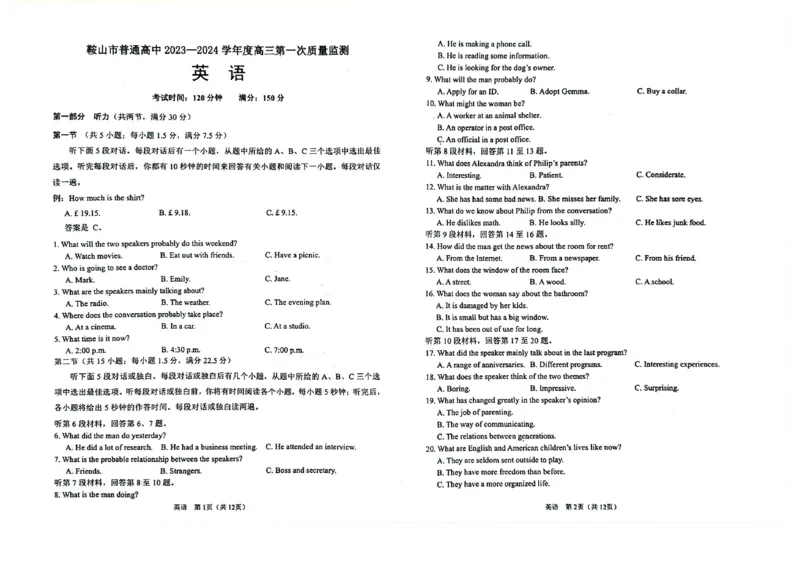
1-5 CABBA     6-10 CACBA     11-15 CBACB     16-20 CABAC

第二部分阅读
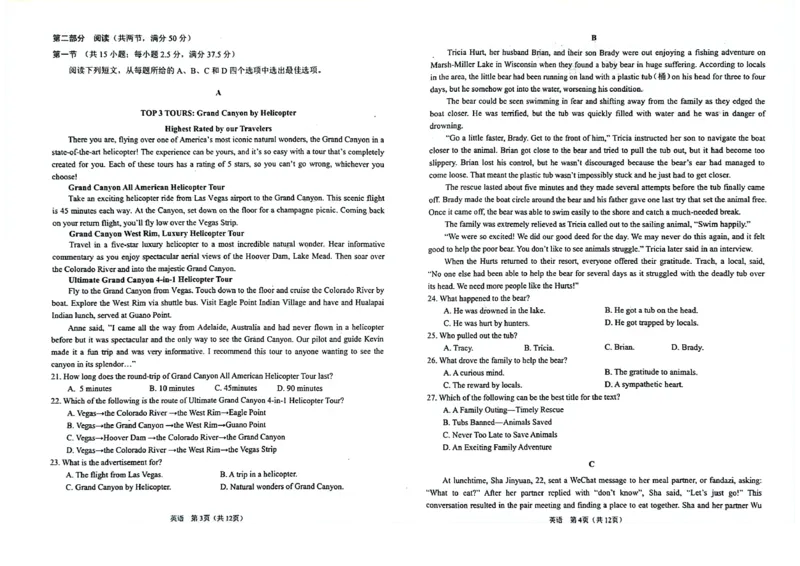
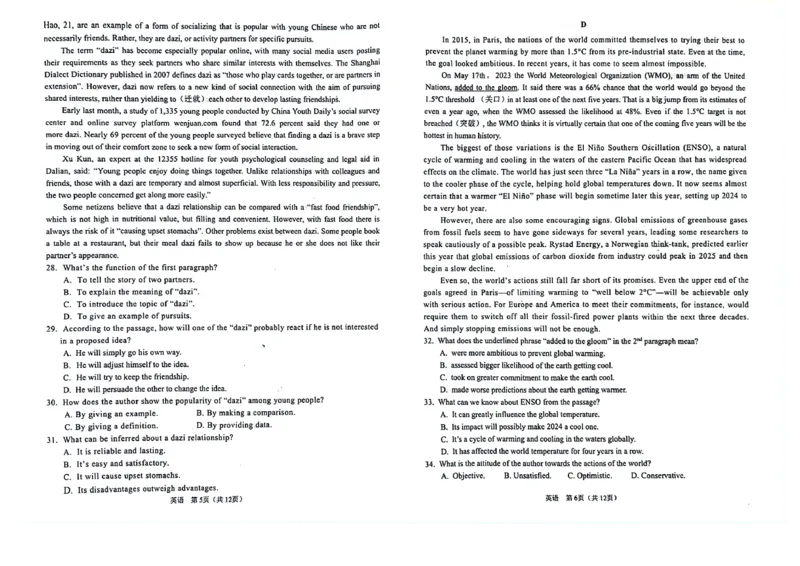
第一节21-23 DAC     24-27 BCDA     28-31 CADB     32-35 DABB
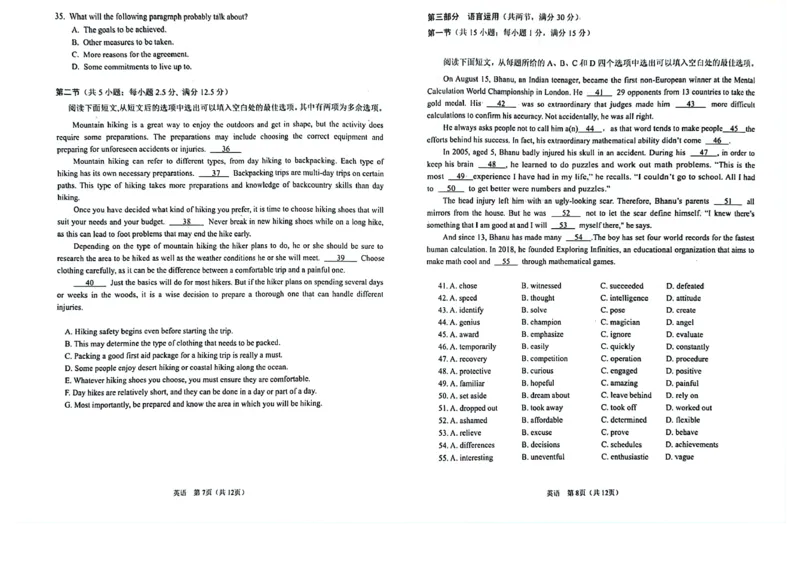
第二节36-40GFEBC

第三部分语言运用
第一节完形填空
41-45DABAC     46-50BACDD     51-55 BCCDA
第二节语法填空
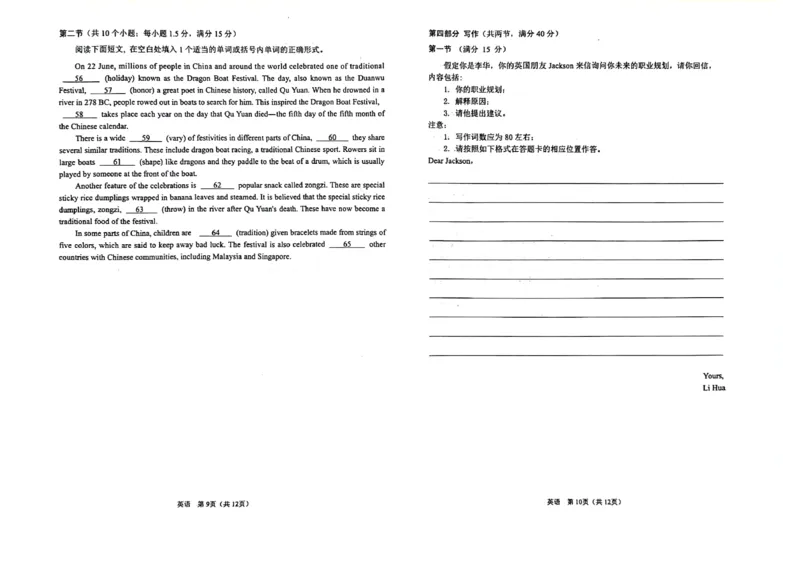
56. holidays 57. honors 58. which

59. variety
60.but
61. shaped 62. a

63.were thrown 64. traditionally 65. in

第四部分写作
第一节
Sample One
Dear Jackson,
I’m writing to share with you my career plan in the future in response to your last letter.
When I grow up, I want to be a journalist.
As a student passionate about international events and good at communicating with people,
there is nothing working better for me than being a journalist, which can be quite challenging
yet rewarding. Also, reporting news from home and abroad objectively will keep people
informed of what is really happening in the world and allow them to make right judgements.
What do you think of my career plan? Can you give me some suggestions about it?
Looking forward to your reply.

Yours,

Li Hua
第二节

Sample One
Paragraph 1:
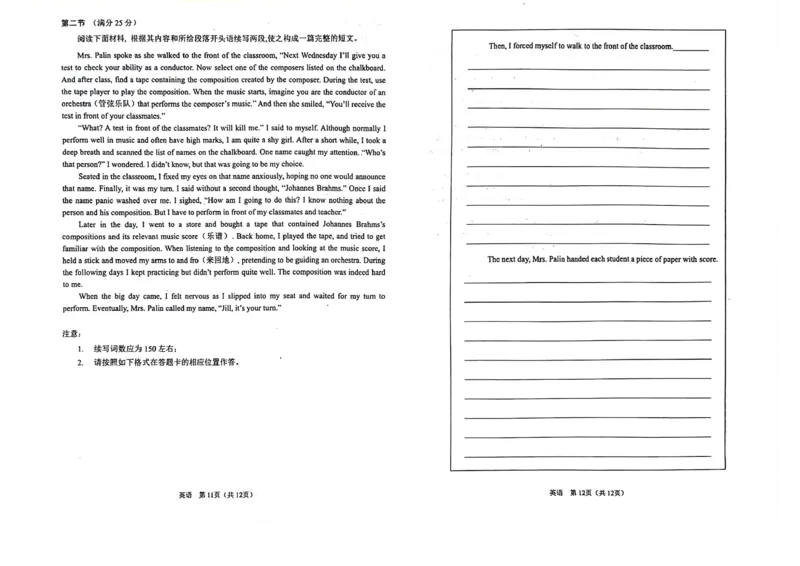
Then, I forced myself to walk to the front of the classroom. I placed the music score in
front of myself. I felt weak as I put the tape into the player, held the wooden stick, and pressed
the “Play” button. When the music started, I began to raise my arms to give a performance. As
the music swelled, my legs trembled, and I moved my arms to and fro awkwardly. Sweat soon
rolled down my neck and underneath my suit jacket. Finally, my time was up.
Paragraph 2:
The next day, Mrs. Palin handed each student a piece of paper with a score. My heart beat
fast. I lowered my head down and waited for my score anxiously. A few seconds later, Mrs.
Palin approached me and gave mine. I stared at the paper, on which there was a high mark. And
there were words on it, “Little Jill, have more self-confidence and you’ll do better. I believe in
your potential.” Then I looked up at Mrs. Palin. Her eyes locked onto mine. She gave me a pat
and smiled. That pat and smile indeed encouraged me and positively influenced my whole life.


写作评分标准
写作第一节
【评分标准】
1.评分原则
(1)本题总分为15 分,按五个档次进行评分。
(2)评分时,应主要从内容、词汇语法和篇章结构三个方面考虑,具体为:
◆ 对内容要点的覆盖情况以及表述的清楚程度和合理性。
◆ 使用词汇和语法结构的准确性、恰当性和多样性。
◆ 上下文的衔接和全文的连贯性。
(3)评分时,先根据作答的整体情况初步确定其所属档次,然后以该档次的要求来
综合衡量,确定或调整档次,最后给分。
(4)评分时还应注意:
◆ 词数少于60 的,酌情扣分。
◆ 单词拼写和标点符号是写作规范的重要方面,评分时应视其对交际的影响程
度予以考虑。英、美拼写及词汇用法均可接受。
◆ 书写较差以致影响交际的,可将分数降低一个档次。
2.各档次的给分范围和要求
第五档(13~15 分)
-覆盖了所有内容要点,表述清楚、合理。
-使用了多样并且恰当的词汇和语法结构,可能有个别错误,但完全不影响理解。
-有效地使用了语句间衔接手段,全文结构清晰,意义连贯。
完全达到了预期的写作目的。
第四档(10~12 分)
-覆盖了所有内容要点,表述比较清楚、合理。
-使用了比较多样并且恰当的词汇和语法结构,可能有些许错误,但不影响理解。
-比较有效地使用了语句间衔接手段,全文结构比较清晰,意义比较连贯。
达到了预期的写作目的。
第三档(7~9 分)
-覆盖了大部分内容要点,有个别地方表述不够清楚、合理。
-使用了简单的词汇和语法结构,有一些错误或不恰当之处,但基本不影响理解。
-基本有效地使用了语句间衔接手段,全文结构基本清晰,意义基本连贯。
基本达到了预期的写作目的。
第二档(4~6 分)
-遗漏或未清楚表述一些内容要点,或一些内容与写作目的不相关。
-所使用的词汇有限,语法结构单调,错误较多,影响理解。
-几乎不能有效地使用语句间衔接手段,全文结构不够清晰,意义不够连贯。
未能达到预期的写作目的。
第一档(1~3 分)
-遗漏或未清楚表述大部分内容要点,或大部分内容与写作目的不相关。
-所使用的词汇有限,语法结构单调,错误很多,严重影响理解。
-几乎没有使用语句间衔接手段,全文结构不清晰,意义不连贯。
完全未达到预期的写作目的。
零分
未作答;所写内容太少或无法看清以致无法评判;所写内容与题目要求完全不相
关。

写作第二节
【评分标准】
1.评分原则
(1)本题总分为25 分,按五个档次进行评分。
(2)评分时,应主要从内容、词汇语法和篇章结构三个方面考虑,具体为:
◆ 创造内容的质量,续写的完整性以及与原文情境的融洽度。
◆ 使用词汇和语法结构的准确性、恰当性和多样性。
◆ 上下文的衔接和全文的连贯性。
(3)评分时,先根据作答的整体情况初步确定其所属档次,然后以该档次的要求来
综合衡量,确定或调整档次,最后给分。
(4)评分时还应注意:
◆ 词数少于130 的,酌情扣分。
◆ 单词拼写和标点符号是写作规范的重要方面,评分时应视其对交际的影响程
度予以考虑。英、美拼写及词汇用法均可接受。
◆ 书写较差以致影响交际的,可将分数降低一个档次。
2.各档次的给分范围和要求
第五档(21~25 分)
-创造了丰富、合理的内容,富有逻辑性,续写完整,与原文情境融洽度高。
-使用了多样并且恰当的词汇和语法结构,可能有个别错误,但完全不影响理解。
-有效地使用了语句间衔接手段,全文结构清晰,意义连贯。
第四档(16~20 分)
-创造了比较丰富、合理的内容,比较有逻辑性,续写比较完整,与原文情境融洽
度较高。
-使用了比较多样并且恰当的词汇和语法结构,可能有些许错误,但不影响理解。
-比较有效地使用了语句间衔接手段,全文结构比较清晰,意义比较连贯。
第三档(11~15 分)
-创造了基本合理的内容,有一定的逻辑性,续写基本完整,与原文情境相关。
-使用了简单的词汇和语法结构,有一些错误或不恰当之处,但基本不影响理解。
-基本有效地使用了语句间衔接手段,全文结构基本清晰,意义基本连贯。
第二档(6~10 分)
-内容或逻辑上有一些重大问题,续写不够完整,与原文情境有一定程度脱节。
-所使用的词汇有限,语法结构单调,错误较多,影响理解。
-未能有效地使用语句间衔接手段,全文结构不够清晰,意义不够连贯。
第一档(1~5 分)
-内容或逻辑上有较多重大问题,或有部分内容抄自原文,续写不完整,与原文情
境基本脱节。
-所使用的词汇有限,语法结构单调,错误很多,严重影响理解。
-几乎没有使用语句间衔接手段,全文结构不清晰,意义不连贯。
零分
未作答;所写内容太少或无法看清以致无法评判;所写内容全部抄自原文或与题
目要求完全不相关。


附:听力原文:
Text 1
M: Have you got any ideas for the weekend?What about eating out with our friends or just watching movies?
W: Not a bad idea. But you see, spring is almost with us. Why not go out to have a picnic?
M: Sounds great! I can’t wait.
Text 2
M: Do you have to wash the dishes after breakfast, Emily?
W: No, Jane said she would do it. I’m going to take Mark to the hospital, since he isn’t feeling well.
Text 3
M: It’s freezing cold outside. I hope it’ll warm up soon.
W: But the radio said it might snow this evening. I’m afraid we won’t be able to eat out tonight.
M: What a pity!
Text 4
M: What a beautiful sunrise it is!
W: Let’s stop the car and enjoy it for a minute.
M: Great. Where is the camera? Let’s see if we can catch this on film.
Text 5
M: Rose, when does our train leave this afternoon?
W: At 4:30 p. m. And we have two and a half hours to go. We have a lot of time and won’t be late.
M: OK. I think we should start early because of the heavy traffic.
W: Yes, that’s a good idea.
Text 6
W: How did it go yesterday?
M: Well, I think it went quite well. I did lots of research and prepared well. I was there for about twenty
minutes.
W: And what did they say?
M: Nothing much. In the end, I asked them, “What happens now?”, and a woman said, “We’ll call you back
with news in two or three days.”
W: Really?
M: Yes, I guess I’ve got the job. There weren’t many other people there. I was the only interviewee that day,
you know.
W: Well, good luck.
Text 7
W: Where did you find the dog?
M: I found her just next to my flat. Her name’s Gemma.
W: Have you tried dialling the number on the collar?
M: Yes, but the number’s no longer in service. And there’s no other information but that.
W: No ID number. Without that, we can’t do much.
M: You can try to find the dog’s owner. And if you can’t, can I…can I adopt the dog?
W: Emm, yes. If the owners don’t claim the dog in forty-eight hours, then you can apply for adoption.
M: How can I do that?
W: You really want to?
M: Yes, I’m serious. If no one comes to claim Gemma, I’d like to adopt her.
W: It’s not difficult.
Text 8
W: Philip, this new Walkman is absolutely wonderful.
M: My parents bought it for me for my birthday.
W: They’re so thoughtful. You are very lucky, Philip, to have such a nice family.
M: You sound sad. What’s up, Alexandra?
W: I received a letter from my parents this morning.
M: Any bad news?
W: No. But when I received the letter with the photos of my family, I cried. I miss them all.
M: You really miss your family, don’t you?
W: Yes. I know I must sound silly.
M: Hey, why don’t we go out for a cheeseburger and French fries? That will cheer you up. And you can use my
Walkman.
W: That’s a good idea. But if we go out, please don’t complain about your math teacher or your math
homework. I want to have fun!
M: So do I!
Text 9
M: Hello, this is Bill Wits. I’m a student from Cambridge and I’m interested in your room for rent.
W: Oh, hello. So you got the information from the Internet?
M: No, a friend of mine read your ad in the newspaper and told me about it.
W: I see. It’s a medium size bedroom with furniture, and it has a big window facing a beautiful wood.
M: Great. I’m so bored with facing a noisy street every day. Does it have a bathroom?
W: No, but you can use the one downstairs, and it hasn’t been used for a long time.
M: Why? I don’t hope it has a broken toilet or something…
W: Oh, no. The bathroom was used by our kids before, but now they’ve all moved out.
M: I see. How much is the rent for the room per month?
W: 800 dollars a month, but you have to pay half a year in advance.
M: Sounds fair. Could I go and see it myself?
W: Certainly, anytime.
Text 10
In my last program I was speaking about different anniversaries. At the end I asked you about the biggest
changes to our world that you have experienced in your lifetime. You sent some interesting answers to my
question. Two themes struck me. The first was how technology is changing our lives—how it’s changing the
way we communicate with each other and how we go about solving problems, including the way we learn
things. The other theme was changes in the relations between generations. The job of parenting seems to have
changed a great deal. Perhaps we take it more seriously these days. Fathers are certainly more involved in
looking after young children than they were 50 years ago. Children, at least in the UK or the USA, get a lot
more attention than they used to. They’re not sent outside to play until it’s time for their next meal. Their lives
are much more organized. I suppose children have always tried to get a bit of freedom from their parents in one
way or another.