Diagrammatic Test 1
Solutions Booklet
AssessmentDay
Practice Aptitude TestsQ1 What replaces the question mark?
(A)A
(B)B
(C)C
(D)D
Solution: D
From the key we see that the given operator changes the shading of all hourglass items. In the input
diagram there are two hourglasses, items 1 and 3. 1 is unshaded, while 3 is shaded. In the output
diagram, therefore, item 1must be shaded and 3 unshaded.Solutions C and D both fulfil this criteria.
As the operator effects only hourglasses, item 2, the square, must remain unchanged. The missing
diagram can therefore only be D.
For personal use only. Unauthorised copying or Page2 AssessmentDay
distribution in printed, electronic, or any other
form in whole or in part, is prohibited without www.assessmentday.co.uk
Document last updated21-03-2014
priorwritten permission from AssessmentDay.Q2 What replaces the question mark?
(A) A
(B) B
(C) C
(D) D
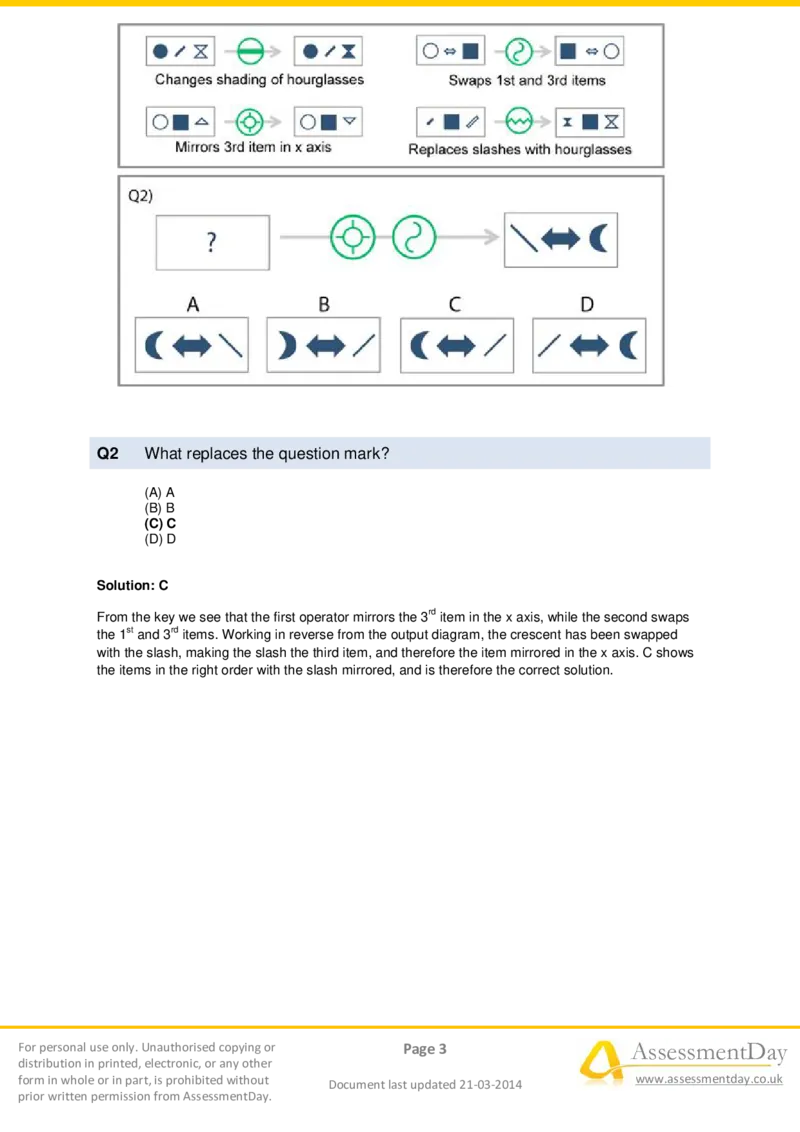
Solution: C
From the key we see that the first operator mirrors the 3rditem in the x axis, while the second swaps
the 1stand 3rditems. Working in reverse from the output diagram, the crescent has been swapped
with the slash, making the slash the third item, and therefore the item mirrored in the x axis. C shows
the items in the right order with the slash mirrored, and is therefore the correct solution.
For personal use only. Unauthorised copying or Page3 AssessmentDay
distribution in printed, electronic, or any other
form in whole or in part, is prohibited without www.assessmentday.co.uk
Document last updated21-03-2014
priorwritten permission from AssessmentDay.Q3 What replaces the question mark?
(A) A
(B) B
(C) C
(D) D
Solution: A
The easiest approach here is towork backwards. The final operator mirrors the 3rditem, but we can
see this has not happened, and further that the item is different compared to the input diagram, so we
consider the previous operators. The 1stoperator switches the 1stand 3rditems, which has been done.
We can see that the 1stitem, which should be a slash mirrored in the x axis by the 3rdoperator, is now
an hourglass, which is symmetrical and therefore not visibly affected by the 3rdoperator. The only
operator in the key which replaces slashes with hourglasses is the one shown in A, which is therefore
the correct solution.
For personal use only. Unauthorised copying or Page4 AssessmentDay
distribution in printed, electronic, or any other
form in whole or in part, is prohibited without www.assessmentday.co.uk
Document last updated21-03-2014
priorwritten permission from AssessmentDay.Q4 What replaces the question mark?
(A) A
(B) B
(C) C
(D) D
Solution: B
From the key we see that the 1stoperator shades the 1stitem; this has no visible effect, because the
1stitem is already shaded. The second operator makes the 1stitem half-size. Solution B is the only
one in which the square is half-size and shaded while the other items remain unchanged; it is
therefore the correct solution.
For personal use only. Unauthorised copying or Page5 AssessmentDay
distribution in printed, electronic, or any other
form in whole or in part, is prohibited without www.assessmentday.co.uk
Document last updated21-03-2014
priorwritten permission from AssessmentDay.Q5 What replaces the question mark?
(A) A
(B) B
(C) C
(D) D
Solution:D
The 1stoperator makes all items half size, but in the output diagram, none of the items have been
changed. Therefore the missing operator must cancel or reverse the effect of the 1st. The only
possibility is the one shown in D, which changes the size of all triangles, thereby restoring them to full
size. The correct answer is therefore D.
For personal use only. Unauthorised copying or Page6 AssessmentDay
distribution in printed, electronic, or any other
form in whole or in part, is prohibited without www.assessmentday.co.uk
Document last updated21-03-2014
priorwritten permission from AssessmentDay.Q6 Which operator, if any, has no apparent effect in this process?
(A) A
(B) B
(C) C
(D) D
Solution: A
The 1stand 3rdoperators have clearly had an effect, as the only top-shaded square has moved 2
positions left, andnotbeen mirrored in the y axis, as it would have been in 2ndposition when this
operator came into effect. The 2ndoperator, which mirrors items in the yaxis, has also been effective,
since the original 1stand 3rditems have both been mirrored. The answer is therefore A.
For personal use only. Unauthorised copying or Page7 AssessmentDay
distribution in printed, electronic, or any other
form in whole or in part, is prohibited without www.assessmentday.co.uk
Document last updated21-03-2014
priorwritten permission from AssessmentDay.Q7 What replaces the question mark?
(A) A
(B) B
(C) C
(D) D
SolutionD:
In the output diagram, the 1stand 3rditems have been changed by the 2ndoperator, but the 2nditem
has also changed, from shaded to unshaded. The only operator, shown in D, which affects shading of
the the 2nditem, also removes shading from the 1stitem, which has already occurred. The solution is
therefore D.
For personal use only. Unauthorised copying or Page8 AssessmentDay
distribution in printed, electronic, or any other
form in whole or in part, is prohibited without www.assessmentday.co.uk
Document last updated21-03-2014
priorwritten permission from AssessmentDay.Q8 What replaces the question mark?
(A) A
(B) B
(C) C
(D) D
Solution: D
The 1st operator swaps the 1st and 2nd items, moving the hourglass to 2nd and the semicircle to 1st
position. The 2nd operator then shades the (new) 2nditem, resulting in a shaded hourglass in 2nd
position. The 3rd operator replaces the 1st and 3rd items with a copy of the now-shaded hourglass,
resulting in 3 shaded hourglasses in the output diagram, as shown in D.
For personal use only. Unauthorised copying or Page9 AssessmentDay
distribution in printed, electronic, or any other
form in whole or in part, is prohibited without www.assessmentday.co.uk
Document last updated21-03-2014
priorwritten permission from AssessmentDay.Q9 What replaces the question mark?
(A) A
(B) B
(C) C
(D) D
Solution: B
Working in reverse, the 2ndoperator mirrors the sequence in the y axis; in the input diagram the items
should be in reverse order, with the slash and square inverted. The 1stoperator removes shading
entirely from the 1stand 2nditems, which are the circle and slash, so this operator gives no further
clue. The only solution in which the items are in the correct order and configuration is B.
For personal use only. Unauthorised copying or Page10 AssessmentDay
distribution in printed, electronic, or any other
form in whole or in part, is prohibited without www.assessmentday.co.uk
Document last updated21-03-2014
priorwritten permission from AssessmentDay.Q10 What replaces the question mark?
(A) A
(B) B
(C) C
(D) D
Solution: B
Working in reverse, we know that the 2ndoperator mirrors the 2nditem, so we are looking for a
mirrored crescent as the 2nditem. The 1stoperator replaces the 1stitem with a square, but does not
change size or shading, so we are looking for any full-size, unshaded item in the 1stposition. The only
solution fitting both criteria is B.
For personal use only. Unauthorised copying or Page11 AssessmentDay
distribution in printed, electronic, or any other
form in whole or in part, is prohibited without www.assessmentday.co.uk
Document last updated21-03-2014
priorwritten permission from AssessmentDay.Q11 What replaces the question mark?
(A) A
(B) B
(C) C
(D) D
Solution:C
The 1stoperator rotates the 3rditem 90 degrees clockwise, so we are looking for a small square with
the bottom left corner shaded. The 2ndoperator mirrors the 1stitem in the x axis, so we are looking for
a large square with the top right corner shaded. C is the only solution to fit both criteria.
For personal use only. Unauthorised copying or Page12 AssessmentDay
distribution in printed, electronic, or any other
form in whole or in part, is prohibited without www.assessmentday.co.uk
Document last updated21-03-2014
priorwritten permission from AssessmentDay.Q12 What replaces the question mark?
(A) A
(B) B
(C) C
(D) D
Solution: D
The 1stoperator replaces the slash with a square; the 2ndhas no effect on the circle. There are no
further changes to the output diagram, so the operator must be ineffective. Mirroring the arrow will
have no effect. The 1stitem is already a square. Rotating the circle has no effect. Mirroring the square
has no effect. None of the operators would have any effect on the output diagram, and the correct
solution is therefore D.
For personal use only. Unauthorised copying or Page13 AssessmentDay
distribution in printed, electronic, or any other
form in whole or in part, is prohibited without www.assessmentday.co.uk
Document last updated21-03-2014
priorwritten permission from AssessmentDay.Q13 What replaces the question mark?
(A) A
(B) B
(C) C
(D) D
Solution: B
The 1stoperator makes the 3rditem full size, which should result in a full-size shaded triangle. The 2nd
however changes the size ofallitems, returning the triangle to half-size, and also reducing the square
to half-size and increasing the crescent to full size. B is therefore the correct solution.
For personal use only. Unauthorised copying or Page14 AssessmentDay
distribution in printed, electronic, or any other
form in whole or in part, is prohibited without www.assessmentday.co.uk
Document last updated21-03-2014
priorwritten permission from AssessmentDay.Q14 What replaces the question mark?
(A) A
(B) B
(C) C
(D) D
Solution: A
We see from the key that the cross operator rotates the 2ndand 3rdicons 90° clockwise. In the output
diagram the 3rdicon is actually rotated 180° so we need to rotate it another 90° clockwise. The effect
two lots of 90° rotations will have on the 2ndicon is tomake it appear as not changing, which is indeed
what we see. So the missing operator must be another cross.
For personal use only. Unauthorised copying or Page15 AssessmentDay
distribution in printed, electronic, or any other
form in whole or in part, is prohibited without www.assessmentday.co.uk
Document last updated21-03-2014
priorwritten permission from AssessmentDay.Q15 What replaces the question mark?
(A) A
(B) B
(C) C
(D) D
Solution: A
The 1stoperator changes the size of all items, which has occurred in the output diagram. The 3rd
rotates the 2nditem 180 degrees; however, the square in the output diagram is unchanged compared
to the input diagram, indicating that the 3rdoperator restored the square to its original state; it must
already have been rotated by the 2ndoperator. The 2ndoperator must therefore be identical the 3rd
operator–the answer is A.
For personal use only. Unauthorised copying or Page16 AssessmentDay
distribution in printed, electronic, or any other
form in whole or in part, is prohibited without www.assessmentday.co.uk
Document last updated21-03-2014
priorwritten permission from AssessmentDay.Q16 What replaces the question mark?
(A) A
(B) B
(C) C
(D) D
Solution: D
Working in reverse, the 2nd operator has shaded the 2nd item, indicating either an unshaded or
already-shadedslash in the input diagram. The 1st operator has replaced shaded items with squares,
so the 1st and 3rd items could have been either shaded squares already, or any other shaded item,
ruling out A; B is ruled out because the 1st item is the wrong size. Theorder of operators is crucial: if
the slash had been shaded in the input, it, too, would be a square in the output; thus C must be ruled
out. D is therefore the correct answer.
For personal use only. Unauthorised copying or Page17 AssessmentDay
distribution in printed, electronic, or any other
form in whole or in part, is prohibited without www.assessmentday.co.uk
Document last updated21-03-2014
priorwritten permission from AssessmentDay.Q17 What operator can be removed from the process without changing the output?
(A) A
(B) B
(C) C
(D) D
Solution: C
The 1stoperator has no effect on the triangle due to its symmetry in the y axis. The 2ndoperator has
changed the shading of the arrow. The 3rdoperator has no effect on the arrow, which is already full
size. The two operators which have no effect are therefore shown in C.
For personal use only. Unauthorised copying or Page18 AssessmentDay
distribution in printed, electronic, or any other
form in whole or in part, is prohibited without www.assessmentday.co.uk
Document last updated21-03-2014
priorwritten permission from AssessmentDay.Q18 What replaces the question mark?
(A) A
(B) B
(C) C
(D) D
Solution: A
Working in reverse, the 3rdoperator rotates the 1stitem clockwise, so we are looking for an upright
triangle. The 2ndoperator makes the 1stitem full size, so the triangle could be half or full size. The 1st
operator mirrors all triangles in the y axis, so we are still looking for an upright triangle in the 1st
position, and the same in the 3rdposition, since upright triangles have symmetry in the y axis. The
square is unchanged. This configuration is shown in solution A.
For personal use only. Unauthorised copying or Page19 AssessmentDay
distribution in printed, electronic, or any other
form in whole or in part, is prohibited without www.assessmentday.co.uk
Document last updated21-03-2014
priorwritten permission from AssessmentDay.Q19 What replaces the question mark?
(A) A
(B) B
(C)C
(D) D
Solution: A
In the output diagram, the 1stand 3rditems are unchanged while the 2nditem has been mirrored in the
y axis. As mirroring in the y axis has no effect on the symmetrical hourglass, the missing operator is
the one in solution A, which mirrors the 1stand 2nditems in the y axis.
For personal use only. Unauthorised copying or Page20 AssessmentDay
distribution in printed, electronic, or any other
form in whole or in part, is prohibited without www.assessmentday.co.uk
Document last updated21-03-2014
priorwritten permission from AssessmentDay.Q20 What replaces the question mark?
(A) A
(B) B
(C) C
(D) D
Solution: D
Working in reverse, the 2ndoperator swaps the 2ndand 3rditems, so we are looking for a triangle in 2nd
position and a square in 3rd. The 1stoperator shades the original 3rditem, the square, which could
already have been shaded; therefore the correct solution has a shaded triangle in 2ndposition and a
full-size square of any shading in 3rd. This configuration is shown in D.
For personal use only. Unauthorised copying or Page21 AssessmentDay
distribution in printed, electronic, or any other
form in whole or in part, is prohibited without www.assessmentday.co.uk
Document last updated21-03-2014
priorwritten permission from AssessmentDay.Q21 What replaces the question mark?
(A) A
(B) B
(C) C
(D) D
Solution: D
The 1stoperator results in a downward-pointing triangle in 2ndposition. The 2ndoperator swaps this
triangle with the square. The 3rdmirrors the 1stitem, still the crescent, and the new 2nditem, now the
square, in the y axis. So we are looking for a mirrored crescent, followed by a square shaded in the
bottom left corner, followed by a downward-pointing triangle. This configuration is shown in solution D.
For personal use only. Unauthorised copying or Page22 AssessmentDay
distribution in printed, electronic, or any other
form in whole or in part, is prohibited without www.assessmentday.co.uk
Document last updated21-03-2014
priorwritten permission from AssessmentDay.Q22 What replaces the question mark?
(A) A
(B) B
(C) C
(D) D
Solution: B
The 1st operator swaps the 1st and 2nd items, resulting in a semicircle in 1st position and an
hourglass in 2nd .The 3rd operator replaces shaded items with squares, which would result in an
unshaded semicircle followed by 2 shaded squares, as shown in the output diagram; therefore the
missing operator must have had no other effect. The operator in A would satisfy this, as would the
additional operator in B. The additional operator in C would have resulted in 3 hourglasses, which
would have become 3 squares in the output. The answer in therefore B.
For personal use only. Unauthorised copying or Page23 AssessmentDay
distribution in printed, electronic, or any other
form in whole or in part, is prohibited without www.assessmentday.co.uk
Document last updated21-03-2014
priorwritten permission from AssessmentDay.Q23 What replaces the question mark?
(A) A
(B) B
(C) C
(D) D
Solution: C
Working in reverse, the 3rdoperator rotates crescents anticlockwise, so we are looking for a crescent
pointing downwards in 2ndposition. The 2ndoperator removes shading from the 2nditem, so the
crescent could be either shaded or unshaded in the input diagram. The 1stoperator shades squares,
so the square in the input diagram could have any shading. The only solution with the crescent in the
correct rotation is C.
For personal use only. Unauthorised copying or Page24 AssessmentDay
distribution in printed, electronic, or any other
form in whole or in part, is prohibited without www.assessmentday.co.uk
Document last updated21-03-2014
priorwritten permission from AssessmentDay.Q24 What replaces the question mark?
(A) A
(B) B
(C) C
(D) D
Solution: C
The 1stoperator results in fully shaded squares in all positions. The 2ndoperator then unshades the
square in 3rdposition. The 3rdoperator results in an unshaded square in 2ndposition. The correct
solution is therefore C.
For personal use only. Unauthorised copying or Page25 AssessmentDay
distribution in printed, electronic, or any other
form in whole or in part, is prohibited without www.assessmentday.co.uk
Document last updated21-03-2014
priorwritten permission from AssessmentDay.Q25 What replaces the question mark?
(A) A
(B) B
(C) C
(D) D
Solution: B
The 1stoperator results in a right-pointing triangle in 2ndposition; the 2ndoperator results in the slash
and triangle being rotated anticlockwise, which rotates the triangle back to its original upward position.
This configuration is shown in B.
For personal use only. Unauthorised copying or Page26 AssessmentDay
distribution in printed, electronic, or any other
form in whole or in part, is prohibited without www.assessmentday.co.uk
Document last updated21-03-2014
priorwritten permission from AssessmentDay.Q26 What replaces the question mark?
(A) A
(B) B
(C) C
(D) D
Solution: A
Working in reverse, the 2nd operator has mirrored the 2nd and 3rd items in the x axis, so we would
expect a downward-pointing semicircle in 2nd position (ruling out answers C and D), while the
operator has no effect on the square in 3rd position. The 1stoperator has made the 1st and 2nd items
full size; therefore those items could have been either half or full size in the input diagram. No
operators effect shading, ruling out answer B. A is therefore the correct answer.
For personal use only. Unauthorised copying or Page27 AssessmentDay
distribution in printed, electronic, or any other
form in whole or in part, is prohibited without www.assessmentday.co.uk
Document last updated21-03-2014
priorwritten permission from AssessmentDay.Q27 What replaces the question mark?
(A) A
(B) B
(C) C
(D) D
Solution: C
The 1st operator replaces the two triangles with crescents. The 2nd operator then mirrors the
crescents in the x axis, which has no effect, as the crescents have symmetry in the x axis. The final
operatorreplaces the 1st and 3rd items with hourglasses. No operators change rotation or shading,
so the correct configuration is a shaded hourglass followed by an unshaded crescent, then another
shaded hourglass. This configuration is shown in C.
For personal use only. Unauthorised copying or Page28 AssessmentDay
distribution in printed, electronic, or any other
form in whole or in part, is prohibited without www.assessmentday.co.uk
Document last updated21-03-2014
priorwritten permission from AssessmentDay.Q28 What replaces the question mark?
(A) A
(B) B
(C) C
(D) D
Solution: D
Working in reverse, the 2ndoperator should have changed the size of the two squares, so the 2nditem
in the input diagram would be a full-size partly-shaded square, and the 3rditem a half-size shaded
square. However, the 1stoperator makes the 2nditem full size, so the 2nditem could be either a full-
size square, in which case the operator had no effect, or a half-size square, in which case the 2nd
operator changed it back again. The arrow is unchanged. The only solution with a partly-shaded
square in 2ndand a half-size shaded square in 3rdposition is D, which is the correct answer.
For personal use only. Unauthorised copying or Page29 AssessmentDay
distribution in printed, electronic, or any other
form in whole or in part, is prohibited without www.assessmentday.co.uk
Document last updated21-03-2014
priorwritten permission from AssessmentDay.Q29 What replaces the question mark?
(A) A
(B) B
(C) C
(D) D
Solution: C
The 1stoperator changes the size of squares, resulting in half-sized squares in the 1stand 2ndposition
and a full-sized square in 3rd. The 3rdoperator has changed all the squares to crescents, without
altering their size or configuration. The missing operator must therefore have changed the size of the
2nditem, which is the operator given in C. A repeat of the 1stoperator would also have changed the
size of the 2nd item, but as all items were squares prior to the effect of the 3rdoperator, the 1stand 3rd
items would also have been returned to their original state, which has not happened. Therefore the
solution is C.
For personal use only. Unauthorised copying or Page30 AssessmentDay
distribution in printed, electronic, or any other
form in whole or in part, is prohibited without www.assessmentday.co.uk
Document last updated21-03-2014
priorwritten permission from AssessmentDay.Q30 What replaces the question mark?
(A) A
(B) B
(C) C
(D) D
Solution: A
The 1stoperator makes the 2nditem a full-size unshaded square. The 2ndoperator results in a half-
size slash in the 1st, and a full-sized slash in the 2ndpositions. The 3rdoperator changes the size of
the only remaining square, resulting in a half-size square in 3rdposition. The solution matching this
configuration in shown in A, which is the correct answer.
-- End of Test --
For personal use only. Unauthorised copying or Page31 AssessmentDay
distribution in printed, electronic, or any other
form in whole or in part, is prohibited without www.assessmentday.co.uk
Document last updated21-03-2014
priorwritten permission from AssessmentDay.