Diagrammatic Test 2
Solutions Booklet
Instructions
This diagrammatic reasoning test comprises 30 questions. You will have 25 minutes in
which to correctly answer as many as you can.
Each question contains a process with an input diagram, one or more ’operators’, and an
output diagram. The effect of the operators is described in the key to each question. Your task
is to study the process and decide which of the options given best answers the question.
You will have to work quickly and accurately to perform well in this test. If you don’t know the
answer to a question, leave it and come back to it if you have time. You may click Back and
Next during the test to review or skip questions.
You can submit your test at any time. If the time limit is up before you click submit the test will
automatically be submitted with the answers you have selected. It is recommended to keep
working until the time limit is up.
Try to find a time and place where you will not be interrupted during the test. The test will
start on the next page.
AssessmentDay
Practice Aptitude TestsQ1 Which diagram replaces the question mark?
(A) A
(B) B
(C) C
(D) D
(E) E
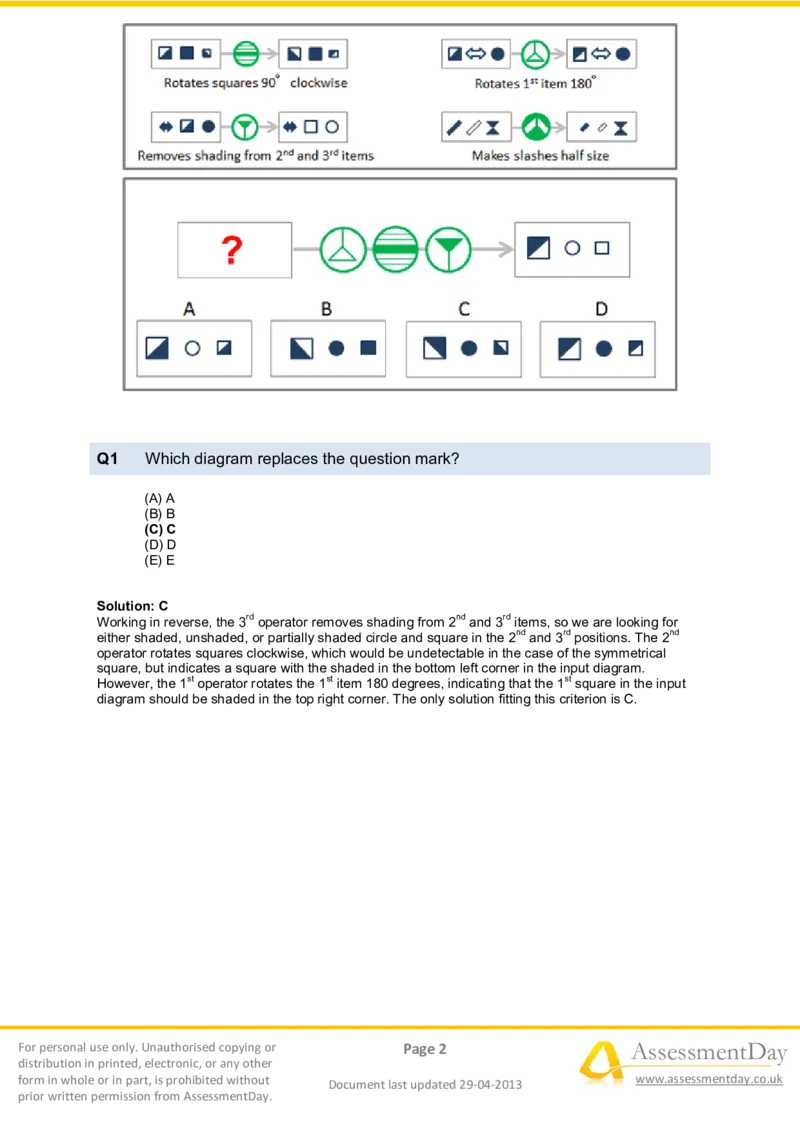
Solution: C
Working in reverse, the 3rd operator removes shading from 2nd and 3rd items, so we are looking for
either shaded, unshaded, or partially shaded circle and square in the 2nd and 3rd positions. The 2nd
operator rotates squares clockwise, which would be undetectable in the case of the symmetrical
square, but indicates a square with the shaded in the bottom left corner in the input diagram.
However, the 1st operator rotates the 1st item 180 degrees, indicating that the 1st square in the input
diagram should be shaded in the top right corner. The only solution fitting this criterion is C.
For personal use only. Unauthorised copying or Page 2 AssessmentDay
distribution in printed, electronic, or any other
form in whole or in part, is prohibited without
Document last updated 29-04-2013
www.assessmentday.co.uk
prior written permission from AssessmentDay.Q2 Which diagram replaces the question mark?
(A) A
(B) B
(C) C
(D) D
(E) E
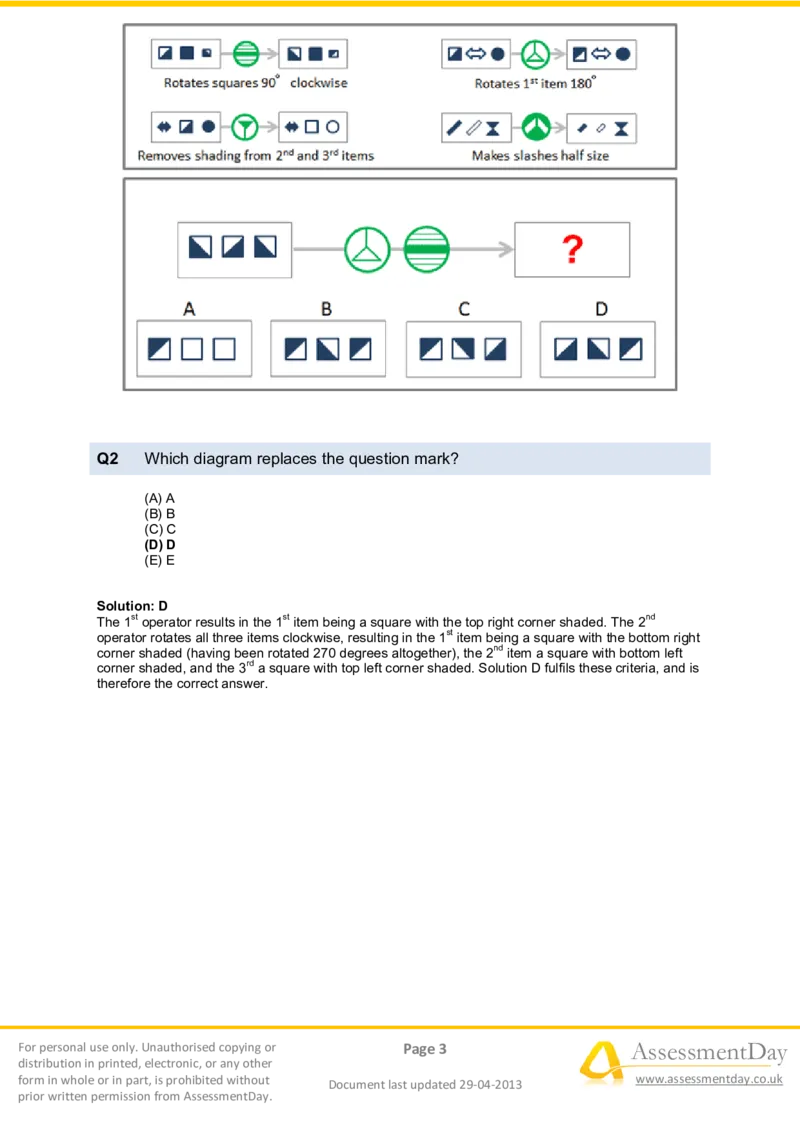
Solution: D
The 1st operator results in the 1st item being a square with the top right corner shaded. The 2nd
operator rotates all three items clockwise, resulting in the 1st item being a square with the bottom right
corner shaded (having been rotated 270 degrees altogether), the 2nd item a square with bottom left
corner shaded, and the 3rd a square with top left corner shaded. Solution D fulfils these criteria, and is
therefore the correct answer.
For personal use only. Unauthorised copying or Page 3 AssessmentDay
distribution in printed, electronic, or any other
form in whole or in part, is prohibited without
Document last updated 29-04-2013
www.assessmentday.co.uk
prior written permission from AssessmentDay.Q3 Which diagram replaces the question mark?
(A) A
(B) B
(C) C
(D) D
(E) E
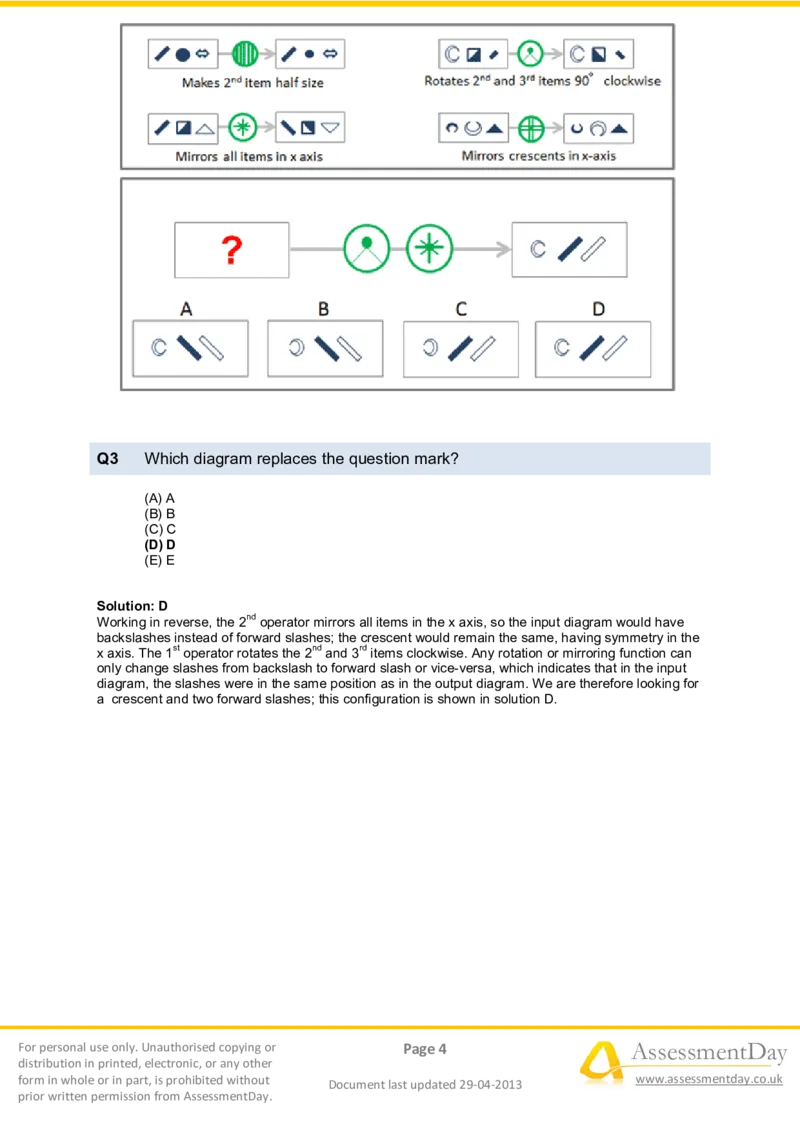
Solution: D
Working in reverse, the 2nd operator mirrors all items in the x axis, so the input diagram would have
backslashes instead of forward slashes; the crescent would remain the same, having symmetry in the
x axis. The 1st operator rotates the 2nd and 3rd items clockwise. Any rotation or mirroring function can
only change slashes from backslash to forward slash or vice-versa, which indicates that in the input
diagram, the slashes were in the same position as in the output diagram. We are therefore looking for
a crescent and two forward slashes; this configuration is shown in solution D.
For personal use only. Unauthorised copying or Page 4 AssessmentDay
distribution in printed, electronic, or any other
form in whole or in part, is prohibited without
Document last updated 29-04-2013
www.assessmentday.co.uk
prior written permission from AssessmentDay.Q4 Which diagram replaces the question mark?
(A) A
(B) B
(C) C
(D) D
(E) E
Solution: B
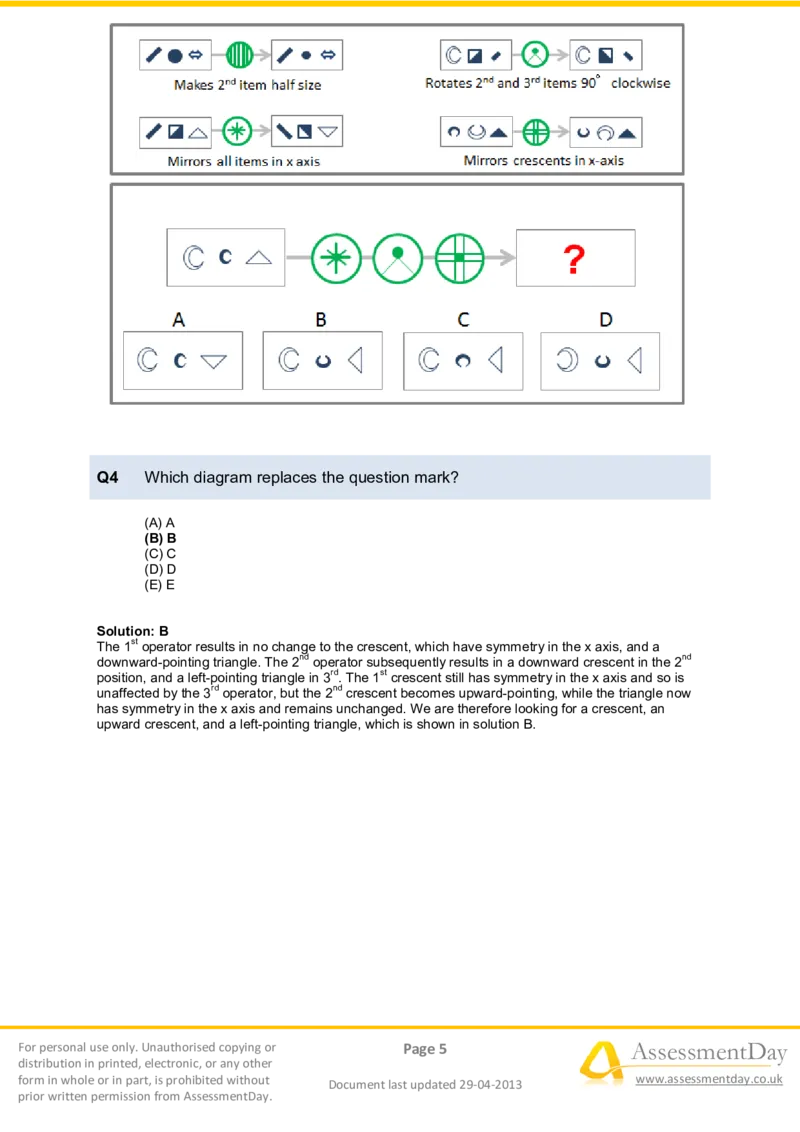
The 1st operator results in no change to the crescent, which have symmetry in the x axis, and a
downward-pointing triangle. The 2nd operator subsequently results in a downward crescent in the 2nd
position, and a left-pointing triangle in 3rd. The 1st crescent still has symmetry in the x axis and so is
unaffected by the 3rd operator, but the 2nd crescent becomes upward-pointing, while the triangle now
has symmetry in the x axis and remains unchanged. We are therefore looking for a crescent, an
upward crescent, and a left-pointing triangle, which is shown in solution B.
For personal use only. Unauthorised copying or Page 5 AssessmentDay
distribution in printed, electronic, or any other
form in whole or in part, is prohibited without
Document last updated 29-04-2013
www.assessmentday.co.uk
prior written permission from AssessmentDay.Q5 Which operator, if any, has no apparent effect in this process?
(A) A
(B) B
(C) C
(D) D
(E) E
Solution: D
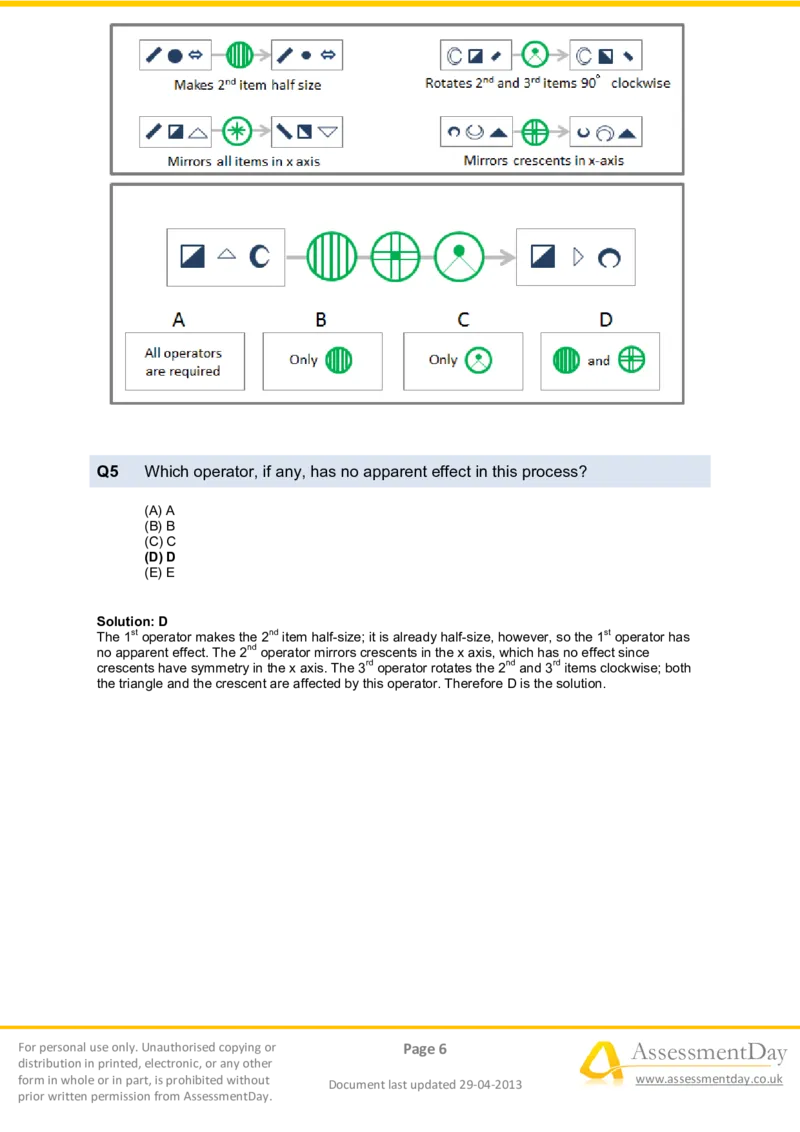
The 1st operator makes the 2nd item half-size; it is already half-size, however, so the 1st operator has
no apparent effect. The 2nd operator mirrors crescents in the x axis, which has no effect since
crescents have symmetry in the x axis. The 3rd operator rotates the 2nd and 3rd items clockwise; both
the triangle and the crescent are affected by this operator. Therefore D is the solution.
For personal use only. Unauthorised copying or Page 6 AssessmentDay
distribution in printed, electronic, or any other
form in whole or in part, is prohibited without
Document last updated 29-04-2013
www.assessmentday.co.uk
prior written permission from AssessmentDay.Q6 Which diagram replaces the question mark?
(A) A
(B) B
(C) C
(D) D
(E) E
Solution: A
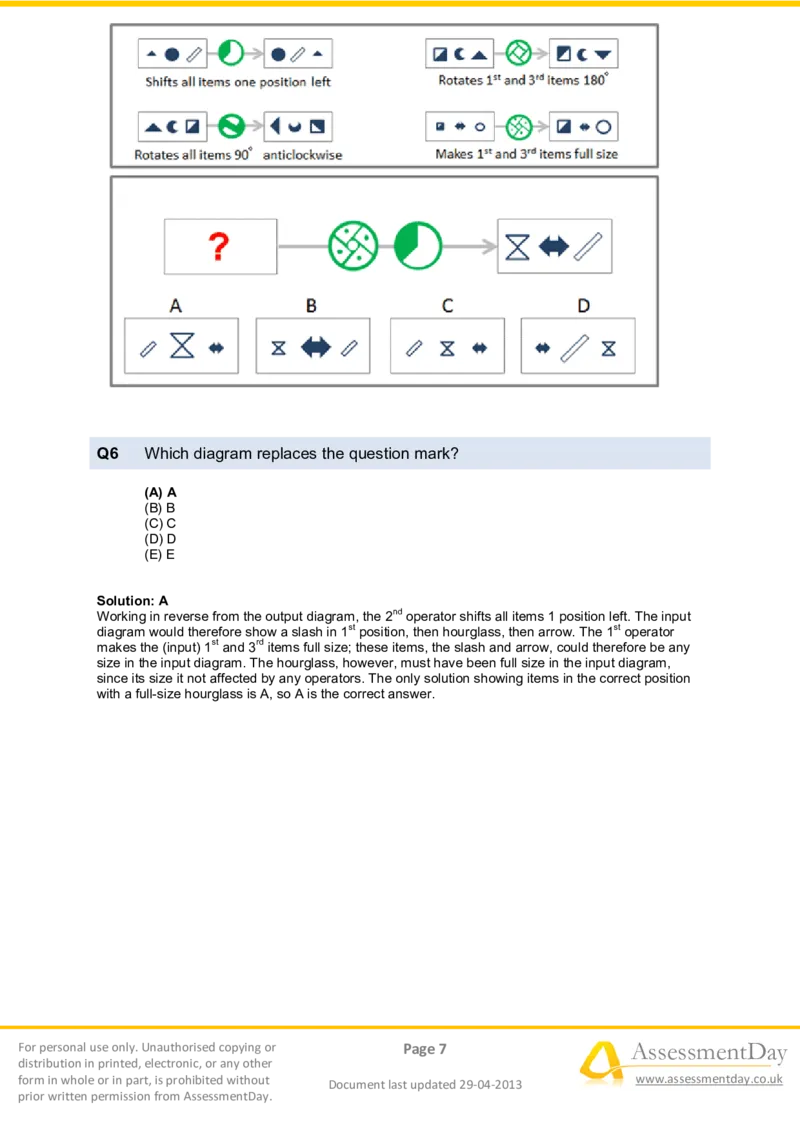
Working in reverse from the output diagram, the 2nd operator shifts all items 1 position left. The input
diagram would therefore show a slash in 1st position, then hourglass, then arrow. The 1st operator
makes the (input) 1st and 3rd items full size; these items, the slash and arrow, could therefore be any
size in the input diagram. The hourglass, however, must have been full size in the input diagram,
since its size it not affected by any operators. The only solution showing items in the correct position
with a full-size hourglass is A, so A is the correct answer.
For personal use only. Unauthorised copying or Page 7 AssessmentDay
distribution in printed, electronic, or any other
form in whole or in part, is prohibited without
Document last updated 29-04-2013
www.assessmentday.co.uk
prior written permission from AssessmentDay.Q7 Which operator, if any, replaces the question mark?
(A) A
(B) B
(C) C
(D) D
(E) E
Solution: C
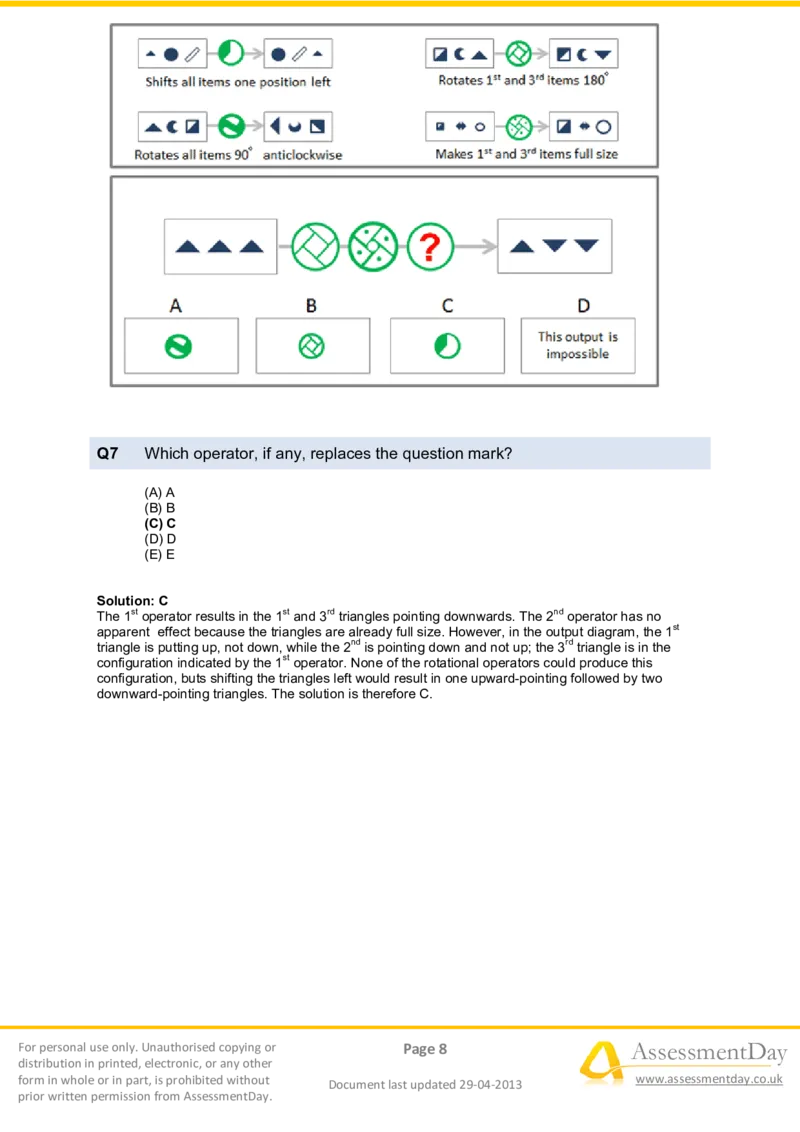
The 1st operator results in the 1st and 3rd triangles pointing downwards. The 2nd operator has no
apparent effect because the triangles are already full size. However, in the output diagram, the 1st
triangle is putting up, not down, while the 2nd is pointing down and not up; the 3rd triangle is in the
configuration indicated by the 1st operator. None of the rotational operators could produce this
configuration, buts shifting the triangles left would result in one upward-pointing followed by two
downward-pointing triangles. The solution is therefore C.
For personal use only. Unauthorised copying or Page 8 AssessmentDay
distribution in printed, electronic, or any other
form in whole or in part, is prohibited without
Document last updated 29-04-2013
www.assessmentday.co.uk
prior written permission from AssessmentDay.Q8 Which operator, if any, replaces the question mark?
(A) A
(B) B
(C) C
(D) D
(E) E
Solution: A
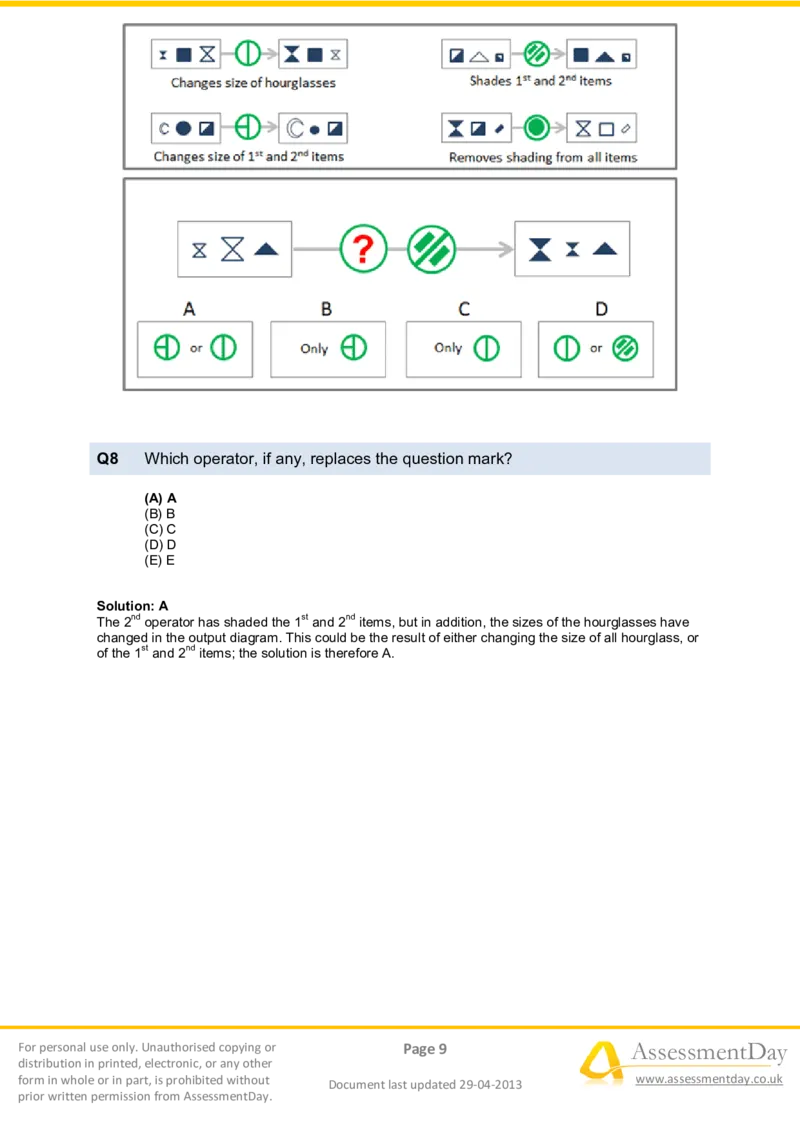
The 2nd operator has shaded the 1st and 2nd items, but in addition, the sizes of the hourglasses have
changed in the output diagram. This could be the result of either changing the size of all hourglass, or
of the 1st and 2nd items; the solution is therefore A.
For personal use only. Unauthorised copying or Page 9 AssessmentDay
distribution in printed, electronic, or any other
form in whole or in part, is prohibited without
Document last updated 29-04-2013
www.assessmentday.co.uk
prior written permission from AssessmentDay.Q9 Which diagram replaces the question mark?
(A) A
(B) B
(C) C
(D) D
(E) E
Solution: D
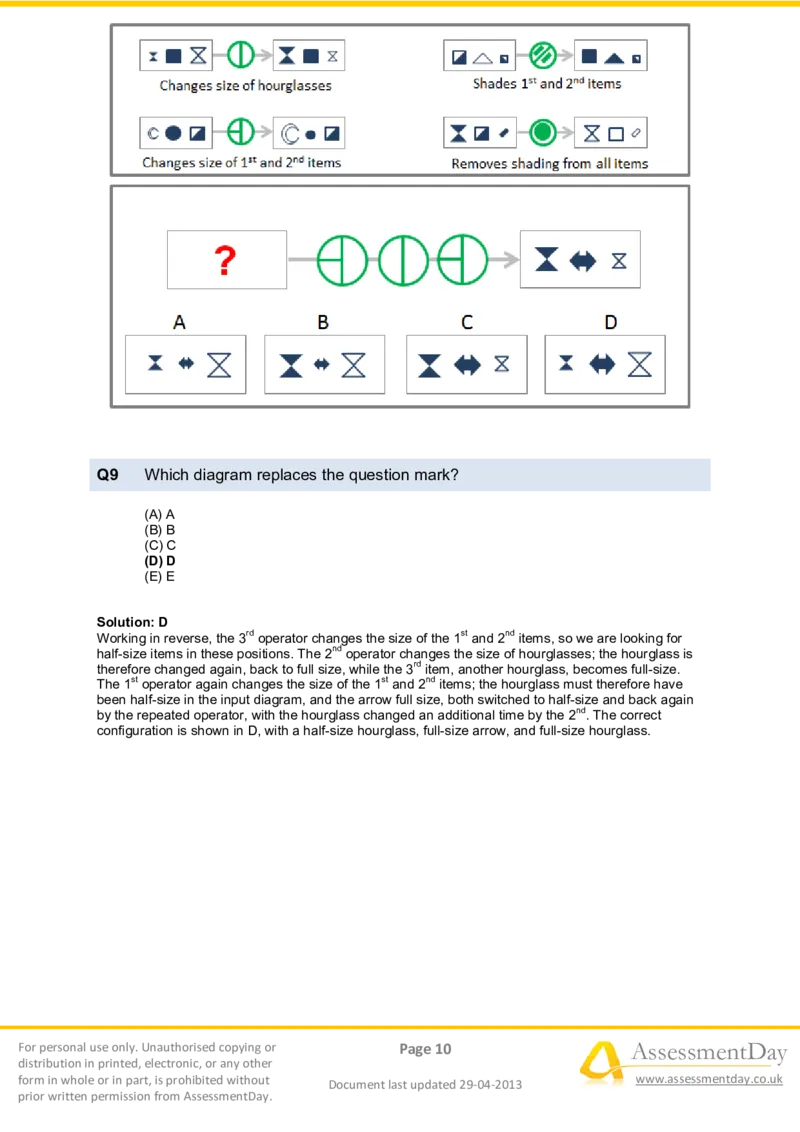
Working in reverse, the 3rd operator changes the size of the 1st and 2nd items, so we are looking for
half-size items in these positions. The 2nd operator changes the size of hourglasses; the hourglass is
therefore changed again, back to full size, while the 3rd item, another hourglass, becomes full-size.
The 1st operator again changes the size of the 1st and 2nd items; the hourglass must therefore have
been half-size in the input diagram, and the arrow full size, both switched to half-size and back again
by the repeated operator, with the hourglass changed an additional time by the 2nd. The correct
configuration is shown in D, with a half-size hourglass, full-size arrow, and full-size hourglass.
For personal use only. Unauthorised copying or Page 10 AssessmentDay
distribution in printed, electronic, or any other
form in whole or in part, is prohibited without
Document last updated 29-04-2013
www.assessmentday.co.uk
prior written permission from AssessmentDay.Q10 Which operator, if any, replaces the question mark?
(A) A
(B) B
(C) C
(D) D
(E) E
Solution: B
From the output diagram we see that the 2nd operator appears unchanged, while the 1st and 3rd have
been rotated or mirrored. The 2nd operator swaps the 1st and 2nd items, so, working in reverse, the
output following the 1st operator would have shown the 1st item unchanged and the 2nd and 3rd
mirrored compared to the input diagram. The operator shown in B mirrors the 2nd and 3rd items in the
Y axis, which, followed by switching the 1st and 2nd items, would produce the output shown. B is
therefore the correct solution.
For personal use only. Unauthorised copying or Page 11 AssessmentDay
distribution in printed, electronic, or any other
form in whole or in part, is prohibited without
Document last updated 29-04-2013
www.assessmentday.co.uk
prior written permission from AssessmentDay.Q11 Which diagram replaces the question mark?
(A) A
(B) B
(C) C
(D) D
(E) E
Solution: A
Working in reverse from the output diagram, the 3rd operator mirrors the 2nd and 3rd items in the y axis;
we would therefore look for a normal crescent in 2nd position and a square shaded in the bottom left
corner in 3rd. The 2nd operator switches the circle with the crescent, so we would expect a normal
crescent followed by a circle followed by the square. However, the 1st operator replaces the 2nd item
with a circle; the 2nd item in the input diagram could therefore by any half-size shaded shape. Solution
A shows a normal crescent followed by a half-size shaded square, followed by a square shaded in the
bottom left, so A is correct.
For personal use only. Unauthorised copying or Page 12 AssessmentDay
distribution in printed, electronic, or any other
form in whole or in part, is prohibited without
Document last updated 29-04-2013
www.assessmentday.co.uk
prior written permission from AssessmentDay.Q12 Which diagram replaces the question mark?
(A) A
(B) B
(C) C
(D) D
(E) E
Solution: D
The 1st operator results in a rightward-pointing triangle and a downward-pointing crescent; the 2nd
operator then makes the crescent half-size and the slash full-size. The final operator mirrors the
shaded items in the y axis, resulting in a leftward-pointing triangle, but not affecting the crescent,
which has symmetry in the y axis. The output diagram should therefore comprise a leftward-pointing
triangle, half-size downward-pointing crescent, and full-size slash. This configuration is shown in
solution D, which is the right answer.
For personal use only. Unauthorised copying or Page 13 AssessmentDay
distribution in printed, electronic, or any other
form in whole or in part, is prohibited without
Document last updated 29-04-2013
www.assessmentday.co.uk
prior written permission from AssessmentDay.Q13 Which operator, if any, has no apparent effect in this process?
(A) A
(B) B
(C) C
(D) D
(E) E
Solution: B
The 1st operator has changed the size of the 2nd and 3rd items. The 2nd has shaded the circle. The 3rd,
however, mirrors shaded items in the y axis; the shaded items, the circle and arrow, have symmetry in
the y axis. The 3rd operator therefore has no effect, and the correct solution is B.
For personal use only. Unauthorised copying or Page 14 AssessmentDay
distribution in printed, electronic, or any other
form in whole or in part, is prohibited without
Document last updated 29-04-2013
www.assessmentday.co.uk
prior written permission from AssessmentDay.Q14 Which diagram replaces the question mark?
(A) A
(B) B
(C) C
(D) D
(E) E
Solution: C
Working in reverse from the output diagram, the 2nd operator rotates the 1st and 2nd items 180
degrees, so the input for this would be an upward-pointing triangle and a square shaded in the bottom
right corner. The 1st operator mirrors the 3rd item in the y axis, so the input must have been another
square shaded in the bottom right corner. The input diagram therefore comprised an upward-pointing
triangle followed by two squares shaded in the bottom right corner, as shown in C, which is the
correct solution.
For personal use only. Unauthorised copying or Page 15 AssessmentDay
distribution in printed, electronic, or any other
form in whole or in part, is prohibited without
Document last updated 29-04-2013
www.assessmentday.co.uk
prior written permission from AssessmentDay.Q15 Which diagram replaces the question mark?
(A) A
(B) B
(C) C
(D) D
(E) E
Solution: A
The 1st operator results in the crescent becoming half-size, while the 2nd operator affects all items –
making the square half-size, the arrow full-size, and restoring the crescent to its original size. This
output is shown in A, which is the correct solution.
For personal use only. Unauthorised copying or Page 16 AssessmentDay
distribution in printed, electronic, or any other
form in whole or in part, is prohibited without
Document last updated 29-04-2013
www.assessmentday.co.uk
prior written permission from AssessmentDay.Q16 Which operator replaces the question mark?
(A) A
(B) B
(C) C
(D) D
(E) E
Solution: B
The 1st operator rotated the triangle and crescent, as shown in the output diagram. The 2nd operator
affected only the square, making it half-size, also as shown. There are no additional changes from the
input diagram; therefore the final operator must have had no effect. The operator shown in A would
have no effect on the square, which was already made half-size by the 2nd operator, so this is a
possibility. The operator shown in C would also have no effect on the square, which has symmetry in
the y axis. The answer is therefore B.
For personal use only. Unauthorised copying or Page 17 AssessmentDay
distribution in printed, electronic, or any other
form in whole or in part, is prohibited without
Document last updated 29-04-2013
www.assessmentday.co.uk
prior written permission from AssessmentDay.Q17 Which diagram replaces the question mark?
(A) A
(B) B
(C) C
(D) D
(E) E
Solution: C
Working backwards from the output diagram, the 2nd operator reverses the order of the sequence, so
we would expect a square shaded in the top left corner, then an arrow, then a square shaded in the
bottom right corner. The 1st operator, however, rotates squares 180 degrees, so the input diagram
must comprise a square shaded in the bottom right corner, an arrow, then a square shaded in the top
left corner. This configuration is shown in C, which is the correct answer.
.
For personal use only. Unauthorised copying or Page 18 AssessmentDay
distribution in printed, electronic, or any other
form in whole or in part, is prohibited without
Document last updated 29-04-2013
www.assessmentday.co.uk
prior written permission from AssessmentDay.Q18 Which diagram replaces the question mark?
(A) A
(B) B
(C) C
(D) D
(E) E
Solution: D
The 1st operator changes the shading of half-size items, resulting in a half-size unshaded hourglass in
2nd position and a half-size unshaded triangle in 3rd without affecting the full-size triangle in 1st
position. The 2nd operator then replaces the two triangles, both of which are now unshaded, with
arrows, giving a full-size arrow followed by a half-size hourglass followed by a half-size arrow. The
final operator then reverses the order of this sequence, which would produce the sequence in solution
D. D is therefore the correct answer.
For personal use only. Unauthorised copying or Page 19 AssessmentDay
distribution in printed, electronic, or any other
form in whole or in part, is prohibited without
Document last updated 29-04-2013
www.assessmentday.co.uk
prior written permission from AssessmentDay.Q19 Which operator, if any, has no apparent effect in this process?
(A) A
(B) B
(C) C
(D) D
(E) E
Solution: A
The 1st operator has rotated the hourglass as expected. The 2nd has no effect, since there are no full
size items to be shaded. The 3rd changes the size of previously rotated items – in this case, the
hourglass, which has indeed been changed. Only the 2nd operator had no apparent effect; the correct
solution is therefore A.
For personal use only. Unauthorised copying or Page 20 AssessmentDay
distribution in printed, electronic, or any other
form in whole or in part, is prohibited without
Document last updated 29-04-2013
www.assessmentday.co.uk
prior written permission from AssessmentDay.Q20 Which diagram replaces the question mark?
(A) A
(B) B
(C) C
(D) D
(E) E
Solution: C
The 1st operator results in a mirrored slash in the 3rd position. The 2nd operator results in an hourglass
on its side in 1st and 2nd positions. The final operator changes the size of rotated (not mirrored) items,
thus affecting only the hourglasses; the 1st becomes half-size, the second full-size. A half-size
hourglass on its side, followed by a full-size hourglass in the same position, followed by a reversed
slash, is shown in solution C, which is the correct answer.
For personal use only. Unauthorised copying or Page 21 AssessmentDay
distribution in printed, electronic, or any other
form in whole or in part, is prohibited without
Document last updated 29-04-2013
www.assessmentday.co.uk
prior written permission from AssessmentDay.Q21 Which operator replaces the question mark?
(A) A
(B) B
(C) C
(D) D
(E) E
Solution: A
Working in reverse, the 2nd operator has replaced circles with triangles, and we see from the input
diagram that the 2nd item, a circle, is a triangle in the output diagram. However, the 1st item in the
output diagram is also a triangle, while the 1st item in the input diagram is a square. As no operators
replace squares with another shape, the 1st operator must have transformed the square into a circle,
which was subsequently transformed again into a triangle by the 2nd operator. The operator which
replaces full-size items with circles would accomplish this. The answer is therefore A.
For personal use only. Unauthorised copying or Page 22 AssessmentDay
distribution in printed, electronic, or any other
form in whole or in part, is prohibited without
Document last updated 29-04-2013
www.assessmentday.co.uk
prior written permission from AssessmentDay.Q22 Which diagram replaces the question mark?
(A) A
(B) B
(C) C
(D) D
(E) E
Solution: D
Working in reverse from the output diagram, the 2nd operator replaces full-size items with circles; the
1st and 3rd items could therefore be any full-size shape, including circles. The 1st operator replaces
circles with triangles, so the 2nd item must either have been a circle or a triangle already (note that
even if they had been triangles in the input diagram, the 1st and 3rd items would still be circles in the
output, regardless of the effect of the 1st operator, due to the effect of the 2nd operator). The input
diagram could therefore include any full-size shape in 1st and 3rd position, and a half-size circle or
triangle in 2nd position. Any of solutions A, B or C meets these criteria; the correct answer is therefore
D.
For personal use only. Unauthorised copying or Page 23 AssessmentDay
distribution in printed, electronic, or any other
form in whole or in part, is prohibited without
Document last updated 29-04-2013
www.assessmentday.co.uk
prior written permission from AssessmentDay.Q23 Which diagram replaces the question mark?
(A) A
(B) B
(C) C
(D) D
(E) E
Solution: B
The 1st operator results in a triangle in the 1st position. The 2nd operator results in a downward-
pointing triangle in 1st position and a square shaded in the bottom left corner in 3rd position. The 3rd
operator does not affect the triangle in 1st position, which has symmetry in the y axis, but mirrors the
crescent in 2nd position, and results in a square shaded in the top left corner in 3rd position. The
output diagram should therefore show a downward-pointing triangle followed by a mirrored crescent
followed by a square shaded in the top left corner. This configuration is shown in solution D, which is
therefore the correct answer.
For personal use only. Unauthorised copying or Page 24 AssessmentDay
distribution in printed, electronic, or any other
form in whole or in part, is prohibited without
Document last updated 29-04-2013
www.assessmentday.co.uk
prior written permission from AssessmentDay.Q24 Which operator, if any, has no apparent effect in this process?
(A) A
(B) B
(C) C
(D) D
(E) E
Solution: A
The 1st operator has been effective in making the diamond full size, and the 2nd operator has been
effective in replacing the 1st item with an hourglass. The final operator mirrors the diamond and the
hourglass in 3rd position in the x axis; however, both these shapes have symmetry in the x axis, and
are unaffected. The answer is therefore A.
For personal use only. Unauthorised copying or Page 25 AssessmentDay
distribution in printed, electronic, or any other
form in whole or in part, is prohibited without
Document last updated 29-04-2013
www.assessmentday.co.uk
prior written permission from AssessmentDay.Q25 Which diagram replaces the question mark?
(A) A
(B) B
(C) C
(D) D
(E) E
Solution: D
Working in reverse, the 2nd operator has rotated all three items 90 degrees from their previous
position (i.e. from 'backslashes' to forward slashes). The 1st operator rotated only the 1st slash 90
degrees; therefore the input diagram must have included a backslash followed by two forward
slashes, as shown in D.
For personal use only. Unauthorised copying or Page 26 AssessmentDay
distribution in printed, electronic, or any other
form in whole or in part, is prohibited without
Document last updated 29-04-2013
www.assessmentday.co.uk
prior written permission from AssessmentDay.Q26 Which operator, if any, has no apparent effect in this process?
(A) A
(B) B
(C) C
(D) D
(E) E
Solution: B
The slash and cross have changed size, therefore the 2nd operator has had an effect. The 1st and
3rd operators both affect only the slash, the 1st rotating the slash to a new orientation, and the 3rd
returning it to its original orientation. As the slash is in its original orientation in the output diagram,
both of these operators are required. Thus B is the correct answer.
For personal use only. Unauthorised copying or Page 27 AssessmentDay
distribution in printed, electronic, or any other
form in whole or in part, is prohibited without
Document last updated 29-04-2013
www.assessmentday.co.uk
prior written permission from AssessmentDay.Q27 Which diagram replaces the question mark?
(A) A
(B) B
(C) C
(D) D
(E) E
Solution: C
Working in reverse, the 2nd operator will not have affected the 1st item, because the triangle has
symmetry in the y-axis. It will have mirrored the 3rd item, the chevron, in the x-axis, so the input
diagram should contain a right-pointing chevron. The 1st operator changes the size of triangles,
indicating that the triangle in the input diagram was half-sized. The 2nd item remains unchanged by
either operator. We would therefore expect a half-size upward-pointing triangle, a diamond, and a
right-pointing chevron, as shown in C.
For personal use only. Unauthorised copying or Page 28 AssessmentDay
distribution in printed, electronic, or any other
form in whole or in part, is prohibited without
Document last updated 29-04-2013
www.assessmentday.co.uk
prior written permission from AssessmentDay.Q28 Which diagram replaces the question mark?
(A) A
(B) B
(C) C
(D) D
(E) E
Solution: B
The 1st operator results in the 2nd chevron becoming shaded. The 2nd operator swaps this half-size
shaded chevron with the full-size shaded chevron in 3rd position, resulting in a full-size unshaded
chevron, followed by a full-size shaded chevron, then a half-size shaded chevron. The final operator
then mirrors all three chevrons in the y axis, resulting in an unshaded leftward-pointing chevron in 1st
position, a leftward-pointing full size shaded chevron in 2nd, and a leftward-pointing half-size shaded
chevron in 3rd position. This configuration is shown in B.
For personal use only. Unauthorised copying or Page 29 AssessmentDay
distribution in printed, electronic, or any other
form in whole or in part, is prohibited without
Document last updated 29-04-2013
www.assessmentday.co.uk
prior written permission from AssessmentDay.Q29 Which operator replaces the question mark?
(A) A
(B) B
(C) C
(D) D
(E) E
Solution: C
The chevrons are in the expected orientation in the output diagram, indicating that the missing
operator should not effect the chevrons. The shading of the full size chevron has not been changed
as expected in the output diagram, indicating that the missing operator must reverse the effect of the
2nd operator. The missing operator must therefore be the one shown in C.
For personal use only. Unauthorised copying or Page 30 AssessmentDay
distribution in printed, electronic, or any other
form in whole or in part, is prohibited without
Document last updated 29-04-2013
www.assessmentday.co.uk
prior written permission from AssessmentDay.Q30 Which diagram replaces the question mark?
(A) A
(B) B
(C) C
(D) D
(E) E
Solution: A
Working in reverse, the 3rd operator would have had no effect on the chevron, which has symmetry in
the y axis. The 2nd removes shading; therefore the chevron in 1st and semicircle in 3rd positions
could be either shaded or unshaded in the input. The 1st operator indicates a downward-pointing
semicircle in 2nd position, and an upward-pointing semicircle in 3rd position in the input diagram. An
upward-pointing chevron, followed by a downward-pointing semicircle, then an upward-pointing
semicircle in shown in A, which is the correct answer.
-- End of Test --
For personal use only. Unauthorised copying or Page 31 AssessmentDay
distribution in printed, electronic, or any other
form in whole or in part, is prohibited without
Document last updated 29-04-2013
www.assessmentday.co.uk
prior written permission from AssessmentDay.