Numerical Critical Reasoning
Test 5
Solutions Booklet
Instructions
This numerical reasoning test comprises 21 questions, and you will have to correctly
answer as many as you can. Calculators are permitted for this test, and it is
recommended you have some rough paper to work on.
You will have to work quickly and accurately to perform well in this test. The test does
not have an overall time limit however each question has a time limit. The first
question relating to each table or graph has 90 seconds, and subsequent questions
relating to the same table or graph have 75 seconds.
Try to find a time and place where you will not be interrupted during the test. The test
will begin on the next page.
AssessmentDay
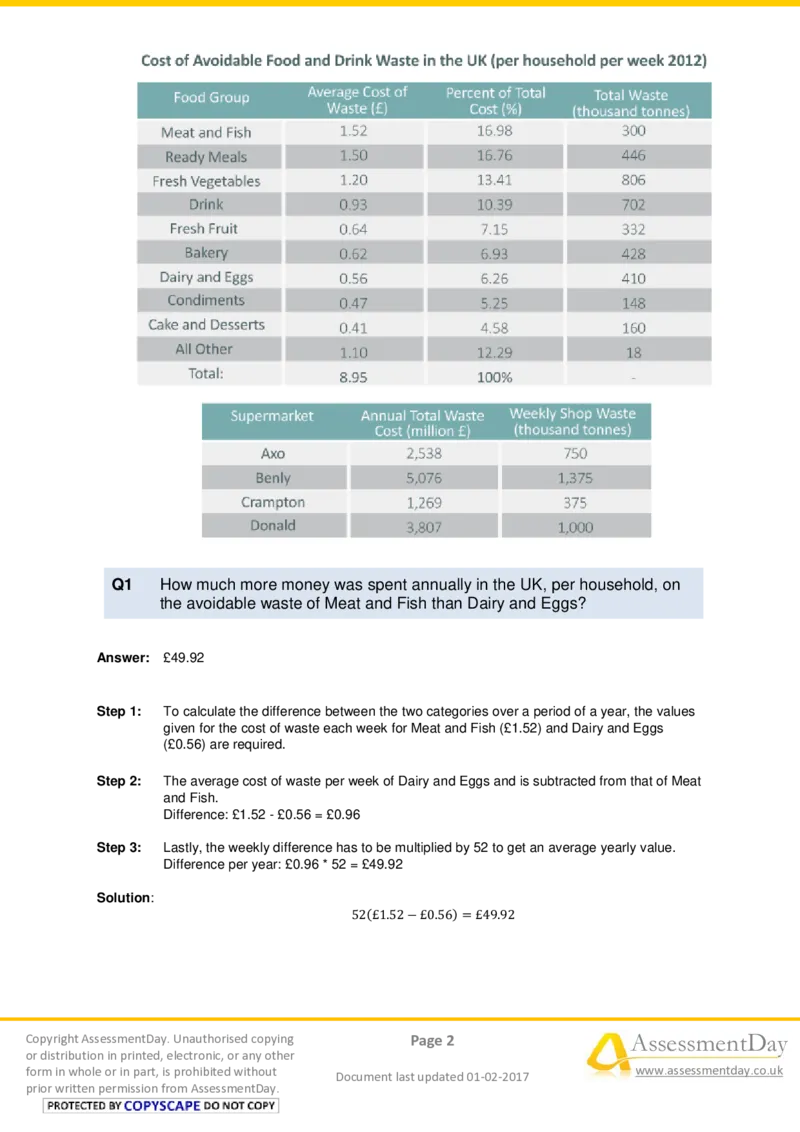
Practice Aptitude TestsQ1 How much more money was spent annually in the UK, per household, on
the avoidable waste of Meat and Fish than Dairy and Eggs?
Answer: £49.92
Step 1: To calculate the difference between the two categories over a period of a year, the values
given for the cost of waste each week for Meat and Fish (£1.52) and Dairy and Eggs
(£0.56) are required.
Step 2: The average cost of waste per week of Dairy and Eggs and is subtracted from that of Meat
and Fish.
Difference: £1.52 - £0.56 = £0.96
Step 3: Lastly, the weekly difference has to be multiplied by 52 to get an average yearly value.
Difference per year: £0.96 * 52 = £49.92
Solution:
52(£1.52−£0.56)=£49.92
Copyright AssessmentDay. Unauthorised copying Page 2 AssessmentDay
or distribution in printed, electronic, or any other
form in whole or in part, is prohibited without
Document last updated 01-02-2017
www.assessmentday.co.uk
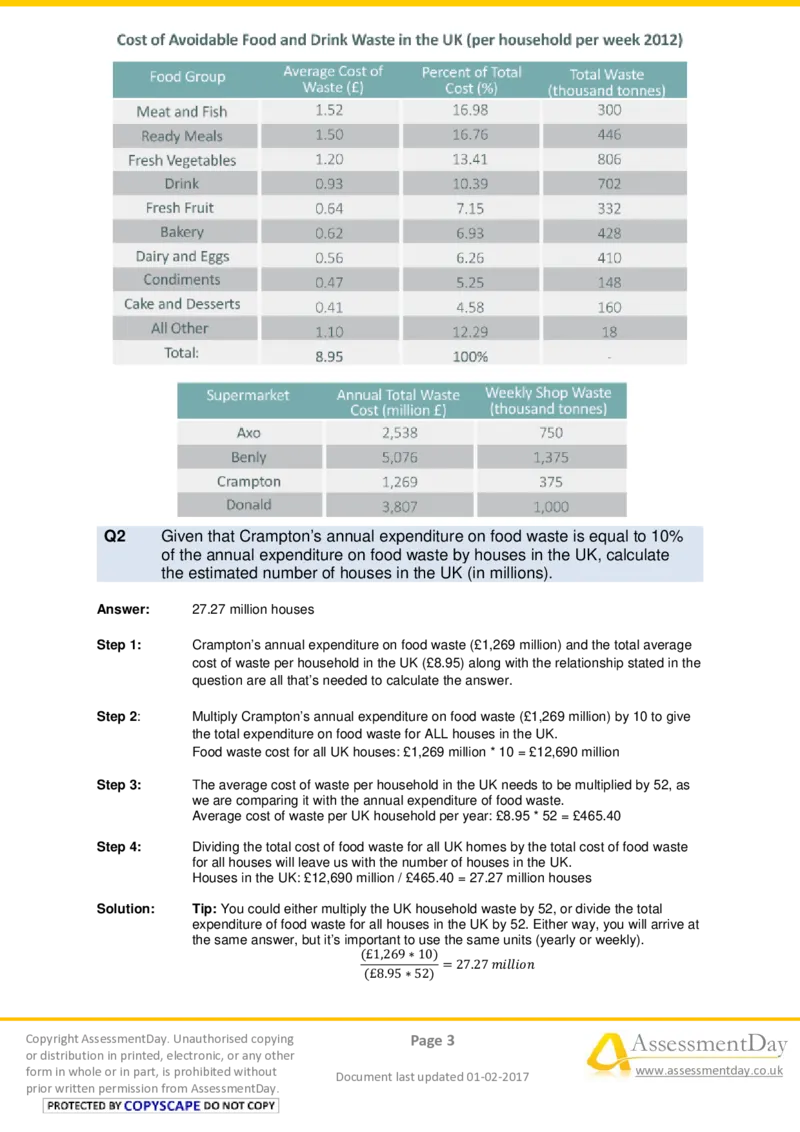
prior written permission from AssessmentDay.Q2 Given that Crampton’s annual expenditure on food waste is equal to 10%
of the annual expenditure on food waste by houses in the UK, calculate
the estimated number of houses in the UK (in millions).
Answer: 27.27 million houses
Step 1: Crampton’s annual expenditure on food waste (£1,269 million) and the total average
cost of waste per household in the UK (£8.95) along with the relationship stated in the
question are all that’s needed to calculate the answer.
Step 2: Multiply Crampton’s annual expenditure on food waste (£1,269 million) by 10 to give
the total expenditure on food waste for ALL houses in the UK.
Food waste cost for all UK houses: £1,269 million * 10 = £12,690 million
Step 3: The average cost of waste per household in the UK needs to be multiplied by 52, as
we are comparing it with the annual expenditure of food waste.
Average cost of waste per UK household per year: £8.95 * 52 = £465.40
Step 4: Dividing the total cost of food waste for all UK homes by the total cost of food waste
for all houses will leave us with the number of houses in the UK.
Houses in the UK: £12,690 million / £465.40 = 27.27 million houses
Solution: Tip: You could either multiply the UK household waste by 52, or divide the total
expenditure of food waste for all houses in the UK by 52. Either way, you will arrive at
the same answer, but it’s important to use the same units (yearly or weekly).
(£1,269∗10)
=27.27 𝑚𝑚𝑚𝑚𝑚𝑚𝑚𝑚𝑚𝑚𝑚𝑚𝑚𝑚
(£8.95∗52)
Copyright AssessmentDay. Unauthorised copying Page 3 AssessmentDay
or distribution in printed, electronic, or any other
form in whole or in part, is prohibited without
Document last updated 01-02-2017
www.assessmentday.co.uk
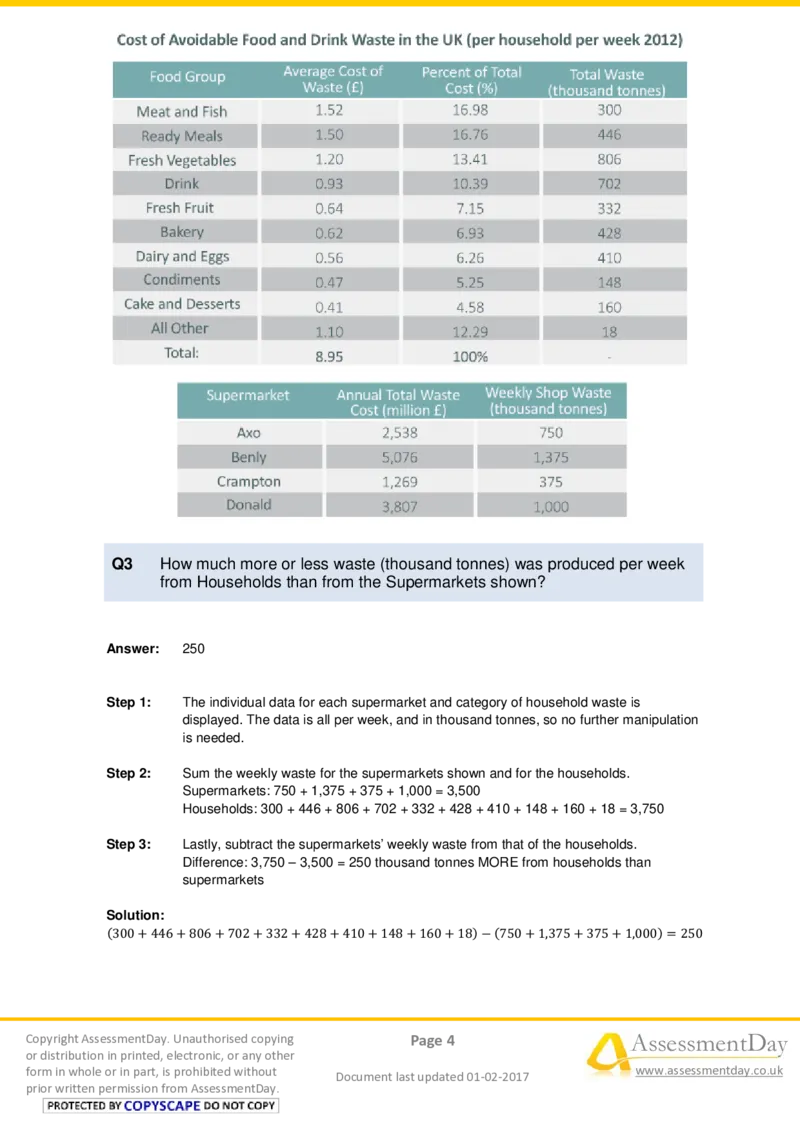
prior written permission from AssessmentDay.Q3 How much more or less waste (thousand tonnes) was produced per week
from Households than from the Supermarkets shown?
Answer: 250
Step 1: The individual data for each supermarket and category of household waste is
displayed. The data is all per week, and in thousand tonnes, so no further manipulation
is needed.
Step 2: Sum the weekly waste for the supermarkets shown and for the households.
Supermarkets: 750 + 1,375 + 375 + 1,000 = 3,500
Households: 300 + 446 + 806 + 702 + 332 + 428 + 410 + 148 + 160 + 18 = 3,750
Step 3: Lastly, subtract the supermarkets’ weekly waste from that of the households.
Difference: 3,750 – 3,500 = 250 thousand tonnes MORE from households than
supermarkets
Solution:
(300+446+806+702+332+428+410+148+160+18)−(750+1,375+375+1,000)=250
Copyright AssessmentDay. Unauthorised copying Page 4 AssessmentDay
or distribution in printed, electronic, or any other
form in whole or in part, is prohibited without
Document last updated 01-02-2017
www.assessmentday.co.uk
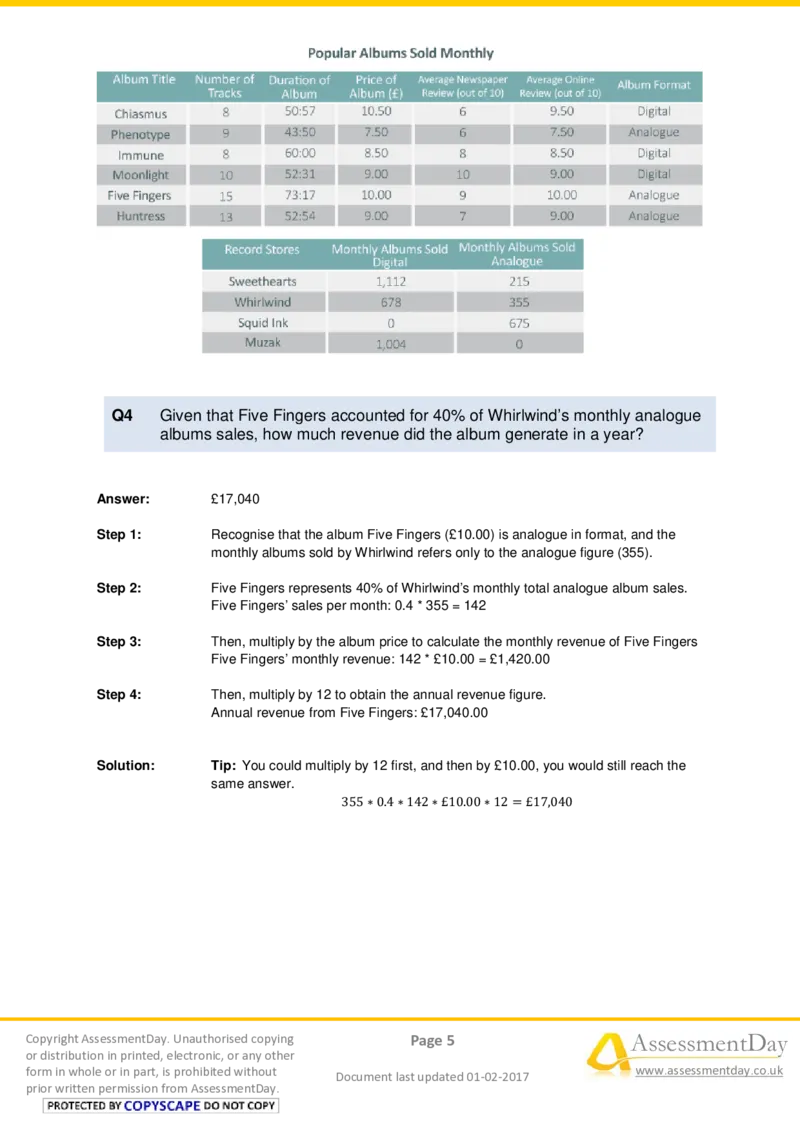
prior written permission from AssessmentDay.Q4 Given that Five Fingers accounted for 40% of Whirlwind’s monthly analogue
albums sales, how much revenue did the album generate in a year?
Answer: £17,040
Step 1: Recognise that the album Five Fingers (£10.00) is analogue in format, and the
monthly albums sold by Whirlwind refers only to the analogue figure (355).
Step 2: Five Fingers represents 40% of Whirlwind’s monthly total analogue album sales.
Five Fingers’ sales per month: 0.4 * 355 = 142
Step 3: Then, multiply by the album price to calculate the monthly revenue of Five Fingers
Five Fingers’ monthly revenue: 142 * £10.00 = £1,420.00
Step 4: Then, multiply by 12 to obtain the annual revenue figure.
Annual revenue from Five Fingers: £17,040.00
Solution: Tip: You could multiply by 12 first, and then by £10.00, you would still reach the
same answer.
355∗0.4∗142∗£10.00∗12=£17,040
Copyright AssessmentDay. Unauthorised copying Page 5 AssessmentDay
or distribution in printed, electronic, or any other
form in whole or in part, is prohibited without
Document last updated 01-02-2017
www.assessmentday.co.uk
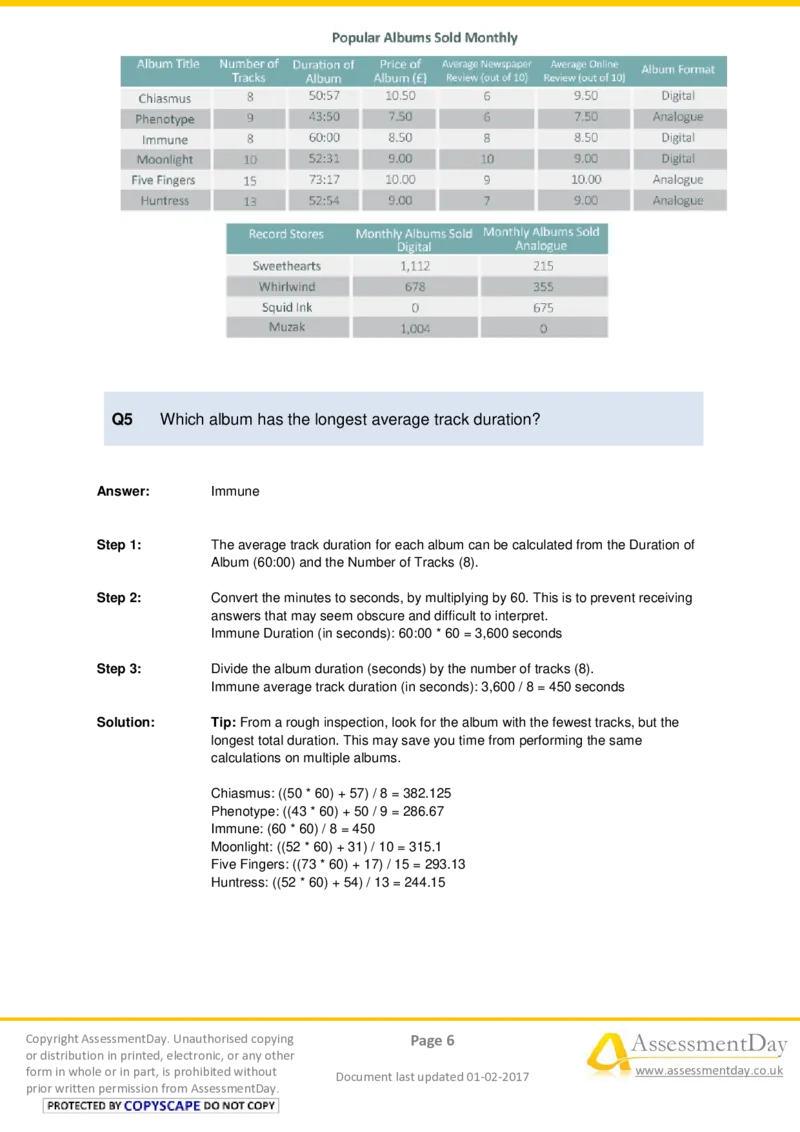
prior written permission from AssessmentDay.Q5 Which album has the longest average track duration?
Answer: Immune
Step 1: The average track duration for each album can be calculated from the Duration of
Album (60:00) and the Number of Tracks (8).
Step 2: Convert the minutes to seconds, by multiplying by 60. This is to prevent receiving
answers that may seem obscure and difficult to interpret.
Immune Duration (in seconds): 60:00 * 60 = 3,600 seconds
Step 3: Divide the album duration (seconds) by the number of tracks (8).
Immune average track duration (in seconds): 3,600 / 8 = 450 seconds
Solution: Tip: From a rough inspection, look for the album with the fewest tracks, but the
longest total duration. This may save you time from performing the same
calculations on multiple albums.
Chiasmus: ((50 * 60) + 57) / 8 = 382.125
Phenotype: ((43 * 60) + 50 / 9 = 286.67
Immune: (60 * 60) / 8 = 450
Moonlight: ((52 * 60) + 31) / 10 = 315.1
Five Fingers: ((73 * 60) + 17) / 15 = 293.13
Huntress: ((52 * 60) + 54) / 13 = 244.15
Copyright AssessmentDay. Unauthorised copying Page 6 AssessmentDay
or distribution in printed, electronic, or any other
form in whole or in part, is prohibited without
Document last updated 01-02-2017
www.assessmentday.co.uk
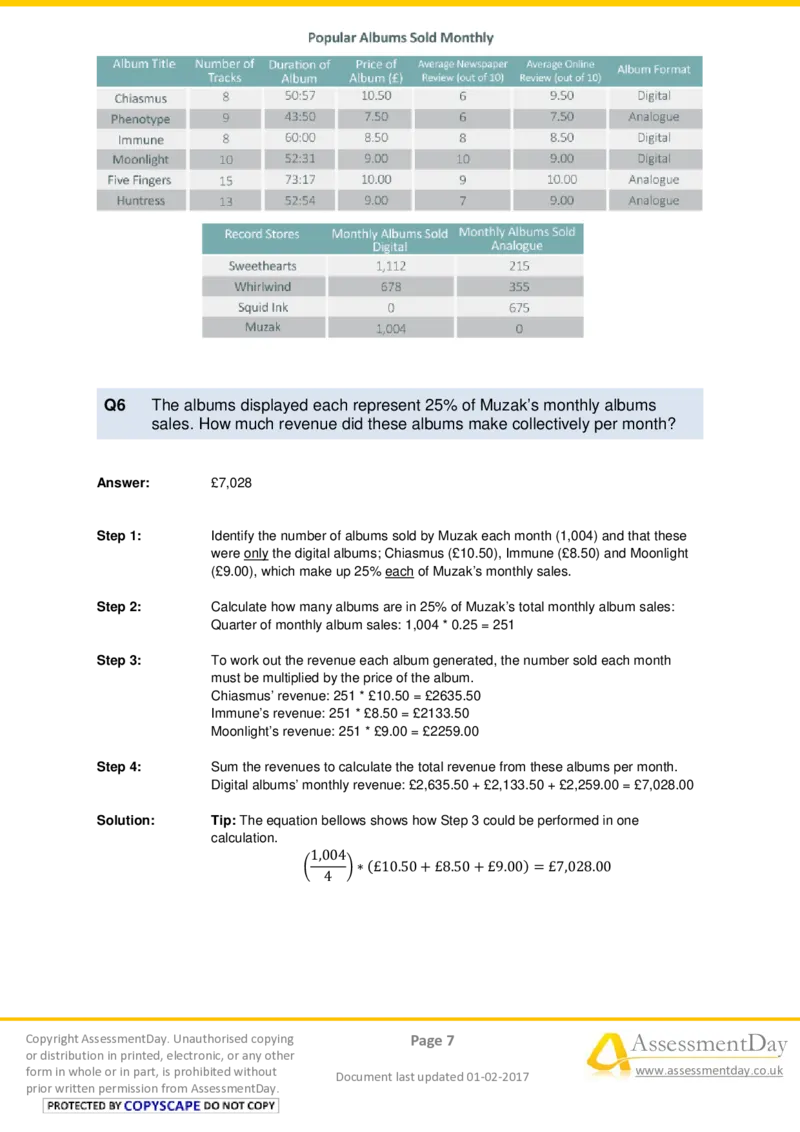
prior written permission from AssessmentDay.Q6 The albums displayed each represent 25% of Muzak’s monthly albums
sales. How much revenue did these albums make collectively per month?
Answer: £7,028
Step 1: Identify the number of albums sold by Muzak each month (1,004) and that these
were only the digital albums; Chiasmus (£10.50), Immune (£8.50) and Moonlight
(£9.00), which make up 25% each of Muzak’s monthly sales.
Step 2: Calculate how many albums are in 25% of Muzak’s total monthly album sales:
Quarter of monthly album sales: 1,004 * 0.25 = 251
Step 3: To work out the revenue each album generated, the number sold each month
must be multiplied by the price of the album.
Chiasmus’ revenue: 251 * £10.50 = £2635.50
Immune’s revenue: 251 * £8.50 = £2133.50
Moonlight’s revenue: 251 * £9.00 = £2259.00
Step 4: Sum the revenues to calculate the total revenue from these albums per month.
Digital albums’ monthly revenue: £2,635.50 + £2,133.50 + £2,259.00 = £7,028.00
Solution: Tip: The equation bellows shows how Step 3 could be performed in one
calculation.
1,004
� �∗(£10.50+£8.50+£9.00)= £7,028.00
4
Copyright AssessmentDay. Unauthorised copying Page 7 AssessmentDay
or distribution in printed, electronic, or any other
form in whole or in part, is prohibited without
Document last updated 01-02-2017
www.assessmentday.co.uk
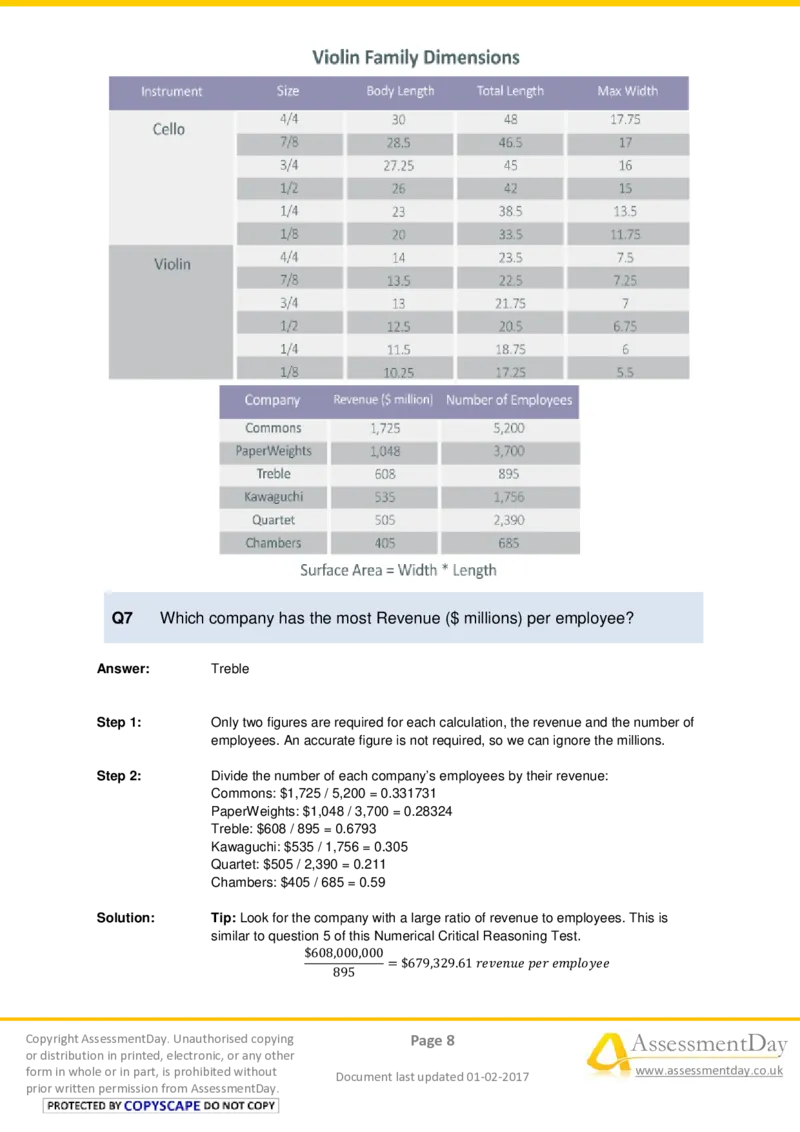
prior written permission from AssessmentDay.Q7 Which company has the most Revenue ($ millions) per employee?
Answer: Treble
Step 1: Only two figures are required for each calculation, the revenue and the number of
employees. An accurate figure is not required, so we can ignore the millions.
Step 2: Divide the number of each company’s employees by their revenue:
Commons: $1,725 / 5,200 = 0.331731
PaperWeights: $1,048 / 3,700 = 0.28324
Treble: $608 / 895 = 0.6793
Kawaguchi: $535 / 1,756 = 0.305
Quartet: $505 / 2,390 = 0.211
Chambers: $405 / 685 = 0.59
Solution: Tip: Look for the company with a large ratio of revenue to employees. This is
similar to question 5 of this Numerical Critical Reasoning Test.
$608,000,000
=$679,329.61 𝑟𝑟𝑟𝑟𝑟𝑟𝑟𝑟𝑚𝑚𝑟𝑟𝑟𝑟 𝑝𝑝𝑟𝑟𝑟𝑟 𝑟𝑟𝑚𝑚𝑝𝑝𝑚𝑚𝑚𝑚𝑒𝑒𝑟𝑟𝑟𝑟
895
Copyright AssessmentDay. Unauthorised copying Page 8 AssessmentDay
or distribution in printed, electronic, or any other
form in whole or in part, is prohibited without
Document last updated 01-02-2017
www.assessmentday.co.uk
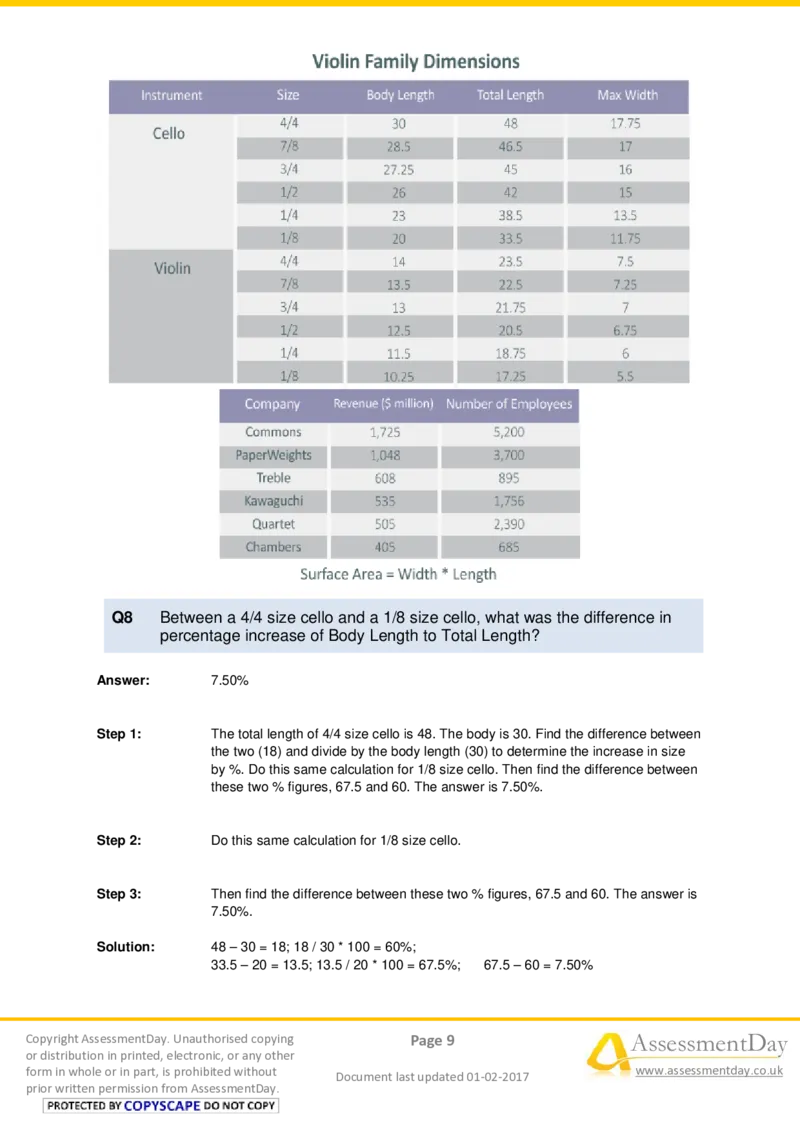
prior written permission from AssessmentDay.Q8 Between a 4/4 size cello and a 1/8 size cello, what was the difference in
percentage increase of Body Length to Total Length?
Answer: 7.50%
Step 1: The total length of 4/4 size cello is 48. The body is 30. Find the difference between
the two (18) and divide by the body length (30) to determine the increase in size
by %. Do this same calculation for 1/8 size cello. Then find the difference between
these two % figures, 67.5 and 60. The answer is 7.50%.
Step 2: Do this same calculation for 1/8 size cello.
Step 3: Then find the difference between these two % figures, 67.5 and 60. The answer is
7.50%.
Solution: 48 – 30 = 18; 18 / 30 * 100 = 60%;
33.5 – 20 = 13.5; 13.5 / 20 * 100 = 67.5%; 67.5 – 60 = 7.50%
Copyright AssessmentDay. Unauthorised copying Page 9 AssessmentDay
or distribution in printed, electronic, or any other
form in whole or in part, is prohibited without
Document last updated 01-02-2017
www.assessmentday.co.uk
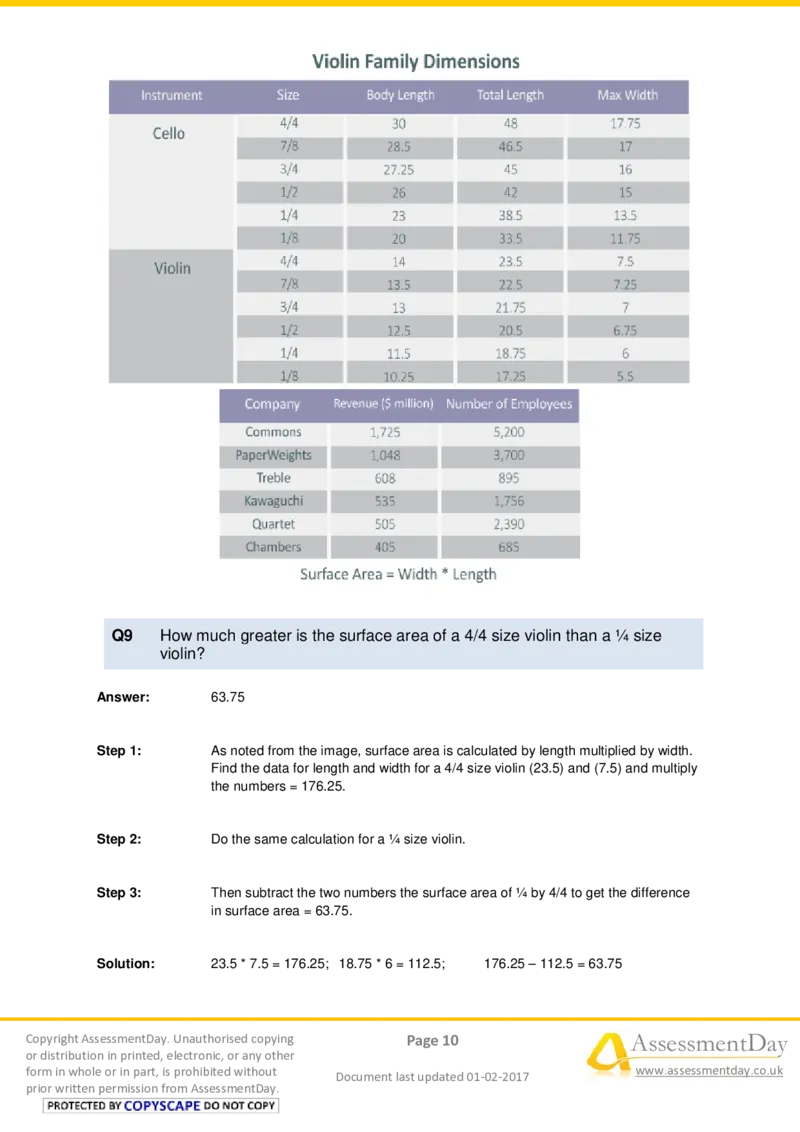
prior written permission from AssessmentDay.Q9 How much greater is the surface area of a 4/4 size violin than a ¼ size
violin?
Answer: 63.75
Step 1: As noted from the image, surface area is calculated by length multiplied by width.
Find the data for length and width for a 4/4 size violin (23.5) and (7.5) and multiply
the numbers = 176.25.
Step 2: Do the same calculation for a ¼ size violin.
Step 3: Then subtract the two numbers the surface area of ¼ by 4/4 to get the difference
in surface area = 63.75.
Solution: 23.5 * 7.5 = 176.25; 18.75 * 6 = 112.5; 176.25 – 112.5 = 63.75
Copyright AssessmentDay. Unauthorised copying Page 10 AssessmentDay
or distribution in printed, electronic, or any other
form in whole or in part, is prohibited without
Document last updated 01-02-2017
www.assessmentday.co.uk
prior written permission from AssessmentDay.Q10 Which were the only two Sector Subject Areas that saw a rise in
participants from 2005-2008?
Answer: Life Skills and Maths
Step 1: Investigating the numbers, all show a decline. For example, in Agriculture, 2005/06
= 91,710 whereas 2008/09 is 68,710. A decline by 23,000. Life Skills increases
from 585,700 to 820,260, and Maths from 300,110 to 305,550. These are the only
Sector Subject Areas that rise in participants.
Solution: Life Skills = 234,560 = POSITIVE
Maths = 5,440 = POSITIVE
Copyright AssessmentDay. Unauthorised copying Page 11 AssessmentDay
or distribution in printed, electronic, or any other
form in whole or in part, is prohibited without
Document last updated 01-02-2017
www.assessmentday.co.uk
prior written permission from AssessmentDay.Q11 In 2005, what was the Percentage Difference between participants in ICT
and in Health?
Answer: 14.70%
Step 1: Locate the figures for ICT and Health from 2005.
Step 2: Then input them into the Percentage Difference formula = 14.70%
Solution: 1,000,610 – 863,560 = 137,050;
(1,000610 + 863,560) / 2 = 932,085;
137,050 / 932,085 * 100 = 14.70%
Copyright AssessmentDay. Unauthorised copying Page 12 AssessmentDay
or distribution in printed, electronic, or any other
form in whole or in part, is prohibited without
Document last updated 01-02-2017
www.assessmentday.co.uk
prior written permission from AssessmentDay.Q12 What was the Average Proportion of Young People who studied Business
& Admin in 2008?
Answer: 98,221
Step 1: Young people accounted for 35% of participants. Locate the figure for Business &
Admin for 2008.
Step 2: Divide by 100 to convert to 1% and multiply by 35 = 98,220.5. Round up to 98,221.
Solution: 280,630 / 100 * 35 = 98,220.5 = 98,221
Copyright AssessmentDay. Unauthorised copying Page 13 AssessmentDay
or distribution in printed, electronic, or any other
form in whole or in part, is prohibited without
Document last updated 01-02-2017
www.assessmentday.co.uk
prior written permission from AssessmentDay.Q13 How much would it cost to ride a 1st Class train from Morgan to Bricks?
Answer: € 76.80
Step 1: Notice that Morgan to Bricks is the full length of the Eagle train line. The full line
fare for Eagle is € 48.00.
Step 2: Then multiple this figure by 60% to get that % increase on its figure. 48 / 100 * 60
= 28.8; then add this to 48 to get 76.8. A simpler way is to multiply 48 by 160%, or
by 1.6 to get 76.80.
Solution: 48 + (48 / 100 * 60) = 48 + 28.80 = € 76.80
Copyright AssessmentDay. Unauthorised copying Page 14 AssessmentDay
or distribution in printed, electronic, or any other
form in whole or in part, is prohibited without
Document last updated 01-02-2017
www.assessmentday.co.uk
prior written permission from AssessmentDay.Q14 How much would it cost to ride Basil to Interlake with a Young Persons
Travel Add-On?
Answer: € 39.20
Step 1: Notice that Basil West to Interlake is the full length of the Bull train line. The full
line fare for Bull is €56.00. Then calculate 30% of this figure to determine what
must be decreased from the full value. 56 / 100 * 30 = 16.8.
Step 2: Therefore, subtract 16.8 from 56 to get the ride with a Young Persons Travel Add-
On reduction = 39.20.
Solution: 56 – (56 / 100 * 30) = 56 – 16.8 = € 39.20
Copyright AssessmentDay. Unauthorised copying Page 15 AssessmentDay
or distribution in printed, electronic, or any other
form in whole or in part, is prohibited without
Document last updated 01-02-2017
www.assessmentday.co.uk
prior written permission from AssessmentDay.Q15 How much longer is the duration of the longest train line than the second
longest train ride?
Answer: 8 minutes
Step 1: Calculate the length of all three train lines to determine which are the longest and
the second longest. These are Bull and Eagle respectively. A clue to their length is
their relative price.
Step 2: Then subtract Eagle (123) from Bull (131) to get the difference in duration = 8
minutes.
Solution: 13:51 – 11:40 = 131;
13:32 – 11:44 = 108;
14:02 – 11:59 = 123;
131 – 123 = 8 minutes
Copyright AssessmentDay. Unauthorised copying Page 16 AssessmentDay
or distribution in printed, electronic, or any other
form in whole or in part, is prohibited without
Document last updated 01-02-2017
www.assessmentday.co.uk
prior written permission from AssessmentDay.Q16 Between the ages of 15-29 Years Old, how many more people live in an
Urban City or Town, than a Rural Town or Fringe?
Answer: 7,185,886
Step 1: Locate the percentages necessary for the question. These are 15.2 for rural and
19.5 for urban.
Step 2: Then calculate the population number by getting the % of the setting’s population.
Urban (43,971,688) had 19.5% which = 8,574,479 (round down). And rural
(9,135,481) had 15.2% which = 1,388,593 (round down).
Step 3: Then subtract the rural from the urban and you get how many more people aged
15-29 that live in an urban city or town over a rural town or fringe = 7,185,886.
Solution: 43,971,688 / 100 * 19.5 = 8,574,479.16 = 8,574,479;
9,135,481 / 100 * 15.2 = 1,388,593.112 = 1,388,593;
8,574,479 – 1,388,593 = 7,185,886
Copyright AssessmentDay. Unauthorised copying Page 17 AssessmentDay
or distribution in printed, electronic, or any other
form in whole or in part, is prohibited without
Document last updated 01-02-2017
www.assessmentday.co.uk
prior written permission from AssessmentDay.Q17 How many people between the ages of 30-65+ Years Old live in a Rural
setting?
Answer: 6,349,159
Step 1: Calculate the total % of people that are between the ages of 30-65+ years old.
This includes the age ranges of 30-44, 45-64 and 65+ = 16.1, 29.9 and 23.5
respectively. Add these together to get the % = 69.5. Using the rural population
(9,135,482), divide by 100 to convert to a percentage.
Step 2: Then multiply by 69.5 = 6,349,159 (to the nearest person).
Solution: 16.1 + 29.9 + 23.5 = 69.5;
9,135,481 / 100 * 69.5 = 6,349,159.295 = 6,349,159
Copyright AssessmentDay. Unauthorised copying Page 18 AssessmentDay
or distribution in printed, electronic, or any other
form in whole or in part, is prohibited without
Document last updated 01-02-2017
www.assessmentday.co.uk
prior written permission from AssessmentDay.Q18 How many more people aged 45-64 Years Old live in a Rural Village or
Hamlet than a Rural Town or Fringe?
Answer: 292,335
Step 1: Find the % for people aged 45-64 years old in a rural village or hamlet (31.5%)
and rural town and fringe (28.3).
Step 2: Calculate the difference between them (31.5-28.3) which equals 3.2%. Get that %
from the rural population (9,135,481) to get the difference between populations =
292,335.
Solution: 31.5 – 28.3 = 3.2;
9,135,481 / 100 * 3.2 = 292,335.392 = 292,335
Copyright AssessmentDay. Unauthorised copying Page 19 AssessmentDay
or distribution in printed, electronic, or any other
form in whole or in part, is prohibited without
Document last updated 01-02-2017
www.assessmentday.co.uk
prior written permission from AssessmentDay.Q19 Given an annual interest rate of 10%, how much was the Total Private
Investment of 2010-11 (£ million) worth in 2007-08?
Answer: 263.71
Step 1: We want to work out how much money the total private investment of 2010-11
would be worth in 2007-08. The formula for this equation is given. PV = FV / (1 + r)
^ n). The future value is 351 and the interest rate is given at 10% = 0.10. There is
a gap of 3 years, therefore n = 3. Thus, PV = 351 / ((1 + 0.10) ^ 3) = 263.71.
Solution: 351 / ((1. + 0.10) ^ 3) = 263.71
Copyright AssessmentDay. Unauthorised copying Page 20 AssessmentDay
or distribution in printed, electronic, or any other
form in whole or in part, is prohibited without
Document last updated 01-02-2017
www.assessmentday.co.uk
prior written permission from AssessmentDay.Q20 What was the Percentage Difference between the Total Government
Investments from 2006-07 to 2011-12?
Answer: 56.41%
Step 1: The formula for percentage difference is given = (V1 - V2 / ((V1 + V2) / 2)) * 100).
V1 is the total government investment of 06-07 = 7.5, and V2 of 11-12 = 4.2.
Substituting the numbers in the equation, we can the answer as 56.41%.
Solution: (7.5 – 4.2 / ((7.5 + 4.2) / 2)) * 100) = (3.3 / 5.85) * 100 = 56.41%
Copyright AssessmentDay. Unauthorised copying Page 21 AssessmentDay
or distribution in printed, electronic, or any other
form in whole or in part, is prohibited without
Document last updated 01-02-2017
www.assessmentday.co.uk
prior written permission from AssessmentDay.Q21 From 2006-12, how much more funding (£ million), as an annual average,
did Stations receive over Track and Signalling?
Answer: 30.83
Step 1: Separate Track and Signalling and Stations into two different calculate. Add all the
numbers from each column in a whole number and divide them by 6 to get the
annual average.
Step 2: Subtract the number to get the difference = 30.833333.
Solution: ((144 + 69 + 19 + 10 + 25 + 31) / 6) – ((106 + 8 + 2 – 4 + 0 + 1) / 6) = (298 / 6) –
(113 / 6) = 30.83
-- End of Test --
Copyright AssessmentDay. Unauthorised copying Page 22 AssessmentDay
or distribution in printed, electronic, or any other
form in whole or in part, is prohibited without
Document last updated 01-02-2017
www.assessmentday.co.uk
prior written permission from AssessmentDay.