Numerical Comprehension Test 6
Solutions Booklet
Instructions
This numerical reasoning test comprises 18 questions, and you will have 18 minutes in
which to correctly answer as many as you can. Calculators are permitted for this test, and it is
recommended you have some rough paper to work on.
You will have to work quickly and accurately to perform well in this test. If you don't know the
answer to a question, leave it and come back to it if you have time. Each question will have
five possible answers, one of which is correct. If the exact correct answer is not provided,
select the closest possible answer. You may click Back and Next during the test to review or
skip questions.
You can submit your test at any time. If the time limit is up before you click submit the test will
automatically be submitted with the answers you have selected. It is recommended to keep
working until the time limit is up.
Try to find a time and place where you will not be interrupted during the test. The test will
begin on the next page.
AssessmentDay
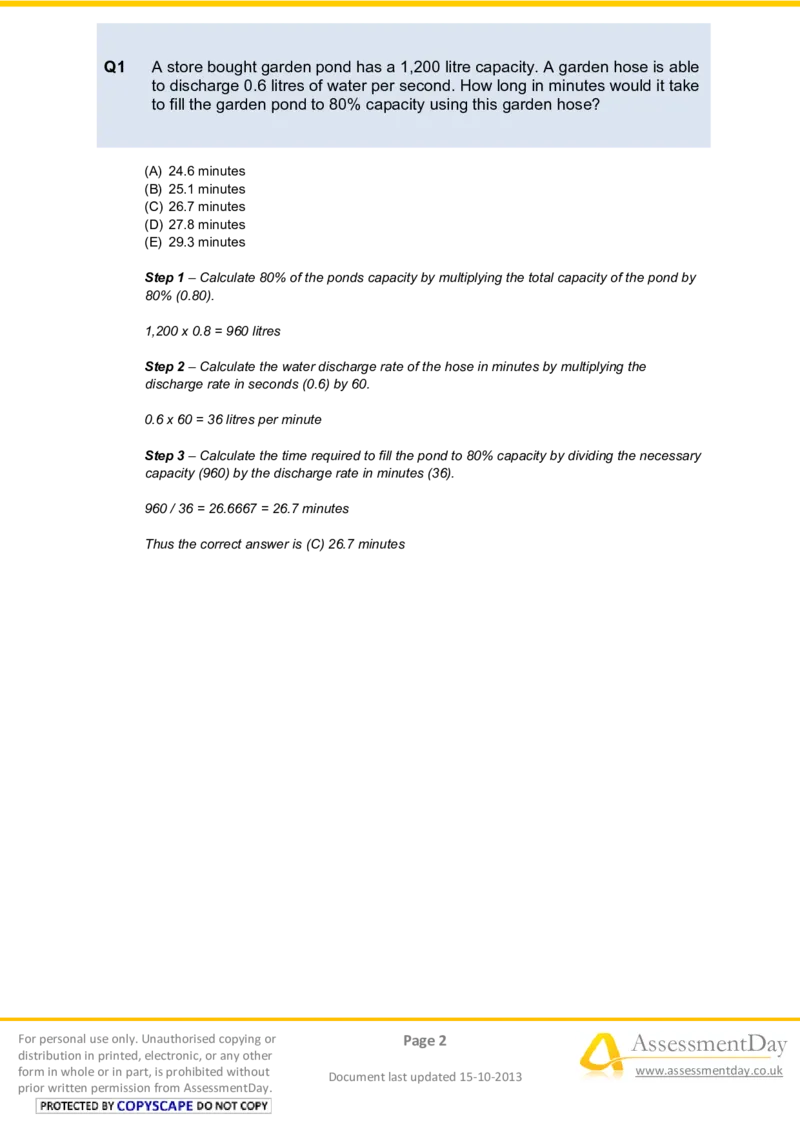
Practice Aptitude TestsQ1 A store bought garden pond has a 1,200 litre capacity. A garden hose is able
to discharge 0.6 litres of water per second. How long in minutes would it take
to fill the garden pond to 80% capacity using this garden hose?
(A) 24.6 minutes
(B) 25.1 minutes
(C) 26.7 minutes
(D) 27.8 minutes
(E) 29.3 minutes
Step 1 – Calculate 80% of the ponds capacity by multiplying the total capacity of the pond by
80% (0.80).
1,200 x 0.8 = 960 litres
Step 2 – Calculate the water discharge rate of the hose in minutes by multiplying the
discharge rate in seconds (0.6) by 60.
0.6 x 60 = 36 litres per minute
Step 3 – Calculate the time required to fill the pond to 80% capacity by dividing the necessary
capacity (960) by the discharge rate in minutes (36).
960 / 36 = 26.6667 = 26.7 minutes
Thus the correct answer is (C) 26.7 minutes
For personal use only. Unauthorised copying or Page 2 AssessmentDay
distribution in printed, electronic, or any other
form in whole or in part, is prohibited without
Document last updated 15-10-2013
www.assessmentday.co.uk
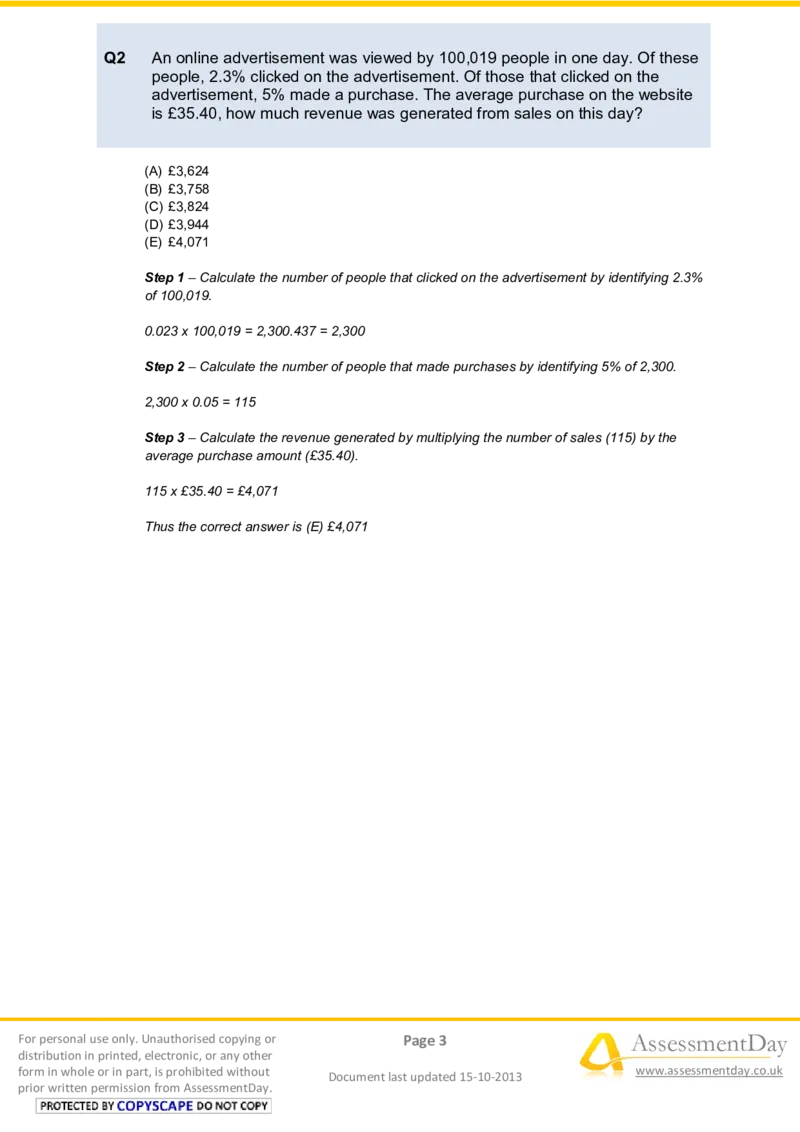
prior written permission from AssessmentDay.Q2 An online advertisement was viewed by 100,019 people in one day. Of these
people, 2.3% clicked on the advertisement. Of those that clicked on the
advertisement, 5% made a purchase. The average purchase on the website
is £35.40, how much revenue was generated from sales on this day?
(A) £3,624
(B) £3,758
(C) £3,824
(D) £3,944
(E) £4,071
Step 1 – Calculate the number of people that clicked on the advertisement by identifying 2.3%
of 100,019.
0.023 x 100,019 = 2,300.437 = 2,300
Step 2 – Calculate the number of people that made purchases by identifying 5% of 2,300.
2,300 x 0.05 = 115
Step 3 – Calculate the revenue generated by multiplying the number of sales (115) by the
average purchase amount (£35.40).
115 x £35.40 = £4,071
Thus the correct answer is (E) £4,071
For personal use only. Unauthorised copying or Page 3 AssessmentDay
distribution in printed, electronic, or any other
form in whole or in part, is prohibited without
Document last updated 15-10-2013
www.assessmentday.co.uk
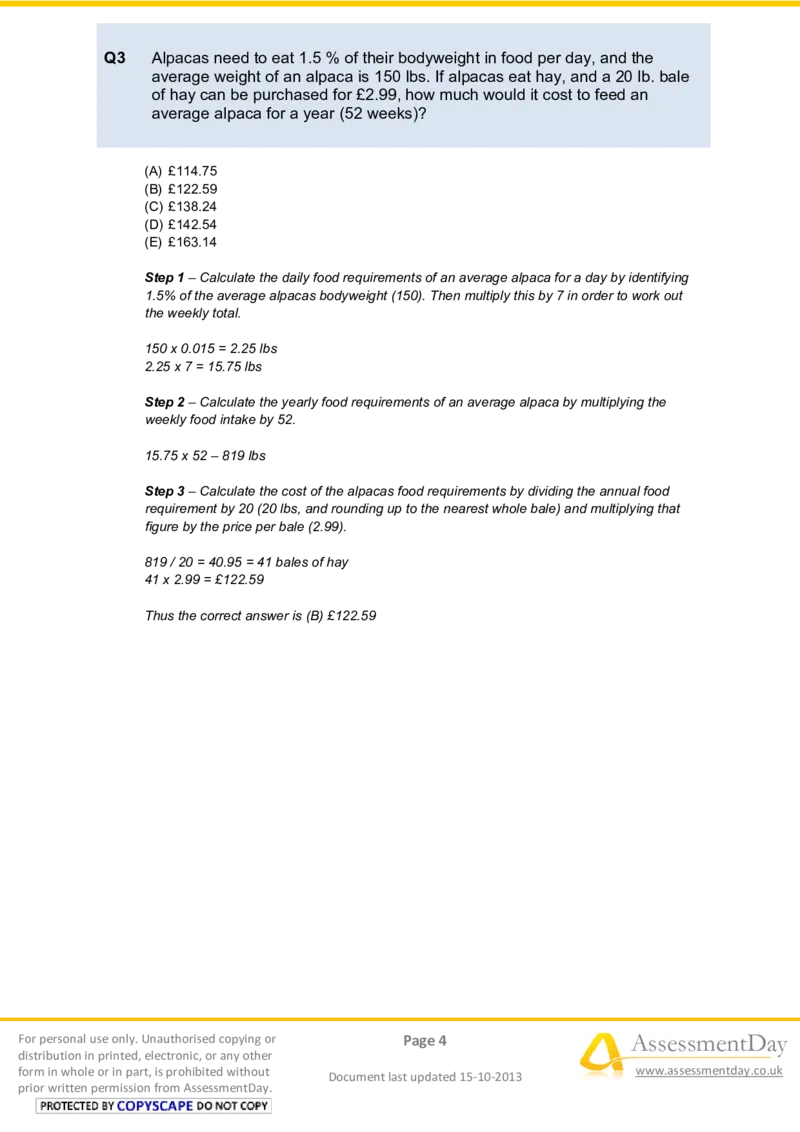
prior written permission from AssessmentDay.Q3 Alpacas need to eat 1.5 % of their bodyweight in food per day, and the
average weight of an alpaca is 150 lbs. If alpacas eat hay, and a 20 lb. bale
of hay can be purchased for £2.99, how much would it cost to feed an
average alpaca for a year (52 weeks)?
(A) £114.75
(B) £122.59
(C) £138.24
(D) £142.54
(E) £163.14
Step 1 – Calculate the daily food requirements of an average alpaca for a day by identifying
1.5% of the average alpacas bodyweight (150). Then multiply this by 7 in order to work out
the weekly total.
150 x 0.015 = 2.25 lbs
2.25 x 7 = 15.75 lbs
Step 2 – Calculate the yearly food requirements of an average alpaca by multiplying the
weekly food intake by 52.
15.75 x 52 – 819 lbs
Step 3 – Calculate the cost of the alpacas food requirements by dividing the annual food
requirement by 20 (20 lbs, and rounding up to the nearest whole bale) and multiplying that
figure by the price per bale (2.99).
819 / 20 = 40.95 = 41 bales of hay
41 x 2.99 = £122.59
Thus the correct answer is (B) £122.59
For personal use only. Unauthorised copying or Page 4 AssessmentDay
distribution in printed, electronic, or any other
form in whole or in part, is prohibited without
Document last updated 15-10-2013
www.assessmentday.co.uk
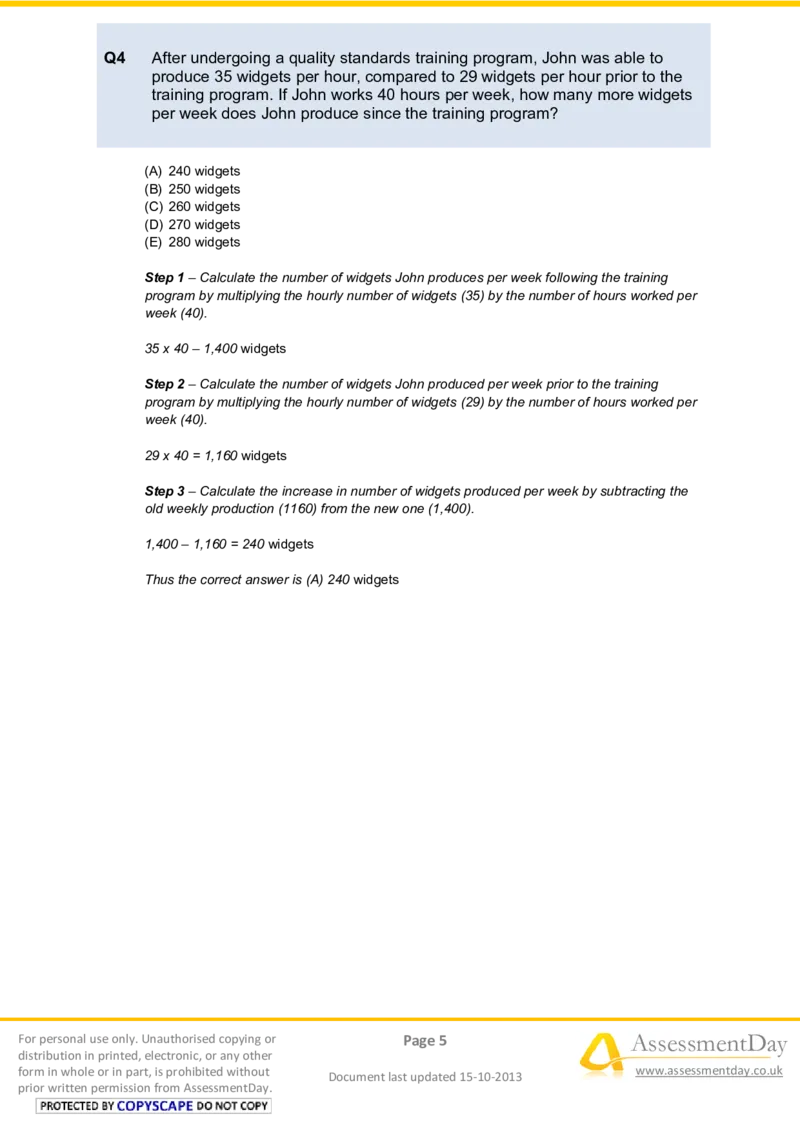
prior written permission from AssessmentDay.Q4 After undergoing a quality standards training program, John was able to
produce 35 widgets per hour, compared to 29 widgets per hour prior to the
training program. If John works 40 hours per week, how many more widgets
per week does John produce since the training program?
(A) 240 widgets
(B) 250 widgets
(C) 260 widgets
(D) 270 widgets
(E) 280 widgets
Step 1 – Calculate the number of widgets John produces per week following the training
program by multiplying the hourly number of widgets (35) by the number of hours worked per
week (40).
35 x 40 – 1,400 widgets
Step 2 – Calculate the number of widgets John produced per week prior to the training
program by multiplying the hourly number of widgets (29) by the number of hours worked per
week (40).
29 x 40 = 1,160 widgets
Step 3 – Calculate the increase in number of widgets produced per week by subtracting the
old weekly production (1160) from the new one (1,400).
1,400 – 1,160 = 240 widgets
Thus the correct answer is (A) 240 widgets
For personal use only. Unauthorised copying or Page 5 AssessmentDay
distribution in printed, electronic, or any other
form in whole or in part, is prohibited without
Document last updated 15-10-2013
www.assessmentday.co.uk
prior written permission from AssessmentDay.Q5 Ralph sells his product for £9.99 to customers. He purchases his product at
the wholesale price of £39.50 for a pack of ten. How much profit would Ralph
make through the retail sale of 125 units of his product?
(A) £720.75
(B) £725.25
(C) £730.75
(D) £735.25
(E) £740.75
Step 1 – Calculate the revenue generated through the sale of 125 units of Ralphs product by
multiplying the number of units (125) by the unit cost (£9.99).
125 x 9.99 – £1,248.75
Step 2 – Calculate the cost of purchasing the required units by dividing the number of
required units (125) by the size of the pack (10), then multiplying by the cost per pack
(remember to round up to the nearest whole pack).
125 / 10 = 12.5 = 13 packs
13 x 39.5 = £513.50
Step 3 – Calculate the profit by subtracting the purchasing costs from the revenue to identify
the profit.
£1,248.75 – £513.50 = £735.25
Thus the correct answer is (D) £735.25
For personal use only. Unauthorised copying or Page 6 AssessmentDay
distribution in printed, electronic, or any other
form in whole or in part, is prohibited without
Document last updated 15-10-2013
www.assessmentday.co.uk
prior written permission from AssessmentDay.Q6 A country sees 21,634 males and 22,028 females born in one year. If the
country has a population of 32.4 million people, what percentage of the
population are female?
(A) 50.2%
(B) 50.3%
(C) 50.4%
(D) 50.5%
(E) Cannot say
Step 1 – We are only given the number of births for each gender for one year. We cannot
generalise from that one year as to what the gender ratio would be in the general population.
Thus the correct answer is (E) Cannot say
For personal use only. Unauthorised copying or Page 7 AssessmentDay
distribution in printed, electronic, or any other
form in whole or in part, is prohibited without
Document last updated 15-10-2013
www.assessmentday.co.uk
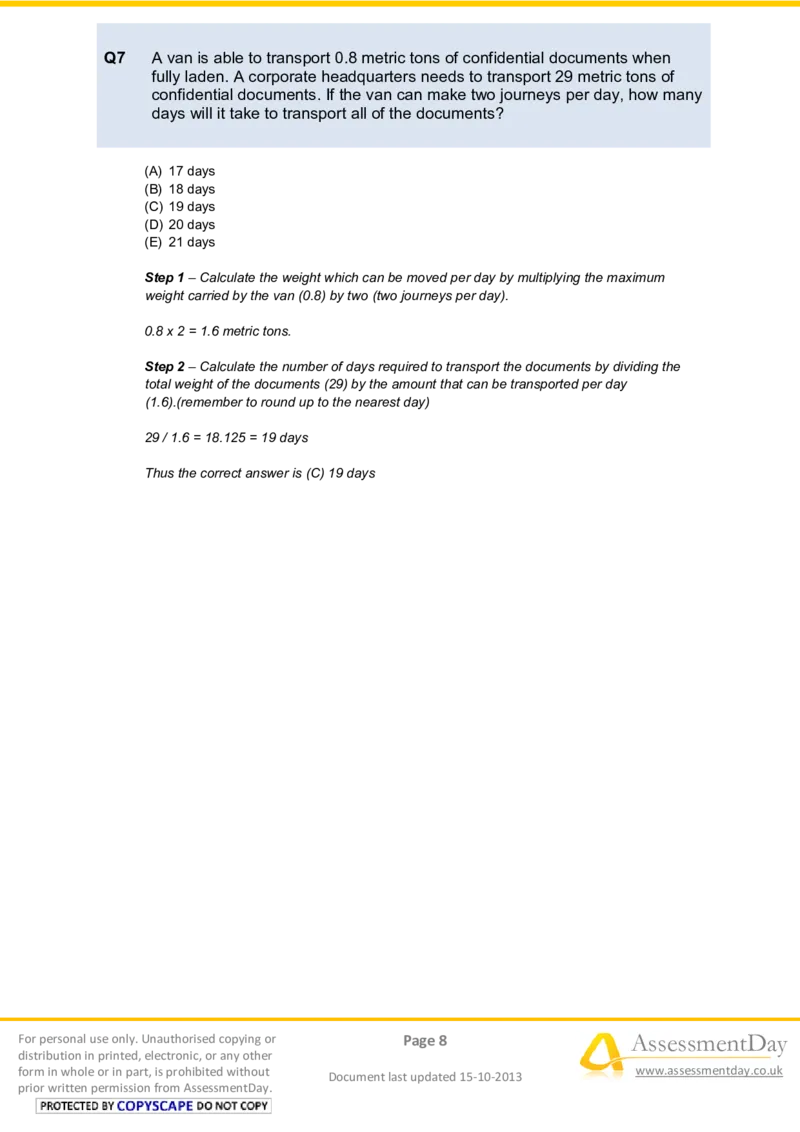
prior written permission from AssessmentDay.Q7 A van is able to transport 0.8 metric tons of confidential documents when
fully laden. A corporate headquarters needs to transport 29 metric tons of
confidential documents. If the van can make two journeys per day, how many
days will it take to transport all of the documents?
(A) 17 days
(B) 18 days
(C) 19 days
(D) 20 days
(E) 21 days
Step 1 – Calculate the weight which can be moved per day by multiplying the maximum
weight carried by the van (0.8) by two (two journeys per day).
0.8 x 2 = 1.6 metric tons.
Step 2 – Calculate the number of days required to transport the documents by dividing the
total weight of the documents (29) by the amount that can be transported per day
(1.6).(remember to round up to the nearest day)
29 / 1.6 = 18.125 = 19 days
Thus the correct answer is (C) 19 days
For personal use only. Unauthorised copying or Page 8 AssessmentDay
distribution in printed, electronic, or any other
form in whole or in part, is prohibited without
Document last updated 15-10-2013
www.assessmentday.co.uk
prior written permission from AssessmentDay.Q8 One Japanese Yen is valued at 0.0066 British pounds. One British pound is
valued at 1.57 US dollars. What is the value of 1,250,000 Japanese yen in
US dollars?
(A) £9,954.50
(B) £10,956.50
(C) £11,785.50
(D) £12,952.50
(E) £13,878.50
Step 1 – Calculate the value of the Japanese Yen in pounds by multiplying the number of Yen
(1,250,000) by the 0.0066.
1,250,000 x 0.0066 = £8,250
Step 2 – Calculate the number of US dollar that can be exchanged for British pounds by
multiplying the number of Pounds (£8,250) by the number of US dollars per pound (1.57).
£8,250 x 1.57 =£12,952.50
Thus the correct answer is (D) £12,952.50
For personal use only. Unauthorised copying or Page 9 AssessmentDay
distribution in printed, electronic, or any other
form in whole or in part, is prohibited without
Document last updated 15-10-2013
www.assessmentday.co.uk
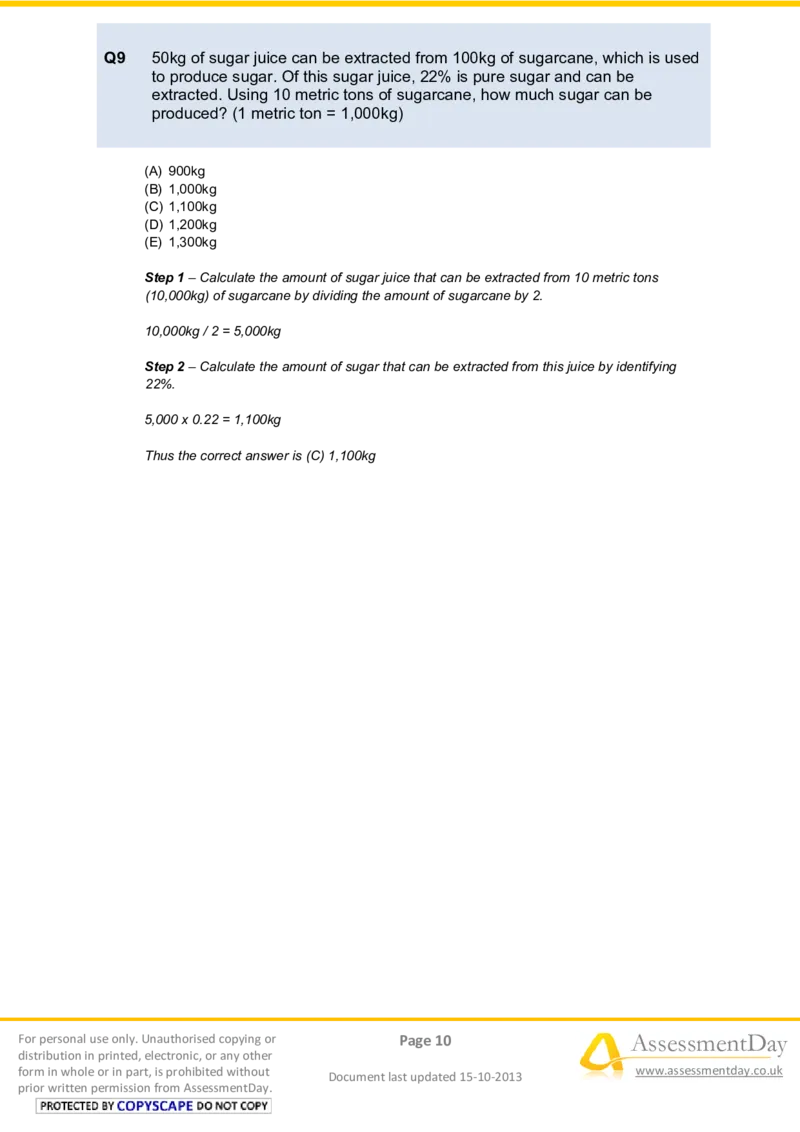
prior written permission from AssessmentDay.Q9 50kg of sugar juice can be extracted from 100kg of sugarcane, which is used
to produce sugar. Of this sugar juice, 22% is pure sugar and can be
extracted. Using 10 metric tons of sugarcane, how much sugar can be
produced? (1 metric ton = 1,000kg)
(A) 900kg
(B) 1,000kg
(C) 1,100kg
(D) 1,200kg
(E) 1,300kg
Step 1 – Calculate the amount of sugar juice that can be extracted from 10 metric tons
(10,000kg) of sugarcane by dividing the amount of sugarcane by 2.
10,000kg / 2 = 5,000kg
Step 2 – Calculate the amount of sugar that can be extracted from this juice by identifying
22%.
5,000 x 0.22 = 1,100kg
Thus the correct answer is (C) 1,100kg
For personal use only. Unauthorised copying or Page 10 AssessmentDay
distribution in printed, electronic, or any other
form in whole or in part, is prohibited without
Document last updated 15-10-2013
www.assessmentday.co.uk
prior written permission from AssessmentDay.Q10 A commodities trader purchased 2.5 metric tons of Zinc at the market price of
$1,823.50 per metric ton. Three weeks later, the price per ton of zinc rose to
$2,018.50. If the trader charges a 15% commission fee on all profits
generated, how much commission will the trader have earned?
(A) $67.52
(B) $70.54
(C) $73.13
(D) $76.25
(E) $79.51
Step 1 – Calculate the cost of 2.5 tons of zinc by multiplying the price per ton ($1,823.50) by
the number of tons purchased (2.5).
2.5 x $1,823.50 = $4,558.75
Step 2 – Calculate the value of 2.5 tons of zinc three weeks later by multiplying the new price
per ton ($2,018.50) by the number of tons (2.5).
2.5 x $2,018.50 = $5,046.25
Step 3 – Subtract the previous value of the zinc ($4,558.75) by the new value of the zinc
($5,046.25) to identify the profit generated from the transaction.
$5,046.25 - $4,558.75 =$487.5
Step 4 – Calculate the trader’s commission by identifying 15% of the profit ($487.5).
$487.5 x 0.15 = $73.125 = $73.13
Thus the correct answer is (C) $73.13
For personal use only. Unauthorised copying or Page 11 AssessmentDay
distribution in printed, electronic, or any other
form in whole or in part, is prohibited without
Document last updated 15-10-2013
www.assessmentday.co.uk
prior written permission from AssessmentDay.Q11 Two competitors sell product A. At competitor 1, product A is sold for £9.99.
At competitor 2, product A is sold for £8.99. If competitor 1 purchases
product A for the wholesale price of £4.50 each, and competitor 2 purchases
product A for the wholesale price of £4.00, how much extra profit is
generated from 150 sales by competitor 1 than competitor 2?
(A) £75
(B) £80
(C) £85
(D) £90
(E) £95
Step 1 – Calculate the revenue generated by 150 at competitor 1 and 2 by multiplying their
respective sales prices by the number of sales (150).
Competitor 1 = 9.99 x 150 =£1,498.50
Competitor 2 = 8.99 x 150 =£1,348.50
Step 2 – Calculate the costs of purchasing product A by multiplying the wholesale price paid
for each respective company by the number of sales (150).
Competitor 1 = 4.50 x 150 =£675
Competitor 2 = 4.00 x 150 =£600
Step 3 – Calculate the profit generated by subtracting the costs from the revenue for each
respective competitor.
£1,498.50 - £675 = £823.50
£1,348.50 - £600 = £748.50
Step 4 – Calculate the difference in profit by subtracting the profit generated by competitor 2
from the profit generated by competitor 1.
£823.50 - £748.50 = £75
Thus the correct answer is (A) £75
For personal use only. Unauthorised copying or Page 12 AssessmentDay
distribution in printed, electronic, or any other
form in whole or in part, is prohibited without
Document last updated 15-10-2013
www.assessmentday.co.uk
prior written permission from AssessmentDay.Q12 The total population of the people’s republic of China is 1,353,821,000 and
the total population of India is 1,210,569,573. The total gross domestic
product (GDP) of the people’s republic of China is $13.623 trillion and the
total GDP of India is $4.711 trillion. What is the difference between the
average GDP per capita (per person) in the people’s republic of China and
India?
(A) $5,789.78
(B) $5,862.24
(C) $5,965.50
(D) $6,064.85
(E) $6,171.07
Step 1 – Calculate the GDP per capita in China by dividing the GDP by the population of
China.
$13,623,000,000,000 / 1,353,821,000 = $10,062.63014 = $10,062.63
Step 2 – Calculate the GDP per capita in India by dividing the GDP by the population of India.
$4,711,000,000,000 / 1,210,569,573 = $3,891.55659 = $3,891.56
Step 3 – Calculate the difference by subtracting the GDP per capita of India from the GDP per
capita of China.
$10,062.63 - $3,891.56 = $6,171.07
Thus the correct answer is (E) $6,171.07
For personal use only. Unauthorised copying or Page 13 AssessmentDay
distribution in printed, electronic, or any other
form in whole or in part, is prohibited without
Document last updated 15-10-2013
www.assessmentday.co.uk
prior written permission from AssessmentDay.Q13 A car traveling at 29 miles per hour drives into a tunnel which is 7km long.
How long does it take the car to fully pass through the tunnel? (1 mile =
1.609344km)
(A) 6 minutes
(B) 7 minutes
(C) 8 minutes
(D) 9 minutes
(E) 10 minutes
Step 1 – Calculate the length of the tunnel in miles by dividing the length the of the tunnel (7)
by the number of kilometres in a mile (1.609344km)
7 / 1.609344 = 4.3496
Step 2 – Calculate the speed of the car in miles per minute by dividing the cars speed in miles
per hour (29) by 60.
29 / 60 = 0.48333 miles per minute
Step 3 – Calculate the number of minutes required to travel the length of the tunnel by
dividing the length of the tunnel (4.3496) by the speed of the car in miles per minute
(0.48333).
4.3496 / 0.48333 = 8.999234477 = 9 minutes
Thus the correct answer is (D) 9 minutes
For personal use only. Unauthorised copying or Page 14 AssessmentDay
distribution in printed, electronic, or any other
form in whole or in part, is prohibited without
Document last updated 15-10-2013
www.assessmentday.co.uk
prior written permission from AssessmentDay.Q14 A numerical reasoning test contains 18 questions, with a time limit of 30
seconds per question. A candidate takes 20 seconds to complete 6
questions, 25 seconds to complete 5 questions and 18 seconds to complete
7 questions, how much time went unused from the overall time limit of the
test?
(A) 136 seconds
(B) 147 seconds
(C) 158 seconds
(D) 169 seconds
(E) 180 seconds
Step 1 – Calculate the time spent answering the questions by multiplying the time taken for
the respective questions by the number of questions.
20 x 6 = 120 seconds
25 x 5 = 125 seconds
18 x 7 = 126 seconds
Total = 120 + 125 + 126 = 371
Step 2 – Calculate the full length of the test by multiplying the time limit per question (30) by
the number of questions (18).
30 x 18 = 540 seconds
Step 3 – Calculate the time to spare at the end of the test by subtracting the actual time taken
(371) by the time limit (540).
540 – 371 = 169 seconds
Thus the correct answer is (D) 169 seconds
For personal use only. Unauthorised copying or Page 15 AssessmentDay
distribution in printed, electronic, or any other
form in whole or in part, is prohibited without
Document last updated 15-10-2013
www.assessmentday.co.uk
prior written permission from AssessmentDay.Q15 A film was recently released on DVD and during its first week of sales, 2,150
copies are sold. If the DVD is sold for £9.99 each, how much revenue was
made on average per day during the first week of sales?
(A) £2,954.21
(B) £3,068.36
(C) £3,145.87
(D) £3,245.96
(E) £3,354.35
Step 1 – Calculate the revenue generated by multiplying the number of sales (2,150) by the
individual sales price (£9.99).
£9.99 x 2,150 = £21,478.50
Step 2 – Calculate the average revenue per day by dividing the total weekly revenue by 7.
£21,478.50 / 7 = £3,068.357143 = £3,068.36
Thus the correct answer is (B) £3,068.36
For personal use only. Unauthorised copying or Page 16 AssessmentDay
distribution in printed, electronic, or any other
form in whole or in part, is prohibited without
Document last updated 15-10-2013
www.assessmentday.co.uk
prior written permission from AssessmentDay.Q16 A cola drink contains a secret ingredient. Every litre of cola contains 32
grams of this secret ingredient. If the cola is sold wholesale by the barrel, and
each barrel contains 40 gallons of cola, how much of the secret ingredient is
present in the barrel? (1 gallon = 4.54609 litres)
(A) 5,475 grams
(B) 5,585 grams
(C) 5,657 grams
(D) 5,759 grams
(E) 5,819 grams
Step 1 – Calculate the number of litres of cola in each barrel by multiplying the volume of cola
(40) by the number of litres per gallon (4.54609).
40 x 4.54609 = 181.8436
Step 2 – Calculate the amount of secret ingredient per barrel by multiplying the number of
litres (181.8436) by the number of grams of secret ingredient per litre (32).
181.8436 x 32 = 5,818.9952 = 5,819 grams
Thus the correct answer is (E) 5,819 grams
For personal use only. Unauthorised copying or Page 17 AssessmentDay
distribution in printed, electronic, or any other
form in whole or in part, is prohibited without
Document last updated 15-10-2013
www.assessmentday.co.uk
prior written permission from AssessmentDay.Q17 An art broker sells paintings from leading artists for a commission of 10%.
Similarly, when auctioning paintings, the broker earns an additional £150 per
item through auction fees. If the broker sells 8 paintings not at auction for
£8,000 a piece, and sells 4 paintings at auction for a total of £32,000, how
much does the broker earn in total?
(A) £10,200
(B) £11,400
(C) £12,600
(D) £13,800
(E) £15,000
Step 1 – Calculate the total commission earned on the non-auctioned items by multiplying the
number of items (8) by their sale price (8,000), and then identifying 10%.
8 x £8,000 = £64,000
£64,000 * 0.1 = £6,400
Step 2 – Calculate the total commission earned from the auctioned items by identifying 10%
of the auctioned total (£32,000), plus the additional auction fee (150).
£32,000 * 0.1 = £3,200
£150 x 4 = £600
£3,200 + £600 = £3,800
Step 3 – Calculate the total amount earned by the broker by combining the total revenue of
the auctioned and non-auctioned items.
£6,400 + £3,800 = £10,200
Thus the correct answer is (A) £10,200
For personal use only. Unauthorised copying or Page 18 AssessmentDay
distribution in printed, electronic, or any other
form in whole or in part, is prohibited without
Document last updated 15-10-2013
www.assessmentday.co.uk
prior written permission from AssessmentDay.Q18 A bamboo shoot grows at a rate of 95cm per day under optimum
circumstances. If a bamboo field contains 1,500 bamboo shoots, how much
additional length would be gained in total over a week under optimum
circumstances?
(A) 987,500
(B) 997,500
(C) 107,500
(D) 117,500
(E) 127,500
Step 1 – Calculate the daily length gained in the field by multiplying the daily length increase
per plant (95) by the number of plants (1,500).
1,500 x 95cm = 142,500 cm
Step 2 – Calculate the weekly length gained in the field by multiplying the total daily length
increase by 7.
142,500 cm x 7 = 997,500
Thus the correct answer is (B) 997,500
-- End of Test --
For personal use only. Unauthorised copying or Page 19 AssessmentDay
distribution in printed, electronic, or any other
form in whole or in part, is prohibited without
Document last updated 15-10-2013
www.assessmentday.co.uk
prior written permission from AssessmentDay.