Talent Q Elements Logical Test Practice
第一组 12题
1.
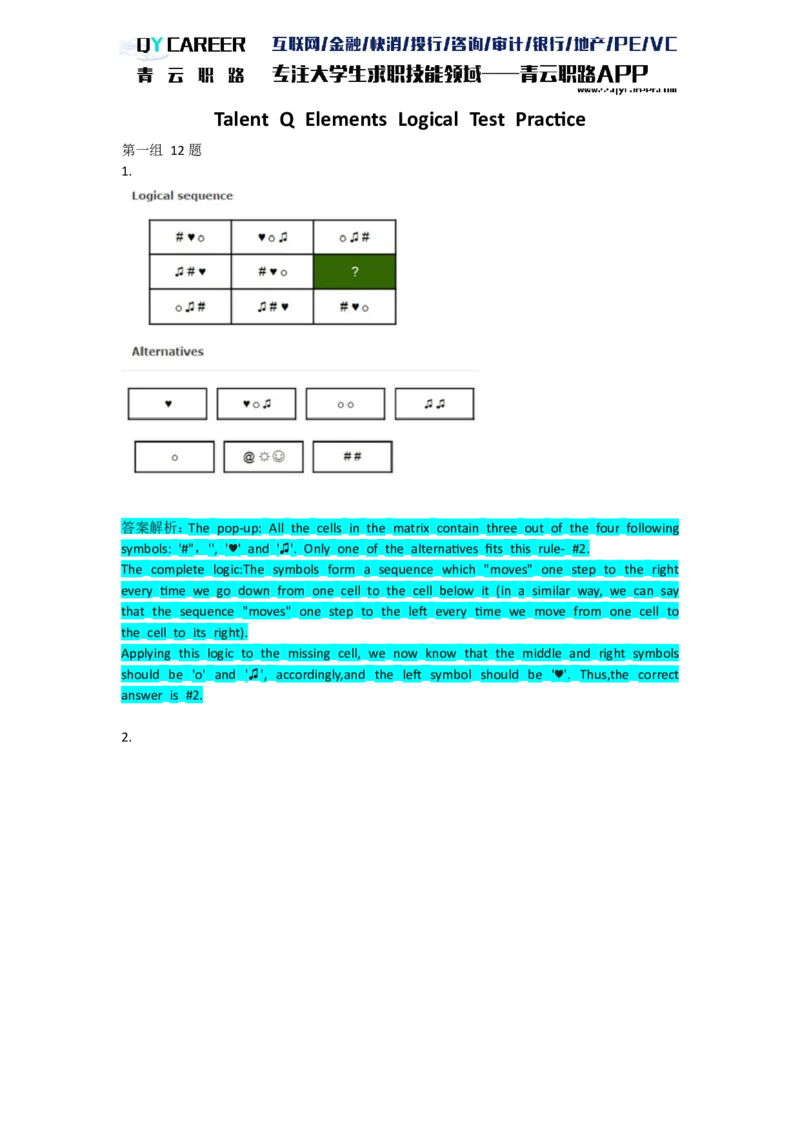
答案解析:The pop-up: All the cells in the matrix contain three out of the four following
symbols: '#",'', '♥' and '♫'. Only one of the alternatives fits this rule- #2.
The complete logic:The symbols form a sequence which "moves" one step to the right
every time we go down from one cell to the cell below it (in a similar way, we can say
that the sequence "moves" one step to the left every time we move from one cell to
the cell to its right).
Applying this logic to the missing cell, we now know that the middle and right symbols
should be 'o' and '♫', accordingly,and the left symbol should be '♥'. Thus,the correct
answer is #2.
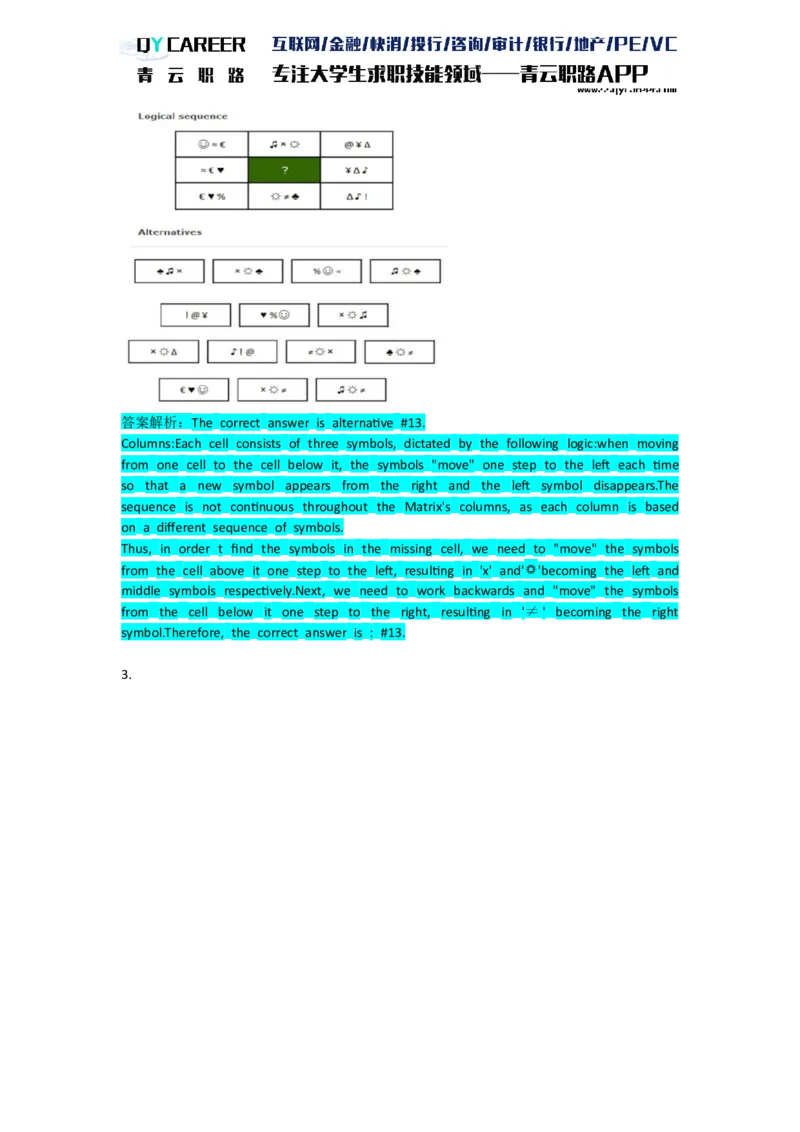
2.答案解析:The correct answer is alternative #13.
Columns:Each cell consists of three symbols, dictated by the following logic:when moving
from one cell to the cell below it, the symbols "move" one step to the left each time
so that a new symbol appears from the right and the left symbol disappears.The
sequence is not continuous throughout the Matrix's columns, as each column is based
on a different sequence of symbols.
Thus, in order t find the symbols in the missing cell, we need to "move" the symbols
from the cell above it one step to the left, resulting in 'x' and'☼'becoming the left and
middle symbols respectively.Next, we need to work backwards and "move" the symbols
from the cell below it one step to the right, resulting in '≠' becoming the right
symbol.Therefore, the correct answer is : #13.
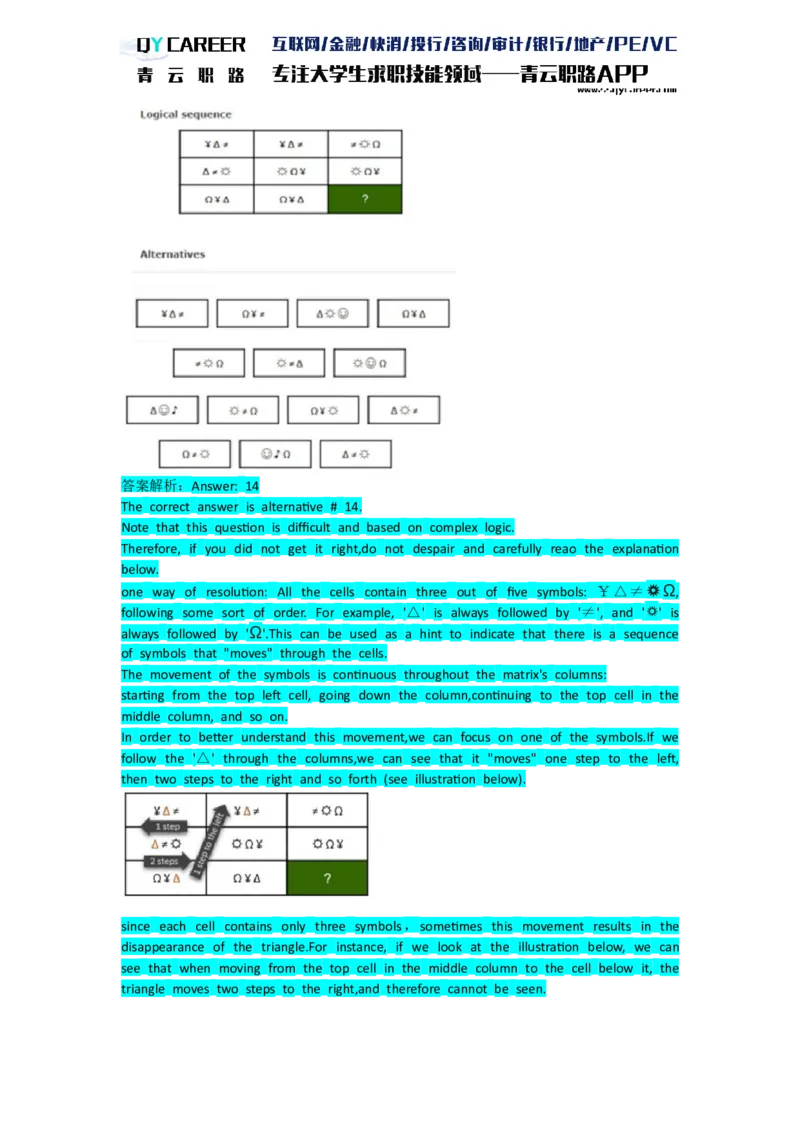
3.答案解析:Answer: 14
The correct answer is alternative # 14.
Note that this question is difficult and based on complex logic.
Therefore, if you did not get it right,do not despair and carefully reao the explanation
below.
one way of resolution: All the cells contain three out of five symbols: ¥△≠☼Ω,
following some sort of order. For example, '△' is always followed by '≠', and '☼' is
always followed by 'Ω'.This can be used as a hint to indicate that there is a sequence
of symbols that "moves" through the cells.
The movement of the symbols is continuous throughout the matrix's columns:
starting from the top left cell, going down the column,continuing to the top cell in the
middle column, and so on.
In order to better understand this movement,we can focus on one of the symbols.If we
follow the '△' through the columns,we can see that it "moves" one step to the left,
then two steps to the right and so forth (see illustration below).
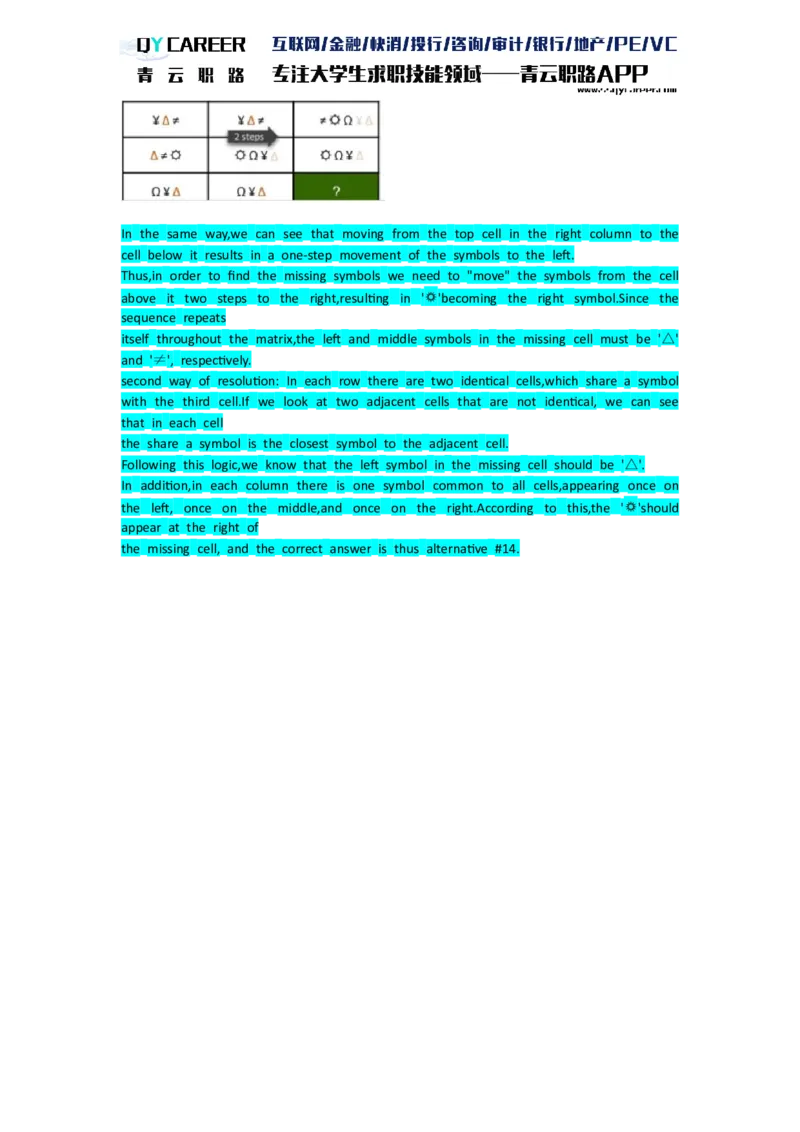
since each cell contains only three symbols,sometimes this movement results in the
disappearance of the triangle.For instance, if we look at the illustration below, we can
see that when moving from the top cell in the middle column to the cell below it, the
triangle moves two steps to the right,and therefore cannot be seen.In the same way,we can see that moving from the top cell in the right column to the
cell below it results in a one-step movement of the symbols to the left.
Thus,in order to find the missing symbols we need to "move" the symbols from the cell
above it two steps to the right,resulting in '☼'becoming the right symbol.Since the
sequence repeats
itself throughout the matrix,the left and middle symbols in the missing cell must be '△'
and '≠', respectively.
second way of resolution: In each row there are two identical cells,which share a symbol
with the third cell.If we look at two adjacent cells that are not identical, we can see
that in each cell
the share a symbol is the closest symbol to the adjacent cell.
Following this logic,we know that the left symbol in the missing cell should be '△'.
In addition,in each column there is one symbol common to all cells,appearing once on
the left, once on the middle,and once on the right.According to this,the '☼'should
appear at the right of
the missing cell, and the correct answer is thus alternative #14.4.
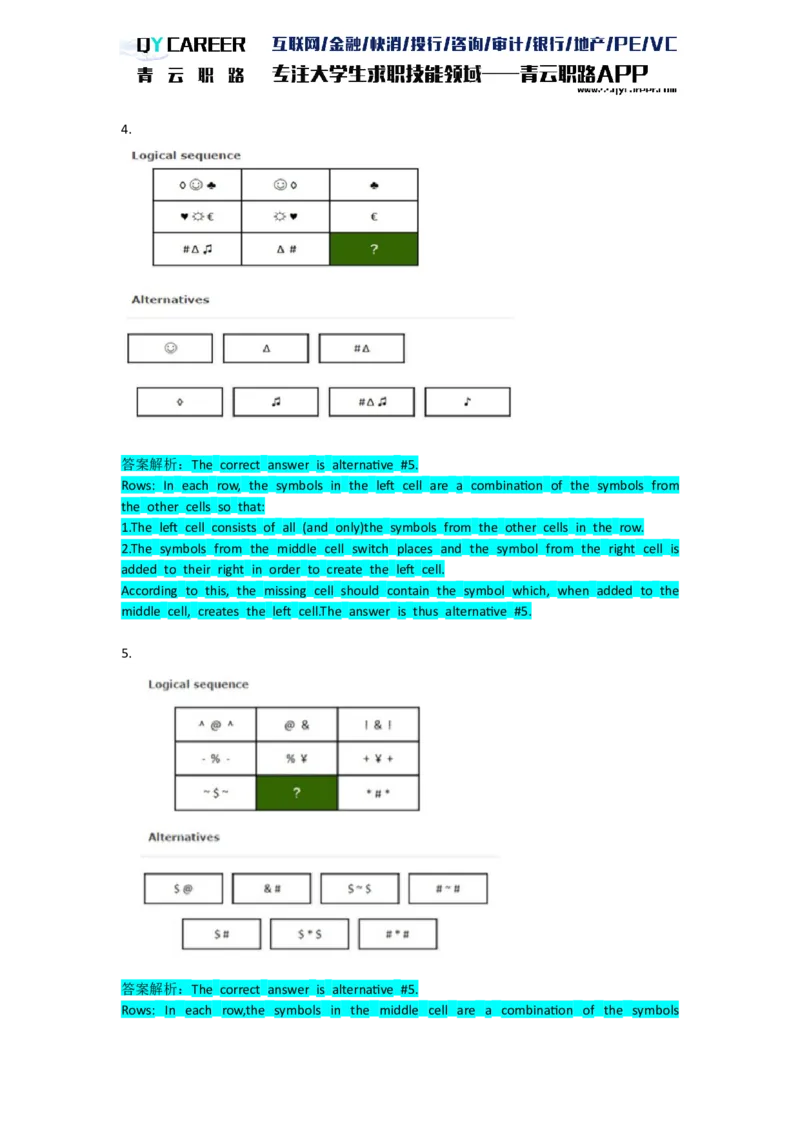
答案解析:The correct answer is alternative #5.
Rows: In each row, the symbols in the left cell are a combination of the symbols from
the other cells so that:
1.The left cell consists of all (and only)the symbols from the other cells in the row.
2.The symbols from the middle cell switch places and the symbol from the right cell is
added to their right in order to create the left cell.
According to this, the missing cell should contain the symbol which, when added to the
middle cell, creates the left cell.The answer is thus alternative #5.
5.
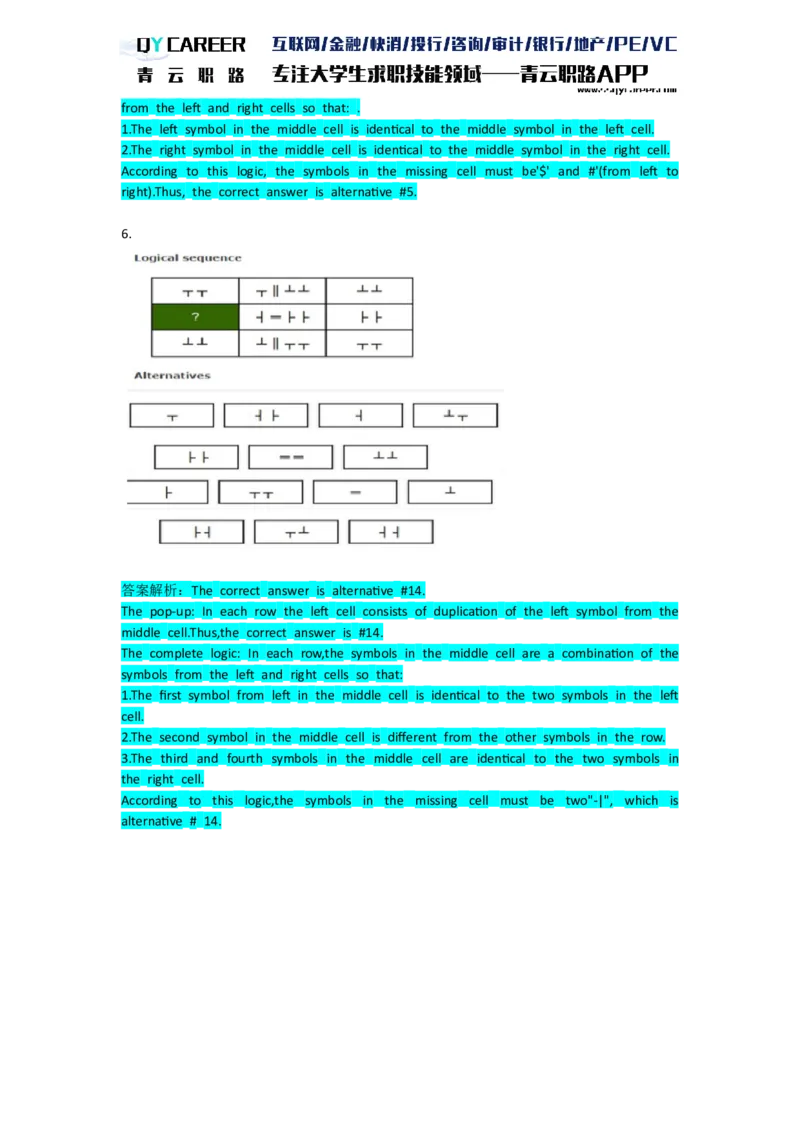
答案解析:The correct answer is alternative #5.
Rows: In each row,the symbols in the middle cell are a combination of the symbolsfrom the left and right cells so that: .
1.The left symbol in the middle cell is identical to the middle symbol in the left cell.
2.The right symbol in the middle cell is identical to the middle symbol in the right cell.
According to this logic, the symbols in the missing cell must be'$' and #'(from left to
right).Thus, the correct answer is alternative #5.
6.
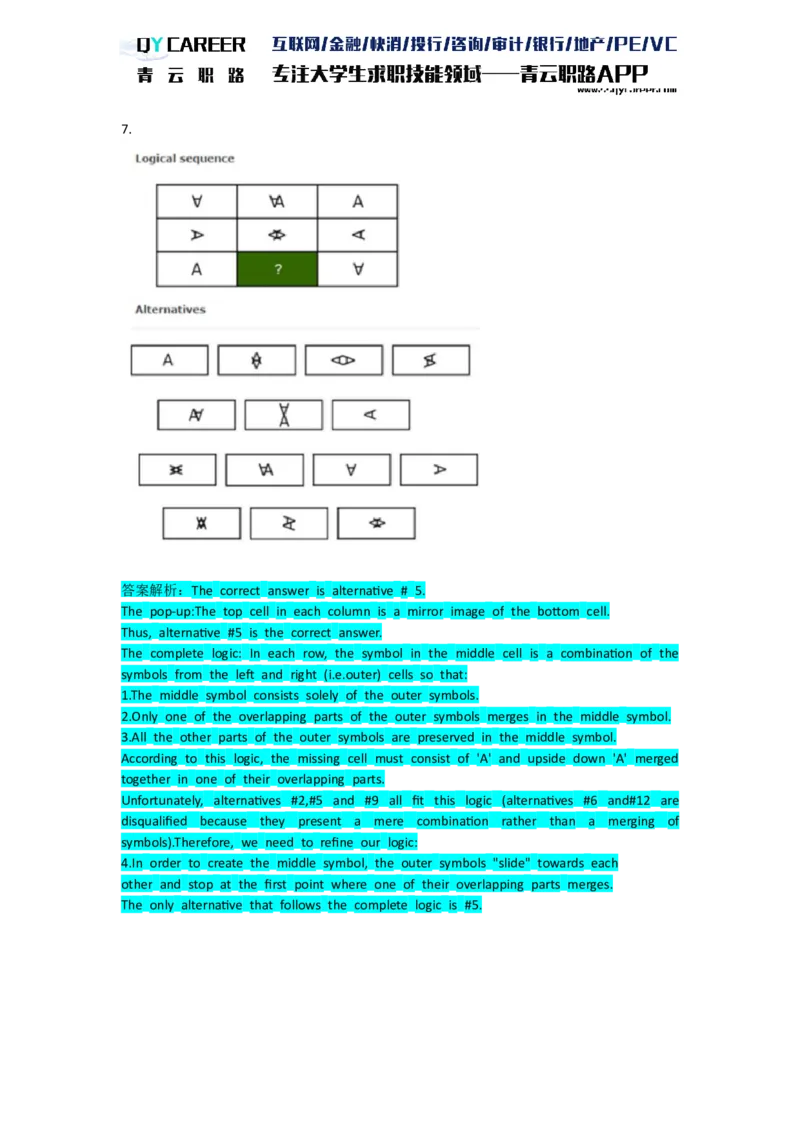
答案解析:The correct answer is alternative #14.
The pop-up: In each row the left cell consists of duplication of the left symbol from the
middle cell.Thus,the correct answer is #14.
The complete logic: In each row,the symbols in the middle cell are a combination of the
symbols from the left and right cells so that:
1.The first symbol from left in the middle cell is identical to the two symbols in the left
cell.
2.The second symbol in the middle cell is different from the other symbols in the row.
3.The third and fourth symbols in the middle cell are identical to the two symbols in
the right cell.
According to this logic,the symbols in the missing cell must be two"-|", which is
alternative # 14.7.
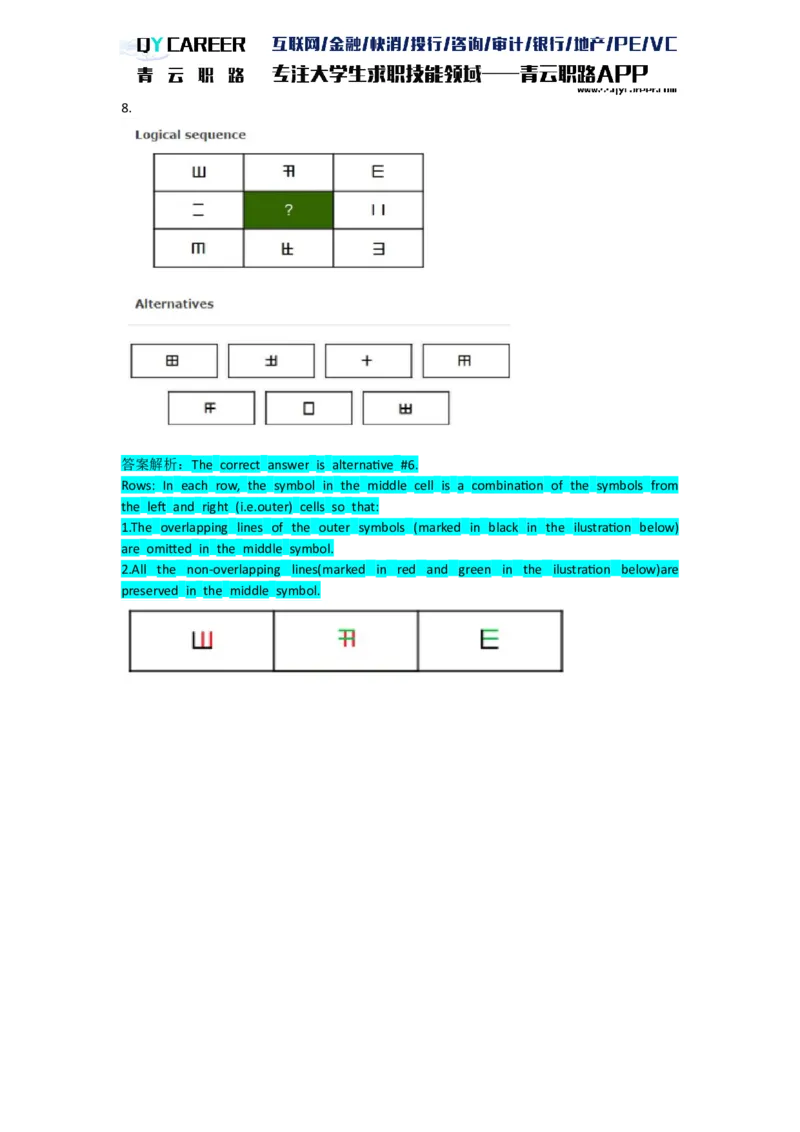
答案解析:The correct answer is alternative # 5.
The pop-up:The top cell in each column is a mirror image of the bottom cell.
Thus, alternative #5 is the correct answer.
The complete logic: In each row, the symbol in the middle cell is a combination of the
symbols from the left and right (i.e.outer) cells so that:
1.The middle symbol consists solely of the outer symbols.
2.Only one of the overlapping parts of the outer symbols merges in the middle symbol.
3.All the other parts of the outer symbols are preserved in the middle symbol.
According to this logic, the missing cell must consist of 'A' and upside down 'A' merged
together in one of their overlapping parts.
Unfortunately, alternatives #2,#5 and #9 all fit this logic (alternatives #6 and#12 are
disqualified because they present a mere combination rather than a merging of
symbols).Therefore, we need to refine our logic:
4.In order to create the middle symbol, the outer symbols "slide" towards each
other and stop at the first point where one of their overlapping parts merges.
The only alternative that follows the complete logic is #5.8.
答案解析:The correct answer is alternative #6.
Rows: In each row, the symbol in the middle cell is a combination of the symbols from
the left and right (i.e.outer) cells so that:
1.The overlapping lines of the outer symbols (marked in black in the ilustration below)
are omitted in the middle symbol.
2.All the non-overlapping lines(marked in red and green in the ilustration below)are
preserved in the middle symbol.9.
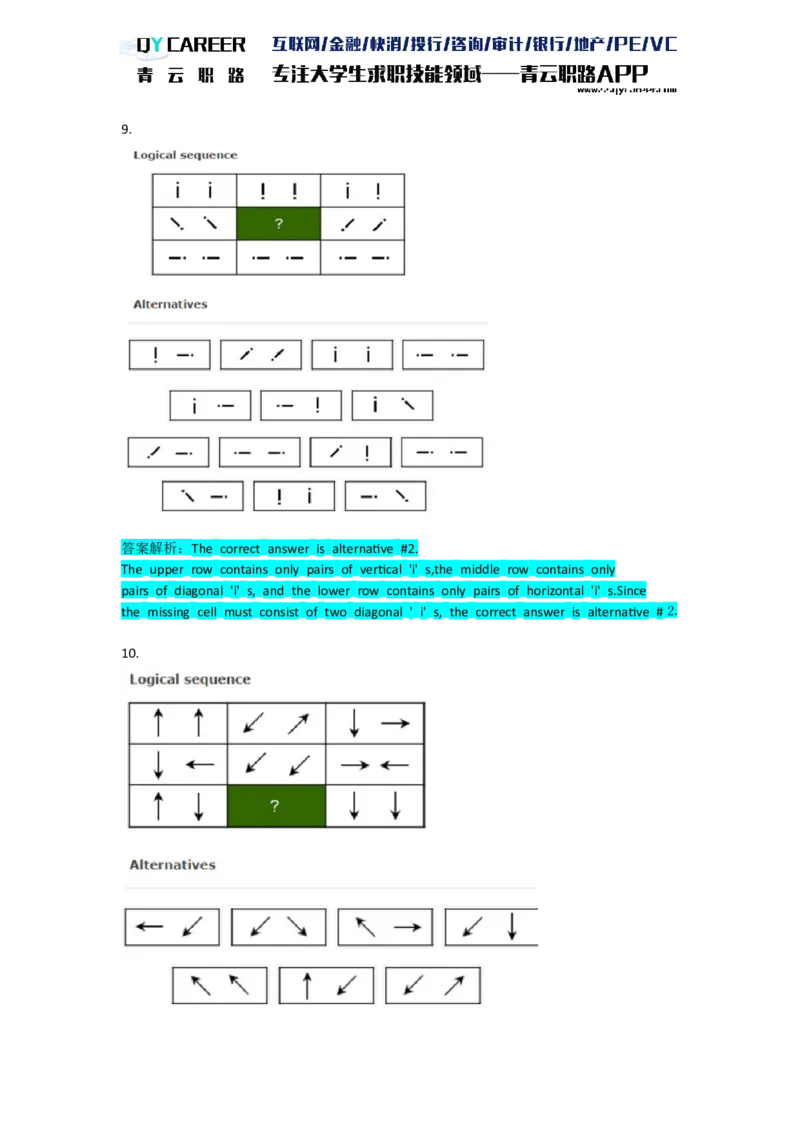
答案解析:The correct answer is alternative #2.
The upper row contains only pairs of vertical 'i' s,the middle row contains only
pairs of diagonal 'i' s, and the lower row contains only pairs of horizontal 'i' s.Since
the missing cell must consist of two diagonal ' i' s, the correct answer is alternative #⒉
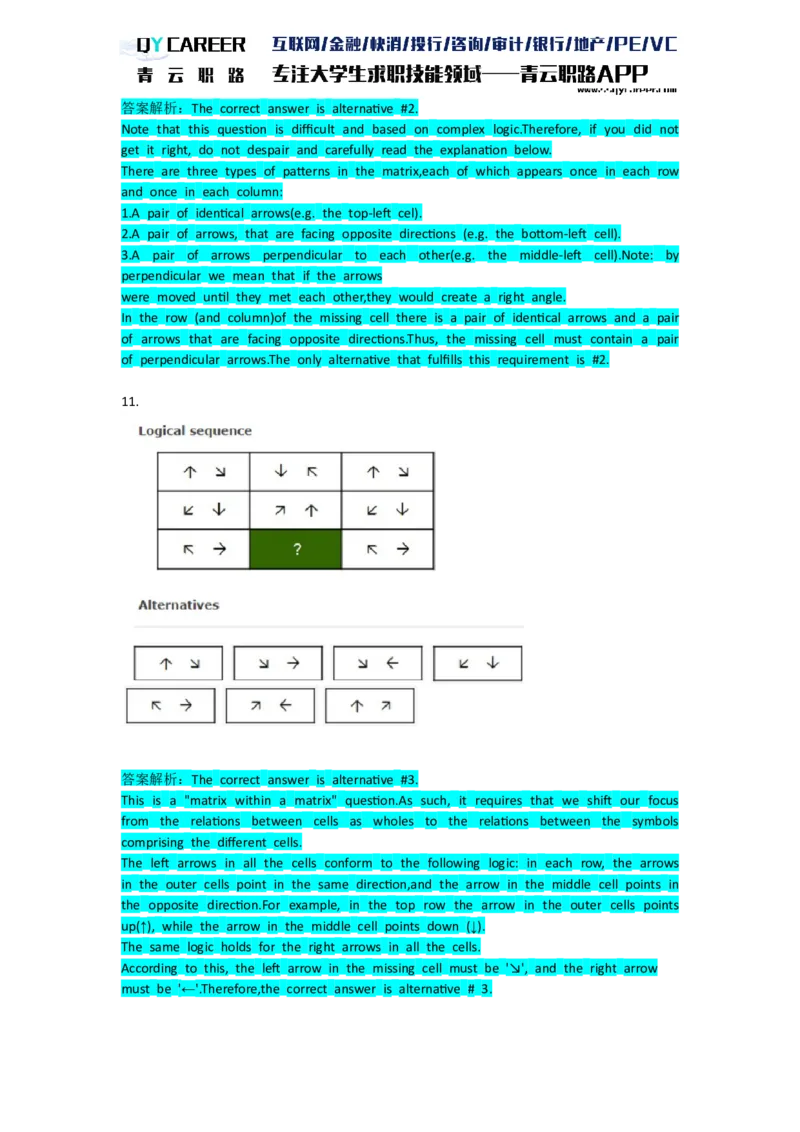
10.答案解析:The correct answer is alternative #2.
Note that this question is difficult and based on complex logic.Therefore, if you did not
get it right, do not despair and carefully read the explanation below.
There are three types of patterns in the matrix,each of which appears once in each row
and once in each column:
1.A pair of identical arrows(e.g. the top-left cel).
2.A pair of arrows, that are facing opposite directions (e.g. the bottom-left cell).
3.A pair of arrows perpendicular to each other(e.g. the middle-left cell).Note: by
perpendicular we mean that if the arrows
were moved until they met each other,they would create a right angle.
In the row (and column)of the missing cell there is a pair of identical arrows and a pair
of arrows that are facing opposite directions.Thus, the missing cell must contain a pair
of perpendicular arrows.The only alternative that fulfills this requirement is #2.
11.
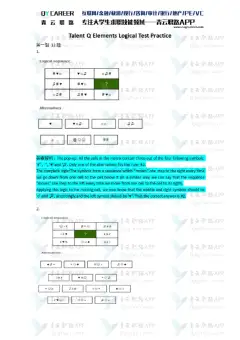
答案解析:The correct answer is alternative #3.
This is a "matrix within a matrix" question.As such, it requires that we shift our focus
from the relations between cells as wholes to the relations between the symbols
comprising the different cells.
The left arrows in all the cells conform to the following logic: in each row, the arrows
in the outer cells point in the same direction,and the arrow in the middle cell points in
the opposite direction.For example, in the top row the arrow in the outer cells points
up(↑), while the arrow in the middle cell points down (↓).
The same logic holds for the right arrows in all the cells.
According to this, the left arrow in the missing cell must be '↘', and the right arrow
must be '←'.Therefore,the correct answer is alternative # 3.12.
答案解析:The correct answer is alternative #4.
This is a "matrix within a matrix" question. As such, it requires that we shift our focus
from the relations between cells as wholes to the relations between the symbols
comprising the different cells.
Within each column, there are three pairs of symbols, so that each symbol in the left
side of the column pairs with an identical symbol in the right side of the column. As a
result, the same symbols appear both on the left side of the column and on its right
side, not necessarily in the same order.
For instance, if we look at the left column, we can see that both its left side and its
right side contain one " that is facing down (coloured in orange in the ilustration
below), one i that is facing right (coloured in light-blue) and one " that is facing
bottom-left (coloured in purple). The only difference between the two sides is the order
of the Ti's.
Let's have a look at the column of the missing cell, and compare the right i's to the left 's. We can
see that there are two i's that are facing down, one on the left side of the column and another
on the right side. However, there is only a left i' that is facing top- right and a right i' that is facing
top-left. Therefore, we can conclude that the missing cell must consist of a left i' that is facing
top- left and a right I' that is facing top-right. Thus, the correct answer is alternative #4.第二组 11题
1.
答案解析:The correct answer is alternative #9.
The pop-up: In each row, one of the cells contains three different symbols and the
other cells consist of a tripling of its left/right symbol. Thus, the correct answer is
alternative #9.
The complete logic: In each row, the symbols in one of the cells are a combination of
the symbols from the other cells so that:
1. The left symbol in the "combination cell" is identical to the three symbols in the left
most cell (out of the cells containing two symbols).
2. The right symbol in the "combination cell" is identical to the three symbols in the
right most cell (out of the cells containing two symbols).
3. The middle symbol in the "combination cell" is different from the other symbols in
the row. According to this logic, the symbols in the missing cell must be three 'o',
which is alternative #9.2.
答案解析:The correct answer is alternative #8.
There are three types of patterns in the matrix, each of which appears once in each
row and once in each column:
1. Three vertical arrows.
2. Two horizontal arrows.
3. One diagonal arrow.
In the row (and column) of the missing cell, one cell matches the second pattern and
the other matches the third one. Therefore, We need to look for an alternative that
matches the first pattern. Only one of the alternatives matches this pattern - alternative
#8.
3.答案解析:The correct answer is alternative #3.
Though it is not obvious at all, the matrix is based on the following sequence of
symbols:
◆♠♥♣♠
Each cell consists of three of these symbols, dictated by the following logic:
when moving from one cell to the cell below it, the symbols' 'move" one step to the
left each time. This movement is continuous throughout the matrix's columns: from the
bottom cell in each column to the top cell in the next column.
Thus, in order to find the missing symbols we need to "move" the symbols from the
cell above it one step to the left, resulting in ' ♠ ' and '◆' becoming the left and middle
symbols respectively. Next, we need to work backwards and "move" the symbols from
the next cell (the uppermost cell in the right column)
one step to the right, resultingin e' becoming the right symbol. Thus, the correct answer
is #3.
Solving tip: The diagonal line of identical symbols, which appears in all columns
(
♥
" in the left and right columns, and '
♠
' in the middle column) can serve as a hint to
indicate that the matrix is based on the"movement of a seauence of symbols" principle.
4.
答案解析:The correct answer is alternative #1.Note that this question is extremely difficult and based on complex logic.
Therefore, if you did not get it right, do not despair and carefully read the explanation
below.
The pop-up: In each row, the left cell is a mirror image of the right cell. According to
this, the correct answer should be alternative # 2. However, this pop-up is misleading,
as the matrix follows a different and more complex logic which leads to a different
answer.
The complete logic: This is a "matrix within a matrix" question. As such, it requires that
we shift our focus from the relations between cells as wholes to the relations between
the symbols comprising the different cells.
The symbols at the left side of the cells in each row/column conform to a different
logic than the symbols at the right side of the cells.
The logic of the left symbols: combining the three left symbols in each row/column
creates a米. Since the the left symbols in the row (and column) of the missing cell are-
and X, the left symbol in the missing cell must be 1.
The logic of the right symbols: the symbol in the last cell (i.e. the bottom cell of each
column and the right cell of each row) is a combination of the other
symbols in its column/row so that the overlapping parts of the other symbols (marked
in red in the ilustration below) are omitted and the non-overlapping parts (marked in
green in the
5.
答案解析:The correct answer is alternative #4.
This is a "matrix within a matrix" question. As such, it requires that we shift our focus
from the relations between cells as wholes to the relations between the symbols
comprising the different cells.
The left "'s conform to a different logic than the right i' s:
The logic of the left i' s: in each row and in each column there is one I that is facing
up and two i' s that are facing down.The logic of the right "i' s: in each row and in each column there is one i that is
facing right and two 's that are facing left.
According to this, the let I' In the missing cell must be facing down, and the right 1
must be facing right. There tore, the correct answer is alternative #4.
6.
答案解析:The correct answer is alternative #6.
The pop-up: The top cell in each column is a mirror image of the bottom cell.
Thus, the correct answer is #6.
The complete logic: In each row, the symbols in the middle cell are a combination of
the symbols from the left and right cells so that:
1. The left symbol in the middle cell is identical to the pair of symbols constituting the
left cell.
2. The right symbol in the middle cell is identical to the pair of symbols constituting the
right cell.
3. The middle symbol in the middle cell is different from all the other symbols in the
row. .
The only alternative that follows this logic is #6.7.
答案解析:The correct answer is alternative #5.
There are three types of patterns in the matrix, each of which appears once in each
row and once in each column:
1. Two arrows pointing up.
2. Two arrows pointing right.
3. Two arrows pointing left.
In the row (and column) of the missing cell there is a pair of arrows pointing up and a
pair of arrows pointing right. Therefore, the missing cell must contain a pair of arrows
pointing left. The correct answer is, thus, alternative #5.8.
答案解析:Answer: 1
Columns: The matrix is based on the following sequence of symbols:
☹
♥Ω≠ ♣
Each cell consists of three of these symbols, dictated by the following logic:
when moving from one cell to the cell below it, the symbols "move" one step to the
right each time. This movement is continuous throughout the matrix's columns: from the
bottom
cell in each column to the top cell in the next column.
Thus, in order to find the missing symbols we need to "move" the symbols from the
cell above it one step to the right, resulting in
♥
' and
♣
' becoming the right and middle
symbols respectively. Next, we need to work backwards and "move" the symbols from
the cell below it one step to the left, resulting in 'o' becoming the left symbol.
Therefore, the correct answer is # 1.9.
答案解析:The correct answer is alternative #2.
This is a "matrix within a matrix" question. As such, it requires that we shift our focus
from the relations between cells as wholes to the relations between the symbols
comprising the different cells.
The left and right (i.e. outer) "I's conform to a different logic than the middle i' s:
The logic of the middle i' s: in each row and in each column, two of the i' s are facing
right and one is facing left.
The logic of the outer i' s: in each row and in each column, there are always two pairs
of diagonal i' s, perpendicular to each other, and one pair of vertical i' s.
According to the first logic, the inner i in the missing cell must be facing right since
there is only one inner i that is facing right at the missing cell's row (and column).
According to the second logic, the outer i' s must be diagonal and perpendicular to
each other since there is only one pair of diagonal i' s in the missing ell's row (and
column).
The only alternative that follows both of these rules is alternative #2.10.
答案解析:The correct answer is alternative #6. ,
Note that this question is extremely difficult and based on complex logic.
Therefore, if you did not get it right, do not despair and carefully read the explanation
below.
All of the cells consist of three diagonal arrows.
There are three types of patterns in the matrix, each of which appears once in each
row and once in each column:
1. Three parallel arrows (e.g. the top-left cell).
2. Two parallel arrows, opposite in their direction and perpendicular to the third arrow
(e.g. the bottom-left cell).
3. Two identical arrows, perpendicular to the third arrow (e.g. the middle-left cell).
In the row (and column) of the missing cell, one cell matches the first pattern and the
other matches the third one. Therefore, we need to look for an alternative that matches
the second pattern. The only suitable alternative is #6.11.
答案解析:The correct answer is alternative # 12.
Columns: In each column, the symbols in one of the cells are a combination of the
symbols from the other cells so that:
1. The "combination cell" consists of all (and only) the symbols from the other cells in
its column.
2. The symbols from the cell containing two symbols (the "small cell") are placed in
between the symbols from the cell containing three symbols (the "big cell") to create
the "combination cell". That is to say that the left symbol from the "big cell" appears
first from left in the combination cell, followed by the left symbol from the "small cell",
the middle symbol from the "big cell", the right symbol from the "small cell", and the
right symbol from the "big cell".第三组 12题
1.
答案解析:The correct answer is alternative # 1.
Columns: In each column, the symbols in one of the cells are a combination of
the symbols from the other cells so that:
A. The "combination cell" consists of all (and only) the symbols from the other cells in
the column.
B. The symbols from the lower cell (out of the cells containing two symbols)
appear first from left in the "combination cell, followed by the two symbols from the
upper cell.
Rule A allows us to eliminate alternatives #2, #3, #4, #5 and #7. Rule B further
helps us to eliminate alternative #6, so we are left with only one alternative- #1.
Rows: In each row, two of the cells consist of two symbols and the third cell consists
of four symbols. None of the symbols appear more than once in the same row.2.
答案解析:The correct answer is alternative # 14.
Rows: The matrix is based on the following sequence of symbols:
€≈◆×♥
.
Each cell consists of three of these symbols, dictated by the following logic:
when moving from one cell to the next in the row (left to right), the symbols"move"
one step to the left each time. This movement is continuous throughout the matrix's
rows: from the right cell in each row to the left cell in the row below it.
Thus, in order to find the missing symbols we need to "move" the symbols from the
previous cell one step to the left, resulting in '×' and '◆' becoming the left and middle
symbols respectively. Next, we need to work backwards and "move" the symbols from
the next cell one step to the right, resulting in '≈' becoming the right symbol. Thus,
the correct answer is alternative # 14.3.
答案解析:The correct answer is alternative #7.
There are three types of patterns in the matrix, each of which appears once in each
row and once in each column:
1. A pair of identical diagonal arrows (e.g. the top-left cell).
2. A pair of parallel diagonal arrows that are facing opposite directions (e.g. the bottom-
left cell).
3. A pair of diagonal arrows perpendicular to each other (e.g. the middle-left cell).
In the row (and column) of the missing cell there is a pair of identical arrows and a
pair of perpendicular arrows, thus the missing cell must containa pair of arrows that are
facing opposite directions. The only alternative that fulfills this requirement is #7.4.
答案解析:The correct answer is alternative #2.
The pop-up: The top cell in each column is a mirror image of the bottom cell (and the
left cell in each row is a mirror image of the right cell). Following this logic, the correct
answer must be alternative #2.
The complete logic: All of the symbols in the left and right (i.e. outer) cells are different
parts of a cross symbol (+). In each row, the symbol in the middle cell is a combination
of the symbols from the outer cells so that the middle symbol consists of a duplication
of the overlapping part of the outer symbols (e.g. in the top row - the upper part of
the vertical line; in the middle row - the entire vertical line).
Thus, the missing symbol must share a part with the right symbol in its row, and that
part should be the lower vertical line.5.
答案解析:Note that this question is extremely difficult and based on complex logic.
Therefore, if you did not get it right, do not despair and carefully read the explanation
below.
This is a "matrix within a matrix" question. As such, it requires that we shift our focus
from the relations between cells as wholes to the relations between the symbols
comprising the different cells.
Each column/row can be divided to three: left arrows, middle arrows and right arrows.
Each of these triplets contains one vertical arrow, one diagonal arrow and one horizontal
arrow. For instance, if we look at the middle column, and then focus on its left arrows,
we can see that the top arrow IS vertical, the middle one IS horizontal, and the bottom
one IS diagonal.
According to this logic, the left arrow in the missing cell must be vertical, the middle
arrow must be horizontal, and the right arrow must be diagonal. The only alternative
that fulfills this requirement is #2.6.
答案解析:The correct answer is alternative #2.
Rows: the symbol in the middle cell is a combination of the symbols from the left and
right (i.e. outer) cells so that:.
1. The middle symbol consists solely of the outer symbols.
2. AI the overlapping parts of the outer symbols (e.g. the vertical lines in the top row)
merge together in the middle symbol.
3. All the non-overlapping parts are preserved in the middle symbol.
According to this logic, the missing symbol must consist of two horizontal lines (the
overlapping parts of the outer symbols) and one long vertical line to their right (made
of combining the vertical lines from the outer cells). The only alternative that follows
this logic is alternative #2.7.
答案解析:The correct answer is alternative #2.
Rows: the symbol in the middle cell is a combination of the symbols from the left
and right (i.e. outer) cells so that: .
1. The middle symbol consists solely of the outer symbols.
2. Al the overlapping parts of the outer symbols (e.g. the vertical lines in the top row)
merge together in the middle symbol.
3. All the non-overlapping parts are preserved in the middle symbol.
According to this logic, the missing symbol must consist of two horizontal lines(the
overlapping parts of the outer symbols) and one long vertical line to their right (made
of combining the vertical lines from the outer cells). The only alternative that follows
this logic is alternative #2.
(答案和上一个题一样?)8.
答案解析:The correct answer is alternative # 14.
Note that this question is difficult and based on complex logic. Therefore, if you
did not get it right, do not despair and carefully read the explanation below.
All the cells contain three out of five symbols:
☹
≠☼≈ ♫
following some sort of order. For example, ☼' is always followed by'≈' .
and '≠'is always followed by".☼This can be used as a hint to indicate that there is a
sequence of symbols that "moves'throughout the cells.
In order to better understand this movement we can focus on the complete rows.
Starting from the left cell in the middle row and moving to the right, we can see that
the symbols "move" one step to the right and then two steps to the right. This
movement's
logic is continuous throughout the matrix's rows, so that the symbols "move" again one
step to the right when moving from the right cell in the middle row to the left cell in
the bottom row.
For instance, if we follow the'☼' through the rows, starting from the left cell in
the middle row, we can see that it first "moves" one step to the right. Then, when
moving to the right cell in the middle row, the'☼' "moves" two steps to the right,
causing it to disappear (as it is now the 5th symbol in the sequence, whereas only the
first three symbols can be seen in each
cell). Continuing to the left cell in the bottom row, the '☼' moves again one step to
the right, causing it to reappear (as it becomes the 1st symbol in the sequence).
Working backwards, we can see that the symbols "move" two steps to the left when
moving from the left cell in the middle row the right cell in the top row.
Therefore, the symbols should "move" one step to the left when moving from the right☹
cell in the top row the missing cell, resulting in the next sequence of symbols: ♫≠.
9.
答案解析:The correct answer is alternative # 10. .
The pop-up: In each row the right cell is a mirror image of the left cell. Following this
logic, the correct answer must be alternative #10.
The complete logic: In addition to the aforementioned rule, the following also exists: in
each row, the symbols in the middle column are a combination of the symbols from the
left and right columns so that:
1. The left symbol in the middle cell is identical to the middle symbol in the left cell.
2. The right symbol in the middle cell is identical to the middle symbol in the right cell.
10.答案解析:The correct answer is alternative #3.
There are three types of patterns in the matrix, each of which appears once. in
each row and once. in each. column:
1. A pair of vertical i' s.
2. A pair of diagonal i' s.
3. A pair of different-oriented i' s (one diagonal i and one horizontal i').
In the row (and column) of the missing cell there is a pair of different-oriented I's and
a pair of diagonal i' s. Therefore, we need to look for an alternative that contains two
vertical 'i' s. The answer is therefore alternative #3.
11.
答案解析:The correct answer is alternative #5.This is a "matrix within a matrix" question. As such, it requires that we shift our focus
from the relations between cells as wholes to the relations between the symbols
comprising the different cells.
The left arrows conform to a different logic than the right arrows:
The direction of the left arrows is determined by the column: in the left column the
arrow is '↘', in the middle column it is '↖', and in the right column it is '↗'.
The direction of the right arrows is determined by the row: in the top row the arrow is
'↑', in the middle row it is '→', and in the bottom row it is'↓'.
According to this, the left arrow in the missing cell must be '↗ ',
and the right arrow must be'↓'. Therefore, the correct answer is alternative #5.12.
答案解析:The correct answer is alternative #7.
The pop-up: In each row the right cell consists of a duplication of the right symbol
from the middle cell and an addition of a new symbol between the two identical
symbols. Thus, the correct answer is #7.
The complete logic: In each row, the symbols in the middle cell are a combination of
the symbols from the left and right (i.e. outer) cells so that:
1. The left symbol in the middle cell is identical to the outer symbols in the left cell.
2. The right symbol in the middle cell is identical to the outer symbols in the right cell.
3. The middle symbol in all three cells is different from all the other symbols in the
row.
The only alternative that follows this logic is #7.第四组 9题
1.
答案解析:The correct answer is alternative #7.
The pop-up: In each column the bottom cell is a mirror image of the top cell (the
same rule holds for the left and right cells in each row). Following this, the correct
answer must be alternative #7.
The complete logic: In addition to the aforementioned rule, the following also exists: in
each row, the symbols in the middle cell are a combination of the symbols from the
left and right (i.e. outer) cells so that the symbols from the outer cells switch places
and new symbol is added in between them.2.
答案解析:The correct answer is alternative # 10.
In each column, the symbol in the middle cell (marked in red in the illustration below)
is determined based on the lines shared by the symbols in the top and bottom cells
(marked in green). At first glance, it seems as if the shared lines are doubled to create
the middle symbol. However, when we take a closer look at the matrix, we can see
that in the middle cell of the left column, one of the 1 is smaller than the other. To
be more precise, we can say that the shared lines go through a graphical transformation
which is not duplication per se. This graphical transformation can be thought of as
causing the shared lines to resemble a pipe system in which these lines are the water
(marked in blue) running inside the pipes (marked in red).
The lines shared by the symbols in the top and bottom cells of the right column are
the vertical line and the right horizontal line (see illustration below). Following the logicpresented above, we can think of the missing symbol as surrounding the shared lines
(the |-).
3.
答案解析:The correct answer is #7.
Note that this question is difficult and based on complex logic. Therefore, if you did not
get it right, do not despair and carefully read the explanation below.
This is a "matrix within a matrix" question. As such, it requires that we shift our focus
from the relations between cells as wholes to the relations between the symbols
comprising the different cells.
The logic of the left arrows: in each row and in each column there is one vertical
arrow, one diagonal arrow and one horizontal arrow. Note: although it may seem that
the left arrows follow a different logic, based on their clockwise/counter-clockwise
rotation, this is only a distraction and no such logic actually exists.
The logic of the middle arrows: all arrows are vertical. Note: the exact orientation of
the arrows (up/down) is arbitrary and functions as a distraction.
The logic of the right arrows: in each row, the arrow in the left cell is identical to the
arrow in the right cell, and the arrow in the middle cell is in the opposite direction to
both of them. The logic of the columns is slightly different - in each column, the arrows
in the top and bottom cells are facing opposite directions,and the arrow in the middle
cell is perpendicular to both of them.
According to this, the left arrow in the missing cell must be horizontal, the middle
arrow must be vertical, and the right one must be '. Therefore, the correct answer is
alternative #7.4.
答案解析:The correct answer is alternative # 11.
Rows: In each row, the cell containing three symbols is a combination of the cells
containing two symbols so that:
1. The left symbol in the "combination cell" is identical to the right symbol in the
left most cell (out of the cells containing two symbols).
2. The right symbol in the "combination cell" is identical to the left symbol in the
right most cell (out of the cells containing two symbols). .
3. The middle symbol in the "combination cell" is different from all the other
symbols in the row.
We thus need to look for an alternative where the left symbol is '%' and the right
symbol is'&'. The only alternative that follows this logic is #11.5.
答案解析:The correct answer is alternative #4.
Rows: In each row, the symbol in the middle cell is a combination of the symbols
from the left and right (i.e. outer) cells so that:
A. The middle symbol consists solely of the outer symbols.
B. The outer symbols must share at least one part.
C. All the shared parts merge in the middle symbol.
D. All the non-shared parts are preserved in the middle symbol..
We can thus eliminate the following alternatives: #1 as it fails to fulfill principle A;
#2 as it fails to fulfill principle B; and #3 and #56.
答案解析:The correct answer is alternative #5.
There are three types of patterns in the matrix, each of which appears once in
each row and once in each column:
1. Two vertical i' s and one horizontal丫' in between them (e.g. the middle-left
cell).
2. Two horizontal i' s and one vertical i' in between them (e.g. the top-left cell).
3. Three diagonal i' s (e.g. the bottom-left cell).
In the row (and column) of the missing cell, one cell matches the first pattern and
the other matches the second one. Therefore, we need to look for an alternative
that matches the third pattern. As 6 of the alternatives have 3 diagonal "i' s, we
need to refine our rule.
Another feature of the matrix is that all of its cells consist of three i' s as follows:
the outer T's in each cell are facing opposite directions and are perpendicular to
the inner i'..
The only alternative that conforms to both rules is alternative #5.7.
答案解析:The correct answer is alternative # 1.
Rows: In each row, the symbol in the middle cell is a combination 1
of the symbols from the left and right (i.e. outer) cells so that:
1. The middle symbol consists solely of the outer symbols.
2. The outer symbols have an overlapping part
(marked in black in the illustration below).
3. The overlapping part merges in the middle symbol.
4. All the non-overlapping parts (marked in red and green in the
illustration below) are preserved in the middle symbol.
According to this logic, the missing symbol must share one part with '||' and contain,
in addition, the part appearing in' -||' but not in
'||'. The only alternative that follows this logic is alternative # 1.8.
答案解析:The correct answer is alternative #3.
Note that this question is extremely difficult and based on complex logic.
Therefore, if you did not get it right, do not despair and carefully read the
explanation below.
In each row, as a whole, and in each column, as a whole, there are:
1. Two i' s that are facing up.
2. One i' s that is facing down.
3. Two i' s that are facing right.
4. One i' that is facing left.
In the row (and column) of the missing cell there is one i' that is facing up, one i'
that is facing down, one i' that is facing right, and one i' that is facing left.
Therefore, we need to look for an alternative that consists of one i that is facing
up and one i' that is facing right. The only alternative that fulfill this requirement is #3.9.
答案解析:The correct answer is alternative # 12.
The pop-wp: In each row the left cell consists of a duplication of the left symbol
from the middle cell and an addition of a new symbol between the two identical
symbols. Thus, the correct answer is # 12.
The complete logic: In each row, the symbols in the middle cell are a
combination of the symbols from the left and right (i.e. outer) cells so that:
1. The left symbol in the middle cell is identical to the outer symbols in the left cell.
2. The right symbol in the middle cell is identical to the middle symbol in the right cell.
3. The middle symbols in the left and middle cells and the outer symbols in the
right cell are different from all the other symbols in the row..
The only alternative that follows this loqic is #12.