Verbal Test 6
Solutions Booklet
Instructions
This verbal reasoning test comprises 30 questions, and you will have 25 minutes in which to
correctly answer as many as you can.
You will be presented with a passage to read, and a statement about that passage. For each
statement you must select one of the following answers:
True: The statement follows logically from the information contained in the passage.
False: The statement is logically false from the information contained in the passage.
Cannot Say: It is not possible to determine whether the statement is true or false
without further information.
You will have to work quickly and accurately to perform well in this test. If you don’t know the
answer to a question, leave it and come back to it if you have time.
Try to find a time and place where you will not be interrupted during the test. When you
are ready, begin the test.
Assessment Day
Practice Aptitude TestsOil sands are most commonly found in Venezuela’s Orinoco Basin and Alberta,
Canada. Modern technology has made the extraction of crude bitumen, or
unconventional oil, from these oil sands much easier. The crude oil that is
extracted from traditional oil wells is a free-flowing mixture of hydrocarbons,
whereas oil sands yield a highly viscous form of petroleum. Increasing world
demand for oil and higher petrol prices have made the economic viability of
extracting oil sands approach that of conventional oil.
Oil sands have been described as one of the dirtiest sources of fuel. Compared to
conventional oil, four times the amount of greenhouse gases are generated from
the extraction of bitumen from oil sands. Additionally there is an impact on the
local environment. Tailing ponds of toxic waste are created whenever the tar
sands are washed with water.
Proponents of oil sands development point to the land that has already been
reclaimed following oil sands development. Also, that there will be considerably
less surface impact once technology innovations have allowed oil sand reserves
to be drilled rather than mined.
Q1 Oil sands offer a clean solution for meeting future energy needs.
True False Cannot say
False – the passage emphasises the environmental pollution caused by oil sands
development.
Q2 Oil sands are only found in Alberta and the Orinoco Basin.
True False Cannot say
False – they are “most commonly” found in these two areas so must occur elsewhere
too.
Q3 Bitumen is a highly viscous form of petroleum that needs to be heated to
flow.
True False Cannot say
Cannot Say – the passage states only that bitumen is a highly viscous form of
petroleum and nothing about the effects of heating.
For personal use only. Unauthorised copying or Page 2 AssessmentDay
distribution in printed, electronic, or any other
form in whole or in part, is prohibited without
Document last updated 18-07-2014
www.assessmentday.co.uk
prior written permission from AssessmentDay.Q4 It is almost as expensive to extract conventional oil as oil sands.
True False Cannot say
True - this can be inferred from the last sentence of the first paragraph: “Increasing
world demand for oil and higher petrol prices have made the economic viability of
extracting oil sands approach that of conventional oil”. So if the economic viability of
oil sands is currently approaching the economic viability of conventional oil, it can be
said that it is almost the same cost to extract oil sands.
Q5 Extracting bitumen from conventional oil generates four times the level of
greenhouse gases than extracting from oil sands.
True False Cannot say
False – the passage states that it is bitumen extraction from oil sands which
produces four times the amount of greenhouse gases emitted by extraction of
conventional oil (i.e. the other way round).
For personal use only. Unauthorised copying or Page 3 AssessmentDay
distribution in printed, electronic, or any other
form in whole or in part, is prohibited without
Document last updated 18-07-2014
www.assessmentday.co.uk
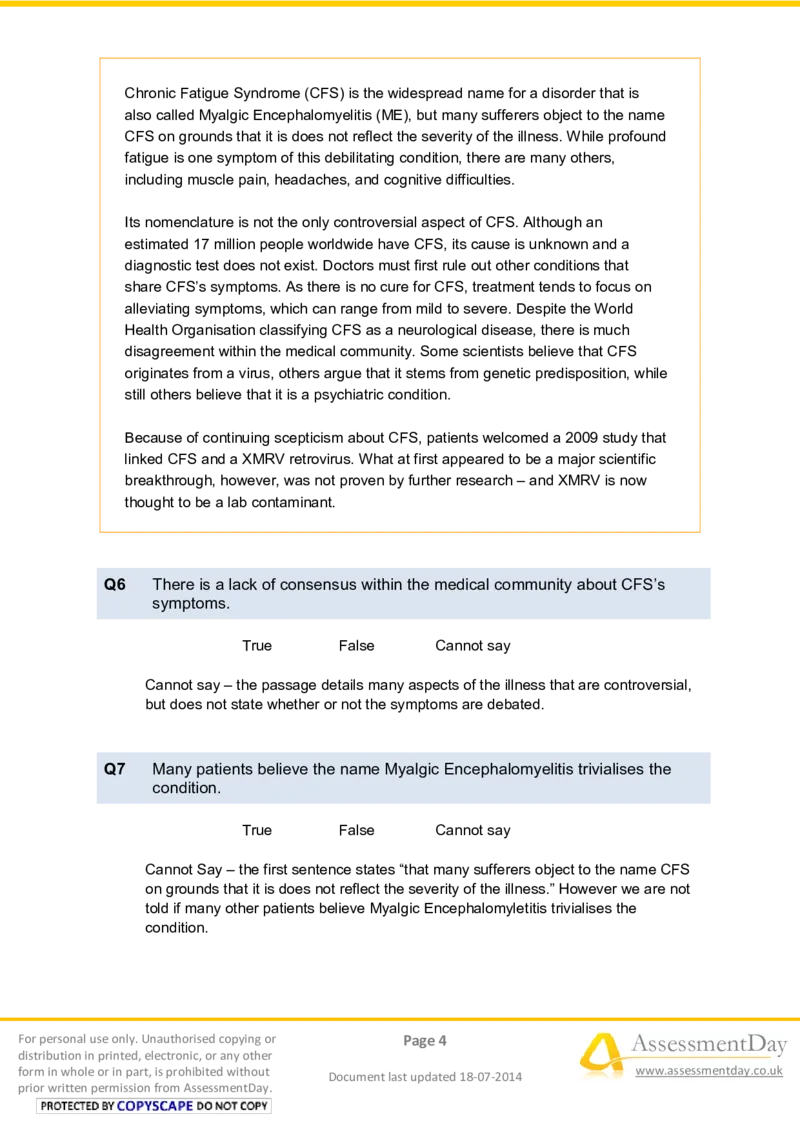
prior written permission from AssessmentDay.Chronic Fatigue Syndrome (CFS) is the widespread name for a disorder that is
also called Myalgic Encephalomyelitis (ME), but many sufferers object to the name
CFS on grounds that it is does not reflect the severity of the illness. While profound
fatigue is one symptom of this debilitating condition, there are many others,
including muscle pain, headaches, and cognitive difficulties.
Its nomenclature is not the only controversial aspect of CFS. Although an
estimated 17 million people worldwide have CFS, its cause is unknown and a
diagnostic test does not exist. Doctors must first rule out other conditions that
share CFS’s symptoms. As there is no cure for CFS, treatment tends to focus on
alleviating symptoms, which can range from mild to severe. Despite the World
Health Organisation classifying CFS as a neurological disease, there is much
disagreement within the medical community. Some scientists believe that CFS
originates from a virus, others argue that it stems from genetic predisposition, while
still others believe that it is a psychiatric condition.
Because of continuing scepticism about CFS, patients welcomed a 2009 study that
linked CFS and a XMRV retrovirus. What at first appeared to be a major scientific
breakthrough, however, was not proven by further research – and XMRV is now
thought to be a lab contaminant.
Q6 There is a lack of consensus within the medical community about CFS’s
symptoms.
True False Cannot say
Cannot say – the passage details many aspects of the illness that are controversial,
but does not state whether or not the symptoms are debated.
Q7 Many patients believe the name Myalgic Encephalomyelitis trivialises the
condition.
True False Cannot say
Cannot Say – the first sentence states “that many sufferers object to the name CFS
on grounds that it is does not reflect the severity of the illness.” However we are not
told if many other patients believe Myalgic Encephalomyletitis trivialises the
condition.
For personal use only. Unauthorised copying or Page 4 AssessmentDay
distribution in printed, electronic, or any other
form in whole or in part, is prohibited without
Document last updated 18-07-2014
www.assessmentday.co.uk
prior written permission from AssessmentDay.Q8 A 2009 study linking CFS with a retrovirus has now been discredited.
True False Cannot say
True – the final sentence states that the link “was not proven by further research.”
Q9 The symptoms of Chronic Fatigue Syndrome are also attributable to other
illnesses.
True False Cannot say
True –the second paragraph states that “Doctors must first rule out other conditions
that share CFS’s symptoms.”
Q10 CFS is a severely debilitating condition for 17 million people worldwide.
True False Cannot say
Cannot Say – the passage tells us that an “estimated” 17 million people have CFS
and the second paragraph states that symptoms can “range from mild to severe.”
However we are not told the exact numbers of those who have a severely debilitating
form of CFS. So we cannot say for sure.
For personal use only. Unauthorised copying or Page 5 AssessmentDay
distribution in printed, electronic, or any other
form in whole or in part, is prohibited without
Document last updated 18-07-2014
www.assessmentday.co.uk
prior written permission from AssessmentDay.There is no unifying theory to explain the experience of dreaming. Dreaming
involves an altered state of consciousness that occurs during periods of REM (rapid
eye movement) sleep. One of the most unusual features of this state is that most of
the body’s muscles are paralysed.
The most common sleeping pattern is for a period of REM sleep to be preceded by
four stages of non-REM sleep, and for this to repeat itself up to five times a night.
Most adults and children, if woken during REM sleep, will report that they were
dreaming. Whilst the physiological stages of sleeping may be similar across adults
and young children, the potential complexity of a child’s dreams develops as they
age – alongside their imagination.
It’s difficult to prove that a dream is taking place – only after the fact can you know
that you were dreaming. There are a small number of people, however, who do
know when they are experiencing what is called a “lucid” dream. The “scanning
hypothesis” posits that eyes move during REM sleep in accordance with the
direction of gaze of one’s dream. Research, for example with “lucid” dreamers, has
shown that eyes do point towards the action that a dreamer, having a goal-
orientated dream, describes.
Q11 REM sleep tends to be preceded by non-REM sleep.
True False Cannot say
True – this can be inferred from the information in the second paragraph “the most
common sleeping pattern is for a period of REM sleep to be preceded by four stages
of non-REM sleep”.
Q12 Eye muscles are the only muscles that are not paralysed during REM sleep.
True False Cannot say
Cannot say – most of the body’s muscles are paralysed according to the passage.
We are told that eye muscles are not paralysed, but we are not told about other
muscles.
For personal use only. Unauthorised copying or Page 6 AssessmentDay
distribution in printed, electronic, or any other
form in whole or in part, is prohibited without
Document last updated 18-07-2014
www.assessmentday.co.uk
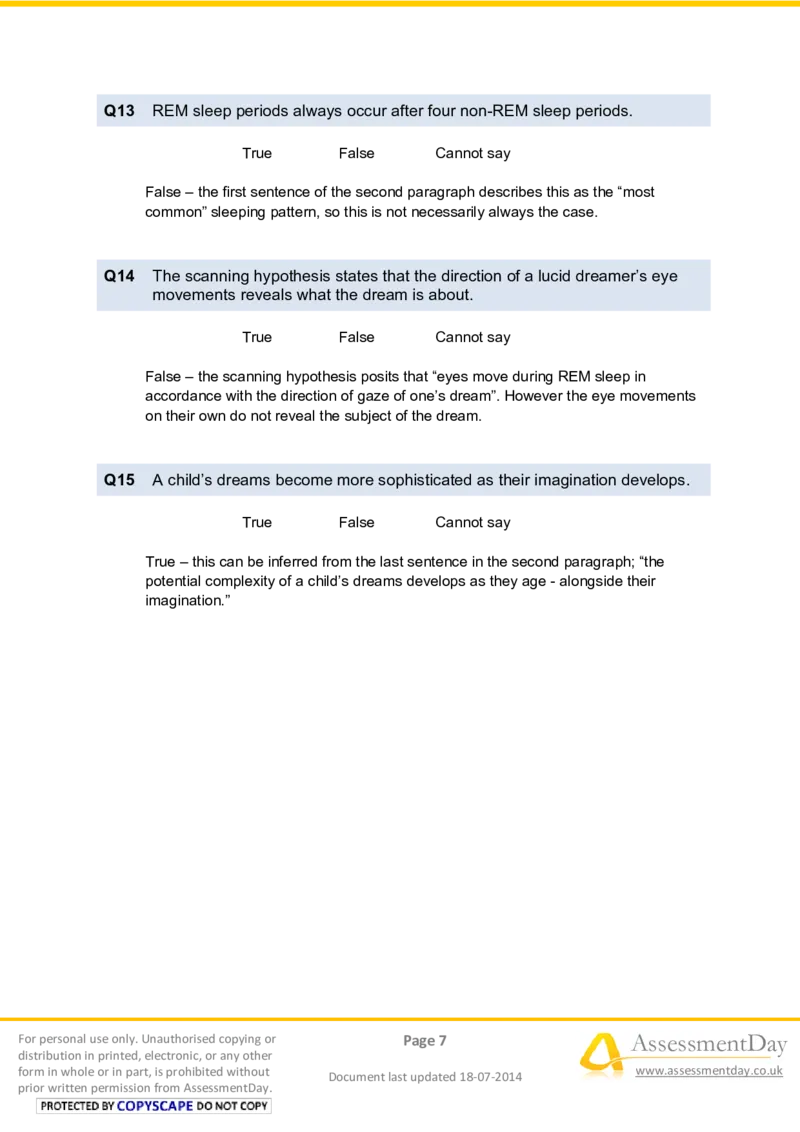
prior written permission from AssessmentDay.Q13 REM sleep periods always occur after four non-REM sleep periods.
True False Cannot say
False – the first sentence of the second paragraph describes this as the “most
common” sleeping pattern, so this is not necessarily always the case.
Q14 The scanning hypothesis states that the direction of a lucid dreamer’s eye
movements reveals what the dream is about.
True False Cannot say
False – the scanning hypothesis posits that “eyes move during REM sleep in
accordance with the direction of gaze of one’s dream”. However the eye movements
on their own do not reveal the subject of the dream.
Q15 A child’s dreams become more sophisticated as their imagination develops.
True False Cannot say
True – this can be inferred from the last sentence in the second paragraph; “the
potential complexity of a child’s dreams develops as they age - alongside their
imagination.”
For personal use only. Unauthorised copying or Page 7 AssessmentDay
distribution in printed, electronic, or any other
form in whole or in part, is prohibited without
Document last updated 18-07-2014
www.assessmentday.co.uk
prior written permission from AssessmentDay.Ergonomics is the scientific study of the interaction between people and machines.
The discipline aims to design equipment and environments that best fit users’
physical and psychological needs, thus improving the efficiency, productivity and
safety of a person using a device. A multi-disciplinary field, ergonomics
encompasses aspects of psychology, physiology, industrial design and mechanical
engineering.
The field is divided into three main areas. Physical ergonomics addresses the
relationship between human anatomy and physical activity, for instance designing
tools that minimize or eliminate muscle strain. This area also looks at how the
physical environment affects performance and health. Cognitive ergonomics studies
the mental processes involved in humans’ interactions with systems, such as
computer interfaces. In designing an airplane cockpit, for example, it is of vital
importance that control panels take human factors into account. Organisational
ergonomics focuses on optimising socio-technical systems, such as team structure
and work processes.
Increasingly, progressive organisations are looking for ways to improve workplace
ergonomics. The benefit of this strategy is not only increased productivity but also
reduced sick leave. In the United States, compensation to workers with repetitive
strain injuries costs $20 billion annually.
Q16 The area of physical ergonomics can involve preventing repetitive strain
injuries.
True False Cannot say
True – this can be inferred from the passage’s statement that “physical ergonomics
addresses the relationship between human anatomy and physical activity, for
instance designing tools that minimize or eliminate muscle strain.”
Q17 One of the objectives of ergonomics is to increase the happiness of a work
environment.
True False Cannot say
Cannot say – the passage states that efficiency, productivity and safety are some of
the areas of ergonomics however the passage does not tell us explicitly if
ergonomics is ever used to increase the happiness of a work environment.
For personal use only. Unauthorised copying or Page 8 AssessmentDay
distribution in printed, electronic, or any other
form in whole or in part, is prohibited without
Document last updated 18-07-2014
www.assessmentday.co.uk
prior written permission from AssessmentDay.Q18 An ergonomically designed control panel accommodates a person’s mental
and physical needs.
True False Cannot say
True – the second sentence describes ergonomics as the design of “equipment and
environments that best fit users’ physical and psychological needs”.
Q19 Environmental factors can affect a worker’s productivity and wellbeing.
True False Cannot say
True – the second paragraph states that physical ergonomics “looks at how the
physical environment affects performance and health.”
Q20 Ergonomic design places little emphasis on aesthetics.
True False Cannot say
Cannot Say – the passage does not make any reference to aesthetics.
For personal use only. Unauthorised copying or Page 9 AssessmentDay
distribution in printed, electronic, or any other
form in whole or in part, is prohibited without
Document last updated 18-07-2014
www.assessmentday.co.uk
prior written permission from AssessmentDay.The legal term double jeopardy refers to a second prosecution of an individual for
an offence for which he has already been prosecuted. Double jeopardy is
famously prohibited in the Fifth Amendment of the United States constitution,
which states that no person shall, “be subject for the same offence to be twice put
in jeopardy of life or limb.” Not only does the double jeopardy doctrine uphold the
finality of criminal proceedings, it also protects individuals from the stress of
multiple prosecutions. Despite dating back to Roman times, this legal rule is often
challenged. Some legal reform advocates believe that a second trial should be
permitted if significant new evidence becomes available – for example DNA
evidence can reveal more using more recent technology.
Double jeopardy laws are intended to protect innocent people from continual
harassment by the state. They also prevent a defendant from receiving successive
trials for the same offence – for instance, someone found guilty of murder cannot
also be tried for manslaughter for the same act. Some exceptions exist. A new trial
is allowed if the original trial is declared a mistrial, or if an appeal against a
conviction is successful. The rules also do not restrict a different sovereignty from
prosecuting for the same offence. Similarly, in the United States, civil proceedings
can be brought against someone who has already been acquitted or convicted of
committing the offence.
Q21 Under double jeopardy rules, someone who has been acquitted of a crime
can never be retried for the same offence.
True False Cannot say
False – the second paragraph states “Some exceptions exist.” Therefore it is not true
that someone who has been acquitted can never be retried for the same offence.
Q22 Criminal and civil proceedings fulfil different objectives in the United States.
True False Cannot say
Cannot say – the passage does not specify the objectives of criminal and civil
proceedings.
For personal use only. Unauthorised copying or Page 10 AssessmentDay
distribution in printed, electronic, or any other
form in whole or in part, is prohibited without
Document last updated 18-07-2014
www.assessmentday.co.uk
prior written permission from AssessmentDay.Q23 Double jeopardy laws exist to prevent the government from persecuting
innocent individuals.
True False Cannot say
True – the second paragraph states, “Double jeopardy laws are intended to protect
innocent people from continual harassment by the state.”
Q24 New technology can shed new light on old cases.
True False Cannot say
True – the first paragraph of the passage gives as an example of “significant new
evidence” the following: “DNA evidence can reveal more using more recent
technology”. So new technology can provide new evidence from existing artefacts or
existing DNA.
Q25 The double jeopardy rule was first expressed in the Fifth Amendment of the
United States constitution.
True False Cannot say
False – the first paragraph states that this legal rule dates back to Roman times.
For personal use only. Unauthorised copying or Page 11 AssessmentDay
distribution in printed, electronic, or any other
form in whole or in part, is prohibited without
Document last updated 18-07-2014
www.assessmentday.co.uk
prior written permission from AssessmentDay.The Silk Road, stretching from China to the Mediterranean Sea, was not one road,
but a network of trade routes. Originating in the ancient Chinese capital of
Chang’an, the overland routes crossed modern-day India, Pakistan, Afghanistan,
Turkey, Syria and Iran en-route to various Mediterranean ports, from where the
goods were carried to Rome by boat. Typically, traders did not travel the entire
6,440 km distance, instead covering one section of the route and passing their
goods to another caravan for the next stage.
As the name suggests, the Silk Road facilitated the trade of Chinese silk, but many
other goods were carried along the route. Tea, gunpowder, spices, and porcelain
travelled from East to West, while wool, linen, glass and wine travelled in the
opposite direction. Not only commodities, but also ideas and technology were
transmitted along the Silk Road. Algebra, astronomy, medicine and papermaking
were brought to the West, while construction and seafaring methods flowed East
from Europe. The Silk Road also enabled the dissemination of religion, most notably
the spread of Buddhism from India to China. The Silk Road was in use from the
second century BC until the fifteenth century AD. Many factors contributed to the
route’s demise, including the fall of the Mongol Empire and the resulting political and
economic fragmentation along the route. The rise of maritime trade between Europe
and Asia was another major cause.
Q26 The Silk Road has never been longer than 6,000km in length.
True False Cannot say
False – the third sentence tells us that “typically, traders did not travel the entire
6,440 km distance [of the Silk Road]”.
Q27 In addition to bringing commodities such as wool and glass to Asia, the Silk
Road spread papermaking techniques from West to East.
True False Cannot say
False – the second paragraph states that papermaking was “brought to the West” via
the Silk Road.
For personal use only. Unauthorised copying or Page 12 AssessmentDay
distribution in printed, electronic, or any other
form in whole or in part, is prohibited without
Document last updated 18-07-2014
www.assessmentday.co.uk
prior written permission from AssessmentDay.Q28 The Silk Road’s historical significance goes beyond its function as a
commerce route.
True False Cannot say
True – the second paragraph explains that the Silk Road played an important role in
the spread of knowledge and religion.
Q29 Two main factors led to the Silk Road falling into disuse after the fifteenth
century AD.
True False Cannot say
Cannot say – the passage states that “many factors contributed to the route’s
demise.” Although only two of these factors (the fall of the Mongol Empire; the rise of
maritime trade between Europe and Asia) are cited, it does not necessarily follow
that they are the two main factors.
Q30 Boats were not used in trade along the silk road prior to the fifteenth century
AD.
True False Cannot say
False – the first paragraph says that “goods were carried to Rome by boat” as part of
the Silk Road.
-- End of Test --
For personal use only. Unauthorised copying or Page 13 AssessmentDay
distribution in printed, electronic, or any other
form in whole or in part, is prohibited without
Document last updated 18-07-2014
www.assessmentday.co.uk
prior written permission from AssessmentDay.