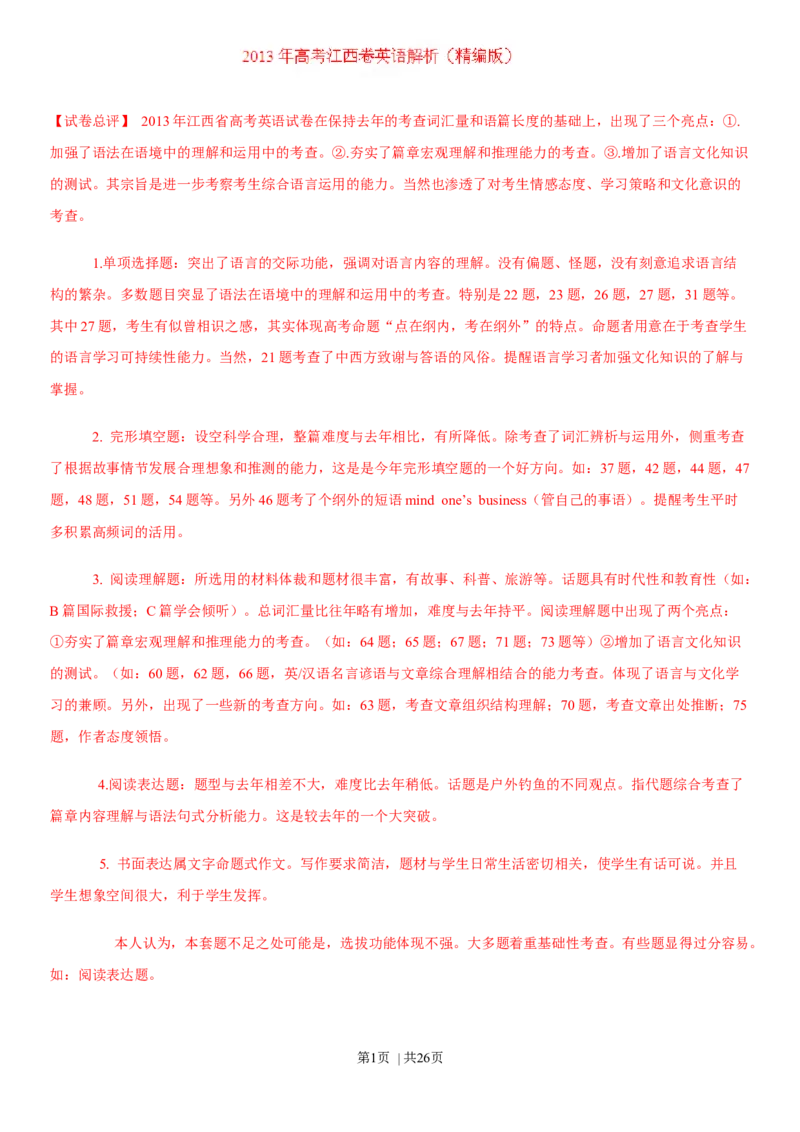
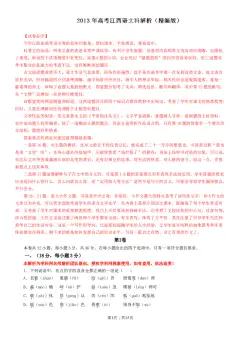
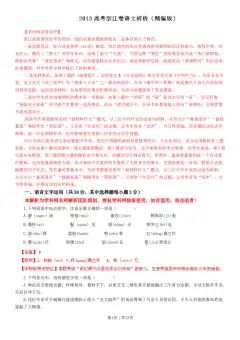
【试卷总评】 2013年江西省高考英语试卷在保持去年的考查词汇量和语篇长度的基础上,出现了三个亮点:①.
加强了语法在语境中的理解和运用中的考查。②.夯实了篇章宏观理解和推理能力的考查。③.增加了语言文化知识
的测试。其宗旨是进一步考察考生综合语言运用的能力。当然也渗透了对考生情感态度、学习策略和文化意识的
考查。
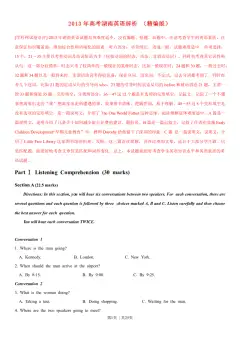
1.单项选择题:突出了语言的交际功能,强调对语言内容的理解。没有偏题、怪题,没有刻意追求语言结
构的繁杂。多数题目突显了语法在语境中的理解和运用中的考查。特别是22题,23题,26题,27题,31题等。
其中27题,考生有似曾相识之感,其实体现高考命题“点在纲内,考在纲外”的特点。命题者用意在于考查学生
的语言学习可持续性能力。当然,21题考查了中西方致谢与答语的风俗。提醒语言学习者加强文化知识的了解与
掌握。
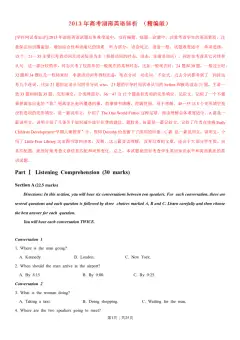
2. 完形填空题:设空科学合理,整篇难度与去年相比,有所降低。除考查了词汇辨析与运用外,侧重考查
了根据故事情节发展合理想象和推测的能力,这是是今年完形填空题的一个好方向。如:37题,42题,44题,47
题,48题,51题,54题等。另外46题考了个纲外的短语mind one’s business(管自己的事语)。提醒考生平时
多积累高频词的活用。
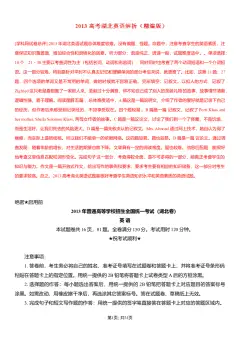
3. 阅读理解题:所选用的材料体裁和题材很丰富,有故事、科普、旅游等。话题具有时代性和教育性(如:
B篇国际救援;C篇学会倾听)。总词汇量比往年略有增加,难度与去年持平。阅读理解题中出现了两个亮点:
①夯实了篇章宏观理解和推理能力的考查。(如:64题;65题;67题;71题;73题等)②增加了语言文化知识
的测试。(如:60题,62题,66题,英/汉语名言谚语与文章综合理解相结合的能力考查。体现了语言与文化学
习的兼顾。另外,出现了一些新的考查方向。如:63题,考查文章组织结构理解;70题,考查文章出处推断;75
题,作者态度领悟。
4.阅读表达题:题型与去年相差不大,难度比去年稍低。话题是户外钓鱼的不同观点。指代题综合考查了
篇章内容理解与语法句式分析能力。这是较去年的一个大突破。
5. 书面表达属文字命题式作文。写作要求简洁,题材与学生日常生活密切相关,使学生有话可说。并且
学生想象空间很大,利于学生发挥。
本人认为,本套题不足之处可能是,选拔功能体现不强。大多题着重基础性考查。有些题显得过分容易。
如:阅读表达题。
第1页 | 共26页另试题创新性体现不够。如单选24,29题,有从资料上照搬之嫌。阅读A篇与D篇,好像都与环境话题
相关。
2013年普通高等学校招生全国统一考试(江西卷)
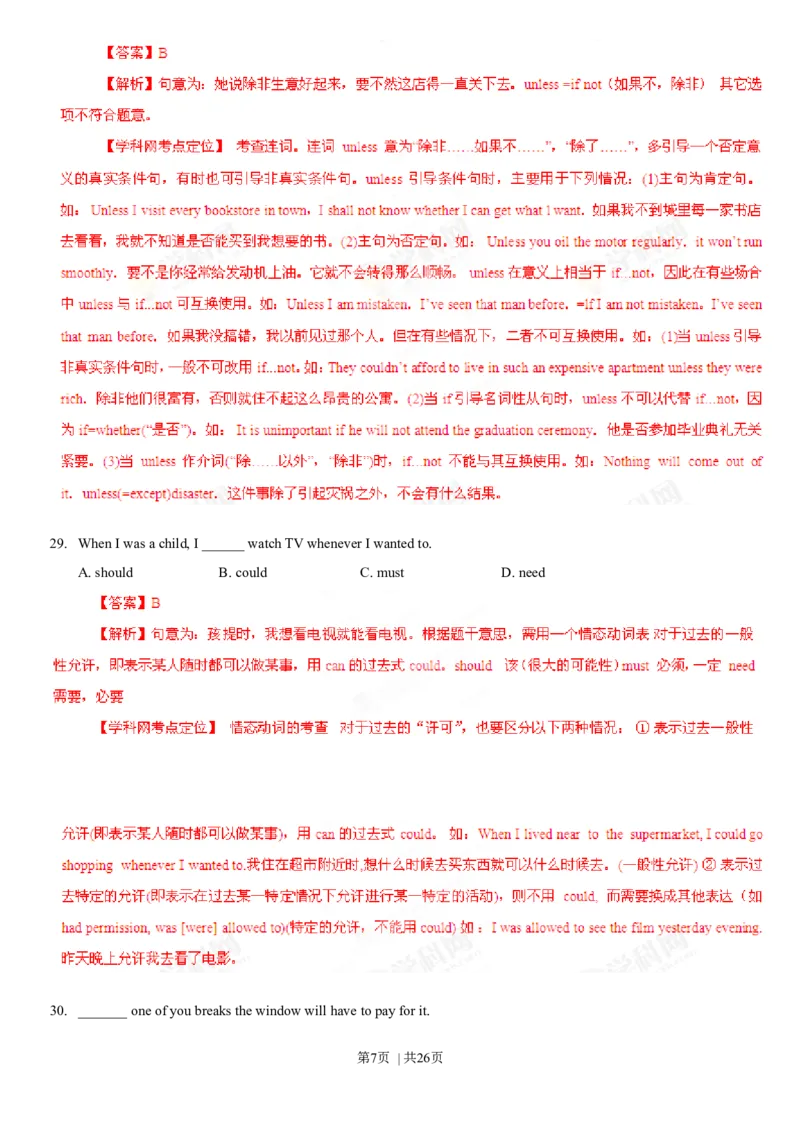
英 语
第Ⅰ卷(选择题 共115分)
本解析为学科网名师解析团队原创,授权学科网独家使用,如有盗用,依法追责!
第一部分 听力 (共两节,满分30分)
回答听力部分时,请先将答案标在试卷上。听力部分结束前,你将有两分钟的时间将您的答案转涂到客观答题卡
上。
第一节(共5小题:每小题1.5分,满分7.5分)
听下面5段对话,每段对话后有一个小题,从题中所给的A、B、C三个选项选出最佳选项,并标在试卷的相应位
置,听完每段对话后,你都有10秒钟的时间来回答有关小题和阅读下小题,每段对话仅读一遍。
例:How much is the shirt?
A. £19.15. B. £ 9.18 C.£9.15.
答案是C。
1. What does the man want to do?
A. Take photos. B. Buy a camera C. Help the woman
2. What are the speakers talking about?
A. A noisy night B. Their life in town C. A place of living
3. Where is the man now?
A. On his way B. In a restaurant C. At home
4. What will Celia do?
A. Find a player B. Watch a game C. Play basketball
5. What day is it when the conversation takes place?
A. Saturday B. Sunday C. Monday
第二节(共15小题:每小题1.5分,满分22.5分)
听下面5段对话。每段对话有几个小题,从题中所给的A、B、C三个选项中选出的最佳选项,并标在试卷的相应
位置。听每段对话前,你将有时间阅读各个小题,每小题 5秒钟;听完后,各小题给出5秒钟的做答时间。每段
对话读两遍。
听第6段材料,回答第6、7题。
6. What is Sara going to do?
A. Buy John a gift. B. Give John a surprise C. Invite John to France
第2页 | 共26页7. What does the man think of Sara’s plan?
A. Funny B. Exciting C. Strange.
听第7段材料,回答第8、9题。
8. Why does Diana say sorry to Peter?
A. She has to give up her travel plan.
B. She wants to visit another city.
C. She needs to put off her test.
9. What does Diana want Peter to do?
A. Help her with her study B. Take a book to her friend C. Teach a geography lesson.
听第8段材料,回答第10至12题。
10. Why does the man call the woman?
A. To tell her about her new job B. To ask about her job program C. To plan a meeting with her.
11. Who needs a new flat?
A. Alex B. Andrea. C. Miranda.
12. Where is the woman now ?
A. In Baltimore. B. In New York. C. In Avon
听第9段材料,回答第13至16题。
13. What does Jan consider most important when he judges a restaurant?
A. Where the restaurant is.
B. Whether the prices are low
C. How well the food is prepared.
14. When did Jan begin to write for a magazine?
A. After he came back to Sweden
B. Before he went to the United States.
C. As soon as he got his first job in 1982.
15. What may Jan do to find a good restaurant?
A. Talk to people in the street. B. Speak to taxi drivers C. Ask hotel clerks.
16. What do we know about Jan?
A. He cooks for a restaurant. B. He travels a lot for his work. C. He prefers American food.
听第10段材料,回答每17至20题。
17. What do we know about the Plaza Leon?
A. It’s a new building B. It’s a small town. C. It’s a public place.
18. When do parents and children like going to the Plaza Leon?
A. Saturday nights. B. Sunday afternoons. C. Fridays and Saturdays.
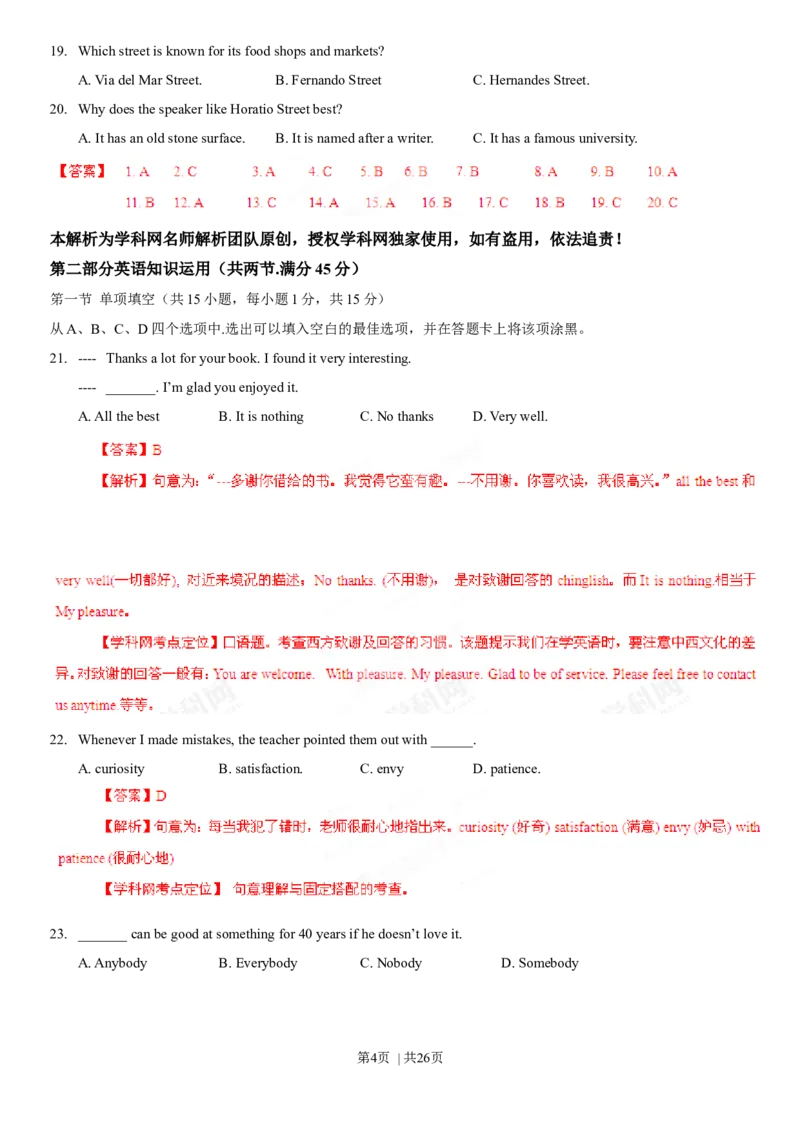
第3页 | 共26页19. Which street is known for its food shops and markets?
A. Via del Mar Street. B. Fernando Street C. Hernandes Street.
20. Why does the speaker like Horatio Street best?
A. It has an old stone surface. B. It is named after a writer. C. It has a famous university.
本解析为学科网名师解析团队原创,授权学科网独家使用,如有盗用,依法追责!
第二部分英语知识运用(共两节.满分45分)
笫一节 单项填空(共15小题,每小题1分,共15分)
从A、B、C、D四个选项中.选出可以填入空白的最佳选项,并在答题卡上将该项涂黑。
21. ---- Thanks a lot for your book. I found it very interesting.
---- _______. I’m glad you enjoyed it.
A. All the best B. It is nothing C. No thanks D. Very well.
22. Whenever I made mistakes, the teacher pointed them out with ______.
A. curiosity B. satisfaction. C. envy D. patience.
23. _______ can be good at something for 40 years if he doesn’t love it.
A. Anybody B. Everybody C. Nobody D. Somebody
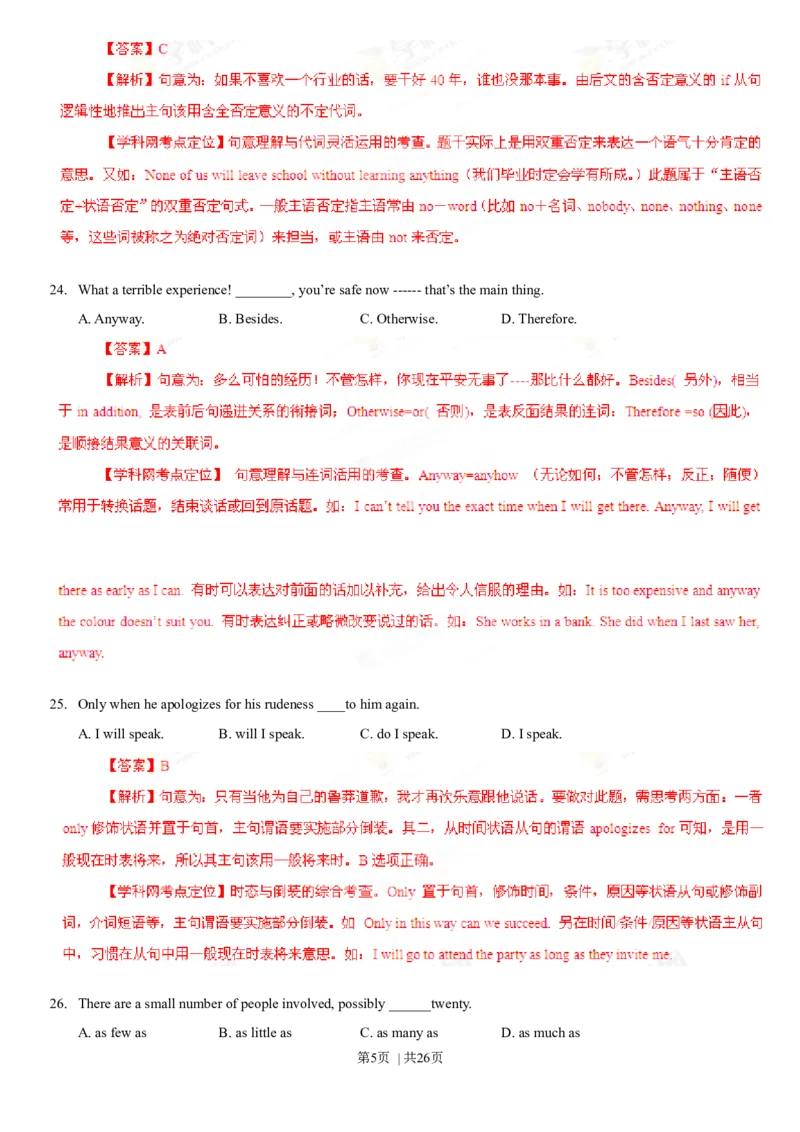
第4页 | 共26页24. What a terrible experience! ________, you’re safe now ------ that’s the main thing.
A. Anyway. B. Besides. C. Otherwise. D. Therefore.
25. Only when he apologizes for his rudeness ____to him again.
A. I will speak. B. will I speak. C. do I speak. D. I speak.
26. There are a small number of people involved, possibly ______twenty.
A. as few as B. as little as C. as many as D. as much as
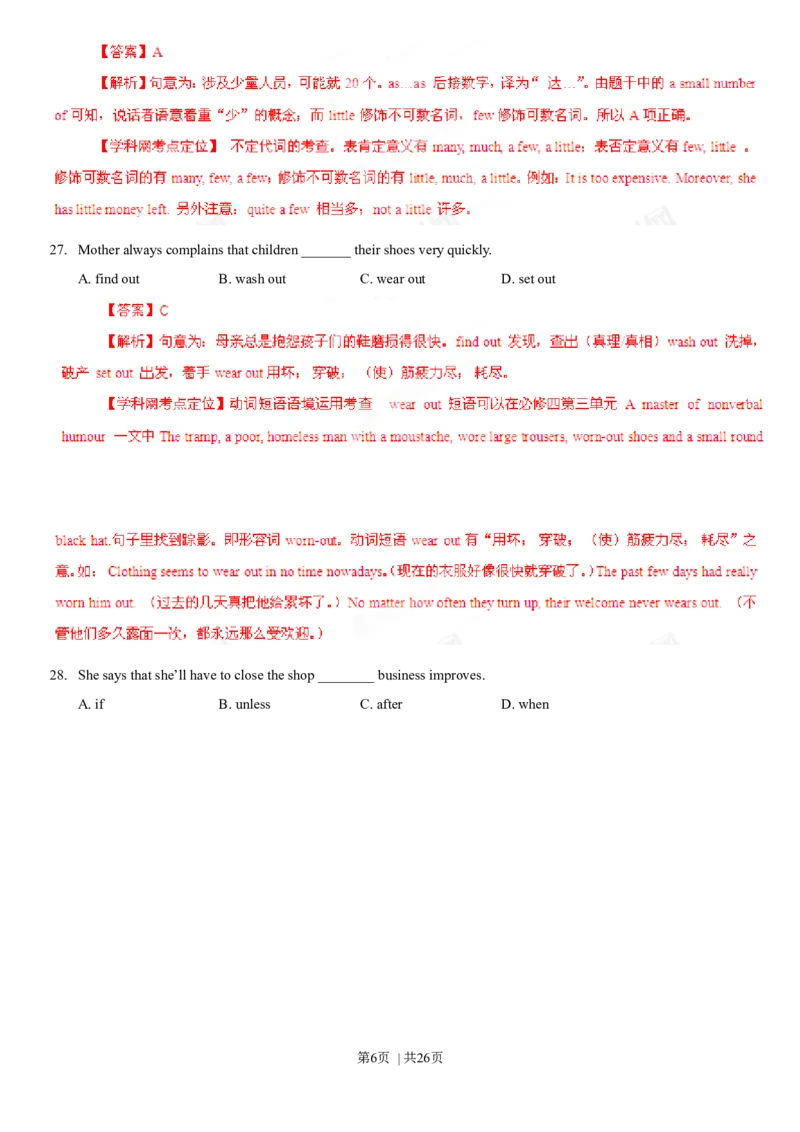
第5页 | 共26页27. Mother always complains that children _______ their shoes very quickly.
A. find out B. wash out C. wear out D. set out
28. She says that she’ll have to close the shop ________ business improves.
A. if B. unless C. after D. when
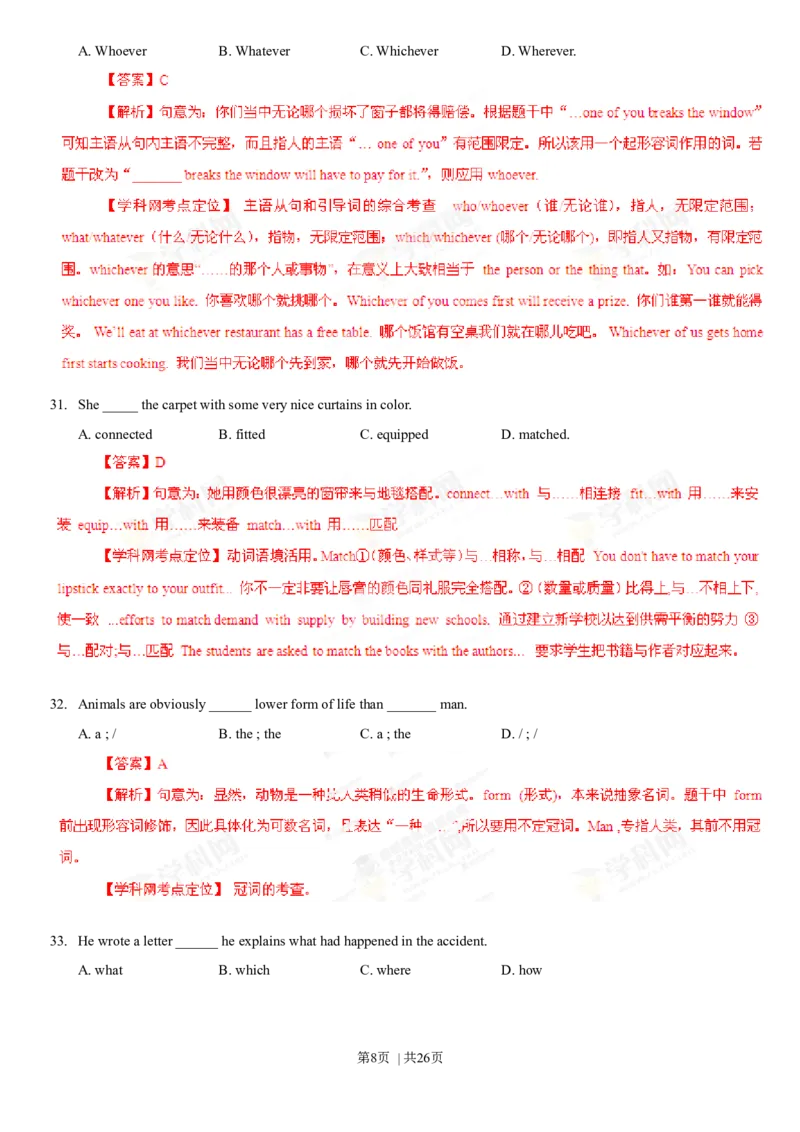
第6页 | 共26页29. When I was a child, I ______ watch TV whenever I wanted to.
A. should B. could C. must D. need
30. _______ one of you breaks the window will have to pay for it.
第7页 | 共26页A. Whoever B. Whatever C. Whichever D. Wherever.
31. She _____ the carpet with some very nice curtains in color.
A. connected B. fitted C. equipped D. matched.
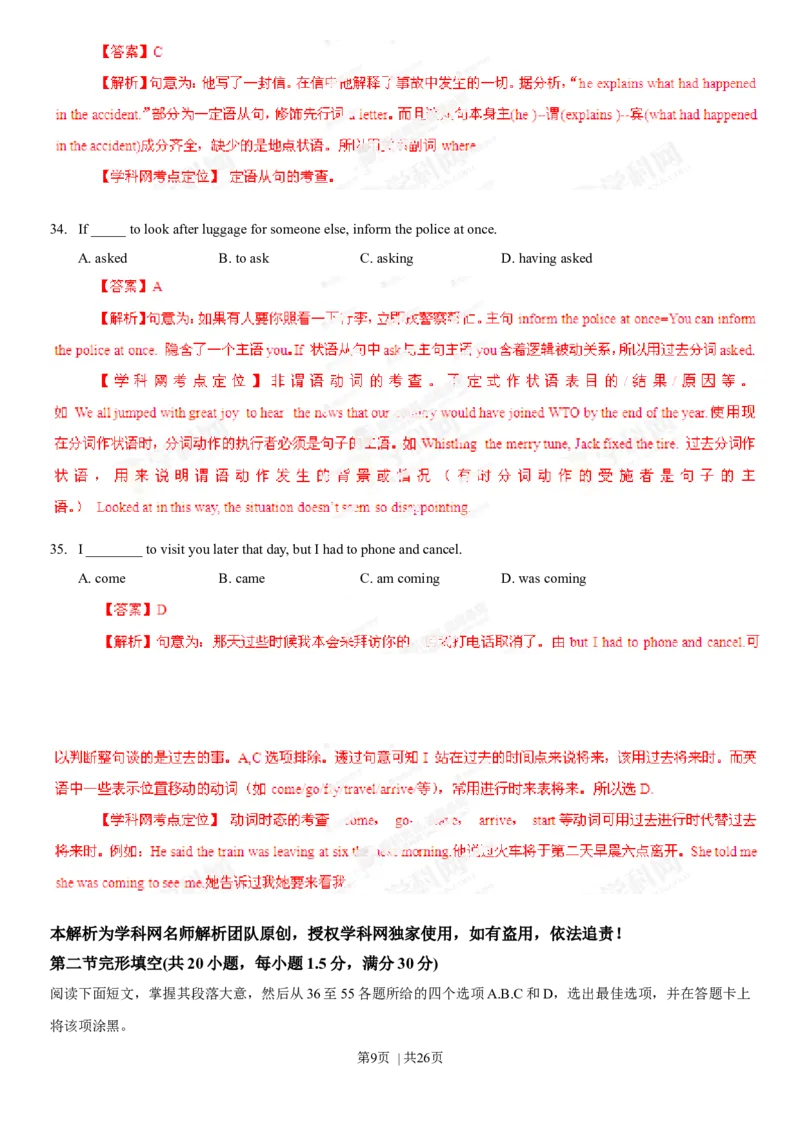
32. Animals are obviously ______ lower form of life than _______ man.
A. a ; / B. the ; the C. a ; the D. / ; /
33. He wrote a letter ______ he explains what had happened in the accident.
A. what B. which C. where D. how
第8页 | 共26页34. If _____ to look after luggage for someone else, inform the police at once.
A. asked B. to ask C. asking D. having asked
35. I ________ to visit you later that day, but I had to phone and cancel.
A. come B. came C. am coming D. was coming
本解析为学科网名师解析团队原创,授权学科网独家使用,如有盗用,依法追责!
第二节完形填空(共20小题,每小题1.5分,满分30分)
阅读下面短文,掌握其段落大意,然后从36至55各题所给的四个选项A.B.C和D,选出最佳选项,并在答题卡上
将该项涂黑。
第9页 | 共26页Diane Ray was completely self-centered and very spoilt. Her parents gave her 36 she wanted, knowing that she
would throw a temper tantrum(耍小孩脾气)if they did not. She would scream and kick and 37 on the floor drumming her
heels. Her parents always 38 .
That was why she was alone on the 39 , wearing an expensive swimsuit. It has taken a massive tantrum to 40 her
parents to buy it. They were back at the beach-house, 41 from the tantrum she had thrown when they told her that it was
too dangerous to go diving 42 . “Dangerous?” she had said. “You just don’t want me to have 43 . I’m going and if you try
to stop me, I’ll scream.”
“What are you doing ?” a voice asked. Diane jumped. She did not know that the man was there 44 he spoke .
“I’m going diving, ” she answered.
“You shouldn’t swim that day, ” the man 45 . “There is a storm coming up.”
“You should mind your own 46 !” Diane replied and walked into the gentle waves.
“If you go out there you’ll be 47 ,” the man called after her. She did not bother to reply.
Diane slipped into the water and dived 48 until white caps began rolling in and it became harder to 49 against the
current (水流). Saltwater hit against her face, making it 50 to breathe. Oh, why had she not listened to advice.
Panicking, she began to 51 . Then, just as it seemed as if she would slip beneath the surface, she heard a 52 voice.
“Hold on ! I’m coming.” With 53 , she saw the old man rowing an ancient-looking boat towards her. “I hope you’ve
learned a lesson. You put us both in 54 , ” he shouted angrily, as he dragged her over the side of the 55 . Gratefully, Diane
thanked him and ran towards the beach-house.
36. A. either B. neither C. nothing D. everything
37. A. jump B. lie C. spin D. sleep
38. A. set out B. set in C. gave in D. gave out
39. A. beach B. bed C. floor D. ship
40. A. allow B. warn C. get D. prefer
41. A. changing B. recovering C. appearing D. traveling
42. A. alone B. away C. again D. aside
43. A. time B. money C. food D. fun
44. A. when B. until C. after D. once
45. A. decided B. intended C. advised D. repeated
46. A. business B. swimsuit C. friends D. parents
47. A. angry B. sorry C. confused D. excited
48. A. nervously B. sadly C. shyly D. happily
49. A. rise B. swim C. stop D. row
50. A. difficult B. easy C. comfortable D. suitable
51. A. speak B. sing C. sniff D. scream
第10页 | 共26页52. A. calm B. frightening C. beautiful D. disgusting
53. A. regret B. relief C. interest D. ease
54. A. power B. safety C.. danger D. thought
55. A. house B. wave C. beach D. boat
第11页 | 共26页第12页 | 共26页本解析为学科网名师解析团队原创,授权学科网独家使用,如有盗用,依法追责!
第三部分 阅读理解(共20小题;每小题2份,满分40分)
阅读下列短文,从每题所给的四个选项(A、B、C和D)中,选出最佳选项,并在答题卡上将该项涂黑。
A
The light from the campfire brightened the darkness, but it could not prevent the damp cold of Dennis’s Swamp (沼泽
地) creeping into their bones. It was a strange place. Martin and Tom wished that they had not accepted Jack’s dare. They
liked camping, but not near this swamp.
“So,” Martin asked as they sat watching the hot coals. “How did this place get its name?”
“Are you sure you want to hear it ? It’s a scary story,” warned Jack.
“Of course!” cried out Tom. “If there were anything to be scared of, you wouldn’t have chosen this place!”
“Ok, but don’t say I didn’t warn you,” said Jack, and he began this tale.
“Way back in time, a man called Dennis tried to start a farm here. He built that cottage over there to live in. In those
days, the area looked quite different ---- it was covered with tall trees and the swamp was a crystal-clear river. After three
hard years, Dennis had cleared several fields and planted crops. He was so proud of his success that he refused to listen to
advice.
“‘You are clearing too much land,’ warned one old man. ‘ The land is a living thing. It will hit back at you if you abuse
it. ’
第13页 | 共26页“‘Silly fool,’ said Dennis to himself. ‘If I clear more land, I can grow more crops. I’ll become wealthier. He’s just
jealous!’”
“Dennis continued to chop down trees. Small animals that relied on them for food and shelter were destroyed. He was
so eager to expand his farm that he did not notice the river flowing slowly towards his door. He did not notice salt seeping
to the surface of the land. He did not notice swamp plants choking all the native plants.”
“What happened?” Martin asked. It was growing colder. He trembled, twisting his body closer to the fire.
“The land hit back ---- just as the old man warned,” Jack shrugged. “Dennis disappeared. Old folks around here
believe that swamp plants moved up from the river and dragged him underwater. His body was never found.”
“What a stupid story,” laughed Tom. “Plants can’t …” Before he had finished speaking, he screamed and fainted (晕
倒). The other two boys jumped up with fright, staring at Tom. Suddenly, they burst out laughing. Some green swamp ivy
(常春藤) had covered Tom’s face. It was a while before Tom could appreciate the joke.
56. The underlined word “dare” in Paragraph 1 is closed in meaning to ________.
A. courage B. assistance C. instruction D. challenge
57. Why did Jack tell Tom and Martin the story?
A. To frighten them.
B. To satisfy their curiosity.
C. To warn them of the danger of the place.
D. To persuade them to camp in the swamp.
58. Why did Dennis ignore the warning of the old man?
A. The old man envied him. B. The old man was foolish
C. He was too busy to listen to others. D. He was greedy for more crops.
59. Why did Tom scream and faint?
A. He saw Dennis’s shadow B. He was scared by a plant
C. His friends played a joke on him. D. The weather became extremely cold.
60. What lesson can we learn from the story of Dennis?
A. Grasp all, lose all. B. No sweat, no sweet.
C. It is no use crying over spilt milk. D. He who makes no mistakes makes nothing.
第14页 | 共26页第15页 | 共26页B
When international aid is given, steps must be taken to ensure (确保)that the aid reaches the people for whom it is
intended. The way to achieve this may not be simple. It is very difficult for a nation to give help directly to people in
another nation. The United Nations Organization (UNO) could undertake to direct the distribution of aid. Here however
rises the problem of costs. Also tied with this is time. Perhaps the UNO could set up a body of devoted men and women in
every country who can speedily distribute aid to victims of floods and earthquakes.
More than the help that one nation can give to another during a disaster; it would be more effective to give other forms
of help during normal times. A common proverb says, “Give me a fish and I eat for day, teach me to fish and I eat for a
lifetime.” If we follow this wise saying, it would be right to teach people from less developed nations to take care of
themselves. For example, a country could share its technology with another. This could be in simple areas like agriculture
or in more complex areas like medical and health care or even in building satellites. Even small country is able to help less
developed nations. Sometimes what is take for granted, like the setting up of a water purification plant or the administration
of a school, could be useful for countries which are looking about to solve common problems. It does not cost much to
share such simple things. Exchange students could be attached for a number of months or years and learn the required craft
while on the site. They can then take their knowledge back to their homelands and if necessary come back form time to
time to clear doubts or to update themselves. Such aid will be truly helpful and there is no chance of it being temporary or
of it falling into the wrong hands.
Many countries run extensive courses in all sorts of skills. It will not cost much to include deserving foreigners in
these courses. Besides giving effective help to the countries concerned, there is also the build-up of friendships to consider.
Giving direct help by giving materials may be effective in the short run and must continue to be given in the event of
emergencies. However, in the long run what is really effective would be the sharing of knowledge.
61. According to the author, how could international aid reach the victims in time?
A. By solving the cost problems
B. By solving the transportation problems
C. By setting up a body of devoted people in every country.
D. By relying on the direct distribution of the UNO.
62. What does the author try to express in the underlined sentence?
A. Providing food is vital B. Learning to fish is helpful
C. Teaching skills is essential D. Looking after others is important.
63. The second paragraph is developed mainly _________.
A. by example B. by process C. by comparison D. by contrast
64. Which aid is likely to fall into the wrong hands?
第16页 | 共26页A. A medical team. B. An exchange program.
C. A water plant. D. Financial support.
65. What can we infer about international aid from the passage?
A. It is facing difficulties. B. It is unnecessary during normal times
C. It should be given in the form of materials D. It has gained support developed countries
第17页 | 共26页C
Many people think that listening is a passive business. It is just the opposite. Listening well is an active exercise of our
attention and hard work. It is because they do not realize this, or because they are not willing to do the work, that most
people do not listen well.
Listening well also requires total concentration upon someone else. An essential part of listening well is the rule
known as ‘bracketing’. Bracketing includes the temporary giving up or setting aside of your own prejudices and desires, to
experience as far as possible someone else’s world from the inside, stepping into his or her shoes. Moreover, since listening
well involves bracketing, it also involves a temporary acceptance of the other person. Sensing this acceptance, the speaker
will seem quite willing to open up the inner part of his or her mind to the listener. True communication is under way and the
energy required for listening well is so great that it can be accomplished only by the will to extend oneself for mutual
growth.
Most of the time we lack this energy. Even though we may feel in our business dealings or social relationships that we
are listening well, what we are usually doing is listening selectively. Often we have a prepared list in mind and wonder, as
we listen, how we can achieve certain desired results to get the conversation over as quickly as possible or redirected in
ways more satisfactory to us. Many of us are far more interested in talking than in listening, or we simply refuse to listen to
what we don’t want to hear.
It wasn’t until toward the end of my doctor career that I have found the knowledge that one is being truly listened to is
frequently therapeutic(有疗效的) In about a quarter of the patients I saw, surprising improvement was shown during the
first few months of psychotherapy(心理疗法), before any of the roots of problems had been uncovered or explained. There
are several reasons for this phenomenon, but chief among them, I believe, was the patient’s sense that he or she was being
truly listened to, often for the first time in years, and for some, perhaps for the first time ever.
66. The phrase “stepping into his or her shoes” in paragraph 2 probably means _______.
A. preparing a topic list first B. focusing on one’s own mind
C. directing the talk to the desired results D. experiencing the speaker’s inside world
第18页 | 共26页67. What is mainly discussed in Paragraph 2?
A. How to listen well. B. What to listen to.
C. Benefits of listening. D. Problems in listening
68. According to the author, in communication people tend to ________.
A. listen actively B. listen purposefully
C. set aside their prejudices D. open up their inner mind
69. According to the author, the patients improved mainly because _______.
A. they were taken good care of. B. they knew they were truly listened to.
C. they had partners to talk to. D. they knew the roots of problems.
70. What type of writing the article likely to be?
A. Science fiction B. A news report. C. A medical report. D. Popular science
第19页 | 共26页D
One might expect that the ever-growing demands of the tourist trade would bring nothing but good for the countries
that receive the holiday-makers. Indeed, a rosy picture is painted for the long-term future of the holiday industry. Every
month sees the building of a new hotel somewhere, and every month another rock-bound Pacific island is advertised as the
'last paradise(天堂) on earth'.
However, the scale and speed of this growth seem set to destroy the very things tourists want to enjoy. In those
countries where there was a rush to make quick money out of sea-side holidays, over-crowded beaches and the concrete
jungles of endless hotels have begun to lose their appeal.
Those countries with little experience of tourism can suffer most. In recent years, Nepal set out to attract foreign
visitors to fund developments in health and education. Its forests, full of wildlife and rare flowers, were offered to tourists
as one more untouched paradise. In fact, the nature all too soon felt the effects of thousands of holiday-makers traveling
through the forest land. Ancient tacks became major routes for the walkers, with the consequent exploitation of precious
trees and plants.
Not only can the environment of a country suffer from the sudden growth of tourism. The people as well rapidly feel
its effects. Farmland makes way for hotels, roads and airports; the old way of life goes. The one-time farmer is now the
servant of some multi-national organization; he is no longer his own master. Once it was his back that bore the pain; now it
is his smile that is exploited. No doubt he wonders whether he wasn't happier in his village working his own land.
Thankfully, the tourist industry is waking up to the responsibilities it has towards those countries that receive its
customers. The protection of wildlife and the creation of national parks go hand in hand with tourist development and in
第20页 | 共26页fact obtain financial support from tourist companies. At the same time, tourists are being encouraged to respect not only the
countryside they visit but also its people.
The way tourism is handled in the next ten years will decide its fate and that of the countries we all want to visit. Their
needs and problems are more important than those of the tourist companies. Increased understanding in planning world-
wide tourism can preserve the market for these companies. If not, in a few years’ time the very things that attract tourists
now may well have been destroyed.
71. What does the author indicate in the last sentence of Paragraph 1?
A. The Pacific Island is a paradise. B. The Pacific Island is worth visiting.
C. The advertisement is not convincing. D. The advertisement is not impressive
72. The example of Nepal is used to suggest _________.
A. its natural resources are untouched. B. its forests are exploited for farmland
C. it develops well in health and education. D. it suffers from the heavy flow of tourists.
73. What can we learn about the farmers from Paragraph 4?
A. They are happy to work their own lands.
B. They have to please the tourists for a living.
C. They have to struggle for their independence.
D. They are proud of working in multi-national organizations.
74. Which of the following determines the future of tourism?
A. The number of tourists B. The improvement of services.
C. The promotion of new products. D. The management of tourism
75. The author’s attitude towards the development of the tourist industry is __________.
A. optimistic B. doubtful C. objective D. negative
第21页 | 共26页第二卷(非选择题 满分35分)
注意事项:
第22页 | 共26页第二卷2页,须用黑色墨水签字笔在答题卡上书写作答。如在试题卷上作答,答案无效。
第四部分 写作(共两节,满分35分)
本解析为学科网名师解析团队原创,授权学科网独家使用,如有盗用,依法追责!
第一节 阅读表达(共5小题;每小题2分,满分10分)
阅读下面短文并回答问题,然后将答案写到答题卡相应的位置上(请注意问题后的词数要求)。
[1] Fishing is probably the world’s most popular sport. People spend many dollars each year on items like boats and
four-wheel-drive vehicles. In addition, they spend money on fishing equipment, bait, fuel and boat repairs. And you can see
that fishing can be an expensive pastime. Fishing lovers believe that their hobby is worth it. Others say that fishing is
spoiling the environment and that it is a cruel hobby.
[2] Supporters of fishing say that it is a nice hobby. Firstly, of the millions of people who fish for fun, most only catch
enough fish to feed their families. They catch fish that are found in large numbers, so there is little danger to the species (种
类).
[3] Secondly, recreational fishermen contribute to the economy. They spend money on equipment and other items, and
they also spend it indirectly by paying taxes on their equipment and fuel. Those who travel to fishing spots pay for
accommodation (食宿) and airfares. This money keeps people in work and provides new jobs each year.
[4] Thirdly, fishing is relaxing and fun so it lessens stress. Instead of turning to drugs or alcohol, it is far better to go
fishing. People who are relaxed are generally healthier and much nicer to be near ----- except for the smell of the bait!
[5] Those who _________________ say that there are too many fish thoughtlessly taken from rivers, lakes, streams
and oceans. This could lead to the dying out of some species. Modern cars and boats mean that people can fish in remote
areas of the world, so no place is safe from greedy fishermen who take both males and females, leaving few fish to produce
young.
[6] Those against fishing also say that it is a blood sport, which means that an animal must die so that a human can
have fun. Many of the fish caught for sport are not suitable for eating, so they are thrown away. Once hooked, fish have no
chance of escape.
76. What is the main idea of the passage? (no more than 4 words)
__________________________________________________________________________________
77. According to Paragraph 2, why does fishing cause little danger to the species? (no more than 8 words)
__________________________________________________________________________________
78. List 4 items on which people spend their money for fishing. (no more than 7 words)
__________________________________________________________________________________
79. Fill in the blank in Paragraph 5 with proper words.
Those who _________say that there are too many fish thoughtlessly taken from rivers, lakes, streams and oceans.
80. What does the word “which” (Line 1, Paragraph6) probably refer to? (no more than 3 words)
第23页 | 共26页__________________________________________________________________________________
第24页 | 共26页本解析为学科网名师解析团队原创,授权学科网独家使用,如有盗用,依法追责!
第二节 书面表达(满分25分)
星光中学(Xingguang High School)近期举行了一次登山活动。假定你是学校英语报记者,请写一篇短文,
报道此次活动。内容包括:
1. 时间与地点:4月10日,大青山(Daqing Mountain);
2. 活动的过程;
3. 你对于这次活动的评论。
注意: 1. 词数120左右。
2. 可适当增加细节,以使行文连贯。
第25页 | 共26页第26页 | 共26页