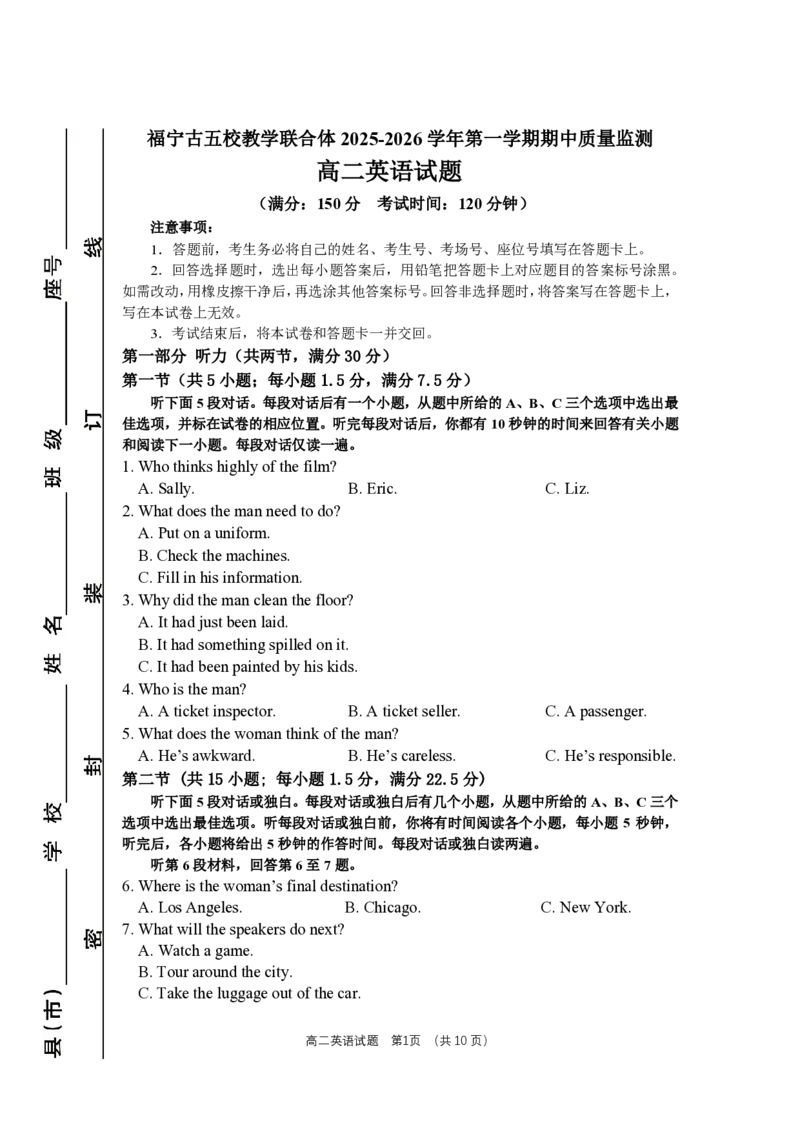
福宁古五校教学联合体 2025-2026 学年第一学期期中质量监测
高二英语试题
(满分:150分 考试时间:120分钟)
注意事项:
1.答题前,考生务必将自己的姓名、考生号、考场号、座位号填写在答题卡上。
2.回答选择题时,选出每小题答案后,用铅笔把答题卡上对应题目的答案标号涂黑。
如需改动,用橡皮擦干净后,再选涂其他答案标号。回答非选择题时,将答案写在答题卡上,
写在本试卷上无效。
3.考试结束后,将本试卷和答题卡一并交回。
第一部分 听力(共两节,满分 30分)
第一节(共 5小题;每小题 1.5 分,满分 7.5 分)
听下面5段对话。每段对话后有一个小题,从题中所给的A、B、C三个选项中选出最
佳选项,并标在试卷的相应位置。听完每段对话后,你都有10秒钟的时间来回答有关小题
和阅读下一小题。每段对话仅读一遍。
1. Who thinks highly of the film?
A. Sally. B. Eric. C. Liz.
2. What does the man need to do?
A. Put on a uniform.
B. Check the machines.
C. Fill in his information.
3. Why did the man clean the floor?
A. It had just been laid.
B. It had something spilled on it.
C. It had been painted by his kids.
4. Who is the man?
A. A ticket inspector. B. A ticket seller. C. A passenger.
5. What does the woman think of the man?
A. He’s awkward. B. He’s careless. C. He’s responsible.
第二节 (共 15 小题; 每小题 1.5 分,满分 22.5 分)
听下面5段对话或独白。每段对话或独白后有几个小题,从题中所给的A、B、C三个
选项中选出最佳选项。听每段对话或独白前,你将有时间阅读各个小题,每小题 5 秒钟,
听完后,各小题将给出5秒钟的作答时间。每段对话或独白读两遍。
听第6段材料,回答第6至7题。
6. Where is the woman’s final destination?
A. Los Angeles. B. Chicago. C. New York.
7. What will the speakers do next?
A. Watch a game.
B. Tour around the city.
C. Take the luggage out of the car.
高二英语试题 第1页 (共10页)
{#{QQABZYAAogAoAIBAAQhCUwVSCgCYkBEACIgGwAAQoAAAABFABAA=}#}听第7段材料,回答第8至10题。
8. What’s the probable relationship between the speakers?
A. Friends. B. Brother and sister. C. Shop assistant and customer.
9. Which item will the man take?
A. The shirt. B. The hat. C. The belt.
10. What does the woman intend to do with the clothes?
A. Give them to charity.
B. Leave them to her sister.
C. Sell them in online shops.
听第8段材料,回答11至13题。
11. Which class are the speakers in?
A. Science. B. History. C. Writing.
12. Where are the speakers?
A. In New York. B. In Washington. C. In San Francisco.
13. What will the man probably do after answering the question?
A. Finish homework. B. Take an exam. C. Text Jemma.
听第9段材料,回答14至17题。
14. Why did the woman join the activities on the Healthy Living Day?
A. To do more exercise.
B. To make new friends.
C. To try something different.
15. What was the woman’s feeling at the end of the Healthy Living Day?
A. Thirsty. B. Sick. C. Tired.
16. When is the next Healthy Living Day?
A. On April 14th. B. On May 28th. C. On July 5th.
17. What sport has the woman chosen for her next Healthy Living Day?
A. Skateboarding. B. Boating. C. Cycling.
听第10段材料,回答18至20题。
18. What should you pay attention to when flying a kite?
A. Hidden caves. B. Diving birds. C. High waves.
19. What should you be careful of in rock pools?
A. Dangerous fish.
B. Water on your legs.
C. The sand in your toes.
20. What is the main topic of the talk?
A. Scenery on the coast.
B. Things to do on the coast.
C. The best places to go on the coast.
高二英语试题 第2页 (共10页)
{#{QQABZYAAogAoAIBAAQhCUwVSCgCYkBEACIgGwAAQoAAAABFABAA=}#}第二部分 阅读(共两节,满分 40分)
第一节(共 15小题;每小题 2.5分,满分 37.5分)
阅读下列短文,从每题所给的A、B、C和D四个选项中选出最佳选项。
A
We’re happy to introduce News for Classroom Use: a weekly newsletter with a
piece of news and activities based on it which you can use as a warm-up, a filler or a
wrap-up task. The newsletter might include: discussion questions, tasks around
headlines and images, comments to respond to, vocabularies and links to related ESL
Brains lesson plans.
How to use the newsletter
The stories covered in the newsletter range from breaking news to more evergreen
content which you will be able to go back to according to your students’ needs. The
newsletter itself has several parts.
INTRO: A short paragraph describing what the news is about. You might need to read
it out to students or it may also serve as a reference point to you, depending on the
activities that go with the particular piece of news.
ACTIVITY: A task or tasks for students to work on in the classroom. Each newsletter
contains a set of questions related to the news. You might ask students to discuss all of
them or just some of them. If you teach lower-level students, use the easier questions
or just ask students to say what they think about the news. Other activities might include
completing headlines, commenting on pictures, reporting what students have heard
about the news, etc.
Subscribe to the newsletter
If you are an Unlimited or a Premium user and you’re subscribed to our newsletters,
the News for Classroom Use newsletter will drop into your mailbox every Wednesday.
21. Which is a feature of the newsletter?
A. It posts daily updates. B. It contains advanced vocabularies.
C. It emphasizes breaking news. D. It offers reusable reading materials.
22. What activity can be recommended to beginners?
A. Rewriting related news. B. Choosing news pictures.
C. Expressing their opinions. D. Contributing to the newsletter.
23. Who is the text intended for?
A. News presenters. B. Teachers.
C. Foreign students. D. Journalists.
高二英语试题 第3页 (共10页)
{#{QQABZYAAogAoAIBAAQhCUwVSCgCYkBEACIgGwAAQoAAAABFABAA=}#}B
The first model was Napster, a lovely American Staffordshire terrier. She was just
5 months old when she was rescued from an animal cruelty situation. Although safe in
the shelter environment, she was there for over a year and developed behavioral issues.
No one stepped forward to adopt her.
Miller, an animal behavior consultant, and Spidle, both from Harrisburg,
Pennsylvania, signed up to do a “paint your pet” event together, and saw Napster's inner
beauty and potential. “I really wanted to help get her out and into a foster(寄养的)
home,” Miller tells Daily Paws. She used a picture of Napster as inspiration and created
her first dog portrait(画像). Spidle says Napster's story made a light bulb go off, and
she and Miller brainstormed about how interesting it would be to help overlooked
shelter dogs in Central Pennsylvania get adopted through art. In 2019, they started the
nonprofit Cheddar Paws Dog Art.
Miller and Spidle aren't professional artists, but in addition to their full-time jobs,
they're enthusiastic animal advocates. They persuaded local businesses to hang dog
portraits with shelter information. Other artists stepped forward to donate their time
and talent to give each pup(小狗)the star treatment. The result? Pure magic.
"To date, we've painted 197 dogs, and 138 have been adopted,” says Spidle.
She adds that when a shelter pup is gone before finding a home, Cheddar Paws
donates their painting as a memorial piece. Unfortunately, Napster crossed the rainbow
bridge shortly after the pair met her. Miller's initial portraits of this sweet pup remind
her of the work she and Spidle hope to do with other pets. They celebrate each success
on social media.
"It's so rewarding to be able to post a long-termer with 'Adopted' stamped on their
portrait!" Spidle says. “We can't wait to see those numbers go up!”
24. Why did Miller and Spidle create Cheddar Paws Dog Art?
A. To raise money for dog rescue.
B. To help shelter dogs find homes.
C. To call on people to care for dogs.
D. To make pet-keeping more popular.
25. Which word best describes Cheddar Paws Dog Art?
A. Successful. B. Profitable. C. Well-organized. D. Entertaining.
26. What does the underlined phrase “crossed the rainbow bridge" in paragraph 5 mean?
A. Fell ill. B. Got lost. C. Passed away. D. Got injured.
27. What is the author's purpose in writing the text?
A. To appreciate the power of art.
B. To raise awareness of animal care.
C. To stress the importance of dog rescue.
D. To share a story of helping shelter dogs.
高二英语试题 第4页 (共10页)
{#{QQABZYAAogAoAIBAAQhCUwVSCgCYkBEACIgGwAAQoAAAABFABAA=}#}C
About 4 billion people already experience water shortage for at least one month a
year and this number could double by 2050, according to a 2024 study. Yet progress on
water-shortage targets under the UN Sustainable Development Goals is off track.
Professor Guenther, director of the UN University's Institute, says that water shortage
has largely been invisible to policymakers.
Fortunately, many technologies to make better use of water resources are
developing. These include technologies to improve the efficiency of typically energy-
intensive desalination(海水的脱盐)plants, and the improved biological treatment
processes that effectively double the capacity of wastewater treatment plants to increase
the water available for industrial and agricultural use.
Investment has not always been available for water resource solutions. The water
sector is a $500 billion marketplace, representing a huge opportunity for investors. But
investing in this area requires a willingness to wait for returns in the longer term.
Investment in new technologies is not the only answer, says Brooke, co-editor of
Unconventional Water Resources, a book published by the UN earlier this year to urge
the use of various and plentiful resources that until now have not received much
attention. These range from the millions of cubic kilometers of water in deep land-
based and seabed aquifers(含水层),and in fog and icebergs,to reusing water from
the ballast holds(压载舱)of thousands of ships for agriculture.
“It is a human approach to think that sufficient technology will address the problem.
But if there's no rain, if the groundwater level gets lower and lower, if we cannot dig
deeper, and there is no option for desalination, this is when we start thinking," says
Brooke. “But by then it's very often too late.”
28. What causes the slow progress on water-shortage solutions according to Guenther?
A. Insufficient funds. B. The lack of effective policies.
C. Outdated technology. D. The rise of global warming.
29. What stops investors from investing in the water sector?
A. The limited market. B. The long profit cycle.
C. The high investment risk. D. The large initial investment.
30. Which measure did the UN suggest taking earlier this year?
A. Promoting water use efficiency.
B. Improving wastewater treatment.
C. Building more desalination plants.
D. Seeking alternative water resources.
31. What does the last paragraph mainly convey?
A. To issue a warning. B. To launch an appeal.
C. To make a prediction. D. To highlight an approach.
高二英语试题 第5页 (共10页)
{#{QQABZYAAogAoAIBAAQhCUwVSCgCYkBEACIgGwAAQoAAAABFABAA=}#}D
When we’re tired or injured, we often go to bed earlier to recharge and mend our
bodies. That’s because we often think that night is a golden time to deal with stress or
injuries. But is it true?
Nathaniel Hoyle, a scientist of the Laboratory of Molecular Biology in Cambridge,
UK, has been leading a study into this topic. The team discovered that fibroblast cells
(成纤维细胞) in the body switch off at night. These cells help close up a wound after
the skin is broken and lay a foundation for new skin to grow. Why exactly are these
cells less active at night?
It’s all to do with your body’s circadian (昼夜节律的) rhythm—a 24-hour internal
clock that helps your cells do their jobs on time. New Scientist reported that a group of
30 genes that control the fibroblasts worked only daytime shifts, causing the slower
healing process at night. To test its theory, the Cambridge-based team examined data
from the International Burn Injury Database, which records details of burn victims
around the world. This analysis revealed that nighttime burns, on average, took 11 more
days to heal than burns during the day.
A similar result occurred while experimenting using live mice. Those that were cut
during night-time hours recovered more slowly than those during the day. “You can see
by eyes, when the cell is wounded only 8 hours apart from each other, in different
circadian periods, the daytime wounded ones take off, and the nighttime ones drag,”
research team member John O’Neill told Science Alert. He added, “The time-varying
response may be an evolutionary adaptation. As people are more likely to sustain
injuries when awake than when sleeping, perhaps our bodies are prepared to respond
more quickly in the daytime.” He went on to say that it could be beneficial to schedule
surgeries in time with people’s circadian rhythms, earlier for early birds and later for
night owls, in order to lessen recovery time. However, in any case, it might be best not
to use anything sharp once the sun goes down.
32. Why does the author mention people going to bed earlier when tired or injured?
A. To list common methods of recharging the body
B. To explain why people suffer from injuries easily
C. To prove sleep is the only method to deal with stress
D. To arouse readers’ interest in the truth of night healing
33. What do the researchers find during their research?
A. Burns take the same time to heal regardless of their cut time.
B. Fibroblast cells boost the healing by working nighttime shift.
C. Mice respond differently in the healing process from humans.
D. A body’s circadian rhythm matters in waking up fibroblast cells.
高二英语试题 第6页 (共10页)
{#{QQABZYAAogAoAIBAAQhCUwVSCgCYkBEACIgGwAAQoAAAABFABAA=}#}34. How might scheduling surgeries according to circadian rhythms help patients?
A. It can reduce the risk of surgery failure.
B. It can reduce the pain felt during surgery.
C. It can shorten the recovery time after surgery.
D. It can help patients wake up faster after surgery.
35. What can be a suitable title for this passage?
A. Why We Heal Injuries Better in the Daytime
B. A Research Offers Clues to Treating Injuries
C. How We Heal Wounds and Injuries Effectively
D. Scientists Unlock the Secret to Avoiding Injuries
第二节(共 5小题:每小题 2.5分,满分 12.5分)
阅读下面短文,从短文后的选项中选出能填入空白处的最佳选项。其中两项为多余选项。
People are constantly bombarded (轰炸) with unrealistic and potentially harmful
images of “ideal” body types. 36 It’s also important to learn what your body can
physically do and become comfortable. In order to accept your body, it’s important to
get in touch with both of these aspects of your body on their own terms.
Accept your body as it is. This means not trying to change who you are or focus
on qualities you don’t like. Learn to enjoy your body — how you move, feel, and get
around. 37 Be kind to your body as it is right now.
38 As soon as you notice yourself starting to have a negative thought, take
the place of it with something positive about yourself. Give yourself time to get into
the habit of thinking positively. Try starting each day by thinking a few positive
thoughts. Remind yourself of these thoughts throughout the day when you start feeling
critical of yourself.
Compare yourself only to yourself. 39 There’s no point in comparing
yourself to others, regardless of whether the person is a celebrity or classmate sitting
next to you. Instead, compare yourself in terms of how you’ ve progressed over time,
now that you’ve created your own realistic goals. For example, you might think to
yourself that you’ve improved your appearance compared to a few years ago.
Know when to seek help. Understand that nearly everyone struggles to maintain
positive body image all the time and it’s normal to have ups and downs. 40 There
are various signs that your body issues are severe and require professional help.
A. Replace negative thoughts with positive ones.
B. Identify what you like about your body and appearance.
C. Let go of how you used to look at changes in your body.
D. Negative thoughts do nothing to improve your self-image.
E. The world would be pretty boring if we all looked identical.
F. But you should also honestly consider whether to consult a specialist.
G. This can make it tough to feel confident in your own body, which is critical.
高二英语试题 第7页 (共10页)
{#{QQABZYAAogAoAIBAAQhCUwVSCgCYkBEACIgGwAAQoAAAABFABAA=}#}第三部分 完形填空(共 15小题;每小题 1分,满分 15分)
阅读下面短文,从短文后各题所给的A、B、C、D四个选项中选出可以填入空白处
的最佳选项。
I didn’t possess any of that pioneer spirit of exploring the unknown. Besides, the
long journey would take money for transportation, 41 and meals. Unless someone
paid for all those 42 items, that road trip wasn’t happening anytime soon. But I
always imagined 43 being at all the places.
I had only read about in books. One day, I noticed a brochure 44 a teacher
creativity fellowship (团队) program for the summer. This fellowship was for teachers
like me who had taught for a number of years and needed a new 45 for continuing
our teaching career. I read over the 46 of the program. One of the examples 47
traveling to domestic (国内的) locations to study literature and history. Not expecting
any 48 , I went ahead and mailed my 49 . Then, reality hit me. Two months
later, I learned I was one of eighty 50 from hundreds of applicants.
With a(n) 51 on the outside and fear on the inside, I 52 the process of
packing and booking hotels near the sites I wished to visit. I started on my travels the
next morning with a new purpose in each step.
Yes, I 53 my adventure and continued using all I learned in my long
teaching career. Ever since that trip, I have traveled to 54 locations and given
presentations about my fellowship and my life has changed due to a brave 55 .
41.A.security B.commitment C.intelligence D.accommodations
42.A.efficient B.essential C.potential D.convenient
43.A.hardly B.actually C.gradually D.automatically
44.A.seeking B.warning C.detecting D.advertising
45.A.passion B.prediction C.interaction D.consumption
46.A.feature B.structure C.content D.conclusion
47.A.resisted B.opposed C.repeated D.mentioned
48.A.plot B.delay C.success D.hesitation
49.A.draft B.essay C.application D.assessment
50.A.removed B.selected C.adjusted D.investigated
51.A.anxiety B.delight C.annoyance D.embarrassment
52.A.set up B.put off C.went through D.brought about
53.A.switched B.ceased C.prohibited D.accomplished
54.A.abnormal B.unfamiliar C.invisible D.unavailable
55.A.inquiry B.attempt C.encounter D.appointment
高二英语试题 第8页 (共10页)
{#{QQABZYAAogAoAIBAAQhCUwVSCgCYkBEACIgGwAAQoAAAABFABAA=}#}第四部分 语法填空(共 10小题:每小题 1.5分, 满分 15分)
阅读下面短文,在空白处填入1个适当的单词或括号内单词的正确形式。
We use both words and body language to express our ideas in our interactions with
other people, learning a lot about 56. people are thinking by watching their
body language.
Just like spoken language, body language 57. (vary) from culture to
culture. The crucial thing is using body language in 58. way that is
appropriate to the culture you are in. For example, making eye contact in some
countries is to display interest but is not always 59. (approve) of in many
Middle Eastern countries, where men and women are not 60. (social)
permitted to make eye contact.
The gesture for “OK” has different meanings in different cultures. In Japan,
someone 61. witnesses another person employing the gesture might think it
means money, while in France, a person 62. (encounter) an identical
gesture may interpret it as meaning zero.
Some body language, like a smile, can help us get 63. difficult
situations and find friends in a world of strangers, and break down barriers. We can use
a smile to make an 64. (apologise), to greet someone, to ask for help, or to
start a conversation. If we are feeling down or lonely, there is nothing 65.
(good) than seeing the smiling face of a good friend.
第五部分 书面表达 (共两节, 满分 40分)
第一节 应用文( 满分 15分)
随着全球数字化,人工智能产品已悄然融入我们的生活。假如你是李华,
近期你班英语课的 presentation 的主题是“AI与我们”,请你写一篇英文报
告,主要内容包括:
1.简要介绍 AI(应用、影响等);
2.未来人们该如何与 AI共存。
注意:
1.词数80左右;
2.可适当增加细节,以使行文连贯。
Good morning, everyone! _____________________________________________
____________________________________________________________________
____________________________________________________________________
____________________________________________________________________
Thanks for your listening!
高二英语试题 第9页 (共10页)
{#{QQABZYAAogAoAIBAAQhCUwVSCgCYkBEACIgGwAAQoAAAABFABAA=}#}第二节 读后续写(满分 25分)
阅读下面材料,根据其内容和所给段落开头语续写两段,使之构成一篇完整
的短文。
The summer break was drawing near. Leo and his brother Max burst with joy and
kept talking about the trip at the thought of visiting their grandparents again.
The long-awaited day came at last. With the whole family all packed and ready
they headed eagerly right away to their grandparents’ small house. On the way the
brothers chatted excitedly about the fun times they’d shared with their grandparents
before.
At last a cozy small blue house with a high white chimney came into sight
gradually. Behind it lay the quiet forest holding their sweet good memories with
Grandpa. They pulled up at the driveway where Grandma stood at the end waiting
happily with a big smile.
Leo and Max each hugged Grandma tightly, then rushed quickly into the living
room, yelling “Grandpa, we’re home!”
Seeing them walk in, Grandpa was over the moon. He tried to stand with all his
strength from his chair but failed, a helpless look flashing across his face. Grandma
explained his health had worsened fast lately and he might never stand up alone again.
But Grandpa insisted stubbornly, “I can!” Still in his boyish way. Mum and the
grandparents were delighted to reunite after such a long time, sitting together and
chatting about what had happened recently.
Bored with the adults’ slow conversation, the brothers wandered into the green
forest. Tall trees stretched high skyward, thick branches crossing overhead while young
ones standing straight like brave guards. Grandpa was once a great explorer full of
wisdom. He could tell birds’ origins easily by their calls. Trees, birds, lizards, small
bugs… How many happy moments they’d shared with him here before!
Worried Grandpa couldn’t stand up, Leo said “We need to cheer him up.”
“Grandpa loves birds — let’s catch one for him?” Max suggested softly. “But he hates
birds being caged!” Leo shook his head firmly.
注意:续写词数应为 150左右。
Then a clever thought hit Leo suddenly. ________________________________
____________________________________________________________________
____________________________________________________________________
____________________________________________________________________
____________________________________________________________________
Filled with joy, the two brothers presented it to Grandpa. __________________
____________________________________________________________________
____________________________________________________________________
____________________________________________________________________
____________________________________________________________________
高二英语试题 第10页 (共10页)
{#{QQABZYAAogAoAIBAAQhCUwVSCgCYkBEACIgGwAAQoAAAABFABAA=}#}!"#$%&’()*#$#%!#$#&’+,-’./0.12345
6789:;
<=:;
!"
!!%!’()’)!&!!$!((’(’!!!!!%!)’)(’!!&!#$!)’)’)
#$
#!!#*!+()!#"!#,!)’(+!#-!*!!))+’!*#!*%!++()
%&’
*&!"$!.(’/0
()*+
"!!"%!+))+’!"&!%$!(+(()!%!!%%!)’+))
,-*+
%&12345!%,164789:!%-14!%;1<94==7>69?!&$1:>@84AAB
&!123>"5345!C@>DC5978CE!&*1537>DE3!&"14=>A>EB!&%1<95597
./
012
3456#
!""#$"%&’&($)*)%+"&)% F8535392>7A??8E858G8CE$4758H8@84A8C59AA8E9C@9=7>?D@5:3469
ID895AB8C59E7459?8C5>>D7?48ABA869:1J>2KLM3>C>79?5>8C57>?D@9’K5>B>D1)4:8@4AAB$’K
8:4<74C@3>H@>M=D597:@89C@9534548M:5>@794598C59AA8E9C5M4@38C9:1
NC?>D<59?AB$’K<>4:5:4CDCA8M859?CDM<97>H4==A8@458>C:$74CE8CEH7>M4D5>C>M>D:
6938@A9:5>?>M9:58@7><>5:4C?574C:H>7M8CE53924B29A8691J9697539A9::$4:29<9@>M9
8C@794:8CEAB?9=9C?9C5>C538:59@3C>A>EB$:>M9=9>=A9H99A5379459C9?<B85:4?64C@9:1
O97:>C4AAB:=94P8CE$:8C@9’K8:39794C?H>7A>CE$858:4?68:4<A9H>7D:5>54P94?64C54E9
>H8528:9AB4C?C>5<95>>E799?B1Q>=9HDAAB$2853’K$>D7A8H928AA<9M>79@>C69C89C54C?
?8697:9534C<9H>791
,-.&/01"%+"2%3’04)&’&(%
072
3456#
,-)&.53)*)%4-"2(-4-’46)"02##)&3+1&F3BC>5M4P94@4C9>D5>H4B>DCE5799’(
R4S53>DE358524:4E>>?8?941Q468CE794@39?4C4E799M9C5$53952><7>5397:3D7789?<4@P
5>53987E74C?H45397L:3>D:9H>75>>A:$4C?539C74@9?5>5392>>?:1’M>CE5395799:$R4S
:DEE9:59?:9A9@58CE4:5748E35>C9!H799>HPC>5:5>46>8?:@745@38CE.74C?=4L:34C?:1T9>
C>??9?38:394?1U39B:=9C53>D7:@74H58CE4:M>>53V59S5D79?$=97H9@5AB:8G9?@4C9$
书书书@>C68C@9?5345.74C?=42>DA?@3978:3851
7’33)#8’4-9"+$4-):%"4-)%0;%)0)&4)#’44"!%.&#;.1’:395>>P85$38:34C?:579M<A9?
2853?9A8E351T9>6>8@9?539873>=95345539@4C92>DA?48?38M8C:54C?8CE4C?9S=A>78CE539
2>>?:4A>CE:8?9539M1.74C?=4:M8A9?$?9597M8C9?5>E86985457B$C>55>?8:4==>8C538:
E74C?:>C:1Q>A?8CE539@4C9$39:5>>?D=$MD:5978CE:579CE538C38:A9E:1’AA=79:9C52979
4:5>C8:39?4C?9A459?$5947:29AA8CED=45539@>7C97:>H.74C?=4L:9B9:1K524:45539M>M9C5
5345539E74C?:>C:4==79@8459?539=>297>HH4M8AB4HH9@58>C1
>?@A
,)<4!
F#W4AAB:4B:538:8:539HDCC89:5M>689:3934:9697:99C1)!*W3929C55>:99852853T8G4C?
/78@1
R#F345?8?/78@4C?T8G538CP>H85’
F#U39B?8?CL5794AABA8P985$<D5K57D:5W4AABL:>=8C8>C1
,)<4#
F#/S@D:9 M91)9H>799C5978CE$4AA@>C:57D@58>C 2>7P97: MD:5H8AA8C53987=97:>C4A
8CH>7M458>C4C?=D5>CDC8H>7M:1
R#K5L:XY1F94794AA<D8A?8CE8C:=9@5>7:1J>C9>HD:28AA34C?A94CB@>C:57D@58>CM459784A:
>7M4@38C9:1
F#X3$KDC?97:54C?1OA94:9$ZD:53469B>D7E7>D=:8EC8C539C1)#*
,)<4*
R#U3979$539HA>>7A>>P:A8P9C921KL69C9697:99C534585A>>P::>@A94C$969C4H5978524:
ZD:5A48?1
F#[>D?8?29AA5>79M>69854AA1K?8?CL5538CP539=48C52>DA?9697@>M9>HH1
R#TD@P8AB$B>D:=8AA9?85>C4=475534524:94:B5>@A94C1)**
,)<4"
R#F3979?8?B>D<>47?5395748C$M4?4M’
F#)4@P45539A4:5:5458>C1K<>DE35MB58@P9545539>HH8@9539791K34698539798CMB<4E
:>M9239791
R#K5L:XY1KLAA@39@P53979:5>H5395748C4C?@>M9<4@P5>B>DA45971)"*
,)<4%
F#[>DC99?5><9M>7979:=>C:8<A92853<>53B>D7538CE:4C?M>C9B1
R#F345?>B>DM94C’KC99?9?5><DB538:=3>C9<9@4D:9MBA4:5>C9<7>P91
F#/S4@5AB1[>D7A4:5>C9<7>P9<9@4D:9B>D2979CL554P8CEE>>?@479>H851)%*
,)<4&
R#KLM:>9S@859?5>3>:5B>D39791F3454?7869B>DMD:5346934?% ),*
F#RB<>BH789C??8?539?7868CE1)D5855>>P!#3>D7:5>?7869H7>M539R8?29:55>(38@4E>1
{#{QQABZYAAogAoAIBAAQhCUwVSCgCYkBEACIgGwAAQoAAAABFABAA=}#}R#K@4CL5<9A8969B>DEDB:479?7868CEH7>MT>:’CE9A9:<4@P3>M95>J92[>7P1F3979479
B>D394?9?C9S5’ )&*
F#F9LAAM4P9:>M9:5>=:C9S5299P$<D529LAA:955A9?>2C453>M94H59753451)&*
R#KLMEA4?B>D:5>==9?3979238A9=4::8CE537>DE31F9LAA:99539@85B4C?4(38@4E>(D<:
E4M91
F#KH2934699C>DE358M91F9@4C>CAB<947>DC?H>7539299P9C?1
R#U345L:=A9C5B>H58M9%T95L:E>?7>=>HHB>D7538CE:1),*
,)<4,)0-89:;8*
F#’AA539:9@A>539:4799853975>>:M4AA>7>D5>HH4:38>C1)!$*
R#[>D2>795345:294597A4:5299P1K5@4CL5<95>>H47>D5>HH4:38>C1
F#U345M4?9M9794A8G93>23>778<A9858:1OD7=A9’NE3%
R#’AA539:4M9$85L::D@34:34M95>537>2539M424B1U39BL798CE>>?@>C?858>C1+>9:
C><>?B24C5539M’
F#RB:8:5974C?MBH789C?:346954P9C2345539B24C51
R#+>B>DM8C?8HK54P9:>M9538CE’
F#K538CPMBHA>297B:38758:5>>:M4AAH>7B>D$4A53>DE3B>DM8E35A>>PE>>?8CMB79?345%
R#Q4V34$697BHDCCB1)D5:978>D:AB$538:<9A58:5>>E>>?5>E869424B1K52>DA?A>>PXY
2853MBZ94C:1);*
F#K5L:B>D7:$);*4C?53979:58:E>8CE5>539@34785B:3>=1)!$*
,)<4-
F#/697B<>?B$=A94:95D7C5>=4E9#%"$5>539:9@58>C585A9?&O3>5>E74=3B8C539(>C59S5>H
J92[>7PQ8:5>7B(1)!!*)!#*+8?B>D4AA794?538:@34=597B9:597?4B’Q469B>DA947C9?
:>M9538CEC924<>D5>D7@85B’ )!#*T95L:E>>6972345B>D53>DE354<>D585$>C9<B>C91
\9MM4$B>D:54751
R#W>77B$@>DA?KE>H87:5’K34695>7DC5>539F4:38CE5>C)D8A?8CE78E354H597$:8C@9K34694
:@89C@99S4M>697539791)!**
F#XY$B>D@4C:54751[>D2>CL5<93979H>7539HDAA@A4::539C$78E35’
R#J>$<D5K@4C3469:>M9<>?B:9C?M9539C>59:4C?3>M92>7P4H597247?:1
F#[9:$K2>DA?38E3AB79@>MM9C??>8CE53454C?H8C8:38CE5393>M92>7P1U38:8:4697B
8M=>754C5DC854C?8528AA=7><4<AB<9>C53959:5C9S5299P1
R#KLAA59S5\9MM4MB9M48AA4597$<9@4D:9:39L:E>>?4554P8CEC>59:1
F#F9AA$397M4Z>78:27858CE$4H5974AA1’CB24B$A95L:E95:54759?1F345?8?B>D538CP4<>D5
539E7>253>H=3>5>E74=3B8C538:@85B’
R#K24:<>7C>C539>5397:8?9>H539@>DC57B$4C?K8MM9?8459ABC>58@9?5>C:>H:8M8A478589:
<95299C3>2538:@85BA>>P:8C>A?=3>5>:4C?W4C074C@8:@>111,)<4;
F#KL69ZD:5?>C9539M>:54M4G8CEQ94A53BT868CE+4B45539:=>75:@9C5971)!"*
R#(>>A%)D52345L:Q94A53BT868CE+4B’
F#F9AA$B>DA947C5>A8698C4394A53B24B1/697B>C9?>9:537994@5868589:1KC539M>7C8CE$
B>D@4C@3>>:952>?8HH979C58C?>>74@5868589:4C?8C5394H597C>>C$B>D@4C57B>C94@58685B
>D5?>>7:1
R#W>DC?:A8P9347?2>7P% F3B?8?B>D?>85’ )!"*
F#K24C59?5>?>4C924@58685B$:>K29C52853MB@>D:8C.9>7E841)!"*W39?8?CL5?>
9C>DE39S97@8:91F9M4?9A>5:>HC92H789C?:1
R#F979B>D<>53794AAB5879?239CB>DH8C8:39?’ )!%*
F#.9>7E8424:4C?:39?8?CL5H99A697B29AA1K24:XY<D5KC99?9?:>M9538CE5>?78CP1)!%*
R#F9AA$239CL:539C9S5Q94A53BT868CE+4B’ )!&*KL?A>695>E>1KPC>2KLMH799>CM>:5
W45D7?4B:4H597’=78A!"531
F#X3$KL69ZD:5<>>P9?4=A4@9H>7\DAB%53$<D5K538CP539C9S5>C98:>CR4B#-531)!&*
R#.7945%KLAA@>M95>539:4M9>C94:B>D%’79B>DE>8CE5>E>@B@A8CE4E48C’ )!,*
F#J>5538:58M91KLME>8CE5>?>4?64C@9?:P459<>47?8CE1)!,*K24C59?5>57B<>458CE<D5
5345E7>D=8:HDAA1
R#F>2%KL?A8P95>?>53455>>%
,)<4!$)0#$89<=8*
J>5M4CB538CE:<9454?4B<B539:941U3979L:C>538CEID859A8P9539H99A>H539:DC>C
B>D7<4@P4C?2469:<794P8CEC947B>D7H9951Q979479:>M9E7945538CE:5>?><B539:941
K5L:>H59C28C?B>C539@>4:5$M4P8CE854=97H9@5=A4@95>HAB4P8591F38A9B>DL79?>8CE5345$
P99=4C9B9>C539:PBH>7:94<87?:5345?8698C5>539245971)!-*[>D@4C4A:>H8C?4C
DC?97245972>7A?5345L:H8AA9?285328A?A8H91[>DM8E35H8C?H8:338?8CE8C7>@P=>>A:1
]9M9M<975>=D5539M<4@PID8@PAB>C@9B>DL6934?4A>>P$4C??>CL59697A9469539M8C4
<D@P958C539:DC1W>M9H8:3@4C<9697B?4CE97>D:5>>1)!;*/CZ>BH99A8CE5392459724:3
>697B>D7H9954C?A9E:1099A539:4C?M>68CE<95299CB>D75>9:1F3BC>5:998HB>D@4C:=>5
@7945D79:5345M8E35<98C5979:59?8CB>D7H995’U39@>4:58:539=97H9@5=A4@95>P8@P>HHB>D7
:3>9:4C?E>H>7424AP1099A3>2:>H54C?247M539:4C?8:DC?97B>D7H9951/S=A>794
@469!23>PC>2:2345B>DLAA?8:@>697’ T>5:>H>D7=A4@9:C947539@>4:53469@469:5>
9S=A>79$<D5B>DLAAC99?5>245@3>D5H>7539:94@>M8CE8C1R4B<9B>D@4C4A:>E>:28MM8CE
8C539:941