重庆八中 2024-2025 学年度(下)高二年级第一次月考
英语试题
(满分 150 分;考试时间 120 分钟)
第一部分 听力(共 20 小题;每小题 1.5 分,满分 30 分)
第一节(共 5 小题;每小题 1.5 分,满分 7.5 分)
听下面 5 段对话。每段对话后有一个小题,从题中所给的 A、B、C 三个选项中选出最佳选项。听完每段对
话后,你都有 10 秒钟的时间来回答有关小题和阅读下一小题。每段对话仅读一遍。
1. How will Alex go to meet the woman?
A. By plane. B. By subway. C. By car.
2. Where are the twins now?
A. In the bedroom. B. In the bathroom. C. In the dining room.
3. What will the man do next month?
A. Join a gym. B. Make a workout plan.
C. Take part in a contest.
4. What is the relationship between the speakers?
A. Deliveryman and customer. B. Neighbors.
C. Workmates.
5. What does Kelly mean?
A. She beat Frank last week.
B. She swims faster than before.
C. She is the best swimmer in the school.
第二节(共 15 小题;每小题 1.5 分,满分 22.5 分)
听下面 5 段对话或独白。每段对话或独白后有几个小题,从题中所给的 A、B、C 三个选项中选出最佳选项。
听每段对话或独白前,你将有时间阅读各个小题,每小题 5 秒钟;听完后,各小题将给出 5 秒钟的作答时间。
每段对话或独白读两遍。
听第 6 段材料,回答第 6、7 题。
6. What activity does the first tour include?
A. Eating seafood. B. Watching penguins. C. Exploring a cafe.
7. What will the woman do next?
A. Go for some food. B. Leave for home. C. Take a street walk.
听第 7 段材料,回答第 8、9 题。
8. When did the man first want to become a writer?
A. When he was a child.
B. After he became a father.
C. Before he retired as a doctor.
9. What do we know about the man?A. He is an environmentalist.
B. He has changed his lifestyle.
C. He focuses on children’s books.
听第 8 段材料,回答第 10 至 12 题。
10. Where is the first bridge located?
A. In Rome. B. In Florence. C. In Azerbaijan.
11. Why was the second bridge built?
A. To connect two countries.
B. To accommodate workers.
C. To serve as a historical landmark.
12. What does the woman say about the second bridge?
A. It is about 48 miles long.
B. It was built in 1345.
C. It is well equipped.
听第 9 段材料,回答第 13 至 16 题。
13. How often does Vicky work on a different trip?
A. Twice a month. B. Once a month.
C.Every two months.
14. Who was the trip to the Caribbean targeted at
last year?
A. Popular singers. B. Musical enthusiasts.
C.Old stars.
15. How has Vicky spent her spare time during a
trip?
A. By talking with others. B. By listening to music.
C. By doing a training course.
16. What does Vicky plan to be in the future?
A. A trainer. B. A psychologist. C. A tour guide.
听第 10 段材料,回答第 17 至 20 题。
17. What does the speaker mainly talk about?
A. Her gap year experience.
B. Her father’s influence.
C. Her travel arrangements.
18. When did the speaker set off?
A. In January. B. In June. C. In July.
19. What did the speaker do during the journey?
A. She kept a diary.
B. She took maths classes.
C. She completed some homework.
20. Why did the speaker’s father make the decision?A. To let his kids explore the world first-hand.
B. To help his kids to make foreign friends.
C. To relieve the stress of the whole family.
第二部分 阅读理解(共两节,满分 50 分)
第一节(共 15 小题;每小题 2.5 分,满分 37.5 分)
阅读下列短文,从每题所给的 A、B、C、D 四个选项中,选出最佳选项。
A
Four Outstanding Female Scientists
Katherine Johnson
Katherine Johnson graduated from college—with honor—at the same age most people graduated from high
school. She later applied to a program at the National Advisory Committee for Aeronautics and earned a spot as
one of the agency’s human computers. One of Katherine’s S most important jobs was calculating the path of the
first American manned spaceflight in 1961and the Apollo moon landing in 1969. While NASA began using
computers for the task in 1962, astronaut John Glenn refused to go into flight until Katherine checked the computer’
s calculations by hand.
Cecilia Payne-Gaposchkin
When Cecilia Payne-Gaposchkin became the first woman to receive a PhD from Harvard’s Radcliffe College,
no one knew how much her doctoral paper would change the world of science. Her conclusion that stars are
composed mainly of hydrogen and helium(氨)contradicted the main theory of the time, and some of the day’s
leading scientists openly questioned her findings. It would take more than a decade for another scientist to reach the
same conclusion.
Lise Meitner
Lise Meitner is one of only two women to have an element named in her honor—the element with the atomic
number 109 is called meitnerium. She was the first physics professor in Germany and the first scientist to include
the term “nuclear fission(裂变)” in a published paper. During her career, she discovered what causes the Auger
Effect, explained how nuclear fission works, and uncovered the element protactinium(镁).
Grace Hopper
Grace Hopper was known for her pioneering work in the development of computer programming languages.
She began her career in computing and worked on the Harvard Mark I computer program. Later, she created the
first program that translated code into machine language, and also developed the COBOL (Common
Business-Oriented Language) programming language.
21.What was one of Katherine Johnson’s significant contributions?
A. She earned a PhD from Harvard.
B. She developed a programming language.
C. She calculated the path for major space missions.
D. She explained how nuclear fission works in a modern way.
22. Whose conclusion about stars faced contradiction from leading scientists?A. Cecilia Payne-Gaposchkin’s. B. Katherine Johnson’s.
C. Lise Meitner’s. D. Grace Hopper’s.
23. What do Lise Meitner and Grace Hopper have in common?
A. They graduated from Harvard.
B. They discovered new elements.
C. They were both pioneers in their own fields.
D. They worked on something about computers.
B
By 2015, the priest Joyner of Conetoe came to understand he was hosting funerals(葬礼) twice a month——a
surprising number for his town’s tiny population. In this African American town, a quarter of families live an
extremely poor life and heart disease kills more 20 to 39-year olds than car accidents do.
Joyner decided to do something about it. Driving home one day, he pulled over and thought that maybe he’d
get further with his eyes open. He looked around, and all he saw was farmland. It gave him an idea: Get the kids to
take part in it.
Joyner ran a youth camp, so that summer, he showed the campers how to grow their own food on the small
land. The kids, 4 to 16 years old, ate up the vegetables they had grown, and the following year, they gave free
boxes of vegetables to the old people in the town.
Not everyone welcomed the idea. Some church elders questioned whether it was wise to let kids take part in
agrarian pursuit(农业工作). But Joyner saw it differently. “The kids are bringing food to people who need it. They
enjoy what they’re doing,” he said. At the same time, it improved the health of the community by providing healthy
foods.
Today, because of Joyner, that small land has changed into the 21-acre Conetoe Family Life Center. The local
hospital, schools and restaurants help the center by buying its salad greens, peppers, strawberries, and other food
for people. Research from East Carolina University found that people in Conetoe have lost weight, lowered their
blood pressure, and visited the hospital less frequently because of the fresh food and health advice available at the
center.
24.What do we know about the town where Joyner lives?
A. It develops very slowly. B. There are not enough churches.
C. People are too poor to live a healthy life. D. Many young people die from accidents.
25.Why did Joyner decide to grow food on the small land?
A. To provide food for kids. B. To lower the number of deaths.
C. To teach kids how to plant. D. To make full use of the small land.
26.What did some church elders think of Joyner’s idea?
A. They weren’t interested in it. B. They were doubtful about it.
C. They strongly disagreed with it. D. They thought it did harm to kids.
27. Which of the following would be the most suitable title for the passage?
A. Joyner’s Agricultural Solution for Community HealthB. A Small Town’s Battle Against Poverty and Accidents
C. Kids in Farming: Challenges and Triumphs in a Poor Town
D. The Transformation of a Farmland into a Life - Changing Center
C
In my social network, there are several members who generate complicated feelings in me, including delight
and fear. Interactions with them feel like a conversational game of Russian roulette (轮盘赌). In the right mood,
these individuals can deliver a fun-filled evening, but if I catch them at the wrong moment, they can wipe out all
my positive energy. There is simply no knowing what is to come. If this sounds familiar, then you too have
frenemies.
Julianne Holt-Lunstad and her colleagues at Brigham Young University have designed a scale(量表) that
identifies four categories of relationships. You can try it for yourself. Pick couple of people within your social
network and answer the following two questions on a scale of one (not at all) to six (very much). When you are
feeling in need of advice, understanding or a favor, how helpful is your connection? Likewise, how upsetting is
your connection?
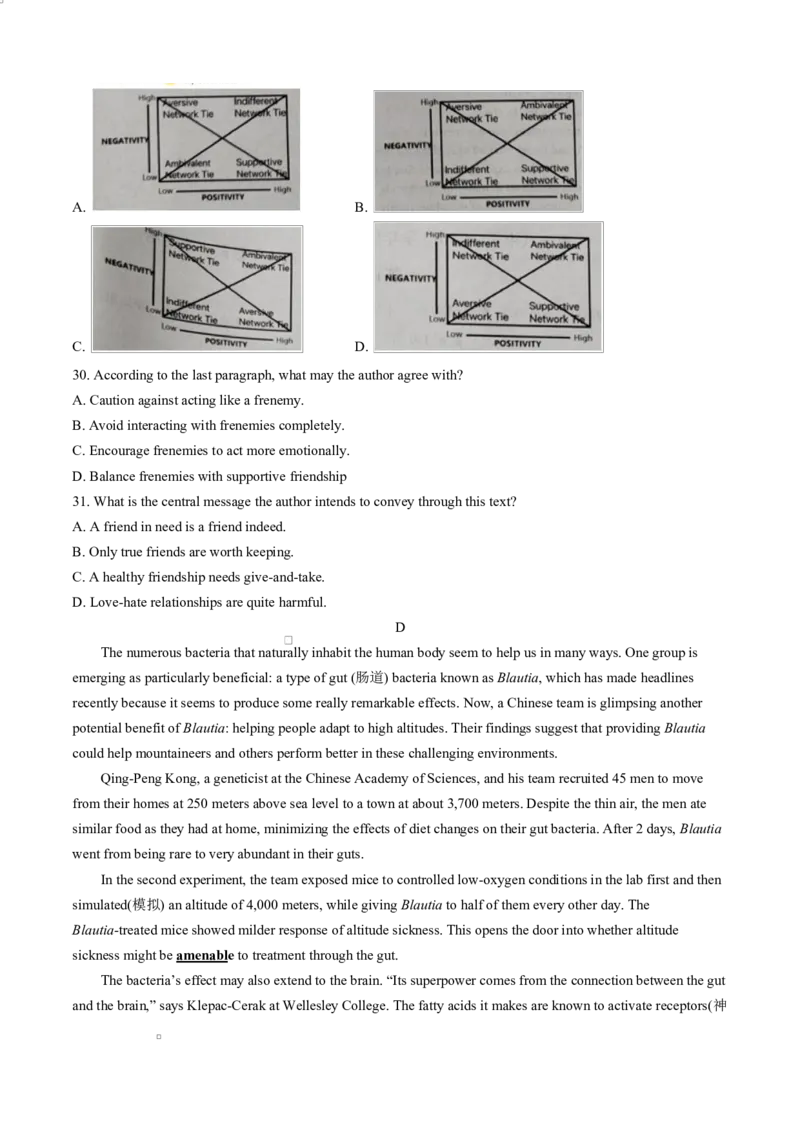
People who score one on both questions are your indifferent relationships —a neighbor, perhaps, with neither
good nor bad qualities. Those who score highly on the first question, while getting the lowest possible rating on the
second, are your supportive and loyal social ties. Those with the lowest score on the first question and high marks
on the second are aversive relationships. Finally, anyone with a score of two or more on both scales is considered
an ambivalent connection—your frenemies. They may be incredibly generous when you have a problem yet can
also fight back with a cruel comment when they feel envious or threatened.
Research suggests that ambivalent, love-hate relationships are often more stressful than consistently negative
ones, damaging mental and physical health. Cutting off contact may not always be possible, especially if the person
is a boss or family member. So, what can be done?
Simply being aware of the ambivalent nature of a relationship might offer some protection. Personally, I use
this insight to prepare myself emotionally, focus on the positive, and limit interactions when needed. It also leads
me to reflect on my own actions --am I ever the frenemy? I am determined to be a little mindful of my interactions
with all my ties.
28. Why does the author compare interactions with certain people to Russian roulette?
A. To suggest ways to handle these interactions.
B. To show how these people compete for attention.
C. To stress how unpredictable these interactions can be.
D. To introduce a social game these people like to play.
29. Which figure best illustrates the different types of relationships in our social network?A. B.
C. D.
30. According to the last paragraph, what may the author agree with?
A. Caution against acting like a frenemy.
B. Avoid interacting with frenemies completely.
C. Encourage frenemies to act more emotionally.
D. Balance frenemies with supportive friendship
31. What is the central message the author intends to convey through this text?
A. A friend in need is a friend indeed.
B. Only true friends are worth keeping.
C. A healthy friendship needs give-and-take.
D. Love-hate relationships are quite harmful.
D
The numerous bacteria that naturally inhabit the human body seem to help us in many ways. One group is
emerging as particularly beneficial: a type of gut (肠道) bacteria known as Blautia, which has made headlines
recently because it seems to produce some really remarkable effects. Now, a Chinese team is glimpsing another
potential benefit of Blautia: helping people adapt to high altitudes. Their findings suggest that providing Blautia
could help mountaineers and others perform better in these challenging environments.
Qing-Peng Kong, a geneticist at the Chinese Academy of Sciences, and his team recruited 45 men to move
from their homes at 250 meters above sea level to a town at about 3,700 meters. Despite the thin air, the men ate
similar food as they had at home, minimizing the effects of diet changes on their gut bacteria. After 2 days, Blautia
went from being rare to very abundant in their guts.
In the second experiment, the team exposed mice to controlled low-oxygen conditions in the lab first and then
simulated(模拟) an altitude of 4,000 meters, while giving Blautia to half of them every other day. The
Blautia-treated mice showed milder response of altitude sickness. This opens the door into whether altitude
sickness might be amenable to treatment through the gut.
The bacteria’s effect may also extend to the brain. “Its superpower comes from the connection between the gut
and the brain,” says Klepac-Cerak at Wellesley College. The fatty acids it makes are known to activate receptors(神经末梢) on nerves that connect the digestive system, heart and brain. This could help explain a surprising
relationship that Klepac-Cerak reported last year: Kids are more likely to talk and laugh when they have more
Blautia in their guts. “There’s lots of communication happening between our brain; we are just beginning to
uncover what services bacteria do for us.” Klepac-Cerak notes.
Blautia’s apparent superpowers suggest to Kong it could serve as a supplement (补充) that benefits people
regardless of whether they are planning a trip to Tibet. But first, Kong says, he wants to find out whether Blautia is
a “solo” player or has these protective effects only as part of a larger group of bacteria.
32. What’s the newly-found benefit of the study led by a Chinese team?
A. It gets public attention. B. It helps people do better at high altitudes.
C. It makes social media angry. D. It introduces an advanced new technology.
33. What do we know about the subjects (实验对象) in both experiments?
A. They experienced low-oxygen conditions.
B. They received Blautia in their diet.
C. They moved to high-altitude regions.
D. They suffered severe altitude sickness.
34. What does the underlined word “amenable” in Paragraph 3 mean?”.
A. Careless B. Untreatable. C. Unchangeable D. Reactive.
35. How would both Kong and Klepac-Cerak describe Blautia’s role in human health?
A double-edged sword. B. A solo player.
C. An extremely effective solution. D. A partially-understood influence
第二节(共 5 小题;每小题 2.5 分,满分 12.5 分)
阅读下面短文,从短文后的选项中选出可以填入空白外的最佳选项,选项中有两项多余选项。
Protecting the Ecological Environment
As we all know, the ecological environment is crucial for the survival and development of all life on Earth. It
provides us with essential resources such as clean air, fresh water, and rich soil. 36
Industrialization has led to increased emissions s (排放) of pollutants into the air and water. Factories release
large amounts of waste gases and liquids, which not only damage the quality of the air we breathe but also pollute
rivers and lakes. 37 Vast areas of trees are being cleared for agriculture, logging, and urban expansion. This
destroys the habitats of countless species and contributes to soil loss.
38 Governments around the world have been passing stricter environmental laws and regulations. These
laws are effective in controlling industrial pollution. For example, they set limits on the amount of pollutants that
factories can release and require heavy fines as punishment.
Renewable energy sources are also being increasingly used. Solar and wind energy, in particular, are catching
on. 39 Renewable energy s sources can reduce our dependence on fossil(化石)f fuels and lower carbon
emissions.
Besides, individuals can also play a vital role in protecting the ecological environment. We can start with
simple things in our daily lives, such as saving water and electricity. 40 We can also choose to use publictransportation or bicycles instead of private cars.
Moreover, raising public awareness of environment protection is essential. Only when everyone realizes the
importance of protecting the ecological environment as well as takes action can we hope to have a sustainable
future.
A. Deforestation (森林砍伐) is another major issue.
B. This helps to conserve energy and reduce waste.
C. Cutting carbon emissions is essential for our welfare.
D. After all, their cost may add too much burden to our lives.
E. They are clean and sustainable alternatives to traditional energy.
F. To address the threats, human beings are urged to take some measures.
G. However, human activities have been posing a serious threat to it recently.
第三部分 语言运用(共三节,满分 40 分)
第一节(共 15 小题;每小题 1 分,满分 15 分)
阅读下列短文,从每题所给的 A、B、C、D 四个选项中,选出最佳选项。
One summer day, Sarah decided to go for a bike ride in the countryside. The sun was shining brightly, and the
air was filled with the sweet smell of fresh flowers. She felt a great sense of 41______ as she bicycled along the
winding path.
As Sarah rode further, she 42______a small, old house standing at the end of a dirt road. She had never seen it
before and felt curious. Resolved to 43______, she locked her bike and walked towards it. The door was half
44______, so Sarah pushed it open and stepped inside. The house was dusty. She 45______ the rooms, finding
some old photographs and on 46______toys.
In the kitchen, Sarah found a 47______ cookbook whose cover was torn at the edges. She opened it and was
surprised to see 48______ from her grandmother, who had passed away years ago. Tears welled up in her eyes as
she remembered the happy times they had shared. She carefully 49______ it in her scarf and placed it in her
backpack.
When Sarah got home, she showed the cookbook to her parents. They were amazed by the 50______ and
hugged her tightly. That night, Sarah cooked one of her grandmother’s recipes for the whole family, and they had
the meal together 51______
The experience had been a/an 52______ point for Sarah. She learned to 53______ history and beauty in
everyday life. Looking back, Sarah knew that her 54______ about the value of family had led her to a treasure she
had never 55______to find.
41.A. emptiness B. contentment C. achievement D. loss
42. A. spotted B. located C. imagined D. recognized
43. A. investigate B. slip C. explore D. check
44.A.closed B. stuck C. repaired D. blocked
45. A. searched for B. cleaned up C. broke into D. wandered through
46. A. misplaced B. unused C. ignored D. abandoned47.A.well-received B. worn-out C. second-hand D. best-selling
48. A. recipes B. menus C. illustrations D. notes
49.A. threw B. wrapped C. folded D. hid
50.A. secret B. wonder C. outcome D. discovery
51.A. calmly B. confidently C. cheerfully D. patiently
52.A.confirming B. breaking C. ending D. turning
53. A. appreciate B. assess C. analyse D. admit
54. A. sympathy B. curiosity C. enthusiasm D. innocence
55. A. arranged B. guaranteed C. expected D. declined
第二节(共 10 小题;每小题 1.5 分,满分 15 分)
阅读下面短文,在空白处填入 1 个适当的单词或括号内单词的正确形式。
Rosalind Franklin: The Overlooked DNA Pioneer
Rosalind Franklin, a British chemist, made groundbreaking contributions to DNA research. Her X-ray images
offered the first concrete evidence 56 DNA had a double-helix structure. Yet, her work was long
unrecognized.
Franklin’s methods were meticulous(一丝不苟的). She dedicated countless hours to studying crystals through
a microscope, demanding that every statistic 57 (record) with precision. One of her key techniques 58
(be) refining X-ray technology, which became vital to the discovery.
59 addition to her research, Franklin mentored young scientists selflessly. Her patriotism was 60
(primary)shown in her dedication to truth. Tragically, she passed away before realizing 61 profoundly her
discovery shaped modern biology.
Franklin’s legacy teaches that science requires not just abstract theories but 62 (practice) solutions. She
developed 63 novel method to capture clearer images, proving the need for innovation. Her famous quote
remains a principle 64 (guide)researchers today. Just as a telescope reveals distant stars, her work 65
(serve) as a beacon for future discoveries. 第四部分 写作(共两节,满分 40 分)
第一节 应用文写作(共 15 分)
假定你是李华,与留学生朋友 Bob 约好一起去书店,因故不能赴约。请给他写封邮件,内容包括:
1)表示歉意;2)说明原因;3)补救方案并另约时间。
____________________________________________________________________________________________
____________________________________________________________________________________________
____________________________________________________________________________________________
___________________________________________________________________________________________
第二节 读后续写(共 25 分) 阅读下面材料,根据其内容和所给段落开头语续写两段,使之构成一篇完整
的短文。
The high jump mat (垫子) loomed in front of me like a monster. I had signed up for the track and field
competition on a dare, never imagining I’d actually make it to the finals. Now, the bar (杆) was set at 1.6 meters -aheight I had failed to clear three times in practice. My legs felt like jelly.
“You’re up next, Lena!” Coach Harris called. The crowd in the bleachers cheered, but their voices sounded
distant. I wiped my sweaty palms on my shorts, remembering the last time I attempted this height. My foot had
caught the bar, sending it crashing landed awkwardly on the mat. The laughter from the other students still haunted
me.
Coach walked over and placed a hand on my shoulder. “Fear is just a shadow,” he said quietly. “It’s not real
unless you let it block your light.” He pointed to my shoes-old but meticulously cleaned. “Remember why you put
these on today.”
I glanced down. On the inside of my left shoe, I had written “For Dad” in permanent marker. My father, a
former athlete, had always believed I could do anything. He’d passed away last year, but his voice still echoed in
my mind: “The only limit is the one you set for yourself.”
Taking a deep breath, I stepped back to begin my approach.
注意:
1.续写词数应为 150 左右;
2.请按如下格式在答题卡的相应位置作答。
The moment my feet left the ground, time seemed to slow.
________________________________________________________________________________________
____________________________________________________________________________________________
____________________________________________________________________________________________
__________________________________________________________________________________________
At the award ceremony the next day, Coach handed me a small, aged notebook.
____________________________________________________________________________________________
____________________________________________________________________________________________
____________________________________________________________________________________________
____________________________________________________________________________________重庆八中 2024-2025 学年度高二年级第一次月考答案
听力:1-5.CACAC 6-10.BABAB 11-15.BCCBC 16-20.BACCA
阅读理解:21-23CAC 24-27CBBA 28-31 CBAD 32-35 BADD
七选五:36-40 GAFEB
完形填空:41-45 BACAD 46-50 DBABD 51-55 CDABC
语法填空:56. that 57. be recorded 58.was 59.In 60. primarily
61.how 62. practical 63.a 64. guiding 65. serves
应用文写作:
Dear Bob,
I’m writing to sincerely apologize for having to postpone our bookstore visit this weekend
I’ve been selected to represent our school in a national academic competition next month, so I have to be fully
committed to preparing it. To make up for this, I’d love to suggest a new plan! There’s a fascinating exhibition on
sustainable innovation at the city library next Saturday afternoon. It combines our shared interests in technology
and environmental science, and I think it’d be a meaningful experience. Would this work for you?
Once again, I’m sorry for the inconvenience. Let me know your thoughts—I’m flexible and excited to
reschedule!
Best regards,
Li Hua
读后续写:
The moment my feet left the ground, time seemed to slow. I felt the spring of the track beneath me, the air
rushing past my face. My eyes stayed locked on the bar, but instead of fear, I felt a strange calm. There was only
Dad's voice-clear, steady and alive. “Bend at the hips, Lena. Let the world fall away.” My right leg swung up, then
my left followed in a smooth arc. For a heartbeat, I hung in the air-and then I was rolling onto the mat. The bar
trembled but stayed in place. The crowd exploded into cheers. I lay there, staring at the sky, tears mixing with
sweat. I had done it.
At the award ceremony the next day, Coach handed me a small, aged notebook. As I flipped through the pages,
my breath caught -Inside were my father’s handwritten training notes, filled with tips and sketches of jumping
techniques. On the last page, he had written: “To my Lena-someday, you’ll fly higher than I ever did.” Tears spilled
onto the paper as I clutched the notebook to my chest, feeling his presence stronger than ever. “He’d be proud,”
Coach said softly. I nodded, knowing this was just the beginning.
听力材料:
(Text 1)
W: Alex is going to meet me at the airport tomorrow. I can’t wait!
M: Is he taking the subway or is he driving?
W: He isn’t going to take the subway. It takes too long.
(Text 2)M: Where are the twins? It’s awful quiet around here!
W: They took a shower after jumping rope in the garden all morning, then had lunch and they are sleeping at the
moment.
(Text 3)
W: What did you do last weekend?
M: Umm, I spent most of the time at the gym.
W: How come?
M: Well, I plan to enter a bodybuilding competition next month.
(Text 4)
M: Hello, Maggie Ferguson? I’m outside your house now, 25 Hill Street. I have a package for you, but you’re not
answering the door.
W: I’m not home. I’m at work. And I work on the same street, number 91. Can you bring it here?
(Text 5)
M: I’m a better swimmer than you, Kelly!
W: Have you ever beaten Mark in a race?
M: No, he is the fastest swimmer in our school.
W: Well, guess what, Frank, I beat Mark last week. So, what does that make me?
(Text 6)
W: Hi. Do you have any tickets for the SeaRide Special tour today?
M: Sorry. We’re sold out. It’s a really popular tour this time of year because the penguins are passing through the
area.
W: Oh, too bad. I’m leaving tomorrow morning, and I was really hoping to take one of your tours.
M:Well, the Island Exploration tour still has a couple of spots left.
W: Great! And that’ll give me time to get something to eat before it starts. I see there’s a coffee
shop just down the
street. (Text 7)
W: What made you decide to become an author?
M: Ever since I was a child, I have written stories. But I never dreamed I could be an author. I studied science at
school and went on to become a doctor. It was only after having children of my own and telling them stories that I
remembered how much I loved writing.
W: What do you write about in your novels?
M: Many of my books focus on protecting the environment. I do lots of research for those and I love it when I get
letters from readers telling me that my stories have changed the way they live and see the world.
(Text 8)
W: Did you know that some people live on bridges? Look at these two pictures.
M: Oh yeah. This one looks very old. It’s in Rome, isn’t it?
W: Well, it’s actually in Florence, north of Rome. It’s called the Ponte Vecchio, built in 1345.M: But the bridge in the other picture looks newer.
W:Yeah, that’s Neft Dashlari in Azerbaijan, 60 kilometers away from its capital Baku.
M: It looks really long, and it looks like it has a lot of factories. Do a lot of people work there?
W: Yes, they drill for oil from under the sea there. They decided that the workers needed somewhere to live, so they
built a kind of “city” above the sea. The bridge is 30 miles long. That’s about 48 kilometers. They built houses,
libraries, schools, and even a movie theater there. It even appeared in a James Bond movie.
(Text 9)
M: How long have you been working on the passenger ships, Vicky?
W: Well. for about two years till now. And I’ve been on twelve different trips.
M: Do you like it?
W. I do. We only haye two-month contracts but the work is very varied. And often each trip has a different theme. I
was on a trip to the Caribbean last year, which was for fans of musicals and lots of singers were there to entertain
the guests. Several of them were stars in the old days.
M: So, what’s the next step in your career?
W: Well, obviously, I don’t want to wait tables for the rest of my life. I have a lot of free time on board the ship, so
I’ve been doing a training course with an online university.
M: On what?
W: Psychology. I want to help people. I’ve been listening to people telling me their problems for years in the
tourism industry!
(Text 10)
Hi, everyone. I was so happy to tell you about my remarkable year, which I’d describe as a grand adventure. It’
s tricky to know where to start, so I think I’ll just begin at the very beginning. That was when my dad decided to
take our family on a trip around the world. He started planning it last January. but we didn’t leave until July, after
my exams in June. During my gap year, I wanted to keep my mind engaged. so Miss Barnes, my old geography
teacher, and Mr. Green from my amazing maths classes, kept in touch with me and provided plenty of assignments.
My dad wanted to give us experience of things you can’t get from books or TV programmes. You know, things like
the amazing smells coming from the Indian street food markets or the breathtaking light you encounter in deserts.
He was right. In the Sahara it was amazing! And the real experience of meeting and making friends with people
from diverse cultures was invaluable.
Some people might argue that it wasn’t a good idea for my parents to take us out of school for a year. But I
think it was a wonderful opportunity. Having connections in all those countries has been incredibly enriching.
Travelling is a great thing, and I hope you all have the chance to do a lot too.