2024-2025 学年第一学期六校联合体 11 月联合调研
高三英语
(试卷满分150分,考试时间120分钟)
第一部分 听力(共两节,满分30分)
第一节 (共 5 小题;每小题 1.5 分,满分 7.5 分)
听下面 5 段对话。每段对话后有一个小题,从题中所给的 A、B、C 三个选项中选出
最佳选项。听完每段对话后,你都有 10 秒钟的时间来回答有关小题和阅读下一小题。每
段对话仅读一遍。
1. What is the woman doing?
A. Repairing a computer. B. Making a payment. C. Requesting a refund.
2. Why does the man come to the woman?
A. To invite her to dinner. B. To give her a present. C. To seek some advice.
3. What is the man going to do first?
A. Make reservations. B. Check with his wife. C. Work out a plan.
4. What is the woman’s opinion on the new building?
A. Unattractive. B. Pretty. C. Unique.
5. What is the probable relationship between the speakers?
A. Salesman and customer. B. Householder and renter. C. Colleagues.
第二节 (共 15 小题;每小题 1.5 分,满分 22.5 分)
听下面 5 段对话或独白。每段对话或独白后有几个小题,从题中所给的 A、B、C 三
个选项中选出最佳选项。听每段对话或独白前,你将有时间阅读各个小题,每小题 5 秒
钟;听完后,各小题将给出 5 秒钟的作答时间。每段对话或独白读两遍。
听第6段材料,回答第6、7题。
6. What are the speakers discussing?
A. The accommodations. B. The destination. C. The activities.
7. What is the man’s attitude towards the woman’s words?
A. Supportive. B. Disapproving. C. Unclear.
听第 7 段材料,回答第 8、9 题。
8. When will the presentation take place?
A. On the 15th. B. On the 16th. C. On the 22nd.
9. How can we describe Mr. Sadik?
A. Bossy. B. Forgetful. C. Changeable.
听第 8 段材料,回答第 10 至 12 题。
10. What was the speakers’ original plan for the day?
A. Attending a meeting. B. Visiting Ethan’s house. C. Watching a movie.
1
学科网(北京)股份有限公司11. Why didn’t Ethan answer his cellphone?
A. He had an accident on the road.
B. He did not have it with him.
C. He left it in the car.
12. What will the woman do tonight?
A. Complete her report.
B. Work overtime at the office.
C. Eat at a new Spanish restaurant.
听第 9 段材料,回答第 13 至 16 题。
13. How did the man know about the woman?
A. From the Internet. B. From his parents. C. From his friend.
14. Why does the woman recommend Jack Shin?
A. She has a time conflict.
B. She lives far from Halifax.
C. She wants to help the man save money.
15. What can we learn about Jack Shin?
A. His charges are low.
B. His schedule is very tight.
C. His style is similar to the woman’s.
16. How will Jack Shin present the photos to the man at first?
A. By uploading them online. B. By printing them out. C. By exhibiting them.
听第 10 段材料,回答第 17 至 20 题。
17. Who probably are the listeners?
A. Company employees. B. High school students. C. University seniors.
18. What does the speaker say about interviewing?
A. It requires a little talent.
B. It needs some practice.
C. It can improve skills.
19. What is the speaker’s first suggestion?
A. Being confident.
B. Contacting potential employers.
C. Writing a solid résumé.
20. What does the speaker ask the listeners to bring?
A. A list of possible questions.
B. A notebook with interview skills.
C. An outline of their background.
第二部分 阅读(共两节,满分50分)
2
学科网(北京)股份有限公司第一节 (共15小题;每小题2.5分,满分37.5分)
阅读下列短文,从每题所给的A、B、C、D四个选项中选出最佳选项。
A
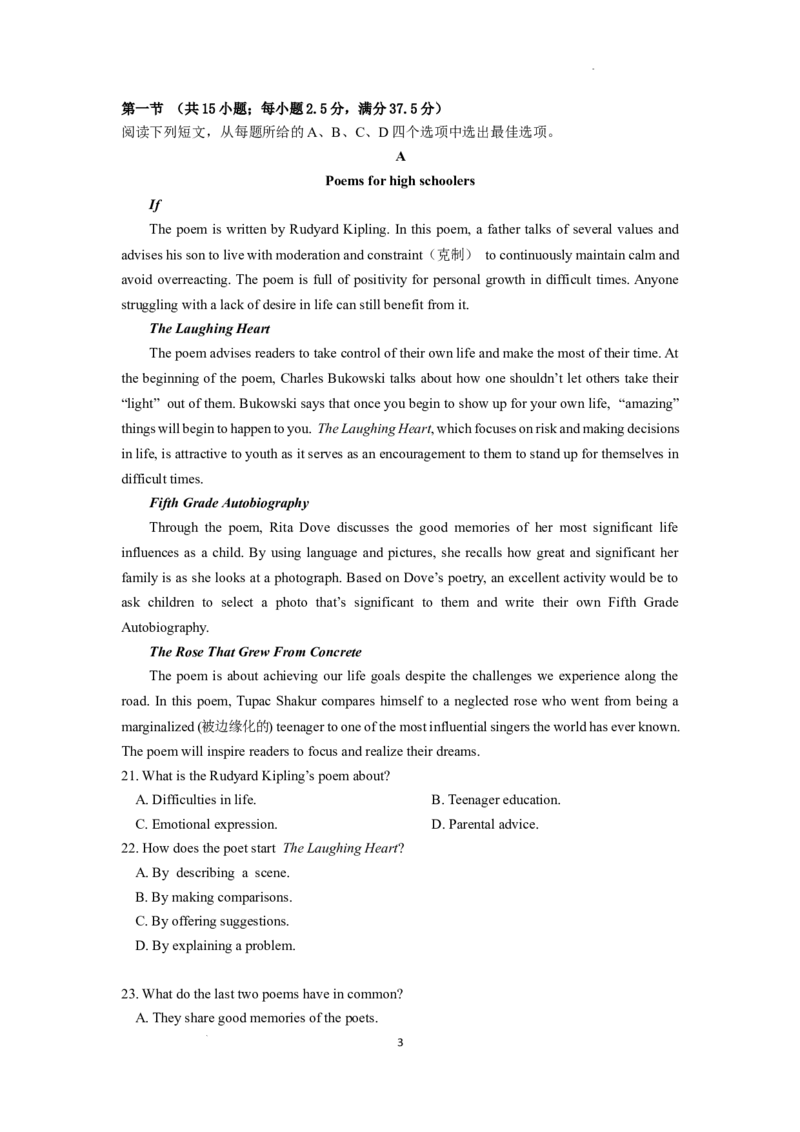
Poems for high schoolers
If
The poem is written by Rudyard Kipling. In this poem, a father talks of several values and
advises his son to live with moderation and constraint(克制) to continuously maintain calm and
avoid overreacting. The poem is full of positivity for personal growth in difficult times. Anyone
struggling with a lack of desire in life can still benefit from it.
The Laughing Heart
The poem advises readers to take control of their own life and make the most of their time. At
the beginning of the poem, Charles Bukowski talks about how one shouldn’t let others take their
“light” out of them. Bukowski says that once you begin to show up for your own life, “amazing”
things will begin to happen to you. The Laughing Heart, which focuses on risk and making decisions
in life, is attractive to youth as it serves as an encouragement to them to stand up for themselves in
difficult times.
Fifth Grade Autobiography
Through the poem, Rita Dove discusses the good memories of her most significant life
influences as a child. By using language and pictures, she recalls how great and significant her
family is as she looks at a photograph. Based on Dove’s poetry, an excellent activity would be to
ask children to select a photo that’s significant to them and write their own Fifth Grade
Autobiography.
The Rose That Grew From Concrete
The poem is about achieving our life goals despite the challenges we experience along the
road. In this poem, Tupac Shakur compares himself to a neglected rose who went from being a
marginalized (被边缘化的) teenager to one of the most influential singers the world has ever known.
The poem will inspire readers to focus and realize their dreams.
21. What is the Rudyard Kipling’s poem about?
A. Difficulties in life. B. Teenager education.
C. Emotional expression. D. Parental advice.
22. How does the poet start The Laughing Heart?
A. By describing a scene.
B. By making comparisons.
C. By offering suggestions.
D. By explaining a problem.
23. What do the last two poems have in common?
A. They share good memories of the poets.
3
学科网(北京)股份有限公司B. They are based on the poets’ own life.
C. They are about important life skills.
D. They stress the importance of dreams.
B
My initial exploration of the world of comic books happened through the comic strips in
newspapers. It began with a fondness for Garfield and his adventures, and led to the discovery of a
range of comic books like Champak, Tintin, and Archie. They enabled me to enjoy myself in a
world without iPads and the Internet―just like so many of my friends who were fond of reading.
While my access to comics as a child was limited to what was printed in the newspaper, this
changed once I grew older and started visiting bookstores to buy the books that I wanted to read.
Having grown up on a diet of image-heavy books, I found the idea of reading text-only novels
quite formidable. As I searched for books that lay somewhere in between, I came across a copy of
Bhimayana―a graphic novel. It felt familiar due to its comic-like theme and design. Plus,
understanding complex narratives through pictures was relatively easier and more fun. And so, as I
grew older, I found myself transitioning towards graphic novels from childish comic books.
Graphic novels dealt with serious topics in a more engaging manner. They would literally
show me what was going on. For example, when I was reading Joe Sacco’s Palestine, I didn’t have
to imagine the ruin caused by the Israeli-Palestinian conflict. I could actually see it while reading
about it.
Fast-forward a few years to when I was given a copy of Jonathan Bloomfield’s Palestine: A
Novel. Though I was impressed by the compelling (扣人心弦的) nature of storytelling in his book, I
am not sure if I would have been able to visualize and enjoy his text-only version so much had I not
read Sacco’s Palestine first. Thanks to the graphic novel, I had a “picture” of whatever had
happened, and that made it easier and more fun to understand the details of the overall story.
From black and white strips and colorful comic books to illustrated graphic novels, this type
of storytelling has come a long way. While my romance with comic books is still ongoing, in the
long run, my love for graphic novels is more substantial and here to stay.
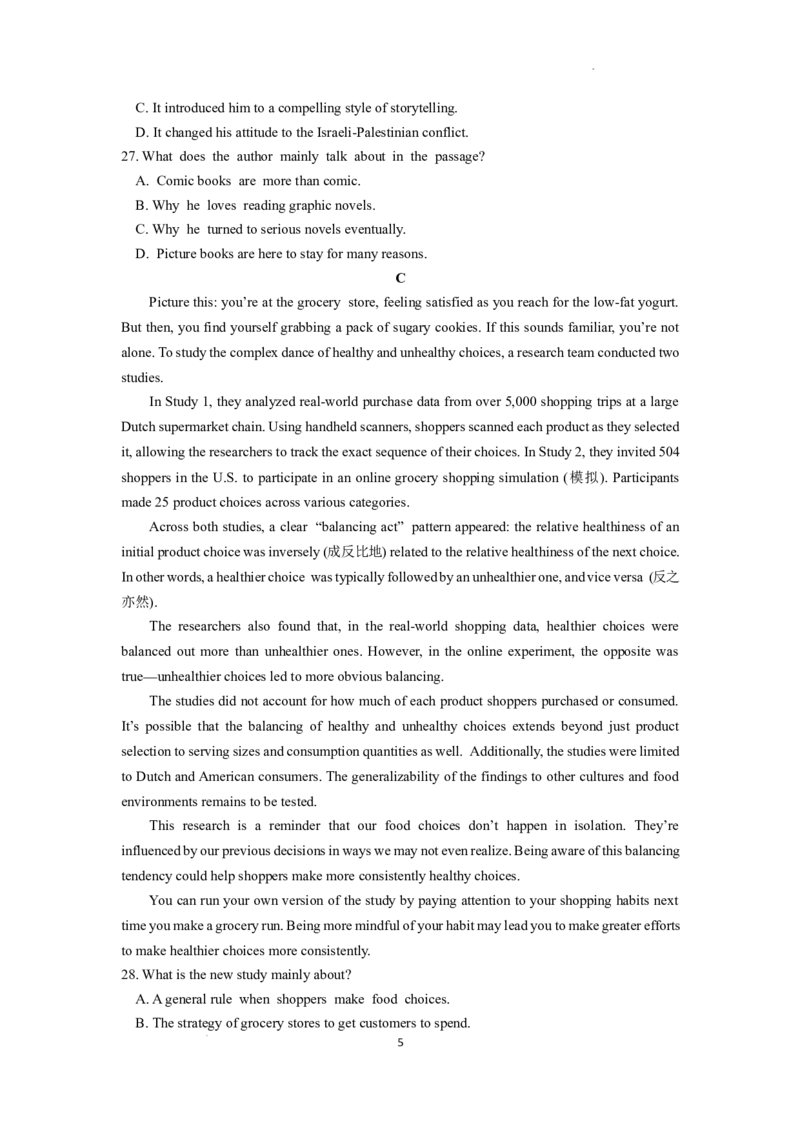
24. Why did the author turn to comic books as a child?
A. He found comic books interesting.
B. He had limited access to other books.
C. He wanted to be different from his friends.
D. He could relax from reading text-only books.
25. Which word can best explain the underlined word “formidable” in paragraph 2?
A. Acceptable. B. Natural.
C. Scary. D. Appealing.
26. What does the author say about reading Sacco’s Palestine?
A. It encouraged him to read more text-only novels.
B. It improved his understanding of Bloomfield’s book.
4
学科网(北京)股份有限公司C. It introduced him to a compelling style of storytelling.
D. It changed his attitude to the Israeli-Palestinian conflict.
27. What does the author mainly talk about in the passage?
A. Comic books are more than comic.
B. Why he loves reading graphic novels.
C. Why he turned to serious novels eventually.
D. Picture books are here to stay for many reasons.
C
Picture this: you’re at the grocery store, feeling satisfied as you reach for the low-fat yogurt.
But then, you find yourself grabbing a pack of sugary cookies. If this sounds familiar, you’re not
alone. To study the complex dance of healthy and unhealthy choices, a research team conducted two
studies.
In Study 1, they analyzed real-world purchase data from over 5,000 shopping trips at a large
Dutch supermarket chain. Using handheld scanners, shoppers scanned each product as they selected
it, allowing the researchers to track the exact sequence of their choices. In Study 2, they invited 504
shoppers in the U.S. to participate in an online grocery shopping simulation (模拟). Participants
made 25 product choices across various categories.
Across both studies, a clear “balancing act” pattern appeared: the relative healthiness of an
initial product choice was inversely (成反比地) related to the relative healthiness of the next choice.
In other words, a healthier choice was typically followed by an unhealthier one, and vice versa (反之
亦然).
The researchers also found that, in the real-world shopping data, healthier choices were
balanced out more than unhealthier ones. However, in the online experiment, the opposite was
true―unhealthier choices led to more obvious balancing.
The studies did not account for how much of each product shoppers purchased or consumed.
It’s possible that the balancing of healthy and unhealthy choices extends beyond just product
selection to serving sizes and consumption quantities as well. Additionally, the studies were limited
to Dutch and American consumers. The generalizability of the findings to other cultures and food
environments remains to be tested.
This research is a reminder that our food choices don’t happen in isolation. They’re
influenced by our previous decisions in ways we may not even realize. Being aware of this balancing
tendency could help shoppers make more consistently healthy choices.
You can run your own version of the study by paying attention to your shopping habits next
time you make a grocery run. Being more mindful of your habit may lead you to make greater efforts
to make healthier choices more consistently.
28. What is the new study mainly about?
A. A general rule when shoppers make food choices.
B. The strategy of grocery stores to get customers to spend.
5
学科网(北京)股份有限公司C. Factors that influence people’s choice of food when shopping.
D. The difference between online shopping and offline shopping.
29. What can be learned from the new study?
A. People are more likely to spend more when shopping online.
B. People are more likely to choose healthy foods when shopping online.
C. People are easily affected by the order in which food is placed in stores.
D. People buy a rough balance of healthy and unhealthy foods when shopping.
30. What is the author’s attitude towards the studies?
A. Critical. B. Objective. C. Supportive. D. Doubtful.
31. What is the author’s advice in the last paragraph?
A. Be more aware of our own shopping habits.
B. Make a shopping list before we go shopping.
C. Cut down on shopping time as much as possible.
D. Do some research on healthy and unhealthy foods.
D
One day, my 11-year-old daughter told me that she wanted to return a pair of pants on
Amazon. “You need to keep clicking the ‘something else’ button if you want to talk to a real
person,” I told her. She followed my word, and after a bit of clicking, she managed to talk to a real
person and get the pants returned. In the process, I had the chance to think about what this everyday
interaction was teaching my daughter.
I thought about what it meant to constantly ask for “something else”. It’s not only about having
a real person to talk with. It’s equally about the quality of our communication. It’s about thinking
something, then saying it, and then having another person think and say something back to you. It
seems simple and yet it may become the exception, not the rule. In many cases, it already has.
With the “quick responses” at the bottom of Gmail, potential responses often appear right in
front of us. “Yes, sure.” “Of course!” or “I got it.” The responses, I’ve noticed, are mostly okay.
Sometimes, they’re exactly what I want to say. Occasionally, they’re wildly wrong. At first, I told
myself I wouldn’t use those pre-made responses. Soon enough, though, I got in a rush and found
they were good.
What would happen if our language got automated in general in this way? What if, instead of
generating responses, we simply pointed and clicked? Choosing a response is a kind of thinking,
but it’s far less accurate than the kind needed to generate content. It has to do more with recognizing a
“good enough” response. Instead of starting with a blank board, we critique (评判) things. That’s
not useless, but it doesn’t replace thinking in a generative way. If kids only critique something, they
won’t have original thoughts. They may become great editors, but they’ll likely struggle to create
ideas in fresh ways.
There’s no simple solution and certainly no way to turn back the clock on automated talk.
Yet, as we move forward, we need to consider carefully how simple changes in communication can
6
学科网(北京)股份有限公司have serious effects. If we want to help our kids, the “something else” we searched for―authentic
human conversation―should not be the exception, but the rule.
32. What contributes to high-quality communication according to paragraph 2?
A. The clear goals.
B. The exact expressions.
C. The process of thinking.
D. The immediate response.
33. How does the author feel about using the pre-made responses?
A. Excited and eager to try them out.
B. Annoyed and not interested in them.
C. Disappointed by their inaccurate suggestions.
D. Unwilling but finally aware of their convenience.
34. What would happen to kids with the automation of language?
A. Their creativity will suffer.
B. Their critical thinking ability will increase.
C. Their editing skills will hardly improve.
D. Their expressions will be more accurate and efficient.
35. What can be the best title for the text?
A. My Reflections on Automated Talk
B. My Unforgettable Online Return Experience
C. The Art of Guiding Children’s Creativity
D. The Benefits of Using Automation in Communication
第二节(共5小题;每小题2.5分,满分12.5分)
阅读下面短文,从短文后的选项中选出可以填入空白处的最佳选项。选项中有两项为多余选
项。
We all need to give and receive feedback for our work, which sometimes can be
tricky. In fact, Confucius, way back in 500 BC, talked about the importance of expressing difficult
messages well. However, a recent survey found that only 26 percent of subjects strongly agree that
the feedback they get is effective and useful to their work. Either the feedback is so indirect
and soft that the brain doesn’t even recognize it or it’s just too direct that it makes the other
person unhappy and defensive. 36
Ask micro-yes questions.
Propose your feedback by asking a question that is short but important. For instance, you can
ask “Do you have five minutes for a brief discussion?” 37 First, it lets the other person
know that feedback is about to be given. Second, it offers some space for the other to refuse.
Avoid blur(模糊) words.
7
学科网(北京)股份有限公司38 To change this, try to say “You said you’d get that email to me by 11 a.m, and
I still don’t have it yet 4 p.m.” instead of “You aren’t reliable.” The reason for that is that you
want to specify exactly what you want the other person to do.
State the impact.
39 For example, you might say, “Because I didn’t get the message, I was blocked on
my work and couldn’t move forward” or “I really liked how you added those stories, because it
helped me grasp the concepts faster.” It gives others a sense of purpose and meaning and logic
between the points.
Wrap the feedback with a question.
Great feedback givers tend to ask something like, “Well, how do you see it?” Or “This is
what I’m thinking, but what are your thoughts on it?”. 40 Instead, try to make it a joint
problem-solving situation.
Now that you know this approach, you can mix and match it to make it work for any difficult
conversation.
A. This can do two things for you.
B. This makes your feedback effective.
C. Make the conversation no longer a monologue (独白).
D. Name exactly how the other person has influenced you.
E. The following four methods can be employed to make your feedback direct.
F. There’s a mistaken tendency that we use vague, or not specific words for feedback.
G. Here comes a four-part approach that you can adopt to say any difficult message well.
第三部分 语言运用(共两节,满分30分)
第一节(共15小题;每小题1分,满分15分)
阅读下面短文,从每题所给的A、B、C、D四个选项中选出可以填入空白处的最佳选项。
Everyone needs comfort when they are in the process of recovering from a major health
crisis. Patients who have their families around can get access to some 41 support when they
ask for it. But when a kid woke up from surgery and asked to get a hug, a nurse 4 2 . This
incident took place in Pennsylvania where 5-year-old Thompson was getting 4 3 at the
hospital.
4 4 , Hager was on duty during Thompson’s treatment and surgery. When she went to
attend to the little boy, he had a(n) 4 5 for her. The boy just wanted a warm hug from his
mother. But she couldn’t be there, so Hager 4 6 his mother and comforted the little boy.
“We had been in the children’s hospital. We were kind of nervous,” Thompson’s mother Layla
said. After the operation was 4 7 , Layla was told that her son was awake. But before they
could allow the mother to 4 8 her son, the nurses had to check Thompson’s vital signs. “When I t
old him Mom couldn’t be there, he 4 9 if I’d hug him and I said, ‘Sure,’” Hager said.
Witnessing Hager’s act of kindness, Layla’s 50 for her son disappeared. Hager not
only did her duty but also set an example to others in her 5 1 to go beyond their call of
8
学科网(北京)股份有限公司duty. 52 , Hager was modest, just saying, “Anyone working there would have done the same
thing.”
The hospital left a post online to 53 this sweet moment between Thompson and
Hager. “As a nurse, providing care is one thing, but ensuring our patients are calm and
comfortable 54 just as much. We thank our nurses for taking time to make personal
55 with patients,” the post read.
41. A. moral B. emotional C. technical D. economic
42. A. agreed B. hesitated C. avoided D. checked
43. A. involved B. caught C. treated D. injured
44. A. Regularly B. Generally C. Apparently D. Thankfully
45. A. suggestion B. request C. offer D. choice
46. A. replaced B. informed C. engaged D. visited
47. A. taken out B. picked out C. carried out D. locked out
48. A. help B. protect C. find D. meet
49. A. knew B. asked C. felt D. guessed
50. A. concern B. fear C. anger D. doubt
51. A. life B. mind C. profession D. future
52. A. Moreover B. Therefore C. Otherwise D. However
53. A. enjoy B. document C. recall D. predict
54. A. matters B. doubles C. pays D. exists
55. A. promises B. decisions C. connections D. comments
第二节 (共10小题;每小题1.5分,满分15分)
阅读下面材料,在空白处填入1个适当的单词或括号内单词的正确形式。
A “3D rendering (渲染) competition” is a contest 56 participants engage in the
process of creating three-dimensional animations 57 means of computer programs. Through
techniques such as adding textures, lighting effects, and colors, 58 (compete) are required to
freely display their creativity based on a pre-provided video. However, they are not allowed to
change the structure of the original video 59 the position of the main character.
The 9th World Rendering Competition, themed “kinetic rush”, challenged participants to
create unique animations, based on the 60 (give) video. It has attracted thousands of 3D artists
from around the world, receiving a diverse collection of 61 (imagine) entries that are
masterfully created.
Among these, the work of Karaok, a 3D artist from Chengdu China stood out and 62
(award) the runner-up. Inspired by 63 Egyptian Paralympic table tennis player, his
animation tells the story of an armless boy, who 64 (enthusiastic) pursues his dream of
playing ping-pong despite his disabilities. Karaok’s work successfully made it to the top
competition, showcasing extraordinary technical competence as well as emotional descriptions.
9
学科网(北京)股份有限公司The judges have highly praised this piece, 65 (refer) to it as “a work where every pixel
(像素) is perfectly completed, without a single flaw.”
第四部分 写作(共两节;满分40分)
第一节 (满分15分)
66. 假如你是李华,你校英语俱乐部将选举新一届副主席,负责组织俱乐部的相关活动。请
按以下提示,写一篇竞选演讲稿。内容包括:
1. 个人优势。
2. 组织活动的设想。
3. 表达当选的愿望。
参考词汇:副主席vice president 竞选run for
注意:1. 写作词数为80左右。
2. 可适当增加细节以使行文连贯。
Good afternoon, my dear friends,
My name is Li Hua.
__________________________________________________________
_______________________________________________________________________________
_______________________________________________________________________________
_______________________________________________________________________________
_______________________________________________________________________________
_______________________________________________________________________________
Thank you!
第二节 (满分25分)
67. 阅读下面材料,根据其内容和所给段落开头语续写两段,使之构成一篇完整的短文。
Nita’s Beautiful Bag
“What is that black smoke?” Nita asked her mother as they were folding the clothes.
“Your father is burning some things. Go see what he is up to,” she replied.
Nita approached her father, who was tending to a small fire in the yard. As she drew closer, she
noticed a bunch of plastic bags burning. Confusion mixed with worry filled her young mind. She
couldn’t help but question her father’s action.
“Why are you burning those plastic bags, Dad?” she asked, her voice full of concern.
“These bags would last an incredibly long time if we buried them. Plastic doesn’t break down in
the earth. Burning is the only way to remove them, Nita,” he replied.
Nita’s forehead wrinkled. She felt a wave of sadness for the earth and couldn’t help but voice
her discontent. “But burning isn’t good for the earth either, Dad. And the smoke ... it smells
terrible,” she complained softly.
Her father let out a heavy sigh, understanding her concern. He knelt down to her level and
spoke with a touch of regret in his voice, “I know, Nita, but I haven’t found another way to keep
these bags from polluting the earth.”
10
学科网(北京)股份有限公司That afternoon, as Nita’s mother returned from the market with more plastic bags, Nita felt a
growing sense of unease. The cycle of using and burning plastic bags seemed endless, and she
longed for a solution.
Later that day, Nita found herself watching her father work on cutting shirts for his clothing
business. Her mind wandered, thinking about the problem at hand. Suddenly, an idea occurred to
her. “Maybe I can create something useful with the leftover fabric scraps (碎布)!” she thought
excitedly.
Determined to make a difference, Nita borrowed her father’s scissors, thread (线), and a
needle. Her father, concerned for her safety, tried to stop her. However, her determination shone
through, and he soon found himself assisting her in making a beautiful bag.
注意:1.续写词数应为150左右;
2.请按如下格式在相应位置作答。
Days later, Nita accompanied her mother to the market with the newly-made cloth bag.
_______________________________________________________________________________
_______________________________________________________________________________
_______________________________________________________________________________
_______________________________________________________________________________
_______________________________________________________________________________
_______________________________________________________________________________
Word of Nita’s bags spread rapidly throughout the village.___________________________
_______________________________________________________________________________
_______________________________________________________________________________
_______________________________________________________________________________
_______________________________________________________________________________
_______________________________________________________________________________
_______________________________________________________________________________
11
学科网(北京)股份有限公司