2025 届高三第一次校际联考
英 语 试 题
注意事项:
1.本试题共10页,满分150分,时间120分钟。
2.答卷前,务必将答题卡上密封线内的各项目填写清楚。
3.回答选择题时,选出每小题答案后,用2B铅笔把答题卡上对应题目的答案标号涂黑。如需改动,
用橡皮擦干净后,再选涂其它答案标号。回答非选择题时,将答案写在答题卡上。写在本试卷上无效。
4.考试结束后,监考员将答题卡按顺序收回,装袋整理;试题不回收。
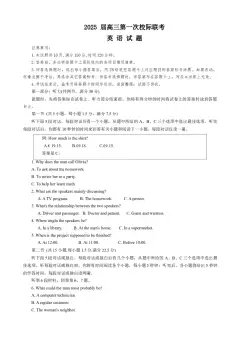
第一部分:听力(共两节,满分30分)
做题时,先将答案标在试卷上。听力部分结束前,你将有两分钟的时间将试卷上的答案转涂到答题
卡上。
第一节 (共5小题,每小题1.5分,满分7.5分)
听下面5段对话。每段对话后有一个小题,从题中所给的 A、B、C三个选项中选出最佳选项。听完
每段对话后,你都有10秒钟的时间来回答有关小题和阅读下一小题。每段对话仅读一遍。
例: How much is the shirt?
A.₤ 19.15. B.£9.18. C.£9.15.
答案是C。
1. Why does the man call Olivia?
A. To ask about the homework.
B. To invite her to a party.
C. To help her learn math.
2. What are the speakers mainly discussing?
A. A TV program. B. The housework. C. A person.
3. What's the relationship between the two speakers?
A. Driver and passenger. B. Doctor and patient. C. Guest and waitress.
4. Where might the speakers be?
A. In a library. B. At the man's home. C. In a supermarket.
5. When is the project supposed to be finished?
A. At 12:00. B. At 11:00. C. Before 10:00.
第二节 (共15 小题,每小题1.5分,满分22.5分)
听下面5段对话或独白。每段对话或独白后有几个小题,从题中所给的 A、B、C三个选项中选出最
佳选项。听每段对话或独白前,你将有时间阅读各个小题,每小题5 秒钟;听完后,各小题将给出5 秒钟
的作答时间。每段对话或独白读两遍。
听第6段材料,回答第6、7题。
6. What could the man most probably be?
A. A computer technician.
B. A regular customer.C. The woman's neighbor.
7. What is the woman's problem?
A. It is difficult for her to fix a cup holder.
B. One part of her computer is broken.
C. She cannot afford a computer.
听第7段材料,回答第8至10题。
8. What is Jim's job?
A. He is a firefighter. B. He is a postman. C. He is a reporter.
9. How long did the fire last?
A. About four hours. B. About six hours. C. About eight hours.
10. Why does the woman think the fire was big?
A. Based on how big the building is.
B. Based on what was inside the building.
C. Based on how long it burned.
听第8段材料,回答第11 至 13 题。
11. Why is chemistry a challenge for Jason?
A. He can't focus in chemistry class.
B. He spends little time on it.
C. He doesn't like the chemistry teacher.
12. What does Emma suggest Jason do?
A. Talk to Mr. Lee about the difficulties.
B. Review the basics and study together.
C. Take a break from chemistry.
13. What does Miss Jeans teach?
A. History. B. Chemistry. C. Geography.
听第9段材料,回答第14 至16题。
14. What can Sally get from her grandmother in the autumn?
A. Cabbages. B. Lettuce. C. Carrots.
15. What does Sally's grandmother do when it gets cold?
A. She covers her plants.
B. She clears out the dead plants.
C. She gives some food to the animals.
16. What does Nick think of growing a garden?
A. It needs a lot of work.
B. It takes a little time.
C. It can help save some money.
听第10段材料,回答第17至20题。
17. How many levels of courses does the program offer?
A. Seven. B. Eight. C. Twelve.18. What is the strength of the program?
A. It can meet personal needs.
B. It provides courses on American culture.
C. It is available throughout the year.
19. What can students get if they perform well in an end- of- session test?
A. A course for free.
B. A promotion to a higher level.
C. A chance to work part- time.
20. What does the Language Center Bonus Project provide?
A. Field trips. B. Social activities. C. Extra practice hours.
第二部分:阅读(共两节,满分50分)
第一节 (共15 小题,每小题2.5分,满分37.5分)
阅读下列短文,从每题所给的A、B、C和D四个选项中,选出最佳选项。
A
The fifth Close- up Photographer of the Year ( CUPOTY) is now open for entries!
CUPOTY is an annual competition revealing the wonder of the world through close- up photography.
Enter now for a chance to win £ 2,500 cash and a trophy (奖牌). There are 10 categories to choose from and
a Young category for under 18. The Top 100 images selected by the judge will appear in the winner's gallery as a
permanent exhibition on this website. Our hope is that these pictures will help to inspire a wider appreciation of
nature's wealth and a desire to protect it.
The Early Bird deadline is September 30th. Enter by then and save 10%. The final deadline for entries is
October 9th. During the Early Bird offer, you may enter l for £ 10, 6 for £ 20, and 15 for £ 30.
Images can be spread across the categories and the same image can be entered into more than one category. (
Every time a picture is entered into a category it counts as one entry.)
Pay for your entry
Select the number of pictures you wish to enter and pay with a card or through PayPal.
Prepare your image files
Resize a copy of each image so that it is:
1920px or less along the longest edge
at 300DPI
★in the sRGB color space
★without watermarks or signatures
Though not necessary, adding information to your image during file preparation gives you the opportunity to
tell the judges anything interesting about the picture.
21. What can the winners get?
A. The top 100 images.
B. Some money and a trophy.
C. A chance to enter another competition.
D. A free trip to enjoy the nature.22. How much should you pay for your 6 entries on September 3th?
A.₤60. B.₤50. C.£30. D.₤20.
23. What is a must if you want to participate in the fifth CUPOTY?
A. Making the photo watermark- free.
B. Paying for the entry through PayPal.
C. Submitting the same picture to a single category.
D. Offering extra information about the image.
B
When training for my first marathon, I treated myself to an expensive fitness watch that tracked my time, pace
and splits.
At the end of my final training run, I threw myself down on the floor the moment I got home, only to see my
watch had failed me. Twenty- one miles briefly flashed on the screen before it went blank and disappeared forever.
I screamed in pain. That tragic image of me crying on my living room floor pretty much sums up my relationship
with exercise tracking technology.
It can be a total joy to watch your data change as you get stronger and faster, but sometimes it became a stick
for punishment. I would compare my pace with other people's or criticize myself for not doing it 30 seconds faster. I
never really recognized this as a problem. To me, tracking was the route to self- improvement, and the point was to
be better.
In the past year,“ being better” has taken on a different meaning. My mental health dropped, and things like
brushing my teeth became unimaginably difficult. Being better stopped meaning getting faster or stronger. It meant
taking care of myself and feeling some joy. Once I started getting better, I reflected on what made me happy and
what did not. So, I stopped tracking my runs and deleted all the data.
I then found I genuinely love running. I run around my local park with a silly little smile. But I do not love
running quickly. I do not like races. I do not want to be pushed to be faster. I now notice how my legs feel and how
my mind feels afterwards — clear and focused. I notice the smell of the wild plants and the sunshine on my face.
I am better. Sometimes I am worse. But either way I'm moving forward slowly and firmly, and that's good
enough.
24. Why did the author cry after the final training run?
A. Because she had to stop working out.
B. Because she lost the data on the watch.
C. Because she became physically worn out.
D. Because she felt a sharp pain in the legs.
25. The author used to view exercise tracking as .
A. a fun hobby for enjoyment B. an opportunity to get better education
C. a method of escaping punishment D. a way of being a better runner
26. What does“ being better” mean to the author now?
A. Getting pleasure out of winning races. B. Being more focused on her speed.
C. Improving her overall well- being. D. Freeing herself from school tasks.
27. What can we conclude from this passage?A. Adjustment brings happiness. B. Passion is the key to success.
C. Sports contribute to happiness. D. Success equals self- improvement.
C
Animals might not be able to speak or master advanced language techniques, but they certainly have other
ways of communicating. Whale song, wolf howls, frog cries —— even the fast dance of the honeybee or the friendly
waves of a dog's tail —— are among so many ways animals pass on information to each other and to other living
things of the animal kingdom.
When it comes to hearing communication, not every member of a species is just alike. Animals in different
places have often been sounding off in different dialects. For example, one study shows that blue whales produce
different types of sounds depending on where they are from. Some bird species are the same way. And what about
those birds that live on the border between territories (领地) of different songbirds? They are often able to
communicate in a way accepted by each of their groups of neighbors.
Communication between different species can play important roles as well. One study shows that iguanas(鬣
蜥蜴) do not communicate by making sound, but their well- developed ears help them hear well the warning calls
of the flycatcher (a type of small bird). The two species have nothing in common except for the fact that they share a
general habitat and enemies. So when an iguana hears a bird make a signal of danger for other birds, it probably
knows to be watchful for arriving enemies, too.
However, as noise pollution has become a serious problem all across the globe, many animals are now under
fire. Increased shipping traffic over the last century has greatly affected the spread of whale song around the ocean
basin. Studies have found that songbirds, too, suffer from noisy city surroundings. Some species have had to change
their singing styles, producing songs that sound louder, in order to be heard above the noise. Their new voices
usually lead to stranger and somewhat worse styles of singing that female birds find decidedly less sexy.
28. What can we know from Paragraph 3?
A. Iguanas get along well with flycatchers. B. Iguanas are born with poor hearing.
C. Iguanas often bring bad luck to humans. D. Iguanas communicate by singing.
29. As noise pollution has become serious, many animals .
A. refuse to communicate with others
B. cannot communicate effectively
C. are now in danger of dying out
D. don't make a sound any more
30. The author develops the passage mainly .
A. by raising questions B. by following time order
C. by providing examples D. by analyzing the data
31. Where can you read the passage?
A. In a paper on physics. B. In a fashion brochure.
C. In a magazine about nature. D. In a science fiction.
D
Stroke ( 中风) survivors often struggle with handling objects. They lose the sensation (知觉) in their hands
and fingers, which is the usual damage they experience daily. This condition affects their activities and lowers thequality of their lives to an extent. As a solution to this problem, a group of scientists from the UK's University of
Hertfordshire has developed a special touch pad that can allow them to feel once again.
In an article by E & T, the University of Hertfordshire researchers have created a unique invention that can
bring back the sense of touch among stroke survivors. This particular device is capable of sending tiny vibrations (振
动) to the patient's fingertips. This will give life to the brain cells so they can function once again and restore the
sensation of the limbs.
If the survivor wears this device , they could now normally function as before. They can do tasks on their own
without asking for help from other people.“ Improvement in touch sensation should lead to them being able to sense
that they are holding hands. That definitely should be possible,” Dr. Amit Pujari, the inventor of the device, said.
During the British Science Festival, the device developer urged the participants to tell if they had sensations
on their hands while the tool was placed. The trial lasted for 10 minutes. The researchers found that 20% to 40% of
them have shown an improved sensation in their limbs.
Besides enhancing the patient's movements, the test proved that it could also be a huge help in improving a
patient's mental well- being. The study is expected to undergo a peer review in the future. The experts are still
wondering about the device’s impact in the long run. They also want to tackle how effective it is for patients who
suffer from stroke.
32. What's the function of the special touch pad?
A. Increasing stroke survivors' brain cells.
B. Changing the way stroke survivors seize objects.
C. Helping stroke survivors regain the sense of touch.
D. Tracking the life quality of stroke. survivors.
33. What does“ That” in Paragraph 3 refer to?
A. Restoring the sensation of hands. B. Turning to others for help.
C. Preventing stroke. D. Wearing the special device.
34. What can be inferred about the outcome of the 10- minute trial?
A. It's negative. B. It's encouraging.
C. It's typical. D. It's disappointing.
35. Which is TRUE about the special device?
A. It has undergone a peer review.
B. It cures stroke immediately.
C. It has produced long- term good impact on patients.
D. It helps improve patients' mental health.
第二节 (共5小题,每小题2.5分,满分12.5分)
根据短文内容,从短文后的选项中选出能填入空白处的最佳选项。选项中有两项为多余选项。
Save the Earth from Declining Biodiversity
Plants and animals depend on each other for survival. Find out why this biodiversity is so important and how
you can help.
Ski p the selfie ( 自拍照). Riding elephants, holding monkeys, and taking photos with little lion might seem
fun, but these animals might have been caught from the wild and aren't being properly cared for. Avoid theseactivities on vacation unless you know the group is trustworthy and not treating animals cruelly. 36
Stand up for scary animals. Some people are afraid of animals like wolves, sharks, and bats and try to harm
them. But these animals are super important. 37 So tell everyone how amazing they are.
Bad plants. 38 They can destroy native species and shake up the whole ecosystem. You can help. Sign up
to help remove invasive plants at a local park or nature centre.
39 Birds can become confused by bright nighttime lights, causing them to crash into windows or fly in
circles until they' re very tired. Turn off unnecessary lights at night in the spring and fall when birds are migrating.
You can also talk to your parents about turning off the lights at their high- rise offices.
Look —— Don't touch. 40 That way you don't disturb animals, which can change their behaviour.
Critters(生物) are better off spending energy looking for food or caring for young —— not hiding from you!
A. Lights off.
B. Bring binoculars (望远镜) on an outdoor adventure to enjoy wildlife from afar.
C. A large number of birds die from these.
D. We should make an effort to protect local species.
E. Invasive species are plants and animals that don't belong in a habitat.
F. Ask your parents not to“ like” similar photos on social media.
G. Because they keep their habitats healthy.
第三部分:语言运用(共两节,满分30分)
第一节 完形填空(共15 小题,每小题1分,满分15分)
阅读下面短文,从短文后各题所给的A、B、C和D 四个选项中,选出可以填入空白处的最佳选项。
He caught my eye and waved to me. As usual, I waved back and gave him a(n) 41 .“ Do you know the old
man, Mom?” asked my son. I 42 my head. “I don't know his name, but he's very friendly. He waves to me
whenever we meet.”
We were new to this town. Having 43 another city, I wasn't used to waves from strangers. Actually, where
we were from, people hardly acknowledged each other. We simply passed by each other, heads down, minding our
own 44 .
Perhaps that's why I 45 these daily waves. It felt good to be 46 and received that message of“ Hello!” On
days when I didn’t meet him, I missed him and 47 if he was okay.
One evening when I was walking alone, my 48 travelled to“ The Waver”, as my children called him. I
wondered if I could be courageous enough to 49 at the people I don't know. I wanted to give it a try, but I 50 .
“I'll feel silly,” I thought to myself. Then I heard a car 51 . The next moment I found myself waving to the lady in
the passenger 52 . Her face softened and waved back. I was a little 53 . They do this here! I reminded myself. It's
really cool! I waved to everyone I 54 the rest of the way home.
That was the day I became a“ waver”. I can't 55 the world. It's enough to help sweeten it a little.
41. A. vase B. invitation C. shelf D. smile
42. A. dropped B. ensured C. shook D. nodded
43. A. settled for B. moved from C. caught up D. helped out
44. A. business B. education C. impression D. talent45. A. imagined B. clicked C. enjoyed D. ignored
46. A. tackled B. forgotten C. replaced D. noticed
47. A. knew B. wondered C. emphasized D. agreed
48. A. schedule B. titles C. humor D. thoughts
49. A. wave B. laugh C. look D. call
50. A. accepted B. apologized C. hesitated D. cheated
51. A. approaching B. preventing C. bouncing D. falling
52. A. ambulance B. seat C. clinic D. trap
53. A. shocked B. disappointed C. worried D. scared
54. A. considered B. served C. saw D. protected
55. A. dismiss B. stop C. estimate D. change
第二节 语法填空(共10小题,每小题1.5分,满分15分)
阅读下面短文,在空白处填入1个适当的单词或括号内单词的正确形式。
A group of foreign teenagers recently toured China and said they found the country interesting and friendly,
56. ( add) that they were impressed by its culture and natural scenery.
A total of 110 students, age from 14 to 18 from about one hundred 57. ( country), visited Beijing and
Southwest China's Yunnan province during a 15- day tour in October while taking part58. the 16th Chinese
Bridge Chinese Proficiency Competition for Foreign Secondary School Students.
For most, it 59. ( be) their first time that they had visited China. And many said the tour helped 60.
( they) gain a new perspective and even deeper understanding of the country and its people.
Luise Maralda Senst, an 18- year- old college student from Germany, 61. ( cook) and dined with a
Chinese family. Senst said she has been learning Mandarin for three years and she has received help literally from 62.
aunt who is Chinese. That was 63. she has progressed so quickly.
A Sinology major student Phansankor said he was impressed by the electronic flower auction hall at the Dounan
Flower Market.“ It looks like a stock exchange,” he said. “I know that over 4. 5 million fresh flowers 64. (
trade) here every day, some of which will be exported to my country.” He added his dream is 65. ( become)
a successful businessman, so he also wanted to obtain some business knowledge in China.
第四部分:写作(共两节,满分40分)
第一节 (满分15 分)
假定你是李华,最近收到好友 Ben 的来信,信中说他因为使用人工智能完成作业而受到老师的批评,
请你给他写一封回信,内容包括:
1.你对使用人工智能完成作业的看法;
2.你的建议。
注意:1.词数80左右;
2.请按如下格式在答题卡的相应位置作答。
Dear Ben,Yours,
Li Hua
第二节 (满分25分)
阅读下面材料,根据其内容和所给段落开头语续写两段,使之构成一篇完整的短文。
I needed to do something in my community in order to complete the community service hours required to
graduate from high school. Some of my friends had signed up to spend time at a soup kitchen, so I did, too. It
seemed like a good thing to do.
I thought that we would just be passing out dinners to those in need, but I found out we would be doing
everything from preparing to serving the dinner. We began preparing the food, from mixing salad dressing to
separating frozen meat. Much still needed to be done before dinner was served, but already outside the building
many homeless people were gathering. It wasn't until a couple of hours later that we opened the doors and began
serving dinner.
As the line of people came toward me, I got a little scared. I'd come face to face with the homeless: How
should I act? How would they treat me? Would they hate me for having more than they did? While some of the
people looked very friendly, some of them looked so dangerous. I didn't have too much time to worry about it. I was
assigned to serve the salad with the lady next to me. She smiled at me and said if I needed help, she'd be right there,
which I found quite comforting.
I had never seen so many people wanting food. They were of all ages and nationalities. Most of them wore
clothes that were torn and dirty. Some looked like they had totally given up on life, while others seemed to be
making the best of the situation, smiling and joking. Some were better off than others, but they all needed a good
meal and a warm place to eat. It saddened me to think of how many people there were who didn't have a place to
call home and the only food they got came from a soup kitchen.
注意:1.续写词数应为150左右;
2.请按如下格式在答题卡的相应位置作答。
As they came in my direction, I put on my brightest and happiest smile.
I was so happy that I had earned my service hours in this way.2025 届高三第一次校际联考
英语试题参考答案及评分标准
第一部分:听力(共两节,满分30分)
第一节 (共5小题,每小题1.5分,满分7.5分)
1. A 2. B 3. C 4. A 5. A
第二节 (共15 小题,每小题1.5分,满分22.5分)
6. A 7. B 8. C 9. A 10. B 11. A 12. B 13. C 14. C 15. A16. A 17. B 18. A 19. B 20. C
第二部分:阅读(共两节,满分50分)
第一节 (共15 小题,每小题2.5分,满分37.5分)
A)21. B 22. D 23. A
B)24. B 25. D 26. C 27. A
C)28. A 29. B 30. C 31. C
D)32. C 33. A 34. B 35. D
第二节 (共5 小题,每小题2.5分,满分12.5分)
36. F 37. G 38. E 39. A 40. B
第三部分:语言运用(共两节,满分30分)
第一节 完形填空(共15 小题,每小题1分,满分15 分)
41. D 42. C 43. B 44. A 45. C 46. D 47. B 48. D 49. A 50. C
51. A 52. B 53. A 54. C 55. D
第二节 语法填空(共10小题,每小题1.5分,满分15分)
56. adding 57. countries 58. in 59. was 60. them
61. cooked 62. an 63. why 64. are traded 65. to become
第四部分:写作(共两节,满分40分)
第一节 (满分15 分)
参考范文:
Dear Ben,
I'm sorry to learn about your current trouble regarding the use of AI tools for your assignment. I can fully relate
to your situation as I once faced similar temptations to manage heavy academic workloads. However, AI should
never replace our own intellectual efforts.
As a scientist once said,“ Our intelligence is what makes us human, and AI is an extension of that quality. ”
While AI can assist in certain areas, over reliance on it undermines the essence of learning and compromises
academic integrity. Therefore, I suggest you improve your work without solely depending on AI tools and have an
open conversation with your teacher, clarifying your intentions and demonstrating your commitment to genuine
learning.
Learning is not just about completing tasks but also about the process of acquiring knowledge. Wish you all
the best.
Yours,Li Hua
一、评分原则
1.本题总分为15分,按5个档次给分。
2.评分时,先根据文章的内容和语言初步确定其所属档次然后以该档次的要求来衡量、确定或调整档
次,最后给分。
3.词数少于60和多于100的,从总分中减去2分。
4.评分时,应注意的主要内容为:内容要点应用词汇和语法结构的丰富性和准确性及上下文的连贯性。
5.拼写与标点符号是语言准确性的一个方面评分时,应视其对交际的影响程度予以考虑。英、美拼写
及词汇用法均可接受。
6.如书写较差,以至影响交际,将分数降低一个档次。
二、各档次的给分范围和要求
第五档:(14—15分)
完全完成了试题规定的任务,覆盖所有内容要点,应用了较多的语法结构和词汇,语法结构或词汇
方面有个别错误,但为尽力使用较复杂结构或较高级词汇所致;具备较强的语言应用能力,有效地使用
语句间的连接成分,使全文结构紧凑,完全达到了预期的写作目的。
第四档:(11—13 分)
完全完成了试题规定的任务。虽漏掉1、2个次重点,但覆盖所有主要内容。应用的语法结构和词汇
能满足任务的要求。语法结构或词汇方面应用基本准确,少量错误主要是因尝试较复杂语法结构或词汇
所致。应用了简单的词句连接成分,使全文结构紧凑。达到了预期的写作目的。
第三档:(8—10分)
基本完成了试题规定的任务。虽漏掉了一些内容,但覆盖所有主要内容。应用的语法结构或词汇方
面有错误,但不影响理解。应用了简单的语句间连接成分,使全文的内容连贯。整体而言,基本达到了
预期的写作目的。
第二档:(5—7分)
未恰当完成试题规定的任务。漏掉或未描述清楚一些主要内容,写了一些无关内容。语法结构单调、
词汇项目有限。有一些语法结构或词汇方面的错误,影响了对写作内容的理解。较少使用语句间的连接
成分,内容缺少连贯性。信息未能清楚地传递给读者。
第一档:(1—4分)
未完成试题规定的任务。明显遗漏主要内容,写了一些无关内容,原因可能是未理解试题要求。语
法结构单调,词汇项目有限。有较多语法结构或词汇方面的错误,影响了对写作内容的理解。缺乏语句
间的连接成分,内容不连贯。信息未能传递给读者。
0分
未能传达给读者任何信息;写作内容与题目无关或无法看清楚。
第二节 (满分25 分)
参考范文:
As they came in my direction, I put on my brightest and happiest smile. I wanted to make them know that I
was really anxious to help them. To my relief, they smiled politely back at me when they saw my smile, and I could
see their exhaustion in their eyes. I wanted to know what they were going through and I was desperate to know what
I could do for them. They nodded gratefully as I pushed my spoon into the pot and took a large spoonful and pouredit into their bowls.
I was so happy that I had earned my service hours in this way. This experience made me realize that there are
so many people in this world who need our help. It also made me realize that our small act of kindness can make
them feel warm and make a great difference to them. I will never forget the way they looked at me when they were
given food. I am anxious to urge the world to do everything possible to help those in need.
一、评分原则:
1.总分25分;按5档给分;
2.评分时,先根据所给短文的内容和语言初步确定所属档次,然后以该档次要求来衡量、确定或调整
档次,最后给分;
3.词数少于150词,总分扣除2分;
4.主要从以下4个方面考虑:
a.与所给短文及段落开头语的衔接程度;
b.内容丰富性;
c.语法结构及词汇的丰富性和准确性;
d.上下文连贯性。
5.拼写与标点符号准确性也是评分的一个重要方面;
6.若书写较差,分数降低一档。
二、读后续写评分档次标准:
第五档(21—25 分)
与所给短文融洽度高,与所提供各段落开头语衔接合理;内容丰富;所使用语法结构和词汇丰富、
准确,可能有些许错误,但完全不影响意义表达;有效地使用了语句间的连接成分,使所续写短文结构
紧凑。
第四档(16—20分)
与所给短文融洽度较高,与所提供各段落开头语衔接较为合理;内容比较丰富;所使用语法结构和
词汇较为丰富、准确,可能有些许错误,但完全不影响意义表达;比较有效地使用了语句间的连接成分
使所续写短文结构紧凑。
第三档(11—15分)
与所给短文关系较为密切,与所提供各段落开头语有一定程度的衔接;写出了若干有关内容;应用
的语法结构和词汇能满足任务的要求,虽有一些错误,但不影响意义的表达;应用简单的语句间连接成
分,使全文内容连贯。
第二档(6—10分)
与所给短文有一定的关系,与所提供各段落开头语有一定程度的衔接;写出了一些有关内容;语法
结构单调、词汇项目有限,有些语法结构和词汇方面的错误,影响了意义的表达;较少使用语句间的连
接成分,全文内容缺少连贯性。
第一档(1—5分)
与所给短文和开头语的衔接较差;语法结构单调、词汇项目很有限,有较多语法结构和词汇方面的
错误,严重影响了意义的表达;缺乏语句间的连接成分,全文内容不连贯。
0分白卷、内容太少无法判断或所写内容与所提供内容无关。